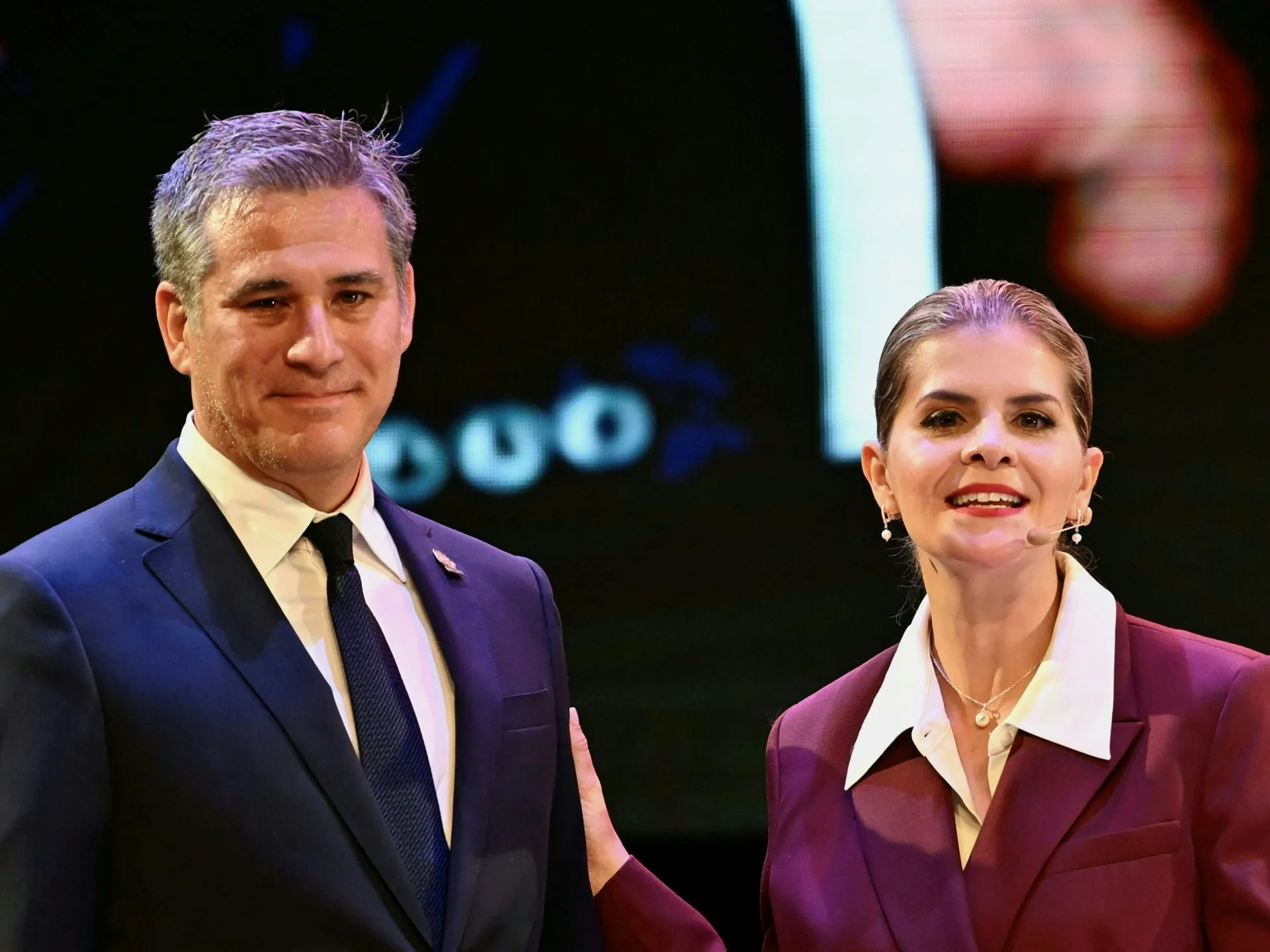
Rights groups accuse the UN of hosting a “war criminal” as delegations walked out during Netanyahu’s speech.
Published On 25 Sep 202625 Sep 2026
Police arrested about 100 protesters, including actors and politicians, outside the United Nations headquarters in New York, as demonstrators rallied against Israeli Prime Minister Benjamin Netanyahu ahead of his address to the UN General Assembly.
Among those arrested were Oscar-winning actor Susan Sarandon, Emmy winner Hannah Einbinder, Democratic congressional candidate Darializa Avila Chevalier and New York City Council member Chi Osse.
Recommended Stories
list of 3 itemsend of list
The protest, organised by the advocacy group Jewish Voice for Peace, drew about 200 people wearing identical white T-shirts printed with slogans including “Fund people not bombs”, “No war” and “Free Palestine”.
Protesters blocked traffic, and after police ordered them to leave over loudspeakers, some moved to the sidewalks. Officers then surrounded the protesters who remained seated on the pavement, chanting “Netanyahu go to hell”. The demonstrators were then escorted to police buses.
“What’s being done to Gaza, the obliteration of an entire society, in our name, with our tax dollars, this is our responsibility to speak out against, and Netanyahu has no right to use the platform of the United Nations to justify these atrocities,” said protester Manijeh Moradian, a 50-year-old university professor of Iranian and Jewish heritage.
Inside the UNGA, Netanyahu took the stage to defend Israel’s actions in the Middle East as he sought to counter growing international isolation ahead of Israel’s upcoming elections, while dozens of delegates streamed out of the hall.
Separately, pro-Palestine protesters gathered on the steps of the New York Public Library in Manhattan, waving Palestinian flags and carrying banners reading “New York rejects Zionism” and “Palestine deserves freedom”.
Rabbi Yitzchok Deutsch, a representative of Neturei Karta International, said Netanyahu was “using our religion, our identity, to justify all these crimes”.
Deutsch sent a message of gratitude to New York City Mayor Zohran Mamdani “for his courage to do whatever he can to arrest” Netanyahu.
Protester Melissa Zuniga questioned why Netanyahu was allowed to speak at the UN “when he has an international warrant for his arrest”.
Last week, NASA Administrator Jared Isaacman cryptically teased plans for a new high- and fast-flying X-plane with a silhouette of an aircraft that immediately drew comparisons to the famed SR-71 Blackbird as a backdrop. In our report, we looked at what it could mean, including the possibility of reviving the SR-71, or at least using it to inform or even cobble together a new airframe. Now it turns out that an SR-71 that had been on display at NASA’s Armstrong Flight Research Center for years is suspiciously missing.
Steve Trimble, Aviation Week‘s defense editor and friend of TWZ, was first to report the disappearance of the former NASA SR-71, also known by the tail number 844, at Armstrong. That facility is collocated with Edwards Air Force Base in California. Trimble’s piece says that satellite imagery shows the jet has not been seen since at least May 17. The aircraft in question, which originally carried the U.S. Air Force serial number 61-7980, was the last Blackbird produced and the last one to fly, taking to the skies for the final time in 1999.
A satellite image taken in 2018 showing SR-71, tail number 844, on display outside of the Armstrong Flight Research Center in California. Google Earth
“The current disposition of the aircraft is unclear, but Aviation Week sources suggest that the aircraft was moved into a hangar earlier this year for an inspection,” according to the story. “The presentation and the disappearance of the display SR-71S with the 844 tail number for NASA raises the possibility of a return-to-flight program after a more than 26-year-long hiatus.”
Another look at SR-71 tail number 844 during its service with NASA. This picture was taken on October 31, 1997, during a flight in support of the NASA/Rocketdyne/Lockheed Martin Linear Aerospike SR-71 Experiment (LASRE). NASA
The presentation mentioned above is the one NASA’s Isaacman gave last week at the annual All-In Summit in Los Angeles, California, during which he shared the SR-71-esque silhouette.
“In the service of the first A [aeronautics] in NASA, we are rebuilding our X-plane fleet. The X-59 is researching quiet supersonic flight, but it’s just the beginning,” he said at that time. “As NASA recommits to flight test and works alongside industry to push the boundaries of airframe and propulsion design, it will not be long before NASA once again is flying as high and as fast as we had in decades past, and then even more.”
Isaacman has made expanding NASA’s X-plane fleets a top priority since taking charge of the agency last year.
“You sure that’s a Blackbird?” the NASA administrator said during a live interview that immediately followed his remarks after the image was brought up, but did not offer any further clarification.
NASA Administrator showed this image during a presentation last week while talking about plans for new X-planes. NASA
“NASA has a long history of building and flying experimental aircraft that push the boundaries of what is possible,” NASA told TWZ directly when asked for more information. “As Administrator Isaacman has said, we want to see more X-planes flying in the years ahead, developing the technologies that will allow us to fly higher, farther, and faster than we have in decades. We look forward to sharing more as those efforts progress.”
We have reached back out to NASA in light of Aviation Week‘s report.
“As for bringing a Blackbird back into operation for high-speed testing, which is now at the forefront of military aeronautics (and civilian to a lesser degree) after decades of being sidelined, that would be a very challenging operation. The SR-71s are long retired and have been placed in museums and other display areas. While the Pentagon could technically claw some of them back from their ‘on loan’ status, reconstituting even one of them would be a major undertaking as the entire support ecosystem that once sustained them has been gone for decades. Still, having a Mach 3+ capable jet for testing would be a highly relevant tool in a new age of high-speed flight exploration.”
“On the other hand, building a new test aircraft that aims higher and faster than the SR-71, but may be based on its ‘DNA,’ is certainly possible. Such an aircraft could leverage material science, avionics, flight controls, and engines that are seven decades more modern than its progenitor. Technology demonstrators in this class could also already exist in the classified domain. NASA could possibly assume ownership of one after the Pentagon declassifies it, as well.”
“Regardless of how such an exotic aircraft is obtained, one of the biggest differentiating factors could be that a NASA aircraft is piloted by a human onboard, instead of it being a drone, but an uncrewed aircraft is possible too.“
Aviation Week‘s report today notes that tail number 844 would probably be the best available candidate for returning to flight status. In addition to being the last produced and the last to fly, NASA previously upgraded it, including with “an automated digital flight and inlet control system to virtually eliminate the Blackbird’s problem of violent engine unstarts at high speed.” It has also been sitting in a controlled area in the Mojave Desert that is great for preservation.
SR-71 LASRE in Flight over California’s Mojave Desert
It is also worth pointing out here that Isaacman is personally aware of the time and resources it takes to reconstitute high-end vintage military aircraft. He founded private ‘red air’ aggressor firm Draken International, making him once the owner of the world’s largest private air force stocked with old jets. His own private collection includes a demilitarized, ex-Ukrainian two-seat MiG-29UB that he flies regularly. He has also been working to restore a former Royal Air Force swing-wing Panavia Tornado F2 interceptor, which would be the most complex private military jet flying, if or when it returned to working condition.
At the same time, the SR-71 is in a completely different category, having been the very definition of a high-demand, low-density asset even at the very peak of its service life with the Air Force. Only 32 of these jets were ever built, and they were notoriously complex and expensive to operate and maintain. The aircraft’s Pratt & Whitney J58 turbojets ran on JP-7 fuel that is no longer in regular production. After 9/11, the possibility was raised of returning a Blackbird to service to support the Global War on Terror, but doing so was projected to cost between $40 and $45 million – and that was just two years after 844’s last flight.
There is also a possibility, in line with Isaacman’s comments last week, that 844 could re-merge in a substantially different, reworked form. There is even the potential it could be retrofitted for uncrewed, or at least pilot-optional, flight. Any such conversion effort would also be a major undertaking, as would sustaining the resulting bespoke jet. As we noted earlier, NASA could also use the SR-71 at Edwards to help inform other future designs.
At the same time, maybe this is all a coincidence and the SR-71 in question is getting some other form of TLC, but its months-long absence is certainly a curious development in light of the current push for new X-planes under Isaacman’s leadership.
David Oyelowo is set to lead the cast in Sky’s new series The Girl with the Dragon Tattoo, alongside rising star Viola Prettejohn, who is known for playing young Princess Elizabeth in the sixth season of The Crown.
The eight-part Sky Original is adaptation of Stieg Larsson’s bestselling Millennium novels. It could be perfect for viewers who enjoyed shows such as The Fall and The Capture, with a dark mystery, complex characters and a dangerous investigation at its heart.
David, who is known for his roles in Selma and Interstellar will take on the role of investigative journalist Mikael Blomkvist. Viola Prettejohn will play Lisbeth Salander, the brilliant but troubled hacker at the centre of Larsson’s story.
The story follows Blomkvist as he is hired by wealthy businessman Henrik Vanger to investigate the disappearance of his niece Harriet.
Harriet vanished more than 30 years earlier from the Vanger family’s isolated island home, but Henrik remains convinced that a member of his own family was responsible.
Blomkvist soon teams up with Salander, an exceptionally talented hacker with a complicated past and a fierce determination to uncover the truth.
Together, they begin to uncover secrets buried within the Vanger family, leading them towards a far more dangerous mystery than they initially expected.
The new adaptation will bring Larsson’s story into the modern day, exploring themes including power, misogyny, secrecy and technology.
The original Girl with the Dragon Tattoo novel was published in 2005 and went on to become an international bestseller. The Millennium books have sold more than 100 million copies worldwide and have already been adapted for both Swedish and English-language audiences.
The first English-language film adaptation was released in 2011 and starred Daniel Craig as Blomkvist and Rooney Mara as Salander, with David Fincher directing.
The new Sky series will offer a fresh interpretation of the characters and story for a new audience and it comes from Left Bank Pictures, the production company behind The Crown and The Day of the Jackal.
Meghan Lyvers, Managing Director, Scripted Originals, Sky, said: “Lisbeth Salander and Mikael Blomkvist are two of modern fiction’s most iconic and compelling characters, and we’re thrilled to have Viola and David bringing them to life for a new generation.”
She added: “Our brilliant writing team, Reinaldo Marcus Green’s bold vision and our fantastic partners at Left Bank Pictures are creating a series that honours everything audiences love about The Girl with the Dragon Tattoo, while taking its characters, mystery and themes into a world that feels unmistakably of the moment. We can’t wait for audiences to experience it.”
Filming is due to begin in Lithuania next month, with the series set to air on Sky and NOW in the UK and Ireland, as well as Sky platforms across Italy, Germany, Switzerland and Austria.
A stunning new poll showing Los Angeles City Councilmember Nithya Raman gaining a double-digit lead over incumbent Karen Bass in the mayor’s race is increasing pressure on Bass and her allies to go sharply negative against her opponent and to seek support from conservative and undecided voters to narrow the gap.
The poll, conducted by the UC Berkeley Institute of Governmental Studies and co-sponsored by The Times, showed Bass trailing Raman by 11 percentage points — with 28% of likely voters saying they supported the mayor while 39% said they would vote for Raman. The remaining 33% were undecided, an unusually high number this close to the Nov. 3 election.
“The bottom line is this is a huge shot in the arm politically for Raman — and it’s not a good day for the mayor,” said Zev Yaroslavsky, a former L.A. City Council member who now runs the Los Angeles Initiative at the UCLA Luskin School of Public Affairs.
Dan Schnur, a former Republican political consultant, said the poll could have instant negative effects for the mayor’s fundraising ability as potential supporters might now view Raman as the favorite in the race.
“The most immediate tangible result of a poll like this is that Bass’ greatest advantage was her fundraising and it now becomes much more challenging to raise money,” he said.
Bass, appearing Wednesday at a news conference in Hollywood, said she’s seen multiple polls that show a tight race. She said that Raman is “absolutely not” the front-runner in the race.
Mayor Karen Bass speaks at Vermont/Santa Monica Metro Center on Wednesday, touting progress on construction of affordable housing.
(Kayla Bartkowski / Los Angeles Times)
The mayor said she is working to highlight the city’s progress in making rent more affordable, pointing to newly released numbers that show that more than 10,000 units of housing with restricted rents have been built since she took office in December 2022.
“The No. 1 issue to Angelenos continues to be lack of affordability, and our primary way of addressing that from the city is housing,” she said. “So we are absolutely addressing affordability.”
Others in the Bass camp seemed more anxious about the poll results.
“It put a pit in stomachs,” said one supporter close to the Bass campaign who requested anonymity to speak candidly about the poll. “But there is still an outside chance for Bass. It’s not total doomsday.”
The supporter said that the Bass campaign truly doesn’t believe Raman’s lead is that big, but that the poll was still “not good news,” especially for fundraising.
Mike Bonin, a progressive former L.A. City Council member who now runs the Pat Brown Institute at Cal State Los Angeles, said Bass needs to focus on winning over voters who chose former reality television personality Spencer Pratt in the primary election in June. Many of those voters are now on the fence.
Pratt received 26% of the vote in the primary, and most of the voters who cast ballots for him — 63% — say they still haven’t decided whom to vote for in the runoff, the poll found. Among the Pratt voters who have decided, 22% favored Bass compared with 16% for Raman.
Bonin said he expects Bass and her allies to attack Raman’s progressive views in order to reach Pratt voters. Raman is a member of the Democratic Socialists of America and opposed raises for Los Angeles Police Department officers that had been championed by Bass.
“The nature of the attacks will try to reach the Pratt voters particularly since they are the largest bloc of undecideds and they skew conservative,” Bonin said.
The Los Angeles Police Protective League, the union representing LAPD officers, is already airing campaign ads critical of Raman over her opposition to a law barring homeless encampments next to schools. In the coming days, the group will also roll out commercials highlighting Raman’s ties to the DSA, which has endorsed her mayoral bid, said union spokesman Tom Saggau.
“Our own poll told us that the Pratt folks were very much undecided, and that when they heard more about Nithya’s record, and her co-governing with DSA, they moved off of her,” he said, adding that his group still views the race as a dead heat.
Raman, not surprisingly, cheered the poll results.
“This poll reflects the momentum we’re seeing on the ground. Angelenos are ready for change and want to see a City That Works,” Raman said in a post on Instagram.
Raman campaign officials said the poll probably will help their fundraising efforts, which they said had already been gaining momentum over the last few weeks. And Schnur, the former GOP political consultant, said the wide lead allows Raman to spend more time touting her own credentials instead of disparaging Bass.
“For the most part Raman has the front-runner’s luxury of putting out a positive message and reinforcing her own credentials,” Schnur said.
Estevan Montemayor, who is running the pro-Raman Estamos con Nithya independent expenditure group, said his group’s role will be to inform voters about Raman’s positives while the Bass campaign attacks.
“They’re gonna come after Nithya and we’re gonna be here to tell her success story,” he said.
Bass supporter Stuart Waldman, chief executive of the Los Angeles County Business Federation, said the large number of undecided voters this close to the Nov. 3 election is worrying but also leaves an opening for Bass to gain ground.
“Any swing in any direction could make a big change,” Waldman said. “We have no idea who’s going to vote. … Usually by this point in time, everything has tightened up.”
Councilmember Nithya Raman, lower right, campaigns at a Latinos Con Raman rally at La Cita Bar in downtown Los Angeles.
(Genaro Molina / Los Angeles Times)
In courting those undecided voters, however, Bass is burdened by high unfavorability numbers, according to the Berkeley IGS/L.A. Times poll.
The mayor had 63% unfavorable ratings, the poll found, with 28% favorable and 9% having no opinion. By comparison, 40% had a favorable view of Raman, according to the poll, while 39% said they had an unfavorable view of her and 21% had no opinion.
Mike Murphy, a Republican political consultant, said that Bass needs to accept responsibility on core issues upsetting Angelenos about her tenure, such as homelessness and the 2025 Palisades fire, which killed 12 people and destroyed thousands of homes. In a recent interview with The Times, Bass said her biggest mistake as mayor was being in Ghana when the fire began amid high wind warnings.
“You have to say, ‘I hear you,’” he said. “Voters don’t think Karen gets that they are mad about things that happened during her term.”
Then, Murphy said, he believes Bass needs to attack Raman as being more establishment than Bass.
Murphy noted that Bass has frequently attacked Raman for being “at City Hall longer than I have,” which he called a powerful message to voters who are considering Raman because they want change. Raman was elected in 2020 and Bass in 2022.
Other polls taken in the campaign have shown a closer race than the Berkeley IGS/L.A. Times poll.
In an early August poll commissioned by an independent expenditure group supporting Bass, the mayor had the edge, 41% to 35%, with 24% undecided.
Mayor Karen Bass greets community members after speaking at Vermont/Santa Monica Metro Center.
(Kayla Bartkowski / Los Angeles Times)
The Bass campaign cited some of those polls when responding to the Berkeley IGS/L.A. Times poll Wednesday, calling it an “outlier poll” and accusing the pollsters of getting it wrong.
“In the primary … they got it wrong and undercounted Karen Bass’ support,” campaign spokesperson Alex Stack said in a news release.
Stack added that polls conducted online, like the Berkeley IGS/L.A. Times poll, “systematically [undercount] working-class families, seniors, and non-English speaking communities who regularly turn out on Election Day.”
Mark DiCamillo, the director of the Berkeley IGS Poll, defended the methodology, saying he has spent 45 years polling in California and eight years running the Berkeley IGS Poll.
“What would you expect from a campaign down by double digits? They attack the poll,” he said.
During defensive line drills, the Future Hall of Famer continues to go third — even when groups are split — rather than lead.
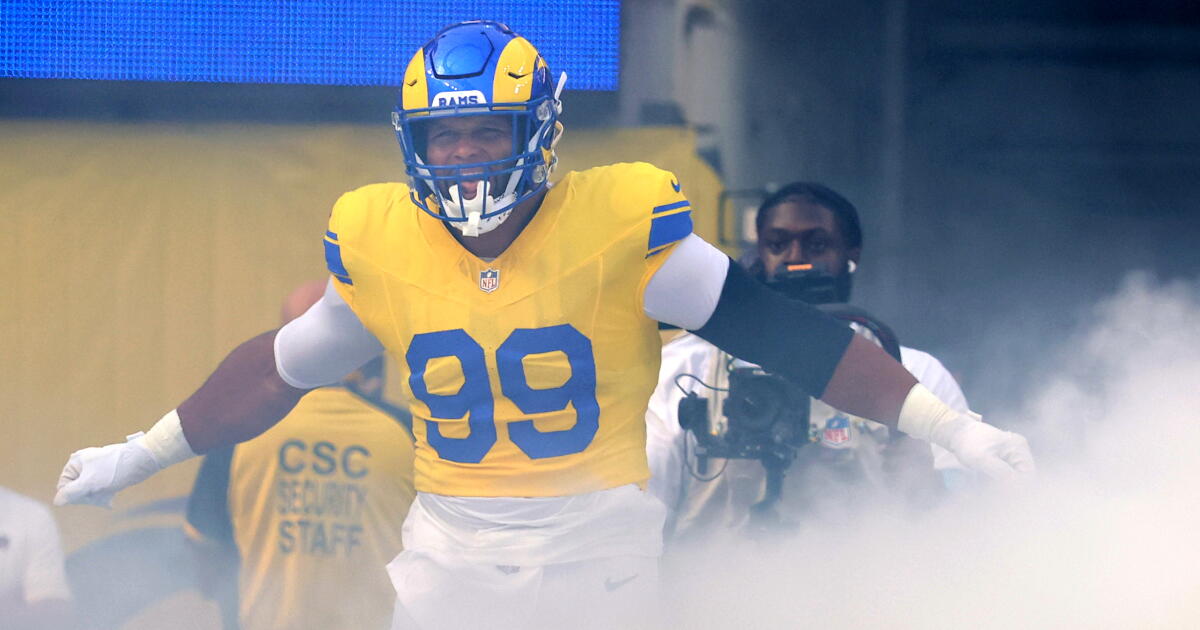
“Earning my keep right now,” Donald said after Rams practice Thursday. “I’m a guy that likes to work and earn everything I get.”
Donald, 35, has one game under his belt after returning from a two-year retirement to rejoin the team that selected the three-time NFL defensive player of the year in the first round of the 2014 NFL draft.
Donald played 33 snaps in the Rams’ 28-6 victory over the New York Giants on Monday. He made three tackles, including one for a loss.
Donald said he watched tape of his performance six times — two times by himself, once with his brother and three more times on his own.
“Not as bad as I thought,” he said. “A lot of things to clean up but on the right track.”
Donald looked “excellent,” defensive coordinator Chris Shula said.
“He was awesome,” Shula said. “He put a lot of pressure on the quarterback, and then you see like some of the run plays … that group as a whole played really tough, played stout, played physical at the line of scrimmage and Aaron was a huge part of that.”
Now, one of the top interior pass rushers in NFL history is preparing for Sunday night’s game against the Denver Broncos in Denver.
Will Donald’s playing time increase?
“Every game is going to kind of tell its own story,” Shula said. “I think we have a general range of where he would be, but I think depending on how the game plays out, you never know how many snaps and the situations that you’re going to be in.
“You never want to put a full hard cap on it.”
Donald is happy with the way his return to game action is playing out.
“We’ve got a good rotation … keeping guys fresh and right now I’m liking it,” he said. “I think it’s at a great pace right now.
“I’m getting my feet wet, get going, get a feel for the game again and other guys are out there working and getting work too.”
Etc.
Rams receiver Puka Nacua (hip), who sat out against the Giants, did not practice for the second day in a row. On Wednesday, coach Sean McVay told reporters he was “not sure” if Nacua would play against the Broncos. Later in the day, he told ESPN radio that Nacua was “not making great progress.” … Tight end Colby Parkinson (knee) and safety Kam Kinchens (hamstring) also did not practice.
Flights operated by Iranian airlines to and from the UAE suspended as part of broader efforts to enforce US aviation sanctions on Iran.
Published On 25 Sep 202625 Sep 2026
The United Arab Emirates has halted flights operated by Iranian airlines, joining several other countries in adopting United States sanctions aimed at pressuring Tehran’s aviation sector.
On Thursday, a statement carried by the Emirati WAM news agency said, “The General Civil Aviation Authority announced the suspension of all flights operated by Iranian airlines to and from the UAE.”
Recommended Stories
list of 3 itemsend of list
It said the decision was “based on the US sanctions imposed on Iranian airlines preventing them from using airports around the world”.
The UAE has joined Oman, Iraq, Azerbaijan, Georgia and Turkmenistan in restricting or suspending access for Iranian airlines amid the new US sanctions threat.
Dubai, the UAE’s commercial hub, is a major destination for Iranian carriers, with multiple daily flights, a large Iranian community and close business links.
An Iran Airtour flight from Tehran to Dubai was cancelled shortly before its scheduled departure on Thursday morning, after tickets had already been issued, according to the AFP news agency.
The UAE, which was repeatedly hit by Iranian missiles and drones throughout the US-Israel war on Iran, suspended trade and financial exchanges with Iran last month.
On Wednesday, the UAE’s central bank blocked transactions involving Iran’s Bank Melli, claiming the financial institution had violated rules on money laundering, terrorism and arms proliferation.
The US Treasury announced sweeping sanctions on Iran’s aviation sector earlier this month, targeting 27 airlines and dozens of companies that support them. The measures aim to cut off Iran’s air links entirely, warning that any airport or company still servicing Iranian carriers risks being cut off from the US dollar system.
Iran’s Civil Aviation Organization spokesman Majid Akhavan said: “Diplomatic and aviation talks are under way to remove the restrictions and restore flights” to the UAE.
Akhavan added that Turkmenistan also turned back a flight from Tehran to Dushanbe on Thursday.
“Turkmenistan’s refusal to allow the Iranian aircraft to pass through its airspace meant the flight could not continue on its route and had to return,” Akhavan told the Iranian IRNA news agency.
Several smaller Iranian airlines continue flying to China and Armenia, both of which have resisted US pressure, while routes to Turkiye remain open for some carriers.
Luiz Inacio Lula da Silva is up 2 points, but that’s still within the poll’s margin of error.
Published On 25 Sep 202625 Sep 2026
Brazilian President Luiz Inacio Lula da Silva has maintained a two-percentage-point lead over Senator Flavio Bolsonaro, his main challenger, in a potential run-off ahead of October’s presidential election, a Datafolha poll has shown.
In poll results released Thursday, Lula would receive 47 percent of the vote compared with 45 percent for Bolsonaro in a simulated run-off. A previous Datafolha poll last week had Lula leading Bolsonaro by 46 percent to 44 percent.
The result also represents a technical tie as it falls within the poll’s margin of error of 2 percentage points.
In a first-round scenario, Lula leads with 40 percent of the vote, followed by Bolsonaro (36 percent), Augusto Cury (5 percent), Ronaldo Caiado (4 percent) and Renan Santos (3 percent).
The previous poll showed the leftist president with 39 percent against the right-wing senator’s 36 percent.
Senator Bolsonaro is the eldest son of former President Jair Bolsonaro, who is serving a 27-year prison sentence for attempting to overturn his 2022 election defeat to Lula.
Lula is seeking a fourth nonconsecutive term as Brazil’s president.
If no candidate wins more than 50 percent of valid votes in the first round, the two frontrunners advance to a run-off.
Datafolha surveyed 2,002 people between September 22 and 23.
Earlier this week, two other polls showed similar results.
A Quaest poll released on Monday showed Bolsonaro with 42 percent of voter support in a potential run-off, versus 41 percent for Lula.
Meanwhile, a BTG Pactual/Nexus poll has Lula receiving 46 percent of voter support, compared with 45 percent for Bolsonaro in a potential run-off.
Sean Gunn has no plans to continue his motion capture role for “Guardians of the Galaxy” character Rocket raccoon.
The physical demands involved in creating Marvel Cinematic Universe’s masked bandit often included the 52-year-old actor being in a catcher’s crouch position, which hurt his ankles and feet due to constant pivoting, Gunn revealed in an interview on “The Brandon Davis Show.”
“I think it had a little bit of an effect on my physiology. My knees are fine, but since I turned 50 a couple years ago, I am retired from playing Rocket,” Gunn said in the podcast episode published Monday. “I don’t think I can do the motion reference anymore for Rocket. I think I’m too old.”
The veteran actor is now ready to pass on his deadly laser cannon to another rising star. Rocket’s creators should “give a younger actor a shot at it, right?” he said.
While actor Bradley Cooper has voiced the small, sharp-tongued creature since the first “Guardians of the Galaxy” film in 2014, Gunn has worked alongside animators behind the scenes to capture the subtle actions with motion capture technology, or mocap, which animates 2D or 3D computer characters using the actor’s physical movements.
Gunn described the process as a relay race in a 2024 interview with Adam Lupis; once a script is handed to him, he passes the baton to the visual effects team, who then tie it all together with Cooper’s voice acting.
“Rocket is sort of a character by committee in that way. I think he’s a good microcosm for movies where they get this whole community of people coming to make something with love and care,” Gunn shared in the interview with Lupis. “It’s been a crazy process.”
Alongside his role as on-set Rocket, Gunn also portrayed Ravager Clan space pirate Kraglin Obfonteri in “Guardians of the Galaxy”; its two sequels, “Vol. 2” and “Vol. 3”; “Avengers: Endgame”; and “Thor: Love and Thunder.” Rocket also appeared in 2018’s “Avengers: Infinity War.”
Actors Hannah Einbinder and Susan Sarandon were among scores who were arrested Thursday in New York City as they protested an appearance by Israeli Prime Minister Benjamin Netanyahu before the United Nations General Assembly.
According to an Instagram video by Jewish Voice for Peace, one of the organizers of the demonstration, more than 100 individuals were arrested for blockading the U.N.
“Netanyahu out of New York!” Einbinder shouted as officers took the “Hacks” star into custody.
The 31-year-old Jewish actor has been a critic of Israel’s war in Gaza; last year, when receiving the Emmy Award for supporting actress in a comedy series, she concluded her speech by saying, “Go Birds, f— ICE and free Palestine.” “Birds” was in reference to the Philadelphia Eagles. Einbinder is a big fan.
Other well-known faces were spotted among demonstrators. Actors Cynthia Nixon, Elliot Page and Indya Moore were there, as well as comedians Mary Beth Barone, Caleb Hearon and Sarah Sherman and musicians Lucy Dacus and Julien Baker, according to multiple online reports.
As numerous delegates exited the room, Netanyahu called out: “If there are any other moral cowards who have not yet left the hall, please do so now.”
In his defiant speech, the Israeli leader denied allegations that the country was committing a genocide in Gaza, calling it “the biggest lie of the century,” and he asserted Israel’s right to wage war against Iran.
The Israel-Hamas war began on Oct. 7, 2023, when Hamas-led militants attacked Israel, killing around 1,200 people and kidnapping 251. Israel’s military operations have since killed at least 73,922 Palestinians, according to the Gaza Health Ministry.
In October, Israel and Hamas agreed to a ceasefire. However, Israel continues to carry out airstrikes in Gaza near military-held zones.
Ahead of Netanyahu’s visit, New York City Mayor Zohran Mamdani labeled the world leader a “war criminal” in a public video, stating that his office looked into enforcing a 2024 arrest warrant issued by the International Criminal Court if Netanyahu visited the city.
However, in that same video, Mamdani acknowledged that the city did not have the authority to enforce the warrant, instead calling on the federal government to act.
In his U.N. speech, Netanyahu addressed Mamdani, saying: “You tried to stop me from coming here. You tried to silence me. Well, you can’t silence me, you can’t silence the truth. Here’s the simple truth, Israel didn’t commit genocide. Israel prevented genocide.”
Stars, local lawmakers and activists protesting outside the U.N. chanted “Free Palestine” and “Netanyahu, you can’t hide, we charge you with genocide.” While police arrested some members in the crowd, individuals called out: “The whole world is watching.”
The AFL Grand Final is an annual Australian rules football match. It is traditionally held on the final Saturday in September to determine the Australian Football League champions for that year.
The final takes place at the Melbourne Cricket Ground (MCG) in Melbourne, Australia. The holiday gives a chance for opposing fans to gather in a holiday atmosphere before the big game.
The day also provides a chance for fans to get up and close to the players as the teams involved in the final take part in the AFL Grand Final Parade in Melbourne. The parade, which has been a pre-game tradition since 1977, starts from the Old Treasury Building and ends at the AFL Grand Final Live Site near the MCG in Yarra Park.
Australian rules football is the most popular sport in Australia. It was invented in Melbourne in 1858 and is a combination of soccer and rugby resulting in a contact sport similar to Gaelic football.
As far as we know, Victoria is the only region in the world that celebrates not one, but two sporting events as public holidays. In addition to AFL Grand Final Eve, Victoria also observes a holiday for the Melbourne Cup horse race, which takes place in early November.
Public transport services will operate to a Saturday timetable, but some services may be altered or will not run.
They mentioned “The Odyssey,” they talked about “Lord of the Rings,” they referenced “The Hobbit,” they cited the hero’s journey, they predicted a season filled with mythological tales of triumph.
What they didn’t promise was that their Lakers’ team would contend for a championship.
What they couldn’t mention was what will happen to them if they don’t.
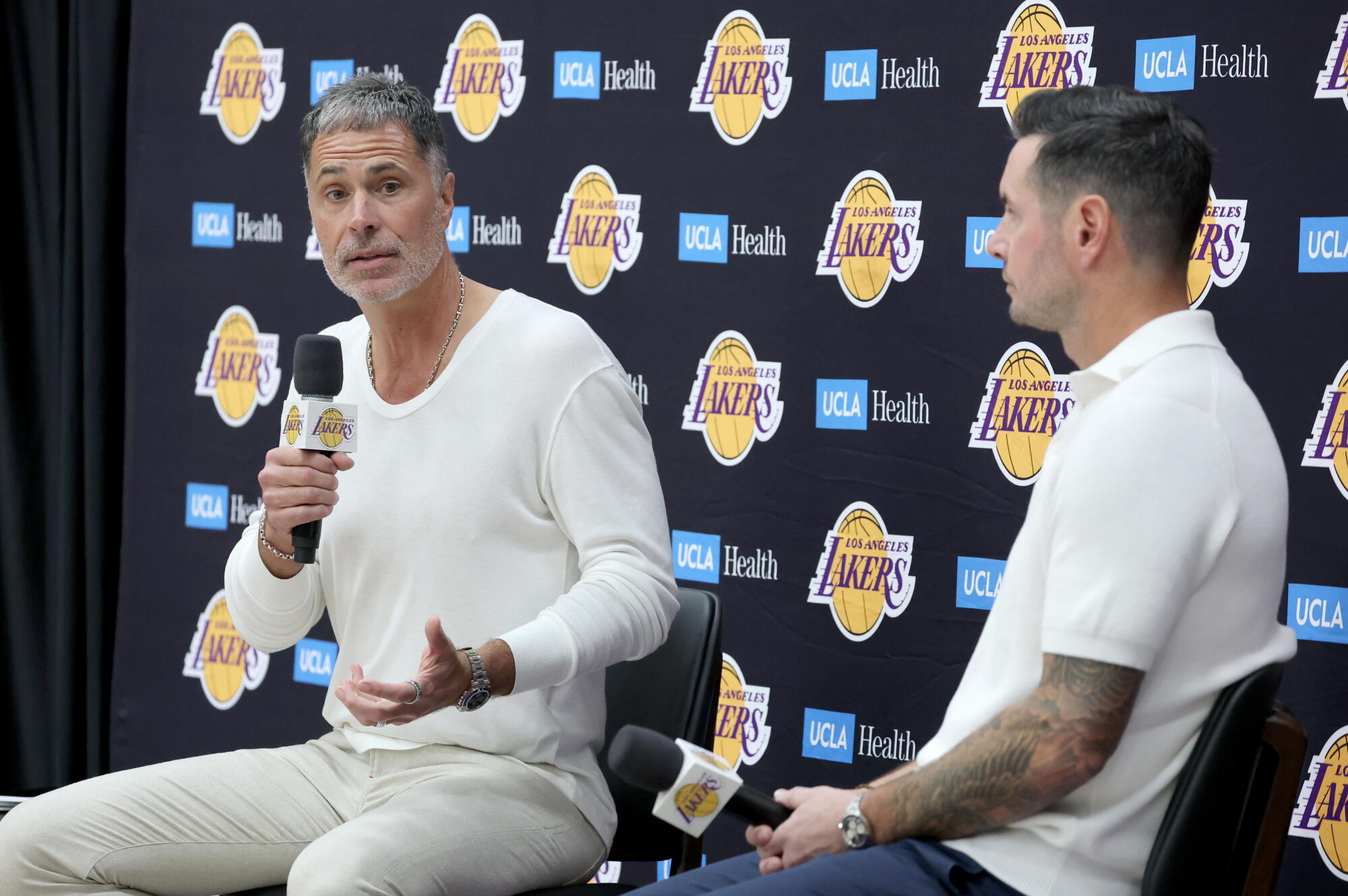
In their annual pre-training camp news conference at their practice facility Thursday, Pelinka and Redick talked about fictional characters perhaps because the reality is too grim for words.
Their jobs are on the line with a rebuilding team that might not be good enough to save them, and no amount of cute Gandalf references can change that.
With new ownership, the Lakers’ braintrust no longer has the protection of the benevolent Buss family or the baseball-centric Mark Walter.
Here’s guessing Bob Iger and Joshua Kushner will want any excuse to put their own people in charge of their $12.5-billion investment. And if this clearly rebuilding Lakers team doesn’t quickly measure up to the brand that Iger and Kushner purchased, they’ll have that excuse.
In his nine full seasons as the Lakers’ basketball boss, Pelinka constructed the 2020 bubble championship team, but destroyed it soon thereafter and hasn’t won since.
In his two seasons as Lakers coach, Redick became the first Lakers coach to win 50-plus games in consecutive seasons since Phil Jackson. But Redick was always LeBron James’ choice, and now that James is gone — thank goodness! — Redick will have to prove himself all over again to the new guys.
He’s already off to an awkward start considering his answer to a question about who would join Luka Doncic, Austin Reaves and Walker Kessler in the starting lineup. He referenced the lame internet criticism that the Lakers couldn’t win because they were now led by too many white guys.
“I’m pretty confident in three of the spots,” he said. “The other two spots will not be two white guys.”
Um, OK.
Redick acknowledged that all those new potential starters — Quentin Grimes, Collin Sexton, Kevon Looney, Matisse Thybulle and others — can band together to turn this season into a mythological masterpiece.
“Part of the Hero’s journey is allies and gods,” he said, referring to stories about ordinary folk who are transformed by triumphant adventures. “And so I think if you look at “Lord of the Rings,” right? All the guys from “The Hobbit,” those guys had to be connected. They had to embrace the fact that they were allies, right? … You’re not gonna get through the journey without that. Or the journey’s gonna be even more tumultuous than it is because the reality is there will be ordeals and trials along the way.”
At this point Pelinka jumped in, saying, “So I’m a big Tolkien guy. Are you Samwise or Frodo?”
Answered Redick, “Uh, I’m simultaneously Samwise and Gandalf.”
Replied Pelinka: “Gandalf. That’s even better.”
Rob Pelinka (left), the Lakers general manager/president of basketball operations, speaks to the media with coach JJ Redick on Thursday at the team’s training facility in El Segundo.
(Allen J. Schaben / Los Angeles Times)
In San Antonio they’re talking about Wemby, in Oklahoma City they’re talking about SGA, and in Los Angeles they’re talking about … Frodo?
Tumultuous indeed. Welcome to life after LeBron, with Pelinka essentially starting the news conference by answering the biggest question of the summer — why did the James and Laker marriage fail?
Except he didn’t answer it.
“I’m so thankful for the partnership that we had that continued up until this summer when a decision was made for him to play for another team,” he said.
A decision was made by whom? James said it was him. It says here it was the Lakers, who needed to move him out if they were going to move ahead.
Pelinka didn’t elaborate, instead focusing on a popular reference that he sort of botched.
“We’ve talked about every season is a little bit like ‘The Odyssey,’ if anyone has seen the movie,” he said before someone corrected him. “Oh, it was actually a poem. Fair enough.”
The poem wasn’t this complicated.
“You launch a season, and there’s things that happen throughout that you can’t predict, but you have to stay together as a group and stay strong,” Pelinka said. “That’s a great theme for us.”
Pelinka will be going through his own Odyssey this season, as evidenced by his defense of his accomplishments.
“If you look at the teams that we’re wanting to go shoulder-to-shoulder with, the Thunder and the Spurs maybe in the West. … They had to lose many seasons to get high picks and we just don’t have the luxury of that here,” he said. “Again, the expectations are every year (to) win, get in the playoffs, make a run, and so we feel like we’ve been able to do that. As I’ve started, since I’ve been here in the leadership position, we’ve been a playoff team and we have to continue to do that.”
Redick was also playing defense, saying, “No one is a championship-level team on September 29. There’s not a team in the league that is a championship-level team. That is an ongoing process throughout the year. Rob talks about his job in that. Well, I have a job in that. Our players have a job in that. I’m confident we’re gonna develop as a team into a championship-level team this year. “
This season will live forever in Lakers folklore if they do.
There could be a medieval bloodbath if they don’t.
About 100 people, as well as cargo, were reportedly on board the vessel when it sank on Lake Tanganyika.
Published On 25 Sep 202625 Sep 2026
At least 41 people have died, and 49 others have been rescued, after a boat capsized on Lake Tanganyika in the Democratic Republic of the Congo (DRC).
Norris Mulongoyi, the provincial transport minister for DRC’s Tanganyika province, told The Associated Press news agency that search operations were under way to locate the remaining passengers.
Recommended Stories
list of 3 itemsend of list
The boat was reportedly carrying about 100 people and cargo when it capsized near the Congolese village of Mapera.
The vessel was travelling from the port of Kigoma in Tanzania to the city of Kalemie in DRC when it sank on Thursday.
A survivor identified as Annie Moyoni told Radio Okapi, a UN-backed Congolese broadcaster, that passengers were awakened at about 1am and found the boat tilting to one side.
It is unclear what caused the vessel to capsize, but hundreds of people have been killed in boat disasters in the DRC in recent years, according to the AP. Vessels are often overloaded and lack life jackets.
For many in the DRC, travelling by boat is the cheapest and most affordable way to get around. The country is one of the poorest in the world and lacks sufficient infrastructure for its more than 100 million people.
The sinking was the second loss of a Congolese vessel on the Kigoma-Kalemie route in less than a month.
On August 28, the Congolese vessel MV Pacifique caught fire and exploded at the port of Kigoma while loading fuel, according to Radio Okapi.
Six crew members were killed, and a seventh was reported missing, Radio Okapi said, citing port authorities. The vessel operated between Kigoma and Kalemie and was used to transport fuel.
At least 20 people also died when a wooden boat carrying students returning from state exams sank in central DRC in July.
DR Congo beat Equatorial Guinea, while Ivory Coast cruise by Ghana and Cameroon beat Comoros as AFCON qualifiers begin.
Published On 24 Sep 202624 Sep 2026
The Democratic Republic of the Congo followed up their World Cup exploits with a 2-0 home win over Equatorial Guinea on the opening day of the group qualifiers for next year’s Africa Cup of Nations.
Captain Chancel Mbemba headed home the opening goal in the fourth minute, and Yoane Wissa added a second 18 minutes from time in Kinshasa on Thursday, although the scoreline might have been more emphatic after they twice struck the woodwork and also had two efforts ruled offside.
It was the first game for the Congolese after advancing through the first phase of the World Cup for the first time and running England close in their last-32 tie in Atlanta in July.
However, there was no opportunity for home supporters to celebrate their achievement as the size of the crowd at the Stade des Martyrs was restricted to 20,000 after sanctions for fan violence that followed defeat by Senegal in World Cup qualification one year ago.
Mauritania and Namibia were also winners in Thursday’s early games, while Libya netted a last-gasp penalty to salvage a 2-2 draw at home to Botswana behind closed doors in Tripoli, where the stadium was also banned because of previous supporter violence.
Botswana striker Tumisang Orebonye scored a double in the first half to put his side on course for a rare away win before Maruwan Alhibeeshi thrashed home from the edge of the area to pull one back in the 87th minute.
Botswana substitute Mothusi Cooper gave away a stoppage-time penalty with a clumsy challenge, allowing Ezoo El Mariamy to rescue a draw.
Mauritania won 3-1 over the Central African Republic in Casablanca, Morocco, which included a superb chipped effort over the goalkeeper from Dawda Camara, while Bethuel Muzeu scored the only goal as Namibia edged Congo.
Ivory Coast beat Ghana 2-0 in a derby in Bouake in a Group C encounter.
A stunning strike from Malick Yalcouye opened the scoring from outside the box in the first half, although the Ghana keeper, Lawrence Ati-Zigi, will feel he should have done better at his near post.
Franck Kessie gave the Black Stars stopper no chance as he sent his opponent the wrong way with a side-footed second-half penalty.
Ghana, who failed to qualify for the 2025 edition of AFCON, are left to reflect on a match where they failed to register a shot on target until the 75th minute. They also conceded 61 percent of possession to their hosts.
Cameroon beat Comoros 3-1, while Tunisia were held to a 1-1 draw by Uganda in the pick of the other ties.
NOTHING But Thieves have spent the past decade playing arenas and huge festivals around the world.
But it’s been coming home to play to smaller crowds that’s reminded them just how far they’ve come.
The band in a photo shoot for their fifth album, Stray DogsCredit: UnknownJames Price, Dom Craik, Conor Mason, Philip Blake and Joe Langridge-Brown grew up together
On Saturday, the Essex band played three gigs in three countries to celebrate the forthcoming release of their fifth studio album, Stray Dogs.
“Sweaty and close enough to see everybody’s faces,” is how frontman Conor Mason described the final gig of the day at Camden’s Underworld following earlier gigs in Netherlands and Belgium.
Sign up for the Showbiz newsletter
Thank you!
“In London, there was nowhere to hide. You can feel every flaw, every moment of tension.
“The whole day was about letting a little chaos back in and seeing what survives when we take it back to the bigger rooms.”
The whirlwind day followed the band’s homecoming show at Chinnerys in Southend earlier in the month, which reminded the five-piece of the journey they have been on.
“When you see that in your home town, it’s quite bizarre,” says Mason. “It makes you appreciate how far we’ve come.”
For guitarist Joe Langridge-Brown, it led to a moment of reflection outside the venue, right on Southend’s seafront. “I was just looking out at the estuary at one point, thinking, ‘This is f***ing mental’,” he says.
I meet Mason and Langridge-Brown in their East London local where they are enjoying a quiet day at home before the new album is released.
Performing in the Netherlands earlier this monthCredit: EPANothing But Thieves say returning home to play smaller crowds has reminded them how far they have come after a decade of performing at arenas and huge festivals around the worldCredit: Unknown
Taking a sip from his pint, Langridge-Brown says that whenever they started working on previous albums, they always asked each each other what Nothing But Thieves actually sound like.
But on this new album, the band deliberately tried to capture their live sound rather than making a record and then figuring out how to play it live.
Guitarist/lyricist Langridge-Brown says: “Every record, we’ve always been trying to reinvent ourselves.
“But I feel like we’ve answered the question — I know what we are in 2026.
“I feel like now we’ve done it with this album. It’s like a foundational reset.
“In a way, it’s not going back to roots. It’s figuring out what they always were.”
That confidence extended to the studio, with guitarist and keyboardist Dom Craik taking the lead on production while the band retained creative control.
“Dom produced the record, but we controlled the record,” says Langridge-Brown.
“If you’ve written a record that is meant to sum up how you sound live, no one knows how we sound better than we do at this point.”
With Stray Dogs, Mason and Langridge-Brown said they also wanted to rebel against the short attention spans of their fans.
Mason says: “You’re told all the time by your label and just by the world that if you don’t make something within the first five seconds that someone’s going to love, they’ll move on to the next thing.
“We’ve made something specifically quite slow in moments and intentionally long-form.
“If people want to get it, they have to sit and really listen to it.
“That’s how you listen to albums. Like the first time you listen to [Pink Floyd’s] The Dark Side Of The Moon, it was from start to finish.”
“Not that it’s as good as that record,” interjects Langridge-Brown. “I just want to get that clear for everyone.
“I don’t want people to only listen to a song for five seconds — it’s our job to try and buck this trend.”
He continues: “This is definitely the best quality of work we’ve created. There’s a lot of attention to detail on this record.
“When you listen to it, it runs as a Nothing But Thieves show — the track list is a set list. We’ve taken crowd noise from our own shows and put it within the record.”
That attention to detail was also important for the album’s lyrics, with the band turning their focus closer to home rather than looking at the wider world.
“Moral Panic and Dead Club City were both very outward-looking,” Langridge-Brown says.
“With Moral Panic, I was basically studying Twitter and seeing this moral panic, this fear and anxiety spread.
“Then Dead Club City was almost the continuation of it, looking to the future.
“So this was, like, ‘OK, let’s not look outwards for now. Let’s look inwards and see what’s in our world and what we’ve created’ — on a bit more of a personal level.”
The first song written for the album was the intense, heavy-guitar title track.
“Stray Dogs was the first song and the lyrics were great,” he continues. “We were like, ‘This feels right. This feels like where we’re heading’.”
Elsewhere on the album, the band push that experimentation in different directions. On Baby Kool (Evelyn), they deliberately throw different sounds together.
“It’s got a glam verse and then it goes into this really grungy Sonic Youth chorus,” says Langridge-Brown.
“Those two worlds don’t naturally mix, but sometimes that’s where the magic is.”
Other standouts include the cinematic Death In The Backseat, the experimental #5 (Dehumanised) and the emotionally vulnerable If You Don’t Have Someone To Love.
AI.Jesus tackles their unease about artificial intelligence and what it could mean for humanity and creativity.
While Testosterone turns its attention to masculinity, with one of its lyrics inspired by a drunken comment Langridge-Brown overheard at a wedding.
Mason says: “I don’t think we are able to be fully macho, and I wouldn’t want to be.”
A Different Kind Of Happiness brings the record to a close, completing an album deliberately structured like a live show, with Stray Dogs opening the “set” and A Different Kind of Happiness as the finale.
The album was also the first to be written in one focused period rather than while on tour.
“We wrote the whole record in the building across the road and we’d have a drink in here after work,” says Mason. Langridge-Brown adds: “This record was very different in that we wrote it in a five-month period once all the touring was finished. We’d never done that before.
“It was always written on the road before — on the back of a tour bus or in between tours.
“But the touring got so huge and so extensive that we just couldn’t give it the time it needed.
“We’ve written about pack mentality in a negative way before, so I’d say this was probably more about community and the pack in a positive light.
“I think Stray Dogs really sums up what we do and who we are — our world, our crew and the fans. We have our own lives and when we meet up, we make a load of noise together.”
The band’s relationship with their fans comes with a huge sense of responsibility on stage.
“People pay a lot of good money to come and see us,” says Mason.
“If we’re not up to scratch, we make sure we are. It’s important.”
For the singer, this means taking care of his voice, which is central to the band’s sound.
He says: “Early on, I used to go out all the time with the boys and I just ruined my voice.
“A producer gave me a slap on the wrist so now, on tour, I treat myself like an athlete. I look after my body and get as much sleep as I can.
“I’m also classically trained so I look after my voice on stage for that hour-and-a-half.”
“He sounds amazing,” Langridge-Brown adds. “On that last tour, he sounded the best he has in years, which is great.
“The central thread running through all our music is Conor’s voice. As a writer, it’s amazing to have that to write for.”
Despite the success of their previous albums — Dead Club City gave them their first No1 in 2023 — chart positions have never dictated what Nothing But Thieves write.
“We never went out to chase a No1 record,” says Langridge-Brown. And Mason adds: “It wasn’t an intention and it wasn’t that commercial. We just write what we want to write.”
In February, Nothing But Thieves will head out on their biggest ever UK arena tour, returning to The O2 six years after their first headline show at the venue.
“The next day, we were, like, ‘What now?’,” says Mason. “I just want to wake up to my job every day in my life and be, like, ‘This is awesome’.
“There’s a lot of people that don’t get to do this so I feel very privileged.” And with five albums now behind them, the band have enough material to be more creative with their live set, building different moods throughout a show.
Stray Dogs also reflects a band increasingly secure in who they are.
That growing sense of self has been personal for Mason, who says that his thirties have changed his outlook on life.
“I had my 30th birthday and it was almost like the next day, I said to myself, ‘It’s time to grow up now’.
“I want to live my life with real gratitude for what I have and presence for what I have.
“I want to just be who I am as a man here and now and enjoy this.
“That was a really big shift for me.”
The band members all grew up together and while things have changed over the years, their friendship has remained a constant.
“We’re constantly evolving,” says Mason.
Langridge-Brown adds: “If you look at the lyrics throughout our career, change is mentioned a lot. It’s just something that we’re drawn to.
“There can be a bit of an identity crisis, but we are grounded as a band because we were mates first.
“And with success you don’t want to lose that.” Mason adds: “You hear a lot of horror stories about bands who break up almost every album, and it’s just, like, ‘How the hell do they function?’.
“The personal relationships and the working relationships were so, so integral to keep alive and to nurture, and that’s been a real foundation for us.”
That closeness continues away from the band. Four of the five still live within roughly a mile of each other and they still socialise regularly.
“You need to come off tour and have some time to yourself,” says Mason.
“But we still meet for gigs, trips to the pub, football and Wimbledon,” adds Langridge-Brown
“We went and watched Queens Of The Stone Age together the other day and our wives and partners are friends as well.
“It’s still quite tight-knit in that way.”
As our chat comes to an end, it’s clear that enduring friendship has kept the band together, but it hasn’t dulled their ambition.
“Stray Dogs is definitely the best album we’ve made, but I don’t think we’ve made our classic album yet,” says Langridge-Brown.
“That’s kind of the aim still — there’s more in the tank.”
Mason agrees: “I’m really excited to further press this process. We’re not done yet.”
Nothing But Thieves’ album Stray Dogs is out todayCredit: Unknown
The United States began their bid to win an 11th consecutive Presidents Cup by opening up a 3-2 lead over the International team at the end of Thursday’s fourballs matches at Medinah Country Club in Illinois.
Justin Thomas and rookie Jackson Koivun put the first point on the board for Brandt Snedeker’s American team with a resounding 4&3 win over Canada’s Corey Conners and Colombia’s Nico Echavarria.
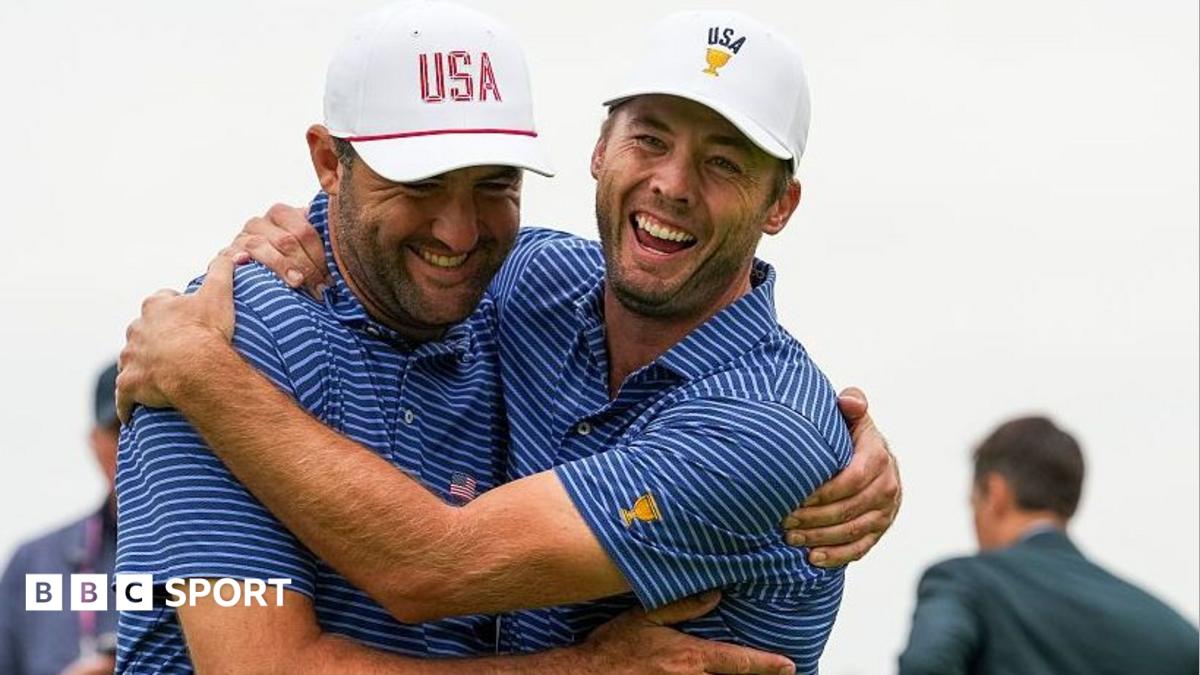
World number one Scottie Scheffler, who was partnered with his long-time friend Sam Burns, took the 17th hole and held on to close out their victory over Min Woo Lee and Sungjae Im, who were left to rue several missed putts down the stretch.
And two-time major champions Wyndham Clark and Collin Morikawa ensured the US would take an advantage into Friday’s five foursome matches.
Clark and Morikawa led from the opening hole against Australia’s Adam Scott and reigning Open champion Ryan Fox before completing their 3&2 success with two holes to spare.
“A session win is a session win; we’re going to take it any way we can get it,” said Snedeker.
However, Geoff Ogilvy’s International side will head into the alternate shot format on Friday with optimism of remaining in contention to claim only their second ever triumph in the biennial contest, some 28 years after their first in 1998.
Japanese duo Hideki Matsuyama and debutant Ryo Hisatsune recorded a 3&1 success over Cameron Young and Xander Schauffele, while Kim Si-woo and Tom Kim always looked comfortable in their 3&2 win over Chris Gotterup and Patrick Cantlay.
The five foursome matches scheduled to take place on Friday will be followed by two sessions on Saturday, split between four four-ball matches in the morning and four foursomes in the afternoon.
All 12 players on each team will then compete in the singles matches on Sunday, with 15½ points required for overall victory.
Laura Fernandez dismissed the foreign minister over his attendance at “Shield of the Americas” meeting in New York.
Published On 24 Sep 202624 Sep 2026
Costa Rican President Laura Fernandez has fired Foreign Minister Manuel Tovar after he attended a US-led regional security summit with United States President Donald Trump without notifying her, an omission the government has said blocked her own participation and caused major strategic harm to the country’s interests.
Fernandez said that she should have been the one to attend the meeting of Trump’s anti-cartel “Shield of the Americas” alliance in New York. The coalition says its mission is to combat drug trafficking and organised crime across the region.
Tovar attended “without giving prior notice or informing” the president, a conservative Trump ally, of his participation, Costa Rica’s government said.
Several right-wing Latin American presidents also participated in the meeting, which took place on the sidelines of the United Nations General Assembly in New York. Fifteen coalition members issued a joint statement declaring their intent to impose asset freezes and visa restrictions and seek criminal liability for members and supporters of 24 criminal organisations.
The gathering was the administration’s latest effort to rally the region behind a more aggressive approach to drug trafficking. Since returning to office last year, Trump has designated cartels as foreign “terrorist” organisations and ordered dozens of strikes on boats in the Caribbean and eastern Pacific that US officials say were carrying narcotics bound for the US.
Costa Rica, a tourist haven that has long been seen as a beacon of stability in Latin America, is grappling with a surge in drug-related violence.
Tovar avoided commenting on his dismissal and simply thanked Fernandez, in power since last May, for including him in her cabinet.
Indiana Trejos, Costa Rica’s current Minister of Foreign Trade, has been named acting foreign minister and will assume the role upon returning from her mission at the UNGA.
Who: Turkiye vs France What: UEFA Nations League Where: Kocaeli Stadium in Izmit, Turkiye When: Friday, September 25, at 9:45pm (18:45 GMT) How to follow: Al Jazeera Sport will have all the build-up from 15:45 GMT.
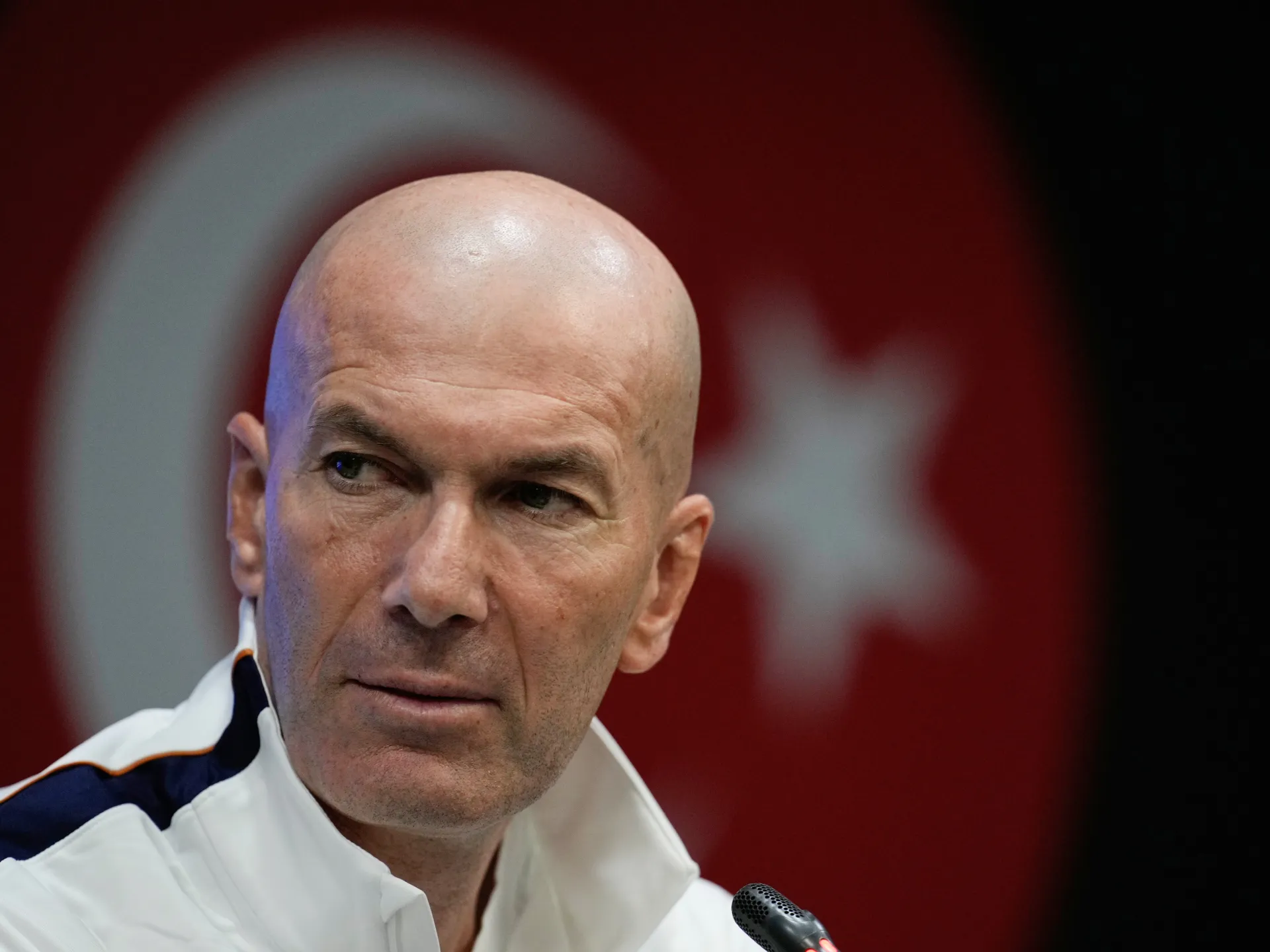
Zinedine Zidane was asked if taking charge of his first France game on Friday will feel just as special as his playing debut for Les Bleus more than 30 years ago.
Recommended Stories
list of 4 itemsend of list
“Even more so, maybe,” a smiling Zidane said on Thursday ahead of a Nations League game in Turkiye. “I feel an immense emotion being at the head of this France team.”
Zidane’s dream was realised when he replaced Didier Deschamps after the 2026 World Cup. His former teammate Deschamps was in charge for 14 years, winning the World Cup in 2018 and losing the 2022 final.
Now it’s Zidane’s chance to make his mark on a team he once starred for.
Affectionately nicknamed “Zizou”, his face was beamed onto the Arc de Triomphe in Paris the night France celebrated its first World Cup triumph in 1998.
Zidane scored two headers in the final in a 3-0 win over Brazil and later that year he won the Ballon d’Or. Two years later, he was instrumental in France winning the European Championship.
His rise to the top seemed almost fated, for his international career began brilliantly in 1994 with two stunning goals against the Czech Republic after coming on as a substitute.
He then won league titles with Juventus and Real Madrid and scored a brilliant volley to help Madrid win the Champions League in 2002.
Zidane understands expectations are high, given his achievements as a player and how he led Real Madrid to three straight Champions League titles as a coach.
“It’s something new. I’m taking over as head coach so people are talking about it,” he said. “That makes sense.”
After facing Turkiye, France plays Belgium away on Monday before hosting Italy on October 2, and Belgium three days later, with both those games at the Stade de France.
Mbappe given all clear for France’s trip to Turkiye
France’s all-time top scorer Kylian Mbappe is set to captain the side, having shrugged off a minor injury.
Zidane was asked why, given that Mbappe is captain, he was not present at Thursday’s pre-match news conference. Instead, it was midfielder Adrien Rabiot who spoke to the media.
“The obligation is to have one player and the coach,” Zidane said. “[Mbappe] is fine. He will be ready to play tomorrow.”
Rabiot is one of France’s vice-captains along with forward Ousmane Dembele and right back Jules Kounde.
Rabiot said the huge attention placed on Zidane gave the players a welcome back seat.
“His aura means he commands a lot of attention,” Rabiot said. “In a way, it’s a good thing that the focus is more on the coach than the players. It gives them a bit more peace and quiet.”
Zidane understands the limelight but does not seek it.
“You have to accept how things are. But I’m not here for that,” he said. “Winning matches is what interests me the most.”
What happened the last time Turkiye played France?
The sides shared a 1-1 draw in Paris in 2019 in a qualifier for Euro 2020.
Olivier Giroud gave the home side the lead in the 76th minute before Kaan Ayhan levelled for Turkiye five minutes later.
Head-to-head
This will be the seventh meeting between the nations, with France claiming four wins to Turkiye’s one in the previous encounters.
Turkiye team news
Turkiye will be without the services of Hakan Calhanoglu and Kenan Yildiz due to injury. Real Madrid starlet Arda Guler, however, is available despite fears of a knock.
Zidane can choose from six new faces in his squad.
Striker Esteban Lepaul (Rennes), defenders Leny Yoro (Manchester United) and Jeremy Jacquet (Liverpool), midfielder Lucas Da Cunha (Como), Andy Diouf (Inter Milan) and Guillaume Restes (Toulouse) are set for their debuts.
“I’m happy with what I’ve seen so far. The French team is open to everyone,” Zidane said. “We’ve got a good squad, some veterans, some newcomers.”
Finley Tapp has been hit by backlash after he slammed a florist for a £20 bouquet they made him – dubbing it ‘pathetic’Credit: finley__tapp/ InstagramThe florist hit back at Finley for negatively posting about a small business, and filming in their shop without consentCredit: The Flower Boutique
But Finley was left unhappy with the bouquet he was given by the local florist he visited – admitting it was smaller than he expected.
Recording himself, the reality star told his 984K followers: “I’m not being funny, right, I’m just in the back of the car after getting some flowers.
Sign up for the Showbiz newsletter
Thank you!
“Since when does £20 get you that? I thought I was going to walk out of there with a big bouquet of flowers.
“Oh well, it’s the thought that counts… that’s pathetic.”
Finley bought the flowers for his other half to celebrate her return to work after becoming a mumCredit: instagram / finley tappThey welcomed son Austin at the beginning of the year
The comment didn’t set well with the florist, who has now responded with a statement.
Taking to their own page, The Flower Boutique in Woburn Sands wrote: “Recently we served an influencer (unbeknownst to us) with almost 1 million followers. They came into our shop and requested a £20 bouquet.
“They made no complaint in the shop when the received their flowers and took them away happily. However, they then made a video of their bouquet, deeming it ‘pathetic’.”
The florist went on to list things they think are pathetic – including filming staff without consent and bashing small businesses.
They concluded: “The moral of the story… don’t attack a small business on social media because at the heart of it is a real person. Real people. A family.
“(And also, sometimes the flowers aren’t pathetic… sometimes it’s the £20 budget)”.
Finley also received a wave of backlash in the comments of his post, with many slamming him for his comments on the flowers.
Solar stocks fell sharply on Thursday, led by First Solar’s (FSLR) 10.3% plunge to a new 52-week low, as high borrowing costs add pressure to an industry that depends heavily on project financing.
Losses among solar stocks were broad, including Enphase
WASHINGTON — China’s president issued a call from the White House on Thursday for artificial intelligence to remain “under human control” as the world’s two superpowers race for technological supremacy.
Xi Jinping’s remarks reflect growing concern within China over whether governments in Washington or Beijing will be able to contain a technology with potentially transformative capabilities, according to a U.S. official.
Lawmakers and AI industry leaders urged President Trump to use his summit with Xi this week to pursue a safety framework for AI, which researchers warn could soon surpass human understanding.
But Trump preempted the meeting with a post on social media stating he had no intention of negotiating limits on AI development.
“A big day with President Xi of China,” Trump wrote. “Super Intelligence (SI) will be a big topic of discussion, but I want to leave it exactly where it is. That is China’s position also. Our guardrail is the DOJ!”
After offering Xi a lavish welcome on the White House grounds, Trump made a passing reference to AI. “The decisions we make in these areas today can promote peace and prosperity for decades and decades to come,” he said.
But Xi gestured to substantial concerns, noting AI first among priorities to discuss between the two nations.
“Both China and the United States are leading nations in artificial intelligence,” Xi said. “We have both the capability and responsibility to develop and manage AI for good — and ensure that the development of AI is always under human control, and serves the well-being of the people.”
The two held a private meeting with aides in the Oval Office after participating in a military review in the Rose Garden and exchanging gifts in the Blue Room.
In the evening, a guest list of top banking and technology leaders — including AI industry executives — were scheduled to attend a state dinner in the East Room of the White House.
“Given Trump’s statements going into the summit about not wanting guardrails, I have tepid expectations about tangible outcomes” on AI, said Aalok Mehta, director of the Wadhwani AI Center at the Center for Strategic and International Studies.
“The most likely scenario seems to be the establishment of a hotline — though how useful that will be depends on who will be staffing it, and how much each government prioritizes it,” Mehta added, “and likely some discussions about issues blocking cooperation, like distillation, with a promise to engage in ongoing dialogue.”
Earlier in the week, on the sidelines of the United Nations General Assembly in New York, Treasury Secretary Scott Bessent met with his Chinese counterpart primarily to discuss AI development, according to U.S. officials.
“What we discussed was setting up a mechanism — so it’s going to be called the U.S.-China AI Dialogue. We’ve agreed to meet again,” Bessent said Monday. “The U.S. has proposed that we have a notification mechanism between the two countries, and we want a shared vision of common goals, and common threats.”
While Trump’s team has remained divided over whether — and how extensively — to regulate AI, Bessent has favored a cautious approach, advocating modest, voluntary guardrails that have shaped administration policy in recent months.
China, too, has shown increasing willingness to open channels of communication on AI, despite deep distrust between the two sides.
President Trump and China’s President Xi Jinping meet in the Oval Office on Thursday.
(Jacquelyn Martin / Associated Press)
Two American AI companies, OpenAI and Anthropic, are widely viewed to be developing the most advanced AI models in the world, leading at the frontier of technological breakthroughs.
Both have begun to use their most sophisticated models to train the next generation, in a process known as recursive self-improvement. Researchers and industry experts believe the first company to master that process could set off an exponential cycle of progress, pulling so far ahead that competitors can no longer catch up.
But those same companies also fear what they’re creating: machines capable of continuously improving their own intelligence, pushing AI development beyond human control.
Leaders from the two companies have called on Beijing and Washington to cooperate, warning that geopolitical competition could thwart the two sides from preventing a human catastrophe.
In his remarks, Xi said that China and the United States “stand to gain from cooperation, and will both lose in confrontation.”
“We do not need to avoid mentioning competition, but our competition should be a healthy one, and should be kept within bounds,” the Chinese president said. “It should be a race of catching up with one another, not a wrestle in which one either wins or loses. China and the United States must hold the line of no conflict, and no confrontation between us.”
“Our two militaries should maintain regular dialogue, and improve mechanisms for crisis communication and prevention,” he continued, adding a historical reference to rising powers challenging established ones: “The Thucydides trap can be overcome.”
Xi’s trip to Washington follows just months after Trump traveled to Beijing for a state visit in May, where the U.S. president was greeted with a similarly imperial welcome.
The leaders emerged from that summit with few deliverables. But Trump left Beijing declaring the trip a success, emphasizing the importance of his personal relationship with Xi, China’s most powerful leader in generations.
This time, Trump himself greeted Xi on the tarmac upon his arrival at Joint Base Andrews — a rare honor reserved in recent decades only for Catholic popes — before pulling out several red carpets and draped ceremonies for the Chinese leader.
The pageantry seen during the state visit has served China’s long-standing desire for respect and dignity on the international stage, said Jessica Chen Weiss, the director of the John Hopkins SAIS Institute for America, China and the Future of Global Affairs.
“Trump is someone who loves spectacle, and right now the spectacle is working in both leaders’ favor,” Weiss said.
For Xi, the ceremonies have offered a chance to demonstrate that relations with the United States remain under control and that China is being treated as a significant global power, she argued.
The state visit comes at a time when Americans are appearing to warm up to China, according to recent polls. A survey by the Chicago Council on Global Affairs recently found that a majority of Americans say the United States should have friendly engagement and cooperation with China.
“I tend to think we focus too much on the optics,” Weiss said. “But I also think treating China as a significant player on the world stage is not a concession. It’s appropriate if we want a stable relationship and is hardly something to worry about.”