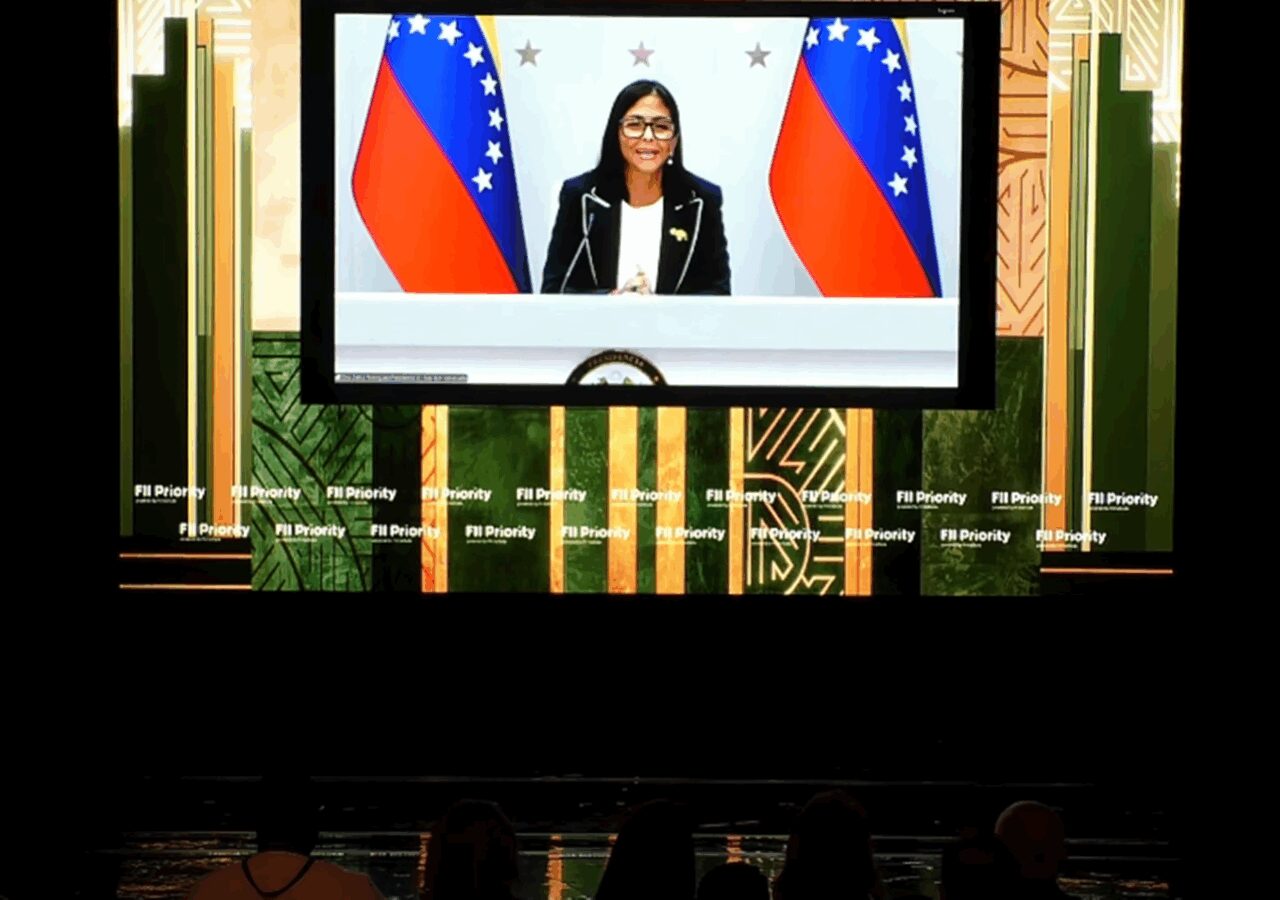
Rodríguez connected remotely to the FII Priority conference. (Archive)
Caracas, March 25, 2026 (venezuelanalysis.com) – Venezuelan Acting President Delcy Rodríguez has reiterated calls for foreign investment in the Caribbean nation.
Addressing the FII PRIORITY Miami Summit, Rodríguez showcased Venezuela’s economic growth and lauded the investment opportunities in the country’s vast oil, natural gas, gold, and other mineral resources. The Venezuelan leader highlighted the recent pro-business overhaul of the country’s Hydrocarbon Law and other upcoming reforms as key in generating “flexibility,” “guarantees,” and “security” for investors.
“The new Hydrocarbon Law creates important mechanisms for private sector control over production and commercialization,” Rodríguez said in her video message from Caracas. “It also creates flexible fiscal arrangements and establishes alternative conflict-resolution processes such as international arbitration.”
The acting president added that 64 percent of the price of a barrel is up for “negotiations with investors” in terms of reduced royalties and taxes, as well as dividends.
Approved in late January by the Venezuelan National Assembly, the new Hydrocarbon Law allows the executive to reduce taxes and royalties at its discretion. The reform also grants expanded control to private corporations, curtailing the state’s sovereignty over the industry established under Hugo Chávez under the 2001 Hydrocarbon Law and subsequent reforms.
In her remarks, Rodríguez urged “de-ideologization,” vowing, “regardless of different [political] views, a favorable climate can be created so that investors have the mechanisms so that their investments foster returns.” She added that she has met with representatives from 120 multinational corporations since January.
“Our reforms are a call for investors to participate,” Rodríguez stated. She went on to press for greater Latin American economic integration and for an end to unilateral sanctions against Venezuela, though she refrained from mentioning the US by name.
The Future Investment Initiative (FII) Institute is a non-profit run by Saudi Arabia’s Public Investment Fund and holds regular conferences bringing together business executives, analysts, and political leaders.
Rodríguez’s participation in the Saudi initiative came amid unprecedented energy market volatility as a result of the US and Israeli war against Iran. In spite of strong Venezuelan ties with Iran over the past 25 years, the Rodríguez administration has not taken a firm stance on the conflict, having published and later withdrawn a controversial statement. Caracas expressed solidarity with Qatar and the UAE after Iran retaliated against US military assets in the region.
The Venezuelan leader’s Wednesday message to investors in Miami followed a meeting with business executives at Miraflores Presidential Palace on Tuesday. The companies represented were not disclosed, though Houston-based oil giant Exxon Mobil has confirmed it has a team in Caracas “looking to assess the state of the resource that’s there.”
Rodríguez delivered a similar pitch hailing Venezuela’s natural resource potential and the prospects for foreign conglomerates opened by ongoing reforms. She appealed for the full lifting of sanctions, arguing that US Treasury licenses hurt investor confidence.
Since January, the Trump administration has issued a number of sanctions waivers allowing Western entities to engage with the Venezuelan energy and mining sectors. The licenses block transactions with companies from China, Cuba, Iran, North Korea, and Russia.
Additionally, the Treasury exemptions mandate that all royalty, tax, and dividend payments destined for Venezuelan state entities be deposited in US-run accounts. Washington currently controls Venezuelan oil proceeds, having returned a reported US $500 million, out of an initial $2 billion agreement, to Caracas.
On Tuesday, Rodríguez likewise announced the imminent departure of a Venezuelan diplomatic mission to Washington. Félix Plasencia, slated to become the country’s ambassador to the US, will lead the delegation.
“Our delegation will manage this new stage of diplomatic relations and dialogue between our two countries,” she affirmed.
Caracas and Washington fast-tracked a diplomatic rapprochement in the wake of the January 3 US attacks against Venezuela and kidnapping of President Nicolás Maduro and First Lady Cilia Flores. The two governments reestablished diplomatic relations in early March after a seven-year hiatus. The Trump administration went on to recognize Rodríguez as Venezuela’s “sole leader” days later.
Rodríguez, who had served as vice president since 2018, assumed the presidency in an acting capacity on January 5 with the endorsement of the Venezuelan National Assembly and Supreme Court, which declared Maduro’s absence as temporary.
Maduro and Flores pleaded not guilty to charges including drug trafficking conspiracy and will have a court hearing on Thursday. US officials have not presented evidence to sustain reiterated “narcoterrorism” accusations against Venezuelan leaders, while data from specialized agencies has found Venezuela to play a marginal role in global narcotics trafficking.
Edited by Lucas Koerner in Fusagasugá, Colombia.