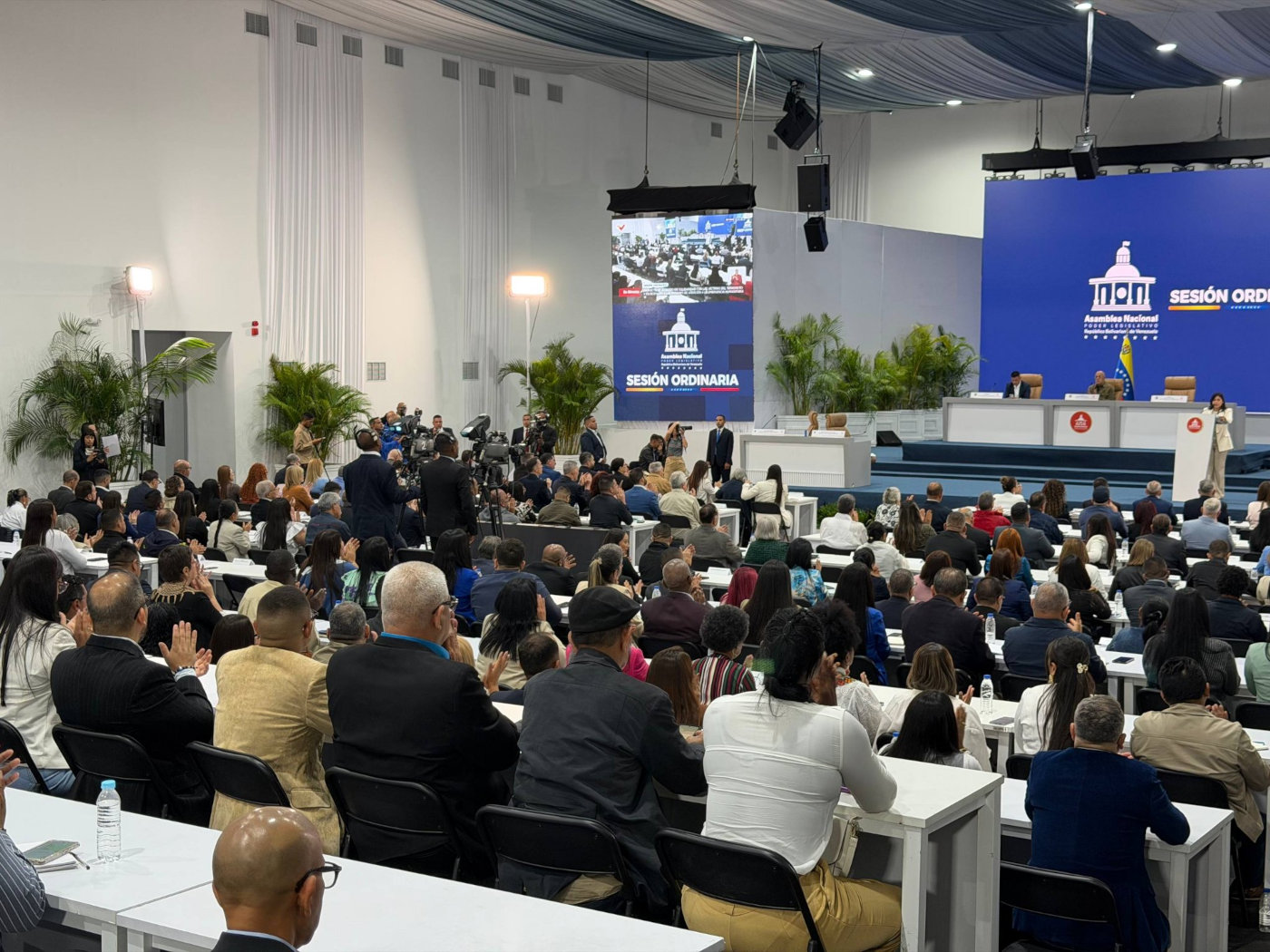
The Venezuelan National Assembly held its session in an alternative venue after the legislative palace suffered damages in the June 24 earthquakes. (Mervin Maldonado)
Mérida, July 14, 2026 (venezuelanalysis.com) – The Venezuelan National Assembly preliminarily approved two laws granting expanded benefits to landlords and the private real estate sector as part of authorities’ post-earthquake reconstruction plans.
The Tuesday session was held at Simón Bolívar Park in La Carlota, Caracas, after the legislative palace suffered damage from the June 24 double tremor.
The Venezuelan legislature voted in favor of a Law for the Special Regime of Housing Property Leasing and a partial reform of the Law Against Real Estate Fraud. Both projects will now be subject to consultations and revisions before being put to a second and final vote.
“Our main task with this reform is to stimulate the housing rental market,” National Assembly Vice President Pedro Infante stated. “We have to strengthen the legal certainty for property owners and also protect tenants. It’s a legal balance.”
Infante added that officials estimate that there are around 200,000 homes that could enter the rental market but that parliament has to “untie the knots that are holding this market back.”
The existing legislation governing housing rentals was enacted by former President Hugo Chávez in 2011 and it is highly protective of tenants. Grassroots movements participated directly in several housing laws.
In a recent press conference, National Assembly President Jorge Rodríguez called the current law “regressive” and argued that parliament needed to make property owners feel “more secure in renting their properties.” Real estate chambers have long lobbied for reforms to housing laws.
The preliminarily approved bill expands conditions for landlords to evict their tenants, including two months of unpaid rent, deterioration of the property, or unauthorized subletting. It additionally establishes that disputes are to be resolved via mediation or municipal courts. Tenant movements have recently denounced a growing trend of landlords bringing “invasion” charges against tenants as a way to evict them, with the complicity of public prosecutors.
The partial reform of the law against real estate fraud, likewise approved during Tuesday’s session, loosens conditions for the sale of housing properties yet to be built or under construction while also reducing collateral requirements for developers.
“The reform seeks to guarantee better conditions, legal security, and financing capacity so that the private sector initiates an aggressive, accelerated process of housing construction,” Infante explained, adding that it “removes rigid price schemes,” allowing real estate developers to factor “variations in the costs of materials in supplies” into house prices.
Under the updated law, house sale and pre-sale contracts no longer need to be individually approved by government housing authorities. Instead, the governing body will publish a set of general rules. According to the reform text, banks that finance real estate projects will no longer be liable for their non-completion, with legislators arguing that the measure will boost credit options.
Deputy Alejandra Rodríguez, from opposition party Un Nuevo Tiempo, endorsed the preliminary housing reforms for seeking a “balance between the right to housing, the protection of private property, legal security, and the promotion of responsible investment.”
Venezuelan authorities have prioritized finding housing solutions with over 20,000 people forced into temporary shelters after losing their homes in the June 24 double earthquake, most of them in coastal La Guaira State. The latest official figures placed the death toll at 4,734, with nearly 17,000 injured.
Venezuelan Acting President Delcy Rodríguez has launched the “Venezuela Renace” program to conduct inspections and repair works in affected buildings, as well as revitalize the construction sector to generate new housing complexes in a short time frame. She likewise called on public and private banks to expand mortgage programs, vowing that the government would subsidize them up to 80 percent.
On Monday, Rodríguez met with representatives from business chambers, including construction and real estate, and reiterated calls for the private sector to participate in the post-earthquake reconstruction.
“Every person who lost their home should have hope of being under a new roof in the short term,” she stated.
Rodríguez announced that the government is working on construction plans in La Guaira alongside the Venezuelan Construction Chamber and the Venezuelan Real Estate Chamber. Authorities are conducting soil studies and identifying potential land plots. She recalled that the export of construction materials is presently banned.
The acting president assured those present that Venezuela remains on a path of economic growth and that household consumption had risen by 33 percent in June.
Rodríguez reiterated calls for the removal of economic sanctions against the country and ongoing efforts to secure the release of frozen Venezuelan assets, including gold reserves held by the Bank of England.
Edited by Ricardo Vaz in Caracas.