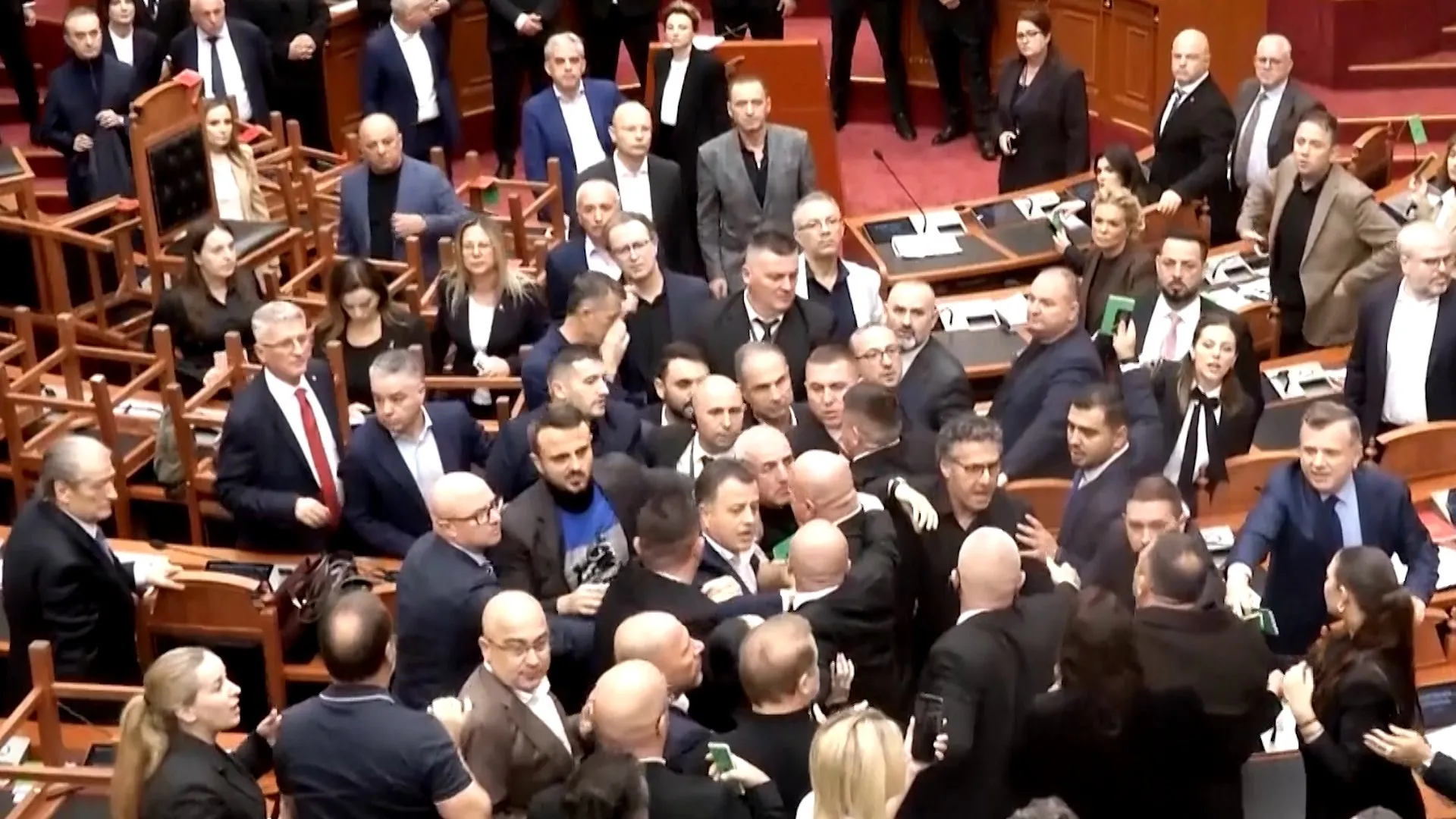
Albanian lawmakers have scuffled in parliament, throwing objects at one another and ripping microphones from desks. The chaos follows months of daily street protests, first over corruption, and now over schooling conditions.
Lawmakers adjourn second session as one party tells members to abstain over unclear commitment.
Published On 19 Oct 202619 Oct 2026
Egypt’s parliament has delayed a vote on authorising its armed forces to support Saudi Arabia, which has come under increasing attack from the Iran-aligned Houthis in Yemen.
The vote has been adjourned to October 26, the House of Representatives said on Monday. The move prolongs the debate over Egypt’s role in the Yemeni conflict.
Recommended Stories
list of 3 itemsend of list
The opposition Egyptian Social Democratic Party said it had told its lawmakers to abstain.
The party said parliament had not been given enough information about the mission’s objectives, duration, cost, or the risks to Egyptian troops.
However, the party, which holds nearly a dozen seats, said most of its lawmakers support the measure, according to two members of parliament who spoke to the AFP news agency.
The parliament has been tasked with authorising President Abdel Fattah el-Sisi to approve any request from Saudi Arabia for defence assistance amid attacks on the kingdom by Yemen’s Houthis.
The call for support came after the Iran-backed rebel group attacked Riyadh’s international airport and the state oil company Saudi Aramco last week. Saudi authorities say 13 people were killed in the October 10 attack on the airport.
El-Sisi said on Saturday that Egypt would take “any measure” needed to protect its Gulf allies.
“I’m not talking about confronting or attacking anyone,” el-Sisi said. “We’re talking only about defence.”
After approval from the National Defence Council, chaired by el-Sisi, Egypt’s constitution requires a two-thirds parliamentary majority to send troops on a combat mission abroad. The council gave its approval on Sunday.
Egypt’s rocky economy
The Grand Imam of al-Azhar urged Arab and Muslim leaders on Sunday to mediate Egypt’s parliamentary decision and avert further bloodshed.
Saudi Arabia holds an important role in financing Egypt’s rocky economy. It is due to deposit $5.3bn into Egypt’s central bank this month, plus $267.39m in interest.
Egypt’s EGX30 stock index fell early on Monday amid concerns about possible military involvement but recovered to close 0.4 percent higher.
Nematallah Choucri, head of research at HC Securities, told the Reuters news agency that geopolitical developments are the main driver of recent market losses.
Egypt is also affected by the shortage of oil and gas exports from the Middle East due to the United States war on Iran and fighting in Yemen.
Egypt’s economy is heavily dependent on remittances from Egyptians working in the hydrocarbons industry in Saudi Arabia.
Suez Canal threat
Political analyst and Gulf studies expert Thomas Bonnie James told Al Jazeera that the Houthi security threat to Saudi Arabia also threatens the Suez Canal, which Egypt’s foreign minister says has lost about $11bn since the Houthis launched attacks in the Bab al-Mandeb strait in solidarity with Gaza in 2023.
James also said Egypt does not want to be seen as the regional ally that “stood aside while others defended the kingdom”.
Turkiye and Pakistan have made their own pledges after activating the Mecca defence pact with Riyadh, signed in August, amid the deteriorating security situation in the Middle East.
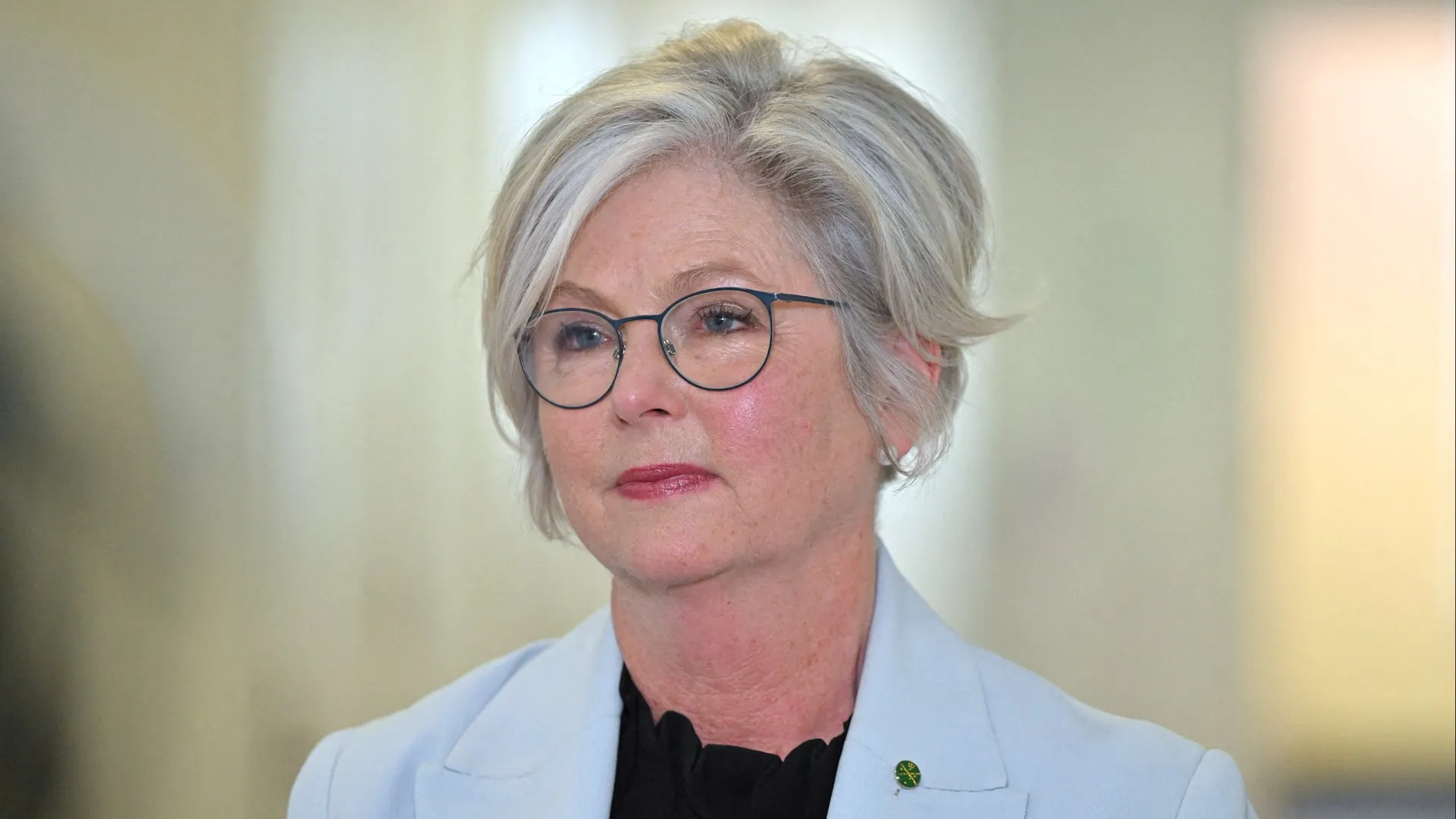
Australian MP Dr. Helen Haines is in critical condition after being struck by a car outside her office building in Victoria. Police have arrested a 43-year-old man accused of carrying out the attack and discovered a knife in his vehicle.
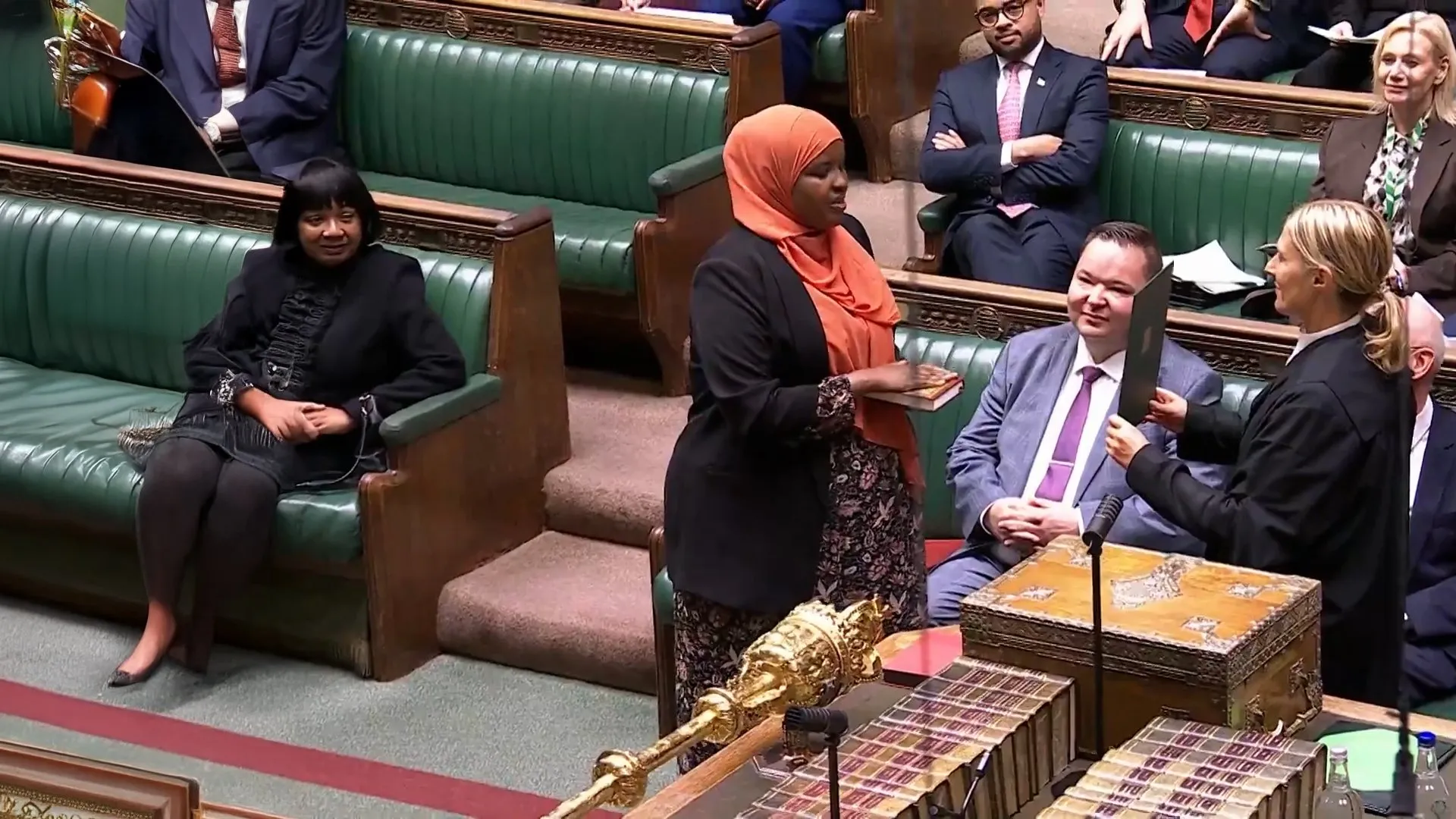
Newly sworn-in Labour MP Sagal Abdi-Wali has made history as the first Somali-born refugee woman elected to UK Parliament. She won London’s Holborn and St Pancras seat, vacated by former Prime Minister Keir Starmer, defeating Green Party leader Zack Polanski.
Eastern-based parliament votes to replace longtime speaker with Al-Salhin Abdelnabi al-Obeidi.
Published On 7 Oct 20267 Oct 2026
Libya’s eastern-based House of Representatives has elected a new speaker, ending Aguila Saleh’s 12-year tenure amid growing discontent among lawmakers over his leadership.
Legislators in the 170-member House voted on Tuesday to replace Saleh with Al-Salhin Abdelnabi al-Obeidi, the parliament’s spokesperson announced on X.
Recommended Stories
list of 3 itemsend of list
The vote came a day after 98 members of the House approved a new system limiting the speaker and deputy speakers to a single 12-month term.
The change ended an arrangement that had been in place since the chamber’s first leadership was elected in 2014.
“There was significant discontent among MPs with the previous leadership over numerous errors,” lawmaker Jebree Oheida told the Reuters news agency. “We tried to engage with the leadership to address these issues, but to no avail. Among these errors were decisions made without consulting MPs.”
The vote was overseen by Second Deputy Speaker Misbah Douma, according to the Libya Observer.
Saleh has previously rejected the proceedings, saying the initial vote to limit the speaker’s term was “not official and had no legal effect”, according to the outlet. He had also announced that he had cancelled the session he had called for Tuesday.
The developments come as Libya remains divided politically and militarily between the United Nations-recognised government in Tripoli led by Prime Minister Abdul Hamid Dbeibah, and a rival administration in the east backed by renegade military commander Khalifa Haftar.
Haftar’s camp relies in particular on the parliament, which sits in the eastern city of Benghazi under their control.
Saleh has long been considered a staunch ally of the Haftar clan, but analysts said he appeared to be weakened as Haftar’s sons, in particular Saddam Haftar, consolidated their positions.
“Agila Saleh appears to be the latest casualty of Saddam Haftar’s drive to centralise decision-making in eastern Libya and bulldoze his way into a political role,” said Emadeddin Badi, an analyst at the London-based Chatham House.
Al-Obeidi, who comes from the same tribe as Saleh, represents the eastern city of Tobruk and has chaired parliament’s Libyan-Turkish friendship committee.
The House on Tuesday also elected Tarek al-Ashtar and Mesbah Douma as first and second deputy speakers, respectively.
Their election follows the signing of a landmark agreement by representatives of Libya’s rival political camps in Tripoli in August that could see presidential and legislative elections held within two years.
Mediated by the United Nations Support Mission in Libya (UNSMIL), the “4+4 committee” agreement attempts to resolve recurring legal and institutional disputes that have crippled the nation since the overthrow of Colonel Muammar Gaddafi in 2011.
The United States is pursuing a separate reunification plan for the oil and gas-rich North African country, led by Massad Boulos, President Donald Trump’s senior adviser for Arab and African affairs.
Both decrees to tackle housing affordability crisis shot down as critics say measures would tighten the housing market.
Spain’s government has lost key votes to ratify emergency measures aimed at tackling the nation’s housing affordability crisis, after protests intensified last month following the eviction of an 87-year-old woman.
The proposed measures, which comprised two separate decrees, were both shot down by the majority of the 350-seat lower house of parliament on Friday.
Recommended Stories
list of 3 itemsend of list
The move is a heavy blow to Prime Minister Pedro Sanchez, whose government faces public pressure, including from the hundreds of protesters who had gathered outside parliament demanding help for renters.
The first decree was meant to stop evictions of vulnerable people, make real estate speculation harder, impose tighter restrictions on short-term leases and provide tax incentives to encourage renting and the construction of housing.
The second decree proposed making leases automatically renew when they are set to expire, essentially making them indefinite. A property owner would have to pay a tenant 12 months of rent to break the contract.
The right-wing Catalan separatist party Junts refused to back the housing decrees, saying they would ultimately tighten the housing market. The centre-right Popular Party and far-right Vox also voted against the measures.
Sanchez, who leads a coalition government composed of his Socialist Party and the far-left Sumar, appealed to lawmakers in the run-up to the vote to put aside political calculations and pressure.
“Think about ordinary people, about those who most need the protection of public institutions. Think about the millions of young people who cannot afford to move out of their parents’ homes. Think about the families living with the constant anxiety of ever-rising rents,” he said.
“Do the right thing, because I believe that if you do not, history will judge you sooner than you think, and far more harshly than you can imagine.”
Miriam Nogueras of Junts argued the decrees would only lead to owners removing their properties from the rental market, and thus driving up prices even further.
“These decrees still allow speculators to buy property and to evict people,” Nogueras said.
‘Your profits, our misery’
As the vote was under way, protesters marched on the parliament demanding help for renters.
The government decrees were intended to quell a public uproar following the televised eviction on September 23 of Maria del Carmen Abascal, known across Spain as Maricarmen, that set off protests and a camp-in that occupied Madrid’s Puerta del Sol square ever since.
Abascal was living in the property in Madrid’s central Retiro neighbourhood under a rent-capped lease contract signed by her father in the 1950s. The property was then bought by the real estate and investment firm Urbagestion in 2018.
Urbagestion sought to terminate Abascal’s contract and evict her after raising her rent from 500 euros ($572) to 2,650 euros ($3,010) – nearly double her pension of 1,350 euros ($1,533) a month – according to Spanish newspaper El Pais.
When the police carried out her eviction on their fourth attempt, hundreds of activists who had been protesting against her losing a home she had lived in her entire life were waiting outside. Abascal has since been offered a preliminary agreement that would allow her return to her home.
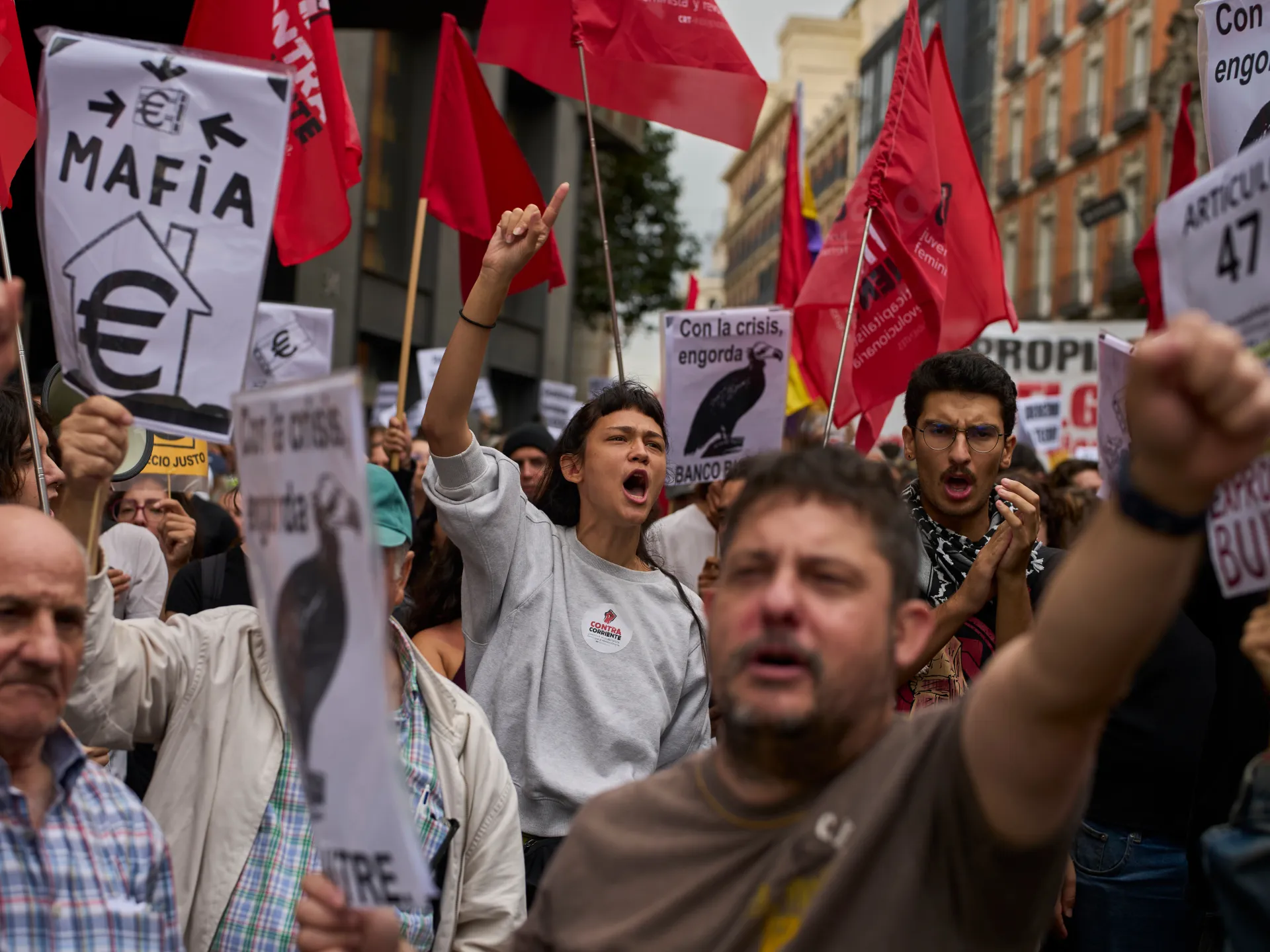
Protesters rallying at the chamber in downtown Madrid on Friday held up homemade signs with images of vultures on them, denouncing the real estate speculators they blame for driving up prices.
Some people gathered outside the assembly chanted “your profits, our misery” as lawmakers voted down the government’s decree.
The average rent in Spain has almost doubled in the past 10 years. The average price per square metre has risen from 8.20 euros (about $9.08 at the time) in 2016 to 15.1 euros ($17.15) this year, according to the real estate website Idealista.
Siegfried Muresan’s loss of the confidence motion increases the prospect for snap elections.
Published On 30 Sep 202630 Sep 2026
Romania’s pro-European Prime Minister-designate Siegfried Muresan has failed to win a parliamentary vote of confidence, prolonging a political crisis seen as a boost for the rising far right.
Muresan, a liberal European Parliament member who was the latest of three designated prime ministers, secured only 182 votes out of the 233 required to secure the confidence motion on Wednesday, according to the official count.
Recommended Stories
list of 3 itemsend of list
The far-right Alliance for the Union of Romanians (AUR) largely boycotted the vote.
The 45-year-old had proposed what he described as a “reform-oriented” governing programme under his centre-right National Liberal Party (PNL), which teamed up with the Save Romania Union party, or USR, and the small ethnic Hungarian UDMR party.
President Nicusor Dan said he would nominate a new prime minister candidate on Monday afternoon, after holding talks with the leaders of the parliamentary parties, to avoid snap elections.
Siegfried Muresan addresses delegates of the Romanian Parliament prior to a vote at the parliament in Bucharest, Romania, on September 30, 2026 [AFP]
Romania saw the collapse of a pro-European coalition government in May, when governing social democrats, together with the opposition far right, ousted liberal Prime Minister Ilie Bolojan in a no-confidence motion at that time.
The far right, which comprises about a third of Parliament, threatened to impeach the president if he does not call early elections once the conditions are met.
Romania, a member of the EU and NATO that borders Ukraine, has not held snap elections since the fall of communism in 1989.
Political analyst Cristian Pirvulescu told the AFP news agency that snap elections would lead to another fragmented Parliament, but with an emboldened far right.
“Early elections mean that, from the moment they are called, it would take four months before a new government could be formed,” Pirvulescu told AFP. “Due to political instability, Romania finds itself in a very complicated economic situation. Four months is already a very long time.”
The country of 19 million has been struggling for months with the highest public deficit and inflation in the European Union.
Supporters of Romania’s far-right politician and former presidential candidate Calin Georgescu, not in picture, cheer as he leaves the Court of Appeal in Bucharest on September 28, 2026, following a new hearing in the case in which he and other defendants are accused of actions against Romania’s constitutional order [AFP]
Millions of voters went to polls in Morocco on Wednesday to determine the makeup of the House of Representatives, the parliament’s lower house.
Twenty-seven political parties are competing for 395 seats in the country’s 12th legislative election since independence in 1956.
Almost 16 million people are able to vote, with 55 percent residing in urban areas and 45 percent in rural regions, seeing a mix of concerns among voters.
Economic frustrations
While King Mohammed VI will maintain most executive powers, the new government will manage many public affairs for the coming years.
Once the votes are counted, the king will appoint the head of government from the leading party, but they will still need the support of 198 deputies – an absolute majority – to gain parliamentary confidence.
The election comes at a time of mounting challenges for the country, with the economic situation creating discontent and frustration, Mohammed Masbah, head of the Moroccan Institute for Policy Analysis, told Al Jazeera.
“The upcoming elections will have special importance because they come in a context tied to a social and economic crisis, especially high prices and the cost of living on one hand,” Masbah told Al Jazeera.
“On the other hand, there is a state of frustration among broad segments of society, especially the youth. The Gen Z protests last year, as well as the attempt to cross towards Ceuta a few weeks ago, demonstrate this crisis.”
The introduction of a new financial system designed to support candidates aged 35 could encourage more youth participation. But the nearly six million Moroccans residing overseas, many of them younger citizens, will have to appoint a proxy in Morocco to cast their vote.
There is also an upcoming key milestone for the country with the 2030 World Cup, which requires huge investments. What will remain in the minds of most voters is the state of the economy and inflation, which have impacted the living standards of many Moroccans.
“I believe the upcoming elections will produce a government majority whose primary function will be to address these imbalances, especially the economic ones related to the high cost of living in Morocco,” Masbah said.
“Regarding the issues that were raised and discussed by the majority of political parties, whether represented in the government or the opposition, they are the issue of employment and high prices.”
Two of the main parties competing in the election, the National Rally of Independents and the Authenticity and Modernity Party, have put these issues at the front of their campaigns in what has been a heated election.
“Of course, this is the main topic, but in the public debate, we also noticed conflicts, especially between the top two parties currently running the government,” Masbah said. “We noticed mudslinging and accusations of squandering funds and stealing candidates, which may increase voter alienation from voting today.”
A woman prepares to cast her ballot to vote in Morocco’s legislative elections at a polling station inside a school at the Udayas neighbourhood, Rabat, on September 23, 2026 [AFP]
Despite the tense conditions, Morocco’s Public Prosecution has recorded a significant drop in election-related complaints compared with the 2021 vote.
But legal amendments that criminalise digital offences for the first time – including the dissemination of fake news and false allegations intended to defame candidates or voters – have been introduced. The digital space became the primary arena for violations this year, accounting for 22 complaints.
Masbah said that despite a mood of frustration in Morocco over the government’s inability to manage key economic and social issues, turnout is expected to remain steady, as it has been over the past 20 years, due to structural factors.
“Electoral and voting behaviour in Morocco is not primarily linked to electoral programmes and promises [of parties], as much as it is linked to the stable bloc formed by Moroccan deserts and villages, which relies primarily on a network of notables who have influence and the ability to win voters’ voices through utilitarian voting,” Masbah said.
“I expect that if there is a decline in the voting rate – and this is likely – it will not be catastrophic or a sharp decline, given the consideration I mentioned earlier, which is the focus on notables and traditional elites in winning over voters.”


![Supporters of Romania’s far-right politician and former presidential candidate Calin Georgescu, not in picture, cheer as he leaves the Court of Appeal in Bucharest on September 28, 2026, following a new hearing in the case in which he and other defendants are accused of actions against Romania’s constitutional order [AFP]](https://i0.wp.com/www.aljazeera.com/wp-content/uploads/2026/09/afp_6abd16ba6649-1790777018.jpg?w=640&ssl=1)
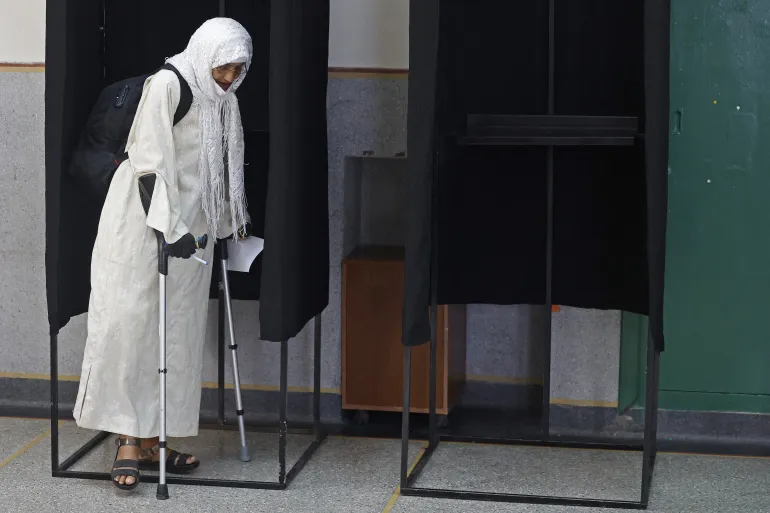
![A woman prepares to cast her ballot to vote in Morocco’s legislative elections at a polling station inside a school at the Udayas neighbourhood, Rabat, on September 23, 2026 [AFP]](https://i0.wp.com/www.aljazeera.com/wp-content/uploads/2026/09/afp_6ab3c71f1ac5-1790166815.jpg?w=640&ssl=1)