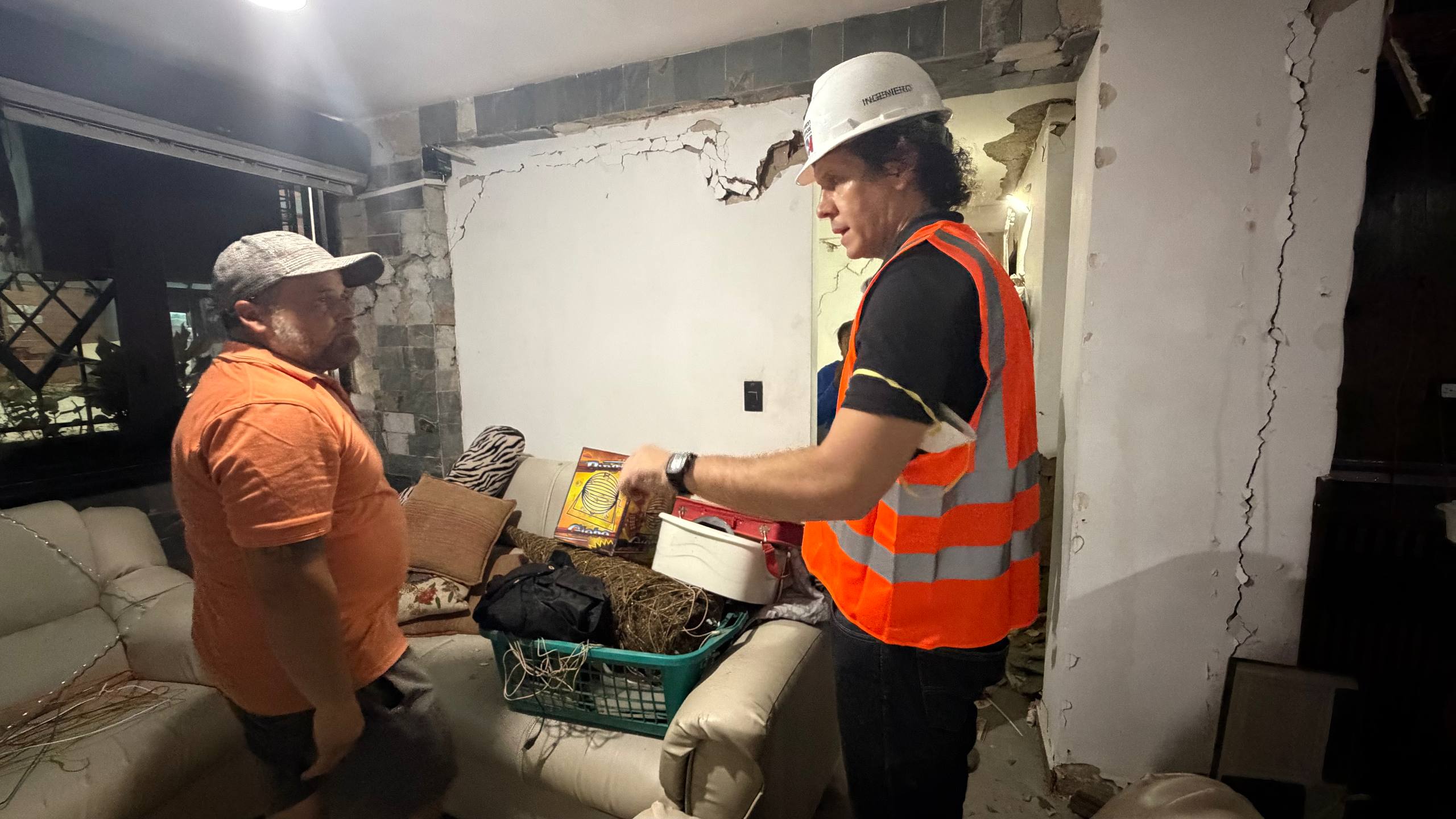
Commission chairman Garcés conducted inspections in Brisas del Aeropuerto, La Guaira State. (Ángel Márquez)
Caracas, June 30, 2026 (venezuelanalysis.com) – Venezuelan Acting President Delcy Rodríguez has created a Presidential Commission for the Assessment of Housing and Infrastructure Habitability following the 7.2- and 7.5-magnitude earthquakes that struck the country on June 24.
The commission, chaired by structural engineer Francisco Garcés, began its work on Monday, June 29, in the states of La Guaira and Miranda, as well as in Caracas, carrying out scientific and technical evaluations of buildings, bridges, overpasses, and road infrastructure.
The inspections will deliver a traffic light-style assessment system developed by the Venezuelan Seismological Research Foundation (FUNVISIS) and the Central University of Venezuela (UCV) to classify the level of structural damage through a rating system that is easily understood by the public.
“We have created a traffic light system to determine whether a building is habitable, using the colors green, yellow, and red, so that this commission on housing and infrastructure can decide whether a home is safe to continue occupying,” Rodríguez said during a televised broadcast on Monday.
Under the system, green identifies homes that are structurally stable and safe for occupancy without significant risk. Yellow indicates buildings with moderate or partial damage that require repairs before they can be safely reoccupied, while red designates structures that have suffered total loss or critical structural damage.
“We have found buildings whose structural systems—beams, columns, and frame structures—have not sustained significant damage. However, the masonry has been severely affected. This means these buildings are repairable but cannot be inhabited until damaged walls and enclosure elements are removed and rebuilt,” Garcés explained to Venezuelan media.
The commission brings together specialists from the Ministry of Habitat and Housing, the Ministry of Public Works, the Venezuelan College of Engineers, the Venezuelan Chamber of Construction, Funvisis, and the Engineering Corps of the Bolivarian National Armed Forces.
It is also supported by several academic institutions and will coordinate efforts with governors’ and mayors’ offices from the hardest-hit regions.
“We have deployed several teams of engineers specialized in structural engineering,” Garcés added. “After receiving training in the use of the damage assessment forms, they are able to determine the condition of a structure and recommend the appropriate course of action.”
The acting government has also launched training programs so that professors, graduates, and senior engineering students with the required technical background can join the inspection teams. Authorities say the initiative likewise aims to address public fears among residents who remain hesitant to return to their homes.
Rodríguez additionally announced plans to build thousands of new homes by the end of the year.
According to official figures, the earthquakes have left 189 buildings completely destroyed as well as 585 structures with severe damage or partial collapse. There have been 38 hospitals and 44 shopping malls affected, and 1,645 additional structures, mainly bridges and roads, have sustained damage.
Multiple corporate media outlets have launched claims that the buildings from Venezuela’s Great Housing Mission (GMVV) were especially damaged by the earthquake. However, analysis from open-source tracking of damaged buildings has shown that only a very small percentage of affected structures belong to the housing mission. Former President Hugo Chávez launched the massive program in 2011 to provide housing at next-to-no cost for working-class families.
So far, Venezuelan authorities have reported 1,943 dead, 10,571 injured, and over 15,000 displaced families as a result of the double earthquake. The disaster has seen emergency teams arrive from 27 countries to assist in search-and-rescue operations. For its part, the US Southern Command (SOUTHCOM) has deployed multiple military assets and is managing operations at Simón Bolívar International Airport, the South American country’s main air hub.
Alongside the disaster in Venezuela’s northern central region, the Caribbean nation has been struck by further emergencies in recent days. Torrential rains caused rivers to overflow in western Portuguesa state, leaving an initial toll of 100 displaced families. Further west, firefighters have been working to bring forest fires under control since last Friday.
Edited by Ricardo Vaz in Caracas.