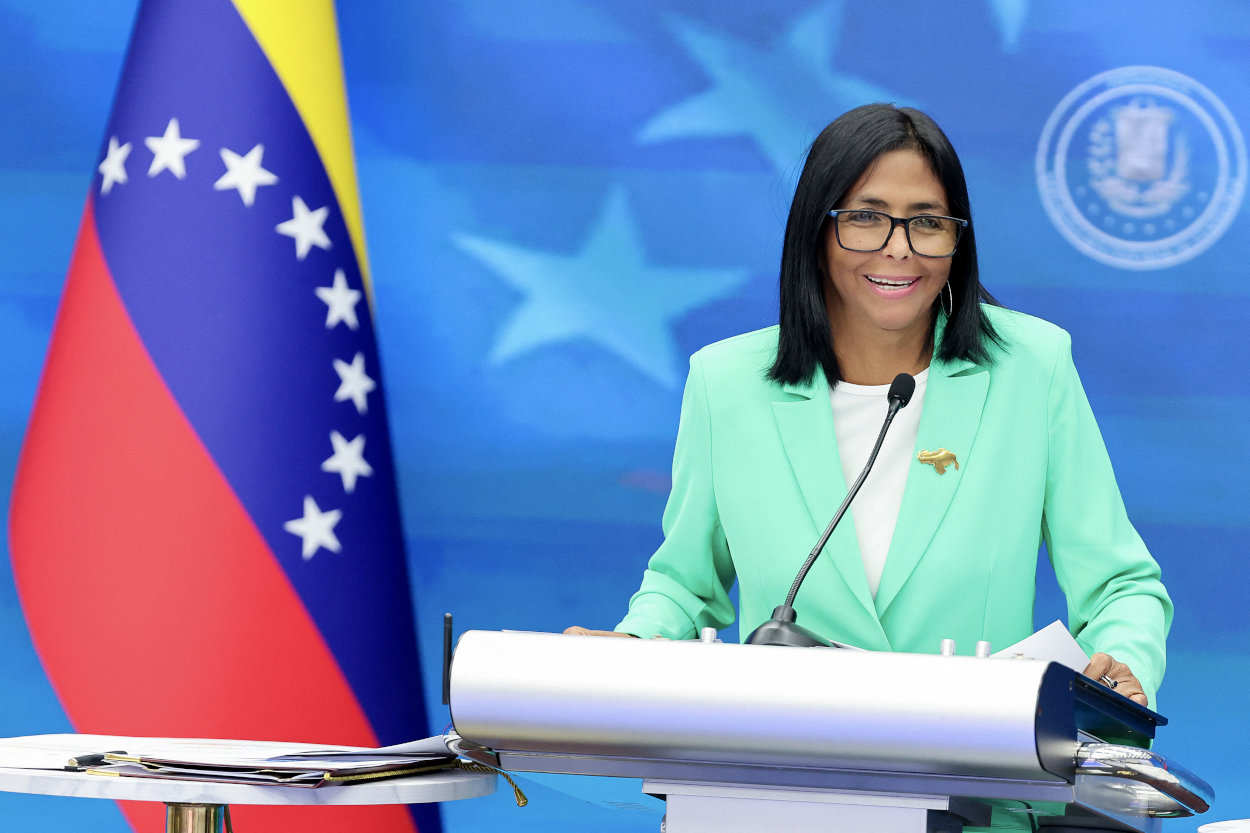
Caracas, April 9, 2026 (venezuelanalysis.com) – Venezuelan Acting President Delcy Rodríguez announced a series of upcoming reforms concerning Venezuela’s labor, tax, and pension frameworks during a press conference on Wednesday, April 8.
Addressing her cabinet at Miraflores Presidential Palace, Rodríguez unveiled the creation of a commission made up of representatives from the state, business sector, active workers, and pensioners to “review labor conditions, address precariousness, and strengthen the social security system.”
Rodríguez acknowledged deficiencies in areas such as working hours, vacation benefits, and pensions, arguing that the present social security system is not sustainable due to insufficient contributions from active workers and the private sector.
The acting president disclosed an upcoming increase to workers’ incomes on May 1, but did not specify if it would come in the form of an adjusted minimum wage or non-wage bonuses. Rodríguez warned that salary adjustments must be “responsible” so that they do not trigger inflation.
Venezuelan authorities have discussed the prospect of reforming the 2012 Labor Law for several months, installing several dialogue commissions and public debates.
The existing labor law, approved by former President Hugo Chávez, prohibits unfair dismissal and outsourcing, enshrines the world’s third-longest maternity leave, guarantees the right to work for both women and people with disabilities, and extends retirement pensions to all workers, including full-time mothers and the self-employed. However, trade unions have pointed out that state institutions and the Labor Ministry have reduced their enforcement of the law in recent years.
Rodríguez’s public broadcast came hours before workers and unions staged a mobilization in Caracas demanding higher wages, improved working conditions, and the repeal of statutes that suspended several collective bargaining rights. In recent protests, workers have called for an end to the government’s bonus-based wage policy and the restoration of collective bargaining agreements.
Venezuela’s minimum wage has remained unchanged since March 2022 at 130 bolívares per month—equivalent at the time to around US $30 but presently worth approximately $0.27 at the official exchange rate.
With the economy heavily constrained by US sanctions, the Venezuelan government relied on non-wage bonuses—paid in bolívares but pegged at a fixed US dollar amount. A recent increase took the so-called Economic War Bonus, paid to public sector employees, to $150 a month. Coupled to a $40 food bonus, it brought the floor income to $190.
Public sector retirees and pensioners receive $130 and $60 Economic War bonuses, and do not access the food bonus.
For their part, business sector representatives have demanded changes to the labor law that reduce costs for employers before any adjustment to the minimum wage. Amid ongoing discussions with the International Labour Organization (ILO), private sector organizations proposed modifying Article 122 of the Labor Law, which establishes that severance payments are calculated based on the last salary earned by the worker.
Tax reform and state asset review
Rodríguez also announced the immediate convening of a National Economic Council tasked with designing a more “efficient” tax model aimed at making Venezuela “more competitive.”
“I hope that this council can produce a new tax model that can generate consensus among the different economic sectors in the country,” the Venezuelan leader stressed.
She further enacted the Law on Streamlining and Optimization of Administrative Procedures, previously approved by the National Assembly, which seeks to modernize public administration by reducing bureaucracy and incorporating digital tools. According to Rodríguez, the law grants the executive authority to eliminate procedures, shorten timelines, and improve coordination between institutions.
In addition, she ordered the creation of a mixed commission to evaluate which state-owned assets have “strategic” importance, potentially opening some to private investment. However, she clarified that the hydrocarbons sector will remain under state control. The Cisneros group, one of Venezuela’s largest conglomerates, recently announced plans to raise funds ahead of an “expected wave of privatizations.”
The Venezuelan acting administration’s wholesale reform plans follow a recent pro-business overhaul of the Hydrocarbon Law in late January. The South American country’s National Assembly is likewise close to approving a new Mining Law with the goal of attracting foreign investment for extractive activities.
On Wednesday, Rodríguez additionally called for reforms to the country’s housing laws, claiming that there are half a million “frozen” properties presently that could be incorporated into the real estate market.
The acting president’s final announcement was a nationwide “pilgrimage” scheduled from April 19, Venezuela’s Independence Day, to May 1 to demand the lifting of US unilateral coercive measures against the Caribbean nation. While the Trump administration has issued selective and restrictive licenses to favor the participation of Western companies in the Venezuelan oil and mining sectors, wide-reaching sanctions remain in place.
Edited by Ricardo Vaz in Caracas.