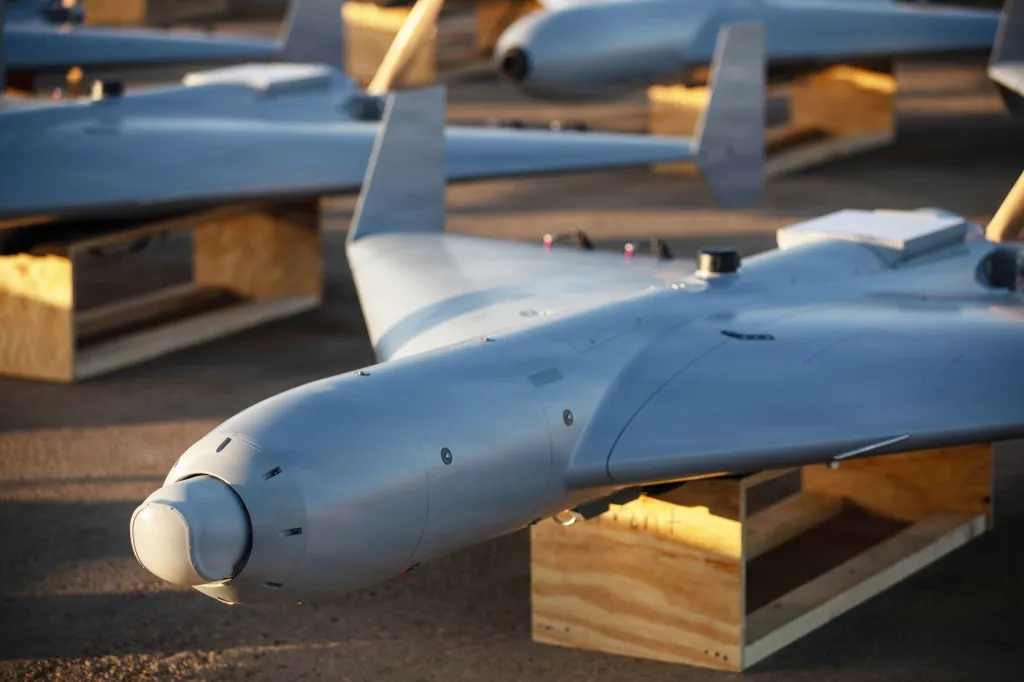
The U.S. has used LUCAS kamikaze drones for the first time in combat, U.S. Central Command acknowledged on Saturday. The drones, based on the Iranian Shahed-136, were launched from the ground by Task Force Scorpion Strike (TFSS). The task force was set up in December “to flip the script on Iran,” a U.S. official told us at the time. The launch of LUCAS drones marks a rare instance when the U.S. adopted Iran’s drone playbook and used it against them.
Today’s strikes were part of Operation Epic Fury, an attack the U.S. launched along with Israel on targets across Iran. You can read more about that in our initial story here.
The War Zone has advocated for the procurement of this exact class of drone by the American military.
The LUCAS drones are designed to be a far less expensive strike weapon than missiles, which not only cost more, but are far more difficult and time-consuming to produce.
“Costing approximately $35,000 per platform, LUCAS is a low-cost, scalable system that provides cutting-edge capabilities at a fraction of the cost of traditional long-range U.S. systems that can deliver similar effects,” Navy Capt. Tim Hawkins, a CENTCOM spokesperson, told TWZ back in December. “The drone system has an extensive range and the ability to operate beyond line of sight, providing significant capability across CENTCOM’s vast operating area.”
In addition, the LUCAS design includes features that allow for “autonomous coordination, making them suitable for swarm tactics and network-centric strikes,” a U.S. official told us. As we have explained in detail in the past, the swarming capabilities combined with some of the drones being equipped with Starlink terminals, means extremely advanced cooperative tactics and dynamic targeting are possible, all while keeping humans in the loop.
The LUCAS drones have “an extensive range and are designed to operate autonomously,” CENTCOM said in a press release announcing the creation of Task Force Scorpion Strike. “They can be launched with different mechanisms to include catapults, rocket-assisted takeoff, and mobile ground and vehicle systems.”

Though the LUCAS drones fired against Iran were ground-launched, U.S. Navy personnel in the Middle East test-fired one from the Independence class Littoral Combat Ship (LCS) USS Santa Barbara. This came two weeks after the U.S. military announced the formation of Task Force Scorpion Strike.
Overall, the LUCAS drone’s core design was based directly on the Shahed-136, a U.S. official told us.
“The U.S. military got hold of an Iranian Shahed,” according to the U.S. official in December. “We took a look and reverse-engineered it. We are working with a number of U.S. companies in the innovation space.”
“The LUCAS drone is the product of that [reverse-engineering] effort,” the official added. “It pretty much follows the Shahed design.”

As we have explained for years, the Shahed was based on an Israel concept, which also has roots in a German concept. So it is a complicated lineage for sure.
The LUCAS was designed by SpektreWorks. Its website provides basic specifications for a related target drone design called the FLM 136, which has a stated maximum range of 444 miles and can stay aloft for up to six hours. Its total payload capacity, not counting fuel, is 40 pounds, and it cruises at a speed of around 74 knots (with a dash speed of up to 105 knots). Whether these details reflect the capabilities of the operationalized LUCAS design is unclear.

In contrast, the baseline Shahed-136, which is powered by a small 50-horsepower internal combustion engine, has a top speed of around 100 knots (185 kilometers per hour) and a maximum range of approximately 1,242 miles (2,000 kilometers) while carrying an 88-pound (40-kilogram) warhead, according to the U.S. Army’s Operational Environment Data Integration Network (ODIN) training portal. It was designed to strike static targets based on targeting data programmed in before launch.
Iran has shown additional versions over the years. The Shahed-238 has new guidance systems, with radar and electro-optical/infrared guidance and jet power. Earlier Shahed versions primarily employed a combination of inertial and GPS navigation to hit fixed targets.

از موشک کروز ابرفراصوت فتاح2 و پهباد شاهد 147 با حضور رهبر انقلاب رونمایی شد
Russia also now produces a still-expanding array of variants and derivatives of this design, referred to locally as the Geran. Iran and Russia have both been notably working to integrate more dynamic targeting capabilities into their respective versions of the drone.

The use of the LUCAS comes as Iran has launched its Shahed-136 drones against targets across the Middle East and highlights the limitations of air defenses. Even IDF’s multi-tier integrated air defense system, the most advanced one on Earth, and U.S. ground- and sea-based air defense systems around the Middle East do not offer complete protection against these and other weapons.
Iran used Shahed-136s to successfully strike the headquarters of the U.S. Fifth Fleet in Manama, Bahrain.
You can see a video of another Shahed attack in Bahrain below.
It is unclear how many of these drones the U.S. used, what targets they hit or the effect of any strikes. A U.S. official declined comment. Regardless, this is the first war where the U.S. is actively using long-range one-way attack drones and it just so happens to be against the same country that the design, and its modern operating concept, was lifted from.
Contact the author: howard@thewarzone.com