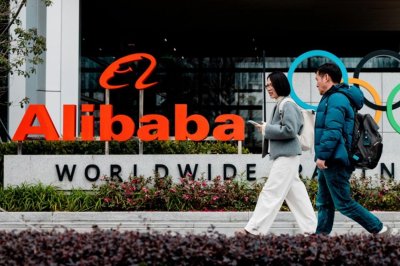

People walk past Alibaba logo on their building in Xuhuibinjiiang Park, also known as ‘AI Park,’ home to many Chinese companies involved in AI (artificial intelligence) research, in Shanghai, China, 19 March 2026. Photo by ALEX PLAVEVSKI / EPA
June 30 (Asia Today) — Major Washington lobbying firms are ending their relationships with Alibaba, Tencent and other Chinese companies as a new U.S. defense-contracting restriction takes effect Tuesday.
Brownstein Hyatt Farber Schreck, Mercury Public Affairs and MO Strategies were among the influential firms that recently terminated contracts with the Chinese technology companies, Bloomberg reported Monday.
Public lobbying disclosures showed Alibaba had lost five lobbying firms and Tencent had lost four over the past week. MO Strategies said it would comply fully with the new Defense Department requirements.
The shift follows the implementation of Section 851 of the fiscal 2025 National Defense Authorization Act.
The provision prohibits the Defense Department from awarding contracts to a company, including its parent companies and subsidiaries, if that company retains a covered lobbyist who also lobbies for a Chinese business on the Pentagon’s Section 1260H list.
The law does not directly prohibit lobbying firms from representing Chinese companies. In practice, however, it forces firms to choose between Chinese clients on the list and U.S. companies seeking Defense Department business.
The Pentagon established the Section 1260H list under the fiscal 2021 defense authorization act to identify companies it considers affiliated with China’s military or contributors to Beijing’s military-civil fusion strategy.
The Defense Department added Alibaba and dozens of other companies to an updated list published June 8. The latest version includes 188 entities operating directly or indirectly in the United States, according to the department.
Tencent appeared on an earlier version of the list and remained designated in the June update.
A company’s inclusion on the list does not by itself impose comprehensive economic sanctions. Other U.S. laws, however, increasingly connect the designation to federal contracting, procurement and funding restrictions.
Alibaba filed a federal lawsuit last Tuesday seeking removal from the list. The Chinese e-commerce company said the Pentagon lacked sufficient evidence to classify it as a Chinese military company and failed to adequately consider evidence disputing the alleged ties.
Alibaba has denied that it works with the Chinese military or participates in China’s military-civil fusion strategy. Tencent has also denied military links.
Alibaba said in its lawsuit that the new lobbying restriction had already prompted several firms and individual lobbyists to indicate that they would end their relationships with the company.
The Pentagon’s expanded list and the new contracting rule are likely to increase compliance reviews among Washington lobbying firms, law firms, consultants and defense contractors.
Companies seeking Pentagon contracts may need to determine whether outside advisers represent any listed Chinese entities, even when those advisers’ work for the U.S. company is unrelated to national defense.
The development also narrows Chinese companies’ access to experienced lobbyists as they seek to challenge expanding trade, investment and national security restrictions in Washington.
— Reported by Asia Today; translated by UPI
© Asia Today. Unauthorized reproduction or redistribution prohibited.
Original Korean report: https://www.asiatoday.co.kr/kn/view.php?key=20260630010010558