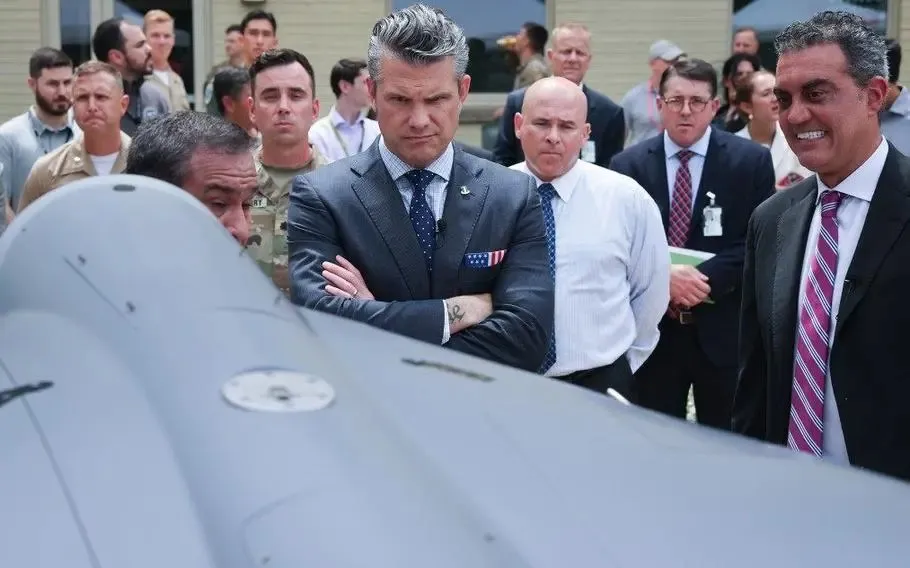
The U.S. military has stood up its first operational unit armed with Low-Cost Uncrewed Combat Attack System (LUCAS) kamikaze drones, a design reverse-engineered from the Iranian-designed Shahed-136, in the Middle East. The establishment of Task Force Scorpion Strike (TFSS) is a major development, and offers a way “to flip the script on Iran,” according to a U.S. official. Earlier this year, TWZ laid out a detailed case for why America’s armed forces should be investing heavily in rapidly-produced Shahed-136 clones as an adaptable capability that could be critical in future operations globally, as you can read here.
U.S. Central Command announced the creation of TFSS today, which it said is a direct response to Secretary of War Pete Hegseth’s “Unleashing U.S. Military Drone Dominance” initiative that kicked off earlier this year. TFSS falls more specifically under the auspices of U.S. Special Operations Command Central (SOCCENT), which oversees U.S. special operations activities across the Middle East. CENTCOM’s Rapid Employment Joint Task Force (REJTF), established in September to help fast-track the fielding of new capabilities in the region, was also involved.
You can read our analysis of the capabilities of these drones in our latest story on the topic here.

TFSS consists of about two dozen troops that will oversee the establishment and operations of drones, the U.S. official told us, speaking on condition of anonymity to discuss operational details. The delta wing LUCAS drone, which is roughly 10 feet long and has a wingspan of eight feet, was developed by Arizona-based SpektreWorks in cooperation with the U.S. military.
“I do not want to get into numbers [of drones fielded], but they are definitely based and delivered at an amount that provides us with a significant level of capability,” the official added. The LUCAS design includes features that allow for “autonomous coordination, making them suitable for swarm tactics and network-centric strikes.”
“Costing approximately $35,000 per platform, LUCAS is a low-cost, scalable system that provides cutting-edge capabilities at a fraction of the cost of traditional long-range U.S. systems that can deliver similar effects,” Navy Capt. Tim Hawkins, a CENTCOM spokesperson, also told TWZ. “The drone system has an extensive range and the ability to operate beyond line of sight, providing significant capability across CENTCOM’s vast operating area.”
“LUCAS drones deployed by CENTCOM have an extensive range and are designed to operate autonomously,” CENTCOM added in a press release. “They can be launched with different mechanisms to include catapults, rocket-assisted takeoff, and mobile ground and vehicle systems.”

“We can push them from various points,” the U.S. official told TWZ when asked about whether the LUCAS drones could be launched from ships. “They can be launched through various mechanisms, and land is not the only place from which to launch these.”
As an aside here, TWZ has previously explored in great depth the arguments for adding a variety of drone types to the arsenals of U.S. Navy ships to provide additional layers of defense, as well as enhanced strike, electronic warfare, intelligence-gathering, and networking capabilities, which you can find here.
Overall, the LUCAS drone’s core design was based directly on the Shahed-136.
“The U.S. military got hold of an Iranian Shahed,” according to the U.S. official. “We took a look and reverse-engineered it. We are working with a number of U.S. companies in the innovation space.”

“The LUCAS drone is the product of that [reverse-engineering] effort,” they added. “It pretty much follows the Shahed design.”
SpektreWorks’ website provides basic specifications for a related target drone design called the FLM 136, which has a stated maximum range of 444 miles and can stay aloft for up to six hours. Its total payload capacity, not counting fuel, is 40 pounds, and it cruises at a speed of around 74 knots (with a dash speed of up to 105 knots). Whether these details reflect the capabilities of the operationalized LUCAS design is unclear.
For comparison, the baseline Shahed-136, which is powered by a small 50-horsepower internal combustion engine, has a top speed of around 100 knots (185 kilometers per hour) and a maximum range of approximately 1,242 miles (2,000 kilometers) while carrying an 88-pound (40-kilogram) warhead, according to the U.S. Army’s Operational Environment Data Integration Network (ODIN) training portal. It was designed to strike static targets based on targeting data programmed in before launch. Iran has shown additional versions over the years with other guidance options, as well as a jet-powered derivative. Russia also now produces a still-expanding array of variants and derivatives of this design, referred to locally as the Geran. Iran and Russia have both been notably working to integrate more dynamic targeting capabilities into their respective versions of the drone.

Iranian forces, as well as the country’s various regional proxies in the Middle East, have extensively employed variations of the Shahed-136 in combat in recent years, especially against targets in Israel. Russian forces routinely use their versions of the drones in the ongoing conflict in Ukraine. U.S. military experience aiding in the defense of Israel, as well as observations from the war in Ukraine, have been key drivers in recent pushes to develop and field new drone and counter-drone capabilities, now including the LUCAS design.
Beyond the particulars of the LUCAS drones themselves, the confirmation that an operational American unit in the Middle East is now armed with them is a major development. Before now, at least publicly, the U.S. military had only shown concrete interest in LUCAS and similar designs for use as threat representative targets for testing and training purposes rather than as operational weapons.
“We are now at a point where not only are we building them in mass, but we have already based them in [the] Middle East for the first time,” the U.S. official stressed to TWZ. “In essence, we are able to flip the script on Iran.”
“I’ll let you read between the lines, but the fact that we are basing it where we are basing it, and the fact that we have seen what the Russians have done to Ukraine, what Iran has done to fomenting instability with the use of drone technology, the 12-Day War threats they posed to Israel and how partners and allies have to expend vast amounts of resources to defend against these attacks, we are now taking a page from their playbook and throwing it back at them,” the U.S. official continued. “In essence, Iran enjoyed overmatch and an advantage through the high volume of drone attacks they were able to effectively deploy, and they are hard to defend against at such a high volume.”
The video below includes a montage of clips from Iranian state media showing Shahed-136s being employed during an exercise.

To date, TFSS has not employed its LUCAS drones in real combat operations, but they have been launched at test targets in the region to demonstrate their capabilities, according to the U.S. official.
“We are shoring up our defense, and a good defense can sometimes be a good offense, as well,” they added. “We are adding an offensive firepower capability that we have seen, [that] can be effective, especially when you have a country [that] previously wreaked havoc with this technology, now vulnerable.”
In addition to Iran, “we don’t have a problem hitting the [Iranian-backed] Houthis [in Yemen], we could throw it in their face as well,” the U.S. official continued. However, “with the Houthis, you have more of a target-find problem, [rather] than sending a bunch of things into Iran with lots of stuff to hit.”
The official also noted that the U.S. government currently has a formal ceasefire in place with the Houthis.
As mentioned, the benefits that Shahed-type drones could offer U.S. forces extend well beyond the Middle East. This includes the sheer mass of additional strike capacity and the ability, by extension, to overwhelm finite enemy defensive assets. This all aligns well with broader efforts across the services to extend the scale and scope of their long-range fires capabilities, especially when it comes to fielding new, lower-cost, and readily producible weapon systems. TWZ‘s feature in September explored these realities in deep detail.

These are capabilities that could also be steadily built upon as time goes on, especially if the designs are highly modular and put emphasis on open architectures for the integration of new and improved capabilities. As we wrote:
“Modern positioning, navigation, and timing (PNT) technologies will only improve upon this resilience to electronic warfare, even for those drones configured to strike with precision. Basic infusion of artificial intelligence (AI) is fast approaching over the horizon for lower-end drones, which will enable adaptive autonomous navigation without GPS and strikes even on mobile targets of opportunity. Again, you can read all about this in our previous feature linked here. Electronic warfare will not be able to impact these systems.”
“The key takeaway is that having tens of thousands of real threats that cost a fraction of the price of a standard cruise or ballistic missile, ready to gobble up precious air defense effectors, will be an absolutely critical factor in any major future conflict.”
“We will continue to develop these platforms,” like LUCAS, the U.S. official also told us. “One of the upsides to them is that they are not only scalable systems, but they can be developed and improved over time.”
SpektreWorks is not the only company in this marketspace. In the United States, at least one other firm, Griffon Aerospace, has been pitching a Shahed-esque drone called the MQM-172 Arrowhead to America’s armed forces.
While the general concept has existed for decades, similar delta-winged one-way attack munitions are steadily emerging globally among allies and potential foes alike, including in China. Russia is also said to be assisting North Korea in establishing its own domestic capacity to produce Shahed-136s, or derivatives thereof, as part of an exchange for Pyongyang’s help in fighting Ukraine.
At the same time, while today’s announcement about TFSS and its LUCAS drones is significant, it is still being presented heavily as a regionally limited capability to be employed by special operations forces. Whether or not there are efforts to stand up similar units elsewhere within the U.S. military in other locales is unclear. Top U.S. Army and U.S. Air Force officers have openly expressed an extremely high desire to field a Shahed-like kamikaze drone capability as soon as possible.
Still, the U.S. military’s standing up of its first operational unit armed with Shahed-like long-range kamikaze drones is a major development — one that has a high chance of serving as a springboard to much broader fielding of similar capabilities.
Update: 9:16 AM Eastern –
The Pentagon published three photos of the LUCAS drones on its image-sharing portal, which you can see below. We will have an analysis of these weapons shortly.


Contact the author: joe@twz.com