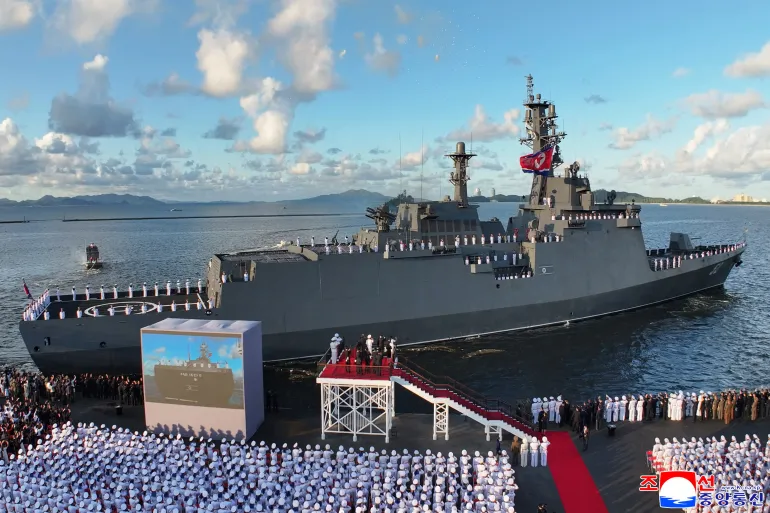
deploys

South Korea deploys 5 spy satellites, advances ‘kill chain’

April 28 (Asia Today) — South Korea has completed deployment of a five-satellite reconnaissance system designed to strengthen its preemptive strike capabilities against North Korea, marking a major milestone in its defense space program.

The project, known as the “425 program,” gives Seoul an independent ability to monitor North Korea with high-resolution imagery at roughly two-hour intervals, officials said.

The system combines one electro-optical and infrared satellite with four synthetic aperture radar satellites, allowing surveillance regardless of weather or time of day. Military officials say the network can track mobile missile launchers and other high-value targets, enhancing the country’s “kill chain” capability – a core element of its three-axis defense system.

The satellites were launched between late 2023 and late 2025, with the final unit successfully placed into orbit in November. U.S. space company SpaceX supported the launches, providing real-time global broadcasts that demonstrated the reliability of South Korea’s space assets.

The deployment marks a shift away from reliance on U.S. intelligence toward what officials describe as “independent surveillance,” enabling South Korea to observe targets at times of its choosing.

Despite the progress, military officials and analysts warn of a critical challenge: delays in real-time intelligence sharing with the United States.

Sources said that during the satellite deployment process, some U.S. intelligence inputs were delayed or limited, raising concerns about coordination between South Korea’s independent assets and allied systems.

The issue has implications for the effectiveness of the kill chain, which relies on rapid detection, identification and strike decisions within a narrow time window.

To address coordination gaps, U.S. Forces Korea has established a new unit known as J10, or Integrated Strategy Division, to support nuclear-conventional integration between the allies.

The unit is intended to act as a control hub linking U.S. nuclear deterrence capabilities with South Korea’s precision strike assets, enabling real-time operational coordination under the bilateral Nuclear Consultative Group framework.

Defense experts say the effort reflects growing complexity in integrating allied systems, particularly as both sides seek to align security protocols and data standards.

“The challenge is not just hardware, but digital synchronization,” one analyst said. “If delays persist, the kill chain could miss its critical response window.”

Another limitation is the system’s revisit rate. With North Korea believed to be able to prepare missile launches within 30 to 40 minutes, a two-hour surveillance cycle leaves potential gaps.

To address this, South Korea is accelerating plans to deploy constellations of small satellites in low Earth orbit, aiming to reduce revisit times to under 30 minutes.

Officials also emphasized the need for artificial intelligence-based analysis platforms capable of processing large volumes of satellite data in seconds to detect early warning signs.

Experts say the long-term success of the program will depend on software capabilities as much as hardware.

“When South Korea can produce intelligence as quickly and accurately as its allies, real-time data sharing will naturally deepen,” a defense expert said.

— Reported by Asia Today; translated by UPI

© Asia Today. Unauthorized reproduction or redistribution prohibited.

Original Korean report: https://www.asiatoday.co.kr/kn/view.php?key=20260428010008986

Source link

Iran dismisses Trump’s peace plan as ‘deceptive,’ as U.S. deploys more troops to Mideast

The Trump administration has offered Iran a 15-point ceasefire plan aimed at temporarily halting the war in the Middle East, as the Pentagon simultaneously orders thousands of Marines, paratroopers and a warship to the region.

The plan presented to Iranian leadership Tuesday broadly included a 30-day ceasefire and sanctions relief for Iran in exchange for a laundry list of U.S. demands, according to the Associated Press and other outlets.

But Iran dismissed the proposal Wednesday, criticizing the White House’s terms as “excessive” and out of step with reality, according to Iranian state-run media.

Those terms included limitations on Tehran’s missile stockpiles, and the permanent end to its nuclear program, its support for regional militias including Hezbollah, and of its blockade of the Strait of Hormuz, various outlets reported, citing Pakistani officials mediating the negotiations.

Several of those provisions have long been considered nonstarters for Iran, which sees its missile stockade and regional alliances as central to national security.

Iranian officials responded with defiance and skepticism.

“Iran will end the war when it decides to do so and when its own conditions are met,” an Iranian official told state media. “Not when Trump envisions its conclusion.”

The official outlined the Islamic Republic’s terms for ending the conflict, which included a halt to “aggression and assassinations,” an end to fighting on all fronts, enforceable guarantees that hostilities will not resume, compensation for war damages and a formal recognition of Iran’s sovereignty over the Strait of Hormuz.

Iranian Foreign Minister Abbas Araghchi has stated that Iran is not interested in a ceasefire but rather a comprehensive “end of war” on all fronts, including the lifting of sanctions and guarantees to allow Iran to pursue peaceful nuclear enrichment for energy and medical applications.

Iranian officials told state media that they believed the Trump administration’s diplomatic efforts were deceptive.

“You have reached a stage where you are negotiating with yourselves,” Iranian military spokesman Ebrahim Zolfaqari said in a televised address Wednesday. “Do not call your defeat an agreement.

Since the start of the conflict, Iranian leaders have voiced suspicion of any diplomatic talks with the Trump administration, pointing to prewar diplomatic efforts as evidence they were “tricked.” The Islamic Republic says it made clear in those talks that it had no interest in developing nuclear weapons, but Trump launched his military campaign nonetheless.

There have been conflicting media reports over Tehran’s exact position. Statements from Iranian officials and state-linked outlets have left open the possibility that elements of the proposal are still under review, while some reports frame the response as an outright refusal.

The Iranian response also conflicts with President Trump’s insistence that negotiations were progressing.

“We have had very, very strong talks,” he said Sunday in Florida. “We have points, major points of agreement. I would say almost all points of agreement will at some point very, very soon meet.”

Compounding the issue, Israel — which continues to carry out routine bombing campaigns over Iran — has stayed out of the talks.

Trump and Israeli Prime Minister Benjamin Netanyahu spoke about the peace deal in a phone call Tuesday. In a televised address, Netanyahu said that Trump “believes there is an opportunity” to realize U.S.-Israeli war objectives in an agreement “that will safeguard our vital interests.”

“At the same time, we continue to strike both in Iran and in Lebanon,” Netanyahu said. “We will safeguard our vital interests in any scenario.”

The negotiations are being facilitated by Pakistan, with support from Egypt and Turkey — countries that have pushed to contain a conflict that has killed more than 2,400 people, further destabilized the embattled region and disrupted global oil markets.

As Washington pursued a diplomatic end to the conflict, the Pentagon deployed an additional 2,000 troops from the 82nd Airborne Division to the Mideast. An additional 5,000 Marines and thousands of sailors are already en route to the region, where 50,000 more Marines are currently stationed.

House Speaker Mike Johnson (R-La.) told reporters on Wednesday that the deployment “sends a signal to Iran that they need to get their act together,” but denied any coming escalations by the American side. Johnson instead said that he believes “Operation Epic Fury is almost done.”

Now in its fourth week, the operation began with a series of intensive airstrikes that killed Iran’s Supreme Leader, Ali Khamenei, and dozens of other high-ranking officials. Since then, the U.S. and Israel have carried out over 9,000 strikes targeting Iranian military infrastructure and nuclear program.

Defense Secretary Pete Hegseth told reporters in the Oval Office Tuesday that while the president’s diplomatic envoys seek a peace deal, his department of war will continue to “negotiate with bombs.”

“The president has made it clear that you will not have a nuclear weapon. The War Department agrees,” Hegseth told reporters Tuesday in the Oval Office. “Our job is to ensure that, and so we’re keeping our hand on that throttle.”

Iranian retaliatory strikes have hit Gulf infrastructure and halted energy production and shipping in the region, spurring global fears of an enduring supply crunch. Meanwhile, Israel has expanded operations in Iran and sought to expand its borders into Lebanon.

Oil prices, which had surged above $120 per barrel earlier in the conflict, fell sharply this week on hopes that a ceasefire could ease supply woes.

In a statement Wednesday, U.N. Secretary-General António Guterres demanded an end to the fighting, which he said “has broken past limits even leaders thought imaginable.”

He specifically called on the U.S. and Israel to end the war, as “human suffering deepens, civilian casualties mount, and the global economic impact is increasingly devastating.”

Times staff writers Ana Ceballos, in Washington, D.C., and Nabih Bulos, in Beirut, contributed to this report.

Source link