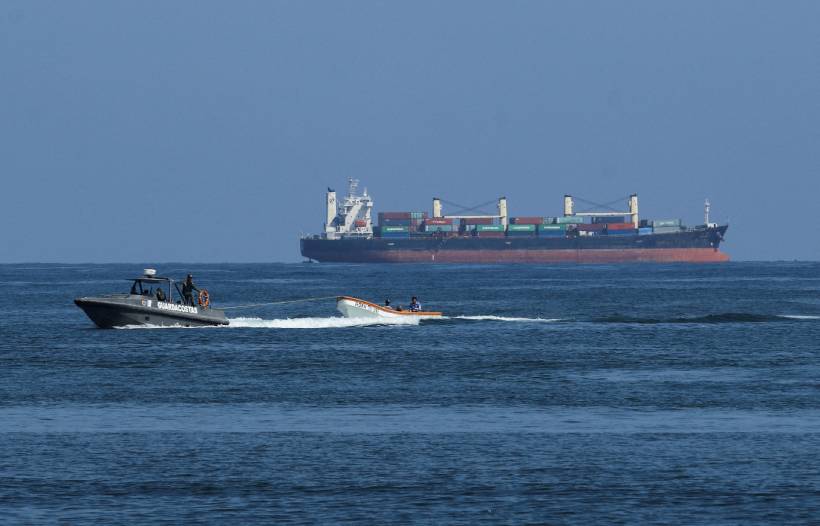
The United States has fully commited to its enforcement of sanctions on Venezuela by seizing a large oil tanker off its coast. President Donald Trump publicly announced the operation on December 10th and authorities said a joint FBI/Homeland Security/Coast Guard team executed a court-ordered seizure of the vessel, which was transporting Iranian and Venezuelan crude in violation of U.S imposed sanctions.
This is reportedly the first U.S. seizure of a Venezuelan oil shipment since sanctions began way back in 2019. “We’ve just seized a tanker on the coast of Venezuela, a large tanker, very large, largest one ever seized, actually,” says Donald Trump.
Trying to maintain the credibility of U.S. sanctions at a time when their enforcement have increasingly been challenged by other international actors such as Russia or Iran. Now, The U.S. is willing to take direct action beyond economic wars, even at the risk of diplomatic and military escalation.
Reactions from Caracas
Venezuela publicly denounced the action and accused Washington of blatant theft describing the seizure as “an act of international piracy”. Venezuelan President Nicolás Maduro has long cast himself as the victim of a U.S. led campaign to oust him from the country in order to seize the vast oil wealth on the country’s shores. He reiterated that the U.S. military buildup, which started this summer, including carrier strike groups and bases is directly aimed at overthrowing him.
Maduro’s supporters rallied in the streets against foreign aggression even as officials prepared diplomatic protests to international bodies. For the time being, he faces limited other practical options for retaliation as Venezuela’s navy is in no position to challenge U.S. maritime dominance, and legal recourse through international courts would likely take years.
Russia’s Offers Full Support
Moscow reaffirmed its backing for Maduro, emphasising the legitimacy of Venezuela’s government and condemning what it described as unilateral U.S. actions. An ally in South America provides Russia opportunities for energy investment, and a way to challenge U.S. influence.
The tanker seizure allows Moscow to frame Washington as overreaching and destabilising, a narrative it also applies to recent U.S. actions in Eastern Europe and the Middle East. While Russia is unlikely to escalate militarily, its political backing is significant.
China’s Strategic Role, A Potential Mediator?
Avoiding direct confrontation with Washington over the seizure, Beijing has reiterated its general opposition to unilateral sanctions and calling for international dialogue. However, China remains Venezuela’s most important economic partner and oil consumer, giving it substantial influence over any talks in the region.
Chinese companies have adapted to sanctions by purchasing Venezuelan crude oil at discounted prices, often through intermediaries. For Beijing, Venezuela is also part of a broader strategy to diversify energy supplies and expand its economic reach to the Americas.
Impact on Oil Markets
The announcement caused a modest spike in oil prices around the globe; for example: Brent crude briefly rose about 0.4% to around $62 a barrel, before returning to normal levels in the following few days.
The incident also highlighted Venezuela’s export challenges: under sanctions, its oil trades at a deep discount for its main trade partners, China and Russia. American oil companies with Venezuelan ties reported no immediate trouble. Chevron the U.S. firm that co-owns Venezuela’s largest oil project said its operations there continue normally, and U.S. imports of Venezuelan crude have even ticked up slightly in recent months.
Broader Consequences
Neighbouring countries such as Cuba and other Caribbean states depend on Venezuelan oil and could feel its effects. Sanctioning Venezuela was intended to pressure the regime into political concessions, yet Maduro remains firmly in power.
Enforcement actions like this tanker seizure may increase short-term pressure, but they also come with great risk for the stability of the Caribbean. Venezuela’s experience mirrors that of Iran and Russia, suggesting that sanctions alone may be insufficient to produce regime change, particularly when the targeted government is provided external backing.
Possible Future Scenarios and Implications
One scenario is a continuation of this low-level rise in tensions, with the U.S. stepping up enforcement and Venezuela responding through diplomatic protests while relying on Russian support.
Another is a negotiated de-escalation, potentially linked to limited sanctions relief in exchange for political concessions, though past efforts suggest this would be difficult to achieve with the current White House administration.
A more destabilising scenario would involve a potential confrontation at sea and broader disruption to energy markets. However, this scenario remains unlikely for the time being.
With information from Reuters and BBC News.