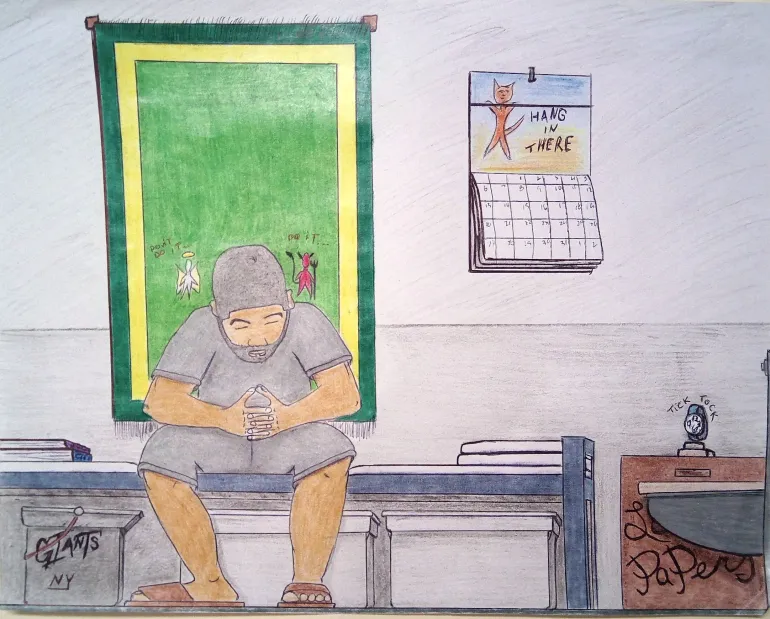
Some define time as linear, some see it as a block. Others refer to it as something spent, in the present, or the future. Meanwhile, others consider it to be supernatural or holy, or something to twist, tame or traverse.
As someone who has been sentenced to a lifetime behind bars, time is both abstract and defined. When you have so much time, it is all you have, yet, inside, you have almost no control over how to spend it.
Every day, I can hear it: tick, tick, tick. It’s torturous, like that dripping faucet in my cell.
So to quiet the sound, I study. I learn. I try to build something meaningful from the minutes.
At the time of my arrest in 2002, I was a 25-year-old entrepreneur who had started a successful business. I was enrolled in college, working towards my degree in Information Technology, when my world collapsed. Once in New Jersey State Prison (NJSP) in Trenton, I had a simple choice: either give up on all of my dreams, or fight for them alongside my efforts to prove my innocence. So, I decided to use my time to complete my education.
My father had brought our family to the United States from Pakistan so his two sons could have access to higher education. He passed away this past January, and it is because of him I keep studying, to fulfil the dream he carried across an ocean.
Yet on the inside, that dream has been hard to chase.
‘You guys aren’t going anywhere’
Prison life is an insidious thing. The environment is conducive to vice and illicit activities. Drugs and gambling are easy to find; doing something constructive, like education, well, that can be a monumental task.
The NJSP’s education department only offers GED-level (high-school level) education. Prisoners can also enrol in outside correspondence courses, also known as independent study. These include certifications, like in paralegal studies, costing about $750 to $1,000.
For-profit “correspondence schools” advertise mail-order college degrees, but most, costing anywhere from $500 to $1,000, are unaccredited – selling paper, not knowledge. Some men collect a bachelor’s, master’s, and even a doctorate in a single year. I could not bring myself to do that. For me, an accredited degree is something that cannot be dismissed, and would make me feel on par with those in the free world.
But the options for college degrees from reputable accredited universities can run into the thousands – a non-starter for most of those imprisoned. So I began with a prison paralegal training course taught by fellow prisoners helping others with their legal battles.
Later on, I watched a PBS documentary about the Bard Prison Initiative in New York, a real college programme, accredited and rigorous, for men and women in the state’s prisons. Inspired, I decided to write dozens of letters to reputable universities across the country, asking them to take me as a test case to do a degree. None replied.
Then I learned about NJ-STEP, a programme offering college courses to prisoners at East Jersey State Prison. But when I asked to enrol, the NJSP’s education supervisor replied that it was not offered at our prison. When I appealed to the administration, a security major told me, “Why should I bring the NJ-STEP here? You guys aren’t going anywhere.”
His words echoed, as if a sentence within a sentence.
![[Illustration by Martin Robles]](https://i0.wp.com/occasionaldigest.com/wp-content/uploads/2025/12/Scanned_20251109_062437-2-1-1763466969.jpg?w=640&ssl=1)
The myth of higher education
Thomas Koskovich, 47, has spent nearly three decades in NJSP, where he is serving a life sentence.
When I asked him about the opportunities for higher education in the prison, he scoffed.
“What college programme?” he blurted.
“The only thing they let us do is something called independent study, and by the way, you pay for everything yourself. The prison doesn’t help you. They just proctor [meaning they provide someone to administer] the tests.”
Thomas works as a teacher’s aide, a prison job detail, in the Donald Bourne School, named after a policeman who was killed by a prison inmate in 1972. The teachers come from the outside, while aides like Thomas assist them and also tutor students requiring extra support. He helps men earn their GEDs while knowing there is no path offered beyond that to further higher education.
“I’ve seen guys stuck in GED classes for 15 years,” he said.
Prisoners get stuck for different reasons: classes get cancelled because of emergencies, or sometimes the men have little education to begin with and require years to learn to read and write. Students also get paid $70 a month to attend, so some consider it a job – particularly as prison jobs are scarce – and deliberately fail so they can stay at the school for longer.
Of the two dozen or so students, “the school averages maybe five to 10 graduates a year”, Thomas explained.
He earns about $1,500 a year, far less than the $20,000 he would need to afford an accredited correspondence degree. But he chooses to help others in the same school where he got his GED because, as he put it, “Most people in here aren’t career criminals. They just got caught in bad situations.”
He added, “If given half a chance, they’d choose a legal, meaningful life.”
Thomas sees education as key to self-betterment. It was a book, Pedagogy of the Oppressed by Paulo Freire, a Brazilian Marxist educator, given to him by an activist friend that showed him the power of education, he says.
Education equips us to “better handle stressful situations” and nurture creativity and “artistic expression”, he reflected. “But most importantly, we can develop skills that will allow us to earn a living legally and contribute to society in a positive way.”
The Department of Corrections may store bodies, but it does not nurture minds, though many will eventually be freed back into society after serving their terms, while others could win their freedom in court or through clemency.
And education can only help with transitioning into life on the outside. According to the Prison Policy Initiative, a research and advocacy nonprofit, limited access to education in prisons remains a major barrier to rehabilitation and reentry into society. Decades of studies support the idea that education in prison reduces recidivism – a RAND meta-analysis found a 43 percent lower likelihood of reoffending among inmates who pursued studies.
Kashif Hassan, 40, from Brooklyn in New York City, has been imprisoned for 15 years. Serving a life-plus-10-year sentence, he has earned multiple degrees, including two PhDs, one in business administration and one in criminal justice, through university distance education.
Unlike other prisoners, Kashif was fortunate in that his family could afford the tens of thousands in accredited college tuition fees.
“I have two sons,” he told me, “and I want to show them that no matter the circumstances, even here, you can keep learning.”
He laughed when I asked about support from the NJSP’s education department. “None,” he said. “They even cancelled the college correspondence roster [a list that allowed students enrolled in long-distance education to access the prison law library and school computers to type and print]. They say it’s for security, but really, it’s about control.”
Kashif has also been on the waiting list for a paralegal course for 10 years.
“Education is a powerful tool,” he said. “It helps you understand your rights, navigate the system, and articulate yourself better. Especially in here, it’s the difference between feeling powerless and feeling empowered.”
A door where there was a wall
In 2023, I learned of a glimmer of progress. The Thomas Edison State University (TESU) in Trenton – ranked among the state’s top 20 public institutions – launched a new programme enabling men in NJSP to pursue accredited college degrees.
In 2024, I began taking TESU courses for a liberal arts degree. My tuition is paid for by grants and scholarships. The programme runs independently from the NJSP’s education department, which only proctors exams. For those of us long shut out of higher learning, it felt revolutionary. As if a door opened where there had only been a wall. It has made me feel free and given me purpose.
For Michael Doce, 44, another student in the programme who is serving a 30-year sentence, the door is narrow but precious. “I want to stick it to the NJDOC, to say, ‘Look what I did all on my own.’”
Michael studied engineering at Rutgers University before he was imprisoned. Now he is earning a communications degree.
“My family buys used textbooks,” he said. These are mailed to the prison, but security checks mean they can take weeks to reach him.
“But the prison just banned used books,” he added. “Depending on how much new ones cost, I might not be able to continue.”
Al Jazeera requested clarification from the New Jersey Department of Corrections about the cancellation of the roster and the banning of used books, but did not receive a response.
Michael shrugged and gave a wry smile. “If too many guys signed up, they’d probably cancel the whole thing. I’m being funny, but not really.”
He maintains top grades and dreams of becoming a journalist. “A criminal conviction closes a lot of doors,” he told me. “I’m just trying to open new ones.”
‘Doing his own time’
There is a couplet from the 18th-century Urdu poet Mir Taqi Mir that goes:
Yaarān-e deyr o Ka‘bah, donon bulā rahe hain
Ab dekhen Mir, apnā jānā kidhar bane hai
My heart is torn between two calls – the world of love and the house of God.
Now it is a test to see which way my soul will turn.
Perhaps that captures the prisoner’s daily dilemma: between despair and determination; between giving up and growing. In the absence of rehabilitation, every man must choose his own path – “doing his own time,” as the popular prison phrase goes – towards light or darkness.
Men like Thomas, Kashif, Michael, and many others choose light. They choose education.
The Department of Corrections may store bodies, but it cannot own the will to grow. Education here is not charity. It is resistance. It is the one realm where we can still choose, and in choosing, we stay human and free.
Because in the end, freedom does not begin with release. It begins with the decision to grow. It begins with the mind.
And in this place, where time is both enemy and companion, every page turned, every lesson learned, is a way to quiet the endless ticking, a way to remind ourselves that even behind bars, time can still belong to us.
Tick. Tick. Tick.
This is the final story in a three-part series on how prisoners are taking on the US justice system through law, prison hustles and hard-won education.
Read more from the series:
How I’m fighting the US prison system from the inside
Tailors and corner stores: The hustles helping prisoners survive
Tariq MaQbool is a prisoner at New Jersey State Prison (NJSP), where he has been held since 2005. He is a contributor to various publications, including Al Jazeera English, where he has written about the trauma of solitary confinement (he has spent a total of more than two years in isolation) and what it means to be a Muslim prisoner inside a US prison.
Martin Robles is also a prisoner at NJSP. These illustrations were made using lead and coloured pencils. As he has limited art supplies, Robles used folded squares of toilet paper to blend the pigments into different shades and colours.