Skydance-owned Paramount Pictures has taken over the lease for the Bay Theater in Pacific Palisades and intends to reopen the cinema, which has been closed since the January 2025 Palisades fire last year.
Paramount plans to upgrade the theater with state-of-the-art projection systems and in-seat food and drink service, Rick Caruso, whose company owns the Palisades Village shopping center where the Bay Theater is located, said in an interview. Caruso is founder and executive chairman of the real estate firm Caruso.
Paramount plans to show first-run theatrical movies from all studios. The theater will be operated by The Lot, a La Jolla-based luxury dine-in theater chain with four locations in California. The theater is expected to reopen later this year, Caruso said.
“The comeback of this movie theater is a great signal for all of L.A.,” he said. “Los Angeles is resilient, and we’re going to show the country that Los Angeles can bounce back from a terrible, terrible disaster, and the comeback is going to be much greater than the setback.”
Palisades Village reopened in August after more than $100 million in renovations, including major infrastructure work. The upscale outdoor mall survived the Palisades fire, but needed refurbishment to eliminate any potential contaminants from the blaze.
Caruso declined to share terms of Paramount’s lease agreement, saying only that it was long-term. Paramount declined to comment on the size of its investment in the theater.
Caruso said he brought up the Bay Theater over lunch last year with David Ellison, chief executive of Skydance, who was then working to acquire Paramount. The two were discussing that deal and Ellison’s belief in the importance of the movie theater business to the industry.
“Together with Caruso, we are proud to help bring the Bay back to life as a place for the Pacific Palisades community to gather around the shared experience of cinema,” Ellison said in a statement. “This theater has always meant more than movies alone — it’s woven into the fabric of this neighborhood, and helping restore it is a privilege.”
The Bay Theater was previously leased by Netflix, which took it over in 2021. The company used the theater to host special events, screen classic films and showcase its own original theatrical movies.
Caruso described Netflix and company Chief Executive Ted Sarandos as “incredible stewards” of the theater, adding that Sarandos was “very much a gentleman” in having the discussion about Paramount stepping in at the theater.
Ellison has long extolled his love of movies and appeared at the CinemaCon movie theater owners convention earlier this year to reiterate his commitment to theatrical releases.
Studios were barred from owning theaters for decades under the Paramount consent decrees, which a federal judge terminated in 2020. Netflix has since operated the Egyptian Theatre in Hollywood and the Paris Theater in New York.
“Through our curated offering and dedicated hospitality, we look forward to welcoming the Pacific Palisades community back to the movies, the way they were intended to be shared,” Adolfo Fastlicht, founder and chief executive of The Lot, said in a statement.
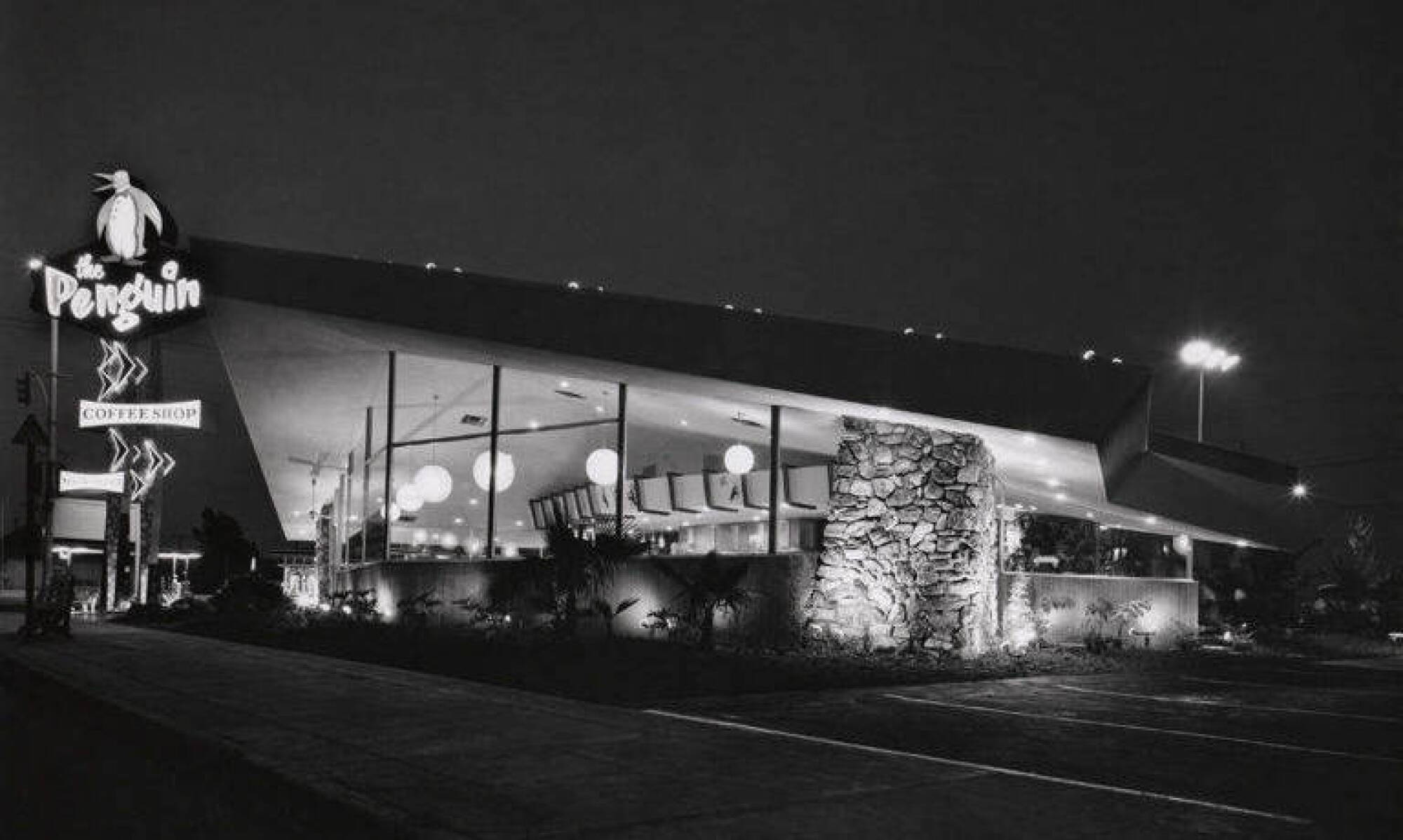
For decades, the bold, mid-century building at Lincoln and Olympics boulevards in Santa Monica has been the end of the line — the last address on the 2,400-mile westward journey of Route 66. Once home to the Penguin Coffee Shop, today it holds Mel’s Drive-In. But now its future is in doubt.
The owners of the property have filed early paperwork to level the structure and replace it with an eight-story apartment building. Preservationists are pushing for a historic designation that might protect it.
The groups appear headed toward a showdown Dec. 14, when the Santa Monica Landmarks Commission will hold a hearing on the site’s nomination for protected status by the Santa Monica Conservancy and the Los Angeles Conservancy. The allied conservancies contend that the building is “the most significant representation of its style and period in architecture and design in Santa Monica.”
Designed by famed mid-century architects Armet & Davis, the building held the Penguin Coffee Shop from 1959 through 1991.
(Architects Armet Davis / Santa Monica Public Library Image Archives)
“This isn’t about saving a modern restaurant. It’s about preserving some really important Googie architecture,” said Nina Fresco, vice president of Santa Monica Conservancy. She added that “there’s no reason why housing and historic preservation can’t be partners.”
Irvine-based firm ValueRock Realty bought the half-acre Mel’s property for $6.2 million in 2020, and in 2025 began offering the property for sale, asking $26 million through brokers Newmark Pacific.
Soon after learning that the building was for sale, the Santa Monica and L.A. conservancies nominated Mel’s for a landmark designation, which can protect buildings from demolition, Fresco said. As part of the effort, Santa Monica Conservancy leaders raised $6,800, the cost of a Santa Monica landmark nomination, and enlisted the L.A. Conservancy as an ally.
Then on Sept. 18, ValueRock filed a preliminary application with the city (also known as an SB330 application) to replace the 1959 building with an eight-story apartment building, including 138 apartments, 123 parking spaces and first-floor retail space.
The sign of Mel’s Drive-In features a penguin, homage to the coffee shop of yesteryear.
(David Fouts / For The Times)
When it bought the property in 2020, ValueRock announced that it “is considered to be a historical landmark within the community.” But in its September filing for the apartment project, ValueRock management checked a box indicating that no historic or cultural resources are known to exist on the property.
“We didn’t know they would be quite this aggressive, but it’s not a huge surprise,” Fresco said.
Under city law, Fresco said, if a property is more than 40 years old, the owner must wait at least 75 days after seeking a demolition permit before any demolition can happen. “So we’re OK at least until that hearing” in December, Fresco said.
If the Landmark Commission agrees to confer landmark status on the building, Fresco said, it may be shielded from demolition — but the owner can appeal the decision to the City Council.
Management at ValueRock Realty did not immediately respond to requests for comment.
The restaurant remains open, receiving a steady stream of locals and Route 66 travelers. “We’re going to be here until 2029,” said Marilina Borchio, manager of Mel’s, citing a lease that runs through June of that year. As she spoke, the breakfast crowd was trickling in on Sunday morning. Borchio said she’s spending a lot of time reassuring customers who “think we are going to be demolished tomorrow night.”
The Googie-style building, designed by famed mid-century architects Armet & Davis, held the Penguin Coffee Shop from 1959 through 1991, catching the eyes of passing drivers with its dramatically slanted roof, oversize windows and a long counter inside for diners in a hurry. Architectural historians describe Googie style as a bold strain of Mid-Century Modernism, notable for big neon signs and swooping roofs, especially popular among restaurants, bowling alleys and car washes, now increasingly rare. Rae’s Diner, a 1958 building on Pico Boulevard, is another Santa Monica example.
The coffee shop never earned a Michelin star (nor has Mel’s) but its workaday American fare won a following. “The Penguin gets my vote for the best diner around,” wrote Times restaurant critic Charles Perry in 1989.
But two years later, the Penguin was gone. By 1992, the building had been converted into a dentist’s office. Eventually it fell idle, until the San Francisco-based Mel’s chain arrived in 2016 and began a renovation aimed at bringing back the restaurant’s ’50s atmosphere.
Mel’s Drive-In now occupies the old Penguin Coffee Shop building at the official end of Route 66 in Santa Monica.
(Christopher Reynolds / Los Angeles Times)
The renewed restaurant opened in 2018, with a penguin atop its sign, in homage to years gone by.
“A lot of the neon elements are gone, but the main elements are still there,” said the Santa Monica Conservancy’s Fresco, who is also a Santa Monica planning commissioner and former landmarks commissioner.
The renovation and restoration effort included removing layers of paint and tile that had been added over decades, revealing interior stone cladding that had been covered and replicating the counter and stools, vinyl cushioned booths, tables of plastic and metal, terrazzo floor, and light fixtures. The work was “to the letter of the Secretary of the Interior’s standards” for the treatment of historic properties, Fresco said.
The building is not mentioned in “An Architectural Guidebook to Los Angeles,” by David Gebhard and Robert Winter, which is a prime source for many preservationists. But Mel’s won a $10,000 grant from the National Trust for Historic Preservation in 2025 to pay for Route 66 centennial signage project.
Route 66 memorabilia at Mel’s Drive-in.
(David Fouts / For The Times)
“This site, like Route 66 itself, represents something greater than itself,” said Rhys Martin, manager of the National Trust’s Preserve Route 66 initiative, in an email. “It’s a connection to a journey through time and space that will be forever lost if this remarkable Googie structure is demolished.”
Fresco said she’d love to see the building continue to operate as Mel’s, but in the big picture, “we can’t stop them from building housing.” Still, Fresco said, she is hoping that the owner can come up with a project that retains the existing building while adding housing around it, as several other developers in Santa Monica have done. At 829 Broadway, developers agreed to preserve a World War II era Quonset hut while building a five-story apartment building around it. (The Quonset hut was occupied by Pono Burger from 2013 to 2025.) And the old Rapp Saloon — an 1875 brick building at 1436 2nd Street — was reborn in the late 1980s as a meeting space within a four-story hostel, now known as Hostelling International’s HI Los Angeles Santa Monica Hostel. The Santa Monica Conservancy begins its walking tours there.
If the allied conservancies win landmark status for the Penguin/Mel’s building, Fresco said, the owners “will be able to do exactly what they want to do now. They will just have to do it differently.”
Route 66, which was born and officially named U.S. Highway 66 on Nov. 11, 1926, was extended to Santa Monica in 1935. Though many travelers think of the Santa Monica Pier as the end of the route, its official terminus from 1935 on was at the intersection of Lincoln and Olympic boulevards, where Mel’s now stands.
Though Route 66 was decommissioned in the 1980s, its popularity as an Americana-rich driving route has grown in recent years, especially during this year’s centennial celebration of the road.
By the time the coffee shop building was going up at the end of the route in 1959, Fresco said, interstate freeways were already beginning to usurp Route 66’s role and the Santa Monica route of Interstate 10 had been plotted. By putting their eye-catching building on a spot along Route 66 and next to the path of the freeway, Fresco said, the people behind the Penguin were catering to motorists on roads rooted in two different eras.
“The Catholic Church shaped Rome. Commerce shaped Manhattan. It is popular culture that has shaped L.A.,” architecture critic Alan Hess told a Times reporter in 1993. “We should see these buildings in that context and take them seriously.”
The feature is co-produced by the Daily Wire — the right-wing media company launched in 2015 by conservative political commentator Ben Shapiro — and Bonfire Legend, a production company formed by prolific producer Dallas Sonnier in 2021.
Frequently featured in movies targeting Latino audiences, Trejo built a devoted following within the demographic over the years as one of the more prominent Mexican American actors in Hollywood.
He was criticized online for his involvement in “Pawn Shop” due to its positive portrayal of ICE agents, who have been antagonizing the Latino community at an accelerated clip over the last two years. Trejo was called a “sellout” and a “traitor” across social media in recent days.
“I want to address some social media comments about me. Make no mistake. I am a proud Mexican who has always been and will always be a supporter of my community,” Trejo wrote in an Instagram post. “I am also obviously pro-immigrant. I am not pro ICE. I know where I come from and I know our struggles. I am an actor. My job is to tell a story.”
Trejo’s casting was first announced by the Montana newspaper Bozeman Daily Chronicle after speaking with one of Trejo’s cast members on the film’s set in Livingston, Mont., as well as Livingston locals who had seen and photographed the actor in the city’s downtown area.
Deadline confirmed that Trejo, along with “Reservoir Dogs” actor Harvey Keitel and “E.T. the Extra-Terrestrial” star Henry Thomas, was scheduled to appear in the film after reviewing the call sheet.
The 82-year-old Trejo has previously voiced support for immigrant communities. During the initial onset of the COVID-19 pandemic in spring 2020, he was part of a coalition of Latino actors who pushed forward the #AyudaEnEspanol campaign, which advocated for providing COVID-19 resources kits in Spanish for Latino migrant farmworkers across the U.S.
In an interview with TMZ in fall 2025, the actor, who has appeared in over 400 films and television programs, was asked to give a message to the families that had been affected by ICE raids.
“To the families, keep up hope,” Trejo said. “Help your neighbor and do whatever you can for people in need.”
His recent statement came after “Pawn Shop” made headlines for hitting snags in its production in Livingston following local protests. Residents claimed the movie’s production interrupted local businesses’ operations — and that the crew did not properly communicate with businesses about its schedule.
Production on the film was temporarily paused on Oct. 3 from an order by the Livingston city commission. Filming resumed on Oct. 6 after Livingston officials reinstated permits for the movie.
NEW YORK — Elon Musk, the world’s only trillionaire, has quietly become the biggest known donor in this year’s midterm elections, doling out more than $276 million since July to try to save Republican majorities in Congress.
The numbers, first reported by the New York Times ahead of this week’s federal filing deadline, were confirmed by Andrew Romeo, a spokesperson for Musk’s super PAC.
The money includes $158 million given to the Senate Leadership Fund, the main super PAC supporting Republican Senate candidates, one of the largest known political donations in American history, according to the Times.
Another $76 million went to America PAC, a Musk super PAC, which has once again built out a major turnout operation like the one it used to help elect President Trump by knocking on doors in 2024.
Musk also provided $10 million to Lone Star Liberty PAC, a group that supports the Republican nominee for Senate in Texas, Ken Paxton. The race has been a major focus of Musk’s efforts.
It’s a dramatic turnaround since last May, when Musk said he intended to cut back on future political spending. “I think I’ve done enough,” he said at the time.
Despite the cash infusion, Musk has generally kept a lower profile than in 2024, when he appeared on stage next to Trump at rallies, and in the early days of the president’s second term, when he led the Department of Government Efficiency.
He had a falling out with Trump while leaving his government post, but the two have since reconciled. Trump presented Musk with the National Medal of Science last week.
Musk’s net worth has fluctuated around the trillion-dollar line this year based on changes in stock prices, but he topped $1 trillion again last week according to Forbes magazine.
Republican have a gaping financial advantage over their Democratic counterparts — a disparity that has been a rare bright spot for a party that is bracing for major potential losses amid deep voter frustration over the president’s performance, stubbornly high prices and the unpopular war with Iran.
They have been using the money to blanket the airwaves in the race’s final stretch.
“These robust investments have allowed the G.O.P. apparatus to get its message out so Republicans can have a fighting chance to defy history,” Romeo told the Times.
Democrats responded to the news by accusing Republicans of using vast amounts of cash to mask their shortcomings.
“Republicans are hoping to buy these elections, injecting tens of millions into races to try and outrun their unpopular candidates, unpopular president, and unpopular economy,” said Lauren French, a spokesperson for Democrats’ Senate Majority PAC.
President Trump has pushed Congress to pass a proof-of-citizenship law, signed an executive order seeking a national voter ID requirement and tried to limit mail voting through U.S. Postal Service changes.
None of those moves succeeded in time to affect this year’s midterm elections. It’s a different matter in the states.
More than three dozen voting laws passed in Republican-controlled states are taking effect for the first time this year, many of them containing elements of Trump’s stalled proposals. They include changes to what IDs are acceptable to register for the first time and requirements to show proof of citizenship, an issue the Republican president has tried but failed to get through Congress.
“Trump’s attacks on our elections are deeply damaging, but they are not happening in isolation,” said Sophia Lin Lakin, director of the American Civil Liberties Union’s Voting Rights Project. ”Across the country, states are also advancing restrictions that make it harder for eligible voters to cast a ballot.”
Republican lawmakers who support the tighter voting laws, especially around voter ID, describe them as common sense changes that help build trust in elections.
Trump and other Republicans have been pushing for more restrictive rules since the president’s false claims of widespread fraud in his 2020 election loss to Democrat Joe Biden. Trump’s false claims have resonated with Republican voters, a majority of whom believe Biden was not legitimately elected despite all evidence to the contrary. Trump lost dozens of court challenges, his own attorney general found no evidence of widespread fraud, and reviews, audits and recounts in the battleground states where he contested his loss all affirmed Biden’s victory.
Among the changes confronting voters as early voting gets underway: Students in New Hampshire can no longer use student IDs; Utah voters returning mail ballots must include more information on the envelope; and some voters in Mississippi might need birth certificates or passports to verify their identities.
Changes to voter ID requirements are challenged
New Hampshire state Rep. Donald McFarlane said he sponsored the bill to eliminate student IDs as acceptable for voting because colleges don’t have the same controls when issuing those cards as government agencies.
“The change removes a special exception and applies the same government-issued ID standard to all voters,” he said, adding that his bill had bipartisan support.
Students, he said, can still get state IDs free of charge.
The new requirements have not gone unchallenged.
In South Dakota, the ACLU has filed a lawsuit seeking to halt a new law that includes requiring voters registering for the first time to present the most common forms of ID — driver’s licenses, Tribal IDs and non-driver state IDs. They must be presented in person at places that accept registration.
“Proof of citizenship in itself is not terrible,” said Kathryn Johnson, president of the League of Women Voters of South Dakota.
Her concern is the requirement to present the IDs in person.
“We’re kind of a remote state, so sometimes it takes a drive, and you have to coordinate, you have to take off work, and all of these kinds of things,” she said.
Some Democrats also have expressed support for voter ID during recent debates. Pennsylvania Gov. Josh Shapiro said he was open to the idea as long as it wasn’t based on “conspiracy theories.” When legislatures change their state’s voting laws, they typically give election offices and voters time to adjust. Trump wanted federal voter ID and proof-of-citizenship legislation to take effect immediately, forcing election officials and voters to comply in the middle of the midterms.
Ohio seeks to scrub voter rolls
Ohio has a proof of citizenship requirement in effect for the first time this year for those registering to vote or updating their voter registration information at a Bureau of Motor Vehicles location. The state also eliminated its four-day grace period for mail ballots, which now must be received at local election offices by Election Day.
Yet the biggest concern for voting rights groups is an ongoing purge of the state’s voter rolls. The databases used to check citizenship against voter registration lists can be outdated, said Freda Levenson, legal director of the ACLU of Ohio, which has sued to overturn the law.
“Vast numbers of perfectly eligible voters are vulnerable to being disenfranchised,” she said.
Republican state Sen. Theresa Gavarone, one of the primary sponsors of the bill, challenged the ACLU’s legal action and said the problem it addresses is a real one.
“In the past two years, hundreds of noncitizens have been removed from Ohio’s voter rolls,” she said in an email. “Every single vote cast by a noncitizen disenfranchises a lawful Ohio voter.”
Voters have mixed views on the changes
Outside an early voting center in Wayne County, Ohio, retired steel worker Dan Walter, an independent voter, said he opposes requiring documentary proof of citizenship to vote.
“It’s to keep people from voting, it sounds to me like,” he said.
His wife, Jody, a retired aerospace executive and a Democrat, said she felt the same way about Ohio’s new requirement for registering to vote.
“A driver’s license doesn’t prove citizenship, and that’s all they ask for now,” she said. “It’s going to be an obstacle for so many people.”
Genia Fortune had a different view. A nurse, the Millersburg resident described herself as an independent and said she voted for President Barack Obama, a Democrat, and later for Trump. She believes Trump’s false claims that the 2020 election was stolen and sees requiring documentary proof of citizenship as a necessary precaution.
“I just feel like you need to be a citizen and show proof of ID,” she said.
Voting and election laws have become a regular target for legislatures
The Trump administration has pushed multiple strategies to influence this year’s midterm elections, most of them stymied by Congress or the courts.
Chris Diaz, director of legislative tracking at the Voting Rights Lab, said the group has seen several versions of the Republican president’s proposals passed by his allies in the states.
A recently released report by the group highlighted some of the key areas drawing Republican lawmakers’ attention, including mail balloting, voter ID and the hunt for noncitizens on voter rolls.
Noncitizen voting has been a focus of the Trump administration despite it being a rare problem. The U.S. Department of Justice recently announced it had brought charges in roughly 90 cases for various types of election misconduct, including 50 against people who are alleged to have voted as noncitizens. The U.S. had 227 million registered voters for the 2024 presidential election.
The Brennan Center for Justice has identified nearly 40 laws in 21 states taking effect this election season that will make it harder for eligible voters to register, stay on the rolls or cast ballots.
The report from the center, part of the New York University School of Law, found that many of the new laws target subsets of voters.
“What I want voters to take away from this is that elections are still run by the states and there are still people in many states who are trying to make it harder for you to vote,” said Sean Morales-Doyle, senior director of the center’s Voting Rights and Elections Program. “But that’s all the more reason to go make a plan to vote and participate.”
Fields and Smyth write for the Associated Press. Fields reported from Washington and Smyth reported from Wooster and Millersburg, Ohio.
Hi, and welcome to another edition of Dodgers Dugout. My name is Houston Mitchell. Another year, another NLCS. What happens this time? Let’s find out together.
Are you a true-blue fan?
Get our Dodgers Dugout newsletter for insights, news and much more.
By continuing, you agree to our Terms of Service, which include arbitration and a class action waiver. You agree that we and our third-party vendors may collect and use your information, including through cookies, pixels and similar technologies, for the purposes set forth in our Privacy Policy such as personalizing your experience and ads.
Game 1 thoughts
—As always, this is written as the game is going on, and I don’t go back and change my opinions to match the outcome of the game, so I might write something in the second inning that looks dumb considering how the game ended. Baseball!
—I’m predicting Dodgers in six. They lose today. Win tomorrow. Win two of three at home, win Game 6 in Milwaukee.
—Dodgers won the past two World Series. Brewers were last in the World Series in 1982, when they lost to the St. Louis Cardinals.
—I’m not a big fan of the Fox pregame show.
—Jacob Misiorowski can throw the ball 104 mph. I once threw a baseball 104 … feet.
—There’s something about Ken Rosenthal that I find disquieting. Of course, I’m sure some people say the same about me.
—Nice play by Jake Bauers to open the game.
—Freddie Freeman seems like he says “don’t like that two-strike pitch, so I’ll foul it off.”
—And Will Smith‘s struggles continue. But, the Dodgers are making contact.
—The Dodgers seem to have a lot of PitchCom problems.
—Two strikeouts for Skubal, 15 pitches. No strikeouts for Misiorowski, 12 pitches.
Second inning
—Opponents are still pitching to Shohei Ohtani as if he is full-strength Ohtani.
—Andy Pages does it again. He does not look intimidated by any situation. Dodgers 1, Brewers 0.
—Great at-bat by Kyle Tucker. He has really been what they expected for the past six weeks. Already 40 pitches for Misiorowski.
—It would be really nice to get at least one more run here. Bases loaded, one out.
—Kiké grounds into a double play. More Clark Kent than Superman there. That could come back to haunt the Dodgers later.
—Tarik Skubal looks really good so far.
—As soon as I wrote that, he gives up a double. Sorry.
—Skubal has very wide open eyes. He looks perpetually astonished. Skubal: 29 pitches. Misiorowski: 47.
Third inning
—Dodgers waste a leadoff single by Mookie Betts. This could be important later.
—I got a lot of emails during this game disagreeing with me about John Smoltz, saying he talks way too much. I agree (I wrote that), but what he says is often insightful. He just needs to edit things down in his brain before it reaches his mouth.
Fourth inning
—A leadoff single by Teoscar. Will they waste this one? Insurance runs would be nice.
—No one has ever successfully explained a balk call. I think the umpiring crew decides before a game, “We need to call a balk today.”
—And the Dodgers can’t cash in. This could be important later.
—Misiorowski has made 85 pitches through four, so he probably has one more inning left in him.
—And now it’s tied. Dodgers 1, Brewers 1. By the way, in tribute to my old boss, Mike James: The game is not tied, the score is tied.
—It’s hard to see from the center-field camera. Stupid fireworks. What about those of us with asthma? First-world problems.
—Dodgers are down to their last challenge! For some reason I don’t find that as stressful as many others do.
—Don’t Brice Turang and Jake Bauers realize they aren’t supposed to hit left-handers well? Come on guys, get with the program.
—And a double play ends the inning.
—You know that swing Ohtani has in the New Balance commercial? That’s the swing he is missing. Maybe study that ad.
—Things I don’t need to see during a game while watching with my grandchildren: Ads for horror movies (like “Other Mommy.”) And that Sydney Sweeney ad.
—By the way, I need all you kids to get off my lawn. Darn neighborhood rapscallions.
Fifth inning
—That will be it for Misiorowski. 4 1/3 innings, five hits, three walks. Didn’t have his best stuff, but he battled. Seems like you should have more than one run when you get eight batters on base in 4 1/3.
—It is funny, though, to hear everyone praise the ace after he just went 4 1/3. I always think back to Fernando Valenzuela in Game 3 of the 1981 World Series. He pitched a complete game despite not having his best stuff, throwing 147 pitches, giving up nine hits and walking seven while defeating the Yankees, 5-4. Now that was battling without your best stuff.
—Another double play. Dodgers don’t get a left on base that inning, but really they did.
—Hey, a bunt! I thought those weren’t allowed anymore because they were a waste of an out.
—And the Brewers immediately cash in, something the Dodgers haven’t been able to do. Brewers 2, Dodgers 1.
—Skubal won’t last much longer.
—Gift hit for Jackson Chourio.
—Turang walked to load the bases. I can’t believe Skubal is still in the game.
—And Skubal escaped the jam. Dodgers are lucky to be trailing by only one.
Sixth inning
—Ohtani has become Bill Russell as a hitter.
—One thing the Dodgers do that is bothersome: When they fall behind, they seem to abandon their plan to make the pitcher work.
—Max Muncy with a hard single. The most underrated player on the team this season.
—And Pages strikes out. Another chance wasted.
—Alex Vesia is great.
Seventh inning
—It didn’t work out, but the Dodgers were less swing happy that inning.
—I find Brewers fans far less annoying than Braves fans.
—The five franchises to never win a World Series: Brewers, Colorado Rockies, San Diego Padres, Seattle Mariners, Tampa Bay Rays.
—I wrote that before Fox put up the graphic with the same info. Really.
—Evan Phillips strikes out the side.
Eighth inning
—And the Dodgers strand another runner.
—Another bunt! Anarchy!
—First and second, one out. Can the Brewers cash in against Tanner Scott?
—Intentionally walking the bases loaded is a gutsy move.
—But it pays off.
Ninth inning
—Muncy, Pages and Tucker against Trevor Megill.
—Muncy pops out.
—Pages flies out.
—Tucker walks. Good at-bat.
—Can Josue De Paula, at 21 years old, be a Game 1 hero? (As former colleague Bob Cuomo would say, “Hero? How many lives did he save?”)
—De Paula walks. He feels no pressure ever. What a batting eye for one so young.
—Betts flied out. One final blown chance by the Dodgers.
—I should point out that the Dodgers were seventh in the majors this season in batting average with runners in scoring position at .262. The Brewers were second, .276. The Dodgers were seventh with two out and runners in scoring position at .241. The Brewers were ninth at .239.
Final score: Brewers 2, Dodgers 1.
Nothing to worry about. The Dodgers have trailed 1-0 before and won, and led 1-0 and lost. This is why they play seven games. We’ll be back tomorrow.
Poll results
We asked, “Who will win the NLCS?”
After 11,784 votes, the results”
Dodgers in six, 51.3% Dodgers in five, 18.4% Dodgers in seven, 15.8% Brewers in six, 7.5% Brewers in seven, 3.2% Dodgers in four, 2.2% Brewers in five, 1.4% Brewers in four, 0.2%
Up next
Monday: Dodgers (Yoshinobu Yamamoto) at Milwaukee (Logan Henderson), 2 p.m., Fox/FS1/Fox Deportes/Fox One
Wednesday at Dodgers, 5 p.m., Fox/FS1/Fox Deportes/Fox One
Thursday at Dodgers, 6 p.m., Fox/FS1/Fox Deportes/Fox One
*Friday at Dodgers, 6 p.m., Fox/FS1/Fox Deportes/Fox One
*Sunday at Milwaukee, 5 p.m., Fox/FS1/Fox Deportes/Fox One
*Monday, Oct. 19 at Milwaukee, 5 p.m., Fox/FS1/Fox Deportes/Fox One
Shohei Ohtani hits three home runs, strikes out 10 in Game 4 of the 2025 NLCS against the Brewers. Watch and listen here.
Until next time …
Have a comment or something you’d like to see in a future Dodgers newsletter? Email me at houston.mitchell@latimes.com. To get this newsletter in your inbox, click here.
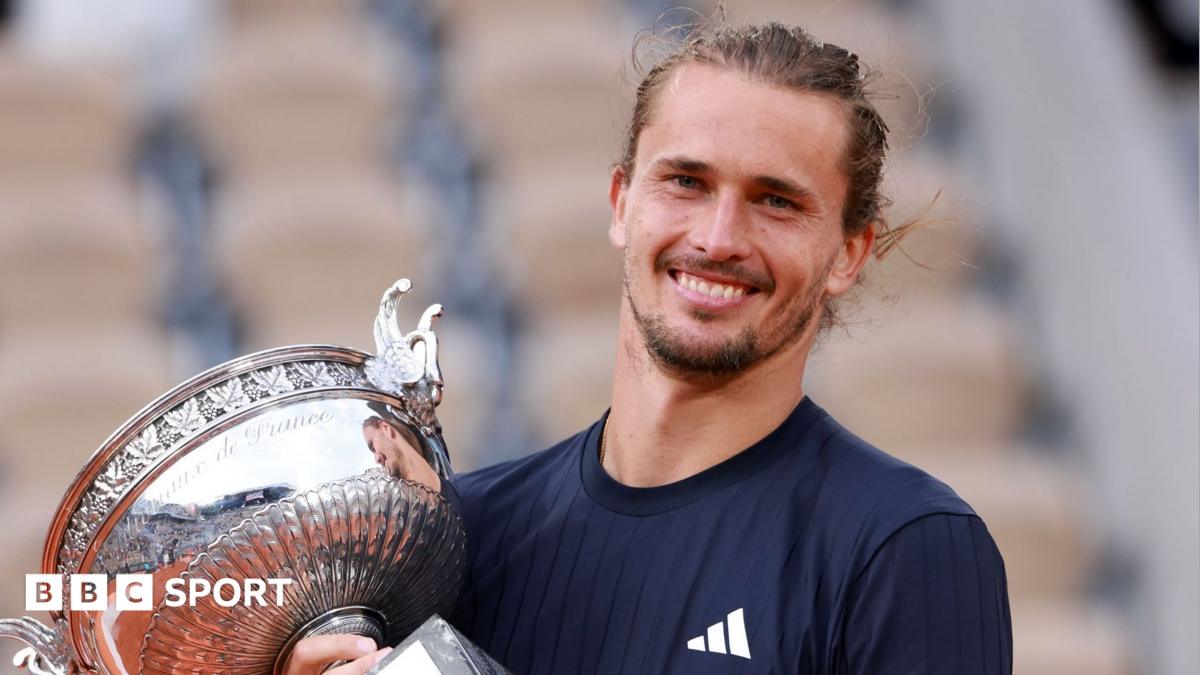
Alexander Zverev is guaranteed to finish the 2026 season as the world number one after Carlos Alcaraz’s surprise defeat in the Shanghai Masters.
German Zverev was on course to climb above current world number one Jannik Sinner, who has been ruled out for the rest of the year with a knee injury.
Alcaraz still had a mathematical chance of stopping Zverev until he was beaten 7-5 7-6 (7-4) by Belgium’s Zizou Bergs in the third round on Monday.
“It’s been a fantastic season for me. Knowing that I will finish the year on top of the rankings is just a dream come true,” said Zverev.
After losing three major finals, Zverev landed the first Grand Slam title of his career by winning the French Open in June, and followed that with victory at the US Open last month.
The 29-year-old has taken advantage of the injury problems suffered by Spaniard Alcaraz and Italian Sinner – the dominant pair on the ATP Tour in the previous two seasons – to become the world’s leading player.
Zverev cannot overtake Sinner until 2 November at the earliest.
He will become the first German to end the year as number one, and the oldest player to achieve the feat for the first time.
After suffering a serious ankle injury in the 2022 French Open semi-finals which kept him out for seven months, Zverev regained his place in the upper echelons of the sport and been ranked inside the top four continuously since March 2024.
“So much work and effort have been put into achieving this goal, especially after coming back from the ankle injury. I look forward to finishing the season in style,” he said.
Hi, and welcome to another edition of Prep Rally. I’m Eric Sondheimer. It’s looking like the game of the year this week in high school football: No. 1 Santa Margarita at No. 2 St. John Bosco.
Get our high school sports newsletter
Prep Rally is devoted to the SoCal high school sports experience, bringing you scores, stories and a behind-the-scenes look at what makes prep sports so popular.
By continuing, you agree to our Terms of Service, which include arbitration and a class action waiver. You agree that we and our third-party vendors may collect and use your information, including through cookies, pixels and similar technologies, for the purposes set forth in our Privacy Policy such as personalizing your experience and ads.
Assistants in spotlight
Kuika Moaalii, a 6-foot-5 sophomore, makes tough catch for St. John Bosco. He had four catches for 119 yards and one touchdown in 28-14 win over Orange Lutheran.
(Craig Weston / For The Times)
Santa Margarita (7-0) at St. John Bosco (6-1) on Friday night has all the makings of your typical Trinity League title decider. Great coaching, great players, great atmosphere.
While many will focus on the head coaching matchup of Santa Margarita’s Carson Palmer vs. St. John Bosco’s Jason Negro, the real spotlight should fall on the highly respected coordinators who will need to be smart, creative and be ready to improvise and adjust.
I had to put this in slow motion to try to understand how DJ Tubbs of St. John Bosco made four players from Orange Lutheran miss him like he was invisible. https://t.co/g8Ugv0UF96
For Santa Margarita, that will be offensive coordinator Lenny Vandermade and defensive coordinator Steve Fififa. For St. John Bosco, offensive coordinator Steve Lo and defensive coordinator Chris King have lots of respect for their counterparts. Don’t expect any to be dismissed in the middle of the game.
All need to figure ways to get the ball to their star athletes on offense and prevent big plays on defense.
It’s the defensive chess match that will be most interesting. Santa Margarita has been getting excellent production from a group of freshmen and recorded three shutouts. This will be their biggest game yet. St. John Bosco has fixed some secondary issues with the addition of Kingston Fatu, who has two interceptions in two games. This will come down to which defensive line can apply enough quarterback pressure without having to blitz.
The winner should be in good position to be the Trinity League champion.
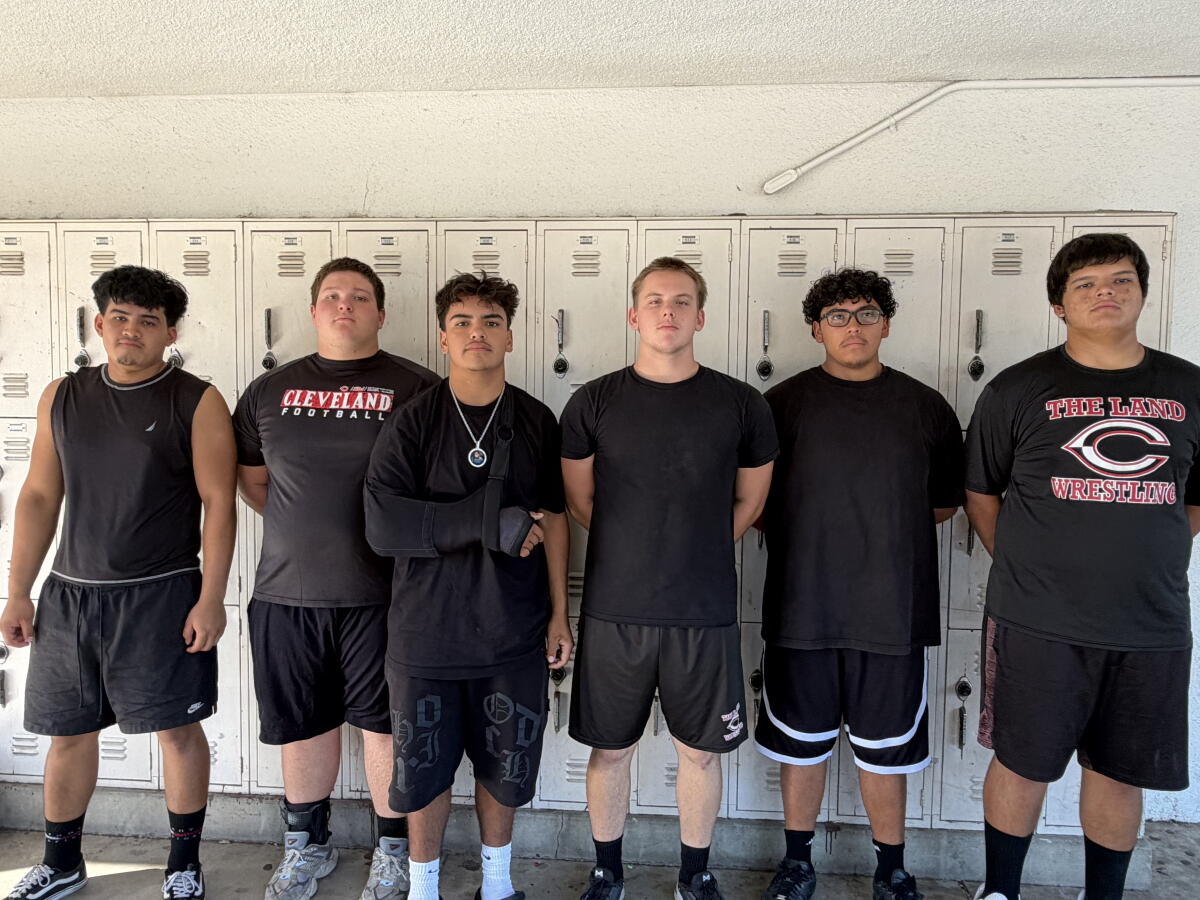
Cleveland’s offensive line has been a strength, including right tackle Carlos Gomez (left), right guard Carter Fitzgerald, center Pedro Castaneda, center Adam Garbisch, left guard Jovanni Orellana and left tackle Josue Fonseca.
(Eric Sondheimer / Los Angeles Times )
In case you haven’t noticed, history is being made at Cleveland High, which is 7-0 and has the inside track to win the West Valley League title under 34-year-old third-year head coach Mario Guzman. It has been decades since a young coach at not one of the City Section power schools has guided his team to contention at the highest level in City football.
The surprise football teams keep winning: Cleveland (7-0), Sherman Oaks Notre Dame (7-0), Royal (7-0), Huntington Beach (7-0), St. Bernard (7-0), Bonita (7-0).
Franklin and Eagle Rock had their Northern League game postponed Friday because of continuing fallout dealing with the death of a Franklin student. The game will be played Monday night at L.A. Wilson.
23 unbeaten football teams remaining: Santa Margarita, Sierra Canyon, San Clemente, Corona del Mar, Sherman Oaks Notre Dame, San Jacinto, Huntington Beach, Cleveland, Orange, Charter Oak, Mary Star, Bonita, Desert Christian, Los Altos, Nordhoff, San Marino, Nogales, Viewpoint, Royal, St. Bernard, Rancho Alamitos, Marshall, Granada Hills Kennedy.
There’s a season-long competition to be the best running back in the City Section among Brandon Hernandez of Panorama, Ceasar Reyes of Garfield and Tru Warrior Casas of Fairfax. All are well past 1,000 yards rushing and closing in on 2,000.
Elisha Mueller of St. John Bosco shows off his blocking skills against Orange Lutheran.
(Craig Weston / For The Times)
St. John Bosco set up its showdown with Santa Margarita with a hard-fought 28-14 win over Orange Lutheran. Here’s the report.
Inglewood rallied to defeat Palos Verdes and move to win the Bay League title. Here’s the report.
El Modena knocked off Laguna Beach in the Delta League. Here’s the report.
Chase Curren is the new Crespi record holder for career TD passes after connecting with Blue McFarland for No. 54. Crespi up 35-0 over Harvard-Westlake. https://t.co/SLluu4mDfW
Crespi junior quarterback Chase Curren became the school’s all-time leader in touchdown passes with 54 by passing for three touchdowns in a 49-0 win over Harvard-Westlake. The old record was 53 held by his offensive coordinator, Bryan Bennett. His standout receiver Bru McFarland, called the record-breaking TD.
There are still 23 unbeaten teams left in the Southern Section and City Section. Here’s the report.
Harlem Bullock 18-yard TD catch. Crespi 21, Harvard-Westlake 0. Chase Curren ties school record for career TD passes. And he’s only a junior. https://t.co/8HefGAIiIe
Week eight in high school football has the chance to be one of the dramatic in the regular season with many big games.
Besides Santa Margarita at St. John Bosco, there’s Mission Viejo at San Clemente, Bishop Amat at Sherman Oaks Notre Dame, King/Drew at Crenshaw, Hamilton at Palisades, Bellflower at Paramount and Mater Dei vs. Servite at Cerritos College,
Pualani Olotoa-Le’au, a sophomore, has been contributing to Carson in flag football and softball.
(Courtesy Olotoa-Le’au family)
Last week’s heat wave caused lots of postponed flag football games in the City Section. The powerful Northern League needs to catch up. Wilson is 2-0 and Eagle Rock 1-0.
A big Monday showdown has Huntington Beach facing Newport Harbor.
Roommates at UCLA
Linebacker Scott Taylor (left) and receiver Shane Rosenthal, graduates of Loyola and Newbury Park, have become roommates and contributors for UCLA’s football team.
(Eric Sondheimer / Los Angeles Times)
Former Loyola High star Scott Taylor and former Newbury Park star Shane Rosenthal are roommates and teammates on UCLA’s football team.
They explain how important it is going off to college to explore and find someone with similar ideas and principles.
Harvard-Westlake made a big move in the water polo rankings this week with consecutive wins over JSerra and Santa Margarita.
Harry Siafaris was a key player with his scoring skills.
Newport Harbor had a big league win over rival Corona del Mar. Here’s the report.
Notes
Junior pitcher Carlos Acuna of Birmingham, the City Section player of the year, has committed to UC San Diego….
Dezi Delgado from Sherman Oaks Notre Dame has committed to CSUN baseball….
King Rachal of Sherman Oaks Notre Dame has committed to Utah State for basketball….
Standout guard Gene Roebuck of La Mirada has committed to Cal….
Former Monroe High and Cal State Northridge pitcher Lew Lernerhas died. He was 74. He was a first-round draft pick of the Twins and led CSUN to a national championship in 1970….
JSerra cross-country star Reese Holley has committed to North Carolina….
Bob Hitchcock, who built the Temple City High football program into a powerhouse, has died. He was 97. He won seven Southern Section championships in the 1970s….
Guard Omar Cuffie from Loyola has committed to play basketball at Navy….
Michael Scarince of South Pasadena won the cross-country invitational race at the Clovis Invitational in 15:01….
Track and field athlete Aidan Antonio of Woodbridge has committed to Georgetown….
Guard Pierce Thompson of Harvard-Westlake has committed to Utah….
The JSerra girls volleyball team claimed the Division 1&2 Diamond Bracket at the Southern California Volleyball Invitational at Alliant University in San Diego….
Cooper Barkate playing for Mater Dei in 2021. He’s now at Miami.
(Allen J. Schaben/Los Angeles Times)
In Cooper Barkate’s senior season in 2022 at Mater Dei, the team went 12-1 and he was a vey good receiver who chose academics and the Ivy League, attending Harvard for three years and graduating with a degree in economics. Then he transferred to Duke for one season and is now at Miami, where entered the national discussion after catching five passes for 98 yards and one touchdown against Clemson.
His father, Harold, was a punter for UCLA who grew up in the high desert.
From Indianapreps, a story on the changing landscape in covering high school sports.
From KGET in Bakersfield, a story on a private eye uncovering ineligible players.
From Oregonlive, a story on former Crenshaw running back De’Anthony Thomas turning to disc golf.
From Axios, a story on how youth sports is affecting Sunday worship.
Tweets you might have missed
The most interesting question for a high school athlete is: Do you know what high school your mom or dad attended? They go silent and can’t answer. If they only knew how good mom or dad were in high school sports.
This is the high school football season we’re seeing a resurgence of multiple-sport athletes. If only all coaches could learn to share their players and stop being selfish and so ambitious that they are preventing a better high school experience for their great athletes.
“I know more about the wet bulb than I would like.” Yes coaches and athletic directors have learned these days their sports lives revolve around the wet bulb that reveals if teams are allowed to practice outside. It’s a great way to protect safety of everyone in heat. Or you can practice at 6 am.
In this week’s episode of ‘Friday Night Live,’ @latsondheimer + @RandyRosenbloom talk to Paraclete quarterback Shawn Sanders about his versatility, his fearless playing style and the Spirits’ recent success. https://t.co/VS9eGA2oSd
I’m offering a warning to high school football coaches in Southern California: Start preparing for rain, especially if you have grass field. Playoffs will see rain. It’s coming. Players think it’s fun. Coaches think it’s terror. Underdogs suddenly have a chance.
Agoura football coach Dustin Croick was busy with relatives in town. He turned off his phone. Then he saw 173 text messages. Then he faced timed with his former QB Ty Dieffenbach after UCLA beat Oregon. Emotional day. https://t.co/eyn5YD6Uva
Have a question, comment or something you’d like to see in a future Prep Rally newsletter? Email me at eric.sondheimer@latimes.com, and follow me on Twitter at @latsondheimer.
Did you get this newsletter forwarded to you? To sign up and get it in your inbox, click here.
In rural Modoc County, in California’s remote northeast corner, Republican gubernatorial candidate Steve Hilton donned a beige cowboy hat and climbed atop a horse.
Riding through a grassy field, with his dress shoes in the stirrups, Hilton lamented to a camera that California was “completely being ruined by killjoy bureaucrats” who put too many rules on fun stuff like beach fire pits and bars that stay open extra late.
In coastal San Luis Obispo County, Hilton boarded a bright yellow dune buggy at the Oceano Dunes State Vehicular Recreation Area and called the California Coastal Commission “idiots” for trying to end off-road beach driving.
And in the Central Valley, he waved the ceremonial green flag at a stock car race at the Madera Speedway, where he was named grand marshal of the annual Harvest Classic. (The designation caused a minor uproar, prompting the operator of the racetrack to make a fake online concession menu that offered a hot dog and soda for $6 for Republicans and $17.50 for Democrats.)
If it seems like Hilton — the British immigrant and former Fox News talk show host — is just about everywhere, taking just about every media interview that comes his way, well, that’s the point, he says.
He has logged thousands of miles on the proverbial campaign trail, visiting all 58 counties in his quest to lead the nation’s most populous state, where no Republican has been elected to statewide office in 20 years.
Meanwhile, his heavily favored — and far more staid — opponent, Democrat Xavier Becerra, has kept a comparatively low profile, agreeing to just one debate with Hilton and holding few public events, mostly in urban areas.
In a phone interview while driving through Los Angeles, Hilton said: “Whether I’m in Humboldt or Del Norte or Siskiyou County, my joke is, when people say, ‘Where do you live?’ I say I live in the Hampton Inn somewhere in California because we’re basically in a different place every night.”
The odds are against him.
Sure, California produced GOP presidents Richard Nixon and Ronald Reagan. But today, Democrats outnumber Republicans nearly 2 to 1 in the state, and the current White House occupant shares a mutual disdain with the vast majority of Golden State voters.
Hilton was endorsed during the primary by President Trump, who suggested at a campaign rally this month that Iran could “take out” Los Angeles and San Diego, drawing swift outrage from both Democrats and Republicans.
Hilton has tried to walk a fine line, appealing to the 6 million Californians who voted for the president in 2024 while simultaneously downplaying Trump’s support.
This summer, Hilton took out full-page ads in The Times and the San Francisco Chronicle asking: “Can you be anti-Trump and still vote for me?”
“Yes, I’m the Republican,” it said. “The ‘Fox News guy.’ Endorsed by Trump. But this election is not about who you hate in Washington. It’s about what you love here.”
Corrin Rankin, chairwoman of the California Republican Party, said that 16 years after the state’s last Republican governor, Arnold Schwarzenegger, left office, “it’s safe to say Democrats own all the problems in California.”
“You can’t blame Trump for what’s going on here in California,” she said. “We feel really good about Steve Hilton’s campaign. He is working so hard, up and down the state.”
Hilton has blasted California Democrats as entitled, saying they assume Becerra will cruise to victory in the race to replace termed-out Gov. Gavin Newsom simply because he has a “D” beside his name on the Nov. 3 ballot.
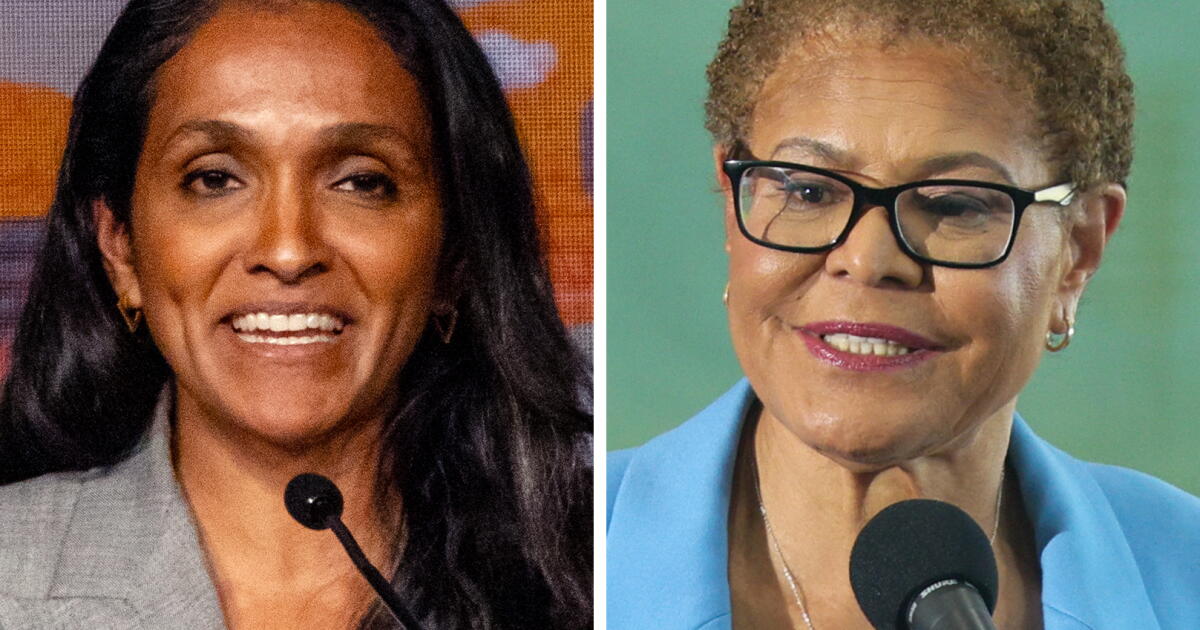
Hilton frequently quotes a September podcast interview by Los Angeles’ Democratic mayor, Karen Bass, who mocked his British accent and said: “The governor’s race right now is over. Our governor’s name is Xavier Becerra. You don’t need an election on Nov. 3. A Republican cannot win in this state.”
Hilton told The Times that Democrats “feel they don’t have to earn your vote. … They can deliver results that are bad as ever, and they don’t need to work hard to deliver results for people or earn their support. And I think it’s that attitude that is going to be their downfall.”
Steve Hilton has the support of 33% of likely California voters, according to a recent poll, while rival Xavier Becerra has 58%.
(Jason Armond / Los Angeles Times)
Becerra is a former member of Congress who represented Los Angeles, and he was the California attorney general and U.S. Health and Human Services secretary under President Biden. He has the backing of 58% of likely California voters, compared with 33% who support Hilton, according to a poll released late last month by the UC Berkeley Institute of Governmental Studies and co-sponsored by The Times.
The poll showed that voters’ top concern was reducing the state’s high cost of living — followed by fighting Trump administration policies.
“Hilton is trying to win an election, so he tries to frame himself as someone who can appeal to the broader electorate,” Underland said. “But at the end of the day, he has the albatross around his neck, which is Trump, who is openly hostile to California.”
Hilton cuts a colorful and pugnacious figure on the campaign trail. He eschews ties and jackets, favoring T-shirts with punchy phrases like, “$ave With Steve” and “WAKE UP” superimposed on a California license plate — a reference to his proposal to eliminate the state’s Department of Motor Vehicles and slash vehicle registration fees, which would cut billions in state revenue.
He wears one bracelet with the name of slain right-wing activist Charlie Kirk, whom he called an “incredibly close friend.” Another reads, “Save Girls’ Sports,” calling back to this spring, when he traveled to the state high school track and field championship in Clovis to protest the participation of a transgender athlete.
Republican nominee Steve Hilton protests transgender athletes’ participation in girls’ sports during a May 29 news conference in Clovis, Calif.
(Tomas Ovalle / For The Times)
Hilton, 57, was born in London to parents who fled conflict in their native Hungary during the 1956 uprising against the Soviet-controlled communist government and later anglicized their surname, Hircsák, to Hilton.
He was a senior advisor to British Prime Minister David Cameron, a member of the Conservative Party, though the men’s once-close friendship never recovered from Brexit, Britain’s withdrawal from the European Union. Hilton supported it; Cameron did not.
Hilton earned a reputation as eccentric but savvy, pushing the Conservative Party to embrace same-sex marriage and more climate-friendly policies. Dubbed “the barefoot revolutionary” for his refusal to wear shoes, Hilton was satirized on the BBC political sitcom “The Thick of It” as Stewart Pearson, the Tories’ “eco-friendly, media-savvy, blue-sky-thinking” communications director.
He and his family moved to California in 2012 after his wife, Rachel Whetstone, was promoted to lead global communications at Google. For six years, he hosted “The Next Revolution,” a weekly Fox News show from which Trump regularly tweeted clips.
In 2015, the couple purchased their home in the Silicon Valley city of Atherton, one of the wealthiest ZIP Codes in the U.S., for $12.5 million, property records show.
Whetstone now leads communications for Sierra, an AI startup founded by OpenAI board Chairman Bret Taylor and Clay Bavor, who met while working at Google. Hilton and Whetstone’s 2024 tax returns show they had a combined household income of $7.5 million, which included his reported earnings of $250,000 from Fox News and her $6.7 million from her then-employer, Netflix.
Hilton became a U.S. citizen in 2021 and last year renounced his British citizenship.
He finished second in the June 2 primary behind Becerra. Under California’s top-two primary system, the first- and second-place finishers, regardless of party, advance to the general election.
The pack of Democratic candidates was so large that party leaders initially urged struggling candidates — including Becerra — to drop out to avoid splitting the vote. Becerra shot to the top of the polls when then-Rep. Eric Swalwell, a front-runner at the time, dropped out of the race after he was accused of sexual assault and misconduct.
Republicans coalesced around Hilton after the president endorsed him over his GOP rival, Riverside County Sheriff Chad Bianco, a staunch Trump supporter who later said the endorsement made Hilton unelectable.
Kim Nalder, director of the Project for an Informed Electorate at Sacramento State, said it is exceedingly difficult for Hilton to distance himself from Trump and the Fox News brand.
“If you had a different brand of Republican they might have a shot,” given the discontent in the state over myriad issues, she said. “But Trump is so politically radioactive in California right now that it is an effective technique to tie this particular candidate to him.”
California’s population growth is stagnant after years of pandemic-era losses, with immigration lagging amid the Trump administration’s crackdown and many residents leaving the state for more affordable parts of the country.
Greg Perrone, past president of the conservative Greater Bakersfield Republican Assembly, said he was impressed with Hilton’s policy knowledge and the amount of detail in his economic plans.
Steve Hilton, right, chats with Sir Richard Branson before a White House dinner with then-British Prime Minister Cameron and President Obama in 2012. Hilton was an advisor to Cameron.
(Susan Walsh / Associated Press)
“There’s a real concern that the current state of the economy is worse than people expected,” Perrone said. “A lot of people hung their hat on Donald Trump saying he was going to bring down prices, and that just has not happened. There’s a lot of angst.”
Perrone said he remains a Trump supporter, though he has been frustrated by the frenetic roll-out of tariffs that, he said, hurt many businesses. While he has been annoyed that Becerra, in his view, has focused more on the president than laying out his own detailed economic plans, he acknowledged that the strategy plays well in blue California.
Christopher Cole, former chairman of the Lassen County Republican Party, said that in his rural corner of the state, he has seen Trump banners that have hung since 2016 start to come down because people are angry about the Iran war, the high cost of fuel and the economy.
“When Trump stupidly endorsed Hilton, it was the kiss of death for any down-ticket Republican,” said Cole, whose county voted for Trump on 76% of the ballots in 2024, the highest percentage in the state, and was the only one to support Bianco in this year’s primary.
“Hilton is a carnival barker and a very wealthy man,” said Cole, who supported Bianco. “You can’t run a multimillionaire when people are struggling to put food on the table.”
Hilton has made a slew of campaign promises to lower the cost of living, including having no taxes on income below $150,000, lowering energy bills by slashing climate-friendly regulations imposed by Democrats, and having $3 gasoline (though governors cannot directly set the price at the pump, which is driven largely by global crude oil supply and demand).
He has tried to channel the state’s discontent into persuading voters to “try something different” by voting Republican.
During the gubernatorial race debate on CNN last month, Hilton quoted a former Biden domestic policy advisor who reportedly called Becerra a “bitch-ass,” and his campaign promptly launched a website, bitchassbecerra.com, outlining alleged failures of the politician known for his calm demeanor and decades of government experience.
“I think Hilton got dealt a bad card with Becerra making the runoff,” said Rob Stutzman, a Republican strategist who was Schwarzenegger’s spokesman. “It’s difficult to get anyone outraged about Becerra because he is perfectly boring. He worked for Joe Biden — maybe that upsets some people? — but you can’t associate him with any bizarre, woke policies like you could Kamala Harris or Gavin Newsom.”
Hilton’s campaign this month released a provocative, sexually suggestive ad titled “Just Try It!” in which two young women sit on a bed in a candlelit room. An LGBTQ+ pride flag hangs on the wall, and they’re seemingly talking through one’s first romantic encounter with another female.
In a recent poll, voters rated California’s high cost of living as their top concern, followed by fighting Trump administration policies. Above, people gather in North Hollywood to watch the Sept. 30 gubernatorial debate.
(Jason Armond / Los Angeles Times)
Wearing a T-shirt that says, “RESIST,” the anti-MAGA mantra, the first-timer nervously says: “I’ve just never done anything like this before. Like, what if my dad finds out?”
The other woman holds her hand as she fills out a ballot for Hilton then says, “Now lick it,” referring to the mail ballot envelope.
Some conservatives condemned the ad, saying it promoted lesbianism. Liberals criticized it, too, saying it was insensitive to the LGBTQ+ community.
The day the ad launched, he told The Times: “I think there’s a very strong sense that things aren’t working in California, and my argument is: ‘OK, let’s try something different.’”
Later, he said he never meant to offend anyone with the risqué ad, which did, after all, do its job in racking up millions of views online — coveted and invaluable publicity for a long-shot California Republican.
Nestled a short stroll from the Griffith Park Ranger Station, near some tennis courts and not far from the remains of the park’s original zoo lies a gem that is on most days behind lock and key. The Griffith Park merry-go-round, which turned 100 this year, stands motionless, many of its 66 wooden horses weathered and caught mid-ascent.
But the effort to ensure that they once again rise, fall and spin around a spherical base has begun. The Griffith Park merry-go-round is being resurrected by a group of passionate supporters and volunteers, some of whom are veterans of the theme park industry. Collectively, they argue that this isn’t simply a relic from another era, but a place of multigenerational connection, a reminder of the beauty of handmade art and a statement piece of Los Angeles.
Tracy James, who works in the Department of Recreation and Parks and focuses on Griffith Park, is helping to lead the plans to refurbish the Griffith Park merry-go-round.
Visitors ride the Griffith Park merry-go-round, a favorite haunt of Walt Disney and his daughters, on Aug. 24, 1951.
Shuttered since the COVID-19 pandemic, save for a brief but limited run in 2022, the Griffith Park carousel is now under city control, purchased last year for $1 million. That’s a veritable bargain for such a museum piece, argues Tracy James, who is leading the efforts to restore the project, one that’s expected to take at least two years and cost millions.
“This is the jewel in the middle of the city,” says James, who works in the Department of Recreation and Parks and focuses on Griffith Park. “The ornamentation and the craftsmanship represent a bygone era.”
There was a real fear, James says, that the merry-go-round would fall into the hands of a private collector, as the carousel, if not officially, has long symbolically belonged to L.A. A piece of whimsy, artistry and play in the middle of a natural wonderland, it is where Walt Disney is said to have dreamed up the vision for what would become the Disneyland Resort and a site that has withstood Civil Rights actions and ’60s-era love-ins. To some, it’s a beacon of hope in the midst of an imperfect urban fabric that has long prioritized the fantastical.
“I got teary-eyed when I walked up,” says Wendy Osmundson, who approached the carousel during a recent open house while on a stroll around the park. Osmundson reflected on a day, decades ago, when the merry-go-round saved the family’s Christmas.
1
2
3
1.Details from the Griffith Park merry-go-round, which is in need of refurbishment.(Christina House / Los Angeles Times)2.The horses of the Griffith Park merry-go-round are known for their flowing manes.3.Each horse at the carousel is outfitted with jewels.
“I was 21, and my mom’s kitchen burned down,” Osmundson says. “We couldn’t have Christmas at my mom’s house. Everyone came to my one-bedroom apartment in Los Feliz, and me and my three sisters came here and rode the carousel. We were adults, but it was really great. I’d love to see it restored.”
Joining the project to do just that are some of the brightest minds in the theme park and amusement industry, and they’re doing so without pay and on their own time. Kurt Sawitskas has already spent weeks analyzing the carousel’s innards, marveling at its antique nature, but also being amazed that it’s still mostly intact.
“Honestly, I don’t think carousels were ever intended to last 100 years,” Sawitskas says. “And now here we are with a carousel that’s 100 years old. We want to honor it and make it run again.”
Sawitskas’ day job is at Walt Disney Imagineering, the creative arm of the company responsible for theme park design. Beginning to think ahead toward retirement, Sawitskas says he was looking for a project in which he could volunteer his time and expertise. He found it.
The painted panels at the Griffith Park merry-go-round will also need to be restored.
Built in 1926, near the end of what many consider the heyday of the American carousel, the Griffith Park merry-go-round began its life in San Diego and was relocated to Los Angeles in the depths of the Great Depression in 1937. It is the showcase product of the Spillman Engineering Co., whose carousel horses were known for the flowing, wind-blown manes and heavily detailed secondary carvings on the portion of their bodies that face viewers, known as the “romance” side.
A few, for instance, have lion heads extending from their chest. Others have cherubs reaching toward the horse’s face. All are adorned with jewels and tails made of real horse hair, many of which have been eaten by squirrels or other critters. Griffith Park’s carousel is especially unique in that it also has horses from master carvers Charles Looff and Charles Carmel, considered the finest carousel craftsmen of the era.
The few carousel companies that survived the Depression largely did so by switching to a cheaper, mass-produced product, such as transitioning from wood to aluminum. An art was lost.
“It’s brought to me a real appreciation of the deeper aesthetic,” Sawitskas says. He mentions this as he’s giving a tour of the horses, emphasizing how the thickness of the paint created a sense of depth in the figures — a saddle, for instance, of a crisscrossing chessboard-like pattern, or elsewhere an aged leathery toughness. “I recognize what is attractive about an amusement like this, and that’s the ability to return again and again and still see something different.”
Horses and a mural at the Griffith Park merry-go-round.
Sawitskas has recruited a pair of co-workers, Troy Leverton and Pim Renting, who work in various aspects of ride engineering, to help in the task. For Leverton, restoring the carousel is important in bringing a piece of history back to the city, one centered on affordable outdoor entertainment.
“I brought my nieces here 10-plus years ago, and rode it and it was really cool,” Leverton says. “Unfortunately, since my daughter has been born this has been shut down. So it was like, you know what, I live in the city, and it’d be really cool to be a part of something that is doing something for the city. I want to bring my daughter back here when it is running.”
It’s also not lost on them that there’s an association between the company they work for and the carousel, although it’s important to stress they are not volunteering their time as representatives of the Walt Disney Co.
The organ inside the Griffith Park merry-go-round.
“There’s obviously a connection with Walt Disney and what we do,” Leverton says. “There’s a lot of history here. The industry was born out of Disneyland, and Disneyland was born out of this place.”
The story goes that Disney would bring his daughters to the merry-go-round, sit on a bench and dream of a place where adults and children could be entertained together. Both Disney and the company have long told this tale, and a bench, as well as one of the original horses from the carousel, can be found on Disneyland’s Main Street, U.S.A. (There were initially 68 horses, but one, says James, is at Disneyland, and another is with a former owner.) With Disneyland’s King Arthur Carousel, which itself dates to the 1920s, Disney requested a number of modifications that closely match the Griffith Park attraction, such as wanting all its animals be “jumpers” that look like they’re galloping.
James, along with Sawitskas and his pals, want the carousel to be restored to its original glory, a magnificent, gleaming merry-go-round that inspired Disney to dream. On a recent Saturday, Sawitskas hopped on a ladder to analyze the condition of the mechanisms that raise and lower the horses and started poring over carousel history books to match the horses with their original paint colors. In the 1920s, lead paint was used, which must be stripped away.
Wendy Osmundson takes a moment to appreciate the memories of riding the Griffith Park merry-go-round.
“There’s no way to just keep painting over this and hiding the problem,” Sawitskas says. “We really need to get down to the bottom. A lot of the horses have small fractures in the wood joints that need to be repaired as well. You can’t do that on top of paint. You need to be at the wood. We have some very nice ways to get down to the wood without destroying the wood itself, just lifting the paint off. We want to restore all the worn wood and reintroduce the carving lines.”
And that says nothing of the mechanical adjustments and efforts to make the carousel ADA accessible. The Griffith Park carousel has one speed — 14 mph — and the hope is to update it with some modern controls to create a smoother ride. All of this is why James is estimating the tally to restore the carousel will top $3 million or $4 million. An assessment is expected in the coming weeks, and fundraising will occur via the nonprofit Friends of Griffith Park. James will be hosting open houses on as many Saturdays as she can, posting updates on the Griffith merry-go-round project Instagram page.
As the world turned, so did the carousel. In 1961, for instance, a riot erupted at the merry-go-round when police officers alleged a 17-year-old Black rider failed to pay for his admission. Onlookers leapt to the teen’s defense, and it took 75 officers to quell the disturbance. Later that decade hippie love-ins were held regularly at the base of the carousel, occasionally drawing the likes of the Hells Angels or law enforcement. The merry-go-round also became a gathering spot for a candlelight vigil when the Grateful Dead’s Jerry Garcia died in 1995.
And today, even in its shuttered and bruised state, it stands defiantly — a testament to handmade art at a time the world is spinning toward all-digital everything.
“One of the biggest challenges here is making it look new again,” Sawitskas says. “But I think if we do that, it’s going to be a treasure.”
One that, by the time it’s operational, will twirl gallantly into its next century.
Who doesn’t love a Hollywood ending — or a beginning?
The only guide you need for fall entertainment.
As summer gives way to the inevitable grunts of awards-season jockeying, how wonderful it is to crawl back into the head of our favorite portal John Malkovich, returning with his most complex work in years in “Wild Horse Nine” (hitting theaters Nov. 6). Meanwhile, Jordan Firstman made his name with viciously funny online “Impressions” and a spotlight-stealing turn on HBO’s “I Love LA,” but did you know he was Trojan-horsing in a triple threat? “Club Kid” (out Nov. 6) marks the arrival of a serious screenwriter, director and star making a feature debut of rare wisdom.
Read on for features about those two movies, and if you’d like more options, here are 17 fall titles worth getting excited about in the coming months.
‘Resident Evil’ (Sept. 18)
Austin Abrams in “Resident Evil,” directed by Zach Cregger.
(Sony Pictures Releasing)
Milla Jovovich brought stony-faced supermodel moxie to 2002’s underrated first film and her subsequent franchise was a mixed bag. But there’s a whole global fandom of obsessives who feel that none of these movies truly got the crux of what made Capcom’s original games such an all-night fixation. One of those people turns out to be filmmaker Zach Cregger, who, between “Barbarian” and his Oscar-winning “Weapons,” can now write his own ticket. As unlikely as it seems, this reboot is a project he has spent a considerable amount of his newfound Hollywood capital pursuing and you have to love him for it. Apocalyptic Raccoon City and a viral zombie outbreak are sure to figure, but also, given the Cregger of it all, spooky subterranean passages and confident performances, this time from Austin Abrams and Paul Walter Hauser. — Joshua Rothkopf
‘Digger’ (Oct. 2)
Tom Cruise in the movie “Digger.”
(Warner Bros. Pictures)
Tom Cruise has been busy these last 15 years, starring in five “Mission Impossible” movies, reboots of “The Mummy” and “Top Gun” and a handful of other would-be blockbusters best forgotten. In nearly all of them, he plays a version of the unstoppable Cruise persona. And that’s a performance for sure. But we haven’t seen him play a real character in a long time, which makes his new movie my most-anticipated of the fall, even if the trailer makes it look like it could be a tonal train wreck. Billed as a “comedy of catastrophic proportions,” “Digger” has Cruise playing a Texas oil man charged with saving the world from an environmental disaster that he appears to have caused. The writer-director, Alejandro González Iñárritu, is a five-time Oscar winner, but not a filmmaker known for his humor. That makes the trailer’s absurdist tone and visual style intriguing (and also concerning). Iñárritu clearly loves “Dr. Strangelove,” as do we all. Fingers crossed. — Glenn Whipp
‘Fjord’ (Oct. 9)
Sebastian Stan and Renate Reinsve in the movie “Fjord.”
(Neon)
Winner of the Palme d’Or at this year’s Cannes Film Festival — the second for writer-director Cristian Mungiu and an astonishing seventh in a row for distributor Neon — this is a gripping morality tale specifically designed to make viewers question their instinctive reactions no matter where they sit on the political spectrum. A conservative religious couple (Sebastian Stan and Renate Reinsve, both giving quietly riveting performances) relocate from Romania to a small village in Norway and soon find that the outwardly progressive locals are less than welcoming. The Gheorghius’ five children are taken into protective custody amid allegations of abuse and soon enough, it seems that their beliefs and values are being put on trial. Fans of “Anatomy of a Fall” (another Neon title) will appreciate the detailed glimpse inside another international legal system, as the courtroom scenes are full of tension, emotion and surprise. — Mark Olsen
‘The Social Reckoning’ (Oct. 9)
Jeremy Strong as Mark Zuckerberg in the movie “The Social Reckoning.”
(Leah Gallo / Columbia Pictures)
It’s been 16 years — an eon in internet time — since David Fincher made gripping drama out of coding, depositions and bruised male egos in “The Social Network.” Facebook’s story has since then taken a far darker turn: Russian troll farms, growing concerns about worsening teenage mental health and election misinformation. Aaron Sorkin, who scripted the first film, both writes and directs the follow-up, drawing on internal Facebook documents that whistleblower Frances Haugen (Mikey Madison) leaked to Wall Street Journal reporter Jeff Horwitz (Jeremy Allen White) for the paper’s “Facebook Files” investigation. In a particularly inspired bit of casting, Jeremy Strong succeeds Jesse Eisenberg as Mark Zuckerberg. After playing Kendall Roy, a would-be mogul desperate to seize power in HBO’s “Succession,” and Roy Cohn, a fixer who wielded it ruthlessly in the Trump biopic “The Apprentice,” Strong may have been preparing for Zuck all along. That alone might be reason enough to log back onto Facebook. — Josh Rottenberg
‘Sense and Sensibility’ (Oct. 16)
Daisy Edgar-Jones, left, and Esmé Creed-Miles in the movie “Sense and Sensibility.”
(Focus Features)
You come to “Sense and Sensibility” for sisterly love, for Edward and Elinor, for wit and cleverness, for nosy neighbors, for passionate longing, brooding, Byronic suitors and happily-ever-afters. The 1995 film adaptation of the Jane Austen classic, directed by Ang Lee with Emma Thompson starring and writing the screenplay, was damn near perfect, setting a high bar for any and all comers. So it’s with pleasure (and relief) that I can report that the latest version, directed by talented British filmmaker Georgia Oakley, will delight Janeites and anyone else who appreciates a smart, charming costume drama. The film faithfully adheres to the text, foregrounding the relationship between the Dashwood sisters, the passionate Marianne (Esmé Creed-Miles) and the pragmatic Elinor (Daisy Edgar-Jones). It’s fresh without needing to lunge for all the compulsively shocking aesthetics that undid Emerald Fennell’s “Wuthering Heights” earlier this year. Oakley crisply delivers everything you want, everything you need. — G.W.
‘Whalefall’ (Oct. 16)
Austin Abrams in the movie “Whalefall.”
(20th Century Studios)
If you’re a sucker for that “Pinocchio” sequence in which Geppetto gets swallowed by a whale, you’ll dig Pulitzer Prize-winning novelist Daniel Kraus’ “Whalefall,” a drama about a Californian scuba diver stuck in the stomach of a 60-ton behemoth. That’s bad enough. Worse, the kid’s oxygen tank is running low. One part survival quest, one part ghost story, the narrative centers on the young man hallucinating his abusive dead father, who advises him on how to escape. I devoured the book in one weekend, but couldn’t imagine how this claustrophobic nightmare could possibly translate to film. Director Brian Duffield (“Spontaneous,” “No One Will Save You”) has braved the challenge. Austin Abrams plays the trapped swimmer; Josh Brolin is his seafaring dad. It’s a reunion for two of the leads in last year’s “Weapons.” Steel yourself for slimy bile, sticky emotions and wet tears. — Amy Nicholson
‘Clayface’ (Oct. 23)
Tom Rhys Harries in the movie “Clayface.”
(Warner Bros. Pictures)
Even comic-book obsessives will mention a dozen other DC villains before digging out Clayface, the nom de gloop of a disfigured actor transformed into human Play-Doh. But after the animated series “Harley Quinn” stretched the character into a squishy, vulnerable showboat, I’m curious to see what he looks like in the hands of James Watkins, director of the mischievous 2024 thriller “Speak No Evil.” Watkins has a vicious sense of humor and the casting of Welsh theater actor Tom Rhys Harries in the title role is a signal that the film might be a performance showcase in the vein of Tom Hardy’s roiling split-personality turn in “Venom.” Early glimpses of footage at CinemaCon hint that the script by Mike Flanagan and Hossein Amini is most hyped to mix the superhero genre with icky body horror. Apparently, there are images in which Clayface doesn’t even have a face. — A.N.
‘Fatherland’ (Oct. 23)
Sandra Hüller and Hanns Zischler in the movie “Fatherland.”
(Agata Grzybowska / Mubi)
Paweł Pawlikowski has made a specialty of looking at European history from close range: the aftermath of the Holocaust in the Oscar-winning “Ida” and the Iron Curtain era in “Cold War.” Eight years after the latter, Pawlikowski returns with this spare black-and-white drama, for which he left Cannes with a directing honor. Hanns Zischler plays author Thomas Mann, the Nobelist and critic of Hitler, returning to Germany in 1949 after 16 years in exile, with his daughter Erika (Sandra Hüller) behind the wheel. Their journey takes them through a ruined country eager to reclaim one of its greatest writers without dwelling too much on why he fled. After the moral minefields of “Anatomy of a Fall” and “The Zone of Interest,” Hüller seems ideally cast as Erika, a writer and committed anti-Nazi unlikely to let her father, or the country around him, off the hook. — J. Rottenberg
‘Klara and the Sun’ (Oct. 23)
Jenna Ortega in the movie “Klara and the Sun.”
(Sony Pictures)
When novelist Kazuo Ishiguro published “Klara and the Sun” in 2021, a book narrated by an artificial intelligence still felt safely like science fiction. Five years and one AI boom later, the future has arrived early. Jenna Ortega plays Klara, a solar-powered “artificial friend” purchased as a companion for an ailing teenager (Mia Tharia) whose mother is played by Amy Adams. Klara observes the humans around her with extraordinary attentiveness but only a partial understanding of their behavior, gradually forming her own ideas about love, loneliness and what makes one person irreplaceable to another. Taika Waititi, whose movies have ranged from the antic Nazi satire “Jojo Rabbit” to the candy-colored superhero spectacle of the “Thor” films, is an unexpected match for Ishiguro’s quiet, melancholy story. But with people already turning to chatbots for companionship, the film’s central question no longer feels quite so theoretical: What happens when the machine stops feeling like a machine? — J. Rottenberg
‘Wicker’ (Oct. 23)
Alexander Skarsgård and Olivia Colman in the movie “Wicker.”
(Kristof Galgoczi Nemeth / Black Bear Pictures)
Most of the questions you have following the recent trailer that sent the internet into a tizzy are in fact answered by seeing the movie itself. Set in an indistinct Mitteleuropean village of an uncertain era, the story follows an unmarried fisherwoman (Olivia Colman) who asks her friend, a master basketweaver (Peter Dinklage), to make her a husband. And does he ever, sending over a mass of reeds fashioned into Alexander Skarsgård. Their little community goes berserk, full of curiosity and more than a hint of jealousy at their loving and compatible albeit unconventional union. Adapted from an Ursula Wills-Jones short story by the husband-and-wife writer-director team of Alex Huston Fischer and Eleanor Wilson, the film never overlooks how absurd its premise is, but also finds tender emotional notes within it as well. “Wicker” is a wise, warm allegory examining community and relationships — and why we need the things we do. — M.O.
‘Godzilla Minus Zero’ (Nov. 6)
A scene from the movie “Godzilla Minus Zero.”
(2026 TOHO)
Three years ago, the post-World War II period thriller “Godzilla Minus One” was a monster smash, earning the 72-year-old franchise its first Oscar win and biggest box office haul to date. (What, you thought the radioactive lizard wouldn’t come back?) Takashi Yamazaki’s sequel — the 39th Godzilla movie, if you’re counting — takes place in 1949 Tokyo after disgraced kamikaze pilot Kōichi (Ryunosuke Kamiki) has begun to rebuild his life with new wife Noriko (Minami Hamabe). In still-traumatized Japan, simply having hope for tomorrow is brave and foolhardy with an angry kaiju sulking in the Pacific. Yes, Godzilla exploded in the last film. Since when has that mattered? “Godzilla Minus Zero” has giant shoes to fill, but personally, I couldn’t care less if the green guy wins another Academy Award as long as the multiplex enjoys a shivery blast of his atomic breath. — A.N.
‘Paper Tiger’ (Nov. 13)
Adam Driver in the movie “Paper Tiger.”
(Neon)
A favorite of international festival programmers and film critics for decades now, James Gray has never quite had his breakthrough with mainstream audiences. That may finally change with his latest, which finds him again exploring the rich, complicated bonds of family amid the betrayals and uncertainties of New York’s outer-borough criminal underworld in a way that feels totally fresh and new. Miles Teller is a family man drawn into a business scheme by his ex-cop brother (Adam Driver) that puts them both afoul of the Russian mob in a story set in Queens in the 1980s. Scarlett Johansson plays Teller’s wife. All three give what are easily among their career-best performances as Gray steadily ratchets up the tension with a master’s hand, melding the crime thriller with domestic drama in a distinctive way. With a tremendous payoff in its devastating climactic sequence, this feels like the film Gray has been building toward his entire career. — M.O.
‘Elsinore’ (Nov. 20)
Andrew Scott as Ian Charleson in the movie “Elsinore.”
(Anthony Dickenson / Focus Features)
The Scottish actor Ian Charleson would forever be an Olympic runner on the beaches of “Chariots of Fire,” head tipped back in a kind of spiritual ecstasy. The role brought him international acclaim, but there weren’t enough of them, and a secret battle with HIV and AIDS took its toll. But what Charleson didn’t know was that, near the end, he would embark on the run of his life, performing a legendary Hamlet onstage in a race with death. Andrew Scott carries the whole of this exhilarating biopic on his knitted brow, diving deeply into the metaphysical darkness of Shakespeare’s text, into the rituals and camaraderie of actors and, ultimately, into the defiance of an artist who only wants to disappear once more into his art. Inexplicably overlooked for “All of Us Strangers” and “Blue Moon,” Scott is just now arriving at a kind of effortless humility, dazzling yet approachable, that puts him in the company of the all-time greats. — J. Rothkopf
‘Josephine’ (Nov. 20)
Mason Reeves in the movie “Josephine.”
(Sumerian)
If we are to have things like a “Sundance Film Festival” or “independent cinema,” it should be to support and nourish movies like Beth de Araújo’s powerful San Francisco-set thriller, about a violent sex crime witnessed by an 8-year-old, who is altered by the experience but then called upon to be a courtroom voice in the world of adults. Everyone who has come together to make this tricky but meaningful project seems to be operating on a higher plane: For Channing Tatum, playing a dad increasingly out of his depths, it’s an opening door to the kind of complex roles he has earned from being a dependable goof. For Gemma Chan, as a parent dealing with the unthinkable, the film is a promise fulfilled. But for young Mason Reeves, imbuing the title character with an evolving mystery that suggests a prodigy, “Josephine” is a revelation. — J. Rothkopf
‘Minotaur’ (Nov. 20)
A scene from the movie “Minotaur.”
(Mubi)
The whispers were fierce at a recent Academy Museum screening of Adrian Lyne’s windy erotic thriller “Unfaithful” as plugged-in attendees looked for points of similarity with Andrey Zvyagintsev’s sleek domestic drama, one that dominated this year’s Cannes conversation. Both movies are remakes of Claude Chabrol’s 1969 “The Unfaithful Wife,” but Zvyagintsev kicks the concept up to expert level, turning an affair and its brutal repercussions into a referendum on Russia’s new-money detachment: eating, lying and screwing with the Ukraine war out of mind. Was Zvyagintsev able to shoot in Russia itself? Of course not — he needed to film in look-alike Latvia. That’s how dependably infuriating he is to the authorities. But it’s a miracle he’s shooting anywhere at all: A case of long COVID, a coma and a yearlong hospital stay almost snuffed out one of the boldest filmmakers on the planet. His return to action is a grand piece of fortune. — J. Rothkopf
‘The Further Mis-Adventures of Cliff Booth’ (in Imax Nov. 25; on Netflix Dec. 23)
Brad Pitt and Leonardo DiCaprio in a scene from 2019’s “Once Upon a Time … in Hollywood.”
(Andrew Cooper / Sony Pictures Releasing)
Three years ago, Quentin Tarantino teased that his 10th and final film would be “The Movie Critic,” centered on a film reviewer for a 1970s porno rag, but he scrapped it and pivoted to a sequel featuring Brad Pitt’s stuntman from “Once Upon a Time … in Hollywood.” Tarantino didn’t want to direct it, though, preferring to challenge himself with something more ambitious for his sign-off. So he handed the screenplay — an “unwieldy thing,” he calls it — to David Fincher, tasking him to shrink it down. And that’s how we’ve arrived at a collaboration between two defining American filmmakers who came to prominence in the ’90s and share an interest in dark impulses that often turn violent. How Fincher will meld his clinical precision to Tarantino’s yo-gabba-gabba gonzo spirit is the movie question of the season. — G.W.
‘All of a Sudden’ (Nov. 25)
Tao Okamoto, left, and Virginie Efira in the movie “All of a Sudden.”
(Neon)
It still feels like a magic trick, the way Japan’s Ryusuke Hamaguchi turned “Drive My Car,” a three-hour movie about grief and chauffeuring (among other subjects), into a 2022 Oscar juggernaut. The director is back to remind you of everything you loved about that one, plus he’s got even more in the trunk. Many filmmakers are indulged with long running times; few of them make them as worthy and unnoticeable as Hamaguchi. He’s also in a class with Richard Linklater and virtually no one else when it comes to the lingering, evolving conversation, the kind that drifts into flirtation, debate and something soul-revising. Here it’s between two women (Tao Okamoto and the emotionally reverberant Virginie Efira) who, over the course of a walk along the Seine as dusk turns to night, find themselves bonded by something unexpected. “All of a Sudden” has death on its mind, but also how we live and care for each other en route to that destination. It’s a conversation we all need to have. — J. Rothkopf
The UH-60 Black Hawk has been the rugged workhorse of U.S. Army aviation for nearly 50 years, with around 4,000 examples currently in service with 36 nations worldwide. Many of these helicopters, and new aircraft coming off the line, are set to fly as far out as 2070, and Sikorsky is curating a suite of upgrades to keep them valuable assets for the future fight. A new “digital backbone” is designed to underpin swift technological insertions such as launched effects, with related initiatives including the provision of more power to lug greater payloads, and the fully-autonomous U-Hawk cargo drone variant.
“As part of an overall “Black Hawk 2070” modernization effort we’re developing a number of complementary capabilities, including our U-Hawk uncrewed cargo variant, which we plan to fly later this year,” Jason Wrigley, Sikorsky’s director of business development for Black Hawk, told TWZ at the company’s Stratford plant in Connecticut.
Sikorsky plans to fly its U-Hawk uncrewed cargo version of the Black Hawk this year. Sikorsky
“A new digital backbone for the Black Hawk is at an advanced design phase in our labs and it’s designed to provide interfaces throughout the aircraft that will provide power, data, a network, cooling and most importantly, open architecture interfaces that enable the easy integration of new equipment, such as sensors. We see this as a core building block for the next generation of Black Hawk, along with new engines and other airframe improvements designed to futureproof the platform.”
The new digital backbone is designed to work in concert with a modern, software-driven strategy that meets the Army’s Modular Open Systems Approach and the desire to add technologies cheaper, faster, and more easily. Wrigley says that as customers identify new capabilities and needs for their Black Hawks, the digital backbone will be sufficiently efficient to permit customization even on a mission-by-mission basis. Sikorsky is also introducing a new modular nose to the H-60, which is reconfigurable with sufficient volume to support even more sensors and electronics.
“There’s a big focus on open architecture and that ability to quickly plug-and-play,” says Wrigley. “The new modular nose will change the look of the Black Hawk up front to provide even more space for equipment that will work directly with the new digital architecture.”
The new modular nose will give the Black Hawk more than twice the internal volume of the original nose section and it’s designed to provide space for internal electronics and an integrated mount for external sensor pods. It is designed to provide sufficient space to accommodate electronics that enable roles such as search and rescue, drone control, and flying in degraded environments, and it will also house some of the equipment required as the Black Hawk’s autonomous capabilities expand.
Sikorsky plans to introduce a new modular nose to the UH-60M. Sikorsky
Joshua Powers spent 22 years as an Army Aviation officer flying the Black Hawk, and he’s well qualified for his new role with Sikorsky handling business development for rapid capabilities insertions. “Army units know the Black Hawk inside out; how to fly it, maintain it, and use it to maximum effect. The upgrades we are developing will bring new capabilities faster, without time-consuming and complex changes to sustainment, training, and operations, plus we are adding more range, more payload, and more power to meet the demands of the Indo-Pacific region.”
“I find it amazing to pair new technology with a rugged platform like the Black Hawk. These new innovations are needed to meet the needs of the new complex battlefield. The fight I fought in Iraq is very different from the current operating environment and what future warriors are going to go up against, and what we’re asking them to do is very different from what came before.”
Bringing autonomous co-pilots to the Black Hawk
Autonomy is a central pillar of Sikorsky’s strategy for the future Black Hawk. The company’s MATRIX autonomy software is now being matured on a UH-60M variant, and while it’s not necessarily designed to completely replace pilots, MATRIX will assume some of their workload, making flying safer and simpler as mission sets grow increasingly complex and dangerous. “Pilots that are controlling collaborative drones, for example, need to be able to focus on the drone mission, and autonomy will help lighten their cognitive load,” explains Wrigley.
“The standard Black Hawk crew operates with two pilots. Adding our MATRIX autonomy system gives the operator options – a single pilot could fly without an unbearable workload and still fulfil a mission commander role, for example. The Army could then operate the Black Hawk with no pilots at all when that’s the appropriate option.”
The U.S. Army received its first UH-60MX Optionally Piloted Vehicle (OPV) on March 20, 2026. Sikorsky
“We delivered the first UH-60MX to the Army earlier this year,” says Wrigley. The delivery marked the first full authority fly-by-wire and optionally-piloted UH-60 in the Army fleet. “They are using it for testing and soldier feedback to develop tactics, techniques and procedures for the autonomous Black Hawk. We have since received a contract to deliver three more MX aircraft to the Army.”
MATRIX autonomy kits have now been installed on all three U.S. Army Black Hawk models; the UH-60A, UH-60L and UH-60M. Sikorsky plans to incorporate autonomy options into all Black Hawks as they are built, plus the MATRIX system will be able to be retrofitted to existing examples.
Powers is well aware of the benefits autonomy will provide from complex combat operations to more mundane day-to-day missions. “Flying at night and seeing the tracer fire coming up at you, things like that, I honestly feel that’s not the big threat. It’s when you’re going to land and there’s just a big dust cloud. When you’re tired, you aren’t as focused. Having MATRIX, whether that’s with one, two, or no pilots, it’s about that reduced workload on the mission. Pilots won’t be as fatigued, plus they have the safety net of a fully autonomous aircraft that can, if needed, land in all of those difficult environments. It will give commanders more operational flexibility and the ability to mitigate risk in less-than-ideal conditions dictated by the enemy or weather.”
The first UH-60MX during testing alongside Sikorsky’s UH-60A Optionally Piloted Black Hawk. Sikorsky
“The Black Hawk operation isn’t just about pilots, it’s also that integrated four-person crew. As a pilot, you’re relying on your senses and also on the guys in the back to watch out and tell you where you’re going. MATRIX is just going to help that team effort and put you in a better position to bring the crew back safely. It integrates all the systems and sensors and uses altitude, airspeed, radar altimeter, drift indications, and puts the fly-by-wire technology to where it can make rapid adjustments and changes based on what it’s seeing with the sensors.”
The volume of testing, the maturity, and the confidence in MATRIX helped Sikorsky to develop the S-70UAS, or U-Hawk, which was unveiled in 2025. The U-Hawk project essentially removes the cockpit and its associated equipment from a Black Hawk and replaces the front end with cargo doors to provide a huge internal space as a supply drone.
“We acquired a used UH-60L Black Hawk as the template for our initial U-Hawk. We added the clamshell doors and that was the actual aircraft that we showed at AUSA last year,” says Wrigley. “Since then we’ve been adding the fly-by-wire and integrating the MATRIX autonomy. It’s currently in our innovations hangar in Bridgeport, Connecticut, getting the final work done and it will make its first flight as a U-Hawk later this year.”
The first U-Hawk is based on a modified UH-60L. Sikorsky
Sikorsky sees the U-Hawk as a natural evolution for the Black Hawk in contested logistics missions, when cargo needs to be moved but the threat is sufficiently high that it drives a need for uncrewed platforms to tackle the mission.
“We’re spending a lot of time on the U-Hawk and its roles. As well as being an uncrewed cargo helicopter, it can also be a truck that can carry a large volume of launched effects,” explains Wrigley. “There are Black Hawk models on the market right now that are being divested, and we see those as being an ideal option for conversion to U-Hawk configuration to affordably introduce this capability to the market.”
Drone dispenser
The integration of small drones dubbed ‘launched effects’ into rotary-wing operations is a major initiative from the Army as a new means to collect intelligence for commanders on the battlefield, relay communications, jam and distract enemy emitters, and act as loitering munitions. These mini air-launched drones can be carried and fired from stub-wing-mounted launchers, with other concepts seeing larger volumes of them carried inside the cabin as a “mega-pack,” with Sikorsky seeing both as being highly-applicable to both the Black Hawk and the U-Hawk.
This is exactly the kind of capability that the digital backbone in the Black Hawk is intended to open the door to; installing plug-and-play drone command kits, which could enable the Black Hawk to act as a “drone mothership” to launch, task, and command swarms of multi-mission launched effects.
A Launched Effect-Medium Range is fired from a UH-60M Black Hawk during Project Convergence-Capstone 6, in July 2026. U.S. Army
The Army tested its latest operational concepts for launched effects during the Project Convergence Capstone 6 demonstration event this summer. This annual exercise is designed to develop concepts and tactics as well as gather soldier feedback, as it works to transition new systems into service. The latest exercise built on previous launched effects testing on the Black Hawk, when a UH-60M deployed Anduril’s Altius-700 launched effects that then operated as an autonomous hunter-killer team to locate targets, share data on those targets, and then strike them, without the need for the Black Hawk to expose itself to threats.
“As a young Black Hawk pilot, the OH-58 Kiowa Warrior was the primary scout platform, but it was limited by range and its ability to be detected,” explains Joshua Powers. “Today, we launch small drones that can remain unseen and they can give us real-time feedback. Launched effects make our lift assets more capable.”
“We see the Black Hawk as the aircraft capable of carrying, deploying and then acting as an airborne mission command node for launched effects,” adds Jason Wrigley. “In the operational environment of the future, it’s really about the mass of those launched effects. This isn’t about carrying one or two of them, this is about carrying and controlling a large number of them.”
A “quiver” of launched effects inside the U-Hawk shown at the AUSA 2026 trade event. Jamie Hunter
“We’ve tested them on the stub-wings, but we are also exploring what we call “quiver” – that large number of launched effects inside the cabin in that “mega-pack.” This creates additional opportunities for mass that we think is going to be really critical. We’ve done a lot of operational analysis in concert with the Army on what the right mix of launched effects might be to extend the standoff range of the aircraft to improve survivability – which is of course what it’s all about – but the right mix will ultimately come down to the mission. We have seen a lot of testing over the past few years, so we do believe this is a capability that can be introduced operationally soon on the Black Hawk.”
More power for more missions
To support the increased lift that might be needed for a missionized Black Hawk lugging large payloads, including an arsenal of launched effects, Sikorsky is well along in development of a new engine that is designed to create over 1,000 pounds of increased payload capacity and increased range for the Black Hawk. The T901 Improved Turbine Engine (ITE) from GE Aerospace provides 50 percent more horsepower over the existing T700 engines in the UH-60M.
“One of the key building blocks of the future of the Black Hawk are the twin ITEs as we look to expand the mission capability and the utility of this aircraft for decades to come,” explains Wrigley. Sikorsky began initial testing of the first UH-60M with ITE in January 2025. “We are actively in the test program right now at our test facility in West Palm Beach, Florida. The twin ITEs in each Black Hawk and that additional power translates into some pretty significant operational opportunities. Since our first flight with ITE in May 2025 we’ve flown the aircraft with the new engine for over 50 hours and up to 17,000 ft above sea level.”
A UH-60M fitted with twin GE Aerospace T901 Improved Turbine Engines (ITE). Sikorsky
Sikorsky is accompanying the addition of the new engines with a significant expansion of the fuel tank to increase capacity and range. This is being done without impinging on cabin volume and thus retaining the important ability to transport 11 combat troops, while increasing range by around 100 nautical miles. “The T901 also improves fuel efficiency and eases maintenance – so overall we are really improving the payload capacity of the aircraft. We’ll be getting to the milestone C production decision on ITE within the next couple of years, and at that point it will become a core element of the Black Hawk program going forward,” Wrigley explains.
Inside Sikorsky’s “Black Hawk 2070” Plan With Drones, Autonomy, And The Pilotless U-Hawk.
Building Black Hawks
Touring the Black Hawk production line in Stratford, Connecticut, it’s a hive of activity. Many of the major components for each helicopter are manufactured here. The long final assembly line sees teams of workers busily constructing UH-60M and HH-60M medevac Black Hawks for both domestic and foreign military sales customers, along with new HH-60W Combat Rescue Helicopters for the U.S. Air Force and MH-60R Seahawks.
“We’re designing all of these upgrades with the intent that they will all be available off the production line in new build aircraft, as well as in kit form for upgrades to existing assets in the field,” notes Wrigley. “Here in Stratford in what we call the “back shop” we build all the rotor blades, gearboxes, and many other components that go into each aircraft. We are already thinking ahead and we’ve invested significantly into additive manufacturing, with 11 parts on the Black Hawk today that are additively manufactured. It’s a great place to start, but there’s a long way to go and we’re working on qualifying more challenging components and load-bearing parts.”
A brand new UH-60M in pre-delivery testing. Sikorsky
Cohesively, the digital backbone, larger fuel tank, new engines, and the new modular nose will all be introduced on the production floor in the coming years to pave the way for that increased payload capacity to carry fully-equipped combat troops, supplies, and all the new kit needed for the future fight and the Black Hawk’s role as a multi-mission forward battlefield node. The autonomous U-Hawk and the optionally piloted flexibility afforded by MATRIX – all of these pieces of the future Black Hawk are presently coming together under an overarching effort.
“The future Black Hawk will be that complement to the future long-range MV-75 Cheyenne II,” says Powers. “These won’t be a one-for-one replacement for every Black Hawk currently in the fleet – the MV-75 has a specific purpose and function that the Black Hawk isn’t designed to do. What the Black Hawk can do with these new upgrades is shape the battlefield and with its autonomy be out there flying missions into contested environments.”
U.S. Army UH-60 Black Hawks assigned to 4th Ranger Training Battalion. U.S. Army
“Those homeland missions are equally necessary. I recall talking about this in flight school when choosing an aircraft to fly, how it’s one thing to be deployed on combat missions, but it’s also about being back in the homeland on disaster relief when you need the Black Hawk to go out and save lives, those kinds of missions the Army National Guard does – it really underlines the importance and versatility of the Black Hawk.”
Over the past 50 years and looking ahead to the next 50, continuing the proven legacy of the Black Hawk will mean constant evolution to meet new missions and needs. Sikorsky’s task is for all of these new elements to meld into a future Black Hawk that’s ready to roll off this production line soon, that still also provides the same dependable, rugged capability for the Army at home or overseas, well into the future.
Movie stars are an endangered species. They still exist, sure. Their beautiful faces still fill 50-foot screens, beaming down on us. Yet, there is a shortage of, say, Michael Douglas. A man who, over the span of decades, played an American president, a troubled detective, and a Wall Street tycoon so convincingly that the FBI recruited the actor to do a PSA for investment bankers about the perils of financial fraud.
On the Shelf
One Helluva Ride
By Michael Douglas Grand Central Publishing: 496 pages, $35
If you buy books linked on our site, The Times may earn a commission from Bookshop.org, whose fees support independent bookstores.
The night before I meet Michael Douglas on Zoom, I have a hard time sleeping. I want to be well-rested before I meet the leading man — perhaps one of the last leading men from an era in Hollywood that felt limitless. What do I mean by that? He’ll tell you. His new memoir details his movie-making career as a prolific producer and actor, along with his affair with his “Romancing the Stone” co-star Kathleen Turner, mudslides in Mexico, snorting cocaine with O.J. Simpson, encounters with Princess Diana and screaming matches with Paul Verhoeven that end in blood. In short: the life of a movie star.
“People say to me: Michael Douglas. When I see your name, I don’t know what I’m going to get, but I know it’s going to be good,” Michael Douglas says.
(David Urbanke / For The Times)
Halfway through our conversation, something unanticipated happens: Douglas reveals that he doesn’t quite see himself as a movie star. After gentle pushback, he elaborates. Instead, Douglas sees himself as a chameleon.
“People say to me: Michael Douglas. When I see your name, I don’t know what I’m going to get, but I know it’s going to be good,” he says.
He’s speaking from his home in New York. Behind him is a moody 18th-century Orientalist painting, its scene too indistinct for me to make out. His smiling face — which, like most American moviegoers, I had watched 50 feet tall in the dark — glows with warmth even on my laptop screen. It seems abnormal even to witness him in miniature.
To be clear: Michael Douglas is a movie star, whether or not he wants to cop to it over Zoom. It’s in his blood. His father, Kirk Douglas — born Issur Danielovitch to Russian Jewish immigrant parents — was a legendary actor whose shadow Douglas struggled to escape, as he details in the early chapters of his memoir. He spent his childhood on movie sets, watching his father spar with iconic directors like Stanley Kubrick. Michael Douglas was subject to violent and angry outbursts as well. “Dad’s volatility kept us on edge,” he writes. He felt suffocated by his father’s legacy, often hoping to shake the title of “Kirk Douglas’ son.”
Early in his career, Douglas left his starring role on TV’s “The Streets of San Francisco” after producing his first film, “One Flew Over the Cuckoo’s Nest,” which became a breakout success. On that film, he had to deliver the shattering news to his father that he was too old to play the lead — essentially, firing his father from his dream role. It was a betrayal. Instead, the role went to Jack Nicholson, who would later win an Academy Award for his humanizing portrayal of Randle McMurphy. The film won multiple Academy Awards, launching Douglas’ career as a heavyweight producer and later an actor. Escaping the shadow of being Kirk Douglas’ son has been a lifelong battle for the actor.
(Grand Central Publishing)
Occasionally, inheritance can be a burden. In his own life, Douglas details how he was a distracted father and husband who lost sight of his son, Cameron Douglas. During Cameron’s childhood, Douglas was elsewhere — on location in the Mexican jungle in “Romancing the Stone,” then a disastrous film production in Morocco for “Jewel of the Nile” that included a fatal plane crash that resulted in three crew members’ deaths. To cope with the breakneck pace of show business, Douglas sought refuge in women, cocaine and work.
Cameron’s troubled youth reached a crescendo when he was sentenced to five years in federal prison for drug smuggling, with an additional sentence for drug possession in prison — serving seven years in the end. It was enormously painful for Douglas, who also struggled with addiction, and had sought out treatment to provide an example to his son.
In a late chapter, he recalls confiding in Rob Reiner, who also had a son who struggled with addiction issues. In the memoir, Douglas addresses the killing of Rob and Michelle Reiner in December 2025; their son Nick has been charged with murder. “We both had sons with serious drug issues and we both, at times, had been at the end of our rope,” Douglas writes. “It was a heartbreaking confessional for us, but I know we gave each other some measure of comfort during the hard times.”
Why trudge through movie history, turning over every stone and every wound, in a nearly 500-page memoir? Because, according to Douglas, it’s time.
“Your 80s may be a good time to share,” the actor says, who recently turned 82. “People interested in movies, we give them a certain insight into the process, and maybe they could learn something. For others, it’s just gossip.” His battle with Stage 4 oral cancer brought the contours of his life into stark relief, sharpened by seven weeks of radiation and chemotherapy. His official diagnosis was tongue cancer, but he told the public he had throat cancer, hoping to stall speculation in the press about the possibility of disfigurement — and, more specifically, the prospect of losing his tongue. It was isolating, and Shane Salerno — the memoir’s co-author — stayed by Douglas’ side.
Michael Douglas.
(David Urbanke / For The Times)
As much as Douglas’ memoir, “One Helluva Ride,” is a revealing and delightful account of a life in show business, it is also a love letter to California — a place where Douglas spent much of his adult life, beginning at UC Santa Barbara. The college travel brochure read: campus by the sea. “I remember the cover of it was a guy walking down the beach with a surfboard, two girls in two-piece bathing suits. In 1963, I never saw a two-piece bathing suit back east.” He was sold.
The California years made an impression. Douglas is still, at heart, a hippie. Raised in stiff East Coast prep culture, he was reborn in the California sunshine. “I transferred into becoming a hippie, influenced by the Maharishi Mahesh Yogi, hallucinatory drugs, and the world that existed in the early ‘60s in San Francisco.”
Strangely, Douglas argued that some of the utopic sentiments of the 1960s are returning. “People are beginning to look back at that time, and realize how important family is — cooperation, sharing,” he says. “Socialism is not a four-letter word or something that’s terrible. There are other things to pursue in life other than just making money.”
“Your 80s may be a good time to share,” Michael Douglas says.
(David Urbanke / For The Times)
Like the characters he portrayed, Douglas is far from perfect. He admits that he struggled — in his first marriage, and later as a father. After marrying Diandra Luker, Douglas was unfaithful, having relationships with co-stars, most notably Turner on the set of “Romancing the Stone” in the Mexican jungle. The two denied the relationship for years. Now, with Turner’s blessing, Douglas writes about their involvement in his memoir.
Before Turner, there was Diane Thomas, the film’s waitress-turned-screenwriter, with whom Douglas had an affair. Thomas’ life was tragically cut short in a car accident involving a Porsche that Douglas had gifted her.
Then there were the rumors. On the set of “Basic Instinct,” some speculated that Douglas and Sharon Stone were having an affair. They weren’t, he explains. Douglas was instead locked in a power struggle with director Verhoeven, who, during one particularly heated argument with the actor, suffered a burst artery in his nose, turning the confrontation into a bloody scene. Douglas, meanwhile, was involved with another co-star, Jeanne Tripplehorn. “They were so focused on a possible relationship between Sharon and me, they missed the real relationship happening between me and Jeanne,” he writes.
When he and his current wife, actor Catherine Zeta-Jones, made it official, Douglas went to the other room to make breakup calls to five other women. (By this point in the memoir, Douglas has enough goodwill to pass this off as charming.) “From the moment I met Catherine, and we formed our family, I was a new man,” he writes.
The memoir enshrines Douglas’ petty show-business grievances too: a repaired grudge against David Letterman, a TV co-star who stole his longtime girlfriend, and a bouquet sent to Julia Roberts to apologize for his drunken buffoonery. In Douglas’ words: “There’s two or three people that I share my hostilities with.” He clashed with Brian De Palma, who was originally attached to direct “Fatal Attraction” and tried to have Douglas fired. De Palma underestimated Douglas and was replaced by Adrian Lyne. Years later, De Palma apologized, but Douglas rejected it.
It is impossible to tell the story of Douglas’ career without the women he encountered. The films he championed helped establish a new type of female lead — in all their powerful, morally ambiguous and deranged glory. “An actress was not allowed to play a villain,” he says. In “One Flew Over the Cuckoo’s Nest,” the actor struggled to cast Nurse Ratched. “A whole number of leading actresses turned that part down until we found Louise Fletcher, who went on to win an Oscar.”
For Glenn Close, Sharon Stone and Kathleen Turner, acting opposite Michael Douglas was transformative. After her role as a murderous, sex-crazed bisexual in “Basic Instinct,” Stone became one of the biggest stars of the 1990s and earned an Oscar nomination for Martin Scorsese’s “Casino.” Close‘s portrayal of the mistress-turned-lovesick psychopath in “Fatal Attraction” earned the actor her first lead Oscar nomination after three supporting nods. Turner went from being primarily known as the sexy femme fatale of “Body Heat” to a Golden Globe-winning star with box-office clout after her collaboration with Douglas. Sure, she sued him, too, but their friendship survived.
However, it wasn’t until his role as Gordon Gekko, the fast-talking, impulsive tycoon in 1987’s “Wall Street,” that Douglas was in full force, winning an Academy Award for lead actor. Directed by Vietnam veteran Oliver Stone, Douglas delivered an unforgettable performance about the dangers of unchecked capitalism and greed. At an early New York screening, Douglas recalls Wall Street traders being stunned by the film’s stinging accuracy. “A lot of the Wall Street characters were there, very cocky at the time; they all were shocked because we caught them.”
To his surprise, Wall Street financiers approached him on the street to praise Gekko — anointing him as their hero. “I said, ‘I was the villain.’ ‘No, no, no,’” he said. “So it showed me a lot.”
It speaks to Douglas’ gifts as an actor that he could transcend the caricature of white male entitlement he portrayed with such precision. In “Falling Down,” filmed during the 1992 uprising triggered by the Rodney King verdict, Douglas plays an unemployed defense worker, a man so consumed by disillusionment and blinded by his own sense of victimhood that he cannot recognize the harm he inflicts on others. The character would prove eerily prescient, anticipating an archetype that would take shape in the decades to come. An entire generation mistaking the actor’s brilliance as an invitation.
Perhaps that is the strange thing about being a movie star: Audiences decide who you are, and what you mean to them. For a chameleon, an actor who spent a lifetime resisting other people’s definitions of him, that might be the ultimate paradox.
As our conversation winds down, I remind him of his immense contributions to filmmaking, through producing and acting. It seems redundant, but I say it anyway. His response is polite.
“Quirky,” he said. “‘Falling Down,’ ‘The War of the Roses’ — I love those quirky films.”
“I’m proud of my movies,” he says. “I’m very proud of my movies.”
Connors is a culture journalist in L.A. She covers books, food, entertainment and offbeat Los Angeles. She’s currently at work on a book of essays about tourism in all its forms.
Marvel Unlimited, the company’s digital comics subscription service, is shutting down after 19 years.
Marvel announced Monday that it is launching Marvel Comics, a new digital comics app that will house more than 35,000 current and classic titles featuring Spider-Man, the X-Men, Captain Marvel and more from its extensive library. The new platform is built and operated by Webtoon and will launch Nov. 16.
The Marvel Comics app library will feature comics spanning Marvel, Star Wars and 20th Century Studios titles at launch, with stories from Disney’s other brands — like Pixar and Disney Animation — expected to follow. The new app will support both the traditional page-based comics format that mirrors physical books and the more mobile-device-friendly vertical-scroll format. (Marvel Unlimited also featured vertical-scroll comics under its Infinity Comics banner.)
A preview of the Marvel Comics app.
(Marvel Comics)
Those attending New York Comic Con this Thursday through Sunday can get an early look at the new app at the Marvel Comics booth (#2435).
With the arrival of the new Marvel Comics app, Marvel Unlimited will “sunset” on Dec. 7. Marvel Unlimited has been the company’s in-house digital hub for its comics since its launch as Marvel Digital Comics in 2007. Subscriptions and payment information from Marvel Unlimited will not automatically carry over into the Webtoon-operated Marvel Comics, and Marvel says those whose paid subscriptions will be cut short because of the shutdown can expect a prorated refund on or around Nov. 16.
Marvel Unlimited members who sign up for Marvel Comics will be able to import their current library and reading history into the new app once it’s launched. The steps required for that process have not yet been detailed, but the company says these members will have until Dec. 21 to access their Marvel Unlimited library to ensure the transfer was successful.
Marvel Comics will offer two subscription tiers: The base-tier membership will run $9.99 per month or $69.99 annually for access to the app’s full catalog, with new issues of ongoing titles added as early as three months after print release. For those who would rather not wait that long to read newer comics, Ultimate-tier members will be able to access new issues as early as a month after its print release. Subscriptions for that tier will run $12.49 a month or $99.99 a year. Marvel is currently offering a special $59.99 “founder member” price for the first year of an annual Ultimate-tier memberships for those that preorder the service.
To understand the dedication and determination of football players from unbeaten Cleveland High, let’s review the commitment of backup quarterback Julio Avalos. He was so excited after guiding the Cavaliers to a 14-9 win over City Section power Birmingham that he spent all night watching film.
Asked what time he finally decided to go to sleep, Avalos said, “4 a.m.”
The entire offensive line eats together at lunch in the cafeteria.
“You see people hiding their food,” one lineman quipped.
They also get together on Thursdays for pasta night, where one player acknowledged eating “six to eight” chocolate chip cookies to close out a night of shared love for carbohydrates.
Then there’s the 34-year-old coach Mario Guzman. It’s been decades since a young coach armed with a teaching credential has pulled off the kind of breakthrough season in the City Section that Cleveland is enjoying, at a time when the City has lost such historic coaching figures as Robert Garrett, Angelo Gasca, Lorenzo Hernandez, Paul Knox and Mike Walsh.
Think back to 1992 when Troy Starr of Taft was 30 years old and took his team to the City 3-A final after a winless 1991 season.
If Cleveland (7-0) wins out and captures the West Valley League title, the Cavaliers likely will receive the No. 2 seeding behind defending champion Carson in the City Section Open Division playoffs. Cleveland never plays in the Open Division.
“I told him, ‘Good luck, baby,’” Birmingham coach Jim Rose said of his message to Guzman.
“They have 30 seniors. That’s a huge help,” Rose said. “He’s got his guys believing in what they do as a program. Their identity is to pound the ball on offense. The first two series, we gave up touchdowns. One thing about Cleveland is they always get athletes, but they put it together this season. He’s got enough big guys and enough speed to get it going.”
Cleveland also went on the road to beat another City power, Crenshaw, 24-18. Each win came with Avalos at quarterback, replacing the injured Domenik Fuentes. Avalos normally plays receiver, but he had to fill in last season when Fuentes got hurt before returning for the playoffs.
Cleveland’s offensive line has been a strength, including, from left, right tackle Carlos Gomez, right guard Carter Fitzgerald, center Pedro Castaneda, center Adam Garbisch, left guard Jovanni Orellana and left tackle Josue Fonseca.
(Eric Sondheimer / Los Angeles Times )
Guzman was caught by surprise last season when he didn’t prepare for losing Fuentes, so all summer, he vowed to never again to be without a fully ready backup quarterback. Fuentes returned on Friday night to pass for 208 yards and three touchdowns in a 37-20 win over El Camino Real.
Cleveland has multiple running backs, led by Moyosoreoluwa Odebunmi. The defense features middle linebacker Joseph Hurtado, who Rose said is impressive as a tackler.
Guzman is a third-year coach who was an assistant under former coach Peter Gunny. Guzman graduated from Grant and served as an assistant there for several years while going to Valley College, Cal State Northridge and National University to gain a teaching credential. His wife, Elizabeth, helps out with her cooking skills during preseason practices. She’s a prekindergarten teacher for ages 4 and 5, which means she has lots of patience.
The wife of Cleveland football coach Mario Guzman, Elizabeth, is cracking 15 dozen eggs for Thanksgiving practice. City DII finalists. Cooking for 60 players. 25 pounds pancake mix. A new tradition at Cleveland. pic.twitter.com/4QAKZ0pjal
“She was fired up,” Guzman said about the Birmingham game. “She wanted a headset.”
TK Drayton, who’s been in Cleveland’s program for four years, said of Guzman, “He loves us outside of sports. He checks on you. You want to go the extra mile for him.”
Discipline has been big for Guzman, whether that means players show up to weight training wearing all black or making sure they never walk when heading to the practice field.
Guzman also has integrity. He’s the last adult to leave Cleveland after games. Sometimes it takes until nearly midnight for the final player to be picked up by a parent. Guzman waits with him. Yes, it would be easy for Guzman to give the player a ride home, but that’s against LAUSD rules for teachers and coaches.
“All you can do is watch,” Guzman said.
The players have placed their trust in Guzman, as have parents. He’s delivering.
And we have 10,000 FREE tickets up for grabs for Sun Club members, so you can enjoy the 150 rides and attractions inside.
The tickets, on a first come, first service basis, even include entry Magical Ice Kingdom presents Neverland in Partnership with Great Ormond Street Hospital Charity – a world made up of500 tonnes of ice and snow.
Sign up for the Travel newsletter
Thank you!
Join Sun Club now — don’t miss out.
But how should you spend your time there?
Here’s a full rundown of what you MUST see from free things to do, to all of the new additions for 2026.
Last year, the attraction launched a free Santa’s Grotto experience, which is the largest free grotto in London.
Visitors will head on a journey through the new Elves’ Workshop and visit Mrs Claus before meeting the big man himself.
Of course, you can browse the German-style Christmas markets for free too, where there are dozens of chalets selling handmade crafts, ornaments, food and gifts.
In the Bavarian Village, make sure to head to The Bavarian Village Hall where there are often live bands, acoustic performers and Oktoberfest-style singalongs.
The atmosphere of the park in general is brilliant as well, with twinkling festive light installations, giant illuminated Christmas trees and themed areas.
Stepping into Bar Ice is as close as you will most likely get to experiencing an igloo.
The chilly cocktail lounge is kept at -10C and made entirely of giant blocks of carved ice.
Everything – I mean everything including the tables and chairs – is made out of ice.
And when you grab a drink, that will even be served in a glass made out of ice.
When you enter, staff will give you a coat and gloves to keep you warm too.
Inside, there are also a number of ice sculptures and neon lights illuminating the icy mythical creatures.
Each session lasts 20 minutes and includes one drink per person.
Tickets cost between £17 and £20 per person.
Join Sun Club now — don’t miss out.
Best family activity
Magical Ice Kingdom presents Neverland, in Partnership with Great Ormond Street Hospital Charity is great for families and allows visitors to literally chill out.
Kept at -10C, this magical kingdom is made entirely out of ice and is a walk-though indoor exhibition.
This year the theme is the very exciting ‘Neverland’.
For the first time ever, visitors will step through the Jolly Roger and into a Magical Ice Kingdom inspired by the Neverland, with Peter Pan and Wendy.
All the sculptures inside will be hand-carved by ice sculptors from 500 tonnes of ice.
Many of the ice features are interactive too, making it the ideal place to snap some photos of the family.
You can explore the exhibition at your own pace, but I’d recommend no more than 30 minutes.
My visit last year I spent about half an hour in the exhibition before getting a little too chilly and heading back outside.
Last year, Jingle Bell Bistro also launched and it is a great food spot.
Not as busy as the other food areas, the Jingle Bell Bistro is designed to be more child-friendly with options including simple burgers and chicken nuggets.
Adults can get food from here as well, but don’t expect fussy food with all the bells and whistles – more comfort food that pleases everyone.
You can even get Buddy the Elf’s famous spaghetti for £8.50. Prices vary, including £8 per child-sized pasta dish or £12 for an adult portion.
How to save your cash
There’s a whole host of new pre-bookable packages too for this year.
There’s the Explorer Pass for example, which includes the Real Ice Slide, Haunted Mansion, Snow Jet, Pirate Ship and Après Ski Party Funhouse.
It also includes free entry to the event.
There’s also Ride & Game Credit pass, which allows you to buy credit for the rides and attractions online in advance.
You can select from £20, £30 or £50 of pre-paid credit.
Of course, this year there are more £1 tickets than ever before as well.
Ig you want to save your money on entry make sure to book online in advance for an off-peak entry time.
Hyde Park Winter Wonderland will run between November 19, 2026 and January 3, 2027.
Join Sun Club now — don’t miss out.
How to get your free tickets to Winter Wonderland
To claim your tickets, follow the steps below:
Step 1: Join thesun.co.uk/club for just £1.99 a month or £12 for the first year, then £19.99 thereafter.
Step 2: Go to the Offers Hub and select the Winter Wonderland page. You do not need to collect Sun Savers codes.
Step 3: Your unique booking code will appear on this page. Redeeming a code does not guarantee tickets. Click the ‘Copy’ button and then hit ‘Book’. You will be directed to the Winter Wonderland website.
Step 4: Select your preferred date and time, then choose ‘The Sun Winter Wonderland Entry & Magical Ice Kingdom Offer’. Two tickets will be added automatically to your basket.
Step 5: Continue to checkout to complete your booking. You must book your tickets by Sunday, November 1.
Our tickets are available for visits between Thursday, November 19 to Sunday, December 6.
18+ UK only (exc. NI, IoM & CI). Sun Savers multiple code collect 10/10/26-14/10/26 or digital subscription required. Online access required. 5,000 pairs of tickets available (7,000 off-peak, 2,000 standard & 1,000 peak) on a first come, first served basis. Subject to availability, daily allocation limits apply. Tickets available between 19/11/26 – 06/12/26. 2 tickets per person only. Non-transferable and non-refundable. T&Cs apply, see sunsavers.co.uk or club.thesun.co.uk/sun-club. New customer offer: £1.99 per month or £12 for the first year, then £19.99 thereafter unless you cancel at least 7 days before your next billing date. Full T&Cs apply, visit thesun.co.uk/terms-and-conditions.
Los Angeles Mayor Karen Bass and challenger Nithya Raman will be on the same stage Tuesday night for their final debate before the Nov. 3 election, but the two mayoral candidates are expected to come in with starkly different game plans.
With recent polls showing Raman in the lead, the councilmember will likely try to avoid making any kind of flub during the in-studio debate hosted by NBC4 and Telemundo52 in Universal City.
“A successful debate for Raman is one in which not very much happens,” said Dan Schnur, a professor of politics at USC, UC Berkeley and Pepperdine.
Raman floundered at the last NBC4/Telemundo debate during the mayoral primary, when Spencer Pratt was also on stage. She got better marks after a debate with Bass before the Sherman Oaks Homeowners Assn. in August.
Along with avoiding mistakes, Raman will need to paint a positive view of the city she hopes to lead, said Sara Sadhwani, a professor of politics at Pomona College.
“She needs to able to spell out a vision for the city of Los Angeles and inspire confidence that she would be able to deliver on such a vision,” she said.
For Bass, it’s a different task entirely. The mayor was the top vote-getter in the June 2 primary, but numerous several polls now show her trailing. The Berkeley IGS / L.A. Times poll, conducted Sept. 15-20, showed Raman with an 11-point lead over the incumbent.
To gain ground, Bass needs to go on the attack and convince voters that Raman isn’t fit to lead, Schnur said.
“Bass needs to explain to voters why voting for a relatively unproven candidate would be a dangerous risk to take,” he said. “I’m curious if it will go down the road of the nasty,” Sadhwani said. The debate, being conducted in partnership with Loyola Marymount University, will run from 7 p.m. to 8 p.m. and will be moderated by NBC4 news anchor Colleen Williams, NBC4 chief political reporter Conan Nolan and Telemundo 52 news anchor Alejandra Ortiz.
The Times will have live coverage.
You’re reading the L.A. on the Record newsletter
Sign up to make sense of the often unexplained world of L.A. politics.
By continuing, you agree to our Terms of Service, which include arbitration and a class action waiver. You agree that we and our third-party vendors may collect and use your information, including through cookies, pixels and similar technologies, for the purposes set forth in our Privacy Policy such as personalizing your experience and ads.
An influencer digs in on Bass
Social media creator Ed Choi made headlines this week, posting and then removing an Instagram video showing him and Raman declaring in unison: “Only you can stop fascist liars.”
The pair used that phrase as an image of Bass appeared on the video. Raman, facing criticism for her words, said she was referring to Trump and Immigration and Customs Enforcement raids, not the mayor or Los Angeles Police Chief Jim McDonnell, and had asked for the video to be taken down.
Choi defended his messaging, saying in a subsequent Instagram video that Bass is in fact a fascist, pointing to to Bass’ decision to appoint McDonnell, a former L.A. County sheriff. He also cited the Los Angeles Police Department’s treatment of anti-ICE demonstrators as evidence that the city is “descending into fascism.
Raman voted in 2024 to support Bass’ selection of McDonnell, even as her fellow Democratic Socialists of America colleagues on the council cast opposed his appointment. On the campaign trail, she has repeatedly criticized McDonnell, saying the LAPD should not have used tear gas on anti-ICE protesters exercising their First Amendment rights.
Choi also claims in his video that Raman is committed to defunding the police. But Raman no longer supports that idea, saying in February that LAPD staffing should not get any smaller.
Banned word lawsuit
When the Los Angeles City Council considered banning the use of the N-word and C-word at its meetings last year, Stacey Segarra-Bohlinger was in attendance to give the politicians a piece of her mind.
“This is going to bring lawsuits,” said Segarra-Bohlinger, who often sings parody songs at council meetings and has been a member of the Sherman Oaks Neighborhood Council.
Segarra-Bohlinger filed suit Tuesday, represented by lawyers with the Foundation for Individual Rights and Expression. The group contends that word bans — which can lead to people who use those words getting kicked out of meetings and potentially barred from future ones — violate First Amendment protections of free speech.
“The Council has weaponized the Word Ban and Meeting Ban to silence, remove, and prospectively exclude its critics,” asserts Segarra-Bohlinger’s lawsuit, filed in U.S. District Court in Los Angeles.
Segarra-Bohlinger filed the suit after her repeated use of the C-word at two council meetings last year, once while singing a parody song of the Ghostbusters theme song in which she repeated the line “Council is afraid of the word c—” four times.
Council President Marqueece Harris-Dawson is standing by the ban.
“In a moment of very serious attacks on our basic rights in this country, it’s especially absurd that some individuals would waste the court’s time defending the right of racists and misogynists to hurl invectives at the public simply to hear their own profanity,” he said in a statement to The Times.
State of play
—MONEY, MONEY, MONEY: Hedge fund manager Aaron Sosnick dropped another $3 million into Estamos Con Nithya, the pro-Raman independent expenditure committee sponsored by Western States Regional Council of Carpenters. Sosnick, who has been pushing for an expansion of the city’s bike lane network, has now put $6 million into the committee.
— UNION KERFUFFLE: The LAPD’s officer union said Tuesday it will oppose Measure FD, the half-cent sales tax measure on the Nov. 3 ballot pushed by the city firefighters’ union — setting up a bitter and expensive clash between two of the city’s most powerful unions.
— LEFT UNREAD: Citing lingering concerns about the potential misuse of police license plate readers, the Los Angeles City Council voted Tuesday to delay an agreement that would enable the deployment of hundreds of the controversial devices until officials are satisfied that the technology will be wielded responsibly.
— LAUSD WOES: The state’s school Fiscal Crisis and Management Assistance Team concluded that the Los Angeles Unified School District is at “high risk” of insolvency — and needs to move quickly to avoid losing control over budget decisions.
— HIT THE SKIDS: Federal authorities along with local partners like LAPD made more than a dozen arrests on Skid Row during a massive drug trafficking crackdown in the troubled Downtown neighborhood.
— LAPD’S LEGAL BILLS: The city of Los Angeles has shelled out nearly $480 million over the last five and a half years to end legal disputes involving the Police Department, including claims of excessive force, litigation over traffic accidents and cases filed by employees who allegedly faced retaliation after reporting misconduct.
— POLLING UPDATE: New polling from the pro-Nithya Raman independent expenditure group that was conducted between Oct. 2 and Oct. 7 found that Raman is leading the mayor 43% to 33% with 23% undecided. The poll’s margin of error is 3.5%.
— A separate poll sponsored by the United Firefighters of Los Angeles City, Local 112 and conducted between Sept. 25 and Oct. 5 found a tighter race, within the margin of error, with Raman leading 35% to 33% with 19% undecided. That poll’s margin of error was 4%.
— A third poll conducted for the Bass independent expenditure group Unidos con Bass of 602 likely Latino voters found the incumbent ahead by 12 points, 40% to 28% for Raman. The poll, conducted between Oct. 1 and Oct. 8, has a margin of error was 4%. That’s a 36-point swing from a UC Berkeley IGS/L.A. Times poll from September that found Raman ahead with Latinos by 24 points, 45% to 21%.
QUICK HITS
Where is Inside Safe? The mayor’s signature program went to Councilmember Ysabel Jurado‘s district on Santa Fe Avenue and 23rd Street and moved 35 people indoors.
On the docket next week: Bass and Raman will square off in a debate Tuesday night at 7:00 p.m. on NBC4/KNBC and Telemundo 52/KVEA.
Stay in touch
That’s it for this week! Send your questions, comments and gossip to LAontheRecord@latimes.com. Did a friend forward you this email? Sign up here to get it in your inbox every Saturday morning.
Parking will be vastly improved, too – in the first five years there will be two new car parking areas for flyers.
Nick Barton, Chief Executive Officer at Birmingham Airport Limited, said: “The £2bn proposed investment is unprecedented at Birmingham Airport and will take our airport close to 30m passengers.
“This level of ambition sends a strong signal of support and confidence in our airport and wider region.”
Birmingham Airport has assured local residents that in 2041, the noise impact will be similar to how it is today because of quieter aircraft.
They have also said they will be net zero by 2033; they list energy efficiency, alternative fuels and renewable electricity as a few reasons why.
The West Midlands Mayor, Richard Parker, said: “It’s set to bring thousands of new jobs, better international links, and unlock vital backing for local businesses and supply chains.
“This consultation gives local people and business owners a chance to have their say and help shape the airport’s expansion so that it brings lasting benefits for our communities.”
Netflix plans a substantial round of layoffs as the streaming giant faces rising competition and pressure to retain its subscribers, according to people familiar with the job cuts.
The cuts are expected to affect 5% of the company‘s workforce, which could be 800 employees, according to one of the sources who was not authorized to comment. The job losses will affect the creative team including those working on features, the source said.
Netflix declined to comment. The planned cuts are believed to be the biggest at the Los Gatos company since 2022. The news was first reported by news outlet Puck.
Netflix has been under scrutiny from investors over how much time its subscribers spend on the streaming service. View hours rose only about 2% in the first half of 2026 compared with a year earlier, even as content spending climbed.
“Overall we’re not growing as fast as I want us to, and we’re working on making that move faster,” said Netflix co-Chief Executive Ted Sarandos at the Bloomberg Screentime event last week.
Netflix has noted how engagement can be measured in different ways. For example, its investment in live programming helps spur significant subscription sign-ups, even though it represents a small percentage of watch time on the streaming service, the company has said.
But some investors remain skeptical about the company’s future growth. Rival YouTube remains the leader in streaming viewing hours in the U.S. on TVs, representing 14.2% versus Netflix’s 7.8% in July, according to Nielsen. Netflix stock has also declined 43% compared to a year ago. On Friday, the stock closed at $70.30, down about 2%.
Netflix last conducted major layoffs in 2022 after the streamer reported subscriber losses for the first time in more than a decade. In May that year, the company laid off 150 workers and dozens of contractors and part-time workers in areas including its social media teams. The following month, it laid off 300 people or roughly 3% of its staff.
Recently, Netflix made changes to its games division. In August, the company closed its Hollywood-based gaming studio Night School and said it was in the process of closing its Helsinki-based gaming studio Moonloot.
Melanie Marx bought Angel City season tickets before the team was a team. It had no players, no coach and no uniform. It was more a concept than a reality and Marx bought in.
“I’ve always had pride for this team.” she said. “This was the first team from the NWSL that I’ve been able to say that I’m a supporter for.”
Yet supporting Angel City, she says, has been as exhausting as it has been exciting. Once the most valuable women’s professional sports team in history, Angel City has had one winning season and made just one playoff appearance in its first four seasons.
Attendance declined more than 22%, high-profile players such as Alyssa Thompson, Christen Press, Ali Riley and Madison Hammond have either been transferred away, retired or been allowed to leave and the team hasn’t re-signed popular captain Sarah Gorden for next season. At the same time, it has gone through five coaches and three general managers/sporting directors in less than five years.
Angel City defender Gisele Thompson celebrates with teammates after scoring a goal.
(Lindsey Wasson / Associated Press)
That’s not exactly what Marx signed up for.
“I’m upset as a fan, of course, and I’m upset as a season-ticket holder,” she said. “But I’m also upset as a fan of these players and someone who’s been invested in this league of almost 10 years.”
“What keeps myself and others coming back week to week is because of the players themselves,” she added. “Because the results on the pitch haven’t always matched the ambitions of the supporters.”
During the past three months, that support has finally been rewarded. Following Sunday’s draw with first-place Gotham FC, the reigning NWSL champion, Angel City (12-8-7) heads into the league’s two-week international break riding a seven-game unbeaten streak and is in sixth place in the 16-team table, in position for another playoff berth.
The team has lost just twice in 16 games under interim coach Leif Gunnar Smerud. Its 12 victories with three games to play is already a franchise record for a single season, as are its 45 goals. After posting a substantial negative goal differential in its first four seasons, Angel City’s plus-16 mark this year in best in the league.
And in the current international break, the team had a record nine players called up to various national teams. It’s one of the most dramatic turnarounds in NWSL history, one that may have saved at least a portion of the team’s most loyal fan base.
“My renewal for next year just recently came up and I was on a bit of knife’s edge deciding whether I want to go ahead,” said Michael Jaeger, an attorney who has had multiple Angel City season tickets in section 133 since the first season. “There have been consistent problems throughout.
“I really want the team to succeed. Given the recent successes, I did go ahead and re-up for next year because I’m feeling optimistic.”
Optimistic but not necessarily confident.
“I am not feeling like ‘OK, this is what I’ve been waiting for. The team’s really turned a corner,’” Jaeger said. “That to me would be success on the field, plus a decision about Sarah Gorden, plus [a] permanent head coach who we know is at least going to have one or more seasons to have things play out.
“So I don’t think we’re there yet. I like the current trend but because not a lot has necessarily changed about the front office, I’m not ready to say ‘OK, we’re fully on the right track.’”
Angel City has only itself to blame for that lack of trust. When the team launched with a massive ownership group that included Hollywood A-listers, former U.S. women’s national team stars and sports luminaries including Serena Williams and Billie Jean King, it promised to ignite a revolution in women’s sports.
Angel City FC fans chant during a match against the San Diego Wave at BMO Stadium on May 9.
(Luiza Moraes / Getty Images)
“We’re not just building a soccer club. We want to build an organization that has impact,” said Julie Uhrman, one of its team’s three founding owners.
And while Angel City has done real, meaningful work in the community, providing millions of meals to the hungry, funneling millions of dollars into community programs and taking a courageous stand against ICE raids across Southern California, as a soccer team it hasn’t delivered on its promises.
The loyal fans blame the front office, which has waived nearly six dozens players and five managers, including interim coaches, through its revolving doors since the first season. Mark Parsons, who won six trophies as manager with the Portland Thorns, was hired 20 months ago to stabilize things but his highly touted global search for a coach ended with Alexander Straus spending just a year with the club — going 7-15-5 in parts of two seasons — while Parsons unsettled the roster by making more than 40 transactions.
“There’s just a lack of trust in the front office frankly,” said Nadia Johnson, who attended games every season but didn’t buy season tickets until this year. “We’re still doing these chaotic things, which is really frustrating as a fan.”
And the chaos may not be ending anytime soon. Despite his success, Smerud has not publicly been guaranteed anything beyond this season; officially, the team is still searching for a new manager.
Gorden, the captain and anchor of the defense, is out of contract at the end of the season as is veteran Claire Emslie. Meanwhile Sydney Leroux, 36, who has played one minute the past two seasons as she deals with mental health issues, is signed through 2027.
At the same time, Parsons has built the league’s youngest roster around players whose performances are bigger than their names. Goalkeeper Angelina Anderson, 25, is third in the league with nine clean sheets and 12 wins. Brazilian Maiara Niehues, 22, already has a franchise-record nine goals while Evelyn Shores, 21, has tied the single-season record with seven assists and defender Gisele Thompson, Alyssa’s sister, leads all outfield players with 2,420 minutes.
“I am excited about how diverse our team is and really how they’ve grown,” season ticket-holder Johnson said. “It’s playoff crunch time and so it’s always exciting, especially when your team is in it. So I’m excited to see where they go.”
But after four seasons of mediocrity and worse, however, she’s learned to keep her fingers crossed.
“I’m not confident if we get a rough patch next year what decisions will be made in terms of trying to repair that,” she said. “So yeah, that’s where I’m at.”
In confirming his plans to live-stream Fort Hood mass shooter Nidal Malik Hasan’s military execution by firing squad on Dec. 3, Defense Secretary Pete Hegseth called it a “no brainer” punishment for a “radical Islamist terror attack” on U.S. service members.
“We’ll make sure that people are able to watch it, that it’s public, because people need to understand [that] there are serious consequences for these types of things,” Hegseth said in an interview with the Real America’s Voice network.
Others across the country and around the world — Democrats and Republicans, human rights experts, legal scholars and military and religious leaders — condemned it as a barbaric throwback to an era when executions were cast as entertainment, and as the world’s leading democracy adopting a form of punishment carried out in modern times only by authoritarian regimes and terrorist organizations.
Nidal Malik Hasan is shown in a courtroom sketch in 2013.
(Brigitte Woosley / Associated Press)
“Hasan should face the death penalty, but making his execution public and streaming it? Beyond disgusting,” Sen. Thom Tillis (R-N.C.) wrote on X. “Public executions are what oppressive dictatorships like Iran and Afghanistan do. It should not be happening in America.”
“I absolutely support the sentence of death, but live-streaming executions is what jihadists do. America is better than that,” Rep. Austin Scott (R-Ga.) wrote.
The United Nations’ High Commissioner for Human Rights said that “the livestreaming of an execution is tantamount to a public execution and would breach the absolute prohibition of torture.” The head of the U.S. Conference of Catholic Bishops said it would “further undermine the moral fabric of our nation and be a blight on the conscience of its people.”
Matthew Robinson, a criminal justice professor at Appalachian State University and author of a book on U.S. capital punishment titled “Death Nation,” said he was “appalled” by the plans. “It strikes me as meant to be entertaining.” He said the last military execution was in 1961, and the last by firing squad was in 1945.
Soldiers hold a candlelight vigil at Fort Hood, Texas, in 2009, one day after Nidal Malik Hasan shot and killed 13 people.
(LM Otero / Associated Press)
Hasan was an Army psychiatrist and major who in 2009 entered a medical building on the Texas military base with a laser-sighted handgun, shouted “Allahu akbar” — Arabic for “God is great!” — and opened fire, killing 13 people and injuring 32 others. He has since spoken of being a “martyr” if executed.
President Trump, an outspoken proponent of the death penalty for years but also a past critic of public executions in places like Iran, has signed off on Hasan’s execution but not addressed Hegseth’s plans. The White House did not respond to a request for comment.
Vice President JD Vance, who is Catholic, said Friday that people should remember that Hasan “brutally murdered a lot of innocent people.” But he also said he would not watch a live-stream of the execution, and expressed doubt that is “actually going to happen.”
On his first day in office this term, Trump issued an executive order requiring federal agencies to restore the death penalty to prominence. In April, the U.S. Department of Justice announced it had taken steps to do so, including by “expanding the protocol” to include firing squads.
Five states currently allow firing squads to carry out executions: Idaho, Mississippi, Oklahoma, South Carolina and Utah. The U.S. Supreme Court has repeatedly turned down appeals contending such executions amount to “cruel and unusual punishment,” which is barred under U.S. law. South Carolina executed three men by firing squad last year.
When the Supreme Court last year rejected an Alabama inmate’s request to be killed by firing squad rather than with nitrogen hypoxia, liberal Justice Sonia Sotomayor — joined by fellow liberal Justices Elena Kagan and Ketanji Brown Jackson — dissented, writing, “Boyd asks for the barest form of mercy: to die by firing squad, which would kill him in seconds, rather than by a torturous suffocation lasting up to four minutes. The Constitution would grant him that grace.”
Kathleen Walter prays outside the Nashville, Tenn., prison where Christa Pike was set to be executed.
(George Walker IV / Associated Press)
Last week, a Tennessee inmate named Christa Pike survived what was meant to be a lethal injection of the barbiturate pentobarbital. Other states have also struggled with executions by lethal injection in recent years.
Much of the criticism of Hegseth’s plan for Hasan has centered not on the method of killing, but on the live-streaming of it.
Robin M. Maher, executive director of the Death Penalty Information Center, said the center has “no record of any execution being live streamed,” and is “not aware of any regulation or precedent for a military execution to be live streamed on the internet or otherwise made widely available to the public.”
Fox News commentator Howard Kurtz wrote: “I’m sensing revulsion on the left and right, not so much for killing a death row prisoner — although firing squad seems extreme in the modern age — but for the Pentagon to live-stream it, turning this into a horrifying TV show to entertain the masses. Is this America?”
Daniel LaChance, an associate history professor at Emory University and author of the book “Executing Freedom: The Cultural Life of Capital Punishment in the United States,” said the last public execution in the U.S. occurred in 1936, when a Black man convicted of rape was hanged in Kentucky — which still allowed public executions after most states had abandoned the practice.
That execution was “by all accounts a grotesque carnival” and “sort of like a gladiatorial contest brought to life in the 20th Century, where the crowd was surly, shouting,” LaChance said. “It was a debacle.”
That the Trump administration is seeking to turn capital punishment into a public spectacle once more, LaChance said, is out of line with decades of thinking on the issue, but in line with Trump’s own ethos about crime and punishment.
“His whole brand is this kind of populist, anti-elitism. And when executions moved into the bowels of prisons in the early 20th century, they were really becoming bureaucratic affairs, run by experts, carried out in front of a small group of professionals and clergy,” LaChance said. “It was a denial of the public’s right to see a punishment that was carried out in their name, in part because there were elites who thought that the public couldn’t handle this kind of spectacle, that they were misbehaving, that it would generate more disorder when an execution is designed to do the exact opposite: to generate order.”
President Trump points to fans to as he walks to the stage at a political rally Wednesday in San Antonio.
(San Antonio Express-News via Getty Images)
Trump clearly thinks he is pushing back against elitism and expertise and giving people what they want, LaChance said, though the question many scholars have is whether doing so will “increase people’s bloodthirst” or force them to recoil — and ultimate decrease support for such punishments.
Eugene Fidell, who teaches military justice at Yale Law School, said Trump has publicly mused about killing people by firing squad for years, so Hegseth’s plans to use a firing squad should not be surprising. However, the decision to live-stream the killing is clearly a source of “dismay” for many. “Even people who are resigned to the death penalty, who don’t have religious or other scruples about the death penalty, have real heartburn over this,” he said.
Fidell said “brutality” has become an “operating principle” for the Trump administration broadly, from its decision to host an Ultimate Fighting tournament at the White House to its immigration tactics across the country to, now, it’s plans to live-stream an execution — which Fidell said has “nothing to do” with deterring future crime.
“There’s a pathology going on here that is so out of keeping with the dignity that ought to characterize the taking of a life as a result of a legal process,” he said.
Robinson, of Appalachian State, said a student of his Friday morning asked what would happen when children tune in to watch the execution, which Robinson said he believes they will do, as if it’s a video game. He said the idea was appalling — and not just to him.
“I imagine the rest of the world, the civilized world, will see this and have the same response that I did,” he said. “They’ll respond with shock.”
Times staff writer David G. Savage contributed to this report.
Mustache. Aviator sunglasses. Bears sweater vest. Though Mike Ditka‘s look may be iconic, his time as a player and coach is what cemented his name in NFL history.
Ditka, the first ever tight end to be inducted into the Pro Football Hall of Fame and coach of the legendary 1985 Chicago Bears, has died. He was 86.. His family announced his death in a statement Friday.
“It is with profound sadness that we announce the passing of our beloved husband, father, grandfather, and friend, Mike Ditka,” The family said. “While the world knew Mike as a Hall of Fame football player, legendary coach, and leader of the Chicago Bears’ Super Bowl XX championship team, we knew him as the heart of our family. Mike will be missed beyond measure and remembered forever.”
With nicknames “Iron Mike,” “Da Coach” and “The Hammer,” Ditka was inducted into the Pro Football Hall of Fame in 1988 after a 12-year playing career that featured five Pro Bowls, 427 receptions, 43 touchdowns and 5,812 receiving yards.
Ditka, who won two Super Bowls as a coach and one as a player, revolutionized the tight end position, transforming it from a primarily blocking-focused role to one that could pose a threat in receiving.
Notorious for his fiery personality, Ditka also took his stardom from field to screen, starring alongside Will Ferrell in “Kicking & Screaming,” in which he played himself. Though instead of coaching the championship-winning Bears, he helps coach a little league soccer team — but his competitive spirit remains the same. He also made several TV appearances, including in “Cheers,” “L.A. Law” and “Entourage.”
Born in Carnegie, Pa., on Oct. 18, 1939, Ditka was a first-round draft pick of the Chicago Bears in 1961. The team at the time was helmed by Bears founder, president and head coach George Halas, who later bestowed Ditka with his first NFL head coaching job in 1982.
Coming from the University of Pittsburgh, where he also played basketball and baseball and received All-America honors in football, Ditka immediately became a mainstay in the Bears lineup, going on to start 84 straight games. He was named rookie of the year with 56 catches for 1,076 yards and 12 touchdowns, becoming the first tight end to reach 1,000 yards receiving in his rookie season.
He also earned All-NFL honors from 1961 to 1964 and made the NFL Pro Bowl five times in his first six seasons. Ditka was enshrined into the College Football Hall of Fame in 1986.
Chicago Bears tight end Mike Ditka is tackled after a pass reception against the Green Bay Packers at Wrigley Field on Oct. 16, 1966.
(Associated Press)
The tight end eventually became a coach, famously leading the 1985 Chicago Bears. The team, one of the best in NFL history, went 15-1 and scored 456 points while only allowing 198. The Bears had plenty of personality that year as well, audaciously recording a rap-styled video called “The Super Bowl Shuffle” that was released during the regular season.
But it was not only a strong season on paper — Ditka is credited with leading the Bears back to relevance and luster after losing records in 1980, 1981 and 1982. He built them back to a team fans adored and competitors feared.
“I think that’s the way Mr. Halas always wanted it,” Ditka told The Times in 1985. “He wanted to have a ballclub with a certain personality, a team made up of, you know, rough, tough guys, a team that didn’t take any crap from anybody and could dish it out.”
Ditka and the team brought triumph to Chicago in Super Bowl XX in New Orleans with a 46-10 win against the New England Patriots.
Winning NFL coach of the year with the ’85 team, Ditka is one of only two who have won a Super Bowl as a player, assistant coach and head coach.
“I believe Mike Ditka represents us, in more ways than one,” then linebacker and captain Mike Singletary told The Times. “We know he’s not coaching the Chicago Bears because he needed a job. The Bears mean something to Mike Ditka. The team is part of him.”
His time in Chicago wasn’t all glitz and glamour, though. Ditka wasn’t immediately welcomed back to the Bears as a coach, with his temper a source of strain between him and the owners. He also had a DUI conviction in 1985 and suffered a heart attack in 1988.
“There was a (magazine) poll of 200 NFL players who said the coaches they would least like to play for were, first, (Tom) Landry and, tied for second, Don Shula and me. I was flattered. What a great compliment,” wrote Mike Ditka in his 1986 autobiography.
Ditka was entrenched in controversy, having been outspoken about Washington not changing its name from the Redskins, also facing backlash for comments he made in 2016 criticizing Colin Kaepernick and social justice protests, later apologizing.
Despite it all, his name is etched in NFL history.
“Ditka was proud and headstrong,” wrote former Times sports columnist Mike Downey. “He was common and condescending. … He did as he pleased. But he restored the reputation of the Chicago Bears, made them winners and made them watchable.”
During his playing career, he made an iconic 63-yard catch-and-run against the Steelers on Nov. 23, 1963, which stands in 69th place on NFL’s 100 Greatest Plays. The highlight helped the Bears to a 17-17 tie after being down 17-14 in the fourth quarter; the team later went on to win the NFL championship.
In 1967, he was traded to the Philadelphia Eagles and then to the Dallas Cowboys in 1969. During his time with the Cowboys, Ditka made it to two Super Bowls, with a loss in 1971 and finally a win the following year in which he scored the final touchdown in a 24-3 win against the Miami Dolphins.
After retiring in 1972, Ditka joined the Cowboys as an assistant coach. He got his hands on the Super Bowl trophy once again in 1977 with the team and stayed on until joining the Chicago Bears.
The Hall of Famer’s ties with Chicago were once again severed, this time with his firing in 1993 following a 5-11 season. But he refused to shed the navy and orange in the years after he went 106-62 and led the Bears to seven playoff appearances in 11 seasons.
“Yeah, I was fired by the Bears, but that’s life,” Ditka said during a visit to Chicago’s practice field in 2013. “There has never been a time I was not a Bears fan. I have a right to be a Bears fan as much as anybody. I played on a championship team and I coached a championship team.”
The Bears retired Ditka’s number, 89, in 2013.
His involvement with the NFL expanded off the green as he explored TV commentating, even earning Sports Emmy nominations for outstanding sports personality in 1994 and 1996.
Ditka did have one more head coaching stint in the NFL from 1997 to 1999 with the New Orleans Saints. After two 6-10 seasons, the Saints traded all of their draft picks — plus a first-round selection in 2000 — to move up and select running back Ricky Williams. But the team went 3-13 in 1999 and Ditka was fired after the season.
He finished his coaching career 121-95 after the 15-33 stint in New Orleans.
“I’ve been to the top of the mountain and I’ve seen it,” Ditka told The Times in 2004. “And I’ve been to the bottom of the mountain and I’ve seen that too. I don’t want to get anywhere between them anymore.”
Professional football would not see the last of him, however, as he went on to do radio and TV broadcasting for programs such as The NFL Today, Monday Night Football and SportsCenter. His passion for football would never fade, apparent in his launch of X Football, women’s tackle football competition league, in 2021.
And his mark on Chicago was not confined to the stadium gates; he was a partner in Ditka’s Restaurant Group which first opened a steakhouse in downtown Chicago in 1997, boasting its signature dish, “Da Pork Chop.” While the original location closed in 2020, there are still locations in Oakbrook, Ill., and Pittsburgh.
After a short stint living in Florida, Ditka and his wife, Diana, replanted roots in Chicago at the end of 2024.
‘‘I was born in Pennsylvania and raised in Pittsburgh, but Chicago is my home . . . and it is my life,” Ditka told the Chicago Sun Times.