SEATTLE — Growing up the son of an NFL wide receiver, Alex Freeman said he felt a lot of pressure to play the American version of football, not the one the rest of the world plays.
“I always got asked if football was the path,” he said last summer. “But I always had a secret love for soccer.”
And he had to keep it a secret because he wasn’t sure his father Antonio, a Super Bowl winner with the Green Bay Packers, would understand.
But his stepfather did. Jake Hinkle introduced Alex to the sport and served as his first coach while his mother Rochelle urged him on.
Now his biological father, who last played in 2004, the year his son was born, has joined the cheering section as well.
“I was with him at the hotel,” Freeman said, “and he was just giving me those kinds of speeches that you hear from a dad. He’s just telling me to be myself. I think he knows that being myself has gotten me to this point. So why change that, right?”
Instead he put a massive exclamation mark on what has been a breakout 13 months by setting up Gio Reyna for the final goal of a 4-1 win for the U.S. in its World Cup opener against Paraguay. The U.S. returns to group play Friday in Seattle where it will face Australia, with the winner of the match taking the inside track toward advancing to the knockout rounds as the group champion.
Much of that still sounds like a dream to Freeman, who was playing for Orlando City’s reserve team in MLS Next Pro during the last World Cup. He wasn’t in the national team’s plans this time around either until coach Mauricio Pochettino called him in for an audition last year, something Freeman called a big surprise.
U.S. defender Alex Freeman kicks the ball over Paraguay forward Antonio Sanabria during the second half of a World Cup group stage match on June 12.
(Kelvin Kuo / Los Angeles Times)
But Freeman earned his first international start less than three weeks later, then played all but three minutes of the Americans’ six-game run through the Gold Cup, the team’s last competitive tournament before the World Cup.
Since joining the national team, Freeman has appeared in 17 consecutive matches and has become the ninth-youngest American to start a World Cup game.
Freeman, 21, is the youngest player on a young team, the second-youngest roster the U.S. has sent to a World Cup in more than three decades. That just doesn’t bode well for the future — it’s paying off in the present, too.
Reyna is on his second World Cup team at 23. Folarin Balogun, 24, had two goals in the U.S. opener, becoming the first American to score multiple times in a World Cup game in 96 years. And Chris Richards, 26, completed all 83 of his passes in the opener, the most without a miss by a World Cup player since 1966.
With an average age of 26.8 years, the U.S. is the fifth-youngest team in the World Cup. Leave captain Tim Ream, 38, out of the equation and only Ivory Coast and Ecuador have younger rosters.
Pochettino is being rewarded for giving those young players a chance, with five players making their World Cup debuts against Paraguay.
“He has this ability to find the potential [of] the young players and he is not scared to give them the responsibility to put them on the field,” LAFC goalkeeper Hugo Lloris, who played for Pochettino at Tottenham, told CBS Sports. “I can see a lot of coaches protecting themselves and try[ing] to not take that risk with the young players. But he’s not this kind of coach. If the young player deserve[s], he will be on the field.”
With Freeman, Pochettino broke with tradition in another way. Many national team coaches won’t call up players who aren’t starting for their club team, but Freeman has played more games and minutes with the U.S. this year than he has with Villarreal, the Spanish team he joined in January after appearing in only 32 MLS games with Orlando City.
The coach explained himself by saying he was choosing the “right 26” players for the World Cup, not the best 26. And Freeman fits Pochettino’s need for a defender who can transition seamlessly between a back three and back four, allowing the U.S. to play the kind of dynamic style the coach prefers.
If questions about his presence on the team have left him feeling slighted, Freeman says he’s fueled more by the adversity he has faced than by his recent success.
“Knowing that I’ve been in different environments, different situations, it’s how can I be consistently good, consistently solid, consistently making a difference?” he said. “Especially now in the World Cup, in another different environment. It’s how can I consistently help my team?”
A decade after making a clean break from football to play fútbol, Freeman says he has no regrets.
“I had to pick,” he said. “And soccer was the clear choice by far.”
Even his father, with whom he remains close, recently admitted as much, telling his son that playing in a World Cup beats winning a Super Bowl.
“Absolutely,” the younger Freeman said. “Seeing it now, especially throughout the last year I’ve been with the national team, knowing that it’s a different type of competition, it’s a different type of atmosphere? For sure.”
The first six days of the 2026 FIFA World Cup are over, with the U.S. and Mexico each winning their group stage openers. However, several teams in the World Cup field are still looking to hit the competitive pitch for the first time.
Here’s everything you need to know about matches being played on Wednesday and Thursday in the 48-team tournament across the U.S., Mexico and Canada (all times Pacific).
Wednesday’s Group K games:
Portugal vs. DR Congo
Portugal’s Cristiano Ronaldo celebrates after scoring during a World Cup qualifying match on Oct. 14.
The buzz: The Democratic Republic of the Congo is back in the World Cup for the first time since 1974 — when the country was known as Zaire — and in its first game it faces fifth-ranked Portugal and Cristiano Ronaldo, the greatest goal scorer in soccer history. Ronaldo, 41, is playing in the tournament for a sixth time, and this likely is his last chance to win the one prize that has eluded him — a World Cup title.
As for the Congo, it qualified by beating Jamaica in extra time of an inter-confederation playoff in March. But its final pretournament tuneup, with Chile this month, was canceled in Spain because of health concerns linked to the Ebola outbreak in Congo, then relocated to France, where Les Leopards lost 2-1. Before that, the team’s only two losses in the last year had been to World Cup qualifiers Senegal and Algeria.
Uzbekistan vs. Colombia
Uzbekistan’s Eldor Shomurodov controls the ball during an international friendly against the U.S. in September 2023.
The buzz: Uzbekistan, a former Soviet republic, is another first-time World Cup qualifier, having punched its ticket for the tournament by finishing second to Iran in its Asian Confederation qualifying group. Its best player is forward Eldor Shomurodov, the team’s all-time leader in goals and the active leader in appearances who shared the lead in Turkey’s Super Lig with 22 scores this season.
Colombia is returning to the World Cup after missing the 2022 tournament. That led to the hiring of Argentine manager Néstor Lorenzo, who guided Colombia to a 28-game unbeaten streak between 2022 and 2024.
Wednesday’s Group L games:
England vs. Croatia
England’s Harry Kane takes part in a team training session on Saturday.
The buzz: The last time these teams met in the World Cup was in the 2018 semifinals, where Croatia won in extra time. Since making its first World Cup as an independent country in 1998, Croatia has finished third or better three times, making the final in 2018 and the semifinals in 1998 and 2022. Only France has fared better in the last two tournaments. England, a quarterfinalist in Qatar, made the final of the last two European Championships and, like Croatia, comes into this tournament with an aging core led by captain Harry Kane, England’s all-time leader in goals.
Ghana vs. Panama
Panama’s Ismael Diaz, center, controls the ball during an international friendly against Brazil in May.
(Silvia Izquierdo / Associated Press)
Where: BMO Field, Toronto Time: 4 p.m. TV: FS1, Telemundo
The buzz: Panama made its first World Cup appearance in 2018, and seven players from that team are back looking for their first win in the tournament. Prolific goalscorer Ismael Diaz is one of those holdovers as is San Diego FC midfielder Anibal Godoy, the team captain. Ghana, meanwhile, has qualified for five of the last six World Cups but hasn’t gone beyond the group stage since 2010. Its best player is Leicester City forward Jordan Ayew, Ghana’s all-time leader in caps and its active leader in goals.
Thursday’s Group A games:
Czechia vs. South Africa
Czechia’s Ladislav Krejci, center, celebrates with teammates after scoring against South Korea on June 11.
(Matias Delacroix / Associated Press)
Where: Mercedes Benz Stadium, Atlanta Time: 9 a.m. TV: Fox, Telemundo
The buzz: Both teams lost their openers, meaning neither can afford another setback. But South Africa will be without two key players in midfielders Yaya Sithole and Themba Zwane, who both drew red cards in the team’s loss to Mexico. Ladislav Krejci’s second-half goal gave Czechia the lead briefly in its loss to South Korea. It was the country’s first World Cup lead since a 3-0 win over the U.S. in group play in 2006.
Mexico vs. South Korea
Mexico’s Raúl Jiménez celebrates after scoring against South Africa at the World Cup on June 11.
The buzz: After both teams opened their World Cup with wins, a victory here likely will mean advancing to the knockout rounds as the group champion. Mexico has a one-goal lead in goal differential but will be facing South Korea without defender César Montes, who drew a silly red card in stoppage time of El Tri’s win over South Africa.
Thursday’s Group B games:
Switzerland vs. Bosnia and Herzegovina
Switzerland’s Breel Embolo scores on a penalty shot against Qatar at the World Cup on June 13.
The buzz: Switzerland dominated its first game, outshooting Qatar 26-6 and putting seven tries on target. But it dropped two important points on an own goal deep in stoppage time, turning a potential 1-0 win into a 1-1 draw. Despite all that offense, Switzerland’s only goal came on Breel Embolo’s penalty shot. Bosnia also let a lead — built on Jovo Lukic’s header in the 21st minute — get away late in its draw with Canada.
Canada vs. Qatar
Canada’s Cyle Larin (9) celebrates with teammates after scoring against Bosnia-Herzegovina at the World Cup on June 12.
The buzz: Cyle Larin scored two minutes after coming off the bench late in the second half of Canada’s opener, giving the country its first point in a World Cup match. A win against Qatar almost certainly would be enough to see Canada through to the second round, but the team once again will be without its best player, injured winger Alphonso Davies. Qatar also earned its first World Cup point against Switzerland, with keeper Mahmud Abunada making five saves, enabling the team to draw on an own goal in stoppage time.
AN ABANDONED airport home to one of the UK’s longest runways is set to reopen as early as next year.
Commercial passenger flights at the airfield are expected to restart sometime in the next two years.
Sign up for the Travel newsletter
Thank you!
An abandoned UK airport is set to reopen as soon as this yearCredit: AlamyDoncaster Sheffield Airport previously closed in 2022 for financial reasons, but has been undergoing a major redevelopmentCredit: Alamy
The site was previously considered no longer financially sustainable and since closing has remained abandoned and partially derelict.
During this time, regional developers have been pushing for a major overhaul of the former transport hub, costing around £160 million through a public-funded reopening programme.
The proposals have received the support of local councils, and the site is projected to resume cargo operations as early as this year, with passenger flights slated to resume in late 2027 or early 2028.
The airfield also boasts one of the UK’s longest runways, measuring 1.8miles and once operational again, will be the eighth longest commercial runway in England.
The longest runway can be found at London Heathrow, measuring 2.4miles, and runs parallel with the second longest runway also found at the airport, measuring 2.2miles.
Executive director for Airport Operations at FlyDoncaster, Simon Hinchley, said: “As we work towards re-opening Doncaster Sheffield Airport, our focus is firmly on building a safe, efficient and operationally robust airport that is ready to serve a broad range of users from day one.”
Airlines such as TUI and Wizz Air used to be found at Doncaster Sheffield Airport, but currently it has not been confirmed who will be flying to and from the transport hub.
The airport is also keen to showcase the region, having independent vendors on-site rather than larger chains.
The airport will be kitted out with the latest technology and security lanes and systems are expected to move as their original location was in an unideal area of the site.
A project of this size has previously been described as transformative for the area.
The South Yorkshire Mayoral Combined Authority, which is one of the backers on the project, previously stated their rationale for investing in the development.
They said: “Doncaster Sheffield Airport closed in November 2022, leaving South Yorkshire one of the largest UK city regions without an international aviation presence.
“South Yorkshire’s Mayor, Oliver Coppard, and Council Leaders have taken a historic decision to reopen Doncaster Sheffield Airport, approving a £160 million funding package that will see commercial flights return to the region.”
Doncaster Sheffield Airport first opened in 1915, and operated as a Royal Flying Corps airfield in the First World War.
The transport hub then served as an RAF base before being transformed into a commercial airport in 2005.
The airport was previously called Robin Hood Airport, referencing the folklore of the region.
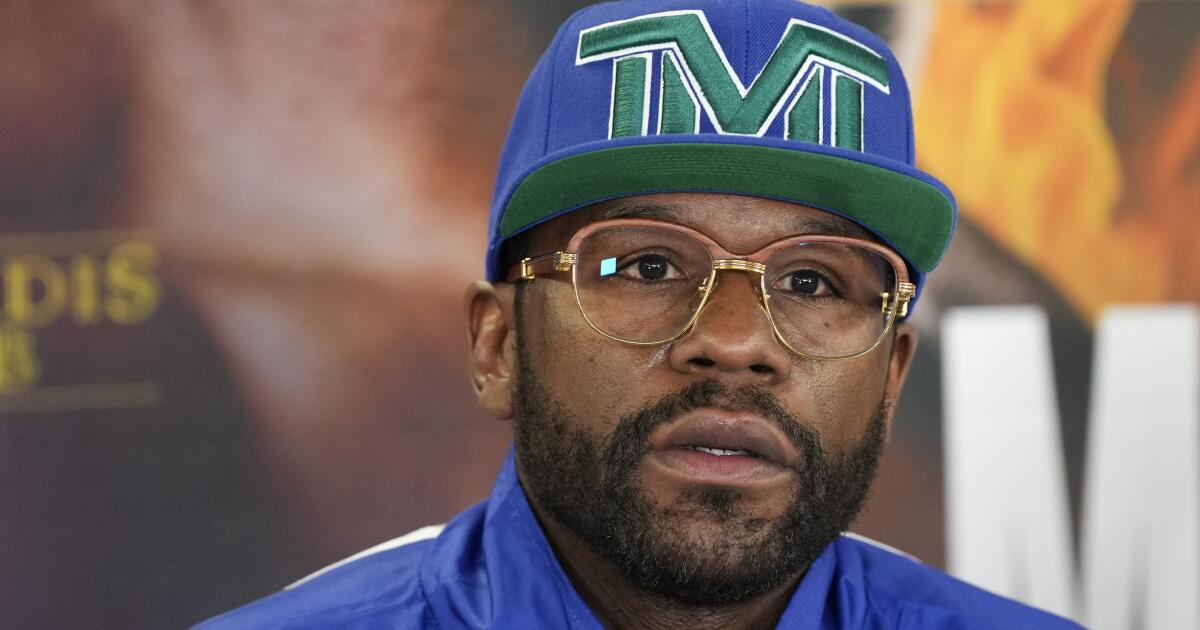
Floyd Mayweather Jr.’s Christmas Day purchase of an exclusive Audemars Piguet watch has landed the billionaire boxer in court facing two felony charges alleging theft and intent to defraud, according to Clark County, Nev., court records.
Mayweather wrote a check for $200,000 to Las Vegas high-end consignment store Gold and Beyond for the timepiece on Dec. 25, 2024. Prosecutors filed a criminal complaint on April 27 of this year and the court ordered Mayweather to appear before a judge. His lawyer did so at a preliminary hearing Monday.
The charges are theft with a value of $100,000 or greater and passing a check of $1,200 or greater with intent to defraud. Mayweather did so “knowing that the check would not be paid when presented,” according to the complaint.
Mayweather, 49, could face a prison term of one to 20 years and $15,000 in fines if found guilty of felony theft. The fraud charge carries a sentence of one to four years in prison and a $5,000 fine plus restitution.
Audemars Piguet, which has operated in the quaint Swiss village of Le Brassus for 150 years, is considered a more luxurious and prestigious brand than Rolex, belonging to the “Holy Trinity” of Swiss watchmaking alongside Patek Philippe and Vacheron Constantin.
Luxury watch expert Prestige Time explains why a watch enthusiast would become enamored by the brand: “Buy an Audemars Piguet if you enjoy complications, the kind you find in a really high-end mechanical watch. We’re talking about tourbillons, perpetual calendars, moon phase, retrograde, minute repeaters, chronographs, dual time zone/GMT’s, and more mechanical features that offer more function than just to tell you the time.”
Now the man nicknamed “Money” is on the clock to resolve a high-dollar dispute that could result in a criminal conviction. Mayweather’s next court appearance is Sept. 17. Meanwhile, lawyers representing both sides made their cases in court filings and to the judge.
Mayweather has had a longstanding business relationship with Gold and Beyond, his attorney Adrian Lobo told ESPN in a statement on Tuesday night. Lobo appeared perturbed that the shop’s owner brought the claim to the Clark County District Attorney instead of filing a civil suit.
“This matter does not belong in the criminal courts,” Lobo wrote in the statement. “And Mr. Mayweather looks forward to being vindicated through the court proceedings.”
Gold and Beyond attorney Marc Cook said his client exhibited patience with Mayweather, giving him ample time to pay for the watch. The complaint was filed with the Clark County District Attorney’s office in February.
“The reason for the delay is that my guy trusted Mayweather and was trying to give him every opportunity to make good on that,” Cook said in a statement to ESPN. “And it got to the point where he wasn’t getting responses and wasn’t getting money for a watch that Mayweather had for well over a year.”
Given Mayweather’s reported wealth, bouncing a check might seem perplexing. He is considered the richest boxer of all time, with roughly $1.1 billion in career earnings and an estimated net worth of $400 million.
He owns three of the top-five largest payouts in boxing history, making $275 million for an exhibition with UFC fighter Conor McGregor in 2017, $250 million for the “Fight of the Century” against Manny Pacquiao in 2025, and a then-record $80 million payout for a bout with Canelo Alvarez in 2013.
Mayweather, whose career record is 50-0, reportedly has increased his net worth since last fighting nine years ago. He represents some of the world’s top boxers through Mayweather Promotions and owns roughly 75 gyms around the country along with real estate holdings.
However, Mayweather is reportedly beset by financial woes as well. He filed a $340 million lawsuit against former broadcast partner Showtime, alleging the television network concealed and diverted his earnings. Also pending is a $175 million lawsuit against former associates, claiming they defrauded him and misappropriated his funds, jewelry, and private jet.
Mayweather is scheduled to face kickboxer Mike Zambidis in a full-contact exhibition June 27 in Athens, Greece, and a rematch with Pacquiao is set for September in Las Vegas. However, an exhibition against Mike Tyson scheduled for last April was canceled because Mayweather was notified by the IRS that it intended to revoke his passport over a delinquent tax debt of $7.3 million, according to Ring Magazine.
Diversity in last year’s streaming films followed the same downward trend as theatrical releases, a new study found, with the percentage of people of color directing, writing and leading films diminishing.
In past years, streaming was considered a more accessible outlet for early-career female or BIPOC filmmakers, which was reflected in data about gender and racial representation. According to Part 2 of UCLA’s 2026 Hollywood Diversity Report, which was released Wednesday and analyzed all of the original English-language films distributed on major streaming platforms in 2025, that trend reversed across every category studied.
The share of streaming films directed by women declined to just over 23%, the lowest it’s been since 2022, when the annual study began analyzing streaming and theatrical films separately. Among those female directors, an overwhelming majority (81%) were allotted budgets below $20 million, while more than a quarter of the films directed by white men exceeded $50 million.
Only about 31% of streaming films last year had BIPOC directors, down 10% since 2024, when the proportion more closely reflected U.S. demographics.
“This is an industry in flux — and in reverse, especially when it comes to diversification,” Darnell Hunt, UCLA’s executive vice chancellor and provost and the report’s co-founder, said in a statement.
“Unfortunately, as we’ve seen with theatrical films, we’re now seeing the impact of this current political climate in very meaningful and concrete ways,” he continued. “As budgets tighten, opportunities for filmmakers of underrepresented backgrounds are always the first to be squeezed out.”
Despite losing ground behind the scenes and in front of the camera, women and people of color continued to drive streaming viewership in 2025, the report found.
The year’s biggest streaming hit, “KPop Demon Hunters,” was also the most-watched original Netflix film of all time, and according to Neilsen ratings, it was most streamed by women in Latinx households, followed by women in Asian and Black households. The report acknowledged the film as a “bright spot” in a disappointing year for diversity.
Michael Tran, a sociologist who co-authored the report, noted that the film’s impact and earnings potential could have been even greater with a theatrical release.
“It was a missed opportunity for theaters,” Tran said. “We’ve tracked how diverse films tend to succeed at the box office, here and abroad. For ‘KPop Demon Hunters,’ we could have been talking about record-breaking box office receipts in addition to topping the ratings.”
When “KPop Demon Hunters” did briefly screen in theaters — for two days last August, with over 1,750 locations domestically and more than 1,150 sold-out screenings — it was the No. 1 movie that weekend, earning about $18 million in ticket sales (though Netflix does not report exact box office figures).
Data from the report also indicated that streaming films with at least somewhat diverse casts tended to outperform in terms of audience and social media engagement.
However, overall cast diversity in streaming films declined in 2025. For the first time since 2022, films with a majority-BIPOC cast did not represent the plurality of streaming titles. Most notably, the percentage of lead actors of color dropped from a high of 51% in 2024 to 36% in 2025.
Report authors called it an “industry-wide chilling effect” reminiscent of a similar decline in diversity among theatrical films in 2024. That said, streaming films continued to star BIPOC leads more often than their theatrical counterparts, the study found.
The overall number of streaming films also declined. While the annual UCLA report typically examines the top 100 original, English-language movies across streaming platforms, this time, there were only 89 for researchers to analyze.
In addition to studying race and gender demographics in the film industry, the report also examined on-camera representations of disability. According to the study, while adults with a disability make up at least 26% of the U.S. population, actors with a known disability represented 6.5% of total streaming movie actors, which is in line with the previous year.
According to the study’s authors, streamers hoping to compete in a fast-paced, globalized market should increase their diversity efforts in light of these results.
“Kids under 18 are already majority BIPOC. There’s no going back if a studio wants to be profitable and relevant to Gen Z and Gen Alpha,” said report co-founder and co-author Ana-Christina Ramón. “Severing all brand loyalty now will only make it more difficult to regain long-term subscribers in the future.”
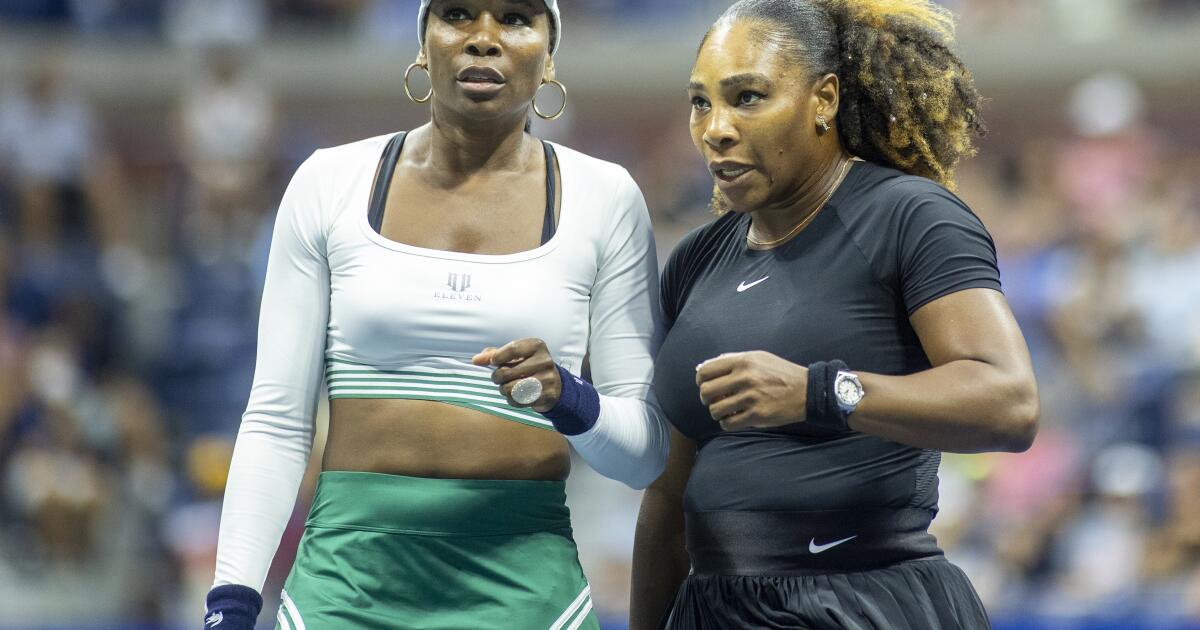
The Williams sisters — Venus, 45, and Serena, 44 — will bring back their doubles partnership at Wimbledon in under two weeks. The All England Club announced the doubles wild card invitation on Tuesday.
Should they win for a record seventh time, the Williams sisters would make history as the oldest Grand Slam-winning doubles combo by nearly 16 years.
The record of 74 years and 303 days is held by Hsieh Su-wei and Barbora Strýcová, who won at Wimbledon in 2023. Venus will turn 46 on Wednesday and Serena will be 45 on Sept. 26, putting their combined age by the tournament’s end at 90 years and roughly 290 days.
The Williams sisters have won six doubles titles together at Wimbledon, most recently in 2016 with the first coming in 2000. They have won 14 Grand Slam doubles titles together, the second most by any women’s team in the Open Era behind the 20 won by Martina Navratilova and Pam Shriver.
Serena recently returned to competition after almost four years away from professional tennis. She will compete in the Berlin Open doubles alongside world No. 10 singles player Karolína Muchová on Tuesday against Erin Routliffe and Giuliana Olmos.
The initial tournament in Serena’s comeback was abbreviated. Her playing partner, Canadian teenager Victoria Mboko, suffered a knee injury that ended their effort at the Queen’s Club Championship after one match, a 7-6(2), 6-2 victory over No. 3 seeds Erin Routliffe and Nicole Melichar-Martinez.
Venus, who will turn 46 on Wednesday, is in the midst of her record 33rd consecutive WTA season. She has been eliminated in the first round of singles at several tournaments while faring better in doubles.
The pairing at Wimbledon will be the first since 2022 for the Williams sisters. Serena took a long hiatus beginning that year and gave birth in 2023 to her second child, Adira River Ohanian.
Many of the sisters’ career highlights have come at Wimbledon. Serena has 14 titles on the hallowed grass court — six in doubles, one mixed doubles and seven in singles. Venus Williams has won 11 Wimbledon titles — five in singles and six in doubles.
Neither Williams sister is slated to play singles in this year’s tournament, although one women’s singles wild card has not been allocated.
Grammy-nominated rapper Mystikal has been sentenced to 20 years in prison for third-degree rape.
The “Danger” rapper was arrested in the summer of 2022 and booked into the Ascension Parish Jail in Louisiana and charged with first-degree rape, simple robbery, domestic abuse battery–strangulation, false imprisonment and simple criminal damage to property after the victim identified the rapper as the suspect from the hospital where she was being treated for injuries.
According to Baton Rouge-based ABC affiliate WBRZ, the victim told a Louisiana courtroom on Tuesday that Mystikal, real name Michael Tyler, punched and choked her, pulled braids out of her hair and forcibly raped her during the 2022 incident. The victim requested the maximum sentence for the rapper.
“If I did that to you, I deserve the max sentence,” Tyler told the courtroom before he was sentenced to 20 years for third-degree rape, which carries a maximum sentence of 25 years with no chance for early release or probation.
In March, Tyler entered a guilty plea, which knocked his first-degree rape charge down to third-degree. In Louisiana, first-degree rape carries a maximum sentence of life imprisonment. According to WBRZ, the rapper’s attorney filed a motion to withdraw the guilty plea days before Tyler was sentenced, but the motion was tossed.
The rapper was previously indicted in 2017 on rape and kidnapping charges stemming from allegations in 2016. He spent 18 months in jail before being released in 2019 on a $3-million bond, the Associated Press reported. The Caddo Parish district attorney in Louisiana ultimately dropped those charges in 2020 after a second grand jury declined to bring an indictment.
With his raspy vocal intensity and scream-like musical delivery, Mystikal shot to the top of the charts with Master P’s No Limit Records in the late 1990s. In 2004, the embattled rapper’s original label, Jive Records, released two compilations of his music, “Prince of the South … The Hits” and “Chopped & Screwed.”
Former Times staff writer Nardine Saad contributed to this report.
MADISON, Wis. — President Trump’s attorney for the 2020 campaign in Wisconsin and two former aides all pleaded not guilty Tuesday to felony forgery charges for their roles in a fake elector scheme designed to overturn Trump’s loss in the swing state.
Jim Troupis, a former judge who was Trump’s Wisconsin campaign attorney; Mike Roman, Trump’s director of election day operations in 2020; and Ken Chesebro, a former Trump legal advisor, all entered the pleas in Dane County Circuit Court.
Troupis, who lives in the Madison area, appeared in person. Roman and Chesebro appeared via Zoom.
The Wisconsin fake electors case is moving forward even as others in the battleground states of Michigan and Georgia have faltered. A special prosecutor last year dropped a federal case alleging Trump conspired to overturn the 2020 election. Another case in Nevada is still alive.
The fake elector scheme, under which Republican electors in battleground states submitted documentation to Congress attesting that Trump had won their states even though he lost to President Biden, originated in Wisconsin.
Troupis, Chesebro and Roman argue that they committed no crime and were just trying to keep their options alive in case a court ruled that Trump had actually won the state.
But prosecutors allege that the three defendants defrauded the 10 Wisconsin Republican electors who cast their ballots for Trump in 2020.
Prosecutors contend that Troupis, Chesebro and Roman lied to the electors about how the certificate they signed would be used as part of a plan to submit paperwork to then-Vice President Mike Pence, falsely claiming that Trump had won the battleground state that year.
A majority of the electors told investigators that they did not believe their signatures on the elector certificate would be submitted to Congress without a court ruling, the complaint said. Also, a majority said they did not consent to having their signatures presented as if Trump had won without such a court ruling, the complaint said.
The arraignment on Tuesday came two years and two weeks after the first charges were brought against the three by Wisconsin Democratic Atty. Gen. Josh Kaul. Troupis, Chesebro and Roman face 11 felony forgery charges that are each punishable by up to six years in prison and a $10,000 fine.
Troupis and Roman both filed motions seeking to relocate the trial from Dane County, which includes Madison, to neighboring Jefferson County, saying negative publicity had tainted the potential jury pool.
Trump carried Jefferson County by 15 percentage points in 2020. He lost Dane County by nearly 53 points.
“This case is headed to trial,” wrote Troupis’ attorney, Joe Bugni, in Troupis’ motion. “No question. Neither side is going to blink. And when we get to trial, Troupis has the right to a fair and impartial jury.”
Troupis and Roman also argued that one of the 11 felony counts against them should be dropped because Trump issued a pardon for any federal crimes related to their work on the fake elector scheme. They argued that the state can’t prosecute them over the casting of electoral votes, which is a federal process, and therefore Trump’s pardon applies.
Trump also pardoned Chesebro.
The judge said Tuesday he would set a schedule to hear arguments on those motions.
The state charges against the Trump attorneys and aide are the only ones in Wisconsin. None of the electors have been charged. The 10 Wisconsin electors, Chesebro and Troupis all settled a lawsuit that was brought against them by Democrats seeking damages.
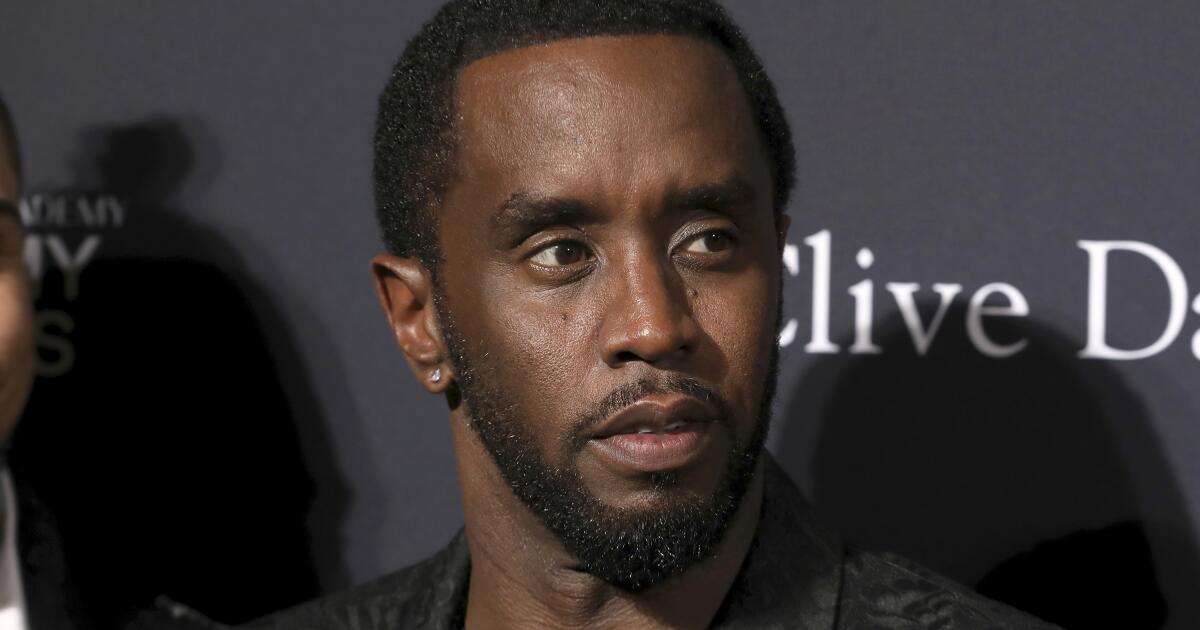
Sean “Diddy” Combs is expected to be released from federal prison earlier than expected in 2028.
The disgraced music and alcohol mogul, 56, is now set to be released from FCI Fort Dix, a low-security federal prison in New Jersey, on Feb. 23, 2028, according to the Federal Bureau of Prisons inmate database. Combs was sentenced in October 2025 to 50 months in prison after he was convicted of transporting prostitutes across state lines for drug-fueled sex performances known as “freak-offs.”
The updated release date shaves off even more prison time for Combs, who was initially projected to be freed in June 2028. Earlier this year, the producer’s release date was moved up to April 2028.
A legal representative for Combs did not immediately respond to a request for comment Tuesday. People reported that Combs is participating in a drug-abuse rehabilitation program in the federal prison. The outlet also reported that the musician’s legal team preferred Combs carry out his sentence at FCI Fort Dix because of its treatment program and proximity to his family.
Combs was sentenced last year after a lengthy and highly public legal saga involving damning allegations of sexual assault and other violence. Singer Casandra “Cassie” Ventura and producer Rodney “Lil Rod” Jones were among the accusers who lodged civil complaints against Combs. Though he was found guilty in July on two counts of a prostitution-related charge, jurors cleared Combs on racketeering and sex trafficking.
“Mr. Combs has been given his life by this jury,” defense attorney Marc Agnifilo said at the time.
Earlier this month, the Los Angeles County district attorney’s office said it was investigating two sexual assault cases against the Bad Boy Records founder. A Florida music producer alleged last year that Combs sexually assaulted him in 2020 and 2021. When the claims first surfaced in 2025, Combs’ civil attorney dismissed them.
“Let me make it absolutely clear, Mr. Combs categorically denies as false and defamatory all claims that he sexually abused anyone,” attorney Jonathan Davis said at the time. “He looks forward to vindicating himself in court, where such matters are decided — and not in the media — based on admissible, material evidence, not rank speculation and unsubstantiated allegations.”
Times staff writers James Queally and Richard Winton contributed to this report.
WASHINGTON — Ever since Kevin Warsh was nominated by President Trump in late January to lead the Federal Reserve, a question has lingered: Will he seek to raise interest rates to tame inflation or cut them as Trump has long demanded?
On Wednesday, Warsh may provide the first hints of an answer when he oversees his first Fed policy meeting as chair and holds a news conference afterward. Bond markets, which can swing sharply on a chair’s pronouncements, will be watching particularly closely for any signs of which way he leans.
“We expect the press conference to be pivotal,” Jonathan Pingle, an economist at investment bank UBS, wrote in a note. “This will be Kevin Warsh’s first public appearance as Chair. … We do not really know what his policy views are.”
Economists say Warsh will likely aim for a neutral approach, largely because he is taking over the Fed at a challenging time. Rising inflation has made it all but impossible for the Fed to cut interest rates anytime soon, which could stimulate growth and further raise prices. Hiring has improved noticeably since the beginning of the year, removing another key rationale for rate cuts. And the other 11 policymakers on the Fed’s rate-setting committee — including Warsh’s predecessor, former chair Jerome Powell — are split on whether an increase in the Fed’s key rate will be needed or if it can stay unchanged.
High inflation puts Fed in tough spot
Oil prices have fallen sharply on news that the U.S. and Iran have reached an initial deal to end their war, which could eventually cool inflation. Yet it’s unclear whether a permanent agreement can be reached.
“The right thing to do now is wait and see,” said William English, an economist at the Yale School of Management and a former top Fed economist.
Inflation has jumped to a three-year high of 4.2%, the government said last week, mostly because of higher gas prices. Even Trump has backed off a bit from his relentless demands for lower rates, and instead has argued that rate hikes — which the Fed undertakes to cool the economy and slow inflation — aren’t necessary.
In an interview earlier this month on NBC’s “Meet the Press,” Trump said, “Kevin is fantastic and I want him to do whatever he wants,” but added, “there’s no reason to raise rates.”
On Wednesday, the Fed is widely expected to keep its key rate at about 3.6%, where it has remained since last December. When the Fed reduces its rate, over time it can lower other borrowing costs for things like mortgages, auto loans, and business loans.
Changes likely to dash hopes for those seeking lower rates
Still, some changes are expected, which will disappoint those hoping for lower borrowing costs: The Fed is likely to drop language that suggests its next move will be a rate cut, and instead adopt wording that is more neutral. Several Fed policymakers in recent weeks have said that the Fed’s most likely next move is a hike, rather than a cut.
The central bank is also scheduled to release its quarterly economic projections, which include forecasts for how the Fed’s key rate will change over the next three years, on Wednesday. In March, those projections suggested the Fed would cut its rate once this year. Yet on Wednesday they will likely show no change in 2026, with maybe one or two cuts next year, economists say.
Warsh has criticized the projections for providing too much “forward guidance” to financial markets and leading Fed officials to stand by their forecasts for too long, even as the economy changes. Fed watchers will look closely to see if Warsh participates in the quarterly projections. If he doesn’t submit his own forecasts, it could be a sign he will seek to get rid of them entirely in the coming months.
Warsh to bring a new approach to Fed leadership
Outside of policy, Warsh is expected to bring a different style to the Fed than Powell, according to people who’ve worked with him. He wants Fed policymakers to give fewer speeches, have more debates behind closed doors and will likely avoid commenting on the daily ups and downs of the economy. Powell was relatively plainspoken and straightforward, while Warsh has suggested he sees the famously oracular Alan Greenspan, the Fed’s chair from 1987 to 2005, as a model.
“He’s just going to say less, because he doesn’t find that stuff very helpful,” said Robert Tetlow, a former senior policy adviser at the Fed.
Randall Kroszner, an economist at the University of Chicago who served on the Fed’s governing board from 2006 to 2009, when Warsh was also a governor, said the new chair would likely focus on bigger-picture questions, such as how AI will impact the economy. He will avoid thornier issues, such as whether tariffs raise inflation, which Powell was willing to address.
By avoiding such hot-button issues, the Fed could attract less negative attention from the White House, Kroszner said.
“He’s going to stay away from those,” Kroszner added. “If the Fed is to maintain its independence, it needs to maintain its focus.”
While seeking Trump’s nomination, Warsh called for “regime change” at the Fed and criticized the central bank for not preventing the 2021-22 inflation surge, when prices jumped 9.1% in a year, the biggest spike in four decades.
Yet Kroszner said Warsh will likely to seek to build consensus around changing things like the Fed’s communications policies, rather than imposing them. So far, former Fed officials say he hasn’t sought to fire top staff.
“He’s not there to break things,” Kroszner said.
During his Senate confirmation hearing in April, Warsh said he would focus on quelling inflation.
“Inflation is a choice, and the Fed must take responsibility for it,” he said then.
If he acts on that sentiment by keeping rates unchanged — or even raising them — Trump could end up disappointed in another Fed chair. He often threatened to fire Powell, whom he also appointed, for not cutting rates deeply enough.
“There’s at least a risk here that six months down the road, Trump is fulminating about how he didn’t get what he wanted from Warsh, and he’d like to fire Warsh,” English said.
The country music star filed for divorce from his wife in Tennessee’s Williamson County on May 18, according to court documents obtained by People — TMZ broke the news. The announcement may come as a shock for country fans who have followed the couple through their sappy podcast appearances and gushy acceptance speeches.
Bunnie XO, who hosts the “Dumb Blonde” podcast, met Jelly Roll at one of his Las Vegas Country Saloon concerts in 2015. Then, a year later on a Las Vegas stage, the “Save Me” hitmaker popped the question.
The pair said their “I do’s” at a local courthouse later than night in a secret ceremony.
Jelly Roll and Bunnie XO have been candid on the podcast circuit about the ups and downs of their relationship. In Bunnie’s 2026 memoir, “Stripped Down: Unfiltered and Unapologetic,” she wrote about Jelly Roll’s 10-month affair in 2018 and her subsequent emotional unraveling.
The couple also has been open about their struggle with IVF in recent years.
As recently as February, while accepting his win for contemporary country album for “Beautifully Broken,” Jelly Roll thanked Bunnie XO in his acceptance speech, saying that he wanted to thank his “beautiful wife” and that he’d be dead or in jail without her.
And during a 2023 appearance on “Bussin’ With the Boys” podcast, Jelly Roll was overcome with emotion recounting his early days with Bunnie XO. “When Bunnie comes into my life, I have to sit Bunnie down and go, ‘Look, I have a kid that you know about that I’m fixing to have to get full custody of.’”
According to the Grammy winner, Bunnie had his back from the beginning.
“I don’t have a house, I’m homeless. So she’s like, ‘Well, the first thing we have to do is get you somewhere to live in Nashville.’ I was like, ‘Well, I can’t put it in my name, I’m a felon, I don’t have enough proof of income to get the kind of place we need to get her in the right school district.’
“Bunnie’s like, ‘Let’s just go get a condo, so you have a bedroom for her.’ … So Bunnie comes down, and we’re getting a condo. I’ll never forget, Bunnie looked at me, and, man, it makes me emotional. She said, ‘No matter what happens with us. I’m gonna help you get this little girl.’
“And I was like, man, what character this woman has,” he continued.
Hours before news of the couple’s split broke, Bunnie XO posted a video on Instagram dancing to Nickelback’s “How You Remind Me,” and mouthing the lyrics “I said I love you and I swear I still do.”
A weekend BASE jumping accident in a Utah canyon killed two people, one of them a daredevil athlete best known for performing onstage with Madonna at the 2012 Super Bowl, authorities said.
The Sheriff’s Office in Grand County, Utah, confirmed one of the dead was Andy Lewis, an extreme athlete known for feats in BASE jumping, a dangerous sport that involves parachuting to the ground after jumping from a tall fixed object such as a building, a bridge or a desert cliff overlooking a deep canyon.
In BASE jumping circles, Lewis had a huge following and a reputation for pushing the envelope — leaping into tighter spaces or deploying his parachute later than his peers would dare, said John McEvoy, a BASE jumping instructor in Twin Falls, Idaho, who has jumped with Lewis.
“He had an incredible level of athleticism and skill that was developed over years of practice,” McEvoy said. “But then he would take an incredible amount of risk.”
Lewis’ other sport made him an overnight celebrity, thanks to Madonna
Lewis was also a prominent figure in the niche sports of slacklining and tricklining, which combine elements of high-wire walking with aerial acrobatics — sometimes at perilous heights.
Lewis went from obscure athlete to overnight celebrity when he appeared onstage in Madonna’s 2012 Super Bowl halftime show. Dressed in a Roman toga, Lewis bounced and executed tricks on his inch-wide line as though it was a trampoline while Madonna sang behind him.
“My phone actually rang itself to death three days in a row,” Lewis said soon afterward in an appearance on Conan O’Brien’s late-night show.
Emergency responders were dispatched Sunday to a report of people injured in a BASE jumping attempt at Mineral Bottom, a remote desert area near the Utah-Colorado line, according to the Sheriff’s Office. Lewis and an unidentified 50-year-old man died at the scene, the office said in a news release.
Sheriff’s Lt. Al Cymbaluk confirmed to the Associated Press that it was Lewis the extreme athlete who died. He said he had no further details on the fatal accident.
BASE jumping is far more dangerous than skydiving
Though there’s no official tally of BASE jumping deaths, a list compiled by the website BASEaddict.com shows 540 total fatalities worldwide since 1981 — including 30 people killed last year. Prominent deaths include BASE jumper Dean Potter and his climbing partner, Graham Hunt, who were killed in 2015 while attempting a wingsuit flight in Yosemite National Park.
A study focused on BASE jumping in Norway, published in a medical journal in 2007, estimated that BASE jumping carried risks of injury or death five to eight times greater than skydiving.
Lewis openly acknowledged the sport’s inherent danger.
“It’s weird to think about how many people are dead, because it’s like a normal thing,” Lewis told documentary filmmaker Ella Warnick in an interview published last year.
Lewis owned BASE Jump Moab, a business that offered excursions to inexperienced customers using tandem jumps, in which the customer was harnessed to a guide wearing the parachute.
Sheriff’s spokesperson Cymbaluk said he didn’t know whether Lewis and the other man killed were performing a tandem jump.
Tandem BASE jumping carries additional risk because it straps together two people, one of whom generally lacks experience, under a single parachute, McEvoy said. But because they involve novices, they also tend to be the most low-risk, basic types of jumps.
“Within BASE, it’s a very controversial topic,” McEvoy said. “There’s a lot of people who say it’s the stupidest thing in the world and others arguing, `No, we’re giving people the experience of their lives.’”
No one immediately returned phone, text and Facebook messages left Monday for BASE Jump Moab.
Lewis won four straight world championships in competitive slacklining from 2008 through 2011. Lewis set a Guinness World Record for slackline surfing, swaying his feet side to side in a rocking motion that mimics surfing, while keeping his balance above China’s Diaoshuilou waterfall in 2011.
In 2014, he walked a slackline suspended between two hot air balloons more than 4,000 feet above the Nevada desert.
WASHINGTON — While millions of soccer fans cheer or groan over World Cup matches spanning North America, health officials are on high alert for germs.
A heat wave may be the most obvious health threat. But infectious diseases can spread in a crowd, and experts are scrutinizing wastewater, hospital visits, even social media for any signs that an outbreak might be brewing.
Measles, one of the most contagious diseases, is among the top concerns, sparking a warning this week from the Pan American Health Organization, PAHO. With a nearly six-week stretch of packed stadiums, bars and tourist sites in 16 cities, officials are on the lookout for a long list of infections, from the stomach bug norovirus to mosquito-borne dengue fever.
“This is truly a marathon,” said Palak Raval-Nelson, Philadelphia’s health commissioner.
The mass gatherings come at a tense moment for budget-strapped health agencies in the U.S. The Centers for Disease Control and Prevention, hit hard by Trump administration staffing cuts, already was grappling with a growing Ebola outbreak in central Africa and a cruise ship hantavirus outbreak. While CDC officials have advised state and local health departments behind the scenes, it’s expected World Cup disease surveillance dashboard still was “in final development” days before games began, according to the Department of Health and Human Services.
“Our public health professionals are pretty stretched,” said global health specialist Rebecca Katz of Georgetown University, who is leading an unusual new hub to help.
At the Health Security Operations Center, a joint effort between Georgetown and MedStar Health, workers are analyzing data from around the country so they can alert health authorities, even emergency rooms, to any early signs of trouble. The center is issuing daily “situation reports” about disease trends around World Cup host cities and team base camps to several hundred local and federal public health groups, emergency management and hospital officials and others who’ve signed up.
“It’s important that we don’t become alarmist,” said MedStar emergency medicine specialist Dr. Shane Kappler. “We’re trying to be the insurance policy.”
Measles is a top concern for potential World Cup spread
Already more than 2,000 people in the U.S. have come down with measles this year, nearly as many as during all of last year, according to the CDC. Patients can spread measles before the rash appears and they realize they’re sick. Not too long ago, the U.S. seldom saw measles except from international travel by unvaccinated people.
Now with frequent U.S. outbreaks, “actually a lot of our international partners are worried about measles being exported to them after the games,” said Georgetown’s Katz.
Measles is spreading in Canada, too, and has exceeded 11,000 cases in Mexico, according to PAHO. It’s urging soccer fans to be sure they’re vaccinated, with a health campaign saying a single measles patient can spread the virus to up to 18 unprotected people.
Is Ebola a concern at the World Cup?
Brown University’s Dr. Craig Spencer, who survived Ebola while working in the West Africa outbreak over a decade ago, said he’s repeatedly asked about the risk of Ebola during the World Cup — but “for me, Ebola is not the No. 1 or No. 2 or even No. 3 threat.”
“I am concerned about importation of measles, I am much more concerned about the importation of other infectious threats that may not seem as scary to us as Ebola,” Spencer said.
Many health experts agree that the risk of Ebola spreading in the U.S. is very low. That’s partly because of government travel screenings and restrictions on people recently in outbreak-affected areas. Moreover, Ebola spreads by contact with bodily fluids from someone showing symptoms, not through the air like measles or respiratory viruses.
“One fortunate thing about this virus is you’re most contagious when you’re really quite ill. It’s not like COVID, where you could be sitting next to someone who doesn’t even know they’re infected and perhaps contract the virus,” said Jennifer Nuzzo, director of Brown’s Pandemic Center.
How to spot brewing diseases
There’s precedent for germs invading major sporting events. Canadian scientists linked a community measles outbreak to the 2010 Olympics in Vancouver, and clusters of norovirus had to be contained during the Olympics this year in Milan and in 2018 in South Korea.
One way to detect signs of trouble: People with certain viral or bacterial infections shed genetic material that sophisticated testing of wastewater can spot. For example, measles can appear in wastewater days before an emergency room sees its first patients.
A recent surveillance reports from Katz’s center note that wastewater testing recently found diarrhea-causing rotavirus, hepatitis A and norovirus in some parts of the U.S., something to watch as soccer crowds arrive.
In Dallas, officials ramped up wastewater screening including at the international airport, casting a wide net rather than looking for specific illnesses, said Dr. Phil Huang, director of Dallas County Health and Human Services.
His team also is enhancing the usual mosquito testing, checking not just for West Nile virus that regularly spreads in the U.S. but for viruses more common in other countries like dengue and chikungunya.
Public health officials have been preparing for months, said Philadelphia’s Raval-Nelson, including with mock emergency drills and communications with counterparts around the country.
“I don’t want to send a message that there’s one key thing,” she said. “We have the frameworks in place to carry out what we need to.”
A federal immigration judge has granted asylum to a woman orphaned in Iran in the 1970s and adopted by an American war veteran, whom immigration officials threatened this year with deportation to the country with which the U.S. is now at war.
Judge Andrew Fishkin’s ruling probably ends a months-long ordeal for the California woman, one of thousands adopted from abroad who were never granted citizenship because of bureaucratic loopholes between adoption and immigration law.
The woman has lived in the United States since she was adopted by American parents as a toddler and has no criminal record. The Associated Press is not naming her because she worries her legal situation remains tenuous as the administration has time to appeal. A federal judge has allowed her to use a pseudonym, “Ms. S,” in her challenge to the government’s determination of her immigration status.
The woman received a letter from the Department of Homeland Security in February that ordered her to appear for removal proceedings, saying she is subject to deportation because she overstayed her visa in March 1974 at 4 years old.
The woman, 56, described what came next as a terrifying and humiliating few months.
She grew up in a Christian, military family on a farm in Wisconsin and was taught to be patriotic. But the documents she received from the government described her as an “alien;” some said she did not understand English, which is the only language she speaks.
Immigration officials told her she was being arrested, but was released and tracked with an ankle monitor. She bought new pants to try to hide it and taught herself not to cross her legs in work meetings, terrified it would threaten the corporate job in healthcare she’s held for almost two decades.
They fingerprinted her and took her DNA. She said she was obviously weeping in the mug shot they snapped of her.
She prepared herself to be detained: She put her bills on autopay and gave her friends a key to her home.
Her lawyer, Emily Howe, said the government had the power to agree she is an American citizen.
“Instead they treated her like a terrorist, like she was the worst of the worst criminals,” Howe said. “It felt very Big Brother, very Orwellian.”
The Department of Homeland Security declined to comment on the record on an individual case.
The Associated Press profiled the woman in 2024 as part of a story about how many international adoptees were left without citizenship because their American adoptive parents failed to naturalize them.
The woman’s parents were living in Iran, where her father was working for a U.S. government contractor, in the 1970s. He was retired from the Air Force as a lieutenant colonel. He’d been held for years a prisoner of war in Germany during World War II.
The couple found the toddler at an orphanage and returned to the U.S. with her in 1973 and soon completed the adoption. At that time, parents had to separately naturalize adopted children. The woman’s parents have since died.
She didn’t learn she hadn’t been naturalized until she applied for a passport at 38 years old. She still doesn’t know how the oversight happened. She searched her father’s papers and found a letter from a lawyer, dated 1975, that said he was working with immigration officials, “it appears this matter is concluded,” and billed her father for his services.
She filed a federal lawsuit this month trying to prohibit the government from removing her and forcing it to grant her citizenship.
She has long believed she should be considered a U.S. citizen: She has a Social Security card, and a driver’s license and has been legally allowed to work and pay taxes for decades. It’s only the immigration agency that denies she is a citizen. She suspects her paperwork was lost, probably when militants seized the U.S. Embassy in Tehran in 1979.
Fishkin seemed to agree: He wrote in his ruling that documents from that embassy are not available to her or to the U.S. government. He declared her a refugee, entitled to work in the U.S. His ruling puts the woman on a pathway to being recognized as a citizen.
She’d felt hopeful, she said, when she learned her court date before Fishkin was scheduled for her late father’s birthday. She always felt like she needed to protect not only herself but also her father’s legacy. He was a conscientious military official, she said, who would not have knowingly allowed such a glaring oversight that left his daughter in legal limbo.
Hi, and welcome to another edition of Dodgers Dugout. My name is Houston Mitchell. Maybe the Dodgers can lure Nuke LaLooshout of retirement.
Are you a true-blue fan?
Get our Dodgers Dugout newsletter for insights, news and much more.
By continuing, you agree to our Terms of Service, which include arbitration and a class action waiver. You agree that we and our third-party vendors may collect and use your information, including through cookies, pixels and similar technologies, for the purposes set forth in our Privacy Policy such as personalizing your experience and ads.
The Dodgers are struggling in June, going 7-6 this month after going 20-11 in March/April and 18-10 in May. Why? Let’s take a look.
Runs per game March/April: 5.39 May: 5.25 June: 5.54
Batting average March/April: .273 May: .252 June: .261
OB% March/April: .350 May: .339 June: .354
SLG% March/April: .452 May: .441 June: .413
Power is down a bit, but all the other numbers are normal, so offense does not appear to be a big problem. They are hitting about the same in all the clutch stats, so that’s not a big problem. Let’s look at the pitching:
ERA April: 3.19 May: 2.95 June: 4.73
ERA by starters April: 2.83 May: 3.31 June: 3.28
ERA by relievers April: 3.88 May: 2.35 June: 7.51
Ah, we begin to see the problem: The bullpen, which has been outstanding all season until this month.
That’s a lot of bad pitching in the bullpen this month. Of course, this is the same bullpen that set a team record for most consecutive scoreless innings. And, just like batters go into slumps, so do pitchers.
“Out of the bullpen specifically, I think maybe some strike throwing, a few more walks that we’re not used to over the last six weeks or so, because they’ve been really, really good,” bench coach Danny Lehmann told reporters after the Dodgers lost to the Chicago White Sox on Sunday. “We’ve gotten bit by the long ball, obviously in Pittsburgh, and here tonight. But overall, it’s more the strike throwing and just getting ahead of guys and doing what they’re supposed to do.”
Are fresh arms on the way?
Well, Brock Stewart is on a rehab assignment in Ontario, but he has been injured so often since the Dodgers traded for him, you can’t expect anything from him. You can just hope. Evan Phillips is on assignment in Oklahoma City, and is on track to return in early July.
“It’s really good to see,” Dave Roberts told reporters recently. “Evan’s a guy that’s very focused and determined, and he’s going to do everything he’s supposed to do to get back. And to potentially have him back is a big weapon that we’ve missed for quite some time, and I miss seeing him around. … I depended on him a lot when he was active, so to get him back is going to be a big boost to everyone.”
There are the usual suspects in the minors, such as Paul Gervase, whom they can turn to, but other than that, it’s just wait and see and hope Stewart and Phillips can come back healthy (especially Phillips, who was a key man in the bullpen for four seasons).
Congratulations!
Roberts missed Sunday’s game for a very good reason: His daughter, Emme, graduated from Stanford.
“I’m really proud,” Roberts told David Vassegh on AM 570 last week. “It is weird, though, because you never want to miss a game. But I think that this is a good reason.
“I think the one thing for me, is the world has evolved, and many can argue not in a good way. In some ways good, some ways bad. But I do think in a lot of ways from the workplace sense of things, it’s more open to people spending time with their families. Knowing that those moments are important, they’re fleeting. The job is going to get done with or without you.
“So I encourage my coaches to enjoy graduations and things like that. One of our coaches had to leave for a surgery for their daughter. I certainly welcome that, because there’s nothing more important than family. And also, I think when you get to do moments with your family and other things that are really important, I think you do your job better, and you feel better for the people you work with and for.”
These names seem familiar
How notable players who were with the Dodgers the last couple of seasons are doing with their new teams (through Sunday). Click on the player’s name to be taken to their full stats page:
Have a comment or something you’d like to see in a future Dodgers newsletter? Email me at houston.mitchell@latimes.com. To get this newsletter in your inbox, click here.
SEATTLE — If a pregnant Nigerian woman had been allowed to board a plane 25 years ago, the U.S. team’s path through this summer’s World Cup may have unfolded much differently. Instead, a gate agent turned her away, insisting it wasn’t safe for her to fly from New York to London.
So Florence Balogun returned to Brooklyn, where she had been visiting relatives, and waited for her second son to be born. And when Folarin arrived a few weeks later, entering the world just hours before Independence Day dawned, he did so as an American citizen.
It was that quirk of fate that allowed Balogun, who lived just two months in the U.S., to represent the country on soccer’s biggest stage.
“I’m extremely proud my individual journey will come full circle now,” he said before the tournament started. “Especially the World Cup being here, the opportunity to represent my nation. It’s going to be something special for me.”
The first game certainly was, with Balogun scoring twice in the first half of a dominant 4-1 win over Paraguay, becoming the first American with multiple goals in a World Cup game in 96 years while introducing himself to a country that may have known his name, but not his unique talent.
“If you don’t know the type of player he is, you could see it today,” midfielder Weston McKennie said. “It’s the World Cup, everyone steps up to their maximum. In the past a lot of people maybe have not made him out to be a player like that.
“He showed everyone he’s willing to do the dirty work as well.”
Balogun once had his pick of countries to represent. His birth in Brooklyn made him eligible to play for the U.S., his longterm residency in London made him eligible to play for England and his parents’ nationality qualified him to play for Nigeria.
He picked the U.S.
And he’s not the only one on the American team who had a choice. Half the men on the World Cup roster — including Christian Pulisic, Gio Reyna and Malik Tillman, who each had a goal or an assist against Paraguay — are dual nationals, meaning they’re playing for the U.S. because they want to, not because they have to.
“You’re more American if you were not born over there because you had the choice to choose and you chose America,” Kenneth Dest, the Surinamese-American father of Dutch-born defender Sergiño Dest, said in an HBO Max documentary.
If America is a nation of immigrants, it only seems right that it should be represented in the World Cup by a team of immigrants. Like Tillman and Dest, who were born and raised in Europe, the sons of U.S. soldiers. Or forwards Tim Weah, the Brooklyn-born son of the former president of Liberia, and Alejandro Zendejas, who was born in Mexico but became a U.S. citizen at 13 after his father was naturalized.
U.S. forward Folarin Balogun, right, celebrates his goal with Sergiño Dest (2) and Chris Richards (3) against Paraguay.
(Robert Gauthier / Los Angeles Times)
The paternal great-grandmother of goalie Matt Turner fled religious persecution in Lithuania, with his Jewish ancestors changing their family name from Turnovski to Turner when they arrived at Ellis Island. The parents of midfielder Cristian Roldan came to the U.S. to escape civil wars in Central America, his father from Guatemala and his mother from El Salvador.
They didn’t wind up wearing the same uniform by accident, however. The recruitment of dual nationals dates to the 1980s under Hungarian-born manager Bob Gansler, who qualified the U.S. for the World Cup for the first time in 40 years with a team that included players born in Uruguay, Greece, Germany and El Salvador.
It really began to scale up about 15 years ago under Bob Bradley and his successor Jurgen Klinsmann. Gregg Berhalter then took it to another level, recruiting more than a dozen dual nationals — including Dest, Tillman, Balogun and Turner — in his five years as coach.
The practice isn’t limited to the USMNT. When France won the World Cup in 2018, 16 of the 23 players on the team came from families that recently immigrated from places like Zaire, Cameroon, Morocco, Angola, Congo or Algeria. More than half the players on Algeria’s team in this summer’s tournament were born in Europe while only seven men on Morocco’s roster are from Morocco.
Even Japan, famously homogeneous, has a Black goalkeeper who was born in Arkansas to a father from Ghana.
“Inclusion always pulls sport forward,” said Ronen Dorfan, a journalist and sports historian based in Budapest.
Still, Balogun’s journey is unusual — and not just because of the way it started.
He was two months old when he and his mother finally made it to London and eight years later he was good enough to enter Arsenal’s academy system. He made his junior international debut with England at 17, then three months later was invited to play four games for the U.S. U18 team.
But Balogun’s future appeared to be with England, especially after he scored seven times in 13 appearances with the U21 team, then followed that up with a career-high 21 goals for Reims in France’s Ligue 1 in 2022-23.
Yet neither performance earned him a call-up to a senior national team that was deep at forward.
So the U.S., which desperately needed a fast, technical, two-footed No. 9, pounced, getting Balogun to withdraw from England’s U21 training camp to make a secret visit to Florida. Once there, U.S. Soccer arranged for him to sit courtside at an NBA game, receive VIP passes to Universal Orlando, attend spring training with the Yankees and meet with a number of U.S. national team players.
With a schedule like this, his visit didn’t stay secret for long. After studying pictures Balogun had posted on social media, some U.S. fans determined he was in Orlando and began peppering his feeds with American flag emojis. Others found him at his hotel and urged him to commit to the U.S., a plea his parents, citing a quirk in fate, had been making for years.
You’re American, they argued. You were born there.
Six weeks later he did commit, with FIFA approving his request to switch allegiances from England to the U.S. A month after that, he scored his first senior international goal in the 2023 Nations League Finals and he’s never looked back. Because if Balogun, 24, felt overlooked in England, he’s felt looked after in the colonies.
“When I committed and throughout this whole cycle and the whole journey to me being at this point, I’ve always said the fans gave me so much motivation, showed me so much support,” said Balogun, who speaks in a pronounced London accent. “The most important thing has been to repay that.
“I just want to continue to show the fans I made the right decision. I want to continue to make the fans proud as well.”
He made a great start on that in his World Cup debut.
Buckle in because the training wheels are OFF for this improv drop-in. So Much Improv, created and led by comic Joe Fahey, focuses on getting in your reps by doing back-to-back improvised scenes. Classes are held at Kingsley Studios, which can be difficult to spot. The two-level complex is located right in front of a liquor store, and the studio is on the second floor behind gated doors. The studio looks like a cute living room, with a couch against one wall and plants across another.
The class size tends to be small (my class included five people), but that allows more time to improvise per person. The class is mostly regulars, so there is already a good rapport between Fahey and the students. That means he can give more specific feedback. After completing other beginner courses, this one felt the scariest, but I leaned in. After a few reps, I felt more confident in my ability to improvise and develop tactics to work with my scene partner. By implementing his feedback, I was able to fine-tune my improv skills.
This class is perfect for those who want more practice. The type of reps can differ each class, but the week I went centered on UCB auditions (it was that time of year). Since the class is small, you get a more catered experience.
Best for: Back-to-back practice on intermediate or advanced drills Cost: $20 Time commitment: Two hours Parking: Street parking Pro tip: Bring water because you will be talking a lot, and something caffeinated to beat the late-night crash for this evening class that requires your full attention.
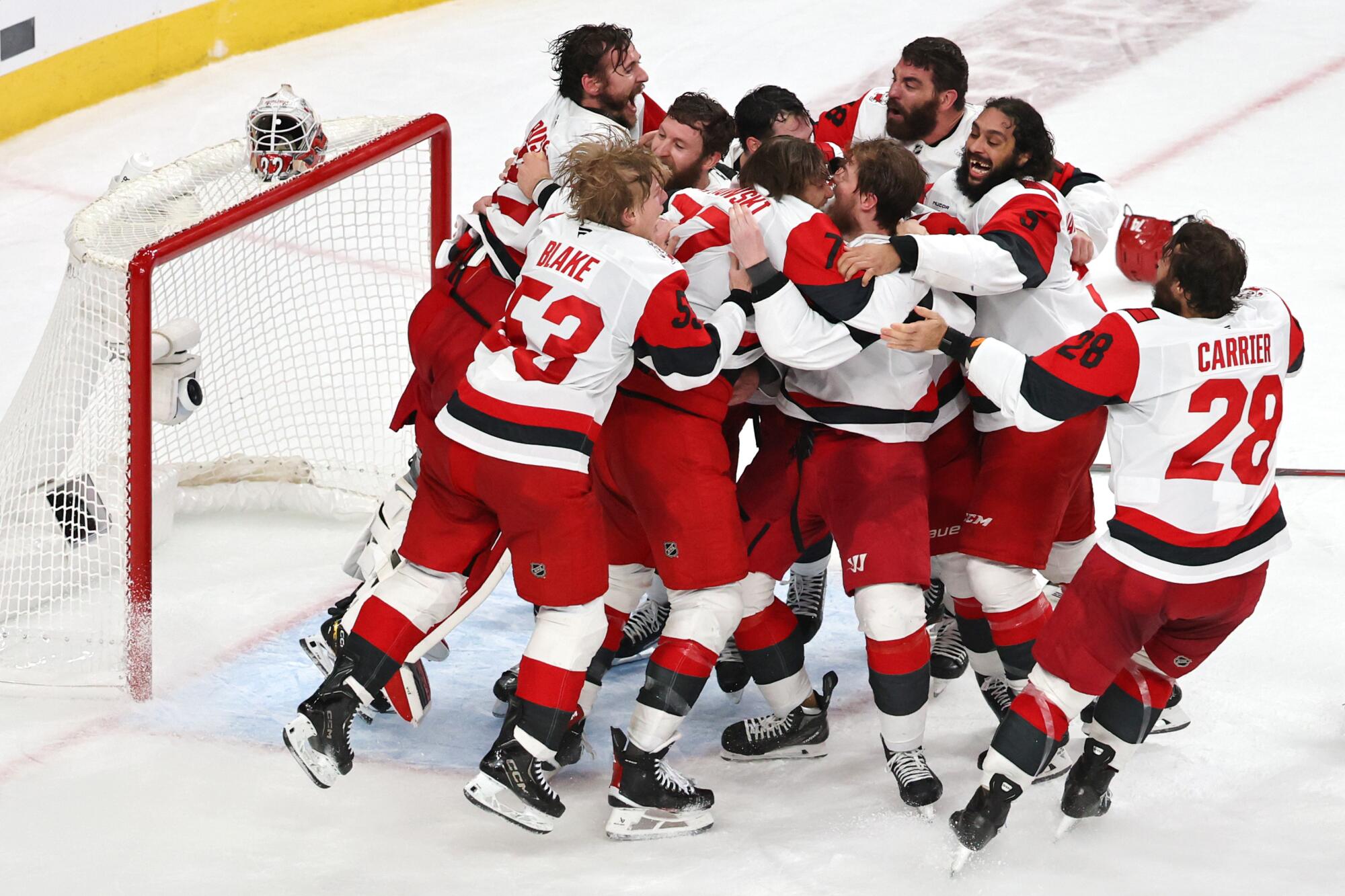
LAS VEGAS — Carolina spent the first part of the Stanley Cup Final surviving, finding ways to overcome deficits and play a high-scoring game that didn’t fit the Hurricanes’ typical style.
But when it came down to doing what it takes to win the Cup, the Hurricanes’ defense put its stamp on this series, shutting down the Vegas Golden Knights and not letting up.
The Hurricanes held Vegas to five total goals in Games 4 and 5 and used a suffocating defense in a 3-0 shutout in Sunday night’s clinching Game 6 to win their first championship in 20 years.
“That’s a lot of years,” said Carolina center Jordan Staal, who received the Conn Smythe Trophy as playoff MVP. “It’s amazing. This is something I’ve been going after ever since we got the first one. You want to win it again and again and again. What a feeling, what a battle. The boys were grinding today, my goodness. So many individual efforts just to keep the puck out of our net. It was an amazing ride. I’m just so proud of these guys.”
Carolina Hurricanes players celebrate after defeating the Vegas Golden Knights to win the Stanley Cup on Sunday.
(Ethan Miller / Getty Images)
Brandon Bussi, whose entrance late into Game 3 helped turn around the series for Carolina, recorded his first career playoff shutout in stopping 22 shots. Jackson Blake had a goal and assist, and Taylor Hall scored just 3:47 into the game to set the tone. Nikolaj Ehlers added an empty-net goal.
“Your mind wanders the last couple of days and wonder what it may be like out here (on ice after winning) and it’s better than I could have expected,” Hall said. “My career has taken a lot of different turns, but to end up here with this group of guys and to do this is amazing.”
The Golden Knights, who made an unlikely run just to reach the final, struggled badly to muster any kind of offense in Game 6 and went 18:37 between shots on goal in the second and third periods. Playing in their third Cup final, this is the first time they have been shut out.
This clinching game was what many observers expected the series to be like between the defensive-minded teams, but each side watched leads of two-plus goals disappear in the first three games.
Now, the Cup belongs to the Hurricanes, led by coach Rod Brind’Amour, who also captained Carolina to its 2006 title.
This was the first game of the series that Vegas goalie Carter Hart didn’t allow four goals in a game. He finished with 20 saves.
Carolina Hurricanes forward Nikolaj Ehlers celebrates after scoring an empty-net goal in the third period against the Vegas Golden Knights on Sunday.
(John Locher / Associated Press)
The Hurricanes began to assume control of the series after falling behind by the score of 4-0 in Game 3. They came back force overtime, and though the Hurricanes lost, they outplayed the Golden Knights from there on out.
Reflecting the do-or-die situation for the Golden Knights, they made several lineup changes, with Brett Howden replacing the injured William Karlsson at second-line center. Mitch Marner could have moved there, but remained at right wing.
Original Golden Knight Reilly Smith made his Cup final debut at third-line right wing, and Braeden Bowman made his playoff debut at fourth-line right wing. Kaedan Korczak replaced Dylan Coghlan on the third defensive pairing.
This title is a testament to Carolina’s resilience as a franchise that kept coming close to winning the Eastern Conference, but couldn’t quite get through until now.
Brind’Amour made sure the Hurricanes kept getting back up after losing in the conference final twice in the past three years and three times in their current eight-year playoff run. The talent was clearly there, but there was always a stumbling block.
Not anymore.
After dispatching Montreal in five games to make the final, the Brind’Amour-led Hurricanes then faced perennial power Vegas and took care of business there too. Now, he will get his name on the Cup for the second time.
So will 37-year-old Staal, who also won the title in 2009 with Pittsburgh. He planted himself in front of Hart and dared the Golden Knights to knock him out of the way. Staal scored in each of the first five Cup final games, the first time that has happened.
The Hurricanes got off to a fast start with a goal just 25 seconds into Game 1, only to lose 5-4 on a late goal from Tomas Hertl. And the Golden Knights were on the verge of taking complete control as minutes ticked down in Game 2 while holding a 2-0 lead and appearing as if they would take a two-game advantage back home.
Then, it all changed. Carolina showed a fight that not only brought the Hurricanes back into the series by rallying to win 4-3 in overtime on Seth Jarvis’ one-timer, but would serve as their signature throughout the series.
That was especially true the following game when the Golden Knights took a 4-0 lead into the third period and the Hurricanes seemed to have no answers. Brind’Amour even appeared to wave the white flag by removing goalie Frederik Andersen and replacing him with Bussi.
Carolina Hurricanes coach Rod Brind’Amour hugs Jordan Staal after the team’s Stanley Cup win on Sunday.
(Ethan Miller / Getty Images)
But the Hurricanes weren’t simply trying to get to Game 4. They sent a message, going on a remarkable rally to force overtime. Though Carolina lost, it was inflection point, with Bussi backstopping a team that was only growing stronger. Carolina then went on to win the next two games and moved within a victory of the championship.
The Hurricanes got it done against the Golden Knights team that was on a heater after John Tortorella replaced Bruce Cassidy with eight games left in the regular season. Vegas then went from third in the Pacific Division to first, knocked off Utah and Anaheim in six games apiece in the playoffs and shockingly swept Presidents’ Trophy-winning Colorado to win the West.
Now, the Golden Knights have some notable questions to ask, including at the top of the list whether to make Tortorella a full-time coach. He didn’t have any guarantees of coaching in Vegas beyond this season, but getting to the Cup final is a good argument to run it back.
Golden Knights management will make the final call on that, and they don’t always follow league norms.
David Baerwald holds up his most precious possession so that it’s visible on our video conference: a very old violin in a very old, battered case.
Baerwald, an award-winning musician, film composer and songwriter who called Los Angeles home for nearly four decades, doesn’t play the violin. During his years with the Tuesday Music Club (immortalized in the Sheryl Crow album “Tuesday Night Music Club”), he played guitar. But the violin belonged to his grandfather Ernst Baerwald — and it plays an important role in his recently published debut novel, “The Fire Agent.”
Not every successful artist turns to a new medium at age 65 or moves to the opposite coast (Baerwald now lives in Kingston, N.Y.). Then again, not every artist has a family history quite like Baerwald’s, one that includes Germany and Japan, two world wars, a 1920s throuple and Beethoven’s Ninth.
On the Shelf
The Fire Agent
By David Baerwald Spiegel & Grau: 624 pages, $32
If you buy books linked on our site, The Times may earn a commission from Bookshop.org, whose fees support independent bookstores.
The violin in Baerwald’s hands was the one his German-Jewish grandfather played as a Japanese prisoner of war in the Bandō camp at Tokushima during World War I. “It’s a very serviceable violin,” Baerwald notes. “A friend of mine played it for some years in the Long Beach Symphony. When my grandfather was older and wealthy, he bought a better violin, which was lost in a fire. But this is the one that matters.”
It matters because Ernst Baerwald was a founding member of a German POW orchestra that chose Beethoven’s great symphony as their premiere work — a performance so moving that it began a Japanese tradition marking the December holidays that persist to this day. Baerwald’s grandfather not only kept his violin throughout the war in which he fought; when he defected from the Third Reich in 1941, he placed it in an oiled bag and brought it with him via an oceanic escape.
Ernst Baerwald’s odyssey from a cushy childhood in Frankfurt to his final days in a beautiful Berkeley mansion, with a long sojourn in Tokyo along the way, reads like, well, a novel. Sent to an elite boys’ prep school in Germany, then on to a seriously disciplined Milanese dojo where he was trained by a Japanese sensei, Ernst was a prisoner in Japan for four years during World War I.
Those details might have been easy to find, but it wasn’t until David Baerwald went to clear out his parents’ house in Brentwood that he discovered papers showing that his grandfather had not only been the head of the Tokyo office of I.G. Farben, but that he had given a major speech to the nascent Office of Strategic Services (precursor to the Central Intelligence Agency) in 1943 that laid out the plan for the firebombing of Japan.
For the record:
10:56 a.m. June 8, 2026An earlier version of this story said Ernst Baerwald’s 1943 speech to the OSS urged use of the atomic bomb on Japan. It laid out the plan for the firebombing of Japan. It also said Kurt Baerwald joined the CIA. He joined the U.S. Army.
He also urged them not to allow partnerships between large corporations and the military, the way the German scientific community and government did with I.G. Farben and Krupp Armaments and Steel. “Any business that makes peace with Fascism will become Fascist,” he said. “And once Fascism captures economic control, then a Fascist coup will inevitably follow to seize political power. Germany, Italy, Rumania, Japan, Spain the story is the same. We cannot allow it to become the story of America.”
When Baerwald read that, “I was really alarmed, in the moment,” he says, realizing how closely tied his grandfather had been to the bombs dropped on Hiroshima and Nagasaki. “But it gave me a plan.” He wanted to show how deeply his grandfather had become integrated into Japanese culture.
“One of my characters tells Ernst that he has ‘yuyo,’ which might best be described as grace,” says Baerwald. “Its Japanese meaning is closer to the state of a river rock that has been washed over and tumbled thousands of times, so that it’s both distinct, and a meaningful part of its environment.” To some extent, the author understands “yuyo” personally, having lived in Japan and been educated at its International School until age 12, when his family moved back to California, “although I wouldn’t claim it for myself,” he says.
That move, in the early 1970s, may have led to his career in music. “When we got back to the States, I was extremely troubled. Call me a fish out of water, I guess. I went through a period of voluntary mutism — I think they call it selective communication. I didn’t talk to anyone, especially not to my family. My hearing would sort of come and go at will, too.” His mother understood he seemed to like his sister’s acoustic guitar, so she suggested he take some lessons. “At the time, it wasn’t at all a career path, it was a way of reassembling my brain so that I could cope with the reality I was experiencing, finding a way to communicate again.”
Part of what he was experiencing, which he knows a great deal more about now, was feeling “the secrets that were the engine propelling my family.” After Ernst’s long career of service and deception, David Baerwald’s father, Kurt, entered the U.S. Army during WWII and later became a professor of Japanese studies at both in Japan and at UCLA. The effects on their family of five still reverberate. Baerwald’s mother eventually became a clinical psychologist who specializes in trauma. “I had to separate myself completely from my family in order to survive,” he says.
However, what stalled the writing of this first novel were the two decades he initially left out, which included Ernst, Lina and their lover Chizuko being a ménage à trois in a 1923 Tokyo dealing with the aftermath of an earthquake and wildfires.
Although “The Fire Agent” is based on Ernst’s history, not all of the facts are congruent. The wrestling coach at the American school in Tokyo, Ernst’s glamorous courtesan Chizuko, and many of the characters are composites. Speaking of that courtesan, Baerwald says it’s true that his grandfather and grandmother cohabited with a Japanese woman for many years, even after Lina and Ernst had a child together. “I found so many letters between my grandfather and my grandmother and I think they truly loved each other, and I think they truly loved that woman, too.”
That didn’t make it easy for Baerwald to write about that love. “My German grandmother, on whom Lina is partly based, was terrifying,” he says. “It was easier to write about her sex life with my grandfather and their Japanese lover by creating composite characters.”
He didn’t want to leave out their sex life, though, or that of others.
“Every generation of young people thinks they invented sex, right? But nothing is new — and it never gets old. Here’s an example. One of my godfathers, Sam Jameson, was the L.A. Times bureau chief in Tokyo for decades. He was also the doyenne, if you will, of the cross-dressing community in that city. It was this rich world he was a part of that nobody knew anything about. I based the character I call Bünheimer on him.”
Some of the worlds Baerwald has uncovered through his family’s papers are rich and sensual; others, like the POW camp where Ernst was held and the speech he gave to the OSS analysts at the Presidio in the 1940s, are stark and terrible. While he renders all appropriately, he’s aware that his perspective remains that of a white Western man. How did he gain the courage to write about people of other races, cultures and genders? He says it comes from something he did when he was on a swim team in high school. “The psychological trick I would play on myself at each meet was to imagine the water I’d dive into was freezing cold,” he says. “And of course it wasn’t. Which was such a relief and kept me going.”
Like his grandfather’s beloved violin, Baerwald has taken a deep dive into previously unknown waters — and survived. As he works on his second novel, he’s better prepared for airing family secrets and the publishing world. Ever the musician, he likens his first round with it to a Shepard tone, the auditory illusion that can make listeners feel like two notes one octave apart are constantly ascending or descending in pitch (Baerwald has worked with famed composer Hans Zimmer, who used the tone in, for example, “The Dark Knight”).
“A Shepard tone can make you feel like you’re flying. Or sinking,” he says. “At this point in my life and art, I prefer to have my feet firmly on the ground.”
NEW YORK — It was bedlam on Broadway as the New York Knicks won their first NBA championship in 53 years on Saturday night, with exuberant celebrations marred by mayhem and violence, including a shooting in Times Square.
Outside Madison Square Garden, a crowd watching on a big screen roared as the Knicks rallied from a 16-point deficit to beat the Spurs in San Antonio in Game 5 of the NBA Finals.
Soon after, tens of thousands of people filled the streets and the rowdiest among them were clashing with police, smashing windshields, scaling scaffolding, light poles and a statue, climbing into and atop school buses in Times Square and trying to hitch a ride on a moving fire truck.
Around 2 a.m., a 17-year-old was shot near 42nd Street and Broadway, police said. Bystander video captured the sound of at least seven shots and showed people crouching and running for cover. Police took the victim to the hospital because an ambulance could not get through the crowds, police said. A gun was recovered and three people were taken into custody.
Four people were stabbed or slashed, and one of the school buses, which was being used for World Cup transportation, was set on fire and engulfed in flames, police said. Other buses and five police cars were also damaged, police said.
In all, 63 people were arrested, with charges including assault on a police officer, criminal possession of a weapon, criminal mischief and disorderly conduct.
Knicks owner James Dolan, speaking in San Antonio after the game, urged fans to stay calm.
“We need to tell everybody in New York that we know that they’re celebrating, we want them to have a great time,” said Dolan, interrupting guard Josh Hart’s news conference. “Please be safe. Don’t get hurt; don’t hurt anybody.”
The city will officially celebrate the Knicks on Thursday with a parade and City Hall ceremony.
As the clock ticked to the final buzzer on Saturday night, anxiety that had dominated the game’s first three quarters gave way to euphoria. An orange-and-blue-tinted fever dream that started with the Knicks’ first playoff game two months ago ended in the third title in their 80-year history.
Fireworks boomed over Brooklyn and Central Park. Fans flocked to Times Square and ran through the streets. Outside the Garden, they sang the team’s anthem: “Go New York, Go New York, Go!”
Police officers and ambulance workers shouted, “Let’s go Knicks!” over loudspeakers in Brooklyn. Strangers shook hands and hugged. In the Lincoln Tunnel, where people were riding buses back from the World Cup at MetLife Stadium in New Jersey, drivers honked their horns in celebration.
“I’m so overwhelmed. I’m so happy,” said Mathieu Ogno of Long Island, who fought back tears as he soaked in the victory at a team-sanctioned watch party at Wollman Rink in Central Park.
Ogno wore the jersey of Knicks captain Jalen Brunson, whose 45 points propelled his team to victory and him to the NBA Finals MVP. Brunson’s gritty determination and chip-on-his-shoulder style have made him a fan favorite, embodying New York’s working-class ethos.
The Knicks’ championship — 19,392 days since their last — capped an extraordinary postseason for a franchise that hadn’t been to the NBA Finals since losing to the Spurs in 1999. Since April 23, the team has won 15 of 16 games, with its lone loss coming Monday in Game 3.
Their last title, in 1973, was also won on the road in a Game 5. Their first, in 1970, was won at home in a Game 7 thriller. Neither was celebrated with a parade.
“I’m happy to see my Knicks finally make it over the hump,” said Shawn Muoneke, 26. “I’ve seen them knock on the door. They were knocking on the door the past few years. But they finally made it over the hump, and I’m so happy to see it and I’m so happy I’m in the city to experience it.”
Muoneke, born a year after the Knicks’ last trip to the NBA Finals, started rooting for them when he was 10. He drove from Maryland to be in the city for Game 5 at the team’s Central Park watch party.
“I saw the ups, the downs and I watched the team come back up, and I was so happy to see them finally reach the highest echelon of stardom as a team,” Muoneke said.
After the Knicks’ win, he said, the vibes in the city “are the highest they’ve ever been.”
President Trump, a longtime Knicks fan who attended Game 3 at the Garden with Dolan, congratulated the team in a post on social media.
“What a year it has been but, even more so, what incredible playoff wins we have all witnessed, especially the last four — Maybe the greatest in the history of basketball,” Trump wrote.
With Brunson’s clutch performance, he added, “a superstar was born.”
After several dozen arrests throughout the playoffs and violence after Games 3 and 4 in New York that left officers injured and a teen in a coma, police girded for unrest as Saturday turned to Sunday.
“As we celebrate, be responsible, look out for one another, stay safe, be smart, and make this a night that reflects the very best of our city,” Mayor Zohran Mamdani said on social media. “Let’s go Knicks.”
Sisak and Lum write for the Associated Press. AP writer Emily Wang Fujiyama contributed to this report.
When CBS announced that it planned to outsource the hallowed “Late Show” slot occupied by Stephen Colbert and David Letterman before him to “Comics Unleashed,” the syndicated, low-budget talk show with stand-ups riffing on their routines, many saw politics at play.
But the show’s host and producer, comic-turned-mogul Byron Allen, saw the math. Once a cultural touchstone, late-night television has seen its prominence erode greatly over the years with viewers and advertising dollars shifting away from broadcast TV to streaming.
“I said, ‘Look guys, you’re spending a small fortune on late night,’” recalled Allen, who estimated that the programming was costing the network more than $200 million. He offered it a solution.
His company, the Los Angeles-based Allen Media Group, would pay $15 million for the airtime to run “Comics Unleashed,” which previously aired after “The Late Show,” while keeping most of the advertising time on the program to sell. It was the same time-buy model that propelled his fledgling media empire and made him wealthy many times over.
“Comics Unleashed” drew 1.1 million viewers in its debut in the new time slot last month, down substantially from the 2.7 million Colbert’s show averaged in its final season. Critics chimed in, with one outlet even calling it a “ratings disaster.”
But Allen, typically, was not fazed, saying his show bested the competition in key markets and was more comparable with the same time period last May before Colbert’s post-cancellation victory lap.
“CBS has won big-time because they have zero production costs and now they are saving $55 million a year,” he said in an interview.
Media mogul Byron Allen at his studio on the set of “Comics Unleashed” in Culver City.
(Jason Armond/Los Angeles Times)
A relentlessly driven, shrewd dealmaker and entrepreneur, Allen is used to defying skeptics and seeing opportunity in assets overlooked by others. He was one of the first entertainers to recognize that there was more money to be made in owning your content, rather than just performing it.
Over the last three decades, he has built a multibillion-dollar business, Allen Media Group, which now has 2,000 employees across various media properties.
In addition to creating a trove of accessible, family-friendly programs, he’s taken a number of big, bold swings, buying up distressed assets that now span broadcast, cable, streaming and film distribution.
At times, he appears like a minnow trying to swallow a whale. Although many deals have landed, others, such as his bids for ABC, BET, Paramount Global and Tegna, have not.
“He’s had misses, but that doesn’t stop him from going to bat,” said Lloyd Greif, president and chief executive of Greif & Co., a Los Angeles-based investment bank.
After a major restructuring that began two years ago during which the company laid off staffers and sold off properties, Allen is back with a slew of ambitious acquisitions. In addition to owning CBS’ late-night block, he also took over the 12:35 a.m. slot with his comic game show, “Funny You Should Ask.” He declined to reveal how much he paid for that airtime.
Allen recently snapped up controlling interest in the digital media company BuzzFeed (including HuffPost) for $120 million and bought a 10.7% stake in cable channel Starz for $25 million.
Although Allen’s programming has been dismissed as low-budget, apolitical comedy, and his finances have been questioned by some, he remains undaunted by doubters.
“I like to say I’m a 65-year-old overnight success.” And he remains focused on his mission, even proclaiming he is “building the world’s biggest media company.”
An entrepreneurial streak
Allen was born in Detroit, where his grandparents owned a roller rink where he worked as a floor guard. Being surrounded by a family of factory workers and the legacy of 20th century American industry set the stage for his entrepreneurship. “I didn’t play sports; I played office,” he said.
At age 7, after his parents’ divorce, Allen moved to Los Angeles with his mother, Carolyn Folks. It was the summer of 1968 and they planned a two-week vacation. But Detroit was in flames following the assassination of the Rev. Martin Luther King Jr., and they stayed.
Folks put herself through UCLA and eventually worked her way up at NBC from an intern to a publicist, a move Allen credits with changing the trajectory of their lives. His mother couldn’t afford child care, so Allen often accompanied her at the studio, where he soaked up tapings of “Sanford and Son” and “The Tonight Show.” After Johnny Carson finished filming and the studio was empty, Allen would sit at his desk, mimicking the legendary late-night host.
At 14, he convinced his mother to let him do stand-up at the Comedy Store on Sunset Boulevard.
“There were literally four people and 200 chairs. And I said, ‘I have to figure out how to make these chairs laugh.’”
A writer for Jimmie “J.J.” Walker, who was starring on the groundbreaking Norman Lear hit comedy “Good Times,” caught his act. He hired Allen to write jokes for Walker along with a pair of yet-to-be discovered comics: Jay Leno and David Letterman. Allen earned $25 a joke.
Howie Mandel met Byron Allen when they were both starting out at The Comedy Store.
(Allen Media Group)
“Most people in my business wait for other people to give you an opportunity,” said Howie Mandel, the actor and comic who met Allen when they were starting out at the Comedy Store during this period. “Byron and his mom constantly made their own opportunities.”
In 1979, when Allen was 18, he became the youngest comic to appear on “The Tonight Show.” Like a shot out of a cannon, the performance catapulted his career.
While various offers poured in, Allen chose the NBC prime-time series “Real People” as a host and correspondent. It was an embryonic version of reality TV. Allen traveled around the country showcasing quirky, heartwarming stories. The hit show brought Allen to every pocket of America. It also made him a star, delivering him to the country’s living rooms each week.
He continued to tour, doing stand-up and serving as the opening act for such musicians as Lionel Richie and Dolly Parton, and starred in TV movies.
Allen became a hero to young, Black entertainers who were just starting out. Among them was Eddie Murphy, who has called Allen “one of my first inspirations.”
“He just loves comedians,” said Whitney Cummings, co-creator and executive producer of the hit CBS sitcom “2 Broke Girls.” She recalled crucial career and financial advice Allen gave her after she first appeared as a young comic on “Comics Unleashed.” “It gave me like a true north. It changed my life.”
Whitney Cummings says Allen helped her early in her career.
(Troy Conrad)
As Allen’s success swelled, he said, he realized the industry was what he calls “business show, not show business.”
“You need to know the business side and learn the business side and then you can do as many shows as you want. And I knew that I didn’t want to work for anybody,” he said.
While on “Real People,” he sat in on sales meetings and went to the National Assn. of Television Programming Executives, where he introduced himself to Al Masini, the syndication trailblazer who produced “Entertainment Tonight” and “Star Search.”
“I understand you’re the best. I’m here to learn from you,” Allen said.
In 1989 he began hosting the syndicated “The Byron Allen Show.” Two years later, he created BYCA Television Distribution to take over his talk show’s distribution and syndicate other shows.
But Allen and his new company were soon facing legal and financial issues. A group of former employees and an investor sued, claiming they had not been paid. The dispute forced the company into Chapter 7 bankruptcy.
Allen pressed on. He had absorbed another key lesson.
Learning from Richard Pryor
When he was still hanging out at the Comedy Store, he watched Richard Pryor trying out new material.
Iconic comedian Richard Pryor.
(Bettmann / Bettmann Archive)
“He would bomb night after night for almost three months,” Allen said. “I’ll never forget, he told me, ‘Byron, you’re only as good as you dare to be bad.’ I learned, OK, take risks. It’s about growing and taking chances.”
In 1993, Allen launched CF Entertainment on his dining room table in Los Angeles. The production company, later Entertainment Studios, became the foundation of his media empire. He focused on producing low-cost, syndicated programming, including interview series and court shows. Allen produced and often served as host.
His first show, “Entertainers With Byron Allen,” packaged the five-minute celebrity interviews during hotel press junkets, a conveyor belt of actors promoting their latest projects set up by the studios into an hourlong talk show.
Allen bartered the show for free to TV stations in exchange for a split of the revenues from selling commercials to advertisers. Success was not immediate. He said he received countless rejections at first.
“My house went in and out of foreclosure probably 14 times,” he said. At one point, he said, his telephone service was turned off, forcing him use a pay phone for calls.
But the format established the template for what became Allen’s highly successful business. Forbes has estimated his net worth in the billions. Allen declined to discuss his personal or business finances.
The mogul now owns multiple homes, including a $91.3-million mansion in Aspen, Colo., that was recently featured in the Wall Street Journal.
“A lot of people didn’t take him seriously and saw him as a comedian,” said Joan Robbins, Allen’s first employee, who has stayed on for 32 years as president of talent relations. “I don’t think anybody realized the extraordinary business sense he had.”
Byron Allen gets final touches at his studio on the set of “Comics Unleashed.”
(Jason Armond/Los Angeles Times)
As Allen’s media ambitions have expanded beyond comedy and syndicated talk shows, so has his company. It produces, distributes and sells advertising for 74 television programs (“Mathis Court With Judge Mathis” and “Career Day” among them) as well as owns 13 broadcast stations affiliated with the major networks in 11 markets and several dot-TV cable and digital networks including Cars.TV, Automotive.TV and Comedy.TV.
In 2016, he acquired the Black entertainment platform TheGrio and later purchased the assets of the Black News Channel out of bankruptcy for a reported $11 million, merging its TV assets and carriage deals into TheGrio’s network.
A year earlier, Allen made waves by filing the first of several multibillion-dollar racial discrimination lawsuits to tackle what he called the “trade deficit between Black America and white corporate America.” His case against Comcast for not carrying Allen-owned stations and networks reached the Supreme Court before being settled.
“I feel good about starting that conversation … because we were going in circles and we were definitely suffering from economic genocide,” he said.
In 2018, Allen’s company bought the Weather Channel and the streaming service Local Now for $300 million. His firm also announced it had raised $500 million in credit facilities organized by Deutsche Bank Securities, Jefferies Financial Group, Brightwood Capital Advisors and Comerica Bank to finance production and other acquisitions.
What unites these disparate assets? “We’re directed at where the viewers are,” he said. “That’s where we’ll be.”
But in his tireless push to expand his sprawling company, Allen has made several failed bids for high-profile assets.
In 2023, he offered Disney a reported $10 billion for ABC and some of its cable networks, and the following year bid $30 billion for Paramount Global. He also made plays for Tegna and BET.
None of his offers succeeded, prompting skepticism about his ability to finance such deals. Allen Media Group is wholly owned by the entrepreneur.
Allen dismissed such concerns. “I raised the money to buy the Weather Channel in one day,” he said. “There’s trillions of dollars looking for really good executives and really good deals. I have no problem raising capital.”
The Times viewed multiple letters from private equity firms and banks. Several indicated that Allen had financial backing on the deal to buy BET, and another showed he had $4 billion in funds to back the purchase of Paramount assets.
Over the years, former employees have criticized some of Allen’s employment practices. In 2012 he faced a class-action suit from performers and staffers on “Comics Unleashed” who alleged they were not paid residuals or reimbursed for travel and other expenses. The suit was settled in 2023.
Allen called the suits “frivolous,” saying, “I couldn’t be in business if I actually conducted myself that way.”
Last year, Allen came under fire after announcing sweeping cuts at about two dozen local affiliates that included laying off meteorologists, part of a reorganization to centralize forecasts at the Weather Channel in Atlanta. The move sparked viewer outrage and the plans were reversed.
The controversy came as Allen’s company was retrenching. He sold off about a third of the TV station portfolio for $171 million.
Allen said this was a case of “rightsizing,” paying down debt and investing more in digital. “I sold 10 of my ABC, NBC, CBS and Fox affiliates to Gray [Media] at a great price for us and a great price for them.”
Allen confirmed he is negotiating with lenders over substantial debt payments coming due in the next year, but said he is “highly confident they will get refinanced or extended.”
Shortly after he bought a stake in Starz, Allen announced his intentions to own the cable channel. Starz responded by adopting a poison pill.
“Good luck,” he said. “I still plan to take over Starz, and I will eventually get control of Starz.”
TONOPAH, Nev. — Some years ago, Harry Chahal and his wife were on a trip to Las Vegas when, like countless motorists before and since, they passed through this high desert speck of a town.
Tonopah, built by the mining industry around 1900 and depleted as the gold, silver, lead and mercury waned, is a remote way station about halfway between Reno and Las Vegas. Signs on either side warn — ominously, given the unforgiving expanse ahead — that once you’ve left, the nearest gas station is not for another 100 miles or so.
Harry Chahal opened hometown pizza in 2015 after driving through town and seeing there was no pizza place.
(Mark Z. Barabak / Los Angeles Times)
As he passed through town, Chahal noticed something missing: a pizza parlor.
Pizza is not generally associated with Punjab, India, where Chahal — given name Harvarinderjit — is originally from. But he learned how to make pizza, and how much customers loved gobbling it up, while working at different gas station mini-marts around rural Nevada.
In that absence, Chahal saw opportunity.
He and his wife, Ravinder, moved to Tonopah and in 2015 opened Hometown Pizza in a vacant building on U.S. Route 95, which runs through the heart of town. Ten years later, they bought the Dream Inn Motel, a 39-room operation just up the road.
Views of the 47th president, from the ground up
Lately, Chahal has been sprucing up the motor inn: new cabinets, new furniture, fresh paint every few months. The reason is President Trump.
Tonopah and the surrounding desert, stretching farther than the eye can reckon, is verging on a boom, owing to vast reserves of lithium, boron and other sought-after materials and a Trump administration promise to turn the U.S., in the words of Interior Secretary Doug Burgum, into “a mineral powerhouse once again.”
Chahal, 40, is a repeat Trump voter and even though he has issues with some of what the president has done — he’s not happy about the war with Iran and inflation has taken a decent-sized bite out of his pizza business — he feels his faith in Republicans in general and Trump in particular have paid off.
A registered nonpartisan, Chahal is fairly apolitical. “I vote for Republicans because they’re better for business,” he said as a lunch-time crowd of locals and folks passing through tucked into the $11.99 pizza-and-salad buffet. Here’s proof: In the last year, Chahal said, he’s seen motel occupancy increase significantly, from around 15 rooms rented each night to 25 or more.
Those fresh touches to the Dream Inn are Chahal’s investment in the future and a belief that, with Trump in office, even better times lie ahead.
Tonopah was built as a mining town around 1900. It’s fortunes have waxed and mostly waned.
(Mel Melcon / Los Angeles Times)
::
For much of its being, Tonopah relied on metal, minerals and other valuables scooped from the earth. Today, government is the largest employer.
But mining continues to hold fast to the town’s imagination.
A headframe — that’s the tower built directly over an underground mine shaft — is part of Tonopah’s logo. Mining-related sculptures, including statues of Jim and Belle Butler, who staked the first claim in the 20th century silver rush, dot the main thoroughfare. The high school’s athletes are called the “Muckers,” after those who shovel ore into underground rail cars.
The Tonopah Historic Mining Park is a big tourist attraction, along with the Clown Motel and other lodging establishments supposedly haunted by the ghosts of dead miners and other paranormal phenomena. (Chahal says there are no apparitions at the Dream Inn.)
The Clown Motel, which draws visitors from around the world, is said to be haunted by the ghosts of dead miners.
(Christopher Reynolds / Los Angeles Times)
Lately, however, mining is becoming more than just a part of nostalgic lore. It’s poised to again be a major boon to the local economy and the town’s 3,000 residents.
Plans are underway for a new lithium and boron mine at Rhyolite Ridge, approximately 30 miles southwest of Tonopah, in Nevada’s Silver Peak Range. (Lithium, most of which is now imported, is a vital ingredient in the batteries that store solar energy and power electric vehicles; boron is used, among other things, for bulletproof armor and vests.)
About 27 miles to the south of Tonopah, near the town of Goldfield, a new gold mine is set to open in 2028.
Joe Westerlund, Tonopah’s town manager, said fresh development and the prospect of hundreds of new, good-paying jobs are much welcomed. The median income here is about $37,000 annually, less than half the state average. The hospital in town closed in 2015. Venture off U.S. 95 and the rolling hills are flecked with weathered miner’s cottages and tumbledown homes no longer fit for habitation.
(A three-bedroom, two-bath home in a comfy subdivision on the north end of town can be had for around $250,000, but don’t hurry over to buy; inventory is low and could grow even leaner if demand for housing increases.)
The Tonopah Historic Mining Park is a big local tourist attraction.
“As soon as he got into office, things started loosening up. We had 15 drill rigs,” said Westerlund, who has lived in Tonopah since 1972. “I had never seen that before in my life.”
There are, of course, environmental concerns — about pollution, water supply, native habitat — but those worries haven’t gained much of a toehold. Nye County, which is home to Tonopah, isn’t exactly tree-hugger country — and not just because most of the land is scrub-filled desert. Trump carried Nye County all three times he ran, with landslide support ranging from 68% to 70%.
“This is a pro-Trump town,” Westerlund said, “and I feel like his policies are doing good for the town.”
Chahal stands ready to cash in, knowing firsthand what economic good times feel like.
The Mizpah hotel, opened in 1908, offers the plushest accommodations in town.
(Chris Erskine / Los Angeles Times)
When he moved here in 2014, he and his wife were forced to stay in a motel for six months because workers finishing up a $1 billion solar energy project were taking up most of the living space. That’s the kind of extended-stay guest he’s after, not the tourists bedding at the Mizpah Hotel, the plushest resort in town, with its cut-glass chandeliers, Victorian furnishings and photo gallery of celebrities who’ve stayed the night.
“If I can rent 25 rooms a night, maybe 15 can be for the long term” of several weeks at a time, Chahal said. He’s done the math — $82 a night for a queen bed, single occupancy; $89 for a king — and likes how it pencils out.
::
Chahal came to the U.S. in 2006, after marrying Ravinder, who grew up in the Sacramento area. She had family in Punjab and was a regular visitor to India. The two met when they were 10 years old. Chahal became an American citizen in 2020.
Politically, Indian Americans lean heavily toward the Democratic Party. But in the tiny Nevada communities where the couple lived — Lovelock, Battle Mountain and Ely before Tonopah — there was little or no Indian American presence. So Chahal wasn’t acculturated into the party the way many others have been. Rather, he embraced the GOP gospel of lower taxes and less regulation.
Working seven days a week, Chahal has little time these days for politics, beyond voting. He isn’t particularly ideological or, for that matter, worshipful of Trump.
“Every coin has a head and a tail,” he said, flipping his wrist as though tossing a quarter in the air. He sees two sides to the president. “Maybe you’re angry for some things,” Chahal said. “Maybe you agree with some things.”
He supports the notion of tariffs as a way of bringing manufacturing jobs back to the U.S. He also laments that the pizza boxes he uses, which are made in China, once cost him 30 cents and now run almost 67 cents apiece.
He backs Trump’s promise to round up and deport violent criminals who are in the country illegally. But he’s also mindful of the important role immigrants play, especially in areas like farming and construction, in sustaining the U.S. economy.
Living in a town greatly shaped by outside forces — the fluctuation of commodity prices, the changing of presidential administrations, the shifting priorities emanating from Washington — Chahal is familiar with vicissitudes and the business cycles of boom and bust.
Not everything Trump has done has helped the mining industry.
But based on the talk around town, Chahal believes a more prosperous future is in the offing. He certainly hopes so, and he’s counting on the president to deliver.