It is set to become the world’s largest airport after a £23.5billion expansion and refurbishment project is completed
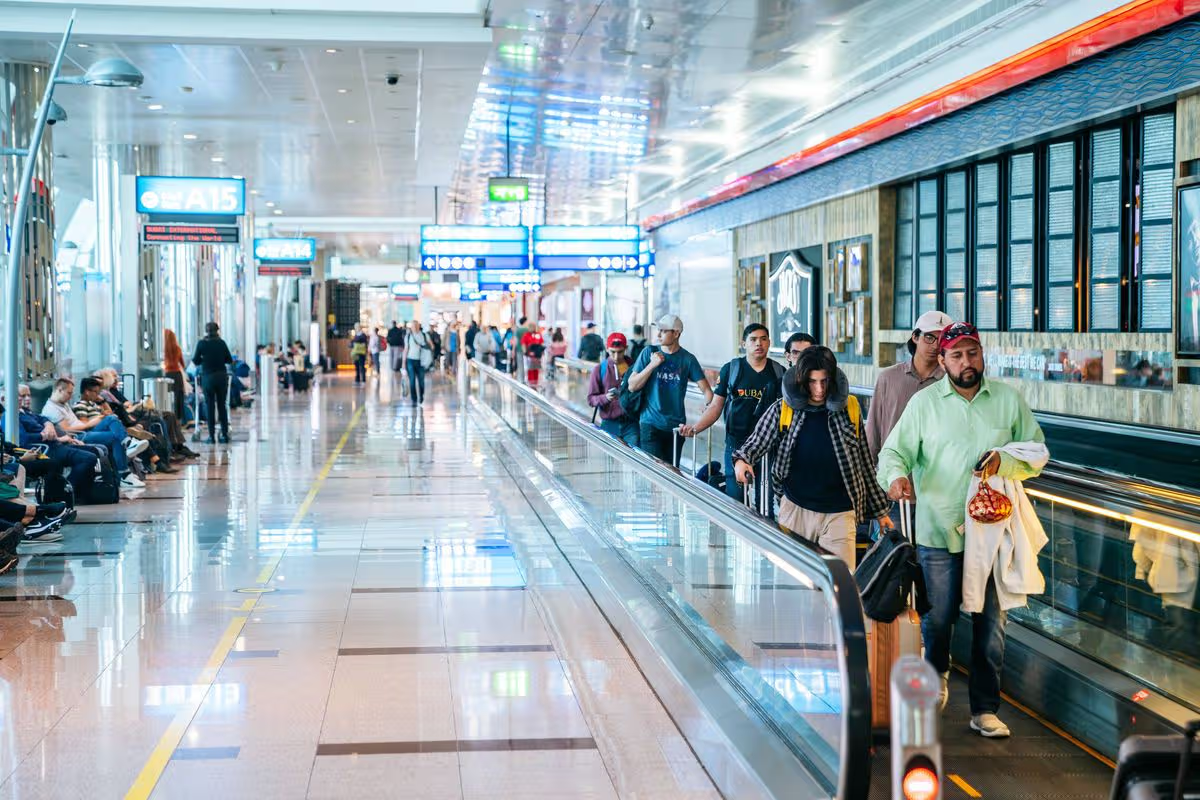
Dubai International Airport is set to close its doors in 2035(Image: Andrey Danilovich via Getty Images)
Dubai is preparing to unveil the world’s largest and most cutting-edge airport, complete with robot staff and ‘no queues’ for passengers. Al Maktoum International Airport will become the biggest in the world once its £23.5billion expansion and refurbishment is finished.
It is anticipated to handle 260 million passengers annually and boasts features specifically designed to make travelling as seamless as possible. The airport claims it will eliminate queuing altogether, as bags can be dropped off before travellers even reach the terminal.
This means passengers will not need to repeat the security and customs processes.
Dubai Airports CEO Paul Griffiths described this as a “no red lights” concept while speaking to Khaleej Times.
Another way the passenger experience will be improved is through an ‘integrated underground Automated People Mover system’ that removes the need to walk from one end of the vast airport to the other.
This will feature a multi-track train, with 14 stations to shuttle passengers between terminals and concourses.
Collecting baggage is also set to be a far quicker process, as the new system will be capable of handling tens of thousands of bags in under 60 minutes.
Luggage is also expected to be available within minutes of landing, meaning the dreaded wait at the baggage carousel will become a thing of the past.
All of these impressive features will be made possible through automated travel systems, AI security checks and robot staff. These robots will be responsible for tasks such as baggage handling and may even tackle customer service queries.
According to details published by Dubai Aviation Engineering Projects (DAEP), the infrastructure developer for Dubai’s aviation sector, plans for DWC include “a new era of smart airport systems and passenger-centric facilities, taking travellers to worldwide destinations in the most awe-inspiring and comfortable way possible”.
The expansion also features five parallel runways and up to 400 aircraft gates.
Once construction at Al Maktoum International Airport is complete, the neighbouring Dubai International Airport will shut down permanently.
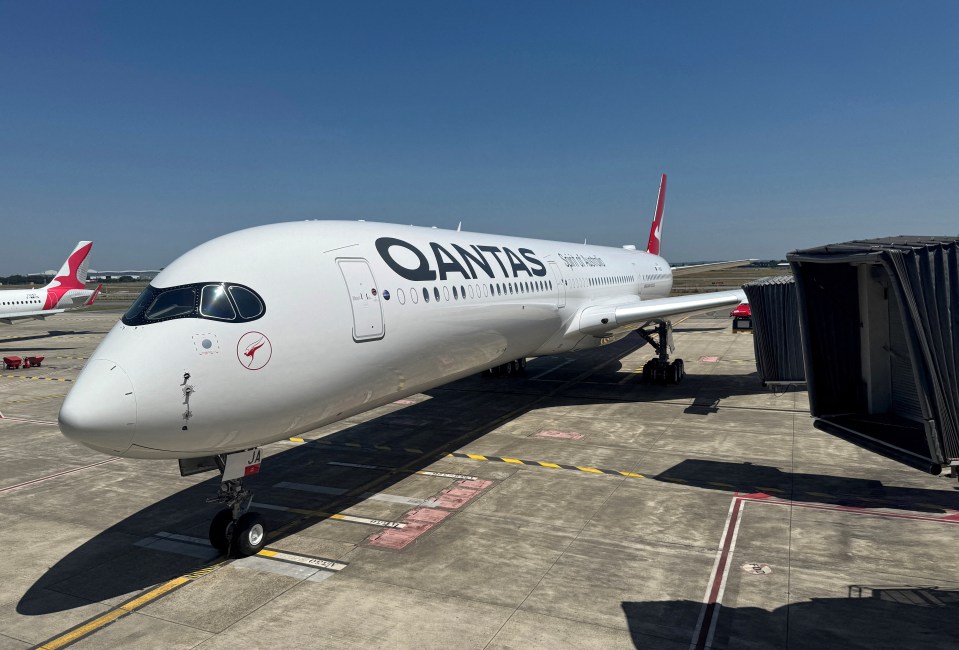
However, it won’t hold the record for long, as Qantas is set to launch a new non-stop route in 2027. It is planning a nonstop flight from Sydney, Australia, to London.
Thanks to a 20,000-litre fuel tank, the plane wouldn’t need to stop to refuel. It will travel 10,573 miles and has been labelled “the final frontier of long-haul travel” by Qantas.
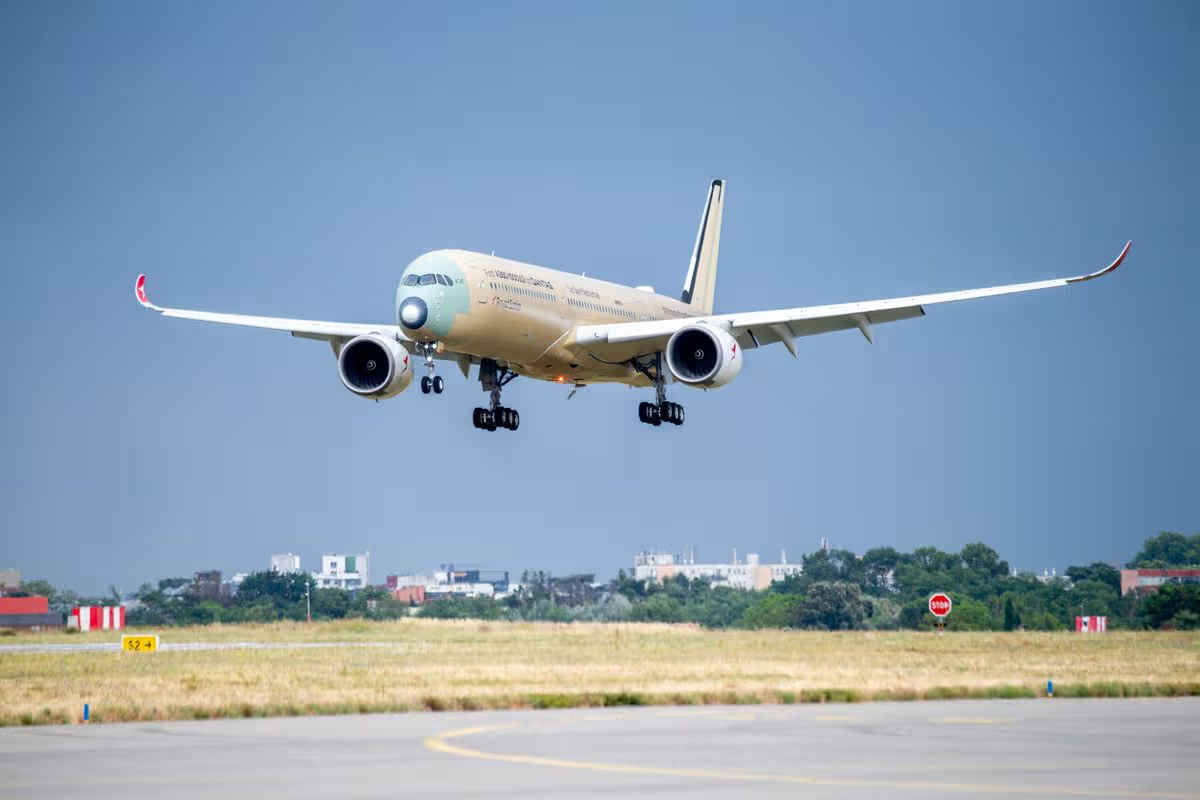
Travel expert Simon Calder has revealed more details of the flight after visiting the home of Airbus, which is making the plane.
He said of the plane: “This is a specially modified Airbus A350 Twin Jet that is being built for Qantas so they can, in October 2027, fly you nonstop from London Heathrow 10, 573 miles to Sydney.
“It is going to take a long time, over 20 hours in the air. But, achieving something no airline has done before.”
Typically, passengers flying to Australia have a stopover in the Middle East, yet there is demand for a long-haul direct flight.
Simon said Qantas believes there is a “premium customer base” that is prepared to pay a 20% surcharge on the one-stop flight to get to Sydney directly.
He added: “On top of that, there’s lots of passengers that do not want the faff of changing planes in Singapore, Hong Kong, Dubai or Abu Dhabi along the way. They just want to get there, and Qantas believes they will be able to sell those seats.”
Simon explained on his Travel Expert podcast that he asked Qantas if the rise in fuel prices would affect the flight.
But the airline says it has seen increased demand for direct flights to Australia, so it doesn’t need to stop in the Middle East along the way.
Due to the flight’s length, Qantas is making changes to the plane to make it more comfortable for passengers.
There will be a reduced passenger count to 238, which Simon said is almost 100 fewer than British Airways and Virgin Atlantic have on identical flights.
The first record-breaking flight almost took a different route, as it was scheduled to depart from New York rather than London. New York will get its own direct flight, and the route will take slightly less time to fly.
THE UK is home to the world’s fastest zipline – and it’s cheaper to visit this summer.
There are eight locations across the UK, one of which is Penrhyn Quarry in Wales where you can reach top speeds of 100mph.
Sign up for the Travel newsletter
Thank you!
The world’s fastest zipline flies over the Zip World quarry in WalesCredit: Zip WorldIt also has underground caverns with even more ziplines and trampolines tooCredit: Zip World
The ride allows riders to soar high over quarry for one mile, and there are four parallel lines so families can race too.
There are other activities at Penrhyn Quarry including Aero Explorer which is the UK’s largest zip-coaster.
There’s a smaller zipline called the Quarry Flyer and there’s also karting and tours of the historic slate quarry.
And this summer, Zip World is offering up to £25 off tickets.
One of the biggest savings is at Penrhyn Quarry where tickets are £99 between June 25 and September 1, rather than £124.
Here, families can also get up to two free kids’ meals with every adult main meal (children must be aged 12 or under).
Children can also eat for free at three other Zip World sites: Betws-y-Coed, Llechwedd and Tower Colliery.
While the other Zip World sites might not have to same zipline thrills, there’s still plenty to do there – at Llechwedd, there’s an underground cavern filled with trampolines.
Tickets for the world’s fastest zipline are up to £25 off this summerCredit: Zip World
Travel Writer Catherine Lofthouse who visited said her children were thrilled to find all the rides inside the former slate mine.
Catherine continued: “My boys were most excited forBounce Below – a sprawling and cavernous trampoline park whichfeaturesnets set at different levels for adventurers young and old to explore.
“The boys had an absolute blast underground, exploring all the different levels of nets and the twisty slides that connect them.
“Obviously the caves are a bit cold and damp, so you need to wear warm clothes and sensible shoes, preferably not your Sunday best.”
Meanwhile, Zip World Betws-y-Coed has the UK’s longest alpine coaster which at its fastest can travel up to 25mph.
Other Zip World sites have high ropes courses, tree top adventures and the site in London has the world’s longest and tallest tunnel slide which overlooks the 2012 Olympic Park.
China’s LineShine overtakes US-based El Capitan as most powerful supercomputer, according to the TOP500 list.
Published On 24 Jun 202624 Jun 2026
China has displaced the United States on an influential ranking of the world’s fastest supercomputers, underscoring Beijing’s growing capability to compete with the world’s leading superpower in cutting-edge technology.
China’s LineShine is the most powerful system on the planet, overtaking the US-based El Capitan, according to the biannual ranking announced in Hamburg, Germany, on Tuesday.
Recommended Stories
list of 4 itemsend of list
LineShine, located at the National Supercomputing Centre in Shenzhen, achieved a performance of 2.198 exaflops, carrying out more than 2 quintillion calculations per second – a 20 percent lead over El Capitan, according to the latest TOP500 list.
LineShine’s position marks the first time a Chinese system has topped the list since Sunway TaihuLight did so in 2017.
El Capitan, based at Lawrence Livermore National Laboratory in California, had ranked as the top-performing system since November 2024.
Frontier, hosted by the Oak Ridge National Laboratory in Tennessee, ranked third, followed by Aurora at the Argonne National Laboratory in Illinois and Jupiter at the Jülich Supercomputing Centre in Germany.
Other countries represented in the top 20 include the UK, Japan, South Korea, Italy, the Netherlands, and Switzerland.
Unlike other supercomputers, LineShine runs entirely on general-purpose central processing units (CPUs), which have fewer processing cores and are slower at performing complex tasks than the graphics processing units (GPUs) indispensable to running AI models, such as ChatGPT and Claude.
LineShine is the first and only system to achieve more than 2 exaflops in performance using a CPU-only design, according to the TOP500 list.
The TOP500 list has been published twice yearly since 1993, when computer scientists Erich Strohmaier and Hans Meuer first compiled statistics on supercomputers around the world in preparation for a conference on the topic.
The list ranks supercomputers’ performance using the LINPACK Benchmark, which measures the amount of time it takes to solve a dense system of linear equations.
While the TOP500 list has been influential for decades, experts consider the ranking to have become less relevant since the advent of AI.
While corporate tech giants such as Microsoft and Amazon are at the forefront of today’s advances in AI, the list is largely made up of government and academic initiatives that volunteered their participation.
In a 2015 paper, researchers at Cornell University estimated that El Capitan achieved only 22 percent of the computational performance of xAI’s Colossus supercomputing facility in Memphis, Tennessee.
China and the US are locked in a fierce battle for global supremacy in leading technologies such as AI, with Washington and Beijing rolling out a slew of tit-for-tat sanctions and export controls to blunt each other’s advances.
The 2026 AI Index Report, released in April by Stanford University, found that China had “effectively closed” the AI model performance gap with the US.
While the US produces more top-of-the-line AI models, China holds the advantage in rolling out patents and industrial robot installations, the report said.
DUBAI is currently building what will be the biggest, and possibly the most efficient, airport in the world.
Not only will it see millions of passengers through its doors – it also plans on eliminating queues altogether and will even have robot staff.
Sign up for the Travel newsletter
Thank you!
Al Maktoum International Airport is expected to open in 2032 with 260million passengersCredit: Dubai Media OfficeIt will have ‘no queues’ and robot staff to help travellersCredit: Dubai Media Office
When Al Maktoum International Airport has been fully expanded and refurbished, it will be the biggest in the world – and it will have all the modcons too.
The airport which will cost £23.5billion and will serve 260million passengers every year is being designed to make travel as smooth as possible.
One of the ways it’s doing this is by creating a way that passengers won’t have to queue, which almost seems like a given in other airports.
At Al Maktoum International Airport, bags could be dropped off before travellers even reach the terminal.
Passengers will then be able to move through the airport without the usual repeated stops for the likes of security and customs.
Dubai Airports CEO Paul Griffiths called this a “no red lights” concept while talking to Khaleej Times.
The airport is set to be huge, but travellers won’t have to worry about walking from one side to the other.
Instead, they will be able to use the ‘integrated underground Automated People Mover system’, which includes a multi-track train.
It will have 14 stations and will transport passengers from terminals to concourses.
It’s designed to help travellers get to their flights in the shortest and quickest route possible.
The airport will have an underground ‘Automated People Mover system’Credit: Dubai Media Office
When it comes to collecting baggage, the new system will be able to process tens of thousands of bags in just one hour.
And better yet, bags are expected to be available within minutes – so there won’t be any standing about waiting for suitcases after a flight.
The airport is also going to be technologically advanced with automated travel systems, AI security check and robot staff.
The robots will be used for various tasks, including baggage handling and potentially customer service roles too.
The terminal isn’t completely new, as Al Maktoum International Airport is an expansion of Dubai World Central.
The nearby Dubai International Airport which is currently the main base in Dubai will close once the new runways are operational which is scheduled for 2032.
Al Maktoum International Airportis 23 miles south of Dubai and once fully up and running will be the largest in the world.
Weekly insights and analysis on the latest developments in military technology, strategy, and foreign policy.
More than three decades after decommissioning the USS Long Beach, the Navy is finally preparing to dispose of what’s left of the world’s first nuclear-powered surface combatant. The cruiser – which already had its distinctive boxy superstructure as well as its bow and stern sections removed – has been moored at Puget Sound Naval Shipyard and Intermediate Maintenance Facility since being decommissioned in 1995.
After a long process to determine what to do with Long Beach, the Navy on Wednesday put out a call for companies willing and able to perform the extremely complex and lengthy operation to transport, dismantle, de-militarize, and dispose of what was once a 721-foot-long ship that displaced 15,540 tons, including its two defueled reactor plants. Long Beach was launched in 1959 and commissioned two years later.
You can read more about the ship, its unique character, armaments and exploits in our two-part interview with a master chief who served on Long Beach here and here.
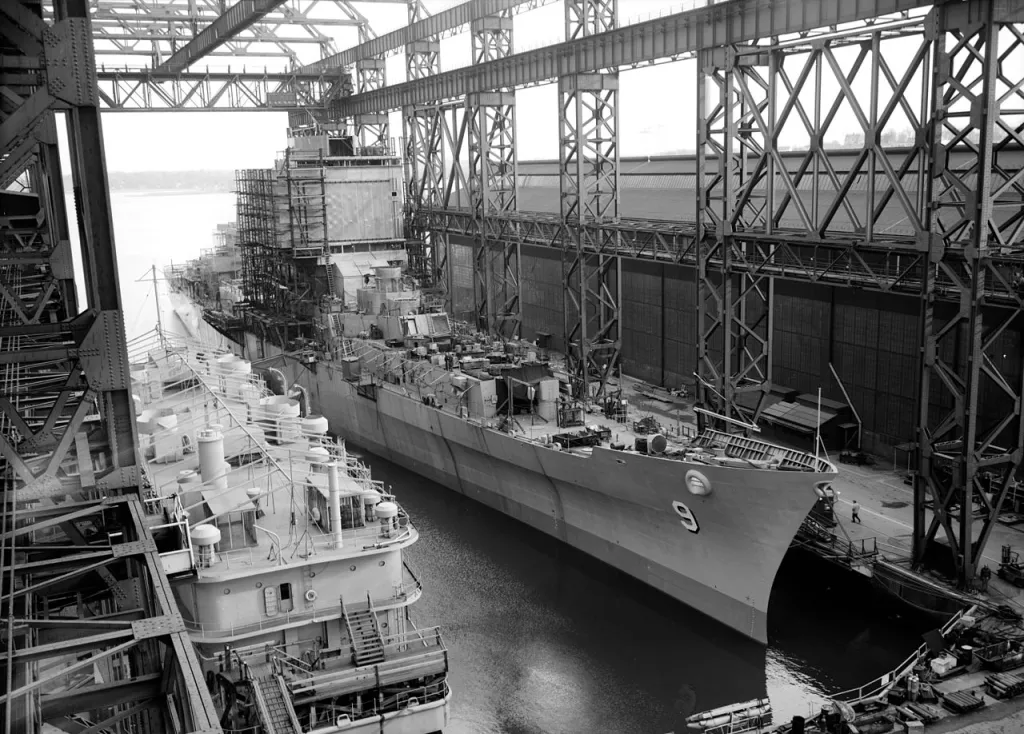
The USS Long Beach, world’s first nuclear-powered surface combatant, under construction. (USN)
This marks just the second time the Navy has opted to select a commercial yard to dismantle a nuclear-powered warship. The first was the ex-USS Enterprise, the world’s first nuclear-powered aircraft carrier from the same era as Long Beach. It is vastly more complex and expensive to dispose of nuclear-powered vessels than conventionally powered ones because of all the radiological concerns, even long after the reactors have been defueled.
We’ll get into more details about how difficult, time-consuming and costly a process this could be later in this story when we examine the pitfalls of the Enterprise situation, admittedly a much more complex undertaking for various reasons we will explain. However, first we need to understand how Long Beach got to this point.
USS Long Beach. (USN)
The decision to go forward with the Long Beach dismantling process came after a Naval Vessel Historical Evaluation (NVHE) in April determined that the ship was ineligible for listing in the National Register of Historic Places (NRHP) despite its history as the first surface combatant ever to have nuclear propulsion and combat service that ranged from the Vietnam War to Operation Desert Storm.
USS Long Beach (CGN-9)
“The ship was deactivated in 1994 and towed to Newport News Shipbuilding where the entire superstructure was removed and the reactors were defueled,” according to the NVHE. “After this work was completed in the winter of 1995, the hull was towed through the Panama Canal to Puget Sound where it has been waiting to be recycled.”
In 2012, the ship was sold for scrap.
“Long Beach had 10,000 tons of steel, 300 miles of electrical cable and 450 tons of aluminum, earning it the voice radio call sign ‘Alcoa’ after the aluminum maker of the same name,” Reuters reported at the time.
“More than a dozen scrap dealers have expressed interest in taking part in sealed online bidding for the hull, with more than 7.35 million pounds (3.33 million kg) of steel, aluminum and copper wiring, galley equipment, tables, chairs, lockers and bunks,” Government Liquidation president Tom Burton told the news outlet.
“It’s a two-year process but it could take 18 to 26 months,” Burton said. “What’s left is an inert hull.”
USS Long Beach CGN-9
It remains unclear what happened to that scrap sale. We reached out to the Navy for answers.
The Puget Sound Naval Shipyard subsequently completed a limited-scope hull preservation availability in 2015 that resulted in the removal of the bow and stern, according to the NVHE records. It was ultimately decided not to save the ship by placing it on the NRHP because “major alterations have been made in design that do not maintain the historic design of the vessel (loss of the superstructure and major hull elements),” the review found. “Character defining features of USN warship have been lost, such as main armament, superstructure, bow, and stern. Does not evoke the aesthetic of a 20th Century USN warship.”
What’s left of the USS Long Beach. (Google Earth)
Moreover, a 60-day period for stakeholders to comment expired earlier this month with no responses.
USN
With all the hurdles to ultimate destruction now out of the way, the Navy will host an Industry Day meeting on June 24 and 25 in Washington, D.C. for companies interested in learning more about what is involved in the final dismantling of the USS Long Beach.
Screenshot
Whoever gets the job will first have to transport it from Puget Sound to the shipbreaking yard by “dry transport via semi-submersible barge, deck barge, or semi-submersible heavy lift vessel” because the ship’s “current structural condition precludes an open ocean tow,” according to the RFI.
“Dismantling and disposing of ex-Long Beach is necessary in order to comply with Navy policy for inactive nuclear-powered ships stricken from the Naval Vessel Register, and Naval Nuclear Propulsion Program (NNPP) statutory responsibilities,” the RFI explains. “The requirement for disposal includes dismantling, demilitarizing, and recycling the remnant hull sections at an authorized commercial facility in accordance with applicable federal, state, and local laws, and removing and packaging the reactor plant components for transportation and disposal as low‑level radioactive waste (LLRW) at an authorized radioactive waste facility or facilities.”
There are no timelines or cost estimates associated with the RFI, nor is there any guarantee that a request for proposal will be issued. We’ve reached out to the Navy for more details.
Our past reporting offers some insights into the tremendous time and money it takes to dismantle a nuclear-powered warship, as evidenced by the saga of the aforementioned Enterprise. However, it should be noted that there are some big differences between that vessel and Long Beach. The carrier is far larger and more complex, had eight reactors compared to two, and had less prep work done in advance.
Tugs move the USS Enterprise into Newport News Shipbuilding’s yards in 2013. USN
In 2019, the Government Accountability Office found that it could cost the Navy more than $1.5 billion to fully dispose of Enterprise.
The GAO report also stated that a complete process could take more than 15 years to finish.
A trio of nuclear-powered Navy surface warships sail together in 1964. From left to right, the aircraft carrier USS Enterprise, the cruiser USS Long Beach, and the frigate USS Bainbridge. USN
From our previous story about the dismantling of the ship known as the Big E:
“The Navy officially decommissionedEnterprise, also known by its hull number CVN-65, in February 2017, after more thanfive decades of service. The ship had already effectively been in mothballs since 2012 and Newport News Shipbuilding completed a lengthy ‘inactivation’ process, which included removing nuclear fuel, mission systems, and other items from the ship,in April 2018.
‘At approximately 76,000 tons, CVN-65 will require an unprecedented level of work to dismantle and dispose of as compared to previous ships,’ GAO’s review, which the congressional officepublished on Aug. 2, 2018, said. ‘Regardless of the approach the Navy chooses, CVN-65 will set precedents for the processes, costs, and oversight that may be used to dismantle and dispose of nuclear-powered aircraft carriers in the future, such as the Nimitz-class carriers which the Navy will begin to retire in the mid-2020s.’”
An SH-60 Blackhawk helicopter assigned to Helicopter Anti-Submarine Squadron Seven (HS-7) hovers off the bow of the aircraft carrier USS Enterprise CVN 65. (DoD photo by Petty Officer 3rd Class Timothy Smith.) Cpl. Madisyn Paschal
The first of those, the USS Nimitz, the Navy’s oldest operational carrier, is scheduled to be inactivated in 2027, the Navy told us.
On March 13, the Navy signed a $95.7 million contract with Huntington Ingalls Inc. “for advance planning and long-lead-time material procurement to prepare and make ready for the accomplishment of the inactivation and defueling of USS Nimitz (CVN 68). Work will be performed in Newport News, Virginia, and is expected to be completed by March 2027.”
The aircraft carrier USS Nimitz underway. (USN)
Meanwhile, the Navy originally projected that it would cost somewhere between $500 and $750 million to scrap the Enterprise, but by 2013, this figure had grown to over $1 billion. The difficulties involved forced the service to push back the start of the process more than once.
The regulatory and logistical picture was equally tangled. The Navy and the NRC disagreed on what standards should apply if a private company did the work, and NRC only has direct authority in 13 states, potentially limiting where the job could even be done. Conducting the work at Puget Sound Naval Shipyard — the Navy’s proven approach — risked worsening an already serious maintenance backlog for active ships. The commercial route could be faster and cheaper, but no private yard had ever handled military nuclear reactors at this scale, and the highly classified nature of U.S. naval reactor design added another layer of complexity.
You can read more about the challenges involved with breaking up a nuclear behemoth in our deep dive into the problems with the Enterprise effort here.
The Decommissioning Of The USS Enterprise
The challenges of disposing of Enterprise, however, continued even after a final decision was made about what to do with the vessel.
On May 30, 2025, the Navy awarded a $536.7 million contract to dismantle the ship to NorthStar Maritime Dismantlement Services, LLC, of Vernon, Vermont, according to Pentagon records. The work was initially expected to be completed in November 2029.
“It was the first time a U.S. nuclear-powered warship will be dismantled through a commercial effort, representing a significant milestone in responsibly and safely closing out the legacy of one of the most iconic nuclear-powered warships,” the Navy noted at the time, according to USNI.
However, the effort unraveled over a legal battle over how the Navy handled final bid submissions, ultimately resulting in the service being “ordered to pause the project and reassess bids, while the appeal now puts the future of the contract back in question,” according to NBC15 News. “The Navy is expected to re-award the contract by June 2026.”
We have reached out to the Navy to find out the status of that contract as well.
USS Enterprise to be dismantled in Alabama
Even as the Navy is working to dispose of its first nuclear-powered surface combatant, it is planning for the newest one. The Navy says its proposed Trump class battleships will be nuclear-powered as well.
It remains to be seen how the complications the Navy has faced trying to dismantle Enterprise will affect the disposal of Long Beach and what lessons will be applied, if any. The answers to some of those questions should come into sharper focus next week when interested parties get to ask the Navy for themselves at the Industry Day.
I’ve been intrigued by the Northern California area of Humboldt County ever since the fourth grade. That’s when my teacher told us the story of the Gold Rush town of Eureka: In the 1850s, when prospectors struck gold, they would yell “Eureka!” which is Greek for “I have found it!” What a funny word, I thought.
My curiosity about the area later grew when I learned about its logging renaissance — vast swaths of old-growth redwood forests were felled to make ships and build railroads, both of which were needed to transport this valuable commodity to the rest of the country and beyond. It wasn’t until 1918 with the formation of the Save the Redwoods League that preservation efforts began to try to halt the rapid depletion of the old-growth forests, which, by that point, had dwindled down to between 5% to 10%. From those efforts, Humboldt Redwoods State Park was established in 1921, followed by the formation of Redwoods National Park in 1968. Today the four parks that make up Redwood National and State Parks cover about 139,000 acres of land and protect nearly half of the world’s remaining old-growth redwood forests.
And it was the lure of walking beneath these giants that I, decades past that fourth-grade history lesson, finally decided to make my pilgrimage.
It took this long because, dear reader, Redwood National and State Parks are not easy to get to from L.A.
By car, without accounting for traffic and breaks, it would be at least a 12-hour journey along the 101, through San Francisco, past wine country and bypassing Mendocino before you reach Humboldt County, where the southern end of the parks begin. Realistically, it would take a few days and a couple of overnight stays along the way to get there, which is fine if you’re in it for the road trip; but if you’re like me and only have the weekend, this leaves one option: flying into California Redwood Coast-Humboldt County Airport, a.k.a. Arcata-Eureka Airport (ACV), the only airport that services the area. United has direct flights there from LAX. But Burbank Airport has Breeze Airways offering direct flights three times a week with prices as low as $80 roundtrip.
When I landed at Arcata-Eureka Airport, it felt smaller than some municipal airfields — and just as quiet. That calm set the tone for the rest of the weekend. I walked in peaceful serenity between trees so tall and ancient they recalibrated my sense of time. I discovered that life in Humboldt County, and neighboring Del Norte County near the Oregon border, moves at that same unhurried pace. The fog retreats slowly in the morning. Night arrives gently, carried in on the mist.
And I learned that Humboldt County — including the cities of Eureka, Arcata and Ferdale — is full of treasures beyond its abundance of the Earth’s tallest trees. Whether I was eating a greasy cheeseburger at a family-run diner that becomes the social center of town after 9 p.m. or slurping oysters at a bar that harvested them from its own farm just offshore, it became clear that this place is shaped by discovery, exploitation and preservation. What follows are hikes, sights and bites that should get you started for a weekend full of your own “Eureka!” moments.
About This Guide
Our journalists independently visited every spot recommended in this guide. We do not accept free meals or experiences. What should we check out next? Send ideas to guides@latimes.com.
At the moment, the current longest flight in the world is Singapore Airlines’ Singapore to New York route, which takes around 19 hours.
UK tourism minister Stephanie Peacock said: “Qantas’s decision to make London the first destination for Project Sunrise is a powerful vote of confidence in the UK as a hub for global tourism, and a reflection of the deep ties between our two countries.
“This is a historic moment, not just for British aviation and tourism, but for the millions of passengers who will experience flying from Sydney to London non-stop for the first time.”
VisitBritain chief executive Patricia Yates said: “Australia is one of our most valuable inbound markets, set to reach £1.8 billion this year in visitor spending, and expanding airline connectivity and seat capacity is fantastic news for our competitive tourism offer and our welcome.”
Onboard the plane, there will be 238 seats as well as a wellbeing zoneCredit: Qantas
Onboard the plane, passengers can expect 238 seats across First Class suites, Business Class, Premium Economy and Economy seats.
The cabins will prevent jet lag through different light settings, to help passengers to adapt to the time zone of their destination.
All passengers will also be able to use a Wellbeing Zone onboard, with space to move about, listen to guided wellbeing content and grab a healthy snack or drink.
Wi-Fi and Bluetooth connectivity will also be available onboard.
Eventually there will be 12 aircraft as part of Project Sunrise.
Back in April the airline was hoping for an early 2027 launch, however this has now been pushed back to October 2027 with tickets for the first flights expected to go on sale in February 2027.
Elon Musk’s space and AI conglomerate ended its third day of public trading worth roughly $2.65 trillion (€2.28tn), having displaced Amazon in the global market-capitalisation rankings.
ADVERTISEMENT
ADVERTISEMENT
The stock settled at $201.8 per share, in a debut week that has rewritten the upper reaches of the world’s equity leaderboard at remarkable speed.
The milestone caps an already extraordinary stretch for the company, which listed on the Nasdaq under the ticker SPCX only last Friday.
SpaceX priced 555.6 million Class A shares at $135 each, raising around $75 billion (€65bn) in what was the largest initial public offering in history, comfortably eclipsing the $29.4 billion (€25.3bn) that Saudi Aramco raised in 2019.
The company also increased the total capital raised to $85.7 billion (€73.8bn) after underwriters exercised the “greenshoe” option to purchase additional shares on Monday due to exceptional demand.
At Tuesday’s close, the stock was trading more than 50% above its IPO price.
During the trading session, share prices climbed as high as $225.6, briefly pushing SpaceX’s valuation above $3 trillion (€2.58tn) and, for a moment, ahead of Microsoft as the world’s fourth most valuable company.
The stock later pared those gains, closing below that threshold, but the intraday spike underscored the intensity of investor appetite for the listing.
Based on Tuesday’s closing prices, only Nvidia ($5tr), Alphabet ($4.5tr), Apple ($4.4tr) and Microsoft ($2.9tr) had larger market capitalisations than SpaceX. Eight of the world’s ten most valuable listed companies are tied to the technology and AI sector, a concentration that has defined markets throughout 2026.
The Cursor deal fuels the surge
Tuesday’s advance coincided with a significant strategic move.
Before the opening bell, SpaceX announced an all-stock agreement to acquire Anysphere, the developer behind the AI coding assistant Cursor, in a deal valuing the startup at $60 billion (€51.7bn).
According to a regulatory filing, a SpaceX subsidiary will merge into Anysphere, leaving Cursor as a wholly owned arm of the group, with completion expected in the third quarter, subject to regulatory approval.
The purchase deepens SpaceX’s push into enterprise AI, a market where rivals such as OpenAI and Anthropic have gained early commercial traction, and it follows the company’s merger with Musk’s xAI venture in February.
The acquisition stems from an option SpaceX secured in April, under which it agreed either to acquire Cursor for $60 billion (€51.7bn) later this year or pay $10 billion (€8.6bn) for a more limited partnership to access its computing technology.
However, despite all the positive news, the speed of the climb has drawn caution.
Sceptics argue that SpaceX remains overvalued, given that it has yet to turn a profit and only 3% to 4% of its total equity is publicly traded.
A fast-track route into major stock indices, which compels passive funds to buy the shares, is expected to further amplify demand for the limited supply of shares in the opening days of trading.
This article does not constitute financial advice, always do your own research and invest according to your specific circumstances.
IT SEEMS like everyone has either been to Bali, is planning to go to Bali, or wants to go to Bali.
But what about heading to one Indonesian neighbourhood the tourists don’t make a beeline to?
Sign up for the Travel newsletter
Thank you!
When heading to Bali, many people head to Canggu but next door there is a trendy and quieter neighbourCredit: Getty
The seaside village of Pererenan was recently named the third coolest neighbourhood in the world by Time Out.
Time Out stated: “While the tourist hordes pack into Canggu, those in the know are heading to neighbouring Pererenan.
“This place will remind you of what made Canggu famous in the first place – pristine beaches, cosy cafés, eclectic shops, and a certain laidback cool, devoid of noise and traffic.”
You won’t miss out on the classic Bali charm though, as the area is great for surfers and those who like to sunbathe.
One top spot that’s a must-visit is Pererenan’s black-sand beach – which gets its colour due to the volcanic activity on the island.
The beach tends to be less crowded than its neighbours as well, and is known for having amazing sunsets.
The seaside village has a black-sand beach which is ideal for surfingCredit: AlamyPererenan was recently named the third coolest spot in the worldCredit: Alamy
When heading to the beach, make sure to lookout for the Gajah Mina Statue, which is of a mythical creature that has the head of an elephant and the body of a fish.
One recent visitor said: “This place was quite lovely. Was able to watch surfers, grab a bite to eat, catch the sunset and watch the tide rise in the evening.
“Lots of restaurants and surfing options – it was very peaceful.”
You can also walk from Pererenan Beach to Echo Beach – one of Bali’s most famous surfing spots in the busier village of Canggu – just 500 metres away.
According to Ministry of Villas, “blending in with trendy Canggu, Pererenan is becoming more popular but still maintains a more relaxed Balinese feel”.
Around the beach you will also find a few spots to grab a bite to eat.
And there are a number of restaurants nearbyCredit: Alamy
While there aren’t as many restaurants as there are in other neighbourhoods, there is Hippie Fish Pererenan Beach which looks right over the beach.
The Mediterranean-inspired seafood restaurant serves a variety of dishes include red snapper and black cod and also has a rooftop bar where you can grab a cocktail.
There are a number of Balinese temples across the village as well including the Pura Batu Mejan (Kahyangan Jagat) temple, which sits at the edge of the beach.
One visitor commented: “Pura Batu Mejan Canggu is a beautiful temple, unique, highly respected and holds great spiritual significance.
“Visitors can feel a calm and relaxed atmosphere, while enjoying beautiful panoramas at Pererenan Beach.”
One recommended place to stay is Further Hotel which features a unique architecture across its one and two bedroom suites.
One top spot to stay at is Further Hotel, which is spread across several buildingsCredit: Refer to source
window.itgHolidayConnectHolidayDealsFrames =
window.itgHolidayConnectHolidayDealsFrames || [];
window.itgHolidayConnectHolidayDealsFrames.push({
cid: “3a7668b3”,
pid: “8925dc20-49c7-4663-9c7c-547ad29879e4”,
config: {
“poweredBy”:”icelolly”,”intro”:”Best value TUI deals “,”title”:”The Sun Travel TUI deals under £500pp”,”brandId”:”1224″,”maxPrice”:”50000″,”maxDepartureDate”:”plus60″,”utm_campaign”:”The Sun Travel TUI deals under £500pp”,”layout”:”carousel”,”container”:”false”
},
});
And if you do want to head out of Pererenan then you can visit central Canggu, which is 10 minutes away and home to Bali’s most popular beach clubs and nightclubs.
Around 30 minutes away is also Tanah Lot Temple, which is one of the most famous temples in Bali, sat on a rock offshore.
Flights to Bali from the UK cost from £660 return, per person, in June.
SpaceX lands on public markets as the sixth largest US company by market value.
Published On 12 Jun 202612 Jun 2026
SpaceX has debuted on US markets with a market valuation of more than $2 trillion, minting CEO Elon Musk as the world’s first trillionaire.
Shares are set to open on Friday at $150 per share, marking a 6.6 percent increase from the initial public offering (IPO) price, valuing the company at $1.96 trillion putting the aerospace company on track to become the sixth-largest company in the United States.
Recommended Stories
list of 4 itemsend of list
The company sold $75bn in shares, immediately valuing it at $1.77 trillion. The IPO was oversubscribed four times higher than was otherwise expected, according to the Reuters news agency.
Of the institutional investors allocated, according to Bloomberg News, as much as 70 percent went to what are called long-only investments — a strategy in which holders buy assets based on the expectation that their value will grow over time — and sovereign wealth funds, including those from Saudi Arabia and Kuwait as well.
SpaceX President Gwynne Shotwell and Chief Financial Officer Bret Johnsen rang the Nasdaq MarketSite in New York City opening bell at 9:30am local time as US markets opened.
On Thursday, protesters gathered outside the MarketSite to protest the IPO amid continued allegations that Grok, part of xAI, a subsidiary of SpaceX, allowed users to create non-consensual deepfake sexualised images before the IPO debut.
Shares of SpaceX did not trade until the middle of the trading day as the exchange collected buy and sell orders and underwriters delayed trading until supply and demand were balanced.
“We would expect SpaceX to see an immediate pop in trading due to the hype around the deal, north of 20 percent perhaps,” said Samuel Kerr, global head of equity capital markets at Mergermarket. “Anything lower would actually make me nervous.”
Exchanges and trading firms are eager to avoid the technical mishaps that marred Meta’s 2012 debut. With SpaceX widely viewed as a dress rehearsal for a new generation of mega-listings, market participants will also be watching for signals on investor appetite in advance of forthcoming IPOs for AI heavyweights Anthropic and OpenAI.
The landmark listing cemented Musk’s status as the first trillionaire ever and propelled SpaceX into the ranks of the world’s most valuable companies — even though the firm posted a loss of nearly $5bn last year and generated only a fraction of the revenue brought in by similarly valued tech giants.
The surge comes amid growth driven by its Starlink subsidiary, which drives as much as 80 percent of its revenue.
On Friday, SpaceX launched its Falcon 9 rocket with 29 satellites into space from Cape Canaveral in Florida.
ROLLING hills with rude names and hidden dinosaur footprints on beautiful beaches are just a couple of attractions of one UK island.
Dubbed ‘Scotland in miniature’ thanks to its different mountainous and rolling landscapes caused by sitting on the Highland Fault line, the Isle of Arran has something for everyone.
Sign up for the Travel newsletter
Thank you!
The Isle of Arran is dubbed ‘Scotland in miniature’ and is home to beautiful beachesCredit: Alamy
“It’s the best Scottish island,” claimed Andy McNamara, owner of outdoor tourism businessOtter’s Tail that leads groups on adventures around Arran.
“Scottish islands all offer something special to do but we’re the best one,” he added.
One of the main draws of the island for Andy is the beaches, which he claims are some of the best in the world.
There’s Silver Sands Beach in Kildonan, for example, which is often named one of Arran’s most beautiful spots.
“It’s ideal for kids as there are dinosaur footprints – specifically a five-fingered dinosaur – on the beach that you can look at,” Andy revealed.
While in Kildonan, Andy also recommends staying at The Boathouse.
There’s even one beach with dinosaur footprintsCredit: GettyYou could stay at The Boathouse which used to be the old Holy Isle ferryCredit: VisitArran
“It’s an amazing little cottage which used to be the old Holy Isle ferry.
“They put it upside down, with walls underneath and made it into accommodation – right on the beach,” he explained.
Inside, guests will find room for two people, as well as a small kitchen area.
Those staying at The Boathouse have often spotted seals and dolphins, basking sharks – as well as resident otters – from the accommodation.
For the warmer months, there is also a table and chairs and barbeque outside.
He added: “Wild camping is very popular and we’ve got raised beaches right around the island.
There are caves you can kayak to as wellCredit: Instagram/otterstailarran
“You’ll get spots where the sea has receded from a few thousand years ago and created a nice flat area just above the beach to camp on – which you can do for free as we have a right to roam in Scotland.”
Alternatively, adults wanting a bit of a different adventure could head to the nudist colony on the island which according to Andy has been there “for about 30 years”.
Funnily enough, this isn’t the only ‘nudity’ on the island.
Andy said: “Most hills are dubbed locally as being like breasts or penises.”
And you can camp anywhere, as Scotland has a right to roamCredit: Instagram/otterstailarran
You could head to the peninsula of Kintyre for example, which is next to the island and is known for its penis-like shape.
And this isn’t the only unusually named place on the island – there’s also the Witch’s Step (or Coombe na Ceolach in Gaelic).
One of the adventures Andy runs is a day trip to the Holy Isle.
He said: “The Holy Isle is in Lamlash Bay – it’s two kilometres across the water and it’s a Buddhist island.
“The island has a herd of wild horses – about 40 of them wild – as well as a herd of goats and little brown sheep.
“On our Grand Tour experience, we’ll kayak across and round Holy Isle and then we’ll also walk to the summit of Holy Isle.
Nearby is also the Holy Isle – a Buddhist retreat with around 40 wild horsesCredit: Instagram/otterstailarran
“Along the way we’ll walk by the Buddhist artwork and walk by St Molaise’s Cave – who was a saint from Ireland and lived on the island.”
Andy also runs other sea kayaking, gorge walking and scrambling adventures on the Isle of Arran.
More confident kayakers can even head with him to Ailsa Craig – the volcanic island where Olympic curling stones are made.
Speaking of the different kayaking adventures, Andy joked: “Husband and wife duos go on double kayaks sometimes, but that can be dangerous because they’re known as ‘divorce boats’.”
Visitors often will catch a glimpse of dolphins and basking sharks in the water tooCredit: Getty
“With gorge walking on the other hand, we’re in full wetsuits and we’ll go into the river, see waterfalls and even climb up them or jump from the waterfall into the water below.
“There are a lot of natural slides – it’s a good fun, some of the pools are really beautiful,” he added.
When it comes to finding a place to tuck into some food or enjoy a tipple, Andy said: “The social scene in Arran is really good.
“There’s a lot of music, where a lot of the bars have open sessions for folk music.”
And getting to the island is pretty straightforward as well.
From Glasgow, head to Ardrossan port – which is about a 50-minute drive or half-hour train journey.
Once at Ardrossan port, you can hop on the ferry across to Arran, which takes about an hour.
THE world’s BIGGEST bouncy castle is coming to the UK – and it won’t just be for kids.
‘Mega Bounce’ is set to open at Braintree Village in Essexnext month, and will run until the end of the summerholidays.
Sign up for the Travel newsletter
Thank you!
Inside will be giant slides, obstacle courses, sports challenges and, of course, dedicated bouncing arenasCredit: Jam Press/Mega BounceIt will run for six weeks
The massive attraction spans 2,500 square metres – the size of two football pitches – and is more than eight metres tall.
Inside will be giant slides, obstacle courses, sports challenges and, of course, dedicated bouncing arenas.
And outside of it will be other entertainment zones with food vendors, games such as giant Jenga and Connect 4, and music.
Visitors will also find giant Jenga, Connect 4, ping-pong, food stalls and drink vendors throughout the event arena.
There will be day-time quieter sessions designed for guests who prefer a more relaxed environment, before moving into all-ages sessions featuring music, lighting effects and entertainment throughout the day.
And it’s not just aimed at children – during the six-week run, a number of adult-only sessions will launch.
Once family sessions finish each evening, there will be adults-only events featuring DJs, karaoke, a fully stocked bar and even foam parties..
Josef O’Sullivan, centre director at Braintree Village, said: “After the success of The Monster at Braintree Village last summer, we wanted to come back with something even bigger and better this year.
Tickets will last for one hour sessionsCredit: Jam Press/Mega Bounce
“Mega Bounce making its UK debut here at Braintree Village is incredibly exciting, and we expect to see visitors from far and wide.”
The bouncy castle was previously in Dubai.
Mr O’Sullivan added: “We’re certain that this is going to be one of the best attractions available in the country over the summer holidays.”
Visitors booking a bounce session will get unlimited access to the attraction during a 60-minute slot.
General admission tickets are priced at £18, with discounts available for larger groups and members of Braintree Village’s PLUS+ rewards scheme.
A traveller stumbled on a stunning beach he thinks is one of the “world’s most beautiful” but he warned others to not make this mistake when visiting the location
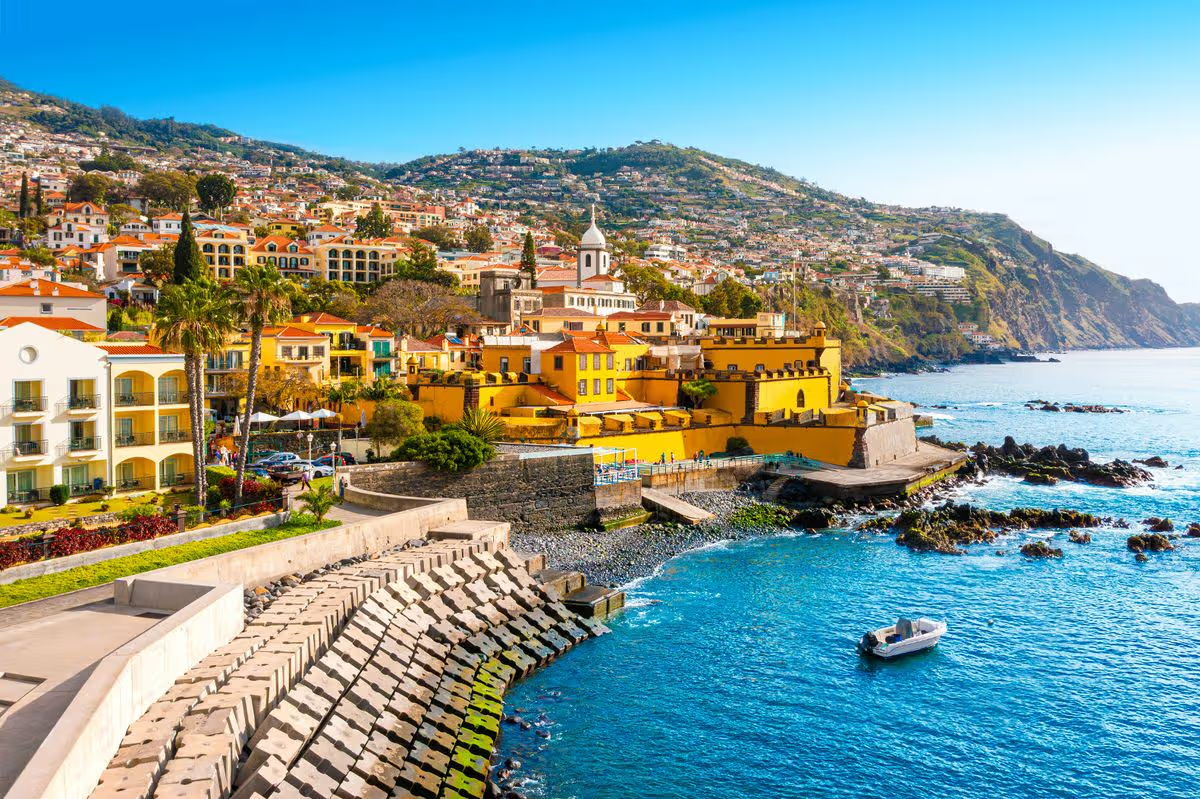
You can find one of the ‘world’s most beautiful beaches’ here(Image: Getty Images)
A man believes he discovered one of the “most beautiful beaches in the world” – and it’s just 4 hours away. Most holidaymakers tend to flock to popular tourist spots which are packed with crowds, making the whole experience rather overwhelming.
But one traveller has uncovered a stunning beach that you absolutely must visit at a specific time of the day. The content creator urged tourists to stop turning up to Seixal beach in Madeira at the “wrong time”. He began his post: “I get it. You came to Madeira for vacation and maybe want to relax, sleep well, have a nice breakfast, and slowly arrive at Seixal around 11am… Exactly like hundreds of other tourists…”
In the TikTok post with his 144,400 followers, he added: “And then reality hits: Traffic jams at the entrance, no parking, overcrowded beach and lighting that looks nothing like Instagram.”
He explained that instead of deep volcanic sand, you’re left with flat grey colours. Rather than breathtaking scenery, you’re greeted with harsh yellow sunlight. And any hope of tranquillity is quickly dashed by the swarms of crowds.
Alongside his tips, the man said: “Seixal really is one of the most beautiful beaches in Europe… but only if you visit it at the right time.
“And the best time is not during sunset. It’s during the morning golden hour, right after sunrise.
“That’s the magical moment when: the black sand turns golden, the green cliffs become soft pastel colours, and the sun no longer blinds your eyes but decorates the landscape with cinematic light.”
The traveller also suggested that Madeira will truly reward those who “wake up for sunrises and wait for sunsets”. So, to soak up the real enchantment of Madeira away from the tourist hordes, make sure you venture out at these different times of day.
Content cannot be displayed without consent
What to do in Madeira:
This subtropical Portuguese archipelago is renowned for its breathtaking volcanic scenery, fortified wine, and pleasantly mild climate throughout the year. It is the perfect getaway for hikers and nature enthusiasts alike.
Visitors can trek the celebrated network of thousands of kilometres of historic irrigation channels that wind their way through lush, mountainous landscapes.
Boat trips departing from the marina out into the deep Atlantic waters are also well worth experiencing. You can also take a ride up to the hilltop district of Monte in Funchal to discover its stunning tropical botanical gardens.
When it comes to food and drink, traditional wine and the Espetada Madeirense – succulent chunks of beef marinated in garlic and bay leaves – are absolute must-tries.
The ideal time to visit falls between April and October, with temperatures ranging from 20C to 26C.
A direct flight from the UK to Madeira (FNC) generally takes between 3.5 to 4 hours. This swift journey time applies to departures from the main London airports as well as regional hubs such as Manchester, Birmingham, and Edinburgh.
It was built by locals to be able to cross a huge river
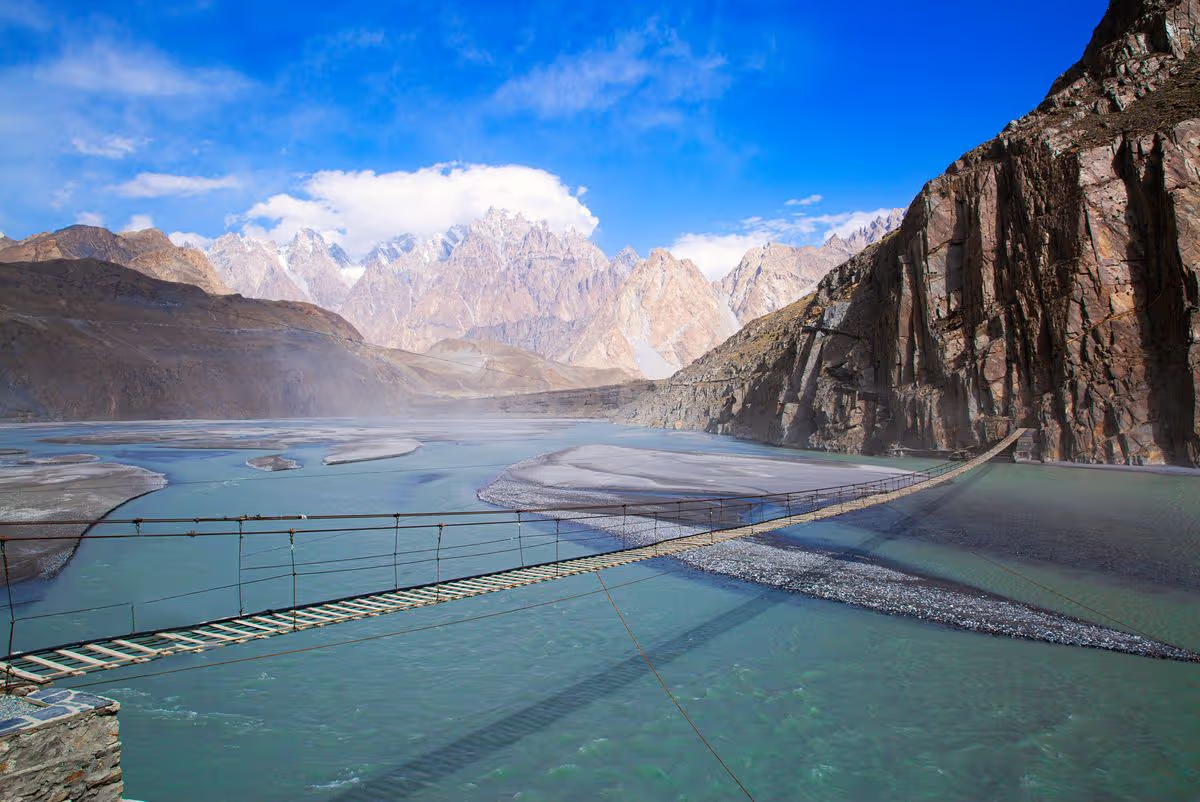
The bridge is held together by six ropes.(Image: Traveling/Getty)
There are thousands upon thousands of bridges across the world, yet one has the unwelcome title of being the most dangerous. Not all bridges are created equally when it comes to safety.
Often called the “most dangerous” in the world, the Hussaini Suspension Bridge in Pakistan is known for its high winds. Despite the title, the bridge remains a masterpiece of local engineering and has become a magnet for thrill seekers.
It was built in 1968 by local villagers of Hassaini and Zarabad using only raw materials. The 635-foot-long bridge is made of wooden planks and steel cables, held together by six main ropes that span its length.
The Hussaini Suspension Bridge was designed to provide a lifeline to transport goods and livestock across the Hunza River. Following a devastating landslide in 2010, the bridge was reconstructed.
Between the wooden planks of the bridge are larger spaces designed to resist the wobbly vibrations caused by the wind. Travel Magazine Conde Nast Traveller named the bridge as among the most dangerous in the world in 2013.
While it was built for local access, it has become popular with tourists. To visit and cross the bridge, tourists must wear life jackets.
Tragically, in July 2022, a student from Sindh reportedly died from drowning after falling from the bridge. It was sealed off while an investigation was under way, and later renovations were carried out.
Safety upgrades were implemented, including replacing the old, rotting and uneven wooden boards. The local community and authorities also worked together to tighten the steel cables.
Many tourists are still braving the crossing and have shared their experiences on TripAdvisor. One said: “What a thrilling bridge! People who have mental strength and not afraid of heights should give a try on this bridge! It’s a dare!”
Another added: “The journey to reach the bridge itself is an adventure, with winding roads and breath-taking landscapes that set the stage for the thrill to come.”
Someone else commented: “About 400 steps from one end to the other end of the bridge.
“The bridge is secure and safe. However, precautions should be taken when crossing the bridge as it is still a risk of falling accidentally. Give it a try!”
However, a fourth wrote: “Firstly, I refused to cross that bridge, but now I literally repent my decision. Looks dangerous , definitely not for people with fragile hearts like me , but its damn daring.”
One stunning beach has been crowned the world’s most beautiful by TUI
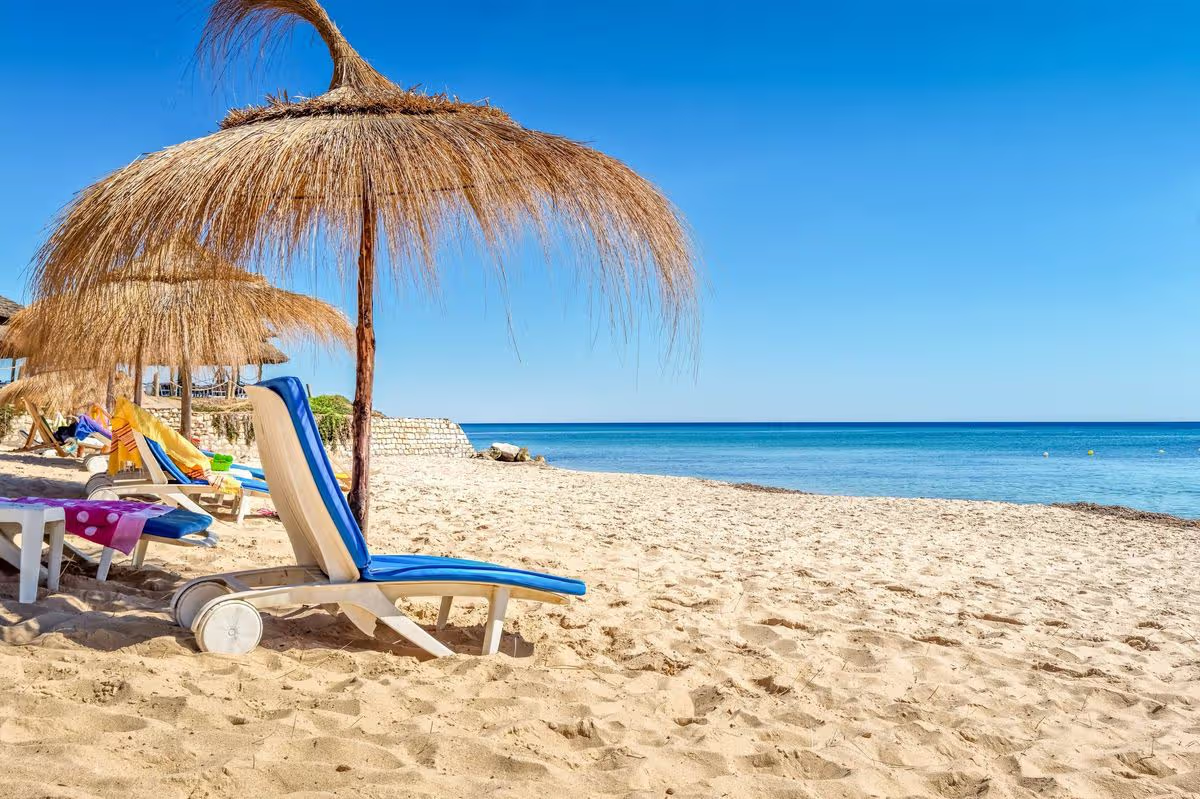
This beach has been named the most beautiful in the world (Image: gianliguori via Getty Images)
Just a three-hour flight from the UK lies Tunisia‘s breathtaking Yasmine Hammamet Beach, which has just been crowned the most beautiful beach in the world. Travel specialists at TUI assessed countless beaches across the globe, with this stunning coastal gem coming out on top.
The beach scored exceptionally well for its perfect blend of turquoise waters, golden sand and unspoilt coastal scenery, making it an ideal destination for all manner of holidaymakers, from families to watersports fans. Coming in second place was Içmeler Bay Beach in Türkiye, which wasn’t the only Turkish beach to feature, with the country claiming four of the top ten spots. Third place, meanwhile, went to Reduit Beach in Saint Lucia.
A recent visitor to Yasmine Hammamet Beach took to TripAdvisor to rave about the experience, writing: “We travelled with Senior Discovery Tours for 16 days and loved every minute of Tunisia!
“Can’t say enough about how beautiful this country is and especially Hammammet Beach! Beautiful sand and can walk for miles! Would highly recommend!”
Another holidaymaker enthused: “Warm clear blue water and golden sand, lovely clean and safe. Beach cafes and hot sun. I could stay here forever!”
A third visitor added: “Beautiful golden sands – camels seen walking near to water’s edge. Very tranquil. transport available from hotel to beach for guests – Hotel staff accompanying guests – bar available on beach for cold drinks.”
Revealing the findings of their research, Abbigail Head, a TUI retail agent, said: “Beautiful beaches continue to be one of the biggest drivers when people choose a holiday destination, because they represent the ultimate sense of escape.
“We find that travellers are naturally drawn to clear blue water, soft golden sand and bright coastal scenery because these landscapes instantly create feelings of relaxation.
“Whether families are looking for long beach days, couples want romantic sunset walks, or holidaymakers simply want somewhere to completely switch off, visually stunning beaches remain at the heart of the perfect getaway experience.”
The most beautiful beaches in the world, according to TUI
THE best 100 beaches in the world have been named – and two can be found in the UK.
Announced by Corona, the 2026 Corona Beach 100 has revealed the best spots around the world from well-known spots to hidden coves.
Sign up for the Travel newsletter
Thank you!
Two UK beaches have been named as some of the best in the worldCredit: AlamyFistral Beach Newquay made the listCredit: Alamy
Three criteria were analysed – Beachside Culture, Connection to Nature and Scenic Aesthetics.
A new entry on the list this year is Barafundle Bay in Pembrokeshire.
The first Welsh beach to make the list, it was praised for its “remote and dramatic landscape, as it is “accessible only by clifftop walk through a medieval archway.
It wrote: “Barafundle Bay feels hidden even when people talk about it.
“Reached only by a clifftop walk along the Pembrokeshire coast, this crescent of pale sand sits tucked between limestone cliffs with nothing built around it.
“No road, no cafés, no signal, just seabirds overhead, cold clear water below, and the kind of quiet that makes you slow down without realising it.”
And returning to the list this year was Fistral Beach in Cornwall, praised for being a “social and cultural hotspot” by being the UK’s surfing capital after hosting the first British Surfing Championships in 1966.
It added: “Facing the full force of the Atlantic, it’s where you go to chase sets, drink tea with cold hands, and feel like you’re part of something.
In Europe, Agia Anna on Naxos island in Greece was praisedCredit: GettyOne Croatia beach was listed, which was Zlatni Rat Beach on the island of BolCredit: Getty
“The beach delivers all year, with consistent swell, golden sands, and a surf scene that’s as seasoned as it is welcoming.
“From world-class comps to waist-high rollers, Fistral doesn’t need sunshine to shine — just wind, water, and the right kind of restlessness.”
Europe featured heavily on the list as well.
When it came to Greece, Agia Anna Beach in Naxos and the famous pink Elafonissi Beach in Crete made the cut, as well as Sarakiniko Beach on Milos.
For Spain, there was Aiguablava Beach, as well as Ibiza’s Casa Salada and Majorca’s Cala Mondragó.
Beaches across Italy, France and Croatia were also included, as well as other holiday spots such as Turkey, Morocco and Thailand.
A flight on the A350-1000ULR, developed for ultra-long-haul routes, is set to enable non-stop services between Sydney and major cities, including London and New York
It will enable non-stop services between Sydney and cities like London and New York
(Image: Airbus)
A plane offering a non-stop flight tipped to be the world’s longest and spanning up to a whopping 22 hours has reached a massive milestone. Yesterday (Tuesday, June 2), Airbus completed the first test flight of its A350-1000ULR, developed for ultra-long-haul routes and aimed at setting a new record for the longest non-stop commercial flight.
It will enable non-stop services between Sydney, Australia, and major cities London and New York. On its maiden flight, the MSN 707 model aircraft flew for three hours and 43 minutes.
Flown by an Airbus test crew and fitted with specialised instrumentation, the aircraft departed from and returned to Toulouse, France, reaching an altitude of more than 41,000 feet (12,500 metres).
It marks a turning point for the world of long-haul travel, with the plane making these non-stop routes possible for the first time and potentially cutting journey times by up to four hours.
At present, the longest commercial flight in use is Singapore Airlines’ more than 18-hour Singapore to New York, a distance of some 15,350 km; on the other hand, however, Sydney to London would be 18,500km.
The “ULR” in A350-1000ULR — a variant of the A350-1000 — stands for “ultra-long range”. A key difference is an extra tank capable of holding 20,000 litres of fuel, which Airbus says extends the range by more than 1,800km.
It stated: “During the first flight, the crew carried out general performance checks on the aircraft and tested the new fuel system architecture. This marks the start of a two-month flight test campaign to certify the modifications.”
Further tests will cover things like ventilation and temperature control in the cabin, and a refrigeration system. Aussie airline Qantas has ordered the first 12 units, the first of which is scheduled to arrive in April 2027.
Qantas’ plans form part of its so-called “Sunrise Project”, a name that refers to the fact that those flying on the lengthiest flights can see the sun rise twice as a result of the time difference.
Some of the features of the Qantas flight will be reduced passenger numbers (about 300 down to 238), a wellness area, and Wi-Fi access.
It comes after a flight attendant weighed in on passengers who ask to swap seats on planes. The individual, who goes by Ms Attendant Tea on TikTok, didn’t mince her words in her assessment.
She said: “What is the problem with that? Now, if you wanted to change a seat, you could have done so when you booked the flight. I don’t know, there are some sites of where you get the tickets from, it is an extra fee for you to select your seats, but you could have done that when you booked the flight.
“You may have had to pay a little extra, but you could have done that. Or, once you were assigned a seat, you could have taken care of that at the gate.
“Now, let me say something. When you get to me on the plane, every weight has been accounted for. All the calculations have been done, and everything else so, yes, where you are sitting is calculated in our weight and balance, which is an issue.
“So, when you get on a plane and ask me ‘can I sit here because I see [an] empty seat?’, and I say ‘no’. What is the problem?”
One in five holidaymakers say they are less likely to visit a destination if they cannot pronounce its name correctly – here’s some of the ones people often get wrong
This article contains affiliate links, we will receive a commission on any sales we generate from it. Learn more
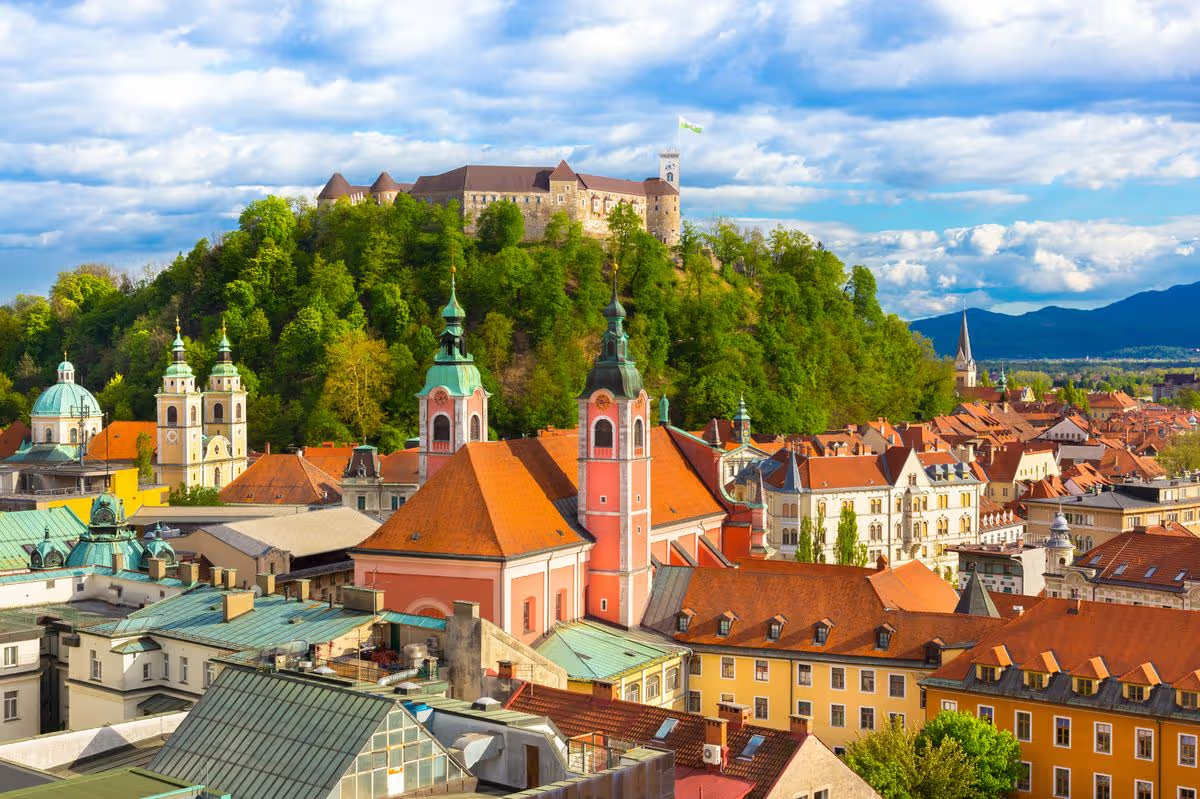
The Slovenian capital Ljubljana is one of the hardest names to pronounce(Image: Getty Images/iStockphoto)
Millions of British travellers are limiting where they go on holiday due to a surprisingly simple barrier – not knowing how to pronounce the destination.
One in five holidaymakers (22%) are less likely to visit destinations like Ljubljana and Reykjavik because they are afraid of getting their names wrong while 23% avoid booking the trip altogether.
One in three meanwhile, are worried about sounding rude when they mispronounce a foreign destination, while 26% said they are embarrassed, according to multi-modal travel booking platform Omio.
From Ljubljana (lyoo-BLYAH-nah) to Reykjavik (RAKE-yah-vik) and Montjuïc (mon-zhwEEK), many of the world’s most culturally rich locations are being overlooked.
Anxiety about language barriers goes beyond place names. Half (48%) of British travellers admit they avoid ordering dishes they can’t confidently pronounce while travelling, often missing out on tasty dishes such as bouillabaisse, tzatziki and mille-feuille and açai.
Omio has partnered with language expert and polyglot Alex Rawlings to launch a pronunciation guide to help British travellers travel abroad with confidence.
From understanding how certain letters and sounds change across languages to focusing on using tools like AI and pronunciation apps, the guide highlights easy ways to improve communication while travelling.
Alex said: “Pronunciation can feel like a barrier, but it doesn’t need to be perfect. The key is to focus on the sounds rather than trying to replicate every letter exactly.
“Breaking words into smaller parts and practising them slowly can make a big difference. Even a small effort is often appreciated by locals and can help travellers feel far more confident when exploring a new destination”.
Veronica Diquattro, president B2C Europe at Omio, added: “At Omio, we believe travel should feel exciting and accessible, not intimidating. With so many incredible destinations reachable by train, bus, ferry or plane, we want to give people the confidence to explore beyond the obvious.
“We know that even small barriers, like unfamiliar place names, can make travel feel daunting, so pairing up with Alex to produce the guide will help keen travellers to discover new destinations with ease.”
Tips for mastering hard-to-pronounce place names
Tip 1: Don’t read it like your own language Even when languages use the same alphabet, letters often sound completely different. In German, Dutch, Scandinavian and many Eastern European languages, “j” is pronounced like a “y”, while in French, Portuguese and Catalan it becomes a soft “zh” sound.
Tip 2: Use technology to help If you can’t ask a local, use tools like AI or Google Translate’s listen function to hear pronunciations and identify unfamiliar sounds or stress patterns.
Tip 3: Focus on the stress Getting the emphasis on the right syllable is often more important than perfect pronunciation. Think about the word Birmingham – people are far more likely to understand “BIR-ming-ham” than “bir-MING-ham”, even if the individual sounds aren’t perfect.
Tip 4: Learn the pattern Many languages follow consistent pronunciation rules, meaning once you learn one pattern, you can apply it to lots of other place names too. In French, Spanish, Italian, Portuguese and Catalan, for example, the letter “c” is pronounced like a “k” before “o”, “a” or “u”, but changes sound before “i” or “e” – becoming “ch” in Italian, “th” in Spain, and “s” in French and Portuguese.
Tip 5: Some letters are silent French is famous for silent letters, especially at the ends of words. That’s why places like Calais and Bordeaux are pronounced much more simply than they look. As a rule of thumb: if you’re in France and not sure whether you should pronounce the letter at the end of a word, you probably shouldn’t.
Tip 6: Don’t let language put you off Some of the world’s most exciting destinations – from Poland to Thailand – can also be the hardest to pronounce. Don’t let unfamiliar names stop you from exploring somewhere new.
Tip 7: Don’t be afraid to get it wrong Nobody expects perfect pronunciation – locals usually appreciate the effort more than accuracy. You might make a few mistakes, and you might earn yourself a few knowing smiles. But give it a go and see for yourself what worlds you might unlock!
The pronunciation guides are available to download now via Omio.
Southampton back Tonda Eckert despite missing out on a playoff final for a Premier League place due to spying scandal.
Published On 2 Jun 20262 Jun 2026
Southampton manager Tonda Eckert has apologised for orchestrating the “spygate” scandal that led to the club’s expulsion from the Championship playoffs, as owner Dragan Solak insisted that he would not sack the German.
“For everything that’s happened, I do want to apologise, and I hold my hand up because as a head coach I am responsible for everything that has happened in this football club,” Eckert said in a video statement on Tuesday.
Recommended Stories
list of 4 itemsend of list
The Saints were kicked out of last month’s playoff final after admitting they had observed a training session held by semifinal opponents Middlesbrough, as well as two other similar incidents during the season.
They also received a four-point deduction that will be applied to the 2026-27 Championship table, while the Football Association has opened its own investigation and could yet charge Eckert.
An independent disciplinary commission of the English Football League (EFL) ruled that there had been a “contrived and determined plan from the top down to gain a competitive advantage” through spying missions.
It said Eckert had authorised the tactics, highlighting the “particularly deplorable” use of junior members of staff to conduct clandestine operations.
Southampton beat Middlesbrough 2-1 over two legs in the playoff semifinals, but Boro were reinstated, going on to lose in the final to Hull City, who were promoted to the Premier League.
The prize for the winners of the final is regarded as the most lucrative in world football, with the winners joining the richest domestic league in the world. Hull will receive an estimated 200 million pounds ($268m) in extra income.
Eckert, who was appointed head coach in December, put out an eight-minute video statement about the scandal on Southampton’s social media channels.
The 33-year-old said: “I am devastated that after six months of building that relationship [with fans] back up, the season has come to an end, come to an end that couldn’t have left us in a worse place than we are in right now.”
He claimed that observing other teams was routine in other countries, though he admitted that this was not an excuse for his actions in the English second tier.
“When I worked in Italy for over four years, every starting lineup that we’ve chosen for the games was always out in the media before games,” he said.
“And the reason is that our training sessions, especially the ones before games, have always been observed from the media and have always been observed from opponent teams that we came up against.
“[Pep] Guardiola has spoken about this in his time at Bayern Munich, that it has been common practice in Germany to observe training sessions, knowing that other teams would do the same.”
Many had anticipated Eckert would lose his job after Southampton’s expulsion from the playoffs, but chairman Solak gave robust backing to Eckert in his own post on the club’s channels on Tuesday.
“Tonda’s period as our head coach has been a success so far. Our form during 2026 has been remarkable, and we believe he is the man to take us forward,” Solak said.
“As a board, we are fully behind him, and together we only have one objective – we want promotion back to Premier League.”
Solak told the BBC separately that Tonda had been subject to a witch-hunt in the media, saying he believed the club had been “over-sentenced”.
The Serbian, whose media company acquired a majority stake in the south-coast club in 2022, said: “I believe Tonda that he didn’t know that it was the rule that he was breaking.
“My personal opinion, and the opinion of the board, is that he is a manager who deserves to be backed by us and to be supported by us.”
90s movie actress Ashley Judd looks worlds away from her Hollywood days as she rings in her birthday and sings into a hairbush.
The iconic star celebrated her 58th birthday in May and took to Instagram to share a note with her fans.
Sign up for the Showbiz newsletter
Thank you!
90s movie star Ashley Judd looks worlds away from Hollywood as she sang into a hairbrushCredit: InstagramThe actress turned 58 last monthCredit: Instagram
She was one of the most popular actresses in the 90s and has a strong filmography of work to prove it.
Ashley shared a video of herself singing into a hairbrush as she danced away in her garden with loved ones on her special day.
She popped her grey locks into ponytails as wore a navy plaid dress and went make-up free.
The actress also posted snaps of herself sat in front of a birthday cake as well as being serenaded by a group of musicians who played their instruments for her.
These days Ashley spends her time working as an activist and humanitarian and is an ambassador for UNFPA (United Nations Population Fund), which is a sexual and reproductive health agency.
She isn’t the only famous person in her family as she’s the daughter of country music singer Naomi Judd.
Her half sister Wynonna also forayed into the country music world.
A GuruWalk study found the world’s most walkable destination for travellers fascinated by ancient history
There’s nothing better than exploring a city on foot(Image: andresr via Getty Images)
The old adage that the best things in life are free rings particularly true when it comes to travel. Exploring a city on foot, rather than wrestling with bewildering public transport networks or splashing out on car hire, is one of the finest ways to immerse yourself in unfamiliar surroundings — and it won’t cost you a penny.
Free walking tours are a firm favourite amongst seasoned travellers as a brilliant way to get acquainted with a new city while soaking up a bit of local history.
Europe is brimming with historic cities where you can stroll between landmarks in just a few minutes, including Cordoba in Spain, whose magnificent Old Town has even earned UNESCO World Heritage status.
The ability to simply wander up to a World Heritage Site is a remarkable privilege that’s easy to overlook, yet far from an everyday occurrence. But when it comes to exploring your surroundings on foot, one European city — dubbed an “open-air museum” — stands head and shoulders above the rest as the ultimate walkable destination.
A study by GuruWalk, the world’s largest platform for free walking tours, has crowned Rome the most walkable destination on the planet for “travellers fascinated by ancient history”, drawing on the preferences of more than four million users of the platform.
The city’s historic centre is packed with unmissable sights, while its surrounding streets and winding cobblestone alleyways are frequently too narrow for traffic to navigate, making it an absolute must for exploring on foot.
Many of Rome’s most iconic attractions, including The Colosseum, the Pantheon and the Trevi Fountain are within a mere 20-minute stroll of one another, with countless stunning Baroque piazzas to pause at along the way.
The oldest surviving structure in Rome, the present-day Pantheon — which originally functioned as a temple dedicated to Roman deities — was finished in 126 AD and sits encircled by three of the city’s most cherished squares: Piazza Navona, Piazza di Spagna, and Campo de Fiori, reports the Express.
Reflecting on the awe-inspiring monument, one Tripadvisor reviewer remarked: “We didn’t get to go in so this review is only in regards to the outside. I thought it was so cool to see. You’re walking through a city and suddenly walk right next to this beautiful ancient structure. There’s so much history to it!”
Indeed, there’s no finer method of immersing yourself in Ancient Rome than by meandering through its storied streets. A visit to the Vatican — the heart of the Roman Catholic Church and location of one of the world’s grandest churches, St Peter’s Basilica — wouldn’t be complete without popping into the nearby Pizzarium.
This beloved Roman establishment, famed for its pizza al taglio (by the slice), is adored by both residents and tourists, and there’s an abundance more to discover while exploring — from velvety gelato and piping hot bowls of pasta to a crisp Aperol Spritz to round things off.
If you find yourself worn out from all that strolling, there’s plenty of coffee bars to choose from, but be aware that milky coffees are only deemed acceptable before 11am, with tradition suggesting it’s wise to order an espresso after that time.
According to GuruWalk’s 2026 top ranking for Rome, it stated: “Rome has captivated travellers for over 2,700 years thanks to its unparalleled historical legacy. Walking through its cobblestone alleyways reveals one treasure after another: the Colosseum, where gladiators battled before 50,000 spectators, the Pantheon with its unreinforced concrete dome that remains the largest in the world, and the baroque fountains that spring up at every corner. Every step transports you through empires, popes, and renaissances.”