World

South Korea air fuel surcharges nearly double

A Korean Air plane takes off from Incheon International Airport, west of Seoul, South Korea, 01 April 2026. Fuel surcharges for flights operated by South Korean airlines have surged by as much as threefold from the previous month in April due to the spike in global oil prices, industry watchers said. Photo by YONHAP / EPA

May 1 (Asia Today) — Fuel surcharges on airline tickets issued in South Korea nearly doubled Friday as carriers respond to a sharp rise in oil prices driven by escalating tensions in the Middle East.

The airline industry said tickets issued this month will be subject to the highest surcharge level, Stage 33, for the first time since the current system was introduced in 2016.

Korean Air set one-way international fuel surcharges from 75,000 won ($51) to 564,000 won ($383), up from 42,000 won ($29) to 303,000 won ($206) in April. The lowest charge applies to short-haul routes such as Fukuoka and Qingdao, while the highest applies to long-haul destinations including New York, Atlanta, Washington and Toronto.

Asiana Airlines set its international one-way surcharge at 85,400 won ($58) to 476,200 won ($323), nearly double April’s range of 43,900 won ($30) to 251,900 won ($171).

Jeju Air, a low-cost carrier, will charge $52 to $126 one way on international flights departing South Korea, compared with $29 to $68 last month.

The higher surcharges are still not enough to fully offset rising costs. Some low-cost carriers saw fuel expenses rise more than 120% from the previous month and 130% from a year earlier, while surcharge revenue covered only about half of the increase.

Airlines are responding by cutting less profitable routes. Asiana expanded planned reductions on some international routes from eight flights to 13, while Jin Air plans to cut 131 flights across 14 routes this month after canceling 45 flights on eight routes in April.

Air Premia plans to cut 22 flights in July, including eight on the Incheon-Da Nang route, six to Los Angeles and four each to San Francisco and Honolulu.

Korean Air has not announced route reductions but is closely monitoring market conditions.

— Reported by Asia Today; translated by UPI

© Asia Today. Unauthorized reproduction or redistribution prohibited.

Original Korean report: https://www.asiatoday.co.kr/kn/view.php?key=20260501010000007

Source link

World Snooker Championship 2026 quiz: Name all finalists since 2000

China’s Wu Yize is the 21st man to reach a World Snooker Championship final at the Crucible Theatre since the turn of the century thanks to his extraordinary win against Mark Allen.

Can you name the other 20 players who have appeared in a world title decider in Sheffield between 2000 and 2025?

After more quizzes? Go to our dedicated Football Quizzes and Sports Quizzes pages and sign up for notifications to get the latest quizzes sent straight to your device.

Source link

World Cup 2026: How much would it cost to go as an England or Scotland fan?

Our two England fans fly out of Heathrow on Monday, 15 June with return flights to JFK in New York costing just over £500 each – which is good value.

With the Three Lions’ final group game taking place in New Jersey, it is the most cost-effective way to travel to the US and back, with the first stop being Dallas.

After landing in the States, they pick up a flight to Dallas the same night – this costs £283 per person.

Four nights at the Hampton Inn & Suites Dallas Market Center cost £624 (£156 a night) for a twin.

Double rooms, which are more available in all cities, come in cheaper at the Hilton Dallas Medical District at £560 (£140 a night).

Both properties have breakfast included, meaning Dallas – which also has free shuttle buses from stations to the stadium in Arlington – is an affordable start to the trip.

The England supporters fly to Boston on Friday, 19 June with the fare £378 each.

Boston is at the other end of the scale as one of the more expensive host cities for accommodation.

Our couple stay at the Hampton Inn & Suites Boston Crosstown Center, costing £1,650 (£330 a night), including breakfast, for five nights.

The cheapest twin-bed option in the city itself is £2,041 (£408 a night) without breakfast at the Courtyard Boston Downtown/North Station.

It is possible to book a hotel near the airport £500 cheaper but with five days in the city, it may not be worth the saving.

With England’s third game being in New Jersey, there is no need to take a flight. The supporters can hop on the Amtrak train to New York on Wednesday, 24 June with tickets £42 each.

Unlike in Boston, there are still lots of hotel options in New York with a five-night stay before the flight home on 29 June.

A double at the Truss Hotel Times Square costs £1,184 (£237 a night) while a twin at the AMTD Idea Tribeca Hotel is £1,275 (£255 a night).

This time, however, you will need to head out for breakfast.

But the last two games come with a sting – train tickets to the stadiums cost £59 per person from Boston and £114 from New York.

Just to get to the States and travel around, the estimated costs for two friends are £6,273 and for a couple £5,855.

And what of the family? It is going to cost £9,008 to get to the States, get around and put your heads down.

Costs are helped by some hotels offering free stays for children.

In Dallas, the Comfort Inn Dallas Medical-Market Center costs £627 (£156 a night).

The same Hampton Inn is used in Boston with a higher cost of £1,763 (£353 a night).

Over in New York, the Holiday Inn in Times Square costs £1,589 (£318 a night).

Source link

Japan holds off naval deployment to Hormuz Strait

May 1 (Asia Today) — Japan considered deploying its Self-Defense Forces to the Strait of Hormuz ahead of a summit with U.S. President Donald Trump but ultimately held back due to constitutional and legal constraints, reports said Friday.

Prime Minister Sanae Takaichi reviewed options in March to send naval assets to the region amid heightened tensions in the Middle East, according to Japanese media.

Two proposals were examined: dispatching minesweepers under Japan’s Self-Defense Forces law or sending destroyers and patrol aircraft for “survey and research” purposes under a separate legal framework. Both options were shelved due to concerns they could violate Japan’s pacifist constitution.

Article 9 of Japan’s constitution renounces war and prohibits the use of force to settle international disputes, placing strict limits on overseas military operations.

The discussions were prompted in part by U.S. requests for allied support in securing maritime routes. Trump warned in March that Iran could disrupt shipping in the Strait of Hormuz using drones, mines and short-range missiles, and called on countries including Japan, South Korea and European allies to contribute naval forces.

The Strait of Hormuz is a critical energy corridor for Japan, which depends heavily on Middle Eastern oil imports. Any prolonged disruption could affect supplies of crude oil, naphtha and petrochemical products.

Japanese officials acknowledged the urgency of ensuring maritime security but stressed legal limits. Defense Minister Shinjiro Koizumi said Japan must act within the bounds of its laws, while Takaichi told parliament she had explained constitutional constraints during talks with Trump.

Legal concerns centered on whether minesweeping operations in a conflict zone could be considered part of combat activities, potentially violating Article 9. Similarly, deploying naval vessels under the guise of research could be viewed as de facto joint operations with U.S. forces in a high-risk area.

Despite the decision, debate continues within Japan. Lawmakers from the ruling Liberal Democratic Party have suggested revisiting deployment options if maritime disruptions persist, emphasizing the importance of securing sea lanes.

The episode highlights Japan’s evolving security posture. While Tokyo has expanded defense spending and strengthened alliances, its ability to deploy forces abroad remains constrained by constitutional interpretation.

The issue also carries implications for South Korea, which relies on the same energy routes. If the United States increases pressure on allies to contribute to maritime security, both Seoul and Tokyo may face similar dilemmas balancing energy security with military involvement.

— Reported by Asia Today; translated by UPI

© Asia Today. Unauthorized reproduction or redistribution prohibited.

Original Korean report: https://www.asiatoday.co.kr/kn/view.php?key=20260501010000010

Source link

World Snooker Championship 2026: Wu Yize & Mark Allen set up thrilling finale to semi-final

Wu Yize and Mark Allen produced a session of spellbinding snooker and finished locked at 11-11 to perfectly set up the final session of their World Championship semi-final at the Crucible Theatre.

Resuming at 7-7 on Saturday, the third session of the match was a complete contrast to their epic slugfest on Friday, that produced the longest frame ever played at the famous venue.

China’s Wu set the tone, opening with a sublime 142 and also constructing breaks of 76 and 121 to lead 10-8 at the mid-session interval.

However, Allen, who is attempting to become the first player from Northern Ireland to reach the final since Dennis Taylor in 1985, showed he had also thrown off the shackles of negativity.

The 40-year-old enjoyed a run of 56, and well-crafted breaks of 85 and 99 enabled him to draw level at 10-10.

Wu, 22, who defeated Lei Peifan, Mark Selby and Hossein Vafaei to reach the last four, responded with his third century of the day.

But as the tension increased, in what felt like an important concluding frame to the session, Wu was unable to capitalise after getting the first opportunity.

That allowed Allen, who could become the oldest first-time winner at the Crucible, to make a couple of useful contributions and ensure there was nothing to divide the pair.

They return to play the final session of their best-of-33 encounter at 19:00 BST on Saturday, with a possible 11 frames still to get through, as they attempt to set up a title match against John Higgins or Shaun Murphy.

Source link

South Korea exports jump 48% in April

Containers for export are stacked at a port in Pyeongtaek, around sixty kilometers south of Seoul, South Korea, 22 February 2026. Photo by YONHAP /EPA

May 1 (Asia Today) — South Korea’s exports rose 48% from a year earlier in April, staying above $80 billion for the second consecutive month, government data showed Friday.

Exports totaled $85.89 billion, the second-highest monthly figure on record after $86.6 billion in March, according to the Ministry of Trade, Industry and Energy.

The increase was driven by strong semiconductor shipments, which surged 173.5% to $31.9 billion on rising demand tied to artificial intelligence. Chip exports exceeded $30 billion for the second straight month and set an April record.

Daily average exports, adjusted for working days, rose 48% to $3.58 billion, staying above $3 billion for a third consecutive month.

Auto exports fell 5.5% to $6.17 billion due to logistics disruptions from the Middle East, U.S. tariff effects and expanded overseas production. Exports of electric and hybrid vehicles continued to grow.

Petroleum product exports rose 39.9% to $5.11 billion by value due to higher oil prices, though shipment volume dropped 36% because of export controls on gasoline, diesel and kerosene.

Petrochemical exports increased 7.8% to $4.09 billion, while shipment volume fell 20.9% as companies expanded domestic supply.

Computer exports jumped 515.8% to $4.08 billion, and wireless communication device exports rose 11.6% to $1.62 billion.

By destination, exports to China rose 62.5% to $17.7 billion, marking six straight months of gains. Shipments to the United States increased 54% to $16.33 billion, while exports to the Association of Southeast Asian Nations rose 64% to $15.41 billion.

Exports to the European Union increased 8.5% to $7.19 billion. Shipments to the Middle East fell 25.1% to $1.27 billion due to logistics disruptions.

Imports rose 16.7% to $62.11 billion. Energy imports increased 7.5% to $10.61 billion, while non-energy imports rose 18.8% to $51.51 billion.

South Korea posted a trade surplus of $23.77 billion in April, extending its surplus streak to 15 months.

— Reported by Asia Today; translated by UPI

© Asia Today. Unauthorized reproduction or redistribution prohibited.

Original Korean report: https://www.asiatoday.co.kr/kn/view.php?key=20260501010000017

Source link

Report: North Korea shared missile tech with Iran for decades

1 of 2 | Bruce Bechtol speaks at the International Council on Korean Studies (ICKS) annual conference titled “Challenges of the U.S.-South Korea Alliance 2026” at the Hudson Institute in Washington on Wednesday. Photo by Asia Today

May 1 (Asia Today) — North Korea has transferred missile technology to Iran over more than 40 years, evolving from early Scud missile supplies to capabilities approaching intercontinental ballistic missiles, while also helping build factories, underground facilities and naval systems, according to U.S. experts.

Bruce Bechtol made the assessment at the annual International Council on Korean Studies conference titled “Challenges of the U.S.-South Korea Alliance 2026,” co-hosted in Washington by the Hudson Institute and the Committee for Human Rights in North Korea.

Bechtol, co-author of the book Rogue Allies: Iran and North Korea’s Strategic Partnership, said Iran began acquiring Scud missiles in the early 1980s during the Iran-Iraq War. Initially supplied in limited numbers by Libya, Iran later established contact with North Korea and imported roughly 100 Scud missiles, which it used to strike Iraqi cities during what became known as the “War of the Cities.”

He said Iran subsequently ordered an additional 200 to 250 Scud-C missiles and, with North Korean assistance, produced and upgraded them domestically. This led to the development of Iran’s current short-range ballistic missile, the Qiam, which has an estimated range of about 800 kilometers.

Bechtol added that Iran attended North Korea’s Nodong missile test in 1993, along with a Pakistani delegation, and later signed a contract to acquire about 150 Nodong missiles. North Korean engineers helped build production facilities near Isfahan, where Iran manufactured the missiles under the name Shahab-3.

He said North Korean specialists further modified these systems, leading to the development of the Emad missile, with a range of about 1,750 kilometers, and the Ghadr missile, with a range of about 1,900 kilometers. Both systems have been used repeatedly and are capable of reaching targets across Israel.

Bechtol also said North Korea sold 19 Musudan missiles – based on the Soviet-era submarine-launched ballistic missile R-27 – to Iran after obtaining the technology from Russian scientists following the collapse of the Soviet Union. He noted that Iran modified the missile for land-based launch, which introduced structural instability and limited its success rate to about 50%.

Based on the Musudan platform, Iran developed the Khorramshahr missile, which can carry a warhead approximately four times heavier than the original design and has an estimated range of 2,000 kilometers. The Israeli military has estimated its penetration rate at about 8%.

Bechtol cited media reports that North Korea transferred 80-ton-class rocket boosters – equivalent to first-stage propulsion systems for intercontinental ballistic missiles – to Iran even during negotiations over the Joint Comprehensive Plan of Action. He noted that the United States imposed sanctions on both countries in 2016 and 2019 in response.

He said a 2021 report by a United Nations panel of experts also detailed such transfers and assessed that technologies similar to those used in North Korea’s Hwasong-12 and Hwasong-15 missiles had been shared with Iran.

Bechtol further claimed that ballistic missiles fired by Iran toward the U.S.-U.K. base on Diego Garcia in the Indian Ocean in March – from a distance of about 4,000 kilometers – were based on North Korean technology.

Beyond missiles, North Korea has supported Iran and its allied groups by providing military hardware and infrastructure. Bechtol said Pyongyang sold 14 Yono-class submarines – the same type used in the 2010 sinking of South Korea’s Cheonan warship – and helped build production facilities for them. North Korea also supplied 46 fast infiltration boats and assisted in constructing related manufacturing sites.

He said North Korean engineers were involved in building underground nuclear-related facilities in Natanz and Isfahan, which he described as difficult to destroy without the use of U.S. B-2 bombers.

Bechtol also pointed to evidence that North Korean weapons were used by Hamas during its October 2023 attack on Israel, including 122 mm rockets, anti-tank weapons, Type 73 machine guns and Type 58 rifles marked in Korean.

Separately, an Israeli research center reported that North Korean arms exporter Korea Mining Development Trading Corporation helped build two tunnels in Lebanon for Hezbollah, measuring about 25 miles (40 kilometers) and 45 miles (72 kilometers), at a cost of about $13 million.

Bechtol said North Korea has also generated significant revenue through military cooperation. Citing research from the Korea Institute for Defense Analyses, he estimated that Pyongyang earned about $20 billion over roughly 15 months from transactions with Russia since late 2023 – close to its annual gross domestic product of about $26 billion.

Andrew Scobell said cooperation among China, Russia, Iran and North Korea – sometimes referred to as “CRINK” – is not a formal multilateral alliance but rather a collection of bilateral relationships.

Scobell added that North Korea appears to have exercised restraint in supplying weapons to Iran following U.S. and Israeli strikes earlier this year, citing intelligence assessments reported by international media.

Former U.N. sanctions panel expert William Newcomb said North Korea’s proliferation activities have contributed significantly to instability in the Middle East and called for a comprehensive assessment of their global economic impact, suggesting the cost could exceed $1 trillion.

Scobell also noted that North Korea’s strategic value to Russia could decline significantly if the war in Ukraine ends, indicating that the current level of cooperation is closely tied to ongoing conflict dynamics.

— Reported by Asia Today; translated by UPI

© Asia Today. Unauthorized reproduction or redistribution prohibited.

Original Korean report: https://www.asiatoday.co.kr/kn/view.php?key=20260501010000016

Source link

Former U.S. envoy says Kim seeks U.S. ties as nuclear state

1 of 2 | Joseph DeTrani, right, speaks with Greg Scarlatoiu at the International Council on Korean Studies annual conference titled “Challenges of the U.S.-South Korea Alliance 2026” at the Hudson Institute in Washington on Wednesday. Photo by Asia Today

May 1 (Asia Today) — Former U.S. Six-Party Talks envoy Joseph DeTrani said North Korean leader Kim Jong Un still wants to normalize relations with the United States but is demanding that Washington recognize North Korea as a nuclear weapons state.

DeTrani said U.S. leverage in negotiations with North Korea has weakened sharply compared with the period around the 2005 Six-Party Talks joint statement, as Pyongyang has significantly expanded its nuclear and missile capabilities and China and Russia have effectively shielded the North.

He opposed calls by some Korea specialists in the United States for arms control negotiations with North Korea, saying Washington should maintain complete, verifiable denuclearization as its ultimate goal. At the same time, he said the United States should pursue interim freeze measures, including a halt to nuclear testing and production of fissile material.

DeTrani made the remarks Wednesday during a presentation and discussion with Greg Scarlatoiu, president of the Committee for Human Rights in North Korea, at the annual International Council on Korean Studies conference, “Challenges of the U.S.-South Korea Alliance 2026,” held at the Hudson Institute in Washington.

DeTrani previously served as director of the National Counterproliferation Center under the Office of the Director of National Intelligence and as U.S. representative to the Korean Peninsula Energy Development Organization. He spent 13 years handling negotiations with North Korea and participated in intelligence work that first confirmed the North’s highly enriched uranium program.

DeTrani said the Sept. 19, 2005, joint statement from the fourth round of the Six-Party Talks was meaningful because it explicitly confirmed North Korea’s commitment to abandon “all nuclear weapons and existing nuclear programs.”

The statement also committed North Korea to returning at an early date to the Nuclear Non-Proliferation Treaty and International Atomic Energy Agency safeguards. The United States affirmed that it had no nuclear weapons on the Korean Peninsula and no intention to attack or invade North Korea with nuclear or conventional weapons.

But DeTrani said North Korea refused U.S. demands during both plenary and bilateral talks to explicitly include its highly enriched uranium program in the agreement, explaining why the final text did not directly mention the program.

He said North Korea would not have agreed to the 1994 Agreed Framework if Washington had tried to explicitly include highly enriched uranium, adding that Pyongyang has consistently shown since around 2000 that it wanted to pursue such a program for nuclear weapons development.

DeTrani said the U.S. negotiating “tool kit” was relatively strong in 2005 but has lost much of its effectiveness by 2026.

He said Wang Yi, now China’s foreign minister, played an active and constructive role as chair of the Six-Party Talks at the time. Today, however, China and Russia are effectively accepting North Korea as a nuclear weapons state and blocking additional U.N. Security Council sanctions, he said.

DeTrani said China still controls about 90% of North Korea’s foreign trade and oil supply, but added that it is difficult to expect Beijing to use that leverage to move Pyongyang in the direction Washington wants.

On Russia, DeTrani said North Korea is likely receiving assistance for its satellite, nuclear and missile programs in exchange for sending more than 12,000 troops, artillery shells and ballistic missiles to support Russia’s war in Ukraine, following the June 2024 comprehensive strategic partnership treaty between Kim and Russian President Vladimir Putin.

Still, DeTrani warned against assuming that the alignment among North Korea, China and Russia is permanent. He said historical distrust between Pyongyang and Beijing, along with geopolitical competition between Moscow and Beijing, remains a source of internal friction.

DeTrani estimated North Korea now has 50 to 60 nuclear weapons based on fissile materials such as highly enriched uranium and plutonium and could expand that arsenal to 100 weapons within several years.

International Atomic Energy Agency Director General Rafael Grossi warned during a visit to South Korea on April 15 that North Korea is expanding uranium enrichment capabilities at Yongbyon and at a new facility resembling the Kangson enrichment site in satellite imagery, describing the program as having advanced to a “very serious” level.

DeTrani said North Korea recently displayed the Hwasong-20, a solid-fuel, road-mobile intercontinental ballistic missile with multiple independently targetable reentry vehicle capability and an estimated range of 15,000 kilometers, demonstrating a potential ability to reach the entire United States.

He said North Korea has more than 400 ballistic missiles, ranging from short-range systems to long-range intercontinental missiles, and is focusing on solid-fuel, road-mobile short-range systems such as the KN-23, KN-24 and KN-25.

DeTrani also said Kim recently visited the second 5,000-ton destroyer, Choe Hyon, and that North Korea aims to build a third and fourth destroyer while securing 12 nuclear-capable destroyers by 2030.

He said North Korea is constructing an 8,700-ton nuclear-powered submarine, a move he described as strengthening the second leg of a nuclear triad intended to preserve retaliatory nuclear capability even after a first strike.

DeTrani said another major change is North Korea’s nuclear doctrine, which now allows for automatic preemptive nuclear use if there is an imminent or perceived imminent threat to the leadership or command and control system.

“With satellite and imagery intelligence, I think we have verification capabilities and will not be deceived,” DeTrani said. “But North Korea remains a black hole, and there is still a great deal of information we cannot access.”

DeTrani said Kim, like his father Kim Jong Il and grandfather Kim Il Sung, understands that normalization with the United States could restore international confidence and open the door to institutions such as the International Monetary Fund and World Bank.

He said Kim’s request at the February 2019 Hanoi summit for relief from U.N. Security Council sanctions imposed since 2016, in exchange for steps related to the Yongbyon nuclear facility, reflected that calculation.

DeTrani said President Donald Trump had built a degree of trust with Kim, and that Kim has conditionally signaled a willingness to meet Trump again.

But DeTrani said in his presentation that it would not be surprising if North Korea had given up on the United States and South Korea, given the Iran conflict, tensions between the United States and NATO, and China and Russia’s de facto acceptance of North Korea’s nuclear status.

He said if Washington recognizes North Korea as a nuclear weapons state, Pyongyang would claim victory and use that recognition to extract more concessions from China and Russia.

Asked about proposals for nuclear nonproliferation or arms control talks with North Korea, DeTrani said, “I absolutely disagree.”

Such an approach, he said, would reinforce the North Korean regime’s belief that the United States will eventually accept it as a nuclear weapons state and would damage the broader nuclear nonproliferation system.

DeTrani identified North Korea’s nuclear program as the biggest challenge facing the U.S.-South Korea alliance in 2026. He also cited additional alliance issues, including debate over the possible use of about 28,500 U.S. troops stationed in South Korea in a Taiwan Strait or South China Sea contingency and support for keeping the Strait of Hormuz open.

— Reported by Asia Today; translated by UPI

© Asia Today. Unauthorized reproduction or redistribution prohibited.

Original Korean report: https://www.asiatoday.co.kr/kn/view.php?key=20260501010000029

Source link

South Korea oil aid applications reach 73%

Residents apply for high oil price relief payments at a community center in Seoul on April 27. The program provides 100,000 won ($68) to 600,000 won ($407) per person to the bottom 70% of income earners, with payment options including credit or debit cards, prepaid cards and local gift certificates. Photo by Asia Today

May 1 (Asia Today) — More than 73% of people eligible for South Korea’s first round of high oil price relief payments have applied, government data showed Friday.

The Ministry of the Interior and Safety said 2,358,682 people had applied as of midnight Thursday, accounting for 73.1% of the 3,227,785 people eligible in the first round.

The government has paid a total of 1.3413 trillion won ($910 million) in relief funds, or about 570,000 won ($387) per person.

The first round covers vulnerable groups, including basic livelihood security recipients, near-poverty households and single-parent families.

By payment method, credit and debit cards were the most common choice, used by 984,209 applicants, or 41.7%. Prepaid cards accounted for 814,056 applicants, followed by mobile or card-type local gift certificates at 493,254 and paper gift certificates at 67,163.

By region, South Jeolla Province had the highest application rate at 79.3%, followed by Busan at 77.7%, Gwangju at 76.9%, North Jeolla Province at 76.2% and Ulsan at 76%.

Applications remain open through May 8.

— Reported by Asia Today; translated by UPI

© Asia Today. Unauthorized reproduction or redistribution prohibited.

Original Korean report: https://www.asiatoday.co.kr/kn/view.php?key=20260501010000031

Source link

U.S.-China summit prospects brighten after official calls

U.S. Secretary of State Marco Rubio meets with Chinese Foreign Minister Wang Yi at the ASEAN Foreign Ministers’ Meeting in Kuala Lumpur, Malaysia, on 2025. Photo by Freddie Everett/U.S. State Department/UPI | License Photo

May 1 (Asia Today) — Senior U.S. and Chinese diplomatic and trade officials held a series of calls ahead of a planned summit between President Donald Trump and Chinese President Xi Jinping, signaling that the meeting is likely to proceed as scheduled.

The summit is planned for May 14-15, after speculation that it could be delayed again because of prolonged tensions in the Middle East.

Chinese Foreign Minister Wang Yi spoke by phone Wednesday with U.S. Secretary of State Marco Rubio, according to China’s Foreign Ministry. The call came as both countries prepare for high-level engagement and seek to manage tensions over trade, Taiwan and regional security.

Wang said leader-level diplomacy has long served as a guide for U.S.-China relations and that bilateral ties have generally remained stable under the strategic direction of Xi and Trump.

He urged both sides to preserve what he called a hard-won period of stability, prepare carefully for major high-level exchanges, expand cooperation and manage differences.

Wang also said Taiwan is China’s core interest and the “biggest risk” in U.S.-China relations, urging Washington to honor its commitments and make what Beijing views as the correct choice.

China’s Foreign Ministry said Rubio described U.S.-China relations as the world’s most important bilateral relationship and said leader-level diplomacy is central to maintaining strategic stability.

The two sides also held economic talks. Chinese Vice Premier He Lifeng spoke by video with U.S. Treasury Secretary Scott Bessent and U.S. Trade Representative Jamieson Greer. Reuters described the trade discussion as “candid and comprehensive,” with both sides raising concerns over trade restrictions and regulatory measures.

The exchanges suggest Washington and Beijing are moving toward holding the summit as planned, despite persistent disputes over Taiwan, trade restrictions and broader strategic competition.

— Reported by Asia Today; translated by UPI

© Asia Today. Unauthorized reproduction or redistribution prohibited.

Original Korean report: https://www.asiatoday.co.kr/kn/view.php?key=20260501010000028

Source link

SoFi Stadium workers threaten strike if ICE is at World Cup games

Isaac Martinez has been as a cook at SoFi Stadium for four years. He’s worked dozens of NFL games, a Super Bowl, Taylor Swift concerts, Wrestlemania and the college football national championship game, among dozens of other events.

And he’s never been afraid to come to work. Until now.

He’s not alone. With the World Cup kicking off at the Inglewood venue next month, Martinez says he and many of the people who work in food services and other jobs at the stadium won’t feel safe if federal immigration agents are present during the tournament.

“Most of the workers are afraid. They fear for their safety,” Martinez said in Spanish. “This is also about the fans. People come from everywhere, even from Iran. So we’re concerned about their safety.”

Workers and activists begin their march from MacArthur Park to downtown Los Angeles on Friday in recognition of May Day.

Workers and activists begin their march from MacArthur Park to downtown Los Angeles on Friday in recognition of May Day. The group stopped at the FIFA local organizing offices to protest ICE’s presence at World Cup matches.

(Genaro Molina/Los Angeles Times)

So concerned, Unite Here Local 11, the hospitality union that represents Martinez and about 2,000 others who are working at SoFi without a contract, said it may strike ahead of the World Cup if ICE agents aren’t kept away from the stadium.

Last month Unite Here Local 11 filed an unfair labor practice complaint with the National Labor Relations Board charging Legends Hospitality, which operates the premium food, beverage and retail services at SoFi; Kroenke Sports and Entertainment, owner of the stadium; and FIFA, organizer of the World Cup, with creating an unsafe work environment by refusing to restrict the presence of ICE officials at the eight World Cup games to be played in Inglewood.

“We are concerned about the safety of guests and workers,” said Kurt Petersen, co-president of Local 11. “ICE has become more and more out of control and violent. We saw what happened in the killings in Minnesota. So I don’t think anyone is safe when ICE is around.”

A spokesperson for FIFA, organizer of the World Cup, declined to comment on the record about the union’s complaint and Legends Hospitality, did not immediately respond to repeated requests for comment. The union, meanwhile, joined Friday with faith and labor leaders and members of the Fair Games Coalition to press their point at a May Day rally outside the FIFA host committee offices in downtown Los Angeles.

It’s unclear what role, if any, federal authorities will play at the World Cup but Todd Lyons, acting director of ICE, has said his agency will have a “key part” in security at tournament venues. And that ambiguous statement has raised alarms not just with workers but also with human rights groups such as Amnesty International, which issued a World Cup travel advisory for visitors planning on attending the tournament.

Petersen said the union, along with more than 100 human rights groups, has asked FIFA president Gianni Infantino to make a direct request to President Trump for a moratorium on ICE raids in U.S. — especially at World Cup venues — during the 38-day tournament.

“FIFA could tell the Trump administration ‘keep ICE out of the games. We don’t need them to run a soccer tournament,’” Petersen said. “So that is the demand that we’re continuing to insist on. And if we don’t get that, then we’re prepared to do everything up to a strike heading into the World Cup.”

Amnesty International’s concerns are far broader than those of Petersen’s union. The group said it is worried about “the deteriorating human rights situation in the United States” and “the absence of meaningful action and concrete guarantees from FIFA, host cities, or the U.S. government” to address that.

Amy Fischer, director for refugee and migrant rights at Amnesty International USA, warned that “there is a real risk for people traveling to these games because of the aggressive immigration enforcement tactics that we’ve seen from this administration.”

“I think there is a high likelihood of some chaos. Because that is what this administration thrives off of and it’s what they love to create,” she added. “At Amnesty we are really hoping for the best, but preparing for the worst.”

The travel advisory the group issued claims visitors may be arbitrarily denied entry to the country, detained in “inhumane” conditions or subjected to invasive phone and social media searches. It also cites aggressive immigration surges in cities including Los Angeles that led to accusations of racial profiling and the violent suppression of protests.

“We know at the games there will be immigrant fans, there will be immigrant workers,” Fischer said. “Nobody is safe in that environment with this lawless agency that is consistently violating the law and violating people’s human rights. It could make any game turn into a disaster.”

Anxiety is high among stadium workers, who are concerned about the threat of ICE detainment, regardless of their immigration status.

“We are asking FIFA to take care of this and now allow ICE to be present in the stadium,” Martinez said. “We’ve seen the violence isn’t limited to one particular group. The violence is widespread. People have been killed in Minneapolis, in Chicago even here in Los Angeles.

“We’ve seen everything that’s happened with ICE and that’s where the fear comes from for all of us.”

Source link

Brazil Congress approves measure cutting Jair Bolsonaro sentence

Sen. Flavio Bolsonaro (C), son of former Brazilian president Jair Bolsonaro, celebrates with members of Congress a vote that could reduce the sentences for coup attempts imposed on his father and others, in Brasilia, Brazil, on Thursday. Photo by Andre Borges/EPA

May 1 (UPI) — Brazil’s Congress approved legislation that could significantly reduce prison sentences for former President Jair Bolsonaro and several supporters convicted over the 2023 attempted coup.

Both chambers of Congress voted Thursday by wide margins to overturn a veto by President Luiz Inácio Lula da Silva, allowing changes to how sentences are served for crimes linked to coup attempts.

Local media described the vote as further evidence of tensions between Lula’s government and a Congress dominated by conservative factions.

Newspapers, including Estadão and Folha de S.Paulo, said lawmakers dealt a “double blow” to Lula in less than 24 hours after the Senate also rejected, for the first time in 130 years, a presidential nominee for Brazil’s Supreme Court.

The legislation would directly benefit Bolsonaro, who was sentenced to 27 years in prison for leading the alleged coup plot, as well as dozens of former officials and hundreds of demonstrators linked to the Jan. 8, 2023, assault on government institutions in Brasília.

After the congressional vote, Sen. Flávio Bolsonaro, the former president’s son and a presidential candidate, wrote on X that the decision “is the first step toward full justice for the political persecution victims of Jan. 8.”

“The defeat of the Workers’ Party is the victory of Brazil,” he added.

The measure focuses on changes to sentencing rules. By overturning Lula’s veto, lawmakers established that convicts would no longer serve cumulative sentences for each individual offense, such as criminal association or damage to public property.

Instead, courts would apply only the sentence tied to the most serious crime, sharply reducing total prison time.

In Bolsonaro’s case, the change would cut his sentence from 27 years to a maximum of 12 years. Under Brazilian law, inmates may qualify for legal benefits after serving part of their sentence, potentially allowing the former president to seek parole or the end of his house arrest within an estimated two to four years.

The law is expected to face challenges before the Supreme Federal Court on grounds that Congress may have overstepped judicial authority and violated constitutional principles by altering sentences tied to crimes against the state.

While the court reviews the measure’s constitutionality, judges could suspend its implementation, preventing any immediate reduction of Bolsonaro’s sentence until a final ruling is issued.

Bolsonaro, who has been under temporary humanitarian house arrest since March 27 after suffering bilateral pneumonia, was admitted Friday to DF Star Hospital in Brasília after authorization from Supreme Federal Court Justice Alexandre de Moraes, according to local outlet G1 Globo.

The 71-year-old former president is scheduled to undergo shoulder surgery to repair a torn rotator cuff and related injuries.

The judicial developments come amid early campaigning ahead of Brazil’s October presidential election, where Flávio Bolsonaro is emerging as Lula’s main challenger. Several polls show the two tied in a potential runoff election.

Source link

Ousted Myanmar leader Daw Aung San Suu Kyi moved to house arrest

The military government in Myanmar announced former leader Daw Aung San Suu Kyi, seen here in 2019, has been moved from prison to house arrest. File Photo by How Hwee Young/EPA

May 1 (UPI) — The military government in Myanmar announced former leader Daw Aung San Suu Kyi, who was ousted in 2021, has been moved from prison to house arrest.

Military leader Min Aung Hlaing released a statement to state media saying 80-year-old Aung San Suu Kyi, who was sentenced to 27 years in prison after the military coup, will serve the remainder of her sentence on house arrest at an undisclosed location.

Aung San Suu Kyi’s party came to power in 2015. She had previously spent decades as a pro-democracy activist, leading to her spending more than 15 years under house arrest. She was awarded the Nobel Peace Prize for her efforts in 1991.

Her whereabouts since being convicted on charges including corruption and election fraud in 2021 have not been confirmed, but it is believed that she was being held at a military prison in Nay Pyi Taw, the nation’s capital.

The former leader’s son, Kim Aris, said he is skeptical of the announcement. He said a photo of his mother recently released by the military is “meaningless” as it was taken in 2022.

“I hope this is true. I still haven’t seen any real evidence to show that she has been moved,” Kim Aris told the BBC. “So, until I’m allowed communication with her, or somebody can independently verify her condition and her whereabouts, then I won’t believe anything.”

Source link

World Snooker Championship 2026: John Higgins & Shaun Murphy locked at 8-8 after second session of semi-final

The World Championship semi-final between John Higgins and Shaun Murphy is delicately poised at 8-8 after a captivating second session at the Crucible Theatre in Sheffield.

In contrast to the opening to their match on Wednesday, Higgins appeared the stronger of the two players in their early exchanges.

The four-time world champion, who turns 51 on 18 May, ruthlessly punished a missed black from Murphy to take the opening frame with a break of 72.

Englishman Murphy, who is looking to end a 21-year wait for his second Crucible crown, delivered the perfect riposte with an 88 as he took two of the next three frames to draw level at 6-6.

When Murphy failed to convert a plant to the right middle, his error was again exploited, with Higgins enjoying a run of 57 to edge back in front.

The Scot then knocked in a wonderful break of 86 off the back of a brave long red to open up a two-frame advantage.

However, Murphy took a scrappy 15th frame and turned the tables on his opponent to restore parity when Higgins missed a tricky red with the rest down the left cushion.

Their best-of-33-frames encounter will resume on Friday at 19:00 BST, with another eight frames to be played in the third of four sessions.

China’s Wu Yize takes a 6-2 lead into the second session of his last-four meeting with Mark Allen, which gets under way at 14:30 BST.

Source link

Ukraine thanks Melania Trump for her help in bringing abducted kids home

May 1 (UPI) — U.S. First Lady Melania Trump was instrumental in securing the return of at least 26 Ukrainian children abducted by Russia over the past several months, Ukraine‘s top human rights official said.

Speaking at a Bring Kids Back event in Kyiv on Thursday, Dmytro Lubinets, the Ukraine Parliament’s Human Rights Commissioner, said Trump had become an important ally in negotiating with Moscow to return children to their families from Russia and regions under Russian control.

“She helps us a lot… It is clear that the involvement of the first lady of the United States makes it [negotiating with Russia] easier for me in some sense,” said Lubinets, who added that Moscow “can’t avoid” responding to Ukrainian requests when they were routed via the White House.

He said that his office held weekly discussions with Trump regarding the issue.

According to Ukraine Government data, 20,570 children had been deported or forcibly displaced from Ukraine by Russia, as of May 1, of whom only 2,126 have been returned.

At least two are alleged to have been taken from their homes in Crimea and sent to a North Korean “summer camp” where they underwent indoctrination.

The latest return in which Trump was involved was of seven children on April 2 following on from three other groups of children since she wrote a personal appeal to Russian President Vladimir Putin in August personally asking for Ukrainian children deported to Russia to be returned.

The letter was hand-delivered to Putin by U.S. President Donald Trump when the pair met in Alaska for a summit on ending the Ukraine war on Aug. 15.

While Trump’s letter avoids directly accusing Moscow of carrying out deportations, she makes her intent clear, telling Putin he had the power “restore the melodic laughter” of children whose innocence “stands above geography, government, and ideology” with a stroke of his pen “today.”

Following the return of the most recent batch of children, the first lady said she was heartened by the commitment of both sides to the effort.

“Reunifying children with their loved ones in this region of the world remains one of the most important global issues today. I am encouraged that both sides remain committed to ongoing cooperation, raising the safety and well-being of children above this abhorrent war,” she said in a statement.

The initiative has also seen some Russian children displaced by the war return to their families in Russia.

Both Lubinets’ Russian counterpart, children’s commissioner Maria Lvova-Belova, and Putin are wanted by the International Criminal Court in The Hague in connection with illegal transfers of children from Ukraine to Russia.

The ICC issued arrest warrants for Lvova-Belova and Putin in March 2023. The warrants were sealed to protect the children affected.

Neither Russia nor the United States is a party to the 1998 Rome Statute that established the court and neither recognizes its jurisdiction.

The United States, along with Britain and other countries, has however, sanctioned Lvova-Belova for her role in removing children from Ukraine and forced adoptions.

Artemis II pilot Victor Glover (L) and mission specialist Christina Koch meet with President Trump in the Oval Office of the White House on Wednesday. Photo by Graeme Sloan/UPI | License Photo


Source link

Majority of S. Koreans back raising senior age to 70: poll

A majority of South Koreans support raising the country’s senior age threshold to 70 from the current 65, a survey showed Friday. In this file photo, attendees take part in a Senior Citizens’ Day ceremony in Seoul on October 2, 2025. File Photo by Yonhap

A majority of South Koreans support raising the country’s senior age threshold to 70 from the current 65, a survey by Gallup Korea showed Friday.

The survey, conducted from Tuesday to Thursday on 1,002 adults aged 18 and older, found that 59 percent of respondents favored raising the eligibility age for senior benefits.

Opposition stood at 30 percent, while 12 percent either declined to answer or said they were unsure.

In similar surveys conducted in 2015 and 2023, 46 percent and 60 percent of respondents, respectively, backed raising the threshold.

The poll also found 60 percent of respondents believe individuals should be primarily responsible for their own livelihood in old age.

By contrast, 29 percent said the government and society should take responsibility, while 4 percent said such responsibility fell on their offspring and 3 percent chose other options.

Across all age groups, more than half said individuals should take primary responsibility for their retirement.

Copyright (c) Yonhap News Agency prohibits its content from being redistributed or reprinted without consent, and forbids the content from being learned and used by artificial intelligence systems.

Source link

Lee vows zero compromise on workplace safety in Labor Day address

South Korean President Lee Jae Myung delivers an address at an event commemorating Labor Day at Cheong Wa Dae on Friday. Photo by Yonhap

President Lee Jae Myung on Friday pledged unwavering commitment to workplace safety in his address to mark Labor Day at Cheong Wa Dae.

“I will neither compromise nor make concessions on workplace safety,” he said, vowing to build a “normal” country where no worker ever has to risk their life at work.

“Safeguarding workers is the most basic responsibility of any nation and any business,” he said.

The president also pushed back against the notion that worker welfare and business growth are incompatible, stressing the two are mutually dependent.

“We can only move forward by breaking free from the outdated thinking that being pro-business means being anti-worker,” he said. “Growth has a future only when labor stands behind it” he said.

Amid growing concerns that artificial intelligence (AI) threatens jobs, the president sought to reassure the public that the government prioritizes people over productivity.

“As technologies advance, the prevailing view is that machines powered by artificial intelligence will largely replace human labor,” he said. “But it is not right to ask workers to sacrifice themselves in the name of productivity,” he said, adding that growth that leaves workers behind is not growth at all.

Lee called workers “the backbone of our economy,” who keep things running on the ground and drive the spending that fuels growth.

It marked the first time a Labor Day event has been held at Cheong Wa Dae. The event brought together some 130 participants, including key figures from labor, management and government, as well as workers from diverse occupations, to mark the occasion.

It also marked the first time two major umbrella labor unions — the Federation of Korean Trade Unions and the Korean Confederation of Trade Unions — that are said to hold different political views both took part in such an event.

South Korea had initially observed Labor Day on May 1 before it was renamed “Workers’ Day” in 1963. The government restored the name to Labor Day last year and designated it as a national holiday earlier this year, allowing all workers to take the day off.

In celebration of Labor Day, a variety of events took place across the country, highlighting the value of work and its role in improving quality of life and driving economic growth.

Copyright (c) Yonhap News Agency prohibits its content from being redistributed or reprinted without consent, and forbids the content from being learned and used by artificial intelligence systems.

Source link

CJ ENM premieres AI-hybrid film as Korea movie industry seeks answers

1 of 6 | CJ ENM premiered its AI-hybrid film “The House” in Seoul Thursday, presenting the low-budget occult thriller as a test case for AI use in Korea’s struggling film industry. Photo by CJ ENM

SEOUL, May 1 (UPI) — South Korean entertainment giant CJ ENM premiered its AI-hybrid feature film The House this week, presenting the low-budget occult thriller as a test case for how artificial intelligence could help revive a struggling film industry.

The 60-minute film, unveiled Thursday at CGV Yongsan I’Park Mall in Seoul, follows a young woman who can see dead souls after moving into a decrepit apartment building. It is scheduled to be released Friday on CJ ENM’s streaming platform TVING.

Taken on its own merits, The House is far from innovative. It scans as a fairly forgettable horror flick, leaning heavily on gloomy atmospherics, digital gore and jump scares in service of a paper-thin story.

But behind the scenes, the film represents a cutting-edge use of fast-evolving technology that dramatically reduces both costs and production time.

CJ ENM said the actors’ performances were filmed entirely indoors on a green-screen stage, while every background and visual effect was created with AI, using Google tools including Imagen, Nano Banana and Veo.

“We have expanded the production paradigm,” Jeong Chang-ik, head of CJ ENM’s AI Studio and lead producer of The House, said at a panel discussion after the premiere Thursday.

The film cost about $337,000 to produce — at least five times less than a comparable conventional production, Jeong said.

He added that the efficiency gains could be especially significant for genre films, disaster movies and other effects-heavy productions.

“From our perspective, there isn’t much difference in production costs between making a scene where a main character drinks coffee at a cafe and making a scene where that main character defeats a monster,” he said. “In reality, there is a huge difference, but in terms of AI, the difference is not much.”

Actor Kim Shin-yong, who plays a security guard in the film, said the process differed sharply from traditional chroma-key filming, where performers must imagine effects that are added later.

“I could perform while seeing the completed backgrounds in real time, which made immersion much better,” Kim said, adding that the entire shoot took just four days.

The rapid adoption of AI has raised alarm across the global entertainment industry, helping fuel strikes in Hollywood in 2023 amid concerns over job losses and creative control. But the technology is already being widely integrated across production pipelines.

The team behind The House said the goal is not to replace actors or creators, but to integrate AI into existing production workflows.

Ahn Sung-min, director of customer engineering at Google Cloud Korea, said AI is being used not to “take the place of creation,” but to help realize creators’ intent within the filmmaking process.

CJ ENM executives also pushed back on the idea that AI could replace human performers.

“We are actually certain that AI cannot replace the acting of actors,” Baek Hyun-jung, head of content innovation, said. “That’s why we designed this hybrid approach — to preserve the actor’s unique expressiveness while using AI for backgrounds and effects.”

The experiment comes as South Korea’s film industry faces mounting pressure from rising production costs, reduced investment and competition from streaming platforms.

Korean Film Council data showed theater admissions fell 13.8% in 2025 from a year earlier, while revenue from domestic films plunged 39.4%.

Despite the global popularity of Korean content, Culture, Sports and Tourism Minister Chae Hwi-young said in September that the reality facing the country’s creative industries is one of “despair.”

He singled out the film sector as the most vulnerable, noting the number of commercial Korean productions has dropped from around 60 per year to about 20 in 2025.

“Investment has stopped, and the film production scene has run out of money,” Chae said. “The ecosystem of the film industry is collapsing to the point where filmmakers can’t make a living.”

Some A-list filmmakers have responded with dramatic measures such as “microbudget” productions. Train to Busan director Yeon Sang-ho’s 2025 film The Ugly was made for around $150,000 and performed respectably, drawing more than 1 million theatrical viewers before landing on Netflix.

Against that backdrop, AI is increasingly being seen as a potential lifeline for the industry.

For CJ ENM, The House builds on a growing slate of AI-driven projects, including the animated series Cat Biggie, released online last year.

The new film is less a finished template than a proof of concept. Its visual seams remain visible, and panelists acknowledged that AI tools still struggle with consistency, particularly in longer narrative works.

Still, executives said AI will likely become inseparable from mainstream filmmaking.

“I think AI will be the next generation after CGI,” Baek said. “The era in which the boundaries between regular movies and AI movies disappear will surely come quickly.”

Source link

Israeli military raids Gaza aid flotilla on international waters

Some of the 20 ships hoisting the Palestinian flag dock in the port in Barcelona, Spain, on Sept. 1, 2025. The Global Sumud Flotilla was intercepted by Israeli forces on Thursday near the Greek island of Crete. File Photo by Quique Garcia/EPA

April 30 (UPI) — Israeli forces intercepted and boarded the Global Sumud Flotilla in international waters off Greece on Thursday, preventing it from delivering aid to Gaza and drawing international condemnation.

The Israeli military, using drones and armed personnel, blocked the fleet of ships in the Mediterranean Sea off the coast of the Greek island of Crete. Twenty-two of 58 vessels were seized, with passengers held at gunpoint.

“Our boats were approached by military speedboats, self-identified as ‘Israel’, pointing lasers and semi-automatic assault weapons, ordering participants to the front of the boats and to get on their hands and knees,” the Global Sumud Flotilla aid mission said in a statement.

The Israeli Foreign Ministry said in a social media statement on Thursday that it detained about 175 activists from the more than 20 boats of the flotilla.

“Well done to our Navy!” Prime Minister Benjamin Netanyahu said in a statement following the operation, stating he had directed the military to intercept the boats before they reached Gaza.

“No ship and no Hamas supporter reached our territory, and not even our territorial waters. They were turned back and will return to their countries of origin.”

The flotilla was sailing from Barcelona, Spain, to Gaza when its ships were intercepted. Crete is more than 700 miles from the Palestinian enclave.

The Global Sumud Flotilla social media page posted that Israeli forces smashed engines and destroyed navigation arrays on its ships before retreating.

“Intentionally leaving hundreds of civilians stranded on powerless, broken vessels directly in the path of a massive approaching storm,” the social media post reads. “Furthermore, communications with multiple vessels have been jammed, severing their ability to coordinate or signal for help.”

Israel has maintained a maritime blockade of Gaza since 2009. It has said the blockade is meant to block weapons smuggling to Gaza.

The Israeli Foreign Ministry called the aid flotilla a “PR stunt.”

“As international media have exposed, these are professional provocateurs on pleasure cruises, addicted to self-promotion,” the Israeli Foreign Ministry wrote on social media.

Numerous countries, politicians and human rights organizations voiced condemnation of the Israeli operation, with a dozen-country bloc, including Brazil, Pakistan, Spain, Malaysia and South Africa, describing the interception as an “Israeli assault” on a peaceful civilian humanitarian initiative.

“The Israeli attacks against the vessels and the unlawful detention of humanitarian activists in international waters constitute flagrant violations of international humanitarian law,” the bloc said in a statement.

Italian President Giorgia Meloni separately condemned the seizure, while Turkey’s Foreign Ministry called upon the international community “to adopt a unified stance against this unlawful act by Israel.”

The U.S. State Department, meanwhile, issued a statement condemning the flotilla.

Wreathes are seen amongst the statues at the Korean War Veterans Memorial during Memorial Day weekend in Washington on May 27, 2023. Memorial Day, which honors U.S. military personnel who died while in service, is held on the last Monday of May. Photo by Bonnie Cash/UPI | License Photo

Source link

Palestine FA chief hits out at Israel federation VP at FIFA Congress | World Cup 2026 News

Palestine and Israel representatives had been lined up close together at the FIFA Congress in Canada.

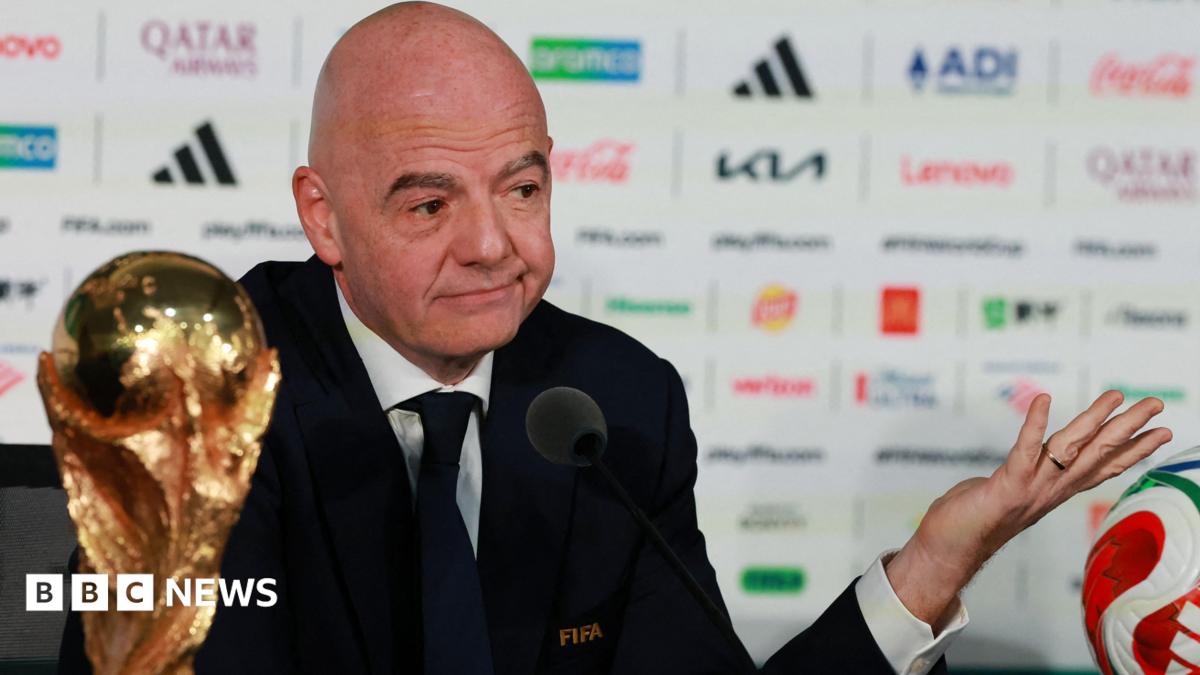
Palestinian football federation president Jibril Rajoub refused to stand alongside Israel FA ⁠Vice-President Basim Sheikh ⁠Suliman in a heated moment at the 76th FIFA Congress.

Both men were called to the stand by FIFA President Gianni Infantino at the event on Thursday, but Rajoub ⁠declined to be brought closer to Suliman, a Palestinian citizen of Israel.

Recommended Stories

list of 4 itemsend of list

Infantino put his hand on Rajoub’s arm and invited him with a gesture to come closer to Suliman, but in ⁠vain.

Asked what Rajoub said when he refused, Palestinian FA Vice President Susan Shalabi, who was in the room, told Reuters: “I cannot shake the hand of someone the Israelis have brought to whitewash their fascism and genocide! We are suffering.”

Israel has denied committing genocide in Gaza.

Infantino ‌then took the stand and said: “We will work together, President Rajoub, Vice President Suliman. Let’s work together to give hope to the children. These are complex matters.”

FIFA President Gianni Infantino with Jibril Rajoub, President of the Palestine Football association during the congress
FIFA President Gianni Infantino with Jibril Rajoub, President of the Palestine Football association during the congress [Jennifer Gauthier/Reuters]

Speaking to the Reuters news agency after the congress ended, Shalabi said Infantino’s attempt to have Suliman and Rajoub shake hands showed little consideration for the Palestinian FA chief’s speech, in which he made yet another plea for Israeli clubs not to base teams in ⁠the West Bank settlements.

“To be put in a position ⁠where to have a handshake after everything that was said, this negates the whole purpose of the speech that the general [Rajoub] was giving,” she said.

“He spent like 15 minutes trying to explain to everyone how ⁠the rules matter, how this could easily become a precedent where the rights of member associations are violated with impudence, ⁠and then we’ll just wrap this under the carpet. ⁠It was absurd.”

Last week, the Palestinian Football Association (PFA) appealed to the Court of Arbitration for Sport against FIFA’s decision not to sanction Israel over clubs based in West Bank settlements.

The PFA has long argued that clubs ‌based in settlements in the West Bank – territory Palestinians seek as part of a future state – should not compete in leagues run by the Israel Football Association (IFA).

FIFA said ‌last ‌month it would take no action against the IFA or Israeli clubs, citing the unresolved legal status of the West Bank under public international law.

Source link

Rep. Young Kim vows push to renew North Korea Human Rights Act

1 of 4 | Rep. Young Kim, chair of the House Foreign Affairs Subcommittee on East Asia and the Pacific, leads a roundtable with 11 North Korean defectors at the Rayburn House Office Building in Washington on Tuesday. Photo by Asia Today

April 30 (Asia Today) — U.S. Rep. Young Kim on Tuesday pledged to work for the swift reauthorization of the North Korea Human Rights Act, which has lapsed for more than six years, vowing to serve as a “voice” for North Korean defectors.

Kim made the remarks while chairing a roundtable at the Rayburn House Office Building in Washington attended by 11 North Korean defectors as part of North Korea Freedom Week.

“I will do my best to ensure the North Korea Human Rights Act is reauthorized as soon as possible in this Congress,” Kim said.

Kim stresses urgency of reauthorization, shifts from English to Korean

Kim opened the meeting in English, noting that she has been involved in North Korea human rights issues for more than 30 years, including 21 years as a congressional staffer and later as an elected lawmaker.

After listening to defectors’ testimony, she switched to Korean without an interpreter, appearing to emphasize her commitment more directly.

“The most important thing from what you said is that we must work together to reauthorize the North Korea Human Rights Act,” she said in Korean.

She highlighted that a key component of the legislation is funding for broadcasting into North Korea.

“Broadcast resources are essential,” Kim said, noting that transmissions into North Korea have weakened, including those from outlets such as Radio Free Asia and Voice of America.

“I will be your voice and speak with my colleagues to ensure the act is reauthorized,” she said.

Susan Scholte, head of the North Korea Freedom Coalition and the Defense Forum Foundation, said Sen. Tim Kaine is preparing to introduce a Senate version of the bill corresponding to the House legislation.

Kim says human rights conditions worsening despite greater information access

Kim said North Korea’s human rights situation has not improved over decades and has in some respects worsened.

“Even after decades, nothing has changed,” she said. “If anything has changed, it is that North Korean people now know more about the outside world than ever before, while crackdowns on external media have reached unprecedented levels.”

She argued that any meaningful change in North Korea must come from within, driven by the spread of information.

“If regime change happens, it must come from inside,” Kim said. “It should begin with people like those here who share information through broadcasting.”

Defectors recount hardships, escapes and role of outside information

Defectors at the roundtable shared personal accounts of life in North Korea and their paths to escape.

One defector said he came to understand the reality of the regime after listening to foreign radio broadcasts, which ultimately influenced his decision to flee.

Another described being detained in Russia after drifting into its waters while fishing and later seeking help from human rights groups after exposure to South Korean media via USB devices.

Others recounted losing family members to starvation, enduring forced labor and being trafficked into China before eventually reaching South Korea.

One defector said she had been forcibly repatriated to North Korea eight times and was separated from her young child, whose fate remains unknown.

Survey shows role of broadcasts, concerns over China surveillance

Kim Ji-young, head of Free North Korea Radio, presented survey results of 75 defectors who arrived in South Korea after 2022.

She said 66% reported accessing foreign broadcasts at least once a week, which inspired aspirations for freedom and motivated their escape.

All respondents said North Korea’s so-called “three major repressive laws” reflect fears of regime instability and efforts to maintain authoritarian control.

Kim also raised concerns about defectors in China, including cases in which children born to North Korean women and Chinese fathers are left stateless, as well as reports that Chinese authorities use artificial intelligence-based facial recognition to track and repatriate defectors.

One participant said she has avoided traveling to China due to fears of abduction or poisoning, adding that South Korean authorities have advised her against visiting.

U.S. lawmaker calls for stronger joint efforts

Rep. James Moylan said the United States and South Korea should strengthen cooperation to bring about meaningful change in North Korea without another decades-long delay.

In an interview with Voice of America, Moylan said radio broadcasting is an effective tool for change, adding that increased access to information, combined with support from advocacy groups and the United States, can help drive transformation.

— Reported by Asia Today; translated by UPI

© Asia Today. Unauthorized reproduction or redistribution prohibited.

Original Korean report: https://www.asiatoday.co.kr/kn/view.php?key=20260430010009822

Source link