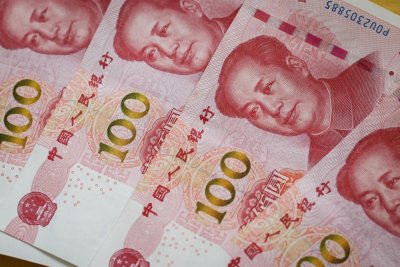

The 100 Chinese yuan or Renminbi (RMB) notes in Beijing, China. Photo by MARK R. CRISTINO / EPA
June 11 (Asia Today) — China’s renminbi, also known as the yuan, has strengthened sharply in recent months as Beijing seeks to elevate the currency’s global standing, but its rapid gains may create new risks for the Chinese economy.
The yuan recently reached its strongest level in three years and three months, prompting some Chinese media to describe the move as an advance by the currency. The trend is expected to continue for the time being.
According to recent reports by Chinese media, including National Business Daily, the yuan was poorly regarded until the end of the last century. Although the official exchange rate hovered around 8.2 yuan per dollar, the currency often traded at about 9 yuan per dollar on black markets in Beijing and other cities.
The yuan’s status began to change after China’s economy expanded rapidly in the early 2000s. After the 2008 global financial crisis weakened confidence in the U.S. economy, the yuan strengthened past 8 per dollar, then 7 per dollar, at times trading in the 6-yuan range.
The currency weakened again early last year and stayed around the 7-yuan level for about a year. Some analysts warned it could fall as low as 7.5 yuan per dollar.
Those concerns proved temporary. The yuan rebounded early this year and returned to the 6-yuan range. It strengthened further and traded around 6.77 yuan per dollar Wednesday, its highest level since Feb. 15, 2023, when it was at 6.8183 yuan per dollar.
Markets widely expect the yuan could strengthen further to around 6.5 per dollar. The currency was worth about 90 won at the end of the last century, but it now trades at about 225 won.
Several factors are driving the yuan’s gains. The prolonged war in the Middle East has increased demand for the yuan alongside the dollar, while China’s large trade surplus, supported by strong exports, has also lifted the currency.
A stronger yuan, however, is not necessarily good for China. It could become a burden for export-dependent companies by making Chinese goods more expensive overseas. Cheaper import prices could also deepen China’s chronic deflationary pressure, which remains a major concern for the economy.
Even so, Chinese economic authorities are not expected to intervene aggressively to slow the yuan’s rise.
Pan Gongsheng, governor of the People’s Bank of China, said during an economic news conference at the National People’s Congress in Beijing on March 6 that the yuan’s recent movement against the dollar reflected China’s stable economic recovery, weakness in the dollar index and a seasonal increase in corporate foreign exchange settlement.
Pan also said China did not need a yuan depreciation, signaling that authorities were comfortable with the currency’s strength.
The yuan’s transformation from a weak and undervalued currency into one with rising global influence has become increasingly difficult to ignore. But its continued ascent could create new pressure on China’s exporters and complicate Beijing’s fight against deflation.
— Reported by Asia Today; translated by UPI
© Asia Today. Unauthorized reproduction or redistribution prohibited.
Original Korean report: https://www.asiatoday.co.kr/kn/view.php?key=20260611010003994