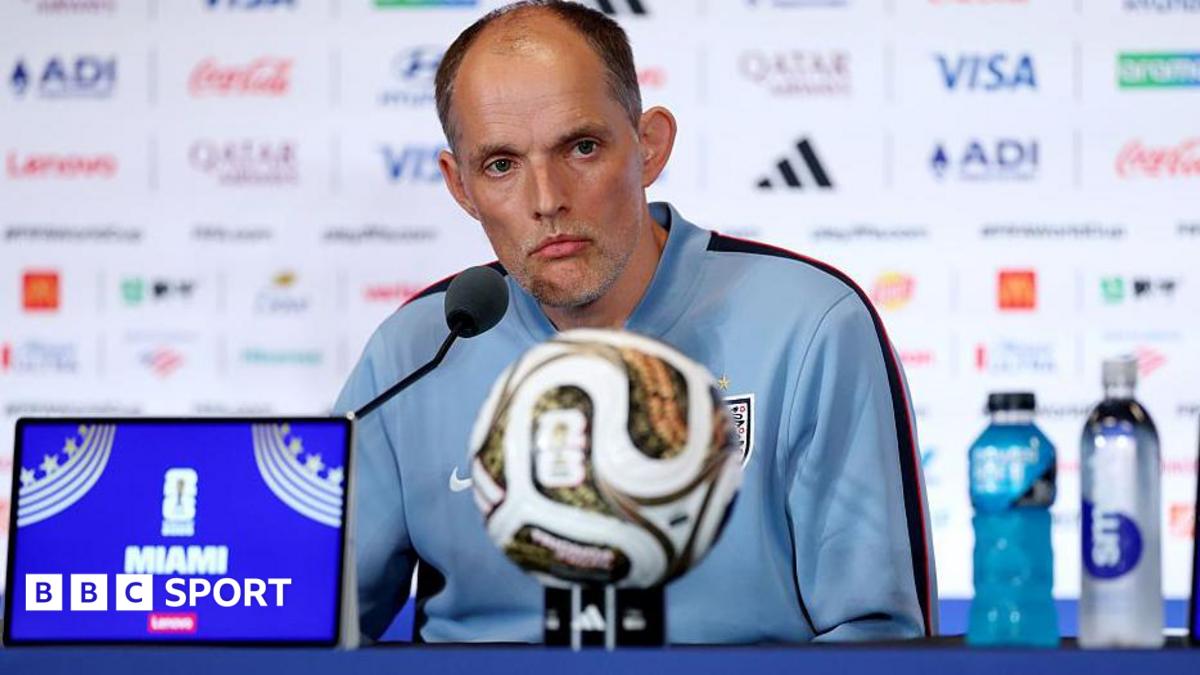
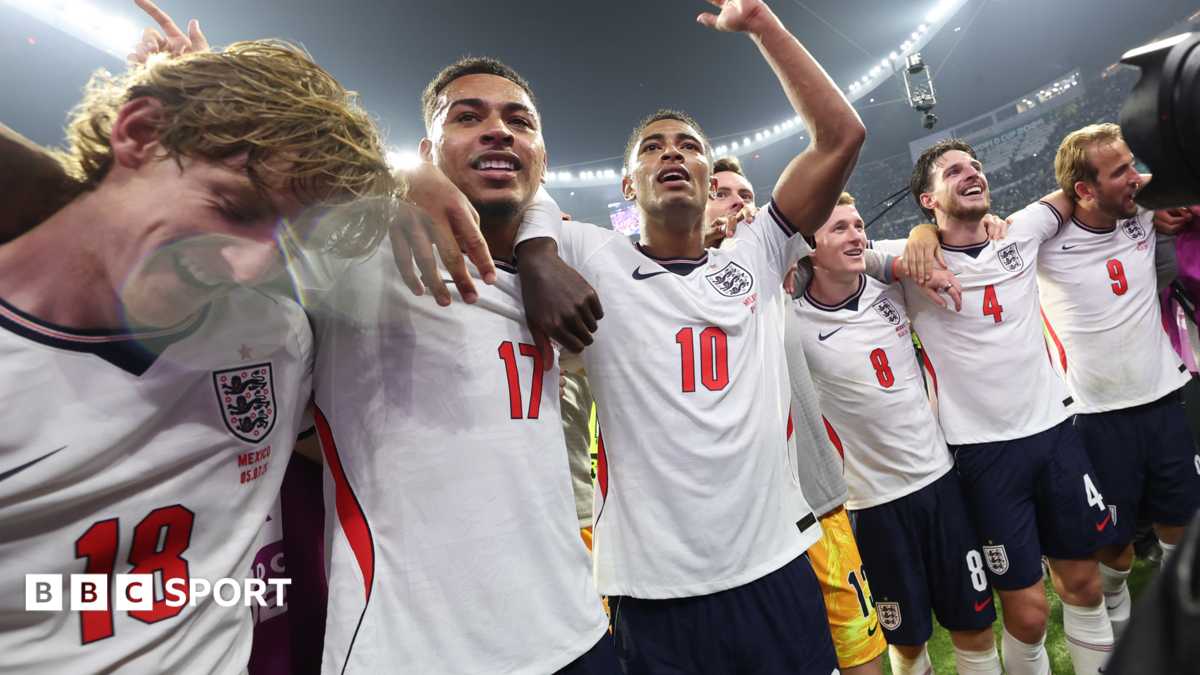
Asked about how he viewed the last 35 minutes of the game having had time to reflect, Tuchel said he felt “the same way – that we were too passive”.
“If you’re asking if I regret my decision, if this is the question, then I don’t regret my decisions,” he added.
“I felt that the momentum switches in the match. And I tried to help my team…
“I took several decisions, trusting my instinct, my intuition, my experience, trusting my competitiveness, and I took the decision in order to help the team and get the result. We didn’t get the result.
“So I take, of course, the responsibility and for these decisions. I would regret if I didn’t help. I would regret if we didn’t react.”
Tuchel said he was not willing to engage “in this kind of game” over who is to blame.
“No problem,” he said. “This is the deal that you sign up for, but I will not engage.
“For me, there is no-one to blame. If you need someone to blame, I take the responsibility. I’m the head coach.”
Asked why England’s record goalscorer Kane played so deep in the latter stages, he said: “What do you mean? Like in the last 30 minutes?
“Why we defended in a deep block. Well, that’s what you do if you defend in a block. We were not active enough.”
Tuchel said Argentina had “played with a lot of momentum after our goal”.
“They had a lot of offensive changes, and a lot of offensive positions,” the 52-year-old added.
“We could not stop the crosses, and we could not stop the runners into the box.
“So we decided to play a back five, to have more width in the field, to be closer to the guys who cross.
“We just became too passive, and Argentina, by the way, found another gear and they found the total flow.
“We played in the semi-final against the reigning world champions.
“We were 85 minutes 1-0 up. We played against the best player in the world, and we lost 2-1, which is painful.”
Tuchel was asked if he had studied data which showed England’s physical performance levels against Argentina were lower than the DR Congo game in the same stadium earlier in the tournament.
He said “even if we don’t want to admit it because it feels like an excuse”, the Mexico game with 10 men in the altitude of the Azteca Stadium and the heat against Norway in Miami “cost us more than we maybe thought”.
“The players literally gave everything physically [in] every single match. If you see this data drop, there must be a reason behind it, because the motivation was through the roof,” he said.
The only thing you might have in common with a World Cup football player is posting on Instagram as soon as you’re back home from a social gathering. Or, in the case of Erling Haaland, while you’re still in the dressing room after a win.
Football’s biggest stars are giving an insider look into the World Cup, their training, and personal lives at the six-week tournament through social media, and for some of them, their following has grown by tens of millions. Their on-pitch heroics, popularity, and personal stories have led them to overnight social media stardom during the World Cup.
Of course, football icons like Cristiano Ronaldo, Lionel Messi, and Neymar have seen an exponential rise in their Instagram following as well. But the 2026 World Cup wasn’t the first rodeo for these veterans, who have an evergreen social media boom outside the tournament.
Al Jazeera Sport takes a look at some of the biggest social media stars from this World Cup:
Erling Haaland — Netherlands
The goofy, witty and relatable six-foot-five-inch (195cm) Viking has been one of the World Cup’s most loveable personalities on the pitch and online.
The 25-year-old Norwegian striker, like many Gen Z social media users, seems to be chronically online when he’s not leading his country to new World Cup heights.
From candid Snapchat stories to Instagram posts right after winning to taking a taxidermied raccoon on the plane ride home, Haaland has become a social media phenomenon this World Cup.
It’s all thanks to his authentic posting style, compared with more carefully curated accounts that PR firms manage for similar high-profile personalities.
Of Haaland’s Instagram following of more than 70 million, 29 million were added in the past 30 days, according to analytics tool Social Blade. He is projected to reach 75 million after the World Cup final and nearly 322 million by the end of the year.
Vozinha — Cape Verde
One of the best feel-good stories of the tournament belongs to Vozinha, the Cape Verde goalkeeper whose heroics kept some of the world’s best teams from scoring a single goal against the island nation — all of which his mother eventually saw in person after she finally received a US visa to attend the World Cup.
He leapt, dived and executed a string of saves in Cape Verde’s tournament opener against Spain to end the match in a shock 0-0 draw. By the time he opened his Instagram a few hours later, his following surged from 500,000 to nearly five million.
It currently sits at 29.3 million followers, and the initial hype around him still stands as his posts garner millions of likes and interactions.
The 40-year-old joked how most people couldn’t even point out Cape Verde on a map before the World Cup, but his team’s standout performance in the group stages and knockout match helped change that.
Jude Bellingham — England
Good looks, loveable personality, Golden Boot contender — is there anything Jude Bellingham isn’t great at? And a massive 50 million Instagram following, of course.
The English midfielder’s World Cup journey may have ended in disappointment earlier this week, but there’s a lot to be said about a player whose fans sing “Hey Jude” for him after leading his team to victory at previous World Cup stages before the semifinal loss.
Bellingham, 23, has gained nearly nine million followers in the past 30 days, according to Social Blade, but his online popularity spiked by three million in October, when he opened up about his struggles with mental health.
Lamine Yamal — Spain
The teen sensation has been on the up and up since bursting to stardom two summers ago with Spain’s UEFA 2024 win, and his social media reflects the cool, candid, level-headed personality he carries on and off the pitch.
The 19-year-old’s Instagram feed is a mix of post-match photos, brand partnerships, multiple trophy wins and pictures with family members with whom he shares a close relationship.
His younger brother, Keyne, has become something of a celebrity at the World Cup, too, with his endearing antics as Yamal shepherds the three-year-old around the stadium pitch or watches him try — and fail — at golf.
The Barcelona striker could see his popularity gain new heights — and more Instagram followers, which currently number 49.6 million — after this Sunday’s World Cup final as Spain take on Messi’s Argentina.
Social media has already been fawning over the full-circle moment that began with a now-viral photo of Messi and Yamal in 2007 for a UNICEF fundraising shoot.
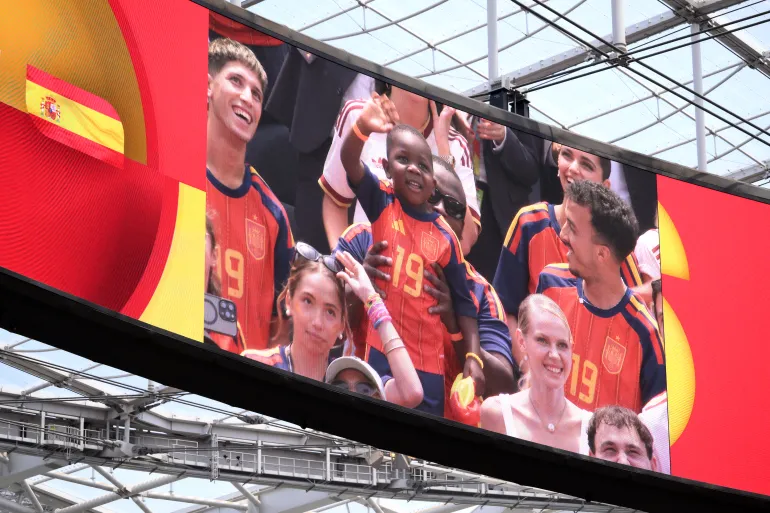
Keyne, the little brother of Lamine Yamal, is seen on the screen during the FIFA World Cup 2026 quarterfinal match between Spain and Belgium at Los Angeles Stadium on July 10 [David Ramos/Getty Images/AFP]
Tim Payne — New Zealand
Payne’s viral moment may have come before the World Cup, but it was touching nonetheless.
The New Zealand defender’s Instagram following exploded late in May after an Argentinian influencer decided he was the least-known player at the World Cup.
Valen Scarsini, known as “elscarso” on Instagram and TikTok, made a video encouraging his audience to give the Wellington Phoenix and All Whites defender’s account likes, comments and follows.
Payne’s Instagram following grew from fewer than 5,000 before the campaign to about 5.8 million, turning the 32-year-old into one of the tournament’s most unlikely viral stars.
He even addressed the outpouring of love in a video on Instagram, and eventually met up with Scarsini at the team’s hotel in Boca Raton, Florida, ahead of the World Cup.
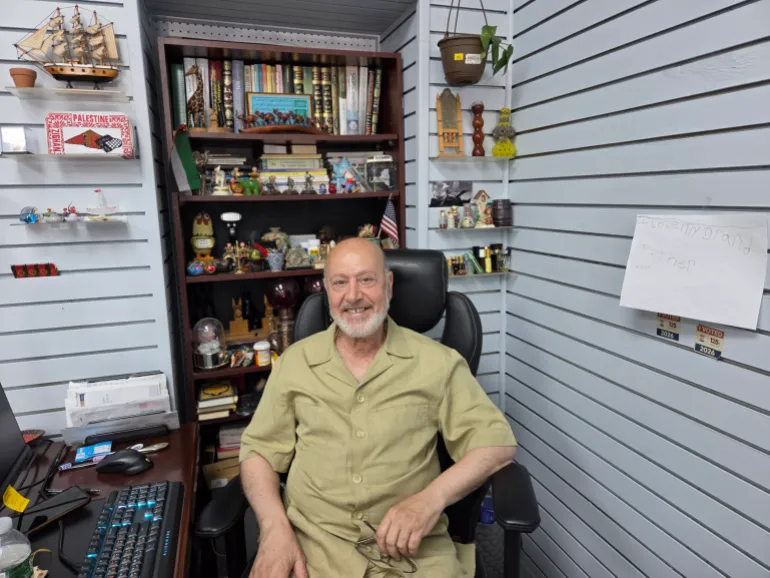
New York, United States – Zein Rimawi says he’s not much of a football fan, but when asked for his pick for the FIFA World Cup final, Rimawi blurted: “Spain.”
“You don’t need to finish the question,” the 72-year-old told Al Jazeera.
Recommended Stories
list of 3 itemsend of list
Sitting in his office in the Bay Ridge neighbourhood of New York with a Palestinian flag behind him, Rimawi said football cannot be separated from politics.
“I support countries that support our causes, especially the Palestinian cause,” added Rimawi, who serves as the chair of the Arab American Federation nonprofit.
His support for Spain, who will face off against Argentina for football’s most prized trophy on Sunday, echoes the sentiments of many among the large Arab American community.
The neighbourhood is nicknamed Little Palestine, but in reality, it is a melting pot of Arab-American and other immigrant communities from across the world.
With the final taking place in neighbouring New Jersey, World Cup fever is raging in Bay Ridge.
Palestinian restaurants, Yemeni cafes, Lebanese grocery stores and corner shops all have the flags of the participating teams displayed.
While the tournament has been a festival of football, Rimawi called it a “political summit”.
So Spain, which recognised the State of Palestine in 2024 and has been a vocal critic of Israel’s genocidal war on Gaza, is a natural choice for Arab fans, he argued.
“I didn’t know who Hossam Hassan was,” he said, referring to Egypt’s head coach.
“But when he raised the Palestinian flag, I instantly became a fan.”
Zein Rimawi speaks to Al Jazeera in Brooklyn, New York, on July 17, 2026 [Ali Harb/Al Jazeera]
‘We’re for Spain with all our hearts’
Across 5th Avenue at Al Reef Bakery, Talal Abdraboh had a similar take.
He said Spain’s support for Palestinians and the Arabs’ presence in Andalusia for centuries make the team endearing to fans in the community.
“It’s not about bias against Argentina. If any team that’s not Arab were facing Spain, we would support Spain,” he said.
“We’re for Spain with all our hearts.”
The bakery has a large mural of the Dome of the Rock in Jerusalem and another featuring a Palestinian woman baking with the words of Palestinian poet Mahmoud Darwish, “I long for the bread of my mother.”
“The Arab community was immersed in this World Cup, especially when Arab teams were playing,” Abdraboh told Al Jazeera as he cut a loaf of bread into vertical strips.
“All the Arab fans were raising the Palestinian flag. So, when any Arab team was playing, we were cheering for them as Palestinians.”
A record eight Arab teams participated in the 2026 tournament, with Morocco going the farthest before losing to France in the quarterfinals.
Egypt made it to the round of 16, but they crashed out after squandering a two-goal lead against Argentina amid a series of controversial refereeing decisions that included ruling out an Egyptian goal for a soft foul in the build-up after a VAR review.
Palestinian American business owner Mahmoud Kasem at his restaurant in Brooklyn, New York, July 17 [Ali Harb/Al Jazeera]
Arab unity
For many Arab New Yorkers, the tournament showcased the community’s unity.
Mahmoud Kasem, the owner of Al-Aqsa Bakery, installed a large TV screen outside his restaurant and gave out free falafel for major Arab teams’ matches, attracting people from across Bay Ridge.
“Not everything is about business. I love soccer. Across the Arab world, we are infatuated with the game. I wanted to create a beautiful atmosphere as we do in Palestine. Put a TV outside and tell people, ‘Come and watch,’” Kasem told Al Jazeera.
“The beauty of it is seeing the Palestinians, the Lebanese, the Moroccans, the Jordanians, everyone get together. I love unity. I love community and being all together.”
He added that he wishes Arab leaders would follow the example of people in the diaspora and eliminate borders and disputes.
Kasem said he convinced police officers who complained about his show partially closing down the street to drop their grievances, invoking the celebrations that took place across the city when the New York Knicks won the NBA championship.
Like many people in Bay Ridge, Kasem is hoping for a Spanish win on Sunday. He highlighted Arab and Spanish cultural, linguistic and musical similarities and lauded the positions of the government in Madrid.
“When Palestine was bombed, they took a stance. When Lebanon was bombed, they took a stance,” he told Al Jazeera. “They stand with humanity. They stand with freedom.”
Kasem added that many Palestinians support Real Madrid and Barcelona in club football.
Beyond the Spanish government, many Spanish celebrities and footballers have expressed solidarity with Palestine.
Last year, the Basque side Athletic Club – home to Spain’s goalkeeper Unai Simon and winger Nico Williams – officially called for an end to the genocide in Gaza.
Kasem said politics should stay out of football, but it was FIFA that politicised the sport after handing US President Donald Trump its inaugural Peace Prize and suspending Russia over the invasion of Ukraine while refusing to ban Israel for the genocide in Gaza.
Pro-Palestine graffiti in the Bay Ridge neighbourhood of Brooklyn, New York, July 17 [Ali Harb/Al Jazeera]
Argentina-Israel vibes
Some fans have linked the Argentinian team to Israel because of the pro-Israel policies of the government of President Javier Melei.
Israeli Prime Minister Benjamin Netanyahu has also expressed support for Argentina. Israeli flags were also spotted during Argentina’s match with Egypt.
But the Argentinian team and players have not taken a position on the conflict.
In 2018, Argentina cancelled a friendly match with Israel in Jerusalem after pressure from Palestinian rights activists.
So some Arab Americans are still backing Argentina, arguing that the magic that Lionel Messi produces transcends politics.
Karim Bouzeraa, a 24-year-old barber in Bay Ridge, said the Israeli flags do not represent Argentinian football.
“Messi is a legend,” he told Al Jazeera. “Twenty years of competition is not something easy. We’ve seen other legends, but no one with the same longevity.”
Bouzeraa said regardless of who’s cheering for whom in the final, it was heartwarming to see Arab fans get behind all of their teams in the tournament.
“At the end of the day, we are all Arabs – one blood. Hopefully in the next World Cup we see many Arab teams, so we can support them,” he said.
United States President Donald Trump has joined criticism of England’s tactics in their World Cup semi-final loss to Argentina, by questioning Harry Kane’s second-half “defensive” role.
Manager Thomas Tuchel’s second-half substitutions have been criticised by pundits and supporters following the 2-1 defeat, as Argentina scored two late goals to set up Sunday’s final against Spain (20:00 BST).
Tuchel reverted to a back five and made a number of defensive-minded substitutions in the closing stages as Lionel Messi inspired a dramatic comeback.
“You have a great player in England who I’ve played golf with. And he is Harry [Kane] who has been fantastic,” said Trump.
“I think they perhaps made a mistake when they made him a defensive player. What do I know about soccer? They took the lead, and they took their best player and put him on defence.
“We got to be a little offensive, right. But no, I’m not going to call it, what do I know about coaching? But that was a little unusual.”
Tuchel was quick to brush off Trump’s criticisms when mentioned to him in a news conference later.
Balogun, 25, was set to miss his side’s last-16 tie against Belgium after being shown a straight red card for a foul on Bosnia-Herzegovina defender Tarik Muharemovic in the previous round.
But Fifa made the shock decision to suspend the automatic one-match ban for 12 months, leading to widespread criticism.
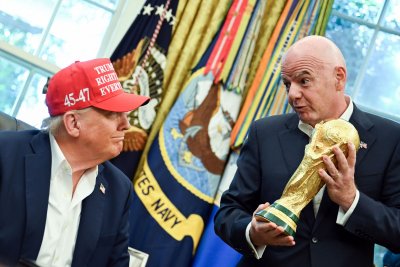
Trump said: “This has been a tournament like no other. Filled with fierce competition, unforgettable moments. Probably the most unforgettable is when they gave that gentleman… is it a red card?
“And I was forced to call Gianni [Infantino]. I said ‘Gianni, I’d like to make a recommendation. Let the guy in the game!’ No, I didn’t say that. I said I’d like to wage a complaint.
“And actually I had no idea what was going to happen, but you know it is so much better the way it worked out because there is no controversy. [Belgium] won the game and our team had all of its players. You made another great decision if you think about it, but you’ll never get credit for it.”
Trump also thanked Fifa president Infantino and described the World Cup in the US, Mexico and Canada as “the most successful sporting event, maybe in the history of the world”.
Infantino said the World Cup had “exceeded expectations”.
“The American dream, Mr President, came to reality. We united the world in America,” he said.
“This is not just the greatest World Cup of all times, it is the greatest human, social and cultural event that mankind has ever witnessed and we are all part of it and for this I thank you very much, Mr President.”
epa11732729 An ambulance drives past a building of Bangkok Hospital in Bangkok, Thailand, 21 November 2024. Australia’s Prime Minister Anthony Albanese told the Parliament that two young Australian tourists died after drinking suspected tainted methanol alcohol in Laos’ Vang Vieng tourist city, while the Australia’s Department of Foreign Affairs and Trade states confirmed to provide consular assistance for two Australians families in Thailand after the two tourists have been transported to Thailand for medical treatments. EPA-EFE/RUNGROJ YONGRIT
July 17 (UPI) — Laos authorities have charged the owner of a distillery whose methanol-laced alcohol killed six travelers, officials said Friday.
The mass poisoning claimed the lives of two Australian teenagers, two Danish women, a British woman and an American man in November 2024.
The tourists became ill and quickly died after consuming alcohol from a popular local bar in Van Vieng.
It was later discovered the drinks were tainted with methanol.
The Laos distillery owner was charged with selling food products harmful to health and operating an illegal business, according to the Danish authorities.
“The charges carry a penalty ranging from three months to four years’ imprisonment, as well as a fine,” Denmark’s Ministry of Foreign Affairs said in a statement to Australia’s ABC.
“The case will formally remain open for 15 years, meaning that more serious charges carrying higher penalties such as negligent manslaughter may still be brought if sufficient evidence can be established.”
But relatives of the victims, as well as government officials, have expressed frustration at the charges, which could see the distillery owner in jail for as few as three months.
“The Australian Government is deeply frustrated and bitterly disappointed that authorities in Laos are not pursuing the most serious charges in relation to the methanol poisoning deaths of Australian citizens Holly Bowles and Bianca Jones,” said Penny Wong, the Australian foreign minister, in a statement. “This devastating news will only add to the immense pain and grief suffered by the families and friends of Holly and Bianca.”
Mark Jones, father of victim Bianca, said feeling “furious would be an understatement.”
“I don’t have words for the disgust that I have with what the Laos authorities are suggesting is meant to be justice for the deaths of six tourists,” he told ABC.
EAST RUTHERFORD, N.J. — The spotlight on Sunday’s World Cup final will shine brightest on two men, one playing the last game of his sixth tournament and the other the final game of his first.
Argentina’s Lionel Messi, 39, is arguably the greatest player in World Cup history, having played more games, scored more goals and collected more assists than anyone who has gone before him. If Argentina wins Sunday, he’ll match another record as captain of the first team to win back-to-back titles in 64 years.
Spain’s Lamine Yamal, who turned 19 on Monday, may be the heir to all that. He’s already scored 56 goals and won seven major trophies for club and country; Messi had 11 goals and four trophies at the same age.
But these are more than just two ships passing in the night. If fact, this isn’t even their first meeting, although neither remembers the day they were introduced in 2007.
Messi was a shaggy-haired 20-year-old, just beginning his unparalleled career with Barcelona while Yamal was a cherubic 3-month-old, just beginning his life. They came together after Yamal’s mother, Sheila, won a raffle run by a local newspaper and Barcelona’s shirt sponsor, the children’s charity UNICEF. She was told the child would pose with an unnamed first-team player for a photo that would appear in a fundraising calendar.
When she carried her son into the dressing room at Barcelona’s stadium for the photo shoot, Messi appeared, having been chosen by chance. The pictures of a clearly uncomfortable Messi helping Sheila bathe her son in a blue plastic tub were published, then forgotten, until Yamal helped Spain win the 2024 European Championship. After the tournament Yamal’s father, Mounir Nasraoui, posted the picture online with the caption “The beginning of two legends.”
Lionel Messi, then 20, helps bathe Lamine Yamal, who was 3 months old, with help from Yamal’s mother, Sheila Ebana, during a photo shoot in September 2007 in Barcelona.
(Joan Monfort/Associated Press)
“It’s unbelievable,” Yamal’s teammate Mikel Merino said Friday. “The first time I saw it, I thought it was AI. It’s funny how life works sometimes. You have these situations you think is scripted by someone. But it’s just how life works, the coincidences of life.”
That they’ll meet again Sunday afternoon at MetLife Stadium seems more like destiny than coincidence, but who wins the reunion may be decided, in part, by factors other than the play on the field. Smoke from nearly 900 wildfires burning in Canada have blanketed a large swath of the U.S., from Chicago to New York, resulting in poor air quality that forced the postponement of one MLS game Thursday.
The sky above the open-air stadium in East Rutherford, N.J., was noticeably clearer Friday and could improve even more with the heavy rains forecast for Saturday. If those rains linger, however, that could also affect what is shaping up to be a battle of the ages.
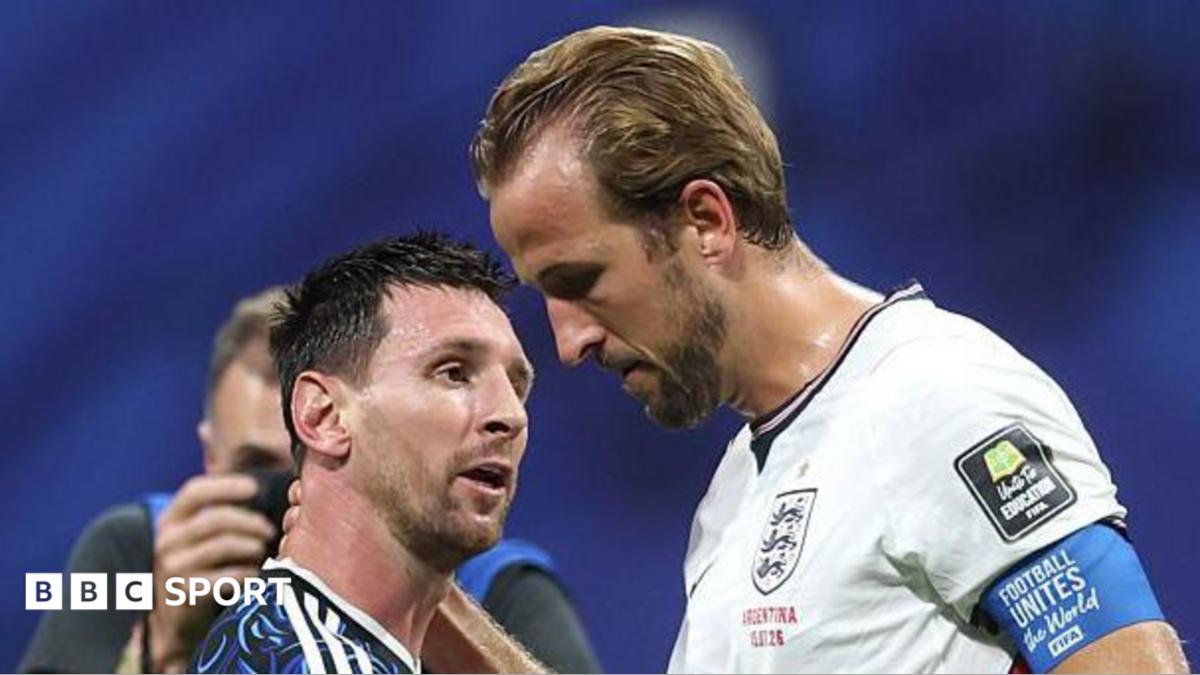
Messi has carried Argentina into its third World Cup final since 2014, matching France’s Kylian Mbappé with a tournament-best eight goals and leading all players with 12 goal contributions. Four of his scores either tied the game or put Argentina in front and in Wednesday’s frantic comeback win over England, Messi assisted on the tying and winning goals seven minutes apart.
He seems guaranteed to win his third Golden Ball, which goes to the tournament’s outstanding player. He’s already the only player to win the award twice.
Yamal now plays at Barcelona, Messi’s home for 17 years, and he’s proven to be the same kind of game-changing left-footed playmaker, leading the team in goals (24) and assists (17) in all competition and winning La Liga’s player of the year award this season. Last year, at 18, he finished second in the voting for the Ballon d’Or, an award Messi won eight times.
He’s been quieter in the World Cup, with just a goal in seven games, but Spain has never lost a match he’s played in, going 21-0-6.
Yamal’s father was born in Morocco and his mother in Equatorial Guinea before moving to Catalonia with their families as children. Yamal grew up in a working-class, largely immigrant neighborhood the Spanish newspaper El País described as “forgotten, isolated and stigmatized.” His parents separated when he was 3 and while both remained present in his life, it was his paternal grandmother, Fatima, who sacrificed to support the boy, managing his daily routine to make sure he attended training sessions.
That devotion paid off when Yamal, then just 7, was invited to live and train at Barcelona’s famed La Masia academy, the same academy the Argentina-born Messi had entered at 13. When Yamal signed his first long-term contract with the team 14 months ago — a contract that could pay him more than $45 million a year in wages, bonuses and sponsorships, making him the team’s best-paid player, as Messi once was — he was given the No. 10 shirt Messi wore.
“In every match he shows that he is the best player in history,” Yamal told a Spanish newspaper. “If someone has doubts, it is because they are looking for them. There is nothing more to say there. For me, he is the best.”
Spain forward Lamine Yamal controls the ball during a World Cup quarterfinal against Belgium at SoFi Stadium on July 10.
(Ronaldo Bolanos/Los Angeles Times)
The comparisons and the praise flatter him, said Messi, who then used the same words to describe Yamal as the best.
“There is a new generation of footballers who are very good and who have many years ahead of them. But if I have to choose one because of age, for what he has done so far and for the future he may have, it is Lamine,” he told the Spanish sports journal Diario Sport in May.”There’s no doubt, for me, he’s the best.”
For all the similarities, there are differences. Yamal plays with much more speed and street-football flair and is far more prolific than Messi was at the same age. And while a young Messi focused almost entirely on soccer, Yamal has learned to speak three languages fluently and, unlike Messi, hasn’t kept his politics hidden, waving a Palestinian flag during the club’s parade through Barcelona celebrating its La Liga title last May.
And remember that charity calendar photo with Messi? The one that raised money for UNICEF? Last month Yamal became a goodwill ambassador for the group, focusing on the right to play and supporting children living through humanitarian emergencies.
Turns out some pictures are worth more than a thousand words.
July 17 (UPI) — President Donald Trump on Friday told FIFA officials they should pick the United States to host another World Cup, so long as they don’t include Canada or Mexico.
“You should choose the United States of America again,” Trump said during a FIFA World Cup reception at Trump Tower in New York, Politico reported. “This time we will leave Canada and Mexico out.”
The next World Cup, in 2030, will be co-hosted by Morocco, Portugal and Spain, followed by Saudi Arabia in 2034.
FIFA has not yet selected a host for the 2038 tournament.
Trump added FIFA should “pick somebody else for the next one and that will take some of the anger, hatred and steam out of everyone,” Politico reported.
Trump has close ties to FIFA President Gianni Infantino.
The president earlier this month said he spoke with Infantino to ask for a reversal of a red card suspension to U.S. soccer star Folarin Balogun.
After Trump’s call, FIFA followed suit and allowed Balogun to play in the following match against Belgium.
“You made another great decision,” Trump told Infantino of the reversal on Friday. “You’ll never get credit for that.”
It made no difference: the U.S. soccer team was eliminated in a 4-1 loss to Belgium.
The World Cup comes to a close on Sunday. Trump said he would be present for the final match between Spain and Argentina.
Spanish midfielder says he has ‘huge confidence’ in his abilities after his impressive performances as a substitute.
Published On 17 Jul 202617 Jul 2026
Spanish super-sub Mikel Merino admitted that neutralising the threat of Lionel Messi will be a “huge challenge” as La Roja prepare for their World Cup final showdown against Argentina.
“It’s a huge challenge, an incredible motivation for me and the whole team,” Merino said of facing Messi in his news conference on Friday.
“Being able to play against a side like Argentina, which has already won this trophy, makes the match even more significant, and I’m very happy to be experiencing this moment,” Merino told reporters at Spain’s training base in East Hanover, New Jersey.
Argentina skipper Messi, 39, has been pivotal in dragging the defending champions into Sunday’s final in East Rutherford, orchestrating a 2-1 semifinal victory over England with two assists.
Messi, the tournament’s joint top-scorer with eight goals, also inspired a dramatic comeback against Egypt in the last 16, when Argentina fought back from 2-0 down with 11 minutes remaining to win 3-2.
Arsenal ace Merino has played a decisive role in Spain’s road to the final, coming off the substitutes’ bench to score late winners in a last-16 defeat of Portugal and a quarterfinal victory over Belgium.
“I have incredible confidence in myself and my abilities, and every time I step onto the pitch, I believe I can make an impact for the team,” Merino stated.
“But honestly, it doesn’t matter who the hero is; the important thing is that the team wins in the end. “When you win a title, it belongs to everyone, not just the starting 11,” he added.
Merino, meanwhile, enthused about the “impressive” talent of 19-year-old Lamine Yamal, who will face Messi for the first time in a clash representing the past and the future of FC Barcelona.
Merino, 30, predicted that the final would be “an intense match” and that the referee would need to “control the intensity and frequency of challenges and fouls”.
“The faster the ball moves between us, the less time the opposition has to commit a foul,” he noted.
The midfielder, who said he did not have “very clear memories” of Spain’s first World Cup title in 2010, recalled the admiration of that trailblazing side.
“Being able to represent our country today and be those same players for new generations – for the children watching us – is something magical,” he said.
Brazilian Foreign Minister Mauro Vieira participates in a press conference in Brasilia on Thursday after the announcement of new U.S. tariffs on Brazilian goods. ‘It is clear that what bothers the U.S. government is that Brazil did not give in to the excessive demands and unreasonable requirements made during the negotiations,’ Vieira said. Photo by Andre Borges/EPA
BRASILIA, Brazil, July 17 (UPI) — Brazil’s government has delayed plans to invoke its Reciprocity Law after the United States imposed a 25% tariff on Brazilian exports. It opted instead for a more cautious strategy aimed at avoiding a broader trade conflict.
After meetings between the government’s economic team and the country’s leading industrial groups, President Luiz Inacio Lula da Silva‘s administration paused previous plans for immediate retaliatory measures.
According to Brazilian media reports, officials are concerned that reciprocal tariffs could trigger a trade war, increase the cost of imported inputs and drive up consumer prices in Brazil.
Industrial associations argued that the production chains of both countries are highly integrated, and that making U.S. imports more expensive would also hurt Brazilian manufacturers, CNN Brasil reported.
The Brazilian government also announced a support program for companies affected by the U.S. tariff.
“We already have mechanisms to protect our companies and our jobs,” Deputy Finance Minister Dario Durigan said. He added that, in coordination with affected industries, the government will strengthen the Brazil Sovereign Plan, which supports businesses “unfairly harmed by the increase in U.S. tariffs,” according to G1.
Analysts say Lula’s administration is expected to exhaust all negotiation channels before escalating the dispute, although they acknowledge that the prospects for direct bilateral negotiations with Washington are limited.
The Office of the U.S. Trade Representative has concluded its Section 301 investigation, determining that Brazil maintains “unfair trade practices.” That finding has left Brazilian diplomats with little room to continue technical negotiations.
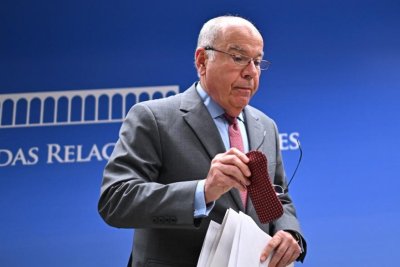
Brazilian Foreign Minister Mauro Vieira on Thursday rejected Washington’s demands as “excessive and unreasonable.” He said U.S. negotiators had sought concessions that would undermine Brazil’s economic sovereignty in sensitive areas, including the country’s Pix instant payment system and environmental regulations.
Brazil’s manufacturing sector, particularly higher value-added industries, is expected to suffer the greatest impact from the 25% tariffs scheduled to take effect July 22. The measure will affect about 3,000 Brazilian products, representing nearly 18% of Brazil’s exports to the U.S. market, according to O Globo.
To limit the impact on everyday consumer goods in the United States, the Trump administration excluded products such as coffee, oranges and concentrated orange juice, beef and grains from the new tariffs.
With little indication that the White House will soften its position, Brazil has shifted its strategy away from direct bilateral negotiations and toward legal challenges before the World Trade Organization and the gradual use of its Reciprocity Law.
The government’s primary legal strategy will be to challenge the legality of the unilateral tariffs before the World Trade Organization.
Brazil has not ruled out using the Reciprocity Law, which was unanimously approved by Congress. The legislation authorizes Brazil to impose tariffs on the 76% of U.S. products that currently enter the country duty-free and even suspend intellectual property rights.
However, officials said implementation will be delayed while the government evaluates the economic impact of the U.S. measures.
“It is important to emphasize that we have the Reciprocity Law, unanimously approved by the National Congress, and the government will know how to implement it at the appropriate time,” Vice President Geraldo Alckmin said.
He said the law is not intended as retaliation but rather as a measure “that defends the national interest, the interests of Brazilians and the Brazilian economy.”
July 17 (UPI) — Italy returned to Mexico a collection of 27 pre-Columbian archaeological artifacts and fossils recovered during separate investigations into the illicit trafficking of cultural property, authorities from both countries said.
The handover occurred Thursday at the Mexican Embassy in Rome, where the Italian Carabinieri’s Cultural Heritage Protection Unit officially delivered the items to Mexico’s ambassador to Italy, Genaro Lozano.
The artifacts will be transferred to Mexico after being cataloged by the National Institute of Anthropology and History, the institute said.
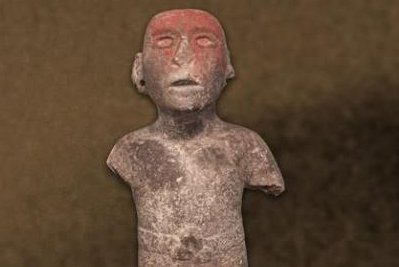
The collection includes three Teotihuacan heads dating from 200 B.C. to A.D. 650, two Maya terracotta figurines from the Early Classic period, a tripod bowl, 16 other pre-Columbian artifacts and three Late Cretaceous fossil fish, according to the National Institute of Anthropology and History.
The artifacts were recovered during investigations carried out by Italian authorities in Florence, Rome, Monza, Ancona and Venice.
The objects were found in customs inspections, private collections, online auctions and e-commerce platforms, while the fossils were intercepted in an illegal postal shipment from the Mexican state of Nuevo León, the National Institute of Anthropology and History said.
Brig. Gen. Antonio Petti, head of the Carabinieri unit for the protection of cultural heritage, said the artifacts are in an “absolutely excellent state of preservation” after being recovered during separate operations targeting the illegal trafficking of cultural property, according to El Observador, which cited comments he made to EFE.
During the ceremony, Lozano said the artifacts “represent the living history of Mexico” and said their value lies in “memory, justice, and recovering and keeping history alive,” according to the National Institute of Anthropology and History.
The diplomat said the restitution is part of the “My Heritage Is Not for Sale” campaign launched by the Mexican government to recover cultural property illegally removed from the country.
Since 2013, Italy has returned more than 840 cultural objects to Mexico through cooperation between the two countries to combat the international trafficking of archaeological heritage, the National Institute of Anthropology and History said.
The institute said the 27 pieces have been classified as archaeological monuments and, under Mexican law, are the inalienable property of the nation.
Once they arrive in Mexico, cultural authorities will decide whether the artifacts will be displayed in national museums or returned to the regions from which they were removed, the National Institute of Anthropology and History said.
Hello! I’m Mark Olsen. Welcome to another edition of your regular field guide to a world of Only Good Movies.
I have been writing this newsletter, most weeks, for more than 10 years now. I wouldn’t even want to do the math on how many of them that would be, or just how many movies I have written about. That count is about to come to a close as this is the last one.
Don’t worry: I will still be covering the world-class scene of moviegoing in Los Angeles as well as writing about a broad swath of films and filmmakers, just finding new ways to go about it.
When this newsletter began, it was a catch-all for movie coverage and related events from The Times and eventually settled into a curated survey of the best new releases each week. We helped figure out what you should go see. As theaters reopened following the closures forced by the pandemic, the repertory scene in Los Angeles exploded, with new audiences turning out for old movies in astonishing numbers.
We followed their lead, flipping the focus of the newsletter to the rep scene while still keeping an eye on new releases. Venues around the city had a newly revived energy to match audiences’ enthusiasm. The Academy Museum opened with two gold-standard theaters, while the American Cinematheque expanded the number of screens it programs. (Just recently, it added the historic Village Theater in Westwood.) The Vista began bringing first-run films in 35mm and 70mm, along with classic movies. Vidiots opened in Eagle Rock, helping to redraw the map of L.A.’s movie-loving community.
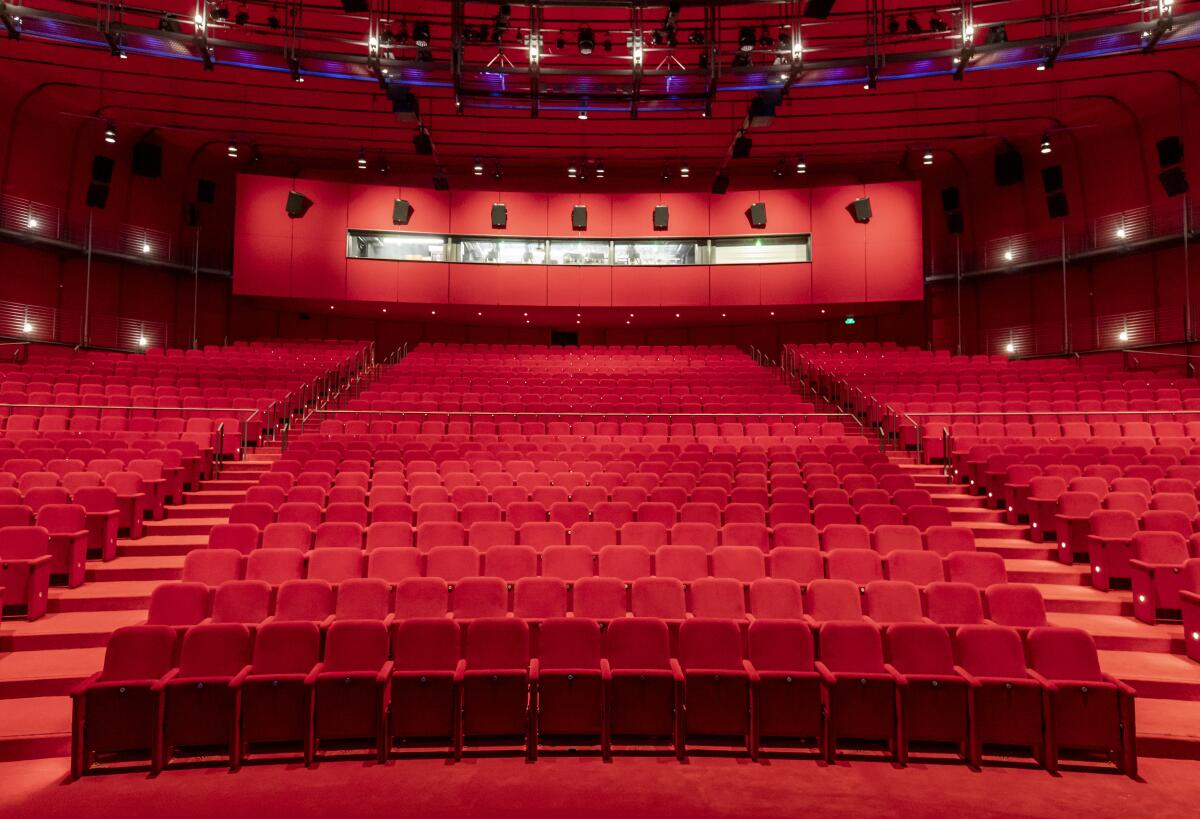
The David Geffen Theater at the Academy Museum seats a thousand and is often fully attended.
(Ricardo DeAratanha / Los Angeles Times)
The city has also seen the rise of itinerant pop-up series such as Mezzanine, Acropolis Cinema and Hollywood Entertainment pulling off must-see events. Smaller venues such as Now Instant Image Hall, 2220 Arts + Archives, Eastwood Performing Arts Center, Brain Dead Studios and the Philosophical Research Society have made a home to all kinds of movies. The Laemmle and Landmark chains have continue to play traditional arthouse releases and international films, while the Frida and Gardena theaters bring great movies to the South Bay.
Entities such as Revival Hub and MovieTown do a vital job of collating extensive listings info. (We will also continue to give monthly overviews of the best movies to see.) This is simply an incredible time for going to the movies in Los Angeles, arguably the best ever.
My main takeaway from the experience of working on this newsletter is confirmation of my belief in the movies themselves and the community of people around them. I was recently at a sold-out screening of Akira Kurosawa’s “Ran” and the idea of sitting with nearly a thousand other people watching a Japanese movie from the 1980s, each connecting to the events on screen in their own way, was deeply inspiring.
Among my favorite recent developments is how many venues now name the show’s projectionists as part of a screening’s introduction, which is always met with an enthusiastic round of applause. It is a reminder that what this is really about is people, dedicated to something we love.
And since this isn’t really a goodbye, it seems fitting to turn to the movies once again, as another week demonstrates why the scene here in Los Angeles is so truly special.
A tribute to Sam Neill
Sam Neill and Nicole Kidman on the set of 1989’s “Dead Calm.”
(Michael Ochs Archives / Getty Images)
Anyone looking for an example of just how intimate the screening scene in Los Angeles can be should make their way to the New Beverly Cinema on July 24. The theater already had a three-night double-bill of Rob Reiner’s “Misery” and Phillip Noyce’s 1989 thriller “Dead Calm” booked when news broke last weekend that actor Sam Neill had died at age 78.
The New Bev quickly announced that it would make one of those screenings into a tribute to Neill, who co-stars in “Dead Calm.” Director Noyce, along with co-star Billy Zane and filmmaker Roger Donaldson (who worked with Neill on 1977’s “Sleeping Dogs”) will all be there to celebrate their friend and colleague.
“Dead Calm” is a tight thriller set within the confines of a small sailing boat. Reviewing the movie when it was first released in 1989, Sheila Benson wrote, “Neill is probably one of the screen’s most underrated actors … ‘Dead Calm’ was probably far and away his nastiest assignment physically, yet his presence, sexuality and all, is absolutely vital to the balance of the story.”
Remembering the actor as part of a rundown of his greatest performances, Glen Whipp described Neill in “Dead Calm” as “part Cary Grant, part MacGyver.”
Two by Ross McElwee
Documentary filmmaker Ross McElwee in his 1986 movie “Sherman’s March.”
(Music Box Films)
Documentary filmmaker Ross McElwee helped to reinvent the form with his 1986 film “Sherman’s March,” which comes with the explanatory subtitle of “A Meditation on the Possibility of Romantic Love in the South During an Era of Nuclear Weapons Proliferation.”
Ostensibly a film about Union General William Tecumsah Sherman’s campaign of destruction during the Civil War, the movie actually ends up being about McElwee revisiting old girlfriends and forging a few new ones along the way, reflecting on his own campaign of romantic misadventure. As charming as it is revelatory, the movie is being rereleased in a new 4K restoration.
McElwee’s latest film, “Remake,” reflects on the death of his son Adrian and whether the director himself had a detrimental effect on the boy’s life. Reviewing “Remake,” Tim Grierson calls it “especially revealing — both in terms of the glimpses we get of this father-son relationship and of unsolved mysteries that linger just outside the frame.”
A weekend with Robert Rodriguez
Quentin Tarantino, George Clooney and Salma Hayek in the horror movie “From Dusk Till Dawn.”
(Academy Museum)
The Academy Museum will present “A Weekend with Robert Rodriguez” to celebrate the 30th anniversary of “From Dusk Till Dawn” and the 25th anniversary of “Spy Kids.” It speaks to Rodriguez’s undersung range as a filmmaker that one movie is a bawdy, gory comedy about a criminals on the run who encounter an ancient den of vampires, while the other is a family-friendly tale of two siblings who discover their parents are secret agents and must rescue them from a supervillain.
Rodriguez will not only be present to talk about both movies, he will be performing music each day with a different band.
Reviewing “From Dusk Till Dawn,” which was scripted by Quentin Tarantino, Jack Matthews said it was “a film nerd’s fever dream, a Frankenstein’s monster of used movie parts, deliberately mismatched styles, and deliriously implausible characters.”
Elaine May’s secret success
Dustin Hoffman and Jessica Lange in the movie “Tootsie.”
(Everett Collection / Columbia Pictures)
One of the most exciting things about the ongoing revival of L.A.’s repertory scene is the upheaval of the notion of the “canon.” What are the most lauded movies of all time and who gets to do the lauding? Case in point is the now widely accepted coronation of Elaine May as a towering creative figure, no longer relegated to being merely a fringe character unfairly saddled with the commercial failure of “Ishtar.”
May is credited as director on only four feature films, though she’s an uncredited writer on a number of other projects, perhaps most notably 1982’s comedy “Tootsie,” starring Dustin Hoffman as a struggling New York City actor who finds success when he lands a part by secretly posing as a woman. Directed by Sydney Pollack, who also makes a tremendous turn as Hoffman’s agent, the movie will be playing at Vidiots on Saturday.
Finding new moves
Wiley Wiggins and Patrick Riester in the movie “Computer Chess.”
(Kino Lorber)
The very first thing I ever wrote under the banner of Indie Focus was about how independent filmmakers such as Andrew Bujalski and Alex Ross Perry were working on 35mm at a time when mainstream Hollywood was very much forcing the idea of shooting on digital. So it only seems appropriate that this final edition of the newsletter should include something on Bujalksi, who has long been one of my favorite contemporary American filmmakers.
“Computer Chess,” Bujalski’s oddball experiment in using antiquated video equipment to tell a heady, offbeat story about a weekend chess tournament in the early ’80s, will screen in a 35mm print at Brain Dead Studios on July 24, presented by Mezzanine. Bujalski will be present, along with Blair Barnes, a filmmaker who will be showing the L.A. premiere of his short “sitrep,” also shot on an analog-era tube camera.
New this week
Matt Damon and Zendaya in the movie “The Odyssey.”
(Melinda Sue Gordon / Universal Pictures)
Sure to be one of the biggest movies of the year, Christopher Nolan’s adaptation of “The Odyssey” opens today. Los Angeles audiences have multiple venues to choose from that are showing the film in Nolan’s preferred Imax 70mm format — these theaters are among only a small number across the world that are doing this. Presenting a movie in Imax 70mm isn’t the easiest endeavor. Eloise Rollins-Fife has a report on how that’s actually done. Get your epic on.
Reviewing the movie, Amy Nicholson wrote, “Nolan refuses to tremble before the canon. Grabbing mighty scissors, he cuts and rejiggers Homer and a bit of Virgil to transform these classical texts into his type of tale: one fixated on memory, self-identity, destructive genius and the slippage of time. As ever, it’s light on sex, heavy on wine-dark angst.”
Kenneth Turan spoke to Nolan about the movie’s origins, saying, “I’ve been telling this story in all my films for years. It’s a family story, a love story, a revenge story, a war story, a coming-of-age story. It’s a very strong foundational text for me.”
July 17 (UPI) — Israel’s parliament, the Knesset, voted to dissolve on Friday after pushing through controversial legislation favorable to Prime Minister Benjamin Netanyahu‘s supporters.
The Knesset is expected to be in recess until the Oct. 27 election in which Netanyahu is seeking re-election.
Analysts told CNN most of the legislation passed in the government’s closing days was meant to appease Netanyahu’s far-right and ultra-Orthodox — or Haredi — allies, thus ensuring his success in October’s election.
The motion to disband parliament was tacked on to a financing bill that increases public funding for political parties during elections, The Times of Israel reported. Opposition leader Avigdor Liberman said the legislation was an abuse of taxpayer money, calling it a “contemptible attempt to tie the end of the session to increasing funding.”
The Knesset voted 62-0 in favor.
Political analyst Nadav Eyal said Netanyahu is trying to show his ultra-Orthodox allies that he’s the only leader who will support their issues.
“Netanyahu is fighting for his political survival, and the Haredi parties are essential to it,” Eyal wrote.
If he stays in power until the October election, Netanyahu will be the first Israeli prime minister to complete a full term in office since 1988.
Among the legislation pushed through in the final days of the 25th Knesset were laws reducing the powers of the attorney general, easing actions against Haredi draft dodgers and increasing government oversight of media companies.
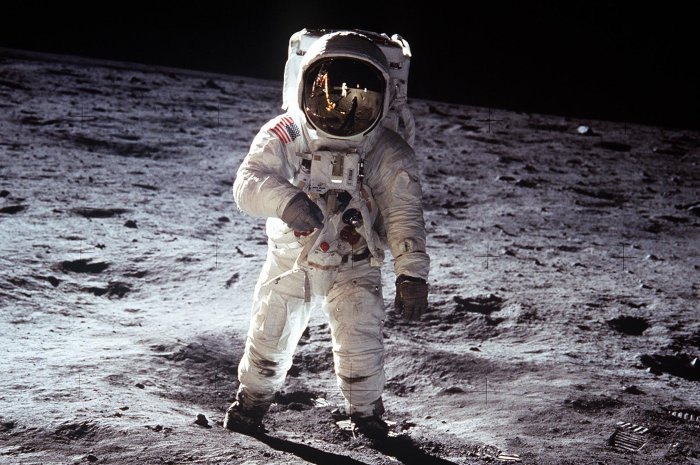
Astronaut Buzz Aldrin walks on the surface of the Moon during the Apollo 11 mission on July 20, 1969. Photo by NASA/UPI | License Photo
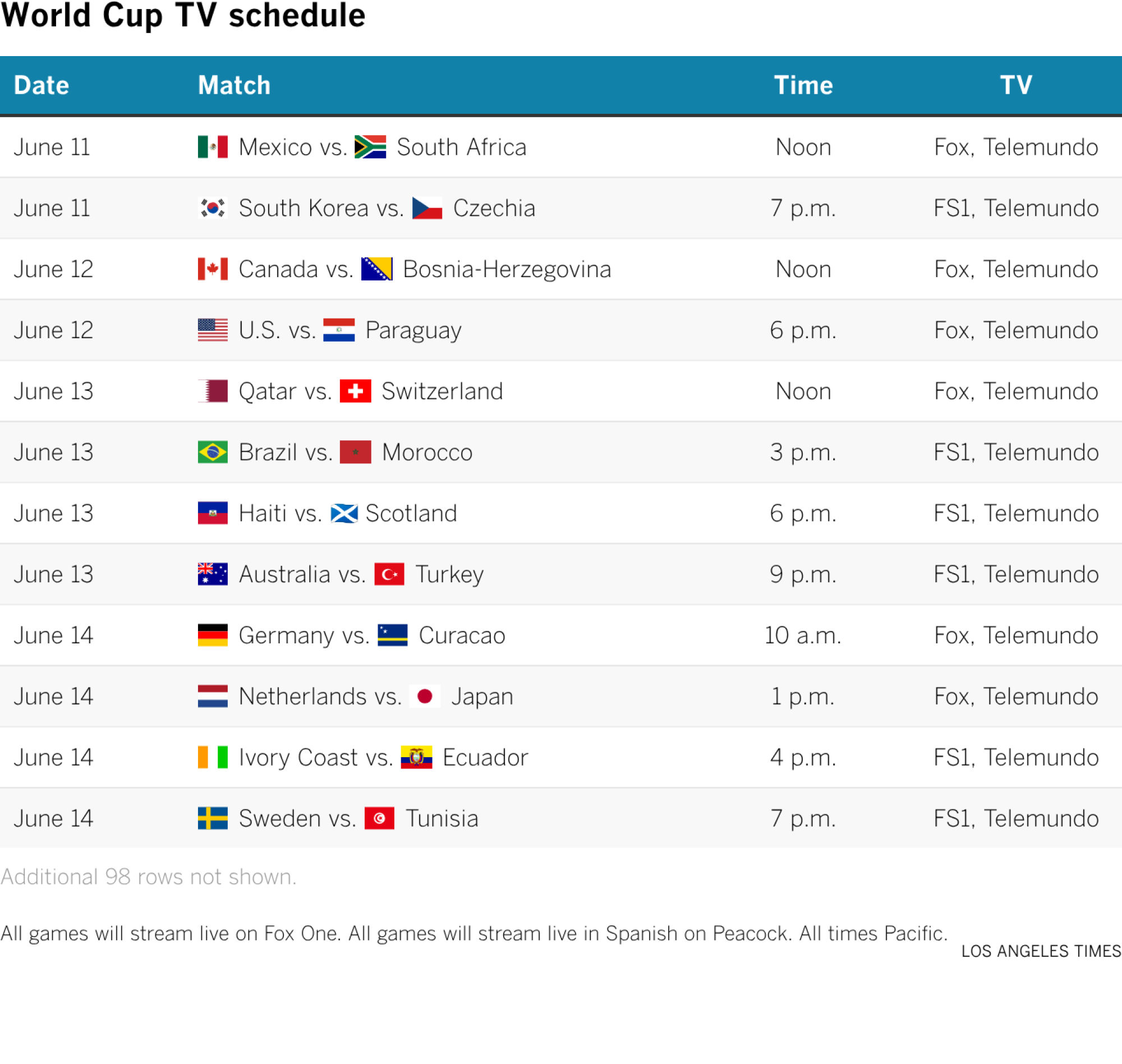
The final weekend of the 2026 FIFA World Cup is here, with France and England playing for third place on Saturday before defending champion Argentina takes on 2010 winner Spain for the title on Sunday.
Here’s everything you need to know about the last two matches of the 39-day, 48-team tournament in North America (all times Pacific).
Saturday’s third-place game
France vs. England
France star Kylian Mbappé smiles during a World Cup semifinal match against Spain on Tuesday.
(David Ramos / Getty Images)
Where: Hard Rock Stadium, Miami Gardens, Fla. Time: 2 p.m. TV: Fox, Telemundo | Streaming:Fox One, Peacock
The buzz: This is a game neither team really wants to play. The disappointment of missing the final is fresh and the weather report calls for temperatures in the high 80s with 68% humidity and a chance of thundershowers — a brutal South Florida summer day. The $2-million difference in prize money between third and fourth place isn’t likely to make any of that more palatable. Still, the game will have meaning for France since it will be the final match for coach Didier Deschamps, the winningest World Cup manager in history. And captain Kylian Mbappé, tied with Argentina’s Lionel Messi for most goals in the tournament (8), has a chance to become the first player to win consecutive Golden Boots. England is playing in the consolation final for the second time in three World Cups; it lost to Belgium 2-1 in 2018. But this one will probably sting even more since the Three Lions were five minutes away from their first final in six decades before collapsing against Argentina. This could be the last World Cup game for England’s Golden Generation of Harry Kane, Jordan Pickford, John Stones and Jordan Henderson.
Sunday’s championship game
Spain vs. Argentina
Argentina star Lionel Messi celebrates after a win over England in the World Cup semifinals on Wednesday.
The buzz: Argentina has a chance to become the first repeat World Cup champion since Brazil in 1962, which would give Messi another grand achievement in his sixth and likely final World Cup. Messi enters the weekend as the all-time leader in goals, assists and games played in tournament history. But unbeaten Argentina hasn’t made things easy, with its winning goals in the four knockout-round games coming in the 92nd minute or later. Spain, the reigning European champion, will be playing to put a second star on its jersey to match the one it won in 2010. La Roja, with the sixth-youngest roster in the World Cup, got to the final on the strength of spectacular defense led by Unai Simón, who has six clean sheets in seven games. Mikel Oyarzabal is the team’s leading scorer with five World Cup goals. The teams had one common opponent in this tournament, tiny Cape Verde, a World Cup debutante. It played Spain to a scoreless draw in its opener, then held Argentina to a 1-1 standoff into extra time before falling.
Japan’s Parliament voted Friday to revise the law regarding the royal succession that has been in place since 1947, expanding the number of eligible heirs to distant male relatives but did not relax the ban preventing Princess Aiko (pictured), or any other female royal, from ascending the Chrysanthemum Throne. File Photo by Keizo Mori/UPI | License Photo
July 17 (UPI) — Japanese lawmakers adopted measures Friday to bolster the dwindling ranks of the country’s royal family but ignored public backing to permit female succession to the Chrysanthemum Throne in favor of allowing the family to adopt distantly related male kin.
The first major change to the law in almost 80 years legalizes the adoption of males born to former imperial branch families descended from emperors, provided they are 15 or older, as well as allowing female royals to marry outside the family without forfeiting their imperial status.
Males adopted into the imperial family will be permitted to succeed Emperor Naruhito over female members of the royal family, including his popular 24-year-old daughter, Princess Aiko, who remains excluded from the succession.
The children of female royals who marry commoners will remain forever commoners and be recorded on the Basic Resident Register in line with the majority of ordinary Japanese citizens.
The move tabled by Prime Minister Sanae Takaichi’s ruling conservative Liberal Democratic Party coalition drew criticism from the opposition over concerns not enough parliamentary time had been allocated to debate the issues and their push to maintain a succession where only males descended from the paternal line can ascend the throne.
The revision, part of the LDP-Japan Innovation Party coalition’s manifesto, expands the three male heirs who could succeed 66-year-old Naruhito to include unmarried males of 11 former branch families who may now legally become part of the imperial family, which is down to just 16 members.
Prior to the revision, the survival of Naruhito’s line hinged on his nephew, Prince Hisahito, producing a male heir.
The other two immediate heirs to Naruhito are his brother, Crown Prince Fumihito, and his uncle — but they are aged 60 and 90-years-old, respectively.
The throne has been passed down through the male line for all of its history, said to be more than 26 centuries, although there is doubt over whether some of the earlier emperors were real; several of those whose existence has been confirmed were female.
Astronaut Buzz Aldrin walks on the surface of the Moon during the Apollo 11 mission on July 20, 1969. Photo by NASA/UPI | License Photo
Away from the football itself, one of the major stories out of the 2026 World Cup has been the conditions that players – and fans – have faced during matches.
While England did benefit from some fixtures being played in air-conditioned stadiums with roofs, such as in Atlanta against DR Congo, other conditions were less forgiving. Those included the stifling humidity and soaring temperatures in Miami for their quarter-final against Norway.
The much-discussed altitude of Mexico’s Azteca stadium for England’s round of 16 match against the co-host nation was perceived to be a major hurdle for the squad to overcome. That was before you took into account Mexico’s fearsome home record and notoriously raucous atmosphere at the ground.
Despite this, England adapted well and never seemed to be struggling due to the external factors imposed on them during games – or at least, managed to struggle less than their opponents.
While pre-tournament training camps to adjust to the conditions will have helped with preparation, it is testament to the players’ mental and physical strength that they managed to persevere in oppressive conditions better suited to opponents accustomed to playing in extreme weather. That could stand them in good stead for the more familiar conditions that will be present at Euro 2028.
There’s a small dock at the back of the restaurant where kayakers, paddle boarders and anyone else travelling along the river can order and collect their food.
The dock has been open for 11 years now, after launching in in 2015.
Taupō,New Zealand
There’s a McDonald’s restaurant inside this disused planeCredit: Alamy
The original plane stairs lead diners into the restaurant which has room for 20 people across 10 tables – even the plane’s cockpit has been preserved behind a glass wall.
The previous airline name has been replaced with “McDonald’s” and the tail end of the plane features the classic golden arches.
Outside, there’s also a playground for kids.
McDonald’s, Guatemala
Would you guess that this courtyard is inside a McDonald’s in Guatemala?Credit: Tripadvisor
AS A kid, we all dream of going to Disney World, but what if I told you, you could actually live there?
Well, you can in Disney-themed houses littered with subtle details from hidden Mickeys to Beauty and the Beast character door knobs.
Mum and content creator Cristie Anne has a home in Disney WorldCredit: Cristie Anne / @thetravelingred
Mum and content creator, Cristie Anne, and her family bought a house in Golden Oak at Disney World Florida back in 2020 – the exclusive community that is directly on Disney property.
In fact, it is so exclusive that only residents are allowed into the community where there are 300 homes, as well as a clubhouse, a pool, a coffee bar and a fitness suite.
“We always have neighbourhood events and we have met some of the nicest people there.”
Cristie Anne added: “At the time, Charlie [her daughter] was just two-years-old, so the idea of having a place where our family could spend time together while being so close to Disney felt absolutely perfect.”
And with Mickey Mouse himself as your neighbour, there are obviously some big perks including being just minutes away from both the Epcot and Magic Kingdom parks.
Instead of battling for a car parking space, residents simply make a call to be picked up and then they’ll be dropped directly at the park.
The parks are just a few minutes from the houseCredit: Cristie Anne / @thetravelingredThe house is part of an exclusive community called Golden OakCredit: Cristie Anne / @thetravelingred
Cristie Anne said: “A Golden Oak van will take us directly to the parks and drop us right at the front entrance. They’ll actually take us anywhere on Disney property.
“Being able to decide at breakfast that you want to spend the afternoon in a Disney park and be there just minutes later is something I never take for granted.”
In addition to a concierge team and a full calendar of events, the community also gets front row seats to the theme park’s daily fireworks, without even leaving their homes.
“Our third-floor reading room has the most perfect view of the Magic Kingdom fireworks.
“We can hear them a little from inside, but from up there the view is incredible,” she said.
Every house in the community is unique, with Cristie Anne’s home being inspired by Belle’s cottage from Beauty and the Beast on the outside.
On the inside, you can expect a Winnie the Pooh room as well as a bedroom with Bambi-inspired bunk beds, complete with a Mickey seared into the wood.
There’s even a ‘Haunted Mansion’ in one of their walk-in cupboards.
She added: “Some of the themed rooms inside our neighbours’ homes are absolutely incredible and would completely blow you away.”
When asked about the mistakes tourists make when visiting Disney World, Cristie Anne simply replied: “Trying to do too much.”
A lot of the homes have subtle theming inside including hidden MickeysCredit: Cristie Anne / @thetravelingredThe exterior of Cristie Anne’s home is themed around Belle’s cottage from Beauty and the BeastCredit: Cristie Anne / @thetravelingred
She added: “People spend months planning and then arrive with a schedule so packed that they’re stressed before they even walk through the gates.”
Instead of checking rides off a list, Cristie Anne recommends slowing down, watching the parade, exploring a resort and hunting for a great meal.
Or she simply lets her daughter lead the day, instead.
“You’ll enjoy Disney much more if you leave room for spontaneity, and if you’re well rested,” she added.
And of all the spots to enjoy, Cristie Anne of course has some hidden gems up her sleeve, confessing that many people don’t leave the parks but should.
She revealed: “Disney’s resorts are attractions in their own right. The lobbies, restaurants, seasonal decorations, and activities create an entirely different side of Disney that most tourists never experience.
“If I had to pick one specific experience, I’d recommend visiting Animal Kingdom in the evening.
“Many guests leave early, but Pandora at night is one of the most beautiful places anywhere on Disney property and feels completely different after dark.
“It’s more romantic and there’s great restaurants. If we just want something quick and simple, we love Nomad Lounge. If we want a full meal, Tiffin’s is fantastic. Animal Kingdom in the evening could be a great date night without all the chaos.”
She also revealed her hidden gems in Disney WorldCredit: Cristie Anne / @thetravelingredThe mum said make sure to visit the resorts, including Animal KingdomCredit: Cristie Anne / @thetravelingred
By the end of this summer, Charlie will have visited 21 countries (a number Cristie Anne admits would be even higher if it wasn’t for the Covid-19 pandemic).
And for those wanting to travel with their kids more, the mum recommends “just doing it”.
She said: “The first few trips may feel overwhelming, but every trip gets easier.
“At nine-years-old, Charlie’s incredibly comfortable navigating airports, long flights, different cultures, and unfamiliar places. She gets excited about trying new foods, meeting new people, and exploring new destinations.
“I truly believe that’s because she grew up doing it. Travel isn’t something intimidating or stressful to her… It’s something she loves.”
She added that travelling with a child allows you to slow down, stay in a place for longer and really experience it – rather than parenthood stopping you from travelling, it just changes the way you travel.
Cristie Anne revealed: “We leave room for pool days, playground stops, long dinners, and spontaneous adventures. Ironically, slowing down has allowed us to enjoy our travels so much more.
“The temporary challenges of traveling with a toddler are far outweighed by the memories you create and the confidence, adaptability, and curiosity that travel helps build in them.”
July 17 (UPI) — A 39-year-old man was due in court in London on Friday accused of breaching national security law by assisting Iran’s intelligence service.
Counter-terrorism police charged Vahid Aberi, of Liverpool, with aiding the intelligence service of another country under the 2023 National Security Act after arresting him in Birmingham on Wednesday following an investigation, the Met said in a news release.
Commander Helen Flanagan, Head of Counter Terrorism Policing London, said that while authorities were seeing “a significant and sustained increase” in cases involving national security, there was no threat to the public in this specific instance.
“We have seen a significant and sustained increase in the tempo of our work in national security investigations in recent years. This case is yet another example of where we’ve intervened to disrupt suspected activity linked to foreign intelligence services,” Flanagan said.
“While we can’t comment in detail around the allegations now that a man has been charged, I do want to reassure the public that we have not identified any direct threat to them nor any threat towards a community or individual in connection with this investigation,” she added.
Aberi was held at a West Midlands police station while police carried out raids at addresses in the Birmingham and Liverpool areas. Charges were authorized by the Crown Prosecution Service ahead of his appearance at Westminster Magistrates Court.
The case comes two weeks after a judge at the Old Bailey sentenced two Romanian nationals to 12 and eight years in prison for a knife attack on Iranian independent TV journalist Pouria Zeraati in London in 2024 carried out on behalf of the Iranian state.
Nandito Badea, 21, and George Stana, 25, who were arrested in Romania along with a third suspect, were extradited to Britain to face prosecution.
Following their sentencing, the Foreign Office summoned Iran’s charge d’affairs to demand Tehran immediately cease its attempts “to undermine U.K. sovereignty and security.”
On Monday, the government designated Iran’s Islamic Revolutionary Guard Corps and the Islamic Movement of Companions of the Right as national security threats with anyone convicted of supporting the groups facing up to 14 years in prison.
The IMCR has claimed responsibility for seven attacks linked to Jewish and Israeli communities in Britain, including a March 23 arson attack on Jewish volunteer ambulances in Golders Green in north London.
In March, counter-terrorism police in London arrested four Iranian men on suspicion of conducting surveillance on behalf of Iranian intelligence on Jewish-community-linked individuals and locations in the capital.
Astronaut Buzz Aldrin walks on the surface of the Moon during the Apollo 11 mission on July 20, 1969. Photo by NASA/UPI | License Photo
K-pop exports reached a record high in the first half of 2026, South Korean government data showed Friday, In this March 21 photo, a billboard advertising the Netflix livestream of a BTS concert is seen in Seoul. File Photo by Thomas Maresca/UPI | License Photo
South Korea’s exports of K-pop albums hit a record high in the first half of the year, government data showed Friday, driven in part by BTS‘ fifth studio album, “Arirang.”
K-pop album exports reached US$257.48 million in the January-June period, up 125 percent from a year earlier, according to import and export trade statistics from the Korea Customs Service.
The United States was the largest importer of K-pop albums during the period, with imports totaling $74.12 million, followed by China and Japan at $61.18 million and $45.61 million, respectively.
Rounding out the top 10 were Germany, Taiwan, Hong Kong, the Netherlands, Britain, France and Poland.
BTS, one of the world’s top boy bands, released its first new album in three years and nine months in March. Both the album and its lead single topped Billboard’s main charts.
Earlier in February, BLACKPINK released its third mini album, “Deadline,” which had sold nearly 2 million copies as of June.
Copyright (c) Yonhap News Agency prohibits its content from being redistributed or reprinted without consent, and forbids the content from being learned and used by artificial intelligence systems.
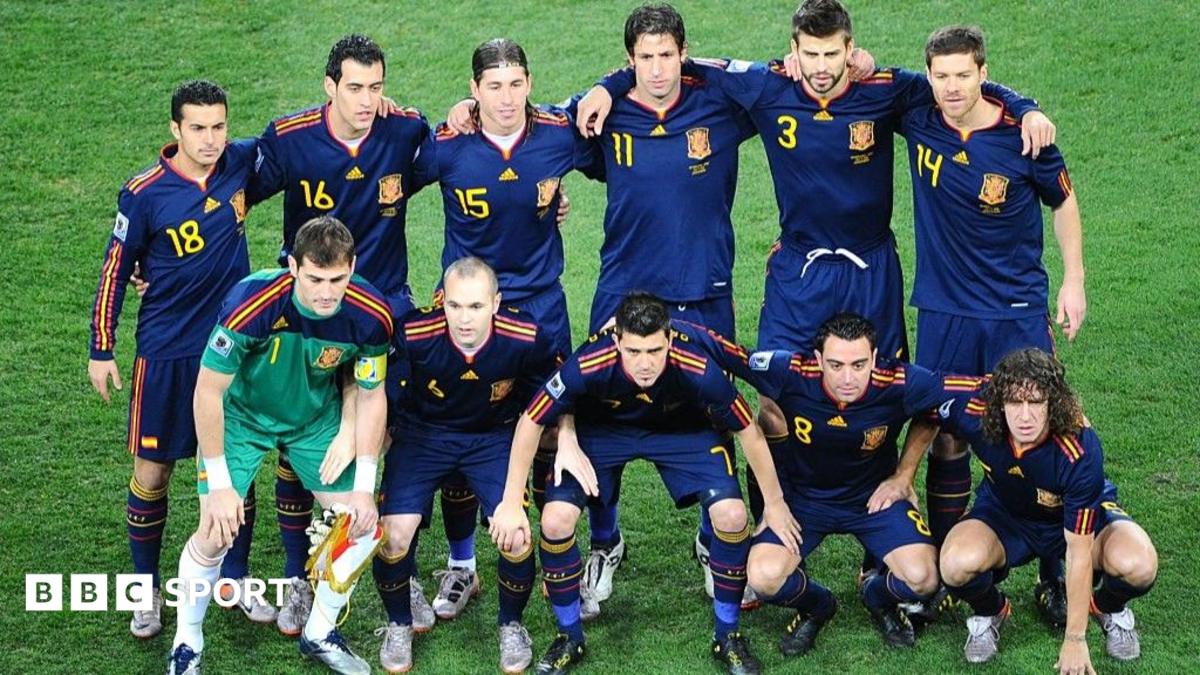
The year is 2010. A Spain side stacked with star names have sneaked their way into the World Cup final, where they ultimately triumph in a bruising encounter against the Netherlands with an extra-time Andres Iniesta winner.
Fast forward 16 years and a more under-the-radar, but equally efficient, Spain team have again reached football’s showpiece.
The names may not trip off the tongue as smoothly as they did before, but Luis de la Fuente’s current contingent are driven to match the achievement of the country’s golden generation and lift the trophy for a second time on Sunday, 19 July.
Certain parallels are evident.
Take the continuity as both sides came into their respective World Cups having won the European Championship two years earlier.
For the team that triumphed in 2010, only three of the starting XI had not been at the 2008 Euros. Only two players who began Tuesday’s semi-final against France were not part of the successful squad at Germany 2024.
Interestingly, Spain’s 2026 squad of 26 players have an older average age than the group selected by Vicente del Bosque in 2010 (27.8 compared with 26.7), but they are less experienced on the international stage (33 caps on average against 56).
Spain had not won a World Cup knockout game since lifting the trophy in the South Africa tournament, before embarking on this run.
The vaunted 37-match unbeaten record of De la Fuente’s men is impressive – matching Italy’s world-best mark – even if it does discount a penalty shootout defeat by Portugal in last year’s Nations League final.
This Spain side are the first team to keep six clean sheets at a single World Cup.
So how do the two XIs compare? BBC Sport takes a look.
Five weeks after the start of the biggest-ever football tournament, it’s almost time for the day billions across the world have waited for – the FIFA World Cup final.
Spain, the champions of Europe, face defending World Cup winners Argentina in a title clash for the ages.
Recommended Stories
list of 3 itemsend of list
For Spain, it marks the final step in their quest for a second world title, 16 years on from their maiden triumph, while Argentina are chasing history to become only the third country to lift back-to-back World Cups.
Here are the top 10 things you need to know ahead of Sunday’s final in New York, United States:
Deja vu: Messi and Yamal meet again after two decades
The moment Argentina set up the World Cup final against Spain, social media was again flooded with the now-viral photo of a young Messi bathing baby Yamal during a TV commercial. At first, many thought it was an AI-generated image, but it’s indeed real and dates back to 2007.
During a UNICEF fundraising shoot at his former club, Barcelona’s Camp Nou stadium, a 20-year-old Messi met Yamal, who was only five months old at that time and accompanied by his mother, Sheila Ebana.
Almost two decades on from that day, Messi and Yamal face each other in a clash of generations in the 2026 World Cup final.
“It is a true miracle of destiny,” the photographer Joan Monfort told BBC Sport.
This photo, taken in September 2007, shows a 20-year-old Lionel Messi, who had embarked on his legendary Barcelona career four years earlier, helping to bathe Lamine Yamal, six months, with Yamal’s mother Sheila Ebana [Joan Monfort/AP Photo]
Will Donald Trump attend the World Cup final?
Yes. The White House has said US President Donald Trump will attend Sunday’s World Cup final – his first appearance at the tournament. He will jointly present the trophy, along with FIFA President Gianni Infantino, to the winning team’s captain.
Though Trump was not at any game of the 48-team tournament, he was still involved – rather controversially. Trump personally urged Infantino to review a decision to hand a red card to US striker Folarin Balogun.
FIFA, then, broke its own rules to suspend Balogun’s one-game ban, allowing him to play in the quarterfinals, which the US lost to Belgium. The controversial decision drew criticism and once again put the spotlight on the growing influence of politics on sport.
US President Donald Trump holds up a red card as he meets with FIFA President Gianni Infantino in the Oval Office of the White House [File: Leah Millis/Reuters]
Superstitions first: Argentinian President Milei won’t attend the final
It is common practice for the heads of state of the finalist nations to attend the ultimate showdown, but Argentinian President Javier Milei won’t be travelling to New Jersey. Why? Because of superstition.
Milei has decided to watch the game on a TV from his presidential residence, just like he did for each of Argentina’s seven matches en route to the final. He will also be putting on the same heavy jacket he wears each time.
In Latin America, and particularly in Argentina, so-called “cabalas”, or ritualistic beliefs and habits, carry unusual weight, reflecting their passion for the national team.
Canadian wildfire smoke blankets New York before World Cup final
Smoke from Canadian wildfires has blanketed much of the northeastern US, triggering health alerts, but a cold front expected on the weekend will help dissipate the dangerous haze in time for Sunday’s World Cup final in the New York area.
More than 80,000 people are expected to attend the World Cup final at the open-air New York-New Jersey stadium, while another 50,000 are expected to watch the game from Central Park in Manhattan.
New York City began feeling the effects of the wildfires this week, and local authorities issued an alert, urging residents to reduce strenuous outdoor activity and take extra breaks if they are outside.
On Thursday, the air quality in New Jersey, the site of the stadium, was rated as “unhealthy for sensitive groups” by several air quality measurement platforms.
World Cup final: The most expensive US sporting event
As of Friday, the get-in price for the Spain vs Argentina final is $7,595, according to ticket-tracking service TicketData.com. The platform states a 10 percent increase in price over the last three days.
As per data from secondary ticket marketplace TickPick, the average purchase price for the final is $11,327, the highest ever recorded in US sporting history, surpassing the ticket prices for the NFL’s Super Bowl and the NBA Finals.
NFL-style half-time show
For the first time in history, a football World Cup final will feature a half-time show, inspired by the Super Bowl.
Expect fireworks to light up the New York skyline when a pop party kicks off, headlined by Madonna, Justin Bieber, Shakira, BTS, Burna Boy, Coldplay and others.
The performance is expected to last about 11 minutes, with the half-time break potentially extended to up to 30 minutes. Additionally, there will be a closing ceremony 90 minutes before kickoff, with Tom Cruise, Robbie Williams and Nicole Scherzinger expected to feature.
Colombian singer, songwriter and producer Shakira, who performed during the opening ceremony of the 2026 World Cup, will also be at the half-time show [Carl De Souza/AFP]
Record-breaking prize money
In December, FIFA announced a record World Cup prize fund of $727m – a 50 percent increase on the funds distributed at the 2022 tournament in Qatar.
Four months later, the prize money on offer was further increased, with the world governing body projected to surpass $11bn in revenue in the current four-year cycle from 2023 to 2026.
FIFA’s December announcement on prize money said the champions would take home $50m and the runners-up $33m. Additionally, each qualified nation would be entitled to $1.5m to cover preparation costs.
World Cup trophy to arrive in bespoke Louis Vuitton trunk
As was the case in the last four finals, the golden World Cup trophy – the biggest prize in football – will be transported to the venue in a bespoke Louis Vuitton trunk designed by the French luxury fashion house.
The trunk features a golden V for “Victory” – and “Vuitton” – across the front, with the brand’s recognisable monogram pattern and gold-plated brass corner protectors.
Golden Boot among awards up for grabs
Apart from the winning team earning the opportunity to lift the coveted World Cup trophy, players will also have a shot at individual glory.
As many as five official trophies, including the Golden Boot for the top scorer and Golden Ball for the best player of the tournament, will be handed out.
Messi leads the race for the Golden Boot, ahead of France’s Kylian Mbappe, who will feature in the third-place playoff a day before the final. Mbappe won the Golden Boot last year while Messi is bidding for his first such achievement.
The Golden Glove, Young Player and Fair Play are the other official awards presented by the FIFA Technical Study Group.
Argentina’s Lionel Messi celebrates with his teammates at the end of the World Cup semifinal [Rebecca Blackwell/AP]
The referee lineup
The World Cup final will be officiated by Slovenia’s Slavko Vincic, who will be assisted by his compatriots Tomasz Klancnik and Andraz Kovacic.
Jordanian duo Adham Makhadmeh and Mohammad Alkalaf will be the fourth official and reserve assistant referee, respectively.
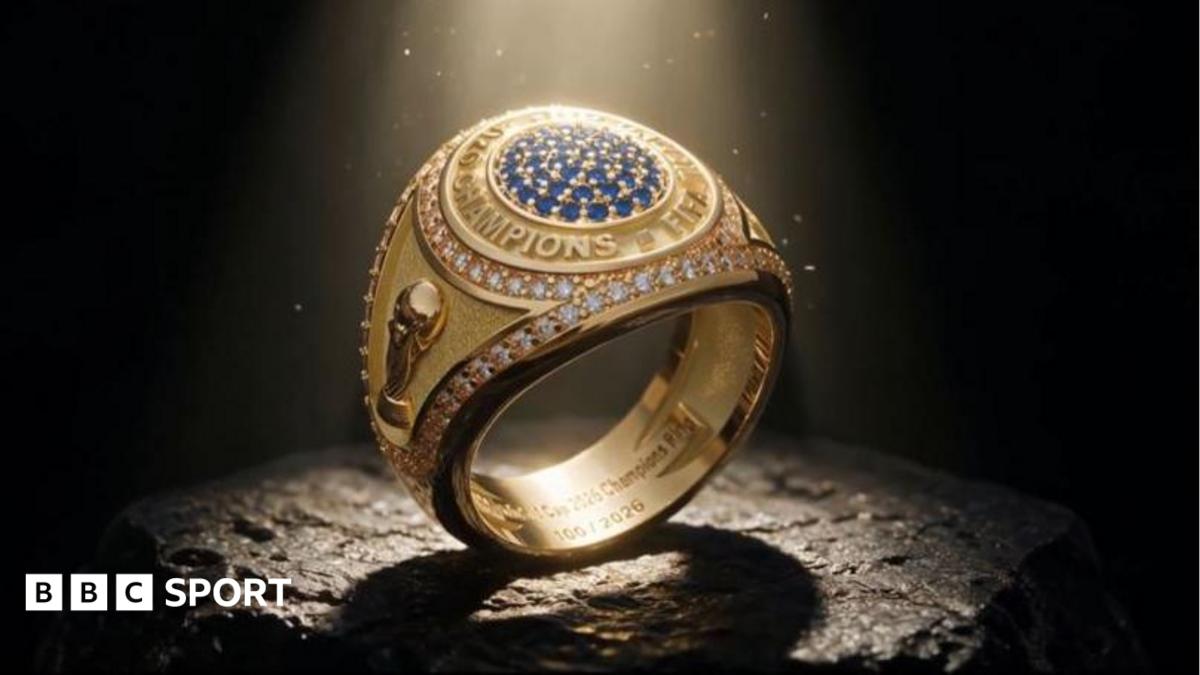
Fifa will present World Cup rings to the winners of Sunday’s final between Argentina and Spain, which will be attended by Donald Trump.
Winner rings are a tradition in American sport, with the NFL’s Super Bowl victors presented with them.
Thirty rings will be made available to the world champions, and a further 1,996 rings will go on sale to fans. Each ring will include a mini World Cup trophy in its design and an engraving in the band.
President Trump, who is to present the trophy, has not attended any of the 102 World Cup games so far, missing all of the USA’s matches before they went out to Belgium in the last 16.
There is a weather warning in New York over air quality caused by wildfires in Canada, but there is no suggestion the final at MetLife Stadium will be affected.
Fifa president Gianni Infantino had already said Trump would attend the final and White House press secretary Karoline Leavitt has confirmed he will.
The subsequent decision to suspend Balogun’s automatic ban was heavily criticised, with questions raised about the integrity of the tournament.
Balogun was allowed to feature in the knockout game against Belgium, but the USA suffered a 4-1 thrashing.
No other red or yellow cards have been suspended during this World Cup, despite France and England appealing to have their own respective incidents reviewed.