World

Soccer Aid LIVE: Match updates, kick-off time and how to watch, England vs World XI players

There are some big names that will be on show at London Stadium for Soccer Aid including some famous celebrities and plenty of former international footballers.

England squad in full: Robbie Williams (Manager), Wayne Rooney, Jermain Defoe, Jill Scott, Tom Hiddleston, Danny Dyer, Paddy McGuinness, Olly Murs, Joe Marler (GK), Theo Walcott, Toni Duggan, Steph Houghton, Jordan North, Angry Ginge, GK Barry, Jack Wilshere, Joe Hart, Sam Thompson, Chloe Burrows, Jack Whitehall and Owen Cooper.

World XI squad in full: Usain Bolt (Manager), Edwin van der Sar, Michael Essien, Jordi Alba, Leonardo Bonucci, Dimitar Berbatov, Nemanja Matic, Maisie Adam, Big Zuu, Nabhaan Rizwan, Nitro, Ali Krieger, Jen Beattie, Nicky Byrne, Dermot Kennedy, Chris O’Dowd, Richard Gadd, Nikolaj Coster-Waldau, Tobi Brown and Behzinga.

Tom Hiddleston and Olly Murs will be playing for England XI at Soccer Aid For UNICEF 2026

Tom Hiddleston and Olly Murs will be playing for England XI at Soccer Aid For UNICEF 2026(Image: (Photo by Jo Hale/Getty Images))

Source link

World Cup 2026: England players advised by Thomas Tuchel to take holiday in US time zones

England head coach Thomas Tuchel advised his World Cup players to go on holiday in United States time zones before the tournament, to help the acclimatisation process.

A total of 21 of England’s 26-man squad will arrive in Florida on Monday for their pre-tournament camp, where they will also face New Zealand and Costa Rica in warm-up matches on 6 and 10 June.

Many players are understood to have spent the off-season in the United States or Caribbean at the behest of the England boss.

The weather is sure to play a major factor in the tournament, with studies indicating that nearly a quarter of all World Cup games are likely to be played in temperatures higher than 26C.

Adapting to the US time zones will also be a factor, with England’s tournament training base in Kansas City, Missouri, six hours behind UK time, which is the same as Dallas, where Tuchel’s men face Croatia in their opening group game on 17 June.

The remaining Group L matches against Ghana and Panama, which will be played in Boston and New Jersey respectively, will be played in a time zone five hours behind the UK.

To ensure England can hit the ground running, Tuchel requested players travelled west for their post-season break before joining up with the squad.

Arsenal quartet Declan Rice, Noni Madueke, Eberechi Eze and Bukayo Saka, and Crystal Palace goalkeeper Dean Henderson – who were all involved in European finals this week – will join the rest of the squad at a later date.

Premier League players Alex Scott, Jason Steele, Rio Ngumoha, Josh King and Ethan Nwaneri will also join the squad for England’s training camp in West Palm Beach, Florida.

Source link

Mexico approves election annulment reform over interference

Mexico approved a constitutional reform that adds foreign intervention or interference in electoral processes as a new ground for annulling elections. File Photo by Sashenka Gutierrez/EPA

May 29 (UPI) — Mexico’s Congress approved a constitutional reform that adds foreign intervention or interference in electoral processes as a new ground for annulling elections.

The measure, promoted by the ruling party, the National Regeneration Movement, or Morena, has sparked debate over national sovereignty, electoral security and the limits of legal interpretation in future elections.

The reform amends Article 41 of the Constitution to establish that an election may be annulled when acts of foreign intervention or interference that influence electoral results are proven.

The initiative was initially approved by the Chamber of Deputies and later received Senate approval. It must now be ratified by at least 17 state legislatures before it can take effect.

The proposal was introduced by Ricardo Monreal, Morena’s coordinator in the Chamber of Deputies, who argued that Mexican law had until now lacked a specific sanction for cases of foreign interference in elections.

“Currently there is no sanction for anyone who seeks to invade our country or interfere in electoral processes,” Monreal said during the legislative debate, according to El Universal.

The lawmaker said the annulment could only be applied when there is “full and conclusive evidence” that foreign governments or external agents intervened in an election.

The Chamber of Deputies approved the reform with 307 votes in favor, 128 against and one abstention.

The ruling coalition argues that the measure seeks to strengthen national sovereignty against possible attempts at external influence, including irregular financing, disinformation campaigns, digital operations or political pressure originating abroad.

President Claudia Sheinbaum publicly backed the initiative and said there is a “real risk” of foreign intervention in future Mexican electoral processes.

Several local media outlets reported that the government has linked the reform to an international environment marked by growing geopolitical disputes, digital influence campaigns and external pressure on Latin American governments.

However, opposition parties questioned both the substance of the reform and the speed with which it advanced through Congress.

Rubén Moreira, parliamentary leader of the Institutional Revolutionary Party, warned that the initiative was introduced only days before it was debated and argued that there was not enough time to thoroughly analyze the legal implications of concepts such as “interference” or “foreign intervention,” according to reports by El País.

Lawmakers from the National Action Party and the Citizens’ Movement party also warned of the risk that the new provision could be used discretionarily to challenge election results under broad interpretations of what constitutes foreign influence.

During the legislative debate, Morena rejected those accusations and said the reform is not intended to censor news media, social media platforms or individual expressions.

Monreal said that a news article, an interview or a social media post would not, by themselves, be sufficient grounds to justify the annulment of an election.

He also said secondary legislation will be needed to precisely define the legal circumstances under which foreign intervention occurred and which authorities will be empowered to determine it.

The debate comes amid growing political tensions between Mexico and United States over issues related to drug trafficking, border security and regional cooperation.

It also coincides with a broader debate across Latin America over the influence of foreign governments, transnational digital campaigns and mechanisms to protect electoral sovereignty.

Source link

Experts urge South Korea to hold Iran accountable over HMM ship attack

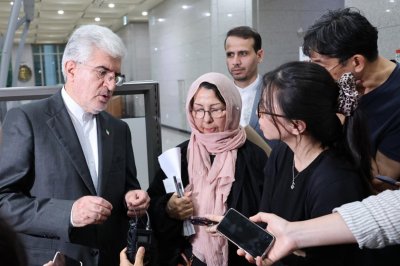
Iranian Ambassador to South Korea Saeed Koozechi (L) speaks to reporters as he exits the foreign ministry building in Seoul, South Korea, 27 May 2026. The ministry summoned Koozechi to lodge a protest over a 04 May attack on the HMM Namu, a South Korean-operated vessel, in the Strait of Hormuz. The ministry said Iranian-developed anti-ship missiles were likely used in the attack earlier this month. Photo by YONHAP / EPA

May 29 (Asia Today) — South Korean defense experts said the government should take a tougher position toward Iran after investigators concluded that an Iranian-developed anti-ship missile was likely used in an attack on the HMM Namu.

Experts said Thursday that Seoul needs a firm diplomatic response to the results of the government investigation into the unidentified aerial objects that struck the HMM-operated vessel.

The government said Wednesday that the objects were highly likely to have been Noor-series anti-ship missiles developed by Iran. Technical analysis found the engine resembled an Iranian-made turbojet engine, and some components carried markings believed to be from an Iranian manufacturer.

South Korean officials said the evidence points toward Iran but stopped short of making a final judgment on who carried out the attack or whether it was intentional. The government summoned Saeed Koozechi, Iran’s ambassador to South Korea, but Koozechi denied that Iran was involved.

“If it was actually confirmed to be an Iranian missile, it should be viewed as an act by the Iranian government,” said Kwon Yong-soo, professor emeritus at Korea National Defense University. “The missile’s maximum range is short, and because of the flame at launch, it would have been visible where it came from.”

Kwon said the government should be able to explain whether the missile was fired from land, a ship or a fast boat.

“If it was not Iran’s act, Iran itself should present evidence,” he said.

Yang Uk, a research fellow at the Asan Institute for Policy Studies, said the evidence points to an Iranian-made anti-ship missile.

“Even if Iran denies it, that denial is not persuasive,” Yang said. “Anti-ship missiles are weapons that only states, governments and militaries can operate.”

Yang said Iran may have provided missiles to an armed group, such as the Houthi rebels, but the distance would have been too far for such a launch.

“If the Islamic Revolutionary Guard Corps fired it and the Iranian government pretends not to know, that would prove Iran’s own command and control is inadequate,” he said.

Some experts said the South Korean government’s response has been too weak, even though it summoned Koozechi immediately after announcing the investigation results.

A Foreign Ministry official said summoning Iran’s ambassador was a serious diplomatic measure.

“Summoning the Iranian ambassador to South Korea is by no means meaningless,” the official said. “The measure itself shows our firm position.”

The official said Seoul had sent investigation teams twice, collected debris, reached its conclusion through analysis by expert agencies, publicly announced the findings and explained them to the other country.

“That itself is a serious diplomatic step,” the official said.

Yang said some may argue South Korea does not need to create unnecessary conflict with Iran. But he said Seoul should at least secure something from the Iranian government if it takes that position.

“Given that the evidence points to Iran, we should at least apply pressure to ensure our ships are allowed to return safely,” Yang said. “If we do not even do that, then we are refusing to do what a state should do.”

— Reported by Asia Today; translated by UPI

© Asia Today. Unauthorized reproduction or redistribution prohibited.

Original Korean report: https://www.asiatoday.co.kr/kn/view.php?key=20260528010008578

Source link

Hyundai Atlas robot shows soccer skills in World Cup campaign

The ATLAS prototype robot by Boston Dynamics walks on stage during a press conference at the 2026 International CES, at the Mandalay Bay Convention Center in Las Vegas, Nevada on Monday, January 5, 2026. File. Photo by James Atoa/UPI | License Photo

May 29 (Asia Today) — Hyundai Motor Group released a new campaign linking advanced robotics and soccer, highlighting its physical artificial intelligence technology ahead of the World Cup.

Hyundai Motor Group said Friday it released its “School of Football” campaign video, which shows Atlas, a humanoid robot developed by Boston Dynamics, learning and improving through soccer movements.

The campaign is part of Hyundai Motor’s World Cup campaign, “Next Starts Now,” which is rooted in the company’s vision of “Progress for Humanity.”

The video series consists of five parts, including a launch film featuring Atlas and training scenes showing the robot practicing various soccer movements.

The launch film follows Atlas as it becomes interested in soccer after observing the emotions, energy and dynamic movements of players.

The training videos show Atlas gradually learning basic soccer skills such as footwork, passing and shooting, as well as more advanced techniques including crossed-leg shots and crosses.

Hyundai Motor said it plans to release a making-of film June 4 featuring interviews with Boston Dynamics officials who led Atlas’ training during preparations for the campaign.

“The campaign is meaningful because it presents the future of robotics through soccer in an engaging and human-centered way as part of Hyundai Motor’s World Cup campaign,” said Jee Sung-won, executive vice president and head of Hyundai Motor’s brand marketing division. “We plan to continue creating diverse brand experiences using mobility and robotics.”

— Reported by Asia Today; translated by UPI

© Asia Today. Unauthorized reproduction or redistribution prohibited.

Original Korean report: https://www.asiatoday.co.kr/kn/view.php?key=20260529010008721

Source link

South Korea, U.S. to open security talks on nuclear subs

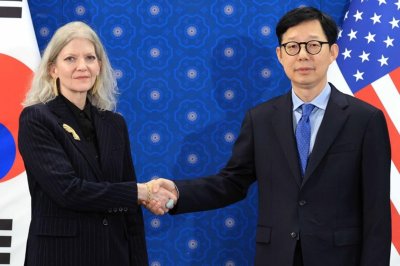
South Korean Vice Foreign Minister Park Yoon-joo (R) shakes hand with his US counterpart, Allison Hooker, at the foreign ministry in Seoul, South Korea. Photo by YONHAP / EPA

May 29 (Asia Today) — South Korea and the United States will hold their first meeting in Seoul next week to discuss security issues agreed to at last year’s bilateral summit, including South Korea’s acquisition of nuclear-powered submarines.

South Korea’s Foreign Ministry said Friday the two sides will hold a launch meeting June 2-3 in Seoul for follow-up consultations on the security provisions of the joint fact sheet issued after the summit.

The meeting will come eight months after the two leaders announced agreements in the security section of the joint fact sheet in October.

The two sides are expected to discuss specific measures related to South Korea’s construction of nuclear-powered submarines, as well as expanded authority over uranium enrichment and spent nuclear fuel reprocessing.

With U.S. midterm elections scheduled for November, negotiations in individual areas are expected to gain momentum.

South Korea will send an interagency delegation led by First Vice Foreign Minister Park Yoon-joo. Officials from the presidential National Security Office, Foreign Ministry, Defense Ministry, Ministry of Climate and Energy, Ministry of Science and ICT, Ministry of Trade, Industry and Resources and Nuclear Safety and Security Commission will also attend.

The U.S. delegation will be led by Allison Hooker, under secretary of state for political affairs. Officials from the White House National Security Council, State Department, Energy Department and War Department are expected to travel to Seoul for the talks.

— Reported by Asia Today; translated by UPI

© Asia Today. Unauthorized reproduction or redistribution prohibited.

Original Korean report: https://www.asiatoday.co.kr/kn/view.php?key=20260529010008720

Source link

SK chairman says AI will redefine future talent

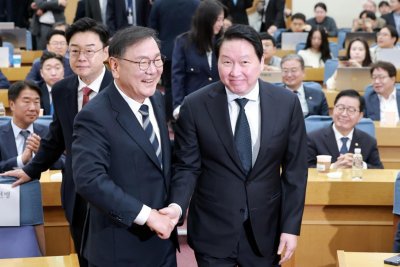
Kim Tae-nyeon (L), a lawmaker of the ruling Democratic Party, shakes hands with SK Group Chairman Chey Tae-won, who also heads the Korea Chamber of Commerce and Industry, at the National Assembly in Seoul, South Korea, 28 April 2026. The meeting takes place during a seminar on South Korea’s growth strategies amid intensifying US-China artificial intelligence technology rivalry, organized by a union of South Korean and Chinese lawmakers. Photo by YONHAP / EPA

May 29 (Asia Today) — SK Group Chairman Chey Tae-won said generalist talent will become more important in the artificial intelligence era as workers need to develop abilities that remain uniquely human.

Chey, who also serves as chairman of the Korea Chamber of Commerce and Industry, said South Korea should accelerate the expansion of AI infrastructure based on speed, scale and safety.

SK Group said Friday that Chey appeared Thursday on KBS1’s “Documentary Insight – Talent War 2: Chey Tae-won’s Answer,” where he discussed what people should learn and what abilities they should develop as AI advances faster than humans.

“I wanted to share the perspective I have gained by speaking directly with many people in the AI industry and working with them in business,” Chey said.

Chey said the world is now moving through the era of “reasoning AI,” in which AI responds to human questions, and will enter the era of “agentic AI,” in which AI can make decisions and act on its own.

“In this period, the gap in ability between people who actively use AI and those who do not could become much wider than it is now,” Chey said. “The same polarization could deepen among individuals, companies and countries depending on how quickly and effectively they use AI.”

Over the longer term, however, Chey said the rise of artificial general intelligence could narrow gaps in knowledge and productivity among people.

He said that if two people now have ability levels of 10 and 100, their gap is 10 times. But in an AGI era, if everyone receives a baseline AI-powered ability of 1,000, those levels could become 1,010 and 1,100, sharply reducing the relative gap.

“In the future, what matters more than what job a person has will be how that person can use and connect humans and AI together,” Chey said.

He said generalists who can move across different fields and design new systems and societies where humans and AI coexist will become more important than specialists who deeply understand only one field.

Chey also said AI could perform a large share of work tasks, making it possible for people to take on multiple roles and jobs at the same time. He said the conventional “9 to 6” work structure and fixed ideas about occupations could gradually change.

Chey presented four core “muscles” that individuals should build in the AI era: a thinking muscle to ask fundamental questions, an adaptation muscle to respond to rapid change, an empathy muscle that reflects uniquely human compassion and “body skills” that create value through physical activity such as music, art and sports.

“The ability to quickly acquire knowledge and do well on tests will be replaced in large part by AI,” Chey said. “It is important to build the areas that only humans can do.”

Chey also presented a national strategy, saying South Korea needs “3S” — speed, scale and safety — to become a competitive “AI nation.”

He said South Korea should speed up technological development, expand large-scale AI infrastructure and investment and build an institutional foundation that allows citizens to use AI safely.

“AI talent does not simply mean engineering talent,” Chey said. “Education and social systems must also change quickly so future generations can naturally use AI and coexist with it.”

— Reported by Asia Today; translated by UPI

© Asia Today. Unauthorized reproduction or redistribution prohibited.

Original Korean report: https://www.asiatoday.co.kr/kn/view.php?key=20260529010008715

Source link

‘Pressure’ review: Fraser, Scott in World War II showdown

“Pressure,” the new World War II movie from director Anthony Maras and writer David Haig, is a hyperfocused look at the days leading up to D-day with a special focus on the weather. It’s a one-setting thriller that unspools in the pressure-cooker environment of General Dwight D. Eisenhower’s war room at an English country estate. The movie works backward from a famous 1961 Eisenhower quip to JFK that attributed his success in Normandy, France, to the Allies having “better meteorologists than the Germans.”

If you’re skeptical about how exciting a movie about the weather on D-day might be, “Pressure” takes that as a creative challenge, an argumentative stance from which to start. For the next hour and 40 minutes, Maras and co-writer Haig, who also wrote the 2014 play from which the film is adapted, explain to us exactly how important the meteorologists of D-day were, beginning with the disastrous D-day rehearsal Exercise Tiger.

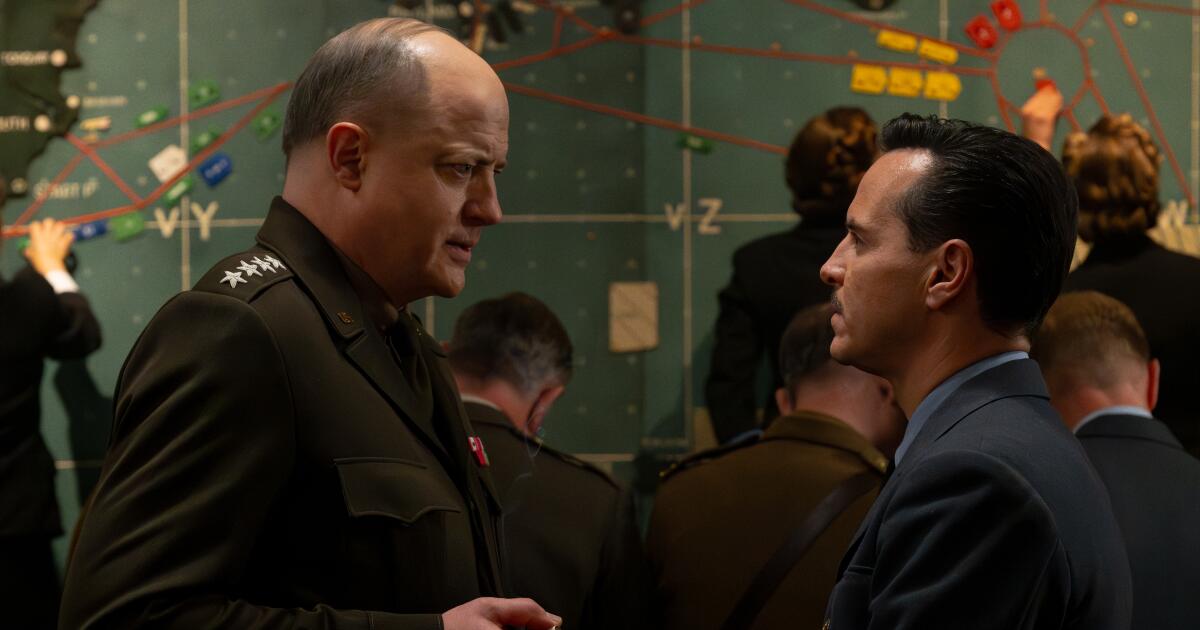
With the weather app at our fingertips these days, it can be hard to imagine just how difficult it was to forecast the weather in the 1940s, especially in Northern Europe. That was the predicament facing Eisenhower (Brendan Fraser) just 72 hours before the planned D-day launch of June 5, 1944. But we know that D-day happened on June 6, so the arrival at that date is part of the film’s narrative intrigue.

After a devastating glimpse of Exercise Tiger, red blood mixing with blue ocean waves and white sandy beaches, we’re quickly introduced to our protagonist, Group Capt. Chief Meteorologist James Stagg (Andrew Scott), in his cozy home with his pregnant wife before he’s swept into critical war planning.

He’s stern, terse and no-nonsense. Stagg is the kind of person who wants to be correct more than he wants to be liked and he insists on a careful collection of live data, using weather balloons, phone calls and mathematical charting. His foil is Col. Irving Krick (Chris Messina), a charming American meteorologist and Eisenhower’s chosen weather guru, a yes man who relies on selective historical data and a persuasive speaker whose approach rankles the fastidious Stagg. Eisenhower instructs the two men to come to an agreement and “Pressure” follows the ups and downs of their working relationship over the course of several days.

The movie becomes a two-hander between Scott’s Stagg and Fraser’s Eisenhower, the former convinced that a storm on June 5 will make conditions less than ideal, the latter raging at the uncertainty while simultaneously attempting to placate a phalanx of military personnel. The troops are requisitioned, the destroyers in place, the full moon just right, the secrecy of the invasion delicate. Fraser’s explosive performance underlines the immensity of the stakes, balancing every precarious element of this enormous mission.

Maras, who is known for another terrific one-setting thriller based on a true story, 2018’s “Hotel Mumbai,” both directs and edits and his films are put together like precision clockwork: propulsive and relentless, the pace italicized by Volker Bertelmann’s scores. “Pressure” is skillfully directed, sweeping us into this world with a kind of addictive immediacy, and is also beautifully lensed by cinematographer Jamie Ramsay. Maras and Ramsay make the wise choice to shoot the film with richly saturated color instead of the usual grayish, desaturated look often assigned to period pieces set in this era. It’s not gritty and harsh, but rather stunning and lovely — an eerie contrast to the terror and bloodshed of the day itself.

While Fraser delivers an external performance as the tough American general, Scott offers a restrained, mostly tamped-down depiction of the repressed and methodical Stagg. But when he finally bursts with a cathartic eleventh-hour speech about the inaccuracy of Krick’s historical forecast, Eisenhower listens. Scott, as seen in “All of Us Strangers” and “Blue Moon,” is so good at this kind of acting, processing every emotion internally but allowing just enough to show to let the audience into his character’s emotional state. It’s wildly compelling to watch.

In a quiet conversation with Eisenhower’s close confidant and aide, Kay Summersby (Kerry Condon), she jokes that weathermen are boring. Stagg reminds her that the weather itself isn’t. Weather feeds us, it can destroy us — it rules our existence, he says. “People ask, ‘When will the wind stop blowing?’ No one ever asks, ‘Why does the wind blow? What is the wind?,’ ” revealing himself as a sort of philosophical poet of the weather. His forecast was the crucial edge in D-day and the volatility of the weather is increasingly relevant in our lives, especially with our changing climate.

Boring? Never. Thrilling and history-making? Indeed.

Katie Walsh is a Tribune News Service film critic.

‘Pressure’

Rated: PG-13, for war violence, bloody images, some strong language, and smoking

Running time: 1 hour, 40 minutes

Playing: Opens Friday, May 29 in wide release

Source link

LG Energy Solution sees ESS opportunity amid EV slowdown

Kim Hyun-tae, executive director of product planning and strategy for LG Energy Solution’s energy storage system business division, speaks Friday at the second Asia Today Environment Forum at The Plaza Seoul. Photo by Asia Today

May 29 (Asia Today) — LG Energy Solution sees the electric vehicle slowdown as an opportunity to expand its energy storage system business as artificial intelligence data centers drive surging electricity demand, a company executive said Friday.

Kim Hyun-tae, executive director of product planning and strategy for LG Energy Solution’s energy storage system business division, said the EV “chasm” has created risks but also opened a path for the company to shift more aggressively into ESS.

“In the carbon-neutral era, we must move beyond simply increasing renewable energy and improve both grid stability and energy efficiency,” Kim said.

Kim made the remarks at the second Asia Today Environment Forum held at The Plaza Seoul, where he gave a presentation titled “LG Energy Solution’s vision for power grid stabilization and decarbonization.”

He outlined LG Energy Solution’s strategy for shifting toward ESS and responding to electricity infrastructure needs in the AI era.

Kim said South Korea’s battery industry had built large-scale production bases in the United States, viewing it as a core automotive market. But the market contracted after the second Trump administration took office and reduced electric vehicle subsidies while changing related policies.

“We secured new business plans by proactively converting U.S. plants from EV-centered production to ESS production,” Kim said.

LG Energy Solution produces ESS products in South Korea, Europe and the United States, Kim said. Its ESS production capacity in North America is now about 50 gigawatt-hours, and the company plans to expand that to more than 80 gigawatt-hours by next year.

“The United States has the highest ESS demand after China,” Kim said. “An ESS boom is taking place in the United States because investment subsidies of at least 30% and as much as 60% are provided when ESS and renewable energy facilities are built.”

Kim said the spread of AI data centers is also driving ESS demand.

“AI data centers are called a hippopotamus that eats water and electricity because they consume enormous amounts of power,” Kim said. “Nvidia’s next-generation Rubin graphics processing unit is expected to consume about four times more power than the Blackwell chip currently being sold, so securing stable power is essential.”

Kim said global Big Tech companies are focused on “time to power,” or how quickly new power capacity can be secured.

“Because connecting to existing power grids takes a long time, demand is growing for quickly building onsite and off-grid power sources that combine solar power, ESS and small gas turbines,” he said.

Kim also proposed an ESS-based distributed power grid model as an alternative to delays in building new transmission networks.

“Large-scale electricity demand sites are increasing, such as the Yongin semiconductor cluster, but building new transmission networks or high-voltage direct current systems usually takes six to seven years,” Kim said.

“For example, a realistic alternative could be storing electricity generated from renewable energy in the Honam region in ESS and then using existing transmission networks to distribute it to demand centers,” he said.

In the medium and long term, Kim said sodium-ion batteries, sometimes called “salt batteries,” could become a game changer in the ESS market.

“When renewable energy’s share expands to about 50%, large-scale ESS will be needed to offset intermittency, but costs are currently high,” Kim said. “LG Energy Solution plans to test sodium-ion batteries that can replace lithium in the United States in 2027 and pursue large-scale commercialization in 2029.”

Kim also said the global ESS market is being reshaped around domestic protectionism.

“The United States is encouraging the use of U.S.-made products through subsidy policies based on the Inflation Reduction Act, and Europe is also pursuing the introduction of the Industrial Accelerator Act, which is being called a European version of the IRA,” Kim said. “In a blocked supply chain environment, policy consideration is also needed to protect domestic industries and strengthen supply chain competitiveness.”

Kim said LG Energy Solution is building a decarbonization system that includes its supply chain and recycling operations as it works toward achieving RE100 by 2030 and carbon neutrality across its value chain by 2050.

— Reported by Asia Today; translated by UPI

© Asia Today. Unauthorized reproduction or redistribution prohibited.

Original Korean report: https://www.asiatoday.co.kr/kn/view.php?key=20260529010008771

Source link

World Cup 2026: Alphonso Davies in Canada squad despite recent injuries

Goalkeepers: Dayne St Clair (Inter Miami), Maxime Crepeau (Orlando City), Owen Goodman (Crystal Palace).

Defenders: Alistair Johnston (Celtic), Derek Cornelius (Marseille), Richie Laryea (Toronto), Niko Sigur (Hajduk Split), Joel Waterman (Chicago Fire), Luc de Fougerolles (Fulham), Moise Bombito (Nice), Alphonso Davies (Bayern Munich), Alfie Jones (Middlesbrough).

Midfielders: Stephen Eustaquio (Porto), Ismael Kone (Sassuolo), Tajon Buchanan (Villarreal), Mathieu Choiniere (Los Angeles FC), Ali Ahmed (Norwich City), Nathan Saliba (Anderlecht), Liam Millar (Hull City), Marcelo Flores (Tigres UANL), Jacob Shaffelburg (Toronto), Jonathan Osorio (Toronto).

Forwards: Jonathan David (Juventus), Cyle Larin (Southampton), Tani Oluwaseyi (Villarreal), Promise David (Union SG).

Source link

Samsung ships first samples of seventh-generation HBM

An exterior view of the Samsung Electronics headquarters in Seoul, South Korea. File. Photo by YONHAP / EPA

May 29 (Asia Today) — Samsung Electronics said Friday it shipped samples of its seventh-generation high-bandwidth memory chip, HBM4E, for the first time, demonstrating its competitiveness in advanced semiconductor technology.

The shipment came three months after Samsung began mass shipments of HBM4 in February, raising expectations that the company could expand its share of the HBM market.

Samsung said it supplied 12-layer HBM4E samples to global customers. The company did not identify the customers, but industry officials said the samples were likely supplied to Nvidia, a major buyer of AI chips.

Samsung said the HBM4E shipment goes beyond an expansion of its product lineup and could strengthen the company’s supply capacity and technological edge in the global AI infrastructure market, which is expected to grow rapidly for years.

Samsung said HBM4E operates at 14 gigabits per second to 16 gigabits per second per pin, more than 20% faster than the previous generation. It provides bandwidth of 3.6 terabytes per second in a single stack, improving computing speed for large language models and next-generation AI systems.

The 12-layer HBM4E offers 48 gigabytes of capacity, more than 30% higher than the previous generation. Samsung said it plans to expand the lineup to 32 gigabytes, or eight layers, and 64 gigabytes, or 16 layers, to meet different customer service environments.

The new HBM4E uses Samsung’s 1c DRAM, a sixth-generation 10-nanometer-class DRAM process, and its own 4-nanometer foundry logic die. Samsung said the combination improves process stability, yield and mass production capability.

The company also said low-power design and packaging optimization improved energy efficiency by 16% and thermal resistance characteristics by more than 14% compared with the previous generation.

Samsung’s position in the HBM market is expected to strengthen because the company appears to have moved ahead of competitors in shipping samples. Earlier sample shipments could help Samsung secure customer volume in the next-generation AI memory market.

Samsung ranked second in the global HBM market with a 22% share in the fourth quarter of last year, behind SK hynix, which held 57%, according to Counterpoint Research. Samsung’s share was down sharply from 40% a year earlier, but analysts say its HBM4 mass shipment this year could help it recover.

Global customers have given positive reviews of Samsung’s HBM4 in speed, power efficiency and overall performance, industry officials said. Samsung’s HBM4 received the highest rating in a system-in-package test in December after demonstrating an industry-leading speed of 11.7 gigabits per second.

Analysts say HBM4E could move into mass production quickly because Samsung is already mass-producing HBM4 using the same combination of 1c DRAM and a 4-nanometer base die.

Market watchers also remain optimistic about Samsung’s HBM business.

“The memory market in 2027 is expected to face a deeper supply shortage, and price increases are also likely to gain momentum,” said Kim Dong-won, an analyst at KB Securities. “HBM prices are expected to rise more than 50% from a year earlier as negotiations reflect the narrowing margin gap with general-purpose DRAM.”

Hwang Sang-joon, executive vice president and head of memory development at Samsung Electronics, said the company completed the HBM4E sample supply without disruption after successfully starting HBM4 mass shipments.

“This has clearly imprinted Samsung Electronics’ unmatched technology leadership in the market,” Hwang said. “We will continue to strongly lead growth in the global AI memory market based on overwhelming technology leadership and preemptive investment in production infrastructure.”

— Reported by Asia Today; translated by UPI

© Asia Today. Unauthorized reproduction or redistribution prohibited.

Original Korean report: https://www.asiatoday.co.kr/kn/view.php?key=20260529010008844

Source link

Iran ready to reassure world it is not pursuing nuclear weapons, president says – Middle East Monitor

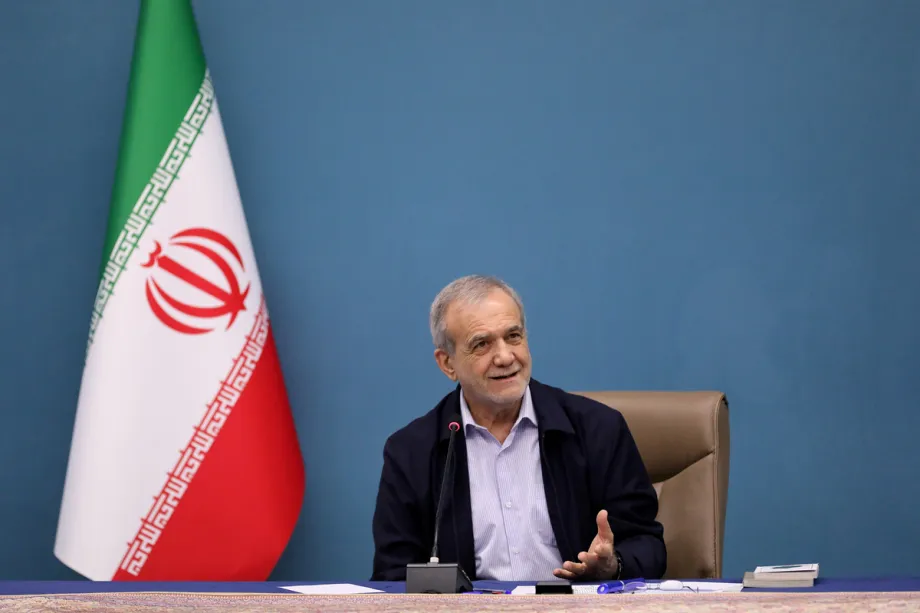
Iran is ready to reassure the international community that it is not pursuing nuclear weapons or instability in the region, President Masoud Pezeshkian said on Sunday, Anadolu reports.

“Prior to the martyrdom of Ayatollah (Ali) Khamenei, Iran’s late Leader, we declared — and we reiterate now — that we are ready to assure the world we do not seek nuclear weapons,” Pezeshkian said in remarks carried by state-run news agency IRNA.

“It is rather Tel Aviv that is driving regional instability,” he said, accusing Israel of pursuing a vision of “Greater Israel.”

Iranian negotiators will never compromise on the country’s “honor and dignity,” added Pezeshkian.

His remarks came a day after US President Donald Trump on Saturday said an agreement with Iran to end the war was “largely negotiated” and awaited finalization.

Regional tensions have escalated since the US and Israel launched strikes against Iran in February. Tehran retaliated with strikes targeting Israel as well as US allies in the Gulf, along with the closure of the Strait of Hormuz.

A ceasefire took effect on April 8 through Pakistani mediation and was later extended by Trump indefinitely.

READ: Iran shoots down Israeli spy drone in country’s south: Report

Source link

Zelesky warns that Ukraine is bracing for ‘big attacks’

Ukrainian President Volodymyr Zelensky warned citizens of his country that Russia is planning an attack, based on their intelligence reports, and to hunker down on Friday night. File Photo by Aaron Schwartz/UPI | License Photo

May 29 (UPI) — Ukraine on Friday evening said that it expects Russia to launch ‘big attacks’ against it sometime on Friday or Saturday, and warned its citizens to take cover.

Ukrainian President Volodymir Zelynsky told CBS News on Friday evening that it expects Russia to launch new attacks at the country in the next 24 to 48 hours, and advised his citizens to take cover.

“Our people have to be very, very careful, cautious and children – they have to use bomb shelters,” he told the news organization.

“Today, at night or tomorrow night, high percent – of course, nobody knows 100% – but there is high percent,” he said.

Russia on Friday evening already launched missiles toward Ukraine, with explosions reported in Kyiv and nearby regions, among other parts of the country, The Kyiv Post reported.

“We have intel that Russia is preparing a new massive attack,” Zelensky said in the post.

“Please pay attention to air raid alerts and stay safe,” he said.

The warnings follow an alleged drone hitting the roof of an apartment building in Romania, which was reportedly aimed at nearby location in Ukraine, which is neighbors the country.

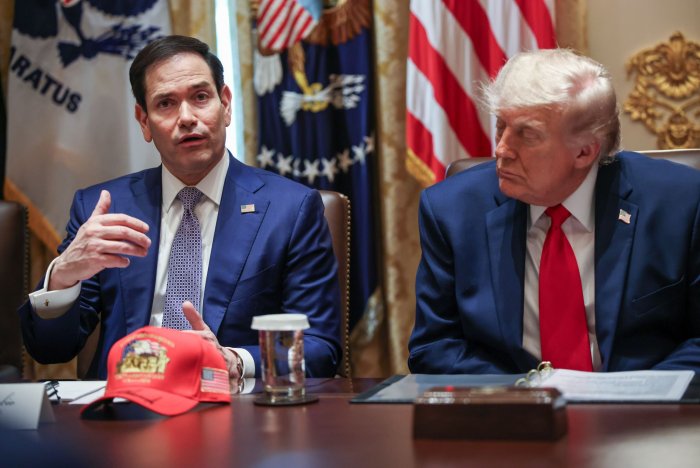
Secretary of State Marco Rubio and President Donald Trump participate in a Cabinet meeting in the Cabinet Room of the White House on Wednesday. Photo by Samuel Corum/UPI | License Photo

Source link