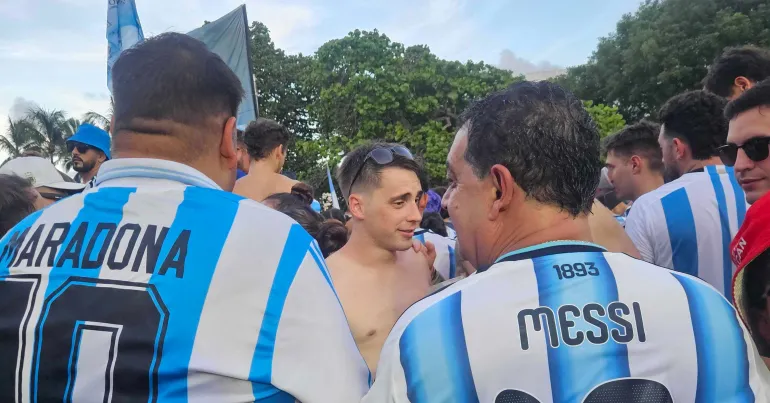
Miami, United States – Singing to the beat of the drum, jumping and dancing with joyful abandon, sporting their famous light blue and white shirts, and waving large flags bearing images of their heroes, Argentinian football fans have announced their team’s arrival in Miami in grand fashion.
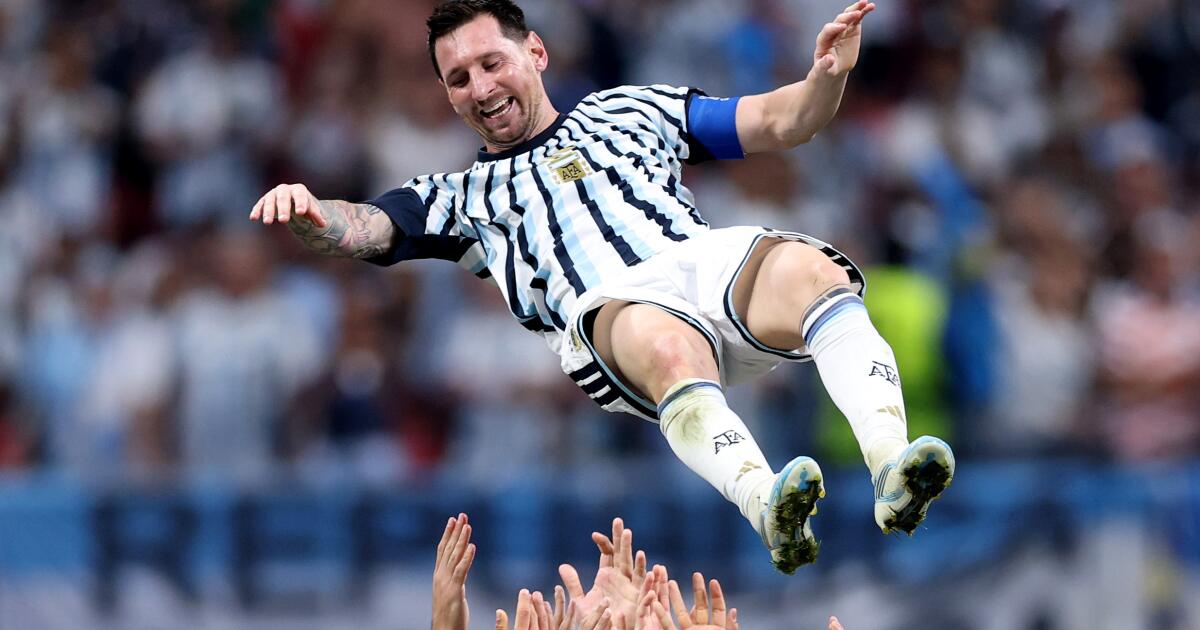
A day before Argentina’s first knockout match of the FIFA World Cup 2026 – and their first fixture in the Sunshine State – the portion of Miami Beach known as Little Buenos Aires came to life as close to a thousand revellers geared up for Lionel Messi’s “homecoming” on Friday.
The defending champions and one of the pre-tournament favourites will take on the fairytale team of the World Cup – the small African island nation of Cape Verde.
The match at Miami Stadium will pit a team supported by one of the largest travelling fan bases of the tournament against an outfit that may not have strong backing in the stands but has endeared itself to the neutrals with its heroic performances.
Among Argentinian supporters, though, there’s no room for sympathy for the team punching above its weight.
For Adrian Elizondo, the logic is simple: “Messi deserves to win another World Cup.”
“It’s Messi’s last World Cup and since he’s the greatest player of all time, he deserves to walk away with another trophy,” Elizondo told Al Jazeera.
Elizondo believes there’s more to Argentina’s success than Messi.
“We have good players, a great coach and tens of thousands of people supporting the team. We make a big difference.”
A quick glance at the party-like atmosphere in Miami Beach reinforced Elizondo’s claim.
Miami, where Messi has been playing his club football since 2023, is home to at least 30,000 Argentinians, according to local census data.
Add to this mix another 20,000 fans following the team on their quest to defend the title in the United States and it becomes evident that Miami is “Messi Country”.
Argentina fans gather in Miami before their team’s World Cup match against Cape Verde, on July 2, 2026 [Hafsa Adil/Al Jazeera]
The crowd in North Beach, which is home to several decades-old Argentinian restaurants and cafes, started building more than 24 hours before kickoff and showed no sign of letting up as the evening went on.
Fans, from toddlers to supporters in their 70s, were seen walking towards the central area in Little Buenos Aires.
A small pocket of enthusiasts would begin singing “Muchachos” – the famous Argentinian football anthem – and hundreds of others would soon join in.
While the lyrics speak to the heartbreak of lost World Cup finals and past heroes, the mood among fans was festive, especially as Messi and Co broke a 36-year title drought four years ago in Qatar and emulated his hero Diego Maradona in leading them to a World Cup trophy.
For Argentina fans, Maradona and Messi are commonly considered the master and the protege. It’s part of their footballing folklore which is reinforced at every opportunity.
In Miami, as men, women and children danced on the streets, a group of supporters dressed in the shirts of Argentinian football club Newell’s Old Boys proudly stood in front of a banner connecting the two national heroes with the club.
Jorge Martinelli, second left, and other Argentina fans from Newell’s Old Boys club [Hafsa Adil/Al Jazeera]
Jorge Martinelli travelled to Miami from Rosario, the club’s base, with his friends and proudly shared some facts about his hometown.
“Messi was born in Rosario and played in Newell’s youth teams before joining Barcelona, while Maradona came to the club in 1993,” he tells Al Jazeera.
Is there any other connection between the two iconic captains? Martinelli said: “Yes, it’s a cosmic connection.
“Many here believe Maradona is guiding the team from the heavens above,” he quipped.
Amid Martinelli’s explanation of the spiritual connection between the two, fans let off crackers to celebrate Miami’s favourite footballing son’s return to his adopted home.
The Rosario resident said he does not want to contemplate a future after Messi retires from international football.
“It will create a big hole in the national team, the same as what happened after Maradona,” he said.
For now, though, he believes Messi is the favourite to do what even the great Maradona couldn’t achieve: successfully defend the title.
“He [Messi] is here. He’s playing. Maradona is watching.”
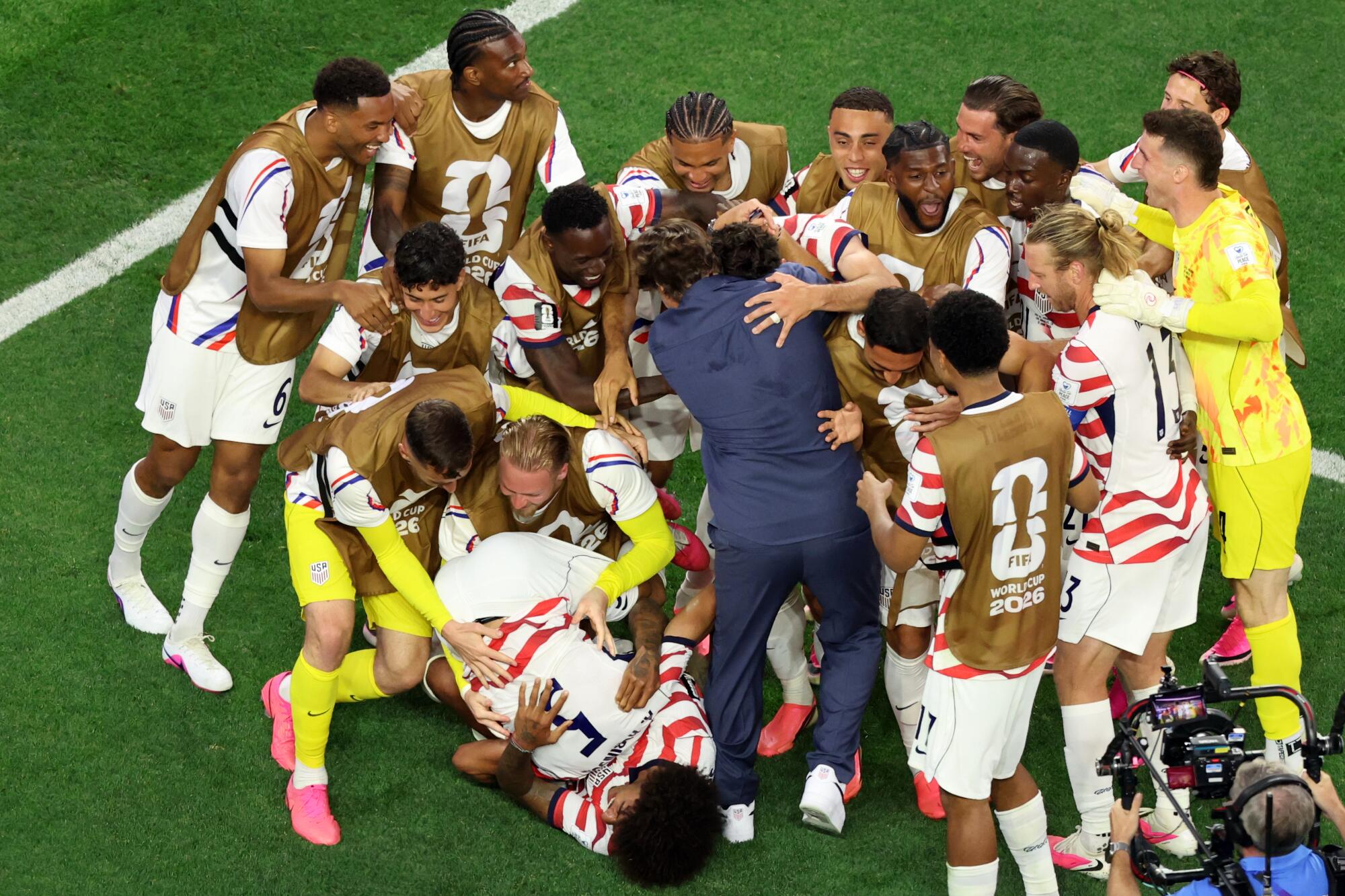
SANTA CLARA, Calif. — Folarin Balogun was still learning to walk the last time the U.S. won a knockout round game in a World Cup. On Wednesday, he helped lead the Americans to another with his goal in the waning seconds of the first half, sparking a 2-0 win over Bosnia and Herzegovina that sends the team on to the round of 16 of this summer’s tournament.
The other goal came from Malik Tillman in the 82nd minute. The Americans have scored multiple goals in every game of the tournament for the first time ever, also setting a national record with 10 goals overall in the tournament.
The U.S. will face Belgium in the next round Monday in Seattle. Belgium advanced with a 3-2 win over Senegal in extra time.
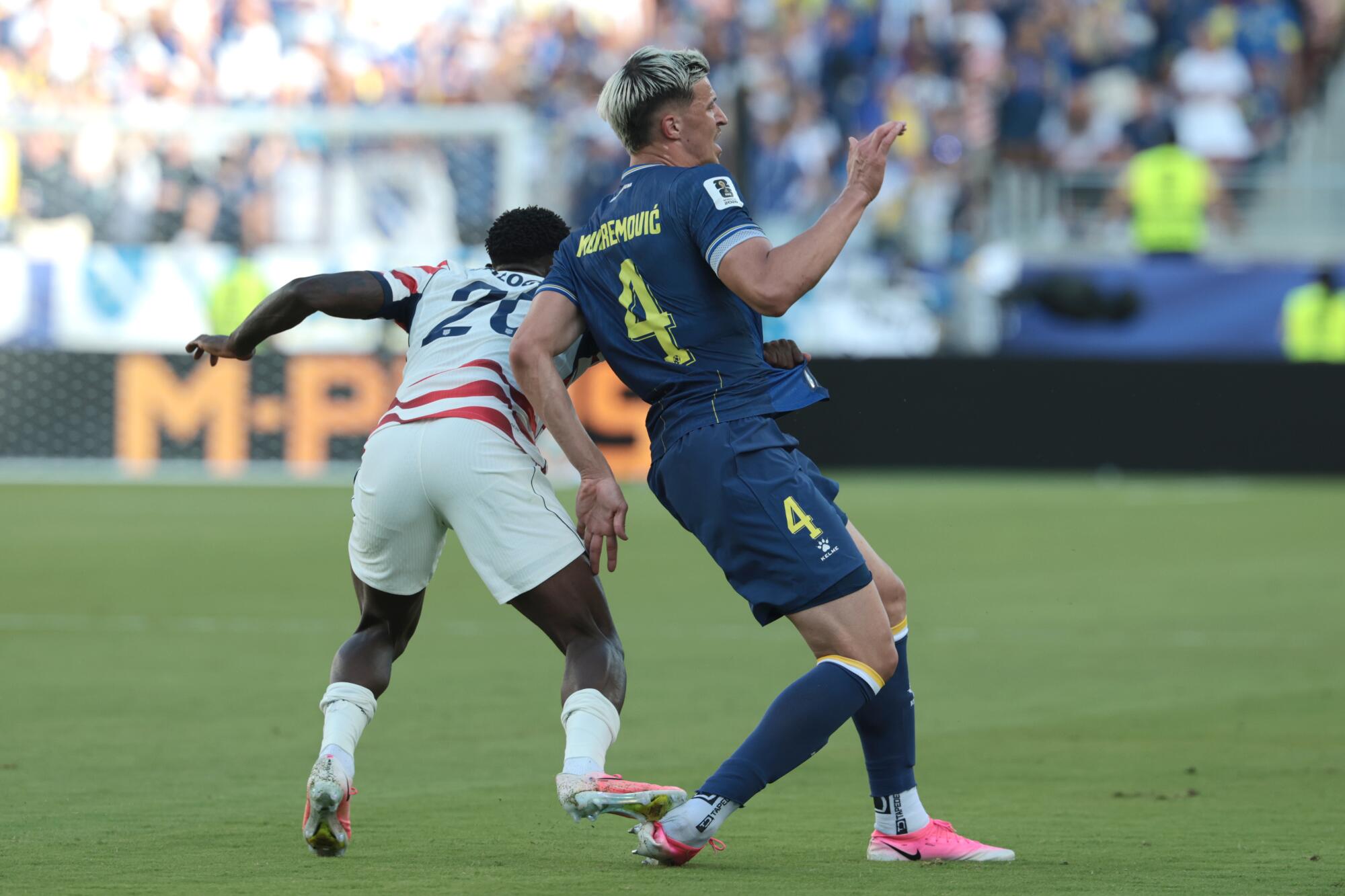
Balogun wasn’t around to see the finish though, drawing a straight red card for stomping on the right ankle of Bosnian center back Tarik Muharemovic in the 61st minute, a foul Brazilian referee Raphael Claus confirmed via a video review. That forced the Americans to see Wednesday’s game out with just 10 players.
“For me, never is this red card,” U.S. coach Mauricio Pochettino said. “Watching after on TV, never was [it] intention[al] to step up on the player. That was a normal action in football that happened by accident.
“That is why for me it’s never a red card.”
Claus disagreed, which could prove costly against Belgium because the card comes with a one-game suspension the U.S. cannot appeal.
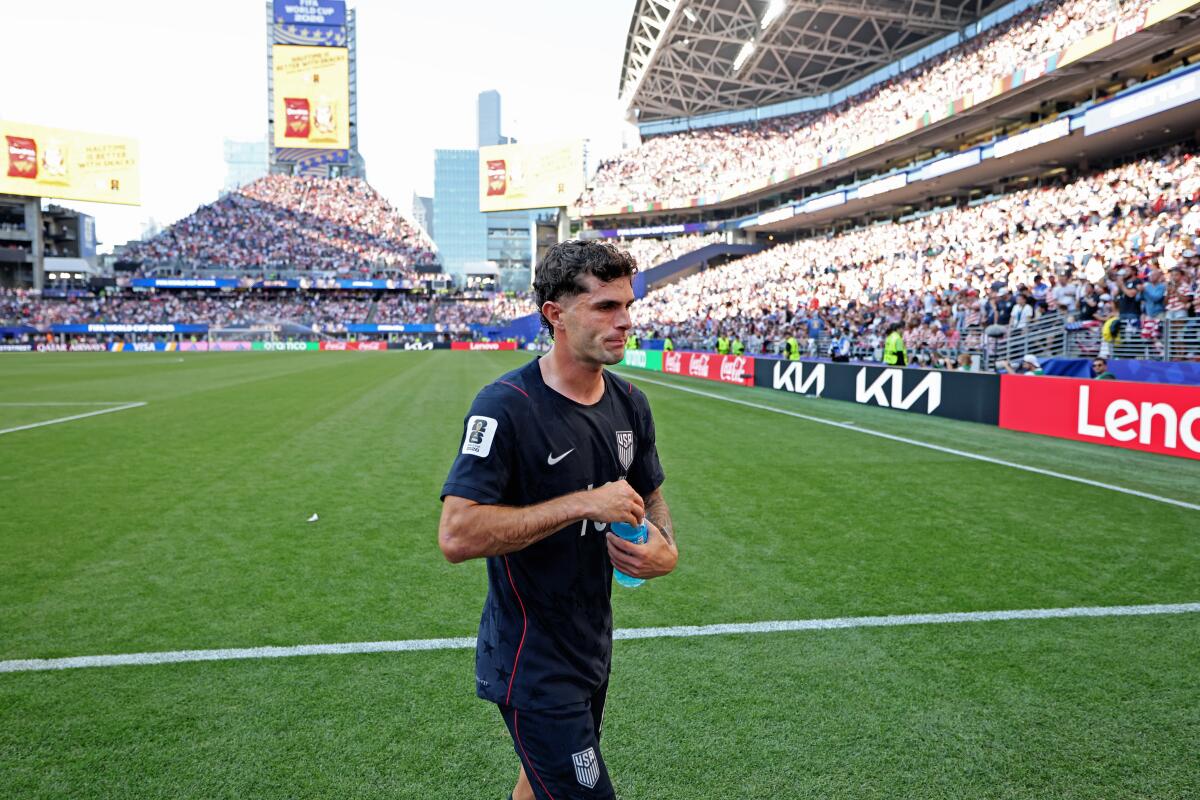
“It’s just so unfortunate, honestly,” teammate Christian Pulisic said. “Looking back at it, it just seems, it seems so harsh. I just told him he’s done so much for us, and now we got his back. So that’s it.”
Balogun put the U.S. in front to stay just before the intermission. The sequence started with Bosnian defender Stjepan Radeljic sliding in front of a Tillman pass, deflecting it forward toward Muharemovic. But Muharemovic got his feet crossed, allowing the ball to carom to Balogun who did the rest, sweeping the ball into the net with his left boot from about 15 feet.
The goal was Balogun’s third of the tournament, tying him with Landon Donovan (2010) for most by an American in a single World Cup since 1930. The lead was the Americans’ first at halftime in a World Cup knockout game since 2002, when they beat Mexico in the round of 16.
Folarin Balogun and Bosnia-Herzegovina defender Amar Dedic in action during the first half.
(Robert Gauthier / Los Angeles Times)
It looked to be a precarious lead when Muharemovic crumpled to the ground with about 30 minutes in regulation time. Claus did not show a card but after the VAR official suggested he take a look at a slow-motion replay, he came away from the monitor and reached for the red, making Balogun the first American to get a red card and score a goal in the same World Cup game.
“I think it’s a yellow card,” midfielder Tyler Adams said. “I think when you slow everything down, it’s only going to look worse.”
A few minutes after Balogun left, the game paused for the second-half hydration break, which proved to be a lucky break for the U.S. Tillman had his right foot stomped on early in the half, ripping his boot and leaving his foot bloodied. The break came him a chance to change shoes.
In the 82nd minute, he swung that new right shoe at a free kick from the top of the box, bending it off the gloved right hand of Bosnian keeper Nikola Vasilj and in the net. That brought another first, according to OptaJack, which said Tillman was the first U.S. player to score on a direct free kick in a competitive match since Jozy Altidore in 2017 Gold Cup final.
“I’ve been dreaming about this game. I’ve been dreaming about maybe taking a free kick and scoring a free kick,” said Tillman, who practices set pieces endlessly after training sessions. “And then it actually came true.”
Until Wednesday, the U.S. hadn’t beaten a European team in 13 tries, a slump that included draws with Wales and England in the 2022 World Cup and six losses in as many games under Pochettino.
The last UEFA country it did beat? Bosnia and Herzegovina, in December 2021.
“Details decided the game,” Vasilj said.
After the red card “we started controlling the game,” he continued “and they canceled that with the second goal. We had our moments and you could feel something was coming. The only thing missing was the goal.”
Staff writer Mirjam Swanson contributed to this report.
“The World Cup is ruining my life,” a neighbor recently said with a laugh. “I’m supposed to be working; instead I’m watching World Cup. I’m supposed to be doing chores; instead I am watching World Cup.”
I laughed in guilty recognition. We had met on the street by chance while I was walking the dog. Having just spent the last two hours watching, then celebrating Lionel Messi’s hat trick during Argentina’s first-game victory over Algeria, I had less than an hour to get back in time to watch Austria play Jordan.
That was on Day 6, and it’s only gotten worse. If I had to calculate my own ratio of work done to soccer watched … well, as I am not a sports reporter, I don’t think my editor would be thrilled. (Though I’m sure she appreciated the England/Congo updates I provided as I finished this piece.)
Like millions worldwide, my family and I have been deeply, and in our case, weirdly, engrossed in this year’s games. “Weirdly” because we do not follow men’s soccer. The World Cup is different, of course — going in, I figured I would check out the U.S., keep an eye on Messi, then tune into the final few games. Perhaps my husband would join (but only if he at least pretended to understand the offside rule), but with our two oldest children out of the house, it is, with the exception of the Super Bowl, unheard of for our family to concurrently view any sporting event in real time.
Until this World Cup. I’m not quite sure how it happened, but suddenly we’ve got game times written onto our calendar. Entire days have been spent in front of the TV with at least one child and the others watching from their homes, our family texts studded with “are you watching…?,” “did you just see that?” and, of course, “OMG MESSI!”
(I would attempt to calculate my recent ratio of chores done to Messi videos watched if I weren’t legitimately concerned that my family would have me committed.)
The fact that my son and his girlfriend live in Kansas City certainly helped spark our newfound fascination. Yes, Los Angeles is also a host city, but L.A. hosts so many things; inevitably we were mostly concerned about what it would do to the traffic. KC, on the other hand, is the smallest and most unlikely of the host cities, and over the last few years we have seen — on visits and through my son’s accounts — all the construction, effort and can-do spirit that has gone into preparing for the event.
We were thrilled when it was announced that Argentina, England, the Netherlands and Algeria would be based in or near KC. We wanted the city to shine, and it has — from nearby Lawrence’s enthusiastic adoption of Algeria to Messi’s historic hat trick at Kansas City Stadium.
Team USA defender Mark McKenzie, left, and Turkey midfielder Baris Alper Yilmaz in the World Cup match at Los Angeles Stadium on June 25.
(Robert Gauthier / Los Angeles Times)
But it’s more than vicarious Midwestern pride. When our older daughter began texting out missives from the earliest games and our son sent pictures of fans streaming into Kansas City Stadium, we started watching as a way to stay connected.
First, as a family, and then to our country and the rest of world.
The games have been inevitably exciting, especially as now that they’re in the knockout round, but the overall sensation was unexpected relief, a soul-soothing balm.
At a time when the news cycle seems to serve up nothing but conflict, crisis and woe, the World Cup offers shelter, a truly international event in which conflict is defined by long-term sports rivalries and questionable referee decisions.
We want our national or preferred teams to win, of course, but no matter the outcome, it’s impossible not to be thrilled by the sight of phenomenal play, underdog tenacity and so many adoring and enthusiastic fans.
Soccer is called the beautiful game for many reasons, and hours/days/weeks of sustained beauty is impossible to resist. Even social media has surrendered to spectacular highlights along with tales of Japan supporters cleaning up stadiums, fans of the victorious consoling fans of the defeated and Europeans discovering the glories of free refills and ranch dressing.
None of this changes the realities we face in America and the rest of the world. Grocery and gas prices remain catastrophically high; Iran continues to contradict U.S. claims of diplomatic resolution to an unpopular war. The unnecessarily revamped reflecting pool in Washington remains a swamp of algae and tourist arrests, as the semiquincentennial struggles under the weight of our president’s self-centered hubris.
But for a few blessed weeks, the World Cup offers inspiration, escape and cultural healing.
It has also, thus far, escaped President Trump’s so often internationally insulting social-media notice and more importantly, his presence. Historically, the leaders of host countries attend the opening match; Trump has, apparently, been too busy (including planning and attending the UFC Freedom 250 cage match recently held on the South Lawn.)
Given his tendency to suck the oxygen out of any room (like his recent reception at Game 3 of the NBA Finals in New York), it’s definitely for the best. If nothing else, the World Cup has given us a chance to take a break from politics and talk instead about Messi, France’s Kylian Mbappé, England’s Harry Kane and all the amazing goalkeepers, including Cape Verde’s now-iconic Vozinha.
Never before have I so understood the therapeutic power of sport.
Who wouldn’t want to at least take a break from rising measles cases, the latest federal or Supreme Court decisions and primary tea-leaf readings to lose themselves in a game where exquisitely patient passing suddenly bursts into spectacular feats of speed and footwork? Where a well-defended ball can suddenly become a goal with a nearly undetectable flick of a foot, or a perfectly placed shot blocked by a goalie’s incredible ability to launch into space? Where an outcome that seems assured can be overturned in the final minutes to the collective roar of an international cast of thousands?
Vozinha of Cape Verde makes a save during the World Cup match between Spain and Cape Verde at Atlanta Stadium on June 15.
(Justin Setterfield / Getty Images)
Like many Americans, I have been occasionally embarrassed by the World Cup’s exposure of my world-geography ignorance — I know where Bosnia and Herzegovina lies on a map, but until recently, I couldn’t place Cape Verde, Curacao or, if I’m being completely honest, Cote d’Ivoire.
Isn’t it wonderful, though, to have a reason to reacquaint yourself with a world map that isn’t related to war, natural or man-made disaster or economic and political tension? The current U.S. administration may seem to be at odds with just about everyone, but visiting World Cup fans are here to remind us of all we share, beneath our crazy wigs and face paint, our cheers, groans and chants.
And we, as hosts, have shown them that America is so much more than the sum of our current government’s policies and posturing.
Watching all this happen, in real time, has been magical, miraculous and magnetic.
Not every moment, of course. Various visa issues created unnecessary and embarrassing drama; high ticket prices and transportation issues were blamed for empty seats at some of the early games. Members of the Iranian team and its coaching staff criticized the way they were treated (though the team left a handwritten note in the dressing room of Los Angeles Stadium, thanking L.A. for its hospitality). The controversial hydration breaks, and the extra commercials they accommodate, can be irritating (though when it’s close to 100 degrees in many stadiums, quite necessary). And though it didn’t matter in terms of standing, watching the U.S. lose to Turkey wasn’t much fun for American fans (though the Turkish exuberance was pretty infectious).
Overall, the 2026 World Cup has done exactly what it was supposed to do: create, in this country, a stage for the finest teams and players in the world’s most popular sport and, more important, carve out five weeks in which we can all spend a few hours removed from the political and cultural divisiveness that threatens to define us.
It’s space in which we can cheer, gasp and leap out of seats along with our families, friends and all the millions we will never meet but to whom we are connected all the same.
Now if you’ll excuse me, the next game is about to start.
Belgium fans celebrate a dramatic 3-2 victory over Senegal in extra time after the Red Devils fought back from two goals down. Supporters describe the match as an emotional rollercoaster from despair to elation.
An intense heatwave is set to blanket much of the central and eastern United States this week as a “heat dome” settles over the region, bringing days of oppressively high temperatures and humidity ahead of the Fourth of July weekend and FIFA World Cup matches in several US cities.
Forecasters say in some places it could feel as hot as 46 degrees Celsius (115 degrees Fahrenheit). Dozens of temperature records could be broken, according to the National Weather Service (NWS), which called the conditions “dangerous”. More than 60 million people are currently under heat alerts.
Recommended Stories
list of 4 itemsend of list
At the centre of this week’s forecast is a weather phenomenon known as a heat dome. What is it, and why does it make heatwaves even more intense and unbearable?
What is a heat dome?
A heat dome is a large area of high pressure, formed when warm air flows northward, that acts like a lid over the atmosphere, trapping hot air close to the ground.
As the air sinks, it compresses and warms even more. At the same time, the pressure system helps prevent cooler air and storms from moving in, allowing heat to build at the surface and remain trapped there. With few clouds and little wind, the sun has more direct access to the ground, creating a heat feedback loop.
Heat domes are linked to prolonged heatwaves that can last for days.
How long will it last?
The heat dome is already building and is expected to strengthen over the coming days, spreading from the central US towards the east coast, with dangerous heat lasting several days into early July.
The hottest conditions are expected Thursday and Friday, according to the NWS, and are set to continue through the Fourth of July weekend, which marks the 250th anniversary year of the US, and forecasters say some areas across the Great Plains, the southeast, and the mid-Atlantic are likely to remain unusually hot into next weekend.
What will the highest temperatures be?
Many places are expected to see daytime temperatures in the high 30s Celsius (low 100s Fahrenheit), but humidity will make it feel much hotter. In parts of the central and eastern US, the heat index – a measure of how hot it feels when humidity is factored in – could climb between 40C and 46C (100F and 115F).
“That’s heat that’s impactful to anyone,” said NWS meteorologist Bryan Putnam. “It’s not just older adults or younger children or people who are spending a ton of time outdoors, maybe straining themselves a little more than normal. This is heat that really could impact everyone, especially with people outdoors going into the holiday weekend.”
The nights won’t bring much relief either, with temperatures expected to stay in the 20s Celsius (70s Fahrenheit) overnight, creating potentially miserable sleep conditions for those without air conditioning and making it harder for people to cool down.
“Even after the sun goes down, it’s still going to be very hot,” said AccuWeather senior meteorologist Alan Reppert. “We’re at a pattern that’s really going to be hot during the good portion of the afternoon and even into the evening hours.”
Which parts of the US will be hit the hardest?
The most dangerous conditions are expected in a broad corridor stretching from the Great Lakes to the East Coast, where several cities could experience their hottest day of the year so far. New York City, Philadelphia, Washington, Baltimore, Chicago, Indianapolis, Detroit and St Louis are all expected to be affected, with temperatures also soaring farther south in Dallas, Little Rock and Memphis.
Several of those cities are also hosting FIFA World Cup events. In Philadelphia, organisers have already changed Fan Festival hours to start later in the day.
Cities across the US are rolling out emergency measures as temperatures climb.
Chicago said it would open cooling centres and send city workers to check on vulnerable residents.
In New York City, Mayor Zohran Mamdani’s office announced what it called an “unprecedented” response to the heat, including hydration vans and pop-up cooling stations equipped with misting fans and cooling towels.
Washington, DC, where temperatures are expected to exceed 38C (100F) from Thursday through Saturday, the heat will coincide with Fourth of July celebrations, including what organisers say will be the largest fireworks display ever held on the National Mall.
What are some ways to stay cool?
The NWS says people should stay hydrated, avoid strenuous outdoor activity during the hottest part of the day and seek air conditioning or cooling centres where possible. If you’re spending time outside, wear loose, lightweight clothing and stay near shady areas.
Experts say one of the biggest risks during a prolonged heatwave is that the body doesn’t have time to cool down overnight, which can make the effects of the heat build up from one day to the next. They also recommend drinking water before you feel thirsty and limiting alcohol, which can increase the risk of dehydration.
“If somebody realises that they’re hot, but they’re not sweating, or if they begin to feel a little bit dizzy, those are some signs that they really need to take a break, get inside, find some cooling, and drink plenty of water,” said Geoff Cornish, assistant chief video meteorologist for the weather forecasting company AccuWeather. “And if they really begin to experience significant symptoms, they need to seek medical attention right away.”
Some kids grow up with video games and summer camp. Sebastian Berhalter grew up with the World Cup.
He was 13 months old when his father, Gregg, played in the tournament for the first time and 5 when his dad was called back. And four years ago, when Sebastian was already a professional in his own right, he went to Qatar to watch his father coach the U.S. to the round of 16.
Yet none of that prepared the younger Berhalter for his own World Cup debut earlier this month.
“It’s ridiculous,” Sebastian said. “Before the game, I just kept chuckling to myself, like, ‘What the hell is going on?’ Literally I couldn’t believe it. Playing for my country, it’s the best feeling in the world.
“I just can’t believe that happened.”
Nor could he believe what happened next. Because after making appearances off the bench in the team’s first two group-play games — both of which ended in U.S. victories — Berhalter started the third game. And with a goal and an assist in a loss to Turkey, he already has more World Cup goals and assists than his dad.
In fact, he’s the only American with a goal and assist in the same World Cup game in the last 96 years. Not bad for your first start in the tournament.
His father still has bragging rights in one category, however, since the 2002 team he played for is still the only American team to win a knockout game in a World Cup. Sebastian can match that Wednesday in Santa Clara when the U.S. plays Bosnia and Herzegovina in the round of 32 of this summer’s expanded tournament.
“They’re a good team,” Sebastian said of the Bosnians. “It’s a round of 32, so do or die. I think you play every game like it’s a knockout game. For us it’s, it’s keep doing what we’ve been doing.”
If Gregg provided the inspiration and the road map that guided his son to the World Cup team, the younger Berhalter had to wait for Mauricio Pochettino before he could take his first steps on that road. That came in the spring of 2025, about 11 months after his dad had been sacked as coach, when Pochettino, the new manager, gave the younger Berhalter his first national team call-up.
He’s gone on to make 16 appearances for the U.S., including three in the World Cup. And that’s something Gregg is convinced couldn’t have happened as long as he was coach.
“I think about it all the time,” he recently told ESPN. “I never could have picked him.”
The scrutiny would have been too fierce, he feared, the whispers of nepotism too loud. Sure, Michael Bradley played more than 50 internationals games for his father Bob, including four in the 2010 World Cup. But he was already on the team when his father took over from Bruce Arena, who gave Michael his first call-up.
So, Sebastian had to wait. He had to play for three MLS teams, win an MLS Cup and three Canadian Championships and become too good to ignore in order to get his first shot with the national team — one which came from Pochettino, not his father.
Neither Berhalter has regrets.
“What I know,” Gregg, now coach and sporting director of the Chicago Fire, told ESPN, “is that everything is in the place it’s supposed to be. This is how life is. It’s his turn. It’s his time now.”
And he’s playing as if there’s no time to waste.
After making his international debut in a friendly with Switzerland last May, Sebastian played five full games in the Gold Cup last summer, then scored his first international goal in a friendly with Uruguay less than three weeks before leading the Vancouver Whitecaps into the MLS Cup against Inter Miami.
So, when the time came for Pochettino to name his World Cup roster last month, it was clear Sebastian, 25, had earned a spot.
“He’s a monster. He’s a monster, in the way of how professional he is,” the coach said. “He’s the type of player who’s going to train, going to train, going to train. I mean, sometimes I have to say [to him], ‘Go inside, no?’“
After stumbling in the group-play final, which Turkey won with a goal deep in stoppage time, the U.S. will have no room for error in its first elimination game. It’s a game in which history may — or may not — be on the Americans’ side.
On one side, the U.S. is winless in its last 13 games against European opponents. On the other, its last win over a UEFA team came in December 2021, in California, over Bosnia and Herzegovina, a team to which it has never lost.
There’s an omen in there somewhere.
“Our goal is to win the World Cup,” Sebastian said. “That’s what we want to do. It’s always been our mission and we’re still taking it one game at a time.”
There’s also the family record book to think about. One more victory and Sebastian will have more World Cup wins than his dad. Two more and he’ll be in the tournament quarterfinals, which is as far as his father went in his first World Cup.
In Qatar, Sebastian was the one in stands, cheering on his dad. In this tournament, the roles have been reversed. And Gregg told his son he couldn’t be happier about or prouder of how things have worked out.
“Four years ago, I was waiting for him to come up in the stands. Now, he was waiting for me to come up in the stands,” Sebastian said. “That was special.
“When you hear words that your dad is proud of you, that’s a cool moment.”
MEXICO CITY — Mexico once again enjoyed a night of celebration with its fans, this time after defeating an old nemesis — the knockout stage of the World Cup.
El Tri won its first knockout match at a World Cup since 1986, beating Ecuador 2-0 on Tuesday night at the majestic Azteca Stadium packed with 80,824 fans.
From 1994 to 2018, Mexico failed to win a World Cup knockout game and, in 2022, failed to advance past the group stage — its worst showing at a World Cup since 1978.
“Bringing joy to the fans is the best thing that can happen to us,” Mexico coach Javier Aguirre said after the win. “Our duty is to give it our all on the field. Our duty is to defend our crest and represent our country with dignity.”
Thanks to an expanded 48-team World Cup format with a knockout round of 32 teams and a formidable home-field advantage, Mexico achieved a goal that had seemed impossible.
Mexico players celebrate after the World Cup round of 32 win over Ecuador in Mexico City on Tuesday.
(Fernando Llano / Associated Press)
Ecuador, which finished second in the South American World Cup qualifiers, put up a strong fight, bombarding the Mexican team with crosses, albeit without much organization.
Fans roared their approval for the Mexican national team, which took a lap of honor after the match, as the crowd sang “El Rey” and other songs to express their love for their team.
Julián Quiñones scored the first goal for Mexico in the 22nd minute on a counterattack, while Raúl Jiménez added the second in the 31st minute, in a match where El Tri had numerous scoring opportunities against an Ecuador side that did not appear to be well-organized defensively despite having advanced after defeating Germany in the group stage. The victory over Germany helped Ecuador become one of the third-place finishers to advance to the knockout round.
Mexico will play one more match in Mexico City, facing the winner of the England versus the Democratic Republic of Congo match to be played Wednesday in Atlanta. Mexico’s round of 16 game is scheduled for Sunday. The team is one step away from matching its best World Cup performance — a run to the quarterfinals it achieved in 1970 and 1986 when Mexico hosted both tournaments.
El Tri is now 4-0 in World Cup matches and has yet to concede a goal, both firsts for the Mexican national team.
Tuesday night’s showdown with Ecuador was delayed by an hour because of lightning.
The Ecuadorian team complained before the match that their fans had not received the tickets required by FIFA and that Mexican fans made noise all night outside the Ecuadorian team’s hotel — a common practice in Latin America designed to prevent the opponent from getting a good night’s sleep the night before a decisive match. Finally, Ecuador’s coach, Argentine Sebastián Beccacece, complained about the logistics of the trip to Mexico, claiming it involved long journeys that were an undue burden for his team.
Frustration flared up throughout the match, with both teams briefly crowding the sideline after a hard foul.
When Ecuador could not earn shots on target and time was running out during the second half, Piero Hincapié ran toward forward Santi Giménez and covered his mouth while speaking.
The referee saw the exchange and stopped play, calling for video review. Once he confirmed Hincapié’s action, the referee issued a red card and the Ecuador player became the second player this World Cup for violating FIFA’s restriction against players covering their mouths during heated exchanges. Since Ecuador lost, Hincapié will serve his red-card suspension during the team’s next international match.
FIFA established the new rule to prevent players from trying hide use of offensive language.
Paraguay’s Miguel Almirón was the first player to get a red card for the infraction against Turkey earlier in the World Cup.
Other players have covered their mouths while speaking to opponents during the World Cup, but a red card is only issued if the conversation occurs during a confrontation or heated exchange.
After the total failure that was Mexico’s participation in the Qatar 2022 World Cup, where they were eliminated in the group stage, the future looked very dire for “El Tri.” By 2024, the situation had worsened after another international failure at the Copa América. The 2026 World Cup co-hosts had even more pressure now. In a crisis-control move, the Mexico Football Federation opted to bring back its proven problem solver, head coach “El Vasco” Javier Aguirre, for a third stint.
In a short time, Aguirre was able to shape “El Tri” into a competitive squad by breaking from his usual approach. The man who shockingly demoted then-24-year-old goalkeeper Guillermo “Memo” Ochoa in favor of a more experienced player prior to the 2010 World Cup was now relying on upstarts.
Aguirre’s 26-man roster for the 2026 World Cup features 14 debutants on soccer’s grandest stage.The crown jewel of this nucleus is undoubtedly 17-year-old wonderkid Gilberto Mora, but there are also two American-born players who are also expected to become pillars of the team: Brian Gutiérrez, from Berwyn, Ill., and Obed Vargas, from Anchorage, Alaska.
Under Article 30, Section A, Part II of the Mexican Constitution, individuals born abroad are considered Mexican by birth if they are children of Mexican parents — a Mexican mother or a Mexican father. Gutiérrez’s parents are from San Juan de los Lagos, Jalisco, while Vargas’ father is a native of Morelia, Michoacán, and his mother was raised in Mexico City.
“Obviously, I’m taking it day by day and just trying to enjoy the experience,” said Gutiérrez about the opportunity to play for Mexico at the World Cup. “I talk about it a lot with my friends and family. Honestly, it’s amazing… I’m just living in the moment.”
Gutiérrez, 22, and Vargas, 20, are not the first players born in the United States to represent Mexico in a World Cup. That distinction belongs to Miguel Ponce and Isaac Brizuela, who were both born in California and part of the 2014 squad. But the comparisons largely end there.
Unlike Ponce and Brizuela, Gutiérrez and Vargas were fully raised in the United States and went through their entire soccer development on American fields. Ponce and Brizuela were also fringe contributors; they didn’t see any minutes in Brazil 2014.
Meanwhile, Gutiérrez and Vargas are already getting important playing time with the national team. Both were part of Mexico’s historic group stage where, for the first time in history, the team won all three of its games. Gutiérrez was a starter against South Africa and South Korea, while Vargas came off the bench to help preserve the 1-0 lead over South Korea.
Their protagonism in Aguirre’s squad could also signal another new era for the Mexican national team — one in which Mexican American players are just as vital as those born on Mexican soil.
“Brian and Obed are two young players of Mexican heritage. They are very talented players who have made great progress recently. We called them up, and they convinced us with their performances,” said Aguirre prior to the tournament. “I believe there are many Mexican American players who, in the future, will continue strengthening Mexico’s youth national teams, including the women’s side. That makes me happy because they were not born in Mexico, yet they have a deep love for the country and have shown it by choosing to represent us.”
Both Gutiérrez and Vargas are also products of MLS academies.
Gutiérrez, a skillful and dynamic attacking midfielder, rose through the ranks of Chicago Fire’s youth system and made his senior debut in 2020. In December, he moved to storied Liga MX club Chivas, his childhood team. It took time for Gutiérrez to establish himself as a starter for Gabriel Milito’s squad, but his game-changing talent was there — enough to catch the eye of “El Vasco.”
Vargas, a box-to-box midfielder, developed through the Seattle Sounders youth system and debuted with the senior team in 2021. A strong showing against Atlético de Madrid in the 2025 Club World Cup led to the Spanish club adding him to its roster this February. This move also put him in Aguirre’s World Cup plans.
“Playing for Mexico at the World Cup is a dream come true for all Mexican American kids,” said Vargas. “Obviously, with the World Cup being in both countries, it’s special to me. I have connections and ties to both countries.”
For so long, it was said Mexican American players just could not earn a place with Mexico at the international level. Players like Édgar Castillo and Alejandro Zendejas — born in Juárez but raised in El Paso — represented “El Tri” up to the U-23 level, then switched and played for the U.S. Jonathan González (Santa Rosa, Calif.) represented the U.S. at youth level and then chose Mexico, but after a few call-ups he fell out of the picture.
But in this World Cup cycle, Mexican American players have stood out more than ever.
Aguirre’s preliminary 55-man World Cup roster included six Mexican American players. Richard Ledezma (Phoenix), Efraín Álvarez (Los Angeles), Jorge Ruvalcaba (Rialto), and Julián Araujo (Lompoc, Calif.) ultimately missed the final cut. Of the four, Ledezma and Araujo came closest to making the team, but for different reasons fell short.
Vargas believes it was only a matter of time before the talent broke through.
“I think Mexican American players have always been there. The quality has always been there. Obviously, the growing passion for the sport in the United States has helped fuel the development of many of those players,” said Vargas. “I think it’s amazing to see so many Mexican Americans doing well with the national teams of both the United States and Mexico. Dreams come true for kids, and that continues to inspire the next generation of Mexican American players coming through in the U.S.”
Gutiérrez and Vargas, like many standout Mexican American players over the last 15 years, began their paths with “El Tri” amid a long-standing tug-of-war between their birth country and the country of their parents. The Mexico men’s national team and their U.S. counterparts have increasingly become rivals, both on the field and in recruiting dual-national players.
For Mexico, the United States now represents a prime area for scouting outside its territory. According to the Migration Policy Institute’s (MPI) tabulation of data from the U.S. Census Bureau’s 2022 American Community Survey, approximately 38.8 million U.S. residents were either born in Mexico or reported Mexican ancestry or origin.
Not only do Mexican American players expand the national team’s talent pool, but as some argue, they also bring a different element that can be a major advantage for the program.
Former Mexico youth coach and current Guatemala coach Luis Fernando Tena recently raised eyebrows in an interview with ESPN Deportes by stating that Mexican American players possess qualities that can set them apart from homegrown Mexican players.
“They have an American mindset. They grew up with that mentality and with good nutrition, and that makes them different,” said Tena, who led Mexico’s U-23 team to the gold medal at the 2012 London Olympics. “They are more disciplined, work harder, and are more focused — something that we sometimes don’t always find in many Mexican-born players.”
Gutiérrez and Vargas started their international careers representing Team USA at youth level, but FIFA’s one-time switch rule allowed them to change allegiances.
Vargas said he chose Mexico because he simply “followed his heart.” His love for his heritage and the Mexican national team outweighed everything else.
As for Gutiérrez, he was motivated to make the change because his time at Chivas convinced him. In Liga MX, the club has been at the forefront of tapping into the Mexican diaspora in the U.S. Their long-standing “Mexicans-only” policy limits the club’s talent pool when acquiring players. Because of this, Mexican American players are becoming a vital lifeline for Chivas.
“As soon as I arrived at Chivas, I knew my decision was to represent Mexico because we play with 100% Mexicans, that’s just how it is,” said Gutiérrez.
Opportunity may have also played a major role in Gutiérrez’s and Vargas’s “one-time switch” decisions. Both had no clear pathway into the U.S. senior squad, while Mexico offered a clearer route — and a chance at the 2026 World Cup.
In a 2023 interview, El Paso native Ricardo Pepi, who made the one-time switch from Mexico to the U.S., said on the Men in Blazers podcast that his decision was influenced by the fact that the U.S. had him in mind for the senior squad, while “El Tri” did not.
“It was just easy to decide. The U.S. wanted me to join them in World Cup qualifiers, which is a big deal,” said Pepi. “It’s a unique opportunity, being at a World Cup, and something I didn’t even have to think about because Mexico wanted me for the U-20s and eventually the first team. I was like, ‘I’m past that.’”
Although Gutiérrez and Vargas chose Mexico and embrace their parents’ culture, their duality is still present. They carry their communities with them.
A year ago, when aggressive ICE raids and mass deportations swept through many immigrant communities in the United States, particularly Mexican immigrant communities, a visibly frustrated Aguirre refused to comment on the situation, saying he was “apolitical” and not “a spokesperson” for the Mexican people.
This was not the case with Gutiérrez and Vargas, who both addressed questions about the ICE raids during Mexico’s World Cup media day in Pasadena, where they switched seamlessly between English and Spanish.
Gutiérrez answered without hesitation. His hometown of Berwyn is a suburb of Chicago, a city that in September was targeted by “Operation Midway Blitz,” a major federal immigration enforcement surge. According to the Chicago Tribune, between 3,800 and 4,500 individuals were detained or arrested during the operation.
Gutiérrez’s words reflected the strain felt throughout his community.
“It’s been a hard, hard year for us,” Gutiérrez said. “It’s affected a lot of families, and I take playing for Mexico with great pride and hope to show it on the field.”
It’s no secret that a large part of Mexico’s fanbase is composed of Mexican Americans. They are the ones who help fill massive NFL stadiums for “El Tri’s” annual MexTour, a slate of mostly inconsequential friendly matches that are often seen as a cash grab for the Mexican Football Federation. The presence of standout players like Gutiérrez and Vargas is a major development for this segment of the fanbase.
By featuring players with shared cultural experiences and struggles, the connection between the Mexican diaspora in the U.S. and “El Tri” can only strengthen. The ties now go beyond simply sharing the same roots; Mexican Americans can now gravitate toward a team with players who represent their dual identity. And this can bring a true sense of belonging.
Morocco’s Ismael Saibari embraced his mother after scoring the winning penalty against Netherlands to reach the World Cup last 16. The players danced and cheered in the dressing room after the dramatic win in Monterrey, Mexico.
Remember when we were sure the World Cup would suffer from all the issues that had everyone seeing red before the first ball was kicked?
And remember when we were certain soccer could never catch on in this country?
Despite controversies over visas and ticket prices and transportation, and in spite of consternation over expansion and new rules, the game has, as usual, proved too good to fail.
And we, the American people, have become unusually engrossed in it.
We’ve been tuning in on TV in record numbers and, even at exorbitant prices, helping to sell out our 70,000-some-capacity stadiums. Before group play was even finished, this tournament — staged also in Mexico and Canada — already outdrew the 1994 World Cup, which was hosted by the United States and set an attendance record of nearly 3.6 million.
We’ve been loving the healthy cultural exchange, and we’re being reminded that cultural barriers of traditional sports fandom can be breached.
So now, to keep our interest from drying out like a pitch on a hot summer day, the goal should be to keep the market saturated with soccer. That will take Major League Soccer tearing down all the walls.
It’s already turned the page on its calendar, adopting a summer-to-spring season format that will better blend with the global game.
Now MLS needs to make its games easier to watch, and to do its part to make the sport easier to play.
Canada goalkeeper Maxime Crépeau, left, celebrates with teammate Jonathan David after a 1-0 win over South Africa at the World Cup on Sunday.
(Kelvin Kuo / Los Angeles Times)
While the proverbial iron is hot, it needs a strike like Stephen Eustáquio’s winning rocket in the 92nd minute of Canada’s 1-0 victory against South Africa on Sunday at SoFi Stadium.
Eleven players on the two teams were MLS representatives — including Eustáquio, who spent the last six months in LAFC’s midfield.
Goalkeeper Maxime Crépeau, who played two seasons with LAFC and now plays for Orlando City, stopped the only shot he saw for his second clean sheet this World Cup, which saw the Canadians succeed in their first knockout stage appearance.
There’s been no avoiding MLS players in this World Cup. The greatest of them is piling up goals for Argentina: Lionel Messi, the Inter Miami superstar, is now the all-time World Cup goal-scorer (with 19).
MLS has set an attendance record too, with 44 players participating. It ranks as the league with the second-most players apart from the top five European leagues. LAFC had three current players in the mix.
But wait. Record skip. Before you celebrate the MLS’s contributions to this soccer spectacle, check with the VAR. Yep, without the 13 MLS players representing nations that rank 40th or lower in FIFA’s world ranking, there actually would be fewer than the 37 MLS participants at the World Cup four years ago.
A baby’s first steps are for celebrating, but three decades after the league’s formation, MLS is still searching for a giant leap. It’s still having a mean time of trying to make “fetch” happen for real.
It would help to make its games more readily available — not to the already converted, but to fans who didn’t even know what they didn’t know about soccer until the World Cup began in their backyards.
MLS has already brought MLS from behind Apple’s season pass paywall. And the league and streaming service also reportedly have agreed to a revised media rights deal that will end at the end of the 2028-29 season, three and a half years earlier than expected.
But the hat trick would be to remove the need to subscribe to streaming service to watch MLS games altogether, and then get those matches onto the networks people know to tune into for their sports.
Normalize watching American soccer.
And stop gatekeeping. MLS’s developmental programs are too restrictive and exclusive — they’re not developing more soccer players, they’re curtailing who can play.
It’s in the league’s interests, and the sport’s in this country, to encourage as many players to play as much as they can — including for their high school teams, which MLS Next bars.
They’ve got people in the tent; the goal should be to make them want to stay.
To make them want to join the world’s circus, not to let it pack up and move on, out of sight and out of mind, until it swings back through years from now.
Tehran, Iran – Iran’s national football team has once again failed to realise the dream of reaching the knockout phase of the World Cup, with the wartime 2026 tournament stirring up a wide range of emotions among Iranians inside and outside the country for different reasons.
Team Melli ended its seventh appearance in the tournament after a 1-1 draw in Seattle on Friday against Egypt left them in third place in Group G, with only three points gleaned from three draws.
Recommended Stories
list of 3 itemsend of list
The team was eliminated a day later, after a series of other match results left them just outside of the tournament’s eight third-placed teams advancing to the next stage after FIFA expanded from 32 to 48 teams.
“This was very unlikely to happen, I couldn’t believe how we got out again, with just one spot away from advancing,” Milad, a resident of Tehran who watched all matches impacting Iran’s run at the World Cup, told Al Jazeera.
The circumstances were so peculiar that, among other things, they left the head coach pondering divine intervention, and state television accusing other teams of cheating and collusion.
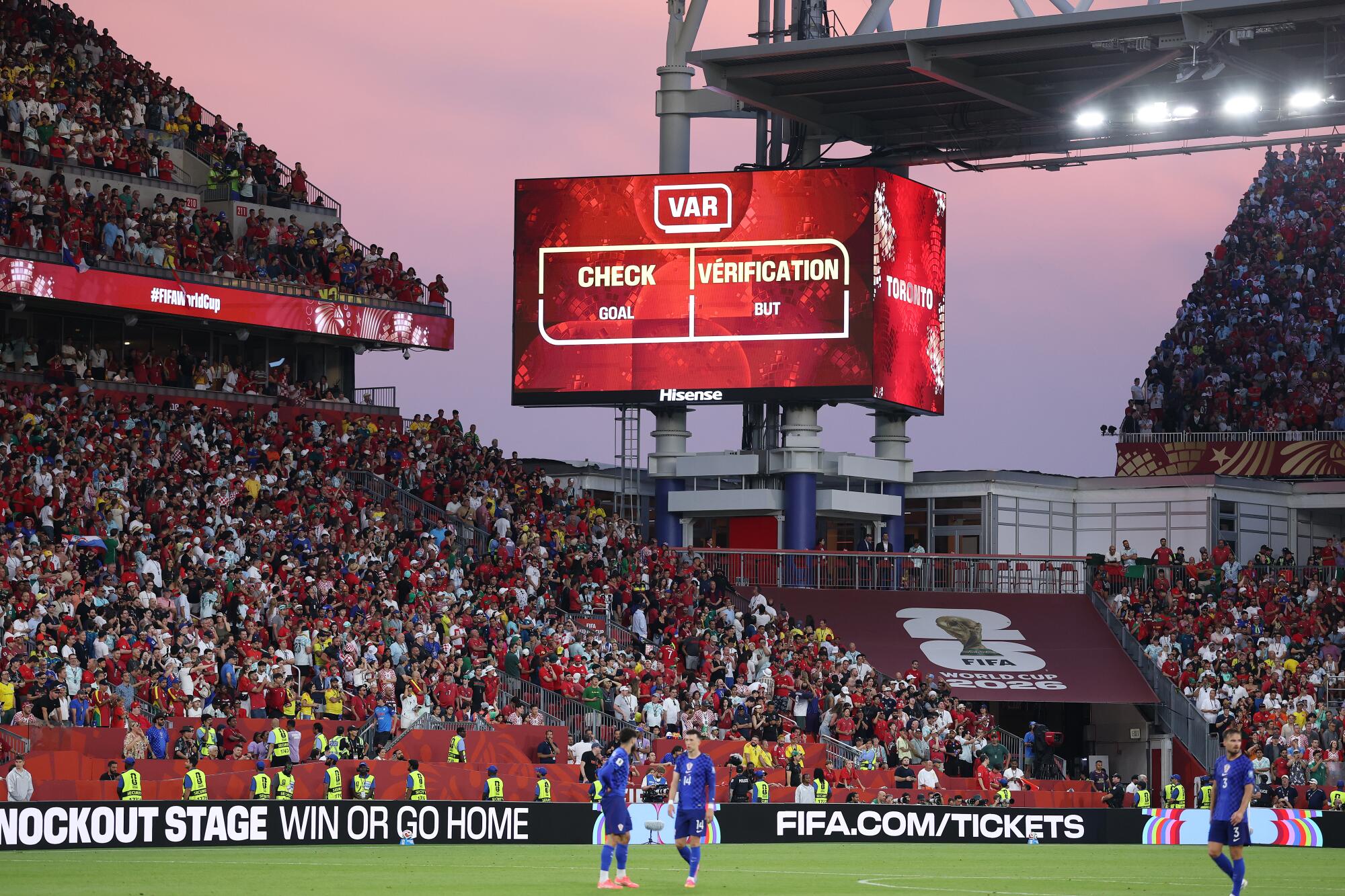
During the Egypt match, centre-back Shoja Khalilzadeh appeared to score a 93rd-minute winner that would have automatically sent Iran into the Round of 32, but VAR ruled it out after a few centimetres of his right foot were offside.
Video replay in the stadium shows Shoja Khalilzadeh of Iran as offside when he scored the second goal which was then dissallowed during the FIFA World Cup 2026 Group G match between Egypt and on June 26, 2026 in Seattle, Washington [Richard Heathcote/Getty Images] (AFP)
A member of the coaching staff had his nose broken after another staff member inadvertently headbutted him during emotional group celebrations of the goal before it was overturned.
Khalilzadeh’s goal celebration included posing with sunglasses, so Egypt – which advanced to the knockout phase – later taunted him with an Instagram picture of striker Mohamed Salah giggling while wearing sunglasses.
A disgruntled head coach Amir Ghalenoei told state television during a live post-match interview that he believed everyone enjoyed the match, but at times it seemed like “God was at odds with us” due to the lack of good luck – which also included Iran scoring three VAR-overturned goals during the competition, the highest of any team.
He also blamed tough conditions faced by the players and the entire staff during an unprecedented World Cup campaign, in which the main host country, the United States, has been at war with a participating nation, Iran, for the past four months.
The US military bombed several islands in the Strait of Hormuz in Iran’s southern waters just hours before kick-off in the Iran-Egypt match.
Football federation officials, as well as other staff and media personnel, were denied visas to travel to the US for the tournament, on grounds that included their alleged affiliation with the Islamic Revolutionary Guard Corps (IRGC), the force running war and politics in Iran.
The playing squad was only allowed in under unusually tight restrictions, and had to be mostly based in Mexico’s Tijuana instead of the originally designated Tucson in Arizona.
They had to enter the US within 24 hours of a match and leave on the same day, with only a slight easing allowing them to arrive two days early for the Seattle match.
‘Completely mad’
After the Egypt match, Iran needed just one of three things to go their way: Croatia had to lose to Ghana, but it won 2-1; DR Congo had to fail to beat Uzbekistan, but won 3-1; and Algeria vs Austria had to produce a winner, but the match ended 3-3.
Hours before the Algeria-Austria match, Javad Khiabani, a sports presenter infamous for decades of eccentric football commentary, released a video message in Arabic, addressed to the “Muslim brothers in Algeria”. He asked them to defeat Austria and allow Iran, a Muslim-majority country that has suffered war, to advance.
Other hosts of Iranian state television and radio channels broadcasting the match live went through an emotional rollercoaster after Algeria’s Riyad Mahrez scored deep into stoppage time, creating a 3-2 result that would have sent Iran through.
“Now, a Muslim country is doing something to keep another Muslim country in the knockout stage,” shouted another ecstatic commentator, again linking the sport with religion.
He and many Iranians watching at home were devastated moments later when Austria’s Sasa Kalajdzic used his first touch of the game to equalise with a header in the box. The result benefited both teams, because it sent both into the next round, with Austria facing Spain and Algeria facing better odds against Switzerland.
Some inside and outside Iran suggested the game was rigged, but Austria’s head coach Ralf Rangnick responded to match-fixing allegations by saying: “If Alfred Hitchcock had written such a drama, I probably would have said he was completely mad”.
Shoja Khalilzadeh #4 of IR Iran scores his team’s second goal that was ruled offside following a VAR review during the FIFA World Cup 2026 Group G match between Egypt and IR Iran at Seattle Stadium on June 26, 2026 in Seattle, Washington [Dean Mouhtaropoulos/Getty Images]
Killings that scarred society
For a second consecutive World Cup, Iran’s national football team did not enjoy unified support from Iranians inside or outside the country, due to the fallout from public protests against the Islamic Republic, the theocratic establishment that has governed Iran since the 1979 Revolution.
In January 2026, thousands of Iranians, including at least 230 children, were killed during nationwide anti-establishment protests that erupted across the vast country of over 90 million. The government, as with previous protests, put all the blame on “terrorists” organised by the US and Israel, but Amnesty International called it an “unprecedented deadly crackdown” by the state that also included a total internet shutdown.
Just months after the killings that scarred parts of Iranian society, some believe football players – who have all avoided commenting on the protests, but in some cases have backed the state – are not representatives of a unified Iran.
Outside the stadiums in the US during the World Cup, some anti-Islamic Republic Iranians protested using Iran’s pre-1979 lion-and-sun flag, as opposed to the official flag which features the word “Allah” in the centre, but most diaspora Iranians ended up cheering for the team in packed stadiums.
Mohammad Khakpour, a former Team Melli captain now based in the US, wrote in an Instagram post on Sunday that the fact Iranians had contrasting emotions after Iran’s elimination from the tournament carries a social message.
“When a part of the society feels that Team Melli is no longer representative of their emotions, pains or hopes, a chasm is created,” he said. “The people may not be happy from a football loss, but they may at times be happy about the collapse of an image that they do not consider to be true”.
Farhad, a 36-year-old resident of eastern Tehran, told Al Jazeera that decades from now, people may remember Team Melli not only as representing the Islamic Republic but also for the football record it left behind.
“Personally, I preferred it if they advanced, but I’m not devastated that they didn’t,” he said.
When FIFA expanded the World Cup field from 32 to 48 teams for this summer’s tournament, the gnashing of teeth and clutching of pearls was as predictable as it was loud. The field would be watered down, the traditionalists protested. The group stage would be a series of blowouts, the sharks would devour the minnows.
In fact, none of that happened.
What we got instead was plucky Cape Verde playing No. 3 Spain to a draw and becoming the smallest nation to reach the elimination rounds. We got Austria advancing on a goal six minutes into stoppage time — eliminating unbeaten Iran, which deserved better — and Canada, Egypt and the Democratic Republic of Congo all winning World Cup games for the first time.
We got Lionel Messi scoring six goals and Mexico and Spain giving up none. We got South Africa, Canada, Egypt and Cape Verde advancing to the knockout rounds for the first time while South Korea and Uruguay went home.
It was one of the most surprising, exciting and compelling group stages in recent World Cup history. And on Sunday it gave way to the first game of the knockout rounds, with Canada beating South Africa 1-0 on a goal by LAFC midfielder Stephen Eustáquio in the second minute of stoppage time.
Canada’s Stephen Eustáquio reacts after a 1-0 win over South Africa at the World Cup on Sunday at SoFi Stadium.
(Robert Gauthier / Los Angeles Times)
Unlike much of the group stage, Sunday’s game was a sloppy, sleepy affair, with South Africa relying on some heroic play from its back line to keep the game even. But it ended with a bang with Eustáquio latching on to a loose ball at top of the box and blasting a right-footed volley just inside the left post.
Canada will play the winner of Monday’s Netherlands-Morocco match in the round of 16 next week. For South Africa, the World Cup is over.
For both countries, this World Cup was the most successful ever. Canada, which is sharing host duties with Mexico and the U.S., has won twice. South Africa had won games before, but it had never gotten beyond the group stage.
For South Africa, that success is part of a continental soccer resurgence. Four years ago in Qatar, Morocco became the first African nation to reach the World Cup semifinals. This summer, thanks to the expanded field, 10 African nations qualified for the tournament and nine advanced to the round of 32.
And the rise of African soccer hasn’t just boosted the fortunes of African teams. Top-ranked France, a World Cup favorite, has 21 players of African descent on its roster; at least a dozen other non-African teams, including Canada, have at least two players of African heritage.
Canada is one of the world’s most diverse countries with nearly a quarter of its population having been born somewhere else. Former coach John Herdman leaned into that diversity when he took over the men’s team in 2018; four years later, Canada made its second trip to the World Cup with a lineup that included four dual nationals.
Jesse Marsch, the U.S.-born coach who succeeded Herdman, doubled down on that. As a result, the 26 players on Canada’s roster, or their parents, come from more than 17 countries — from Iran, Croatia, Jamaica and Barbados to Haiti, Lebanon, Nigeria and the Philippines. Captain Alphonso Davies, Canada’s best player, was born to Liberian parents in a refugee camp in Ghana before being resettled in Edmonton, becoming a citizen in 2017.
Canada goalkeeper Maxime Crepeau makes a save against South Africa on Sunday.
(Ronaldo Bolanos / Los Angeles Times)
Davies, who hasn’t played since sustained an acute hamstring injury in early May, came on in the 76th minute Sunday and had an immediate influence, threading a perfect pass to the feet of Promise David, whose right-footed shot from the top of the box drifted inches wide of the left post.
Three minutes later, Davies drew two defenders to him on the left flank, opening space for Jonathan David to slip into the box and get off a tight-angled shot near the end line that stood up South African keeper Ronwen Williams. But the winner came from Eustáquio, the son of Portuguese parents who Herdman wooed away from the Portuguese U-21 team in 2019.
He has made 60 appearances with Canada’s senior national team, none bigger than Sunday’s.
Canada’s Tani Oluwaseyi, center, gets caught between South Africa’s Khuliso Mudau (20) and Sphephelo Sithole during the first half Sunday.
GUADALAJARA, Mexico — Spain, ranked second in the FIFA rankings and the favorite to win the World Cup, did not play its best game, but did enough late Friday to defeat Uruguay 1-0 and eliminate the South American team in one of the most anticipated matches of the first round.
Spain finished first in Group H, while first-time participant Cape Verde advanced in second place with just three points, the result of three draws. Uruguay was eliminated from the tournament with only two points, following two draws and one loss.
For much of the match on Friday, Spain lacked better offensive coordination ahead of facing more dangerous opponents in the upcoming do-or-die rounds.
Alex Baena scored a goal in the 42nd minute by connecting with the ball after a cross from the right. The ball slipped past goalkeeper Fernando Muslera, who at first seemed to have no trouble blocking the shot, but the ball found the back of the net, making all the difference on Friday night in Guadalajara in front of 45,065 fans — most of whom were rooting for Spain. Muslera did not return for the second half and was replaced by Sergio Rochet.
“We have to celebrate because, honestly, it’s hard to finish first in a group like this,” said Baena, a midfielder for Atlético Madrid.
“It was a physically demanding match — extremely intense — and we rose to the occasion,” said Spain coach Luis de la Fuente, who emphasized that winning the World Cup requires winning tough matches against tough teams like Uruguay.
“I’m proud of this team because they want to keep growing. I have complete faith in this team. We’re where we are, and that’s exactly where we wanted to be,” added De la Fuente, who noted that the team needed to improve its fluidity of play.
Uruguay failed to beat Saudi Arabia or Cape Verde — two teams that, on paper, seemed inferior at the start of the tournament. Coach Marcelo Bielsa’s team couldn’t find its rhythm or play at its best.
“I wasn’t able to bring out the full potential of Uruguay’s players,” Bielsa said, visibly shaken by his failure with the Uruguayan national team. “What I’m leaving behind for Uruguayan soccer is nothing, because any contribution a coach might make to the soccer of a country where he worked for three years never takes root if results aren’t achieved.”
At the end of the match, Uruguay’s Agustín Canobbio was sent off after committing a hard foul on Spanish defender Pau Cubarsí in the 95th minute, prompting several Uruguayan players to protest the decision by U.S. referee Ismail Elfath.
For Bielsa and Uruguay, this marks the end of an era in which many believe the Argentine coach lost control of the locker room and his relationship with the media became strained because of his eccentric and explosive personality, but, above all, a lack of wins.
Cape Verde will face Argentina in the round of 32 on Friday in Miami. Spain will face the second-place finisher in Group J, which will be determined late Saturday by the match between Algeria and Austria. The game will be played at SoFi Stadium.
The match was the fourth and final World Cup game played in Guadalajara. Before the game began, a minute of silence was observed in memory of the victims of the earthquakes in Venezuela. So far, Venezuelan authorities have reported that more than 900 people have died and that thousands are missing.
A viral World Cup campaign tapped into a familiar conversation among Egyptian football fans, prompting debate over hope, expectation and decades of World Cup disappointment. Al Jazeera’s Yasmeen ElTahan explains.
I rose from my living room couch before Mexico’s World Cup match against Czechia when the Telemundo announcer stated it was time for the Mexican national anthem.
The public address system at Azteca Stadium in Mexico City played a short string intro. My back straightened. I pressed my right hand against my chest horizontally in the traditional gesture that accompanies the tune. And then I recited the opening lyrics to a song I’ve heard all my life but that I only began committing to memory this month:
Mexicanos al grito de guerra/El acero aprestad y bridón/Y retiemble en sus centros la tierra/Al sonoro rugir del cañon
Those florid 19th century words — “Mexicans, at the cry of war/Ready the steel and the bridle/and may the Earth tremble to its core/at the cannon’s resounding roar” — make “The Star-Spangled Banner” seem as anti-war as “Give Peace a Chance.” My kumbaya heart nevertheless jumped as the anthem continued.
Goosebumps blossomed on my skin as Mexico’s head coach Javier Aguirre, he of a stern face and gray haircut worthy of a drill sergeant, beamed while singing. My eyes watered as the camera panned over his arm-in-arm players as they shouted the line, “Think, o beloved homeland! That heaven/gave you a soldier in each son.”
Millions of Mexican Americans like myself have stumbled through the himno nacional during this World Cup, whereas in previous years, we might have just hummed some bars or stayed silent. It’s a boisterous way to connect with one half of our hyphenated lives and get in the right mindset to root for El Tri, but otherwise something we don’t really have to know all the way through given we’re in the U.S.
Yet seeing stadiums and bars packed with Latinos wearing the jerseys of their ancestral homes and warbling their national anthems during this World Cup has been a jolt of inspiration I wasn’t expecting. Those few minutes before each match have become a reminder of what we’re up against at this moment in the Western Hemisphere, as President Trump thirsts to smash Latin America into submission while persecuting too many of us stateside.
In downtown Santa Ana earlier this week, Alicia Rojas quietly recited Colombia’s national anthem word for word before a game against the Democratic Republic of the Congo, even though she was just one of a handful of Colombian fans at Chapter One: The Modern Bistro.
“It reconnects me to my roots, my family and the memories of home,” said Rojas, who was born in Bogotá and moved to the U.S. at age 12. The artist has helped to organize against federal immigration raids in Orange County and volunteers for local political races. “Those few minutes remind me that beyond our differences, we share a history, a culture and a love for the land that made us who we are.”
Latinos are a famously divided bunch, to the point that we don’t even like a catch-all label for “us.” A 2024 Pew Research Center survey found that 52% of Latinos prefer to refer to themselves by their family’s country of origin, while only 30% identify as Hispanic or Latino and just 17% use plain ol’ American.
One thing that can unite us all — and all lovers of liberty, for that matter — is those Latin American national anthems. Many were written in the aftermath of wars for independence. Most are bright, rousing listens, even if you don’t understand Spanish, because their chords reflect the Romantic classical music popular at the time of their composition in the 19th century. All call for their countrymen to fight against tyranny.
Fans cheer after Lionel Messi scores a goal against Algeria during a World Cup watch party at Mercado Buenos Aires on Tuesday, June 16 in Van Nuys.
(Ronaldo Bolaños/Los Angeles Times)
Cue up this soundtrack for your summer:
Paraguay’s national anthem starts by stating that the people of the Americas were “oppressed for three centuries” until they rebelled. Ecuador’s recalls how its founding fathers “cried out a holy voice to the heavens/that noble voice of a unbreakable pledge/to defeat that [Spanish] monster of blood.” Colombia’s similarly doesn’t shy away from how violent its fight for independence was, but takes solace that “in furrows of pain/good now germinates.”
On and on, these songs stir the soul. Argentina: “Hear the sound of broken chains/See noble equality enthroned.” Uruguay: “Tyrants: Tremble!/We shall cry out ‘Liberty’ in battle!” — a boast backed by flutes and violins that make it sound like a Rossini overture. I especially like how Panama’s national anthem concludes by urging “shovel and pick/to work without delay” — a reminder that the job of creating a better society is never done.
There’s nothing wrong with taking inspiration from the clarion calls of other countries. “O Canada” is as soaring as “God Save the King,” while revolutionaries across the world have chanted “La Marseillaise” for centuries. And yes: I sing “The Star-Spangled Banner” with all my heart as well — and I definitely know the words to it.
But the message of the U.S. national anthem isn’t enough for Latinos right now. Hailing survival against an invading force is important, but it’s a mindset too many of us have resigned ourselves to under Trump.
The theme of Latin America’s national anthems is the demand that we stand against despotism and push for a better world through sacrifice and valor. They should be a wake-up call, especially for Latinos, to lead the electoral charge against Trump this November. We helped put him in the Oval Office in 2024, and we have the power to take Congress away from his GOP vassals.
Alas, all those paeans to freedom have played out better in song than in real life. Latin America is swinging rightward again, electing presidents who promise to channel the strongmen of yore and rule the region through might, not right.
On the same night that Rojas was cheering on Colombia, she was bemoaning that her homeland had elected Abelardo de la Espriella, a millionaire criminal defense lawyer and political novice who earned Trump’s endorsement for his “tremendous accomplishments in life” — which include claiming that female voters would pick him because of the supposed size of his genitals.
We must channel the hopes and dreams of Simón Bolívar, Emiliano, Zapata, José Martí and other heroes of the Americas who fought for freedom for their countrymen, sought to cast off the long reach of colonialism and imperialism and urged pan-American alliances over forever wars.
Nothing like the World Cup’s unofficial pre-game soundtrack to reinforce this eternal, universal message.
Mexico dominated Czechia 3-0 and finished first in its group. When El Tri plays again on Tuesday in the first round of the knockout stage, I will stand at a packed Chapter One with other fans and so many more across the U.S. and sing again Mexico’s national anthem.
I will hope to have it all memorized by then instead of reading off my smartphone — the thing is hard! The Spanish is archaic, the intonations are complicated, and the words tumble over themselves like a hard charge toward the goal posts.
But I will do it — a little victory in the long battle for freedom that never ends.
Remaining group schedule, teams, as well as the best third-round group fixtures at the tournament in North America.
After 48 matches in North America, it’s time for the final round of games in the group stage at World Cup 2026.
Sixteen teams will be eliminated after these fixtures, with 32 nations heading through to the knockout stages.
Recommended Stories
list of 4 itemsend of list
The top two teams from each of the 12 groups – along with the eight best third-placed teams – will proceed to the next phase.
Here are the top five “must-watch” matches in the second round of fixtures from June 24 until June 27.
Neymar could return for Brazil against Scotland [Reuters]
⚽️ Scotland vs Brazil
Miami Stadium – Wednesday, 6pm (22:00 GMT)
These two sides will meet at the World Cup for the fifth time and there’s plenty to play for in an intriguing encounter in Miami.
Brazil are looking to secure their place in the knockout stages as group winners and are currently tied with Morocco on four points at the top of Group C.
Scotland are aiming to escape the group for the first time at a major international tournament and know that a point will almost certainly guarantee a spot in the round of 32.
Expect Group C to change a lot during these final fixtures, with Morocco taking on Haiti at the same time.
If that isn’t enough, Brazil’s Neymar is also set to make his first appearance at this World Cup.
Sweden have been unpredictable at this tournament [Raquel Cunha/Reuters]
⚽️ Japan vs Sweden
Dallas Stadium – Thursday, 6pm (23:00 GMT)
It’s difficult to predict which Sweden will turn up in Dallas on Thursday.
Graham Potter’s side beat Tunisia 5-1 in their opening match of the World Cup, before losing by the same score to the Netherlands.
Japan have been entertaining to watch at this tournament and were in fine form during their 4-0 win over Tunisia at the weekend.
Expect plenty of goals in this match and plenty of drama. The winner will secure a top-two finish in Group F, so there is a lot to play for.
France’s Kylian Mbappe has scored four goals so far [Kyle Ross/Reuters]
⚽️ Norway vs France
Boston Stadium – Friday, 3pm (19:00 GMT)
Norway and France are already through to the knockout stages, but this game looks set to be a blockbuster affair with both sides looking to top Group I.
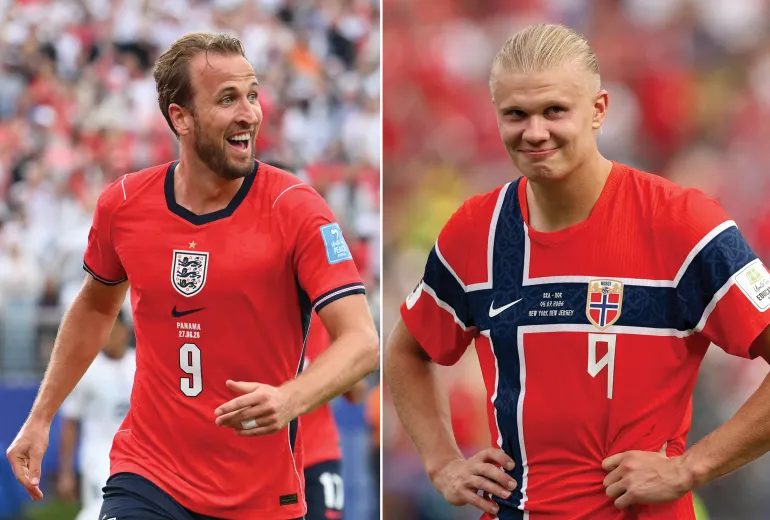
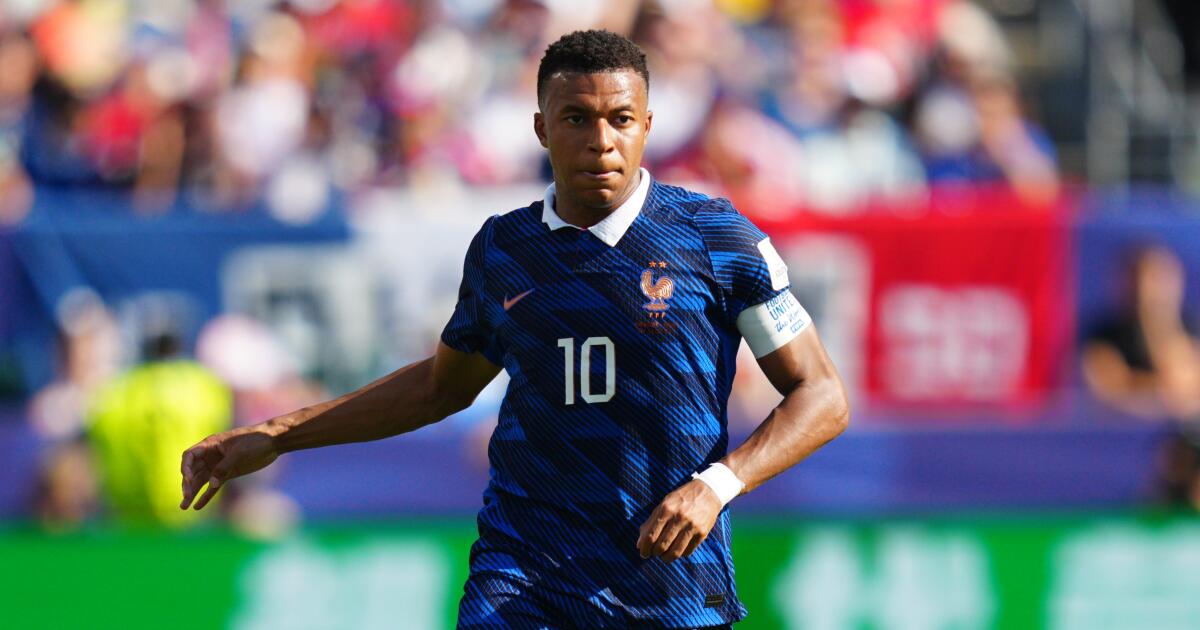
Erling Haaland and Kylian Mbappe have both scored four goals so far and they’ll be desperate to add to their tally as they chase down Lionel Messi.
France are one of the favourites to lift the World Cup next month and are looking to end the group stage with three wins from three.
But Norway have the opportunity to prove that they truly are dark horses in this tournament and can compete with elite international sides.
Buckle in for a big one in Boston.
Spain’s Lamine Yamal, Nico Williams and Victor Munoz celebrate after the match against Saudi Arabia [Claudia Greco/Reuters]
⚽️ Uruguay vs Spain
Seattle Stadium – Friday, 6pm (00:00 GMT on Saturday)
Group H has been a tight affair following some surprise results in the opening round of fixtures.
Uruguay drew with Saudi Arabia, while Cape Verde shocked the world with a goalless draw against Spain.
La Roja bounced back by thrashing Saudi Arabia and they go into their final game as group leaders, with Uruguay two points behind in second.
Spain will secure top spot with a win in Seattle, ensuring that they avoid Argentina in the round of 32.
Egypt are looking to reach the knockout stages at the World Cup for the first time [Anne-Marie Sorvin/Reuters]
⚽️ Egypt vs Iran
Seattle Stadium – Friday, 8pm (04:00 GMT on Saturday)
Neither of these sides have ever made it out of the group at a World Cup, but on Friday, at least one of them will achieve that feat.
Group G is closely bunched after a number of drawn matches and it sets things up nicely for an intriguing final round of fixtures.
Victory for either Egypt or Iran will guarantee them a spot in the knockout phase, so expect both sides to be up for this one.
Iran have faced numerous challenges at this World Cup, with restrictions on travel and visa issues before the tournament even began.
If Iran progress, there’s also still a chance that they will face the US in the knockout stages.
World Cup 2026: Remaining group-stage full schedule
Wednesday, June 24
Switzerland vs Canada at 12pm PT (19:00 GMT) – BC Place, Vancouver, Canada
Bosnia vs Qatar at 12pm PT (19:00 GMT) – Seattle Stadium, Seattle, US
Scotland vs Brazil at 6pm ET (22:00 GMT) – Miami Stadium, Miami, US
Morocco vs Haiti at 6pm ET (22:00 GMT) – Atlanta Stadium, Atlanta, US
Czechia vs Mexico at 7pm CST (01:00 GMT on Thursday) – Mexico City Stadium, Mexico City, Mexico
South Africa vs South Korea at 7pm CST (01:00 GMT on Thursday) – Estadio Monterrey, Guadalupe, Mexico
Thursday, June 25
Ecuador vs Germany at 4pm ET (20:00 GMT) – New York New Jersey Stadium, New Jersey, US
Curacao vs Ivory Coast at 4pm ET (20:00 GMT) – Philadelphia Stadium, Philadelphia, US
Japan vs Sweden at 6pm CDT (23:00 GMT) – Dallas Stadium, Dallas, US
Tunisia vs Netherlands at 6pm CDT (23:00 GMT) – Kansas City Stadium, Kansas City, US,
Turkiye vs USA at 7pm PT (02:00 GMT on Friday) – Los Angeles Stadium, Los Angeles, US
Paraguay vs Australia at 7pm PT (02:00 GMT on Friday) – San Francisco Bay Area Stadium, San Francisco, US
Friday, June 26
Norway vs France at 3pm ET (19:00 GMT) – Boston Stadium, Boston, US
Senegal vs Iraq at 3pm ET (19:00 GMT) – Toronto Stadium, Toronto, Canada
Cape Verde vs Saudi Arabia at 7pm CDT (00:00 GMT on Saturday) – Houston Stadium, Houston, US
Uruguay vs Spain at 6pm CST (00:00 GMT on Saturday) – Estadio Guadalajara, Zapopan, Mexico
Egypt vs Iran at 8pm PT (03:00 GMT on Saturday) – Seattle Stadium, Seattle, US
New Zealand vs Belgium at 8pm PT (03:00 GMT on Saturday) – BC Place, Vancouver, Canada
Saturday, June 27
Panama vs England at 5pm ET (21:00 GMT) – New York New Jersey Stadium, New Jersey, US
Croatia vs Ghana at 5pm ET (21:00 GMT) – Philadelphia Stadium, Philadelphia, US
Colombia vs Portugal at 7:30pm ET (23:30 GMT) – Miami Stadium, Miami, US
DRC vs Uzbekistan at 7:30pm ET (23:30 GMT) – Atlanta Stadium, Atlanta, US
Algeria vs Austria at 9pm CDT (02:00 GMT on Sunday) – Kansas City Stadium, Kansas City, US
Jordan vs Argentina at 9pm CDT (02:00 GMT on Sunday) – Dallas Stadium, Dallas, US
Playing in goal for the U.S. men’s national soccer team is a little like playing right field for the Yankees. You’re following a long line of great players, making the comparisons — and the high expectations — unavoidable.
Matt Freese is the latest to be thrown into that crucible. But he considers that pressure to be a privilege, not a problem.
“I wouldn’t say it’s intimidating, I would say it’s inspiring,” he said before the U.S. training session Tuesday morning in Irvine. “It’s a long line of goalkeepers that I’ve looked up to for my whole life — and there were some before my life as well.”
Two games into this summer’s World Cup he’s certainly held his own with that group, giving up just one goal for a team that’s unbeaten and already through to the next round. However Thursday’s group-stage finale with winless Turkey will be far from meaningless for Freese since his first start for the U.S. came against Turkey 55 weeks ago, bringing his whirlwind international team career full circle.
U.S. goalkeeper Matt Freese waves to the crowd after beating Paraguay during a World Cup match at SoFi Stadium on June 12.
(Kelvin Kuo/Los Angeles Times)
He lost that game but his performance was good enough to make him the starter in the Gold Cup, where he was even better. A little over a year ago he was just a faint blip on coach Mauricio Pochettino’s radar. Now he has a World Cup shutout and with another clean sheet Thursday, he’ll join Matt Turner as the only American keepers to post back-to-back shutouts in a World Cup in 96 years.
“I dreamt of this opportunity. But you never know if it’s going to come,” Freese said. “I learned the ones that work hard without the promise of reward are the ones that usually succeed.”
Turner, who gave up just a goal in the group stage in Qatar four years ago, is Freese’s backup in this tournament. And he’s just the most recent U.S. keeper to stand out in a World Cup. In 2014, Tim Howard set a tournament record with 16 saves in a knockout-stage loss to Belgium and 12 years before that Brad Friedel made six stops in a 2-0 win over Mexico to send the U.S. to the quarterfinals for the only time.
“To have my name next to theirs as the next guy up is an incredible honor, and it’s something I’ve dreamed of,” Freese said. “The bar is set high and I’m going to strive to reach that bar and raise it even higher.”
Freese, 27, took an unusual route to that bar. The son of a neurosurgeon who earned a doctorate from MIT and the grandson of scientists who immigrated from Germany after World War II, Freese grew up in a household where academics were more important than athletics. So while he joined the Philadelphia Union academy as a teen, he craved the demands of school and left soon afterward to enroll at Harvard.
“When you’re a professional athlete at age 18, 19 sometimes it can be difficult to keep a routine, keep a regimen that keeps you focused and keeps you hungry,” Freese said. “For me, taking classes was something that occupied my time, occupied my mind and gave a very natural release off the field.
“I think at that age it was necessary.”
After two seasons at Harvard, he returned to Philadelphia to sign with the MLS team while continuing to take classes online, once writing a paper on penalty-kick analytics. In 2022, he graduated from Harvard with a degree in economics.
The soccer part wasn’t going nearly as well. Playing behind Andre Blake, a three-time MLS keeper of the year, Freese rarely saw the field in Philadelphia. But a trade to New York City FC in the winter of 2023 gave him a second chance and likely saved his career.
He made the most of it, earning the starting job in his second season, when he finished third in the league in saves, and getting his first call-up to a national team training camp in January 2025.
Six months later he was the team’s starter in goal.
The late-blooming Freese’s journey was unusual in another way too since he traveled to the World Cup from MLS. In the five World Cups between 1998 and 2014, the U.S. started Friedel, Kasey Keller and Howard — three English Premier League keepers — in goal. A dozen years later, the Athletic reports, there are no American goalkeepers in the top five European club leagues and the three goalies on this summer’s roster all play in MLS.
U.S. goalkeeper Matt Freese clears the ball as Australia’s Mohamed Toure closes in during a World Cup match in Seattle on June 19.
(Maddy Grassy / Ap Photo/maddy Grassy)
However as a guy with a Harvard diploma on his resume, Freese knows enough to know that getting to a World Cup isn’t about where you came from or even how long it took you to get there. All that matters is that you made it. And now that he’s there, his job isn’t to stand out, but to blend in.
“Being a goalkeeper is recognizing that it’s not always about you. And I’m comfortable with that,” he said. “The less action I have in a game means the better that we’re playing, and the more likely we are going to win.
“So I’m typically more focused on that and preventing any shots rather than just being only ready to save them.”
Fox has adopted a new split-screen approach to ads during the World Cup’s mandatory hydration breaks, after a stir among viewers over how it had been handling the pauses.
By the Mexico-South Korea match last week, Fox had changed course, running split-screen advertisements for the first time: two side-by-side panels, one keeping the camera on the stadium while the other played a commercial. The approach hasn’t been consistent, though. For Friday’s U.S.-Australia match, the network reverted to full-screen ads.
Fox declined to comment on the changes.
Viewers were quick to notice the split-screen format and weigh in on social media. “At least FOX stopped doing the stupid full screen breaks,” one user wrote on X. “I can live with split screen.”
The World Cup has posted substantial ratings gains for Fox.
Throughout the first 16 telecasts of the tournament, the network is averaging more than 6 million viewers from Fox and Fox Sports 1, up 128% from 2022’s World Cup in Qatar. The broadcast of the U.S. team’s first game this month was the most-watched FIFA Men’s World Cup telecast in English in U.S. history, with more than 18 million views, according to the network.
The hydration break itself is new to the World Cup. FIFA announced it in December as a way to protect players’ health in the summer heat. In every match, the referee is to call for a break around the 22-minute mark of both halves, regardless of the weather.
In addition to helping the players, these extra minutes created a new advertising window. Networks are allowed to leave the on-field action 20 seconds after the referee signals the hydration break and return 30 seconds before play resumes, allowing for ads of up to two minutes and 10 seconds in total. They can air any full-screen ad they’d like, or run a split-screen ad — though a split-screen has to feature a FIFA partner, such as Coca-Cola or Adidas.
Ads during the tournament’s earlier games reportedly cost around $200,000 for a 30-second slot. The price jumps to $750,000 when the U.S. is playing, according to the Wall Street Journal.
When any rules change in televised sports, the most dedicated fans are going to get upset, said Patrick Rishe, the director of the sports business program at Washington University in St. Louis. Despite all the online uproar, he said that the hydration breaks are overall beneficial, as they allow networks an extra opportunity to recoup revenue and brands to get additional exposure.
“This is commercially fantastic for FIFA and the networks. It’s tactically helpful for the teams, and I do think it’s helpful for growing interest in the sport,” Rishe said. “It makes it easier for the casual fans to stay engaged.”
“Do you have an extra ticket?” a man shouted outside SoFi Stadium last Thursday.
The World Cup has been drawing fans from around the globe. But for many, getting a seat in the stadium has come at a steep price.
Some were lucky enough to nab $400 to $500 tickets through official World Cup lotteries, others paid thousands of dollars to catch the action IRL. Tickets for the upcoming USA versus Turkey match were selling for more than $1,400 on resale sites.
The demand has been so high that authorities have been warning fans about how to avoid ticket scams.
As crowds flocked into the stadium, we asked attendees about how much they paid to get into the most-watched sporting event in the world. Here’s what they shared.
Their responses have been lightly edited for length and clarity.
Luis Moreno, Luis Moreno Jr., Angelica Castellano, Diana Moreno and Ramon Aguilera of Orange County
Luis Moreno, Luis Moreno Jr., Angelica Castellanos, Diana Moreno and Ramon Aguilera sport Mexico gear.
How much did you pay for your tickets?
Diana: We don’t want to say because I don’t want our parents to know.
*Whispers* We paid retail. It was like $500 per ticket. For Father’s Day, we wanted to make sure he got to enjoy it.
Why did you want to attend the World Cup?
Castellano: We went in ‘86 in Mexico, ‘94 in Pasadena and now here. We’re excited because I want to enjoy it with my kids. If we didn’t come, I would’ve been sad because they need to see how it is.
Diana: Now, it’s our turn. Even though [today’s match] is not our country, we still had to come and experience it. We’ll watch our team play later on the big screen.
Did you have to give up anything to be here?
Diana: Work, but that doesn’t matter. This is more important. Time with family.
Luis Jr.: Sleep. [Laughs]
Diana: It’s Thursday. We’re out here watching the game, we’re drinking, so there’s no complaints.
Was it worth it?
Diana: Absolutely. No matter what happens today. The fact that we’re here, it’s already a success.
Tell me about your outfit. You’re rocking Paisaboys, an L.A. brand.
Diana: I got the Paisaboys shirt on, repping. I know they have a collaboration with Nike. I got my Nike shoes on and I’m just ready to have a good time. My mom sewed her top last night. She wanted to add a little touch to it.
Angelica: Yes! This is an old, old, old jacket.
Diana: My dad’s outfit is sponsored by me. All Adidas, Father’s Day gift.
Luis Sr.: I got lucky this year.
Adam Chapman and Sarah Harrell of Washington, D.C.
Adam Chapman and Sarah Harrell.
How much did you pay for tickets?
Harrell: We went to two games: USA versus Paraguay [in Los Angeles] and Senegal versus France in New Jersey/New York.
Chapman: The L.A. tickets were way more expensive. We bought them presale for like $1,940, but the [seats] were still very high in the arena and the resale prices are actually cheaper than the ones we bought on presale. It’s horrible. [Laughs]
Why did you want to come to the World Cup?
Chapman: This is my first men’s World Cup. I went to the women’s World Cup in Australia a couple years ago. The last time the U.S. had a men’s World Cup here was like forever ago. We’re probably not going to have another in our lifetime, so I really wanted to make sure we had a chance to go to some games.
Did you have to give up anything to be here?
Harrell: We’re moving the day we get back, so we were packing until the moment we got here. Some of this gear was last-minute purchasing in order to make that work. Also, we took a six-hour plane ride, middle seats. We really committed to get here. We got cat sitters, we both took days off from work, the whole thing.
Was it worth it?
Chapman: Yeah, just for the experience. It’s more money than we would’ve wanted to pay but yeah.
Harrell: We bought the tickets like a year and a half ago, so it’s been on the calendar forever. We ended up getting to bring my brother and his best friend to celebrate his 40th birthday, so it sort just worked out for all of us.
Cambage: This is my first fútbol game ever. I wanted to come cause it’s L.A. Yay sports! It’s a once-in-a-lifetime opportunity. Let’s get out there and get into it.
Samimi: I’m born and raised in L.A. so I’m happy to see the World Cup here.
Tell me about your outfit inspiration.
Samimi: I’m wearing Honor the Gift, Russell Westbrook’s brand, a Nike top, my shorts are from a random boutique in L.A. and Jordan shoes.
Cambage: I just went crazy at the Nike store. I’m not gonna lie. We just came from the Nike store. I’m reppin’ USA today. Yes, I am Australian, but I do live in America and USA is AUS. [Laughs]
Kenan Sahbaz of St. Louis and family
Bosnia and Herzegovina fans cheer on their team.
How much did you pay for your ticket?
I got mine directly through the FIFA website. We paid $500 a piece. I brought my son, my cousins and their kids.
Why did you want to attend the World Cup?
Sahbaz: This is our very first World Cup. It’s a historic event for our very small country, Bosnia and Herzegovina. This is a huge accomplishment in the past 12 years. This is going to be the first time we’ve made it here again. We’ve got a really good squad and I think we can do some amazing things for our country. This is a time when we really need some support and joy in the country, and no better way to do it than at the World Cup.
Who’s your favorite player?
Kids: Džeko.
Did you have to give up anything to be here?
Sahbaz: A lot. Work. Time. We were initially going to go on vacation to the Bahamas, but I asked him either the Bahamas or the World Cup. So when we found out that we made it, it was the World Cup. We canceled everything else. We even went to the qualifiers in Wales and that was a once-in-a-lifetime experience as well. There was just no way we were going to miss it.
Was it worth it?
Sahbaz: 100%. Win or lose, we still win today.
Daniel Henriquez and David Njenga of Seattle
David Njenga, left, sports Kenya gear, while Daniel Henriquez cheers for El Salvador.
How much did you pay for your ticket?
Henriquez: This match was $500 each. We bought it in like October of last year.
Why did you want to attend the World Cup?
Njenga: Because this is the World Cup. You have to go to a World Cup. This is my second one. I was in Qatar for the last World Cup.
Henriquez: The energy! World Cup baby!
Njenga: There’s people from all over the world. We are all assembled here to enjoy this moment.
Henriquez: This is what happens when all the world comes together. This is our utopia. We all love each other. We’re all here for one thing, to support our country.
Did you have to give up anything to be here?
Njenga: My job. I have to be at work right now, but I took the day off. I don’t mind.
Henriquez: I’m a nurse for the fire department. My boss was awesome. She gave me a day off. I love my boss Nancy. Go Nancy!
Was it worth it?
Njenga: It is worth every penny. It’s not even the money. It’s the experience. After this, we head to San Francisco for another game.
Henriquez: Then we’re heading to Vancouver and then we have another game in Seattle.
Njenga: We’re going to six games [in total]. Our Houston tickets were the cheapest. They were about $400.
Cindy Vazquez of Grenada Hills
Cindy Vazquez Zavala reps Mexico with her outfit.
How much did you pay for your ticket?
It was free.99. Shh!
Why did you want to come to the World Cup?
This is my first World Cup. The Jordan team invited me to attend this game, so lucky me. That’s why I’m wearing Jordans today. I’m in the industry so they invited a few employees from neighborhood stores to come.
Tell us about your outfit inspiration.
Today there’s a Mexico game, so I still gotta rep even though I’m attending this match [Switzerland versus Bosnia and Herzegovina]. The outfit is a Nike T90 jersey and my lace is from Amazon. I got the little [soccer] ball, the little World Cup and teddy bear from the gas station. I needed it.
Did you have to give up anything to be here?
I actually had to request PTO to attend, but the store is still running without me. Right after this game, I actually have to jet back. I work at Feature, which is a sneaker boutique in Studio City. S/O Feature for allowing me to come here!
Fabian Almiron of Spain
Fabian Almiron, originally from Paraguay but currently living in Spain, rides Metro to the game.
How much did you pay for your ticket?
I paid $1,100 for the first game [June 12], $290 for the Turkey game [June 19] and the last game with Australia was $170 [June 25].
Why did you want to come to the World Cup?
This is my first World Cup. I live in Spain, but I’m rooting for Paraguay. I’m very excited to be seeing them participate after 16 years.
Did you have to give up anything to be here?
I used like 20 to 25 days of vacation time to come see the World Cup.
Was it worth it?
Yes!
Sunny Kwong, Sam Mallari, Antonio Evangelista, Michael Evangelista of San Diego and Los Angeles
Antonio Evangelista, Sam Mallari, Michael Evangelista and Sunny Kwong are decked out in Bosnia and Herzegovina gear.
How much did you pay for your ticket?
Michael: We paid $400 each. We got lucky with the last chance lottery. They released the tickets a few months ago.
Why did you want to attend the World Cup?
Michael: We’re rooting for Bosnia this time. This is our first World Cup.
Antonio: It’s a lifelong dream. I’ve loved the sport ever since I was in the Philippines.
Did you have to give up anything to be here?
Michael: Most of us had the day off. I worked in the morning at like 6 a.m. and then I’m going to work afterward. I really wanted to carve out time to be there.
Mallari: I took time off because this is my first soccer game ever and I wanted to experience the World Cup with true fans.
Was it worth it?
Michael: 100%. It’s honestly a once-in-a-lifetime experience. It’s been awesome to be here with my dad. We watched the last World Cup finals and we were literally in tears. I know he’s been playing soccer ever since he was in the Philippines military.
Antonio: 20 years.
Becky Clift of Orange County and William Wagner of San Diego
Colleagues William Wagner and Becky Clift sport traditional festival inspired outfits to cheer on Switzerland.
How much did you pay for your ticket?
Clift: They were gifted to us.
Wagner: We’re a fortunate group.
Why did you want to come to the World Cup?
Clift: The World Cup in America is super fun, so we wanted to support it and be a part of it. This was the game that we got tickets for, so we decided to dress up a little bit and have some fun.
Wagner: We’re both soccer people. We both speak the world’s language, so we’re happy to be a part of it here.
Tell me about your outfit inspiration.
Wagner: I have a very close Swiss friend who was equipped for this. One quick phone call and here I am.
Clift: Then I had to get mine so I could support.
Did you have to give up anything to be here?
Wagner: A full day of work. We’re both engineers. We know each other through work.
Was it worth it?
Wagner: We’ll find out.
Clift: Heck yeah!
Jorge Morales of Topanga
Jorge Morales holds out a ball he got at the World Cup opener in Mexico City.
How much did you pay for tickets?
It was between $800 to $900 for my USA versus Paraguay tickets. I bought them through Seat Geek.
Why did you want to come to the World Cup?
I wanted to experience it not just in Los Angeles, but I also wanted to experience it in Mexico. I’m going to three games in Los Angeles and four in Mexico City. Going to my first World Cup in Mexico City was a whole different ballgame. Mexico played in their home country and they won. It was like pandemonium. Even though it was raining over there at the time, it was still a lot of fun. Everyone was hugging each other. I’m looking at you, New York Knicks fans. [Laughs]
Did you have to give up anything to be here?
I’m used to traveling, so I’m like this ain’t nothing. I just wanted to experience a World Cup game and the fact that it’s in three countries, you’re not going to experience that any other time. It’s the one and only World Cup where you’re going to see three countries hosting it.
Alexi Kulik, Marcella Harkness, Luke Kulik and Ian Harkness of San Diego
Switzerland fans Alexi Kulik, Marcella Harkness, Luke Kulik and Ian Harkness.
How much did you pay for your ticket?
Ian: $450 per ticket.
Alexi: We won the ticket lottery. That’s the only way ‘cause the resale is expensive.
Why did you want to attend the World Cup?
Marcella: This is our first World Cup!
Ian: I was at the Switzerland versus Qatar game. Similar outfit. We got it dialed this time. Lots of fun. Tough ending, but what are you going to do?
Luke: We wanted to support Switzerland. Everyone in the family is Swiss. It’s fun to go to a World Cup game. We were just excited to get tickets. I think it’s a great way for the family to spend time together and a good excuse to get out of work.
Did you have to give up anything to be here?
Luke: Time off work. Time to come here. We drove up here. I don’t think we gave up much. We just enjoy being here.
Ian: $450.
Alexi: And we woke up at 5 a.m., so that we could come up here and spend the day together.
Was it worth it?
All: Yes!
Anja Gegic, Dino Gegic, Benjamin Mustafic, Nordin Kapic, Armin Kapic of Los Angeles
Bosnia and Herzegovina fans Anja Gegic, Dino Gegic, Benjamin Mustafic, Nordin Kapic and Armin Kapic.
How much did you pay for your ticket?
Nordin: $3,000. We’re like literally on the field.
Anja: $450. In L.A., we got it like that.
Why did you want to attend the World Cup?
Anja: This is our second time ever qualifying for the World Cup. We are so proud to be here and support our country today.
Nordin: I mean, look around. Why would you not want to be here today?
Armin: We’re hoping for the win!
All: 2-0!
Bendicht Hügli and Lucia Grajales of Mexico City
Lucia Grajales and Bendicht Hugli, both currently living in Mexico City, hold a Swiss flag.
How much did you pay for your ticket?
Hügli: The ticket was $650. That’s stealing. That’s robbery. When I went in ‘86, I think the tickets were 10% of the price I paid for this year.
Why did you want to attend the World Cup?
Hügli: I had some business in San Diego. I saw Switzerland is going to be here, so let’s hit it and break the bank to get tickets. I went to the World Cup in Mexico City in ’86. I saw 12 games. I’m going to one this time.
Was it worth it?
Hügli: We’ll see. If Switzerland plays lousy, then I’m going to be pissed, but I think they’ll do better than in the first game.
Flavia Sacco and Isidoro Garcia of Washington, D.C.
Flavia Sacco and Isidoro Garcia root for Paraguay.
How much did you pay for your ticket?
Isidoro: I think it was around $500 per ticket. Again, we were very lucky because Paraguay was the first game.
Flavia: It was early bird without knowing who was going to play.
Isidoro: We’re also going to the Paraguay versus Turkey game in San Francisco and the third one in Mexico City.
Why did you want to come to the World Cup?
Flavia: We’re rooting for Paraguay. I’m from Paraguay, born and raised.
Isidoro: This is my second World Cup. I went to the one in Qatar. We were very excited about it. Actually, we were very lucky too because we bought Paraguay’s tickets when they were selling them blank. So we just bought the three tickets for Paraguay before knowing the group stage and then it turned out to be in the U.S., so it was awesome.
Flavia: We were hoping it would be on the East Coast because that’s where we live and it ended up being on the other side of the country, but we already had the tickets and we really wanted to go to a game, so we flew. We’re coming straight from the airport. We have our 5-month-old baby who is at the hotel with my mom.
Did you have to give up anything to be here?
Isidoro: I guess time with our daughter. Even though it’s only going to be a few hours, we miss her a lot. She’s very tiny. Every [moment] is precious with her.
Was it worth it?
Isidoro: Yes, even though it’s a few hours and hopefully Paraguay will pull it off.
Jorge Espinosa of Los Angeles
Jorge Espinosa of Los Angeles.
How much did you pay for tickets?
For the USA versus Paraguay ticket, I think I paid like $1,800, and for another match, I think I paid about $1,020, so a little less. I think that’s when the prices started to go down.
Why did you want to come to the World Cup?
I’ve always wanted to go. I missed my chance to go to Brazil in 2014. I really wanted to go, but I had just taken a huge trip to Asia, so I couldn’t really go. I didn’t have any money left and I’ve been thinking about the World Cup being here since it was awarded to the U.S. I was really bummed out when it was awarded to Qatar instead of the U.S. and also instead of Australia. I’m really excited about it. It feels unreal.
What does it mean for the World Cup to be in your hometown?
It means so much. I remember when they had it here in ‘94. I didn’t get a chance to go to any of the games, but the energy that you feel around the city is like next level. The events they’ve been hosting are so awesome. You get to meet more people from other walks of life and other countries.
Did you have to give up anything to be here?
I just pretty much had to pick up more debt, but I get points so it’ll help fly somewhere. Also, debt disappears when you die so they can try coming after me for that World Cup money, but they never will. [Laughs]
Was it worth it?
I looked at the price and was like, “It’ll never be this cheap in my life, ever.” It’s only ever going to go up, and, hey, it’s in my backyard.
For forward Folarin Balogun, things couldn’t be going any better.
“You know, if someone said before the tournament, two games and you’d be through to the knockouts, I think we all would have taken it,” he said. “We’re delighted.”
On Monday, the U.S. got more good news when Christian Pulisic, its talisman, returned to training after missing 10 days because of a calf injury. So Balogun said the last thing the team wants to do is take its foot off the gas for Thursday’s group-play finale with Turkey.
U.S. forward Folarin Balogun celebrates after scoring against Paraguay during the teams’ opening World Cup match at SoFi Stadium on June 12.
(Robert Gauthier/Los Angeles Times)
“The object and the aim is to go out there and win,” he said before Monday’s practice at the Orange County Great Park in Irvine. “Three wins, three games. We can create history.”
He is unlikely to be part of that effort, however. Balogun, Tyler Adams, Chris Richards and Antonee Robinson all picked up yellow cards in the first two U.S. games, and a second booking against Turkey would leave them ineligible to play in the round of 32 match.
There’s no need to risk that in a game that will change neither team’s World Cup fate — the U.S. already won the group while Turkey has been eliminated and will fly home after the match. But protecting their momentum is important for the Americans, who last won their group in 1930 and have won a World Cup knockout-stage game just once.
“Game to game, even minute to minute, half to half, it ebbs and flows,” captain Tim Ream said of momentum. “You can wrestle momentum away from teams and create your own. Every goal, every block, every set play — everything that we’re doing is together. That’s how we create the momentum.”
U.S. defender Chris Richards kicks the ball in front of Paraguay forward Julio Enciso while midfielder Tyler Adams looks on.
(Kelvin Kuo/Los Angeles Times)
“Momentum is everything,” defender Richards added. “Going into the last game with the group stage with two wins, hopefully we can finish with the third.”
With decisive victories over Paraguay and Australia, the U.S. has consecutive wins in a World Cup for the first time in 96 years. It has never won more than twice in a tournament, so beating Turkey would make history — and a bold statement.
“The belief’s always been there,” forward Alejandro Zendejas said. “Not just now, but in the past FIFA windows. We’ve been playing against good national teams, respected national teams, and we’ve been coming out with a positive result. So just keep on believing in this group.”
Zendejas said one reason the team is playing so well is because the players genuinely like being around one another. And unlike other national team camps, which rarely last more than 10 days, these 26 players have been together nearly a month, which has helped bond a roster that was already tight.
“The vibes are high, the team is having fun,” he said. “Training is intense, but in a good way. That’s since the beginning of this whole camp.
“It’s fun being around these guys. There’s a bunch of jokes. But when it comes to work and training and games, we get serious. And we’ve been showing that.”
With coach Mauricio Pochettino likely to rotate his squad against Turkey to protect the players with yellow cards, Zendejas is among those who figure to see the field for the first time in the tournament. Midfielder Cristian Roldan, who is in his second World Cup but has yet to play, was in line to get some minutes as well, but he was held out of training Monday with what was vaguely described as a muscle strain. His status is listed as day to day.
Pulisic’s role in Thursday’s game could be Pochettino’s toughest decision. The team’s best player, Pulisic was electric in the first half of the opener with Paraguay, setting up two goals. But he hasn’t played since, and his absence was noticeable against Australia.
So while getting him back on the field would be a positive, an additional week’s rest and recovery also would be valuable since there will be no room for error in the knockout stages.
How it started: A dream. A French machine-gun officer in the trenches during the First World War. A man named Jules Rimet, who believed an international soccer tournament would bring the nations together with the goal of peace.
How it’s going: The world’s biggest party. A 48-nation celebration of the world’s most beloved sport. Expected to generate about $8.9 billion, it’s become such a big deal that it’s being hosted by three countries — one of which, yes, launched a war on a competing nation in the months before the tournament.
The United States’ war with Iran, costly in all the profound ways that war is, also laid the groundwork for an uneven — and possibly precedent-setting — playing field.
At this World Cup, Team Melli has been subjected to shifting travel restrictions and uncertainty unlike the other 47 teams, spending the tournament commuting between Southern California and its base in Tijuana.
And still, after Sunday’s 0-0 draw against Belgium, the world’s No. 10-ranked team, Team Melli is in position to not only get out of its group at the World Cup for the first time, but to win Group G.
Iran’s treatment only makes its performance more impressive — while bringing into question the future of a tournament that purports to be apolitical. And conjuring up concerns about how the Olympics will operate when L.A. is supposed to open its arms to the world two years from now.
Will we be laying down blanket bans again? Will it be easier to ditch diplomacy than to deal hospitably with a global audience for a global event?
Russia and Qatar were capable of implementing systems that relaxed visa requirements to accommodate every team and its fans in the previous two World Cups. Why couldn’t the United States?
Instead, the U.S. State Department suspended visa issuance for nationals from not only Iran, but also from participating countries Haiti, Senegal and Ivory Coast. Iraq’s striker, Aymen Hussein, was held and questioned for nearly seven hours at Chicago’s O’Hare airport.
And the U.S. has allowed members of Iran’s team — discounting the 15 administration officials who reportedly were denied entry — to enter the country only within 24 hours of a match and leave the same day.
And those arbitrary restrictions — they’re OK 24 hours before a match, but not 48? — have put Team Melli at a competitive disadvantage.
“I think that united us even more,” said winger Alireza Jahanbakhsh, who spoke eloquently in English postmatch, a gracious statesman in Adidas sneakers. “That’s one of the things that I think we showed today — we showed a great team character. And part of it comes from the situation we are in.”
Through an interpreter, coach Amir Ghalenoei broadened the scope of what Iran has been facing in its runup to the World Cup.
“We were in a state of war for six months, we didn’t have a league and I remember once during a FIFA qualifying day, we traveled 40 hours by land to another country to play,” Ghalenoei said. “Everybody knows about the visa issues. Everyone knows about our coming to America. A part of the team was in competition conditions and part of them had their domestic league suspended because of the war … and many of the teams that were supposed to play us, canceled.
“I think we entered the World Cup in the worst possible conditions. This is the part I wanted the whole world to know … but the players who entered the World Cup under these conditions are truly commendable.”
It’s been a spirited rebuttal to what’s felt like a counterattack on the inherent values of the World Cup. A reminder that governments and governing bodies can get it wrong, but the beautiful game stays undefeated.
FIFA president Gianni Infantino, left, and U.S. Secretary of State Marco Rubio pose for a photo before a World Cup game between the U.S. and Paraguay at SoFi Stadium on June 12.
(Robert Gauthier / Los Angeles Times)
But what about FIFA?
What about the all-powerful governing body that runs the sport, whose motto is “Football Unites the World”?
The world’s foremost party planning committee, with the cachet to override branded venue names with generic, location-based names — Los Angeles Stadium instead of SoFi Stadium — on Google and Apple maps?
What has FIFA done to flex its muscle to maintain the integrity of the world’s beautiful game?
Not much.
There have been niceties and brownnosing, but no sanctions or threats thereof. Not even a hint of repercussions for diminishing the integrity of the event.
No fines, like what FIFA imposed on six national football associations in response to racist incidents involving supporters during the qualifiers for the World Cup.
No bans, like what FIFA leveled in 1988, when it ousted Mexico from all FIFA competitions for using four overage players in the Under-20 World Cup, or in 2006, when Myanmar was banned from qualifying after refusing to play Iran in an Asian qualifying match for the 2002 World Cup.
Peace talks are ongoing between the United States and Iran, but Iran’s footballing ambassadors haven’t been free to move or to prepare as they wish ahead of its matches against Belgium, and before that, their 2-2 draw against New Zealand.
Apparently, though, Iran will get greater control over travel arrangements before its now hugely consequential final group-stage match is in Seattle against Egypt on June 26, or so Ghalenoei believed when he addressed reporters Saturday.
“What my problem is, why didn’t they let us come earlier for the first two games as well?” Ghalenoei asked. “If they’ve managed to do this now, why didn’t they do that for our first game and for this game?”
Good questions.
Questions no one should be asking at the World Cup.
Brenda Jaimes pushed her way through an ecstatic crowd in downtown Santa Ana Thursday night, stopping in the middle of Fourth Street and calling attention to herself by shouting, “Me! Me!”
Fans blew horns and spun noisemakers, chanting “México!” and “¡Sí se puede!” They brandished the Mexican flag seemingly everywhere: on banners, painted on cheeks, emblazoned on Jaimes’ tube top. They stood on the back of trucks and boogied.
An Orange County Fire Authority truck flashed its sirens to cheers. A line of drivers cruised down Fourth Street — the historic cultural and economic heart of Latino Orange County — to high-five the crowd and let people shake their cars as if everyone was inside a bounce house.
Jaimes wanted something more dramatic.
She lay down in the arms of some men wearing green Mexico soccer jerseys. They counted to three, launched her a good 8 feet upward, then effortlessly caught the laughing Jaimes.
Scenes like this replicated themselves across Southern California after the match, from Koreatown to Boyle Heights to Pacoima to Huntington Park — really, anywhere with a big Latino population. It happens any time Mexico wins big in soccer. But the pachanga was even more pronounced in Santa Ana.
A year earlier, Fourth Street was empty. Federal immigration agents were seizing people across the city. The National Guard set up a roadblock complete with an armed Humvee for over a month, just a block away from where Jaimes and so many others celebrated.
One of the most Latino big cities in the country trembled in fear. On Thursday night, Santa Ana erupted in joy.
“This here is the antithesis of the raids last year,” said Sandra De Anda, who wore a Stetson and a Tigres Mexican soccer club jersey and waved a South Korea flag. She’s the director of policy and legal strategy at the Orange County Rapid Response Network.
Last June, the Santa Ana native joined thousands as they marched down Fourth Street for days demanding that ICE and the National Guard leave town. Through the rest of 2025, she and others in the Rapid Response Network fought la migra in courthouses and through fundraisers for immigrant detainees and their loved ones.
“They tried to take our community down, but they had no chance,” De Anda added as her boyfriend rushed off to join the celebration. “We Mexicans always get beat down, but we have pride. Tonight, you see how we stand up when we need to.”
Jaimes agreed.
“It’s so important to do this especially after last year,” she told me after her short turn as a Cirque du Soleil performer. “We don’t care what Trump can say about this. It was his birthday recently — who cares? This right here is real.”
Another young woman shrieked as she sailed above us. Jaimes pointed at her, then looked at me. “Throw yourself también [also], bro!”
I stuck to slapping the hoods and windows of so many cars that my hand turned black with soot.
Mexico soccer fans shake a car cruising down Fourth Street in downtown Santa Ana after Mexico’s 1-0 World Cup win over South Korea on Thursday.
(Gustavo Arellano / Los Angeles Times)
Seeing Mexico become the first country to win its World Cup group would be thrilling any year. But in 2026, when Trump continues to meddle in Latin American affairs while his migra goons keep launching raids across the country, the satisfaction hits that much more.
Few things irk Trump and his followers more than Mexicans succeeding at anything. Eleven years ago this week, he announced his presidential campaign by stating that Mexico was “not sending its best” immigrants but instead, people he claimed were mostly rapists and drug dealers. Trump has spent his two terms obsessing over the U.S.-Mexico border, attacking anything that reeks of diversity and demeaning Mexican President Claudia Sheinbaum as if she were a junior executive at one of his many failed companies.
Conservatives and more than a few liberals always get furious when Mexican Americans wave the flag of their ancestral homeland — but rooting for Mexico’s soccer team especially brings out the venom. Fans far outnumber supporters of the U.S. soccer team during matches in this country, which brings on accusations of treason against Mexican Americans even though other diasporas do the same, with nowhere near the same opprobrium.
Haters don’t get why so many Mexican Americans root for El Tri. The team embodies what it means to be Mexican: They’re a good group of folks who always seem to get bad breaks and never seem to win against the powers that be — but never stop fighting for a better day, while having fun doing so.
That’s why Americans of all ethnicities should back Mexico along with the U.S. side in this World Cup, which Trump has already sullied. The U.S. Department of Homeland Security denied a Somali referee entry into this country because he allegedly was “talking to some very bad people,” per the White House World Cup task force. The Trump administration is forcing Iran’s squad to base its training camp in Tijuana, which means players have to fly to matches in Los Angeles and Seattle instead of taking every other team’s short bus trip.
Every Mexico victory should give solace to the underdogs of the world and affirm the belief that a communion of nations engaged in friendly rivalries is better than Trump’s proclivity for launching indiscriminate raids and bombings. To cheer for Mexico is about as American as you can get right now.
Sydney Tran took her turn at the Fourth Street procession in a Honda Civic packed with friends. The crowd shook her car with such vigor that the 23-year-old Westminster resident couldn’t turn up the music like people shouted at her to do.
“This is crazy!” yelled Tran, who wore a Mexico soccer jersey. “I’m Vietnamese, but this is wonderful to see my Mexican friends so happy. They deserve to be happy — it’s been rough for them. It’s been rough for all immigrants.”
Mexico fans celebrate a goal while watching a FIFA World Cup soccer Group A matchup between Mexico and South Korea in Boyle Heights on Thursday.
(Eric Thayer / Los Angeles Times)
The festivities were still going strong when I left. Restaurants that were usually closed by 10 p.m. had lines out the door. Dance parties sprouted on sidewalks. Rancheras, funk and oldies blasted everywhere. The police were nowhere to be seen, unlike last year, when they broke up the anti-ICE protests with rubber bullets and tear gas.
Cynicism shot through me for a second. Mexico, which won on a fluke goal and two miraculous saves, stands virtually no chance of beating soccer titans like France and Argentina once the knockout stage of the World Cup begins. Trump’s immigration team vows that more raids are forthcoming. And I can only hope that the overwhelmingly young crowd will take the passion they showed for Mexican soccer to the ballot box this November.
Then I chilled out.
Everyone around me got to breathe and scream and let out their frustrations about our nation in the most delightful way imaginable. Reality would return the next morning — but for one night, for a few hours, life was wonderful for Mexican Americans, and better days ahead seemed possible. Sí se puede, indeed.