world cup

Why U.S. World Cup hotel bookings are disappointing

Why isn’t the World Cup drawing foreign visitors as expected? Blame Trump’s immigration policies, his Iran war and his tariffs

Almost exactly one year ago, I speculated about how President Trump could sabotage the World Cup and the L.A. Olympics.

Since then, speculation has congealed into reality.

By almost any measure, tourism to the United States has cratered. Overall, it was down 5.5% last year from the year before. Visitors from Canada, traditionally the largest pipeline of foreign tourism, plummeted 21%.

Even with global anticipation building, the path to the U.S. for many World Cup travelers feels increasingly less like a red-carpet welcome.

— American Hotel & Lodging Association

That’s the largest drop from any country, according to statistics from the Commerce Department’s International Trade Administration cited by the Congressional Research Service. The runner-up is Germany, with a decline of 11.3%.

Expectations have faded that this summer’s World Cup games, which begin in the U.S. on June 12 with USA vs. Paraguay at SoFi Stadium, would buoy the flow of foreign visitors. Hotel bookings show that hasn’t happened, as my colleague Caroline Petrow-Cohen reports. According to an April survey by the American Hotel & Lodging Assn., hotel operators in all 11 of the U.S. host cities say that bookings are below their expectations.

Get the latest from Michael Hiltzik

Commentary on economics and more from a Pulitzer Prize winner.

Those figures bode ill for the 2028 Los Angeles Olympics, whose organizers are also counting on a robust flow of foreign visitors.

More than 65% of the Los Angeles hotels responding to the survey reported dashed expectations, the association said. That wasn’t the worst result; the percentage was higher in five host cities, led by Kansas City, where nearly 90% of survey respondents reported booking paces below expectations.

The association identifies several reasons for the lackluster bookings, including botched planning by FIFA, the World Cup’s governing body. But much of the blame falls on issues created by one person: President Donald Trump. These include “increased gas and jet fuel prices,” which are artifacts of Trump’s Iran war and its upward pressure on oil prices.

The survey also points to concerns about visa availability and the treatment of foreign visitors once they land in the U.S. or cross the border.

The administration has disavowed any intention to interfere with the World Cup or the Olympics.

“Thanks to President Trump’s leadership, the FIFA 2026 World Cup will no doubt be one of the greatest and most spectacular events in the history of mankind,” White House spokesman Davis Ingle told me by email.

“International visitors who legally come to the United States for the World Cup have nothing to worry about,” the Department of Homeland Security said. “What makes someone a target for immigration enforcement is whether or not they are illegally in the U.S. — full stop.”

Trump pledged in 2018, when FIFA was weighing bids to host the 2028 World Cup, that “all eligible athletes, officials and fans from all countries around the world would be able to enter the United States without discrimination.” But concerns remain that family members of participating athletes might face restrictions on entering the U.S.

Those concerns could hardly be assuaged by a comment from Vice President JD Vance, chair of a government task force overseeing preparations for the World Cup, at a 2025 meeting attended by FIFA President Gianni Infantino.

Vance said the U.S. wants foreign visitors “to come, we want them to celebrate, we want them to watch the games. But when the time is up, we want them to go home, otherwise they will have to talk to Secretary Noem.” (Trump subsequently ousted Kristi Noem as Secretary of Homeland Security, replacing her with former Sen. Markwayne Mullin, Republican of Oklahoma.)

Trump also committed himself to safeguarding the L.A. Olympics, stating, “I’m going to be supportive in every way possible and make them the greatest games.”

Yet America’s standing as a world-class tourist destination has plainly soured under Trump.

“Even with global anticipation building, the path to the U.S. for many World Cup travelers feels increasingly less like a red-carpet welcome,” the Hotel & Lodging Assn. observed.

“There is a perception that international travelers may face lengthy visa wait times, increased visa fees, and lingering uncertainty around entry processing. For those who do make the journey, concerns do not end at the border — questions about airport security screening wait times and airport congestion add another layer of hesitation.”

None of this should come as a surprise. As I projected last June, two administration initiatives in particular were poised to affect the World Cup and Olympics. The first was Trump’s crackdown on immigration.

Immigration agents, I noted, were acting as though they had carte blanche to detain people suspected of being in the U.S. illegally, conducting raids that sometimes swept up American citizens. That was before the Immigration and Customs Enforcement raids in Los Angeles, Minneapolis and other communities where immigration agents were accused of targeting specific ethnic and racial groups. And it was before the shootings of Renee Good and Alex Pretti in Minneapolis by immigration agents worsened their image as lawless thugs.

By then, however, stories had surfaced of foreign tourists being detained for weeks, even months, without explanation or apparent cause. A 65-year-old British woman named Karen Newman traveling on a valid tourist visa was arrested in September 2025 at the Montana border, shackled and held for six weeks in an ICE detention center. Other stories involved a German tourist who said she was held by ICE for 45 days, some of that time in solitary confinement; and a New Zealand woman who was detained with her 6-year-old son for three weeks.

The Department of Homeland Security didn’t deny that these incidents had occurred, though in relation to the New Zealand woman, whose visa had been only partially renewed, a U.S. Customs and Border Protection spokesman said, “When someone with an expired parole leaves the country and tries to re-enter the US, they will be stopped in compliance with our laws and regulations.”

The other policy that could interfere with the World Cup and Olympics are Trump’s travel bans and restrictions, which as of January covered 75 countries, including Brazil, Russia and 26 African countries.

Stringent regulations for some visa applicants — notably those coming to the U.S. to study or for work-study programs and their dependents — have further clouded America’s image as a destination. Applicants for those visas are required to open their social media accounts for the last five years for inspection by visa officers.

And Homeland Security Secretary Mullin last month raised the prospect of withdrawing customs officers from airports in so-called sanctuary cities, a move that would effectively shut down international flights at those airports.

The change couldn’t happen in time to affect the World Cup, but it could happen before the 2028 Olympics. Mullin’s idea didn’t win immediate favor with other members of Trump’s cabinet, including Transportation Secretary Sean Duffy.

Last year, the Department of Justice published a list of nearly three dozen states, cities and counties it defined as “sanctuary jurisdictions” because they “obstruct or limit local law enforcement cooperation” with ICE. Most are led by Democrats. They include California, and the cities of Los Angeles, San Francisco and Berkeley.

It’s true that immigration policies and rising travel costs are only part of the problem. The Hotel & Lodging Assn. also flayed FIFA for having block-booked hotel rooms in venue cities. These blocks “manufactured artificial demand by locking up large pools of inventory well ahead of the tournament,” the hotel group complained. The practice upended hotels’ planning by prompting them to increase staff and begin World Cup-themed renovations, preparing for crowds that may have been overestimated from the outset.

The block-booking “masked softer underlying traveler demand,” the association said, “with FIFA returning some blocks without a single reservation having been made.”

The hoteliers also groused that New Jersey and Philadelphia had proposed raising sales or lodging taxes in order to squeeze visitors. New Jersey lawmakers have proposed a short-term increase in its sales tax to 9.6% from 6.6% and in its lodging tax to 7.5% from 5%. Philadelphia is planning to raise its hotel tax to 10.5% from 8.5%.

None of this means that ticket sales for the World Cup won’t be healthy. FIFA has said that 5 million tickets have already been sold for the matches, even though the average price for even the cheapest seats at some venues tops $500. As my colleague Kevin Baxter has reported, fans are beginning to feel mulcted. That’s so especially because ticket buyers only learned the specific location of their seats after plunking down their money, at which point they discovered that they were placed in sections nowhere as desirable as they expected.

Source link

Iran moves World Cup camp U.S. to Mexico, clearing path to play

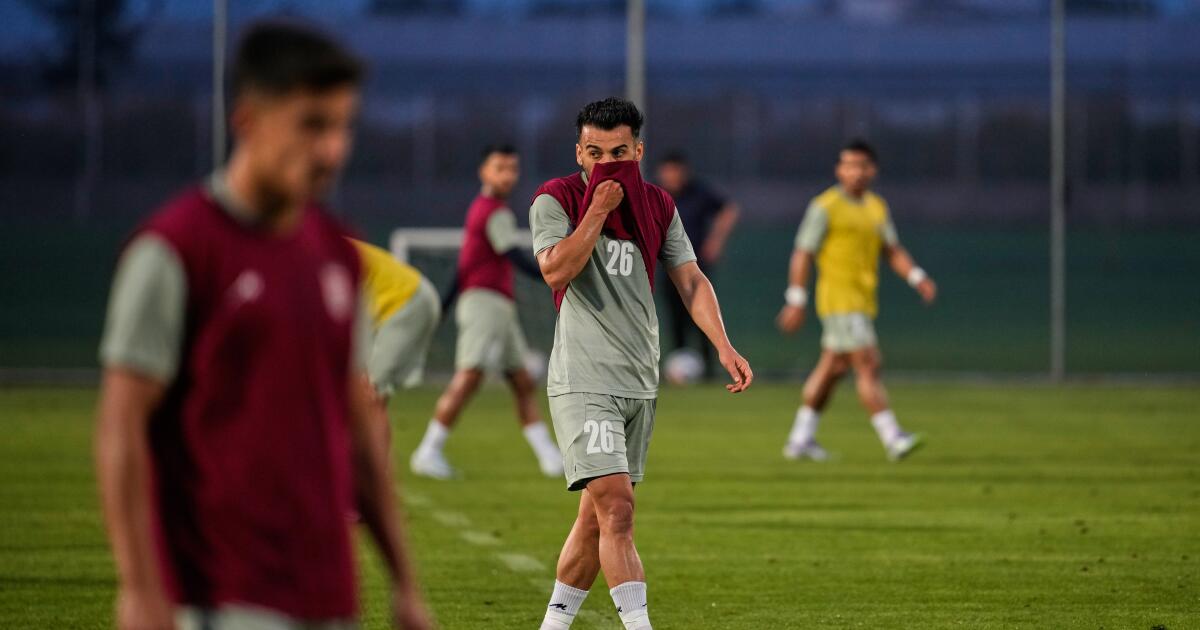
Iran is moving its World Cup training base from Tucson, Ariz., to Tijuana, the president of the country’s soccer federation said Saturday, removing one of the final hurdles to its participation in this summer’s tournament.

Iran is scheduled to open World Cup play at SoFi Stadium, facing New Zealand on June 15. It will play Belgium in Inglewood six days later before finishing the group stage against Egypt in Seattle. But there had been questions over the Iranian team’s security in the U.S. after American and Israeli attacks on the country began nearly four months ago.

This World Cup will be the first in which a qualifying team will play in a host country with which it was at war. In March, shortly after the war began, Iranian officials began to question whether they should travel to the U.S. for the tournament — doubts that increased after President Trump posted on social media to say he did not believe it was appropriate for Iran to come “for their own life and safety.”

Because the World Cup is being shared with Mexico and Canada, Iran requested permission to move its base across the border, a request Mehdi Taj, president of the Iran Football Federation, said Saturday had been granted.

FIFA, the World Cup organizer, did not immediately confirm to move.

“All team base camps for the countries participating in the World Cup must be approved [by] FIFA,” Taj said in his statement obtained by the Associated Press. “Fortunately, following the requests we submitted and the meetings we held with FIFA and World Cup officials in Istanbul, as well as the webinar meeting we had yesterday in Tehran with the respected FIFA secretary general, our request to change the team’s base from the United States to Mexico was approved.”

Iran’s federation said moving the base camp will resolve potential visa issues since the team will enter the U.S. through Mexico. Taj that the team “may even be able to travel to and from Mexico using Iran Air flights.”

Tijuana is about 50 minutes by air from LAX, about 55 minutes quicker than a flight from Tucson. Iranians have been banned by the U.S. government from receiving visas to enter the U.S., although exceptions are to be made for athletes, coaches, and support personnel involved in the World Cup.

Source link

World Cup 2026: Which star players will miss the tournament? | World Cup 2026 News

The world’s best football players will travel to North America this summer for the most anticipated sporting event of the year: the FIFA World Cup 2026.

While the 48-team tournament will feature young prodigies and veterans alike, some stars will not be at the tournament, having missed out due to injuries or because their nations failed to qualify.

Al Jazeera takes a look at the top stars who will not be at the World Cup:

Khvicha Kvaratskhelia (Georgia)

Paris Saint-Germain's Georgian forward #07 Khvicha Kvaratskhelia celebrates after scoring his team first goal during the UEFA Champions League semi-final first leg football match between Paris Saint-Germain (PSG) and Bayern Munich at the Parc des Princes in Paris on April 28, 2026. (Photo by Anne-Christine POUJOULAT / AFP)
Georgian Khvicha Kvaratskhelia, PSG’s most creative player, will not be at the World Cup [File: Anne-Christine Poujoulat/AFP]

One of the most feared wingers in European football, Kvaratskhelia will not be on the plane to North America as his country, Georgia, failed to qualify for the finals in June and July.

The Paris Saint-Germain winger, the standout player in the Champions League this season, is yet to play at a World Cup. His last major tournament with Georgia ended in a round-of-16 run at Euro 2024.

Robert Lewandowski (Poland)

Soccer Football - FIFA World Cup - UEFA Qualifiers - Finals - Sweden v Poland - Strawberry Arena, Solna, Sweden - March 31, 2026 Poland's Robert Lewandowski reacts during the match REUTERS/Kacper Pempel
The 2026 edition was probably Lewandowski’s last chance of featuring at another World Cup [File: Kacper Pempel/Reuters]

A teary-eyed Lewandowski left the pitch after Poland’s final World Cup qualifier on March 31 as the nation narrowly missed out on the 2026 edition. The 37-year-old Barcelona striker even hinted at international retirement after the failure to qualify but has yet to confirm the decision.

Lewandowski has played a record 165 games for Poland, beginning with a goal on his debut against San Marino in 2008 when he was 20. His 89 goals are nearly twice as many as any other Polish player, but he has played at the World Cup only twice with a last-16 finish in 2022 being the best result.

Gianluigi Donnarumma and Sandro Tonali (Italy)

Soccer Football - Carabao Cup - Semi Final - First Leg - Newcastle United v Manchester City - St James' Park, Newcastle, Britain - January 13, 2026 Newcastle United's Sandro Tonali and Manchester City's Gianluigi Donnarumma before the match REUTERS/Scott Heppell EDITORIAL USE ONLY. NO USE WITH UNAUTHORIZED AUDIO, VIDEO, DATA, FIXTURE LISTS, CLUB/LEAGUE LOGOS OR 'LIVE' SERVICES. ONLINE IN-MATCH USE LIMITED TO 120 IMAGES, NO VIDEO EMULATION. NO USE IN BETTING, GAMES OR SINGLE CLUB/LEAGUE/PLAYER PUBLICATIONS. PLEASE CONTACT YOUR ACCOUNT REPRESENTATIVE FOR FURTHER DETAILS..
Tonali, left, and Donnarumma are important players at their respective clubs, Newcastle United and Manchester City [File: Scott Heppell/Reuters]

Italy’s failure to qualify for the World Cup for a third consecutive time means the tournament will be devoid of some of the finest Azzurri talents, including star goalkeeper Donnarumma and midfielder Tonali.

After suffering a shock penalty shootout defeat to Bosnia and Herzegovina in the playoffs, Italy became the first former champions to miss three World Cup finals in a row. The last time the Italians played at a World Cup was in 2014 when they crashed out in the group stage in Brazil.

“The World Cup curse”, as described by the Italian media, will keep Donnarumma – one of the best goalkeepers in the world – and Tonali away from playing at the world’s biggest football tournament.

Victor Osimhen and Ademola Lookman (Nigeria)

Nigeria's forward #09 Victor Osimhen celebrates his goal with Nigeria's forward #07 Ademola Lookman during the Africa Cup of Nations (CAN) quarter-final football match between Algeria and Nigeria at the Grand stadium in Marrakesh on January 10, 2026.
Osimhen, left, and Lookman are the two brightest attackers in Nigeria’s squad [AFP]

After Italy, Nigeria are the biggest nation to miss out on a ticket to the World Cup 2026, thanks to an abysmal qualifying campaign. The Super Eagles had dreamed of soaring high in North America, but their wings were clipped after a shock penalty shootout defeat to the Democratic Republic of the Congo in the African playoffs.

Nigeria’s failure to make it to the World Cup means fans will miss out on watching Lookman, arguably their best player at AFCON 2025, and Osimhen, one of the most feared strikers in Africa.

The dynamic duo of Lookman and Osimhen has often brought joy to Nigerian fans, whose team is missing successive World Cup finals for the first time in 36 years.

Hugo Ekitike (France)

Soccer Football - Premier League - Liverpool v Everton - Anfield, Liverpool, Britain - September 20, 2025 Liverpool's Hugo Ekitike celebrates scoring their second goal REUTERS/David Klein EDITORIAL USE ONLY. NO USE WITH UNAUTHORIZED AUDIO, VIDEO, DATA, FIXTURE LISTS, CLUB/LEAGUE LOGOS OR 'LIVE' SERVICES. ONLINE IN-MATCH USE LIMITED TO 120 IMAGES, NO VIDEO EMULATION. NO USE IN BETTING, GAMES OR SINGLE CLUB/LEAGUE/PLAYER PUBLICATIONS. PLEASE CONTACT YOUR ACCOUNT REPRESENTATIVE FOR FURTHER DETAILS..
Ekitike had been dreaming of a maiden World Cup appearance [David Klein/Reuters]

France forward Ekitike’s dreams of making his World Cup debut were shattered when he ruptured his Achilles tendon while playing for Liverpool against PSG in April.

The injury, which could sideline him until January 2027, saw the 23-year-old leave the pitch in tears on a stretcher during the second leg of a Champions League quarterfinal tie at Anfield.

At the start of the 2025-2026 season, Ekitike was far behind in the France pecking order, but an impressive season at Liverpool, which saw him score 17 goals in all competitions until his injury, had put him in the running to be picked by coach Didier Deschamps for the World Cup.

Estevao and Rodrygo (Brazil)

Brazil's forward #20 Estevao celebrates after scoring Brazil's first goal from the penalty spot during the International friendly football match between Brazil and Tunisia at Stade Pierre-Mauroy, in Villeneuve-d'Ascq, northern France, on November 18, 2025. (Photo by Sameer Al-DOUMY / AFP)
Winger Estevao is one of Brazil’s most promising young talents [File: Sameer Al-Doumy/AFP]

One of the brightest talents in global football, winger Estevao was set for his much-awaited World Cup debut until a hamstring injury crushed his dream. The 19-year-old suffered a grade four hamstring injury while playing for his club, Chelsea, in April, which ultimately kept him out of Brazil’s World Cup squad.

Joining Chelsea from Palmeiras in May 2024, Estevao’s eight goals and four assists in his debut season in England caught everyone’s attention. The teenage sensation had also established himself as a regular member of Brazil’s squad under Carlo Ancelotti.

Alongside Estevao, Real Madrid winger Rodrygo, who made five appearances for Brazil at the 2022 World Cup, will not be at this year’s edition after suffering a torn meniscus and ACL in his right knee.

The 25-year-old picked up the injury while playing for Madrid in March and is expected to be out until the end of 2026.

Xavi Simons (Netherlands)

Tottenham Hotspur's Dutch midfielder #07 Xavi Simons warms up prior to the UEFA Champions League league phase- day 8 football match between Eintracht Frankfurt and Tottenham Hotspur in Frankfurt, western Germany, on January 28, 2026.
An injury sustained while playing for Tottenham Hotspur will keep Xavi Simons out of the Dutch World Cup campaign [AFP]

Attacking midfielder Simons will not be with the Netherlands at the World Cup 2026 after he suffered an anterior cruciate ligament (ACL) injury while playing for his club, Tottenham Hotspur, against Wolverhampton Wanderers in a Premier League game.

Simons, 23, ⁠was expected to be a key figure in Ronald Koeman’s Netherlands squad for what would have been his second World Cup after his debut in ⁠2022.

He has earned 34 caps, most recently featuring in friendlies in March.

Bryan Mbeumo (Cameroon)

Cameroon’s failure to qualify for the World Cup came as a surprise as the Indomitable Lions hold the African record for the most appearances with eight overall.

After losing to DR Congo in the semifinals of the African playoffs, Cameroon’s World Cup dreams died and, with them, Mbeumo’s chances of playing in North America.

Mbeumo has had a decent season at Manchester United, scoring 10 goals and bagging three assists across all competitions.

NEWCASTLE UPON TYNE, ENGLAND - MARCH 04: Bryan Mbeumo of Manchester United reacts during the Premier League match between Newcastle United and Manchester United at St James' Park on March 04, 2026 in Newcastle upon Tyne, England. (Photo by Stu Forster/Getty Images)
Mbeumo is one of several African stars who will not be at the upcoming World Cup [Stu Forster/Getty Images]

Honourable mentions

A few other high-profile players will also miss the tournament.

Spain midfielder Fermin Lopez misses out after requiring surgery on a fracture in his right foot while Germany’s Serge Gnabry has been ruled out with a torn adductor muscle in his right thigh.

England have omitted Cole Palmer and Phil Foden from their squad after both had disappointing seasons.

Japan’s Takumi Minamino was left out after suffering an ACL tear while Kaoru Mitoma also misses out after suffering a hamstring injury.

Defender Eder Militao was dropped from Brazil’s squad after undergoing surgery for a hamstring injury while Ancelotti also dropped forwards Joao Pedro and Richarlison.

Slovenia goalkeeper and captain Jan Oblak will be absent after they failed to qualify, and central midfielder Dominik Szoboszlai faces a similar fate after Hungary missed out too.

Source link

Tuchel leaves Palmer and Foden out of England’s 2026 World Cup squad | World Cup 2026 News

Real Madrid’s Trent Alexander-Arnold also left out, while Saudi-based Al-Ahli striker Ivan Toney the surprise inclusion.

Cole Palmer and Phil Foden were among a number of high-profile names excluded by Thomas Tuchel from England’s World Cup squad.

Real Madrid’s Trent Alexander-Arnold was also left out of the squad announced on Friday, with Saudi-based Al-Ahli striker Ivan Toney the surprise inclusion.

Recommended Stories

list of 4 itemsend of list

Tuchel, a Champions League winner during his time at Chelsea, has been hired to end England’s 60-year wait to win a major international tournament.

The former Paris Saint-Germain and Bayern Munich boss has made a series of bold calls, which will be harshly judged if the Three Lions fall short of glory in the coming weeks.

Foden and Palmer played a major role in England’s run to the final of Euro 2024.

However, Manchester City’s Foden and Chelsea playmaker Palmer have paid the price for poor seasons with their clubs.

Nottingham Forest midfielder Morgan Gibbs-White and Leeds striker Dominic Calvert-Lewin have also been overlooked, despite being two of the highest-scoring Englishmen in the Premier League this season.

Veteran Brentford midfielder and former Liverpool captain Jordan Henderson has been included at the expense of Crystal Palace’s Adam Wharton.

Tuchel said telling players they would not be on the plane to the United States had been tough.

“It was difficult, sometimes painfully difficult and like even in the phone calls I felt the emotion,” he said.

“So I called all players that were with us in camp at least one time, I called them, I wanted to show at least the appreciation and the respect for what they have done.”

Tuchel said he could not wait to be on the plane and “be a coach”.

“Now I’m feeling in between relieved and excited and ready to go because once you get the energy back and once you see the excitement of the players that you chose and then once the decisions are made it gives you a certain edge, it gives clarity,” he said.

Manchester United defender Harry Maguire said on Thursday he was shocked at not being included.

“I was confident I could [have] played a major part this summer for my country after the season I’ve had,” the 33-year-old posted on social media.

“I’ve been left shocked and gutted by the decision.”

Maguire’s Manchester United teammate Luke Shaw has also been overlooked.

Tuchel has taken a risk on centre-back John Stones despite his lack of involvement at Manchester City during an injury-hit season.

Toney made an impact off the bench at the Euros two years ago, but has played only two minutes of international football since moving to Saudi Arabia in 2024.

England kick off their World Cup campaign against Croatia in Dallas on June 17, before playing Ghana on June 23 and Panama four days later.

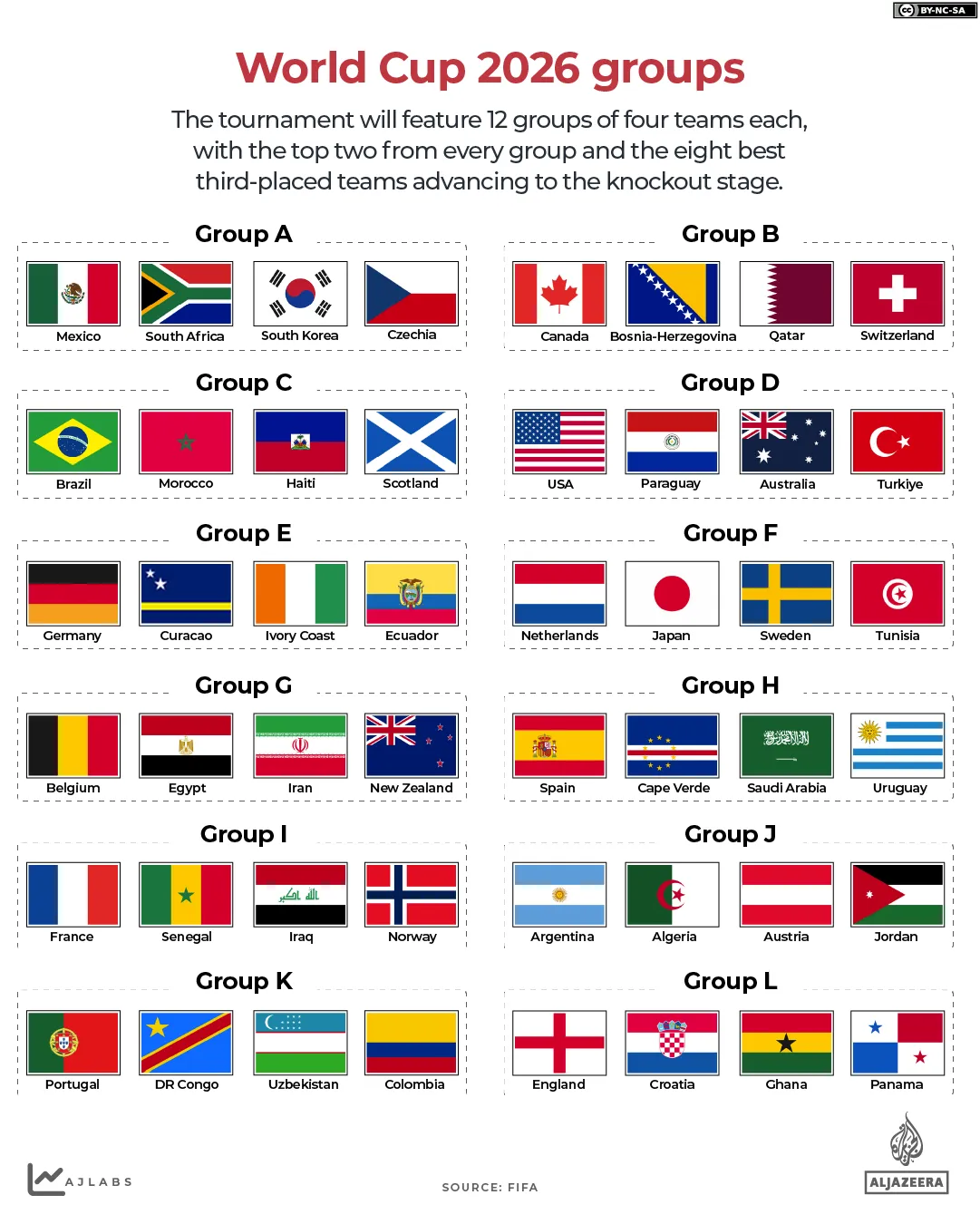
INTERACTIVE-Football FIFA How teams are group World Cup 2026-1776670778

England’s 2026 World Cup squad

Goalkeepers: Jordan Pickford, Dean Henderson, James Trafford.

Defenders: Reece James, Tino Livramento, Dan Burn, Marc Guehi, John Stones, Nico O’Reilly, Ezri Konsa, Jarell Quansah, Djed Spence.

Midfielders: Declan Rice, Elliot Anderson, Jude Bellingham, Jordan Henderson, Kobbie Mainoo, Morgan Rogers, Eberechi Eze.

Forwards: Harry Kane, Ivan Toney, Ollie Watkins, Bukayo Saka, Noni Madueke, Marcus Rashford, Anthony Gordon.

Source link

Airbnb to add grocery delivery and car rentals ahead of World Cup

Airbnb unveiled a new set of services for guests on Wednesday, adding car rentals, airport pickup and grocery delivery to its online marketplace that connects travelers with local hosts.

Customers can now get groceries delivered to their Airbnb through a partnership with Instacart and have a driver meet them at the airport with Airbnb’s Welcome Pickups. The app is also offering luggage storage in partnership with Bounce and will add in-app car rentals later this summer.

At the same time, Airbnb is ramping up its use of AI by adding AI-powered review summaries and lodging comparisons, the company said.

The company has been expanding beyond lodging since last year, when it introduced Airbnb Experiences & Services, giving guests the option to book private tours and chef-cooked meals through the app.

In an earnings call earlier this month, the company’s chief executive, Brian Chesky, said the company is at “the very, very beginning of how AI is going to change how we all do our jobs.”

The changes are coming in time for the 2026 FIFA World Cup, which will take place in 16 cities across the U.S., Mexico and Canada. The company said it is offering exclusive World Cup experiences, such as watch parties and access to stadiums.

“In terms of what we’ve seen in cumulative bookings heading into the event, the World Cup is slated to be the largest event in Airbnb’s history,” the company’s chief financial officer, Ellie Mertz, said on the earnings call.

Airbnb gained popularity for offering travelers unique and homey stays on other people’s property, but it added boutique hotel bookings to its platform late last year. The move had some customers questioning if the app was straying too far from its original purpose.

In its announcement this week, the company said it is partnering with more independent hotels in 20 top destinations, including New York, London and Singapore. On the earnings call, Chesky said hotels on Airbnb could become a multibillion-dollar revenue business.

The San Francisco-based company was founded in 2007 and gave homeowners the opportunity to earn money by renting out their space to travelers seeking something different from a hotel. Airbnb bookings can range from private bedrooms in a shared home to luxury mansions and yachts.

The company’s revenue grew 18% year over year to $2.7 billion in the first quarter, while net income increased slightly to $160 million. Airbnb’s new services and offerings could transform it from a home-sharing platform to a holistic travel marketplace, analysts said.

Shares of the company have increased by 14% over the last six months and fell by less than 1% on Thursday.

Source link

Which teams will make their debut at World Cup 2026? | World Cup 2026 News

Football’s world governing body, FIFA, has framed the 2026 World Cup’s expansion from 32 to 48 teams as a watershed moment for inclusivity, opening the door for nations that have never qualified before.

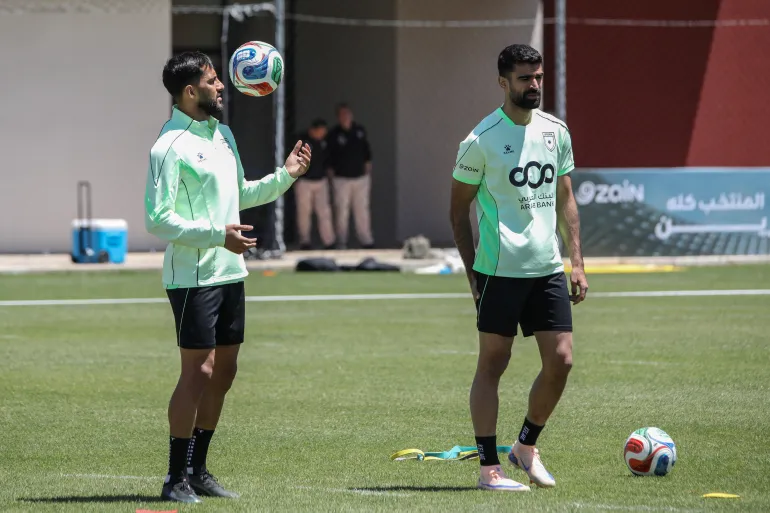
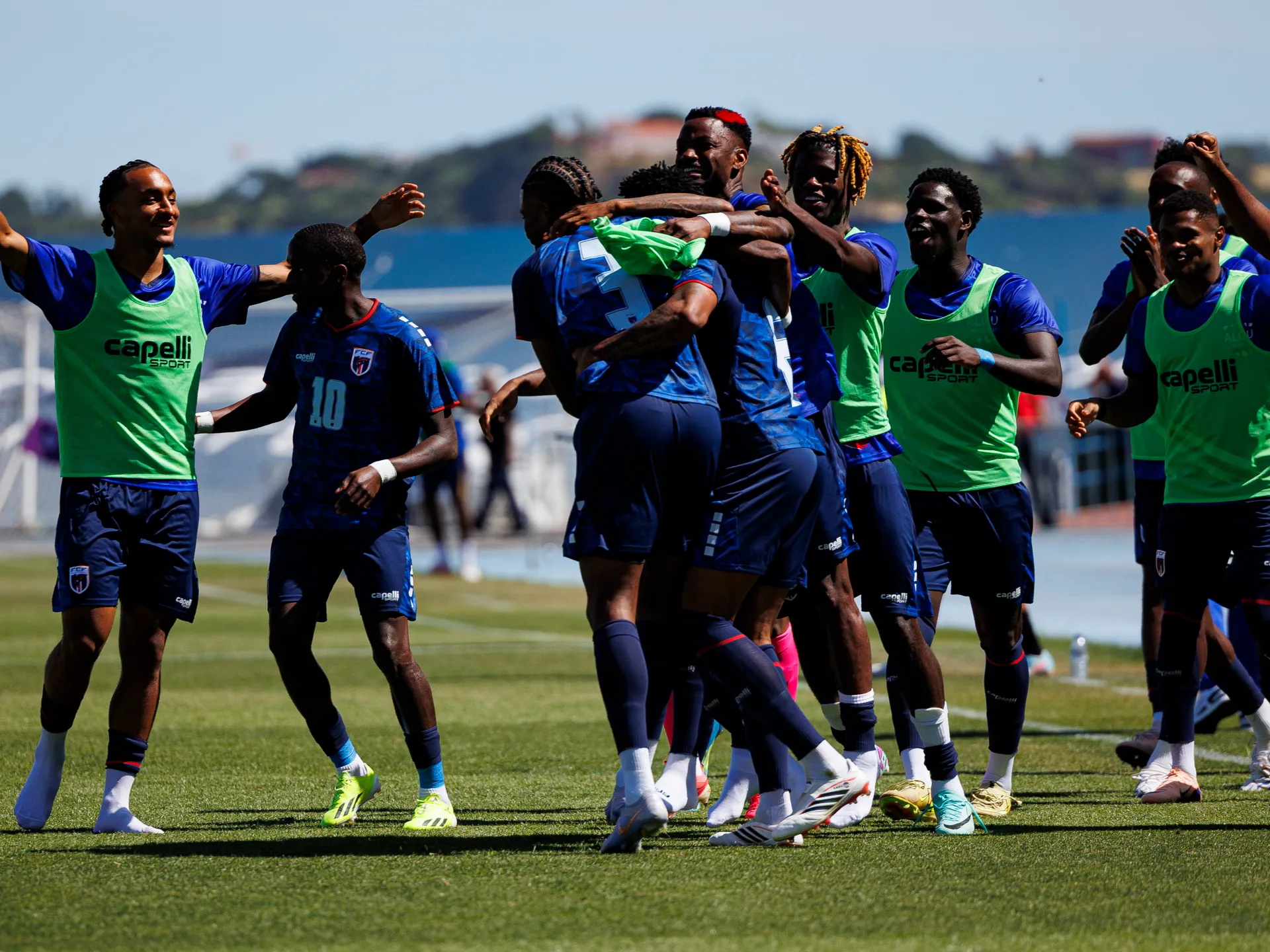
Indeed, four teams will be playing at their first World Cup in North America this summer: Cape Verde, Curacao, Jordan, and Uzbekistan.

Recommended Stories

list of 4 itemsend of list

Here is Al Jazeera’s short guide to the debutants at this year’s competition.

Cape Verde

  • FIFA world ranking: 69
  • World Cup fixtures (Group H): Spain (June 15, Atlanta), Uruguay (June 21, Miami, US), Saudi Arabia (June 26, Houston, US)
  • Player to watch: Garry Rodrigues

With a population of about 525,000, the small archipelago off the coast of Senegal will become the third-least populous country to participate in a World Cup after Curacao and Iceland.

Ryan Mendes is not even a household name in Turkiye, where he plays for second-tier Igdir, but Cape Verde’s 35-year-old captain was at the heart of their 3-0 win over Eswatini in October, which booked their place at the World Cup.

This was no freak occurrence as Cape Verde topped their group at the 2023 Africa Cup of Nations, which included Ghana, reaching the quarterfinals where they lost on penalties to South Africa.

Although they failed to reach AFCON 2025, they again topped their group in 2026 World Cup qualifying – this time finishing ahead of the once-mighty Cameroon.

“We have taken part in four African Cup of Nations tournaments, and we were also very close to qualifying for the 2014 World Cup,” Mendes told the AFP news agency.

“A lot has been achieved over the years. And today, we can say that this is the logical outcome.”

AUCKLAND, NEW ZEALAND - MARCH 30: Garry Rodrigues of Cape Verde is challenged by Onni Valakari of Finland during the FIFA Series match between Cape Verde and Finland at Eden Park on March 30, 2026 in Auckland, New Zealand. (Photo by Phil Walter/Getty Images)
Garry Rodrigues of Cape Verde is challenged by Onni Valakari of Finland during a match in March [Phil Walter/Getty Images]

Cape Verde rely heavily on their Portuguese colonial past for a supply of diaspora talent, and also have several Dutch-born players, as well as one from Ireland – the Shamrock Rovers defender Roberto Lopes. The Dublin-born 33-year-old has a Cape Verdean father and Irish mother and was reportedly recruited for Cape Verde via LinkedIn.

The team’s best-known player, however, is probably 35-year-old winger Garry Rodrigues; now at Cypriot club Apollon Limassol, he has had stints at the likes of Galatasaray and Olympiacos.

But even without mega-star names, Mendes is certain that the Blue Sharks can make a mark at the tournament.

“One thing’s for sure: we’re not going there just to play three games and come home,” he said.

Curacao

  • FIFA world ranking: 82
  • World Cup fixtures (Group E): Germany (June 14, Houston, US), Ecuador (June 20, Kansas City, US), Ivory Coast (June 25, Philadelphia, US)
  • Player to watch: Tahith Chong

“Small island, big dreams” reads a poster for the football team of the Caribbean island of Curacao – the smallest country ever, by population, to qualify for football’s World Cup.

Since Curacao clinched qualification with a hard-fought 0-0 draw against Steven McClaren’s Jamaica in November, the 160,000 inhabitants of the Dutch island famed for its eponymous sapphire liqueur are riding the crest of the Blue Wave, as the national side is dubbed.

The most famous person around the squad is Curacao’s boss Dick Advocaat, the 78-year-old former Netherlands, PSV and Rangers manager who guided the Curacaoans to qualification. He is set to become the oldest manager ever at a World Cup.

Meanwhile, as a self-governing entity within the Netherlands, the island owes its World Cup squad entirely to its Dutch-based diaspora, the president of Curacao’s football federation, Gilbert Martina, admitted.

“All the players on the national team play in foreign leagues,” he told AFP.

Perhaps the best-known player is former Dutch youth international Tahith Chong, now at Championship side Sheffield United. The only team member born on Curacao, Chong moved to the Netherlands at the age of 13.

The 26-year-old winger or attacking midfielder is known for his pace, dribbling and a wicked left foot.

The most famous Curacaoan is probably former Ajax and Barcelona star Patrick Kluivert, who was born to a Surinamese father and a mother from Curacao.

“It’s fantastic that the island is in the World Cup,” Kluivert, who coached the Curacaoan side between 2015 and 2016, told AFP.

“In my day, [football] was not that big on the island, but the players have given Curacao visibility. It’s important for the future, for the next generation.”

Jordan

  • FIFA world ranking: 63
  • World Cup fixtures (Group J): Austria (June 16, San Francisco, US), Algeria (June 22, San Francisco, US), Argentina (June 27, Dallas, US)
  • Player to watch: Musa Al-Taamari

Jordan head coach Jamal Sellami has called on ⁠his players to emulate ⁠Morocco’s shock run to the last four of the World Cup in 2022 as they prepare for their first appearance at the tournament.

“In big competitions, many teams can surprise. My country, Morocco, ‌reached the semifinals in the last World Cup,” Reuters quoted him as saying during a training camp in Antalya, Turkiye in late March. “That gives us belief.”

Despite their underdog status, the players say they are not going to the World Cup just to make up the numbers.

“For us, we are not going just for participation,” midfielder Noor Al-Rawabdeh added. “We are aiming to go as far ⁠as we can in the tournament.

“To be honest, sometimes we don’t sleep when we think about it,” he added. “It’s a dream come true for us.”

LUSAIL CITY, QATAR - FEBRUARY 10: Musa Al-Taamari of Jordan battles for possession with Akram Afif of Qatar during the AFC Asian Cup final match between Jordan and Qatar at Lusail Stadium on February 10, 2024 in Lusail City, Qatar. (Photo by Robert Cianflone/Getty Images)
Jordan’s Musa Al-Taamari, left, in action with Qatar’s Akram Afif during the AFC Asian Cup final in 2024, which Qatar won 3-1 [Robert Cianflone/Getty Images]

The Rennes winger Musa Al-Taamari is probably the team’s standout player – he was the key creative force as Jordan ⁠secured an automatic berth at the World Cup after finishing ⁠second behind South Korea in their Asian qualifying group.

Sellami said the camp in Antalya, which involved games against Costa Rica and Nigeria, was a key stage in building experience before facing elite opposition.

“We ‌are ‌preparing step by step. We’ve played against different football cultures,” he said.

“We are collecting experience and, Inshallah [God willing], we will surprise many people.”

Uzbekistan

  • FIFA world ranking: 50
  • World Cup fixtures (Group K): Colombia (June 17, Mexico City, Mexico), Portugal (June 23, Houston, US), DR Congo (June 27, Atlanta, US)
  • Player to watch: Abdukodir Khusanov

Uzbekistan FA Vice President Ravshan Irmatov is no stranger to the World Cup, having refereed at three finals, but believes the Central Asian country’s long-awaited qualification is merely the latest step in its football development.

“Qualifying for the World Cup has been a dream for 38 million people for 34 years,” Irmatov said. “You can understand how important it was for the Uzbek nation, we waited so long.”

Uzbekistan’s first qualification comes after seven attempts to secure a finals spot since the country was granted FIFA membership in 1994 following the break-up of the Soviet Union.

Slovenian coach Srecko Katanec guided a team built primarily on home-based talent to the cusp of the finals before health issues forced him to stand down, leaving Olympic team coach Timur Kapadze to secure the ticket for the 2026 tournament.

BURNLEY, ENGLAND - APRIL 22: Abdukodir Khusanov of Manchester City during the Premier League match between Burnley and Manchester City at Turf Moor on April 22, 2026 in Burnley, England. (Photo by Alex Livesey/Getty Images)
Abdukodir Khusanov became the first Uzbek to play in the Premier League when he joined City last year [File: Alex Livesey/Getty Images]

Captain Eldor Shomurodov, on loan at Istanbul Basaksehir from Roma, is the country’s top scorer with 44 goals in 90 games and scored 21 Turkish Super League goals this season.

But the team’s best-known player is probably Manchester City’s Abdukodir Khusanov. The 22-year-old centre back has become a key part of the defence this season, well-regarded for his positional play, pace, strength and quiet leadership.

Uzbekistan confirmed their place at the finals with a 0-0 draw against the United Arab Emirates in June, and since then, former Italian World Cup winner Fabio Cannavaro has taken over as coach.

“I’ll tell you what I always repeat to my players: for the first time you will play in a World Cup, you have nothing to lose,” Cannavaro was quoted as saying by The Mirror newspaper in March.

“Approach every match with maximum calm, enjoy yourselves as much as possible, and if you feel anxiety, let it be positive anxiety.”

Source link

Los Angeles World Cup stadium workers threaten strike over ICE deployment | World Cup 2026 News

Workers represented by a local union say ICE presence would create a climate of fear during the FIFA World Cup 2026.

Workers at the SoFi Stadium in Los Angeles have decided to go on strike if federal immigration enforcement agents are deployed at the venue when it hosts FIFA World Cup matches in June and July.

The UNITE HERE Local 11 – a labour union representing some 2,000 hospitality employees – on Monday demanded federal guarantees that Immigration and Customs Enforcement (ICE) would not be used during the matches scheduled at the stadium.

The venue, which will be known as the Los Angeles Stadium during the tournament, will host eight World Cup games, including the opening fixture for the United States on June 12.

Workers at the world’s most expensive sports arena say the ICE presence would create a climate of fear for themselves and for fans.

“ICE should have no role in these games,” said Isaac Martinez, a stadium cook, at a protest outside the venue.

“We do not want to live in fear coming to work, or fear being detained going home.”

“If we do not reach an agreement, my colleagues and I are ready to strike,” Martinez added, speaking on behalf of a workforce composed largely of food and beverage concession staff.

SoFi Stadium workers, belonging to union Local 11, picket outside of the FIFA Los Angeles World Cup 2026 Host Committee headquarters on May Day, Friday, May 1, 2026, in Los Angeles. (AP Photo/Jae C. Hong)
SoFi Stadium workers protest in Los Angeles on May Day [Jae C Hong/AP]

ICE has led the charge in President Donald Trump’s immigration crackdown.

Human rights groups have condemned the agency for its conduct during raids in several US cities, including Los Angeles last year.

In early 2026, ICE agents fatally shot two American protesters in Minneapolis.

Workers on Monday also raised alarms over FIFA’s accreditation process, which requires employees to submit personal data before the tournament, which runs from June 11 to July 19 across the US, Canada and Mexico.

“We ask FIFA not to share our information with ICE agencies, foreign countries, or intelligence services,” worker Yolanda Fierro said.

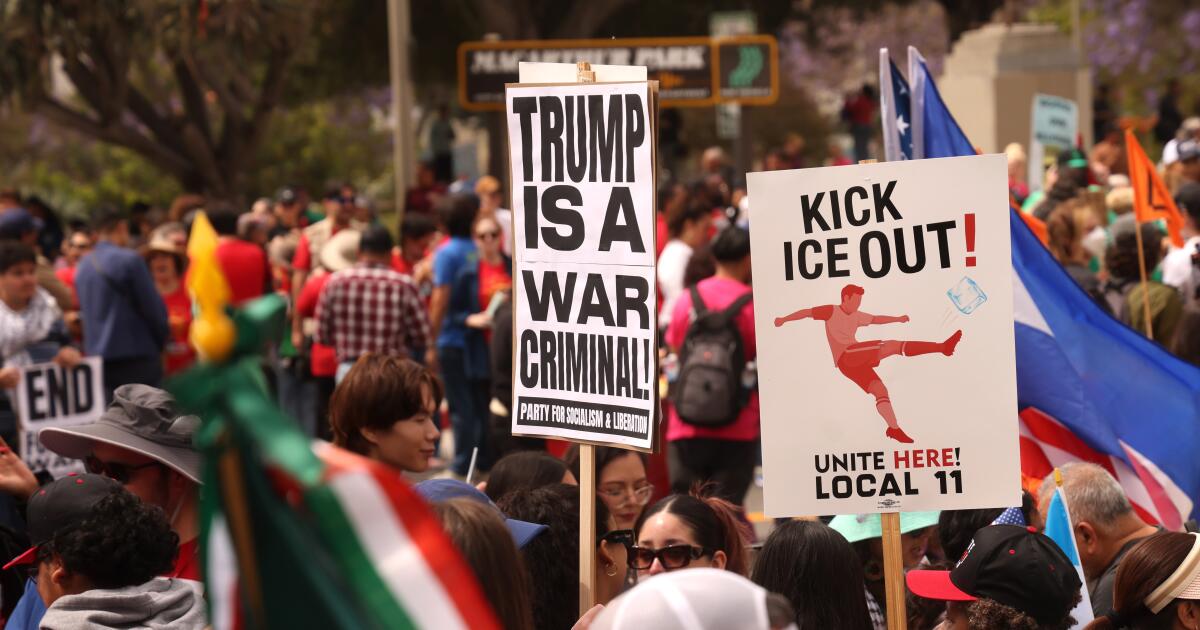
Protesters carrying plastic balls and signs reading “Kick ICE Out of the World Cup” drew support from Tom Steyer, a Democratic candidate in California’s gubernatorial race.

ICE’s mandate is border control, the financier-turned-politician said.

“Can anyone explain what that has to do with the World Cup? Nothing,” Steyer said.

“How is it possible that this is the agency that is going to be here when we know in fact they’re an absolute threat, a lawless threat, to workers in California?”

Source link

Artists, community welcome World Cup to Inglewood with murals and more

A lot has changed since Jacori Perry attended Morningside High School.

Perry is now a renowned artist who goes by the names Mr. Ace and AiseBorn.

The school is now known as Inglewood High School United.

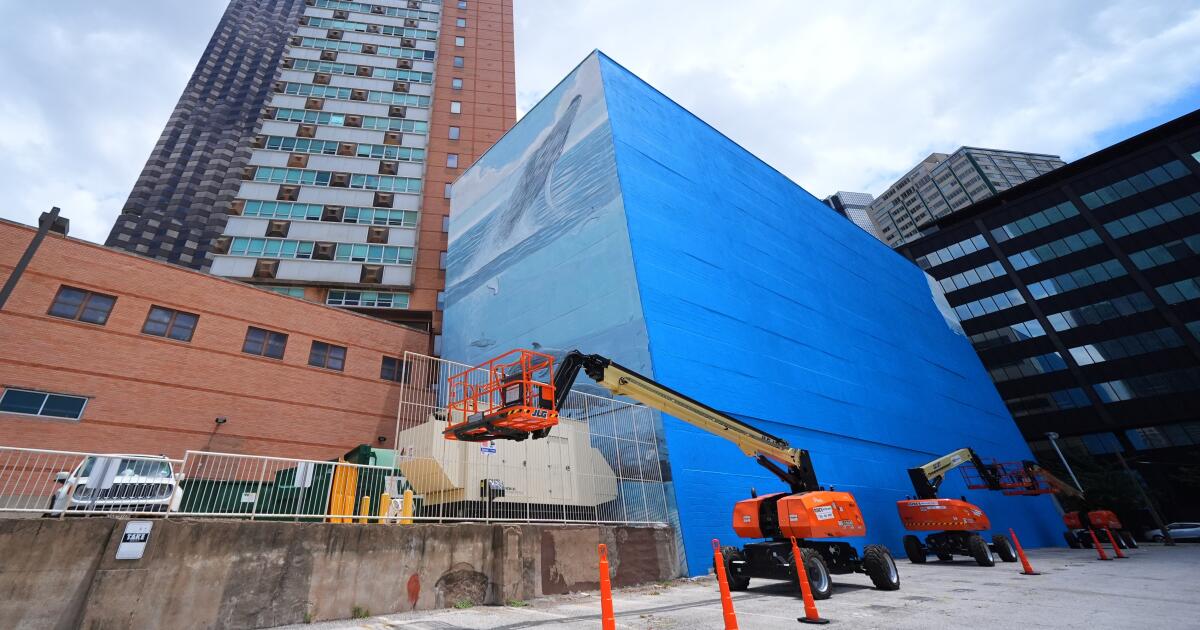
And the lecture hall on that campus now features a large, ornate mural of a soccer ball being grasped by the hands of two people — freshly painted by the 2004 Morningside graduate as the city of Inglewood prepares to host eight World Cup games at SoFi Stadium starting next month.

A man brushes paint onto a mural while harnessed to a lift above the ground.

Local artist Mr. Ace works on his mural at Inglewood High School United on May 11. The artist, whose real name is Jacori Perry, attended the school when it was known as Morningside High more than two decades ago.

(Eric Thayer / Los Angeles Times)

“If you told me that I would be back here painting one of the walls on this campus when I was in high school, I don’t think that I necessarily would have foreseen it,” Mr. Ace said as he put the finishing touches on his mural last week. “So I’m a little in amazement about just the way life works in that sense.”

He was one of several Los Angeles-based artists to participate in a Road to World Cup Community Day last month at Inglewood High United. Many of the artists — including Juan Pablo Reyes (“JP murals”), Michelle Ruby Guerrero (“Mr. B Baby”) and Angel Acordagoitia — sketched designs on portable panels (12-feet by 8-feet) and picnic tables for community members to paint.

The picnic tables will remain at the high school in front of Mr. Ace’s mural. The mobile murals will be placed throughout LAX to welcome visitors arriving for the World Cup.

Kathryn Schloessman, chief executive of the Los Angeles World Cup 2026 Host Committee, said in a news release that the event was “just one example of how the energy of the World Cup can be felt in neighborhoods across our region.”

“Students, artists, and volunteers came together to create a work of art that will live on well beyond the end of the tournament,” Schloessman said. “It’s a reflection of the creativity, diversity, and community pride that makes our region so special as we prepare to host the world for FIFA World Cup 2026.”

Community members were encouraged to take part in the painting process, no matter their skill level.

“We made it easy enough for people that have zero experience to a proficient level of experience, for them to all be involved,” said Reyes, who designed and helped paint two mural panels and three tables. “We did the sketch, and then I tried to dab a little bit of color — whatever color is supposed to be there, I dabbed a little bit of color right there, so they would have a guide. …

People stand on a scaffold and on the ground while painting a mural on a large panel.

Students and community members help paint a mural panel during a Road to World Cup Community Day event May 2 at Inglewood High School.

(Dawn M. Burkes / Los Angeles Times)

“I was right there, kind of supervising, making sure that everything went as planned. And if anybody has questions, they’re more than welcome to let me know about them. But, yeah, it’s pretty easy for them to kind of be involved and feel that sense of ownership and have a sense of pride that, ‘Yeah, I was part of that mural-creation process.’ It’s a rich experience for them.”

Acordagoitia sketched several tabletop designs for the public to paint at the event.

“They did great,” he said of the community members. “They helped a lot. They were asking questions. They got all the other colors correct. So, yeah, they were excited. A lot of kids were excited to see the live painting, because now kids are used to being on their phones. So that was a great experience for them.”

Acordagoitia also opted to paint a mural panel on his own because “it was a little more technical,” involving portraits of his 8-year-old son, a nephew and a friend.

“I wanted to focus more on the youth because that’s really our future,” he said. “So that’s, that’s the main thing about the mural, just about the kids, soccer, culture, community. It’s exciting for me, because I grew up playing soccer and to include soccer with art, it’s just a dream come true.”

Guerrero said “the community was a big help in filling in all the background colors that I need in order to build the detail and layers” on the two mural panels she designed.

“My whole style is based on culture. And I think that there’s a connection there with the World Cup and how I feel like it brings together all the culture and just, like, celebration,” Guerrero said. “It kind of goes hand in hand with the type of work I do, because my stuff is really festive, celebrating culture. And just as an L.A.-based artist, I think the collaboration made sense.”

The four artists also took part in another Road to World Cup Community Day in downtown L.A. at Gloria Molina Grand Park on March 14. At that event, the artists sketched designs on large sculptures shaped like soccer balls and on an oversized picnic table, also for community members to paint.

While Mr. Ace opted to paint his permanent mural at Inglewood High School United on his own, he was sure to include the community theme into his work.

“The idea was really centered around just creating something that was community-based — something that represented the World Cup but also represented some sense of community,” he said. “And so what I did was try to create something that was symbolic, very direct in terms of its relationship to soccer and figuring out through that how to create something simple that [brings] into that a sense of community. And that’s how I landed on the two hands holding the soccer ball.”

A man stands in a lift and paints on a wall with blue paint as part of a mural with an ornate design.

Local artist Mr. Ace works on his World Cup-themed mural at Inglewood High School United on May 11.

(Eric Thayer / Los Angeles Times)

Back when he was a student on that campus, Mr. Ace said he was always involved in art and knew he wanted a career as an artist. He struggled to come up with the right words to describe how it felt being back there creating a work of art to be shared with the students, all of the community and everyone who happens to see it on the way to a World Cup match.

“I guess there’s no words to really describe it,” he said. “I think if any artist gets the opportunity to paint at their own high school — especially if they’ve been doing large-scale works around the city, the country or the world — I think that is a little touching. When it’s attached to something like the World Cup … you know, a large part of my childhood was spent in Inglewood, so coming from my circumstances and life, I think it’s even more intriguing.”


Source link

Nearly 1,900 vanished in and around Guadalajara. Now the World Cup arrives

The highway from the Guadalajara city airport to downtown is newly paved and the city’s famous roundabout has gotten a $4-million facelift. The city is abuzz with renovation projects as Guadalajara prepares to host four World Cup soccer matches in June.

But there’s one thing the 3 million fans expected to flock to the city won’t see — the sites where hundreds of bodies have been found in clandestine graves dug by Mexico’s notorious New Generation Jalisco Cartel. Scores were discovered on the main route leading to Akron Stadium, where the games will be played.

One set of remains was that of a 17-year-old high school student who had gone out to sell his motorcycle to help his unemployed uncle. He disappeared. When his uncle began searching, he disappeared as well. At another site, the bones of a 34-year-old cellphone repairman were found. He was a father of two who’d simply ventured out to shop for used tennis shoes.

According to statistics compiled by the state of Jalisco, between 2018 and March of this year, 1,907 bodies were found in Guadalajara and surrounding cities.

The arrival of the World Cup is an opportunity for Mexico’s second-largest city to shine on the international stage, and the Jalisco state government launched an upbeat campaign highlighting the municipality where games will be played: “Zapopan, the heart of soccer,” the slogan goes.

Families searching for their loved ones sarcastically responded with, “Zapopan, the heart of clandestine graves.”

An aerial view of La Minerva roundabout fountain in Guadalajara

An aerial view of La Minerva roundabout fountain in Guadalajara, Mexico, taken on June 27, 2025.

(Ulises Ruiz / AFP via Getty Images)

Since January of 2025 alone, search groups and authorities have discovered 58 graves with 226 sets of remains inside city limits. Five graves were located within three miles of Akron Stadium.

Three graves with 15 bodies were found within a mile of the city’s iconic La Minerva roundabout, a huge traffic circle featuring fountains, greenery and a towering statue of the Roman goddess Minerva. Others were found not far from Chapultepec Street, a popular tourist destination.

a mother poses with a search card

Liliana Meza, mother of Carlos Maximiliano Romero Meza, who disappeared on Oct. 22, 2020, poses with a search card at the Glorieta de las Personas Desaparecidas in Guadalajara, Mexico, on Friday, May 15, 2026. Founders of the Luz de Esperanza Desaparecidos Jalisco collective created the cards, inspired by World Cup soccer stickers, to draw attention to missing persons cases ahead of the 2026 FIFA World Cup in Jalisco.

(Alejandra Leyva/For The Times)

Though tourists and tourist sites are rarely touched by cartel violence in Mexico, critics say the graves are an embarrassment for state and city administrators.

Amid all the cleanup, little official attention has gone to the growing number of clandestine graves that groups of persistent, family-funded search teams have found in recent months.

Large machinery and backhoes are working nonstop across the city ahead of the games, said Jaime Aguilar, a spokesperson for the group Warrior Searchers of Jalisco, which finds an average of two graves a month. “But when we ask for a backhoe to help in our searches, there is never one available,” he said.

Over the years, secret graves have been discovered in rural areas, at industrial sites, alongside roads, inside buildings and even in the heart of Guadalajara. The Jalisco state government tracks grave discoveries, but an analysis by The Times and Puente News Collaborative shows many have been concentrated in the Guadalajara area.

Flyers with photographs and identifying information about missing persons

Flyers with photographs and identifying information about missing persons, posted by search collectives, have become a common sight along the main streets of the city’s historic center, as seen here on Friday, May 15, 2026.

(Alejandra Leyva/For The Times)

Earlier this year, authorities found a blood-soaked safe house a mile from Akron Stadium where cartel enemies were tortured. One person was found buried there. Within a 10-mile radius, nearly 100 sets of remains were found in 500 trash bags buried in shallow graves.

The graves, and the potential discovery of more, worried Mexican President Claudia Sheinbaum. She feared that FIFA, the international soccer association in charge of the games, might move the Mexico games to the United States or Canada, the other countries co-hosting the games, because of the violence, said one Mexican official familiar with planning for the tournament.

That fear burst into the open in February, when Mexican special forces killed Nemesio “El Mencho” Oseguera Cervantes, leader of the hyper-violent New Generation Jalisco Cartel. Law enforcement officials said Guadalajara is a stronghold for the criminal group.

Cartel members responded to El Mencho’s death by setting fire to cars and buses and blocking major exits from Guadalajara. The city was briefly paralyzed. Gunmen burned 80 convenience stores and a host of pharmacies, flexing their power in the city.

In the days after the violence, FIFA officials met with the Mexican government to review security for the Guadalajara matches. Sheinbaum laid out a plan to send 100,000 security personnel, including Army soldiers and police officers, to stadiums in Guadalajara and the country’s two other host cities, Mexico City and Monterrey. FIFA determined it would not change the World Cup venues.

U.S. law enforcement has been advising Mexico on counter-terrorism methods, including training in repelling drone bombs, a weapon increasingly used by cartels to terrorize communities, attack adversaries and target military convoys. U.S. special forces have been training Mexican military teams to repel attacks at stadiums.

Flyers identifying information about missing persons are displayed throughout Guadalajara's historic center

Fliers with photographs and identifying information about missing persons are displayed throughout Guadalajara’s historic center alongside traditional city scenes and World Cup-related imagery.

(Alejandra Leyva / For The Times)

The Mexican government had already witnessed the Jalisco cartel’s proclivity for brazen killing. In December, some four miles from Akron Stadium, gunmen fired more than 3,000 bullets in broad daylight into the car of a director of a produce distribution center. The gun battle between his security guards and the cartel took place just a few blocks from a police station. It took officers nearly a half hour to arrive at the scene.

In recent years, Jalisco state has become a cartel killing ground, security experts say. Some graves discovered in the Guadalajara area contained a single body, some more than 40. A few had 95 or more.

In 2023, the remains of nine teenagers, chopped up and stuffed in trash bags, were found in a canyon in Zapopan. They had worked for a Jalisco cartel call center where telemarketers scammed Americans of millions of dollars in a time-share scheme. The teenagers are believed to have upset their employer.

Traffickers recruit young people, including minors, to serve as foot soldiers in their bloody quest to control drug-trafficking routes across Mexico. Some of those teenagers were lured by ads promising good-paying jobs, only to discover they were being funneled to a Jalisco cartel training camp an hour outside Guadalajara. There, as a test, Mexican security officials said, recruits were forced to kill fellow recruits.

Plaza Liberacion, the city's main public square

Plaza Liberacion, the city’s main public square, with flyers with photographs and identifying information about missing persons, on Friday.

(Alejandra Leyva/For The Times)

The cartel has recruited more than 45,000 minors across Mexico in recent years, said one Jalisco state representative.

While some of Guadalajara’s upscale neighborhoods have escaped the violence, families across the metropolitan area have seen hundreds of children disappear, some to reappear, dead, on cartel battlefields across Jalisco and in the states of Sinaloa and Michoacán, searchers said.

The Jalisco state government lists more than 16,000 reports of missing people — the most of any Mexican state. Nationwide more than 130,000 people are reported missing.

Despite the preparations and the buzz among the nation’s vast population of soccer fans, World Cup fever has not caught on among families of the disappeared and the search teams that each week fan out across Guadalajara, looking for new graves.

Natalia Leticia García’s son disappeared in 2017. She began her own search and launched a group to help find other victims. Eight years later, García’s group has located 26 graves. Some finds have been bags full of severed heads, others holding just arms. It is a cartel tactic, she said, to make it harder to piece together remains.

“It is cruel,” García said. Her son, César Ulises Quintero García, remains missing.

Fisher is a special correspondent. This article was co-published with Puente News Collaborative, a bilingual nonprofit newsroom that covers stories from Mexico and the U.S.-Mexico border.

Source link

Foreign World Cup ticket holders now exempt from steep U.S. bonds

The Trump administration is suspending a requirement that foreign visitors from countries that have qualified for the World Cup and have bought tickets for the soccer tournament pay as much as $15,000 in bonds to enter the United States, the State Department said Wednesday.

The department imposed the bond requirement last year for countries that it said had high rates of people overstaying their visas and other security issues as part of the Republican administration’s broader crackdown on immigration.

Travelers to the United States from 50 countries are required to pay the new bond, and five of those countries have qualified for the World Cup — Algeria, Cape Verde, Ivory Coast, Senegal and Tunisia.

Citizens from those five countries who have purchased tickets from FIFA are now exempt from the visa bond requirement. World Cup team players, coaches and some staff already had been exempt from the bond requirement as part of the administration’s orders to prioritize the processing of visas for the tournament.

“The United States is excited to organize the biggest and best FIFA World Cup in history,” Assistant Secretary of State for Consular Affairs Mora Namdar said. “We are waiving visa bonds for qualified fans who bought World Cup tickets” and opted in to the “FIFA Pass” system that allows expedited visa appointments as of April 15.

The waiver is a rare loosening of immigration requirements under the administration and will ease travel burdens for at least some visitors to the U.S. for the World Cup, which begins June 11 and is co-hosted by the United States, Canada and Mexico.

The administration has taken dramatic steps to restrict immigration in ways that critics say are incongruous with the type of unifying message that a global sporting event such as the World Cup is supposed to project.

For instance, the administration has barred travelers from Iran and Haiti, though World Cup players, coaches and other support personnel are exempt. Travelers from Ivory Coast and Senegal face partial restrictions under an expanded version of that travel ban, even without the visa bond exemption.

Foreign travelers also are facing new requirements to submit their social media histories, while the administration had deployed U.S. Immigration and Customs Enforcement agents at airports recently when Transportation Security Administration personnel were not being paid.

Those measures prompted Amnesty International and dozens of U.S. civil and human rights groups to issue a “World Cup travel advisory” that warns travelers about the climate in the U.S.

In a report this month, the main advocacy group for U.S. hotels blamed visa barriers and other geopolitical issues for “significantly suppressing international demand,” leading to hotel bookings for the soccer tournament that are far below what had initially been anticipated.

The American Hotel & Lodging Assn. said travelers are concerned about potentially lengthy visa wait times and increased fees, along with uncertainty about how they’re being processed to enter the U.S.

The bond requirements are part of the administration’s larger effort to clamp down on migrants who travel to the U.S. on temporary visas but then overstay them. Visa applicants from the affected countries are required to pay $5,000, $10,000 or $15,000 in bonds, which will be refunded if the traveler complies with the terms of the visa or if the visa application is denied.

As of early April, the number of World Cup fans affected by the bond requirement was believed to be relatively small, perhaps only about 250 people, according to U.S. officials who were not authorized to comment publicly and spoke on condition of anonymity. But they said that number was changing rapidly as more people buy tickets and some with tickets opt against traveling.

FIFA had requested the waiver, which had to be approved by the State Department and Department of Homeland Security, and was the topic of discussion at multiple meetings at the White House and elsewhere in Washington for several months, the officials said.

Kim and Lee write for the Associated Press.

Source link

Iran says it will play at 2026 World Cup if hosts address ‘concerns’ | World Cup 2026 News

Iran’s presence at the tournament has been shrouded in uncertainty since the US and Israel launched a war on the country in February.

Iran’s football federation has said the men’s national team will take part in the 2026 World Cup that begins in June, but demanded that joint hosts the United States, Mexico and Canada agree to its conditions amid the Middle East war.

The call on Saturday comes after Canada refused entry to the federation’s chief last month before the FIFA Congress because of his alleged links to the Islamic Revolutionary Guard Corps (IRGC), the ideological arm of Iran’s military, which it designated as a “terrorist group” in 2024.

Recommended Stories

list of 4 itemsend of list

Iran’s presence at the tournament, which will take place between June 11 and July 19, has been shrouded in uncertainty since the US and Israel launched a war on the Middle East country in February.

“We will definitely participate in the 2026 World Cup, but the hosts must take our concerns into account,” the Iranian federation said on its official website.

“We will participate in the World Cup tournament, but without any retreat from our beliefs, culture, and convictions.”

The Iranian football federation (FFIRI) President Mehdi Taj told state TV on Friday that Tehran has 10 conditions for attending the global spectacle, seeking assurances over the country’s treatment.

The conditions include visas being granted and respect for the national team staff, the team’s flag and its national anthem during the tournament, as well as demands for high security at airports, hotels and routes to the stadiums where they will play.

US Secretary of State Marco Rubio has insisted that Iran’s footballers would be welcome at the tournament.

But he warned that the US may yet bar entry to members of the Iranian delegation with ties to the IRGC, which it also designates as a terrorist organisation.

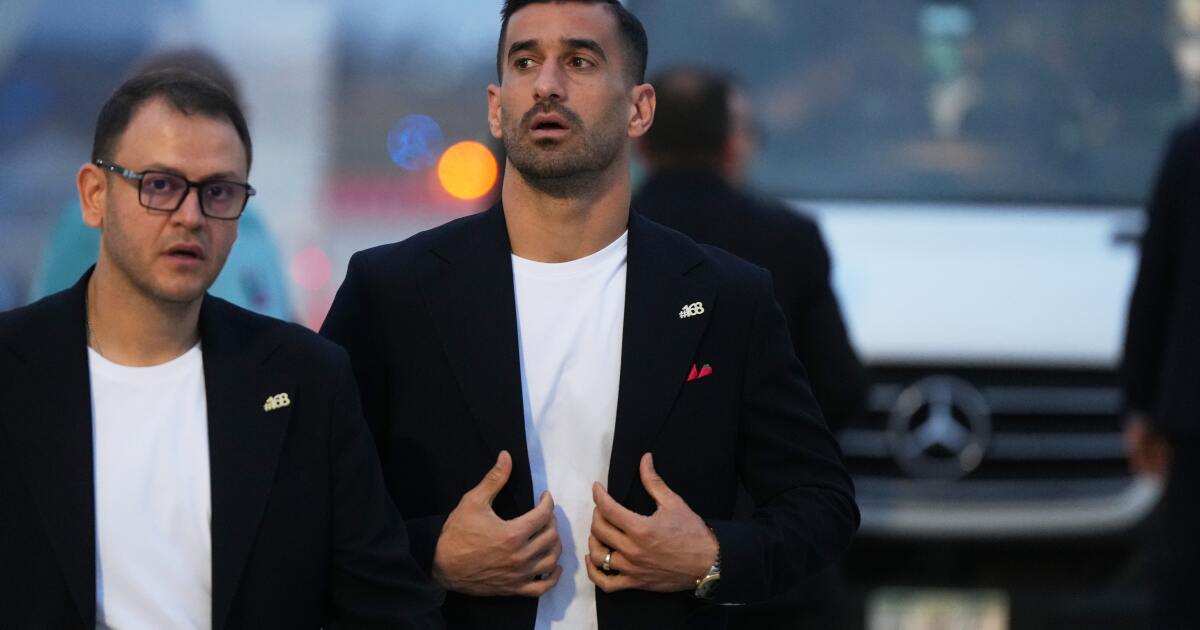
“All players and technical staff, especially those who have served their military service in the Islamic Revolutionary Guard Corps or IRGC, such as Mehdi Taremi and Ehsan Hajsafi, should be granted visas without any problems,” said Iranian football chief Taj.

FIFA chief Gianni Infantino has reiterated that Iran will play their World Cup games in the US as scheduled.

Iran, who are due to be based in Tucson, Arizona, during the World Cup, face New Zealand, Belgium and Egypt in Group G.

The Iranians open their World Cup campaign against New Zealand in Los Angeles on June 15.

“No external power can deprive Iran of its participation in a cup to which it has qualified with merit,” the Iranian federation said on Saturday.

Source link

World Cup 2026: How US football has evolved since hosting the 1994 event | World Cup 2026 News

Football has gained a foothold in the United States, and the country seems ready to host the World Cup this summer – which was not clear in 1994.

Back then, when the US last hosted the World Cup, the country had no professional league and the national team was cobbled together with ex-collegians, journeymen, and semi-professionals.

Recommended Stories

list of 4 itemsend of list

“Leading into ’94, we were at risk on the ticket side,” former US Soccer President Sunil Gulati told Al Jazeera in a recent interview. “For the US Organizing Committee, it was a big concern if we could sell all the tickets.’’

In the end, the 1994 tournament was successful. A record 3.5 million (68,991 per game) attended matches; the US advanced from the group stage for the first time since 1930, losing 1-0 to eventual champions Brazil in the last 16; and seeds were planted for a professional league, Major League Soccer.

Football has since moved from the margins to the mainstream in the US.

MLS is thriving, the national team is ranked a creditable 16th in the world by FIFA, and as the World Cup returns this summer, ticket demand far outpaces supply.

“If you said in 1994 MLS would be a 30-team league, with [22] soccer-specific stadiums and averaging 20,000 crowds – not in our wildest dreams,” Gulati said.

“The landscape is completely different. The most visible thing is the development of professional leagues, MLS and the women’s league [NWSL]. We had no first division league. And now there is [also] USL Division 2 and 3. The number of teams has increased dramatically.”

Today, the US Soccer Federation, commonly referred to as US Soccer, sanctions 127 professional teams – 102 men’s and 25 women’s.

“Eighteen of the top 50 [valued] teams in the world are in MLS,” Gulati said. “That’s an extraordinary statistic. The women’s team in Columbus just sold for $205m. Commercial interest in soccer and soccer leagues is at an all-time high.”

Credit Joao Havelange for seeing the future. During his reign as FIFA president, Havelange usually got what he wanted, and he wanted the 1994 World Cup in the US, along with a professional league.

Easier said than done, though. Organised football has been played in the US since the late 19th century, with the American Cup inaugurated in 1884. But over the following decades, several professional leagues collapsed, and after the North American Soccer League (NASL) folded in 1984, there appeared to be little future for the game. Enter Havelange and FIFA.

“FIFA recognised a long time ago that, for the sport to grow internationally, it had to be successful in the US,” Farrukh Quraishi, a Tampa, Florida-based administrator who played in the NASL, told Al Jazeera.

“For me, it was purely a matter of time. This is a huge and wealthy market. Now, you look at who is buying clubs in MLS, and it’s a who’s who of NFL owners.”

Looking back, it’s remarkable that the US actually competed in World Cups and played host to one at all, without a nationwide professional league.

Romario (with trophy) and captain Dunga of Brazil and the Brazilian team celebrate after winning the1994 FIFA World Cup Final against Italy on 17 July 1994 played at the Rose Bowl in Pasadena, California, United States. Brazil defeated Italy 3-2 in a penalty shootout.(Photo by Ben Radford/Getty Images)
Brazil celebrates winning the 1994 World Cup after defeating Italy 3-2 in a penalty shootout [Ben Radford/Getty Images]

For years, football’s foundation in the country was built on amateur and youth participation. By the early 1990s, the numbers were high, with an estimated 18 million people playing the sport at some level in the US. But the pyramid lacked a top tier, leaving a dead end for aspiring players, little media coverage, and scattered fan interest.

The 1994 World Cup came and went, and, in 1996, MLS finally kicked off.

Havelange duly arrived to commemorate the inaugural game, sitting in the rickety stands of Spartan Stadium in San Jose, California.

The San Jose Clash edged DC United 1-0, as Eric Wynalda scored an 88th-minute goal – just in time to avoid the game going to a “shootout”, in which draws were decided by players going one-on-one with goalkeepers from 32 metres (35 yards) out. This novel method of deciding games ended in 2000.

Football-specific stadiums started springing up in 1999. Lamar Hunt’s Columbus Crew Stadium became the country’s first major purpose-built football venue since Mark’s Stadium in Fall River, Massachusetts, in 1922. Now, Columbus are on their second stadium, the ScottsMiracle-Gro Field, and a total of 22 MLS teams compete at their own venues.

Football finally became part of the American sporting scene.

“Is it in the same way as the NFL, with [average figures of more than 18 million] watching it, or the American Pastime that baseball is? No,” Gulati said.

“It’s not at that viewership level, [but] there is worldwide coverage of games. Look at everyone wearing jerseys on the street, Lionel Messi playing in Miami. It is part of the mainstream.”

‘Soccer still isn’t king in the US’

Not that the picture is not flawed. Wynalda, who went on to score 34 goals in 106 games for the US national team, sees the current system as a recipe for mediocrity, registering millions of youngsters but limiting their ambition as few US players take up prominent roles on MLS teams.

Most are offered the league’s minimum annual salary ($80,622) and only two US players were listed last year among the top 40 highest-paid, according to the MLS Players Association – Austin FC forward Brandon Vazquez (24th at $3.55m) and Nashville SC defender Walker Zimmerman (27th at $3.45m).

“Look at the growth of [MLS] and you can say soccer looks professional, looks like a big deal, looks major league. And a lot of people look at the sport with a different lens now because it’s a legitimate sport,” Wynalda, now a coach and commentator, told Al Jazeera.

“[But] facilities do not create ability. We need more focus on a competitive environment to develop players. We tell them winning doesn’t matter and then wonder why they can’t win. We’ve lost that competitive mentality.”

He favours introducing promotion/relegation as a solution.

“If you’re going to a team that is never going to be relegated, because it’s got enough money, you never learn how to fight relegation, how to beat 11 angry men with their livelihood on the line,” Wynalda said.

And while the MLS franchise model has created riches, with teams valued as high as Los Angeles FC at $1.25bn (thanks to owning the 22,000-seat BMO Stadium) by Forbes Magazine, the quality of play does not always correspond.

MLS teams have tended to struggle in CONCACAF competitions, although in 2022 the Seattle Sounders ended a 22-year drought for an MLS side to win the federation’s elite competition, which was previously won by DC United in 1998 and LA Galaxy in 2000.

“There are things we agree with and disagree with, on and off the field, but [MLS] is successful,” Fox Sports commentator Alexi Lalas, a central defender for the US in 1994, told Al Jazeera. “I don’t think you can argue against that.”

Thanks to the 1994 WC and MLS, football in the US became “a very different world, to finally be even recognised for what you did, let alone respected”, Lalas said. “You know, soccer still isn’t king in the US, but, let’s be honest, it’s part of the palate and certainly part of the landscape when it comes to this generation.”

Lalas predicts the US will harness the “magic” of being hosts to reach the quarterfinals, while Gulati expects the sport to continue to grow in the US after the World Cup.

“That is what the legacy of the tournament is about and why we bid,” Gulati said.

Source link

US says Iran can play at 2026 World Cup but bars those with ‘IRGC ties’ | World Cup 2026 News

US Secretary of State Marco Rubio says the US has not told the Iranian national team that it cannot play.

US Secretary of State Marco Rubio said Washington has no objections to Iranian players participating in the 2026 FIFA World Cup, but he added the players will not be allowed to bring people with ties to Iran’s Islamic Revolutionary Guard Corps (IRGC) with them.

Since the United States-Israeli war on Iran began on February 28, Iran’s participation in this summer’s edition of FIFA’s global showpiece has been in doubt because all of the country’s group-stage matches are scheduled to be played in the United States.

Recommended Stories

list of 3 itemsend of list

“Nothing from the US has told them they can’t come,” Rubio told reporters.

“The problem with Iran would be not their athletes. It would be some of the other people they would want to bring with them, some of whom have ties to the IRGC. We may not be able to let them in, but not the athletes themselves,” Rubio said.

“They can’t bring a bunch of IRGC terrorists into our country and pretend that they are journalists and athletic trainers,” Rubio added.

Washington has designated the IRGC as a “foreign terrorist organisation”.

US President Donald Trump, speaking alongside Rubio, added that his administration “would not want to affect the athletes”.

The World Cup is set to begin on June 11 across the US, Mexico and Canada.

INTERACTIVE-Football FIFA How teams are group World Cup 2026-1776670778

Speculation about Iran’s participation has been rife, with officials from both Iran and the US weighing in.

In a statement on Wednesday, however, Iran’s government spokesperson Fatemeh Mohajerani said all necessary arrangements for the team’s participation in the tournament have been ensured by the Ministry of Sports and Youth.

An envoy for Trump, though, has been quoted as suggesting that Italy, who failed to qualify for the World Cup for a third straight edition, should replace Iran at this year’s World Cup.

Paolo Zampolli, an Italian-American who is ⁠a US envoy for global relations, told The Financial Times that he made the suggestion to both Trump and FIFA President Gianni Infantino.

“I’m an Italian native, and it would be a dream to see the Azzurri at a US-hosted tournament. With four titles, they have the pedigree to justify inclusion,” Zampolli, who has no official connection with the World Cup ⁠or Italian football, said earlier this week.

Italian Sports Minister Andrea Abodi has rebuked the idea, saying “it ‌is not appropriate … You qualify on the pitch,” while Economy Minister Giancarlo Giorgetti described the concept as “shameful”.

Iran qualified for a fourth successive World Cup last year but, after the start of the war, requested that FIFA move the team’s three group matches from the US to Mexico – a suggestion that was rejected.

Iran is now seemingly ⁠proceeding as planned.

“We are preparing and making arrangements for the World Cup, but we are obedient to the ⁠decisions of the authorities,” Iranian football federation President Mehdi Taj told reporters at a pro-government rally in Tehran on Wednesday.

Source link