White

Unification white paper pivots to peaceful ‘two-state’ coexistence with N. Korea

South Korea’s Unification Ministry on Monday released a new white paper focusing on peaceful coexistence with North Korea. This photo shows the Unification Bridge in Paju, across the border from the North, on Oct. 26, 2025. File Photo by Yonhap

The Lee Jae Myung government has shifted its focus to a peaceful “two-state” coexistence with North Korea, rather than pressure and confrontation, the unification ministry’s white paper showed Monday, striking a markedly different tone from its predecessor.

The annual paper reflects the push by the Lee government, which took office in June last year, to repair the strained inter-Korean relationship based on building mutual trust.

The previous conservative Yoon Suk Yeol government sought to bring about change in North Korea through pressure and the influx of outside information.

The latest white paper laid out three key guiding principles: Seoul respects North Korea’s system, does not pursue unification by absorption and does not engage in hostile activities.

Built on these principles, the government has framed its overarching policy as one of “peaceful coexistence and mutual growth on the Korean Peninsula.”

In particular, regarding Pyongyang’s “two hostile states” policy, the document specified the ministry’s stance that highlights the need for a transition to a “peace-oriented two-state relationship” aimed at achieving unification.

At a year-end party meeting in December 2023, the North Korean leader declared inter-Korean relations as those between “two states hostile to each other” and has since pursued hostile policies toward Seoul.

“Considering the reality that the South and the North exist as two de facto states, we intend to develop inter-Korean relations into a relationship of peaceful coexistence while still aiming for unification,” the ministry said.

Critics said the ministry’s “peace-oriented two-state relationship” narrative runs counter to the long-held stance that inter-Korean ties are a “special relationship” tentatively formed in the process of seeking unification, not as state-to-state relations.

Among the measures cited is the Lee government’s decision to halt the sending of anti-Pyongyang leaflets to North Korea and stop loudspeaker broadcasts along the border as steps to ease military tension and rebuild trust.

The paper also outlines plans to revive the Sept. 19 inter-Korean military agreement, signed by former President Moon Jae-in and North Korean leader Kim Jong-un in 2018, and pursue a bilateral accord to establish a systematic foundation for peaceful coexistence.

The shift in policy priorities is visible in the paper’s language. References to “peace” and “peaceful coexistence” surged to 196 from 29 and mentions of “meeting” or “dialogue” rose to 58 from 16.

By contrast, the section on North Korean human rights has been significantly scaled back. The term “North Korea’s human rights” dropped to 26 from 156, and “freedom” fell to three from 43. Mentions of “North Korean defectors” plummeted to just 10 from 203.

In a foreword message for the paper, Unification Minister Chung Dong-young stated, “Peace on the Korean Peninsula is not a choice for us, but a lifeline.”

“As we practice peace through actions rather than words, I hope that the South and the North can sit down together once again as neighbors peacefully coexisting with each other,” he added.

Despite Seoul’s olive branch, inter-Korean relations remain virtually frozen. There has been no inter-Korean human exchange in five years and no economic exchange whatsoever, the paper showed.

Pyongyang, meanwhile, has doubled down on its two-state policy, revising its constitution to remove all references to unification and cutting off remaining ties with Seoul.

Copyright (c) Yonhap News Agency prohibits its content from being redistributed or reprinted without consent, and forbids the content from being learned and used by artificial intelligence systems.

Source link

Helen Flanagan looks incredible as she poses in plunging white mini dress after moving out of home

HELEN Flanagan today looked incredible as she posed in a plunging white mini dress as she revealed she is now looking for her “fairytale”.

The new photoshoot comes just days after the former Corrie actress, 35, finally moved out of her Cheshire family home that she once shared with her ex-fiancé Scott Sinclair, 37.

Helen Flanagan thrilled fans as she posed in this plunging white dress Credit: Instagram
The sexy star seductively ate a strawberry in her summer-inspired photoshoot Credit: Instagram

After the big move, Helen is now keen to start a fresh chapter in her life.

To celebrate this new start, the sexy star thrilled fans by sharing an Instagram video of herself posing in a plunging white dress.

Posting the summer-inspired clip online, Helen was seen frolicking on a picnic blanket on the grass.

The actress pulled various poses to show off all her best angles.

Read more on Helen Flanagan

SOFA SO BAD

Helen Flanagan’s explosive moving day with ex Scott Sinclair has turned ‘toxic’


CLEAN SLATE

Beaming Helen Flanagan reunites with ex Scott as they move out of family home

Helen pulled various poses as she languished in a picnic blanket Credit: Instagram
Fans went wild for her latest sexy Instagram video Credit: Instagram

At one point, Helen was seen seductively eating a strawberry.

Revealing she was starting a new chapter, the soap star penned: “I want the fairytale.”

It’s fair to say Helen’s fans went wild for her look, with one writing: “Beautiful lady.”

Another added: “Absolutely stunning!”

Helen and Scott split in 2022 after 13 years together Credit: Instagram
The pair share three children – Matilda, Delilah and Charlie

This fan swooned: “Stunning and classy!”

Last week, Helen was spotted moving all of her stuff out of the family home she once shared with ex Scott.

There’s no love lost between the pair, with the Ex On The Beach star previously slamming her former fiance for leaving her skint and having a lack of involvement in their kids’ lives.

The detached home near Bolton was in Scott’s name, but he let Helen and their three kids — Matilda, Delilah and Charlie — live there after the split.

Last year, we reported the house was put on sale for £1.5million before being reduced to £995,000.

Despite the loss, it means Scott has still made a £155,000 profit on the home having bought it for £840K in 2021.

But despite the house now being sold, a source told The Sun that things are still “far from rosy”.

“Helen said she wasn’t planning to talk to Scott or even look him in the eye, things between them are still toxic,” an insider revealed.

“All the conversations about moving and the furniture have mostly been over email.

“Scott is relieved the house has finally sold, but Helen is in limbo at the moment.”

In January, The Sun revealed how Scot was keen to get the home sold, while Helen wasn’t in any rush to move out.

A friend of Helen’s said at the time: “Scott pays for the house and all the bills and he’s decided a six-bedroom place is way too big for Helen on her own with the kids.

“But Helen doesn’t want to move and is digging her heels in.

“She loves the place, the kids are settled at the local school and her mum and dad live around the corner.

“Scott wants to buy Helen a four-bedroom home. He’s even offered to put it in her name but wants to stop the maintenance payments.

The relationship has completely broken down. They no longer communicate — everything goes through her parents.”

Source link

Senate parliamentarian deals blow to $1-billion security proposal for White House

A proposal to fund $1 billion in security additions for the White House campus and President Trump’s new ballroom fails to meet procedural rules, according to the Senate parliamentarian, dealing a blow to Republican plans to include it as part of a bill to fund immigration enforcement agencies for the next three years.

The parliamentarian’s ruling, described late Saturday by Senate Democrats, said that funding for a project as large and complex as Trump’s massive East Wing renovation is too broad to be included in the narrow GOP budget bill, which cannot be filibustered and needs only a simple majority to pass.

It’s unclear whether Republicans will be able to immediately salvage any part of the billion-dollar Secret Service proposal, which would fund security for Trump’s ballroom along with other parts of the White House, including a new visitor screening center, additional training for agents and extra reinforcements for large events. Republicans said Saturday night that they are revising the legislation based on the parliamentarian’s advice.

Ryan Wrasse, a spokesman for Senate Majority Leader John Thune (R-S.D.), wrote in a post on X that “none of this is abnormal” during the complicated budget process that Republicans are using to try to pass the immigration enforcement and White House security money on a partisan basis.

“Redraft. Refine. Resubmit,” Wrasse said in the post.

Democrats say they’re ‘ready to stop them again’

Democrats have seized on the security request, accusing Republicans of dedicating federal resources to the ballroom project instead of focusing on helping Americans with rising costs. Republicans have insisted that private donations will be used to build the ballroom and that the federal dollars are focused just on much-needed security enhancements.

Senate Minority Leader Chuck Schumer (D-N.Y.) took credit for the ruling after Democrats argued to the parliamentarian that the security money doesn’t belong in the bill.

“Republicans tried to make taxpayers foot the bill for Trump’s billion-dollar ballroom,” Schumer said Saturday evening. “Senate Democrats fought back — and blew up their first attempt.”

Schumer added that Democrats “will be ready to stop them again” as Republicans say they will revise the bill.

The ruling from the Senate parliamentarian is advisory, but such rulings are rarely if ever ignored when lawmakers put together legislation that can pass with a simple majority. Most bills are subject to a filibuster and thus need 60 votes for passage — meaning Republicans must find some Democratic support in the 53-47 Senate.

Part of immigration bill

Republicans are looking to approve a roughly $72-billion package to fund Immigration and Customs Enforcement and Customs and Border Protection until the end of Trump’s term after Democrats have blocked the money for months.

As part of that package, Republicans included $1 billion for White House security enhancements, part of it connected to Trump’s ballroom. The Secret Service had requested the money after a man was charged with trying to assassinate Trump at the White House Correspondents’ Assn. dinner last month.

The overall budget package is providing another boost of funding for Trump’s immigration and deportation agenda, fueling operations through September 2029. It comes on top of Immigration and Customs Enforcement and Border Patrol funds Congress provided last year in the One Big Beautiful Bill Act that Trump signed into law.

The parliamentarian kept most of the immigration portion of the legislation intact, though some minor provisions were blocked, including Customs and Border Patrol funds to hire, train and pay Border Patrol agents. Republicans said those were only technical fixes.

Oregon Sen. Jeff Merkley, the top Democrat on the Senate Budget Committee, said Saturday evening that “Democrats are prepared to challenge any change to this bill.”

Americans shouldn’t spend “a single dime” on Trump’s “Louis XIV-style ballroom and throw tens of billions more at two lawless agencies,” Merkley said.

Jalonick and Freking write for the Associated Press. AP writer Lisa Mascaro contributed to this report.

Source link

White House freezes new Medicare enrollments for hospice, home health

The Trump administration on Wednesday pursued new efforts in a sweeping initiative to root out fraud in federal health programs, including announcing a nationwide six-month freeze on some new Medicare enrollments and warning states to actively investigate Medicaid fraud or risk losing funding.

The moves are related to Vice President JD Vance’s anti-fraud task force, which has been accelerating its messaging before the November elections. The panel set up by Republican President Trump seeks to crack down on potential misuse of public money.

The most significant step Wednesday came from the Centers for Medicare and Medicaid Services with a nationwide six-month moratorium on all new Medicare enrollments by providers of hospice and home care.

“We’ve seen systemic and deeply troubling fraud in the hospice and home health space, with bad actors exploiting some of our most vulnerable Medicare patients and stealing money from the American taxpayer,” the agency’s administrator, Dr. Mehmet Oz, said in a statement. “Today we’re shutting the door on fraud — preventing new bad actors from entering Medicare while we aggressively identify, investigate, and remove those already exploiting them.”

The Department of Health and Human Services’ internal watchdog has sent letters to state attorneys general warning them to vigorously investigate possible fraud or risk losing federal money.

People across the United States have raised concerns about rising healthcare costs and barriers to access, sometimes from the federal government’s actions. New work requirements in Medicaid, for example, are expected to strain hospitals around the country and result in millions of enrollees losing their health coverage.

Several alleged fraud schemes have been prosecuted in the hospice and home health care categories, and states have acknowledged that it is a legitimate concern. But some have pushed back on the administration’s aggressive tactics and raised concerns that the catchall efforts could needlessly punish law-abiding providers that are trying to serve patients.

What the freeze does

The administration contends the enrollment freeze and other actions it is taking will help prevent potential fraud in Medicaid and Medicare and preserve funding and resources for people most in need. Under the six-month pause, existing hospice and home health care providers will continue to operate as usual. But the Medicare and Medicaid agency said it will “intensify targeted investigations, deploy advanced data analytics, and accelerate the removal” of providers in the category that are suspected of fraudulent activity.

Such a freeze is not unprecedented, said Tricia Neumann, a senior vice president and executive director for the program on Medicare policy at the healthcare research nonprofit KFF. She said President Clinton’s Democratic administration also imposed a temporary moratorium on home health agencies.

“A brief moratorium gives the administration time to crack down on true fraud and prevent new fraudulent entities from popping up,” she said.

Maine becomes a focus

Vance, a potential 2028 White House hopeful, has used the high-profile assignment from Trump to remind Americans struggling with high costs that he is trying to claw back taxpayer dollars. Vance has promoted the task force’s work during campaign stops for Republican candidates and is expected to focus on the effort Thursday in Maine, where there are closely watched primary races on June 9.

Oz said earlier in the year that he was calling for corrective action on alleged fraud in government health programs in Maine, a request characterized by the state’s Democratic governor, Janet Mills, as a “political attack.”

Federal investigations and oversight

In recent months, the Medicare and Medicaid agency has suspended payments to hundreds of hospice and home care agencies in Los Angeles over alleged fraud and issued another six-month moratorium on suppliers of durable medical equipment, prosthetics, orthotics and certain other supplies in Medicare.

The administration also has approached at least five states with investigations into potential healthcare fraud and halted about $243 million in Medicaid payments to one of them, Minnesota, over fraud concerns. Last month, Oz announced his agency would add to that oversight by requiring all 50 states to share how they planned to revalidate some of their Medicaid providers.

In at least one case, the administration has erred in its accusations against states. In April, the Medicare and Medicaid agency acknowledged to the Associated Press that it made a significant error in figures it used to help justify a fraud inquiry in New York. The acknowledgment deepened doubts about the administration’s methods and raised a common criticism about the second Trump administration — that it tends to attack first and confirm the facts later.

Swenson and Price write for the Associated Press. Swenson reported from New York. AP writer Geoff Mulvihill in Haddonfield, N.J., contributed to this report.

Source link

Man charged in White House correspondents’ dinner attack pleads not guilty

A man accused of storming the White House Correspondents’ Association dinner while armed with guns and knives pleaded not guilty on Monday to charges that he attempted to kill President Trump and fired a shotgun at a Secret Service officer who tried to stop the attack.

Cole Tomas Allen was handcuffed and shackled and wearing an orange jail uniform when he appeared in federal court for his arraignment. Allen didn’t speak during the brief hearing. One of his attorneys entered the plea on his behalf.

Allen’s lawyers are asking U.S. District Judge Trevor McFadden to disqualify at least two top Justice Department officials from direct involvement in prosecuting him because they could be considered victims or witnesses in the case, creating a potential conflict of interest.

Acting Atty. Gen. Todd Blanche and U.S. Atty. Jeanine Pirro were attending the event when Allen ran through a security checkpoint and fired a shotgun at a Secret Service officer, authorities said. In a court filing last week, Allen’s attorneys argued that it creates at least the appearance of a conflict of interest for Blanche and Pirro to be making any prosecutorial decisions in the case.

McFadden, a Trump nominee, didn’t rule from the bench on that question but asked Allen’s attorneys to elaborate on the possible scope of their recusal request. Defense attorney Eugene Ohm said the defense likely would seek to disqualify Pirro’s entire office from involvement in the case. Ohm acknowledged that a bid to disqualify the entire Justice Department would be unlikely.

“That would be quite a request,” the judge said.

McFadden gave prosecutors until May 22 to respond in writing to the defense’s request. The judge asked the government to specify whether it believes Pirro and Blanche could be considered victims in the case.

“That might add some clarity here,” McFadden said.

In their filing, Allen’s attorneys suggested that the appointment of a special prosecutor might be warranted.

Allen is scheduled to return to court on June 29.

A Secret Service officer was shot once in a bullet-resistant vest during the April 25 attack at the Washington Hilton hotel, which disrupted and ultimately prompted an early end to one of the highest-profile annual events in the nation’s capital. The officer fired five shots but didn’t hit anybody, authorities said.

Allen, 31, of Torrance, was injured but was not shot.

Besides the attempted-assassination count, Allen also is charged with assaulting a federal officer with a deadly weapon and two additional firearms counts. He faces a maximum sentence of life in prison if convicted of the attempted assassination charge alone.

Allen was placed on suicide watch after his arrest, but jail officials removed him from that status after several days. Allen’s attorneys complained that he had been unnecessarily confined in a padded room with constant lighting, repeatedly strip searched and placed in restraints outside his cell.

Allen told FBI agents that he didn’t expect to survive the attack, which could help explain why he was deemed to be a possible suicide risk, a Justice Department prosecutor has said.

Allen was outfitted with an ammunition bag, a shoulder gun holster and a sheathed knife when he took a photo of himself in his room at the hotel just minutes before the attack, according to prosecutors. In a message that authorities say sheds light on his motive, Allen referred to himself as a “Friendly Federal Assassin” and alluded obliquely to grievances over a range of actions by Trump’s Republican administration.

Authorities have alleged that Allen on April 6 reserved a room for himself at the Hilton where the event would be held weeks later under its typical tight security. He traveled by train cross-country from California, checking himself into the hotel a day before the dinner with a room reserved for the weekend.

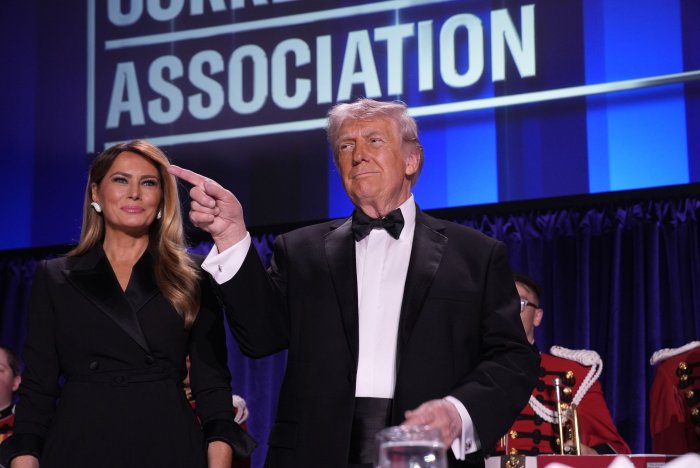
Trump was rushed off the stage by his security team at the Saturday night event and appeared at the White House two hours later, still in his tuxedo, to talk about the attack and the suspect.

“When you’re impactful, they go after you. When you’re not impactful, they leave you alone,” the president said. “They seem to think he was a lone wolf.”

Kunzelman writes for the Associated Press.

Source link