Iran war live: Tehran says US ports siege ‘intolerable’; Trump mulls action
Israeli attacks on Lebanon killed at least 2,586 people and wounded more than 8,000 since March 2, local media report.
Source link
Israeli attacks on Lebanon killed at least 2,586 people and wounded more than 8,000 since March 2, local media report.
Source link
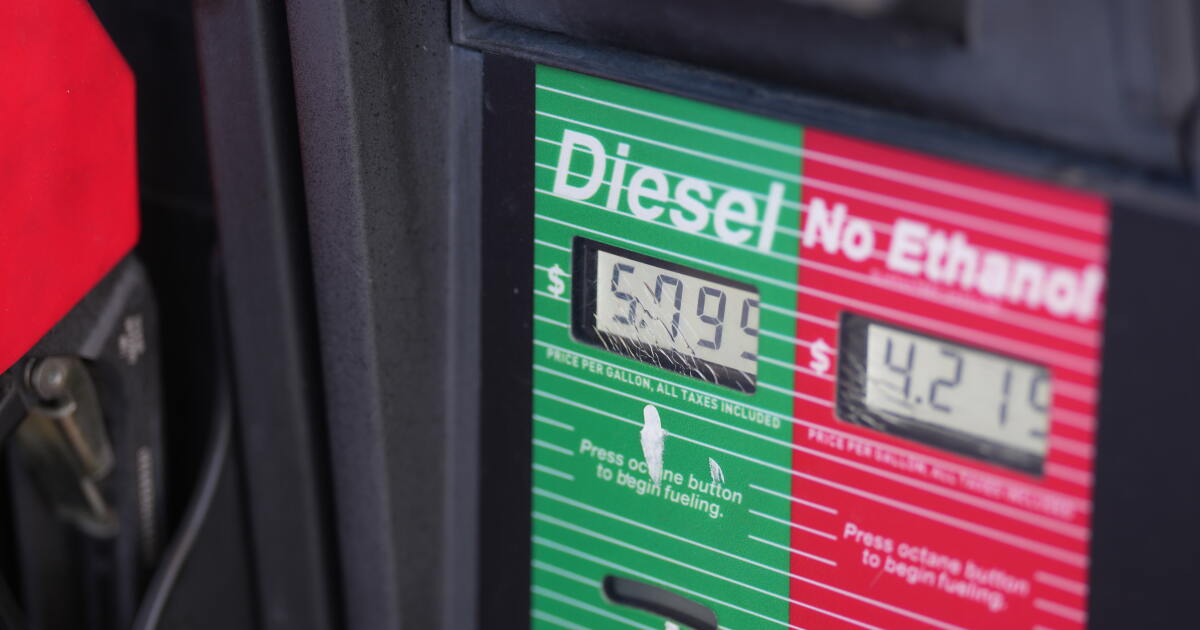
Price of petrol in US jumps by nearly 30 cents in one week amid Strait of Hormuz blockade and Iran diplomatic deadlock.
The average price of one gallon (3.8 litres) of gasoline in the United States has reached $4.30, according to the American Automobile Association (AAA), up from less than $3 before the February 28 start of the US-Israel war on Iran.
Thursday’s prices come as US President Donald Trump insists that time is on his side in the standoff with Iran, even as he refuses Tehran’s offers of a preliminary deal to reopen the Strait of Hormuz.
list of 3 itemsend of list
According to AAA, prices for gas or petrol went up by 27 cents over the past week amid the deepening impasse, with Iran blocking the strait and the US imposing a naval siege on Iranian ports.
“The national average is $1.12 higher than it was this time last year, as oil prices surge above $100/barrel with no indication of when the Strait of Hormuz will reopen,” AAA said in a brief report on Thursday.
“Gas prices are the highest they’ve been in four years, since late July 2022.”
California, home to nearly 40 million people, saw petrol prices hit more than $6 per gallon on Thursday.
The spike in energy prices has been fuelling inflation and economic uncertainty, adding to Trump’s political woes.
The US president’s approval rating is hitting record lows amid growing discontent with the conflict with Iran, recent public opinion polls show.
Since the start of the war, Trump and his allies have been trying to frame the hike in petrol prices as a temporary price worth paying to achieve the aims of the military campaign.
The US president reiterated that argument on Thursday when asked about the latest price increase.
“And you know what? And we’re not going to have a nuclear weapon in the hands of Iran,” the US president told reporters.
“The gas will go down. As soon as the war is over, it’ll drop like a rock.”
However, oil prices do not drop automatically after hostilities stop. Despite the ceasefire reached on April 8, the cost of gas in the US has continued to climb.
Iran denies seeking a nuclear weapon.
Although the US is one of the largest oil producers and is not heavily reliant on energy products from the Middle East, global prices affect what Americans pay at the pump.
On Thursday, Trump stressed that Iran is all but vanquished militarily and economically – a claim he has been repeating since the early days of the conflict.
“Iran is dying to make a deal,” he said, calling the naval blockade against the country “incredible”.
Tehran has projected defiance, refusing to hold direct talks with the US until the siege is lifted, even after Trump announced last week that he was dispatching his top envoys to Pakistan to negotiate with Iranian officials.
Earlier on Thursday, Iranian President Masoud Pezeshkian suggested that Iran is running out of patience with the current situation of no war and no peace amid the US siege.
“The world has witnessed Iran’s tolerance and conciliation. What is being done under the guise of a naval blockade is an extension of military operations against a nation paying the price for its resistance and independence,” Pezeshkian said in a social media post.
“Continuation of this oppressive approach is intolerable.”

The TWZ Newsletter
Weekly insights and analysis on the latest developments in military technology, strategy, and foreign policy.
U.S. President Donald Trump is at an inflection point in the currently paused war in Iran. He is facing a legally mandated deadline tomorrow for seeking Congressional permission to continue the conflict while also reportedly meeting today with Epic Fury’s top general about future strikes. Meanwhile, Iran’s Supreme leader signalled that his country is not willing to give in to Trump’s demands, increasing the chances hostilities could continue.
This is all happening against the backdrop of a shaky ceasefire and stalled negotiations with Iran over its nuclear program and continuing closure of the Strait of Hormuz.
Tomorrow marks the 60-day mark since Trump formally notified Congress of hostilities against Iran. That’s the limit established under the War Powers Resolution of 1973 for deploying troops without Congressional approval if there is an “imminent threat” to the country. However, Congress must sign off on a 30-day extension if the president says it’s necessary and informs the legislative body. An extension is meant to allow the president to use force protection to withdraw troops from a conflict, not keep it going or expand it.
Trump has until tomorrow to force a vote on the matter, since an extension requires Congressional approval. The legislature also has the option to declare war on Iran, which has not happened. With that in mind, the president’s team is reportedly talking to legislators about an extension. Trump can also ignore the mandate as other presidents have in the past.
“The administration is in active conversations with [Congress] on this topic,” a senior White House official told the Washington Examiner. “Members of Congress who try to score political points by usurping the commander in chief’s authority would only undermine the United States military abroad, which no elected official should want to do.”
Sen. Lindsey Graham (R-SC), a close Trump ally and staunch proponent for armed intervention in Iran and other hostile nations, urged Trump to pay no heed to the resolution.
“If I were them, I’d completely ignore” the deadline, Graham told the Washington Examiner in a brief interview. “I’ve always thought it’s been unconstitutional.”
Several recent attempts by Congressional Democrats to invoke the War Powers Act to stop the war have failed.
BREAKING: Senate Republicans stopped an Iran War Powers Resolution 51-46.
Democrat John Fetterman voted with Republicans; Republican Rand Paul voted with Democrats. pic.twitter.com/YbV0wfvhpk
— Fox News (@FoxNews) April 22, 2026
As CBS News notes, the resolution has never successfully stopped an administration from continuing hostilities and both the Obama and Clinton administrations continued kinetic actions despite passing the deadline.
It remains publicly unknown at this point what action Trump will take. We have reached out to the White House for more details.
Meanwhile, the president is slated to receive a briefing today on new plans for potential military action in Iran from CENTCOM Commander Adm. Brad Cooper, Axios reported on Wednesday, citing two sources with knowledge.
The briefing “signals that Trump is seriously considering resuming major combat operations either to try to break the logjam in negotiations or to deliver a final blow before ending the war,” the outlet suggested.
CENTCOM has prepared three options, Axios noted. They include:
Scoop: President Trump is slated to receive a briefing on new plans for potential military action in Iran on Thursday from CENTCOM Commander Adm. Brad Cooper, two sources with knowledge told me. My story on @axios https://t.co/wlthqTjurg
— Barak Ravid (@BarakRavid) April 30, 2026
The ceasefire extension Trump authorized on April 21 continues to hold despite Iranian attacks on shipping and the ongoing U.S. blockade of Iranian ports and its seizure of Iranian-backed oil tankers in the Indian Ocean.
So far Operation Epic Fury has cost taxpayers $25 billion, and that “most of that is in munitions,” the Pentagon’s acting comptroller, Jules Hurst, told the House yesterday. Today, Hurst, War Secretary Pete Hegseth, who engaged in a number of heated exchanges with House Democrats yesterday, and Joint Chiefs Chairman Gen. Dan Caine testified before the Senate.
Regardless of what actions the U.S. takes, Iran does not appear to be willing to negotiate away either its nuclear ambitions or ballistic missile arsenal.
The Islamic Republic’s supreme leader said Thursday that his country will protect its “nuclear and missile capabilities” as a national asset, The Associated Press reported. That will likely draw a hard line as Trump presses for a wider deal to cement the war’s shaky three-week ceasefire, the wire service added.
“Ayatollah Mojtaba Khamenei maintained his defiant tone since taking over following the killing of his father in the war’s opening airstrikes,” according to AP. “In a written statement read by a state television anchor, Khamenei — who has not been seen in public since becoming supreme leader — said the only place Americans belonged in the Persian Gulf is ‘at the bottom of its waters’ and that a ‘new chapter’ was being written in the region’s history.”
Supreme leader Ayatollah Mojtaba Khamenei said in a written statement that Iran will protect its nuclear and missile capabilities as a national asset, likely drawing a hard line as President Trump seeks a wider deal. Khamenei also insisted Americans belong “at the bottom” of the…
— The Associated Press (@AP) April 30, 2026
Khamenei is said to be taking extreme security precautions, and messaging from him has been extremely limited. As we have previously reported, he was also seriously injured in the attack that killed his father, Ayatollah Ali Khamenei, on the first day of the war.
Trump on Thursday said Iran wants “to make a deal badly” and repeated his claim that it is unclear who is really in charge in Iran, making it hard to negotiate.
Given all this, the next two days could tell us a lot about the future of this conflict.
CENTCOM has asked to send the Army’s long-range Dark Eagle hypersonic boost-glide vehicle weapon to the Middle East for possible use against Iran, Bloomberg News reported on Wednesday. The outlet suggested the request was made because the command is seeking a longer-range system to hit Iranian ballistic-missile launchers deep inside the country.
“If approved, it would mark the first time the US will have deployed its hypersonic missile, which is running far behind schedule and hasn’t been declared fully operational even as Russia and China have deployed their own versions,” the outlet added. “The Request for Forces submission justifies the move by saying Iran has moved its launchers out of range of the Precision Strike Missile (PrSM), a weapon that can hit targets at more than 300 miles, a person with direct knowledge of the request said.”
US Central Command has asked to send the Army’s long-delayed Dark Eagle hypersonic missile to the Middle East for possible use against Iran, seeking a longer-range system to hit ballistic-missile launchers deep inside the country. https://t.co/xsD93MLWUT
— Bloomberg (@business) April 29, 2026
As we have noted before, Dark Eagle is “a trailer-launched hypersonic boost-glide vehicle system that can travel long distances at hypersonic speeds (velocities in excess of Mach 5) while maneuvering erratically through Earth’s atmosphere. This makes it an ideal weapon for striking high-priority and time-sensitive targets that are extremely well defended. This includes critical air defenses, command and control nodes, and enemy sensor systems, among other targets. It is the first true hypersonic weapon slated for frontline U.S. service.”
CENTCOM declined comment, however, whether it would even make sense to use this weapon against Iranian targets is questionable. There are just a tiny handful of these munitions (likely single digits) in the inventory and there are many other ways to strike targets anywhere in Iran relatively quickly. This includes fixed-wing airpower being able to loiter over the country and drones operating persistently over it.
Beyond using the war as an operational demonstration of the weapon, which has its own major advantages and disadvantages, Dark Eagle is a precious weapons system that would be poorly allocated to making out a single missile launcher. These weapons are needed for near-peer contingencies in the Pacific and Europe, according to the military.
Images on X show the Wasp class amphibious assault ship USS Boxer and part of its Amphibious Ready Group (ARG), loaded with elements of the 11th Marine Expeditionary Unit (MEU), continue to steam toward the Middle East. As we have previously reported, the ARG/MEU is traveling to supplement the force currently stationed in the region.
The images show the Boxer and Whidbey Island class dock landing ship USS Comstock traveling westbound in the Singapore Strait.
USS Boxer (LHD 4) Wasp-class amphibious assault ship and USS Comstock (LSD 45) Whidbey Island-class dock landing ship westbound in the Singapore Strait – April 30, 2026 SRC: FB- Military Aviation Photography Singapore pic.twitter.com/uN9svQdACw
— WarshipCam (@WarshipCam) April 30, 2026
The aircraft carrier USS Gerald R. Ford will depart the Middle East and begin the sail for home in coming days, The Washington Post reported, citing multiple U.S. officials. The move means an expected relief for roughly 4,500 sailors who have been on a record-setting deployment even as the vessel experienced a fire and plumbing issues.
The Ford, as we previously noted, is one of three aircraft carriers in the region — the others are the USS George H.W. Bush and the USS Abraham Lincoln — amid hostilities with Iran. While the Ford is in the Red Sea, the Lincoln and Bush are operating in the Arabian Sea to enforce the U.S. blockade targeting vessels carrying oil or goods from Iranian ports.
It was not clear precisely when the Ford would depart the Middle East. One official told the Post that it is probably expected back home in Virginia around mid-May.
“As of Wednesday, the Ford had been deployed 309 days — the record for the longest time any modern U.S. aircraft carrier has been at sea,” the newspaper noted.
The Bush’s arrival in the Middle East last week marked the first time since 2003 that there were three carriers in the CENTCOM area of responsibility. Combined, the three carrier strike groups have 200 aircraft, nine Arleigh Burke class guided missile destroyers, and 15,000 sailors and Marines.
Air Force Chief of Staff Gen. Kenneth Wilsbaugh told lawmakers that the service will try to replace aircraft lost during Iran operations through a supplemental request, Politico reporter Audrey Decker reported on X.
“Both the supplemental and the 2027 budget is supposed to address those losses,” he testified.
There have been dozens of crewed and uncrewed aircraft damaged and destroyed so far in this conflict, which you can read more about in our chart here.
Air Force chief Gen. Wilsbach tells lawmakers they’ll try to replace aircraft lost during Iran operations through a supplemental request. “Both the supplemental and the 2027 budget is supposed to address those losses.”
— Audrey Decker (@audrey_decker9) April 30, 2026
Both the U.S. and Iran are betting on the flow of oil benefiting their bargaining positions.
A big part of the Trump administration’s plans for the future of efforts against Iran are based on the president’s assertion that Iranian oil fields will be irreparably damaged once it no longer has any place to store crude. As we noted last week, Trump suggested that Iran’s oil infrastructure could “explode” in about three days because of mechanical and geologic issues exacerbated by the blockade. The administration is banking on Iran – concerned about the long-term blow to an economy relying heavily on oil exports – bowing to U.S. pressure and agreeing to give up its nuclear ambitions and open the Strait of Hormuz.
Several experts, however, have since come forward to suggest Trump’s calculus on the matter is incorrect.
“That is not how it works,” Rosemary Kelanic, an energy scholar and director of the Middle East Program at the foreign policy think tank Defense Priorities, told The Washington Post. “Nothing is going to self-destruct.”
Mark Finley, a fellow in energy and global oil at Rice University’s Baker Institute, agreed. “Iran has proven it knows how to keep its system operating,” he told the newspaper. The closure of the strait means there are plenty of empty tankers available to Iran that could hold stranded oil production, Finley said. Even without them, “there is a domestic refining and distribution network that can keep the system running at a reduced rate,” he added.
“I don’t buy the argument that [Iran’s] oil wells would suffer irremediable damage — and neither do most experts with on-the-ground experience in the petroleum sector. Sadly, the US administration appear to be relying on flawed analysis, often amplified in social media and…
— Steve Lookner (@lookner) April 29, 2026
The Iranians, meanwhile, are watching the price of oil surge. For instance, the price of Brent crude, a benchmark oil, has jumped this week, to just over $104 per barrel today, according to OilPrice.com. That’s up from a recent low of just over $85 a barrel on April 17. Meanwhile, the average price of a gallon of gas in the U.S. is now $4.30, up from $4.03 a week ago, according to AAA.
Given this, Iran feels it can manage the storage issue and feels the pressure will be on the Trump administration as the global impact of the standoff grows.
In a message delivered on the occasion of Iran’s “National Day of the Persian Gulf,” Iranian President Masoud Peseshkian claimed that “any attempt to impose a naval blockade and restriction on Iran is doomed to failure.”
“The Persian Gulf is not an arena for imposing unilateral foreign wills and the security of this strategic zone can only be ensured with the cooperation of the coastal countries,” he wrote. “The Persian Gulf is not the field of imposing foreign wills. Hormuz Strait is a symbol of national sovereignty and Iran’s role in the security of the region. Any attempt to blockade Iran’s ports is doomed to failure. Iran is the guardian of the security of the Persian Gulf and the Strait of Hormuz.”
پیام رئیس جمهور به مناسبت روز ملی خلیج فارس
🔹خلیج فارس | عرصه تحمیل ارادههای خارجی نیست
🔹تنگه هرمز | نماد حاکمیت ملی و نقش ایران در امنیت منطقه است
🔹ایران پاسدار امنیت خلیج فارس و تنگه هرمز است
🔹هرگونه تلاش برای محاصره دریایی ایران محکوم به شکست استhttps://t.co/NYIU3gQWks pic.twitter.com/ncENHljnmH— pezeshkian (@drpezeshkian2) April 30, 2026
Israel, meanwhile, says it is ready to resume hostilities with Iran.
Defense Minister Israel Katz says while Israel supports the United States’ diplomatic efforts with Iran, it may “soon be required to act again” to remove the “existential threats” posed by the Islamic Republic, the Times of Israel reported.
“Iran has suffered extremely severe blows over the past year, blows that have set it back years in all areas,” says Katz during a ceremony promoting the next Israeli Air Force chief, Omer Tischler, to the rank of major general.
“US President Trump, in coordination with Prime Minister Benjamin Netanyahu, is leading the effort to complete the campaign’s objectives in a way that ensures Iran will not return to being a threat to the existence of Israel, to the United States, and to the free world for generations to come,” he added.
Defense Minister Katz: It is possible and soon we will be required to operate in Iran again to ensure the realization of the goals. pic.twitter.com/DaofxlqSCZ
— Open Source Intel (@Osint613) April 30, 2026
So far, CENTCOM has turned away 42 ships during the blockade, Cooper stated on X yesterday. Cooper said this represents 69 million barrels of oil, worth about $6 billion, that Iran can’t sell.
Russian Ambassador Mikhail Ulyanov said that President Vladimir Putin told Trump that if the US and Israel resume military operations, this would inevitably lead to extremely adverse consequences not only for Iran and its neighbors, but for entire international community, Ulyanov stated on X.
Putin also stressed that a ground operation on Iranian territory would be particularly unacceptable and dangerous, Ulyanov wrote.
In a phone call with D.Trump, President Putin pointed out that if the US and Israel resume military operation, this would inevitably lead to extremely adverse consequences not only for Iran and its neighbours, but for entire international community. He also stressed that a ground…
— Mikhail Ulyanov (@Amb_Ulyanov) April 30, 2026
Investigators from Naval Criminal Investigative Service (NCIS) and Homeland Security Investigations (HSI) are aboard the Majestic X, one of several Iranian-linked oil tankers seized in the Indian Ocean.
Last week, the Pentagon announced an overnight “maritime interdiction and right-of-visit boarding of the sanctioned stateless vessel M/T Majestic X transporting oil from Iran, in the Indian Ocean within the INDOPACOM area of responsibility.”
Pakistan has opened six overland transit routes for goods destined for Iran, effectively allowing the Islamic Republic to partially circumvent the U.S. port blockade, Al Jazeera reported.
“The move formalizes a road corridor through its territory as thousands of containers remain stranded at Karachi port because of the United States blockade of Iranian ports and ships trying to pass through the Strait of Hormuz,” the outlet stated.
The order “allows goods originating from third countries to be transported through Pakistan and delivered to Iran by road,” according to Al Jazeera.
The announcement coincided with Iranian Foreign Minister Abbas Araghchi’s visit to Islamabad for talks with Prime Minister Shehbaz Sharif and army chief Asim Munir, the latest in a series of diplomatic engagements as Pakistan seeks to mediate an end to the two-month war between Washington and Tehran.
🚨 Iranian media outlets associated with the regime confirm that Pakistan, Iran’s neighbor, has opened 6 land transport routes for trade. This somewhat undermines the blockade’s effectiveness and gives Iranians a little breathing room. However, keep in mind that more than 90% of… pic.twitter.com/8r2AHp1QQr
— Raylan Givens (@JewishWarrior13) April 30, 2026
The Trump administration wants other countries to form an international coalition to restore freedom of navigation in the Strait of Hormuz, according to a State Department cable Reuters says it saw.
“U.S. Secretary of State Marco Rubio approved the creation of the Maritime Freedom Construct (MFC), the cable dated April 28 said, which it described as a joint initiative by the State Department and the Pentagon,” the outlet noted.
“The MFC constitutes a critical first step in the establishment of a post-conflict maritime security architecture for the Middle East. This framework is essential to ensuring long-term energy security, protecting critical maritime infrastructure, and maintaining navigational rights and freedoms in vital sea lanes,” the cable read.
The MFC would reportedly be similar in nature to the European-led Operation Aspides, a defensive mission in the Red Sea region.
WSJ: The effort, called the “Maritime Freedom Construct,” was spelled out in an internal State Department cable sent to U.S. embassies on Tuesday that called on U.S. diplomats to press foreign governments into signing up. The U.S.-led coalition would share information, coordinate…
— Annmarie Hordern (@annmarie) April 30, 2026
Iran’s Navy Commander Rear Admiral Shahram Irani says the Islamic Republic will soon unveil a new weapon that would “deeply terrify the enemy,” the official Iranian IRNA media outlet reported.
“In a televised interview on Wednesday, Admiral Iran said the adversaries are deeply afraid of the new weapon the Islamic Republic plans to unveil close to where they are stationed,” IRNA added.
Irani provided no details about the weapon.
Commander of the Iranian Navy, Commodore Shahram Irani said today that they will soon unveil a weapon which enemies are very scared of. pic.twitter.com/mDI7ThYCae
— Mehdi H. (@mhmiranusa) April 29, 2026
The IDF issued a new warning to residents in south Lebanon of pending military action against Hezbollah.
“URGENT ALERT TO RESIDENTS OF LEBANON IN THE FOLLOWING VILLAGES: Al-Samanieh, Al-Hnieh, Al-Qalila, Wadi Jilo, Al-Kanisa, Kafr, Majdal Zoun, Seddiqine Hezbollah activities force the Defense Army to act against it, as it does not intend to harm you,” the warning read. “Out of concern for your safety, you must evacuate your homes immediately and stay away from the villages for a distance of at least 1000 meters to open areas. Anyone present near Hezbollah elements, their facilities, and combat means exposes their life to danger.”
#عاجل ‼️انذار عاجل إلى سكان لبنان في القرى التالية: السماعية, الحنية, القليلة, وادي جيلو, الكنيسة, كفرا, مجدل زون, صديقين
🔸نشاطات حزب الله تجبر جيش الدفاع على العمل ضده حيث لا ينوي المساس بكم.
🔸حرصًا على سلامتكم عليكم إخلاء منازلكم فوراً والابتعاد عن القرى لمسافة لا تقل عن… pic.twitter.com/BvK2oKYYrl
— افيخاي ادرعي (@AvichayAdraee) April 30, 2026
Israeli forces continue being attacked by Hezbollah drones. The following image shows an Israeli cargo carrier struck by one near the northern border community of Shomera. As we reported yesterday, the IDF is resorting to the use of netting to help defend some of its vehicles from these weapons.
A photo shows the Israeli military cargo carrier that was struck by a Hezbollah explosive-laden drone at an artillery position near the northern border community of Shomera this morning.
The M548, known in the IDF as the Alfa, is used to transport artillery shells.
Twelve… https://t.co/qFnKqJV3K3 pic.twitter.com/JbTtJMyyQO
— Emanuel (Mannie) Fabian (@manniefabian) April 30, 2026
Contact the author: howard@thewarzone.com
WASHINGTON — Defense Secretary Pete Hegseth clashed with Democratic lawmakers in Congress for a second day Thursday, rejecting senators’ accusations that the Iran war was launched without evidence of an imminent threat and waged with no coherent strategy.
The three-hour hearing of the Senate Armed Services Committee mostly traced the well-worn positions of Republicans and Democrats on the conflict, Hegseth’s leadership and the ways in which President Trump has used the American military.
In his opening statements, Hegseth called Democratic lawmakers “reckless naysayers” and “defeatists from the cheap seats” who have failed to recognize the many successes of the U.S. military against the Islamic Republic.
Hegseth said Trump has had the courage “unlike other presidents to ensure that Iran never gets a nuclear weapon and that their nuclear blackmail never succeeds. We have the best negotiator in the world driving a great deal.”
Democrats peppered Hegseth with questions about his efforts to remake military culture, U.S. support for Ukraine and whether Trump would seek congressional approval for the war. The Defense secretary said the ceasefire postpones the deadline for securing such approval.
Hegseth seemed to emerge with solid Republican support, though a few GOP senators asked about the dismissal of a top Army general and sought assurances that the Pentagon is doing everything possible to prevent civilian deaths.
The hearing was convened to discuss the Trump administration’s 2027 military budget proposal, which would boost defense spending to a historic $1.5 trillion. Hegseth and the chairman of the Joint Chiefs of Staff, Gen. Dan Caine, emphasized the need for more drones, missile defense systems and warships.
Top Democrat argues that war has left U.S. in worse position
Sen. Jack Reed, the committee’s ranking Democrat, argued that the war has left the U.S. in a worse strategic position, with 13 American troops killed, more than 400 injured and equipment destroyed.
The Strait of Hormuz remains closed, sending fuel prices skyrocketing, Reed said. Iran still has enriched uranium and retains enough combat effectiveness to keep the conflict locked in an impasse, while Iran’s hard-line government is still in charge.
“I am concerned that you have been telling the president what he wants to hear instead of what he needs to hear,” Reed said. “Bold assurances of success are a disservice to both the commander in chief and the troops who risked their lives based on them.”
Reed also lambasted Hegseth for his firing of top military leaders and suggested the Defense secretary had failed to recognize the accomplishments of women and people of color in the military. Reed noted that 60% of about two dozen officers fired by Hegseth have been female or Black.
Hegseth said that any firing is based on performance and that previous Pentagon leaders “were focused on social engineering, race and gender in ways that we think were unhealthy for the department.”
Republican chairman offers warmer welcome
Hegseth received a warmer welcome from Sen. Roger Wicker, the Republican chairman of the committee, and other GOP lawmakers. Wicker kicked off the hearing by noting that the U.S. is in the most dangerous security environment since World War II.
Through the war against Iran, Trump “has worked to remove the regime’s conventional military capabilities and force it back to the table for a permanent solution,” Wicker said.
He also commended the budget proposal for 2027, saying it “is chock-full of important programs and initiatives that are absolutely necessary to secure American interest in the 21st century.”
Sen. Deb Fischer, a Republican from Nebraska, praised Hegseth’s statement on the need for nuclear deterrence as well as the development of Trump’s Golden Dome missile defense program.
“For years, this committee has known that we must improve our ability to defend our homeland against a wider variety of threats,” Fischer said.
Sen. Tom Cotton, an Arkansas Republican, asked Hegseth whether he ever lied to Trump, pushing back against Reed’s claim that Hegseth tells the president what he wants to hear.
“I only tell the truth to the president,” Hegseth said.
Questions about civilian deaths
Senators also focused on civilian deaths in the Iran war and the Pentagon decision to hollow out a congressionally mandated office set up specifically to reduce civilian casualties.
The Associated Press has reported that growing evidence points to U.S. culpability for a deadly strike on an Iranian elementary school adjacent to a Revolutionary Guard base that killed more than 165 people, including children.
Democratic Sen. Kirsten Gillibrand of New York asked Hegseth, “What is your response to targeting that has resulted in the destruction of schools, hospitals, civilian places? Why did you cut by 90% the division that’s supposed to help you not target civilians?”
Hegseth responded that the Pentagon has an “ironclad commitment” to do more than other countries to prevent civilian deaths.
A day earlier, he battled with Democrats during a nearly six-hour House Armed Services Committee hearing, where he faced sharp questioning over the war’s costs in dollars, lives and diminishing stockpiles of crucial weapons.
Hegseth said Wednesday that the strike on the Iranian school remains under investigation.
War powers resolutions fail to pass
Democrats have called the conflict a costly war of choice that lacks congressional approval or oversight. But they have failed to pass multiple war powers resolutions that would have required Trump to halt the conflict until Congress authorizes further action.
Under the War Powers Act of 1973, Congress must declare war or authorize use of force within 60 days — a deadline that arrives Friday. The law provides for a potential 30-day extension, but the Republican administration has not indicated publicly whether Trump will seek it.
Sen. Tim Kaine, a Democrat from Virginia, asked Hegseth whether Trump will seek congressional authorization or ask for the 30-day extension. The Defense secretary said the clock pauses during a ceasefire. Kaine disagreed based on his reading of the law.
The Trump administration is in “active conversations” with lawmakers on addressing the 60-day timeline, according to a White House official, who spoke on condition of anonymity to discuss private deliberations.
Finley, Groves and Kinnard write for the Associated Press. Kinnard reported from Columbia, S.C. AP writer Seung Min Kim contributed to this report.
The conflict involving Iran and the disruption of the Strait of Hormuz have shaken global energy markets. Supply constraints and extreme volatility have driven oil prices sharply higher, exposing a growing structural divide in how major oil companies operate across the Atlantic.
European majors profit from trading strength
Companies such as BP, Shell, and TotalEnergies have benefited from strong oil trading performance. Their global trading networks allow them to move crude and refined products across regions, taking advantage of price differences created by supply disruptions.
These firms trade volumes far exceeding their own production, turning volatility into profit. In the current crisis, trading has significantly boosted earnings, offsetting weaker performance in other segments.
Volatility creates both gains and exposure
The sharp rise in Brent crude prices and market instability has created lucrative arbitrage opportunities. Companies have rerouted fuel shipments across longer and unusual routes to capture higher margins.
However, these strategies come with risks. Trading at such scale requires large amounts of capital, and holding cargoes for extended periods increases financial exposure if market conditions shift.
Trading as a shock absorber
For European majors, trading divisions have acted as a buffer during the crisis. Losses from disrupted production or regional exposure have been partially offset by gains in trading, highlighting the strategic importance of these operations in volatile markets.
US majors rely on production strength
In contrast, Exxon Mobil and Chevron focus primarily on large scale oil and gas production. Their output significantly exceeds that of European rivals, giving them a strong advantage when prices rise.
While they have more limited trading operations, their upstream strength allows them to generate substantial cash flow in high price environments without relying heavily on market arbitrage.
Structural differences in strategy
The divergence reflects long term strategic choices. European companies invested more heavily in renewables and diversified energy portfolios, which limited growth in their upstream production. US firms, by contrast, maintained a strong focus on expanding oil and gas output.
As a result, European majors depend more on trading to drive returns, while US majors depend on production scale.
Analysis
The Iran war has highlighted a clear split in the global energy industry between trading focused and production focused business models. European majors have shown that strong trading capabilities can generate significant profits during periods of disruption, effectively turning volatility into an advantage.
However, this model is inherently unpredictable. Trading gains depend on market conditions and may not be sustainable if volatility declines. In contrast, the US model offers more stable returns tied directly to production levels and commodity prices.
In the long term, this divide could shape investor perceptions and valuations. If European companies continue to rely heavily on trading while lagging in production, the gap between them and US rivals may widen. The industry is increasingly defined by a fundamental question: whether it is more profitable to move oil around the world or to produce it at scale.
With information from Reuters.
Brian Kahn was a teenager living in the San Fernando Valley in the 1970s, which meant at 5:30 p.m. every weekday he did what any true sports fan did at that time.
He listened to the radio.
“Is it true? … I am the king … Aw, blow it out! … The dreaded 6 o’clock tone …”
“I had a buddy and his dad used to listen to Jim Healy a lot,” Kahn recalled, “and I caught onto it and loved it and just religiously listened to it every day. He’d talk about horse racing all the time and I knew nothing about it.
“It caught my interest somehow.”
Little did 15-year-old Brian Kahn know that enjoying odd sound effects and rants from Tommy Lasorda and Lee Elia would someday lead him to breeding one of the 20 horses that will start in Saturday’s Kentucky Derby at Churchill Downs (3:57 p.m. PDT, NBC). The Puma, who is 10-1 on the morning line, is a son of Eve of War, a mare Kahn owns with Hidden Brook Farm in Paris, Ky.
After hearing Healy talk about the horses, Kahn began watching the race replays each night on TV. His cousin started taking him to Santa Anita, where he saw Spectacular Bid win the 1980 Strub Stakes in world record time for 1¼ miles and later followed such stars as John Henry.
“It was just so dynamic back then, being at Santa Anita for the big days and there would be 60,000 or 70,000 people there,” he said. “It was amazing.”
Brian Kahn stands alongside a 2026 foal, the daugher of Maximus Mischief, at Hidden Brook Farm in Paris, Ky.
(Courtesy of Brian Kahn)
Kahn, 61, went to Birmingham High School and USC, and decided he wanted to have a career in horse racing. He worked as a hot walker for some trainers, including Gary Jones, read everything about the sport and business he could and learned that unless he wanted to get up at 4 a.m. and be a trainer, he needed to move to Kentucky.
Duncan Taylor from Taylor Made Farm offered him a job, and Kahn got in his car and drove more than 2,100 miles to Nicholasville, Ky., just outside Lexington.
He started working with horses but eventually Taylor thought Kahn was more suited to client relations, or “hustling business” for the farm by convincing owners to board their mares at Taylor Made or sell them.
It was a good beginning, but after three years, Kahn missed California.
“I really should have stayed in Lexington and made a life there for myself, but I ended up coming back,” he said. “But I was able to do business for them from out here.”
Kahn, who lives by the beach in Venice, enjoyed his first major success with Miatuschka, a mare he bought with Taylor Made in the mid-1990s and later sold for $380,000, making “a nice profit.”
“I’ve been doing that ever since,” Kahn said.
Brian Kahn, left; Bryan Cross, center; and Dan Hall are his partners owning Eve at War, the mother of The Puma. They gathered at Hidden Brook Farm in Paris, Ky.
Not every sale works out like that, but Kahn has done well enough to make this his career. He looks to buy fillies and mares that are good broodmare prospects, then either resells them or breeds them and sells the foal.
For the colt that turned out to be The Puma, Kahn thought Eve of War — a daughter of Declaration of War, who was a multiple Grade 1-winner in Europe — had great promise after winning a maiden race. Her career never really took off like he thought, but Kahn believed she would be a good broodmare. When she was consigned to a sale in the summer of 2021, he bought her with Hidden Brook for $135,000.
Kahn’s idea was to breed her to Charlatan, who won the Arkansas Derby and Malibu Stakes for Bob Baffert in 2020. But Sergio de Sousa, managing partner at Hidden Brook, suggested Essential Quality, a champion colt at 2 and 3 at the start of this decade.
As a yearling, the colt didn’t meet his reserve price of $95,000, so Kahn and Hidden Brook pointed him to a 2-year-old in training sale last year at Ocala. He brought a price of $150,000, still less than Kahn hoped. But they still own Eve of War, whose value has increased with the progress of The Puma, and she has a yearling colt by Nyquist, a weanling colt by Practical Joke and this year was bred to Sierra Leone.
Under the care of trainer Gustavo Delgado, who won the Derby two years ago with Mage, The Puma has won only once in four starts, but that victory came in the Tampa Bay Derby. He also was second in the Florida Derby, losing to Commandment by a nose.
And now he’s in the Kentucky Derby. Kahn, who spends three to four months a year in Lexington, was there last week but will be home Saturday, watching by himself.
“To have a Derby horse … it’s very significant for me and very exciting,” he said. “Off the charts exciting.”
Silent Tactic, second in the Rebel and Arkansas Derby, has been scratched from the Derby with a bruised foot. That moves Great White from the also-eligible list into the field of 20, breaking from the outside post position. Horses who were drawn from 14-20 will move inside by one spot.
Great White, a son of Violence, won the John Battaglia Memorial Stakes in February over the synthetic surface at Turfway Park, but in his first (and only) career start on dirt, he was a distant fifth in the Blue Grass at Keeneland.
Islamabad, Pakistan – Pakistan has opened six overland transit routes for goods destined for Iran, formalising a road corridor through its territory as thousands of containers remain stranded at Karachi port because of the United States blockade of Iranian ports and ships trying to pass through the Strait of Hormuz.
The Ministry of Commerce issued the Transit of Goods through Territory of Pakistan Order 2026 on April 25, bringing it into immediate effect. The order allows goods originating from third countries to be transported through Pakistan and delivered to Iran by road.
list of 4 itemsend of list
The announcement coincided with Iranian Foreign Minister Abbas Araghchi’s visit to Islamabad for talks with Prime Minister Shehbaz Sharif and army chief Asim Munir, the latest in a series of diplomatic engagements as Pakistan seeks to mediate an end to the two-month war between Washington and Tehran.
Federal Minister for Commerce Jam Kamal Khan described the initiative as “a significant step toward promoting regional trade and enhancing Pakistan’s role as a key trade corridor”.
Iran has not publicly commented on the move, and Al Jazeera’s query to the Iranian embassy in Islamabad went unanswered.
The notification does not extend to Indian-origin goods. A separate Commerce Ministry order issued in May 2025, following the India-Pakistan aerial war that month, bans the transit of goods from India through Pakistan by any mode and remains in force.
The six designated routes link Pakistan’s main ports, Karachi, Port Qasim and Gwadar, with two Iranian border crossings, Gabd and Taftan, passing through Balochistan via Turbat, Panjgur, Khuzdar, Quetta and Dalbandin.
The shortest route, the Gwadar-Gabd corridor, reduces travel time to the Iranian border to between two and three hours, compared with the 16 to 18 hours it takes from Karachi – Pakistan’s biggest port – to the Iranian border. The Gwadar-Gabd route could cut transport costs by 45 to 55 percent compared with costs from Karachi port, according to officials.
But for Iran, firms sending their goods to the country, and transporters, all routes into Iranian territory today are viable options, with the principal maritime passage they have traditionally used – the Strait of Hormuz – blockaded by the US Navy.
The current US-Iran war began on February 28, when US and Israeli forces launched attacks on Iran.
In the weeks that followed, Iran restricted commercial navigation through the Strait of Hormuz, the narrow waterway through which roughly a fifth of the world’s oil and gas passes during peacetime, disrupting one of the most critical arteries of global trade.
Pakistan brokered a ceasefire on April 8 and hosted the first round of direct US-Iran talks on April 11, in Islamabad. The negotiations lasted nearly a day but ended without a deal. Two days later, Washington imposed a naval blockade on Iranian ports, throttling Tehran’s maritime access.
A second round of talks has since stalled. US President Donald Trump cancelled a planned visit to Islamabad by special envoys Steve Witkoff and Jared Kushner last weekend.
Iran has ruled out direct negotiations with Washington while the blockade remains in place, though Araghchi told Pakistani officials that Tehran would continue engaging with Islamabad’s mediation efforts “until a result is achieved”.
The transit order appears to be a direct economic response to that impasse.
More than 3,000 containers destined for Iran have been stuck at Karachi port for several days, with vessels unable to collect the cargo. War-risk insurance premiums have surged from about 0.12 percent of a vessel’s value before the conflict to roughly 5 percent, making shipping to the region too expensive for many operators.
The corridor also signals a shift away from Afghanistan, whose relations with Pakistan have deteriorated sharply.
The two sides engaged in clashes in October 2025 and again in February and March this year, with skirmishes continuing along the northwestern and southwestern borders.
The Torkham and Chaman crossings have ceased to function as reliable commercial routes since tensions escalated, limiting Pakistan’s overland access to Central Asian markets.
“This is a paradigmatic shift. Pakistan’s relations with the Afghan Taliban, the de facto rulers in Kabul, have no reset switch,” Iftikhar Firdous, cofounder of The Khorasan Diary, told Al Jazeera.
“Kabul has been diversifying away from Pakistan towards Iran and Central Asia, but this move flips the equation. Pakistan can now bypass Afghanistan entirely for westbound trade. The impact on Kabul’s transit relevance and revenue is strategic, not immediate – but it is real.”
Firdous said the implications extend beyond bilateral ties.
“This corridor also reduces Pakistan’s reliance on longer maritime routes through the Gulf. Geopolitics, security, and infrastructure will ultimately determine which corridors dominate, but it places Pakistan as the main overland gateway for China-backed trade routes into West Asia and beyond,” he said.
Minhas Majeed Marwat, a Peshawar-based academic and geopolitical analyst, urged caution. “A cornered Afghanistan is a destabilised Afghanistan, and Pakistan knows better than most what that costs,” she wrote on X on April 27.
“The opportunity here is real. So is the risk. Security on the northwestern and southwestern borders remains the variable that could unravel everything. Pakistan is positioned well. It is not yet positioned safely. Those are different things.”
Published on •Updated
Brent crude, the international standard for oil prices, jumped by over 7% during early trading on Thursday, touching $126 per barrel, the highest intraday level since 2022 when Russia initiated the full-scale invasion of Ukraine.
The US benchmark crude, WTI, also rose more than 3% and hit over $110 per barrel.
At the time of writing, prices have corrected slightly with the front month contract for Brent trading at around $122 per barrel and WTI at roughly $108.5.
Prices are now the highest they have been since the start of the Iran war.
The surge in oil prices is a direct consequence of stalled negotiations over the reopening of the Strait of Hormuz, the absence of a clear path toward ending the war and a seemingly increased chance of US-Israeli military action returning.
US President Donald Trump is set to meet with the head of the US Central Command, Admiral Brad Cooper, on Thursday and receive a briefing on new military options for action in Iran, according to Axios which cites two unnamed people.
The meeting signals the potential for fresh escalation in the Middle East as the resumption of combat operations is reportedly “seriously under consideration” and oil markets have reacted swiftly to the news.
A ceasefire has held since early April but recent negotiating efforts have fallen flat with the two sides refusing to meet. Meanwhile, the US and Iran both maintain their blockade of the vital Strait of Hormuz.
US Central Command has also reportedly asked for hypersonic missiles to be sent to the Middle East, which would mark the first time the US army has deployed that type of weapon.
The persistent blockade of ports and the threat of expanded combat have fundamentally reshaped market expectations.
The spike in prices is occurring against a backdrop of significant structural change within the global oil hierarchy.
Earlier this week, the United Arab Emirates officially withdrew from the Organisation of the Petroleum Exporting Countries (OPEC) and its wider alliance (OPEC+), a move the nation claimed was necessary to prioritise its own national interests.
Under normal market conditions, the exit of a major producer from the cartel might be expected to signal a potential increase in supply or a decrease in price stability.
However, the sheer scale of the Iran war has rendered the UAE’s departure secondary in the minds of traders.
Despite the UAE’s exit, which was expected to potentially weaken OPEC’s grip on production quotas, prices have continued their upward trajectory.
This suggests that the “war premium” currently dominates all other market fundamentals.
Investors are currently less concerned with the internal politics of oil-producing nations and more focused on the immediate physical absence of Iranian crude, suspended shipping routes through the Strait of Hormuz and the threat to regional infrastructure.
However, the transition of the UAE to an independent actor still highlights a growing fragmentation in global energy governance at a time when the world’s energy security is at its most vulnerable.
April 30 (UPI) — On this date in history:
In 1789, George Washington was inaugurated as the first president of the United States.
In 1803, the United States more than doubled its land area with the Louisiana Purchase. It obtained all French territory west of the Mississippi River for $15 million.
In 1812, Louisiana entered the union as the 18th U.S. state.
In 1927, Douglas Fairbanks and Mary Pickford became the first movie personalities to leave their footprints in concrete at Grauman’s Chinese Theater in Hollywood.

File Photo by Jim Ruymen/UPI
In 1939, Franklin D. Roosevelt became the first U.S. president to appear on television when he was shown on opening day at the New York World’s Fair.
In 1945, the burned body of Nazi dictator Adolf Hitler was found in a bunker in the ruins of Berlin.
In 1948, 21 countries of the Western Hemisphere formed the Organization of American States.
In 1967, Muhammad Ali was stripped of his world heavyweight boxing championship title after he refused to be drafted into the U.S. military.
In 1975, South Vietnam unconditionally surrendered to North Vietnam. The communists occupied Saigon and renamed it Ho Chi Minh City.
In 1997, Ellen DeGeneres’ character came out as gay on the popular sitcom Ellen, making it the first sitcom to feature a gay leading character. The local ABC affiliate in Birmingham, Ala., refused to air the episode so gay rights advocates arranged for a satellite downlink to beam the show.
In 1993, tennis star Monica Seles was stabbed and injured by a self-described fan of Steffi Graf during a break between games in a match against another player in Hamburg, Germany. Seles, who won nine grand-slam singles titles in her career, was out of competitive tennis for more than two years after the attack.
In 2006, rebel factions in Sudan rejected a peace agreement in the Darfur conflict. Officials estimated the fighting had killed at least 180,000 people and driven more than 2 million from their homes.

File Photo by Debbie Hill/UPI
In 2009, Chrysler filed for bankruptcy protection in a key move of a restructuring plan backed by the Obama administration.
In 2012, Israel began construction of a wall that would be 23 feet high and less than a mile long on its border with Lebanon. Security officials said the concrete wall would protect residents in the Matulla area from sniper fire from nearby Lebanese villages.
In 2013, Queen Beatrix, the 75-year-old monarch of the Netherlands, signed a formal declaration abdicating in favor of her eldest son, Willem-Alexander, 46, who became the country’s first king in 123 years.
In 2019, Japanese Emperor Akihito, 85, formally abdicated his throne, becoming the nation’s first monarch to step down in 200 years. His son, Crown Prince Naruhito, ascended to the throne, starting the Reiwa era.
In 2022, country legend Naomi Judd, one half of duo the Judds, died at the age of 76.

File Photo by Frederick Breedon/UPI
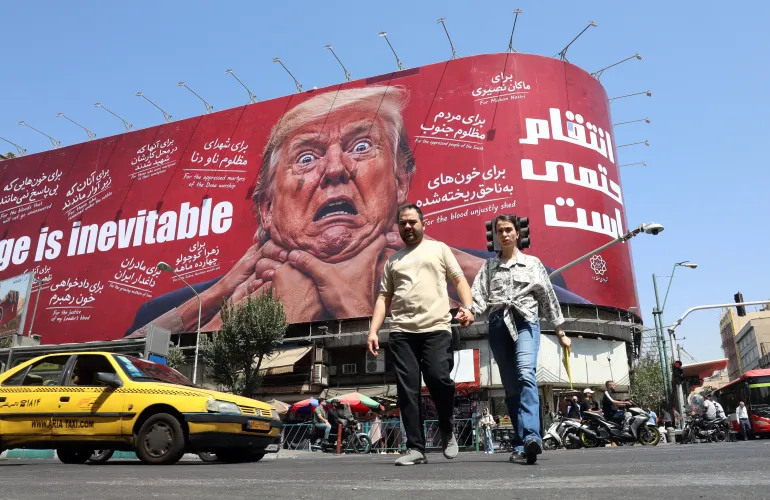
Hundreds of Iranians have rallied in Tehran to demand an end to US threats and the ongoing blockade of Iranian ports. The blockade is causing Iran’s already devalued currency to sink further.
Published On 30 Apr 202630 Apr 2026
Share
Standoff in the Strait of Hormuz is pushing global oil prices above $120 per barrel, with average gas prices in the US hitting a four-year high.
WASHINGTON — Making his first appearance before Congress since the Trump administration went to war in Iran, Defense Secretary Pete Hegseth faced withering questioning from skeptical Democrats Wednesday over a costly conflict being waged without congressional approval.
The war has cost $25 billion so far, according to Pentagon numbers presented to the House Armed Services Committee during the contentious hearing, ostensibly focused on the administration’s 2027 military budget proposal, which would boost defense spending to a historic $1.5 trillion.
While Republicans focused on the details of military budgeting and voiced support for the operation, Democrats pivoted to the ballooning costs of the war, the huge drawdown of critical U.S. munitions and the bombing of a school that killed children. Some lawmakers also questioned President Trump’s dealings with allies and his shifting justification for the conflict.
Hegseth dismissed the criticism as political and rebuked lawmakers who pushed him for answers.
“The biggest challenge, the biggest adversary we face at this point are the reckless, feckless and defeatist words of congressional Democrats and some Republicans,” Hegseth said.
Wednesday’s hearing stretched nearly six hours as Democrats and some Republicans questioned Hegseth over the war and his ouster of several top military leaders.
In one tense exchange, Hegseth told Rep. Adam Smith (D-Wash.) that Iran’s nuclear facilities were obliterated in a 2025 attack by the U.S., prompting Smith to question the Trump administration’s reasoning for starting the Iran war less than a year later.
“We had to start this war, you just said 60 days ago, because the nuclear weapon was an imminent threat,” said Smith, the ranking Democrat on the committee. “Now you’re saying that it was completely obliterated?”
Hegseth responded by saying that Iran “had not given up their nuclear ambitions” and still had thousands of missiles.
Smith said the war “left us at exactly the same place we were before.”
Democrats accused Hegseth of misleading Americans about the reasons for the conflict and said rising gas prices are now threatening the pocketbooks of millions of people in the U.S.
“Secretary Hegseth, you have been lying to the American public about this war from day one and so has the president,” said Rep. John Garamendi of Walnut Grove, who called the war “a geopolitical calamity,” a “strategic blunder” and a ”self-inflicted wound to America.”
Hegseth blasted Garamendi’s remarks.
“Who are you cheering for here?” he asked the lawmaker. ”Your hatred for President Trump blinds you” to the success of the war.
The Defense secretary faced intense questions from Rep. Chrissy Houlahan (D-Pa.) about his decision to oust the Army’s top uniformed officer, Gen. Randy George, one of several top military officers to be dismissed since Trump’s reelection.
Houlahan said George was deeply respected by both members of the military and Congress and asked why Hegseth fired him. Hegseth’s response that “new leadership” was needed failed to satisfy Houlahan.
“You have no way of explaining why you fired one of the most decorated and remarkable men —” Houlahan began before Hegseth interrupted her. “We needed new leadership,” he repeated.
The Pentagon announced this month that Navy Secretary John Phelan was stepping down. Hegseth previously removed Adm. Lisa Franchetti, the Navy’s top uniformed officer, and Gen. Jim Slife, the Air Force’s No. 2 leader, while Trump fired Gen. Charles “CQ” Brown Jr. as chairman of the Joint Chiefs of Staff.
Republican Rep. Don Bacon of Nebraska said that while Hegseth is empowered to make personnel changes, he shares what he called “bipartisan concern” about the firings.
“We had a huge bipartisan majority here that had confidence in the Army chief of staff and the secretary of the navy,” Bacon said. “And I would just point out it may be constitutionally right … but it doesn’t make it right or wise.”
Hegseth has said the changes are part of building a “warrior culture” at the Pentagon.
Republican Rep. Nancy Mace of South Carolina defended Hegseth’s personnel moves, saying he is “trying to innovate and trying to change the way we do business.”
“I’m glad that you’re firing people,” Mace said. “There are people there that are getting in your way. They need to go.”
During the extended hearing, Hegseth detailed plans to increase pay for service members and upgrade munitions while also announcing that, as of Tuesday, the Pentagon had authorized $400 million in military aid for Ukraine in its fight against Russia.
But the debate and the questions were dominated by the war in Iran.
While a fragile ceasefire is now in place, the U.S. and Israel launched the war Feb. 28 without congressional oversight. House and Senate Democrats have failed to pass multiple war power resolutions that would have required Trump to halt the conflict until Congress authorizes further action.
Republicans say they back Trump’s wartime leadership, for now, citing Iran’s nuclear program, the potential for talks to resume and the high stakes of withdrawal. Still, GOP lawmakers are eager for the conflict to end, and some are eyeing future votes that could become an important test for the president if the war drags on.
Democrats questioned Hegseth over the war’s economic impact and rising gasoline costs, noting Trump’s promise to lower consumer costs. Hegseth responded by citing the threat posed by Iran.
“What is the cost of Iran having a nuclear weapon that they wield?” he said.
Republicans expressed support for Trump’s decision to strike Iran, including Mace, who in late March had expressed concerns about the justification for the war. “The longer this war continues, the faster it will lose the support of Congress and the American people,” she wrote in a social media post.
On Wednesday, Mace noted her past concerns but said she is “impressed with where we are today.” She told Hegseth: “Everything I have seen, you have surpassed all of my expectations.”
Iran’s closing of the Strait of Hormuz, a vital shipping corridor for the world’s oil, has sent fuel prices skyrocketing and posed problems for Republicans ahead of the midterm elections. The U.S. has imposed a naval blockade of Iranian shipping and three American aircraft carriers are in the Middle East for the first time in more than 20 years.
The countries appear locked in a stalemate. Trump told Axios on Wednesday that he is rejecting Iran’s proposal to reopen the Strait of Hormuz in exchange for lifting the U.S. blockade.
Finley, Groves, Klepper and Toropin write for the Associated Press.

WASHINGTON, Apri; 29 (UPI) — Secretary of Defense Pete Hegseth alternated between championing a proposed massive increase to defense spending and fielding attacks from Democratic lawmakers during testimony on Capitol Hill Wednesday.
It marked the secretary’s first appearance before lawmakers since the start of a war that has roiled the global economy and decimated Iran’s military.
Hegseth appeared before the House Armed Services Committee alongside Gen. Dan Caine, chairman of the Joint Chiefs of Staff, and the Pentagon’s comptroller, Jules Hurst III. They entered the hearing room past protesters’ chants of “arrest Hegseth” and yells of “war criminal.” The secretary appeared unfazed.
“We’re rebuilding a military that the American people can be proud of — one that instills nothing less than unrelenting fear in our adversaries.” Hegseth said in his opening statement.
Hegseth’s testimony was intended to serve as a defense of the White House’s petition to Congress for $1.5 trillion in defense spending for 2027, a 44%t increase from the 2026 budget.
It’s an increase that, by itself, would be more than the total defense spending of any other nation, according to recently released figures. The spending level exceeds that spent on the Reagan-era military buildup and would be only overshadowed by levels seen during World War II.
The spending boom would come at the cost of domestic programs and at a time when federal tax revenue is set to take a $4.5 trillion hit over the next 10 years, mostly from tax cuts codified in last year’s One Big Beautiful Bill Act, according to the Bipartisan Policy Center, a Washington-based think tank.
But rather than question Hegseth on the specifics of the budget proposal, many Democratic members grilled him about the war in Iran, recent firings of senior leaders in the Pentagon and lethal strikes against alleged drug traffickers in the Pacific and Caribbean oceans.
In one heated exchange, Rep. John Garamendi, D-Calif., delivered a sharp critique of the war in Iran when questioning the defense secretary, calling it a “blunder” in which the United States had expended much to gain little.
Garamendi said it would take years for the U.S. and global economies to recover. The war has hiked average unleaded gas prices in the country to more than $4.20 a gallon and inflation to its highest level in nearly two years.
“Secretary Hegseth, you have been lying to the American public about this war from Day 1,” Garamendi said. “The strategy has been an astounding example of incompetence.”
Hegseth counterattacked. With his voice raised, he accused the congressman of “handing propaganda to our enemies.”
“I hope you appreciate how reckless it is,” Hegseth said of Garamendi’s description of the two-month-long war as a quagmire. “Shame on you.”
Hurst, the comptroller, told lawmakers the Iran war has cost the Pentagon $25 billion. Committee ranking member Rep. Adam Smith, D-Wash., responded that was the first time he had been given a cost figure, despite repeated inquiries to the department.
In March, the Pentagon reportedly petitioned Congress for an additional $200 billion to replace stocks from the war and prepare for future operations, should they be ordered. When asked about it at the time, Hegseth indicated the report’s veracity.
“That number could move, obviously,” Hegseth said then. “It takes money to kill bad guys.”
Hegseth’s central defense of the war during the hearing was arguing that it served to prevent Iran from obtaining a nuclear weapon. Republican members echoed his contention.
Iran maintains uranium supplies that could eventually be used to build a nuclear weapon if it were to be further enriched. But since the U.S. bombed Iran’s nuclear facilities in June, Iran has made “no efforts since then to try to rebuild their enrichment capability,” Tulsi Gabbard, the director of national intelligence, said in a written statement to Congress in March.
“What is it worth to ensure Iran never gets a nuclear weapon?” Hegseth asked rhetorically in Wednesday’s hearing.
A defense budget unprecedented in modern times
The Pentagon’s budget request is composed of $1.1 trillion in base discretionary funding and an additional $350 billion in mandatory spending.
The mandatory funds, which are earmarked mostly for munitions and the expansion of the defense industry, would go through the budget reconciliation process and therefore would be shielded from a potential Democratic filibuster in the Senate.
The expansion of America’s defense industrial base — the network of private manufacturers that supply the Pentagon — is a central facet of the proposed budget.
“President Trump inherited a defense industrial base that had been hollowed out by years of ‘America Last’ policies,” Hegseth said. “Under the leadership of President Trump, our builder-in-chief, we are reversing this systemic decay and putting our defense industrial base on a war-time footing.”
Another of the administration’s top defense funding priorities, as reflected in the budget document, is the procurement of munitions.
“Critical munitions are vital to the administration’s priorities to defend the homeland and deter potential aggression after years of neglect by the previous administration,” the White House wrote in a recent budget justification. Limited munitions stockpiles and the United States’ inability to quickly produce them have long troubled U.S. war planners.
While the Trump administration has pushed to expand munitions stockpiles, it has also expended massive amounts of scarce ordnance in the Middle East in recent months.
An April analysis by the Center for Strategic and International Studies estimated that the U.S. military has expended more than 850 Tomahawk cruise missiles in the Iran war from an estimated prewar inventory of 3,100.
Key U.S. capabilities like the Patriot and THAAD air defense systems have also seen stockpiles dwindle by about half since the start of the war, according to the report.
“We’re fighting wars”
The administration’s request for the massive infusion of cash comes as Trump has said that federal spending on healthcare and social programs should take a back seat to “military protection.”
In its proposed budget, the White House moved to cut non-defense discretionary spending by 10%. The spending category comprises public health, scientific research and scores of other domestic programs, but excludes mandatory programs like Medicare and Medicaid.
In a speech at a private Easter luncheon, Trump said spending on childcare, Medicare and Medicaid should be left to the states, while the federal government should be focused solely on national defense.
“We’re fighting wars,” Trump said.
The sentiment runs contrary to Trump’s long-held foundational critique of his predecessors — that money spent on foreign wars from Iraq, to Afghanistan, to Ukraine, should have been used to benefit Americans at home.
Tehran, Iran – Iran’s national currency has plunged to new lows as authorities mobilise to dampen the impact of the naval blockade enforced by the United States.
The Iranian rial shot above 1.81 million to the US dollar on the open market by early afternoon on Wednesday before partially recovering. The embattled currency changed hands for about 1.54 million earlier this week, and its rate was about 811,000 per US dollar a year ago.
list of 3 itemsend of list
The rial had remained relatively stable over the past two months after experiencing an earlier drop as US forces amassed in the lead-up to the US-Israeli war on Iran, which began at the end of February.
The latest freefall follows on from unchecked inflation, which has been increasingly plaguing the Iranian economy as a result of mismanagement and sanctions, and continues to ravage households. Washington now has three aircraft carriers in the region and is bringing in more troops and equipment as Israel expresses readiness to restart fighting, three weeks after a ceasefire began.
Iran’s authorities this week projected a hardened stance on negotiations with Washington, and pledged to fight the naval blockade of Iran’s southern waters, which the US Central Command insisted on Tuesday had “cut off economic trade going into and coming out of” the country.
Amid threats by US President Donald Trump, the Iranian government has also tried to empower its own border provinces to import essential goods by reducing red tape. It has also allocated $1bn from the sovereign wealth fund to buy food, and made a partial policy U-turn to restart offering a preferential subsidised exchange rate with the goal of reducing prices, despite concerns about corruption.
According to customs data released by state media, Iran’s non-oil trade has been negatively affected after commercial ties were disrupted or cut off as a result of the war, and critical infrastructure was bombed.
Iran’s customs authority put the total value of non-oil trade in the Iranian calendar year that ended on March 20 at close to $110bn, with $58bn going to imports. The figure was about 16 percent lower than the year before.
The volume of non-oil trade was valued at approximately $9bn for the 11th month of the calendar year ending on February 19, and $6.46bn in the final month, indicating a drop of about 29 percent in connection with the war, which started on February 28. The final month was also about 50 percent lower than the more than $13bn estimated value for last year’s corresponding month.
Part of the drop is linked with the fact that shipping has been significantly disrupted through the Strait of Hormuz as Iran and the US spar over control of the strategic waterway. The US and Israel also directed some of their thousands of strikes against ports, naval facilities, airports, and railway networks across the country.
Iran’s top steel and petrochemical producers were also extensively bombed, as were oil and gas facilities, power stations, and major industrial zones. The US and Israel have threatened to take Iran “back to the Stone Age” through systematic bombing of civilian infrastructure like power plants.
To manage the impact and preserve domestic supply, Iranian authorities have imposed temporary restrictions on exports of steel, petrochemicals, polymers and other chemicals.
The US is using its military capabilities and economic chokeholds to drive down Iran’s oil exports, a goal that it has also pursued over recent years through sanctions.
Since mid-April, the US military has been deploying its soldiers to take over or inspect ships transiting through waterways near Iran, in addition to targeting what is known as a shadow fleet of tankers used by Iran to circumvent sanctions and ship its oil.
Warships and thousands of troops could still launch a ground invasion or destructive aerial attacks against Iran’s Kharg and other critical islands, and the Trump administration expects increased pressure on Iran’s oil sector due to hampered access to export routes and supertankers keeping the oil stored on the water.
The US Treasury has been blacklisting refineries in China, the biggest buyers of Iranian crude oil, and going after the banking and cryptocurrency channels alleged to be facilitating Tehran’s oil trade, and having links to the IRGC – which Washington considers a “terrorist” organisation.
“We will follow the money that Tehran is desperately attempting to move outside of the country and target all financial lifelines tied to the regime,” said US Treasury Secretary Scott Bessent on social media.
Chinese refineries buy roughly 90 percent of Iran’s oil shipments, and imported a record 1.8 million barrels per day in March, according to Vortexa Analytics data cited by the Reuters news agency, which also said purchases were expected to slow due to worsening domestic refining and processing margins.
According to figures released by the General Administration of Customs of China, the volume of the country’s bilateral trade with Iran during the first quarter of 2026 stood at $1.55bn, down 50 percent year-on-year.
In March, the first month of the war, trade stood at $184m, which was nearly 80 percent lower than the year before and 64 percent lower than the month before. China’s imports from Iran and exports to the country were both considerably reduced as a result of the war.
The removal of the United Arab Emirates as a major trade partner and import market for Iran has also significantly affected the country’s economy, increasing its reliance on land neighbours like Turkiye and Iraq to the west and Pakistan to the east.
The UAE, a big part of the Trump-led Abraham Accords that saw multiple countries normalise relations with Israel, was heavily targeted by ballistic missiles and drones launched by Iran.
The UAE has closed down numerous Iranian institutions on its soil over the past two months, including financial facilitators, instructed Iranian citizens to leave, and has said it will take years to restore bilateral relations to previous levels.
The US naval blockade of Iranian ports and the Strait of Hormuz, in place since April 13, has raised concerns that Iran could run out of crude oil storage capacity and be forced to curb production.
Bloomberg reported analysis on Tuesday from the data and analytics company Kpler suggesting Iran could run out of crude storage in 12 to 22 days if the blockade persists.
Last week, United States Treasury Secretary Scott Bessent claimed that storage capacity at Kharg Island, where most of Iran’s oil is exported, would be full “in a matter of days”.
So how quickly could Iran run out of oil storage, and why does it matter?
The Strait of Hormuz is a narrow channel that connects the Gulf to the open ocean. It spans the territorial waters of Iran on its northern side and Oman on its southern side. It is not in international waters.
During peacetime, 20 percent of the world’s oil and liquefied natural gas (LNG) supplies are shipped through the corridor.
Two days after the US and Israel launched their first air strikes in their war on Iran on February 28, Ebrahim Jabari, a senior adviser to the commander in chief of Iran’s Islamic Revolutionary Guard Corps (IRGC), announced that the strait was “closed”. If any vessels tried to pass through, he said, the IRGC and the navy would “set those ships ablaze”.

As the war has dragged on and negotiations have failed to achieve a settlement, Iran has at times in the past two months allowed some “friendly” ships and those that pay tolls to pass. It is currently refusing to allow any foreign-flagged ships, including those previously deemed friendly, to pass until the US lifts its own naval blockade.
Iranian First Vice President Mohammad Reza Aref said on April 19 that the “security of the Strait of Hormuz is not free”.
“One cannot restrict Iran’s oil exports while expecting free security for others,” he wrote in a post on X.
“The choice is clear: either a free oil market for all, or the risk of significant costs for everyone,” he added. “Stability in global fuel prices depends on a guaranteed and lasting end to the economic and military pressure against Iran and its allies.”
Since the US naval blockade on the strait began, the US has opened fire on and taken control of an Iranian-flagged tanker near the Strait of Hormuz while also redirecting vessels on the high seas transporting cargo to or from Iran. Iran’s armed forces have denounced these actions as “an illegal act” that “amounts to piracy”.
The US naval blockade of the strait means that Iran might have to store the oil it produces.
Iran is the third largest oil producer in the Organization of the Petroleum Exporting Countries (OPEC) after Saudi Arabia and Iraq and exports 90 percent of its crude oil via Kharg Island in the Gulf for shipping through the Strait of Hormuz.

The US is eager to curb Iran’s oil revenues, which have risen since Tehran closed the Strait of Hormuz to other shipping. This is the primary motive behind Washington’s naval blockade of Iranian ports.
Iran exported 1.84 million barrels per day (bpd) of crude oil in March and shipped 1.71 million bpd in April, compared with an average of 1.68 million bpd in 2025, according to Kpler.
However, the US naval blockade since mid-April now means that most of its exports are having to be stored instead.
Bessent wrote in an X post on April 22: “In a matter of days, Kharg Island storage will be full and the fragile Iranian oil wells will be shut in.”
“Constraining Iran’s maritime trade directly targets the regime’s primary revenue lifelines.”
Iran’s domestic refineries have a production capacity of 2.6 million bpd, according to the energy consultancy Facts Global Energy.
Satellite data show the amount of oil Iran has in storage has risen sharply since the US blockade began, and in the days after the US tightened it, stocks were rising so fast that it appeared Iran had been barely able to export any oil at all.
From April 13 to April 21, data showed that stocks rose by more than 6 million barrels, according to the Columbia Center on Global Energy Policy (CGEP). From April 17 to April 21, the stock increased very rapidly, growing by 1.7 bpd.
As of April 20, the storage tanks at Kharg were about 74 percent full after the island alone had taken on about 3 million extra barrels of oil, the CGEP reported.
Generally, oil companies avoid filling their storage beyond 80 percent capacity to balance safety, emissions control and flexibility.
However, Iran and other oil producing countries have exceeded this limit before, for instance, during the COVID-19 pandemic. In April 2020, Kharg island’s stocks reached close to 90 percent capacity, an all-time high.
Iran also has some crude oil storage capacity in the form of “floating tanks”, or parked ships. About 127 million barrels can be stored in this way, Frederic Schneider, a nonresident senior fellow at the Middle East Council on Global Affairs, told Al Jazeera in an interview on April 14.
Muyu Xu, a senior crude oil analyst at Kpler, told Al Jazeera that the blockade could eventually force Iran to cut production.
“However, given there is still available storage capacity onshore (roughly covering 20 days of Iran’s current production), we expect any production reduction to be gradual over the coming week with a higher likelihood of acceleration into May,” she said.
Analysis by CGEP nonresident fellow Antoine Halff echoed this. Halff wrote in an article published by CGEP on Tuesday that it may be some time before the US blockade causes Iran to shut off its production “in a big way”.
However, Halff added, Iran may still choose to halt production “fairly aggressively” but this “would be more by choice than by necessity”.
He explained: “Doing so would have the advantage of providing Iran with relatively ample spare storage capacity after the shutdown and would allow for a smoother restart of operations once conditions permit, and the constraint is relaxed, thus minimising adverse impacts from the blockade on longer-term supply.”
Halting oil production risks damaging underground reservoirs by reducing reservoir pressure, allowing water or gas to encroach into producing layers and changing patterns of oil flow. This can make some oil harder or more expensive to recover later, experts said.
Restarting the process of oil production can also be slow and costly, involving repairs of corroded equipment or unclogging pipelines.
Halting production would also cause Iran’s export revenues to drop. However, analysts said that for a few months, Iran can continue to earn revenue from oil that is already in transit at sea.
Kenneth Katzman, former Iran analyst at the Congressional Research Service in Washington, DC, said Iran is not exporting new oil during the US blockade of Iranian ports but Tehran has 160 million to 170 million barrels of oil on ships around the world currently.
Prosecutors say the man, identified only as ‘Sergej K’, has been in ‘continuous contact’ with Russian intelligence.
German authorities have arrested a Kazakh man in Berlin on suspicion of spying for Russia, according to the German Federal Prosecutor’s Office.
Identified only as Sergej K, the man had been “in continuous contact from Germany with a Russian intelligence service” since at least May last year, the office said in a statement on Wednesday, a day after the arrest.
list of 4 itemsend of list
Prosecutors said Sergej K provided his Russian handler with details about German military aid for Ukraine, including companies involved in developing drones and robotic systems. He also allegedly sent photos of NATO military convoys and public buildings in Berlin.
Other activities included offering to find other espionage agents in Germany, prosecutors added, but they did not make clear whether he had done so.
There was no immediate reaction from Kazakhstan or Russia.
The case is the latest in a string of Moscow-linked espionage and disinformation plots German authorities claim to have discovered since Russia’s full-scale invasion of Ukraine in 2022.
Two German-Russian dual nationals were arrested in 2024 on suspicion of plotting sabotage attacks on United States military sites in Germany to undermine Western military support for Ukraine.
German police have also arrested various alleged “disposable” agents, known to carry out sabotage and espionage without any formal training for Russia in exchange for small payments.
Earlier this month, Berlin summoned the Russian ambassador to condemn what it called “direct threats” against “targets in Germany”.
Berlin’s Federal Foreign Office said at the time that the threats were intended to undermine Germany’s support for Ukraine. “Our response is clear: we will not be intimidated. Such threats and all forms of espionage in Germany are completely unacceptable,” the Foreign Office said.
Germany has also accused “state-sponsored” Russian hackers of carrying out an “intolerable” 2023 cyberattack on members of the Social Democratic Party, a charge that Russia’s embassy in Germany “categorically rejected”.
Meanwhile, Russia has essentially banned Germany’s international broadcaster Deutsche Welle on the grounds that it produces “hostile anti-Russian propaganda”.
Moscow has repeatedly denied any involvement in Germany-based espionage schemes.
Oil markets face renewed instability following the United Arab Emirates’ formal exit from the Organisation of the Petroleum Exporting Countries (OPEC) and its wider alliance (OPEC+), announced on Tuesday and taking effect on Friday.
The move, which ends decades of membership, comes as the global economy continues to reel from the ongoing war with Iran and the blockade of the Strait of Hormuz remains in place.
Investors are currently weighing the potential for higher future output from the UAE against the immediate and acute risks posed to global supply routes, as well as the increased chances that more countries drop out of OPEC and OPEC+.
Following the announcement, markets reacted swiftly as the potential for oversupply from the UAE was priced in. Oil prices fell by between 2% and 3%, particularly in futures contracts a couple of months ahead.
However, the move was just as quickly offset by the risk premium associated with the Middle East conflict and the current halt to US-Iran negotiations.
At the time of writing, US benchmark crude, WTI, is trading above $105 a barrel, while Brent crude, the international standard, is over $112. Both prices are around 4% higher on Wednesday from the UAE announcement low.
The UAE’s decision follows years of simmering tension between Abu Dhabi and Riyadh over production quotas. The UAE has invested over $150 billion (€128bn) in the state-owned Abu Dhabi National Oil Company (ADNOC) to expand its capacity to five million barrels per day.
However, under OPEC’s restrictive framework, much of this capacity remained underutilised, now prompting the government to prioritise its national interest.
The departure of the group’s third-largest producer is a significant blow to the cohesion of the 60-year-old organisation. Maurizio Carulli, global energy analyst at Quilter Cheviot, noted the limitations this exit places on the remaining members.
“Until tanker traffic through the Strait of Hormuz is safe again, OPEC’s ability to stabilise prices is sharply constrained, while US producers have gained outsized influence,” Carulli explained.
While the UAE has pledged to bring additional production to the market in a “gradual and measured” manner, the sudden lack of coordination within OPEC has introduced a new layer of uncertainty.
For the UAE, the blockade served as a final catalyst for its exit. With its primary export route under threat, Abu Dhabi has sought the diplomatic flexibility to forge independent security and trade partnerships outside the traditional cartel structure.
Despite the geopolitical turmoil, energy equities have remained resilient.
According to Carulli, “integrated majors such as BP, Shell, TotalEnergies, ENI, Chevron and ExxonMobil are benefitting from a price uplift that could add 5-10% to operating cash flow for every $10 increase in oil prices.”
In a separate but related development, the security situation in the Middle East remains precarious despite a fragile ceasefire. Iran has recently offered a ten-point proposal to reopen the Strait of Hormuz.
In exchange for restoring maritime traffic, Tehran is demanding a full withdrawal of the US naval blockade and an end to the current hostilities.
US President Donald Trump, who recently extended the two-week ceasefire mediated by Pakistan, described the latest Iranian offer as “much better” than previous iterations but still did not accept the terms.
Shortly after, Trump posted on social media claiming that Iran is in a dire and desperate condition with no leverage to negotiate.
Washington continues to insist on a permanent settlement regarding Iran’s nuclear programme and an “unconditional” reopening of the waterway before sanctions are lifted.
The impact of this blockade on global energy security cannot be overstated.
“The prolonged closure of the Strait of Hormuz has removed roughly 12% of global oil supply from the market, according to the IEA, a bigger disruption than the Yom Kippur war, the Iran‑Iraq conflict, the invasion of Kuwait or even the fallout from Ukraine,” Carulli highlighted.
London, United Kingdom – Recent headlines from British newspapers speak to different areas of tension in the UK due to the United States-Israel war on Iran: economic woes, political friction and worries about the country’s readiness for the future, strategically and militarily, if the conflict persists.
On Thursday, the Financial Times blared, “Consumer confidence slumps to two-year low,” as The Guardian reported, “UK braces for price rises driven by Iran war as economic confidence plummets” and “UK prepared to deploy RAF Typhoons to keep Strait of Hormuz open after Iran war.” Earlier this month, The Independent reported that Prime Minister Keir Starmer risked US President Donald Trump’s wrath as he “refuses to let US use UK bases” for strikes on Iran’s infrastructure. And on Sunday, quoting a minister, The Times said the “economic fallout from the Iran war” would last at least eight months.
list of 4 itemsend of list
Beyond the headlines is real public angst about what the war in Iran means on a human level and what the economic and political fallout may be.
For Iranians living in the UK, there is a whole other level of worry.
Omid Habibinia, a man in his 50s who was born in Tehran but moved to the UK 25 years ago, described the impact on him personally.
“Since the first day of the war, connection has been cut off. I am witnessing the pain and suffering of those close to me, many of whom have no news of their families. Beyond the fact that around 90 million people inside Iran have effectively been imprisoned by the internet shutdown and millions more have been deprived of contact with their loved ones, the attacks on the country’s critical infrastructure – alongside the killing and injury of thousands of civilians and the displacement of many – are deeply distressing to me,” he told Al Jazeera.
It seems clear that the impact will last long after the conflict has ended or at least a long-term ceasefire is agreed. There are worries of higher mortgage costs and higher food and fuel prices amid a continued cost-of-living crisis.
Luke Bartholomew, deputy chief economist at fund manager Aberdeen, said the UK economy is “particularly badly exposed to the Iran shock as a big energy importer with weakly anchored inflation expectations and an already soft labour market”.
For many people still recovering from the energy inflation shock that followed Russia’s invasion of Ukraine in 2022, this is a hit to their household finances that is hard to manage.
Although the government has urged people not to worry, sporadic queues at petrol stations and talk of a return to panic shopping seen during the start of the COVID-19 pandemic are commonplace.
Starmer formed an Iran crisis committee that met on Tuesday to persuade people that “you can be sure we will stand by working people in this crisis”.
He hinted that people might change their holiday plans and might already be cutting back on food.
“I think we’ll see how long the conflict goes on. I can see that, if there’s more impact, people might change their habits, … where they go on holiday this year, what they’re buying in the supermarket, that sort of thing,” he said.
Critics said the government’s stretched finances mean it cannot afford the energy subsidy that may be needed. They have also lamented the government’s reluctance to exploit the nation’s untapped oil reserves in the North Sea. Experts disagreed on whether this would make any significant difference.
Before the Iran war began, the UK economy was turning a corner. Inflation and fuel costs were falling, government borrowing was down and unemployment was falling.
The hits to the UK population range from the relatively trivial to the potentially terrifying.
London house prices have tumbled as sellers become nervous and buyers sit tight, but some observers have noted that they were overpriced in the first place.
Flights being cancelled due to a lack of jet fuel might be an inconvenience. Higher prices for fuel and food and then everything else are a major problem for those whose incomes are already stretched.
Then there is the genuine fear of what a prolonged war could mean, such as a serious recession or military involvement.
Thomas Pugh, chief economist at the consulting firm RSM UK, said: “The Strait of Hormuz has effectively been shut since early March. The International Energy Agency called it the largest supply disruption in the history of the global oil market. Oil prices have spiked, gas prices are climbing and inflation fears are back. But the bigger risk is ‘demand destruction’.
“Demand destruction happens when high prices force people and businesses to buy less. We’re seeing it already in fuel rationing in emerging market economies. It means fewer cars sold, fewer homes bought, fewer restaurant meals, fewer business investments and eventually fewer jobs. Because this crisis is about more than oil, demand destruction appears across the whole economy.”

The Iran war arrived at a time when the UK population was already unhappy.
A survey by the polling company IPSOS in December reported: “Three quarters of Britons expect large-scale public unrest in 2026. 59 percent think there will be protests against the way their country is being run, highest in Peru (80%) and South Africa (76%). In Great Britain, 74% predict large scale unrest. Since 2019, three of the G7 countries – Great Britain, Japan (both+11pp [percentage points]) and United States (+10pp) – have seen a double-digit increase in the proportion that think there will be large-scale public unrest.”
Bartholomew added: “With inflation rising and wage growth sluggish after a sustained period of very weak employment activity, real wages are likely to turn negative in coming months, adding a further headwind to the economy. So it’s probably just too early for the full effects of the war to be felt or show up in the data yet. But one place the impact of the war is very clearly showing up is around the path of interest rates.
“It is very likely that were it not for the war, the Bank of England would be cutting rates at its April meeting. Instead, the market is pricing in a series of rate hikes this year. For households that were hoping for mortgage rate cuts this year, the prospect of rates staying on hold is almost as painful as renewed hikes.”
As Iran stares down the economic consequences of a prolonged blockade of the Strait of Hormuz, attention is shifting north.
With Gulf shipping lanes disrupted and oil exports constrained, Tehran may seek to depend less on the Gulf and more on a patchwork of railways, Caspian ports and sanctions-era trade networks linking it to Russia.
list of 4 itemsend of list
The importance of that relationship was underscored this week when Iranian Foreign Minister Abbas Araghchi travelled to St Petersburg for talks with Russia’s President Vladimir Putin, praising Moscow’s “firm and unshaken” support as the two sides discussed the war, sanctions and the future of the Strait of Hormuz.
But could Moscow really offer a lifeline for Iran’s beleaguered, war-torn economy, and would it even want to? We spoke to experts to find out.
Economic relations between Iran and Russia deepened after the US withdrew from a 2015 nuclear deal with Iran and other nations in 2018 and reimposed sweeping sanctions on Tehran.
Russia’s full-scale invasion of Ukraine in 2022 served to accelerate that trend as both countries found themselves increasingly cut off from the Western financial system. They turned to sanctions-evasion networks, alternative payment systems and non-Western trade corridors to keep goods, energy and money flowing.
Current trade is dominated by agricultural products – especially wheat, barley and corn – alongside machinery, metals, timber, fertilisers and industrial inputs. Tehran has also supplied Russia with low-cost Shahed drones, which Russia updated and has been using in its war on Ukraine.
“Trade turnover reached $4.8bn last year [2024], but we believe that the potential for our mutual trade is much greater,” Russian Energy Minister Sergey Tsivilyov told an intergovernmental commission on trade and economic cooperation between Moscow and Tehran in 2025.
Bilateral trade is reported to have increased by 16 percent during that period, driven largely by Russian exports of grain, metals, machinery and industrial goods.
But experts say that despite this increase, the overall trade relationship remains relatively modest compared with Iran’s trade with China or the Gulf countries.
Trade between the two is “not substantial, because both countries are producing almost similar products and the industries are similar”, Mahdi Ghodsi, an economist at the Vienna Institute for International Economic Studies, told Al Jazeera.

The backbone of Russia-Iran trade is the International North-South Transport Corridor (INSTC), a network of shipping lanes, railways, and roads linking Russia to Iran and onward to Asia, bypassing Western-controlled maritime routes.
Goods move from southern Russian ports, across the Caspian Sea to northern Iranian ports, including Bandar Anzali, before continuing by rail or truck.
The route has become increasingly important for Russian grain, machinery and industrial exports to Iran.
This route can serve as a “viable but partial lifeline”, Naeem Aslam, chief market analyst at London-based Think Markets, told Al Jazeera, adding that Russian ports in Astrakhan, on the Volga River delta near the Caspian Sea, and Makhachkala, on the Caspian Sea, are already “primed for a surge in grain, metals, timber and refined products”.
A western branch also runs through Azerbaijan, though a key missing rail link between Rasht and Astara in northern Iran remains unfinished.
In 2023, Moscow agreed to help finance the line, with Russia’s president calling the agreement a “great event” that “will help to significantly diversify global traffic flows”.
Analysts say that, although these routes may provide a temporary solution, the Strait of Hormuz offers a scale and efficiency that rail and land corridors cannot easily replicate.
Although maritime trade has been highly volatile in recent weeks, “from a historical perspective it is simply the quickest and the most cost-effective way of transporting anything”, Adam Grimshaw, an economic historian at the University of Helsinki, told Al Jazeera.
“Roughly 90 percent of Iran’s international trade is maritime trade that goes through the Gulf, which can’t be quickly or immediately replaced through land access to Iran or through air transport to circumvent the American blockade”, Nader Hashemi, an associate professor at Georgetown University, told Al Jazeera.
Ghodsi said Russia might be able to offer a “lifeline” in the short term, as it did when it exported grain during Iran’s droughts, but in the long run, it simply “cannot substitute” the vast amounts of maritime trade.
Re-routing trade routes via land “takes time”, pushing up prices for consumers and creating more food waste as perishables rot en route.
Most analysts say throwing an economic lifeline to Iran is not in Russia’s interests.
“They’ve got their own economic problems,” John Lough, head of foreign policy at the New Eurasian Strategies Centre, told Al Jazeera, pointing to signs of stagnation inside Russia, pressure on reserves and growing frustration over the prolonged war in Ukraine.
While Moscow could offer symbolic support or limited humanitarian assistance, “now is not a good time” to invest in Iran, he said, referring to the US-Israel war on the country.
Replacing maritime trade with overland routes would be extremely difficult, despite years of discussion about alternative corridors linking the two nations, he said.
It also won’t necessarily help Iran’s economy, which needs all the export revenue it can get, experts say.
“Much of Iran’s economy revolves around the sale of oil, and with that blocked or prevented by the American blockade, Russia really can’t help in that regard”, Hashemi said.
Others are more optimistic, however.
“Propping [up] Iran locks in higher global oil prices that buoy Russia’s war economy, cements INSTC dominance for Asian trade, and keeps a key anti-Western ally alive – no downside for Moscow in a fragmented Gulf,” Aslaam said.
The UAE’s decision to quit OPEC to prioritise its ‘national interests’ deals a blow to the oil group already grappling with the challenge of shipping Gulf exports through the Strait of Hormuz. Here’s what we know about why it’s withdrawing and the impact it might have.
Published On 29 Apr 202629 Apr 2026
Share
US president says Iran has reached out and asked Washington to lift its naval blockade on Iranian ports.
Only 22 percent of US voters back the president’s performance on the cost of living, Reuters/Ipsos survey suggests.
United States President Donald Trump’s approval rating has dropped to its lowest point since he returned to the White House, sinking to 34 percent amid economic uncertainty and the US-Israel war on Iran, a Reuters/Ipsos poll suggests.
The poll, released on Tuesday, also showed that only 22 percent of respondents back Trump’s performance on the cost of living. Affordability has been a top issue for US voters.
list of 3 itemsend of list
The Iran war, which saw Tehran block most shipping through the Strait of Hormuz, has sent energy prices soaring across the world and fuelled inflation in the US.
The Reuters poll was conducted April 24-27, and it surveyed 1,014 US adults.
It comes months before the midterm elections in November when Trump’s Republican Party will have to contend with the US president’s abysmal job approval ratings as it tries to retain control of the Senate and House of Representatives.
Trump continues to enjoy near-unanimous support from Republicans in Congress despite growing criticism of the war on Iran by some right-wing commentators and podcasters.
The conflict has also been unpopular with US voters, including a sizeable Republican constituency.
A Marquette Law School survey released last week suggested that only 32 percent of voters approve of Trump’s handling of the war.
The number rose to 65 percent among Republican respondents, but it still showed significant dissent within the party on the issue.
A separate Associated Press-NORC poll last week reported similar findings – Trump’s overall approval rating at 33 percent, support for the war at 32 percent and his handling of the economy at 30 percent.
The US and Iran reached a two-week ceasefire on April 8 that Trump extended indefinitely, but tensions remain high in the region.
Duelling blockades in the Gulf – Iran shutting down the Strait of Hormuz and the US laying a naval siege on Iranian ports – have caused global energy supply issues to persist despite the truce.
In the US, the average price of 1 gallon (3.8 litres) of petrol is currently at $4.17, up from less than $3 before the war.
Still, Trump has suggested that he is comfortable with the status quo, claiming repeatedly that the Iranian economy is crumbling and that time is on his side.
“Iran has just informed us that they are in a ‘State of Collapse,’” the US president wrote in a social media post on Tuesday.
“They want us to ‘Open the Hormuz Strait,’ as soon as possible, as they try to figure out their leadership situation (Which I believe they will be able to do!)”
It’s not clear how or why Iran, which is currently refusing to hold direct negotiations with the US without it lifting the naval blockade, would inform Trump that its own economy is collapsing.