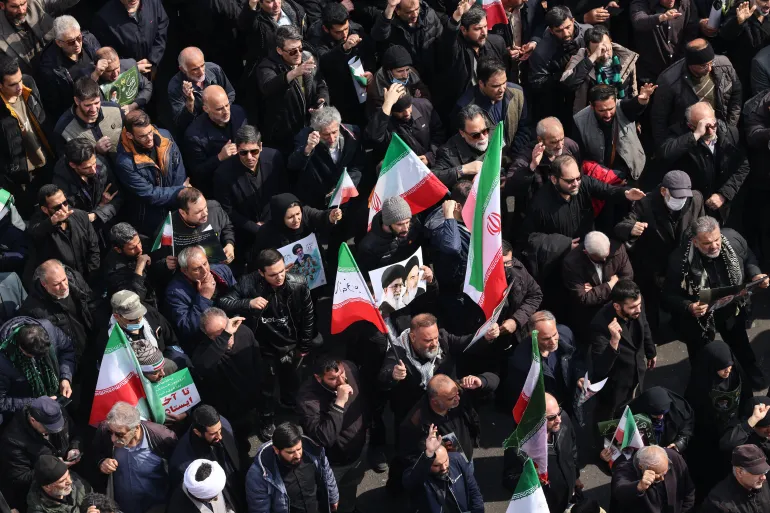
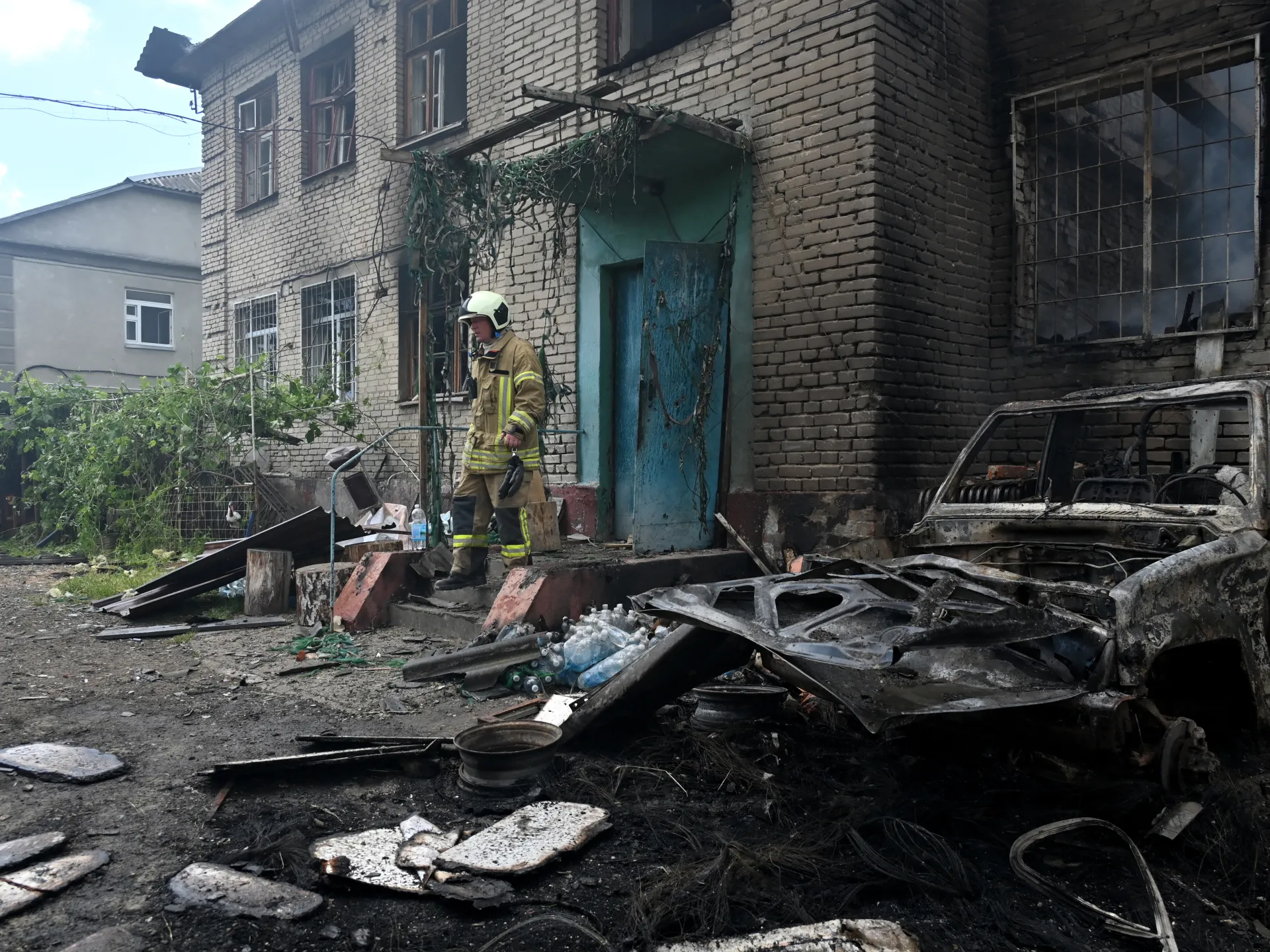
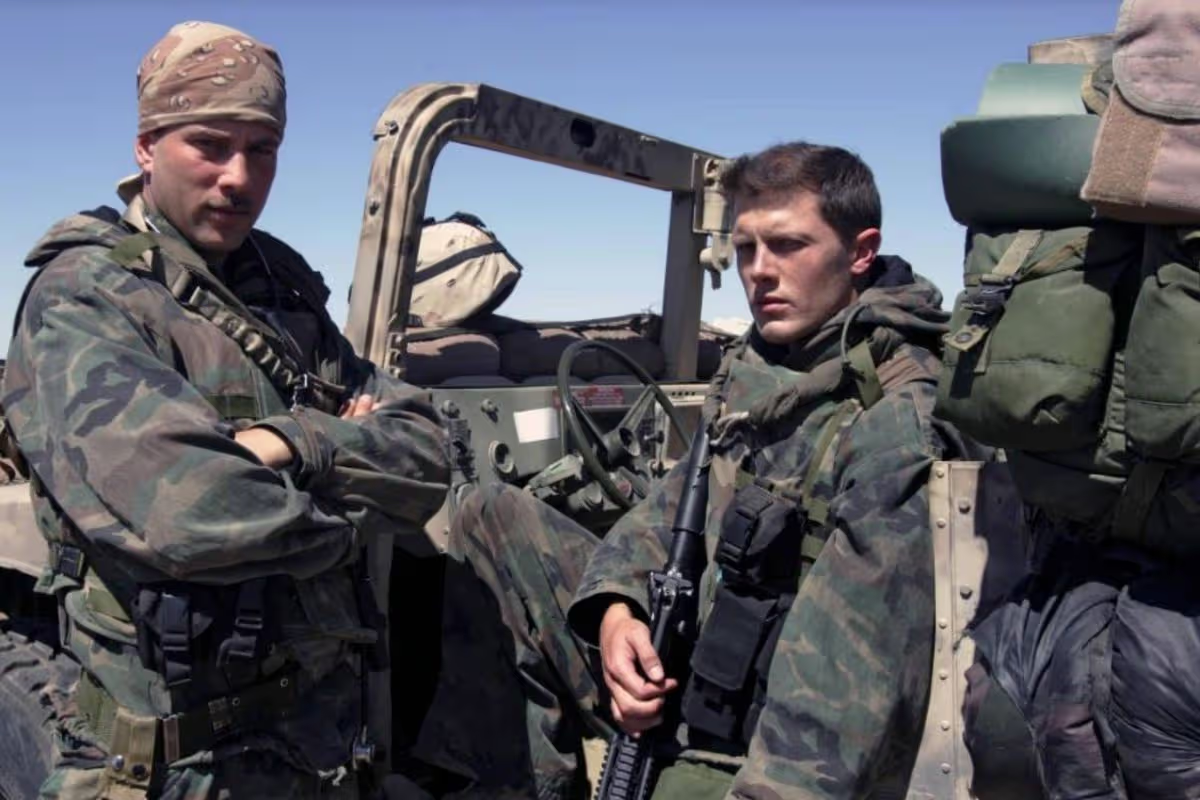
Iran war live: US negotiators due to arrive in Pakistan for ceasefire talks
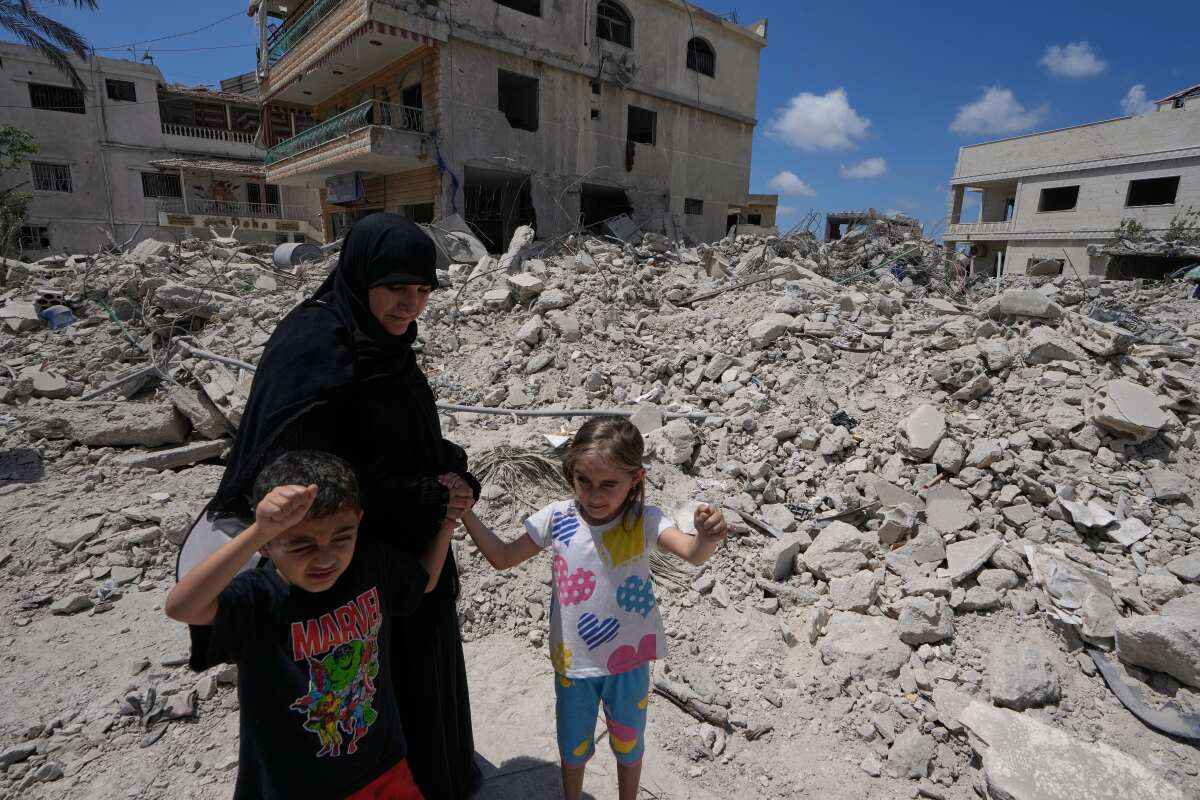
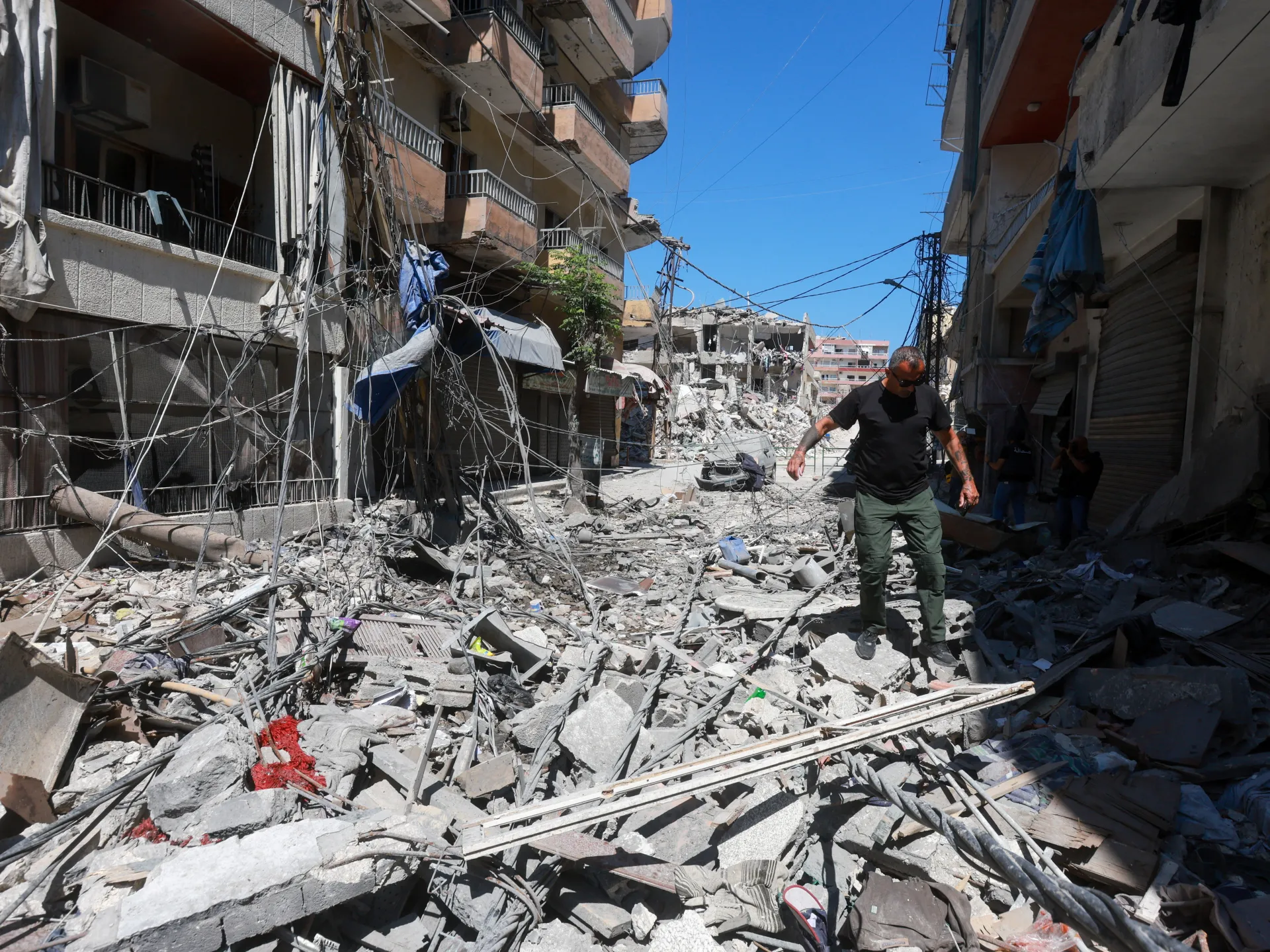
Lebanese Health Ministry says people killed in Israeli attacks since March 2 rises to 1,953 with 6,303 wounded.
Source link
Lebanese Health Ministry says people killed in Israeli attacks since March 2 rises to 1,953 with 6,303 wounded.
Source link
NEW YORK — Calls inside Congress for investigations into the prediction market platform Polymarket are increasing after the latest instance in which groups of anonymous traders made strategic, well-timed bets on a major geopolitical event hours before it occurred.
On Wednesday, the Associated Press reported that at least 50 new accounts on Polymarket placed substantial bets on a U.S.-Iran ceasefire in the hours, even minutes, before President Trump announced it late Tuesday. These were the sole bets made on Polymarket through these accounts.
In January, an anonymous Polymarket user made a $400,000 profit by betting that Venezuelan leader Nicolás Maduro would be out of office, hours before Maduro was captured. In the hours before the start of the Iran war, another account made roughly $550,000 in a series of trades effectively betting that the U.S. would strike Iran and that Ayatollah Ali Khamenei would be removed from office.
Such prescient wagers have raised eyebrows — and accusations that prediction markets are ripe for insider trading. And the issue goes beyond these three geopolitical events, according to at least one report.
Researchers at Harvard University released a paper last month in which, using public blockchain data, they estimated that $143 million in profits have been made on Polymarket by individuals who potentially had insider information about events ranging from Taylor Swift’s engagement to the awarding of the Nobel Peace Prize last year.
Rep. Ritchie Torres, D-N.Y who sits on the House Financial Services Committee as well as the subcommittee on digital assets and financial technology, sent a letter Thursday to the Commodity Futures Trading Commission demanding the regulator review and investigate these well-timed trades. The CFTC regulates the derivatives markets, which includes prediction markets.
“This pattern raises serious concerns that certain market participants may have had access to material nonpublic information regarding a market-moving geopolitical event,” Torres wrote. The letter was shared exclusively with AP.
“What is the statistical likelihood that of anyone other than an insider trader placing a winning bet 12 minutes before a market-moving presidential announcement?” Torres said in an interview with AP. “There are two answers: God, or an insider trader. And something tells me that God is not placing bets around Donald Trump’s posts on Truth Social. “
Prediction market platforms like Kalshi and Polymarket allow users to bet on everything from whether it will rain in Phoenix, Ariz., next week to whether the Federal Reserve will raise or lower interest rates.
Americans have limited access to Polymarket, which was banned from the U.S. in 2022. The company has moved to reenter the country by acquiring a CFTC-licensed exchange and clearinghouse, giving it a legal pathway to start offering contracts domestically. The company has begun a limited rollout in the U.S.
Polymarket also operates a separate, crypto-based platform offshore that remains outside U.S. jurisdiction. That platform accounts for most of its activity.
Sen. Richard Blumenthal, D-Conn., sent a letter to Polymarket on Thursday demanding the company explain why it continues to allow trades on war and violence as well as whether the company is making efforts to keep insiders from trading on the platform.
“Polymarket has become an illicit market to sell and exploit national security secrets unlike any in history, and by extension a potential honeypot for foreign intelligence services watching for those same suspicious bets and wagers,” Blumenthal wrote.
Republicans also have criticized these platforms and called for bans on these sorts of bets. There are at least two bills pending in Congress co-signed by both parties, one in the House and one in the Senate.
“We don’t want to imagine a world where America’s adversaries use prediction markets to anticipate our next move,” Rep. Blake Moore, R-Utah, said after the release of AP’s findings on the ceasefire wagers.
Polymarket did not immediately reply to a request for comment.
The stakes are high for both Polymarket and Kalshi as they seek approval to operate nationwide, particularly in the lucrative sports betting market.
Kalshi, which already is regulated in the U.S., and its executives have a goal of making the company the nation’s dominant prediction market. Kalshi has leaned heavily into sports, which critics have said effectively makes it a sports betting platform that dabbles in event-based contracts on the side. Both companies also announced partnerships with sports teams and even news organizations to broaden their reach as well. AP has an agreement to sell U.S. elections data to Kalshi.
The competition also carries political overtones. Donald Trump Jr. is an investor in Polymarket through his venture capital firm, 1789 Capital, and separately serves as a paid strategic adviser to Kalshi.
Sweet writes for the Associated Press.
Islamabad, Pakistan – With key differences in the Iranian and American positions seemingly intact, Pakistan is aiming for what officials describe as a realistic – if modest – outcome from the negotiations between the two warring nations set to commence in Islamabad on Saturday.
The aim: to get the United States and Iranian negotiators to find enough common ground to continue talks.
On Friday, US Vice President JD Vance left Washington for Islamabad, where he will lead the American team, which will also consist of President Donald Trump’s chief negotiator Steve Witkoff and son-in-law Jared Kushner. While Iran has not formally confirmed its representatives at the talks, Foreign Minister Abbas Araghchi and Parliament Speaker Mohammad Bagher Ghalibaf are expected to lead Tehran’s team.
These high-level talks follow days after the US and Iran agreed to a Pakistan-mediated two-week ceasefire, and will be held exactly six weeks after the US and Israel launched their war on Iran with the killing of Iranian Supreme Leader Ayatollah Ali Khamenei on February 28.
Experts and sources close to the mediation effort said there was little expectation that a major breakthrough would be reached on Saturday. But by setting a more realistic ceiling – an agreement in Islamabad to continue deeper negotiations aimed at finding a lasting peace deal – Pakistan is hopeful it can help build on a truce that led to a collective sigh of relief globally.
“Pakistan has succeeded in getting them together. We got them to sit at a table. Now it is for the parties to decide whether they are willing to make the sacrifices necessary to reach an eventual solution,” Zamir Akram, Pakistan’s former ambassador to the United Nations, told Al Jazeera.
Now, he added, it will aim to secure an agreement for the US and Iran to continue dialogue.
The US and Iranian delegations will land at the Nur Khan airbase outside Islamabad and then drive to the Serena Hotel, where they will stay, and where the talks will be held.
Though the two teams will be in the same hotel, they will not come face to face for the negotiations, officials said.
Instead, they will sit in two separate rooms, with Pakistani officials shuttling messages between them.
In diplomatic jargon, such negotiations are known as proximity talks.
Pakistan’s experience with such a dialogue is not new. In 1988, Islamabad itself participated in the Geneva Accords negotiations on the Soviet withdrawal from Afghanistan, where UN-mediated indirect talks between Pakistan and Afghanistan produced a landmark agreement.
Akram, who has represented Pakistan at the UN in Geneva from 2008 to 2015, said that history was relevant.
“Proximity talks have been used before. Pakistan itself participated in one in Geneva in 1988 on the Afghan issue,” he told Al Jazeera. “If the parties did not trust Pakistan, they would not be here. The metric of success should be an agreement to continue this process in search of a solution. It will not happen in a couple of days.”
In the days between the ceasefire announcement on April 7 and the arrival of the delegations in Islamabad, world leaders moved quickly to register support.
UN Secretary-General Antonio Guterres welcomed the ceasefire and expressed appreciation for Pakistan’s role. Kazakhstan, Romania and the United Kingdom also issued statements endorsing Islamabad’s mediation.
French President Emmanuel Macron called Prime Minister Shehbaz Sharif to congratulate him, while Turkiye’s President Recep Tayyip Erdogan also spoke to the Pakistani leader.
Analysts say these calls were not only expressions of goodwill but signals of international backing, aimed at strengthening Pakistan’s hand in pushing both Washington and Tehran to deliver results.
Sharif spoke with eight world leaders, including the emir of Qatar, the presidents of France and Turkiye, the prime ministers of Italy and Lebanon, the king of Bahrain and the chancellors of Germany and Austria.
Foreign Minister Ishaq Dar, who is also deputy prime minister, engaged with more than a dozen counterparts over the past two days and held an in-person meeting with China’s ambassador in Islamabad.
In total, Pakistan’s leadership made or received more than 25 diplomatic contacts in roughly 48 hours.
Salma Malik, a professor of strategic studies at Quaid-i-Azam University, said the scale of engagement reflected confidence in Pakistan’s role.
“The two main parties showed confidence in Pakistan to act as a neutral agent, that is the first and most critical litmus test for any mediating country, and Pakistan passed it,” she told Al Jazeera.
The most immediate threat to Saturday’s talks lies outside the negotiating room.
Iran has framed Israeli strikes on Lebanon as a direct challenge to the ceasefire. Iranian President Masoud Pezeshkian, who spoke to Sharif earlier this week, warned that continued attacks would render negotiations meaningless.
Hours after the ceasefire was announced, Israel launched its most widespread bombardment of Lebanon since the start of the conflict, killing more than 300 people across Beirut and southern Lebanon in a single day.

Foreign Minister Abbas Araghchi said Tehran could abandon the ceasefire entirely if the strikes continued.
Sharif, in a call with Lebanese Prime Minister Nawaf Salam on April 9, strongly condemned Israel’s actions.
Whether Lebanon is covered by the ceasefire remains contested. Pakistan has maintained that the truce extends across the wider region, including Lebanon, as reflected in Sharif’s statement earlier this week.
Washington has taken a different view. US Vice President JD Vance, who will lead the American delegation, said in Budapest that Lebanon falls outside the ceasefire’s terms, a position echoed by President Donald Trump and the White House.
Seema Baloch, a former Pakistani envoy, said the issue ultimately rests with Washington.
“Lebanon is key and Israel will use it to play the spoiler role,” she told Al Jazeera. “It is now the US decision whether it will allow Israel, which is not seated at the negotiating table, to play that role.”
There are, however, signs of limited de-escalation.
Israeli Prime Minister Benjamin Netanyahu said on Thursday that Israel was ready to begin direct negotiations with Lebanon “as soon as possible”, focusing on disarming Hezbollah and reaching a peace agreement.
The announcement followed US pressure. Trump told NBC he had asked Netanyahu to “low-key it” on Lebanon.
However, Netanyahu made clear there was no ceasefire in Lebanon, saying Israel would continue striking Hezbollah even as talks proceed.
Salman Bashir, a former Pakistani foreign secretary, said Lebanon remains within the ceasefire’s scope.
“Lebanon is very much part of the ceasefire, as was mentioned in the prime minister’s statement,” he told Al Jazeera. “The Israelis may be inclined to keep the pressure on Lebanon, but not for long if the US is keen on a cessation of hostilities, as it seems.”
Beyond Lebanon, several other obstacles remain.
Washington is expected to push for verifiable restrictions on Iran’s nuclear programme, including limits on enrichment and the removal of stockpiled material.
Tehran, in turn, is demanding full sanctions relief, formal recognition of its right to enrich uranium and compensation for wartime damage.
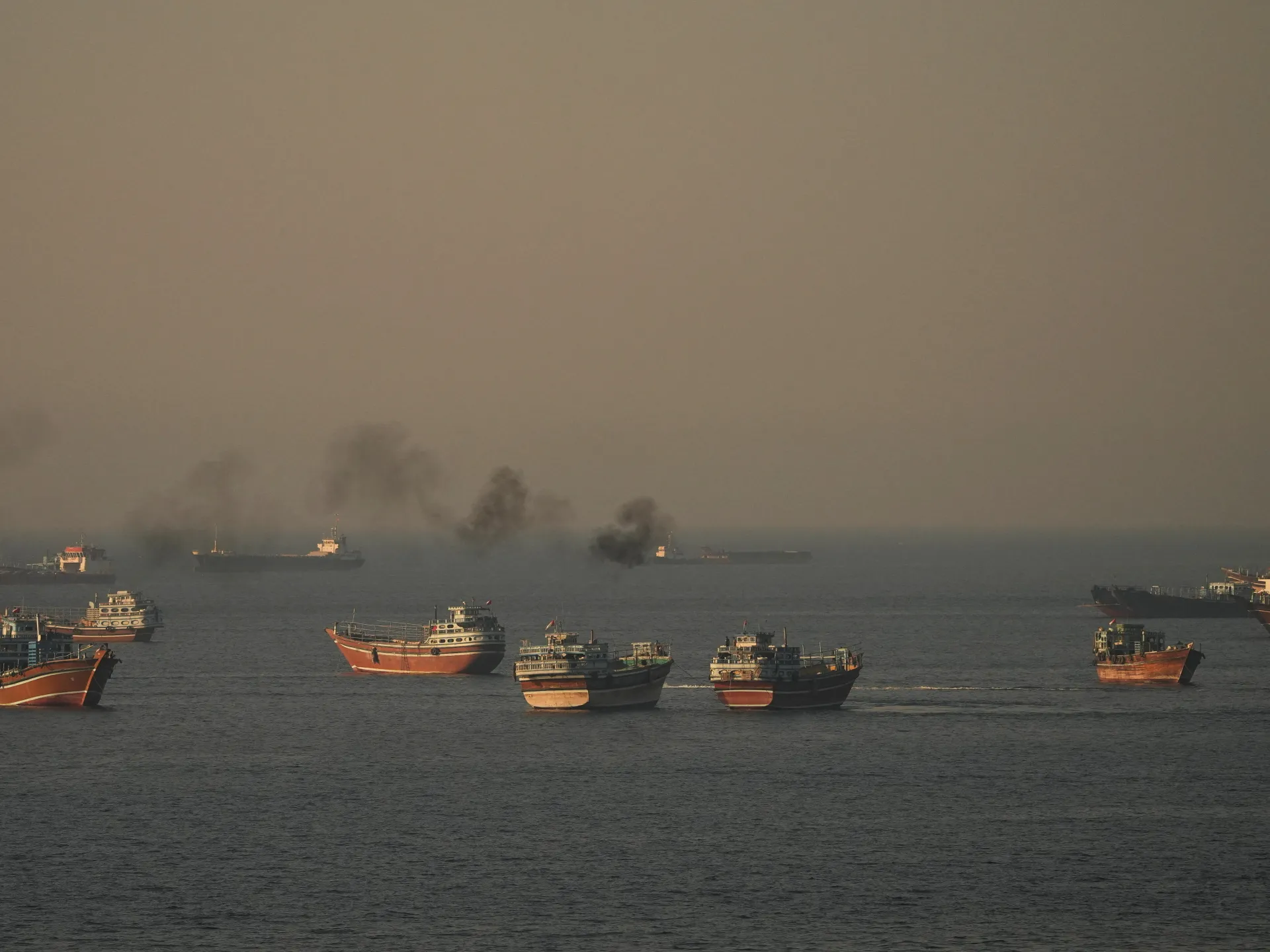
The Strait of Hormuz, through which roughly a fifth of the world’s oil and gas passes in peacetime, remains a key pressure point, with Iran retaining the ability to disrupt maritime traffic.
Bashir said there could be movement on some of these issues.
“There may be an opening on the Strait of Hormuz, under Iranian control. Iran will not give up on the right to enrichment. If nothing else, there should be an extension of the ceasefire deadline,” he told Al Jazeera.
Muhammad Shoaib, a professor of international relations in Islamabad, said progress would depend on movement on core issues.
“Both parties agreeing on the need to continue or even extend the ceasefire, while in principle agreeing on crucial points such as the Strait of Hormuz, Iran’s right to enrichment and respect for sovereignty, will suggest that the first round is meaningful and successful,” he told Al Jazeera.
The regional atmosphere has also been shaped by sharp rhetoric from some of Iran’s Gulf neighbours.
The United Arab Emirates, which faced hundreds of missile and drone attacks during the conflict, has been among the most vocal.
Its ambassador to Washington wrote in The Wall Street Journal that a ceasefire alone would not be sufficient and called for a comprehensive outcome addressing Iran’s “full range of threats”.
Bahrain, meanwhile, presented a United Nations Security Council resolution on April 7 calling for the reopening of the Strait of Hormuz. The measure received 11 votes in favour but was vetoed by Russia and China, with Pakistan and Colombia abstaining.
Saudi Arabia, Turkiye and Egypt are not expected to have a formal presence at the talks, despite being closely involved in pre-negotiation diplomacy. The four countries held meetings in Riyadh and later in Islamabad aimed at securing a pause in hostilities.
Israel, a party to the conflict, will also not be represented. Pakistan, like most Muslim-majority countries, does not recognise Israel and has no diplomatic relations with it.
There are, however, tentative signs of easing tensions ahead of Saturday’s talks.
On Friday, as he was departing from Washington, Vance said that the US team was “looking forward to the negotiations”.
“We think it’s going to be positive. We’ll, of course, see. As the president of the United States said, if the Iranians are willing to negotiate in good faith, we are certainly willing to extend an open hand,” the US vice president said. “If they try to play us, they’re going to find that the negotiating team is not that receptive. So we’ll try to have a positive negotiation.”
He also said that Trump had given the US team “some pretty clear guidelines”.
Earlier this week, Saudi Arabia’s foreign minister spoke with his Iranian counterpart for the first time since the war started.
And Iran’s Supreme National Security Council said on April 8 that discussions could continue for up to 15 days, suggesting readiness for a prolonged process.
Akram, the former envoy, said the benchmark for success was clear.
“What they need to agree is that they will find a solution, and that in itself would be a step in the right direction,” he told Al Jazeera. “Finding a long-term solution will take time. It will not happen in a couple of days.”
Malik, the academic in Islamabad, said Pakistan’s expectations remained modest.
“What Pakistan expects is breathing space, an opportunity for peace. It is not expecting anything big. It is a small wish, but realising it will be very difficult,” she told Al Jazeera.
AIRPORTS in Europe are at risk of running out of fuel in just weeks, experts have warned, sparking fears for half term holidays.
The conflict in Iran continues to cause chaos across the world, with the latest seeing President Donald Trump slam the regime for breaking the short-lived ceasefire.
This came after Iran closed the Strait of Hormuz just hours into a two-week ceasefire agreement.
Travellers are now being warned that flights could be cancelled and prices could soon rise as fuel reserves are expected to run out due to ongoing closure.
And it could mean chaos for Brits heading abroad for the school May half-term holidays.
According to ACI Europe (the lobby group for airports in Europe), fuel reserves are expected to run out in less than three weeks unless the Middle East increases supplies.
ACI Europe warns: “If the passage through the Strait of Hormuz does not resume in any significant and stable way within the next three weeks, systemic jet fuel shortage is set to become a reality.”
It added that the shortage of fuel supply is likely to “severely disrupt airport operations and air connectivity”.
Around 140 ships usually pass through the Strait of Hormuz – yet has dropped to just seven ships today.
For Brits, this could mean travel chaos for May half-term getaways including popular destinations such as Spain, Italy and France.
The announcement comes as a number of airports in Italy already warned that they were running out of fuel.
According to local reports earlier this week, Brindisi-Casale Airport confirmed that Jet A1 fuel was not available for a short period of time.
While this didn’t result in any flight cancellations, airlines were warned to fly with enough fuel for the return journey.
This is because any remaining fuel was being reserved for emergency situations including medical flights.
A statement said at the time: “Jet A1 fuel is temporarily unavailable at Brindisi Airport.
“Refueling is permitted only for state, emergency medical services, and medical flights.
“Pilots are advised to refuel at previous stopovers to cover subsequent flights.”
Restrictions were also in place at other airports in Italy including Milan Linate, Venice, Bologna and Venice temporarily.
Despite this, Antonio Maria Vasile, president of Aeroporti di Puglia, commented regarding the news of the alleged fuel shortage.
He said at the time: “Fuel supplies continue regularly, and there is no risk of an imminent shortage.”
And it isn’t just Italian airports being hit by the fuel crisis.
The Australian government has warned that the country only has around 30 days of jet fuel left.
The announcements also come as some Asian countries are grounding flights and European airlines are making plans to deal with shortages.
Back in March, United Airlines CEO Scott Kirby said: “It’s entirely possible that parts of Asia are just going to run out of fuel.”
Both Scandinavia’s SAS and Poland’s Lot have already cancelled flights.
Air New Zealand has cancelled thousands of flights due to fears of fuel shortages.
And UK airline Skybus announced that it was stopping all flights between Cornwall and London due to a huge rise in fuel costs and a drop in new passenger bookings.
Lisa Minot, the Sun’s Head of Travel, has weighed in on what this could mean for you holiday
Fears of fuel shortages at European airports could lead to a disastrous start to summer putting holidays and flights at risk in the popular half term week.
Ryanair boss Michael O’Leary had already started to raise his concerns – saying last week that if the war continues beyond the end of April it could impact between ten and 25per cent of the low cost giant’s fuel supplies.
But the fresh warning from European airports is a step up in the crisis.
Unless ships start to pass through the Strait of Hormuz with increased regularity, we could see fuel shortages at airports across the globe.
We’ve already started to see cancellations, with flights to Guernsey operated by Aurigny and to Newquay by Skybus axed in concerns over fuel shortages.
Further afield, Vietnam and Pakistan have warned of fuel shortages and Air New Zealand has begun cancelling some domestic flights.
The lack of clarity as to when the situation will improve will do nothing to calm fears and it is unsurprising that travel companies and airlines have seen demand dip as worried holidaymakers await better news.
The longer the situation remains uncertain, the more damage is done.
Even Michael O’Leary, chief executive of Ryanair, has also warned of “the risk of supply disruptions in Europe in May and June” unless the war ends quickly.
Fuel prices have soared compared to what they were before the war in the Middle East broke out.
Last week, the cost of filling up an average diesel tank broke through the £100 mark for the first time since December 2022.
And the Iran conflict has taken Dubai off the holiday list, with the UK Foreign Office still warning against non-essential travel.
Hundreds of thousands of travellers were left stranded abroad when the conflict resulted in airspace closures and Dubai Airport closing.
While limited flights have returned, most airlines are still axing flights to Dubai, as well as other destinations in the Middle East.
This has also had a knock-on effect of airlines that travel via the Middle East, such as Thailand, Vietnam and Australia.
British Airways has axed more flights to the Middle East this week as the crisis continues.
And some airlines are even hiking the cost of baggage due to rising fuel costs.
Donald Trump is accustomed to criticism from coast to coast — Democrats, disaffected Republicans, late-night comedians, massive protests. Yet in his second presidency, Trump’s most influential American critic doesn’t live in the country but at the Vatican.
It’s an unprecedented situation, with the first American pope directly assailing the American president over the war in Iran, where a fragile ceasefire took hold this week. The announcement came after Pope Leo XIV declared that Trump’s belligerence was “truly unacceptable.”
Never before has the relationship between Washington and the Vatican revolved around two Americans — specifically, a 79-year-old politician from Queens and a 70-year-old pontiff from Chicago. They come from the same generation and share some common cultural roots yet bring jarringly distinct approaches to their positions of vast power. And the relationship comes with risks for both sides.
“They’re two white guy boomers but they could not be any more different in their life experiences, in their values, in the way they have chosen to live those values,” said theology professor Natalia Imperatori-Lee of Fordham University. “This is a very stark contrast, and I think an inflection point for American Christianity.”
Experts on the Catholic Church emphasized that Leo’s opposition to the war reflects established church teachings, not the reflexive politics of the moment.
“For the last five centuries, the church has been involved in a project of helping develop strong international norms,” including the Geneva Conventions in recent centuries, said Catholic University professor William Barbieri. “It is a very long-standing tradition rooted in Scripture and theology and philosophy.”
Yet the U.S. administration, which has close ties to conservative evangelical Protestant leaders, has claimed heavenly endorsement for Trump’s war on Iran.
Defense Secretary Pete Hegseth urged Americans to pray for victory “in the name of Jesus Christ.” When Trump was asked whether he thought God approved of the war, he said, “I do, because God is good — because God is good and God wants to see people taken care of.”
The Rev. Franklin Graham, son of iconic Baptist evangelist Billy Graham, said of Trump that God “raised him up for such a time as this.” And Graham prayed for victory so Iranians can “be set free from these Islamic lunatics.”
Leo countered in his Palm Sunday message that God “does not listen to the prayers of those who wage war, but rejects them.” He referenced an Old Testament passage from Isaiah, saying that “even though you make many prayers, I will not listen — your hands are full of blood.”
While it’s not unusual for popes and presidents to be at cross purposes, it’s exceedingly rare for the leader of the Catholic Church to directly criticize a U.S. leader, and Leo later named Trump directly and expressed optimism that the president would seek “an off-ramp” in Iran.
An even stronger condemnation came after Trump warned of mass strikes against Iranian power plants and infrastructure, writing on social media that “an entire civilization will die tonight.” Leo described that as a “threat against the entire people of Iran” and said it was “truly unacceptable.”
Imperatori-Lee said Leo’s direct criticism stands out from the church’s more general critiques of political and social systems. For example, Pope Francis urged U.S. bishops to defend migrants without specifically mentioning Trump or his deportation agenda. Leo also previously called for humane treatment of migrants.
“Popes have critiqued unfettered capitalism before, very robustly. The popes have critiqued the Industrial Revolution, right? Things that the U.S. has been at the forefront of,” Imperatori-Lee said, “but it’s never been this specific and localized.”
She said Leo’s commentary resonates in the U.S. — with Catholics and non-Catholics — because he is a native English speaker.
“There’s no question about his inflection and meaning,” she said. “It removes any ambiguities.”
Trump welcomed Leo’s election last May as a “great honor” for the country, and he hasn’t responded to the latest criticisms. The White House did not respond to a request for comment.
“What Pope Leo and Donald Trump have in common is they both lived through the post-war polarization,” including the political upheaval of the Civil Rights Movement and Vietnam War, said Steven Millies, a professor at Chicago’s Catholic Theological Union, one of the pope’s alma maters.
He noted that Leo is a subscriber to The New York Times, plays the “Wordle” game, keeps up with U.S. sports and talks regularly with his brothers, including an avowed Trump supporter.
“In some ways he’s just like us,” Millies said, someone “who understands where our domestic political crisis came from,” unlike the Argentinian Francis, “who did not fully understand the peculiarities of the United States” even as he offered implicit criticism.
Barbieri said Leo’s American savvy still does not change an underappreciated reality of Catholicism and the papacy. “The Catholic Church doesn’t neatly fit into either right or left boxes as they’re understood in U.S. politics,” he said.
Leo spent much of his pre-papal ministry, including all his time as a bishop and cardinal, outside the U.S.
He was educated in Rome as a canon lawyer within the church. He was a bishop in poor, rural swaths of Peru. He led the Augustinian order and served as Francis’ prefect for recommending bishop appointees around the world.
Imperatori-Lee said that global reach gave him a first-hand perspective on how Washington’s economic and military policies — including backing dictators in Latin America — have negatively affected less powerful nations and their citizens.
His varied experiences made then-Cardinal Robert Prevost uniquely suited to be elected pope despite the College of Cardinals’ traditional skepticism toward the U.S. and its superpower status. Millies argued that Trump and his advisers, even Vice President JD Vance, a Catholic convert, may not appreciate those distinctions.
“This is an administration that seems to think only in terms of transactional politics — who’s for us and who’s against us,” he said.
Relations between Washington and the Vatican have become so strained that a report of an allegedly contentious meeting involving Pentagon and Catholic Church officials sent shockwaves through both cities.
According to the report in The Free Press, a member of Trump’s administration warned the church in January not to stand in the way of U.S. military might.
The Vatican on Friday issued a statement rejecting the report’s characterization of the meeting, saying it “does not correspond to the truth in any way.”
The U.S. Embassy to the Holy See also pushed back, writing on social media that “deliberate misrepresentation of these routine meetings sows unfounded division and misunderstanding.”
Millies, meanwhile, questioned whether anything the pope or U.S. bishops say can sway individual Catholics. Trump is likely to lose support among Catholics as he loses support across the broader electorate, Millies said, but that’s not necessarily because members of Leo’s flock are applying church doctrine.
“Partisan preferences always trump the religious commitments,” Millies said, describing a “disconnect” between church leaders and many parishioners who look to other sources, politicians included, when shaping their views of faith and politics.
“The icon of Catholicism in American politics now is JD Vance, and it’s more about winning an argument,” he said. “It’s a very different emphasis, but it’s one that may suit the Trump administration very well.”
Barrow writes for the Associated Press. AP reporters Nicole Winfield in Rome and Konstantin Toropin in Washington contributed to this report.
The casualty rate for Russian soldiers in Ukraine increased to a new monthly high in March, according to Ukraine’s armed forces. They say drone production enabled a record number of strikes.
Ukraine tallied Russian casualties at 35,351 last month, with drones causing 96 per cent of them while artillery and small arms fire accounted for the rest. That casualty rate was a 29 per cent increase on February, said Ukraine’s commander in chief.
“These are clearly confirmed losses: we have video footage of each such strike in our system,” said Ukrainian Defence Minister Mykhailo Fedorov.
The losses are slightly above a previous record set in December, and appear to confirm Ukraine’s claim that Russian casualty rates are rising inexorably this year. Ukrainian Presidential Office Deputy Head Colonel Pavlo Palisa told RBC-Ukraine that Russia had suffered 316 casualties for every square kilometre it captured in the first three months of 2026, compared with 120 casualties per square kilometre last year.
Ukraine’s defence ministry said Russia has been unable to replace all of the losses since December. Russia aimed to recruit 409,000 contract soldiers this year, Ukraine’s armed forces said in January.
That means a daily average recruitment rate of 1,120. But Ukraine’s “I Want to Live” initiative, which provides communication channels for Russian soldiers wishing to surrender, said Russia recruited 940 troops a day in the first quarter.
If sustained, that meant Russian recruitment was on track for a 65,000-man shortfall this year. Ukraine now sees manpower shortages as a Russian strategic weakness it can exploit. President Volodymyr Zelenskyy, set a goal of 50,000 Russian casualties a month in January, which he called the “optimal level” to ensure Russian forces weaken irrecoverably.
“We are confidently moving towards our strategic goal – 50,000+ eliminated occupiers per month,” said the Ukrainian defence ministry.
The territory Russia is capturing for its mounting losses is also in long-term decline, according to estimates by the Institute for the Study of War, a Washington-based think tank. Russian forces captured an average of 5.5sq km a day this year, compared to 10.66sq km a day in the middle of last year and 14.9sq km a day at the end of 2024, said the ISW.
Zelenskyy said the stark reality of manpower weakness lay behind Russian President Vladimir Putin’s ceasefire demand that Ukraine hand over the heavily fortified quarter of the eastern Donetsk region it held last August.
“They believe that if we retreat, they won’t lose hundreds of thousands of people,” Zelenskyy told the Associated Press in an interview this week.
Ukrainian officials credit drone production and training for their armed forces’ growing lethality. Commander-in-Chief Oleksandr Syrskii said the armed forces struck 151,207 targets in March using drones, a 50 per cent increase on February. That’s the result of 11,000 drone sorties a day.
“This is all a historical maximum,” Syrskii said.
Palisa said that’s because Ukraine’s drone manufacturing had managed to outpace Russia’s to achieve a 1.3:1 overall ratio in First Person View drones on the frontlines.
Other reports suggested Ukraine was raising drone production. Fedorov said Ukrainian interceptor drones shot down a record 33,000 Russian UAVs of various types in March – twice as many as in the previous month.
His deputy, Serhii “Flash” Beskrestnov said he was working with interceptor drone manufacturers to develop the next generation of interceptors capable of flying at 400-550km/h to counter the jet-powered Shahed drones to which Russia was gradually converting.
Fire Point, Ukraine’s biggest manufacturer of long-range drones used in the majority of strikes deep inside Russia, told Reuters that it had designed two ballistic missiles of 300km and 850km range, which were approaching the deployment stage.
The longer-range type is capable of reaching Moscow.
Syrskii thinks that Ukraine’s forces, although still ceding small amounts of territory, have now gained “the strategic initiative” because they “do not allow Russian troops to resume a large-scale offensive.”
He said an increase in mid-range strikes against logistics, warehouses, command posts and oil depots 30-120 km into the Russian rear had been particularly effective in hamstringing Russian assaults – one of the top operational priorities.
Syrskii said on April 5 that fighting was most intense in Dnipropetrovsk, where Ukraine’s forces have recaptured eight settlements and 480sq km of territory.
Ukraine’s leadership has long believed that Russia harbours territorial ambitions to seize the Odesa and Mykolaiv regions to control Ukraine’s entire Black Sea coastline, and to carve out a buffer zone across northern Ukraine.
Palisa told RBK-Ukraine on April 8 that Russia also planned to create a southern buffer zone in Ukraine’s southwestern Vinnytsia region next to Moldova’s Russian-speaking territory of Transnistria.
That was the first time a Ukrainian official has suggested such an ambition. “I am 100 per cent convinced that the Russians want to completely occupy us,” Zelenskyy told the AP.
A war for the soul of the world is happening right now that’s straight out of the Bible — and I’m not just talking about the Middle East.
In one corner are President Trump and his minions, who insist that everything they do is divinely mandated. They have consistently invoked a violent version of God as they deport undocumented immigrants, try to make the United States whiter, rip up long-standing treaties with allies, rain down bombs like a biblical plague on supposed narco boats and choke nations they deem a threat or whose resources they covet.
They’re the ones who lecture religious leaders on what Jesus stood for, demanding blessings for Trump’s actions — or else.
Just check out the recent allegations in The Free Press that senior defense officials dressed down the Vatican’s ambassador to the U.S. in January over Pope Leo XIV’s lack of enthusiasm for Trump’s imperialist ambitions. Or Secretary of Defense Pete Hegseth, he of the tattoos hailing the blood thirst of the Crusades (another Middle Eastern forever war that the “civilized” side lost), who compared the rescue of a downed American aviator in Iran over Easter weekend to the resurrection of Jesus.
It’s a playbook straight out of the Book of Revelations, which describes a Beast in the End Times with “a mouth speaking great things and blasphemies” in its quest to hold dominion over the earth.
In the other corner of this existential fight is an actual man of God: Pope Leo XIV.
Rather than cower before a despot who makes the Pharaoh in the Old Testament seem as stable and kind as St. Francis, the first American pope has resisted Trump like a protester at a “No Kings” rally. He has yet to denounce by name anyone in the president’s sordid orbit — but Pope Leo has returned to their actions again and again in his first year as head of the world’s 1.4 billion Catholics.
He began his papacy by greeting a cheering crowd with “Peace be with you all” — what Jesus told his disciples after his Resurrection and a brilliant, biblical way to telegraph where he stands in our bellicose times.
On Palm Sunday a few weeks ago, the pontiff proclaimed during Mass in St. Peter’s Square that God “does not listen to the prayers of those who wage war” — a not-so-subtle rebuke to Hegseth, who prayed shortly after the U.S. launched the Iran war for “every round [to] find its mark” and for “overwhelming violence of action against those who deserve no mercy.”
For his first Easter message, Pope Leo wrote, “Let those who have the power to unleash wars choose peace! Not a peace imposed by force, but through dialogue!”
Meanwhile, President Trump told a reporter that God supports the destruction he’s inflicting on Iran because “God is good. God wants to see people taken care of.”
Secretary of Defense Pete Hegseth speaks to reporters at the Pentagon, July 16, 2025, in Washington.
(Julia Demaree Nikhinson / Associated Press)
According to the Free Press article, the Vatican declined an invitation from Vice President JD Vance for Pope Leo to visit the U.S., for fear that Trump would use him as a political pawn. Instead, the man born in Chicago as Robert Prevost plans to spend July 4 — America’s 250th birthday — on a Mediterranean island that has long served as a gateway for migrants trying to make it to Europe.
Critics will accuse Pope Leo of Trump Derangement Syndrome and call him particularly short-sighted, since he stands athwart the desires of many American Catholics.
Though he isn’t Catholic, Trump has favored Catholicism far above any other mainline Christian denomination, from acknowledging feast days to packing his administration and the Supreme Court with adherents in a way that even Joe Biden — a lifelong Catholic — never did.
About 55% of Catholics voted for Trump in 2024, per the Pew Research Center. A survey last year by The Catholic Project at The Catholic University of America found “a clear generational shift away from liberal self-identification” among younger priests. Dioceses across the country are reporting the highest amount of converts in decades, many of them drawn in by orthodox Catholic influencers.
But Trump’s embrace of Catholicism, like everything else in his life, has been conditional on fealty to him. His administration pulled tens of millions of federal funds from Catholic charities because they assisted migrants regardless of legal status — something the American Catholic church has done for over a century. Vance, himself a Catholic convert, accused bishops of being “worried about their bottom line” for daring to criticize the move and his boss’ deportation Leviathan.
The Free Press also reported that Trump’s lackeys invoked the Avignon Papacy — when 14th century French kings exiled a succession of popes from the Vatican and made them their puppets — during their browbeating of the Vatican ambassador.
Re-litigating history is an obsession of the Trump regime, so bringing up a medieval episode amounted to a threat to Leo to shape up — or else.
That’s what makes Pope Leo’s stance against a modern-day Babylon even braver. A pope’s main role is to bear witness to the words of Christ, who said far more about taking care of the meek and turning the other cheek than he did about waging war.
The best popes, from John XXIII to John Paul II, know that their words stand as a challenge for all people, believers and not, to create a better world that paves the way for the world to come. Trump wages war for himself; Pope Leo urges us to stand for something other than ourselves.
At this point in his reign, Trump is a dead ringer for the Antichrist, described in the Second Book of Thessalonians as a “man of sin … the son of perdition who opposeth and exalteth himself above all.”
Pope Leo would never characterize his opposition to Trump in such apocalyptic terms, of course. But his stance against the president’s tyranny is a call to action in the same vein as John Paul II’s exhortation to the free world to oppose the Soviet empire.
“Let us abandon every desire for conflict, domination, and power,” Pope Leo stated on Easter, “and implore the Lord to grant his peace to a world ravaged by wars and marked by a hatred and indifference that make us feel powerless in the face of evil.”
Amen, amen, amen.
Senegalese prime minister Ousmane Sonko criticised Donald Trump, accusing him of plunging the world into “chaos” by starting a war on Iran, and questioned whether the world is now less safe under Trump’s leadership.
Published On 10 Apr 202610 Apr 2026
Share
Moscow and Kyiv signal a short Easter truce as diplomacy stalls and war pressures mount.
Russia’s President Vladimir Putin has announced a 32-hour ceasefire for Orthodox Easter, with President Volodymyr Zelenskyy confirming that Ukraine will honour it.
The Kremlin said on Thursday that the pause in fighting will begin at 4pm Moscow time (13:00GMT) on Saturday and run until midnight on Sunday, covering Easter celebrations observed in both countries.
list of 3 itemsend of list
“We proceed on the basis that the Ukrainian side will follow the example of the Russian Federation,” the Kremlin said in a statement.
It added that Defence Minister Andrei Belousov had instructed Chief of the General Staff Valery Gerasimov to halt military operations during the period. Russian forces, however, would remain ready to respond to any violations.
Zelenskyy said Ukraine had already proposed a similar pause and would act in kind.
“Ukraine has repeatedly stated that we are ready for reciprocal steps. We proposed a ceasefire during the Easter holiday this year and will act accordingly,” he wrote on Telegram.
“People need an Easter without threats and a real move towards peace, and Russia has a chance not to return to attacks even after Easter.”
Hours after the announcement, the governor of Dnipropetrovsk region said Russian artillery and aerial attacks had killed two people.
“The enemy attacked three districts of the region almost 30 times with drones and artillery,” Oleksandr Ganzha said on Telegram on Friday.
This weekend’s planned ceasefire echoes a similar, short-lived pause declared by Moscow last year, which both sides accused each other of breaching.
The ceasefire comes as wider diplomatic efforts to end the war remain stalled, with attention in Washington shifting towards escalating tensions in the Middle East.
Kremlin spokesman Dmitry Peskov said Moscow had not discussed the Easter proposal in advance with the United States, nor did it signal any immediate revival of three-way peace talks.
Despite the limited pause, humanitarian channels between the two sides remain active. Speaking from Moscow, Al Jazeera’s Yulia Shapovalova said Russia and Ukraine recently carried out another exchange of soldiers’ remains.
“Moscow handed over the remains of 1,000 Ukrainian soldiers to Kiev in exchange for 41 bodies of the Russians,” she said.
“More than 500 bodies of Russian servicemen have been returned this year during these regular exchanges and over 19,000 bodies of Ukrainian soldiers have been returned to Kiev,” she added.
These exchanges, often mediated by Turkiye, remain one of the few functioning lines of communication between the warring sides, alongside periodic prisoner swaps.
Zelenskyy has repeatedly pushed for temporary ceasefires, including a halt to attacks on energy infrastructure, but said Moscow had largely rejected proposals. He added that Ukraine now faces growing pressure, both on the battlefield and from international partners.
“This spring–summer period will be quite difficult politically and diplomatically. There may be pressure on Ukraine,” Zelenskyy said. “There will also be pressure on the battlefield.”
He warned that the coming months could prove decisive, as Kyiv confronts both sustained Russian attacks and shifting geopolitical priorities among its allies.
“I believe it will be very difficult for us until September.”
Even though a fragile ceasefire between Iran and the United States and Israel has been announced, it’s going to be a long time before prices of oil and gas come back to pre-war levels, experts say.
In response to the US-Israeli attacks, Iran choked off the Strait of Hormuz, the narrow channel linking the Gulf to the Gulf of Oman, through which roughly 20 percent of the world’s oil and gas exports pass from the Middle East, mainly to Asia and also to Europe.
list of 4 itemsend of list
It also attacked energy infrastructure in several Gulf countries, leading to soaring prices of not just energy but also of byproducts like helium, used in a range of products like tiles used in homes and semiconductor equipment. Fertilisers that rely on some of these inputs were hit too, impacting sowing seasons.
As a result, consumers the world over, but particularly in developing countries of Asia and Africa, have felt the brunt of those shortages and soaring prices. The question on many minds: Now that there is a ceasefire in place, how quickly will prices normalise?
“Anyone who tells you they know the answer to that question is lying,” said Rockford Weitz, professor of practice in maritime studies at The Fletcher School at Tufts University. “It’s too early to tell when we return to normal.”
There needs to be a predictable and stable flow of cargo through the strait before markets can stabilise, experts say.
“What we’re seeing is the biggest disruption in the history of global oil markets,” said Weitz.
Before this conflict, approximately 120-140 ships passed through the Strait of Hormuz every day. On Wednesday, only five vessels crossed the strait, while seven passed through the waterway on Thursday.
That shows why “to get back to normal is going to be a while”, Weitz told Al Jazeera. “And it’s too complicated to know at this stage when that will happen, as it requires collaboration with the great powers [US, China and Russia], but also regional powers [UAE, Saudi Arabia, India and Pakistan]. It’s hard to say when it will end, as there are so many parties who can make it not happen.”
There is also some concern that developments, like Iran charging a toll fee to allow ships to pass through and skyrocketing insurance fees, will keep oil prices high.
“There are reports that Iran is charging fees to tankers going through the Hormuz Strait,” US President Donald Trump wrote on TruthSocial Thursday.
“They better not be and, if they are, they better stop now.”
But experts agree that those fees, rumoured to be about $2m per vessel, are not enough to move the needle on oil prices.
“What is causing oil prices to rise is not insurance. It’s about getting tankers through. Tolls won’t be the cost driver,” said Weitz.
Some of that reality was on display with the reopening of the strait, showing “signs of strain just hours after the ceasefire was announced”, said Usha Haley, W Frank Barton Distinguished Chair in international business at Wichita State University.
Compounding that problem was the fact that some countries, including Iraq, had shut down production because of limited storage capacity, further taking oil supplies offline.
“That will take weeks and months to reopen,” Haley added.
“It’s going to be a contested reopening … LNG [liquefied natural gas] will take months to rebalance because of the hits to infrastructure, and can take three to six months to normalise if everything else remains normal. And it’s not.”
On Thursday, International Monetary Fund managing director Kristalina Georgieva warned that the fund will downgrade its forecast for the world economy next week from the current expectation of 3.3 percent. “Growth will be slower – even if the new peace is durable,’’ Georgieva said.
While the war has hit most economies, “it hasn’t really affected the two primary [US] targets – Russia and China. Russia, in fact, has benefitted enormously, and Chinese ships have been allowed to go through,” said Haley.
The US has hit Russia with multiple sanctions for its war on Ukraine, including capping sales of Russian oil to undercut its income stream. Similarly, the first Trump administration put tariffs on China and curbed US exports of certain high-end technology, measures that were held up under the administration of former US President Joe Biden and further ratcheted up by Trump last year with his tariffs blitz.
But amid the war on Iran and the effective closure of the Strait of Hormuz, the US temporarily eased some sanctions on Russian oil, and countries desperate for crude have since paid far higher prices to Moscow than the subsidised energy that President Vladimir Putin’s government was previously offering them.
“We [the US] really need to decide what we want to do long-term, who our targets are. There’s got to be some coherence to what we want to do.”
For now, “an overhang of greater risk premium of supplies out of the Gulf means oil prices will remain higher than what they were before the attack started”, said Rachel Ziemba, adjunct senior fellow at the Center for a New American Security.
While it’s possible that some of the blocked oil and oil products could be released soon, providing a short boost of supplies in the coming days and weeks, “that would be a temporary support” and is still conditional on the ceasefire holding and converting to a broader deal, said Ziemba.
For now, she’s keeping an eye on Iraq to see if it strikes a side deal with Iran. Iraq, long a proxy battleground between the US and Iran, can produce at least 3.5 million barrels of oil per day, production that it had shut off because of limited storage capacity, said Ziemba.
Should that come back online, it will help oil flows and, eventually, prices. But the uncertainty of the truce and the history of attacks on Iraq mean that the future of the country’s oil production remains unclear. “In that environment, who wants to invest in scaling up production?” Ziemba wondered.
Iranian state TV has read out a message from new Supreme Leader Mojtaba Khamenei which says Iran ‘does not want war’ but will ‘not renounce legitimate rights’ in the face of threats from the US and Israel.
Published On 9 Apr 20269 Apr 2026
Share
As UK Prime Minister Keir Starmer arrived in Doha as part of a Gulf tour spanning Saudi Arabia, the UAE, Bahrain and Qatar, he discussed efforts to secure the US-Iran ceasefire and reopen the Strait of Hormuz. Starmer warned there’s more ‘work to do’, stressing the need for regional partners to restore global energy flows.
Published On 10 Apr 202610 Apr 2026
Share
Video shows an explosion in the sky above Erbil, in the Kurdish region of northern Iraq, in a suspected drone interception following reports of an unidentified aircraft flying over the city. Earlier, Kuwait reported a drone attack. The IRGC insists Iran has not launched anything during the ceasefire.
Published On 9 Apr 20269 Apr 2026
Share
Iran’s parliament speaker Mohammad Bagher Ghalibaf warns ‘time is running out’ amid Israel’s continuing attacks on Lebanon.
Pro-Iran groups have used artificial intelligence to create internet memes in English to try to shape the narrative during the war against the U.S. and Israel and foster opposition to it.
Analysts say the memes appear to be coming from groups linked to the government in Tehran and are part of a strategy of leveraging its limited resources to inflict damage on the U.S., even indirectly. That includes how Iran has used attacks and threats to control the flow of traffic through the Strait of Hormuz and maintain a stranglehold on the world’s economy. A ceasefire raised hopes Wednesday of halting hostilities, but many issues remained unresolved.
“This is a propaganda war for them,” Neil Lavie-Driver, an AI researcher at the University of Cambridge, said, referring to Iran. “Their goal is to sow enough discontent with the conflict as to eventually force the West to cave in, so it is massively important to them.”
It’s not the first time memes have been used in a conflict, and they have evolved to include AI images in recent years. AI imagery bombarded Ukrainians after the Russian invasion in 2022. Last year, the term “AI slop” became widely used to describe the glut of imperfect images posted online during the Israel-Iran war to try to destroy the country’s nuclear program.
In the conflict that began Feb. 28 with joint U.S.-Israel strikes, the memes have used well-honed cartoons that lambast U.S. officials.
The memes are fluent not just in English but in American culture and trolling. Published on various social platforms, they are racking up millions of views — though it’s not clear how much influence they have had.
They have portrayed President Trump as old, out of step and internationally isolated. They have referenced bruising on the back of Trump’s right hand that prompted speculation about his health; infighting in Trump’s MAGA base; and U.S. Secretary of Defense Pete Hegseth’s fiery confirmation hearing, among other things.
“They’re using popular culture against the No. 1 pop culture country, the United States,” said Nancy Snow, a scholar who has written more than a dozen books on propaganda.
The pro-Iran images circulating online include a series that uses the style of the “Lego” animated movies. In one, an Iranian military commander raps, “You thought you ran the globe, sitting on your throne. Now we turning every base into a bed of stone,” as Trump falls into a bullseye built of “Epstein files,” the U.S. government’s investigative records on disgraced financier and convicted sex offender Jeffrey Epstein.
The animations show levels of sophistication and internet access that indicate ties to government offices, said Mahsa Alimardani, a director of Witness, a human rights group working on AI video evidence.
“If you’re able to have the bandwidth needed to generate content like that and upload it, you are officially or unofficially cooperating with the regime,” she said, pointing to severe restrictions Iran has imposed on the internet as part of a crackdown on nationwide protests earlier this year.
State media has reposted some of the memes, including some from the account behind the “Lego”-style videos, Akhbar Enfejari, which means Explosive News.
Akhbar Enfejari described itself as an independent group of Iranians with no connection to the government. “We don’t even receive any funding. We’re just a group of friends working voluntarily — paying for our own internet, using our own laptops and computers, and doing all of this ourselves,” the group told the Associated Press on the messaging app Telegram.
The group said it is producing and upload from within Iran to try to disrupt decades-long dominance of Western control of the airwaves.
“They’ve long dominated the media landscape and, through that power, imposed narratives on many nations,” Akhbar Enfejari said. “But this time, something feels different. This time, we’ve disrupted the game. This time, we’re doing it better.”
In addition to the memes coming from pro-Iran groups, Iranian government accounts have trolled the U.S., including in a post Wednesday from Iran’s Embassy in South Africa that said, “Say hello to the new world superpower,” with a picture of the Iranian flag. Both the U.S. and Iran declared victory after agreeing to a ceasefire.
Analysts say the deep grasp of U.S. politics and culture is the fruit of more old-school methods of propaganda: a decades-long Iranian government program to promote narratives against the U.S. and Israel.
“This meme war comes from institutions that are very aware what the American public is aware of and pop cultural references that can appeal to them,” Alimardani said.
Analysts say the U.S. and Israel do not appear to be engaging in the same kind of campaign — and given the restrictions Iran has put on internet access in the country, getting such messages to ordinary Iranians would be difficult.
Early in the war, Israeli Prime Minister Benjamin Netanyahu released a video that used AI to make it seem like he was speaking in Farsi, in which he urged Iranians to overthrow their government. The White House has published a steady stream of memes, but those are aimed at a U.S. audience and feature clips from American TV shows and sports.
The U.S. government-run Voice of America, which for decades beamed news reports to many countries that had no tradition of a free press, does still broadcast in Farsi, though it is has been operating with a skeleton staff since Trump ordered it shut down.
“This world order is really changing overnight and the U.S. is not going to end up necessarily as the state that everybody listens to,” Snow said.
McNeil writes for the Associated Press.
WASHINGTON — Pivotal negotiations in Pakistan this weekend between the United States and Iran could hinge on developments in Lebanon, where ongoing Israeli strikes Thursday risked derailing a wider regional ceasefire.
Tensions only deepened amid reports of limited Iranian drone attacks across the region, and as Arab states warned that the Strait of Hormuz — a vital global shipping route — had only partially reopened despite President Trump’s assurances that Tehran had guaranteed full access.
Yet tests of the ceasefire have not deterred Iranian and American officials from their plans to travel to Pakistan on Saturday for the highest-level talks between the two nations, aimed at a final agreement to end the war, now in its sixth week.
The stakes are high for Iran, which has been pummeled by U.S. attacks, and for Trump, whose pursuit of the war has been domestically unpopular. The plan appeared precarious early Thursday, amid ongoing disagreement over whether the ceasefire included Lebanon.
Iran warned that continued Israeli attacks targeting the militant group Hezbollah in Lebanon could jeopardize the two-day-old truce. Hours later, Israel Prime Minister Benjamin Netanyahu said his government would open direct negotiations with Lebanon — but subsequently declared he would not cease strikes there.
His move to negotiate with the Lebanese came the day after President Trump asked Netanyahu to slow operations in Lebanon ahead of the Pakistan talks, a source familiar with the matter told The Times. Iran’s Foreign Ministry spokesman, Esmail Baghaei, told reporters Thursday that the talks starting would be “contingent” upon hostilities ceasing in Lebanon.
As Israel’s posture on Lebanon injected uncertainty into the situation Thursday, the Strait of Hormuz — which Iran agreed to reopen in the ceasefire deal — remained closed, according to Sultan Al Jaber, a government minister in the United Arab Emirates. Traffic through the strait was below 10% of its usual volume Thursday, with only seven ships passing through in a 24-hour period, Reuters reported.
Trump, however, projected optimism Thursday about the weekend negotiations in Islamabad — even as the U.S. position appeared to weaken.
“I spoke with Bibi and he’s going to low-key it. I just think we have to be sort of a little more low-key,” Trump said in an interview with NBC News. He said he was “very optimistic” that a deal with Iran was in reach.
A White House official said Vice President JD Vance will lead the U.S. delegation, which will also include special envoy Steve Witkoff and Jared Kushner, the president’s son-in-law. They would be the highest-level talks between the United States and Iran since the 1979 Islamic Revolution.
An Israeli official said the separate talks with Lebanon, to be conducted by the Israeli and Lebanese ambassadors to Washington, would start next week at the State Department. A State Department official confirmed the agency would host the talks.
Israel is not a direct party to the weekend negotiations in Pakistan between the U.S. and Iran. But “the United States knows our red lines in terms of nuclear disarmament, proxies, ballistic missile production,” the Israeli official said. “We believe we’re on the same page here.”
The Tuesday night ceasefire deal between the United States and Iran came after 39 days of conflict in the region, set off by Trump’s Feb. 28 attack on Iran. The full terms have not been publicly disclosed, and much remains uncertain about the agreement.
The agreement got off to a shaky start Wednesday: The strait remained restricted as the Iranians accused Americans of violating the agreement and it emerged that the U.S. and Israel were at odds with Iran over whether Lebanon was part of the ceasefire.
Trump threatened late Wednesday on his social media website that if Iran did not comply with the ceasefire, “then the ‘Shootin’ Starts,’ bigger, and better, and stronger than anyone has ever seen before.”
The deal’s status became even more fragile as Thursday dawned and Iran said Israeli strikes in Lebanon overnight violated the agreement. European leaders and the prime minister of Pakistan, which is brokering U.S.-Iran talks, warned that the operations could be putting the truce at risk.
“This is a dangerous sign of deception and lack of commitment to potential agreements,” Iranian President Masoud Pezeshkian said Thursday. “The continuation of these actions will render negotiations meaningless.”
The speaker of Iran’s parliament, Mohammad Bagher Ghalibaf, warned of “explicit costs” for any moves Iran views as violations of the ceasefire, saying Lebanon was an “inseparable part” of the deal.
Israel and the U.S. have said that Lebanon, where Israel says it is targeting Iran-backed Hezbollah militants, was not part of the ceasefire agreement. Netanyahu said in a Thursday evening statement that he was pursuing negotiations at the request of the Lebanese government.
“There is no ceasefire in Lebanon. We are continuing to strike Hezbollah with full force, and we will not stop until we restore your security,” he said.
Also Thursday, House Republicans rebuffed an attempt by Democrats to vote on restricting Trump’s war powers. Democratic leaders — who have raised concerns about Trump’s Easter Sunday threat to wipe out Iranian civilization and said his statement amounted to threatening war crimes — afterward called on Speaker Mike Johnson (R-La.) to bring Congress back to session.
Meanwhile, Trump railed on his social media website against conservative figures who have criticized his approach to the war, including former Fox News hosts Tucker Carlson and Megyn Kelly, calling them “stupid people” and proclaiming that the United States “IS NOW THE ‘HOTTEST’ COUNTRY ANYWHERE IN THE WORLD!”
He also continued to attack NATO members for not living up to his expectations in helping him with the war in Iran. In a post earlier Thursday, the president said the North Atlantic Treaty Organization has been “very disappointing” and suggested the United States needs to pressure allies in order for them to respond to its needs.
That followed a meeting Wednesday afternoon with NATO Secretary Mark Rutte at the White House, after which Trump asserted online that “NATO WASN’T THERE WHEN WE NEEDED THEM, AND THEY WON’T BE THERE IF WE NEED THEM AGAIN.”
In an interview with CNN, Rutte said Trump had made his disappointment with NATO allies clear. Rutte said he had emphasized to Trump that a large majority of European nations have given the U.S. some logistical military help, such as allowing American warplanes to land at their bases and fly over their territories.
Lebanon’s Health Ministry said Israel’s surprise barrage of airstrikes on Wednesday killed 303 people and wounded about 1,150 others, in a preliminary toll. It added that the numbers were likely to rise while search efforts for bodies and DNA testing continue.
If direct negotiations with Israel do take place, they would break a long-standing political taboo for Lebanon. Successive governments have dealt with Israeli diplomats only as far as allowing technical discussions with Lebanese military officials via the United Nations.
The prospect of direct negotiations is likely to kick up fierce opposition from Hezbollah and its political ally, the Lebanese Shiite party Amal.
Both parties — which together form the so-called Shiite Duo, are part of a voting bloc in parliament and hold important portfolios in Lebanon’s Cabinet — are already in a war of wills with the Lebanese government, which recently declared the Iranian ambassador-designate persona non grata and ordered his departure.
Amal and Hezbollah officials told the ambassador-designate to remain in Lebanon and exhorted the government to reverse its decision. He remains at the embassy in Beirut.
McDaniel and Wilner reported from Washington and Bulos from Amman, Jordan. Times staff writer Ana Ceballos in Washington contributed to this report.
In a statement read out on television, Mojtaba Khamenei said Tehran will ‘demand compensation’ for damages due to the war.
Iran’s supreme leader, Mojtaba Khamenei, has claimed a “final victory” in the war with Israel and the United States, as a fragile ceasefire continues to be threatened by Israel’s continuing offensive on Lebanon.
Marking 40 days since his father, Ayatollah Ali Khamenei, was killed in a US-Israeli attack on the first day of the war, Khamenei said in a statement on Thursday that, over the course of the war, Iran had “astonished the world”.
list of 3 itemsend of list
Khamenei, 58, who has not been seen or heard from since the war began, said in a statement read out on television that Tehran was not seeking war but was fighting for its legitimate rights.
“We will certainly not leave the criminal aggressors who attacked our country unpunished,” he said, adding that Iran will “demand compensation for all damages, as well as the blood of the martyrs and the wounded”.
Regarding the Strait of Hormuz, which Iran has effectively blockaded since the war broke out on February 28 and has become a key sticking point in US-Iran proposals to end the war, Khamenei said that his country will move towards a “new phase” without elaborating.
On Wednesday, the US and Iran agreed to a two-week ceasefire in a deal mediated by Pakistan to allow for negotiations to take place, after attacks on Gulf nations and the near-closure of the Strait of Hormuz had caused fears of a longer conflict whose impact would be felt long after it ended.
As part of the ceasefire, Iran agreed to allow shipping to pass through the important waterway, with reports that Tehran would impose a toll on ships transiting the strait to fund the country’s reconstruction efforts.
Yet, Khamenei warned that Iran was ready to respond if attacks were to end the pause in hostilities.
“Our hands are on the trigger,” he said.
However, a devastating wave of Israeli air strikes across Lebanon on Wednesday killed more than 300 people, threatening the US-Iran truce amid disagreement on whether Beirut was part of the agreement.
While Iran and Pakistan state that Lebanon was part of the deal, the US and Israel have said that it was not. World leaders have also called for Lebanon to be part of the agreement, urging for peace in the region.
Still, Khamenei said that while they did not start the war, they will not “renounce our legitimate rights under any circumstances, and in this respect, we consider the entire resistance front as a whole,” an apparent reference to Lebanon.
On Saturday, delegations from Iran and the US are expected in Pakistan to hold talks on ending the war.
The TWZ Newsletter
Weekly insights and analysis on the latest developments in military technology, strategy, and foreign policy.
America’s long-range kamikaze drone, a reverse-engineered clone of the Iranian-designed Shahed-136, was used in combat for the first time during Operation Epic Fury. Before the Low-Cost Uncrewed Combat Attack System (LUCAS) was known to exist,The War Zone made a detailed case for the Pentagon to mass produced this exact aircraft. Now the U.S. military says LUCAS is a huge success – with CENTCOM’s top officer calling it “indispensable,” – and wants many more of them, we wanted to know more about how these weapons were first developed. One former Pentagon official who pushed for their creation, a drive that began under the Biden administration and came to fruition under Trump, gave us unique insights into LUCAS and its genesis.
Michael C. Horowitz served as Deputy Assistant Secretary of Defense (DASD) for Force Development and Emerging Capabilities and Director of the Emerging Capabilities Policy Office in the Pentagon between 2022 and 2024 under the Biden administration. Now a senior fellow for technology and innovation at the Council on Foreign Relations and director of Perry World House and Richard Perry professor at the University of Pennsylvania, Horowitz spoke to us Wednesday. He provided unique insights into why it took so long for the U.S. to fully embrace the use of a weapon that has proved devastating in Ukraine and now across the Middle East, and how it could be used in the future against China.

Some of the questions and answers have been lightly edited for clarity.
Q: When did the U.S. first obtain a Shahed from Ukraine and what were your thoughts?
A: It was early 2024 essentially. One of the things my office did was look at what were the emerging capabilities that may be in the services and where there might be a lot of potential, but for whatever reason, weren’t getting the support that they needed. And in May 2024, the question of a potential for this came across my desk.
Q: How did Russia’s experience in Ukraine inform your decision about pursuing such a weapon at the time?
A: Given that we were in the era of precision mass and that the U.S. arsenal has been entirely made up of these exquisite, expensive, difficult to produce capabilities, there was interest in finding lower-cost alternatives – more attritable, more autonomous kinds of systems. And at that point, the world was now familiar with the capabilities of the Shaheds from the thousands that Russia had been launching against Ukraine. And Russia was starting to work on the capability that we now call the Geran-2, their version of the Shahed. The idea was that these should be a complement to the more exquisite, expensive, difficult-to-produce weapons. That this country should be producing these lower-end, precise mass systems for itself. The LUCAS, in some ways, was emblematic of that category, but not necessarily the only plausible example.

Q: What was your argument for using these weapons and what was the pushback, if any, and if so, from who?
A: I don’t think that there was pushback. Nobody looked at this and said ‘Oh, that’s a terrible idea.’ But this is just not something that the United States had done before. We were starting to see growing interest in this kind of thing, conceptually, through something like the Replicator initiative, which my office had also promoted. We were trying to push for funding and capabilities, but it was just a very different kind of thing. It wasn’t a ‘let’s produce the best version of something.’ It was ‘let’s invest in a very much lower-cost capability where the idea is that the quantity has quality of its own.’
Q: What did you think when you first saw the LUCAS concept?
A: I thought that this was exactly the kind of system that we had been looking for in a world where defense procurement needed to become more risk-acceptant and not let the perfect be the enemy of the good, given all of the well-known munitions shortages. Even the idea of reverse-engineering a Shahed seemed like an obviously good idea, in some ways, Iran had already perfected. What could we do?

Q: The Wall Street Journal reported that the LUCAS was a mock-up at the time it was selected over other more mature systems. Can you say why?
A: I don’t know the answer to that. As the DASD for Force Development and Emerging Capabilities, my job was to try to figure out, given the different strategies, what were capabilities that we should be pursuing. So something like the LUCAS was right in the wheelhouse that my office was looking for and trying to move money toward, but the specifics of the vendor and how all that was chosen, is a question for Research and Engineering (R&E).
Q: Who did you have to try to convince to pursue this?
A: The amount of money involved was really small given the scale of the Pentagon budget. But because it wasn’t anything that anybody had planned to spend money on, it involved having to go to [Pentagon] elements like R&E and the Defense Innovation Unit (DIU), and going to the military services, and making the case that this was an important capability that the joint force needed, and that could potentially be developed very quickly.
Q: How much money are you talking about? Millions? Tens of millions? Hundreds?
A: To the best of my recollection, it was tens of millions.

Q: Who in the Pentagon made the decision to push this forward while you were there?
A: Eventually, we successfully persuaded then-Deputy Secretary of Defense Kathleen Hicks that, especially at the price point, this was a risk worth taking.
By the way, just to be clear about one thing, [Deputy Assistant Secretary of Defense for Prototyping and Experimentation] Alex Lovett is really the hero of this story in many ways. He both discovered the concept and moved it forward even after all of the original team that supported the LUCAS had left the government. He did incredible work in R&E in making the LUCAS a reality. The people who really deserve the credit are Alex, the CENTCOM team that accelerated it and Arizona-based SpektreWorks, the company that made it.

Q: When the Biden administration left office, where was the LUCAS program?
A: It was moving forward, but not yet a fielded capability. The Trump team deserves credit for seeing the potential and moving this forward and getting it done.
Q: Why has the U.S. been so slow to adopt these types of weapons?
A: Because I think that the American military since the end of the Cold War was built on having the best capabilities. And the idea was that even if we have small numbers of systems, our systems are so good that it doesn’t matter. And it took a while to get the services out of that [mindset] and for people to embrace the idea that second-best military capabilities might have real value. Especially given the very real risk of major conflict.

Q: How could weapons like LUCAS fill in the U.S. magazine depth?
A: I think the math would suggest that building 400 Tomahawks would give you 46,000 LUCAS rounds. And so if you think about this range of capabilities that includes something like LUCAS and like other really super low-cost systems – up through the like family of affordable mass missiles that the Air Force is working on – you’re just talking about like a whole new level of depth in the magazine for the American military.
This is absolutely necessary for the U.S. to continue to compete successfully in the Indo-Pacific in particular, but also in general, as we’re seeing in the Iran context. But the system had been designed for so long to only procure small numbers of the best systems, and it was challenging to [change that]. There’s now a lot of momentum behind that, but it was challenging to get things moving in the other direction.

Q: What was your reaction when CENTCOM first announced that it stood up a LUCAS drone unit and again, when they were first used in combat during Epic Fury.
A: CENTCOM has been on the leading edge of experimentation for years. I saw that firsthand when I was in the Pentagon and so I was not surprised that CENTCOM was leading the way in experimenting with and figuring out what the concepts for use would be for something like the LUCAS and I was not surprised to see CENTCOM figuring out how to apply it successfully in Epic Fury.
Q: What were your thoughts when they were first used in combat?
A: It was a great illustration of how the Pentagon can move fast in developing and fielding emerging military capabilities when it chooses to, but the incentives just haven’t been aligned to do it that way for decades.

Q: CENTCOM commander Adm. Brad Cooper told me LUCAS drones were indispensable. How much do you know about how they were used in Epic Fury, and what are some of the target sets that you think they should be used against?
A: I genuinely don’t know the answer to that. I think someone inside the conflict would be in a better position to answer that.
Responding to a question from TWZ’s @haltman at a press conference at CENTCOM HQ in Tampa, the Admiral leading the war against Iran praised the LUCAS kamikaze drone: pic.twitter.com/H3Lu8jWaTu
— The War Zone (@thewarzonewire) March 7, 2026
Q: What would your recommendation be about how they should be used and against what kinds of targets?
A: These weapons are accurate. They’re just pretty easy to shoot down. So in some ways, you could either imagine using these against military targets in large volumes to try to overwhelm defenses, or you could use them in combination with more exquisite weapons to try to trick adversarial defenses and clear the path, in some ways, for more exquisite weapons.
Q: The Russians are doing that in Ukraine, both to overwhelm systems, but they’ve been a very effective strike weapon. If you were still at the Pentagon, how would you recommend they be used in a campaign like Epic Fury and across the military as a whole. And how widely should they be fielded, and what would be ideal numbers?
A: It would not be for somebody like me to decide given my role. But these are essentially inexpensive precision weapons, so any target you would be comfortable using a precision weapon against, in theory, you could use LUCAS against. What’s important is that any weapon has been through the testing and evaluation cycle so you can prove that it works effectively and reliably.

Q: Images released by CENTCOM show what appears to be a gimbaled camera system mounted on its nose and, most importantly, a miniature beyond-line-of-sight satellite datalink mounted on the spine of some LUCAS drones. Being able to be controlled dynamically after launch at great distances, do you see these as a strike weapon to hit moving targets, targets of opportunity and operate in swarms?
A: The missions you could use a weapon like LUCAS for is a software question as much as a hardware question. There’s no reason in principle it couldn’t be used to hit moving targets, or in coordination.

Q: How widely should they be fielded by the U.S. military? What are ideal numbers?
A: I think incredibly widely. This is whether it is LUCAS specifically, or related precision systems. I think if you are looking for the trade space to increase defense production short term – over a couple of years period, as opposed to a decade – are in these lower-cost capabilities that you can scale through more commercial manufacturing. So I would think that there’s an opportunity to have tens of thousands to hundreds of thousands of these kinds of systems to complement exquisite capabilities like Tomahawk.
Q: With a far smaller warhead, they wouldn’t replace Tomahawk, though, right?
A: The LUCAS is a much smaller weapon than the Tomahawk, among other things. It’s not a replacement. What we need is a high-low mix with both types of systems.

Q: How would they be helpful in a fight against China?
A: If you think about the potential range that LUCAS variants could get to – if you look at the max range of the Geran-2 or the Shahed – and then we could do better. I think that means that you now have new attack vectors and the ability to flood the space with munitions in a way that could substantially complicate Chinese defenses.
Q: The LUCAS drone used by CENTCOM was developed by SpektreWorks in cooperation with the U.S. military. Did you ever work with them?
A: No.
Q: SpektreWorks received a $30 million contract in Fiscal Year 2025 from the Accelerate the Procurement and Fielding of Innovative Technologies (APFIT) program to provide procurement funding for innovative projects that have completed development and are ready to transition into operational use. Is APFIT helpful in speeding up the procurement process for LUCAS-type drones?
A: APFIT is a bridge to production for capabilities that are ready to start scaling but not yet programs of record. So APFIT funding is a starting point not the end point.
Q: What are the bottlenecks for the production of LUCAS drones?
A: I think the supply chain issues for the LUCAS and other precise mass systems are different than those facing AGM-158C Long Range Anti-Ship Missiles (LRASM) OR AGM-158 Joint Air-To-Surface Standoff Missile (JASSM). That you can make them with modified commercial manufacturing means that the constraints are simply lower from a production perspective.

Q: What can the government do to speed up the process of procuring LUCAS-type drones?
A: The government should speed up the process by pursuing a Liberty Ship model. Since the government owns the IP, you can have lots of vendors produce the Lucas simultaneously and then increase orders with the vendors who excel the most.
Contact the author: howard@thewarzone.com
Home Features
Q&A: How Lebanon’s Aviation Chief Keeps Beirut Airport Open Amid Iran War Chaos
With most carriers suspending operations, Aziz, a former Middle East Airlines’ advisor, discusses how the Beirut airport keeps operating despite Israel’s strikes on Lebanon.
Since the start of the US-Israeli war on Iran in late February, air traffic across the Middle East has been severely disrupted. Large portions of regional airspace are either closed or avoided, forcing airlines to reroute flights and cancel services.
In Lebanon, the situation is even more extreme: Israel strikes Beirut and its southern suburbs almost daily, just minutes from the country’s only international airport. With most carriers suspending operations, Middle East Airlines (MEA) remains the only one flying, maintaining a fragile lifeline with the rest of the world.
Global Finance sits down with Captain Mohammed Aziz, head of Lebanon’s Civil Aviation Authority and former senior advisor to MEA’s CEO, to discuss how the Beirut airport continues to operate under fire and what this means for the airline’s business.

Global Finance: How is the airport operating these days?
Aziz: Considering what’s going on around us, the airport is operating in a very nice way. For example, on April 1st, there was a hit near the airport road. The security forces closed the road for half an hour, the time for the bombing to happen and for it to be cleaned. They then resumed operations. But the airport didn’t stop at all during this period. We are ensuring that the airport remains open safely and securely despite the situation.
GF: How do you know when a strike is going to happen and when planes can go in or out?
Aziz: First, most of the time, [Israeli authorities] announce where they want to bomb, especially if it’s around Beirut. Second, we can see on the radar if there are planes coming in for bombardment. They also know when a civilian aircraft is coming in, and they try to avoid it. Only once or twice did they come during a civilian operation. We had to hold the aircraft in the air until they finished their job before landing.
GF: Who are the airlines flying in and out?
Aziz: MEA is flying on all its routes, except to destinations where the airports are closed, like Kuwait, Doha or Abu Dhabi. They are losing about 40% of their traffic because many Gulf airports are closed. Gulf carriers are not coming to Beirut anymore because either their airport is not operating, or, when it is, they have other priorities. European carriers stopped serving the whole region from day one.
GF: What are the MEA’s operations?
Aziz: MEA now has 22 planes; five or six are parked continuously abroad, so they don’t get exposed if anything happens. That means they are practically operating with 16 aircraft. But even these 16 planes are not at full capacity. For example, some airports that used to take Airbus A330s now receive A321s. They have to maintain a balance in order to minimize their losses and insurance exposure.
GF: Why is the MEA the only airline flying?
Aziz: Well, because it’s a Lebanese carrier. For MEA to stay alive, they have to fly. They also consider it a duty to maintain the link between Lebanon and the outside world. This has always been MEA policy. They only stop when the risk assessment tells them not to fly. This occurred a lot during the civil war (1975-1990) and more recently during the 2006 war. But for the time being, MEA is still flying.
GF: How does flying from and to Beirut still make sense business-wise for the MEA?
Aziz: To be able to fly in such a situation, you need a daily risk assessment conducted at the highest level, with the highest contacts. The head of civil aviation, the chairman of MEA and the head of the security forces have to be in direct contact with the government 24/7. The government is in contact with embassies and foreign ministries. So if anything changes, we can know immediately and take the right decision. Every day we have a coordination meeting. If anything changes, we know about it, but this is time-consuming. Now, if Lebanon is 100% of your operations, you do it because the only alternative is to stop. But for foreign airlines, Beirut is just one of thousands of flights, so they say, “OK, forget about it, when the situation gets better, we will return.”
GF: How does insurance cost evolve in a situation like this?
Aziz: Insurers look at many aspects: the risk management done by the company, by the authorities, their own information, and they adjust their policy accordingly. Sometimes they give higher premiums, sometimes they lower the ceiling, sometimes they say you can continue as you are. And it changes constantly. Today might be one thing, tomorrow another, so we have to keep in touch with them.
GF: During a war situation, are there other extra costs?
Aziz: Sure. We have to pay employees extra to encourage them to come in and thank them for being here under the circumstances. If they feel they don’t want to come, they still get their salary. We also have special sleeping facilities for the staff to stay close to the airport. Then there are fuel costs. The ton used to be $700; it’s now $1,500. That’s over a 100% increase. And finally, some routes are now longer. For instance, Beirut to Dubai previously took three hours. Now, it’s about five because planes have to go from Dubai to Oman to Saudi Arabia to Egypt to Cyprus to Beirut instead of coming straight. In addition to the extra fuel costs, the longer flight time means more aircraft maintenance and more staff hours. It’s these incremental cost that keep on adding up.
GF: How can a company like MEA compensate for this extra cost?
Aziz: They cannot compensate 100%, but they can offset some of the cost with yield management. If you have many empty seats, you lower the price of the ticket; when the plane gets full, you raise it. It doesn’t recover all the extra costs, but the only alternative would be to stop flying. Even if they suffer some temporary losses, the MEA considers that people will appreciate that they kept flying, and when things return to normal, they will remain loyal customers. We are confident that the future will be bright. This is why we are working day and night to ensure that the airport remains open and that people’s confidence in the airline and the country remains the same, so that whenever things settle down, they know they have a good airport that never lets them down.
GF: Do you see opportunities in this time?
Aziz: Yes, we are using the current situation as an opportunity to accelerate the improvements to the departure and arrival areas we had started last year. Normally, it should take a year. However, the density of travelers is now 20-25% of what it normally is. I think we can finish it in two to three months.
Israeli Prime Minister Benjamin Netanyahu says his government is ready to hold direct talks with Lebanon, a day after Israeli attacks on its northern neighbour killed hundreds of people on the deadliest day of the ongoing round of fighting.
“In light of Lebanon’s repeated requests to open direct negotiations with Israel, I instructed the cabinet yesterday to start direct negotiations with Lebanon as soon as possible,” Netanyahu’s office wrote in a statement on Thursday.
list of 3 itemsend of list
“The negotiations will focus on disarming Hezbollah and establishing peaceful relations between Israel and Lebanon.”
The statement comes a day after Israeli attacks across Lebanon killed more than 300 people in a series of devastating strikes that have threatened to undermine a United States-Iran ceasefire.
Israel and the US have said Lebanon was not included in the US-Iran two-week truce, which aims to allow for negotiations on ending their more than monthlong war. Iran and mediator Pakistan have said Lebanon was included in the ceasefire, and several international leaders have called for Lebanon to be included.
Shortly before Netanyahu’s surprise announcement about potential talks, Lebanese President Joseph Aoun said he was working on a diplomatic track on this matter that was starting to be seen “positively” by international actors.
And Lebanon’s cabinet instructed security forces to restrict weapons in Beirut exclusively to state institutions, in a warning to the armed group Hezbollah.
“The army and security forces are requested to immediately begin reinforcing the full imposition of state authority over Beirut Governorate and to monopolise weapons in the hands of legitimate authorities alone,” Prime Minister Nawaf Salam said at the end of a cabinet meeting.
Hours before opening the way for talks with Lebanon, Netanyahu said Israel would continue striking Hezbollah “with force, precision and determination”.
Lebanon’s health ministry said at least 303 people were killed and more than 1,000 wounded on Wednesday in Israeli strikes in central Beirut and other areas of Lebanon, with Salam declaring Thursday a “national day of mourning”.
But Israel continued its bombardment overnight and into Thursday, saying it killed Ali Yusuf Harshi, an aide to Hezbollah leader Naim Kassem. There was no immediate comment from the Lebanese armed group.
Meanwhile, Lebanon’s National News Agency (NNA) reported on Thursday that the Israeli army targeted the centre of Bint Jbeil city with heavy artillery shelling.
At the same time, Hezbollah has announced at least 20 operations against Israel and said it had targeted Israeli vehicles on Lebanese territory.
Reporting from Beirut, Al Jazeera’s Malcolm Webb said the Israeli army had issued new forced evacuation orders for the capital’s southern suburbs in advance of an attack.
“[This is an] area where thousands of people had initially fled, so this will force people to be on the move once again, looking yet again for somewhere safe to go to avoid the kind of destruction we can see here at one of the sites in central Beirut that was hit just over 24 hours ago in that wave of bombings across the city,” Webb said.
Since the ongoing Israel-Lebanon conflict began on March 2, Israel has issued evacuation orders for about 15 percent of Lebanese territory, displacing more than 1.2 million people, according to the United Nations. Israeli attacks have killed at least 1,888 people and wounded more than 6,000 others, according to Lebanese health authorities.

As Israel continues its attacks on Lebanon, concerns are growing about the effect it could have on the originally fragile deal.
Since Wednesday, Iran has argued that attacks in Lebanon violate the ceasefire deal, with President Masoud Pezeshkian saying on Thursday that Israeli strikes on Lebanon would render negotiations meaningless, adding that Iran would not abandon the Lebanese people.
However, the US has said Lebanon is not covered by the truce, despite Pakistan, which acted as mediator, saying it was part of the deal.
Other countries, including the United Kingdom, France, Russia and Turkiye, have said the truce should extend to Lebanon.
Delegations from the US and Iran are expected to meet in the Pakistani capital, Islamabad, on Saturday for talks on ending the war.
Conflict upends flow of critical raw materials for manufacturing, aviation and technology.
The United States and Iran may have agreed to a ceasefire for now, but the world’s supply chains will continue to feel the effects.
Beyond oil and gas, Iran’s near closure of the Strait of Hormuz has blocked shipments of critical raw materials from the Gulf.
Petrochemicals, helium and aluminium are just some of the products that have not been able to reach manufacturing hubs around the world.
Many everyday items are affected, from plastic packaging to the advanced semiconductors in our smartphones.
How will our supply chains recover, and can they become more resilient to global shocks?
Published On 9 Apr 20269 Apr 2026
Share
BRUSSELS — NATO Secretary-General Mark Rutte has weathered a fresh ordeal with President Trump, this time over the U.S.-Israel war on Iran, a conflict that does not even involve the world’s biggest military alliance and one it was never consulted about.
Since launching the war, Trump has derided U.S. allies as “cowards,” slammed NATO as “a paper tiger” and compared U.K. Prime Minister Keir Starmer to Neville Chamberlain, who is probably best remembered for a policy of appeasement toward Nazi Germany.
That comes on top of Trump’s repeated threats to seize control of Greenland, which have deeply strained relations with U.S. allies in NATO and raised fears that doing by force could spell the end of the organization.
In recent days, the man who is as good as chairman of the NATO board suggested that the U.S. might leave the trans-Atlantic alliance. Trump already threatened to walk out in 2018 during his first term. His complaint now is that some allies ignored his call to help as Iran effectively shut the Strait of Hormuz, a vital trade waterway.
After talks with Rutte on Wednesday, the alliance’s most powerful leader took to social media to show his annoyance. “NATO WASN’T THERE WHEN WE NEEDED THEM, AND THEY WON’T BE THERE IF WE NEED THEM AGAIN,” Trump posted.
Peppered with questions later on CNN about whether Trump intended to take America out of NATO, Rutte said: “He is clearly disappointed with many NATO allies, and I can see his point.”
Rutte has earned a reputation as a “Trump whisperer,” notably helping to draw up a plan that has seen European allies and Canada buy U.S. weapons for Ukraine, and keep the administration involved in Europe’s biggest war in decades.
Indeed, one of his most demanding tasks since taking office in 2024 has been to keep the mercurial U.S. leader engaged in NATO, particularly as America has set its sights on security challenges elsewhere, in the Indo-Pacific, Venezuela, and most recently Iran.
Rutte has used flattery, praising Trump for forcing allies to spend more on defense. He has congratulated the U.S. leader over the war and refrained from criticizing Trump’s warning that “a whole civilization will die” should Iran not reopen the strait.
“This was a very frank, very open discussion but also a discussion between two good friends,” Rutte told CNN. He declined to confirm reports that Trump is considering moving U.S. troops out of European countries that do not support the war.
Asked whether the world is safer thanks to the U.S.-Israel war, Rutte said: “Absolutely.”
The striking thing about the war on Iran is that NATO has no role to play there. As a defensive alliance it has protected ally Turkey when Iranian missiles were fired in retaliation at its territory, but the war was launched by a NATO member, not at one.
Rutte himself has said that NATO would not join the war, and there is no public confirmation that the U.S. had even raised the issue at the organization’s Brussels headquarters, although it cannot be ruled out that the administration made a request on Wednesday for that to happen.
NATO declined to say whether security for the strait has been officially discussed and referred questions to the United Kingdom, which is leading an effort outside the alliance to make the trade route safe for shipping once the ceasefire is working.
Estonian Foreign Minister Margus Tsahkna said Thursday that his country is always ready to consider providing support through NATO to partners who request it there.
“If the U.S. or any other NATO ally is asking (for) our support, we are always read to discuss it,” he told broadcaster CNBC. “But for that, we need of course the official ask to discuss then what is the mission, what is the goal?”
If allies “need our support, then we need to plan together,” he said.
Rutte himself insists that the alliance will only defend itself, and not become involved in another conflict outside of NATO territory, which is considered to be much of Europe and North America.
“This is Iran, this is the Gulf, this is outside NATO territory,” he said.
NATO has operated outside of the Euro-Atlantic area in the past, notably in Libya and Afghanistan. But there is no appetite to do so again given its chaotic U.S.-led exit from Afghanistan in 2021, which former NATO chief Jens Stoltenberg described as a “defeat.”
Trump’s ire seems most directed at Spain and France, rather than NATO itself. Spain has closed its airspace to U.S. planes involved in the Iran war and has refused U.S. forces the use of jointly operated military bases.
After the two-week ceasefire was announced, Spanish Prime Minister Pedro Sánchez posted on X that his government “will not applaud those who set the world on fire just because they show up with a bucket.”
“What’s needed now: diplomacy, international legality, and PEACE,” he added.
France has been critical, insisting that the war was launched without respecting international law and that Paris was never consulted about it. No blanket restrictions were placed on the use of joint bases or its airspace, but French authorities have said they’re making such decisions on a case by case basis.
Cook writes for the Associated Press.