WASHINGTON — A federal judge on Monday ruled that a recently revamped version of a federal tool central to the Trump administration’s election integrity strategy is unlawful and can no longer be used.
U.S. District Court Judge Sparkle L. Sooknanan sided with advocacy groups that argued the recent upgrades to the program, called Systematic Alien Verification for Entitlements, or SAVE, aggregated Americans’ sensitive personal data in a way that could result in voters being wrongly purged from voter rolls.
“All in all, the federal government has knowingly trampled on the privacy rights of American citizens in a manner that threatens the sacred right to vote,” Sooknanan said in an order explaining the decision. “This Court cannot stand idly by while that happens.”
She said Congress had expressly prohibited the government from centralizing Americans’ personal identifying information and that the federal agencies that created the SAVE program “knew that the database violates those statutory protections.”
The decision is a major legal setback for President Trump in his efforts to use federal agencies to encourage a nationwide crackdown on noncitizens illegally on state voter rolls. The modified SAVE system, which critics had referred to as an unlawful centralized federal database of voter information, had been a key pillar of the second election executive order the Republican president signed earlier this year. The ruling leaves its future uncertain.
“It’s amazing how hard the Left will fight to stop us from solving problems they insist do not exist,” James Percival, general counsel at the Department of Homeland Security, said of the ruling in a social media post.
The department referred to his post as its comment on the ruling. The Department of Justice did not immediately return a request for comment.
The SAVE program was created under an immigration law mandating that Homeland Security help federal, state and local agencies prevent government benefits from going to noncitizens. At least 25 states used it to check their voter rolls since April 2025, after the Trump administration significantly expanded its search abilities. Since then, at least 67 million registrations have been scanned through the program, but critics worry it could end up purging valid voters from the rolls.
The plaintiffs, including the League of Women Voters, the Electronic Privacy Information Center and five unnamed U.S. citizens, had alleged the revamped SAVE program violated Americans’ privacy and voting rights. The groups also alleged the Trump administration violated federal privacy laws by ignoring transparency requirements about the changes to the system.
“The agencies were scrambling to comply with an Executive Order aimed at reshaping federal elections, which directed them to create a system for mass voter verification,” the judge wrote. “So they haphazardly combined and repurposed the private information of millions of Americans, including citizenship data that they knew to be unreliable.”
Plaintiffs attorney Nikhel Sus told the court during the October hearing that naturalized citizens face a greater risk of unlawfully being purged from voter rolls.
“They are uniquely vulnerable to errors in the database,” said Sus, an attorney for Citizens for Responsibility and Ethics in Washington.
Sus said Monday he sees Sooknanan’s ruling as an “across the board victory” and noted the plaintiffs were pleased the judge’s ruling reinforced their argument that the federal government doesn’t have implied authority to freely share sensitive data across agencies.
Swenson and Hussein write for the Associated Press. Swenson reported from New York.
WASHINGTON — It is no secret that a lack of job creation has emerged as a pivotal election issue. But a new Los Angeles Times Poll suggests that Americans’ pocketbook concerns extend well beyond the labor market, and the public thinks that Democratic presidential candidate John F. Kerry would better look out for their financial futures than would President Bush.
Asked to name the candidate who would be “best at protecting the financial security of the average American,” 47% named Kerry, while 34% picked Bush.
Among independents, a group that could play a crucial role in determining the winner of the presidential election in November, the gap was even wider: 49% for Kerry and 26% for Bush.
Those polled also view the Bush White House as much more aligned with business interests than the interests of ordinary workers, and they express widespread doubts about the integrity of corporate America.
A 63% majority said the president was more concerned about corporations, while 21% said he was more concerned about workers. The view that the president sides with big business over rank-and-file workers has become more prevalent over time. In an August 2002 Times Poll, 55% felt that way.
The results suggest that the economic battleground in the presidential election campaign is taking an untraditional shape that transcends meat-and-potatoes issues such as employment and price levels. These days, people are also concerned about corporate scandal and the integrity of the financial markets — and the way their leaders are dealing with these matters.
“This poll tells me that Bush’s economic troubles are of the new post-inflation, post-unemployment form,” said Samuel L. Popkin, a UC San Diego political scientist and a Democrat.
It further indicates that “Bush hasn’t been able to convert military security into financial security,” he added.
The Times Poll of 1,616 adults nationwide was conducted between March 27 and March 30. The margin of sampling error is plus or minus 3 percentage points.
In the survey, 69% of those earning less than $50,000 a year saw the president as more concerned with corporations. That figure dipped to 56% among those earning $50,000 or more.
Follow-up interviews with some of those surveyed underscore that Americans have mixed feelings about Bush’s approach to corporate America and the economy.
Greg Voorhees, a registered independent from Bradenton, Fla., feels the economy has changed for the worse, with corporations aiming only for the bottom line, deserting employees for cheap labor overseas and paying top executives “millions and millions while their workers barely get the minimum wage.”
The Bush administration, he is convinced, has been too quick to craft policies that benefit corporate interests at the expense of the public. Ordinary Americans, the 51-year-old said, are not informed of the real agenda on matters ranging from energy policy to drugs and Medicare: The White House, he said, is “hiding something.”
But others disagree. Curtis Blevins, a warehouse worker in northeast Ohio, said he believed the president was helping regular employees by responding to the needs of large corporations.
“Ordinary people work for big business,” said Blevins, 38. “If he doesn’t help big business, ordinary people are out on their duff…. I’m an ordinary person. I work for a big company. The more he helps the big companies, the more we get to hire. The easier our jobs become.”
The poll suggests, however, that many Americans harbor strikingly negative feelings about big companies and those who run them.
Revelations of phony bookkeeping at Enron Corp., WorldCom Inc. and other companies first grabbed public attention more than two years ago. Since then, news of financial scandal has remained highly visible — most recently centering on the trials of Tyco International Ltd. executives accused of looting their company and of Martha Stewart, who was convicted of lying to investigators about her stock dealings.
Half of those polled said they would describe corporate fraud as “a widespread problem” in a system that is failing; 40% said only “a few corrupt individuals” engaged in such behavior. Three out of four Americans said they could trust executives “only some of the time” or “hardly ever.” Slightly fewer than 1 in 4 said they could trust executives most of the time.
Revelations of fraud also have affected personal behavior. Thirty-seven percent said they were less willing to invest in the stock market in light of the corporate scandals, while 31% said the revelations had not affected their willingness to invest. Many of the rest said they did not own stock.
Almost half of those surveyed — 45% — ranked economic issues as the most important problem facing the nation, about the same percentage that put security concerns at the top.
Democrats contend that the ongoing attention to corporate scandal aggravates public worries about financial security, in part because the series of high-profile frauds rattled the stock market and eroded long-term savings accounts for college and retirement. The scandals also raise questions about whether a greedy business elite operates on a different ethical playing field from the rest of society.
“Every day there’s a new scandal on television that makes our point,” said Jenny Backus, a Democratic strategist. “You want to have somebody looking out for the economy that makes sure that corporations play by the rules and stockholders are protected.”
But Republicans maintain that corporate corruption is not an issue that will harm Bush. They often point out that the president has supported Justice Department prosecutions of white-collar criminals and ultimately endorsed sweeping legislation for corporate reform.
“Voters don’t hold the commander in chief in a position of corporate leadership,” said Scott Reed, a Republican consultant. “It’s very difficult for Kerry in his campaign to tie this knot around Bush’s neck.”
Reed asserted that strong economic growth, combined with Bush’s “optimistic message of hope,” presents a winning case for the president when it comes to financial security.
*
(BEGIN TEXT OF INFOBOX)
Financial assessment
Q: ‘He would be the best at protecting the financial security of the average American’: Does this apply more to George W. Bush or more to John Kerry?
Neither 9%
Bush 34%
Kerry 47%
Both equal 2%
Don’t know 8%
Q: Do you think George W. Bush cares more about protecting the interests of ordinary working people, or more about protecting the interests of large business corporations?
Ordinary people 21%
Large corporations 63%
Both 8%
Don’t know 8%
Q: Have corporate scandals in this country made you more willing or less willing to invest in the stock market, or have corporate scandals not played a role in your investing in the stock market one way or the other?
Don’t invest 23%
More willing 6%
Less willing 37%
No role 31%
Don’t know 3%
*
How the Poll Was Conducted
The Times Poll contacted 1,616 adults nationwide by telephone March 27 through 30, 2004. Telephone numbers were chosen from a list of all exchanges in the nation and random digit dialing techniques were used to allow listed and unlisted numbers to be contacted. The entire sample of adults was weighted slightly to conform with census figures for sex, race, age and education. The margin of sampling error is 3 percentage points in either direction. For certain subgroups the error margin may be somewhat higher. Poll results may also be affected by factors such as question wording and the order in which questions are presented.
Andy Burnham, the new Labour Member of Parliament for Makerfield surrounded by supporters on Friday as he celebrates winning the seat in Greater Manchester. Burnham, who has served as the region’s mayor since 2017, beat Reform UK candidate Robert Kenyon by more than 9,000 votes. Photo by Adam Vaughan/EPA
June 19 (UPI) — Greater Manchester Mayor Andy Burnham scored a convincing victory for the ruling Labour Party in a by-election for the parliamentary seat of Makerfield on Friday, winning more seats than all the other parties combined.
The two-time former nominee for the leadership of the party saw off Reform UK in Thursday’s poll with 24,927 votes — 55% of the vote — against Reform’s 15,696, with the official opposition Conservative’s candidate pushed into a distant fourth place with only 997 votes.
Burnham’s return to parliament to mount an anticipated bid to oust Prime Minister Keir Starmer with Burnham’s supporters saying the scale of his win confirmed he was the best person to lead the party — and by extension — the country.
In his victory speech in the early hours in the constituency, 20 miles west of Manchester and on the outskirts of Wigan, Burnham said the win could be a “turning point” for Britain.
“Everyone knows that politics isn’t working. Everyone can feel that the country isn’t where it should be. Tonight could, just could, be the turning point. From here on, I will give everything I have got to make it so. To ensure that the name Makerfield is forever synonymous with bringing about the change this country needs,” said Burnham.
Starmer congratulated Burnham, saying voters had chosen the party’s vision of “hope and optimism over division and hate” but vowed he would not “walk away” from the leadership.
He stressed that there was no contest for the leadership of the party currently and that he didn’t think it was a good idea because it would “plunge the country into chaos — but said that if Burnham initiated a challenge after he returns to Parliament next week, he would fight.
Any challenger needs the backing of a quarter of MPs — around 81 — but the incumbent gets a bye and is automatically entered into the contest, should they wish to participate.
Former Health Secretary Wes Streeting, who quit the cabinet on May 14 — the same day the sitting Makerfield MP stood down to make way for Burnham — is also tipped to enter the race.
Other candidates such as former Defense Secretary Jon Healey could also emerge in the interim.
It is understood Burnham will not move against Starmer immediately and his preference, along with others in the party who no longer back Starmer, is that given some breathing space he will stand aside without a fight.
Starmer’s problems began in summer 2025, less than a year into his government’s five-year term following a landslide election victory, after a poor showing in local elections and losing a by-election in the “safe” Labour seat of Runcorn and Helsby.
Rebellions by his own MPs forcing policy U-turns, the Peter Mandelson debacle, and more losses at the ballot box, culminating in a cataclysmic defeat to Reform UK in “mid-term” local elections in May, saw growing numbers of MPs call for him to quit and defections from his cabinet.
First elected as an MP representing the Greater Manchester seat of Leigh in 2001, Burnham unsuccessfully fought two contests for the Labour leadership when the party was in opposition, losing to Ed Miliband in 2010 and Jeremy Corbyn in 2015, before quitting the House of Commons in 2017.
He currently has two years still to run of his four-year term as mayor of Greater Manchester. His resignation to take up his seat in Parliament triggers a mayoral election in Britain’s second largest metro area after London scheduled for July 30.
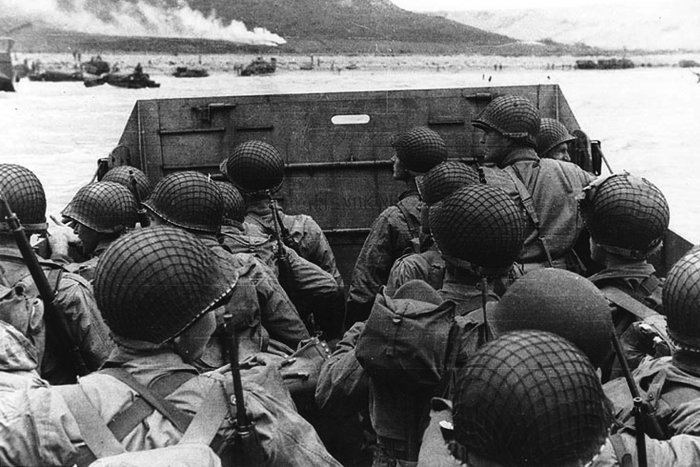
Troops in landing craft approach Omaha Beach on D-Day in Normandy, France, on June 6, 1944. D-Day was the largest seaborne invasion in history and turned the tide of World War II. Photo by UPI | License Photo
One day, when people say “they don’t make ’em like they used to,” they will be saying it about “Industry.”
First filmed before the pandemic and launched in its throes, a survivor of the era of streaming wars, corporate consolidation and Hollywood strikes, HBO’s addictively dissolute workplace drama remains as ambitious and authoritative as ever. Indeed, despite being divided from predecessors like “Mad Men,” “Succession” and “The Leftovers” by a series of epochal crises, it more closely resembles a vestigial tail of the medium’s past than most of its current counterparts: Out of place and out of time, “Industry” can best be understood as the last great drama of TV’s golden age.
Cast member and “Game of Thrones” alum Kit Harington, resident expert on series that reshaped the medium, agrees that “Industry” is a bit of a throwback in this respect.
“If you scroll back to ‘Game of Thrones’ in the first two seasons, it wasn’t a massive Goliath success, and it exploded after Season 3 with the Red Wedding. I think there’s a similar story going on here,” he says. “So often in TV at the moment, you’re given one season and everyone needs to pack in f— everything to get people hooked. But they’re burning through too much story. Season 2 is then done; the characters haven’t got anywhere to go. I think this is where this show has been successful, is that it was given that time to breathe.”
Earlier this spring, I convened “Industry’s” creators and cast in a conference room at The Times to walk me through its evolution into one of the best shows on television, and what to expect from its impending end.
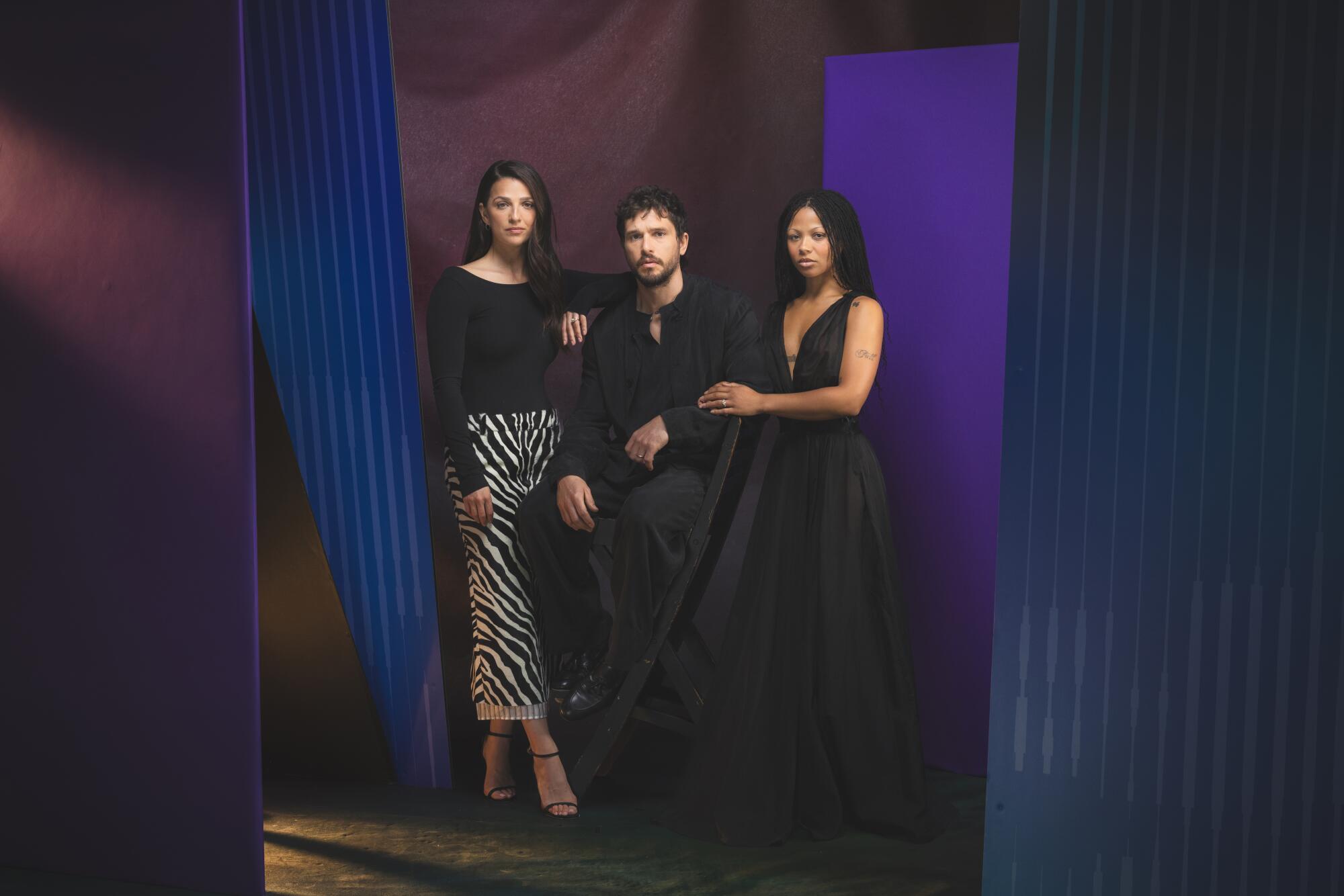
Marisa Abela, left, Kit Harington and Myha’la.
(Jason Armond / Los Angeles Times)
‘What the f— are you thinking, guys?’
Atrading-floor knife fight of hot, young strivers, or “grads,” competing for a permanent place at the fictional Pierpoint investment bank, the first season of “Industry,” filmed in 2019, premiered in the waning months of 2020 as a warped love letter to office culture. But for Konrad Kay and Mickey Down, the emerging writers at the helm, the voice of the series didn’t fully take shape until they’d found their main cast, including Myha’la, as hard-charging American Harper Stern, and Marisa Abela, as privileged publishing heiress Yasmin Kara-Hanani.
Kay: Season 1, me and Mickey were really green.
Down: We actually pitched HBO on the idea that it was going to be eight episodes, it was going to be in different months, and the big-bang dramatics were going to happen between the episodes. A bit like “Boyhood.” Huge things would happen in between episodes, and the episode would be about the reaction to those huge things. And they were like, “What the f— are you thinking, guys?” It was so antidramatic.
Abela: I had a lot of rounds of auditioning for Yasmin. They weren’t sure about me at all. I think part of it was because they were quite hellbent on her being vulnerable, on her being soft, and that was what I was playing in those first two, three episodes. … And what happens in any functional collaboration is you start to see what they really want from you — what it is that they need from your character. And in those moments of conflict, the moments of change, Yasmin has to stand up for herself at some point, otherwise it’s too wet.
Mickey Down.
(Jason Armond / Los Angeles Times)
Down: Yasmin was all vulnerability masked by Prada in script, and then you came in and you were very hard. [Laughs.]
Abela: There is one scene with [Yasmin’s abusive supervisor] Kenny [played by Conor MacNeill] in Season 2 where … Yasmin turns around to him and tells him to f— off, basically: “You don’t have a disease, you’re a narcissist, with a new excuse to lord it over people. You’re weak.” I think that’s the first time that Yasmin became a gangster. I was watching “Real Housewives of New Jersey” at the time, being completely honest. She can go really mob wife really quick.
Myha’la: I had almost the exact opposite experience in terms of finding or deciding who Harper was. When I read the scripts initially, I just thought, “There’s no way in hell that Harper can’t be steely and [on offense], because she’s clearly feeling out of her depth, and as a young woman of color going into a new space like this, you can’t show up like you’re vulnerable. You’re already expected to do poorly.” … On the page, Harper was an anxious person when I first met her in the pilot episode. She was sweaty and clammy and stammering. And I just thought, “Hell no!”
Down: Sometimes when we write the character, we focus on one thing, and then the actor comes in and then that one thing we thought the character was becomes the artifice that they have to play.
Harington: Great TV writers genuinely learn their actors as well as their characters, and they tie those things in as it goes through.
Abela: As much as they know how we speak now, we know how they speak. If Yasmin has a “F— off,” I know what they want with that. If she says “F— off,” it’s very different to “F— you.”
Down: It’s like playing the piano with the foot pedal, blindfolded.
Kay: When you get super-talented actors doing your writing, you sort of fall in love with them doing everything. There’s no story we can’t tell with them.
‘Am I being fired?’
The series’ second season, which opens with Pierpoint’s post-COVID return to office, found the grads established enough to become “active characters,” and the creators confident enough to begin breaking the mold they’d set for themselves in Season 1. From the nail-biting trade sequence with which Harper wins over hedge fund manager Jesse Bloom (Jay Duplass) to her firing from Pierpoint in the Season 2 finale, it marked the arrival of “Industry’s” distinctive, go-for-broke aesthetic.
Kay: [In] Season 2 we were still figuring out what the show was, and we had Jami O’Brien as our co-showrunner, who really professionalized me and Mickey towards the American system, towards how to be producers, curbed some of our more bombastic instincts, made us more professional in terms of some of the style of the writing we were doing, found a cleaner version of the show and a cleaner version of the story.
Konrad Kay.
(Jason Armond / Los Angeles Times)
Down: [The Bloom trade] was one of the first times in the show where we were like, “Wow, we’ve actually created something kind of singular,” in that we were able to create scenes of people trading, [using] financial jargon that no one understands, and make it feel like a car chase. The contrast between the Harper that’s on the trading floor being able to be in command of that with all the people looking at her, and then the Harper that’s in the loo afterwards in floods of tears, that for me was kind of the moment where we thought that we had a completely 3D, rounded character.
Myha’la: If you asked me to do the Jesse Bloom trade scene again, I’d piss myself. Because at least when I did it two seasons ago, I could have anxiety and fear percolating inside me. If I had to do it today, I’d have to do it confidently, and I would have to try really hard because so much of the language is truly blind memorization and being able to juggle particularly the f— phones. … You have to get the choreo[graphy] so good and you have to know the words so well so that you can do the important part, and that’s the subtext — communicating the feelings of the thing, which are not in the words. Which I love. It is so hard.
Harington: When you first read the scripts, you can’t understand a lot of what’s on the page. … You look at it, you go, “This is f— impossible.”
Myha’la.
(Jason Armond / Los Angeles Times)
Myha’la: This is not spoon-feeding the audience. “I’m sorry that you’re hurting because I know last summer your mom died in a car crash.” They don’t do that.
Kay: Do you know who hates that about us? Network executives. [Laughs.]
Down: We had a kind of mantra the first season especially, and then going into the second, that we would never have a scene that didn’t have one of our four main leads in it. And then, just for the necessity of the storytelling, we said, “We have to pop out of that perspective.” I don’t think HBO realized what a big decision that was, because I don’t think they’d actually realized we’d kept this mantra that we were never going to go away from the perspective of the grads.
Kay: It’s also where we broke the rule of, “We’re not going to just tell the bottom-up story; we’re going to go to the top.” When we sold the show, we were like, “This is a bottom-up story,” and then by that point we were like, “Actually, we have these older characters who might have these really rich inner lives that we should also explore.”
Myha’la: We blew the s— up. [Harper’s firing] forced us all outside the bank, which was dangerous and scary for me and really exciting and was how we got to see all the other things that Mickey and Konrad are capable of doing. I think they didn’t tell me before, so I was like, “Am I being fired?” [Laughs.]
Down: We thought we were all being fired. The reason the show evolves so much is because we basically never know whether we’re coming back, so we just blow up everything. We try to leave the audience with a satisfying conclusion. And then we get renewed, and then we have to basically write ourselves out of a corner. So Harper getting fired could have ended the whole show.
‘Oh, poor Henry’
Given time to develop its characters, refine its style and grow its audience, “Industry” returned for Season 3 with all the trappings of a series that had finally arrived: effusive critical acclaim, proliferating fan accounts and buzzy arcs by Sarah Goldberg and Harington, as playboy and erstwhile green–energy executive Henry Muck. Had it premiered just a few years later, “Industry” may have ended up on the chopping block before finding its footing; instead, it was allowed to achieve “terminal velocity.”
Kay: What happened between Seasons 2 and 3 was, we got renewed. We didn’t think we were going to get renewed. We operated from the principle of, “We might never get to do this again.” And that was incredibly freeing for me and Mickey because it was just like, “We’re gonna get eight hours, let’s just do everything we possibly can within that eight hours. Let’s indulge every creative impulse we’ve ever had. Let’s take the stabilizers off the story. Let’s not necessarily keep it within Pierpoint.” What we felt like was a perfect marriage of creative latitude, trust in ourselves and the right point in our arc of writing the show and directing and producing. We reached terminal velocity, where we could actually do all of the stuff that we were pretending we could do in the first two seasons.
Kit Harington.
(Jason Armond / Los Angeles Times)
Harington: When I joined up in Season 3, I had a good handful of friends who watched the show. It may be bigger than you think it was from the inside. It’s been fascinating for me, joining when I did and seeing it grow again … We all want to do stuff that people actually watch. We’d be lying if we said we didn’t. We’ve all done jobs that we really love and no one’s f— seen. When there’s a focus in on something that you know is good and you love, that’s more rare than you think. I started in this job in “Game of Thrones” and just assumed, “That’s, like, how jobs go. You get invited to the Emmys every year and everyone frigging watches it.”
Kay: The softness in Henry was a function of Kit playing the character and us writing to that vulnerability. There’s a totally different version of that character which never unlocks that kind of thinking in me and [Mickey].
Harington: You know that moment where it’s all going to s— with Lumi and he just gets up and he’s like, “None of this is real” and he f— off? For me, that was it. Because it was like, “Wait a minute, he can’t just leave the f— room” — and he does. I think that kind of sums him up. I got a handle of him properly then, and that was quite an early one we shot.
Down: He has a sense of entitlement most of the other characters don’t have.
Myha’la: But you still manage to make me feel bad for you. I’m like, “Oh, poor Henry.” Do you know what I mean? Isn’t that psychotic?
Down: I said it to him in an email recently. Somehow he managed to make an ex-Tory minister who bankrupted his company twice and needed bailouts from the British public — [a] junkie, adulterer — the most vulnerable and probably most empathetic character on the show, in some respects.
Harington: He’s one of the few characters who is actually trying to do good. Even if it’s about him being perceived as doing good. … It’s also very smartly done in how you demarcate addiction and drug-taking. You’ve got most of the characters, who can kind of put it down, but then you’ve got Rishi [a Pierpoint trader played by Sagar Radia] and Henry, who are a different kettle of fish. And also how it creeps up.
Kay: As a sober person playing that stuff, is there a psychic trigger in your brain that sort of feels like it’s happening?
Harington: I was very worried about coming in and doing some of this stuff, but quite quickly realized I was A) sober enough for long enough to go back there safely; and B) it was a sort of muscle memory, a lot of it. I get to exorcise this stuff in my job. How many ex-addicts get to do that? It was a kind of cathartic thing.
Marisa Abela.
(Jason Armond / Los Angeles Times)
Abela: There’s a real freedom that comes with drugs, alcohol, whatever it is, for the character. Those are the moments when you can really open the lid on something.
Myha’la: When you’re f— up, you’re uninhibited, so you can do your own thing, but I think you’re also taking the other person at face value. I feel like it sort of takes the judgment away. It creates a kind of childlike innocence.
Down: If you’re in a situation like that, you can skip like five stages of relationship if there’s a big bag of drugs in front of you. That’s something we try to capture.
‘Where we leave the characters feels so perfect’
Earlier this year, HBO announced that “Industry” had been renewed for a fifth and final season. But it was Season 4 — which finds Harper and Yasmin’s friendship in tatters, Yasmin and Henry’s marriage at an end, and the structure of the show evolving yet again to draw on new characters and genre influences — that led Down and Kay to determine that the series’ time had come.
Kay: We did think to ourselves, “OK, so we’re going to do a Season 4, which means the show is a kind of success in and of itself, which means we can start to think about ending. If you get four seasons, you’re probably going to get five. So we felt that it created latitude there. What we thought to ourselves was, “We meet these two women in the pilot. If you’re going to spend five seasons of TV with them, what is the starkest contrast you can do between how you meet them and where they end up?” … When we started, the show was about not having power. Five seasons in, they have it. Then what do you do with it? The phrase me and Mickey have been talking about is this idea of “arrival fallacy.” You climb and climb, you’re at the top of the mountain. Is there another peak? Do I sit here and enjoy the view?
Down: We’re writing Season 5 right now, and without giving too much away, we’re approaching that season very differently in terms of how information’s parceled out.
Kay: It’s very dense, though, isn’t it? Honestly, it might be the densest season. There’s a lot of theology in it, actually.
Down: We talked about doing a sixth [season], and then quite honestly we thought that was going to be diminishing returns. … We would have been pulling our punches constantly. This has been one of the most creatively fulfilling versions of the show, because we are writing towards a conclusion that we know is the conclusion. We’re thinking of images for the last 10 minutes that we know are going to be what the audience is left with, and that’s really, really thrilling for us as writers. I’ve never once thought, “God, I wish we were doing a sixth one,” as much as I love writing and making the show. Where we leave the characters feels so perfect.
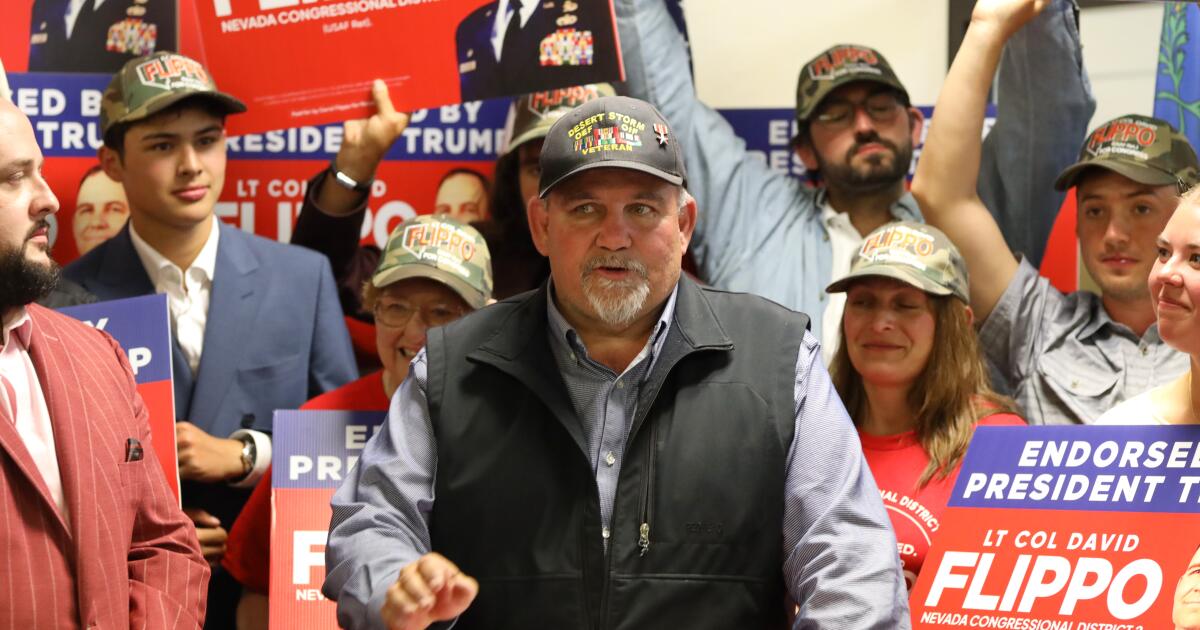
LAS VEGAS — Retired Air Force Lt. Col. David Flippo has won the Republican primary in Nevada’s 2nd Congressional District after securing President Trump’s endorsement in the closing weeks of the campaign.
The race, which was called Wednesday, put Trump opposite Republican Nevada Gov. Joe Lombardo and retiring Rep. Mark Amodei, who both backed former state Sen. James Settelmeyer. Amodei announced he was retiring after 15 years, opening up a competitive primary for Nevada’s only Republican-held House seat.
Flippo said he will fight “relentlessly” for secure borders, American energy, tax cuts, national defense and “the America First agenda our country needs.”
“Nevada deserves a fighter, and that’s exactly what I will deliver,” he said in a statement.
Democrats had hoped for a Flippo victory, thinking it would make it easier for them to win over less partisan voters in November in the conservative-leaning district. They nominated the chief of staff to state Atty. Gen. Aaron Ford, former majority floor leader Teresa Benitez-Thompson.
“I will ensure that Nevada families have an authentic Nevadan voice fighting for their needs in Washington DC,” Benitez-Thompson said in a Wednesday morning statement.
The 2nd District race is one of several Nevada contests that will be watched closely this year. In southern Nevada’s 3rd Congressional District, Democratic Rep. Susie Lee will face Marty O’Donnell, a composer known for writing the soundtrack to the video game “Halo.”
Trump won the 3rd district in 2024 and backed O’Donnell, who thanked Trump in his victory statement.
Tuesday’s primary also set the general election contest for governor, with Ford defeating a progressive candidate in the Democratic primary and moving on to face Gov. Lombardo. The incumbent, a former Clark County sheriff, is running on his record of public safety and job creation while pledging to work on housing affordability in a second term.
Ford is tying Lombardo to Trump in placing blame for soaring prices across the state and has pledged to lower costs for families. He would be the state’s first Black governor if elected in November.
In other races for statewide offices, Republican primaries for attorney general and secretary of state included several candidates who had pushed election conspiracy theories or been skeptical of election operations. Adriana Guzmán Fralick, who has expressed concerns about voting security, won the GOP nomination for attorney general and will face Democratic state Senate Majority Leader Nicole Cannizzaro.
The Republican primary for secretary of state, the office that oversees elections, included Jim Marchant, a former state lawmaker who has said the 2020 election “ was probably stolen,” and Sharron Angle, a former state lawmaker who was part of an effort to block the certification of Nevada’s 2020 election results. Another candidate who was competitive in the race, Shirley Folkins-Roberts, is an attorney who has denied that there is widespread voting fraud in Nevada.
In the 2nd District race, Flippo said he understands issues important to the region, including mining, water rights and fuel prices. He sought to turn Settelmeyer’s long political record into a liability, pointing to votes he said did not match conservative values.
He moved to the district this election cycle after losing a race in southern Nevada in 2024. The 2nd District covers all northern Nevada. It mostly rural but includes the major battleground county of Washoe, home to Reno.
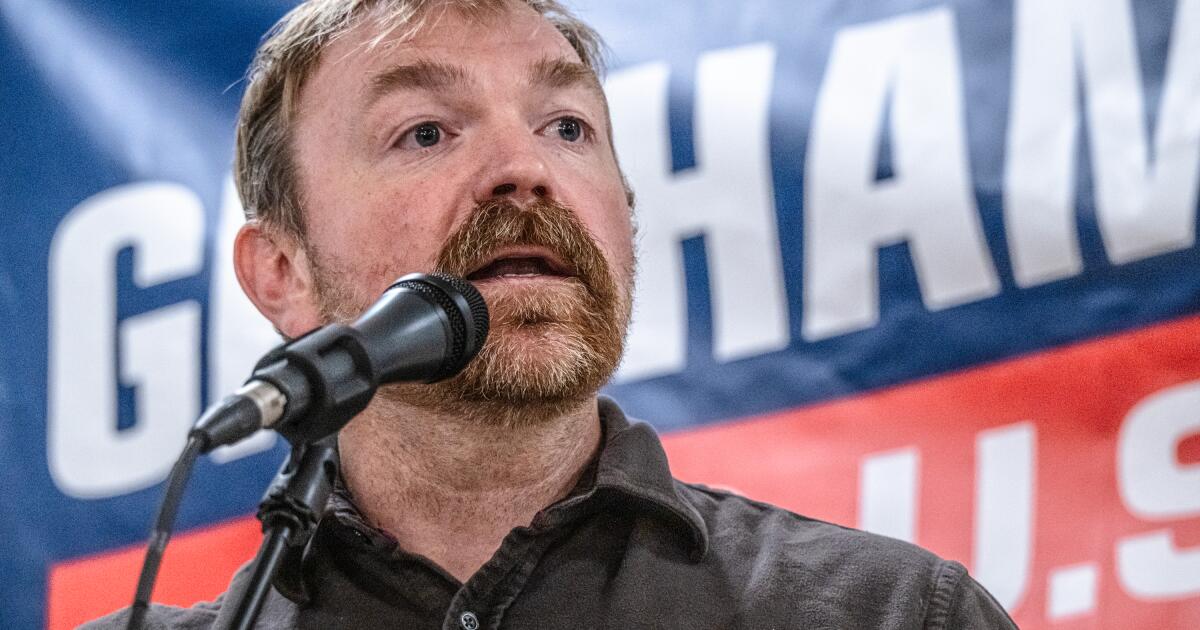
WASHINGTON — Democrats’ path to winning control of the Senate probably runs through Maine — where voters were set to head to the polls Tuesday after several days of growing party anxiety about Graham Platner, who has faced a string of controversies as the likely Democratic candidate.
Democrats not just in Maine but around the country — including in Texas, Iowa and other red states where the party’s mission to flip Senate seats would become more urgent if its prospects in Maine faltered — were closely watching Platner’s performance in Tuesday’s primary.
“They’ve probably become if not less optimistic, at least more nervous over the last 10 days or so,” said Mark Brewer, a political science professor at the University of Maine.
Democrats face a challenging map as they seek to regain control of both chambers of Congress and claw back power in Washington. Unseating Sen. Susan Collins, the veteran Maine Republican, has been viewed as one of the party’s best chances, Brewer said.
Platner’s primary opponent, Maine Gov. Janet Mills, suspended her campaign in late April, clearing his path. He is generally expected to prevail as the Democratic nominee, but what percentage of his party’s vote he captures could help indicate how strong his candidacy will be in the general election, said John Cluverius, director of survey research for the Center for Public Opinion at UMass Lowell, which has conducted polling on the race.
“It’s critical [for Democrats], because without Maine, to win back the Senate you would need to win in states that Donald Trump won overwhelmingly,” Cluverius said.
Platner, an oyster farmer and Marine Corps veteran, emerged as a political outsider and quickly gained popularity.
But apparent scandals followed him. The latest came Thursday, when the New York Times reported that three ex-girlfriends of Platner’s had described his behavior as volatile and, by one account, physically rough. Platner, who denied the latter allegation, had previously addressed controversies related to his texting of women outside his marriage, a Nazi-style tattoo and old Reddit posts.
Over the weekend, Platner projected confidence. He took questions from audience members at a Sunday town hall, and on Friday, the campaign saw its best fundraising day since Mills suspended her bid opposing Platner for the nomination, bringing in $200,000 in 24 hours, a campaign official said.
“Since the beginning, Maine, you had my back,” Platner told supporters at a Friday rally. He drew a standing ovation when he continued: “Now, as every single piece of that past and journey gets dug up, litigated and weaponized, you have my back.”
Platner described the allegations against him as “politically motivated” and false.
The controversies surrounding him could help Collins, who has a track record as a political survivor, Brewer said. In 2020, the last time Collins was reelected, polls predicted she would lose to her Democratic opponent, but she secured reelection, even as the state went for Democrat Joe Biden in the presidential race.
“Her position has probably improved over the last few weeks,” Brewer said. “She has mostly stayed out of the way on this and let the negative stories pile up.
Last week, Democratic leaders largely stood by Platner, as Senate Minority Leader Chuck Schumer indicated the party would continue to back him. Rep. Ro Khanna (D-Fremont) campaigned with him at the Friday rally. Sen. Elizabeth Warren (D-Mass.) recorded a call to prospective voters on his behalf, and Sen. Brian Schatz (D-Hawaii) appeared at a virtual fundraiser, according to a source familiar with the plans.
The political calculus comes down to whether “they would rather have a Senate majority with Graham Platner in it than a Senate minority without Graham Platner in it,” Culverius said.
Democrats must flip at least four Republican seats to take control of the Senate, a difficult task. The Maine seat is the only possible Democratic flip in a state that went for Democratic presidential nominee Kamala Harris in 2024 rather than for President Trump.
Democrats are also looking for victory in Texas, Iowa, Ohio, North Carolina or Alaska, all states that went for Trump in 2024. The party must additionally retain their seats in competitive races in Michigan, New Hampshire and Georgia.
How Platner affects his party’s chances of taking Senate control depends on what happens next, Brewer said.
“What else are we going to see? And I don’t know that anybody knows that at this point,” Brewer said. “I think that’s really what Democrats have to worry about the most. Is this as bad as it gets, or is there other stuff?”
Voters are willing to overlook scandal more readily than in the past, said Brandon Rottinghaus, a political scientist at the University of Houston. And in these midterm elections, Democratic voters view the stakes as “extremely high.”
“Most voters are looking at the prospect of winning and losing,” he said. “Parties are worried about getting the win.”
What was the moment from the season finale of “The Pitt” that finally broke you?
Was it the shot of the day-shift staff watching the Fourth of July fireworks from the hospital roof, the sound of “America the Beautiful” playing in the distance? Maybe it was Dr. Al-Hashimi (Sepideh Moafi) crying in her car, realizing she can’t work around the seizure disorder that makes her a liability in the ER. Or perhaps it came when Noah Wyle’s Dr. Robinavitch (a.k.a. Dr. Robby) swaddled Baby Jane Doe, telling her that “everything’s gonna be just fine,” because she has “so many wonderful things to see and so many people to love.”
But what opened the floodgates for me, after the last half-hour of the episode left me completely dazed and dumbfounded, was Drs. Santos (Isa Briones) and King (Taylor Dearden) exorcising the day’s demons by belting out Alanis Morissette’s “You Oughta Know” at a karaoke bar and demonstrating that primal scream therapy is alive and well three decades into the 21st century.
Sign up for The Envelope
Get exclusive awards season news, in-depth interviews and columnist Glenn Whipp’s must-read analysis straight to your inbox.
By continuing, you agree to our Terms of Service, which include arbitration and a class action waiver. You agree that we and our third-party vendors may collect and use your information, including through cookies, pixels and similar technologies, for the purposes set forth in our Privacy Policy such as personalizing your experience and ads.
Which is all to say: “The Pitt” is the only television show I’ve watched that gives me the same feeling I have when I read a great, immersive novel. When the end is near, I’m bereft. I’m Al-Hashimi in her car, wanting to pound the dashboard. I do not want to let these characters go. They’ve given me 15 hours and I still crave more. I would devour a series of short films about odd couple Santos and Whitaker (Gerran Howell) sharing an apartment or a summer spinoff showing Dr. Abbot (Shawn Hatosy) working off-hours as a SWAT medic. Anything to fill the long, “Pitt”-less weeks between seasons.
“The Pitt” won five Emmys from 13 nominations, including best drama series, for its celebrated first season, a 15-episode run that began with Dr. Robby up on the hospital roof talking down Dr. Abbot after an intense shift. The season ended with Dr. Abbot returning the favor after Robby and his staff ground their way through a day that included a mass shooting, a child drowning and a patient assaulting LaNasa’s no-nonsense charge nurse.
How do you follow that?
For a few episodes this new season, it looked like “The Pitt” wasn’t up to the task. We watched the ER staff dealing with a series of bloody, messy (the disimpaction!) medical maladies, an avert-your-eyes spectacle that felt like the writers were trying to one-up themselves and find the worst possible affliction to make viewers double over. Worse, the thrill of discovery that kept us invested throughout the first season, the slow drip of information about the characters, wasn’t quite there. Something was missing, and it wasn’t just Dr. Robby’s motorcycle helmet.
But the luxury of having 15 episodes is that the writers can take their time laying the groundwork for the story they want to tell.
And what a story it was.
Over the course of the season, we watched Dr. Robby disintegrate, his mental health more precarious than ever because he has done nothing to address his apparent PTSD. “You need help,” Dr. Langdon (Patrick Ball) tells Robby, confronting him in the finale. “Be honest with yourself.”
Robby isn’t the only one struggling, as Dr. Abbot puts it, to “dance through the darkness.” Langdon is back, managing his sobriety. Dr. Mohan (Supriya Ganesh) is having panic attacks. Santos is still dealing with self-harm. Dana remains haunted by that Season 1 patient assault and now carries a syringe containing a heavy sedative just in case somebody emerging from that overcrowded waiting room crosses the line again.
“I’ve seen so many people die that I feel like it’s leaching something from my soul,” Robby says. “I’m tired of feeling like I’m drowning every day.”
And there you have it, the subject of Season 2 of “The Pitt.” Medical professionals are gasping for air, and the American healthcare system, with its focus on profit above all else, is failing them and the patients they treat.
Remember Orlando, the patient with severe diabetic ketoacidosis who arrives at the ER after fainting? Orlando had to ration his insulin because he lacked insurance and felt he had to cut corners. He ends up leaving the hospital early, fearing the cost of treatment. Later he returns, having fallen (jumped) from a catwalk at his construction job, fracturing his skull. But good news: He now qualifies for Medicare and Medicaid due to long-term disability.
It’s a tragedy, one of many reasons the season finale shot of the ER staff holding back tears as they watched the Fourth of July fireworks felt like a body blow. “America the Beautiful”? How can that be true when the current administration is seeking $1.5 trillion for defense spending — nearly 50% more than this year — while cutting healthcare and social safety nets? How can that be true when an act known as the “Big, Beautiful Bill” removed funding from an already frayed healthcare system and exacerbated the shortage of care in rural areas of the country?
That one scene, the culmination of hours of careful, patient storytelling, said more about the disconnect between American ideals and America’s reality than anything else I’ve read or watched this year.
Give “The Pitt” all the Emmys. It has more than earned them.
After the 2022 Los Angeles mayoral primary, developer Rick Caruso looked to have a surprising, and sizable, lead over then-U.S. Rep. Karen Bass.
The morning after the polls closed, Caruso was ahead by 5 percentage points — 42% to Bass’ 37% — and the former Republican called the early results “a victory story.”
But that lead did not last as the vote count continued. By the time all votes were tabulated two weeks after election day, Bass had come out on top, with 43% of the vote compared with Caruso’s 36%.
Welcome to the postelection vote-count slog in California, where tight races are often impossible to call even when the initial results seem clear-cut.
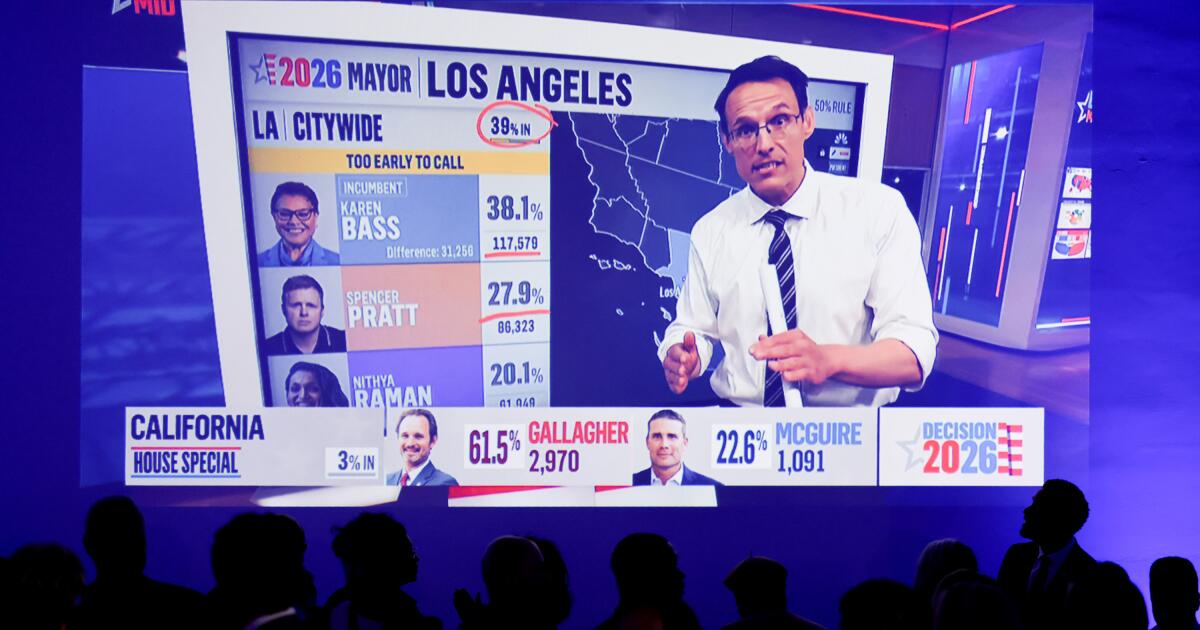
The California governor’s race still has not been called even though Republican Steve Hilton has been the top voter-getter and Democrat Xavier Becerra has been in second place since election night. The same is true in the battle over who will face Bass in the mayoral election: reality TV personality Spencer Pratt, who is now in second place, or L.A. City Councilmember Nithya Raman, who is in third place.
At this point in the vote tally, “everybody has an opinion and very few facts” about what the results will be, said Mike Murphy, a Republican strategist.
“Nobody in politics wants to be patient,” Murphy said, adding that California has “adopted a system that’s slow and deliberate.”
It’s not just the L.A. mayor’s race where mail-in ballots have swung election outcomes. Other contests, including those for highly competitive Orange County congressional districts and L.A. City Council seats, have come down to extremely narrow margins that have shifted long after election day.
On election night in November 2024, just over 1,000 votes separated Democrat Dave Min and Republican Scott Baugh in their bid for the 47th Congressional District, with Baugh enjoying a slight lead.
But, ultimately, as more ballots were counted, Min pulled ahead. He ended up winning by about 10,000 votes.
Similarly, in the race between Democrat Derek Tran and then-incumbent Michelle Steel to represent Congressional District 45, it took until Nov. 27 to determine that Tran had won the contest by just over 650 votes.
In 2022, the race between then-incumbent Gil Cedillo and community activist Eunisses Hernandez for L.A. City Council was similarly unsettled. On election day, Cedillo had a comfortable lead with 56% of the vote. But two weeks later, Hernandez ended up in the lead with 54% of the vote to Cedillo’s 46%.
Experts say confirming the final spot in the mayor’s race could still take several more days, depending on how close the contest becomes and how many ballots still need to be counted. Only an estimated 62% of ballots from the city of Los Angeles had been counted as of Thursday morning.
“Of the 40% remaining, or outstanding, there could still be a chance that there would be a significant return of more left-leaning votes, which would certainly benefit Raman,” said Pete Peterson, dean of the School of Public Policy at Pepperdine University.
Late results tend to favor Democrats — as seen in the 2022 Bass-Caruso contest — as Democrats tend to be more likely to vote by mail, a system that accepts ballots up to seven days after election day as long as they are postmarked by that Tuesday. And this year, Democratic voters held on to their ballots longer amid an unsettled governor’s race, which could further boost that phenomenon.
“The major difference between ’26 and ‘22, you had two candidates versus three,” Peterson said. “Mathematically, it’s a different situation.”
Three experts The Times interviewed said Raman still had a chance to pass Pratt, but it seemed more likely at this point that Pratt would survive and challenge Bass in November.
The remaining ballots to count, even if they are overwhelmingly left-leaning, will probably be split between Raman and Bass, which means Raman needs to outperform not just Pratt but Bass to make such a comeback possible, Peterson said.
He called her chances of ousting Pratt “dastardly remote … but it’s not impossible.”
In L.A. County, the registrar of voters reported late Wednesday that officials estimate they still have about 713,000 ballots to process and count, which primarily includes vote-by-mail ballots postmarked by election day but not yet received, as well as ballots returned to drop boxes and vote centers on election day. The registrar only made countywide estimations, which includes a much larger pool than L.A. city voters who will decide the mayor’s race.
Kamy Akhavan, the managing director at the USC Dornsife Center for the Political Future, said there’s a theory circulating among pundits that ballots submitted later are going to break more progressive, meaning they’ll be more friendly to Raman.
“Whether there is enough of them to tilt the outcome in favor of Raman taking a second place position, right now, it seems unlikely,” he said.
Pratt is pulling from the same electorate in Los Angeles that voted for President Trump and could snag a few more voters who are angry about the state of the city. But his lead very well could shrink a bit as more Democrats’ ballots are counted, Murphy said.
“Nithya, she’ll probably go up because there’s going to be a fair amount of Democratic votes and she’ll get her chunk, but will she catch Pratt? You can extrapolate it either way,” Murphy said.
A similar left-leaning shift also occurred as more ballots were counted in November 2022 when Bass and Caruso faced off in the general election. Results on election night wavered between the two candidates, but by the following morning Caruso had a thin lead with 51.25% of the counted votes. Bass sat at 48.75%.
Caruso remained in the lead — though it continued to shrink — as the week dragged on, but by Saturday, Bass had pulled ahead with 50.78% of the counted vote. Caruso had fallen to 49.22%.
Her momentum continued to grow as more ballots were processed. Eight days after polls closed the following week, the Associated Press called the race for Bass. At that point, she led Caruso by six points with 53% of the vote.
The final tally would have her winning almost 55% of the vote.
California officials have worked to dispel rumors and falsehoods about slow election results — explaining that it’s part of the process to accurately count and confirm ballots, especially those mailed in — though there has been a growing push to expedite results to build voter trust.
The process has been particularly slow in L.A. County, though experts say that is mostly a result of the county’s massive voter base. Mail-in ballots are also heavily scrutinized with workers verifying signatures and giving voters a chance to remedy the situation if their signature doesn’t match, a process that takes time.
“They’re using that level of care because they’re supposed to — that’s their protocol — and also because it could make a big difference,” Akhavan said. “We’ve seen some elections in Southern California decided by single digits. And that just means this is going to take time. That can be very frustrating, even annoying, to Angelenos.”
California voters are deeply divided over the trustworthiness of state elections heading into Tuesday’s primary, with most Democrats but less than half of Republicans expressing confidence in the electoral process, according to a new poll.
The polarized view follows a years-long campaign by President Trump and his Republican allies to question the legitimacy of American elections, especially in California and other blue states. It also follows robust efforts from liberal leaders, elections officials and voting rights experts to denounce Trump’s claims as baseless.
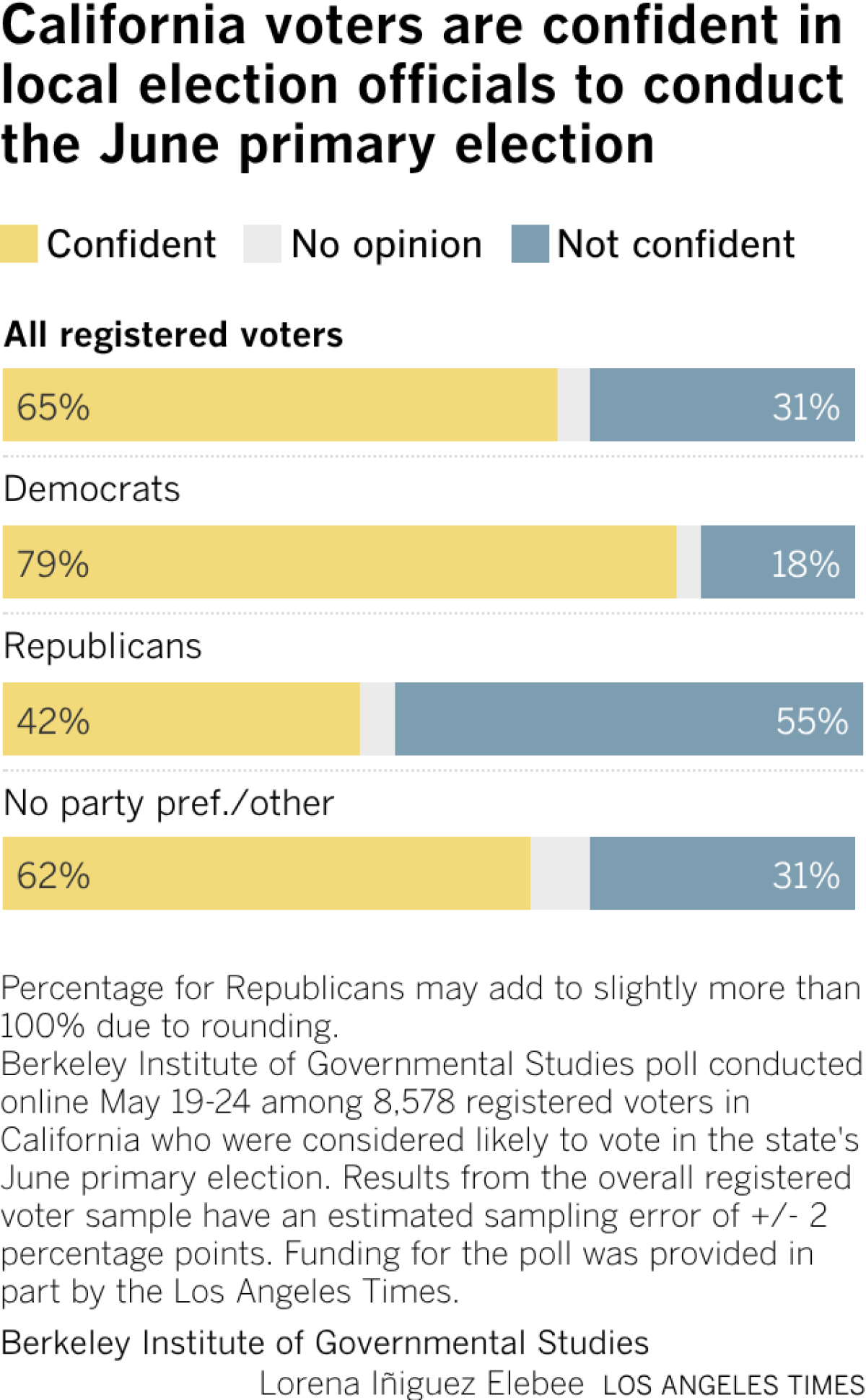
Overall, registered voters in the state — which skews heavily Democratic — expressed confidence in local election officials by a 2-to-1 margin, with 65% expressing confidence and 31% expressing a lack of confidence, according to the poll released Tuesday by the UC Berkeley Institute of Governmental Studies and co-sponsored by The Times.
However, those figures shift dramatically when sorted by political party, and even more when parsed by partisan leaning.
For example, 79% of Democratic voters expressed confidence in local officials running a secure and fair election, compared to 62% of independent voters and 42% of Republican voters, the poll found.
While 82% of voters who identified as strongly liberal expressed confidence, just 38% of voters who identified as strongly conservative did so.
A volunteer assists Melani Hurwitz at a polling location Monday at the Cal State Long Beach Walter Pyramid.
(Eric Thayer / Los Angeles Times)
“It’s clearly a partisan issue, and it is being promoted by the president and others who are his followers,” said Mark DiCamillo, the director of Berkeley IGS polls. “Strong conservatives and the Republicans are the least confident, and a lot of them are saying [they are] not at all confident. That’s a pretty extreme statement.”
Rick Hasen, an election law expert and director of the Safeguarding Democracy Project at UCLA Law, said he expected Republican confidence to be even lower given Trump’s decade of undermining trust in elections, especially in liberal, diverse states such as California. But he said neither Trump’s narrative nor public sentiment about election security — which generally shows voters are more confident “when their side wins” — reflects reality, which is that “our elections are administered well.”
“There’s very little evidence of manipulation or of fraud or even of incompetence,” Hasen said. “Anyone who looks objectively would see that there are numerous safeguards to ensure we have free and fair elections in California.”
Trump has long contended without evidence that voter fraud is pervasive among undocumented immigrants and in states, such as California, that use mail ballots, and blamed his 2020 loss to Joe Biden on such fraud despite experts rejecting the claim and Trump’s own allies and lawyers being unable to prove it.
A voter casts their vote inside the Westchester Family YMCA Annex on Monday.
(Kayla Bartkowski / Los Angeles Times)
Since returning to the White House last year, Trump has tried to implement strict new requirements for voter ID and proof of citizenship and to limit or bar mail-in voting, and called for greater federal or Republican Party control over state-run elections. In February, he said that “Republicans ought to nationalize the voting” in “at least 15 places” where they lose.
Democratic leaders, elections experts and voting rights advocates have all pushed back. They’ve backed their assurances that the state’s elections are safe with lawsuits to block Trump’s efforts to assert federal control. They also warn that his administration may try to intervene anyway, including by sending federal immigration agents to polling locations or intercepting or invalidating mailed ballots.
Last week Gov. Gavin Newsom signed a bill barring federal agents and other law enforcement from interfering with local and state elections officials or confiscating ballots, voter rolls or voting machines without a warrant. Newsom said California voters were experiencing “legitimate anxiety” over election integrity given the threats from the Trump administration and the recent actions of Riverside County Sheriff Chad Bianco — a MAGA-backed Republican candidate for governor who recently seized hundreds of thousands of ballots as part of what he said was an investigation into potential fraud in last year’s election.
An election worker collects extracted vote by mail ballots to be tallied at the Los Angeles County Registrar-Recorder/County Clerk Ballot Processing Center in City of Industry.
(Gary Coronado / For The Times)
Newsom said he expects Trump to interfere with the upcoming election as well because “every single thing that Donald Trump is saying only suggests that he will do more, not less, to intimidate and to impact the outcome of this election,” but that the state stands ready to respond.
California Atty. Gen. Rob Bonta last week said that his office is preparing for “all different types of scenarios” involving federal interference, from ballots being seized to immigration agents showing up at polling locations.
“We are currently monitoring any potential risks or threats, and we’re ready for any possibility,” he said.
Sen. Alex Padilla (D-Calif.) last week blasted the U.S. Postal Service for issuing a proposed rule to implement Trump’s mail ballot changes, despite the ongoing litigation. In April, Rep. Nancy Pelosi (D-San Francisco) helped convene a pair of “shadow hearings” in California where fellow House Democrats and a panel of experts shot down Trump’s claims about widespread fraud and expressed confidence in state elections.
A Berkeley IGS Poll from a year ago found that California voters support requiring first-time voters to show ID to prove citizenship in order to register, and that most supported requiring a government ID every time a voter casts a ballot. However, another Berkeley IGS Poll from last month found that strong majorities of California voters believe American democracy is under attack or being “tested.”
Dean Logan, head of the L.A. County registrar-recorder/county clerk’s office, said that overall confidence, “despite a sometimes volatile state and national narrative,” was “gratifying.”
“Election officials take connection to their community seriously. We recognize that our job is to facilitate their voting experience, and that voter participation is key to election security,” Logan said. “Regardless of party affiliation, our role as election officials focuses on the function and process of ensuring the voice of the electorate is heard and that compliance with the election laws adopted in our state is achieved.”
Jesse Salinas, president of the California Assn. of Clerks and Elections Officials and the registrar of voters in Yolo County, said local elections officials are “proud to be a steady source of trust at a consequential moment,” and stand ready to “open our doors to any voter who wants to see firsthand how our elections work and to answer any questions they may have.”
Times staff writer Iris Kwok contributed to this report.
Here’s a low-key 68-year-old candidate who excited no one. And that apparently was a major strength. He was easygoing, non-threatening and a safe bet.
He also had an impressive resume — former U.S. health secretary, California attorney general, longtime congressman and state assemblyman. This seemed to attract voters.
People perpetually badmouth politicians. That’s in the American DNA. And in California, there’s always loud anti-Sacramento jabber. But voters tend to prefer politicians with Sacramento experience when electing governors — unless a celebrity entertainer is available.
You’re reading the L.A. Times Politics newsletter
George Skelton and Michael Wilner cover the insights, legislation, players and politics you need to know. In your inbox Monday and Thursday mornings.
By continuing, you agree to our Terms of Service, which include arbitration and a class action waiver. You agree that we and our third-party vendors may collect and use your information, including through cookies, pixels and similar technologies, for the purposes set forth in our Privacy Policy such as personalizing your experience and ads.
Politics is cyclical, however. In the past six decades, Californians have gone from electing fascinating Govs. Ronald Reagan and Jerry Brown to selecting uninspiring George Deukmejian, Pete Wilson and Gray Davis — then returning to headliners like Arnold Schwarzenegger, Brown again and Gavin Newsom.
Now we’re ready for boring Becerra?
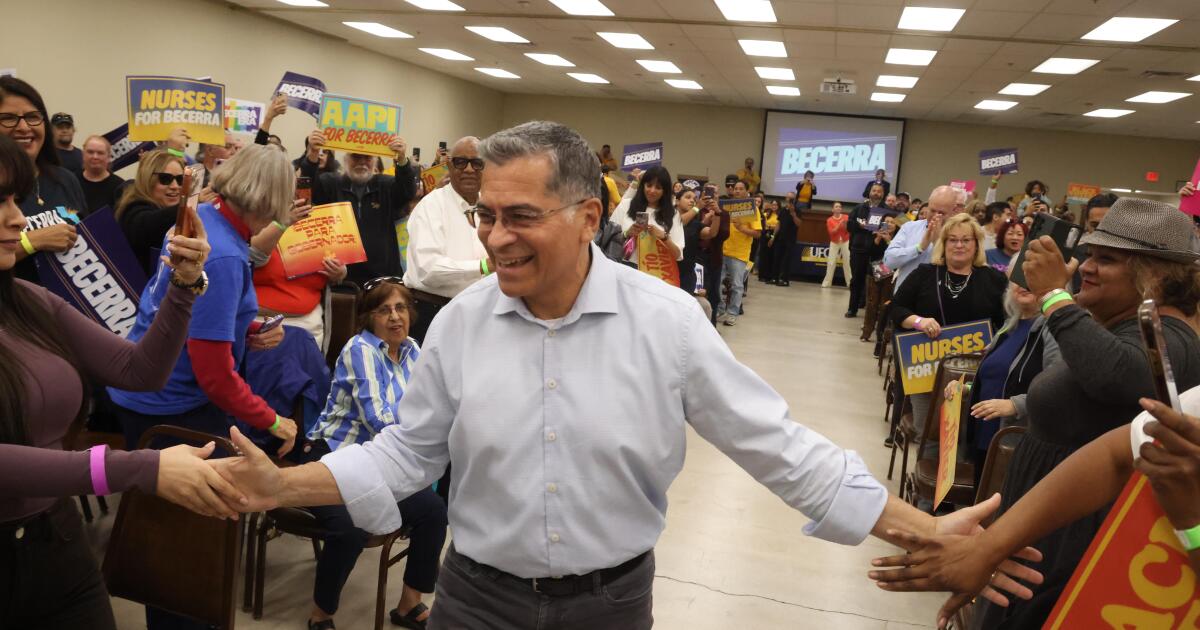
The last pre-primary poll by UC Berkeley’s Institute of Governmental Studies found Democrat Becerra leading the pack. But he was closely trailed by Republican former Fox News commentator Steve Hilton and Democrat billionaire Tom Steyer, a hedge fund founder turned climate activist.
The large field of candidates wound up with those three leading — Becerra drawing 25% support, Hilton at 21% and Steyer with 19%.
A later Emerson College poll also found Becerra in front but Steyer and Hilton in a statistical dead heat: Becerra 28%, Steyer 22%, Hilton 21%.
The top two vote getters will qualify for the November general election.
In contrast to earlier hot speculation about two Republicans — Hilton and Riverside County Sheriff Chad Bianco — finishing in the top two and locking out any Democrat from the November ballot, the final IGS and Emerson polls showed that an opposite scenario was possible. Two Democrats could conceivably advance to the November voting.
As campaigning neared an end, Becerra apparently tried to help Hilton attract more MAGA support to prevent Steyer from edging out the Republican. Becerra would be a shoo-in over any GOP opponent in November, but could face a tough fight facing Steyer with his bottomless checkbook.
The games-playing involved Becerra running a statewide digital ad subtly reminding Republican voters that Hilton was President Trump’s “favorite” candidate for governor. The spot asserted that Becerra is “Trump’s worst nightmare.”
Another major poll completed a few days earlier by the Public Policy Institute of California found the same basic rankings as the IGS survey, but with Steyer a bit further back.
Becerra was leading with 23%, followed by Hilton at 20% and Steyer at 15%.
Every independent poll found Becerra surging from irrelevancy in March to leader of the pack by late May.
It’s “one of the most unusual gubernatorial election campaigns in modern California history,” IGS poll director Mark DiCamillo says.
Most of Swalwell’s voter support soon went to Becerra, which helped him attract campaign donors and endorsements by interest groups.
Becerra, who had been moseying along the race track, suddenly got a second wind. And voters sensed a breath of fresh air.
“Voters are exhausted by Trump. He makes it hard to sleep at night. ‘Cool and calm’ win,” says Chapman University political science professor Fred Smoller. “People want a candidate like a no-drama Becerra.
“The fact he has a charisma deficit may in fact be his political asset.”
But Becerra also has other assets, notes UC San Diego political science professor Thad Kousser — ”legislative and executive experience…. He was safe and predictable.
“And he’s second only to Gavin Newsom in opposing Donald Trump.”
Yes, a calm temperament appeals to voters fatigued by political fire and brimstone. But California Democrats also want someone who will fight back against Trump’s policies.
Becerra repeatedly points out that as state attorney general, he sued the first Trump administration more than 120 times and won the vast majority of cases.
“Becerra has caught the attention of Democratic voters who overwhelmingly disapprove of Trump,” says PPIC Poll Director Mark Baldassare.
How overwhelmingly? Ninety-five percent disapproval by Democrats in the latest PPIC survey, 70% among all likely voters.
Becerra “stood out from the rest of the candidates because of his background as attorney general,” Baldassare adds.
“And look at the other candidates. You can’t name one who has had experience in Sacramento.”
Among the last nine California governors, only Schwarzenegger and Reagan have been elected without serving prior Sacramento stints.
Becerra also has another asset: He’d be the first elected Latino governor in California history. He finished the primary campaign with a comfortable lead among Latino voters, as well as Asian American.
As Becerra’s political stock rose, Democratic rivals — especially Steyer — tried to portray him as incompetent, touched by scandal and a Chevron tool. But the mud didn’t seem to stick.
A natural Becerra strength is likability.
DiCamillo recalls what his mentor, the late legendary pollster Mervin Field, used to say about how voters choose between candidates for governor or president.
“It’s a highly personal choice,” DiCamillo says, quoting Field. “People put more mental energy into choosing a top-of-the-ticket candidate than any other.
“It’s like trying on a new suit. If it doesn’t fit well, you don’t buy it. You’ve got to be comfortable in the feel.”
Many California voters apparently feel that way about Becerra — nothing flashy, just plain but comfortable.
One more day and it’ll all be over. I’m referring to the primary election, of course, and the unremitting campaign ads that have infiltrated every aspect of our being as Californians.
Authentic or paid influencers promoting candidates on TikTok and Instagram. Facebook ads vilifying or praising various measures. Incessant, repetitive TV campaigns that get nastier with every election, yet still manage to feel like an analogue remnant from 1982. The worst? Those sponsored leaflets and postcard mailers that end up as makeshift coasters, mosquito swatters or unread refuse that goes straight from the mailbox into the blue recycle bin.
The king of ad spending is Democratic gubernatorial candidate Tom Steyer. He’s behind the most expensive political advertising campaign in the country this year. A former hedge fund manager, Steyer has reportedly spent more than $200 million on his campaign, with a major chunk of that for broadcast TV, cable and radio — 20 times the amount spent by fellow Democrat, former U.S. Secretary of Health and Human Services and California Atty. Gen. Xavier Becerra. And Steyer is still polling behind Becerra.
I never thought I’d write this but it’s not always about the money.
Xavier Becerra, front-runner in the race for California governor, speaks before a crowd at UFCW Local 1167 Union Hall.
(Genaro Molina/Los Angeles Times)
Voters have more resources than ever should they choose to actually research and learn about who and what is poised to shape the future of their city, county and state.
There’s no shortage of broadcast, cable, digital and print reporting about former reality TV personality turned mayoral candidate Spencer Pratt. He uses AI!
The battle between incumbent Karen Bass and her closest Democratic competition, Los Angeles city council member Nithya Raman, dominates local newscasts. And there’s pundits from both sides arguing for and against these choices on every available platform.
Given the amount of information now at voter’s fingertips, we should be the most informed voting populace in the history of ballot casting. But are we?
A new poll by UC Berkeley’s Institute of Governmental Studies that was co-sponsored by the Los Angeles Times asked 8,578 registered voters across California what sources they rely on to get news and information about election-related issues. The poll, which was conducted online May 19-24 in English and Spanish, found that nearly half of the state’s electorate (47%) said they refer to the official voter information guide that is mailed to voters in advance of each election.
Discovering that a nonpartisan, non-sponsored source of data topped the list is a welcome surprise. Today’s media-verse is so fractured and bifurcated along political lines, I just assumed that confirmation bias would drive most folks toward friendly sources, i.e. what they want to hear.
Not as surprising is that 44% of those polled said they use Google or other search engines to seek out election-related information, and greater than 3 in 10 obtain election-related information from social media (39%). Traditional means of information weren’t far behind search engines. Those polled said they still rely on national or cable TV news (39%), newspapers, online or in print (37%), and local TV news (35%). One in three (33%) get information word-of-mouth from family, friends, neighbors or co-workers.
Gubernatorial candidate and billionaire Tom Steyer, right, meets with supporters at a campaign stop.
(Sara Nevis/For The Times)
“The substantial differences in news sources across generation, education and partisanship suggest that we are a considerable distance from the information environment that dominated most of the 20th century, where local newspapers, network news and local television stations dominated,” said Professor Eric Schickler, co-director of the Institute of Governmental Studies. “This fragmentation means that voters may no longer share a common frame of reference when evaluating candidates and election issues.”
The increasingly splintered ways in which voters seek information, fueled by the rapid changes in technology and media, has kept political campaign strategists on their toes.
“Getting attention is the first barrier, and then once you have that attention, how do you convert that into support?” says Democratic campaign consultant and strategist Brian Brokaw. “You have to create a surround-sound effect in order to persuade the voter to go for your candidate or your issue, and they have to hear from multiple avenues. Voters are innately skeptical of advertising, especially when it’s a very direct sale from a candidate. That’s why you’re seeing the use of more influencers in campaigns, particularly paid influencers, who may or may not be disclosing that they are being paid. That’s been a prominent issue in the governor’s race.”
Age, or generational differences, are another deciding factor in where voters look for more intelligence on issues and candidates. The poll found that two-thirds of voters under the age of 30 (67%) and a majority of those ages 30-39 (52%) use social media such as Facebook, X, Instagram, or TikTok to get their information.
Getting to know a candidate, particularly via social media, isn’t necessarily part of a rigorous, fact finding mission. Laughing at Pratt’s Batman-themed video or Gov. Gavin Newsom’s satirical X posts are more about bonding with the person than unpacking their policies. Real or perceived, discovering a candidate via one’s Instagram feels more organic than seeing them on billboard or TV ad.
“One way that politics has changed is that people are craving authenticity. Someone like [Zohran] Mamdani, was very successful and promoted himself from the back of the pack to mayor of New York City. But what people are seeing doesn’t mean that’s the truth,” warns Republican consultant and campaign strategist Kevin Spillane. “I’ve been involved in politics for 40 years. A lot of people are not how they present themselves. But we still crave authenticity, we want to believe [in someone], we want that connection.”
We’ll soon see who Californians choose to represent them and their concerns — or which candidate waged the best campaign warfare, substantive political arguments be damned. But it may take a minute to count all the votes. California reached a record number of registered voters ahead of Tuesday’s primary election, according to the Secretary of State’s office. Officials say more than 23.1 million Californians are now registered to vote statewide.
West Coasters who want to understand what they’re voting for have infinite resources to turn to, some more useful than others. Sponsored mailers (the aforementioned mosquito swatters) only appealed to 9% of those polled as a useful source of information. But did you really need a poll to tell you that?
Voters in Colombia will head to the polls on May 31 for a presidential election. Some of the main concerns for Colombians are healthcare, corruption, and security. Al Jazeera’s Teresa Bo reports from Bogota.
Los Angeles voters will cast ballots in eight City Council district elections next week, including for two open seats where incumbents are leaving because of term limits.
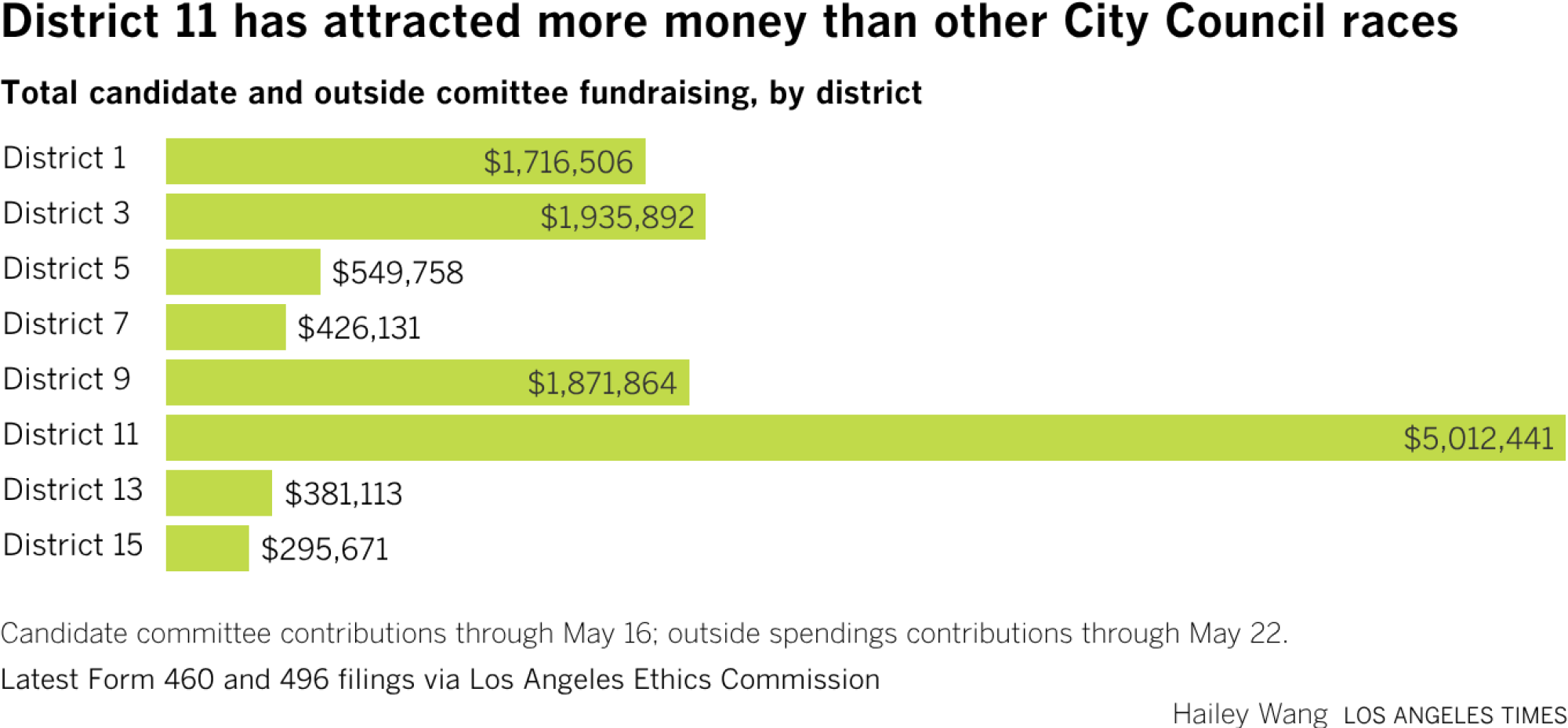
The contests for the seats being vacated by Councilmembers Bob Blumenfield and Curren Price have drawn large fields of candidates, but the biggest spending has been in the Westside’s District 11, where incumbent Traci Park is facing challenger Faizah Malik, a public interest attorney and one of four council candidates backed by the local chapter of Democratic Socialists of America.
Park has raised $1.3 million, according to the latest campaign finance reports filed Friday, while challenger Faizah Malik reported about $520,000 in contributions. In addition, more than $3 million has been spent in the race by so-called independent expenditure committees that spend money to elect or defeat candidates but which are barred from coordinating their activities with the campaigns.
The district includes Venice, Mar Vista, Brentwood and Pacific Palisades, which was devastated by wildfire in January 2025.
Malik said Friday she is confident heading into the primary election, saying most of her donations are under $100 each, and that she hasn’t taken money from corporations.
Los Angeles City Council candidate Faizah Malik attends a canvassing event March 15 in Westchester.
(Eric Thayer / Los Angeles Times)
“This is what it means to be a grassroots candidate, and it is just more evidence that the people of CD11 believe in our vision for a Westside that is affordable for everyday people,” Malik said.
A Park campaign aide said Park’s haul is indicative of the councilmember’s record of getting results.
“But no one is taking anything for granted,” the aide said in a statement. “We’re working until the final vote is cast because this election will determine whether the Westside keeps moving forward or gets pulled backward into the same failed ideological politics Angelenos are exhausted by.”
Los Angeles City Councilmember Traci Park, center, with members of United Firefighters of Los Angeles City on May 12.
(Genaro Molina / Los Angeles Times)
Park has emphasized her advocacy for fire recovery efforts, including pushing for permit fee waivers for residents wanting to rebuild. Malik has said Park has been too focused on single-family homeowners and said she would focus more energy on renters.
They have contrasting views on policing: Malik said she opposes expanding the size of the Los Angeles Police Department and instead supports shifting more resources to the city’s unarmed crisis response program. Park said the Police Department should have about 10,000 sworn officers, up from about 8,700 currently. She voted in favor of a 2023 LAPD contract that gave raises to officers and increased salaries to new hires.
They stand in contrast of each other on the Venice Dell housing development project, which would turn a city lot into 120 housing units for low-income and homeless people. Park opposed the completion and instead wants to turn it into a “mobility hub” and move the housing project to an adjacent lot. Malik, who represented the developer that filed a suit against the city claiming Park and others sought to kill the project, said the project was a motivating factor for her campaign.
District 9
Six candidates are vying to replace Councilman Curren Price, who hit the 12-year limit, in District 9. The district includes the Convention Center, USC and communities along the Harbor Freeway.
The candidates vary on key issues, including policing and housing. Estuardo Mazariegos, co-director of the Alliance of Californians for Community Empowerment Los Angeles, is backed by the Democratic Socialists of America. He has called for reducing the LAPD budget and redirecting funds to other city departments.
Two other candidates — Jorge Hernandez Rosas, an educator, and Jose Ugarte, who previously worked for Price — said they support hiring more police officers. Another hopeful, Elmer Roldan, executive director of Communities in Schools of Los Angeles, said he believes in keeping the LAPD at its current size.
Ugarte, Roldan, Rosas and Martha Sánchez, a therapist, all support enforcing Municipal Code 41.18, which bars homeless encampments near schools and daycare centers. Mazariegos and Jorge Nuño, an entrepreneur, say the code doesn’t solve homelessness and instead just moves people around.
Ugarte has raised the most in contributions of any candidate and has been endorsed by the Los Angeles County Democratic Party in the nonpartisan race.
District 3
Three candidates are competing for an open seat in District 3, where Councilmember Bob Blumenfield has termed out of office. The district encompasses Woodland Hills, Canoga Park, Reseda, Winnetka and Tarzana.
The candidates are Tim Gaspar, who founded an insurance company, Barri Worth Girvan, district director for Los Angeles County Supervisor Lindsey Horvath, and Christopher Robert “C.R.” Celona, a tech entrepreneur.
The three candidates are similarly positioned on public safety, backing Mayor Karen Bass’ long-term goal to increase the LAPD ranks to at least 9,500 officers. All three also support enforcing Municipal Code section 41.18.
Gaspar and Worth Girvan have both scored key endorsements. Gaspar is backed by Blumenfield, billionaire developer Rick Caruso and Councilmembers Monica Rodriguez, Tim McOsker and John Lee and billionaire developer Rick Caruso. Worth Girvan has endorsements from a long list of state Democratic lawmakers, the county Democratic Party, the Sierra Club and labor unions.
Gaspar leads in campaign contributions, followed by Worth Girvan. Celona, who has promised to resuscitate the city’s entertainment industry by fast-tracking film permits and cutting red tape, trails far behind.
District 1
Councilmember Eunisses Hernandez faces four challengers in District 1, which stretches from Highland Park on the northeast to University Park on the southwest. She is backed by the local Democratic Socialists of America, and her challengers claim the district has suffered under under her leadership, pointing to MacArthur Park as emblematic of the homelessness and drug addiction crisis plaguing the city.
Hernandez counters with a list of accomplishments, including helping secure a $6.3-million state grant to house homeless individuals near the Arroyo Seco riverbed and advocating for a citywide network of unarmed crisis response teams.
She faces challenges from Maria Lou Calanche, a former Los Angeles police commissioner and founder of the nonprofit Legacy LA; Nelson Grande, an executive consultant and former president of Avenida Entertainment Group; Raul Claros, founder of California Rising; and Sylvia Robledo, a small-business owner and former council aide.
Incumbent Katy Yaroslavsky faces two challengers for her District 5 seat, both of whom oppose her stance on housing and public safety spending. The district includes some of the city’s wealthiest neighborhoods, including Bel-Air, Westwood, Cheviot Hills and Hancock Park.
Challengers Henry Mantel, a tenants’ rights lawyer, and Morgan Oyler, an accountant, say Yaroslavsky hasn’t done enough to increase the district’s housing supply. Yaroslavsky, who holds a wide lead in fundraising, has said she supports increasing housing density near transit centers but cautioned against building more than the city can sustain.
District 13
Councilmember Hugo Soto-Martínez, who is also backed by the Democratic Socialists of America’s L.A. chapter, faces three challengers in District 13, which includes Atwater Village, Glassell Park, Elysian Valley, Echo Park, Silver Lake and East Hollywood.
The list of challengers includes Colter Carlisle, vice president of the East Hollywood Neighborhood Council, Dylan Kendall, who runs Grow Hollywood, and Rich Sarian, vice president of strategic initiatives for downtown’s South Park Social District.
While Soto-Martínez supports expanding the city’s unarmed personnel program, Carlisle and Kendall would like to expand the police force. Sarian has said he supports the unarmed personnel program and wants to examine the LAPD’s current size and resources.
District 15
Incumbent Tim McOsker is facing off against community organizer Jordan River in District 15, which covers Harbor City, Harbor Gateway, San Pedro, Watts and Wilmington. McOsker has decades of experience in the political world, having worked in the mayor’s office, and the city attorney’s office before joining the City Council in 2022. Rivers, who is unemployed, is a member of the Green Party.
District 7
Monica Rodriguez is running unopposed for the District 7 seat in the northeast San Fernando Valley.
Times staff writers David Zahniser, Noah Goldberg and Sandra McDonald contributed to this report.