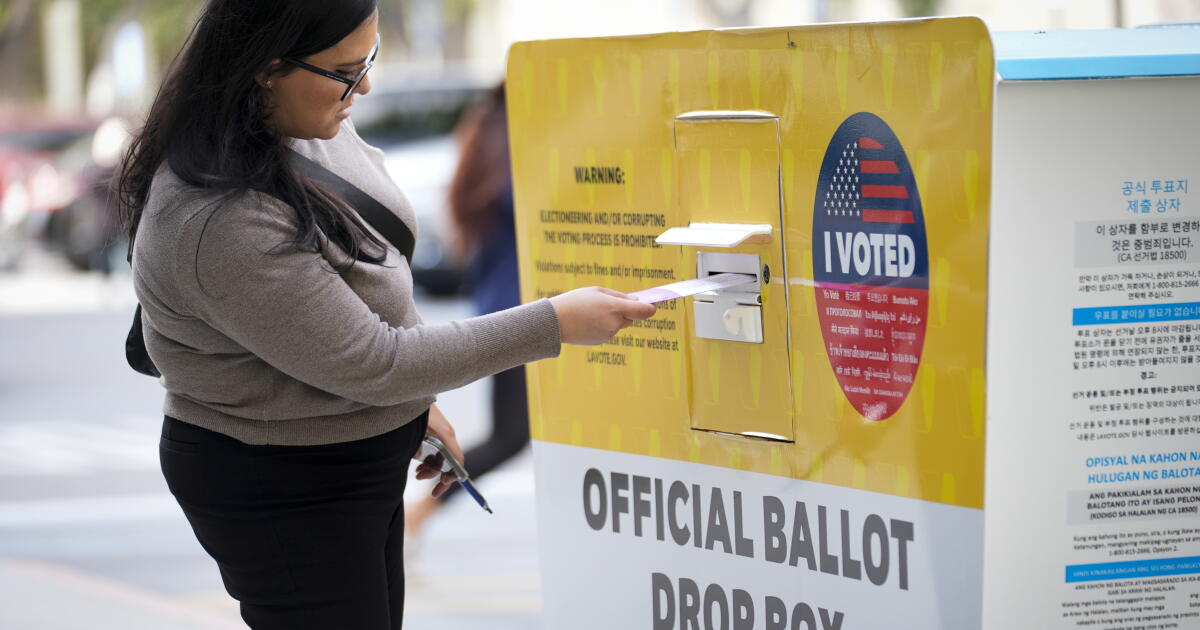
voter

Becerra advances to November, moves closer to becoming California’s first elected Latino governor

Veteran Democratic politician Xavier Becerra won one of the top two spots in California’s primary election for governor, according to the Associated Press, a finish that puts him in a prime position to win in November and make history as California’s first elected Latino governor.

“The people of the great state of California, in the greatest nation on earth, have spoken — loudly and proudly,” Xavier Becerra said in a statement Friday. “We will not be bought. We will not be bullied. And we are never backing down. November, here we come.”

Former Fox News host Steve Hilton, a Republican, remains in a close second and appears on the cusp of securing the right to face off with Becerra in the November general election.

Tom Steyer, a hedge fund manager turned climate change activist, may be destined to finish in third place — which would be a disappointing end to a campaign that saturated California’s television screens, social media scrolls and mailboxes thanks to the progressive Democrat spending $216 million of his own wealth.

Becerra’s victory was declared by the Associated Press on Friday evening, three days after the June 2 election — an indication of the competitive race to replace termed-out Gov. Gavin Newsom and California’s lengthy process of counting ballots. Still, Becerra and Hilton were within a percentage point of each other, though that could change as the vote tally continues. While his fate is not sealed, Steyer faces long odds to finish in the top two.

Under California’s primary system, only the two candidates who receive the most votes in the primary advance to the November general election, regardless of their party affiliation.

Becerra would enter the general election campaign with a significant edge over Hilton since Democratic voters in California outnumber Republicans by almost a 2-to-1 margin, a telltale reason why no GOP candidate has won a statewide race since 2006.

President Trump’s endorsement of Hilton helped consolidate support from Republican voters, which was pivotal to his success in the primary, but would likely hurt him in a face-off against Becerra. Nearly two-thirds of voters in the state want a governor who will fight Trump’s policies, according to the survey by UC Berkeley’s Institute of Governmental Studies that was co-sponsored by the Los Angeles Times.

Becerra could make history by becoming the first Latino to be elected governor — and the first to lead the state in more than 150 years. The last time a Latino held the office was in 1875, when then-Lt. Gov. Romualdo Pacheco was elevated to fill a vacancy and served for 10 months.

“California has made history. Xavier Becerra’s advancement to the general election is a defining moment both for the state, and for the millions of Latino families who have been instrumental in shaping the state’s future. … As home to the nation’s largest Latino population, California will once again demonstrate the decisive power of Latino voters,” said Voto Latino Executive Director Beatriz Lopez.

Though Latinos make up about 40% of the state’s population and are California’s largest ethnic group, they historically have lower turnout in elections and are underrepresented in government. Though Becerra often cites his upbringing as a child of working-class Mexican immigrants, he will still need to demonstrate he can deliver for those communities, said Christian Arana, vice president of civic power and policy at the California-based Latino Community Foundation.

“There’s a lot of excitement about the representation side,” Arana said. “You can have Latino representation, but whether or not that will actually lead to tangible outcomes for Latino communities, that’s what people want to know.”

Once stuck in the single-digits in public opinion polls with a handful of other Democratic candidates, Becerra rose quickly and unexpectedly following the political demise of former Rep. Eric Swalwell.

Becerra’s rise began days after Swalwell dropped out in April following allegations of sexual assault and misconduct, which he denies. Becerra quickly consolidated support from elected officials including Assembly Speaker Robert Rivas and influential groups like Planned Parenthood Affiliates of California and the California Medical Assn.

But both supporters and critics of Becerra struggle to explain exactly how or why he became the main beneficiary of Swalwell’s downfall.

Becerra’s campaign credits the timing of a major television and digital advertising push. The political ads began running just before the allegations against Swalwell came out and depicted Becerra as a calm, experienced leader with a record pushing back against Trump and support from Young Democrat groups.

Steyer’s campaign hired an intelligence firm to look into the online surge favoring Becerra and found thousands of bot accounts had amplified Becerra on various social media platforms. Becerra’s campaign denied any involvement and dismissed the influence of the fake accounts.

Political experts describe it as the stars aligning for the longtime Democratic politician. In the aftermath of the scandal, voters were apparently drawn to Becerra’s long resume and calm, thoughtful demeanor.

“He just never overreacted. Even when attacked [during debates], he was calm,” said Fernando Guerra, professor of Chicano Studies at Loyola Marymount University. That “gave the sense of being a moderate, while he’s really a liberal, so he was able to appeal not only to Latinos, but to liberals and to moderates.”

After Swalwell’s campaign crumbled, members of the political brain trust — many with ties to Newsom — that had been advising the former congressman began working for Becerra, including digital strategist Alf LaMont and veteran consultants Courtni Pugh and Lindsey Cobia.

“There was nothing going for him for a long, long time,” said Jason McDaniel, associate professor of political science at San Francisco State University. “I do think it was just people looking for someone who had a lot of experience who could win.”

Becerra’s first election victory was to the state Assembly in 1990. He served one term before successfully running for a Los Angeles congressional seat, which he held for 24 years.

Then-Gov. Jerry Brown appointed Becerra as state attorney general in 2017, a post he used to challenge Trump administration policies in the courts more than a 100 times — with great success. Becerra helped craft the Affordable Care Act in Congress and defended it as attorney general, and Joe Biden nominated him to serve as Health and Human Services secretary.

The 68-year-old veteran elected official has faced criticism on the campaign trail for his record leading the massive federal agency, particularly over a New York Times investigation that found thousands of unaccompanied migrant children ended up working in dangerous jobs after they were released to sponsors.

Some former Biden administration officials, many of them anonymous, have also criticized Becerra’s leadership of the agency.

Still, Becerra’s supporters said the candidate’s experience, particularly when it comes to fighting the Trump administration, qualifies him for California’s top job.

“He’s had some very important positions in government,” labor leader Dolores Huerta said at Becerra’s election night party in downtown Los Angeles. “He is qualified. He doesn’t have to go into a learning mode.”

“He’s a legal scholar,” said David Dixon, a political science professor at Cal State Dominguez Hills and brother to a longtime Becerra aide. “When our Constitution is threatened, we need people like him to be in positions of power to reclaim things we are losing now.”

Times staff writers Seema Mehta, Dakota Smith and Andrew Khouri contributed to this report.

Source link

U.S. attorney says FBI and federal prosecutors are investigating alleged election fraud in California

First Assistant U.S. Atty. Bill Essayli on Friday morning said his office “has multiple election fraud investigations underway,” in coordination with the FBI in Los Angeles.

Essayli’s remarks, posted to X, seemed to be in response to President Trump alleging in his own social media post late Wednesday that Democrats in California were “cheating” in the state’s primary election, and that there was an investigation underway in Essayli’s office.

Essayli’s office also confirmed that one of its prosecutors — Assistant U.S. Atty. Robert Renner — was at a Los Angeles County ballot processing center Friday “to observe the vote counting process.”

A spokesperson for Dean Logan, head of the L.A. County registrar-recorder/county clerk’s office, described the visit as in line with other routine observations of the counting process, which is open to public observation by appointment.

Democratic officials firmly rejected Trump’s claims of cheating, which they had warned he would make in advance of the election given his long record of objecting to and claiming fraud in elections he and his party lose.

Trump provided no evidence for his claims, other than to complain about California taking a long time to count ballots and criticizing its mail ballot system, suggesting it was a source of fraud. California officials have acknowledged the process takes longer than they would like, but said that is a result of a careful, accurate count of millions of ballots, many of which were mailed on election day.

“Taking the time to do this work correctly protects voters’ rights and ensures the integrity of our elections,” California Secretary of State Shirley Weber said Thursday. “California has built a strong system that expands access, empowers voters, and ensures more Californians can fully participate in our democracy.”

According to Weber’s office, about 5.6 million ballots had been processed in the state as of Thursday evening, while an estimated 3.6 million additional cast ballots remained.

Steve Hilton, a Republican who was leading in the gubernatorial race, said Friday that he expected to make it to November’s head-to-head race between the top two primary finishers — despite Trump insinuating Democrats were rigging the vote to exclude him. But Hilton also lambasted the state for counting so slowly, and said Gov. Gavin Newsom should deploy state resources to help ensure results are verified by next Thursday.

“This shambles is absolutely shameful for our state,” Hilton said, of the slow results.

Newsom’s office dismissed Hilton’s comments as uninformed. “It’s concerning that a candidate for Governor doesn’t know the Governor has nothing to do with counting ballots,” said Brandon Richards, Newsom’s deputy director for rapid response.

Essayli — a Trump loyalist the administration has kept in charge of one of the country’s largest federal prosecutor’s offices through a legal loophole, and despite his failing to be confirmed by the Senate — said he would not comment “on any specific investigation.” But he added that protecting California’s elections is “a top priority” for his office, and that “California’s election system has serious structural vulnerabilities.”

He said California’s mail ballot system, which a vast majority of voters rely on in the state, and its voter ID requirements — he said there were none, but California does have measures to ensure voters are who they say they are, including signature verification — create “conditions where fraud can go undetected and unpunished, eroding public confidence.”

“We will follow the evidence wherever it leads and prosecute any violations of federal election law to the fullest extent,” Essayli said.

He also noted that his office is working with Assistant Atty. Gen. Harmeet Dhillon, head of the Justice Department’s Civil Rights Division, to “conduct a comprehensive audit of California’s voter rolls.”

The Justice Department sued the state for its voter rolls, in a lawsuit that was thrown out by a federal judge who called the demand “unprecedented and illegal” and accused the federal government of trying to “abridge the right of many Americans to cast their ballots.”

The Justice Department appealed the ruling, and the case is now before the U.S. 9th Circuit Court of Appeals.

“The state has stonewalled every effort to verify that only eligible U.S. citizens are registered to vote,” Essayli wrote. “My office will not look the other way. We will investigate and prosecute. Every legal vote deserves to be counted. Every illegal vote cancels one out.”

Essayli’s office did not provide any additional information about Renner’s presence at the county balloting center, or about its fraud investigations. Essayli also provided no evidence of widespread fraud or acts by Democrats in the state to rig or steal the election, as Trump continued to claim Thursday.

Essayli did, however, point to a case in which a woman recently pleaded guilty to paying homeless people on Skid Row to help get initiatives on the California ballot. “Yes. There is evidence of election fraud in California. Here’s a case we charged just last month. More investigations are underway,” Essayli wrote.

Election experts say there are certainly examples of fraud in voting, but they are isolated and rare, and there is no evidence that fraud is widespread or exists in volumes large enough to sway elections. They note Trump has tried to argue such fraud in the past — including in disputing his 2020 loss to Joe Biden — but has never been able to prove it.

Michael Sanchez, Logan’s spokesperson, said Logan’s office was notified by Essayli’s office late Thursday that an assistant U.S. attorney would be visiting the ballot processing center to observe.

“The individual arrived this morning, was provided an overview of the public observation program, and participated in a walkthrough of the ballot processing operations,” Sanchez said.

Sanchez said election officials “routinely host observers representing a wide range of interests, including members of the public, candidates, political parties, advocacy organizations, and government agencies.”

California Atty. Gen. Rob Bonta’s office has also been involved in monitoring ballot processing in the state, including during last year’s vote on Proposition 50.

On Friday, Bonta acknowledged Renner’s presence at the L.A. County facility, and said his office also had a presence at the facility, was “monitoring the situation closely, and stands ready to protect voters and ensure California’s election laws are followed.”

Other Democrats in the state have also defended the state’s election process and blasted Trump for calling it into question.

“Let’s be honest about what this is: A blatant attempt to cast doubt in our election results, and a phony pretext for Trump to act illegally in the midterms,” Sen. Adam Schiff (D-Calif.) wrote on X. “California has safe and secure elections. And it takes time for every vote to count. It’s called democracy, Donald.”

Source link

City attorney likely to be first incumbent to lose primary since 1933

The last time Angelenos sacked an incumbent city attorney in the primaries, almost 30% of them were unemployed.

That was May 2, 1933, the nadir of the Great Depression, when sprawling encampments blanketed downtown, King Kong ruled movie theaters and violent crime reached a fever pitch not seen again for almost half a century.

Incumbent City Atty. Hydee Feldstein Soto’s near-certain defeat on Tuesday may have little in common with Erwin P. Werner’s primary loss 93 years ago, but themes of Depression-era Los Angeles echo through the contest.

Marissa Roy, a deputy attorney general with the California Department of Justice who leads the race with ballots still being counted, wooed voters with shoe-leather and social media savvy, promising to use the office to fight for wage workers and tenants. But it was the city’s powerful unions and its increasingly democratic socialist bloc that propelled her to the top spot, mirroring the coalition that drove California’s sharp left turn in the early 1930s.

Meanwhile, county prosecutor John McKinney tapped into voter frustration with homeless encampments, a blighted downtown and general distrust of City Hall to pull off a last-minute heist of the second runoff spot. McKinney only started campaigning in earnest five weeks ago, but managed to win votes with a tough-on-crime campaign — even as some categories of city crime have dipped to historic lows.

Karen Bass, left, shares a laugh with Hydee Feldstein Soto

L.A. Mayor Karen Bass, left, shares a laugh with L.A. City Atty. Hydee Feldstein Soto, right, at Avance Democratic Club’s politics and tacos event on May 16.

(Christina House / Los Angeles Times)

As of Thursday morning, Roy had nearly double the number of votes of Feldstein Soto. McKinney led the incumbent by 13 percentage points for the second runoff slot. The race has not yet been called, but Feldstein Soto issued a statement effectively conceding the race Wednesday morning. She acknowledged that “the voters had spoken” and referenced “her successor’s administration.”

Her campaign did not respond to a request for comment for this story.

The ouster of Feldstein Soto would be nearly unprecedented. Werner’s 1933 loss is the only similar instance since the city adopted its current primary ballot process in 1917, according to the City Clerk’s office. No other incumbent city council member or mayor has ever failed to advance out of the primary when facing two or more opponents.

“This is not something that has happened in the lifetimes of most people who follow city government,” said Mike Bonin, former City Council member and executive director of the Pat Brown Institute for Public Affairs at Cal State L.A.

McKinney’s sudden emergence in the race in May saw him hijack the incumbent’s support from law enforcement. His campaign received $3 million worth of independent expenditures. An official with a group supporting McKinney — who spoke on condition of anonymity because they were not authorized to speak to the media — said an internal poll showed Feldstein Soto falling nearly 10 points outside the runoff a week before election day.

Since Roy had already captured the support of the county Democratic Party and energized left-leaning voters, that put Feldstein Soto in the center, analysts said, which left her vulnerable in a race that most people casting ballots hadn’t closely followed.

“To the extent that people had any information, they knew that one of them basically wanted to be tougher and somebody on the other side wanted to be kinder, that left her with very little room to maneuver,” said Roy Behr, a longtime consultant to veteran politicians in the city.

Roy “micro-targeted” likely progressive voters in social media spots, experts said, presenting as an affable presence in her ever-present purple blazer while sharing her vision of serving as the “people’s lawyer.”

 Marissa Roy

Marissa Roy, a deputy attorney general with the California Department of Justice, appears poised to finish first in the June 2 primary race for L.A. city attorney.

(Gary Coronado / For The Times)

Boosted by a massive influx of cash from rental giant Airbnb, some of McKinney’s ads played up his hard-luck upbringing in one of New Jersey’s most violent cities. His campaign also sent out texts that painted his opponents as “George Gascón”-style Democrats, invoking the former progressive district attorney as a bogeyman for voters anxious about crime.

AI-generated videos depicted McKinney as a stoic, suit-clad crime fighter walking through a dystopian version of L.A.’s Metro system.

“The debate isn’t necessarily two candidates on one stage appealing to one person, it’s for attention and information in the same sphere,” said Spencer Slovic of Mycorrhiza Digital, who ran Roy’s digital advertising. “That battle of information will play out almost in different realms.”

Without a compelling story for her powerful but poorly understood role, Feldstein Soto often struggled to explain her achievements in office.

In a recent interview with The Times, she said she delivered on “public safety, public integrity and public services.” She went on to discuss granular improvements she made to the office, such as limiting access to law enforcement databases by former employees, modernizing internal systems and improving the rapport between the city attorney’s office and LAPD. By her own admission, she doesn’t often publicly celebrate her accomplishments.

“I didn’t hold some big press conference and hop up on a white horse and declare myself Joan of Arc and the savior of all things Los Angeles,” she said. “Which I could have done.”

Tumult during Feldstein Soto’s lone term in office was easier for voters to identify. The cost of litigation exploded. A high-ranking city lawyer accused her of abusing her power, prosecuting political enemies, mistreating employees and engaging in “inappropriate alcohol consumption.” Feldstein Soto claimed she improved her office’s rapport with the LAPD, but the police union’s decision to rescind its endorsement of her and instead back McKinney cost her a key voting bloc.

Feldstein Soto’s messaging was at times muddled and lacked the flair of her challengers, political observers said. Campaign finance records show she paid for 80 email blasts, mailers and other messages that sought to influence voters.

John McKinney

John McKinney, a Los Angeles County prosecutor, appears set to advance to a run-off against Marissa Roy in the race for L.A. city attorney.

(Kayla Bartkowski / Los Angeles Times)

In one video, she stood in front of a static background and talked for three minutes straight about her record while describing her opponents as representing the “extreme left” and “extreme right.” She attacked both for receiving large sums of money from “special interests,” especially McKinney for accepting Airbnb’s largesse. Feldstein Soto sued the rental giant for price gouging in the wake of the 2025 wildfires.

Roy’s campaign sent out 180 communications, records show, the bulk of them ads for Instagram and Facebook, where her team said they saw instantly which stories resonated with likely voters and which were duds.

Slovic said a “clip of Hydee talking about how she wasn’t going to prosecute the Trump administration” seemed to touch a nerve with voters.

“That was by far our best performing ad,” he said, adding, “What Democrats really want in primaries is someone who will fight and have some sort of backbone.”

McKinney had just 23 communications, campaign records show, plus 19 more made by independent groups. He often leaned into the same gritty visuals that defined mayoral candidate Spencer Pratt’s viral AI spots.

In a race for a position most voters don’t understand, McKinney’s and Roy’s ability to play a consistent character may have proved critical, political analysts said.

The vast majority of voters started off with no strong feelings about the race,” Behr said. “Nobody had any votes locked down other than their friends and neighbors.”

Source link

Live Election 2026 primary results, updates: races too close to call as ballots counted

More than a day after polls closed, voters still hadn’t learned which two candidates would run off in the November general election for dozens of races.

Many significant races are still too close to call. In the race for governor, Republican Steve Hilton and Democrat Xavier Becerra held leads, with Democrat Tom Steyer and Republican Riverside County Sheriff Chad Bianco trailing. Former Los Angeles Mayor Antonio Villaraigosa, San José Mayor Matt Mahan and former Rep. Katie Porter conceded the race Tuesday night.

The Associated Press surveys the numbers posted by local election officials and projects the winner using vote returns and other data. Races can be called within minutes of polls closing on election night. However, if a race has tight margins or an high expected volume of mail-in ballots, it can take longer to call.

In some cases, such as for L.A. mayor and state treasurer, the tight race is between second and third place.

In California’s primary, the top two vote-getters move on to the general election regardless of candidate pool size, party preference, or whether one candidate receives a majority of votes. Locally and in nonpartisan races, however, a candidate can avoid the November election if they win with a majority.

Statewide

State Senate

State Assembly

Congress

Almost half of California’s 52 U.S. House of Representatives seats had known finalists on election night. But in tight races such as the Republican vs. Republican competition in the 40th District and the Democrats’ challenging of Republican Rep. David Valadao in a redrawn 22nd District, the top two vote-getters weren’t yet known.

Local

In Los Angeles County, there were still 27 races with uncertain results. The Times considers uncertain races those where no candidate has a majority or where the vote share for the top two is between 55% and 40%. The Associated Press does not call winners for most local races, such as city councils, city officers and ballot measures. If no candidate wins with a majority, the top two will face off in November. That could be the case for the sheriff and L.A. City Council’s 3rd District.

The L.A. County registrar will continue to count and confirm mailed-in, provisional and conditional ballots until June 26. Updates to the results charts below are expected approximately once a day in the early evening.

Close city races

Voters can track their own cast ballot here.

The secretary of state will certify results in early July.

Source link

Trump, without proof, claims ‘cheating’ in California vote, says federal probe underway

To the surprise of few, President Trump has once again claimed without evidence that Democrats are somehow cheating to win California’s primary elections — writing on social media late Wednesday that federal prosecutors in Los Angeles are investigating the matter.

“The Dumocrats are at it again! They are trying to STEAL THE GOVERNOR OF CALIFORNIA PRIMARY, AND THE MAYOR OF LOS ANGELES, PRIMARY, AWAY FROM TWO GREAT REPUBLICAN CANDIDATES. Here we go with the very late and massive numbers of MAIL IN BALLOTS,” Trump posted to his social media platform Truth Social.

“There’s BIG cheating by the Dumocrats in California. Votes are all tied up. May not be in for weeks. Under investigation by the U.S. Attorney’s Office in Los Angeles,” he wrote in a second post. “Why the vote counting DELAY???”

A spokesperson for the U.S. attorney’s office in Los Angeles — run by Trump loyalist First Assistant U.S. Atty. Bill Essayli — declined to comment Thursday morning on Trump’s claims of an investigation.

California Secretary of State Shirley Weber’s office also did not immediately respond to a request for comment.

Gov. Gavin Newsom’s office responded directly to Trump late Wednesday with its own social media post, writing, “Trump is lying about California again — time to take the phone away from grandpa and put him to sleep.”

On Thursday morning, Newsom’s office wrote that there “is a lot of misinformation floating around about California’s election — including from the President,” and recommended people watch a CNN video about California’s election process. It concluded that delays in vote counting in the state are essentially a result of state leaders deciding that providing voters with “last minute options” for casting ballots is more important than a quick count.

“And yes, for the record: we wish the votes were counted faster, too,” Newsom’s office wrote — a nod to the fact that the issue isn’t new.

In an email, Brandon Richards, Newsom’s deputy director for rapid response, said Trump’s claims are part of “a tinfoil hat level conspiracy theory that has been debunked repeatedly.”

The president’s claims of cheating were predicted before the election by both elections experts and Democratic leaders in California, who dismissed them in advance as more baseless bluster from a president beset by low approval ratings.

A worker counts ballots

A worker puts ballots in a counting machine at the Los Angeles County Ballot Processing Center on Wednesdayin City of Industry.

(Kayla Bartkowski/Los Angeles Times)

Those same experts and Democratic leaders acknowledge that California’s system for counting votes takes a long time and should be quickened, but stress that is not because of anything nefarious. Rather, it is because California allows voters to cast ballots by mail up until election day — and then has to count those ballots, which can number in the millions and are subject to manual signature verification.

Trump has long dismissed such explanations. An election denier since he first entered politics more than a decade ago, Trump has pushed skepticism about elections he and his party lose time and again since — most notably when he claimed, again without evidence, that the 2020 election he lost to Joe Biden was stolen.

Trump even challenged Biden’s victory in court, but his claims were rejected completely because neither he nor his attorneys could produce any evidence substantiating them.

He has combined his tactic of targeting undocumented immigrants for political gain with his skepticism of election integrity by claiming, again without evidence, that such immigrants somehow vote in large numbers, particularly in big blue states such as California, despite experts saying there is no evidence of that.

He has alleged that mail ballots — such as those used by the majority of California voters — are a particularly rich source of voter fraud, despite again having no basis for the claim and it being disputed by experts.

A consistent feature of his election fraud claims is that they arise and target races only when Republicans lose or lose ground.

And, he has tried to use the power of his administration to make sweeping changes to election laws to bar mail ballots and require strict voter ID and proof of citizenship measures, despite the control of elections and their rules being constitutionally given to the states.

Those efforts have prompted a wave of litigation between the Trump administration and California and other blue states, with multiple cases pending in the courts over voter ID, proof of citizenship, mail balloting and the role that the U.S. Postal Service may be allowed to play in processing such ballots.

Trump’s latest remarks came as additional vote counting on Wednesday narrowed the advantage of Republican Steve Hilton over his Democratic challengers in the California governor’s race and closed the gap in the L.A. mayoral race between the MAGA-aligned candidate Spencer Pratt, currently running second, and City Councilmember Nithya Raman, who is running third.

The trend was anticipated. Elections experts warned before vote counting began of the potential for a “red mirage,” wherein earlier voting among Republicans and late voting among Democrats — many of whom were unsure of whom to vote for in the two high-profile races — would create an early illusion of Republican victories despite large volumes of liberal votes from major population centers still to be counted.

It is a trend that has played out repeatedly in past elections, and one that does not come as a surprise to careful elections watchers.

Elections officials in California knew such claims were going to be made, as they’ve been made in the past. Some local elections officials made a point of preparing their staffs for baseless claims of election fraud in advance of this year’s primaries. State officials made repeated efforts to explain the reasons why California elections take time, precisely to undercut claims amid counting that the delays were the result of fraud.

But those claims have come regardless, and not just from Trump.

Above an X post Wednesday suggesting Pratt was losing ground to Raman as more counts came in, Florida Gov. Ron DeSantis wrote, “California keeps dumping votes. Odds are shifting because the vote dumps always seem to go one way. Count until you get the result you want?”

Above another X post Wednesday noting that the California count would take time, Katie Miller, a former Trump administration official and conservative podcaster married to Trump’s top advisor Stephen Miller, wrote, “The Democrats are about to steal the LA mayoral race once again using mail-in voting.”

Both of the posts that DeSantis and Miller were responding to were from Polymarket, a prediction market where people can bet on the outcomes of political races, pop culture events and a slew of other subjects.

Such emerging financial markets, which process billions of dollars in bets, are causing rising concerns about political meddling for profit — including by campaign staffers and other individuals with insider knowledge of polling and other campaign information, or by politicians and their operatives, whose public remarks about politics can swing those markets.

Source link

Hilton and Becerra lead California governor’s race; Steyer faces elimination

As election officials continued tallying ballots Wednesday, Republican Steve Hilton and Democrat Xavier Becerra continued to lead in the unsettled race to replace termed-out Gov. Gavin Newsom, with billionaire Democrat Tom Steyer hoping for a surge in late-arriving votes to push him into one of the top-two spots to advance to the November general election.

Hilton, a British immigrant and former Fox News commentator, told reporters outside the state Capitol in Sacramento Wednesday morning that he was “very encouraged” by the latest results, though he stopped short of declaring victory.

“It does look as if change is coming to California, and that is good news for everyone, every small business, every working family, everyone who wants to see our state set back on track,” he said.

Becerra and Steyer did not hold public events as of Wednesday afternoon.

Election data analyst Paul Mitchell said it would be nearly mathematically impossible for Steyer to close the gap.

“As we start to get more data, the runway is going to get shorter and shorter,” he said.

He said Steyer, to finish in the top two in the primary, would have to get about 30% of the remaining uncounted votes while Becerra would need to be limited to 15%. The self-funded billionaire has “a very high hill to overcome, and the challenge gets steeper and steeper as we get more data from the counties,” Mitchell said.

Once mired near the bottom of a crowded pack of Democrats in opinion polls, Becerra, a former Biden administration cabinet member, rocketed ahead of his rival candidates after former Rep. Eric Swalwell dropped out of the race in April amid allegations of sexual assault and misconduct. The scandal triggered an upswing of voter interest in California’s once sluggish governor’s race and in Becerra, who seized the moment.

“Here in Hollywood’s hometown, we love a good underdog story,” Becerra told cheering supporters at his election night party at La Plaza de Cultura y Artes in downtown Los Angeles.

Becerra spoke about his Mexican immigrant parents and becoming the first in his family to attend college. Though a longtime California politician, Becerra said that his campaign for governor was outspent and that he faced calls to drop out of the race.

“The underdog stayed in the fight,” he said. “Like my parents, I never gave up. … Never stopped believing in the beacon-light goodness of California and thankfully, neither did you.”

Steyer, who spent more than $216 million of his wealth on the race, has not conceded defeat.

His campaign manager, Heather Hargreaves, wrote in a letter to supporters Wednesday that “we’re going to give democracy time to work. County election officials are still counting ballots and don’t expect to know how many people voted in total until” Thursday, when officials are required to report the estimated number ballots left to process.

The billionaire former hedge fund owner campaigned against the corporate and special interests that have a powerful presence in Sacramento and often spend heavily in elections, including this year against Steyer.

Billionaires “do everything they can to hoard their wealth and avoid paying taxes, and we see corporations continue to rig the system for themselves — raising your prices to juice their profits. Screw that,” Steyer said at his election watch party at the Regency Ballroom in San Francisco.

Other candidates in the race included Republican Riverside County Sheriff Chad Bianco and Democrats including former Rep. Katie Porter, San José Mayor Matt Mahan, former Los Angeles Mayor Antonio Villaraigosa and state Supt. of Public Instruction Tony Thurmond.

Villaraigosa, Mahan and Porter conceded the race Tuesday night.

California’s 2026 race for governor started slow but ended with a flourish, including the demise of a scandal-ridden Democratic favorite, the anointing of a Republican by Trump and Becerra’s unexpected rise from the depths of the candidate field.

Unlike gubernatorial elections in the last quarter of a century, this year’s race lacked a clear crowd-pleasing front-runner able to win over voters, such as movie star Arnold Schwarzenegger or Jerry Brown, a sage of the California electorate and scion of a storied political family. But it unfolded at a time when the state’s residents are overwhelmed by high housing costs, steep gas prices and overall unaffordability that threatens the “California dream” that once drew millions of people to the state.

“Normal people are not living and breathing politics on a daily basis,” said Tim Rosales, a strategist who ran Republican John Cox’s unsuccessful 2018 gubernatorial campaign. In today’s information-saturated environment, Rosales said, the race and its roster of “extremely milquetoast candidates” didn’t break through until the Swalwell scandal grabbed voters’ attention.

The 2026 gubernatorial primary has been one of the most unpredictable and expensive in decades and a race that was shaped early on by a number of heavyweight Democrats staying on the sidelines.

Though supporters urged them to run, former Vice President Kamala Harris, Sen. Alex Padilla and Atty. Gen. Rob Bonta passed on the race. It was in a state of limbo for months last year as Harris, one of the state’s most high-profile politicians, weighed whether to jump in.

“I don’t ever recall a playing field that looks like this one. Usually there’s a clear front-runner,” said veteran Democratic strategist Darry Sragow. “It’s easy to say that it reflects a lack of talent [but] that’s absolutely not true. Almost any of the candidates running could make a good governor.”

Still, candidates struggled for months to break through to voters.

In February, polls showed the crowded field of Democrats splitting liberal voters and opening a statistical possibility that the party would be boxed out of November under California’s open, top-two primary, which places all candidates on the same ballot. Only the first- and second-place finishers in the primary advance to the general election, regardless of their party affiliation.

Just when Swalwell appeared on the cusp of becoming the Democratic front-runner the San Francisco Chronicle and CNN published allegations that he sexually assaulted a former staffer and acted inappropriately with other women. Swalwell suspended his campaign.

It was Becerra who benefited the most. In less than two months, he vaulted from polling in the low single digits to the top of the field of candidates, according to surveys conducted by UC Berkeley’s Institute of Governmental Studies that were co-sponsored by the Los Angeles Times.

“Becerra caught lightning in a bottle,” Rosales said. “It could have easily gone to any of the other candidates,” but many had baggage. Videos of Porter losing her temper hurt her image, the source of Steyer’s wealth and his unbridled campaign spending weighed on voters’ minds, and Villaraigosa and Mahan were “more centrist than what most Democrats wanted, and so Xavier Becerra was really the safe choice,” Rosales said.

Before Democratic voters began to narrow down their choices, Trump endorsed Hilton in early April. It helped the former Fox News host break away from Bianco, his main GOP rival.

In the days before the primary election, the race solidified into a three-way contest involving Becerra, Steyer and Hilton.

Steyer stepped up his fight in the remaining days, seeking to squeeze into one of the top two spots by battering Becerra in ads and at campaign rallies as a politician propped up by corporate special interests.

“We cannot afford to have a governor who’s been bought off by Big Oil. Period,” he said at a Sunday rally in Los Angeles.

Corporations, along with labor unions and interest groups including the California Assn. of Realtors, had spent more than $18.7 million to boost Becerra, according to the election spending tracker California Target Book. Many of the same groups also gave money to a committee intended to attack Steyer.

As the election neared, Becerra sharpened his attacks against Steyer, calling the billionaire a “liar” and accusing him of trying to buy the election.

“We are not going to let a billionaire or Trump’s handpicked candidate take over this state,” he said during a Sunday rally in Long Beach.

If Becerra faces off with Hilton in November he’ll have a distinct advantage. Democratic voters outnumber Republicans nearly 2 to 1 in left-leaning California.

Winning the general election would make the 68-year-old Becerra the first elected Latino governor of California. At roughly 40% of the state’s population, Latinos are California’s largest ethnic group but have not been represented in the governor’s mansion since 1875, when then-Lt. Gov. Romualdo Pacheco was elevated to fill a 10-month vacancy.

Times staff writers Iris Kwok, Susanne Rust, Andrew Khouri and Christopher Goffard contributed to this report.

Source link

Takeaways from the California gubernatorial primary election

After all the buildup, fear and uncertainty, the most wide-open and unpredictable California gubernatorial primary in decades appears to have ended in the most consistent and predictable of ways.

California has never elected a female governor. That won’t change in November.

Voters have never much cared for rich people trying to buy the state’s highest elected office. They still don’t.

The California electorate has typically favored experience over youth, and favored bland and boring over razzle and dazzle. It continues to do so.

And for all the speculation about one political party or the other being shut out in Tuesday’s primary, the November runoff may very well turn out to be a thoroughly conventional Democrat vs. Republican matchup.

Here are five takeaways from a gubernatorial contest that was sedentary and sleepy until, suddenly, it wasn’t.

Flashback!

Three months ago, Xavier Becerra seemed so irrelevant he — along with a clutch of other weak-polling candidates — was conspicuously excluded from a scheduled debate at USC. Today, the Democrat has seemingly punched his ticket to November.

The obvious parallel is with another massive underdog, Gray Davis, who also came from far behind to win the last time a gubernatorial primary held this level of uncertainty and suspense. That was back in 1998.

Like Davis, Becerra has a political persona that could be marketed as a sleep aid. No one will ever mistake either of them for, say, Arnold Schwarzenegger. But Becerra’s even-keeled demeanor seemed the perfect prescription following the overnight implosion of Eric Swalwell’s scandal-scarred campaign while presenting a welcome contrast with the endless Sturm und Drang emanating from Washington, D.C.

Despite California’s star-struck reputation (perpetuated mainly by outsiders), the state has elected far more governors like Davis and Becerra than Schwarzenegger and Ronald Reagan. In fact, other than Schwarzenegger, who prevailed in an unprecedented recall campaign, every candidate following Reagan has successfully run for statewide office at least once before being chosen governor.

Becerra was elected attorney general before heading to Washington to join the Biden administration; his candidacy offered worn-out voters a safe harbor amid the Trumpian tempest.

Cha-ching!

There are things money can’t buy which, Tom $teyer — er, Steyer — is just the latest to discover.

The hedge fund billionaire turned Democratic activist sank more than $215 million — a record — into his gubernatorial bid, after spending nearly $350 million in a failed 2020 try for president.

With roughly 60% of the vote counted, he was running an unimpressive third and hoping a lopsided surge of still-to-be-counted ballots will push him into the top two.

Half a billion dollars, which makes for a pretty pricey, “Meh.”

California has a long record of rejecting money-bag candidates for governor and the U.S. Senate — a pattern stretching back more than half a century. Given that hostile history, Steyer would enter the runoff as a distinct underdog, notwithstanding the many added millions he is poised to spend.

“These filthy rich people who don’t have to deal with the kind of financial struggles that people have in connection with their daliy lives just don’t feel relatable,” said Garry South, who ran Davis’ successful 1998 campaign against the free-spending Steyer of his day, former airline executive Al Checchi.

Given the relentlessly negative campaign Steyer has waged, besieged voters could count on many more ugly months of brutality on the airwaves, on computer screens and in their mailboxes.

The only happy ones would be TV station managers and political consultants cashing Steyer’s super-sized checks.

A self-fulfilling prophecy

It was never likely. But the mere prospect of Democrats being shut out of the November runoff was enough to guarantee such a scenario would not happen in this reliably blue state.

With a large pack of Democrats running and just two serious Republican contenders, Democratic partisans feared their fractured vote would let the GOP nab both spots in Tuesday’s top-two primary.

Much of the freak-out was fed by polls supposedly showing Republicans Steve Hilton and Chad Bianco atop the field. But no candidate ever had much more than a paltry 20% support; for all the heavy breathing, the race was always pretty much a multi-candidate tie.

Fearing the worst, however, voters who normally couldn’t tell a “jungle primary” from a jungle gym began thinking a lot like gimlet-eyed political strategists. Democrats, in particular, held onto their ballots much longer than usual, waiting to see which candidate appeared strongest at the end.

“The decision matrix on this was not just the political insiders, but all the normies who heard there might be two Republicans,” said Paul Mitchell, a Sacramento political data expert who developed a popular online tool handicapping various election scenarios. “They’re talking to friends and families. It was kind of crazy.”

In the end, the race among Democrats became less a contest than a self-fulfilling prophecy. Becerra was seen as the candidate with the best chance of advancing to November, so many voters flocked his way — ensuring he would advance to November.

Now he waits to see whether his opponent will be Hilton or Steyer.

Sacramento still a boy’s club

More than 30 states have elected female governors. A few have done so multiple times. But come January, California — which perceives itself as oh-so-cutting edge on oh-so-many things — will install the 41st in the state’s unbroken line of male governors.

Things might have been different had Kamala Harris jumped into the contest. The former vice president, U.S senator and California attorney general would have been a prohibitive favorite to end that gendered streak. When she opted not to run, there were still a handful of female contenders. But Toni Atkins and Betty Yee eventually fell by the wayside, leaving just Katie Porter.

The former Orange County congresswoman and whiteboard wizard was making her second try for statewide office after a failed 2024 bid for U.S. Senate. Given her wide name recognition and national fundraising base, Porter started as one of the front-runners for governor. But a needlessly combustible TV interview and a leaked video that showed her profanely snapping at one of her aides played into persistent questions about Porter’s temper and temperament.

Unfair? Perhaps.

“There’s expectations that are put on a woman” that are different from those male candidates face, said Mindy Romero, director of the Center for Inclusive Democracy at USC. Toughness in a man can be seen as abrasive or off-putting in a women. Acting with authority can come across — at least to some observers — as overbearing.

“A woman’s version of a leader still has to be at least somewhat feminine,” Romero said. “That’s what our society expects. So you have to be tough, but do it with a smile.”

Clearly, there’s a double standard. There’s also apparently a different standard for the office of governor. California, after all, became the first state in history to send two women to serve at the same time in the U.S. Senate and is home to the first female House speaker, San Francisco’s Nancy Pelosi.

But in Sacramento, within the governor’s suite, California’s highest glass ceiling remains firmly intact.

Youth won’t be served

Last fall, over a plate of enchiladas in downtown San José, Mayor Matt Mahan emphatically ruled out a run for governor.

“I have a wonderful marriage,” Mahan said at the time. “I have two wonderful kids. I loved working in the private sector. I’ve got a lot of great friends … I genuinely want to make our city better, and I love the job.”

He should have stuck to those words.

Instead, Mahan and his wealthy Silicon Valley backers talked themselves into a rushed and premature campaign that was never remotely competitive. Investors might have thought they were getting in on the ground floor of the next Amazon. Instead, Mahan’s candidacy was more like Pets.com, a famous e-commerce flop that came to embody the heedless froth of the dot.com bubble.

But it would be equally premature to write Mahan off.

Decades ago, another youthful big-city mayor ran an ill-considered campaign for governor, finishing a distant fourth and failing to muster even double-digit support. That, however, didn’t hurt Pete Wilson’s political career. Four years later, he was elected to the U.S. Senate en route to two terms as California governor.

At 43, Mahan has plenty of highway ahead and a good deal of political potential. His time may yet come.

Source link

Highlights from our June 4 issue

“It’s already awards season again?”

So asked a Times colleague on our morning editorial call earlier this week, sharing her impression that the Oscars — which were handed out March 15 — just concluded. And though it may feel like Hollywood was awarding gold statuettes just yesterday, the Emmys wait for no man, least of all this one.

I’m Matt Brennan, editor in chief of the Envelope and I’ll be back in your inboxes for the next three weeks to share highlights from our four pre-nominations issues, starting with the June 4 edition. Whether you’re a voter prioritizing what to catch up with or an observer trying to get a handle on what’s in this year’s race, read on.

The Emmy Comedy Roundtable

June 4, 2026 cover of The Envelope for The Emmy Comedy Roundtable

(Christina House / Los Angeles Times)

Leave it to comedy legend Steve Carell to deliver a sage piece of advice on The Envelope’s 2026 Emmy Comedy Roundtable — without even participating in the conversation.

“Steve says this beautiful thing that characters don’t know whether they’re in a comedy or a drama,” Carell’s “Rooster” co-star Danielle Deadwyler relayed to nods of agreement and appreciation from the panel. “And that’s about as true as it gets. You bring full rigor and development and discipline to the making of a role, regardless of what genre.”

Of course, with Deadwyler, Donald Faison (“Scrubs”), Sabrina Impacciatore (“The Paper”), Justine Lupe (“Nobody Wants This”), Lamorne Morris (“Spider-Noir”) and Chris Perfetti (“Abbott Elementary”) around the table, the conversation, moderated by The Times’ Lorraine Ali, came with plenty of laughs too — about surviving bad reviews, being mistaken for other performers, breaking one’s castmates and much more. You can also watch it on YouTube here.

Meet ‘SNL’s’ resident ‘quiet little freak’

'SNL' cast member Ashley Padilla in West Hollywood.

(Sela Shiloni / For The Times)

As someone who counts ex-Trump voters among my own family, “Saturday Night Live” cast member Ashley Padilla’s character in “Mom Confession” — about a stubborn MAGA parent who finally admits to her kids that she may have been wrong about the president — struck a chord with me when it aired in January. So I was delighted to see contributor Tim Grierson’s profile of the actor (and former Diane Keaton assistant) dig into what makes the sketch, like so much of her work on NBC’s variety series, tick.

“Padilla, who sports an ebullient manner and warm smile, has become a fan favorite by exploring how much humor (and tension) you can derive from stillness,” he writes. “Her best sketches … sparkle because of how expertly she builds suspense regarding where the setup is going.”

‘Margo’s Got Money Troubles’

A larger-than-life female alien leans over a movie theater.

Sex work is work. And in the right hands, it’s highly creative work. Case in point: HungryGhost, the alien alter ego Margot Millet (Elle Fanning) assumes when she launches an OnlyFans to make ends meet in “Margo’s Got Money Troubles.”

As contributor Tomris Laffly reports, the DIY artistry that brings HungryGhost to life in “Margo” reflects the layers of craftsmanship required to bring her to the screen, from hand-bedazzled cowboy boots to bulk-bought containers of turquoise eye shadow. “She’s a director,” executive producer and director Dearbhla Walsh says of Margo, an aspiring writer. “You could always see the creation [process], how Margo brought theater into her OnlyFans.”

Source link

The final 2? California waits to see who advances in governor’s race

The outcome of the hotly contested race for California governor remained uncertain Tuesday night, but Republican Steve Hilton and Democrat Xavier Becerra held leads in the large field running to replace termed-out Gov. Gavin Newsom.

Hilton, a former conservative commentator, and Becerra, a longtime elected official who served in the Biden administration, were roughly tied in early returns, with Democratic billionaire Tom Steyer in a distant third. Only two of the candidates will advance to the November general election.

In Tuesday night remarks, Becerra cited his upbringing as the child of hardworking immigrant parents. When it came to his run for governor, he said, he was counted out, was outspent by competitors and faced calls to drop out to clear a path for a Democrat to rise to the top of a crowded field.

In the end, Becerra appears to have been that Democrat.

“Like my parents, I never gave up … and thankfully neither did you,” he told supporters Tuesday evening at the Plaza de Cultura y Artes in downtown Los Angeles. “While I take nothing for granted [and] there are lots of ballots left to be counted, it appears that we are on track to advance to November.”

Hilton, a former Fox News commentator who was endorsed by President Trump, took the stage at his party in Huntington Beach just after 10 p.m. as results showed him leading the race. “This is the first stage, but the fight really starts tomorrow,” he told supporters.

Hilton spoke of himself and Spencer Pratt, who had a strong showing in the Los Angeles mayoral race, as “a couple of outsiders who’ve never run for office before” who had taken on a broken system.

Steyer remained hopeful Tuesday night, urging supporters to be patient as the statewide vote is counted. He called out corporations, including Chevron, PG&E and the insurance industry, for rigging the system and making the state unaffordable for working people.

“Never before in all our history have these forces been so united against one candidate,” he said.

Other candidates in the race included Republican Riverside County Sheriff Chad Bianco and Democrats including former Rep. Katie Porter, San José Mayor Matt Mahan, former Los Angeles Mayor Antonio Villaraigosa and state Supt. of Public Instruction Tony Thurmond.

Villaraigosa, Mahan and Porter conceded the race Tuesday night.

Sonia Molina of Hancock Park said she came to Becerra’s election night party to support the Democrat, whom she has known since college. The local dentist described him as an honest, hardworking person who understands the importance of healthcare policy. Still, she was initially surprised at his rise in the polls.

“He’s very low-key and not very pompous — a lot of people [didn’t] really know him,” Molina said. “But I’m glad people are actually paying attention.”

Supporters of Hilton were gathered at the Waterfront Beach Resort in Huntington Beach, where cheers erupted in the ballroom with each wave of incoming results.

“He’s a true conservative,” said Hilton supporter John Merguerian, 52, of Glendale, who works as a security guard. “This is a chance for real change. We have the highest gas prices in the nation. We have the highest sales tax. One-party rule has done all this.”

California’s 2026 race for governor started slow but entered its next phase with a flourish, including the demise of a scandal-plagued Democratic favorite, the anointing of a Republican by Trump and Becerra’s unexpected rise from the depths of the crowded field of candidates.

Unlike gubernatorial elections in the last quarter century, this year’s race lacked a clear crowd-pleasing front-runner able to win over voters like Hollywood movie star Arnold Schwarzenegger or Jerry Brown, a sage of the California electorate and scion of a storied political family. But it unfolded at a crucial time as the state’s residents are overwhelmed by high housing costs, steep gas prices and overall unaffordability that threatens the “California dream” that once drew millions of people to the state.

Many voters appeared exhausted by Trump’s policies that disproportionately affected California, such as immigration raids, and the costly special election in the fall to redraw the state’s congressional districts. They did not tune in to the gubernatorial contest until weeks before Tuesday’s primary.

A fundamental question in recent days was whether the state’s 23.2 million registered voters, who all received mail-in ballots, were waiting to vote or if they would skip the election because of malaise. Low early Democratic voter turnout alarmed party leaders, but it increased in the lead-up to the primary.

Tuesday’s initial results are the culmination of one of the most unpredictable and expensive gubernatorial primaries in decades and a race that was shaped just as much by who opted not to run as by the candidates who did.

Former Vice President Kamala Harris signaled interest in the seat shortly after her bruising 2024 loss to Trump. The race was in effect in limbo as Harris, one of the state’s most high-profile politicians, weighed whether to enter.

She ultimately decided against it, as did Sen. Alex Padilla. If they had run, political strategists said, either would have been favorites to win, with high name recognition and previous experience running for statewide offices.

Others bowed out too, including Atty. Gen. Rob Bonta and billionaire developer Rick Caruso. Candidates who had initially declared for the seat — former state Senate leader Toni Atkins, Lt. Gov. Eleni Kounalakis and billionaire Stephen Cloobeck among them — dropped out or pivoted to other races.

“I don’t ever recall a playing field that looks like this one. Usually there’s a clear front-runner,” said veteran Democratic strategist Darry Sragow. “It’s easy to say that it reflects a lack of talent [but] that’s absolutely not true. Almost any of the candidates running could make a good governor.”

Still, candidates struggled for months to break through to voters.

In February, polls showed the crowded field of Democrats splitting liberal voters and opening a statistical possibility that the party would be boxed out of November under California’s open, top-two primary, which places all candidates on the same ballot. Only the first- and second-place finishers in the primary advance to the general election, regardless of their party affiliation.

Republicans Hilton and Bianco led many polls, prompting Democratic officials and allies to urge their party’s low-polling candidates to drop out of the race.

“Normal people are not living and breathing politics on a daily basis,” said Tim Rosales, a strategist who ran Republican John Cox’s 2018 gubernatorial campaign. In today’s information-saturated environment, Rosales said, the race and its roster of “extremely milquetoast candidates” didn’t break through to voters until scandal erupted.

Just when former Rep. Eric Swalwell appeared on the cusp of becoming the Democratic front-runner — rising in polls and gaining support from influential labor unions — the San Francisco Chronicle and CNN published allegations that he sexually assaulted a former staffer and acted inappropriately with other women.

Swalwell, a top Trump critic in Congress, vehemently denied the allegations as “flat false” and vowed to fight them, but the damage was done. His campaign staff and supporters abandoned him and some donors sought refunds. Two days after the allegations were published, Swalwell suspended his campaign.

In the vacuum created by Swalwell’s collapse, his Democratic rivals frenetically cast about for momentum. Porter saw a new bump in fundraising. Silicon Valley executives poured new millions behind Mahan. Former state Controller Betty Yee — who languished at the bottom of the polls — held on for a few more weeks before calling it quits.

It was Becerra who benefited most, though his critics and supporters alike have a hard time explaining exactly how or why. In less than two months, he vaulted from polling in the low single digits to the top of the field of candidates, according to surveys conducted by UC Berkeley’s Institute of Governmental Studies that were co-sponsored by the Los Angeles Times.

“Becerra caught lightning in a bottle,” Rosales said. “It could have easily gone to any of the other candidates,” but many had baggage. Videos of Porter losing her temper hurt her image, the source of Steyer’s wealth and his unbridled campaign spending weighed on voters’ minds, and Villaraigosa and Mahan were “more centrist than what most Democrats wanted, and so Xavier Becerra was really the safe choice,” Rosales said.

Before Democratic voters began to narrow down their choices, Trump endorsed Hilton in early April. It helped the former Fox News host break away from Bianco but diminished the chances of a Republican primary sweep.

In the days before the primary election, the race solidified into a three-way contest involving Becerra, Steyer and Hilton. Now fearing a scenario with two Democrats on the November ballot, Hilton called on Republicans to unite behind him and ramped up pressure on Bianco to drop out of the race, warning that having Becerra and Steyer on the November ballot would “be a disaster for California.”

“There’s one person who can stop this doomsday scenario, and that is my friend Chad Bianco,” Hilton said in an Instagram video Friday. “Chad, the best time to have dropped out would have been a couple of weeks ago, but the second best time is right now.”

Steyer stepped up his fight in the remaining days, seeking to squeeze into one of the top two spots by relentlessly battering Becerra in ads and at campaign rallies as a politician propped up by corporate special interests.

“We cannot afford to have a governor who’s been bought off by Big Oil. Period,” he said at a Sunday rally in Los Angeles.

Corporations, along with labor unions and interest groups including the California Assn. of Realtors, had spent more than $18.7 million to boost Becerra, according to the election spending tracker California Target Book. Many of the same groups also gave money to a committee intended to attack Steyer.

As the election neared, Becerra sharpened his own attacks against Steyer, calling the billionaire a “liar” and accusing him of trying to buy the election.

“We are not going to let a billionaire or Trump’s handpicked candidate take over this state,” he said during a Sunday rally in Long Beach.

Steyer’s wealth has been a central theme of the race. He has so far dropped more than $216 million into his campaign, shattering records set by other wealthy self-funded candidates before him and prompting attacks from critics who accuse him of trying to buy an election.

“Everybody assumes money is the most important thing, that you can quote-unquote ‘buy an election’ with all that money,” said Jason McDaniel, an associate professor of political science at San Francisco State University. “You still have to have a candidate who is able to be well-liked, and policy stances that are aligned with where voters are in general.”

Times staff writers Susanne Rust, Andrew Khouri and Christopher Goffard contributes to this report.

Source link

Early returns show L.A. County voter doubts about healthcare sales tax

Los Angeles County’s half-cent sales tax to fund healthcare services was trailing Tuesday, with early returns showing a majority of voters rejecting the measure.

The tax — a half-penny of every dollar spent in the county — is meant to prop up local hospitals and clinics that are hemorrhaging funding after recent federal cuts.

The sales tax, which needs a simple majority to pass, would take effect Oct. 1 and last five years. Officials say it would pull in $1 billion annually to help plug the budget holes hitting local hospitals and clinics.

L.A. County health officials anticipate the One Big Beautiful Bill Act, signed into law by President Trump last summer, will slash more than $2 billion from the county’s health services budget within the next three years. Due to eligibility changes, the county will no longer be able to get reimbursements for many Californians who have lost Medi-Cal.

The measure was championed by a coalition of healthcare advocates called Restore Healthcare for Angelenos who warned that mass layoffs and emergency room closures could be imminent if new funding didn’t come fast. The Department of Public Health recently closed seven clinics — a grim sign, supporters said, of service cuts to come.

Voters haven’t rejected a sales tax hike since 2012, when a transportation measure fell just short with 66.1% support. It needed 66.7% to pass.

A majority of county supervisors had supported the new tax proposal, voting 4 to 1 this February to put it on the ballot. But the measure faced significant opposition from local cities, with opponents arguing the sales tax hike would unfairly burden the poorest county residents and encourage people to spend their dollars across the county line.

Supervisor Kathryn Barger, the board’s lone opponent of the tax, said she was concerned it was a “general” tax, meaning the money wouldn’t be earmarked for healthcare costs. Instead, she argued, politicians would have final say over how the money gets spent.

The supervisors have created a plan for spending the tax money, with the largest chunk of the money meant to cover the costs for patients without insurance. The measure also asked voters to sign off on a nine-member oversight committee.

The county currently has a base sales tax rate of 9.75%, and cities impose local taxes on top of that.

Source link

Supreme Court rules Alabama may redraw congressional maps to oust a Black Democrat

The Supreme Court ruled Tuesday night that Alabama Republican leaders may redraw their congressional voting districts to oust a Black Democrat and elect a white Republican.

The court’s conservatives, who ruled for Louisiana Republicans in a redistricting dispute, extended that decision to Alabama. The three liberals dissented.

The decision clears the way for the governor and state lawmakers to redraw their congressional voting map with six districts that favor Republicans and one that favors a Democrat.

“Weeks ago, I warned that vacating the District Court’s injunction in these cases would ‘unleash chaos and … confuse voters,’ ” Justice Sonia Sotomayor wrote in dissent. “Yet just as Alabama doubled down on racial discrimination, the Court today doubles down on chaos. Because I choose to defend the rule of law and the right of all Alabamians to participate equally in democracy, I respectfully dissent.”

The justices granted an emergency appeal that was backed by the Trump administration and set aside the decision of a three-judge panel in Alabama.

The court in a brief opinion said the three judges should not have blocked Alabama’s new map.

“While federal courts should not impose changes close to an election, states are free to decide for themselves whether last-minute changes to an election are in their best interests,” the court said.

Alabama’s emergency appeal went to Justice Clarence Thomas, who referred it to the full court.

Those three judges, two of them Trump appointees, ruled that Alabama’s state lawmakers discriminated against Black voters, who made up a near majority in the center of the state.

Three years ago, the Supreme Court agreed.

In a 5-4 decision written by Chief Justice John Roberts, the justices upheld the creation of a second district in the center of the state where Black voters had a near majority.

The result then was an Alabama state voting map that favored five Republicans and two Democrats for the House of Representatives.

But last month, in the wake of the Louisiana decision, Alabama’s lawmakers went back to court, arguing that the state may return to the voting map with only a single Black majority district.

In his appeal to the Supreme Court, Alabama’s Atty. Gen. Steven Marshall argued that the high court’s decision in favor of Louisiana “vindicates Alabama position on the lawfulness” of its earlier voting map. He said the state should not be penalized for “refusing to intentionally discriminate” to favor Black voters.

The court’s decision has cleared the way for Republican-led states in the South to flip congressional districts in Louisiana, Tennessee, Florida and now Alabama.

Source link

In deep blue California, frustration with Democratic status quo fuels governor, L.A. mayor race

As primary voters head to the polls Tuesday to determine which candidates will face off in November to become California’s governor and Los Angeles’ mayor, both races are wide open, with a new crop of candidates challenging the Democratic status quo.

For Democrats, little clear consensus has emerged so far on who should lead the city and state into the future.

In California’s crowded gubernatorial race, Democrats have struggled in recent months to settle on a candidate to succeed term-limited Gov. Gavin Newsom.

After former Rep. Eric Swalwell suspended his campaign in April amid allegations of sexual misconduct, Xavier Becerra, a former Biden cabinet member, inched ahead by positioning himself as the safe, experienced Democratic candidate. Another Democrat, billionaire climate activist Tom Steyer, and Republican Steve Hilton, a former Fox News commentator, trail close behind.

In L.A., experience seems to be as much a liability as an advantage.

Mayor Karen Bass finds herself in the extraordinary position, as an incumbent, of fighting to make the runoff as she is assailed from the left and the right. The latest UC Berkeley-L.A. Times poll shows Bass leading with just 26% of the vote, one point ahead of City Councilmember Nithya Raman, a wonkish Democratic socialist, and four points ahead of Republican Spencer Pratt, a former reality TV star.

“There’s a clear sense of frustration with the Democratic Party,” said Sara Sadhwani, a professor of politics at Pomona College. The reason a wave of conservative outsiders like Pratt and Hilton are doing so well in such a solidly liberal city and state, Sadhwani said, is that they’re more willing to spell out the challenges that L.A. and California face.

“Democrats tend to be very concerned about not upsetting one coalition or another, so it’s politics as usual with many of the Democratic candidates,” Sadhwani said. “Spencer Pratt has blown a hole in that by just naming the problems that everyday residents and voters are seeing and feeling on the ground.”

On homelessness, many Angelenos are frustrated Bass hasn’t significantly moved the needle.

“We can point to facts and figures that might suggest that things have changed,” Sadhwani said. “But when you walk down the streets of Los Angeles, it doesn’t feel like it, so she hasn’t passed the field test. That’s the problem.”

A growing segment of Angelenos also chafe at the city’s high cost of living. And many are angry about the Bass administration’s lack of preparation and response to the 2025 Palisades fire.

“The Democrats have to account for those challenges,” Sadhwani said. “They have been in power for all of this time.”

California, of course, remains a Democratic stronghold, and polls show state voters are overwhelmingly opposed to President Trump. His second-term agenda — including a sweeping immigration crackdown, tariffs and the war in Iran — only seems to have cemented California’s status as a resistance state.

But after so many years of Democratic dominance, in Sacramento and at Los Angeles City Hall, leaders have to answer for voter frustrations.

The top two vote-getters in California’s nonpartisan primaries will advance to theNovember runoff, unless one candidate manages to pick up more than 50% of the vote.

Republicans have turned out at higher rates than Democrats in early voting. Paul Mitchell, vice president of the Sacramento-based bipartisan firm Political Data Inc., said that older Democrats who reliably turn in their ballots were slower to vote this year, likely because two Republicans were on the gubernatorial ballot and the Democratic field was fractured.

“That has caused them to dive into a lot more strategic voting,” Mitchell said, noting many seemed to be waiting to cast their ballots for the Democrat who looks to have the best chance of moving on to November.

For the GOP, getting a candidate on the November ballot for governor means more than just demonstrating Republicans are players in California. A GOP candidate would bring out more Republicans to vote in the general election, raising the party’s prospects of winning down-ballot races and passing a GOP-led ballot initiative on voter ID.

For Democrats, the midterm races offer the party its first major chance to chart a new path for the future.

As polls show Trump cratering in popularity, Democrats in California and beyond are struggling a year and a half after Kamala Harris’ bruising 2024 defeat to agree on what went wrong.

The Democratic National Committee’s long-awaited autopsy of that election — which said Harris “wrote off rural America,” wrongly assumed identity politics would win over voters of color and failed to develop “defined or consistent” strategy against Trump — has only generated more hand-wringing.

“There is not a clear vision, there is not a clear policy agenda, and the Donald Trump presidency upended the policy world as we knew it,” Sadhwani said. “It’s unclear how any Democrat, including any of the individuals in these two races, is going to navigate the waters into the future. One thing is for certain: We aren’t going back. So, which of these candidates is going to lead us into an uncertain future?”

Referendum on Bass

In L.A., the election is a referendum on Bass, who pledged in 2022 to solve homelessness, cut crime and make the city more affordable.

“How has L.A. changed in four years?” said Christian Grose, a professor of political science and public policy at USC. “The Bass campaign is saying it has changed for the better and she still needs more time. All the other candidates, from very different perspectives, are saying that it’s much worse than it was four years ago, and it’s time for new leadership.”

Bass told The Times she plans to win in November by demonstrating her administration’s progress in clearing homeless encampments and accelerating the building of affordable housing. She has also noted that data shows homicides in the city are at their lowest since 1966.

Challenging Bass from the left is Raman, who was elected in 2020 as the first DSA-backed L.A. City Council member. Pitching herself as the viable progressive in the race, Raman has accused Bass of not doing enough to make the city affordable and critiqued Bass’ spending on Inside Safe, her program to move unhoused people into stable housing. Although Raman presents herself as an outsider, she is a former Bass ally who has chaired the council’s Housing and Homelessness Committee for more than three years.

“She’s absolutely a part of the establishment,” Sadhwani said. “She’s been in City Hall longer than Karen Bass.”

As Raman tacked to the center during the campaign to appeal to more moderates and distanced herself from past calls to defund the police, she alienated some DSA members who complained they didn’t know what she stood for. Her three fellow DSA City Council members endorsed Bass.

Pratt is challenging Bass and the entire Democratic status quo.

A former star of “The Hills” who lost his home in the Palisades fire, he has surprised many political observers with his success assailing the city’s handling of the 2025 firestorms. He has called unhoused people drug-addled “zombies” and argued that L.A.’s housing crisis requires heavy-handed policing.

Pratt has raised vastly more campaign contributions than Bass and Raman. He has also generated national online buzz by waging an aggressive social media campaign and inspiring supporters to post a stream of viral AI election campaign ads.

Still, most political experts agree that Bass has the most viable path to victory, starting with a solid base of Black voters and a large share of Latino voters, plus support from powerful unions.

“Under normal circumstances, or at least under historic circumstances, that would be plenty to get her over the finish line,“ said Jim Newton, executive director of UCLA Blueprint magazine and a former political journalist for The Times. “What’s problematic for her is that there are people who are angry with her.”

A reset in California

Newsom has emerged in recent years as the national face of Democratic resistance to Trump, bolstering California’s status through a barrage of lawsuits and all-caps trolling against Trump.

Whatever candidate replaces Newsom, things are going to be different.

The emerging front-runner, Becerra, is a safe-bet career politician who has served as California attorney general and U.S. secretary of Health and Human Services. Asked recently why he had climbed in the polls, Bercerra said he thought voters wanted experience, not “glitz and sizzle.”

He has pledged to issue executive orders declaring California’s housing shortage a state of emergency and directing state agencies to maintain coverage for every Californian affected by federal or Medi-Cal cuts. He also touts his record, as the state’s attorney general, of suing Trump 122 times.

Steyer, a hedge-fund billionaire, calls himself “the most progressive candidate on the ballot.” He has pledged to build one million affordable homes, make the wealthy pay more taxes, and defend the environment — stances that are certain to unsettle Sacramento lobbyists and test the limits of California’s progressivism. But his past investments in coal plants and ICE prisons raise questions for some voters.

“His wealth is in one way his Achilles heel in the election,” Grose said. “Voters think of him as a billionaire more than progressive.”

Republicans seem to have rallied around Hilton — a British immigrant and former top strategist forconservative prime minister David Cameron — who has secured Trump’s backing and is campaigning on the message that California is a failed state in need of radical reform.

Hilton has pledged to cut government spending, make housing more affordable and bring gas prices down. But to achieve some of his goals he would scale back public services and environmental regulations and ramp up domestic production of oil and natural gas — strategies that many Californians might hesitate to get behind.

Whichever candidates make it to the runoff, the California Democratic Party will face questions about its strategy and vision. Less than two months ago, the party chair had urged Becerra to drop out of the race to make way for Swalwell.

“Clearly, the party itself has lost its way in California,” Sadhwani said. “I would not be surprised if the California Democratic Party looks for new leadership after this election.”

Can a Republican win?

Because the top two spots in each contest are up for grabs, elections experts warn that the vote results may not be known for days.

If Republicans make it to the runoff, they face steep odds of being elected in November in a state where Democratic registered voters outnumber Republicans by more than 20 percentage points.

Rob Stutzman, a GOP strategist, said neither Hilton nor Pratt was likely to win. But if they made the runoff they could have a huge impact on the political environment by advancing “grievance issues that really put up a spotlight on what I call the blue state incompetence.”

Of all the candidates, Mitchell said, Pratt as an outsider adept at Instagram and TikTok has the greatest opportunity to create a new surge electorate. But he’s also going after the hardest voters to get to turn out: disaffected voters who are upset at the system.

Pratt had more retweets and viral videos than any other candidate, Mitchell said. “But that doesn’t buy him the vote of the disaffected DoorDash driver who believes that the system is broken, and who hasn’t voted in the last five elections.”

If Republicans don’t make it past the primary, Mitchell said, Democrats would likely hit the reset button.

“Pratt running has kind of obfuscated the differences between Raman and Bass,” Mitchell said. “It’s like a WWE match versus a chess match. I think Raman versus Bass would be more of a strategic and nuanced election than Spencer Pratt trying to hit Karen Bass over the head with a chair.”

Source link

The mystery behind Becerra leapfrogging over his rivals in California’s governor’s race

Xavier Becerra’s campaign for California governor appeared doomed just two months ago. Every major opinion poll showed the longtime Democratic politician mired near the bottom of the pack, overshadowed by his flashier or wealthier rivals.

Now Becerra tops them all, according to the most recent opinion polls, emerging as a surprise front-runner in a race that has confounded voters and political experts alike.

Both his loyal supporters and well-financed critics have a hard time explaining Becerra’s rapid ascent, with theories ranging from outright luck to a nefarious social media push. Others credit Becerra’s mild temperament, describing him as a steady figure — the Goldilocks candidate in a field of competitors who weren’t just right.

Becerra, when assessing his sudden rise, believes voters wanted experience, not “glitz and sizzle.”

“Folks put their faith in someone who’s done that kind of work and achieved results, someone who’s taken on real crises and been able to pull us out of them,” Becerra said in an interview Friday after a union rally in the Inland Empire. “Now it’s time to get things done. I think they’re looking for someone who could actually do that.”

Becerra’s team also points to the fortuitous timing of their seven-figure political ad campaign that launched shortly before explosive allegations of sexual assault and misconduct against the then-leading Democrat in the race, former Rep. Eric Swalwell. After Swalwell suspended his campaign on April 12, Becerra’s ascent began.

Becerra is backed by 25% of likely California voters, followed by Republican Steve Hilton at 21% and environmental activist Tom Steyer, a fellow Democrat, at 19%, according to a new UC Berkeley Institute for Governmental Studies poll co-sponsored by the Los Angeles Times. Two months ago, before Swalwell dropped out of the race, support for Becerra registered at just 5%.

Whatever the outcome of Tuesday’s primary election, Becerra’s surge over the other Democrats in the final sprint of his campaign will be a defining moment of the 2026 governor’s contest.

“It’s almost too good to be true,” said Carrie Webster, a Becerra supporter and Long Beach hairdresser who interviews political candidates on social media using the name “Crowd Source Carrie.”

“He shot through the roof, but it feels like it’s all organic,” said Webster, 49, who said she isn’t paid for her political work.

A Sacramento resident, Becerra, 68, served one term in the state Legislature, more than two decades as a Los Angeles congressman and then as California attorney general, and most recently worked as the secretary of Health and Human Services in the Biden administration.

His only previous statewide race was his 2018 bid for attorney general. In that contest, which he won handily, he had the major advantage of incumbency after being appointed by Gov. Jerry Brown to fill the vacancy caused by then-Atty. Gen. Kamala Harris’ election to the U.S. Senate.

Running for governor has proved to be much more daunting. His top Democratic challengers not only include Steyer, a free-spending billionaire, but also former Los Angeles Mayor Antonio Villaraigosa, current San José Mayor Matt Mahan, former Orange County congresswoman Katie Porter and state Supt. of Public Instruction Tony Thurmond.

In early March, the chair of the California Democratic Party, Rusty Hicks, urged stuggling candidates to drop out of the race. He feared the crowded field of candidates would splinter the party’s voters and lead to a Republican being elected as the next governor of California.

Under the state’s top-two primary system, only the first- and second-place finishers in the primary advance to the November election, regardless of party. While Hicks did not mention Becerra by name, he was certainly among the struggling candidates at the time.

Until now, Becerra’s splashiest moment was in late March, when he launched a public pressure campaign to boycott a gubernatorial debate hosted by USC after he and other candidates of color were excluded from lineup. University officials based the invites on opinion polls and a controversial campaign fundraising formula. The debate was canceled less than 24 hours before it was scheduled to take place.

Then came the allegations against Swalwell, which prompted nationwide interest in the otherwise sleepy California governor’s race. Political data strategist Paul Mitchell compared the moment to a dramatic scene midway into a “Real Housewives” season.

“Finally, somebody flipped a table, threw wine on somebody else, and all the voters started paying attention,” he said.

Alf LaMont worked for Swalwell’s team as a digital communications expert until his firm quit on April 10 following news reports about the allegations against the East Bay Democratic congressman.

LaMont said he was “doomscrolling” that same night when he saw an “organic, random” push for Becerra on Threads and other social media sites. LaMont said he immediately called Becerra’s campaign team and signed up to work for him.

Webster, the Long Beach content creator, also noticed the online buzz about Becerra.

“People were saying, ‘Let’s print out yard signs, T-shirts,’” Webster said. “Or someone would say, ‘I’m going to start Gen X for Becerra,’ or ‘I’m going to start Millennials for Becerra.’”

The push was so noticeable that Steyer’s campaign hired an intelligence agency with ties to a major Israeli firm to study the trend.

The agency’s report found about 3,000 fake accounts that amplified Becerra across social media platforms X, Facebook and Instagram while also criticizing Steyer, according to Steyer’s team. In all, the fake accounts generated 1.3 million views and 42,000 engagements, the report stated.

Steyer spokesperson Kevin Liao alleged a coordinated network from Becerra’s team or his supporters. Becerra’s campaign denied any role and dismissed the influence of the fake accounts.

Earlier opinion polls also offer a possible explanation for Becerra’s rise.

Even as he remained stuck behind other candidates in support among voters, Becerra’s favorability ratings versus his unfavorability ratings were better than rivals, including Porter and Villaraigosa.

Swalwell also had high favorability ratings, and when he dropped out, Becerra was “seen as the least objectionable of the candidates that were remaining,” Mitchell said.

The UC Berkeley Institute poll released Thursday shows more likely voters viewed Becerra favorably (44%) than unfavorably (38%). By contrast, 39% of voters viewed Steyer favorably and 43% unfavorably.

Becerra’s campaign credits part of his April surge to good fortune. His team unleashed a large advertising buy — a major chunk of his remaining campaign funds — placing spots on cable TV and online beginning in late March.

The timing was opportune given the chaos caused by Swalwell.

Becerra’s ads depicted him as calm and experienced. One showed him speaking to a diverse group of young people about his record of challenging President Trump, suing his administration more than 100 times when he served as attorney general, and his plan to bring down the cost of living for “the next generation.”

At the same time, LaMont’s team — which also is behind Gov. Gavin Newsom’s political communications — created a more “earthy” and “grassroots” look to Becerra’s campaign ads and messaging. Words like “Tio” and “carne asada” emphasized the candidate’s Latino heritage.

Polls done in the wake of Swalwell’s exit showed Becerra gaining ground.

Special interest groups, including California Medical Assn., which had supported Swalwell, switched to Becerra. A well-financed, independent political committee campaigning against Steyer — an effort intended to benefit Swalwell — also moved over to Becerra. Major corporations, including Chevron, Meta and McDonald’s, lined up next.

Becerra appeared unprepared for the speed at which voters and others gravitated toward him. He stammered through hastily filmed videos asking for small-dollar donations as his campaign sought to convert the new interest around him into donors.

He appeared stiff during his first post-Swalwell debate appearance; he mistakenly referred to Trump’s “war in Iraq” instead of Iran during his first answer and fended off the first of many attacks to come during an April 22 debate. During a sit-down interview with a KTLA-TV reporter in Los Angeles in early May, Becerra went immediately on the defensive — questioning whether it was a “gotcha piece.”

Still, people flocked to town halls, including one in Oxnard in May, where he leaned into his “bad dad joke” persona. He greeted the large crowd with his corny, familiar line, “Did you think you were coming to a Bad Bunny concert?”

Oxnard audience member Rose Castren, 68, told The Times she liked Becerra’s “calm and reassuring” style. The retired nurse watched the CNN debate in early May, where the candidates piled on Becerra to try to undercut his momentum.

“The other candidates seemed to be coming unglued,” she said. “And he didn’t.”

Times staff writer Seema Mehta contributed to this report.

Source link

Steyer and Hilton scrap for 2nd place in Tuesday gubernatorial primary

As Californians dawdle about casting ballots before Tuesday’s primary, the leading candidates hoping to succeed Gov. Gavin Newsom crisscrossed the state making their closing arguments to voters.

With former Biden Cabinet secretary Xavier Becerra surging in recent polls, the two candidates battling to win the second spot in this week’s primary and advance to the November election highlighted the strategic reasons why they believe voters ought to support them.

Republican Steve Hilton — a former conservative commentator who rocketed past his main GOP rival, Riverside County Sheriff Chad Bianco, after President Trump endorsed him in April — urged voters to back him to avoid the possibility of two Democrats facing off in November.

“I want us to fight like we are third. We aren’t going to let this slip away,” Hilton told a few hundred people at the Santa Monica Hilton Hotel & Suites on Sunday morning.

Steve Hilton gestures while speaking into a microphone

Steve Hilton surged ahead of his GOP rival, Riverside County Sheriff Chad Bianco, after receiving an endorsement from the president.

(Kayla Bartkowski/Los Angeles Times)

The former British political strategist once led the polls, but has slipped slightly behind Becerra. Not too far behind Hilton is billionaire hedge fund founder turned climate change activist Tom Steyer, a Democrat.

During his hour and a half appearance, Hilton veered between his oft-repeated criticisms about 16 years of Democrat-led rule in California to jabs at the top Democrats in the race.

Steyer’s nonstop advertising blitz is “one reason alone to defeat him,” while Becerra is the “living embodiment of more of the same.”

“Our secret weapon? The Democrat candidates,” Hilton said to chuckles.

Asked why voters shouldn’t back Bianco, Hilton said it was simple math. Only the first- and second-place finishers in the June 2 primary will advance to the general election, regardless of party affiliation.

“Every vote for Chad Bianco is a vote for two Democrats in the top two,” he said.

If a GOP gubernatorial candidate fails to make the November ballot, it would depress the Republican vote, harming the party’s down-ballot candidates, as well as handicap a Republican-led ballot initiative that would require voters to show government-issued ID to cast ballots.

Tom Steyer takes a picture with a volunteer during a rally

California gubernatorial candidate Tom Steyer takes a picture with a volunteer during a Get Out the Vote rally at Los Angeles Trade Technical College on Sunday.

(Eric Thayer/Los Angeles Times)

Steyer, who has spent a record-breaking $216 million of his wealth on his gubernatorial bid, argued that he is the only candidate in the race who is not beholden to special interests. He hammered Becerra for the support he has received from corporations including Meta, Airbnb, Uber and Chevron. Steyer argued that Becerra, if elected governor, would be more responsive to special interests than financially strapped Californians.

“We’ve seen it in this race. Chevron cuts you a check and you look the other way when they hike prices at the pump. Meta gives you money and your AI plan starts sounding like ChatGPT,” Steyer, sporting a ball cap labeling himself a “class traitor,” told more than 500 supporters at a community college near downtown Los Angeles on Sunday afternoon. “That’s the story of Xavier Becerra.”

Corporations, along with labor unions and interest groups including the California Assn. of Realtors, have spent more than $18.7 million to boost Becerra as of Sunday, according to the election spending tracker California Target Book.

“These companies may be selfish, but they’re not stupid. They don’t give hundreds of thousands of dollars to get someone elected unless they know he’s going to be on their side,” Steyer said.

Though Steyer earned his fortune in part through past investments in private prisons, fossil fuels and private equity, his supporters described him as a reformed billionaire who stepped away from those industries more than a decade ago.

Francesca Fiorentini, a comedian and podcaster, compared Steyer to Charles Dickens’ fictional miser Ebenezer Scrooge.

“At the end of ‘A Christmas Carol,’ nobody turns to Ebenezer and is like, ‘No, I’m not gonna accept your gifts.’ No, they welcome him. They might clown him a little bit, but we need to welcome someone like Tom Steyer,” Fiorentini said. “Tom Steyer is actually listening, he actually cares, he’s actually changing his belief system and he’s acting accordingly.”

Though he mainly went after Becerra, Steyer also made sure to criticize Hilton.

“You are not voting for who’s on the ballot, you’re voting for the California that comes after,” Steyer said. “The California that Steve Hilton is running on sounds exactly like what Trump wants: higher prices, lower wages, and less freedom.”

His campaign underscored his attacks against Becerra by having a handful of supporters dressed as zombies speak outside of Becerra’s Sunday evening rally in Long Beach. Waving signs naming businesses that have supported Becerra, they wore lanyards describing “Big Oil,” “Big Tech” and other corporate sectors as Becerra’s “bestie.”

At a raucous rally, elected officials, labor leaders and reproductive rights advocates were among the speakers who introduced Becerra, who attacked Steyer and Hilton, though not by name.

“We are not going to let a billionaire or Trump’s handpicked candidate take over this state,” he told more than 1,000 people at the city’s convention center. “We are not going to let them gut Medicaid while Californians work hard to build a future. We are not going to let them buy an election…. Not here, not in this state, not on our watch.”

Becerra seemed in awe as he stood in front of the packed room.

“Look around this room. One of our opponents has a billion dollars in a checkbook,” he said. “We have something better… We don’t have the money, but we have the movement. We don’t have the money, but we’ve got the momentum. And in this state, if you’ve got the momentum, you run across the finish line, and you win, baby, you win.”

Becerra also released a new video that ostensibly attacks Hilton as “Trump’s favorite” — a thinly veiled effort to prop up Hilton among Republicans to ensure he finished ahead of Steyer in the primary. Given that Democratic voters outnumber Republicans by almost 2 to 1, Becerra would much rather face Hilton than Steyer in the general election.

Newsom’s campaign employed this strategy to boost GOP businessman John Cox in the 2018 gubernatorial election, as did then-Rep. Adam Schiff against Republican Steve Garvey in Schiff’s successful 2024 U.S. Senate race.

California gubernatorial candidate Tom Steyer gestures before taking the stage.

Billionaire Tom Steyer has argued that he is the only candidate not beholden to special interests.

(Eric Thayer/Los Angeles Times)

Steyer launched an ad this weekend titled “Risky” that implies Becerra could face criminal charges related to the acts of two former advisors who have plead guilty to federal charges related to stealing campaign funds from a dormant Becerra campaign account.

Becerra’s campaign called the ad defamatory in a cease and desist letter sent to the Steyer campaign on Saturday.

Becerra, Hilton and Steyer, the front-runners in the race, barnstormed the state in the final days before the June 2 primary. They devoted much of their attention to voters in Southern California, which is home to many of the state’s 23.2 million registered voters. Lower-polling candidates also stumped in the Southland — San José Mayor Matt Mahan greeted diners at Grand Central Market in downtown Los Angeles, and former Orange County Rep. Katie Porter kicked off a union canvassing event in Orange on Saturday.

Unlike recent contests to lead the nation’s most populous state, this year’s gubernatorial contest failed to energize the electorate. Despite a crowded field of candidates with notable resumes, as well as record-breaking spending by Steyer and independent-expenditure committees. Californians only recently tuned in.

Political experts of both parties believe voters malaise was due to fatigue about the nation’s political polarization, as well as Trump administration policies such as federal tariffs that drove up prices everywhere and some that disproportionately affected California, such as immigration raids. Southern Californians were also reeling from the devastating wildfires in the Pacific Palisades and Altadena and last year’s special election to redraw the state’s congressional boundaries.

Earlier this year, Democratic leaders worried that their voters would splinter among their candidates, creating a scenario where two Republicans advanced to the general election. They controversially urged their party’s candidates to assess their viability, effectively urging several low-polling candidates to drop out of the race.

Democratic turnout also prompted concerns. As of May 22, mail ballots returned by Democrats were 9.2% lower compared with the 2022 gubernatorial primary, while ballots returned by Republicans were 11.6% higher, according to Political Data Intelligence. But the return rates are shifting — as of Friday, Democrats were 7% behind their 2022 return rate, while Republicans were 6.8% higher.

The most recent polls suggest that the prospect of two Republicans advancing to the general election is nonexistent, and there is now a slim chance that two Democrats win the top two spots in the June 2 primary.

Source link

Commentary: TikTok? Crazy neighbor? A new poll sheds light on where voters get their information

One more day and it’ll all be over. I’m referring to the primary election, of course, and the unremitting campaign ads that have infiltrated every aspect of our being as Californians.

Authentic or paid influencers promoting candidates on TikTok and Instagram. Facebook ads vilifying or praising various measures. Incessant, repetitive TV campaigns that get nastier with every election, yet still manage to feel like an analogue remnant from 1982. The worst? Those sponsored leaflets and postcard mailers that end up as makeshift coasters, mosquito swatters or unread refuse that goes straight from the mailbox into the blue recycle bin.

The king of ad spending is Democratic gubernatorial candidate Tom Steyer. He’s behind the most expensive political advertising campaign in the country this year. A former hedge fund manager, Steyer has reportedly spent more than $200 million on his campaign, with a major chunk of that for broadcast TV, cable and radio — 20 times the amount spent by fellow Democrat, former U.S. Secretary of Health and Human Services and California Atty. Gen. Xavier Becerra. And Steyer is still polling behind Becerra.

I never thought I’d write this but it’s not always about the money.

Xavier Becerra, front-runner in the race for California governor, speaks before a crowd at UFCW Local 1167 Union Hall.

Xavier Becerra, front-runner in the race for California governor, speaks before a crowd at UFCW Local 1167 Union Hall.

(Genaro Molina/Los Angeles Times)

Voters have more resources than ever should they choose to actually research and learn about who and what is poised to shape the future of their city, county and state.

There’s no shortage of broadcast, cable, digital and print reporting about former reality TV personality turned mayoral candidate Spencer Pratt. He uses AI!

The battle between incumbent Karen Bass and her closest Democratic competition, Los Angeles city council member Nithya Raman, dominates local newscasts. And there’s pundits from both sides arguing for and against these choices on every available platform.

Given the amount of information now at voter’s fingertips, we should be the most informed voting populace in the history of ballot casting. But are we?

A new poll by UC Berkeley’s Institute of Governmental Studies that was co-sponsored by the Los Angeles Times asked 8,578 registered voters across California what sources they rely on to get news and information about election-related issues. The poll, which was conducted online May 19-24 in English and Spanish, found that nearly half of the state’s electorate (47%) said they refer to the official voter information guide that is mailed to voters in advance of each election.

Discovering that a nonpartisan, non-sponsored source of data topped the list is a welcome surprise. Today’s media-verse is so fractured and bifurcated along political lines, I just assumed that confirmation bias would drive most folks toward friendly sources, i.e. what they want to hear.

Not as surprising is that 44% of those polled said they use Google or other search engines to seek out election-related information, and greater than 3 in 10 obtain election-related information from social media (39%). Traditional means of information weren’t far behind search engines. Those polled said they still rely on national or cable TV news (39%), newspapers, online or in print (37%), and local TV news (35%). One in three (33%) get information word-of-mouth from family, friends, neighbors or co-workers.

Gubernatorial candidate Tom Steyer, right, meets with supporters at a campaign stop.

Gubernatorial candidate and billionaire Tom Steyer, right, meets with supporters at a campaign stop.

(Sara Nevis/For The Times)

“The substantial differences in news sources across generation, education and partisanship suggest that we are a considerable distance from the information environment that dominated most of the 20th century, where local newspapers, network news and local television stations dominated,” said Professor Eric Schickler, co-director of the Institute of Governmental Studies. “This fragmentation means that voters may no longer share a common frame of reference when evaluating candidates and election issues.”

The increasingly splintered ways in which voters seek information, fueled by the rapid changes in technology and media, has kept political campaign strategists on their toes.

“Getting attention is the first barrier, and then once you have that attention, how do you convert that into support?” says Democratic campaign consultant and strategist Brian Brokaw. “You have to create a surround-sound effect in order to persuade the voter to go for your candidate or your issue, and they have to hear from multiple avenues. Voters are innately skeptical of advertising, especially when it’s a very direct sale from a candidate. That’s why you’re seeing the use of more influencers in campaigns, particularly paid influencers, who may or may not be disclosing that they are being paid. That’s been a prominent issue in the governor’s race.”

Age, or generational differences, are another deciding factor in where voters look for more intelligence on issues and candidates. The poll found that two-thirds of voters under the age of 30 (67%) and a majority of those ages 30-39 (52%) use social media such as Facebook, X, Instagram, or TikTok to get their information.

Getting to know a candidate, particularly via social media, isn’t necessarily part of a rigorous, fact finding mission. Laughing at Pratt’s Batman-themed video or Gov. Gavin Newsom’s satirical X posts are more about bonding with the person than unpacking their policies. Real or perceived, discovering a candidate via one’s Instagram feels more organic than seeing them on billboard or TV ad.

“One way that politics has changed is that people are craving authenticity. Someone like [Zohran] Mamdani, was very successful and promoted himself from the back of the pack to mayor of New York City. But what people are seeing doesn’t mean that’s the truth,” warns Republican consultant and campaign strategist Kevin Spillane. “I’ve been involved in politics for 40 years. A lot of people are not how they present themselves. But we still crave authenticity, we want to believe [in someone], we want that connection.”

We’ll soon see who Californians choose to represent them and their concerns — or which candidate waged the best campaign warfare, substantive political arguments be damned. But it may take a minute to count all the votes. California reached a record number of registered voters ahead of Tuesday’s primary election, according to the Secretary of State’s office. Officials say more than 23.1 million Californians are now registered to vote statewide.

West Coasters who want to understand what they’re voting for have infinite resources to turn to, some more useful than others. Sponsored mailers (the aforementioned mosquito swatters) only appealed to 9% of those polled as a useful source of information. But did you really need a poll to tell you that?

Source link

Burned ballots, other vandalism reported in L.A. before election day

Election workers collecting ballots from a drop box in downtown Los Angeles on Sunday found multiple mail-in ballots that had been burned, officials say.

The vandalism was discovered Sunday morning outside the Department of Public Social Services building in the Civic Center area. According to county officials, election staff were conducting a routine ballot collection when they found the damaged ballots.

They “appeared to have sustained fire-related damage inside an Official Ballot Drop Box,” according to a news release from the Los Angeles County Registrar-Recorder/County Clerk’s Office.

Officials did not immediately provide further details.

A second incident of election-related vandalism was reported at a voting center in Long Beach. The incident occurred at the center at Cesar E. Chavez Park. No other details were provided.

News of the vandalism comes just days before election day on June 2.

In L.A. County, ballot drop boxes are collected on a regular schedule by two election workers, according to the county registrar-recorder’s website. Drop-off boxes are available to voters 29 days before election day. Boxes are typically bolted into concrete or chained in place.

“Our responsibility is to protect voters and ensure every eligible voter has the opportunity to cast a ballot,” said Dean Logan, registrar-recorder/county clerk. “Any attempt to interfere with voting or election operations is taken seriously. We will continue working closely with law enforcement and other partners to safeguard the voting process and ensure voters can participate with confidence.”

The registrar-recorder is “carefully reviewing both incidents and working to identify any voters who may have been affected,” according to the release. “Voters whose ballots may have been impacted by the Drop Box incident will be contacted directly and provided information about available options, including replacement ballots if necessary.”

In 2020, a ballot box caught on fire at the Baldwin Park Library, prompting an investigation of potential arson. Firefighters had to cut open the metal drop box to extinguish the fire, and numerous ballots inside were damaged, some charred beyond recognition.

The Los Angeles Police Department did not immediately provide details about Sunday’s incident. A police report was filed, according to the county registrar-recorder.

To check the status of your ballot, visit the county registrar-recorder’s website. Drop boxes close at 8 p.m. on election day.

Source link

Your last-minute guide to L.A. City Council elections

The most important California stories and recommendations in your inbox every morning.

Source link

Despite Trump’s insistence, in-person voting does exist in Los Angeles

Yes, voting centers will be open across Los Angeles this week. And no, you don’t have to cast your ballot by mail.

With days left before the June 2 primary, President Trump made a round of misleading claims about the electoral process, this time falsely suggesting that the city was holding elections only by mail.

Trump’s comments came Saturday during an appearance on Fox News when he was asked by host Lara Trump — the president’s daughter-in-law — about his predictions for the upcoming primary.

“You know, they don’t have voting booths; everything’s by mail,” Trump responded. “I don’t think a Republican can win in California unless you pass the Save America Act — then they’re gonna have to show proof of citizenship, they’re going to have to get rid of mail-in voting.”

The L.A. County registrar-recorder moved to set the record straight in a tweet posted Sunday morning that read “MISINFORMATION ALERT.”

Noting that in-person voting was in fact allowed, the agency announced that it had 646 vote centers across the county — each with multiple voting booths. The centers will be open from 10 a.m. to 7 p.m. on Monday and Tuesday, the agency said in the posting, while tagging Fox News and the White House.

A map of polling locations featured on the agency’s website shows that there are dozens of voter centers available countywide. Mobile vote centers also were made available at various sites in the county. Mobile voting runs for the 10 days before election day and will not be available on June 2, according to the county registrar-recorder.

As of Friday morning, 333,000 mail-in votes had been cast in the June 2 primary for Los Angeles mayor, city attorney, city controller and eight of the 15 City Council seats. This was up from 321,000 at the same time in 2022, according to registrar-recorder.

Registered voters already should have received a ballot in the mail. Those who choose to vote in person can take their mail-in ballot to a vote center and ask to vote in person instead. Residents who haven’t yet registered to vote can still do so by requesting a conditional voter registration application at any voter center and filling out their ballot as they normally would.

Recent polling suggests that, ahead of Tuesday’s primary, incumbent Los Angeles Mayor Karen Bass has what pollsters deem a statistically insignificant lead in her bid for reelection as the city’s top executive. Bass is locked in a tight race with councilmember and former ally Nithya Raman and Spencer Pratt.

Trump has signaled his support for Pratt but hasn’t formally endorsed the former reality TV star and registered Republican. Former Trump advisor Steve Bannon said the president hadn’t done so out of the fear it would hurt Pratt’s chances in Democrat-dominant Los Angeles.

In 2020, during the outbreak of the COVID-19 pandemic, Gov. Gavin Newsom took the unprecedented step of issuing a statewide order for voting by mail for that year’s election in what he described as a necessary step to limit the virus’ spread.

A handful of rural counties had no in-person voting locations that March.

In 1979, the state eliminated the need for an excuse to receive an absentee ballot, and an option to choose permanent absentee voting was created in 2002. In the decades since, Californians have embraced the flexibility that voting away from a polling place offers. In nearly every statewide election since 2008, the majority of votes have not been cast at a traditional polling place.

Fourteen more counties — including Orange, Sacramento and Santa Clara — have adopted the state Voter’s Choice Act, an optional state law that requires them to mail every voter a ballot and to replace traditional neighborhood polling places with multipurpose vote centers. Those in-person locations offer multiple election services for up to 10 days before election day.

Los Angeles, the 15th county to adopt the new state law, was initially given special permission by the Legislature to implement it without mailing every voter a ballot.

Trump has for years repeated baseless claims that the 2020 election was stolen and that undocumented immigrants were swaying elections by voting illegally.

In light of these claims, Trump and some Republicans have pushed for new restrictions on voters. A federal proposal known as the Save America Act — which would require Americans to prove they are U.S. citizens before they register to vote and to show identification at the polls, among other things — cleared the U.S. House but stalled out in the Senate.

In November, California voters will weigh in on a similarly contentious ballot measure pushed by Republicans that would require all voters in future elections to show identification every time they vote in person or provide a special PIN when submitting mail-in ballots.

Under current state law, Californians are required to provide identification when registering to vote and must swear under penalty of perjury, a felony, that they are eligible to vote and are U.S. citizens. They are not required to show or provide identification when casting a ballot in person or by mail.

If passed, the California ballot measure would require voters to present government-issued identification, such as a state driver’s license, every time they vote. Voters mailing ballots would be required to write a four-digit number, essentially a PIN, on their ballot envelopes matching the one generated when they registered to vote.

Critics of California’s voter ID initiative, including many legal scholars, say the ballot measure addresses a problem that does not exist.

In May, a federal judge handed Trump a victory by declining to halt the president’s executive order creating a federal list of eligible voters and then directed the U.S. Postal Service to deliver mail ballots only to those on the list. Observers say the decision opens the door for potential sweeping changes in how American elections are run shortly before this year’s midterm elections.

The Associated Press contributed to this report.

Source link

L.A. mayoral hopefuls Bass, Pratt and Raman make final primary push

The leading candidates for mayor fanned out across Los Angeles this weekend to make their final cases to voters ahead of Tuesday’s hotly contested primary election.

An energized Mayor Karen Bass galvanized crowds of labor union workers sporting union merch Saturday. “Four more years!” crowds chanted as a slew of local and state Democratic heavyweights joined the incumbent.

City Councilmember Nithya Raman spent the day dashing between local restaurants and bars in an old-school yellow Scout convertible to meet with business owners and her supporters.

Meanwhile, former reality TV personality Spencer Pratt hosted a block party in Baldwin Village with barbecue food, free merch and American-flag lawn chairs — although he spent much of the event off to the side, listening to the concerns of Black residents.

Recent polls have placed Pratt and Raman within striking distance of Bass, who had enjoyed a comfortable lead for much of the campaign. A recent survey, co-sponsored by The Times, had Bass at 26%, Raman at 25% and Pratt at 22% — with a roughly 3% margin of error in either direction and 10% of voters undecided.

The top two candidates in Tuesday’s jungle primary will advance to a November runoff, unless one candidate manages to garner over 50% of the vote.

Spencer Pratt, in a beige suit, speaks to a woman at an outdoor event.

Mayoral candidate Spencer Pratt speaks with Diane Waterhouse, a caregiver and Westchester native, about homelessness and drug addiction at a campaign event Saturday in Baldwin Village. “We just talk about it like, ‘oh it’s Skid Row, that’s just where the drug addicts are.’ No, there’s communities, there’s kids, there’s people that work there, businesses,” Pratt said.

(Noah Haggerty / Los Angeles Times)

“I believe God moves mountains; I believe that you can get that 51% on that Tuesday,” Diane Waterhouse, a 60-year-old caregiver, told Pratt at his Baldwin Village event.

On the lawn of Jim Gilliam Park on Saturday, supporters from across the city chanted Pratt’s name, took selfies in front of black campaign vans with his hummingbird logo and ate cookies decorated with his face as kids raced around on scooters and played with the handful of dogs attending.

But Pratt — who had spent the morning at the West Los Angeles Animal Shelter speaking with animal welfare advocates — headed toward the nearby recreation center to talk with residents away from the cameras.

“Most people that come here and want our vote — we give y’all our vote; we’re still living like this. Nothing changes,” Erica Helon, a 40-year-old bus driver, told Pratt in one of the most tense moments of the event.

Pratt, wearing a beige suit and a hat with his name stylized like the L.A. Lakers logo, emphasized he was in South Los Angeles to listen and wasn’t even asking residents for their votes. He pulled Helon aside and gave her his personal phone number so they could talk more.

“I’m here because I want to be a voice for the community,” he said at one point. “I’m here because I don’t know what I don’t know.”

Helon, who is still undecided, left the event open-minded on Pratt.

“I would love to see what he’s going to do for this city,” she said.

Nithya Raman stands in a group photograph with others

Los Angeles mayoral candidate Nithya Raman joins a group photograph during a campaign stop Sunday with SevaSphere volunteers after preparing meals for people experiencing homelessness at Oaks Kitchens.

(Kayla Bartkowski / Los Angeles Times)

Raman, who has made publishing detailed policy plans a staple of her campaign, spent Saturday meeting with local restaurant owners after recently dropping a policy plan for small businesses.

Around sunset, the yellow convertible pulled up to Lowboy Bar, an Echo Park staple. Raman, sporting a Japanese Dodgers hat and a rainbow City Council fanny pack, joined campaign staff for drinks at tables covered in “Nithya Raman for Mayor” pins.

A few young Angelenos, starting out their nights in trendy getups, recognized Raman and stopped by to chat and take pictures.

“I’ve lived in L.A. for 12 years. It’s a very, very important city to me,” said Ryan Bergeron, a 35-year-old who works in marketing and does art on the side.

Bergeron, who is on the Echo Park neighborhood council, hopes Los Angeles can serve as a “beacon in an otherwise scary time in the country” as it tackles affordability, the housing crisis and sustainability issues.

As for Raman, “I’ve seen her as a councilmember and been really proud of that,” Bergeron said. When she announced her candidacy for mayor, “It felt like everything really clicked.”

Mayor Karen Bass wears a red apron and stands next to Monica Rodriguez.

Mayor Karen Bass and Councilmember Monica Rodriguez attend the Los Angeles Democratic Party and Avance Democratic Club Carne Asada Tour, a community event held Saturday at the Yosemite Recreation Center. Avanceis one of the country’s largest Latino Democratic clubs.

(Karla Gachet / For The Times)

Bass, conversely, wound down after a day of union rallies by eating tacos at the Yosemite Recreation Center’s picnic tables in Eagle Rock with several local politicians, including Councilmember Monica Rodriguez and county Democratic Party Chair Mark Ramos.

California Atty. Gen. Rob Bonta and L.A. County Sheriff Robert Luna had joined Bass earlier in the day. Although Luna missed out on the picnic, he still enjoyed several tacos in his car.

Come Sunday, Raman, wearing jeans and a chartreuse cardigan, was greeting bike riders at a Sawtelle coffee shop and speaking to a phone bank group at UCLA.

“It is absolutely essential to making sure that our little campaign, without all the political machine behind us, without MAGA millions behind us, that our vision of Los Angeles still manages to get out to the people, and your work today is an essential part of that,” Raman told a group of United Auto Workers-represented graduate students from multiple nearby universities.

She had several other appearances scheduled for the rest of the day, including lunch with a group of Korean American Democrats in Koreatown, Encinofest, a block party in Silver Lake and a visit to Boyle Heights.

“There seems to be increasing awareness about the race and excitement about the issues,” Raman told The Times. “It’s been really exciting to see people engaging and feeling positive about the city’s future.”

About two dozen students spoke to potential voters associated with UAW and urged them to mark Raman’s name on their ballots by Tuesday.

Stephanie Wert, a 30-year-old psychology graduate student at UCLA and head steward for UAW, said the phone bank could determine whether Raman’s campaign would survive the week.

“This vote is going to be decided on the margins, and so I think we could really make the difference that pushes her to the runoff,” Wert said.

Bass peeked around the back doors of a supporter’s Venice home Sunday afternoon to cheers from several dozen supporters at an intimate event. Speaking over small snack plates and beverages, many said they saw real improvements in the homeless populations around their neighborhood during Bass’ tenure as mayor.

Tatiana Barhar, a Venice resident for over 30 years, said she saw in real-time an “extreme” homelessness problem get better during Bass’ term, thanks to her Inside Safe program. “I want to support her,” she said. “I think there’s a lot more she can do.”

Bass spoke of 1960s-level crime rates, thousands of unhoused people pulled off the street into housing and efforts to build up Hollywood during her time as mayor. “We got a lot to do,” Bass said. “We have such a bright future in the nation’s second-largest city, and I hope that you will continue to be there with me as we win.”

Pratt’s moves on Sunday remained more elusive. His campaign emphasized he was hoping to have intimate moments with L.A. communities, instead of a media and influencer frenzy like some of his previous, more widely publicized events.

One of those more intimate moments was a community event in a Latino neighborhood near downtown L.A. on Sunday morning. Pratt had spent Thursday in New York for some national media interviews to “get the message to as many people as possible.”

Source link

California Dems wait to cast ballots amid fears of governor lockout

In a typical midterm year, Donna Layne casts her ballot long before election day.

But this time around was different for the 75-year-old Democrat. Late-cycle controversies and fear of a “wasted vote” leading to a lockout for Democrats in the race for California governor meant she didn’t make her final decision until Friday.

California Democrats have been wringing their hands for weeks about who would emerge as front-runners in the crowded race to replace termed-out Gov. Gavin Newsom. The sudden departure of high-profile candidate Eric Swalwell amid sexual assault allegations and California’s jungle primary system, which sends the top two vote-getters to the November general election regardless of their party affiliation, added pressure for Democrats to coalesce around candidates who had the best chance of advancing.

“I was concerned,” Layne said as she slid her ballot into a drop box. “I wanted to make my ballot count and I was afraid that there might be two Republicans because they had been polling pretty high, so I wanted to be strategic about it.”

On Friday morning, voters — predominately Democrats like Layne — trickled into the Orange County Registrar of Voters in Santa Ana to turn in their ballots. A few told The Times they frequently wait to vote until the days leading up to the election so they can watch all the debates and get the most up-to-date information about the candidates.

But most said they hung onto their ballots this year for far longer than usual.

As of Friday, 19% of California Republicans had already cast their ballot, compared with roughly 16% by the same time in the 2022 primary cycle, according to data from Political Data Inc.

An election worker separates ballots from vote by mail envelopes to be tallied at a Ballot Processing Center

An election worker separates ballots from vote by mail envelopes to be tallied at the Los Angeles County Registrar-Recorder/County Clerk Ballot Processing Center on Thursday in City of Industry.

(Gary Coronado/For The Times)

Meanwhile, only 14% of the state’s far-more-numerous registered Democrats have returned their ballots, down from 17% at this point in 2022. Only 29% of Democrats age 65 years and older — generally enthusiastic voters — had returned their ballots, down from 33% in 2022, data show.

But that doesn’t mean that Democrats will stay on the sidelines. Data show Democrats have started returning their ballots in earnest over the past several days, a trend that’s likely to continue through election day, said Paul Mitchell, the vice president of Political Data Inc.

“It’s the predominance of this fear that they’ve heard in the media — and that’s largely abated — that a Democrat won’t make it to the runoff,” Mitchell said. “In fact, there’s a growing sense that we could have two Democrats make the runoff, so that fear has — for the political class — gone away, but voters are still clinging to it.”

Democrat Xavier Becerra, the former Health and Human Services secretary, has risen steadily in recent polls, positioning him well to potentially advance to November. He was the leading candidate in a poll released Thursday by UC Berkeley’s Institute of Governmental Studies that was co-sponsored by the Los Angeles Times, garnering support from 25% of likely California voters.

Xavier Becerra shares a light moment with supporters at the UFCW Local 1167 Union Hall

Former U.S. Secretary of Health and Human Services and California Atty. Gen. Xavier Becerra, a front-runner in the race for governor, shares a light moment with supporters at the UFCW Local 1167 Union Hall in Bloomington, on Friday.

(Genaro Molina/Los Angeles Times)

Slightly behind with support from 21% of likely state voters was Republican Steve Hilton, a former Fox News commentator whom President Trump has endorsed. In third place with 19% support was another Democrat: Tom Steyer, a hedge fund founder and environmental activist.

With support increasing for Becerra, Hilton and Steyer since the last Berkeley IGS/Times poll in March, the survey provided the clearest indication yet that those candidates have separated themselves from the rest of the field.

Support for Riverside County Sheriff Chad Bianco, the only other major Republican candidate in the race, dropped 5 percentage points from the March poll to last week’s, putting him in a distant fourth at 11%. Former Democratic Rep. Katie Porter saw her support drop by almost half to 7%. Other prominent Democrats — San José Mayor Matt Mahan, former Los Angeles Mayor Antonio Villaraigosa and state Supt. of Public Instruction Tony Thurmond — were all in the low single digits, the poll found.

Republican candidate Steve Hilton speaking at a news conference

Republican candidate Steve Hilton speaks at a news conference outside the CIF State Track Championship in Clovis, where transgender athlete AB Hernandez will be was to compete Friday.

(Tomas Ovalle/For The Times)

Roughly a dozen registered Democrats interviewed by The Times said they cast their ballots last week for the person they thought would have the best chance of making it through the state’s jungle primary, even if it wasn’t their ideal candidate.

“I love Katie Porter,” said Connie Wadsley, 78. “I really do, but I just didn’t see her as being able to pull it off. I just don’t think society is ready for a woman governor as much as that pains me to say.”

In the end, Wadsley and her husband, Victor, cast their ballots for Steyer. Becerra, she said, is too much of a career politician for her liking, but Steyer impressed her with his promise not to take corporate money and his position on social justice issues.

“I think we need to shake things up in this state — in this nation,” she said. “Yeah, [Steyer] is a billionaire and I’m not really excited about that, but he truly seems to be spending his money on things that I feel are important.”

For some voters, the sheer volume of gubernatorial candidates — 61 in all — was off-putting. Some even organized gatherings with politically like-minded friends to discuss the best course of action.

“I think it was really overwhelming for a lot of people, especially when they got their ballot and saw all of those names,” said Linda Verraster, co-president of the Democratic Women of South Orange County. “There was this fear of making a mistake — air quotes — that would lead to two Republicans in the runoff.”

Arnold Schwarzenegger, left, and Gray Davis joke with each other in the governor's private office

Gov.-elect Arnold Schwarzenegger, left, and Gov. Gray Davis joke with each other as Davis shows Schwarzenegger the governor’s private office at the Capitol in Sacramento on Oct. 23, 2003.

(Rich Pedroncelli / Associated Press )

The race seems somewhat reminiscent of the 2003 recall election when 135 candidates vied to replace then-Gov. Gray Davis amid the state’s energy crisis. Actor Arnold Schwarzenegger, a Republican, won decisively with roughly 48% of the vote.

But this race differs in a few key ways, experts say.

Mainly, while all of the top candidates have impressive resumes, there’s a lack of star power that could help propel someone to the forefront. Instead, Democrats “have an option of like moderate Dem to slightly less-moderate Dem,” said Matt Lesenyie, an assistant professor of political science at Cal State Long Beach.

“There’s a lot of people, but they occupy a very similar lane and I think that’s been a lot of the problem,” he said. “They’re loathe to really critique some of the foundational problems like a real ideological opponent would.”

Verraster put it even more simply: “There’s no unicorn.”

Still, she’ll be happy if either of the two Democratic front-runners — or both — make the ballot.

Source link

Steyer vs. Becerra? It’s possible

With just days left to campaign and polls putting him in an unexpectedly strong third place — maybe even second — Tom Steyer is down-not-out. But Riverside’s favorite MAGA sheriff and Republican contender Chad Bianco is almost definitely shoulders-to-the-mat done.

That means there’s no chance of a Republican sweep in this blue state, and suddenly, what has up until now been a pretty dry governor’s primary race has turned into one that has a slim-but-genuine chance at a surprise ending — two Democrats on the November ticket.

“It’s a low probability,” political data guru Paul Mitchell told me, “But there’s always a chance.”

He puts it somewhere under 10%. But stranger things have happened. Spencer Pratt, for instance.

Those of you who have hung on to your ballots like winning lottery tickets, and those who plan on voting in person, will largely decide what happens next: An Xavier Becerra-Steve Hilton top two is a virtual election for Becerra since there just aren’t enough Republican voters in the state to carry a general election. A Becerra-Steyer face-off would force both candidates to define a vision of California beyond generic liberal ideas.

Personally, I wouldn’t mind seeing California have that Dem-on-Dem showdown so that voters of all parties (or none) have the chance to pin these would-be leaders down on the details of their policies. So far, this election has been light on the specifics, but the state faces real problems — from a failing healthcare system to gas prices that literally mystify even lawmakers.

Everything changes when a candidate becomes a winner, so maybe it would be good for democracy to have an old-fashioned war of ideas in this moment when the future of California holds so many unknowns.

Is Steyer just a billionaire dilettante trying to buy an office? Is Becerra beholden to the many corporate interests who have funded his campaign? Those are just the top-line questions many voters still have.

“There’s lots of shades of blue,” pointed out Chad Peace of the Independent Voter Project, on a press call to support open primaries. “When we only look at things as, ‘Oh, there’s red and there’s blue,’ we forget that.”

But voters remain nervous, and the ballot is still packed — along with the top three, former Rep. Katie Porter and San José Mayor Matt Mahan are still campaigning, though with falling support.

Voters, Mitchell said, “are really thinking about the implications” of their vote, and perhaps don’t want to throw it away on a candidate they perceive as having no chance. That’s why the new polls showing Steyer as a contender have the potential of stirring up momentum, especially for voters who originally saw themselves filling in the bubble for one of those candidates on the decline.

Recent polls have put Steyer in a near-dead-heat with Republican front-runner Hilton, both hovering slightly above or below 20%. Becerra, the former California attorney general and a former Biden Cabinet secretary, leads them both by a few points, especially among Latino voters. As my colleague Gustavo Arellano has pointed out, Becerra would be the state’s second Latino governor, after Romualdo Pacheco, who held the office for 10 months in 1875.

“A Dem-Dem race, maybe we’ll get more people involved, because it’s going to be a harder fight, you know?” Diane McClure told me. She’s a board member of the California Nurses Assn., which endorsed Steyer early — in large part because he supports a plan for single-payer health insurance, which that union has long fought for.

McClure, of course, would love to see Steyer take the top spot in that easy-win scenario against Hilton, though that seems doubtful. But a Steyer-Becerra race?

“Maybe it’s a good thing, maybe it’ll wake some people up,” she said.

For his part, Steyer is staying the course. At a Sacramento stop Friday, he bounded around chatting with about four dozen mostly union supporters, wearing trademark Nikes, this time a vintage pair with a tartan plaid swoop.

“Four days,” Steyer said when he finally took the microphone. “I really need you to stand with me. But let me say this: you stand with me, I stand with you.”

Unlike his debate performances, Steyer is passionate, and, though it seems unlikely based on his television appearances, has an amiable charisma dotted with a fair amount of light profanity.

“Make a decent living, buy a house, have a great education for your kids, and retire,” he said. “That’s what we’re trying to build here. We can easily do that. When people say that’s not possible, bull—, that’s bull—.”

It was enough to sway Ricky Carter, one of the few non-union members in the room, who was invited because his wife, Barbara, was on a prayer chain with another invitee. An older Black man originally from South Los Angeles, Carter represents a demographic where Steyer has growing popularity.

“I believe him. He got it right in here,” he said, pounding a fist over his heart. “It ain’t about no color, creed and race. … It’s about the people.”

Indeed, elections are about the people, though it doesn’t always feel like it. But suddenly, this one does.

Source link

L.A. city attorney’s role could be weakened under charter reform proposal

In a few days, Los Angeles voters will be casting ballots for city attorney — and in a few months, they could be voting to sharply diminish the city attorney’s authority.

The city’s Charter Reform Commission has proposed splitting the city attorney’s office into two parts — an elected city prosecutor, charged with handling criminal misdemeanors, and a mayor-appointed and City Council-confirmed city attorney who would represent the city in civil cases and advise the mayor, city council and city departments.

The City Council is reviewing the recommendation as part of sweeping changes to city government, including expanding the council from 15 to 25 seats, which could go before voters in the Nov. 3 general election.

The proposed changes to the city attorney’ office, however, come in the midst of a heated primary campaign, where incumbent Hydee Feldstein Soto is up against three challengers, including a state deputy attorney general and a deputy district attorney.

Both of those challengers say plans to bifurcate the city attorney’s office are rooted in longstanding conflicts between Feldstein Soto and the City Council.

Council members have expressed frustration over her handling of rising costs from an outside law firm, where the payout amount has grown to nearly $7.5 million — with some attorneys billing the city roughly $1,300 an hour.

And last year, City Council took a 12-0 vote to direct Feldstein Soto to withdraw an effort to halt a federal judge’s order prohibiting LAPD officers from targeting journalists with crowd control weapons.

“When I first heard about this idea, I thought it was probably the greatest indictment of the current city attorney that I’ve heard yet,” said John McKinney, a Los Angeles County deputy district attorney who is running for city attorney in Tuesday’s primary.

McKinney opposes the bifurcation, saying it will cause overlap and confusion. “If she was doing a good job … we wouldn’t even be having this discussion,” he said.

Marissa Roy, another candidate in the race, hasn’t taken a position on bifurcation but said Feldstein Soto’s actions triggered the proposed change.

“The only reason that bifurcation, or splitting the city attorney’s office, is even going to be going before voters is because we’ve had an incumbent city attorney who has gone so rogue to politicize the role,” said Roy, a deputy state attorney general.

Roy said accused Feldstein Soto of inappropriately blocking an affordable housing project in Venice. And in her office’s role of drafting ordinance language, Roy said, Feldstein Soto has returned to city council ordinance language that isn’t “faithful to the intent of the drafter.”

Feldstein Soto said the proposal to bifurcate the office has nothing to do with her performance.

“This issue comes up every single time charter reform comes up,” Feldstein Soto said. “To me this is all political opportunism.”

Feldstein Soto has opposed the split, and former city attorneys have also come out against it, saying an appointed position threatens the independence of the city attorney’s office, takes away from voters the right to elect a city attorney and could cost taxpayers money in order to split the office.

In a March letter to the Charter Reform Commission, Feldstein Soto said an attorney “serving at the pleasure” of the mayor and city council would face an “innate, human pressure to harmonize legal advice with the political goals of the appointing officials.”

“I have been able to provide honest, accurate legal advice to the Mayor, City Council, Controller and departments — even when that advice is unwelcome — precisely because I am an independently elected officeholder with an ultimate duty to the public,” she wrote. “An appointed City Attorney, serving at the pleasure of the Mayor and City Council, faces enormous political pressure on all of these issues, behind closed doors, cloaked in privilege without an independent voice.”

Burt Pines, a former city attorney who served from 1973 to 1981, deeply opposes the bifurcation proposal, citing the threat to independence as the largest issue at stake. As city attorney, he said, he was empowered to tell city officials when a proposed action was unlawful and refuse to support it.

“You want to be able to call the shots as you see them, true to the law,” Pines said in an interview.

Advocates say other cities have bifurcated offices, and splitting it could reduce conflict and provide a clear delineation of roles.

After consulting with experts and good governance groups, the commission agreed the benefits of bifurcation outweighed the negatives, and it passed unanimously by the commission.

“It was easy to get consensus on this,” said Raymond Meza, chair of the commission. The commission’s proposal calls for the city attorney to be nominated by the mayor, and confirmed by the City Council.

In its report, the commission said that “the current structure creates conflicts when the same office advises the city and prosecutes cases. Separation provides clearer roles, reduces conflicts, and allows each function to be performed effectively.”

Other cities have different models for the city attorney’s office: Long Beach has a similar model with bifurcated duties, while New York City has legal representation split up several ways. The San Francisco City Attorney provides legal representation for the city and county of San Francisco, and the San Francisco District Attorney’s Office handles criminal cases in the city and county.

Mike Bonin, executive director of the Pat Brown Institute, said he has seen the question of splitting the office come up with at least three different city attorneys to varying degrees.

“Given that the city attorney is an elected position, there’s always going to be somebody who doesn’t like them,” Bonin, a former city council member, said. “You need to divorce the question from the occupant and focus on the role — the charter is not about a particular person, the charter is about the function of the office.”

Source link