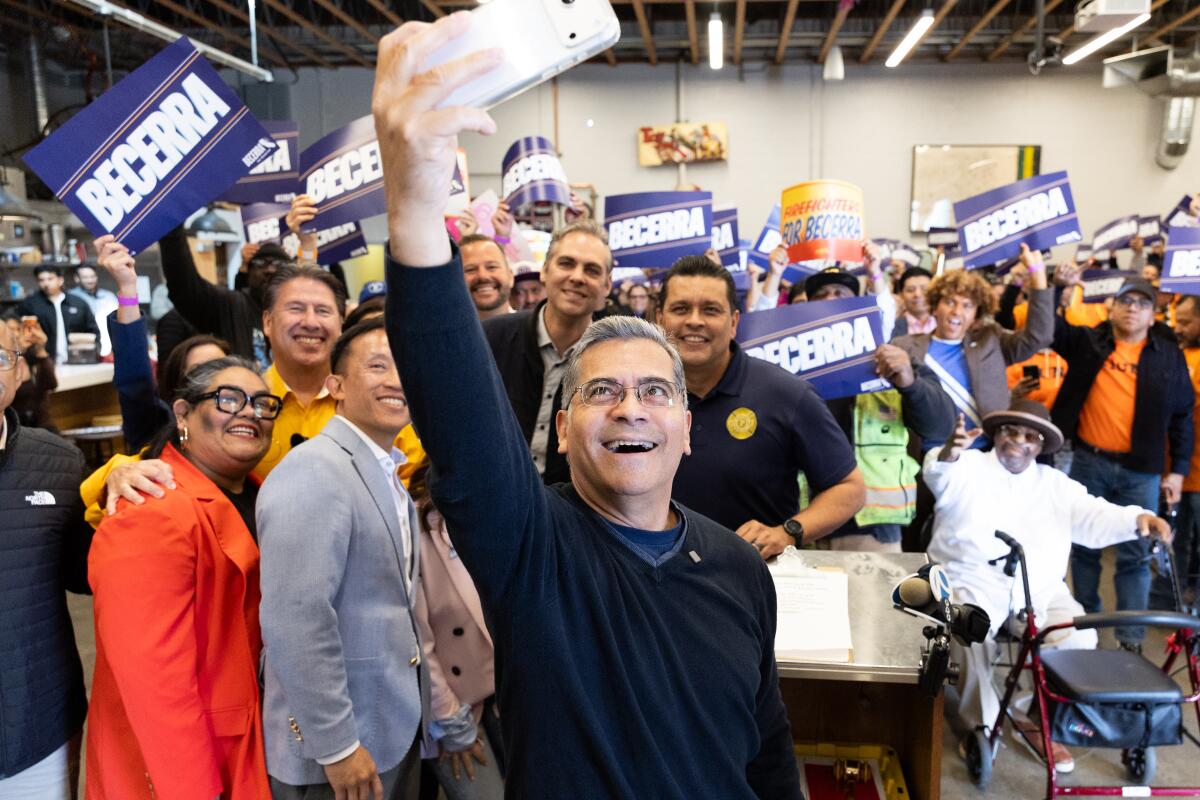
voter

This is California’s most interesting governor’s race in ages

Pity poor California.

It’s not just the eye-watering price of gasoline, the absurd cost of housing, the rising price of utilities and groceries, the Trump-led assault on the state’s immigrant population and his attack on California’s long-cherished values of tolerance and diversity.

No, on top of all that voters have been subjected to — the horror! — a dull and drab gubernatorial campaign, burdened by a surfeit of C- and D-list candidates with all the electricity and elan of a tepid bath.

Where are the A-listers? Where are the lights? The cameras? The action?

That, anyway, is the perspective one gets reading a certain genre of campaign dispatch, written from the perspective that all of California, Land of Reagan and Schwarzenegger, home to Hollywood and Silicon Valley, incubator of the Next Big Thing, is a stage. Woe unto those who fail to entertain, animate or amuse.

The fact that those dreary assessments have very little to do with the actual wants and needs of the vast majority of Californians — not to mention the state’s history of electing mostly dull and drab governors — should give their authors pause.

It hasn’t.

Contra all the stifled yawns and thinly veiled condescension, the contest — now in its final stretch — is the most compelling California gubernatorial campaign in decades. And not just because one of the leading contestants torched himself and his political livelihood in a bonfire of hubris and stupidity.

Come November, voters could elect the first female governor in state history, or possibly the first Latino governor in more than 150 years. (They might also install California’s first billionaire governor, a considerably less uplifting and monumental achievement, but historic nonetheless.)

Depending on the result, the election could also solidify a notable shift in California’s political power balance, from the long-reigning San Francisco Bay Area (think Govs. Jerry Brown, Gavin Newsom and U.S. Sens. Alan Cranston, Dianne Feinstein and Barbara Boxer) to Southern California (think Sens. Adam Schiff, Alex Padilla and, possibly, Gov. Xavier Becerra or Katie Porter.)

True, there’s no pyrotechnic personality in the expansive field of gubernatorial hopefuls. But this is no group of slouches.

“Look at the resumes of these people. There’s nothing embarrassing,” said Jim Newton, a UCLA historian who’s written a shelf-load of biographies of Californians as disparate as Earl Warren and Jerry Garcia. The contenders, he noted, include a former state attorney general and Biden Cabinet member, a high-profile ex-congresswoman, the aforementioned hedge-fund billionaire and men with experience running two of the state’s most populous cities. “That’s a pretty good range of backgrounds in candidates for governor.”

With no glitz, no glamour, what’s a star-seeking, celebrity-hungry voter to do? If you believe the stereotype, Californians take their political cues more from Variety and In Touch magazine than, say, their voter guide or the flood of TV ads and campaign mailers that inundate the state every two years.

In truth, the Hollywood stars elevated to the governorship, Ronald Reagan and Arnold Schwarzenegger, have been the exception — spaced nearly four decades apart — and far from the norm. Both political insurgents were elected under extraordinary circumstances. Reagan amid the tumult and tectonic fracturing of the 1960s Civil Rights and Free Speech movements. Schwarzenegger in an unprecedented, rapid-fire recall of an enormously unpopular governor.

Far more typical are the likes of George Deukmejian, Pete Wilson and Gray Davis. Each was a career politician who spent decades laboriously climbing the government rungs before being elected governor. Collectively, they were featured on the cover of People magazine precisely zero times.

The three were, to use Newton’s description, “mainstream, politically tested, not flashy.” Which also happens to describe several of those currently aspiring to be governor.

Drab, but true.

Boring as it may seem, most Californians want someone who’ll focus on their workaday concerns, not jollification. For all the talk of the “attention economy” — the hearts and minds won by jokey memes, viral videos and other snackable morsels on social media — voters are much more focused on the real economy, which is to say putting food on their table, maintaining a roof over their head and keeping their car fueled and home at a bearable temperature.

“It’s not virtual reality,” said Mike Madrid, a longtime California Republican strategist and one of the state’s most astute political observers. “It’s reality reality.”

“That may not be interesting to the punditry and the East Coast,” Madrid went on, “but it still matters. Reality still matters. The performative nature that has dominated our discourse for 10 years in the Trump era is fading away.”

Imagine, for a moment, if former Vice President Kamala Harris had jumped into the governor’s race, as contemplated. The contest, for all intents, would have ended then and there, save for months of airy speculation on which Democrat or Republican would make the November runoff en route to eventual defeat. That would have been boring.

In Harris’ absence, the sprawling field of candidates has been a good and healthy thing, yielding the most competitive California gubernatorial contest in a quarter century. Fears of a Democratic shutout in June’s top-two primary and a fluky Republican being elected — which were always overwrought — have faded dramatically. Even if they hadn’t, would it really be better for politicians in Sacramento and Washington to anoint the Democratic favorite and cut voters out of the equation?

(While we’re busting myths, another is the fanciful notion that the state party or Democratic grandees like Nancy Pelosi, Gavin Newsom, Jerry or Willie Brown could have cleared the field with just a phone call or two.)

This wide-open fight for governor may not be boffo entertainment or dazzling to those looking in from the outside, but it’s absorbing nonetheless. It’s destined to be remembered as one of the most volatile and surprising political contests modern-day California has ever seen.

Source link

In California governor race, single-payer healthcare is a litmus test. There’s still no way to pay for it

When Gavin Newsom ran for California governor in 2018, his support for a state-run single-payer healthcare system was considered a risky move and earned him hefty labor endorsements.

Today, leading Democrats in the wide-open race to succeed Newsom have embraced single-payer healthcare as a political necessity, an answer to voters fed up with rising premiums and other spiraling healthcare costs.

But with no clear front-runner, they are sparring among themselves in debates and political ads over who is most committed to a government-run model. No candidate has outlined how California would fund comprehensive health coverage for its 40 million residents, leaving voters unable to discern which candidate has a concrete plan for the nation’s most populous state.

Healthcare and political experts said the concept of single-payer has shifted from progressive pipe dream a decade ago to today’s mainstream talking points in a state where Democrats outnumber Republicans nearly 2 to 1. Democrats have pledged the model as the best way to lower costs in an attempt to woo voters worried about affordability as ballots arrive for the June 2 primary. The top two Republicans, meanwhile, have dismissed government-run healthcare as a “disaster” and “socialism.”

“In many ways, single-payer healthcare has become a progressive litmus test,” said Larry Levitt, a former White House policy advisor and a healthcare expert at KFF, a health information nonprofit that includes KFF Health News.

Few voters fully understand the term single-payer, let alone expect the next governor to achieve it, Levitt said. Rather, he added, the term has become more of a signal to voters about a candidate’s approach to healthcare reform.

Xavier Becerra, the former U.S. Health and Human Services secretary, who for decades backed single-payer healthcare in Congress, has come under criticism from opponents for a nuanced but clear shift away from single-payer. It came after Becerra secured an endorsement from the California Medical Assn., a powerful group representing doctors and a longtime opponent of single-payer healthcare bills in California.

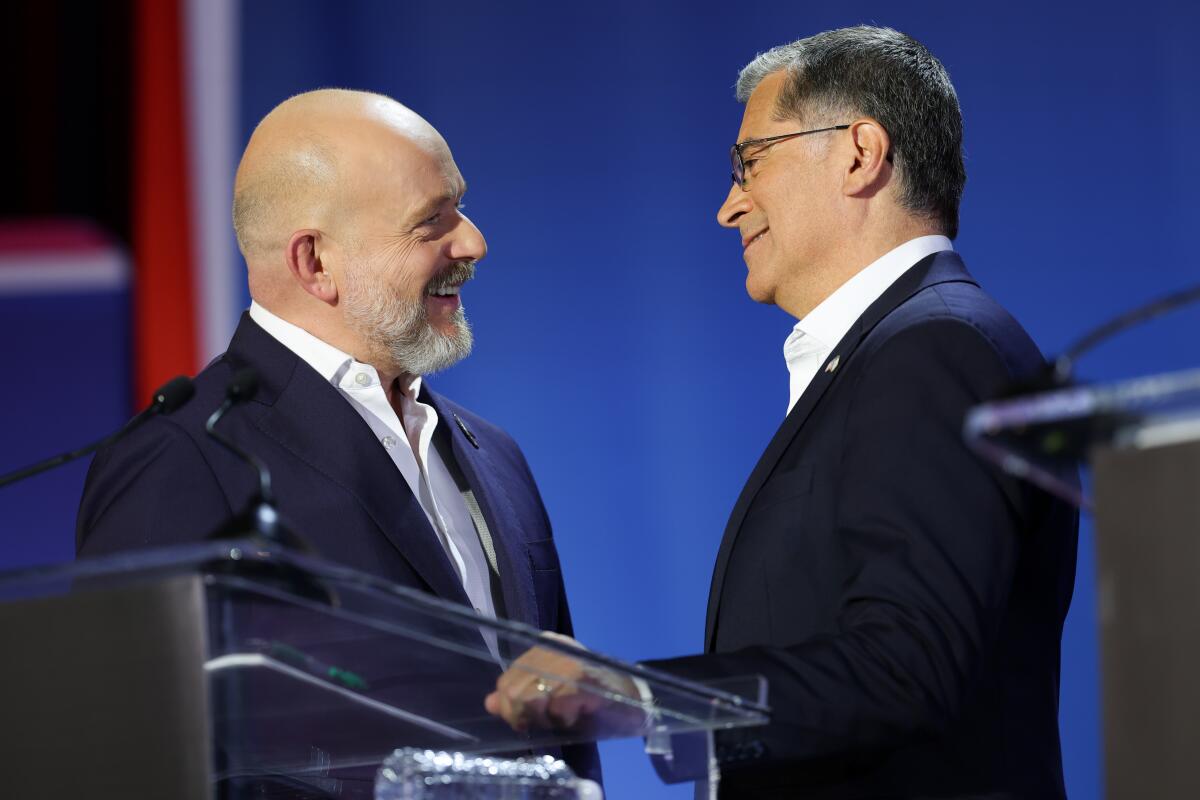
At a May 5 debate put on by CNN, Becerra declared his support for “Medicare for All,” a proposal for a federally run system that’s been stalled for years, but he declined to say whether he’d pursue a California-led effort. He said his immediate focus would be on mitigating the drastic federal cuts expected to hit low-income and disabled enrollees in Medi-Cal, the state’s Medicaid program, which covers more than a third of residents.

Becerra is counting on voters not to distinguish between the often-confused terms single-payer, Medicare for All, and universal coverage, noting during the debate that “Californians don’t care what you call it, so long as they have affordable healthcare.”

“A lot of people aren’t clear what single-payer is, and they need a metaphor to understand it,” said Celinda Lake, a Democratic strategist and one of the lead pollsters for former President Biden’s 2020 campaign.

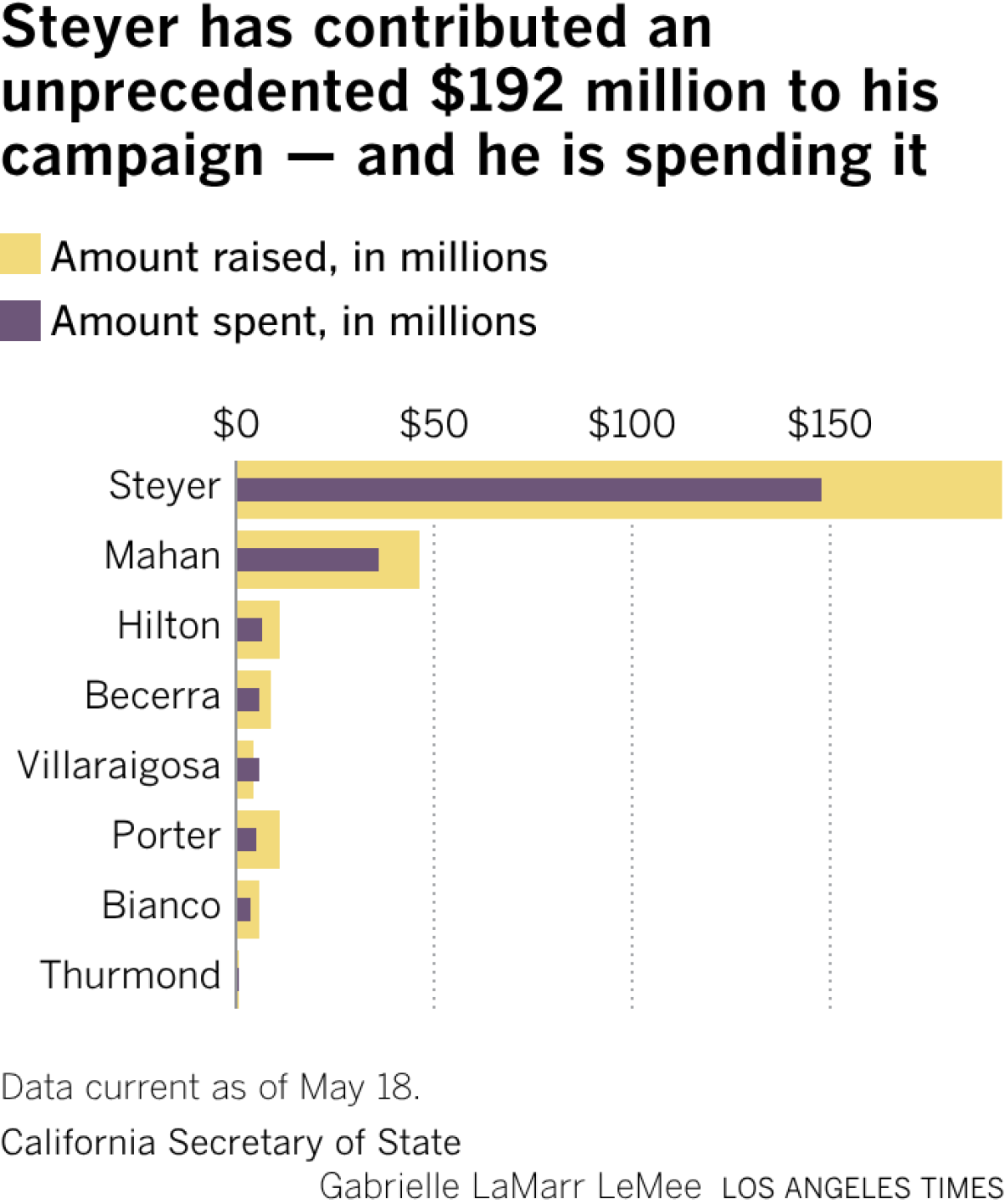
Billionaire activist Tom Steyer, who’s touted his self-funding as a signal he can’t be bought, has emerged as the race’s most vocal advocate of single-payer after opposing it during a short-lived 2020 presidential bid. As governor, Steyer has said, he would pass legislation backed by the California Nurses Assn. that has failed to come to fruition under Newsom’s tenure. Pressed on how he would cover the estimated $731.4-billion cost, Steyer told KFF Health News that “God is going to be in the details.”

At a forum last year, former U.S. Rep. Katie Porter said she didn’t believe achieving such a system was realistic in the near term, but the Orange County Democrat later told party delegates that she would “deliver single-payer.” Former Los Angeles Mayor Antonio Villaraigosa and San Jose Mayor Matt Mahan, Democrats who are trailing their competitors in the polls, don’t support single-payer. The top two vote-getters — regardless of party — advance to the November general election.

Some of the most seasoned politicians have failed to deliver single-payer. Newsom, who campaigned on the promise of being a “healthcare governor,” dialed back his ambitions upon taking office, choosing instead to pursue “universal access” to health coverage under a series of Medi-Cal expansions and efforts to contain healthcare spending.

A bus with the message "All Aboard For A California You Can Afford" and "Tom Steyer for Governor" on its side is parked.

The campaign bus for billionaire activist Tom Steyer, who has made single-payer healthcare a central pillar of his run for governor, in downtown Oakland.

(Christine Mai-Duc/KFF Health News)

Vermont, which remains the only state to pass a single-payer healthcare law, reversed course when leaders there couldn’t identify a funding source.

To enact single-payer, California would need permission from the federal government to redirect billions of dollars from Medicaid, Medicare and other funding that currently flows to the system — approval not likely to come from the Trump administration.

More than half of adults nationally say healthcare costs will have a major impact on whom they vote for in November, according an April KFF poll.

Danielle Cendejas, a Los Angeles-based Democratic consultant who works with state legislative candidates, said single-payer healthcare increasingly appears on candidate questionnaires from small-business advocates as well as hyperlocal Democratic clubs, in state legislative races and national union endorsements. What most California voters want to hear, Cendejas said, is how candidates plan to give them more immediate relief from higher premiums, expensive drug costs and long waits to access care.

The high price tag doesn’t faze Jennifer Easton, a 63-year-old Democrat from Oakland, who said other countries with similar models have proved they can lower costs. She said she supports a single-payer health system because it’s clear to her that Americans have reached the limits of working within the existing system. But she isn’t expecting any of the current candidates to succeed in implementing one, and she hasn’t decided whom to support.

“No one can in four years,” she said. Seeing a candidate enthusiastically support the concept gives her a good idea of their philosophy. “It is, if we’re lucky, a 20-year, 25-year plan.”

Rob Stutzman, a Republican political consultant who advised former Gov. Arnold Schwarzenegger, said while Americans may be supportive of single-payer in polls, focus groups suggest that approval drops quickly when voters realize it could mean losing their current doctor or insurance plan.

At the CNN debate, Steve Hilton, the Republican candidate President Trump has endorsed, said Californians would end up with subpar patient care and “taxes sky high to pay for it,” like in his native United Kingdom. Instead, Hilton suggested the state stop providing “free healthcare for illegal immigrants who shouldn’t even be in the country in the first place.”

Mai-Duc writes for KFF Health News, a national newsroom that produces in-depth journalism about health issues and is one of the core operating programs at KFF—an independent source of health policy research, polling, and journalism.

Source link

California under pressure — again — as redistricting wars escalate

When the U.S. Supreme Court sharply curtailed a key provision of the Voting Rights Act last week, Democrats in Washington had a message: The rules of redistricting have changed, and California — the nation’s biggest blue bastion — may have a further role to play.

Rep. Alexandria Ocasio-Cortez (D-N.Y.) said Democrats should “play by the same set of rules” as Republicans. House Minority Leader Hakeem Jeffries (D-N.Y.) vowed to fight in “the Deep South and all over the country.” And Rep. Terri Sewell, an Alabama Democrat, was blunt: “I’ll take 52 seats from California, I sure would. And 17 seats from Illinois.”

The calls for action came as Republican governors in Louisiana, Alabama, Mississipppi and Tennessee called special legislative sessions to redraw congressional maps ahead of this year’s midterm elections. Florida has also approved new maps that could give the GOP four more seats in the House, and President Trump urged other Republican states to follow suit.

The Republican response has intensified the pressure on Democrats to act, including those in California — where the ruling could upend not just congressional maps, but also legislative and local races.

“We can’t allow this national gerrymandering effort of Republicans to go unanswered,” said Rep. Robert Garcia (D-Long Beach). “If Republicans go for it, I think we have to leave all options on the table.”

For now, California’s response is far from settled.

A woman with brown hair, wearing glasses and a dark jacket, gestures while speaking before a microphone

Rep. Sydney Kamlager-Dove (D-Los Angeles) cautioned against “accelerating a race to the bottom.”

(J. Scott Applewhite / Associated Press)

The chair of the California Democratic Party said there are no current plans to redraw maps — just months after voters approved a constitutional amendment authorizing a mid-decade redistricting backed by Gov. Gavin Newsom.

The Democratic consultant who drew the state’s current congressional district boundaries says an all-blue map, while possible to create, would probably hurt Democrats more than help them in the long run. And some of the state’s congressional Democrats are worried the impulse to match Republican partisan efforts would be bad for the American electorate.

“Rather than accelerating a race to the bottom, the next step is to dial it down because you can reach a point of no return,” said Rep. Sydney Kamlager-Dove (D-Los Angeles), one of the state’s most prominent Black lawmakers. “And that’s where we’re headed.”

What California decides — and when — will matter at the national level. With 52 congressional seats, no state has more to offer Democrats in a redistricting war. But experts, lawmakers and party officials say the path forward is more complicated than the calls from Washington suggest.

California could see 48 blue seats, out of 52

That’s in part because California already acted. In 2025, voters approved Proposition 50, which drew new congressional district lines designed to favor Democrats for the 2026, 2028 and 2030 elections. The new maps, which could yield as many as 48 Democratic seats out of 52, are already in effect, and voters have begun receiving their mail-in ballots.

Going farther is not currently on the table — at least not yet.

“We have yet to fully win the seats in the map that was drawn in 2025. It seems a step too far to say we’re going to go back to the drawing board and redraw the map,” said Rusty Hicks, the chair of the California Democratic Party.

Hicks said it doesn’t mean the issue could not become part of a future discussion, but he said Democrats in other states should not look past what California has already done.

“We’re trying to pick up 48 of them. How much more do you want us to pick up? You want us to make it 52 blue? Well, you all should get into the fight,” Hicks said. “You all should pick up some seats. Let’s all do this together, because California cannot do it alone, it will take the rest of the country.”

Others are not convinced the most aggressive option makes the strategic sense in California.

Paul Mitchell, the Democratic redistricting consultant who drew California’s Proposition 50 congressional maps, said the push for a 52-0 delegation reflects a fundamental misunderstanding of how a partisan map would perform in the state over time.

“A 52-to-zero map would have the potential of backfiring,” Mitchell said. “In 2026, we could pick up 52 seats. But then in 2028 or 2030 — a bad year for Democrats, let’s say — Democrats lose 11 of those seats. You’ve drawn these districts so demonically to a Democratic advantage in a good year that in a bad Democratic year, they don’t have the ability to withstand the challenge.”

Ruling could jeopardize state’s voting rights law

The political debate over congressional maps has so far dominated the conversation in Washington. But legal scholars and redistricting experts say the ruling could also have consequences in California’s city hall, school board and county supervisor races.

The justices’ ruling, decided by the court’s conservative majority, says states cannot consider race to create majority-minority electoral districts while allowing them take partisan interests into account.

“A purely partisan map is actually more defensible now than one drawn with racial considerations,” said Rick Hasen, an election law professor at UCLA. “It turns the world on its head.”

The ruling now puts at risk any district drawn at any level of government that relied on the Voting Rights Act to justify its boundaries, Hasen said.

And in California, that uncertainty extends to districts drawn under the state Voting Rights Act, which extends protections for minority voters beyond the federal law, he said. The state law was not directly at issue in the Supreme Court ruling, but Hasen argues the court’s reasoning could provide new legal grounds to challenge the state law as potentially unconstitutional.

Cities including Santa Monica and Palmdale have faced lawsuits alleging their at-large City Council elections diluted the Latino vote. Palmdale settled its case and agreed to switch to district-based elections; Santa Monica’s case is ongoing. Hasen argued that the cities, as well as other bodies, such as school boards, could now return to court to challenge whether district maps drawn as a result of the California Voting Rights Act are unconstitutional.

“That has not been tested yet,” he said, but he fears the same arguments made to challenge the federal Voting Rights Act could be made against the state law.

At the state level, Republican strategist Matt Rexroad sees the ruling affecting the California Legislature as well. He argues the boundaries drawn for the state Assembly and Senate districts are racial gerrymanders.

“Those legislative lines, I would argue, are unconstitutional,” Rexroad said. “And those lines are probably going to change by 2028.”

But Rexroad’s biggest concern goes beyond any single set of maps: It is the future of California’s independent redistricting commission, the nonpartisan body he has spent years defending.

A threat to independent redistricting

Rexroad sees a scenario in which the national political environment gives California Democrats little incentive to return the map-making power to the commission. If Republican states continue to aggressively redraw maps, Democrats will have another justification to keep power in the Legislature’s hands, the same argument made to pass Proposition 50, he said.

“I don’t think the California redistricting commission has ever been in greater jeopardy than it is right now,” he said.

J. Morgan Kousser, a historian who has testified as an expert witness in voting rights cases for 47 years, said California’s commitment to the commission may depend on how aggressive Republican states act in redistricting.

“If we go back to an all-white South in Congress, California may not go back to a fairness standard,” Kousser said. “It may not disarm. It may rearm.”

Mitchell, the redistricting consultant, said that he hopes California and other states choose the path of disarmament and that there is a national push for independent commissions in every state.

“This isn’t good for anybody,” he said. “This was all basically a nerd war over lines that didn’t actually improve any districts anywhere.”

Source link

California county discovers trove of unopened ballots in locked box

The Humboldt County Office of Elections made an unnerving discovery Monday: a stack of 596 sealed ballots from the most recent election left at the bottom of a locked voting drop box.

The uncounted ballots would not have affected the outcome of the November statewide special election for Proposition 50, the county office said in a news release Wednesday. However, officials said they’re working hard to have all the votes legally counted.

The office discovered that the ballots were uncounted because of a staff error. When workers checked the drop box, there was a miscommunication about whether it had been fully emptied, the office said.

“That outcome is unacceptable and runs counter to the core of what this office stands for,” Juan Pablo Cervantes, county clerk-recorder and registrar of voters, said in a statement. “While the mistake occurred after an election worker did not follow proper procedures, the responsibility for what happened ultimately sits with me.”

After the ballots were discovered, elections staff confirmed that the sealed ballots had not been tampered with, and they worked with the California secretary of state to determine next steps. Under California law, the ballots should have been counted before the election was certified on Dec. 5 and destroyed six months later.

The Office of Elections said it had altered its protocols to ensure such a mistake does not take place again, implementing a new “lock out, tag out” procedure to ensure each drop box is empty and secured before election results are finalized.

“I promise you that we are taking this seriously,” Cervantes said. “We will strengthen our processes and continue pushing toward the standard our community expects and deserves.”

The discovery comes as California continues to be under a microscope for allegations of voter fraud.

Within minutes of polls opening for California’s special election in November, President Trump took to Truth Social to claim that the Proposition 50 vote — which redrew several congressional districts to favor Democratic candidates — was rigged.

“The Unconstitutional Redistricting Vote in California is a GIANT SCAM in that the entire process, in particular the Voting itself, is RIGGED,” Trump wrote.

When asked later that day to explain Trump’s claims on how the election was allegedly rigged, White House Press Secretary Karoline Leavitt said California has “a universal mail-in voting system, which we know is ripe for fraud.” She also accused the state of counting ballots from undocumented immigrants.

Elections officials and Democratic leaders including Gov. Gavin Newsom decried those claims as baseless. “The bottom line is California elections have been validated by the courts,” California Secretary of State Shirley Weber said in a November statement.

More recently, Republican gubernatorial candidate Chad Bianco has drawn scrutiny for using his position as Riverside County sheriff to seize some 650,000 ballots in the county to determine whether they were fraudulently counted. Critics decried the move as another attempt by Republican election deniers to disenfranchise voters.

Humboldt County, which encompasses 4,052 square miles of rural California below the Oregon border, has largely avoided election-related turmoil in recent years. In 2008, however, Humboldt election officials discovered that software they used to tally votes had failed to count 197 ballots from one precinct.

More recently, nearby Shasta County has become a hotbed of election denialism and MAGA politics, with its Board of Supervisors voting in 2023 to end the use of Dominion Voting Systems machines in favor of pursuing a hand-counting system.

Times staff writers Hailey Branson-Potts, Jenny Jarvie and Ana Ceballos contributed to this report.

Source link

How I learned to stop worrying about noncitizens voting in L.A. elections

¿Qué en la fregada?

What the hell?

That’s what I muttered after learning that Los Angeles Councilmember Hugo Soto-Martínez wants to allow noncitizens to vote in city and school board elections.

Talk about a solution in search of a problem, considering everything Angelenos are facing right now.

While the specter of la migra continues to haunt the city, far more crushing are problems that affect everyone — affordability, housing, traffic, pollution. Maybe Soto-Martínez and his colleagues should double down on fixing those things first and sell their message better to voters instead of picking up a new issue?

I know the first-term council member comes from a good place. His parents were formerly undocumented, just like my dad, and he has been a fierce advocate for immigrants going back to his labor organizing days. I have friends without legal status and others in the DACA program for people who came to the U.S. illegally as children. I think giving them, as well as green card holders and others with papers, a chance to participate in elections is a righteous idea.

But to paraphrase the Book of Ecclesiastes, there’s a time and a place for everything. In 2026, Angelenos should be focused on electing people and approving initiatives that will improve the city for everyone, not a narrow plank benefiting a slice of the population.

So I called up Soto-Martínez and challenged him to convince this doubting Tomás.

He hopes his proposal will reach the City Council later this month for a vote on whether to place it on the November ballot. If voters pass the measure, it goes back to the council to decide when — if ever — to enfranchise the immigrants.

The proposal, already vilified in conservative media, isn’t as radical as it seems. Noncitizens are already prohibited from voting in federal elections, but there’s a well-established history of their participation in local ones, including in Vermont and Maryland. They can already vote in L.A. neighborhood council elections, and in San Francisco school board elections if they have a child in the district.

Besides, L.A. has long led the way in weaving undocumented immigrants into the fabric of civic life.

This is a sanctuary city where Mayor Karen Bass has stood up to President Trump’s xenophobia. Where eight of the 15 council members are immigrants or the children of immigrants. Where LAUSD Supt. Alberto Carvalho — himself formerly undocumented — has striven to make local schools as welcoming as possible (Carvalho is on paid leave after the FBI raided his home and office earlier this year). Even the LAPD learned decades ago that it’s better to embrace undocumented immigrants than castigate them for their lack of legal status.

“If you’re contributing to this economy, you should have the right to decide who represents you,” Soto-Martínez told me.

Fair point. But isn’t thumbing our noses at Trump asking for more of what he has already inflicted on L.A., making life even more miserable for undocumented immigrants? Could he use the noncitizen voter rolls as a list of whom to deport? Besides, doesn’t extending the franchise to noncitizens give fuel to his crazy conspiracies about stolen elections?

“You always hear, ‘Don’t poke the bear, don’t instigate them,’ but that’s not how you deal with a bully,” Soto-Martínez replied. “They’re coming at us already. While they’re removing people’s right to vote in the Supreme Court, we’re expanding it. … And it has nothing to do with Trump. It’s about fairness.”

Tell that to Trump.

I mentioned that Santa Ana — a city far more Latino than Los Angeles, though not as liberal — decisively rejected a similar measure in 2024. Soto-Martínez’s fellow Democratic Socialist council members, Ysabel Jurado and Eunisses Hernández, have voiced their support for his measure. But I wonder whether the full council will move it along to voters in a year when some members, including Soto-Martínez, are running for reelection.

I couldn’t get a comment from Bass. Councilmember Nithya Raman, who’s running against her, said in a statement that Soto-Martínez’s push “is worth taking seriously” but that it’s “critical to getting this right, and we must not make decisions lightly or quickly.”

“We’re going to have to organize,” Soto-Martínez acknowledged. “But we live in a political moment where it’s the right conversation to have about what this city stands for.”

Nilza Serrano is president of Avance Democratic Club

Avance Democratic Club President Nilza Serrano at Mariachi Plaza in Boyle Heights in 2022.

(Irfan Khan / Los Angeles Times)

He’s going to have to convince people like Nilza Serrano. She’s president of Avance, L.A. County’s largest Latino Democratic club, and heads the California Democratic Party’s Latino caucus. Serrano is no wokosa — she supported Rick Caruso in the last mayoral election and is now siding with Bass.

While Serrano thinks Soto-Martínez is on to something, she said that voting rights for noncitizens are a nonissue for the people she’s trying to get to the polls for the June primary and November general elections. The economy and Trump’s deportation deluge are more on their minds.

I asked if Soto-Martínez’s proposal would cheapen citizenship for people like her. Serrano and her family came here legally from Guatemala in the 1980s before becoming U.S. citizens, a process that took years.

“Not for me,” she replied. “But it’s hard to say for others. I’d have to do a little bit more research.”

So I continued with my own research, calling someone I was sure would have a fit about the idea: Los Angeles County Hispanic Republican Club President David Hernandez.

“Isn’t San Francisco already doing it?” the Navy veteran cracked.

I thought Hernandez would go on an anti-liberal rant, but.…

“I believe there’s a strong argument,” he said, “that if someone has established residency and is a member of the community and suffered the consequences of whatever local policies will be enacted, they should have a say in who gets elected.”

Did the ghost of Joaquin Murrieta, California’s original avenging Latino, suddenly possess Hernandez? To make sure I was hearing right, I asked again if noncitizens voting in L.A. elections is a good thing.

How could he support that, as a Trump-voting Republican?!

“We have to be pragmatic,” he replied. He approves of noncitizens voting in L.A. neighborhood council elections, because that’s true local control.

He understands that allowing them to vote in municipal elections might come off as an insult to the memory of civil rights activists who lost their lives fighting for that right for Black Americans. But U.S. citizens are already taking it for granted, he noted — turnout in the November 2022 L.A. mayoral election was a pitiful 44%.

“Maybe noncitizens will appreciate voting more than citizens,” he said.

I’m still not fully convinced that Soto-Martínez’s push is wise right now, but I like that he’s being careful.

“We need to get in the weeds of this,” he said of the City Council’s deliberations, which he characterized as attempting to ensure maximum benefit and minimum fallout.

Let’s see what they come up with in a few weeks.

Source link

Trump’s drugmaker deals may save economy $529B over 10 years, White House says

White House economists estimate that President Trump’s deals with pharmaceutical companies to drop some of their U.S. prescription drug prices to what they charge in other countries could save $529 billion over the next 10 years.

The analysis obtained by the Associated Press includes the first economy-wide projections behind a policy at the core of Trump’s pitch to voters going into November’s midterm elections for control of the House and Senate. Democratic lawmakers have been doubtful about the savings claimed by Trump and these new numbers are likely to trigger additional questions about the data.

Cost-of-living issues are at the forefront of voters’ concerns and higher energy prices tied to the Iran war have deepened the public’s anxiety. Trump has tried in part to address affordability concerns by focusing on his efforts to cut deals with companies so that the cost of prescription drugs in the U.S. would no longer be dramatically higher than in other affluent nations.

“Now you have the lowest drug prices anywhere in the world,” Trump said at a Friday rally before a crowd of seniors in Florida. “And that alone should win us the midterms.”

The analysis was done by administration officials for the White House Council of Economic Advisers. They also estimated that federal and state governments could save a combined $64.3 billion on Medicaid during the next decade because of what Trump calls his “most favored nation” policy on drug prices.

Few of the details of the deals struck by the Trump administration and 17 leading pharmaceutical companies have been made public, making it hard to independently verify the projected savings. The White House analysis sought to estimate the prospective savings as more medications come onto the market and fall under Trump’s framework — with one model in the report tallying the possible savings at $733 billion over a decade.

Trump and his Department of Health and Human Services have touted his drug-pricing deals as transformative and urged Congress to codify their principles into law. Democratic lawmakers have challenged the administration’s claims of savings. Senate Finance Committee Ranking Member Ron Wyden, D-Ore., and 17 Senate Democrats in April proposed a measure requiring the administration to disclose the terms of the agreements signed by pharmaceutical companies.

“If these deals are so great, why is the Trump administration afraid of showing them to the public?” Wyden said when announcing the measure. Health Secretary Robert F. Kennedy Jr. said his team would share details that didn’t include proprietary information or trade secrets.

The White House said it has not shared the text of the agreements because they include highly sensitive data that could move financial markets.

The potential savings estimated by the Trump administration would be substantial as Americans spent $467 billion on prescription drugs in 2024, according to the most recent government data available. The analysis is premised on the idea that foreign countries would also pay more for their prescription drugs, which would diversify drugmakers’ sources of revenue and preserve their ability to innovate with new treatments.

Outside economists have caveated that any savings might not flow directly to patients, many of whom already pay discounted prices for their drugs through their insurance coverage.

The Congressional Budget Office in October 2024 estimated that a plan similar to what Trump ended up adopting could reduce prescription drug prices by more than 5%, though the decrease “would probably diminish over time as manufacturers adjusted to the new policy by altering prices or distribution of drugs in other countries.”

The scope of the savings claimed by the Trump administration are likely to intensify the scrutiny by Democrats, who counter that any price reductions would be offset by higher costs for prescription drugs not covered by the “most favored nation” framework. One of their main critiques is that pharmaceutical companies have increased their profit margins while working with the administration.

In April, staff working for Sen. Bernie Sanders, I-Vt., released an analysis that looked at 15 of the companies that have agreed to this drug-pricing plan and found that their combined profits jumped 66% over the past year to $177 billion. The report noted that the tax cuts Trump signed into law last year “exempted or delayed many of the most expensive drugs” from price negotiations with Medicare.

The Trump administration has countered that they consider Sanders’ critique to be flawed, saying that it’s based on the list prices for pharmaceutical drugs instead of the actual price that patients pay.

Boak writes for the Associated Press.

Source link

Kamala Harris endorses L.A. Mayor Karen Bass for reelection

Former Vice President Kamala Harris endorsed Los Angeles Mayor Karen Bass for reelection on Monday.

“Mayor Karen Bass is the leader Los Angeles needs right now. She has done what so many said couldn’t be done — the first ever two-year decline in homelessness, reducing crime to levels this city hasn’t seen since the 1960s, and refusing to back down when the federal government came after our neighbors,” Harris said in a statement. “She has my full support for re-election.”

The endorsement comes as ballots have begun arriving in Californians’ mailboxes at a critical moment in the race to lead the nation’s second-largest city. Although Bass leads in polls, she is viewed unfavorably by many Angelenos for her perceived lack of leadership in the aftermath of the devastating Palisades fire.

A quarter of voters supported Bass in a March poll by the UC Berkeley Institute of Governmental Studies that was co-sponsored by The Times. City Councilmember Nithya Raman had the backing of 17%, and conservative reality TV star Spencer Pratt had 14%. A quarter of voters were undecided.

Though Bass led the other prominent mayoral candidates, political strategists say the numbers are troubling for the incumbent because she is facing off against lesser-known rivals and because 56% viewed her unfavorably. And Pratt and Raman had raised more money than Bass this year through April 18, according to fundraising disclosures filed with the city’s Ethics Commission. However, Bass had nearly $2.3 million in the bank because she started fundraising for reelection two years ago.

Though Bass and Harris were rivals to be selected as presidential nominee Joe Biden’s running mate in 2020, the two Democrats have known each other for more than two decades and have a long shared history. Bass was sworn in by Harris as the 43rd mayor of Los Angeles in 2022. Two years later, at the Democratic National Convention where Harris became the party’s presidential nominee, Bass spoke about working with her more than a decade ago on youth homelessness and fixing the child welfare system when Bass led the California Assembly and Harris was a state prosecutor.

Harris also endorsed Rob Bonta for reelection as state attorney general, Malia Cohen for reelection as state controller and Lt. Gov. Eleni Kounalakis for state treasurer. Here’s a look at those races and the rest on the ballot.

Source link

Advice on when best to cast your California primary ballot

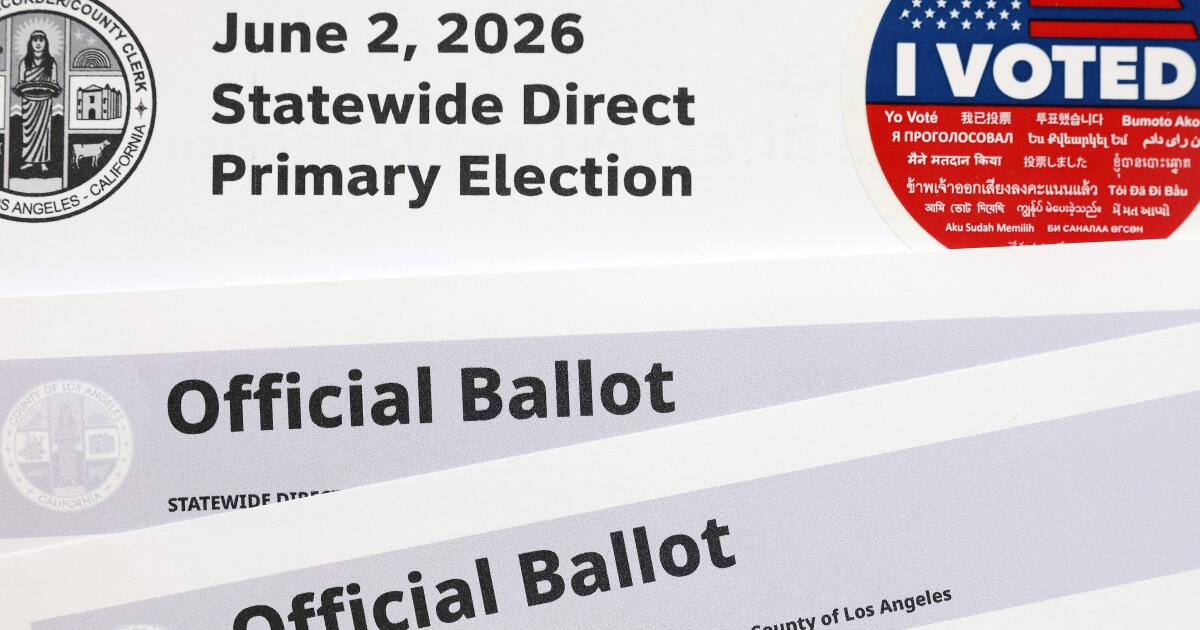
For the next week or so, in homes all over California, ballots will be arriving for the June 2 primary.

Since 2020, a ballot has been mailed to every active registered voter in the state — more than 23 million, by last count. The time to choose is drawing nigh.

In addition to the race for governor, Californians will vote in contests for seven other statewide offices, the Board of Equalization — which oversees the property tax system — and a great many congressional, legislative and local races, including the primary for Los Angeles mayor.

What’s a voter to do?

If you’ve waited your entire life for a candidate like Republican Chad Bianco, the Riverside County sheriff running for governor, or you’ve been jonesing to cast a gubernatorial ballot for Democrat Katie Porter from the moment she whipped out her famous whiteboard, the choice is easy. Fill out that ballot and toss it in the mail, stat! No postage needed.

“Don’t mess around,” said Paul Maslin, a veteran Democratic campaign strategist. (His candidate for governor, Betty Yee, quit the race late last month, so he’s a neutral observer at this point.)

“If you have pretty good inkling what you want to do,” Maslin urged, “vote.”

But if, like many, you’re not wed to a particular candidate, what then? If you’re worried about mailing in your ballot and then having some awful, Eric Swalwell-like revelations surface, or if you fret about wasting your vote by supporting someone who drops out before June 2, then what?

There are no do-overs in a California election. Once you’ve cast your ballot, you’ve made your choice. That’s it, however sorry you may be.

Which is why Republican strategist Rob Stutzman, who’s worked in California politics for decades, urged voters not to mail their ballot too soon. Like Maslin, he’s unaffiliated with any of the gubernatorial campaigns.

“It’s a slow-developing race,” Stutzman said of the contest for governor, the marquee attraction on the June ballot. “These are still relatively little-known candidates. There’s going to be a lot more campaigning to go in the weeks ahead. [So] unless you feel really strongly about somebody, I’d hang on to that ballot and see what happens over the next several weeks.”

Then again, with all the talk of clamping down on mail-in ballots and concerns about processing delays by a stretched-thin Postal Service, is there a danger of waiting too long to vote? What if your ballot arrives past the deadline to be tallied?

In March, the U.S. Supreme Court strongly signaled a likelihood it would require mail ballots to be received by election day if they are to be counted as legal. As it stands, California accepts mail-in ballots that were cast before the end of election day, so long as they arrive no later than seven days after.

The court seems unlikely to issue its ruling before the June primary — but that’s not guaranteed.

So is there a sweet spot, somewhere between voting in haste and having your ballot go to waste?

The Official Voter Information Guide, produced by California’s secretary of state, urges those voting by mail to “return your ballot … as soon as you receive it.”

But Kim Alexander, head of the nonpartisan California Voter Foundation, falls into the wait-a-bit camp. “Don’t vote too early,” she counseled, “because this is a very dynamic election.”

Once you’ve made up your mind, her best advice is to mail your ballot at least a full week before election day, which is May 26, to ensure it arrives on time to be processed and counted. If someone wants to drop their ballot off in person, either at a vote center or secure drop box, Alexander suggests doing so by May 30, which is three days before the election.

“The good news,” she said, “is that under a new state law … all county election offices will be open at least six hours on Saturday, May 30, for voters to come vote in person or to turn in their vote-by-mail ballots.”

Voting in person is an option right up until 8 p.m. on election day, even if you received a ballot in the mail. That applies everywhere in California, save for three sparsely populated, rural counties — Alpine, Plumas and Sierra — which conduct their elections entirely by mail. Bring your unused vote-by-mail ballot to your local polling place and swap it for a polling-place ballot you can use instead.

For procrastinators or those wanting to wait until election day to mail their ballot, they run the risk that it won’t be postmarked until after June 2. That means it won’t be counted, regardless of when it arrives at their county elections office.

“Voters who want to hold out as long as possible … ought to be planning to turn their ballot into a drop box or a voting site and not use the mail at all,” Alexander said.

Having spent decades working to make voting easier and elections safer and smoother, Alexander knows that voting by mail has made many people miss “the election day experience.” (Things like bringing the kiddos into the voting booth, or posing for selfies with an “I Voted” sticker.)

Her suggestion is to find other ways to mark the occasion.

“Help somebody else go and vote,” Alexander suggested, “or volunteer to help with an organization” running a get-out-the-vote operation.

“If you want to help election officials get ahead on the vote count” — a source of repeated upset as the country awaits California’s lagging results — “you can be part of the solution by getting your own ballot in just a little bit earlier.”

All of which sound like fine ideas. That way you can celebrate election day and make sure your ballot isn’t cast for naught.

Source link

L.A. City Council District 3 voter guide: Gaspar vs. Girvan vs. Celona

p]:text-cms-story-body-color-text clearfix”>

The candidates are largely in sync on big-picture public safety issues. All three support Mayor Karen Bass’ long-term goal of restoring the Los Angeles Police Department to 9,500 officers. (Last month, it had 8,640.)

Gaspar, 44, thinks that goal doesn’t go far enough. He wants the department to have 10,000 officers, which it last had in 2020. He points to his own experience from a few years ago when his family’s home was burglarized.

“When I called 911, this is no exaggeration, I was on hold for 30 minutes before I got a person. Thirty full minutes,” he said. “That is something that points to the city being broken.”

Worth Girvan, 42, said she too wants the LAPD to return to 10,000 officers, a goal first accomplished in 2013 by former Mayor Antonio Villaraigosa, who was her boss for several years.

Celona, 46, was less specific about the number of officers needed but voiced general support for the mayor’s hiring goal.

All three also spoke in favor of the pay increases Bass negotiated with the city’s police union, which critics have derided as too expensive. Supporters say the pay hikes will keep officers, particularly new hires, from being lured away by other law enforcement agencies.

“I have met with many LAPD officers, and what they they tell me consistently is that they train here, but then we lose them,” Worth Girvan said.

Source link

L.A. City Council District 1 election voter guide: Five run in an Eastside district

p]:text-cms-story-body-color-text clearfix”>

The challengers say Hernandez has failed to making meaningful headway on homeless encampments in Chinatown, Lincoln Heights and other parts of the district.

“People feel they do not have safe and walkable streets,” Robledo said. “People are disappointed, and I am too.”

Robledo, 67, wants to shut down the Los Angeles Homeless Services Authority, the city-county agency that oversees social services at the city’s hotels, motels and other interim housing.

Hernandez touts a $6.3-million state grant she helped secure to house homeless people living in or near the Arroyo Seco riverbed. She’s bringing a new 65-bed interim housing facility to Cypress Park and has worked to beef up services near MacArthur Park.

“I’m not focused on what folks are saying about us not delivering the services,” Hernandez said. “I know in my district we’re doing the work.”

Hernandez supports Mayor Karen Bass’ Inside Safe program, which has cleared encampments across the city, but wants greater transparency on how its money is spent.

Grande and Robledo also favor Inside Safe but say it is too expensive and needs to be reworked. Claros is the only candidate in the race who outright opposes the program, saying he would vote against any additional funds to keep it going.

“When we look at it now and we just do the numbers, it’s been a failure,” Claros said. “We’ve got to completely course correct and get away from that.”

Calanche, 57, supports Inside Safe but believes it isn’t addressing the root causes of homelessness, particularly mental health and drug addiction. Those issues are the responsibility of county government, which has its own public health and mental health agencies, she said.

To make real progress on those issues, the city should create its own public health department, similar to those found in Long Beach and Pasadena, Calanche said.

“There needs to be a different vision to address this issue,” she said.

Calanche, Claros, Grande and Robledo support Municipal Code 41.18, which prohibits homeless encampments within 500 feet of schools and daycare centers. That law allows the council to create 41.18 zones around “sensitive use” locations, such as public libraries and freeway overpasses.

Hernandez is a longtime opponent of 41.18, calling it ineffective and inhumane. She has voted against dozens of 41.18 zones that were created by her colleagues in the San Fernando Valley, the Westside and South Los Angeles.

Source link

L.A. County’s proposed healthcare sales tax election voter guide

p]:text-cms-story-body-color-text clearfix”>

Supervisor Kathryn Barger was the only supervisor against it. She pointed to the fact that the tax was a “general” tax, meaning the money won’t be earmarked for healthcare costs. That means politicians have final say over how the money gets spent rather than voters, she said.

Some cities within L.A. County say they’re also rattled over the tax, unleashing a stream of opposition letters against the tax. The California Contract Cities Assn. argues a sales tax hike would “disproportionately burden the very residents the County seeks to protect.” Shoppers near the county line, they warn, likely would start crossing it to shop.

Some of these cities say they have the trust issues when it comes to county ballot measures. When voters approved Measure B in 2002 to fund the county’s trauma center network, an audit years later found the county couldn’t account for whether the money actually had been spent on emergency medical services. And some cities feel they never got their fair share of funds from Measure H, the homelessness services tax measure passed in 2017.

Source link

California state schools superintendent election voter guide

p]:text-cms-story-body-color-text clearfix”>

Every Democrat on this list could be expected to work in general harmony with a Democratic governor and in opposition to key Trump administration policies.

There are differences in their backgrounds, but only minor policy divergences, including on the participation of trans athletes in women’s and girls’ sports.

Listed in alphabetical order, with an excerpt from their survey responses:

Richard Barrera, 59, is a longtime school board member in San Diego Unified, the state’s second-largest school system, a senior advisor to Thurmond and before that was a local labor union executive.

“The three experiences that best qualify me for this office are the ones that required me to govern a public school system, execute policy inside the state agency, and understand workforce realities in practice,” Barrera said.

Wendy Castañeda-Leal, 42, has pursued a career in more rural areas, currently serving as superintendent for the Semitropic Elementary School District, which has one TK-8 school with about 140 students off Highway 46 in Kern County. She’s also been director of whole child education for Roseland School District and a secondary alternative school principal.

“I lead districtwide efforts aligned with California’s priorities by advancing equity, strengthening academic achievement, and expanding supports for the whole child, including multilingual learners and underserved student populations,” Castañeda-Leal said. “I also bring extensive site leadership experience as a principal at the elementary, middle and high school levels, where I improved student outcomes.”

Nichelle Henderson

Nichelle Henderson

(Courtesy of Nichelle Henderson.)

Nichelle Henderson, 57, is an elected trustee of the Los Angeles Community College District. Her education career began as a teaching assistant. She later taught sixth grade math and science in Compton Unified. She’s currently a faculty advisor and clinical field supervisor in a Cal State teacher preparation program.

“What it is clear among Democratic candidates is that there are candidates that are seeking this position because they want a safe place to land after having termed out,” Henderson said. “My goal is to build the capacity of our TK-12 public schools to prepare students for higher education and to participate in the local and global workforce.”

Ainye Long, 41, a San Francisco Unified middle school math department chair, ran four years ago with no significant resources and came within less than 1 percentage point of making the runoff. It helped then that no Democrat ran against Thurmond and that Republican challengers divided the Republican vote. Long also had then — and still has — the ballot designation: “public school teacher.” She also is a past senior administrator at a charter-school group.

“One job of the [state superintendent] is to measure the effectiveness [in practice — what actually happens] of our laws, and help to find better ways to educate our body,” Long said. “The people closest to the work are closest to the problems of practice, so they’re the first to see the solution.”

Al Muratsuchi

Al Muratsuchi

(Photo courtesy of Al Muratsuchi)

Al Muratsuchi, 61, represents the 66th Assembly District, encompassing parts of the South Bay, and has been the chair of the state Assembly education committee. He taught briefly at the college level and served as an elected board member of the Torrance Unified School District.

“I am the only candidate running for State Superintendent of Public Instruction with the combined experience of statewide education policy leadership, … local school district governance as a former Torrance Unified School District board trustee, and classroom educator,” Muratsuchi said, adding that he authored 23 education-related bills that were signed into law.

Josh Newman

Josh Newman

(Josh Newman)

Josh Newman, 61, has been a state senator, including chairing the education committee, and a technology company executive. He served in the Army and taught briefly both at the college and middle school levels.

“Among the Democrats in this race, the most significant distinction is between candidates whose approach to this office is primarily organized around labor relationships and funding advocacy, and my own, which emphasizes accountability, outcomes, and the full range of students’ needs alongside continued investment,” Newman said.

Anthony Rendon

Anthony Rendon

(Photo courtesy of Rendon campaign)

Anthony Rendon, 58, was state Assembly Speaker from 2016-23, previously directed Plaza de la Raza Child Development Services and served as chief operating officer for Mexican American Opportunity Foundation.

He spoke of “the role that technology is playing in the degradation of youth mental health and happiness. The next superintendent needs to properly implement California’s ban on phones in classrooms, be ahead of the curve in establishing policies on generative AI use, and make sure teachers have the training and support they need to make sure the classroom is about learning.”

No candidate received enough votes to win the Democratic Party endorsement. The tally was as follows: Henderson: 24.75%; Muratsuchi 21.97%; Rendon 17.43%; Newman 16.82%; Barrera 12.77%.

Source link

L.A. Measure CB voter guide: taxing illegal cannabis businesses

p]:text-cms-story-body-color-text clearfix”>

A nonprofit advocacy group, Social Equity LA, organized with local cannabis business owners to oppose the measure in letters to Mayor Karen Bass.

Luis Rivera, executive director of the nonprofit, said Measure CB risks legitimizing the illegal cannabis industry while linking city finances to the tax revenue the businesses would generate. The measure also would undermine Proposition 64, the state law that requires cannabis businesses to be licensed, he said. And amid the city’s struggles to track and close illegal cannabis businesses, Rivera said it will be difficult to force them to pay up.

“There’s no guarantee or mechanism to assure that illegal operators will pay the taxes or fulfill their obligations,” Rivera said.

Even if they pay taxes, illegal operators could undercut legal businesses by selling unregulated products and avoiding requirements, such as code inspections and safety tests for merchandise, that legal businesses must fulfill to keep their licenses, he said. For an already struggling industry, the answer isn’t taxing more businesses, he said — it’s lowering taxes.

Source link

L.A. County District 3 supervisor’s election voter guide

p]:text-cms-story-body-color-text clearfix”>

Lindsey Horvath was a West Hollywood city councilmember in 2022 when she ran for L.A. County supervisor in a six-person primary that featured a pair of state senators, Bob Hertzberg (D-Van Nuys) and Henry Stern (D-Malibu).

Hertzberg and Horvath advanced to the general election, where she won by 29,000 votes.

As a supervisor, Horvath helped lead a historic push to remake county government. Measure G, passed by voters in 2024, will nearly double the size of the Board of Supervisors and create an elected chief executive position as well as an independent ethics commission. But the passage of Measure G had the unintended effect of wiping out Measure J, which funds anti-incarceration programs, leaving county officials scrambling for solutions.

Tonia Arey is a real estate agent who said she decided to “enter public service out of concern for the direction of Los Angeles County and a desire to bring stronger accountability to local government.”

She calls herself a “Jewish woman challenging the incumbent” and is centering her campaign on public safety, including law enforcement, fire and probation, emergency preparedness and confronting antisemitism.

Tomás Sidenfaden is a software developer and startup founder who has lived in Los Angeles for nearly three decades.

“Three generations of my family have called this region our home, and I’m tired of waiting around for other people to fix it,” he said.

Carmenlina Minasova is a San Fernando Valley reform advocate who did not respond to requests for comment.

Source link

California Congressional District 27 primary election voter guide

p]:text-cms-story-body-color-text clearfix”>

  • Jason Gibbs: Republican, Santa Clarita City Council member, mechanical engineer

Gibbs has been a member of the Santa Clarita City Council since 2020 and was chosen by his peers to serve as the city’s mayor in 2023. He earned his bachelor’s and master’s degrees in mechanical engineering at Cal Poly and went on to work in the aerospace industry, according to his campaign website. He has lived in Santa Clarita for nearly a decade while raising two young children, his bio says, and has served on the local boards of the Boys and Girls Club, the Valley Industry Assn. and the Salvation Army.

  • George Whitesides: Democrat, incumbent

Whitesides defeated Republican incumbent Mike Garcia to represent the 27th Congressional District in 2024. Whitesides worked on President Obama’s transition team in 2008 and served as NASA chief of staff during the Obama administration, according to his campaign bio. He was the first chief executive of Virgin Galactic, co-founded Megafire Action, a nonprofit that advocates for legislation to address the growing problem of massive wildfires, and was a board member for the Antelope Valley Economic Development and Growth Enterprise, his bio says.

Others:

  • Roberto Ramos: Democrat, Marine veteran, UCLA master’s student
  • Caleb Norwood: Democrat, college student

A representative for David Neidhart, a Republican candidate, said he has withdrawn from the race. His name still will appear on the ballot.

Source link

California secretary of state election voter guide

p]:text-cms-story-body-color-text clearfix”>

Across the country, debates over voter identification laws have become a flash point in broader fights about election security and voting access.

Supporters of voter ID laws say they are needed to prevent election fraud and ensure only eligible voters cast ballots. Critics argue there is little evidence of noncitizens voting and say the requirements instead would reduce voter participation in elections.

Under California law, voters in the state are not required to show or provide identification when casting a ballot in person or by mail. The state does require ID when registering to vote, and residents must swear under penalty of perjury that they are eligible to vote and they are a U.S. citizen.

Weber has opposed proposals that would require voters to show identification in order to cast a ballot. She and many Democratic leaders argue that voter ID laws can create barriers for eligible voters, particularly those who may not have easy access to government-issued identification.

Weber believes Voter ID efforts are meant to sow doubt in the integrity of the elections system.

“When you really get to it, Voter ID is a smoke screen for trying to create the idea that this is a corrupt system,” she said.

Weber instead supports policies aimed at expanding participation among eligible voters, including vote-by-mail ballots and automatic registration.

Conversely, Wagner wants the state to require voters to show ID at the polls. He argues that requiring identification would strengthen public trust in election results and align California with practices used in many other states. He said it’s patronizing to minorities when critics argue it’s hard for them to get identification.

“You need an ID to drive,” he said. “You need an ID to fly in a plane. You need one to buy alcohol. You need it to buy tobacco.”

Wagner has been working with proponents of the Voter ID ballot measure to raise money and helped gather signatures. That statewide ballot measure would require state or local elections officials to verify that Californians registering to vote are U.S. citizens by “using government data,” which according to supporters could include information in the federal Social Security Administration database, jury summons information and other government records.

“What I’m pledging the people of California is that if they pass voter ID, I will protect it. I will sue if I have to,” Wagner said. “If I am secretary of state, I will implement it and hold the registrars accountable and hold my office and myself accountable for doing the will of the people.”

Source link

How to vote in California’s June 2026 primary election

p]:text-cms-story-body-color-text clearfix”>

Vote-by-mail ballots will not be forwarded to a new address, so your ballot will be returned to your local county election office if you haven’t updated your voter registration.

The Los Angeles Registrar-Recorder/County Clerk recommends voters who have been impacted or displaced by wildfires update their mailing address or request a replacement ballot be sent to their temporary address or new permanent address. Los Angeles County residents can follow a guide created for Pacific Palisades and Altadena fire survivors online. Residents can also make updates by phone by calling the Registrar-Recorder/County Clerk’s office at (800) 815-2666, Option 2.

You also can update your mailing address by re-registering to vote online. In the “residential address” section, enter your former place of residence and in the “mailing address” section, check the box that says your mailing address is different from your home address and then enter your temporary mailing address.

Source link

‘Earthquake’: Supreme Court limits Voting Rights Act in setback for Black Democrats, boost for GOP

The Supreme Court’s conservative majority on Wednesday sharply limited a part of the Voting Rights Act that has forced states to draw voting districts to help elect Black or Latino representatives to Congress as well as state and local boards.

In a 6-3 decision in Louisiana vs. Callais, the court ruled that creating these majority-minority districts may amount to racial discrimination that violates the 14th Amendment.

When weighing what the Voting Rights Act requires, “we start with the general rule that the Constitution almost never permits the federal government or a state to discriminate on the basis of race,” Justice Samuel A. Alito Jr. wrote for the court.

Alito said states may draw election districts for partisan advantage but may not use race as a basis for redistricting.

The ruling in a Louisiana case appears to clear the way for Republican-led states across the South to redraw their election maps and eliminate voting districts that favor Black or Latino candidates for Congress, state legislatures and county boards.

UCLA law professor Rick Hasen said, “It is hard to overstate what an earthquake this will be for American politics,” adding that the decision makes the Voting Rights Act a “much weaker, and potentially toothless law.”

Hasen said it’s unclear how the decision will affect the November election because in many states early voting has already started and primaries have already taken place.

But the ruling’s long-term consequences for minority representation in Congress, state legislatures and local government are almost “certainly” going to be felt in 2028, Hasen said.

Republican leaders in states across the South have already signaled they intend to move quickly to redraw congressional maps in the wake of the ruling.

Alabama Atty. Gen. Steve Marshall said the state will “act as quickly as possible” to ensure its congressional maps “reflect the will of the people, not a racial quota system the Constitution forbids.” Marshall called the decision a recognition of how much the South has changed since the civil rights era.

“The court rightly acknowledged that the South has made extraordinary progress, and that laws designed for a different era do not reflect the present reality,” he said in a statement.

Florida was already in motion before the ruling came down. But Gov. Ron DeSantis celebrated the decision and said it was all the more reason for state lawmakers to redraw its congressional maps, in a manner that could give Republicans up to four more seats in Congress.

The proposed congressional maps, drawn by DeSantis’ office, were first unveiled to Fox News on Monday. On Wednesday, both chambers approved the maps, and readied them for DeSantis’ final approval.

In Mississippi, Gov. Tate Reeves had already called lawmakers into a special session at the end of May in anticipation of a court ruling on the Voting Rights Act. In a post on X, Reeves underscored the ideological underpinnings to the ruling’s potential implications.

“First Dobbs. Now Callais. Just Mississippi and Louisiana down here saving our country!” Reeves wrote.

Sen. Raphael Warnock of Georgia speaks outside the Capitol.

Sen. Raphael Warnock (D-Ga.) speaks at a news conference outside the U.S. Capitol after the Supreme Court ruling.

(Tom Williams / CQ-Roll Call / Getty Images)

At issue was how to ensure equal representation for Black and Latino citizens.

About one-third of Louisiana’s voters are Black, but the state seeks an election map that will elect white Republicans to five of its six seats in the House of Representatives.

Lower courts said that map violated the Voting Rights Act because it denied fair representation to Black residents.

The state had one Black-majority district, in New Orleans.

Two years ago, judges upheld the creation of a second Black-majority district that stretched from Shreveport to Baton Rouge on the grounds that it was required under the law.

The state’s Republican leaders appealed and argued that race was the motivating factor in drawing the second district.

Alito and the conservatives agreed and called that district an “unconstitutional racial gerrymander.”

The three liberals dissented. The consequences of the ruling “are likely to be far-reaching and grave,” said Justice Elena Kagan, adding that it will allow “racial vote dilution in its most classic form.”

She said the decision means “a state can, without legal consequence, systematically dilute minority citizens’ voting power. Of course, the majority does not announce today’s holding that way. Its opinion is understated, even antiseptic.”

But she said states across the South may draw electoral districts that deprive Black voters of equal representation. Justices Sonia Sotomayor and Ketanji Brown Jackson agreed.

The decision was the latest example of a partisan political dispute in which the court’s six Republican appointees vote in favor of the Republican state plan, while the three Democratic appointees dissent.

The ruling is likely to have its greatest impact in the Southern states, where white Republicans are in control and Black Democrats are in the minority.

The court’s divide over redistricting is similar to the long dispute over affirmative action.

For decades, university officials said they needed to consider the race of applicants to achieve diversity and equal representation.

But in 2023, the court by a 6-3 vote struck down college affirmative action policies at Harvard and the University of North Carolina and ruled race may not be used to judge applicants.

The historic Voting Rights Act of 1965 succeeded in clearing the way for Black citizens to register and vote across the South, but it took longer for Black candidates to win elections.

The dispute was highlighted in a 1980 case from Mobile, Ala. Its three commissioners were elected to six-year terms, and each of them ran countywide.

Even though one-third of the county’s voters were Black, white candidates always won.

The Supreme Court upheld this arrangement as legal and constitutional. In dissent, Justice Thurgood Marshall said Black residents were left with the right to cast meaningless ballots.

In response, Congress amended the Voting Rights Act in 1982 to say states must give minorities an opportunity to elect representatives of their choice.

Four years later, the Supreme Court interpreted that to mean that states had a duty to draw voting districts that would elect a Black or Latino candidate if these minorities had a sufficiently large number of voters in a particular area.

In recent years, the court’s conservatives, led by Justice Clarence Thomas, have chafed at the rule on the grounds it sometimes required states to use race as a factor for drawing election districts.

Alito’s opinion adopted that view and said states are not required or permitted to use race as a basis for drawing districts.

Hours after the ruling came out, President Trump met with reporters in the Oval Office and said he had not yet seen the decision. He was visibly excited, however, when a reporter explained the decision favored Republicans.

“I love it!” he said. “This is very good.”

Former President Obama said in a statement that the court’s decision “effectively guts a key pillar of the Voting Rights Act, freeing state legislatures to gerrymander legislative districts to systematically dilute and weaken the voting power of racial minorities — so long as they do it under the guise of ‘partisanship’ rather than explicit racial bias.”

The Mexican American Legal Defense and Educational Fund, in Los Angeles, also denounced the decision.

“The Supreme Court’s decision blesses racially discriminatory gerrymandering, and dismantles the legal protections for minority voters,” said Nina Perales, the group’s vice president for litigation. It “openly invites states to dilute minority voting strength, and undermines our democracy.”

Source link

Here’s what to watch for in Tuesday’s California governor debate

Contenders in the race to be California’s next governor will meet on stage Tuesday night for the second of three planned debates before the June 2 primary.

Last week’s meet-up in San Francisco didn’t provide the fireworks or memorable moments the candidates, and many voters, were hoping for — but it did manage to remind us all that ballots will hit mailboxes in coming days and decisions must be made.

Ahead of the forum at Pomona College in Claremont, a trio of our Times columnists — Gustavo Arellano, Mark Z. Barabak and Anita Chabria — weigh in with a cheat sheet on what to look for, what to expect and why it matters.

Chabria: I’ll start us off with the obvious — let’s hope Tuesday gives us at least one breakout candidate who comes with some fire and vision.

After last week’s debate, there was lots of social media posturing about who won and who trolled whom the best. But as one of the six people who actually watched, I can tell you it was mostly bland with no clear winner.

That’s in large part because many of the Democrats have only slivers of daylight between their policies, and ditto for the two Republicans.

So my hope is that at least a single candidate ups their game and comes to voters with not just attacks, but something that inspires, something that sets them apart. This far into the race, that hope is slim, but I’m keeping it alive.

What are your hopes and dreams — and maybe fears — going into this?

Barabak: I know I sound like a broken record. (Google it, kids.) Anita, you and I, in particular, have gone round and round on this one. But I don’t feel a particular need for inspiration from the guys and gal that are running for governor. If I want inspiration, I’ll go back and reread the Rev. Martin Luther King Jr.’s “Letter From Birmingham Jail.” Or listen to a Grateful Dead show from May of ’77.

Give me someone who can work with the Legislature, and as difficult as it may be, President Trump, to get stuff done.

Pursue a “California First” agenda, to borrow a phrase. Put voters and their interests ahead of ego, careerism and personal ambition. Start by pledging, if elected, to serve a full four-year term and not run for president so long as they’re serving as governor.

Of course, that kind of promise can be broken. (See then-Gov. Pete Wilson, who made that vow when he sought reelection in 1994, then turned around and — unsuccessfully — sought the White House in 1995.)

At least we’d have them on the record.

Arellano: I’m all for this morass of democracy. A small part of me wants two Republicans to make it into the general election because the California Democratic Party deserves a meteor-like extinction event. No GOP statewide elected official since Schwarzenegger. Supermajority in Sacramento for most of a decade.

And what do they have to show for their one-party rule? This.

But then I hear Chad Bianco and Steve Hilton mewl, and I’m suddenly hoping alongside Anita that someone vanquishes their foes with an unassailable vision. Problem is, I think all the candidates have reached their ceiling. The only one who has any chance of showing us something new is Xavier Becerra, who needs to drop his Dudley Do-Right shtick for a second and channel the inner cholo we all know is in him.

Instead, he was at a fundraiser in Fullerton over the weekend with professional Latinos — you should’ve been kicking it with my cousins in Anaheim who were watching their Dodgers slaughter the Cubs, loco, because they’re the ones who’ll make or break you.

Chabria: How the first potential Latino governor is failing to excite Latino voters is exactly what I’m talking about. If you don’t give voters something to be excited about, they don’t vote, and our fragile democracy needs every voter it can get.

But if we are forced to vote on nuance, let’s do it informed. Here are some questions I hope these candidates have to answer:

For San José Mayor Matt Mahan, funded in the mega-millions by tech bros, it’s not enough to promise to regulate artificial intelligence, or billionaire influence, for that matter. Tell us what those regulations look like and tell us how you reconcile your own politics with those of big donors such as Joe Lonsdale, co-founder of Palantir, who has called Gen Z the “loser generation.”

For billionaire investor Tom Steyer, who has said he will reform Proposition 13 (which limits property taxes) for corporate land owners: What assurances do homeowners have that they won’t be next?

For former Rep. Katie Porter, polling third among Democrats, the clock is ticking — is there a point where you will drop out and endorse a fellow candidate if you can’t break through? Same-ies for state schools superintendent Tony Thurmond and former L.A. Mayor Antonio Villaraigosa, who are included in this debate but polling in the single digits.

And I agree with you, Gustavo, Becerra is coming across as resolutely bland, but to Mark’s point, he’s using that to position himself as drama-free and experienced. So in an era when fraud and abuse are the words of the day, how does Becerra explain not catching fraud in his own office?

Mark and Gustavo, what are the topics you hope candidates will be grilled on?

Arellano: Slight correction, Anita — California already had a Latino governor: Romualdo Pacheco, the lieutenant governor who replaced Newton Booth in 1875 when the latter became a U.S. senator. Pacheco — a Latino Republican! — served all of 10 months before becoming a Congress member.

See, Californians? Political musical chairs is as much a part of our state as free-spending oligarchs — but enough about Steyer.

Issues? Immigration, of course. I want each one to address the state’s undocumented immigrants for 90 seconds in whatever matter they choose. Water: Believe in climate change or not, but our supply is shrinking faster than the gubernatorial chances of Thurmond. And since I believe that the more random the question, the more you learn about who a candidate truly is: What’s the best song about California, and why? Anyone who says “California Girls” or “California Gurls” deserves disqualification, even if both songs rock.

Barabak: Not an issue, per se. What I’d like to see is a bit of backbone.

The next governor is going to have to make some tough decisions, especially around spending priorities and/or cuts to the state budget. Inevitably, the next governor is going to make some people unhappy. And I’m not talking about just those members of the opposite party, or folks who didn’t vote for them.

So I’d like each of them to name an issue where, for the good of the state, they’re willing to take on their friends and allies, knowing they’ll be displeased. If you’re a Democrat, name something you would do that would, say, tick off organized labor. And for Republicans Bianco and Hilton, what’s an area where you’re willing to say to Trump, “Sir” — the president imagines everyone bowing and calling him sir — “you’re dead wrong about this and California needs to go its own way, whether you like it or not.”

Arellano: Good luck seeing any candidate buck their masters. I think we need to lower our expectations way, way, well, lower. So a simple question to conclude: Who needs to do the most tonight besides Mahan’s beard? I think it’s my fellow Orange Countian, Katie Porter. She’s now to the right of Steyer and left of Becerra, which means she needs to peel off supporters from both of them and grab undecideds if she wants to advance. Not sure how she can pull that off — but if anyone can bring necessary fire, it’s her.

Chabria: Porter definitely has a lot on the line.

One standout moment for her, Steyer or Becerra — good or bad — could tilt this very-much-undecided race — not so much because people will be watching, but because it will fuel the social media and advertising sure to follow. These next two debates are high-stakes, not just to avoid a Biden performance, but to do something, anything, that fires up momentum.

Politics ain’t beanbag, as the old saying goes, and it’s time to bring the heat. So in the spirit of Gustavo’s song request, I’ll leave it with these lyrics from the Rivieras (or the Ramones, if you prefer): We’re out there having fun, in the warm California sun.

Barabak: Not to be the pooper at the party but I think we shouldn’t overstate the import of tonight’s debate. For one thing, as Anita suggested, the audience will be exceedingly small — minuscule, even, relative to the state’s 23 million registered voters.

We know, from experience, that most folks will take away what they do based not on the debate itself but rather the coverage of it and whatever soundbites, memes, chatter and advertising it produces — and that’s only to the extent people are paying attention.

So, yes, what’s said and done in Pomona, will matter some. But we’re still five weeks away from election day, and I suspect many folks will be waiting at least another week or three to start focusing on the race and finally make up their minds.

I’ll end with something that Jerry Garcia sang: All good things in all good time.

Source link

Virginia Supreme Court considers whether to block voter-approved U.S. House map favoring Democrats

Virginia Supreme Court justices on Monday questioned whether the state’s Democrat-led legislature complied with constitutional requirements when it sent a congressional redistricting plan to voters, in a case that could help decide the balance of power in the U.S. House.

The new districts, which could net Democrats four additional seats, won narrow voter approval last week. But a Republican legal challenge contends the General Assembly violated procedural rules by placing the constitutional amendment before voters to authorize the mid-decade redistricting. If the court agrees that lawmakers broke the rules, it could invalidate the amendment and render last week’s statewide vote meaningless.

The Virginia court proceedings mark the latest twist in a national redistricting battle between Republicans and Democrats seeking an advantage in a November midterm election that will determine whether Republicans maintain their narrow majority in the U.S. House.

President Trump kicked off a tit-for-tat round of gerrymandering last summer when he urged Texas Republicans to redraw districts to their favor in an attempt to win several additional House seats. That set off a chain reaction of similar moves in other states, leading to the voter approval last week of Virginia’s new map.

Next up is Florida, where Republican Gov. Ron DeSantis has included congressional redistricting on the agenda for a special session of the GOP-controlled Legislature beginning Tuesday.

Virginia arguments focus on what counts as an `election’

During Monday’s arguments, the Virginia Supreme Court focused on whether the new congressional districts should be invalidated because of the process used by lawmakers. The justices issued no immediate ruling.

Because the state’s redistricting commission was established by a voter-approved constitutional amendment, lawmakers had to propose an amendment to redraw the districts. That required approval of a resolution in separate legislative sessions, with a state election sandwiched in between, to place the amendment on the ballot.

The legislature’s first vote occurred in October — while early voting was underway but before it concluded on the day of the general election. Judicial questioning focused on whether that was too late, because early voting already had begun.

Attorney Matthew Seligman, who defended the legislature, argued that the “election” should be defined narrowly to mean the Tuesday of the general election. In that case, the legislature’s first vote on the redistricting amendment occurred before the election and was constitutional, he told judges.

But an attorney arguing for the plaintiffs, Thomas McCarthy, said “election” means the entire period during which people can cast ballots, which lasts several weeks in Virginia. If that’s the case, then the legislature’s initial endorsement of the redistricting amendment came too late to comply with the state constitution, he said.

Attorneys argue over the rights of voters

The purpose of Virginia’s two-step amendment process, with an intervening election, is so voters can know whether legislative candidates support or oppose a proposed constitutional amendment, McCarthy said.

He pointed to the case of Democratic voter Camilla Simon, one of the plaintiffs in the lawsuit alongside Republican state lawmakers, who cast an early vote last fall for Democratic Del. Rodney Willett. After she voted, Willett sponsored the Democratic redistricting amendment, and Simon wished she could have undone her vote, McCarthy said.

“None of these voters had any idea this was coming, and that’s not how this process is supposed to work,” McCarthy told the justices.

Those defending the Democratic redistricting plan also contend that the voters’ will should be respected.

The people voted to ratify the constitutional amendment, “and the challengers are asking to overturn that democratic result,” Seligman told reporters after the arguments.

Nationwide redistricting battle has no clear winner so far

So far, the two major parties have battled to a near draw in the states that have redrawn their congressional maps for this year’s midterms.

Republicans think they could win up to nine more seats under revised districts in Texas, Missouri, North Carolina and Ohio. Democrats think they could win as many as 10 additional seats under new districts in California, Utah and Virginia. But legal challenges remain in both Virginia and Missouri.

Virginia currently is represented in the U.S. House by six Democrats and five Republicans who were elected from districts imposed by a court after a bipartisan redistricting commission failed to agree on a map after the 2020 census. The new districts, which narrowly won voter approval on April 21, could give Democrats an improved chance to win 10 districts.

Some candidates already have begun campaigning based on the new districts in advance of the state’s Aug. 4 primary election.

More court battles could remain in Virginia

In January, a judge in rural Tazewell County, in southwestern Virginia, ruled that lawmakers failed to follow their own rules for adding the redistricting amendment to a special session last fall. Circuit Judge Jack Hurley Jr. also ruled that lawmakers failed to initially approve the amendment before the public began voting in last year’s general election and that the state had failed to publish the amendment three months before the election, as required by law. As a result, he said, the amendment is invalid and void.

The Virginia Supreme Court placed Hurley’s order on hold and allowed the redistricting vote to proceed before hearing arguments on the case.

During Monday’s arguments, justices also raised questions about the ability of lawmakers to expand the agenda for their special session and whether the three-month public notice requirement was important enough to thwart a voter-approved amendment.

Republicans have filed at least two additional legal challenges, which also are winding their way through the courts.

Robertson and Lieb write for the Associated Press. Lieb reported from Jefferson City, Mo. AP writers Allen G. Breed in Richmond and Nicholas Riccardi in Denver contributed to this report.

Source link

Google co-founder Sergey Brin confronted Gavin Newsom — then launched a political war

In a treehouse nestled in redwoods north of San Francisco, Gov. Newsom stood cold and hungry as Sergey Brin, the world’s fourth-richest man, and his wellness-influencer girlfriend told him they were leaving the state.

It was late in the evening at a Christmas party hosted by crypto titan Chris Larsen — featuring singer Janelle Monáe and a towering abominable snowman with glowing red eyes — when Brin and his partner, Gerelyn Gilbert-Soto, confronted Newsom about a new proposal to tax billionaires in California, according to people who’ve spoken with the governor. Such a levy could hit Brin’s stake in Alphabet Inc. and his $272.6 billion fortune.

Newsom, who opposes the wealth tax, was still telling people about the lengthy exchange at the party months later, complaining of a lingering cold the pair had given him, according to the people, who asked not to be named discussing private conversations with the governor.

Brin, meanwhile, followed through. He left the state, bought a lakeside mansion in Nevada, and started bankrolling a billionaire political uprising in California.

Newsom, through a spokesperson, declined to comment on the interaction. “The governor has been very clear with everyone, no matter who they are, that this effort will do serious damage to the state, including for public safety workers and schools, at the expense of one special interest group,” Izzy Gardon, a spokesperson, said.

A representative for Brin didn’t respond to requests for comment.

Brin’s political push reflects a broader awakening among California’s ultrawealthy. Over the past six months, the proposed billionaire tax and a heated governor’s race have drawn tech titans and business leaders more directly into the state’s affairs — a space many of them have traditionally kept at arm’s length.

Prior to this year, Brin’s last contribution in a California election cycle was 2010 when Arnold Schwarzenegger was governor and the Google co-founder largely backed climate causes. He’s now spent more than $58 million in the last four months, including an extra $9 million disclosed late Friday, but more importantly has helped mobilize a network of fellow tech titans in a push to sway state issues.

“The wealth tax was a wake up call, it was a fire that just lit up Silicon Valley literally in a matter of weeks,” said Steven Maviglio, a veteran Democratic strategist. “I’ve never seen anything like it.”

Altogether, ultrawealthy donors have injected more than $270 million into California’s political scene in this election cycle. Outside of the wealth tax, billionaire Tom Steyer is emerging as a top Democratic candidate for governor after the downfall of former Representative Eric Swalwell following allegations of sexual assault. Steyer, a former hedge fund manager, has spent more than $140 million in his election bid, crowding TV airwaves with ads and labeling himself a “class traitor” with a campaign modeled after Vermont Senator Bernie Sanders.

Ballots for the June 2 primary election start going out next week. Brin and a cohort of the ultrawealthy including Coinbase CEO Brian Armstrong and venture capitalists Vinod Khosla and John Doerr have plowed millions into supporting Matt Mahan, a Silicon Valley mayor, with a back-to-basics agenda and a penchant for taking on the state’s Democratic establishment.

That money has helped Mahan buy airtime and attracted controversy, but his polling numbers remain stuck in the single digits while Steyer’s well-funded progressive campaign is gaining favor with voters. Brin has also backed Republican Steve Hilton, who’s currently leading polls.

“You have two polar opposites going on. You have a billionaire running who has actually fully adopted an agenda that the vast majority of voters agree with: Taxing billionaires, funding healthcare, fighting back against ICE,” said Lorena Gonzalez, head of the state’s largest union group, the California Federation of Labor Unions. “And then you have billionaires pushing a candidate whose talking points are apologetic to the tech industry.”

The billionaire political activism in California mirrors larger shifts in Silicon Valley and the nation. President Donald Trump has given tech billionaires broad access to the White House, inviting Brin and other industry captains over for dinner and to join advisory boards.

Back in September, Trump singled out Gilbert-Soto as Brin’s “really wonderful MAGA girlfriend” at a White House dinner also attended by Mark Zuckerberg, Tim Cook and Sam Altman. She has publicly supported Republican Steve Hilton for California governor, a candidate Trump endorsed and Brin has also donated to.

In California, Brin’s newfound political action was catalyzed by the wealth tax proposal, which would levy a one-time 5% tax on billionaires to help offset federal healthcare cuts. In a Signal group chat earlier this year with other Silicon Valley elite, Brin floated the idea of raising hundreds of millions of dollars to influence California politics, according to a person who saw the message.

Brin left California for Nevada ahead of a Jan. 1 residency deadline for the proposed wealth tax. He moved to a $42 million mansion on the Nevada side of Lake Tahoe, featuring two glass-walled funiculars.

Shortly after leaving California, Brin contributed $20 million to a new group dedicated to fighting the tax while also pushing pro-business and housing affordability policies, Building a Better California, making him the single largest contributor. He added $37 million over the spring, as the group quickly started supporting a trio of anti-wealth tax measures that could nullify a billionaire tax if it gets passed in an election. One of the measures, the so-called Transparency Act, has enough signatures to qualify for the November ballot, its backers claimed on Monday.

Building a Better California “remains fixed on long-term reforms supported by most Californians: housing affordability, stable funding for education, infrastructure investments, and government accountability,” a spokesperson said.

Joining Brin in the effort were other billionaires, including former Google CEO Eric Schmidt, Stripe CEO Patrick Collison and venture capitalist Michael Moritz. Peter Thiel, who also left California ahead of the New Year’s Day deadline, gave $3 million to a separate committee opposing the wealth tax.

“They don’t trust California anymore,” said David Lesperance, a tax attorney who specializes in relocations and has helped move five families out of the state because of the wealth tax threat.

Brin and his fellow billionaires helped push up the costs to gather the more than 870,000 signatures required to qualify a ballot measure. This forced the union behind the wealth tax, SEIU-UHW, to spend more on their efforts.

Now, the union says it has succeeded in getting the signatures it needed, which will likely force the business leaders opposing it into further spending.

“A very small group of the most controversial billionaires on the planet tried to stop Californians from being able to save their local emergency rooms and hospitals — but our current signature tally proves frontline healthcare workers will prevail in bringing this commonsense proposal to voters,” said Suzanne Jimenez, SEIU-UHW’s chief of staff. “When our growing coalition files these signatures, David will have won the first round against Goliath.”

Other billionaires have bankrolled their own political initiatives, including Larsen, who set up his own network of influence groups with names like Grow California and Golden State Promise.

Many in Sacramento are skeptical that Brin and his fellow ultra-rich will succeed in swaying California state politics. They point to the failed candidacy of former eBay executive Meg Whitman, who spent around $144 million of her own fortune to become governor, or even venture capitalist Tim Draper’s longshot initiative to split California into six separate states.

“They’re trying to extrapolate from their own industry, which might have been fabulously successful, that they know something about political advertising, when they don’t,” said Garry South, a veteran Democratic strategist. “They think, ‘Hey, I’ve got money I can throw it around,’ and they don’t really do their homework.”

Political consultants describe their frustration with some wealthy tech donors, who often view their political giving through an investment lens, promising big checks and not following through if they don’t see momentum. That’s led to questions about whether the California billionaire activism would continue if Mahan’s governor bid fails and the wealth tax passes.

Even Larsen, who’s worth around $13 billion, has expressed anxiety that not enough business leaders are stepping into politics. “It’s a lot of talk, and they’re happy, but we don’t see the firepower we need to take on the SEIUs,” he said, referring to the state’s largest union.

Newsom, for his part, acknowledges that many of the state’s wealthiest residents are willing to donate significant sums of money, but want to do it on their own terms and not through a tax.

“Some will never give a penny away,” he said at a Bloomberg News event in January, not long after his encounter with Brin in the treehouse. “Some I respect. Some I don’t.”

Kamisher and Carson write for Bloomberg.

Source link