voter

Pleas and political attacks fill the home stretch of California governor’s race

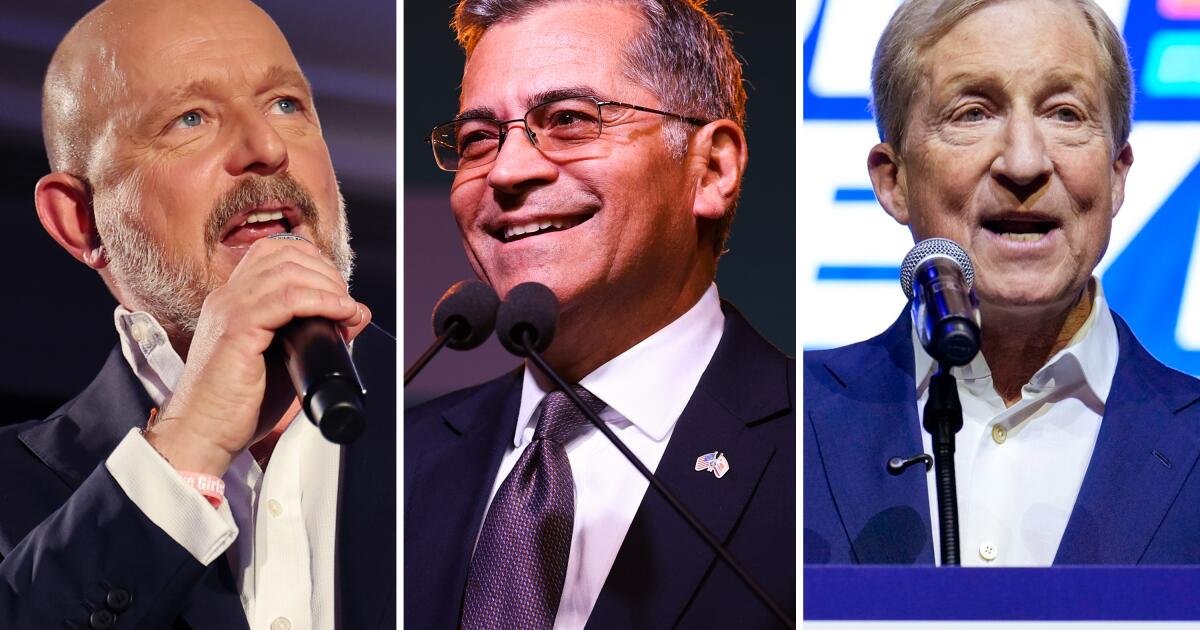
The top candidates for California governor crisscrossed the state Friday, all venturing to friendly political territory to woo voters and undermine their rivals as the June 2 primary election fast approaches.

The top Republican in the race, former Fox News host Steve Hilton, spent the day railing against transgender athletes before a high school track event in the Central Valley, an event sure to appeal to his base of President Trump supporters.

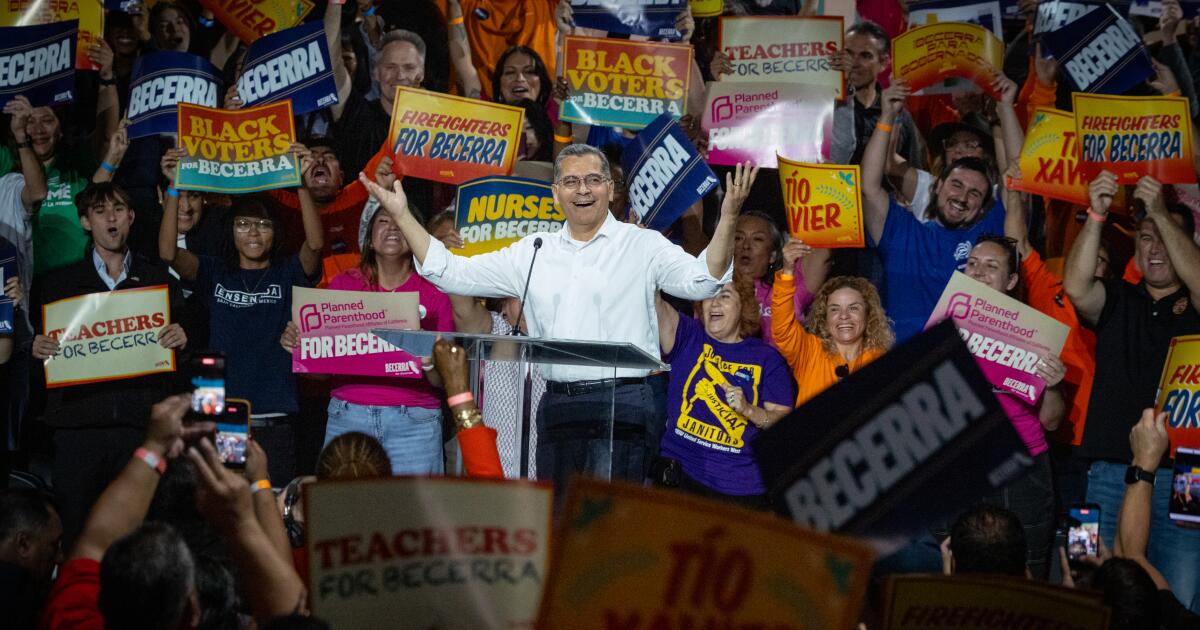
The front-running Democrats, former Biden administration Cabinet member Xavier Becerra and billionaire environmentalist Tom Steyer, rallied one of their party’s most influential constituencies: union members.

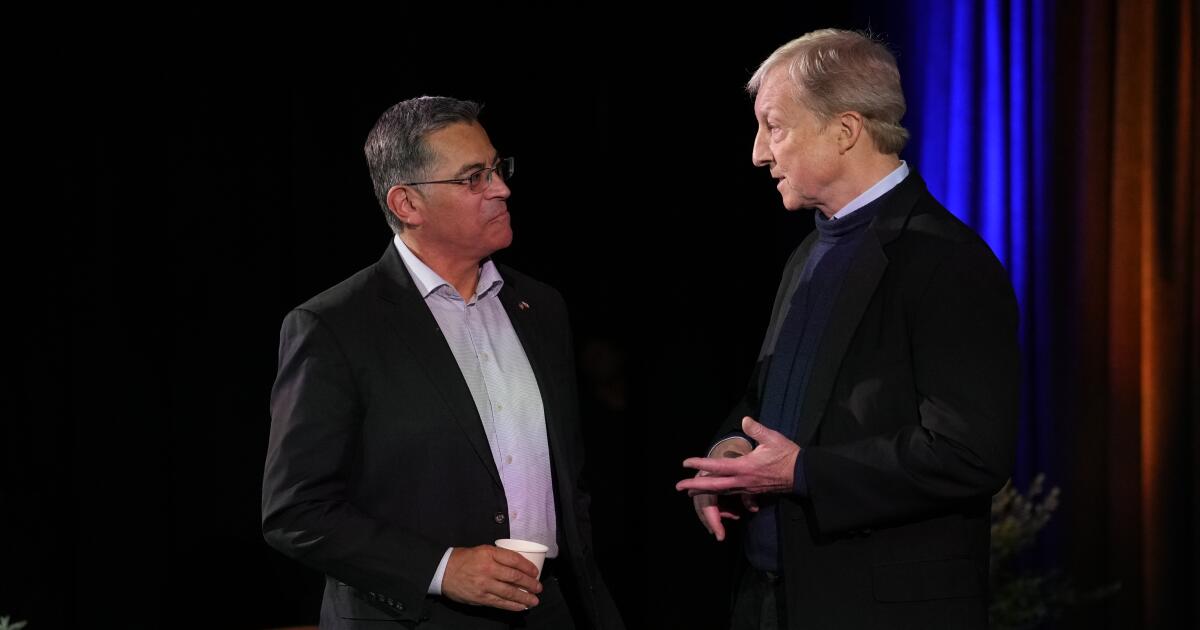
While both stuck with mostly an upbeat message and reiterated promises to lift up Californians struggling to make ends meet, Steyer afterward accused Becerra of being “a corporate Democrat who’s taking money from all these big corporations” who “doesn’t want to change things.”

Steyer’s had good reason to go after Becerra.

A new poll from the UC Berkeley Institute of Governmental Studies and co-sponsored by the Los Angeles Times showed Becerra leading the race with 25% support from likely voters, followed by Hilton at 21% and Steyer within striking distance at 19%. The two candidates who finish in first and second place in the primary will advance to the November general election, leaving the third-place finisher on the sideline.

Though he told reporters Friday morning that “I don’t pay attention to polls,” Steyer was energetic at a Northern California campaign event, where he held a private meeting with leaders of a union representing long-term caregivers. In brief remarks at the offices of SEIU Local 2015, Steyer described the race as a choice between a billionaire champion of working people and the corporate-backed Becerra.

“Does California work for Californians or does California work for corporations? The corporations think it works for them. They want it to continue to work for them and they’re putting up tens of millions of dollars to make sure they continue to make record profits,” he told dozens of home-care workers, teachers, construction workers and nurses at the West Sacramento gathering.

Groups including PG&E, the California Assn. of Realtors and the California Chamber of Commerce have spent more than $34 million opposing Steyer’s candidacy. The former hedge fund manager has pledged to lower energy bills by breaking up large electric utility monopolies.

As a billionaire who has so far poured $216 million of his own money into his gubernatorial campaign, Steyer has faced skepticism from some left-wing and working-class voters. But he is endorsed by progressives, including Rep. Ro Khanna (D-San Jose), and unions including the California Nurses Assn. and both major teachers unions.

“I voted for Tom. I was looking for a change,” said Alvenia Scott, a union board member who works as an in-home caregiver to her disabled sister.

“He really has some good ideas,” she said, adding that she had more qualms about Steyer’s lack of government experience than his wealth. “He made his way in life, more power to him.”

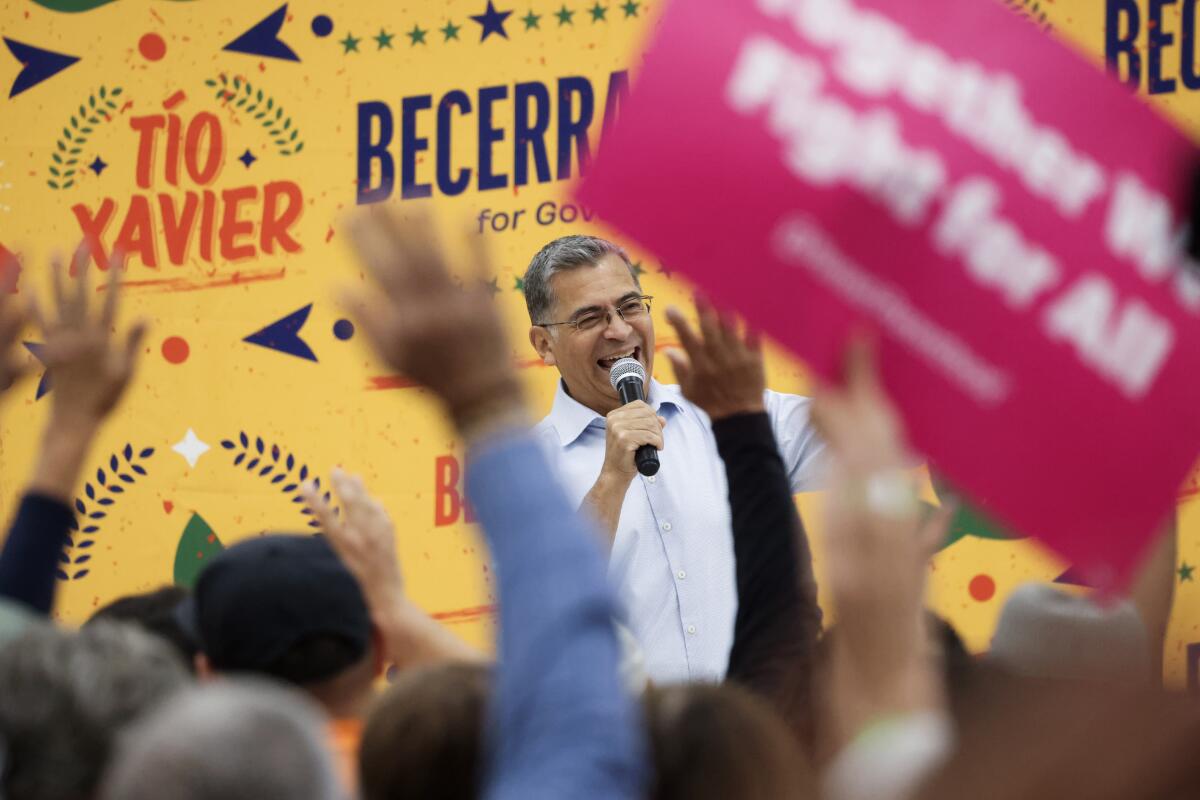
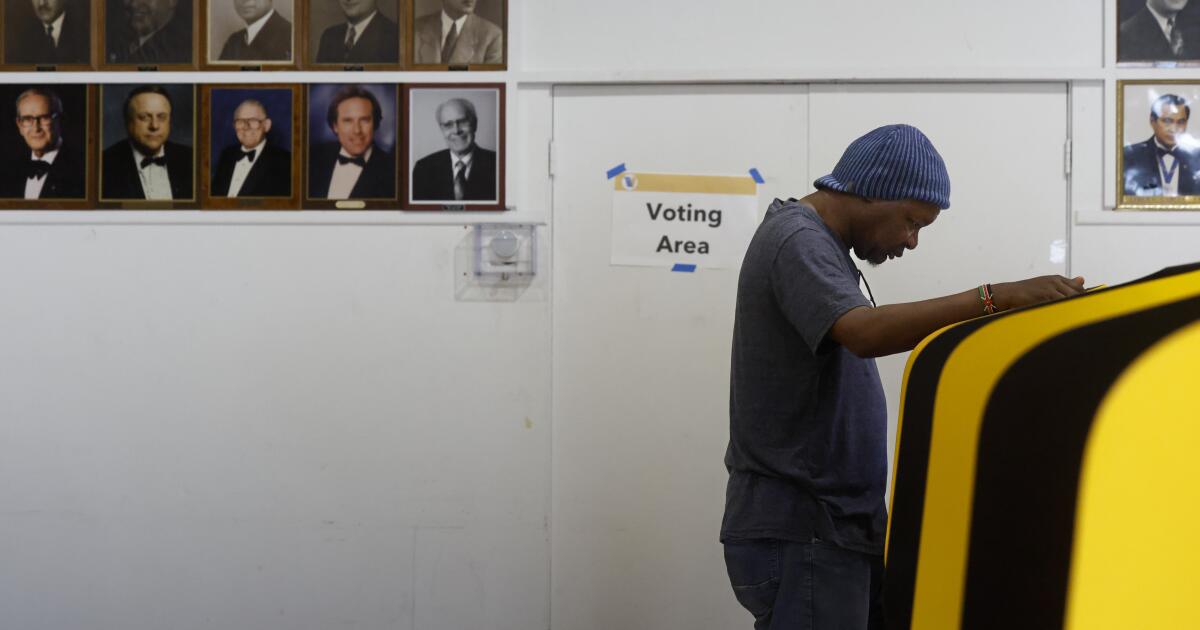
Hundreds of miles south in the Inland Empire, Becerra pledged to be on the side of unions if he is elected governor and urged voters to turn in their ballots in what has so far been a remarkably low-turnout election.

“I am with you. When I become governor and I sit behind that desk, you’ll have a union man sitting at that desk,” Becerra told about 500 people at the United Food and Commercial Workers hall in Bloomington.

He asked the crowd if they had cast their ballots and noted that not everyone raised their hand.

“Less than one in five Californians have actually cast their vote so far. We got to get that number way, way up,” he said, arguing that the election is about “sending a message all across the country that California will be counted, that California cannot be neglected, and that California will not take a knee to anyone in Washington, D.C.”

Only 12% of the state’s registered voters have cast ballots as of Thursday evening, according to the election tracking firm Political Data Inc.

Community college counselor Diego Rodriguez, 32, said he decided to vote for Becerra in recent weeks after seeing the former U.S. Health and Human Services secretary’s momentum in the race and researching his record.

“Also just his story. As someone who works in higher education, and seeing how Xavier, being first-generation, has benefited from higher education, and how he advocates for higher education,” the Rialto resident said. “Additionally, today, him being here at a labor union and advocating for the working class and labor, I think, is very important.”

Rodriguez said he first started looking into Becerra after he was among the candidates excluded from a USC debate that was ultimately canceled.

“I think that people became aware of him more because of that,” Rodriguez said. “There was a lot of conversation online regarding that, but I think it allowed the spotlight to be brought onto him and it made people aware of his record.”

At a campaign stop in Clovis in the central part of the state, Hilton marveled that his campaign had spent only about $2 million in campaign advertising but was still polling above Steyer, according to the latest Berkeley IGS survey.

“We’re feeling confident,” said Hilton, standing in a suburban stretch of the city. Still, he warned that voters need to get out to support him and avoid a “complete disaster for California” of two Democrats advancing to the November election.

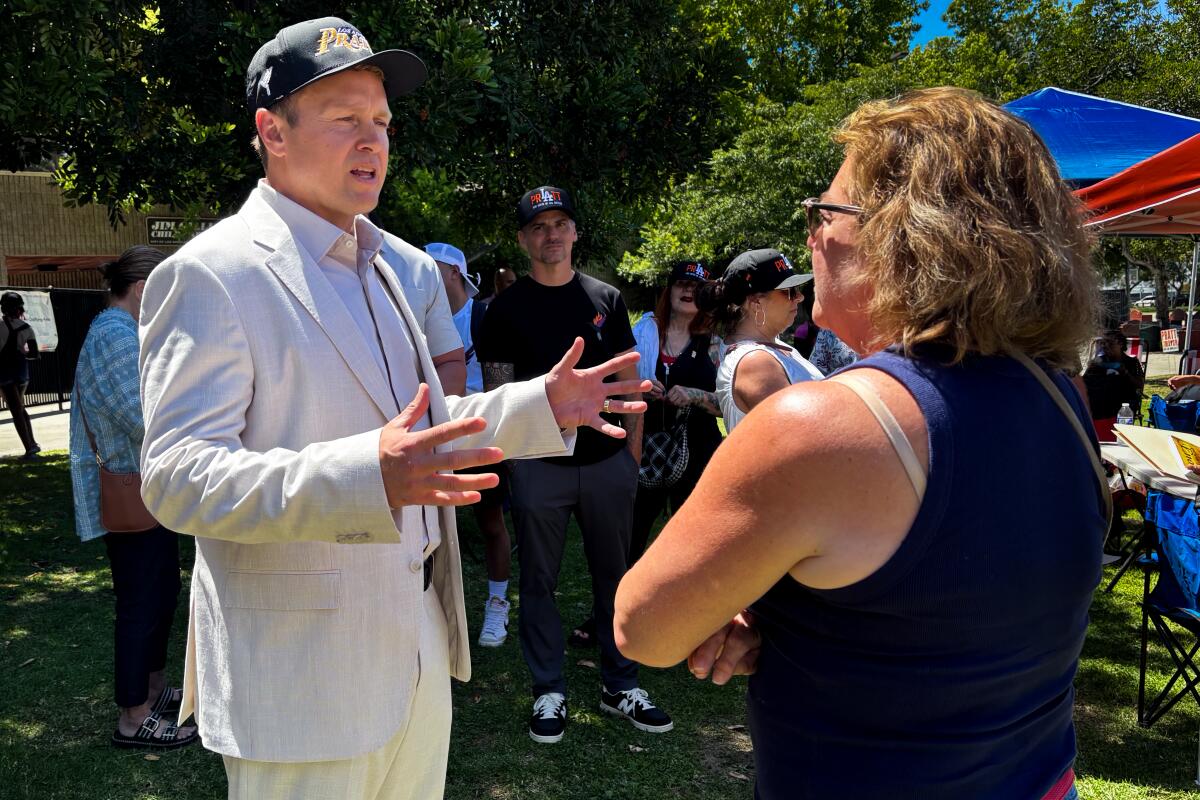
Hilton, who was endorsed by Trump in April, joined other politicians and leaders in Clovis in opposing trans athletes from competing at the 2026 CIF State Track & Field Championships.

The group met near where the championship events were scheduled to take place this weekend.

Asked why he was focusing on sports and gender in the final days of the race, Hilton said it’s “one of the main issues” that come up at town halls. If elected, he said he would seek to overturn the state’s 13-year-old law that allows students to participate in school activities and use facilities such as bathrooms based on their gender identity.

Hilton argues the law violates the state Constitution and will “suspend” it while he initiates legal proceedings to overturn it.

He also praised Spencer Pratt, a Republican and former reality TV star who is running for Los Angeles mayor, saying his candidacy has brought “excitement and energy” to the state’s primary election.

“For a long time in California, there’s been this sense that it’s all inevitable — there’s nothing you can do, Democrats run this place, just the way it is,” Hilton said. “I think that that’s changing. I think there’s this sense that something’s happening.”

Source link

Compton educators are baffled by Rep. Maxine Waters’ snub of school bond

When Compton Unified School Board President Micah Ali checked his mailbox last week, he was in for a shock.

The school district has been making headlines as a state and national leader in student performance gains, and it has been upgrading and replacing its aging campuses to help advance that growth. Next week’s ballot includes a $360-million bond measure called CPT, which would keep that momentum going and replace badly dated Dominguez High School.

So when Ali opened a slate mailer titled “Congresswoman Maxine Waters’ Sample Ballot and Voter Recommendations,” he couldn’t believe her advice on Measure CPT.

Vote “no.”

Given Waters’ stature as a congressional representative for 35 years, Ali said, her slate mailers can swing outcomes.

“Yes, it does carry weight,” Ali said, and the thumbs-down recommendation “can literally cripple our ability to pass this bond.”

Ali was doubly surprised because the mailers went out to voters just a few weeks after Waters attended an unveiling ceremony for the new Compton High School campus. Compton High alums and hip-hop heavyweights Kendrick Lamar and Dr. Dre joined the celebration, and the latter was honored for his $10-million donation to the new performing arts center.

Lunch tables outdoors

Lunch tables and a temporary cafeteria are set up outdoors at Dominguez High School because of a fire three years ago.

(Eric Thayer / Los Angeles Times)

A second district high school, Centennial, is being replaced with a modern campus, and district officials are hoping Measure CPT passes so Dominguez students aren’t left behind, but also because the district’s other schools would get multiple upgrades and repairs, from infrastructure to classrooms to athletic fields.

I met with Ali on Wednesday afternoon at Dominguez, along with Principal Caleb Oliver. The school turned 70 this year, and it shows. The grounds are scruffy, wiring and plumbing are outdated, the gymnasium air conditioning hasn’t worked in years. To walk the campus is to step back in time — to the Eisenhower administration.

While we were talking, Oliver called out to a senior named Angelina Ramirez, referring to her as a superstar student. I asked Angelina what kind of upgrades the campus could use.

Dominguez High School Principal Caleb Oliver.

Dominguez High School Principal Caleb Oliver.

(Eric Thayer / Los Angeles Times)

“Well, I like to use the cafeteria as an example,” she said, pointing to where it used to be.

What happened to it?

“It burned down,” she said. An electrical problem was the suspected cause, her principal added.

That was more than three years ago, and since 2023, the cafeteria has been an outdoor plaza.

“I feel like that’s affected students a lot,” Angelina said.

The big question, of course, is why Waters’ campaign committee — Citizens for Waters — recommended a no vote.

I’d like to tell you why it is that a rapper has written a $10-million check in support of Compton’s students while a congresswoman has told them to go fly a kite. But I’ve asked by phone, text and email, and I still don’t have an answer.

After contacting Citizens for Waters, which referred me to the congresswoman, I called her office and emailed her press office, which sent me this response at 7:43 p.m. Thursday:

“Per US House Ethics rules, we are unable to respond to your request.”

I don’t know what rules those are, but the rulebook needs some rewriting if a congresswoman can’t answer a simple question about why her campaign mailer recommends a no vote on a school bond measure.

“We have no idea, and we’re baffled,” Ali said. “Who would oppose the construction of a new school in a community like Compton?”

In the working-class community, the student population is roughly 84% Latino and 14% Black.

I suggested that Ali consider having students march over to Waters’ district office and ask for an explanation.

“We’d rather have these children’s butts in seats and learning,” Ali said, adding that “we need … to continue driving up these test scores.”

Tana McCoy talks to school board President Micah Ali.

Compton school board candidate Tana McCoy talks to school board President Micah Ali about the mailer.

(Eric Thayer / Los Angeles Times)

It’s not as if there is no reasonable opposition to Measure CPT. These kinds of bonds cost taxpayers real money over the course of many years, and CPT would add about $60 per $100,000 of assessed property to annual tax bills.

That would hit working folks and retirees with an added tax burden of between a few hundred and several hundred dollars a year. And taxpayers have been paying off two previous school improvement bond issues, one passed in 2015 and one in 2022.

In addition to the financial burden, according to district parent Anthonia Limon, who wrote the statement against CPT for the L.A. County sample ballot, safety issues have undermined community trust in district leadership.

“Infrastructure alone does not create safe schools,” Limon wrote.

If Waters has similar concerns, that would be one thing. But to my knowledge, and to Ali’s, there has been no public explanation for recommending a no vote. And when you read the fine print on the slate mailer, which advises voters to “take Congresswoman Maxine Waters’ recommendations with you to vote,” it only raises more questions.

“This document was prepared by Citizens for Waters, not an official party organization. Appearance in this mailer does not necessarily imply endorsement of others appearing in this mailer nor does it imply endorsement of, or opposition to, any issues set forth in this mailer,” it says.

Huh?

Are they endorsements or aren’t they?

The Times reported in 2004 that the rep’s daughter, Karen Waters, “has charged candidates for spots on her mother’s ‘slate mailer,’ a sample ballot that many voters in South Los Angeles use to guide their choices.” Last year, the Waters campaign paid a $68,000 fine for campaign finance law violations following a Federal Election Commission investigation that involved Citizens for Waters.

Rep. Maxine Waters' slate mailer.

Rep. Maxine Waters’ slate mailer.

(Eric Thayer / Los Angeles Times)

Also in the fine print on the current mailer:

“Appearance is paid for and authorized by each candidate and ballot measure which is designated by” an asterisk.

So are these endorsements or paid advertisements? There’s an asterisk on nearly every endorsement in the mailer, from city council to governor to judgeships to Measure CPT. The way I read this is that various parties paid for endorsements, but the mailer does not reveal who paid, or how much they ponied up. Such mailers, by the way, are not uncommon in California, according to election law experts.

“I think this is misleading for voters,” said Erwin Chemerinsky, dean of the UC Berkeley law school. Although he thinks the endorsements are a form of protected free speech, he said this “reflects a very deep problem in our elections with dark money, when we don’t know where the money is coming from.”

On Thursday, I visited Tana McCoy, a Compton High grad and retired city employee who is running for Compton Unified school board. She showed me the slate mailer delivered to her home, but said she’s going to vote yes on CPT despite Waters’ recommendation.

“Children need to feel good about their environment, because that’s all part of their mental health,” McCoy said.

At Dominguez, where graduates have a 96% college acceptance rate, according to district officials, junior Zaiden Ross gave me a tour that included a stop at a gymnasium fountain that he said hasn’t worked in years. Some fountains are dirty, he added, “and some of the pipes on campus produce water that has, like, extremely high amounts of lead and magnesium.”

Student Zaiden Ross demonstrates a nonworking sink in a bathroom

Student Zaiden Ross demonstrates a nonworking sink in a bathroom on the campus of Dominguez High School in Compton.

(Eric Thayer / Los Angeles Times)

Zaiden took me to a classroom to show me water samples he’s still testing. Then we visited the robotics classroom, where he turned on a faucet, and the flow was closer to the color of apple juice than water. The air conditioner was rattling, and teacher G.C. Esiobu, who runs the engineering and robotics club, said there had been an “emergency” fix for a busted system. Zaiden gave me a quick rundown of dated computers and other equipment students use to design drones and robots.

And yet despite all that, a display case was filled with trophies. At competitive meets, Esiobu said, “we have been winning with little or nothing.” With equipment upgrades, she added, “just imagine the level we will go.”

There’s still time, before Tuesday’s election, for Waters to visit Dominguez High and maybe get a tour from Zaiden and Esiobu.

If she does, she might rethink that endorsement.

steve.lopez@latimes.com

Source link

Contributor: In politics after Trump, nothing is disqualifying

After a decade of Trumpism, it should come as no surprise that President Trump’s ethos (presenting scandal as strength, outrage as authenticity and public disgrace as evidence you’re a “fighter”) has trickled down into congressional campaigns of both parties.

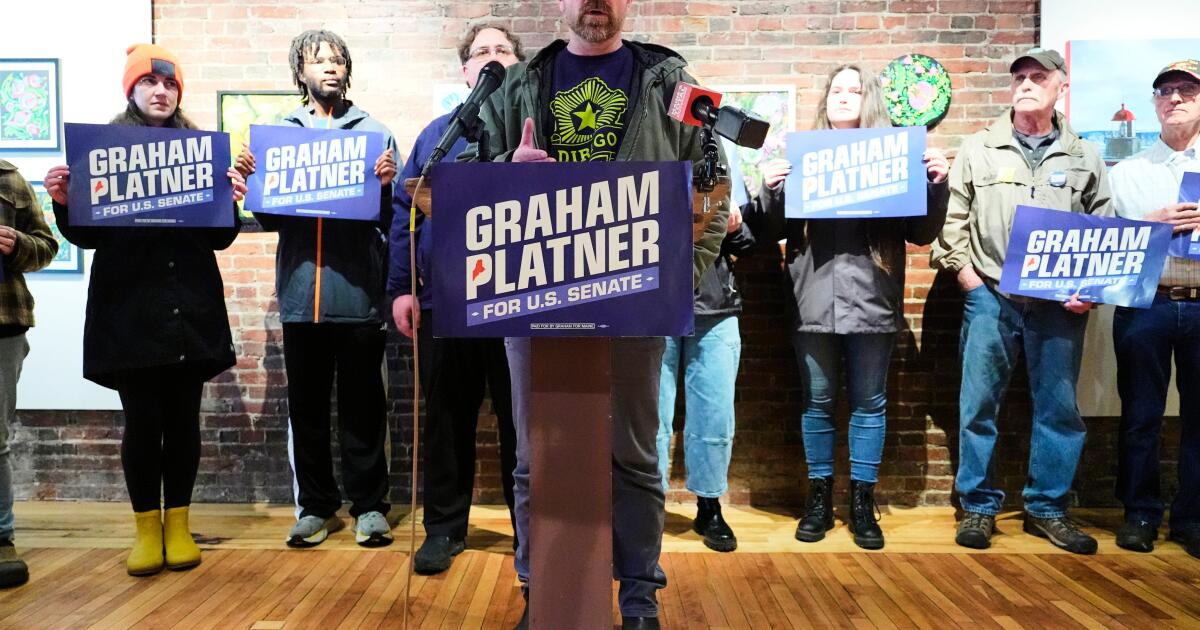
In Maine, for example, controversial oysterman and veteran Graham Platner, a Democrat, appears poised to face Republican Sen. Susan Collins, after incumbent Gov. Janet Mills’ failure to launch led her to drop out of the Senate primary.

Under old “pre-Trump” rules, Platner’s campaign would have withered instantly after revelations that he once had a Totenkopf SS tattoo, previously identified himself as a communist, said Black people were poor tippers, and wrote that white people “actually are” as racist and stupid as Trump thinks they are.

Instead, after all this surfaced, Platner actually rose in the polls. Considering the circumstances, there are several reasonable explanations for this.

Maybe Maine Dems have concluded that moral purity tests are politically suicidal after years of watching heterodox figures like Joe Rogan and Elon Musk drift away from the party.

Maybe Platner’s rough-edged outsider persona simply feels more authentic than another interchangeable politician in a pantsuit droning on about “working families.”

Perhaps the difference is that, unlike Trump or Texas’ scandal-plagued Republican Atty. Gen. Ken Paxton, Platner has at least attempted contrition.

Or maybe Maine Democrats have absorbed the same lesson Republicans adopted in 2016: Once voters stop treating scandal as disqualifying, policing your own side for off-the-field behavior starts to look like unilateral disarmament.

I mean, who could blame them for thinking you’ve got to fight fire with fire? America, after all, reelected Trump after 34 felony convictions.

At a certain point, continuing to insist that “character matters” starts sounding like advice Ward Cleaver might have offered Wally on “Leave It to Beaver.”

But Maine isn’t the only example of voters viewing scandalous behavior as a “keeping it real” feature, not a bug.

Another just took place in Texas, when the aforementioned Paxton crushed normie incumbent Sen. John Cornyn in a Republican primary runoff, garnering nearly 64% of the vote.

Paxton, it’s worth noting, was previously indicted on felony securities fraud charges, impeached by the Texas House on allegations including bribery, accused by senior aides of abusing his office to help a donor and real-estate developer and accused by his wife (a Texas Republican politician) of infidelity, just to name a few of his greatest hits.

Yet, not only did the scandals not doom Paxton, they probably helped him. They signaled a willingness to fight, casting him as both a victim and an outsider. There may be no purer expression of trickle-down Trumpism than Paxton, which probably explains why Trump endorsed him.

At this point, you might be thinking that all is lost. But there are counterexamples that lend to optimism.

Paxton’s Democratic opponent in Texas, for example, offers a stark contrast, as well as an opportunity to test the level of our societal decline in November.

Texas Democrats could easily have nominated their own chaos agent in Rep. Jasmine Crockett, a progressive firebrand whose flair for viral combat suggests she understands the incentives of modern politics perfectly well.

Instead, they chose James Talarico — a young state legislator, former middle-school teacher and Presbyterian seminarian — who projects the kind of earnest optimism that lands somewhere between Barack Obama and Pete Buttigieg.

If a Democrat like Talarico can win in deep-red Texas — against a scandal-plagued candidate who shouldn’t get within 10 miles of the U.S. Capitol — it will perhaps provide a modicum of hope that red lines still exist, and that some voters still believe character is destiny.

But regardless of who wins that matchup, the fact that both Paxton in Texas and Platner in Maine emerged as their party’s respective Senate candidates (Platner won’t technically be the Democratic nominee until after the Maine primary in June) still suggests something profound has shifted in American politics.

Not long ago, the scandals attached to either man would have ended a campaign overnight.

Today, they function more like résumé enhancements. Because the defining lesson of the Trump era may be this: Nothing is disqualifying anymore.

If a failed nepo baby and middling reality-TV star can become president, survive endless scandals (think “Access Hollywood”), rack up felony convictions, be found liable for sexual abuse, sit by and watch a Capitol riot, and then return to power anyway, traditional ideas about character and electability are simply no longer relevant.

The question now is whether Trumpism has become America’s permanent political operating system — or whether the new rules apply only to Trump himself.

November will offer some hints.

Matt K. Lewis is the author of “Filthy Rich Politicians” and “Too Dumb to Fail.”

Source link

Becerra leads governor’s race; Hilton, Steyer in tight contest for second spot

On the cusp of California’s gubernatorial June 2 primary, voters are closely divided among three candidates vying to succeed Gov. Gavin Newsom at a perilous moment in the state and nation’s history, according to a poll released Thursday.

Among likely California voters, 25% support Xavier Becerra, a Democrat and former Biden Cabinet secretary, according to the survey by UC Berkeley’s Institute of Governmental Studies that was co-sponsored by the Los Angeles Times. Republican Steve Hilton, a former Fox News commentator and British political strategist, has the backing of 21%, while 19% backed billionaire hedge fund founder turned environmental activist Tom Steyer, a Democrat.

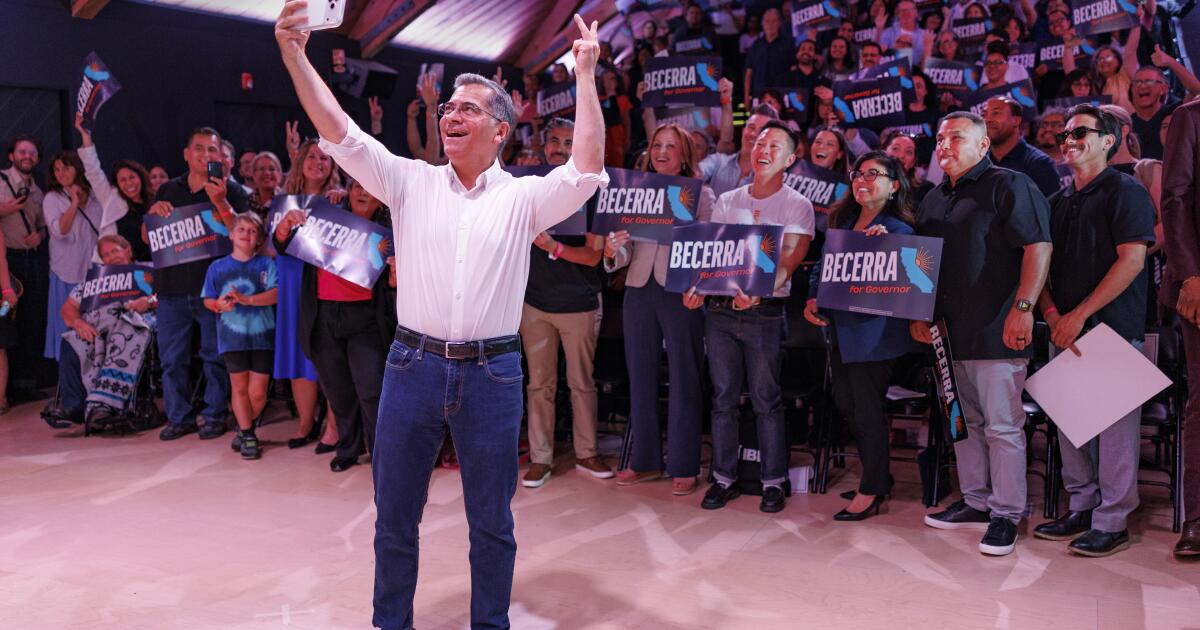
California gubernatorial candidate Xavier Becerra takes a selfie at an event while campaigning

California gubernatorial candidate Xavier Becerra takes a selfie at an event while campaigning on May 26, 2026 in San Francisco, California. Becerra is the former United States Secretary of Health and Human Services and is running as a democratic candidate for governor. California’s statewide election is on June 2.

(Benjamin Fanjoy / Getty Images)

The survey provided the clearest indication yet that the three have separated themselves from the rest of the field. Support increased for Becerra, Hilton and Steyer since the last Berkeley IGS poll in March. Becerra leapfrogged everyone. In early March he wallowed near the bottom of the pack at just 5% support among likely voters, and now is the front-runner.

The other candidates floundered. Support for Riverside County Sheriff Chad Bianco, a Republican, dropped 5% and he now finds himself in a distant fourth place. Former Democratic Rep. Katie Porter of Irvine dropped by almost half to 7%. San Jose Mayor Matt Mahan, former Los Angeles Mayor Antonio Villaraigosa and state Supt. of Public Instruction Tony Thurmond — all Democrats — remained mired in the single digits.

Poll director Mark DiCamillo cautioned that it remains unclear which candidates will finish in first and second place in the June 2 primary, a pivotal question since only the top two finishers will advance to the November general election regardless of party affiliation. The low voter turnout thus far makes predicting the outcome especially difficult.

Although every registered voter in California was sent a mail-in ballot, many have not returned them or dropped them off at voting locations — a telltale sign of the uncertain nature of this year’s governor’s race. The survey, which included all 61 of the gubernatorial candidates on the ballot, found that Democratic turnout thus far is noticeably lower compared with past primary elections, DiCamillo said.

Steve Hilton, Republican gubernatorial candidate for California, arrives for a news conference

Steve Hilton, Republican gubernatorial candidate for California, arrives for a news conference at the San Jose Diridon Station in San Jose, California, US, on Tuesday, May 26, 2026. Republican gubernatorial candidate Steve Hilton is announcing his intention to halt future taxpayer-funded payments for California’s High-Speed Rail project, if elected in November.

(Jason Henry/Bloomberg via Getty Images)

“We’re assuming that … the Democrats will in fact turn out in the final week after we had concluded our poll and begin to make up ground on what looks like an early lead for Hilton, and those voters favor Becerra,” DiCamillo said.

The survey, conducted between May 19 and 24, found that likely Democratic voters favored Becerra over Steyer by 11 percentage points. Voters registered as “no party preference” were evenly divided between Becerra, Steyer and Hilton. Among likely Republican voters, Hilton led Bianco by almost 2 to 1.

Becerra also had a notable edge over Steyer among women and Latino voters, while Steyer had an advantage among Black voters. Hilton was favored over the two Democrats among self-identified libertarians and among voters in Orange County, the Central Valley and northern coast and Sierra region.

The poll found that 7% of voters remained undecided.

For the first time in more than a quarter of a century, the contest to lead the nation’s most populous state and the world’s fourth-largest economy has consistently lacked a front-runner despite a plethora of candidates.

Two of California’s best-known Democrats, former Vice President Kamala Harris and U.S. Sen. Alex Padilla, both toyed with a run for governor before deciding not to run, which contributed to the sluggishness of the race. The 2026 campaign for governor also languished in the shadow of the mayhem stirred up by President Trump, including his immigration raids throughout Southern California, and the devastation wrought by the 2025 Pacific Palisades and Altadena wildfires.

But a whirlwind of recent developments has drawn attention to the race.

Former Rep. Eric Swalwell (D-Dublin), once a front-runner in the contest, withdrew from the race and resigned from Congress in the aftermath of multiple allegations of sexual misconduct and assault that he denies.

Tom Steyer, Democratic gubernatorial candidate for California, during a campaign event

Tom Steyer, Democratic gubernatorial candidate for California, during a campaign event in Santa Rosa, California, US, on Wednesday, May 27, 2026. California is holding its primary election on June 2. Photographer: David Paul Morris/Bloomberg via Getty Images

(Bloomberg/Bloomberg via Getty Images)

Additionally, record-breaking amounts of money have flowed into the race. Steyer has smashed state self-funding records by contributing $212 million to his campaign as of Tuesday, according to the California secretary of state’s office. Nearly $85 million has been donated to independent expenditure committees by corporations, labor unions, tech titans, Native American tribes and other special interests, most of which will have policy interests that will be in front of the next governor.

Although the 2026 California governor’s race lacks the allure of recent contests that featured candidates such as global movie star Arnold Schwarzenegger, political scion Jerry Brown and former San Francisco mayor and likely 2028 presidential candidate Gavin Newsom, it is unfolding at a crucial time for Californians.

The state’s most vulnerable residents are facing severe reductions to medical care because of looming federal healthcare funding cuts, and California’s budget, already volatile because of its reliance on the state’s wealthiest residents, may grow more unpredictable. California’s highest-in-the-nation gas prices increased even more because of the U.S.-Iran war, adding to the state’s entrenched affordability crisis, which has driven many residents out of the state.

The cost of living, homelessness and public safety were among the top concerns expressed by voters, according to the poll. Protecting voting rights was also supported by most voters, though their underlying concerns could be starkly different based on their political views.

Democrats have been focused on the disenfranchisement of voters, a fear that has heightened in the aftermath of a recent Supreme Court decision that gutted a section of the Voting Rights Act that forced states to draw voting districts to help elect Black or Latino representatives to Congress. Republicans echo President Trump’s claims of elections being rigged.

Chad Bianco is interviewed after the California Gubernatorial debate

Los Angeles, CA – MAY 06, 2026: Chad Bianco is interviewed after the California Gubernatorial debate at Skirball Cultural Center on Wednesday, May 6, 2026 in Los Angeles, CA.

(Jason Armond/Los Angeles Times)

Voters split largely along party lines about issues such as Trump’s policies about climate change, immigration and taxes.

Voters’ uncertainty in the governor’s race is partly driven by California’s unique, voter-approved “jungle” primary system, in which the two candidates who win the most votes in the June 2 primary advance to the November general election, regardless of party affiliation.

Although the state’s voters are largely registered Democrats, the party’s leaders feared earlier this year that they would splinter among the multiple Democrats on the ballot, leading to Hilton and Bianco advancing to the November general election and ensuring that a Republican would be elected governor. Bianco had the backing of 11% in the new Berkeley survey.

The Republicans were once roughly tied in polls, until Trump endorsed Hilton in April. More than one-third of likely Republican voters said Trump’s endorsement of Hilton made them more likely to support him. Among voters who identified with the “Make America Great Again” movement, nearly two-thirds supported Hilton while less than 3 in 10 backed Bianco.

Though Bianco’s followers seem to be more passionate, “Hilton has got the much broader base of support, and then he got Trump’s endorsement,” DiCamillo said.

He added that Hilton’s rise is unusual in California, where statewide candidates typically spend enormous sums of money to raise their visibility among the state’s 23.1 million registered voters.

“What’s interesting about Hilton is that he hasn’t really done much of his campaigning in the traditional way. He hasn’t run huge amounts of television advertising, you don’t see his name out there in the traditional media, other than in free media,” DiCamillo said. “You can see that in the data, because almost a third of voters still have no opinion of Hilton … about what it was back in March, which is startling for a candidate who is among the leaders.”

Democrats’ fear of being locked out of the November general election led party leaders and allies to effectively urge low-polling candidates to drop out of the race in remarkable public statements in March.

The tables have since turned — the prospect of two Republicans winning the top spots in the June primary appear nonexistent, while polling shows a small possibility of two Democrats advancing to the general election.

“I’m not saying it’s likely, but it’s possible that two Democrats could emerge, and that would have huge implications on turnout in the [November] election,” DiCamillo said, pointing to California congressional races that could shape control of the U.S. House of Representatives. “If you don’t have a Republican at the top of the ticket, it would be dismal for the Republicans’ chances.”

The poll of 8,578 registered California voters was conducted online in English and Spanish and has a margin of error of about 2 percentage points in either direction.

Source link

2026 California voter guide: vote-by-mail, registration, track my ballot

With just days left to cast your vote in California’s primary election on June 2, The Times has answers to your last-minute questions about the voting process.

Here’s what you need to know:

What are the key races to watch?

  1. The California governor’s race is a tight battle between Democrats and Republicans who are vying to replace Democratic Gov. Gavin Newsom, who is serving his second term and cannot run again. Top candidates include a Riverside County Sheriff, a former senior advisor to British Prime Minister David Cameron, a former Los Angeles mayor, a billionaire hedge fund founder and a member of the U.S. House of Representatives. Your guide to the race for California governor can be found here.
  2. In the Los Angeles city mayoral race, incumbent Karen Bass faces a reelection challenge from a field of candidates that include a reality TV personality, a tech entrepreneur, a City Council member and a progressive community leader. Your guide to the L.A. mayor’s race can be found here.

What is on the ballot?

There are several races, ballot measures, local district seats and statewide races that Southern Californians must decide on.

Most of the attention will be on the races for California governor and the mayor of Los Angeles.

City of Los Angeles residents have several other items to consider, including:

County of Los Angeles residents will be asked to vote on:

Voters will decide on six local congressional district seats and other statewide races including the:

A comprehensive breakdown of each race or proposed tax measure can be found here.

What is an open primary?

An open primary allows the top two candidates who garner the most votes to move on to the general election in November, no matter what party they belong to.

This system could allow two candidates from the same party to advance to the general election.

Is it too late to vote by mail?

No. You can return your vote-by-mail ballot by:

  1. Dropping it off in the return envelope at a secure official drop box now through the close of polls on June 2.
  2. Dropping it off in person at a polling place, vote center or county elections office by 8 p.m. on June 2.
  3. Dropping it off at the post office. Mailed ballots must be postmarked on or before election day and received no later than 7 days after election day. To ensure your ballot is postmarked by election day, mail it at least five days before June 2. If mailing on election day, get a hand-stamped postmark from a postal employee at a United States Post Office.

What is the deadline to return a vote-by-mail ballot?

In order to be counted, vote-by-mail ballots must be postmarked on or before election day, June 2, and received by your county elections office by June 9.

How do I check if I’m registered to vote?

To find out if you’re registered to vote, visit the secretary of state’s website. You’ll need to enter a California driver’s license or identification number or the last four digits of your Social Security number.

You also can call the state’s voter hotline (available in 10 languages) at (800) 345-8683 to get a paper application mailed to you, or you can pick up one at a county election office, most California libraries and United States Post Office locations, as well as many federal, state and local government offices — including the Department of Motor Vehicles.

If you opted to register online, officials say you should wait at least 24 hours before checking your voter status.

How do I register to vote? Can I register on election day?

The deadline to register to vote was May 18.

If you’ve failed to meet the deadline, you can register as a conditional voter through the same-day voter registration process.

Eligible citizens who need to register or reregister to vote within 14 days of an election can complete this process to register and vote at county elections offices, polling places or vote centers.

To find an early voting location, use the secretary of state search tool here. You can find your local polling places here.

Your submitted ballot will be processed and counted once the county elections office has completed the voter registration verification process.

How do I check my voter status?

You can check your voter status from the California secretary of state website here. To find your record, you’ll need to provide your full name, date of birth, state driver’s license or identification card number and the last four digits of your Social Security number.

Where is my closest drop box?

Secure ballot drop-off locations opened May 5. You can visit the Los Angeles County Office of the Registrar-Recorder/County Clerk’s website here to find a ballot box near you.

How do I track my ballot?

Once cast your ballot, you can track it here.

Staff writers Seema Mehta, Phil Willon and David Zahnister contributed to this report.

Source link

A bitter slugfest in Central Valley exposes divisions in the Democratic Party

The southern Central Valley is home to one of California’s few remaining congressional battlegrounds, where Democrats are itching to oust longtime Republican incumbent Rep. David Valadao.

Last year’s voter-approved Proposition 50 redrew the lines of this Latino-majority district slightly in Democrats’ favor. Two top Democratic candidates are battling over who is the best choice to face Valadao (R-Hanford) in November.

Valadao is particularly vulnerable after he voted last year to cut Medicaid spending, a critical resource for many in this poor, rural area. Two-thirds of residents in the district are enrolled in the federally funded low-income health insurance program, and more than 60,000 are expected to lose coverage when work requirements and other federal rules take effect next year.

Rep. David Valadao (R-Hanford) leaves a meeting of the House Republican Conference at the Capitol Hill Club on March 17.

Rep. David Valadao (R-Hanford) leaves a meeting of the House Republican Conference at the Capitol Hill Club on March 17.

(Tom Williams/Getty Images)

National Democratic infighting has overshadowed a classic moderate vs. progressive primary race since House Democrats’ campaign arm threw its support behind one candidate, Assemblymember Jasmeet Bains (D-Delano), over Randy Villegas, a school board trustee backed by progressives including Sen. Bernie Sanders (I-Vt.).

The race was already tense when the Democratic Congressional Campaign Committee added Bains, a family doctor and two-term assemblywoman, to its “Red to Blue” program, which provides staff and fundraising support to Democrats running against vulnerable Republican incumbents. Local party leaders said they had received assurances from national Democrats that they would stay out of the race, which further angered Villegas and his supporters.

“This is another example as to why people’s faith in the Democratic Party and party leadership is at an all-time low,” Villegas said in an interview with The Times. “In many ways, it’s a badge of honor to not be the insider candidate and to say that I’m actually going to fight for community members here and not D.C. elites.”

DCCC chair, Rep. Suzan DelBene of Washington, cited Bains’ background as a family doctor and her track record in the Legislature fighting to expand access to healthcare.

Randy Villegas takes frequent selfies for their social media while walking neighborhoods in Bakersfield.

Randy Villegas, running for California’s 22nd Congressional District, said his campaign manager wants him to take frequent selfies for their social media while walking neighborhoods in Bakersfield.

(Myung J. Chun/Los Angeles Times)

“We only weigh in on primaries when we feel that one candidate stands out as the strongest possible nominee to ensure that we win in the general election,” DelBene said in a recent interview on CBS’ “Face the Nation.” “This is a district that has been devastated by cuts to healthcare, a large Medicaid population, so she’s an incredible candidate and definitely can speak to the issues needed on health care.”

For Democrats, the outcome of the primary could have national significance. With President Trump’s popularity at a low point nationwide — and especially in California — the party hopes to win enough seats in the 2026 election to oust the Republicans from power in the U.S. House of Representatives.

Valadao, who was first elected to Congress in 2012, has been a perpetual target for Democrats, who have held a sizable registration advantage in his district. A moderate Republican, Valadao had emphasized his support for immigration reform, a departure from his party. Still, Democrats ousted Valadao in the blue wave of 2018, only for him to win back the seat in 2020 and remain in office ever since.

Both Villegas and Bains promote themselves as the Democrats’ best option to topple Valadao once again.

Villegas, the son of Mexican immigrants, is endorsed by the House Hispanic and progressive caucuses and has painted Bains as a corporate-backed candidate who would bend to special interests.

Jasmeet Bains speaks with Mary Jimenez during a campaign canvassing walk in Bakersfield.

Jasmeet Bains, running for California’s 22nd Congressional District, speaks with Mary Jimenez during a campaign canvassing walk in Bakersfield.

(Myung J. Chun/Los Angeles Times)

“We can’t just offer that we’re not Trump. The Democratic Party actually needs to stand for something,” he said. “To me that means fighting for universal healthcare, universal childhood education, banning members of Congress from trading stocks, getting rid of corporate PAC money. Those things may make Democratic leadership uncomfortable, and I’m OK with that.”

Bains is campaigning on her experience as a physician in a region known for its poor environmental and health outcomes. After medical school, she returned to Kern County, where she completed her residency and continued working at clinics that primarily serve low-income patients in the region.

She decided to run for the seat after Valadao voted in favor of H.R. 1, the Republican spending bill Trump signed into law last year that cut nearly $1 trillion in Medicaid funding to pay for tax cuts, which Bains described as a “betrayal.”

“In the Valley, your word is your bond,” she said in a phone interview as she drove the 250-mile journey from her district to the state Capitol in Sacramento. “In the beginning he kept telling everyone that he wasn’t going to vote for it, and I took him for his word.”

Jasmeet Bains brings 8-month-old, Chiquita, as she campaign walks a neighborhood in Bakersfield.

Jasmeet Bains brings 8-month-old, Chiquita, as she campaign walks a neighborhood in Bakersfield.

(Myung J. Chun/Los Angeles Times)

Bains is the daughter of Indian immigrants and was the first South Asian woman elected to the California Legislature. She continues to work weekend shifts at a clinic in Delano.

“I thought the healthcare disparities of people losing their private insurance and having to transfer to Medicaid” was bad, Bains said. “With the trillion dollars cut from Medicaid federally, I’m now in a position where I’m transferring my patients from Medicaid to nothing. The problem in the Valley for healthcare has gotten worse and worse and worse.”

It’s the reason labor unions including SEIU Local 521, which represents workers in public, nonprofit and healthcare sectors in Kern and other counties around the state, are backing Bains.

“Within my own union, the members that I represent in Kern County, in certain ZIP Codes they have a 15-year less life expectancy than my union members living in Monterey County, which is a very similar community” with rural agricultural interests, said Riko Mendez, the union’s chief elected officer.

He said Bains understands the region’s unique health challenges and has used her perch in the Legislature to address them, including pushing for funding to research and treat valley fever, an infection caused by fungal spores in the region’s soils.

“We think her experience, her profile, her message is one that we agree with, and that has the best chance of winning in the runoff against Valadao,” he said.

Bains’ time commitments in Sacramento and working at the clinic leave her little time for a traditional campaign knocking doors and showing up to community events. Some voters backing Villegas have noticed.

Randy Villegas takes a phone call in the shade while walking neighborhoods in Bakersfield.

Randy Villegas takes a phone call in the shade while walking neighborhoods in Bakersfield.

(Myung J. Chun/Los Angeles Times)

“For us, showing up is one of the most important things, and he’s the only candidate who has been doing that consistently,” 18-year-old Vanessa Orozco Romero said after a recent candidate forum in Bakersfield. Though nearly a dozen candidates for various offices were invited, Villegas and two other Democrats running for legislative seats were the only ones to attend.

Orozco Romero called the DCCC’s decision to back Bains “stupid and morally not OK,” especially since neither of the candidates earned enough delegate support to win the state party endorsement earlier this year.

Bains and Villegas have similar backgrounds as children of immigrants who grew up in the southern Central Valley. Though they both went on to earn high-level degrees, each is adamant about staying in Kern County to improve life for its residents.

The district is anchored in the eastern side of Bakersfield, home to California’s once-thriving oil fields, and stretches northward toward Fresno to include swaths of agricultural lands and small farming towns.

While there are more than twice as many registered Democrats in the district as Republicans, Democratic candidates often underperform in the Central Valley and independent voters play a crucial role picking winning candidates. Even under the new Proposition 50 lines that favor Democrats, President Trump would have beat former Vice President Kamala Harris by nearly 2 points.

Though nearly two-thirds of voters in the district are Latino, turnout is usually low among Spanish-speaking voters who are often discouraged by negative attack ads, Democratic activists said.

Save for the 2018 midterms during Trump’s first term, Valadao, a dairy farmer, has frustrated Democrats by continually winning over enough independents to hold onto the seat. Though the three candidates are competing in an open primary, Valadao is expected to advance to the general election as a longtime incumbent and the only Republican on the ballot.

“As he does in every primary election, Congressman Valadao is working hard to earn the vote of all Democrats, Independents, and Republicans,” Robert Jones, a consultant for Valadao’s campaign, wrote in an email. “We trust that the voters of the Central Valley will send the two best candidates to the general election in November.”

Source link

News Analysis: Uncertainty, frustration define messy midterm battles for mayor, governor and Congress

With little more than a week left until primary voters winnow the candidates for Los Angeles mayor, California governor and Congress, there remains a palpable sense of political uncertainty among the electorate — attributable to a lack of clear front-runners, redrawn political maps, messy party infighting and competing voter frustration with both President Trump and the state’s Democratic establishment.

In a state where Democrats hold a substantial advantage among registered voters and Trump lost in 2024 by more than 20 percentage points, MAGA-aligned Republicans are nonetheless competing on a message of ineptitude from longtime liberal leaders to address the state’s most intractable problems. Even some Democrats have railed against the status quo.

With Trump’s grip on the Republican base intact despite abysmal overall approval ratings, many Republican candidates have courted his approval — and been hammered for it by their Democratic opponents.

But those same Democrats have found it harder to explain why their own party should continue to lead the state despite allowing its affordability, housing and homelessness crises to take root and persist — taking little responsibility while swiping at each other for having failed to find solutions sooner.

All that party infighting — present before every primary, but at a fever pitch now — comes against a backdrop of broader voter unease about the war in Iran, volatile oil and gas prices, and the burgeoning threat of AI to the American workforce.

Republican voters are being warned of a blue wave in November giving Democrats control of Congress and grinding Trump’s agenda to a halt. Democratic voters are being warned of Trump administration efforts to undermine local and state elections, and of control of Congress unfairly slipping from reach thanks to further Republican redistricting following a U.S. Supreme Court decision undermining the Voting Rights Act and its protections for majority-Black districts across the South.

Many California voters — some already shaken or burned by former Rep. Eric Swalwell dropping from the gubernatorial race amid sexual assault and rape allegations last month — appear hesitant to cast ballots early, despite warnings that the Trump administration may try to discount those mailed at the last minute.

“Voters don’t want to make a mistake. They’re not absolutely certain,” said Rob Stutzman, a Republican consultant in California. “It’s just not real clear where to land.”

James Adams, a political science professor at UC Davis who studies elections and public opinion, said California Democrats this cycle “have a candidate problem and they have a message problem,” in that they are trying to convince voters to back them “not because they offer exciting ideas or inspiring leadership, but because their Republican opponents are even worse.”

And that message — offered as they gerrymander California in a race to the bottom with Republicans nationally — isn’t cutting it, Adams said.

“People are alienated from our current politics not because Americans are cynical, but because people recognize that they deserve better.”

Outsider shakes up L.A. mayor’s race

Amid entrenched homelessness, affordability concerns and lingering anger over the bungled response to last year’s wildfires, the L.A. mayor’s race was “supposed to be a referendum” on embattled Mayor Karen Bass, Stutzman said.

And yet, Bass remains in the lead, and many voters remain confused about which way to turn away from her — if at all.

Bass has won the endorsement of three council members who are members of the Democratic Socialists of America, despite City Councilmember Nithya Raman, an ally who’d previously endorsed Bass and is a member of the DSA herself, entering the race to her left.

Unable to consolidate support from the city’s progressive flank, Raman is now running neck and neck for a second-place finish and a chance to face Bass in the November runoff with former reality TV personality Spencer Pratt, who has remained in contention in ultra-liberal L.A. despite pushing a MAGA-aligned message to Bass’ right.

Pratt, who did not respond to a request for comment, lost his Pacific Palisades home in the fires and has won over many frustrated city residents with his anti-establishment message and cheeky AI videos — including one casting him as Batman, taking on a corrupt Democratic bourgeoisie.

Pratt, a registered Republican, has tried to dance around politics in the race, calling his campaign a “nonpartisan” one and comparing himself to President Obama politically. But he is backed by many Republicans, has echoed Trump’s rhetoric around restoring “common sense” and a “Golden Age” to L.A., and recently responded to Trump saying that he’d heard Pratt “is a big MAGA person” — and Raman posting the quote to X — with a meme of himself shrugging.

Fernando Guerra, founding director of the Center for the Study of Los Angeles at Loyola Marymount University, said he’s glad city voters have choices this race, because they clearly aren’t happy. He said Angelenos are less optimistic today than ever before and are deeply frustrated with “this same liberal Democratic regime from Bradley to Bass over 50 years” — a reference to former Mayor Tom Bradley, who first took office in 1973.

Voters are clearly tired of that regime, which has succumbed to “policy paralysis” in the name of “inclusion” and trying to please everyone, Guerra said — but not so much that they will consider going MAGA for Pratt.

“People say, ‘Yeah, Democrats have really f—d it up, but there’s no way we’re going to [back] Republicans. Look what they’ve done to the nation.’”

Others aren’t so sure. In its voter guide, the progressive group LA Forward wrote that the “most important thing” in the June 2 primary is to block Pratt — whom it called a “right-wing reality TV buffoon” — from advancing, and the best way to do so is to vote for Raman.

“We would much rather see a Bass/Raman runoff, with no chance of Pratt becoming mayor, than a Pratt/Bass runoff where a Pratt win would be a real possibility — plunging LA into a Trumpian mayoral nightmare,” the group wrote.

An unsettled gubernatorial contest

In the gubernatorial race, none of the many Democratic candidates has been able to consolidate a sizable lead, creating a lingering apprehension that Republicans could somehow eke out a stunning upset in the biggest of blue states.

That’s in part thanks to leading Democratic candidate Xavier Becerra, the former California attorney general and U.S. Health secretary under President Biden, being dogged by insinuations, including from fellow Democrats, that he was somehow complicit in a scheme by underlings to steal from his campaign coffers, despite prosecutors in the case — which resulted in his former chief of staff pleading guilty — never alleging wrongdoing on his part.

It’s also thanks in part to the fact that the leading progressive, Tom Steyer, is a billionaire who has bought his way into contention with nearly $200 million of his own money — in an election cycle in which progressive voters nationwide are decrying billionaires as the clearest symbol of all that is wrong with the nation’s lopsided economy.

“This kind of weird self-loathing rationale of why he’s the right guy to take on billionaires because he is one? You can’t build a Mamdani movement around that,” said Stutzman, referring to New York City Mayor Zohran Mamdani, who shot to power on a democratic socialist platform last year.

The Democrats have also struggled to combat the criticism — leveraged time and again by their Republican competitors — that their party has failed for years to solve California’s most substantial problems, and deserves to be ousted from power.

Republican Steve Hilton and Democrat Xavier Becerra speak during a break in the April 28 gubernatorial debate.

Republican Steve Hilton and Democrat Xavier Becerra speak during a break in the April 28 gubernatorial debate.

(Eric Thayer / Los Angeles Times)

Former Fox News commentator Steve Hilton has hammered that message in ads and on the debate stage, lambasting the Democratic establishment for pushing so much unnecessary regulation that it has chased out business and investment and made everything from gas to housing to groceries more expensive for average residents.

He has blamed Democrats for California’s high rates of poverty and unemployment, its high cost of living and high taxes, its record homelessness and its poor public school results.

In an interview, Hilton said he understands that California voters may not like Trump — who endorsed him — and may have conflicting beliefs about federal and international policy, but that California’s biggest problems have “nothing to do with President Trump.”

“Voters need to decide on what direction they want to take in terms of the policies that affect their daily lives in California,” he said, and those are “devised and enacted within California by our politicians here in Sacramento.”

He also said it’s no surprise that some of his Democratic rivals have also acknowledged that the Democratic establishment has been a failure, because “if you pretend otherwise, you show that you’re just completely out of touch with public opinion.”

Rusty Hicks, chair of the California Democratic Party, said “every campaign is entitled to run the race that they believe matches their story,” even if that means questioning the party’s past performance. But he also said polling hasn’t shown that message to be an effective one, and he’s confident that voters will show their ongoing trust in the party at the polls.

Redistricting, sniping and name-calling

The decision by California voters last November to pass Proposition 50 and allow the state’s Democratic leaders to redraw the state’s congressional maps to favor Democratic candidates in a handful of additional districts — part of a wider redistricting war sparked by Trump — has intensified the primary races in those areas.

As an example, longtime incumbent Reps. Ken Calvert (R-Corona) and Young Kim (R-Anaheim Hills) are now competing to represent the same redrawn swath of Orange, Riverside and San Bernardino counties, and have bitterly attacked one another. Kim has called Calvert a “swampy,” “sleazy” and “corrupt” politician guilty of “sabotaging President Trump’s agenda.” Calvert has called Kim a “RINO,” or Republican In Name Only, and a “Trump-hating liberal.”

Democrats have also sniped at each other, including in the race to replace retiring Rep. Darrell Issa (R-Bonsall) in his redrawn district in San Diego and Riverside counties — where Trump also holds an outsize presence.

Rep. Young Kim and Rep. Ken Calvert are opponents in a heated race in a newly redrawn congressional district.

Rep. Young Kim and Rep. Ken Calvert are opponents in a heated race in a newly redrawn congressional district.

(Associated Press)

Stutzman said it will be interesting to see how those primaries play out, but also how Democrats there and in other races perform in November — when Democrats are expected to perform well nationally given Trump’s lousy ratings, but Democrats in California could underperform thanks to statewide frustration with affordability, housing and homelessness here.

“People are like, ‘Eh, you know, yeah, Trump — but there’s some problems here,’” Stutzman said.

Hicks said he expects California voters to not only elect another Democratic governor, but to “push back on a Trump administration and congressional Republicans and Republicans around the country that have sought to rig the game in their favor,” including by “ensuring that we fulfill the promise of Proposition 50 by winning congressional seats and retaking the House of Representatives.”

He said the current political moment “can feel like a pressure cooker,” but Californians will “continue to adapt and overcome and be resilient, just as they always have been.”

Source link

Contributor: The GOP is collapsing under Trump’s loyalty tests

Americans always say they want politicians with backbone — men and women of principle who will stand up for what they believe in, even when it’s unpopular.

And every so often, the American people prove their commitment to this noble aspiration by firing anybody who actually tries it.

Take Republican Rep. Thomas Massie, who just lost a reelection bid by double digits after President Trump’s affiliated committees dumped enough money into Kentucky to purchase, well, Kentucky.

Massie committed the cardinal sin of modern Republican politics: He behaved as though Congress were a coequal branch of government instead of the warm-up act before a Trump rally.

He bucked Trump on spending, Iran and — in what apparently qualified as political suicide — whether or not to release the Epstein files. For this display of independent thought, Massie was summarily retired by what can only be described as the Trump cult (formerly known as the Republican primary electorate).

Before anybody accuses me of hyperbole, consider the remarkably revealing example presented recently on the New York Times podcast, “The Daily.”

At a town hall in Burlington, Ky., one voter explained to Massie that Trump is basically omniscient.

“As I see it,” the voter said, “the one person in the whole United States, maybe the world, that understands everything and has input to everything is Donald Trump.”

Not content with mere earthly wisdom, Trump also possesses universal awareness, superior intelligence and perhaps even low-level clairvoyance. The voter continued that Trump “gets more information, more meetings, more everything” than anybody else in government.

When Massie noted that Trump opposed releasing the Epstein files, the man calmly explained that if Trump changed positions, “there was a reason” — one too profound for ordinary mortals to comprehend.

Massie’s reply deserves to be bronzed and mounted over the entrance to the U.S. Capitol: “I don’t give anybody but God that kind of trust.”

Unfortunately, for a large portion of the Republican electorate (about 55%, based on the Kentucky primary results), those words constitute sacrilege against their earthly savior.

As South Carolina Sen. Lindsey Graham cheerfully boasted on NBC’s “Meet the Press” on Sunday, “This is the party of Donald Trump.” Which is true in much the same way North Korea is the party of Kim Jong Un.

The one ironic twist in all of this is that Americans finally managed to punish somebody over the Epstein files — only it turned out to be the guy who wanted them released.

There’s American justice for you.

Massie isn’t the only Republican currently being fitted for concrete shoes. Trump also helped finish off Louisiana Sen. Bill Cassidy, whose unforgivable crime was voting to convict Trump during the impeachment trial following Jan. 6. And Trump has endorsed controversial Texas Atty. Gen. Ken Paxton over incumbent Sen. John Cornyn, which in today’s GOP primary environment is roughly the equivalent of finding a horse head in your bed.

Now, to be fair, Cassidy and Cornyn are no Massie, who openly opposed Trump and paid the price standing upright. Cassidy and Cornyn demonstrated brief moments of independence, only to spend years vainly performing political interpretive dance routines in hopes of regaining Trump’s favor.

Still, there may be a silver lining here for students of political irony.

Trump’s endorsement of Paxton will force Republicans to spend enormous sums defending a deep red state that would ordinarily require little more than a campaign sign and a pickup truck.

Meanwhile, Trump is creating resentful lame-duck Republicans in Congress who now possess the most dangerous attribute in politics: nothing left to lose.

But the broader message is unmistakable. Trump wants Republicans to understand that disagreement will not be tolerated. No criticism. No distancing. No independent branding.

The party line is whatever Trump said five minutes ago, amended by whatever he says five minutes from now. By now, everyone knows this to be true.

Which would be excellent news for Trump, if not for one small complication: The rest of the country appears to be tiring of his act. Recent polling shows Trump’s approval slipping to 37%, while Democrats gain major ground, surging to a +11 on the generic congressional ballot.

Trump, it seems, has created a situation in which Republicans can either oppose him and be destroyed in a primary, or they can embrace him and risk losing the House and the Senate in November’s general election. It’s the old “damned if you do, damned if you don’t” conundrum.

The point is this: With the midterms approaching, Trump is making sure Republicans are ensnared in the gravitational pull of his unpopularity.

That may satisfy the president’s desire for complete loyalty. It may also hand Democrats control of both chambers of Congress.

Trump is settling all family business this week, by purging those pesky disloyal Republicans. Only time will tell whether he’s also purging America’s non-Republican “swing” voters, as well.

Matt K. Lewis is the author of “Filthy Rich Politicians” and “Too Dumb to Fail.”

Source link

Facing intense internal pressure, DNC releases postelection autopsy that criticizes Kamala Harris

Kamala Harris “wrote off rural America” during the 2024 presidential campaign and failed to attack Donald Trump with sufficient “negative firepower,” according to a long-awaited post-election autopsy released on Thursday by the Democratic National Committee.

The committee’s chair, Ken Martin, shared the 192-page report only after facing intense internal pressure from frustrated Democratic operatives concerned with his leadership. Martin had originally promised to release the autopsy, only to keep it under wraps for months because he was concerned it would be a distraction ahead of the midterms as Democrats mobilize to take back control of Congress.

On Tuesday, Martin apologized for his handling of the situation and conceded that the report was withheld because it “was not ready for primetime.”

Although the autopsy criticizes Democrats’ focus on “identity politics,” it sidesteps some of the most controversial elements of the 2024 campaign. The report does not address former President Joe Biden’s decision to seek reelection, the rushed selection of Harris to replace him on the ticket or the party’s acrimonious divide over the war in Gaza.

“I am not proud of this product; it does not meet my standards, and it won’t meet your standards,” Martin wrote in an essay on Substack on Thursday. “I don’t endorse what’s in this report, or what’s left out of it. I could not in good faith put the DNC’s stamp of approval on it. But transparency is paramount.”

A spokesperson for Harris did not immediately respond to a request for comment.

The initial reaction from Democratic operatives was a mix of bafflement and anger over Martin’s handling of the situation.

“Why not say this in 2024, or bring in more people to finish it, instead of turning this into the dumbest media cycle for 7-8 months?” Democratic strategist Steve Schale wrote on social media.

Report says Democrats don’t ‘listen to all voters’

The postelection report, which was authored by Democratic consultant Paul Rivera, calls for “a renewed focus on the voters of Middle America and the South, who have come to believe they are not included in the Democratic vision of a stronger and more dynamic America for everyone.”

“Millions of Americans are suffering from poor access to healthcare, manufacturing and job losses, and a failing infrastructure, yet continue to be persuaded to vote against their best interests because they do not see themselves reflected in the America of the Democratic Party,” the report says.

The autopsy points to a reduction in support and training for Democratic state parties, voter registration shifts and “a persistent inability or unwillingness to listen to all voters.”

Thursday’s release comes as Martin confronts a crisis of confidence among party officials who are increasingly concerned about the health of their political machine barely a year into his term. Some Democratic operatives have had informal discussions about recruiting a new chair, even though most believe that Martin’s job wasn’t in serious jeopardy ahead of the midterm elections.

Were Democrats too nice?

The report found that Harris and her allies failed to focus enough on Trump’s negatives, especially his felony convictions. This was part of a broader criticism that Democrats’ messaging is too focused on reason and winning arguments, “even in cycles when the electorate is defined by rage.”

“There was a decision in the 2024 Democratic leadership not to engage in negative advertising at the scale required,” the report states. “The Trump campaign and supportive Super PACs went full throttle against Vice President Harris, but there was not sufficient or similar negative firepower directed at Trump by Democrats.”

The report continues: “It was essential to prosecute a more effective case as to why Trump should have been disqualified from ever again taking office. The grounds were there, but the messaging did not make the case.”

Trump’s attack on Harris’ transgender policies were cited as a key contrast.

Specifically, the report suggested the Democratic nominee was “boxed” in by the Trump campaign’s “very effective” ad that highlighted Harris’ previous statement of support for taxpayer-funded gender-affirming surgeries for prison inmates.

Democratic pollsters believed that “if the Vice President would not change her position – and she did not – then there was nothing which would have worked as a response,” the report said.

‘The math doesn’t work’

The report criticized Harris’ outreach to key segments of America while condemning the party’s focus on “identity politics.”

“Harris wrote off rural America, assuming urban/suburban margins would compensate. The math doesn’t work,” the report says. “You can’t lose rural areas by overwhelming margins and make it up elsewhere when rural voters are a significant share of the electorate. If Democrats are to reclaim leadership in the Heartland or the South, candidates must perform well in rural turf. Show up, listen, and then do it again.”

The report also references Democrats’ underperformance with male voters of color.

“Male voters require direct engagement. The gender gap can be narrowed. Deploy male messengers, address economic concerns, and don’t assume identity politics will hold male voters of color,” it says.

Peoples writes for the Associated Press.

Source link

Democrats may vote at last minute for governor. What it will mean

As plenty of Californians remain undecided about the gubernatorial primary’s unsettled Democratic field, some are waiting to cast their ballots, creating the potential for a slower vote count or a longer wait to find out the winners.

Though the landscape could change quickly if Democrats coalesce around a single candidate within the next several days — signs of which were emerging this week — for now, many Democratic-leaning voters appear to be waiting for new developments before making their final decisions, political analysts say.

“This has been a roller coaster of a race, and I think voters are waiting to see when the ride is going to end and cast a vote at that time,” said Steve Maviglio, a Democratic strategist.

A larger-than-usual number of people casting mail ballots on or close to election day could extend the ballot-counting process, said Kim Alexander, president of the nonpartisan California Voter Foundation. County election officials said they were prepared for that possibility. Early returns so far haven’t made it clear whether most voters will wait longer than usual to cast ballots.

Mike Sanchez, a spokesperson for the Los Angeles County registrar, said the county was “fully prepared” for the possibility of receiving “a significant number” of ballots returned close to or on election day, June 2.

“It is not uncommon in primary elections, particularly those with a large number of contests and candidates, for some voters to take additional time to review their ballots and hold onto them longer before returning them,” he said.

Californians who want to vote on or close to election day can vote in person or use a mail-ballot return option that doesn’t rely on the U.S. Postal Service to help speed the process and avoid the risk of a mail ballot arriving late, election officials said.

Hesitation by Democratic-leaning voters reflects the toll of a historically uncertain primary race for governor. The contest has been marked by the unusual lack of a clear Democratic front-runner and the party’s failure to line up behind a single candidate after former U.S. Rep. Eric Swalwell dropped out in April.

Early concerns within the party that a split Democratic electorate could put two Republicans on the November ballot under the state’s top-two primary system also heightened the sense of stakes among left-leaning voters.

Those factors, combined with a large slate of candidates, voter confusion about how candidates’ platforms differ and a desire to choose the person “most likely to win” have made Democratic-leaning voters uncertain, said Christian Grose, director of the USC Democracy and Fair Elections Lab.

“There’s a little bit of, whoever’s in the lead some Democrats are choosing to vote for … but people don’t know who that person is,” Grose said, noting that “some of that [could start] to go away” as the race tightens.

An indication that Democrats are starting to consolidate around Xavier Becerra, the former U.S. Health and Human Services secretary, came Tuesday in a new survey released by the California Democratic Party. It showed Becerra with support from 21% of respondents, followed by billionaire Tom Steyer with 15%.

Republican-leaning voters appear to favor Steve Hilton, who had support from 22% of survey respondents. Republican Chad Bianco, the Riverside County sheriff, had 10%. Under California’s primary system, the top two vote-getters advance to the general election, regardless of party.

Tallies from a handful of counties showed varying early turnout so far.

In San Francisco, a relatively small number of ballots have been returned, indicating that voters may be waiting, Michelle Parker, president of the city’s elections commission, said Tuesday. If people vote by mail close to election day — rather than voting in person or using a drop box — it could affect the speed of vote-counting, a possibility the city’s election staff is prepared for, she said.

“We’ll see how quickly they come in, but knowing what the news has been like and watching what the dynamic has been like across the state, I’m not surprised people are waiting,” Parker said, referring to the governor’s race.

In San Bernardino County, 5.6% of mail ballots had been returned as of Tuesday, a rate comparable with previous elections, Registrar of Voters Joani Finwall said. Election officials “strongly encourage” voters to cast ballots early using drop boxes or early voting locations, Finwall said.

In Orange County, by contrast, data so far indicate that voters are not waiting, the Registrar of Voters office said. More than 129,000 vote-by-mail ballots had been returned by the end of the day Monday, more than had been returned by the same time in the 2024 and 2022 primaries. Of those, a slightly higher percentage of Republicans than Democrats had voted.

If a large number of voters were to wait until June 2 to cast a mail ballot, the county would be able to efficiently process them, said Registrar of Voters Bob Page, noting that 90% of the county’s early vote-by-mail ballots were included in election night results in the 2024 presidential primary.

Voters should be prepared for the possibility that the gubernatorial results aren’t determined on election night, Grose said. One candidate could appear to be in the lead on election night and another could overtake them once all ballots are counted.

State election officials warned this month that some social media posts urging Democrats to vote “late” could be misinformation. Secretary of State Shirley Weber’s office said it would look into such posts, one of which falsely attributed the message to historian Heather Cox Richardson.

Mail ballots must be postmarked on or before election day and arrive within seven days after the election; otherwise, they are considered late and not counted.

Rusty Hicks, chair of the California Democratic Party, acknowledged chatter around people holding onto their ballots but said the survey released Tuesday indicated voters are “beginning to move towards specific candidates.”

Even as Becerra and, to a lesser extent, Steyer rose in popularity, other Democrats saw support in the single digits in the poll, including former U.S. Rep. Katie Porter, San José Mayor Matt Mahan and former Los Angeles Mayor Antonio Villaraigosa.

“This race isn’t over; we’ve certainly seen a lot of twists and turns to this point, but you do see some clear consolidation taking place for both Democrats and Republicans,” Hicks said on a call with reporters. “I’m not concerned about California Democrats having their voices heard.”

Still, the race’s surprises have taken a toll on voters, Grose said: Swalwell’s exit under a cloud of sexual assault allegations, along with a guilty plea to federal corruption charges by Becerra’s former longtime advisor, two videos that raised questions about the temperament of Porter and a lack of disclosure by influencers being paid to promote Steyer.

“There is some uncertainty among Democrats about, ‘Is there one more shoe to drop for someone?” Grose said. “That’s one reason people are holding onto their ballots.”

Voters who want to cast ballots later than May 26 should return their mail ballots at a voting site, county election office or drop box, rather than via the Postal Service, by 8 p.m. on June 2 or should vote in person, recommended Alexander, of the California Voter Foundation.

Because mail ballots require election officials to conduct signature verification, they take longer to count than in-person ballots. In addition, recent changes at the U.S. Postal Service have slowed mail service, creating a higher potential for mailed ballots to arrive late.

Alexander also urged voters to take advantage of Saturday in-person voting, available at county election offices statewide the weekend before election day, and other early voting options.

“I am very sympathetic with voters who want to take their time to make their decision in this very fluid election,” she said. “The important thing is to have a plan.”

Source link

Tom Steyer shatters self-funding record in California governor’s race

Billionaire Tom Steyer, a leading Democratic candidate for California governor, as of Monday has donated a record-shattering $192.4 million of his personal wealth to his campaign in the lead-up to the June 2 primary.

The cash infusion dwarfs the money raised by all his Democratic and Republican challengers combined, and has fueled a torrent of political ads and a campaign infrastructure that’s kept him near the top of the opinion polls.

But Californians have dismissed rich candidates in the past, especially those who use their own fortunes to appeal to a largely middle- and working-class electorate struggling with day-to-day expenses in the notoriously costly state.

Steyer hopes to avoid the fate of former EBay CEO Meg Whitman, former Hewlett-Packard chief Carly Fiorina, banking and oil heir Michael Huffington and former Northwest Airlines co-chairman Al Checchi, none of whom were able to turn their riches into successful gubernatorial or senate campaigns in California over the last three decades.

Darry Sragow, a veteran Democratic strategist who managed Checchi’s unsuccessful 1998 bid for governor that set a self-funding record, said voters have long been skeptical of the motivation of rich people who run for office.

“Their basic reaction is, this person is incredibly successful, has made obscene amounts of money, could do anything they want to do in the world. Why would they want to run for office? Why would they want to represent me? What’s in it for them?” Sragow said. “And voters just go, ‘You’re just doing this for sport.’ … because they’re bored and they have big egos and they want something to do. That is the fundamental challenge for a self-funding candidate.”

Sragow said Steyer could benefit from his sustained involvement and financial support of climate change policy and other Democratic priorities, in addition to his immense spending in a race that lacks a clear front-runner less than three weeks before the primary.

Steyer said his and his wife’s decades-long work and funding of progressive causes sets him apart from previous wealthy self-funding candidates.

“I’m completely different from those people,” Steyer said in an interview on Friday. “I’ve been working full time on behalf of Californians for 14 years, and I was involved before that. You know, those people … never did anything but the private sector.”

He pointed to his and wife Kat Taylor’s work on ballot measures that took on the tobacco and oil industries, protected environmental laws and taxed out-of-state corporations to fund schools. They also backed successful efforts providing free breakfast and lunch for every California schoolchild, registering 1.2 million voters in the state, and supporting the state’s largest provider of services for immigrants, Steyer said.

We didn’t just fall off the turnip truck. We didn’t just decide in our boardroom [that] we’re smarter than everybody else, they should listen to us.,” Steyer said. “We have been working within this system as private citizens for really a long time, and that’s the truth.”

Steyer said his background is completely different from the people who thought they would bring a business accounting method to state government, a belief he called “super juvenile.”

The hedge-fund founder turned environmental warrior has spent nearly $1 billion on his political pursuits. In addition to the $192.4 million Steyer has spent to date on his gubernatorial bid, he spent nearly $342 million on his unsuccessful 2020 presidential bid, $325 million on national Democratic candidates and causes, $67.4 million on state efforts and nearly $13.5 million backing a successful California gerrymandering ballot measure last year that was widely viewed as a precursor to his gubernatorial bid, according to state and federal fundraising disclosures and Open Secrets, a nonpartisan group that tracks electoral finances.

Californians watching television cannot escape his ads during local newscasts, sitcoms and niche programming such as the Puppy Bowl (the Animal Planet show that airs on Super Bowl Sunday).

Voters are being inundated with glossy multi-page mailers touting Steyer’s environmental record, his work taking on corporations and President Trump, and his campaign promises to build 1 million new affordable homes in four years, cut electric bills by 25% and enact single-payer healthcare.

Recently placing second in Real Clear Politics’ average of recent polls, Steyer is now third behind Republican Steve Hilton, a former conservative commentator and political strategist, and Democrat Xavier Becerra, a longtime elected official who most recently served as President Biden’s Health and Human Services secretary.

Steyer’s Democratic rivals argue that he is trying to buy the election with money his hedge fund made investing in fossil fuels, private prisons currently housing ICE detainees and other industries that are anathema to liberal voters. Only after making money from those ventures did he come out and oppose them, his challengers say.

Steyer “is a billionaire who got rich off polluters and ICE prisons and is now using that money to fund this election,” former Orange County Rep. Katie Porter said during an April debate.

Steyer responded that corporations such as Chevron and PG&E are spending heavily to defeat him because he is the sole candidate who would not be beholden to them.

“‘I’m the only person in this race that the corporate special interests are spending money against, and they’re spending tens of millions of dollars. And the reason that’s true is because I said I will only put the interest of working Californians first,” he told reporters last month in Sacramento. “They’re worried that I mean it, and I do.”

Steyer said the idea that the money funding his campaign is from controversial investments is “absurd.”

“That is such a bunch of bull, that that’s where my money comes from,” he said in the interview. “My money came from long-term investing over 27 years. It did not come from a couple of investments out of thousands that were there for a very short time and were, in terms of the actual money, irrelevant.”

Additionally, endorsements by influential left-leaning organizations — including actor/climate change activist Jane Fonda’s political action committee, the California Nurses Assn. and the Natural Resources Defense Council’s Action Fund — could assure voters who may be skeptical of his past.

He has donated millions to environmental groups and individuals who have endorsed him. Their goals align with Steyer’s long-term commitment to environmental causes. But he was accused of trying to use his money to win endorsements in Iowa and South Carolina during his 2020 presidential bid. He has also recently come under fire that social media influencers who were touting his gubernatorial candidacy did not disclose that Steyer was paying them.

In the 2010 governor’s race, Whitman spent $144 million of her wealth on an unsuccessful campaign, which set a record for statewide campaign spending in the nation until Democrat J.B. Pritzker broke it in 2018 by donating roughly $171.5 million of his fortune to his successful bid to be elected governor of Illinois.

Adjusted for inflation, Whitman’s spending would be nearly $220 million today. But she spent the money in a lengthy primary and general election, while Steyer is still weeks away from the primary and will almost certainly contribute more money before the June 2 primary and if he advances to the November election. Steyer declined to say how much he plans to spend on his bid.

Steyer’s outsized spending in a state that is home to many of the nation’s most expensive media markets could break the unsuccessful streak of wealthy Californians trying to win the state’s top offices, according to political experts.

“Steyer is outspending his opponents by far more than any other self-funded candidate in California,” said Dan Schnur, a longtime politics professor at USC, UC Berkeley and Pepperdine University. “It’s not a question of his message but rather the magnitude of his spending.”

However, Schnur added that the unsettled nature of the race reflects Democratic voters’ “built-in” resistance to supporting a billionaire who became wealthy because of investments that contradict their morals.

Veteran GOP strategist Rob Stutzman, a top adviser to Whitman during her 2010 campaign, said he didn’t think voters’ primary concern would be Steyer’s self-funding, but the money could make a difference.

“It’s not just that Steyer has self-funded to this amazing number,” Stutzman said. “There’s really nobody [else] that’s even spending enough money, arguably, to be successful.”

Steyer’s net worth is estimated at $2.4 billion by Forbes.

In 1986, Steyer founded Farallon Capital, once one of the largest hedge funds in the world. He sold his stake in it in 2012, saying he didn’t want to be associated with investments that did not align with his values.

“There’s a reason I walked away from that business and walked away from a ton of money, because I felt like that is not the life I want,” Steyer told San Francisco voters in March.

Though Steyer has repeatedly expressed regret about Farallon’s investments, his Democratic rivals argue that this is a convenient stance while Steyer benefits from the largess that Farallon created for him. He is using his money to not only tout his record and build a robust campaign operation, but to slash at competitors who present a threat to his candidacy.

Steyer has unleashed a blistering attack ad campaign against Becerra, who was once mired in the single digits and surged in the polls after former Rep. Eric Swalwell (D-Dublin) dropped out of the race in April after being accused of sexual misconduct and assault.

Ads on television and social media accuse Becerra of being inconsistent about his position on single-payer healthcare and about what he knew about a federal corruption scandal that ensnared a former top campaign strategist for stealing funds from a dormant Becerra campaign account.

Steyer recently sent voters a mailer that castigates Becerra for taking campaign contributions from oil, tobacco and utility companies, and his handling of unaccompanied migrant children when he was HHS secretary.

“Xavier Becerra was supposed to keep immigrant kids safe, but thousands were lost, trafficked, or exploited,” the mailer says. “Becerra failed to protect children and they paid the price. What price will California pay when he fails us?”

On April 27 on the social media platform X, Steyer also called on Becerra to return a $39,200 contribution from Chevron.

Becerra responded with an ad that highlighted California’s natural beauty, from the coastline to the desert to the redwoods, as a respite from the deluge of Steyer ads.

“Take a break from all those Tom Steyer ads. Enjoy,” reads the introduction to the ad.

When Swalwell was still in the race, and topping the field of Democratic candidates, Steyer questioned the then-congressman’s eligibility to run for governor because of residency concerns, as well as his attendance record in Congress. Steyer ran ads saying that Swalwell skipped more than two-thirds of congressional votes while in office.

Rich politicians have won prominent elected offices, including financial executive Jon Corzine, who spent more than $100 million of his money on campaigns for New Jersey senator and governor. In California, self-funders have won lower offices, including Lt. Gov. Eleni Kounalakis, who dropped out of the 2026 gubernatorial race and is now running for state treasurer; Richard Riordan in his 1993 Los Angeles mayoral bid; and Rep. Gil Cisneros, Rep. Sara Jacobs and former Rep. Jane Harman in their congressional races.

Steyer has never been elected to public office. The two times he has jumped into a race, there was a familiar pattern.

In last year’s state campaign about redrawing California’s congressional districts to counter Trump’s efforts to do so in GOP-led states, Steyer spent significantly in support of the effort led by Gov. Gavin Newsom. However, he did not donate to the official campaign backing Proposition 50. Instead, he spent his money featuring himself in ads that were widely viewed as a way to raise his visibility among voters before a gubernatorial bid.

In 2019, Steyer spent $8.5 million airing nearly 19,000 ads calling for Trump’s impeachment, according to the Wesleyan Media Project. That was on top of several million dollars he spent on ads that featured himself, leading Trump to call him “unhinged” and a “wacko” in 2017.

That year, when asked by The Times whether his financial support for Trump’s impeachment was laying the groundwork for a future political bid, Steyer demurred.

“One of the things that is now true in American politics — it is reflected in that question — is there is no sense that people might try and do something for its own purpose,” he said. “Throughout American history, people have chosen to do the right thing ’cause they felt like it was important.”

A year and a half later, Steyer launched his presidential campaign. Facing similar questions about the source of his wealth and poor showings in early Democratic primaries, he dropped out in February of 2020.

Times staff writer Nicole Nixon in Sacramento contributed to this report.
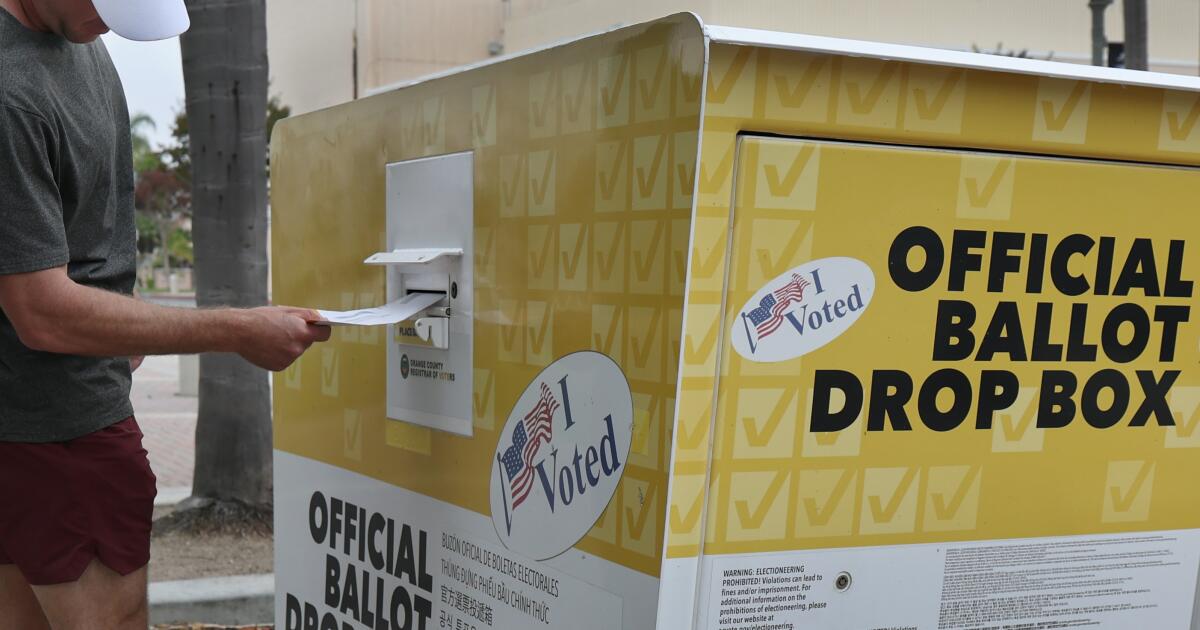
Source link

Voter voices from the San Gabriel Valley on California governor’s race

Eddie Martinez can’t stand Donald Trump. So when Eric Swalwell entered the race for California governor, Martinez had his candidate.

“I liked the way he took Trump on, the impeachment thing in Congress,” Martinez said of the former Bay Area congressman, a Trump nemesis who served as one of the House prosecutors in 2021 when Democrats held the wayward president to account for the second time.

Then, suddenly, Swalwell’s campaign collapsed under the weight of allegations of abuse, including charges he sexually assaulted a former aide. With Martinez’s choice out of the running, the Democrat turned to the candidate who’d been his second pick all along, Xavier Becerra.

Martinez has been familiar with Becerra for decades, going back to when the former congressman, state attorney general and Biden Cabinet member was in the state Assembly. To his credit, said the 65-year-old retired public relations strategist, Becerra has largely kept clear of controversy and there’s never been a whiff of personal scandal — an important consideration after Swalwell’s spectacular self-destruction.

On top of all that, Martinez said as he prepared to drop his mail ballot at a post office in Alhambra, it would be nice for California to elect its first Latino governor in modern times. It’s been, Martinez observed, more than 150 years.

With the gubernatorial primary entering its final two weeks, a contest that had been stubbornly formless has finally gained coherence. Becerra, who’d been widely given up for dead as he foundered near the bottom of polls, has unexpectedly emerged as the Democrat to beat.

“He has the most experience,” said Ruben Avita, a 57-year-old actor who leans Democratic and is tilting toward Becerra over hedge-fund billionaire Tom Steyer. “At this point,” Avita said as he waited to catch a double feature at a cineplex in Monterey Park, “I want someone with a proven track record.”

Among the Republicans running, Trump’s pick — conservative commentator Steve Hilton — seems firmly ensconced atop the GOP field.

“He’s got a lot more common-sense approach than any of these other idiots,” said Wayne The Flame — yes, he explained, that’s his legal name —which, while not exactly a ringing endorsement, still counts as a vote.

The Claremont independent, retired at 73 after a career selling motorcycles and hot rods, described Riverside County Sheriff Chad Bianco, the other major GOP contestant, as a racist and dismissed the entire Democratic field with a string of epithets. “Dumb—,” he said of the voters who keep putting the likes of them in power.

A dog standing alongside the legs of her heavily tattooed owner

Peaches, a chihuahua/boxer rescue, stands alongside her owner, Wayne The Flame

If not terribly enthused, at least The Flame has made up his mind. Many voters remain undecided — or, at least, not entirely wed to a candidate.

Some are holding on to their ballots longer than usual, awaiting any last-minute developments and weighing the election odds as though wagering in a high-stakes game of poker.

Like many Democrats, Bryce Dwyer’s concern is that Hilton and Bianco will seize both spots in June’s top-two primary, advancing to a November runoff and giving California its first Republican governor in 16 years.

A 40-year-old project manager at the Getty Research Institute, Dwyer held his 2-year-old daughter as his son, 6, romped on a pleasant afternoon in Sierra Madre’s Memorial Park. Across the street, the bells of Christ Church chimed the hour.

“None of the Democrats are putting forth anything that is making me excited,” said Dwyer, who’s ruled out Becerra (he doesn’t see much there) and is deciding between Steyer and former Orange County Rep. Katie Porter. He’s trying to cast his ballot strategically, the East Pasadena resident said, and “it’s the first time in a while I haven’t really had a clue who I’m going to vote for so close to election day.”

A woman in a red dress in profile with her hands held in front of her

Democrat Priscilla Vega of Monrovia has yet to settle on her candidate for governor

This is a deeply unsettled season in California, with precious little hope the next governor — whoever he or she turns out to be — will make things better anytime soon. That mix of discouragement and discontent surfaced repeatedly, like a dull ache, in conversations with dozens of voters across the San Gabriel Valley.

The region’s ethnic and economic diversity — from the working-class neighborhoods of Pomona through the Asian-majority suburbs to the mountainside mansions of San Dimas and Pasadena — make the valley a prime battleground in the race for governor.

Alana H., who asked not to use her last name, said she wasn’t even bothering to vote.

She ticked off some reasons: The soaring price of gas and rising cost of, essentially, everything else. The fear her college-age daughter will never be able to buy a home in California. Worse, is her loss of faith. She no longer believes in the promise, once taken for granted, that each generation will improve its lot over the last. And, Alana said, she’s not alone: “Anyone who’s an average person is in the same boat, we’re all just trying to stay afloat.” Standing in front of the post office in Alhambra, the 52-year-old paddled her arms as though to keep from sinking.

A man stands in front of a wall full of framed pictures

Jaunenito Pavon, in his Glendora wine and chocolate bar, would like California to elect a governor who could unify the state. He’s still deciding on a candidate

The politicians in both parties are “so out of touch,” she said, “all they’re doing is fighting over this and that, when everyone I know doesn’t care what party you’re in. They just want to put food on their table. They want their kids to have a better life.”

Shelby Moore has some of the same concerns. Forget about ever buying a home, said the 30-year-old California native, a Democratic-leaning independent. It’s no small feat scraping up money for rent. “I’ve lost almost every single friend that I went to high school or college with,” Moore said between waiting tables at a Mediterranean restaurant in Glendora. “They’ve all moved out of state.”

A waitress places food on the table at a Glendora restaurant

Shelby Moore, 30, a waitress in Glendora, said all her friends from high school and college have left California because it’s so expensive.

She’ll definitely vote, Moore said, though she doesn’t know for whom. One of the Democrats. Someone who’ll work to make California more affordable and keep people like her friends from being priced out.

In Claremont, Eric Hurley was another undecided Democrat. He attended last month’s gubernatorial debate at Pomona College, where the 56-year-old professor teaches psychological science and Africana studies. Otherwise, he’s been too busy to pay much attention to the race.

But it’s important, Hurley said, that whoever wins “keep fighting the good fight and standing by our liberal principles. I would hate to see someone in the governor’s office start capitulating to what the current administration is asking.”

A man sitting outside a coffee shop with his image reflected in the window

Democrat Eric Hurley is undecided in the governor’s race. But he wants someone who’ll stand up to the Trump administration.

Others seconded that notion, that California needs to stand as a bulwark against Trump and his excesses, such as the draconian crackdown that has terrorized the state’s large immigrant population.

But there’s not a great appetite for the sort of performative pushback that’s won the current governor a wide audience on social media and boosted Gavin Newsom’s political stock as he positions himself ahead of the 2028 presidential campaign.

Jennifer Harris, 56, is a single mom in Monrovia who oversees payroll at a food manufacturing company. She has to stretch each of her dollars to make ends meet; soon she’ll be shelling out $30,000 a year for her daughter to go to college. Buying a home, Harris said, is out of the question.

She confessed to chuckling at the governor’s memes — an over-the-top oeuvre that includes Newsom as super hero, Newsom as religious beacon, Newsom as romance-novel hunk — and his other cheeky jabs at the president. “But that’s not an adult way to handle it,” Harris said between errands in Monrovia’s quaint shopping district. “It’s not solving any problems.”

Better, she said, for the next governor — she hasn’t decided whom she’ll support — to focus on practicalities: improving the economy, making housing and healthcare more affordable, dealing with homelessness and the underlying mental health issues.

A woman seen in profile

Jennifer Harris said Gov. Newsom’s over-the-top social media presence is amusing. But she wants the next governor to focus on more practical things.

Britnee Foreman echoed that sentiment.

The 41-year-old, who lives in Azusa and works in the music business, was meeting a friend, Priscilla Vega, 43, for lunch in Monrovia. Along with a meal, the two Democrats shared their concerns about inflation and income inequality.

“Memes are great for publicity,” said Foreman, who’s deciding between Becerra and Porter, based on their policy experience. (Vega, a lifestyle marketer, has yet to narrow down her choice.)

A woman gestures while discussing the California governors race

Britnee Foreman says the next governor needs policies “with teeth,” not an active social media presence.

“But I prefer policy,” Foreman went on. “I don’t want them just to be the popular person out there on social media. It’s great if they’re tweeting and have a cute little Insta-story. But I need their policies to have teeth and actively move us forward. And not just look like it’s moving forward.”

After nearly eight years, amid widespread unease, California seems ready to put the Newsom era in the past. It’s just not clear what path voters will choose, or which candidate they’ll prefer to steer the state toward, hopefully, a better place.

Source link

Mayoral hopeful Spencer Pratt woos Valley voters in a rival’s district

Lake Balboa resident Jose Meraz is looking for a mayor who will turn L.A. around, cleaning up streets that he says are “filled with garbage.”

Schoolteacher Tracey Schroeder, a Republican candidate for state Assembly, is unhappy about crime, open-air drug use and the slow rebuilding effort in the wake of the Palisades fire, which destroyed thousands of homes.

Greg Whitley, a resident of Reseda, said he’s frustrated with homelessness and the influx of what he called “criminal illegal aliens.”

“I live with the Spanish community. Great people,” he said. “But these illegals that come here for criminal reasons, they’re making them look bad, and they don’t like it.”

All three showed up outside a five-bedroom home in Sherman Oaks on Saturday, looking to speak with reality TV personality Spencer Pratt, now waging an insurgent campaign for Los Angeles mayor in the June 2 election.

Mayoral candidate Spencer Pratt, left, poses with a supporter

Mayoral candidate Spencer Pratt, left, poses with a supporter during a community meet-and-greet event Saturday at a home on Longridge Avenue in a residential neighborhood of Sherman Oaks.

(Etienne Laurent/For The Times)

Standing in the entry to the home’s two-car garage, the onetime star of “The Hills” spent more than two hours shaking hands, giving hugs and posing for photos with his admirers, who waited in line under punishing San Fernando Valley sunshine.

Pratt used social media to invite the public to the campaign event, which took place in the district represented by one of his mayoral opponents, City Councilmember Nithya Raman.

He did not deliver any speeches outside the property, which is listed for rent on Zillow for $15,950 per month. He and a member of his security personnel said he was not taking interviews.

Pratt has been running in voter surveys behind Mayor Karen Bass, who is running for reelection, sometimes swapping places with Raman for second and third. He turned in a strong debate performance this month and has been outpacing his rivals in fundraising, according to the most recent disclosure reports.

While running for office, Pratt has blamed Bass for the 2025 wildfire that destroyed much of Pacific Palisades, including his home. He has railed against the city’s handling of homelessness, saying he would pursue a “treatment first” approach toward people with drug addiction who are living on the street.

Mayoral candidate Spencer Pratt, back to the camera, speaks with supporters

Mayoral candidate Spencer Pratt, back to the camera, speaks with supporters Saturday during a community meet-and-greet event.

(Etienne Laurent/For The Times)

Pratt said recently that he wants to increase Los Angeles Police Department staffing to 12,500 officers over the next decade, up from about 8,600. Speaking with one supporter on Saturday, he said the city needs to “make sure all the laws are being enforced.”

“Plenty of functioning cities enforce their laws,” he said.

That message resonated with many of the people in line.

“He is advocating for the safety and security of our families — specifically, for mothers to be able to walk their kids to school,” said Saba Lahar, a resident of Sherman Oaks, moments after talking to the candidate.

Pratt fans dropped off ballots, picked up lawn signs and stopped to pick up coffee drinks from the Hustle N Dough doughnut truck parked out front.

Some showed up even though they cannot cast ballots in L.A.

A man photographs his father holding a "Pratt for L.A. Mayor" sign in the street

Ruben Jr., no last name given takes a picture of his father during mayoral candidate Spencer Pratt’s community meet-and-greet Saturday in Sherman Oaks.

(Etienne Laurent/For The Times)

Brian Rodda, who runs a walking food tour company, described himself as “an unsatisfied Angeleno” even though he lives in West Hollywood, which is not part of the city of L.A.

“Sadly, because I do live in West Hollywood, I cannot vote for him,” he said. “But I certainly think we need a change.”

Source link

Supreme Court turns away Virginia Democrats seeking to reinstate new voting map

The U.S. Supreme Court on Friday turned down an appeal from Virginia Democrats whose new voter-approved state election map was canceled by the state’s Supreme Court.

The justices made no comment, and the legal outcome came as no surprise.

The U.S. Supreme Court has no authority to review or reverse rulings by state judges interpreting their state’s constitution — unless the decision turned on federal law or the U.S. Constitution.

But the Virginia ruling came as a political shock, particularly after 3 million voters had cast ballots and narrowly approved a new election map that would favor Democrats in 10 of its 11 congressional districts.

That would have represented an increase of four seats for Democrats in the House of Representatives.

Even worse for Democrats, the court setback in Virginia came a week after the Supreme Court’s ruling in a Louisiana case had bolstered Republicans.

In a 6-3 decision, the justices reinterpreted the Voting Rights Act and freed Republican-controlled states in the South to dismantle districts that were drawn to favor Black Democrats.

In the two weeks since then, the GOP has flipped seven districts in Tennessee, Alabama, Louisiana and Florida.

The Virginia Supreme Court decision pointed to a procedural flaw which turned on the definition of an “election.”

To amend the state Constitution, Virginia lawmakers must adopt the proposal twice — once before a “general election” and a second time after the election. It is then submitted to the voters.

Last fall, Democrats proposed to amend the state Constitution to permit a mid-decade redistricting.

However, by a 4-3 vote, the state justices said the General Assembly flubbed the first approval because it took place on Oct. 31 of last year, just five days before the election.

By then, they said, about 40% of the voters had cast early ballots.

In defense of the Legislature, the state’s attorneys said the proposed amendment was approved before election day, which complies with the state Constitution.

But the majority explained “the noun ‘election’ must be distinguished from the noun phrase ‘election day’.”

It reasoned that because early voters had already cast ballots before the constitutional amendment was first adopted, the proposal was not approved before the election.

The dissenters said the election took place on “election day” and the proposal had been adopted prior to that time.

The state’s lawyers adopted that view in their appeal and argued that under federal law, the election takes place on election day.
But the Supreme Court turned away the appeal with no comment.

The result is that a state amendment that won approval twice before both houses of the Legislature and in a statewide vote was judged to have failed.

The state says it will use the current map, which had elected Democrats to the House in six districts and Republicans in five.

Source link

Kentucky Republicans love Trump. Will they ignore him and reelect Thomas Massie?

Rep. Thomas Massie was stuck in Washington for a vote on Capitol Hill, so one of his supporters made the pitch for his campaign in a banquet hall packed with Republicans in northern Kentucky.

The audience had just heard Ed Gallrein, who was drafted by President Trump to run against Massie in next Tuesday’s primary, describe the congressman as suffering from “a severe case of Trump derangement syndrome.”

Then Gex Williams, a state senator backing Massie, told the audience at the Lincoln Day Dinner not to worry about all that.

“If you are thinking that you can’t be for President Trump and for Thomas Massie, you certainly can be,” Williams said.

Whether voters agree will determine whether Massie’s political career survives Trump’s most aggressive attempt to purge the Republican Party of dissenters. The president already succeeded last week in dislodging several Indiana state senators who opposed his redistricting plan, and he’s supporting a primary challenge against U.S. Sen. Bill Cassidy in Louisiana on Saturday.

But nothing compares to the vitriol against Massie, whom Trump has called a “moron” and a “nut job” who “will go down as the WORST Republican Congressman.” Trump made an unusual trip to Kentucky to campaign against Massie, and some of the president’s top advisors are working to help Gallrein, a former Navy SEAL.

Massie angered Trump by voting against his signature tax legislation over concerns of adding to the national debt, pushing for the release of the Jeffrey Epstein files and opposing his decision to go to war with Iran. His positions, Massie insists, reflect the America First promises Trump initially made on the campaign trail.

In a Kentucky district where the president won by 35 points two years ago, Massie told the Associated Press that the upcoming primary is “by far the most challenging reelection I’ve ever faced.”

Party loyalty or ideological purity?

The race is playing out across Kentucky’s 4th Congressional District, which sweeps northeast from the outskirts of Louisville along the Ohio River, through the suburbs south of Cincinnati and over to the lush foothills and old coal towns of Appalachia.

Voters here have sent Massie back to Congress ever since his first election in 2012, embracing his stalwart independence and jaunty personality. Back in 2020, they brushed off Trump’s social media demand to “throw Massie out of Republican Party” because he was a “third rate Grandstander.”

Now, Republican voters are debating whether they will do the same thing again.

“If all we’re doing is pulling in yes men, then how do you grow from that? How do you have the best end product if everyone just says, ‘Oh yeah, that’s a great idea,’” said Tonya Young, an attendee of the Lincoln Day Dinner who is leaning toward Massie but still undecided.

“However, I do feel like it’s important to stay loyal. That’s where, I’m like, I’m a hot mess,” said the 57-year-old special education teacher. “Sometimes you have to just bite the bullet and compromise on things.”

Young said she will plumb through the Republican-backed bills that Massie voted against before she makes up her mind. What isn’t a major part of her calculation is Trump’s endorsement of Gallrein or his epithets against Massie.

Young still supports Trump, rating his second term at a “B to a C+” relative to his campaign promises. During Trump’s first term, Young said, she’d “probably put more stock in” his endorsement.

‘I’m going to vote for Massie even though he makes me mad’

At the Lincoln Day Dinner in Covington, well-dressed Republicans sat at circular tables, ate dinner and listened attentively as candidates gave speeches.

Steve Jarvis, a 77-year-old retired law enforcement officer, who stood near the late night coffee station, has decided to vote against Massie for the very first time.

“Made me sad, truly it does,” said Jarvis, wearing a bespoke American flag bow tie made of feathers, “I like Massie.”

When Massie first ran for Congress, Jarvis bought a Massie campaign sign, sized for a freeway overpass, and planted it outside his home, a few doors down from which lived Massie’s opponent.

But some of Massie’s departures from the party, he said, “made me nuts. I can’t do it anymore.”

One was Trump’s flagship Big Beautiful Bill, which Massie voted against citing the consequent budget deficit and increased inflation.

“I understand voting your principle once or twice,” said Jarvis, “but at some point in time when it becomes crucial, I think they have to get in line.”

Gallrein, he said, would get in line.

Jana Kathman came to a different conclusion.

“I’m going to vote for Massie even though he makes me mad,” she said while shopping for bagels at a local farmers market outside Covington.

The 56-year-old registered nurse said, “I just like him as a person, I like how he lives his life, and I know he stands very strong with his convictions.”

Though she still likes Trump, his endorsement and attacks don’t impress her.

“I don’t like when Trump plays the little games as soon as someone opposes him, but we know that’s how Trump lashes out,” Kathman said.

‘Antibodies’ to Trump’s electoral broadside

Gallrein mounted the stage at the Lincoln Day Dinner with a prepared speech. He grew up on a family farm, was inspired by President Reagan to join the Navy SEALs and was recently asked by Trump to serve his country again in Congress.

He hyped up Trump — “Do you know he doesn’t take a salary?” — and launched into a list of Trump-backed policies Massie had voted against, lumping him in with the “radical Democrats.”

Gallrein declined an interview request, and he’s declined to attend candidate forums and debates with Massie.

Several voters said they were grateful for Gallrein’s service, but still don’t have a grasp of his platform, aside from his fidelity to Trump.

Massie argues that’s why Kentucky should stick with him, using what has become a go-to refrain.

“Politicians promise during the campaign, and then they go to D.C. to go along to get along,” he said. “My opponent is promising to go along to get along.”

Massie is hopeful that Trump’s anger will blow over once he wins the primary.

“Once this race is over, I don’t think there’s any benefit to him attacking me, I’ll have the antibodies from a natural infection,” Massie said chuckling.

After years of being considered a conservative gadfly in Congress, he said, maybe he has some of those antibodies already.

“This will be the booster shot,” he said.

Bedayn writes for the Associated Press.

Source link

Supreme Court voting rights ruling fuels a new push to defend Black representation

Same fight. New generation.

That’s the mantra of a multiracial group of civil rights leaders and activists organizing opposition to a mostly white conservative alliance dismantling the Voting Rights Act and political districts that allowed Black and other nonwhite voters to choose more of their elected leaders for the last half-century.

“We have to respond as quickly as possible,” NAACP President Derrick Johnson said in an interview. “The real question,” Johnson told the Associated Press, “is how do we as a country really address the effort to shrink us backwards into a 1950s reality?”

Johnson’s 117-year-old association, which was at the forefront of legal and legislative fights for Black political rights in the 20th century, is among scores of groups coming together Saturday in Alabama for a rally and tribute to the Civil Rights Movement that helped bring about the 1965 Voting Rights Act. They plan events in Selma, where voting rights advocates were attacked by white law enforcement officers on Bloody Sunday, and Montgomery, where a rescheduled march concluded two weeks later.

Unlike 61 years ago, the Alabama events are not the pinnacle of a protracted movement. Instead, civil rights activists hope they serve as a catalyst for a renewed crusade after the U.S. Supreme Court, two weeks ago, further weakened the VRA by no longer allowing race to be considered in how congressional and other districts are drawn.

They acknowledge difficulty in countering a white-dominated conservative network entrenched in the White House, Capitol Hill, federal courts and many state legislatures of the Old Confederacy, where a majority of Black Americans still live.

The VRA “was the foundational nucleus of the Civil Rights Movement,” said Jared Evans of the Louisiana-based Power Coalition for Equity and Justice. “They’ve taken that from us,” he said, with the recent Louisiana v. Callais decision on congressional districts and the earlier Shelby v. Holder decision in 2013 that rolled back federal oversight of election procedures in states and localities with a history of discrimination.

Georgia Sen. Raphael Warnock, who is senior pastor of Atlanta’s Ebenezer Baptist Church, where the Rev. Martin Luther King Jr. once preached, said from his pulpit that the result is “Jim Crow in new clothes.”

Warnock pointed to King and the last voting rights movement. “We need political power. We need economic power. We need personal power,” he said, assuring parishioners that “your adversaries know that your voice matters” because they’re “bending over backwards” to diminish it.

Evans reached further back into history to say what must happen next.

“Our response must be and will be a second Reconstruction period,” Evans said.

Some Democrats want an answer from Congress

The ultimate goal, organizers said, is to win more elections, sway policy fights and protect diverse political representation at all levels.

U.S. Rep. Terri Sewell, a Black lawmaker who represents Selma, Alabama, said an immediate priority is to “reform and reintroduce” Democrats’ flagship voting bill, the John R. Lewis Voting Rights Act.

Sewell, whose seat ultimately could be threatened under redistricting, said Democrats want to “completely” eliminate partisan gerrymandering.

She also said the legislation would “bring back pre-clearance,” the requirement for certain federal approvals that the court struck down in Shelby.

“We need to come up with a modern-day formula for showing just how egregious the behavior of these state actors is,” Sewell said.

The Supreme Court ruled in Callais that states do not have to draw majority nonwhite districts under the Voting Rights Act and, in fact, should not consider race at all when drawing boundaries. By arguing that the law’s remedies to combat discrimination had themselves become racist, the decision allows states to redraw heavily Black districts that have historically elected Democrats while arguing that the designs are based on party interests, not race.

President Trump praised the decision as “a BIG WIN for Equal Protection under the Law, as it returns the Voting Rights Act to its Original Intent, which was to protect against intentional Racial Discrimination.”

Groups mobilized for redistricting sessions

Many of the same groups who’ll be in Alabama on Saturday have already gone to Southern statehouses, where white Republican lawmakers moved swiftly to redraw congressional districts after Callais.

Alabama and Louisiana lawmakers reverted to a single majority-Black district, each scrapping a second district that had been ordered by lower federal courts under now-reversed VRA interpretations. Tennessee lawmakers gutted a majority Black district by splitting greater Memphis into three different sprawling districts — itself an obvious racial gerrymander the court had previously forbidden, Evans said.

Anticipating the Callais outcome, Florida and Texas proceeded with redistricting before it came down. Georgia Gov. Brian Kemp, a term-limited Republican, has called a June session to redraw congressional lines for the 2028 cycle. Mississippi and South Carolina have delayed the matter for now.

South Carolina state Senate Majority Leader Shane Massey was among the few white Republicans who pushed back against GOP redistricting plans. He said that not even pressure from Trump could sell him on disenfranchising Black South Carolinians instead of doing what’s best for his state.

Other white conservatives are still talking openly about ousting Reps. Jim Clyburn and Bennie Thompson, the only Black U.S. House members from South Carolina and Mississippi, respectively.

Evans, the Louisiana activist, predicted the fight ahead won’t just be about congressional representation.

“Look for them to go after state house and state senate seats — and then it will be the local level,” he said, adding that “it’s going to be an entire erasure of Black representation.”

The issue is more than a partisan Washington fight

Heavily minority districts drawn under the VRA before Callais nearly always elect Democrats. Black Americans have overwhelmingly aligned with the party since President Lyndon B. Johnson signed the Civil Rights Act and Voting Rights Act, sparking a decades-long migration of most white Southern politicians to the Republicans. Latino and Hispanic voters still lean Democratic in most places as well.

The immediate fight shapes the midterm campaign scramble for control of the U.S. House during the final years of Trump’s presidency. Trump initially pushed Republican-run states to redistrict to protect the party’s fragile House majority.

But Johnson, the NAACP leader, said all voters should see more than partisan warfare or a regional battle over race.

Beyond party allegiance, Johnson argued, white conservatives want to curtail a range of rights “depending on how you pray, depending on who you love,” while also pushing economic policies that punish workers across racial and ethnic lines. From legislation to the confirmation of federal judges who decide constitutional questions, those policy outcomes start with election results.

“It’s not a Black problem,” Johnson said. “That’s an American problem.”

There is no singular movement or leader yet

Evans, Johnson and others acknowledged the complexity in harnessing disparate organizations and galvanizing voters on issues like redistricting and gerrymandering. But they insist the brazen nature of Republicans’ course has spurred engagement.

Johnson said he was on an organizing call in Mississippi this week that had 8,000 participants. Evans pointed to packed hallways in the state Capitols in Baton Rouge and Nashville, respectively.

The NAACP and allies have challenged new maps in multiple states, despite Callais. Many groups want to spur midterm turnout among Black voters, and others are disenchanted with white conservatives’ maneuvers in racially diverse places.

Johnson stressed the need for perseverance.

The 1954 Brown v. Board of Education decision was seismic, with a unanimous court declaring segregated public schools unconstitutional and reversing 19th-century precedents denying Black Americans’ fundamental rights.

But it took 17 years — and many more court battles — for it to be implemented in most Southern school districts. Fights over mandated student busing continued beyond the South. It was a decade after Brown before Congress and Johnson enacted the movement’s seminal laws.

There’s no clear leader of a modern movement.

Johnson said it’s worth remembering that even with King at the helm before his assassination, “there was tension around strategy” in the 1950s and 1960s.

But even “through that tension, through many episodes, we were able to get directly in the right place.”

Barrow and Brown write for the Associated Press.

Source link

Jeffries’ job grows more difficult in race for House and speaker’s gavel

House Democratic leader Hakeem Jeffries had warned Republicans they would come to regret the congressional redistricting fight, and when Democrats counterpunched last month with a redrawn Virginia map, he had made his point.

The net tally of seats gained and lost was essentially a wash.

“F— around and find out,” said Jeffries after the election victory.

But in a matter of days, the race for control of the House — and the speaker’s gavel — was dramatically reset by back-to-back court rulings that wiped out the Democratic gains in Virginia and now threaten to erode Black representation by Democrats in the Deep South.

The shifting political prospects have been a wake-up call for Democrats, who have been favored to win back the House this November, riding the wave of President Trump’s dipping approval ratings, and a test for Jeffries as the party faces an enlarging map of Republican-friendly seats.

The leader’s aligned outside group has spent some $60 million, much of it on Virginia alone, a hit to the Democrats’ resources as they confront Trump’s Republicans.

“It sort of crystallizes the election is now a contest between one side that has the money and the maps, and the other that has the voters and the candidates,” said Jesse Ferguson, a Democratic strategist and former deputy director of the House Democrats’ campaign arm.

Jeffries would make history as the first Black speaker of the House

Jeffries, who is in line to make history as America’s first Black speaker of the House, acknowledged the Democrats may need to flip twice as many Republican seats — a total gain of six rather than just three — to win the majority in the aftermath of the redistricting fights.

But he insisted that Democrats were on track to pick up seats, as they did in 2018 during Trump’s first term, because Republicans are relying on redistricting — rather than policy solutions — to win elections.

Trump Republicans “don’t give a damn” about Americans’ financial struggles, Jeffries said, paraphrasing the president’s own remarks.

During a closed-door meeting on Wednesday with House Democrats, Jeffries described the work ahead in almost existential terms for the country.

He said the court rulings against the Voting Rights Act and the Virginia measure were “disgusting.” And he warned his colleagues that Republicans would proceed with “diabolical intensity” in their campaigns to regain control of the House, which Democrats will not only have to match but “we have to exceed it with righteous intensity at all times.”

“Failure is not an option,” he told the Democrats, according to a person in the room granted anonymity to disclose the private remarks. “We have to win, and we are going to win.”

Path to power depends on a handful of House seats

Never easy, the race to the House majority was also not expected to be this complicated. Republicans hold a slim majority, among the most narrow in modern House history, and midterm elections tend to favor the party out of power, as a check on the White House.

But when Trump said last summer that Republicans were “entitled” to five more GOP seats from Texas, it sparked a redistricting crusade that led Jeffries to respond in kind.

Rather than take what they call the high road, Democrats said they decided to fight back, believing they could not fully count on the nation’s institutions — in this case, the courts — to provide a check on the GOP power play.

Jeffries flew to Austin to join the Texas Democrats fighting the redistricting plan in their state and stood with those same lawmakers in Chicago where they fled to deny statehouse Republicans a quorum. He joined the private meetings of California Democrats as they launched their counter attack, a voter initiative that put five more seats in the Democratic column. The Democrats picked up a seat in Utah.

And on it went.

“We had to very quickly make a decision, set a course and take a risk,” said Rep. Jared Huffman, D-Calif., recalling the closed-door talks last summer. “There was no guarantee this was going to work out.”

The Virginia measure became a turning point, Jeffries’ biggest swing yet, putting Democrats essentially at parity, if not a potential upper hand in the number of seats gained, and shifting Old Dominion more securely into the party’s column.

He rallied some 1,000 churchgoers in Richmond ahead of Election Day as voters headed to the polls.

House Speaker Mike Johnson on Wednesday called the Democratic play for Virginia a “crazy overreach” that was rightly rejected by the state’s high court.

“Fortunately, the plan failed spectacularly,” Johnson said.

Redistricting battles push into 2028

While Democrats said they expected the Supreme Court to gut the Voting Rights Act, the Virginia Supreme Court’s decision to toss last month’s election results blindsided many of them.

Jeffries joined a call with furious Virginia Democrats over the weekend who said they were more determined than ever to win the Republican seats outright, regardless of their loss over the map changes.

The overall tally after nearly a year of redistricting battles is still shifting as Republican legislatures in the South rush to redraw their maps in the aftermath of the ruling in the Voting Rights Act case, many of them preparing to eliminate districts held by some of the most senior Black lawmakers in Congress.

Rep. James Clyburn, the veteran Democratic legislator from South Carolina whose own seat is at risk, blamed the justices, not Jeffries, for the outcome in Virginia and elsewhere.

“What the hell, he can’t control the courts,” Clyburn said, vowing to run for reelection regardless of where his district is drawn. “Don’t put that on Jeffries. We won the vote.”

Jeffries acknowledged that this year’s maps are almost set, and pivoted to 2028 when he said Democrats will redouble their efforts to confront the GOP redistricting battle ahead of the next election.

“We know this unprecedented assault on Black political representation, the likes of which we have not seen since the Jim Crow era, the ghost of the Confederacy” will continue, he said. “The challenge that is in front of us is ensuring that there is a decisive and overwhelming response in advance of 2028.”

Mascaro writes for the Associated Press.

Source link

New West Virginia law requiring photo IDs at polling places greets voters in primary election

Presenting a utility bill as a valid form of identification at a voting precinct in West Virginia has gone the way of the tavern polling place and the punch-card ballot.

State lawmakers tightened an existing voter identification law by requiring photo ID at the polls, with some exceptions. The law was used for the first time in Tuesday’s primary election, and officials said they’ve seen very few glitches.

“The whole point of the law is just making sure you are who you say you are,” Secretary of State Kris Warner said Monday.

Voters will nominate candidates for U.S. Senate, U.S. House and state legislature. They also will elect two new state Supreme Court justices.

During the in-person early voting period that ended Saturday, Warner said his office hadn’t heard of anyone who demanded to vote without a photo ID. He said the state had asked residents to use photo IDs for the past few elections, so “it was not a big shock that it was now law.”

During his statewide travels over the past two weeks, Warner said he was told of some instances where people returned to their vehicle to retrieve a photo ID after entering a polling place. Another voter used an exception to the law by filling out a form that was verified by a poll worker who has known them for at least six months. There also were exceptions for first-time voters.

Most states either require or request some form of ID for in-person voting at the polls.

Proponents say the West Virginia law will cut down on voter fraud and that a photo ID is already required for everyday tasks such as getting on an airplane or buying alcohol.

The bill sailed through the Republican-supermajority legislature last year. All votes against it were cast by Democrats, some who argued it would suppress access to the polls. State Democratic Party Chair Mike Pushkin said no credible evidence was shown during legislative debate that West Virginia had a widespread problem with ineligible voting. Pushkin said the legislation was “designed more for political messaging than solving actual problems.”

But Warner said it allows senior citizens to use expired driver’s licenses, as long as it was valid on their 65th birthday

“I wanted to make sure it didn’t prevent anyone from voting,” Warner said.

Forms of identification that are no longer accepted at polling places include utility bills, bank statements, hunting and fishing licenses, bank or debit cards, and concealed carry gun permits. Acceptable forms of photo IDs include a driver’s license, U.S. passport, military ID, employee ID issued by a government agency and a student ID from a high school or college.

Monongalia County Clerk Carye Blaney said for several years her county has used an electronic system to scan bar codes on the back of driver’s licenses to check in voters at polling places.

“I think that it makes voters feel more secure, or it confirms for the voters the security of our elections when we are verifying a photo to a person,” Blaney said.

Raby writes for the Associated Press.

Source link

California’s Democratic incumbents face primary challenges from political newcomers

In Napa and surrounding counties, Rep. Mike Thompson’s once-easy reelection contest is turning into something of a race. In the Sacramento area, Rep. Doris Matsui is facing one of her most serious challengers in two decades. In Los Angeles, a former White House climate official wants to unseat Rep. Brad Sherman.

In these districts and others, newcomers are challenging some of the most recognizable Democratic names in California politics in the June 2 primary election.

The challenges are part of a national wave reshaping the debate over generational power and the direction of the Democratic Party ahead of the 2026 midterms, when party leaders hope to retake control of the House. They reflect — and capitalize on — restlessness among progressive voters frustrated with the status quo, worried about affordability and looking for fresh leadership.

The question of when elder lawmakers should step aside has dogged both parties for years, from the late-career health scares of senators including Republican Mitch McConnell and Democrat Dianne Feinstein to the generational debates sparked by progressive figures such as Rep. Alexandria Ocasio-Cortez and New York City Mayor Zohran Mamdani.

The debate reached a critical moment for Democrats in 2024, when President Biden withdrew from his reelection campaign under pressure over his age and mental acuity. In California, Rep. Nancy Pelosi, 86, has chosen to retire at the end of her current term.

A man in a suit at a lectern.

Rep. Mike Thompson, a Democrat from California, during a news conference at the U.S. Capitol in March 2025 about a Signal messaging incident involving Trump administration officials.

(Daniel Heuer / Bloomberg via Getty Images)

Now, a handful of California’s primary contests have revived a predictable debate: Some in the party see the argument that lawmakers in their 70s and 80s should step aside as ageist and naive; others argue Democrats need to allow for generational turnover, particularly after the party’s 2024 failure to beat President Trump.

“The Democratic Party has not been delivering, and the power structure there is crumbling,” said Eric Jones, 35, an entrepreneur who is challenging Thompson in the newly redrawn 4th District. “Where’s the hope? Where’s the dreaming? Where’s the future? I don’t see any of that coming out of this current political class.”

Incumbents argue that trading experience for a fresh face is a false promise. In statements to The Times, several pointed to their legislative accomplishments. “Now is not the time for on-the-job training,” said Thomas Dowling, a spokesperson for Thompson.

The redistricting created by Proposition 50 has helped open the door to newcomer candidates in the 4th and 7th districts, where Thompson and Matsui are facing challengers, making those races more competitive. Both districts were redrawn so that the incumbents must earn the trust of new voters who have never before seen them on their ballots.

“They’re still Democratic, but some of the voters are different,” said Christian Grose, a professor of political science and public policy at USC. “I think that has created an opportunity for a couple of those younger people up north, where districts have changed.”

The two races differ — Thompson, for instance, has received endorsements from young-voter groups, such as the Sacramento County Young Democrats, and at 75, is younger than Matsui, 81.

Matsui, meanwhile, is favored in fundraising, with roughly $1 million in cash to the $315,000 brought in by challenger Mai Vang, a Sacramento City Council member backed by progressive groups who has cast her campaign as one fueled by working families and criticized Matsui for relying on corporate donors. Jones’ challenge has forced Thompson to match his fundraising and door-knocking efforts — both candidates have raised roughly $3 million, their campaigns said.

“Others think being a leader is screaming and shouting,” Matsui told The Times. “I think it is about being effective.”

A woman speaks during a hearing

Rep. Doris Matsui (D-Calif.), pictured in April, is facing one of her most serious challengers in two decades.

(Bill Clark / CQ-Roll Call Inc via Getty Images)

A broader pattern emerges

California is home to three of the 13 members of Congress age 80 or older who are seeking reelection in 2026 — Matsui; Rep. Maxine Waters, 87; and Rep. John Garamendi, 81. All three are facing their first serious primary challenges in years.

“It’s going to take new types of energy, new thoughts, and leadership, to fight what is happening in our country right now,” said Myla Rahman, 53, a Los Angeles Democrat in the 43rd District challenging Waters, who has held the seat for 35 years.

The primary election will also feature a handful of open contests in solidly blue districts where long-standing incumbents are stepping aside — including Pelosi’s San Francisco seat and retiring Rep. Julia Brownley’s Ventura County district — offering newcomers their first real opening in years.

In Alameda County, a primary election is set for June 16 for the seat vacated by former Rep. Eric Swalwell, who resigned last month amid sexual assault accusations.

National Democrats, meanwhile, are focused on defending incumbents in two swing districts in California that the party considers crucial to winning the House majority: Rep. Derek Tran of Orange County, who won his seat by just over 600 votes in 2024, and Rep. Adam Gray of the Central Valley, who faces a competitive field.

In both competitive partisan races and in Democrat-on-Democrat contests, analysts say frustration about the economy is bubbling up from voters.

A statewide survey released in February by the Public Policy Institute of California found that 56% of likely voters believe a candidate’s position on affordability was very important in determining their vote in a House race — yet only 20% said they approve of the job Congress is doing.

Among voters under 35, the numbers were starker: 76% named cost of living a top concern, and just 13% approved of Congress.

Those numbers help explain why young voters may be looking for new options from primary challengers, said Mark Baldassare, president and chief executive of the Public Policy Institute of California. Much of the disillusionment stems from economic pressures, he said.

“If you’re getting a 13% approval rating in Congress among 18- to 34-year-olds, that tells you a lot about how people are feeling about the status quo,” Baldassare said.

The trend reflects a mix of younger candidates who have grown tired of waiting their turn, others who are driven by ideology, and others who simply see a rare opening against a vulnerable incumbent, Grose said.

“If you’re a savvy young candidate, it may be easier to beat an incumbent who is over 80 than to then primary 20 people when the person retires later on,” he said.

The challenge for challengers

Still, newcomers face a steep climb against opponents whose names are well known in communities where they have been deeply embedded over the years.

Rahman, a nonprofit director, acknowledged it’s challenging to run against someone like Waters, who is nationally known and has voter loyalty. But she said the cost of groceries, gas and housing have people questioning whether their representatives in Congress are doing enough.

In Solano County, Garamendi, who has served in Congress since 2009 and held senior posts in state government since the 1970s, faces three challengers — two Democrats and one Republican — in the redrawn 8th District.

“Experience matters, both when you’re fighting Trump and when you’re working to improve our community,” he said when he launched his reelection bid.

In Los Angeles’ 32nd District, Sherman, 71, is attempting to fend off Jake Levine, 41, a former Obama and Biden White House climate aide who decided to run after losing his childhood home in the Palisades fire.

“For 30 years, we’ve been told that seniority equals effectiveness, and that time in office equals progress,” Levine said. “But people across our district — who are contending with $7 gas and housing prices driving people out of L.A. — can feel that’s not true.”

Sherman, who has been in Congress since 1997, dismissed the generational-change argument bluntly.

“If you have never shown that you can stand up to the other side in a tough legislative debate, then you might as well just go out there and say, ‘I’ve never done anything, I’ve never proven I can do anything, but I am new,’” Sherman said.

Source link

Oregon Democrats found a way to improve roads. Now their gas tax goes before voters as prices soar

Appealing to voters’ anxieties about the soaring cost of living is central to Democrats’ messaging in their hopes of big wins in this year’s midterm elections. In Oregon, a question on the primary ballot is complicating that strategy.

The Democratic-controlled Legislature raised the state gas tax and a range of fees last fall as a way to pay for road improvements and plug a hole in the state’s transportation budget. Republicans responded with a petition to repeal the increases, leading to a referendum that will land before voters just as the Iran war is causing the price of gas to skyrocket around the United States.

“It is a hell of a time to be raising gas taxes on people,” said Jeanine Holly, filling up her tank on a recent morning in Portland.

The gas tax repeal on the state’s May 19 primary ballot comes amid widespread disruptions in the oil industry from the war with Iran started by Israel and President Trump. Discontent is high among U.S. consumers across the political spectrum, with the price of gas topping $4.50 a gallon nationally on Friday and averaging about 80 cents more per gallon in Oregon.

The referendum will give voters a chance to weigh in on a hot-button issue hitting them directly in the pocketbook at a time when prices remain elevated for everything from housing to groceries. Nationally, Democrats have focused on the affordability concerns similar to those that helped propel Trump to victory in 2024. Some of their candidates have even proposed ways to cut taxes as a way to promote their agenda and counter a traditional GOP strategy.

“It’s difficult to imagine a worse situation for … a gas tax increase than right now in American politics,” said Chris Koski, professor of political science and environmental studies at Portland’s Reed College.

Republicans sense an opportunity

Republicans wasted no time in appealing to voters after the Legislature and Democratic governor signed off on the tax increase, which also included a higher payroll tax for transit projects and a boost in vehicle registration and title fees.

They needed 78,000 voter signatures to qualify the referendum for the ballot. They quickly got 250,000.

“That is a remarkable number,” Republican strategist Rebecca Tweed said.

Republicans in Oregon have countered Democrats’ affordability messaging by portraying the tax and fee increases as further fueling the high cost of living.

“Do Oregonians want to pay more? The answer is no,” said GOP state Sen. Bruce Starr, who helped lead the referendum campaign. “Everything they’re looking at is expensive.”

Under the legislation, Oregon’s gas tax would rise from 40 cents to 46 cents a gallon. That would make it tied with Maryland for the eighth-highest gas tax of any state when factoring in other state taxes and fees, according to figures from the U.S. Energy Information Administration.

At the Portland gas station, Michael Burch said he used to spend $70 to fill three-quarters of his pickup truck’s tank, but now pays $80 for just over half a tank.

“I’m sick and tired of taxes,” the 76-year-old retiree said. “Gas is certainly dampening the spirits and the coffers of folks that aren’t as well off.”

Hannah Coe, a 30-year-old student, said she was not sure how she would vote on the primary ballot referendum.

“I think I would be in favor of it if it was going to go to the things that it was saying it was going to go to, such as fixing our roads,” she said. “I also kind of feel like that’s just a grab at trying to get more money from the people who live here.”

Democrats blame the Iran war

Oregon Democrats spent much of last year fighting to pass a transportation funding bill to help raise money for services such as road paving and snow plowing. The debate came amid projections of declining gas tax revenue as more people adopt electric, hybrid and fuel-efficient cars.

They finally passed a narrower version of their plan during a special session called by Gov. Tina Kotek.

She recently acknowledged the challenging timing of the referendum.

“Certainly, the conversation at the ballot this year … is a tough sell right now, because I think everyone is feeling a pinch on their household budgets,” she told reporters.

But she and other Democrats said the root cause of the jump in gas prices is Trump’s decision to go to war with Iran. She suggested the federal government consider reducing the federal 18-cent-a-gallon gas tax if it wants to provide relief at the pump for Americans.

Some Oregonians are receptive to the Democrats’ reason for passing the legislation last year. Kurt Borneman, 68, said he would support the gas tax increase, even though he’s now paying at least $10 more to fill up his tank.

“I realize that money’s tight and roads need to be improved,” he said at the Portland gas station. “I want less government, but I also want nice roads.”

Democratic state Rep. Paul Evans said his party lost the battle over how to frame the gas tax increase to the public. So far, there has been no organized effort from Democrats and their allies to oppose the ballot referendum.

“When anything is reduced to, ‘Do you want a tax or not?’ Most people are going to say no,” he said. “The messaging got away from us, and it became focused upon the price instead of the value.”

Rush writes for the Associated Press.

Source link

Voter confusion and headaches for election officials follow hasty GOP push to redraw U.S. House seats

Thousands of Louisiana voters have already cast early ballots for congressional candidates in what soon could be the wrong districts. Alabama’s primaries are a week away, but the state could force a do-over for voting on U.S. House races. A new congressional map in Tennessee upended races that had been underway for months.

Republicans’ rush to gerrymander congressional districts across several Southern states after a U.S. Supreme Court ruling hollowed out the Voting Rights Act is confusing voters and creating logistical headaches for local election officials. The changes are hitting while primary season is in progress.

The chaotic upheaval to an election season that could determine which party controls the U.S. House is the latest fallout from an intensely partisan gerrymandering battle initiated by President Trump last year to protect Republicans’ slim majority.

The Supreme Court’s decision last month severely weakening the Voting Rights Act required Louisiana to reconsider a map drawn in 2024 with two majority minority congressional districts that elected Black representatives. The GOP-controlled Legislature could eliminate one or both in a state where roughly 30% of the population is Black.

The ruling also encouraged Republicans in Alabama, Mississippi, South Carolina and Tennessee to consider eliminating four Democratic districts among them, three represented by Black lawmakers. Florida has a new map meant to cost Democrats four of their eight seats, out of 28.

In Louisiana, 66-year-old New Orleans resident Sallie Davis voted early last week. Her ballot allowed her to vote for Democratic U.S. Rep. Troy Carter, but a sign at her polling booth showed his race crossed off with a ballpoint pen. She was confused and frustrated — especially when a poll worker told her to go with what the sign seemed to convey. She’s now worried that her entire ballot will not be counted.

“I was supposed to believe a piece of paper with an X on it marking out the person I wanted to vote for,” she said, her voice breaking as she recounted her experience later. “I think I have been disenfranchised. I think my vote, that I just voted on, it’s not going to count or something. I think it’s illegal.”

Primaries postponed, deadlines compressed

Louisiana’s primary is on Saturday, and a week of early voting there began May 2, two days after the Republican governor declared an emergency and suspended congressional primaries to give lawmakers a chance to draw a new map.

Republican Secretary of State Nancy Landry’s office said nearly 179,000 primary ballots had been cast as of Friday, including about 53,000 absentee ballots returned by mail. She said the ballots included U.S. House races, but votes in those contests won’t be counted.

In Alabama, South Carolina and Tennessee, Republicans justified pursuing new maps by saying that electing more Republicans would better reflect their states’ conservative values. Alabama lawmakers passed legislation Friday allowing a do-over of congressional primaries.

Alabama’s primary is May 19, and voting in congressional races will occur then as planned, but with the old districts. Those votes would end up not counting if a court allows the switch to different districts.

Mississippi held its primaries in March, but a federal court has ordered it to redraw its state Supreme Court districts, and Trump is pushing Republicans to redraw the state’s four congressional districts.

A special session of its Legislature is set for May 20. Renovations of the House chamber will force members to meet at the Old State Capitol, where, decades ago, Mississippi lawmakers passed Jim Crow laws suppressing Black voting.

“Modern-day voter suppression relies on election administration errors and chaos, and that’s what we’re going to see play out in all of these states,” said Amir Badat, a Jackson, Mississippi, voting rights attorney and activist.

Tennessee continues yearlong fight

Tennessee was the first state to enact a new map since the U.S. Supreme Court decision, but Trump’s push for redistricting started in Texas last year. Democrats countered in California and tried but ran afoul of the courts in Virginia.

Before Tennessee’s GOP-controlled Legislature passed a new map last week, the state’s elections coordinator told county officials in a memo what that would mean: reprogramming election systems, retraining poll workers and possibly adjusting precinct boundaries, meaning some voters’ polling places could change.

Tennessee’s congressional primaries still will be held Aug. 6 as planned, and candidates have until Friday to qualify for the ballot. Those who qualified previously will get a pass if they can run in a new district with the same number.

In South Carolina, lawmakers could move all the state’s June 9 primaries to August, or just the congressional races. While mail balloting is limited because the state requires an excuse to do it, more than 6,800 mail ballots already had been sent to voters — with 260 returned — as of Friday, according to the state Elections Commission.

Holding a separate election for congressional primaries would cost $3 million and the time for preparations would be compressed, Conway Belangia, the commission’s executive director, told lawmakers Friday.

“It will be difficult, but it will be possible,” he said.

Activists see problems ahead for voters

Michael McClanahan, president of the NAACP’s Louisiana State Conference, is hearing “total confusion” as voters call him and ask, “Is there an election?”

“People say, ’I ain’t going to vote because the governor’s suspended the election,’” he said. “But he didn’t, he only suspended one aspect of it.”

In Alabama, Senate Democratic leader Bobby Singleton said he has been fielding calls from public officials who also are confused.

“These are the people who are the head of elections,” he said. “They don’t know what to do.“

Voting rights activists see problems that arose in Nashville, Tennessee, in 2022, when Republican legislators divided the state’s capital city into three congressional districts to take a seat from Democrats, as a harbinger of what Memphis voters could face this year. A state report said more than 3,000 Nashville-area voters were assigned to incorrect districts and more than 430 cast ballots in the wrong races in the November 2022 election.

“It’s going to be really hard for the election commissions to be able to keep up with this short timeline,” Matia Powell, executive director of the voting rights nonprofit Civic TN, said during a conference call Friday with other voting rights activists in the South.

Some fear confusion will lead to distrust and apathy

Anneshia Hardy, executive director of Alabama Values, which provides support to voting and civil rights groups, said people will lose trust in elections if they believe the rules can change every two years.

“Once people stop believing that the process is stable and fair, disengagement is going to increase, and that’s one of the biggest dangers here,” she said. “Democracy doesn’t just depend on voting systems existing but really on people believing that their participation matters.”

At least a few Democratic voters who went to the Louisiana Capitol on Friday to protest the gerrymandering expressed doubt about whether they still have a political voice.

Davis came to the State Capitol in Baton Rouge and had a bullhorn with her for a protest in which she yelled, “Whose vote? Our vote!”

David Victorian, a 79-year-old Vietnam veteran from Baton Rouge, said: “I’m concerned for the survival of the democracy that we’re supposed to be living in.”

Hanna and Brook write for the Associated Press. Hanna reported from Topeka, Kan. AP writers Jeffrey Collins in Columbia, S.C., and Kim Chandler, in Montgomery, Ala., contributed to this report.

Source link

Specter of an all-GOP governor race spurs push to remake open primary

Voters in California may get a chance to remake the state’s open primary system in two years.

Political consultant Steve Maviglio filed an application Friday with state officials that seeks to alter California’s voting system by reverting to a traditional primary. Under the proposal, the top candidates from each party would advance to the general election in November.

The current system allows the top two candidates, regardless of party, to move on to the runoff. That has led to instances in which two Democrats or two Republicans have faced off in the general election.

The state’s gubernatorial election, for example, has prompted concern that two Republicans could shut out the Democratic candidates. Riverside County Sheriff Chad Bianco and former Fox News commentator Steve Hilton have polled high in various surveys and are facing a large field of Democrats.

Democratic voters vastly outnumber Republicans in California, yet some political consultants said they feared there were so many Democrats running that voters wouldn’t coalesce around one candidate and the field would be split. Those fears have eased somewhat in recent months as some Democratic candidates advance from the pack.
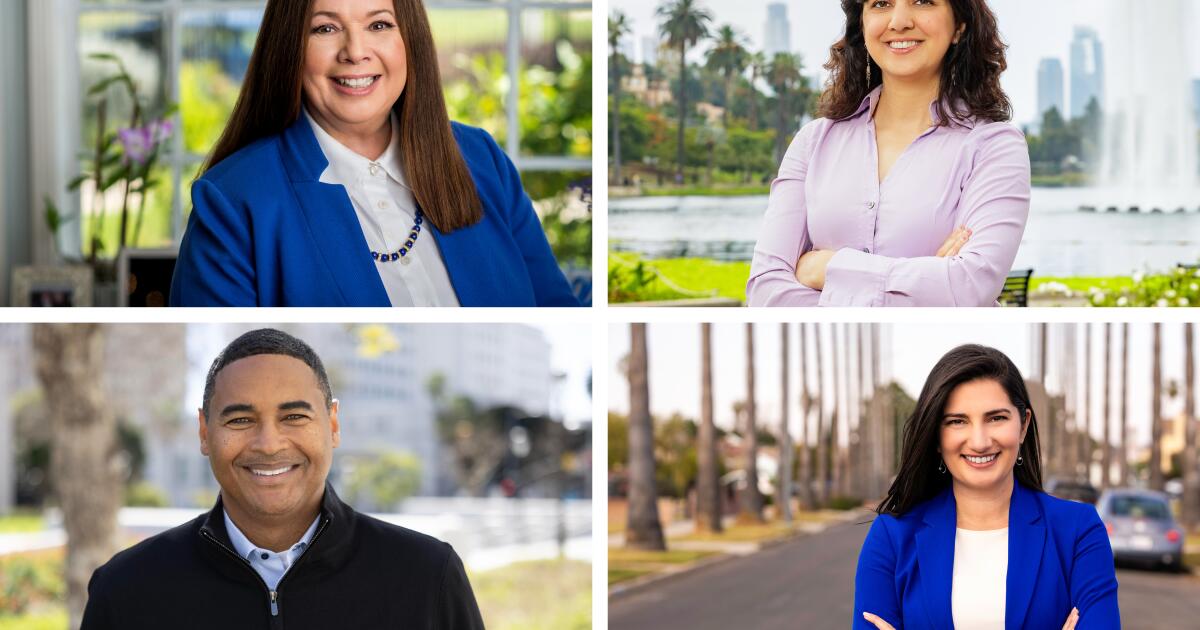
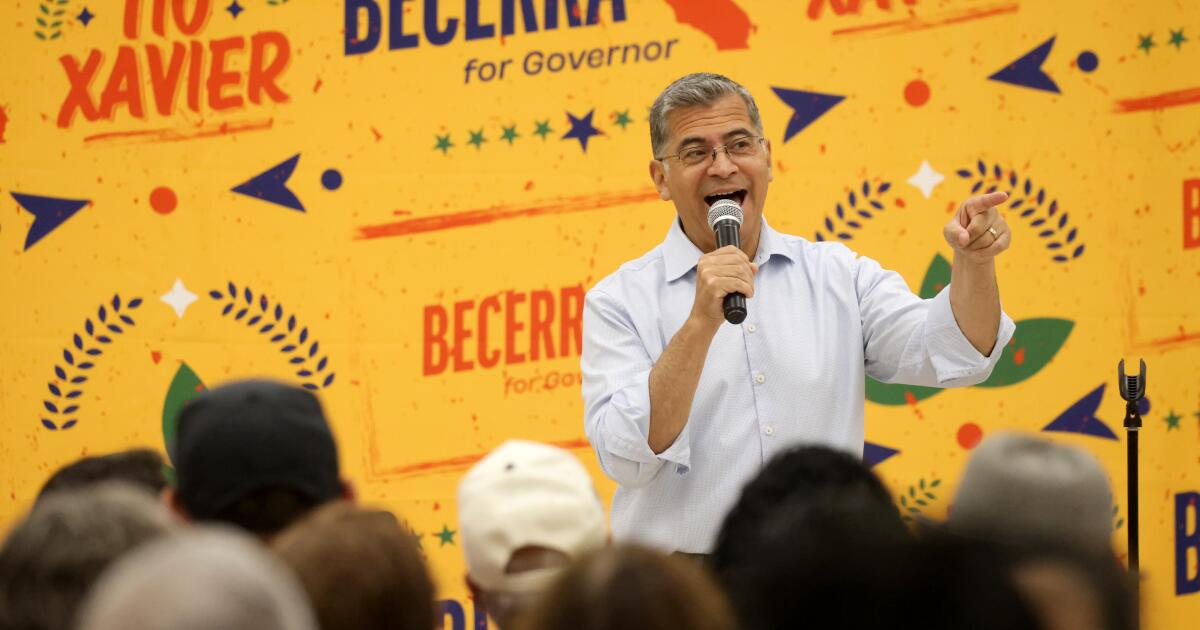
The state’s top-two primary system has been in place since California voters passed Proposition 14 in 2010. The goal was to help end partisan gridlock in Sacramento and force candidates in primaries to appeal to a wider range of voters, rather than just those in their own party.

Proposition 14, as well as the state’s once-a-decade redistricting process, has led to some dramatic races, including the 2012 face-off between Democratic Reps. Brad Sherman and Howard Berman for a congressional seat in Los Angeles’ San Fernando Valley. Amid aspersions and attack ads, the pair nearly came to blows at a community debate.

Maviglio described the ballot measure as a simple repeal of Proposition 14, and said he was inspired by the governor’s race.

“It was extremely scary to envision the November ballot for governor with Republicans on it,” Maviglio said.

The New York Times first reported on the ballot measure proposal.

A news release from Maviglio states that the proposed repeal of Prop. 14 “is fueled by concerns that California’s primaries are disenfranchising a majority of California voters by limiting choice to candidates from one party.”

A website for the effort includes criticisms of the current primary system by Democratic Party Chair Rusty Hicks and Ron Nehring, former chairman of the California Republican Party.

Maviglio’s ballot initiative proposes to appear on the 2028 ballot and take effect in 2030.

Talk of changing Proposition 14 has been swirling in Sacramento for months.

Secretary of State Shirley Weber told reporters at an unrelated news conference last week that she had voted years ago against Proposition 14. She questioned whether it had actually succeeded in creating more diversity.

“I did not like the open primary,” Weber said. “I didn’t think it would solve any problems. They had a list of problems it would solve, and none of those have been solved.”

Source link