How has US imperialism targeted Venezuela and Iran? How have years of hybrid warfare shaped resistance? What role does China play in the emerging multipolar world?
In Episode 46 of the VA Podcast, Venezuelanalysis editor Ricardo Vaz is joined by VA co-editor Lucas Koerner and scholar Matteo Capasso to discuss sanctions, sovereignty, deterrence, and international anti-imperialist solidarity.
Protesters urged the Venezuelan government to bring rice imports under control. (Archive)
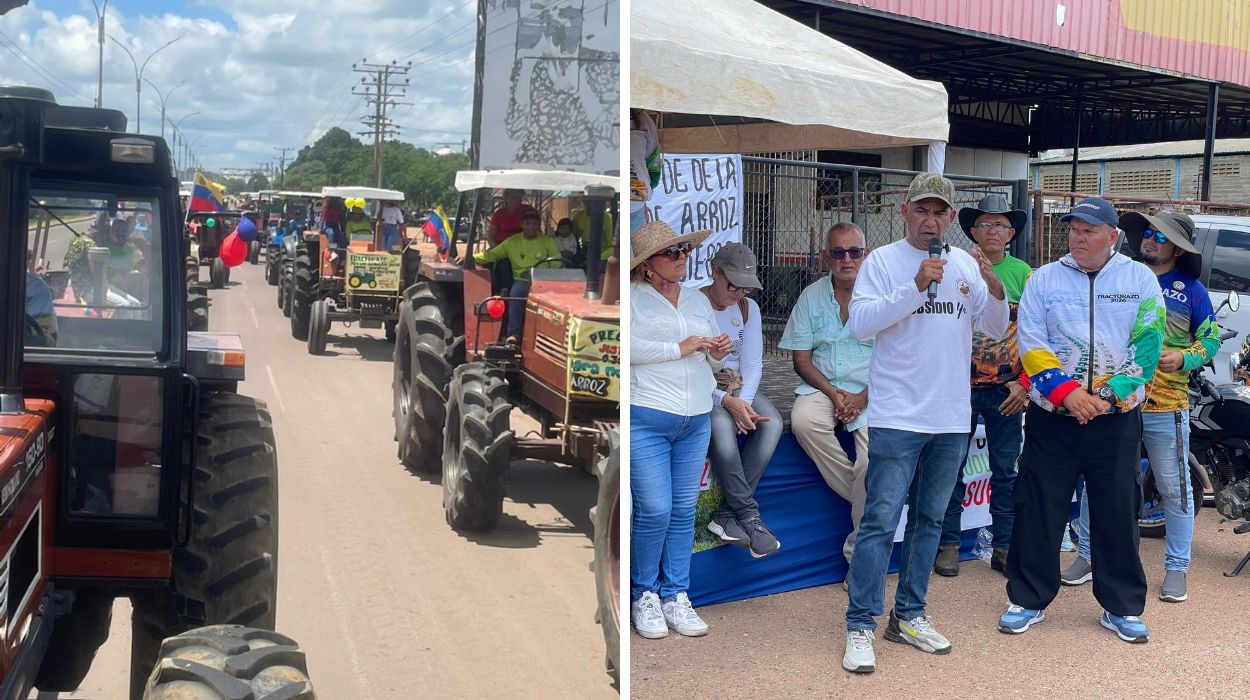
Caracas, June 22, 2026 (venezuelanalysis.com) – Hundreds of rice producers took to the streets on Sunday in Calabozo, Guárico state, to urge the Venezuelan government to take action against agribusiness imports and price fixing.
The “tractorazo” saw local campesinos block one of the state’s major highways with tractors, trucks, and other heavy machinery carrying Venezuelan flags and signs with some of the main demands. Local sources estimated turnout at over 300.
“We are here on behalf of the producing states in Venezuela with a struggle that is just and urgent,” local spokesman José de la Cueva stated. “We urge the Venezuelan government to review its public policies so that national production is not destroyed.”
De la Cueva and other speakers emphasized the need for authorities to control imports, establish fair prices, and implement subsidies for the production of rice and other crops. Protesters contended that they have no conditions to compete with imports from countries where rice is subsidized, including Brazil and the US.
Rice growers, particularly in agricultural states Barinas, Cojedes, Guárico, and Portuguesa, have warned for months that agroindustry conglomerates have been importing massively since February.
According to agribusiness lobby FEDEAGRO, Venezuela has received more than 300,000 tons of imported rice in recent months. The amount is nearly half the 683,000 reportedly produced in the Caribbean country in 2025.
FEDEAGRO has complained that the exoneration of tariffs and import taxes is benefiting imported rice against national competitors. Imports of other crops such as corn have also skyrocketed, with purchases from the US more than tripling in the first five months of 2026 when compared to the previous year.
Meanwhile, campesinos have repeatedly denounced that local agribusiness corporations outright refuse to receive rice crops or attempt to impose prices as low as US $0.30 per kilo. Venezuela’s Agriculture Ministry established $0.40 per kilo following meetings with agroindustry and campesino representatives. Producers complained that the price did not take into account rising production costs and risked driving them bankrupt.
Alongside the latest street mobilization, rural organizations have likewise called for a boycott of Venezuela’s main agrifood conglomerates, including Polar and Iancarina.
The Small Farmers Movement (MPA), one of the organizations that took part in Sunday’s protest, issued a statement stressing that the defense of Venezuelan production and food sovereignty should become a “national unity cause.”
“This protest is about the survival of thousands of campesino families,” the text read. “It denounces the cruelty of agroindustry bosses whose voracious appetite for profit is fueling imports during harvest seasons to drive prices down.”
The MPA added that the growth of agricultural output in recent years has been based on “the exploitation of the work of thousands of campesinos” and urged social movements not to stay silent when it comes to the reality of small-scale producers in the countryside.
The campesino organization urged the government to adopt a series of measures, including implementing fair prices for rice and corn, reviewing import policies during harvest seasons, and investigating the “cartelization of prices” by agroindustry oligopolies. The MPA also called attention to the lack of credit for small-scale producers, which leaves them vulnerable to predatory lending agreements, including ones where they are offered seeds and inputs in exchange for a significant percentage of the harvest.
In a recent meeting with campesinos in Guárico state, National Assembly President Jorge Rodríguez vowed to investigate the issue of rice imports, claiming he was not previously aware of it. He urged agribusinesses to respect the previously agreed $0.40 price and called on public banks to reactivate credit for rural producers.
In recent years, with the economy heavily constrained by US sanctions, the Nicolás Maduro government moved to liberalize agricultural policies, transferring state competencies to the private sector, including provisioning of seed and fertilizer inputs and access to tractors. Fuel subsidies have also been phased out, with small-scale producers highlighting it as a major factor driving up production costs.
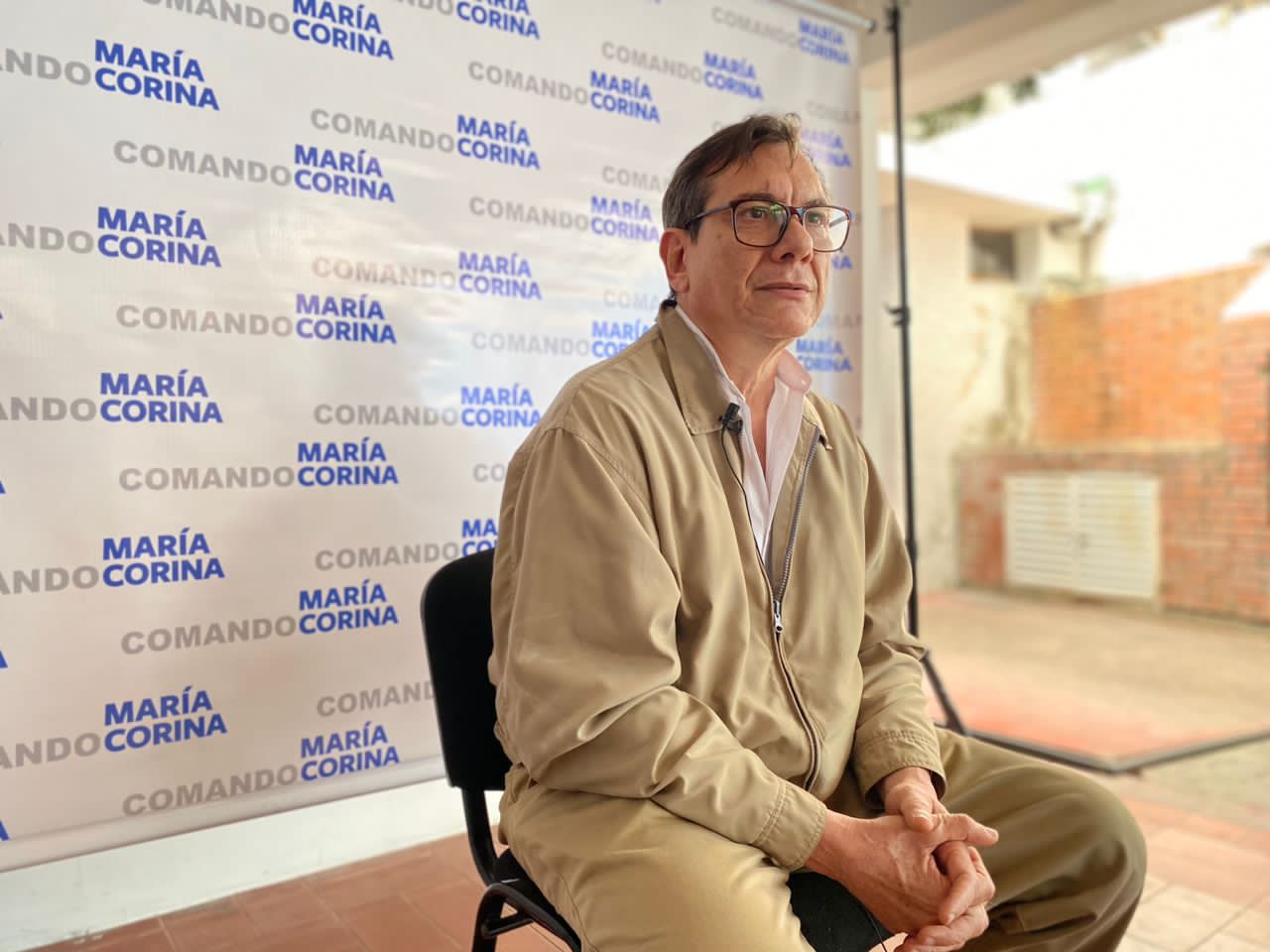
Photo: Humberto Villalobos in February 2023, months before the last opposition primaries
While Washington’s focus seems to be shifting toward security and armed groups, Machado’s team keeps its priorities clear, looking beyond the immediate circumstances. The Nobel Peace Prize laureate keeps saying that an election will be the vehicle to channel a transition to democracy—an event where the anti-chavista movement sees itself as the clear winner. Following the 2023 and especially the 2024 elections (where the coalition successfully defended a clear victory for Edmundo González by collecting and publishing 85% of the official tally sheets), it is not far-fetched to say that this is where the Venezuelan opposition’s greatest strengths lie, even under adverse conditions.
At Caracas Chronicles, we sat down with Humberto Villalobos—Vente Venezuela’s electoral chief, who coordinated Machado’s famous defense machinery—to discuss the current gap between ideal electoral conditions and reality, now that the publication of the Panama Manifesto has opened the opposition to negotiating elections with chavismo, naming Machado as the leader (or conductora) of the process.
Machado’s team is proposing changes that, to a large extent, aim to “demolish” the electoral system as we know it. Among other measures, this involves migrating to a hybrid system that would get rid of the ExCle voting machines, (paper ballots would be counted by hand), establishing a CNE in a novel fashion, improving the Venezuelan Electoral Registry so it accurately reflects how the population is scattered both inside and abroad, and implementing a mechanism to legalize political party competition in practice.
Once a new CNE is formed and the electoral calendar is published, Villalobos says this study could contribute to the renewal of the Electoral Registry. Under the proposal, the Registry would be renewed in three months.
This is a baseline proposal that could change in a scenario where Villalobos views the US as the guarantor of an agreement: “Delcy will make proposals, we will too, and in the end, all those things will be considered to yield something reasonable.” He envisions an election that is “simpler to produce,” stripping away the obvious strategic advantages that chavismo has historically claimed for itself during elections. “Under other conditions,” Villalobos says, “none of this would even be on the table. But here they proved to us that they can pass an energy reform in 15 days. You could do something similar to make elections happen, something just as important as pumping oil.”
First: an independent citizen register
Villalobos began by describing the need to produce a rigorous study of the local and migrant populations to understand the country’s actual electoral reality. The opposition would gather information directly from the people to understand who still lives where the Electoral Registry says they do, who left the country, and how many voters would require a change in their polling station. Villalobos calls this empadronamiento: the creation of a citizen residency register. The objective, he notes, is for the majority of voters to update their addresses through a digital platform featuring biometric facial recognition (ABIS) identification mechanisms, or at registration points operated by a network of enumerators or empadronadores
Once a new CNE is established and the electoral calendar is released, this study could assist in overhauling the Electoral Registry, the current state of which Villalobos calls “disastrous.”
“While citizens are changing their voting addresses, they could also support a political party. From that, you would yield parties with validated groups of voters.”
The digital platform and the network already exist. Vente has started the process with its own members, and all current enumerators hold positions within the party: “We originally thought of it just for Vente, and as we grew, we envisioned it as a solution for all Venezuelans.” They would only need the people’s consent to use their data. Villalobos admits that managing a database of this scale carries an enormous burden of responsibility, but the alternative would mean negotiating while relying exclusively on data managed by the chavista state, which “treats it as its own asset.”
“At the end of the day, we are the only ones ready to do it. The systems being employed are the ones we already used in the 2024 presidential election. We simply added an extra feature that allows for enrollment of this type,” Villalobos asserts. “That feature handled half of the tally sheets we transcribed. And that gives you the certainty that you can handle millions. Furthermore, the guarantee is being provided by María Corina Machado.”
Second: ad hoc CNE, Electoral Registry, and political parties
The proposal rests on the premise that the CNE’s current structure is too flawed to fix simply by appointing a new board of rectors (or “electoral commission,” as Marco Rubio has called it). They propose a new, temporary electoral authority termed ad hoc CNE, an entity created specifically to manage an electoral transition. From that point on, it would only require a new specialized company to carry out the formal overhaul of the Electoral Registry
“More than one company is already preparing its bid under the terms we are working with,” Villalobos says. “That bidding process would have to be run by the new CNE, a natural process that nobody else can handle.”
Data from the independent, citizen register “would serve as a foundation” for the state provider to shorten the process. Villalobos assures that, in this manner, the new Registry could be ready in three months. Meanwhile, political parties that have been suspended or intervened since the last decade would be legalized through groups of voters that endorse these political organizations. “While citizens are changing their voting addresses, they could also support a political party. From that, you would yield parties with validated groups of voters. That would save us a lot of time.” The concept of groups of voters (grupos de electores) exists in Venezuelan legislation, though not necessarily for these purposes. A new statute for the ad hoc CNE, Villalobos suggests, could change that.
The electoral expert noted that one additional provider would be needed to manage the calendar and the elections. Identity verification made possible by the technology first implemented in the independent citizen register would thus help the ad hoc CNE assign party representatives and witnesses.
Third: goodbye to the machines
The most ambitious part of the proposal is to discard the electronic voting system that has been in place in Venezuela throughout this century and move to a mixed system featuring manual counting and automatic transmission.
According to Villalobos, paper ballots would be counted by hand by polling station members in the presence of party representatives. Afterward, a photo and a scan of the voting tally sheet would be taken. The data of all votes would then be transmitted from the polling station to the CNE, the political parties, international institutions linked to the electoral process, universities, and media outlets.
“It works almost like a blockchain, because you will have multiple repositories of the original document, which prevents it from being altered. It isn’t a galactic development like a voting machine that does absolutely everything,” Villalobos says. “It would be a matter of scanning something, transcribing it, and sending it. That fits on a smartphone.”
Villalobos noted they will push to ensure there are no polling stations where it is impossible to deploy a witness.
He maintains that the current system operates like a “black box” where voters are forced to accept the results transmitted by the machines, which he claims can be manipulated by those managing the CNE. But didn’t the physical tally sheets printed by these machines on July 28, 2024—which proved Edmundo González won the election by a 2-to-1 margin—serve to show that the count itself wasn’t manipulated, but rather that the CNE simply fabricated results declaring Maduro the winner? Villalobos insists that the current technology failed because, regardless, opposition witnesses were unable to obtain 15% of the tally sheets. He asserts that without representatives at a polling center, “there are ways they can change your result.”
“The extraordinary concept of having a machine that does everything is not dominant worldwide. In Colombia [referring to the first round of presidential elections where Abelardo de la Espriella secured the majority of votes], where the process was not the fastest, we already had the results of all tally sheets within an hour and a half. All of them, not a single one was missing.”
Finally, Villalobos was emphatic that voting must end strictly at a specific hour (in Venezuela, polling stations commonly close at 6 pm, but voting can be extended if there are still voters in line). He also stressed that the opposition will push to ensure there are no polling stations where it is impossible to deploy a witness. In the 2024 presidential election and previous ones, voting centers were set up inside Misiones Vivienda (state housing complexes), communal council headquarters controlled by the ruling party, and military bases—places where the likelihood of a clean process and of collecting the printed tally sheet is usually much lower.
“Voting systems were created to resolve conflicts. The first step is for all of us to believe we won’t be cheated, because otherwise, we go right back to the same thing,” he concludes. “In any election, they can change the result of a polling center if you don’t have anyone there. That’s why we are going to motivate people to stay at the centers, to have the fiesta right there. So that you walk away from that center knowing it is impossible for them to change the results.”
Venezuela Fury’s new husband Noah was heard complaining about the static home her parents bought for themCredit: TiktokThe young wife looked unimpressed with her husband’s commentCredit: Tiktok
The couple moved into their static home after they got marriedCredit: TikTok/ @venezuelaffuryThe couple got married in a lavish wedding last monthCredit: Splash
At 42ft long and 14ft wide, the static home spans 588 square feet – roughly the same size as a large London studio flat.
They also gave them a nice little nest egg of £5M, to get them started out, as well as paying for their lavish wedding.
Meanwhile, the new couple have found their marriage has been lucrative so far for them.
Since then, the newlyweds have been showing of their new life on social mediaCredit: TikTokThe young couple have proved hugely popular with fansCredit: Getty
A TV insider said: “The couple are not A-list celebrities but everyone has become obsessed with their love story.
“People are genuinely intrigued by them.
“Whether it’s the fact they have married so young, Venezuela’s famous family or their gypsy lifestyle, they have the ‘X factor’.
“Several TV executives think a proper fly-on-the-wall series following their lives as newlyweds in the gypsy community would be fascinating.”
Netflix is likely to win any bidding war for the show, as the streamer already has a working relationship with the Fury family.
Their series, At Home With The Furys, became an instant hit when it dropped in 2023 and filming is already under way on a third series, which is due later this year.
Walking through Budapest, it is impossible not to notice the contradictions. Hungary is a member of NATO, a member of the European Union, and a beneficiary of decades of Western integration. At the same time, Chinese companies are building multibillion-dollar factories, Russian energy remains essential, and Viktor Orbán spent years cultivating close ties with both Moscow and Beijing.
From Caracas, many would interpret this reality as an anomaly. Perhaps for a country so accustomed to contradictions, it is a window into the world that is coming. Or into the world that already arrived.
For decades, international politics was dominated by a relatively straightforward question: whose side are you on? The Cold War forced countries to choose between Washington and Moscow, although Venezuela took a novel approach in the second half of its democratic period. Even after the collapse of the Soviet Union, the American unipolar moment sustained the assumption that development, prosperity, and international integration were ultimately synonymous with Westernization.
The twenty-first century has proven more complicated. Turkey purchases Russian weapons while hosting American bases as a NATO member. India participates in strategic partnerships with the United States while maintaining longstanding military and energy ties with Moscow. The United Arab Emirates hosts capital, companies, and citizens from virtually every geopolitical camp. Hungary, home to CPAC Europe and a destination for both Chinese investment and Western conservative movements, has perhaps turned this logic into a national strategy more successfully than any other European country.
These countries are not neutral. Nor are they non-aligned in the classical Cold War sense. They are states that have learned to maximize their options in a multipolar world.
Time to embrace multipolarity?
For years, discussions about Venezuela’s future have been framed as a choice between opposing models. Would the country resemble Cuba or Colombia? Nicaragua or Costa Rica? Would a transition imply a return to the Western consensus that shaped much of Latin America after the Cold War?
Five months after January 3 and the beginning of a period of unprecedented American tutelage, those questions appear increasingly outdated.
The symbolism of recent weeks is difficult to ignore. While Delcy Rodríguez was in India seeking to deepen energy ties with one of the world’s fastest-growing economies, General Dan Caine was simultaneously in Caracas discussing security cooperation with Venezuelan authorities. In the traditional chavista worldview, these developments would have belonged to rival geopolitical universes. In today’s Venezuela, they increasingly appear as part of the same strategy.
Venezuela arrives at this reality from a different place. Questions of external influence, compromised sovereignty, competing centers of power, and tutelage have played a far larger role here than among our neighbors.
The concept of regime learning refers to the ways political systems adapt in order to survive. In Venezuela, that process has already transformed the country’s economic model. Price controls have largely been abandoned. The private sector is in a slow process of rehabilitation. In short, revolutionary orthodoxy has repeatedly yielded to political necessity.
Regime learning does not only change how states govern. It changes how they understand the world.
What is becoming apparent in 2026 is that the same process may be transforming Venezuela’s geopolitical posture.
The Bolivarian Revolution was founded on a particular assumption. Venezuela would help construct an alternative pole of power, aligned with actors such as Cuba, Russia, Iran, and eventually China. The goal was not merely to diversify partnerships. It was to build a geopolitical project capable of challenging American influence in the hemisphere.
Twenty-five years later, the lesson learned appears remarkably different.
Arriving late to the game
Russia became absorbed by its invasion of Ukraine. China proved willing to defend its own interests, but not necessarily those of its partners. Iran remained geographically distant and economically constrained. Cuba, despite years of leeching off the Venezuelan state, proved largely incapable of defending the revolution against genuine external pressures. The experience of governing under sanctions, isolation, economic collapse, and great-power competition appears to have produced a different conclusion: dependence on any single external patron creates vulnerabilities.
The logical response is not non-alignment, but rather hedging.
Instead of anchoring Venezuela to a single geopolitical camp, the emerging strategy appears designed to maintain productive relations with several simultaneously. Security cooperation with Washington. Oil exports to India. Commercial ties with China. Investment from the Gulf. Access to Western financial markets. None of these relationships are mutually exclusive. In fact, they reinforce one another.
To some extent, there is nothing uniquely Venezuelan about this. Much of Latin America already operates in a multipolar environment. Governments across the ideological spectrum maintain economic ties with China while preserving political, commercial, and security relationships with the United States. Yet Venezuela arrives at this reality from a very different place. Questions of external influence, compromised sovereignty, competing centers of power, and political tutelage have played a far larger role in Venezuelan politics than in most neighboring countries.
The lesson Venezuela appears to be learning is neither socialist nor liberal, neither anti-Western nor fully Western.
In some respects, the country’s experience over the last quarter century has more in common with the dilemmas faced by some post-communist European states (like Ukraine) than with those of Colombia, Peru, or Ecuador. Venezuela is never going to become Switzerland, nor is it going to become India. It lacks the geography, the institutions, and the scale required for either role. Yet it may be discovering a different path, one better suited to its circumstances: not a great power, not a neutral sanctuary, but a medium-sized energy producer whose strategic value derives from its ability to remain relevant to multiple centers of power simultaneously.
This is what makes Hungary such a useful comparison. Not because Hungary represents a political model for Venezuela, nor because Viktor Orbán and Nicolás Maduro are comparable figures. If anything, a Venezuelan transition led by María Corina Machado would likely have more in common ideologically with a post-Orbán government than with Orbán himself. Yet that is precisely the point. Even a post-Orbán Hungary would remain a member of NATO and the European Union, continue attracting Chinese investment, and remain constrained by the economic and energy relationships accumulated over decades. Hungary is useful because it illustrates a broader phenomenon: the emergence of states whose prosperity depends less on belonging to a bloc than on remaining useful to several at once.
Viewed from this perspective, Venezuela’s current trajectory increasingly resembles neither Cuba nor the Colombia of the early 2000s. It is not moving toward the permanent isolation of the former, nor toward the straightforward Western alignment of the latter under Álvaro Uribe. Instead, it is beginning to occupy an intermediate position, one that may become increasingly common in a multipolar world.
The Bolivarian Revolution aspired to create a twenty-first-century Cuba. Five months after January 3, its most enduring geopolitical legacy may be the emergence of an oil-rich Hungary in the Caribbean.
Regime learning does not only change how states govern. It changes how they understand the world. After 25 years of revolution, sanctions, collapse, and adaptation, the lesson Venezuela appears to be learning is neither socialist nor liberal, neither anti-Western nor fully Western. It is something more pragmatic: in a multipolar world, survival belongs to those who can make themselves useful to everyone.
Venezuela’s interim President Delcy Rodriguez signed a memorandum of understanding with U.S.-based GE Vernova, General Electric’s energy division, and state-owned utility Corpoelec to repair, modernize and stabilize the country’s struggling national power grid. File Photo by Miguel Gutierrez/EPA
June 16 (UPI) — Venezuela’s government signed a memorandum of understanding with U.S.-based GE Vernova, General Electric’s energy division, and state-owned utility Corpoelec to repair, modernize and stabilize the country’s struggling national power grid.
The plan aims to restore 1,000 megawatts of generating capacity over the next 24 months and more than 5,000 MW within four to five years.
The agreement, signed Monday by Venezuela’s interim President Delcy Rodriguez, comes shortly after the National Assembly approved reforms to the country’s electricity law. The changes create a new framework that allows foreign investment in the sector after 15 years of an exclusive state monopoly.
During the signing ceremony, attended by Venezuelan government officials, company representatives and U.S. Charge d’Affaires in Caracas John Barrett, Rodriguez said the project will address both hydroelectric and thermoelectric infrastructure.
“We want to move forward steadily in the recovery of the national electricity system, for the benefit of the entire country but also to facilitate conditions for all the international investments arriving in the country,” Rodriguez said during the ceremony, which was broadcast on state television.
#EnVideo| Presidenta (E) Delcy Rodríguez, destacó que la firma del acuerdo con General Electric Vernova constituye un paso histórico para la recuperación del servicio eléctrico, esencial para la vida nacional.
Informó que ha solicitado convertir de inmediato este acuerdo en… pic.twitter.com/O0Wwrs0cYn— Ministerio de Comunicación e Información (@mippci_ven) June 15, 2026
GE Vernova technical teams spent six weeks conducting an audit of Venezuela’s electrical system. The assessment confirmed the deteriorated condition of Corpoelec’s facilities, which have contributed to electricity rationing and widespread blackouts, particularly in western states such as Zulia, the center of Venezuela’s oil industry and a major agricultural region.
“We want to move quickly so the system works as well as possible within a few months, and I believe we can do that together,” GE Vernova Chief Sustainability Officer Roger Martella said. “We already have an agreement on the technical aspects and how we can move forward rapidly. Over the next 12 months and beyond, we will strengthen the national electric system.”
According to local media reports, the Guri Hydroelectric Plant, which supplies about 70% of the country’s electricity, has suffered significant wear because of a lack of original replacement parts. New equipment will be used to stabilize and rehabilitate generating facilities at hydroelectric dams in southern Venezuela.
GE Vernova’s equipment also is expected to help restore local thermoelectric generation capacity, reducing pressure on the Guri complex and improving energy independence for central and western regions.
Transmission lines that cross the country face constant overloads and aging substations. The plan includes energy management software and upgrades to substations to improve reliability and reduce recurring power fluctuations.
The legal reforms approved this month allow concessions of up to 25 years in power generation, transmission and distribution, providing legal certainty for companies such as GE Vernova to deploy technology and services in the sector.
The legislation also establishes stricter accountability requirements for operators and creates a formal framework for renewable energy development.
In addition to increasing generating capacity and modernizing grid operations, the agreement includes a specialized training program for Venezuela’s technical workforce.
Venezuela has signed an agreement with General Electric Vernova aimed at boosting electricity generation as the country seeks to improve a power system plagued by years of outages. Officials say the deal could add 5 gigawatts of capacity over four years.
Hegseth claimed Venezuela “invited” US forces to target Tren de Aragua. (Truth Social)
Caracas, June 14, 2026 (venezuelanalysis.com) – The United States launched a military strike inside Venezuelan territory that reportedly killed Héctor “Niño” Guerrero Flores, an alleged leader of criminal group Tren de Aragua.
US President Donald Trump first announced the “swift and lethal kinetic strike” via social media on Friday evening.
“At my direction, the US Southern Command (SOUTHCOM) delivered a swift and lethal kinetic strike to successfully execute Niño Guerrero, the infamous leader of Tren de Aragua,” he wrote. “Tren de Aragua terrorists no longer have safe haven in Venezuela or anywhere else.”
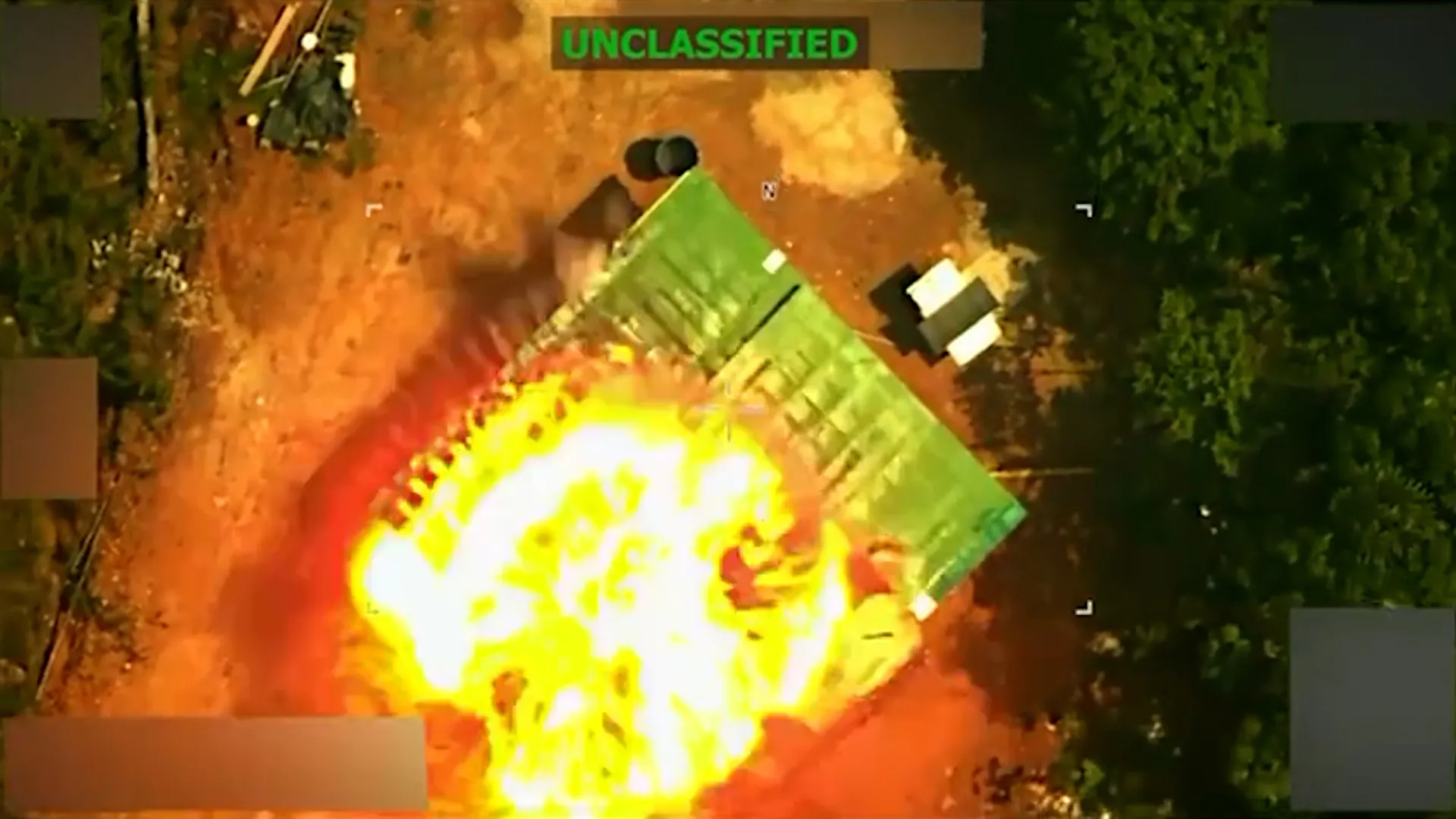
Trump added that the extrajudicial execution was “coordinated closely with our friends in Venezuela.” An accompanying video showed a house or compound being blown up.
US Secretary of War Pete Hegseth confirmed the operation shortly afterward, adding that it had taken place earlier in the week. He reiterated the “full collaboration with Venezuelan security forces” and claimed that Guerrero was confirmed dead in the strike.
“The operation underscores the shared US and Venezuelan commitment to take the fight to narco-terrorists and deny them any safe haven in our hemisphere,” he stated. SOUTHCOM Commander General Francis Donovan also expressed “gratitude” to Venezuelan security forces for their “support to the successful joint operation.”
In a Sunday interview, Hegseth claimed that US forces were “invited” by Venezuelan authorities and that further operations in Venezuelan territory were to be expected.
The Wall Street Journal, citing an anonymous administration official, reported that the CIA provided intelligence for the strike.
For its part, the Venezuelan government headed by Acting President Delcy Rodríguez issued a Friday evening statement informing of a “joint operation” between US and Venezuelan security forces to dismantle “organized crime structures” in southeast Bolívar state.
“During the operation there were clashes with members of these criminal structures that resulted in ‘Niño Guerrero’ being neutralized,” the communiqué read. Neither Venezuelan nor US officials offered details about the operation, the alleged clashes, or additional casualties from the lethal strike against Guerrero.
Caracas went on to claim that the mission involved “intelligence sharing” between the two countries and reiterated its “commitment to fight organized crime.”
According to the Venezuelan Constitution, the deployment of foreign military missions in the country’s territory requires approval from the National Assembly.
The military procedure coincided with a Venezuelan armed forces deployment to dislodge illegal mining outfits from mineral-rich Bolívar state as Western corporations eye lucrative exploration projects under a new, pro-business mining law. Tren de Aragua was alleged to be one of several criminal groups operating in the area.
The reported execution of Guerrero is the first recorded joint US-Venezuela military operation on Venezuelan soil. Since September 2025, the Trump administration has struck dozens of small boats in the Caribbean and Eastern Pacific, killing over 200 civilians. US authorities have claimed to be targeting drug trafficking operations but have not put forward any evidence.
In 2025, Washington likewise ramped up “narcoterrorism” accusations against the Nicolás Maduro government while setting up a large-scale military deployment near Venezuelan shores. Caracas denounced the charges as a pretext for foreign intervention, pointing to United Nations and DEA reports that repeatedly showed the South American country to play a marginal role in global narcotics trafficking.
On January 3, US forces bombed Caracas and kidnapped Maduro and First Lady Cilia Flores. They are currently facing trial in New York and have pleaded not guilty to charges including drug trafficking conspiracy. Despite recurring accusations in recent years, US officials have not provided any public evidence tying high-ranking Venezuelan officials to narcotics activities.
Since the attack, Acting President Rodríguez has fast-tracked a diplomatic rapprochement with the Trump White House while reforming oil and mining legislation to favor Western investment. Multiple US officials have visited Caracas in recent months, including SOUTHCOM Commander Donovan, CIA Director John Ratcliffe, and Chairman of the Joint Chiefs of Staff Dan Caine.
Dating back to his election campaign, Trump consistently talked up the threat posed by Tren de Aragua in the US as part of his anti-migrant crackdown and alleged that it acted in collaboration with the Maduro government. In February 2025, the State Department designated Tren de Aragua as a foreign terrorist organization (FTO), having previously announced a US $5 million reward for information leading to the capture of Guerrero.
However, despite repeated rumors of crimes attributed to Tren de Aragua, US intelligence agencies found no evidence of the organization having any coordinated activity on US soil or ties to the Venezuelan government. Separate reports have documented that the group runs criminal activities, including human trafficking, in several Latin American countries.
For their part, Venezuelan officials stressed that Tren de Aragua had been dismantled in Venezuela following a 2023 raid on Tocorón prison, from where the gang was believed to run its operations. Nevertheless, Guerrero was reportedly alerted in advance and managed to break out.
The 42-year-old had been in and out of prison several times before being handed a 17-year sentence in 2018 for charges including homicide and drug trafficking. In January, he was charged in New York as a co-conspirator in the case against Maduro.
President Donald Trump has posted a video of a ‘swift and lethal’ US strike he claims has killed the leader of Venezuela’s Tren de Aragua gang. Trump said Venezuela helped the US with the strike on Hector Rusthenford Guerrero Flores.
WASHINGTON — President Trump said Friday that a “swift and lethal kinetic” U.S. strike has killed Hector Rusthenford Guerrero Flores, whom he called “the infamous leader” of the Tren de Aragua gang.
Tren de Aragua has been labeled by the United States as a terrorist organization. Guerrero Flores was charged in a New York federal court with racketeering conspiracy and other crimes, including lending support to terrorists in crimes that stretched more than a decade, authorities announced in December.
Defense Secretary Pete Hegseth posted on X that the strike occurred earlier in the week on a Tren de Aragua compound in Venezuela.
U.S. Atty. Jay Clayton alleged at the time that the gang is responsible for countless acts of violence, extortion and drug trafficking in North America, South America and Europe. Trump nominated Clayton on Thursday to be director of national intelligence.
The U.S. State Department had offered rewards of up to $5 million for information leading to Guerrero Flores’ arrest.
In a post on his social media site, Trump wrote, “Tren de Aragua terrorists no longer have safe haven in Venezuela or anywhere else and, under my leadership, we will find these vicious murderers and drug lords anytime, anyplace, and send them to the depths of hell where they belong.” Trump’s post referred to Guerrero Flores by his alias, Niño Guerrero.
Hegseth said, “The operation underscores the shared U.S. and Venezuelan commitment to take the fight to narco-terrorists and deny them any safe haven in our hemisphere.”
Venezuela’s ministry of communications did not immediately respond to a request for comment on the operation.
Trump has taken a series of extraordinary actions against the gang, including a series of strikes on small boats his administration has accused of smuggling drugs to the U.S.. At least 207 people have been killed in boat strikes by the U.S. military in the eastern Pacific Ocean and Caribbean Sea since the Trump administration began the campaign in early September.
Independent investigations, by the Associated Press and others, have raised questions about the boat passengers’ alleged connection to drug trafficking. And, in any case, many legal experts say the boat attacks amount to extrajudicial killings in violation of international law.
Trump and administration officials have consistently blamed Tren de Aragua for being at the root of the violence and illicit drug dealing that plague some U.S. cities. The president spent months repeating the claim — contradicted by a declassified U.S. intelligence assessment — that Tren de Aragua had operated under Venezuelan President Nicolás Maduro’s control. The U.S. invaded Venezuela and seized Maduro in January to face U.S. drug charges.
Tren de Aragua originated more than a decade ago at an infamously lawless prison in Venezuela’s central state of Aragua. The gang has expanded in recent years as millions of Venezuelans migrated to other Latin American countries or the U.S. in search of better living conditions.
Guerrero Flores returned to the prison in Aragua on murder and other convictions in 2013, when Venezuela’s crisis began and corruption, mismanagement and a drop in crude prices wrecked the oil-dependent economy. Guerrero Flores and a few other inmates saw a profitable opportunity as the government neglected prisons.
They assumed control and administration of the prison, establishing a system that controlled the entire inmate population through force and extortion. Over time, they transformed the lockup into a sort of city that included a zoo, baseball field, casino and restaurants. Guerrero Flores had his own lavish suite.
The size of the gang is unclear. Countries with large populations of Venezuelan migrants, including Peru and Colombia, have accused the group of being behind a spree of violence in the region. Still, unlike other criminal organizations from Colombia, Brazil and Central America, Tren de Aragua has no large-scale involvement in smuggling cocaine across international borders, according to InSight Crime, a think tank that tracks crime across Latin America.
In Venezuela, gang leaders have long been known to participate in various illegal activities, including illicit gold mining.
Weissert writes for the Associated Press. AP writer Regina Garcia Cano in Mexico City contributed to this report.
SLB, formerly Schlumberger, is the latest major corporation to sign a renewed agreement with the Venezuelan government. (Archive)
Caracas, June 11, 2026 (venezuelanalysis.com) – The Trump administration continues to dictate conditions on Venezuela’s energy industry for the benefit of US and Western corporations.
At an event organized by Politico, National Energy Dominance Council Director Jarrod Agen stated that he is in contact with Venezuelan Acting President Delcy Rodríguez and her team “multiple times a day” to discuss the legal framework for foreign conglomerates.
“I raised issues [on oil contracts] when I went down [to Venezuela] and she said ‘we’ll work with you to get through it,’”the Trump official added.
Agen stated that the administration is currently working to turn “memoranda of understanding (MoU) into binding contracts” and insisted that Venezuela has “made a lot of progress” in overhauling the country’s hydrocarbon and mining laws.
The legislation approved by the National Assembly slashes royalties and fiscal responsibilities for private companies, while also granting them expanded control over operations and sales. After the laws were approved, authorities were tasked with drafting regulations for their implementation and new contract templates.
Agen went on to announce that a Trump administration delegation will travel to Caracas in the coming days to further discuss conditions for multinational firms in petroleum and gas projects.
Venezuelan oil authorities have reportedly begun circulating drafts of regulations and contract models with industry partners, though the texts have not been made public. The final versions are required to be published in the country’s National Gazette.
According to Bloomberg, Caracas has revised the proposals under pressure from investors, including the removal of a clause that would have allowed the Venezuelan government to terminate contracts, with compensation, for reasons of “public interest.” Venezuelan leaders have openly acknowledged incorporating private sector input into the recent oil and mining reforms.
Since launching military strikes and kidnapping Venezuelan President Nicolás Maduro on January 3, the Trump administration has seized control of the South American country’s energy and mineral exports.
While keeping wide-reaching sanctions in place, the US Treasury Department has issued multiple sanctions waivers allowing select Western corporations to undertake oil and gas operations in Venezuela while barring participation from Chinese, Russian, and Iranian competitors. The general licenses mandate that all Venezuela-owed payments, including royalties and taxes, be deposited in a Treasury-run account.
On Wednesday, the Trump administration updated multiple licenses concerning energy, petrochemical, and mining activities, stipulating that contract disputes can now also be settled in the United Kingdom, France, and Singapore, rather than just the US. However, the licenses still demand that contract terms be “construed and interpreted” in accordance with US laws and jurisdiction.
The revised waivers likewise establish that contracts may recognize that “certain aspects” of the activity are subject to Venezuelan laws and regulations.
For its part, the acting Rodríguez administration has aggressively courted foreign investment in the oil and gas sectors.
On Wednesday, Venezuelan state oil company PDVSA signed a memorandum of understanding with SLB, formerly Schlumberger, one of the world’s largest oil services providers with a presence in the Caribbean nation since the 1920s. The Houston-based multinational stated that the agreement intends to “strengthen operational execution and promote sustainable development” of the Venezuelan energy sector.
During a televised ceremony, Rodríguez said she was “very pleased” with the deal and expressed confidence that SLB’s cutting-edge technology would have a “major impact on oil exploration and production.”
The acting leader has inked agreements with multiple Western energy giants in recent weeks, including Chevron, Shell, BP, and Repsol. Rodríguez has announced that more companies are set to arrive in the coming weeks. Business executives have made repeated trips to Venezuela to evaluate opportunities and meet with government officials.
Rodríguez recently visited India and touted oil project opportunities in meetings with Reliance Industries and Indian public sector energy firms.
Other government officials, including Economy Vice President Calixto Ortega and Oil Minister Paula Henao, have also held closed-door meetings with investors to promote recent reforms and incentives for foreign firms. At a Houston conference in May, Henao trumpeted the new oil law’s international arbitration clauses for offering more “legal certainty” to investors.
Venezuela’s oil output has continued its recent upward trend, with OPEC’s secondary sources registering a production of 1.072 million barrels per day (bpd) in May, up from 1.036 million in April.
For its part, PDVSA registered a 1.179 million bpd output last month, up from 1.136 million in April. Direct and secondary measurements have historically differed over disagreements on the inclusion of condensates and natural gas liquids.
According to Reuters, Venezuelan oil and byproduct exports rose for a third consecutive month, registering 1.25 million bpd, thanks to increased volumes shipped to the US and India.
VENEZUELA Fury has furiously hit back at critics who claim she is too young to be married.
The eldest Fury offspring, who wed partner Noah Price last month, had so far remained silent on the controversy – but has now issued a defiant response.
Sign up for the Showbiz newsletter
Thank you!
Loved-up Venezuela and Noah celebrate becoming husband and wifeCredit: InstagramThe happy couple shared a kiss after tying the knotCredit: Splash
In a defiant new social media post shared on Instagram, the 16-year-old shared a loved-up snap from her wedding day, with a clear message to trolls in her caption.
“For everyone who said I was too young,” she wrote, looking to silence the subject once and for all.
The photo shared showed Venezuela and Noah grinning from ear to ear on their wedding day as they posed together following the lavish ceremony.
Venezuela’s marriage raised eyebrows among some critics, who argue that 16 is too young to fully understand the lifelong commitment of marriage.
Venezuela showed off her huge fairytale wedding dress before tying the knot with NoahCredit: SplashThe 16-year-old bride wore a towering lace creation complete with a show-stopping 50ft trainCredit: Splash
The debate intensified after England and Wales raised the minimum legal age for marriage to 18 in 2022 as part of efforts to tackle child marriage.
The couple tied the knot on the Isle of Man, where 16 and 17-year-olds can still legally marry with the written consent of a parent or legal guardian.
When the wedding was discussed on Loose Women, the panel were generally positive, while viewers commented on social media: “Are we really celebrating child marriage?”
Parents Tyson and Paris Fury have publicly backed the marriage, with Tyson proudly walking his daughter down the aisle on her big day.
Paris has also defended the decision, pointing out that she was engaged at 17 after meeting Tyson when she was just 15.
Venezuela left formal schooling at 11 as part of Traveller tradition and has since moved from family life into married life.
With 1.3 million TikTok followers, the eldest daughter of Tyson and Paris is reportedly being lined up to star in her own reality show alongside husband Noah, 19.
It is believed Netflix would be the frontrunner to produce the series following the success of the family’s hit show, At Home With The Furys.
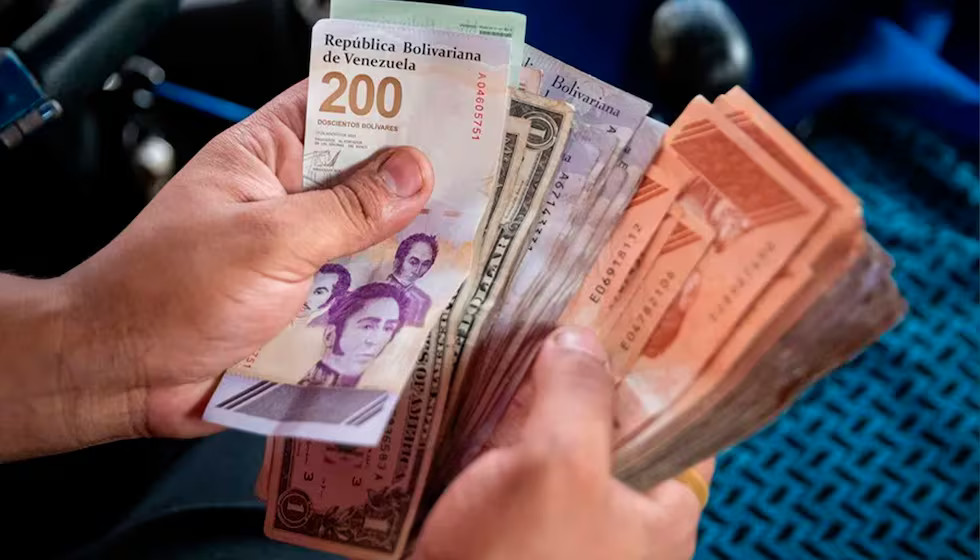
The USD-bolívar exchange rate has nearly doubled in 2026. (EFE)
Caracas, June 9, 2026 (venezuelanalysis.com) – Venezuela has registered the lowest month-to-month inflation figure since October 2024.
According to the Venezuelan Central Bank (BCV), consumer prices went up by 6.3 percent in May. Inflation has fallen for four consecutive months after hitting 32.6 percent in January, following the US military attack and kidnapping of President Nicolás Maduro.
Overall, prices have more than doubled in the first five months of 2026, and accumulated 12-month inflation currently stands at 525 percent.
Despite the widespread use of the US dollar in cost structures, prices have likewise gone up by 12.5 percent over the last year when measured in USD, meaning a loss of purchasing power even for those with incomes pegged to the official exchange rate.
Venezuela’s inflation remains heavily correlated with currency instability. Despite the Central Bank devaluing the USD-bolívar exchange rate by more than 30 percent since March and providing significantly increased volumes offoreign currency to the private sector, a 30-40 percent gap remains between the official and parallel market rates.
Since January, the BCV has directed over US $5.5 billion in foreign currency via bank-run exchange tables, at more than double the rate of 2025, according to figures from Banca y Negocios. However, the chasmbetween official and parallel rates has persisted.
Many economists have identified the stabilization of the foreign exchange market as a necessary step for macroeconomic recovery, but critics have pointed to a lack of regulation and accountability in forex allocation as fueling currency speculation.
Caracas’ monetary and fiscal policy is presently subject to US control. Since January, the Trump administration has mandated that Venezuelan export revenues, principally oil sales, be deposited in US Treasury accounts. Washington returns an undisclosed portion of the proceeds at a time of its choosing.
The White House has likewise imposed that disbursed funds be channeled directly to the private sector via foreign exchange auctions, as well as outside auditing of Central Bank accounts by consulting giant Deloitte. Secretary of State Marco Rubio indicated in January that the Venezuelan government headed by Acting President Delcy Rodríguez would need to submit a “budget request” before accessing its own resources.
For its part, the Rodríguez administration has fast-tracked a series of pro-business reforms tailored to attract foreign investment, including in the oil, mining, and electricity sectors.
As part of efforts to court US investors, Economic Vice President Calixto Ortega reportedly took part in a closed-door meeting with US officials and corporate representatives hosted by the Atlantic Council, a hawkish Washington-based think tank funded by the US government, its allies, and major corporations.
The opening to foreign investment has seen Western business executives flock to Caracas in recent weeks, often escorted by White House officials, to explore opportunities. Pro-Trump tech billionaires such as Fred Ehrsam have made repeated visits, while Peter Thiel’s Erebor Bank struck a corresponding banking agreement with Venezuela’s largest public bank.
Javier Kulesz, a strategist from investment bank Jefferies, relayed optimism after a visit to the South American country and forecast an imminent “stream of announcements” related to the country’s debt restructuring and investments in key economic sectors.
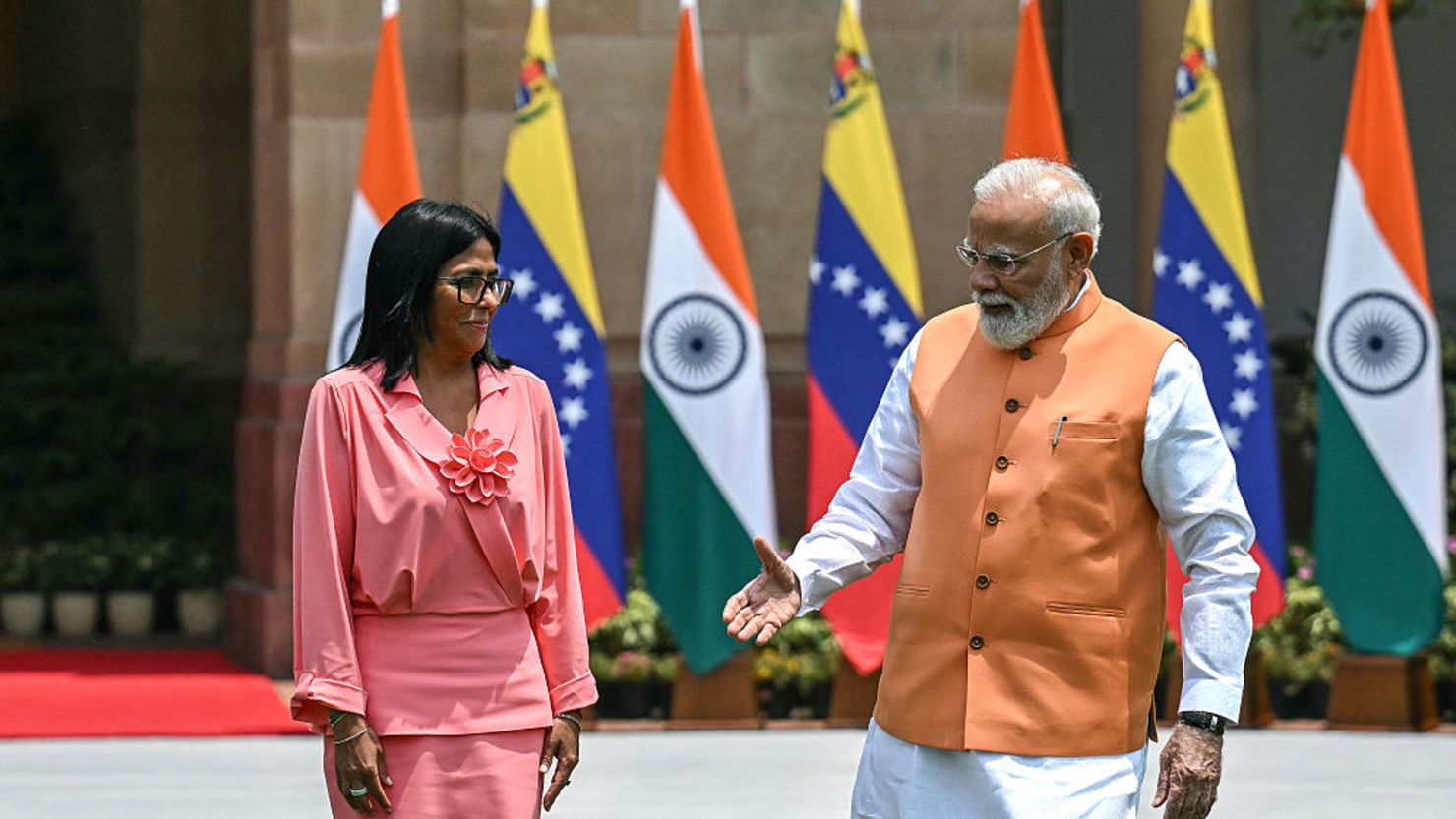
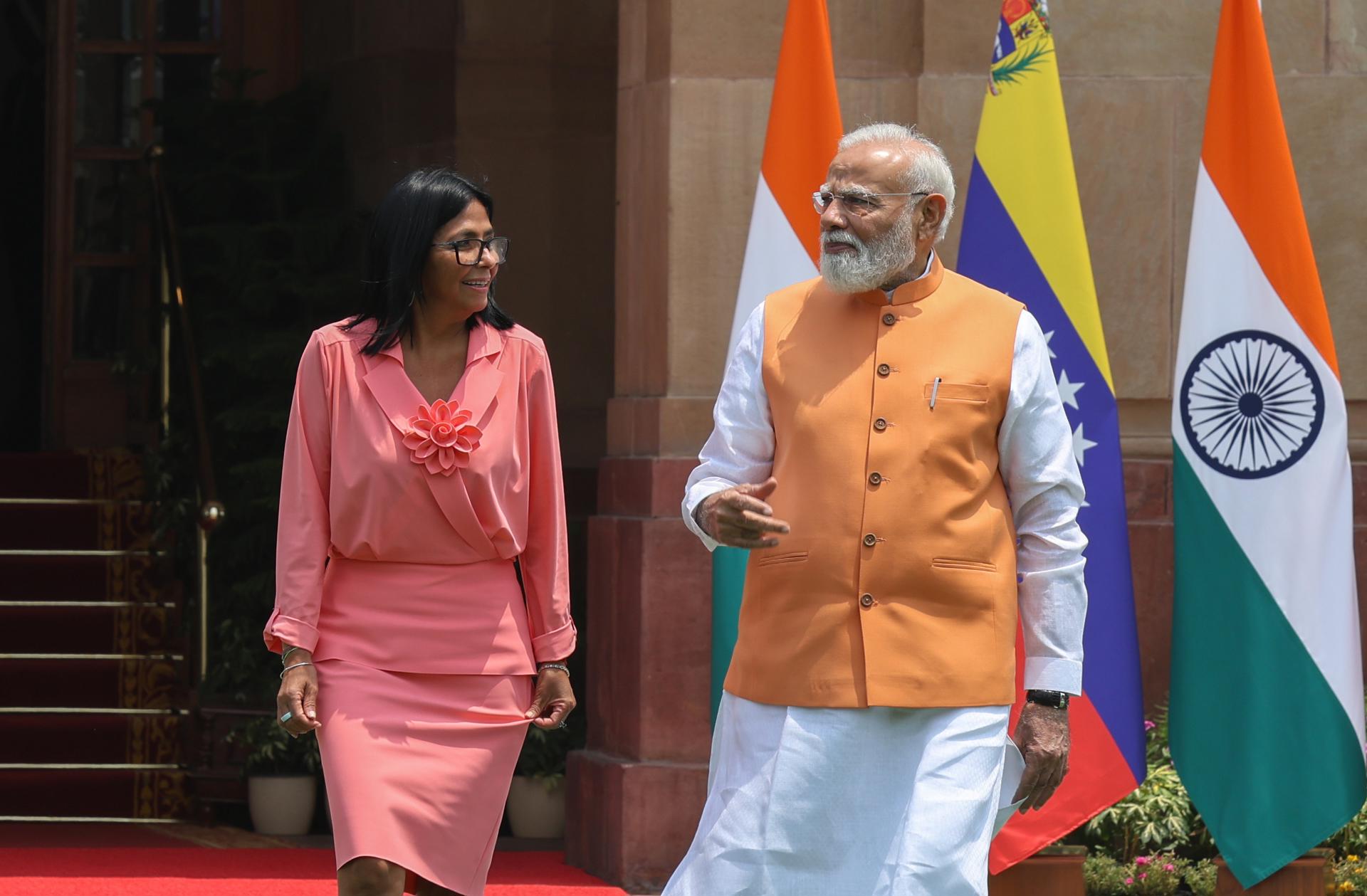
Delcy Rodríguez was hosted by Narendra Modi in New Delhi. (EFE)
Mérida, June 8, 2026 (venezuelanalysis.com) – Venezuelan Acting President Delcy Rodríguez concluded a four-day high-profile diplomatic tour of India on Sunday, having held meetings with Prime Minister Narendra Modi, Indian cabinet members, and major business conglomerates.
Rodríguez, who assumed the acting presidency after the kidnapping of President Nicolás Maduro in a US military operation on January 3, led a large ministerial delegation including the foreign affairs, science, and transport ministers. The visit was Rodríguez’s sixth trip to India.
Caracas’ main stated goal was to deepen long-term energy ties with the Asian giant and expand crude exports. The Trump administration has publicly backed India to increase purchases of Venezuelan crude as part of efforts to move its Asian partner away from Russian energy imports.
One of Rodríguez’s first meetings was with Petroleum and Natural Gas Minister Hardeep Singh Puri, who stated that Indian companies are looking to “build upon” existing investments in the Caribbean nation.
“Indian companies are additionally looking for newer opportunities for fruitful collaborations which will provide momentum to our quest towards energy security,” Singh Puri wrote on social media.
For her part, Venezuela’s acting president described India as a “reliable partner” and invited Indian corporations to explore new investment opportunities in the country’s energy sector. Rodríguez highlighted the “energy complementarities” between the two nations.
Venezuela’s oil exports reached 1.25 million barrels per day (bpd) in May, with India reportedly receiving 427,000 bpd, making it the second-largest destination after the US. In recent years, under wide-reaching US sanctions, Venezuela had repeatedly sought to increase exports to India, only to see efforts blocked by US threats of secondary sanctions.
The meeting with Singh Puri likewise featured executives from several Indian public energy companies, including ONGC, Indian Oil Corporation (IOLC), Oil India, and ONGC Videsh (OVL). The companies own multiple minority stakes in the San Cristóbal and Petrocarabobo heavy crude projects in the Orinoco Oil Belt.
Indian authorities stressed addressing an outstanding US $500 million debt in unpaid dividends to ONGC Videsh as a priority before new investments are to be considered.
Rodríguez went on to tour the Jamnagar refinery complex, owned by Reliance Industries, in Gujarat state. The refinery is the world’s largest, with a daily capacity to process 1.4 million bpd. In recent months, Reliance has emerged as a top buyer of Venezuelan crude, purchasing cargoes directly from state-owned PDVSA as well as from traders Vitol and Trafigura.
The Venezuelan delegation held further meetings with top Indian business conglomerates. On June 6, it toured Tata Group facilities in Mumbai. According to Venezuela’s embassy in India, the discussions centered on renewable energy, ecological projects, and urban transport. Venezuelan Transport Minister Jacqueline Faría highlighted Tata’s cutting-edge electric public transportation vehicles.
Rodríguez’s agenda also included talks with Indian dairy giant Amul. Venezuelan state media emphasized interest in Amul’s massive production of buffalo milk. Venezuela currently holds the largest buffalo herd in South America and officials have touted buffalo dairy as a priority export venture.
Likewise in Mumbai, the Venezuelan officials visited multinational conglomerate Essar, with discussions reportedly focusing on infrastructure and electricity. Venezuela’s National Assembly is presently advancing legislation to open electricity, from generation to distribution, to private sector investment and participation.
Rodríguez’s visit featured a meeting with Indian Prime Minister Narendra Modi in New Delhi. In a social media message, Modi praised Venezuela as a “valued partner” and disclosed that discussions had centered on “expanding cooperation in energy, critical minerals, technology, agriculture, health, and people-to-people ties.”
The Venezuelan delegation was also hosted by External Affairs Minister Subrahmanyam Jaishankar, who praised Rodríguez’s “longstanding commitment” to deepening Venezuela-India ties.
In a press briefing, Rudrendran Tandon, Secretary (East) in the Ministry of External Affairs, emphasized discussions on pharmaceutical cooperation and increasing supplies of low-cost generic drugs for Venezuela’s public healthcare system. Tandon also brought up a $700-800 million debt to Indian pharmaceutical manufacturers but said the Venezuelan side was “very sensitive” to the issue.
While no formal agreements were announced, Venezuela’s acting president offered a positive balance of a visit that “consolidated the friendship and cooperation between the two nations.” She went on to thank Modi for the hospitality.
Rodríguez’s last day in India included a visit to the Prasanthi Nilayam ashram in Andhra Pradesh, a spiritual center founded by Indian religious guru Sathya Sai Baba (1926-2011). In a social media message, Rodríguez expressed her “deep belief” in Sai Baba’s “love all, serve all” motto.
The Venezuelan leader’s tour featured a stop in Istanbul on Tuesday before the return to Caracas. Rodríguez met with Turkish President Recep Tayyip Erdoğan to discuss bilateral trade and diplomacy between Venezuela and Türkiye.
Venezuelan communities have wrested several festivities away from the Church. (Venezuelanalysis)
Black amber, all painted, white foam… The rain sings, summer is over. White foam… May flower.
“Flor de Mayo”, Otilio Galíndez
The Chakana path, It is up and down, inside and out…
Water is synonymous with life, and rain is perhaps the metaphor through which Mother Earth conveys the importance of preserving, nurturing, and multiplying life on this planet. For the peoples of the South, May is a turning point. It brings the rainfall, and thus abundance is renewed. The wet season begins in these torrid regions of exuberant contrasts and excessive beauty. Everything sprouts, blooms, and matures.
In May, the night sky in the South allows us to behold the zenith of a constellation that holds immense value in the ancestral worldview of our peoples: the Southern Cross. This fixed constellation consists of Alpha Crucis, Gamma Crucis, Beta Crucis, Delta Crucis, and a fifth star, Epsilon Crucis, which, although not part of the main points, serves to distinguish it from the “False Cross.”
Our Andean ancestry, which exerts a deep influence on all the Indigenous peoples of Abya Yala, identifies this constellation by the name Chakana, which can be translated as a ladder or bridge between the earthly and spiritual worlds. It means complementarity, harmony, and purpose, as well as a path for returning to the core. The Chakana is the organizational center of the Andean world and its entire sphere of influence, which is why it is the focus of numerous and diverse rituals, ceremonies, offerings, and festivals throughout these territories.
From the moment of their arrival, the Spanish conquistadors were struck by the symbolic power, veneration, and cultural identity of the peoples of Abya Yala with the Chakana. This is why they suppressed all traditional knowledge and ritual symbols, imposing their Eurocentric worldview in the clearest demonstration of colonial epistemicide. Temples, codices, and sages were demolished, burned, tortured, and martyred in the name of Christianity, which came to replace the Southern Cross, a symbol of knowledge and life, with the Catholic Cross, as a condensed symbol of pain, domination, sacrifice, death, and the promise of resurrection.
In Venezuela, a series of daytime and nighttime ritual activities persist, drawing young people and adults alike, in cities and rural areas alike. Afro-Venezuelan peoples especially cherish these traditions. The celebrations of the Cruz de Mayo, San Isidro, San Pascual Bailón, Corpus Christi, San Antonio, San Juan, and San Pedro, among others, escape the Catholic liturgical calendar that continues to try to assimilate them. They are celebrations framed within those exuberant contrasts of excessive beauty that cause everything to sprout, bloom, and mature. These are the days in which the Venezuelan people celebrate the cycle of life and for which they have created music, dances, drinks, foods, costumes, and poetry that have transcended both the Catholic Church and its Inquisition as well as civil and military power, in a testament to the most committed re-existence.
Lighting the altar candles
Wakes (“velorios”) are community gatherings organized to honor the deceased, a saint, the Virgin Mary, the Baby Jesus, or the Cross. These gatherings are held to fulfill a vow or out of devotion, and they feature prayers, drinks, food, poetry, singing, and dancing.
The velorio is a popular tradition that goes beyond the institutional framework of the Catholic Church. In fact, as early as the Synodal Constitutions of the Bishopric of Venezuela and Santiago de León de Caracas of 1687, published by Bishop Diego de Baños y Sotomayor, these activities, which “attract large crowds” and in which “many indecencies and offenses against God are committed,” were prohibited under penalty of “Major Excommunication.” Certainly, the Church seized on these practices of profane worship of the madero (the wood) to imbue them with Christian meaning.
At the center of the velorio dedicated to the Cruz de Mayo (“May Cross”) stands an altar with a main cross and two smaller ones. These are crosses without the image of Christ, “dressed” with cloth, paper, and multicolored flowers. The altar and its surroundings are also decorated in harmony with the crosses, and the offerings of candles, fruits, food, and drinks are arranged in such a way as to celebrate the abundance of a countryside that turns green again at this time of year.
The church’s calendar states that May 3 marks the celebration of “The Finding of the Cross.” Therefore, on the night of May 2, vigils begin in all the eastern states, as well as in Guárico, Lara, Cojedes, Aragua, Yaracuy, Carabobo, Barinas, Apure, Portuguesa, Miranda, Falcón, and in the city of Caracas. People give thanks for health and the fertility of the land. In the central coastal region, where Afro-Venezuelan communities are present, sirenas and fulías are sung. In the llanos, three-voice tonos are performed. In the east, the rhythms include galerones, malagueñas, fulías, jotas, and punto y llanto. The decimistas (poets) make offerings in a circular formation and vie for the spotlight as the musicians and singers perform.
Cantos a la Cruz de Mayo | Live session | Venezuela Un Solo Pueblo
Dancing up and down in a cross
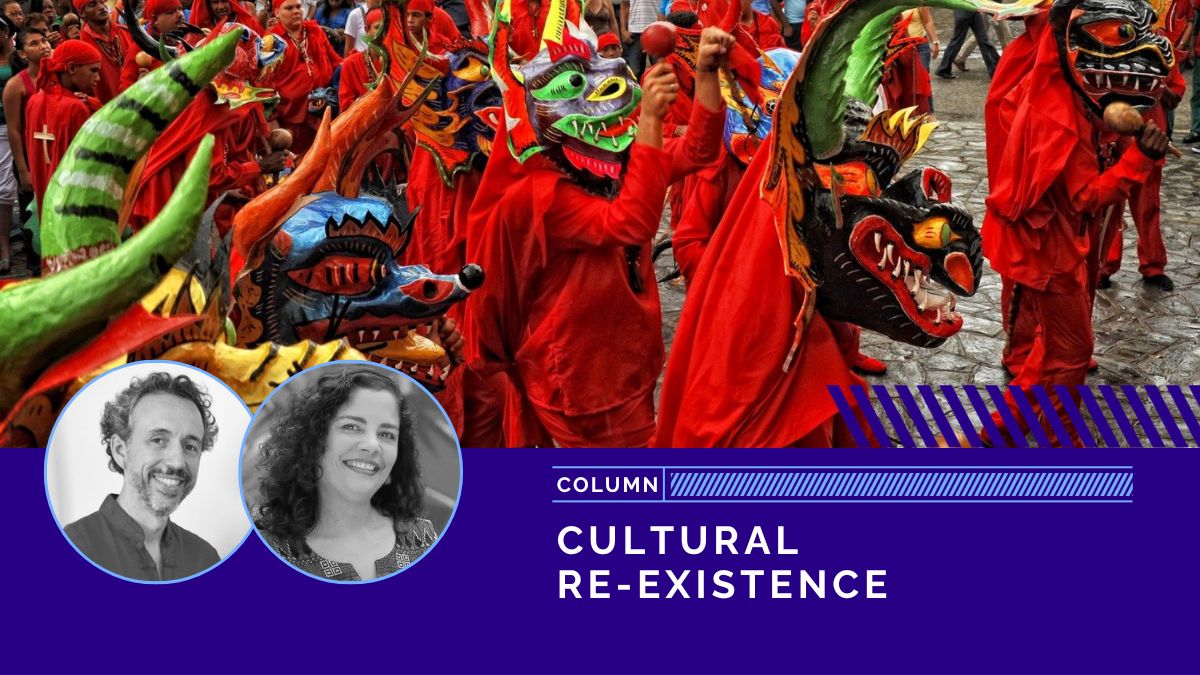
The Dancing Devils of Corpus Christi dance by forming a cross on the ground, to which they add new crosses with every turn, spiral, backward step, and leap. Each movement has a specific meaning and timing because the goal is to maintain order between the upper and lower realms, between complementary forces that must harmonize. Or, put more simply, to ensure that good prevails over evil.
The Incarnation of Christ in the Eucharist is a movable feast that occurs nine Thursdays after Holy Thursday. There are references to its celebration dating back to the third century in the Roman Empire. In 1350, it began to be celebrated in Barcelona with processions that reenacted the Devil’s defeat by the power of the Cross. In Venezuela –specifically in Ocumare de La Costa –there is evidence of Dancing Devils dating back to 1621, and although masked devils were present in many places, this practice survived only in the central region as a magical-religious ritual in the states of Aragua, Carabobo, Cojedes, Guárico, Miranda, and La Guaira.
The people, embodying the Devil, do not view the Evil One as a figure but as a concept. He is simply a force opposed to God. A revelrous, playful, and imperfect being. However, the promesero, dressed in colorful pants and a shirt, wearing masks of different sizes, shapes, and shades, which bear no resemblance to the European portrayal of the devil, protects himself with prayers, scapulars, bells, whips, and crosses that he carries as part of his attire. But his greatest protection is the insistent sign of the Cross he traces with the movements of his foot and the hand holding a maraca.
The cuatro or the caja (snare drum) are the instruments that accompany this celebration, depending on the community. Only in the town of Chuao are both used, though at different times. There is no singing, and the rhythms are performed with different beats that vary in intensity and speed. There are eleven Afro-Venezuelan lay brotherhoods or cofradías recognized as Intangible Cultural Heritage of Humanity by UNESCO, and each has a distinct musical identity linked to its spiritual environment.
Diablos danzantes de Corpus Christi
Beating the drums
Pipas, quitiplás, culos ‘e puya, minas, curbatas, cumacos, and maracas are the essential instruments with which the Venezuelan people celebrate the arrival of San Juan (John the Baptist), the most popular Catholic festival in seventeenth-century Spain that was brought over to preserve the identity of the conquistadors while simultaneously subjugating the Indigenous peoples and later the kidnapped and enslaved African peoples. Coinciding with the second cocoa harvest in these territories, the birth of John the Baptist, exactly six months after Jesus, became the figure of greatest devotion on the major slave-owning plantations along our country’s northern coast.
San Juan is regarded by the people as a saint who charges for his miracles. He’s drinker of aguardiente, a dancer, and a reveler, which is why there is both a popular celebration and an institutional, Catholic one. It must be remembered that Black people were barred from entering the church until well into the nineteenth century. Today, depending on the town and the priest, drums may or may not be allowed inside the church. In any case, the popular celebration of San Juan involves dancing, singing, drumming, drinks, and food –all meant to reclaim a freedom that was historically limited to an extreme. For this reason, it was a celebration that was persecuted and punished with excommunication during the colonial period, as we saw in the above mentioned Synodal Constitutions.
The San Juan festival cycle begins on June 1 with the “Repique de San Juan.” Families, communities, and various organizations meet in advance to plan and assign responsibilities. It is a colorful celebration reflected in the participants’ attire, flags, and scarves. Women’s participation is essential, particularly in the singing that takes place during the sirenas, the sangueo, and the golpes. These songs accompany the individual dancing of those carrying the flags and the saint in the sangueo, which is part of a group dance, but also the dancing of individual couples and, to a lesser extent, of linked couples.
The songs to San Juan are, above all, responsorial, alternating between soloist and choir, often improvised. Each drum has its own “tonada” or way of singing it, and in each locality, even if the same drum is used, the way of playing it and the style of singing this or that beat may vary. They follow the African tradition of three-drum ensembles –interdependent and complementary –where polyrhythm is enhanced by the timbral qualities of each drum, with the lowest-pitched one taking the “lead,” providing the beats and embellishments. “The Saint is in the drum,” it is said, affirming the enduring relevance of the worldview of the Indigenous peoples of West Africa.
Fiestas en Honor a San Juan Bautista, Choroni Venezuela
¡Arriba negro!
With this call, a singer signals to his partner that it is their turn to sing, because in the bella, the galerón, and the seis figureao, consecutive duets of singers in two different voices (a third apart) take turns. Meanwhile, in the yiyivamos, the juruminga, the perrendenga, and the poco a poco, one singer improvises verses and a chorus responds. The so-called Sones de Negros are made up of seven songs. However, it all begins with La Salve, a solemn song in which permission and a blessing are sought from the saint to begin the dance; once this is finished, the battle ensues, sung in two-part harmony and “danced” by two men with traditional stick-fighting.
The dance in the bella and galerón consists of male-female couples who participate one after another in a free-form manner. The seis figureao features a choreographed dance by three couples performing intricate, intertwined movements and turns. In the yiyivamos, juruminga, perrendenga, and poco a poco, independent couples dance, executing figures and movements as directed by the singer. San Antonio presides over an altar beautifully adorned with flowers, fruits, candles, clubs, crosses, bread, and other foods. Musicians and singers stand facing the altar, and each time the dancers enter the circle, they bow to the saint as a sign of respect and gratitude.
The Baile de Negros or Sones de Negros may have originated in the vicinity of El Tocuyo, in the fertile valley irrigated by the Tocuyo river, where the sugarcane-producing slave plantations were located. Its characteristic sound comes from an ensemble of stringed instruments related to the Baroque and Renaissance guitar, known as the cinco, medio cinco, requinto, and cuatro. The master or most experienced player plays the cinco. The timbral variety of the instruments and the ornamentation of the requinto give this instrumental ensemble an unmistakable texture.
In front of the saint stands the Tamunango or Tambor de Negro, a fundamental instrument constructed from a long, hollowed-out log, sized so that one musician can sit on it and play with their hands on its single head, while another strikes the wooden body with the drumsticks. The rest of the musicians are arranged around this instrument. A double-headed drum, a tambourine, and maracas complete this celebration, which is most popular in the states of Lara, Falcón, Yaracuy, and Portuguesa. Throughout June, with a focus on the 13th, these communities organize this traditional dance in homes, squares, streets, and fields -a celebration that cannot end without a sancocho (wood fire, community-prepared stew) soup) and a glass of cocuy de penca (agave-derived drink).
Siete Sones – Sones de Negros (Tamunangue)
Stomp on the boss!
The San Pedro festival is perhaps one of the most complex. Certainly, it is part of the cycle of life celebrations, featuring music, dance, food, and drink specially prepared as an offering to the saint. But as a kind of narrative that highlights Peter’s benevolence, there is the story of the enslaved María Ignacia, who, desperate over her daughter Rosa Ignacia’s illness, offered the deity an annual celebration. Once the miracle was fulfilled, María Ignacia danced until the last day of her life, and on her deathbed asked her husband to keep the promise. That is why a man in drag, carrying a rag doll in his arms, reenacts today the promise that María Ignacia’s husband made to his wife.
The cuatro and maracas are the accompanying instruments, and there may be many of them providing harmonic and rhythmic support to a soloist, which are answered by a chorus from the audience. The latter either joins in or simply watches this parranda as it winds its way through the streets of Guatire and Guarenas (outskirts of Caracas), starting from the church and making strategic stops at the homes of the revelers, the headquarters of the cofradías, and other points of interest.
Although there is no dramatized performance, during the procession there are characters in costume with carefully assigned roles, performing specific actions to convey the story of the miracle that was granted.
It is a distinctly joyful celebration. In the lyrics, music, and dance, there is a feeling of gratitude for favors received. This festive nature does not mean a loss of conscience. The Parranda de San Pedro carries a very powerful symbolic weight that recalls the use of irony and theatrics as a tool of clandestine insurgency, allowing people to denounce oppression and express their own identity as human dignity. When they sing: “With the cotiza [sandal], stomp the earth / turn it to dust without mercy…” and suddenly switch earth (“terrón”) for “boss” (“patrón”), it becomes perfectly clear what they are talking about.
La parranda de San Pedro de Guarenas y Guatire
The candles remain lit in the collective memory altar and the music continues to sound. After following the path of the Southern Cross and the beats of existence, the Chakana route has another stop. In the upcoming delivery of this column, we will go deep into the heart of these festivities in their wonderful displays of cyclicity, complementarity, and interconnectedness.
Fabiola José is a Venezuelan singer. She has performed in countries across South America, Africa, Europe, and Asia. Her singles and albums are available on all digital platforms. She hosted and produced “Cantante y Sonante” for Radio Nacional de Venezuela. In 2018–2019, she created a series of videos for social media, published on her YouTube channel #HechoEnCasa. She holds a bachelor’s degree in Music from IUDEM, Caracas (2005); specialized under Maestro Tom Krause in Spain (2007); and an M.A. in Arts and Cultures of the South from UNEARTE, Venezuela (2020).
Fidel Barbarito is a Venezuelan musician and researcher, with a bachelor’s and master’s degrees in music and history, respectively. He teaches in the undergraduate and graduate programs at the National Experimental University of the Arts (UNEARTE). Together with Fabiola José, he promotes several musical projects aimed at disseminating traditional folk repertoires, integrating them with contemporary compositions inspired by these sounds. Joropo llanero. Parranda de reexistencia is one of his published essays.
The views expressed in this article are the authors’ own and do not necessarily reflect those of the Venezuelanalysis editorial staff.
The Day of Venezuelan Afro-Descendance celebrates José Leonardo Chirino’s uprising against the Spanish crown in 1795. (Venezuelanalysis)
“In my humble opinion, you have never known how to make coffee or Negroes. The former you leave too light, the latter too black.”
– Venezuelan poet and politician Andrés Eloy Blanco to US visitors, 1944
Contemporary racist attitudes in Venezuela have deep roots in the colonial period (sixteenth to nineteenth centuries). After independence, Venezuela constructed a national narrative that claimed to have overcome racism through miscegenation. We were (are) a “café con leche” (coffee with milk) nation, a blend in which racial differences had dissolved. But this supposed harmony concealed a persistent idea: whiteness remained the ideal, while African and Indigenous identities were seen as something to be diluted and gradually eliminated.
This whitening process was not only biological, but also cultural and political. Paradoxically, racism in Venezuela became invisible to those who practiced it and even to those who suffered from it, masked under the pretext that “here we are all mestizos.” However, we have seen that when political conflicts intensify, the mask of mestizaje falls away and colonial prejudices resurface.
The origin of an ideology
Although the validity of the term “race” has been questioned – on the grounds that we all belong to the human race and differ only in phenotypic traits – according to Venezuelan historian Luis Felipe Pellicer, “…if racism exists, race exists,” but only as an ideological construct of domination, and by no means as a scientific truth.
Racism emerged in Venezuela as a result of an exploitative and extractive economy that created a need for enslaved labor. Initially, this labor force consisted of Indigenous people and was later supplemented by individuals brought from the Atlantic coast of Africa. Countries such as present-day Ghana, Togo, Benin, Angola, and the Republic of the Congo were particularly affected.
Now, the issue of slavery in Africa has deeper roots that warrant a more comprehensive examination, but in the Americas this system underwent a transformation, and what began as an economic activity ultimately established ideas that created negative associations around those subjected to slavery, thereby inventing the political and social category of “blackness.” By merging the condition of slavery with skin pigmentation into a single concept, the colonial mindset ended up stigmatizing every cultural and vital expression of these groups, considering them inferior, ugly, and despicable.
One of the characteristics of enslavement in the Americas was dehumanization and its racial justification. That is to say, here the idea of enslavement due to war or debt repayment was abandoned. The automatic association was: you are a slave because you are a Black African, and vice versa. This phenomenon created the idea that all Africans and their descendants were predestined for servitude and forced labor.
The racist backlash
The recent incident in Madrid that saw supporters of far-right leader María Corina Machado shout slogans against Venezuelan Acting President Delcy Rodríguez reflects a deep social divide. Sectors of the opposition who identify – whether phenotypically or aspirationally – with a Eurocentric worldview and the ideal of “whiteness” believe that the exercise of power by groups they associate with or perceive as people of African descent constitutes a historical affront. For decades before the Bolivarian Revolution, epithets like “monkey,” “mulatto,” “zambo,” “bembón,” and “bad hair,” among others, paraded across TV screens and in the national press with complete normality and often disguised as jokes – another mechanism for propagating Venezuelan racism. Following his government’s post-2001 radicalization of revolutionary reforms, Hugo Chávez was himself notoriously called a “monkey” and prominently caricatured as such by Venezuela’s right-wing opposition.
It is no surprise, then, that the presence of figures such as Venezuela’s current acting president transcends the issue of political ideology to constitute a rupture in “quality,” a term used in eighteenth-century Venezuela. “What is quality or race?” asks Pellicer. “It is an idea of inferiority regarding a human group that is transmitted, corporeally, through sexual reproduction.” It is an affront, then, to the natural order of things, to the pyramid of colonial society that placed peninsular Spaniards at the apex and people of African descent at the base.
With the chant “Fuera la mona” (“Out with the monkey”), the Venezuelan far-right hurled an insult that reveals their undemocratic nature. But more importantly, these insults are not even linked to any incompetence in governance, but rather to what these groups perceive as “racial incompetence.” It is the expression of a wounded “whiteness” that uses racism as a defense mechanism against what they see as a displacement of their traditional privileges. It is, in essence, an attempt to restore a colonial order.
Racism is a power structure. “Colonial thought,” Pellicer observes, “invents the other, whether Indigenous, mestizo, mulatto, or Black, as well as the white self … thereby establishing the ideology of race as the primary marker of inequality, beginning with the invasion of the Americas.” The struggle for honor in the colony was a struggle for differentiation and political recognition. Today, the “animalization” of non-white political leaders is the continuation of that colonial war, which is why the Madrid slur is not a simple rudeness; it is an act of historical violence. It is the voice of the eighteenth century trying to silence the twenty-first. And at this point, one must ask: what is admirable about the idea that, based on skin color, some are more or less fit to govern a country?
The slave owner/racist does not see a person; he sees a tool, a piece of property, and for this to happen, the mind must adopt a psychopathic and callous mindset. The racist needs to strip the oppressed of their status as subjects in order to invoke a visceral fear of otherness that, if acknowledged, threatens their illusion of superiority. Choosing to be part of this ideological operation of domination today should be a source of shame, for it is the most glaring expression of a violence that heralds the end of humanity.
From Cortés to Díaz Ayuso
This exclusionary mindset is part of a transatlantic trend toward neocolonial revival that seeks to re-legitimize old hierarchies. A telling example is Spanish right-wing politician Isabel Díaz Ayuso’s recent visit to Mexico, where her proposal to celebrate the figure of Hernán Cortés serves as an ideological parallel to the “Fuera la mona” chants heard in Madrid. By attempting to portray the invasion and genocide in the Americas as a “civilizing” feat, Ayuso revives the logic of the “society of qualities”: a structure where moral and political superiority is an exclusive Hispanic and white inheritance, while Indigenous and Afro-descendant peoples are reduced to a state of barbarism remediable only through paternalistic tutelage.
This narrative is not merely a historical debate, but a contemporary validation of the racial hierarchy and justification for overthrowing processes of popular sovereignty in Latin America. Ayuso’s discourse seeks to reaffirm a “Hispanic identity” that views ethnic otherness as a threat to the values of Western civilization. In this sense, what happened in Madrid is a clear symptom of the reactionary neo-fascist wave sweeping large parts of the Global North and South.
Racist remarks
The trauma of Venezuela’s War of Independence (1810–1830) and the Federal War (1859–1863) created the need to invent a narrative in which Venezuelan society was free of conflicts and differences, and thus the persistence of racial and social tensions has been glossed over. However, it resurfaces in comments such as: “Fuera la mona”; “We need to improve the race”; “Black but refined”; “Money whitens.”
In 1948, conservative writer Arturo Uslar Pietri responded to Rómulo Gallegos’s presidential campaign by stating: “Anyone who speaks of blacks or whites, anyone who invokes racial hatred or privileges, denies the essence of Venezuela. In Venezuela, in political and social matters, there are neither whites nor blacks, neither mestizos nor Indigenous people. There are only Venezuelans .” This argument was almost exactly the same as that put forward by María Corina Machado when asked about the event at La Puerta del Sol, stating that it had occurred because of the fissures of hatred that Chavismo introduced into its discourse over 27 years in power.
The end of denial
As part of the commemoration of the Day of Venezuelan Afro-Descendance, established under the Hugo Chávez government in 2005 to be celebrated every May 10 [on the anniversary of the 1795 slave uprising led by José Leonardo Chirino], it is both pertinent and necessary to reflect on and understand that racism in Venezuela is a long-standing phenomenon that surfaces with particular virulence during times of political crisis. The historical association between power and whiteness, inherited from the colonial era and reinforced by twentieth-century positivist thought, remains alive in the minds of sections of society that refuse to accept the nation’s diversity, including among working-class communities through what is known as endoracism.
Understanding the origin of this phenomenon is the first step toward dismantling it. We must move from the false harmony of “café con leche” to true decolonial justice, where a person’s “quality” is not dictated by their “whiteness.” The Madrid incident reminds us that the battle for Venezuela’s mental independence far from over.
Rosanna Álvarez holds an MSc in History of Republican Venezuela from the Central University of Venezuela (UCV). She is a researcher at the Centro de Estudios Simón Bolívar and Fundación Hugo Chávez, as well as a writer at the Libertador 8 Estrellas magazine. She is the author of Venezuela vista e imaginada. Un recorrido visual por nuestra historia and host of the Bolívar Nuestro show on Radio del Sur.
The views expressed in this article are the author’s own and do not necessarily reflect those of the Venezuelanalysis editorial staff.
Venezuela Fury looks amazing as she posed in her gym gearCredit: @parisvenezuela / TikTokThe 16-year-old recently moved in to her first home with her husband NoahCredit: @parisvenezuela / TikTok
Venezuela married her man Noah Price, 19, in a stunning handmade gown with imported Italian lace and a 50ft train.
The Netflix star has been keeping fans updated on her life over on her TikTok account.
She danced around in the clip as she mimed the lyrics to Cardi B‘s ‘Pretty and Petty’.
They said: “I’m a bad b***h are you mad. You built like your dad.
Venezuela branded herself an ‘bad b***h’ in a video she posted to TikTokCredit: @parisvenezuela / TikTokVenezuela and Noah tied the knot in a lavish Isle of Man ceremony last monthCredit: Splash
“You damn near unemployed. They only book you when they can’t afford Coi, look.
“I got one album and I’m up still. Daughter cost more than your pub’ deal.”
Venezuela pouted her lips and threw up a peace sign as she ended the video.
Fans in the comments gushed over Venezuela.
The young couple moved into their luxe static home just weeks agoCredit: TIKTOKThe caravan is very spacious, complete with plush grey carpets, a beautiful white kitchen, a free standing bath and a huge TVCredit: TIKTOK
One fan penned: “Diva Period!”
Another fan wrote: “This outfit is everything.”
A third person added: “OMG beautiful.”
The reality TV personality has over 1.3 million followers on the app with fans desperate to keep up with her whirlwind last few months.
Venezuela and Noah‘s wedding was one of the biggest events in May – the bash had 120 guests, a 12-tiered wedding cake, a surprise performance from Peter Andre and an all-night buffet.
The luxury caravan home boasts a stunning marble bathroom with a free-standing bath, a cream kitchen overlooking trees and greenery, and plenty of space throughout.
The living room has a huge built-in TV cabinet with a fireplace beneath.
And the bedroom has large wardrobes and plush grey carpet throughout.
Private and mixed companies will be allowed to participate in electricity generation, transmission, distribution, and commercialization. (AFP)
Caracas, June 4, 2026 (venezuelanalysis.com) – The Venezuelan National Assembly preliminarily approved on Tuesday a reform to the country’s Organic Law of the National Electricity System and Service, proposing a structural overhaul of the National Electricity System (SEN).
One of the most significant changes is the incorporation of the private sector in electricity generation, transmission, distribution, and commercialization activities, breaking with two decades of state monopoly through the National Electric Corporation (Corpoelec).
According to the draft text seen by Venezuelanalysis, private corporations and joint ventures will be able to operate in the electric grid in what is termed a “diversification of actors in the service chain.” The mixed ventures, where the state can hold majority or minority stakes, will be approved directly by the government and not by the National Assembly.
“In recent decades, the electric system has showcased structural and financial limitations […] as a result of the productive reality and the negative impact of unilateral coercive measures,” the proposed law reads. “Faced with this reality, the Venezuelan state must assume an institutional and judicial reengineering.”
The bill establishes concessions with a maximum duration of 25 years, renewable for a further 15 years under specific conditions. Once a concession expires, all infrastructure, assets, substations, and data will automatically revert to the state in good condition and without compensation.
The proposed legislation announces the creation of a new tariff scheme “based on real costs and a reasonable return for investors.” Electricity, like most public services, has been heavily subsidized in recent decades in the Caribbean nation. The bill additionally introduces obligations for electricity distributors to compensate users for damages caused by blackouts or other failures.
The reform likewise establishes the possibility for the executive branch to grant tax exemptions to projects linked to renewable energy, rural electrification, or strategic investments in the electricity sector.
The 42-article legislation will now be subject to discussions and amendments before a second and decisive vote.
If approved, it would repeal the Organic Law for the Reorganization of the Electricity Sector, enacted by former President Hugo Chávez on July 31, 2007, which merged the country’s seven existing electricity companies through the creation of the National Electric Corporation. The legislation also defined all stages of electricity generation and distribution as “strategic for the nation.”
During Tuesday’s parliamentary session, United Socialist Party (PSUV) lawmaker Orlando Miranda argued that the electricity reform represented a “mixed and private capital strategy under a rigorous regime of concessions and public supervision.”
He noted that government plans to reinforce the grid with thermoelectric plants in the past 15 years were hampered by US economic sanctions. Miranda went on to add that increased tariffs are being studied to reflect the “real costs” of the system.
For his part, opposition legislator Ezio Angelini (Un Nuevo Tiempo) demanded that the reform address corruption, which he identified as a key factor behind Venezuela’s recurring power outages.
Angelini stated that in 2019 Venezuela generated around 20,000 megawatts (MW) while consuming approximately 12,000. Today, he claimed, the country produces close to 12,000 MW, roughly 40 percent of installed capacity, while demand has risen to 14,000. On May 11, Interior Minister Diosdado Cabello stated that electricity demand had surpassed 15,500 MW due to increased oil production.
Zulia state, considered the cradle of Venezuela’s oil industry, and other western regions have experienced daily blackouts lasting between eight and twelve hours in recent weeks. Supply instability also affects other services such as water pumping and cooking gas distribution.
Frequent power outages have also gripped oil fields in the Orinoco Belt, as crude extraction relies on electric motors that are vulnerable to tension fluctuations. According to Bloomberg, the Venezuelan government is urging international energy companies to generate their own electricity for oil and natural gas projects in an effort to shield the grid from the additional load.
Delegations from Siemens and General Electric visited the country in April and held talks with the Venezuelan government headed by Acting President Delcy Rodríguez. However, the two corporate giants are reportedly “hesitant” to take part in major projects due to doubts over Caracas’ financial capabilities.
Additionally, in mid-May, US Chargé d’Affaires in Venezuela John Barrett held a meeting with Electricity Minister Rolando Alcalá to discuss plans to “restore a reliable energy supply through US investment and collaboration.”
Electricity generation in Venezuela depends heavily on the 10 MW-capacity Guri hydroelectric complex in Bolívar state, making the system particularly vulnerable to climatic factors such as the high temperatures affecting the country. Venezuela suffered nationwide blackouts in 2019, with authorities blaming US-led cyberattacks.
The electricity reform follows legislative overhauls to the hydrocarbon and mining sectors that likewise curtailed the state’s role and responsibilities while granting private corporations expanded control over operations and sales, slashed royalties and taxes, and the ability to bring disputes to international arbitration bodies.
Venezuela holds the largest proven oil reserves on earth. It has lithium. It has agriculture, a coastline three hours away from Miami, and—for the first time in a generation a political window. The reconstruction investment case is real. So is the obstacle for every actor, across every ideology, that wants Venezuelan assets to perform.
The obstacle is not the oil price. It is not the OFAC sanctions framework, which has been substantially liberalized since January 2026. It is not even the absence of functioning institutions, though that is the proximate problem every investor will encounter. The obstacle has a nucleus with name, a title, and an active intelligence apparatus. And his continued presence in power is not merely a moral affront.
This is not a story about mismanagement. Mismanagement leaves a paper trail.
What happened across Venezuela’s infrastructure ministries between 2002 and 2012 lest almost none, deliberately. Over $150 billion in documented railway, housing, and infrastructure contracts were disbursed across that decade. The projects largely do not exist. The documentation largely does not exist. The Tinaco-Anaco railway, a $7.5 billion contract signed with China Railway Engineering Corporation, produced looted campsites and empty concrete columns. The National Railway Plan, budgeted at $150 billion, produced less than one percent of its projected track.
One of the ministers who oversaw that disbursement period of the infrastructure that is so dire, and who preserved an influence only surpassed by Hugo Chávez and Nicolás Maduro, today is the Interior Minister of Venezuela. He controls the national intelligence apparatus, the police, and the armed colectivos. He is Diosdado Cabello, your competing General Partner that has acted without impunity. He carries a live indictment from a New York court on narco-trafficking charges. He is sanctioned by the US Treasury. He hosts a television program that airs every Wednesday evening.
By 2011, the beneficial ownership architecture built by Venezuela’s ruling network spanned more than forty trustees across multiple jurisdictions: a parallel private equity structure embedded inside a sovereign state.
The distinction that every institutional investor must internalize is this: a mismanaged State is recoverable. A State whose productive apparatus was deliberately extracted (not ruined by incompetence but hollowed out because extraction was more profitable than production) presents a categorically different investment problem. The destruction was not the side effect of the governance model. It was the point of it. Cabello remains an icon of that governance model.
The counterparty problem
Conventional private equity rests on a foundational assumption: your counterparty has an interest in the underlying asset performing. Returns depend on it. Exit depends on it. The entire structure of an LP agreement, a term sheet, a co-investment right, all of it assumes a counterparty whose incentive is aligned with asset value.
In Venezuela, the sophisticated actor on the other side of the table for two decades was running a competing structure. One with no limited partners, no fiduciary duty, no quarterly reporting, and a sovereign intelligence apparatus for compliance. That structure had a single mandate: maximum extraction, minimum documentation, zero accountability. It executed that mandate with precision.
By 2011, the beneficial ownership architecture built by Venezuela’s ruling network spanned more than forty trustees across multiple jurisdictions. This is not a warlord’s operation. This is a parallel private equity structure embedded inside a sovereign state.
That sophistication is precisely what makes the residual presence of these networks so consequential for reconstruction capital. They did not disappear with the January 2026 transition. They repositioned. The structures that governed Venezuela’s extraction apparatus are experts at corporate layering: shell companies, nominee directors, off-channel financial instruments designed to distance beneficial owners from the assets they control.
This is the counterparty environment that reconstruction capital is walking into. Not a post-conflict landscape with residual corruption. An active, sophisticated, multi-jurisdictional extraction network that has spent 25 years perfecting its operational security
These are not improvised operations, they are multi-jurisdictional corporate architectures spanning Switzerland, Brazil, Spain, the Caribbean, and more recently Turkey and the Middle East. Each node chosen for its specific regulatory gap or enforcement lag. The $5.2 billion in gold shipped to Switzerland between 2013 and 2016, the Alex Saab procurement network running through Turkey and Cape Verde, the Zapatero indictment revealing consulting structures designed to siphon money from China, Venezuela, and Spain simultaneously these are documented examples of the same operational capability.
These networks retain the best advisors money can pay. Former heads of state, international law firms, financial intermediaries operating across jurisdictions. The Zapatero case is not the exception, it is the template. And they operate with the enforcement discipline of a cartel: strategic asset moves backed by the implicit and sometimes explicit willingness to use coercion when commercial pressure is insufficient. The SDNY indictments against senior regime figures on narco-trafficking charges are not separate from the financial architecture. They are evidence that the same command structure manages both.
This is the counterparty environment that reconstruction capital is walking into. Not a post-conflict landscape with residual corruption. An active, sophisticated, multi-jurisdictional extraction network that has spent 25 years perfecting its operational security, asset acquisitions by “patriotic”expropriations to serve their drug-logistic hubs and is now repositioning for the reconstruction window.
Why China doesn’t actually want this
China’s position in Venezuela is widely misread as unconditional support. The reality is more commercially specific. China has over $60 billion in loan-for-oil exposure through CNPC and the China Development Bank. Those loans require one thing: barrels flowing. Barrels require functional production infrastructure. Functional production infrastructure requires institutional stability, contract enforcement, and (critically) a counterparty with an interest in assets performing.
Beijing understands this better than any outside observer because its own institutions have investigated the damage. Xi Jinping’s Central Commission for Discipline Inspection placed a CITIC Group vice president under investigation for serious disciplinary violations, the same CITIC that embedded confidentiality clauses in Venezuelan housing contracts barring the Venezuelan government from accessing financial information about its own projects. An Andorran court documented $100 million in bribes paid by CAMC Engineering to Venezuelan officials. China did not need backchannel meetings to understand the corruption. Its own companies were defendants in it.
China also enforces its own code of conduct internally. The CCP’s anti-corruption apparatus, operating through the Central Commission for Discipline Inspection, has a long reach, including over state enterprise executives who participated in overseas schemes that damaged China’s institutional reputation. Chinese firms implicated in Venezuelan bribery networks in Andorra for payments to PDVSA lobbyists related to Venezuela’s electricity system did not operate without consequence within their own system. Beijing does not publicize these accountability mechanisms, but they exist. The party does not tolerate reputational exposure that undermines its economic diplomacy, regardless of the geography.
Every dollar that disappears into the extraction apparatus is a dollar that does not produce the barrel that services the Chinese loans.
The Trump-Xi summit concluded in Beijing on May 15, 2026, the same day Lamargas exploded on Lake Maracaibo, a facility operated by China Concord Resources Corp under a PDVSA joint venture contract. At the moment, the US and Chinese governments are navigating toward economic stabilization and a framework for managed competition, building on their South Korea thaw. That G2 stabilization has direct implications for Venezuela: a China that is repositioning toward US capital markets, Boeing purchases, and agricultural commitments is a China with diminishing strategic incentive to backstop a Venezuelan network that embarrasses it commercially.
The Chevron model—US-anchored, internationally governed, with Chinese off-take embedded through structured contracts—is precisely the kind of framework that serves Beijing’s debt recovery needs without requiring it to defend the indefensible.
A ministry based in a kleptocracy whose financial architecture is premised on assets not performing for the state is structurally incompatible with Chinese debt recovery. Beijing is not sentimental about this. It is calculating.
China’s $50-60 billion in loan-for-oil exposure to Venezuela requires one thing above all else: barrels flowing. Barrels require functional production infrastructure. Functional production infrastructure requires institutional stability, contract enforcement, and a counterparty whose economic interest is aligned with assets performing. When the ministry overseeing oil production is the same apparatus that systematically extracted value from every sector it touched, railways that produced concrete columns and nothing else, housing programs with $76 billion in unaccounted deficits, power plants that were paid for and never built, you can see that the problem for Beijing is not political. Every dollar that disappears into the extraction apparatus is a dollar that does not produce the barrel that services the loans.
China tried to correct this internally before abandoning the effort. In 2018, Margaret Myers at the Inter-American Dialogue pointed out that Beijing “tried over the past couple of years to guide decision-making in Caracas by providing advice or by tying loans to production capacity projects in the oil sector, in order to try to help Venezuela right itself economically. That has not proven successful.”
By 2016, China stopped issuing new loans entirely. That is not a diplomatic signal. That is a credit committee decision. The same kind of decision any institutional lender makes when the counterparty’s governance structure has made repayment structurally unlikely.
The Brazilian vector
Brazil’s relationship to Venezuela’s reconstruction is complicated by a paper trail that runs through the largest corruption scandal in Latin American history. Odebrecht paid the highest figure of any country outside Brazil itself. Venezuela’s own former prosecutor general, Luisa Ortega Díaz, formally linked those payments to senior Socialist Party figures including Diosdado Cabello after being removed from office and forced to flee the country. The investigation was halted by Venezuela’s highest court. The Swiss banking system was asked to provide a list of Venezuelan recipients. Neither process was allowed to reach its conclusion.
In Brazil, the Odebrecht network reached the highest levels of political life. Federal prosecutors investigated Lula for allegedly lobbying foreign governments on Odebrecht’s behalf after leaving the presidency, and for his role in directing state development bank BNDES financing toward Odebrecht projects abroad. The contracts that linked Odebrecht to Venezuela were not arm’s-length commercial transactions. They were, by Odebrecht’s own admission in its US Department of Justice plea agreement, instruments of a coordinated bribery architecture that spanned twelve countries and operated through a dedicated internal division (the Division of Structured Operations) whose sole purpose was managing political payments.
What does not yet exist is the decision—by US institutional capital—to arrive with a governance structure that the extraction network cannot penetrate.
Brazil has significant commercial interests in Venezuela’s reconstruction, across energy, agriculture, and infrastructure. Those interests are legitimate and Brazilian private capital is a natural reconstruction partner. The complication is not Brazil. It is the specific political-commercial network that governed Brazil’s prior engagement with Venezuela. Odebrecht did not select its Venezuelan counterparties through competitive markets. Contracts were directed through political relationships — between heads of state, with BNDES as the financing instrument, and with the Odebrecht Division of Structured Operations managing the payments in between.
Political networks have institutional memory. The preferred partners that flow through certain diplomatic channels into Venezuela’s reconstruction window carry relationships forged in that prior architecture. A governance framework serious about reconstruction cannot simply exclude Odebrecht, the legal entity. It must screen for the network that Odebrecht served. That screening is structural, not political. It is the difference between Brazilian capital that competes on merit and Brazilian capital that arrives pre-selected by the same diplomatic infrastructure that enabled the extraction.
The structure that worked and the decision that remains
One Venezuelan asset survived twenty-six years of chavismo with its value intact. One. CITGO Petroleum, incorporated in Delaware, governed under US fiduciary law, with its governance architecture anchored entirely outside Venezuelan legal jurisdiction. It survived not because of political protection but because of structural protection. US law held when every Venezuelan institution around it failed. That is not a coincidence. It is the blueprint.
Venezuela sits very close to Miami. Capital will flow in. The question is whether it arrives with a governance structure equal to the threat, or whether it arrives the way it always has in captured states: trusting counterparties who already demonstrated, at extraordinary scale, that trust was the wrong instrument.
The SDNY indicted the man who sits in the Interior Ministry. The US Treasury sanctioned him. He is still in the building. Turkish construction conglomerates, Asian commodity traders, and European energy juniors are already positioning—without FCPA compliance costs, without fiduciary obligations, without LP reporting requirements. They will move faster. They will price lower. This is what happened in Iraq after 2003. It is what happened in Libya.
The architecture to do this differently exists. Human capital exists in the diaspora: eight million Venezuelans left and within them there are over a million that hold verifiable credentials embedded in US and European institutions, carrying the technical and legal knowledge to rebuild what was taken. The OFAC licensing framework exists. The proof of concept exists in CITGO’s survival. What does not yet exist is the decision—by US institutional capital—to arrive with a governance structure that the extraction network cannot penetrate. That decision is the only thing standing between reconstruction and a second extraction with better letterhead.