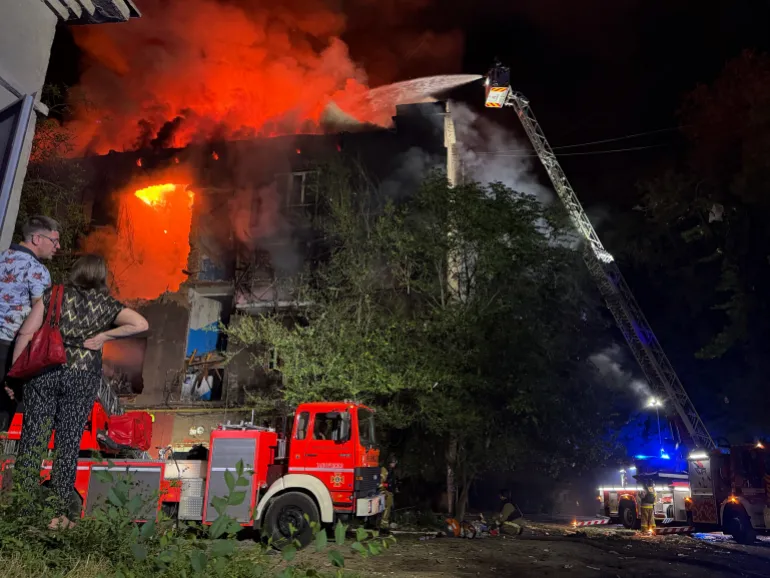
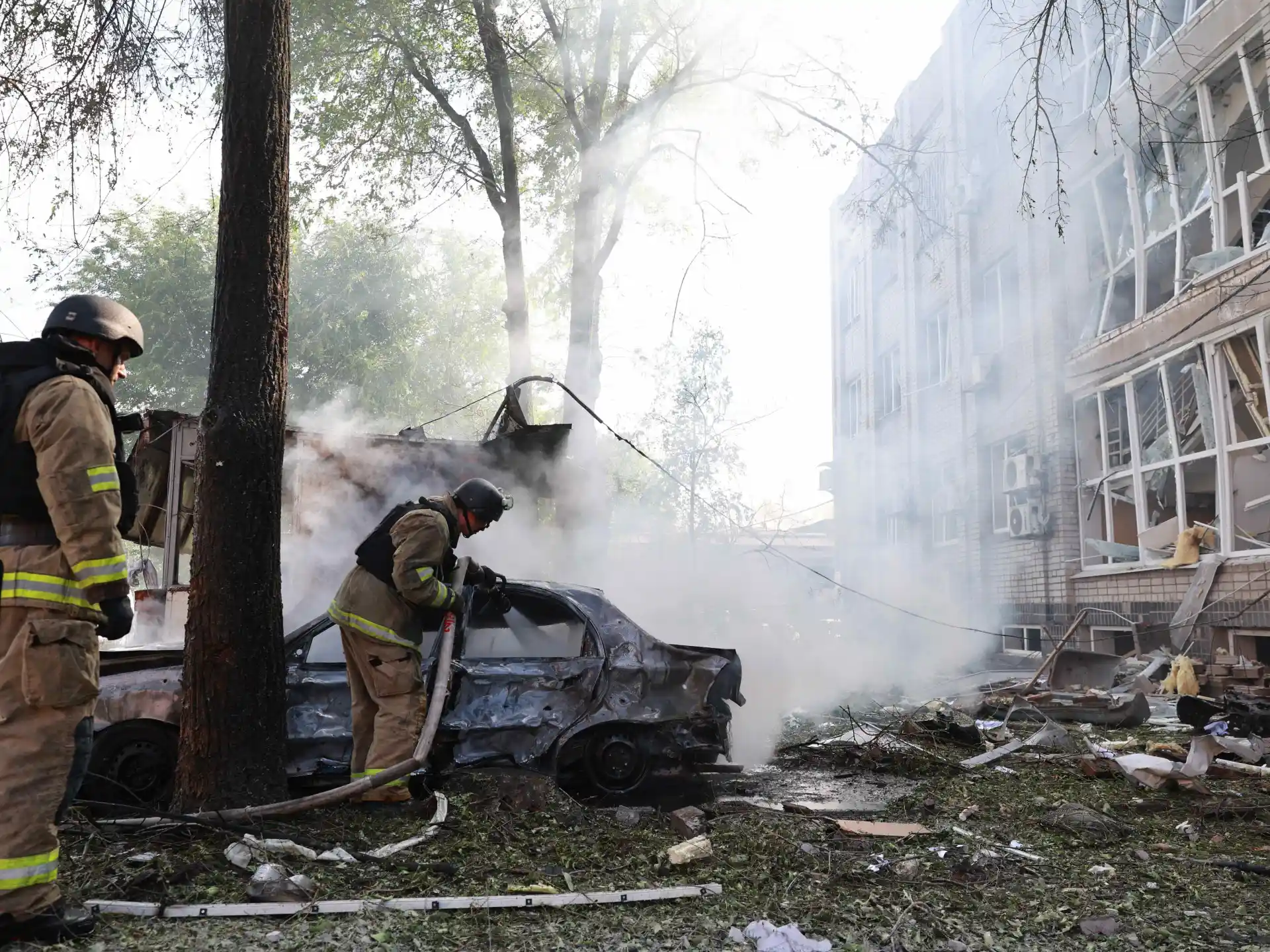
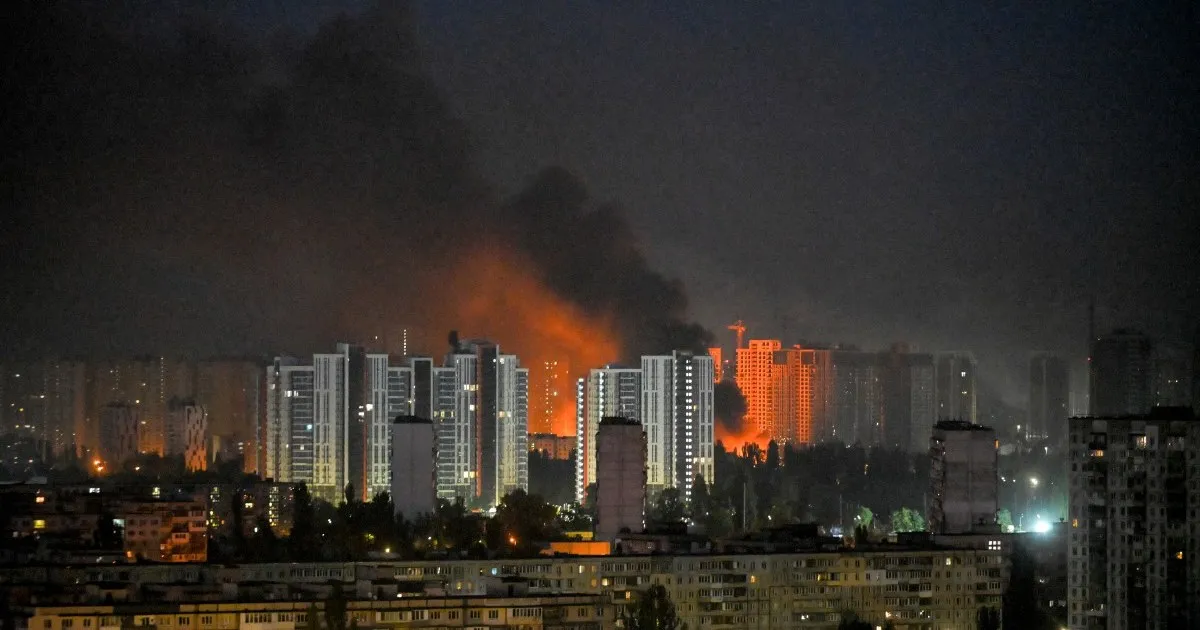
At least three people have been killed and three others wounded in Russian strikes on Odesa, the city’s military administrator says.
Published On 15 Jul 202615 Jul 2026
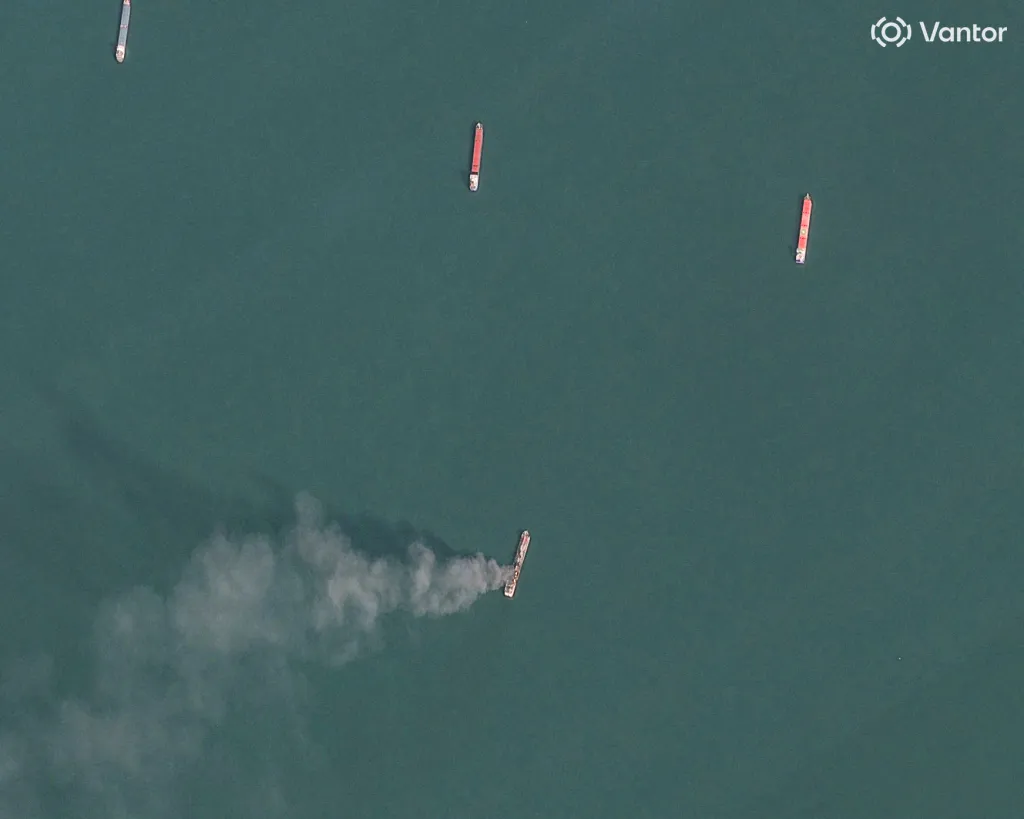
Several people have been killed in Russian attacks on port infrastructure in Odesa and Mykolaiv, and Ukraine said it launched drone strikes on 20 Russian vessels as the warring sides escalated their battle over the Black Sea and key trade routes.
Odesa region Governor Oleh Kiper said on Wednesday that a “massive” Russian drone and missile attack on the southern region continued for a fifth day, with civilian, industrial and port infrastructure coming under attack.
Recommended Stories
list of 3 itemsend of list
At least three people were killed and three others wounded in the Russian strikes on Odesa, the city’s military administrator Serhiy Lysak said on Wednesday.
Russia’s Ministry of Defence confirmed the strikes on the Odesa and Chernomorsk ports, saying Russian forces targeted infrastructure facilities that it claims are used to store fuel and assemble drones.
Russia in recent days has stepped up attacks on Ukraine’s Black Sea ports in the Greater Odesa area, which handle much of the country’s grain and other cargo and are vital to its wartime economy.
Meanwhile, Ukraine has escalated its campaign to disrupt logistics for Russia’s forces in areas Moscow occupies in southern Ukraine and to isolate Crimea, which Russia has occupied since 2014.
Kyiv’s drone force commander Robert Brovdi said Ukraine hit 17 Russian oil tankers, two gas tankers and one tugboat in the Black Sea.
He claimed earlier this week that 116 Russian vessels had been “hunted down” over a nine-day period.
Moscow said on Tuesday that it was preparing to redirect exports following waves of attacks on Russian shipping in the Sea of Azov, while Foreign Minister Sergey Lavrov called the Ukrainian attacks on shipping “terrorism”.
The attacks come as European Commission President Ursula von der Leyen arrived in Kyiv and said she would announce steps to deepen Ukraine-European Union defence integration.
“I will announce new initiatives to integrate our defence industries. So we can produce more, and faster,” she wrote on X, posting footage of her arrival in the Ukrainian capital.
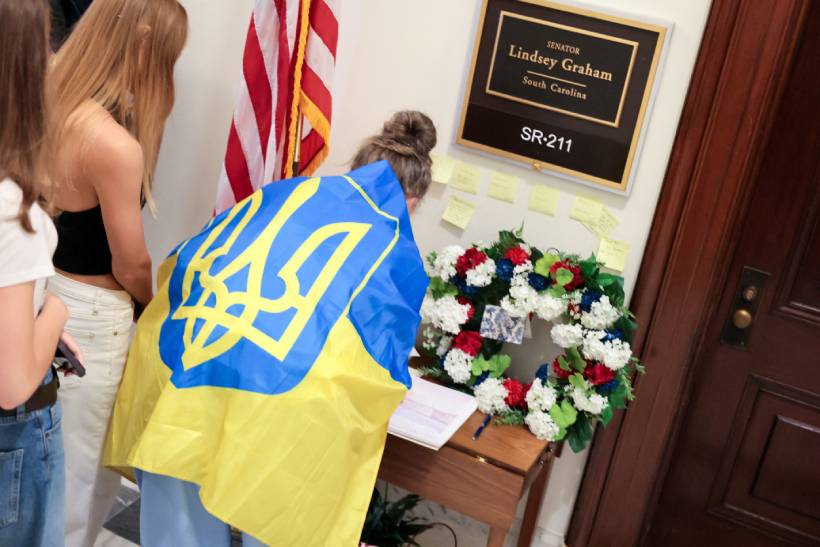
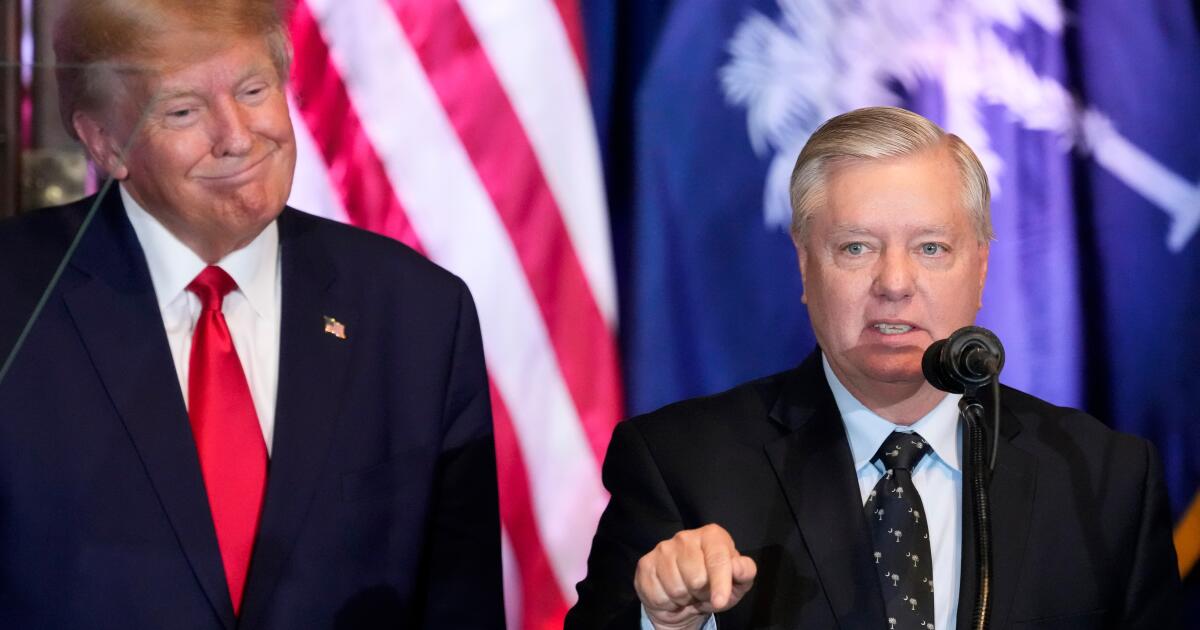
The death of United States Senator Lindsey Graham has created fresh uncertainty over the future of Washington’s support for Ukraine at a critical stage in the war with Russia. Graham was one of Kyiv’s strongest advocates in Congress and one of the few Republican lawmakers with direct access to President Donald Trump, allowing him to influence White House policy on sanctions, military aid, and strategic cooperation.
While many lawmakers have pledged to continue Graham’s initiatives, analysts say replacing his unique political influence will be difficult. His death comes as Ukraine faces intensified Russian attacks, renewed debates over military assistance, and uncertainty over whether Congress will approve tougher sanctions on Moscow.
Who Was Lindsey Graham for Ukraine?
For more than two decades, Lindsey Graham was one of the Republican Party’s leading foreign policy voices. Since Russia’s full scale invasion of Ukraine in February 2022, he emerged as one of Kyiv’s most consistent supporters in Washington.
Unlike many lawmakers, Graham maintained a close personal relationship with both President Donald Trump and Ukrainian President Volodymyr Zelenskiy.
Stay ahead of the geopolitical week.
MD Briefing delivers expert analysis across five global fronts — the Indo-Pacific, energy, geoeconomics, European security, and the Middle East — every Monday morning. Free.
He visited Ukraine 10 times during the war, regularly met Ukrainian officials, and publicly argued that continued United States support was essential for European security and for deterring authoritarian powers worldwide.
His greatest political advantage was his ability to communicate directly with Trump at times when many other Republican supporters of Ukraine struggled to influence the president.
The Russia Sanctions Bill
One of Graham’s most important priorities was the Sanctioning Russia Act, legislation designed to significantly increase economic pressure on Moscow.
The bill seeks to punish countries that continue purchasing Russian:
Its objective is to reduce Russia’s energy revenues, which remain a key source of funding for its military campaign.
Although the legislation gained 85 bipartisan co sponsors in the Senate, it remained stalled because of resistance from the White House.
Just one day before his death, Graham announced that he had finally secured an agreement with the Trump administration to move the legislation forward.
Many senators now hope Congress will pass the bill both as a strategic measure against Russia and as a tribute to Graham’s legacy.
Military Aid Could Face Greater Challenges
Beyond sanctions, Graham consistently advocated stronger military assistance for Ukraine.
He supported:
Patriot air defense systems
Missile production cooperation
Expanded weapons transfers
Long term security commitments
Intelligence cooperation
His lobbying helped improve relations between Kyiv and Trump during periods of political tension.
Last year he also played a central role in negotiating a critical minerals agreement that gave the United States preferential access to future Ukrainian mineral projects in exchange for investment.
More recently, Trump announced that Ukraine would receive licenses to manufacture Patriot interceptor missiles domestically, an initiative Graham strongly supported.
However, Ukraine continues to emphasize that immediate deliveries of defensive weapons remain more urgent than future production capacity.
Why Graham Was Difficult to Replace
Analysts argue that Graham’s influence extended far beyond committee hearings or public speeches.
He served as an informal bridge between:
Congress and the White House.
Republicans and Democrats.
Kyiv and the Trump administration.
Few Republican lawmakers enjoyed comparable access to Trump.
His ability to persuade the president privately often proved more valuable than public congressional debates.
This influence became especially important as many Republicans adopted a more cautious approach toward supporting Ukraine after Trump’s return to office in January 2025.
Several other senior Republican supporters of Ukraine, including former Senate leader Mitch McConnell, are also preparing to leave Congress, further reducing Kyiv’s network of experienced allies.
Will United States Policy Change?
Despite concerns, Graham’s death does not automatically mean a reversal of United States policy toward Ukraine.
Several factors suggest continued support:
Strong bipartisan backing
The Russia sanctions legislation already enjoys overwhelming bipartisan support in the Senate.
Institutional momentum
Military cooperation between Washington and Kyiv now involves long term industrial partnerships, intelligence sharing, and defense production agreements that extend beyond any single politician.
Trump’s recent policy shift
In recent weeks Trump has adopted a noticeably more supportive tone toward Ukraine.
He has endorsed licensed production of Patriot interceptors and appears increasingly willing to allow Congress to vote on tougher sanctions against Russia.
Nevertheless, uncertainty remains.
Without Graham acting as an intermediary, disagreements between Congress and the White House could become more difficult to resolve.
Political Reactions
President Volodymyr Zelenskiy described Graham’s death as a personal loss, noting they had remained in constant contact and met twice during the senator’s final visit to Ukraine.
Democratic Senator Jeanne Shaheen and several Republican lawmakers have proposed passing the Russia sanctions bill as Graham’s legacy, with some suggesting it should even bear his name.
Senate Majority Leader John Thune also called passage of the legislation an appropriate tribute to Graham’s decades of public service.
Why This Matters
Lindsey Graham represented something increasingly rare in Washington’s polarized political environment: a Republican with both strong pro Ukraine views and significant influence over President Trump.
His death removes one of Kyiv’s most effective advocates at a time when the war is entering another difficult phase. While institutional support for Ukraine remains substantial, personal relationships often play an outsized role in shaping United States foreign policy, particularly under the Trump administration.
Whether Congress can maintain bipartisan momentum without Graham may influence not only future sanctions but also military assistance and broader diplomatic engagement with Ukraine.
Analysis
Graham’s passing is unlikely to produce an immediate shift in United States policy, but it could gradually reshape the political dynamics surrounding Ukraine. His influence was rooted less in his legislative position than in his personal relationship with President Trump, allowing him to bridge the gap between a White House that has often been skeptical of deeper involvement in Ukraine and a bipartisan coalition in Congress seeking stronger action against Russia.
The sanctions bill may still pass because of its broad bipartisan support and the symbolic significance it has acquired following Graham’s death. However, future military assistance could face greater political hurdles. Weapons transfers and funding packages require sustained presidential backing, and without Graham serving as an intermediary, advocates for Ukraine may find it harder to persuade Trump during moments of disagreement.
At the same time, the institutional relationship between Washington and Kyiv is now far more developed than it was in the early years of the war. Joint defense production, intelligence cooperation, and long term industrial partnerships have created strategic ties that extend beyond the influence of any individual lawmaker. These structures provide a degree of continuity even as political leadership changes.
Looking ahead, the direction of United States policy will depend less on finding a direct replacement for Graham and more on whether other Republican leaders choose to embrace his internationalist approach or align more closely with voices advocating reduced American involvement overseas. The outcome will shape not only Ukraine’s military position but also the credibility of Western efforts to sustain long term pressure on Russia.
Ukraine says drones hit 11 Russian vessels in the Azov Sea, targeting tankers, dry cargo ships, and a tugboat overnight.
Published On 14 Jul 202614 Jul 2026
Russia says it is working to reroute grain shipments from the Sea of Azov after its vessels came under Ukrainian attacks in the sea, as Kyiv claimed it hit 11 more Russian vessels in overnight strikes.
Russia was preparing to use “alternative shipping routes” and may redirect cargo “to other modes of transport”, Russia’s Ministry of Agriculture said in a statement on Tuesday.
Recommended Stories
list of 3 itemsend of list
The ministry added that “the situation in the Azov Sea will not affect the domestic market’s food supply or our country’s export capabilities.”
Ukrainian military commander Robert Brovdi said on Telegram on Tuesday that drone attacks hit 11 Russian vessels in the Azov Sea overnight. The targets included five tankers, five dry cargo vessels and a tugboat, bringing the total number of vessels struck in the past nine days to 116, he said.
Russia’s Foreign Minister Sergei Lavrov accused Ukraine of carrying out “acts of terrorism”.
“What the Ukrainian regime is doing goes beyond even piracy. Pirates, at least, plunder and keep the spoils for themselves. But here, it benefits neither them nor anyone else – the goal is simply to cause damage and intimidate. It is terrorism, pure and simple,” Lavrov said.
The attacks come as Ukraine steps up long-range strikes on Russian oil refineries and other energy infrastructure, triggering a fuel crisis in Russia.
Russia’s Ministry of Defence said its air defences intercepted 288 Ukrainian drones across the country overnight. Russian authorities said falling debris from a drone attack injured one person and damaged houses in several villages.
One attack sparked a fire at the Afipsky oil refinery, authorities in Russia’s Krasnodar region reported.
Ukraine also struck another oil refinery in the republic of Bashkortostan, which had been hit twice in September 2025. Governor Radiy Khabirov said on Telegram that the attack hit an industrial area in the city of Salavat.
Ukrainian strikes on Russian oil refineries have contributed to a fuel crisis, leading Moscow to ban some fuel exports amid a global surge in energy prices.
Russia’s Defence Ministry also said it hit targets in Kyiv, port infrastructure in Ukraine’s Odesa region, and fuel storage facilities for Ukrainian forces in the port of Yuzhny.
Ukrainian navy spokesman Dmytro Pletenchuk said Russian forces struck a civilian vessel near Ukraine’s Black Sea port of Odesa. Pletenchuk reported no casualties in the attack.
Meanwhile, Ukrainian military officials said their forces shot down seven missiles and 108 drones across the country.
Ukrainian rescuers work to extinguish a fire at a damaged residential building following a Russian drone strike late night in Zaporizhzhia on July 12, 2026, amid the Russian invasion of Ukraine [File: Darya Nazarova/AFP]
The Ukrainian government has dismissed allegations that it is backing the M23 rebels in the fight against the Democratic Republic of Congo. Heorhii Tykhyi, spokesperson for the Ukrainian Ministry of Foreign Affairs, described the accusations as “Kremlin disinformation.”
During his visit to Bujumbura, the capital of Burundi, Russian Foreign Minister Sergei Lavrov claimed that Ukraine is one of the external supporters of the M23 rebellion, which controls significant territories in the North Kivu and South Kivu provinces of the DRC. In a statement on Saturday, July 11, the Ukrainian Foreign Ministry’s spokesperson said the Russian accusations have no concrete element of truth, noting that his country does not support the M23 rebels.
“The affirmations by Lavrov according to which Ukraine supports the M23 in the Eastern DR Congo belong to Kremlin disinformation and are devoid of all foundations. We refute and officially reject these accusations,” Heorhi said.
He stressed that his country does not intervene in African conflicts and that Russia is implementing a policy of interference on the African continent while accusing other nations of similar actions. “Ukraine does not interfere in African conflicts. Russia, on the contrary, does so: it arms groups in violation of sanctions, fuels instability and recruits citizens of African countries to fight in its war against Ukraine. Moscow accuses others of what it does itself: there is nothing new,” he reiterated.
The Ukrainian official said these accusations form part of a broader political strategy by Moscow to distract people from its actions and undermine current diplomatic efforts in the Great Lakes region. “The Russian objective is clear: weaken the American mediation efforts in the Great Lakes region and divert attention from its destructive actions which hinder the peace process,” he said.
The situation remains fluid, even in light of the Washington Accord and several evaluation meetings. The security and humanitarian conditions in eastern DRC have worsened. Tensions persist between the DRC and Rwanda, with each side interpreting the Washington Accord differently. This has complicated matters one year after the accord was signed.
It’s the same issue with the Qatar-facilitated peace accord in Doha. Despite multiple rounds of discussions, the Congolese government and the M23 are struggling to reach an agreement on their key points of disagreement. The Montreux meeting in Switzerland, intended to reinvigorate the process, has not yielded the anticipated results. Commitments made during this phase of negotiations have not been fully honoured, and the worsening security situation in the Middle East has further sidelined this issue, delaying mediation efforts. In light of the current situation, regional and international bodies have urged all parties to honour their commitments from the peace initiatives.
Weekly insights and analysis on the latest developments in military technology, strategy, and foreign policy.
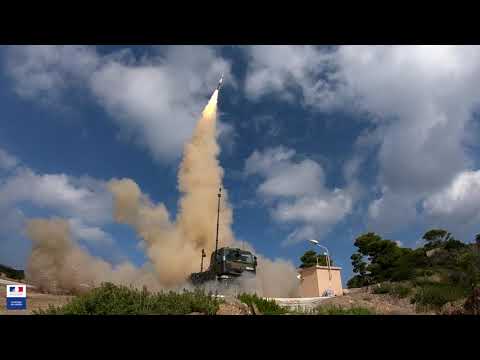
French President Emmanuel Macron says Ukraine is in line to get a license to produce Aster 30 missiles domestically. Aster 30 is the anti-air interceptor used in the SAMP/T surface-to-air missile system, examples of which are already in Ukrainian service. The Franco-Italian SAMP/T is often described as an analog to the U.S.-made Patriot, and both systems offer Ukraine vital anti-ballistic missile capability.
The French President spoke alongside Ukrainian President Volodymyr Zelensky, British Prime Minister Keir Starmer, and German Chancellor Friedrich Merz at a press conference at the Coalition of the Willing summit today in Paris. A total of 25 world leaders were in attendance. At this event, the governments of Ukraine, Denmark, France, Germany, Italy, the Netherlands, Norway, Spain, Sweden, and the United Kingdom also announced the creation of an Integrated Anti-Ballistic Missile Coalition. The coalition will pool resources to develop new anti-ballistic missile defense capabilities.
‼️Ukraine will receive licenses to produce Aster-30 anti-aircraft missiles for the SAMP/T air defense system, AASM Hammer aerial bombs and SCALP cruise missiles.
— Anton Gerashchenko (@Gerashchenko_en) July 13, 2026
“Earlier this afternoon [Ukrainian] President Zelenskiy and I agreed on a roadmap between our two countries, implementing what had been agreed in principle last November regarding our bilateral defense cooperation,” Macron said at a press conference today, per a translation of his remarks from Reuters.
This is set to include the license production of Aster 30, as well as AASM Hammer-series precision-guided bombs and SCALP cruise missiles. France has already supplied tranches of all three of these munitions to Ukraine. It’s also worth noting that Ukrainian forces have also received Storm Shadow cruise missiles from the United Kingdom, which are nearly identical to SCALP.
Macron also highlighted planned deliveries of SAMP/T and SAMP/T NG surface-to-air missile systems to Ukrainian forces, which are set to start at least later this year. The SAMP/T NG is an upgraded version of the baseline SAMP/T type, and is designed to offer an expanded engagement envelope, both in terms of altitude and maximum range, primarily through the inclusion of new radars. The French and Italian versions of SAMP/T NG differ in the exact radar used (the French Thales GF 300 or the Kronos Grand Mobile HP from Italy’s Leonardo). Improved Aster 30 variants are also in development. Ukraine currently has two baseline SAMP/T systems, one from France and the other from Italy.
Eurosam SAMP/T systems with ASTER missiles
In addition, the French President talked about progress in Ukraine’s planned acquisition of French-made Rafale fighters, with the goal now being to deliver the first 16 of those aircraft in the 2028-2029 timeframe. You can read more about those plans, which were first announced last year, here.
The move by French authorities to allow Ukraine to produce Aster 30s domestically is particularly significant. Russian ballistic missiles, including ground-launched types and the air-launched Kinzhal, have and continue to present a threat that is especially difficult for Ukraine to manage. Ballistic missiles hurtle back to Earth at very high speeds in the terminal phase of flight, making them very challenging to intercept compared to other kinds of missiles, in general.
In recent years, Russia has also begun using ballistic missiles with enhanced maneuvering capabilities to make them even more difficult to knock down, even by more advanced air defense systems like Patriot. French Air Force Gen. Fabien Mandon, the chief of the French defense staff, claimed last year that SAMP/T was actually proving to be more effective than Patriot against Russian ballistic threats.
“We helped Ukraine by deploying missile and drone interception systems called the SAMP/T system,” Mandon said. “The Russians adapted the flight profiles of their most advanced missiles because they realized they were being intercepted by Ukrainian defenses. Today, the Patriot system is struggling to intercept them, but the SAMP/T is intercepting them.”
That being said, Ukraine still has more Patriot systems than SAMP/Ts, but both are in extremely high demand and short supply. The same goes for interceptors.
Patriot systems have become a cornerstone of Ukraine’s air defense since 2023.
Using PAC-3 missiles, they intercept ballistic and hypersonic threats like Iskander and Kinzhal, protecting cities and saving lives.@KpsZSU@DefenceUpic.twitter.com/TTi8PCAEsM
“Our warriors performed well today in intercepting drones and cruise missiles, but unfortunately not Russian ballistic missiles. And the reason is precisely the insufficient supplies of interceptor missiles,” Ukrainian President Zelensky wrote in a Ukrainian language post on X on July 6 after an especially heavy barrage on the capital Kyiv, according to a machine translation. “It is extremely important for the world, first and foremost America and our European partners, to emerge from the NATO summit in Ankara with strong decisions to support our air defense, and thus the protection of ordinary people’s lives. As long as missiles for ‘Patriots’ remain in the warehouses of allies, it only encourages Russia to continue ‘defeating’ residential buildings. The United States and Europe have enough power to stop this terror.”
Цієї ночі Київ був під масованим російським ударом. Росія випустила 68 ракет і ще 351 ударний дрон. Зараз триває ліквідація наслідків. Пошкодження зафіксовані більш ніж на 10 локаціях міста, зокрема в житлових будинках. На місцях працюють усі необхідні служби, які роблять… pic.twitter.com/cf2vZzOZy2
— Volodymyr Zelenskyy / Володимир Зеленський (@ZelenskyyUa) July 6, 2026
So, for Ukraine, having its own domestic pipeline for an interceptor like Aster 30 would offer an immensely valuable hedge against shortages and delays elsewhere. For this particular missile, demand extends beyond SAMP/T operators, which also currently include Singapore. Warships in service with the navies of France, Italy, the United Kingdom (where it is part of the Sea Viper air defense system), and several other countries are also equipped to fire these interceptors.
At the same time, there are still questions about how and when domestic production of Aster 30 or Patriot interceptors in Ukraine might begin, or when the first missiles might start being delivered. Higher-end anti-air missiles typically have production lead times measured in months, if not years. It will take some time for Ukraine just to finalize deals with the relevant defense contractors and establish a domestic production line. Where initial funding might come from is not entirely clear, either, though new financial aid from France and other countries could be a definite possibility. Ukraine might potentially be able to export some of the interceptors it produces, offering a badly needed economic boost for the country.
There is also an operational security question. Russia or other adversaries could gain valuable insights into the capabilities of SAMP/T or Patriot if they were to get their hands on full-up interceptors or even just critical subcomponents. There is already a certain danger taken in delivering more advanced missiles to a country at war. Even wreckage can be an intelligence gold mine for the enemy, depending on what is recoverable. Establishing a full domestic production line will require stockpiling of brand-new subsystems, as well as the sharing of at least some degree of intellectual property and manufacturing know-how. All of which increases the total number of potential risk vectors in a country that is, again, at war with its neighbor, which also happens to be a near-peer threat for the United States and others in the West.
Macron’s announcement about licensing Aster 30 production today does not address Ukraine’s critical immediate needs for more high-end interceptors to respond to incoming Russian ballistic missiles. At the same time, it does open up an important new path to keeping a steady supply of missiles for the Ukrainian military’s growing number of SAMP/T systems down the road. These are also capabilities Ukraine will need in the long-term, well beyond the current conflict, to help deter future aggression.
Yulia Svyrydenko resigned Sunday as Ukraine’s prime minister. File Photo by Teresa Suarez/EPA
July 13 (UPI) — Yulia Svyrydenko has resigned as prime minister of Ukraine, as President Volodymyr Zelensky announced that she would be assuming a new position amid a shift in the war-torn country’s political strategy.
Svyrydenko stepped down on Sunday, five days short of serving a full year as prime minister. No reason was given.
Her resignation came as Zelensky said in a statement that “Ukraine is changing its political strategy.”
Though he did not detail specifically how or why the change was necessary, he indicated the new strategy would prioritize implementing the agreement with the United States for Ukraine to manufacture Patriot missile systems, advancing Europe’s anti-ballistic missile defense project, progressing Kyiv’s European Union membership, improving relations with Poland and Hungary and creating ties with the Middle East for security and economic cooperation and with China to help Russia’s War.
“Accordingly, personnel changes will begin in Ukraine to ensure the implementation of the updated political strategy,” Zelensky said in a statement.
He said he discussed the details with Svyrydenko and together, “we determined that these changes require a renewal of the Cabinet of Ministers.”
“I am grateful to Yulia for her clear, steady and effective work as prime minister, for her years of productive service on Ukraine’s team, and I have offered her the opportunity to lead a new and important area of relations with a key partner,” he said.
“I expect that, together with MPs, we will make the corresponding changes in the government of Ukraine. There will also be changes among the heads of law enforcement agencies.”
Svyrydenko said in a separate statement that she was grateful to Zelensky and was proud to have led the government as the country defended itself against Russia’s invasion.
“At this moment, it is critically important to unite all our strength and resources to make Ukraine stronger,” she said.
“I remain ready to serve the Ukrainian state and carry out every task aimed at strengthening Ukraine’s position, defending our national interests and bringing a just peace closer.”
The announcement also came about seven months after Zelensky’s administration underwent a major reshuffle after 11 officials quit following a mass corruption scandal that rocked the government.
Zelensky separately said Sunday that he met with Interior Minister Ihor Klymenko, Defense Minister Mykhailo Fedorov, Energy Minister Denys Shmyhal and Kharkiv Mayor Ihor Terekhov, among other officials.
I discussed with the President the challenges facing our country, the changes needed to strengthen the Government’s work, and our relations with international partners.
At this moment, it is critically important to unite all our strength and resources to make Ukraine stronger…. pic.twitter.com/lRIgk5yqh0— Yulia Svyrydenko (@Svyrydenko_Y) July 12, 2026
Sen. Lindsey Graham, the prominent Republican from South Carolina who served in the Senate for more than two decades, died after suffering an aortic dissection, his office said Sunday.
Graham died unexpectedly Saturday night, his office announced, shortly after he had returned to Washington after a trip to Ukraine.
In a statement, his spokesperson said a preliminary report from the medical examiner for the District of Columbia found that the 71-year-old senator died of aortic dissection due to arteriosclerotic cardiovascular disease. With aortic dissection, a tear occurs in the wall of the aorta.
According to the Mayo Clinic, aortic dissection is not very common, and its symptoms may be mistakenly attributed to other health conditions. It usually affects men in their 60s and 70s. If the blood from the dissection travels outside the artery, the condition is often fatal.
A former military lawyer who reached the rank of colonel in the Air Force, Graham ran for the Republican nomination for president in 2016. Initially a cutting, vocal critic of then-candidate Donald Trump during the election, Graham became one of the president’s staunchest allies after Trump’s election.
“Senator Lindsey Graham, one of the greatest people and Senators I have ever known, is dead!” Trump posted on his social media platform, Truth, on Sunday. “He was always working, and was a true American Patriot.”
Graham was known as a C student in high school, and was the first member of his family to attend college. His mother died while he attended the University of South Carolina, and his father died of a heart attack during Graham’s first semester of law school.
He served as a judge advocate in the Air Force, eventually becoming the chief prosecutor for the Air Force in Europe.
He was first elected to serve as senator for South Carolina in November 2002.
In a social media post on X, Vice President JD Vance described Graham as one of the most powerful lawmakers, and recalled an incident where he and Graham got into a shouting match over a funding bill for the war in Ukraine.
Later the same day, he wrote in the post, Graham was advocating for rail legislation that Vance supported.
“That was Lindsey Graham,” he wrote. “He fought like hell for the things he believed in, and he was just as willing to go to bat for you when it counted.”
Graham had been scheduled to appear on NBC’s “Meet the Press” on Sunday to discuss his trip to Ukraine. Instead, President Trump appeared in his stead, where he said the senator had been “like a member of the family.”
Trump called into several Sunday news programs to discuss Graham’s death, and said he had spoken to Graham on Saturday evening.
Trump told CNN’s Jake Tapper that the South Carolina senator had said he was “tired.”
WASHINGTON — After the Capitol riot on Jan. 6, 2021, Sen. Lindsey Graham said he had finally had enough of the man who was championed by the mob that stormed the pillar of American democracy: President Trump.
“Trump and I, we’ve had a hell of a journey. I hate it to end this way. Oh, my God, I hate it. From my point of view, he’s been a consequential president,” an emotional Graham said once authorities cleared the rioters and allowed senators to reclaim their chamber to certify Joe Biden’s election win. “All I can say is count me out. Enough is enough.”
It wasn’t, of course.
Graham, the South Carolina Republican who died unexpectedly Saturday night at 71, realized that his party’s future was inextricably tied to Trump and quickly reverted back to being a staunch defender. The shift made what had once seemed like a final rupture into just another twist in the topsy-turvy relationship between the powerful senator and the president who came to dominate their party.
“Can we move forward without President Trump? The answer is no,” Graham said in May 2021, just four months after the Jan. 6 insurrection. “I’ve determined we can’t grow without him.”
Trump, who called Graham a “true American Patriot” in a social media post Sunday, appeared shocked by the senator’s sudden death.
“I just can’t believe it,” the president said on NBC’s “Meet the Press.” “He was like a member of the family.”
Graham often advised Trump on foreign affairs, particularly on matters pertaining to Israel, Ukraine and Iran. He was a frequent visitor at the White House.
“At the end of a particularly thrilling and rollicking meeting in the Oval Office, Lindsey Graham turned to the room and said: ‘I’ve never had this much fun in my life,’” Deputy White House Chief of Staff Stephen Miller wrote on X. He said such gatherings “were filled with camaraderie, kinship and uproarious laughter.”
Trump recalled that during his last conversation with Graham, he told his friend, “We’ll see you soon, come over anytime you want.”
‘Unfit for office’
The senator and Trump first clashed while competing for the 2016 presidential nomination.
Graham described Trump as “unfit for office,” and was angered when Trump denigrated the military service of Graham’s close friend Sen. John McCain (R-Ariz.). Trump, while talking about McCain’s years as a prisoner of war in Vietnam, said, “I like people that weren’t captured.”
Trump got mad enough at Graham to release the senator’s personal cellphone number. That prompted a viral video in which the senator dramatically destroyed a series of flip phones. He smashed one with a meat cleaver and another with a golf club, then used lighter fluid, a blender and toaster oven to pulverize others before tossing one off the roof.
Graham eventually likened Trump’s winning the nomination to “being shot in the head” and said he refused to vote for Trump that November. But the pair later bonded over golf and what Graham described as a mutual and irreverent sense of humor.
Trump and Graham began so frequently hitting the links together that the senator started seeing it as something of a career builder, leaning heavily into the kind of over-the-top flattery Trump relishes. In 2017, Graham joked that Trump had beaten him “like a drum” on the course, even worse than in the presidential primary.
“Their true friendship could only be seen behind the curtain,” Sen. Tim Scott (R-S.C.) said on ABC’s “This Week.” Scott said that relationship was forged as political adversaries but was strengthened by spending 100-plus hours golfing together.
During Trump’s first term, Graham helped advance Trump’s nominees to the Supreme Court, lent credibility to the White House’s legislative agenda and even at times became part of the president’s inner circle. He frequently said Trump was maturing in politics and growing on the job.
Graham’s political divergence with McCain, who died in 2018, was never more clear than in 2017, when McCain voted against a Trump-backed plan to overturn the Affordable Care Act, former President Obama’s signature healthcare law. The effort had been co-sponsored by Graham.
A short-lived split, an alliance reignited
In his floor speech after the Capitol attack, Graham said that “he’d never been so humiliated and embarrassed for the country.” But the break with Trump ended quickly.
Weeks later, Trump invited Graham for golf and dinner at the president’s Mar-a-Lago estate in Florida, reigniting their alliance. During Trump’s 2024 campaign, Graham was a frequent Trump surrogate on television, promoting U.S. military strength that he said would advance “America first” policies.
Graham never shed his more traditional Republican foreign policy views, including outspoken support for Ukraine after the Russian invasion — even as Trump frequently wavered in supporting Kyiv, sometimes castigating Ukrainian leader Volodymyr Zelensky and praising Russia’s Vladimir Putin.
The senator was also a leading voice pushing the White House to more fully embrace Israeli Prime Minister Benjamin Netanyahu and take a harder line against Iran, and he was a leading advocate of Trump’s ongoing war with Iran. After the U.S. and Israel attacked in February, Graham staunchly defended the action and working to counter many among Trump’s “Make America Great Again” base who supported the president’s longtime assertions that “America first” meant avoiding such military conflicts.
“To those who say Iran is stronger now than before, that is an insult to the American military and it is delusional thinking because the Iranian economy is in shambles,” Graham posted on social media June 19.
Graham’s admiration for Trump went far beyond Iran. When the senator clinched the South Carolina Republican primary last month, he suggested the president was just short of a deity.
“I want to start with a bunch of thank yous. I want to thank the big guy, God. Trump comes later,” Graham laughed. “Mr. President, you’re not far behind God, but we’re gonna start with him.”
Yulia Svyrydenko to step down as prime minister amid government shake-up aimed at prioritising foreign policy and security goals.
Published On 12 Jul 202612 Jul 2026
Ukraine’s President Volodymyr Zelenskyy has announced a government reshuffle, as well as proposing the replacement of Prime Minister Yulia Svyrydenko and the heads of some law enforcement agencies.
“Ukraine is changing its political strategy. Each priority foreign policy direction will be overseen by a specific individual with substantial experience who is capable of delivering on the agreements reached at the leaders’ level and fulfilling the expectations of the Ukrainian people,” Zelenskyy said on Sunday in a lengthy post on social media.
Recommended Stories
list of 3 itemsend of list
“I discussed the details with Ukraine’s Prime Minister, Yulia Svyrydenko. We agreed that implementing these changes requires a renewal of the Cabinet of Ministers.”
Svyrydenko became prime minister a year ago, succeeding Denys Shmyhal. She previously served as first deputy prime minister and economy minister, roles that brought her into close contact with the administration of US President Donald Trump. She was widely credited with negotiating a critical minerals agreement between Washington and Kyiv last year that helped thaw what had initially been a frosty relationship between Trump and Zelenskyy.
“I am proud to have had the honour of leading the Government during one of the most difficult periods in Ukraine’s modern history. I thank every man and woman defending Ukrainian land. Our warriors are our strength and the foundation of our independence,” the 39-year-old wrote on X.
Zelenskyy also said there would be changes in the leadership of law enforcement agencies.
He said the new political strategy would focus on key foreign policy priorities, including agreements to manufacture Patriot air defence systems under licence, advancing Ukraine’s bid for European Union membership and deepening ties with the Gulf region, which he described as one of the world’s “most promising” areas for security and economic cooperation.
Zelenskyy thanked Svyrydenko for her offer to lead a “new significant direction in relations with a key partner”.
Weekly insights and analysis on the latest developments in military technology, strategy, and foreign policy.
Ukraine claims that 28 Russian vessels were hit by aerial drones in the Sea of Azov on Saturday. The strikes are the latest in a campaign that Ukrainian authorities assert has resulted in nearly 80 Russian vessels, mostly so-called shadow fleet oil tankers, being attacked in that body of water on a daily basis since July 6.
As a result of these attacks, “Russia temporarily stopped shipping through the Don-Azov Channel, a navigable waterway linking the Don River with the Sea of Azov,” Reuters reported, citing three grain export industry sources.
The move came after 13 Russian vessels, including 10 tankers, were attacked in this body of water on Friday. Market analysts noted to Reuters that about 25% of wheat exports from Russia, the world’s largest exporter of the grain, pass through the Sea of Azov.
Russia has suspended new applications for vessel transit through the Kerch Strait and halted navigation on the Don-Azov Canal, Reuters reported. The move follows Ukrainian drone attacks on Russian vessels in the Sea of Azov. Euronext wheat futures rose 4%. #Ukrainepic.twitter.com/5pETqKD75K
“Overnight on 11 July, the Birds of the Unmanned Systems Forces hit 21 tankers, 4 tugs, 2 cargo vessels, and 1 special-purpose vessel in the Sea of Azov,” Ukraine’s 414th Separate Unmanned Strike Aviation System Brigade, known as “Magyar’s Birds,” stated on X. The cutting-edge unit is named for Ukraine’s drone force commander Robert Brovdi, also known as Magyar.
In addition to striking the ships, Magyar’s Birds claimed to also have hit “53 legitimate military targets were engaged deep inside the enemy’s rear in Crimea and the southern part of the temporarily occupied territories, including fleet assets and energy infrastructure. Operation ‘Crimean Switch Off’ has no end date.”
The shadow tanker fleet was engaged by drone pilots from a wide array of units, the brigade added.
“The technological humiliation of the empire continues,” Magyar’s Birds proclaimed. “It will fall because of Crimea.”
TWZ cannot independently verify the claims; however, many videos have emerged on social media purporting to show the results of these attacks. Magyar’s Birds has released six compilations of them.
Magyar’s update: Another bad day to be a tanker.
28 shadow de-fleet vessels of the rf hunted down overnight on 11 July in the Sea of Azov by the Birds of the Unmanned Systems Forces.
A total of 76 vessels were struck over six days (06–11.07.26). The Molochka is doing its job.… pic.twitter.com/nhM9Di3DRg
— 414 Magyar’s Birds (@414magyarbirds) July 11, 2026
The brigade began releasing videos of these strikes on July 6. This first one shows two ships being hit in a compilation of videos showing strikes on targets mostly on Crimea. The targets included S-400 air defense systems, radars and an oil depot.
⚡️ Don’t joke about fuel shipments to Crimea. We warned you.
Two fuel tankers carrying gasoline from Taganrog to Crimea were hunted down in the Sea of Azov; on land – two S-400 “Triumf” air defense systems, an oil depot burning in Kerch, and a Nebo-U radar.
— 414 Magyar’s Birds (@414magyarbirds) July 6, 2026
The next day, July 7, Magyar’s Birds released a video that opened with a wide view of almost two dozen tankers lined up in the Sea of Azov. The video then cuts to show several of those vessels being struck and burning. The unit claimed eight tankers, a cargo ship and a ferry were hit.
Holy shit.
Madyar’s Birds took out 8 Russian tankers, 1 cargo ship, and 1 ferry from the shadow fleet in a single night (!).
At this point, Ukraine is effectively seizing control not only of the northern Black Sea, but of the entire Sea of Azov as well. pic.twitter.com/7Hj1DUVbu3
— Illia Ponomarenko 🇺🇦 (@IAPonomarenko) July 7, 2026
On July 8, Magyar’s Birds claimed nine more Russian tankers were attacked.
Magyar’s update: the tanker hunt continues.
🔥 The USF Birds struck 9 more russian shadow fleet tankers during the night of July 8 in the Sea of Azov.
🌶️ 21 vessels were hit over the past 72 hours: 19 shadow fleet tankers, 1 cargo ship, and 1 ferry in Kerch.
— 414 Magyar’s Birds (@414magyarbirds) July 8, 2026
Magyar’s Birds released another video on July 9 claiming 14 Russian ships were hit overnight.
Magyar: Shadow fleet massacre continues.
🔥 14 vessels hit overnight on July 9 in the Sea of Azov by the Birds of the Unmanned Systems Forces.
The worms’ shadow fleet keeps shrinking: 35 tankers, cargo ships, and auxiliary vessels hit within the past 96 hours. (Full timeline… pic.twitter.com/PNwRY7cg0F
— 414 Magyar’s Birds (@414magyarbirds) July 9, 2026
Friday, July 10, Magyar’s Birds claimed strikes on 10 tankers, a cargo vessel, a ferry and a sea tug.
Magyar’s update on new Chornobaivka in Azov Sea:
The Azov branch of Chornobaivka already 48: +13 shadow fleet vessels hunted down on the approaches to Crimea overnight on 10 July.
🔥 Birds of the Unmanned Systems Forces struck 48 vessels within 120 hours – the fleet is becoming… pic.twitter.com/S0wmmi5Y71
— 414 Magyar’s Birds (@414magyarbirds) July 10, 2026
In addition to the videos released by the unit, others emerged on social media showing the aftermath of these attacks.
❗️Consequences of the 🇺🇦Ukrainian drone strike on the 🇷🇺Russian dry cargo ship FAVORI (Volgo-Don type, Project 1565A) in the Sea of Azov pic.twitter.com/MCfwC5fmPa
— 🪖MilitaryNewsUA🇺🇦 (@front_ukrainian) July 10, 2026
Footage shows Ukrainian Armed Forces drones attacking tankers belonging to the Russian shadow fleet in the Sea of Azov. In the last four days alone, the Ukrainians have damaged or destroyed 49 Russian vessels. pic.twitter.com/Ejv7aPv9JS
— Jürgen Nauditt 🇩🇪🇺🇦 (@jurgen_nauditt) July 10, 2026
Magyar’s Birds doesn’t name the types of drones being used, but the video displays show they are from Fire Point, which makes several kamikaze drones as well as the FP-5 Flamingo cruise missile.
Roy Gardiner, a former Canadian military officer who is part of the Defense Tech For Ukraine collective and is an expert on Ukrainian drone warfare, surmised that the attacks are by the FP-2 drone.
FP-1 and FP-2 – Drones that inflict pain on the Russian rear! | Weapons with @StarskyUA
“It’s the only UAV available in large numbers and with the range to carry that much explosive, other than the long-range AN-196 Liutyi, which is a lot more expensive and illogical to use for this mission,” Gardiner, who uses the @GrandpaRoy2 handle on X, told us.
Ukrainian UAVs have struck about 175,000 tons of shipping in the Sea of Azov over the last few days — these are World War II numbers. https://t.co/P4IEJb77M0
Fire Point co-owner Denis Shtilerman recently told the TSN media outlet that the company has increased the warhead of its FP-2 strike drones to 200 kilograms. A change in the wing design enabled the drone to achieve a flight range of up to 370 kilometers with those warheads, he claimed.
УКРАЇНСЬКІ ДРОНИ СТАЛИ НОСІЯМИ РАКЕТ! Деталі від українських розробників / ТСН.Тиждень
That range gives Ukrainian forces fire control over virtually all of the Sea of Azov, a body of water north of the Black Sea. The videos indicate this is made possible by high-speed satellite data links allowing for man-in-the-loop operations at great distances. This has enabled Ukraine’s sea drones since their arrival but the miniaturization of the technology has now allowed for large-scale use on one-way attack munitions.
Sea of Azov (Google Earth)
In addition to the aerial drones striking these tankers, Ukraine’s SBU state security bureau used Sea Baby sea drones to attack a Russian tanker in the Black Sea on June 8. As we have frequently reported, Ukraine’s naval campaign has focused overwhelmingly on the Russian Black Sea Fleet. Many successful attacks have been recorded against Black Sea Fleet vessels and facilities, forcing the general evacuation of Russian naval assets from occupied Crimea and to bases in Russia proper.
The Sea of Azov campaign has some Russian milbloggers chiding Moscow for not doing enough to protect these tankers.
“The ‘Military Informant’ Telegram channel complained that the defenseless manner in which the tankers had travelled had become in effect a shooting gallery for Ukrainian drone operators, with no cover from a Black Sea Fleet, which could nowadays barely defend itself,” the BBC recently noted.
The Kremlin is certainly paying attention to Ukraine’s targeting of refineries, oil depots, ports, ships and other energy infrastructure.
Russian nationalist and Z-blogger Vitaly Voronov is disgusted that Ukrainian drones have reached Omsk, well to the east of the Urals in Siberia.
Russian President Vladimir Putin “is concerned enough to address the fuel shortage publicly on state TV, insisting the Ukrainian attacks are ‘obviously creating problems’ but insisting ‘it’s not critical,’” BBC explained.
There’s good reason for Putin to be concerned.
“Russian gasoline output fell to a level equivalent to only around 65% of the seasonal average consumption after Ukrainian drone attacks led to stoppages at large oil refineries,” Reuters reported on Friday, citing “two industry sources and Reuters calculations.”
As a result of the Ukrainian attacks, Russia – long a major oil exporter – is now turning to imports to cover the gap and meet the demands.
“Supplies of gasoline and diesel from Belarus to Russia hit a monthly record in June, while industry sources said last week that Russia had started seaborne from India,” Reuters added. “Traders said that up to 6,000 tons of gasoline per day are delivered from neighboring Belarus to Russia. Stockpiles are also being tapped.”
Russia is also taking the drastic step of considering bans on exports of diesel, gasoline and jet fuel.
All this comes as both Ukraine and Russia are jockeying for territory and influence amid a slow-churning, on-again, off-again effort by President Donald Trump to end the conflict.
Ukraine’s success in targeting Russia’s energy infrastructure and isolating Crimea has likely had an effect on Trump, who has repeatedly changed his stance on which side he favors.
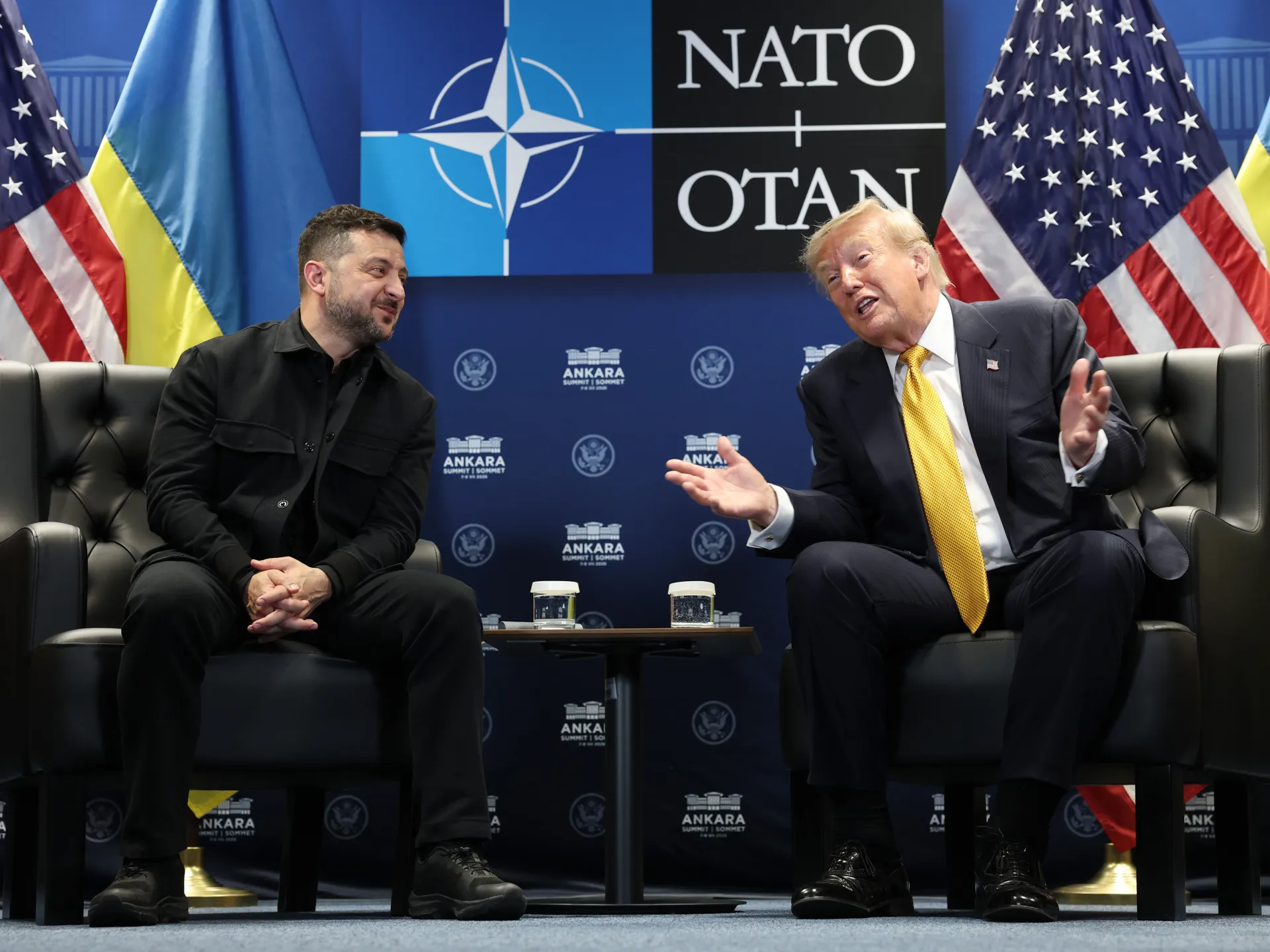
As we recently reported, Trump and Ukrainian President Volodymyr Zelensky had a remarkably warm bilateral meeting at the NATO Summit in Ankara, Turkey, earlier this week. So much so that the American leader promised his counterpart licenses to manufacture Patriot air defense system interceptors, something Zelensky has sought for years without success.
Ukraine continues to struggle badly to fend off Russian ballistic missile barrages and remains overmatched in terms of troops and equipment on the battlefield, where fighting has ground to a virtual standstill. Despite that, Kyiv is proving that asymmetric efforts like the Sea of Azov campaign are helping to offset Moscow’s advantages.
Emergency crews are searching for survivors after a Russian air strike on the Ukrainian city of Zaporizhzhia killed at least one person and injured 29, including two children. The city’s mayor says Russian troops have advanced to just over 20 kilometres away.
Ukraine appeared to have begun large-scale strikes against Russian shadow tankers attempting to supply occupied Crimea with fuel, as an energy crisis on the peninsula worsens.
At the same time, Ukraine has continued to cause fuel shortages in Russia itself, striking refineries deep inside the country, including, for the first time, the Omsk refinery in Siberia, Russia’s largest, 2,500km (1,553 miles) from the Ukrainian border.
Recommended Stories
list of 4 itemsend of list
Ukraine’s Unmanned Systems Forces commander Robert Brovdi said his forces had struck 19 Russian tankers, a cargo ship and a ferry between July 6 and 8, including nine tankers on the night of July 7.
Residents stand near an apartment building hit by a Russian drone strike in Kyiv, Ukraine, July 8, 2026 [ [Reuters]
Ukrainian Navy spokesman Dmytro Pletenchuk told newspaper Suspilne that Russia had rerouted fuel supplies to Crimea after Ukraine deprived it of overland routes.
“They had few options left. It’s either a land corridor or a sea connection,” Pletenchuk said. “As far as we know, they don’t use the Kerch Bridge for such transportation in the necessary volumes,” he said, referring to the bridge connecting Crimea to Russia.
Ukraine detonated a truck on the bridge in 2022, setting alight a fuel train that had been travelling alongside it and demonstrating the risk of using the bridge for large volumes of fuel.
Ukraine pivoted to attacking Crimea in the past few weeks after disabling the oil offloading terminal at Novorossiysk, on the opposite Russian coast, Ukrainian President Volodymyr Zelenskyy told the Financial Times.
“We were slowing down the militarisation of our peninsula occupied by Russia,” he said. “We cut off the logistics and took control of the fuel and energy complex. We showed what it means to operationally control the sky at a specific point, at a specific time.”
The Ukrainian Presidential Office in Crimea said these strikes had caused “a management crisis on the peninsula”.
In Sevastopol, fuel has stopped being sold to civilians, and more than a dozen Crimean regions are suffering from electricity blackouts.
Ukraine continued strikes on the peninsula in the past week, destroying seven Sukhoi aircraft and two sheds containing Shahed aerial drones at the Saky airfield on July 3, the Kerch oil transhipment terminal on July 6 and three hangars at the Guardsman airfield on the same day.
Ukraine also kept up pressure on Russia, launching what mayor Sergei Sobyanin said was its largest strike on Moscow in two years.
More than 400 Ukrainian drones were downed while heading for the city on July 7, which was the first day of a NATO summit in Ankara.
“When our drones weren’t flying to Moscow and St Petersburg, [Russian president Vladimir] Putin didn’t think much about it. He understood that the war was far from the Kremlin,” Zelenskyy told the Financial Times.
“When not a hundred drones, but a thousand would start flying to Moscow, and when he would feel and see this, he would be advised to move somewhere beyond the Urals. This would be a moment like a new page on the path to ending the war.
A rescuer hands a cat named Boniya, found under the rubble of an apartment building damaged by a Russian missile strike a day earlier, to Anastasia Sorokina, a friend of the cat owner in Kyiv, Ukraine, July 7, 2026 [Sergiy Karazy/Reuters]
Ukraine struck several energy targets during the week, furthering its twin goals of starving Russia of petrol and export revenue from oil.
The SBU said it struck and set alight the St Petersburg oil terminal on July 4, which it described as “one of the largest oil product transshipment terminals in the Baltic region”. Zelenskyy posted video purporting to show the terminal in flames.
On Sunday, Ukraine’s General Staff said its forces had struck the Slavneft Yanos refinery in Yaroslavl, 700km (430 miles) from Ukraine, the Ust-Luga refinery on the Baltic Sea, and the Omsk Refinery. Russia’s defence ministry said it had shot down 613 of 625 Ukrainian drones detected in the airspace overnight.
Ukraine’s Air Force said that Russia had lost 42.7 percent of its refining capacity over the past year, and suffered $13.5bn of damage to oil infrastructure.
These strikes have cumulatively caused petrol and diesel shortages in the Russian market, with consumers in urban hubs lining up to fill their cars.
During the week, Ukraine also struck the Kremny EL Group in Bryansk, which it said manufactured microchips, semiconductors and other electronics for the armed forces.
Rescuers working at a site of a Russian missile and drone strike on the previous day, during which a residential building was heavily damaged, amid Russia’s attack on Ukraine, are seen through broken glass, in Kyiv, Ukraine, July 7, 2026 [Alina Smutko/Reuters]
Zelenskyy said the air war would prove “decisive”, because in 2026 Ukraine’s ground troops had effectively stopped Russia’s slow advance of the last two years.
Independent assessments have suggested that Russia gained a total of 97 square kilometres (37 square miles) in the first six months of the year.
“The war is ongoing, but the front line is no longer moving. When the front line is almost not moving, and the enemy cannot invade by sea, the sky remains,” Zelenskyy said.
US President Donald Trump handed Zelenskyy a major victory at the NATO summit in Ankara on Wednesday, saying he would license Ukraine to produce interceptor missiles for anti-air systems.
Zelenskyy has been campaigning for a licence to build Patriot interceptors, which he believes Ukraine can do faster and more cheaply than the US or European manufacturers.
But Zelenskyy said Patriots ultimately are not the answer for European air defence, announcing his intention to develop FREYA, a Ukrainian-designed anti-ballistic system like Patriot “but with a higher production capacity and at a lower cost”.
Is Russia losing?
Zelenskyy’s commander-in-chief warned against dismissing Russia too easily.
“It’s still too early to talk about a qualitative turning point in the war,” Oleksandr Syrskii wrote on his Telegram messaging channel. “The aggressor is showing signs of exhaustion, but retains significant offensive potential,” adding that Russia “plans to extend the front line, which already exceeds 1,250 kilometres (777 miles).”
Putin relaunched the narrative that Moscow will overrun the eastern Ukrainian region of Donetsk, four-fifths of which Russia already controls.
In a televised meeting with his top generals on July 3, Putin was told that Russia has seized 3,000sq km (1,160sq miles) of Ukraine so far this year, and “liberated” 133 settlements. His commander in chief, Valery Gerasimov, also claimed to control the cities of Kupiansk in Kharkiv, and Kostiantynivka in Donetsk.
The Institute for the Study of War, which uses geolocated footage to assess advances, estimated that Russian forces have a presence in 2.4 percent of Kupiansk and 37 percent of Kostiantynivka – and most of that in the form of infiltrations, not firm control.
The Ukrainian military has estimated the number of Russian servicemen in Kostiantynivka at between 100 and 250.
Putin was told that Russian forces seized 636sq km (245sq miles) of Ukraine in June alone. The ISW estimates the real number at 30sq km (11sq miles).
Kostiantynivka is politically important to the Kremlin because it is the first of four heavily fortified cities, including Kramatorsk and Sloviansk, which Moscow must seize to take control of Donetsk – which Putin considers a puppet state and has repeatedly prioritised.
“The capture of Kostyantynovka by the troops of the South battlegroup opens a direct road for further advance to Kramatorsk and Sloviansk, other fortified areas in the Donbas, and is, of course, the key to liberating the entire territory of the Donetsk People’s Republic,” Putin said.
The Donbas includes Donetsk and Luhansk, which Putin mistakenly claimed to have taken in its entirety.
“I understand that we should no longer speak of the Slovyansk-Kramatorsk-Kostyantynovka line, but simply of the Slovyansk-Kramatorsk line,” Putin told the gathering.
US President Donald Trump gave his blessing earlier this week to domestic Ukrainian production of the missiles.
Published On 10 Jul 202610 Jul 2026
Ukraine must make every effort to start domestic production of desperately needed Patriot interceptor missiles as soon as possible, now that Washington has agreed to grant Kyiv the necessary licences, President Volodymyr Zelenskyy has said.
Speaking to reporters on Thursday after returning from this week’s NATO summit in Turkiye, Zelenskyy said that political approval had been obtained from US President Donald Trump when they met in Ankara and the challenge now was to quickly take the practical steps needed to begin production.
Recommended Stories
list of 3 itemsend of list
“We resolved this issue politically,” he said. “It’s now very important that our technical teams, all our representatives from different ministries, representatives of the executive branch, start working on this without delay, so that we can get licences very quickly and start production in Ukraine as soon as possible.”
Although Kyiv has received regular donations of Patriot missiles from its allies for its defence against Russia’s invasion, global supplies are running low, and Ukraine is using the interceptors at a faster rate than they can be produced in the US.
Zelenskyy has been pressing the US to allow Ukraine to start producing the missiles itself to overcome the supply shortage.
At a joint news conference with Zelenskyy in Ankara on Wednesday, Trump told him: “We’re going to give a licence to you to make Patriots. This way, you can’t complain that we’re not giving them enough.”
The Patriot is a US-made air defence system. Its PAC-3 interceptor – short for Patriot Advanced Capability-3 – is one of the few Western weapons capable of shooting down the ballistic missiles Russia has increasingly fired at Ukrainian cities.
Zelenskyy said his meeting with Trump had been a success, and he had also reached agreements with European allies.
“I believe this was a productive summit for Ukraine. In the coming days, we’ll receive a package from the United States, and there were also some separate agreements,” he said, referring to securing more PAC-3 interceptors.
“President Trump has repeatedly emphasised that today, only two to three countries in the world can produce Patriots, because the others are not technologically ready. Ukraine is recognised by America as a country that is ready to do this,” Zelenskyy said.
“Now, after our agreement with the president, our teams, our diplomats, the foreign ministries and defence ministries need to agree on all the remaining technical details. The sooner we reach those agreements, the sooner we will be able to produce Patriots.”
Patriot production will take months
However, Serhii Beskrestnov, an adviser to Ukraine’s defence minister, warned that setting up domestic production of the mobile, surface-to-air systems will take many months.
On his Telegram channel, Beskrestnov said a production licence would typically come with technical process documentation, training for specialists, supplier contacts and foreign consultants to help launch manufacturing.
The main obstacle would be time, rather than Ukraine’s technical or organisational capacity, he said, due to bottlenecks, including the long production cycle for some subcontracted components, which could take 12 to 24 months.
During the NATO summit, Trump praised Zelenskyy for doing “an amazing job”, a sharp change in tone from past criticisms of the Ukrainian leader.
Trump insisted that he remained determined to facilitate a peace deal between Russia and Ukraine.
“It’s not the easiest; not the easiest thing,” the US president said of an eventual peace settlement. “There’s a lot of commitment, and there’s a lot of love of the countries and everything else. But I think we’ve made a lot of progress in the last couple of weeks.”
ANKARA, Turkey — President Trump said Wednesday that the U.S. will give a license to Ukraine to manufacture Patriot air defense systems to help counter Russian missile attacks, a huge coup for Ukraine which has badly needed the technology for the war now in its fifth year.
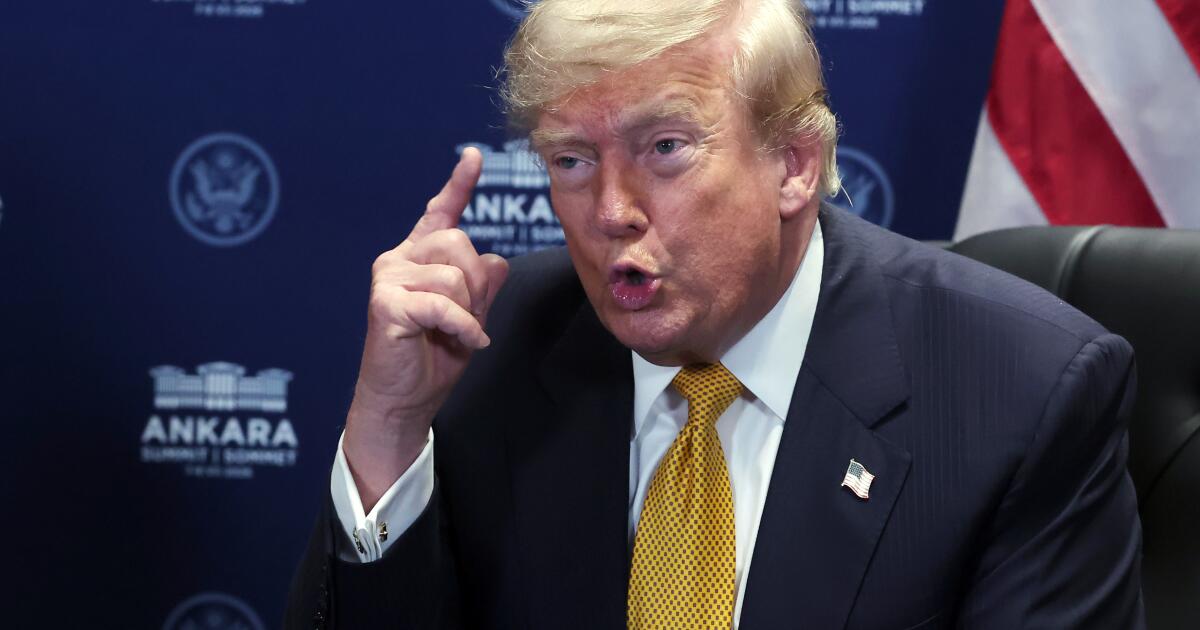
“We’ll give them the right to make Patriots. We’ll show them how to do it,” Trump said as he met with Ukrainian President Volodymyr Zelensky at a NATO summit in Turkey. “I think they can produce them pretty quickly.”
Patriots are expensive, in high demand and take a long time to produce. Zelensky has for years been asking for more of them, and more recently for a license so that Ukraine can manufacture its own.
The tone of Trump’s meeting with the Ukrainian leader was a break from earlier encounters which ended in acrimony, and Trump praised Zelensky’s willingness to reach a deal on ending the fighting in Ukraine.
He said the Ukrainian president has “done an amazing job” and “been very effective” in the war.
“We’ve actually developed a good relationship. It’s hard to believe,” Trump said, adding he believed a deal on ending the war was on the horizon and that the U.S. would “work on some kind of security package” to provide to Ukraine.
Trump takes aim at NATO partners
Trump wasn’t as friendly, however, with some his NATO partners, saying he was unhappy with the alliance for pushing back against his efforts to take control of Greenland and for not supporting his war in Iran.
NATO’s European members plus Canada have scrambled to meet the increased defense spending targets Trump has demanded, as the U.S. draws down the number of troops it has in Europe and insists that the continent take more responsibility for its own security.
But Trump reopened old wounds as he arrived at the meeting of 32 NATO leaders by insisting again that the United States should control Greenland, a semiautonomous Danish territory. He blasted some European countries for refusing to participate in the Iran campaign, singling out Spain as “a terrible partner in NATO” and renewing his threats to cut off trade.
Ahead of the summit, Trump said Greenland “is very important” for the U.S. but not for Denmark, declaring, “We need it for protection of the world, not just the United States.”
But Denmark’s Prime Minister Mette Frederiksen said her country is “ready to defend every inch of NATO including our own territory” in the event of an attack, and would rely on NATO allies to honor their commitment to defend each other.
Trump’s criticisms have in the past drawn European countries closer together as they confront wars in Ukraine and Iran, a ballooning trade deficit with China, and threats from Russia.
The president’s renewed interest in Greenland could put at risk the entire future of NATO, which was founded in 1949 to counter the threat to European security posed by the Soviet Union during the Cold War.
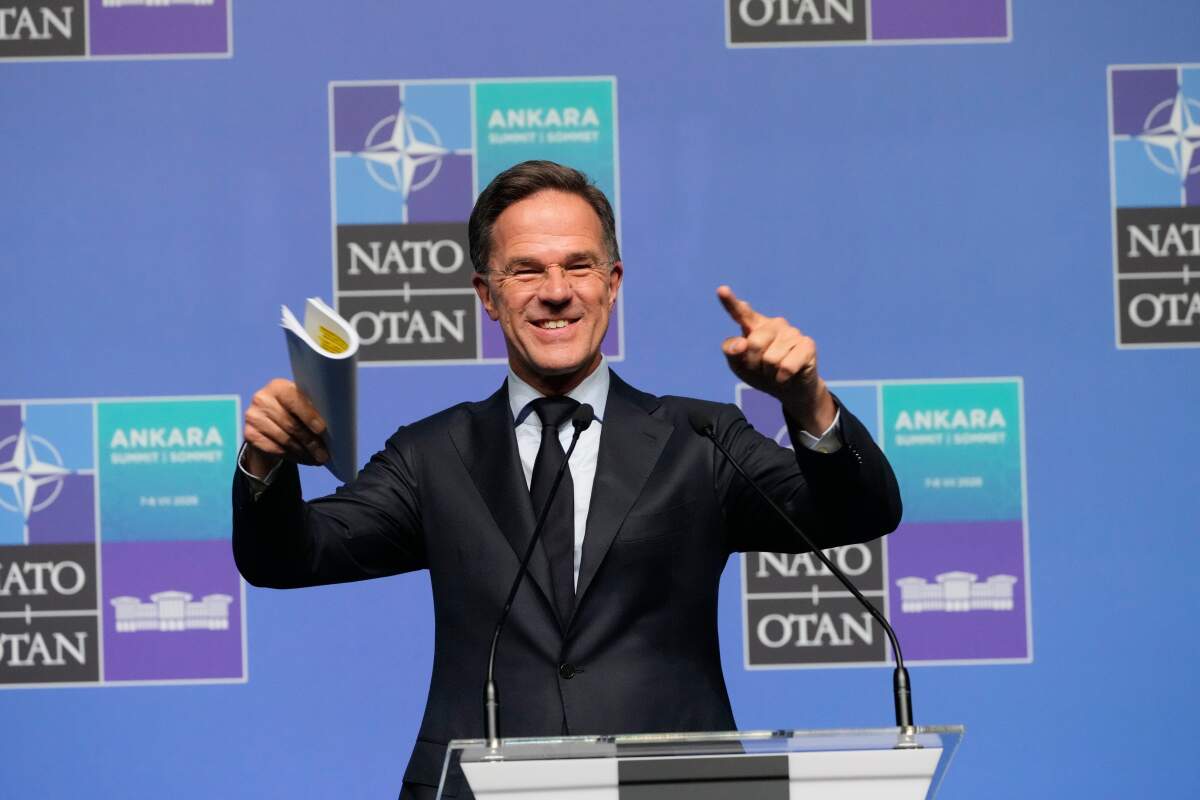
NATO Secretary-General Mark Rutte sought to tamp down the president’s ire by giving him credit for recent increases in defense spending from NATO allies.
“Grab the win. It’s there,” Rutte told Trump on Wednesday.
NATO chief backs latest U.S. strikes on Iran
Ahead of the summit, Rutte praised Trump for the series of U.S. strikes on Iran overnight, after Tehran struck three merchant ships in the Strait of Hormuz.
“I think what you did last night was absolutely necessary,” Rutte said to Trump. “It was a very strong response, and I’m with you on this.”
The U.S. strikes, as well as the revoking of a license allowing Iran to sell its oil on global markets, underscored the fragility of an interim deal to end months of fighting.
Trump said of the interim agreement with Iran: “For me, I think it’s over” — but added he will allow talks to continue.
“It’s just a waste of time dealing with them,” he said.
NATO leaders sought to show Trump they were boosting defense
Rutte has dedicated a huge amount of energy to keeping Trump’s support for NATO and to holding the summit together.
The NATO chief pointed to countries including Estonia, Latvia, Poland and Denmark that are investing more in defense, but noted the Trump administration expects “the Europeans and Canadians will equalize their spending with the United States.”
Last month Rutte went to Washington to hail the “Trump Trillion” — the $1.2 trillion that European allies and Canada have added to defense spending since Trump came to power in 2017.
As leaders converged on Ankara, Rutte hosted a “big reveal” event to showcase the many deals planned for the increased spending — much of it to be spent on U.S. companies, creating thousands of jobs for Americans.
At last year’s summit, the allies agreed to invest 5% of their gross domestic product on defense — 3.5% on their defense budgets and 1.5% on infrastructure so troops and equipment can move faster in times of conflict.
Yet figures released by NATO on Tuesday showed that Slovenia, Belgium, Spain and the Czech Republic have struggled to meet the alliance’s old spending target of 2% of GDP.
The Trump administration wants to see a leaner “NATO 3.0,” with Europe taking responsibility for its own security, including Ukraine, with conventional weapons while America would continue to provide its nuclear umbrella.
The Pentagon has launched a six-month review of U.S. military presence in Europe, leaving allies to seek clarity on just how deeply Trump intends to cut U.S. force numbers.
Ukraine’s Zelensky pushes for NATO entry
Zelensky made a fresh appeal Tuesday for Ukraine to be allowed to join the alliance, saying Ukrainian armed forces are highly experienced and would only boost NATO’s defense capabilities.
He’s highlighted Ukraine’s adaptability and its ability to strike deep inside Russia. He said Ukraine’s armed forces are “eliminating” on average 30,000 Russian troops every month.
Concern has been mounting among some countries with borders near Russia that Moscow might be preparing a hybrid attack — a combination of conventional warfare with tactics like cyberattacks — on the continent as President Vladimir Putin struggles to secure victory in Ukraine.
Trump will also meet with Syrian President Ahmad al-Sharaa, a former insurgent who led the offensive that unseated autocrat Bashar Assad in December 2024. Despite having once been an al-Qaida fighter, al-Sharaa has won Trump’s backing as he seeks to rebuild Syria and restore its shattered ties with the West.
Cook, Kim and Fraser write for the Associated Press. AP journalists Collin Binkley and Michelle L. Price in Washington contributed to this report.
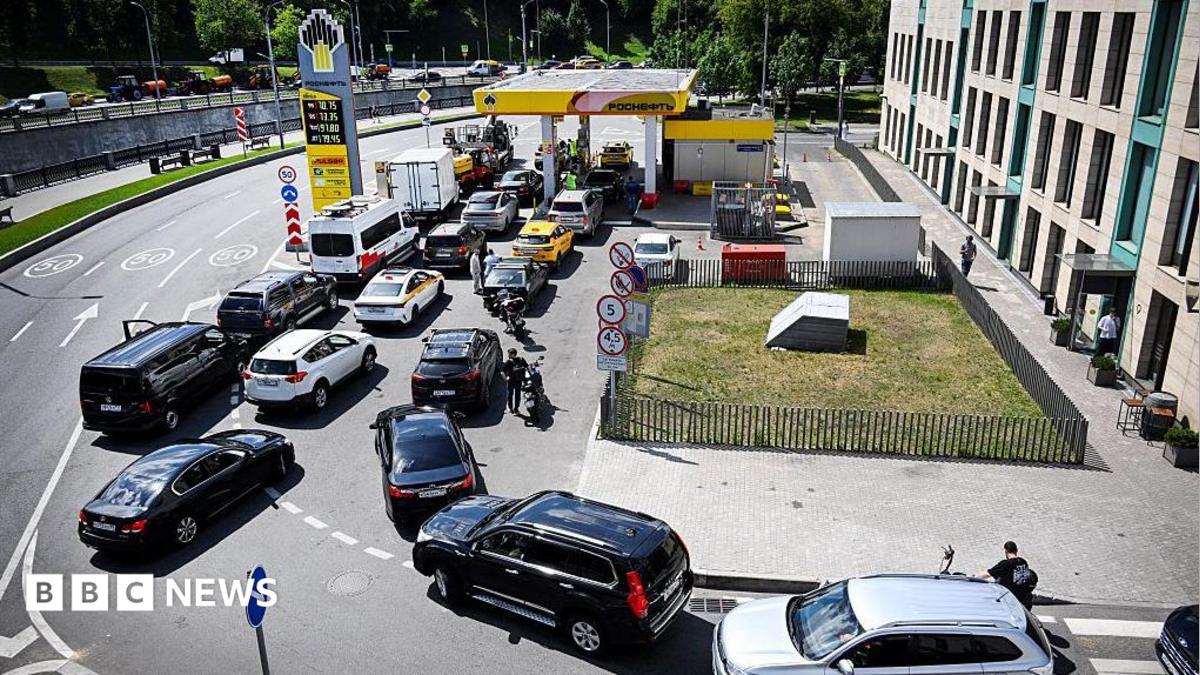
If you want to get a sense of the fuel crisis gripping Russia, all you need to do is spend a day driving around Moscow. At almost every petrol station we passed there was a queue of cars and lorries. Some lines were long, some short; some static, others moving steadily.
If there was no queue, that meant the garage had run out of fuel entirely and was closed.
Remember: this is Moscow, the wealthy, populated capital that draws in so much of Russia’s vast resources. Even here the authorities cannot ensure there is enough petrol and diesel to keep Muscovites on the road.
Yet, in the queues, the mood was more frustrated than angry. Yekaterina told us she was “not happy” and there was “panic because everybody thinks there will be no oil”. But it would OK, she said, “we just need to reorganise the oil distribution”.
The situation according to Elmar was “very bad” and he complained prices were going up as fuel stocks ran low. “You are wasting hours to fill up,” he said. “At the moment I am planning a trip to Dagestan but I don’t know if I should drive there or not because there are so many problems with petrol.”
I asked him who was to blame. “In our country, you can’t say what is to blame and who is to blame,” he said, with a knowing smile.
In Russia, criticism of the president, or even the Kremlin, is not something most feel they can do in public.
Valery said it was strange having to queue in a country that extracts so much oil. He blamed the lack of Russian preparedness as much as Ukrainian missiles. “I have no desire to get used to queues,” he said. “I hope the situation will change soon and won’t be continued.”
So the war is coming closer to home for many across Russia.
President Vladimir Putin has worked hard to insulate most people from the consequences of what he calls his special military operation, now well into its fifth year. On the streets of Moscow, one can see little sign of the war, just a few posters about heroic soldiers.
The attacks have triggered fires in two districts of Kyiv, according to the city’s mayor.
Published On 7 Jul 20267 Jul 2026
Russian missile attacks have struck Kyiv in the third large-scale assault on the Ukrainian capital in less than a week.
Early on Wednesday, Kyiv Mayor Vitali Klitschko said in a statement on Telegram that the Russian strikes had triggered fires in two districts of the city. It is not clear if there have been any casualties or damage.
Recommended Stories
list of 3 itemsend of list
Moscow also launched a large-scale attack on Kyiv on Monday, killing at least 14 people and damaging at least a dozen buildings.
Both Russia and Ukraine have recently expanded their use of long-range weapons, including missiles, marking a new front in Moscow’s four-year war.
Ukraine has focused its attacks on Russian energy facilities to weaken its war efforts.
Ukraine said on Tuesday that its drones attacked a dozen tankers from Russia’s “shadow fleet” over the past two days that were delivering fuel to Moscow-occupied Crimea. Kyiv’s military said they had struck eight vessels subject to sanctions in the Sea of Azov, each with a deadweight of about 7,000 metric tonnes. Two more tankers were hit later in the day.
The Sea of Azov is a key supply route for Russian forces in Crimea and other occupied parts of southern Ukraine.
Russia annexed Crimea in 2014 – in a move that has been unrecognised internationally – eight years before launching its full-scale invasion of Ukraine.
Moscow has not publicly commented on this week’s attacks on Ukraine, which also included strikes on electrical substations, radar systems, and missile installations.
Attacks amid NATO Summit
The latest exchange of fire between Russia and Ukraine also comes amid NATO’s annual summit, which began on Tuesday. The military alliance’s leaders have gathered in Turkey’s capital Ankara for the two-day summit, where defence spending and the Russia-Ukraine war is under discussion.
NATO is expected to pledge further military support for Ukraine, as President Volodymyr Zelenskyy urges the alliance to step up aid for the country’s air defences following a deadly escalation of Russian attacks on Kyiv.
Zelenskyy – who has renewed his call for Ukraine to be allowed to join the alliance – wrote on social media on Tuesday that he had signed new agreements with Estonia, the Netherlands, and Denmark in Ankara.
The deals create “new opportunities for joint production, the development of innovative defense technologies, systematic exchange of expertise, and the export of Ukrainian battlefield-proven solutions”, he said.
Further agreements are expected with Germany, Norway, Finland, and Canada.
US President Donald Trump is also expected to meet Zelenskyy on the summit sidelines on Wednesday, having spoken with Russian President Vladimir Putin ahead of the NATO gathering.
Asked about Russia’s war in Ukraine, Trump said he hoped it would be settled “soon”.
“I think they both want to make a deal,” Trump said.
“It’s too bad it took so long, but I think something’s going to come out.”
ANKARA, Turkey — President Trump said on Tuesday that the U.S. will lift sanctions on Turkey that were issued after Ankara purchased a Russian missile defense system that led to the country being kicked out of the F-35 fighter jet program.
There are still a number of legal hurdles before Turkey could be fully admitted back to the U.S. program, but the removal of the sanctions — issued under the Countering America’s Adversaries Through Sanctions Act — would help ease the process for Ankara to regain access to the F-35s, a top goal of Turkish President Recep Tayyip Erdogan and one that Trump has predicted for some time would occur.
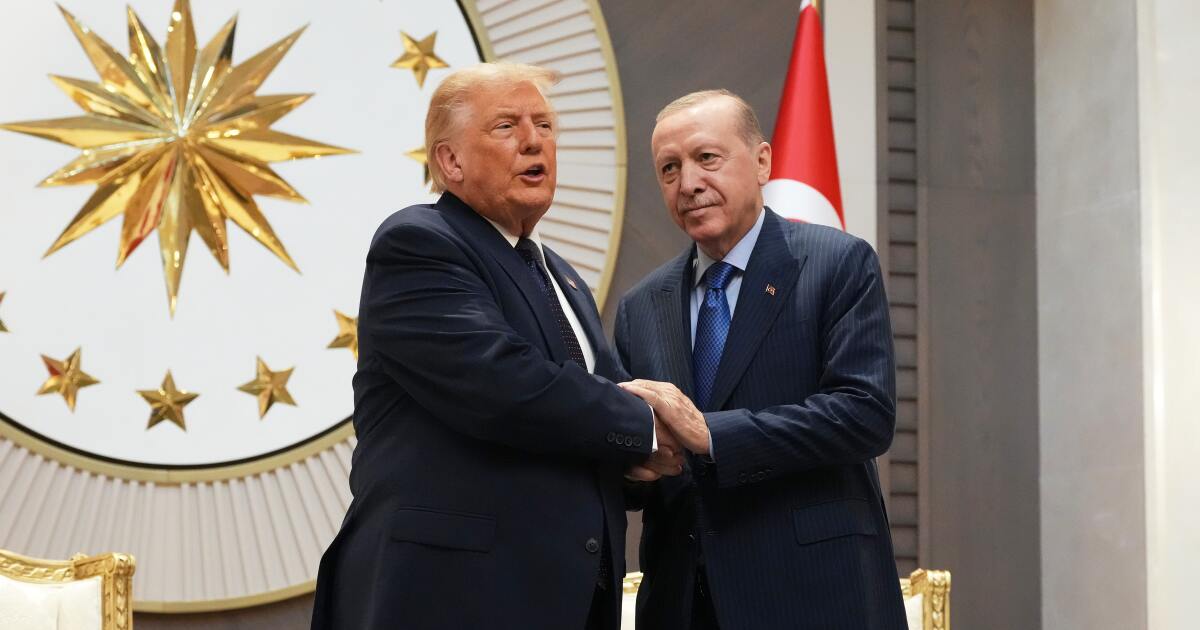
“We’re going to be taking the sanctions off, OK?” Trump said in response to a question during a meeting with Erdogan at the presidential palace in Ankara. He said Cabinet officials were working on the matter. Earlier in the meeting, he said the possibility of selling the F-35s to Turkey is “certainly something we will consider.”
Trump and Erdogan repeatedly underscored their warm relationship as they met soon after the U.S. president arrived in Ankara for the NATO summit. Erdogan greeted the U.S. president with an elaborate welcome ceremony involving cannons, military officials on horseback and jets flying overhead emitting red, white and blue smoke.
“Sometimes you get along with the toughest people, like him,” Trump said, gesturing to Erdogan. The U.S. president repeatedly praised Turkey for its loyalty to the U.S., particularly during the war in Iran.
Trump, who has often upended NATO gatherings with complaints that European allies did not spend enough on defense, had said he would not have attended this year’s summit had it not been for his close ties with Erdogan.
‘Moment of great pride’
Earlier in the day, NATO showcased a series of military projects worth billions of dollars — an investment that the alliance’s secretary-general, Mark Rutte, called “money well spent.”
An energized Rutte was speaking to government ministers and defense industry officials at a forum billed as NATO’s “big reveal,” to the thrum of techno music and a slick video display.
NATO as an organization does not own any weapons — these are the property of the 32 member countries — but it does have a fleet of 14 AWACS early warning radar surveillance planes that are about 50 years old, along with some newer surveillance drones.
A deal to replace the aging planes was announced Tuesday. Swedish manufacturer Saab will be supplying up to 10 new GlobalEye surveillance aircraft for a 10-nation consortium, Swedish Prime Minister Ulf Kristersson announced.
“It’s a moment of great pride,” he said, noting that the twin-engine aircraft would be “made within the alliance for all the alliance.”
Some of the projects will be paid for with funds from a system of cheap loans for defense purposes set up by the European Union, comprising up to $170 billion raised on capital markets.
“We need to ensure that we are translating our economic might into military capabilities, putting the cash to work from defense plans to drones, from money to missiles and interceptors,” Rutte said.
Trump has branded NATO a “paper tiger” that would cease to function without American arms and leadership. At the forum on Tuesday, Michael Duffy, a U.S. undersecretary of defense, said “the reality is that we need production increases across the board.”
“We will be looking to increase our exports to those who are looking to buy our equipment, and we’ll also be looking to partner with the expansion of production capacity here in Europe,” he said.
Defense sales announced
Representatives from 15 nations shook hands and patted shoulders on a vast podium under the NATO logo as they announced a multinational effort to buy air-to-air refueling and transport planes from Airbus.
Then Rutte announced a four-country effort to purchase as many as five new Triton surveillance drones to add to NATO’s small fleet.
“It is genuinely made in NATO, and creating jobs on both sides of the Atlantic,” he said.
Rutte told reporters on the eve of the military alliance’s two-day summit in Turkey that “we will announce tens of billions in new contracts that will provide the crucial kit we need to deter and defend.”
However, at Tuesday’s event, no dollar figures were given and the display included some projects long since agreed.
The defense industry splash comes a few weeks after Rutte tried to ease U.S. concerns about military spending at NATO with a new pitch using a chart labeled “The Trump Trillion” — showing $1.2 trillion in spending by European allies and Canada since 2017.
Trump appeared unmoved, saying he was still disappointed at some NATO allies’ refusal to join the Iran war, which he had launched alongside Israel without consulting them.
“We don’t need their money — we don’t need anything,” Trump said. “I just want loyalty.”
Debate over jet sales to Turkey
The summit is being held in Erdogan’s sprawling palace compound in Ankara, and Trump has suggested he would come bearing gifts for the Turkish leader.
Turkey was barred from the F-35 fighter jet program in 2019 after it purchased Russian-made S-400 missile defense systems. When asked about the fate of Turkey’s return to the F-35 system, Trump said as he sat next to Erdogan that “it’s certainly something we will consider.
Speaking Monday on the morning show “Fox & Friends,” Israeli Prime Minister Benjamin Netanyahu urged the U.S. not to sell F-35 fighter jets to Turkey, saying that Erdogan “calls openly for the annihilation of Israel.”
Turkey and Israel have acrimonious relations. Erdogan frequently accuses Israel of committing genocide in its war in Gaza, triggered by the deadly Oct. 7, 2023, Hamas-led attack on southern Israel.
Netanyahu said selling Turkey F-35s would “upset the power balance in the Middle East, which is ultimately guaranteed by Israeli air superiority and also, I think, by America’s posture in the Middle East.”
Turkey beefed up security and banned protests in Ankara during the summit, but a small group of demonstrators gathered on Tuesday in the capital. They were quickly surrounded by police, and a legal association said 22 students affiliated with the leftist Turkish Workers Party and three lawyers had been detained.
Seeking a stronger Europe for a stronger NATO
The Pentagon wants a reboot and is promoting what it calls “NATO 3.0,” a vision of the alliance in which Europe assumes greater responsibility for its own defense, freeing the U.S. to concentrate on other priorities.
But hiking defense spending means increasing taxes or diverting resources from other priorities. U.K. Defense Secretary John Healey unexpectedly quit last month, saying the British government was not willing to spend at a time of rising threats.
Separately on Tuesday, Ukrainian President Volodymyr Zelensky made a fresh appeal for his country to be allowed to join the alliance, saying its armed forces are highly experienced and resilient would only boost the alliance’s defense capabilities.
He highlighted Ukraine’s adaptability and its ability to strike deep inside Russia, hit oil refineries and other energy targets. He said that Ukraine’s armed forces are “eliminating” on average 30,000 Russian troops every month.
“Frankly we take no pride in this,” Zelensky said, noting that the war with Russia — now in its fifth year — is “a war we did not seek but one we are forced to fight.”
Concern is mounting among some northern and central eastern countries that Russia might be preparing a hybrid attack — a combination of conventional warfare with tactics like cyberattacks — on the continent as Russian President Vladimir Putin struggles to secure victory in Ukraine.
Cook, Fraser, Sewell and Kim write for the Associated Press. AP writers Jill Lawless in London and Andy Wilks in Istanbul contributed to this report.
July 7 (UPI) — Leaders of the Western world’s premier military alliance will gather in Ankara on Tuesday for the start of this year’s NATO summit, with support for Ukraine and questions over U.S. President Donald Trump‘s commitment to the pact expected to dominate the two-day meeting.
The summit in Turkey’s capital is formally focused on reviewing progress made since last year, when the leaders of NATO’s 32 members agreed to raise their annual defense-related spending from the previous 2% target to 5% of gross domestic product by 2035 amid growing global security concerns.
Major new policy pronouncements are not expected, though several large arms deals are. The focus of the two-day summit will be on progress toward that defense-investment plan and how allies intend to spend the money to increase weapons production, cooperation and joint procurement.
Attention will also be on Trump and the U.S. commitment to NATO after his administration announced earlier this year that it would withdraw some American troops from Germany.
Long a demand of Trump’s, the increase in defense spending has done little to curb the American president’s long-held criticism of the alliance, which has intensified since NATO allies offered limited support for the U.S. war against Iran.
Trump departed Maryland’s Joint Base Andrews aboard Air Force One for Turkey a little after 9:40 EDT Monday, with State Secretary Marco Rubio, Treasury Secretary Scott Bessent, Defense Secretary Pete Hegseth and a number of aides with him.
Trump is expected to meet with Zelensky during the summit.
The two spoke Saturday, according to the Ukrainian leader, who said he called the U.S. president to congratulate him on the United States’ Independence Day.
“We are grateful to the United States for all the assistance we have received — from Javelins and Patriots to political support — and we deeply value that America stands by us in defending our independence,” he said online, adding that they had discussed the situation in the Ukraine-Russia war.
“We have agreed to continue these discussions during the NATO Summit in Ankara,” he said.
On the eve of the Fourth of July, Trump also spoke with Russian President Vladimir Putin for nearly 90 minutes, according to the Kremlin, which said in a statement that they discussed “the Ukrainian settlement, including in light of Donald Trump’s upcoming participation in the NATO Summit.”
The Kremlin said Putin framed the current situation of the war as Russia “steadily advancing” despite Ukraine making recent gains and expanding its long-range attacks.
However, Russia has been targeting Kyiv with massive attacks leading up to the summit. Zelensky has been calling on allies for additional long-range weaponry, or the ability to produce the arms themselves, arguing that if Ukraine can batter Moscow how the Kremlin has been hitting Kyiv, an end to the war could be rapidly secured.
“We have proven to all our partners both the need, and more importantly, the possibility of providing greater protection of lives,” Zelensky said in a Monday statement.
“It is simply nonsensical that, in today’s world, production has still not been scaled up to the level that is actually needed to protect people from ballistic terror. We have long made the case that we are capable of producing such defensive weapons ourselves. If Ukraine were granted U.S. licenses to produce Patriots, our own production would be sufficient both to protect Ukraine and to help partners in need.”
The U.S.-based Institute for the Study of War said Monday night that Russian forces were likely timing these large-scale strikes to send a political message ahead of the summit.
News anchors are seen outside the Supreme Court of the United States as the court releases their final opinions before summer recess on Tuesday. The court upheld birthright citizenship and also state laws banning transgender women and girls from playing on school athletic teams. Photo by Bonnie Cash/UPI | License Photo
NATO leaders are meeting in Ankara, Turkiye on Tuesday and Wednesday.
The summit gets underway as US President Donald Trump renews pressure on member states over defence spending. European nations are expected to respond with billions of dollars in new military contracts.
At the NATO summit last year, members agreed to increase their target to 5 percent of GDP: 3.5 percent on military spending by 2035 and 1.5 percent on security-related needs.
Who is there and what is at stake?
Leaders from all 32 NATO member states are at the summit in Turkiye this week.
Two non-alliance heads of state will also be there: Ukraine’s Volodymyr Zelenskyy and South Korea’s Lee Jae-myung.
Australia, Japan and New Zealand are sending defence or foreign ministers, as are Gulf countries affected by the US-Israel war on Iran: Bahrain, Kuwait, Qatar and the United Arab Emirates.
Syrian President Ahmed al-Sharaa is not expected to attend the summit but is holding a bilateral meeting with Trump in Ankara.
What Trump wants from NATO allies
Trump has questioned NATO’s value since his first presidential campaign. He argued that the US carried an unfair share of the costs. At the time, only five countries spent the agreed two percent GDP on defence.
His questions about shared defence responsibility have produced some results in recent years within the alliance as member states pledged an increased defence budget.
Ozgur Unluhisarcikli, the German Marshall Fund’s regional director for Turkiye, believes NATO this year will focus on implementing its promises from last year. “NATO allies just decided to increase their defence spending to five percent last year at The Hague and European allies took action to upgrade their defence industries,” he said. “This year in Ankara the discussion will be on how to translate spending to capabilities. It is therefore stronger than it was last year.”
But Paolo von Schirach, president of the Global Policy Institute, noted that any capability gains from increased spending are years away, saying that more orders mean more military hardware but only eventually. “You can spend a lot and obtain not too much,” he said.
What Ukraine needs from this summit
Ukrainian President Volodymyr Zelenskyy is meeting Trump for a bilateral meeting on Wednesday. Ukraine is not a NATO member.
Zelenskyy will be using his face-to-face with the US president to request additional Patriot air defence systems as Russian attacks are intensifying on Ukrainian cities. A drone attack on the Ukrainian capital Kyiv killed at least 11 people on Monday morning.
Jack Watling, a senior research fellow at the Royal United Services Institute said that Ukraine is looking for ongoing political and military technical support from alliance members, to signal to Russia “that this support will be sustained”.
The idea, he said, was “to show Russia that there will be no diminution in its defensive capacity over the next 12-24 months”.
“There is a direct correlation between the number of interceptors supplied to Ukraine and the damage that Russia can inflict with ballistic missiles,” says Watling.
What European nations are trying to solve for
The billions in contracts expected to be announced by European nations at this summit are seen by some analysts as trying to appease the Trump administration.
When European nations didn’t join the war on Iran, Trump stated he didn’t want their money, just their “loyalty”. He added he might not have attended the summit if it wasn’t hosted by Turkish President Recep Tayyip Erdogan. Turkey has in recent years not only increased its defence spending, it also has grown into one of NATO’s largest military exporters.
For now, the tone around defence spending remains sharp. On the eve of the summit, Trump called Germany’s defence spending “ridiculous”. Chancellor Friedrich Merz defended his country’s budget, saying that “this is the greatest effort we have ever made to strengthen our defence capabilities”.
Meanwhile, the US has gone a step beyond rhetoric and announced a phased withdrawal of warplanes, destroyers and submarines from NATO countries. “Less US infantry or armour in Europe has an impact on messaging but little else,” Watling said. But, he added, “the withdrawal of US air power has a more tangible impact”.
Whether the alliance can project unity amid the rhetoric and withdrawals is a key question, said analysts.
“The main value of this summit is political, it shows that the allies are still talking, still meeting, still trying to project unity, even if the underlying disagreements and doubts haven’t disappeared,” von Schirach of the Global Policy Institute said. “Ankara is more about reassurance and signalling than about concrete, immediate changes on the ground.”
WASHINGTON — The leaders of Europe are bracing for another turbulent summit with President Trump this week as NATO members gather for their annual meeting in the Turkish capital.
European diplomats view Trump’s decision to attend as a positive sign of his continued commitment to the alliance. But the president’s grievances with several European governments over their refusal to join the U.S. war with Iran have cast a pall over a summit already strained by Trump’s wavering support for the continent.
The secretary-general of the transatlantic alliance, Mark Rutte, told reporters on Monday that Trump had aired his resentments in a recent phone call. But Rutte countered with a mix of flattery and countervailing facts that has thus far kept Trump engaged.
While Trump has accused European leaders of denying U.S. forces access to allied bases for takeoffs and refueling during the war, Rutte noted that about 5,000 sorties supporting Operation Epic Fury launched from European airfields. And last Friday, France and Britain committed to a joint military mission with Oman to support freedom of navigation in the Strait of Hormuz — “an extremely important development,” Rutte said.
At last year’s summit, held in The Hague, all NATO member states — with the exception of Spain — agreed to spend 5% of their GDP on defense by 2035, marking a significant increase in historic spending goals for modern Europe. The pledge is divided into two categories, with 3.5% of spending allocated to core military requirements, and the rest committed to a broad set of security-related investments.
Trump’s tough love on the alliance “is, I think, bringing NATO closer together,” the secretary general told reporters.
“You could argue that he is the first president of the U.S. since Eisenhower who was able to come to this situation where the Europeans and the Canadians will spend the same as the Americans” on security, Rutte said. “This equalization was a wish for 50, 60 years, and now it’s happening — I think in large part due to his leadership.”
NATO Secretary-General Mark Rutte speaks to reporters Monday ahead of the NATO summit in Ankara, Turkey.
(Hussein Malla / Associated Press)
In a video message posted on social media Monday, Trump’s ambassador to NATO, Matthew Whitaker, said the summit this week would serve as a “report card” to determine whether countries were beginning to fulfill their commitments from last year.
He offered a note of optimism and suggested the president’s goal is to enhance, rather than undermine, the alliance.
“The United States will be here, but we also need our allies to be here. We cannot do it alone, and the American taxpayer should no longer bear the burden,” Whitaker said.
A White House schedule for Trump’s trip lists bilateral meetings with Rutte and the leaders of Turkey, Syria and Ukraine, in between alliance-wide meals and conferences.
Ukraine will remain at the top of the agenda, Trump told reporters Monday, expressing hope that the war could soon come to an end after four brutal years of fighting.
Russia’s invasion of Ukraine has caused the greatest loss of life in Europe since World War II, resulting in more than 1 million casualties, including an estimated 600,000 dead. Since Russian President Vladimir Putin launched his full-scale invasion in 2022, following his covert invasions of Ukraine’s Crimean peninsula and eastern regions in 2014, Russian forces have captured roughly 12% of Ukraine’s territory.
The war has settled into a deadly stalemate since a 2023 Ukrainian counteroffensive failed to break Russian defensive lines. While Russian forces have occasionally advanced, they have only managed to hold marginal gains along the front, at tremendous cost.
In recent weeks, however, expanded Ukrainian drone and missile capabilities have shifted the dynamic, striking military production sites deep inside Russia and targets near Moscow, bringing the war more directly into the Russian public consciousness and raising questions in the Russian capital whether the war effort is sustainable.
Ukraine’s boldness has impressed the Trump administration, Alexander Stubb, the president of Finland, told the Financial Times this week.
“I think he does feel pressure,” Trump said of Putin, addressing reporters in the Oval Office before departing for Turkey on Monday.
The president referred to an ongoing U.S. effort to end the war, a goal that has remained elusive for Trump since returning to office.
“I think we’re getting much closer than people realize,” he said. “President Putin wants it to end, I will tell you that. Very strongly. Had a good call. And President Zelensky actually wants it to end now.”
“We’re going to be going to NATO, and we’re going to be talking about it,” Trump added. “And I think we’re going to get it ended. It’s been terrible.”
A Russian missile and drone attack on Ukraine’s capital has killed at least 10 people and injured 46 on the eve of a NATO summit. Al Jazeera’s Audrey MacAlpine reports from a residential building that was hit.
Ukrainian President Volodymyr Zelenskyy had warned of a likely attack ahead of meeting with US President Donald Trump.
Published On 6 Jul 20266 Jul 2026
A Russian missile and drone attack on Ukraine’s Kyiv has killed at least 10 people and damaged more than a dozen residential buildings in the second large-scale assault on the Ukrainian capital in less than a week.
The attack early on Monday morning injured at least 46 people in Kyiv, according to Tymur Tkachenko, head of the city’s military administration.
Recommended Stories
list of 4 itemsend of list
Another person was killed and 10 others were injured in districts surrounding Kyiv, according to authorities.
Ukraine’s military said Russia fired 68 missiles and 351 drones overnight.
The Kyiv Independent reported that the first explosions were heard at about 1:40am local time, followed by more strikes at 2:10am and 3:15am.
Thousands of residents fled to underground shelters, it reported, as air raid sirens sounded across Ukraine.
At least 15 buildings were damaged in Kyiv in the strikes, including four in the capital’s historic Podilskyi district, Tkachenko said.
Rescue work is under way across the capital and the death toll could rise, he said.
“Unfortunately, this is not the final information,” Tkachenko told reporters as the death toll jumped to nine from seven in Kyiv.
In his nightly address on Sunday, Ukrainian President Volodymyr Zelenskyy warned that another Russian assault might be coming before the NATO summit in Turkiye this week.
He is due to meet United States President Donald Trump on the sidelines of the summit, which begins on Tuesday.
“Intelligence once again indicates that the Russians are preparing a new massive strike,” Zelenskyy said, according to the Kyiv Independent.
“This is typical of Putin: right after America’s Independence Day and before the NATO summit in Ankara.”
Late last week, Russia hit the Ukrainian capital with dozens of missiles and hundreds of drones, killing 31 people.
The strikes were the deadliest to hit Kyiv this year.
Both Russia and Ukraine have recently expanded their use of long-range weapons, including missiles, marking a new front in the four-year war.
Ukraine has focused its attacks on Russian energy facilities to weaken its war efforts.
Mikhail Razvozhayev, the governor of Russian-controlled Sevastopol, a Black Sea port in Crimea, said on Monday a Ukrainian strike near the city had knocked out electricity supplies.
“Following an enemy attack on energy infrastructure near Sevastopol, our city was temporarily left without electricity,” Razvozhayev wrote on Telegram.