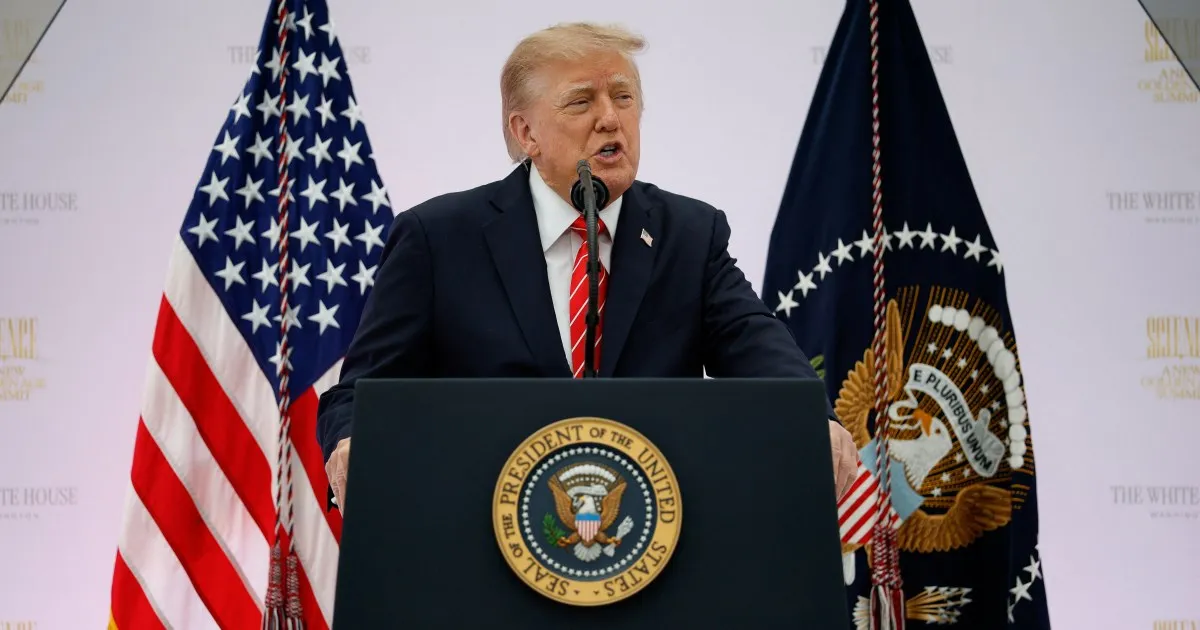
WASHINGTON — President Trump said that he has struck a deal to obtain diesel from Russia, a stunning reversal of years of U.S. pressure on Moscow over its war with Ukraine and an attempt to address high fuel prices ahead of the U.S. midterm elections.
Trump said on social media on Friday that he struck the deal with Russian President Vladimir Putin in a phone call in which he was expected to discuss a suspected case of plague in Russia. Instead, Trump announced that Russia will immediately supply more than 300,000 tons of diesel, followed by an additional 500,000 tons in November and 1 million tons “immediately thereafter.” Russia will deliver another 3 million tons “within a short period of time” after that, he wrote.
Trump’s shocking announcement comes after he signed a sweeping Russia sanctions law last month that aimed at clamping down on Russia’s energy economy, among other areas, that fuel its war against Ukraine.
His move casts doubt on the likelihood of the White House imposing sanctions on Russia this month, given that a bipartisan law passed by Congress directs the administration to target the top importers of Russian oil and gas.
Trump, in his announcement, did not address the sanctions or Russia’s war but said, “Lower prices for Americans, especially our Great Farmers, Ranchers, and Truckers, is my Greatest Priority.”
The White House did not immediately respond to questions about who was paying for the diesel from Russia and when the fuel being supplied under the agreement would become available. It also did not clarify whether subsequent supplies of Russian diesel set to come next month would be supplied prior to Election Day on Nov. 3.
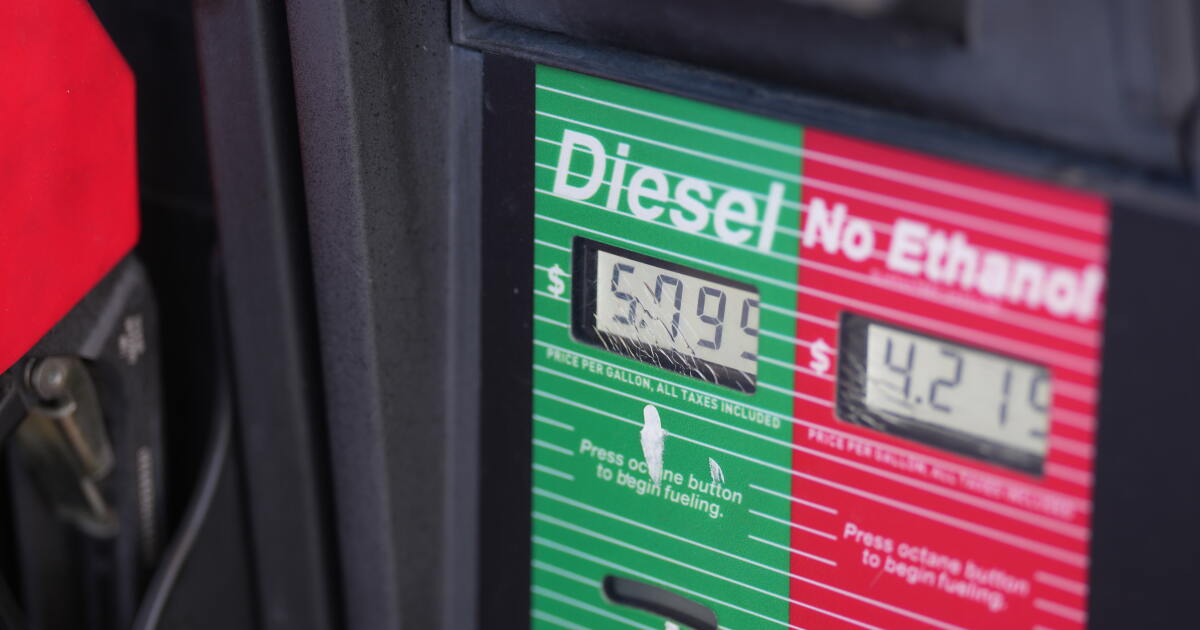
Gas prices globally have surged as the war in Iran upends the energy sector. The national average for a gallon of diesel in the U.S. was $6.23 on Friday, according to AAA, after hitting a record $6.52 on Sept. 22.
Russian presidential envoy Kirill Dmitriev reposted the Treasury Department’s announcement on X Friday and said that “Russia-US cooperation on diesel and energy will benefit the world.”
Rep. Don Beyer, the senior House Democrat on the Joint Economic Committee, called Trump’s announcement, “infuriating.”
“This is what we warned anyone who would listen: Trump isn’t the slightest bit trustworthy when it comes to Russia,” Beyer said in a statement on X. “Giving him expanded tariff powers in hopes he would use them to help Ukraine was a mistake. Now he’s lifting sanctions on Russian fossil fuels.”
The law Trump signed last month envisions sanctions on Russian officials, banks and a shadow fleet of tankers and bans all new U.S. investment in Russia and the handling of sovereign debt.
It also directed Trump to impose tariffs of up to 100% on the top five importers of Russian oil or natural gas, with an exception for countries that import less than 15% of Russia’s natural gas exports and have taken significant steps to reduce those imports.
The U.S. has not imported Russian oil or gas since 2022, when the Biden administration banned them because of Moscow’s invasion of Ukraine, according to the U.S. Energy Information Administration.
Shortly after Trump made the announcement, the Treasury Department said it was immediately issuing a temporary license allowing Russian diesel to be supplied to the global market.
This is the latest in several licenses the U.S. Treasury has issued regarding Russian fuel shipments since the start of the Iran war earlier this year. But it is the first such license to ease sanctions on diesel for a period lasting longer than the standard 30-day window since the start of the Ukraine war.
The new so-called general license means U.S. sanctions will not apply until April 2027 on deliveries of Russian diesel that has been loaded onto tankers as of Friday. The department extended similar easing of sanctions in March and April even though Treasury Secretary Scott Bessent had ruled out such a move earlier in the year.
The extensions continue to underscore how the fallout from the Iran war has boosted Moscow’s ability to profit from its energy exports, which had been restrained by the U.S. and other allies since the invasion of Ukraine.
Price and Binkley write for the Associated Press. AP writer Will Weissert in Washington and Farnoush Amiri in New York contributed to this report.
Russia to supply 300,000 tonnes of diesel immediately, followed by 1.5 million more, as prices soar amid the Iran war.
Published On 9 Oct 20269 Oct 2026
United States President Donald Trump said that Russia has agreed to supply 300,000 tonnes of diesel fuel to global markets amid discussions with Russian President Vladimir Putin.
“I have just concluded a highly successful discussion with President Vladimir Putin, of Russia, wherein it was agreed that Russia will immediately supply over 300,000 Tons of Diesel Fuel to the American and Global Marketplace, another 500,000 Tons during the month of November, and 1,000,000 Tons immediately thereafter,” Trump said in a post on his Truth Social platform.
Recommended Stories
list of 4 itemsend of list
The president added that Russia would deliver an additional 3 million tonnes of fuel “within a short period of time”. He said that the country would supply 500,000 tonnes in November.
An envoy for Russian President Vladimir Putin, Kirill Dmitriev, praised cooperation between Russia and the United States on diesel and energy in a post on X shortly after.
“Russia-US cooperation on diesel and energy will benefit the world,” Dmitriev wrote on X.
Petrol price pressures
The deal comes despite Ukrainian air strikes, which have taken more than half of the country’s oil refining capacity offline, according to claims made by Ukraine’s Ministry of Defence on Sunday.
The move also comes as prices of diesel, used in agriculture, heating homes and trucking goods, are near record highs ahead of the November 3 congressional elections that will determine control of Congress.
Diesel prices have been elevated in recent months but have started to decline. The average price for a gallon is $6.27 ($1.66 per litre), according to the American Automobile Association (AAA), which tracks daily petrol prices. That’s down $0.10 from this time last week, but up $5.94 from this time one month ago.
Diesel prices, which can drive inflation, are up 70 percent since the US and Israel’s war on Iran began this year, despite two high-profile recent moves by Trump to boost supplies of the fuel: pressuring allies to release emergency reserves and expanding access to tax-exempt red-dyed diesel, which is normally used for farm equipment.
The wars in Iran and Ukraine have triggered an unprecedented global fuel supply crunch.
ATLANTA — Not long ago, Georgia gubernatorial nominee Rick Jackson eagerly compared himself to his fellow billionaire in the Oval Office. He promised to be Donald Trump “with a Southern tone.” And sharing a summer rally stage, Jackson pointed at the president and declared, “I’m going to be this man’s favorite governor.”
On the debate stage this week with his Democratic opponent, however, Jackson discussed Trump only when Keisha Lance Bottoms brought him up. And he assured his audience that he’d “stand up to anybody.”
Jackson is not alone in his recalibration: Republican nominees for Senate, the U.S. House and governor’s offices across the country are sidestepping President Trump or openly distancing themselves as they debate before Election Day.
Those tactics, not unlike Republicans scrubbing Trump from their campaign websites, are the latest signs of how much Trump’s standing has fallen because of voters’ frustration with inflation, the Iran war and other matters. And the dynamics highlight the perilous options many Republicans face as they try to stitch together winning coalitions that go beyond Trump’s core supporters.
“Republicans right now are facing a voter turnout problem” in their own party, said GOP pollster Paul Shumaker, and must win “unaffiliated voters” who care most about the economy.
“You have to have something significant to change this narrative,” Shumaker said. But, he explained, that means “a significant victory in Iran” and seismic economic improvements — not something any Republican midterm candidate can force from behind a debate podium.
There’s a Trump tightrope on Iran, tariffs and rhetoric
Some Republicans are taking specific positions at odds with the president.
Michigan Senate candidate Mike Rogers said in his debate Thursday with Democrat Abdul El-Sayed that he’d urged the White House privately to reach a trade deal with Canada and end the president’s tariffs. Canada is Michigan’s largest trading partner, as it is for many Great Lakes and Midwestern states.
Days before, Rogers unveiled a new ad in which he said, “We know that Canada is not our enemy. We need to end the tariff war — now.”
That’s a noticeable departure from Rogers’ earlier, less specific statements praising Trump’s “America First” economic agenda while saying tariffs are not a “one-size-fits-all” solution.
Another Michigan Republican, Rep. Tom Barrett, already had bucked the president by voting for a war powers resolution intended to assert congressional authority over military actions in Iran. But debating Democrat Will Lawrence in their central Michigan district, Barrett added a criticism of Trump’s rhetoric Monday in Nebraska, where he floated the possibility of Iran attacking San Diego and Los Angeles.
The president mentioned those cities as part of his argument that higher gas prices because of his Iran war are a “small price to pay” to keep the country safe. But Democrats seized on the remarks, some insisting that Trump was calling for Iran to attack U.S. cities.
Barrett was asked whether Trump’s words were acceptable. Given the opportunity to echo the White House explanation that Trump was offhandedly mentioning a worst-case scenario he was trying to prevent, Barrett offered no defense.
“Nope,” he said flatly.
Many Republicans prefer a more generalized stiff arm
Reflecting the complex electoral balance, most Republicans have attempted to separate themselves without naming any firm difference with the president.
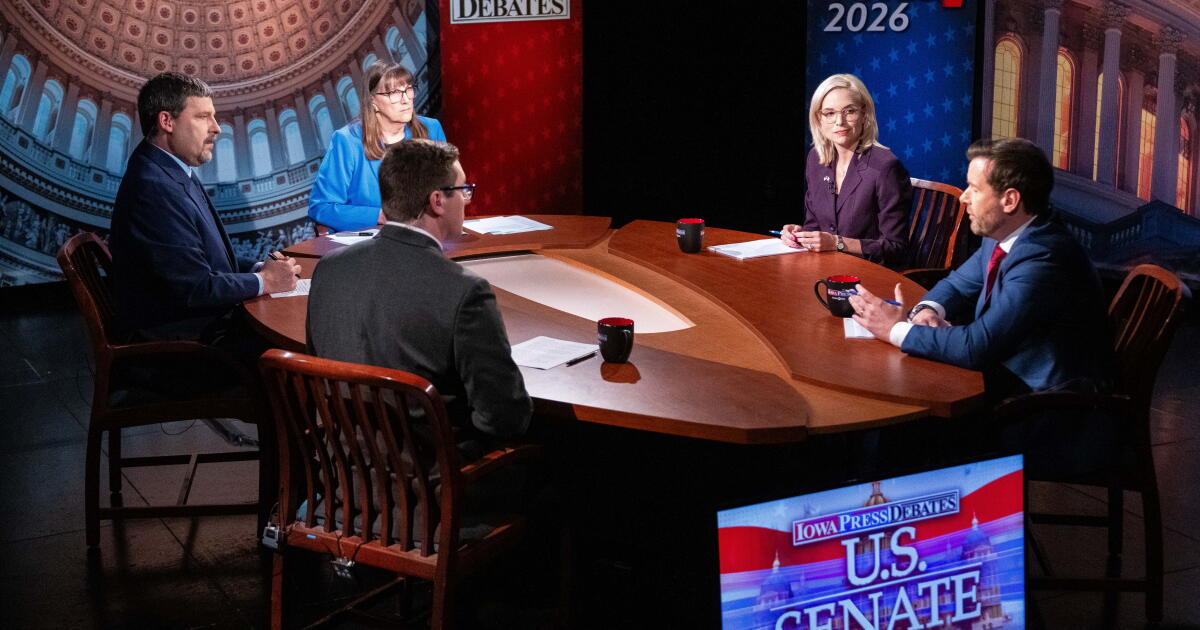
Running for a promotion to the Senate, Iowa U.S. Rep. Ashley Hinson tried in her debate Wednesday against Democrat Josh Turek to reconcile her earlier promises to be a Trump ally in Congress’s upper chamber. She said it would be “really easy” to keep her word and still be bipartisan — a buzz word she’s already been featuring in her campaign.
“I’ll be President Donald Trump’s ally when it is important for Iowa, but I will push back on him — he knows this, because I talk to him regularly — on things that are wrong for our state,” she said. “That’s true no matter who’s in the White House. That’s true no matter who is governing and who has the gavel.”
That’s the same path Jackson took in Georgia, as he pivoted away from Trump by embracing outgoing Georgia Gov. Brian Kemp, a Republican who has clashed with the president, starting with Trump’s false claims that he won Georgia in the 2020 presidential election.
“I will stand up to anybody, just like Brian Kemp has done,” Jackson said.
Another Republican House member, Mike Lawler of New York, made a point of name-checking a Democratic colleague, New Jersey’s Josh Gottheimer, and discussing bills they’d work on together. It was part of his argument that he’s able to challenge Trump and the party line.
“When I agree with the president I say it. When I disagree with the president, I say it,” he said in his closing remarks.
Hinson, meanwhile, referenced bills she’s worked on in the House that have been signed into law by both President Joe Biden and Trump.
But she also avoided criticizing Trump when asked about the president sending Affordable Care Act rebate checks to some Americans and promising a $5,000 bonus after the midterm elections if Republicans retain control of the House and Senate.
She said she “cares very deeply” about making sure Congress maintains the power of the purse and thinks it’s important to “live better within our means.”
Democrats pounce on either approach
Regardless of the Republican efforts, Democrats have continued peppering them with attacks and retorts about Trump. The most heated moments came when Democrat Cait Conley repeatedly said Lawler always voted with Trump.
“No matter how many times you say 100% of the time,” the congressman answered, “it’s provably false.”
When Rogers conceded in his back-and-forth with El-Sayed that the administration “probably” made errors in its mass deportation strategy, the Democrat answered swiftly.
“He said it was probably not right. I mean, it’s definitely not right,” El-Sayed said. “They killed two people.”
And while Georgia’s Jackson seemed uncomfortable talking about Trump, Bottoms was more than happy to mention him.
“I’m not running to be his favorite governor,” she said. “I’m running to work on behalf of people like you.” ___ Associated Press reporters Joey Cappelletti in Washington; Hannah Fingerhut in Des Moines, Iowa; and Jill Colvin in New York contributed to this report.
WASHINGTON — The Arlington County Board in Virginia filed a lawsuit Thursday opposing the construction of the Triumphal Arch, becoming the first governmental body to take legal action against President Trump’s planned monument.
The lawsuit, filed in the Eastern District of Virginia, criticized the speed at which the project slated for Memorial Circle has moved without going through the full review process.
“The National Park Service, the agency responsible for projects on national park land such as Memorial Circle, is proceeding full-speed toward ground-disturbing construction,” the lawsuit said. “Although the agency has claimed that a final decision to construct the Arch has not yet been made and purports to be engaged in a routine decisional process, that rushed process appears to be a pretext designed to shore up justifications for building the Arch in accordance with the President’s repeated marching orders.”
The lawsuit asks that “the agency’s feverish pace toward construction of the arch” be halted to ensure that the requirements of the National Environmental Policy Act be followed and proper analysis and testing be done.
“The Arlington County Board has filed this lawsuit because our community has the most to lose from this egregious and unlawful proposed project,” Arlington County Board Chair Matt de Ferranti said in a statement. He added that the county has acted in good faith in the review process, pointing out the “severe, unique, and wide-ranging negative impacts” the project will have on the county and its residents, only to see them ignored.
Memorial Circle sits on federal parkland west of the Potomac River across the Memorial Bridge and immediately adjacent to Arlington County.
The county is being represented in the lawsuit by legal advocacy group Democracy Forward.
White House spokesman Davis Ingle said the Trump administration and White House have been “fastidiously compliant with all procedural and legal requirements and are certain this meritless and dilatory lawsuit will be dismissed.”
The arch will become one of the world’s most iconic landmarks, he added. “It will enhance the visitor experience at Arlington National Cemetery for veterans, the families of the fallen, and all Americans alike.”
The lawsuit came a day after the Association of Flight Attendants-CWA President Sara Nelson expressed concerns that the 250-foot arch compounds multiple safety issues that she said have gone unaddressed since a deadly January 2025, crash over the Potomac River that killed 67 people. Nelson also criticized Trump’s plan to turn the arch into “a top grade military complex” able to host drones and snipers while storing ammunition.
Though the arch has received early approval from the U.S. Commission of Fine Arts, whose members were all tapped by Trump, a group of three veterans and an architectural historian sued in federal court in Washington, D.C., saying the project needs to be approved by Congress. The judge in that lawsuit said the administration must give the court 48 hours before undertaking any activities related to or in preparation for construction of the arch.
The arch is one of several projects around Washington that Trump has undertaken as he remakes the city, from renovating one of its storied public golf courses to threatening to demolish the John F. Kennedy Center for the Performing Arts.
WASHINGTON — President Trump opened another chapter in his effort to fire Federal Reserve Governor Lisa Cook Friday by establishing a “committee of inquiry” to investigate allegations that she made false statements in mortgage applications.
The inquiry will include a hearing at the White House Nov. 5, Trump said in a written memo, that Cook “shall” attend to answer questions from the committee. The hearing wouldn’t be public but a transcript would be published, the memo said.
Trump’s extraordinary demand that Cook testify before the committee will likely renew concerns about threats to the Federal Reserve’s independence as the president demands the central bank cut its key interest rate. Just last month, the Fed raised its key rate instead, led by Chairman Kevin Warsh, whom Trump appointed earlier this year.
“As President, it is my job to ensure the laws are faithfully executed, including by firing subordinates who cannot be trusted to tell the truth and follow the law,” Trump wrote in the memorandum.
Trump and some of his economic advisers have blamed the Fed’s broader rate-setting committee, which includes 12 voting members and 19 officials in total, for the rate hike. Cook is one of the 12 participants on the committee that votes on interest-rate decisions. The vote to lift rates Sept. 16 was unanimous.
The move follows a Supreme Court ruling in June that Cook could keep her job after Trump sought to fire her last year. That ruling included a footnote that said nothing prevented Trump from “trying again” as long as she was given proper notice and an opportunity to respond to the charges.
Cook has denied any wrongdoing and has not been charged with a crime.
United States President Donald Trump has said that he does not intend to bomb Iran again until the November midterm elections, even though several US media outlets have reported that the Pentagon has drawn up plans to relaunch attacks before that vote.
Trump has been accused of misdirection on the issue in the past. The US launched its initial attacks on Iran on February 28, as talks with Iran were ongoing and despite Trump saying just the day before that he had not made any decision. One year previously, the US struck Iran towards the end of Israel’s June 2025 12-day war, despite Trump saying he would announce a decision about attacks “in two weeks”.
Recommended Stories
list of 4 itemsend of list
Still, striking Iran ahead of the midterm elections would be risky for the administration as the war remains deeply unpopular with Americans.
Resuming the war afterwards may have less of a negative impact on Trump, who is not eligible to run for another term as US president anyway.
Here’s what we know about Trump’s plans.
In the past two days, The New York Times, The Wall Street Journal and other publications have reported claims by unnamed officials that the Pentagon has drawn up plans to attack Iran before the midterms, if authorised to do so.
On Wednesday, US publication Axios cited US and Israeli officials saying the Pentagon has instructed US Central Command (CENTCOM) to prepare for imminent major combat operations. The Atlantic also reported along similar lines.
What has Trump said?
On Thursday, Trump posted on his Truth Social media platform that he will not order a resumption of strikes on Iran before November 3, when the US midterm elections will be held.
“I want to make it clear to everybody that, while Iran is in very bad condition…we will not be attacking Iran at any time prior to the Midterm Elections to be held in the United States on November 3rd,” he said.
The president added that the US is presently “having productive discussions” with the Iranian side. However, that was also the case on February 28, the day the US and Israel first struck Iran, triggering the war.
Trump did not make any reference to preparing for potential military operations, nor did he provide more details on the state of talks.
Why might Trump be hesitant about resuming bombing before the midterms?
Trump and Republicans are worried about a voter backlash against the war at the polls. The US war on Iran is intensely unpopular domestically as Americans have had to grapple with surging prices of gas, food and other basic commodities because of the crisis in the Middle East.
Since the start of the war, surveys have shown that large numbers of Americans did not approve of striking Iran.
Now, about 65 percent of Americans say they “disapprove” of the way in which Trump has handled the Iran war overall, according to a Pew Research Center poll released on Thursday. Trump stated at the start of the war that it would go on for just a few weeks, however, it is now into its eighth month.
According to Pew, most Americans now believe the war will continue for at least another year. Even Republican or more conservative-leaning voters are growing more negative about the war, its poll found.
The conflict has also severely affected Trump’s personal ratings and eroded support for Republicans. A Reuters/Ipsos poll on Thursday found that only 30 percent of his supporters were enthusiastic about voting in the midterms, compared with 48 percent of Democratic voters.
About 13 percent of those who voted for Trump in 2024 say they are not sure who to vote for in the congressional elections.
Delaying attacks until after the elections could potentially shield Republican candidates from voter backlash, analysts say.
While analysts say Trump will see a good performance at the polls as approval for renewed strikes, a Republican defeat at the polls could equally further incentivise him to hit Iran again as he will calculate that he has little to lose at that point.
While that could further affect Trump’s ratings, the president is not eligible to run in the next presidential election in any case.
Will the US restart the war after the midterms?
In recent weeks, the US president has threatened to “end” the war with force after the elections as talks with Iran have dragged on.
At a Republican convention in September, he accused Iran of trying to affect the outcome of the midterms and said that conflict “is going to end immediately after the elections”.
In an interview with Time magazine two weeks ago, he also said it would be “possible” to ramp up bombing in Iran after the elections, but declined to elaborate. Analysts say his comments were designed to calm voters, while at the same time warning Iran of potential aggression after the vote.
Last week, the US military dispatched about 7,000 sailors and 2,000 Marines aboard several ships now sailing to the Middle East amid threats of new attacks from Trump. The vessel formation included the USS Theodore Roosevelt carrier strike group.
The deployment increases the number of US troops in the region to 20,000, alongside hundreds of aircraft and at least three carrier strike groups.
In the past, US troop build-up in the Middle East and the Caribbean has subsequently resulted in military action.
In June, Washington and Iran signed a ceasefire agreement that quickly broke down over control of the Strait of Hormuz.
Trump has repeatedly said that the US has the upper hand in the strait, citing more oil exports and Iran’s weakened economy. He has also voiced aversion to a deal with Tehran over management of Hormuz, but said he might consider it because “they’re willing to offer us anything to stop”.
Washington rejected a recent proposal from Iran to reopen the strait based on certain conditions it wants the US to meet, including the lifting of sanctions, unfreezing Iranian assets and guaranteeing an end to attacks. Last week, Foreign Minister Abbas Araghchi said Iran was considering a counterproposal from the US.
Oil prices drop as Trump dismisses speculation of pre-midterm military action against Iran.
Published On 9 Oct 20269 Oct 2026
United States President Donald Trump has said the US will not attack Iran before the November 3 midterm elections.
The US president said late on Thursday: “we are having productive discussions with the Islamic Republic of Iran,” in a post on Truth Social. “We will not be attacking Iran at any time prior to the midterm elections to be held in the United States on November 3rd.”
Recommended Stories
list of 3 itemsend of list
Oil prices fell early on Friday as Middle East supply concerns eased somewhat after tensions in the energy-rich Gulf region had mounted in recent weeks.
The possibility of renewed fighting had appeared to drive up oil prices in trading on Thursday. Some analysts believe Trump’s comments were an attempt to try and bring prices back down.
Iran’s Foreign Minister Abbas Araghchi said Tehran is reviewing the US response to its seven-day plan to reopen the Strait of Hormuz, and that Iran will respond within the “next few days”.
He added that negotiations are continuing through mediators, Iran’s Tasnim news agency reported.
Hormuz explosions
Iranian media reported “massive explosions” in the southern Strait of Hormuz on Friday, with Fars citing unnamed military sources as saying tankers using “unauthorised” routes may have struck sea mines.
On Tuesday, US Vice President JD Vance said Iran must make a “meaningful” reduction in its uranium enrichment capacity as part of an agreement to end the war. Experts say this demand may signal a softening of Washington’s earlier insistence that Tehran abandon enrichment altogether.
On Monday, Iranian President Masoud Pezeshkian said negotiations with Washington were “futile”, accusing the US of using negotiations to attack Iran.
Russian President Vladimir Putin told Pezeshkian that Russia will “do everything” to help end the US-led war on Iran, Russian news agencies reported on Thursday.
WASHINGTON — President Trump said Thursday that he will not order a resumption of military strikes on Iran before the Nov. 3 midterm elections in the United States.
Trump, while stumping for Republicans this week, has hinted that he was confident that an endgame to the war could come in the days before or after the election, while also hinting that he remained open to resuming full-scale military operations against Iran.
For weeks, Trump has been threatening that a post-midterm election escalation in the seven-month-old war remains a viable option, despite his initial promises to Americans of a military campaign that would last a matter of weeks.
But Trump in a social media post on Thursday said the U.S. “will not be attacking Iran at any time prior to the Midterm Elections to be held in the United States on November 3rd.”
Trump added that his team has been “having productive discussions with the Islamic Republic of Iran.”
Negotiations had appeared at a standstill since Trump late last month publicly rejected Iran’s proposal to reopen the Strait of Hormuz within seven days if the U.S. met certain conditions.
Iran, however, said last week it had received a U.S. counterproposal. And Foreign Minister Abbas Araghchi on Thursday said he expected Tehran would offer a formal reply within days.
Trump’s post comes as the military has dispatched more resources to the region. U.S. officials have said a third aircraft carrier, the USS Theodore Roosevelt, and thousands of troops aboard it and accompanying ships could arrive as early as the end of October.
Trump’s announcement was made the same day the USS Abraham Lincoln was due to arrive to its home port in San Diego after a record-long deployment in support of the Iran war. There have been reports of crew stress and poor mental health, as well as supply shortages, including food and hygiene products.
The USS George Washington, which is usually based in Asia, relieved the Lincoln in August. The other aircraft carrier in the Middle East, the USS George H.W. Bush, has been deployed for about six months, but it pulled into Phuket, Thailand, for a port visit several days ago.
WASHINGTON — President Trump says his administration will make one-time payments of $90 per person to help more than 20 million Medicare enrollees pay for their Part B premiums. It will cost about $2 billion.
Less than one-third of all Medicare recipients are eligible for the payments, which are expected to be sent out this week. Not eligible are roughly 35 million Medicare Advantage enrollees, millions of people with disabilities who get premium assistance and low-income Medicare recipients.
The election-year promise that the Republican president made over the weekend comes as the Nov. 3 midterms are fast approaching, with the cost of living and healthcare expenses among the top issues for voters.
Some questions and answers about the payouts:
Who will benefit?
Some 20.8 million people in the original Medicare Part B who are living in the United States, not receiving premium assistance from Medicaid or not paying an income-related monthly adjusted amount.
Medicare Advantage enrollees, who make up more than half of the eligible 64.2 million Medicare beneficiaries, will not receive a payment, according to KFF, a healthcare research nonprofit. Nor will 12 million low-income older adults and people with disabilities who get premium assistance.
The Part B program covers expenses such as doctor’s visits, ambulance services and lab tests. Total monthly costs generally start at about $200 and vary with income.
Allison Schuster, a White House spokeswoman, said in a statement that the administration “is enabling Americans to take control of their health by putting money directly back in the hands of Medicare patients.”
When will the payments go out and how will they be disbursed?
According to the Centers for Medicare & Medicaid Services website, eligible beneficiaries will receive one $90 rebate this month, with most getting a direct deposit on or around Friday. Others will receive a paper check from the Treasury Department later in October.
Juliette Cubanski, director of KFF’s program on Medicare policy, said the payment will be automatic.
“As far as a benefit goes, people don’t have to call or sign up — it’s just money they receive directly, but not everybody on Medicare will receive this money.”
A White House fact sheet says people can call (800) MEDICARE ([800] 633-4227) to check their eligibility for the premium rebate. To check on payment status, people should call the Social Security Administration at (800) 772-1213.
What is the source of the money?
Payments will come out of the Medicare Improvement Fund created by Congress in 2008 and intended to make improvements to the Medicare fee-for-service program.
The fund was created to improve program management and conduct oversight of contracts and contractors, according to the Congressional Budget Office, but its purpose has expanded after various legislative changes.
This is not the first time the fund has been used.
President Obama’s administration, along with Congress, redirected $20 billion to expand healthcare coverage through the Affordable Care Act.
But under Trump, it is the first time that the fund has been used to directly pay recipients.
What are critics of the plan saying?
Critics of Trump’s promise characterize the $90 payments as a preelection stunt designed to sway voters rather than address structural problems in healthcare costs and administration.
The top Democrat on the Senate Finance Committee, Oregon Sen. Ron Wyden, said in a statement that “this is another desperate attempt by a failed president to escape Americans’ revulsion with his failed agenda, amounting to one tank of Trump-inflated gas.”
Trump recently promised $500 rebate checks to an estimated 1 million Obamacare enrollees across 30 states whom the White House alleged were overcharged by the Biden administration for some fees.
Cubanski said the Medicare rebate payments were being doled out when Americans were feeling the bite of higher food, energy and gas prices. Surging healthcare costs are only compounding those pressure, she said.
“This might be helpful for people but it might not go very far.”
WASHINGTON — President Trump told a crowd in Texas on Wednesday night that he would not allow Iran to attack San Diego or Los Angeles, a comment that came two days after he made off-the-cuff remarks suggesting the West Coast cities could be struck.
“You want to see a horror show? You want to see problems? Let them hit San Diego, let them hit Los Angeles,” Trump said at a rally. He then assured the crowd: “We are not going to let that happen. We protect our cities. We protect our country.”
The San Antonio crowd cheered the remarks.
Trump’s decision to return to the subject capped two days in which the White House had been on the defensive, and it appeared aimed at tamping down the fallout from remarks he made Monday night that quickly spread online.
Speaking to a crowd in Nebraska, Trump had said: “They can take out a city, let them take out Los Angeles, let them take out San Diego. This is a very small price to pay.”
The comments drew swift condemnation from California leaders, even as the White House communications director, Steven Cheung, insisted the president’s remarks had been taken out of context.
“The media freakout over President Trump’s comments is not rooted in reality,” Cheung wrote Tuesday. “He was clearly stating U.S. cities would have been threatened if a nuclear Iran hadn’t been stopped. America is safer because of the president. Iran has no nuclear, no navy, no air force, and no money.”
But the remarks were enough to rattle many in California and drew backlash from the state’s leaders, including Republican Jim Desmond, a Navy veteran running in a highly competitive U.S. House race.
“I vehemently disagree with President Trump’s comments,” Desmond wrote on social media. “America must stand up to Iran and defend our interests, but the first responsibility of our Commander in Chief is to protect the American people and our homeland.”
Gov. Gavin Newsom on Tuesday opened the state emergency operations center to assess potential threats following Trump’s remarks. San Diego Mayor Todd Gloria and Los Angeles Mayor Karen Bass also condemned the president for potentially compromising the safety of their cities.
“San Diego is not collateral damage,” Gloria posted on social media. “We are not expendable. And we are never a ‘small price to pay.’ Keep our city out of your reckless war talk.”
The Democratic National Committee has filed a lawsuit against United States President Donald Trump over television advertisements that were publicly funded and allegedly used to promote his political policies.
Ken Martin, who heads the Democratic Party’s leadership body, suggested in a statement on Wednesday that the ads were designed to bolster Republican odds in the upcoming November 3 midterm elections.
Recommended Stories
list of 3 itemsend of list
“Donald Trump is misusing millions of taxpayer dollars to fund pure propaganda ads in a last-ditch attempt to save Republicans in November,” Martin said.
Later that day, Common Cause, a democracy watchdog group, filed a second lawsuit over the same set of ads.
It argued that the ads were “overtly political” and therefore ran afoul of laws that bar public funds from being used for political propaganda.
“These ads are not public-service announcements,” Common Cause said in its lawsuit, citing a justification Trump has offered for the television spots. “They are personal publicity and political propaganda through and through.”
Both lawsuits argue that, to create the ad campaign, Trump directed the White House to repurpose $20m in funds that Congress allocated for commemorative activities related to border security, including for those killed in the line of duty.
That manoeuvre, they argue, violates the separation of powers established in the US Constitution.
“The founders made clear more than 200 years ago that the executive can spend money only according to Congress’s direction,” Common Cause’s lawsuit said.
The two lawsuits also point to a provision Congress includes in its appropriations bills barring the use of taxpayer funds for “publicity or propaganda purposes”.
Both complaints seek to have the ads declared illegal, and the expenditures stopped. They also call for steps to be taken to recover any money already spent on the ads.
The Democrats’ lawsuit was filed in Washington, DC, while the Common Cause complaint will be heard in the Southern District of New York.
Trump has faced mounting criticism over the ads, which began airing in September.
So far, the advertising campaign has cost more than $12m to run, according to the media tracking firm AdImpact.
The $20m Trump tapped for the ads comes from a $175m package Congress assigned to the Department of Homeland Security as part of Trump’s immigration enforcement agenda.
Critics have pointed out that one of the ads appears nearly identical to a television spot Trump used in his 2024 re-election campaign.
Three ads have aired so far. In one, a choir sings “love me” over a montage of Trump as he declares the US will “never be a communist country”. Another uses images of Mount Rushmore as Trump heralds a new “golden age of America”.
The third is darker: Trump walks towards the camera in black and white, warning of a “final battle” against the “deep state” and other perceived enemies.
On Wednesday, the news agency Reuters and the research firm Ipsos released a poll showing the ads are highly unpopular. Some 86 percent of the Americans surveyed, including four out of five Republicans, said it was inappropriate for Trump to have used public money for them.
Trump has defended the ads as “promotion for the country”, and he has argued they were similar to public outreach campaigns put out by previous administrations.
But after a bipartisan backlash, Trump said on Monday that taxpayer funds would no longer be used for future ads.
He did not, however, commit to paying back the money already spent on the existing ads.
Members of Trump’s Republican Party have been among those speaking out against the ad campaign.
Senator Thom Tillis, a Republican from North Carolina, said the advertisements resembled something former Hungarian leader Viktor Orban would put out.
Senate Majority Leader John Thune, meanwhile, indicated he agreed with the message in one of the advertisements, but he emphasised that “it shouldn’t be paid for with taxpayer dollars”.
WASHINGTON — The Democratic National Committee on Wednesday sued President Trump’s administration for recent television advertisements that promoted his political message while costing taxpayers millions of dollars.
The complaint, filed in the U.S. District Court for the District of Columbia, alleges that the ads are illegal government-sponsored propaganda and accuses Trump of personally directing them. It asks the court to declare the ads illegal and stop the use of federal funds to pay for them.
Trump has faced bipartisan backlash for the ads, which glorify him and echo his campaign pitch as voters cast early ballots with the midterm elections less than a month away.
The spots, which began airing in September, already have cost more than $12 million to run, according to the media tracking firm AdImpact, and a total of $20 million in Homeland Security Department funding has been tapped to pay for them.
Responding Monday to the criticism, Trump defended the ads as “positive promotion for our Great U.S.A.” but said he’d pay for them using his MAGA Inc. super PAC going forward.
But on Tuesday, the fifth ad in the campaign began airing with the notice “paid for by the U.S. Government,” promoting Trump’s military actions in Venezuela earlier this year. The same day, Trump made it clear he hasn’t committed to reimbursing any money that has already been spent, telling reporters “we’ll decide.”
DNC Chair Ken Martin said in a statement that Trump is misusing taxpayer dollars in “a last-ditch attempt to save Republicans in November.”
“Americans deserve better than to have their hard-earned tax dollars used for Trump’s illegal schemes,” he added.
Legal experts have suggested the ads run afoul of a federal statute against congressionally appropriated money being used for “publicity or propaganda,” and potentially other federal laws. The Homeland Security money tapped for the ads comes from a $175 million package Congress gave to the department as part of Trump’s immigration enforcement agenda.
The White House has defended the ads as public service announcements akin to what past administrations have done to promote various policies. Legal experts have said the recent ads differ from many past public service announcements because they aren’t aimed at helping members of the public benefit from specific government programs.
The defendants in the lawsuit — Trump, the White House, DHS and the Office of Management and Budget — didn’t immediately respond to requests for comment.
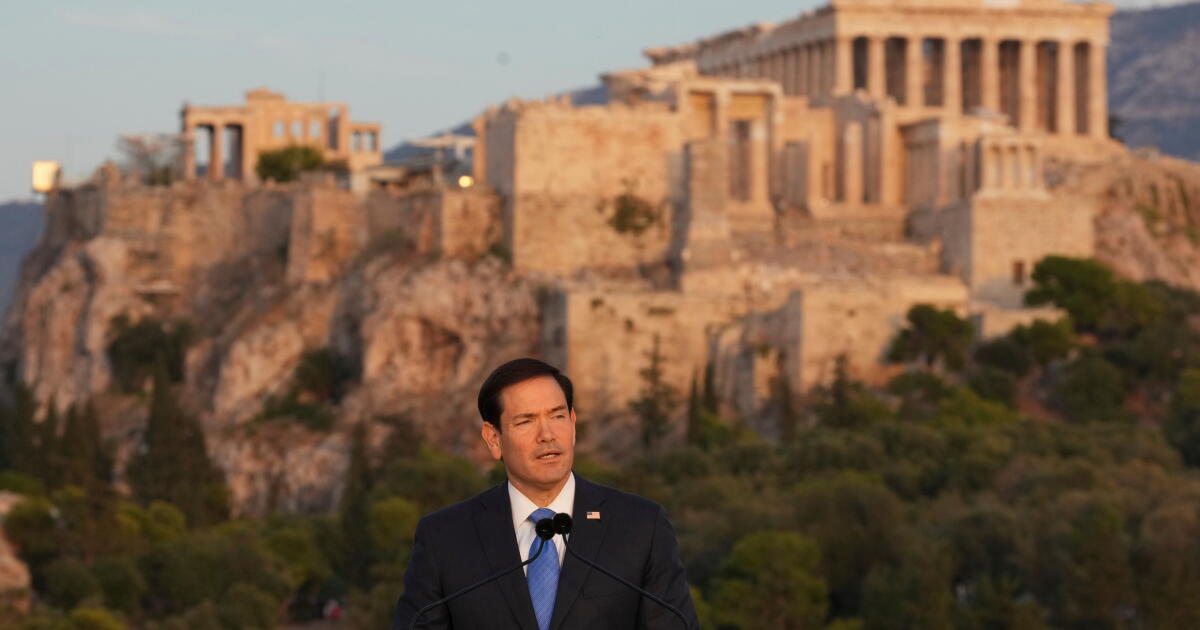
ATHENS — U.S. Secretary of State Marco Rubio called for the nations of the West to return to their civilizational roots and restore the values that drove the rise of Europe and North America to global dominance for centuries.
In Athens to discuss deepening economic, energy and security cooperation with Greece, Rubio delivered a speech later Wednesday near the ruins of the Acropolis, a widely recognizable symbol of the city’s ancient civilization associated with the creation of popular participatory government and the social contract.
Rubio aimed to remind listeners of qualities he says were born in Greece and later defined the West, such as curiosity, courage, ambition, a restless spirit of exploration and a drive to discover the unknown.
“It has become fashionable today to believe that enlightened foreign policy means prioritizing the ‘global community’ over one’s own people. And I think here, too, we have much more to learn from the men of Ancient Greece. They knew that there was nothing selfish or wrong about loyalty to your nation, nor anything selfish or wrong about fighting to defend its interests above all else,” Rubio said.
Rubio urges Europe to uphold its traditional values
“Today, we find ourselves at a crossroads,” he said. “The next decade will write the story of the next century. The course we take will determine whether the West maintains its place at the head of the world, or resigns itself to a future of atrophy, and servitude, and decline. We will either choose to act now or lose the choice to act at all.”
Rubio is seen by many as the gentle face of the Trump administration and has been frequently dispatched to clarify or otherwise address concerns about the president’s frequently undiplomatic statements.
Rubio, along with Vice President JD Vance, is seen as one of the leading contenders to assume Trump’s mantle at the top of the Republican Party, which faces stiff challenges in next month’s congressional midterm elections. Republican Party, which faces stiff challenges in next month’s congressional midterm elections.
The Trump administration has repeatedly accused countries in Europe of backsliding on their traditional values and democratic principles by stifling the free speech of conservatives and falling short on commitments to international partners like the United States.
Many of those countries have rejected the complaints and accused the U.S. under Trump of being guilty of similar behavior and worse with its staunch anti-immigration stance that some believe is racist.
Left-wing groups protest across Greece
Ahead of his visit to Athens, about 1,500 people gathered to protest Rubio’s presence and the war in Iran, chanting “American killers!”
The demonstration was organized by a communist labor union and other left-wing groups and was held ahead of extensive road closures planned in Athens. Organizers said similar protests were held in at least 12 other Greek cities. Police banned public demonstrations Wednesday in central.
Rubio seeks to reassure NATO allies
Rubio is on the second leg of a three-nation tour of NATO allies that has already taken him to Iceland and will end in Portugal on Thursday. The trip is aimed at reassuring U.S. partners that the Trump administration is committed to their success and security despite what has been an often brusque and sometimes rude approach to traditional friends that has stirred unease.
Rubio began emphasizing historical themes on Thursday, when he met Iceland’s foreign minister at the site of the landmark 1986 summit between former President Ronald Reagan and then Soviet leader Mikhail Gorbachev, a meeting that many believe marked the beginning of the end of the Cold War and was a catalyst for the eventual dissolution of the Soviet Union.
It remains unclear what impact Rubio’s visits will have, although on Tuesday in Reykjavik, he sought to reassure Iceland that President Trump’s administration has no designs on the island. Rather, he said the U.S. shares Iceland’s deep concerns about Arctic security as tensions between the U.S. and Russia rise in the High North and elsewhere.
Iceland has been uneasy about Trump’s intentions toward it after he posted a map showing the colors of the U.S. flag sprawling across all of North America and extending to Iceland and Greenland. That wariness has persisted despite an agreement last month to increase the U.S. presence in the neighboring Danish territory of Greenland that appears to have ended Trump’s demands for the U.S. to take full control of the island.
But after Rubio’s talks in Reykjavik, those tensions appeared to be on the wane. Rubio said the United States would not do anything in Iceland without Iceland’s consent.
Visit follows allegations of misconduct by U.S. ambassador
Before delivering his speech in Athens, Rubio declined to comment when he was asked about allegations of misconduct leveled at U.S. Ambassador to Greece Kimberly Guilfoyle.
At a joint news conference with the Greek foreign minister, Rubio said he would not address the matter while visiting a foreign country, but added: “Suffice it to say our embassy here is doing a great job. Our ambassador has been a strong ambassador here.”
The top Democrats on the Senate Foreign Relations and House Foreign Affairs committees, Sen. Jeanne Shaheen and Rep. Gregory Meeks, have initiated probes into claims reported last month by the Wall Street Journal that Guilfoyle acted improperly while serving as the top U.S. envoy to Greece.
The Journal reported that Guilfoyle told guests at a reception that the U.S. could undermine the Greek government if it chose to, promoted the business interests of one particular Greek construction and energy company, and allowed its lobbyist into private diplomatic meetings.
Guilfoyle, a former Fox News Channel host and California prosecutor who was once engaged to Trump’s son Donald Jr., has denied any wrongdoing, and Rubio has defended her before.
Lee writes for the Associated Press. AP writer Derek Gatopoulos in Athens contributed to this report.
California Republican gubernatorial candidate Steve Hilton dove deep into his housing platform and lobbed a few attacks at his Democratic opponent, Xavier Becerra, during a town hall with Los Angeles news outlets Tuesday.
Hilton also pointed to some disagreements with President Trump, providing daylight between himself and a president who remains deeply unpopular in California, during the event hosted and livestreamed by the Los Angeles Times and LAist.
Democratic Gov. Gavin Newsom’s final term ends in early January, providing California voters the opportunity to select a new governor at a time of conflict between the state and the Trump administration over environmental policies, immigration, healthcare and other pressing issues.
Ballots already have started to arrive in California voters’ mailboxes ahead of the Nov. 3 election.
Here are the top takeaways from the discussion with Hilton:
Walking the tightrope on Trump
Republicans running for statewide office already have an uphill battle because of California’s heavily Democratic electorate. It’s an acute challenge this year, campaign experts say, because many Democratic voters are itching to help their party regain control of Congress and neutralize Trump’s agenda.
Trump endorsed Hilton in April, which helped the former Fox News host pull ahead of his GOP rival, Riverside Sheriff Chad Bianco, and secure the second-place spot in the primary election, behind Becerra.
On the campaign trail, Hilton has remained supportive of Trump and said Democratic policies, not the war in Iran, are to blame for high prices.
The Republican said those differences are rooted in his strong support for states’ rights.
“The broader point I want to make, and you can track this back to the commentary and what I’ve written over the years, is I’m a strong believer in decentralizing power,” he said. “I think there’s far too much involvement of the federal government in our affairs in California, and I’m going to be a very strong advocate for bringing those powers back in all sorts of ways.”
Gas prices, taxes and housing permits
Hilton described California’s cost of living as “a nightmare” and a major contributor to residents and businesses moving out of the state.
He laid out an affordability plan, which he refers to as “Califordable,” that he would prioritize if elected governor. His plan includes:
Ending income taxes for Californians who earn $150,000 or less.
Slashing oil industry regulations and clean energy mandates for utility companies to achieve $3 gas and lower electric bills.
Ushering in a new construction boom of single-family homes, including by developing 10 new cities around the state, and capping government fees on newly constructed houses.
He blames the state’s affordability woes on Democrats, who have controlled the state legislative seats and held every elected statewide office since 2009.
“It’s not just that it’s time for some change in California, it’s time for balance. It’s time to try something different after 16 years of doing it the same way,” he said.
Republican gubernatorial candidate Steve Hilton said he does have some policy differences with President Trump during a town hall at the Los Angeles Times Building on Tuesday in El Segundo.
(Ronaldo Bolanos/Los Angeles Times)
Hilton said he would stop enforcing laws requiring communities to meet housing production goals and instead focus on building in undeveloped areas of the state that want new homes.
“We’ve got this attitude that the only place you can build is inside what’s currently developed, and that’s motivated by a desire to stop traffic and sprawl and all these things. But the consequence of that is that you end up finding [it] almost impossible to build anything” because of permitting battles and lawsuits, he said. “My plan is to open that up so that we build outwards, not just upwards, increasing the amount of space we use for housing.”
How he would pay for it all
Hilton said that Newsom and Democratic lawmakers have gotten accustomed to spending big and that he wants to return California’s state budget to its pre-pandemic size.
Earlier this year Newsom signed a budget just shy of $352 billion. His first budget as governor, in 2019, clocked in at nearly $215 billion.
The growth occurred during a time “when around 2 million people on net have moved out of the state,” Hilton said. “So we’re spending twice as much for a big reduction in population and worse results.”
He said he could offset the tax cuts by ending funding for high-speed rail, trimming state agencies by 5% and cracking down on Medicaid fraud. Together, he estimates those cuts would save about $25 billion annually. He has also promised to end state-funded healthcare for undocumented immigrants and to hollow out agencies that regulate the state’s air quality and coastlines.
Another round of attacks on Becerra
While he largely stayed focused on policy, Hilton criticized Becerra’s record as U.S. Health and Human Services secretary and dinged him for skipping the town hall.
“Looking forward to perhaps one day having another chance to sit down with my competitor in this race, Xavier Becerra. We’ve had one debate. He promised that there would be debates, plural. Not to be today. But hopefully we can have that conversation because Californians deserve a conversation about the future of our state,” he said during his opening remarks.
On Monday, Hilton attacked Becerra for having “pulled out” of the debate, though the Democratic candidate never agreed to attend a debate proposed by The Times and LAist. Becerra’s spokesperson said the campaign declined the invitation because of a full campaign schedule.
In the weeks following the June primary election, Becerra made himself scarce on the campaign trail and attended few public events. In August, he told reporters there would be multiple debates. He and Hilton faced off last week in an hourlong debate on CNN but no other debates have been announced.
Offshore wind projects “grotesque,” Hilton says
At a time when the Trump administration has systematically dismantled climate and environmental policies, Hilton took care to cast himself as an environmentalist who is concerned about climate change.
He criticized many of the policies favored by Democrats, however, as a “very one-dimensional way of thinking” and offered a more business-friendly approach to addressing climate change:
Planting 3 billion trees and restoring wetlands.
Expanding the use of climate-friendly geothermal energy near places such as the Salton Sea and Sonoma and Modoc counties.
Expanding oil production in California, which he said reduces the need to import foreign oil on tanker ships that spew carbon emissions.
“So that’s a way of reducing carbon emissions that doesn’t burden working people and small businesses with the highest energy costs in the country. We’ve got to get the balance right,” Hilton said.
Hilton aligns with Trump’s vehement opposition to offshore wind projects, a potential source of abundant renewable energy. This year, the Trump administration announced deals to pay wind project developers billions to abandon U.S. wind leases off the coasts of California, North Carolina, New York and New Jersey.
“I think offshore wind is an absolute abomination. I mean, you look at beautiful Morro Bay or Humboldt up in the northern part of our state,” Hilton said. “The industrialization of our coastline that offshore wind would create, I think, is just grotesque, and I’m dead against it.”
Working across the aisle
When asked how he would work with a Democratic majority in the state Legislature, Hilton said he has experience doing it — as an advisor to former United Kingdom Prime Minister David Cameron, he shared an office with a member of the opposite party.
“We worked together very well. Didn’t agree on everything,” he said. “That would be my attitude. I’m very open. I’m not tribal. I’m not particularly partisan. I’m a pragmatic, problem-solving kind of person, and I’m looking forward to working with the Legislature.”
He said he would press the Legislature to cut spending and “the endless number of bills that they pass every year. … But I want to work together to reduce costs for Californians.”
Hilton also found alignment with Democrats who ran in the gubernatorial primary, including former Orange County Rep. Katie Porter, San José Mayor Matt Mahan and former Los Angeles Mayor Antonio Villaraigosa.
“Katie Porter in the primary … actually endorsed my tax plan. Matt Mahan and I agree on a lot of things to help” cut costs and speed up housing constriction, he said. “Antonio Villaraigosa, we agreed on a lot of things to do with energy policy. So I think there are Democrats who we’ll be able to work with to get consensus on some of the things that we need to get done.”
Members of the Republican Party have joined Democrats in questioning remarks made by United States President Donald Trump about the California cities of Los Angeles and San Diego.
Much of the backlash came on Tuesday, a day after Trump told a midterm rally in Nebraska that Americans should be willing to make sacrifices to gain victory in the US-Israeli war against Iran.
Recommended Stories
list of 3 itemsend of list
Those sacrifices, he implied, could include the destruction of American cities, in case of an Iranian attack.
“It’s a small price to pay for keeping the world safe, keeping our country safe,” Trump said, seemingly in reference to the knock-on effects of the war, including rising fuel and fertiliser prices.
“They can take out a city. Let them take out Los Angeles. Let them take out San Diego. This is a very small price to pay, and it’s going to be over with very soon.”
Trump has downplayed the impact of the war – now in its eighth month – despite polling that shows the conflict is widely unpopular in the US. He has also repeatedly promised the war would end soon, though no lasting ceasefire has been reached so far.
The fallout from his Nebraska remarks was swift. Gavin Newsom, an outspoken critic of Trump and the Democratic governor of California, said the president was “deranged”.
“This is not only madness. This is dangerous,” Newsom said in a video on the social media platform X, in which he called for Congress to rein in Trump’s behaviour.
Newsom, a possible contender in the 2028 presidential race, has clashed repeatedly with Trump.
Last year, the two faced off over Trump’s decision to deploy federal troops to California, as part of an effort to support a crackdown on undocumented immigration in the Los Angeles area.
In December, a federal judge ruled that the deployment had been illegal and ordered its end. Newsom, who opposed the deployment, cited that conflict in his remarks about Trump’s Nebraska rally.
“The president of the United States – the same one who sent in the National Guard into Los Angeles, sent 700 active duty Marines to the second largest city in the United States of America – just invited Iran to take out Los Angeles and San Diego,” Newsom said.
He added that Trump’s remarks should convince those who “didn’t think the November election mattered” to vote in the upcoming midterms.
Some from Trump’s own party have also expressed shock at his remarks.
Jim Desmond, a Republican running in a competitive race for the House of Representatives near San Diego, was among those who distanced themselves from Trump’s statement.
“I vehemently disagree with President Trump’s comments. America must stand up to Iran and defend our interests, but the first responsibility of our Commander in Chief is to protect the American people and our homeland,” Desmond wrote on X.
“No American city is expendable, and no American family should ever be treated as collateral damage.”
US Representative Kevin Kiley, an independent who caucuses with Republicans and is running for re-election in northern California, also called Trump’s comments “unhelpful”.
But the White House has dismissed criticism of the remarks, calling it part of a “media freakout” that “is not rooted in reality”.
“He was clearly stating U.S. cities would have been threatened if a nuclear Iran hadn’t been stopped,” White House Director of Communications Steven Cheung wrote on social media.
“America is safer because of the President. Iran has no nuclear, no navy, no air force, and no money.”
California has the largest population and economy of any state in the US. Because of its population, it also has the most seats in the House of Representatives, at 52.
All 435 seats in the House of Representatives are up for grabs in November’s midterms, along with a third of the Senate. Also on the ballot are key state and local races.
With Republicans’ control of Congress on the line, the results of the midterms are expected to weigh heavily on the final two years of Trump’s second term.
WASHINGTON — As President Trump zigzags across the country in the final weeks before the midterm elections, he has made California his favorite foil as he tries to fire up his base.
On Monday, he blamed the Golden State for the rising cost of gas prices, claimed without evidence that its elections are rigged, and at a Nebraska rally suggested Iran could “take out” Los Angeles and San Diego.
“It’s a small price to pay for keeping the world safe, keeping our country safe,” Trump said. “They can take out a city, let them take out Los Angeles, let them take out San Diego. This is a very small price to pay.”
The president’s team on Tuesday said his remarks were misunderstood, arguing the president “clearly” stated that U.S. cities would have been threatened “if a nuclear Iran hadn’t been stopped.” Trump declined to clarify what he meant by his statements when asked by a reporter Tuesday.
But by then, Trump’s remarks had already drawn fierce condemnation from California leaders, including Republican Jim Desmond, a Navy veteran running in a highly competitive race that is key to helping Republicans retain control of the House.
“I vehemently disagree with President Trump’s comments,” Desmond wrote on social media. “America must stand up to Iran and defend our interests, but the first responsibility of our Commander in Chief is to protect the American people and our homeland.”
The backlash exposed the risk of Trump’s closing midterm strategy. Bashing California is a reliable applause line in red states like Nebraska, Alabama, Texas and Oklahoma, where the president has been holding rallies trying to ensure his supporters get out to vote. But in this modern era, an incendiary comment can travel fast online and leave Republicans running in competitive districts in awkward spots, trying to distance themselves from Trump.
Overall, political observers see the episode as an example of how the president’s political strategy can be unpredictable at a time when Republicans are trying to control the message the most.
“Whether you like Trump or not, he is good at getting his message out and coming up with a message that can resonate and catch fire,” said Mindy Romero, founder and director of the nonpartisan Center for Inclusive Democracy. “I think the question now is: Is he starting to fail himself when it comes to his messaging?”
California Democrats were quick to use Trump’s remarks as a line of attack against him. Gov. Gavin Newsom called him “deranged and dangerous” and opened the state emergency operations center to assess potential threats. San Diego Mayor Todd Gloria told Trump to “keep our city out of your reckless war talk.” And Los Angeles Mayor Karen Bass said his comments could “potentially compromise our safety.”
Trump’s remarks about the California cities on Monday were the most striking example yet of the president using California as a foil to rally a base in GOP strongholds.
In Nebraska and other red states in recent days, Trump has repeatedly cast California as a political boogeyman as a means to motivate voters to cast their ballots for the GOP candidates.
At an Oklahoma rally last week, Trump told the crowd that Republicans need to keep the party in control of Congress so that his administration can continue the work of combating fraud in blue states, like California. The administration’s efforts, led by Vice President JD Vance, have sometimes been overestimated or nebulous.
But Trump tells supporters that in places like California, the administration is seeing “billions and billions of dollars of fraud.”
In a social media post Monday, Trump began blaming the cost of fuel — a defining issue for voters this election cycle — on states like California.
“What’s driving up Gasoline is no longer the Strait of Hormuz,” Trump wrote. The issue, he said, is refineries being “closed up in Blue States, like California, by the Dumocrats.”
Hours later, while rallying in Nebraska, Trump seemed to contradict himself as he promised the crowd that fuel costs would go down once the war in Iran was over.
“That will end very quickly, one way or the other, very soon, maybe a little after the election, maybe a little before, but it is going to end very soon,” Trump said. “When that happens, the oil will come tumbling down.”
Trump’s messaging underscores how the war with Iran, which has gas prices topping $6 a gallon, has emerged as a potential liability for Republicans that the president is trying to address in subtle ways.
Polling on Trump’s handling of the economy has remained low, even among Republicans. A University of Massachusetts Amherst poll last month found that only 22% of Americans perceive the economy in a good or fair state.
The softening of Trump’s approval even among those who still support his performance could translate into lower GOP turnout in the state’s few competitive races, the poll’s director, Mark DiCamillo, said.
Trump’s strategy in the final stretch before the midterms has largely focused on rallying the base in hopes that they will turn out to vote. Part of that strategy includes using California as a punching bag.
One particular line of attack has been disparaging the state’s voting systems. He suggested Monday that Democrat-led cities are trying to cheat in November as he touted the fast count of ballots in foreign countries.
“In Detroit, Philadelphia, California and numerous other U.S. Cities and States, the results, with much smaller numbers, will often take weeks to Rig, I mean, calculate,” Trump wrote on Monday. “Voting in America is CORRUPT!!!”
In another social media post, he said: “California: Took 38 days with 16.1 million ballots in 2024.”’
Trump using California as a foil for any given issue could be a risky strategy, Romero said.
“He’s expanding the types of things that he’s blaming California for, like the gas crisis,” she said, arguing that such statements could “start to lose credibility with those people that he has credibility with.”
For Republican voters in California, the ploy may be even riskier, especially when Trump suggests Iran could “take out” their cities.
“I don’t think that message necessarily plays well here because Californians are Californians,” DiCamillo said. “There is a certain pride in being a Californian, certainly not held by everybody … but I would think that the mainstream would be defending the state.”
A former FBI intelligence analyst has alleged that President Trump ordered the FBI to launch unconstitutional investigations into immigration enforcement protesters from the Los Angeles area, according to a whistleblower report made public Tuesday by Sen. Alex Padilla (D-Calif.).
She also contended that substantial FBI resources were diverted to such probes, and that she was retaliated against for questioning their legality.
The White House and the top federal prosecutor in Los Angeles both denied the allegations.
Jill Fields, a former supervisory intelligence analyst based in L.A., said in a letter addressed to Congress from her attorneys that she was told Trump had ordered FBI Director Kash Patel to launch the probes after seeing a social media video of protests against U.S. Immigration and Customs Enforcement and U.S. Customs and Border Protection operations in Alhambra in February 2025.
Fields said an initial assessment “determined that the protesters’ actions — video recording, use of a megaphone, and verbal objection — were constitutionally protected under the First Amendment and never crossed the line into impeding arrest or being a threat,” but that she and others were nonetheless directed to open investigations.
She said that a supervisor — whose name was redacted in the released report — said the investigation was moving forward because “the President wants this investigation.”
Separately, Fields alleged that she was informed that then-Acting Deputy Atty. Gen. Emil Bove — Trump’s former lawyer and now a federal appellate court judge — had instructed FBI leaders in Los Angeles to investigate “any anti-ICE and CBP protesters demonstrating at federal buildings in Los Angeles,” which surprised her because “investigations against protestors solely for First Amendment activity are explicitly illegal and contrary to FBI policy.”
She said she refused to participate and isn’t sure if the investigations were formally launched, but that she “observed that personnel and analytical resources were immediately diverted from ongoing criminal investigations to address the Alhambra matter.”
Fields said she was reassigned after taking her concerns beyond her direct chain of command, and ultimately resigned.
She alleges that the conduct “had significant consequences for constitutional rights, and the integrity and effective operation of the FBI,” and that her reassignment “created a chilling effect within the workforce” by signaling to other employees that “raising constitutional or legal concerns could carry professional consequences.”
Lauren Bis, a White House spokesperson, denied the allegations.
“The First Amendment does not protect violent rioting, obstructing law enforcement, and assaulting law enforcement. Assaulting and obstructing law enforcement is a crime,” she said in a statement. “This administration has been clear: anyone who assaults or obstructs law enforcement will be arrested and prosecuted to the fullest extent of the law.”
The FBI and the Justice Department said in a joint statement that under Trump, “the Department of Justice will continue to vigorously uphold the First Amendment rights of all Americans,” but that “violence is not protected by the First Amendment” and that “politically motivated attacks will not deter us from doing our job.”
They said “conspiracies to impede federal law enforcement and assaults on federal officers are against the law.”
The Los Angeles region was a hotbed of protest amid an intense immigration crackdown by the Trump administration last year.
Federal prosecutors in Los Angeles have pursued a slew of criminal cases against protesters involved in those demonstrations, though many of the cases have been dismissed, reduced to misdemeanor charges or rejected by grand juries. Legal experts have said the failure rate raised concerns about the strength of the cases being brought by First Assistant U.S. Atty. Bill Essayli, whose leadership of the Los Angeles prosecutors office without Senate confirmation is being challenged in court, but high-ranking Justice Department officials have praised Essayli’s work.
Essayli called Fields’ claims false, including in response to a social media post Tuesday by Padilla recounting them.
“The FBI investigated those obstructing law enforcement and engaging in assault, such as punching and spitting (my office charged more than 100 individuals with such crimes),” Essayli wrote. “There is no First Amendment right to violently resist federal officers enforcing immigration laws passed by Congress.”
Padilla wrote a letter to Patel and Atty. Gen. Todd Blanche on Monday demanding answers to a slate of questions about Justice Department investigations of protesters, their origins and outcomes, and any involvement from the White House.
He wrote that Blanche and Patel have told Congress that “cases would be based only on the facts and the law, free from political interference,” but that the whistleblower report “depicts an FBI and DOJ willing to surveil individuals solely for First Amendment activity criticizing the Administration — at the behest of the White House and Trump loyalists, over the objection of senior staff, and in contravention of agency policy and the Constitution.”
The video from Alhambra that Fields said she was told prompted Trump to demand investigations, and which Padilla shared, was posted to TikTok by the League of United Latin American Citizens on Feb. 26, 2025. LULAC did not immediately respond to a request for comment Tuesday.
The video depicts protesters on megaphones calmly reminding others who appear to be the focus of nearby immigration enforcement about their legal rights and the fact that agents need a legitimate, court-issued warrant to enter their homes — and telling them not to open their doors if the agents don’t have one.
I went to bed at a decent hour Monday night and got a pretty good sleep.
I woke up refreshed Tuesday morning, only to see the news that President Trump seemed to have told a crowd in Nebraska that it wouldn’t be such a bad thing if Iran attacked Southern California.
“Let ’em take out Los Angeles. Let ’em take out San Diego,” he said in a typically meandering speech, perhaps trying to justify a war he has repeatedly claimed is keeping the U.S. safe, even as gas prices have spiked. “This is a very small price to pay.”
“San Diego is not collateral damage,” said San Diego Mayor Todd Gloria.
Such “dangerous” remarks could “potentially compromise our safety,” said L.A. Mayor Karen Bass.
“He is deranged and dangerous,” said Gov. Gavin Newsom.
President Trump throws a pen into the crowd after he signed an executive order during a campaign rally at Pinnacle Bank Expo Center in Grand Island, Neb., on Oct. 5, 2026.
(Kent Nishimura / AFP via Getty Images)
About 8 a.m., I took my dog Philly out for our morning walk. This is usually a lovely time for us. I clear my head. For Philly, a 3-year-old beagle, these are essentially business trips.
I got to thinking about the similarities in the daily routines of Philly and the president of the United States.
The thing is, I carry bags with me and clean up after Philly. The president to my knowledge has nobody on his staff doing this. We are at a point in American politics at which we must consider posting signs, everywhere Trump travels, that say, “Please Curb Your President.”
Not that it would be easy to clean Trump’s daily messes. You’d need the equivalent of those parade attendants in overalls who run along behind the horses with shovels.
The White House does not use poop bags. Instead, it uses denial and spin.
Critical reactions to Trump’s Nebraska comments were “not rooted in reality,” said White House Director of Communications Steven Cheung, who claimed Trump was misrepresented.
We’ve got to respect Cheung’s opinion. Does anyone in the world have more experience when it comes to analyzing comments not rooted in reality?
Some of you may know there are two topics I often revisit in my column. One is the effects, good and bad, of aging. The other is failure of leadership.
So I feel eminently qualified to psychoanalyze the president.
I don’t mean to generalize, but as people age, it’s not unusual for them to undergo behavioral changes. Some folks mellow, they abide, they lean into the ride. Others can become churlish, combative or grouchy.
Not only is Trump the poster boy for the latter group, but as things go wrong, he becomes more obstinate.
And things have definitely gone wrong.
The war in Iran is a disaster. The president is personally responsible for rising gas prices. He’s ruined the economy with his tariffs. He’s picked a fight with Canada. He may cost his party the House and the Senate because his almost daily outrages have pumped oxygen back into the blood of long-slumping Democrats.
A normal person would have the good sense to scale back or shrink away.
President Trump at the campaign rally at Pinnacle Bank Expo Center on the Nebraska State Fairgrounds on Oct. 5, 2026, in Grand Island, Neb.
(Win McNamee / Getty Images)
Trump keeps doubling down, wants to put his name on everything, and lashes out the way someone does when it’s not clear what’s bigger — their ego or their insecurity.
I’ve been to Nebraska, by the way. Nice place, met a lot of lovely people.
I enjoy corn, on or off the cob.
Popcorn. Caramel corn.
Not wild about “Children of the Corn,” the slasher movie based on Stephen King’s short story. But thank you very much, Nebraska, for Fred Astaire, Johnny Carson and Henry Fonda, who, by the way, was born in Grand Island, where Trump made his cracks Monday about California.
Did it occur to any of the shuckers who cheered Trump’s throwaway line about an attack on San Diego and L.A. that:
A: It wasn’t funny.
B: San Diego has one of the nation’s largest military installations, with thousands of personnel currently deployed to the Middle East because of the war in Iran.
C: Maybe we should expect more from someone serving as president and commander in chief.
In defending Trump, the White House said news outlets had misunderstood and misrepresented the president’s comments in what amounted to a “media freakout.” A White House media post singled out an L.A. Times post that said Trump suggested “letting Iran take out” L.A. and San Diego.
“No, he didn’t, you buffoons,” said the White House. “He was saying the U.S. is fighting to STOP Iran from having the ability to take out LA and San Diego with a nuclear weapon — which they would if they had the chance.”
Please.
This buffoon would like to point out that this is yet another case of Trump using California as a punching bag to prop up support for the war and nail down what’s left of his diminishing base. But even some of his longtime disciples know that he has said on dozens of occasions that the war had ended, was ending, or had been won, and not once were any of those words rooted in reality.
It’s not clear whether we’re any safer in the U.S. as a result of the war, although it is clear that we have paid with lives and higher costs.
So maybe a gratuitous and unfunny line about anyone taking out American cities is better left unsaid.
I’m fresh out of muzzles, but I do have extra poop bags.
Donald Trump still decides who gets to call themselves MAGA – but what happens when that power has to pass to someone else?
Josh Rushing is joined by Rina Shah, a Republican strategist and one of the original Never Trumpers, and Emma Doyle, former deputy chief of staff in Trump’s first administration, to ask whether MAGA can outgrow its frontman, or whether, as both guests agree, MAGA simply is Donald Trump.
Contributors: Rina Shah – Republican strategist and political commentator Emma Doyle – Former White House deputy chief of staff
NEW YORK — The Russian oligarch who helped bankroll Donald Trump Jr.’s wedding celebration says the president’s eldest son has paid back the money.
“Yes, he did,” Umar Kremlev told an International Boxing Association press conference in Istanbul on Tuesday. “He did repay the money I spent on the present.” Still, he said he felt the repayment was unnecessary.
“Frankly speaking, I do not understand why he decided to do so,” he went on. “There are all kinds of events organized by all kinds of people. It is as if I invite you to come and visit my country house. Would you expect me to issue an invoice to them afterward?” Speaking through an interpreter, he said that would be “ridiculous.”
ProPublica, a nonprofit investigative website, reported last month that Kremlev, who has close ties to Russian President Vladimir Putin, “footed the bill for hundreds of thousands of dollars of wedding expenses” when Trump Jr. married socialite Bettina Anderson in the Bahamas in May. That included paying to rent one of two private islands where the three-day party was held.
In a subsequent post on her Instagram page signed by the couple, Bettina Trump wrote that they had been married “surrounded ONLY by our family,” but that Kremlev, head of the boxing association, was a “dear friend” who “very generously hosted two incredible nights of celebrations for us AFTER our wedding.”
President Trump, who did not attend the nuptials, previously defended the arrangement but told reporters that the money would be paid back.
“It’s totally allowed,” he said. “But, as I understand it, he paid them back.”
“That’s very common,” he added, “I’ve given wedding parties to numerous people.”
Kremlev, who was recently honored with the Order of Friendship by Putin, also played down the significance, saying the celebration was “a shared event” and “people blew it out of proportion.”
“I mean, why can’t we be friends? We are just friends,” he went on. “We are simply friends and what unites us is love for sports.”
The focus on Kremlev comes as Russia remains at war with Ukraine following its invasion in 2022 and as Trump has failed to broker a promised peace deal between the nations.
Trump Jr. has previously been scrutinized over his ties to Russia. During the 2016 campaign, his meeting with a Russian attorney in Trump Tower to discuss potentially incriminating information about his father’s then-Democratic opponent was a critical element of investigations into whether the Trump campaign coordinated with Russia to meddle in the election to help Trump win.