trump

Cole Tomas Allen, Torrance man accused of trying to kill Trump at press gala, to remain jailed

Cole Tomas Allen, the 31-year-old Torrance man charged with trying to kill President Trump at last weekend’s White House Correspondents’ Assn. dinner, will remain in federal jail pending trial.

Allen agreed to his ongoing detention during a brief hearing in federal court in Washington, D.C., on Thursday. “He’s conceding detention at this time,” one of his federal public defenders, Tezira Abe, told Magistrate Judge Moxila Upadhyaya, according to CNBC.

He did not enter a plea during the hearing, according to the Associated Press.

Abe and Allen’s other public defender, Eugene Ohm, had argued in a filing Wednesday for Allen’s pre-trial release, citing his lack of a criminal record, family support and ties to his church, as well as inconsistencies and weaknesses they allege exist in the government’s case against him.

Abe and Ohm did not respond to a request for comment following the hearing.

In addition to trying to kill Trump, a terrorism-related charge that carries a potential life sentence, Allen faces two firearms charges related to his allegedly transporting two guns across state lines as he traveled from California to Washington by Amtrak train, and allegedly discharging one of those firearms — a shotgun — during the incident.

In arguing for Allen’s release in their Wednesday filing, his attorneys not only insisted he was no danger to the community, but questioned the government’s reasoning and evidence for the charges against him.

Allen was captured on a hotel video camera sprinting past U.S. Secret Service agents and into the secured event space a floor above the dinner while armed, according to prosecutors, with the shotgun, a pistol, and various knives. He then fell to the ground and was detained, according to prosecutors.

Trump administration officials who were at the dinner, including Acting Atty. Gen. Todd Blanche and Jeanine Pirro, the U.S. attorney for D.C., charged him swiftly — leaning heavily on an email Allen had sent to family just as he was breaching event security, which Trump and others referred to as a “manifesto” but which was titled an “Apology and Explanation.”

In that document, Allen allegedly wrote that he was targeting top Trump administration officials, with the highest ranking among them receiving top priority. He allegedly wrote that he would “go through” others at the event to get to those officials, but that he was not targeting guests or hotel staff and had chosen buck shot rather than slugs to “minimize casualties” in the room.

The charge of attempting to kill the president hung largely on that document, according to charging documents.

Blanche and Pirro also alleged that Allen had fired a shot during the encounter with Secret Service agents, in which they said a Secret Service agent was shot in the ballistic vest. Prosecutors also alleged in court that Allen had fired his shotgun, noting their recovery of one spent casing, but made no mention of a Secret Service officer being shot in the vest.

That alleged shot served as the basis for the one count of discharging a firearm.

In their filing arguing for Allen’s release, his attorneys questioned the legitimacy of both arguments.

They wrote that the government’s “sole proffered evidence” of Allen’s intent to kill Trump — the “Apology and Explanation” letter — was “far from clear” and never actually mentioned Trump by name.

“The government’s evidence of the charged offense — the attempted assassination of the president — is thus built entirely upon speculation, even under the most generous reading of its theory,” Allen’s attorneys wrote. “While the government may be able to say that the letter expresses an intent to target administration officials, it falls well short of narrowing those officials to President Trump.”

Regarding the one count of discharging a firearm, Allen’s attorneys wrote that the government “has not asserted that Mr. Allen ever fired any of the recovered weapons.” They wrote that the government, “after essentially asserting that Mr. Allen shot a Secret Service Officer in the criminal complaint, has apparently retreated from the theory by not mentioning the alleged officer at all” in its filing arguing for Allen’s ongoing detention.

In the latter document, prosecutors wrote only that an officer had seen Allen fire his shotgun “in the direction of the stairs leading down to the ballroom.” However, they provided little evidence to support that claim, other than that the shotgun held a spent cartridge in its barrel.

“In sum,” Allen’s attorneys wrote, “the government’s entire argument about the nature and circumstances of the offense is based upon inferences drawn about Mr. Allen’s intent that raise more questions than answers.”

Prosecutors, in a separate filing in the case related to evidence gathering, rejected the defense claims.

“The preliminary analysis of the crime scene is consistent with the government’s evidence that your client fired at least one shot from the 12-gauge pump action shotgun in the direction of Officer V.G., and that Officer V.G. fired his service weapon five times,” they wrote. “The government is aware of no evidence thus far collected and analyzed that is inconsistent with the above.”

They wrote that evidence suggests Allen fired his Mossberg 12-gauge pump-action shotgun “at least one time as he ran past the magnetometers on the Terrace Level of the Washington Hilton.”

They wrote that investigators recovered one spent cartridge from the chamber of the shotgun, that the “government’s preliminary ballistics and video analyses show that your client fired his shotgun in the direction of” the Secret Service officer identified only as “V.G.,” and that “at least one fragment was recovered from the crime scene that was physically consistent with a single buckshot pellet.”

Source link

Trump unveils plans to cut U.S. forces in Germany amid spat over Iran

An U.S. Army helicopter is unloaded from an C-5M Galaxy at Ramstein Air Base, southwest of Frankfurt, amid NATO’s Operation Atlantic Resolve in 2017. Home to around 27,000 troops and their families, “Little America” has been the headquarters for U.S. Air Forces in Europe and a critical NATO facility since 1952. File Photo courtesy U.S. Air Force/Staff Sgt. Timothy Moore

April 30 (UPI) — U.S. President Donald Trump announced plans that could see cuts to the tens of thousands of U.S. forces stationed across 20 bases in Germany.

Writing on his Truth Social platform Wednesday night, Trump said the process of scaling back the United States’ eight-decade-long military presence was already underway.

“The United States is studying and reviewing the possible reduction of troops in Germany, with a determination to be made over the next short period of time,” Trump wrote.

The announcement came two days after German Chancellor Friedrich Merz said Iran was running circles around the United States in ongoing peace negotiations to end the military conflict, saying “the Americans clearly have no strategy.”

Lack of support for the war from European NATO allies has seen Trump and other senior U.S. officials repeatedly threaten to pull out of the 32-country defensive alliance, complaining that Europe was “freeriding” and never there for the United States when it needed it.

On Friday, a Pentagon leak suggested that Spain could face being suspended from NATO in retaliation for not supporting the United States in its war with Iran.

U.S. troop strength in Germany stood at 36,436, mainly army and air force personnel, stationed at 20 bases across the country in December, the latest month for which U.S. Department of Defense data is available.

That compares with around 28,000 across the rest of Europe, with the bulk of those deployed in Italy, Britain and Spain.

Active-duty personnel numbers in Germany were cut from more than 50,000 from 2013 to 2017 during President Barack Obama‘s second term, in line with a strategic shift in the United States’ defense priorities involving pivoting to the Asia-Pacific and reducing the focus on Europe.

Before that, numbers had fallen to 94,000 in the first half of the 1990s following the collapse of the Soviet Union in 1991, and then down to 71,000.

The United States currently has more than 54,000 troops in Japan, another 23,500 in South Korea and 7,000 in Guam.

There has been a continuous significant U.S. military presence in Germany since the end of World War II, initially as an army of occupation and then as the front-line of NATO deterrence during the Cold War and more recently as a bulwark against a resurgent threat to Europe from Russia.

Artemis II pilot Victor Glover (L) and mission specialist Christina Koch meet with President Trump in the Oval Office of the White House on Wednesday. Photo by Graeme Sloan/UPI | License Photo

Source link

Essential Politics: About that phone call from President Trump to Vladimir Putin

Most presidents battling the perception of being too chummy with Russia might think twice about picking up the phone offering congratulations to the Russian leader on his election.

Most presidents, that is, except for President Trump.

TRUMP’S CALL TO PUTIN

On Tuesday, Trump recounted for reporters his “very good call” to congratulate newly reelected President Vladimir Putin, after Russian officials had already confirmed the two leaders had chatted.

“We had a very good call,” Trump said, “and I suspect that we’ll be meeting in the not-too-distant future to discuss the arms race, which is getting out of control.”

Not a fan of the call: Arizona Sen. John McCain. “An American president does not lead the Free World by congratulating dictators on winning sham elections,” McCain said in a statement and online.

COAST-TO-COAST LAWSUITS AGAINST TRUMP

There’s new legal and political jeopardy for Trump in both California and New York. A former Playboy Playmate is suing to break a confidentiality agreement that keeps her from discussing the president, at the same time that a judge in the Empire State has rejected his request to quash a lawsuit stemming from a charge of sexual assault.

Those legal challenges are on top of the ongoing battle over an adult film actress’ insistence that her own confidentiality agreement is invalid.

Sign up for the Essential Politics newsletter »

NATIONAL POLITICS LIGHTNING ROUND

— A California law that requires pregnancy centers — even those that are faith-based — to inform clients about abortion faced sharp, skeptical questions in the U.S. Supreme Court on Tuesday.

— The nation’s election systems, targeted by Russian hacking in the 2016 presidential race, need stiffer defenses to block future cyber-assaults, a bipartisan group of senators said Tuesday.

— Trying to persuade Trump to back down from his increasingly public battle with special counsel Robert S. Mueller III, Republican leaders turned Tuesday to the approach that has worked for Fox network personalities: They talked to him through the television screen.

— Retired Lt. Col. Ralph Peters, a longtime analyst for Fox News, told colleagues he is done with the network he says has become “a propaganda machine” for President Trump.

— Democrats see the tumultuous Trump presidency as the means to finally oust a five-term Republican congressman in Colorado, one of the most vulnerable GOP incumbents in the November midterm election.

— Congressional negotiators laboring to write a trillion-dollar plan to fund the federal government are caught up in last-minute partisan disputes over abortion rights, healthcare costs and the fate of a Northeastern railway tunnel that Trump has sought to derail.

Education Secretary Betsy DeVos faced blistering questioning from House Democrats on Tuesday as they confronted her on gun control, racism and LGBTQ rights.

— As the Trump administration barrels ahead with its plan to apply stiff tariffs on imported metals starting Friday, governments and businesses across the globe are in a fog as to what is happening and are bracing for at least a short-term hit.

— A study says the coalitions behind the nation’s two major political parties have grown steadily apart over the past decade. Democrats are increasingly racially diverse, younger and college educated. Republicans have remained overwhelmingly white and non-college-educated.

— A wall on which border? “We might need to build a wall between California and Arizona as well,” said Rep. Martha McSally (R-Ariz.) on Tuesday.

NO SANCTUARY HERE, SAYS ONE ORANGE COUNTY CITY

The small city of Los Alamitos is making big news for its rejection of California’s new “sanctuary state” law that limits the immigration assistance provided by local law enforcement officers.

Los Alamitos leaders on Monday approved an ordinance that exempts their city from Senate Bill 54, a state law that took effect Jan. 1. It marks a rare effort by a city to challenge the sanctuary movement, which has wide support among elected officials.

NO CASH FROM APPOINTEES TO STATE POSTS?

Californians appointed to state posts could soon be barred from writing checks to lawmakers who must vote on their nomination.

A Central Valley assemblyman has introduced legislation to outlaw contributions to state senators by political appointees for up to a year between the time they are chosen by the governor until their required confirmation.

“The state Legislature should safeguard the public’s confidence in our government institutions,” said Assemblyman Adam Gray (D-Merced).

TODAY’S ESSENTIALS

— Here’s how California Republicans are responding to Trump’s attacks on Mueller and to former FBI Deputy Director Andrew McCabe‘s firing.

— The Los Angeles Police Department’s practice of keeping video from body cameras and patrol cars under wraps will end after the agency’s civilian bosses approved a policy Tuesday that requires the release of recordings in the future.

— New state legislation would end a city of Los Angeles policy giving council members veto power over proposed homeless housing projects in their districts.

— Saudi Crown Prince Mohammed bin Salman is on a two-week visit to the U.S. that will include a visit to Los Angeles to meet with entertainment and defense executives, and Silicon Valley to meet with tech leaders.

— Despite pleas from relatives of those killed in the 2015 mass shooting in San Bernardino, leaders of the state’s largest public sector pension fund have rejected a proposal to consider divesting from retailers who sell assault-style rifles.

— California privacy advocates are asking Facebook to stop opposing their proposed November ballot measure after the Cambridge Analytica debacle.

Gov. Jerry Brown took aim at opponents of his signature high-speed rail project, cursing at those who argue that rising cost estimates threaten the effort’s viability.

LOGISTICS

Essential Politics is published Monday, Wednesday and Friday.

You can keep up with breaking news on our politics page throughout the day. And are you following us on Twitter at @latimespolitics?

Miss Monday’s newsletter? Here you go.

Please send thoughts, concerns and news tips to politics@latimes.com.

Did someone forward you this? Sign up here to get Essential Politics in your inbox.


Source link

Nebraska poised to become the first state to implement a Medicaid work requirement signed by Trump

Nebraska on Friday will become the first state to enforce work, volunteer or education requirements for new Medicaid applicants, eight months before the federally mandated requirements kick in.

Advocates worry that the state is launching so rapidly that key details remain unresolved and some people who are eligible for coverage will lose it.

State officials say they’re prepared, training staff and sending letters, emails and texts to people who could be impacted.

Health policy experts, advocates and other states will be watching closely.

“It can be used as a lesson for other states, both where things go well and where things don’t go well,” said Jennifer Tolbert, deputy director of KFF’s Program on Medicaid and the Uninsured.

The law is expected to leave some without insurance

The work requirement is part of a broad tax and policy law that President Trump signed last year. Nebraska Republican Gov. Jim Pillen announced in December that the state would implement it eight months before it was required, saying the aim was “making sure we get every able-bodied Nebraskan to be a part of our community.”

The state had one of the lowest unemployment rates in the U.S. in February: 3.1%.

The federal policy won’t apply to all Medicaid beneficiaries, just those who are enrolled under an expansion that most states chose to make to allow more low-income people to get healthcare coverage.

Under the change, many Medicaid participants ages 19 through 64 will have to show that they work or do community service at least 80 hours a month, or are enrolled in school at least half-time. They’ll also have their eligibility reviewed every six months rather than annually, so they could lose coverage faster if their circumstances change.

Exceptions will be made for people who are too medically frail to work or in addiction treatment programs, among others.

An Urban Institute report from March estimated that the changes would mean about 5 million to 10 million fewer people nationally would be enrolled in Medicaid than would have been otherwise.

Choices states make about how to run their programs are expected to be a major factor in exactly how many people lose coverage.

“The higher the administrative burden, the more likely people are found noncompliant and disenrolled,” said Michael Karpman, who researches health policy at Urban.

Nebraska plans to use data to help determine who qualifies

Not everyone who has coverage will need to submit proof that they’re working.

The state says it will first match enrollees with other data it has to see if participants are working or exempt. The state says it has that information for most of the roughly 70,000 people enrolled in Medicaid through the expansion.

That leaves between 20,000 and 28,000 who would have to provide more information, plus an average of 3,000 to 4,000 new enrollees each month.

At first, they will just need to show that they met the requirements in just one month of the previous 12. The time frame will shift to six months in 2027.

There’s some flexibility. For instance, instead of showing they work 80 hours in a month, someone could instead provide records that demonstrate they earned at least $580, the amount someone earning minimum wage would make in 80 hours.

People who don’t submit requested information within 30 days of being asked could have their applications denied or lose coverage they already have.

The change is causing worry and confusion

Bridgette Annable, who lives in southwest Nebraska, received a letter saying she must meet the work requirements or lose the benefits that pay for her insulin and diabetic supplies.

The 21-year-old mother now has a part-time job, despite being advised against it to protect her mental health. She’s worried about her ability to keep working.

“I am working 30 to 25 hours a week — as much as my employer can provide,” Annable said. “Although I call out of work often due to fibromyalgia pain and bipolar episodes that leave me too tired to leave the house. I have enough energy to take care of my daughter and do some cleaning, but that’s about it.”

Amy Behnke, the chief executive officer of the Health Center Association of Nebraska, said that staff members who help people enroll with Medicaid and their clients have a lot of questions, including some that the state hasn’t yet answered.

Some examples: Apprenticeship programs are supposed to count for work requirements, but does that apply only to those certified by the state’s labor department? There’s an exemption for people who travel to a hospital for care, but there’s not clarity on how far the journey must be.

KFF’s Tolbert noted that the state issued its 295-page list last week of conditions that could qualify someone as medically frail. “We don’t know if it’s a comprehensive list,” she said.

“The speed at which we are choosing to implement work requirements hasn’t left a lot of space for really meaningful communication,” Behnke said.

And Nebraska could have to make changes after the federal government provides guidance that is expected in June.

Mulvihill and Beck write for the Associated Press. Mulvihill reported from Haddonfield, N.J.

Source link

Florida Legislature approves new congressional map intended to boost Republicans in midterms

The Florida Legislature approved a new congressional map intended to maximize Republicans’ advantage in the state as part of the national redistricting battle that President Trump launched ahead of this year’s midterms.

The vote came just two days after Gov. Ron DeSantis unveiled his proposal and the same day that the U.S. Supreme Court rolled back a key provision of the Voting Rights Act. The decision could make it harder for Democrats to challenge Republican efforts to redraw congressional districts in ways that limit the influence of nonwhite voters.

DeSantis’ map could increase Republicans’ advantage in Florida’s House delegation to 24 to 4, up from the current split of 20 to 8. The potential four-seat gain is the same as what Virginia Democrats expect from a recent redistricting referendum, which is being challenged in state court there.

Florida’s new districts are certain to face lawsuits as well, especially because the state constitution prohibits redistricting for explicitly partisan purposes. DeSantis and his aides believe those provisions will not be a legal barrier because they have been weakened previously by the Florida Supreme Court and again by Wednesday’s U.S. Supreme Court ruling.

Florida Republicans, comfortable in their supermajority in both legislative chambers, said little about the new districts during the whirlwind special session. The measure’s sponsor, Rep. Jenna Persons-Mulicka (R-Fort Myers), limited her remarks to careful answers about an “evolving legal landscape” as Democrats’ asked her about the redistricting effort.

“I believe that there is a likelihood that that map will be upheld against legal challenge,” Persons-Mulicka said.

Opposition was vocal but futile

Democrats, activists and some citizens to decried the process as a partisan power play to satisfy Trump, boost DeSantis’ future ambitions and hurt the majority of registered Florida voters who are not Republicans.

“Y’all are doing this because y’all’s daddy in the White House is injecting national political objectives into what should be a state-driven process,” Rep. Michele Rayner (D-St. Petersburg) told her Republican colleagues before an 83-28 vote in favor of the measure.

The Florida Senate later approved the plan in a 21-17 vote.

Rep. Angie Nixon, a Jacksonville Democrat, chided Republicans for yielding the redistricting process to DeSantis, whose second term expires in January.

“Last time I checked, we’re the ones who were supposed to be drawing the map,” she said, “and yet we are allowing y’all to continue to hold the water of the governor, who is a lame duck and just trying to figure out what his next job is going to be.”

Democrats diminished in metro areas

The new map reshapes districts in Democratic areas around Orlando, the Tampa-St. Petersburg area and in south Florida around Palm Beach, Fort Lauderdale and Miami. The changes could cost Reps. Jared Moskowitz and Debbie Wasserman Schultz, among others, their seats.

DeSantis and his aides said before and during the session that new map is necessary to account for population growth in suburban and exurban areas since the 2020 census and to ensure Florida has a “race-neutral” congressional plan.

The proposal presumed the outcome of the U.S. Supreme Court’s Wednesday decision, which specifically struck down a Louisiana congressional district drawn for the electorate to be majority-Black. Historically, Black voters have aligned more with Democrats, while a majority of white voters lean toward Republicans.

The changes in Florida include the effective elimination of one nearly majority Black south Florida district that was represented by Rep. Sheila Cherfilus-McCormick, a Black Democrat, until her resignation earlier this month.

Lawmakers fast-tracked the measures

From the session’s opening bell Tuesday morning, Republican leaders moved swiftly.

In one of just two committee hearings, Senate Rules Chair Kathleen Passidomo (R-Naples) said she wanted “everybody who has taken the time and effort to come to Capitol to have an opportunity to speak.” Then she declared each speaker would have 30 seconds.

“I know that doesn’t seem like a lot but it actually is, uh, if you’re concise,” she said.

Deborah Courtney drove more than two hours from from Jacksonville and noted that all citizen speakers expressed opposition.

“Why are you doing this redistricting now?” she asked senators. “I doubt that your phone have been ringing off the hook from your constituents going, hey, we need some new maps.”

Rob Woods came from the Tampa area, which under the new map could have no Democratic representation in the U.S. House. A Black man, Wood told senators he was a veteran who said he “bought in from elementary school” on notions of the U.S. as an equal-opportunity democracy.

Now, he said, “it seems as if we are back in that period of Reconstruction, moving back to Jim Crow.”

On the House floor, Persons-Mulicka sidestepped specifics about what factors went into the map. She repeatedly called it “race-neutral,” citing testimony from DeSantis aide Jason Poreda, who took sole credit for the map during the session and did not disclose the names of any architects. But asked about Poreda’s admission that he examined party affiliation and voting patterns, Persons-Mulicka balked.

“I cannot speak to the intent of the map drawer,” she said.

DeSantis unveiled the map on Fox News

Persons-Mulicka and Sen. Don Gaetz, who sponsored the map in the Senate, deflected questions about why DeSantis unveiled the plan on Fox News.

Gaetz, a Crestview Republican, confirmed he had no part in drafting the map and forwarded the governor’s proposal to other senators as soon as he received it late Monday morning.

There’s no guarantee that new maps across the country will play out the way two parties hope. For example, Texas based its revised lines largely on Trump’s performance in 2024, redistributing the president’s voters across more districts to pull them into the Republican column. But Trump’s popularity has waned since his reelection, including among Latino voters who figure prominently in the state.

Florida could face a similar conundrum. Creating more majority-Republican districts could leave margins thin enough to allow for Democratic victories, especially if there’s an anti-Trump backlash at the polls this year.

Some Republicans have expressed worry about that possibility, and a handful voted against the measure in the Florida Legislature.

The governor already took a hit because of the session. He had wanted lawmakers to adopt state regulations on artificial intelligence, ostensibly protecting minors from harmful material, while rolling back vaccine mandates for students in Florida’s public schools. House Speaker Daniel Perez, a Republican but not a DeSantis ally, spiked both ideas.

DeSantis called it “political shenanigans.”

House Minority Leader Fentrice Driskell (D-Tampa) lamented that Republicans still delivered DeSantis the big-ticket item that he wanted.

“On destroying our democracy, they’ve been aligned,” she said, “and that’s what we did here today.”

Barrow writes for the Associated Press.

Source link

Cubans back ‘My signature for the Homeland’ campaign as tensions with U.S. intensify

Cubans hunched over tables this month to sign up for the socialist government’s campaign to support national sovereignty and defy the U.S. as tensions between the countries escalate.

They are endorsing “My signature for the Homeland” movement, which President Miguel Díaz-Canel launched earlier this month.

The initiative is mocked by some who question why people stood in line to sign when hunger and poverty are growing across the island, while supporters say it serves as a warning to the U.S. that civilians want peace but will not back down despite recent threats of invasion.

“Anything for the revolution,” said Rodolfo Ruiz, 64, who sells sunglasses and other items out of his home in Havana. He said he signed last week because of President Trump’s ongoing comments over Cuba, “so that he may hear and know that we are willing to defend our sovereignty.”

“Watch out, Trump. Think before you invade Cuba, think carefully. The people are prepared,” Ruiz said.

In January, Trump signed an executive order asserting that the “policies, practices, and actions of the Government of Cuba constitute an unusual and extraordinary threat,” something Cuban officials have repeatedly scoffed at.

Trump has referred to the island as a “failing nation” and suggested a “friendly takeover.”

“We may stop by Cuba after we’re finished with this,” he said in mid-April, referring to the war in Iran.

Meanwhile, U.S. Secretary of State Marco Rubio — the son of Cuban immigrants who fled before the revolution — has called for “new people in charge” of Cuba.

“It is absurd for the State Department to claim that Cuba — a relatively small, developing country subjected to a brutal economic war — could pose a threat to the world’s greatest military, technological, and economic power,” Cuban Foreign Affairs Minister Bruno Rodríguez wrote in a post on X on Wednesday.

Díaz-Canel has said he does not want military aggression, but noted that Cuba has a duty to prepare to avoid it, and if necessary, defeat it.

Havana resident Delfina Hernández said she would stand shoulder to shoulder with Cubans to fight a U.S. energy blockade, a sharpening of longtime U.S. sanctions and what many refer to as the “imperialist threat.”

For three days last week, the community center she runs in Havana with her husband received sheets of paper and opened its doors so people over age 16 could sign them. Hernández was the first to do so.

“Cuba is something very sacred to us,” she said. “We are well-armed, and the people of Cuba will fight to the very end. We are going to hit them — and with everything we’ve got.”

Criticism was swift on social media, though, with opponents of the campaign asserting that the “homeland” has not provided them with anything. Some said the government should allow people to sign in favor of things like the ability to choose their president.

The homeland initiative began on April 19 and comes as Cuba celebrates the 65th anniversary of its April 1961 Bay of Pigs victory over some 1,500 Cuban exiles backed by the CIA who failed in their attempt to overthrow Fidel Castro’s newly formed Communist government.

Alberto Olivera, a visual artist and Hernández’s husband, questioned how Cuba poses a threat to the U.S.

“If it’s a failed revolution, then leave us alone,” he said. “What do they care?” Hernández added.

Olivera recognized that Cubans have unmet needs, adding that he has been hungry at times, but asserted that the “pressure cooker” tactic by the U.S. would not work.

“If I’m a failed state, why are you seeking me out?” he asked.

The Trump administration has demanded that Cuba release political prisoners, implement major economic reforms and change its way of governance — all things Cuba has rejected, saying it’s open to dialogue and cooperation in certain areas as it pushes for the end of a U.S. energy blockade that has deepened the island’s crises.

Both countries have confirmed recent talks, although details remain secret.

As tensions persist, Cuba’s government is gathering signatures at workplaces and neighborhoods across the island of nearly 10 million people, remaining mum on how many it has collected.

It said in a statement that the signatures are meant to condemn “the U.S. blockade and economic war against Cuba,” which it called a “genocidal act,” and to repudiate threats of military aggression while upholding “the inalienable right of Cubans to live in peace.”

Coto writes for the Associated Press.

Source link

Defying protocol, Trump relays details of private conversation with King Charles III

In the world of diplomatic faux pas, it could have been a lot worse.

At Tuesday’s state dinner honoring King Charles III and Queen Camilla, President Trump said that during a private meeting earlier in the day the British monarch had agreed with him that Iran should never be allowed to have nuclear weapons.

“We’re doing a little Middle East work right now … and we’re doing very well,” Trump told the audience. “We have militarily defeated that particular opponent, and we’re never going to let that opponent ever — Charles agrees with me, even more than I do — we’re never going to let that opponent have a nuclear weapon.”

While many Britons would agree with the president’s sentiment, the comment triggered mild consternation among pundits in the U.K.

By convention, people aren’t supposed to relay private conversations with the monarch. That is partly because the king has to remain above the political fray, but also because the sovereign doesn’t have the ability to wade into a public debate and correct the record if he’s misquoted.

“Generally, as a matter of protocol, I think I would expect discussions between heads of state to be sort of behind the scenes, in those closed meetings, for those to be sort of kept private,” said Craig Prescott, an expert on constitutional law and the monarchy at Royal Holloway, University of London. “And, you know, this was something that the U.K. government wanted to avoid.”

There had been a fair amount of jitters before the king’s trip to the United States, which comes amid Trump’s very public frustration with U.K. Prime Minster Keir Starmer over his failure to support U.S. actions in the Iran war.

Like all royal visits, this is a carefully choreographed diplomatic event carried out at the request of the U.K. government, which hopes that warm relations between the king and Trump can help repair the rift.

But Trump is an unconventional leader who has a penchant for breaking protocol, and there were concerns about just what he might say or do.

At least in this case, the king’s comments seemed clearly within the bounds of existing U.K. government policy.

“The King is naturally mindful of his government’s long-standing and well-known position on the prevention of nuclear proliferation,” Buckingham Palace said in a statement designed to provide context to the president’s remarks.

Prescott said that “in a sense, this was always the issue, just what Trump would do or say — would he put the king in an embarrassing position?’’ Prescott said.

“You always had that sort of issue of what he would post on social media,” he said. “And I think, you know, this could have been much, much worse.”

Before the state dinner, Charles gave a speech to a joint session of U.S. Congress. The king received repeated standing ovations during the address, which celebrated the longstanding bonds between the U.S. and Britain while nodding to differences over NATO, support for Ukraine and the need to combat climate change.

Now, from the U.K. government’s point of view, the trip is shifting to safer ground as the king and queen leave Washington behind and head to New York, where the focus will be on the city’s creative industries, rather than politics.

The most difficult part of the trip may be over, Prescott said.

“If this is the only controversy arising out of this phase of the state visit, I think overall this has been an enormous success for the king and the British government, because the king was able to make some quite pointed remarks in Congress and it hasn’t really yielded any sort of negative reaction from the president.”

“In a sense,” he said, “you get the feeling that the king rather charmed Washington with his speech to Congress and, you know, his very witty speech at the state banquet.”

Kirka writes for the Associated Press.

Source link

Carney ‘strong’ in year one, now must deliver on promises in Canada | Donald Trump News

Canadian Prime Minister Mark Carney took office last year amid a flurry of aggressive actions by his country’s southern neighbour. A recently sworn-in United States president, Donald Trump, slapped tariffs on Canadian exports and threatened to make the US neighbour the 51st state.

The actions were particularly damning as Canada had deep trade and security ties with the US, not only sending nearly 80 percent of its exports to that market, but also often following lockstep on geopolitical policy and strategic moves.

Recommended Stories

list of 4 itemsend of list

All that was thrown aside when Trump took office, and Canada, under former Prime Minister Justin Trudeau, was one of the first countries he slapped with tariffs.

After a year of dealing with a mercurial and unpredictable US president, experts applaud Carney as “standing strong and resolute”, not just in the face of Trump’s threats, but also against internal critics.

“The most notable aspect of the last year was both a bullet dodged and a savvy bit of statecraft to avoid a rush to do a deal on trade and invest with the US the way many other countries did,” said Brett House, a senior fellow at the University of Toronto’s Munk School of Global Affairs & Public Policy.

“Commitments from this president are absolutely worthless, and the biggest accomplishment of the first year has been standing strong and resolute in the face of internal critics,” House told Al Jazeera.

Indeed, Carney has used Trump’s attacks on allies and others to refocus Canada’s foreign policy and place in the world.

With the US no longer the anchor of a rules-based order, and with there now being a “deep rupture” caused by changes in Washington, “Carney has aimed to build at home and diversify abroad, as Ottawa’s dependence and long ties have now become a source of weakness,” said Vina Nadjibulla, the vice president of the Asia Pacific Foundation of Canada.

“And he’s doing this at a speed, scale and ambition that we haven’t seen in recent years” in Ottawa, Nadjibulla said.

‘Rupture’ in global order

Some of that stance was evident in January, when Carney, in a speech in Davos, said there was a “rupture” in the global rules-based order and that Middle Powers like Canada and others had to rise strategically to address geopolitical tensions.

But it was visible in his actions even before Davos, when he had reached out to countries that had historically been important trade partners but where relations had been frozen due to political tensions under his predecessor, Trudeau.

For instance, Carney invited Indian Prime Minister Narendra Modi to the G7 meeting in Canada to initiate a reset of ties with New Delhi that had been in a deep freeze since Trudeau alleged in 2023 that India was involved in the killing of a Sikh separatist activist on Canadian soil.

Carney also recalibrated Canada’s relations with China, which had been tense since Canadian authorities arrested a key official of Chinese telecommunications firm Huawei as she was transitioning through the Vancouver international airport in December 2018. China retaliated against the arrest of Meng Wanzhou, which was carried out at the request of US authorities, by detaining two Canadians.

Carney has also deepened relations with Japan, South Korea, Australia, and others, making sure to align on security and economic issues, and has drawn Canada closer to Europe, Nadjibulla pointed out.

Domestic push

In the lead-up to elections last year, Carney “positioned himself as a centrist, a moderate, and went to great lengths to distance himself from the image of Justin Trudeau,” said Sanjay Jeram, the chair of the political science department at Simon Fraser University in Burnaby, Canada.

“He hasn’t shown much interest in discussing things outside the economy, international relations and trade, and even when asked, has avoided those questions and steered the conversation back to what he believes is his true purpose. Or that could be his political strategy, or a bit of both.”

SHARM EL-SHEIKH, EGYPT - OCTOBER 13: President Donald Trump greets Canada's Prime Minister Mark Carney during a world leaders' summit on ending the Gaza war on October 13, 2025 in Sharm El-Sheikh, Egypt. President Trump is in Egypt to meet with European and Middle Eastern leaders in what’s being billed as an international peace summit, following the start of a US-brokered ceasefire deal to end the war in the Gaza Strip. (Photo by Evan Vucci - Pool / Getty Images)
US President Donald Trump greets Canada’s Prime Minister Mark Carney during a world leaders’ summit on ending Israel’s war on Gaza war on October 13, 2025, in Sharm El-Sheikh, Egypt [Evan Vucci/Pool/Getty Images]


Under that pragmatist persona, “Carney takes the world and the economy as it is, rather than what we hope it to be”, which allows him to be judged on pragmatist metrics, Jeram said, referring to criticisms that Carney is overlooking concerns related to political interference or human rights in his dealings with foreign partners.

“Canadians have bought that [stance] so far,” Jeram added.

Indeed, Carney’s approval ratings are up. According to a March Ipsos poll for Global News, 58 percent of Canadians approve of him, up 10 percent from a year before, while 33 percent do not.

While there has also been significant movement on paper to remove federal barriers to facilitate business and trade within the country, there have also been concerns about certain policy pushes. A major projects bill, for instance, is meant to fast-track big infrastructure projects, but critics are concerned that it undermines the importance of consultation, especially with the Indigenous communities whose land these projects could go through.

“Carney recognises we need more of infrastructure to be able to diversify trade,” the Asia Pacific Foundation’s Nadjibulla said.

As he settles into his second year, Carney’s main challenge will be to see if he can deliver on his first-year announcements.

One of his biggest challenges this year will be a successful conclusion of the review of the trade pact between the US, Canada and Mexico, known as the USMCA, which starts on July 1 and which has helped shield Canadian exports from US tariffs.

The “US has signalled that a successful review could hinge on Canada lining its external tariffs in line with US tariffs, but that’s at cross purposes with Canada’s efforts”, said the University of Toronto’s House, especially as Canada has lined up deals with China on electric cars and agriculture.

Nadjibulla added that “2026 will be harder, because it will be about implementation and delivery, especially against the US-Canada dynamics.”

Source link

Skeptical Democrats confront Hegseth about Iran war for the first time since conflict started

Making his first appearance before Congress since the Trump administration went to war in Iran, Defense Secretary Pete Hegseth faced withering questioning from skeptical Democrats Wednesday over a costly conflict being waged without congressional approval.

The war has cost $25 billion so far, according to Pentagon numbers presented to the House Armed Services Committee during the contentious hearing, ostensibly focused on the administration’s 2027 military budget proposal, which would boost defense spending to a historic $1.5 trillion.

While Republicans focused on the details of military budgeting and voiced support for the operation, Democrats pivoted to the ballooning costs of the war, the huge drawdown of critical U.S. munitions and the bombing of a school that killed children. Some lawmakers also questioned President Trump’s dealings with allies and his shifting justification for the conflict.

Hegseth dismissed the criticism as political and rebuked lawmakers who pushed him for answers.

“The biggest challenge, the biggest adversary we face at this point are the reckless, feckless and defeatist words of congressional Democrats and some Republicans,” Hegseth said.

Democrats press about reasons for war

Wednesday’s hearing stretched nearly six hours as Democrats and some Republicans questioned Hegseth over the war and his ouster of several top military leaders.

In one tense exchange, Hegseth told Rep. Adam Smith (D-Wash.) that Iran’s nuclear facilities were obliterated in a 2025 attack by the U.S., prompting Smith to question the Trump administration’s reasoning for starting the Iran war less than a year later.

“We had to start this war, you just said 60 days ago, because the nuclear weapon was an imminent threat,” said Smith, the ranking Democrat on the committee. “Now you’re saying that it was completely obliterated?”

Hegseth responded by saying that Iran “had not given up their nuclear ambitions” and still had thousands of missiles.

Smith said the war “left us at exactly the same place we were before.”

Democrats accused Hegseth of misleading Americans about the reasons for the conflict and said rising gas prices are now threatening the pocketbooks of millions of people in the U.S.

“Secretary Hegseth, you have been lying to the American public about this war from day one and so has the president,” said Rep. John Garamendi of Walnut Grove, who called the war “a geopolitical calamity,” a “strategic blunder” and a ”self-inflicted wound to America.”

Hegseth blasted Garamendi’s remarks.

“Who are you cheering for here?” he asked the lawmaker. ”Your hatred for President Trump blinds you” to the success of the war.

Hegseth defends firings of officers

The Defense secretary faced intense questions from Rep. Chrissy Houlahan (D-Pa.) about his decision to oust the Army’s top uniformed officer, Gen. Randy George, one of several top military officers to be dismissed since Trump’s reelection.

Houlahan said George was deeply respected by both members of the military and Congress and asked why Hegseth fired him. Hegseth’s response that “new leadership” was needed failed to satisfy Houlahan.

“You have no way of explaining why you fired one of the most decorated and remarkable men —” Houlahan began before Hegseth interrupted her. “We needed new leadership,” he repeated.

The Pentagon announced this month that Navy Secretary John Phelan was stepping down. Hegseth previously removed Adm. Lisa Franchetti, the Navy’s top uniformed officer, and Gen. Jim Slife, the Air Force’s No. 2 leader, while Trump fired Gen. Charles “CQ” Brown Jr. as chairman of the Joint Chiefs of Staff.

Republican Rep. Don Bacon of Nebraska said that while Hegseth is empowered to make personnel changes, he shares what he called “bipartisan concern” about the firings.

“We had a huge bipartisan majority here that had confidence in the Army chief of staff and the secretary of the navy,” Bacon said. “And I would just point out it may be constitutionally right … but it doesn’t make it right or wise.”

Hegseth has said the changes are part of building a “warrior culture” at the Pentagon.

Republican Rep. Nancy Mace of South Carolina defended Hegseth’s personnel moves, saying he is “trying to innovate and trying to change the way we do business.”

“I’m glad that you’re firing people,” Mace said. “There are people there that are getting in your way. They need to go.”

Republicans back Trump on Iran

During the extended hearing, Hegseth detailed plans to increase pay for service members and upgrade munitions while also announcing that, as of Tuesday, the Pentagon had authorized $400 million in military aid for Ukraine in its fight against Russia.

But the debate and the questions were dominated by the war in Iran.

While a fragile ceasefire is now in place, the U.S. and Israel launched the war Feb. 28 without congressional oversight. House and Senate Democrats have failed to pass multiple war power resolutions that would have required Trump to halt the conflict until Congress authorizes further action.

Republicans say they back Trump’s wartime leadership, for now, citing Iran’s nuclear program, the potential for talks to resume and the high stakes of withdrawal. Still, GOP lawmakers are eager for the conflict to end, and some are eyeing future votes that could become an important test for the president if the war drags on.

Democrats questioned Hegseth over the war’s economic impact and rising gasoline costs, noting Trump’s promise to lower consumer costs. Hegseth responded by citing the threat posed by Iran.

“What is the cost of Iran having a nuclear weapon that they wield?” he said.

Republicans expressed support for Trump’s decision to strike Iran, including Mace, who in late March had expressed concerns about the justification for the war. “The longer this war continues, the faster it will lose the support of Congress and the American people,” she wrote in a social media post.

On Wednesday, Mace noted her past concerns but said she is “impressed with where we are today.” She told Hegseth: “Everything I have seen, you have surpassed all of my expectations.”

Iran’s closing of the Strait of Hormuz, a vital shipping corridor for the world’s oil, has sent fuel prices skyrocketing and posed problems for Republicans ahead of the midterm elections. The U.S. has imposed a naval blockade of Iranian shipping and three American aircraft carriers are in the Middle East for the first time in more than 20 years.

The countries appear locked in a stalemate. Trump told Axios on Wednesday that he is rejecting Iran’s proposal to reopen the Strait of Hormuz in exchange for lifting the U.S. blockade.

Finley, Groves, Klepper and Toropin write for the Associated Press.

Source link

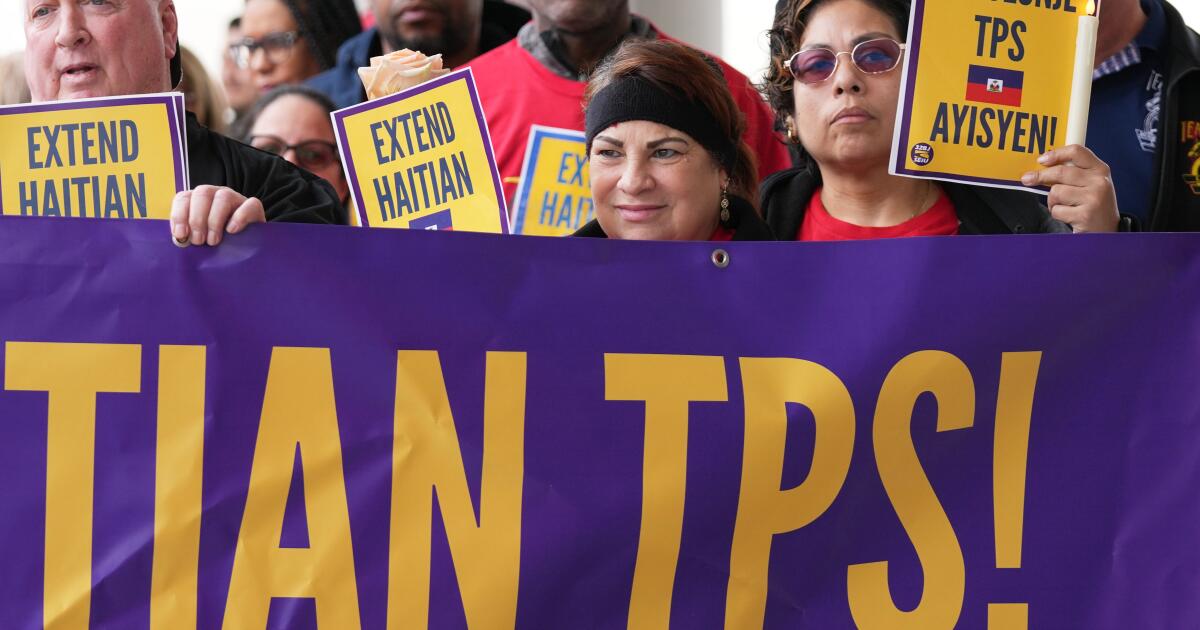
Supreme Court leans in favor of Trump’s bid to end protections for Syrian, Haitian migrants

The Supreme Court’s conservative majority sounded ready Wednesday to rule that the Trump administration may end the temporary protection that has been granted to more than 1.3 million immigrants from troubled countries.

Congress in 1990 authorized Temporary Protected Status, or TPS, for noncitizens who could not safely return home because their native country was wracked by war, violence or natural disasters. If those people passed a strict background check, they could stay and work legally in this country.

But President Trump came to office believing too many immigrants had been granted permission to enter and stay indefinitely.

Last year, his Department of Homeland Security moved to cancel the temporary humanitarian protection for immigrants from 13 countries, including Venezuela, Haiti, Syria, Honduras and Nicaragua. Court challenges on behalf of Haitians and Syrians were consolidated into a single case, Mullin vs. Doe, which the justices heard Wednesday.

Immigrant-rights advocates challenged those decisions as political and unjustified, and they won orders from federal judges that blocked the cancellations.

But Trump’s lawyers filed an emergency appeal at the Supreme Court arguing the judges had overstepped their authority. They pointed to a provision in the 1990 law that bars “judicial review” of the government’s decision to end temporary protection for a particular country.

The justices ruled for the administration and set aside the lower court rulings in a series of 6-3 orders.

Faced with criticism over its brief and unexplained orders, the justices agreed to hear arguments on the TPS issue on the last day of oral arguments for this term.

But the ideological divide appeared to be unchanged.

Solicitor Gen. D. John Sauer said Congress had prohibited “judicial micromanagement” of these decisions, and none of six conservatives disagreed.

UCLA law professor Ahilan T. Arulanantham, representing several thousand Syrians, said the Homeland Security secretary had failed to consult the State Department, which says it is unsafe to travel there.

He said the government “reads the statute like it’s a blank check … to give the secretary the power to expel people who have done nothing wrong.”

Chicago attorney Geoffrey Pipoply, representing more than 350,000 Haitians, said the cancellations were driven by “the president’s racial animus toward non-white immigrants.”

The court’s three liberals argued the administration failed to follow the procedural steps required under the law. But that argument failed to gain traction.

Justice Amy Coney Barrett and her husband adopted two children from Haiti who are citizens. Like most of the conservatives, she asked few questions during the argument.

Source link

Comey appears in court in Trump threat case that’s likely to pose a challenge for Justice Department

Former FBI Director James Comey appeared in court on Wednesday, kick-starting a criminal case against him that legal experts say presents significant hurdles for the prosecution and will likely be a challenge for the Justice Department to win.

Comey, who didn’t enter a plea, was indicted in North Carolina on Tuesday on charges of making threats against President Trump related to a photograph he posted on social media last year of seashells arranged in the numbers “86 47.” The Justice Department contends those numbers amounted to a threat against Trump, the 47th president. Comey has said he assumed the numbers reflected a political message, not a call to violence against the Republican president, and removed the post as soon as he saw some people were interpreting it that way.

The indictment is the second against Comey, a longtime adversary of Trump dating back to his time as FBI director, over the past year. The first one, on unrelated false-statement and obstruction charges, was tossed out by a judge last year. Now prosecutors pursuing the threats case face their own challenge of proving that Comey intended to communicate a true threat or at least recklessly discounted the possibility that the statement could be understood as a threat.

The indictment accuses Comey of acting “knowingly and willfully,” but its sparse language offers no support for that assertion. Acting Atty. Gen. Todd Blanche declined to elaborate at a news conference on what evidence of intent the government has. But broad 1st Amendment protections for free speech, Supreme Court precedent and Comey’s public statements indicating that he did not intend to convey a threat will likely impose a tall burden for the government.

“Here, ‘86’ is ambiguous — it doesn’t necessarily threaten violence and the fact that it was the FBI Director posting this openly and notoriously on a public social media site suggests that he didn’t intend to convey a threat of violence,” John Keller, a former senior Justice Department official who led a task force to prosecute violent threats against election workers, wrote in a text message.

The case was charged in the Eastern District of North Carolina, the location of the beach where Comey has said he found the shells. He is set to make his first court appearance Wednesday at the federal courthouse in Alexandria, Va., the state where he lives.

What the law says on threats

The Supreme Court has held that statements are not protected by the 1st Amendment if they meet the legal threshold of a “true threat.”

That requires prosecutors to prove, at a minimum, that a defendant recklessly disregarded the risk that a statement could be perceived as threatening violence. In a 2023 Supreme Court case, the majority held that prosecutors have to show that the “defendant had some subjective understanding of the threatening nature of his statements.”

Meanwhile, the Supreme Court has found that hyperbolic political speech is protected. In a 1969 case, the justices held that a Vietnam War protester did not make a knowing and willful threat against the president when he remarked that “If they ever make me carry a rifle the first man I want to get in my sights is L.B.J,” referring to President Lyndon B. Johnson. The court noted that laughter in the crowd when the protester made the statement, among other things, showed it wasn’t a serious threat of violence.

Regarding the current case, Merriam-Webster, the dictionary used by the Associated Press, says 86 is slang meaning “to throw out,” “to get rid of” or “to refuse service to.” It notes: “Among the most recent senses adopted is a logical extension of the previous ones, with the meaning of ‘to kill.’ We do not enter this sense, due to its relative recency and sparseness of use.”

Comey deleted the post shortly after it was made, writing: “I didn’t realize some folks associate those numbers with violence” and “I oppose violence of any kind so I took the post down.”

What the government will try to prove

John Fishwick, a former U.S. attorney in the Western District of Virginia, said the government will likely try to prove that Comey should have known better as a former FBI director.

“I think they’re going to try to circumstantially say that you were head of the FBI, you knew what these terms meant and you said them out to the whole world as a threat to the president,” Fishwick said, though he noted that such an argument would be challenging in light of Comey’s obvious 1st Amendment defenses.

Comey was voluntarily interviewed by the Secret Service last year, and the fact that he was not charged with making a false statement suggests that prosecutors do not have evidence that he lied to agents, Fishwick said.

Jonathan Turley, a George Washington University law professor, wrote in an opinion piece published Tuesday that “despite being one of Comey’s longest critics, the indictment raises troubling free speech issues. In the end, it must be the Constitution, not Comey, that drives the analysis and this indictment is unlikely to withstand constitutional scrutiny.”

“If it did,” he added, “it would allow the government to criminalize a huge swath of political speech in the United States.”

Tucker, Richer and Kunzelman write for the Associated Press. Kunzelman reported from Alexandria, Va.

Source link

Kevin Warsh is one step closer to top job at the Fed after Trump’s pick approved by Senate committee

The Senate Banking Committee voted on party lines Wednesday to approve Kevin Warsh as the next chair of the Federal Reserve to replace Jerome Powell, a longtime target of President Trump’s insults for not cutting borrowing costs as far as the president wanted.

The vote was 13-11, with all Republican senators voting in favor and Democrats opposed.

Warsh is a former top Fed official but has also been a sharp critic of the institution and Powell’s leadership. He has called the inflation spike to 9.1% in 2022 the central bank’s biggest policy mistake in four decades. A vote on his nomination probably won’t take place until next month, but he could be confirmed by the time Powell’s term as chair ends May 15.

The Senate Banking vote is the first of two key events surrounding the future of the Fed’s leadership. Also Wednesday, Powell is presiding over what will probably be his last meeting of the Fed’s interest rate-setting committee. At a news conference Wednesday afternoon, Powell may indicate whether he will remain as a member of the central bank’s board of governors after his term as chair ends.

It would be unusual for Powell to stay, but doing so would deprive the Trump administration of an opportunity to appoint a new member to the board. Powell may choose to stay if he sees it as necessary to protect the Fed’s independence, which has become part of his legacy as its leader.

Sen. Tim Scott, a South Carolina Republican and chair of the committee, said Warsh is “battle tested” and added that, “It is incredibly important that we break the bind of Bidenomics on households across this nation.”

Sen. Elizabeth Warren, a Democrat from Massachusetts, criticized the banking panel for voting on Warsh’s nomination. Doing so “will bring the president one step closer to completing his illegal attempt to seize control of the Fed and artificially juice the economy,” she said, citing Trump’s effort to fire Fed governor Lisa Cook and investigate Powell.

The Fed on Wednesday is widely expected to leave its key rate unchanged at about 3.6% for its third straight meeting, defying Trump’s calls for lower rates.

Warsh has called for “regime change” at the Fed and could alter many of its practices, including the economics models it focuses on, how it communicates with the public, and how large its bondholdings will be in the long run.

Those changes could affect financial markets, but otherwise won’t necessarily be visible to the general public. But Warsh has also advocated for additional interest rate cuts, which could potentially lower borrowing costs for mortgages, auto loans, and business loans. He will face barriers to implementing those cuts anytime soon, however, largely because the Iran war has caused a spike in gas prices, pushing inflation to a two-year high of 3.3%.

The Fed typically keeps rates elevated, or even raises them, to combat worsening inflation.

Most of the other 11 members of the Fed’s rate-setting committee have indicated they would prefer to wait and evaluate where inflation and the economy are headed before making any changes to rates. It could take time for Warsh to build up enough influence to push for rapid rate cuts. He will also replace Stephen Miran, a member of the Fed’s rate-setting committee who was appointed by Trump last September and is the most consistent advocate for rate reductions at the central bank.

Warsh also faces questions about his independence from the White House, a key issue that dogged him during a Senate Banking hearing last week. On Wednesday, Warren said, “Mr. Warsh is a Trump sock puppet who is so cowed by the president that he could not even say that Trump lost the 2020 election.”

Last December, Trump called for much lower interest rates in a social media post, and added that “anyone who does not agree with me will never be Fed chair!” And just last week he told Fox Business that he expects rates to head lower, “when Kevin gets in.”

Warsh denied at his hearing, however, that Trump had ever pressured him directly to cut rates.

Rugaber writes for the Associated Press.

Source link

U.S. will issue commemorative passports with Trump’s picture for America’s 250th birthday

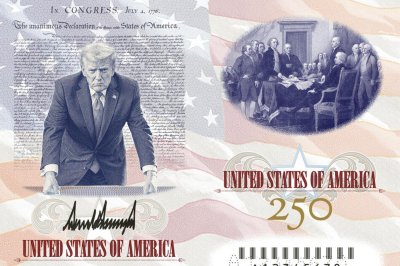
The State Department said that it is preparing a limited release of commemorative U.S. passports celebrating America’s 250th birthday that feature a picture of President Trump, who would be the first living president to be featured in the travel document.

The concept for the special passport, including a rendering of Trump’s stern-looking visage, had been under consideration for months before finally being approved late Monday and publicly announced Tuesday. Between 25,000 and 30,000 of the new passports will be available to applicants at the Washington passport office beginning shortly before July 4.

It’s the latest instance of Trump having his name and likeness added to buildings, documents and other highly visible tributes. There are efforts to put Trump’s signature on all new U.S. paper currency, also a first for a sitting president, as well as to include his image on a gold commemorative coin to celebrate the country’s founding.
The commemorative passport will be the default document for people applying in person at the Washington office, although those who want a standard passport will be able to get one by applying online or outside Washington, officials said.

“As the United States celebrates America’s 250th anniversary in July, the State Department is preparing to release a limited number of specially designed U.S. passports to commemorate this historic occasion,” State Department spokesman Tommy Pigott said.

“These passports will feature customized artwork and enhanced imagery while maintaining the same security features that make the U.S. passport the most secure documents in the world,” he said.

The limited release passport will feature Trump’s picture over a gold imprimatur of his signature to an interior page, while the cover will feature the words “United States of America” in bold gold print at the top and “Passport” at the bottom — a reversal of the standard cover.

In addition, a small gold laminate American flag, with the number 250 encircled by stars, will be at the bottom of the back cover.

The Bulwark reported earlier on the commemorative passports.

The only presidents featured in current U.S. passports are in a double-page depiction of Mount Rushmore in South Dakota — George Washington, Thomas Jefferson, Theodore Roosevelt and Abraham Lincoln.

Other depictions include the Statue of Liberty, the Liberty Bell and Independence Hall in Philadelphia, and scenes of the Great Plains, mountains and islands. Current passports also contain quotations from Martin Luther King Jr. as well as Presidents Washington, Jefferson, Roosevelt, John F. Kennedy and Dwight Eisenhower.

The addition of Trump’s picture and signature to the passport book is the newest step his aides have taken to increase the president’s visibility, including adding his name to the U.S. Institute of Peace building and the Kennedy Center performing arts venue.

Trump also has made waves with his plans for a new White House ballroom and a massive arch to be built at one of the entrances to Washington from Virginia.

Lee writes for the Associated Press.

Source link

Trump, King Charles praise U.S.-British alliance at state dinner

April 29 (UPI) — U.S. President Donald Trump and first lady Melania Trump hosted King Charles III and Queen Camilla at a state dinner at the White House on Tuesday, where both leaders praised the U.S.-British relationship and pledged to strengthen the alliance.

In the East Room of the White House, Trump described the king’s state visit to the White House as “historic,” occurring as they prepare to celebrate the United States’ 250th year of independence.

“It is only natural that Americans begin this by paying tribute to the transcendent bond we share with the nation that Thomas Jefferson himself called our mother country,” Trump said.

“Tonight, on the eve of our 250th year of cherished independence, we turn to the sovereign embodiment of our British heritage and say, sincerely, thank you to our friends, the United Kingdom, for the richest inheritance that any nation has ever given to another.”

He complimented the “fantastic speech” Charles had given only a few hours earlier before a joint meeting of Congress, joking that the king was able to garner a standing ovation from the Democrats.

“I’ve never been able to do that,” Trump said. “They like him more than they’ve ever liked any Republican or Democrat, actually.”

Charles echoed Trump in his own speech that followed, stating that he was glad for the opportunity to renew the “bonds of history and friendship” between their two nations and people.

“Ours is an unbreakable bond of history and heritage, culture and commerce, industry and invention, and we are determined to face the future together,” Charles said.

“Tonight, we are here to renew an indispensable alliance, which has long been a cornerstone of prosperity and security for both British and American citizens.”

Referring to the demolished East Wing where construction is underway on Trump’s $400 million ballroom, Charles joked that he couldn’t help but notice the “readjustments” to the White House followed the president’s visit to Windsor Castle in September.

In the same vein, he jokingly apologized for the British “attempt at real estate redevelopment of the White House in 1814,” when British forces set fire to the building during the War of 1812.

At the end of his speech, Charles presented Trump with the bell from the HMS Trump, a British submarine that the king said played a “critical role” during the Pacific War.

“May it stand as a testimony to our nation’s shared history and shining future,” he said. “And should you ever need to get a hold of us — well, just give us a ring.”

The pair spoke for about 25 minutes before more than 125 attendees, according to the guest list. They included six conservative U.S. Supreme Court justices, several members of Trump’s Cabinet and business leaders Jeff Bezos of Amazon, Tim Cook of Apple and Robert Kraft of the Kraft Group.

A statement from the first lady said the decor of the dinner was intended to reflect “a shared appreciation for gardens,” with guests greeted by cherry blossoms as they entered the Grand Foyer, towering trees and blooming garden boxes.

Tables were clothed in green pleated linens and set with more than 250 pieces of vermeil from the White House collection, the Office of the First Lady said.

The three-course meal included garden vegetable veloute, handcrafted spring herbed ravioli with ricotta cheese and morels, a Dover sole meuniere, potato pave, spring ramps, snow peas and parsley oil.

For dessert, the attendees were served a beehive-shaped chocolate gateau with a vanilla bean cremeux custard inside an almond joconde, all with a creme fraiche ice cream.

Source link

White House hails ‘two kings’ as King Charles delivers pointed remarks | Donald Trump

NewsFeed

King Charles III has hailed US-UK ties at a state dinner in the White House after speaking at a joint session of Congress in a rare appearance by a British monarch. The visit marks 250 years since American independence, and comes amid strains over the war on Iran.

Source link

Trump to feature on limited-edition US passports for 250th anniversary | Donald Trump News

The passports are part of broader plans to celebrate the milestone anniversary of the United States Declaration of Independence.

United States President Donald Trump will feature on a new, limited-edition US passport being issued to mark the country’s 250th anniversary in July, officials said, the latest area of public life to receive Trump’s personal branding.
The commemorative passports are part of broader plans to celebrate the milestone anniversary of the US Declaration of Independence, with events planned across the country next July.

Recommended Stories

list of 4 itemsend of list

Images released by the White House and the Department of State on Tuesday show Trump’s portrait incorporated into the design, set against elements of the Declaration of Independence and the US flag. The rendering also includes the president’s signature in gold.

Another page will feature an illustration of the Founding Fathers signing the Declaration of Independence.

“As the United States marks its 250th anniversary in July, the State Department is preparing to release a limited number of specially designed US passports to commemorate this historic occasion,” said Tommy Piggott, a spokesperson for the US State Department.

The commemorative passports will be available to US citizens applying through the Washington Passport Agency, with distribution set to begin this summer and continue while supplies last.

Current US passports feature images tied to the country’s history and identity. The inside front cover shows a painting of Francis Scott Key after the Battle of Fort McHenry, when he saw the US flag still standing after an attack. This moment inspired him to write a poem that later became the US national anthem, with lines from it printed alongside the image.

Other pages include moments from American history, such as the Apollo 11 Moon landing, and symbols like the Statue of Liberty.

The passport redesign is the latest example of efforts by Trump and his administration to place his name, image or signature on institutions and initiatives across Washington and the country.

Some of those efforts have already been implemented. This year’s national park passes, for example, display Trump’s image alongside George Washington, a departure from the programme’s traditional focus on natural landscapes.

The United States Mint has also released draft designs for a $1 coin featuring Trump’s profile as part of the 250th anniversary commemorations.

Proposed imagery for the coin redesign includes his portrait alongside inscriptions such as “Liberty” and “In God We Trust”. The reverse depicts him raising a clenched fist in front of an American flag with the phrase “FIGHT FIGHT FIGHT”, referencing a chant he used after a 2024 assassination attempt at a campaign rally in Butler, Pennsylvania.

Trump has pushed Democratic Senator Chuck Schumer to rename New York’s Penn Station after him, linking the idea to the release of federal infrastructure funding, but the effort has failed to gain traction.

Trump has also placed his face on government buildings around Washington, DC, in the form of long banners.

Even the architecture of the US capital city is changing to reflect his tastes: Last October, he tore down the White House’s East Wing to build a massive ballroom, and he has plans to build a triumphal arch in the capital, similar to the one in Paris, France.

In December, Trump’s name was added to the Kennedy Center in Washington, DC, just one day after his hand-picked board members controversially voted to rename the art venue, the first time a national institution has been named after a sitting US president.

Within days, workers had added metal lettering to the building’s exterior, renamed as “The Donald J Trump and the John F Kennedy Memorial Center for the Performing Arts”.

Source link

US appeals court rejects Trump’s immigration detention policy | Donald Trump News

In a 3-0 ruling, court says Trump administration misread a decades-old immigration law to justify mandatory detention.

A United States federal appeals court has rejected the Trump administration’s practice of subjecting most people arrested in its immigration crackdown to mandatory detention without the opportunity to seek release on bond.

In a 3-0 ruling on Tuesday, a panel of the New York-based US Court of Appeals for the Second Circuit said the administration relied on a novel but incorrect interpretation of a decades-old immigration law to justify the policy.

Recommended Stories

list of 4 itemsend of list

Writing for the panel, US Circuit Judge Joseph F Bianco, a Trump appointee, warned that the government’s reading “would send a seismic shock through our immigration detention system and society”, straining already overcrowded facilities, separating families and disrupting communities.

Lawyers for the Trump administration say the mandatory detention policy is legal under the Illegal Immigration Reform and Immigrant Responsibility Act, passed in 1996.

But Bianco said the government had made “an attempt to muddy” the law’s “textually clear waters”, arguing that the administration’s interpretation “defies the statute’s context, structure, history, and purpose” and contradicts “longstanding executive branch practice”.

Under the Trump administration policy, the Department of Homeland Security last year took the position that non-citizens already living in the US, not just those arriving at the border, qualify as “applicants for admission” and are subject to mandatory detention.

Under federal immigration law, “applicants for admission” to the US are detained while their cases proceed in immigration courts and are ineligible for bond hearings.

The Department of Homeland Security has been denying bond hearings to immigrants arrested across the country, including those who have been living in the US for years without any criminal history, the Associated Press (AP) news agency reports.

That is a departure from the practice under previous US administrations, when most non-citizens with no criminal record who were arrested away from the border were given the opportunity to request a bond while their cases moved through immigration court, according to AP.

In such cases, bonds were often granted to people who were deemed not to be flight risks, and mandatory detention was limited to those who had just entered the country.

Amy Belsher, director of immigrants rights’ litigation at the New York Civil Liberties Union, said the appeals court ruling affirmed “that the Trump administration’s policy of detaining immigrants without any process is unlawful and cannot stand”.

“The government cannot mandatorily detain millions of noncitizens, many of whom have lived here for decades, without an opportunity to seek release. It defies the Constitution, the Immigration and Nationality Act, and basic human decency,” Belsher said in a statement.

Conflicting rulings set stage for Supreme Court review

The New York court’s decision comes after two other appeals courts ruled in favour of the Trump administration’s policy.

Acknowledging the opposing rulings, Judge Bianco said the panel was parting ways with them and instead aligning with more than 370 lower-court judges nationwide who have rejected the administration’s position as a misreading of the law.

The split among the courts increases the likelihood that the US Supreme Court will weigh in.

The latest ruling also upheld an order by a New York judge that led to the release of Brazilian national Ricardo Aparecido Barbosa da Cunha, who was arrested by immigration officials last year while driving to work after living in the US for more than 20 years.

“The court was right to conclude the Trump administration can’t just ⁠reinterpret the law at its own whim,” Michael Tan, a lawyer for Barbosa at the American Civil Liberties Union, said in a statement.

The Department of Justice, which is defending the mandatory detention policy in court, did not respond to a request for comment.

Source link

King Charles calls for NATO unity, Ukraine support in US Congress speech | Donald Trump News

Britain’s King Charles III has used a speech in front of the United States Congress to pledge NATO unity and call for support for Ukraine amid Russia’s ongoing invasion.

The address on Tuesday came during the royal’s four-day visit to the US, with the US-Israel war with Iran, US President Donald Trump’s criticism of NATO, and trade tensions between the longtime allies looming large.

Recommended Stories

list of 3 itemsend of list

But Charles avoided any reference to specific frictions during his speech at the US Capitol, instead striking a light tone in his joke-heavy opening.
He praised what he called the shared history and values of the two countries, quipping at one point that Washington, DC was “a tale of two Georges”, the first US President George Washington and his ancestor, the UK’s King George.

He assured lawmakers, to laughs, he was not in the US “as part of some cunning rearguard action” in a delayed continuation of the Revolutionary War.

“I am here on this great occasion in the life of our nations to express the highest regard and friendship of the British people to the people of the United States,” the sovereign said to repeated standing ovations.

But amid broad themes of unity, more pointed messages lurked.

Charles did not directly address the US-Israel war with Iran or Trump’s outspoken criticism of NATO allies who have rejected joining Washington’s war efforts.

Instead, he praised support for NATO and the alliance’s invocation of its Article 5 collective defence treaty in the wake of the September 11, 2001 attacks.

“We answered the call together, as our people have done so for more than a century, shoulder to shoulder through two world wars, the Cold War, Afghanistan and moments that have defined our shared security,” he said.

He then turned to funding for Ukraine, an increasingly pointed issue in the Republican-controlled US Congress.

“Today, Mr Speaker, that same unyielding resolve is needed for the defence of Ukraine and her most courageous people,” he said, referring to House Speaker Mike Johnson.

In one instance, Charles hailed the “$430 billion in annual trade that continues to grow, the $1.7 trillion in mutual investment that fuels that innovation”.

Last week, Trump threatened to impose a “big tariff” on the UK if it did not drop a digital services tax on US tech companies.

At another point, Charles pointed to global environmental concerns.

“We ignore, at our peril, the fact that these natural systems, in other words, nature’s own economy, provide the foundation for our prosperity and our national security,” he said.

Trump has called climate change a “con job” and withdrew from the landmark Paris Agreement climate accords during his first and second terms. His administration has since pursued deregulation of fossil fuels and pivoted away from green energy, an approach embraced by many members of the president’s Republican party.

Other messages appeared to gently reference political trends in the US, where critics have accused Trump of using the Department of Justice for political retribution and of overturning long-standing norms of presidential authority.

Charles described the “common ideals” of the US and UK: “The rule of law, the certainty of stable and accessible rules, an independent judiciary, resolving disputes and delivering impartial justice”.

He also drew a throughline between the Magna Carta, the 13th-century document that established that the British king was subject to law, and constitutional and legal precedent in the US, calling it “the foundation of the principle that executive power is subject to checks and balances”.

The address came shortly before Trump was set to host Charles and his wife, Queen Camilla, for an official state dinner.

The pair were then set to visit New York and Virginia, before an official farewell ceremony at the White House on Thursday.

Source link

Ex-FBI Director Comey indicted in probe over online post officials say constituted Trump threat

Former FBI Director James Comey was indicted Tuesday in an investigation over a social media photo of seashells arranged on a beach that officials said constituted a threat against President Trump, according to a person familiar with the matter.

The person was not authorized to publicly discuss the matter and confirmed the indictment to the Associated Press on the condition of anonymity. The charge or charges against Comey were not immediately known.

It’s the second criminal case the Justice Department has brought against the longtime Trump foe, who said he assumed the arrangement of shells he saw on a walk, reading “86 47,” was a political message, not a call to violence. Comey is among multiple foes of the Republican president to come under scrutiny by the Justice Department over the last year, as acting Atty. Gen. Todd Blanche aims to position himself as the right person to hold the job permanently.

Comey was interviewed by the Secret Service in May after Trump administration officials asserted that he was advocating the assassination of Trump, the 47th president. Comey deleted the post shortly after it was made, writing: “I didn’t realize some folks associate those numbers with violence” and “I oppose violence of any kind so I took the post down.”

His lawyer did not immediately respond to a request seeking comment Tuesday.

Merriam-Webster, the dictionary used by the Associated Press, says 86 is slang meaning “to throw out,” “to get rid of” or “to refuse service to.” It notes: “Among the most recent senses adopted is a logical extension of the previous ones, with the meaning of ‘to kill.’ We do not enter this sense, due to its relative recency and sparseness of use.”

Trump, in a Fox News Channel interview in May, accused Comey of knowing “exactly what that meant.”

“A child knows what that meant,” Trump said. “If you’re the FBI director and you don’t know what that meant, that meant assassination. And it says it loud and clear.”

The fact that the Justice Department pursued a new case against the ex-FBI director months after a separate and unrelated indictment was dismissed will likely spark defense claims that the Trump administration is going out of its way to target Comey, who had overseen the early months of an investigation into whether the Republican president’s 2016 campaign had coordinated with Russia to sway the outcome of that year’s election.

The former FBI director was indicted in September on charges that he lied to and obstructed Congress related to testimony he gave in 2020 about whether he had authorized inside information about an investigation to be provided to a journalist. He denied any wrongdoing, and the case was subsequently dismissed after a judge concluded that the prosecutor who brought the indictment was illegally appointed.

Comey was the FBI director when Trump took office in 2017, having been appointed by then-President Obama, a Democrat, and serving before that as a senior Justice Department official in President George W. Bush’s Republican administration.

But the relationship was strained from the start, including after Comey resisted a request by Trump at a private dinner to pledge his personal loyalty to the president — an overture that so unnerved the FBI director that he documented it in a contemporaneous memorandum.

Trump fired Comey in May 2017 amid an FBI investigation into potential ties between Russia and Trump’s presidential campaign. That inquiry, later taken over by special counsel Robert Mueller, would ultimately find that while Russia interfered in the 2016 election and the Trump team welcomed the help, there was insufficient evidence to prove a criminal collaboration.

The department, for instance, is also pursuing a criminal investigation into former CIA Director John Brennan, another key figure in the Russia investigation — one of Trump’s chief grievances and a saga for which he and his supporters have long sought retaliation.

CNN was the first to report the second indictment against Comey.

Richer and Tucker write for the Associated Press.

Source link