The UK’s Foreign, Commonwealth and Development Office (FCDO) has issued new ‘limited to two’ guidance for Thailand
More than a million Brits head to Thailand each year(Image: Chadchai Ra-ngubpai via Getty Images)
Thailand Foreign Office travel advice change – what UK holidaymakers need to know:
The Foreign Office has issued updated travel advice for British tourists heading to Thailand – here’s what you need to know.
Thailand attracts over a million British holidaymakers annually, with tens of thousands living and working in popular destinations like Bangkok, Phuket and Chiang Mai.
Your passport must have at least six months’ validity from arrival date and one blank page. The FCDO warns: “You will be denied entry if you do not have a valid travel document or try to use a passport that has been reported lost or stolen.”
British tourists can stay up to 30 days under the visa exemption scheme for tourism only. Business travellers need appropriate visas before departure.
New restrictions limit visa-exempt land border entries to twice per calendar year. Air arrivals aren’t generally affected by this rule.
All travellers must complete a digital arrival card online up to three days before arrival.
Overstaying carries hefty penalties of 500 Thai baht (around £11) per day, rising to a maximum of of 20,000 baht (around £449). You also risk potential detention, deportation and 10-year bans.
As I drove across the causeway which links the tiny fortress island of Monemvasia to the south-eastern coast of the Peloponnese, the Aegean sparkling on all sides, I recalled a line by Yiannis Ritsos, one of Greece’s greatest 20th-century poets. Ritsos lived in Monemvasia, in a house that is today a museum on a cobble-stretch by the tawny castle walls. A favourite passage goes: “The voyage is neither a leave-taking nor a home-coming – an ethereal bridge …”
The excuse for my trip to the Peloponnese’s deep south – Messinia, the Mani, and Laconia – fell between those two ideas. My mother has roots in the Peloponnese – a sort-of homecoming that I’ve long wanted to explore – and with the summer over and greedy for an adventure to myself, I set out by car, leaving Kalamata, the leafy port city and gateway to the area, on a coastal road circuit.
Autumn in the Peloponnese is another Greece. Forget the Cycladic white and blue; mountain valleys are carpeted in pine forests and wildflowers, a great stretch of green studded with rustic limestone houses. These villages, relieved by the end of a scorching summer, celebrate boisterous harvest festivals for wines, oranges and chestnuts in Laconia, figs in Messinia, and olives near Kalamata. This is the Greece the diaspora yearns for: the chorio – a word that snaps us back to our relatives and Greek rural life, villages where the air is healthy, eating depends on what is grown metres away, and tavernas are alive with locals rather than tourists. In the shoulder season, the weather is cool enough for long walks along the region’s spectacular trails but, at about 25C, is also still good for swimming.
The two-hour drive to Monemvasia began with the Taygetus pass, winding through villages and cliffside tunnels as golden eagles soared above the firs. On the far side of the Taygetus, the road opened to Mystras, an archaeological Byzantine site stacked up its hillside. I climbed to the Paleologian Palace and its chapels, then descended, hungry, to the village of Parori, where Taverna Ores was serving syglino, the local cured pork, and an okra stew. I practised my flimsy Greek with the waitress and her mother, who kept one eye on a television gameshow while stirring the stew pots.
The Byzantine Greek architecture of Monemvasia. Photograph: Kisa_Markiza/Getty Images/iStockphoto
After lunch I stopped at Sparta – site of the ancient city state and modern metropolis. Beneath the Taygetus, in the spectral hush of the olive groves, there is an acropolis, an agora and little else. Yet the air carries something over the ruins, and it’s a short but necessary stop. A statue of Leonidas, hero of Thermopylae, stands facing the new city with the ruins at his back.
This is still the Greece of the Spartans: locals remain fiercely attached to their ancient ancestry. Monemvasia has a thrilling connection: in AD600, a bishop is said to have led the Spartan population to the rock to fortify themselves against invading tribes. Set on to a slope inside the castle walls is a town of tight passages and medieval Orthodox churches. It is a vivid encounter with Byzantine Greek architecture, as well as traces of Venetian trade: the sweet, fortified wine malvasia was once a prized export. Even my guesthouse, Kelia (rooms from €70), began as a monks’ residence on the sea-facing Chryssafitissa Square.
Leaving Monemvasia, I took a detour south for the golden sand dune beaches in Elafonisos. Reaching this island requires taking a 10-minute ferry ride from Pounta. The turquoise waters of Simos beach are deserted in the off-season – a necessary respite before my hour drive north-west to spend a night in Gythio. This working harbour town has neoclassical pastel mansions and waterfront restaurants provisioned by local fishers. Here the Mani begins.
Simos beach is reached by ferry from Pounta. Photograph: Constantinos Iliopoulos/Alamy
“Victory or death” reads the Maniot banner, above the Spartan motto “With the shield, or on the shield”. The region has a reputation for a conservative way of life that might seem unfashionable in modern Greece, but I find it seductive. The Mani’s beauty comes partly from its insularity. Driving an hour to Vathia, rugged mountains are crowned by labyrinthine stone tower villages that Maniot clans built to protect themselves during periods of vendetta or skirmishes with the Ottomans. Some are now ghost towns. Others have been converted into guesthouses.
But it was in Gerolimenas that a Greek friend suggested I stay for a few nights. The seaside village is an easy base for touring both western and eastern coasts. Along the latter, I hiked to mainland Greece’s southernmost point, Cape Tainaron lighthouse and went for an impromptu dip. The Mani’s water is so gin-clear the boats appear to hover above the surface.
The Akroyiali hotel (doubles from €80 B&B) opened in the 1970s, before most of the region’s roads. It is built on Gerolimenas’s shore, so I dozed to the pulse of waves and chatter from the hotel’s taverna below, where owner Mr Theodorakakis and his family entertained guests.
Kardamyli, a popular village on the Mani that quietens in autumn. Photograph: Stephen Hughes/Alamy
“The Mani is changing at its own rhythm,” Theodorakakis told me. “This is a special place. We can’t keep hiding from the world.” Most Greeks prefer to visit off-season, he said. “You can actually explore the region without burning. But be careful of the north-eastern wind. It cuts through!”
Leaving Gerolimenas, I drove 30 minutes up the western coastal route, entering the busy town of Areopoli, where I shopped for hand-harvested sea salt and wild oregano. Pretty Limeni and Kardamyli – the home of British writer Patrick Leigh Fermor (who popularised the region) – get the Mani day-trip overspill from Kalamata. Regardless, it’s quieter in autumn. Every hairpin bend opens on to sea views, flowers and limestone.
I was lunching over one such view of a grassy cape when the taverna owner mentioned a woman in the village who knew miralogia. These are wailing Maniot lamentations sung at funerals, which are heard rarely these days. After two days of asking around, I found Kaiti Braimi in a small chapel where she agreed to sing. “In a way, they’re less necessary,” the octogenarian told me. “No more vendettas.”
The Polylimnio waterfalls in Messinia. Photograph: PitK/Alamy
The haunting rhythms of the miralogia were in mind as I left the Mani to enter Messinia – cutting through Kalamata again, but this time heading west. Here, the villagers were celebrating. Clarinets hummed in taverna gardens at Sunday family parties and relatives joined hands in circles to dance the kalamatianos. Passersby stood and clapped before being dragged in.
On the hour drive from Kalamata to Pylos – which would be my base – the Maniot mountains flattened into lush forests. Wildflowers bloomed on the roadside. Yet in Messinia’s expansive green are traces of ancient civilisations, including the bronze age palace of Nestor, north of Pylos.
My route sidetracked to the Polylimnio waterfalls. You can sidetrack easily in Messinia; there are unspoiled beaches (like Tsapi on the south coast, where mountains tumble into the sea), as well as areas for canyoning, cycling and kayaking. After a small hike, I bathed in clear pools surrounded by pines, alone mostly, apart from an Athenian couple. “We’re here for my birthday,” the man said. “Messinia is the best place in Greece for outdoor activities.” They pointed me to a canyoning trail north of the Bay of Navarino – a tip for my next visit.
That evening in Pylos’s port, only an hour from where I began my voyage in Kalamata, I paused for an ouzo at a kafenion. A group of lads were watching Greece play Germany at football on the television. They wailed their own miralogia with every missed shot, but when the game ended in a win the cafes along the harbour roared.
I thought back on my drive through the Peloponnese’s deep south, a journey that revealed a rural Greece I’d grown up romanticising from family, and believed was slowly disappearing. But not here. In the mountains and shores of Messinia, the Mani and Laconia, I found a Greece for all seasons.
BUS fares are set to soar to a historic high in November, affecting millions of workers.
A single adult bus and tram fare in London will rise by 10p to £1.85 from next month, Transport for London (TfL) has announced.
Bus and tram single fares will rise 10p from November 1Credit: Getty Images
It means the cost of fare has gone up by 35p alone in the last 10 years, although there has been a freeze on price hikes in place since March 2023.
Those with concession cards, like 16+ Zip Oyster cards or the Jobcentre Plus card, will also have their fares increase by 5p when the new prices come into effect on November 1.
Sign up for the Travel newsletter
Thank you!
In a blow to millions of people who use London’s bus and tram network every day, the hike will also affect the Hopper fare, which allows travellers to pay a single flat fare for unlimited journeys within an hour.
The daily bus and tram cap will increase to £5.55 from £5.25.
Originally, London Mayor Sir Sadiq Khan was set to hike prices in July.
But he extended the price freeze until November, after TfL said it was “an emergency cost-of-living measure to support Londoners on the lowest incomes”.
Price caps for tube, rail and Travelcards will remain frozen until March next year, TfL added.
The voluntary scheme will see millions of people across England able to access single bus tickets for £1 less than the current £3 cap – but it won’t apply to every single bus route.
School buses, buses that only run on school days and some other services won’t be subjected to the £2 cap, which will run until December 31, 2027.
A look at your rights if a flight is delayed or cancelled, when your entitled to compensation and if your travel insurance can cover the costs.
What are my rights if my flight is cancelled or delayed?
Under UK law, airlines have to provide compensation if your flight arrives at its destination more than three hours late.
If you’re flying to or from the UK, your airline must let you choose a refund or an alternative flight.
You will be able to get your money back for the part of your ticket that you haven’t used yet.
So if you booked a return flight and the outbound leg is cancelled, you can get the full cost of the return ticket refunded.
But if travelling is essential, then your airline has to find you an alternative flight. This could even be with another airline.
When am I not entitled to compensation?
The airline doesn’t have to give you a refund if the flight was cancelled due to reasons beyond their control, such as extreme weather.
Disruptions caused by things like extreme weather, airport or air traffic control employee strikes or other ‘extraordinary circumstances’ are not eligible for compensation.
Some airlines may stretch the definition of “extraordinary circumstances” but you can challenge them through the aviation regulator the Civil Aviation Authority (CAA).
Will my insurance cover me if my flight is cancelled?
If you can’t claim compensation directly through the airline, your travel insurance may refund you.
Policies vary so you should check the small print, but a delay of eight to 12 hours will normally mean you qualify for some money from your insurer.
Remember to get written confirmation of your delay from the airport as your insurer will need proof.
If your flight is cancelled entirely, you’re unlikely to be covered by your insurance.
HM Passport Office has issued an urgent alert to UK passport holders
You’ll need a valid passport to travel internationally(Image: Lu ShaoJi via Getty Images)
HM Passport Office (HMPO) has issued an alert to all UK passport holders, urging some to act “as soon as possible”.
Anyone in the UK wishing to travel overseas requires a valid passport to do so, and applicants must hold British nationality to apply for or possess a British passport. That said, having British nationality does not automatically guarantee you a passport. You may not get a new one – or have an existing one confiscated – in a number of circumstances.
These include being under suspicion of a serious crime, being on bail, or having previously been repatriated to the UK at the government’s cost without repaying the sum. Many people may also be unaware that your passport never truly belongs to you – it remains government property and can be revoked or withdrawn at any point.
In a fresh warning on X, formerly Twitter, on Friday, HMPO shared some crucial advice for British passport holders. The post reads: “Lost your passport? Report it as soon as possible. Doing so helps protect against misuse and allows you to apply for a replacement.”
Additional guidance on GOV.UK clarifies that reporting your passport as lost or stolen straight away will “reduce the risk of anyone else using your passport or your identity”. You can report a lost or stolen passport on behalf of someone else if they’re unable to do it themselves.
How can I get a new passport quickly?
For those requiring a new or replacement passport as a matter of urgency, a one-day service is available, although “the earliest you can get an appointment is two days after you apply”. You will be required to surrender your old passport at your appointment.
Your new passport will be ready to collect from the passport office four hours after your appointment. Bear in mind this service is exclusively available for adult passport renewals, and carries a cost of £239.50.
Content cannot be displayed without consent
If you find yourself overseas and in urgent need of travel documents, you may be eligible to apply for an emergency travel document, though a fee will apply. Should you go down this route, there is no need to cancel your existing passport immediately, as it will be cancelled automatically as part of the emergency travel document application process.
IT’S easy to get into the festive spirit at a Christmas market and they’re even better on the cheap.
In one city that Brits can reach in three hours for less than £30, hotels are £15 per night, and mulled wine at festive stalls is as little as 82p.
Sibiu Christmas has stalls, rides and mulled wine for less than £1Credit: AlamySibiu can be reached from the UK with direct flights that take 3 hoursCredit: Alamy
Sibiu in Romania is the ideal city for a festive break and it was even named as the 18th most underrated destination by Time Out last year.
Not to mention it’s cheap, eurochange has compared the prices of mulled wine across 55 Christmasmarkets across Europe, and Sibiu came out on top.
Sign up for the Travel newsletter
Thank you!
A warm cup of infused red wine can be bought from 82p which is hugely cheaper than in the UK, where it can more than £7 a cup.
And you’ll be able to buy it soon too, as its Sibiu Christmas Market is set to open on November 13 all the way through until January 3, 2027.
Held in the Grand Square, the Christmas Market is completely free to enter.
There’s plenty to do, from hopping on the Ferris Wheel, to visiting Santa in his workshop, ice skating, and relaxing at the Chalet where festive drinks (including mulled wine) are served.
On certain evenings, the Chalet will even turn into a party spot with a live DJ.
One visitor described is as ‘magical’ and a ‘photographer’s playground’.
Outside of the Christmas market, there’s lots to see like The Bridge of Lies which has lots of legends and myths behind it – and when lit up at night, can make for a great picture spot too.
Another must-see spot in Sibiu is Muzeul Astra, the largest open-air museum in Europe.
The Christmas market in Sibiu will open in early NovemberCredit: Alamy
Talking to Sun Travel, one Wizz Air flight attendant explained why Sibiu is a must-visit destination.
Niko said: “I’ve been to Sibiu in Romania several times already.
“You have the mountains, so there’s lots of nature, the food is amazing, everything is cheap and the people are so friendly.
“And you should try Papanasi. It’s a Romanian dessert that’s like a doughnut. It tastes amazing, but not good if you’re on a diet.”
It’s not just mulled wine in Sibiu that’s affordable – the price of a local pint of beer is less than £2 on average, according to Wise.
The price of a meal can be bought for less than £5 and coffee on average is also less than £2.
Brits can fly directly from London Luton to Sibiu three times a week with Wizz Air and one-way fares start from £26.99.
On Booking.com, one-night stays during November in Sibiu can cost less than £30 per night – or £15 each.
The Old Town is filled with pretty cafes and restaurantsCredit: Alamy
Here are the cheapest place for mulled wine in 2026…
Here are eurochange’s cheapest places for mulled once – and the average price of a cup…
Sibiu, Romania – 82p
Brașov, Romania – £1.63
Craiova, Romania – £1.63
Sofia, Bulgaria – £1.76
Olomouc, Czechia – £1.77
Brno, Czechia – £1.77
Gothenburg (Christmas at Liseberg), Sweden – £1.89
This gorgeous town is tucked inside one of the country’s most beautiful regions.
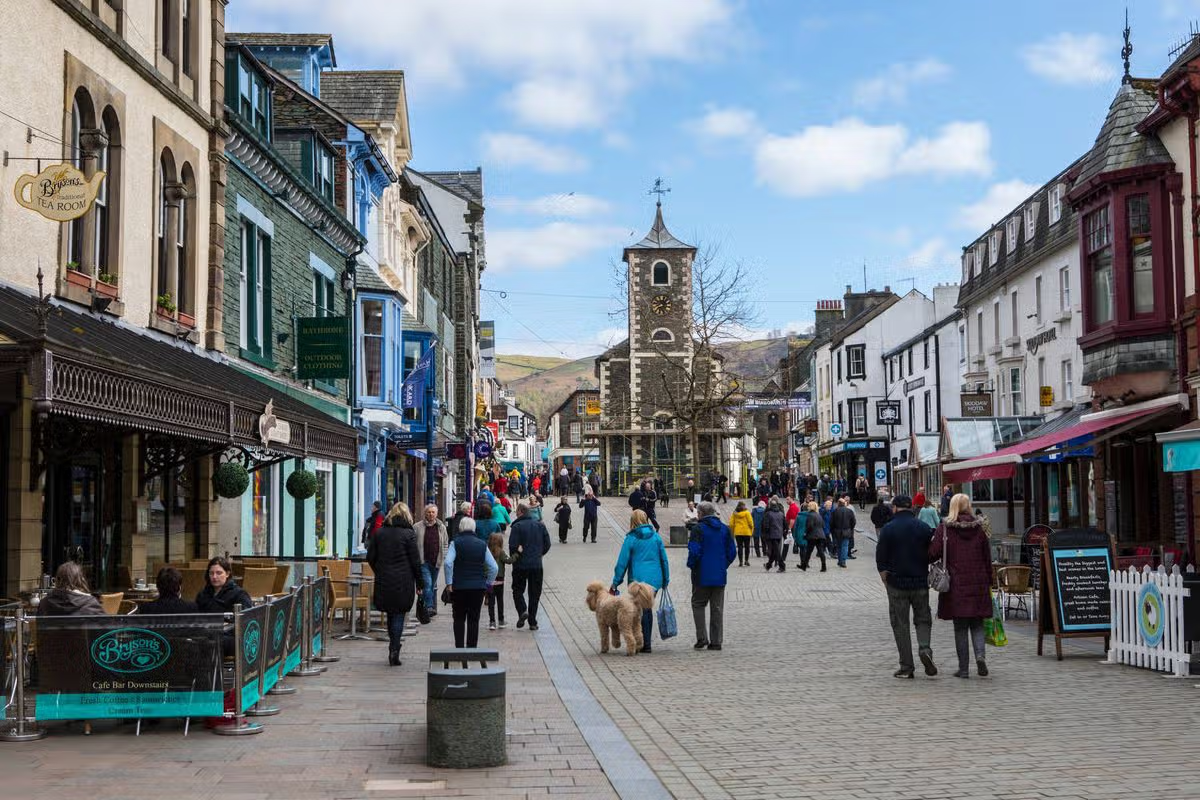
This gorgeous market town is a great place to explore(Image: chrisdorney via Getty Images)
One of the great pleasures of being on holiday is browsing the shops of wherever you happen to find yourself. Unearthing hidden gems or tasty local treats to take back home is one of the finest parts of any trip away.
Nestled in a stunning corner of the UK is a town boasting a market brimming with treasures that has been running for hundreds of years. The charming town of Keswick sits within the Lake District and is renowned for its breathtaking scenery – and naturally, its market.
Before the market as it exists today came into being, churchgoers would hold unofficial ones in the nearby church.
In order to regulate trading, the town was granted a Royal Market Charter in 1276 that gave it the legal right to hold a weekly Saturday market and an annual five day fair.
Today, the market continues to flourish and can be visited every Thursday and Saturday. There are roughly 60 different stalls to browse, selling everything from locally produced food and drink to vintage clothing and artisan gifts.
It’s not solely the market that makes Keswick such a wonderful destination. The town is also packed with stunning lakeside walks that burst into glorious shades of gold and orange throughout the autumn months.
As the leaves begin to turn, now is arguably the ideal time to pay Keswick a visit.
The market town sits in the northern section of the Lake District National Park, and ranks among the nation’s most stunning locations.
There’s an abundance of remarkable walks that highlight the area’s natural splendour. If you’re seeking panoramic vistas, then the Latrigg path is essential, winding up the hillside for three miles.
Upon reaching the top, you’re treated to sweeping views across Keswick and the neighbouring Derwentwater.
Another essential walk is the Castlerigg Stone Circle route which guides you along the former railway path, then up the lane towards the Castlerigg Stone Circle.
The stone circle occupies a natural plateau, and stands as one of Britain’s oldest stone circles stretching back to the Neolithic era.
Some of the 38 stones within the circle tower up to 10 feet high.
Scott, from Cheshire, had visited Hurghada in Egypt twice before, but a taxi ride back from a nightclub on his last trip has put him off returning to the Red Sea destination for good
Scott had enjoyed a night in Hurghada when the scam took place
A Brit has vowed never to return to an Egyptian holiday hotspot after he was scammed.
Scott, from Cheshire, had visited Hurghada in Egypt twice before, but a taxi ride back from a nightclub on his last trip has put him off returning for good. Despite being warned by holiday reps to agree to a total fare before getting in, Scott and his friends ended up paying well over the odds by the end of the ride.
“The worst part is how it’s stuck with me. I’d been to Hurghada twice before and enjoyed it, but that one journey ruined the whole holiday. You forget all the good bits, and that’s the part that stays with you. It’s put me off going back for good,” Scott told the Mirror.
The incident unfolded after an evening out in the beach resort city, which sits on Egypt’s Red Sea coast.
“It was the strangest taxi journey I’ve ever experienced. We’d been told to always agree on a total price before getting in, so that’s what we did. But partway back, the driver pulled over and went off to get himself some food,” Scott explained.
When they got back to the hotel, the taxi driver announced a different, much higher price than they’d expected.
“When we finally got back to the hotel, he suddenly wanted us to pay per person. It felt like, these are tourists, we’re going to rinse them,” Scott said. The situation quickly escalated when the driver mentioned that they would call the police. Unable to speak the local language and unsure whose side the police would take, Scott focused on keeping things calm, and the group ended up paying more than they had agreed just to bring it to an end. “My friend was getting really anxious, and all I could think was, if the police turn up, who are they going to believe?” he explained .
“Honestly, it left me feeling really uneasy and quite vulnerable. We’d done everything we were told to do and agreed a total price before getting in, so when the driver suddenly demanded we pay per person, it felt like we were being taken advantage of just because we were tourists. Once he started talking about calling the police, that unease turned into real anxiety. My friend was getting really worked up, I couldn’t speak the language, and all I could think was, if the police turn up, who are they going to believe? In the end I just wanted it over, so we paid more than we’d agreed to keep things calm.
“It ruined the whole holiday. You forget all the good bits, and that’s the part that stays with you. Now I’d use Uber or a local app wherever I can, because you know the price before you get in. Having one guide or site that shows you which apps work in each destination and what an average fare looks like would give people that confidence before they even arrive.”
It’s experiences like Scott’s that led Confused.com to create its interactive global taxi guide. Travellers can search any destination to see which apps to use, what a typical fare looks like and the local tips worth knowing before they set off.
Do you have travel story to share? Email webtravel@reachplc.com
ANYONE planning to get to London Heathrow this weekend should check travel options before heading to the airport.
Major engineering works will see one tube line partly close and two other services to the terminals will be scaled back.
Anyone heading to Heathrow on the train or tube could run into problems this weekendCredit: GettyOn both days there will be no service to London Heathrow on the Piccadilly LineCredit: Getty – Contributor
On both Saturday and Sunday, the Piccadilly Line will have no service between Hammersmith and London Heathrow terminals.
There will also be no Night Tube service on October 16 – normal service is expected to resume on October 19.
Sign up for the Travel newsletter
Thank you!
Travel to or from Heathrow Airport on the Elizabeth Line will also experience issues.
Services on Saturday will run as usual, but on Sunday, there will be a reduced service between Paddington and Heathrow Terminal 4.
EVERY parent knows that taking a toddler on holiday often feels less relaxing getaway and more like a parenting shift in a different location.
Don’t worry – we’ve found the ultimate cheap holiday for parents with under 5’s where everything’s taken care of for you – plus the kids even eat for free.
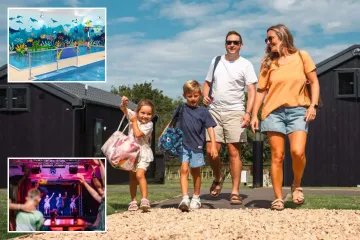
Parkdean Resorts offer four-night Tots Breaks where children under 5 eat for freeCredit: Alamy
Book a four-night Tots Break from £6.19pp per night (save £70)
Parkdean Resorts are running Tots Breaks packages, four-night stays starting from £99.
If you’re visiting as a family of four, that works out to a tiny £6.19pp per night.
Sign up for the Travel newsletter
Thank you!
These action-packed breaks are bursting with free activities and entertainment that’s sure to keep the little ones smiling.
However, the best part may just be the food. On a Tots Break, kids eat completely free for the entire duration of your stay.
That means hot breakfasts, lunches, and dinners are totally sorted, saving a family up to £70 on their holiday dining.
Fussy eaters are well-catered for with the Starland Krew Menu, with kid-friendly classics like tomato pasta, beef burgers, and chicken strips with chips.
You won’t need to constantly dip into your wallet to keep them entertained, either. These breaks are packed with free activities tailored specifically to young children.
Kids can burn off energy at the Tots Adventure Playground, get stuck into messy play, or enjoy the musical Tots & Tunes sessions.
Plus there’s even adorable ‘Mini Olympics’, mini archery, and mini fencing classes.
And if your kids are completely obsessed with their favourite TV characters, you’re in luck.
There are plenty of activities for under 5’s across Parkdean Resorts’ holiday parksCredit: Parkdean Holidays
Book a four-night Tots Break from £6.19pp per night (save £70)
Parkdean Resorts host Milkshake! Mornings packed with stories and singing, plus the chance to meet PAW Patrol legends like Chase and Marshall in the flesh (well, in the fur).
The fun is perfectly timed for early bedtimes, too. Early evening entertainment includes toddler discos, ‘kideoke’ sing-alongs, and even a fun ‘Sparkle Like a Princess’ event.
When it’s finally time to crash, the accommodation is set up for families.
The standard Bronze caravans are spacious, featuring stylish cream-coloured interiors, fully equipped modern kitchens, and TVs for a chilled movie once the kids are asleep.
Tots Breaks are available across dozens of Parkdean Resorts locations nationwide throughout the year.
Participating parks include Sandford in Dorset, a peaceful woodland park close to Poole and Bournemouth, and Trecco Bay in Wales, which is one of Europe’s largest holiday parks.
If you have older children, they may enjoy a Parkdean Resorts’ Nickelodeon Weekender instead.
These breaks start at £163 for three nights, working out to £13.58pp per night for a family of four.
Nickelodeon-themed entertainment includes ‘Mighty Missions’ set by PAW Patrol’s Ryder, learning the Pup Pup Boogie dance, and meeting the Teenage Mutant Ninja Turtles.
Families can even enjoy a ‘Movie with the Stars’, where you’ll sit down to a movie night alongside the actual characters from the film.
Kids under 5 can enjoy three meals a day as part of the Tots Break packageCredit: Parkdean Holidays
Book a four-night Tots Break from £6.19pp per night (save £70)
FANCY a stay inside a haunted hotel this Halloween? Consider a night at Ettington Park in Stratford Upon Avon.
The property is home to so many ghosts that the AA declared it to be the most haunted hotel in the country, with plenty of ghostly sightings by guests.
Ettington Park Hotel in Stratford is considered the most haunted hotel in the UKCredit: @ettingtonparkhotel/InstagramThe Long Gallery is said to be one of the most haunted rooms in the hotelCredit: HeadBox
Ettington Park’s roots go all the way back to the time of William the Conqueror, and as many as 21 ghosts are said to wander its corridors.
Guests and staff have reported sightings of a woman standing by their bed, floating candles and even taps turning on on their own.
Sign up for the Travel newsletter
Thank you!
One of the most commonly sighted ghosts is Lady Emma in White, who is believed to be a former governess – she wears a long white gown and vanishes into solid walls.
An older Victorian woman has also been seen and heard walking near the conservatory, while others have seen the ghost of a man walking with his dog inside the library.
One member of staff even claimed that on Christmas Eve, a candle lifted up off the mantelpiece and floated by itself.
The Long Gallery on the top floor has a vaulted ceiling and is said to be one of the eeriest parts of the building.
Lots of guests have taken to social media after their stay to reveal their experience, with one writing on Facebook: “I woke in the night feeling rather cold and was hit by a feeling of pure fear. It felt like someone was leaning over me and so close I couldn’t move .
“The room was completely black but I was totally convinced someone was there. I don’t know how long I lay terrified before I screamed.”
Another said that during their stay they woke up in the middle of the night to find the taps running and had to “sleep with the lights on all night.”
Talking to The Sun, another guest said that he woke and was laying in bed when he saw a light under the door.
It’s said that a Roman villa once existed on the site of the hotelCredit: Hand Picked Hotels
When he opened it, he “saw this woman standing there, screaming, but there was no sound. I was really freaked out.”
The hotel is tied closely to The Shirleys, one of Warwickshire’s oldest families and has owned Ettington for many years.
There’s evidence that people have been living in the area for at least 2,000 years and that it’s possible a Roman villa once existed on the site of the Ettington Park Hotel.
Next door is a private chapel with a graveyard and tombs, ancient headstones and a pet cemetery.
The hotel has a beautiful swimming pool and spa areaCredit: @ettingtonparkhotel/InstagramStays at the hotel start from £125 per nightCredit: Hand Picked Hotels
The hotel even featured in the 1963 film‘The Haunting’ which follows a small group who spend several nights in a sinister, isolated mansion to investigate whether it is truly haunted.
Aside from its hauntings, visitors describe the hotel as incredibly beautiful and it’s a popular wedding venue too.
If you fancy a stay and perhaps a glimpse of a ghost, the hotel has a variety of rooms from superior to feature and classic.
Meals are served in the grand Drawing Room which has tapestries and enormous windows with views of the grounds.
Afternoon tea is popular too and starts from £29 per adult.
The hotel even has its own spa with a huge swimmingpool, hot tub and treatments too from manicures to massage.
Karina Longworth loves Los Angeles for all its quirks and charms.
Born and raised in the San Fernando Valley, the film critic, author and journalist has made a career out of celebrating her city. Her podcast “You Must Remember This,” about “the secret and/or forgotten histories of Hollywood’s first century,” has spent 21 seasons diving into the intricacies of the movie industry, from lauded stars to undersung production designers. (Its new season, “The Bisexuals,” tells the story of singer turned actor Libby Holman, whose love life would later intersect with the now-famously queer screen star Montgomery Clift.)
In Sunday Funday, L.A. people give us a play-by-play of their ideal Sunday around town. Find ideas and inspiration on where to go, what to eat and how to enjoy life on the weekends.
She’s also fiercely loyal to the hangouts and haunts she grew up frequenting.
“Until they closed down three or four years ago, my favorite Indian restaurant was this place in Studio City on Ventura Place called Gangadin,” she says. “That was the only place I would order from, and I have not been able to find an Indian spot that I like since just because I’m comparing it to Gangadin, which probably wasn’t even the most authentic or the best. It’s just what I had been eating for 30 years.”
Here’s how Longworth would spend her perfect Sunday in L.A., from a stroll down Mulholland Drive to grabbing a cup of frozen yogurt with a cinematic spin.
This interview has been lightly edited for length and clarity.
9 a.m.: Get up and grab a latte
I try to sleep as late as possible, but the older I get, the harder it is to actually sleep in. Ideally on a perfect Sunday, I would sleep until 9. It doesn’t always happen, but I try.
My favorite place to get coffee in L.A. is Kings Road Cafe. I’ve been going there since the ‘90s, and I still think they have the best coffee in Los Angeles. It’s very strong and they give you a large portion, and I find that you rarely get both of those things in L.A. (I like a coffee that can last me multiple hours.) I’ll usually get an almond milk latte — iced if it’s warm out, hot if it’s not.
10 a.m.: A Laurel Canyon hike
Probably what I’d do next is go over to Laurel Canyon. I built my recording studio in a tiny house at the end of a cul-de-sac in Laurel Canyon a few years ago, and I really like hiking around there. So I’d drive up, park there, and then walk up Laurel Pass to the Nancy Hoover Pohl Overlook.
The first half of that walk is really tough because it’s just straight uphill until you get to Mulholland, but I like it because it’s not a hiking trail, so it’s not dusty and there aren’t that many people. There’s an element of solitude and quiet to it, and I love that the end of it is all downhill so you can just kind of run down and get it over with.
Growing up in the Valley, I always romanticized Mulholland Drive, which was always quote-unquote “over the hill.” There’s something about manifesting and then realizing my ideal adult life that I can come to understand by standing at the overlook and looking at the other side, remembering when I dreamed of living where I do now.
In the ‘80s and ‘90s, the Valley wasn’t what it is now. There wasn’t an Alfred Coffee or anything like that. It was a few years behind the times compared to Hollywood or Beverly Hills, where all the cool stuff that I wanted to do was usually happening. All the good record stores, all the good bookstores and movie theaters.
I used to go to the Silent Movie Theater when I was a teenager or the Beverly Cinema, which is now the New Beverly. I’d go to the Nuart all the time, too. I saw a lot of important movies at the Sunset Five, which is now called the Landmark Sunset [Hollywood] and isn’t going to be showing the 2026 equivalent of “Gummo.” I think being in the Valley just felt like being in the Los Angeles version of suburbia and so it was like, “I’ve got to get out of here and go to where things are actually happening.”
11:30 a.m.: An old favorite
After that walk, I’ll go back to my place in Laurel Canyon to have a shower and get dressed and then it’s off to Art’s Deli on Ventura Boulevard in Studio City, which is a place that I’ve been going to since 1987. I had friends that worked there in high school, too, so I was there almost every day having matzo ball soup and coffee.
There used to be a lot more really good delis in L.A. My favorite actually was Solley’s in Sherman Oaks, where I used to go with my grandfather. I’ve never had white fish salad that’s better than what they had at Solley’s, but Art’s Deli is good, too. I really like their knishes, or I’ll get a half-sandwich and soup. I’d probably do turkey on rye with mustard, but with coleslaw and Russian dressing on the side so I can add small amounts when I want. That and a cup of split pea soup.
1 p.m.: Sweet treats
Ideally after lunch, I’ll get dessert at Humphrey Yogart. It’s sort of a funny joke that I’ve become this classic movie person and there’s this frozen yogurt place inspired by the name Humphrey Bogart, but I’ve actually been eating Humphrey Yogart since before I knew who Humphrey Bogart was.
They take frozen yogurt — sweet or tart — add mix-ins, and then put it in this crazy blender that’s like a giant drill with a handle that comes down. I like to do sort of a fake Cherry Garcia with cherries and some kind of nut, but they also have an option called Killer Chocolate where they take plain tart yogurt and add a dark chocolate syrup, which I really like. I’ll add orange and espresso to that, and sometimes I’ll have them put sprinkles on top because sprinkles are amazing.
2 p.m.: Movie magic
I love to go to the movies. On Sundays at the Los Feliz Three, they do something called “Sunday Print Edition” where they show a 35mm print and have somebody come and talk about it, which is always cool. Or if there’s a festival happening at the Egyptian or something I wanted to see at Vidiots, maybe I’d do that.
I think the Egyptian is probably my favorite movie theater in L.A. It’s historic, it’s beautiful inside, and I find that the projection and programming are both very good. It’s also close to where I live so that’s convenient and, assuming they’re open, you can go have a drink or food at Musso and Frank after, which is perfect.
4 p.m.: Dodgers and drinks
Usually on Sundays, the Dodgers play at 1 o’clock, but if it’s a nationally broadcast game sometimes it’ll be on at 4 o’clock. If that’s the case, then I’d like to go to Colombo’s to sit at the bar, have a drink, and watch some of the game.
I think I’d have either a vodka martini, a Manhattan on the rocks, or maybe a glass of wine. Colombo’s is my favorite place to watch a Dodger game that’s not a sports bar. I don’t really love sports bars anyway, but if it’s a big World Series game maybe I’d go somewhere in Koreatown that’s more sporty to watch. But for sitting in a dark bar to watch an hour and a half of a game while you have one or two drinks, Colombo’s is perfect.
6 p.m. Dinner at Da Prato
Right now, I really like Da Prato, which is run by this chef Elisa Da Prato, and she’s calling it a supper club. It’s in this strange almost-loft space on 2nd Street downtown, and I’ve been there three times since early July. Each time it’s gotten busier and busier, too, so I think word of mouth is growing.
She just makes very beautiful traditional but artistically done Italian food. Everything is homemade, and it’s very L.A., but at the same time, it feels like you stumbled into some small place in an alleyway in Rome because it’s informal and they only have a small staff. It’s such a great experience, but you have to think of it in a European way because it’s not a place where you’re going to get in and out in 45 minutes. You’re going to have several courses, you’re going to linger over your food, order a couple bottles of wine, and everything’s going to be very relaxed and wonderful.
If I can’t go to Da Prato or if I need a more “special occasion” place, I’d do Jacaranda, which was started by chef Daniel Patterson and his wife, Sarah Lewitinn. I’ve been internet friends with Sarah for 15 to 20 years, so I went a couple times when they were doing it as a pop-up in their house, and now I’ve gone once since they opened the official restaurant. I’m not normally a tasting menu person because some places it can feel like too much food, but Daniel’s cooking is so phenomenal and you can absolutely manage to eat all 12 courses without feeling like you want to die.
10 p.m.: Skincare and sleep
After dinner, I’d head home and maybe take a little walk to burn off dinner a bit. Otherwise, it’s time for my nighttime routine, which is boring middle-aged lady stuff like skincare and taking magnesium. I try to be asleep by 10, but oftentimes the only time I really have to read a novel or to read for pleasure is in the 10 minutes before bed. So I’ll read a physical book or my Kindle or put on a show that I’ve seen 1,000 times if I just need something to fall asleep.
Chichester has made it onto the list of top places to visit in the world in 2027Credit: GettyThe city has its own harbour and is close to beaches tooCredit: Getty
Expedia has revealed the trending hotspots for next year, which have seen a boom in searches.
Chichester has seen an increased interest of up to 30 per cent, the city itself dates back almost 2,000 years – and its main attraction dates back to 1075.
Sign up for the Travel newsletter
Thank you!
Chichester Cathedral sits right in the heart of the city and has done for over 900 years.
At 277 feet high, it’s the only medieval cathedral in England that can be seen from the sea.
Other popular spots for visitors include Fishbourne Roman Palace, the biggest Roman house in the UK, and the open-air Weald and Downland Living Museum.
Hopefully visitors will bump into friendly locals too as the city was voted the happiest place to live by The Guardian last year.
The location of the city means that it’s less than half an hour away from some of Britain’s beaches.
West Wittering Beach is a mere seven miles away from Chichester city centre and still in the district of Chichester.
The pretty beach has Blue Flag status and is backed by colourful beach huts, and the village itself is home to huge celebrities including Keith Richards and Kate Winslet.
Other nearby coastal spots include Selsey Beach and Bognor Regis – both of which are home to popular holiday parks like Seal Bay Resort and Butlin’s.
Chichester Harbour has thousands of moorings and waterfront restaurantsCredit: Alamy
There is waterfront nearer to the city however as Chichester has its own harbour with sailing clubs, marinas and thousands of moorings.
One popular spot for visitors to enjoy lunch is The Boathouse in the marina which has indoor and outdoor seating.
Chichester also has lots of green spaces too as the area surrounding the city is part of the South Downs National Park.
For those who want to visit, Chichester has its own railway station with direct trains to London Victoria – these take around an hour and a half.
It is even in the famous Bayeux Tapestry, as it was where King Harold lived.
TheCredit: AlamyChichester canal basin, West Sussex, EnglandCredit: Getty
Other locals say it looks like an ‘old fishing village‘ found in Devon or Cornwall.
Talking about Unpack ’27, Expedia Group CEO Ariane Gorin explained: “In 2027, travellers are being more intentional in choosing their next adventure, seeking experiences that are more personal and purposeful to them.
“We’re making it easier to discover, plan, and book the right trip, so travellers can spend less time managing the details and more time enjoying the moments that matter.”
The next closest spot for Brits, and the perfect destination for a holiday is Perugia in the Umbria region of Italy.
Flights with Ryanair are direct from London Stansted and start from as little as £20.
Found on the hilltop, the Umbria capital is one for the foodies, being famous for its chocolate (and annual chocolate festival).
There are also jazz festivals, historic fortresses and beautiful architecture to explore as well.
Here is Expedia’s full list of Destinations of the Year for 2027…
Travel experts have shared their top holiday packing tips, all agreeing on the one packing mistake you should avoid on your next getaway and why you shouldn’t bother packing it
Knowing what to put in your bag is tricky (Image: Oscar Wong via Getty Images)
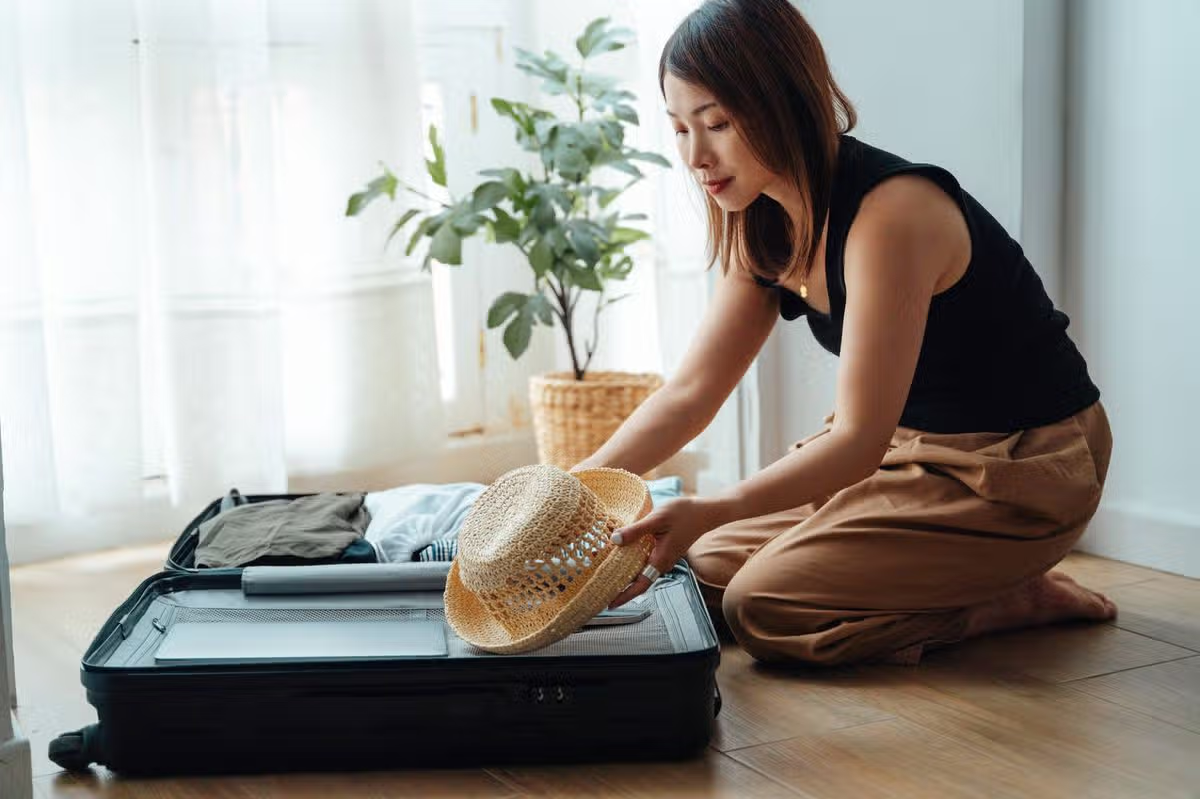
Everyone adores jetting off on holiday, but cramming a fortnight’s worth of belongings into a Ryanair or easyJet underseat bag is nobody’s idea of fun. That’s precisely why knowing what to take and what to ditch is absolutely vital.
I consulted more than a dozen travel gurus for their essential picks and items to skip when heading abroad. The must-have list featured an array of items, from a sarong to a fully charged battery pack, cereal bars and even ‘your favourite comb’.
However, there was considerably more agreement on what holidaymakers should steer clear of packing.
Do you have a travel story to share? Email webtravel@reachplc.com
The travel gurus reckon you should steer clear of overpacking clothes.
“Many travellers say they regret taking too many ‘just in case’ outfits which take up valuable space in your luggage. Before packing anything, ask yourself whether you’ll genuinely wear it and whether it works with at least two other items in your suitcase. If the answer is no, it probably doesn’t need to come with you. Pack versatile pieces that can be mixed and matched, with a simple colour palette so everything works together,” Natasha Inglis, client experience director at Good Business Travel, said. Joe Cronin, president of International Citizens Insurance, shared this view.
He explained: “What I leave at home is the ‘just in case’ wardrobe. After years of living out of a suitcase in places as different as Tokyo and Buenos Aires, I have learned that you never wear the extra pair of shoes and the extra jacket. Laundry is easy to find nearly everywhere, and anything I truly forget I can buy on arrival, often for less than the cost of checking a heavier bag.”
Jim Webber, a retired teacher who now runs the travel blog Travelwidstom, commented: “I leave as many clothes at home as possible when I travel. So, my strategy focuses on packing light and doing laundry on extended trips. For example, my wife and I travelled for 17 days out west. We each had a carry-on and a personal item backpack. We were able to wash our clothes a few times on the trip at the hotels we stayed at.”
Aman Thakran, founder of BharatFare, argued that the ‘just in case’ items were for occasions “that never happen”. “I travel with clothes that all go together, so everything mixes and matches and nothing extra comes along. It saves weight, and often means you can skip the checked bag altogether,” Aman noted.
Vummy Kihaule, founder of Tanzania Safaris, highlighted that excessive clothing is especially unnecessary when embarking on safari. “Most hotels and lodges wash your clothes every day and return them to you the same evening. So three shirts will last you 10 days. Ask your hotel if they do washes every day and you’ll be able to cut half of your clothes from your bag. Weight is also a huge issue with small aircraft on regional routes, and most have a 15kg maximum weight including your hand luggage,” Vummy explained.
Last October, while I was cycling around south-west France, near the Spanish border, a tip from a local waiter led me to Collioure, near Perpignan. The town was like a Mediterranean dream, where the summer crowds had faded, leaving behind a peaceful, artistic haven of soft light, warm sunshine, cobbled streets, sandy beaches – and the Pyrenees as a backdrop. In the early evening, the still balmy autumn air was perfect for wandering through the quiet, pastel-coloured alleyways of the Le Mouré district to enjoy €5 off-season happy hour wine with fish tapas. I had planned to stay a weekend but ended up staying a week, seduced by Collioure’s perfect autumn cocktail of chilled Catalan culture and sunkissed seaside sensuality.
April
Peaceful Portuguese sunsets
Tagus River in Lisbon. Photograph: Mauricio Abreu/Alamy
Sitting outside in T-shirt and shorts on the deck of a boat gliding along the Tagus River in Lisbon, sipping a glass of crisp Portuguese wine as the setting autumn sun illuminated the pastel-coloured hills, is a lasting travel memory for me. October temperatures were still in the mid-20s, perfect for exploring fascinating areas on foot, or hanging out of trams as they rattled up and down the cobbled streets. In the evenings, I joined local people basking in the remaining warmth of the year at outdoor cafes or waterside tavernas like Ponto Final, enjoying coffee and pastries, or anchovies and beer, while watching magnificent sunsets without the summer masses.
Nicoletta
Wild times in St Davids, Pembrokeshire
Whitesands bay, near St Davids. Photograph: Drew Buckley/Alamy
My autumn escape is St Davids on the Pembrokeshire coast. Once the summer crowds disappear, it feels wonderfully wild and tranquil. We walk the coast path towards Whitesands, stopping to watch for seals below the cliffs, before heading back into tiny St Davids for something warm to eat. The beaches are often almost empty and, even when the weather turns, the dramatic sea and windswept coastline are part of the charm. My tip is to visit in early autumn; pack proper walking boots and layers, and embrace the weather – you get one of Britain’s loveliest coastlines almost to yourself.
Tess
Baroque beauty in eastern Germany
Rakotzbrücke (Devil’s Bridge) in Kromlau park, Gablenz, in Saxony. Photograph: Andrew Mayovskyy/Alamy
Görlitz makes for a fascinating autumnal base, with its location on the German-Polish border to the east of Dresden. The highlights were day excursions to Bad Muskau, where there is a wonderful baroque palace, and the Rakotzbrücke (Devil’s Bridge), reached by a narrow gauge forest railway (waldeisenbahn.de). It’s a part of Germany rarely visited, but those who go there will be rewarded with amazing photographs.
Martin
Bliss on a lesser-visited Canary island
Charco Azul swimming hole on El Hierro. Photograph: Henner Damke/Alamy
The Canary Islands are well-trodden choices for autumn sun, but the island of El Hierro remains a wilder alternative to Tenerife or Lanzarote. The scenery is beautiful and bizarrely varied: from pine forests to black volcanic lava flows – most of which you’ll have to yourself. You can pass hours exploring the rugged coastlines, where volcanic swimming holes such as Charco Azul can be found. We spent a blissful few hours there, relaxing on the rocks and looking out at the Atlantic. There are no big resorts but plenty of guest houses and smaller hotels, and sunshine is almost guaranteed into November.
Leo Mark
Profile
Readers’ tips: send a tip for a chance to win a £200 voucher for a Coolstays break
Show
Guardian Travel readers’ tips
Every week we ask our readers for recommendations from their travels. A selection of tips will be featured online and may appear in print. To enter the latest competition visit the readers’ tips homepage
–
Dramatic Devon walks
Endless sand … at Woolacombe beach, north Devon. Photograph: James Cassap/Getty Images
We stayed in Woolacombe, north Devon, with our three-year-old in October 2023 and the off-season suited us well. The three-mile beach gave us room for proper sandcastle engineering, and the Atlantic offered drama rather than deckchair weather. We watched the sunset turn the sea orange and purple from the hill above the bay. We could walk into the village, then use Woolacombe as a base for Mortehoe and the South West Coast Path. Pack waterproofs as well as sunglasses: north Devon makes no promises. But on a bright autumn day, those enormous sands feel almost privately hired.
Funchal on Madeira is my pick for an autumn escape because it still feels properly alive after summer. The seafront is made for slow walks in the sunshine, with cafes and gardens open year-round. You can browse the colourful Mercado dos Lavradores, ride the cable car for views over the terracotta rooftops and Atlantic, then cool off at one of the city’s lidos. The weather is pleasantly warm rather than overpowering, while the mountains and levada (aqueduct) walks are within easy reach. It combines coast, culture and dramatic scenery without feeling like a resort that closes down for winter.
Bernice
Clifftops and crab rolls in the Scottish Borders
Rugged charm … St Abbs. Photograph: Jason Baxter/Alamy
If you’re looking for a cracking wee coastal escape, head straight to St Abbs in the Scottish Borders. My wife and I absolutely fell in love with its rugged charm and bonny views. First off, Marvel fans will know it as New Asgard from Avengers: Endgame, and taking a selfie by the official sign set the right tone. Beyond the film fame, the dramatic clifftop walk up to St Abb’s Head is brilliant, packed with seabirds and proper fresh sea air. Afterwards, grab a fresh crab roll down at the harbour cafe – nae hassle, just proper good cheer.
Craig
Nonstop sun in a Cretan haven
‘A year-round magic place’ … Palaiochora on Crete. Photograph: Witold Skrypczak/Alamy
Autumn came brutal and early to Crete this month. But the ferocious northerly that drenched the northern coast got stuck on the White Mountains. And on just one tiny south-west speck of the island, the sun shone all and every day. Palaiochora is a year-round magic place anyway. No big hotels. Still proudly Greek. A place where the town’s rhythms are set by the comings and goings of the Loutro ferry. But this past week, while thunder stalked the mountains, we swam and walked every day. “We’re unique,” said the man at the cafe. “Please don’t tell anyone.” What have I done?
Kay Jones
Winning tip: Fiestas and feasts in Zaragoza, Spain
Making a floral tribute to the Virgin Mary is a key part of the Fiestas del Pilar, held in October in Zaragoza. Photograph: Visual and Written/Alamy
For an autumn city break, Zaragoza comes alive during the Fiestas del Pilar in October. We spent a week there, wandering bustling streets lined with people, many in traditional dress, queueing to lay flowers at the vast floral tribute to the Virgin Mary in Plaza del Pilar. Along the river, food stalls served Aragonese specialities, from chistorra (sausage) and stews to roast chestnuts and sweet wine. Between festivities, we explored the stunning Aljafería Palace and discovered tiny tapas bars tucked down side streets. The city felt wonderfully local, lively and full of surprises.
Three weeks after the autumnal equinox, it finally feels like fall.
Well, kind of.
This past weekend, Southern Californians breathed a collective sigh of relief as an oppressive heat wave broke. Temperatures in L.A. dropped 31 degrees, from 104 degrees on Oct. 4 to one week later, a high of 73 degrees, according to observed weather data.
I felt like a climatological grim reaper when, in the midst of my friends celebrating the drop in temperature, I told them it was temporary, as it was expected to get hot. Again. (I’m great at parties!)
But, even still, I want to help you get outdoors — safely. In this week’s edition of The Wild, our weekly outdoors newsletter, I will share three excellent L.A. hikes that each offer something different — great views or shade, for example — with caveats about the best time to go.
You are reading The Wild newsletter
Sign up to get expert tips on the best of Southern California’s beaches, trails, parks, deserts, forests and mountains in your inbox every Thursday.
By continuing, you agree to our Terms of Service, which include arbitration and a class action waiver. You agree that we and our third-party vendors may collect and use your information, including through cookies, pixels and similar technologies, for the purposes set forth in our Privacy Policy such as personalizing your experience and ads.
The first caveat is: The National Weather Service issued a red flag watch and warning, which signals an increased risk of fire danger, for much of L.A. and Ventura counties from Thursday morning through Saturday evening. It includes the San Gabriel and Santa Monica mountains. As a result, parks within Santa Monica Mountains National Recreation Area will be closed Thursday through Saturday. The closure applies to land managed by California State Parks, the National Park Service, the Santa Monica Mountains Conservancy and Mountains Recreation and Conservation Authority.
Daniel Swain, UC Agriculture and Natural Resources climate scientist, told my Times colleagues Terry Castleman and Rong-Gong Lin II in a recent story that the greater fire risk will be in communities and natural areas west of the 405 Freeway, as east of the 405 recently saw rain.
The 405 Freeway passes through several areas with hillsides covered in dense shrubs and trees.
(Dania Maxwell / Los Angeles Times)
“West of that point, almost no rain fell at all, and in early October we had a record-breaking heat wave,” Swain said. “East of the 405 in Southern California, the fire risk is lower because it recently rained.”
Bearing that in mind, two of the hikes below are east of the 405 and the third is an urban hike. All three avoid long drives far into the mountains. The two hikes closest to the foothills have large parking areas and clear exits. The urban hike usually offers clear views that should allow hikers to spot a fire near them and evacuate quickly.
Several children balance on rocks as they cross a segment of the Arroyo Seco near Pasadena.
(Jaclyn Cosgrove / Los Angeles Times)
1. A shady hike along a flowing river
Gould Mesa via Gabrielino Trail Distance: About 4 miles out and back Elevation gained: About 300 feet Difficulty: Easier end of moderate Dogs allowed: Yes Nearest to: Pasadena, La Cañada Flintridge and Altadena Accessible alternative: The first mile of this trail is paved. See notes below.
The Gabrielino National Recreation Trail is a 28.8-mile journey from Chantry Flat Recreation Area north of Sierra Madre all the way to the Ventura Street & Windsor Avenue trailhead near the Hahamongna Watershed Park in La Cañada Flintridge. It is a multi-use trail for hikers, mountain bikers and horse riders.
The trail has several beautiful sections, including from its western entrance in Hahamongna to the Gould Mesa Trail Camp. This segment is mostly shaded and great for a morning stroll, especially before 11 a.m. Saturday and Sunday.
To begin your hike, you’ll park at a large free dirt lot near the backside of NASA’s Jet Propulsion Lab. If hiking in a wheelchair or seeking an accessible paved path, I recommend parking at this smaller paved lot, as that’s where the paved portion of the trail begins. (Please leave this lot for folks seeking the accessibility alternative, as it’s smaller than the large dirt lot — and both are free!)
You can either take the paved trail or an unofficial dirt trail that follows the Arroyo Seco before leading you to the official trail. Either way, it’s primarily a mix of flat path and gentle inclines along the Arroyo Seco, shaded by coast live oaks, bay laurels and sycamore trees. After hiking about two miles, you’ll reach the Gould Mesa Trail Camp, where you can set up a picnic at one of the campground’s tables, or cool off along the creek.
And if you’d like to go a bit farther, you can continue onward to the Paul Little Picnic Site or the Brown Mountain Dam waterfall (see map). Regardless of where you stop, I promise you’ll be treated to a stunning landscape and likely hear the chirp and squawk of scrub jays, California quail and more.
The San Gabriel Mountains become blanketed in golden light in the early evening in Dunsmore Canyon in Deukmejian Wilderness Park, a Glendale park.
This 2.6-mile hike through the 709-acre Deukmejian Wilderness Park in Glendale will offer you not only great views of the surrounding cities but also an opportunity to spend time among healthy native trees and plants, including California buckwheat, black sage and California sagebrush (which you should smell).
You’ll park in a lot near the Stone Barn Nature Center. Several signs are usually posted around the lot warning visitors about when the park will close, and a staff member will lock the gate. I think that’s serious, so take note.
You’ll start your hike on Dunsmore Canyon Trail, headed northeast up a straight gravel path covered on both sides with thick ceanothus, yerba santa and more.
Although some hikes, like this path in Dunsmore Canyon in Glendale, may appear exposed during the day, you might find they’re shadier in the morning or evening, depending on their local topography.
(Jaclyn Cosgrove / Los Angeles Times)
Just 0.2 miles in, there’s a massive old coast live oak where kids could easily create an imaginary forest kingdom under its large branches.
As you continue to climb, you might hear Dunsmore Creek, which runs parallel to the trail. Remember to turn around as you gain elevation, as this trail rewards you with substantial views of Glendale and the Crescenta Valley soon after you start. All the while, you have the San Gabriel Mountains right in front of you, including Mt. Lukens, which you can hike to from the same park.
Half a mile in, you have the option to continue on the Dunsmore Canyon Trail or Le Mesnager Trail to make a shorter loop. Le Mesnager Trail includes a lookout point at about 2,750 feet, a great spot for sunset as long as you don’t get locked in! As you meander down the trail, you’ll find a nice shady canopy and continued views of the city below.
Given our weekend temperatures, this trail is best in the morning or evening. I personally prefer the latter, when golden hour paints the mountains a deep gold to red.
If you plan to hike it in the evening, though, keep the park hours in mind. It is open until 8 p.m. until Monday, when its hours shift to closing at 7 p.m., which remains until Daylight Saving Time ends Nov 1. This is relevant if you plan to park in the lot. Otherwise, you can walk out of the park and back to your car. Regardless, have fun!
Visitors reach the Baldwin Hills Scenic Overlook by climbing the Culver City Stairs.
(Myung J. Chun / Los Angeles Times)
3. An urban hike near a great picnic area
Culver City Stairs to Baldwin Hills Scenic Overlook Distance: 1.4 miles Elevation gained: About 350 feet Difficulty: Moderate Dogs allowed? Only on the paved road, not on trails Accessible alternative: Discovery Park and Bluff Creek Trail
This 1.4-mile out-and-back jaunt up 282 concrete steps, known locally as the Culver City Stairs, takes hikers to the stunning Baldwin Hills Scenic Overlook. From here, you’ll have one of L.A.’s most breathtaking — kind of literally — city views.
To begin, you’ll take the Baldwin Hills Scenic Overlook entrance off Jefferson Boulevard. You’ll follow a dirt path briefly east, follow a switchback to the west and soon find stairs. Head straight up, pausing to breathe and appreciate the views. The stairs vary in height, from about 3 to 20 inches, so it’s good to take your time.
At the top, you’ll have panoramic views that, on a clear day, include the Pacific Ocean. To return, you can either head back down the steps or take the meandering dirt trail down.
Culver City is expected to be cooler on Sunday than Saturday, with an expected high of 85 degrees. Why not make it a morning trek followed by brunch?
Regardless of where you go, I hope you have a safe and meaningful time on our public lands!
3 things to do
1. Prance up to a giant pumpkin in Norco The L.A. Fright Club will host a 1.6-mile moderate hike at 9 a.m. Sunday to Pumpkin Rock in Norco. Guests should wear comfortable hiking shoes and bring water. Costumes encouraged. Learn more, including how to register, at the club’s Instagram page.
2. Make marvelous marsh pics in Irvine The California Native Plant Society’s Orange County chapter will host a beginner nature photography course at 5:30 p.m. Thursday at the Duck Club at the San Joaquin Marsh in Irvine. At 5:30 p.m., photographer Bob Allen will guide attendees on a short walk in the marsh, followed by a presentation and discussion of technique at 7 p.m. Learn more at the organization’s Instagram page.
3. Witness the cosmos near Palm Springs The San Bernardino Valley Amateur Astronomers will host a star party from 8 to 10 p.m. Saturday at the Whitewater Preserve northwest of Palm Springs. Gates will open at 7:30 p.m. and close at 8:05 p.m. No late entry. Learn more at the preserve’s Instagram page.
The must-read
An Eastern box turtle at the Turtle Conservancy in Ojai.
(Julie Leopo / For The Times)
The 90-acre Turtle Conservancy in Ojai was founded in 2005 as a research center and advocate for turtle habitat. But over the past 10 years, its mission has shifted in response to illegal turtle poaching, prompting the small nonprofit to take in 810 turtles — more than 400 of which they received in the past six months. What should the conservancy do once it has the turtles? That question remains heavily debated (and underfunded), an issue covered in a recent Times story by writer Stuart Miller. “It’s so easy to pluck an animal out of the wild, but when you want to put one back there’s more roadblocks,” said conservancy founder Eric Goode. “Can we find a happy medium? Because the best thing for these turtles is not to keep them in holding areas for too long.”
Happy adventuring,
P.S.
Would you like to help scientists better understand where native species are thriving in L.A. County? Or how about researchers who are tracking where invasive species are taking up loads of space? The L.A. Nature Quest is a monthlong challenge that runs through Oct. 31. The L.A. Public Library helps host the challenge, which asks participants to download the citizen science app iNaturalist and then document the natural world in their neighborhood. This year, quest organizers are especially hoping people will pay attention to “cold spots,” where there is little to no data on habitat in an L.A. neighborhood. Check out the map at lapl.org to see how you can help.
For more insider tips on Southern California’s beaches, trails and parks, check out past editions of The Wild. And to view this newsletter in your browser, click here.
This picturesque town attracts thousands of visitors every autumn for its stunning foliage — but residents are fighting back against a surge of influencers with calls to restore peace and safety to their quiet community
16:27, 15 Oct 2026Updated 16:27, 15 Oct 2026
People flock to this town every year for the amazing autumn colours – but not everyone is happy about it (file image)(Image: Getty Images)
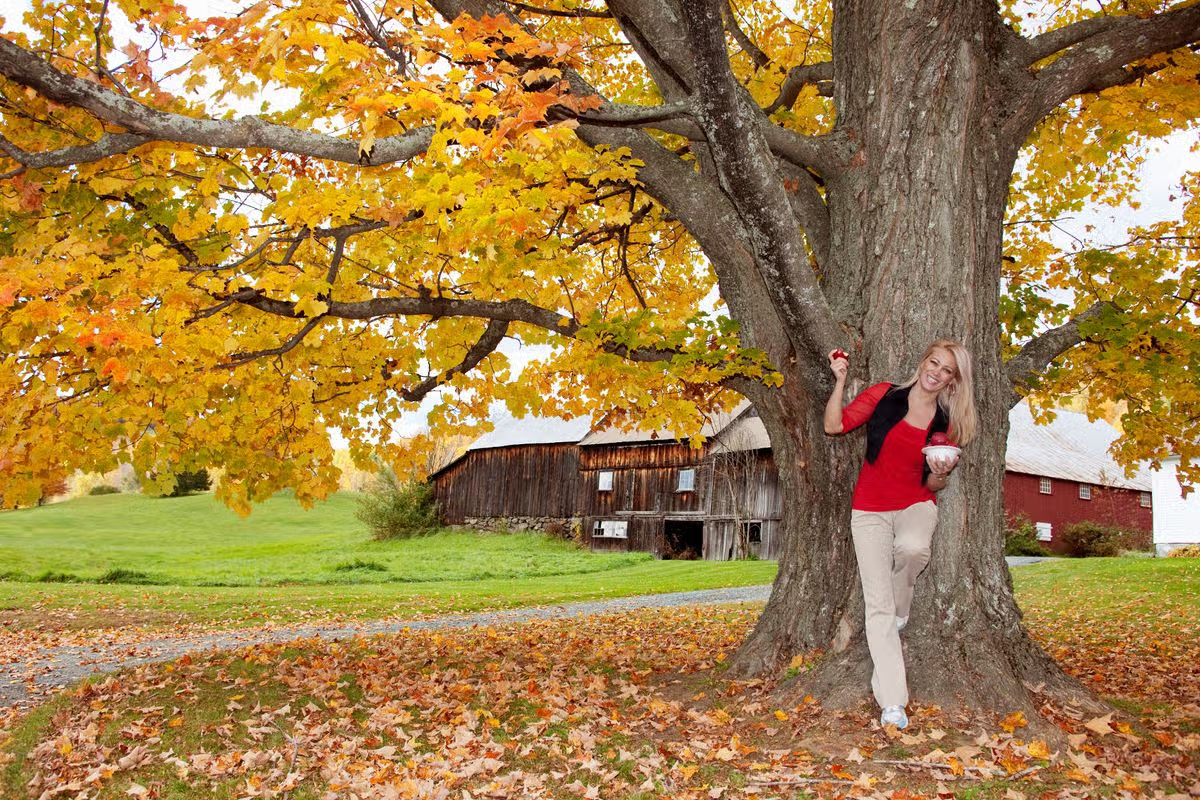
Autumn is one of the most beautiful times of year, as trees turn from green to a stunning red, brown, orange, and gold. Getting out to see the seasonal colours is one of the most enjoyable things to do at this time of year – as long as you wrap up warm – and you can get some incredible pictures and video for social media while you’re at it.
But people living in one town which has become world-famous for its spectacular autumn displays have become so fed up of people flocking to their quiet community that they’re putting measures in place to ban influencers entirely. Pomfret in Vermont, in the north-eastern United States, is a peaceful, tranquil community, home of only slightly more than 900 people.
But in recent years it has become a hive of activity every autumn as crowds of people attracted by beautiful pictures of the autumn colours – known to some as ‘leaf-peepers’ – come by to see for themselves. And this has become a real problem for some residents.
‘Rude’ social media influencers
Some have said they have experienced visitors being rude, disrespectful, or downright selfish in their pursuit of the perfect snap or video, with little regard for those around them. According to news.com.au, local farmer Cathy Emmons said she and her husband Bill had witnessed one visitor wander onto private property and set up a portable changing booth, before emerging in different outfits for her selfies.
She has also witnessed tourists brazenly wandering onto her farm and stealing her tomatoes, while another resident described a drone hovering just a few feet above his head as he dined outdoors with his family. In a separate incident, a visitor parked unlawfully in a local’s driveway and used her garden shed as a toilet.
Problems on the roads
The picturesque Sleepy Hollow Farm on Cloudland Road is one of the most popular locations. But the road is not equipped to deal with the amount of traffic it is experiencing, and concerns have been expressed about visitors blocking lanes as they pull over to take photos.
Various measures have been introduced in an attempt to tackle the problem – but with limited success. In 2023, local officials shut the road to non-residents during the peak foliage season, from the middle of September to the middle of October, reports the Express.
The measure has been repeated in subsequent years, and will once again be enforced from Saturday, September 26, to Tuesday, October 13 this year. In a notice confirming the plans, issued in August, the Town of Pomfret Selectboard acknowledged the measures “cannot fully address the significant issues created by fall foliage traffic”.
It went on to say: “We also appreciate these steps may inconvenience area residents, their guests and others. Nonetheless, we believe these actions will significantly improve safety and quality of life for residents most severely affected by increased foliage season traffic, as they did the last several years.”
Fundraiser for road closure
Last year locals established a fundraising page called ‘Save Cloudland Road’, designed to raise sufficient funds to cover road closures and traffic enforcement to tackle the flood of visitors. A message on the page reads: “Over the past several years, Cloudland Road (and the small roads leading to Cloudland Road) have experienced an unprecedented surge in Instagram and TikTok-fueled tourist ‘influencers’.
“During fall foliage season, crowds commonly surge to hundreds of people at one time, and tour bus companies have even joined the fracas. Cloudland and surrounding roads can become impassable during the fall, and poorly behaved tourists have damaged roads, had accidents, required towing out of ditches, trampled gardens, parked in driveways, and verbally assaulted residents.”
The page pleads with people in the community to band together to raise enough money – estimated to be more than $12,000, or around £9,000 – to pay for signs and sheriff deputies to man temporary closures. It says the measures are needed “to bring peace, safety, and civility back to the families who live here”.
Ensure our latest headlines always appear at the top of your Google Search by making us a Preferred Source. Click here to activate or add us as Preferred Source in your Google search settings
The London Mayor’s officials are meeting with train operators, authorities in Paris and commercial bodies to get backing for the plan.
Speaking to The Standard, Sadiq Khan said: “The case for creating a Stratford International worthy of the name is clear and compelling.
“The popularity of international rail continues to grow in London, which is why my team and I have been lobbying for cross-channel rail services from Stratford for many years – and I’m hoping that our efforts are close to paying off.”
He explained further: “Over the last few months, we’ve been working closely with this new Government to make Stratford International truly ‘international’ for the first time and we’re now within touching distance of getting our plans over the line.
“The data shows that bringing international services to Stratford would bring in an additional £1.3bn in tourist spending for the UK.
“Stratford has become one of Europe’s largest and most successful regeneration projects, and I believe with the arrival of cross-Channel services, the future of East London will be even brighter still.”
This is not the only proposal that has been made for Stratford – Sir Richard Branson‘s rail company Virgin Trains have confirmed they are interested in the station too.
A Virgin Group spokesperson previously said the company is: “looking forward to exploring additional stops, including Stratford International.”
Holidaymakers are increasingly planning their next destination around music, sporting and cultural events
NFL veteran Efe Obada is Marriott Bonvoy’s new ‘Check-In Coach’ (Image: PinPep)
More and more British holidaymakers are planning their trips around music, sports, and cultural events, according to a recent study. This surge in event-driven travel is shifting how people holiday, prompting 45% of respondents to explore destinations they’d never even thought of visiting before.
What’s more, out of all the travellers who stayed overnight for an event in the past four years, 62% planned their entire trip specifically around it. Looking ahead to 2027, 36% say they’re even more excited to travel for a concert, festival, exhibition, or big game than they were last year.
The survey of 2,000 adults revealed that 56% of sports fans would happily use their annual leave to follow their favourite team anywhere they play—and 31% are willing to head abroad to do it.
With hotels right near nearly every NFL stadium, Marriott Bonvoy—an Official Sponsor of the NFL—is helping fans build the ultimate game plan by bringing on Efe Obada as their official Check-In Coach.
Efe Obada said: “In the NFL, preparation gives you a strong starting point, but you’ve also got to trust your team and be ready to adapt when things change.
“I approach travel in the same way. If you’ve only got a few days in a city, be tactical, adaptable and make a game plan.
“Book your hotel, know how you’re getting to the main event and ask people who know the city for advice. That’s how to make the most of every trip.”
The research also identified four NFL-inspired traveller types, showing the roles people typically adopt while on holiday.
A quarter (25%) see themselves as ‘The Quarterback’, the trip leader who unites the group, takes charge of major choices, and adjusts plans when circumstances shift.
An equal proportion (25%) regard themselves as ‘The Coach’, the organiser who handles the practicalities, from accommodation and transport to excursions and schedules.
Meanwhile, 24% assume the position of ‘Rookie’, the first-timer who is discovering a location or occasion for the first time and seeks advice and insider tips from companions.
In contrast, 19% fell into ‘The Receiver’ category, the impulsive explorer who identifies possibilities, proposes unplanned diversions, and contributes to unforgettable experiences.
Andrew Watson from Marriott International, said: “This research highlights what we see in our hotels, that travellers are increasingly planning trips around the things they are passionate about.
“Our partnership with the NFL is just one example of a wider commitment to helping our members pursue what they love.”
Efe, who applied the strategy to his hometown, London, added: “London is one of those cities where every neighbourhood has its own personality.
“For a perfect weekend, I’d book at stay at citizenM Tower of London then grab a coffee at Qima Café in Covent Garden, walk along the Thames around Southbank or spend an afternoon at Hampstead Heath for unbeatable London views.
“For food, you can’t beat 2210 by NattyCanCook in Herne Hill or head to Passyunk Avenue in Waterloo for unmatched game-day vibes and a Philly cheese steak.”
EFE’S PLAYBOOK FOR A TACTICAL WEEKEND TRIP:
Do your pre-match analysis: Book your hotel early, check journey times and map out the key moments you don’t want to miss.
Kick off strong: Give yourself time to fuel up before heading out. A good game plan always starts with the essentials.
Teamwork is key: Local knowledge can make all the difference. Ask hotel staff for recommendations and insider tips.
Don’t be afraid to adapt: Leave room for unexpected discoveries – be that a bar, restaurant or neighbourhood. Sometimes the highlights aren’t part of the original strategy.
A STATE of emergency has been declared on the Greek island of Rhodes after flash floods swept cars into the sea and claimed the life of a hotel worker.
Cars are swept into the sea, following a heavy rainstorm on the Greek island of Rhodes, which left one person deadCredit: ReutersThe weather has flooded streets and caused rivers to overflowCredit: Reuters
Greek authorities have ordered British holidaymakers to restrict all but essential travel – here’s everything you need to know.
Where is the flooding in Rhodes?
Rhodes’ eastern coastline bore the brunt of the weather, with the area around Stegna beach near Archangelos suffering flash flooding.
Dozens of cars were submerged or abandoned across the island’s road network as drainage systems struggled to contain the rainwater.
Data from the National Observatory of Athens confirmed that Rhodes recorded 264mm of rain, 202mm of which fell in just six-and-a-half hours.
That’s a month’s worth of typical rainfall in a single morning.
What is the current Rhodes weather forecast?
Conditions across Rhodes have begun to calm as the worst of the storm front moves east.
The UK Met Office and the Hellenic National Meteorological Service both forecast drier conditions for the region on Thursday October 15, with sunny spells for the remainder of the day.
Temperatures are expected to peak at 23C, with moderate northwesterly winds between 12 and 16mph.
Though the forecast points toward calmer conditions, forecasters and officials stress that the danger has not fully cleared.
Because the island’s terrain is saturated, more rain could present a risk of further localised flooding and mudslides.
Tomorrow (October 16) is expected to stay largely dry and sunny, but an unsettled Atlantic front is forecast to push across the Aegean Sea over the weekend.
This is expected to bring a renewed chance of showers by Saturday.
Elsewhere in Greece, the Hellenic National Meteorological Service has issued yellow “Be Aware” alerts for Crete and the South Aegean.
What is the advice for holidaymakers?
Thousands of UK tourists visit the region every year for late-season sunshine.
With 112 emergency alerts remaining active, tourists are advised to limit their movements to absolutely necessary journeys.
Several key bridges and roads across Ialysos, Faliraki, Afandou, and Rhodes Town are submerged or damaged by mud.
Authorities have suspended multiple transport routes, including the key Rhodes–Faliraki tourist corridor and services to and from Akandia port.
Greek emergency services recommend that all travellers monitor local weather warnings through the Hellenic National Meteorological Service and follow instructions via the official @112Greece Twitter/X channel.
Never attempt to drive or walk through standing or flowing water, as road surfaces may have collapsed underneath.
Keep an eye on the UK Foreign, Commonwealth & Development Office (FCDO) travel advice pages for Greece regarding sudden disruptions.
The spot is renowned for its striking chalk cliffs, charming villages and coastal walks – making it the perfect autumn getaway for families and couples
One UK spot has less crowds and is the perfect autumn escape(Image: Getty)
With its untouched landscapes, fascinating heritage and tranquil way of life, one UK destination has become a haven for ramblers, nature lovers and tourists looking for a serene seaside retreat. West Wight, located on the western edge of the Isle of Wight, is famous for its dramatic chalk cliffs, delightful villages and endless attractions.
Getting to the Isle of Wight is remarkably easy. Red Funnel operates services between Southampton and the Island via both car ferry and rapid foot-passenger routes, meaning you can bring your vehicle or rely entirely on public transport.
October makes an ideal time for a visit now the summer holiday crowds have dispersed.
Ensure our latest DWP headlines always appear at the top of your Google Search by making us a Preferred Source. Click here to activate or add us as Preferred Source in your Google search settings
The Needles and Alum Bay
Amongst the Isle of Wight’s most iconic sights, The Needles comprise a series of impressive chalk formations rising majestically from the ocean off the island’s western shore.
Close by, Alum Bay is renowned for its rainbow-hued sand cliffs, sweeping coastal panoramas and classic seaside diversions, establishing it as a must-visit destination for those discovering the region. When visibility is good, the surrounding shoreline provides magnificent views stretching across the English Channel.
Freshwater and Freshwater Bay
Freshwater ranks among West Wight’s main settlements, providing gateway access to some of the island’s most beautiful coastal landscapes. Just south of the village, Freshwater Bay boasts a stunning shingle beach framed by dramatic chalk cliffs.
The spot is perfect for coastal walks, photography and soaking up the seaside atmosphere, with swimming on offer when conditions allow.
Tennyson Down and the coastal paths
Perched above Freshwater Bay, Tennyson Down is a vast expanse of open grassland that provides some of the Isle of Wight’s most spectacular walking routes.
The area is named after Victorian poet Alfred, Lord Tennyson, who resided close by at Farringford. Visitors can take in sweeping sea views, rolling countryside and the chance to spot local wildlife, making it a firm favourite amongst walkers and nature enthusiasts.
Yarmouth
Nestled on the island’s north-west coast, Yarmouth is a historic harbour town renowned for its charming streets, independent shops, traditional pubs and cafés.
The town is also home to Yarmouth Castle, a historic coastal fortification, and acts as a key ferry hub linking the Isle of Wight with Lymington in Hampshire.
With its rich maritime heritage and laid-back atmosphere, Yarmouth provides a delightful contrast to the island’s larger, more bustling resorts.
Weather in October
October in West Wight typically brings mild yet unpredictable weather, making it an attractive time for coastal walks, countryside adventures and discovering quieter seaside villages. Visitors should come prepared for the odd shower and breezy spells.
Daytime temperatures typically sit between 13°C and 16°C, while night-time lows usually hover around 8°C to 11°C. Periods of sunshine can feel comfortably mild, though temperatures dip considerably once the sun goes down.
How to get to West Wight
By car
One of the easiest ways to reach West Wight is via the Wightlink car ferry from Lymington, located in the New Forest, to Yarmouth on the Isle of Wight.
The journey takes approximately 40 minutes, providing a simple route for drivers heading to the western side of the island. Upon arrival in Yarmouth, travellers can quickly access nearby spots such as Freshwater Bay, Totland and The Needles.
Without a car
Those travelling without a vehicle can catch a train to Portsmouth Harbour before hopping on the Wightlink FastCat passenger ferry to Ryde Pier Head on the Isle of Wight.
The crossing takes roughly 22 minutes, making it an efficient choice for those on foot. From Ryde, connecting bus services through Newport link passengers to West Wight, including Freshwater and the nearby coastal communities.
IF you’re desperate for a getaway but don’t want to spend loads, it might be time to look beyond the usual high street holiday agents.
We’ve found a lesser-known booking site where you can bag entire package holidays from just £118, hotel rooms from £16 a night, and flights for as little as £9.
Your next holiday could be closer than you think with these bargain getawaysCredit: Alamy
Browse cheap holidays, flights and hotels on Opodo
Opodo acts as a massive travel search engine, scouring hundreds of airlines and millions of hotels to pull together some of the absolute cheapest deals on the internet.
As a travel writer who scours the internet each week for the cheapest holidays for Sun readers, these are some of the lowest travel fares I’ve ever seen.
Sign up for the Travel newsletter
Thank you!
So whether you’re after a quick weekend city break, a week-long beach escape, or even a solo travel retreat – here’s our guide to the very best travel bargains on Opodo right now.
Package holidays
Package hols are where you get the most bang for your buck on Opodo, as you can save up to 40% extra by booking your flights and hotel together through the website.
Or you can click here to browse all cheap package holidays.
Mallorca – from £121pp
Boat sailing, Majorca island, Spain. Cala MarmolCredit: Getty
With flight times around two and a half hours, Mallorca is an easy hop away for some autumn sun, with pleasant October temperatures of around 24C.
Spend your days exploring the winding, cobbled streets of Alcudia’s Old Town, hiking the spectacular Serra de Tramuntana mountains, or soaking up the sun on the pristine white sands of Es Trenc.
Browse Mallorca holidays from £121pp
Tenerife – from £147pp
Playa de las Teresitas in TenerifeCredit: Getty
The flight to Tenerife is only four hours from the UK, yet it still reaches highs of 26C in October.
Once you’re there, stroll the volcanic beaches of Costa Adeje, enjoy €3 tapas in traditional tavernas, hit up award-winning waterpark Siam Park or even go whale watching.
Browse Tenerife holidays from £147pp
The Algarve – from £118pp
Beautiful village of Carvoeiro in the Algarve, PortugalCredit: Getty
Autumn is the perfect time to visit Portugal‘s stunning southern coast, offering warm highs of 25C without the overwhelming summer crowds.
Wander around the bustling Olhao fish market, hike along dramatic coastal cliffs to see the spectacular rock formations, or simply relax on the golden sands of Praia dos Pescadores right by Albufeira’s old town.
Browse Algarve holidays from £118pp
Rome – from £119pp
You don’t need a huge budget to experience Rome, especially with Opodo offering package holidays from £119pp.
In the Italian capital the streets themselves are their own attraction. Soak up the atmosphere at the Spanish Steps, or toss a coin over your shoulder into the Trevi Fountain.
Browse Rome holidays from £119pp
Flights
You could fly to Barcelona from £9 if you’re signed up to Opodo PrimeCredit: Getty
Opodo offers super cheap flights to destinations in Europe and beyond, but they get even cheaper if you join Opodo Prime.
For example, you can bag a one-way flight to Barcelona for £24 each way, but if you’re signed up to Opodo Prime this sinks down to £9.
It costs £8.99 a month and also gets you discounts on hotels, so if you like to go on holiday regularly, it could save you some serious cash.