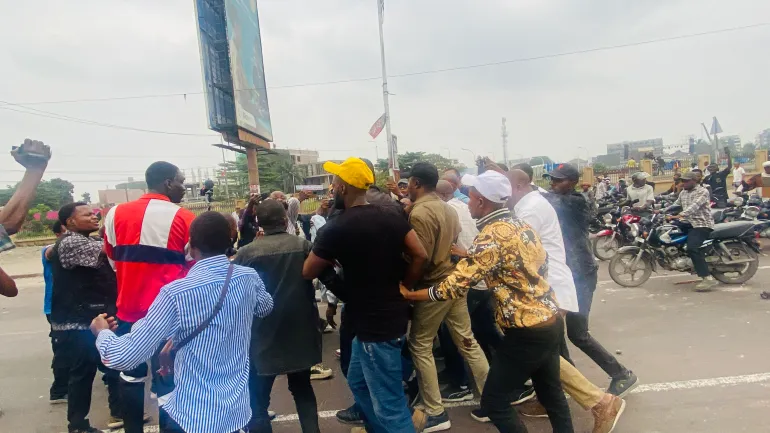
Election-related information is displayed on an electronic board at the National Election Commission’s situation room in Gwacheon, south of Seoul, South Korea, 26 May 2026, eight days ahead of the 03 June local elections. Photo by YONHAP / EPA
May 29 (Asia Today) — Leaders of South Korea’s rival political parties urged voters to cast ballots Friday, the first day of early voting for the June 3 local elections, but their strategies showed different approaches.
Chung Chung-rae, leader of the Democratic Party, and Han Byung-do, the party’s floor leader, both voted on the first day of early voting. People Power Party leader Chang Dong-hyeok and floor leader Song Eon-seok divided their roles, with Chang choosing to vote on Election Day and Song planning to vote early.
Chung began his schedule Friday by casting an early ballot at the Seongsan 2-dong Community Service Center in Mapo District, Seoul. After voting, he attended a meeting of the party’s central election committee in Seoul and urged voters to participate.
“Voting is stronger than bullets,” Chung said. “Power does not come from the barrel of a gun. It comes from the polling place.”
Han also visited an early voting station before heading to campaign events in Namwon, North Jeolla Province.
“Early voting will be held for two days starting today,” Han said. “Please exercise your precious vote for the future of South Korea.”
The major opposition People Power Party took a different approach. Chang plans to vote on Election Day, while Song is scheduled to cast an early ballot Saturday.
The move is seen as a strategy to appeal both to the party’s hard-line conservative base and more moderate conservative voters. Chang and Song have also divided campaign duties during the election period, focusing on separate schedules.
Chang campaigned Friday in Sejong and western Gyeonggi Province.
“The atmosphere is changing as we lead this election, but if we lose by even one vote, there is no future for South Korea,” Chang said. “Everything depends on your one vote. Please do not leave yourself with regret by failing to go to the polling place.”
Song said he plans to vote early Saturday in Gimcheon, North Gyeongsang Province, his electoral district.
At a news conference at the National Assembly earlier Friday, Song acknowledged that some political figures have argued against early voting.
“It is true that there are some movements in political circles saying people should not vote early, but I will not say that is our party,” Song said. “There is a big difference between holding voting over three days and holding it for only one day.”
“In reality, the number of votes cast during the two days of early voting and on Election Day is close to half and half,” he said. “I think voters should vote over the three days, including early voting, according to their circumstances and schedules.”
Park Sung-hoon, chief spokesperson for the People Power Party, said both early voting and Election Day voting are important exercises of political rights.
“To strategically encourage both early voting and Election Day voting, we decided that the floor leader would vote early and the party leader would participate in Election Day voting, taking his schedule into account,” Park said.
As US President Donald Trump heads into the White House Situation Room to make a “final determination” on a potential peace deal with Iran, analyst Alex Scheers remains skeptical Tehran will accept Washington’s demands, saying “nothing concrete is in place” yet.
Scheers cautions that Trump’s Truth Social post should not be interpreted as a finalised deal, noting major gaps between political statements and actionable agreements. He points to disputes over sanctions, nuclear enrichment and Iran’s frozen assets estimated at $120 billion.
Israeli Prime Minister Benjamin Netanyahu said Israeli forces had crossed the Litani River in southern Lebanon and were operating in Beirut and the Bekaa Valley, in what he described as a “tactical victory”. This comes after Netanyahu said he ordered the Israeli military to take control of 70% of the Gaza Strip.
US President Donald Trump posted online that he’s heading into the Situation Room at the White House to make a “final determination” on potentially finalising a peace deal with Iran. Al Jazeera’s Patty Culhane reports from the White House.
Romanian President Nicusor Dan says that the Russian consul in the southeastern city of Constanta will be expelled and the consulate shut down after a drone intended for Ukraine crashed into an apartment complex in the border town of Galati.
US Vice President JD Vance says Washington and Tehran have made “a lot of progress” towards a ceasefire extension agreement, including talks on reopening the Strait of Hormuz. However, he says disagreements remain over Tehran’s enriched uranium stockpile.
Thai rescuers pulled a man from a cave in central Laos after he and six others had been trapped for nine days. Photo by Metta Tham Kalasin Rescue/EPA
May 29 (UPI) — One Laotian miner has been pulled from a cave in central Laos after being trapped for nine days underground, a Laotian rescue organization said.
Rescue Volunteer for the People said on social media that a person was removed at 8:37 p.m. local time Friday. The organization did not name the person, and it wasn’t clear how they brought him to safety.
Social media video showed a man looking disheveled and weak being propped up as he was brought up through a narrow crevice, NBC News reported. He was then taken to medical teams for evaluation and treatment.
Kengkard Bongkawong, president of the Thailand-based Metta Tham Association Rescue Unit, confirmed to NBC that one person had been rescued. He said there were four still inside and “are awaiting further assessment.”
Seven gold miners have been trapped in the cave since May 19 in the Xaysomboun province of central Laos. Five of them have been found alive, but this is the first person to have been reported rescued.
Bongkawong said Friday that the search for the two missing men “will continue tomorrow.”
The local men were on a hunting and gold prospecting trip when they were trapped in the cave by rising water after heavy rain, which also caused landslides that blocked the entrance.
Bongkawong said earlier this week that rescuers were challenged by a partly submerged 1,115-foot-long tunnel that is as narrow as 23 inches in some parts.
On Monday and Tuesday, the rescue teams pumped out as much water as possible and placed ropes inside for rescuers to follow after being forced back by rising water from Sunday’s torrential rains.
Monsoon season creates a “ticking clock,” lead diver Mikko Paasi told CBS. A trained team of divers takes about five hours to travel to the trapped men and back.
The Thai volunteers leading the search include a diver who participated in the 2018 rescue of 12 boys and their soccer coach from a cave in northern Thailand.
Wreathes are seen amongst the statues at the Korean War Veterans Memorial during Memorial Day weekend in Washington on May 27, 2023. Memorial Day, which honors U.S. military personnel who died while in service, is held on the last Monday of May. Photo by Bonnie Cash/UPI | License Photo
May 29 (UPI) — Reports that the U.S. Attorney’s Office in Chicago is investigating President Donald Trump accuser E. Jean Carroll are denied by that office, one day after widespread reporting by multiple news outlets.
“In light of wide-spread reporting and intense media and public interest into the E. Jean Carroll matter in New York, the Chicago U.S. Attorney’s Office can confirm that it has not opened — and has never opened — a criminal investigation into E. Jean Carroll. Any claim to the contrary is categorically false,” U.S. Attorney for the Northern District of Illinois Andrew S. Boutros posted a statement on X.
CNN broke the news Thursday, citing multiple sources familiar with the matter, and other news outlets confirmed with their sources. They reported that Acting Attorney General Todd Blanche had recused himself from the investigation because he had represented President Donald Trump in one of his appeals of a civil case brought by Carroll.
Carroll won two civil suits against Trump. One alleged that he sexually assaulted her in a New York department store in the 1990s and another one was for defamation in 2019, after he denied the assault and said she made up the attack to boost book sales. In the assault case, Carroll was awarded $5 million, and in the defamation case, she was awarded $83 million.
The reported investigation was allegedly into a 2022 deposition in which Carroll said she received no outside funding for the suit. Later, it came to light that billionaire Reid Hoffman, co-founder of LinkedIn, paid some of her legal fees and expenses.
The BBC reported Friday that CBS News had initially reported the investigation but later reported that its source had clarified that Carroll’s testimony about funding for her lawsuits against Trump was being looked at as part of an investigation into a nonprofit run by Hoffman. CBS published an editor’s note Thursday to clarify.
Secretary of State Marco Rubio and President Donald Trump participate in a Cabinet meeting in the Cabinet Room of the White House on Wednesday. Photo by Samuel Corum/UPI | License Photo
May 29 (UPI) — Former Attorney General Pam Bondi is set to testify before the House Oversight Committee Friday over her handling of the release of the Epstein files.
The hearing will be behind closed doors and will not be filmed, and Bondi will not be under oath. But it will be transcribed, and that transcription will be released to the public.
The committee subpoenaed Bondi in March after months of releases. Her critics say she released files haphazardly and her team was sloppy in its redactions. The Epstein Files Transparency Act required the Department of Justice to redact only the name and identifiers of victims, but many of the files redacted the names of alleged perpetrators.
Convicted sex offender and billionaire financier Jeffrey Epstein died by suicide in prison in 2019 while awaiting trial for sex trafficking charges.
“We haven’t seen the full release of the files, so that’s already a violation of the law,” Dani Bensky, referencing the Epstein Files Transparency Act, told NPR. Bensky, who alleged that Epstein sexually abused her when she was a young ballet dancer, said Bondi’s release of the files without proper redactions, “sends such a chilling effect to the rest of the survivor community.”
“It should be transcribed, it should be filmed, and it should be publicly released as quickly as possible,” Bensky said. She added that transcription only isn’t good enough because, “context is lost.”
The survivors have repeated “same talking points over and over” to the DOJ, Bensky said. “And it’s just not getting any better.”
Some politicians are continuing to push for more transparency.
“We’re demanding that it be both videotaped under oath and released to the public,” Rep. Robert Garcia, D-Calif., the ranking Democrat on the committee, told NPR.
The committee has questioned several important people about Epstein, including Commerce Secretary Howard Lutnick, and former President Bill Clinton and former Secretary of State Hillary Clinton. The Clintons’ testimonies were recorded on video and the videos were released to the public.
Rep. Nancy Mace, R-S.C., called it “highly disappointing” that Bondi would not appear for an official deposition.
“She deserves the same treatment as the Clintons and as everybody else,” Mace said. “I’ll be there, though, with bells on,” Mace said. “And I’ll be asking her the tough questions.”
Harmeet Dhillon, assistant attorney general for human rights, will be alongside Bondi as her lawyer at the hearing, which has raised some eyebrows.
But legal scholars say it’s not unusual.
Barbara McQuade, former federal prosecutor and professor at the University of Michigan Law School, told NPR that when a government official testifies on issues of that office, “an attorney for the government often appears on behalf of the United States to assert privileges.”
Rep. James Walkinshaw, D-Va., another member of the Oversight Committee, told Politico that “the lack of videotape … contributes to the feeling that Americans have that there’s been a cover-up here.”
“I think she recognizes that she doesn’t have good answers to the questions that we’re going to ask, and a videotape makes it more real and brings more attention to it,” Walkinshaw said.
Rep. Maxwell Frost, D-Fla., told Politico he wanted to ask Bondi what specific directives she received from Trump or others on the handling of the Epstein case.
“I spoke with some of the survivors in Florida,” Rep. Suhas Subramanyam, D-Va., told Politico. “They were curious why [Bondi has] been hiding so much and what she has to hide herself. Why wouldn’t she be more forthcoming about the files? … Who got to her? What do they have on her? Those are the kinds of questions that the survivors are curious about.”
“So am I, and so are the American people,” he added.
Secretary of State Marco Rubio and President Donald Trump participate in a Cabinet meeting in the Cabinet Room of the White House on Wednesday. Photo by Samuel Corum/UPI | License Photo
Firefighters worked to free riders stranded 30.4 metres in the air after a rollercoaster malfunctioned and their car became stuck at Pleasure Pier amusement park in Galveston, Texas. No injuries were immediately reported.
Belgian defender Thomas Meunier caused debate recently after saying that France has the footballing talent to put out three teams capable of winning the World Cup.
Could Les Bleus, who are co-favourites with Spain in this summer’s World Cup, really lift the title with their second- or third-string team? Maybe not, but their talent is certainly Mariana Trench-deep.
Recommended Stories
list of 4 itemsend of list
Consider this: According to transfermarkt.com, a lineup of French players that didn’t make the 26-man cut would rank in value among the top five teams – ahead of Portugal, Brazil, the Netherlands and reigning champions Argentina.
Lucas Chevalier 30 million euros ($35m); Pierre Kalulu 32 million, Jeremy Jacquet 55 million, Leny Yoro 50 million, Adrien Truffert 25 million; Boubacar Kamara 40 million, Eduardo Camavinga 50 million; Dilani Bakwa 28 million, Senny Mayulu 40 million or Khephren Thuram 40 million, Mousa Diaby 28 million; Junior Kroupi 40 million. = 418 million [38 million average]
So, how did Les Bleus get to this point?
It started with frustration after French teams consistently fell short on the biggest stage from the 1930s to the 1970s. The solution, national team manager Georges Boulogne said in the early 1970s, would be for the French Football Federation to create training academies known as Centres de Formation.
“France had not won any trophies, and it was decided they needed to create a new structure,” INF (Institut National du Football) Clairefontaine administrator Franck Bentolila told Al Jazeera.
The government backed the programme, viewing it as promoting French ideals through sports, as well as a recipe for winning trophies.
A total of 16 centres were set up, the first opening in 1974 with the main site in Vichy. It recruited widely, drawing young players from the entire country, plus overseas departments. The centres laid a foundation, preparing players for professional careers and the national team.
The record was initially mixed. In the 1980s, France won the European Championship and Olympic Games titles (both in 1984) and reached two World Cup semifinals, but then failed to qualify for the 1990 and 1994 World Cups.
But by 1998, everything fell into place, with the so-called “Black-Blanc-Beur” squad winning the World Cup at home. The multiethnic group represented the changing nature of French society, as well as validating the federation’s development programme. Bentolila said coach Aime Jacquet dedicated the victory to “all the amateur clubs and academies – it’s also your trophy”.
“The [1980s] period with [Michel] Platini, [Alain] Giresse, [Jean] Tigana, had a lot of talent, but we don’t win a World Cup,” Bernard Lama, a goalkeeper who captained the national team in the 1990s, told Al Jazeera.
“The difference with our generation, all the guys were from academies. And we were hungry to win a title. And, also, we had one exceptional talent with Zinedine Zidane.”
France went on to lift the 2018 World Cup and were runners-up in 2006 and 2022.
Zinedine Zidane lifts the trophy after France’s victory over Brazil in the 1998 World Cup Final [Ben Radford/Allsport via Getty]
“You have people coming from overseas – Africa, French Guyana, Martinique – they give us two things, music and sports,” Lama said.
“And, now, there is a sub-generation coming from overseas, and they are French. [Ousmane] Dembele, [Desire] Doue, they are French, they are not naturalised, they grew up in France, the majority around Paris.
“And they are hungry, you understand, for a lot of reasons. But, also, it’s not only a question of work; the first thing is they have talent.”
Lama sees a danger in football, more broadly, of players becoming overly drilled and “robotic”, but France has many exceptions who can give them an edge.
“We are lucky to still have these players who are capable of making the difference,” Lama said. “Maybe that is why we are so good, we have players like [Kylian] Mbappe, Dembele, Doue. They hate to lose and, physically and technically, they can make the difference, individually.
“And that is the force of the national team, and also PSG, our capacity to score. Today, we have maybe four or five guys – [Maghnes] Akliouche, [Rayan] Cherki, a different kind of talent. When you have that explosion of talent, it gives the coach more solutions, offensive solutions.”
Most national team members, no matter their background, have gone through the academies, but their development starts long before that.
“It’s cultural,” Bentolila said. “In America, when you are young, you have a basketball in your hands, or a football in your hands. In France, you have a football at your feet when you are a baby – and free access to facilities.”
That part of the formula sounds similar to many countries. Is there a secret to French development, or are they just doing it better than most?
“The secrets,” said longtime coach and scout Stephane Nado, “are a combination of hard work, structure and organisation.”
Nado said: “The player is the centre, the heart, of the project. The player will receive education. And we will not take them away from their family. It is important for them to keep their roots, important psychologically. This is why France is one of the best in the world at developing players for export.”
Training at Clairefontaine blends street game skills with organisation, including “lots of 1 vs 1, 2 vs 2”, Bentolila said. “You have to fight. You’re good at dribbling and first touch, now you organise possession, 5 vs 2. As soon as you get the ball, you have to have good control. We do that a lot.”
Clairefontaine is now focusing on younger age groups, ceding responsibility for older players to clubs. And development is expanding beyond the centres and established club academies, Bentolila said.
“Paris and Sao Paulo are the best areas in the world for talent,” Bentolila said. “Why? Private academies. It is an amazing situation. Kids, eight- and nine-year-olds, playing every day. Amateur coaches offer not a meal, but a snack at 4 o’clock. Then, they do homework and training sessions. When they are 12 years old, they play like Mbappe.
“In Paris, you have amateur clubs nobody knows, and they can beat [the youth teams of] Barcelona and professional clubs. They are better than PSG, Paris FC. So many players – they play anywhere, any time, eight years old against 10 years old. They are like soldiers, they fight every day, and they are good because they play under pressure.”
In the 1980s, Les Bleus were dubbed “The Brazilians of Europe”. It’s taken a while, but France appears to have lived up to the moniker. And they’ve gone about it their own way.
“Brazilian coaches [used to] tell me, ‘In our country, we are poor, but we can succeed in football or music. So, we start the day with football,’” Bentolila said.
“In France, we go to school, first, and, after, practise football. We do it every day and, like Brazil, we play a lot, and play well.”
A digital register of land ownership in the West Bank is seen as an escalation of Israel’s occupation.
Published On 29 May 202629 May 2026
Occupied East Jerusalem, Palestine – A controversial Israeli plan to digitally register property ownership in the occupied West Bank is a “dangerous colonial occupation step that represents a direct assault on the historical and legal rights of the Palestinian people to their land and property”, the Palestinian Land Authority has said.
The Palestinian Jerusalem Governorate and the Colonization and Wall Resistance Commission (CRRC) have urged Palestinians in the West Bank not to engage with any Israeli “entities, committees, platforms, or procedures” of lands and property.
Recommended Stories
list of 4 itemsend of list
Israel reportedly launched the online “Land Registry and Settlement of Rights” platform on which it plans to “update” property ownership in the occupied West Bank on Wednesday this week.
The Jerusalem Governorate and the CRRC have called on the international community, the United Nations, the International Criminal Court and all international human rights and legal institutions to “take their urgent responsibilities to stop these illegal procedures and hold the occupying state accountable for its continuous violations against the Palestinian people, their land, and their resources”, they said.
Moayad Shaaban, head of the CRRC, which is part of the Palestine Liberation Organization, said the move reveals “the occupation’s transition from traditional policies of field control to digital and administrative colonial engineering aimed at imposing permanent legal realities on the occupied Palestinian territory”.
‘Annexation’ by land registry
In May 2025, the Israeli Security Cabinet launched a new, aggressive land settlement process throughout the West Bank, with the aim of “completing the legal and administrative annexation of the occupied territories through fully registering the lands under Israeli authority”, the Jerusalem Governorate said.
Then, in July 2025, Israel’s parliament approved a symbolic measure calling for the annexation of the occupied West Bank. The move was first tabled in 2024 by Israel’s far-right Finance Minister Bezalel Smotrich, who himself lives in an illegal Israeli settlement.
On February 15, 2026, the permanent acquisition and registration of approximately 58 percent of Area C – the part of the West Bank over which Israel exerts total control – began.
(Al Jazeera)
Under that decision, Palestinian land registration in the Israeli “Tabu” – the land registry extract – began for the first time since the occupation of the West Bank in 1967. It is a final measure that will be difficult to challenge in Israeli courts, the Israel Hayom newspaper reported in February.
With the onset of land settlement, the Israeli Land Registry unit will take over the regulation and registration of land ownership in Area C. It also has the power to issue sales permits and to collect fees. Israel aims to complete the full settlement of 15 percent of the West Bank by the end of 2030.
Some 700,000 Israeli settlers already live in the West Bank and East Jerusalem, as illegal settlement has expanded under the government of Prime Minister Benjamin Netanyahu.
Rights groups say settlement approvals, along with rising settler violence against Palestinian communities, have accelerated since Israel launched its genocidal war on Gaza on October 7, 2023.
This photo, taken Friday, shows the trading room of Hana Bank in Seoul as South Korean reached a new high on AI stock gains and optimism for a Middle East peace deal. Photo by Yonhap
South Korean stocks rebounded to a fresh all-time high Friday, driven by strong gains in stocks related to artificial intelligence (AI) and renewed optimism about a potential ceasefire in the Middle East. The local currency fell against the U.S. dollar.
The benchmark Korea Composite Stock Price Index (KOSPI) added 290.86 points, or 3.55 percent, to close at 8,476.15, after hitting a new intraday high of 8,615.09.
Trade volume was heavy at 701.5 million shares worth 73.7 trillion won (US$48.9 billion), with losers outnumbering winners 686 to 205.
Foreign and individual investors unloaded local shares worth a net 1.04 trillion won and 1.4 trillion won, respectively, while institutions scooped up a net 2.37 trillion won.
The index restarted its record-breaking run after losing 0.53 percent the previous day. The KOSPI had risen for four consecutive sessions starting May 21, breaching the 8,000-point level for the first time Tuesday.
Overnight news reports that the United States and Iran had reached an agreement to extend the current ceasefire for 60 days and resume talks on Tehran’s nuclear program pushed up the index.
AI shares were boosted by the latest reports that Nvidia Corp. founder Jensen Huang plans to visit South Korea next week.
“Backed by gains in major stocks, the KOSPI rallied on news of Jensen Huang’s planned visit,” said Lee Kyung-min, an analyst at Daishin Securities. “Stocks related to Huang’s Korean visit closed in positive territory.”
Market bellwether Samsung Electronics jumped 5.84 percent to 317,000 won, and its chipmaking rival SK hynix advanced 1.92 percent to 2.33 million won.
LG Electronics shot up 29.93 percent to 293,000 won, and internet giant Naver surged 14.15 percent to 234,000 won. The two companies were reportedly on the top of Jensen Huang’s Korean schedule.
Top carmaker Hyundai Motor rose 6.79 percent to 723,000 won, and its auto parts affiliate Hyundai Mobis moved up 11.95 percent to 768,000 won.
Leading battery maker LG Energy Solution advanced 3.62 percent to 458,000 won, and pharmaceutical giant Celltrion gained 1.53 percent to 192,900 won.
However, major bank share Hana Financial Group retreated 0.17 percent to 115,100 won, and food giant Nongshim was down 0.77 percent to 385,000 won.
The Korean won was quoted at 1,507.9 won against the U.S. dollar at 3:30 p.m., down 5.1 won from the previous session.
Bond prices, which move inversely to yields, closed higher. The yield on three-year Treasurys fell 3.5 basis points to 3.731 percent, while the return on the benchmark five-year government bonds dropped 6.8 basis points to 3.924 percent.
Copyright (c) Yonhap News Agency prohibits its content from being redistributed or reprinted without consent, and forbids the content from being learned and used by artificial intelligence systems.
May 29 (UPI) — A Russian drone carrying explosives struck the roof of an apartment building in NATO ally Romania overnight, risking a dangerous escalation in Moscow’s four-year-old war in Ukraine.
The drone had entered Romanian airspace during a Russian attack on neighboring Ukraine and struck the building in the eastern city of Galati, located near the Romania-Ukraine border, Romania’s Defense Ministry said in a statement Friday.
Two people were “slightly injured,” according to Romania’s Ministry of Foreign Affairs. The two victims were transported to the Galati County Emergency Clinical Hospital, officials said.
The drone sparked a fire on the 10th floor of the building, according to the Department for Emergency Situations, which said online that 70 people were evacuated from the building.
Video of the scene shared by Galati County emergency services officials shows firefighters responding and debris littering the residential street.
“This represents a serious and irresponsible escalation by the Russian Federation,” Romanian Foreign Minister Oana Toiu said online.
According to the Defense Ministry, radars had detected drones flying near Romanian airspace, prompting two F-16 fighter jets and an IAR-330 SOCAT helicopter to deploy at 1:19 a.m., with authorization to engage targets.
The aircraft followed the drone in Romanian airspace, but the decision was made to not engage over heightened risk to the safety of the civilian population, Romanian President Nicusor Dan said in a statement.
Dan said he convened a meeting of the Supreme Council of National Defense for 11 a.m. Friday to discuss what he called “the most serious incident to have affected national territory” since Russia invaded Ukraine on Feb. 24, 2022, igniting the war.
“The unprecedented nature of the event requires a firm, coordinated and commensurate response — at the national, allied and international levels,” he said.
He said he holds the Kremlin wholly responsible.
“What happened today in Galati is the direct consequence of Russia’s war of aggression unleashed against Ukraine, of the irresponsible and indiscriminate manner in which Moscow operates these weapons systems in the immediate vicinity of NATO borders, as well as of its systematic disregard for international law,” he said.
“There is no ambiguity regarding the perpetrator and the cause of this aggression.”
All NATO and European Union allies have been informed of the incident, and the U.N. Security Council has been informed, he said, adding that Romania has formally requested that allies deploy additional anti-drone capabilities to NATO’s eastern flank.
Romania also summoned the Russian ambassador to officially communicate “the effects that this lack of responsibility on the part of the Russian Federation will have on the diplomatic relations between our countries and the next steps at the European level regarding packages of sanctions,” Toiu said.
Numerous heads of state and ministers of foreign affairs condemned the attack, including European Commission President Ursula von der Leyen and NATO Secretary General Mark Rutte, who said he spoke with Dan and assured him that the alliance “stands ready to defend every inch of allied territory.”
“Russia’s reckless behavior is a danger to us all,” he said in a statement. “They continue to target civilians and civilian infrastructure across Ukraine. And last night showed yet again that the implications of their illegal war of aggression don’t stop at the border.”
Russian drones have repeatedly entered NATO airspace amid Russia’s war in Ukraine, but Friday’s incident appeared to be the most severe involving Romania.
Previous World Cup appearances: 11 Best performance: Runners-up (1974, 1978, 2010) First appearance: 1934 (Italy) Top goal scorer: Johnny Rep (7) Most appearances: Wesley Sneijder, Robin van Persie (17) Player to watch: Tijjani Reijnders FIFA world ranking: 7
The Netherlands have never fulfilled their potential at the World Cup – they lost all three finals they reached (1974, 1978, 2010). The 1988 Euro winning cohort did not even come close to replicating their European success on the global stage.
Recommended Stories
list of 4 itemsend of list
But while previous golden generations repeatedly fell short, this more unheralded side should not be discounted too hastily.
The Dutch were unbeaten across their eight qualifiers, although Poland held them to draws.
With commanding defenders, a midfield of genuine class, and enough attacking options to cause problems for any defence, this Netherlands side have a outside chance of lifting the trophy for the first time.
Reijnders: the midfield heartbeat
Man City’s Tijjani Reijnders has steadily established himself as one of the finest midfielders in Europe over the last few seasons season and arrives at this tournament in fine fettle.
After two outstanding years at AC Milan, where he was named Serie A Best Midfielder of the season, he joined City in 2025 and has adapted well to life under Pep Guardiola, even if he is not always in the starting XI.
While he has grabbed five goals and two assists across 28 Premier League appearances this season, these relatively modest headline numbers do not tell the full story of his influence – especially at the international level.
Reijnders is the Netherlands’s all-action man – he gets forward and links defence and attack, breaks up opponents’ attacks, and is a classy, assured presence on the ball.
Generally, when he plays well, so do the Netherlands.
A solid core
Liverpool legend Virgil van Dijk may not quite be the force he was a few years ago, but he remains a world-class, richly experienced centre back.
He leads a talented defence that also features the likes of Micky van de Ven, Jurrien Timber and Jan Paul van Hecke.
Ahead of them, Ryan Gravenberch, outstanding for Liverpool over the last couple of seasons, shields the defence and is also capable of mounting dangerous forays forward.
His teammate Cody Gakpo offers a significant threat out wide and in front of goal, and has been one of Liverpool’s better performers in a poor season for the 2024/25 Premier League champions.
Injury worries
The Netherlands received a huge blow in April when playmaker Xavi Simons ruptured his anterior cruciate ligament playing for Tottenham. Arguably the most important creative Dutch player, he will be on the sidelines for months and has no chance of making the tournament.
Memphis Depay, now his nation’s all-time leading scorer with 55 goals in 108 caps, usually provides the focal point up front, although his inconsistency has been a source of frustration for clubs and country alike.
He was named in the squad, despite only two substitute appearances for his Brazilian club Corinthians over the past two months, as he has struggled to recover from a hamstring injury.
“I selected Memphis because of who he still is. I don’t see anyone else in that position who can do it. I believe he can be an asset, but he does have to get through the coming period well,” coach Ronald Koeman said.
Arsenal defender Timber is also a concern as a groin injury has kept him on the sidelines since March, and he will certainly need time to get match-sharp.
“We have Ian Maatsen and Lutsharel Geertruida on the standby list for Timber. The situation with him is that he was supposed to train with Arsenal today, to assess for the weekend. They have the Champions League final on Saturday. It remains to be seen whether he will be fit for that match,” Koeman said.
Depay, left, in action for Corinthians with Santos’s Christian Oliva [File: Thiago Bernardes/Reuters]
Koeman’s second chance
This is Koeman’s second stint in charge of the national team, having previously managed them from 2018 to 2020.
After the Dutch failed to reach Euro 2016 and the 2018 World Cup, Koeman secured qualification for Euro 2020, but left before the tournament to manage Barcelona.
After struggling in his recent club roles, Koeman returns to take the reins again. He was a popular figure with the players during his last stint and commands respect as a legend of Dutch football, and he will face a tough task to balance his world-class talent with a squad that is patchy in places.
He will be hoping at least to not have to deal with the fractious egos and strong personalities that undermined very strong Dutch sides in the past. This current squad does not outwardly appear to be as combustible as previous iterations.
Koeman gives instructions to Frenkie de Jong during a qualifier against Poland [File: Rafal Oleksiewicz/Getty Images]
How does their group look?
Group F should offer the Netherlands a relatively comfortable route to the last 32.
The toughest game is likely to be the opener against Japan, themselves a talented side considered to be dark horses, who recently defeated England at Wembley in a friendly.
Sweden had a terrible qualifying campaign but qualified through the playoffs via the Nations League, and nevertheless have plenty of dangerous players, such as Victor Gyokeres and Anthony Elanga.
The final group game against Tunisia should be more straightforward, as the North Africans lack real star quality – although they tend to be obdurate opponents that are hard to break down in major tournaments.
Netherlands’ group stage matches
⚽ June 14: Netherlands vs Japan (Dallas, United States), 4pm ET (20:00 GMT) ⚽ June 20: Netherlands vs Sweden (Houston, United States) 1pm ET (17:00 GMT) ⚽ June 24: Tunisia vs Netherlands (Kansas City, United States), 7pm ET (23:00 GMT)
Al Jazeera’s prediction
Last 16.
While the Dutch boast undoubted talent, it does not elite enough or cohere enough into a team that is bigger than the sum of its parts.
Netherlands World Cup squad
Goalkeepers: Bart Verbruggen (Brighton), Robin Roefs (Sunderland), Mark Flekken (Bayer Leverkusen).
Defenders: Jurrien Timber (Arsenal), Micky van de Ven (Tottenham), Virgil van Dijk (Liverpool), Nathan Ake (Manchester City), Jorrel Hato (Chelsea), Denzel Dumfries (Inter), Jan Paul van Hecke (Brighton).
Midfielders: Ryan Gravenberch (Liverpool), Tijjani Reijnders (Manchester City), Frenkie de Jong (Barcelona), Teun Koopmeiners (Juventus), Marten de Roon (Atalanta), Quinten Timber (Marseille), Guus Til (PSV Eindhoven), Mats Wieffer (Brighton).
Forwards: Brian Brobbey (Sunderland), Memphis Depay (Corinthians), Cody Gakpo (Liverpool), Justin Kluivert (Bournemouth), Noa Lang (Galatasaray), Donyell Malen (Roma), Crysencio Summerville (West Ham), Wout Weghorst (Ajax).
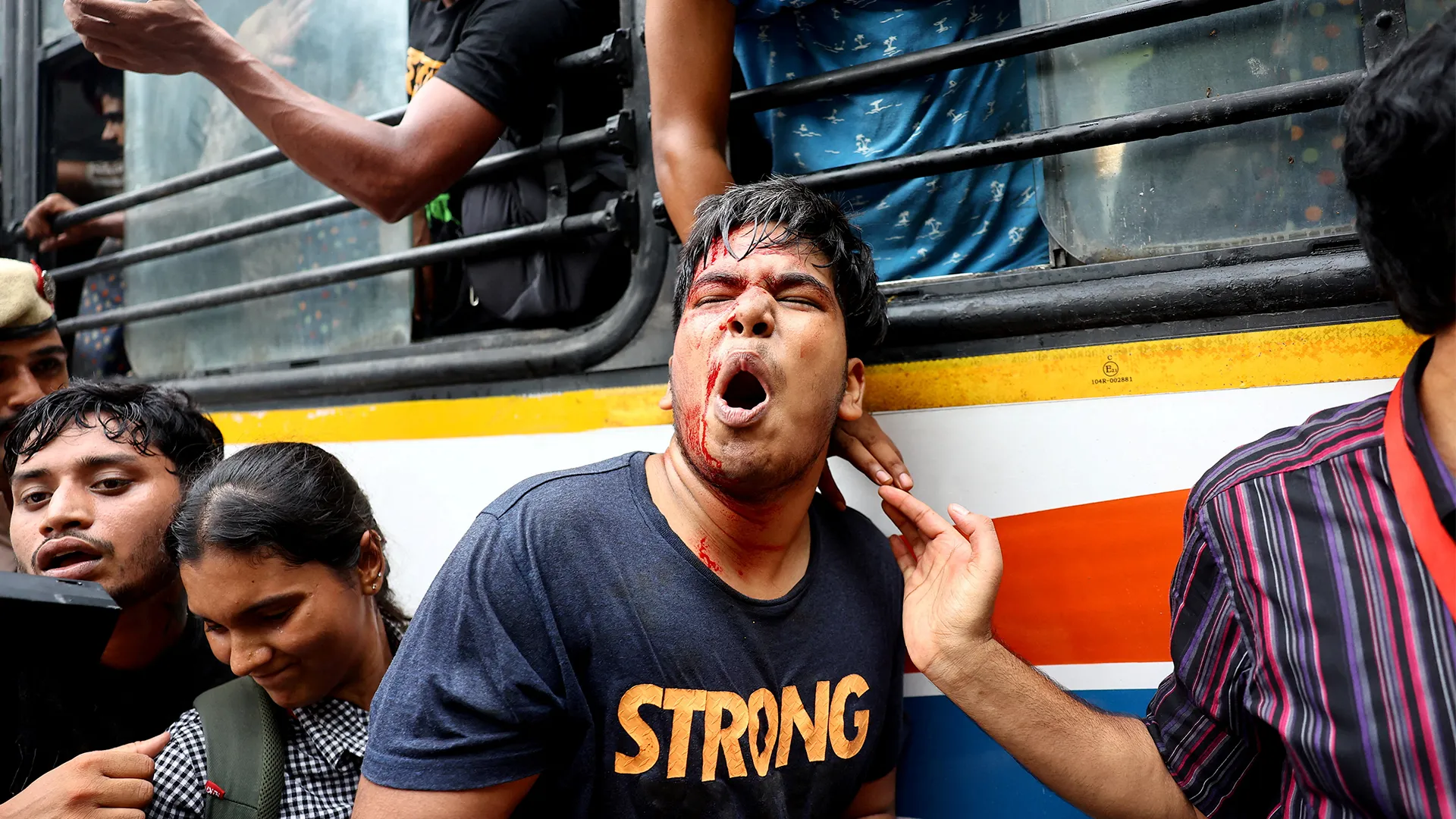
At least six people are feared dead after an under-construction bridge collapsed in India’s Uttar Pradesh state. Local officials say the collapse was triggered by heavy rain, trapping workers under the rubble. The incident comes days after severe storms killed more than 100 people across the state.
Voters cast ballots on the first day of early voting for nationwide local elections at a polling station in the Eulji Nuri Center in Seoul on Friday. Photo by Yonhap
Many South Koreans headed to the polls Friday in early voting for next week’s local elections and parliamentary by-elections, widely seen as a referendum on President Lee Jae Myung’s first year in office.
Eligible voters can cast ballots at 3,571 polling stations nationwide from 6 a.m. to 6 p.m. until Saturday, according to the National Election Commission (NEC).
As of 11 a.m., turnout for the local elections came to 3.81 percent, according to the NEC. The rate was higher than the 3.59 percent recorded at the same time on the first day of early voting for the 2022 local elections.
More than 44.6 million people are eligible to vote in this year’s local elections.
Up for grabs are 16 mayoral and gubernatorial posts, along with 227 heads of local governments and some 4,000 members of local councils.
Eyes are also on the parliamentary by-elections that will fill 14 vacant Assembly seats, with political heavyweights, such as Han Dong-hoon, former leader of the main opposition People Power Party (PPP), vying for seats.
In a poll released by the NEC last Thursday, 73.6 percent of respondents said they will definitely vote in the upcoming elections. Of them, 39.4 percent said they intended to cast ballots during the early voting period.
The upcoming elections are widely viewed as the first major nationwide vote for the Lee administration since it took office last June after former President Yoon Suk Yeol was ousted over his failed martial law bid.
Both the ruling Democratic Party (DP) and the PPP have been rallying voters to hit the polls this week, with the former urging the public to make a stern judgment on what it calls the “remnants” of Yoon’s insurrectionist forces.
Recent polls, however, indicate that races are tightening in more regions than earlier expected, despite the DP’s hopes for a landslide victory.
While the DP, which controls a majority in the National Assembly, seeks to extend the momentum for the Lee administration to push forward with its key policies, the PPP hopes to gain the footing needed to rebuild the conservative bloc amid deepening internal rifts in the aftermath of the martial law declaration.
Both parties view the capital area, where half of the country’s population resides, as a key battleground.
The Seoul mayoral election has shaped up to be a fierce two-horse race between incumbent Oh Se-hoon of the PPP and ruling party candidate Chong Won-o.
A Hankook Research poll released Monday showed Chong leading with 42 percent against Oh’s 36 percent.
Also closely watched is the parliamentary by-election in the Buk-A constituency in the southeastern city of Busan, where Ha Jung-woo, former presidential secretary for artificial intelligence policy and future planning, is competing against independent Han Dong-hoon and former PPP lawmaker Park Min-shik
Copyright (c) Yonhap News Agency prohibits its content from being redistributed or reprinted without consent, and forbids the content from being learned and used by artificial intelligence systems.
The incident is the latest setback for Jeff Bezos’s space venture as it seeks to narrow the gap with Elon Musk’s SpaceX.
By AFP, Reuters and The Associated Press
Published On 29 May 202629 May 2026
Blue Origin’s New Glenn rocket has exploded on the launchpad during a test in the US state of Florida.
The incident on Thursday evening is the latest setback for Jeff Bezos’s space venture as it seeks to narrow the gap with Elon Musk’s SpaceX.
Recommended Stories
list of 4 itemsend of list
Footage of the incident shows smoke emerging from underneath the rocket before it erupts into a massive fireball that billows skyward, sending a towering plume of flames and smoke into the air.
Emergency crews remained at the scene more than an hour later, but officials said there was no threat from fumes or other potential hazards.
No injuries have been reported.
“We experienced an anomaly during today’s hotfire test,” Blue Origin said in a brief statement posted on X, adding that “all personnel have been accounted for”.
A hot-fire test is where a rocket engine is fired up while anchored to the ground.
In a separate X post, Bezos said it was “too early to know the root cause” of the incident.
“Very rough day, but we’ll rebuild whatever needs rebuilding and get back to flying. It’s worth it,” Bezos added.
US House Representative Mike Haridopolos, whose Florida district includes the launch site at Cape Canaveral, said in a statement on X that he has been in contact with NASA Administrator Jared Isaacman regarding the explosion.
“I am grateful there were no reported injuries and thankful for the first responders, engineers, and launch crews who acted quickly,” Haridopolos said.
Blue Origin is preparing the New Glenn rocket to launch 48 Amazon Leo satellites into low-Earth orbit, part of efforts to build a broadband constellation to rival Musk’s Starlink network.
Musk responded on X to a video of the New Glenn explosion, saying: “Most unfortunate. Rockets are hard.”
Last month, the New Glenn rocket failed a mission to deliver a communications satellite into the correct orbit, prompting an investigation.
A large fire destroyed an apartment complex in Dallas after crews responded to reports of a gas leak. Authorities say at least three people, including a child, were killed. Other residents are unaccounted for.
May 28 (UPI) — A 52-year-old California woman convicted of hosting drunken house parties for young teenagers has drawn a 35-year prison sentence, prosecutors said Thursday.
Shannon O’Connor of Los Gatos, Calif., dubbed the “Party Mom,” was handed the maximum sentence on child abuse convictions during a hearing at Santa Clara County Court in San Jose.
Prosecutors said O’Connor procured vodka, whiskey and condoms for the 14- and 15-year-olds who attended parties at her home over a two-year period and encouraged them to drink to the point of passing out.
They alleged she warned the victims not to tell their parents about the parties or she could go to jail, and at one handed an teenager a condom and pushed him into a room with an intoxicated minor.
A jury convicted O’Connor in March and this week the court heard victims’ impact statements, including from one young woman who testified that she became suicidal from the experience.
In another instance during a party attended by five 14-year-olds, prosecutors say O’Connor watched and laughed as a drunk teen sexually accosted a young girl in bed.
In yet another case, she encouraged a sexual act after which the young female victim said to O’Connor, “Why did you leave me in there with him? Like, you knew like what he was going to do to me.”
“Many people call this defendant the ‘Los Gatos Party Mom.’ This isn’t some fun parent giving sips of wine spritzers to kids,” Santa Clara District Attorney Jeff Rosen said.
“She facilitated dangerous and drunken sex acts with these children. She risked their lives and damaged their psyches. She is not a party mom. Shannon O’Connor is a convicted felon. Shannon O’Connor is a registered sex offender.”
Rosen said O’Connor would summon teens to party at her home in the middle of the night and in one instance let a minor drive her SUV while another teen was knocked unconscious after falling off the back.
Korea Water Resources Corporation is moving to introduce a robot-based
inspection system for managing water supply facilities. Photo Courtesy of K-water
May 28 (Asia Today) — Korea Water Resources Corporation, also known as K-water, is accelerating the use of four-legged artificial intelligence robots to inspect large-scale water treatment plants.
The state-run water agency is adopting robots to improve facility inspections and safety management in hazardous areas and during nighttime patrols at water treatment plants.
Under K-water’s plan to introduce inspection robots at metropolitan water treatment plants, four-legged robots will be deployed this year and next year at four facilities in Seongnam, Hwaseong, Gosan and Gongju.
The agency plans to use data and results from those sites to expand the system to 40 additional water treatment plants by 2030.
K-water plans to deploy robots at 10 plants in 2027, 11 in 2028, nine in 2029 and 10 in 2030. The plan would establish a robot operating system at 44 metropolitan water treatment plants, with 44 robots in total.
A task force will soon begin work to operate the four pilot sites selected for this year.
The total budget for the project is 26 billion won, or about $17.3 million. It includes 7.8 billion won, or about $5.2 million, in state funding and 18.2 billion won, or about $12.1 million, from K-water’s own budget.
The robots will be used for equipment inspections, patrols, construction supervision and accident response. K-water is also considering the phased introduction of water quality analysis assistance robots, grass-cutting robots and unmanned guide robots.
The agency eventually plans to replace some of the robots with humanoid robots.
The use of AI and robots at water treatment plants is part of K-water’s strategy to create fully autonomous facilities. The agency aims to upgrade AI functions now used to assist workers and achieve fully autonomous water treatment plant operations within four years.
After that, K-water plans to package AI-based plant operation technology with robot-based management systems for use in overseas water management markets.
Once the robot operating system is established, K-water expects robots to handle 61% of condition inspection work among inspection and maintenance tasks. Condition inspections include checking whether equipment has visible abnormalities.
The agency estimates the system could save about 2.25 billion won, or about $1.5 million, annually.
K-water also plans to develop its own independent control system to avoid dependence on specific vendors for data accumulated during robot operations and additional operating costs.
“Bidding for the four pilot sites is expected to begin as early as next month, along with software service procurement,” a K-water official said. “Contracts are expected around August, and actual installation is expected to begin at the end of the year.”
The official said K-water will also consider gradually expanding the system beyond water treatment plants to other water supply facilities, dams and sewage systems.
Iran’s football team still lacks US visas and is not competing on ‘equal terms’, Tehran’s envoy to Mexico says.
Published On 28 May 202628 May 2026
Iran’s football team still lacks US visas and is not competing in the World Cup on “equal terms” because of its difficulty in training ahead of the tournament, Tehran’s ambassador to Mexico said on Thursday.
Abolfazl Pasandideh visited the northwestern Mexican border city of Tijuana, where Iranians have relocated their training camp. They were originally planned to be based in Tucson in the US state of Arizona.
Recommended Stories
list of 4 itemsend of list
The ambassador told a news conference that “the country to the north” – meaning the United States – had not followed through on its responsibility of hosting the Iranian team.
“We don’t know whether or not they’re going to give the players their visas,” he added.
Iran will play their three World Cup group games in two West Coast US cities: Los Angeles and Seattle. The head of the Iranian Football Federation has said there was hope that the players would be granted multiple entry visas.
“We aren’t participating in the World Cup on equal terms,” Pasandideh said.
“We haven’t been able to train our team like they should,” he said, because of the US-Israel war on his country that began on February 28.
On Wednesday, Iranian diplomats visited the stadium where the team is training, a source from Club Tijuana that plays there told the news agency AFP. The diplomats also met with local security officials, the source said.
Iran are due to play in Los Angeles on June 15 against New Zealand, and on June 21, against Belgium. They then play in Seattle against Egypt on June 26.