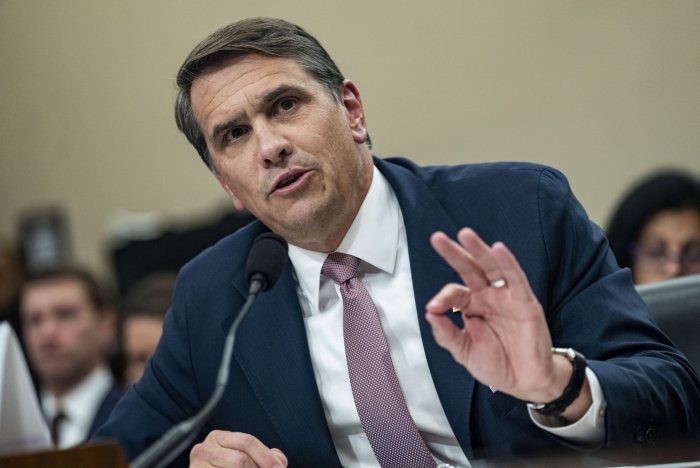
June 4 (UPI) — The Kennedy Center ordered its staff Thursday to remove President Donald Trump‘s name from the center by June 12.
A memo was sent out from the center’s general counsel that said they must remove all references from signs, brochures, websites, furniture and more, and that they must update email signatures and letterhead immediately.
On Friday, U.S. District Judge Christopher Cooper ruled that the center’s board had overstepped its authority when it voted to add Trump’s name to the center. The memo was the first sign that the center plans to comply with the order.
“Congress gave the Kennedy Center its name, and only Congress can change it,” Cooper said.
Trump claimed that naming the center after him was a surprise, but the name was added to the sign the next day.
Justice Department lawyers representing Trump later said the speed of the move showed it had been “prepared and/or purchased prior to the Board’s vote the day before,” The Washington Post reported.
Thursday’s memo also said officials were “considering their options and will provide further guidance shortly” on whether the center will close after July 5. The center was scheduled for two years of closure for a $257 million renovation.
In his decision, Cooper said the renovations are “sorely needed,” and his ruling doesn’t bar the board from closing “should it come to this decision anew after independently balancing its multiple obligations to the Center in a prudent fashion,” CBS News reported.
“By way of this opinion, the Court does not purport to dictate how the Center should be run, nor does it prescribe any particular plan for the institution — construction, closure or otherwise — moving forward,” he wrote. “It simply holds the Kennedy Center Board to certain minimum requirements imposed by law. Beyond that, the Court will let the parties play on.”
June 4 (UPI) — Melinda French Gates has added another $215 million to her organization Pivotal, which funds social initiatives for women and families around the world.
The latest boost in funding is specifically to address problems with women’s reproductive and menopause health, she said. French Gates has contributed $600 million to women’s health over the past two years.
As part of this round, she is donating $10 million to The Menopause Society for the education of healthcare professionals and to expand outreach in areas where access to menopause care is limited.
“For too long, perimenopause and menopause have been treated as invisible — something women are expected to manage quietly, without clear answers or support. That must change. By getting healthcare practitioners better training and investing in research, we can help ensure women have the care they need to live full and healthy lives,” French Gates said in a statement.
While midlife issues have seen more attention, thanks to social media, that attention doesn’t always translate to correct information from practitioners.
“The piece that I’m focused on with Pivotal is: How do we make sure that women get accurate information about what we do know about this phase of life? And how do we make sure that all providers are trained?” she told Time in an interview.
“In midlife, I would say we both don’t have enough knowledge or tools,” she said. “The research should have been started more than 50 years ago. We should have had many, many, many studies about this period of life, so that we have different tools, not just hormone replacement therapy. Then, we have a lack of provider training, which is the piece I’m going to work on with this particular amount of funding.”
The Menopause Society said the funding will help reach women who need the care.
“Menopause is a universal life stage, but quality care is not universally available,” said Dr. Stephanie Faubion, medical director of The Menopause Society, in a statement. “With this funding, we can scale evidence-based training for front line clinicians and extend our reach to areas where menopause care has long been overlooked. This is a meaningful step toward ensuring that women receive the informed, compassionate care they need and deserve so they can make smarter healthcare decisions. It also allows for exploration and a better understanding of the need for system changes.”
While the donation is critical, Faubion said the attention generated by French Gates is even more important.
“It shows that somebody like Melinda Gates and Pivotal feel that this is an important issue,” Faubion told the Independent. “It will illuminate the gaps that are still there … and it makes people not only aware, but maybe motivated to take some action.”
Though women make up half the population, health issues that affect them get only 2% of private healthcare funding, according to the World Economic Forum.
“The role of philanthropy, in my opinion, is to look at some of these societal problems that have been left behind, and shine light on them, show ways of making progress so you can then crowd in other donors and ultimately crowd in government funding,” French Gates told The Independent. “Part of what I’m doing here, I hope, is sending a signal to say, ‘This is really important. Let’s do something about it.’ And my hope is that I’ll be able to get others who will join me.”
People gather during a protest in a street in Mogadishu, Somalia, on Thursday after fighting erupted between opposition-led protesters and Somali state security forces during a planned protest against the federal government’s mandate extension for President Hassan Sheikh Mohamud. Photo by Said Yusuf Warsame/EPA
June 4 (UPI) — The Somalian military and opposition militias opposed to an extension of President Hassan Sheikh Mohamud’s term by the country’s parliament skirmished Thursday in its capital.
After the opposing sides set up positions within Mogadishu late Wednesday, gunfire and fighting broke out in the city ahead of planned demonstrations today, The Guardian and The New York Times reported.
Mohamud was due to leave office May 15, but the country’s parliament voted to extend his term by one year, prompting opposition leaders — including former President Sharif Sheikh Ahmed and former Prime Minister Hassan Khayre — to announce demonstrations against what they said is a constitutional crisis.
Ahmed said that government forces had targeted his home intending to kill him because he has spoken out against the extended term and is leading resistance to it.
Ahmed and Khayre each have their own security, as do other clans throughout the country, and the alleged targeting of the leaders by government military forces led to ongoing skirmishes that have left Mogadishu residents fleeing for their safety.
Ahmed, in a video statement, said that government forces had “encircled and attacked my house.”
“I am never scared of their aggressive attack — I will fight back,” he said.
Khayre said in a statement that the government had deployed anti-tank weapons and drones in the attack, endangering civilians in the area.
At a press conference Thursday, Col. Mahdi Omar Mumin said that government forces staged “an operation in which security agencies neutralized armed militia members who yesterday attacked police forces in the Hodan District,” Somalia’s Ministry of Defense said in a statement on X.
“The militia had caused harm to Somali civilians and disrupted security in the capital,” the ministry said.
Mohamud and members of the parliament who support him said the effort is to move from indirect elections to individuals voting specifically for their chosen candidates.
Opposition members have said they fear the change could prevent many people in the country from having a voice in the government and potentially enable greater power for Mohamud.
Sudan’s Rapid Support Forces have had a long history of violations, going back to when they were known as the ‘Janjaweed’. Over the past few years, they have been trying to change their image and become influential political actors in Sudan, but will that work? Al Jazeera’s Hala Saadani looks back at the RSF’s history and where they may go from here.
No handshake and no photo as Mirra Andreeva of Russia beats Marta Kostyuk of Ukraine to reach French Open tennis final.
By Kevin Hand, News Agencies and The Associated Press
Published On 4 Jun 20264 Jun 2026
Russian teenager Mirra Andreeva reached her first Grand Slam final by beating Marta Kostyuk of Ukraine 6-1, 6-3 in a tense encounter at the French Open.
Andreeva converted her first match point when she served for the tennis match on Thursday.
Recommended Stories
list of 4 itemsend of list
There was no post-match handshake between the pair, however, and Kostyuk walked off quickly, turning only to wave and blow kisses to the crowd at Court Philippe-Chatrier, where some fans were draped in Ukrainian flags.
The atmosphere beforehand was somewhat tense as the players had separate photos taken as they each stood next to two children on their respective sides of the net. Usually, the players pose for the same photo, standing right next to each other by the net.
Kostyuk and countrywoman Oleksandra Oliynykova have spoken out during the tournament about the impact Russia’s four-year invasion of Ukraine is having on their country.
The eighth seed seized control from the outset and never loosened her grip on the contest, overwhelming Kostyuk with her depth and aggression on Court Philippe-Chatrier to set up a title clash against compatriot Diana Shnaider or Polish qualifier Maja Chwalinska.
Andreeva, 19, raced into a 4-0 lead in the opening set and barely looked back in the third meeting between the two players, the Ukrainian having won the first two.
Kostyuk briefly threatened to make a contest of it in the second set, but the Russian swiftly snuffed out any hopes of a comeback before serving out the match to complete a dominant display.
“I’m still very nervous, very nervous coming to this match as she’s had an amazing season, she hadn’t lost on clay, so that put pressure,” said Andreeva.
“She’s an amazing player, a tough opponent, so I’m super happy with the way I played. I’m happy I got revenge for the Madrid final, and to reach my first Grand Slam final.
“All of these feelings combined, I’ve never felt anything like this. I’m very excited about the last match here in Paris.”
Top-seeded Sara Errani and Andrea Vavassori of Italy won the mixed doubles final earlier Thursday, beating Gabriela Dabrowski of Canada and Evan King of the US 4-6, 6-3, 10-4.
An Italian is guaranteed to be in Sunday’s men’s French Open singles final, with Flavio Cobolli facing fellow Italian Matteo Arnaldi on Friday in the first Grand Slam semifinal for both players.
Israel and the Lebanese government have agreed to implement a new US-mediated ceasefire, the Trump administration has said, despite Israel’s defence minister insisting the military will continue operations in Lebanon.
Furthermore, while Lebanese President Joseph Aoun said on Thursday that the ceasefire would come into force within 24 hours of approval by all concerned parties, Hezbollah leader Naim Qassem has dismissed the deal, labelling it a “surrender and defeat”.
Recommended Stories
list of 4 itemsend of list
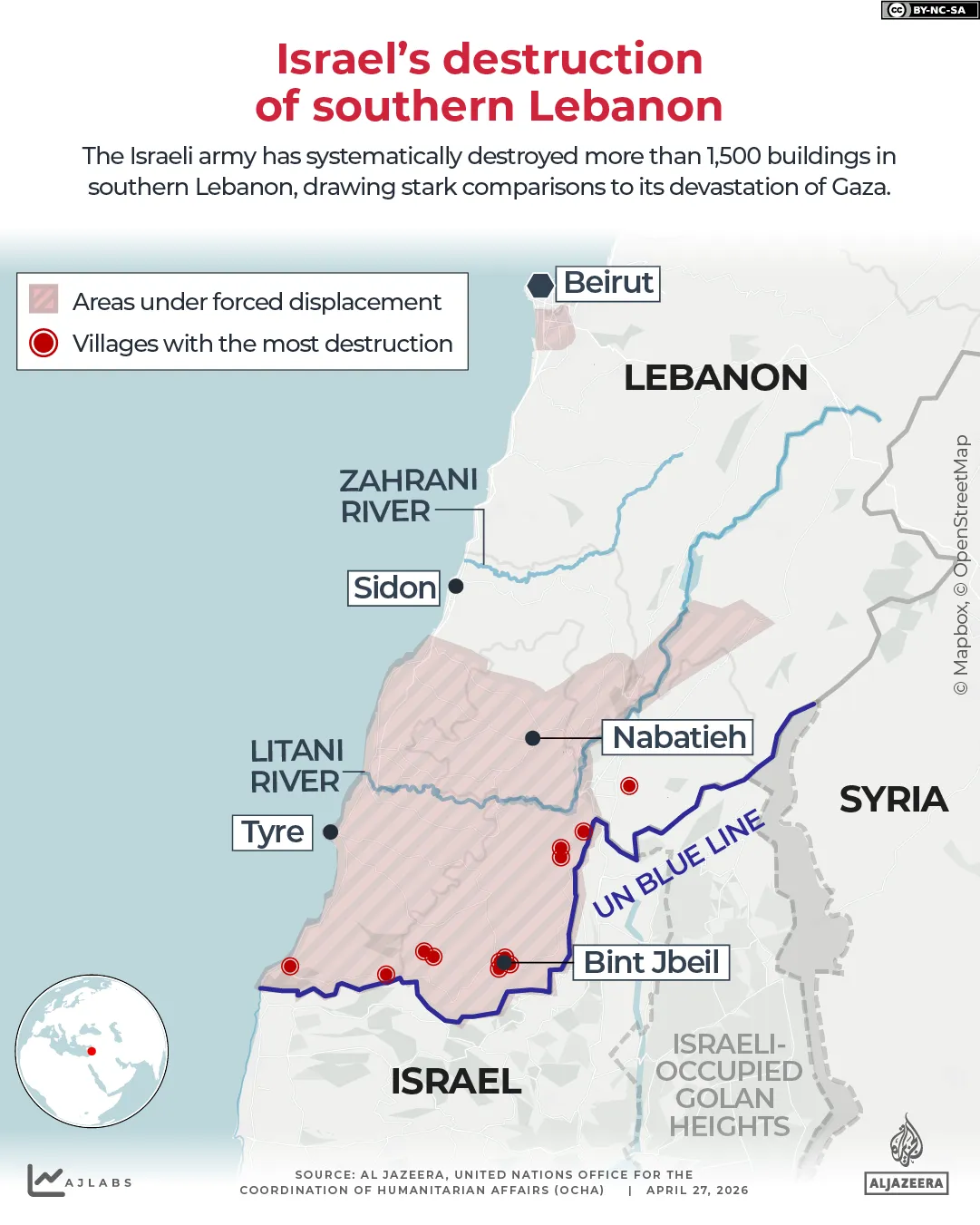
The Trump administration announcement comes just weeks after a previous agreement to cease hostilities was supposedly reached on April 16. Since then, however, more than 600 people have been killed in Israeli strikes across Lebanon while Israel has expanded its military presence in the south of the country, now occupying about one-fifth of the country.
The renewed diplomatic push also comes as Washington pursues parallel shuttle negotiations with Iran. Tehran, a close ally of Hezbollah, has made a ceasefire in Lebanon a condition for any broader agreement to end the war with the US and has repeatedly called for Israel to withdraw from southern Lebanon.
Iran’s position was underlined when Quds Force commander Esmail Qaani said the baseline demand in Lebanon is for Israeli forces to withdraw to the positions they held before the start of the US-Israel war on Iran at the end of February – a demand that is not explicitly reflected in the agreement.
Iran and Hezbollah’s responses to the US announcement, coupled with Israel’s insistence that military operations will continue, have cast serious doubt on its viability. Critics of Israel’s war on Lebanon also point to the April truce, which they say has completely failed to halt Israeli attacks or Israel’s occupation of the south of the country.
What has been announced?
According to the Trump administration, Israel and Lebanon have agreed to implement a ceasefire contingent on a “complete cessation” of Hezbollah fire and the evacuation of its fighters from the area south of the Litani River.
The agreement also calls for the creation of “pilot zones” where Lebanese Armed Forces would take exclusive control “to the exclusion of all non-state actors”. The stated aim is to move towards a wider political and security agreement, including the dismantling of non-state armed groups and preventing their re-emergence.
But Hezbollah was not party to the talks and has already rejected the agreement. Lebanon was represented by government diplomats, even though the Lebanese army is not a party to this conflict.
According to the wording of the agreement, the parties are due to reconvene during the week of June 22 to continue diplomatic and security talks, with the US facilitating communications in the meantime. It remains unclear if that stage of the agreement will ever be reached.
[Al Jazeera]
What was agreed in April?
The April agreement used different language, saying Israel and Lebanon would implement a “cessation of hostilities” from April 16, and never actually used the word ceasefire.
It also included a clause allowing Israel to “take all necessary measures in self-defence, at any time, against planned, imminent or ongoing attacks”.
That clause does not appear in the new text, which could be interpreted as a small concession. That was until Israel Katz said Israel would continue its military operations in Lebanon regardless.
The latest agreement also repeats Israel’s longstanding demand that Hezbollah withdraw from south of the Litani River.
Meanwhile, there is one major glaring omission. While the text focuses heavily on Hezbollah’s withdrawal from parts of southern Lebanon, it does not mention Israel’s withdrawal from southern Lebanon.
Lebanese journalist and analyst Souhayb Jawhar told Al Jazeera the agreement is defined as much by what it leaves out as by what it includes.
The text, he said, focuses on Hezbollah’s obligations and those of the Lebanese state: removing armed elements from south of the Litani and creating zones where the Lebanese army holds exclusive control.
“This point alone explains much of the scepticism within Hezbollah and its political environment,” Jawhar told Al Jazeera. “From the party’s perspective, any agreement should include a clear ceasefire, an Israeli withdrawal, and a framework for addressing outstanding issues, rather than becoming a document focused primarily on restructuring Lebanon’s internal security landscape.”
What else is different this time?
Other points of contention regarding the new agreement are the “pilot zones”, which appear to go beyond stopping the fighting and instead test a new security model in southern Lebanon – one that could eventually be expanded elsewhere, analysts say.
“This is why many observers see these zones as the beginning of a gradual transition from a security environment in which Hezbollah played the dominant role to one in which the Lebanese state and its armed forces become the sole security authority,” Jawhar said.
He added that the fate of the agreement may depend less on Lebanon-Israel talks than on the US-Iran track. If Washington and Tehran reach a wider understanding, the ceasefire in Lebanon will have a stronger chance of holding because both sides will have an interest in stabilising the Lebanese front.
“If those negotiations stall or collapse, Lebanon could quickly return to being one of the main arenas of pressure and confrontation between the two sides,” Jawhar added.
What is the situation in Lebanon now?
Southern Lebanon remained under heavy military pressure on Thursday, with Israeli strikes on Kafra and al-Mansouri in the southwest of the country. In the Bekaa Valley, one person was killed and four others wounded in an Israeli strike on Sohmor, according to Lebanon’s state-run National News Agency (NNA).
A separate strike hit Tell al-Aqareb, while further raids targeted Haddatha, Tibnin, Haris, and Harin. The NNA also reported more Israeli strikes across southern Lebanon as drones flew at low altitude over Beirut. In Maaroub, one person was killed and another wounded when Israeli forces targeted a motorcycle.
Israeli warplanes also struck towns and villages across the south, including Zawtar al-Sharqiya, Zawtar al-Gharbiya, Shoukin, Barachit, Srifa, Zibdin, Haris and Deir Zahrani. Jets and drones have also been flying over the south for much of the morning, including a drone seen at extremely low altitude over Tyre.
Lebanon’s Civil Defence authorities have warned people not to return south, citing the continued danger to civilian life in towns and villages across southern Lebanon.
More than 3,000 people have been killed, and more than one million have been forced from their homes since Israel renewed its assault on Lebanon in early March.
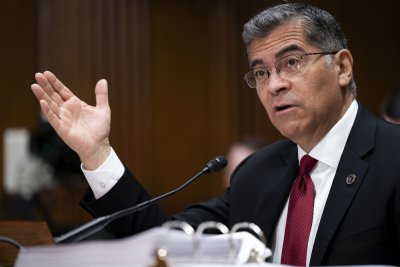
1 of 2 | Former Secretary of the Department of Health and Human Services Xavier Becerra speaks during a Senate Finance Committee hearing on former President Joe Biden’s proposed budget request for the Department of Health and Human Services for fiscal year 2025 at the U.S. Capitol in Washington, D.C., on March 14, 2024. File Photo by Bonnie Cash/UPI | License Photo
June 4 (UPI) — Republican Steve Hilton and Democrat Xavier Becerra are leading a crowded field in California’s primary for governor on Thursday with millions of ballots left to count.
The two candidates that receive the most votes will advance to the November election, regardless of party. Democrat Tom Steyer has the third most votes so far.
Sixty-one candidates qualified to appear on the primary ballot to replace Gov. Gavin Newsom.
Polls closed on Tuesday night at 8 p.m. PDT. It is common for California to take days if not weeks to tally enough votes to declare a winner.
Despite millions of votes still being counted, President Donald Trump has alleged that Democrats have cheated in California’s primaries.
“There’s BIG cheating by the Dumocrats in California,” Trump posted on social media. “Votes are all tied up. May not be in for weeks. Under investigation by the U.S. Attorney’s Office in Los Angeles. Why the vote counting DELAY?”
Trump also declared Hilton the winner of the primary, even though not enough votes have been counted to make that determination.
“Congratulations to Steve Hilton on coming in first, last night, in the California Vote for Governor,” Trump wrote.
Hilton, a former Fox News host, is the top overall vote-getter as of Thursday morning.
Becerra is the former Biden administration U.S. human services and health secretary. Steyer, a billionaire, is a philanthropist and climate activist.
Demonstrators march during a rally in Tirana on Wednesday calling for a proposed $1.6 billion luxury resort in an enironmentally sensitve island location off Albania’s Adriatic Sea coast by an international consortium led by Donald Tump’s son-in-law, Jared Kushner. Kushner and wife Ivanka Trump stumbled upon the uninhabited island during a vacation. Photo by Malton Dibra/EPA
June 4 (UPI) — Thousands of Albanians marched in the capital Tirana for a third day straight to protest against a $1.6 billion luxury resort backed by Donald Trump‘s son-in-law, Jared Kushner, in a national marine park off the country’s Adriatic Sea coast.
Some demonstrators in Wednesday’s protest held inflatable flamingos aloft to highlight the impact they fear the project will have in and around Sazan Island, where work recently got underway in the midst of one of the Mediterranean’s most environmentally-vulnerable areas.
Scuffles broke out with police who fired water canon at protesters.
An offer to meet with opponents from Prime Minister Edi Rama, who has staked his premiership on what he has billed as a developmental coup for the former communist state, was rejected as calls for the project to be halted grew, with protests also set to spread to the south of the country.
“From start to finish there has been a total lack of transparency. We have seen no public consultation or public documentation regarding permits, and so now what we are saying is, if they remove the bulldozers, remove the fence and restore the habitats to what they were, then we can start talking,” said Aleksandr Trajce, executive director of Protection and Preservation of the Natural Environment in Albania.
“We were on a friend’s boat, and we stopped for a swim. Effectively, that’s how we found it. We swam to the island. We went on a hike, barefoot all the way up to the top, and we were just captivated,” Ivanka Trump said.
Environmentalists are worried about the effect the resort will have on an area that includes the currently uninhabited Sazan Island and the nearby wetlands and coastal habitats of the Karaburun-Sazan Marine Park.
BirdLife International said the park’s waters around Sazan and the Karaburun peninsulta were among the last places where Mediterranean monk seals survive and support populations of flamingos and Dalmatian pelicans as well as 200 other species of birds, many of which are endangered.
Sazan Real Estate Development, which is developing the plans in partnership with Kushner’s Miami-based investment firm, Affinity Partners, insisted it was committed to sustainable development.
“Our focus remains on responsible stewardship, environmental enhancement, job creation, and creating long-term value for local communities. We respect the ongoing public and institutional processes,” said Sazan Real Estate Development chair Asher Abehsera.
Enrique Riquelme held up a Real Madrid shirt bearing Erling Haaland’s name, while campaigning for club presidency.
Published On 4 Jun 20264 Jun 2026
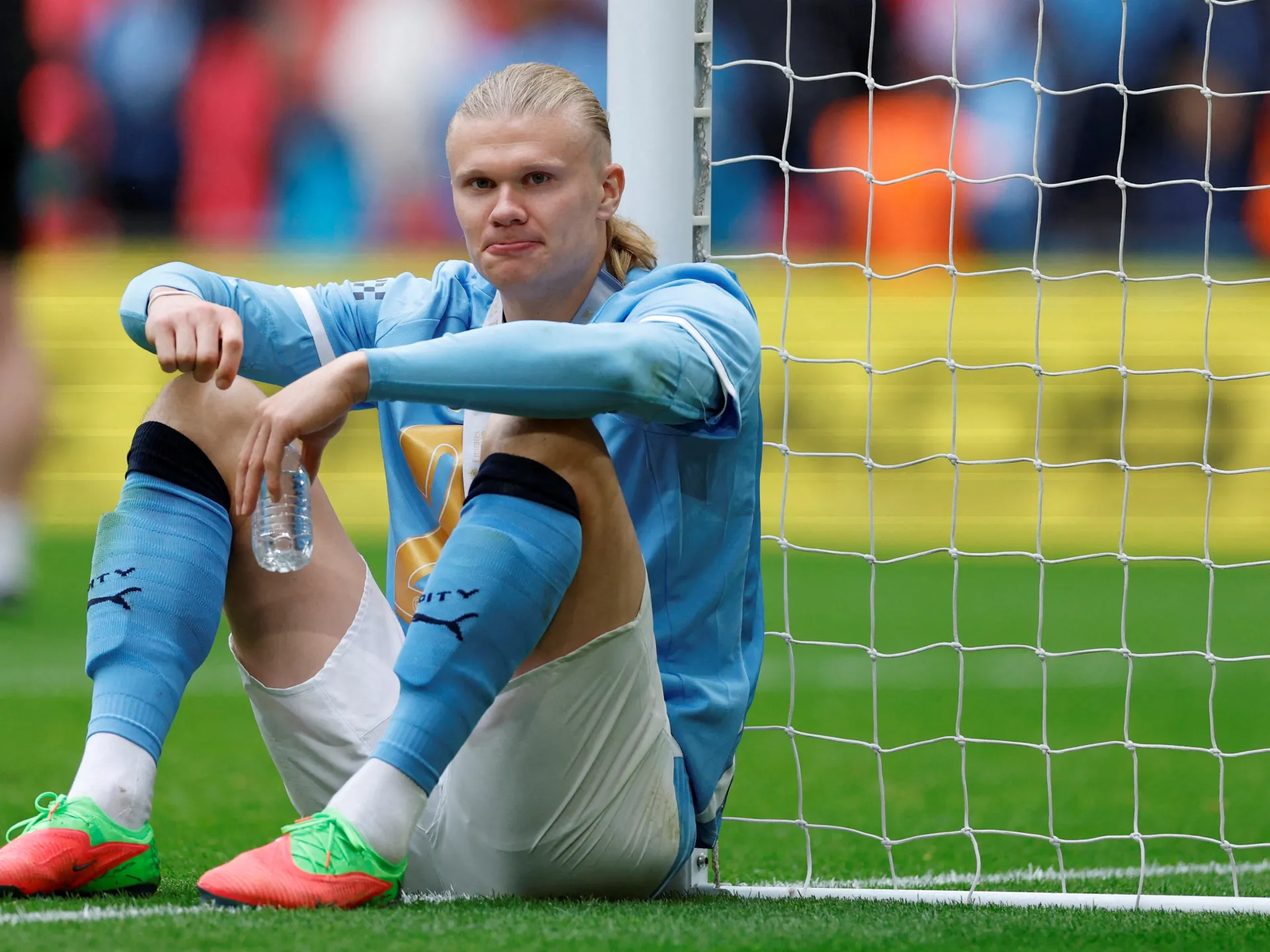
Manchester City is considering legal action after Real Madrid presidential candidate Enrique Riquelme said he would sign the Premier League club’s Norwegian striker Erling Haaland if elected.
Riquelme, a renewable energy entrepreneur challenging incumbent Florentino Perez, made the pledge during an appearance on Spanish television on Wednesday, where he held up a Real Madrid shirt bearing Haaland’s name.
Recommended Stories
list of 4 itemsend of list
“The stories which have emerged from Spain regarding the future of Erling Haaland are untrue,” a City spokesperson said on Thursday.
“There is no chance of this happening, and there is no contractual clause to enable it. We are considering legal action for the use of our player’s image in this context.”
Riquelme said Haaland, who scored 38 goals in all competitions last season, had a release clause and wanted to move to the Spanish club, adding that he would make the transfer a priority if he wins Sunday’s election.
A joint statement from the 25-year-old footballer’s father, Alfie Haaland, and his agent, Rafaela Pimenta, swiftly rejected the suggestion, describing it as “not true”.
Riquelme added he would try to sign City’s Spain midfielder Rodri, saying he had spoken to the player’s agent and would “do everything possible” to bring the Ballon d’Or winner to Madrid.
The remarks come against the backdrop of Real’s presidential election, the first in two decades in which Perez is not running unopposed, after the club’s two seasons without a major trophy.
Voting is scheduled for Sunday, with some 100,000 club members eligible to take part.
Haaland had the option to join Real in 2022, when he left Borussia Dortmund. But he chose City, where his father played.
While the striker, who won the Premier League Golden Boot for the third time in four seasons, said he would like to play for Real one day, there has been no suggestion he is unhappy at City. He signed a new nine-and-a-half-year contract in January 2025.
Perez announced on Wednesday that, should he be elected, he would bring Benfica manager Jose Mourinho back to Real Madrid for a second term at the helm of Los Blancos.
The Portuguese former manager of Manchester United, Chelsea and Inter Milan previously won the La Liga title during a three-year spell in Madrid.
Clashes between Israel and Iran-backed Hezbollah militias in southern Lebanon continued unabated on Thursday, a day after the United States announced a new cease-fire. File photo by Atef Safadi/EPA
June 4 (UPI) — Israel and Lebanon signed up to a fresh U.S.-brokered cease-fire to clear the path for negotiations toward “a comprehensive peace and security agreement” between the two countries.
The truce, predicated on Iran-backed Hezbollah halting all attacks and withdrawing from south of the Litani River in southern Lebanon, involves the setting up of Lebanese Army exclusion zones out-of-bounds to all non-state actors, the parties said Wednesday in a statement released by the U.S. State Department.
“These steps will enable progress towards a comprehensive peace and security agreement. All countries reaffirmed that the future of the relationship between Israel and Lebanon must be decided by the two sovereign governments. They rejected any attempt, by any state or non-state actor, to hold Lebanon’s future hostage,” said the State Department.
The area Hezbollah must vacate is an approximately 20-mile wide strip of land between the Lebanon-Israel border and the Litani River in Lebanon’s south.
The announcement came after a fourth round of ambassador-level negotiations in Washington on Tuesday and Wednesday. Hezbollah was not represented at the talks, which the State Department said were scheduled to reconvene June 22 to try to reach “a comprehensive agreement.”
Israeli Defense Minister Israel Katz said Israel’s military would not halt hostilities in the south and retained the right, with American backing, to carry out retaliatory strikes on Beirut “in response to fire on Israeli communities or territory.”
“The IDF will, at this stage, continue its fire and ground operations, remain in the security zone in Lebanon up to the yellow line — including in the Beaufort area — and without the return of the population, while continuing to dismantle terrorist infrastructure on the ground,” he said.
Hostilities on the ground continued Thursday with at least one person killed and several injured in Israeli strikes in southern Lebanon with Israeli warplanes in the skies over a dozen towns while Hezbollah fired rockets and drones at Israeli forces in southern Lebanon.
The incidents came after Israeli strikes killed nine people across southern Lebanon on Wednesday and Hezbollah fired rockets into northern Israel.
The latest initiative followed a truce agreement announced by U.S. President Donald Trump on Monday to head off pending Israeli strikes on a Hezbollah stronghold in the Beirut suburbs in exchange for Hezbollah halting attacks on Israel.
The fighting in Lebanon has complicated U.S.-Iran peace negotiations with Iran insisting Lebanon is included in a fragile cease-fire that came into force on April 8. Trump’s intervention came after Tehran threatened to pull out of the talks, saying Israel’s ongoing military operations in Lebanon violated the terms of the cease-fire, warning it would shut the Strait of Hormuz and was looking to “activate” its “resistance front” in other parts of the region.
Jensen Huang, CEO of U.S. chip giant Nvidia Corp., will visit South Korea later this week, industry sources said Thursday. Huang is seen here speaking at conference in Taipei on June 1. Photo by Yonhap
Jensen Huang, chief executive officer (CEO) of U.S. chip giant Nvidia Corp., will visit South Korea later this week for a series of meetings with the heads of major conglomerates and researchers that could pave the way for broader cooperation in artificial intelligence (AI) and robotics, industry sources said Thursday.
Huang is scheduled to arrive at Gimpo International Airport in western Seoul aboard his private jet on Friday afternoon for a four-day visit, following his appearance at the Computex trade show in Taipei, the sources said.
During his stay, Huang is expected to meet with leading business figures, as well as executives from the gaming industry, AI and robotics startups, university researchers and students.
On Friday evening, he is expected to visit a Korean barbecue restaurant in Seoul’s Seongsu neighborhood for a gathering with SK Group Chairman Chey Tae-won, Hyundai Motor Group Executive Chair Euisun Chung, LG Group Chairman Koo Kwang-mo and Naver Chairman Lee Hae-jin.
Industry observers expect the participants to discuss a wide range of potential cooperation areas between Nvidia and South Korean companies, including high-bandwidth memory (HBM), AI data centers, autonomous driving, robotics and physical AI.
During his previous visit to South Korea in October, which coincided with the Asia-Pacific Economic Cooperation (APEC) CEO Summit in the southeastern city of Gyeongju, Huang drew widespread attention when he joined Samsung Electronics Chairman Lee Jae-yong and Chung for a late-night meal of Korean fried chicken and beer, commonly known as “chimaek.”
On Sunday, Huang is expected to meet with Kim Taek-jin, CEO of NC Corp., a South Korean gaming company, they said.
While the agenda has not been disclosed, discussions are expected to focus on cooperation in gaming and AI.
On Monday, Huang is also expected to hold a closed-door meeting with executives from South Korean AI and robotics startups in Seoul.
The meeting would mark the first known occasion on which Huang has met with robotics startup founders in South Korea.
The Nvidia chief is also coordinating plans to visit the country’s top-notch Seoul National University’s AI institute and robotics research center.
Separate from the visits, Huang has reportedly expressed interest in meeting directly with university students.
Huang is reportedly meeting Krafton’s Executive Director Chang Byung-gyu, and other senior managers from the company, though the exact dates have yet to be confirmed, the sources said.
The two companies are likely to discuss gaming partnerships related to Nvidia’s RTX Spark, a type of semiconductor designed for premium Windows laptops, as well as physical AI.
Krafton has founded a robotics company called Ludo Robotics early this year.
Copyright (c) Yonhap News Agency prohibits its content from being redistributed or reprinted without consent, and forbids the content from being learned and used by artificial intelligence systems.
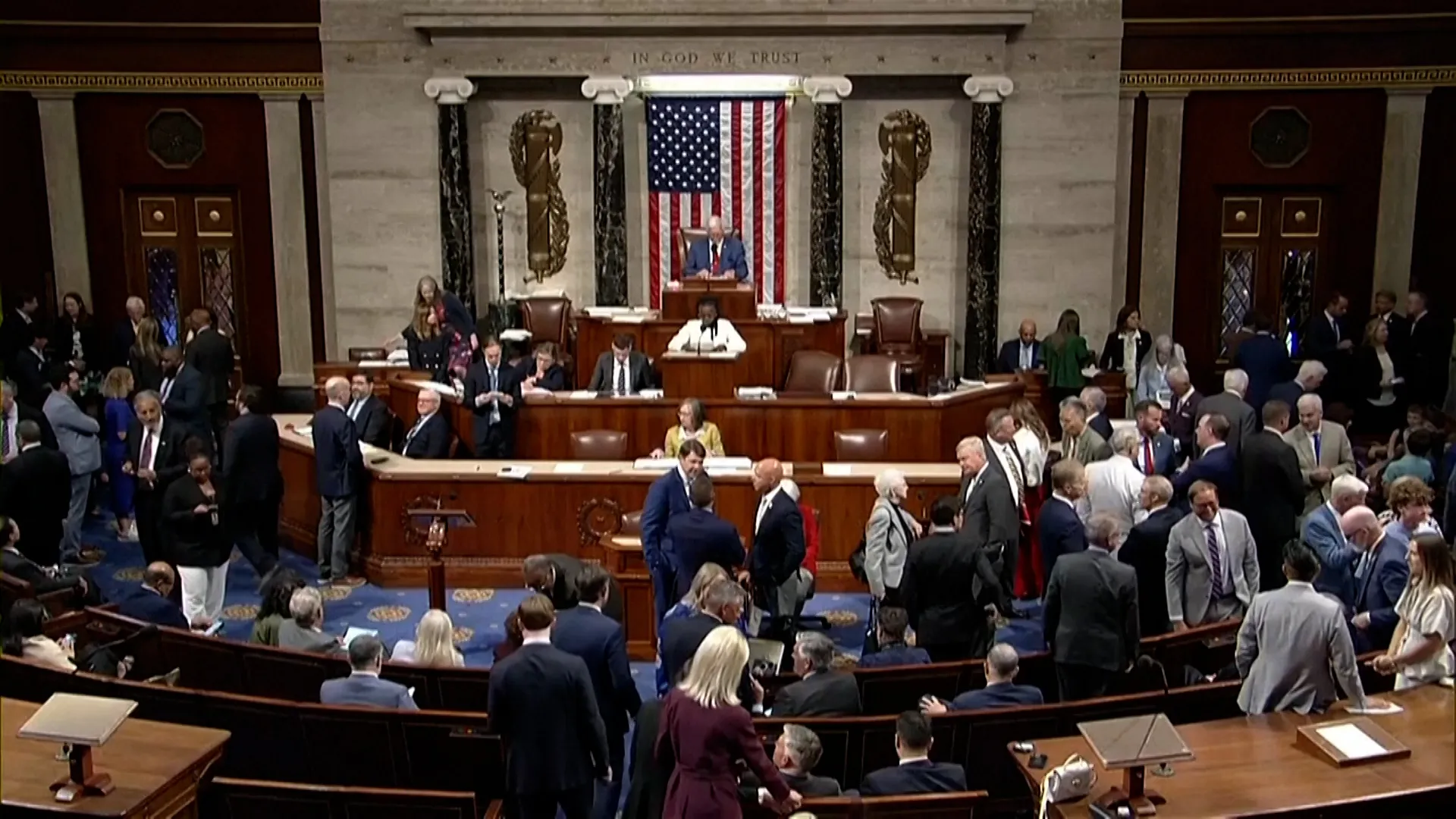
This is the moment the Republican-led US House of Representatives passed a resolution to reign in President Donald Trump’s ability to keep attacking Iran, unless Congress declares war or approves the use of military force. But it’s unlikely to become law as Trump can veto it even if it passes the Senate.
Wu’er Kaixi, a former student leader of the 1989 Tiananmen pro-democracy movement, speaks at a news conference at the Foreign Correspondents’ Club of Japan in Tokyo on Wednesday. Photo by Asia Today
June 3 (Asia Today) — Wu’er Kaixi, a former student leader of China’s 1989 Tiananmen pro-democracy movement, warned South Koreans on Wednesday not to view North Korea only as a country of the same ethnic people.
“North Koreans are certainly Koreans. They speak the same language and eat the same food,” Wu’er said at a news conference at the Foreign Correspondents’ Club of Japan in Tokyo, one day before the anniversary of the June 4 Tiananmen crackdown. “But they have been affected by the disease of communism, and that influence has seeped into their bones and DNA.”
Wu’er, also known as Uerkesh Davlet, was listed by the club as a former student leader of the 1989 Tiananmen movement for its Wednesday news conference, titled “Tiananmen 37 Years Later.”
Asia Today asked Wu’er about the future of China and what it could mean for the Korean Peninsula, noting China’s influence on the Korean War, the division of the peninsula and North Korea’s nuclear issue.
Wu’er responded by directly addressing North Korea.
“I understand that Koreans dream of unification,” he said. “But that is not simply a matter of meeting lost brothers and sisters again. It is the process of rebuilding half of a country that has been affected by communism.”
Wu’er expressed concern about what he described as a nationalist approach within parts of South Korean society.
“When I talk with friends in Seoul, I often sense conservative and nationalist sentiment,” he said. “I fully understand such feelings because South Korea has faced North Korea’s military threat directly.”
“But South Koreans who enjoy liberal democracy should have a mindset of using that freedom for the freedom of North Koreans,” he said.
Wu’er also warned against accepting North Korean propaganda at face value.
“North Korea’s military threats are calculated actions,” he said. “You should not be misled by the nationalist slogans they put forward.”
He said propaganda is used to control hungry citizens.
“North Koreans are still hungry, but they are ruled by regime propaganda,” Wu’er said.
“North Korea is no longer the North Korea we think of,” he said. “If one day South Koreans have the chance to embrace North Koreans, they will realize they are no longer the brothers and sisters they remember from the past.”
“They may be closer to Russians or Chinese,” he said. “You have to understand how a communist system changes human beings and society.”
Wu’er said South Korea’s government and people should understand the nature of the Chinese Communist Party system when considering North Korea.
During the news conference, Wu’er sharply criticized the Chinese Communist Party, saying many people mistakenly view China as a state driven by nationalism or communist ideology.
“The Chinese Communist Party is simply a criminal group,” he said. “They are not pursuing the interests of the state or the rejuvenation of the Chinese nation. They are only interested in maintaining their own power and wealth.”
He dismissed Chinese President Xi Jinping’s slogan of “the great rejuvenation of the Chinese nation” as propaganda meant to deceive the Chinese people.
“The Chinese Communist Party is driven more by interests than ideology,” Wu’er said. “Like a criminal organization seeking more profits, it endlessly tries to expand power and control.”
“To understand China, ask a criminologist rather than an international politics scholar,” he said. “If you approach it through the behavior of a criminal group, you can understand China’s foreign policy much more accurately.”
Wu’er said the Chinese Communist Party “is never satisfied” and urged liberal democracies to respond firmly as Beijing seeks to expand its control and influence.
June 3 (UPI) — The U.S. House of Representatives voted 215-208 on Wednesdayto pass a measure directing President Donald Trump to remove U.S. troops from the conflict with Iran unless Congress votes to allow the conflict. Four Republicans joined Democrats in voting for the measure.
The measure is largely symbolic, as both chambers of Congress must pass it — and then Trump is sure to veto it. Still, this marks the first time the House has come together to pass this symbol of disapproval for the war.
Reps. Thomas Massie, R-Ky.; Brian Fitzpatrick, R-Pa.; Tom Barrett, R-Mich.; and Warren Davidson, R-Ohio, joined the Democrats in the vote. Rep. Jared Golden, D-Maine, who had voted against previous measures, also joined his party on the vote.
This follows a similar measure passed by the Senate in May, in which four Republicans (Sens. Susan Collins of Maine, Lisa Murkowski of Alaska, Rand Paul of Kentucky and Bill Cassidy of Louisiana) joined most Democrats (barring Sen. John Fetterman of Pennsylvania) to pass. It was unclear Wednesday when the Senate might vote to pass this House version, CBS News reported.
Even if both chambers pass the measure, Trump can still veto it, and each chamber would need two-thirds support to override that.
The 1973 War Powers Act gives the U.S. president 48 hours to notify Congress in writing if deploying U.S. forces without a congressional declaration of war. U.S. forces attacked Iran on Feb. 28, with Trump notifyingCongress on March 2.
The act further gives the president 60 days to act unilaterally in the defense of the United States without a declaration of war from Congress. May 1 marked the end of that 60 days counted from March 2, but the administration and some congressional Republicans are arguing that the count stopped with the cease-fire reached on April 7. Both United States and Iranian forces have attacked each other since then.
Republicans opposing the measure have said that it undermines Trump and U.S. negotiators. The president has gone back and forth on the status of the negotiations, telling CNBC on Monday that peace talks were starting “to get very boring” and that he didn’t care if they were over.
The House also passed a measure Wednesday that could bring forward a measure that could provide aid for Ukraine. That sets up a vote Thursday, NBC News reported.
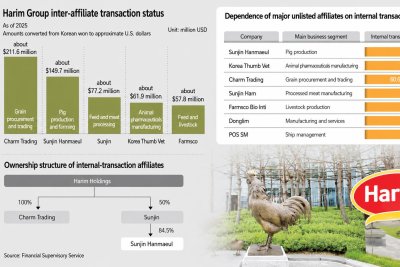
Harim Group’s internal affiliate transactions reached high levels in 2025, with Charm Trading recording about $211.6 million in internal transactions and some unlisted affiliates depending on group transactions for more than 80% of sales. Data from Financial Supervisory Service. Graphic by Asia Today and translated by UPI
June 3 (Asia Today) — Harim Group’s domestic transactions among affiliates exceeded 1.4 trillion won, or about $914 million, last year, raising concerns that some unlisted units remain heavily dependent on business from within the group.
An analysis of Financial Supervisory Service filings and affiliate transaction data showed Harim Group’s domestic internal transactions totaled 1.44 trillion won, or about $938 million, in 2025.
That accounted for about 11.5% of the group’s total revenue of 12.41 trillion won, or about $8.11 billion.
Harim Group has a vertically integrated business structure spanning feed production, livestock, food processing, distribution and logistics. The structure has drawn attention because several unlisted affiliates reported high levels of sales from transactions with other group companies.
Sunjin Hanmaeul, an agricultural company involved in pig farming, generated 229.2 billion won, or about $150 million, of its 256.6 billion won, or about $168 million, in total revenue last year through transactions with affiliates including Harim Holdings and Sunjin. That means 89.3% of its sales came from internal group transactions. Sunjin Hanmaeul is a sub-subsidiary of Harim Holdings.
Korea Thumb Vet, an animal pharmaceutical affiliate, also generated 94.8 billion won, or about $62 million, of its 130.1 billion won, or about $85 million, in total revenue from affiliate transactions. The company is also a sub-subsidiary of Harim Holdings.
Charm Trading, a Harim Holdings subsidiary responsible for grain procurement and trading, posted 323.9 billion won, or about $212 million, in internal transactions out of 534.5 billion won, or about $349 million, in total revenue last year. That was the largest amount among the group’s affiliate transactions.
Sunjin, a core affiliate in the feed and processed meat businesses, recorded 118.138 billion won, or about $77 million, in sales through affiliate transactions. Sunjin also owns an 89.4% stake in Sunjin Hanmaeul, whose internal transaction dependence reached 89.3%.
Other unlisted affiliates also showed high dependence on internal transactions. Sunjin Ham, a processed meat manufacturer, posted an internal transaction ratio of 99.9%. Farmsco Bio Inti, a livestock production affiliate, recorded 85.8%, while ship management company POS SM reported 85.4% and manufacturing and services affiliate Donglim posted 80.2%.
Harim Group was sanctioned by the Fair Trade Commission in 2021 over allegations that affiliates steered business to Orpum, a private company wholly owned by Kim Jun-young, the eldest son of Harim Chairman Kim Hong-kuk and an assistant managing director at Pan Ocean.
At the time, the commission said affiliate support provided unfair economic benefits to the owner family and imposed corrective orders and fines. Harim challenged the decision and the case is currently in administrative litigation.
The continued transaction structure involving major affiliates such as Charm Trading, Sunjin Hanmaeul and Korea Thumb Vet has drawn attention because it appears to have changed little since the commission’s sanctions.
Harim Group’s succession structure is widely seen as centered on Kim Jun-young. Through Orpum and Korea Investment, Kim has secured influence within the ownership structure of Harim Holdings, and key affiliates are also included under that structure.
Some level of internal transactions may be inevitable in a vertically integrated industry. But critics say it is a separate issue when some unlisted affiliates continue to depend on internal group transactions for 60% to nearly 100% of their revenue, especially as regulators strengthen oversight of tunneling and unfair support involving owner families.
The Fair Trade Commission says it does not determine illegality based only on the share of internal transactions.
“Internal transactions become a problem when illegal conduct such as unfair business steering or private benefit-taking is involved,” a commission official said. “If unfair support or private benefit-taking is found, the transaction can be subject to sanctions under relevant laws.”
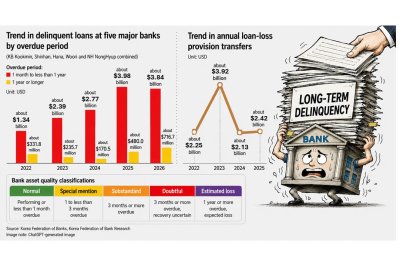
South Korea’s five major banks saw long-term delinquent loans rise to about $716.7 million in 2026, while loans overdue for one month to less than one year remained elevated at about $3.84 billion. Data from Korea Federation of Banks and Korea Federation of Bank Research. Graphic by Asia Today and translated by UPI
June 3 (Asia Today) — South Korea’s major commercial banks are facing growing pressure from a sharp rise in long-overdue loans, with the amount of loans unpaid for more than one year exceeding 1 trillion won, or about $716 million, in the first quarter.
Loans overdue for less than one year, which could later worsen into long-term delinquencies, also approached 6 trillion won, or about $3.84 billion. The increase suggests that borrower distress is deepening, especially among corporate borrowers, despite banks’ efforts to dispose of nonperforming loans.
The sequential expiration of COVID-19 loan maturity extensions also appears to be adding pressure on delinquent borrowers.
Banks, which have continued to post strong earnings, are concerned that rising long-term delinquencies could increase loan-loss provision burdens. The longer a loan remains overdue and the lower its chance of recovery becomes, the more banks must set aside in provisions.
If the Bank of Korea raises its base rate in the second half, borrowers’ repayment burdens could grow further, increasing the risk of additional long-term delinquencies. Analysts say asset quality management could become a key factor determining banks’ earnings performance.
According to financial industry data released Wednesday, the combined balance of loans overdue for at least one year at KB Kookmin Bank, Shinhan Bank, Hana Bank, Woori Bank and NH NongHyup Bank reached 1.0972 trillion won, or about $716 million, in the first quarter.
That was up 49.3% from 734.9 billion won, or about $480 million, a year earlier. Compared with 261 billion won, or about $170 million, in 2024, the figure has more than quadrupled. It was also more than double the 508 billion won, or about $332 million, recorded in 2022 during the COVID-19 pandemic.
The increase appeared across all five banks. By bank, NH NongHyup had the largest balance of long-term overdue loans at 474.8 billion won, or about $310 million, followed by KB Kookmin at 166.9 billion won, or about $109 million, Hana at 155.2 billion won, or about $101 million, Shinhan at 151.5 billion won, or about $99 million, and Woori at 148.8 billion won, or about $97 million.
Loans overdue for at least one month but less than one year totaled 5.8851 trillion won, or about $3.84 billion, approaching the 6 trillion won mark. The figure was slightly lower than 6.1002 trillion won, or about $3.98 billion, a year earlier, but remained high by historical standards.
By category, loans overdue for at least one month but less than three months rose from a year earlier to 2.8225 trillion won, or about $1.84 billion. Loans overdue for at least six months but less than one year, which are considered more likely to become long-term delinquencies, reached 1.1111 trillion won, or about $726 million. Both were record highs since the banks began disclosing the relevant data.
The surge in long-term delinquencies is widely attributed to a sharp increase in new overdue loans in 2024 and 2025. Higher interest rates and weak domestic demand weakened borrowers’ repayment capacity, with some distressed borrowers slipping into long-term delinquency.
The increase appears particularly concentrated among corporate borrowers, whose loans are relatively large and harder to recover. At the end of March, the banking sector’s corporate loan delinquency rate stood at 0.68%, up 0.06 percentage point from 0.62% a year earlier.
“Distress pressure has continued for a long period in sectors such as construction and real estate leasing because of the weak housing market,” an official at a commercial bank said.
A renewed period of rate increases could add to the problem. The Bank of Korea left open the possibility of at least one base rate increase in the second half during last month’s monetary policy meeting, raising concerns that banks could face greater asset quality pressure.
Higher base rates can push up market rates, including bank bond yields, increasing borrowers’ interest burdens. That could deepen distress among loans already in arrears and increase new delinquencies, potentially expanding the volume of long-term overdue loans later.
That would likely translate into higher loan-loss provisions for banks. Banks classify loans into five asset-quality categories: normal, precautionary, substandard, doubtful and estimated loss.
When a loan is classified as substandard, banks must set aside provisions equal to 20% of the loan amount. As the overdue period grows longer and repayment capacity worsens, the required provision ratio rises. Doubtful loans, which are overdue for more than three months and have low recovery prospects, require 50% provisioning. Loans classified as estimated losses after more than one year overdue require 100% provisioning.
That means if a doubtful loan deteriorates into an estimated loss, the provisioning burden doubles.
A rise in provision expenses would directly weigh on bank earnings. In 2022, the five major banks set aside 3.5422 trillion won, or about $2.31 billion, in annual loan-loss provisions, while their combined net profit rose 18.6% from a year earlier to 13.7472 trillion won, or about $8.98 billion.
But in 2023, when banks set aside more than 6 trillion won, or about $3.92 billion, in provisions because of real estate project financing distress and other factors, their net profit growth slowed to 2.6%.
Provision expenses fell sharply the following year, but as delinquencies continue to rise, the possibility of renewed growth in provisions has increased. Analysts say careful risk management has become more important.
“As the delinquency period lengthens, the sale price of nonperforming loans tends to fall, so if long-term delinquencies increase, banks disposing of bad loans will also face greater loss burdens,” a financial industry official said.
“The key will be whether banks can prevent new distress from expanding while effectively clearing existing bad loans,” the official said.
Elon Musk’s rocket company SpaceX is targeting a valuation of nearly $1.77 trillion in its blockbuster initial public offering (IPO), paving the way for the largest stock market debut in history.
In a filing with the US Securities and Exchange Commission on Wednesday, SpaceX said that it plans to sell 555.6 million shares at $135 apiece, raising approximately $75bn.
Recommended Stories
list of 4 itemsend of list
The eye-popping valuation would make SpaceX the world’s seventh-largest company by market capitalisation, ahead of Musk’s electric vehicle maker Tesla and social media giant Meta, and just behind Taiwanese chipmaker TSMC.
It would also eclipse energy giant Saudi Aramco’s 2019 debut, which raised $26bn at a valuation of $1.7 trillion.
Musk, who holds a roughly 42 percent stake in SpaceX, is poised to become the world’s first trillionaire upon the company’s debut on the New York-based Nasdaq stock exchange on June 12.
Despite the public listing, Musk will retain effective control of SpaceX with more than 82 percent of voting rights, the result of a dual-class stock structure that grants certain shares 10 votes instead of one.
The Texas-based firm’s decision to set a specific share price ahead of its IPO marks a break from usual practice.
Companies preparing for a public listing usually announce a preliminary price range that can be adjusted based on investor interest.
“The genuine surprise is that SpaceX fixed a price before the investor roadshow began,” Fabien Yip, a market analyst at online trading and investment company IG Group, told Al Jazeera.
“To me, this reflects Musk’s control over the deal terms and his confidence that the book will fill.”
Elon Musk departs after a welcome ceremony with USPresident Donald Trump and China’s President Xi Jinping at the Great Hall of the People, in Beijing, China, on May 14, 2026 [File: Mark Schiefelbein/AP]
Founded by Musk in 2002, SpaceX is best known for designing and launching rockets, spacecraft and reusable launch vehicles on behalf of NASA and private companies.
The company also provides internet services and artificial intelligence models through its Starlink and xAI divisions.
Musk has outlined lofty ambitions for SpaceX, including to establish a “self-sustaining” city on Mars, “make life multiplanetary,” and “extend the light of consciousness to the stars”.
SpaceX’s listing will be a test of investors’ confidence in Musk’s vision, which has yet to translate into profits at the company.
SpaceX reported a net loss of $4.9bn on revenue of 18.7bn in 2025, followed by a $4.3bn loss in the first quarter of this year.
Jay R Ritter, an emeritus professor at the University of Florida who specialises in IPOs, said the SpaceX IPO differs from Saudi Aramco’s blockbuster listing as the state-owned oil company had a track record of generating large revenues and profits.
“SpaceX, in contrast, has trailing annual revenue of less than $20bn, and is not profitable,” Ritter told Al Jazeera.
“So, one company’s valuation was – and is – based on its demonstrated profitability, while the other company’s valuation is based on potential.”
“With SpaceX, there is a risk that cash flows will be used to send hundreds of thousands of people to Mars, at a loss,” Ritter added.
Despite SpaceX’s lack of profitability, market sentiment is strong, said IG’s Yip, noting that buyers of investment products linked to the listing are pricing the company’s end-of-first-day market capitalisation at $2.2 trillion.
“The Tesla parallel is perhaps worth drawing: It debuted in 2010 as a loss-making company and largely tracked the S&P 500 for years, only breaking away decisively once it turned profitable for the first time in Q1 2013,” Yip said, referring to the benchmark stock index on Wall Street.
“SpaceX investors are making a similar bet on future growth, with the added complexity that SpaceX’s addressable market – rockets, satellite internet, AI – is considerably broader than Tesla’s was at listing.”
Sokoto, Nigeria – Each time her curious seven-year-old child returned home from school with homework, 28-year-old Habiba Abubakar knew it was time to take him to her neighbour, whom the child called “aunt”, even though they were not related by blood, who had been his saviour every time he wanted to stand in front of his class and receive a standing ovation.
But that changed in 2021, when Abubakar enrolled herself in the Women Centre for Continuing Education (WCCE) in Sokoto State, northwest Nigeria.
“I’ve always felt ashamed when Muhammad told me that they’ve been given another assignment,” she told Al Jazeera.
This frustration, coupled with her enthusiasm for learning English, pushed her to return to the classroom 13 years after she left.
Now, the mother of four said she helps all the children with their assignments.
The interruption in Abibaker’s studies is not uncommon across northern Nigeria, especially in rural communities, where girls are more likely to drop out of school due to cultural practices, such as early marriage, or poverty, which forces parents to make gender-biased decisions by enrolling male children over females.
UNICEF reported that more than half of the girls in the region are not attending school.
Jennifer Agbaji, a social accountability professional and the executive director at Basileia Vulnerable Persons Rights Initiative (BVPRI), a Nigerian nonprofit dedicated to advancing the rights of women, girls, and other vulnerable populations through education and leadership development, viewed the initiative as a positive and necessary intervention.
Nonetheless, she said second-chance education should not be limited to classroom-based learning alone.
“If access to education depends solely on physical attendance, many women who face mobility, childcare, economic, health, or security challenges may still be excluded.”
How the system works
WCCE, commissioned by the then-military governor of Sokoto State, Navy Captain Abdul Rasheed Adisa Raji, was founded in 1997 to provide adult education and vocational skills to women in the state.
Since then, Nuraddeen Ladan Dogon Daji, a physics teacher, told Al Jazeera that the centre has trained many students, some of whom now practise professions, such as teaching and nursing, helping to address the country’s shortage of skilled professionals.
Unlike other public schools, where pupils spend six years, the centre designed a three-year curriculum for its primary section, from adult one to three.
In the secondary sections, students spend three years each in the junior and senior levels.
In their final years, they also sit for the mandatory Junior Leaving School Certificate of Education (JLSCE) and Senior School Certificate of Education (SSCE) examinations.
To help these students realise their dreams, the centre also offers free education, benefitting from the state government’s effort to reduce the number of out-of-school children.
This has helped students like Abubakar, who, following her divorce, relied heavily on her father’s support to stay in school.
“We used to pay 5,000 naira ($3.5) per term, but were later told to stop because the state government has given us a chance to study for free,” Abubakar told Al Jazeera from her home in the Kofar Atiku neighbourhood.
But free tuition does not eliminate all costs. Students still have to pay for transport, books, and other daily expenses.
The challenges
According to Agbaji, beyond poverty and early marriage, there are several structural barriers, including restrictive gender norms that prioritise domestic responsibilities over education.
She said many women lose confidence after years away from formal education, and in some communities, education is still viewed as an investment for boys rather than a lifelong right for women.
In her opinion, these norms often combine to make re-entry into education difficult, even when opportunities exist. In her journey to becoming a nurse, Fatima Attahir, who left school after primary school 12 years ago, found it necessary to go back to the classroom and start afresh.
To support herself while studying, she helps with her family’s trading activities when she is not in class.
She said that although some of her friends already saw the decision as time-consuming, she is not satisfied with the system’s duration.
“I wish the primary section was also up to six years,” she said.
“Because to become a nurse, I need to have a solid background in the core subjects.” Some of the students Al Jazeera spoke to said their greatest challenge is juggling academic activities with household responsibilities.
Before her divorce, Abubakar said she would wake up earlier than usual to prepare breakfast, clean the house, and get herself and her children ready for school.
“When I finally set my foot in class, I was already tired, and as the lectures went on, I would start slumbering because I hadn’t had enough sleep.” She said the pressure became worse when her youngest child frequently fell ill, sometimes forcing her to leave class before lectures ended.
After her divorce, transport costs became another obstacle. “Since I was no longer married, my parents were the ones paying for the transport fares, but when they couldn’t, I would not go to school because I couldn’t afford it myself,” she said.
Later, her father gave her 10,000 naira to start making and selling local snacks and small chops.
The small business now helps her cover transport costs and other school-related expenses. Abubakar still credits the neighbour who used to help her son with homework before she returned to school.
When transport costs became difficult to afford after her divorce, her parents stepped in when they could, while her father later provided the capital that helped her start a small business and continue her studies.
Her experience is not unique.
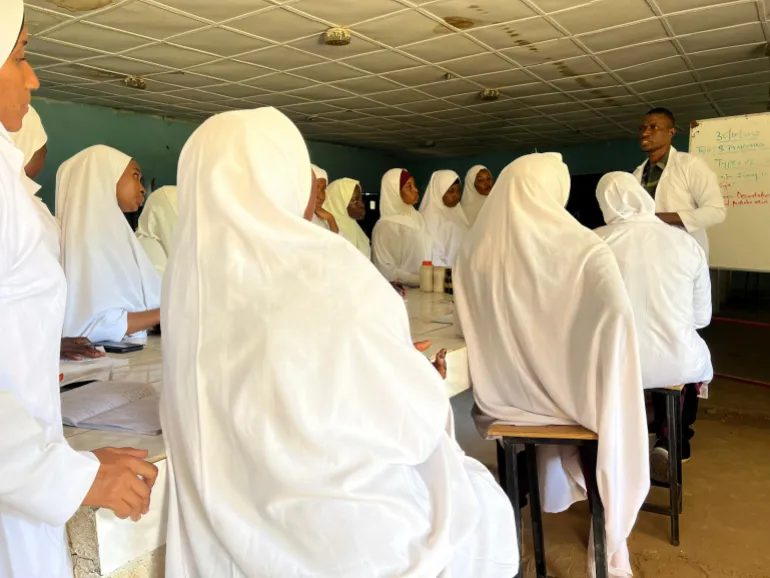
A classroom session at the Women’s Centre for Continuing Education in northern Nigeria [Abdulaziz Bagwai /Al Jazeera]
Another student, Hafsat Aliyu, said she leaves her two-year-old child with her in-laws whenever she attends classes to avoid disrupting lessons.
Her husband pays for books and other occasional school needs, while she sells local pastries during break time at the centre to earn money for daily transport and personal expenses.
During examination periods, she studies late into the night after completing household chores and putting her children to bed.
“My husband does his best, but I thought it was time for me to get a source of income, too,” she said.
“Now, I pay for my transport and a few other daily needs.”
However, the physics teacher, Dogon Daji, said that in his seven years of teaching at the centre, a recurring challenge among students is the pace of learning.
“I’ve taught young people, and the level of their understanding is quite different,” he said.
But he added that there are still outstanding students among them; one recently won this year’s Usmanu Danfodio Week, an annual quiz competition organised for secondary school students in the state.
On the other hand, the vocational section of the centre, which was designed to equip students with practical skills such as tailoring and soap-making, now offers only tailoring.
Students are required to provide tools, such as scissors, including those whose interests may lie in other trades.
The way forward
Agbaji acknowledged that for Nigeria to bridge the gender disparity in education, the country must adopt a lifelong learning framework that recognises education as a continuous right and opportunity.
UNICEF reports that more than half of girls in northern Nigeria are out of school, among the highest rates in the country [Abdulaziz Bagwai/Al Jazeera]
This requires increased investment in adult education, digital and remote learning platforms, community-based education, and flexible pathways for women who missed formal schooling, because the long-term consequences are significant.
She added that many women pursuing second-chance education continue to balance childcare, household responsibilities, and income-generating activities, often relying on family and community support networks to remain in school.
“Educational exclusion perpetuates poverty, limits economic opportunities, increases vulnerability to abuse and exploitation, and restricts women’s participation in governance and public service. It also affects future generations because children of educated mothers are generally more likely to enrol in and complete school,” Agbaji clarified.
June 3 (UPI) — People in the United States have pulled back from support of LGBTQ+ issues over the past few years, with 65% percent showing support for same-sex marriage now as opposed to 71% in 2022-2023, a Gallup poll released Wednesday shows.
The percentage of U.S. residents saying that gay or lesbian relations are “morally acceptable” also fell to 62%, the lowest that percentage has been since 2016.
This comes after a surge in acceptance in the late 2010s and early 2020s. Gallup said that between 1996 and 2022, the percentage of those in favor of legal same-sex marriage increased from 27% to 71%. However, that percentage has declined since.
The poll (Gallup’s annual Values and Beliefs survey) first asked about same-sex relationships and morality in 2001. Then, 40% percent said they were “morally acceptable.” That percentage grew to 71% by 2022, dropping to 64% in 2023.
The Gallup release noted that Republicans are largely responsible for the decline in acceptance. In 2021 and 2022, it said, 55% of Republicans expressed acceptance for same-sex marriage, but that has now dropped to 37%. Democrat views, however, are the same today as in 2022, with 87% in favor. Independents dropped from 73% to 67%.
There is a similar trend in opinion on the overall morality of same-sex relationships. In 2022, a high of 56% of Republicans said same-sex relationships were morally acceptable, but that percentage has now fallen 21 points to 35%. Democrats remain at 81% for that measure, while Independents have fallen eight points to 64%.
Gallup noted that Republican views on that measure are now where they were between 2005 and 2014.
The poll also asked about the perceived morality of changing one’s gender. The percentage of those in support has decreased from 46% over five years to 38 percent. Among Republicans, 22% expressed support in 2021, the first year the question was asked, compared to 5% today. Among Independents, the percentage decreased from 48% to 42%, and among Democrats, it decreased from 67% to 60%.
“The change has come as conservative leaders have pushed back against diversity, equity and inclusion programs that were intended to foster greater acceptance of LGBTQ+ people and other historically disadvantaged groups,” a Gallup release said.
The Trump administration has worked against protections for LGBTQ+ people in both terms, including ending civil rights settlements with college and school districts intending to prevent discrimination against transgender students.
Gallup surveyed 1,001 adults between May 1-17 with a 4% margin of error.
People Power Party campaign committee chief Jang Dong-hyeok attends a central campaign committee meeting at the National Assembly in Seoul on Wednesday, the day of South Korea’s local elections and parliamentary by-elections. Photo by Asia Today
June 3 (Asia Today) — The People Power Party protested Wednesday after voting was temporarily halted at some polling stations in Seoul’s Songpa Ward because of ballot shortages, calling the incident “a serious violation of voters’ political rights.”
Chung Hee-yong, the party’s secretary-general, held an emergency news conference and criticized the National Election Commission over the incident.
“This is a shocking incident that should not and must not happen at a polling site in South Korea in 2026,” Chung said. “It goes beyond simple lack of election preparation and reflects a deplorable failure to fulfill the duty of election management.”
Chung called for “strong and immediate action” by the election commission.
“First, swift measures must be taken so that citizens who could not vote because of ballot shortages can exercise their voting rights,” he said.
Song Eon-seog, the party’s floor leader, also issued an emergency statement.
“We are receiving absurd reports that citizens in Seoul cannot vote because ballots are unavailable,” Song said. “Seoul citizens, you must not give up voting under any circumstances. Even if it is difficult, please wait calmly and make sure to vote.”
Song said the situation infringed on citizens’ right to participate in elections.
“We strongly urge the National Election Commission to guarantee voting rights so that citizens who waited can vote even after 6 p.m.,” he said. “Transfer the ballots quickly.”
Song also said the party had received reports that voting was taking place at several polling stations nationwide without People Power Party observers present.
“Is this the 19th century? Does this make any sense?” he said. “As soon as the election ends, we will immediately push for a fact-finding investigation into this incident and make sure those responsible are held accountable.”
Bae Hyun-jin, chairwoman of the People Power Party’s Seoul chapter, also held an emergency news conference.
“A shortage of ballots in an election is not a simple mistake. It proves that the basic election management system, the foundation of democracy, has completely collapsed,” Bae said.
She criticized the election commission for saying the shortages resulted from a sudden increase in voter turnout.
“The commission responded as if it were nothing serious,” Bae said. “We will continue to demand measures to prevent a recurrence and disciplinary action against those responsible for the election management failure that violated the sovereign act of Seoul citizens.”
The People Power Party said it had identified eight polling stations affected by ballot shortages: Munjeong 2-dong No. 2, Jamsil 2-dong No. 6, Jamsil 7-dong No. 2, Jamsil 4-dong No. 5, Garak 2-dong Nos. 3 and 7, Cheongdam-dong No. 4 and Guui 3-dong No. 6 in Gwangjin Ward.
1 of 5 | Markwayne Mullin, secretary of the Department of Homeland Security, and Troy Edgar, deputy secretary, are shown Wednesday during a House Homeland Security Committee hearing on the fiscal year 2027 budget request for DHS in the Canon House Office Building near the U.S. Capitol in Washington, D.C. Photo by Bonnie Cash/UPI | License Photo
June 3 (UPI) — Markwayne Mullin, secretary of the Department of Homeland Security, said Wednesday that Immigration and Customs Enforcement officers will have to undergo more than 500 hours of training again, a return to the amount the department originally required.
News agencies first reported in early May that this change might be on the way. In fall 2025, ICE cut training for its officers from 584 hours to 336 hours, a move that came as part of a hiring push that brought in hundreds of new ICE agents. Senate Democrats released documents showing the cuts earlier this year, The New York Times reported.
The cuts were criticized by Democrats and some others, as critics said recruits did not receive enough training on how to handle firearms, First Amendment rights or other issues. Many people have called for ICE to be reformed or abolished, especially after ICE agents killed two U.S. citizens in January in Minneapolis. Then, in February, the Times reported, a former ICE attorney publicly criticized the changes in training at a forum in Washington, D.C.
“For the last five minutes, I watched ICE dismantle the training program,” Ryan Schwank said. “Cutting 240 hours of vital classes from a 584-hour program — classes that teach the Constitution, our legal system, firearms training, the use of force, lawful arrests, proper detention and the limits of officers’ authority.”
The agency responded at the time by saying hours had not been cut.
Mullin also said Wednesday that he’s reviewing contracts signed by Kristi Noem, the previous secretary of the department, that may have ties to her allies, The Hill reported. Rep. Bennie Thompson, D-Miss., the top Democrat on the committee, noted that Noem had signed contracts giving business to companies connected with her.
Mullin said he’d give the committee a list of any canceled contracts that hadn’t yet been signed. The department cannot nullify contacts that have been signed, but some are under review, he said.
Acting Attorney General Todd Blanche speaks during a House Appropriations Subcommittee on Commerce, Justice, Science and Related Agencies oversight hearing on the Department of Justice in the Rayburn House Office Building near the U.S. Capitol on Tuesday. Blanche announced the Justice Department is abandoning President Donald Trump’s proposed $1.8 billion “anti weaponization” fund. Photo by Bonnie Cash/UPI | License Photo


























![UNICEF reports that more than half of girls in northern Nigeria are out of school, highlighting deep gender gaps in education. [Abdulaziz Bagwai /Al Jazeera]](https://i0.wp.com/occasionaldigest.com/wp-content/uploads/2026/06/1000872132-1-1780347186.jpg?w=640&ssl=1)
![A classroom session at the Women Centre for Continuing Education in northern Nigeria. [Abdulaziz Bagwai /Al Jazeera]](https://i0.wp.com/occasionaldigest.com/wp-content/uploads/2026/06/1000872131-1-1780347183.jpg?w=640&ssl=1)