street

Coronation Street Sally Dynevor’s life with Emmerdale star husband and famous daughters

Coronation Street icon Sally is not the only famous person in her family

Coronation Street: Sally Webster returns after DOI

Coronation Street legend Sally Dynevor has two famous daughters who TV fans may recognise.

Sally, 63, joined the ITV soap back in 1986 playing Sally Seddon, who later became famed for marrying mechanic Kevin Webster (Michael Le Vell).

From a devastating cancer battle to her many failed romances on the street, Sally’s 40 years in Weatherfield have not been short of drama. Especially as her marriage to husband, Tim (Joe Duttine), hasn’t always been smooth sailing.

It’s fair to say Sally is a soap legend and has played a part in several big storylines, and is much-loved for her comedy appeal and status as a street busybody.

Away from the soap, actress Sally is loved up with her husband, Tim, whom she married in 1995. Tim is a successful screenwriter who has worked on the ITV soap Emmerdale, as well as on the TV series The Drowning and Desperate Measures. According to IMDb, Tim has written more than 2,000 episodes of Emmerdale between 1995 and 2016.

His last credited episode aired in January 2016 and followed Diane Sugden (Elizabeth Estensen) as she tried to sell her half of The Woolpack, while Adam Barton’s (Adam Thomas) emotional attachment to baby Johnny Woodfield became a problem.

Sally recently delighted fans after giving them a look into her private life with Tim. Taking to her Instagram, she shared several snaps from their recent trip to Iceland, where the happy couple was taking in the glorious sights.

Content cannot be displayed without consent

She captioned the post: “Well, that was an adventure. What a wonderful, beautiful country Iceland is”. As expected, fans and co-stars were left gushing over the post.

Jane Danson commented: “Pretty special I really want to go again. Glad you had a fab time Sal”. Sally Ann Matthews penned: “Oh wowzers”, while Jude Riordan added: “I’m going next week!”

Sally and Tim share three children together, including daughters Phoebe, 31, and Hattie, 22, and son Sam, 29 Both of the girls have followed in their footsteps and are enjoying careers in television.

Who are Sally Dynevor’s famous daughters?

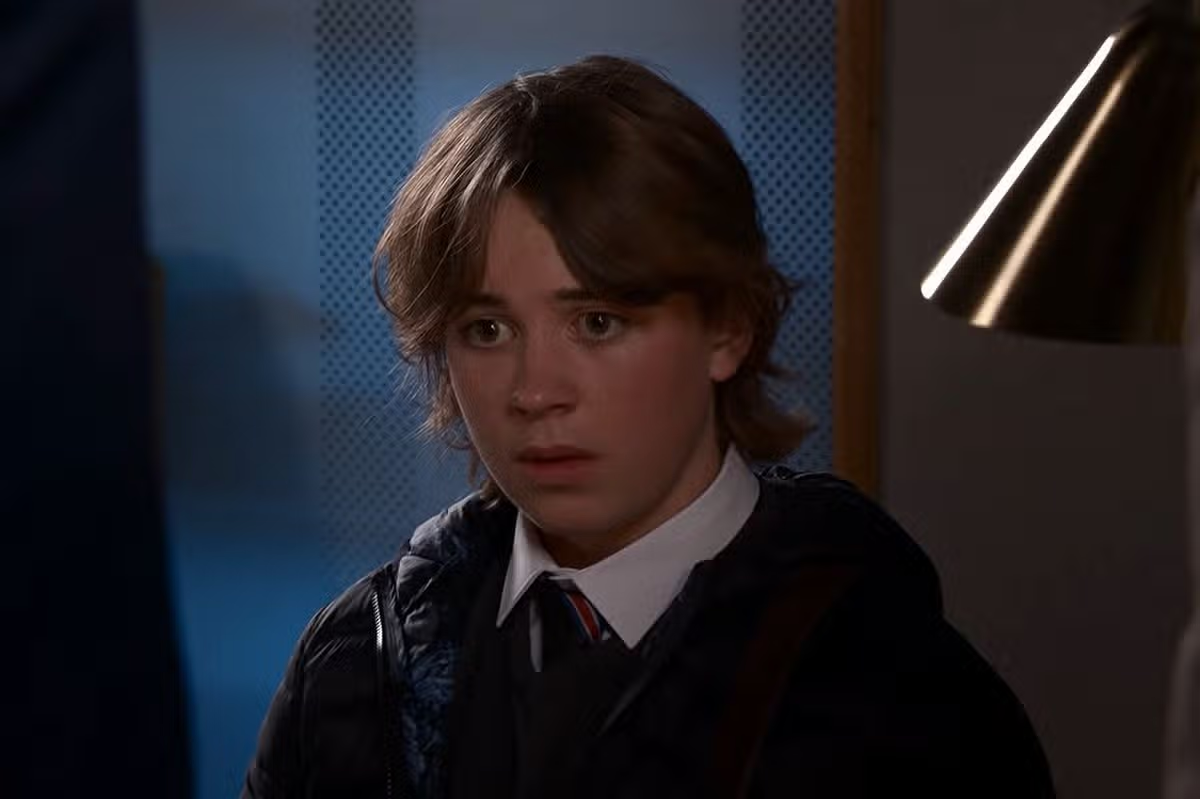
Hattie Dynevor stars on the BBC drama Waterloo Road, playing Libby Guthrie, the daughter of history teacher Neil (Neil Fitzmaurice), and has so far appeared in series 13 – 17.

She also appeared in the recently released gripping Netflix series Legends as Arabella, which also stars Steve Coogan and Tom Burke.

Hattie’s older sister, Phoebe, also launched an acting career on Waterloo Road, playing Siobhan Mailey between 2009 and 2020.

Bridgerton fans will also recognise the actress as Daphne, the wife of Simon Basset, the Duke of Hastings, played by Regé-Jean Page, between 2020 and 2022. Speaking to Collider, Phoebe opened up about a possible return to the Netflix period drama.

She said, “When the first season came out, they didn’t know what they needed to put in play. We were the ones that got away, in a certain way.

“I can only speak for myself, I would always come back if I was asked. I have not received a call. When I get that call, I will be there if I can.”

She has since starred in a long list of popular television shows, including The Musketeers, Dickensian, Snatch, and Ten Percent. Away from the small screen, Pheobe has starred in the movies The Colour Room, Inheritance, and Thrash.

Coronation Street airs weekdays on ITV and ITVX

Source link

Are Emmerdale and Coronation Street on tonight and when are they back? Schedule revealed

Emmerdale and Coronation Street are missing from the ITV schedules for two days this week, before returning to the channel amid the football coverage – while EastEnders is still on

Soap fans have found their Emmerdale and Coronation Street schedules all over the place this week.

With football taking over on ITV1 once more, the soaps are not airing in their usual time slots, or even on their normal days. EastEnders is also being hit by a schedule shake-up this week.

But EastEnders still airs on it’s normal days for this week, while Corrie is not on at all this Wednesday or Thursday. So when are the soaps on next?

For EastEnders fans, you will still get your soap fix on both Wednesday and Thursday. It’s a bit later than normal on BBC One though, airing for 30 minutes at 8:30PM, instead of 7:30PM.

As for Corrie and Emmerdale, fans will not get their next episodes until Friday 19 June. For once, both soaps will be in their usual time slots too.

So Emmerdale fans, your next episode will air on ITV1 at 8PM on Friday, followed by Coronation Street’s next episode at 8:30PM on the same channel. The episodes will also be dropping on ITVX that morning.

Of course with no episodes on Wednesday or Thursday, there will be no ITVX episode to stream on these days. But rest assured for this week, your next soap action is Friday.

Of course next week, it’s chaos again. Friday’s episode teases big moments ahead. On Corrie, Debbie Webster is trapped in a nightmare after the gun drama at the garage.

While she clashes with Tracy Barlow, an incident with a balloon leaves her terrified as she mistakes the noise of it bursting for a gunshot. Betsy Swain has some news for Lisa and Carla, which could tease an exit.

Sam Blakeman’s family rally around him, while he asks to see Roy Cropper. Maria Connor is suspicious of Gary Windass when he reveals he’s booked a holiday for the whole family.

She’s still assuming Gary and Sarah Platt are having an affair. Meanwhile, Kit admires the engagement ring he’s bought for Sarah.

As for Emmerdale, Lewis Barton gets kidnapped after preparing for a holiday with his love interest Vinny Dingle. As Lewis packs a suitcase and goes to make his way to the airport, a van suddenly pulls up near him.

Masked men jump out and Lewis is taken, and next week we find out who is holding him hostage. It’s all part of Kev Townsend’s return storyline, with more to be revealed.

Emmerdale airs weeknights at 8pm on ITV1 and ITVX. Coronation Street airs weeknights at 8:30pm on ITV1 and ITV X. * Follow Mirror Celebs and TV on TikTok , Snapchat , Instagram , Twitter , Facebook , YouTube and Threads .


Source link

Has Kevin Webster died on Coronation Street? Soap legend faces shocking gun showdown

Coronation Street legend Kevin Webster got into a huge showdown with nephew Carl on Tuesday night’s episode of the world’s longest-running TV soap and a shot was fired

Kevin Webster got involved in a shocking gun showdown on Tuesday night’s episode of Coronation Street. The mechanic has been played by Michael Le Vell since 1983 and has been central to many of the soap’s biggest storylines, many of them involving his ex-wife Sally (Sally Dynevor), and their daughters, Rosie (Helen Flanagan) and Sophie (Brooke Vincent).

Over the last year, it’s been a typically dramatic time for Kevin and, not only has he had to deal with a testicular cancer diagnosis, he found out that his now-estranged wife Abi ( Sally Carman ) had been having an affair with Carl Webster, the man he thought was his brother. It was just this year that a major retcon took place and Kevin’s sister Debbie (Sue Devaney) revealed that she was, in fact, Carl’s birth mum.

On top of all that, Carl was recently injured when working on a car on the garage when Tyrone Dobbs (Alan Halsall) let the vehicle collapse down on him, and, to keep himself in the clear, lied to the police about his whereabouts that night, thereby landing innocent Summer Spellman (Harriet Bibby) in prison over the murder of Theo Silverton.

Things came to a head in the latest episode of the world’s longest-running TV soap when Kevin and Carl came face-to-face in the garage as Ronnie Bailey, along with Tyrone, watched on in horror. Having obtained a gun from dodgy car dealer Fiona Morley (Sara Poyzer), it was lying on the floor between them – just after Kevin had tried to hit him with a wrench.

Carl told Kevin: ” Either we fix this… ..or you pick up that gun,” to which his brother-turned-nephew did, believing that it was fake and a violent tussle followed when Carl told him to pull the trigger. A gunshot was heard and it transpired that Kevin had pulled the trigger.

Tyrone got a hold of Kevin to make him see sense and, when he realised Carl had dodged the bullet, he said: “I’m sorry, Carl.” Later on, Carl called round to number 13 where he told Kevin: “Been a bit of a day, eh? Should never have agreed to do that job for Fiona. I don’t know what I was thinking, pulling that out on you. We’re a right pair, aren’t we, eh?

“So, is this us now? Putting everything behind us?” Kevin sighed as he said: “We’re never gonna be best mates, but yeah. We both love Debbie and if you’re serious about doing the right thing by her then we’ll move forward.

“Just one thing. Why did you do it? Abi, I mean. Like, I know I’ve gotta get past it, and it’s doing me no good dwelling on the past but I need to know. Please.” Carl said: “Because she was there, I was selfish, self-destructive. Jealous. Kev, whatever the reason, doing that to you, to both of you, it was wrong and I regret it. I regret it all. I don’t wanna be that person again and I don’t think I’m gonna be.” It was then that the warring relatives seemingly called a truce as they shook hands.

By the end of the episode, Ronnie and Debbie had found out about the whole thing and he claimed he had returned the gun, but now it was nowhere to be seen as Fiona hadn’t received it. Lamenting in the living room, Debbie said to Ronnie and Carl: “So, not only have we got God knows who coming after us, but there’s someone out there with a loaded gun!

“Right, first thing tomorrow, I want you both out there, and I want you to find it, because if you don’t, it won’t be Fiona you’ll have to worry about, it’ll be me! Now, get out of my sight… the pair of you,” and showed them the door. What none of them know, though, is Jodie Ramsey, the mysterious long-lost sister of Shona, had found the gun and taken it for herself.

Reacting to the tense episode, one fan wrote on X: “Carl bringing a gun to an argument.. yes only soft b******* do that!! #Corrie,” whilst another said: “So what’s Jodie planning on doing with the gun then?” Is she gonna use it on David if he doesn’t sleep with her?”

A third wrote: “Aw Carl and Kevin making up. Hope Carl sorts himself out for Debbie,” and a fourth said: “A near miss for Carl and Kevin. Oh s*** the gun has gone off!”

Coronation Street airs Monday to Friday at 8:30pm on ITV1 and is available to stream from 7am on ITV X.

* Follow Mirror Celebs and TV on TikTok , Snapchat , Instagram , Twitter , Facebook , YouTube and Threads .


Source link

Investors look beyond the ‘Magnificent 7’ as Wall Street embraces the ‘FAB 10’

Published on

Wall Street’s most famous market label may be outdated.


ADVERTISEMENT


ADVERTISEMENT

The ‘Magnificent 7’ or ‘Mag 7’ defined the first phase of the AI rally, as it included Nvidia, Apple, Microsoft, Alphabet, Amazon, Meta and Tesla, but a fresh grouping is now circulating among investors keen to capture its next leg.

In the wake of SpaceX’s blockbuster listing, analysts are looking to add Elon Musk’s company, as well as OpenAI and Anthropic, which are expected to IPO later this year, to a new market label.

Coined by the British financial firm Vanda Research, the ‘FAB 10’ stands for Frontier AI & Big Tech 10, and takes the original seven companies from ‘Mag 7’ together with the three new market darlings.

According to Vanda, last Friday’s SpaceX IPO offered the clearest signal yet that attention is widening beyond the ‘Magnificent 7’.

After Monday’s close above $192 per share, Elon Musk’s space and AI firm is now the sixth most valuable company in the world by market capitalisation.

What the new label captures

The term ‘Magnificent 7’ was coined in late 2023 by Michael Hartnett, who wanted a single term for the megacap stocks powering the market to records.

Their combined value now sits at roughly $22.6 trillion (€19.5tn), with Nvidia alone worth more than $5 trillion (€4.33tn) as the most valuable company in the world by market capitalisation.

The three newcomers represent a different flavour of the same AI boom.

SpaceX brings aerospace and satellite connectivity through its Starlink unit, while OpenAI and Anthropic are among the leading developers of frontier AI models.

According to Vanda, the ten companies collectively map the direction of the AI and technology sectors over the coming decade.

However, a wrinkle in the label is that two of the additions are not yet listed.

OpenAI and Anthropic remain private, though both have filed to approach public markets this year, potentially at valuations surpassing $1 trillion (€861bn) and making the ‘FAB 10’ as much a shorthand as a tradable basket.

The ‘FAB 10’ is also not the only contender.

Bank of America has floated an ‘AI Big 10’ that instead adds the chipmakers Broadcom, Advanced Micro Devices (AMD) and Micron, reflecting the semiconductor rally.

Others have suggested smaller clusters, such as the rival ‘MANGOS’ label, which has surfaced and includes Meta, Anthropic, Nvidia, Google (Alphabet), OpenAI and SpaceX.

Strategists caution that none of the names signals the demise of the ‘Magnificent 7’, which still accounts for roughly a third of the S&P 500 index. Investors are not abandoning the originals but simply broadening the definition of who leads the AI era.

As Vanda frames it, the next decade’s winners may simply need a bigger tent.

Source link

Walking all 25 miles of Atlantic Boulevard from Alhambra to Long Beach

We took Atlantic all the way to the Pacific, traveling from the San Gabriel Valley to Long Beach on foot. On the last morning of May, a group of us set out at 7:45 a.m. from a barren In-N-Out parking lot in Alhambra, where Atlantic Boulevard begins. We kept walking until we reached the water, 12 hours and more than 55,000 steps later.

In all, our group passed eight freeways, two highways, and one river, twice. We walked through a dozen cities: Alhambra, Monterey Park, Commerce, Vernon, Maywood, Bell, Cudahy, South Gate, Lynwood, Compton, Long Beach and, of course, Los Angeles.

We spent only about 1.5 miles, a half-hour, in the city of Los Angeles itself, all in East L.A. We spent more time in Lynwood than Los Angeles. We spent far more time — more than a third of our day — in Long Beach.

  • Share via

To walk Atlantic was to connect the dots about how our region functions economically, from the port to the factories to the suburbs. It was also to realize just how expansive and multifaceted Long Beach is.

This is the sixth such walk of one lengthy street that, ending at the ocean, we’ve completed across Los Angeles. Our pursuit began in 2022 with Wilshire’s 16 miles, continued in 2023 with Sunset’s 25, maxed out in 2024 with Western’s 28-plus miles, and stepped back in 2025 with Pico’s 15.5 miles. Earlier this year, roughly 30 of us strolled all of Santa Monica’s 14.5 miles.

This time, we started with a group of 16, ranging in age from 20-something to sexagenarian, and finished with 12. Some walkers left and joined us along the way. Ten, including one Long Beach local, completed the street.

1

A man in a hat and long sleeves talks to a group of people circled around him.

2

Clothes and a mirror crowd the sidewalk.

3

A teen in a hoodie holds a squeegee as cars pass by.

4

A group of walkers lead the way past Louis Burgers III on Atlantic Avenue.

1. Pedro Moura, center, gives a pep talk before leading a group on a 25-mile walk the length of Atlantic Boulevard. (Scott Strazzante/For The Times) 2. In so-L.A. fashion, a Tesla Cybertruck rolls past a pile of possessions flooding the sidewalk in front of an apartment building. 3. Josiah Fields, 15, earns money by cleaning car windshields at the intersection of Atlantic and Alondra Boulevards. 4. During the final mile of the their 25 mile walk, Chloe Stepney and Trevor O’Brien lead the way past Louis Burgers III on Atlantic Avenue. (Scott Strazzante/For The Times)

We’ve been playfully calling our annual jaunts the Big Walk. This one, we called the Bigger Walk. I suppose that makes Western the Biggest. We’ve come to believe the ideal distance for an all-day effort is about 20 miles. That seems long enough for it to feel like a real feat and short enough to include more interested folks and ample break time.

After a tranquil time on Santa Monica, I wrote that we expected Atlantic to be the opposite experience — “unwieldy, at times unwelcoming, and excessively industrial.” That was an overstatement at best and factually wrong at worst.

We did visit Vernon, the city that proudly promotes itself as “exclusively industrial.” But by one measure, Atlantic was literally the most welcoming street we’ve done yet. Many more people greeted us. The actual street was at least as pedestrian-friendly as Western or Sunset. At no point did we have to walk on the road or in a minuscule median.

We did, though, have to cross five crosswalks just to continue on Atlantic at one point, at an absurd intersection with Ferguson Drive, Goodrich Boulevard, Telegraph Road and Triggs Street. Railroad tracks and the famed old East L.A. Union Pacific Station stood to our left, and the 5 freeway to our right. Clearly, pedestrian convenience had not been front of mind during the area’s planning.

Oil might be the simplest way to illustrate how Atlantic differs from more famous L.A. streets. On Pico Boulevard, there are oil derricks hidden behind elaborate, towering facades. Along Atlantic, the derricks are just everywhere in plain sight for a while. We did walk atop both the Long Beach Oil Field, a mega giant field, and the Wilmington Oil Field, the third-largest oil field in the contiguous United States.

That’s Atlantic, lacking in pretense, not hiding anything, but exceeding our expectations. We saw more plants native to our region, including Cleveland sage and Sacred datura, than along Santa Monica. And we kept encountering vibrant pockets where we did not know they would be. Monterey Park was the first to impress us, with gorgeous Cascades Park tucked into a lush little valley.

A rose peeks through a fence at St. Rose of Lima Church on Atlantic Boulevard.

A rose peeks through a fence at St. Rose of Lima Church on Atlantic Boulevard.

A teen in a navy blue dress, sparkly necklace and tiara holds a white bouquet where a street meets a park.

Lykayla Melendez poses in her quinceañera dress at Cascades Park along Atlantic Boulevard.

In East L.A., chilaquiles, tamales, tejuino and ribs were all available street-side, and one of our members noticed the newer location of the famed La Azteca Tortilleria in a strip mall near the Metro station. Azteca has been the No. 1 seed in Times columnist Gustavo Arellano’s tortilla tasting tournaments with KCRW; we picked up a couple dozen to go.

Farther south, Bell is best known locally as the home of brazenly corrupt city officials earlier this century. When we passed through, the shade provided by a pocket park in the city center became a crucial respite for our lunch break. Across the street, a community market was just starting up for the afternoon. We caught a couple songs from a talented mariachi band.

Once we crossed the 105 overpass, we quickly encountered four sizable parks, each no more than two miles from the last. We saw one pump track, two tennis courts and skate parks, several sports fields, and an impressive number of food trucks, including Instagram-famous Kitchen’s Corner BBQ. At least another dozen food vendors seemed to be setting up for evening service as we marched by in the late afternoon.

By the third park we passed, we were in Long Beach, specifically North Long Beach. The fourth, Scherer Park, is a sprawling, 26-acre gem. Soon enough we were in Bixby Knolls, where, for more than a decade now, Long Beach officials have been investing in improving bicycle and pedestrian access. It shows. We had a delightful happy hour on Ambitious Ales’ front patio overlooking Atlantic.

A man using a walker fist bumps two men walking by him.

August Fagerstrom and Pedro Moura fist bump a well-wisher on Atlantic Avenue.

Official lists of the longest L.A.-area streets are almost impossible to find. Often, such lists are kept by cities. The longer the street, the less likely that all of it is within one city’s limits.

We can say this: There are not many stretches of a single street with the same name longer than Atlantic in the L.A. Basin. Western Avenue, definitely. Imperial Highway, depending on your perspective on what constitutes a street. Sunset is about the same length. And that’s about it.

Unless you want to be particularly persnickety and disqualify Atlantic on the grounds that it technically has two names. For its northern 10 miles, Atlantic is a boulevard. For its southern 15, it’s an avenue. Where Maywood becomes Bell, it switches. But it’s Atlantic all the same, and that was good enough for us.

Surely you’ve been wondering about the origin of the name. Atlantic has been named for the distant ocean since the 19th century, when a Brit tried to christen a city after himself and named its three major streets Pacific, American and Atlantic avenues, from west to east. American is now Long Beach Boulevard, so it no longer makes much sense.

A man raises his fist in the air as a group around him smiles and claps.

At the end of their 25-mile walk, Chris Kirkham celebrates with fellow walkers at Atlantic Avenue and Ocean Boulevard.

Speaking of names: Our Alhambra is named after a Washington Irving book inspired by his visit to the 13th-century Islamic fortress of the same name in what is now Spain. You can walk to the actual Atlantic from that Alhambra in about 150 miles.

This was easier than that, at least. If you’re eager to explore the backbone of Los Angeles, curious for a challenge, you could do worse than attacking Atlantic. I promise you’ll see something new. We saw a street juggler. We saw a live chicken and a dead turkey. We saw a discarded box of Pacifico beer that had been cooking in the sun so long it turned from yellow to white.

Five people dip their toes in the water, pointing out one of their sock tans.

Pedro Moura points out Chloe Stepney’s sock tan line as they celebrate the end of their 25-mile walk down Atlantic with a dip in the Pacific Ocean at Alamitos Beach.

After we rinsed our weary feet in the Pacific, some of us waddled back up to Downtown Long Beach and scarfed down Sonoratown burritos and chivichangas before heading home. It was a Sunday well spent.

Source link

From South L.A.’s erupting sidewalks, 5 questions for Bass and Raman

OK, I’ll admit it. I’m going to miss Spencer Pratt.

I had never heard of the former reality TV star before he said God wanted him to be mayor of Los Angeles. And now that he’s out of the race, he’s still serving up lazy fastballs down the middle of the plate, calling the top two vote-getters — Mayor Karen Bass and Councilmember Nithya Raman — dummies and morons.

Quick question for Pratt: If you’re on record claiming that 9/11 was an inside job and the Sandy Hook massacre was a hoax, and you run for office in a deep blue city with President Trump’s backing but not much of a plan or even a clue as to what a mayor can or can’t do, should you be calling other people morons?

And yet the pouting Pratt pulled more than 200,000 votes. So sore loser or not, he tapped into a lack of faith in elected officials and simmering frustration with City Hall, which happen to be the essence of today’s column.

I have five questions for Bass and Raman. They’re somewhat inter-related and have to do with matters I hear about regularly from readers:

Infrastructure (sidewalks, streets, etc).

Homelessness (billions of dollars spent, and a long way to go).

Parks (L.A.’s national ranking for quality and accessibility just dropped again).

Trash and blight (no explanation needed, right?).

And focus. (Do the candidates have a clear set of goals and a plan for achieving them?)

We’ve got five months to visit and revisit these topics, and today I’m going to focus on the first, so here we go.

Infrastructure:

A few days ago, I met with Earl Ofari Hutchinson of the Los Angeles Urban Policy Roundtable. Hutchinson is a longtime community activist and commentator, and he had just launched a torpedo in the direction of City Hall.

“There are hundreds of busted, dangerous sidewalks in South L A that have gone unrepaired for years,” he wrote to his network of followers. “They cause hundreds of injuries, and have resulted in massive numbers of claims and payouts in settlements. LA City Officials must act now to jumpstart a crash program to fix these sidewalks.”

On my way to meet Hutchinson, I traveled west along Florence Avenue and saw dozens of typical rough patches on the street and sidewalks. But if there were a contest to identify the all-time worst sidewalks in Los Angeles, Hutchinson’s discovery of the one at 71st Street and 11th Avenue would be a Hall of Fame contender.

For starters, it’s got the classic uplift, and the villain is the usual suspect — ficus tree roots. A 20-foot slab of sidewalk is pitched sharply, as if designed by trip-and-fall lawsuit lawyers. Way back in 2014, in my early days on sidewalk patrol, I was able to crawl under a similarly ruptured sidewalk in West L.A., and I could’ve done the same at 71st and 11th.

But I thought better of it after Hutchinson peered into the opening and said it looked like a comfy home for rats and other vermin.

The homeowner, Sharon Kelly, can’t use her front gate because of the lopsided sidewalk. She let me borrow her tape measure, which revealed a 16-inch rise in the pavement.

“It keeps rising,” Kelly said. “But it was already lifted when we came here.”

That was in 1997. I asked if she’s called the city for help.

“Several times,” she said, and the only response was a slapdash temporary asphalt patch.

Hutchinson said residents have responded in force to his call for emergency sidewalks repairs, just as they did when he crusaded for a crackdown on widespread illegal dumping.

“Dozens of residents have come out of the woodwork, and here’s what they all say: ‘We have called our city council person and various city departments repeatedly, over and over again.’”

And the response?

“Nothing,” Hutchinson said.

While we were talking, two people with walkers steered clear of the worst spot near Kelly’s property. Charles McQuarn, 77, said traversing the neighborhood means zigzagging around all the hazards.

“I gotta come out into the streets, too,” he said.

When he was a teenager, McQuarn said, he worked for a community group that fixed sidewalks. I mentioned that Councilmember Monica Rodriguez has been using Conservation Corps youths to do the same, but it’s time to scale up that program and come up with other remedies to speed the process.

The city is fixing about 600 sidewalks each year, the backlog of requested repairs stands at about 30,000 and if you get onto the waiting list, you’re looking at about 10 years before help arrives.

When we were done on 71st Street, Hutchinson led me over to a nearby stretch of Florence where, for blocks and blocks, it appears as if there have been volcanic eruptions around the trees. Large chunks of cracked sidewalk form mounds, one after another. The Hutchinson Himalayas are a site to behold — a mile-long museum of municipal neglect.

And it’s been like this, Hutchinson said, “for years.”

The question for Bass and Raman: What will you do to speed the repairs?

Homelessness:

Voters have been generous when it comes to repeatedly taxing themselves more, and more, to address homelessness. There’s been Measure H, Measure A, Measure ULA and Proposition HHH.

Yet although billions of dollars have been spent and tens of thousands of people have been helped and housed, more than 40,000 people are homeless in the city and roughly 70,000 in the county. In her primary victory speech, Bass said families shouldn’t have to step around encampments, and Raman has said greater urgency is needed.

Questions for Bass and Raman: Why haven’t taxpayers gotten more for their money with the two of you at the helm, what are you going to do to speed progress and create more accountability, and what distinguishes you from each other?

Parks:

In the annual rankings by the National Trust for Public Lands, Los Angeles has dropped from 90th to a tie for 93rd in park investment and accessibility among the nation’s 100 most populous cities.

The City Council is about to consider a motion to increase park funding through charter reform (with dozens of community groups in support), and progress is ridiculously slow on an agreement to use schools as after-hours playgrounds.

Question for Bass and Raman: Do you support the charter reform, and what else are you going to do to address the sad state of the city’s parks?

Trash and blight:

In downtown L.A., vandalism, shuttered storefronts and post-COVID abandonment have crippled what was a vibrant, revenue-generating economy that benefited the whole city.

In Hollywood, a resident hired her housekeeper to help report illegal dumping of goods that are often used to construct more homeless encampments, leading to all sorts of problems.

On the south lawn of City Hall, a graffiti-tagged monument and fountain have been out of commission for most of the last six decades.

Question for Bass and Raman: At the very least, can you fix the fountain?

Focus:

Like any big city with great assets and unlimited challenges, many residents have a love-hate relationship with L.A. But years ago, someone told me he loves Los Angeles because it’s a messy, multi-cultural work in progress, set on a dramatic landscape between mountain and sea, trying to figure out what it wants to be.

Question for Bass and Raman: Whether in the realm of basic services or grand visions, what three or four primary objectives do you have over the next four years?

In other words, what do you want L.A. to be?

steve.lopez@latimes.com


Source link

Spencer Pratt became a voice for L.A.’s disaffected. Where do his supporters go now?

When Republican Spencer Pratt burst into Los Angeles politics, venting a torrent of online fury against Mayor Karen Bass’ handling of the Palisades fire, he pitched his mayoral campaign as a full-bore challenge to L.A.’s political status quo.

The former reality TV star, who lost his home in the blaze, started as a long shot but emerged as a national story, with the ability to harvest social media attention, rally a base and dominate the news cycle.

But in a city overwhelmingly Democratic, where Republicans make up just 15% of registered voters, even some of his supporters wondered how far he could rise. In the end, voters selected Bass, a Democratic centrist, and democratic socialist City Councilmember Nithya Raman, who ran to Bass’ left, to face off in the runoff.

Still, for many of the 200,000 Angelenos who voted for Pratt, his brash, social media-fueled campaign was not just a long exercise in trolling. Pratt gave voice to their discontent with the system of one-party rule and said things they too often felt uncomfortable saying.

And now, they face a difficult choice of who to support in November.

“I know a lot of people who are disappointed,” said Meghan Daum, an L.A. writer and podcaster and former Los Angeles Times columnist who endorsed Pratt. “They are saying, ‘OK, now what? What can we do?”’

While Pratt did not make the runoff, political experts said his candidacy tapped into Angelenos’ dissatisfaction with the Democratic establishment and resonated with a sizable number of Angelenos who are rarely represented in L.A. politics.

“He identified a previously invisible level of anger and frustration,” said Dan Schnur, a longtime politics professor at USC, UC Berkeley and Pepperdine University, of Pratt. “The question going forward is whether he, or someone else, can shape that raw emotion into a movement.”

Pratt has yet to put out a statement conceding the race or contesting the results. As a stream of Republicans, including President Trump, made unfounded allegations of election fraud in California, the campaign’s most online candidate was conspicuously absent on X and Instagram.

Some Democrats in L.A. urged Pratt to make good on his promise to leave the city if Bass or Raman were elected. Late night TV host Jimmy Kimmel, a prominent Democrat, told Pratt he had rented him a U-Haul.

Despite the snark from Democrats, political observers say Pratt changed the terms of L.A.’s mayoral debate.

“He forced the more conventional candidates to talk about the issues in a way that would not have been the case if he weren’t in the race,” Schnur said.

“For the first time in years, there is a critical mass of citizens who are done pretending that what they see before their eyes isn’t really there,” Daum wrote on her Substack. “The people in charge will have to answer to those citizens.”

In the final weeks of the campaign, Pratt became ubiquitous in the national media. There were profiles in high-end publications, podcast interviews and regular reports from Fox News. But the results show he fell short of persuading enough Angelenos to make the runoff.

“It doesn’t appear that he’s impacted the political underpinnings of a deep blue city like Los Angeles,” Schnur said. “His impact was less ideological than attitudinal. He wasn’t convincing the voters to become more conservative, he was convincing them that it was OK for them to vent their anger in an unconventional way.”

Dissatisfaction is building in L.A. as the city’s cost of living mounts and a new generation of young Angelenos are unable to buy homes. Many are concerned about the lack of visible progress on street homelessness. Some are angry at what they see as city leaders’ poor preparation and response to the Palisades fire.

Ultimately, the momentum for change in Los Angeles was divided. As Pratt challenged Bass from the right, Raman tacked to the left of Bass on homelessness and policing and made affordability a key plank of her campaign.

Whatever their concerns about the status quo in L.A., many Angelenos were unwilling to vote for a Republican.

During the course of the campaign, Daum said she had numerous conversations with Angelenos who said: “I can’t associate with anybody who voted for Trump. I can’t have them in my house. I can’t have a conversation with them. I want nothing to do with them.”

A 42-year-old millennial who became famous on “The Hills” and owns a business selling “healing” crystals, Pratt had no political experience when he entered the mayoral race. He didn’t even appear to have a campaign manager.

“The system in Los Angeles isn’t struggling, it’s fundamentally broken,” Pratt said as he launched his campaign on Jan. 7, the anniversary of the fire. “It is a machine designed to protect the people at the top and the friends they exchange favors with while the rest of us drown in toxic smoke and ash.”

Bombastic and full of braggadocio, Pratt critiqued what he saw as Bass’ failure to prepare for and respond to the wildfires. He berated city leaders for not doing enough to get unhoused people off the streets. He railed against the city’s challenges with public safety, potholes, and the abuse of dogs on Skid Row. He even seized on a comment Bass made on the campaign trail about using taxpayer money to fund dental care for meth users.

As Pratt talked about homelessness, his message resonated with Marissa Comstock, 36, a stay-at-home mom and former software engineer in Eagle Rock.

“It’s totally obvious to me,” she said. “We need to get these people off the street.”

Last year, Comstock said she and her husband had a negative encounter at Griffith Park as they pushed their daughters around in strollers. Just a few minutes into their hike, she said, they were accosted by an unhoused person who screamed at them and threatened to cut off their daughters’ legs.

Since that incident, Comstock said, she takes her daughters only to places like the Huntington or Descanso Gardens that require membership to be admitted.

“I don’t feel comfortable even being on regular streets,” she said. “If there’s some crazy homeless person, what am I supposed to do?”

Pratt did extraordinarily well in capturing attention and developing a message, said Paul Mitchell, vice president of the Sacramento-based bipartisan firm Political Data Inc. Many Angelenos, he noted, had a better sense of Pratt’s viewpoint than they did of much more deeply funded California gubernatorial candidates, like Matt Mahan or Xavier Becerra.

During his campaign, Pratt did not express support for Trump or the Make America Great Again movement. He insisted he was a nonpartisan candidate running on local issues.

“I’m going to show everybody that I’m their mayor,” Pratt said on election night.

But even if Pratt was not explicitly MAGA, his reality TV theatrics mixed with antiestablishment populism were so MAGA-coded that he struggled to persuade disaffected liberal Angelenos. He referred to the homeless as “fentanyl zombies.” He railed against California’s “socialism.” He called Bass “Basura,” Spanish for trash.

When Trump spoke of Pratt, telling reporters “I heard he’s a big MAGA person,” Raman was quick to share Trump’s remarks on social media, warning Angelenos that Pratt was wildly out of step with their views.

While Pratt impressed some political observers with his performance in a May 6 televised debate with Bass and Raman, others said he alienated a significant portion of Angelenos with some of his social media antics.

“He could have talked about the drug use and the risks and the filth and the fire risks and all that,” said Rob Stutzman, a GOP political strategist, of Pratt’s zombie rhetoric, “but then paired that with, ‘My God, these liberals are leaving these people out here to die,’ and expressed some humanity towards the population that’s on the streets.”

Ultimately, Daum said Pratt was a “terrible candidate.”

“He did a million things wrong,” she said. “The whole time, I was yelling on Twitter about how he’s got to stop it: the AI videos are gonna hurt him, the Basura stuff, the zombie stuff. Like, stop it! Stop it!”

As Pratt’s campaign came to an end, Stutzman said, it is not clear that he represents any kind of lasting political movement.

“The question remains: Did he create a political movement or did he exploit the opportunity to run for mayor to restoke his diminishing fame?” Stutzman said. “He’s in the mold of a Kardashian: He’s just found ways to be famous without ever really doing anything important. I suspect that this was more about him acting out as to what he is as a reality celebrity versus becoming a leader of a political movement in L.A. We’ll see.”

When Angelenos go to the polls in November, there are several paths for Pratt voters.

Some, Mitchell said, will probably sit the election out entirely.

“You’ll get some Republicans who vote for Raman because they’re like, ‘Well, she’s a socialist and I can’t stand her, but I’m just voting no on Bass.’ And then you’ll have a lot of Republicans who are like, ‘OK, Raman’s a socialist.’”

After Raman made it to the runoff, Bass’ campaign slammed the city council member for voting against hiring more police and blocking efforts to keep homeless encampments away from schools. Meanwhile, Raman positioned herself as the anti-status quo candidate.

In a statement celebrating her advance to the general election, Raman did not mention Pratt or his supporters, but railed against “powerful interests” in City Hall.

“Working people pay the price in higher rents, depleted services, and a city that has stopped working for them,” she said. “If you’re as frustrated by the broken status quo as I am, I hope you’ll join our movement to build a city that works for everyone.”

Even as Daum felt depressed that Pratt’s campaign was not continuing, she said she felt more engaged in L.A. politics than she had ever been. She planned to vote in November and would be watching both Bass and Raman to see how they responded to Angelenos’ concerns about street homelessness.

“If Karen Bass said, ‘OK, I get it, “housing first” is not the panacea that I’ve been thinking it is. Seriously, I’m gonna put together a task force of people who are going to actually think this through.’ … I would be following that. I would be very curious,” Daum said. “Same if Nithya said that, too. I’m open to either of them, I guess.”

Comstock said she would probably vote for Bass in the runoff.

“Nithya Raman is just way too far on the socialist scale for me and will likely do more damage, rather than Karen Bass’ ineffectualness,” she said. “I don’t want to go any farther left.”

Source link

Amanda Barrie ‘would’ve been axed from Coronation Street if bosses knew about love life’

Coronation Street legend Amanda Barrie, who starred as Alma Baldwin on the ITV soap, is convinced bosses would’ve sacked her had her sexuality been made public at the time

Amanda Barrie is convinced she would have been axed from Coronation Street had producers found out about her sexuality. The actress, 90, starred as Alma Halliwell on the ITV soap from 1988 until 2001 and the character became known for her marriage to Mike Baldwin (Johnny Briggs) and ran the local café with Gail Tilsey (Helen Worth) before it was taken over by Roy Cropper.

In real life, Amanda was married to actor Robin Hunter from 1967 until the mid-1980s and she went on to tie the knot with crime novelist and former Mirror journalist Hilary Bonner in 2014, having chosen to come out as bisexual in her 2002 memoir It’s Not A Rehearsal, which she released shortly after quitting the soap.

Now, Amanda, has insisted that whilst the programme now has an influx of gay and lesbian characters, she had to keep her sexuality a secret and is now sure that, had she been open and honest about it, she would have been written out thanks to the attitudes that were in place in society at that time.

She said: “Not thought, I KNOW I would have been [fired], taking into account the climate at the time. Things are so different now. Corrie’s like Canal Street in Manchester these days.

“The people I was close to always knew about me and the relationships throughout my life. Being at the age I am, I still remember when gay men were absolutely crucified for being the way they were. “

Amanda, whose Corrie alter-ego Alma was memorably killed off following a battle with cancer, noted that these days it is “so much easier” for people like Christine McGuinness, who was rumoured to have been dating Nicola Adams after splitting from Paddy McGuinness, to discuss their sexuality publicly.

Now, the former Bad Girls star is just hopeful that eventually, society will arrive at a place where the announcement of one’s sexuality is not even necessary and it ends up being an “unimportant” factor in one’s personality.

Speaking to The Sun, she added: “I believe in the freedom to do and be exactly as you wish in life. To live in your own way. I dream of a day when people’s sexuality is regarded as so unimportant that no one even bothers to remark on whether somebody is gay or straight. “It’s probably a pipedream, but I still like to dream it.”

Amanda, whose stellar showbiz career also includes appearances in other TV favourites like Casualty, Amandaland, and Benidorm and has also seen her become a pantomime favourite, previously spoke of the surprise reaction she got from the public when she did eventually decide to go public about her sexuality.

During an appearance on Good Morning Britain towards the end of last year, she explained: “I expected to be stoned in the street, I got a lot of hugs. What was I in such a state about? Because it was just ‘Oh, I see, oh…'” before adding:

“You automatically revert to the way you’d always behave, lurking about with your head down editing your life is what you do. You change they, he, she, all that editing…”

Like this story? For more of the latest showbiz news and gossip, follow Mirror Celebs on TikTok, Snapchat, Instagram, Twitter, Facebook, YouTube and Threads.


Source link

I went to the overlooked country with trendy neighbourhoods, super cheap street food & Lord of the Rings epic landscapes

“DON’T go cheating!” the bartender tells me after I sloshed a bit too much vodka in the cocktail mixer.

He was right — my pisco sour ends up being more punchy than I’d planned.

A local leads a llama walk in Sibayo Credit: © PROMPERÚ
The old city of Arequipa has a rich colonial history Credit: © PROMPERÚ

I’m not sure I’ll be working as a bartender in Lima any time soon.

Thankfully the city has more than enough of them, with the Peruvian capital often named a top food and drink destination.

The place may be nicknamed Lima La Gris (from the large grey clouds that frequent the sky) but the city is certainly colourful when it comes to both gastronomy and architecture.

One of its brightest districts is the vibrant and noisy Barranco.

WAIL OF A TIME

I drove Irish Route 66 with deserted golden beaches and pirate-like islands


TEMPTED?

Tiny ‘Bali of Europe’ town with stunning beaches, €3 cocktails and £20 flights

Often referred to as among the world’s coolest neighbourhoods, the bohemian area is popular with surfers heading to the beach and art lovers adding to the hundreds of muralled walls.

Walking down the street is a feast for the eyes with men playing guitars outside multi-coloured houses, while cyclists zoom past with wetsuits on.

With more than 200 pieces of artwork across the neighbourhood, it feels more like an open-air art gallery.

And the city is fast making a name for itself when it comes to food, with many award-winning restaurants also found here.

One of those is Mayta, a World’s 50 Best Restaurants winner in Miraflores, made up of structured wood and concrete blocks.

While the seven-course tasting menu was tempting, I didn’t have four hours to kill, so opted for the à la carte.

I started with the fresh and zingy limey ceviche before I filled up on their take on paella with a crispy rice parcel surrounding shrimp.

For something a little more ­wallet-friendly, in the ­Miraflores neighbourhood, I found Parque Kennedy, known for its huge number of street vendors selling cheap snacks.

For around a fiver, my hands were quickly filled with herbal “emoliente” drinks that stave off hangovers, picarones (sweet doughnuts made of squash) with honey and chicharron pork sandwiches.

Peruvians love massive portions, I soon found out. And I was told that the best way to work off all the food would be to hit the waves, of course.

But with my surf skills lacking, I instead opted for a bike tour of the city, taking in the spectacular coastline, as well as the famous Love Park.

Inspired by Catalan architect Antoni Gaudi, sculptor ­Víctor Delfín built a wall of tiles, surrounding the famous El Beso sculpture of couples embracing.

The vibrant ­Miraflores neighbourhood Credit: © PROMPERÚ
Parque central de Miraflores Credit: © PROMPERÚ

Peru’s huge exports of coffee and chocolate mean you can barely walk five minutes without spotting a chocolataria.

As a self-professed choc expert, I was extremely smug after one cocoa class, naming all of the regions I tasted correctly.

A few hours away, Peru’s tiny second city of Arequipa, in the shade of the Misti volcano, is even more overlooked than Lima, yet the food is just as incredible.

My favourite way to spend the morning was jogging in the main central square, watching the sunrise over the Basilica Cathedral of Arequipa.

That running was preparing my body for yet more fantastic restaurants.

There was the vibey 13 Monjas (13monjas.com), with huge portions of Peruvian inspired pasta and Chica (chicha.com.pe) with yet more huge portions of fish tacos.

The Misti volcano in the Andes Credit: PROMPERÚ
The Sun’s Kara Godfrey in a selfie with animals Credit: Kara Godfrey

Yet there was one thing missing from my trip to Peru so far — and that was a cuddle with a llama.

Leaving the cosmopolitan cities, I went in search of the fluffy animals through the Colca Canyon region.

We sped through arid deserts, barely seeing a soul, bar a few locals by an abandoned train track.

Ears popped as we climbed the mountains across Lord Of The Rings-esque epic landscapes.

I was warned to expect some altitude sickness and I was certainly unsteady on my feet as we hit 4,900 metres.

It’s a few hours into my journey that I gasp as I finally see them — a traffic jam of wild llamas and alpacas.

Lazily grazing on the side of the road like oversized sheep, they seemed non-plussed as they sauntered over the road in front of us.

But just seeing them wasn’t enough for me. I wanted to get up close and personal.

Our abode for the night was in the village of Sibayo with a local family who had lived in the area for generations.

It was here that we were joined by a farmer, who excitingly told us we would be going on a llama walk.

It was only as we got up close that I realised quite how tall they were, some towering over my mere 5ft 5in height.

But my excitement never dwindled.

We walked across the beautiful river as they followed me like I was their leader.

I couldn’t resist a ruffle of their heads, with their ears cutely flipping up whenever we stopped.

Returning to our lodges, the evening was spent learning how to knit and dance.

The warm hospitality was evident throughout the stay, with free bracelets and shots of alcohol while listening to music and even a hot breakfast bag before leaving.

By the end of our stay, there were hugs all around, with our guide telling us how he always feels sad saying goodbye to tourists.

A feeling that is mutual it seems from the full guestbook of goodbyes.

I wasn’t ready to return to cold England that’s for sure – but a bag full of local coffee and alpaca socks certainly helped.

Source link

Commentary: For mayoral candidates and all of L.A., here’s the homelessness conversation we must have

Ron, a West L.A. resident, thinks he knows why former reality TV star and political newcomer Spencer Pratt won so much support in his run for mayor.

People are frustrated, frightened and angry about homelessness “and the crime associated with it,” Ron said in an email. He added that he voted for Mayor Karen Bass, but “almost everything Pratt said about the homeless resonated with me. … The homeless run wild here, without consequence.”

“Many of us support him not because we think he’s perfect,” said Kathy, “but because we are deeply dissatisfied with the direction of Los Angeles and feel that traditional politicians have not delivered the results we were promised.”

Bob, “a left-leaning Palisades resident,” said the issue is not Pratt’s lack of credentials, but the failures of incumbents. “There was a columnist … who documented in depth the situation at MacArthur Park,” Bob wrote in reference to me. “What was his name and what happened to him? Did he change his tune?”

These are all fair points, and if Pratt holds onto one of the top two spots and makes it to the Nov. 3 general election, or he’s overtaken by late-charging Councilmember Nithya Raman, we’re going to hear a lot more about homelessness in coming months.

So whether we’re looking at a Bass-Raman contest or a Bass-Pratt showdown, here are some random musings, and I’ll begin by responding to Bob’s question about whether I have changed my tune.

Not in the least.

The situation in MacArthur Park — targeted Thursday in a crackdown that involved multiple arrests — has long been a disgrace, and the same is true of many other places I’ve written about for the past quarter of a century. Last month, I visited a Hollywood neighborhood where one frustrated resident hired her housekeeper to document chronic problems related to homelessness, illegal dumping and criminal activity.

Residents have good reason to ask why they haven’t gotten better results after responding to politicians’ pleas for more money over the years.

It’s no surprise that Bass had high unfavorability ratings and why, despite leading in the primary vote count, she’ll fall far short of the 50% needed to avoid a second election phase. I still can’t believe that when I first asked her about the sad state of MacArthur Park, she told me she was fully aware, because she often drove through the area on her way to work.

Then why hadn’t she led the charge to address the problems and return the park to the community?

It shouldn’t take months, let alone years, to take back control of public spaces, and Pratt’s criticism is warranted, no doubt. And my main issue is not the hypocrisy of him saying God wants him to be mayor while calling his opponents demonic entities and villainizing homeless people he intends to shoo away to Seattle. It’s that his “fixes” demonstrate a lack of understanding.

Let me make a confession. From one angle or another, I’ve been writing about the intersection of homelessness, mental illness and addiction for a couple of decades, and I still have a lot to learn.

And on a personal note, I lost my son to a drug overdose. He had a job and wasn’t homeless, but like a lot of people who struggle with depression and other demons, he was resistant to help, and even to the idea that he needed help.

There are a lot more substance users like him, living out of public view, than there are on the street. We notice only those who don’t have the means to pay the rent or the mortgage as housing prices rise. So when Pratt says we don’t have a homelessness problem, but a drug problem, he’s missing a critical component in understanding why L.A. has tens of thousands of unsheltered people.

Pratt said on his website that his “treatment first” approach would direct resources into mental health and drug treatment care, which sounds good except that those responsibilities are primarily under county jurisdiction, not city control.

He and others have attacked harm reduction practices, such as distribution of needles and other paraphernalia. And I have to admit that it seems counterintuitive to enable further drug use. But the idea is to prevent death, engage clients and start a relationship that might lead to transformative care.

The county reports that in 2024, fentanyl-related deaths decreased by 37% and meth-related deaths by 20%. Harm reduction can be “absolutely invaluable,” addiction specialist Rick Rawson told me when I was working in MacArthur Park, but we need much more than that.

“When you have someone who becomes so incapacitated that they can’t stand up,” Rawson said, “to say that you’re just going to provide them with harm reduction and hope they don’t die, I think that falls short of the responsibility we have to each other and to the sickest people.”

I’ll add here that I firmly believe we should intervene more aggressively with people who are gravely ill, or are a threat to themselves or others. I recently profiled two San Diegans who are advocating for use of an existing law to allow for deeper evaluations and longer-term treatment plans for people with chronic drug and mental health issues.

It’s worth noting that drug and alcohol rehab is seldom a quick or surefire remedy. As for mental illness, it took me one year, along with the help of trained professionals, to convince my friend Nathaniel to seek help after he’d spent decades on the street following a diagnosis of schizophrenia.

What I’ve found over the years is that many of those living in tents and cars and alleys and parks are damaged in numerous ways.

I’m less inclined to judge people from a distance after having met a man on Skid Row who said he fell apart after his young daughter drowned. I’ve met women who are victims of domestic abuse or sexual assault. People in the grip of killer drugs like meth or fentanyl don’t think as clearly as we’d like them to, and they repeatedly sabotage their own self-interest.

To see people take over public spaces, openly sell or use drugs, lash out and scare those around them is disturbing and sometimes scary. But to say they choose to live on the street, as Pratt has, is to miss the point, to excuse our own complicity, to overlook historic policy failures, and to choose contempt over compassion.

Homelessness can cause mental illness, and mental illness can cause addiction, and vice versa. One condition alone can be difficult to address, but intertwined maladies further complicate matters.

I recently checked in with a guy I wrote about who had been addicted and homeless in Koreatown, and he said his recovery took more than half a year. He was in residential treatment for a few months, then in intensive outpatient treatment. There are no shortcuts, he said.

I’m not here to defend Bass, or Raman and the rest of the City Council, which shares responsibility for the current state of the city. Limited progress has been made in the last 3½ years, with a marginally lower number of homeless people.

But there’s a long way to go in moving people indoors and restoring a sense of order and public safety. The many needs include smarter enforcement of existing laws, faster development of low-cost interim and permanent housing, better coordination of outreach and follow-up services and more people willing to do all of this work.

Let’s hope that in the coming months we’ll get an honest conversation about what’s working, what isn’t, and how to do better.

steve.lopez@latimes.com

Source link

If Pratt holds off Raman, the L.A. mayor’s race could be a holy war

L.A. Mayor Karen Bass made what sounded like a victory speech Tuesday night.

Councilmember Nithya Raman made what sounded almost like a concession speech.

And former reality TV star Spencer Pratt relayed a message from the heavens.

“Well, obviously God wanted five more months of me exposing all the failures of our mayor, so it’s gonna be a fun ride,” Pratt said. “I hope she’s ready.”

Assuming Pratt holds on to one of the two spots in the Nov. 3 general election as the final votes are tallied in the next few days, the smart money will be on Bass, for reasons I’ll get into in a moment.

But the supreme being and patron of all pontiffs has to be considered a wild card. This is the first time, to my knowledge, that an incumbent mayor in the City of Angels would be running against a challenger whose campaign manager is God Almighty.

So here we go. We could be in for one of the more remarkable electoral adventures in city history, with a complete novice and MAGA conservative going up against a liberal career politician in a deep-blue city and state full of people who are tired of hearing excuses from Democrats. (If Raman ends up ousting Pratt, my apologies for jumping to conclusions. But it’s not my fault. The devil made me do it.)

If you intend to follow closely, as of course you should, maybe you can help me count the number of times Pratt plays the faith card. I went to St. Peter Martyr School and attended the church by the same name, and I don’t recall ever hearing a nun or a priest drop God’s name as often as Pratt does.

In fact, I just watched a clip of Pratt talking to Fox News TV host and Donald Trump disciple Kayleigh McEnany, and over the course of 1 minute and 52 seconds, he mentioned God or Jesus 10 times.

“Thankfully, I married an angel who was very connected with Jesus and has brought me to the light,” Pratt said of his wife and former reality TV co-star Heidi Montag. “It’s been very empowering to just pray and just be on his path and just say, ‘God, if you want me to save these animals, save these humans and protect my city, just keep putting me in the place where I can do that.’”

Is he running for mayor or cardinal?

Look, I totally respect your average true believer. But I’m not entirely comfortable with a mayor who might be sitting around City Hall waiting for signs and smoke signals rather than knowing what to do on his own.

God has a lot on his plate. He might be busy multiplying fishes and loaves so people don’t go hungry thanks to the president’s tariffs and warmongering. Is he going to rush to answer a prayer for guidance about underfunded parks or broken sidewalks in Los Angeles?

How did we get here, you ask?

Well, Pratt is an AI creation, in a way. A composite of sorts. You combine the forces of social media, political rebellion, second-rate celebrity obsession and the Peter Principle, and here’s a little Trump puppet walking around L.A. like he’s the chosen one.

Add to that the very real essence of his appeal to some voters:

Los Angeles has problems. Big problems that don’t get fixed quickly enough or at all, and Pratt represents the angry voter who wants to know why City Hall can’t do better and where all the money went. He’s absolutely right when he says we shouldn’t have people living on the streets, using drugs on the streets and dying on the streets.

But if Pratt is in the general election rather than Raman, we’re in for a national media circus rather than a summit on solutions. Raman is well-versed on matters of relevance and could have pushed back against Bass in substantive, detailed ways. On the other hand, as Pratt has fairly argued, Raman headed City Council’s homelessness committee, so isn’t she partly to blame for the failures she tried to pin on Bass?

As for Pratt’s policy chops, he has not responded to my offers of a get-together. Absent that, and given his careful avoidance of local reporters who know their stuff, I read his platform on his campaign website and I can tell you that while he touches on many of the right issues — public safety, fiscal integrity, homelessness — attention to detail and depth of knowledge are not God-given strengths.

Maybe Pratt can actually deliver on his promise of a “treatment-led recovery model that addresses mental illness and addiction as the primary drivers of chronic homelessness.” But that would require an act of God (which I suppose is possible given their relationship), because those matters are primarily under the direction of the county, not the city.

This is the main problem here. Bass was beatable, and could have been pushed by a serious challenger to do better.

In the last election, Rick Caruso gave her a scare. That was partly because he had some depth on the issues, he was a successful businessman and philanthropist, he had served on the police commission and the water and power board, he had built relationships across the city and, along with his family, he had poured time and millions of dollars into underserved communities.

In this election, it looks as though Bass could get lucky and face off against a guy who lost his house in the Palisades fire, saw a few homeless encampments through his car window, and decided he wanted to be mayor. Some might have questioned his hubris, but only before learning that he was on a mission from God.

If you’re keeping count, that’s nine mentions of God so far in this column.

One more for the tie, with an eye toward five more months of campaign fodder.

Thank you, God.

steve.lopez@latimes.com

Source link

Why Wall Street & China Have the Same Problem in Venezuela

Venezuela holds the largest proven oil reserves on earth. It has lithium. It has agriculture, a coastline three hours away from Miami, and—for the first time in a generation a political window. The reconstruction investment case is real. So is the obstacle for every actor, across every ideology, that wants Venezuelan assets to perform.

The obstacle is not the oil price. It is not the OFAC sanctions framework, which has been substantially liberalized since January 2026. It is not even the absence of functioning institutions, though that is the proximate problem every investor will encounter. The obstacle has a nucleus with name, a title, and an active intelligence apparatus. And his continued presence in power is not merely a moral affront. 

This is not a story about mismanagement. Mismanagement leaves a paper trail.

What happened across Venezuela’s infrastructure ministries between 2002 and 2012 lest almost none, deliberately. Over $150 billion in documented railway, housing, and infrastructure contracts were disbursed across that decade. The projects largely do not exist. The documentation largely does not exist. The Tinaco-Anaco railway, a $7.5 billion contract signed with China Railway Engineering Corporation, produced looted campsites and empty concrete columns. The National Railway Plan, budgeted at $150 billion, produced less than one percent of its projected track. 

One of the ministers who oversaw that disbursement period of the infrastructure that is so dire, and who preserved an influence only surpassed by Hugo Chávez and Nicolás Maduro, today is the Interior Minister of Venezuela. He controls the national intelligence apparatus, the police, and the armed colectivos. He is Diosdado Cabello, your competing General Partner that has acted without impunity. He carries a live indictment from a New York court on narco-trafficking charges. He is sanctioned by the US Treasury. He hosts a television program that airs every Wednesday evening.

By 2011, the beneficial ownership architecture built by Venezuela’s ruling network spanned more than forty trustees across multiple jurisdictions: a parallel private equity structure embedded inside a sovereign state.

The distinction that every institutional investor must internalize is this: a mismanaged State is recoverable. A State whose productive apparatus was deliberately extracted (not ruined by incompetence but hollowed out because extraction was more profitable than production) presents a categorically different investment problem. The destruction was not the side effect of the governance model. It was the point of it. Cabello remains an icon of that governance model.

The counterparty problem

Conventional private equity rests on a foundational assumption: your counterparty has an interest in the underlying asset performing. Returns depend on it. Exit depends on it. The entire structure of an LP agreement, a term sheet, a co-investment right, all of it assumes a counterparty whose incentive is aligned with asset value.

In Venezuela, the sophisticated actor on the other side of the table for two decades was running a competing structure. One with no limited partners, no fiduciary duty, no quarterly reporting, and a sovereign intelligence apparatus for compliance. That structure had a single mandate: maximum extraction, minimum documentation, zero accountability. It executed that mandate with precision.

By 2011, the beneficial ownership architecture built by Venezuela’s ruling network spanned more than forty trustees across multiple jurisdictions. This is not a warlord’s operation. This is a parallel private equity structure embedded inside a sovereign state.

That sophistication is precisely what makes the residual presence of these networks so consequential for reconstruction capital. They did not disappear with the January 2026 transition. They repositioned. The structures that governed Venezuela’s extraction apparatus are experts at corporate layering: shell companies, nominee directors, off-channel financial instruments designed to distance beneficial owners from the assets they control.

This is the counterparty environment that reconstruction capital is walking into. Not a post-conflict landscape with residual corruption. An active, sophisticated, multi-jurisdictional extraction network that has spent 25 years perfecting its operational security

These are not improvised operations, they are multi-jurisdictional corporate architectures spanning Switzerland, Brazil, Spain, the Caribbean, and more recently Turkey and the Middle East. Each node chosen for its specific regulatory gap or enforcement lag. The $5.2 billion in gold shipped to Switzerland between 2013 and 2016, the Alex Saab procurement network running through Turkey and Cape Verde, the Zapatero indictment revealing consulting structures designed to siphon money from China, Venezuela, and Spain simultaneously these are documented examples of the same operational capability.

These networks retain the best advisors money can pay. Former heads of state, international law firms, financial intermediaries operating across jurisdictions. The Zapatero case is not the exception, it is the template. And they operate with the enforcement discipline of a cartel: strategic asset moves backed by the implicit and sometimes explicit willingness to use coercion when commercial pressure is insufficient. The SDNY indictments against senior regime figures on narco-trafficking charges are not separate from the financial architecture. They are evidence that the same command structure manages both.

This is the counterparty environment that reconstruction capital is walking into. Not a post-conflict landscape with residual corruption. An active, sophisticated, multi-jurisdictional extraction network that has spent 25 years perfecting its operational security, asset acquisitions by “patriotic”expropriations to serve their drug-logistic hubs and is now repositioning for the reconstruction window. 

Why China doesn’t actually want this

China’s position in Venezuela is widely misread as unconditional support. The reality is more commercially specific. China has over $60 billion in loan-for-oil exposure through CNPC and the China Development Bank. Those loans require one thing: barrels flowing. Barrels require functional production infrastructure. Functional production infrastructure requires institutional stability, contract enforcement, and (critically) a counterparty with an interest in assets performing.

Beijing understands this better than any outside observer because its own institutions have investigated the damage. Xi Jinping’s Central Commission for Discipline Inspection placed a CITIC Group vice president under investigation for serious disciplinary violations, the same CITIC that embedded confidentiality clauses in Venezuelan housing contracts barring the Venezuelan government from accessing financial information about its own projects. An Andorran court documented $100 million in bribes paid by CAMC Engineering to Venezuelan officials. China did not need backchannel meetings to understand the corruption. Its own companies were defendants in it.

China also enforces its own code of conduct internally. The CCP’s anti-corruption apparatus, operating through the Central Commission for Discipline Inspection, has a long reach, including over state enterprise executives who participated in overseas schemes that damaged China’s institutional reputation. Chinese firms implicated in Venezuelan bribery networks in Andorra for payments to PDVSA lobbyists related to Venezuela’s electricity system did not operate without consequence within their own system. Beijing does not publicize these accountability mechanisms, but they exist. The party does not tolerate reputational exposure that undermines its economic diplomacy, regardless of the geography.

Every dollar that disappears into the extraction apparatus is a dollar that does not produce the barrel that services the Chinese loans.

The Trump-Xi summit concluded in Beijing on May 15, 2026, the same day Lamargas exploded on Lake Maracaibo, a facility operated by China Concord Resources Corp under a PDVSA joint venture contract. At the moment, the US and Chinese governments are navigating toward economic stabilization and a framework for managed competition, building on their South Korea thaw. That G2 stabilization has direct implications for Venezuela: a China that is repositioning toward US capital markets, Boeing purchases, and agricultural commitments is a China with diminishing strategic incentive to backstop a Venezuelan network that embarrasses it commercially.

The Chevron model—US-anchored, internationally governed, with Chinese off-take embedded through structured contracts—is precisely the kind of framework that serves Beijing’s debt recovery needs without requiring it to defend the indefensible.

A ministry based in a kleptocracy whose financial architecture is premised on assets not performing for the state is structurally incompatible with Chinese debt recovery. Beijing is not sentimental about this. It is calculating.

China’s $50-60 billion in loan-for-oil exposure to Venezuela requires one thing above all else: barrels flowing. Barrels require functional production infrastructure. Functional production infrastructure requires institutional stability, contract enforcement, and a counterparty whose economic interest is aligned with assets performing. When the ministry overseeing oil production is the same apparatus that systematically extracted value from every sector it touched, railways that produced concrete columns and nothing else, housing programs with $76 billion in unaccounted deficits, power plants that were paid for and never built, you can see that the problem for Beijing is not political. Every dollar that disappears into the extraction apparatus is a dollar that does not produce the barrel that services the loans.

China tried to correct this internally before abandoning the effort. In 2018, Margaret Myers at the Inter-American Dialogue pointed out that Beijing “tried over the past couple of years to guide decision-making in Caracas by providing advice or by tying loans to production capacity projects in the oil sector, in order to try to help Venezuela right itself economically. That has not proven successful.”

By 2016, China stopped issuing new loans entirely. That is not a diplomatic signal. That is a credit committee decision. The same kind of decision any institutional lender makes when the counterparty’s governance structure has made repayment structurally unlikely.

The Brazilian vector

Brazil’s relationship to Venezuela’s reconstruction is complicated by a paper trail that runs through the largest corruption scandal in Latin American history. Odebrecht paid the highest figure of any country outside Brazil itself. Venezuela’s own former prosecutor general, Luisa Ortega Díaz, formally linked those payments to senior Socialist Party figures including Diosdado Cabello after being removed from office and forced to flee the country. The investigation was halted by Venezuela’s highest court. The Swiss banking system was asked to provide a list of Venezuelan recipients. Neither process was allowed to reach its conclusion.

In Brazil, the Odebrecht network reached the highest levels of political life. Federal prosecutors investigated Lula for allegedly lobbying foreign governments on Odebrecht’s behalf after leaving the presidency, and for his role in directing state development bank BNDES financing toward Odebrecht projects abroad. The contracts that linked Odebrecht to Venezuela were not arm’s-length commercial transactions. They were, by Odebrecht’s own admission in its US Department of Justice plea agreement, instruments of a coordinated bribery architecture that spanned twelve countries and operated through a dedicated internal division (the Division of Structured Operations) whose sole purpose was managing political payments.

What does not yet exist is the decision—by US institutional capital—to arrive with a governance structure that the extraction network cannot penetrate.

Brazil has significant commercial interests in Venezuela’s reconstruction, across energy, agriculture, and infrastructure. Those interests are legitimate and Brazilian private capital is a natural reconstruction partner. The complication is not Brazil. It is the specific political-commercial network that governed Brazil’s prior engagement with Venezuela. Odebrecht did not select its Venezuelan counterparties through competitive markets. Contracts were directed through political relationships — between heads of state, with BNDES as the financing instrument, and with the Odebrecht Division of Structured Operations managing the payments in between.

Political networks have institutional memory. The preferred partners that flow through certain diplomatic channels into Venezuela’s reconstruction window carry relationships forged in that prior architecture. A governance framework serious about reconstruction cannot simply exclude Odebrecht, the legal entity. It must screen for the network that Odebrecht served. That screening is structural, not political. It is the difference between Brazilian capital that competes on merit and Brazilian capital that arrives pre-selected by the same diplomatic infrastructure that enabled the extraction.

The structure that worked and the decision that remains

One Venezuelan asset survived twenty-six years of chavismo with its value intact. One. CITGO Petroleum, incorporated in Delaware, governed under US fiduciary law, with its governance architecture anchored entirely outside Venezuelan legal jurisdiction. It survived not because of political protection but because of structural protection. US law held when every Venezuelan institution around it failed. That is not a coincidence. It is the blueprint.

Venezuela sits very close to Miami. Capital will flow in. The question is whether it arrives with a governance structure equal to the threat, or whether it arrives the way it always has in captured states: trusting counterparties who already demonstrated, at extraordinary scale, that trust was the wrong instrument.

The SDNY indicted the man who sits in the Interior Ministry. The US Treasury sanctioned him. He is still in the building. Turkish construction conglomerates, Asian commodity traders, and European energy juniors are already positioning—without FCPA compliance costs, without fiduciary obligations, without LP reporting requirements. They will move faster. They will price lower. This is what happened in Iraq after 2003. It is what happened in Libya.

The architecture to do this differently exists. Human capital exists in the diaspora: eight million Venezuelans left and within them there are over a million that hold verifiable credentials embedded in US and European institutions, carrying the technical and legal knowledge to rebuild what was taken. The OFAC licensing framework exists. The proof of concept exists in CITGO’s survival. What does not yet exist is the decision—by US institutional capital—to arrive with a governance structure that the extraction network cannot penetrate. That decision is the only thing standing between reconstruction and a second extraction with better letterhead.

Source link

Shameless sex offender Stephen Bear seen selling £2 Nutríbullet SMOOTHIES on street market with pregnant teen wife

DISGRACED reality TV star Stephen Bear has set up a market stall selling £2 smoothies with his pregnant teenage wife.

Bear, 36, was spotted on Sunday flogging fruit juice in Walthamstow, north-east London, with his Brazilian missus Miami, 19.

Disgraced reality TV star Stephen Bear was spotted flogging £2 fruit juice in Walthamstow with his pregnant teenage wife
Bear, who is expecting his first child with Miami, previously revealed his intention to set up a stall in the market Credit: Instagram

The former Ex on the Beach cast member was sentenced in March 2023 to 21 months in prison for uploading CCTV footage of himself having sex with ex-girlfriend Georgia Harrison, 31, to his OnlyFans account without consent.  

An eyewitness who saw the Walthamstow-born sex offender, who won the 18th series of Celebrity Big Brother in 2016, said: “I was walking past the market at about 1pm on Sunday and spotted him and recognised him from Ex on the Beach.

“He had set up one of those folding tables and someone stopped and asked him for a selfie.

“By the time I went back that way around an hour later they had gone.

“They were doing different flavours like strawberry and mango, putting the fruit in a nutribullet blender and selling them for just £2 in those plastic cups with the round lid on the top.

“It’s hard to think he’s even making a profit at that price, fruit is so expensive at the moment.”  

Bear announced his intention to set up a stall in the market in a social media video posted three weeks ago.

But he said it would likely be after he makes his boxing debut on July 25.
He is due to fight Andy “The Silencer” Lee at York Hall in Bethnal Green, east London.

In the clip posted to his TikTok on May 10, in which he can be seen being driven by his brother Rob, Bear said: “We’ve got some breaking news guys.

“Me and Rob’s decided we’re going to inquire and get a market stall down Walthamstow market.

“We’re thinking you don’t want to travel far to sell your bits and pieces, and if you never need to store anything, the house is, like, five minutes away from Walthamstow market.

“So send me a DM, what you think we should sell on our stall and then we’re going to inquire.

Bear was sentenced in 2023 to 21 months in prison for uploading CCTV footage of himself having sex with ex-girlfriend Georgia Harrison online without consent Credit: ITV
Bear and Miami post X-rated content together Credit: Instagram

“Probably going to be after my boxing match, July 25, I’m going to get that out of the way first.”

After Rob suggested selling T-shirts or fruit and veg, Bear said: “I think if you’re holding fruit and veg, it’s going to go off, so we’re not going to do that.

“But we’re going sell something out of the ordinary.

“Send us a DM, what you think we should sell on our market stall.”

He married then 18-year-old Miami in her native Brazil in July 2025, 18 months after he was released from HMP Brixton Credit: Instagram / bearzy1_
Bear served 10 and a half months of his sentence Credit: PA

Bear married then 18-year-old Miami in her native Brazil in July 2025, around 18 months after he was released from HMP Brixton.  

The couple – who post X-rated content together – announced in March that they are expecting their first child.

Bear, who served 10 and a half months of his sentence, was ordered to pay his former Love Island and The Only Way is Essex star ex Georgia £207,900 in civil damages.

In March 2024, Georgia later said that she had received “not one penny” of it or the £212,515 she was owed for lawyers’ fees.

Bear was then ordered to pay HM Treasury the £22,305 he made in profits from subscribers after uploading the video and £5,000 in compensation to Georgia.

The Sun asked Bear for comment.

Source link

I visited charming seaside town with amazing high street and a must-try bakery

It’s home to a 170-year-old pub, world-famous golf, medieval cathedral ruins and a legendary bakery that all visitors have to try.

Summer is almost here, making it an ideal opportunity to escape for a short break. If you fancy visiting somewhere with outstanding cuisine, stunning scenery, a fascinating past and a calming atmosphere, there’s one spot that deserves a place on your travel list – and once you visit, you’ll want to come back again and again.

Home to one of Britain’s most ancient universities, St Andrews on Scotland’s east coast is truly unique. Where else might you find a 170-year-old pub a stone’s throw away from an Oliver Bonas? It’s a location I’ve visited so many times, yet every trip uncovers something new to experience.

On a weekend getaway to Lower Largo, a tiny village in Fife, we popped into St Andrews for the afternoon. From Edinburgh it’s approximately an hour and a half’s drive, while from Glasgow it’s an hour and three quarters.

Whether you’re enthusiastic about it or not, most people probably know that St Andrews is primarily known for its golfing legacy.

The Old Course, one of the world’s most famous courses, boasts an iconic landmark that demands a picture, no matter how frequently you’ve been.

The Swilcan Bridge, constructed over 700 years ago, was our initial stop on this outing. Located on the course’s 18th hole, stepping onto the green feels extraordinary, yet it offers the ideal photo opportunity. You’ll inevitably come across fellow tourists, so you may need to queue briefly for your photo opportunity, but it’s absolutely worth the wait. Just a two-minute walk away sits the fantastic Jigger Inn pub, which was our next port of call for a bite to eat.

Dating back to the 1850s, the Jigger Inn is a cosy, welcoming pub with roaring fires that gazes out over the golf course. There’s a brilliant selection of drinks at the bar, or you can sit down and order from the menu, which is exactly what we chose to do.

Nobody will convince me there’s a better combination than a caesar salad, chips and wine, and the Jigger Inn delivered all three brilliantly.

Suitably fed and watered, it was time to explore the town itself. It’s not the largest, with most shops and attractions spread across roughly three main streets, yet you could happily wander around for hours without getting bored.

St Andrews is a truly remarkable place, with its medieval heritage plainly visible as you stroll through its streets. The university began teaching in 1413, which is extraordinary to think about, particularly given that it remains a thriving academic institution to this day.

There’s no denying it’s an exceptionally wealthy area. Students from all corners of the world move here to study, and its multiculturalism only adds to its charm. It’s also famously where William and Catherine first met and sparked their romance.

One of the main attractions is the ruins of St Andrews Cathedral, located close to the waterfront. It was built back in 1158, and was previously the largest church in Scotland. Little remains of it today, and it has since been transformed into a graveyard.

Sadly, there was ring fencing surrounding numerous graves due to possible structural concerns, but it’s still a haunting yet captivating place to explore.

There’s so much going on in St Andrews that you nearly overlook the sea being right there. Just past the Old Course sits the celebrated West Sands Beach, which actually appeared in that memorable scene at the start of Chariots of Fire.

Had it been a bit warmer, this would have been the perfect location for a walk, but the wind was battering us from side to side so we opted to retreat into the shelter of the town centre.

St Andrews is brimming with superb shops, from high street names such as H&M and Jo Malone to independent boutiques and retailers that you won’t discover elsewhere. As a passionate reader, I was keen to visit Topping and Company, a popular family-owned booksellers with a handful of stores across the UK.

The staff were friendly and helpful, and the range of books available were outstanding. There was an entire table of signed first editions at the front of the shop, and the shelves appeared to extend upwards and deeper into the shop for miles.

It’s the kind of spot where you could easily spend hours browsing – and potentially spend a lot of money. Thankfully, I succeeded in restricting myself to just one book, which proved quite the test of willpower.

There was only one more destination to visit on our trip, and if you’ve got a sweet tooth, you’ll definitely want to know about it.

A trip to St. Andrews wouldn’t be complete without stopping by Fisher and Donaldson. Founded in Fife in 1919, this family-run bakery is renowned for one thing above all else: its fudge doughnuts.

Hailed as the best in Scotland, these indulgent delights are filled with fresh custard and topped with a mouth-watering fudge icing.

While other cakes and biscuits are on offer, the fudge doughnut really steals the show. We grabbed a few to have with a coffee later, and unsurprisingly, they disappeared quickly.

St Andrews is just a lovely place to spend the day or even the weekend if you want to take it slower. It’s pleasant whatever the weather, but in the summer when the sun is shining, it’s truly unbeatable.

Source link

Coronation Street Daniel’s troll truthteller ‘exposed’ – but its not Jodie

Coronation Street scenes that aired on Friday night’s episode have suggested that Jodie Ramsey may not be the person behind the anonymous trolling about Daniel Osbourne

Coronation Street has seemingly confirmed that Jodie Ramsey is not behind the anonymous trolling that is ruining Daniel Osbourne’s life on the ITV soap.

The teacher has been played by Rob Mallard for over a decade and his latest drama has seen him trying to come to terms with the fact his ex-girlfriend Megan turned out to be a paedophile who had been abusing teenager Will Driscoll.

To make matters worse, an anonymous social media known only as Truthteller has been spreading malicious lies online about him, claiming that he is as bad as Megan. What he doesn’t know is that Shona Platt’s long-list sister Jodie , who broke into his flat and now looks set to become his girlfriend, was the one behind it all. But there was another twist in store as, with the abusive messages having suddenly stopped and the account wiped, Daniel, Jodie and the family went for a meal at the Bistro.

But almost as soon as they sat down, a new account, creatively named Truthteller2, popped up. Exasperated, Jodie said: “What?! How has that happened? and then said: “It must be someone else. Why would the Truthteller become their own sequel?” but Tracy suggested: “Well, maybe to hide their own identity…”

The latest nasty message was claiming Daniel should have Bertie taken off him, and it had come through just moments before, so he suggested it could be someone who was sitting in the restaurant with them all at that very moment. With Jodie having ruled herself out of being beind the new account, this means that, by Daniel’s way of thinking, it could’ve been Tracy, or Adam Barlow, Alya Nazir or Leanne Battersby.

Viewers of the ITV soap will also know that Sam Blakeman, who was the first to suspect Megan’s relationship with Will, has been experiencing hallucinations as he deals with the trauma caused by his threatening teacher. But following the scenes that aired on Friday night, fans think that it could be someone else entirely.

Taking to X, one fan said: “Jodie is definitely going to pay someone else to play Truthteller to ensure the heat is off her?” whilst another said: “Well, it can’t be our Jodie trolling Daniel. She’s sitting next to him.”

But others are still convinced that Jodie is still the one pulling the strings. One fan said: “Jodie using the name truth teller is pretty funny since I don’t think she’d tell the truth about anything unless there was something in it for her & living under Daniel’s roof doesn’t stop her,”

Taking to Reddit, another said: “I assume that Jodie is a psychopath. I actually knew (past tense) a woman with psychopathic traits who tore up 2 family/friend groups, and caused permanent damage to some friendships. She was outed in the end, but not before the damage was done. I assume this is where they’re going with Jodie.”

Another said: “I am genuinely just impatiently waiting for Jodie to be exposed. It’s driving me nuts. Can’t wait for the “the IP address is coming from INSIDE your house!?” moment.

They have to go down psychopath route surely because most of her behaviour is totally nonsensical but always manipulative and self interested. She seems to want to keep Daniel weak so he needs her? Idk. Can’t wait for David to have his “told you so” moment too.”

Coronation Street airs Monday to Friday at 8:30pm on ITV1 and is available to stream from 7am on ITV X.

* Follow Mirror Celebs and TV on TikTok , Snapchat , Instagram ,Twitter ,Facebook , YouTube and Threads .


Source link

Coronation Street star Tracy Shaw shares health update after first chemotherapy session

Coronation Street actress Tracy Shaw, who played Maxine Peacock in the ITV soap, has been battling breast cancer and has now shared an update after completing her first day of chemotherapy

Coronation Street star Tracy Shaw, who portrayed Maxine Peacock in the ITV soap opera, has shared a health update after she revealed she has been fighting breast cancer.

Following the completion of her first chemotherapy session she explained to fans that she would be shaving her head and donating her hair to charity. Posting a video on Instagram, she disclosed to her followers that she had spent more than eight hours at her initial appointment.

The actress said: “First day of chemo done. I’m feeling alright but that has a great amount to do with the steroids which are helping my body fight the chemo that has gone in. So I went in today to start at 9am and I left at 5:30pm, very hot day and there was a bit of delay.”

She continued: “Basically with my chemo injection, one of which hadn’t arrived, it’s got nothing to do with robots or anything to do with the hospital team, it was the medics delivery, so yeah that was the delay. But I’m feeling really positive but everything I keep eating tastes horrible.

“Everything tastes of metal, just like you told me, and every now and again I feel like the Incredible Hulk, I want to start moving furniture around, the dogs keeping away from me because they sense that.”

This follows her recent decision to cut her hair to donate to The Little Princess Trust, and she has since ventured out to shop for a replacement wig. She posted footage online of herself modelling the various wigs and displaying them while being assisted by a Macmillan nurse who also offered guidance to individuals experiencing a similar situation, reports the Express.

Earlier this month Tracy revealed the emotional difficulties she’s been encountering, informing her followers: “Each morning I wake up and know that I have to go into hospital and receive more news, which has been going on for a long time, that unknown… I just think, ‘I can’t go through with this anymore,’ but I’ve not even started my journey.”

She’s received an outpouring of support online from her followers as she’s posted updates on every stage of her journey, with many of Tracy’s recent posts emphasising how waking up is a “gift” each day.

Source link

What it’s like to walk around California’s most walkable city

With average gas prices topping $6 in Los Angeles, it can be painful to watch your fuel gauge creep toward “E” during a day out around town. It’s time to stop the car and walk. And where better to do that than in the most walkable city in California?

For more than a decade, West Hollywood has been designated a “Walkers Paradise” by Walk Score, earning a 91 out of 100 on the popular walkability index that looks at distance to amenities, pedestrian friendliness, population density and road metrics. The small city within a city scores two points above the state’s second most walkable city, San Francisco. It’s also a full 22 points above Los Angeles, which has a middling score of 69.

But you don’t need a formula to know that West Hollywood’s well-maintained sidewalks dotted with cafes, shops and historic sites is a great place for walking. Take a stroll around the city and you can find out for yourself.

That’s what I did on a recent Friday afternoon, where I met locals like Kimberly Beauchaine out in the neighborhood — yes — walking. “We really don’t use our car here,” Beauchaine said, pushing her 18-month old in a stroller past the Pacific Design Center on Melrose Avenue. “It’s very walkable and very central.”

Alex Uihlein and Kimberly Beauchaine walk down Melrose Avenue with their son, Harry, 18 months old.

Alex Uihlein and Kimberly Beauchaine walk down Melrose Avenue with their 18-month-old on their way to the West Hollywood Aquatic & Recreation Center.

(Scott Strazzante / For The Times)

While West Hollywood is easy to navigate on foot, getting there without a car can be a challenge. The closest Metro stop is along the just-opened D-line on Wilshire Boulevard, a two-mile hike from the West Hollywood border. Fortunately, West Hollywood has ample public parking. I found a spot in a public lot on North San Vincente Boulevard, where I paid $12 for the whole day.

The hardest part about planning a fun day in West Hollywood might be choosing a place to start. According to Walk Score, there are about 339 restaurants, bars and coffee shops in the city and you can walk to an average of 13 of them in 5 minutes.

I asked Eric Parker, director of PR and communications for the city of West Hollywood, why there’s such an abundance of spots to eat and drink in the tiny city. He explained that West Hollywood serves not just residents who live within its borders but also the many folks who live in the residential neighborhood of the Hollywood Hills.

“They need a place to live their lives too,” he said. “Beverly Hills has become a little jam-packed with tourists, so West Hollywood has become the heart of L.A. in many ways.”

My journey began at the Butcher’s Daughter on Melrose Avenue, a cheerful and bright plant-forward cafe a few blocks from where I parked my car. The croissant I ordered was fine, but the atmosphere was lovely — open and airy with a communal wood table inside and green and white bistro chairs outside. Pedestrians of all ages strolled by on the wide flat sidewalks, many with small dogs in tow. Trees along the street offered dappled shade, and there were several other cute restaurants nearby, many with outdoor spaces of their own.

Adisa Aditheparot (left) and Mari Muay enjoy a light lunch at The Butcher's Daughter

Adisa Aditheparot, left, and Mari Muay enjoy a light lunch at the Butcher’s Daughter on Melrose Avenue after walking over from a nearby Pilates class.

(Scott Strazzante / For The Times)

Moving on from the Butcher’s Daughter I headed one block east to the corner of Melrose and San Vincente to take in the rolling lawns and massive green, red and blue glass buildings of the 14-acre Pacific Design Center, which first opened to the public in 1975 and currently houses nearly 100 showrooms. Across the street on San Vincente, I strolled past the excellent West Hollywood Library, the luxurious rooftop West Hollywood Public Pool, and the green expanse of West Hollywood Park where young children were shrieking on the playground.

The vibe shifted as I continued north toward Santa Monica Boulevard. Here, the city’s identity as a gay haven was in full view. The crosswalks were painted with stripes and triangles celebrating the full range of queer identity and although the many colorful bars were quiet on this early Friday afternoon, it was easy to imagine them filled with revelers after the sun set. On the weekends, a free bus runs down this street every 15 minutes, connecting the Troubadour to Formosa Cafe. The area felt fun and funky, but I was only passing through, determined to get to my next destination.

To be fair, walking in West Hollywood is not ideal for everyone. After having lived in Boston, New York and Santa Monica, Sean Patrick Gallagher points out that the hills are real.

“It’s walkable if you are walking east to west,” said Gallagher, who has lived in the city for two years. “If you have to venture north or south, you are destined to hit inclines that are not for every able body.”

Pedestrian traffic outside Book Soup on Sunset Boulevard.

Pedestrian traffic outside Book Soup on Sunset Boulevard.

(Scott Strazzante / For The Times)

At the same time, daily conveniences are generally in easy walking distance for many residents. “Most people in West Hollywood can walk to the gym, the grocery store and the laundromat,” he said. “There are enough things on each street that cater to your needs.”

Parker describes West Hollywood as a place where history is hidden in plain sight. I certainly felt that as I passed onto the quiet, shaded streets of Norma Triangle, a historic neighborhood in West Hollywood where Dorothy Parker and Christopher Isherwood once lived. The sidewalks here are more narrow but well maintained, and the streets are filled with locals walking dogs of all sizes. The homes and apartment buildings, many of which date to the mid-20th century, are beautifully landscaped and clearly tended to with care, but I was searching for one in particular — the Lloyd Wright Home and Studio, designed in 1927 by Frank Lloyd Wright’s eldest son who also worked as an architect.

The house was not a disappointment. It’s not open to the public, so I was only able to see the exterior, but it was worth it. The desert landscaping on the corner lot is on point and the building itself, a two-story space that makes use of the organic textile-block pattern popularized by Lloyd Wright’s father, has a unique interlocking design of stylized Joshua Trees. I loved it. It’s also located in deep shade, which is very welcome on a hot day.

With that done, I made my way up to Sunset Boulevard, which is loud and unshaded and not nearly as pleasant a place to walk as some of West Hollywood’s more green and leafy streets. However, there are some cultural landmarks here that I felt should not be missed along with a surge of oval-eyed delivery robots (seriously, so many). This is the famous Sunset Strip where you’ll find the Roxy Theatre, the Whisky a Go Go and the Viper Room. All very cool, but this writer was most excited about getting to spend some time in Book Soup, the iconic bookstore with a real-life magazine stand outside that celebrated its 50th anniversary last year. Down a narrow alley right next door is the more esoteric Mystery Pier Books, which specializes in first editions and is beloved by celebrities.

Taking a walk down Sunset Boulevard in West Hollywood.

Taking a walk down Sunset Boulevard in West Hollywood.

(Scott Strazzante / For The Times)

I had ambitious plans to amble past more spots in West Hollywood. More than one friend suggested I go to Mamie on Sunset and Fairfax for Italian sandwiches (the focaccia is supposed to be amazing). I considered ending my day at the perfect patio at Chateau Marmont on the border of the Hollywood Hills. But reader, I was tired, and walkability is not about exhausting yourself. It’s about enjoying your time car-free. So instead, I headed back toward where I started, walking past the high-end shops of Melrose Place before arriving at Zinque for a simple prosciutto and cornichon sandwich and an Arnold Palmer. At 4 p.m., a waiter came past my table to tell me happy hour had officially begun and asked if I’d like a drink.

There is more than one reason why it makes sense to live in a walkable community.

Source link

Who plays Idris in Coronation Street and where have fans seen actor before?

Junade Khan has joined Coronation Street as new character Idris Nazir and here’s everything you need to know about the actor including his eight years driving buses to his famous family

Coronation Street newcomer Idris Nazir is poised to cause disruption.

Alya Nazir’s (Sair Khan) cousin has landed in Weatherfield and is set to catch the eye of Leanne Battersby (Jane Danson) as he establishes himself over the coming weeks.

Nevertheless, this isn’t Junade’s inaugural appearance on the cobbles. He portrayed the romantic interest of Rosie Webster (Helen Flanagan) 18 years ago. His character was named Saj and was shown approaching the Street’s resident in a nightclub during the peak of her John Stape abduction storyline.

As Idris gets comfortable, here’s an insight into the life of actor Junade including his notable family and his surprising job before securing his Corrie role.

Idris who wastes no time establishing his presence as he turns up unexpectedly in his expensive car, catching cousin Alya off guard, impressing Brody Michaelis (Ryan Mulvey), antagonising Daniel Osbourne (Rob Mallard), and pursuing one of Weatherfield’s unattached women.

Hinting at what audiences can anticipate from Idris, Junade revealed: “He’s multi-layered and incredibly ambitious. As a child, he suffered a lot of hardship and neglect, so he’s had to overcome those obstacles entirely on his own.

“He’s a lone wolf – the black sheep of the family who has made a name for himself. He’s addicted to success and the finer things in life, but there’s a real vulnerability there, too. It’s the first time I’ve played a character where I can show that side, which is a great gift for an actor.”

Junade is perhaps best recognised for his role as Ash Roy in Channel 4 soap Hollyoaks from 2008 until 2009, featuring in over 80 episodes. He has also had roles in Game of Thrones, Better, The Last House and Emmerdale.

In a candid chat with ITV, the actor disclosed: “I’ve been driving buses for eight years while doing little acting jobs here and there, so to be able to give that up, it was unbelievable. I even had a Coronation Street magnet on my fridge for years.

“I’d bought it after a failed audition for the role of Imran years ago. I was working in a call centre then and was so desperate for a way out. I remember looking at the magnet after my audition. It feels like a total full-circle moment as if it was all meant to be.”

Junade isn’t the sole well-known member of his household. His wife Gem Khan is a presenter, singer and owner of PopGems Academy. The couple’s daughter, Alara-Star Khan, is an actress with credits spanning both UK and US film and television.

She has starred alongside Hollywood icon Angelina Jolie in a film called Anxious People, featured in Ridley Scott’s The Dog Stars, and portrayed Poppy across all four episodes of The Serial Killer’s Wife for Paramount+ and Channel 5.

Their son Pacino Khan has likewise secured roles in a Marvel production and Waffle the Wonder Dog. Gem manages the children’s Instagram accounts and regularly keeps fans updated with the latest casting news.

Coronation Street airs weeknights on ITV1 at 8.30pm and available to stream from 7am on ITVX

Source link

Coronation Street spoilers: Summer exit ‘sealed’, Tyrone’s guilt and Brody arrested

Coronation Street spoilers for next week tease an exit for one character while a surprising resident is arrested amid the Theo murder investigation, new spoilers reveal

There’s some big moments ahead for our favourite Coronation Street characters next week, new spoilers have revealed.

There’s characters spiralling as recent events become too much, resulting in violence. Secrets are uncovered too, and there’s some interesting developments in the Theo Silverton murder investigation.

After a bad day at work, including his students taunting him and yet more online trolling, teacher Daniel turns to booze once more. When he’s refused alcohol at the pub he storms out, only to come face-to-face with Megan.

As he lets rip at her for ruining his life, is Megan in danger? Daniel soon realises Jodie has been the one trolling him, but when she insists she isn’t behind the latest messages, he kicks her out.

READ MORE: What’s wrong with Coronation Street’s Sarah ‘revealed’ in new ‘health scare’READ MORE: Coronation Street fans ‘rumble’ Theo’s real killer – and it’s not Summer or Christina

Daniel soon leaves his son Bertie in danger when he gets drunk and falls asleep on the sofa. Bertie decides to cook his own dinner, but soon there’s smoke pouring from the kitchen.

When Daniel wakes up he realises Bertie is missing. When Adam confronts Daniel over his behaviour, Ken gets caught in the crossfire. Todd learns from Lisa that Danielle has been interviewed over Theo’s murder.

At the prison visitor room, a distressed Summer considers pleading guilty to manslaughter as she’s out of options. Later, when Todd asks for his phone back from the police, he’s floored by Lisa’s response.

When it’s found at a pawn shop, Lisa orders it to be sent to forensics. It leads to Brody being arrested after his fingerprints are found all over the phone. Gary is also quizzed about the phone, while Todd finds out Summer has been admitted to hospital.

Carl is suspicious of Tyrone, and vows to figure out what he’s hiding. Idris continues to flirt with Leanne, but Alya warns her she’s playing with fire.

Adam takes Idris on as a client, while Leanne is concerned about the jobs Idris is tasking Brody with. Lisa moans to Carla about her new boss, who is happy to let Summer take the blame for Theo’s murder.

Jodie continues to make David squirm with her lies, but soon he’s accusing her of theft. Maria is taken aback when Gary leaps to Sarah’s defence, while Hope tells Sam she’s going out with Will.

So it looks set to be another big week in Weatherfield for all our favourite residents. As ever, expect twists and turns when the episodes air, with things still kept under wraps and more ahead for the show’s big plots.

Coronation Street airs weeknights at 8:30pm on ITV1 and ITV X. * Follow Mirror Celebs and TV on TikTok , Snapchat , Instagram , Twitter , Facebook , YouTube and Threads .


Source link

‘Thrilling’ Channel 4 drama starring Emmerdale and Coronation Street stars gets first-look

First look images have been released for Channel 4’s new drama Number 10, written by Doctor Who and Sherlock creator Steven Moffat and starring Rafe Spall as the Prime Minister

Channel 4 has unveiled first look images from its upcoming drama Number 10, featuring Rafe Spall in the role of Prime Minister.

The newly-released photographs also showcase Coronation Street’s Katherine Kelly as Chief of Staff and Emmerdale’s Jenna Coleman as Deputy Chief of Staff, appearing alongside the Chief Mouser to the Cabinet Office.

Jenna, Katherine and Rafe lead an impressive ensemble cast that includes Akshay Khanna, Abigail Lawrie, Laura Haddock, Jing Lusi, Pierro Niel-Mee, Rick Warden, Joe Wilkinson, Robyn Cara, Richard Rankin and Rhiannon Clements, amongst others.

The official synopsis for the programme states: “Set in the only terrace house in history with mice and a nuclear deterrent, it’s the only knock-through in the world where a hangover can start a war.

There’s a Prime Minister in the attic, a coffee bar in the basement and a wallpapered labyrinth of romance, crisis and heartbreak in-between, reports Wales Online.

“The government will be fictional and unspecific, but the problems will be real. We’ll never know which party is in power, because once the whole world hits the fan it barely matters.”

“This is a show about the building and everyone inside. Not just the Prime Minister upstairs, but the conspiracy theorist who runs the cafe three floors below, the man who repairs the lift that never works, the madly ambitious ‘advisors’ fighting for office space in cupboards. Oh, and of course, the cat.

“A drama about one of the most famous addresses in the world, Number 10 is all of Britain in a house: it’s British history under one roof. It’s how we all got into the mess we’re in. It’s also our only hope of getting out of it.”

Former Doctor Who showrunner Steven, who also co-created Sherlock and Dracula, said of his new project: “For me, it’s all about famous doors! The doors to the TARDIS, the door to 221B Baker Street, and now the most famous door in the world – Number 10.”

“I’ve been wanting to write about the mad house that runs the madhouse for years, and I’ve never had so much fun doing the research. If you want to do a workplace comedy drama, this one is the boss of them all.”

Discussing his latest role, Rafe said: “Number 10 is a sensational piece of writing, equal to its peerless author, Steven Moffat. I’m delighted to be playing the Prime Minister, in a funny, real and thrilling piece of TV.”

Jenna added: “I thought it was about time I visited another British institution with Steven Moffat. I’m very much looking forward to moving into Number 10 with Steven’s cracking scripts.”

Number 10 is expect to air on Channel 4 this year

Source link