When I wrote last week about one of my favorite mountain ranges — L.A.‘s sidewalks — I immediately began fielding questions.
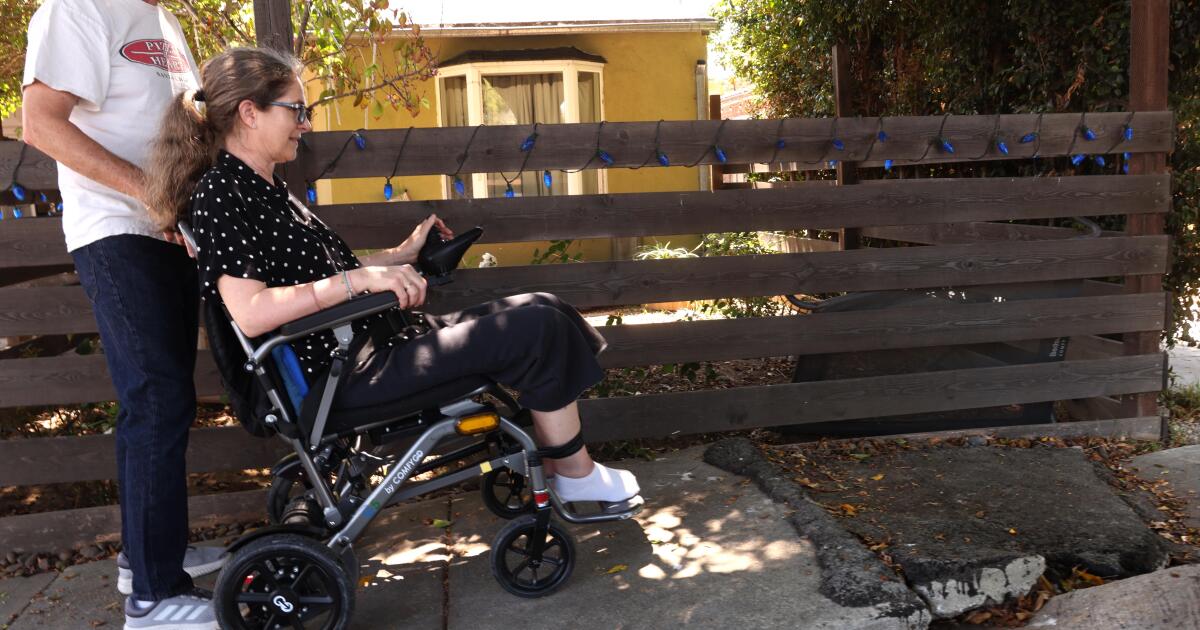
People wanted to know about the scoring system that awarded just 15 points, out of 45, to John Coanda and his wife, Barbara, who uses a wheelchair because of ALS. The Mar Vista couple had applied to the city’s Safe Sidewalks program to have some busted-up sidewalk in front of their home repaired.
With several sidewalk hazards on both sides of their block, Barbara can’t safely make it down her street. So how is it possible that under L.A.’s “Sidewalk Repair Program Prioritization and Scoring System,” their meager 15 points means they could be waiting “in excess of 10 years” for help?
I have the answers.
The Coandas got 15 points for being in a residential zone. But they didn’t meet the requirements for getting two additional awards of 15 points. They do not live within 500 feet of a bus or transit stop. And they had not been in the sidewalk repair backlog queue for more than 120 days.
It is not clear, however, that moving up to a score of 30 will bring out city work crews in less than 10 years. Knowing what I know, I wouldn’t bet on it.
The scoring system exists because in a lawsuit settlement 10 years ago, the city agreed to spend $1.4 billion over 30 years to repair damaged sidewalks and other infrastructure failures that impede the mobility of people with disabilities.
But there’s a backlog. A huge backlog, in the thousands. At my request, the city disclosed on Friday that it’s receiving about twice as many new disability-access repair requests each year as it’s addressing. In addition, the backlog for disability access requests and from residents applying for a sidewalk repair rebate program stands at roughly 30,000, with about 600 repairs being made each year.
As I said in a previous column, L.A. might indeed be all buttoned up by the ‘28 Olympics, but that would be 3028, not 2028.
Cracked sidewalks, to be clear, are but a symptom of a deeper, decades-long breakdown at City Hall. Basic services have been sacrificed to pay for employee compensation and pension costs the city can’t afford, with homeless services adding to the budget crisis.
By the way, I heard from one reader in response to my suggestion last week that if you can’t wait 10 years or more for the city to fix a broken sidewalk, you can apply to the rebate program, which will cover a portion of repairs. Don’t bother, said Lori Lerner Gray, who owns a house in Silver Lake and applied two years ago, but finally gave up.
“There is a massive waiting list and it’s a very complicated procedure just to try to get on it, let alone speak with anyone to help,” Gray said. “Once you finally get into the program, it’s impossible to proceed because of permits, engineering reports and finally you are required to bring the entire area to ADA compliance on your own dime.”
She said she was told she’d have to pay to relocate a utility pole.
And sidewalks aren’t the only infrastructure problem, as other readers noted. The city is way behind on filling potholes, repaving streets, installing curb ramps, making park improvements and replacing broken lights. I recently wrote about all the blight around City Hall, including the graffiti-tagged monument and fountain that has been inoperable for most of the last 60 years.
Oren Hadar, a Mid-City resident who writes about housing and transportation on his The Future Is L.A. website, reported last year in a Times op-ed that city streets were falling apart because the city had switched from repaving entire roads to doing what it called “large asphalt repair.”
With the switch, the city avoided federal requirements to upgrade curb ramps on repaved streets, Hadar said. He told me that when he travels to other cities near or far, “I’m always jealous of everything. Sidewalks are in better shape or there are better bike lanes. … You could go to even Santa Monica or Culver City. You don’t have to go far to see infrastructure that’s better.”
Other major cities have had formal infrastructure plans for years, while L.A. has ducked and dithered. Finally, earlier this month, Mayor Karen Bass introduced the city’s long-awaited CIP (capital infrastructure program), and offered a brutal assessment of what went wrong.
“For too long,” she said in the executive summary, “information has been scattered across departments, buried in lengthy reports and budgets, and difficult to fully understand. These challenges have had real consequences, contributing to decades of underinvestment in our built environment.”
The summary reads like an indictment of City Hall leadership and the manner in which public spaces have deteriorated. With Bass running for reelection, voters have to decide whether her role in those failures is grounds for dismissal, or her campaign-season pitch for a new day should help earn her a second term.
The report, with backing by members of the City Council, cited “fragmented systems and data silos,” “no shared vision across city departments,” “growing maintenance deferrals,” “slow, inefficient capital planning,” no “project intake standards,” “highly decentralized and uncoordinated grants,” “resource planning and staffing misalignment,” and “opaque capital planning process.”
Way to go, team.
You could take many of those same critiques and apply them to the haphazard way in which city and county leaders have addressed homelessness.
However, the city’s infrastructure plan does offer a framework for assessing the damage and prioritizing projects, and using charter reform to create a public works director position with greater authority. None of this will happen quickly, and given the budget crunch, you might be wondering how any of this would be paid for.
The suggestions in the report include bonds, a parcel tax, grants, fees on tickets to concerts and sporting events, fees on taxi and rideshare trips, and much, much more. None of this will be popular, especially if the public is unconvinced that city leaders can be trusted with more money.
Urban planner Deborah Murphy, chair of the city’s pedestrian advisory committee, noted that L.A. has gotten grants or state funding in the past for specific projects and then, because of staffing shortages or other stumbles, failed to hold up its end of the deal.
“It kind of ruins our reputation for getting future money,” Murphy said.
“But the key question is: who is actually in charge of making it happen?” she asked.
It’s critical, Meaney suggested, for city leaders to push for charter reform that puts infrastructure authority under a newly empowered public works director. If the city gets this right, she said, implementation of the infrastructure plan “could finally show Angelenos the true scale of deferred maintenance, make trade-offs visible, and create a road map for better sidewalks, streets, parks, and accessibility.”
If the current fragmented authority remains in place, Meaney said, the headline would be:
“No one is in charge of your sidewalk and City Hall is determined to keep it that way.”
Wall Street’s major market averages dropped lower on Friday as tech stocks fell and U.S. Treasury yields marched higher following the U.S.-China summit ending.
The blue chip Dow (DJI) was -0.7%, the benchmark S&P 500 (SP500) was -0.9%, and
I was 10 when I first read “All Creatures Great and Small,” devouring each subsequent book that Alf Wight, under the pen name James Herriot, wrote about life as a veterinarian in his beloved Yorkshire Dales. I was a bit older when I encountered Bram Stoker’s “Dracula,” which opens in the seaside town of Whitby, where cliffs overlook the sea in which the ill-fated ship Demeter meets its end. In my teens, I discovered the wild moors and ancient halls of “Jane Eyre” and “Wuthering Heights.” More recently, I have been entranced by the work of Sally Wainwright, whose string of critically acclaimed series — ”Last Tango in Halifax,” “Happy Valley,” “Gentleman Jack” and “Riot Women” — have made her the modern bard of Yorkshire, England.
So when a friend, planning a visit to her daughter at Durham University, proposed I join her for a side trip of our own, I jumped at the chance to travel to a land I knew only through the eyes of others.
The Dales of James Herriot
In mid-April, I joined my friend Nancy in York, a city often mentioned in Yorkshire-based literature. On a sunny Saturday, we took a train to Thirsk, where Herriot, alongside Donald and Brian Sinclair (known in the books as Siegfried and Tristan Farnon) lived and worked in “Skeldale House,” now the World of James Herriot museum.
Lambing season in North Yorkshire.
(Mary McNamara / Los Angeles Times)
The city sprawl quickly gave way to stone-walled fields full of dazzling yellow rape and spring-green grass dotted with sheep and frolicking lambs. April is lambing season, the perfect time to visit Herriot Country. “All young animals are appealing,” he wrote, “but the lamb has been given an unfair share of charm.”
Situated between the North York Moors and Yorkshire Dales national parks, Thirsk (known as Darrowby in the Herriot books) is a market town, organized around a great open plaza in which stands a clock tower that on this day was decorated with rather splendid floral creations by the Thirsk Yarnbombers, in celebration of its 10th anniversary.
Even so, it looks much as it must have when Herriot lived here — modern businesses housed in medieval and Georgian buildings. Surely the Ritz Cinema is the theater Herriot describes as he begins his courtship of Helen Alderson; a blue circle marker proudly declares its date of establishment as a picture house, 1912.
The entrance to the World of James Herriot in Thirsk, North Yorkshire.
(Mary McNamara / Los Angeles Times)
The World of James Herriot museum is a sudden splash of crimson and white signage on an otherwise ordinary, albeit charming, street; at the far end stands St. Mary’s Church, where Herriot married his actual wife, Joan Anderson. When we visited the church later that afternoon, they were cleaning up from a community tea and I spoke with a woman who remembered Herriot and especially his son Jim and daughter Rosie, who were the town vet and doctor, respectively, for many years.
The museum, on the first floor, is a re-creation of “Skeldale House,” down to the pint pot in which Siegfried kept the petty cash and the old central telephone. There’s a display documenting the evolution of the books — originally printed in the UK, beginning in 1972, under different names, until a struggling St. Martin’s Press published two of them with the title “All Creatures Great and Small” and helped turn Herriot into a franchise.
The old central telephone at the World of James Herriot museum in Thirsk.
(Mary McNamara / Los Angeles Times)
Various outbuildings now house a small screening room, where clips from a documentary on Herriot’s life play, as well as a re-creation of the TV studio and set on which the 1978 television series was filmed. The set from the current PBS series, which began in 2020, is in another part of the museum, which also includes an extensive exhibit of historic veterinarian instruments.
As we wandered through the town and the museum, Herriot the man came to life as lyrically as his fiction. A country vet, whose career began before the age of antibiotics and many now-commonplace vaccines, wrote, beginning at age 50, a series of semi-autobiographical novels that would become international bestsellers and launch several films and two series, one of which was filming 35 miles away in Grassington.
He never left the Dales, or stopped being a vet; during his lifetime, fans would line the street outside his practice, waiting for autographs and photos. Twenty years after his death, Thirsk remains both an ordinary Yorkshire town (the only Herriot memorabilia advertised is in the museum gift shop) and an enduring tourist destination. (If you go, may I recommend lunch/tea at Upstairs, Downstairs, where I got a life-changing Yorkshire rarebit with bacon and fried egg as well as a sack of the local sweet, cinder toffee.)
Grassington, North Yorkshire, becomes a film set for “All Creatures Great and Small.”
(Mary McNamara / Los Angeles Times)
Deeper in the Dales, Nancy and I rented a “glamping pod” in Malhamdale. On our way, we stopped in Grassington, where the town was being transformed into Darrowby with period-and-place-appropriate signs, advertisements and community announcements. “Open as usual but dressed for filming” read a sign in the window of the Stripey Badger Bookshop, Coffee Shop and Kitchen.
Filming would take place in two days’ time, so we returned then to see the square come alive with extras in period clothing. Within the crowd of fellow onlookers, controlled by lovely but firm crew members, we watched as a scene between Siegfried (Samuel West) and Tristan (Callum Woodhouse) was filmed outside the Drovers Arms.
A breathtaking view and unique fractured “pavement” at Malham Cove.
(Mary McNamara / Los Angeles Times)
We had chosen Malhamdale because its limestone topography is considered the most stunning of the Dales. And that it most certainly is.
From the village of Malham we hiked to Malham Cove, which rose in near miraculous silver splendor among the sylvan greenery, and then ascended the nearly 500 steps to its top. There, a breathtaking view and unique fractured “pavement” has been used in countless films, including “Harry Potter and the Deathly Hallows” and the 1992 “Wuthering Heights.” We followed the trail to the Gordale Scar, a glorious gorge and waterfall that is also a favorite filming spot, and thence to Janet’s Foss, a woodland waterfall and pool, beside a cave where the queen of the fairies is said to live.
Janet’s Foss, a woodland waterfall and pool.
(Mary McNamara / Los Angeles Times)
After just three days in the Dales, I clearly understood why no amount of money or fame had convinced Herriot and his family to leave.
Dracula town
Windswept Whitby sits on the east coast of Yorkshire, with its back to the North York Moors National Park and its face to the North Sea. It climbs either side of a valley created by the River Esk, as it joins the port where whalers once launched and Captain Cook first commandeered the HMS Endeavour.
On the west side, the street along the harbor is chockablock with venues catering to tourists and daytrippers come to enjoy the pier and small beaches. Families rent crab pots and put their catch in plastic buckets held by delighted children. Atop the cliffs behind, Georgian homes, hotels and guest houses stand in gracious testament to Whitby’s Victorian history as a popular spa town, as it was when Stoker visited in 1890. He stayed in a West Cliff guest house, gazing, as everyone must do, across the harbor where the remains of the 13th century Whitby Abbey dominate the East Cliff.
The harbor at Whitby, North Yorkshire.
(Mary McNamara / Los Angeles Times)
Even under a beaming sun, the ruins, aproned by the graveyard of the nearby Norman church of St. Mary’s, carve a formidable black silhouette against the sky. Beneath are the roofs and cobbled streets of the medieval Old Town, where ancient pubs stand among jewelers specializing in local jet. To reach the abbey, visitors must climb the town’s famous 199 steps that rise along the cliff.
“It is a most noble ruin,” Mina Harker writes in her journal in early chapters of “Dracula.” “Between it and the town there is another church, the parish one, round which is a big graveyard, all full of tombstones. This is to my mind the nicest spot in Whitby, for it lies right over the town, and has a full view of the harbor.”
Here Mina and her friend Lucy Westenra sit among the graves, sketching and talking, later, watching clouds gather for the storm that would bring the Demeter, and Count Dracula, to Whitby. Here too Mina would see, from the West Cliff, her sleepwalking friend half reclining on “our favorite seat” and for a moment “it seemed to me as though something dark stood behind the seat where the white figure shone, and bent over it.”
The remains of Whitby Abbey.
(Mary McNamara / Los Angeles Times)
We visited on a sunny day, and the wind blew hard as we traced Mina and Lucy’s steps through the tombs and along the path past the Abbey toward Robin Hood’s Bay. With its glorious views and picturesque harbor, Whitby is the antithesis of gothic horror. Still, it was here that Stoker, researching another novel, first read of Vlad the Impaler, otherwise known as Dracula, and no doubt heard of the wreck of the Russian ship Dmitry, which had run aground beneath East Cliff five years before his visit.
And so the godfather of modern horror was born.
Brontë Country
It is difficult to imagine a fictional tale more gothic, inspirational and remarkable than that of three brilliant sisters who lived in relative isolation on the edge of the Yorkshire Moors, secretly battling their socially conscripted futures by writing poems and novels that they dared not publish under their own names.
The Brontë Parsonage Museum in Haworth, North Yorkshire.
(Mary McNamara / Los Angeles Times)
Two of those novels — ”Jane Eyre” by Charlotte Brontë and “Wuthering Heights” by Emily Brontë, are still considered masterworks, influencing subsequent generations and endlessly adapted for film and television. (In the ultimate Yorkshire crossover, Wainwright wrote the breathtaking two-part Brontë biopic “To Walk Invisible,” which everyone should see.)
The Brontë Parsonage Museum, and the town of Haworth which it overlooks, is very much a tourist attraction. An information annex, gift shop and public restroom have been added behind it, but once you enter the small garden that stands between the parsonage’s front door and St. Michael and All Angels’ Church, you are in another world.
In 1820, Patrick Brontë, recently appointed incumbent of St. Michael, moved his wife, Maria, and their six children into the parsonage where they all lived for the rest of their natural (albeit in most cases, short) lives. Maria died in 1821; the two older children, Maria and Elizabeth, died four years later after being sent to a typhoid-plagued school Charlotte would pillory as Lowood in “Jane Eyre.”
The museum is meticulously restored to reflect the years that the surviving children — Charlotte, Emily, Anne and Branwell, the only son — were young adults. The dining room table, where the sisters wrote, is strewn with manuscripts, quill pens and tea cups; a bonnet and shawl bedeck a chair in the small kitchen. Patrick had his own study but it is difficult to imagine three women being able to write separate works, never mind classics, in such close quarters. Ironically, only Branwell’s room, papered with sketches and poems, looks like an artist’s refuge.
St. Michael and All Angels’ Church in the town of Haworth.
(Mary McNamara / Los Angeles Times)
Unlike his three sisters, Branwell, his artistic career stunted by alcoholism and an opium addiction, never published. He died of tuberculosis in 1848 at 31.
If any place should be haunted, it is the Brontë parsonage. Shortly after Branwell’s funeral (and just a year after “Wuthering Heights” was published), 30-year-old Emily also died of tuberculosis, expiring on the sofa that stands beside the dining room table. A few months later, after the publication of her second novel, “The Tenant of Wildfell Hall,” Anne, 29, succumbed to the disease in nearby Scarborough, just south of Whitby.
Charlotte, who wrote two more novels after “Jane Eyre,” was the only sister to be celebrated during her lifetime. She married and then died at the parsonage in 1855 at 38 of complications from her first pregnancy. Only Patrick lived to old age — 84 — dying in 1861 in the home where he had served for 41 years.
The Brontë Parsonage Museum in Haworth, North Yorkshire.
(Mary McNamara / Los Angeles Times)
But it is not a sad house; instead visitors are left to wonder at the genius, resolution and audacity that roiled the quiet rooms and halls where the sisters secretly wrote and sent out their manuscripts, all initially under the the names of Currer (Charlotte), Ellis (Emily) and Acton (Anne) Bell.
The steeply descending main street of Haworth is filled with tea shops, pubs and stores clearly dedicated to pleasing Brontë pilgrims, but its basic form, including the original stationery store where the sisters once bought their paper, remains the same.
As do the moors that stretch behind the parsonage. On a walk to the Brontë Waterfall (more like a small but still lovely rill) and Top Withens, the ruin of a 16th century farmhouse believed to have inspired “Wuthering Heights,” the wild silence and sweeping vistas are even more transporting than the parsonage. One imagines not the ghost of Cathy or Heathcliff, but a trio of women, very much alive and striding through the heather, their minds alight with the stories they would tell, set among similar terrain.
Wainwright’s Way
Our final accommodation on this literary sojourn was Holdsworth House, a manor hotel near Halifax where screenwriter Wainwright and her casts often stay during filming, and where Alan (Derek Jacobi) and Celia (Anne Reid) were married in “Last Tango in Halifax.”
Holdsworth House, a manor hotel near Halifax.
(Mary McNamara / Los Angeles Times)
With creaking floors, fireplaces, a first-class restaurant, mullioned windows and a lovely garden, Holdsworth House would be glorious even without its famous connections (including a 1964 stay by the Beatles). Plans for at least two weddings were being discussed by staff during our sojourn.
On our way there, we stopped in Heptonstall, a tiny town above Hebden Bridge, where Sylvia Plath is buried in the St. Thomas A’ Becket churchyard. Her husband, Ted Hughes, was born in the nearby town of Mytholmroyd and though they were estranged at the time of her death, he was her next of kin and chose the site, and the stone, on which the poet is identified as Sylvia Plath Hughes above an epitaph that reads: “Even amidst fierce flames, the golden lotus can be planted.”
Heptonstall, a tiny town above Hebden Bridge, where Sylvia Plath is buried in the St. Thomas A’ Becket churchyard.
(Mary McNamara / Los Angeles Times)
There are no signs directing visitors to Plath’s resting place; we relied on Apple Maps and my memory of a brief glimpse of it in Wainwright’s “Happy Valley” (Becky, the daughter of main character Catherine Cawood [Sarah Lancashire], is buried nearby). Looking for the piles of pens that once adorned Plath’s grave didn’t help; it is now blanketed in planted flowers. A few pens have been left on the headstone, which has been replaced at least once; generations of fans have attempted to obliterate “Hughes.”
Down the hill in Hebden Bridge, Wainwright’s world comes miraculously to life — the canals with their longboats, on which Catherine battled Tommy Lee Royce (James Norton); the Albert pub which proudly announces on a placard that it is the Duke of Wellington in “Riot Women”; even the public car park where Alan had his car stolen while meeting Celia for the first time in “Last Tango.”
The canal at Hebden Bridge.
(Mary McNamara / Los Angeles Times)
While driving around Hebden Bridge and towns surrounding nearby Halifax, I more than once imagined I was Catherine Cawood and marveled at Wainwright’s loyalty to this land, its cities, towns, farms and moors. Her series are inevitably female-centric and like the Brontës, who wrote 200 years and a few miles away, her work excavates the drama of daily life and the tension between good and evil that sings below any surface.
I’m going to start this story on a quiet tree-lined street in Mar Vista, where a couple I met with on Thursday — the day after the L.A. mayoral debate — have a problem.
It’s not an unusual matter, as things go in Los Angeles. On both sides of the street, the sidewalk rises and falls, uprooted and cracked by shallow roots because over many decades, the trees were not properly maintained.
John Coanda, 61, who grew up in Los Angeles, was never bothered by torn-up sidewalks as a kid.
“In fact,” he said when he first emailed me about his predicament, “my friends and I sometimes used the ramping pavement as jumps for our bicycles.”
But his wife, Barbara, was diagnosed in 2024 with ALS, and she uses a wheelchair. When John pushes her, they can’t use the sidewalk if they want to go to the store or meet with friends, or just enjoy a nice pass through the neighborhood without getting into a vehicle.
So John pushes Barbara’s wheelchair in the street, which creates an obvious safety problem. And despite John’s best efforts to get City Hall to fix the sidewalks, he’s not expecting help anytime soon.
I’ll circle back to this story in a bit, but first, about that debate.
I recruited a half-dozen L.A. residents to watch and send me their thoughts about how the candidates tackled the important issues. And then I felt guilty for having done so, because the candidates didn’t do much tackling at all.
Candidate Spencer Pratt is shown on a television while journalists work during the 2026 Los Angeles mayoral debate at Skirball Cultural Center.
(Jason Armond / Los Angeles Times)
They hit their talking points, for sure, and Mayor Karen Bass, Councilmember Nithya Raman and TV personality Spencer Pratt each had their moments. But by the end of the debate, and two straight nights of gubernatorial debates as well, I came away thinking there were no clear winners, but there was a definite loser.
Voters.
This is the fault of the format more than of the candidates themselves. The deck is stacked against meaningful, substantive discussions, especially when moderators ask — as they did several times — for one-word answers.
“Moderator questions are so meaningless … and they make it easy for candidates to take potshots at each other,” said longtime political sage Darry Sragow. “The format is guaranteed to elicit nothing that matters.”
It’d be better to have single-issue debates, and to have candidates pressed for details by journalists who cover those issues and can push back against unrealistic promises and expose a lack of depth.
My debate watchers did some of that themselves. CSUN librarian Yi Ding had praise and criticism for each candidate, but was looking for concrete plans and didn’t get many.
Ding was also disappointed that two other mayoral candidates — Ray Huang and Adam Miller — were not invited to the debate, and I agree with her. Both have been polling low, but with so many undecided voters, and such high unfavorability ratings for Bass, they should have been in the mix.
Mike Washington, a retired pharmacist and West Adams resident, said Bass has done better than previous mayors on homelessness and he didn’t think Raman or Pratt came off as worthy of bumping her out of City Hall.
“The public would have benefited from more questions related to the challenges young people are facing,” said Juan Solorio Jr., president of the San Fernando Valley Young Democrats club. His colleague David Ramirez agreed, saying he was hoping for “more discussion about the cost of living for young adults,” but he and Solorio are both backing Bass.
West L.A. software developer Mike Eveloff asked the million-dollar question in one of his many observations during the debate:
“Why is LA spending record amounts on homelessness, fire, police, and infrastructure while results deteriorate? Streets and sidewalks crumble. Even the city emblem right in front of City Hall is deteriorated. With the World Cup and Olympics approaching, voters need to know: Do these leaders have the financial discipline and operational competence to manage a fourteen billion dollar city?”
Venice resident Dennis Hathaway, author of “An Octogenarian’s Journal,” said he thinks “these kinds of debates are pretty non-edifying.” And, as someone I wrote about two years ago regarding busted sidewalks in his neighborhood, he shared this lament about Thursday’s debate:
“No mention of broken sidewalks, potholed streets, other deteriorated infrastructure. To me, that’s a much more important subject than non-citizens voting in city elections.”
(Bass did say during the debate that there was a new infrastucture plan in place, and that’s a step in the right direction. But there was no discussion, and when you read the details, 2028 Olympics projects will be prioritized, and it’ll take years to figure out how to fund thousands of additional much-needed fixes.)
The Coandas live not far from Hathaway, and their lives have been upended first by Barbara’s diagnosis and then by John getting laid off in February from his job as a data analyst. Barbara still teaches French via Zoom, and John is tending to her needs. They started a Gofundme campaign to help pay their bills.
With Barbara in a wheelchair, John contacted the city’s Safe Sidewalks L.A. program last fall, and I think it’s fair to say that name is somewhere between a misnomer and a bad joke.
The “program” responded by email on Halloween, appropriately enough, informing him that under the City Council-approved “Sidewalk Repair Program Prioritization and Scoring System,” his request for help merits only 15 points out of a possible 45.
“Currently,” he was informed, “the estimated wait time for completion of an Access Request with a score of 15 is in excess of 10 years.”
Happy Halloween.
Over the years, responsibility for sidewalk repairs has shifted between the city and homeowners. There’s a rebate program available to people who repair their own sidewalks, but it’s capped at an amount that doesn’t always cover the costs. And ruptured pavement is keeping lots of lawyers busy with trip-and-fall lawsuits that cost the city millions each year.
Barbara Durieux Coanda, who has ALS, and her husband, John Coanda, make their way down the ramp in front of their home in Mar Vista.
(Genaro Molina / Los Angeles Times)
Coanda told me he doesn’t have the funds at the moment to pay for repairs, and even if he did, there are several more sidewalk disaster zones on both sides of his street, so he’d still have to push his wife’s wheelchair in the street even if he fixed the cracks in front of his own house.
Barbara graciously said she thinks the city has other, higher priorities, but in November her husband contacted the office of Councilmember Traci Park, saying he was told that he would have to wait 10 years for repairs.
“Sadly,” he wrote, “I don’t think my wife will live that long.”
A Park staffer wrote back, saying, “The turnaround time does sound realistic given the budgetary crisis the city finds itself in.” But, the staffer added, maybe the council member’s office could “help move the needle on this request.”
Coanda said he’s been too busy with his wife’s issues to follow up. But Pete Brown, Park’s communications director, told me Friday afternoon that the office is exploring ways to pay for fixes that don’t take 10 years, including the use of discretionary funds.
I don’t know how that might play out, but I do know that L.A. doesn’t need another debate like the last one.
We need a mayor and council members who refuse to accept that it takes 10 years to create safe passage for a wheelchair.
In the national capital of broken sidewalks, we need concrete plans.
Abi made her debut on the long-running ITV soap back in 2017 – and it’s fair to say she has quickly become a firm favourite with fans. The character has also played a part in several big storylinesduring her stint on the soap.
From her drug addiction, the tragic death of her son Seb (Harry Visinoni), and, more recently, her affair with Carl Webster (Jonathan Howard) behind her husband Kevin’s (Michael Le Vell) back, her time in Weatherfield has not been short of drama.
Away from the cobbles though, on Saturday (May 9) Abi actress Sally celebrated her birthday – and fans couldn’t believe her real age.
On a Coronation StreetFacebook fan page, one person paid a sweet tribute to Sally and said: “Sally Carman is 51 today. Happy Birthday Sally.” And rushing to the comments section, fans were left gobsmacked by her age.
One person wrote: “51?! She looks in her 40s!” Another added: “She doesn’t look a day over 30.” A third chimed in: “I’d have guessed she was in her 40s.” Someone else wrote: “She doesn’t look that age! Gorgeous lady.”
Last year, Sally revealed the secrets behind her remarkably youthful looks. In an interview with The Sun, Sally confessed: “Oh, it’s no secret – I have fillers, I have Botox, facials…. I do all of it.”
Sally continued: “I’m really open about it. I don’t think there’s anything worse than someone promoting a cream saying: ‘Buy this mega-bucks cream and your face will be as smooth as mine.’ I’m like: ‘Yeah, whatever.’ So there’s no cream – well, there is, but there are other things on top.”
Meanwhile earlier this year, Sally confirmed that fans will be seeing her playing Abi until at least 2027 as she signed another year-long contract. Speaking exclusively to Radio Times at the TV Choice Awards, she confirmed: “Just signed for another year, which is great. My goodness, I love it. It’s my favourite job I’ve ever done.”
The soap star also shared that she would be honoured to follow in the footsteps and have the same screen longevity as Corrie royalty Sally Dynevor, who recently marked the milestone of playing Sally Metcalfe for 40 years. “If they’ll have me, yeah!” Sally joked.
In addition to her success on Coronation Street, Sally has also found love on the show. She met her co-star Joe Duttine, who plays Tim Metcalfe, on set in 2017, and the couple got engaged in 2020 before tying the knot two years later.
Discussing their unique engagement tale on Kate Thornton’s podcast, White Wine Question Time, Sally shared: “It was while we were in lockdown and we were staying in the Dales with his sister, who has a lot of space, with, his kids” she said.
She added: “We were walking around this big field on this walk and he went: ‘Kids, have a look in between the dry stone walling because you know, they used to put coins and precious things to hide them in the walls.”
Sally continued: “So I’m having a look and there’s this box. And I opened it. I’m like: ‘No way.’ And then there was another box inside. And I turned around and he was on one knee.”
Coronation Street airs Monday to Friday at 8:30pm on ITV1 and ITVX
Coronation street fans think they have worked out who killed Theo Silverton after telling scenes aired on Friday night’s episode of the world’s long-running TV soap
Could Theo have been killed by his ex-wife?
Coronation street fans think they have worked out who killed Theo Silverton. The scaffolder, who was played by former Tracy Beaker star James Cartwright, was found dead at the end of the ITV soap’s much-hyped murder week.
When Theo was introduced, he was married to Danielle Silverton (Natalie Anderson) but he began an affair with Todd Grimshaw and, once he had split from his wife, they began an official relationship but it quickly turned sour.
For almost a year, Theo terrorised Todd with bizarre forms of abuse, both mental and physical, and caused the death of his best friend Billy (Daniel Brocklebank) in the crossover with Emmerdale.
Still coming to terms with the loss of Theo, on Friday’s episode of the world’s longest-running TV soap, Todd was surprised to see Danielle turn up at his flat amid the murder investigations, where she revealed more about her past with Theo. He said: “The police have already interviewed me. I had nothing to do with Theo’s death.”
But Danielle wasn’t convinced, and she shot back: “If he hadn’t met you, he’d still be alive. My kids would still have a dad! Maybe you got cold feet, thought it was easier if he was dead.”
It was then that Danielle started to say more about what she had been through. She said: “Since he’s been gone, I’ve been thinking back over our relationship. What kind of man he was. It’s what made me wonder if you’d snapped. Killed him.
“He was a good dad… especially when the kids were little. I knew he had a short fuse. God, sometimes we’d go at it like hammer and tongs.” When Todd claimed he “gave Theo power,” Danielle pushed back as she said: “No. Theo took power. He had all the power in our relationship, too. He just… didn’t abuse it.
“Though, actually, he did make all the decisions about everything. Where we lived, how we lived, how we parented. Every time we argued, I gave in. Because, secretly, I was afraid of him. I mean, he never hurt me or the kids, and I didn’t want to believe he was a bad man. But I knew how controlling he was.”
Danielle is an official suspect along with Todd, his father figure George Shuttleworth, his daughter Summer Spellman, and Theo’s former colleague Gary Windass, as revealed by bosses of the soap earlier this week. But fans think that they might have sussed it after Danielle’s sudden appearance.
One fan wrote on X: “Oh wow, I wasn’t expecting Danielle to say that. Was it Danielle?” whilst another said: “Go on, admit it Danielle.” A third suspected that the way in which Danielle had instantly accused Todd meant that she was the guilty one.
They wrote: “That scene where she turned up to the flat was very interesting because she instantly interrogated Todd, almost like she was deflecting or bluffing. That’s what made me think she killed him.”
Coronation Streetairs Monday to Friday at 8:30pm on ITV1 and is available to stream from 7am onITVX.