DENVER — Colorado Gov. Jared Polis on Friday commuted the sentence of election conspiracy theorist Tina Peters following pressure from President Trump, the latest instance of the president using his influence to reward those who echoed his baseless claims of mass fraud as the cause of his 2020 election loss.
Trump has championed the case of Peters, a 70-year-old former county clerk who was sentenced to nine years behind bars after being convicted in a scheme to make a copy of her county’s election computer system. She will be released June 1.
In April, a Colorado appeals court upheld her conviction but ordered Peters to be resentenced because it said the judge who sent her to prison wrongly punished her for speaking out about election fraud, a decision that Polis praised.
In a letter to Peters, Polis wrote that she was convicted of serious crimes and deserved to spend time in prison. “However, this is an extremely unusual and lengthy sentence for a first time offender who committed nonviolent crimes,” the governor wrote.
He added that Peters’ application “demonstrates taking responsibility for your crimes, and a commitment to follow the law going forward.”
Trump posted around the time of the announcement on his social media platform: “FREE TINA!”
Jeany Rush, 76, wears a We the People pin along with numerous Free Tina Peters stickers during the Colorado Republican State Assembly on April 11 at Massari Arena on the Colorado State University Pueblo campus in Pueblo, Colo.
(Timothy Hurst/MediaNews Group/The Denver Post via Getty Images)
‘Affront to the rule of law’
Colorado Secretary of State Jena Griswold criticized the decision by the governor — a fellow Democrat — saying that “it was a dark day for democracy” and that ”selling out our state’s justice system for Trump is an affront to the rule of law.”
“A clear message is being sent to those willing to break the law and attack democracy for the president — they will likely not face consequences for their actions,” Griswold said at a news conference.
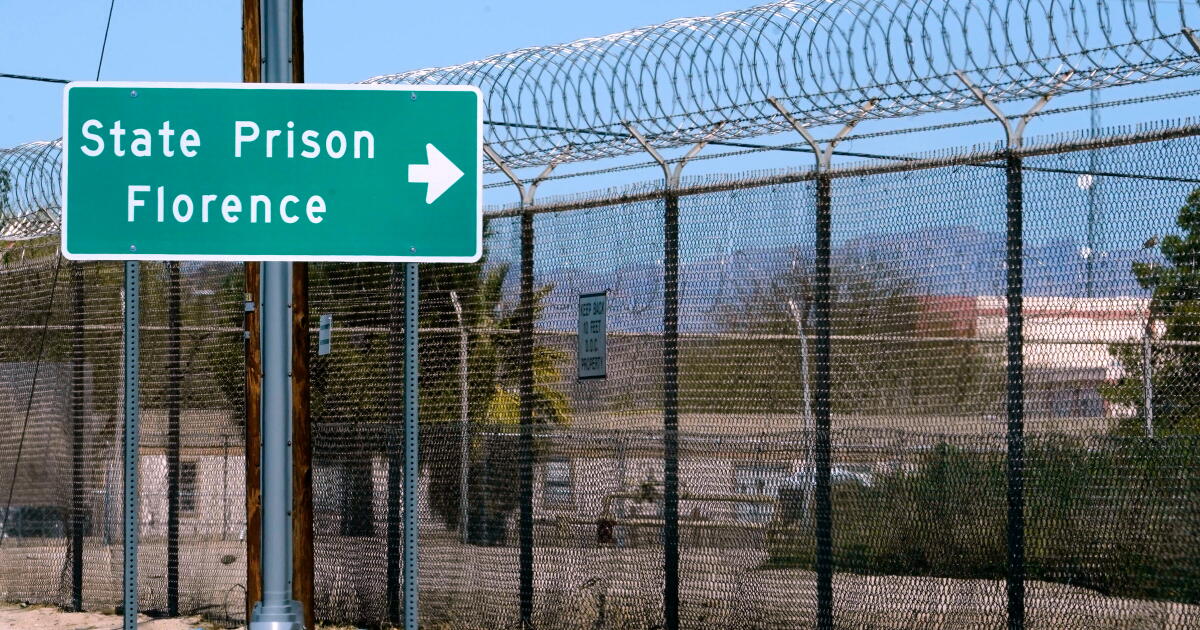
Peters has been serving her sentence at a prison in Pueblo after being convicted in 2024 by jurors in Mesa County, a Republican stronghold that supported Trump.
Peters sneaked in an outside computer expert, an associate of MyPillow Chief Executive Mike Lindell — a fellow election denier — to make a copy of her county’s Dominion Voting Systems election computer server as state officials updated it in 2021. Peters joined Lindell onstage at a “cybersymposium” that promised to reveal proof of election rigging, after which video and photos of the update, including passwords, were posted online.
After the commutation announcement, Peters issued a statement through her attorney thanking Polis and apologizing.
“Five years ago I misled the Secretary of State when allowing a person to gain access to county voting equipment. That was wrong,” Peters said. “I have learned and grown during my time in prison and going forward I will make sure that my actions always follow the law, and I will avoid the mistakes of the past.”
She also condemned threats and violence against voters, county clerks and election workers.
Gubernatorial candidates weigh in
Polis is ineligible to seek reelection due to term limits, and the candidates running to succeed him weighed in on his decision.
Sen. Michael Bennet, a Democrat in the race, said that he vehemently disagreed with the commutation and that Peters knowingly broke the law, undermined elections and was convicted by a jury.
“Lawlessness only breeds more lawlessness,” Bennet said. “With President Trump continuing to attack Colorado, we must do everything we can to stand strong for our institutions and the rule of law.”
A Republican candidate, state Sen. Barbara Kirkmeyer, said she would have preferred that the trial judge revisit Peters’ sentence as ordered by the appeals court before the governor considered any commutation.
“A commutation or pardon by a governor should be reserved for truly extraordinary circumstances,” Kirkmeyer wrote in a statement. “The governor has a responsibility to apply justice fairly, consistently, and without bias.”
Trump’s influence
Peters was convicted of state, not federal, crimes, which put her beyond the reach of Trump’s pardon power, which he used to free those convicted of crimes for the Jan. 6, 2021, attack on the U.S. Capitol. So the president championed her cause through the media.
Trump has lambasted both Polis, calling him a “Scumbag Governor,” and the Republican district attorney who prosecuted her, Daniel Rubinstein, for keeping Peters in prison. He has referred to Peters as “elderly” and “sick.” Earlier this year, Trump uninvited Polis from a White House meeting with governors over the case.
The president had said Colorado was “suffering a big price” for refusing to release her. His administration has been choking off funds, ending federal programs and denying disaster aid. It also announced the dismantling of the National Center for Atmospheric Research in Colorado and relocated the U.S. Space Command from the state to Alabama.
Matt Crane, executive director of the Colorado County Clerks Assn., said the commutation “signals that it is open season on our election and election officials.”
“Gov. Polis is bending the knee to the same political voices and conspiracy theories that are undermining belief in our democratic institutions,” Crane said. “This is now Gov. Polis’ legacy. He will not be able to run from it.”
Peters’ health
Peters’ lawyers have said her health has declined in prison. Peters, who had part of her right lung removed in 2017, started coughing frequently after the prison’s heating system was turned on for the winter and has had trouble sleeping due to chronic pain from fibromyalgia, her lawyers said.
In January, Peters was involved in a scuffle with another inmate but was found not guilty of assault following a prison disciplinary hearing, Colorado Department of Corrections spokesperson Alondra Gonzalez-Garcia said. Peters was found guilty of being in a location without authorization.
The federal Bureau of Prisons tried but failed to get Peters moved to a federal prison. In January, Polis said he was considering granting clemency for Peters, calling her sentence “unusual and harsh“ for a first-time, nonviolent offender. In March he repeated those arguments in a lengthy post on the social media platform X.
Polis defended his decision Friday in a social media post.
“I’ll always stand for free speech and to make sure that we live in a country that no matter what your viewpoints are, you are not incarcerated longer because of them,” Polis said.
In contrast to some other Democratic governors, Polis, who portrays himself as a political iconoclast, has at times taken an accommodating stance toward Trump. Though he criticized the president’s tariff and immigration policies, the governor praised earlier moves by Trump such as creating the Department of Government Efficiency, which was run by billionaire Elon Musk, and the choice of vaccine critic Robert F. Kennedy Jr. to run the Department of Health and Human Services.
Slevin and Riccardi write for the Associated Press. AP writers Ali Swenson in New York, Jacques Billeaud in Phoenix and Audrey McAvoy in Honolulu contributed to this report.
SACRAMENTO — Citing reasons financial, emotional and political, hundreds of gays and lesbians around California took advantage of a new law Monday and began the process of registering with the state as domestic partners.
To some it seemed a giant step, to others a baby step, toward full recognition of their relationships.
“We are involved in a commitment with caring and loving and all the things I hear people say about their husbands and wives,” said Sam Catalano, a state employee who hummed the wedding march as he and his partner paid $10 to become registered couple No. 66 at the secretary of state’s office in Sacramento.
“But today I have gained one benefit, and those married couples have 1,400,” he said, citing federal studies that estimate more than 1,000 legal benefits of marriage.
Actually, the legislation signed into law last year by Gov. Gray Davis–AB 26 by Assemblywoman Carole Migden (D-San Francisco)–affords some same-sex couples two benefits: hospital visitation rights (which could otherwise be restricted to family members) and health insurance coverage for the dependents of government employees covered by CalPERS, the state retirement system.
With the new law, California became one of the nation’s pioneers in domestic partner policies. Twelve California cities and four counties, including Los Angeles, have their own policies giving health benefits to domestic partners, as do many corporations.
In Vermont last month, the state Supreme Court ruled that homosexual couples are entitled to all benefits and protections related to marriage. And in October, France became the first European nation to legalize civil solidarity pacts.
Across the country, 30 states have enacted laws to prevent same-sex marriages from being recognized, a Californians will decide on such a proposal in the March 7 primary election.
Tens of thousands of couples are expected to register under the domestic partners law. Same-sex couples are eligible, along with heterosexual couples over age 62, who sometimes hesitate to marry because of potential cuts in their Social Security income.
State analysts have no estimate of how much the registrations will cost the state and local governments.
State construction supervisor Billie Norman has been with her partner, Beverly Thames, for 14 years. Every year she has applied to add Thames to her health plan. Every year her application has been rejected.
“I could marry a man tomorrow and they’d give me insurance for him,” Norman said, flashing one of the matching diamond engagement rings the two wear. “We’re stable, we’re homeowners, we’re civil servants. There ought to be recognition of that.”
The state registration program signals a social shift, Norman said, that inches her and Thames closer to the Elvis-themed wedding they hope to have someday. Similar domestic partner bills passed the Legislature in 1994 and 1998 only to be vetoed by former Gov. Pete Wilson.
In March, California voters will vote on Proposition 22, the Limit on Marriages Act spearheaded by state Sen. Pete Knight (R-Lancaster), which would bar California from recognizing same-sex marriages. No state currently permits same-sex marriage, but some have court cases or legislation pending that could change the situation.
Proposition 22 spokesman Robert Glazier said the campaign has taken no position on domestic partnership registration, but “if someone wants to change marriage in California, they should do it in a very upfront way, not through a back door.”
Members of the “No on Knight” camp that opposes the measure predicted that publicity about partnership registration will work in their favor, highlighting the discrimination they believe gays and lesbians face in California and “how the Knight initiative will further discriminate against them,” said campaign manager Mike Marshall.
A small line of applicants greeted secretary of state employees when they arrived at 8 a.m. Monday to open the special filings desk, which falls under the ironically named “Limited Partnerships” division. All through the day couples wandered in, many having just learned of the opportunity in news accounts over the weekend.
By day’s end, spokesman Shad Balch said 71 couples had registered in Sacramento and at four branch offices around the state and hundreds more had taken out applications.
Among them were retirees and young people, middle class and poor, outspoken and shy. One couple has lived together for 29 years, another for three. For some it was the first official documentation of their relationship, for others one of a series of acknowledgments: city registrations, commitment ceremonies and corporate benefit extensions.
Ken Day, Catalano’s partner, said many gay couples they know are reluctant to even bother with the paperwork, a simple one-page form that can be mailed to the secretary of state but must be notarized.
Some think “it’s unnecessary and derivative,” he said. Others, he said, rolling his eyes, think the very idea is “too heterosexual.” A few were not ready for the commitment, which hinges on a pledge of joint responsibility for living expenses.
Among the many rights the state accords to married people but the new law does not extend to same-sex couples are Social Security benefits, inheritance provisions and health coverage after the death of the state employee. It does not give them any of the tax benefits of marriage, and they will not have the right to make medical decisions for each other.
Nor does the law untangle the complicated and expensive arrangements that gay and lesbian couples with children make to share health benefits with, and legal responsibility for, their children.
California Youth Authority counselor Cathyann Intemann spent $4,700 to adopt her partner’s daughter so she could count her as a dependent for her state health benefits. The couple rejoiced on learning Sunday that the new law would take effect in time to cover their second child, due this spring.
Intemann’s partner is a stay-at-home mother who estimated that she pays at least $3,000 a year for her own health insurance. “The bottom line is this saves us money in our household,” Intemann said.
(BEGIN TEXT OF INFOBOX / INFOGRAPHIC)
How to Register
The secretary of state’s office recommends that domestic partners mail registration forms to the Sacramento office, P.O. Box 944225, Sacramento, CA 94244-2250. Both partners’ signatures must be notarized and a fee of $10 enclosed. Forms are available at county clerks’ offices and online at https://www.ss.ca.gov, and can be filed in person at the secretary of state’s offices in these cities:
AUSTIN, Texas — The Texas Supreme Court on Friday refused to declare that Democratic lawmakers who briefly fled the state in 2025 to block a vote on new congressional voting maps pushed by President Trump had vacated their office.
The all-Republican court dealt a blow to Gov. Greg Abbott and state Republicans in their efforts to severely punish the more than 50 Democrats who bolted for New York, Illinois and Massachusetts in a bid to stop a vote on the maps during a special session. State Republicans had sought their arrest and threatened fines to bring them back to the state Capitol.
Abbott had argued in a lawsuit filed directly to the state’s highest civil court that state Rep. Gene Wu, the leader of the House Democratic caucus, and others had effectively abandoned their office.
Wu had argued that he was not abandoning his office in the quorum break, but was exercising a right to dissent.
In denying Abbott’s request, the court opinion written by Justice James Blacklock noted that the Republican-majority Legislature had adequately resolved the problem itself through measures such as fines against the missing lawmakers, and that they eventually returned on their own within a few weeks.
“In the end, a quorum was restored in two weeks’ time, without judicial intervention, by the interplay of political and practical forces,” Blacklock wrote.
“Courts have uniformly recognized that it is not their role to resolve disputes between the other two branches that those branches can resolve for themselves,” the opinion said.
If the issue rises again and the Legislature cannot effectively compel lawmakers to return, the court may someday consider whether the courts should step in, the opinion said.
“When Greg Abbott threatened to arrest and expel us for denying him a quorum, we told him he should ‘come and take it.’ He tried!” Wu said in a statement Friday. “Abbott was wrong, weak, and after all his bluster, he couldn’t come and take a damn thing.”
Wu and the other lawmakers eventually returned to Texas, and the new map was passed and signed into law by Abbott.
Wu had argued that because he had returned to the Capitol and the map was eventually signed into law, there was no longer any reason for the court to weigh in.
“Their return is robust proof that they never intended to abandon their offices,” Wu argued in legal briefs. “Despite the overheated rhetoric, this quorum break was always understood to be temporary.”
The Texas walkout intensified into a high-stakes national drama as Trump urged Texas and other GOP-controlled states to redraw their congressional districts to help Republicans maintain control of the U.S. House. The Texas map effort set off a wave of similar efforts across several states as governors from both parties pledged to redraw maps with the goal of giving their political candidates a leg up in the 2026 midterm elections.
The state constitution requires that at least 100 of the 150 House members be present to conduct business, and the quorum break effectively shut down a special legislative session Abbott had called to address redistricting and other issues, including aid to communities hit by the devastating July Fourth floods that killed more than 100 people.
In 2021, the court ruled that the Texas Constitution enables the possibility of a quorum break but also allows for consequences to bring members back.
Last year’s Democratic walkout was the third since 2003, when lawmakers bolted to stop a vote on a redistricting bill. They did it again in 2021 over an elections bill. In both cases, they were temporary victories as Democrats eventually returned and the Republican majority in the Legislature ultimately passed both measures into law.
WASHINGTON — Democratic Rep. Steve Cohen of Tennessee on Friday announced that he is ending his bid for reelection, his career upended by the redistricting battles that are sweeping the country after last month’s Supreme Court decision.
Republicans in Tennessee this month enacted a new U.S. House map that carves up Cohen’s majority-Black district, reshaping it to the GOP’s advantage as part of President Trump’s strategy to hold on to a slim majority in the November midterm elections.
“I don’t want to quit. I’m not a quitter. But these districts were drawn to beat me,” Cohen told reporters in his Washington, D.C., office.
Cohen is challenging the state’s redistricting effort in court and said that he would reenter the race if that lawsuit succeeded in restoring his old congressional district.
He lamented that Tennessee would likely shift to an entirely Republican congressional delegation after the next election, warning that it could also leave the state out of the loop once Democrats are able to regain the White House.
Redistricting targeted Cohen’s district
Tennessee was the first state to pass new congressional districts after a U.S. Supreme Court ruling that significantly weakened federal Voting Rights Act protections for minorities. But more Southern states could follow. Republicans in Louisiana, Alabama and South Carolina also have taken steps toward redistricting.
Cohen has represented his Memphis-based district for about two decades, among the last of the white Democrats representing the South. He has been a longtime member of the House Judiciary Committee and has focused on strengthening voting access and civil rights.
“It’s unique in America that an African American majority district has elected a white guy, and that we’ve got a great relationship, great amount of support,” said Cohen, who is also the first Jewish person to represent Tennessee in Congress.
He was facing a primary challenge from state lawmaker Justin Pearson, a Black Democrat who represents Memphis in the state’s General Assembly. Pearson has said he will continue his campaign in the state’s newly redrawn 9th Congressional District.
But Cohen predicted that it would be nearly impossible for Tennessee Democrats to win a seat in Congress with the new districts. He added there was a chance the redistricting effort could “backfire on the Republicans” but that would require an “unbelievable registration effort among Democrats” and a massive vote turnout effort.
Cohen vows to oppose Trump
Sitting in his congressional office with staff looking on, Cohen pointed to photos of Memphis and local projects that he had championed during his career and expressed worry that Memphis voters would no longer have a voice in Washington. He also recounted how he had worked with the state’s Republican leaders to win funding during the Biden administration for a larger bridge to cross the Mississippi River into Memphis.
House Democratic leader Hakeem Jeffries said in a statement that Cohen was “a powerful champion for civil rights” and that “the City of Memphis, the Congress and the nation are better because of Steve’s commitment to making a difference.”
Cohen said that the Republican’s redistricting effort was being done “for Donald Trump to get one more vote, he thinks, to stop them from being impeached.”
Still, he vowed to use his remaining time in Congress to try to mount opposition to Trump, calling the president “the greatest threat to democracy and to decorum and grace that we’ve ever seen.”
Like many lawmakers, Cohen has often attracted attention with colorful outbursts during congressional debates and hearings. During Trump’s first term, in 2019, Cohen brought a bucket of fried chicken to a House Judiciary Committee hearing at which then-Atty. Gen. William P. Barr was a no-show.
“The message is Attorney General Bill Barr is not brave enough to answer questions from a staff attorney and members of the Judiciary Committee,” he said in a statement at the time.
WASHINGTON — The U.S. Supreme Court on Friday turned down an appeal from Virginia Democrats whose new voter-approved state election map was canceled by the state’s Supreme Court.
The justices made no comment, and the legal outcome came as no surprise.
The U.S. Supreme Court has no authority to review or reverse rulings by state judges interpreting their state’s constitution — unless the decision turned on federal law or the U.S. Constitution.
But the Virginia ruling came as a political shock, particularly after 3 million voters had cast ballots and narrowly approved a new election map that would favor Democrats in 10 of its 11 congressional districts.
That would have represented an increase of four seats for Democrats in the House of Representatives.
In a 6-3 decision, the justices reinterpreted the Voting Rights Act and freed Republican-controlled states in the South to dismantle districts that were drawn to favor Black Democrats.
In the two weeks since then, the GOP has flipped seven districts in Tennessee, Alabama, Louisiana and Florida.
The Virginia Supreme Court decision pointed to a procedural flaw which turned on the definition of an “election.”
To amend the state Constitution, Virginia lawmakers must adopt the proposal twice — once before a “general election” and a second time after the election. It is then submitted to the voters.
Last fall, Democrats proposed to amend the state Constitution to permit a mid-decade redistricting.
However, by a 4-3 vote, the state justices said the General Assembly flubbed the first approval because it took place on Oct. 31 of last year, just five days before the election.
By then, they said, about 40% of the voters had cast early ballots.
In defense of the Legislature, the state’s attorneys said the proposed amendment was approved before election day, which complies with the state Constitution.
But the majority explained “the noun ‘election’ must be distinguished from the noun phrase ‘election day’.”
It reasoned that because early voters had already cast ballots before the constitutional amendment was first adopted, the proposal was not approved before the election.
The dissenters said the election took place on “election day” and the proposal had been adopted prior to that time.
The state’s lawyers adopted that view in their appeal and argued that under federal law, the election takes place on election day. But the Supreme Court turned away the appeal with no comment.
The result is that a state amendment that won approval twice before both houses of the Legislature and in a statewide vote was judged to have failed.
The state says it will use the current map, which had elected Democrats to the House in six districts and Republicans in five.
NEW YORK — Democratic leaders, desperate to compete in red states where their party brand is toxic, are embracing something new this midterm season: not backing Democrats.
In states like Nebraska and Alaska, Democratic officials are, in some cases, looking past their own party’s candidates while subtly encouraging — or even openly promoting — independent candidates they hope can outperform the Democratic label. The Democratic National Committee and some of its allies in Washington are quietly supporting the new strategy.
Meanwhile, some of the independent candidates are chatting in a group text about their approach as they plot a path that could shake up Congress, which is consumed by partisan gridlock.
Nebraska Democrats this week chose a nominee for U.S. Senate, Cindy Burbank, who said a major campaign priority was to ensure a Democrat wouldn’t be on the fall ballot to pull support from independent Dan Osborn. Shortly after polls closed, Burbank reiterated her plan to drop out in the coming weeks during a private conversation with a party official, according to state Democratic chair Jane Kleeb.
Democratic leaders believe Osborn, who came within 7 percentage points of winning a Senate seat in 2024, has the best chance to defeat Republican Sen. Pete Ricketts.
Democrats’ pivot toward independents is part of an intentional strategy in some places — and something closer to a wink and a nod in others — that covers a handful of high-profile Senate and House and even statehouse contests. Independent Senate candidates are also running in states like Idaho, South Dakota and Montana, where Democratic leadership has so far been unwilling to fully embrace the independents, although many view them as the Democrats’ best chance to stop Republicans this fall.
“For some states, and Nebraska is one of them, where Democrats are 32% of the electorate, this is a long-term strategy for us,” said Kleeb, who also serves as a vice chair to the Democratic National Committee.
Kleeb said her state party is backing independents in at least four state legislative seats in addition to the U.S. Senate: “We have to build a coalition with independents in order to win elections so we can do good work for the people. Period.”
Some of the Democratic Party’s national political machine appears to be on board.
The Democrats’ fundraising site, ActBlue, serves some of the independent candidates, as do popular Democratic-allied website builders. At the same time, some of the party’s campaign committees in Washington quietly provide logistical support in some cases, while avoiding public criticism of the independent candidates even in some races where there is a Democratic nominee.
“The Democratic Party’s brand is awful right now,” said Democratic strategist Josh Schwerin. “The combination of the brand problem and the existential nature of the threat that our country is facing requires us to have a big tent and look for candidates who can win.”
There are risks for the Democratic Party
Some Democratic donors, strategists and party leaders from other states have privately pushed back, insisting Democrats should not look past their own nominees for short-term political gain. They want Democratic officials, in Washington and on the ground in red states, to work harder to make the Democratic brand more attractive — even if it takes several more years to be competitive.
“What’s the independent going to do for the Democratic Party if they win?” asked Democratic strategist Mike Ceraso, who sees the shift toward independents as an attempt to disguise Democrats in some cases. “We’re the party of truth and honesty and integrity, but we’re playing these stupid political games?”
And there is no guarantee that the independent candidates, if elected, would support all of the Democrats’ policy priorities or even Democratic leadership in Congress.
In Idaho, independent Senate candidate Todd Achilles, an Army veteran and former Democratic state legislator, said he won’t be caucusing with either party if elected. He explained his politics as “straight down the middle,” and said he believes in individual liberties.
“Idahoans should be able to live how they want,” he said. But the Democratic Party was a bad fit because it “has given up on little red states like Idaho.”
On his list of problems with Democrats is that the party made a big mistake by initially running Joe Biden again for president in 2024. But he also said “the shine is coming off” Trump, whom Idaho voters backed by 36 points in 2024.
Achilles said he and other military veterans running for Senate as independents chat in the text chain and are “very much on the same page.” He says the group wants to see “guardrails,” including term and age limits and campaign finance reform.
“The priority is to get Congress functioning again,” he said. “We gotta break the grip of the two-party system.”
‘I’ll never vote for a Democrat’
In South Dakota, Navy and Air Force veteran Brian Bengs has launched an independent bid to defeat Republican incumbent Sen. Mike Rounds, who’s seeking a third term this fall.
Bengs ran as a Democrat against Senate Majority Leader John Thune four years ago and lost by 43 points.
A lifelong independent, he said he got turned down by the party this time when he sought to run with its organizational support but without the label. Still, he insists he can win without the party’s formal backing.
One key lesson from his 2022 campaign, he says, was how hard it was to break through with the Democratic Party label.
Voters would immediately ask, “What are you?” he recalled.
“When you say, ‘I’m a lifelong independent running as a Democrat,’” Bengs said, the response was quick. “‘I’ll never vote for a Democrat.’ And that was it,” he said.
“So that takeaway soured me on running again in any party system, because it was just a soul-sucking experience.”
In Alaska, some Democrats believe that commercial fisherman Bill Hill, a retired school superintendent, may represent their best hope in defeating first-term Republican Rep. Nick Begich for the state’s only House seat.
Hill, a lifelong independent, raised more than $780,000 in the first three months of the year, besting Democrat Matt Schultz, a pastor, who raised $578,000 from last October through March.
The state Democratic Party declined to endorse Schultz at its recent convention, which Hill also attended. The House Democrats’ campaign committee in Washington has also declined so far to promote Schultz’s candidacy. Hill, meanwhile, is racking up local union endorsements.
Hill’s message to voters, he said, is the same for Republicans, Democrats and independents: “You need to be pragmatic about who you choose to support in this election cycle, because at the end of the day, we need a change in the House seat in Alaska.”
A spokeswoman for the National Republican Senatorial Committee criticized independents like Osborn, Bengs, Achilles and Seth Bodnar, who is running in Montana, as “fake Independents who would push liberal Democratic policies in the Senate.”
Currently, there are two independents in the Senate: Maine Sen. Angus King and Vermont Sen. Bernie Sanders. Both caucus with Democrats.
In an interview, Hill said he’s unlikely to caucus with Republicans in Washington if elected, but he’s not committing to joining Democrats either. He was reluctant to criticize the Democratic Party or Trump.
Hill acknowledged the challenge of running for Congress as an independent, but said there are benefits, too.
“There’s freedom,” he said. “I can truly represent the working people of Alaska.”
Peoples and Catalini write for the Associated Press.
That’s the mantra of a multiracial group of civil rights leaders and activists organizing opposition to a mostly white conservative alliance dismantling the Voting Rights Act and political districts that allowed Black and other nonwhite voters to choose more of their elected leaders for the last half-century.
“We have to respond as quickly as possible,” NAACP President Derrick Johnson said in an interview. “The real question,” Johnson told the Associated Press, “is how do we as a country really address the effort to shrink us backwards into a 1950s reality?”
Johnson’s 117-year-old association, which was at the forefront of legal and legislative fights for Black political rights in the 20th century, is among scores of groups coming together Saturday in Alabama for a rally and tribute to the Civil Rights Movement that helped bring about the 1965 Voting Rights Act. They plan events in Selma, where voting rights advocates were attacked by white law enforcement officers on Bloody Sunday, and Montgomery, where a rescheduled march concluded two weeks later.
Unlike 61 years ago, the Alabama events are not the pinnacle of a protracted movement. Instead, civil rights activists hope they serve as a catalyst for a renewed crusade after the U.S. Supreme Court, two weeks ago, further weakened the VRA by no longer allowing race to be considered in how congressional and other districts are drawn.
They acknowledge difficulty in countering a white-dominated conservative network entrenched in the White House, Capitol Hill, federal courts and many state legislatures of the Old Confederacy, where a majority of Black Americans still live.
The VRA “was the foundational nucleus of the Civil Rights Movement,” said Jared Evans of the Louisiana-based Power Coalition for Equity and Justice. “They’ve taken that from us,” he said, with the recent Louisiana v. Callais decision on congressional districts and the earlier Shelby v. Holder decision in 2013 that rolled back federal oversight of election procedures in states and localities with a history of discrimination.
Georgia Sen. Raphael Warnock, who is senior pastor of Atlanta’s Ebenezer Baptist Church, where the Rev. Martin Luther King Jr. once preached, said from his pulpit that the result is “Jim Crow in new clothes.”
Warnock pointed to King and the last voting rights movement. “We need political power. We need economic power. We need personal power,” he said, assuring parishioners that “your adversaries know that your voice matters” because they’re “bending over backwards” to diminish it.
Evans reached further back into history to say what must happen next.
“Our response must be and will be a second Reconstruction period,” Evans said.
Some Democrats want an answer from Congress
The ultimate goal, organizers said, is to win more elections, sway policy fights and protect diverse political representation at all levels.
U.S. Rep. Terri Sewell, a Black lawmaker who represents Selma, Alabama, said an immediate priority is to “reform and reintroduce” Democrats’ flagship voting bill, the John R. Lewis Voting Rights Act.
Sewell, whose seat ultimately could be threatened under redistricting, said Democrats want to “completely” eliminate partisan gerrymandering.
She also said the legislation would “bring back pre-clearance,” the requirement for certain federal approvals that the court struck down in Shelby.
“We need to come up with a modern-day formula for showing just how egregious the behavior of these state actors is,” Sewell said.
The Supreme Court ruled in Callais that states do not have to draw majority nonwhite districts under the Voting Rights Act and, in fact, should not consider race at all when drawing boundaries. By arguing that the law’s remedies to combat discrimination had themselves become racist, the decision allows states to redraw heavily Black districts that have historically elected Democrats while arguing that the designs are based on party interests, not race.
President Trump praised the decision as “a BIG WIN for Equal Protection under the Law, as it returns the Voting Rights Act to its Original Intent, which was to protect against intentional Racial Discrimination.”
Groups mobilized for redistricting sessions
Many of the same groups who’ll be in Alabama on Saturday have already gone to Southern statehouses, where white Republican lawmakers moved swiftly to redraw congressional districts after Callais.
Alabama and Louisiana lawmakers reverted to a single majority-Black district, each scrapping a second district that had been ordered by lower federal courts under now-reversed VRA interpretations. Tennessee lawmakers gutted a majority Black district by splitting greater Memphis into three different sprawling districts — itself an obvious racial gerrymander the court had previously forbidden, Evans said.
Anticipating the Callais outcome, Florida and Texas proceeded with redistricting before it came down. Georgia Gov. Brian Kemp, a term-limited Republican, has called a June session to redraw congressional lines for the 2028 cycle. Mississippi and South Carolina have delayed the matter for now.
South Carolina state Senate Majority Leader Shane Massey was among the few white Republicans who pushed back against GOP redistricting plans. He said that not even pressure from Trump could sell him on disenfranchising Black South Carolinians instead of doing what’s best for his state.
Other white conservatives are still talking openly about ousting Reps. Jim Clyburn and Bennie Thompson, the only Black U.S. House members from South Carolina and Mississippi, respectively.
Evans, the Louisiana activist, predicted the fight ahead won’t just be about congressional representation.
“Look for them to go after state house and state senate seats — and then it will be the local level,” he said, adding that “it’s going to be an entire erasure of Black representation.”
The issue is more than a partisan Washington fight
Heavily minority districts drawn under the VRA before Callais nearly always elect Democrats. Black Americans have overwhelmingly aligned with the party since President Lyndon B. Johnson signed the Civil Rights Act and Voting Rights Act, sparking a decades-long migration of most white Southern politicians to the Republicans. Latino and Hispanic voters still lean Democratic in most places as well.
The immediate fight shapes the midterm campaign scramble for control of the U.S. House during the final years of Trump’s presidency. Trump initially pushed Republican-run states to redistrict to protect the party’s fragile House majority.
But Johnson, the NAACP leader, said all voters should see more than partisan warfare or a regional battle over race.
Beyond party allegiance, Johnson argued, white conservatives want to curtail a range of rights “depending on how you pray, depending on who you love,” while also pushing economic policies that punish workers across racial and ethnic lines. From legislation to the confirmation of federal judges who decide constitutional questions, those policy outcomes start with election results.
“It’s not a Black problem,” Johnson said. “That’s an American problem.”
There is no singular movement or leader yet
Evans, Johnson and others acknowledged the complexity in harnessing disparate organizations and galvanizing voters on issues like redistricting and gerrymandering. But they insist the brazen nature of Republicans’ course has spurred engagement.
Johnson said he was on an organizing call in Mississippi this week that had 8,000 participants. Evans pointed to packed hallways in the state Capitols in Baton Rouge and Nashville, respectively.
The NAACP and allies have challenged new maps in multiple states, despite Callais. Many groups want to spur midterm turnout among Black voters, and others are disenchanted with white conservatives’ maneuvers in racially diverse places.
Johnson stressed the need for perseverance.
The 1954 Brown v. Board of Education decision was seismic, with a unanimous court declaring segregated public schools unconstitutional and reversing 19th-century precedents denying Black Americans’ fundamental rights.
But it took 17 years — and many more court battles — for it to be implemented in most Southern school districts. Fights over mandated student busing continued beyond the South. It was a decade after Brown before Congress and Johnson enacted the movement’s seminal laws.
There’s no clear leader of a modern movement.
Johnson said it’s worth remembering that even with King at the helm before his assassination, “there was tension around strategy” in the 1950s and 1960s.
But even “through that tension, through many episodes, we were able to get directly in the right place.”
For the sixth and final time before votes are counted, the leading contenders for California governor gathered Thursday night for a televised debate, this one a 90-minute session in San Francisco.
Times columnists Gustavo Arellano, Mark Z. Barabak and Anita Chabria absorbed the rhetorical blows, followed the heated back-and-forths and took in each and every one of the candidates’ myriad policy prescriptions. Here’s their assessment:
Arellano: Near the end of the debate, co-moderator and San Francisco Examiner editor-in-chief Schuyler Hudak Prionas groaned as candidates talked over each other while trying to answer a question that was supposed to elicit a yes or no response.
That’s pretty much how California voters have reacted to this primary.
In an era where politics are far too often about choosing the least worst option, voters in this election are left with the political version of the Angels baseball team.
No candidate has polled higher than 20-some percent — a testament to how many are in the running, but also an indication that none of them has truly captured the zeitgeist of today’s California.
This year’s debates have done little to catapult anyone to the top, and tonight was more of the same. I still don’t know who I’m going to vote for, and no one inspired me to side with them. No one offered a clear vision of how they would pull Californians out of a spiritual malaise that has so many of us leaving the state, or thinking about leaving.
Instead, what I heard too many of the candidates evoke was the glories of the past — their past.
Antonio Villaraigosa’s closing remarks made a mantra out of “Dream with me,” a slogan he used back when he was L.A. mayor — that was 13 years ago.
Xavier Becerra bragged about how he stood up to President Trump as California attorney general — that was five years ago.
Katie Porter pulled out a white notebook with something written on it and directly challenged Becerra to answer a question — a callback to her time as a congressmember grilling people on Capitol Hill with a whiteboard and a marker, which she first made famous seven years ago.
The two Republicans, Riverside County Sheriff Chad Bianco and conservative commentator Steve Hilton, spoke of a halcyon California destroyed by feckless Democrats and vowed a return to those days.
The only candidates who didn’t live in the past were San José Mayor Matt Mahan and hedge fund billionaire Tom Steyer — but they seemed particularly out of their league, with Steyer too often looking down at notes instead of speaking off the cuff with his well-rehearsed populist pluck.
The word “nostalgia” first emerged to describe what doctors back then considered a malady, thinking it unwise to long for the past. It’s a concept historically antithetical to California, long boosted as the land of today and tomorrow by everyone from the Mission fathers to orange barons, developers to politicians. Indeed, nostalgia has sometimes been a dangerous factor in California politics, unleashing the Spanish fantasy heritage movement, Prop. 13, Prop. 187 and all sorts of other nonsense.
The two candidates who advance to the general election would be wise to offer Californians a hope for the future that doesn’t call back to our yesterdays. For now, the only real winners are the political consultants, and the only real losers are Californians, because we still don’t know for sure that any of the candidates can make things better.
All we can expect is that they’ll turn things for the worse.
Barabak: A popular expression — which Steyer mentioned — defines insanity as doing the same thing over and over and expecting a different result.
By that measure, was the audience for Thursday night’s throwdown insane? Masochistic? Or a group of high-minded, dutiful, quite-conscientious California voters?
The leading gubernatorial candidates have been at this so long that they’re like actors in a stage troupe, delivering well-rehearsed lines, or an old band getting together to play their greatest hits, though far less melodious.
Among those reprising familiar roles were Steyer as the boastful billionaire; Bianco as the angry white avenger; Hilton as the chipper doomsayer; Mahan as the kid brother insinuating his way into the conversation; Porter as the left-wing tribune promising a progressive Valhalla; and Villaraigosa as the old political war horse.
Once more, Becerra was the focal point of attacks, befitting his newfound status as the candidate to beat. “This is what happens when you take the lead in polls,” he rightly noted.
And so rivals again assailed Becerra’s performance as state attorney general and Health and Human Services secretary in the Biden administration. They accused of him being a shill for Big Oil. They tried, implying guilt-through-association, to rope Becerra into the scandal involving his former aides who embezzled from a dormant campaign account.
(Becerra, crisper and more lively than he’s previously been, noted that prosecutors in the case have described him as a victim and not a perpetrator or co-conspirator.)
It’s hard to see all the jostling and thrown elbows making a huge difference. The promises made and attacks scattered like buckshot on the San Francisco soundstage all seem much less important than the numbers that show up in opinion polls between now and Election Day.
Many Democrats, spooked by the prospect of their party being frozen out in June’s top-two primary, have been clinging to their ballots, intending to vote at the last moment for whichever Democrat appears likeliest to finish first.
In that way, the race seems to be shaping up as less a competition than a self-fulfilling prophecy. And Thursday night’s performance, while not wholly irrelevant, was just another television rerun broadcast to a less-than-mass audience.
Chabria: Here’s what I’ll say about Thursday night: It was a debate. The old-school kind where everybody is mostly well-behaved and polite, and the audience scrolls on their phones to stay awake.
The candidates themselves seemed low-energy, even with their jabs — which were largely directed at Becerra, as Mark said.
But no sparks also means we have more clarity. Barring an Eric Swalwell-style blow-up, the top three — Becerra, Steyer and Hilton — are really the only true contenders.
But I’ll give a shout-out to Porter, who had her best performance to date with answers that were clear and laid out policy with detail. Still, I fear it’s too little, too late.
Becerra, on the other hand, seemed subdued to the point of flat (sorry, Mark, he came off crisp like a week-old apple to me) often relying on the line that he sued Trump more than a hundred times as attorney general of California during Trump’s first term. I’m not sure that’s inspiring, though it did lead to some court victories.
Granted, Becerra has had a hard week, with a gaffe with a reporter that went viral and a plea deal by a former aide in that case of money misappropriated from his dormant campaign account. It’s not clear yet if voters care about either of those glitches — but if they stick in people’s minds, that could open a path for Steyer to scrape up the small margin he needs to get through the primary.
But Thursday night also did little to help Steyer’s cause — or hurt it. He made some clear, forceful points that positioned him as the changemaker progressive, especially around his policies on moving away from fossil fuels. He also had some convoluted answers that didn’t land. He didn’t give undecided voters much to work with.
I’ll end with one answer from Hilton that women should pay attention to: He said that if elected, he would allow California abortion providers to be extradited to states such as Louisiana to face criminal charges for mailing abortion medications.
Women across the U.S. now must rely on states such as California for any access to abortion care. Hilton’s position is not just bad for California but presents a risk to women everywhere.
For me, that answer should disqualify him for the highest office in our pro-choice state.
SACRAMENTO — As Los Angeles prepares to host the 2028 Olympics, state lawmakers are raising concerns that potential clashes with President Trump could cause chaos.
State Sen. Susan Rubio (D-Baldwin Park), speaking at a legislative hearing this week on the 2028 Games, expressed concern about Trump’s animosity toward California and questioned whether that could affect the federal financial support that is essential to the Olympics.
“I know we rely a lot on the federal funding,” Rubio said. “Can you assure me that we’re not going to be left in the middle of the planning carrying the bag?”
Rubio was addressing Joey Freeman, the vice president of state affairs for the LA28 Organizing Committee, who testified before lawmakers.
Freeman assured legislators that the organizing committee had a “wonderful working relationship” with the Trump administration. He said the committee successfully advocated for $1 billion in federal funds for state and local law enforcement, and $94 million to boost transportation planning.
LA28 leaders previously projected that the Games will cost more than $7.1 billion. They’ve said the money will come from a mix of sources, including corporate sponsors, ticket sales, merchandise, the federal government and the International Olympic Committee.
Rubio, however, said she remained worried that the federal dollars could fall through.
“As a state, our funding is also stretched thin, and at the end of the day we don’t want to have to step in to save the Olympics,” Rubio said.
Several other concerns were raised during the roughly three-hour hearing, including questions about how to best protect visitors and participants from federal immigration raids. The Trump administration’s increased enforcement actions by Immigration and Customs Enforcement and U.S. Border Patrol last year in the Los Angeles area led to clashes with protesters and widespread concerns about immigrant rights.
Sen. Lena Gonzalez (D-Long Beach) said legislators were working on a package of bills to help rein in ICE during the event.
“Immigration is still front and center,” she said. “People are feeling even more worried that they’ll continue to be deported and kidnapped.”
Other lawmakers grilled Freeman for more information about ticket sales. LA28 previously advertised tickets as being affordable for locals, but many shoppers last month were dismayed to find prices in the thousands.
Freeman said he did not have specifics on the community ticketing program, which earned a rebuke from Sen. Laura Richardson (D-San Pedro).
“You’re in an official state hearing and I think you know there was a problem because it was well-publicized in the news,” she said. “The fact that we came to this committee and you don’t know how many tickets were issued, you don’t know how many of those were under $100 — you don’t have the information that we need.”
Paul Krekorian, executive director of the Los Angeles Office of Major Events, chalked up many of the concerns surrounding the games to political negativity. He pointed to the success of the Olympics in Los Angeles in 1932 and 1984.
“You hear the tickets are too expensive, there aren’t going to be enough opportunities, it’s going to be a big disruption, there’s going to be a lot of traffic, the city just went through these horrible fires, how are we going to pull this off?” he said. “I just want to remind all of us — L.A. knows how to do this.”
WASHINGTON — The Supreme Court on Thursday rejected an antiabortion challenge to federal regulations that permit sending pills through the mail once a patient has consulted a doctor online.
The justices granted an emergency appeal from the makers of mifepristone and set aside an order from a U.S. appeals court in Louisiana that would have made it illegal to send or receive the medication by mail.
Justices Clarence Thomas and Samuel A. Alito Jr. dissented.
“The court’s unreasoned order granting stays in this case is remarkable,” Alito wrote. “What is at stake is the perpetration of a scheme to undermine our decision in Dobbs v. Jackson Women’s Health Organization, which restored the right of each State to decide how to regulate abortions within its borders.”
The decision is a setback for abortion opponents, including Louisiana Atty. Gen. Liz Murrill, who sued and argued that her state’s ban on abortion has been thwarted by abortion pills sent by mail.
Thursday’s order preserves access to the medication under the current rules, but it is not a final decision.
The case will now return to the 5th Circuit Court in New Orleans for further review.
“Today’s ruling buys time, but no peace of mind,” said Nancy Northup, president of the Center for Reproductive Rights. “Mifepristone access remains highly at risk as this case moves forward and the Trump administration conducts a politically motivated review of this pill with the hardly disguised aim of making it harder to get.”
National Right to Life expressed deep disappointment.
“Women facing unexpected pregnancies deserve real medical care and support, not a one-size-fits-all mail-order abortion system that minimizes risks and leaves women isolated during medical emergencies,” said Carol Tobias, the group’s president.
The legal dispute has put the Trump administration in a politically awkward spot.
Critics of abortion, including Republican attorneys general from 23 states, argued that the regulations adopted during the Biden administration have thwarted their state laws and allowed patients to obtain medication from doctors in California and New York.
But the Trump administration has shown no urgency to change the regulations that allow for dispensing the pills by mail.
Alito, who spoke at the 5th Circuit a week ago, said he agreed with the state’s argument.
“Louisiana’s efforts have been thwarted by certain medical providers, private organizations, and States that abhor laws like Louisiana’s and seek to undermine their enforcement,” he wrote. “These medical providers and private organizations have developed an operation enabling women in Louisiana and other States that restrict abortions to place an online order for a pill called mifepristone that induces abortion.”
Thomas said abortion is a crime in Louisiana.
The makers of the abortion pills have no grounds to sue “based on lost profits from their criminal enterprise. They cannot, in any legally relevant sense, be irreparably harmed by a court order that makes it more difficult for them to commit crimes.”
But most of the court’s conservatives refused to go along, even though they had voted to overturn the constitutional right to abortion.
Chief Justice John G. Roberts and Justices Neil M. Gorsuch, Brett M. Kavanaugh and Amy Coney Barrett refused to block the current regulations on a fast-track appeal.
Two years ago, the court handed down a similar decision involving abortion pills and the 5th Circuit Court.
The justices overturned a 5th Circuit ruling on the grounds that the antiabortion doctors who sued had no standing because they did not prescribe or use the medication.
In 2000, the FDA approved the use of mifepristone as safe and effective for ending an early pregnancy or treating a miscarriage. It is used in combination with a second drug misoprostol, which induces cramping.
Since 2016, the FDA has relaxed regulations on its use. They include a requirement that women obtain the pills directly from a doctor or a medical clinic. However, it was understood the medication would be taken later at home.
The agency temporarily suspended this rule in 2021 in response to the COVID-19 pandemic, then lifted it entirely in 2023.
Medication abortions now account for almost two-thirds of abortions in the United States, and telehealth is used in 27% of abortions nationwide. Last year, in response to abortion opponents, the Trump administration agreed to review the safety record of mifepristone.
“Mifepristone is one of the safest and most well-studied drugs on the market,” said Dr. Camille A. Clare, president of the American College of Obstetricians & Gynecologists. “The FDA removed the in-person dispensing requirement after careful evaluation of the data because mifepristone is safe and effective even when distributed by mail.”
But the Louisiana attorney general decided to sue in federal court without waiting for the FDA.
She argued that the mailing of abortion medication, which was approved under the Biden administration, was undermining her state’s strict ban on abortions.
A federal judge in Louisiana said the state appeared to have a strong claim, but he decided not to rule on it until the FDA completed its review.
The 5th Circuit Court of Appeals responded a few days later by ruling the FDA erred by relaxing its regulations to allow for dispensing the pills by mail. The three-judge panel then put its ruling into effect immediately on May 1.
Abortion law experts called out the decision as extreme and unusual.
“To our knowledge, no court has ever ordered the FDA to reimpose on a drug a safety rule the agency has thoroughly studied and deemed unnecessary,” said Melissa Goodman, executive director of UCLA’s Center for Reproductive Health, Law and Policy.
COLUMBUS, Ohio — The bitter divorce between an Ohio congressman and his former wife, the daughter of one of the state’s U.S. senators, has escalated into new legal action.
Republican U.S. Rep. Max Miller filed a defamation lawsuit against Emily Moreno, his one-time spouse, on Wednesday in Cleveland, citing “the considerable reputational and financial harm” caused to him by her accusations that he was “a violent and abusive husband and father.”
Miller, a two-term congressman up for reelection this fall, alleges that Moreno, her attorney Andrew Zashin and his law firm have engaged in a defamatory campaign against him by spreading knowingly false information about him to media outlets including the Daily Mail, a British tabloid, and the New York Post. The action contends that the resulting damage to his reputation undermines his chances of reelection.
Those outlets have “circulation measured in the tens of millions of print and online readership,” the complaint states, and their articles have been read, viewed or discussed by Miller’s constituents, his congressional colleagues, ”his political supporters and donors, the media, and the general public.”
The suit seeks compensatory damages in excess of $25,000, punitive damages sufficient to deter future similar conduct and attorney’s fees.
“Congressman Miller is seeking to hold those responsible accountable and to obtain damages for the significant personal, professional, and political harm that he has suffered,” his spokesman said in a statement.
Zashin declined comment.
The incident brings to mind a similar situation that played out as Miller, a White House aide to President Trump during the Republican’s first term, made his first run for Congress in 2021.
Miller’s former girlfriend, one-time White House Press Secretary Stephanie Grisham, raised allegations in her book and in a Washington Post op-ed at the time that a former White House staffer later identified as Miller had physically abused her while they were dating. Miller responded by filing a defamation lawsuit against her. He voluntarily dismissed the suit with prejudice in August 2023, just before the case was set to go to trial.
Moreno’s spokesperson, Stefan Mychajliw, cited the earlier lawsuit in a statement Thursday.
“Mr. Miller is upset because he’s tried to silence Emily Moreno the same way he silenced Stephanie Grisham — and Emily won’t let him,” he said, suggesting Miller is “running the same playbook against a woman with photographs of her bruises and burns.” He added, “Mr. Miller will not silence Ms. Moreno.”
Miller married Emily Moreno in 2022. They had a daughter in 2023.
He filed for divorce in August 2024, as her father, Bernie, was making a successful run for U.S. Senate backed by Trump. The abuse allegations — most recently, Moreno said Miller threw boiling water at her, an allegation he denies — come amid a messy custody battle that has included Miller seeking a restraining order against his ex-wife and subpoenaing the senator to testify. The divorce was finalized last June.
Miller’s spokesperson provided documentation that several allegations that he had abused his daughter were investigated by the Cuyahoga County Division of Children and Family Services and deemed unsubstantiated.
Amid the drama, Democrat Brian Poindexter, a five-term local councilman and union ironworker, is looking to oust Miller and flip Ohio’s 7th Congressional District in November.
SACRAMENTO — Gov. Gavin Newsom will propose a new $100-million fund to help wildfire victims afford loans to rebuild their homes under a revised budget plan set to be released Thursday.
The Newsom administration estimates that thousands of victims of the Los Angeles wildfires cannot afford to rebuild, blaming a lack of access to affordable loans and a gap between insurance payouts and the cost to build again.
“We have been on the ground in L.A. since Day One of recovery from these fires, and we aren’t turning our backs now,” Newsom said in a statement. “This community deserves continued support to help them get back on their feet, and rebuild their homes and their lives. “
The new fund would be designed to cover loan-loss guarantee to lenders, in which the state would commit to paying back a percentage of a loan amount if a borrower defaults, in order to lower the risk for lenders and encourage them to award construction loans to borrowers who might not otherwise qualify or only be eligible for loans at high interest rates. The money would also be available for homeowners to buy down their interest rates during the construction period, according to Newsom’s office.
The Eaton and Palisades fires killed 31 people and destroyed over 16,000 structures in January 2025.
Under Newsom, California has also provided mortgage relief to more than a thousand wildfire survivors under CalAssist, a program that provides grants to eligible homeowners to cover mortgage payments for 12 months up to $100,000.
The governor’s new proposal will be included in his funding plan for the upcoming 2026-27 budget year that begins July 1.
State revenue from income tax collection is higher than initially forecast, a boon that is expected to wipe out a projected deficit in the year ahead. Analysts attribute the revenue increase to an artificial intelligence boom in the stock market.
Though likely temporary, the extra funding is expected to give Newsom enough cushion to balance the state budget without major cuts and lower a projected shortfall in 2027-28.
The proposal to create the rebuilding fund requires support from both houses of the California Legislature and would move forward as a trailer bill accompanying the state budget. The funding would be available to disaster survivors, though details on eligibility will be determined during the legislative process.
Vice President JD Vance said Wednesday that the Trump administration is deferring $1.3 billion in Medicaid reimbursements to California over concerns the state is allowing “fraudsters” to drive up costs to taxpayers, including by pushing unnecessary medications on unsuspecting patients.
“There are California taxpayers and American taxpayers who are being defrauded because California isn’t taking its program seriously. But also, you have people who’ve been prescribed medications that they don’t even need,” Vance said. “Sometimes they’ve had drugs put into their bodies that they don’t need because fraudsters have actually encouraged false prescriptions and false administration and medications.”
Vance, standing alongside Dr. Mehmet Oz, the administrator for the Centers for Medicare and Medicaid Services, said the administration is also sending letters to all 50 states informing them that if they do not “effectively and aggressively prosecute Medicaid fraud in their states,” they will see federal funding cut off as well.
“We want California to get serious about this fraud,” said Vance, who President Trump named his “fraud czar” last month.
Oz called out what he said was widespread fraud in hospice services and similar in-home care programs nationally — and particularly in the Los Angeles region — and announced a six-month moratorium on new Medicare enrollment for hospices and home health agencies.
“A third of all these programs in the entire country are in Los Angeles. Ask yourself, how is that possible? It’s not,” Oz said. “They’re not that many people dying in Los Angeles. We’re not talking about California, just Los Angeles.”
He said he and others in the administration determined that “at least half of the hospices, in the entire area around Los Angeles, are fraudulent,” and had shut down 800 of them that last year had “charged the federal taxpayer $1.4 billion,” which “will no longer be paid.” That is a major increase from the 450 providers the administration said it had suspended as of last month.
The announcement was the latest attempt by the Trump administration to highlight and rein in fraud in federal healthcare benefits programs, particularly in blue states. The actions were met with immediate push back from California officials.
“We hate fraud. But that’s NOT what this is,” Gov. Gavin Newsom’s office posted on the social media site X. “Vance and Oz are attacking programs that keep seniors and people with disabilities OUT of nursing homes. Pretty sick.”
Newsom’s office said that the growth of In-Home Supportive Services placements in California was “simple,” and due to California “keeping more people OUT of far more expensive nursing homes!”
Such services cover assistants who help people with daily tasks such as bathing, laundry or cooking; provide needed care such as injections under the direction of a medical professional; and accompany them to and from doctor’s appointments. A 2020 report by the California state auditor found that nearly three-quarters of IHSS caregivers assist a family member.
Newsom’s office wrote IHSS care costs $30,000 a year, while nursing home care costs $137,000 a year. “SAVING TAXPAYERS: $107K per person,” it wrote.
California Atty. Gen. Rob Bonta also criticized the administration’s moves.
“Once again, California appears to be targeted solely for political reasons,” Bonta said. “The Trump administration is planning to defer over $1 billion in Medicaid funding for vital programs that helps seniors and people with disabilities remain safely in their homes.
“My team is carefully reviewing all available information. We have not hesitated to challenge unlawful actions by the Trump administration, and we will continue to act whenever Californians’ rights or access to critical services are threatened,” he said.
Democratic Sen. Alex Padilla also lashed out at the Trump administration.
“The Trump Administration is attacking California over claims that they can’t back up,” Padilla wrote on social media. “Let’s be real, this isn’t about fraud — it’s about punishing a state that didn’t vote for him. Political retribution plain and simple.”
Fraud in California’s hospice industry has been a problem for years.
Authorities in the state promised to crack down on the issue after a Times investigation in late 2020 revealed that unscrupulous providers were billing Medicare for hospice services and equipment for patients who were not actually dying — with the hospice industry in the state exploding in size.
California’s Medicaid program, known as Medi-Cal, is expected to cost about $222 billion for the budget year starting July 1, including both state and federal funding. Roughly 15 million Californians, more than a third of the state, are on Medi-Cal.
Vance, a potential 2028 presidential hopeful, has taken up his work as “fraud czar” with vigor, traveling around the country to drive home the idea that the Trump administration is working diligently to bring down healthcare costs by addressing waste, fraud and abuse that is rampant across the system.
He has said that waste and abuse is particularly prevalent in Democratic-led states such as California, New York and Minnesota.
“We have red states and blue states that go after fraud aggressively, but we also, unfortunately, have some states, mostly blue states, unfortunately, that do not take Medicaid fraud very seriously,” he said Wednesday.
Vance specifically threatened to cut off what he said is billions in federal funding for state-run fraud control units that are meant to prosecute people who abuse the system, but which he said aren’t doing the work. “This is a tool that we want the states to use, but unfortunately, a lot of states aren’t using these tools at all,” he said.
The focus on fraud comes against a backdrop of criticisms that other policy measures pushed by the administration have driven healthcare costs up or made it harder for people to access healthcare — including cuts to Obamacare subsidies and new work requirements in Medicaid, which are expected to strain hospitals around the country and led to millions of people losing healthcare coverage.
Democrats and Republicans have argued over who is to blame for rising healthcare costs, and Vance and Oz have clashed with California leaders before.
In January, Newsom filed a civil rights complaint against Oz after he posted a video accusing Armenian crime groups of carrying out widespread healthcare fraud in Los Angeles. In the video, Oz was shown driving around Van Nuys, saying about $3.5 billion worth of Medicare fraud had been perpetrated by hospice and home care businesses — and “run, quite a bit of it, by the Russian Armenian mafia.”
Newsom called Oz’s claims “baseless and racist.”
The administration previously launched investigations into potential healthcare fraud in at least five states — California, Florida, Maine, Minnesota and New York — and halted some $243 million in Medicaid payments to Minnesota over fraud concerns.
The Centers for Medicare & Medicaid Services has also acknowledged using errant figures to justify a fraud probe in New York, deepening concerns in the administration’s methods for identifying problematic activity.
Vance said the deferral of funds to California and the letters warning other states to get serious is not about political retribution, but a wake up call. He said the Trump administration wants to help states root out fraud and abuse, including with new technologies — but can’t do so if they are not “willing to help themselves” first.
“We don’t want to turn off any money. What we want to do is ensure that people are taking fraud seriously. We want to protect Medicaid, we want to protect Medicare,” Vance said. “But we can’t do that if the states that are administering those programs are allowing those programs to be fleeced by fraudsters.”
BATON ROUGE, La. — Republican senators in Louisiana advanced a plan Wednesday to eliminate one of two majority-Black, Democratic-held congressional seats following a U.S. Supreme Court ruling that struck down the state’s U.S. House map as an illegal racial gerrymander.
The early morning Senate committee vote came after hours of impassioned testimony from Black residents and Democrats opposed to the move. Republicans opted not to pursue a more aggressive approach, which could have targeted both Democratic seats for elimination.
The Supreme Court’s recent ruling weakening federal Voting Rights Act protections for minorities has prompted Republicans in several Southern states to try to eliminate House districts with large minority populations that have elected Democrats. Tennessee and Alabama already have acted to implement different House maps that could help Republicans win an additional seat. But a similar effort fizzled Tuesday in the South Carolina Senate.
The redistricting efforts to undo minority districts are the latest variation in a 10-month-long national redistricting battle that already has involved about one-third of the states. It gained steam when President Trump urged Texas Republicans last year to redraw House districts in an attempt to win more seats in the midterm elections. Democrats in California responded with their own new districts. Numerous Republican states have redistricted since then.
Republicans think they could gain as many as 15 seats so far from new House maps in Texas, Missouri, North Carolina, Ohio, Florida, Tennessee and Alabama. Democrats, meanwhile, think they could gain six seats from new maps in California and Utah. The Virginia Supreme Court last week struck down a redistricting effort that could have yielded four more winnable seats for Democrats.
Brook and Lieb write for the Associated Press. Lieb reported from Jefferson City, Mo.
SACRAMENTO — Severely disabled veterans in California could be getting an expanded tax break.
State lawmakers are considering legislation that would exempt from taxation 50% of the residential property owned by a fully disabled veteran, or 100% if their household income does not exceed $40,000.
“I’ve seen firsthand the financial challenges many disabled veterans face just trying to stay in their homes,” Assemblyman Jeff Gonzalez (R-Indio) said Thursday. “We always say we support our veterans, but support has to mean taking meaningful action to make life more affordable for them.”
Gonzalez, who introduced Assembly Bill 2022, is a Marine Corps veteran and vice chair of the Assembly Committee on Military and Veterans Affairs.
The legislation would apply only to veterans who became disabled as a result of their military service. It defines a fully disabled veteran as one who is blind in both eyes, has lost the use of at least two limbs, or is otherwise incapacitated due to an injury or disease. Surviving spouses would be eligible for the same exemptions, provided they do not remarry.
The exemptions would sunset in 2032 so legislators could review the bill’s effect before deciding whether to enact the policy permanently.
California is home to more than 1.8 million former service members, which is the largest veteran population of any state in the nation, according to the most recent census. The California Department of Veterans Affairs estimates there are 184, 283 veterans this year residing in Los Angeles County.
During a legislative hearing earlier this year, Gonzalez told lawmakers that about 380,000 veterans in the state live with service-related disabilities. He explained the rising cost of living in California is especially challenging for those on fixed incomes, and said reducing property tax burdens could help prevent the most vulnerable veterans from ending up on the streets.
“For a veteran who has already sacrificed so much, losing their home is not just a financial hardship, it is a failure of our commitment to them,” Gonzalez said.
The bill has passed two committees with unanimous support and was most recently referred to the Assembly Committee on Appropriations.
There are currently two property tax exemptions offered for fully disabled veterans in California, according to the State Board of Equalization.
The basic property tax exemption, or the $100,000 exemption, is available to all fully disabled veterans. The low-income exemption, or the $150,000 exemption, is available to fully disabled veterans whose annual household income does not exceed a specified amount — currently $81,131 — that is adjusted periodically for inflation. The exemption amount reduces the assessed value of the property, resulting in less property taxes due.
Patrick Murphy, an urban affairs professor at the University of San Francisco who focuses on tax policy, doubts the legislation would have a significant effect on homelessness.
“Homelessness among veterans is a big problem; that is pretty well-documented,” he said. “But I think if we were to list the reasons why veterans end up homeless, the burden of their property taxes would be pretty far down.”
Murphy also cautioned that Assembly Bill 2022 could face potential legal challenges if signed into law.
“Since Prop. 13 is written into the California Constitution, I would almost think there would need to actually be a proposed ballot initiative to change this,” Murphy said.
Proposition 13 mandates that property should be assessed and taxed uniformly based on purchase price. It caps property tax rates at 1% of a property’s value at the time of purchase, and limits annual assessment increases to a maximum of 2%.
Scott Kaufman, legislative director for the Howard Jarvis Taxpayers Assn., believes the legislation is on solid footing.
“I don’t see a problem,” he said. “The disabled veterans exemption already exists in the constitution, so I don’t think Prop. 13 trumps it because they both exist together.”
The California Teacher’s Assn. has raised other concerns with the legislation.
“We oppose tax exemptions that cut into the state’s ability to fully fund public schools by putting Prop. 98 funding at risk,” spokesperson Maggie Sisco wrote in an email.
Proposition 98 guarantees a minimum annual funding amount for K-12 schools and community colleges. The money comes from state funding and local property taxes.
According to the State Board of Equalization, the state does not reimburse local governments for the property tax revenue losses from the Disabled Veterans’ Exemption.
The bill is backed by several veterans organizations, including the American Legion, California State Commanders Veterans Council and Vietnam Veterans of America California State Council.
It also has support from the California Assn. of Realtors. Sanjay Wagle, the association’s senior vice president of government affairs, said property taxes are a concern for many disabled veterans looking to purchase a home.
“A lot of our members have seen them struggling, frankly, to make ends meet,” Wagle said. “This kind of property tax relief could be vital.”
A similar bill, SB 296, is being sponsored in the state Senate by Sens. Bob Archuleta (D-Pico Rivera) and Suzette Martinez Valladares (R-Acton).
Another measure, Senate Bill 888, is also seeking to reduce property tax burdens for disabled veterans. The legislation, whose author is Sen. Kelly Seyarto (R-Murrieta), would exclude service-related disability payments from being included in the household income used to determine eligibility for exemptions.
Counting unhoused populations is difficult due to the transient nature of homelessness, but the most recent analyzed data from the U.S. Department of Housing and Urban Development indicate veteran homelessness is on the decline nationwide. In 2024, the department’s annual count found 32,882 homeless veterans, the lowest figure since the count began in 2009.
President Trump’s push to redraw the nation’s U.S. House districts received mixed results Tuesday as South Carolina senators defied his desires, but Missouri’s top court upheld a new map that could help Republicans win an additional seat in the November midterm elections.
Rather than waning, a national redistricting battle that began 10 months ago has intensified — inflamed by a recent U.S. Supreme Court ruling that weakened the federal Voting Rights Act and provided grounds for states to try to eliminate voting districts with large minority populations.
Republican lawmakers in Louisiana are wrestling with how politically aggressive to be when redrawing House districts after the U.S. Supreme Court invalidated a majority-Black district as an illegal racial gerrymander.
The ripples of the Louisiana ruling already have led to new U.S. House districts in Tennessee and have extended to Alabama, where Republican Gov. Kay Ivey announced an Aug. 11 special primary for four of the state’s seven congressional districts. That came after the U.S. Supreme Court on Monday overturned an order mandating use of a map with two largely Black districts. The state plans to switch to a map passed in 2023 that has only one majority-Black district.
Republicans think they could gain as many as 14 seats from new House maps enacted so far in Texas, Missouri, North Carolina, Ohio, Florida and Tennessee. Democrats, meanwhile, think they could gain six seats from new maps in California and Utah. The Virginia Supreme Court last week struck down a redistricting effort that could have yielded four more winnable seats for Democrats.
Missouri map splits Kansas City district
Missouri was the second Republican state, after Texas, to redraw its congressional districts at Trump’s urging last year. Since then, numerous other states have joined the redistricting battle.
During arguments earlier Tuesday, attorneys for voters challenging Missouri’s new map focused on changes to a Kansas City-based district long represented by Democratic U.S. Rep. Emanuel Cleaver, who previously was the city’s mayor, the first Black person to hold the post.
The new map takes a compact urban district that covered 20 miles and two counties and stretches it 200 miles over 15 counties, distorting it “into a sprawling behemoth that cuts clear across the state to unite territories that share nothing in common,” said Abha Khanna, an attorney who has represented Democrats in voting and redistricting cases across the country.
A lower court ruled in March that the map as a whole satisfied the compactness requirement, even though the Kansas City district is less compact. No Missouri court has ever struck down a congressional map for not being compact, said attorney John Gore, who defended the districts on behalf of the Republican Party.
A second case heard by the high court centered on whether the new map took effect in December, as asserted by Republican Atty. Gen. Catherine Hanaway and Republican Secretary of State Denny Hoskins, or whether it should have been suspended when referendum signatures were submitted.
To suspend the map before validating the signatures would let activists temporarily undercut laws by submitting boxes of fraudulent signatures, Missouri Solicitor Gen. Lou Capozzi argued.
But to not immediately suspend the map “would dilute the referendum right, if not destroy it altogether,” said attorney Jonathan Hawley, arguing for voters who sued.
Republican officials contend the new districts can be suspended only after Hoskins determines the petition meets constitutional requirements and has enough valid signatures. Hoskins has until Aug. 4, the day of Missouri’s primary elections, to make that determination. The Supreme Court upheld the decision of a state judge in March who agreed with Republicans’ position.
Louisiana hearing leads to death threats
Louisiana state Sen. Jay Morris, a Republican who drafted redistricting bills that would eliminate one or both of the state’s majority-Black districts, told lawmakers Monday that he received death threats after Friday’s contentious hearing in which he told members of the public to “shut up.”
Morris acknowledged the outburst but denied the Louisiana Democratic Party’s assertion — blasted across social media and in a news release — that he also used the derogatory term “boy” toward its executive director, Dadrius Lanus, who is Black.
State Sen. Gary Carter, one of three Black Democrats serving alongside six white Republicans on the Senate committee overseeing redistricting, told the Associated Press on Tuesday that he had withdrawn from the committee “to help restore the decorum and focus that this moment demands” after shouting at Republicans during Friday’s hearing. Carter publicly apologized Monday to Morris and his Senate colleagues for having “lost my temper” and for any remarks that were taken as “personal attacks.”
Carter is the nephew of U.S. Rep. Troy Carter, a Democrat who represents New Orleans and is at risk of losing his seat in the redistricting process. Gary Carter is being replaced on the committee with state Sen. Royce Duplessis, a Democrat representing New Orleans.
South Carolina weighs political risks of redistricting
The Republican push for South Carolina to join the national redistricting battle by redrawing its U.S. House map fizzled Tuesday as an initial vote in the state Senate fell short.
Trump had urged South Carolina to redraw its congressional districts ahead of the November elections in an attempt to help Republicans win another seat in the closely divided chamber. The state House had voted in favor of letting lawmakers return after the regular session ends this week to consider redistricting, and had proposed a new map that could eliminate the state’s only Democratic-held seat.
But the Senate had to give permission to take up redistricting, too.
The 29-17 vote failed, with just two votes short of the two-thirds needed. Five Republicans joined all the Democrats in the chamber to reject the proposal.
Trump said Monday on social media that he was closely watching the redistricting vote, urging South Carolina senators to “be bold and courageous” and to delay the House primaries so new districts can be drawn.
Although Republicans have a supermajority in the chamber, some GOP senators weren’t sure the proposed map would guarantee the party could unseat longtime Democratic U.S. Rep. James E. Clyburn. They also said it could push enough Democrats into other districts to backfire, resulting in a 5-2 or even a 4-3 Republican split.
Republican Senate Majority Leader Shane Massey acknowledged the pressure from Trump, but said he doesn’t like being asked to bend to someone’s will instead of doing what’s best for his state.
“I got too much Southern in my blood,” Massey said. “I’ve got too much resistance in my heritage.”
Lieb, Collins, Brook and Chandler write for the Associated Press. Brook reported from Baton Rouge, La.; Chandler from Montgomery, Ala.; Collins from Columbia; and Lieb from Jefferson City, Mo.
Friends, motorists, fellow Americans: The road ahead is far from straight. But it will take us through eight states and dozens of small towns, past Muffler Men and Patel motels, beneath the bright lights of Tulsa and Tucumcari, up close to Edward Hopper’s “Nighthawks” and Angel Delgadillo’s barber chair.
In other words, it’s Route 66, an American artifact that turns 100 in November and seems to contain more curiosities and paradoxes than the Midwest has cornstalks.
To see all that up close and catch America’s Main Street making ready for its centennial summer, I drove the entire stretch — from Chicago to Albuquerque in one trip, then Albuquerque to Santa Monica in another, a combined 17 days on the road.
Share via
Even before that first day of driving brought me to Springfield, Ill., I’d realized that more days would have been better. As traveler Leonidas Georgiou of Greece told me, “This is a lifetime journey.”
You quickly see that this 2,448-mile route is actually a medley of rural highways, small-town main streets, frontage roads and inescapable bits of Interstate 40. You roll from Midwest farmland to Southwest desert to the Pacific, rising and falling between sea level and 7,000 feet. The roadside signs and buildings, restored and ruined, cry out for more than a drive-by snap. And people are happy to see you, because Route 66 is what keeps some of these towns alive.
Beginning with your first miles — and a cup of coffee at Lou Mitchell’s diner in Chicago — you meet all sorts of travelers. A mother and daughter from New York. The California couple who just retired from the Air Force. The European cop who persuaded his mom to come along, then had her sleep in the car to save money. The “roadies,” many of them retired, who return every year. Some come for the scenery, some for the signage, some for the conversations.
Depending on whom you ask, this might be the most famous highway in the world. It is the inspiration for a short, happy song that’s lasted 80 years (Bobby Troup’s “[Get Your Kicks on] Route 66”) and a long, sad book that’s lasted 87 (John Steinbeck’s “The Grapes of Wrath”). Then again, if you were born in this century, you probably know the road’s story best from the 2006 Disney-Pixar movie “Cars.”
As the miles go by, you realize that Route 66 hasn’t been strictly American for a long time. Many Route 66 merchants and hoteliers say that most of their customers are travelers from abroad. Beyond that, many Route 66 entrepreneurs are from families that came to the U.S. in the last 50 years. I met a restaurateur from Lebanon, one motel owner from the Netherlands and four more motel owners, all named Patel, whose families arrived from India after 1965.
Route 66 west of Seligman, Ariz.
(Christopher Reynolds / Los Angeles Times)
“You never know what language or accent you’re going to hear,” says Rhys Martin, Tulsa, Okla.-based manager for the National Trust for Historic Preservation’s Preserve Route 66 initiative. “You’ve got new business owners. You’ve got unique cuisine. You’ve got this cultural diversity. You’ve got the African American experience. It’s more complicated than just a trip back in time.”
And this year is especially complicated.
Hundreds of small businesses along the route have been investing in centennial upgrades and celebrations, including a 19-day national caravan that begins June 6 in Santa Monica. But 2025 was slow on 66, in part because many Canadian visitors stayed away after President Trump proposed taking over their country.
1.) Views of the Chicago skyline from Navy Pier. 2.) Millennium Park, Chicago.(Christopher Reynolds / Los Angeles Times)
Now, on the brink of summer, soaring gasoline prices could keep many Americans home, and President Trump’s America-first rhetoric and nonresident fees might drive more international travelers elsewhere.
“We all worry about that,” says Terri Ryburn, owner of Ryburn Place Gifts & Gab in a 1930s gas station in Normal, Ill.
“We need new roadies,” says Anna Marie Gonzalez, co-owner of the Aztec Motel & Creative Space in Seligman, Ariz. “And the roadies need to be American this year.”
Now my rented Ford Escape SUV is rolling and my windshield is full of rural Illinois. Water towers, grain elevators, flags on barns. Black and white cows.
The skyline view from Chicago’s Navy Pier is half a day behind me, as are the crowds around the big silver bean in Millennium Park and the great American artworks in the Art Institute of Chicago (where “Nighthawks” hangs).
Experts say that about 85% of the old highway is still drivable. But some states post more signs than others. And everywhere, people steal signs.
Ah, but not these signs. One for a barn sale off Stripmine Road. A warning that Funks Grove has sold out of pure maple syrup. Somebody selling deer pee to hunters.
When I cross the state line, I face a billboard pitching “Uranus Fudge Factory, Missouri’s No. 2 Attraction.”
After I pass the exit comes the sequel message: “Uranus is behind you.”
The Wagon Wheel Motel stands along Route 66 in Cuba, Mo.
(Christopher Reynolds / Los Angeles Times)
The Route 66 timeline starts in November 1926. That’s when state and federal transportation officials embraced the idea of connecting scores of cities and small towns with one long, paved road.
As I pull over for a barbecue dinner in tiny Cuba, Mo., the 90-year-old Wagon Wheel Motel pops up like a slideshow illustration of that time. The stone-walled motel looks unchanged in decades, but sleepy.
“Never closed,” says a sign in the window with a phone number. “If office locked we are close by.”
The Rockwood Motor Court in Springfield, Mo., is a window into the same era. Built in 1929, my $77 room is compact and the plumbing is delicate, but all the vintage vibes are present. Phyllis Ferguson, desk clerk, owner and “old building hugger,” is full of tips on roadside businesses and where to stay, because “I know these little tourist courts are getting fewer and farther between.”
Boots Court motel opened in 1939 to capitalize on Route 66 traffic in Carthage, Mo.
(Christopher Reynolds / Los Angeles Times)
In Carthage, Mo., at Boots Court, desk clerk Jason Shelfer shows me a splendidly restored 1939 room where Clark Gable slept and tells me he never appreciated the reach of Route 66 until now.
“When people from Brazil come to Carthage, Missouri,” Shelfer says, “something magical is happening.”
And there’s another side to this magic: 66 can also be invisible up close. Not just because of missing signs, but because it has aliases everywhere. It’s Jackson Boulevard in parts of Chicago, Garrison Avenue in Carthage and Main Street in Galena, Ks., where 18-year-old cashier Kassidy Kell welcomes me into Gearhead Curios.
“Before my job,” she confesses, “I had no idea what the thing was with Route 66.”
It was John Steinbeck who called 66 the Mother Road. But if the Mother Road has a father, it’s probably Cyrus Avery, a Tulsa businessman and big wheel on the Oklahoma Highway Commission in the 1920s. Avery, who now has his own plaza in Tulsa, campaigned for a Chicago-Los Angeles route through his hometown. Little did he know what was coming.
The Cyrus Avery Centennial Plaza features a bronze sculpture called “East Meets West,” just off the now-closed Cyrus Avery Route 66 Memorial Bridge in Tulsa, Okla.
(Mike Simons / For The Times)
Within a decade, drought and Depression had forced legions of Dust Bowl migrants from Oklahoma and beyond on desperate journeys west, using Route 66.
A decade beyond that, the end of World War II in 1945 filled the road again, this time with happy travelers.
That postwar era is what many people now think of as a simpler time, and perhaps a better one. But segregation and “sundown towns” were still in place along much of the route. For travelers of color, a carefree road trip would have been impossible. And for many Native Americans, the roadside proliferation of cowboy/Indian caricatures would have been nothing to smile at.
But these were years that reshaped the look of Route 66. Hundreds of motels, shops and gas stations rose along the road, often designed in bold geometry and bright colors.
Mary Beth Babcock at her shop Buck Atom’s Cosmic Curios in Tulsa, Okla. In the background is her giant, Stella Atom.
(Mike Simons / For The Times)
Flash forward now to Tulsa’s Meadow Gold District, a.k.a. “land of the giants.” In 2018, retailing veteran Mary Beth Babcock took over an old gas station, dubbed it Buck Atom’s Cosmic Curios on 66, and soon opened more shops nearby.
Then, to get attention and make drivers smile, she put up a few “muffler men” — roadside fiberglass giants. She started with Buck and Stella Atom, a space cowboy and cowgirl who loom over 11th Street, looking to the past and future.
“Americana!” says Babcock. “Road trip! Who wouldn’t want to do that?”
Near the east edge of the Texas panhandle stands the most elegant gas station you’ll ever see: the 1936 U-Drop Inn and Tower Station in Shamrock, which drips with Art Deco style. (No, you can’t get gas there. But you can eat at the cafe inside or charge your Tesla in back.)
In Groom, stopping for gas, I spy the largest cross I have ever seen — 190 feet high and 110 feet wide. Nearby, I glimpse a crooked water tower — built to attract tourists and billed as the Leaning Tower of Texas.
Sorry, Groom. I’m not stopping.
The fastidiously restored U-Drop Inn, a Streamline Moderne filling station and cafe in Shamrock, Texas, is one of the architectural standouts of Route 66. It doesn’t sell gas, though.
(Christopher Reynolds / Los Angeles Times)
I reach Amarillo just in time, grab paint cans and hustle out to the field where a line of 10 old Cadillacs stand half-buried. As the sun sets, they throw 50-foot shadows while the scent of spray paint fills the air.
This is Cadillac Ranch, an art installation from the 1970s where visitors are free to add their own paint, whatever they like. Mine says “Read Something.”
Next comes Tucumcari, N.M., one of the few places to sleep between Albuquerque and Amarillo. Because of that, it used to get thousands of road-trippers. They’d slowly roll down the main drag, choosing favorites from a riot of snappy names and caricatures lit in gleaming neon.
“They tell me it was like driving into a little Las Vegas,” says Gar Engman, owner of Tee Pee Curios.
But I-40 changed everything.
In 1956, President Eisenhower called for a better interstate highway system. By the mid-1960s, wider, faster interstates started opening, flanked by chain hotels and restaurants. After I-40 bypassed Tucumcari in 1981, and train service dropped off as well, Tucumcari crashed. Just about every town along 66 has a version of this story, especially in New Mexico and Arizona.
Visitors to the Cadillac Ranch art installation in Amarillo, Texas, are allowed to spray-paint the 10 Cadillacs half-buried in the ground there.
(Christopher Reynolds / Los Angeles Times)
So is Tucumcari a ghost town? Not exactly. Many buildings stand empty and the Apache Motel’s vintage sign rests flat in a parking lot like a fallen soldier. But several motels are clearly doing fine, as is Tee Pee Curios. At night you still see a great set of signs. Most dramatic is the Blue Swallow Motel with its bird in flight, cursive letters and promise of “100% refrigerated air” — maybe the most photographed sign on 66. But you can’t ignore Motel Safari, the Roadrunner Lodge and La Cita restaurant, which wears a red sombrero and serves a fine Frito pie.
In Newkirk, N.M., four turkeys cross the road, leaving me groping for a punch line.
In Santa Rosa, N.M., I tiptoe into the Blue Hole, an artesian well that’s always 62 degrees, then tiptoe out again.
Turkeys on Route 66, Newkirk, N.M.
(Christopher Reynolds / Los Angeles Times)
In Albuquerque, I roll past many blighted blocks on Central Avenue, then jog 65 miles northwest to sample the art and wealth of Santa Fe.
In the farmers market there, I give public poet William Curius $20 to pound out a Route 66 poem on his Royal typewriter. In 20 minutes, he comes up with a solid effort, but it’s nothing compared to his answer when I ask his age.
“I don’t identify with age. This is how you die. Counting each year.”
In Petrified Forest National Park — the only national park directly on the route — I hike among red rocks and howling wind.
By the time I reach Williams, Ariz., several people have told me that the European travelers know more about Route 66 than the Americans do. So when I see four guys from Greece on the sidewalk, I try that idea on them. Alex Andros, age 30, nods immediately.
“If you come to Greece,” he says,”you probably know more Greek mythology than us. So that makes sense.”
Now we arrive at Seligman, Ariz. It’s tiny, with a population south of 800. But in the lore of Route 66, Seligman is big. Because of Angel Delgadillo.
By 1985, though the roadway was still mostly intact, Route 66 was officially obsolete, decommissioned as a federal highway. Starved for visitors, Seligman was dying. But Delgadillo, a barber with deep roots in the town, had an idea. He and his wife, Vilma, rallied business people from nearby towns to seek historic status for their stretch of Route 66. After they prevailed, they started a statewide organization and set a national movement in motion.
Angel & Vilma Delgadillo’s Original Route 66 Gift Shop on Route 66 through Seligman, Ariz. (Mark Lipczynski / For The Times)
Scenes from Route 66 in Williams, Ariz. (Mark Lipczynski / For The Times)
The Delgadillos’ business, now a gift shop, endures on Seligman’s main drag, as do Vilma and Angel, who celebrated his 99th birthday in April. Two daughters help run the shop, which includes an old barber chair where you can sit for a selfie.
The westernmost stretch of 66 in Arizona is a driver’s dream and a magnet for motorcycles. Those 158 miles make up the longest-surviving continuous stretch of Old 66, beginning just east of Seligman, veering away from the railroad tracks, cutting through Kingman, twisting and turning through Oatman and the Black Mountains, eventually rejoining I-40 at the state line.
Then it’s time to cross the Colorado River. Roar through Needles. Pause at the Roy’s sign in Amboy for dusk. Crash for the night in Barstow.
At San Bernardino’s Wigwam Motel, I wind up chatting with a mother-daughter duo of Canadian travelers.
“I was against coming down,” admits Sharon Prinz, 75, of British Columbia.
1.) The stretch of old Route 66 between Kingman and Topock in western Arizona is known as “Arizona Sidewinder” for its 191 turns, often without guardrails. The old mining town of Oatman, known for its roaming donkeys, is on the way. (Christopher Reynolds / Los Angeles Times)2.) The Magic Lamp Inn in Rancho Cucamonga. (David Fouts / For The Times)3.) Foothill Drive-In sign on the campus of Azusa Pacific University. (David Fouts / For The Times)
“It’s a timing thing,” says Wendy Prinz, 51, who talked her mom into coming. “If you put off something for a year, you might never get the chance.”
The end is near, and I’m feeling like a marathoner at Mile 25. Creeping along Foothill, Colorado, Sunset and Santa Monica boulevards, I scan the scene for old signs. Rancho Cucamonga’s Magic Lamp Inn! Azusa’s Foothill Drive-In! (But there is no drive-in, just the sign.)
And then, at dusk, it appears: the Santa Monica Pier and the sign declaring I’ve reached the “end of the trail.”
All those miles. Yet already, I’m making a mental list of stops to add and detours to try next time.
A sign marking the end of Route 66 on the Santa Monica Pier.
(David Fouts / For The Times)
“It’s so easy to use up all your time and end up running behind,” says Ian Bowen, manager of the pier’s 66 to Cali kiosk. “It took me six years to do the whole road.” And then, he adds, “you become part of the community.”
And you see how, in so many ways, the road is one long small town. When Brenda at the Midpoint Cafe in Texas sends a guest westward with a coconut cream pie for Robert and Dawn at the Blue Swallow Motel, Robert and Dawn thank her on Facebook (“It’s like a hug in a box”) and scores of roadies applaud. When Angel Delgadillo turns 99, West Side Lilo’s Cafe is ready with carrot cake. After Beth Hilburn adds a giant outside her Hi-Way Cafe, Mary Beth Babcock heads over from Tulsa to Vinita to say hi.
And when a rookie roadie finishes his first 66 trip, he has to wonder: Who will be out there this summer? Will it be enough to keep this fragile recovery going?
If this is the story of America’s Main Street, what’s the next chapter?
PORTLAND, Ore. — Appealing to voters’ anxieties about the soaring cost of living is central to Democrats’ messaging in their hopes of big wins in this year’s midterm elections. In Oregon, a question on the primary ballot is complicating that strategy.
The Democratic-controlled Legislature raised the state gas tax and a range of fees last fall as a way to pay for road improvements and plug a hole in the state’s transportation budget. Republicans responded with a petition to repeal the increases, leading to a referendum that will land before voters just as the Iran war is causing the price of gas to skyrocket around the United States.
“It is a hell of a time to be raising gas taxes on people,” said Jeanine Holly, filling up her tank on a recent morning in Portland.
The gas tax repeal on the state’s May 19 primary ballot comes amid widespread disruptions in the oil industry from the war with Iran started by Israel and President Trump. Discontent is high among U.S. consumers across the political spectrum, with the price of gas topping $4.50 a gallon nationally on Friday and averaging about 80 cents more per gallon in Oregon.
The referendum will give voters a chance to weigh in on a hot-button issue hitting them directly in the pocketbook at a time when prices remain elevated for everything from housing to groceries. Nationally, Democrats have focused on the affordability concerns similar to those that helped propel Trump to victory in 2024. Some of their candidates have even proposed ways to cut taxes as a way to promote their agenda and counter a traditional GOP strategy.
“It’s difficult to imagine a worse situation for … a gas tax increase than right now in American politics,” said Chris Koski, professor of political science and environmental studies at Portland’s Reed College.
Republicans sense an opportunity
Republicans wasted no time in appealing to voters after the Legislature and Democratic governor signed off on the tax increase, which also included a higher payroll tax for transit projects and a boost in vehicle registration and title fees.
They needed 78,000 voter signatures to qualify the referendum for the ballot. They quickly got 250,000.
“That is a remarkable number,” Republican strategist Rebecca Tweed said.
Republicans in Oregon have countered Democrats’ affordability messaging by portraying the tax and fee increases as further fueling the high cost of living.
“Do Oregonians want to pay more? The answer is no,” said GOP state Sen. Bruce Starr, who helped lead the referendum campaign. “Everything they’re looking at is expensive.”
Under the legislation, Oregon’s gas tax would rise from 40 cents to 46 cents a gallon. That would make it tied with Maryland for the eighth-highest gas tax of any state when factoring in other state taxes and fees, according to figures from the U.S. Energy Information Administration.
At the Portland gas station, Michael Burch said he used to spend $70 to fill three-quarters of his pickup truck’s tank, but now pays $80 for just over half a tank.
“I’m sick and tired of taxes,” the 76-year-old retiree said. “Gas is certainly dampening the spirits and the coffers of folks that aren’t as well off.”
Hannah Coe, a 30-year-old student, said she was not sure how she would vote on the primary ballot referendum.
“I think I would be in favor of it if it was going to go to the things that it was saying it was going to go to, such as fixing our roads,” she said. “I also kind of feel like that’s just a grab at trying to get more money from the people who live here.”
Democrats blame the Iran war
Oregon Democrats spent much of last year fighting to pass a transportation funding bill to help raise money for services such as road paving and snow plowing. The debate came amid projections of declining gas tax revenue as more people adopt electric, hybrid and fuel-efficient cars.
They finally passed a narrower version of their plan during a special session called by Gov. Tina Kotek.
She recently acknowledged the challenging timing of the referendum.
“Certainly, the conversation at the ballot this year … is a tough sell right now, because I think everyone is feeling a pinch on their household budgets,” she told reporters.
But she and other Democrats said the root cause of the jump in gas prices is Trump’s decision to go to war with Iran. She suggested the federal government consider reducing the federal 18-cent-a-gallon gas tax if it wants to provide relief at the pump for Americans.
Some Oregonians are receptive to the Democrats’ reason for passing the legislation last year. Kurt Borneman, 68, said he would support the gas tax increase, even though he’s now paying at least $10 more to fill up his tank.
“I realize that money’s tight and roads need to be improved,” he said at the Portland gas station. “I want less government, but I also want nice roads.”
Democratic state Rep. Paul Evans said his party lost the battle over how to frame the gas tax increase to the public. So far, there has been no organized effort from Democrats and their allies to oppose the ballot referendum.
“When anything is reduced to, ‘Do you want a tax or not?’ Most people are going to say no,” he said. “The messaging got away from us, and it became focused upon the price instead of the value.”
SAN DIEGO — President Trump nominated Cameron Hamilton on Monday to lead the Federal Emergency Management Agency, a surprising comeback for the former Navy SEAL who was fired from his role as FEMA’s temporary leader last year after he defended its existence.
His nomination comes as the Trump administration has increasingly signaled it is backing away from promises to dismantle FEMA, an agency that has faced withering criticism by the president. The nomination of Hamilton, who argued abolishing FEMA was not in the country’s best interests, is the latest indication of that change.
If confirmed, Hamilton would be the principal advisor to Trump and Homeland Security Secretary Markwayne Mullin on emergency management and FEMA’s first permanent administrator in Trump’s second term. The agency has gone through three temporary leaders, including Hamilton’s brief tenure from January to May 2025.
He would take over an embattled agency still reeling from Kristi Noem’s turbulent leadership of the Department of Homeland Security, of which FEMA is part. FEMA’s workforce has been worn down by mass staff departures, policies that hamstrung operations and a 75-day-long Homeland Security shutdown that ended April 30.
Hamilton will need to ensure the agency is prepared for summer disaster season, just weeks away, while answering to Trump, who is likely to expect major reforms after a council he appointed recommended sweeping changes on Friday.
“Now is the opportunity to stabilize FEMA,” said Michael Coen, the agency’s chief of staff in the Obama and Biden administrations.
Fired after defending FEMA
Hamilton, who had never been a state or local emergency management director and who had publicly criticized FEMA in the past, was a controversial choice when Trump named him temporary leader in January 2025, just days before the president floated the idea of “getting rid” of FEMA.
His rupture with Homeland Security officials began as he defended a federal role in supporting disaster-affected states, tribes and territories.
“Once the conversation shifted to, ‘Now we’re going to abolish,’ I immediately expressed concern,” he said in September on the “Disaster Tough” podcast with John Scardena, a former FEMA incident management team leader.
Homeland Security officials even subjected him to a polygraph test, accusing him and other officials of leaking details of a private meeting. He passed but said he knew his dismissal was inevitable.
At a May 7, 2025, appearance before a House Appropriations subcommittee, Rep. Rosa DeLauro, a Connecticut Democrat, asked Hamilton if he believed FEMA should be abolished.
“I do not believe it is in the best interest of the American people to eliminate the Federal Emergency Management Agency,” he replied. The next day, he was fired.
Hamilton will have to rebuild trust
Defending FEMA despite knowing it would probably cost him his job generated respect and trust among people whose job it is to lead communities through crisis, said Scardena, now president of the consultancy Doberman Emergency Management Group, which trains emergency managers.
“He won myself over and I think a lot of people by what he did,” Scardena said.
But multiple current FEMA employees who requested anonymity for fear of retribution for speaking publicly told the Associated Press they had concerns over some of the actions taken under Hamilton.
In 2024, Hamilton shared posts on X promoting misinformation about FEMA spending during Hurricane Helene.
During his temporary leadership, FEMA ceased door-to-door canvassing to reach survivors after disasters, and canceled a multibillion-dollar resilience grant program, since restored by a federal judge. The Department of Government Efficiency gained access to internal FEMA networks containing survivors’ private information. FEMA staff were fired for fulfilling a reimbursement payment to New York City for housing undocumented immigrants as part of FEMA’s Shelter and Services program.
Hamilton has said he believes FEMA needs major reform. He has said that he wants FEMA to move faster, that the agency is saddled with responsibilities he sees as outside its remit, and that some states have become too dependent on the agency. A Trump-appointed council last week urged sweeping changes to FEMA, which would require congressional action.
“I think he’s going to need to rebuild trust across the agency,” said Deanne Criswell, FEMA administrator under former President Biden, adding that she believes Hamilton cares about FEMA and she appreciated his outreach to emergency management directors and former officials during and after his tenure.
Senate confirmation process could raise questions of experience
Hamilton could face pushback in the Senate confirmation process over never having led an emergency management agency, a common stepping stone to becoming administrator of an agency with over 21,000 employees.
Federal law requires the FEMA administrator to have “a demonstrated ability in and knowledge of emergency management and homeland security” and at least five years of “executive leadership and management experience.”
Hamilton trained as a Navy hospital corpsman before spending a decade as a Navy SEAL on SEAL Team Eight. He then became a U.S. State Department emergency management specialist handling overseas crisis response, then directed emergency medical services at the Department of Homeland Security.
Human beings invented States to protect themselves from catastrophe. You understand this in Lewis Mumford’s books on the first cities or in Jared Diamond’s on civilizational collapse: we went from nomadic tribal groups to organized societies of thousands of people because we learned to organize governments that, besides making some richer and more powerful than others, reduced the chances of dying from hunger, cold, disease, or enemy attack.
Until the mid-20th century, Venezuela did not have a State that significantly reduced the primitive precarity of its population, that defended it from catastrophe. As in so many other places on Earth, it was then that Venezuelans began to benefit from technology and institutions that saved them from dying of starvation or influenza. There had been previous efforts, from Páez’s first economic reconstruction programs and Guzmán Blanco’s compulsory education to Gómez’s road construction.
But it was with the López Contreras administration in 1936 that we began to see institutions functioning on a truly national scale, vaccination and literacy campaigns, a systematic effort to transform a dispersed, sparsely populated society with a very low life expectancy, where the vast majority of people were sick and malnourished, into a functional and productive one. During those decades, the governments of López Contreras, Medina Angarita, the 1945-1948 junta, Gallegos, and Pérez Jiménez took advantage of oil revenues to implement measures that benefited the people. With democracy, in 1958, came more public works and institutional innovations, such as the expansion of political rights.
With Chávez, the decadent welfare state we had not only ceased to protect society from catastrophe, but became the cause of the catastrophe. It was like teaching a loyal guard dog to kill the children in the house.
Until that promise of development for all was broken, inequality began to grow, vulnerability began to regain ground, and a frustrated and confused society chose Hugo Chávez as its answer, precisely in the year, 1998, that marked five centuries since the first contact with Spain. It had taken us half a millennium to have a State that provided health, education, justice, and order. That year, that history of progress halted, and the long road traveled began to unravel.
Reversal and investment
As Paula Vásquez Lezama described it, since the Vargas tragedy in 1999, when chavismo appropriated the bodies of the survivors, everything the State gave demanded in return helping that State grow and maintain itself. As Mirtha Rivero recounts in La oscuridad no llegó sola, chavismo used every crisis to seize control of the entire State. Once it had it in its hands, it turned it upside down. The State that should have served society now only had to serve power, against society.
With Chávez, the decadent welfare state we had not only ceased to protect society from catastrophe, but became the cause of the catastrophe. It was like teaching a loyal guard dog to kill the children in the house.
Chavismo deepened all the vices of those previous governments to reverse the complicated history of our development and invert the role of the State. The long-standing culture of police and military violence expanded to turn the entire country into a checkpoint, where the armed forces behave like an army of occupation that treats all natives as enemies, on a scale that covers the entire territory, not just the slums riddled with bullets during the Caracazo. The perennial culture of corruption among civil servants was perfected to privatize the public administration, which does nothing unless its staff is paid personally, and to transform the bureaucracy into an industry for extracting wealth from citizens and the land, far more voracious than under any dictatorial or democratic government prior to 1999.
As long as this perpetrator State exists, we will not have any transition to democracy in Venezuela.
The elephantine State erected by Chávez had lost much of its muscle mass by 2020, but it remained, and remains, capable of subjugating a nation diminished by the miniaturization of its economy and mass migration. Maduro redesigned repression to maximize the yield of his limited resources. And so he reached the point where he discovered, especially after the 2024 electoral fraud, the efficiency of kidnapping a minor, because that means imprisoning an entire family and the community network to which the family turns to.
The method of subjugating society by harming entire families is evident in the Víctor Quero case. It wasn’t administrative chaos that prevented his family from knowing whether he was alive or dead, nor was it that the clerks couldn’t find the file with his name on it. It was terror, a set of practices that a regime, illegitimate and rejected by the majority of the population, implemented to minimize the chances of losing power. That State, which for decades attempted to be a welfare state, providing public goods to millions of citizens, now focuses on managing harm to those millions in order to provide private goods to the few thousand who control it.
Beyond the anger we feel over the story of Carmen Navas asking about her son from the cruel giant who killed him, the Víctor Quero case is causing such a stir because of how it exposes the way the Venezuelan State has become the very opposite of what it should be. Instead of saving people from misfortune, it inflicts misfortune to govern through fear. Instead of being accountable, it lies and sows confusion for months as a form of torture. Instead of being the state of law and justice promised by the Constitution that frames it, it is a criminal State where justice does not exist.
The great work of chavismo
This is the State that killed Víctor Quero and that forced an elderly woman, for more than nine months, to undertake the economic and logistical challenge of visiting courts and prisons, even outside Caracas, driven by the hope of seeing her son again before he died.
And this State is the main achievement of chavismo.
Previous governments, whose main task was to govern for better or for worse, left behind a legacy of buildings and institutions, from banks and State-owned enterprises to schools, museums, and universities, which were a mix of successes and failures. Chavismo will leave some buildings and infrastructure projects, far too few considering the revenue it received during almost three decades in power. But the main creation of chavismo is this gigantic state that serves only to subjugate society.
And as long as this perpetrator State exists, we will not have any transition to democracy in Venezuela. We will not be able to return to the path of democracy and development from which chavismo diverted us.
Attorney General Devoe vowed to clarify the death of Victor Quero. (Archive)
Caracas, May 11, 2026 (venezuelanalysis.com) – Venezuelan Attorney General Larry Devoe has opened an investigation into the death of Victor Hugo Quero Navas in state custody in July 2025.
“The investigation aims to clarify the facts in a timely and impartial fashion,” Devoe’s statement, published on Thursday, read. “There will be a prompt exhumation of [Quero’s] body in accordance with Venezuela’s penal code.”
Quero’s case drew headlines in recent days following reports that a request for amnesty under the Amnesty Law approved in February was denied, only for Venezuelan authorities to reveal that he had passed away months earlier.
On May 6, attorney Moisés Gutiérrez from the Human Rights and Democracy Coalition NGO informed that the Second Control Court in Caracas had denied amnesty for Quero due to the charges against him, which reportedly included terrorism, criminal association, and conspiring with foreign agencies, falling outside the scope of the Amnesty Law.
Gutiérrez argued that Quero, a 51-year-old Caracas businessman and retailer, was in a situation of “enforced disappearance,” having had no contact with relatives or a lawyer of his choice since being arrested in early January 2025.
On May 4, Public Ombudswoman Eglée Lobato met Quero’s mother, Carmen Teresa Navas, and vowed to “activate institutional mechanisms” to provide information on her son’s judicial case.
However, last Thursday, Venezuela’s Prison Ministry issued a statement disclosing that Quero had died on July 24, 2025, due to an “acute respiratory failure” following a “pulmonary thromboembolism.” Authorities added that he had been detained in the Rodeo I prison in the outskirts of Caracas since January 3, 2025 and was admitted to a hospital with “gastrointestinal bleeding” ten days before his death.
The Prison Ministry reported that Quero was buried on July 30, 2025, and that he had provided no next-of-kin information nor had any visits from relatives. Nevertheless, his mother made multiple documented visits to Rodeo I, only to receive no information on her son’s whereabouts.
The 82-year-old Navas was taken to Quero’s grave on Thursday and demanded a DNA test to confirm her son’s identity. She lamented having spent more than a year visiting the prison and judicial institutions without any answers. There was likewise no public information on any hearings in Quero’s case.
During an October visit to the Ombudsman’s office, Navas was informed of the charges against Quero and that he remained in Rodeo I, despite the fact that he had reportedly died three months earlier.
Following the latest revelations, multiple NGOs have accused Venezuelan judicial institutions of recurring human rights and due process violations. The Justicia, Encuentro y Perdón organization called for an “independent and exhaustive investigation” under the Minnesota Protocol on the Investigation of Potentially Unlawful Death.
Lavoe and Lobato took office in April following a parliamentary selection process. Their respective predecessors, Tarek William Saab and Alfredo Ruiz, have yet to comment on Quero’s case.
Venezuelan Acting President Delcy Rodríguez did not address the case explicitly but vowed to take action against “deviations in the justice system.”
“The deviations in the penal justice system exist,” she said during a televised event on Saturday. “I have information and call for action against judges who charge fees to grant amnesty. This must stop.”
Venezuela’s February Amnesty Law grants a blanket amnesty for crimes committed in contexts of political violence since 1999. The law excludes serious human rights violations, crimes against humanity, and war crimes.
According to Venezuelan officials, more than 9,000 people have benefited from amnesty in recent months. A majority of them were not imprisoned but were still facing trial or parole-type measures.
In April, Rodríguez created a commission on penal justice reform, headed by Devoe, referring to “evils that persist” in the judicial apparatus and calling for a “truly humane justice system.” Interior Minister Diosdado Cabello, also a member of the commission, said authorities were investigating issues of prison overcrowding and systematic trial delays.
Rodríguez had served as vice president since 2018, while Cabello took over as interior minister in August 2024. In 2021, Cabello headed a parliamentary commission tasked with undertaking a “judicial revolution.” However, complaints of prison overcrowding and poor conditions, as well as due process violations, continued.
THE HAGUE — Venezuela ’s acting President Delcy Rodríguez told journalists Monday that her country had no plans to become the 51st U.S. state after President Trump said he was “seriously considering” the move.
Rodríguez was speaking at the International Court of Justice in The Hague on the final day of hearings in a dispute between her country and neighboring Guyana over the massive mineral- and oil-rich Essequibo region.
“We will continue to defend our integrity, our sovereignty, our independence, our history,” said Rodríguez, who assumed power in January following a U.S. military operation that ousted then-President Nicolás Maduro. Venezuela is “not a colony, but a free country,” she added.
Rodríguez went on to say that Venezuelan and U.S. officials have been in touch and are working on “cooperation and understanding.”
Before addressing Trump’s comments, Rodríguez defended her country’s claim to Essequibo at the United Nations’ highest court, telling judges that political negotiations — not a judicial ruling — will resolve the century-old territorial dispute.
The 62,000-square-mile territory, which makes up two-thirds of Guyana, is rich in gold, diamonds, timber and other natural resources. It also sits near massive offshore oil deposits currently producing an average 900,000 barrels a day.
That output is close to Venezuela’s daily production of about 1 million barrels a day and has transformed one of the smallest countries in South America into a significant energy producer.
Venezuela has considered Essequibo its own since the Spanish colonial period, when the jungle region fell within its boundaries. But an 1899 decision by arbitrators from Britain, Russia and the United States drew the border along the Essequibo River largely in favor of Guyana.
Venezuela has argued that a 1966 agreement sealed in Geneva to resolve the dispute effectively nullified the 19th-century arbitration. In 2018, however, three years after ExxonMobil announced a significant oil discovery off the Essequibo coast, Guyana’s government went to the International Court of Justice and asked judges to uphold the 1899 ruling.
Tensions between the countries further flared in 2023, when Rodríguez’s predecessor, Maduro, threatened to annex the region by force after holding a referendum asking voters if Essequibo should be turned into a Venezuelan state. Maduro was captured Jan. 3 during a U.S. military operation in Venezuela’s capital, Caracas, and taken to New York to face drug trafficking charges. He has pleaded not guilty.
Rodríguez did not address the referendum in her remarks, but she told the court that the 1966 agreement is designed to allow negotiations between Venezuela and Guyana to resolve the territorial dispute. And she accused Guyana’s government of undermining the agreement with the “opportunistic” decision to ask the court to address the dispute.
“At a time when the mechanisms established in the Geneva agreement were still fully in force, Guyana unilaterally chose to shift the dispute from the negotiating arena to a judicial resolution,” she said. “This change was not accidental; it coincided with the discovery in 2015 of the oil field that would become world-renowned.”
When hearings opened last week, Guyana’s foreign minister, Hugh Hilton Todd, told the panel of international judges that the dispute “has been a blight on our existence as a sovereign state from the very beginning.” He said that 70% of Guyana’s territory is at stake.
The court is likely to take months to issue a final and legally binding ruling in the case.
Venezuela has warned that its participation in the hearings does not mean either consent to, or recognition of, the court’s jurisdiction.
Quell and Cano write for the Associated Press. Garcia Cano reported from Mexico City.