CHARLESTON, S.C. — President Trump said Monday he’s recommended that Lindsey Graham’s sister be named as his temporary replacement in the U.S. Senate.
Trump posted on social media that Gov. Henry McMaster should appoint Darline Graham Nordone to fulfill the rest of Graham’s term, which expires in January. Graham died over the weekend at age 71, and McMaster is expected to announce his pick later Monday.
After their parents died at a young age, Graham was left to raise his sister, whom he later adopted. The pair were very close, and Graham’s sister was by his side as he filed reelection paperwork earlier this year.
A special election will be held next month to pick a new Republican nominee in the general election for Graham’s seat. He had been seeking a fifth term this year.
The rare open Senate seat has ignited a scramble among South Carolina’s most ambitious conservatives, who have been eager to climb the political ladder.
Republicans just finished a sprawling and bruising contest to figure out their nominee for succeeding McMaster, who is wrapping up his second term. State Atty. Gen. Alan Wilson won the nomination, overcoming a field that included Lt. Gov. Pamela Evette, Rep. Nancy Mace and Ralph Norman — all of whom are now eyeing Graham’s seat following his death over the weekend.
How will a special primary work?
According to South Carolina law, a one-week filing period for a special primary election begins on the second Tuesday after the candidate’s death, or July 21.
The special primary election would be held on the second Tuesday after that filing period closes, or Aug. 11. Any necessary runoff would follow two weeks after that, or Aug. 25.
From that point, the new nominee would have just over two months to campaign for the general election on Nov. 3.
All of this is problematic according to federal law, which requires military and overseas ballots to go out 45 days before any federal election. For the general election primary, that would have been June 27. Federal Election Commission officials didn’t immediately return a message seeking clarity about the process.
Who could replace Graham?
Graham died on Saturday night, and a preliminary medical examiner report said he suffered a tear in his aorta, known as an aortic dissection.
In the hours after Graham’s death was announced, South Carolina’s Republican circles were already swirling with rumors about possible replacements. Given the proximity of November’s election, it’s likely that whomever McMaster appoints could be a top contender in the special primary, although it’s possible that McMaster’s choice will only serve as a temporary caretaker.
Evette, who has served nearly eight years alongside McMaster and received his endorsement in the governor’s race, is one possibility. She lost the June 23 runoff to Wilson.
A person with knowledge of Evette’s thinking but not authorized to discuss it publicly said that she was getting encouragement from across the state and feels she would have good chances in the special primary.
It’s unlikely that any House member would be appointed to finish Graham’s current term, since Republicans have such a slim majority in the chamber.
U.S. Rep. Joe Wilson, a rumored replacement, said he assured Trump on Sunday that “my goal is to remain in the House to keep his two-vote majority for the American people!!!”
However, that doesn’t mean that House members won’t run for the next full term. A person with knowledge of Mace’s thinking but not authorized to speak about it publicly said she was considering the race. Mace is not running for reelection to the House.
But another Republican from the state, Rep. Russell Fry, could be a possibility. The two-term lawmaker represents the growing area around Myrtle Beach, and he’s been a top Trump ally.
A spokesman for businessman Mark Lynch, whom Graham defeated in the primary, didn’t return a message Sunday.
Treasury Secretary Scott Bessent, who lived in South Carolina before joining the Trump administration, has fielded calls about potentially replacing Graham but doesn’t have interest in the role, according to a person who insisted on anonymity to describe private conversations.
How does Graham’s death affect the general election?
No Democrat has won a Senate seat in South Carolina in decades, and Republicans in recent history typically take statewide seats by double digits. When he last ran in 2020, Graham defeated his Democratic opponent, Jaime Harrison, by a 10 percentage point margin.
So while history suggests that Graham was en route to a fifth term, Republicans are carefully surveying the landscape.
Charleston pediatrician Annie Andrews won the Democratic nomination last month and has raised more than $8 million in the race, and she had just under $3 million cash on hand at the end of May, according to federal filings. Graham had taken in $6 million, with just over $4 million on hand.
In a statement Sunday, Andrews called on South Carolinians to join her “in setting partisanship aside and offering gratitude” to Graham for his service.
Harrison, noting that he and Graham “had our share of political disagreements,” wrote on social media that he “always appreciated that even in our fiercest political battles, we could still share a conversation, a laugh, and a mutual respect for South Carolina and the institutions we were both privileged to serve.”
What happens to South Carolina’s Republican clout?
Graham leaves a major void in the Senate, where seniority can determine influence. He served more than two decades in the chamber, positioning himself to lead committees and set the agenda.
Sen. Tim Scott, South Carolina’s junior senator, has been in office only since 2012 — short by the state’s standards. Fritz Hollings served for 38 years, and Strom Thurmond was there for 47.
Scott, who co-chaired Graham’s reelection effort, described his former colleague as “irreplaceable.”
“America lost a statesman, but I lost a friend,” he told ABC’s “This Week.”
Kinnard writes for the Associated Press. AP writer Fatima Hussein in Washington contributed to this report.
Elias is likely to make his Test start since the opening round of the 2024 Six Nations against Scotland.
Cardiff’s Evan Lloyd is the other hooker in the squad and could make his first international appearance for more than a year, with Dee’s anticipated arrival in South Africa providing extra cover and experience.
Morgan is the obvious choice as captain against the world champions unless Tandy opts to rest the open-side flanker.
Wales slipped to 12th in the world rankings with their loss to Argentina and suffered a record 73-0 loss to the Springboks in their last meeting in November.
The Lucas Museum of Narrative Art, which is moving at light speed toward its Sept. 22 opening, announced Thursday that it will give free annual passes to its South L.A. neighbors living in the 90037 ZIP Code. The 300,000-square-foot, $1-billion museum located in Exposition Park will also host a special community preview day on Sept. 13, more than a week before the general public gets to step inside.
The 90037 ZIP Code has a population of more than 65,000 and is bordered roughly by the 110 Freeway to the west, Slauson Avenue to the south, Central Avenue to the east and Martin Luther King Jr. Boulevard to the north. Residents can register for passes at lucasmuseum.org/lm37 and will be alerted in August when the program launches. Pass holders can reserve tickets for themselves and one guest.
“Storytelling has the power to bring people together and create a sense of community,” said Lucas Museum Chief Executive Tracey Bates in a news release about the program. “Through LM37, we are inviting our South Los Angeles neighbors to make the museum part of their lives and take their own path of discovery through the art, programs and experiences that will help shape this new cultural hub for Los Angeles.”
The community preview day is designed to give local business owners, community partners, civic leaders and registered LM37 pass holders a sneak peak of the 10,000 square feet of exhibition space, as well as the expansive gardens with 11 acres of park space.
The opening programming, curated by co-founder George Lucas, features 20 inaugural exhibitions across more than 30 galleries, including one titled “Star Wars in Motion,” containing vehicle designs, high-speed racers, flying vessels, props, costumes and illustrations from the first six films in the beloved franchise.
More than 1,200 objects will be on display from Lucas’ personal collection of narrative art. Highlights include work by Norman Rockwell and Dorothea Lange, as well as a variety of manga, children’s book illustrations and comics.
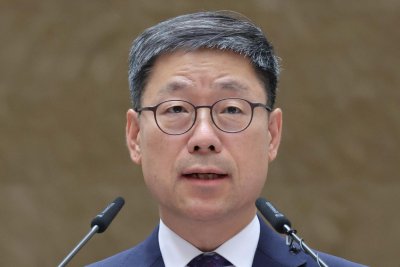
Justice Roh Kyung-pil delivers his inaugural remarks at the Supreme Court in Seoul on Aug. 2, 2024. Photo by Asia Today / Joint Press Corps
July 10 (Asia Today) — South Korean Chief Justice Cho Hee-dae appointed Justice Roh Kyung-pil as the new head of the National Court Administration, filling a vacancy that had lasted about four months.
The Supreme Court announced Friday that Roh, 62, will begin his term Tuesday.
The head of the National Court Administration oversees personnel and budgets for courts nationwide. The chief justice appoints the official from among sitting Supreme Court justices, and the justice does not handle trials while serving in the post.
Roh, a native of Haenam, South Jeolla Province, began his judicial career as a judge at the Seoul District Court in 1997. He later served as a Supreme Court research judge, Seoul High Court judge, presiding judge at the Gwangju High Court, and presiding judge and senior presiding judge at the Suwon High Court. He was appointed to the Supreme Court on Aug. 2, 2024.
The Supreme Court said Roh is qualified for the post because of his “leadership of listening and inclusion,” saying he is suited to strengthen public trust in the judiciary by communicating with court members and broader society and working to build a swift and fair judicial system for the public.
The post had been vacant since Justice Park Young-jae tendered his resignation as head of the National Court Administration on Feb. 27. Ki Woo-jong, deputy head of the administration, had served as acting chief.
With the vacancy resolved, attention is turning to whether stalled Supreme Court justice nominations will gain momentum.
The Supreme Court justice candidate recommendation committee in January recommended four candidates to succeed former Justice Roh Tae-ak: Seoul High Court judges Kim Min-ki and Park Soon-young, Daegu District Court Presiding Judge Son Bong-gi and Seoul High Court Presiding Judge Yoon Seong-sik. No final recommendation has been made.
The selection process is also underway for a successor to Justice Lee Heung-gu, who is scheduled to retire in September.
The Supreme Court on July 3 completed its review of public comments on 28 recommended candidates who agreed to be screened by the recommendation committee. If the committee recommends at least three candidates this month, Cho will select a final nominee and recommend the candidate to President Lee Jae Myung for appointment. The nominee would then go through a National Assembly confirmation hearing before final appointment.
The National Court Administration is also tied to one of the ruling party’s major judicial reform agendas. After legislation on three judicial reform measures, including criminalizing distorted application of the law, allowing constitutional complaints against court rulings and expanding the number of Supreme Court justices, a separate bill has been introduced to revise the Court Organization Act and abolish the National Court Administration.
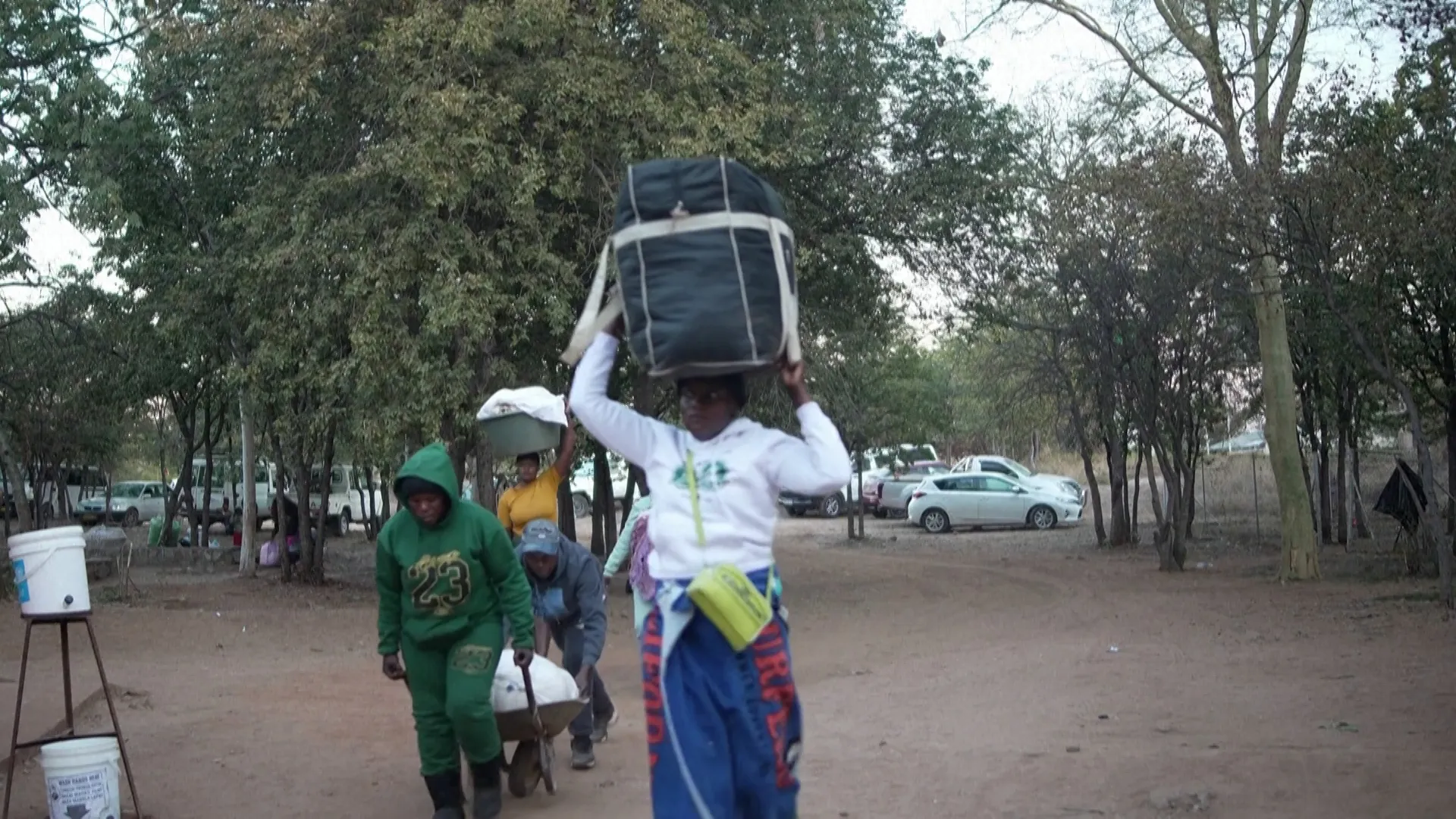
Thousands of Zimbabweans are returning home after xenophobic violence in South Africa, describing beatings, robbery and threats from anti-migrant groups. Nearly 21,300 have been repatriated by the government in five weeks, with 56,800 more self-repatriating.
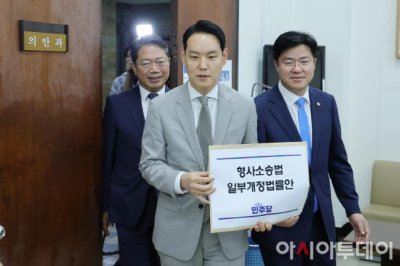
Democratic Party lawmakers Kim Seung-won, Kim Han-kyu, Park Sang-hyuk and Lee Hae-sik, members of the party’s Criminal Procedure Act revision task force, submit a partial revision bill at the National Assembly on Thursday. Photo by Asia Today
July 9 (Asia Today) — South Korea’s ruling Democratic Party introduced a revision to the Criminal Procedure Act on Thursday that would abolish prosecutors’ supplementary investigation power.
The bill would remove prosecutors as investigative agents while strengthening their authority to request supplementary investigations from police. The party said the measures are intended to reduce investigative gaps.
The Democratic Party’s task force on revising the Criminal Procedure Act submitted the bill to the National Assembly’s bill office. The proposal would completely separate investigation and indictment. It would abolish prosecutors’ supplementary investigation power while strengthening their authority to request further investigations and introducing the power to request the replacement of investigators, increasing oversight of investigative agencies.
Kim Han-kyu, the party’s senior deputy floor leader for policy, told reporters after submitting the bill that the revision is designed to adjust investigative authority, strengthen checks and supervision over investigative agencies and enhance protections for victims and complainants ahead of the planned Oct. 2 launch of new investigation and prosecution agencies.
The Democratic Party removed the legal basis for prosecutors’ direct investigations from the bill. But it added a one-month deadline for police to complete supplementary investigations requested by prosecutors. In cases in which the statute of limitations is about to expire, prosecutors would be allowed to set a shorter deadline. The bill also allows one extension.
If a judicial police officer assigned to a supplementary investigation is deemed inappropriate to handle the case, the head of the prosecution office would be allowed to request the replacement of the investigator. The bill also allows supplementary investigations to be assigned to another investigative agency.
Prosecutors’ authority to demand corrective measures would also be strengthened. Even before a case is referred to prosecutors, if a prosecutor confirms that an investigative agency conducted an improper investigation, the prosecutor would be allowed to receive the case from judicial police and transfer it to another investigative agency.
Police would also be required to submit investigative records and lists of materials to prosecutors in cases they decide not to refer for prosecution.
The bill strengthens victim protection provisions. If an improper investigation is suspected, suspects as well as complainants, victims and legal representatives would be allowed to file reports about the case. Prosecutors receiving such reports would be allowed to demand corrective measures from the investigative agency or transfer the case to another agency.
The Democratic Party plans to review the bill Friday at the National Assembly Legislation and Judiciary Committee together with previously submitted bills.
Rep. Kim Seung-won said the committee’s first bill review subcommittee plans to meet once or more than twice a week to conduct an intensive and swift review.
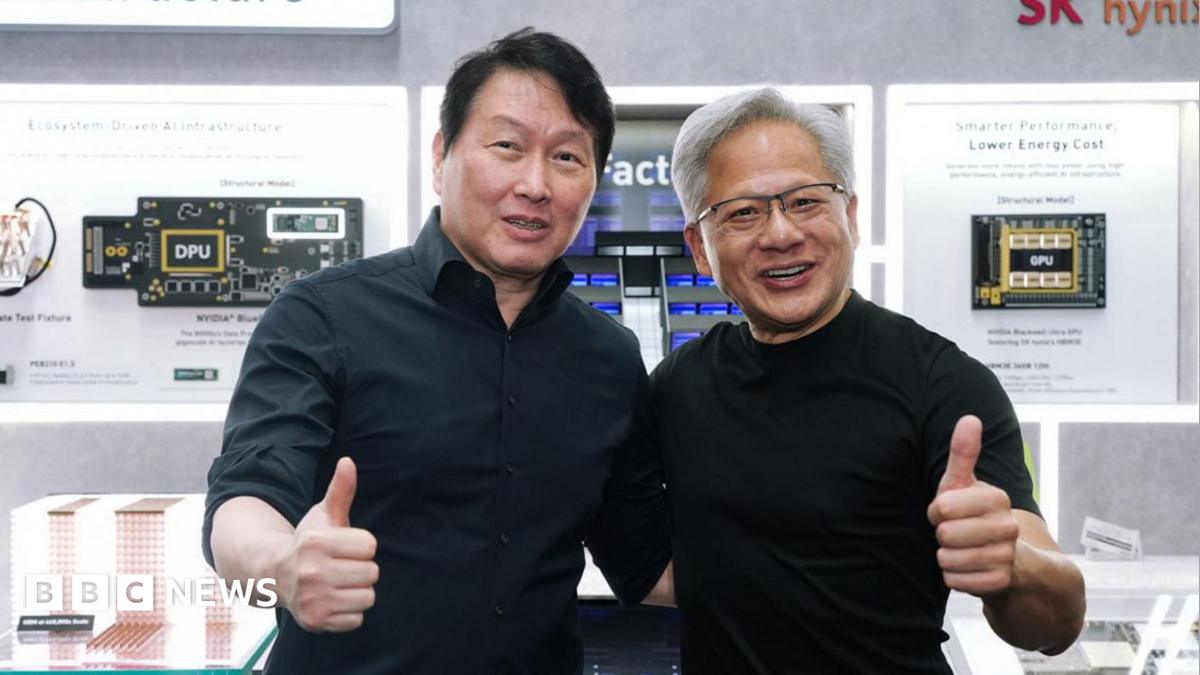
South Korean computer chip maker SK Hynix has raised $26.5bn (£19.8bn) in its New York share offering, marking the largest ever listing by a foreign firm in the US.
The company, a key supplier to artificial intelligence (AI) chip giant Nvidia, said on Thursday that it had sold 177.9 million American depositary shares for $149 each. The shares are set to begin trading on Friday on the Nasdaq.
Its share price has more than tripled in South Korea this year, which along with Samsung Electronics has helped boost the benchmark Kospi index by more than 70% over the same period.
SK Hynix is one of the world’s leading memory chip makers. The industry has been given a major boost by the hundreds of billions being spent on AI.
Shares in rivals Samsung Electronics and Micron have more than doubled in recent months.
The US listing gives SK Hynix easier access to huge amounts of potential investment from the world’s biggest economy, which has fewer barriers than South Korea, said Seoul National University finance professor Jaewon Choi.
Traders are closely watching the listing as a “yardstick to test the water” for whether investor enthusiasm for memory chip makers will continue, Choi said.
The AI boom has triggered a rush of companies raising money on the the stock market.
In June, GrokAI owner SpaceX became the world’s biggest ever listing as it raised $85.7bn.
Meanwhile, AI developers Anthropic and OpenAI are preparing to go public, with valuations of more $1tn.
Demand for SK Hynix’s offering was reportedly over seven times more than the number of shares available, highlighting the strong investor appetite for a key company in the AI supply chain.
Each American depositary share is equivalent to a tenth of a Seoul-traded common share, SK Hynix said.
The offering gives US investors a way to buy SK Hynix shares without having to trade via an overseas stock exchange.
The company has pledged major investments to develop South Korea’s chip making and AI capabilities in the coming years.
The country’s government is likely to be counting on SK Hynix’s US listing to raise funds that can support the firm’s domestic investments, said Hanyang University business professor Yun Youngjin.
But the Nasdaq listing carries some risks, especially if investors move money towards the US and away from South Korea’s stock market, Yun added.
In June, the country’s government unveiled plans for more than $880bn of investments in partnership with SK Hynix and Samsung.
Both SK Hynix and Samsung have stock market valuations of more that $1tn, joining growing group of firms which includes tech giants Nvidia, Apple, Microsoft and Google-owner Alphabet.
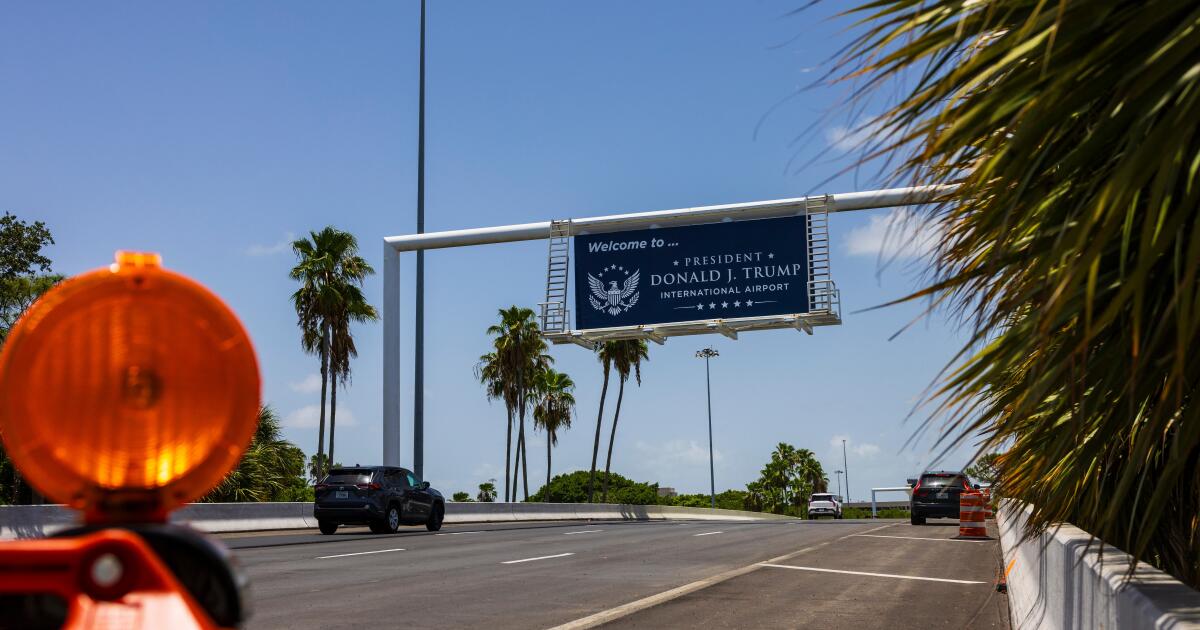
WEST PALM BEACH, Fla. — A South Florida airport officially changed its name Thursday to the President Donald J. Trump International Airport.
Signs for the Palm Beach International Airport have been removed as new signage goes up.
“Because an entire airport transformation doesn’t happen overnight, you’ll notice a combination of both our classic look and our new brand elements coexisting while traveling through the terminal over the next several weeks,” airport officials said in a Facebook post.
“Trump Force One,” a Boeing 757 owned by the Trump Organization, was the first plane to arrive at the airport under its new name, shortly after 5 a.m. The president’s son, Eric Trump, was one of the passengers. The Trump family regularly uses the West Palm Beach airport when they visit President Trump’s Mar-a-Lago home in nearby Palm Beach. A stretch of road from the airport to Trump’s estate was renamed Donald J. Trump Boulevard earlier this year.
“There is no person who has done more for Florida and our country, and no one more deserving of this incredible honor,” Eric Trump posted on X. “As a son, and someone who flies out of this airport nearly every day, I will forever be proud to see the initials ‘DJT’ on my boarding pass.”
Although the name change took effect Thursday, the three-letter airport code will change from PBI to DJT on Aug. 18.
Florida Gov. Ron DeSantis signed legislation earlier this year that made the name change possible. Changing the airport’s name is expected to cost as much as $5.5 million for new signs, branding and other updates.
Keegan Collett, who was departing the airport Thursday morning on his way to Cincinnati, said he was surprised to see the new name. He said he doesn’t think Trump deserves to have an airport named after him but isn’t necessarily bothered by it.
“At the end of the day, it’s just the name of an airport,” Collett said. “There’s bigger things. I feel like it’s just more of a distraction. Why even worry about it?”
In Dandridge, Tenn., Thursday morning, Treasury Secretary Scott Bessent, U.S. Sens. Marsha Blackburn and Bill Hagerty and Rep. Tim Burchett attended a ceremony to rename the I-40 Bridge in East Tennessee to the Donald J. Trump Bridge.
Bessent said ahead of the ceremony that “no one is more deserving” of the honor than Trump.
Trump received 82% of the vote in Jefferson County, where Dandridge is located, in the 2024 election.
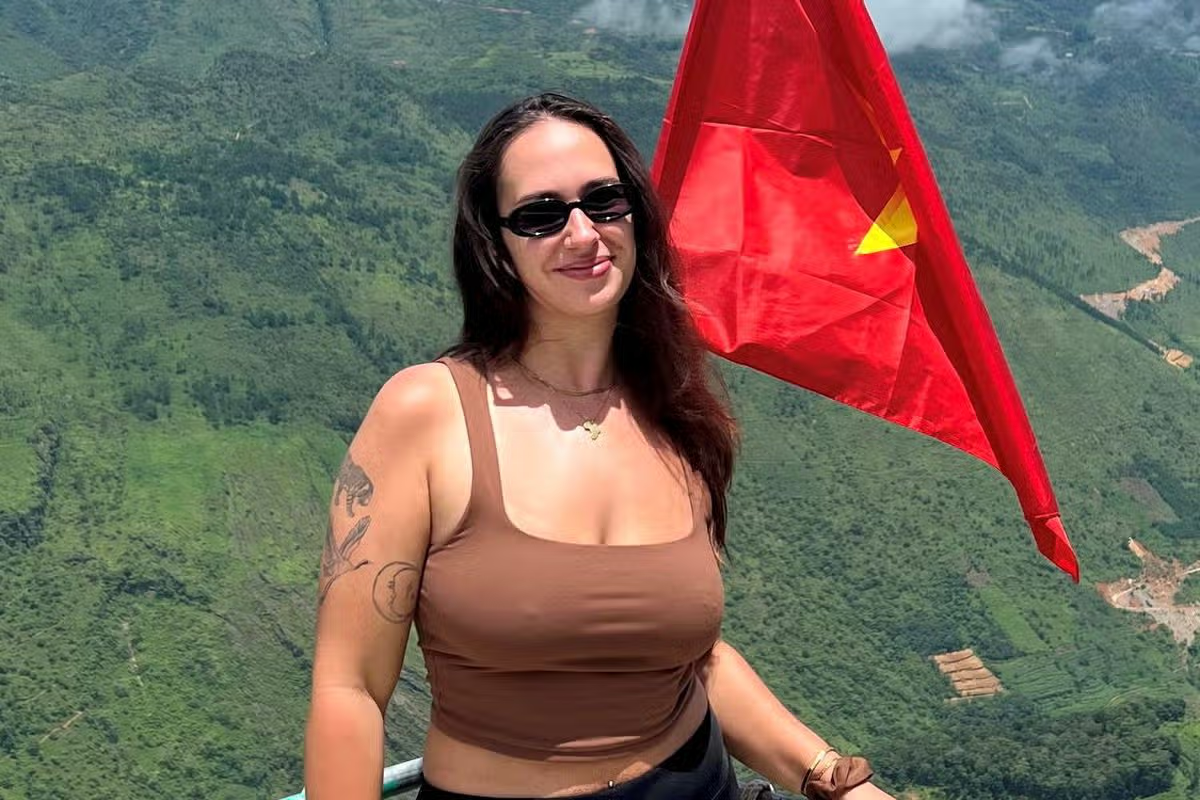
A woman saved £18,000 in just seven months to travel the world – by selling her wardrobe on Vinted. Rebekah Swatton, 26, has spent the past seven months aggressively saving for an open-ended trip abroad after a previous journey forced her to rethink her relationship with money and possessions.
Her outlook on life changed dramatically after the sudden death of her boyfriend from a cardiac arrest five years ago, an experience she says made her realise that “nothing in life is certain”. Last March, she embarked on a six-month backpacking adventure across Australia, Africa, and Asia, taking a sabbatical from her job at Lloyds Banking Group.
But when she returned to the UK in September, she says she was struck by how little she actually needed the possessions waiting for her at home. That realisation sparked a drastic lifestyle change.
Rebekah sold her car, worked up to 20 hours of overtime each week and cleared out the majority of her wardrobe on Vinted – ultimately building up savings of £18,000 for her next trip to South America. Rebekah, from Powick, Worcestershire, said: “I had been away for so long that when I came back I realised I had been living without any of these extra material things happier than I was living with them.”
Rebekah began saving in 2022 following the sudden death of her boyfriend of six months, who passed away from an undiagnosed underlying heart condition. Rebekah said: “It really made me wake up and I felt that nothing is certain going forwards. I’d gone straight from college into career mode without thinking.
“I’d always said I wanted to travel and this really catalysed my first trip, as I want to live my life to the fullest.”
Last March, Rebekah set off on a six-month backpacking adventure, travelling through Australia, the Philippines, Cambodia, Vietnam, Kenya, and Tanzania. When she returned, Rebekah decided to completely change the direction of her life and pursue travelling full time.
She said: “It was such an amazing time. I really enjoyed feeling free and experiencing new things each day. But once I got back and realised I wanted a change, I decided next time I left I would leave my job permanently and not return to the UK for at least a few years.”
With that commitment in mind, Rebekah knew she would need to build up substantial savings to support herself on an open-ended trip with no fixed return date. Rebekah said: “Since I’ve been back, I’ve been living with my parents, which of course helps keep outgoings down.
“I have been working my £30,000 banking job full time plus an extra 15 to 20 hours over time each week. I sold over 200 items on Vinted, from clothing to accessories to random trinkets and also sold my car for £2,500.
“This, plus working 60 hour weeks and living with my parents, meant I saved nearly £20k for the next time I leave the country.”
Rebekah has booked a flight to Guatemala for the first week of May, with plans to travel through South America from there. She said: “I’ve planned out the first couple months of my trip with flights and loose accommodation.
“But I know over the next six months I want to travel through Guatemala, Columbia, Peru, Bolivia, Brazil, Argentina, and Chile.”
South Sudan became the world’s newest country in July 2011 after nearly 99 percent of voters chose independence from Sudan.
Fifteen years later, most of the major promises that came with independence remain unfulfilled.
Recommended Stories
list of 4 itemsend of list
South Sudan remains one of the world’s most fragile states.
Oil finances nearly 90 percent of the government’s revenue, but the country remains wracked by deep inequality and violence: 82 percent of the population lives below the poverty line, and political jostling between rival groups has left the young nation in a perpetual state of conflict.
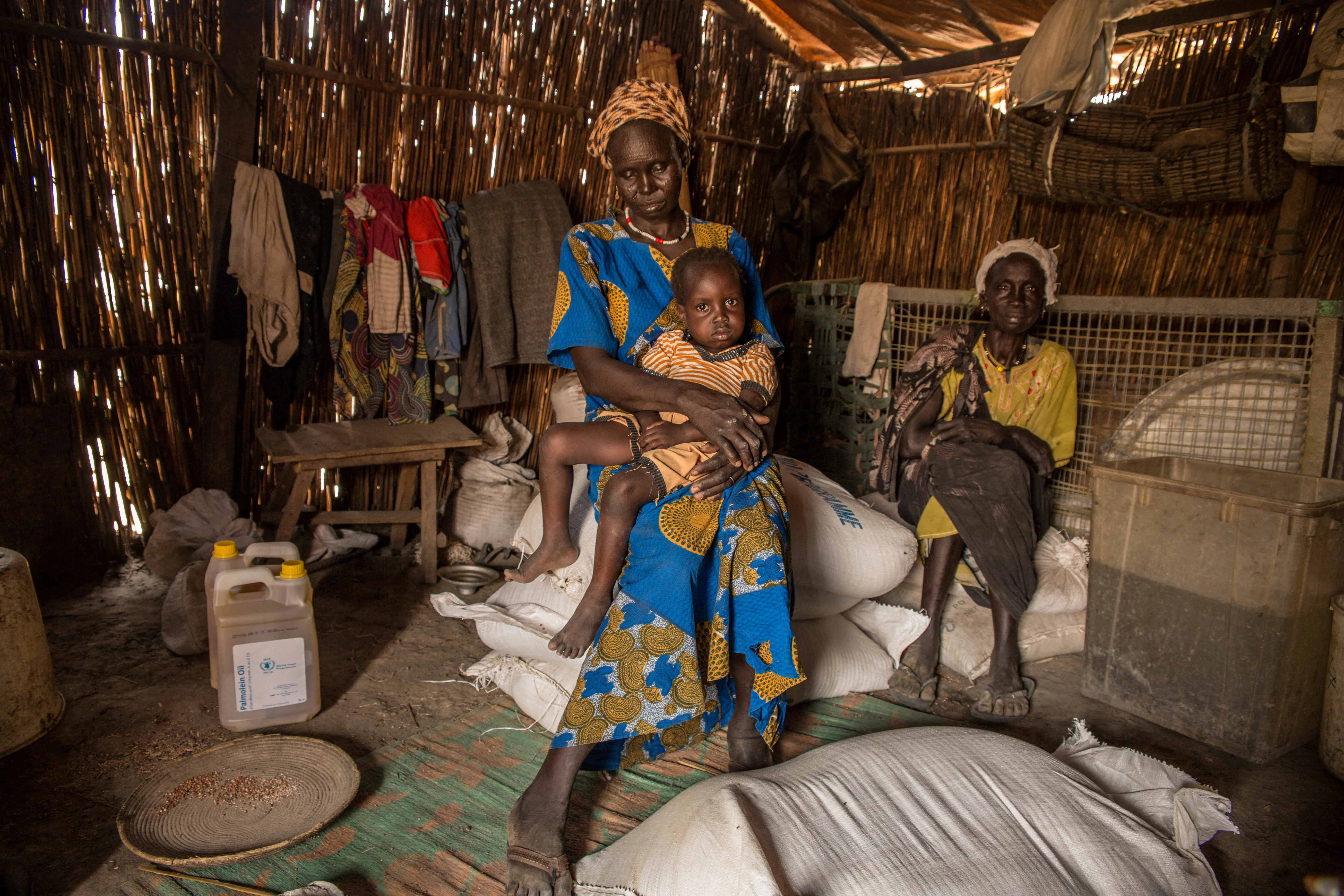
A woman poses with her three-year-old daughter in their house which is made out of straw, bamboo and plastic sheeting at the Protection of Civilian site (PoC) in Bentiu, South Sudan, on February 15, 2018 [File: Stefanie Glinski/AFP]
Elections have never been held since independence, millions remain displaced, and the country’s economy depends on pipelines running through Sudan, the very nation it fought to leave.
‘A failed promise’
Jok Madut Jok, 57, a professor and director of graduate studies at Syracuse University, is from Warrap, South Sudan, and still has family in both rural and urban parts of the country.
Jok says he recalls the joy of the time when South Sudan broke away to establish a new beginning. It was a moment of hope. Today, though, he feels as though he has been denied all that was promised at the time.
“South Sudan at the moment is a failed promise,” he says. “South Sudanese who had lived under brutal regimes in Sudan and had been excluded from money and development programmes, and were victims of security operations in the southern part, had hung their hopes on independence.”
Jok says people are now looking towards possibilities of political transitions to hold their government accountable.
Who controls what in South Sudan?
The country is technically governed by a transitional unity government created under the 2018 peace agreement.
But that peace remains fragile.
Violence continues across Jonglei, Upper Nile, Unity and Equatoria states with clashes involving government forces, opposition fighters and other armed groups.
Elections scheduled several times since independence have again been delayed, with the latest vote planned for late 2026.
Main political and armed groups:
Sudan People’s Liberation Movement (SPLM)
The ruling party which led the independence movement.
Led by Riek Machar, it is part of the unity government. It still maintains armed forces in parts of the country.
South Sudan People’s Defence Forces (SSPDF)
The national army, formerly known as the SPLA, it is loyal to President Salva Kiir.
White Army
A loose network of armed youth, mainly from the Nuer ethnic group.
National Salvation Front (NAS)
It remains active, mainly in Equatoria province. The NAS never fully joined the peace agreement.
A South Sudanese military police officer sits on a pickup truck while monitoring the area as troops belonging to the South Sudanese Unified Forces take part in a deployment ceremony at the Luri Military Training Centre in Juba on November 15, 2023 [File: Peter Louis Gume/AFP]
Who runs the government?
Salva Kiir – President since independence.
Leader of the governing SPLM.
Supported largely by influential sections of the Dinka, South Sudan’s largest ethnic community.
FILE – South Sudan’s President Salva Kiir attends the swearing-in ceremony for Kenya’s new president William Ruto, at Kasarani stadium in Nairobi, Kenya on September 13, 2022 [File: Brian Inganga/AP]
Riek Machar – Vice President.
Leader of SPLM-IO.
Historically backed by many Nuer supporters.
His rivalry with Kiir triggered the 2013 civil war after political tensions exploded inside the ruling party.
South Sudan’s rebel leader Riek Machar speaks to the media about the situation in South Sudan following a peace agreement with the government in Addis Ababa, Ethiopia, August 31, 2015 [File: Mulugeta Ayene/AP]
Independence delivered, violence continued
Between 2011 and 2026, according to data compiled by the United States-headquartered Armed Conflict Location and Event Data (ACLED), there were 13,256 attacks in South Sudan, which means 883 attacks per year on average – or more than two a day.
The majority of the attacks have been led by:
Various communal and clan-based armed groups. These constituted 6,168, or just over 46 percent, of all attacks.
The armed forces and police, who were responsible for 3,278 attacks.
Unidentified armed groups, behind 2,276 attacks.
Sudan’s People’s Liberation Movement-in-Opposition, responsible for 900 attacks.
National Salvation Front, behind 269 attacksForeign actors, behind 154 attacks.
Others, responsible for the remaining 184 attacks.
Jan Pospisil, 52, a researcher at the Austria-based Peace and Conflict Evidence Platform, recently conducted a survey of more than 22,000 respondents in South Sudan.
Of them, 98 percent said they were proud of being South Sudanese. At the same time, more than 52 percent of respondents said in 2023 that they didn’t feel safe speaking up politically, and in 2025, the results were approximately the same.
Hunger persists after 15 years of violence
Hunger is worsening across South Sudan, where an estimated 7.8 million people are facing crisis levels of food insecurity between April and July 2026, about 280,000 more than projected last year, according to the Integrated Food Security Phase Classification.
Of those, about 73,000 people are living in catastrophic conditions, facing starvation, extreme food shortages and a heightened risk of death.
Another 2.5 million are in emergency conditions, while 5.3 million more are struggling to meet daily food needs without exhausting what little they have left.
The nutrition crisis is worsening alongside this.
An estimated 2.2 million children under five now require treatment for acute malnutrition, an increase of about 90,000 cases since the previous assessment.
Another 1.2 million pregnant and breastfeeding women also need urgent nutritional support.
The crisis is being fuelled by conflict, displacement and repeated shocks that have destroyed livelihoods, disrupted markets and cut communities off from aid.
“My family is living in rural areas, some in the cities but have no access to quality healthcare, no clean drinking water, no road infrastructure,” Jok says. “Even if they were to farm and raise cattle, and create their own livelihoods, they usually are cut off from markets and from basic services that are the responsibility of the state, especially a state that extracts public resources from underneath the people.”
“It’s a feeling that people are totally excluded from the gains of independence,” he added. “It verges on criminal neglect.”
Villagers collect food aid dropped from a plane in gunny bags at a village in Ayod county, South Sudan, by the World Food Programme (WFP) on February 6, 2020 [File: Tony Karumba/AFP]
Economic inequality
Pospisil says despite the riches of the 150,000 barrels of oil that are extracted, sold and mainly exported every day, broader economic gains are not a reality for most of the public.
In most rankings, South Sudan languishes as the poorest nation in the world.
South Sudan mainly exports crude to China, but also has Chinese and Indian companies invested alongside state-held organisations that own blocks in the oil fields.
Jang Dong-hyeok, chief of the main opposition People Power Party, speaks during a meeting of the party’s Supreme Council at the National Assembly, a day after he called for a new election over an unprecedented shortage of ballot papers that disrupted voting in the 03 June local elections at some polling stations in the capital’s southern areas, in Seoul, South Korea, 08 June 2026. Photo by YONHAP / EPA
July 8 (Asia Today) — People Power Party leader Jang Dong-hyeok is moving into street politics over the June 3 ballot shortage while also using the party’s ethics process to discipline internal critics, a strategy some see as an effort to consolidate support among the party’s hard-line base.
Jang attended a rally in Incheon on Wednesday condemning the ballot shortage during the June 3 local elections, beginning what is expected to be a series of visits to voting rights protests across the country.
It was his first appearance at a protest outside Seoul’s Songpa District, where demonstrations have continued for more than a month near Olympic Park.
Some party officials and political observers say Jang appears to be using street rallies to rally conservative supporters and push back against calls for his resignation. They say he is trying to regain political momentum by focusing on the ballot shortage and voting rights rather than internal power struggles.
But concerns are also growing inside the party.
Rep. Lee Sung-kwon, secretary of Alternative and Future, a reform-minded group of People Power Party lawmakers, said on YTN radio Wednesday that lawmakers may need to act if disciplinary action against party members becomes unfair.
“If disciplinary action becomes reality and unfair punishment is imposed, we must act,” Lee said. “If necessary, we can convene a general meeting of lawmakers or circulate a petition.”
Rep. Kim Jae-sub, who has been mentioned as a possible target of disciplinary action, criticized Jang during an appearance on a Channel A YouTube program.
“The person most responsible for the local election defeat is Jang,” Kim said. “It is difficult to understand why he is creating a disciplinary atmosphere everywhere under the pretext of restoring discipline. The person who has most harmed the party is Jang himself.”
Rep. Cho Kyoung-tae, who was referred to the party ethics committee over allegations that he asked Democratic Party lawmakers to vote against Park Deok-heum in the National Assembly vice speaker election, also criticized the leadership at a news conference.
“The irresponsibility of a leadership that refuses to take responsibility after an election defeat and the tyranny of suppressing colleagues who speak the truth are shaking the roots of the party,” Cho said.
A senior lawmaker from the southeastern Yeongnam region said Jang is closing off channels for internal communication and deepening his own isolation.
“The party must now recognize that its direction should be expanding its appeal, not rallying only hard-line supporters,” the lawmaker said.
Lee Yong-cheol, chief of the Defense Acquisition Program Administration, attends a ceremony at the Navy submarine command in Changwon, South Gyeongsang Province, South Korea, 25 March 2026. Photo by YONHAP / EPA
July 7 (Asia Today) — South Korea’s defense acquisition chief apologized Tuesday for failing to win Canada’s next-generation submarine project, saying alliance interoperability was the decisive factor in Ottawa’s decision.
Lee Yong-cheol, head of South Korea’s Defense Acquisition Program Administration, said South Korea’s submarine proposal was competitive on performance, delivery schedule and maintenance, but Canada placed greater weight on its long-standing NATO defense network.
“I am sorry that we were unable to achieve the expected result despite strong public interest and all-out support from the Industry Ministry, Defense Ministry, Foreign Ministry, Navy and other government agencies,” Lee told reporters at the Defense Ministry press room. “The failure to secure the result was due to my lack of ability.”
Canada selected Germany’s Thyssenkrupp Marine Systems as the preferred bidder for its Canadian Patrol Submarine Project, which aims to replace the Royal Canadian Navy’s aging submarine fleet.
Lee said Canada appeared to consider several factors, including fuel cell-based air-independent propulsion technology, battery performance, Germany’s record of supplying submarines to more than one-third of NATO members, alliance interoperability, crew sharing, joint training, maintenance, parts supply and industrial benefits tied to jobs and maintenance facilities.
“In terms of submarine performance, early delivery and regional benefits such as maintenance, repair and overhaul, I do not believe there was a meaningful gap with our proposal,” Lee said. “In delivery schedule, even considering Norway’s production slot, we were faster.”
“The decisive difference appears to have been NATO interoperability and cooperation that allows crew sharing,” he said.
A defense acquisition official said South Korea’s submarines should not be seen as inferior in operational capability.
“Submarines, for which stealth is most important, do not operate by constantly exchanging wireless communications,” the official said. “We do not believe our submarine had weaker operational capability. Canada appears to have judged that sharing future operating systems and parts would be relatively easier with Germany.”
The official said Canada’s geography and Arctic security concerns likely shaped the decision.
“Canada stretches across both ends of the North American continent and must cover both the Atlantic and Pacific,” the official said. “Personally, I think the difference in Arctic security priorities also played a major role. For South Korea, the Arctic is more of a conceptual issue, but for Canada it is a real security concern.”
The official said Canada’s Indo-Pacific defense cooperation with South Korea is still developing, while its Atlantic alliance structure has been operating for more than 70 years.
“Training among those allies is routine, to the point where they can discuss sharing submarine crew members,” the official said. “South Korea has only recently begun joint exercises with Canada. Canada chose to strengthen an existing alliance framework, and I think that strategic choice should be respected.”
The agency said the failed bid still produced meaningful results for South Korea’s defense industry.
Lee cited South Korea’s previous loss in Norway’s K2 tank procurement, saying the tank passed performance testing in harsh winter conditions but narrowly failed to win the contract.
“Poland took close note of that performance and moved aggressively to sign a contract,” Lee said. “This challenge may also lead to another reversal.”
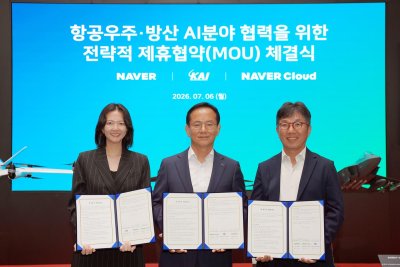
Naver CEO Choi Soo-yeon, Korea Aerospace Industries CEO Kim Jong-chul and Naver Cloud CEO Kim Yoo-won attend a signing ceremony for an aerospace and defense AI partnership in Sacheon, South Korea. Photo courtesy of Naver
July 7 (Asia Today) — South Korea’s Naver is teaming with Korea Aerospace Industries to develop artificial intelligence models tailored for defense and future combat systems based on physical AI.
Naver said Tuesday that Naver, Naver Cloud and Korea Aerospace Industries signed a memorandum of understanding Monday at the aircraft maker’s headquarters in Sacheon, South Korea.
Naver CEO Choi Soo-yeon, Naver Cloud CEO Kim Yoo-won and Korea Aerospace Industries CEO Kim Jong-chul attended the signing ceremony.
The agreement brings together one of South Korea’s leading artificial intelligence companies and one of its main aerospace and defense companies as Seoul seeks greater technological self-reliance in national security.
The three companies said advanced AI has become a key factor in future defense competition. They plan to develop sovereign AI optimized for South Korea’s defense and security environment, reducing reliance on foreign technology and lowering security risks.
Sovereign AI generally refers to artificial intelligence systems developed and operated domestically to reflect a country’s language, data, laws and security requirements.
The companies will first work on a defense-specific AI foundation model. They also plan to jointly participate in government-led research and development projects and block-funding programs.
The partnership is expected to create a cooperation framework among industry, government and the military, linking core physical AI technologies for next-generation defense systems with future commercialization.
The scope of cooperation will extend across future combat systems. Korea Aerospace Industries plans to apply AI to unmanned aircraft platforms and AI pilot development for future battlefield environments, including its next-generation air combat system.
The companies also plan to raise the level of autonomy in future aerospace platforms, including manned-unmanned teaming systems.
Naver and Korea Aerospace Industries said they will also expand an AI cooperation ecosystem with defense and aviation suppliers to strengthen South Korea’s domestic AI industry.
“Technological self-reliance in national defense and security is directly connected to national sovereignty, making it essential to secure independent sovereign AI infrastructure,” Choi said. “By combining Team Naver’s advanced AI capabilities with Korea Aerospace Industries’ defense infrastructure, we will do our best to strengthen South Korea’s defense technology sovereignty and create new global competitiveness for the future defense industry.”
Kim said global competition in defense AI is intensifying.
“The three companies need to respond jointly by combining their core capabilities,” Kim said. “By bringing together Korea Aerospace Industries’ aerospace and defense expertise with Team Naver’s AI and cloud technology, South Korea can establish defense AI technology sovereignty and improve global competitiveness in unmanned aircraft and future combat systems based on physical AI.”
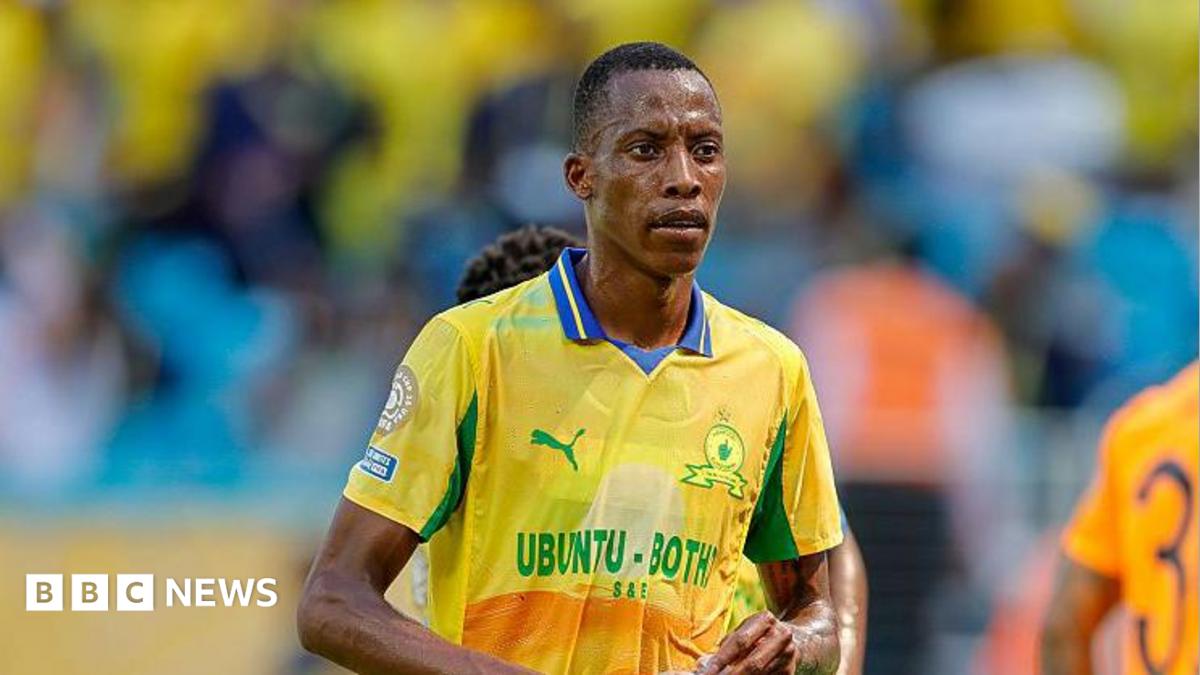
Zimbabwean footballer Divine Lunga has survived a gun attack in Johannesburg, South African police have said.
The football star, 31, was driving in the inner city suburb of Hillbrow on Sunday when his car was shot at by an unknown gunman, according to local reports.
Lunga, who plays for both Zimbabwe’s national football team and top South African club Mamelodi Sundowns, escaped unharmed.
Crime is a major problem in South Africa and the country has one of the highest murder rates in the world.
Police spokesperson Captain Tintswalo Sibeko said they were investigating a case of attempted murder but that no arrests had been made.
She did not provide further details, but South African publication The Citizen said that Lunga was on his way to church with his younger brother when they came under attack.
The duo were driving through Hillbrow when the suspect opened fire on their car, apparently mistaking him for an undercover police officer.
South Africa’s government has been accused of not doing enough to crack down on xenophobic attacks.
Published On 6 Jul 20266 Jul 2026
The safety of African immigrants in South Africa is deteriorating, Nigeria’s foreign minister has warned, after two Nigerians were killed in disputed circumstances during anti-immigrant protests.
“There are no signs that the situation is improving,” Bianca Odumegwu-Ojukwu said on Monday, while announcing more evacuation flights.
Recommended Stories
list of 3 itemsend of list
The minister demanded South African authorities investigate the deaths of two Nigerians, Musa Yunana Joe and Charles Iroegbu, killed amid “the ongoing xenophobic protests and attacks on migrants”.
South African police said Joe’s killing did not appear to be related to the protests, but could not immediately comment on Iroegbu’s death.
Nigeria’s foreign ministry says Joe was killed in front of his shop in the northeastern city of eMalahleni by unidentified criminals on June 28 , while Iroegbu was killed by South African police during interrogation in Pretoria on the same day.
In a statement on Sunday, the ministry said: “We wish to place the Government of South Africa on notice that if the situation continues to persist, all options remain on the table, some of which will be activated if the uncultured and provocative trend of intolerance… against foreigners is not addressed”.
South African foreign ministry spokesman Chrispin Phiri said the government had asked Nigeria’s High Commission to submit “any actionable information to our law enforcement authorities, which will enable a thorough, objective investigation in accordance with the rule of law”.
Weeks of anti-immigrant marches
There have been weeks of protests against undocumented migrants, with many South Africans blaming workers from other African countries for taking their jobs and putting a strain on their social services.
South Africa’s government has been accused of not doing enough to crack down on the violence, which has claimed the lives of several foreigners and seen shops owned by immigrants looted and torched.
Mozambique said that five of its citizens were killed in xenophobic attacks in late May. South Africa said the number was only two.
Ghana and South Africa were embroiled in a diplomatic row last week, following the killing of a Ghanaian national. The South African government said the death of Bashiru Isak was not linked to anti-immigrant protests.
Hundreds of Nigerians, among tens of thousands of foreigners, have already left South Africa, once a popular destination for documented and undocumented African immigrants due to its relatively strong economy.
Uganda’s High Commission in Pretoria announced on Monday that a fourth group of Ugandan nationals were voluntarily repatriating.
South Africa has had a longstanding violent crime problem that precedes the outbreak of xenophobic violence.
The South Korean government intends to set aside the extra tax income flowing from its record-breaking chip industry in a dedicated “future response fund”, the presidential office said, using the proceeds of the AI boom to bankroll public projects ranging from industrial infrastructure to support for younger generations.
ADVERTISEMENT
ADVERTISEMENT
Behind the windfall sit Samsung Electronics and SK hynix, whose memory chips have become essential to the data centres powering the global AI race.
Their record profits this year have propelled the wider economy, and swollen the government’s tax receipts along the way.
Presidential chief of staff Kang Hoon-sik outlined the plan at a meeting between the government and the ruling party on Sunday, saying the fund would help finance large-scale projects built around AI and semiconductors, while also tackling inequality and helping young people with housing, start-ups and work.
Kang warned that the extra revenue thrown off by the chip boom must not be squandered at what he described as a decisive moment for the country’s future.
No figure was provided for the fund’s size, as the government will consider its use at a fiscal strategy meeting this month before consulting the public.
In an interview with the Dong-A Ilbo newspaper, Kang added that part of the money would go towards the utilities on which chip plants depend, above all power and water.
A boom that keeps giving
The windfall reflects an extraordinary run for Korea’s chipmakers.
Samsung shares surged more than 170% in the first half of the year, and SK hynix shares rose more than 300%, carrying both companies past $1 trillion (€874bn) in market value.
Samsung is due to publish preliminary second-quarter earnings on Tuesday, while SK hynix plans to raise 45 trillion won (€25.7bn) through a listing on the Nasdaq.
Both are also part of an 800 trillion won (€457bn) public-private push, unveiled last week, to build a new chipmaking hub in the country’s southwest.
How the windfall should be spent has become a live political debate.
In May, presidential policy chief Kim Yong-beom floated using it for start-ups, young people, basic income schemes in rural and fishing communities, and support for artists.
The boom has also emboldened workers as Samsung averted a major walkout in May by agreeing to a bonus deal with its largest union.
Samsung Electronics Co. Chairman Lee Jae-yong announces an investment plan during a meeting at the presidential office Cheong Wa Dae in Seoul, South Korea, 29 June 2026, to unveil the government’s three mega projects aimed at attracting large-scale investment in semiconductors, physical AI and AI data centers. South Korea plans to develop a new semiconductor production base in the country’s southwestern region through 800 trillion won (517.9 billion US dollar) in corporate investments that will create four memory chip fabrication plants. Photo by YONHAP / EPA
July 5 (Asia Today) — Samsung Electronics and SK hynix are facing a strategic balancing act as they move ahead with major U.S. semiconductor projects while preparing to invest about 800 trillion won, or $523.7 billion, in a new chip cluster in South Korea.
The two companies announced plans last week to build a semiconductor cluster in South Korea’s southwest, part of a broader government-backed effort to strengthen the country’s position in artificial intelligence chips and advanced memory.
The project is expected to include four new fabrication plants, two each from Samsung and SK hynix. But the plan comes as the companies are also watching possible pressure from the United States, where President Donald Trump has repeatedly used tariffs and investment demands as tools of industrial policy.
In a recent securities filing, SK hynix listed U.S. tariffs and trade restrictions as a business risk.
“If major countries, including the United States, impose or strengthen trade restrictions such as tariffs on imports, including semiconductors, our business performance could deteriorate,” the company said.
The United States has imposed reciprocal tariffs and other import-related charges since 2025. Semiconductors have not been included in some measures, but Trump has previously threatened tariffs of up to 100% on memory chipmakers that do not build factories in the United States.
Samsung and SK hynix already have major U.S. investment plans.
Samsung is building semiconductor facilities in Taylor, Texas. Its U.S. investment plans have been reported at more than $37 billion through 2030, with the Taylor site expected to include advanced foundry production.
SK hynix is investing $3.87 billion in West Lafayette, Ind., to build an advanced packaging and research facility for AI memory. The Indiana plant is expected to support high-bandwidth memory products used in AI accelerators.
The U.S. projects are already large, but they are smaller than the companies’ planned domestic investment. That could draw attention from Washington as the Trump administration seeks more manufacturing commitments from global companies ahead of the U.S. midterm elections.
Industry officials say the more realistic option for Samsung and SK hynix may be to accelerate existing U.S. projects rather than announce entirely new plans, given the size of their commitments in South Korea.
Samsung could further clarify plans for a second Taylor fabrication plant. The company said in April that it was conducting an initial review of the second Taylor fab while holding discussions with global customers.
SK hynix may face closer scrutiny because its U.S. investment is smaller than Samsung’s and because it is preparing to list American depositary receipts on Nasdaq on July 10.
Both companies are highly exposed to the U.S. market. Samsung’s Americas sales accounted for 32.5% of first-quarter revenue, while SK hynix’s Americas sales accounted for 68.8%, according to their quarterly reports.
Funding will be the key question if Washington presses for faster or larger U.S. investment. Both companies have already outlined enormous capital spending plans at home and abroad.
For now, their cash generation remains strong. Brokerage estimates cited by local media project Samsung’s second-quarter operating profit at about 85 trillion won, or $55.6 billion. SK hynix’s second-quarter operating profit is projected at about 65 trillion won, or $42.6 billion.
Analysts say AI-related semiconductor demand remains in an early phase. Kevin Warsh, chairman of the U.S. Federal Reserve, recently compared the AI boom to the first or second inning of a baseball game, saying the technology shift represents a major paradigm change for economic policy and the wider economy.
Industry officials say the semiconductor cycle could last longer than the traditional three to four years because demand for AI data centers, advanced memory and high-performance computing continues to expand.
For Samsung and SK hynix, the challenge is how to satisfy U.S. expectations for local production while also carrying out South Korea’s largest semiconductor investment push.
Lawmakers of the main opposition People Power Party, (from L to R) Choi Soo-jin, Joo Jin-woo, and Park Choong-kwon, submit a bill to an office of the National Assembly in Seoul, South Korea, 09 June 2026, to seek an independent counsel probe into an unprecedented shortage of ballot papers that disrupted voting in the June 3 local elections at some polling stations and, critics say, infringed upon voters’ rights. Photo by YONHAP / EPA
July 5 (Asia Today) — South Korea’s ruling and opposition parties clashed Sunday over a revised online information law set to take effect Tuesday, with the ruling Democratic Party calling it a safeguard against fake news and the main opposition People Power Party denouncing it as a threat to free speech.
The revised Information and Communications Network Act allows punitive damages of up to five times the actual damage when false or manipulated information is distributed online and causes harm. Repeat distribution can also trigger administrative fines of up to 1 billion won, or about $655,000.
The People Power Party called the measure an online “gag law” and said the standard for determining what counts as false or manipulated information is too vague.
Choi Soo-jin, the party’s chief floor spokesperson, said posts criticizing the government or raising reasonable suspicions could become targets of disputes.
“To avoid large damages and fines, platforms will have no choice but to preemptively delete posts even before illegality is clearly determined,” Choi said. “Excessive deletion and de facto prior censorship are structurally inevitable.”
People Power Party lawmaker Joo Jin-woo said he plans to file a constitutional challenge after the law takes effect.
“The law is rushed legislation that does not even have a body to determine false or manipulated information,” Joo wrote on social media. He said the measure violates constitutional protections against prior censorship as well as principles of proportionality and freedom of speech and the press.
The Democratic Party rejected the criticism and said the law is being misrepresented.
Jeon Su-mi, a party spokesperson, said the measure is not designed to silence ordinary citizens but to prevent malicious false information and so-called “cyber wreckers,” a Korean term for online personalities who profit from sensational or defamatory content.
“Not a single citizen who shares daily life, expresses legitimate political opinions or sharply criticizes power will be subject to punishment under this law,” Jeon said.
She accused the People Power Party of defending false information and online harassment by portraying basic social filtering as censorship.
The Democratic Party also criticized opposition proposals to limit regulation to already illegal information, saying such an approach would leave manipulated falsehoods unaddressed.
The dispute comes as South Korea continues to debate how to regulate online misinformation without chilling political speech. Supporters say the revised law is needed to hold malicious content creators accountable when false claims cause real harm. Critics say vague definitions could pressure platforms to over-remove content and discourage citizens from criticizing public officials.
The revised law was passed by the National Assembly in December under Democratic Party leadership.
A Jangbogo-III Batch-II submarine built by Hanwha Ocean. Photo courtesy of Hanwha Ocean
July 5 (Asia Today) — Canada is nearing a decision on a major submarine program that could open the North American defense market to South Korea’s Hanwha Ocean or strengthen Germany’s naval defense ties with Ottawa.
The Canadian Patrol Submarine Project is intended to replace Canada’s aging fleet of four Victoria-class submarines with as many as 12 new conventionally powered submarines. Industry estimates put the program at as much as 60 trillion won, or about $39.3 billion, when shipbuilding and long-term maintenance are included.
Canada is expected to select a preferred bidder soon, with the timing drawing attention because Prime Minister Mark Carney is scheduled to attend the NATO summit in Ankara, Turkey, from Monday to Wednesday.
A decision near the summit could carry a political message about Canada’s defense cooperation with allies. Germany has been pressing its case through government-level support for TKMS, while Hanwha Ocean is emphasizing delivery speed, pricing and proven South Korean submarine technology.
German Vice Chancellor and Finance Minister Lars Klingbeil recently visited a TKMS site and said Berlin was making a broad push to support defense cooperation with Canada. He said Germany’s high production standards and submarine-building capacity put TKMS in a strong position.
TKMS CEO Oliver Burkhard has also expressed confidence that the company can win the contract. The German company is stressing its more than 100 years of submarine experience and interoperability with NATO navies.
Hanwha Ocean is offering a model based on the KSS-III Batch-II submarine, a 3,000-ton-class hybrid diesel-electric submarine developed for the South Korean Navy. The submarine uses fuel-cell air-independent propulsion and lithium-ion batteries, allowing it to remain submerged for more than three weeks, according to the company.
The submarine has a range of more than 7,000 nautical miles, or about 8,055 miles.
Hanwha Ocean has proposed delivering the first submarine in 2032 if a contract is signed in 2026. The company has said it could deliver four submarines by 2035 and then supply one additional submarine each year.
Delivery timing is considered a key factor because Canada’s Victoria-class submarines are expected to retire in the mid-2030s.
Hanwha Ocean is also seeking to strengthen its bid through long-term maintenance, repair and overhaul plans, as well as industrial partnerships in Canada. The company has promoted cooperation in shipbuilding, steel, artificial intelligence, space and defense technology.
If Hanwha Ocean is selected as the preferred bidder, it would mark a major breakthrough for South Korea’s shipbuilding and defense industries in North America. It would also expand South Korea’s submarine exports beyond Asia and Europe.
But TKMS remains a strong competitor because Canada may value closer defense industrial cooperation with Germany and other NATO partners at a time of heightened security concerns in the Arctic and North Atlantic.
The online campaign stoking South Africa’s latest xenophobic backlash.
South Africa is experiencing an ugly wave of xenophobia driven by a coordinated digital campaign by anti-migrant groups.
As prejudiced rhetoric seeps into mainstream news coverage, a growing number of South African journalists are trying to figure out who’s really pulling the strings behind the movement.
Contributors: Qaanitah Hunter – Host, The Debrief Aimee-Noel Mbiyozo – Senior research consultant, Institute for Security Studies Haru Mutasa – Correspondent, Al Jazeera English Herman Wasserman – Department of Journalism, Stellenbosch University
On our radar
In Venezuela, a natural disaster has exposed the state’s failures and officials have imposed tight controls on journalists trying to cover the story.
Tariq Nafi looks at the government’s heavy-handed methods to control the narrative.
Governments around the world are trying to solve one of the defining parenting challenges of the digital age: what to do about teenagers and social media. The Listening Post‘s Meenakshi Ravi reports on the politics behind social media bans – whether governments are solving the right problem – and who should take responsibility for keeping young people safe online.
Featuring: Preston Byrne – Tech and free speech lawyer Daisy Greenwell – Cofounder, Smartphone Free Childhood Tama Leaver – Professor of internet studies, Curtin University Kate Sim – Director, Children’s Online Safety and Privacy Research Program
French President Emmanuel Macron (R) meets with the CEO of Anthropic Dario Amodei during a bilateral meeting on the sidelines of the G7 summit in Evian-les-Bains, France, 17 June 2026. Photo by THIBAULT CAMUS / EPA
July 3 (Asia Today) — Anthropic, the developer of the Claude artificial intelligence model, is in early discussions with Samsung Electronics about manufacturing a custom AI chip, according to a U.S. technology news report.
The Information reported Thursday, citing multiple people familiar with the discussions, that Anthropic is considering using Samsung’s 2-nanometer manufacturing process and advanced chip-packaging facilities.
The project remains at an early stage. Anthropic has not begun detailed chip design, testing or manufacturing, the report said.
Samsung’s 2-nanometer process is among the most advanced semiconductor manufacturing technologies available. Smaller manufacturing nodes can allow more transistors to be placed on a chip, potentially improving computing performance and energy efficiency.
Advanced packaging places processors, high-bandwidth memory and other chip components closer together. The shorter distance can increase data-transfer speeds and reduce bottlenecks when running large AI models.
Anthropic is studying the functions and performance required for the chip as well as how it could be integrated into servers, people familiar with the matter said. The company is also reportedly holding discussions with several chip-design companies.
Anthropic is considering using processors developed by Microsoft and British chip startup Fractile as it evaluates different approaches to expanding its computing infrastructure.
The company hired Clive Chan in June. Chan was the second hardware engineer to join OpenAI’s custom-chip program and worked on the project from its early stages.
Chan announced his departure from OpenAI and move to Anthropic in a June 7 post on the social media platform X. He said he was drawn by the opportunity to begin climbing a new technological mountain from the bottom.
The recruitment suggests Anthropic is building an internal team capable of designing specialized processors as competition with OpenAI expands from AI models into hardware and data-center infrastructure.
Anthropic raised $65 billion in a Series H investment round completed May 28, giving the company a post-investment valuation of $965 billion.
The funding was led by Altimeter Capital, Dragoneer, Greenoaks and Sequoia Capital. Samsung Electronics, SK hynix and Micron participated as strategic infrastructure partners.
Anthropic said the three semiconductor companies provide technologies that play important roles in supplying memory, storage and logic chips.
Samsung is the only one of the three companies that also operates a large contract chip-manufacturing business, raising expectations that its relationship with Anthropic could expand beyond memory supplies.
A manufacturing agreement with Anthropic would give Samsung another major AI customer as the South Korean chipmaker seeks to challenge Taiwan Semiconductor Manufacturing Co. in the market for advanced processors.
Samsung previously signed a $16.5 billion agreement to manufacture next-generation AI chips for Tesla. Google is also reportedly considering using Samsung to manufacture part of a future tensor processing unit.
The potential Anthropic contract could strengthen Samsung’s position as demand for alternatives to Taiwan Semiconductor’s manufacturing capacity increases.
Major technology companies are developing specialized processors to reduce computing costs, improve energy efficiency and gain greater control over their AI infrastructure.
Google has developed several generations of its tensor processing units, while Amazon Web Services operates its Trainium processors for AI training.
OpenAI and Broadcom unveiled Jalapeño, OpenAI’s first custom inference processor, on June 24. Inference refers to the process through which a trained AI model generates responses to user requests.
OpenAI said the processor was developed from initial design to production in nine months. Early deployment is expected by the end of the year.
Broadcom Chief Executive Officer Hock Tan described Jalapeño as the beginning of a multigeneration processor roadmap. The companies plan to install the chips in large-scale data centers operated with partners including Microsoft.
Anthropic said its custom-chip work would not replace its existing relationships with hardware suppliers.
“Nvidia GPUs, Google TPUs and AWS Trainium chips will continue to play a central role in our computing resources,” the company said in response to a request for comment from The Information.
South Korea on Monday unveiled a wider semiconductor investment plan under which Samsung and SK hynix are expected to invest about 800 trillion won ($523 billion) over the next decade.
The plan includes four new semiconductor fabrication plants and expanded production of high-bandwidth memory and advanced packaging technologies used in AI systems.
Samsung has faced yield problems in some previous advanced manufacturing processes. Yield refers to the percentage of usable chips produced from each semiconductor wafer.
The performance and production stability of Samsung’s 2-nanometer process are therefore expected to be critical to its ability to compete with Taiwan Semiconductor for major AI-chip orders.
An industry official said Samsung has become more selective about accepting manufacturing orders, focusing resources on projects considered commercially and technologically viable.
Anthropic is entering the custom-chip competition later than several major AI and cloud-computing companies. However, rapidly rising demand for AI infrastructure is creating opportunities for specialized processors.
TrendForce projects that shipments of servers using cloud companies’ custom application-specific integrated circuits will grow 44.6% in 2026. Shipments of servers using general-purpose graphics processors are expected to grow 16.1%.
Nvidia remains the dominant supplier of AI processors, but the development of chips by OpenAI, Google, Amazon and other technology companies could gradually reduce their reliance on its hardware.
South Korean Finance Minister Koo Yun-cheol (C), who serves concurrently as the deputy prime minister for economic affairs, attends a meeting of the emergency economic headquarters at the government complex in Sejong, South Korea, 03 July 2026. Photo by YONHAP / EPA
July 3 (Asia Today) — South Korea will provide 14.9 trillion won ($9.7 billion) in emergency financing and expand tax and trade-insurance support for small and midsize companies struggling with higher import costs caused by the weak won.
The government announced the measures Friday during an emergency economic meeting chaired by Deputy Prime Minister and Minister of Finance and Economy Koo Yun Cheol at Government Complex Sejong.
The package is intended to improve liquidity for companies facing rising raw-material costs and financing pressures as the won remains weak against the U.S. dollar.
The government will redirect 13.8 trillion won ($9 billion) in unused capacity from a 23.7 trillion won ($15.5 billion) policy-financing program previously established in response to the Middle East crisis.
An additional 1.1 trillion won ($719 million) in new financing will also be provided. The government said the total could be increased depending on demand and the pace at which available funding is used.
The Korea SMEs and Startups Agency will establish a special emergency stabilization fund for companies affected by the exchange rate.
Small companies that import raw materials or components worth at least 20% of annual sales will be allowed to apply without meeting an existing requirement that sales or operating profit must have fallen by at least 10%.
The Export-Import Bank of Korea will increase its special crisis-response program from 7 trillion won ($4.6 billion) to 8 trillion won ($5.2 billion).
The bank will also increase its maximum interest-rate reduction from 2 percentage points to 2.2 percentage points.
A new ultralow-interest loan program will provide financing at rates close to the state-run bank’s own funding costs for companies affected by the high won-dollar exchange rate.
The Korea Technology Finance Corp. will raise the coverage ratio for its emergency business stabilization guarantees from 95% to 100%. The reduction in guarantee fees will increase from 0.3 percentage points to 0.4 percentage points.
Companies already using government policy loans may also receive repayment deferrals and loan-maturity extensions.
The government will expand import insurance and currency fluctuation insurance to help businesses manage exchange-rate risks.
Small and midsize companies without an export record will be allowed to purchase import insurance, which was previously more difficult for companies focused primarily on the domestic market to obtain.
Import insurance premiums will be discounted by 50% through April 2027.
Companies facing higher costs for essential imported raw materials may also receive up to twice the normal loan-guarantee limit from the state-run Korea Trade Insurance Corp.
The amount available under the government’s currency fluctuation insurance program will increase from 1.2 trillion won ($785 million) to 1.3 trillion won ($850 million).
Premium discounts for small companies will double from 15% to 30%.
Eligibility for the insurance will also expand from selected raw-material importers to companies importing nearly all categories of goods, excluding luxury products.
The government will establish a separate 10 billion won ($6.5 million) export-voucher program for companies affected by the exchange rate.
The maximum trade-insurance premium support available through the voucher system will temporarily double from 10 million won ($6,500) to 20 million won ($13,100).
The government also plans to allow insurance support to be paid in advance rather than reimbursed after the insurance contract ends.
Small companies borrowing from the Export-Import Bank of Korea will be offered a free option to convert loans between the won and foreign currencies or between two foreign currencies.
Tax relief will be provided alongside the financing programs.
Payment deadlines for corporate income tax, value-added tax, individual income tax and customs duties may be extended for companies experiencing exchange-rate-related financial difficulties.
The government will also provide consulting to help companies reflect currency movements in agreements that link subcontracting payments to changes in raw-material costs.
Companies that effectively operate the system may receive incentives, including exemptions from certain government-initiated investigations into subcontracting practices.
Financial institutions will receive credit under a government evaluation index for providing assistance to small companies affected by the weak won.
Regional export support centers will serve as one-stop contact points for companies seeking information on financing, insurance, tax relief and other assistance.
The government said it would continue reviewing the difficulties faced by businesses and consider additional measures if needed.