South

South Korea launches public-defense AI alliance to pursue ‘AI G3’ goal

Kim Yun-tae, chief of the Korea Institute for Defense Analyses, addresses a defense forum, hosted by institute, at the institute’s headquarters in Seoul, South Korea. Photo by YONHAP / EPA

May 22 (Asia Today) — South Korea’s leading defense and public-sector technology institutions agreed Thursday to deepen cooperation on artificial intelligence strategy as the government seeks to position the country among the world’s top three AI powers.

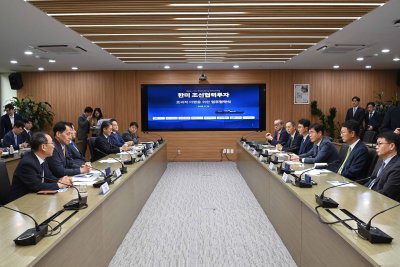
The Korea Institute for Defense Analyses, or KIDA, and the National Information Society Agency, or NIA, held a joint seminar in Seoul under the theme “Strategic linkage between public AI transformation and defense AI transformation for a national AI G3.”

The two organizations also signed a memorandum of understanding to strengthen cooperation between the public and defense sectors on AI policy and infrastructure.

The agreement reflects growing recognition within South Korea that strategic use of AI technology is becoming a key factor in national competitiveness and future security.

The institutions said the partnership aims to create a nationwide AI ecosystem linking the private sector, government and military by integrating AI transformation efforts that had previously been pursued separately in the public and defense sectors.

As part of the initiative, KIDA plans to expand its Defense Artificial Intelligence Policy Research Office into a larger body tentatively named the Defense AI Policy Center.

The planned center would oversee tasks ranging from defense AI strategy to data planning and verification while maintaining a permanent cooperation system with NIA’s AI policy division.

Officials said the center is expected to support both the Defense Ministry and the Ministry of Science and ICT while serving as a bridge between ministries on AI policy and technology.

During the seminar, Shim Seung-bae, a senior researcher at KIDA, presented what he described as a “public-defense hybrid AI transformation strategy” aimed at strengthening South Korea’s defense industry competitiveness.

Lee Yong-jin, head of NIA’s AI policy office, said advanced public-sector AI infrastructure and methodologies should be rapidly integrated into defense applications.

Participants from government, industry and the military also discussed the need for stronger AI governance and closer cooperation between defense companies and civilian AI firms.

Lee Seung-young, chief technology officer at LIG D&A, said open collaboration between defense contractors and private AI companies is urgently needed to upgrade advanced weapons systems.

Kim Dong-hwan, CEO of FortyTwoMaru, said successful AI transformation cases and data experience from civilian and public sectors should be quickly applied to defense programs.

KIDA President Kim Jung-soo said AI has become “a core game changer” determining the success of national competitiveness and defense innovation.

NIA President Kim Hyung-chul said the agency would focus on maximizing synergy between public and defense AI transformation to help South Korea become a global “AI G3” nation.

Officials said the partnership could accelerate South Korea’s broader “Defense Innovation 4.0” initiative and its goal of becoming one of the world’s top four defense exporters.

— Reported by Asia Today; translated by UPI

© Asia Today. Unauthorized reproduction or redistribution prohibited.

Original Korean report: https://www.asiatoday.co.kr/kn/view.php?key=20260522010006708

Source link

South Korean AI power diagnostics system heads to Germany

Employees check power demand and supply at the regional office of the Korea Electric Power Corp. in Suwon, 30 kilometers south of Seoul, South Korea. Photo by YONHAP / EPA

May 21 (Asia Today) — Korea Electric Power Corp.’s AI-based preventive diagnostics technology will be introduced to Germany’s power equipment market under the company’s largest-ever single technology transfer deal.

Korea Electric Power said Wednesday it signed a $1.34 million, or about 2 billion won, contract with German power equipment company Maschinenfabrik Reinhausen in Berlin on Tuesday. The South Korean utility will receive technology transfer fees from the German company over seven years.

The technology, called SEDA, analyzes about 100,000 pieces of substation equipment data a day. The system uses AI to detect abnormalities in power facilities by linking data from Internet of Things sensors, facility specifications and maintenance records.

Maschinenfabrik Reinhausen, founded in 1868, specializes in transformer load tap changers, sensors and digital solutions. The company has annual revenue of about 19 trillion won, or $12.6 billion.

The German company plans to apply SEDA to its TESSA 2.0 power equipment asset management platform. The platform monitors the condition of transformers, switchgear and other power equipment.

Korea Electric Power began using SEDA in South Korea in 2021. The system has been applied to 359 of the country’s 925 substations, or about 40%, and the company is gradually expanding its use.

The company said SEDA has detected an average of 15 abnormal signs per year over the past five years. Last year, the system helped prevent equipment damage worth 36.6 billion won, or about $24.3 million.

“This technology transfer is highly significant because it gives Korea Electric Power a key foothold for entering global markets, including Europe and North America,” said Yeo Geun-taek, head of the company’s transmission and substation operation office.

— Reported by Asia Today; translated by UPI

© Asia Today. Unauthorized reproduction or redistribution prohibited.

Original Korean report: https://www.asiatoday.co.kr/kn/view.php?key=20260521010006459

Source link

Multicultural student population tops 200,000 in South Korea

1 of 2 | The Ministry of Gender Equality and Family government complex in Seoul. Photo by Asia Today

May 21 (Asia Today) — The number of multicultural students in South Korea topped 200,000 for the first time last year, even as the country’s overall youth population continued to decline, government data showed Wednesday.

The Ministry of Gender Equality and Family released its 2026 youth statistics, covering 36 indicators in eight areas, to mark Youth Month in May.

The data showed the number of multicultural students reached 202,208 last year, up 4.3% from a year earlier. They accounted for 4% of all students.

Elementary school students made up 57.7% of multicultural students, followed by middle school students at 25.3% and high school students at 16.6%.

South Korea’s youth population, defined as people ages 9 to 24, stood at 7.409 million this year, accounting for 14.4% of the total population. That was down from 7.626 million, or 14.8%, last year.

Education indicators showed mixed trends. Seven in 10 students said they enjoyed going to school, up 1 percentage point from the previous year. The share was highest among elementary school students at 79.2%, followed by middle school students at 71.9% and high school students at 69.2%.

The private education participation rate among elementary, middle and high school students fell to 75.7%, down 4.3 percentage points from a year earlier. Average weekly time spent in private education also declined by 30 minutes to 7.1 hours.

The school dropout rate edged up to 1.1%, while the share of high school graduates advancing to higher education in South Korea or abroad rose to 74.4%.

Labor data showed the employment rate for people ages 15 to 29 was 45.0% in 2025, down 1.1 percentage points from the previous year. The unemployment rate rose 0.2 percentage points to 6.1%.

Among middle and high school students, 5.1% said they had worked part-time during the past year.

Income was the top factor young people considered when choosing a job. Teenagers and young adults ages 13 to 24 ranked income first, followed by aptitude and interest, then job stability.

Large companies were the most preferred workplaces, followed by government agencies and public corporations.

The share of young people prioritizing income has steadily increased since 2013, when it stood at 27.0%. The trend was stronger among male youths at 42.8% than female youths at 35.9%. Women were more likely than men to cite aptitude and interest as a key factor.

— Reported by Asia Today; translated by UPI

© Asia Today. Unauthorized reproduction or redistribution prohibited.

Source link

South Korean defense firms face growing pressure from U.S. cyber rules

A visitor inspects a K2 Black Panther, a South Korean fourth-generation main battle tank, during the final day of the Black Sea Defense and Aerospace Exhibition 2026 in Bucharest, Romania, 15 May 2026. Photo by ROBERT GHEMENT / EPA

May 19 (Asia Today) — South Korea’s fast-growing defense industry is confronting a major new obstacle in the U.S. market as the Pentagon fully implements strict cybersecurity certification requirements across its global supply chain.

The U.S. Department of Defense has begun enforcing the final version of the Cybersecurity Maturity Model Certification, or CMMC, program, requiring all companies participating in U.S. defense contracts to meet specific cybersecurity standards.

Industry officials warn that Korean defense firms unable to obtain certification could be excluded not only from exports to the United States but also from ship maintenance, repair and overhaul projects and future joint weapons development programs.

The certification system applies not only to primary contractors but also to subcontractors supplying parts and components.

Even companies with advanced technology and competitive pricing can be blocked from bidding if they fail to meet required cybersecurity levels.

For many South Korean defense firms, the most critical threshold is CMMC Level 2, which is required for handling Controlled Unclassified Information, or CUI, tied to U.S. military programs.

The requirement is considered especially important for South Korea’s ambitions to participate in U.S. Navy ship maintenance and repair projects, as well as broader bilateral defense cooperation initiatives.

Defense analysts say the new rules are becoming a de facto trade barrier across Western defense markets.

“Losing access to the U.S. market effectively means being pushed out of the global defense supply chain,” one industry expert said.

Defense Acquisition Program Administration has launched information sessions and consulting support programs in response to growing industry concerns.

The agency is working with regional defense innovation clusters, the Korea Defense Industry Association and the Defense Agency for Technology and Quality to help companies prepare for certification.

But smaller suppliers say the burden remains overwhelming.

Industry estimates suggest that achieving Level 2 certification can cost companies from hundreds of thousands to several million dollars due to infrastructure upgrades, consulting fees and final audits. Preparation alone can take more than a year.

Large defense contractors have already formed dedicated task forces, but many second- and third-tier suppliers lack both funding and cybersecurity specialists.

Because the CMMC system requires certification across the entire supply chain, failure by even a single subcontractor could jeopardize broader export opportunities involving larger Korean defense firms.

Additional complications stem from differences between U.S. and South Korean encryption standards.

One key CMMC requirement involves use of cryptographic modules certified under U.S. National Institute of Standards and Technology guidelines known as FIPS standards.

Many South Korean defense companies, however, rely on domestic encryption systems validated under the country’s K-CMVP framework overseen by intelligence and defense authorities.

Industry experts are calling for government-level negotiations between Seoul and Washington to seek mutual recognition or equivalency between Korean and U.S. encryption standards.

Some officials argue such talks could be linked to ongoing negotiations over a Reciprocal Defense Procurement Agreement between the two allies.

Concerns are also growing over South Korea’s lack of domestically accredited third-party CMMC assessment organizations, forcing companies to rely on U.S.-based auditors and raising concerns about defense technology exposure.

Analysts say South Korea’s defense industry must now treat cybersecurity as strategically important as weapons performance itself if it hopes to become a top-tier global arms exporter.

— Reported by Asia Today; translated by UPI

© Asia Today. Unauthorized reproduction or redistribution prohibited.

Original Korean report: https://www.asiatoday.co.kr/kn/view.php?key=20260519010005245

Source link

Most young South Koreans distrust election polls, survey finds

1 of 2 | Employees of the National Election Commission take part in a campaign in Ilsan, just outside of Seoul, South Korea, 26 April 2026, to encourage voter participation in the June 3 general election. Photo by YONHAP / EPA

May 19 (Asia Today) — More than 60% of young South Koreans and college students do not trust elections or political opinion polls, according to a survey released ahead of the June 3 local elections.

The Korean Law Consumers Federation, a legal advocacy group, released the results Monday after surveying 1,201 young people and college students from 119 universities nationwide. The respondents had an average age of 23.4.

The survey found that 60.37% of respondents said they do not trust elections or political opinion polls, while 38.80% said they do.

Despite the distrust, 59.95% said they would definitely vote in the local elections, and 35.89% said they would try to vote.

Asked whether one vote can have an important effect on election results, 75.27% agreed, while 24.56% disagreed.

On early voting, 53.54% said there is a possibility of election fraud, while 40.30% said such claims are completely false.

The survey also asked about possible constitutional revisions. A total of 62.28% supported including language related to the May 18 Gwangju Democratization Movement in the Constitution, while 35.97% opposed the idea.

However, 91.01% opposed removing the word “freedom” from the Constitution.

The survey included 53 questions and was conducted with the help of student volunteers. It had a margin of error of plus or minus 2.83 percentage points at a 95% confidence level.

— Reported by Asia Today; translated by UPI

© Asia Today. Unauthorized reproduction or redistribution prohibited.

Original Korean report: https://www.asiatoday.co.kr/kn/view.php?key=20260519010005434

Source link

NAACP calls for boycott of Southern college sports programs over voting rights

The NAACP is calling on Black athletes and fans to boycott the athletic programs of public universities in states that are taking steps that the nation’s oldest civil rights group says are restricting Black voting rights.

Launched on Tuesday, the “Out of Bounds” campaign urges prospective Black athletes, their families, alumni and fans to “withhold athletic and financial support” from major public universities in states that “have moved to limit, weaken or erase Black voting representation.”

If Black athletes participate in the boycott, it could deplete rosters for powerhouse football and basketball programs across the Southeastern Conference and Atlantic Coast Conference.

The NAACP is among groups responding to a wave of gerrymandering in the aftermath of a Supreme Court ruling that winnowed a key provision of the Voting Rights Act of 1965.

The boycott comes as civil rights activists have mobilized across the South to protest redistricting plans by Republican state legislatures that eliminate majority-Black congressional districts after the high court’s ruling. Activists have looked for pressure points to dissuade GOP-led states from redistricting maps, including calls for mass protests and economic boycotts.

“Across the South, Black athletes have helped build some of the most profitable college athletic programs in America,” said NAACP President Derrick Johnson. Johnson noted that the programs “generate hundreds of millions of dollars in annual revenue, national television value, alumni donations, merchandising sales, ticket sales, and brand equity — much of it powered by Black football and basketball talent.”

The NAACP’s campaign calls out Alabama, Florida, Georgia, Louisiana, Mississippi, Texas and South Carolina as states to boycott, arguing that the athletic programs of those states’ flagship universities are especially reliant on Black athletic talent and should protect Black political interests.

“Black athletes should not be asked to generate wealth, prestige, and power for state institutions while those same states strip political power from Black communities,” said Johnson.

Black lawmakers themselves are also putting pressure on athletic leagues to take action against Republican-led states that may redistrict longtime Black members of Congress.

The Congressional Black Caucus on Monday sent a letter to the commissioners of the SEC and ACC athletic conferences, as well as NCAA President Charlie Baker, that its members will oppose the SCORE Act, a bill to standardize athletes’ contracting rights across the country, unless conference leaders oppose GOP-led redistricting efforts in states that include major conference members.

“The Congressional Black Caucus believes institutions that profit from Black talent and Black communities have a responsibility to stand with those communities when their fundamental rights are under attack,” the CBC said in a Monday statement. “Silence in the face of injustice is not neutrality — it is complicity.”

Brown writes for the Associated Press.

Source link

UCLA softball pummels South Carolina, advances to super regional

No. 8 UCLA stuck with right-hander Taylor Tinsley throughout the Los Angeles Regional and that faith in the senior paid off.

During the Bruins’ NCAA tournament opener at Easton Stadium, Tinsley gave up 10 runs before her teammates rallied for a walk-off win. She returned less than 24 hours to pitch against South Carolina, giving up two earned runs in a victory. Tinsley was back in the circle Sunday afternoon, yielding one run in UCLA’s 15-1 victory over the Gamecocks to advance to the super regionals.

“I am proud of Taylor’s resiliency, the ability to do whatever she can to help this team,” UCLA coach Kelly Inouye-Perez said. “She got stronger through the weekend. I am proud of that.”

Tinsley and her teammates will host Central Florida in a super regional that begins Friday.

“I feel good,” Tinsley said after pitching three key games in three days. “I could have gone more innings if needed.”

South Carolina right-hander Jori Heard gave up only one hit through two innings, keeping UCLA’s potent bats relatively quiet. The Gamecocks had runners on first and second with two outs in the second, but Tinsley escaped the inning with a pop-up to left field.

The Bruins got on the board first with a two-run home run from left fielder Rylee Slimp in the third inning. The Bruins followed it up by loading the bases with no outs in the fifth for right fielder Megan Grant.

Grant cooked up a grand slam to make it 6-0. She has 40 home runs, extending her hold on the NCAA single-season home run record. Oklahoma freshman Kendall Wells trails Grant with 37 homers.

“Its just incredible because I am blessed to be able to say the number 40,” Grant said.

South Carolina broke through on an RBI single from left fielder Quincee Lilio to cut UCLA’s lead to 6-1 in the fifth inning after being held to just one hit since the first inning. The Gamecocks couldn’t cash in the rest of the way.

The Bruins resumed scoring in the sixth inning, with the bases loaded and Grant at bat again. Fans at Easton Stadium anticipated another grand slam, holding up their cellphones hoping to catch some magic. Grant served up a two-run RBI single to expand the lead 8-1.

Jordan Woolery added to the scoring with a two-run RBI double down the left-field line, and Kaniya Bragg hit a home run to left-center field. Soo-jin Berry put a bow on the win with one more home run.

Source link

South Korea joins statement backing free navigation in Hormuz

A ship was observed waiting to transit the Strait of Hormuz in the Arabian Sea off Muscat, Oman, Tuesday, May 12, 2026. The fragile cease-fire between the United States and Iran conditioned on opening the strait—has kept maritime traffic at very low levels, as tensions rise in negotiations between the two sides. Photo by Ismael Mohamad/UPI | License Photo

May 15 (Asia Today) — Leaders from 26 countries, including South Korea, issued a joint statement supporting the restoration of normal operations through the Strait of Hormuz, according to a CNN report.

The statement came as U.S. President Donald Trump and Chinese President Xi Jinping met in Beijing.

The leaders of South Korea, Britain, France, Japan, Canada, Qatar and Bahrain were among those who reaffirmed support for freedom of navigation through the strait.

“We will use the full range of diplomatic, economic and military capabilities to support freedom of navigation through the Strait of Hormuz,” the leaders said in the statement.

They said navigation must remain free under the U.N. Convention on the Law of the Sea and international law.

The leaders also pledged support for an independent and strictly defensive multinational military mission, including mine-clearing operations, to achieve that goal.

They said any military mission would be carried out only in a permissible environment and would complement diplomatic efforts to reduce tensions.

Trump, who is visiting China, said in a Fox News interview after his summit with Xi that the Chinese leader also supports reopening the Strait of Hormuz.

“President Xi wants the Strait of Hormuz open,” Trump said, adding that Xi offered to help “if he can be of any help.”

— Reported by Asia Today; translated by UPI

© Asia Today. Unauthorized reproduction or redistribution prohibited.

Original Korean report: https://www.asiatoday.co.kr/kn/view.php?key=20260515010004172

Source link

South Korea may unveil nuclear submarine plan this month

South Korean Defense Minister Ahn Gyu-back attends a press conference for South Korean correspondents at the South Korean Embassy in Washington, DC, USA, 12 May 2026 (issued 13 May 2026). Photo by YONHAP / EPA

May 15 (Asia Today) — South Korea may announce a basic plan for acquiring nuclear-powered submarines as early as this month, officials and diplomatic sources said Friday.

According to foreign policy and security sources, the government is preparing a “Korean nuclear-powered submarine basic plan” that would outline its core principles and a timeline for acquisition.

A Defense Ministry official said the plan is being developed in coordination with relevant agencies but said the exact schedule could not be confirmed.

The official also said it has not been decided whether the Defense Ministry will lead the announcement.

Although no specific date has been set, some observers expect the plan could be released before the Shangri-La Dialogue, an Asian security forum scheduled to take place in Singapore later this month.

The plan is expected to include the defensive nature of the submarines, their missions and roles, a detailed timeline, fuel procurement and financing plans and South Korea’s commitment to complying with the Nuclear Non-Proliferation Treaty.

If announced, the plan would mark a formal declaration of the government’s intention to pursue nuclear-powered submarines.

A joint fact sheet released after a recent South Korea-U.S. summit said the United States had approved South Korea’s construction of nuclear-powered submarines and would work closely with Seoul, including on fuel procurement.

Defense Minister Ahn Gyu-back recently visited the United States and discussed cooperation on nuclear-powered submarine construction with U.S. defense officials.

— Reported by Asia Today; translated by UPI

© Asia Today. Unauthorized reproduction or redistribution prohibited.

Original Korean report: https://www.asiatoday.co.kr/kn/view.php?key=20260515010004184

Source link

South Korean SK group to merge strategy meeting, Icheon Forum

SK Group Chairman Chey Tae-won speaks during a meeting with South Korean President Lee Jae Myung and Nvidia founder and CEO Jensen Huang on the sidelines of the Asia-Pacific Economic Cooperation (APEC) summit in Gyeongju, South Korea. Photo by JUNG YEON-JE / EPA

May 15 (Asia Today) — SK Group will merge its annual strategy meeting with the Icheon Forum, its knowledge management platform, industry officials said Friday.

The group plans to hold the New Icheon Forum from June 11-13 at the SKMS Research Institute in Icheon, Gyeonggi Province.

The event combines SK’s management strategy meeting, usually held in June, with the Icheon Forum, which has been held in August. The company plans to hold the New Icheon Forum every June.

The move is aimed at strengthening execution by bringing strategic discussions into a single forum.

This year’s forum is expected to focus on accelerating artificial intelligence.

SK Group Chairman Chey Tae-won and chief executives from major affiliates including SK Innovation, SK Telecom and SK hynix are expected to attend.

Participants plan to discuss specific measures for each affiliate to secure leadership in the AI industry and strategies to create groupwide synergy.

— Reported by Asia Today; translated by UPI

© Asia Today. Unauthorized reproduction or redistribution prohibited.

Original Korean report: https://www.asiatoday.co.kr/kn/view.php?key=20260515010004232

Source link

South Korea employment rate falls for first time in 16 months

Bin Hyun-joon, chief of the social statistics bureau at the Ministry of Data and Statistics, holds a press conference at the government complex in Sejong, South Korea. Photo by YONHAP / EPA

May 13 (Asia Today) — South Korea’s employment rate fell for the first time in 16 months in April as hiring growth slowed amid higher oil prices, weaker consumer sentiment and continued external uncertainty tied to the Middle East war.

The number of employed people aged 15 and older stood at 28.96 million in April, up 74,000 from a year earlier, according to employment data released Wednesday by Statistics Korea.

The increase was the smallest since December 2024 and the first time this year that job growth fell below 100,000.

The employment rate fell 0.2 percentage point from a year earlier to 63.0%, marking its first decline in 16 months.

Youth employment remained weak. The number of employed people aged 15 to 29 fell by 194,000 from a year earlier to 3.42 million, extending its decline for a 42nd consecutive month since November 2022.

The youth employment rate dropped 1.6 percentage points from a year earlier, marking its 24th straight month of decline.

By industry, wholesale and retail jobs fell by 52,000 from a year earlier, while accommodation and food service jobs declined by 29,000. Manufacturing employment dropped by 55,000.

Officials attributed the slowdown to weaker consumer sentiment and continued external uncertainty related to the prolonged Middle East war. Transportation and warehousing jobs, which are sensitive to oil prices, rose by 18,000, but the pace of growth slowed.

Agriculture, forestry and fisheries employment fell by 92,000 amid population aging, while professional, scientific and technical services dropped by 115,000 because of a high base from last year.

Health and social welfare service jobs increased by 261,000, supported by rising care demand and government-backed direct job programs for older people.

“Employment gains were led by health and welfare services, arts, sports and leisure, and real estate,” said Bin Hyun-joon, head of social statistics at Statistics Korea. “By age group, employment increased among people aged 60 and older and those in their 30s, but the pace of growth slowed from the previous month.”

— Reported by Asia Today; translated by UPI

© Asia Today. Unauthorized reproduction or redistribution prohibited.

Original Korean report: https://www.asiatoday.co.kr/kn/view.php?key=20260513010003376

Source link

Could South Africa’s Ramaphosa be impeached over ‘cash-in-sofa’ scandal? | Corruption

South Africa’s President Cyril Ramaphosa has refused to resign over a “cash-in-sofa scandal” that continues to haunt his presidency.

Ramaphosa, who addressed the nation on Monday to declare his intention to remain in his post, is set to face a multi-party impeachment committee, which will investigate allegations that he covered up a 2020 break-in at his private ranch and the theft of more than $500,000, concealing the incident from police and tax authorities.

The committee’s findings could spell his impeachment; however, parliament has not provided a timeframe for the investigation, which has yet to commence.

Analysts say the scandal, which has been dubbed “Farmgate”, has been particularly damaging for a president who rode to power in 2018 on an anticorruption mandate, after the much-criticised presidency of Jacob Zuma. Now, eight years later, the case of the cash found stuffed in a sofa at his game ranch could be what takes Ramaphosa down.

Can the South African president survive? Here is what we know.

ramaphosa
Supporters of the Economic Freedom Fighters (EFF) carry placards outside South Africa’s Constitutional Court, after the court ruled on whether the parliament failed to hold President Cyril Ramaphosa to account over the ‘Farmgate’ scandal, involving allegations that foreign currency was hidden at his Phala Phala game farm, in Johannesburg, South Africa, on May 8, 2026 [Siphiwe Sibeko/Reuters]

What’s the scandal all about?

In February 2020, burglars allegedly broke into Ramaphosa’s luxury private ranch, Phala Phala, in Limpopo province, South Africa, and stole $580,000. The cash was said to have been hidden inside furniture at the farm – hence the “Farmgate” label.

Ramaphosa has been accused of covering up the theft and keeping private efforts to trace the burglars a secret to avoid an investigation into where the money had come from – and why it was hidden in a sofa.

Corruption allegations surfaced when a former head of South Africa’s state security agency walked into a police station in 2022 and accused the president of money laundering in relation to the stolen cash.

Later that year, an independent parliamentary committee found that Ramaphosa “may have committed” serious violations and misconduct. In particular, the panel found he had failed to properly report a theft to police as required under anticorruption laws and “acted in a manner inconsistent with his office”.

At the time, the African National Congress (ANC) had a strong majority in parliament – with 230 seats out of 400. It was therefore able to reject the report and refused to open impeachment proceedings.

But the left-wing Economic Freedom Fighters (EFF) challenged this at the Constitutional Court in Cape Town, which, last week, overturned the government’s rejection of the 2022 parliamentary report and referred it to a multi-party impeachment committee for a full investigation.

ramaphosa
South Africa’s President Cyril Ramaphosa addresses the nation, after a court last week revived proceedings against him over a scandal in which thieves stole bundles of foreign cash from a sofa on his ranch, in Johannesburg, South Africa, May 11, 2026 [Siphiwe Sibeko/Reuters]

What has Ramaphosa said?

Ramaphosa has always denied allegations of corruption and maintains that the stolen cash came from selling buffalo.

Since the constitutional court’s ruling last week, Ramaphosa has been facing renewed calls for his resignation, mostly from opposition leaders. In a televised address on Monday, the president refused to step down.

“While there have been calls in some circles that I should resign, nothing in the Constitutional Court judgement compels me to resign my office,” he said.

“Since a criminal complaint was laid against me in June 2022, I have consistently maintained that I have not stolen public money, committed any crime, nor violated my oath of office,” Ramaphosa said in his address, adding that he has cooperated in all investigations.

The president rejected the 2022 report from the independent panel again, saying: “The complaints against me are based on hearsay allegations. No evidence, let alone sufficient evidence, has been presented to prove that I committed any violation, let alone a serious violation of the Constitution or law, or serious misconduct as set out in the Constitution.”

If the committee does find enough evidence against him, it could direct him to be impeached.

It is unclear how long this will take, however. Ramaphosa has pledged to seek a judicial review of the report’s contents, which, in turn, could delay the investigation of the impeachment committee.

ramaphosa
Judges take their seats at South Africa’s Constitutional Court before the ruling on whether the parliament failed to hold President Cyril Ramaphosa to account over the ‘Farmgate’ scandal, involving allegations that foreign currency was hidden at his Phala Phala game farm, in Johannesburg, South Africa, May 8, 2026 [Siphiwe Sibeko/Reuters]

What is the process for impeachment?

If a president is found to have violated the constitution or the law, or is unable to perform the duties of office, South Africa’s National Assembly has the constitutional authority to remove him or her.

Beyond the parliamentary investigation that will now begin into the Farmgate scandal, and which can trigger a vote on impeachment, as well, any member of parliament may introduce a motion seeking the president’s removal. The speaker of the National Assembly would then refer the motion to an independent panel of legal experts to determine whether sufficient evidence exists to proceed.

If this panel decides there is a case against the president, lawmakers must vote on whether to begin impeachment proceedings. After this, a specially constituted impeachment committee is established to carry out a detailed investigation into the allegations. This is separate from the investigation beginning now and could take several months.

Once that committee recommends the removal of the president, parliament holds a final vote to impeach the president. Under Section 89 of the constitution, a two-thirds majority is required – meaning at least 267 lawmakers must vote in favour of removal in the 400-seat National Assembly.

ramaphosa
Supporters of the Economic Freedom Fighters (EFF) carry placards outside South Africa’s Constitutional Court, on the day the court ruled that parliament failed to hold President Cyril Ramaphosa to account over the ‘Farmgate’ scandal, in Johannesburg, South Africa, May 8, 2026 [Siphiwe Sibeko/Reuters]

Are there other ways to remove Ramaphosa?

Yes, the South African president can be removed from his job via a no-confidence vote in parliament.

Any member of the assembly can propose the no-confidence motion, and it only requires a simple majority of more than 50 percent.

Ramaphosa would need support from coalition partners to survive a no-confidence vote, however. This has already been proposed by at least two opposition parties in parliament.

Another way could be if his ANC party turns against him, as it did with the last president, Zuma, who came in for years of corruption allegations and was finally forced to resign in 2018.

FILE - South African President Cyril Ramaphosa raises his hand as he is sworn is as a member of Parliament ahead of an expected vote by lawmakers to decide if he is reelected as leader of the country in Cape Town, South Africa, June 14, 2024. (AP Photo/Jerome Delay, file)
South African President Cyril Ramaphosa raises his hand as he is sworn in as a member of parliament before an expected vote by lawmakers to decide if he is re-elected as leader of the country, in Cape Town, South Africa, June 14, 2024 [Jerome Delay/AP]

How strong is Ramaphosa’s position?

Ramaphosa is not only the president of South Africa, but also the leader of its most popular party, the ANC. Nelson Mandela was the ANC’s first Black president after apartheid ended in 1994.

In 2024, the ANC stunningly lost its majority in parliament for the first time following more than three decades in power. Today, the ANC holds 159 of 400 seats in the national assembly, or about 40 percent of seats – and Ramaphosa is governing in a coalition with the Democratic Alliance, which has 87 seats, along with other smaller parties.

But Chris Ogunmodede, an independent analyst of African politics, security, and international affairs, based in Lagos, Nigeria, said Ramaphosa would likely survive any impeachment attempts, “simply because of the arithmetic”.

“His numbers in the parliament virtually guarantee that impeachment will not happen,” Ogunmodede told Al Jazeera.

“It hasn’t been easy, but there is a government that seems to be functional and is showing some signs of reinvigoration,” Ogunmodede added. “There’s a lot of uncertainty on the part of the other coalition parties that suggests that they would much rather be on the side of caution and go with the devil they know, and preserve the government by keeping Ramaphosa in power.”

Despite this, the cash-in-sofa scandal has been damaging, he said.

And, under Ramaphosa, the ANC’s popularity has continued to slide. The party’s national vote share fell from 57.5 percent in the 2019 election to 40.2 percent in the 2024 election, marking its worst performance since the end of apartheid.

The South African economy has shown some signs of improvement, however, and given the Ramaphosa government “something to show for the time that it’s been in power”, said Ogunmodede.

Yet the South African government still faces long-term structural concerns about the economy, the country’s institutions, corruption, crime and other issues, the analyst added.

On the back of underlying anti-incumbency, Ogunmodede said the top court’s ruling on the cash-in-sofa scandal “has resurrected many concerns that South Africans have had about the president and his party, and the political institutions of the country more broadly”.

Source link

Britain airlifts hantanvirus patients from remote South Atlantic islands

Eight passengers and two crew from the hantavirus-hit Hondius cruise ship are being flown from the British islands of St. Helena and Ascension in the South Atlantic back to the United Kingdom for observation, most likely at Arrowe Park Hospital near Liverpool. Photo by Adam Vaughan/EPA

May 13 (UPI) — Ten suspected hantavirus patients are being flown from the British islands of St. Helena and Ascension in the South Atlantic back to the United Kingdom to complete their self-isolation at a former COVID-19 facility, the country’s main infectious diseases agency said.

The eight passengers and two crew from the hantavirus-hit Hondius cruise ship are part of a program to relocate “some contacts who are already isolating to places where they can safely self-isolate with access to appropriate specialist medical services,” the U.K. Health Security Agency said in a news release on Tuesday.

“England’s National Health Service high consequence infectious disease network is well equipped to respond if they become unwell. Currently none of these contacts are symptomatic and this is precautionary to support communities in U.K. overseas territories,” the agency said.

The patients being flown to Britain all left the MV Hondius when it stopped in St. Helena on April 24, with the ship going on to Cape Verde, where it was refused permission to dock, before finally disembarking on Tenerife on Sunday.

UKHSA did not say where the patients would be taken on arrival in Britain, but Arrowe Park Hospital in northwestern England, where at least 20 other patients from the Hondius are currently quarantined, was the most likely destination. The hospital has a specialist isolation wing and was a designated quarantine facility during the pandemic in 2020.

The agency said plans were underway “where it is safe and possible” to discharge the 20 existing Arrowe Park patients, 18 Britons, a German citizen and a Japanese national, after completing a three-day quarantine.

Each patient assessed as fit to safely serve out a 45-day isolation period at home will receive a tailored support package with daily monitoring from health protection teams across the country until they receive the all-clear, said UKHSA.

“We are grateful to the passengers for their cooperation and patience in what we appreciate has been a very unsettling period for all involved. As this first assessment period concludes, our priority remains to ensure everyone is safe and well supported, wherever they complete their isolation. Our teams will continue to be there for all of the affected individuals every step of the way,” said the agency’s chief scientific officer, Professor Robin May.

On Saturday, the British military conducted an airdrop of medics and four tons of oxygen and other medical supplies on Tristan da Cunha, another island in the St. Helena and Ascension Island British Overseas Territory, to treat a hantavirus patient who left the Hondius when it stopped there in mid-April.

The patient is a resident of Tristan da Cunha, population 220, one of the most remote places on Earth, 1,510 miles southwest of St. Helena and 1,750 miles west of Cape Town, which has no airstrip and very limited medical facilities.

Wreathes are seen amongst the statues at the Korean War Veterans Memorial during Memorial Day weekend in Washington on May 27, 2023. Memorial Day, which honors U.S. military personnel who died while in service, is held on the last Monday of May. Photo by Bonnie Cash/UPI | License Photo

Source link

South Carolina Senate rejects extension for redistricting despite Trump pressure

May 12 (UPI) — The South Carolina Senate voted Tuesday against a measure to extend its legislative session to redraw the state’s congressional map. President Donald Trump has pressured lawmakers to move forward with redistricting to give Republicans an advantage.

Five Republicans joined Democrats in voting against the resolution, which would have extended the session by a week, NBC News reported. This would have given the Senate more time to vote on a plan that would break up the state’s only Black-majority district. The legislative session ends Thursday, and the state’s primaries are June 9.

The redistricting push by Trump comes after a U.S. Supreme Court decision in late April that badly weakened a key part of the landmark Voting Rights Act of 1965, one that had helped ensure minority groups could elect their choice of candidates.

State Sen. Shane Massey, a Republican and Senate majority leader, spoke out about the efforts before the vote, saying it’s a show of weakness to use redistricting to quash minority votes, Greenville News reported.

“My conscience is clear on this one,” Massey said. “I know what the right thing to do is.”

Massey said he’d received a call from Trump in recent days about pushing forward redistricting. On Monday night, Trump posted on social media that he was watching the vote closely.

“South Carolina Republicans: BE BOLD AND COURAGEOUS, just like the Republicans of the Great State of Tennessee were last week!” he wrote.

Last Thursday, the Tennessee state legislature passed a redistricting map that eliminated the state’s last Democrat-leaning, Black-majority district. Other Southern states have also been moving in this direction.

Senate Minority Leader Brad Hutto said the vote sends a message that the state rejects a White House power grab, Greenville News reported.

“The people of this state expect us to focus on real issues affecting their daily lives, not carry out an outside political agenda,” he said.

Later Tuesday, Republican candidates for governor in South Carolina criticized the members of their party who voted against the resolution.

Rep. Nancy Mace, who’s been endorsed by Trump for the governor position, posted on social media that the state needs “a Governor who the statehouse will fear and listen to.”

“You know I’d whip every single ‘NO’ vote into shape if I was Governor,” she posted.

Source link

South Korea says HMM Namu hit by two unidentified objects

Foreign ministry spokesperson Park Il attends a press conference at the government complex in Seoul, South Korea, 10 May 2026. A South Korean investigation team has concluded that unidentified airborne objects caused the explosion and fire aboard the Panama flagged cargo vessel Namu, operated by HMM Co., in the Strait of Hormuz last week. Photo by YONHAP / EPA

May 10 (Asia Today) — The South Korean government said Sunday that a fire aboard the HMM Namu was caused by strikes from two unidentified flying objects.

Foreign Ministry spokesperson Park Il said during an emergency briefing that two unidentified aircraft struck the outer shell of the portside ballast tank near the stern of the HMM Namu twice, about one minute apart, on Monday.

“The objects were captured on CCTV footage, but there are limits to identifying the launch source, exact model and physical size,” Park said.

The government said the incident does not appear to have been caused by a drifting mine or an underwater drone attack. Authorities plan to conduct further analysis of debris collected at the scene to determine the type and size of the objects that struck the vessel.

After an explosion and fire broke out aboard the HMM Namu on Monday, speculation emerged over whether the incident was a simple fire or an attack by Iran.

U.S. President Donald Trump said the vessel acted independently and suggested Iran was responsible. The South Korean presidential office initially said the possibility of an attack appeared low.

Iranian state television reported that force had been used against a South Korean vessel, but the Iranian Embassy in Seoul denied any attack on the ship, adding to confusion over the cause of the fire.

The HMM Namu arrived at a repair shipyard in Dubai on Thursday, and a detailed internal and external inspection was conducted from Friday through Sunday. A joint South Korean government investigation team, including officials from the Korean Maritime Safety Tribunal and the National Fire Agency, was dispatched to the site. The South Korean Consulate General in Dubai also supported the investigation.

The presidential office said the investigation team had completed necessary on-site work and would return to South Korea individually depending on flight availability.

— Reported by Asia Today; translated by UPI

© Asia Today. Unauthorized reproduction or redistribution prohibited.

Original Korean report: https://www.asiatoday.co.kr/kn/view.php?key=20260510010002226

Source link

‘Dutton Ranch’ brings ‘Yellowstone’s’ fan-favorite couple to South Texas

Taylor Sheridan’s “Yellowstone” universe, the sprawling neo-western TV franchise that chronicles the embattled Dutton family across time and locations, continues its aggressive expansion on screen with next week’s arrival of “Dutton Ranch.”

Premiering May 15 on Paramount+, the series continues the story of Beth Dutton (Kelly Reilly) and Rip Wheeler (Cole Hauser) — she’s the daughter of the late John Dutton (Kevin Costner), while he’s John’s longtime ranch foreman and fixer — as they migrate their passionate and unwavering love from Montana to South Texas to build a new life. The new series picks up about a year after the events that closed out the mothership series — namely, the selling of Yellowstone Ranch. And as you might expect, it doesn’t take long for them to make new enemies in their efforts to keep their new ranch operating.

Christina Alexandra Voros, who is an executive producer and director on the series, stopped by Guest Spot to talk about what sets “Dutton Ranch” apart from its parent show.

You are reading Screen Gab newsletter

Sign up to get recommendations for the TV shows and streaming movies you can’t miss, plus exclusive interviews with the talent behind your favorite titles, in your inbox every Friday

Also in this week’s Screen Gab, our recommendations include the return of a classic Cartoon Network series and a new addition to the growing microdrama landscape. And wait. Did you hear “The Bear” released a special episode? Let us tell you about it.

Scroll down and stream on. See you next week.

— Yvonne Villarreal

Turn on

Recommendations from the film and TV experts at The Times

An animated blue bird raises a brown cup to his beak.

Mordecai, a blue jay who works at the park, in “Regular Show: Lost Tapes.”

(Cartoon Network)

“Regular Show: The Lost Tapes” (Cartoon Network )

Nearly a decade after “Regular Show” flashed into history with a metafictional battle for the fate of the universe, J.G. Quintel is restoring his cult-beloved cartoon series to life, with its cast and creatives back in place. (Following the “Gumball” revival, these are great days for old-school CN fans.) A surreal hardly workplace comedy, it’s set in a city park (even when, in the last season, the park was hijacked into a tree-shaped space station), where the characters — a blue jay, a raccoon, a lollipop man, a Yeti, a muscular little green monster, a video-game ghost with a hand growing out of its body-head and a walking gumball machine, who runs things — get into scrapes as strange as that cast list might suggest. As the original series ended 25 years into the future, “The Lost Tapes” no doubt indicates a rewind — VHS is the preferred format of this crew — into an earlier world we can regard as the present. Though what, after all, is time to a cartoon? (The show premieres Monday on Cartoon Network, and will come to Hulu and HBO Max later in the year.) — Robert Lloyd

A man and two women, standing in a living room, have concerned expressions on their face

Eric C. Lynch, Brittney Jefferson and Jenna Nolen in a scene from “Screen Time.”

(Liliane Lathan)

“Screen Time” (TikTok, PineDrama)

When word hit that Issa Rae’s Hoorae Media was set to premiere its first microdrama series, which are essentially super-short TV shows shot for smartphones, it felt like it was finally time for me to see what this format on the rise is all about. “Screen Time” begins with a double-date movie night that goes off the rails after a mysterious figure hijacks the TV and sends two couples — Danielle (Brittney Jefferson of “Rap Sh!t”) and Marcus (Eric C. Lynch of “Queen Sugar”); and James (Xavier Avila of “Á La Carte”) and Olivia (Jasmine Luv of “Tell It Like a Woman”) — on a tailspin as they’re forced to confess their secrets or risk their online footprint being made public. It’s a fun and ridiculous ride, made all the more entertaining when you scroll the comments for a full communal experience. It’ll have you doing an inventory on your phone’s contents, if you’re not busy unplugging any nearby virtual assistants while questioning what’s up with Marcus. There are 27 episodes now available to watch, with each clocking in at roughly a minute and flowing into the next. (For a bit of comparison, the viral “Who TF Did I Marry?” TikTok series by Reesa Teesa, which held me hostage in 2024, had about 50 videos, with many lasting around 10 minutes. But that was real-life drama.) Of course, Rae knows something about making online content stand out. Long before “Insecure” made her an in-demand storyteller in TV and film, Rae broke through with her YouTube series “The Mis-Adventures of Awkward Black Girl.” The next episode drop arrives on May 22. — Y.V.

Catch up

Two men sit at a table covered in beer cans and beer bottles.

Jon Bernthal as Michael “Mikey” Berzatto and Ebon Moss-Bachrach as Richard “Richie” Jerimovich in a stand-alone episode of “The Bear” titled “Gary.”

(FX)

Everything you need to know about the film or TV series everyone’s talking about

“Dutton Ranch” isn’t the only show spinning off family dynamics in new places. “The Bear” made a surprise episode drop earlier this week. Titled “Gary,” the stand-alone episode — listed on Hulu separate from the main show and not considered part of a season — is a one-hour flashback that mostly functions as a prequel. It follows Richie (Ebon Moss-Bachrach) as he sets out on a work trip to Gary, Ind., with Mikey (Jon Bernthal).

Though not biologically related, the pair are best friends who consider each other family of the “cousin” variety. And they’re tasked with running an errand for cousin Jimmy (Oliver Platt) to deliver a box whose contents neither knows. Moss-Bachrach and Bernthal, who have been friends since 2003, co-wrote the episode. And TV critic Robert Lloyd had this to say about the pair’s collaboration here: “One senses that as writers, they’ve built themselves a playground to act in; both are phenomenal.”

It’s also worth noting that, a day after the episode’s release, FX confirmed the Emmy-winning series is coming to an end next month. Fans questioned the show’s fate when the fourth season concluded with its tortured but deeply ambitious head chef Carmy Berzatto (Jeremy Allen White) announcing he planned to leave the restaurant. So, yes, chef: When “The Bear” returns on June 25 for it’s fifth season, it will be the series’ last.

Guest Spot

A weekly chat with actors, writers, directors and more about what they’re working on — and what they’re watching

Something something

(Emerson Miller / Paramount+)

A pair of “Yellowstone” siblings are keeping television screens supplied with Dutton drama. After “Marshals,” the CBS procedural that follows Kayce Dutton (Luke Grimes) as he leaves ranch life to join an elite U.S. Marshals unit in Montana, became runaway hit for the network when it premiered earlier this year, quickly earning a Season 2 renewal, the fictional character’s sister, Beth (Reilly), is poised for her spin-off debut. Joined by her husband Rip (Hauser) and their surrogate son Carter (Fin Little), the trio relocate to South Texas to escape the ghosts of the Yellowstone ranch and build a new life in “Dutton Ranch.” Managing a new 7,000-acre property, they encounter new friends (a compassionate veterinarian played by Ed Harris) and foes (a rival rancher played by Annette Bening). The nine-episode series premieres with two episodes on May 15. Ahead of the show’s launch, reports surfaced that Chad Feehan, the show’s creator and showrunner, would not return for Season 2. I spoke with Voros, a longtime collaborator of Sheridan, about how the new series is different from the mothership, whether its central couple parallels the epic love story featured in “The Madison” and the show’s she’s been watching. — Y.V.

How is “Dutton Ranch” different from “Yellowstone”?

“Yellowstone” was entirely about a family holding on to the legacy of a place, and “Dutton Ranch” is entirely about building a new legacy. From a spiritual sense, what is driving these characters is similar — it is the bond to family, it is protection of each other. But the landscape has changed. In many ways, what was about land in the mothership has alchemized into being about family in “Dutton Ranch” because that’s what is left. The land that has brought them to their knees in war for generations is no longer something that burdens them, but they are tasked with building a new life and protecting that new life that they have built.

What is it about Beth and Rip that struck a chord with “Yellowstone” viewers? And why do you think they are wellsuited to stretch this TV universe?

Everyone loves a good love story and everyone loves an imperfect hero. When two people find each other and complete each other in a way that is both untraditional and heroic and romantic, it’s hard not to fall in love with them — and it’s hard to not want to fight for them and want to see them succeed. I’ve been with “Yellowstone” since the first season, and I remember very clearly being out there in Montana, making this crazy, big, ambitious TV show. And I remember, the next year, no one could go out to a restaurant in town without being accosted. Then the next year, there were Rip and Beth costumes at the store for Halloween. It takes a very special kind of actor to be able to carry that story and that character forward and to keep evolving, and to not become a caricature of themselves, but to grow not just the fictional person, but to also grow as an artist, to continue breathing life into that character. And I think Kelly and Cole have done so with with such grace and such a profound commitment to each other and to the show and to storytelling. They’re both EPs this season, and it’s so well-earned. It’s not just on face value. They have been in the trenches from the very beginning, really fighting for and protecting themselves and the DNA of the series.

I know, in theory, Taylor’s other series that you worked on, “The Madison,” is not in the same fictional universe. But at the heart of that series is this epic, once-in-a-lifetime romance. Do you see parallels? Do you think Preston (Kurt Russell), whose character loved visiting Montana, and Rip would have ever crossed paths? Would they have liked each other?

They would have enjoyed a beer together if they stumbled into each other at the same bar. I think the pursuits that feed their souls are different. Beth and Stacy would have ultimately gotten along after probably some kind of caustic series of remarks at the same bar.

I think there’s something about enduring love that is in both of those relationships. There are parallels in terms of the secrets that people carry, not necessarily nefarious ones, but sides of yourself that you don’t always see. I will say, Rip and Beth understand all the facets of each other in a way that is different from Stacy and Preston. The love story of “The Madison” is about two people who share everything but this one thing. Rip and Beth’s characters have also known each other since they were teenagers, and they have experienced most of each other’s lives together. If you look at Taylor’s writing, and maybe this comes from his own love story, he loves writing these strong romances, whether it’s Rip and Beth or Stacy and Preston. There are these grounding relationships that are formed by these volatile people, and it is fascinating to watch, and I think people find something familiar in them.

A man and a woman, both dressed in black, walk through a cemetary

Ed Harris as Everett McKinney and Annette Bening as Beulah Jackson in “Dutton Ranch.”

(Emerson Miller / Paramount+)

The cast in the Sheridan TV universe are all pros. You’re also working with some major screen heavyweights — Kevin Costner, Helen Mirren, Harrison Ford, Michelle Pfeiffer, etc. In “Dutton Ranch,” you have Annette Bening and Ed Harris. What was the pinch-me moment?

I don’t even know where to start. Ed came into my office to chat at the very beginning, before we started prep. I just froze for a second; I lost my ability to speak like a normal human being. You have to forget that they are who they are in the beginning until you settle into a routine, otherwise you would be too awe-inspired to really do anything productive with your day. I feel so spoiled by the caliber of artists that I’ve had the opportunity to work with. I’m working with Sam Jackson right now on “Frisco King.” I look at the work that I’ve done with Michelle and Kurt, then Annette and Ed on this — it’s such an honor that artists of that caliber are excited to come play in these worlds. Everyday on set with Annette and Ed makes me a wiser director, makes me a smarter human being.

It was recently reported that Chad Feehan, the series co-creator, departed the series as showrunner. What was your collaboration with him like? And how do you think he handled setting the foundation for this series?

Writing a spin-off to “Yellowstone” comes with a tremendous amount of responsibility and a tremendous amount of opportunity. It’s a gift to be able to work with characters like Rip and Beth, and I think Chad did a wonderful job creating a world of characters for them to go toe to toe with in the Jacksons. The original DNA of the No. 1s on our call sheet was always there, but they are entering a new path and a new part of their own journey and worthy adversaries were needed.

OK, before I let you go, what have you watched recently that you are recommending to everyone you know?

“The Beast in Me” [Netflix], I thought was unbelievable. It’s not the kind of thing that I normally watch. I just finished watching “Imperfect Women” [Hulu]. I was so taken by the performances in both of those shows. I love “Hacks” [HBO Max], I love “Shrinking” [Apple TV]. I balance my dark thriller with comedy.

ICYMI

Must-read stories you might have missed

Source link

South Korean submarine crosses Pacific in bid for Canada deal

Sailors aboard the ROKS Dosan Ahn Chang-ho, a 3,000-ton South Korean naval submarine, bid farewell to family members at a naval port in Changwon, South Gyeongsang Province, South Korea, 25 March 2026. The submarine is departing across the Pacific for the first time to take part in joint drills with Canada in June aimed at bolstering maritime security and defense industry cooperation. Photo by YONHAP /EPA

May 8 (Asia Today) — South Korea’s first domestically designed 3,000-ton submarine has completed a long-distance Pacific deployment as Seoul seeks to strengthen its bid for Canada’s next-generation submarine procurement program.

The South Korean Navy said the Dosan Ahn Chang-ho departed Pearl Harbor-Hickam in Hawaii on Friday with two Canadian Navy submarine personnel aboard and is scheduled to arrive at Esquimalt Harbor in Victoria, British Columbia, in late May.

The submarine left Jinhae Naval Base on March 25 and traveled through Guam and Hawaii before heading toward Canada.

The deployment is seen as a major test of the submarine’s endurance, reliability and operational performance, as South Korean shipbuilders compete for Canada’s submarine project, estimated at about $42 billion.

The Dosan Ahn Chang-ho is expected to travel up to about 18,600 miles round trip, much of it independently. Defense officials say the mission is intended to demonstrate the submarine’s long-range capabilities, quiet operation, onboard living conditions and air-independent propulsion system.

Two Canadian Navy personnel, Maj. Britany Bourgeois and Petty Officer Jake Dixon, joined the submarine for the final leg from Hawaii to Canada.

The submarine is expected to take part in joint training with the Canadian Navy after arriving in late May. The exercises are expected to focus on anti-submarine warfare and interoperability.

Canadian officials are expected to assess whether the South Korean submarine meets key requirements for long-range patrols and operations near Arctic waters.

The Dosan Ahn Chang-ho will later participate in the U.S.-led Rim of the Pacific exercise, known as RIMPAC 2026, alongside South Korea’s next-generation Aegis destroyer Jeongjo the Great.

South Korea’s participation is expected to highlight its growing ability to operate with U.S. and allied naval forces in complex maritime environments.

Canada’s submarine procurement program calls for the acquisition of 12 submarines. South Korean shipbuilders Hanwha Ocean and HD Hyundai Heavy Industries are competing against Germany’s Thyssenkrupp Marine Systems for the contract.

Defense analysts say the Pacific deployment gives South Korea an opportunity to demonstrate proven operational capabilities directly to Canadian officials rather than relying only on written proposals or technical specifications.

The Dosan Ahn Chang-ho is the lead vessel of South Korea’s KSS-III Batch-I class. The submarine has an underwater displacement of about 3,700 tons, is 83.5 meters long and was designed and built in South Korea.

South Korean defense officials say the deployment marks a milestone for the country’s submarine program and reflects the expansion of the Navy’s operating range from coastal waters to the open ocean.

If South Korea wins the Canadian contract, it would mark the largest single defense export deal in the country’s history.

— Reported by Asia Today; translated by UPI

© Asia Today. Unauthorized reproduction or redistribution prohibited.

Original Korean report: https://www.asiatoday.co.kr/kn/view.php?key=20260508010001855

Source link

South Korean, Canadian leaders discuss Hormuz, energy security

South Korean President Lee Jae-myung engaged in a phone discussion in his
presidential office. Photo by Yonhap / EPA

May 8 (Asia Today) — South Korean President Lee Jae-myung spoke by phone Friday with Canadian Prime Minister Mark Carney to discuss ways to strengthen cooperation between the two countries, the presidential office said.

The two leaders agreed that South Korea and Canada should work more closely with the international community to support a peaceful resolution to tensions in the Middle East, secure freedom of navigation in the Strait of Hormuz and maintain stable energy supplies.

Kang Yu-jung, senior presidential spokesperson, announced the details in a written briefing.

Lee and Carney also reviewed follow-up measures from their bilateral summit held on the sidelines of last year’s Asia-Pacific Economic Cooperation summit in Gyeongju, South Korea, and assessed that the efforts were proceeding smoothly.

The leaders agreed that bilateral relations are expanding beyond security cooperation into the economy, energy, advanced industries and culture. They pledged to deepen strategic cooperation based on that momentum.

“For South Korea, Canada is a key partner,” Lee said. “At a time when the international order is increasingly complex and global energy supply chains remain unstable, I hope South Korea and Canada will further strengthen cooperation in security, the economy, energy, critical minerals and advanced industries.”

Carney expressed agreement and said it was important for middle powers such as Canada and South Korea to strengthen solidarity through a more practical approach.

The two leaders agreed to maintain frequent communication and direct officials at various levels to pursue concrete results across multiple areas of cooperation.

— Reported by Asia Today; translated by UPI

© Asia Today. Unauthorized reproduction or redistribution prohibited.

Original Korean report: https://www.asiatoday.co.kr/kn/view.php?key=20260508010001895

Source link

South Korean mothers seek probe into overseas adoptions

1 of 2 | Lee Ae-rirana, a birth mother whose daughter was adopted to the United States, cries in front of a photo of her late daughter, Park Mi-ae, outside the Truth and Reconciliation Commission in Seoul on Friday. Photo by Asia Today

May 8 (Asia Today) — Five South Korean birth mothers who lost children to overseas adoption filed petitions Friday seeking a truth investigation into alleged abuses involving foreign adoptions.

The women submitted the petitions to South Korea’s Truth and Reconciliation Commission, saying their children were taken through kidnapping, false documents, deception by adoption agencies or without parental consent.

TRACE, a coalition advocating for truth-finding on overseas adoptions and child rights, held a news conference outside the commission’s office in central Seoul and disclosed several cases.

“The methods differed, but the result was the same,” the group said. “The mothers lost their children, and the children had to live their lives believing they had been abandoned.”

One case involved Lee Ae-rirana, 53, who said she was told after giving birth in 1993 that her baby daughter was seriously ill. A week later, she was told the child had died.

More than a decade later, Lee learned that her daughter, Park Mi-ae, had been adopted to Minnesota. Park later left her adoptive family after conflict, experienced homelessness and died in 2023, according to the group.

Another mother, Lee Gui-im, said she temporarily placed her two sons in a childcare facility in 1983 because of financial hardship after being told she could take them back when they reached middle school.

When she returned three months later with winter clothes for the boys, she learned they had already been sent to France for adoption.

Lee said an adoption consent form kept by the facility contained a signature in the birth mother’s name that she had never written. She said she could not read or write at the time.

Other cases included children who were reported missing but later sent overseas by orphanages and children allegedly taken through kidnapping or abduction before being placed for adoption.

Han Tae-soon, who was reunited with her daughter through DNA testing 44 years after the child disappeared at age 5 and was adopted to the United States nine months later, attended the event to support other mothers.

Han is pursuing legal action against the government and adoption agencies, accusing them of turning missing children into orphans for overseas adoption.

Park Min-seo, an attorney at Wongok Law Office, said no one involved in the adoption process made a proper attempt to verify the children’s identities.

TRACE called for investigations into false records and illegal adoptions by agencies and childcare facilities, a full review of overseas adoptions conducted without parental consent, a dedicated investigative body, a formal government apology and a support system to reunite birth parents and adoptees.

— Reported by Asia Today; translated by UPI

© Asia Today. Unauthorized reproduction or redistribution prohibited.

Original Korean report: https://www.asiatoday.co.kr/kn/view.php?key=20260508010001911

Source link

Gateway to the South Downs: take the train to a picture-perfect village with a cracking pub | Sussex holidays

Wisteria and clematis hang from weathered cottage walls. Tulips and pink apple blossom spill out of several gardens. Thatched animals decorate the rooftops. There’s a Norman church, a medieval castle and an 80-hectare (200-acre) nature reserve. Amberley is the kind of place people assume you can only reach by car, but the village has its own railway station with regular direct trains, along the scenic Arun Valley line, from Bognor, Horsham and London Victoria.

This spring, the Black Horse pub reopened in Amberley. The new owners are the gourmet Gladwin brothers, Oliver and Richard, returning to their Sussex roots near Nutbourne Vineyards. Having founded five Local & Wild restaurants in London, the Black Horse is their first country pub and first place with rooms.

I’ve walked through Amberley numerous times, but never stopped to explore. It’s the midpoint of the South Downs Way, a 100-mile route from Winchester to Eastbourne, with views for much of its length in both directions: north across the Weald and south towards the sea.

Black Horse pub in Amberley. Photograph: Dave Watts

Trains leave London every half an hour and take about 1hr 20mins to get to Amberley. The scenery outside gets steadily lovelier, passing blackthorn-bordered fields and bluebell woods. Beyond Pulborough, the railway enters the South Downs national park. There are herds of deer, chalk-hill views and the winding River Arun.

My first stop is Amberley Museum (two for the price of one with a voucher if you travel by train). Sprawling across more than 14 hectares (36 acres) of former chalk pits, it has impressive disused lime kilns and demonstrations of everything from broom-making to printing.

It’s right opposite the railway station and I’m planning a 45-minute whiz round before strolling into the village. Three hours later, I’m still there, riding the narrow-gauge railway and chatting to volunteers with encyclopedic enthusiasms for various traditional crafts. Visitors can hear the rattle of old machines and smell the printers’ ink, pine shavings, brick dust and engine oil. There’s a whole building about communications through time, from horse-drawn post carts to fibre-optic cables. The Tools & Trades History Society has intricate displays involving bee-smokers, hoop drivers, moulding planes, straw splitters and spindle grinders.

Above the museum’s main site, a nature trail leads up, through banks of bluebells and primroses, to a hilltop bench. Across the chalk cliffs of the old quarry and tall sycamores with their nesting rooks are views of the fortified walls of Amberley Castle, a bishops’ residence dating mainly from the 14th century.

I pass the castle on my 20-minute amble into the village and stop off at neighbouring St Michael’s church to admire the zigzagged Norman arch, oak leaf-carved doorway and graveyard cowslips. I check into the Black Horse, then head out again to explore Amberley Wildbrooks nature reserve, an area of boggy woods and tussock-sedged wetland, which starts two minutes’ walk away from the pub.

A pair of birders with a proper scope show me their photo of the resident white-tailed eagle, then I stroll through golden evening shadows serenaded by linnets and skylarks. No sign of the eagle, but I’m happy to hear warblers in the reedbeds and a woodpecker drumming for bugs. (Next day, I learn one of the area’s best eagle-spotting sites is The Sportsman, Amberley’s community pub, with binoculars on its terrace). I walk for miles along the single boggy track, following the Wey-South Path, a 34-mile (55km) route to Guildford mostly along canal towpaths, before finally heading back.

With bedrooms offering real milk and coffee, Amberley pottery and homemade biscuits, the Black Horse is hospitable. There are wooden beams, hilly views and fresh flowers. Plenty of pubs claim to be haunted by a “grey lady”; the Black Horse reports sightings of a spectral “woman in lavender … fleeting as the mist that settles over the Downs”.

Arundel Castle and the River Arun. Photograph: Adam Burton/Alamy

The renovated pub’s wood-panelled restaurant has an emphasis on local, foraged and sustainable food. Wild garlic season is ending and local asparagus has arrived. Grilled green spears in lemon with purple onion flowers look beautiful and taste better. Salad is dressed with gingery magnolia. There’s squid from Worthing, free-range lamb from the third Gladwin brother and farmer, Gregory, and wines from the family vineyards five miles north.

Many of the diners live locally (some on their second or third visit), while the early breakfasters next morning are mostly hiking the South Downs Way. The chalky hills look tempting in the spring sunshine, but I have other plans. In Arundel, four minutes’ journey south by rail, the nearly 1,000-year-old fortress (£17, gardens only) is hosting its huge annual tulip festival when I visit, having planted more than 1.4m bulbs over the past decade and won Historic Houses’ garden of the year in 2025, among other awards.

From pretty Arundel station, a bee-friendly path leads cyclists and walkers under the railway and beside a field to a safer stretch of pavement. Local community group Greening Arundel has won awards for this path, which is lined with celandines, murals and bug hotels.

Arundel Castle’s gardens. Photograph: Jesus Maria Erdozain Gomez/Alamy

There’s a queue to get into the castle gardens, but it’s easy to see why people come here. With fountains, thatched gazebos and historic walls as a backdrop, there are sweeping beds of multicoloured blooms, banks of scarlet by the moat, lush tubs of peony-style doubles, elegant lily-flowered cultivars and striped Rembrandts among a soft haze of forget-me-nots and the last of the narcissi.

Included in garden entry is the monument-filled 14th-century Fitzalan chapel, where pairs of marble knights and ladies lie side by side. On one of my teenage South Downs’ hikes, I spent hours with a friend searching every church in town for the stone effigies featured in Philip Larkin’s 1956 poem An Arundel Tomb, only to find them later in Chichester Cathedral.

After walking around the gardens, I climb the narrow-stepped Norman keep for views that stretch to the sea. There’s plenty to look at inside the castle, too: paintings by Van Dyck and Canaletto, rooms full of crossbows and rapiers, lion pelts in the Great Hall, antlers in the corridors.

From Arundel station, I can see the hilltop church and castle, framed by woods and marshes. The scene is up there with England’s other great views from railway stations, such as Durham Cathedral or St Michael’s Mount. Rich in history and wildlife, the trip feels longer and more rewarding than a simple overnight break. Outside the train windows, herons guard the waterways and swans are nesting in the reeds.

Accommodation was provided by the Black Horse pub, doubles from £110 room-only. Train travel was provided by Southern

Source link