South

South Korea seeks to turn defense exports into growth engine

1 of 3 | Government officials, lawmakers, researchers and defense industry executives attend a seminar marking the 20th anniversary of South Korea’s Defense Acquisition Program Administration in Seoul on Friday. Photo by Asia Today

June 19 (Asia Today) — South Korea is seeking to transform its defense industry into a national growth engine by integrating military procurement, weapons exports, advanced technology and industrial policy, government and industry officials said Friday.

Officials at a public-private seminar in Seoul rejected the long-standing argument that growing foreign orders could divert production capacity from the South Korean military and delay domestic weapons deliveries.

Instead, they said an analysis of about 2,000 South Korean defense companies found that exports increased factory utilization, encouraged investment in research and production facilities and eventually reduced manufacturing costs.

The findings were presented at a seminar titled “A New Leap Forward in Acquisition and the Defense Industry,” held at the Fairmont Ambassador Seoul in the city’s Yeouido financial district.

The Defense Acquisition Program Administration organized the event as it marked the 20th anniversary of its establishment.

Participants included lawmakers, officials from the defense, industry, science and small-business ministries, defense company executives and academic researchers.

They called for an end to treating military procurement and defense exports as separate policy areas.

Lee Yong-cheol, minister of the Defense Acquisition Program Administration, said South Korea’s annual defense exports had grown from about $250 million when the agency was established to $15.4 billion last year.

“Defense exports are no longer merely a supplement to domestic military procurement,” Lee said. “They have become a central growth engine driving the Republic of Korea as a whole.”

Lee said South Korea also needed to move beyond selling individual weapons.

He proposed combining weapons with energy systems, infrastructure, maintenance, repair and overhaul services and other forms of industrial cooperation.

“The era of selling weapons as stand-alone products is over,” Lee said. “We will transform the K-defense paradigm through cross-industry package cooperation.”

Lawmakers from South Korea’s governing and opposition parties pledged bipartisan legislative support for faster procurement and stronger financing for small and midsized defense companies.

They said a system that can take about 15 years to plan, develop and deploy a weapon is not suitable for an era in which artificial intelligence, drones and robotic systems evolve rapidly.

Participants also cited research indicating that financial instability among smaller suppliers, rather than export production, was a more important cause of delivery delays.

They called for expanded government-backed financing to prevent small manufacturers in the defense supply chain from being overwhelmed by debt and working-capital shortages.

Study links exports to stronger domestic production

South Korea’s defense industry has long debated whether large export contracts weaken or strengthen the country’s own military procurement.

Critics have warned that foreign orders could occupy production lines and delay the delivery of weapons to South Korean forces.

Supporters have argued that exports create economies of scale, preserve production capacity and lower the price paid by the South Korean military.

Research presented at Friday’s seminar supported the second view.

A team led by researchers from Myongji University analyzed data from about 2,000 South Korean defense-related companies.

The analysis found that increasing exports produced an immediate rise in factory utilization. Higher utilization was then associated with greater investment in research, development and production facilities.

Researchers said the benefits became more evident about three years after an export increase.

The analysis identified improvements in operating profit, lower production costs and greater independence in critical technologies after that period.

Repeated production also allowed factory workers and engineers to improve their skills and reduce defects, a process commonly described as a learning effect.

At the same time, producing weapons in larger quantities spread fixed development and manufacturing expenses across more units.

Researchers said those effects increased the competitiveness of South Korean products in foreign markets while potentially lowering the cost of weapons purchased by the South Korean military.

Industry experts cited South Korea’s large exports of K2 tanks and K9 self-propelled howitzers to Poland as an example.

They said the contracts increased domestic production, helped reduce unit costs and accelerated work on upgraded models.

Kim Myung-keun, an executive at Hyundai Rotem, said the company achieved economies of scale after receiving Poland’s large K2 tank order.

“Mass production lowered costs, reduced the acquisition cost for our own military and accelerated the development of upgraded models,” Kim said.

Yoon Byung-jo, an executive at SNT Motiv, said repeated production generated through large export orders also strengthened technical capabilities on factory floors.

“The learning effect accumulated by technicians during repeated production is the most powerful tool for reducing defects in critical components and increasing technological independence and localization,” Yoon said.

Lee Jung-hyun, a Myongji University professor involved in the study, said the analysis did not identify export volume as the principal cause of delayed deliveries.

“The real causes of delivery delays were companies’ debt ratios and financial soundness,” Lee said. “Exports instead improved operating profits and technological capabilities after a time lag of about three years.”

Lee said the government should strengthen the financial stability of smaller defense companies rather than restrict exports.

Officials seek to shorten 15-year procurement cycle

Government officials said South Korea’s traditional weapons acquisition process is too slow to keep pace with civilian advances in AI, drones, robots and human-machine teaming systems.

Weapons programs can take about 15 years from initial planning through development and operational deployment.

Officials said that schedule risks delivering technology that has already become outdated by the time it reaches military units.

Won Jong-dae, an assistant defense minister, said the existing system had become a national security obstacle.

“In the age of AI and drones, an acquisition process that takes 15 years is an impediment to security,” Won said.

He said the government would seek legislation tentatively called the Advanced Defense Capabilities Projects Act to shorten the process from initial requirements planning through deployment.

Kim Seong-su, a senior research and development official at the Science and Technology Ministry, said innovation in the civilian sector was advancing more quickly than military technology.

Kim called for an adaptive research and development system that would allow mature commercial technologies to be introduced into the military without passing through the full conventional development process.

The acquisition agency said it plans to expand rapid-introduction programs, particularly for drones and AI-related technologies.

The programs would allow the military to test and deploy promising civilian products more quickly while making adjustments based on operational experience.

Jeong Hwan, chief executive of infrared sensor manufacturer i3system, said smaller companies with advanced commercial technologies often cannot withstand the military’s complicated testing requirements and lengthy acquisition schedule.

He urged the government to make rapid acquisition programs more flexible and accessible to technology companies.

Financial support sought for smaller suppliers

Officials said South Korea must also strengthen small and midsized companies that produce components and materials for major weapons manufacturers.

Park Yong-soon, a senior official at the Ministry of SMEs and Startups, said the research presented Friday showed that financial weakness was a major source of supply-chain disruption.

Park said the government would shift policy toward stronger financial support for vulnerable suppliers and seek to increase the share of domestic defense revenue generated by small companies.

Smaller companies currently account for about 18% of South Korean defense industry sales. The government aims to raise the proportion to 25%.

Officials said those businesses can face severe cash-flow pressures because defense contracts require lengthy development, testing and certification before companies receive full payment.

The problem can become more serious when a small supplier must expand production rapidly to meet a major overseas order.

Park said the government must ensure that otherwise competitive companies do not collapse because they cannot obtain sufficient operating capital.

Park Dong-il, a senior official at the Industry Ministry, also warned that South Korea’s export portfolio remained concentrated in ground weapons.

More than 60% of the country’s defense exports come from land-based systems, he said.

Park said the government would work to diversify the industry into aerospace, next-generation satellites and advanced naval vessels while strengthening the domestic manufacturing and component ecosystem.

South Korea plans national security export packages

The acquisition agency said future export efforts would go beyond individual tanks, aircraft or artillery systems.

The government plans to package defense products with energy projects, transportation and industrial infrastructure, information and communications technology, maintenance services and technology transfers.

Officials described the approach as exporting an integrated security platform rather than a single weapon.

They cited Poland as a model.

South Korean arms agreements with Warsaw have included not only K2 tanks, K9 howitzers and other weapon systems but also plans for local production, technology cooperation, training and long-term maintenance.

An industry official said future transactions could involve building a partner country’s broader security and industrial system.

“The business will no longer be about exporting one tank,” the official said. “It will become a platform business that exports an entire national security system.”

Such packages can help importing countries create domestic jobs, develop supply chains and maintain weapons locally.

They can also give South Korean companies access to long-term revenue from training, spare parts, upgrades and depot-level maintenance after the initial sale.

The approach, however, requires coordination among several ministries because infrastructure, export financing and industrial cooperation extend beyond the authority of the acquisition agency.

Kim Il-dong, deputy minister of the Defense Acquisition Program Administration, said procurement and exports should be viewed as two sides of the same coin.

Kim said the acquisition agency could not achieve South Korea’s defense industry goals on its own.

He called for coordinated action by the defense, science, industry and small-business ministries to develop the sector as a strategic national industry.

Seoul targets 5% share of global defense market

The Defense Acquisition Program Administration said it aims to increase South Korea’s share of the global defense market to at least 5% and establish the country as one of the world’s four largest defense exporters.

Officials said South Korea’s defense industry had already approached the global top five based on its 2025 export performance.

Future growth will depend on moving beyond the country’s current strength in tanks, armored vehicles and artillery, they said.

The government plans to support companies working in AI, space systems, drones, advanced ships and autonomous and human-machine teaming technologies.

It also wants to foster globally competitive defense startups and companies capable of reaching valuations of more than $1 billion.

Officials and industry representatives said South Korea’s defense sector had completed an initial period of quantitative growth and now needed to focus on technology, productivity and supply-chain resilience.

“The past 20 years were a period of quantitative growth in which K-defense built weapons capabilities from the ground up,” seminar participants said. “The next 20 years should be remembered as an era of qualitative growth centered on AI, space, drones and unmanned systems.”

They said military procurement and the defense industry should no longer be treated as separate areas.

Instead, both should be viewed as parts of a single strategic industry supporting South Korea’s security, technological development and economic growth.

— Reported by Asia Today; translated by UPI

© Asia Today. Unauthorized reproduction or redistribution prohibited.

Original Korean report: https://www.asiatoday.co.kr/kn/view.php?key=20260619010006831

Source link

Calls for Justice Heighten Over Police Killing in South South Nigeria

“Officer, abeg! I go tell you everything. Na my friend na him deceive me. E de Sapele, I go carry you go the place. I no know anything concern. Officer!”

These were the last words of 28-year-old Oghenemine Ogidi before he was shot at close range by Usman Nuhu, an Assistant Superintendent of Police (ASP), on April 26, 2026, in Effurun, Delta State, South South Nigeria. Oghenemine died instantly from the gunshot. 

A disturbing video had captured him speaking Nigerian Pidgin while begging for mercy from the police officer with his hands and legs tied. He was said to have visited the Effurun Main Park along the Warri-Sapele Expressway to collect a waybill for a friend. However, transport union workers intercepted the parcel, which allegedly contained a Beretta pistol and ammunition. The transport workers informed the Uvwie Area Police Command.

At the park, the police, led by ASP Usman, a former member of the disbanded Special Anti-Robbery Squad (SARS), arrived in a 2010 Toyota Sienna with other officers, supposedly to intervene and arrest the suspect, who had already been restrained by the transport unionists. The police whisked him away from the scene and took him to the front of the Ekpan Police Station in the state, where Usman allegedly shot him three times, while the other officers watched. 

The horrific incident triggered a cascade of criticism against the police on the internet, with many condemning the extrajudicial operations of ASP Usman and other officers in the country. Before his death, Oghenemine was an up-and-coming musical artist and the second child in the family to have been killed by the police. The mother of the slain artist said his elder brother was also killed in 2022 by a high-handed police officer.

Human rights defenders and lawyers have condemned the incident, stressing that it betrayed Nigeria’s judicial system. Abba Hikima, a human rights lawyer, told HumAngle that it is unjust for a police officer to execute the most severe form of criminal justice without a fair trial or proper judicial process in any case. He emphasised the need for swift justice for the victim.

“If someone is found culpable or liable for the allegations against him and a judgment of a death sentence is passed, even the court has to hand that out to the executors of the judgment, which is a department of its own; even the judge cannot do that. It is the sheriffs of the court and the executors that execute the judgment of the court,” Abba said, noting that Usman’s job was to arrest, investigate, and charge the suspect in court so that justice could be administered accordingly.

Oghenemine’s murder forms a part of the troubling pattern of extrajudicial killings that have plagued Nigeria for decades, eroding public trust in law enforcement and fuelling cycles of protest and repression.  

A disturbing pattern

Many civilian lives have been lost to police extrajudicial killings, ill-treatment, and abuse of power. Oghenemine only fell victim to a policing system enmeshed in impunity and brutality. Far worse cases have occurred in the past, and disturbing incidents of police officers unleashing cruelty against civilians continue to disrupt Nigeria’s civic spaces. 

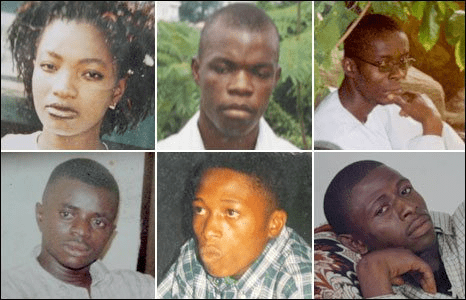
In 2005, for instance, six young traders were killed by some police officers during a supposed anti-robbery patrol. The traders were said to be returning from a nightclub in Abuja, North Central Nigeria. One of them, Augustina, had allegedly rejected the advances of a senior police officer, Danjuma Ibrahim, leading to a bitter confrontation. The angry Danjuma then told officers at a nearby police checkpoint that armed robbers were approaching. When the group arrived in their car, the police blocked them and opened fire. Four died instantly, while two survivors were taken away and left to die. The police had reportedly planted weapons on their bodies to frame them as criminals.

The killings sparked outrage across Nigeria, with widespread condemnation of police brutality and impunity. Then-President Olusegun Obasanjo ordered a panel of inquiry, which confirmed that the victims were innocent traders and not armed robbers. Findings from the panel revealed the deliberate framing of the victims and exposed the systemic abuse of power within the police force. The case became emblematic of the dangers of unchecked authority and the lack of accountability in Nigeria’s law enforcement system.

Collage of six individual portraits, showing varied expressions and poses against different backgrounds.
Image of ‘Apo six’ killed by police in 2005. Photo: Family members.

It took more than 11 years for justice to be partially served. In 2017, two of the six policemen involved, Ezekiel Acheneje and Baba Emmanuel, were sentenced to death for their roles in the killings, while others were discharged. 

The Apo Six case remains a relevant example of extrajudicial killings in Nigeria, projecting a system that harbours police misconduct and the long struggle for justice faced by victims’ families. Between 2020 and 2023 alone, 848 Nigerians were victims of extrajudicial killings, according to Global Rights’ Mass Atrocities Tracker.

During the #EndBadGovernance protests in 2024, several protesters were killed in Kano, Jigawa, Katsina, and Kaduna, with experts raising concerns over growing police brutality. In Oghenemine’s case, however, the Nigerian Police Force seems to have moved swiftly to dismiss the officers involved and hand them over for prosecution. 

“The Force does not shield officers who violate the law. No rank, no position, and no circumstance will be permitted to place any officer above accountability,” DCP Anthony Placid, the Police spokesperson, said in a statement at the time. 

On June 1, a High Court in Delta State ordered the detention of five police officers over the alleged killing. The officers – ASP Usman Nuhu, ASP Onoloko Dauroupamo, ASP Okoh Kelechi, Inspector Goodluck Kingsley, and Inspector Omonigho Ahweyevu – were arraigned before Justice Marshal Onome Umukoro under Suit No. THC/ASB/CR/M/66C/2026. The court directed that they be remanded at the Ogwashi‑Uku Correctional Centre pending legal advice from the Directorate of Public Prosecutions (DPP) and adjourned the matter until June 15, 2026, for further proceedings. 

On the scheduled hearing date, Harrison Gwamnishu, a human rights activist who has closely followed the case and was present at the High Court in Asaba, revealed that the DPP had filed the necessary information before the court. He noted that the matter is now awaiting legal advice before proceedings can continue.

Court document from Delta State, Nigeria charging multiple individuals with murder and negligent acts causing harm.
The court document. Photo: Harrison Gwamnishu. 

“The burial date has not yet been fixed, pending the conclusion of the trial,” he noted. 

The activist emphasised that the murder of Oghenemine symbolises Nigeria’s ongoing challenges with police reform, noting that this incident shows the critical need for reform, accountability, and the protection of human rights. He added that moving forward, the Nigerian police should begin to use body cameras, as they will help reduce the incidents of extrajudicial killings of suspects who are supposed to be charged in court in the country.

“Even though Nigeria stands at a crossroads, I believe that justice will be served, and the judge has ordered that some of the hearings be delivered online to avoid technicalities, even right from the correctional centre. When there is accountability, justice is possible,” the activist said.

‘Police your friend’

Nigeria’s policing system has long been associated with excessive use of force. SARS, for example, was established in 1992 as a branch of the police under the Criminal Investigation Department (CID) and was designed to find a lasting solution to violent crimes, specifically armed robbery, kidnapping, and carjacking across the country. However, it became notorious for torture, extortion, and unlawful killings. 

Despite repeated promises of reform, the culture of impunity persisted. Amnesty International, a global human rights organisation, described the promises of Nigerian leaders to reform the police as “ineffective”. In its 2016 investigation, the organisation painted a damning portrait of SARS, exposing how the unit had strayed far from its original mission of tackling violent crime. SARS officers were accused of turning torture and extortion into a profitable enterprise, routinely brutalising detainees to extract confessions or money. 

The report documented harrowing abuses, including beatings, shootings, starvation, and mock executions. Detainees were held in notorious centres such as the “Abattoir” in Abuja, where overcrowding and inhumane conditions compounded the suffering. Despite clear evidence, officers implicated in torture were rarely suspended or prosecuted; instead, they were transferred to other stations, perpetuating a cycle of impunity.

Beyond violent crimes, SARS extended its reach into civil disputes and business disagreements, exploiting its power to intimidate and extort. Victims reported theft of property, raiding of homes, and confiscation of valuables, with families describing how officers stole cars, emptied bank accounts, and looted homes during arrests. 

The #EndSARS protests of October 2020 were a watershed moment in Nigeria’s struggle against police brutality. Sparked by years of abuses by SARS officers, the protests drew thousands of young Nigerians into the streets, demanding an end to extrajudicial killings, torture, and extortion.  The movement culminated in the Lekki Toll Gate massacre, where security forces opened fire on peaceful demonstrators, killing and injuring dozens. According to Amnesty International, the government’s denial and lack of accountability deepened public mistrust. 

“These shootings clearly amount to extrajudicial executions. There must be an immediate investigation, and suspected perpetrators must be held accountable through fair trials. Authorities must ensure access to justice and effective remedies for the victims and their families,” Osai Ojigho, former country director for Amnesty International in Nigeria, said. 

The death of Oghenemine highlights the same issues that triggered the EndSARS protests: unchecked police violence, lack of accountability, and the erosion of public trust. However, extrajudicial killings are not confined to SARS alone. Regular police units, military detachments, and other security agencies have been implicated in unlawful killings during routine patrols, protests, and even minor disputes. 

For instance, in April 2026, Abdulsamad Jamiu, a youth corps member, was shot in Abuja by Guards Brigade personnel. A similar incident occurred elsewhere on January 1, when Timothy Daniel, a 13-year-old boy, was killed by a soldier in Akwa Ibom. In May 2025, Japhet Njoku, a security guard, died in police detention at Tiger Base, Imo State, after severe beatings. Experts say this systemic problem reflects weak accountability structures, inadequate training, and a justice system that rarely prosecutes officers for abuses.  

“If the lives of human beings can be taken by security personnel, whether or not they have been found guilty of any crime or not and no matter how harsh that crime is, someday somewhere, somebody may be framed for a similar offence, and his life will also be taken unjustifiably,” human rights lawyer Abba warned.

Source link

‘I hiked in UK national park like a tropical paradise – not Lake District or South Downs’

The national park’s a hotspot for tourism, but this particular walk felt like, at points, I could have been hiking in a tropical destination, with its bright green rugged cliffs

The more I travel around the UK, the more I am in awe of its natural beauty which seems to be overlooked by a lot of keen travellers, and this particular spot feels like a real slice of paradise.

You don’t need to hop on a plane to experience a sense of the tropics; it turns out you can immerse yourself in the brightest hues of green and walk along waterfalls in the north of Wales. While, of course, Snowdonia National Park is no secret, especially to avid hikers, cyclists and explorers, it was my first time visiting, and this specific route is one that blew me away.

It’s often cited as one of the best hikes in Snowdonia (Eryri). Cadair Idris is an 893-metre mountain in the southern part of the park and is renowned for its wild and rugged scenery. To me, it looked like its surroundings could belong in the likes of Peru or Southeast Asia, with its tropical plants, waterfalls and vibrancy of its green grass.

But of course, like any beautiful place in Wales, it reminded me exactly where I was when I spotted sheep dotted around its cliffs, even on the steepest parts. It looked as though the sheep could fall off the edge of the world, taking me with them, as I fought for hours against the growing pain in my shins, with each step up and up to the peak.

The route

I was taken up the Minffordd Path route, which is described as the shortest yet steepest route to the mountain’s summit, tackling a demanding 10 km walk. Overall it’s set to take up to four to five hours to complete, and in turn you are rewarded with dramatic and captivating views of the national park’s landscape.

The route begins at Dôl Idris car park and takes you past the Cadair Idris visitor centre, which quickly fills up. We were recommended to get there early in the morning to beat the pile-up and were thankful that we did; setting off on our walk at around 8am meant we got to experience the quietness of the route in all of its natural wonder. Albeit, the lie-in would have also been appreciated.

Running parallel along the stream which runs parallel to the stream which leads to Llyn Cau, the lake at the heart of the base of the mountain. It was immediately, when taking on these steep steps along the river, that I felt like I could be abroad.

Not only was the sun shining down on us, but the water was trickling down, with tropical plants growing around us, and it felt as wild and wonderful as the experiences I had in Thailand or the pictures I’ve seen of hikes in Vietnam or Peru.

This continued as we made our way out of the forest area and into the open air, with nothing but pure greenery around us, and the mountain stood proudly ahead. The second phase levels lightly as you enter a rocky amphitheatre, with up-close and personal views of the lake.

Pushing past slate and rocks, many of which are loose and therefore can be difficult to navigate, this section and throughout the walk, requires concentration and care with each step. A quick trip or fall could have you stumbling, and that’s why lots of hikers opt to go armed with sticks to help gain their balance and push them through.

By the time I made it to the top of the mountain, the weather dramatically changed, from sunny to high winds which were extremely cold. It’s this that can catch a lot of amateur hikers out, and I think it’s always best to go armed with windproof and waterproof layers, as they say ‘don’t dress for the car park’.

The real treat after that consistently steep hike upwards is this – the flat walk along the edge of the entire mountain before reaching its penultimate peak. Seeing it all from a circular angle gave you a real treat at each point whenever I decided to stop and take a breath.

Wales is the gift that keeps on giving when it comes to my explorations, and Cadair Idris was no exception to that. If you’re willing to take on the circular route and the real challenge of its steep and unsteady ground, then you will be rewarded with a touch of paradise and views you’ll continue to daydream about.

Source link

Mexico keeper Raúl Rangel helps El Tri beat South Korea, advance

Three and a half years after its biggest failure on the World Cup stage in half a century, the Mexican national team needed only two games to advance to the knockout round of this year’s tournament as winner of Group A.

Mexico’s defense held off a spirited final push by South Korea, earning a 1-0 win on Thursday night at Guadalajara Stadium in front of a fiery announced sellout crowd of 45,522.

Goalkeeper Kim Seung-gyu made a mistake in the 50th minute, failing to stop what appeared to be a simple cross and bobbling the ball. That allowed Mexico’s Luis Romo to easily tap the ball into the net and claim a 1-0 lead.

South Korea put pressure on the Mexican team throughout the game. Late in the scoreless first half, Jae-sung Lee came close to giving South Korea the lead. Mexico coach Javier Aguirre hoped his team would shake off nerves following the emotional opener at Azteca Stadium and show more bite in its second game against South Korea, but his team didn’t have much power behind its attack during the game’s first 45 minutes.

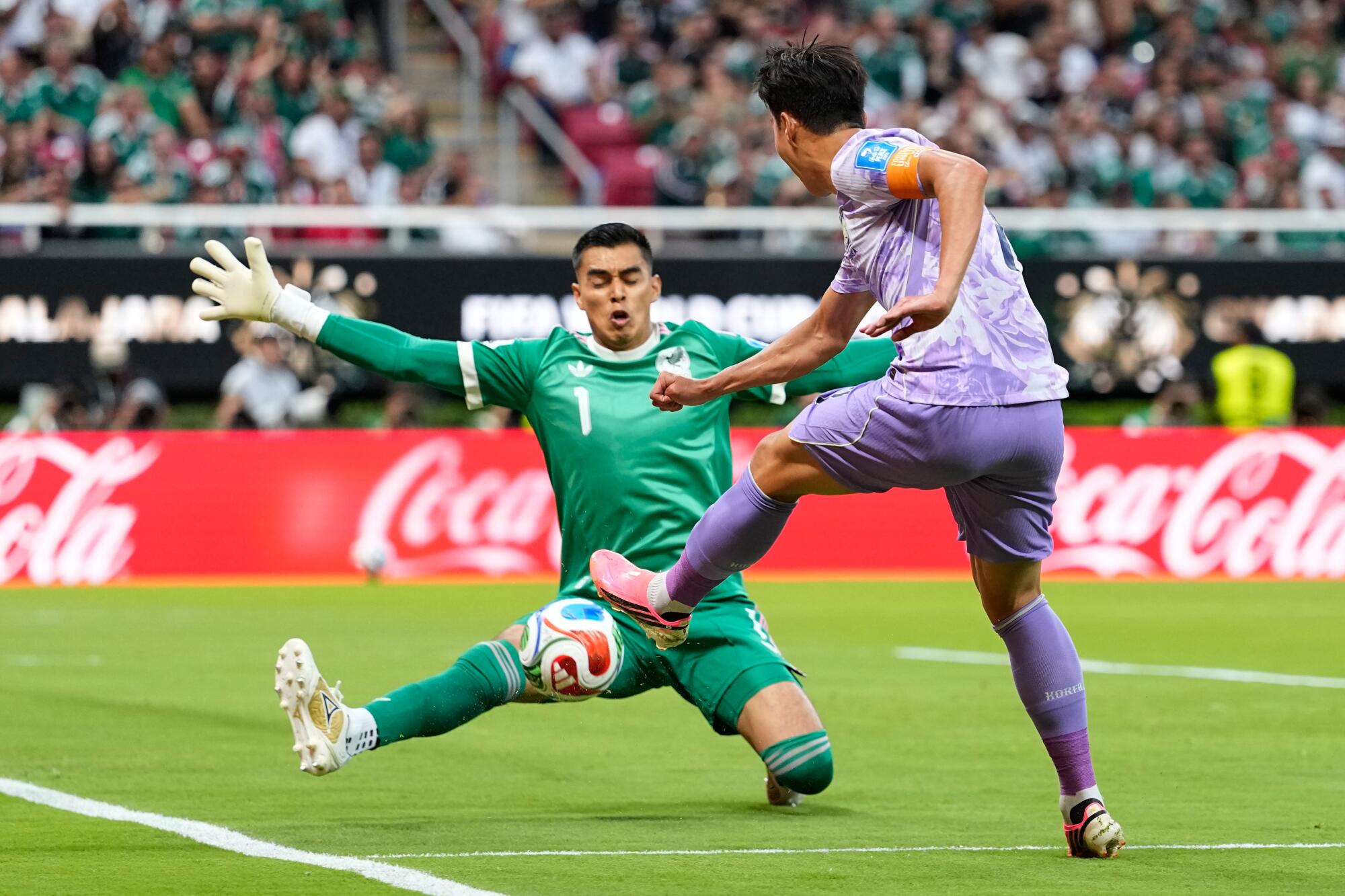
Mexico goalkeeper Raúl Rangel blocks a shot from South Korea's Son Heung-min during their World Cup match.

Mexico goalkeeper Raúl Rangel blocks a shot from South Korea’s Son Heung-min during their World Cup match at Guadalajara Stadium on Thursday.

(Natacha Pisarenko / Ap Photo/natacha Pisarenko)

The crowd in Guadalajara grew frustrated and began booing the Mexican national team’s performance at the end of the first half.

Mexico, however, won back their cheers when it capitalized on South Korea’s costly mistake and converted it into a goal.

El Tri earned a win without any other goals thanks, in part, to a great night by goalkeeper Raúl Rangel, who stopped a header by Cho Gue-sung in the 87th minute. Captain Edson Álvarez helped turn away South Korea’s attack late, holding up relatively well despite having left ankle surgery during the past year.

LAFC star and South Korea captain Son Heung-min fired one shot over Mexico’s goalkeeper in the first half, but Álvarez cleared it off the line before the referee ruled Son was offsides.

South Korea finished controlling possession 58% of the time, but it only earned two shots on target.

Mexico was coming off a comfortable 2-0 victory over South Africa, while the South Koreans had defeated the Czech Republic 2-1, marking their first World Cup opening-match win since 2010.

During the 2022 World Cup in Qatar, Mexico was eliminated in the group stage for the first time since 1978, breaking a streak of seven consecutive appearances in the knockout rounds. However, playing on home soil, the team’s goal is to emulate El Tri’s achievements in 1970 and 1986, when they reached the quarterfinals — the country’s best World Cup finish.

Due to the new 48-team format, Mexico would need to win two knockout-round matches and reach a sixth game to realize its goals.

Mexico's Luis Romo celebrates with his teammates after scoring during a match against South Korea at Guadalajara Stadium

Mexico’s Luis Romo celebrates with his teammates after scoring during a match against South Korea at Guadalajara Stadium on Thursday.

(Natacha Pisarenko / Associated Press)

After the win over South Korea, Mexico will close out group play against Czechia at Azteca Stadium in Mexico City on Wednesday. El Tri will get to play the first two games of the knockout round — should it win the first one — at Azteca Stadium, a venue where it has never lost a World Cup game.

South Korea has four points and will be favored when it plays South Africa Wednesday in Monterrey. If South Korea wins the match, it would be the Group A runner-up and advance to play the Group B runner-up on June 28 at SoFi Stadium.

Source link

South Korea weighs overhaul of local education grants

Pupils learn how to do division as they attend an open math class utilizing digital versions of print textbooks, provided on tablet computers with additional video and audio information, at Namsan Elementary School in Chuncheon, Gangwon Province, South Korea. Photo by YONHAP / EPA

June 18 (Asia Today) — South Korea is again considering changes to a local education funding system that automatically receives a fixed share of national tax revenue, as a semiconductor-driven rise in government receipts is expected to increase grants despite a shrinking student population.

The debate centers on local education finance grants, the main source of funding for elementary, middle and high schools administered by regional education offices.

The grants have risen to about 76 trillion won ($50 billion) under this year’s supplementary budget, according to the National Assembly Budget Office and education officials.

Some projections suggest the total could exceed 80 trillion won ($52.6 billion) if stronger tax revenue from the semiconductor industry is fully reflected.

The grant system receives 20.79% of internal tax revenue along with part of the national education tax. That means the amount increases when tax receipts rise, regardless of changes in student enrollment.

The number of elementary, middle and high school students fell from 5.96 million in 2016 to 4.92 million this year, a decline of 1.04 million, or 17.4%.

Over the same period, local education grants increased from 43 trillion won ($28.3 billion) to 76 trillion won, an increase of 33 trillion won ($21.7 billion), or 76.7%.

Budget officials and public finance experts say the automatic link to tax revenue makes government spending less flexible.

They argue that funding for primary and secondary education continues to expand despite falling enrollment while early childhood, higher education and lifelong learning programs face comparatively greater financial constraints.

Proposals include adjusting the percentage of internal tax revenue allocated to the grants or incorporating changes in the school-age population and nominal economic growth into the funding formula.

Education officials have strongly opposed reducing the grants based mainly on student numbers.

Superintendents-elect from South Korea’s ninth nationwide local elections issued a joint statement Monday warning that students would ultimately bear the cost of a funding overhaul driven primarily by fiscal considerations.

“Personnel expenses for teachers and other employees, school operating costs and facility safety and maintenance expenses arise at the school and classroom level, not simply on a per-student basis,” they said.

Schools also face growing fixed costs for meal services, after-school care and administrative support.

Personnel costs for permanent contract employees at public schools, including cafeteria workers, care staff and administrative assistants, reached 5.74 trillion won ($3.77 billion) last year.

That was a 61% increase from 2021. The figure is expected to exceed 6 trillion won ($3.94 billion) this year.

Three major teachers’ organizations also rejected claims that regional education offices have excess money.

They said the combined initial budgets of special education accounts fell by about 1 trillion won ($657 million) this year.

Funding for teaching and learning support declined 14.9%, while spending on school facility improvements fell 22.4%, they said.

The groups described education office reserve funds as a financial safeguard rather than unused money.

The Education Ministry is reportedly considering alternatives to immediately lowering the legally mandated allocation rate.

Possible measures include retaining the link to internal tax revenue while placing a ceiling on annual increases or allowing regional education offices to use more of the money for early childhood, higher education and lifelong learning.

The approach is intended to avoid a sudden reduction in primary and secondary school funding while directing more resources toward other parts of the education system.

Park Nam-gi, an emeritus professor at Gwangju National University of Education, said many necessary programs remain underfunded despite claims that schools have surplus resources.

“There are many things schools cannot do because they lack funding,” Park said.

He cited the expansion of special education, separate spaces and personnel needed to protect teachers and investment in education suited to the artificial intelligence era.

“It is wrong to conclude that education funding is excessive without properly supporting these needs,” Park said.

He said cash assistance programs introduced by some superintendents should be corrected where necessary, but that such concerns should not be used to justify reducing the overall education budget.

“Unlike welfare spending for the present, education funding is an investment in the country’s future,” Park said.

— Reported by Asia Today; translated by UPI

© Asia Today. Unauthorized reproduction or redistribution prohibited.

Original Korean report: https://www.asiatoday.co.kr/kn/view.php?key=20260618010006611

Source link

Can the Global South have a say in global affairs? | United Nations News

China calls for stronger representation for emerging economies.

China’s foreign minister says that emerging economies remain underrepresented in global governance institutions.

Presenting China’s new white paper on making global governance more equitable, minister Wang Yi argued that the role of the United Nations should be strengthened and developing countries should have a stronger voice in the world body.

In Beijing’s stated view, all countries should have an equal voice in global affairs, which means the Global South should have more representation.

China’s call comes as the world is engulfed in many armed conflicts and facing serious economic challenges.

But is Beijing now presenting itself as a leader of the Global South? And will it be able to garner enough support to play that role?

Presenter: Sami Zeidan

Guests:

Steve Tsang – Director of the SOAS China Institute

Cobus van Staden – Head of research at the China-Global South Project

Allen Carlson – Associate professor in the Government Department at Cornell University

Source link

With calmer nerves, Mexico hopes to top South Korea at World Cup

Goalkeeper Raúl Rangel was 18 years old and playing for Chivas de Guadalajara’s youth academy the last time Mexico faced South Korea in a World Cup match in 2018.

Three years ago, when asked who might be the next great goalkeeper for the Mexican national team, Rangel named himself ahead of veteran Guillermo “Memo” Ochoa. A bold statement for a player who was just making his professional debut.

On Thursday, the 26-year-old goalkeeper will defend El Tri’s goal during his second World Cup match at Guadalajara Stadium — where he usually plays home games with Chivas — when Mexico takes on South Korea at 6 p.m. PDT on Fox/Telemundo in the second match of Group A.

“I told everyone, ‘I see myself at the World Cup.’ Some people laughed,” Rangel recalled. “I’d been picturing myself on the national team for three years.”

Mexico's Julian Quinones celebrates with teammates after scoring against South Africa at Azteca Stadium on June 11.

Mexico’s Julian Quinones celebrates with teammates after scoring during a World Cup match against South Africa at Azteca Stadium on June 11.

(Luke Hales / Getty Images)

Mexico and South Korea won their opening matches — El Tri against South Africa and the South Koreans against the Czech Republic — so the winner of this match will take first place in the group and secure its spot in the next round. The incentive is clear for Mexico, as the group winner will play the next two knockout rounds at Azteca Stadium, where El Tri has never lost a World Cup match.

The second-place team, on the other hand, would have to travel to Los Angeles for its next match. While the opponent could be tougher, Los Angeles would be a comfortable destination for South Korea — it has a strong fan base in L.A. and wouldn’t have to contend with Mexico City’s high altitude.

After an opening match in which Mexico coach Javier Aguirre acknowledged that the pressure of the first day affected the team’s performance and that the emotional atmosphere at Azteca Stadium had “weighed heavily” on several of his players, the coach and the players hope to deliver a sharper performance against South Korea.

“Yes, there was a bit of nervousness, a bit of fear,” Mexico midfielder Erik Lira admitted after the opener.

“We need to be more decisive; the win has calmed the nerves we’ve had over the last few days,” Mexico defender Israel Reyes said.

But if Mexico wants to excel, it needs not only to put its nerves behind it but also to improve tactically. Mexico, a co-host of the tournament alongside the United States and Canada, is aiming to reach the knockout stage of the World Cup and advance beyond the round of 16. El Tri has won only one match in the knockout stage — in 1986, when it defeated Bulgaria 2-0 at Azteca Stadium.

“I think that mental aspect has been missing for us. We have to believe that we can achieve great things,” Rangel said. “I truly believe I’m going to be a champion with Mexico. We have a responsibility as hosts.”

The match will be played at Guadalajara Stadium, 5,138 feet above sea level, and will mark the first time Mexico has played a World Cup match in the city.

Chivas, Mexico’s most popular club team, has the most players on the national team with five and all of them will get to play their second World Cup match on their club’s home turf. Brian Gutiérrez, the Mexican American who played a key role in the opener as South Africa was hit a with a red card while trying to stop him, and veteran Roberto Alvarado, who recorded an assist against South Africa, joined Rangel as Chivas starters in the opener. Bench players Luis Romo and Armando González, who also saw action in the opener, also play for Chivas.

Mexico captain Edson Álvarez challenges South Africa's Themba Zwane during a World Cup match at Azteca Stadium.

Mexico captain Edson Álvarez challenges South Africa’s Themba Zwane during a World Cup match at Azteca Stadium on June 11.

(Carl Recine / Getty Images)

Aguirre will have to make at least one lineup change against South Korea, with Edson Álvarez replacing César Montes, who is serving a red-card suspension. Álvarez is coming off an injury and it’s unclear how he will navigate the stress. Aguirre is also expected to give playing time to 17-year-old prospect Gilberto Mora in midfield — possibly in place of Gutiérrez — and to bring in Jorge Sánchez for Reyes at fullback.

South Korea arrives with a mix of European experience and a hunger for glory. LAFC star Son Heung-min is playing in his fourth World Cup and scored against Mexico in 2018. Kim Min-jae of Bayern Munich has been a rock in defensive midfield, while Paris Saint-Germain’s Lee Kang-in — who, interestingly, played under Aguirre at Mallorca — is a constant threat in creating plays. Joining them is Hwang In-beom of Feyenoord in the Netherlands.

The South Koreans have also been training for weeks at Verde Valle, Chivas’ training facility, which has allowed them to acclimate to the altitude. With the support of the Mexican crowd, they won their World Cup opening match against the Czech Republic at Guadalajara Stadium.

“It was like playing a game in Seoul,” Hwang said after the match, thanking Guadalajara for its support.

“[Mexico] is a good team, but, as you’ve just seen, we can take on anyone,” Hwang said after his team rallied from a 1-0 deficit to beat the Czech Republic.

The week, however, was not without controversy for the South Korean team, as the squad barred press from their home country after audio of media criticizing the mandatory military service exemption granted to Son was leaked. The audio also included criticism of coach Hong Myung-bo.

South Korea and Mexico faced off in September ahead of the World Cup, tying 2-2 in Nashville.

The World Cup stage, however, will be different and brings immense pressure.

Source link

Is the G7 hearing the Global South? | Business and Economy

The G7, BRICS and emerging powers are competing for influence in a changing global order.

For half a century, a handful of wealthy Western democracies wrote the rules of the global economy.

But the world order is becoming crowded, and even as the Group of Seven (G7) remains one of the world’s most influential clubs, a challenger has emerged.

BRICS has expanded, and says it wants a bigger voice for the Global South. This bloc of nations speaks for nearly half the world’s population – and accounts for a growing share of global output, energy and raw materials.

In the space between the two, a third force is gathering pace: the so-called middle powers, nations too big to ignore and unwilling to pick a side.

Source link

Women’s T20 World Cup: South Africa beat Pakistan for first win of the tournament

ICC Women’s T20 World Cup, Group Two, Edgbaston

Pakistan 126-9 (20 overs): Fatima 55* (38); Kapp 3-23

South Africa 127-8 (16.4 overs): Dercksen 52 (35); Fatima 3-16

South Africa won by two wickets

Scorecard, Table

South Africa earned their first victory at the Women’s T20 World Cup as they beat Pakistan by two wickets at Edgbaston.

The Proteas were hammered by favourites Australia in their opener, setting them back in a difficult group which also includes 50-over world champions India.

Their win came from a combination of brilliant bowling from veteran all-rounder Marizanne Kapp and shambolic batting from Pakistan’s top order, who collapsed to 29-5 and then 50-8.

Kapp, 36, made an immediate impact with two wickets in the opening over, before some diabolical running between the wickets gifted South Africa three more.

But an inspired half-century from captain Fatima Sana dragged Pakistan up to 126-9 after a stand of 71 for the ninth wicket with Tuba Hassan.

Fatima finished unbeaten on 55 from 38 balls including two sixes in the final over bowled by Nadine de Klerk which conceded 19.

The skipper then kept her side in the game with the ball – finishing with figures of 3-23 – as South Africa made hard work of the chase by throwing away regular wickets.

Their batting needs to improve considerably if they are to challenge India and Australia in the group’s top two, but all-rounder Annerie Dercksen’s 52 and De Klerk’s 37 were enough to get them over the line with just over three overs to spare.

The Proteas have reached the past two T20 World Cup finals but lost both, to Australia in 2023 and New Zealand in 2024. Pakistan have suffered two defeats, having lost to India on Sunday.

Source link

South African jazz icon Abdullah Ibrahim dies at age 91

Globally celebrated South African jazz icon Abdullah Ibrahim has died at age 91, his family announced in a statement Monday.

Ibrahim, formerly known as Dollar Brand, passed away peacefully in Germany following a short illness, surrounded by loved ones, the statement issued on behalf of his family said.

As one of South Africa’s most respected jazz figures, he famously played at Nelson Mandela’s 1994 presidential inauguration. Mandela referred to Ibrahim as “our Mozart.”

His final public concert in South Africa took place at the Cape Town International Jazz Festival in March, when he once again captivated audiences with the musical skill that defined his career.

Paying tribute to her partner, Dr. Marina Umari said he “passed away peacefully with South Africa and its people in his heart.”

“His love for his country never wavered, no matter where in the world he found himself,” she said.

His family said that even though his life is over, his influence and voice would continue to resonate around the world.

South African President Cyril Ramaphosa paid tribute to the musician, praising his contribution to the anti-apartheid struggle and acknowledging his lasting impact through music.

“Today our nation mourns the passing of an international icon and global citizen whose profound creations honored the South Africa that shaped his political commitment and musical brilliance,” said Ramaphosa.

Born Adolph Johannes Brand in Cape Town on Oct. 9, 1934, Ibrahim rose to international prominence as a pianist, composer and bandleader. With a career spanning more than seven decades, he forged a unique blend of jazz and South African musical traditions, making him a cultural ambassador whose music struck a chord with listeners worldwide.

Ibrahim’s mother Rachel Brand was mixed-race and under the apartheid system he was classified as “colored,” which afforded him certain social privileges that were denied Black South Africans. He was raised by grandparents and was told Rachel was his sister, only learning the truth in adulthood. Influenced by his grandmother and mother playing piano at the AME Church in Kensington, a Cape Town suburb, Irbrahim began piano lessons at age 7 and made his professional debut at 15.

In 1959 and 1960, he played with saxophonists Kippie Moeketsi and Mackay Davashe, trumpeter Hugh Masekela, trombonist Jonas Gwangwa, bassist Johnny Gertze and drummer Makaya Ntshoko in the Jazz Epistles. The group recorded the first full-length jazz LP by Black South African musicians, “Jazz Epistle — Verse 1.” The South African government began targeting jazz groups as part of increasing state repression, and following the Sharpeville massacre in March 1960, the Jazz Epistles broke up.

During this time, Ibrahim met jazz singer Sathima Bea Benjamin and the pair moved to Europe. The following year, in Zurich, Switzerland, Benjamin convinced Duke Ellington to come see Ibrahim perform with the Dollar Brand Trio. Impressed, Ellington helped arrange a recording session with Reprise Records, later released as “Duke Ellington presents The Dollar Brand Trio.”

In 1965, Ibrahim and Benjamin married and moved to New York. He played at the Newport Jazz Festival and toured throughout the U.S. In addition to playing with, and, on occasion, leading the Duke Ellington Orchestra, Ibrahim interacted with such musicians as Don Cherry, Ornette Coleman, John Coltrane and Pharoah Sanders, and was influenced by the Black Power movement, incorporating African elements into his jazz. His compositions also reflected the influence of Ellington and Thelonious Monk.

The musician returned briefly to Cape Town in 1968 and converted to Islam, changing his name from Dollar Brand to Abdullah Ibrahim. As an expatriate, he toured the world for decades, appearing at major venues and working with classical orchestras in Europe. His composition “Mannenberg” became noteworthy as an anthem of South Africa’s anti-apartheid movement.

In 2009, Ibrahim received an honorary doctorate in music from Wits University and the Order of Ikhamanga, a prestigious civilian award, from former President Jacob Zuma in the same year.

Ibrahim was named a Jazz Master by the National Endowment for the Arts in 2019.

Alan Winde, the mayor of the Western Cape, where Ibrahim’s hometown is located, honored the performer and commended him for capturing South Africa’s cultural richness and history in his music.

“South Africa has lost a legend,” Winde said. “Abdullah Ibrahim represented everything that makes South Africa and the Western Cape so remarkable. His music told the story of our unique cultural diversity and past.”

Ibrahim is survived by Umari; his son, Tsakwe, a musician; and his daughter, Tsidi, a rapper who goes by Jean Grae.

According to his family, Ibrahim will be laid to rest in the German state of Bavaria, where he lived.

Gumede writes for the Associated Press.

Source link

South Korea World Cup squad at odds with media over Son Heung-min mockery | Football

South Korean players reportedly refrain from speaking to national media outside official World Cup commitments.

South Korea’s preparations for their World Cup match against Mexico have been overshadowed by a rift between the players and the country’s media following disparaging comments about captain Son Heung-min.

The spat reportedly led to the resignation of one of the team’s media officers on Tuesday. The national team has yet to confirm the resignation, which has been reported by some of the media covering the South Korean squad in Guadalajara.

Recommended Stories

list of 4 itemsend of list

Access for the media had apparently been cut off after the comments against Son were caught on camera. Players reportedly refrained from speaking to South Korean media outside official World Cup commitments, and scheduled interviews with players were cancelled.

Mexican media said there was a meeting between the team’s media officers and the South Korean media to discuss the incident.

There was no media access scheduled on Tuesday. The pre-match news conference is scheduled for Wednesday.

The South Korean football association said it regretted “the inappropriate remarks made by some media personnel during the national football team’s training at the Guadalajara base camp”. The organisation added the comments caused “great shock and disappointment” within the squad.

The incident occurred during an open training session on June 7, days before South Korea beat the Czech Republic 2-1 in its first World Cup match.

The 33-year-old Son, running with teammates, was mocked by unidentified media personnel over his military record in footage recorded by broadcaster JTBC, South Korea’s official rights holder for the tournament. The video was later leaked, prompting a strong reaction on social media.

By helping South Korea win gold at the 2018 Asian Games, Son earned an exemption from the mandatory 21-month military service required of able-bodied men.

Son later completed alternative duties, including a three-week military training course in 2020 and community service.

The federation said in Monday’s statement that it “will continue to prioritise the protection of the squad and strive to create a healthy media environment”.

Son, who left Tottenham for Los Angeles FC a year ago, missed chances in the victory over the Czech Republic, with Hwang In-beom and Oh Hyeon-gyu scoring in Guadalajara.

South Korea plays again in Guadalajara on Thursday when it faces Mexico in Group A.

INTERACTIVE-Football FIFA How teams are group World Cup 2026-1776670778
(Al Jazeera)

Source link

South Korea’s Shinan turns solar profits into resident pensions

Solar panels stand at the Anjwa Solar City power plant in Shinan County, South Jeolla Province, on Friday. The county distributes part of the project’s profits to residents through local cooperatives under its Sunlight Pension program. Photo by Asia Today

June 15 (Asia Today) — Salt-damaged farmland once unsuitable for either agriculture or aquaculture has become a source of pension income for residents of islands in southwestern South Korea.

Shinan County in South Jeolla Province operates what it calls a “Sunlight Pension,” sharing part of the profits from solar power projects with local residents. The program is regarded as a social economy model that connects large-scale renewable energy infrastructure with household income and local spending.

The county began distributing the pension on Anjwa and Jara islands in 2021 under a renewable energy profit-sharing program. It has since expanded the program to Jido, Saokdo, Imjado and Bigeumdo.

Under the program, part of the profits generated by solar power projects is distributed to residents through local cooperatives.

South Korea’s Ministry of the Interior and Safety regards the Shinan program as a social economy model that converts local resources into resident income while keeping spending within the community. The program brings residents, local government and private businesses together to ensure that some profits from power generation remain in the region.

The model is also consistent with the national government’s initiative to create “Sunlight Income Villages,” where communities receive income from renewable energy projects.

Shinan County enacted an ordinance in 2018 establishing a system to share profits from renewable energy development with residents. Residents do not directly pay the cost of building the power plants. Instead, resident cooperatives participate in the projects and receive dividends from the resulting revenue.

The dividends are paid through local gift certificates, encouraging recipients to spend the money within Shinan County.

“Existing residents are guaranteed dividend benefits, while benefits for new residents vary according to age to encourage younger people to move here,” a county official said. “New residents age 40 or younger are eligible immediately, without a waiting period.”

The program has produced measurable results.

Renewable energy development dividends generated cumulative revenue of 24.71 billion won, or about $16.1 million, between April 2021 and April 2025. Of that amount, 22.32 billion won, or about $14.6 million, was distributed through the Sunlight Pension.

An additional 2.39 billion won, or about $1.6 million, was distributed as a Sunlight Child Allowance for residents younger than 18.

Of Shinan County’s 16,483 residents, 13,284 are members of participating cooperatives, representing a participation rate of 81%.

The Anjwa Solar City power plant serves as the foundation of Shinan’s Sunlight Pension model.

The facility has a combined generating capacity of 288 megawatts, consisting of a 96-megawatt first phase and a 192-megawatt second phase. The first phase began commercial operations in November 2020, followed by the second phase in January 2023.

Plant officials said the project cost about 560 billion won, or approximately $366 million. It generates annual revenue of between 80 billion won and 85 billion won, or roughly $52.3 million to $55.6 million.

The history of the site is also significant.

The land was originally used for farming but became unsuitable for both agriculture and aquaculture because of salt damage and years of use as fish farms. A 2019 revision to South Korea’s Farmland Act allowed salt-damaged farmland to be used temporarily for other purposes, clearing the way for the solar project.

The land is scheduled to be restored to farmland after the solar facilities cease operations.

Anjwa Solar City is considered a leading example of South Korea’s resident-participation renewable energy profit-sharing system. Large solar projects can generate local opposition when residents receive few tangible benefits, making the profit-sharing structure a central element in securing community acceptance.

The Shinan model, however, may be difficult to reproduce in every region. Large renewable energy projects require several conditions, including government approval, resident consent and access to transmission infrastructure.

Project profitability and local acceptance must also be considered to maintain a stable dividend system.

“The Sunlight Pension was designed to ensure that development profits remain with residents and circulate within the community,” the county official said. “We plan to expand the profit-sharing program beyond solar power to offshore wind and other renewable energy projects.”

— Reported by Asia Today; translated by UPI

© Asia Today. Unauthorized reproduction or redistribution prohibited.

Original Korean report: https://www.asiatoday.co.kr/kn/view.php?key=20260615010005065

Source link

South Korean team develops low-cost green hydrogen catalyst

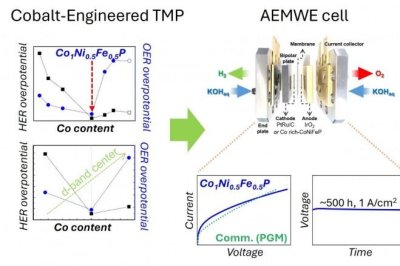
A graphic summarizes the performance of a cobalt-optimized, non-precious-metal catalyst used in an anion-exchange membrane water electrolysis system. Image courtesy of Chung-Ang University

June 15 (Asia Today) — South Korean researchers have developed a catalyst that could substantially reduce the cost of producing green hydrogen while delivering performance and durability comparable to catalysts made with expensive precious metals.

A research team led by Professor Don-Hyung Ha of Chung-Ang University developed multimetallic phosphide nanoparticles that do not require platinum, iridium or other costly precious metals, the university said Monday.

The research was conducted jointly with a team led by Professor Inho Nam of Chung-Ang University’s Department of Chemical Engineering and researchers led by Sung Jong Yoo of the Korea Institute of Science and Technology’s Center for Hydrogen and Fuel Cells.

The catalyst was used to build a high-performance anion-exchange membrane water electrolysis system, a technology considered a potential lower-cost option for producing clean hydrogen.

Water electrolysis uses electricity to split water into hydrogen and oxygen. When the electricity comes from renewable sources, the resulting fuel is commonly called green hydrogen because the production process does not directly emit carbon dioxide.

Many high-performance electrolyzers, however, rely on scarce and expensive catalysts containing platinum or iridium. Their cost and limited availability have been major obstacles to the large-scale commercialization of green hydrogen.

Anion-exchange membrane water electrolysis could reduce dependence on those metals because it can operate with less expensive materials. Existing non-precious-metal catalysts, however, often undergo changes to their surface structures during operation, resulting in lower efficiency and shorter operating lives.

The researchers sought to address the problem by designing nanoparticles made from cobalt, nickel, iron and phosphorus.

They used real-time spectroscopic analysis to examine changes in the catalyst’s oxidation state and surface structure while it was operating.

The team found that optimizing the amount of cobalt caused a stable, highly active structure to form on the catalyst’s surface during electrolysis. The researchers identified this surface reconstruction as a key factor in maintaining high catalytic activity and long-term durability.

In single-cell tests, a system using the catalyst at both the hydrogen-producing and oxygen-producing electrodes reached a current density of 5.73 amperes per square centimeter at 2 volts.

When the catalyst was used only at the oxygen-producing electrode, the system reached 11.43 amperes per square centimeter at the same voltage.

Higher current density generally indicates that an electrolyzer can produce more hydrogen from a given electrode area, although overall commercial performance also depends on factors including energy efficiency, system size, operating conditions and manufacturing cost.

The system also operated continuously for 500 hours at a commercially relevant current density of 1 ampere per square centimeter without a significant decline in performance, the researchers said.

The results indicate that non-precious-metal catalysts can deliver performance approaching that of systems using platinum-group metals.

The study combined control of the catalyst’s chemical composition, real-time analysis of its operating surface and performance testing in a complete electrolysis cell. The researchers said the integrated approach strengthens the catalyst’s potential for practical application.

“This study is academically significant because we precisely controlled the composition of a non-precious multimetallic phosphide catalyst and used real-time analysis to clarify how its surface changes during operation,” Ha said.

“It could serve as a milestone in developing low-cost water electrolysis electrodes that replace expensive precious-metal catalysts while providing both high performance and durability,” he said.

The research was supported by South Korea’s Ministry of Science and ICT through the H2GATHER program, the H2 NEXT ROUND program and a Korea Institute of Science and Technology clean hydrogen technology development program.

The study, titled “Cobalt-Engineered Multimetallic Phosphides with Switchable HER-OER Activity for Durable Anion Exchange Membrane Water Electrolysis,” was published online May 26 in Advanced Functional Materials.

— Reported by Asia Today; translated by UPI

© Asia Today. Unauthorized reproduction or redistribution prohibited.

Original Korean report: https://www.asiatoday.co.kr/kn/view.php?key=20260612001005481

Source link

South Sudan’s Jonglei: Who burned homes and silenced hospitals? | News

Juba, South Sudan – In the days before Lankien was attacked, doctors at the local hospital rushed to evacuate patients. Some were women in labour. Others were being treated for gunshot wounds. By the evening of February 3, just hours after the last patients were carried out, a bomb struck the empty facility, ripping a crater through its warehouse.

Fighting was underway in surrounding areas as South Sudan’s military pressed forward with a counteroffensive aimed at retaking territory seized by opposition armed groups. As the army advanced eastward through Jonglei State, it captured town after town, pushing opposition fighters towards the Ethiopian border.

In the aftermath of the bombing, residents said they were forced to flee into surrounding marshland on the morning of February 7 as mortar fire struck the town. Some eventually returned and described extensive destruction.

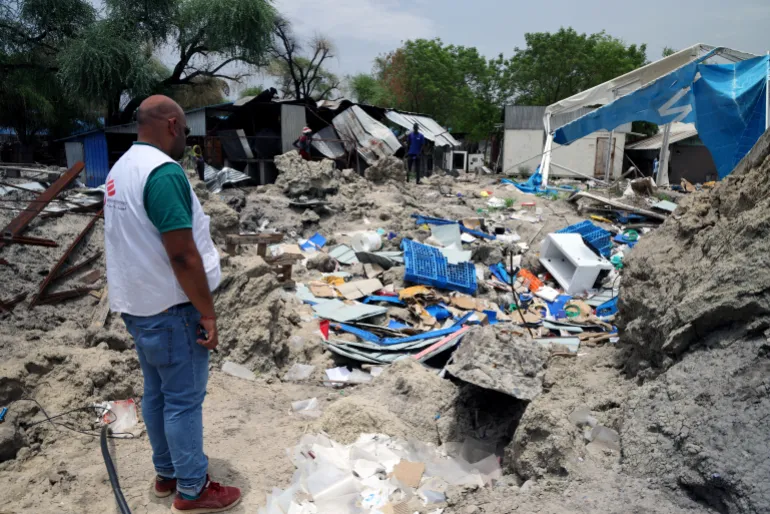
The hospital had been looted and burned. Its cold-chain storage unit, used to preserve vaccines, was set on fire. Vehicles were sprayed with bullets and stripped for parts. Solar-powered water systems had been dismantled. The local market was reduced to twisted metal sheets, while homes on the outskirts appeared to have been burned.

“Anything that can support the life of human beings was deliberately destroyed,” said Emmerson Gono, deputy head of mission for Doctors Without Borders, known by its French initials MSF, who visited Lankien in April, adding that this was his assessment based on what he observed.

A counteroffensive across Jonglei

Since the start of what authorities refer to as “Operation Enduring Peace,” satellite imagery analysed by the Centre for Information Resilience (CIR), combined with verified videos, images and witness accounts, indicates widespread destruction across a swathe of Jonglei that has long been a stronghold of opposition groups.

Both the military and opposition forces have been accused of razing villages and attacking civilians in recent months. In this area of Jonglei, which is home to a section of the Nuer ethnic group that officials often cast as hostile to the state, more than a dozen residents who spoke to Al Jazeera said they believed the military was responsible for targeted destruction that experts say has pushed tens of thousands of people towards the brink of famine.

evacuated, and patients were discharged hours before the attack, following increased tensions and after MSF received information about a possible attack against the city. [Courtesy of MSF]
Lankien hospital was evacuated, and patients were discharged hours before the attack, following increased tensions and after MSF received information about a possible attack against the city. [Courtesy of MSF]

In most of the 23 incidents CIR documented between late January and February, civilian structures, including homes, health facilities and markets, appear to have been burned and looted. CIR said the destruction was “likely to be more widespread and potentially part of what it described as a deliberate military strategy”.

“Using satellite imagery, we were able to map how troop movements from west to east followed a path of burning and looting,” said CIR researcher Kiria Borak, stressing that satellite imagery alone cannot determine intent or responsibility.

Some officials and humanitarian actors have attributed the destruction in Jonglei to clashes between government troops and opposition forces. However, residents told Al Jazeera that opposition fighters were not present when their villages were attacked. Those accounts could not be independently verified due to restricted access to the area.

Government officials did not respond to requests for comment on the specific allegations described in this report. In earlier statements, authorities have said military operations are conducted in self-defence and that civilians are not deliberately targeted.

Political backdrop

Violence has escalated since 2025, when opposition leader and first vice president Riek Machar was arrested on charges of subversion, allegations he denies. Machar and President Salva Kiir were once on opposing sides of the country’s 2013–2018 civil war, which killed hundreds of thousands of people before a peace agreement brought them into a fragile unity government.

The implementation of that agreement stalled amid delays in unifying armed forces into a national military and repeated postponements of national elections.

Following Machar’s arrest, the government undertook a campaign of aerial bombardments to beat back a simmering rebellion in rural areas. Machar’s political group declared the peace deal dead and began launching hit-and-run attacks on military positions.

Between December and January, opposition fighters, buoyed by support from local armed youth, seized several military garrisons in Jonglei, prompting the government to announce a counteroffensive on January 28.

Then-army chief Paul Nang ordered forces, drawn from the national army, intelligence units, police and allied militias, according to UN investigators, to retake territory held by opposition groups.

Analysts say the involvement of allied militias operating alongside formal units has complicated the determination of command responsibility.

‘Burning homes’

Five individuals who fled Lankien told Al Jazeera they witnessed events unfold on February 7.

They said government-aligned forces reached the outskirts of the town after fighting in a nearby village. Around late morning, mortar fire struck the town, followed by the arrival of ground forces in armoured vehicles.

Gai Ket, 32, said he had been cutting firewood when explosions began. He rushed back to town to look for his wife and children.

“The first thing I saw was smoke. SSPDF was burning homes,” he said, referring to the national army.

When he reached his house, he found his wife dead, with a severe wound to her chest. Bodies lay scattered across the neighbourhood. “Everything was gone,” he said.

South Sudan
The hospital’s main warehouse was destroyed during the attack, and we lost most of our critical supplies for providing medical care. [Courtesy of MSF]

Another resident, Puoch Duol, said he returned at night to search for his grandmother, who had been too weak to flee. He said he found her body among several others near the ruins of burned homes.

Satellite imagery reviewed by CIR indicates significant destruction in Lankien between February 7 and 9. On February 7, the army announced it was in control of the town.

MSF has said government forces were in control of Lankien in the days after the attack but has not assigned responsibility for the destruction. It said the government is the only party to the conflict with the capability to carry out aerial bombardments.

Government-appointed officials told Al Jazeera that opposition fighters looted the town during their withdrawal. Opposition representatives deny this, saying their forces were not present at the time. Neither account could be independently verified.

A pattern of destruction

Residents described a similar pattern of destruction across towns and villages stretching from the Nile River to the Ethiopian border. Armed men in military-style uniforms arrived in armoured vehicles, often after opposition forces were reported to have withdrawn, according to residents.

Homes and markets were burned, while health facilities and humanitarian compounds were looted. Civilians took refuge in swamps and forests, while those too weak to flee were killed or went missing.

CIR geolocated social media footage from Pathai showing fighters moving among burning structures towards a road leading into the town’s western entrance. The identities of those in the footage could not be independently verified.

Jany, an aid worker based in the town of Walgak, described an attack on February 5.

“We saw smoke everywhere. They were firing guns and burning houses,” he said.

Satellite imagery shows significant structural damage in Walgak between February 3 and 7, shortly after the town changed hands.

Humanitarian sources tracking developments in the area reported that multiple villages in the vicinity of Walgak were burned or destroyed during the same period. These accounts could not be independently verified due to restricted access and ongoing insecurity.

Remote sensing data shows clusters of fire activity across the region during the same period. However, satellite imagery alone cannot determine the cause or responsibility for the fires.

Command rhetoric and discipline

From the start of military operations, remarks by commanders raised concerns over civilian safety.

A video circulated on social media shows Johnson Olony, a deputy army chief who is also head of the Agwelek armed group, telling troops not to spare lives or property during operations. The government later said the remarks did not reflect official policy, and Olony apologised.

In another video, a commander identified as Wal Nyak appears to threaten violence against perceived opposition supporters. “Whether you are a woman or a girl, we will kill you all … We don’t want supporters of Riek Machar here,” he says.

Reports and satellite imagery point to burned villages and mass displacement across Jonglei. [Satellite imagery © Vantor]
Reports and satellite imagery point to burned villages and mass displacement across Jonglei. [Satellite imagery/Vantor]

The authenticity and full context of the footage could not be independently verified.

Humanitarian impact

Aid agencies say the consequences of the destruction reported in the area are severe and likely to last for months or longer.

At least 28 health facilities in Jonglei were damaged or looted this year, according to the UN. Seventy percent are no longer functioning.

The Integrated Phase Classification (IPC), a United Nations-backed analysis body, says there is a risk of famine in multiple counties, while more than 70,000 people are already facing the highest possible severity of hunger.

Nicholas Kerandi of the UN Food and Agriculture Organization said the impacts on food security and public health “are likely to persist through the remainder of the year and potentially beyond”.

Others say the alleged abuses in Jonglei have pushed South Sudan’s already fractured state to breaking point.

“The tribes don’t trust one another, the citizens don’t trust the government, and the government doesn’t trust its citizens,” Ter Manyang Gatwech, a human rights advocate from Jonglei, told Al Jazeera.

“Unless there is a miracle, South Sudan will disintegrate,” he said.

Source link

South Korea may propose wartime control transfer date

South Korea’s Minister of National Defense Ahn Gyu-back walks to deliver his speech during a plenary session of the International Institute for Strategic Studies (IISS) Shangri-la Dialogue Defence Summit in Singapore, 30 May 2026. Photo by HOW HWEE YOUNG/ EPA

June 14 (Asia Today) — South Korean Defense Minister Ahn Gyu-back said Sunday that Seoul and Washington plan to recommend a target year for transferring wartime operational control of South Korean forces by the end of this year.

Ahn said during an appearance on KBS television that the allies would discuss verification of their full operational capability assessment at their annual Security Consultative Meeting in November.

“If we complete the full operational capability verification and make a recommendation to the presidents of both countries at the end of this year, we will be able to determine the target year for restoring wartime operational control,” Ahn said.

The United States has retained wartime operational control of South Korean forces since the 1950-53 Korean War. South Korea exercises control over its military during peacetime.

The allies have agreed that the transfer should be based on three conditions: South Korea’s military capabilities to lead the combined defense, the alliance’s ability to respond comprehensively to North Korean nuclear and missile threats and a regional security environment conducive to a stable transfer.

The first condition includes three stages of evaluating a future South Korea-led Combined Forces Command: initial operational capability, full operational capability and full mission capability.

Ahn said the full operational capability assessment has been completed. Verification expected by the end of the year would allow the allies to begin specifying a timetable for the transfer.

Responding to concerns that the transfer may be premature, Ahn said waiting for every condition to be perfectly satisfied could postpone the process indefinitely.

“New weapons emerge from one day to the next and the nature of the battlefield continues to change,” Ahn said. “If we keep treating the conditions this way, we could wait forever.”

Although warfare is shifting toward drones and other advanced systems, South Korea has sufficient capabilities to lead combined operations, he said.

Asked whether a future combined command led by a South Korean four-star general could impede coordinated operations or the deployment of U.S. strategic assets, Ahn said the issue had not been discussed.

Ahn acknowledged that Seoul and Washington may have different views on the timing of the transfer.

“Even children raised by the same parents can think differently,” he said. “How could two countries have identical views?”

Ahn also discussed the Jangbogo-N project, South Korea’s plan to acquire nuclear-powered submarines, describing it as part of the country’s transition from a tactical state to a strategic state.

“A tactical state operates within a framework designed by major powers,” he said. “A strategic state creates the framework and takes the lead in planning and designing its response during a war or another crisis.”

South Korea is preparing to build the first nuclear-powered submarine in the mid-2030s, Ahn said.

He said the country possesses the necessary conventional submarine construction capabilities, advanced nuclear technology and world-class shipyards but lacks access to nuclear fuel suitable for naval propulsion.

South Korea plans to seek U.S. cooperation in obtaining uranium enriched to less than 20%, he said.

Ahn said Seoul and Washington had not yet agreed on where the submarines would be built.

“Building nuclear-powered submarines in another country would be less efficient in terms of costs and technology,” he said. “The United States is also coming to understand that position.”

Ahn dismissed concerns in some U.S. circles that the project could contribute to nuclear proliferation.

“Low-enriched uranium below 20% cannot be converted easily for use in a nuclear weapon,” he said. “South Korea has been a model member of the Nuclear Non-Proliferation Treaty.”

— Reported by Asia Today; translated by UPI

© Asia Today. Unauthorized reproduction or redistribution prohibited.

Original Korean report: https://www.asiatoday.co.kr/kn/view.php?key=20260614010004655

Source link

South Korea fans celebrate comeback World Cup win in Seoul

1 of 2 | South Korean soccer fans cheer during a public viewing event at Gwanghwamun Square in Seoul on Friday as South Korea played Czechia in their Group A match at the 2026 FIFA World Cup. Photo by Asia Today

June 12 (Asia Today) — Thousands of South Korean soccer fans packed Gwanghwamun Square in central Seoul on Friday, cheering, gasping and celebrating through South Korea’s 2-1 comeback victory over Czechia in its opening match of the 2026 FIFA World Cup.

“Dae-han-min-guk! Until the end!” fans shouted as the square turned red with supporters wearing national team jerseys and carrying South Korean flags, cheering sticks and handheld fans.

The Group A match was played Friday morning in South Korea, but the weekday timing did little to slow the crowd. Children, office workers and longtime members of the Red Devils, South Korea’s national soccer supporters’ group, gathered in front of a large outdoor screen set up near the square.

When the opening whistle sounded at 11 a.m., fans shouted “Fighting!” and “Let’s win!” Police unofficially estimated about 3,000 people had gathered at the square at the start of the match.

The temperature in Seoul rose to 28 degrees Celsius, or 82.4 degrees Fahrenheit, under clear skies. Many fans used parasols, portable fans and folding fans to cope with the heat.

Some supporters took vacation days to watch the match in public. Lee Hyun-soo, 37, an office worker who came with his elementary school-age child, said he used annual leave so they could cheer together.

“The next day is the weekend and my child also filed for an experiential learning day, so I took the day off,” Lee said. “It is very hot, but it is better than cloudy or rainy weather.”

South Korea controlled much of the early play but failed to score in the first half. When chances ended without a goal, fans grabbed their heads and groaned in frustration.

The crowd grew sharply near halftime as office workers from nearby buildings joined during their lunch breaks. Some skipped restaurant meals and watched while eating toast or convenience store food.

Kim Sung-il, 28, who works near Gwanghwamun Station, said he came with co-workers to watch the second half.

“Lunch break gives us enough time to watch the second half,” Kim said. “I hope the result lets us start the afternoon shift happily.”

As the crowd swelled, police and event staff moved quickly to control pedestrian flow. Seoul’s real-time city data showed about 14,000 to 16,000 people were in Gwanghwamun Square at noon, more than twice the 6,000 expected by the Korea Football Association.

Police deployed about 260 officers from three mobile units to manage the crowd. Officers and staff repeatedly asked fans to fold parasols while moving and to continue walking in one direction. No major safety incidents were reported.

The match turned tense in the second half. Czechia took the lead in the 59th minute when Ladislav Krejci scored with a header. The mood at the square briefly fell silent.

South Korea quickly answered. Hwang In-beom equalized in the 67th minute and later helped create the winning goal by substitute Oh Hyeon-gyu in the 80th minute.

As Oh’s goal went in, fans hugged friends, jumped in place and shouted in relief. Many stayed in the square after the final whistle, still caught up in the emotion of South Korea’s first opening-match win at a World Cup since 2010.

Kim Ji-min, 23, a university student, said she had been nervous before the match.

“I was very worried before the game, but I am so happy we came back and won,” Kim said.

Shim Sung-min, 42, an office worker, said the match felt cinematic.

“I heard this was South Korea’s first opening-match win in 16 years,” Shim said. “Today’s match felt like a movie. I think I can enjoy the rest of the weekend.”

South Korea’s win gave the team three points to begin Group A and lifted hopes among fans watching from Seoul that the national team can advance from the group stage.

— Reported by Asia Today; translated by UPI

© Asia Today. Unauthorized reproduction or redistribution prohibited.

Original Korean report: https://www.asiatoday.co.kr/kn/view.php?key=20260612010004331

Source link

From South L.A.’s erupting sidewalks, 5 questions for Bass and Raman

OK, I’ll admit it. I’m going to miss Spencer Pratt.

I had never heard of the former reality TV star before he said God wanted him to be mayor of Los Angeles. And now that he’s out of the race, he’s still serving up lazy fastballs down the middle of the plate, calling the top two vote-getters — Mayor Karen Bass and Councilmember Nithya Raman — dummies and morons.

Quick question for Pratt: If you’re on record claiming that 9/11 was an inside job and the Sandy Hook massacre was a hoax, and you run for office in a deep blue city with President Trump’s backing but not much of a plan or even a clue as to what a mayor can or can’t do, should you be calling other people morons?

And yet the pouting Pratt pulled more than 200,000 votes. So sore loser or not, he tapped into a lack of faith in elected officials and simmering frustration with City Hall, which happen to be the essence of today’s column.

I have five questions for Bass and Raman. They’re somewhat inter-related and have to do with matters I hear about regularly from readers:

Infrastructure (sidewalks, streets, etc).

Homelessness (billions of dollars spent, and a long way to go).

Parks (L.A.’s national ranking for quality and accessibility just dropped again).

Trash and blight (no explanation needed, right?).

And focus. (Do the candidates have a clear set of goals and a plan for achieving them?)

We’ve got five months to visit and revisit these topics, and today I’m going to focus on the first, so here we go.

Infrastructure:

A few days ago, I met with Earl Ofari Hutchinson of the Los Angeles Urban Policy Roundtable. Hutchinson is a longtime community activist and commentator, and he had just launched a torpedo in the direction of City Hall.

“There are hundreds of busted, dangerous sidewalks in South L A that have gone unrepaired for years,” he wrote to his network of followers. “They cause hundreds of injuries, and have resulted in massive numbers of claims and payouts in settlements. LA City Officials must act now to jumpstart a crash program to fix these sidewalks.”

On my way to meet Hutchinson, I traveled west along Florence Avenue and saw dozens of typical rough patches on the street and sidewalks. But if there were a contest to identify the all-time worst sidewalks in Los Angeles, Hutchinson’s discovery of the one at 71st Street and 11th Avenue would be a Hall of Fame contender.

For starters, it’s got the classic uplift, and the villain is the usual suspect — ficus tree roots. A 20-foot slab of sidewalk is pitched sharply, as if designed by trip-and-fall lawsuit lawyers. Way back in 2014, in my early days on sidewalk patrol, I was able to crawl under a similarly ruptured sidewalk in West L.A., and I could’ve done the same at 71st and 11th.

But I thought better of it after Hutchinson peered into the opening and said it looked like a comfy home for rats and other vermin.

The homeowner, Sharon Kelly, can’t use her front gate because of the lopsided sidewalk. She let me borrow her tape measure, which revealed a 16-inch rise in the pavement.

“It keeps rising,” Kelly said. “But it was already lifted when we came here.”

That was in 1997. I asked if she’s called the city for help.

“Several times,” she said, and the only response was a slapdash temporary asphalt patch.

Hutchinson said residents have responded in force to his call for emergency sidewalks repairs, just as they did when he crusaded for a crackdown on widespread illegal dumping.

“Dozens of residents have come out of the woodwork, and here’s what they all say: ‘We have called our city council person and various city departments repeatedly, over and over again.’”

And the response?

“Nothing,” Hutchinson said.

While we were talking, two people with walkers steered clear of the worst spot near Kelly’s property. Charles McQuarn, 77, said traversing the neighborhood means zigzagging around all the hazards.

“I gotta come out into the streets, too,” he said.

When he was a teenager, McQuarn said, he worked for a community group that fixed sidewalks. I mentioned that Councilmember Monica Rodriguez has been using Conservation Corps youths to do the same, but it’s time to scale up that program and come up with other remedies to speed the process.

The city is fixing about 600 sidewalks each year, the backlog of requested repairs stands at about 30,000 and if you get onto the waiting list, you’re looking at about 10 years before help arrives.

When we were done on 71st Street, Hutchinson led me over to a nearby stretch of Florence where, for blocks and blocks, it appears as if there have been volcanic eruptions around the trees. Large chunks of cracked sidewalk form mounds, one after another. The Hutchinson Himalayas are a site to behold — a mile-long museum of municipal neglect.

And it’s been like this, Hutchinson said, “for years.”

The question for Bass and Raman: What will you do to speed the repairs?

Homelessness:

Voters have been generous when it comes to repeatedly taxing themselves more, and more, to address homelessness. There’s been Measure H, Measure A, Measure ULA and Proposition HHH.

Yet although billions of dollars have been spent and tens of thousands of people have been helped and housed, more than 40,000 people are homeless in the city and roughly 70,000 in the county. In her primary victory speech, Bass said families shouldn’t have to step around encampments, and Raman has said greater urgency is needed.

Questions for Bass and Raman: Why haven’t taxpayers gotten more for their money with the two of you at the helm, what are you going to do to speed progress and create more accountability, and what distinguishes you from each other?

Parks:

In the annual rankings by the National Trust for Public Lands, Los Angeles has dropped from 90th to a tie for 93rd in park investment and accessibility among the nation’s 100 most populous cities.

The City Council is about to consider a motion to increase park funding through charter reform (with dozens of community groups in support), and progress is ridiculously slow on an agreement to use schools as after-hours playgrounds.

Question for Bass and Raman: Do you support the charter reform, and what else are you going to do to address the sad state of the city’s parks?

Trash and blight:

In downtown L.A., vandalism, shuttered storefronts and post-COVID abandonment have crippled what was a vibrant, revenue-generating economy that benefited the whole city.

In Hollywood, a resident hired her housekeeper to help report illegal dumping of goods that are often used to construct more homeless encampments, leading to all sorts of problems.

On the south lawn of City Hall, a graffiti-tagged monument and fountain have been out of commission for most of the last six decades.

Question for Bass and Raman: At the very least, can you fix the fountain?

Focus:

Like any big city with great assets and unlimited challenges, many residents have a love-hate relationship with L.A. But years ago, someone told me he loves Los Angeles because it’s a messy, multi-cultural work in progress, set on a dramatic landscape between mountain and sea, trying to figure out what it wants to be.

Question for Bass and Raman: Whether in the realm of basic services or grand visions, what three or four primary objectives do you have over the next four years?

In other words, what do you want L.A. to be?

steve.lopez@latimes.com


Source link

One killed as Israel hits south Lebanon, issues forced displacement orders | Israel attacks Lebanon News

The Israeli military has ordered residents of 20 Lebanese towns and villages to leave their homes immediately.

Israeli air raids across southern Lebanon have killed one person as attacks continue despite a United States-brokered “ceasefire”.

Lebanon’s National News Agency (NNA) reported that the person was killed in an Israeli air raid in the municipality of Maarakeh, in the Tyre district of southern Lebanon.

Recommended Stories

list of 4 itemsend of list

Al Jazeera’s Heidi Pett, reporting from Beirut, said that over the course of Friday and into the evening, there were continued Israeli air attacks on towns and villages that are well north of what the Israelis call the “Yellow Line” – the part of southern Lebanon that they have been seeking to control and to occupy.

The attacks come after an announcement by Pakistani Prime Minister Shehbaz Sharif on Friday that the United States and Iran have agreed on the wording of an agreement aimed at ending their war, and that mediators were working with both sides to finalise a deal.

Iranian media report the initial agreement would declare an end to the war “on all fronts, including Lebanon”.

This has led to fears that Israel’s actions in Lebanon could scupper a deal, since Israel is not a party to the negotiations between the US and Iran, and its leaders have said they do not plan to withdraw from Lebanon.

The attacks also come amid a supposed ceasefire, agreed between Israeli and Lebanese officials earlier this month, that would require a “complete cessation” of fire by Hezbollah, yet the fighting continues.

The next round of talks between the two countries is expected on June 22, with a view towards reaching a comprehensive agreement.

Israel issues forced displacement orders, demolishes homes

Israeli attacks at dawn have demolished homes and government buildings in southern Lebanon’s Bint Jbeil, the country’s NNA reports.

The Israeli military also ordered residents of 20 Lebanese towns and villages to leave their homes immediately and move “north of the Zahrani River”.

The forced displacement orders apply to Deir al-Zahrani, al-Namirieh, al-Sharquieh, al-Dewayr, Harouf, Habboush, Kfarjoz, Zibdine (Nabatieh), Nabatieh al-Tahta, Nabatieh al-Fawqa, Kfar Rouman, Al-Mahmoudieh, Sajed (Jezzine), Reihan, Aaramta, Kfarchouba, Mlki, Al-Lawiza (Jezzine), Jarjouh and Arab Salim.

On Saturday, the Israeli military said an air raid alert had been activated in the northern town of Metula due to the “infiltration of a hostile aircraft” from Lebanon, but did not name the armed group Hezbollah.

Source link

South Korea turns master workers’ know-how into AI data

Trade, Industry and Resources Minister Kim Jung-kwan addresses the first general congress of the Manufacturing AX Alliance at the headquarters of the Korea Chamber of Commerce and Industry in Seoul, South Korea. The government-led alliance groups businesses and organizations working for the artificial intelligence transformation of manufacturing industries. Photo by YONHAP / EPA

June 12 (Asia Today) — South Korea’s Trade Ministry is accelerating a project to convert master workers’ tacit manufacturing knowledge into artificial intelligence data as the country seeks to preserve industrial skills threatened by aging and labor shortages.

Tacit knowledge refers to experience and know-how that skilled workers often use without writing it down. In manufacturing, it can include judgment used in process optimization, quality control, welding, equipment checks and other work that depends on years of experience.

The Ministry of Trade, Industry and Energy held the fourth M.AX conference Friday at the Korea Chamber of Commerce and Industry in central Seoul. The conference focused on development and cooperation strategies for using master workers’ tacit knowledge in manufacturing AI transformation.

Officials and experts discussed how to build AI systems that can capture knowledge from industrial sites and how labor and management can cooperate in the process.

The ministry said skilled manufacturing experience is becoming a core asset in the AI era. Officials warned that if the know-how of retiring workers is lost, companies could face weaker process control, lower quality management and reduced manufacturing competitiveness.

The government is using 48 billion won, or about $31.2 million, from this year’s supplementary budget to support pilot projects for 30 manufacturing processes. The projects will build tacit knowledge datasets and develop AI models.

The ministry plans to prioritize processes with high safety risks or severe labor shortages. AI models developed through the project are also expected to be used to train new workers.

The conference included examples of AI already being applied in manufacturing. Sungwon, a stainless steel pipe maker, said it is using AI in welding work where skilled workers previously relied on visual judgment to support operators’ decision-making.

Participants said the project’s success will require data standardization, verification systems, proper compensation for workers who share their knowledge and sufficient communication with employees before implementation.

Some participants also proposed creating an advisory group of national quality masters so the project can better reflect expertise from actual manufacturing sites.

Kim Sung-yeol, head of the ministry’s industrial growth office, said the project is designed to protect South Korea’s manufacturing base.

“This project is about protecting manufacturing and manufacturing sites, which are among our core assets,” Kim said. “Because it is a project to preserve and transfer the tacit knowledge of master workers, we will do our best to help solve difficulties at manufacturing sites.”

— Reported by Asia Today; translated by UPI

© Asia Today. Unauthorized reproduction or redistribution prohibited.

Original Korean report: https://www.asiatoday.co.kr/kn/view.php?key=20260612010004392

Source link

South Korea exhibit traces 80 years of art ties with Japan

The San Francisco Museum of Modern Art (SFMOMA) presents the work of the late Nam June Paik, Korean American artist, who is considered to be the founder of video art, during a press preview of his first-ever retrospective exhibition in San Francisco, California. Photo by JOHN G. MABANGLO / EPA

June 12 (Asia Today) — Nam June Paik connected Seoul, Tokyo and New York by satellite in 1986.

His project, “Bye Bye Kipling,” brought Korean traditional dance, American popular music and Japanese avant-garde art together on one screen in real time. The work directly challenged British writer Rudyard Kipling’s famous line that East and West could never meet, presenting instead the possibility of communication across borders and cultures.

That history of encounter and exchange is at the center of “Road movie: Art between Korea and Japan since 1945,” now on view at the National Museum of Modern and Contemporary Art, Korea, in Gwacheon. The exhibition marks the 60th anniversary of normalized diplomatic relations between South Korea and Japan and traces 80 years of artistic exchange since Korea’s liberation in 1945.

The exhibition features about 200 works by 43 artists and artist teams from both countries. It was jointly organized by the Korean museum and the Yokohama Museum of Art. The show first opened in Yokohama late last year and drew about 37,000 visitors before coming to South Korea.

Featured artists include Nam June Paik, Lee Ufan, Lee Bul, Jung Yeondoo, Koki Tanaka, Jiro Takamatsu and Takashi Murakami, along with other major figures in contemporary Korean and Japanese art.

Paik is one of the central figures in the exhibition. He studied aesthetics and art history in Japan in the 1950s and later built close ties with Japan’s avant-garde art scene. It was there that he met Shigeko Kubota, his lifelong partner and artistic collaborator.

Alongside “Bye Bye Kipling,” the exhibition presents Kubota’s video work “Broken Diary: Korean Trip,” which documents Paik’s return to South Korea after 34 years abroad.

The exhibition, however, does not focus only on well-known artists. Its first section, “In Between: Zainichi Koreans’ Gaze,” examines the lives of Korean artists who remained in Japan after liberation. Cho Yanggyu’s “Sealed Warehouse” depicts a dark, enclosed labor site and reflects both the reality faced by Zainichi Koreans and the wounds left by national division.

The exhibition also explores the growth of artistic exchange after South Korea and Japan normalized diplomatic relations in 1965. Works by Lee Ufan, Park Seo-bo, Yun Hyong-keun, Jiro Takamatsu and Kishio Suga show how artists in the two countries influenced one another as modern art movements developed across borders.

Later works by Masato Nakamura, Takashi Murakami and Lee Bul show how artistic exchange expanded in the 1990s from official institutions to personal networks and collaborative relationships.

Lee Bul’s “Cyborg W5” presents a futuristic but incomplete body, questioning boundaries between humans and machines and between male and female identities. The work reflects the shared concerns about technology and identity that shaped Korean and Japanese contemporary art after the 1990s.

The exhibition’s final section shifts from past exchange to present-day solidarity. Koki Tanaka’s “Vulnerable Histories: A Road Movie” links the massacre of Koreans after the 1923 Great Kanto Earthquake to more recent anti-Korean demonstrations in Japan, asking viewers to consider histories of discrimination and exclusion.

Jung Yeondoo’s “Magician’s Walk” reflects on landscapes after the 2011 Great East Japan Earthquake and explores the possibility of empathy and solidarity with the suffering of others.

The exhibition also extends to the museum’s outdoor sculpture park in Gwacheon. Six sculptures by Korean artists based in Japan and Japanese artists, including Duckjun Kwak, Quac Insik and Lee Ufan, highlight the museum’s role as an important site of Korean-Japanese artistic exchange.

Kim Sung-hee, director of the National Museum of Modern and Contemporary Art, Korea, said the exhibition revisits “historical moments experienced by the two countries and the traces of artistic exchange formed within them.”

Kim said she hopes the exhibition will offer visitors a chance to rediscover “the status and possibilities of Korean and Japanese contemporary art.”

The exhibition runs through Sept. 27.

— Reported by Asia Today; translated by UPI

© Asia Today. Unauthorized reproduction or redistribution prohibited.

Original Korean report: https://www.asiatoday.co.kr/kn/view.php?key=20260612010003954

Source link

Opening day of World Cup brings wins for Mexico and South Korea

Mexico wins World Cup opener

From Eduard Cauich: FIFA president Gianni Infantino described Mexico City Stadium as a venue “blessed by the gods” and a “true cathedral of soccer.”

Azteca Stadium, as most people know it, is steeped in soccer history and is now the only venue to host three World Cup opening ceremonies. But the Mexican national team had never much World Cup success at the venue.

On Thursday, spurred on by most of the 80,824 fans in attendance and forwards Julián Quiñones and Raúl Jiménez, Mexico managed to defeat South Africa 2-0 and securing its first opening match victory.

Mexico opened the scoring in the ninth minute when Quiñones capitalized on a defensive error by South Africa and fired a shot down the middle, between the legs of goalkeeper Ronwen Williams. The striker, a top scorer in the Saudi Pro League, immediately ran off to celebrate with the bench, marking the first goal of the tournament. The crowd responded by throwing beer into the air.

Mexico continued to press with numerous chances in the first half, including another shot by Quiñones that hit the post and another great save by Williams, who was South Africa’s best player.

“We were far superior in the first half; we could have been up 3-0,” Mexico coach Javier Aguirre said.

Continue reading here

U.S. vs. Paraguay: Breaking down the challenges in World Cup opener

FIFA World Cup Day 1: Live updates, TV schedule, players to watch and group previews

Click here for complete TV schedule, groups and players to watch

Go beyond the scoreboard

Get the latest on L.A.’s teams in the daily Sports Report newsletter.

Today’s World Cup TV schedule

Noon, Canada vs. Bosnia-Herzegovina, Fox, Telemundo
6 p.m. U.S. vs. Paraguay, Fox, Telemundo

Saturday’s World Cup TV schedule

Noon, Qatar vs. Switzerland, Fox, Telemundo
3 p.m., Brazil vs. Morocco, FS1, Telemundo
6 p.m., Haiti vs. Scotland, FS1, Telemundo
9 p.m., Australia vs. Turkey, FS1, Telemundo

Sunday’s World Cup TV schedule

10 a.m. Germany vs. Curacao, Fox, Telemundo
1 p.m. Netherlands vs. Japan, Fox, Telemundo
4 p.m. Ivory Coast vs. Ecuador, FS1, Telemundo
7 p.m. Sweden vs. Tunisia, FS1, Telemundo

Ohtani hurts knee in Dodgers’ victory

From Maddie Lee: The Dodgers couldn’t have asked for better timing, as Shohei Ohtani’s leadoff spot came back around.

In a game the Dodgers would go on to win 8-6 over the Pirates, they were clinging to a two-run lead in the top of the seventh inning against the Pirates on Thursday. With one out and runners on first and second, the Dodgers superstar, who had already reached base four times, was due up.

Instead, Santiago Espinal stepped up to the plate as a pinch-hitter.

Ohtani left the game with inflammation in his left knee, the Dodgers announced.

“Just wanted to be smart and not push it,” manager Dave Roberts said. “So I feel good about him being in there [Friday]. But obviously with the travel [to Chicago Wednesday night], we’ll just kind of see how he comes in.”

Roberts described the injury as “discomfort” at the back of Ohtani’s knee, around where the hamstring attaches. Though Ohtani underwent surgery on the same knee in 2019, that was to address bipartite patella, on the other side of the knee.

Continue reading here

How the Dodgers plan to shuffle catchers with Will Smith on the injured list

Dodgers box score

MLB standings

Rams cancel minicamp

From Gary Klein: Unless they are in Maui, as they were last year, Rams coach Sean McVay annually opts to cancel mandatory minicamps after the initial report day.

This year, McVay avoided any pretense of suspense.

On Thursday, he announced to his players that after fulfilling some broadcast media responsibilities on Monday, they would not have a minicamp and break until they report to training camp at Loyola Marymount in late July, a Rams official said.

McVay’s announcement came about a week after San Francisco 49ers coach Kyle Shanahan canceled minicamp, and Seattle Seahawks coach Mike Macdonald did the same.

The Rams play the 49ers in their Sept. 10 season opener in Melbourne, Australia.

Continue reading here

Stanley Cup Final Game 5

Andrei Svechnikov scored twice and Sebastian Aho added a second-period goal in a breakout game for Carolina’s top-line performers, helping the Hurricanes beat the Vegas Golden Knights 4-2 on Thursday night to move one victory away from the Stanley Cup.

Captain Jordan Staal added his fifth goal in the series on a night when Carolina overcame multiple hiccups from these playoffs, from a shaky power play to being outplayed in the second period of this series.

And there had been the waiting game for Aho and Svechnikov — two roster mainstays in an eight-year postseason run — to find a better offensive groove.

Continue reading here

Game 5 summary

This day in sports history

1920 — Man o’ War wins the Belmont Stakes, which was run at 1 3/8-miles, in 2:14 1/5. He shatters the world record by 3 1/5 seconds and sets the American dirt-course record for that distance.

1930 — Max Schmeling beats Jack Sharkey on a fourth-round foul for the vacant heavyweight title in New York. Schmeling becomes the first German — and European — heavyweight world champion.

1939 — Byron Nelson wins the U.S. Open in a three-way playoff with Craig Wood and Denny Shute.

1948 — Citation, ridden by Eddie Arcaro, wins the Belmont Stakes and the Triple Crown with an eight-length victory over Better Self. It’s Arcaro’s second Triple Crown. He rode Whirlaway in 1941.

1948 — Ben Hogan wins the U.S. Open with a record 276, five fewer than Ralph Guldahl’s 1937 record.

1954 — Milwaukee Braves spot starting pitcher Jim Wilson throws first no-hitter in history of County Stadium when he blanks Philadelphia Phillies, 2-0.

1979 — Bobby Orr becomes the youngest player in NHL history to be selected for the Hockey Hall of Fame. The 31-year-old is inducted months after officially ending his NHL career as the Hall waives its usual three-year waiting period.

1981 — Larry Holmes stops Leon Spinks in the third round for the WBC heavyweight title in Detroit.

1983 — Patty Sheehan wins the LPGA championship by two strokes over Sandra Haynie.

1984 — 38th NBA Championship: Boston Celtics beat Lakers, 4 games to 3, to win the championship title.

1990 — Egypt, a 500-1 shot, stuns the Netherlands when Magdi Abdel-Ghani makes a penalty kick with eight minutes remaining to tie the World Cup favorites 1-1.

1991 — The Chicago Bulls win the first NBA championship in the team’s 25-year history with a 108-101 victory in Game 5 over the Lakers. MVP Michael Jordan scores 30 points, Scottie Pippen has 32 and John Paxson 20.

2002 — NBA Finals: Lakers beat New Jersey Nets, 113-107 for a 4-0 sweep and 3rd straight title; MVP: Shaquille O’Neal for 3rd consecutive Finals series.

2005 — Annika Sorenstam closes with a 1-over 73 for a three-shot victory over Michelle Wie in the LPGA Championship. The 15-year-old Wie shoots a 69 to finish second. It’s the highest finish by an amateur in a major since 20-year-old Jenny Chuasiriporn lost a playoff to Se Ri Pak in the 1998 U.S. Women’s Open.

2008 — The Boston Celtics overcome a 24-point deficit and beat the Lakers 97-91 to take a commanding 3-1 lead in the NBA finals. No team has ever overcome more than a 15-point deficit after the first quarter, and the Celtics post the biggest comeback in the finals since 1971.

2009 — Pittsburgh’s Max Talbot scores two second-period goals as the Penguins beat the defending champion Detroit Red Wings 2-1 in Game 7 and win the Stanley Cup at Detroit’s Joe Louis Arena.

2011 — The Dallas Mavericks win their first NBA title by winning Game 6 of the finals in Miami, 105-95. Jason Terry scores 27 points and Dirk Nowitzki adds 21 as the Mavericks win four of the series’ last five games.

2013 — Andrew Shaw scores on a deflection in triple overtime to lift the Chicago Blackhawks to a 4-3 victory over the Boston Bruins in a riveting Game 1 of the Stanley Cup finals. The Blackhawks gets third-period goals from Dave Bolland and Oduya to erase a 3-1 deficit.

2016 — Sidney Crosby sets up Kris Letang’s go-ahead goal midway through the second period and the Pittsburgh Penguins win the fourth Stanley Cup in franchise history by beating the San Jose Sharks 3-1 in Game 6 of the Stanley Cup final.

2017 — Kevin Durant caps his spectacular first season with the Warriors by bringing home an NBA championship. Durant, who joined Golden State last July, scores 39 points in a finals-clinching 129-120 victory over LeBron James and the Cleveland Cavaliers.

2019 — Stanley Cup Final, TD Garden, Boston, MA: St. Louis Blues beat Boston Bruins, 4-1 for a 4-3 series victory; first title in franchise history.

2021 — Danish soccer midfielder Christian Eriksen suffers an on-field cardiac arrest during a Euro 2020 match with Finland in Copenhagen. Eriksen is revived with a defibrillator and the game controversially continues with a 1-0 Finland win.

2023 — NBA Finals: Denver Nuggets beat Miami Heat 94-89 to win the franchise’s first Championship; clinch series 4-1; MVP: Denver C Nikola Jokić.

Compiled by the Associated Press

This day in baseball history

1922 — Hub Pruett struck out Babe Ruth three consecutive times, and the St. Louis Browns beat the New York Yankees 7-1.

1928 — Lou Gehrig of the New York Yankees had two triples and two homers in a 15-7 victory over the Chicago White Sox.

1939 — The Baseball Hall of Fame was dedicated at Cooperstown, N.Y.

1954 — Milwaukee’s Jim Wilson pitched the year’s only no-hitter, blanking the Philadelphia Phillies 2-0.

1957 — Stan Musial of the St. Louis Cardinals broke the National League record for endurance when he played in his 823rd consecutive game. The previous mark was established in 1937 by Pirates first baseman Gus Suhr.

1959 — The San Francisco Giant’s Mike McCormick tossed a 3-0, five-inning no-hitter against the Philadelphia Phillies. Richie Ashburn singled in the top of the sixth for the Phillies, but the hit didn’t count because the game was stopped by rain.

1962 — In Milwaukee’s 15-2 rout of the Dodgers at County Stadium, the Aaron brothers both homer in the same game with Tommie connecting in the bottom of the eighth after his older brother Hank had hit one out in the second.

1970 — Dock Ellis of the Pittsburgh Pirates hurled a 2-0 no-hitter in the first game of a doubleheader against the San Diego Padres. Ellis walked eight and hit a batter, and Willie Stargell hit two homers.

1981 — Thirteen games were canceled due to the players’ strike.

1997 — After 126 years, baseball broke its tradition and played interleague games. The San Francisco Giants beat the Texas Rangers 4-3.

1999 — Cal Ripken went 6-for-6, homering twice and driving in six runs as the Baltimore Orioles scored the most runs in franchise history with a 22-1 rout of the Atlanta Braves.

2006 — Jason Grimsley was suspended 50 games by Major League Baseball, less than a week after federal agents raided his home during an investigation into performance-enhancing drugs.

2007 — Justin Verlander pitched a no-hitter to lead the Detroit Tigers over the Milwaukee Brewers 4-0. Verlander struck out a career-high 12, walked four and benefited from several stellar defensive plays.

2009 — Chicago right fielder Milton Bradley had a bad day at Wrigley Field. Bradley lost Jason Kubel’s pop-up in the sun for a single, couldn’t catch Michael Cuddyer’s RBI bloop double, made a baserunning blunder and, most egregiously, flipped the ball into the stands after catching Mauer’s one-out sac fly.

2009 — New York Mets second baseman Luis Castillo dropped Alex Rodriguez’s lazy popup with two out in the ninth inning as two runs scored, helping the Yankees escape with a wild 9-8 victory over the Mets.

2010 — Daniel Nava hit the first pitch he saw as a big leaguer for a grand slam — only the second player to do it — leading the Boston Red Sox to a 10-2 rout of the Philadelphia Phillies. Nava connected on a fastball from Joe Blanton in the second inning. Kevin Kouzmanoff hit a slam on the first pitch he saw Sept. 2, 2006, for Cleveland against Texas.

2011 — Realignment is on the table again as Major League Baseball and the Major League Baseball Players Association are in discussions to renew the collective bargaining agreement, which expires on December 11th. One of the options being discussed would see one team moving from the National League to the American League to create two 15-team leagues, with the Houston Astros the likeliest candidate for a move.

2012 — Alex Rodriguez ties Lou Gehrig’s record by hitting his 23rd career grand slam.

2016 — Sam Cohen put UC Santa Barbara into its first College World Series with a pinch-hit grand slam in the bottom of the ninth inning for a 4-3 victory over second-seeded Louisville 4-3 in the Super Regionals.

2017 — Royce Lewis, a high school shortstop from California, is selected first overall by the Minnesota Twins in the 2017 amateur draft.

2018 — Tigers 1B Miguel Cabrera suffers a season-ending injury when he tears a biceps tendon while swinging at pitch in the third inning of a game against the Twins. He had already missed all but one game of May with a hamstring injury.

Compiled by the Associated Press

Until next time…

That concludes today’s newsletter. If you have any feedback, ideas for improvement or things you’d like to see, email me at houston.mitchell@latimes.com. To get this newsletter in your inbox, click here.

Source link