Comparison of stablecoin market share in South Korea shows Tether dominating domestic trading, while USD Coin leads in global on-chain payment volume. Data from Bank of Korea and CoinDesk. Graphic by Asia Today and translated by UPI
April 14 (Asia Today) — Circle is stepping up efforts to expand its stablecoin footprint in South Korea, aiming to challenge the dominance of Tether through a dual strategy focused on trading and payments.
Tether currently accounts for more than 80% of stablecoin transactions in South Korea and over 60% globally, according to industry data. Circle’s USD Coin, or USD Coin, holds a much smaller share in Korea, at around 10%.
Industry officials said Circle recently met with major South Korean exchanges, including Upbit, Bithumb and Coinone, to expand USDC trading and improve accessibility. The move is aimed at securing liquidity in one of the world’s largest cryptocurrency markets.
Circle CEO Jeremy Allaire visited South Korea this week and signed agreements with local exchanges and fintech firms to promote stablecoin adoption.
With Dunamu, the operator of Upbit, Circle is working on initiatives focused on regulatory compliance, transparency and user education. With Bithumb, the companies agreed to explore integration of multi-chain digital asset infrastructure and stablecoin technologies. Promotions such as fee discounts and airdrops are also being used to boost USDC trading on platforms like Coinone.
Beyond exchange trading, Circle is also expanding its payment infrastructure. The company is promoting its proprietary network to support real-world payments and cross-border transfers, including partnerships with South Korean fintech firm Hecto Financial.
Analysts say this reflects a broader strategy to compete with Tether not only in trading volume but also in real-world financial use cases.
USDC is backed by cash and U.S. Treasury assets and publishes regular disclosures, a structure that has made it attractive to financial institutions. It also operates across multiple blockchain networks, offering flexibility in transaction speed and fees.
Data suggests USDC has gained traction in payments and transfers. According to industry estimates, its on-chain transaction volume reached about $17 trillion last year, exceeding Tether’s roughly $12.9 trillion, indicating stronger usage in real-world transactions rather than exchange trading.
Experts say competition between the two stablecoins is shifting from market share to function.
“Stablecoin competition is no longer about issuance volume but about use cases,” said Gautam Chughani of CoinShares, adding that USDC is expanding rapidly in payments and institutional finance.
Analysts say Tether is likely to maintain its strength in trading liquidity, while USDC could gain ground through integration with the broader financial system.
Circle said it does not plan to issue a Korean won-pegged stablecoin directly, signaling instead that it may participate as a technology provider in a future bank-led consortium structure.
Data from Stanford University Human-Centered AI Institute’s “2026 AI Index Report.” Graphic by Asia Today and translated by UPI
April 14 (Asia Today) — South Korea ranked first in the world for artificial intelligence patent filings per capita in 2024, underscoring the country’s high concentration of AI innovation even as the broader global market remains dominated by the United States and China, according to Stanford University’s 2026 AI Index Report.
The report said South Korea recorded 14.31 AI patent filings per 100,000 people, the highest among countries surveyed. Luxembourg followed with 12.25, while China posted 6.95, the United States 4.68 and Japan 4.3.
South Korea also posted the largest increase in AI use among 30 countries surveyed. Its usage rate rose to 30.7% in the second half of 2024 from 25.9% in the first half, an increase of 4.8 percentage points.
The United Arab Emirates ranked first in overall AI adoption at 64%, followed by Singapore at 60.9%, Norway at 46.4% and Ireland at 44.6%. South Korea ranked 18th in overall usage despite recording the sharpest increase.
China accounted for 74.24% of AI patents worldwide, far ahead of the United States at 12.06%, the report said. Stanford researchers said China has nearly closed the performance gap with the United States in AI, while Washington continues to hold advantages in capital, infrastructure and AI semiconductors.
The report said China has shown particular strength in physical AI fields such as patents, research papers and autonomous robotics, while countries such as South Korea are competing by building on their own specialized advantages.
It also said the number of countries with government-backed supercomputing clusters rose to 44 after major AI infrastructure investment in Europe and Central Asia last year. Stanford’s AI Index, now in its ninth year, is widely used as a data-based benchmark for tracking the global AI industry.
The Korean National Police Agency headquarters in Seoul. Photo by Asia Today
April 13 (Asia Today) — South Korean police have referred nearly 2,000 suspects to prosecutors following a nine-month crackdown on corruption involving public officials, illegal kickbacks and safety violations.
The National Investigation Headquarters of the Korean National Police Agency said Monday that 1,997 people were referred for prosecution between July 1 and March 31, including 56 who were detained.
The probe targeted three main areas: corruption by public officials, unfair business practices and safety-related violations.
Among those referred, 548 were public officials, with 17 taken into custody.
Bribery accounted for the largest share, with 322 suspects referred and 31 detained. Authorities also referred 410 suspects in kickback cases, 507 for financial irregularities, 513 for substandard construction and 52 for hiring-related corruption.
Police said the investigation focused on systemic corruption across government offices and industrial sectors and will expand to include locally entrenched corruption networks.
In one case, police referred nine people, including the head of a Seoul branch of a postal workers’ union, on charges of misusing union funds for an election campaign and overseas travel expenses. The union leader was detained.
In another case, three local council members in Gangwon Province were referred for allegedly offering or receiving money and gifts during an internal vote to elect a council chair. One was detained.
Authorities also uncovered corruption in the medical sector. Police in Busan referred 31 individuals, including a doctor and medical device company officials, for allegedly receiving about 165 million won (about $123,000) in exchange for supply contracts. Two were detained.
Police said they will continue investigating 1,699 suspects tied to unresolved cases and have launched a separate crackdown on local corruption since early last month.
An official from the national investigation body said strong enforcement efforts must be accompanied by public reporting to effectively root out corruption.
President Lee Jae Myung (3-L, rear) attends a meeting of top commanders of the Army, Air Force and Navy at the defense ministry in Seoul, South Korea, 27 March 2026. Photo by YONHAP / EPA
April 13 (Asia Today) — South Korea’s Defense Ministry said Monday it is strengthening fuel procurement and management to ensure military readiness as global energy supply uncertainty rises.
Vice Minister of Defense Lee Doo-hee visited an Army corps unit to inspect fuel storage operations and energy conservation measures, urging tighter management of military fuel reserves.
The visit came as concerns grow over global energy disruptions linked to the Middle East conflict, prompting the government to emphasize stable fuel supplies as a key element of military preparedness.
Lee said effective fuel management is essential to maintaining operational capability in both peacetime and wartime, calling on units to ensure they can carry out missions immediately under any circumstances.
He also stressed the need to strengthen safety management and emergency response systems at military fuel storage facilities.
The government recently raised its resource security alert level for crude oil from “caution” to “alert,” reflecting heightened concerns over supply stability.
Lee urged commanders to improve efficiency in unit operations and promote energy-saving practices across military bases to conserve resources.
The Philippines has raised alarm after discovering cyanide on Chinese vessels operating near a disputed atoll in the South China Sea, intensifying tensions in an already volatile region.
Officials say laboratory tests confirmed the presence of the toxic substance in materials seized during naval operations at Second Thomas Shoal, known in the Philippines as Ayungin Shoal.
The area is a longstanding flashpoint between Philippines and China, with both sides asserting competing claims.
Why the Allegation Matters
Philippine authorities are framing the discovery as more than an environmental violation. According to security officials, the use of cyanide could damage marine ecosystems, kill fish stocks, and weaken the reef structure beneath a grounded Philippine naval vessel stationed at the shoal.
That ship plays a critical role in maintaining Manila’s territorial claim, meaning any environmental damage could also have strategic consequences.
Officials have gone as far as calling it an act of sabotage.
Rising Tensions at Sea
The accusation comes against a backdrop of repeated confrontations in the area. Manila has previously accused Beijing of interfering with resupply missions to its troops stationed on the grounded vessel, including a violent 2024 incident that injured a Filipino sailor.
China has consistently denied such allegations, instead accusing the Philippines of encroaching on its territory.
Despite recent diplomatic talks aimed at reducing friction, incidents at sea continue to test fragile understandings between the two sides.
The Bigger Dispute
The South China Sea remains one of the world’s most contested regions. China claims nearly the entire waterway, overlapping with claims from several Southeast Asian nations.
A 2016 international tribunal ruling rejected Beijing’s sweeping claims under international law, but China does not recognize the decision.
With more than $3 trillion in global trade passing through these waters each year, even localized tensions carry global significance.
Implications: Environment Meets Geopolitics
This incident adds a new dimension to the dispute by linking environmental harm with strategic rivalry.
If proven, the use of cyanide could:
Escalate diplomatic tensions between Manila and Beijing
Draw wider international attention to environmental practices in contested waters
Further complicate already fragile cooperation efforts in the region
It also underscores how control over maritime territory is not just about military presence, but also about sustaining the ecosystems that support it.
Analysis: A Dangerous New Phase
The allegation signals a shift in how disputes in the South China Sea are unfolding. Beyond naval standoffs and legal arguments, there is now a growing risk of indirect tactics that target resources and infrastructure.
Whether intentional or not, the incident deepens mistrust and makes de-escalation more difficult.
The cyanide discovery is more than an environmental concern. It is a geopolitical flashpoint that could further inflame one of the world’s most sensitive maritime disputes.
As tensions persist, even seemingly small incidents have the potential to ripple far beyond the waters where they occur.
Rescuers are digging through rubble after a new wave of Israeli strikes across southern Lebanon killed at least 13 people. The attacks hit multiple towns in the Tyre and Nabatieh districts. The death toll from Israeli attacks in Lebanon climbs above 2,000.
April 10 (Asia Today) —This commentary is the Asia Today Editor’s Op-Ed.
U.S. President Donald Trump is reportedly considering pulling American troops from NATO countries he sees as uncooperative during the Middle East war. The idea suggests he is again weighing a transactional approach to alliances, using troop deployments as leverage based on each country’s contribution to U.S. interests.
That possibility is drawing concern in South Korea as well as Japan. Trump has publicly criticized the muted response of non-NATO allies, and worries are growing that debate over troop movements in Europe could expand into discussions over U.S. Forces Korea and U.S. forces in Japan.
The Wall Street Journal reported Tuesday that Trump and his aides recently reviewed allied contributions and discussed shifting military assets depending on the level of cooperation. Under that idea, troops could be withdrawn from some NATO countries and moved to nations seen as more supportive of U.S. operations in the Middle East.
That differs from Trump’s earlier talk of fully leaving NATO during the controversy over Greenland. A complete withdrawal would face a far higher political and legal barrier in Washington.
Spain and Germany have been mentioned as possible candidates for a reduced U.S. military presence. Spain is the only NATO member that has not indicated support for defense spending at around 5% of gross domestic product, and it refused to allow U.S. aircraft to cross its airspace during the Middle East war. In Germany, senior officials openly criticized U.S. military action, saying it was not their war.
By contrast, Poland, Romania, Lithuania and Greece have been seen as relatively supportive of operations against Iran. Those countries were among the first to back an international coalition to monitor the Strait of Hormuz. Romania in particular quickly approved the use of its air bases by the U.S. Air Force after the war began.
Still, moving more U.S. troops into Central and Eastern Europe could provoke Russia and create new strategic risks. What may look like a reward for friendly allies could become a double-edged sword.
South Korea cannot assume Trump’s frustration is limited to NATO. During the war, he repeatedly complained about allies that declined U.S. requests involving naval participation tied to the Strait of Hormuz, and he spoke of South Korea and Japan in terms suggesting ingratitude.
He also exaggerated the number of U.S. troops in South Korea while pressing the argument that allies should shoulder more of the burden. That matters because Trump has long viewed alliance commitments through the lens of cost-sharing and direct return.
The United States has already drawn on key air defense assets associated with U.S. Forces Korea, including the Terminal High Altitude Area Defense system and Patriot interceptors, for use in the Middle East. Since Washington’s new National Defense Strategy earlier this year highlighted the role of U.S. forces in deterring China, signs of a broader mission shift have become more visible.
If Trump decides to use troop reductions or redeployment as pressure to demand higher defense payments from Seoul, South Korea could face a new round of security bargaining at an especially sensitive moment. The government should prepare accordingly and work to ensure that any review of U.S. force posture does not come at the expense of deterrence on the Korean Peninsula.
Fans of I’m A Celebrity… South Africa have to wait for the next episode as two new campmates arrive
Dan Laurie Deputy Editor of Screen Time
15:21, 11 Apr 2026Updated 15:35, 11 Apr 2026
I’m A Celebrity… South Africa fans have to wait days for the next instalment(Image: ITV/Shutterstock)
I’m A Celebrity… South Africa won’t air this weekend.
Five episodes of the hit ITV reality show have already been broadcasted but fans will have to wait until Monday (April 13) for the next instalment.
The pre-recorded series was filmed in September 2025 with a host of famous faces returning to battle it out to be crowned I’m A Celebrity Legend.
Friday’s (April 10) episode played a teaser trailer confirming the arrival of former King of the Jungle Harry Redknapp and ex-contestant Jimmy Bullard.
Speaking to the group, hosts Ant McPartlin and Dec Donnelly announced: “Camp life as you know it is about to change. It’s time to welcome two new campmates”
The group were then taken into a new area of the jungle to meet Harry and Jimmy.
Former Emmerdale actor Adam Thomas could heard be shouting: “Oh my God! What is going on?” before the show ended.
The second All Stars spin-off kicked off on Monday (April 6) and welcomed back fan favourites from throughout the ITV show’s history and like the first All-Stars series, which aired in 2023, it will Monday to Friday across three weeks.
From Gemma Collins and Sir Mo Farah to Scarlett Moffatt and Sinitta, they are all hoping to follow in the footsteps of season one winner Myleene Klass.
Tensions are already on the rise in camp with Coronation Street icon Beverley Callard taking a swipe at former professional boxer David Haye after he sent her to Savannah Scrub in the very first episode.
During the episode, Beverley threatened “to chin him” and later hit out at him again once the two camps were finally reunited.
It comes after the announcement that the live final will be split into two parts on Friday, April 24, meaning there’s just two weeks left.
The grande finale will be broadcast live from London with the first part airing from 7.30pm until 9pm and then returning at 10pm until 10.30pm for the winners’ announcement.
In the hour gap between 9pm and 10pm, Graham Norton’s new reality show The Neighbourhood will launch.
Whilst there will be two hours of I’m A Celebrity South Africa to enjoy, fans are not happy with how the scheduling shake-up.
Taking to social media, fans lashed out at ITV’s decision to split the finale in two with one fan wrtiting: “Seems kinda pointless imo, why not start I’m A Celebrity at half 8 and put Graham on before or end I’m a Celebrity 9.30.”
“They might want to rethink that… I’m A Celeb won’t add any viewers with its current figures,” another said.
However, there was some positivity surrounding the move. “Seems odd nowadays, but a part of me misses when some live shows used to be split into two parts with another programme airing in the middle. Never see it now with the likes of BGT and Big Brother. Made it feel more like an event,” one viewer said.
I’m A Celebrity… South Africa returns Monday, April 13 at 9pm on ITV1 and ITVX
Orange Lutheran (12-3) is the midseason No. 1 team in Southern California high school baseball.
The Lancers completed a four-game sweep at the Boras Classic South on Friday night, winning the championship game 4-1 over Norco.
Orange Lutheran’s pitching depth was impressive all week.
Ricardo Hurtado had a single and a home run and Brady Murrietta added two hits. Starting pitcher Blake Killinger was able to contain hot-hitting Norco (15-2), giving up five hits and one run in 5⅓ innings. Jacob Melendez hit his fourth home run for Norco since becoming eligible on March 27.
Orange Lutheran has won two prestigious tournaments in the same year — the Boras Classic South and the National High School Invitational in North Carolina. Perhaps the Southern Section’s computer rankings will reflect that feat after the Lancers were ranked No. 51 in this week’s Southern Section power rankings.
Orange Lutheran will face Northern California champion, St. Mary’s, next Saturday in the Boras Classic championship game at Santa Clara University.
Corona 7, Newport Harbor 5: A five-run fourth powered the Panthers. Joseph Flores Jr. had a two-run home run and Anthony Murphy added two hits and two RBIs for the Panthers.
Los Osos 4, JSerra 3: A four-run seventh helped Los Osos overcome a 3-0 deficit. The big hit was a three-run home run by Dominic Rodriguez.
St. John Bosco 2, Fountain Valley 1: James Clark had two hits, including an RBI single.
Ayala 6, Gahr 4: Easton Sarmiento contributed two hits, including a home run. Luke Payne threw 3⅔ innings of scoreless relief.
Mater Dei 6, Aquinas 5: The Monarchs opened a 6-0 lead and hung on. Ezekiel Lara had a three-run home run.
San Diego Patrick Henry 4, Huntington Beach 3: Ely Mason had two hits and two RBIs for Huntington Beach.
Arcadia 5, Corona Centennial 0: Andrew Cooper threw the shutout, giving up three hits. Jordan Vogel had a triple and single.
Royal 5, Moorpark 1: Dustin Dunwoody struck out 12 in 6⅔ innings.
Banning 9, San Pedro 2: AJ Herrera threw a three-hit complete game. He also had three hits.
El Camino Real 13, Cleveland 1: JJ Saffie had three hits and three RBIs and Jackson Sellz added three hits and two RBIs. Hudson December gave up one run in five innings.
Birmingham 4, Taft 3: The Patriots scored three runs in the sixth and one in the seventh to win a West Valley League game. Carlos Acuna hit the tie-breaking home run in the seventh. Aidan Martinez hit a three-run home run in the sixth and also struck out four in 1⅓ innings of relief. Nate Swinson had a two-run home run for Taft.
Granada Hills 6, Chatsworth 2: Max Szczech had a three-run double for the Highlanders.
Bell 4, South Gate 3: Gustavo Ramirez finished with three hits in an Eastern League win.
Garfield 6, Legacy 3: Doubles by Omar Martinez and Nathan Gaytan in the third sparked the Bulldogs.
Sierra Canyon 6, Sylmar 3: Carl McMullan contributed two hits and two RBIs for Sierra Canyon. Matthew Torres homered for Sylmar.
La Mirada 5, Servite 3: Ian Aguayo hit a two-run home run for La Mirada.
Etiwanda 19, Warren 9: Adam Ornales must have been a little tired after scoring six runs and getting three hits in Etiwanda’s win.
La Habra 2, Cypress 1: Bobby Brooks threw a complete game for La Habra.
Villa Park 12, El Dorado 2: Dominic Gutierrez hit a grand slam and Justin Lopez had four hits for Villa Park. Xavi Cadena contributed three hits for El Dorado.
Calabasas 10, Agoura 9: The Coyotes scored four runs in the bottom of the seventh, with Trevor Chang winning it on an RBI single.
Loyola 6, Providence 1: Jack Murray had a two-run home run for Loyola.
Softball
Orange Lutheran 11, Huntington Beach 0: Rylee Silver contributed three hits and also struck out six in five scoreless innings.
Norco 8, Eastvale Roosevelt 5: Coral Williams finished with 15 strikeouts for Norco.
The main entrance of the Yeouido Post Office in Seoul on Wednesday. Photo by Hyojoon Jeon / UPI
April 8 (Asia Today) — South Korea’s postal service chief praised a mail carrier who helped save a man injured at the scene of a suspected gas explosion.
The Korea Post said Tuesday that Park In-hwan, head of the postal service, visited the Gunsan Daeya Post Office in North Jeolla Province a day earlier to commend mail carrier Han Sang-geun.
According to the agency, Han was delivering mail in Gunsan in February when he heard a loud explosion and ran toward the scene.
Han found a man in his 60s collapsed at the site and provided emergency assistance while helping with rescue efforts, the postal service said.
Park said he was proud of Han for acting courageously in a dangerous situation to help save a life.
He added that mail carriers serve as watchful figures in communities across the country and can have a positive impact beyond their daily duties.
1 of 2 | Korean Air engineers assemble KUS-FT unmanned aerial vehicles (UAVs) for their delivery to the Army at the Busan Tech Center in Busan, South Korea. File. Photo by YONHAP / EPA
April 8 (Asia Today) — South Korea held a rollout ceremony Tuesday for the first mass-produced medium-altitude reconnaissance unmanned aerial vehicle, a domestically developed surveillance platform designed to strengthen the military’s independent intelligence-gathering capabilities.
The Defense Acquisition Program Administration said the ceremony for the first production model was held at Korean Air’s tech center in Busan.
The medium-altitude unmanned aerial vehicle, or MUAV, is South Korea’s first strategic-class drone developed under the supervision of the defense procurement agency and the Agency for Defense Development, with Korean Air, LIG D&A and Hanwha Systems participating in development and production.
The aircraft is 13 meters long and has a wingspan of 26 meters. It is powered by a 1,200-horsepower turboprop engine and can fly at altitudes above 10 kilometers, allowing it to carry out reconnaissance missions against ground targets.
The agency said about 90% of the aircraft’s components are produced domestically. Once fully deployed, the MUAV is expected to give South Korea the ability to monitor strategic targets in real time around the clock using high-performance cameras and sensors.
Lee Yong-chul, head of the Defense Acquisition Program Administration, said the program was the result of sustained efforts by defense companies and researchers.
He said the aircraft would significantly improve the military’s surveillance and reconnaissance capabilities, strengthen the foundation for self-reliant defense and help advance South Korea’s aviation industry.
The MUAV will undergo Air Force acceptance tests before being delivered in phases starting in 2027, when it will begin operations.
About 300 people attended the ceremony, including senior officials from the Air Force, the Defense Ministry, the Joint Chiefs of Staff, the Agency for Defense Development and the Defense Agency for Technology and Quality.
In recent months Ant & Dec have spoken more about their televisual adventures both in front of the cameras and behind them as I’m A Celebrity South Africa kicks off
Ant McPartlin Declan Donnelly(Image: ITV)
Declan Donnelly, one half of the Ant & Dec presenting duo, has said they were stunned by an intruder at their lodge on I’m A Celebrity South Africa.
The pair are out in the region presenting the latest series of the ITV programme, which features 12 celebrities, including Gemma Collins, Sinitta, Seann Walsh and Sir Mo Farah, competing for victory.
Anthony McPartlin, 50, said to Declan on their podcast Hanging Out with Ant & Dec: “Didn’t you have a bush baby in your room?” The bush babies Anthony was asking about are a type of nocturnal primate.
In response, Declan, 50, said: “In my lodge was a thatched roof, and I came back from work and my fruit bowl — there was an orange on the side — and it had been half peeled, and there was wee on the worktop.
“Somebody came round — one of the guys who come to pick us up. I said, ‘Have you seen this? Looks like wee on the side and my fruit’s had a go at.’
“He went, ‘Oh, you’ve got bush babies. They live in the thatched roof and they come down and they come at your fruit, have a wee and then they go again.’”
This isn’t the only time Ant & Dec have spoken about their lives behind the television screens, with their podcast seeing the pair speak a little more about the famous people they’ve talked to and the hilarious incidents along the way.
Notably, the pair spoke earlier this year about what it was like when they met King Charles when he was the Prince of Wales in the early 2000s, and how Declan got distracted whilst meeting the then heir to the throne.
The interview, to mark the 25th anniversary of the Prince’s Trust — now the King’s Trust — with the future monarch took place at Highgrove House. Declan recalled how Charles said that he wanted to chat with Ant & Dec off camera before the interview began so they could get to know each other.
As a result, he invited them in for tea. However, Declan said he got a bit distracted by not knowing who was going to pour the tea.
He said: “So, we went in, sat in this room, and he came in and shook our hands and we sat down and they brought in this massive tray with a big teapot, teacups on it, biscuits and stuff, and we sat there and he’s talking to us.
“I’m sitting there going, ‘Who’s going to pour the tea? He’s not going to do it. Do we do it? Are we supposed to do this? Should one of us just dive in?’ I was really distracted.
“‘Has this been left for us to do because he’s not going to do it? So have we got to do this?’ I was really distracted through the whole thing. I kind of wasn’t listening to what he was saying because I was too worried.”
Declan’s comments came ahead of the pair’s travels to South Africa to film the I’m A Celebrity spin-off, which returns to screens at 9pm tonight on ITV.
National Intelligence Service chief Lee Jong-seok (C) attends a plenary session of the intelligence committee at the National Assembly in Seoul, South Korea, File. Photo by YONHAP / EPA
April 6 (Asia Today) — South Korea’s National Intelligence Service said Monday the conflict between the United States and Iran could enter a lull by the end of this month, while also assessing that North Korean leader Kim Jong Un is solidifying a succession plan centered on his daughter.
The assessment was delivered during a closed-door briefing to the National Assembly’s intelligence committee.
The agency said the conflict, which began in February, remains a war of attrition with relatively low likelihood of major escalation, despite continued military pressure.
It said the United States and Israel maintain battlefield superiority, while Iran is leveraging its geopolitical position, including control over energy routes, to sustain its position.
The agency said both sides may pursue limited negotiations, including a potential arrangement in which Iran reopens the Strait of Hormuz and the United States releases frozen Iranian assets.
Officials said the possibility of the United States escalating the conflict with ground troop deployment remains low for now.
The agency added that the trajectory of the conflict over the coming days, particularly the impact of U.S. airstrikes, will likely determine whether tensions ease toward the end of April.
On North Korea, the intelligence service said Kim Jong Un’s daughter Ju-ae can now be regarded as a likely successor, based on recent intelligence.
It said Ju-ae has increasingly appeared in military-related settings, suggesting efforts to build her leadership profile and normalize the idea of a female successor.
The agency also said recent imagery and public appearances appear designed to highlight her military credentials, including staged scenes reminiscent of Kim Jong Un’s own rise to power.
In contrast, the agency assessed that Kim Yo Jong, Kim’s sister, does not hold substantial independent power, and will likely continue serving as a senior aide and public spokesperson.
Data from the National Data Agency and the Ministry of Economy and Finance illustrate South Korea’s national debt and fiscal trends. Graphic by Asia Today and translated by UPI
April 6 (Asia Today) — South Korea’s national debt exceeded 1,300 trillion won ($864.0 billion) for the first time in 2025, while the government posted a managed fiscal deficit above 100 trillion won ($66.3 billion) for a second straight year, according to official data released Monday.
The government’s annual settlement report showed total national debt reached 1,304.5 trillion won ($864.0 billion), up 129.4 trillion won ($85.8 billion) from a year earlier.
The debt-to-GDP ratio rose to 49.0%, up 3.0 percentage points from 46.0% the previous year.
Government debt has risen sharply since the COVID-19 pandemic, increasing by nearly 500 trillion won ($331.5 billion) over the past five years as authorities expanded borrowing to support economic stimulus and welfare spending.
Per capita national debt climbed to about 25.2 million won ($16,700), an increase of about 2.8 million won ($1,900) from a year earlier.
Officials attributed the rise largely to increased government borrowing as tax revenue fell short of spending needs, leading to expanded issuance of treasury bonds.
Central government debt accounted for 1,268.1 trillion won ($840.0 billion) of the total, with most of the increase driven by additional bond issuance. Foreign exchange stabilization bonds also rose as authorities sought to manage currency volatility.
Total revenue and spending were 637.4 trillion won ($422.6 billion) and 684.1 trillion won ($453.6 billion), respectively, resulting in a consolidated fiscal deficit of 46.7 trillion won ($31.0 billion).
The managed fiscal balance, which excludes social security funds and is a key indicator of fiscal health, recorded a deficit of 104.2 trillion won ($69.1 billion). Although slightly lower than the previous year, the deficit remained above the government’s fiscal rule target of 3% of GDP, coming in at 3.9%.
Officials warned that continued fiscal deficits, combined with rising spending pressures linked to global uncertainties including the Middle East conflict, are adding to concerns over the country’s fiscal sustainability.
April 6 (UPI) — The United States and South Korea began a joint investigation Monday to locate the wreckage of at least three U.S. aircraft that crashed off South Korea’s northeastern coast during the Korean War, officials said.
The four-week survey of the Gangneung and Yangyang areas of northeastern Gangwon Province seeks to trace the wreckage of a fighter plane and two transport aircraft, ahead of underwater investigations scheduled for August, South Korea’s Ministry of Defense said in a statement.
The joint survey is being conducted by the Pentagon’s POW/MIA Accounting Agency and South Korea’s Ministry of National Defense Agency for KIA Recovery and Identification, which will collect materials, including information from local residents, as well as confirm the availability of medical decompression chamber facilities essential for underwater operations.
“Since 2024, I have been coming to Korea for three years to work with MAKRI to find traces of the heroes who fought in the war,” U.S. Marine Staff Sgt. Jordyn King, deputy team leader of the Pentagon’s DPAA investigation team in South Korea, said in a statement.
“During the one month given to us, we will carefully gather materials so that we can achieve good results in the future underwater investigation.”
Seoul said the survey covers three aircraft crash sites, including that of a transport plane that crashed on Nov. 15, 1952, after departing Gangneung Air Base for Pohang with nine people, including a South Korean service member, on board.
The plane suffered engine trouble mid-flight and crashed into the sea.
A second site is waters near Yangyang County, where a U.S. aircraft crashed on Feb. 21, 1952. The third is in waters near Gangneung, where a transport plane with 17 people on board crashed on Oct. 16 of that same year after suffering a mechanical problem.
“Just as we recover the remains of South Korean troops killed in action, we will spare no support in helping to find the war dead and missing of the U.S. military who helped us,” Lt. Col. Kim Seong-hwan, acting head of MAKRI, said in a statement.
The announcement comes months after the two agencies signed a memorandum of understanding in Arlington, Va., committing to the recovery and identification of remains of soldiers who were classified as missing during the Korean War of 1950-1953, which ended with an armistice.
According to a DPAA release announcing the signing in August, the agreement enhances cooperation and collaboration between the two agencies, while streamlining efforts to locate, excavate and identify the remains of fallen service members.
More than 1.8 million Americans served in the Korean War of 1950-1953, about 37,000 of whom were killed, more than 92,000 wounded and roughly 8,000 were listed as missing, according to Pentagon statistics.
1 of 2 |
Illustration depicts rising corporate distress in South Korea, with the number of at-risk firms climbing to 3,364 in 2025. Graphic by Asia Today and translated by UPI
April 5 (Asia Today) — The number of financially vulnerable companies in South Korea has surged to a record high, with many firms struggling to cover even interest payments as high borrowing costs and weak domestic demand persist.
According to data from five major commercial banks, 3,364 companies were classified as at high risk of becoming distressed in 2025 credit assessments, up 828 from a year earlier. The figure marks the highest level since records began in 2005 and exceeds levels seen during the COVID-19 pandemic.
The increase reflects prolonged high interest rates and a slow recovery in domestic consumption, which have made it difficult for many firms to repay both principal and interest on loans.
More companies are also slipping into actual distress. Firms categorized as showing clear signs of financial trouble rose to 45, while those deemed unlikely to recover climbed to 98.
The strain is evident in broader financial indicators. The Bank of Korea said 46.4% of companies had an interest coverage ratio below 1 as of the third quarter of last year, meaning nearly half were unable to generate enough operating profit to cover interest expenses.
The rise in vulnerable firms is adding pressure on banks, which are already tightening lending standards. Non-performing corporate loans at the five major banks reached about 4.2 trillion won ($3.1 billion), even as overall corporate lending growth slowed.
Banks have responded by applying stricter credit risk assessments, but the rapid increase in troubled borrowers is raising concerns about asset quality in the financial sector.
Analysts warn that risks could grow further if geopolitical tensions in the Middle East continue to push up oil prices, fueling inflation and weakening corporate profitability.
A central bank official said prolonged external shocks could erode companies’ ability to service debt, potentially undermining financial stability.
It was dominating. It was overwhelming. It was powder-blue pummeling, eight-clap crushing, Westwood wonderful.
It was the UCLA women’s basketball team needing barely two hours to complete the struggles of 45 years, a stunningly swarming triumph unmatched in even the finest of Bruin athletic traditions.
Break out a new banner. Make room in the Pauley rafters. A new collection of heroes is coming home, and they started the party early.
For the first time since 1978, and the first time in the NCAA era, the UCLA women are national basketball champions after a 79-51 finals blowout victory Sunday over favored powerhouse South Carolina.
“Oh my gosh,” said weeping star Lauren Betts after the final buzzer.
Oh my, Lauren. This was a heartfelt triumph for the towering tournament Most Outstanding Player who overcame mental health issues to become the toughest figure on the floor.
“I do it for my teammates,” she said during the celebration. “I don’t do it for me.”
Oh my, Gabby. This was a legendary triumph for Gabriela Jaquez, who scored 21 points with 10 rebounds in the finals while her brother, former Bruin star Jaime Jaquez Jr., watched from the stands one day after he scored 32 points for the Miami Heat.
UCLA forward Gabriela Jaquez hugs coach Cori Close during the second half of the Bruins’ win over South Carolina in the NCAA women’s national championship Sunday.
(Ronaldo Bolanos / Los Angeles Times)
“I imagined this moment, I imagined it so many times,” she said. “Oh my gosh, I’m so happy.”
Oh my, Cori, this being a legacy triumph for Coach Cori Close, a John Wooden disciple who led through thoughtful motivation instead of mindless screaming. This was her 15th season as the Bruins’ boss, which previously made her the longest tenured coach without a national title.
“It’s truly indescribable,” she said from the celebration stage afterward. “The loyalty, the steadfast spirit, the character that they’ve chosen day in and day out. … I am just so humbled that they’ve chosen to commit to our mission.”
One of Close’ mantras is, “Sometimes you, sometimes me, always us.”
This was UCLA’s first finals appearance in the NCAA era, and they were trying to win their first title since Anne Meyers-Drysdale led the Bruins to an AIAW championship in 1978.
Yet they never blinked.
“This was a business trip for us,” said Dugalic. “We had the mentality that the job’s not finished. Now the job is finished.”
Jaquez set the tone in the first quarter by following a Dugalic miss with a flying layup as she was sent sprawling to the floor. She was fouled, converted a three-point play, and the Bruins were quickly sending a message.
They would not be intimidated. They would not be pushed around. And they would play every second, as evidenced by the first-quarter, buzzer-beating trey by Rice as she tumbled backward to give them a 21-10 lead.
The Bruins didn’t even panic when their leader seemed to panic, as Betts spent nearly half of the first quarter on the bench complaining that, “I’ve got something stuck in my throat.”
UCLA coach Cori Close, center, celebrates with her players after guiding the Bruins to the NCAA women’s basketball national championship on Sunday.
(Ronaldo Bolanos / Los Angeles Times)
Trainers checked her throat, gave her an inhaler and eventually nursed her back on to the court, where she told an ESPN interviewer that her throat was just dry from the desert air.
The Bruins kept the heat on during a second quarter in which they made mistakes, seemed to lose momentum, then collected themselves to maintain their huge edge. At one point UCLA committed four consecutive turnovers and the Gamecocks closed the gap to 11, but then UCLA’s defense got tough again and layups by Rice and Kneepkens helped them regain their advantage.
At halftime UCLA led 36-23 and the game was essentially over.
Jaquez put the bow on it when she hit a late three-pointer that made it 79-45, her shot followed by a smile and a scream to the heavens.
Highlights from UCLA’s win over South Carolina in the NCAA women’s basketball national championship game.
“Gabs is incredible,” said Leger-Walker. “She is that person that you never doubt is going to give her all. She impacts the game in so many ways.”
Leger-Walker ended the afternoon dancing with her teammates just as they have danced all season.
“I’m still processing the fact that we are national champions,” she said.
Believe it. These Bruins will be dancing forever.
UCLA players celebrate after defeating South Carolina for the NCAA women’s basketball championship.
With a 30-point lead by the end of the third quarter, much of the end of Sunday’s NCAA championship victory was a celebration of what UCLA had built en route to its 79-51 victory over South Carolina.
By the final buzzer, it was a full-blown party.
It was one of the largest margins of victory in Final Four history.
UCLA won an AIAW title in 1978 against Maryland before women’s basketball was an NCAA sport.
UCLA’s Kiki Rice, right, drives around South Carolina’s Raven Johnson during the first half of the NCAA national title game on Sunday.
(Ronaldo Bolanos / Los Angeles Times)
Last season, UCLA’s 34-point loss to Connecticut in the semifinal became the worst loss in tournament history.
This season, there was no doubt UCLA was ready for the moment and it ensured it could reverse the history books.
It was perhaps the most UCLA performance the Bruins could have had. In their final collegiate games, Lauren Betts (14 points, 11 rebounds) and Gabriela Jaquez (21 points, 10 rebounds) earned double-doubles and all five starters scored in double digits. They dominated the boards (49-36), played stellar defense and most important, didn’t turn the ball over often.
After the Bruins held Texas to a season-low 44 points in Friday’s semifinal, they held the Gamecocks to 51, also their lowest total all season.
UCLA’s Lauren Betts shoots over South Carolina’s Maryam Dauda in the first half of the NCAA national championship game Sunday.
(Ronaldo Bolanos / Los Angeles Times)
The Bruins jumped out early while South Carolina struggled with the Bruins’ size and went three for 18 from the floor. Kiki Rice (10 points, six rebounds, five assists) hit a buzzer-beating three-pointer to end the opening quarter with the Bruins holding on to a 21-10 lead.
Near the end of the first, Betts came back to the bench coughing and sputtering, seemingly unable to clear her throat. At the start of the second quarter, she was at the end of the UCLA bench and used an inhaler before returning to the game.
UCLA’s suffocating defense held the Gamecocks to 25.7% shooting in the first half. Unlike Friday’s win over Texas, the Bruins’ offense recovered from a one-for-10 stretch far earlier.
South Carolina made a mid-second quarter adjustment into a zone defense and a half-court press that forced one 10-second violation and another turnover that led to a fast-break layup and and free throw from Ta’Niya Latson.
UCLA’s Gabriela Jaquez celebrates after scoring while being fouled during the first quarter Sunday against South Carolina.
(Ronaldo Bolanos / Los Angeles Times)
UCLA led 36-23 at the half.
One of the Gamecocks’ only interior presences, center Madina Okot, had three fouls early in the third quarter. With her off the floor, UCLA extended its lead to 18 off a three-pointer from Charlisse Leger-Walker.
Midway through the quarter, a sequence of a Betts layup over the South Carolina defense, a Betts block of a Latson shot and a Jaquez fast-break layup gave the Bruins a resounding 22-point lead.
The Bruins outscored the Gamecocks 25-9 during the third quarter to earn a 61-32 lead off a 13-0 run. It was the largest lead ever for a team going into the fourth quarter of an NCAA championship game.
South Carolina shot a season-worst 18 for 62 from the floor and two for 15 from three-point range.
UCLA players, including Kiki Rice, left, and Gabriela Jaquez celebrate after winning the NCAA women’s basketball national championship on Sunday.
(Ronaldo Bolanos/Los Angeles Times)
The Bruins held Latson to four points and Raven Johnson to three on one-for-seven shooting.
South Carolina had taken down then-undefeated UConn in the semifinal on Friday.
UCLA will need to rebuild with few returners, but now that her players have won a national title, coach Cori Close should have her pick of the transfer portal.
Now, Close and the Bruins have championship pedigree.
Highlights from UCLA’s win over South Carolina in the NCAA women’s basketball national championship game.
Prosecutor Park Sang-yong submits a written explanation for refusing to take the witness oath during a parliamentary inquiry at the National Assembly in Seoul. Photo by Yonhap News Agency
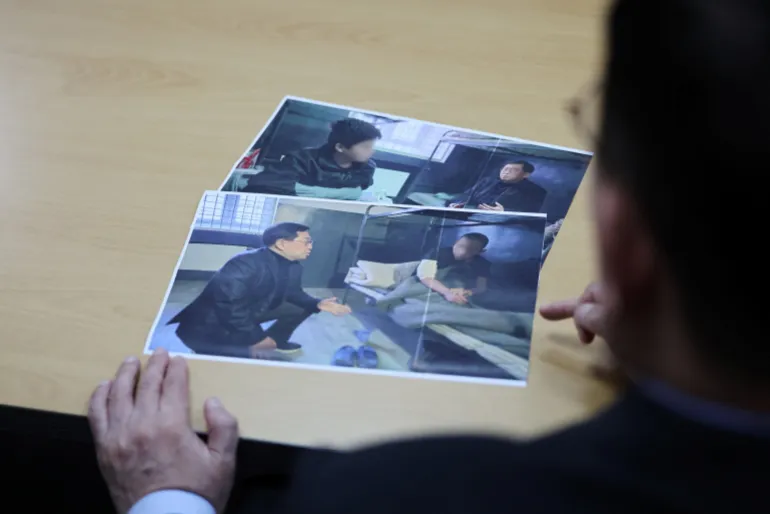
April 5 (Asia Today) — A senior South Korean prosecutor refused to take an oath before a parliamentary inquiry, escalating tensions between the prosecution and lawmakers and raising the possibility of coordinated action within the prosecution.
Park Sang-yong, a deputy chief prosecutor leading an investigation into alleged illegal financial transfers to North Korea, declined to be sworn in as a witness during a National Assembly inquiry into allegations of politically motivated prosecutions under the previous administration.
Under South Korean law, witnesses may refuse to take an oath if their testimony could expose them to criminal liability.
Park submitted a seven-page written explanation to the committee chair and left the hearing after about 38 minutes. He later said the inquiry itself was unconstitutional and illegal, arguing that participating would amount to cooperating with an improper process.
“The law allows a refusal to take the oath if justified, yet I was prevented from following that procedure,” Park said after leaving the session.
Justice Minister Jeong Seong-ho criticized the move as “highly inappropriate,” saying it undermined accountability. The acting prosecutor general also expressed regret, calling the incident unacceptable.
The dispute stems from an investigation into alleged payments to North Korea involving a South Korean company. Park has also faced separate allegations of misconduct during the probe, which are under investigation by prosecutors.
Within the prosecution, signs of collective action have emerged. Members of the investigative team reportedly created a group chat, fueling speculation about a coordinated response to the inquiry.
Legal experts warned the standoff could weaken the effectiveness of the parliamentary probe and deepen concerns over institutional conflict between the legislature and prosecution.
Some analysts said the episode reflects broader tensions over the independence of investigative authorities and the limits of parliamentary oversight.
If you grew up in the ‘70s or ‘80s, your vision of suburban America probably looks a lot like South Pasadena. There’s good reason. The picturesque town on the western edge of the San Gabriel Valley was often used as a backdrop in films like “Halloween,” “Pretty in Pink” and “Back to the Future” (the street where George McFly, Lorraine and Biff lived is actually Bushnell Avenue).
Today in South Pasadena, you’ll still find this idyllic Anytown USA landscape — but with a twist: Along with verdant parks, Craftsman bungalows and tree-lined streets, the city gleams with cool new developments like the recently opened Sid the Cat Auditorium, an all-ages live music venue in a converted 1930s elementary school; the always-packed Cannonball from chef Matt Molina; L.A.’s first nonalcoholic bottle shop Burden of Proof and a high-tech head spa imported from Japan. Add on a walkable downtown and a bustling Thursday night farmers market and it’s easy to see why so many Angelenos are drawn to this increasingly hip community.
Get to know Los Angeles through the places that bring it to life. From restaurants to shops to outdoor spaces, here’s what to discover now.
“So few pockets of L.A. County are actually great for families and that’s what makes South Pas so compelling,” said my friend Tom, who moved to the area after having a baby two years ago. “Plus, it has light-rail.”
Located six miles from downtown L.A., South Pasadena was marketed as a “garden community” when it was founded in the late 19th century. New residents were promised homes with flowering vines and sweet-smelling gardens, all just a short cable car ride away from a bustling metropolis.
“It was that early promise of suburbia,” said Becky Nicolaides, a historian and author of the book “The New Suburbia: How Diversity Remade Suburban Life in Los Angeles After 1945.” “When it was incorporated, there weren’t cars, so the town was built to be walkable.”
But that peaceful facade hid an ugly truth. Like many suburbs in the L.A. area, the town’s officials put race restrictive covenants into place soon after its founding, making it illegal for residents to sell property to people of color.
Those covenants became illegal in 1948, but the town continued to discourage people of color from living within its boundaries for several more decades. That began to change in the 1960s and South Pasadena has diversified, particularly over the past decade. In recent years, town leadership has taken steps to acknowledge its racist past.
Now, even as a new energy permeates, the city continues to lean into its early suburban history. The town is just 3.4 square miles, but it encompasses 100 acres of parks and playgrounds as well as 21,000 trees. There’s an old-fashioned pharmacy where parents have taken their kids for a phosphate soda (or just a regular old milkshake) for over 100 years and volunteers from the community still decorate a float for the Tournament of Roses each year, just as they have since 1911.
And though its historic Red Car trolleys have been discontinued for decades, today it’s still a comfort to take the Metro home from work at the end of a long day and enjoy the peace and quiet of this pastoral suburb, just like its founders did more than a century ago.
What’s included in this guide
Anyone who’s lived in a major metropolis can tell you that neighborhoods are a tricky thing. They’re eternally malleable and evoke sociological questions around how we place our homes, our neighbors and our communities within a wider tapestry. In the name of neighborly generosity, we may include gems that linger outside of technical parameters. Instead of leaning into stark definitions, we hope to celebrate all of the places that make us love where we live.
Our journalists independently visited every spot recommended in this guide. We do not accept free meals or experiences. What L.A. neighborhood should we check out next? Send ideas to guides@latimes.com.
Gurdaspur, Punjab, India – Ramesh Kumar, 42, is anxiously doing the calculations for his crops this year.
Standing at the edge of his wheat field in northwest Punjab’s Gurdaspur, he runs through the numbers in his head, totting up fertiliser costs, expected yield, and market prices.
Then he shifts to more personal concerns: School fees, household expenses, loan repayments and the money he has been saving for his daughter Varsha’s wedding.
“I don’t know if we can afford it this year,” he says. “Everything depends on the crop.”
The uncertainty has crept in quietly.
Fertiliser, once a fairly predictable staple in farming, has become more expensive and harder to secure in time. For Kumar, it is not so much a question of cost as it is the difference between stability and strain.
“If prices go up more, we will have to cut somewhere,” he says. “Maybe delay the wedding. If things get worse … even children’s education becomes difficult.”
School fees for his eldest son, Amit, 12, are due in the coming weeks, and Kumar has been setting aside money for his younger daughter Varsha’s future wedding.
It’s never easily affordable, even in good times. “We somehow manage,” Kumar says. “But if the harvest is weak, then we have to think about what to prioritise, what to delay.”
For farmers like him across South Asia, the United States-Israel war on Iran – unfolding thousands of kilometres away – is not just a matter of distant geopolitics.
It is shaping decisions inside their homes.
A worker pours fertiliser into a sack at a storage facility in Srinagar, Indian-administered Kashmir [Sajad Hameed/Al Jazeera]
A distant crisis with local consequences
At the centre of the unfolding crisis is the Strait of Hormuz, a narrow shipping lane more than 2,000km (1,240 miles) from India’s northern plains. It lies between Iran and Oman, linking the Gulf and its oil producers to the open ocean and, from there, to global markets.
About one-fifth of the world’s oil and liquefied natural gas (LNG) supplies pass through this body of water, which Iran closed down shortly after the first US-Israeli strikes on Tehran on February 28.
Vast volumes of LNG, essential for manufacturing nitrogen-based fertilisers, are transported from Gulf producers to Asia via this route. Any disruption can delay shipments, push up freight and insurance costs and place a stranglehold on supply.
Interruptions to the supply of fertiliser can ripple quickly, reducing crop yields, increasing costs and raising food prices.
The risks are already being felt thousands of kilometres away.
South Asia, home to nearly two billion people, relies heavily on fertiliser-intensive farming to produce staple crops such as wheat and rice. Over the past few decades, the increasing use of fertilisers – which can hugely boost crop yields – has played a key role in agricultural productivity across the region.
The agriculture sector now employs about 46 percent of the workforce in India, about 38 percent in Pakistan, nearly 40 percent in Bangladesh, and more than 60 percent in Nepal.
A farmer spreads fertiliser around apple trees in an orchard in Baramulla, Indian-administered Kashmir, March 2026 [Sajad Hameed/Al Jazeera]
The degree to which countries in the region depend on the Strait of Hormuz varies, but all rely heavily on the trade in fertilisers that this shipping route facilitates.
In India, the agriculture sector is worth $400bn, according to Indian government and World Bank data, and supports the livelihoods of more than half the population, either directly or indirectly. More than 100 million farming families are directly dependent on the sector.
The country imports a substantial share of its fertiliser requirements and other key raw materials, particularly phosphates and potash, as well as natural gas used to manufacture fertiliser, with about 30–35 percent of these supplies moving through or originating from routes that pass via the Strait of Hormuz.
In Pakistan, the agriculture sector contributes close to 20 percent of gross domestic product (GDP), according to Pakistan government estimates, and employs millions. About 20-25 percent of Pakistan’s fertiliser imports, particularly DAP (diammonium phosphate), pass through the Strait of Hormuz at some point in transit. Additionally, the sector relies on domestic natural gas for the production of urea, a key nitrogen-based fertiliser and, with Gulf natural gas supplies held up in the Strait of Hormuz, the price of natural gas everywhere – even at home – is on the rise.
In Bangladesh, where millions of smallholder farmers rely heavily on imported fertilisers, the agricultural sector accounts for about 12-13 percent of GDP, according to government data. The country’s farming industry relies heavily on imported fertilisers to sustain crops, meaning farmers are highly exposed to international supply shocks and price swings.
Furthermore, roughly 25-30 percent of Bangladesh’s imported fertiliser is shipped via routes passing through the Strait of Hormuz.
Nepal, where agriculture contributes about 24 percent of GDP, imports nearly all of its fertiliser needs, with about 25-30 percent of arriving via India, via the Gulf and the Strait of Hormuz.
A worker handles granular fertiliser at a storage facility in Punjab, northern India, March 2026 [Sajad Hameed/Al Jazeera]
Livelihoods at stake
Overall, even minor disruption in the Gulf – let alone the complete closure of the critical Strait of Hormuz – can have dire consequences for hundreds of millions of people.
The Indian government has sought to reassure farmers that supplies remain secure – for now.
Prime Minister Narendra Modi told Parliament on March 23: “Adequate arrangements have been made for fertiliser supply for the summer sowing season…The government has diversified options for oil, gas and fertiliser imports… Domestic production of urea, DAP and NPK [nitrogen, phosphorus and potassium fertilisers] has been expanded… Farmers now have access to Made in India Nano Urea and are encouraged to adopt natural farming…”
He added: “Under the PM Kusum scheme, more than 22 lakh (2.2 million) solar pumps have been provided, reducing dependence on diesel… I am confident that through joint efforts, India will manage these challenges effectively and continue to support our farmers.”
On the ground, however, confidence is low. Farmers say uncertainty is already influencing decisions.
In Pampore, in the south of Indian-administered Kashmir, 53-year-old mustard farmer Ghulam Rasool says price signals travel faster than supply disruptions.
“We hear about war, about shipping problems,” he tells Al Jazeera. “Even before shortages happen, fertiliser becomes expensive.”
Rasool says farmers often respond early by cutting down on the amount of fertiliser they are using, even before actual shortages emerge.
“If we use less, production will fall,” he says. “But sometimes we have no choice.”
In Pakistan’s South Punjab, wheat farmer Muneer Ahmad, 45, is preparing for the next sowing cycle.
“If fertiliser becomes expensive, it will affect everyone here,” he says.
Government officials have expressed confidence in Pakistan’s fertiliser supply amid the Middle East conflict, and claim the government is fully prepared to ensure adequate supplies during the region’s peak sowing period, which typically begins between April and June, depending on the crop.
According to a statement by Pakistan’s federal secretary for agriculture to Al Jazeera, Federal Minister Rana Tanveer Hussain told a meeting on March 25 that the government has started proactive monitoring, is expanding domestic urea and DAP production and taking steps to ensure fertilisers reach farmers at affordable prices.
However, urea production requires supplies of natural gas, meaning global energy price shocks can still translate into rising production costs.
A farm worker spreads fertiliser across a field as part of routine crop management during the growing season in north India [Sajad Hameed/Al Jazeera]
For farmers, even small increases matter
“We already have loans and expenses,” Ahmad says. “If costs go up, we feel it immediately.”
In Rangpur, northwestern Bangladesh, farmer Mohammad Ibrahim, 41, says fertiliser supplies are already becoming unpredictable.
“Sometimes it is available, sometimes not,” he says. “And when it comes, the price is higher.”
Meanwhile, in Nepal’s Gulmi district, farmer Meghnath Aryal, 38, worries that crops will be reduced if a major supply problem does appear.
“If fertiliser does not arrive on time, the crop suffers,” he says. “If it becomes expensive, we reduce use.”
Bangladesh’s Agriculture Secretary Rafiqul Mohammad told Al Jazeera the government is “closely monitoring the situation” and officials have tried to reassure farmers that fertiliser supplies are sufficient for the coming months.
The government has finalised plans to import about 500,000 tonnes of urea in the near term, while also exploring alternative suppliers such as China and Morocco to secure additional supplies in the longer term.
There is no immediate shortage at present, the Agriculture Ministry says.
Ram Krishna Shrestha, joint secretary at Nepal’s Ministry of Agriculture and Livestock Development, told Al Jazeera that fertiliser distribution within the country remains largely stable for now, with supplies already secured for the upcoming rainy season, particularly for paddy crops such as rice.
However, he warned that there may be delays to contracted shipments as a result of the Middle East crisis.
“We have managed fertilisers for the upcoming season, but there could be challenges in timely supply because of the current situation,” he said, pointing to global price increases and logistical disruptions, including those caused by the closure of the Strait of Hormuz.
Shrestha added that as companies report shortages and rising prices in international markets, the government has asked suppliers to expedite deliveries.
“Authorities are also advising farmers to increase the use of traditional nutrient sources such as farmyard manure, compost, green manuring and azolla [a natural fertiliser] to offset any potential shortfall in chemical fertilisers,” he said.
No immediate new fertiliser subsidies have been announced, he said, though adjustments remain under discussion as the situation evolves.
Mustard farmer Ghulam Rasool scatters fertiliser by hand in a field in Pampore, Kashmir, India [Sajad Hameed/Al Jazeera]
Rising food prices on the horizon
The implications extend beyond individual farmers.
Across South Asia, fertiliser use has been central to maintaining crop yields – and keeping large populations fed. Any reduction in availability or increase in costs can quickly lower production. That, in turn, pushes up food prices, a sensitive issue in a region where households spend a large proportion of their income on food.
For governments, the challenge is complex.
In the past, subsidies have kept fertilisers affordable for farmers, but this becomes a fragile balancing act if global prices rise, placing additional pressure on public finances.
In India, Ramesh Kumar is already making adjustments – but he is walking a tightrope.
He has decided to use less fertiliser this season, even though he knows it could reduce yields.
“It is a risk,” he says. “But what choice do we have?”
Lower production will mean less income and harder decisions at home.
“School fees have to be paid,” he says. “Household expenses cannot stop.” He looks across his field.
“And the wedding… we will see.”
Ultimately, sacrifices will have to be made in his household.
Across borders, the same uncertainty is unfolding.
In Pakistan, Ahmad is worried about rising costs. In Bangladesh, Ibrahim is mostly concerned about the availability of fertiliser and, in Nepal, Aryal fears delays in supply.
For Ramesh Kumar, the stakes are clear.
“For others, this is about war,” he says. “For us, it is about whether we can take care of our family.”