Dan Osborne has shared an emotional post about ‘getting away’ to his InstagramCredit: Instagram/danosborneofficialIt comes 7 months after his split from now-ex wife Jacqueline JossaCredit: Instagram
Taking to Instagram to reflect, Dan penned an emotional statement in the caption of a simple black and white selfie.
The caption began: “Sometimes you just need to get away from everything. Take time to think, reflect & reset.
Sign up for the Showbiz newsletter
Thank you!
“Not everyone will understand the way you deal with things, the decisions you make or what you need to find your peace. And that’s okay. You don’t need everyone to understand your journey or agree with how you choose to walk it.”
Dan then encouraged his followers to continue to pursue happiness, and grow along the way through all the lessons life throws at them.
He continued: “Do what makes you happy, what helps your mind, what gives you peace and what helps you grow. Never feel guilty for taking time for yourself.
“Life is about learning, reflecting, making mistakes, growing through them and constantly working towards becoming a better version of yourself.
The reality TV star signed the post off by sharing a revelation: “Sometimes the biggest growth happens when you step away from the noise and learn to be at peace with yourself.”
The Sun On Sunday revealed that Dan grew close to the Brazilian bikini model after bonding with her over fitness and their mutual support of Arsenal — and vowed to see her again soon.
OASIS star Noel Gallagher asks his girlfriend to Stand By Me as they enjoy a Champagne-fuelled date.
The singer-songwriter, 59, and his 28-year-old events organiser squeeze Nina Johnson were on a double date in central London.
Oasis rocker Noel Gallagher was spotted out on a champagne-fuelled date with girlfriend Nina JohnsonCredit: Raw Image LtdThe 59-year-old singer-songwriter and his 28-year-old events organiser partner were on a double date in central LondonCredit: Raw Image Ltd
They were joined by his best pal James Cook and partner Lauren Brown at posh Italian restaurant Martino’s in Sloane Square.
Onlookers saw them sipping Champagne — with bottles of Dom Perignon at the swanky joint costing £380.
Sign up for the Showbiz newsletter
Thank you!
One diner said: “Noel and Nina looked really loved up.
“They were holding hands and being very affectionate as they sat down with James and Lauren.
An onlooker said Noel and Nina were looking loved up and affectionate during their night outCredit: Raw Image LtdThe couple were spotted holding hands and laughing together during their London dateCredit: Raw Image Ltd
“Noel and James ordered champagne and they enjoyed a few glasses before they ate.
“They spent about three hours at their table and were all laughing a lot. Noel looked pretty sweet on Nina. She’s definitely got something special about her.”
Noel, who wrote Oasis classic Champagne Supernova, got together with Nina following his split from Sally Mash earlier this year.
The double date was the second time Noel and Nina have been spotted this week.
They were joined by Noel’s best pal James Cook and his partner Lauren BrownCredit: Raw Image LtdNina is expected expected to join Noel on Oasis’s sold-out tour next yearCredit: Raw Image Ltd
After spotting Noel in the stands, stadium bosses played Oasis hit Wonderwall through the speakers — with fans in the 62,000-capacity venue singing the lyrics to him.
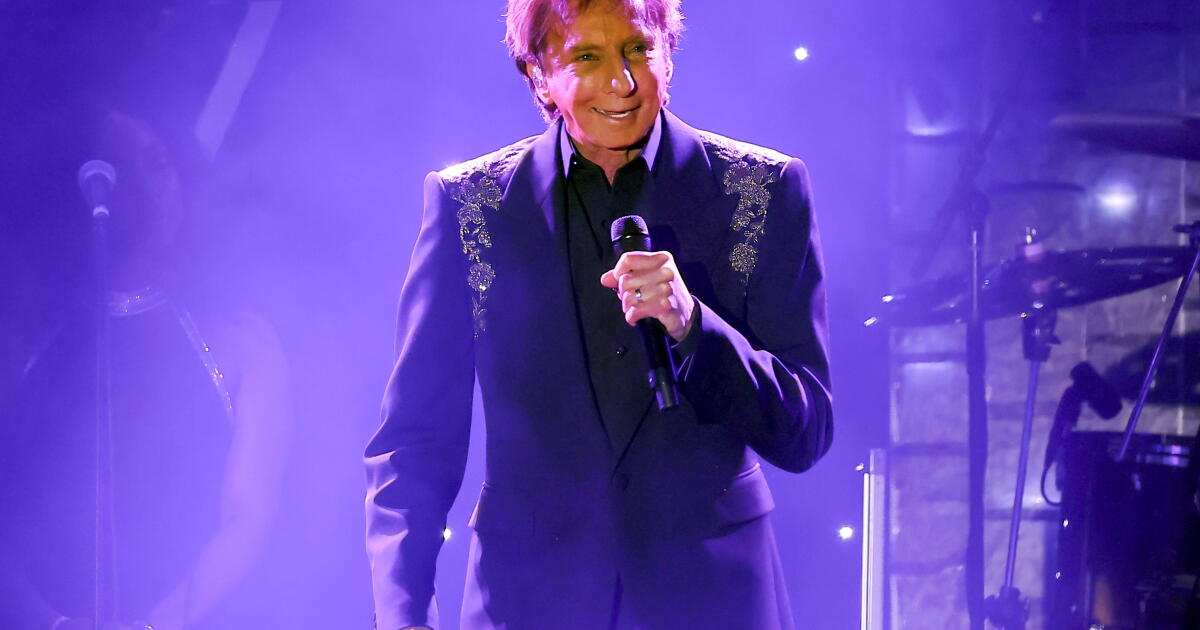
Barry Manilow has returned to the stage after taking a break following his summer tour.
Manilow performed at the International Theater at the Westgate Las Vegas Resort & Casino on Thursday night, telling the audience, “This is the first time back in a long time. I have some medical problems, but I’m back!”
The audience cheered and a couple of crowd members tossed underwear onto the stage. He picked up a pair of full-coverage briefs and asked if they needed to go to the laundry, and then a pink lacy thong and joked, “I’ll keep this pair.”
“God, I feel like I’m a teenage idol again.”
Last year, Manilow revealed that he had been diagnosed with lung cancer and that surgery would require him to postpone several performances. The star returned to the stage in June following a six-month hiatus, in support of his latest album, “What a Time,” his first LP loaded with new material in almost 15 years.
But in August, he canceled shows because of vocal and technical problems before telling fans he needed to pause. “We just finished a fantastic summer tour, 29 shows in 68 days,” the singer said. “The shows were fantastic. The audiences were fantastic. And I sounded fantastic. But it seems that we were pushing a little too hard.
“Now we all need to sit down and shut up,” Manilow said. “So, we’re going to take a break until we return to the Westgate Las Vegas on Oct. 8. When I’ll be singing like a bird. I hope to see you then.”
The “Copacabana” singer is slated to hit the stage again on Friday evening.
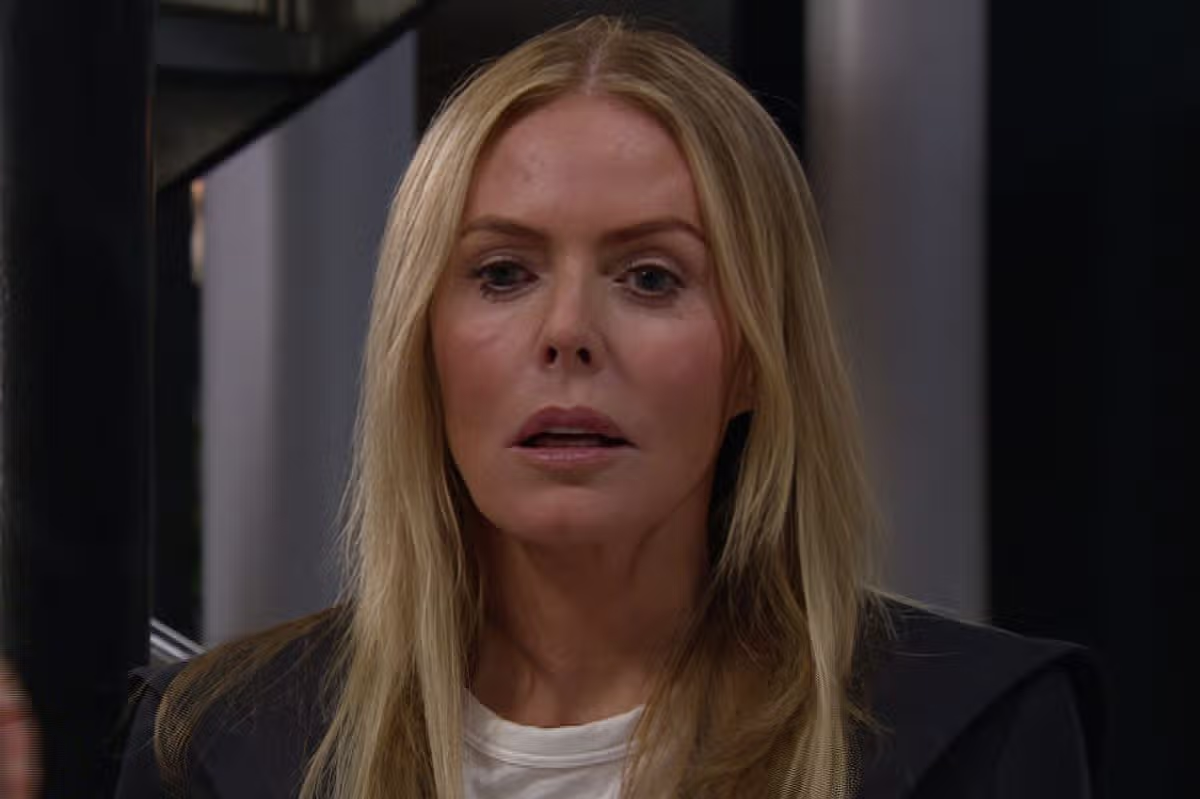
Emmerdale’s Sadie King, played by Patsy Kensit, got her comeuppance after her lies about Jimmy King were exposed, but two more characters will soon be targeted by her
19:48, 09 Oct 2026Updated 19:48, 09 Oct 2026
Emmerdale’s Sadie King, played by Patsy Kensit, got her comeuppance(Image: ITV)
Emmerdale fans rejoiced on Friday as they saw Sadie King exposed, and she certainly faced the consequences.
Nicola King finally learned the truth about Sadie’s lies. After listening to a voice message on her late husband Jimmy King’s laptop, she realised he had not cheated on her with Sadie after all.
Sadie claimed Jimmy had been leading a double life, enjoying a secret romance with Sadie for three years. She said he was planning to leave Nicola too, when in fact Sadie was making it all up, and was actually just after some money he had promised her prior to his death.
When Nicola finally listened to what Jimmy actually said to Sadie and realised Jimmy was simply giving her some money as a one-off payment, while also confessing his love for his family, she took action. Later confronting Sadie at the graveyard, Nicola attacked her with flowers before knocking her to the floor.
Viewers loved the moment, and so did the other village residents watching. Sadie finally found herself caught out and faced the repercussions, with fans saying it was about time.
One fan posted: “I am SO HAPPY Nico got to do that to Sadie.” Another agreed: “Me when Nicola started whacking Sadie with the flowers.”
A third fan commented: “The funeral scenes were so good,” as a fourth added: “Sadie being pushed was good.” However, Nicola might have taken down Sadie, but it’s not over.
Sadie’s about to form an alliance with another village baddie, and she’s got two new targets lined up. Joe Tate and Sadie team up next week against the Miligans, and it’s set to be explosive.
Joe wants to take revenge on the couple yet again, but this time, it’s not missing Graham Foster he’s enlisting the help of. Sadie agrees to help Joe, as she plots to split Caleb and Ruby up.
Joe tasks Sadie with spying on Ruby and Caleb, as he wants her to find evidence that will destroy them. Sadie’s got her own ideas though, and she tells Joe she will seduce Caleb.
Soon Sadie works on getting Ruby to open up, and secrets are revealed. Sadie reels Ruby in with a sob story, but Cain Dingle is suspicious about Sadie deciding to stick around in the village.
Cain warns his brother Caleb that Sadie will ruin his life, but he’s sure he’s too smart for her. But will Sadie be able to get her own way, and will she and Joe be successful in their plan to target the couple?
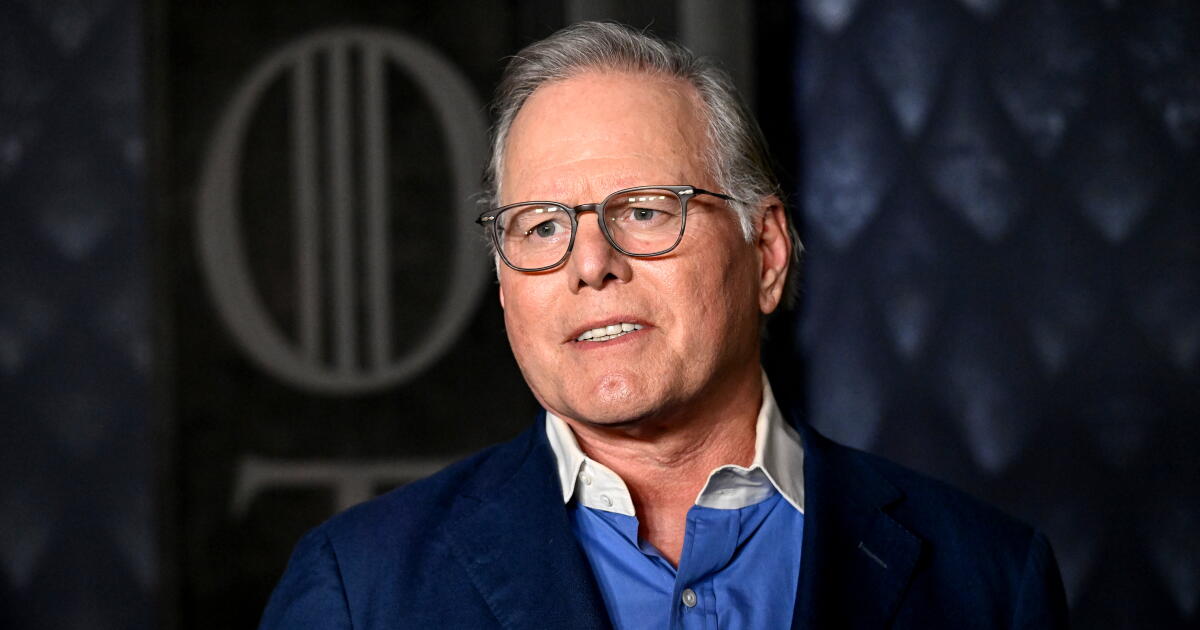
David Zaslav, the longtime TV executive who created Warner Bros. Discovery Inc. but ultimately failed to keep it going as an independent company, made about $600 million on the sale of the business to Paramount Skydance Corp. this week.
Much of Zaslav’s compensation came in the form of stock options. Warner Bros. stockholders received $31 a share in cash in the sale, a nearly 25% increase from when the stock first began trading in April of 2022. The Standard & Poor’s 500 rose 76% over that period.
Many other Warner executives received large paydays, including streaming boss JB Perrette and strategy chief Bruce Campbell. A spokesperson said Zaslav doubled the number of employees overall who received stock awards.
The new company, now called Skydance Corp. and led by technology scion David Ellison, is one of the largest media businesses in the world, comprising the century-old Paramount and Warner Bros. movie studios, dozens of TV networks, like CBS and CNN, as well as the Paramount+ and HBO Max streaming services.
Christopher Palmeri and Dylan Sloan report for Bloomberg.
Winner of the Palme d’Or at this year’s Cannes Film Festival, still among the most prestigious prizes any movie can claim, “Fjord” aims for both a quiet, subtle power and the directness of a sledgehammer. It speaks to the skill of Romanian writer-director Cristian Mungiu, along with the star power and acting prowess of its leads, Sebastian Stan and Renate Reinsve, that the film achieves those goals, creating a mix of feelings including ambivalence, shock and dismay over what people will do to one another in the name of a common good.
Having recently moved from Bucharest to a remote village in Norway, a conservative, devoutly Christian couple and their five young children have begun to insert themselves into the fabric of their new community. Mihai, the Romanian father (Stan), is a little intense and gloomy; Lisbet (Reinsve), a Norwegian, is shy but kind, and their focus seems clearly on what they see as a warm, loving homelife.
But when their children are suddenly taken into protective custody over allegations of abuse, they find their world turned upside down. Eventually, the father asks a prosecutor with equal parts anger and exasperation, “Am I on trial for my beliefs?”
The official answer to that question, more or less, is both no and yes. The government’s position is that the children cannot be placed back into a home where they will be harmed, whether that means physical violence or indoctrination in ideology counter to that of the state’s, such as no dancing, no internet and that being gay is wrong.
Based on actual events involving a Romanian family in Norway in 2015, “Fjord” is purposefully designed to make a viewer — any viewer — question their assumptions and predispositions regarding the relationship between personal liberty and state power. While this may all sound a bit reactionary or like shooting fish in a barrel, Mungiu wisely complicates matters.
The filmmaker, a previous Palme winner for his 2007 abortion drama “4 Weeks, 3 Months and 2 Days,” presumably knows that the majority of the audience for his international art-house domestic drama will be more aligned with the liberal, progressive politics of the Norwegian state than the religious, conservative couple at the story’s center. So most audiences will automatically be put into the purposefully uncomfortable position of siding with people they would never see themselves inclined to agree with. It is Mungiu’s sharpest and most illuminating maneuver.
Once the story moves to the courtroom, “Fjord” begins to resemble 2023’s “Anatomy of a Fall” — another Cannes-winning champ released in the U.S. by boutique distributor Neon — for the way in which it allows American viewers a glimpse into another country’s legal system. It comes off as more conversational and slightly more chaotic than what we are used to in our own domestic courtroom procedurals. As the government prosecutor, Norwegian actor Christian Rubeck gives a smug and condescending tone to nearly every word out of his mouth, becoming the closest thing the movie has to a villain.
Having previously appeared together in the offbeat comedy “A Different Man,” Stan and Reinsve keep the story from feeling like a dour exercise. As Mihai, Stan puts across a low-simmering rage at being put in the position of defending himself at all, while grappling with how to maintain what he sees as his natural role of patriarchal control. Reinsve, known for more outwardly dynamic roles in “The Worst Person in the World” and “Sentimental Value,” here conveys a subdued nuance as Lisbet struggles with understanding her place between her husband and her children.
The moment when the couple’s infant child is taken from them by the authorities is devastating, each of them capturing a sense of helpless isolation from themselves, their community and each other.
Special mention should also go to the performances by Vanessa Ceban and Jonathan Ciprian Breazu as the couple’s teenage children, also to Henrikke Lund-Olsen as a neighbor girl who becomes close to them. These young performers are the film’s secret weapon, since in practical, lived terms they bear the brunt of the existential hand-wringing on the part of all the adults. And too often they become an afterthought.
The poster and key image from the film is a smiling snapshot of Mihai and Lisbet with their children, a seemingly happy family. Or are they? For a movie so steeped in ambiguity and nuance, it also often states its case quite plainly, such as when the couple’s lawyer says no one can really know what goes on in another family. The film asks one to look closer, not just at others but also at one’s own accepted opinions, assumptions and preconceptions. But it ends up with an outcome that feels as sadly inevitable as it is heartbreaking — an ethical knot that cannot be undone.
‘Fjord’
In English, Romanian, Norwegian and Swedish, with subtitles
We are weathering a truly apocalyptic heat wave in L.A., but that hasn’t stopped Halloween from sneaking up on us. For those who like to give themselves the creeps, the city has its fair share of spook shows, including Griffith Park’s Haunted Hayride and the Queen Mary’s Dark Harbor. These mainstays offer hardworking actors seasonal jobs, but usually don’t allow for any real narrative besides jump scares and chainsaws. Which is why I’m so jazzed about a new entry to the immersive Halloween show scene: “Hospital of Emotions After Dark,” with its specially ticketed basement creep-fest, “Below.”
For readers who haven’t been inundated with a million ads for “Hospital of Emotions” on your Instagram feeds, it’s an immersive art show that unspools in 80 discrete rooms over four floors of the shuttered St. Vincent’s Medical Center near downtown L.A. The 45,000-square-foot exhibition opened in late May and was supposed to close in late July, but has extended its run due to popular demand. This month that run includes an after-dark option, which features the regular show — only after-hours — with ambient lighting and roving actors who show up in the most unexpected places (I won’t spoil it, but I got one of the most serious jump scares of my life in one of the exhibit rooms).
A separate ticket (which can be purchased in a bundle with the main exhibition) gets you a ride in an elevator to the hospital’s long-abandoned basement where you are treated to an immersive theater show with a nun for a tour guide. My nun was played by Penny Wiggins, and I’m not sure I have ever witnessed such true commitment in a spook show. Wiggins sold her character — at one point with genuine tears.
I won’t give away the plot, but it’s harrowing, especially if you are someone familiar with the hospital, which opened in the late 1800s and was the first hospital in the city. I had my daughter there in 2016, so it was extra chilling to know that this basement of horrors was there even then. The show uses the building’s actual abandoned infrastructure as its framework, so guests are led through dank subterranean corridors, old examination rooms and specimen labs, as well as an autopsy room.
“Below” isn’t as viscerally gory as “Dark Harbor” or “Haunted Hayride,” but it’s more artistic. There is dancing and an actual script that features a “gotcha” twist — as well as an upsetting demon who appears out of nowhere. I applaud the commitment by the actors who, I imagine, must find it kind of scary just waiting down there for the next round of guests. Plus, it’s good fun to be in the “Hospital of Emotions” at night when everyone is a little wild and there’s a sense that something out of the ordinary might pop out at you at any minute.
I’m Arts editor Jessica Gelt begrudgingly wearing a tank top and shorts in early October. This is your arts and culture news for the week.
You’re reading Essential Arts
Our critics and reporters guide you through events and happenings in the SoCal arts scene. In your inbox every Friday.
By continuing, you agree to our Terms of Service, which include arbitration and a class action waiver. You agree that we and our third-party vendors may collect and use your information, including through cookies, pixels and similar technologies, for the purposes set forth in our Privacy Policy such as personalizing your experience and ads.
The week ahead: A curated calendar
FRIDAY
Felipe Dulzaides / Bradley Baboc Cuban-born artist Dulzaides uses photography, drawing, video, performance, sculpture and sound to capture the sublime nature of Havana knife sharpeners in the exhibition “Balance in Place.” L.A. painter Boboc drew on the Toy District as inspiration for a new series of paintings, “Shadoobie (Shattered).” Opening, 6-9 p.m. Friday; 10 a.m.-4 p.m. Thursday-Sunday, through Nov. 8. Arcane Space, 324 Sunset Ave., Unit G, Venice. arcanespacela.com
Ludovico Einaudi The popular Italian pianist and composer returns to Disney Hall for the first time since 2019 on this solo tour. 8 p.m. Friday. Walt Disney Concert Hall, 111 S. Grand Ave., downtown L.A. laphil.com
Mälkki Conducts Bartók Susanna Mälkki leads the Los Angeles Philharmonic in Béla Bartók’s “Concerto for Orchestra.” 11 a.m. Friday, 2 p.m. Sunday. Walt Disney Concert Hall, 111 S. Grand Ave., downtown L.A. laphil.com
Takács Quartet with Jeremy Denk The Grammy winning ensemble teams up with the MacArthur Grant-winning pianist for a program of chamber music featuring works by Haydn, Mendelssohn and Franck. 7:30 p.m. Broad Stage at Santa Monica College Performing Arts Center, 1310 11th Street, Santa Monica. broadstage.org
SATURDAY
Laura Andreson, 1979, Forrest L Merrill Collection, Photo by M. Lee Fatherree
(Photo by M. Lee Fatherree)
The Eternal Quality of Aesthetic Joy: Laura Andreson and Her Legacy The artist bristled at “superfluous” decoration, favoring distilled jar, box, bowl and vase forms influenced by her love for Scandinavian and Bauhaus design. She became a wizard with glazes, conjuring lustrous surfaces resonant with elements of the Southern California landscape. This show offers a rare opportunity to savor the gorgeous purity of her work, alongside that of several of her mentors and peers, such as Gertrud and Otto Natzler and Glen Lukens, as well as some of her students, including JB Blunk and Bernard Kester. (Leah Ollman) Noon-6 p.m. Tuesday-Saturday, Oct. 10-Jan. 9, 2027. Craft in America Center, 8415 W 3rd St. craftinamerica.org
Haunted Soiree: True Crime An immersive theater experience inspired by the 1928 Hex Hollow murder with cocktails and curious encounters. Selected nights through Oct. 31. Nocturne Theatre, 324 N. Orange St., Glendale. hauntedsoiree.com
Pacific Jazz Orchestra’s Benefit Concert Songwriter and producer David Foster, singers Katharine McPhee, Joanna “JoJo” Levesque, Veronica Swift, Adam “AeJaye” Jackson, violinist Anne Akiko Meyers and pianist Emmet Cohen are the headliners for a celebration of founding Artistic Director Chris Walden’s 60th birthday, which also includes a buffet reception and dancing under the stars. 7 p.m. Private estate in Toluca Lake, address to be provided upon confirmation of attendance. pacificjazz.org
Saint Megan Playwright Joy Gregory, inspired by the journey of the granddaughter of the founder of the controversial Westboro Baptist Church, examines the long history of American Christian zealotry. Opening, 8 p.m. Saturday, 8 p.m. Fridays, Saturdays and Mondays, 2 p.m. Sundays through Nov. 22 (no performance Oct. 12 or Oct. 31. Rogue Machine at the Matrix Theatre, 7657 Melrose Ave. roguemachinetheatre.org
SUNDAY
Akram Khan Company In the London-based dance troupe’s final touring production, “Thikra: Night of Remembering,” an international cast of women perform contemporary and Bharatanatyam dances. 8 p.m. UCLA, Royce Hall, 340 Royce Drive, Westwood, cap.ucla.edu
Camerata Pacifica The chamber ensemble opens its 37th Season with Rachmaninoff’s “Variations on a Theme of Chopin, Op. 22” and Schubert’s “B-Flat Major Trio.” 5 p.m. Sunday. Bank of America Performing Arts Center, Janet & Ray Scherr Forum Theatre, 2100 Thousand Oaks Blvd., Thousand Oaks; 7:30 p.m. Tuesday. The Huntington, Rothenberg Hall, 1151 Oxford Road, San Marino; 8 p.m. Wednesday. The Colburn School, Zipper Hall, 200 S. Grand Ave., downtown L.A.; and 7 p.m. Thursday. Music Academy of the West, Hahn Hall, 1070 Fairway Road, Santa Barbara. cameratapacifica.org
Heartbreak House The Antaeus Theatre Company launches its 35th season with George Bernard Shaw’s dark comedy. Directed by ATC Artistic Director Nike Doukas. The cast includes Elinor Gunn, Harry Groener, Arye Gross and Bernard Addison, Previews, 2 p.m. Sunday, 8 p.m. Tuesday-Oct. 16; opening, Oct. 17-Nov. 16. Kiki & David Gindler Performing Arts Center, 110 East Broadway, Glendale. antaeus.org
Musical Theater Guild members Valerie Larsen and Gabriel Navarro during a reading of “The Light in the Piazza” in 2024.
(Stan Chandler)
Here’s to Us! The Musical Theatre Guild marks its 30th anniversary with a benefit concert featuring show tunes from “Titanic,” “Fanny, “The Pajama Game” and “Sunday in the Park with George.” 7 p.m. Broad Stage at Santa Monica College Performing Arts Center, 1310 11th Street, Santa Monica. musicaltheatreguild.com
Untitled, n.d. Mavis Pusey
(Neil Lane Collection / Estate of Mavis Pusey)
Mavis Pusey Two exhibitions this fall will help familiarize audiences with this remarkable woman. “Mobile Images” at the Hammer is a full-scale survey co-organized by the Studio Museum in Harlem and the Institute of Contemporary Art at the University of Pennsylvania, and is accompanied by a rich and thorough catalog. “Restless” also adds a Pusey publication to the shelf. The Benton show focuses mostly on Pusey’s prints, drawing exclusively from the collection of Ian White, artist, educator and son of esteemed artist Charles White. (Leah Ollman) “Mobile Images,” through Feb. 28, 2027. UCLA Hammer Museum, 10899 Wilshire Blvd., Westwood. hammer.ucla.edu “Restless,” through Jan. 3, 2027. Benton Museum of Art, Pomona College, 120 W. Bonita Ave., Claremont. pomona.edu
MONDAY
Art Of Elan: In The Desert Inspired by a trip to Bryce Canyon, Olivier Messiaen wrote his percussion-rich chamber music masterpiece “From the Canyons to the Stars” as a 1976 U.S. Bicentennial commission from Alice Tully Hall in New York. Replete with Messiaen’s characteristic bird calls, it’s been done out of doors before, and memorably at the Ojai Music Festival. But the San Diego imaginative new music series Art of Elan is now taking it to the desert for a special performance led by percussionist Steven Schick at an outdoor theater in Borrego Springs. (Mark Swed) 6:30 p.m. Stargazing Theater, La Casa del Zorro Desert Resort & Spa, 3845 Yaqui Pass Road, Borrego Springs. artofelan.org
TUESDAY
Angela Hewitt The pianist performs an all-Mozart recital accompanied by Los Angeles Chamber Orchestra concertmaster and violinist Margaret Batjer for the first installment in LACO’s inaugural recital series. 7:30 p.m. Tuesday. The Colburn School, Zipper Hall, 200 S. Grand Ave., downtown L.A. laco.org
WEDNESDAY
Lisa Batiashvili/Gautier Capuçon/Jean-Yves Thibaudet The superstar violinist, cellist and pianist team up for an evening of Shostakovich, Debussy, and Dvořák. 8 p.m. Walt Disney Concert Hall, 111 S. Grand Ave., downtown L.A. laphil.com
Joey Soloway.
(Loshara Vova)
A 1 They/Them Show The Emmy and Golden Globe-winning creator of “Transparent” steps out from behind the camera to try out their stand-up routine in L.A. before hitting the road with a deeply personal solo comedy performance exploring family, Hollywood, gender, sex, Judaism, ambition and reinvention. A tour is expected to include a November stop in Chicago. 8 p.m. Wednesday and Oct. 28, doors open at 7 p.m.. The Virgil, 4519 Santa Monica Blvd. dice.fm
THURSDAY
Houston Ballet
(Quinn B. Wharton/Segerstrom Center for the Arts)
Houston Ballet The Texas dance troupe brings celebrated young pianist George Li for an ode to Frédéric Chopin. Making its West Coast debut, and created by Stanton Welch AM, artistic director of the Houston Ballet, the piece, “Sons de L’âme” (Sounds of the Soul), merges choreography with a live performance of Chopin’s famed piano pieces, showcasing the talents of the nation’s fourth-largest ballet company and a rising star of classical music. (Eloise Rollins-Fife) 7:30 p.m. Thursday-Friday, 2 and 7:30 p.m. Saturday, 1 p.m. Sunday. Segerstrom Center for the Arts, 600 Town Center Drive, Costa Mesa. scfta.org
Speaking In Tongues The world premiere of a Luis Alfaro play is always a welcome event. And his latest work, commissioned by Latino Theater Co. and developed at the theater’s Circle of Imaginistas playwriting group, resonates thematically with Alfaro’s 2023 play “The Travelers,” which LTC produced in 2023 and made my list of that year’s best theater productions. The new play, infused with Alfaro’s trademark Chicano humor, returns us to the world of California’s Central Valley and the stories of migrant farmworkers and their spiritual quests in a societal landscape transforming faster than anyone can keep up. (Charles McNulty) Previews, 8 p.m. Thursday-Friday; opening night, 8 p.m. Saturday; 8 p.m. Thursdays-Saturdays, 2 p.m. Sundays, through Nov.. 15. Los Angeles Theatre Center, 514 S. Spring Street, downtown L.A. latinotheaterco.org
The SoCal scene
Cuban-born artist Enrique Martinez Celaya paints the new curtain for the L.A. Opera at the Dorothy Chandler Pavilion.
(Carlin Stiehl / For The Times)
ICYMI, the best of this week’s L.A. Times arts coverage:
L.A. artist Enrique Martínez Celaya hand-painted a brand new 70-foot curtain for L.A. Opera’s new season.
A documentary about Asco, the revolutionary arts group founded in the 1970s, is streaming for the first time on PBS.
As 24th Street Theatre prepares to celebrate its 30th anniversary, it has announced that it raised $3 million to officially buy the converted 1928 carriage house it’s called home for the past 29 years. It also purchased properties next door and across the street in order to expand its mission and community programming, including plans for an outdoor garden and a black box theater, which is, according to a news release, “officially named the 24th Street Black Box Theatre in honor of longtime supporter Jack Black, who is also the new venue’s first donor.” Black is set to host the theater’s gala on Oct. 18.
Tesserae — Andrew McIntosh, left, Ian Pritchard and Joshua Rubin — perform “Bowling, Animals and the Ocean” at the Sierra Madre Playhouse.
(Dania Maxwell / Los Angeles Times)
The 99-seat Sierra Madre Playhouse announced it has received $2.5 million from the State of California for a slew of exciting upgrades to its 100-year-old building — marking the largest gift in the organization’s history. The funds were secured by Pasadena Assemblymember John Harabedian, and will be used toward making the historic venue ADA-compliant, as well as to renovate lobbies and other areas open to the public. It will also help with new programming and building infrastructure.
The LA Phil and Orchestre de Paris have announced the launch of a new opportunity: the Salonen International Conducting Fellowship, which is, according to a news release, “designed to nurture and accelerate the careers of the next generation of orchestral conductors … the fellowship will offer early-career conductors unparalleled access to artistic mentorship, practical podium experience, and professional development opportunities at Los Angeles’ Walt Disney Concert Hall and the Philharmonie de Paris.” The first yearlong program will start in the 2027-28 season, and will feature two to four fellows, who will spend about six weeks working with each orchestra.
The Hammer Museum at UCLA announced this week that Eric Esrailian is succeeding Marcy Carsey as the new chair of the museum’s board (after previously serving as vice chair). Karen Hillenburg will now serve as vice chair. The Hammer also named three new members to its board: philanthropist Leslie McMorrow, attorney Alicia Miñana de Lovelace and Joan Weinstein, vice president of program planning at the Getty.
Rhian Sugden has admitted that her and husband Oliver Mellor are spending more time apart after welcoming their miracle IVF baby.
The former glamour model, 40, told how becoming parents has put more strain on their marriage than their heartbreaking six-year battle to have a child.
Rhian Sugden sat down for a chat with Amy Hart on the Private Parts podcastCredit: @privatepartspodcast/TikTokFormer glamour model Rhian confessed her marriage to Oliver Mellor is under strainCredit: instagram
Rhian and ex Coronation Street actor Oliver, 45, spent around £150,000 on eight rounds of IVF before welcoming their son George, now two, in 2024.
But while their gruelling fertility struggle brought them closer together at the time, Rhian says life as parents has left them struggling to find time for each other.
Sign up for the Showbiz newsletter
Thank you!
“The IVF itself made us stronger because we’d had to back each other up,” said Rhian.
“I felt guilty that I wasn’t gonna make him a dad because he’s like the best dad.
“So I had all that guilt of, oh god, I’m not gonna be able to fulfill his dream, my dream. So, he was very good in that respect.”
However, Rhian admitted things have dramatically changed between them since George arrived.
Rhian admitted she’s not ‘getting much time alone’ with her husband since giving birth to GeorgeCredit: Instagram/@rhiansuggersCeleb Big Brother alum Rhian gave birth to George in 2024Credit: Collect
Speaking on the Private Parts podcast this week, Rhian explained: “The thing that’s changed our marriage is having the actual child.
“Like, we’re like strangers at the minute. It’s hard. Even when we go on holiday, we’re not really getting much time alone.”
The Celebrity Big Brother alum also revealed she now sleeps in George’s bedroom because of his sleep struggles.
She said: “George just didn’t sleep as a baby, and I was like, I can’t do this. Just get him in bed. So we’ve just bought him a double bed and now I’m in George’s bedroom.”
Rhian and Oliver began dating in 2013 and tied the knot in Turkey in 2018.
Last year, Rhian publicly criticised Oliver after claiming he had gone drinking with friends while she and George were unwell – although she later insisted their marriage was fine.
The couple have spoken openly about their struggle to become parents, with Rhian undergoing eight rounds of IVF after discovering she had a very low egg count.
Elsewhere in the podcast, Rhian recalled breaking down in tears when a doctor warned her that the egg being used in her final IVF attempt was very low grade.
“I was crying on the table,” she said. “I was like, so why are we putting it in?”
But the treatment worked, leaving Rhian stunned when she discovered she was pregnant.
She recalled: “I couldn’t believe it. I still had lots of pregnancy tests even when I was like six months pregnant because I was just like every day thinking, surely not.
“You kind of set yourself up for a fail so that when it actually becomes reality, you’re like, oh no, like what happens now?”
Rhian was asked if her OnlyFans earnings had helped fund IVF and she replied: “I do more things than OnlyFans, but it definitely helped.”
Despite the challenges of parenthood, Rhian said: “I love it. I mean, [George]’s the best thing that’s ever happened to me. But it’s so full on.”
The one consensus about Method acting is that it’s controversial. Other than that, everything’s up for debate: What is Method acting, exactly? Do actors and audiences love it or hate it? And, perhaps most importantly, who can afford to practice the technique?
Method acting is a technique in which an actor embodies a character absolutely, usually both on- and off-camera, for months at a time (and sometimes, as in the curious case of Austin Butler’s Elvis accent, beyond the project itself).
Some actors, like those in the list below — including Daniel Day-Lewis, Christian Bale and Robert De Niro — swear by it. But others — like Brian Cox, Toni Collette and Robert Pattinson — eschew the practice. (Collette called it “total bulls—” and “utter wankery,” and Jennifer Lawrence said that working with a Method actor would make her nervous.)
Female actors — like Charlize Theron, Kristen Stewart, Natalie Portman, Anya Taylor-Joy and Ellen Burstyn — have pointed out that it’s a luxury they can’t afford. (“I don’t think that children or partners would be very understanding of, you know, me making everyone call me ‘Jackie Kennedy’ all the time,” Portman said about portraying the first lady.) And Black actors — like Brian Tyree Henry and Omari Hardwick — have said they wouldn’t be able to do it safely. (“I’ve never gone full Method,” Hardwick said. “I don’t want to be pulled over while ‘driving while Method.’ … I’ll get in trouble for that. That’s scarier.”)
Jeremy Strong — who plays Mark Zuckerberg in “The Social Reckoning” — recently defended his commitment to Method acting. Here are some of the most extreme Method acting performances of all time.
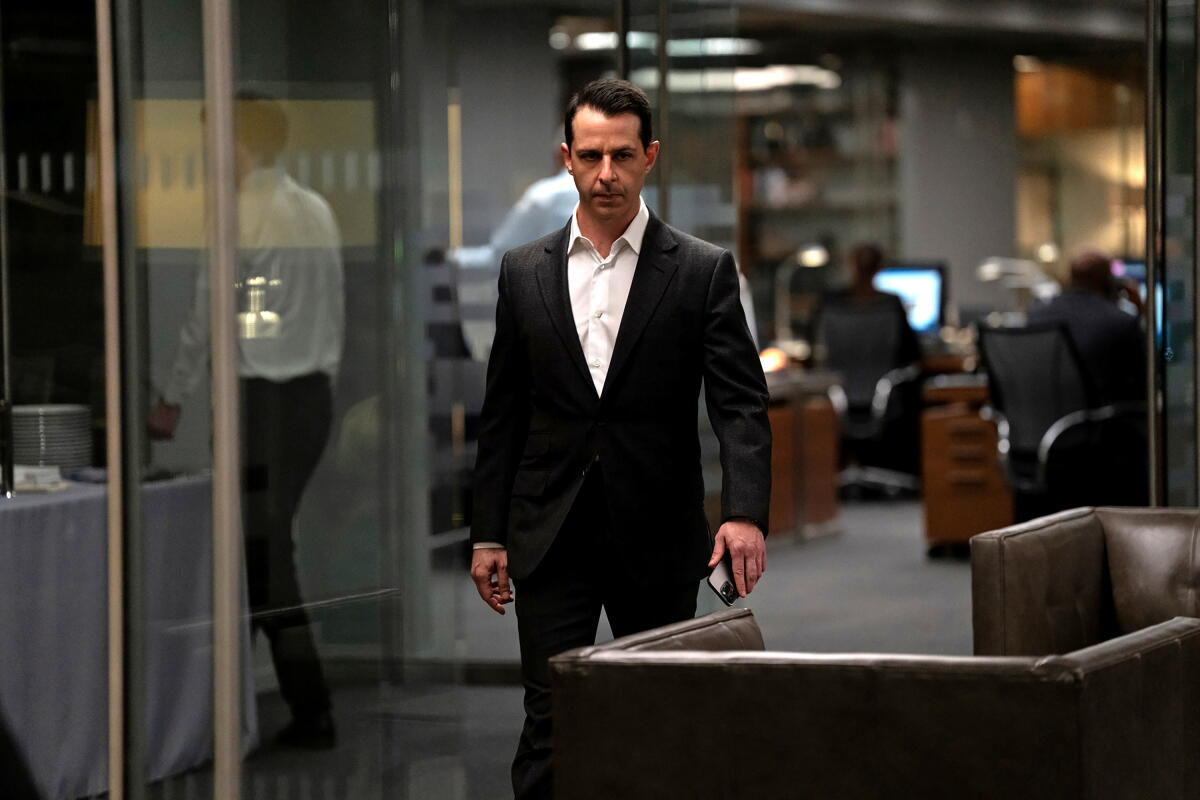
Jeremy Strong as Kendall Roy in “Succession.”
(Macall Polay / HBO)
Jeremy Strong (again)
Strong is known for his unrelenting adherence to Method acting, especially on the set of “Succession.” (“The result that Jeremy gets is always pretty tremendous,” his TV dad Cox told the New Yorker in 2021. “I just worry about what he does to himself. I worry about the crises he puts himself through in order to prepare. … It’s a particularly American disease, I think, this inability to separate yourself off while you’re doing the job.”)
This tendency held true on the set of “The Social Reckoning” too. “He showed up walking like Mark, talking like Mark,” director Aaron Sorkin told Entertainment Weekly. “I heard crew members on set call him Mark. I never heard him use his own voice until after I called ‘cut’ on his last shot.”
“I’ll be honest, I think this isn’t just the way he likes to do it,” Sorkin added. “I think it’s the only way he knows how to do it.”
Andrew Garfield as Father Sebastião Rodrigues in “Silence.”
(Kerry Brown / Paramount Pictures)
Andrew Garfield
Then there are those who argue that the Method is misunderstood — first by actors, and subsequently by public perception.
“I’m kind of bothered by this idea that ‘Method acting is f— bulls—,’” Andrew Garfield said on the “WTF With Marc Maron” podcast in 2022. “No, I don’t think you know what Method acting is if you’re calling it bulls—, or you just worked with someone who claims to be a Method actor who isn’t actually acting the Method at all. It’s also very private. I don’t want people to see the f— pipes of my toilet. I don’t want them to see how I’m making the sausage.”
Garfield employed the Method in Martin Scorsese’s 2016 historical drama “Silence,” in which he played a 17th-century Portuguese Jesuit missionary who goes to Japan. He studied Catholicism with Jesuit priest James Martin, partook in the 31-day Ignatian Spiritual Exercises and denied himself food and sex.
Al Pacino as Tony Montana in “Scarface.”
(Universal Studios / Universal Pictures)
Al Pacino
On that same podcast, Garfield praised two actors known for applying the Method well and seemingly with respect — to the craft and those around them: Al Pacino, especially in “Dog Day Afternoon,” and Robert De Niro, most notably in “The Mission.”
In “Dog Day Afternoon,” Pacino played Sonny Wortzik (based on John Wojtowicz), a first-time crook whose attempt to rob First Brooklyn Savings Bank goes awry and devolves into a hostage situation. Pacino backed out of the role three times before committing (though he later won a BAFTA Award for the performance).
Producer Martin Bregman attributed this hesitancy to Pacino’s Method acting, saying this might have been a world the actor didn’t want to explore, as “no major star had ever played a gay.”
“Scarface” drug kingpin Tony Montana is also considered the pinnacle of Pacino’s Method acting. “I’ve never been that committed to a role,” he said, also on “WTF With Marc Maron.” “I mean, I was there. I said, ‘I am this guy.’”
Robert De Niro as Travis Bickle in “Taxi Driver.”
(Columbia Pictures)
Robert De Niro
In “The Mission,” De Niro stars as Captain Rodrigo Mendoza, a mercenary, slave trader and guest of the Spanish governor of 18th-century Paraguay. Jeremy Irons co-stars as Jesuit priest Father Gabriel, who challenges Mendoza to undergo penance.
De Niro channeled real-life tension with Irons — who he didn’t want cast for the role — into on-screen animosity between the two characters.
And then there’s “Taxi Driver” — for which he got a real New York City cab license and drove 15 hours a day for a month — and “Raging Bull” — when he trained with the boxer he portrays, Jake LaMotta, for over 1,000 rounds — making him a quintessential Method actor.
Lady Gaga as Patrizia Reggiani in “House of Gucci.”
(Metro Goldwyn Mayer)
Lady Gaga
There are also counterexamples of the limitations Method acting often places on women and actors of color. (Theron told The Times in 2020 that, “I can’t do the Method thing. I did it once, for ‘Devil’s Advocate,’ and I was just exhausted. It was really hard to go to those deep, dark places because I was so tired.”)
Lady Gaga, though, lived as Italian socialite Patrizia Reggiani for a year and a half while working on “House of Gucci.” She spoke with a thick Italian accent for nine months, both on- and off-camera.
“I was either in my hotel room, living and speaking as Reggiani, or I was on set, living and speaking as her,” Gaga told British Vogue. “I remember I went out into Italy one day with a hat on to take a walk. I hadn’t taken a walk in about two months and I panicked. I thought I was on a movie set.”
Jared Leto as the Joker in “Suicide Squad.”
(Warner Bros. Pictures)
Jared Leto
Jared Leto also starred in “House of Gucci,” as Paolo Gucci, who aspires to be a designer, despite his apparent lack of talent.
“He works in a very similar fashion,” director Ridley Scott told Vulture. “Once he goes in, it’s like he’s immersed, and he doesn’t come out and breathe for air until he’s finished.”
Leto is infamous for his extreme and controversial approach to the Method. As the Joker in “Suicide Squad,” he sent bizarre “gifts” — a live rat, a dead pig, bullets, anal beads and used condoms — to co-stars Will Smith and Margot Robbie to create a dynamic of “surprise and spontaneity.”
“Leto’s Joker is the latest evidence that the prestige of method acting has dimmed,” essayist Angelica Jade Bastién wrote in the Atlantic, “thanks to the technique’s overuse by those seeking award-season glory or a reputation boost, as well as its history of being shaped by destructive ideas of masculinity.”
Joaquin Phoenix as the Joker in “Joker.”
(Niko Tavernise / Warner Bros. Pictures)
Joaquin Phoenix
The Joker seems to elicit intense psychological commitment like moths to a ghastly green flame. Joaquin Phoenix didn’t quite go Method to play him in “Joker” and “Joker: Folie à Deux,” but he did shed 52 pounds for the role.
“And, as it turns out, that then affects your psychology,” Phoenix told the Daily Beast. “You start to go mad when you lose that amount of weight in that amount of time.” (Heath Ledger walked that same fine line for “The Dark Knight.”)
For his role in “The Master,” as Freddie Quell, a World War II Navy veteran struggling to adjust to a postwar society, Phoenix forced himself to talk out of one side of his mouth by asking the dentistto fasten metal brackets to his teeth.
Jamie Foxx as Ray Charles in “Ray.”
(Nicola Goode / Universal Pictures)
Jamie Foxx
Taylor Hackford, the director of “Ray” — a biopic about Ray Charles — asked Jamie Foxx, who starred as the blind soul musician, to have his eyes glued shut. This was not Foxx’s idea (perhaps a key tenet of the Method), but he agreed to it.
“Imagine having your eyes glued shut for 14 hours a day,” Foxx told the New York Times. “That’s your jail sentence.” For the first two weeks of filming, the actor suffered panic attacks, until he eventually got used to the claustrophobic sensation.
Years later, on the set of “Django Unchained,” Foxx and co-star Leonardo DiCaprio discussed embracing Method acting to help both of them better handle the disturbing material. (DiCaprio plays the ruthless owner of a plantation where Foxx’s character’s wife is enslaved.)
Leonardo DiCaprio as Hugh Glass in “The Revenant.”
(Kimberley French / 20th Century Fox)
Leonardo DiCaprio
The film for which DiCaprio finally won an Oscar (after four previous lead actor nominations, plus one for supporting actor) was also his most Method approach. As fur trapper Hugh Glass in “The Revenant,” DiCaprio crawled inside of a prop horse carcass, ate raw bison liver (despite being a vegetarian) and endured freezing temperatures, his icy breath fogging up the camera lens.
Like Phoenix, DiCaprio might not be a traditional Method actor, but he comes quite close. In 2016, after his “Revenant” nom, director Agnieszka Holland — who directed DiCaprio in “Total Eclipse,” before he filmed “Romeo + Juliet” — reflected on this.
She said he has never been a classic American Method actor, instead relying on personal experience. “But he’s doing some trick which is pretty mysterious to everyone watching — frankly even for the director,” she told the BBC. “Look at him on screen and, for the moment of the shot, he really becomes the character.”
Montgomery Clift as George Eastman and Elizabeth Taylor as Angela Vickers in “A Place in the Sun.”
(Getty Images)
Montgomery Clift
And then there are the true, original Hollywood Method actors. Montgomery Clift, Marlon Brando and James Dean are considered to have christened the technique in the 1950s. Even Clift, though, expressed reservations about the term when asked about it — “Method acting,” as it turns out, is a contentious phrase.
Method acting began with Russian/Soviet theatermaker Konstantin Stanislavski in the 1930s. From there, acting coach and actor Lee Strasberg — who co-founded the Group Theater — largely coined “the Method” in America. Group members Stella Adler and Sanford Meisner eventually left and rejected parts of Strasberg’s technique. All three of them approached the Method slightly differently, and became prominent acting teachers.
Clift was among the first actors invited to study in the Actors Studio with Strasberg and Elia Kazan. His role as George Eastman, the poor nephew of a rich industrialist, in “A Place in the Sun” is considered a landmark Method acting performance.
Marlon Brando as Stanley Kowalski in “A Streetcar Named Desire.”
(Cineclassico / Alamy / Warner Bros. Pictures)
Marlon Brando
Clift and Brando were both contemporaries and, at times, acting rivals. But Brando was so moved by Clift’s performance in “A Place in the Sun” that he voted for him to win the 1952 Academy Award for lead actor — Clift, meanwhile, voted for Brando to win for his role as Stanley Kowalski in “A Streetcar Named Desire” the same year. (Humphrey Bogart ended up victorious for his role as Charlie Allnut in “The African Queen.”)
“A Streetcar Named Desire” — both the original 1947 Broadway production and the 1951 film adaptation — was directed by Actors Studio co-founder Kazan. Brando also starred in both versions, and, though his performance was temperamental, Kazan said: “Marlon was living on stage. … A performance miracle was in the making. What was there to do but be grateful?”
James Dean as Cal Trask and Julie Harris as Abra Bacon in “East of Eden.”
(Warner Bros. Pictures)
James Dean
James Dean only got the chance to star in three films — “East of Eden,” “Rebel Without a Cause” and “Giant” — before he died at 24, and the latter two were released after his death. Prior to all three, though, he also studied at the Actors Studio under Strasberg.
In “East of Eden,” also directed by Kazan, Dean played the wayward young man Cal Trask, who competes against his (favored) twin brother (played by Richard Davalos) for the affection of their pious father. Dean had a turbulent relationship with his own father, and his mother died when he was 9. (The Trask brothers’ mother is ostensibly dead too.)
“One of the things that made [Dean] noticed,” actor Martin Landau told PBS, “was his vulnerability. He understood a mother he didn’t have. … ‘East of Eden’ was like a chance to meet his mother again, if one accepts that.”
Ruth McCabe as Mary and Daniel Day-Lewis as Christy Brown in “My Left Foot.”
(Miramax)
Daniel Day-Lewis
Daniel Day-Lewis is perhaps the closest contemporary follower in Clift, Brando and Dean‘s footsteps. He has won a record three Academy Awards for lead actor, including in 1990 for his iconic performance as Irish writer and painter Christy Brown in “My Left Foot.” (Day-Lewis beat out Tom Cruise in “Born on the Fourth of July,” Morgan Freeman in “Driving Miss Daisy” and Robin Williams in “Dead Poets Society.”)
Brown, who was born with severe cerebral palsy, could not walk or talk, was wheelchair-bound and only had control of his left foot, which he used to paint and write. Day-Lewis refused to stand between takes, remaining in his wheelchair, and made production assistants feed him by hand. He is now renowned for his Method acting, grueling process and devotion to his roles.
Christian Bale as Trevor Reznik in “The Machinist.”
(Paramount Classics)
Christian Bale
Another Method actor who rejects the label, Christian Bale is oft-associated with extreme physical transformations and intense focus onset, including in “American Psycho” as serial killer Patrick Bateman and in “The Machinist” as sleepless industrial worker Trevor Reznik.
Bale lost more than 50 pounds in four months to play the machinist, paranoid and deluded after being unable to sleep for a year. Bale’s daily diet consisted of black coffee, an apple and a tin of tuna.
But in 2011, Bale told the Mirror: “At the end of the day, I’m faking it. Pure imagination. I never took any classes, I just go, ‘I better wing this one and make it up!’ Everybody talks about the process too much. The interesting thing about a movie is the movie.”
Austin Butler as Elvis Presley in “Elvis.”
(Warner Bros. Picture / Warner Bros. Pictures / AP)
Austin Butler
Eight months after “Elvis” hit theaters in June 2022, Austin Butler — who starred as the King of Rock and Roll — said he would finally drop Presley’s deep Southern twang. (That came after fans noticed the Elvis accent creeping in during his Golden Globes acceptance speech, “Saturday Night Live” monologue and “Jimmy Kimmel Live!” guest spot.)
“It’s funny to me because I don’t even think about it,” Butler told The Times after his Oscar nomination for the role. “I guess after three years of doing everything that I could to focus on this one goal of trying to bring life to Elvis in this film, I think that there’s certain muscular habits that must pop up.”
Once again, though, Butler wouldn’t use the term to describe himself. “I never have used the word ‘Method,’” he told the Hollywood Reporter. “I think that word gets thrown around a lot. It’s a very misunderstood thing that isn’t really what I do. … It’s more that I just like to immerse myself.”
The minuscule yet distinctly humanoid figure of a fairy flaps its wings as it flies into the ancient ruins of a bygone kingdom. Guiding a young heroine to meet a mysterious faun, for a moment, the fantastical creature looks as though it might cross the threshold of the screen.
It is in that instant that Guillermo del Toro — wearing 3D glasses while sitting at the Academy Museum of Motion Pictures’ imposing David Geffen Theater for a tech check — chuckles with pride as if to say, “Look at that.” Later that night, almost 1,000 fans were transported into his entrancing 2006 masterwork, “Pan’s Labyrinth,” (a.k.a. “El Laberinto del Fauno”) at the premiere of the new 3D version.
Back in theaters across the country on Friday (which is also Del Toro’s 62nd birthday), “Pan’s Labyrinth” is celebrating its 20th anniversary with a new 4K restoration, available in both 2D and in the aforementioned 3D transfer that Del Toro himself oversaw.
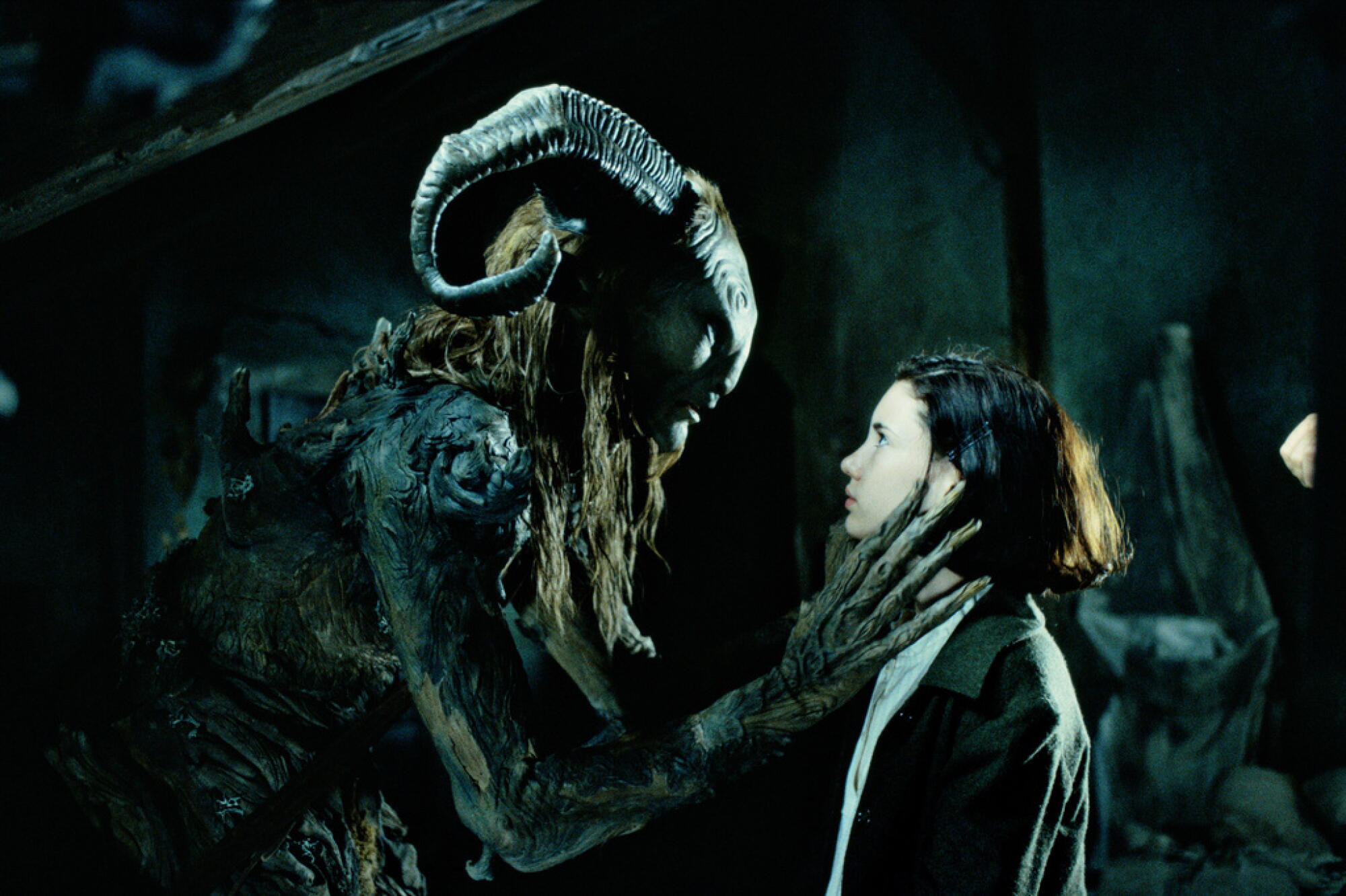
Doug Jones, left, plays the faun that beckons to Ofelia, right, played by Ivana Baquero in “Pan’s Labyrinth.”
(Scott A. Garfitt / Andreea Alexandru / Invision / AP)
As brutal as it is spellbinding, the Mexican filmmaker’s modern classic unfolds during the Spanish Civil War — more precisely, in 1944 — as young Ofelia (Ivana Baquero) and her pregnant mother move into the camp run by the ruthless Capt. Vidal (Sergi López).
Amid the bloodshed, Ofelia discovers an underworld of magical entities, including the alluring faun (Doug Jones), who convinces her that she is a princess who must reclaim her royal status.
By winning three Academy Awards and being nominated for two more — one for Del Toro’s screenplay, the other for foreign language film, representing Mexico — “Pan’s Labyrinth” signified an artistic watershed moment in Del Toro’s career. These accolades came after he directed two comic-book adaptations for Hollywood studios: “Blade II” and “Hellboy.”
Beyond the recognition, the experience felt spiritually transformative for the Guadalajara native; not the least because of the hurdles he overcame to bring it to fruition.
“‘Pan’s’ marks a big divide in what I did before and what I did after. I became invested in a different way in filmmaking,” Del Toro tells me. “I don’t know how to describe it, but filmmaking became a religion, as opposed to something that I could do. It fused with me.”
Though the film is now regarded as one of the greatest works of the 21st century, when Del Toro set out to make it, the industry was not receptive to his ideas.
“Everything I thought I wanted to say about war in ‘Devil’s Backbone’ seemed obsolete, because we had gone through 9/11 and the world had changed,” Del Toro recalls. “I didn’t want to do an American movie. I was being offered a lot of comic- book movies and said, ‘I got to do a companion piece for “Devil’s Backbone” no matter what.’ But nobody wanted to do the movie.”
One key objection was the mature tone of the narrative, in which the child protagonist is directly confronted and endangered by the evils derived from fascist ideologies.
“They said, ‘If it’s a fairy tale then it should be a family movie,’ because I’d been offered ‘Narnia’ a year before by [former Walden Media chief executive] Cary Granat,” Del Toro tells me.
“He said, ‘Why don’t you do ‘Narnia’?’ And I said, ‘Because I want to do my own version of a fairy tale where the lion doesn’t resurrect and it’s about a pitiless world against a boundless imagination.’”
Del Toro’s interest in stories where the woes of children are taken seriously was spurred by ‘Los Olvidados,’ Luis Buñuel’s classic from 1950, about a group of neglected children surviving a harsh reality in the streets of Mexico City.
“When I saw ‘Los Olvidados,’ I was in my early teens,” says Del Toro. “I thought every time somebody told a story about a child that was unsentimental and that was a little brutal — it could be ‘The Spirit of the Beehive’ or ‘Los Olvidados’ or ‘The Red Balloon’ or even Bobby Driscoll in ‘The Window’ — whenever you saw a child in real danger, a child in jeopardy, a child in moral dilemma, like ‘The Fallen Idol,’ I really was transported.”
Children, Del Toro believes, are often invisible to adults. They are “cartoons” in the eyes of “regular adults.” Thus, when his mother started reading child psychology books to better understand a young Del Toro, he read them as well, so that he could try to manipulate her.
Del Toro laughs mischievously as he remembers his antics. “I would do exactly what the book said, and I realized I could work within that preconception and make my grandma buy me horror comic books or make my mom allow me to miss school,” Del Tor recalls. “Ofelia is very strong. That was the point of the movie for me. I wanted to see the clash of wills between a young kid and a fascist captain, and I wanted to see the kid win.”
(Teresa Isasi / Picturehouse)
Del Toro’s mother, Guadalupe, died in 2022. But she lives on in cinema, thanks to the 1985 landmark queer Mexican film “Doña Herlinda and Her Son,” by director Jaime Humberto Hermosillo, where she played the titular Doña Herlinda.
And if you look closely, you’ll also find Del Toro in the movie, which was filmed in Guadalajara.
“I have a cameo with my ex-wife in it. Lorenza. She’s the receptionist and I appear dancing in Chapala, but I’m super thin, so you can never recognize me,” he says. “I’m dancing with a girl that I liked, but I was already in the throes of dating the one who became my wife, Lorenza.”
Then there was the question of the picture’s language. Del Toro wouldn’t waver on making “Pan’s Labyrinth” in Spanish.
“Many of them said, ‘We’ll do it if you do it in English — set in Spain, same ending, the girl dies, no problem, but in English.’ And I said, ‘I can’t. It’s not true to the movie.’ I’m not saying you can never do that, but it’s always this ‘Zorro’ thing like, ‘Are you in a hurry, señor?’ or ‘Come to the hacienda,’” he says, doing a funny, exaggerated accent on the Spanish words.
“If you’re trying to contrast reality versus fantasy, the reality has to be in its language, in its location,” Del Toro adds, emphasizing his resolve to make the movie in his native tongue. “I thought, ‘This is about the reality clashing with the fantasy. I have to make the reality stylized, but I don’t want to do it in English, because then everything is a construct. Everything is just an idea.’”
In 2026, the film’s bilingual appeal is a major component of the marketing strategy that Cineverse — the entertainment company that Del Toro approached to handle the restoration and rerelease of “Pan’s Labyrinth” — is implementing to reach audiences across the country.
“A lot of our messages are in English and in Spanish. The messaging around the making of the 3D — Guillermo likes to say ‘F— AI,’ but we positioned it as ‘Made for humans, for humans. Hecho por humanos, para humanos,’” says Yolanda Macias, chief motion pictures officer at Cineverse. “That’s a really strong message that has resonated with our fans.”
A Mexican American woman whose parents emigrated from Jalisco, Macias sees “Pan’s Labyrinth” as a timeless movie that’s as relevant today as it was two decades ago.
“We are not ignoring a very important segment of the audience, which is the Latino population who have always, in my experience, shown an interest in creators from Mexico or from Latin America,” Macias says. “And we are so proud of Guillermo for being that person for this audience.”
When first envisioning “Pan’s Labyrinth,” Del Toro found himself grappling with existential concerns related to the meaning and relevance of what each person leaves behind when they are gone. Can anything we mortals create stand the test of time? Does it matter?
(Gina Ferazzi / Los Angeles Times)
“One of the things I was going through was I thought, ‘Is making movies worth it? You give them years and years and years, and then they just move down the current into the oblivion of the culture,’” Del Toro says. “A central theme in the film is, ‘Can we give our lives to something that doesn’t change the world?’ That’s why the movie ends with a little flower blooming in a dried tree. That’s all that is left of her story in the real world.”
His films will one day too become flowers left not only as proof of his time on earth, but perhaps as messages for those to come who have the sensibility to appreciate them.
“You can say, ‘Ofelia lived in the other kingdom,’ but in the real world, there’s only one tiny flower. And that’s why it says, ‘For those that know where to look.’ Because that’s what we do as filmmakers. When you ‘discover’ a filmmaker, you say, ‘I discovered this guy Fellini.’ Well, he’s been there for a while, but sure. Or you discover Miyazaki or Mamoru Oshii … They’re continents, but they are only in maps that are very secret. I like that image.”
So long as they are found, Del Toro doesn’t worry that much about how people encounter them.
“[Films] live on to a certain degree. Like when we were shooting ‘Frankenstein,’ I said, ‘We will live forever in the Netflix queue,’” he recalls, trying not to laugh. “Theatrical is the best. There’s no comparison. But I remember my childhood, I saw all the Universal monster movies on TV, and they were monumentally important for me. There’s something to be said about accessibility that is also important.”
I agree with him — and mention that some of the most revelatory movie-watching experiences for me as a young cinephile happened thanks to bootleg DVDs, which I would buy as a teen in Mexico City.
“I love the pirate DVDs in Mexico,” says Del Toro with a laugh. “I’ll tell you a little story: We went to promote ‘Hellboy’ in Mexico City, and we were having coffee. A guy came in and said, ‘You want to buy movies?’ And he had ‘Hellboy’ already, opening week … and it didn’t have a cover either!”
Another distinction that “Pan’s Labyrinth” holds is that it was the last film in Spanish that Del Toro directed. But that could change, he says; he still has another project he’d like to make in Mexico.
“I actually have an idea that I would love to shoot, but I want to make it a drama. I don’t want to make it a fantasy movie,” he explains. “I have a great story that I want to shoot one day. It’s a kidnapping scene from three points of view. The victim, the people doing the pickup, and another component that I will not reveal.” (Del Toro’s late father, Federico, was famously kidnapped in Guadalajara in the late 1990s.)
The thought of Del Toro making another Mexican film in the future, reminded me that the original screenplay for his period ghost story, “The Devil’s Backbone,” was set in Mexico, but a lack of funding forced him to shift the production to Spain, with the help of Pedro Almodóvar’s company El Deseo.
“It was about a traveling circus during the [Mexican] revolution with a mother, a father and a boy. It was full of jarred fetuses. The boy was a clown, and the father was a magician. I was trying to do Bergman’s ‘Hour of the Wolf’ or ‘The Magician’ — modest but creepy,” he explains. “But it was very different. I had the orphanage, I had the legend of the fetuses and a ghost; and I had the devil live in the monastery.”
In any language, Del Toro is a fierce advocate against the use of generative AI in artistic creation. He believes that anything touched by humans has a better chance to endure. The love audiences still hold for “Pan’s Labyrinth” is a testament to this sentiment.
“[Pan’s Labyrinth”] is very truthful to who I was. And whenever you are able to be truthful, people feel that it matters to you,” Del Toro says. “And when you think it matters to someone, you cherish it.”
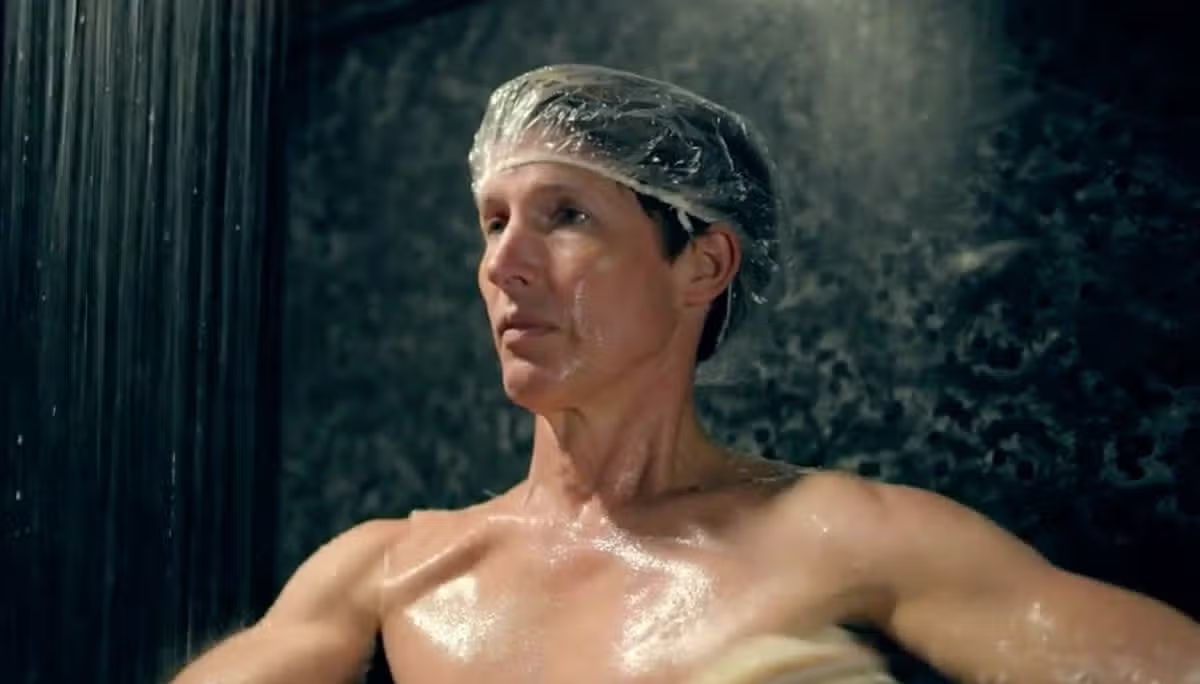
Like many buff-bodied Traitors hunks before him… Tom Daley… Freddie Fraser… James Blunt stepped up to take on the pensive shower cutaway scene in this year’s series.
Viewers were left in hysterics by James’ take – nipples out, thoughtfully scrubbing himself in a very awkward manner and donning a shower cap – all while puzzling over whether he’d be next for murder.
Fans took to X to share their excitement at the scenes.
“Not James Blunt in the shower!!!” cried one.
Others soon chimed in:
“James Blunt with a shower cap and huge brush was just not on my 2026 bingo card.”
“Can only assume that James Blunt is taking his first ever shower and is more of a bath man.”
“All of these shower scenes from previous seasons have nothing on James Blunt and his haircap and scrubber.”
Fans are hoping it doesn’t mean the end for the British Army Captain. In last year’s Celebrity edition, poor Tom Daley was murdered hours after he stripped off.
If we’ve learned anything it’s that you can be too squeaky clean when it comes to the Traitors.
KATHERINE Ryan couldn’t resist taking a cheeky pop at David Beckham as she joked about being “cancelled” by the BBC after her rude slur about his wife Victoria.
Katherine Ryan made a cheeky joke about David Beckham just weeks after complaints over her slur about Victoria was upheld by the BeebCredit: GettyShe couldn’t resist a joke at David’s expense but declared her love for VictoriaCredit: instagram/victoriabeckham
Two weeks ago, Katherine issued an online apology to Victoria, 52, after the ruling by the BBC‘s Executive Complaints Unit (ECU).
Raising the controversy during a stand-up gig in Chelsea, London, last night, the 43-year-old declared her love for Victoria Beckham while making a sly joke about her famous footballer hubby.
Sign up for the Showbiz newsletter
Thank you!
“I have been cancelled by the BBC for allegedly calling Victoria Beckham the C word,” she said.
“Or as David Beckham knows it – the K word, because bless him the alphabet is hard,” prompting laughter from the audience.
“But I actually did not do that, I actually love Victoria Beckham.”
Katherine make a joke about David Beckham in a London comedy gig last nightCredit: @alwaysbecomedy/InstagramThe comedian came under fire for her rude remark about Posh on an episode of Have I Got News for YouCredit: BBCThe BBC’s Executive Complaints Unit said ‘there was no such justification’ for the comment about Victoria which two viewers had complained was ‘gratuitously offensive’Credit: PAKatherine later apologised to Victoria online and showed the message she had sent her privatelyCredit: Instagram/kathbum
Speaking in an episode that aired on November 7 in 2025, Katherine made reference to a 2013 private email sent by David Beckham, where he allegedly used the word ‘c***’.
She said on the show: “I don’t know that we are allowed to broadcast the C-word, but you did reference Victoria Beckham earlier and we’ll allow that.”
The BBC’s Executive Complaints Unit said “there was no such justification” for the comment which two viewers had complained was “gratuitously offensive”.
They added that the word was justified in relation to David’s alleged use of it, but not in reference to his wife.
Now an edited version of the episode has replaced the original on the BBC’s streaming service.
Katherine Ryan publicly apologised to Victoria in an Instagram reel where she shared a screenshot of her message to the fashion designer.
“Hi I’m comedian Katherine Ryan and today the BBC announced their decision to uphold a complaint made by two very influential viewers about a joke that I tried to make on an episode of Have I Got News For You eleven months ago,” she began.
“At that time, though there is no defence, I was suffering from a condition called matrescence.
“I was in that building with a 10-day old baby. Should I have left the house?
“This is gonna be a tough one for the feminists because I was a woman going to work but I did call another woman a c***.
“Sometimes I forget that celebrities are not my friends. If I had called Jimmy Carr a c***, he wouldn’t have minded.
“Joanne McNally, c***, she wouldn’t have minded but this was described by the BBC as a slur.
“As though c**** are part of a protected group,” Katherine said in her trademark sarcastic way.
“The trouble is now that section’s been taken off iPlayer so the incident only exists in printed media, online media and then you lost the context because on the day, if you watched it, it was clearly a joke and the whole audience went ‘huhhhh’ and I said ‘whoaaaa’.”
She then plugged her new book before adding: “I love Victoria Beckham so much that I actually included her in one of my celebrity firstborn daughter chapters.
“I’d like to read you that now whilst remaining very sorry.”
In her apologise message to Victoria shown on screen, Katherine told her it was a “throwaway” comment and that she immediately expressed her love for her after, making it clear it was a “stupid joke”.
AMERICAN actress Jessica Chastain looked sensational on the red carpet for “the scariest of the year” horror movie that gave fans “panic attacks in the cinema.”
The 49-year-old posed for the cameras at the Los Angeles premiere of Other Mommy yesterday.
Jessica Chastain arrived at the premiere of Other Mommy yesterdayCredit: APThe American actress looked incredible as she posed up in a mini dressCredit: Getty
Jessica looked incredible as she flashed her long legs in a green silk mini dress.
She exuded effortless Hollywood glamour; looking world’s away from her terrifying character.
Sign up for the Showbiz newsletter
Thank you!
The film star had her blonde locks styled in a curly bob and accessorised her dress with a pair of strappy silver Louboutin heels.
Jessica was snapped beaming as she waved at her fans.
Jessica was seen waving at fans as she made her red carpet debutCredit: GettyHorror fans have been left terrified by the trailer of Other MommyCredit: Universal Pictures
In Other Mommy, Jessica stars in a dual role as normal mother Ursula and the sinister supernatural force using her appearance as a disguise.
The villainous entity is targeting Bela, played by Arabella Olivia Clark, Ursula’s young daughter.
Fans were left traumatised by the trailer of the film and took to social media to discuss their reactions.
One fan remarked: “Whoever decided to air this trailer right before The Odyssey started is a f*****g d******d.
“Thought it was an ice cream commercial. Next thing you know I’m having a panic attack in my seat.”
“That scene when she’s under table made my entire theater jump,” wrote another fan.
A third commented: “The theater played a trailer for this movie Other Mommy before the odyssey and there’s a jump scare it in that I’m still thinking about and it should be illegal.”
Other Mommy comes out in cinemas across the UK today.
80s rock legends rushed Deen Castronovo offstage mid-set after he suffered a medical emergency during gig on Thursday night.
The 62-year-old, who is the drummer for rock band Journey, had performed just two songs before he was rushed off stage at the BOK Center in Tulsa, Oklahoma.
80s rock legend Deen Castronovo was rushed offstage mid-set on Thursday nightCredit: GettyThe drummer pictured back in March this year in Hamilton, OntarioCredit: Getty
According to Tulsa World, keyboardist Jonathan Cain made the crowd aware of the situation after performing their tunes Be Good To Yourself and Stone in Love.
He said to fans: “We’re going to see what happens as this progresses.
Sign up for the Showbiz newsletter
Thank you!
“It’s an unfortunate situation. We’re very sorry. We’re hoping it’s only a delay, but please — I’m sorry. Don’t worry.
“Have your prayers ready. Have your prayers ready for Deen Castronovo, everybody. Thank you.”
Jonathan Cain, Todd Jensen, Arnel Pineda, Jason Derlatka, Journey founder Neal Schon, Gregg Rolie, and Deen Castronovo pictured together in 2023Credit: GettyDeen was rushed to hospital last nightCredit: Getty
Guitarist Neal Schon later returned and told the crowd that their band mate had been taken to hospital.
And according to Rolling Stone, when the group got back to performing, he told fans: “This concert is for Deen.
“I think he’s going to be fine.”
Journey has not addressed what has happened on social media.
The Sun has contacted the band’s representative for comment.
The band were performing as part of their Final Frontier Tour across North America when it happened.
Journey are set to return to the stage in San Antonio tomorrow night for one of their remaining shows.
Their tour is set to wrap up at the beginning of November.
The group currently consists of Neal Schon, Jonathan Cain, Deen Castronovo, Arnel Pineda, Jason Derlatka and Todd Jensen.
Journey was formed back in 1973 until 1987.
They reunited in 1995 and have been together ever since.
Some of the their best songs include Don’t Stop Believin’, Separate Ways, Faithfully and Open Arms.
CBB’s Chloe Khan has revealed that her designer clothes have been stolenCredit: Instagram/chloe.khanShe took to Instagram to make a plea to her fansCredit: Instagram/Chloe.khan
Sharing snaps of the items that are now missing, Chloe made a plea to her fans and friends.
In the photos there were designer shoes from Dior, Dolce and Gabbana, Chanel jeans, Gucci miniskirts, Fendi outfits, Louis Vuitton bikinis and a selection of high end designer bags.
Sign up for the Showbiz newsletter
Thank you!
Over the top of the snaps, Chloe penned: “STOLEN. PLEASE SHARE. £10,000 reward for discreet valuable information.”
In the caption of her post she added: “EVERYTHING I OWN HAS BEEN STOLEN . PLEASE SHARE AND MAKE THEM TOO HOT TO HANDLE.
The stunning star is heartbroken over her stolen possessionsCredit: InstagramShe appeared on Celebrity Big Brother in 2016Credit: Getty – Contributor
“In the early hours of 2nd of October. In Tring, Hertfordshire. I really didn’t want to post this and have been trying to deal with this for a week privately but I need the internets help.
“Will explain everything in a separate post. But someone must have been offered them by now. My boyfriend kindly put a £10,000.00 reward for someone who can give us valuable information/ been offered them / knows who did it.”
She continued: “And the information you give me will be discreet and undisclosed. If you see anyone in my stuff online please tag me / forward to me . It’s possible they bought and did not know it’s stolen.
“There is so so much more stuff then the photos but basically every designer item I have ever posted with has been taken.”
Fans flocked to the comment section to support Chloe in her hour of need.
One person wrote: “This is just absolutely awful and terrifying! I’m so sorry you’re going through this beautiful girl, sending you love and I hope you get your possessions back!”
“So awful you can’t have anything nice these days sad world we live in I hope you find out who did it and get your things back. Sending lots of love,” said a second.
“Posting expensive clothes and bags etc unfortunately makes people a target, I would be looking at your inner circle to be honest,” wrote a third.
Taking to social media in the spring, she told fans she was travelling back from Manchester to London.
When she arrived at Euston, she decided to jump on the tube instead of sitting in the back of an Uber for half an hour.
Sheexplained in aTikTokvideo that a “gang” of men got on the tube a few stops after her.
The star told how the men were trying to touch her dog, Dior, and attempted to talk to her.
Chloe said: “I was trying to turn away from them [the men]even though they were sitting right opposite me.
“I’ve got her [the dog] in my arms, my LV case and LV bag and stuff because I’ve been travelling. I clung onto them because I felt like something weird was gonna happen.
“I felt like I was gonna get stabbed or something weird was gonna happen.”
NEW DELHI — Nana Patekar, an acclaimed Indian actor and filmmaker, died Thursday at his home in the western state of Goa. He was 75.
Patekar died of a suspected cardiac arrest, the Press Trust of India news agency reported, citing a doctor at the hospital where he was pronounced dead.
Born in 1951 in India’s western state of Maharashtra, Patekar built a career spanning nearly five decades in Hindi- and Marathi-language cinema. He was known for intense performances and roles that often portrayed complex or unconventional characters.
Patekar made his film debut in the 1978 Hindi film “Gaman” and later earned acclaim for “Parinda” and “Krantiveer.” Patekar became popular in mainstream Bollywood films, while also working in India’s “parallel cinema” movement, known for its focus on realism and social issues. He gained wider international recognition with filmmaker Mira Nair’s Oscar-nominated “Salaam Bombay!”
He won three National Film Awards, India’s highest film honors, and received the Padma Shri, one of the country’s highest civilian honors.
In 2018, during India’s #MeToo movement, a Bollywood actress accused Patekar of sexual harassment on a film set. Patekar denied the allegation. The case was among several that drew attention as women publicly spoke about sexual misconduct in India’s film industry.
Prime Minister Narendra Modi mourned Patekar’s death, praising his “intensity, individuality and unmistakable presence” as an actor.
“He brought remarkable versatility and creativity to every role and gave us characters that will be remembered for generations,” Modi wrote on X.
Michael Kearns, a trailblazing AIDS activist and author credited as the first out gay actor, has died. He was 76.
Filmmaker and professor Roland Palencia confirmed the actor’s death on social media, writing that Kearns had died Monday evening after feeling unwell and calling the paramedics on Sunday. Palencia said that the actor had been in and out of emergency rooms more than five times in the last few months.
“Michael Kearns was a friend, mentor, neighbor, and my movie buddy,” Palencia wrote. “For the past year, we watched an average of a movie a month. Our favorite theater was the Vista Theater in Los Feliz, with a larger-than-life screen and within walking distance of where we both lived. Our favorite film this year was ‘The History of Sound.’
“It is a strange feeling to know we will not see the living Michael again, who spoke in hyperbolic, superlative tones. For him, nothing in life was small enough; everything had magnified significance. He himself and his legacy are larger than life,” he continued. “I will miss him deeply. Our next movie was going to be ‘La Bola Negra,’ a film based on Federico García Lorca’s first openly gay play, the Spanish playwright [was] killed in 1936 by the fascist Francisco Franco army. Michael was our Los Angeles García Lorca.”
Born Jan. 8, 1950, and raised in St. Louis, Kearns felt odd from an early age.
“I couldn’t throw a ball particularly well. I didn’t excel in sports,” he told talk show host Sheila Kuehl during a 1998 appearance on “Get Used to It.”
“But one day I was put in the school play, and I excelled. Suddenly I realized I could entertain, and from that moment on it was just like this realization, ‘Oh my God, here is something that I can do, I have found it,’ and I was only 8 years old. From that moment on, to this very moment, I’ve never ever veered from that path.”
Kearns realized along the way that his path to stardom wouldn’t be so simple. He had initially been drawn to the theater as a means to escape his home life, and himself, but he ultimately found the craft inspired the opposite: “As I got into my 20s, coinciding with an awakening of other areas of my life — spiritual, sexuality — I found that the theater and being an actor was more of a way to truly connect with who I was as a person,” he told Kuehl.
Around this time, Kearns made his way to Chicago, where he studied acting at the original Goodman School of Drama, which became the Theatre School at DePaul University, and graduated in 1972. It was here that Kearns got his first taste of casting bias, and realized that he was facing a real dilemma: Did he want to be gay or did he want to become a commercially successful actor?
“In spite of the fact that most of the teachers were gay or lesbian, they had that Hollywood philosophy that if they knew you to be a homosexual, you were not as eligible to play heterosexuals,” he continued. “By that point I was out, out, out. I mean, there was no way I was going to alter my offstage behavior to please anyone.”
Kearns acted across film and television from the 1970s through the aughts, including roles in “Body Double,” “Nine Lives,” “Street Asylum” and “Beverly Hills, 90210.” During an era when it could be dangerous to be queer, the actor was out, and in 1991, he made television history when he shared that he was HIV positive on NBC’s “A Closer Look,” and the next day, “Entertainment Tonight.” The following year, he appeared on a segment of ABC’s dramedy series “Life Goes On” and played a character with HIV.
In 1975, Kearns used his acting chops to pull off a literary stunt in which he posed, both in nude photographs and in extensive interviews, as author Grant Tracy Saxon, a pen name for TV writer Thom Racina who penned “The Happy Hustler,” a faux memoir (it was actually fictionalized erotica) about a high-priced male sex worker. Years later, Kearns became an author himself and published five theater books including “T-Cells & Sympathy” and “Acting = Life,” which were nominated for Lambda Literary Awards.
The actor’s first major theater role in Los Angeles was in Tom Eyen’s comedy “The Dirtiest Show in Town” in 1972. Perhaps his most celebrated performance was playing the title role in Charles Ludlam’s “Camille” at Highways Performance Space in 1993. He also acted in James Carroll Pickett’s “Dream Man,” in 1985 and toured with the production internationally.
Kearns, who considered himself “a political creature as well as an actor,” also garnered acclaim for his solo theater works, which were inspired by the AIDS epidemic and his grief surrounding the too-frequent death of his friends. “Intimacies” and “More Intimacies,” in which he played a dozen diverse characters with AIDS, as well as solo pieces “Rock” and “Going In: Once Upon a Time in South Africa,” made Kearns feel that he had found new purpose and depth in his work.
“Somewhere in that time, I became an artist,” Kearns told The Times in 1994. “Whatever that pain, that loss, that tragedy was, I managed to spin it like an alchemist into something passionate. And it’s been increasingly so since.”
In 1992, he married his husband, Philip Juwig, who died the same year. Bereft, Kearns spent three years thinking, “What now?” and kept coming back to the same thing: He wanted to be a dad. In 1995 he adopted a baby girl, Tia Katherine Kearns, whom he named after his grandmother.
In 2017, he interviewed his daughter for the summer issue of Honeysuckle Magazine about her identity as a Black woman, her work as an artist and her unique upbringing. She said that she attended a progressive school and didn’t feel judged, noting, “they doted on my dad because he had a skill set that other dads didn’t; for school fundraisers; he could climb a ladder and decorate with panache.”
Later in the interview, she revealed that she had her dad’s passion for political activism.
“I think my political consciousness was formed early on,” she said. “I think it would have been impossible for me not to have an awareness of the world and political climate with a dad who is an openly gay actor and activist. Your openness and courage forced me to be honest with myself and the world I live in.”
Kearns gushed in a 2015 interview that his dream creative collaboration would be directing a project written by his daughter that explored race.
In the last couple of decades, the social justice crusader worked with Angelenos to develop their own voices through writing workshops. He also served as an artistic associate at the Skylight Theatre in Los Angeles, artist-in-residence at Housing Works, and artistic director of QueerWise, a Spoken Word collective he founded in 2012.
Kearns was widely recognized for his work, including the Robert Chesley Playwrighting Award (2005), honoring lifetime achievement in LGBTQ+ theater, and a COLA Fellowship (2005) from the city of Los Angeles Cultural Affairs Department to fund major new creative works. His acting career was highlighted by a Drama-Logue Award and a Los Angeles Drama Critics Circle Award nomination for his lead role in “Camille.” Additionally, his national advocacy earned him the Victory Award (1999) from the Gay & Lesbian Victory Fund, alongside honors from the ACLU of Southern California (1987).
Anne Carson, the Canadian poet, essayist, professor of classics and translator, has won the 2026 Nobel Prize in literature.
The prize, announced at the Swedish Academy in Stockholm on Thursday, awarded Carson “for her bold and inventive oeuvre that, in playful dialogue with the classical tradition, has created new forms for contemporary literature.” Carson is the 19th woman to win.
Among Carson’s myriad acclaimed works are her novel in verse “Autobiography of Red” and its sequel, “Red Doc>”; her seminal book of literary criticism, “Eros the Bittersweet”; poetry collections such as “Glass, Irony, and God” — which contains “The Glass Essay” — and the T.S. Eliot Prize-winning collection of narrative poetry “The Beauty of the Husband: A Fictional Essay in 29 Tangos”; her haunting accordion-fold elegy, “Nox”; and her widely praised translation of Sappho’s surviving fragments, “If Not, Winter.”
“In 1981, she published her doctoral thesis in classics, and has throughout her entire career, combined poetry writing with translation work and teaching at various universities,” said Anders Olsson, who serves as the chair of the Nobel Committee for Literature at the Swedish Academy, and presented the laureate. “Almost all her literary production has centered upon the intersection between the philologist’s obsession with words and the poet’s desire for new meaning.
“Throughout her entire authorship, Carson, with a light touch, explores the possibilities of writing, a process by which the literary sketch has become of particular value for her. In her collaborations with visual artists and choreographers, and with opera and theater directors, she has crossed over into various artistic fields, which has lent her writing a strongly performative aspect,” Olsson continued. “This demonstrates the freedom with which she relates to literary expectations and rule systems, which in turn lies behind the outstanding importance her work since the 1990s has had for the international art and literature scene.”
Nobel committee member Steve Sem-Sandberg said Carson is “an author for our time,” unique in her skill at connecting contemporary ways of living through antiquity. Sem-Sandberg marveled at Carson’s use of the myths, characters, stories and fables from that time, and the way she puts them into a modern context. “The mixture between those two gives an enormous energy to her writing,” he said. “Nobody writes like her, and nobody would even, I think, dare to do this in this way.”
Carson was sipping tea and eating crackers at her seaside home in Iceland — she also resides in Ann Arbor, Mich., where she teaches — after she got the big news. She said she was thinking of ways to give the 12 million Swedish kronor ($1.2 million) award away. “We have a friend who needs a house, and we always give a lot to Doctors Without Borders,” she said. She also planned to celebrate by taking a walk through the woods and turning off the phone.
Carson’s initial reaction was surprise. “Who would expect it? For heaven’s sake!”
The latest episode of the ITV2 programme featured an error that viewers couldn’t ignore
Big Brother viewers have pointed out a major error made in the latest episode (Image: ITV)
Big Brother viewers have spotted the same error just minutes into the latest episode of the ITV2 programme.
The reality competition returned to screens on Thursday night (October 8), with the housemates still residing in the House of Revelations. The twist is all about exposing secrets in the house, including housemates’ true feelings about each other.
Viewers were ready to tune into the next revealing challenge in tonight’s episode, but they were left distracted by Rochelle’s comment just minutes in. During a conversation with newcomer Twinks, the housewife earnestly asked: “Who was the feminist that ran in the streets, Betty Boop, or something?”
Rochelle went on to add: “She ran on the race course, didn’t she? And got run over.” The other housemates within earshot quickly jumped in to correct her but their replies weren’t especially helpful.
Twinks responded: “Betty Boop’s a cartoon with the big head,” before adding that “Emily Pankhurst” was the feminist who tragically died after being hit by King George V’s horse in 1913.
While Emmeline Pankhurst was the woman who fronted the British suffragette movement, she wasn’t the person who walked onto the race course. That was actually fellow suffragette Emily Davison.
Viewers quickly spotted Twinks’ error and gathered on social media correct her. One X user posted: “for the record, neither Betty Boop nor Emeline Pankhurst ran in front of the horse, it was Emily Davison #bbuk.” A second rightfully questioned: “Wasn’t it Emily Davidson, not Pankhurst who threw herself under the horse? #bbuk.”
Someone else said: “Eye is twitching at Emily Davison being referred to as both Betty Boop and Emmeline Pankhurst. Bless Twinks for incorrectly correcting Rochelle, Pankhurst was closer but they are different people my love #BBUK
While a third eagle-eyed fan chimed in with: “Slight ding for Twinks there. It was Emily Davison who ran in front of the race track horse at the Derby. Emmeline Pankhurst was the leader of the suffragettes. Know your history if you plan to educate! #BBUK”
But this small mishap is unlikely to sway public opinion on Twinks, who is currently the frontrunner to win the show according to recent odds.
Try ITVX Premium free for a week
This article contains affiliate links, we will receive a commission on any sales we generate from it. Learn more
ITVX Premium offers exclusive ad-free content that can be streamed on-demand and on the go, with everything from Hollywood blockbusters to bingeable British box sets.
An annual plan costs £59.99 – equal to £4.99 per month – after a seven-day free trial.
It comes just hours before the house is set to face its next live eviction following brutal face-to-face nominations earlier this week.
Pauline is up for elimination after receiving five nominations from Lynx, Philip, Rhianna, Rochelle and Catrin. And Rob will join her, having received six nominations from Frankie, Lynx, Omar, Philip, Rhianna and Yasmin.
Viewers are being asked to vote for the housemate they wish to evict. Friday night (October 9) will see the next eviction and the evictee’s first live interview with hosts AJ Odudu and Will Best.
Big Brother continues tomorrow at 9pm on ITV2 and ITVX
KATIE Price told social services she feared her then husband Kieran Hayler had groomed and sexually abused his alleged child rape victim, a court has heard.
The 39-year-old is accused of three counts of rape and one count of sexual assault against the girl between June and October 2016, when she was 13.
Katie Price told social services she feared her then husband had groomed and sexually abused his alleged child rape victim, a court has heardCredit: GettyKieran Hayler, arriving at Lewes Crown Court for trial, is accused of three counts of rape and one count of sexual assaultCredit: Darren Fletcher
Katie told a social worker in 2018 that Hayler, 39, had been grooming the girl since she was 13 in a list of agreed facts read in Lewes Crown Court yesterday.
She alleged that Hayler had been grabbing the teen’s bottom, trying to kiss her and said he was falling in love with the girl, jurors heard.
Sign up for the Showbiz newsletter
Thank you!
The social worker then informed Sussex Police about the allegations.
Authorities contacted the mother soon after but she told police her daughter did not want to talk about it or take the allegations any further.
Katie alleged Hayler had been touching and trying to kiss the girl and was falling in love with her, jurors were toldCredit: PAKatie Price and Kieran Hayler in 2017Credit: Getty
Defence barrister Arlette Piercy asked the mother if she had betrayed her daughter’s trust by going to Katie Price with her allegations in 2017 – nearly a year before she reported them to social services.
She asked: “You said you felt you had to tell Katie Price. “You went behind your daughter’s back?
The mum – who cannot be named for legal reasons – responded: “Yes, she probably didn’t want anyone to ever know.
“It probably did cause arguments. We did have a big fall out.”
Asked if the girl was “OK” about her telling Ms Price, the mum said: “No, she wasn’t OK about it.
“But I said to (the girl) because the marriage situation (with Kieran) had broken down, it was only fair that I let Katie know.”
The child told her mum that Hayler had “done everything” to her during a conversation in 2017 – almost a year after his last alleged attack, jurors were told.
The woman then informed former glamour model and mum-of-five Ms Price, 48, weeks after she was told.
Speaking about when she told Ms Price, the woman said she told her: “I think Kieran has done something to (the girl).”
She told the court: “She was shocked and probably swore.”
The mum said she felt “like I have to” tell Ms Price, who was having marriage problems with Hayler at the time.
She added: “She was quite angry and I didn’t feel that she was particularly upset for (the girl).
“I just felt that she was angry and feeling revengeful towards Kieran for the situation they were in.
“And she said, ‘Well, you could get him into trouble if you told somebody’.”
The woman – who said her daughter did not want to tell authorities about the allegations – continued: “I said we have to respect her wishes, she doesn’t want anybody to know, we have to just look after (the girl).”
The girl – now aged in her 20s – denied making up the claims and became emotional, leaving the courtroom at one point as she faced questions from Hayler’s legal team.
The court was shown a video of her police interview from 2021 where she recalled the alleged abuse, sobbing as she said “I thought it was my fault for ages”.
Jurors previously heard Hayler allegedly begged the girl to not tell anyone and told her to “take it to the grave”.
The court also heard previously that before the first alleged rape, Hayler told the schoolgirl he really liked her and began speaking to her about sex – he is accused of raping the girl again on two further occasions.
The girl, who is not a member of Hayler or Katie’s family, contacted the NSPCC in December 2021 when she was aged 18, which prompted an investigation, it was said.
Former stripper Hayler denies all the allegations, which are said to have happened at an address in West Sussex.
Dearest gentle “Bridgerton” viewers — rejoice, for a new prequel series about Lady Violet is headed to Netflix.
The streamer and Shondaland announced Thursday that an untitled spinoff about the early life of the future matriarch of the Bridgerton clan is in the works. Shonda Rhimes and Nicholas Nardini will write and serve as showrunners on the limited series, which will tell the story of young Lady Violet’s romance with her future husband, Viscount Edmund Bridgerton.
The show will be the second spinoff set in the expanding world of the popular Regency romance following the 2023 prequel series “Queen Charlotte: A Bridgerton Story,” which explored the early days of the eponymous queen’s marriage to King George III.
Portrayed by Ruth Gemmell in the flagship series, Lady Violet is the mother of the eight Bridgerton siblings whose individual adventures in (and around) the marriage mart are the focus of the show. A younger version of the character, played by Connie Jenkins-Greig, also appeared in the “Queen Charlotte” prequel. The cast of the untitled Lady Violet prequel has not yet been announced.
Based on the popular book series by Julia Quinn, “Bridgerton” has been a hit with audiences since premiering in 2020. The first four seasons have chronicled the steamy happily-ever-afters of the eldest Bridgerton siblings, Daphne, Anthony, Colin and Benedict. The fifth season of the series, which will follow the love story of Francesca Bridgerton (Hannah Dodd) and Michaela Stirling (Masali Baduza), is currently in production in London.
In addition to Rhimes and Nardini, who was also a writer on “Scandal,” “Queen Charlotte” and “Inventing Anna,” frequent Rhimes collaborator Tom Verica will direct and executive produce on the upcoming limited series. Shondaland’s Betsy Beers is also an executive producer.
“Crazy Rich Asians” will officially be back on screen, with some familiar faces joining for the ride.
HBO announced on Thursday that it had ordered an original drama series of the same name based on author Kevin Kwan’s book series eight years after director Jon M. Chu’s “Crazy Rich Asians” film adaptation marked a watershed moment for Asian representation in Hollywood. The series will see stars Constance Wu and Henry Golding reprise their roles as lovebirds Rachel Chu and Nick Young; Ronny Chieng as Nick’s cousin Eddie Cheng and Oscar winner Michelle Yeoh as the hard-to-please Young family matriarch, Eleanor.
Although not exactly the movie sequel some fans were hoping for, the series will pick up after the events of the 2018 film and will be based on Kwan’s books, HBO announced. Adele Lim, who co-wrote Chu’s 2018 film, will serve as showrunner and will executive produce the series alongside Kwan, Chu and “Crazy Rich Asians” movie producers Nina Jacobson and Brad Simpson.
The official series order comes more than a year after Golding shared that he and some of his “Crazy Rich Asians” collaborators had reunited to discuss the future of the franchise, including a meeting with Lim. The Times confirmed last year that the series was in early development.
The “Crazy Rich Asians” series could fill the void left by the onetime promise of a “Crazy Rich Asians” sequel. Prospects of a sequel crumbled in 2019 when the Hollywood Reporter broke news that Lim left the sequel over pay disparity.