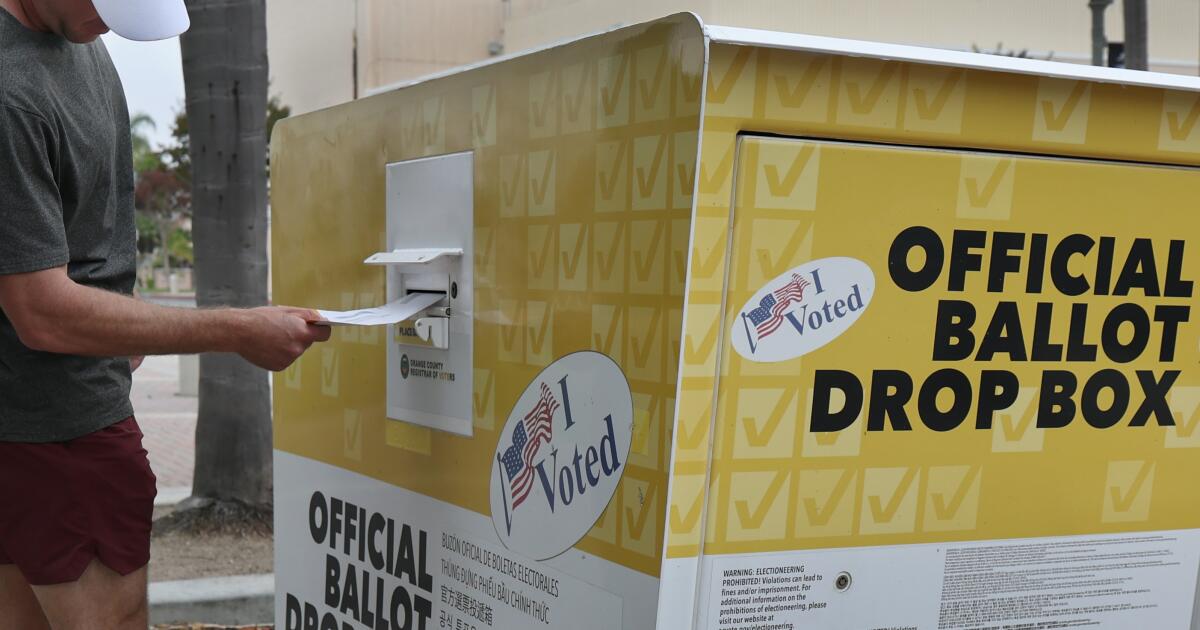
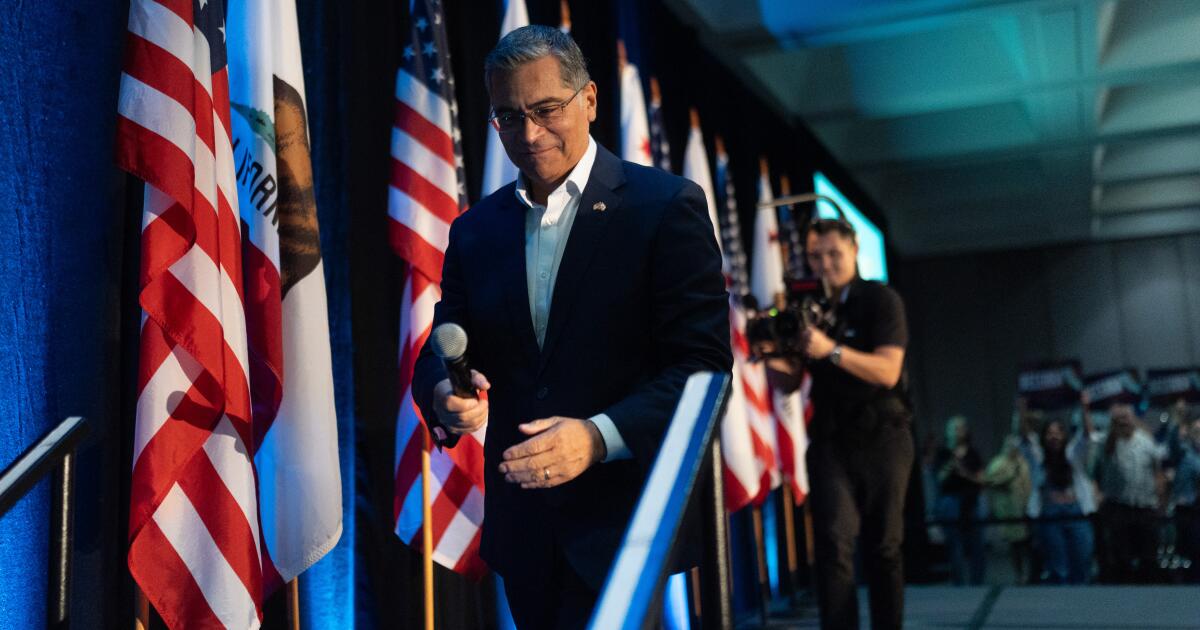
Voters in California may get a chance to remake the state’s open primary system in two years.
Political consultant Steve Maviglio filed an application Friday with state officials that seeks to alter California’s voting system by reverting to a traditional primary. Under the proposal, the top candidates from each party would advance to the general election in November.
The current system allows the top two candidates, regardless of party, to move on to the runoff. That has led to instances in which two Democrats or two Republicans have faced off in the general election.
The state’s gubernatorial election, for example, has prompted concern that two Republicans could shut out the Democratic candidates. Riverside County Sheriff Chad Bianco and former Fox News commentator Steve Hilton have polled high in various surveys and are facing a large field of Democrats.
Democratic voters vastly outnumber Republicans in California, yet some political consultants said they feared there were so many Democrats running that voters wouldn’t coalesce around one candidate and the field would be split. Those fears have eased somewhat in recent months as some Democratic candidates advance from the pack.
The state’s top-two primary system has been in place since California voters passed Proposition 14 in 2010. The goal was to help end partisan gridlock in Sacramento and force candidates in primaries to appeal to a wider range of voters, rather than just those in their own party.
Proposition 14, as well as the state’s once-a-decade redistricting process, has led to some dramatic races, including the 2012 face-off between Democratic Reps. Brad Sherman and Howard Berman for a congressional seat in Los Angeles’ San Fernando Valley. Amid aspersions and attack ads, the pair nearly came to blows at a community debate.
Maviglio described the ballot measure as a simple repeal of Proposition 14, and said he was inspired by the governor’s race.
“It was extremely scary to envision the November ballot for governor with Republicans on it,” Maviglio said.
The New York Times first reported on the ballot measure proposal.
A news release from Maviglio states that the proposed repeal of Prop. 14 “is fueled by concerns that California’s primaries are disenfranchising a majority of California voters by limiting choice to candidates from one party.”
A website for the effort includes criticisms of the current primary system by Democratic Party Chair Rusty Hicks and Ron Nehring, former chairman of the California Republican Party.
Maviglio’s ballot initiative proposes to appear on the 2028 ballot and take effect in 2030.
Talk of changing Proposition 14 has been swirling in Sacramento for months.
Secretary of State Shirley Weber told reporters at an unrelated news conference last week that she had voted years ago against Proposition 14. She questioned whether it had actually succeeded in creating more diversity.
“I did not like the open primary,” Weber said. “I didn’t think it would solve any problems. They had a list of problems it would solve, and none of those have been solved.”
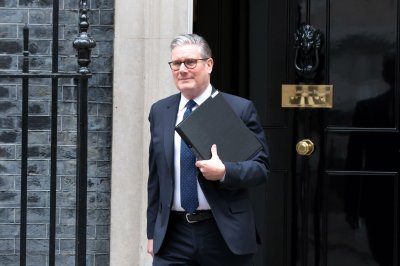
May 10 (UPI) — British Prime Minister Keir Starmer’s job was hanging in the balance Sunday in the aftermath of the worst local council election results for his Labor Party in its long history, analysts said.
Political rivals were circling around the prime minister after the ruling party’s support on councils in England and in devolved Parliaments in Scotland and Wales collapsed in Thursday’s voting, leave the right-wing Reform UK and left-wing Green Party as the biggest electoral winners.
In what was termed a “total bloodbath,” a “calamity” and a “wipe-out,” Labor was voted out of power in 40 local councils, losing about 1,500 councilors along the way, with the vast majority of the seats being seized by Nigel Farage’s Reform UK.
Starmer’s party also lost the Welsh Senedd to Plaid Cymru, surrendering its control of the body for the first time since the Welsh parliament was created in 1999.
The results came during what is essentially the mid-point of the Starmer government’s five-year term following Labor’s lopsided victory over the Conservative Party in 2024, and he vowed on Friday that he would not stand aside.
Labor, he said, was elected to meet the challenges faced by everyday Britons “and I’m not going to walk away from those challenges and plunge the country into chaos.
“I led our party to that victory, that is a five-year mandate to change the country. It was a five-year term I was elected to do, I intend to see that through.”
But the scale of last week’s losses have prompted calls for the prime minister’s resignation. As of Sunday, more than 40 Labor members of Parliament have publicly called on him stand aside.
“It is clear that Keir has fought his last election as Labor leader and, deep down, he will know it,” Labor MP Richard Burgon said in a statement. “The party should now work towards a timetable for an orderly transition to a new leader by the end of this year.”
“When you’re the leader, the buck stops with you,” Labor MP David Baines told the BBC. “There’s no doubt his popularity has plummeted and we’ve heard it on the doorstep.”
Starmer’s main party rivals spent Sunday voicing warnings that he rethink his determination to hang on to power ahead of what will likely be a “make-or-break” speech on Monday in which the prime minister is expected to outline sweeping changes to his government’s direction.
Angela Rayner, Starmer’s former deputy prime minister, issued what amounted to an ultimatum that he avoid mere “policy tweaks” and instead implement a sharp progressive turn to win back voters who are deserting Labor for the Green Party.
“The prime minister must now meet the moment and set out the change our country needs,” she said. “Change our economic agenda to prioritize making people better off, change how we run our party so that all voices are listened to, and change how we do politics.
“Labor exists to make working people better off. That is not happening fast enough, and it needs to change — now.”
Meanwhile, Health Secretary Wes Streeting has told Starmer he is preparing to make a bid for the top job should the prime minister resign or be forced from office, The Telegraph reported Sunday.
The favorite candidate of the “soft left,” Greater Manchester Mayor Andy Burnham, has been blocked by Labor’s National Executive Committee from standing as a parliamentary candidate in a move engineered by Starmer in January.
But Rayner on Sunday called for Starmer to lift Burnham’s ban in the greater interests of the party and the country.
The National Science Foundation suspended at least 18 research grants to UC Berkeley last month despite a court injunction restricting such suspensions, according to an attorney representing university scientists in a class-action lawsuit.
The NSF declined to comment on the suspensions.
The grants include at least one that the NSF had previously canceled and was compelled by a federal court order to restore, for a series of mixed-reality exhibits at the Lawrence Hall of Science showcasing Indigenous Ohlone knowledge about the natural world, said one of the project’s leaders, Jedda Foreman.
Foreman, an associate director at the Lawrence Hall of Science, said another researcher on her team received an email from UC Berkeley’s vice chancellor of research, Katherine Yelick, notifying them that the National Science Foundation had suspended the $1.4-million grant. Foreman said she viewed the email, which said the university had received a letter from the NSF raising concerns about “foreign funding.” The email did not provide a copy of the letter or explain further, she said.
Foreman said the Lawrence Hall of Science had not received any foreign funding for the project.
“The grantees were given near-zero information about what was problematic in the execution of their grant,” said Claudia Polsky, a professor at UC Berkeley School of Law who is representing Foreman and other researchers in a suit they filed last year contesting a previous round of grant cancellations by the Trump administration.
Polsky said her legal team was seeking more information about the 18 suspensions, but was concerned that the freezing of Foreman’s grant may violate a court order a federal judge issued in that case restoring the defunded projects.
UC Berkeley spokesperson Dan Mogulof said in a statement that the university “is engaged with the government on matters pertaining to research grants, and remains committed to compliance with all federal laws, rules and regulations.”
He declined to comment on the types of grants affected, the amount of funds at stake, or the potential effect on the campus.
One of the Lawrence Hall of Science exhibits, which were co-designed with Ohlone youth, is scheduled to open Sunday, with another set for the fall of 2028. Researchers also are studying whether participating in creating exhibits sparks more interest in science among Indigenous young people and makes them more likely to pursue STEM careers.
“We’re doing a lot of hoping and finger-crossing that something works out,” Foreman said. “It was such a powerful project and we really want to be able to share what we’ve learned.”
National Science Foundation turmoil
The University of California received $525 million in National Science Foundation grants in the 2024-25 budget year. But that funding source has become increasingly volatile under the Trump administration as the federal agency has terminated nearly 2,000 grants nationwide that it said did not align with its priorities — including those focusing on diversity, equity and inclusion — and has been slower to approve and disburse new awards.
Other federal agencies also terminated research grants en masse last year. Some of the cancellations have been reversed by the courts.
UC researchers are contesting grant reversals by the National Science Foundation, Department of Energy, National Institutes of Health, Department of Transportation, Department of Defense, Environmental Protection Agency and National Endowment for the Humanities in the class-action lawsuit, filed last year. The University of California is not a party to the suit.
Last June, the researchers won a key legal victory when U.S. District Judge Rita Lin issued a preliminary injunction restoring grants canceled by the NSF, EPA and NEH — including for the Ohlone-focused exhibits co-led by Foreman, one of six named plaintiffs in the case. The judge barred the agencies from revoking funds using form letters that didn’t include an explanation specific to the grant at stake, or because of Trump’s anti-DEI executive orders.
Judge Lin stepped in again after the NSF froze hundreds of grants to UCLA in August, amid attempts by the Trump administration to secure a $1-billion settlement from the university over allegations of campus antisemitism. Indefinitely suspending a grant was the same as terminating it, Lin said in a ruling requiring the agency to reinstate the funds.
Polsky said last month’s suspension of Foreman’s grant raised concerns that the Trump administration was seeking a way around those orders. “It seems to us like something that should not have been canceled on the merits and raises suspicion that this was just a different way to cancel the grant,” she said.
UC looks to state for alternative funding
The University of California is ramping up efforts to find alternative funding for its multibillion-dollar research enterprise as federal support becomes less reliable. On Monday, UC President James Milliken spoke alongside state Sen. Scott Wiener and United Auto Workers president Shawn Fain at a Sacramento rally in support of state legislation to create a $23-billion fund for scientific research.
If successful, the bill will place a bond measure on the November ballot. Money from the bond would go toward research in wildfire and pandemic preparedness, new medical treatments and other areas, with revenue from inventions shared with the state. The state Assembly’s appropriations committee is set to consider the bill Thursday.
“If the federal government is going to continue to attempt to reduce funding for the research that has been so important to UC — that saves lives, that drives the economy — then the state of California, I hope, will be able to step up,” Milliken said at a meeting of the university’s Board of Regents on Wednesday.
UC Provost Katherine Newman told the regents she has been meeting with leaders of the Russell Group, a consortium of the United Kingdom’s top universities, to discuss collaborating on research in climate change, clean energy and public health — all areas that have seen federal funding threatened under the current administration.
Mello writes for Berkeleyside, which originally published this story. It wasdistributed through a partnership with the Associated Press.
No, on top of all that voters have been subjected to — the horror! — a dull and drab gubernatorial campaign, burdened by a surfeit of C- and D-list candidates with all the electricity and elan of a tepid bath.
That, anyway, is the perspective one gets reading a certain genre of campaign dispatch, written from the perspective that all of California, Land of Reagan and Schwarzenegger, home to Hollywood and Silicon Valley, incubator of the Next Big Thing, is a stage. Woe unto those who fail to entertain, animate or amuse.
With no glitz, no glamour, what’s a star-seeking, celebrity-hungry voter to do? If you believe the stereotype, Californians take their political cues more from Variety and In Touch magazine than, say, their voter guide or the flood of TV ads and campaign mailers that inundate the state every two years.
In truth, the Hollywood stars elevated to the governorship, Ronald Reagan and Arnold Schwarzenegger, have been the exception — spaced nearly four decades apart — and far from the norm. Both political insurgents were elected under extraordinary circumstances. Reagan amid the tumult and tectonic fracturing of the 1960s Civil Rights and Free Speech movements. Schwarzenegger in an unprecedented, rapid-fire recall of an enormously unpopular governor.
The three were, to use Newton’s description, “mainstream, politically tested, not flashy.” Which also happens to describe several of those currently aspiring to be governor.
Drab, but true.
Boring as it may seem, most Californians want someone who’ll focus on their workaday concerns, not jollification. For all the talk of the “attention economy” — the hearts and minds won by jokey memes, viral videos and other snackable morsels on social media — voters are much more focused on the real economy, which is to say putting food on their table, maintaining a roof over their head and keeping their car fueled and home at a bearable temperature.
“That may not be interesting to the punditry and the East Coast,” Madrid went on, “but it still matters. Reality still matters. The performative nature that has dominated our discourse for 10 years in the Trump era is fading away.”
Imagine, for a moment, if former Vice President Kamala Harris had jumped into the governor’s race, as contemplated. The contest, for all intents, would have ended then and there, save for months of airy speculation on which Democrat or Republican would make the November runoff en route to eventual defeat. That would have been boring.
In Harris’ absence,the sprawling field of candidates has been a good and healthy thing, yielding the most competitive California gubernatorial contest in a quarter century. Fears of a Democratic shutout in June’s top-two primary and a fluky Republican being elected — which were always overwrought — have faded dramatically. Even if they hadn’t, would it really be better for politicians in Sacramento and Washington to anoint the Democratic favorite and cut voters out of the equation?
TAIPEI, Taiwan — A resolute Secretary of State Marco Rubio took to the White House lectern Tuesday and declared the United States, under President Trump’s leadership, had launched a bold new operation to reopen the Strait of Hormuz, based on the principle that international waterways must remain free.
An hour later, Trump walked it all back, ending the complex military endeavor after less than a day.
It was just the latest evidence to America’s allies that the word of the U.S. government is subject entirely to the president’s whims. And such is the worry fueling concerns in Taipei ahead of Trump’s state visit to China this week.
Privately, senior administration officials have assured Taiwanese leadership ahead of the trip that Trump has no intention of changing long-standing U.S. policy on the island, two sources familiar with the discussions said — a stance of “strategic ambiguity” that has avoided any declarative statements on Taiwanese independence since it was coined by Henry Kissinger 55 years ago.
A White House official was definitive that U.S. policy toward Taiwan “remains the same as the first Trump administration.”
“The U.S. One China policy, as our cross-strait policies are collectively known, is based on the Taiwan Relations Act, the three U.S.-PRC Joint Communiques and the Six Assurances to Taiwan,” the official said. “There is no change to our policy with respect to Taiwan.”
But Chinese officials told The Times that their president, Xi Jinping, intends to raise the matter as a top priority, knowing that only one person — Trump himself — speaks for the administration today.
Whether Xi can leverage the intimacy of a private audience to shift Trump’s stance, potentially linking it to other U.S. objectives, is the source of significant concern here.
Taiwanese officials fear even the most subtle rhetorical change in policy from Trump could imperil a delicate status quo that has held, to its benefit, for decades. They have similarly sought assurances that the administration will follow through on a pending U.S. arms sale worth over $10 billion, which received approval from Taiwan’s legislature on Friday.
“The most serious scenario would be if President Trump were to make an impromptu statement, such as, ‘I oppose Taiwanese independence,’ particularly if he were to link this to trade, the Iran issue, or a summit agreement,” said Chienyu Shih, of the Institute for National Defense and Security Research in Taiwan. “This would constitute a rhetorical concession of substantial significance to Beijing.”
Rubio told reporters at his news conference Tuesday — with a similar confidence he expressed on the Iran file — that China understands Washington’s long-standing position on the island.
“I’m sure Taiwan will be a topic of conversation. It always is. The Chinese understand our position on that topic — we understand theirs,” Rubio said.
“I think both countries understand that it is in neither one of our interests to see anything destabilizing happen in that part of the world,” he added. “We don’t need any destabilizing events to occur with regards to Taiwan, or anywhere in the Indo-Pacific. And that’s to the mutual benefit of both the United States and the Chinese.”
Trump has suggested a willingness to shift U.S. policy on Taiwan before.
During his initial campaign for the presidency in 2016, Trump openly questioned the One China policy, drawing ire from Beijing for suggesting he might endorse Taiwanese independence. He accepted a call from Taiwan’s president after his victory and would later support significant arms sales to Taipei.
And yet, at a 2017 meeting with Xi, Trump vacillated, telling the Chinese leader he could “deal with” the Taiwan issue in “a matter of months,” according to the Wall Street Journal. The Chinese were reportedly so flabbergasted by the comment that they dismissed it as rhetorical flourish.
“There is concern that the conversation between the two leaders could veer into sensitive territory on the topic of Taiwan,” said Brian Hart, deputy director of the China Power Project at the Center for Strategic and International Studies, “but there are many in the administration who would still appreciate the importance of general continuity in U.S. policy.”
U.S. support for Taiwan’s democratic movement used to be a matter of principle. Today, Washington sees it as a matter of national security. Over 60% of semiconductors are produced in Taiwan, including 90% of the world’s most advanced chips. And it is viewed as the clasp of the first island chain guarding against Chinese maritime expansion.
A robust debate between Taiwan’s Cabinet and the opposition in parliament ended Friday not over whether to accept U.S. defense equipment, but over how much to spend. The Legislative Yuan approved $24 billion in purchases — including a defense package passed by Congress in December and the pending arms sale — falling short of Taipei’s $40-billion proposal.
Anticipation for the president’s state visit is high here in the capital city, where local news is filled with questions over the influence Trump’s war in Iran might have on his appetite for supporting Taiwan.
Chinese defense analysts have seen the war as a sign of U.S. weakness. But Taiwanese defense experts have taken away a different lesson: cheap equipment from a lesser military, such as dumb mines thrown in a strait, may just be enough to paralyze a superpower.
The latest U.S. National Security Strategy, released by the Trump administration in December, emphasized the importance of support for Taiwan and the status quo.
But the Taiwanese took note that the strategy also called for an end to forever wars in the Middle East, offering little preview of the president’s sudden strategic pivot on Iran in February, launching a war few saw coming.
What Trump chooses to say in China “might be difficult to predict,” said Jyh-Shyang Sheu, a scholar of Chinese politics and military capabilities based in Taiwan.
But “in Taipei, we are still focusing on the U.S. policy,” he added, “more focusing on what he does instead of what he says.”
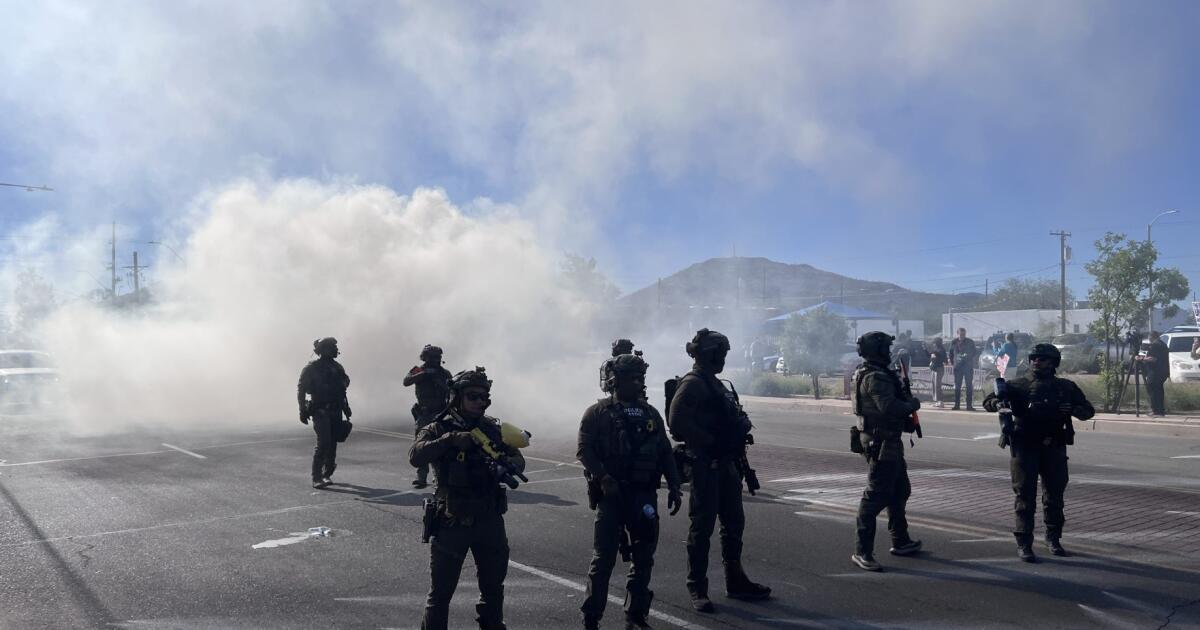
TUCSON — Tucson migrant advocates have designed a new tool to help track immigration-related enforcement in and around the city as arrests surge under President Trump’s mass deportation initiative.
Tucson Migra Map allows people to document and visualize enforcement activities by Immigration and Customs Enforcement and other federal agencies. While revealing patterns, the tool also raises questions about safety, transparency and the limits of public tracking tools.
“It indicates the level of chaos and how disruptive it is to our community,” activist Lucia Vindiola said in a statement. Vindiola launched the mutual aid group La Bodega to provide groceries and other help to people affected by increased enforcement.
“We are seeing firsthand the impact on families, limiting them from shopping for groceries and supplies,” Vindiola said.
Since Trump took office, immigration-related detentions have more than tripled in fiscal year 2025 — surging from fewer than 200 in late 2024 to more than 800 by June 2025. The response in communities nationwide has been swift, with groups such as the Tucson Rapid Response network organizing to monitor and track federal immigration action on the street.
Geographer Dugan Meyer, one of the map’s creators, is a PhD student at the University of Arizona who volunteers with Tucson Rapid Response and related organizations.
“This project came out of the documentation work that Rapid Response is doing, but also around the city,” Meyer said. “It is a community research project, community mapping project.”
The data are pulled from spreadsheets maintained since January 2025 that tracks and documents federal enforcement actions in greater Tucson such as raids, vehicle stops and aerial surveillance.
Incidents on the map are vetted and classified as “confirmed” or “credible but unconfirmed” based on the level of evidence.
“If we have photographs of, say, an agent wearing a tactical vest that says ‘ICE,’ that’s confirmed,” Meyer said. “Credible unconfirmed, we’re very confident something happened.”
Meyer said a trained Rapid Response observer witnessing an event, even if they had not photographed it, would be an example of a credible unconfirmed event.
“Their testimony about that would be enough for us,” he said.
Hundreds of people, including noncitizens, have contributed their eyewitness accounts of immigration enforcement to the map and the database it draws from, according to the Tucson Migrant Map website. Information from the local news is included, along with reports collected by Rapid Response and other neighborhood networks such as Migra Watch, and information shared on social media and in WhatsApp groups.
Rapid Response member Steven Davis has documented five incidents, including one in which he was pepper-sprayed by law enforcement. He says having these incidents recorded and published furthers his efforts to better show people what ICE is doing in their community.
“The value of the observation is that we take this out of the shadows and get it out into the public,” Davis said. “The Migra Map is a public-facing map that makes visible this activity that is mostly behind the scenes.”
Davis said knowing the data he collects will be used for Migra Map makes it more important for him to document diligently.
“There’s the saying, garbage in, garbage out. I want to make sure that the information that I’m providing is the most accurate information that I can possibly provide,” Davis said.
Meyer said that as of late April, the team had reviewed around 562 incidents, with about 300 meeting the threshold to be included. The goal is to review reported incidents within a week, then add qualifying cases.
“We know that the map is an undercount by any estimation,” Meyer said.
The map also includes police facilities and immigration detention facilities, along with flight paths of various federal agencies’ surveillance flights.
The accuracy of the reporting has been confirmed as more data is gathered, said Meyer. For example, repeated vehicle reports often confirm instances of surveillance.
Meyer said he hopes that the map will ultimately become a platform for information accessible to the public.
He said he thinks the map “can show in a way that people may know intuitively already.”
“It really helps us think about directly when we can see these things in relation to each other,” he added.
Meyer said that makes it easier to identify trends and point out hotspots like El Super grocery store on Tucson’s south side, which is frequented by mostly Latino customers and has seen a high concentration of enforcement.
“It’s used as a hunting ground for that, but there are others as well,” Meyer said, such as specific apartment complexes targeted by ICE or other agencies.
The Tucson Migra Map was not the first of its kind.
Last year, an initiative called People over Papers was used nationally to track immigration enforcement before being shut down by its host site, Padlet, for violations of its content policy.
Federal officials have said such tracking puts officers at risk, and other tracking sites, including ICEBlock, were previously taken offline after the Trump administration called for their removal.
Meyer said that he hopes the Constitution’s protection of free speech will protect Migra Map from a similar fate, and that people in other places will be encouraged to launch their own initiatives.
Davis, the observer, said that unlike the earlier trackers, the Migra Map doesn’t attempt to alert people to events occurring in real time, but reports enforcement actions after the fact.
“It doesn’t tell you where ICE is active right now. It tells you where ICE has been active in the last months,” Davis said. “You could file a Freedom of Information Act for the Tucson District Office and get the exact same information that we’re providing on the map.”
Meyer also noted that he and the other developers have been public about the project.
“It’s not a crime to collect this information and share this information,” said Meyer.
Nonetheless, some contributors opt to report anonymously out of fear.
“I think that anyone paying attention is at the very least concerned” about the current administration, Meyer said. He said he feels privileged he can publicly associate with the project.
But he allowed that Migra Map is far from perfect.
“The important thing is that it doesn’t tell us a lot,” Meyer said. “While many people would like it to be a real-time alert system, this map can’t be that.”
Cuellar writes for Arizona Luminaria, where this story was originally published. It was distributed through a partnership with the Associated Press.
MEMPHIS, Tenn. — For 21 years, Steve Fowler and Sam Wilson have performed together in a band on Memphis’ renowned Beale Street. And for the last decade, the men have been neighbors on a quiet, leafy avenue.
But as of Thursday, they will no longer cast the same ballot despite living across the street from each other.
That’s because Tennessee’s Republican-controlled Legislature redrew the congressional district of Memphis, which has long enjoyed its own Democratic-leaning U.S. House seat. Now, the city is split into three Republican-leaning districts, its majority-Black population sliced up and bound to mostly white, rural and conservative communities along lines that branch away from Fowler and Wilson’s East Memphis neighborhood.
A line runs down the middle of the street, placing Fowler in the 8th Congressional District, which runs hundreds of miles to central Tennessee across a dozen counties. Wilson is zoned for the 9th District, which extends across most of the state’s southern border before curving up to encompass the largely white and affluent Nashville suburbs.
“I think it’s horrible,” said Fowler, who is white. “This isn’t just going to be bad for Black folks in Memphis, but poor whites in these new districts also aren’t going to get services. How are any of these congressmen going to serve all these different counties?”
A national competition
The redraw was sparked by a ruling from the conservative majority of the U.S. Supreme Court that may be a death knell for congressional representation of majority-Black Southern communities such as Memphis.
For 60 years, a provision of the landmark Voting Rights Act required mapmakers to prove they were not discriminating against racial minorities in how they drew districts, often leading to political boundaries that allowed some minority communities to vote for their preferred representative rather than having their vote diluted by white majorities surrounding them.
The rule had the greatest effect in Southern states, where neighboring Black and white communities remain highly polarized in partisan politics.
On April 29, the justices severely weakened that requirement, ruling that the way courts had handled it improperly injected racial matters into redistricting in violation of the Constitution. Republicans across the South immediately leaped at the chance to redraw their maps before the November elections to eliminate as many Democratic-held, majority-minority congressional seats as possible.
Tennessee’s Legislature was the first in a GOP-controlled state to finalize a new map. But it is one of several Southern states — Alabama, Florida, Louisiana, Mississippi and South Carolina among them — engaged in a broader partisan redistricting competition sweeping the country.
Republicans have long complained that the Voting Rights Act prevented them from doing to Democratic, majority-Black districts what Democrats in states they control do to conservative-leaning, white and rural areas — scatter their voters for partisan gain.
That is what Tennessee Republicans did in their initial congressional map in 2021 to the state’s other large reservoir of Democrats in Nashville, where they did not have to step gingerly because that city is majority white.
“Tennessee is a conservative state and our congressional delegation should reflect that,” said Republican state Sen. John Stevens, who shepherded the bill for a new map that made all nine congressional districts solidly Republican.
The nationwide gerrymandering wars began after President Trump pressured Texas to redraw its map to favor Republicans. Some Democratic states, including California, countered by redrawing their congressional maps for partisan advantage. With the U.S. Supreme Court ruling reining in the Voting Rights Act and the Virginia Supreme Court’s decision to toss out voter-approved maps that favored Democrats in that state, the GOP has gained the upper hand.
A ‘central place’ in pursuit of racial justice
Wilson, the Memphis musician who is Black, was less distraught by the carving up of his neighborhood for partisan purposes. He saw the move as just another trial facing the city after a surge of federal agents sent by Trump to combat crime and amid narratives about Memphis’ safety from neighboring suburbs and Republican state lawmakers.
“It’s a hustling community. We’re going to make ends meet for our families,” Wilson said. “The legacy of Memphis is music and our civil rights history,” he said, adding the two were intertwined. “Hard times mean you’re going to try and find your gift. That’s what we do here; music in Memphis is a way of life.”
The Memphis district predates the Voting Rights Act. For at least a century, well before Congress acted to protect minority voting rights, Tennessee has believed it made sense for its metropolis on the Mississippi River to have its own U.S. House district. But since that law was passed in 1965, anyone who tried to split up the district for partisan gain could be sued and have the maps thrown out. Now, legal experts say that is not much of a risk.
Nonetheless, Democrats and civil rights groups are suing to block the map. The symbolism is especially sharp as the city is home to the National Civil Rights Museum, built around the motel where the Rev. Martin Luther King Jr. was assassinated in 1968. When the Legislature passed the new maps, Democrats and protesters shouted, “Hands off Memphis!” and waved signs accusing Republicans of bringing back Jim Crow.
“Memphis is not just any city; it holds a central place in the national story of our quest for racial justice in this country and how, over time, we have increasingly achieved civil, voting, and economic rights for all Americans,” said Eric Holder, a former U.S. attorney general who chairs the National Democratic Redistricting Committee. “Black citizens protested, marched and died there for the right to vote.”
A city-state divide
Memphis has faced dual stories in recent years. Billions of dollars in private investment and federal dollars have flooded into the area in recent years, but many local businesses still express concerns about a lagging regional economy.
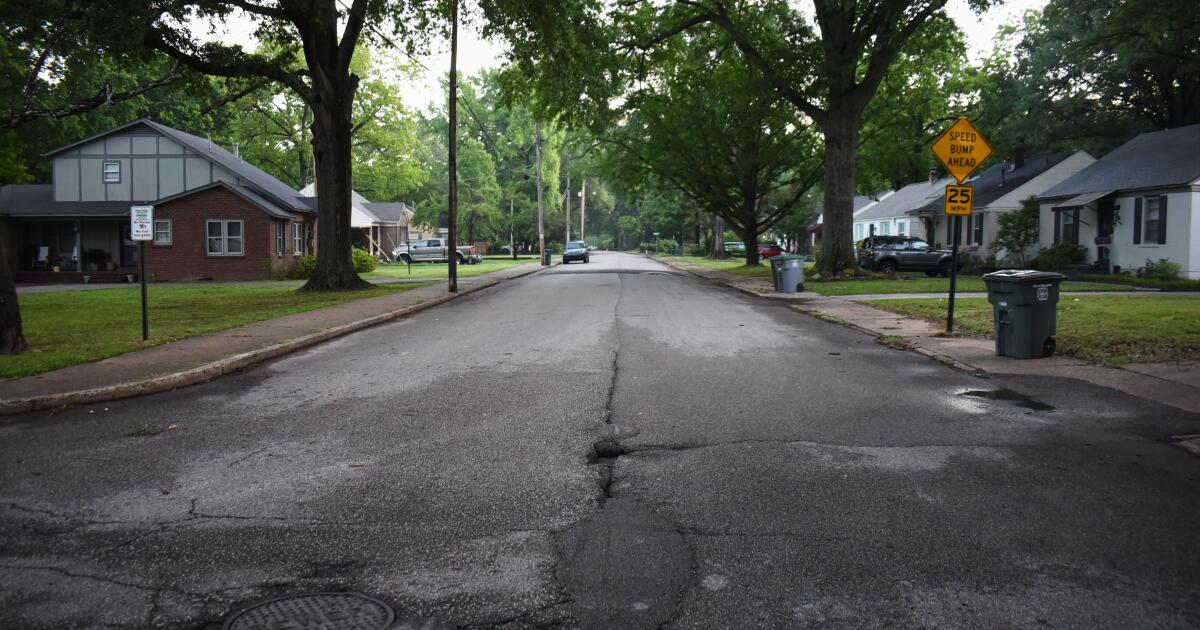
Residents who spoke with the Associated Press expressed concerns about safety and public services but bristled at stereotypes about rampant crime. The twin stories are often on display in the river city, where pothole-filled streets run from empty storefronts to ornate mansion-filled neighborhoods and leafy college campuses only blocks away.
The city has long had a contentious relationship with the rest of the state, which voted for Trump in 2024 by a roughly 2-1 margin.
The conservative Legislature in Nashville has clashed repeatedly with Memphis and accused its leaders of broad mismanagement. Legislators passed a law blocking many police overhaul efforts in Memphis that were put in place after the death of Tyre Nichols, an unarmed Black man, at the hands of city police officers in 2023. It passed another measure seizing control of Memphis’ airport board and those of other cities across the state, and gave the state attorney general, also a Republican, the power to remove Memphis’ elected district attorney.
“The state Legislature is trying to take it over,” said U.S. Rep. Steve Cohen, the white Democrat who still represents the city in Congress until the new lines kick in after the midterms. “And that’s absurd. It was all partially because it’s a majority Black city.”
Lack of representation seen
Thomas Goodman, a politics and law professor at Rhodes College in Memphis, says the new congressional districts may lead to greater friction over who receives attention — and funding — from lawmakers. Memphis residents will soon share districts with Republican towns with starkly different economies, geographies and demographics. Whoever holds those congressional seats will have an incentive to pay attention to those voters and not to Memphis’ population.
“It would not only deprive Black Tennesseans of proper representation,” Goodman said. “These changes also break up the city of Memphis as an entity into multiple districts, thereby removing a dedicated agent in government who knows the people, who understands their concerns and can speak for them and deliver on behalf of their interests and desires.”
Chris Wiley’s house sits in what was, before last week, a quiet street in Midtown Memphis dotted with duplexes, tidy lawns and sports fields. Now his neighborhood will be carved apart at the intersection of three congressional districts. That is not surprising, he said, because “Tennessee is all about the dollar” rather than residents.
“Memphis is majority Black, so if you mess with that, what’s the point of even voting in Tennessee?” said Wiley, a 29-year-old sports stadium worker who is Black. “Whatever the congressional numbers, whatever that is, we don’t count on the scale as high, anyway.”
Brown writes for the Associated Press. AP writer Nicholas Riccardi in Denver and videojournalist Sophie Bates contributed to this report.
San Francisco, United States – Greer Dove’s days are packed with studying business and finance, as well as doing administrative work at college, along with caring for her eight-year-old daughter with special needs. But once a week, Dove, a single mother, makes sure to drop in at the food bank in California’s Marin County to pick up vegetables, fruit and other food. Along with the federal government’s food benefits, they keep her housing running.
“We need this so we can keep functioning at a high level,” she says. “She loves fruit, so I make sure to get it,” she says of her daughter.
Recommended Stories
list of 4 itemsend of list
Dove, who is also looking for a full-time job, has worked in restaurants, event management, retail, television shows, office administration and payroll over the years. But she has been on the federal government’s Supplemental Nutritional Assistance Program (SNAP) for six years, and with the food bank, for more than three years. Before she got food benefits, Dove fed her daughter all she had and skipped meals or looked around for snacks in the offices she worked at to get her through the day.
United States President Donald Trump’s One Big Beautiful Bill Act (OBBBA), passed in June, cut SNAP benefits by more than $186bn over the next 10 years to make up for extending cuts to income tax. This could lead to more than 3 million people nationwide, and 665,000 recipients in California, losing such food benefits, according to estimates.
“This will bring a series of cuts that collectively present an existential threat to food benefits,” says Andrew Cheyne, managing director of government relations and public affairs at the County Welfare Directors Association of California.
California’s proposed billionaire tax, which seeks to impose a one-time 5 percent tax on the assets of the state’s more than 200 billionaires to make up for the funding gap created by the OBBBA, got more than 1.5 million signatures in April. It is likely to be on the ballot for the November midterm election.
While most of the nearly $100bn expected to be raised through the tax will go towards filling the gap in health insurance created by the OBBBA, 10 percent will be used to make up for the retrenchment in food benefits.
In California, where more than 5.3 million people, more than any other state, receive food benefits, the impacts of the cuts began to be felt in April when 72,000 immigrants started losing benefits. June onwards, nearly 600,000 recipients will be screened for work eligibility. Recipients, including those who are homeless, seniors, foster youth and veterans, will have to work, study or volunteer to receive food benefits. Failing the screening to meet work requirements for three months will lead to their food benefits being cut.
Brian Galle, professor of law at the University of California at Berkeley and one of the tax measure’s authors, says that in California, the state that introduced gig work, “jobs are increasingly precarious. You may find enough work or not. You may get tips or not. But nutrition needs are steady.”
Making impossible choices
On a recent Friday morning, new members lined up to enrol at a whitewashed, bunting-festooned La Ofrenda food bank in San Francisco’s Mission district. The food bank doles out fresh vegetables, fruit and bread that have been donated by large grocery stores once those products neared expiration date.
Gladys Lee had taken a 45-minute train ride after a friend told her about it. Lee worked at downtown San Francisco’s Hyatt hotel as a room cleaner for three decades until a back injury meant she could not push the heavy cleaning carts any more and had to leave. After seven years of struggling to find work, food was getting scarce, and Lee found her way to La Ofrenda. She packed what she could into a carton and held it in her arms for the train ride back.
Volunteers gathered at the La Ofrenda food bank in San Francisco’s Mission District [Saumya Roy/Al Jazeera]
Food benefit rolls have shrunk by more than 3.3 million nationally in the six months from July 2025, when the OBBBA was enacted, to January 2026.
In California, the rolls of Calfresh, as food benefits are known in the state, shrank by 288,000 or 6 percent from July 2025 to February 2026, according to analysis by the Center for Budget and Policy Priorities, a Washington, DC-based think tank. This reduction in rolls happened even before the OBBBA cuts began.
Brooke Rollins, the agriculture secretary, wrote in a recent essay that the shrinking of SNAP rolls reflected an ebullient economy and buoyant job growth.
“The drop in SNAP recipients affirms that many Americans are moving from welfare to work,” she wrote. “It is no secret that Trump’s massive tax cuts and deregulation efforts are unleashing robust, private sector-led economic growth, which are fueling trillions in investments, booming wage growth”.
But unemployment remained stable at about 4.4 percent since July 2025, according to the Bureau of Labor Statistics data, while SNAP rolls shrank.
“This last time we saw such a steep, quick decline, other than during natural disasters, is three decades ago when welfare reform was enacted,” says Dottie Rosenbaum, senior fellow and director of Federal SNAP Policy at the Center for Budget and Policy Priorities.
Nationally, SNAP rolls shrank by 8 percent, while in California, they shrank by 5.5 percent, in part because the work eligibility requirements were delayed until June, while some other states have already implemented them.
At La Ofrenda, Roberto Alfaro, executive director of the nonprofit Homey, says he started the food bank when food costs went up during the pandemic. They have stayed high, he says. Now he sees people doing day jobs and night jobs and coming for food when they have paid rent.
“People are making impossible choices,” says Keely O’Brien, a policy advocate at the Western Center for Law and Poverty.
While California is the world’s fourth-largest economy, growth has come with a soaring cost-of-living crisis.
“With rising housing and utility costs, few households can dedicate that much of their income towards food,” O’Brien says.
The OBBA has also shifted the administrative cost of meeting work eligibility requirements to states, and beginning next year, part of the cost of SNAP will also fall on states.
“To make requirements more stringent, you are creating more government, more bureaucratic logjam,” says Jaren Sorkow, state director for the Children’s Defence Fund.
This has already led to a 51 percent drop in SNAP rolls in Arizona, which has begun implementing the OBBBA cuts, according to data by the Center for Budget and Policy Priorities.
Food being given out at the La Ofrenda food bank in San Francisco’s Mission District [Saumya Roy/Al Jazeera[
Making something from nothing
Several measures to counter the $100bn gap in funding for health insurance and food benefits created by the OBBBA have been floated in California. The biggest of these is the one-time 5 percent tax on those with assets of more than a billion dollars. The tax will raise $100bn, its authors estimate.
As it seems set to be voted on in the November election, it faces mounting opposition from the state’s tech entrepreneurs who have funded measures to undercut the tax.
Tech entrepreneurs have called it an economic 9/11, saying taxing their assets, including shareholding in startups, will lead to a flight of capital and innovation from the state. Sergey Brin, a cofounder of Google Inc, now spends a week in Nevada and a week in his Bay Area offices and has spent more than $57m on opposing the billionaire tax. He has backed two measures that undercut the billion tax, which have also received 1.4 million and 1.5 million signatures and are also set to be on the ballot for the November election.
One of these measures prohibits future taxes on personal property, including financial assets, savings and retirement accounts, as well as intellectual property. The other would increase audits of taxpayer-funded programmes, and includes language that would essentially invalidate the billionaire tax.
In a recent statement to The New York Times, Brin said, “I fled socialism with my family in 1979 and know the devastating, oppressive society it created in the Soviet Union. I don’t want California to end up in the same place.”
The coalition of unions backing the billionaire tax is bracing for the fight ahead. “We expect to be outspent,” says Kris Cuaresma-Primm, director of partnerships for the coalition that is backing the billionaire tax. “We will keep communicating to people that there is a tidal wave of pain coming from the cuts, and we want to reclaim the losses from the OBBBA.”
Giulia Varaschin, senior tax policy adviser at the International Tax Observatory, who recently coauthored a study on wealth taxes, says there is little academic evidence that such taxes cause the wealthy to leave at a notable scale. “There is only a marginal flight with very little, if any, economic impact,” she says.
The study, coauthored with the economist Gabriel Zucman, who supports the California billionaire tax, did find that wealth taxes had not raised as much revenue as estimated in several European countries and became less popular as a result.
Varaschin says this was because these taxes were levied on a larger set of the wealthy, which included homeowners or small businesses, rather than the ultra-rich or billionaires. The taxpayers could hardly afford to pay it, and the government made exemptions instead. These taxes also did not touch assets, where much of the wealth of the ultra-rich lies, Varaschin says.
The California tax remedies this by taxing only billionaires and taxing assets, including shares in companies.
Daniel Shaviro, Wayne Perry professor of taxation at New York University, says, “Traditionally, these taxes can be hard to enforce because tax administration don’t want to go after these people.”
Even if it passes, “The governor could just say this is not a high priority for him and not enforce it,” Shaviro says, referring to Governor Gavin Newsom, who has opposed the tax.
But Primm says, “The governor is out of touch with Californians on this”.
Newsom is in the last year of his last term as governor. However, nearly all the candidates running for the June 2 primary for governor, except billionaire Tom Steyer, who is running as a progressive Democrat, also oppose this measure. While some have said this will lead to a flight of capital, others say the spending plan does not include expenses for education, which was not cut in the OBBBA.
Greer Dove, who gets food through Calfresh and the San Francisco Marin Food Bank for herself and her daughter, says the looming food benefit cuts are worrying. “The anxiety of it all is adding up. I could be next.”
Greg Davies has been called up to host the BAFTA TV Awards for the first time1
16:18, 10 May 2026Updated 16:19, 10 May 2026
Greg Davies said he’s looking for a wife(Image: Rex)
Greg Davies is back on our screens tonight as he hosts the BAFTA TV Awards for the very first time.
The 57-year old, known for co-hosting the hit comedy gameshow Taskmaster, follows in the footsteps of Graham Norton, Lenny Henry and Michael Parkinson in his MC role and said it was an opportunity he could not turn down.
“I used to watch Stephen Fry at the Baftas and marvel at his cool, intellectual charm. I won’t be bringing that,” laughed Greg ahead of the show.
The 6ft 8in funnyman shot to fame after starring as headteacher Mr Gilbert in The Inbetweeners and has since become a regular fixture on our screens, thanks to his TV roles in The Cleaner, Brassic, Cuckoo and Man Down.
Speaking as a guest at the BAFTAs last year, Greg gave a rare update on his personal life as he said he was ‘ready for a wife’.
The Taskmaster star and his co-host Alex Horne were nominated in the Entertainment category for their Channel 4 programme alongside The 1% Club, Michael McIntyre’s Big Show and Would I Lie to You?
Speaking on the red carpet, Alex said: “We’re an unlikely couple,” with Greg piping up: “That’s why we’re a good team.”
Alex then added: “And I would like to thank my wife for getting us here tonight,” before Greg joked: “I don’t have a wife so maybe I can thank Alex’s wife.”
Tom insisted he could meet his wife at the star-studded event, with Greg responding: “Maybe I will, I’m open to it. It would be so lovely, it’s been too long and I’m ready now.”
Alex simply quipped: “Lonely”,” as Greg added: “Oh god, the horrible hot lonely tears.”
The Cleaner star was in a relationship with Labour Party politician Liz Kendall between 2007 and 2015, but usually keeps his love life under wraps.
Liz told previously The Mirror about their romance: “I am not going to be the sort of politician who does all that stuff about their private life because it’s very precious to me and really important to me that I have that space that’s personal and just to me. We are not together any more but we remain really good friends.”
In the past Greg has made jokes about his disastrous single life and previously said he ‘gave up’ on romance while on The Graham Norton Show.
Greg said his grandfather once caught him in an embrace with his first girlfriend and the experience left him mortified. “It’s not for me, romance… that was the day I gave up on romance,” he explained. However, Greg counts one ex-girlfriend of changing the course of his life. His former partner, who he has not named, convinced him to switch from his teaching career to one in comedy. Speaking to The Times, he said: “I’ve been doing comedy for about 15 years now. I always wanted to do it, I just never had thick enough skin.
“A girlfriend I had while teaching was a pragmatist and always told me that if you want to do something, then go for it. So eventually I made the switch. Comedy is definitely where I’m happiest.”
Mortified Greg recalled: “I met Janet Ellis once in a fish and chip shop. I used to have a terrible crush on her, all throughout my childhood. Then I finally met her and said something humiliating, I think chips-based, that guaranteed I would never end up in the relationship I craved.” He added: “I met her daughter Sophie on a show once and told her I fancied her mum and she rolled her eyes and said ‘everyone does’.”
While he was known for playing doting dad Ken in the sitcom Cuckoo, the actor himself does not have any children. He does, however, have lots of experience looking after kids as he was a secondary school drama and English teacher for 13 years before moving into comedy.
That’s not Greg’s only transformation. In recent years the funnyman has admitted to using Ozempic to lose weight after receiving concerning health news from his doctor.
The host claimed to have lost three stone – and named the diabetic medication in an interview. Ozempic is not designed as a weight loss drug and is used instead as a treatment for type 2 diabetes in adults – however, many patients have experienced weight loss as a side effect.
He told The Times: “[I] lost three stone on the old Ozempic, in about four months, before putting most of it back on.” The interview also notes that his doctor warned him that if he was shorter, he would “look obese” – and that he is now considering turning to fasting in an attempt to maintain his weight.
Noting that he is not concerned about ageing, he added: “I think that’s probably good in my game, isn’t it?”
Addressing reporters on a recent flight to Algeria, Pope Leo XIV invoked the Gospel, called himself a peacemaker and pledged to keep speaking out on behalf of the downtrodden.
“Too many people are suffering in the world today,” he said. “Too many innocent people are being killed, and I think someone has to stand up.”
Pontiffs have a tradition of weighing in on global strife, and Leo’s words were in keeping with long-standing church teaching. Appearing in front of reporters in this fashion was also not new: Pope John Paul II began taking questions from journalists on the papal plane in the 1970s.
But the first American pope was in fact wading into an unprecedented political tempest — responding to a series of broadsides from President Trump that drew Leo into debates over the war with Iran, immigration policies and more, all while Catholics in the U.S. and around the world looked on.
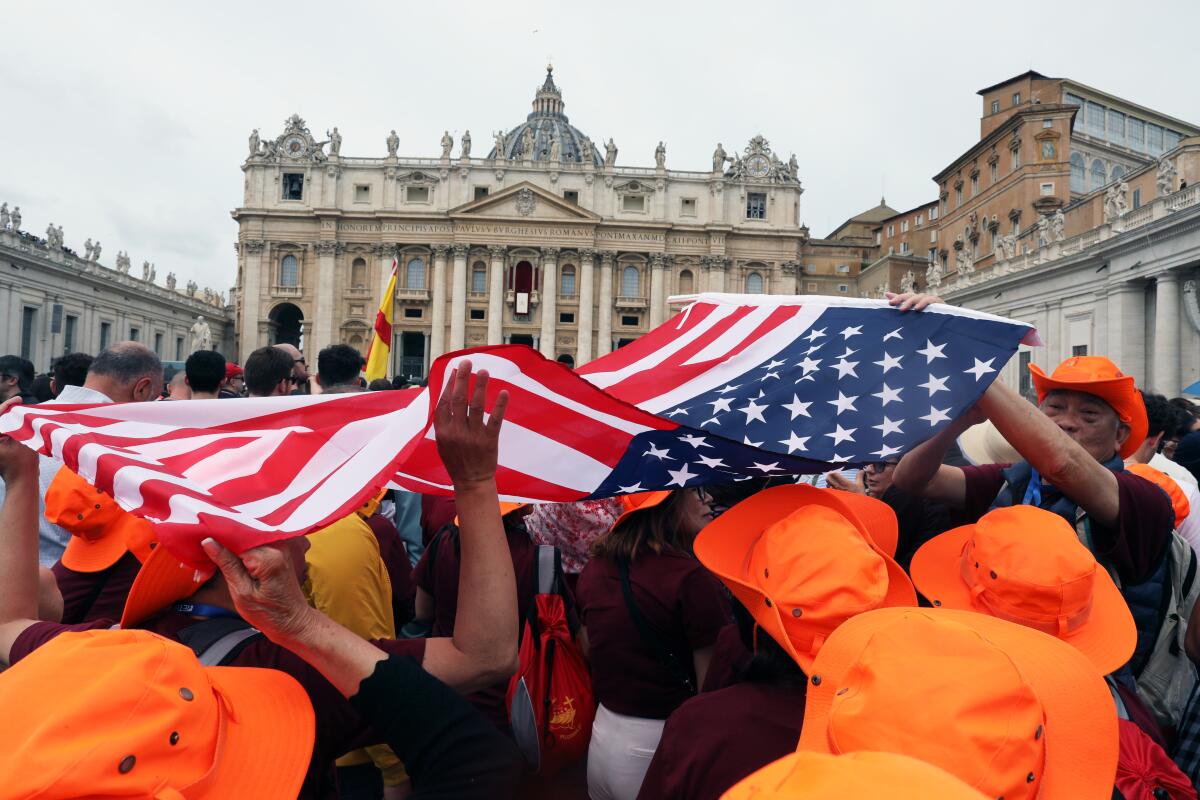
Missionaries from Austin, Texas, gather for prayer in St. Peter’s Square on May 11, 2025.
(Marco Di Lauro / Getty Images)
With no permanent peace deal in sight to end the war, two of Trump’s top lieutenants — Vice President JD Vance and Secretary of State Marco Rubio, both Catholics and potential 2028 presidential candidates — have also been pulled into the fray. On Thursday, Rubio met Pope Leo at the Vatican in what he said was a long-planned diplomatic visit. Next month, Vance will release a memoir, “Communion: Finding My Way Back to Faith,” detailing his 2019 conversion to Catholicism.
Trump’s invective has not abated, even in the week his chief diplomat met the pontiff. Ahead of Rubio’s visit, Trump repeated his claim that Leo was “just fine” with Iran developing a nuclear weapon. In response, Leo said that his critics should go after him “truthfully,” noting that the Catholic Church has spoken out against all nuclear weapons.
Against the backdrop of this sparring, Rubio sought to downplay the drama after his official visit to the Holy See, which lasted about two hours. On X, he said the meeting with Leo focused on their “shared commitment to promoting peace and human dignity.”
The episode has revealed the unique power Leo holds on the U.S. stage, with his inherent understanding of the country’s politics and an ability to deliver his message in an accent that at times reveals his Chicago roots.
“He’s speaking in English and he’s American,” said Father James Martin, a Jesuit priest and author, most recently of the memoir “Work in Progress.” “People can’t dismiss him as not understanding the United States.”
For weeks, Leo has been asked to respond to a cascade of insults from Trump, including accusations that he is “weak on crime,” that he was chosen as pope because of Trump, and that the leader of the world’s 1.4 billion Catholics should “get his act together.”
In measured tones, Leo has repeatedly said he does not want to fight with the president. He counters that he is merely preaching the Gospel. On that flight in April, the pope told journalists: “I do not look at my role as being political, a politician. I don’t want to get into a debate with him.”
He added: “I will continue to speak out loudly, looking to promote peace, promoting dialogue and multilateral relationships.”
He may not be a politician, but Leo’s preaching, ranging from Iran to immigration and global warming, has touched a nerve with Trump. In the U.S., Catholics often serve as a powerful swing vote and hold a wide range of views on those issues. But even in a time of deep division and political malaise, enthusiasm for the pontiff, born and raised in the Chicago area, is hard to dismiss.
Leo’s ascendancy comes as engagement with the Catholic Church appears to be growing in the United States. Though comprehensive data are hard to come by, parishes are reporting renewed interest.
Mark Gray, a senior research associate at the Center for Applied Research in the Apostolate at Georgetown University, said there was evidence of an increase in baptisms, a trend that appeared to predate Leo’s election as pope last May.
Some of the new American converts lean more conservative, experts said, part of a broader rise in traditionalism. Amid tensions over whether the church should focus more on traditional issues of morality, such as abortion and marriage, or global concerns like war and migration, Leo has stressed that all are welcome and that he wants the church to function as a big tent.
Making history
U.S. presidents have long sought to court the pope, mindful of the country’s sizable Catholic population and its potential as a swing vote in elections. Woodrow Wilson was the first president to meet with the pope, in 1919, during talks after the end of World War I. Since Dwight Eisenhower made a trip to Rome in 1959, every president has traveled to meet the pope, some more than once.
That includes Trump, who traveled to see Pope Francis in 2017, accompanied by First Lady Melania Trump and his daughter Ivanka Trump. He also attended Francis’ funeral in 2025.
Asked if there was any precedent for Trump’s clash with the pope, Steven Millies, a professor of public theology at Catholic Theological Union in Chicago, invoked an English king who changed the course of church history: “Henry VIII invites a comparison,” he said. Henry rejected Catholicism in the 1500s and founded a new church in order to ratify a divorce rejected by the pope.
Though Trump — who is not Catholic — has not suggested any such schism, he certainly appears to have discarded most niceties. The president has not apologized for any of his comments, though he did, after widespread backlash, take down a social media post that appeared to depict him as Christ.
Trump is constitutionally blocked from seeking another term, so picking a fight with Pope Leo may not have lasting political implications for him. But it’s a different story for Vance and Rubio, both of whom may need to appeal to the country’s Catholic voters to further their ambitions.
In the 2024 election, the Catholic vote tilted more decisively to the right, with 55% supporting Trump compared with 43% for Kamala Harris, according to the Pew Research Center. Four years earlier, Catholics were evenly divided, with 50% supporting Joe Biden, a practicing Catholic, and 49% backing Trump.
Rubio noted as he headed to Rome that “obviously we had some stuff that happened” between the White House and the Vatican. Vance, who has frequently expressed his support for the pope but is also known for his often-punchy defense of the president’s positions, drew some derision in April when he was asked at a conference about Trump’s comments and suggested that Leo should “be careful when he talks about matters of theology.”
Pope Leo XIV exchanges gifts with U.S. Secretary of State Marco Rubio in the pope’s private library at the Vatican on Thursday.
(Vatican Media via Associated Press)
He later modified his tone, posting on X: “Pope Leo preaches the gospel, as he should, and that will inevitably mean he offers his opinions on the moral issues of the day. The President — and the entire administration — work to apply those moral principles in a messy world. He will be in our prayers, and I hope that we’ll be in his.”
Still, the rift could cloud the upcoming release of Vance’s memoir, overshadowing a book meant to burnish a potential 2028 bid with questions about Trump’s antagonism toward the pontiff.
Two Catholics have served as president — Biden and John F. Kennedy. During an era of stronger anti-Catholic sentiment, Kennedy famously gave a speech as a candidate emphasizing the separation of church and state. Biden was more openly devout, attending Mass every weekend and quoting Catholic hymns in his speeches. Vance is the second Catholic vice president, following Biden’s two terms as President Obama’s deputy.
In a statement, White House spokeswoman Taylor Rogers said Trump’s social policies were a boon for U.S. Catholics and alluded to electoral politics without mentioning the pope. “President Trump has great respect for the more than one billion Catholics around the world, especially the Catholic Americans who helped power his landslide election victory in 2024,” she said.
The Midwestern pontiff
It’s been a year since the man born Robert Prevost in 1955 stepped out onto the Vatican balcony as pope, a role that predates the United States by nearly 2,000 years. The first American pope’s compatriots quickly seized on his Midwestern upbringing (he’s a White Sox fan) and relatable family dynamics (one of his two brothers supports Trump). In a nod to his Chicago roots, an Iowa-based clothing store, Raygun, began selling a T-shirt bearing the slogan “Da Pope.”
Leo also served for years as Bishop of Chiclayo in Peru, building a global profile that helped propel him to the papacy. It hasn’t stopped Chicagoans from claiming him as one of their own — even showing up at the Vatican with Chicago-style deep-dish pizza.
Known as “Bob” before becoming Pope Leo, the new pontiff chose a name that clearly signaled his intentions as a leader, invoking memories of Leo XIII, an intellectual considered a pioneer of modern Catholic social teaching and an advocate for workers. Millies said the choice signaled that Leo wants to refocus on justice and care for others as well as the rising threats around the globe. Leo has cited artificial intelligence as one of those challenges.
With a more low-key presence than his predecessor, Pope Francis, some observers have labeled Leo as quiet. But as his tug of war with Trump shows, his messages are frequently not subtle. In fact, his reserved style may be a reflection of his Midwestern roots.
Pope Leo XIV presides over the Prayer Vigil for Peace at St. Peter’s Basilica, on April 11.
(Antonio Masiello / Getty Images)
This mild manner comes across in public statements that nonetheless make a lasting impact.
Last fall, Leo questioned Trump’s decision to rename the Department of Defense as the Department of War. “Let us hope it is just a way of speaking,” he said. More recently, he took aim at the president’s preferred method of communication, his social media site Truth Social. Asked about Trump’s vitriol on the platform, Leo said: “It’s ironic — the name of the site itself. Say no more.”
Perhaps no message has been clearer than the pope’s decision on how to spend the Fourth of July this year. For the nation’s 250th birthday, as Trump hosts a giant celebration, the pope will be an ocean away. His plans? Visiting Lampedusa, an Italian island that serves as a stop for migrants traveling to Europe.
One member calls for a Presidential Medal of Freedom for a baker who refused to create a wedding cake for a same-sex couple.
Another calls for court interventions by the Department of Justice on behalf of Amish parents fighting New York vaccine requirements and Catholic nuns challenging that state’s requirement that they accommodate hospice patients’ gender identities.
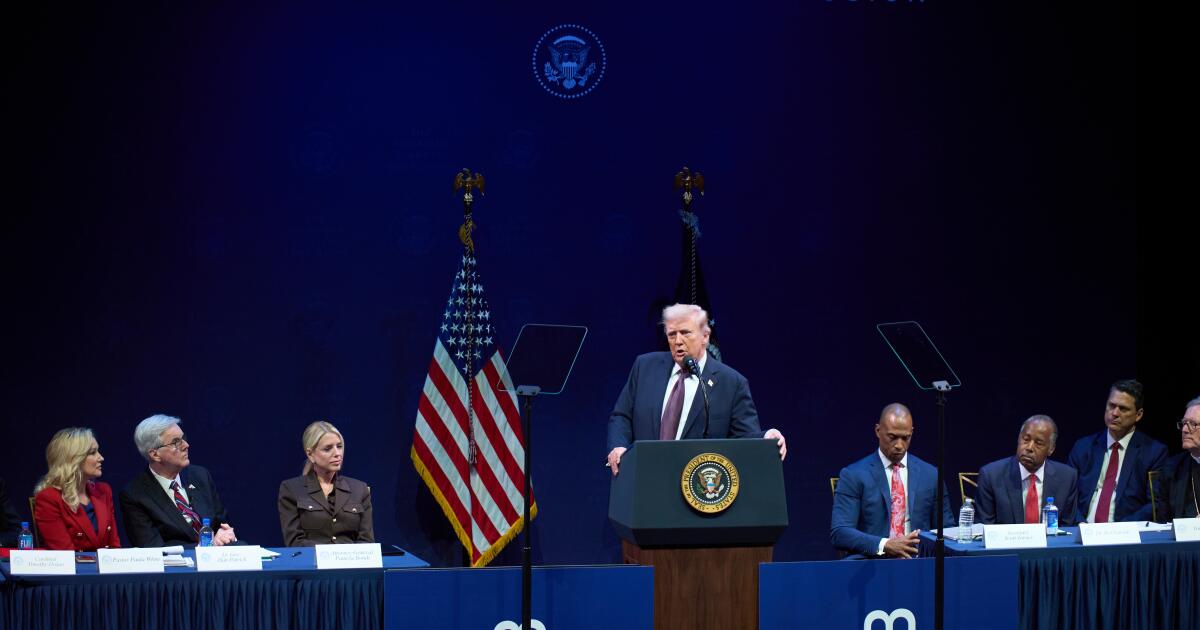
And the chair of the Religious Liberty Commission is calling for a federal hotline with this automated recording: “There is no separation of church and state.”
These are just some of the recommendations that members of the advisory panel formed by President Trump last year want to see included in the commission’s final report.
That report is still in the works, but commissioners had an opportunity to describe their wish lists during their most recent meeting in April. There was little dissent as the commissioners, most drawn from Trump’s base of conservative Christian supporters, covered the items they want in the report.
Their ideas reflect the prevailing perspectives on the definition of religious liberty among many conservative Catholic and evangelical activists: increasing avenues for religious expression in public schools, expanding opportunities for faith-based organizations to receive public money, and allowing for religious-based exemptions in areas ranging from labor law to classroom lessons to healthcare mandates.
Such views have also been reflected in Supreme Court decisions issued in recent years by its conservative majority.
Commission’s views criticized
Critics of the commission say it embodies a one-sided perspective of Trump’s supporters and is threatening a well-established constitutional separation of church and state.
A lawsuit by a progressive interreligious coalition argues that the commission fails to comply with federal law requiring advisory panels to feature diverse members and viewpoints.
The lawsuit echoes criticism that most commissioners are conservative Christian clerics and commentators; one is an Orthodox Jewish rabbi. The coalition says members have asserted that America is specifically a Judeo-Christian or Christian nation and notes that most commission meetings took place at the Museum of the Bible in Washington, an institution with Christian leadership.
The Republican administration is asking a federal court to dismiss the lawsuit. The government is citing legal technicalities and contending that the law does not define how a commission should be fairly balanced or whose viewpoints should be represented.
Another entity created by Trump — the Task Force to Eradicate Anti-Christian Bias — issued a report saying Christians faced discrimination under the administration of President Biden in areas such as education, tax law and prosecution of antiabortion protesters. Progressive groups said that report failed to document systemic discrimination, focused on causes favored by conservative Christians and amounted to advocacy rather than an investigation.
In a further interlocking of Trump-related initiatives, several members of the Religious Liberty Commission are scheduled to take part in a May 17 prayer event marking the country’s upcoming 250th birthday. Several also participated in a recent Bible-reading marathon staged largely at the Museum of the Bible.
Harmony and tension
The commission has mostly featured agreement among members, with one dramatic exception. One commissioner, Carrie Prejean Boller, was ousted in February after a contentious hearing on antisemitism.
Commission Chair Dan Patrick said Prejean Boller sought to “hijack” the hearing, in which she had sharp exchanges with witnesses about the definition of antisemitism and defended commentator Candace Owens, denying her record of antisemitic statements. Prejean Boller, a Catholic, contended that she was wrongly ousted for expressing her beliefs.
In other hearings, witnesses described how they defied workplace regulations that they said conflicted with their conservative religious values on gender, abortion, COVID-19 vaccines and more. Some said they were prevented, at least temporarily, from displaying a religious symbol at work or trying to sing a Christian song at a school talent show.
At the hearing devoted to antisemitism, Jewish witnesses spoke of being harassed and threatened at campus pro-Palestinian protests against Israel. The commission has also heard from Hindu, Muslim, Sikh and other witnesses.
Even so, critics said the commission mostly focused on conservative Christian and right-leaning political grievances.
The Rev. Paul Brandeis Raushenbush, president of the progressive Interfaith Alliance, one of the groups suing over the commission’s composition, said the panel’s omissions are as significant as what it focuses on.
He said the commission has failed adequately to address such issues as anti-Muslim efforts in Texas and elsewhere, and also the rise of antisemitism on the right, not just the left.
Separation of church and state
Raushenbush said he is especially worried about the commission chair’s challenging the very notion of church-state separation.
Patrick, a Republican who is the Texas lieutenant governor, repeatedly denounced a concept that is embedded in Supreme Court precedent.
“We need to say there is no separation of church and state,” Patrick said at the April meeting. “That’s a lie.” He suggested printing “a million bumper stickers” to that effect.
No one at the commission meeting disagreed.
Trump made similar comments at a prayer event at the White House in 2025. “They say separation between church and state,” he said. “I said, all right, let’s forget about that for one time.”
While the phrase “separation of church and state” does not appear in the Constitution, 20th century decisions by the Supreme Court cited Thomas Jefferson’s description of the 1st Amendment as creating “a wall of separation between church and state.” The court applied the 1st Amendment’s prohibition of any church “establishment” to the states in addition to the federal government, citing the 14th Amendment’s ban on states denying citizens’ rights.
Courts have since wrestled with how to balance freedom of religion and freedom from government-sponsored religion.
Schools, vaccines and workplaces
Patrick has advocated for prayer and Ten Commandments postings in public schools.
“I don’t have any malice towards anyone that doesn’t believe in any type of faith,” Patrick told fellow commissioners. “That’s fine. That’s what America is about. But these organizations that are pushed by some ideology and pushed by someone’s bank account who wants to remove God from our country? We need to push back.”
On other issues, various commissioners called for requiring schools and workplaces to post notices of the rights of religious expression and exemptions.
Some called for restoring full pay and pension benefits for military service members who were discharged for refusing COVID-19 vaccines.
Bishop Robert Barron of the Catholic Diocese of Winona-Rochester, Minn., called for allowing religious groups such as Catholic Charities to receive federal money without compromising on traditional church teachings about the family.
He also said Catholic immigrants in detention should have humane treatment and access to sacraments and that immigration agents should not disrupt worship services in enforcement actions. The administration last year eliminated a policy against immigration enforcement in sanctuaries, which other religious leaders said should not occur at any time.
Kelly Shackelford, president and chief executive officer of the legal organization First Liberty Institute, called for new requirements that governments pay all legal bills if they lose a religious liberty case. He said many individuals lack the money to challenge the government in court.
“That would be a huge shifting of power in favor of citizens,” he said.
Italy’s Prime Minister Giorgia Meloni meets Secretary of State Marco Rubio at Palazzo Chigi, in Rome, Thursday. Rubio was in the Italian capital for high-level meetings with Italian and Vatican officials. Photo Guiseppe Lami/EPA
May 8 (UPI) — Secretary of State Marco Rubio highlighted his support for NATO, the pope and Italy on Friday during his visit to the country, but said President Donald Trump may still continue social media attacks.
“The president will always speak clearly about how he feels about the U.S. and U.S. policy,” Rubio said after being asked by reporters in Rome if he would ask Trump to limit his verbal attacks. He said, “the president of the United States is always going to act on what’s in the best interest of the United States.”
He added that Trump’s decision to remove troops from Germany was already in the works.
“There was always a plan to do some shifting within NATO,” Rubio said. He added that the troops that are being removed from Germany “represent less than 14% of our total troop presence there.”
Rubio, who visited Pope Leo XIV with his wife and several State Department employees Thursday, gifted the pope a crystal football with the State Department’s logo on it, while the pope gave Rubio a pen made from an olive branch.
Italian Prime Minister Giorgia Meloni gave Rubio documentation of his family’s Italian origins in Piedmont, in the country’s northwest.
Rubio said it was a “true honor” to get the documentation. He said visiting Piedmont is “one more reason to be back” in Italy. He’ll give a speech in Italian next time he visits, he said.
“I need to learn a third language,” Rubio said.
Meloni and Trump had been cordial until the president began attacking the pope and Italy stayed out of the war in Iran.
Meloni said the meeting was a “frank dialogue, between allies who defend their own national interests but who both know how precious Western unity is.”
Polls in Italy show that most Italians are against joining the war against Iran. Meloni said, “we are not at war, and we do not want to go to war.”
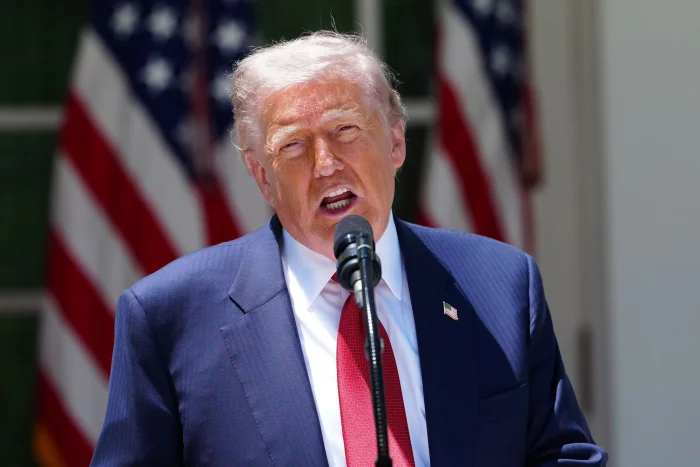
President Donald Trump delivers remarks at an event he is hosting for a group that includes Gold Star Mothers and Angel Mothers in honor of Mother’s Day in the Rose Garden of the White House on Friday. Photo by Aaron Schwartz/UPI | License Photo
The White House’s newly released strategy for tackling the nation’s drug and addiction crisis calls for a number of ambitious public health approaches that some experts say are laudable but will be hampered by the administration’s own actions.
The sweeping 195-page National Drug Control Strategy, published May 4, advocates for making access to treatment easier than getting drugs, preventing young people from developing addictions in the first place, increasing support for people in recovery, and reducing overdose deaths.
Those broad goals are widely supported by public health researchers, addiction treatment clinicians, and recovery advocates.
Many components of the National Drug Control Strategy are “things that we would agree with and that we fully support,” said Libby Jones, who leads overdose prevention efforts at the Global Health Advocacy Incubator, a public health advocacy group.
But there are “disconnects in what the strategy says is important and then what they’re actually going to fund,” she said of the Trump administration. “Those inconsistencies feel particularly loud in this strategy.”
The White House’s National Drug Control Strategy, released every two years, is a touchstone document meant to lay out the federal government’s coordinated approach to what in recent decades has been one of the country’s defining problems.
Since 2000, more than 1.1 million people have died of drug overdoses. Although deaths have decreased recently, the numbers remain elevated compared with earlier decades, and research suggests overdose death rates among Black Americans and Native Americans are disproportionately high.
The strategy document published this week is the first of President Trump’s current term. In keeping with the administration’s approach to addiction issues, it places heavy emphasis on law enforcement efforts to reduce the supply of illicit drugs. The document repeatedly refers to the ongoing “war” against “foreign terrorist organizations” — the Trump administration’s term for drug cartels — and touts increased enforcement at U.S. borders.
It also outlines plans to implement artificial intelligence technologies to screen for illicit drugs brought into the country and wastewater testing to detect illegal drug use nationwide.
The second half of the strategy focuses on reducing the demand for drugs through public health prevention efforts, addiction treatment, and support for people in recovery. It promotes the role of religion in recovery and calls for the widespread use of overdose reversal medications, such as naloxone.
In a news release, the White House’s Office of National Drug Control Policy called the document a “roadmap” that will “continue dismantling the drug supply and defeating the scourge of illicit drugs in our country.”
The Trump administration did not respond to requests for comment about how the strategy aligns with its other actions.
In December, Trump signed a reauthorization of the SUPPORT Act, which continues several grants related to treatment and recovery and the requirement for Medicaid to cover all FDA-approved medications for opioid use disorder. In January, he announced the Great American Recovery Initiative, including a $100-million investment to address homelessness, opioid addiction, and public safety.
However, few details have been provided about the initiative, and in January, about a month after the SUPPORT Act passed, billions of dollars in addiction-related grants were abruptly terminated and reinstated within a frantic 24-hour period.
That “whiplash” left “a sense of instability and uncertainty in the field,” said Yngvild Olsen, a national adviser with the Manatt Health consultancy. She led substance use treatment policy at the Substance Abuse and Mental Health Services Administration, or SAMHSA, under the Biden administration and left about six months into Trump’s second term.
That insecurity was exacerbated by the president’s 2027 budget request, which proposes cuts to several addiction and mental health programs and the consolidation of key federal agencies working on those matters. Jones’ group and nearly 100 others in the field have signed a letter asking Congress to reject the proposals, as it did with similar requests last year.
The national drug strategy adds new, potentially contradictory information to this confusing landscape.
Increasing Access to Treatment
One of the most significant public health goals in the strategy, mentioned at least half a dozen times, is to make it easier to get treatment than it is to buy illegal drugs.
National data underscores the necessity: More than 80% of Americans who need substance use treatment don’t receive it.
The administration’s actions on health insurance may make it difficult to improve that statistic.
Medicaid is the main source of healthcare coverage for adults with opioid use disorder. When implemented, the Medicaid work requirements in Trump’s One Big Beautiful Bill Act are projected to strip that coverage from about 1.6 million people with substance use disorders.
The last time Medicaid rolls were purged — after COVID-era protections expired — many people who had been receiving medication treatment for opioid addiction stopped it and fewer people started treatment, according to a study published last year.
Olsen, who is also an addiction medicine doctor, said she loves the strategy’s emphasis on making treatment readily available to anyone who wants it. But she said that’s “hard to really imagine when now people may have to pay for it themselves because they may be losing their Medicaid insurance coverage.”
One analysis estimated the upcoming Medicaid changes could lead 156,000 people to lose access to medications for opioid use disorder and result in more than 1,000 additional fatal overdoses per year.
People with private insurance may be affected too.
The Trump administration has refused to enforce Biden-era regulations aimed at bolstering mental health parity, the idea that insurers must cover mental illness and addiction treatment comparably to physical treatments. And recently, the administration said it would redo those regulations altogether, raising fears that addiction treatment could become increasingly unaffordable.
The administration did not respond to specific questions about how it reconciles its actions on Medicaid and parity with the goal of increasing treatment.
Prioritizing Prevention
The strategy highlights preventing addictions before they begin as one of the keys to reducing demand for drugs. It calls for “promoting a drug-free America as the social norm” and implementing school and community-based programs that are backed by science.
“Investing in primary prevention, before drug use starts, saves lives and resources,” it says, citing several studies about the cost-effectiveness of such programs.
Yet, the president’s budget proposes cuts to these types of programs, and federal layoffs have decimated the agencies that would implement such work.
“It’s not clear to me that they’re really going to be able to have the funds or the people to be able to carry that out,” Olsen said of the strategy’s prevention goals.
Another wrinkle appears in the strategy’s discussion of marijuana. The document points to marijuana use as one of the drivers of increasing drug use disorders and reports that “convergent evidence from multiple sources” suggests cannabis use increases the risk of psychosis. It calls for developing new tools to treat marijuana withdrawal and addiction.
However, just two weeks ago, the White House moved to reclassify medical marijuana to a lower tier of scheduled substances and is moving to hold a hearing to do the same for marijuana broadly.
“The administration, on the one hand, is moving in a direction of liberalizing access to cannabis,” Jones said, “but at the same time, in the strategy, it talks about the dangers of doing so.”
“There’s a disconnect there that just makes you question: Which one do you believe?” she added.
The administration did not respond to specific questions about its marijuana policies.
Stopping Overdose Deaths
One of the more surprising elements of the National Drug Control Strategy comes in the last paragraph of the final chapter. It focuses on public drug-checking programs, which often involve using test strips to help people who use drugs determine whether there are more-dangerous substances, such as fentanyl or xylazine, in the batch they bought. That helps them determine whether or how to safely use those drugs.
“Rapid test strips and similar technologies that detect fentanyl and other drugs are an important tool that should be legal,” the strategy document says.
However, SAMHSA announced in a recent letter that it would no longer pay for test strips, as part of the Trump administration’s “clear shift away from harm reduction and practices that facilitate illicit drug use.”
The administration has similarly attacked harm reduction programs in an executive order and its budgetrequests. It did not respond to specific questions about how this position interacts with the drug control strategy.
Regina LaBelle, a Georgetown University professor who served as acting director of the Office of National Drug Control Policy during the Biden administration, wrote about the contradiction in a blog post: “It is the height of rhetoric over reality to champion a tool while simultaneously cutting off the funding used to acquire it.”
KFF Health News is a national newsroom that produces in-depth journalism about health issues and is one of the core operating programs at KFF—an independent source of health policy research, polling, and journalism.
Central banks hold rates steady as energy shock tests inflation fight.
Caught between rising inflation and slowing growth, the United States Federal Reserve, the European Central Bank and the Bank of England are keeping interest rates and borrowing costs steady.
That’s despite rising energy bills, fuel and food costs squeezing businesses and households worldwide.
The International Monetary Fund is warning of a global slowdown, and no one knows how long the energy shock set off by the US-Israel war on Iran will last.
The impact will be felt hardest in emerging markets and developing nations. Central banks face a tough choice: fight rising prices or support a weakening economy.
WASHINGTON — As Kamala Harris eyes a possible 2028 presidential bid, there is little outward enthusiasm among her biggest 2024 backers to fund a repeat performance, adding to uncertainty about the former vice president’s prospects in what is sure to be a crowded primary field.
The Times reached out to more than two dozen top donors to the biggest pro-Harris super PAC in 2024. Several of them said they do not plan to support her should she choose to run, or declined to talk about her. Others did not respond.
“I don’t think it’s a helpful narrative [for 2028] to start with the 2024 hangover,” said one fundraiser for Harris’ 2024 campaign, who requested anonymity to speak candidly. “There is an enormous appetite for new blood — something fresh, something that really represents the future, not the past.”
That narrative is poised to present Harris’ biggest challenge if she decides to run — particularly if it jeopardizes her ability to pull in crucial funding. Though few in the party want to criticize Harris, few appear inclined to endorse her, and conversations about her prospects often come down to one thing: Democrats’ anxiety about winning.
“She’s run, she’s lost, so the question’s going to be, is there somebody that gives Democratic voters more of a sense that they could win?” said Dick Harpootlian, a longtime South Carolina Democratic strategist. “That’s what all of us are looking for. We want to win in ‘28.”
The chatter among party elites appears at odds with recent polling in Harris’ favor, including in April’s Harvard Center for American Political Studies/Harris Poll, which showed Harris leading the Democratic field with support from 50% of Democrats.
The former vice president has also been met with enthusiasm from audiences in a series of recent speaking stops — including when she told a friendly crowd at a New York conference in April that she “might” run for president.
Harris remains undecided about whether to mount a run, according to a person familiar with her thinking, who said Friday she has been focused on boosting Democrats ahead of the midterm elections, meeting voters and delivering messages about the economy and affordability.
If she were to run, Harris would expect a crowded primary field to split donors and would be aware of the need to overcome the perception of skeptics, this person said — but noted that 2028 would afford a very different dynamic than the circumstances under which she took the nomination in 2024.
“There’s a bit of a ‘doth protest too much’ quality to some of these complaints about the idea of her running,” said the person close to her. “It may be a backhanded way of acknowledging that she’d be quite formidable if she decided to get in.”
Speculation about whether Harris would run again — and whether she should — has swirled since her truncated 2024 campaign ended in defeat to Donald Trump. Harris’ decision not to run for California governor in a wide-open race was broadly viewed as signaling presidential ambitions, and she reentered the public eye with the publication of a book about the 2024 campaign and an associated speaking tour.
Last month, Harris gave her strongest signal yet that she could seek the party’s nomination again, telling the Rev. Al Sharpton at a gathering of his civil rights organization in New York that she was “thinking about it.”
“I know what the job is and I know what it requires,” Harris said at the time.
Harris’ 2024 loss to Trump and failure to capture any battleground states — after entering the race late following President Biden’s exit — was bruising for Democrats. The defeat is lingering longer for some top donors than it did after Hillary Clinton’s loss to Trump in 2016, making them extra wary, said one Democratic political consultant.
“Especially in the donor class, everyone feels burnt,” he said. “People just want to turn the page.”
The Times contacted top donors to Future Forward, the Democratic super PAC that spent the most to back Harris in the 2024 election. All the donors contacted gave at least $1 million and some acted as bundlers for the campaign, soliciting big checks from other donors in addition to their own contributions.
Netflix co-founder Reed Hastings, who gave $1 million to Future Forward in 2024, said he hoped to support a different Californian.
“Gavin is the candidate who can motivate both the left and the center,” Hastings told The Times, referring to Gov. Gavin Newsom.
A bundler for both Harris and Biden said it comes down to who can give Democrats the best chance to succeed.
“I think it is too early to pick a favorite in the 2028 race, but Kamala Harris will not be my candidate,” this person said. “I don’t think she would appeal to a swing voter, and we need swing voters to win.”
Others, including a few party leaders, deflected questions by citing a focus on this year’s midterm elections. Rep. James E. Clyburn (D-S.C.), who last year praised Newsom’s presidential prospects during a visit by the governor, said Tuesday that Democrats should be zeroed in on 2026.
“I’m not thinking about 2028, and if she were to call me I wouldn’t talk to her about it,” Clyburn told The Times when asked about Harris’ chances.
Enthusiasm for Harris and skepticism about her viability in 2028 aren’t mutually exclusive, said the former Harris fundraiser.
“A lot of people love her and also don’t think that she is the answer for 2028,” the fundraiser said.
The attitudes of the donor class and political elite may be at odds with those of regular Americans, particularly Black and working-class voters, the Democratic political consultant said. Few of the possible candidates have the potential to excite Black voters the way Harris does, he said.
If a candidate, whether Harris or someone else, makes a successful case that they can win, Black voters will be “strategic and optimistic enough” to rally around whoever it is, said Keneshia Grant, a Howard University political scientist.
But, she said, “I don’t think that they are going to take well to work by elites or the donor class to sideline Harris if there is no clear, reasonable, exciting, Obama-level, yes-we-can candidate instead of her.”
Harris speaks the Public Counsel Awards Dinner on April 29 in Beverly Hills.
(Frazer Harrison / Getty Images)
In recent weeks, Harris has spoken at a fundraiser in South Carolina, a party luncheon in Michigan and a dinner in Arkansas. On Thursday, she was in Nevada to rally Democrats ahead of the midterm primary.
She also joined other likely 2028 contenders at the Colorado Speaker Series in Denver and Sharpton’s conference, accepted an award from the nonprofit Public Counsel at a Los Angeles gala and addressed the National Women’s Law Center gala in Washington to a warm reception, as did Illinois Gov. JB Pritzker.
“She was inspiring, she was hopeful, she pushed back on Trump,” said Jay Parmley, chair of the Democratic Party in South Carolina, where Harris spoke at a party-hosted fundraiser in Greenville on April 15.
South Carolina, a key primary state, could help unlock Harris’ path to the nomination. If Black voters there boosted her to a win, she could build early momentum.
But Parmley said he believed she would have to “get over” the hurdle of convincing voters that she can beat the GOP.
“I don’t think it’s a given she wins here without work,” Parmley said. “She’s going to have to really visit with voters and work just like everybody else.”
Times staff writer Ana Ceballos in Washington contributed to this report.
May 8 (UPI) — Consumer sentiment in the United States has hit another record low as Americans worry about the cost of life as gas prices continue to rise amid the war in Iran.
A monthly University of Michigan survey found that consumer sentiment dropped 3.2% in the last month — from 49.8 to 48.2 — and was down 7.7% over the course of the year, the university’s Institute for Social Research said on Friday.
Joanne Hsu, director of the university’s Surveys of Consumers, said that consumer sentiment is “essentially unchanged” from April, while the current economic conditions survey dropped 9% because of high prices affecting personal finances and whether people will make major purchases.
The decline in the current economic conditions survey was down nearly 19% from last year.
“Taken together, consumers continue to feel buffeted by cost pressures, led by soaring prices at the pump,” Joanne Hsu, director of the survey, said in an analysis.
“Middle East developments are unlikely to meaningfully boost sentiment until supply disruptions have been fully resolved and energy prices fall,” she said.
Hsu noted that, in the surveys, “about one-third of consumers spontaneously mentioned gasoline prices, and about 30% mentioned tariffs.”
The index of consumer expectations did, however, show a 0.8% gain from last month, and is up 1.3% over last year.
May’s consumer sentiment survey is the lowest going back to 1952 — April also set a record — although markets did not react significantly after the institute published its preliminary data for this month’s surveys.
The Bureau of Labor Statistics on Friday also released its April jobs report, which showed that the economy gained 115,000 non-farm payroll jobs — more than double what Wall Street expected — but down from the 185,000 added in March.
For the 12 months ended in April, BLS noted that net payrolls were relatively unchanged.
The unemployment rate for April was unchanged from March at 4.3%.
President Donald Trump delivers remarks at an event he is hosting for a group that includes Gold Star Mothers and Angel Mothers in honor of Mother’s Day in the Rose Garden of the White House on Friday. Photo by Aaron Schwartz/UPI | License Photo
May 8 (UPI) — Russia and Ukraine on Friday confirmed a three-day cease-fire and prisoner swap, which they said was agreed to after their leaders spoke with U.S. President Donald Trump.
Trump announced in a post on Truth Social that the countries agreed to pause the conflict Saturday through Monday, and for both country to swap 1,000 prisoners each that have been captured during the four-year war.
Ukrainian President Volodymyr Zelensky confirmed the agreement in a post on X, and said that he has instructed his team to “promptly prepare everything necessary for the exchange.”
Russian presidential aide Yuri Ushakov also confirmed the deal, saying that Russian President Vladimir Putin found it acceptable and that Russia “welcomes” it, Turkey’s state-run Anadolu Agency reported.
The deal comes less than a day before Russia celebrates Victory Day, its annual commemoration of the allied powers victory over Nazi Germany in World War II.
“This request was made directly by me, and I very much appreciate its agreement by President Vladimir Putin and President Volodymir Zelenskyy,” Trump said in the post, referring to calls he placed to both leaders and which they confirmed.
“Hopefully, [the cease-fire] is the beginning of the end of a very long, deadly, hard fought War,” Trump said. “Talks are continuing on ending this Major Conflict, the biggest since World War II, and we are getting closer and closer every day.”
The cease-fire in the biggest land war in Europe since World War II will include “a suspension of all kinetic activity,” as well as countries returning 1,000 prisoners each to one another.
Zelensky said there had been appeals and signals about a potential cease-fire to start on Saturday because of Victory Day, which motivated it to negotiate the pause and pursue the return of Ukrainians held during the war.
“An additional argument for Ukraine in determining our position has always been the resolution of one of the key humanitarian issues of this war — namely, the release of prisoners of war,” he said. “Red Square is less important to us than the lives of Ukrainian prisoners who can be brought home.”
Ushakov said that Trump, during the call with Putin, emphasized that Russia and the United States were allies during World War II, pointing to Victory Day as a potential date to start a cease-fire.
“An agreement on this matter was reached during our telephone contacts with the U.S. administration,” Ushakov said. “In turn, U.S. representatives were in contact with Kyiv.”
May 8 (UPI) — The Department of Government Efficiency illegally canceled roughly $100 million in grants that Congress had approved the National Endowment for the Humanities to award, a judge ruled.
U.S. District Court Judge Colleen McMahon said Thursday in a 143-page decision that DOGE and the Trump administration had “no constitutional authority to block, amend, subvert or delay spending appropriations based on the president’s own policy preferences,” CBS News and The Washington Post reported.
DOGE used ChatGPT to revoke grants the NEH had already awarded that it thought were related to diversity, equity and inclusion programs the administration sought to rapidly eliminate throughout the federal government in 2025.
The NEH was one of 16 “small agencies” that President Donald Trump last May marked for elimination in his 2026 budget proposal, which the DOGE effort, as spearheaded by Elon Musk, had already started culling expenditures from.
“The termination of NEH grants challenged in this action was unlawful because it was undertaken in violation of the First Amendment, in violation of the equal protection component of the Fifth Amendment and without statutory authority,” McMahon wrote in the decision.
The lawsuit was brought by the American Council of Learned Societies, the American Historical Association and the Modern Language Association of America after DOGE cut more than 1,400 grants that had been awarded to scholars, research institutions and humanities organizations.
McMahon said that because Congress had not given DOGE the authority to “identify, select or direct the termination of the grants,” she permanently enjoined the government from terminating all of the grants referenced in the lawsuit, as well as from cutting any others using the arguments rejected in the ruling.
Representatives of the three organizations hailed the ruling and said they would continue to push for the full restoration of all the NEH grants, which includes “staff, programs and capacity to serve the public it was created to support.”
“This ruling is an important achievement in our effort to restore the NEH’s ability to fulfill the vital mission with which Congress charged it,” Sarah Weicksel, executive director of the American Historical Association, said in a press release.
“From history exhibitions and path breaking scholarship to library programs and professional development opportunities, the humanities help us understand our past and ourselves, providing all of us with the essential tools for our future,” she said.
President Donald Trump delivers remarks at an event he is hosting for a group that includes Gold Star Mothers and Angel Mothers in honor of Mother’s Day in the Rose Garden of the White House on Friday. Photo by Aaron Schwartz/UPI | License Photo
Saturday Night Live UK’s cold open featured Peter Serafinowicz in a guest cameo as Nigel Farage, spoofing the Reform UK leader as Prime Minister in 2046 following the party’s sweeping local election wins.
Paige Ingram and Carla Feric Press Association Entertainment Reporter
03:53, 10 May 2026Updated 04:00, 10 May 2026
The sketch took aim at the party’s landslide victories (Image: Saturday Night Live UK)
Shaun Of The Dead actor Peter Serafinowicz made a surprise appearance playing Reform UK leader Nigel Farage as prime minister in an SNL UK sketch set in the year 2046.
The comedy programme kicked off on Saturday evening with a political skit depicting Mr Farage occupying Number 10, pulling pints at his desk while US President Donald Trump has seized control as the nation’s king.
The sketch took aim at the party’s landslide victories during this week’s local council and Scottish and Welsh elections. It began with ‘Mr Farage’ recording a personalised 120th birthday message for much-loved naturalist Sir David Attenborough, before Conservative party leader Kemi Badenoch (Ayoade Bamgboye) appeared as his deputy.
“Big news day, Prime Minister. Thanks to our deportations, the population of London is finally down to single fingers,” she said, drawing uproarious laughter from Mr Farage.
Taking a swipe at the continuing tensions between the US and Iran, she went on: “One last thing, King Trump assures us he has almost negotiated a ceasefire over the Strait of Hormuz.”
Mr Farage responds: “Phew, for a minute there, it felt like we were on the brink of World War Four.”
The pair jest that since their parties joined forces, they have been “unstoppable”, drawing a comparison to the spreading hantavirus, referencing the outbreak that has dominated news coverage in recent days. After checking the weather forecast – which shows London engulfed in flames, satirising climate change – the pair head out for a stroll before Sir Keir Starmer and Angela Rayner emerge from behind a bookshelf, which turns out to be a time machine.
The former deputy leader, portrayed by Celeste Dring, warns Sir Keir (George Fouracres) that unless he allows her to run the government, “this future will come to pass”, to which he replies he will “seize every moment” as Prime Minister.
When Mr Farage returns to the office accompanied by Mrs Badenoch, he queries who Sir Keir is, declaring himself the “big chungus” of the “great United Kingdom and the middle part of Wales”.
They warn they’ll have the Labour party leaders removed from the building by security guards, but Mrs Badenoch jokes: “We deported security.”
The sketch concluded with Al Nash emerging through the prime ministerial time machine portal dressed as Sir Winston Churchill to launch the show, leading into Ted Lasso star Hannah Waddingham’s opening monologue.
The award-winning actress made light of the “glamorous characters” she has portrayed throughout her career, before displaying pictures of less flattering parts such as her “sexy little turn as the shame nun” in hit TV series Game Of Thrones.
Throughout the episode, Waddingham took part in numerous sketches alongside the show’s inaugural cast, and was accompanied by Stargazing singer Myles Smith as the musical guest. The programme also marked Sir David’s landmark 100th birthday in its weekend news segment, with hosts Ania Magliano and Paddy Young sitting down to interview a rhino (Hammed Animashaun) for their take on the much-loved broadcaster.
The skit descended into mayhem when Sir David (Fouracres) burst onto the scene to grapple with the wild beast after it dared to criticise him.
The Sky Original production is filmed live in London, featuring a rotating guest host each week alongside the show’s regular cast, which comprises actor Hammed Animashaun and comedian Ania Magliano.
SNL UK returns to Sky and Now TV on May 16 for its series finale, with Sex Education star Ncuti Gatwa taking the hosting duties, accompanied by musical guest Holly Humberstone.
Saturday Night Live UK is available to watch on Sky and Now TV on Saturdays at 10pm.
Brazilian Supreme Court Justice Alexandre de Moraes suspends use of law to reduce prison sentences, pending further review.
Published On 9 May 20269 May 2026
Brazilian Supreme Court Justice Alexandre de Moraes has barred the implementation of a law that could dramatically reduce the prison sentence of former President Jair Bolsonaro for involvement in a coup plot after his loss in the 2022 election.
De Moraes ordered the law’s suspension on Saturday until the Supreme Court can convene a full hearing to consider appeals challenging its constitutionality.
Recommended Stories
list of 3 itemsend of list
Bolsonaro’s conviction for involvement in a plot to remain in office after losing to left-wing rival Luiz Inacio Lula da Silva in 2022 has become a cause celebre for the country’s political right, which has pushed for Bolsonaro’s release from prison.
The Supreme Court sentenced the former far-right president to 27 years in prison in September, but a law passed by Brazil’s conservative-majority Congress in December would apply to Bolsonaro and others convicted in the plot, paving the way for reductions in their sentences.
President Lula vetoed the bill in January, but a vote led by Bolsonaro’s allies in Congress overrode the veto in late April.
Plaintiffs have subsequently asked the Supreme Court to overturn the bill, stating it is unconstitutional.
Lawyers for those convicted must file individual requests for sentence reduction. The ruling by de Moraes essentially suspends such requests until the court has had the opportunity to decide on the law’s constitutionality.
Lawyers for the 71-year-old Bolsonaro filed a new appeal to the Supreme Court on Friday, asking it to overturn what they called a “miscarriage of justice”.
Bolsonaro’s conviction and sentencing remain a matter of controversy in Brazil, where his allies have decried it as a political witch-hunt.
Opponents have welcomed it as a necessary form of accountability, from which not even former presidents are exempt.
Thiago Avila, a member of the Global Sumud Flotilla, arrives to attend a hearing at the Ashkelon Magistrate’s Court in Ashkelon, Israel, on May 3. Israel has said he and Saif Abukeshek will be released Saturday. Photo by Abir Sultan/EPA
May 9 (UPI) — Two activists being held in Israel after the country intercepted its Gaza-bound aid flotilla are scheduled to be released Saturday, an aid organization said.
Human rights organization Adalah said that Brazilian Thiago Ávila and Spanish-Swedish citizen Saif Abukeshek were set to be released on Saturday.
The organization said on Instagram it had been told “that the two Global Sumud Flotilla leaders will be transferred to immigration authorities later today, pending deportation back to their home countries.
“Adalah is closely monitoring to ensure their release. Adalah and FIDH stress that Ávila and Abukeshek were abducted by the Israeli navy from international waters near Greece, held in total isolation under punitive conditions, and subjected to ill-treatment and torture, despite their mission being entirely civilian.
“Both have been on hunger strike since their detention began. Abukeshek escalated to refusing water on the evening of May 5. Their detention was unlawful from the start,” Adalah said.
“We are outraged that instead of speaking out and taking action to ensure the safety and immediate release of the at least 14 U.S. citizens illegally abducted by the Israeli military, the Department of State went out of its way to issue a formal condemnation of their humanitarian efforts,” it said.
The activists arrived via the Global Sumud Flotilla, which originated in Spain on April 12 bound for Gaza. It was intercepted by the Israelis in the Mediterranean Sea.
The flotilla alleged Israeli forces held people at gunpoint, smashed engines and destroyed navigation equipment on its ships.
“Intentionally leaving hundreds of civilians stranded on powerless, broken vessels directly in the path of a massive approaching storm. Furthermore, communications with multiple vessels have been jammed, severing their ability to coordinate or signal for help,” the group said.
The Freedom Flotilla Coalition announced that Ávila’s mother, Teresa Regina de Ávila e Silva, died while he was detained by Israel.
“[Avila’s and Abukeshek’s] continued imprisonment is not only arbitrary and illegal, but also an act of profound cruelty that has denied Thiago the most basic human right: to say farewell to his mother,” the Coalition said in a statement.
NEW YORK — No quick dispatching of disease investigators. No televised news conference to inform the public. No timely health alerts to doctors.
In the midst of a hantavirus outbreak that involves Americans and is making headlines around the world, the U.S. government’s top public health agency, the Centers for Disease Control and Prevention, has been uncharacteristically missing in action, according to a number of experts.
To President Trump, “we seem to have things under very good control,” as he told reporters Friday evening.
To experts, the situation aboard a cruise ship has not spiraled because, unlike COVID-19 or measles or the flu, hantavirus does not spread easily. It has been health experts in other countries, not the United States, who have been dealing primarily with the outbreak in the last week.
“The CDC is not even a player,” said Lawrence Gostin, an international public health expert at Georgetown University. “I’ve never seen that before.”
Not until late Friday did CDC actions accelerate.
Health officials confirmed the deployment of a team to Spain’s Canary Islands, where the ship was expected to arrive early Sunday local time, to meet the Americans onboard. They said a second team will go to Offutt Air Force Base in Nebraska as part of a plan to evacuate U.S. passengers from the ship to a University of Nebraska quarantine center for evaluation and monitoring. Also, the CDC issued its first health alert to U.S. doctors, advising them of the possibility of imported cases.
At their first briefing, held Saturday by telephone only for invited reporters, officials pledged to be transparent in updating the public but said the media could not cite the speakers by name under rules set by aides to Health Secretary Robert F. Kennedy Jr. They did not directly answer a question about whether the U.S. passengers could leave the university medical facility when they wanted.
The CDC’s diminished role in this outbreak is an indicator the agency is no longer the force in international health or the protector of domestic health that it once was, some experts said.
The hantavirus outbreak is “a sentinel event” that speaks to “how well the country is prepared for a disease threat. And right now, I’m very sorry to say that we are not prepared,” said Dr. Jeanne Marrazzo, chief executive officer of the Infectious Diseases Society of America.
How the outbreak unfolded
Early last month, a 70-year-old Dutch man developed a feverish illness on a cruise ship traveling from Argentina to Antarctica and some islands in the South Atlantic. He died less than a week later. More people became sick, including the man’s wife and a German woman who both died.
Hantavirus was first identified as a cause of sickness of one of the cases on May 2. The World Health Organization swung into action and by Monday was calling it an outbreak. About two dozen Americans were on the ship, including about seven who disembarked last month and 17 who remained on board.
It’s WHO taking center stage
For decades, the CDC partnered with the WHO in such situations. The CDC acted as a mainstay of any international investigation, providing staff and expertise to help unravel any outbreak mystery, develop ways to control it and communicate to the public what they should know and how they should worry.
Such actions were a large reason why the CDC developed a reputation as the world’s premier public health agency.
But this time, the WHO has been center stage. It made the risk assessment that has told people the outbreak is not a pandemic threat.
“I don’t think this is a giant threat to the United States,” said Jennifer Nuzzo, director of Brown University’s Pandemic Center. But how this situation has played out “just shows how empty and vapid the CDC is right now,” she said.
Tumult under Trump
The current situation comes after 16 tumultuous months during which the Trump administration withdrew from the WHO, has restricted CDC scientists from talking to international counterparts at times and embarked on a plan to build its own international public health network through one-on-one agreements with individual countries.
The administration has laid off thousands of CDC scientists and public health professionals, including members of the agency’s ship sanitation program.
As this was playing out, Kennedy said he was working to “restore the CDC’s focus on infectious disease, invest in innovation, and rebuild trust through integrity and transparency.”
Waiting to hear from the CDC
The CDC has not been completely silent on hantavirus.
The agency on Wednesday issued a short statement that said the risk to the American public is “extremely low,” and described the U.S. government as “the world’s leader in global health security.”
Said Nuzzo: “Not only was that not helpful, it actually does damage because a core principle of public health communications is humility.”
The CDC’s acting director, Dr. Jay Bhattacharya, posted a message on social media that the agency was lending its expertise in coordinating with other federal agencies and international authorities. Arizona officials this week said they learned from the CDC that one of the Americans who left the ship — a person with no symptoms and not considered contagious — had already returned to the state. WHO officials said the CDC has been sharing technical information.
The CDC also is “monitoring the health status and preparing medical support for all of the American passengers on the cruise,” Bhattacharya wrote.
But federal health officials have mostly been tight-lipped, declining interview requests.
COVID-19 comparison
In interviews this week, some experts made a comparison with a 2020 incident involving the Diamond Princess, a cruise ship docked in Japan that became the setting of one of the first large COVID-19 outbreaks outside China.
The CDC sent personnel to the port, helped evacuate American passengers, ran quarantines, shared genetic data on the virus, coordinated with the WHO and Japan, held public briefings and rapidly published reports “that became the world’s reference data on cruise ship COVID transmission,” said Dr. Tom Frieden, a former CDC director.
Some aspects of the international response to the Diamond Princess were criticized, and it did not halt the outbreak or stop COVID-19’s spread across the world. But some experts say it was not for the CDC’s lack of trying.
“The CDC was right on top of it, very visible, very active in trying to manage and contain it,” Gostin said, while the agency’s work now is delayed and subdued.
Instead of working with nearly all of the world’s nations through the WHO, the Trump administration has pursued bilateral health agreements with individual nations for information sharing, public health support, and what it describes as “the introduction of innovative American technologies.” Roughly 30 agreements are currently in place.
That’s not sufficient, Gostin said. “You can’t possibly cover a global health crisis by doing one-on-one deals with countries here and there,” he said.
Stobbe writes for the Associated Press. AP writers Ali Swenson in New York, Darlene Superville in Washington and Susan Montoya Bryan in Albuquerque contributed to this report.