politics

Column: My pick for California governor is … I’m still working on it

Like millions of Californians, I haven’t voted yet in the primary election. That’s because I can’t decide who should be our governor. Here’s what I’m thinking:

It’s an underwhelming field. But one of these Democratic contenders will very likely replace Gov. Gavin Newsom in January.

Based on the latest polling, a Democrat — probably Xavier Becerra — will qualify for the November general election ballot. That Democrat will face a Republican — very likely Steve Hilton.

It’s inconceivable that a Democratic gubernatorial candidate would lose to a Republican in this polarized, deep blue state. That means we’ll actually be choosing the governor in next Tuesday’s primary. You can dismiss the November face-off as essentially moot.

You’re reading the L.A. Times Politics newsletter

George Skelton and Michael Wilner cover the insights, legislation, players and politics you need to know. In your inbox Monday and Thursday mornings.

My mail ballot, like millions of others in California, has been sitting on the kitchen table for weeks.

As of this writing, I only know who I’m not voting for. And that’s either of the two Republicans: former Fox News host Hilton and Riverside County Sheriff Chad Bianco. That’s not because they’re Republicans. I’ve voted for plenty of Republicans — for governor, senator and president.

But Hilton won’t acknowledge that President Trump lost to Joe Biden in 2020. And anyone who doesn’t have the backbone to stand up to Trump and recognize a basic fact of our democracy shouldn’t be trusted as our governor.

Bianco disqualified himself by buying into Trump’s persistent lies about election fraud and seizing 650,000 ballots from last November’s Proposition 50 voting. The sheriff wasted taxpayer resources and, moreover, doesn’t have any vote-counting expertise.

Now for the Democrats:

It has been a disappointing campaign — a missed opportunity to seriously discuss crucial issues such as the need to become more self-sufficient locally on water supply, significantly improve wildfire prevention and regulate the coming AI menace.

I’ve winced during televised debates and TV ads at ugly attacks against opponents.

For a while, I considered casting my vote for the Democrat ranking highest in the polls. I thought that in a large Democratic field, the vote could be splintered and only two Republicans would qualify for November. But that now seems inconceivable because three Democrats dropped out.

Anyway, an individual’s vote is too precious not to be used for the candidate considered best for the job.

These are my thoughts on who that might be:

Becerra, 68. He’s the Democratic front-runner and seemingly the safe choice. Not a huge risk taker. He probably wouldn’t screw up and make things worse. He might even marginally improve some stuff.

Calm and understated. Decent. Likable. He brings an impressive resume with the experience and knowledge to handle the job: a former U.S. health secretary, California attorney general, longtime congressman from Los Angeles and a state assemblyman.

Unfortunately, he has often been too vague about what he’d do as governor. That’s largely because he’s not the sort who rushes into things. He wants to first “scrub” the matter. Not a bad trait.

He should have better answers, however, for accusations that he was derelict in Washington for releasing thousands of undocumented immigrant children to sponsors who exploited them as laborers — and also for a scandal involving his top aide who pilfered Becerra’s campaign account. Becerra said he didn’t know about it. But he should have.

Becerra would be California’s first elected Latino governor. Like many California Latinos, he’s the son of hardworking Mexican immigrants who took advantage of their opportunity to seek the California Dream.

Tom Steyer, 68. Here’s the liberal firebrand who wants to shake up Sacramento.

The question is whether he has the ability and knowledge to pull it off. Steyer wants to split up the private utility monopolies and lower consumers’ electricity bills. And how’s he going to do that? We really haven’t heard.

He’s a billionaire who has never held public office and is trying to start at the top by spending $200 million of his own money to buy into the governor’s suite. California voters have always rejected such candidates.

I’ve got nothing against billionaires. In fact, I think it’s a noble use of their money to participate in democracy and try to fix the state.

But in Steyer’s case, his recent unrelenting attack ads against surging Becerra — now his chief campaign rival — are disturbing and seem like overkill. He’d be better off telling us how he plans to improve our daily lives.

Katie Porter, 52. I find her refreshing, despite a feisty personality that grates on many voters.

She’s a former Orange County congresswoman and longtime professor of consumer law who’s plenty smart.

What I like is she has done her homework, is very conversant on most issues and is specific about what she’d do as governor.

OK, some of her goals are probably beyond financial reach: single-payer healthcare, free college tuition and free child care.

But she’d shake up Sacramento and that’s needed. She’d stand up to special interests. And she’d be California’s first female governor.

Could she work well with the Legislature? Probably well enough, given a governor’s immense power to reward and punish.

Matt Mahan, 43. The centrist San José mayor hasn’t spent enough time in his current job to prove himself to voters beyond the San Francisco Peninsula. And he entered the race too late.

He’s not quite ready. Knock again in a few years.

Antonio Villaraigosa, 73. He might be the best potential governor of the lot.

He understands Sacramento as a former Assembly speaker and urban problems as an ex-Los Angeles mayor. He’s a no-nonsense guy who has been leveling with voters..

But age discrimination is a problem, although he’s only five years older than Becerra and Steyer. And he hasn’t held office in many years. His time is past.

For me, it’s time to pick up my ballot and decide who should be California’s next governor.

What else you should be reading

The must-read: Voter guide to the 2026 California primary election
Money, it’s a gas: Billionaire Tom Steyer’s $192.4-million self-funded California gubernatorial bid shatters records
The L.A. Times Special: Steve Hilton and Spencer Pratt need Latinos, not Trump

Until next week,
George Skelton


Was this newsletter forwarded to you? Sign up here to get it in your inbox.

Source link

Golf and Politics: Sen. Sam Nunn (D-Ga.)…

Golf and Politics: Sen. Sam Nunn (D-Ga.) has resigned from the affluent Burning Tree private golf club that lost a legal fight over its refusal to admit women members. The Bethesda, Md., club’s members include many powerful political leaders. Washington wags speculated Nunn was preparing a run for the presidency. Nunn said in Washington, D.C., Tuesday he dropped out for “personal reasons . . . . I have no plans . . . to run for President.”

* Kennedy Clan: Another Kennedy wedding is due in the fall. Kara Kennedy, 30, daughter of Sen. Edward M. Kennedy, will marry Michael Allen, a Washington, D.C., architect. The date and site of the wedding were not announced.

* Hear This: Sixty guests gathered at the French ambassador’s home Wednesday to honor Revolutionary hero Marquis de Lafayette over dishes from the menu at Lafayette’s wedding feast in 1774. A town crier announced guests for the meal of oysters in caviar sauce, filet of sole, squab and venison.

* Maples Syrup: Ivana Trump’s lawyers want to question Marla Maples and they want Donald Trump to limit the documents he is demanding from his wife. He says he is seeking items showing “any threats made or undue influence” on his wife, all her personal diaries since 1976 and other writings. Jay Goldberg, one of his attorneys, said the documents would “demonstrate without question the infirmity of her claim” about threats and influence. Goldberg dismissed her plans to call Maples as posturing.

Source link

Southern California should get more of its water locally, groups say

A coalition of conservation groups wants Southern California to get 85% of its water locally, up from the 50% it gets now, by 2045, and says a new plan shows how.

It’s urging state leaders to scrap plans for a 45-mile tunnel beneath the Sacramento-San Joaquin River Delta and consider asking voters to approve a bond measure to fund local water solutions. The 34-page strategy was released as critical decisions loom for local officials, California’s next governor and legislators.

Over the last century, Southern California has grown and thrived thanks to giant aqueducts it built to bring water from hundreds of miles away — the Eastern Sierra, the Colorado River and Northern California.

But with water costs rising and climate change jeopardizing these distant sources, there is growing interest in finding ways to get more water locally.

The allied groups are calling for recycling more wastewater, capturing more stormwater, improving efficiency and cleaning up contaminated groundwater.

“We have to prioritize our investments, and prioritizing them in local water makes the most sense,” said Bruce Reznik, executive director of the group Los Angeles Waterkeeper.

The coalition includes fishing groups, environmental organizations and Northern California’s Winnemem Wintu Tribe.

Its plan calls for a “new urban water renaissance” in California that prioritizes local water. This approach would reliably yield more and cost far less than Gov. Gavin Newsom’s proposed Delta Conveyance Project beneath the Delta.

The state estimated in 2024 the tunnel would cost $20.1 billion, but opponents say it could cost three to five times more.

“Local water is reliable, it’s more affordable, and it’s more flexible, so that we’re not committing California ratepayers to higher bills that they don’t need,” said Kyle Jones, a water expert and consultant who helped prepare the plan for the coalition.

Southern California imports about half of its water from other regions.

The coalition’s plan says the region can secure up to 2 million acre-feet of local water per year. It estimates the costs of more conservation and efficiency, more stormwater and groundwater cleaning, and more water recycling at $44 billion over two decades. The Delta tunnel, in contrast, could cost $60 billion to $100 billion, it says.

Whether the tunnel project is ultimately built may hinge on whether large water agencies, including the Metropolitan Water District of Southern California, decide to participate and pay for it.

1

Cranes work the groundwater replenishment project

2

Construction is underway at the groundwater replenishment project.

3

Storage tanks await placement at the groundwater replenishment project

1. Cranes rise above the Donald C. Tillman Water Reclamation Plant in Van Nuys. 2. When completed, Los Angeles will nearly double recycled water for 500,000 residents. 3. Storage tanks sit behind a fence before being placed in the ground at the plant. (Myung J. Chun / Los Angeles Times)

“Metropolitan Water District really does have a significant choice on it, that not just impacts their ratepayers but impacts every single person in the state,” said Barbara Barrigan-Parrilla, executive director of the group Restore the Delta. “Are we going to spend $20, $60, maybe upward to $100 million on a tunnel? Or are we going to invest significant money in local solutions that provide water resiliency and sustainability for everyone in California? That is what is at stake right now.”

The Metropolitan Water District already is planning a large new facility in Carson to transform wastewater into purified drinking water. Los Angeles and San Diego are also building water recycling plants.

“At the same time, water imported from the northern Sierra and the Colorado River provides the foundation of water supply reliability for Southern California,” said Shivaji Deshmukh, the MWD’s general manager.

He noted that the MWD invests in water efficiency and capturing stormwater, and has helped reduce per-person water use by more than 40% since 1990.

The agency’s 38-member board last year adopted a climate adaptation strategy that sets goals for lining up additional water.

Los Angeles city leaders and L.A. County supervisors have also set goals for becoming more locally self-sufficient.

The advocates who wrote the policy plan said these efforts should accelerate and expand. They pointed out that the Colorado River’s reservoirs are falling to perilously low levels, and native fish in the Delta are in decline as the pumping of water takes an ecological toll.

“Climate change is exacerbating the challenges in those ecosystems, meaning that less and less water will be available to import,” said Ashley Overhouse, water policy advisor for the group Defenders of Wildlife. “All the while, the cost of water is continuing to rise.”

About 20 other environmental groups endorsed the coalition’s strategy.

“We have got to do a better job in the next 100 years than we did in the last 100 years, if we truly want to create a place of abundance once again,” said Frankie Myers, a member of the Yurok Tribe in Northern California. “This idea that we can steal … and divert water however we want with no consequences has got to end.”

Construction continues at a Department of Water and Power wastewater treatment plant

Construction continues at the Donald C. Tillman Water Reclamation Plant in Van Nuys in October 2025.

(Eric Thayer / Los Angeles Times)

Benjamin Bass, a UCLA scientist who studies how climate change is affecting the Colorado River and other water sources, joined the group as they presented their proposal in an online briefing.

“Traditional sources for imported water are less reliable than they used to be,” Bass said. “The most reliable source of water in the future is local water.”

Other experts have reached similar conclusions.

Researchers at the Pacific Institute, a water think tank in Oakland, have examined improvements such as fixing leaks in pipes, switching out inefficient washing machines and toilets, and replacing thirsty lawns with plants suited to the state’s Mediterranean climate.

In a 2022 report, they found that a set of standard practices and technologies could reduce total urban water use by 30% or more.

Source link

U.S. blames other nations for U.N. nuclear treaty conference failure

May 24 (UPI) — The United States on Sunday blamed the collapse of a U.N. nuclear nonproliferation conference on what it called some countries’ inability to take Iran’s threat to global nonproliferation seriously.

The nearly monthlong Review Conference of the Parties to the Treaty on the Nonproliferation of Nuclear Weapons ended Friday without consensus on an outcome document, which reviews implementation of the Cold War-era pact and sets recommendations and commitments for its 191 state parities.

Conference President Do Hung Viet of Vietnam said Friday, following weeks of work and four versions of an outcome document, that he would not put it forward for adoption as “the conference is not in a position to achieve agreement on its substantive work.”

The failure came amid mounting global insecurity, including the war in Iran, the modernization and expansion of nuclear arsenals and other geopolitical tensions, which complicated efforts to reach consensus.

The U.S. State Department on Sunday faulted on other NPT member states.

“The inability of some NPT States Parties to take Iran’s threat to global nonproliferation seriously will be addressed by the United States in our continuing engagements,” State Department spokesperson Thomas Pigott said in a statement.

He said the failure to adopt a document was made worse by what he described as Iran’s continued noncompliance with NPT-required safeguards and “its escalating nuclear activities.”

Pigott did not specify in the statement which activities he was referring to. The United States attacked Iran’s nuclear facilities in June, with President Donald Trump repeatedly claiming they were “obliterated.”

“For the NPT Review Conference to uphold its founding mandate, States Parties cannot turn a blind eye to Iran’s noncompliance, nor can violators be allowed to undermine the enforcement and accountability mechanisms at the core of the NPT,” he said.

Iran was quick to blame the United States, saying Washington’s “excessive demands” were at fault.

The United States was seeking to include language in the document concerning Iran, which accused the United States during the meeting of violating the treaty by attacking its nuclear facilities.

“The NPT Review Conference failed for the third consecutive time due to obstructionism by the United States and its allies,” Iran’s mission to the U.N. said in a social media statement.

Following the collapse of the conference, U.N. Secretary-General Antonio Guterres expressed his “disappointment.”

“The current international environment, marked by deep tensions and an elevated risk posed by nuclear weapons, demands urgent action,” his spokesperson, Stephane Dujarric, said in a statement.

“The secretary-general appeals to all states to make full use of all available avenues of dialogue, diplomacy and negotiation to reduce tensions, lower nuclear risks and, ultimately, eliminate the nuclear threat.”

It is the 11th meeting of the treaty states parties and the third in consecutive review conference to end without an agreement.

Daryl Kimball, executive director of the Arms Control Association, said the failure of the conference to call for “urgently needed” concrete actions to avert a new nuclear arms race was due to the five nuclear-armed states’ use of “aggressive diplomatic intimidation tactics against non-nuclear weapons states.”

He also said U.S. leadership as “sorely lacking.”

“The foundations of the NPT, the cornerstone of global efforts to reduce and eliminate the world’s greatest danger, are cracking due to inattention, intransigence and ineptitude,” Kimball said in a statement.

Source link

Cuba thanks China for rice shipment amid worsening humanitarian conditions | Government News

Cuba has announced the first shipment in an expected donation from China of about 60,000 tonnes of rice, as the Caribbean island contends with an ongoing humanitarian crisis.

In a series of social media posts on Sunday, Cuban President Miguel Diaz-Canel confirmed that the first load of 15,000 tonnes had arrived a day earlier in the port of Havana.

Recommended Stories

list of 3 itemsend of list

He also expressed “deep gratitude” to China, as well as to members of the European Parliament who denounced the pressure campaign his government faces.

Since January, the United States has increased its sanctions against Cuba, as part of a hardline turn under the second term of President Donald Trump.

“Thank you very much for the solidarity, and for the firm and unequivocal condemnation of the collective punishment to which our people are being subjected,” Diaz-Canel wrote, likening Cuba’s situation to “genocide”.

While Trump has sought to check China’s growing influence on Latin America, Cuba has increasingly relied on the Asian superpower for assistance.

Already, China has donated solar panels to Cuba to help update its ageing energy grid and transition the island away from fossil fuels. Currently, Cuba relies on imports for nearly 60 percent of its oil supply, according to the International Energy Agency.

But since the start of the year, the Trump administration has largely blocked the export of oil to Cuba.

The de facto oil blockade began shortly after January 3, when the US launched a military operation to abduct and imprison Venezuelan President Nicolas Maduro.

Trump followed that operation with the announcement that no more oil or funds would be transferred from Venezuela to Cuba.

By the end of the month, he had also issued an executive order identifying Cuba as an “unusual and extraordinary threat” to the US and threatening economic penalties to any country that supplies it with oil.

Since then, only a single Russian tanker has been permitted to reach the island. Earlier this month, Energy Minister Vicente de la O Levy announced that the island had exhausted its oil supplies.

While Cuba is no stranger to power outages, the recent crisis has caused island-wide blackouts and has brought public services — including transportation and medical care — to a standstill in many areas.

But Trump has continued to impose sanctions on the island’s communist government, in an apparent effort to force regime change.

Media reports have indicated he has sought Diaz-Canel’s resignation and would be open to a situation akin to Venezuela’s, where Maduro’s government has been left largely intact, though Maduro himself has been replaced.

Trump has also repeatedly suggested he may consider a military response should Cuba fail to give in to his demands, though his administration has sent mixed messages about possible intervention on the island.

“Other presidents have looked at this for 50, 60 years, doing something, and it looks like I’ll be the one that does it,” Trump said last week from the Oval Office.

Negotiations between the two countries, however, are likely to be strained after the Trump administration unveiled a murder indictment against Cuba’s former president, Raul Castro, for the 1996 downing of two planes run by Cuban exiles.

Since the 1960s, Cuba has been under a sweeping US trade embargo that has weakened its economy.

US officials, however, have blamed the Cuban government for economic mismanagement and the oppression of its people, particularly political dissidents.

Earlier this month, US Secretary of State Marco Rubio disclosed that the Trump administration offered $100m in humanitarian aid to Cuba, on the condition it implement “meaningful reforms”.

In Sunday’s posts, however, Diaz-Canel sought to project defiance in the face of Trump’s “maximum pressure” campaign.

“The ‘maximum pressure’ strategy — which some in the US morbidly trumpet — is part of a strategy intended to justify the false narrative of an impending collapse, and thereby pave the way for military intervention,” he wrote.

Diaz-Canel added that Cuba would continue to strengthen its ties with the US’s economic and political rival, China.

“The cherished bonds of friendship and cooperation that unite us grow stronger in these crucial times,” he said.

Source link

What we know about the slain White House gunman

The 21-year-old man shot and killed after opening fire on U.S. Secret Service agents near the White House was a Maryland resident, according to online records.

Following Saturday’s shootout, the Associated Press identified the suspect as Nasire Best. According to virtual records, Best lived in the Prince George’s County suburb of Glenarden with his family.

The shooting occurred near a White House security checkpoint shortly after 6 p.m., according to a social media post from the Secret Service, which alleged that Best “pulled a weapon from his bag and began firing.”

Secret Service Uniformed Division officers returned fire, striking Best, who was taken to a hospital where he was pronounced dead a short time later, the post said. The Secret Service said no officers were injured, but a bystander was struck by gunfire and remained in serious but stable condition Sunday, according to the Associated Press.

The Secret Service said the bystander, who has not been identified, suffered a gunshot wound described as not life-threatening, the AP reported. It was not clear how the person was shot.

The Secret Service post also noted that President Trump was in the White House during the incident and was not harmed.

A person listed as having the same name as Best has three failure-to-pay rent cases for a dwelling in the Foundry by the Park Apartments in Dundalk, Md., from as recent as November. The Baltimore Sun could not confirm whether the cases are linked to the person killed Saturday.

The AP reported that Best was identified as the suspect by a law enforcement official who spoke on condition of anonymity due to not being authorized to discuss the investigation.

The AP noted that court documents indicated that Best was arrested in July 2025 after he attempted to enter a White House checkpoint without authorization. It wrote that the court records said Best did not heed officers’ commands to stop, “claimed he was Jesus Christ” and told officers he wanted to be arrested.

The court issued Best a “pretrial stay away order,” which typically requires defendants not to go near a person or area before a trail, the AP reported. In August, a bench warrant was issued against Best after a notice of “noncompliance.” He did not appear for a subsequent hearing, the AP reported.

The shooting remains under investigation, and additional information will be release as it becomes available, according to the Secret Service.

Saturday’s shooting was the third time in the last month that shots were fired near the president, including at the White House Correspondents’ Assn. dinner in late April and near the Washington Monument earlier this month.

Hubbard writes for the Baltimore Sun. This story was distributed by the Associated Press via Tribune News Service.

Source link

Ecuador’s Noboa pledges to extradite criminals in State of the Union speech | Crime News

The right-wing president highlighted anti-crime operations and economic progress, while critics warned of abuses.

Ecuadorian President Daniel Noboa has used his State of the Union speech to tout his United States-backed crime-fighting strategies as well as improvements to the economy.

Addressing the National Assembly in the capital Quito on Sunday, Noboa cited the extradition of a dozen crime bosses to the US and the seizure of almost 300 tonnes of drugs as examples of what he described as his decisive and effective approach.

Recommended Stories

list of 3 itemsend of list

“We will seek them out, find them and extradite them,” Noboa said of wanted criminals. He also asserted that the South American country cannot develop “if families live in fear”.

Organised crime is the leading concern among Ecuadorians this decade, after a spike in homicides during the COVID-19 pandemic.

Since 2021, Ecuador has struggled to contain drug violence as rival cartels partner with local gangs to battle for control of routes and coastal ports used to smuggle cocaine. The country is wedged between Colombia and Peru, the world’s top cocaine producing countries.

Last year, Ecuador recorded its highest homicide rate in decades, with approximately 50 murders for every 100,000 residents, according to the Ministry of the Interior.

In response, Noboa, who was reelected last year to a four-year term, has used a state of exception to allow the military to implement a variety of crime-fighting strategies, including joint patrols with police officers and property searches without warrants.

Earlier this year, Ecuador’s military also carried out an operation with US forces against a training camp allegedly used by Colombian drug traffickers, attacking the site with drones, helicopters and boats.

Noboa’s approach, however, has come under criticism from civil society groups, who say his iron-fisted methods have failed to reduce crime while putting civilians in danger.

Glaedys Gonzalez, an analyst for the Andean region at the International Crisis Group, said on Sunday that Noboa may have been optimistic in his speech regarding the country’s security.

“Progress on violence is far from being achieved,” Gonzalez said. “It is evident that the situation in Ecuador has reached unprecedented levels.”

Sunday’s speech also promoted Ecuador’s economic progress, with Noboa telling lawmakers that poverty dropped from 26 percent to 21.4 percent in 2025. Extreme poverty, he added, went down from 10.4 percent to 8.4 percent.

Noboa was first elected in 2023 during a snap election triggered when then-President Guillermo Lasso dissolved the National Assembly and shortened his own term.

Source link

San Francisco immigration court has shut; asylum cases in chaos

There are no immigrants waiting for rulings anymore at San Francisco’s main immigration court, no lawyers making arguments.

The court, which had 21 judges when President Trump was sworn in last year, had only two left when it closed May 1. The rest had been fired, retired or resigned amid a White House purge of federal immigration judges.

The closing is one more reflection of the turmoil that has upended the immigration court system as the administration looks for ways to churn through its massive backlog of 3.8 million asylum cases and deport as many people as possible.

Asylum denial rates have soared as the administration has fired almost 100 judges deemed to be too liberal, and approved using hundreds of military lawyers to replace them. Immigrants have been arrested when they arrive at courthouses or government offices for scheduled appearances.

But amid the nationwide upheaval, San Francisco is the first major city to be left without a primary immigration court, leaving chaos and dysfunction in a region long known for its friendliness to asylum seekers. The two remaining judges will work from another federal building in the city but will be part of an immigration court across the bay.

That reputation, court insiders say, might have led to its downfall.

“It was a vibrant legal scene and so I think if you were looking to target a court you would have to look at what San Francisco stands for,” said Jeremiah Johnson, an immigration judge in the city until he was fired in November. He is now executive vice president of the National Assn. of Immigration Judges.

Most of the court’s 117,000 immigration cases have been moved to a courthouse in Concord, a city about 30 miles away that opened two years ago to help with San Francisco’s backlog of cases. But turmoil has also reached that city. A courthouse that had 11 judges at the start of 2025 is down to five after a series of firings. It had a caseload of 60,000 cases even before the San Francisco cases were shifted over.

San Francisco’s immigration court, which had the third-highest number of asylum cases in the nation, was long considered one of the most favorable to people seeking asylum. From 2019 to 2024, almost 75% of petitioners received some form of relief, compared with 43% nationwide, according to data compiled by the Transactional Records Access Clearinghouse, a nonprofit data research center based at Syracuse University.

That’s partly because San Francisco, with its vast network of pro-immigrant organizations and pro bono or low-cost legal services, had one of the country’s highest rates of legal representation for immigrants.

The Executive Office of Immigration Review, the Department of Justice branch that oversees immigration courts, announced in March that it would close the San Francisco courthouse in 2027 as a cost-saving measure and move its cases to Concord. But the end came early after nearly all the San Francisco judges left or were fired. The Executive Office provided no detailed explanation for the changes, saying in a statement only that it had decided not to renew its lease for the court, and doesn’t comment on personnel matters.

Tight security in Concord courts

Security is tight at the Concord courthouse, perhaps because of the new influx of cases. Armed security guards ask every person if they are carrying weapons or explosives, and they watch as each person turns off their cellphone. Even coffee is not allowed in. Only water is acceptable, and then only if it’s in a transparent bottle.

Judah Lakin, an immigration attorney based in Oakland who also teaches at UC Berkeley School of Law, said the closure of the San Francisco court has made cases more time-consuming since it’s harder for his clients, who often travel from hours away, to reach Concord on public transportation.

One recent 10-minute hearing in Concord took him more than two hours of travel, he said.

But beyond logistics, Lakin said the chaos in immigration courts under the Trump administration has created a fraught court atmosphere. Mass firings have led to last-minute hearing cancellations, cases have been reset with little notice, and clients are often left in prolonged legal limbo, leaving them vulnerable to deportation.

One of his clients, he said, was provisionally granted asylum by a judge, who was then fired before signing the decision. The case was transferred to a second judge, who was also fired. Now on their third judge, his client is still waiting.

“The ground is constantly shifting underneath your feet, whether it’s judges being fired and hearings getting canceled, whether it’s your clients getting arrested, whether it’s getting denials on things that used to be standard and routine,” Lakin said.

“I think that’s on purpose. That’s by design. It’s part of the strategy,” he added.

‘Heartbreaking’

San Francisco’s immigration court was one of the first in the nation to hire judges with non-prosecutorial backgrounds, with many having previous experience working with immigrants at nonprofits or defending them in court.

To see the court close is “heartbreaking,” said Dana Leigh Marks, a former San Francisco immigration judge who retired in 2021 after 35 years on the bench and who was among the first judges in the nation to be hired from private practice.

She sees the Trump administration’s decision to close the largest immigration court in Northern California as part of an effort to undermine due process and eventually dismantle the path to asylum.

“It’s all a part of big ways and little ways that the Trump administration is trying to get noncitizens out of the country,” she said.

Johnson, the fired San Francisco judge, was appointed during the first Trump administration. He believes he was targeted because he granted asylum in 89% of the cases he heard.

“You don’t fire judges if you disagree with the way they’re handling a case; that’s not how courts work. If you disagree, you appeal that decision,” he said.

Johnson, who is the executive vice president of the National Assn. of Immigration Judges, defended his judicial record, pointing out that over eight years, only about 10 of his cases were appealed by the Department of Homeland Security, and very few were sent back for further hearings by the Board of Immigration Appeals.

Unlike federal courts, where there are strict rules of procedure and judges have lifetime tenure, the Justice Department runs immigration courts, and the attorney general can fire the judges with fewer constraints.

There were 754 immigration judges across the country at the start of Trump’s second term. Now, there are about 600, including some temporary judges, according to data collected by the judges’ union. Widespread courthouse arrests of immigrants have caused hundreds of people not to even show up for hearings, leading to deportation orders in absentia.

Nidaa Pervaiz came to the Concord court on a recent day to represent a client from Nepal. She prefers the new courthouse in some ways, since it’s closer to her home.

But, she said, she and her clients are already feeling the impact of the changes. Fewer judges leads to fewer hearings. That means more delays for her clients, whose paperwork can expire even before they can appear before a judge.

“Their whole lives are at stake, and they are coming to make a plea for their future” she said.

Rodriguez writes for the Associated Press.

Source link

News Analysis: Uncertainty, frustration define messy midterm battles for mayor, governor and Congress

With little more than a week left until primary voters winnow the candidates for Los Angeles mayor, California governor and Congress, there remains a palpable sense of political uncertainty among the electorate — attributable to a lack of clear front-runners, redrawn political maps, messy party infighting and competing voter frustration with both President Trump and the state’s Democratic establishment.

In a state where Democrats hold a substantial advantage among registered voters and Trump lost in 2024 by more than 20 percentage points, MAGA-aligned Republicans are nonetheless competing on a message of ineptitude from longtime liberal leaders to address the state’s most intractable problems. Even some Democrats have railed against the status quo.

With Trump’s grip on the Republican base intact despite abysmal overall approval ratings, many Republican candidates have courted his approval — and been hammered for it by their Democratic opponents.

But those same Democrats have found it harder to explain why their own party should continue to lead the state despite allowing its affordability, housing and homelessness crises to take root and persist — taking little responsibility while swiping at each other for having failed to find solutions sooner.

All that party infighting — present before every primary, but at a fever pitch now — comes against a backdrop of broader voter unease about the war in Iran, volatile oil and gas prices, and the burgeoning threat of AI to the American workforce.

Republican voters are being warned of a blue wave in November giving Democrats control of Congress and grinding Trump’s agenda to a halt. Democratic voters are being warned of Trump administration efforts to undermine local and state elections, and of control of Congress unfairly slipping from reach thanks to further Republican redistricting following a U.S. Supreme Court decision undermining the Voting Rights Act and its protections for majority-Black districts across the South.

Many California voters — some already shaken or burned by former Rep. Eric Swalwell dropping from the gubernatorial race amid sexual assault and rape allegations last month — appear hesitant to cast ballots early, despite warnings that the Trump administration may try to discount those mailed at the last minute.

“Voters don’t want to make a mistake. They’re not absolutely certain,” said Rob Stutzman, a Republican consultant in California. “It’s just not real clear where to land.”

James Adams, a political science professor at UC Davis who studies elections and public opinion, said California Democrats this cycle “have a candidate problem and they have a message problem,” in that they are trying to convince voters to back them “not because they offer exciting ideas or inspiring leadership, but because their Republican opponents are even worse.”

And that message — offered as they gerrymander California in a race to the bottom with Republicans nationally — isn’t cutting it, Adams said.

“People are alienated from our current politics not because Americans are cynical, but because people recognize that they deserve better.”

Outsider shakes up L.A. mayor’s race

Amid entrenched homelessness, affordability concerns and lingering anger over the bungled response to last year’s wildfires, the L.A. mayor’s race was “supposed to be a referendum” on embattled Mayor Karen Bass, Stutzman said.

And yet, Bass remains in the lead, and many voters remain confused about which way to turn away from her — if at all.

Bass has won the endorsement of three council members who are members of the Democratic Socialists of America, despite City Councilmember Nithya Raman, an ally who’d previously endorsed Bass and is a member of the DSA herself, entering the race to her left.

Unable to consolidate support from the city’s progressive flank, Raman is now running neck and neck for a second-place finish and a chance to face Bass in the November runoff with former reality TV personality Spencer Pratt, who has remained in contention in ultra-liberal L.A. despite pushing a MAGA-aligned message to Bass’ right.

Pratt, who did not respond to a request for comment, lost his Pacific Palisades home in the fires and has won over many frustrated city residents with his anti-establishment message and cheeky AI videos — including one casting him as Batman, taking on a corrupt Democratic bourgeoisie.

Pratt, a registered Republican, has tried to dance around politics in the race, calling his campaign a “nonpartisan” one and comparing himself to President Obama politically. But he is backed by many Republicans, has echoed Trump’s rhetoric around restoring “common sense” and a “Golden Age” to L.A., and recently responded to Trump saying that he’d heard Pratt “is a big MAGA person” — and Raman posting the quote to X — with a meme of himself shrugging.

Fernando Guerra, founding director of the Center for the Study of Los Angeles at Loyola Marymount University, said he’s glad city voters have choices this race, because they clearly aren’t happy. He said Angelenos are less optimistic today than ever before and are deeply frustrated with “this same liberal Democratic regime from Bradley to Bass over 50 years” — a reference to former Mayor Tom Bradley, who first took office in 1973.

Voters are clearly tired of that regime, which has succumbed to “policy paralysis” in the name of “inclusion” and trying to please everyone, Guerra said — but not so much that they will consider going MAGA for Pratt.

“People say, ‘Yeah, Democrats have really f—d it up, but there’s no way we’re going to [back] Republicans. Look what they’ve done to the nation.’”

Others aren’t so sure. In its voter guide, the progressive group LA Forward wrote that the “most important thing” in the June 2 primary is to block Pratt — whom it called a “right-wing reality TV buffoon” — from advancing, and the best way to do so is to vote for Raman.

“We would much rather see a Bass/Raman runoff, with no chance of Pratt becoming mayor, than a Pratt/Bass runoff where a Pratt win would be a real possibility — plunging LA into a Trumpian mayoral nightmare,” the group wrote.

An unsettled gubernatorial contest

In the gubernatorial race, none of the many Democratic candidates has been able to consolidate a sizable lead, creating a lingering apprehension that Republicans could somehow eke out a stunning upset in the biggest of blue states.

That’s in part thanks to leading Democratic candidate Xavier Becerra, the former California attorney general and U.S. Health secretary under President Biden, being dogged by insinuations, including from fellow Democrats, that he was somehow complicit in a scheme by underlings to steal from his campaign coffers, despite prosecutors in the case — which resulted in his former chief of staff pleading guilty — never alleging wrongdoing on his part.

It’s also thanks in part to the fact that the leading progressive, Tom Steyer, is a billionaire who has bought his way into contention with nearly $200 million of his own money — in an election cycle in which progressive voters nationwide are decrying billionaires as the clearest symbol of all that is wrong with the nation’s lopsided economy.

“This kind of weird self-loathing rationale of why he’s the right guy to take on billionaires because he is one? You can’t build a Mamdani movement around that,” said Stutzman, referring to New York City Mayor Zohran Mamdani, who shot to power on a democratic socialist platform last year.

The Democrats have also struggled to combat the criticism — leveraged time and again by their Republican competitors — that their party has failed for years to solve California’s most substantial problems, and deserves to be ousted from power.

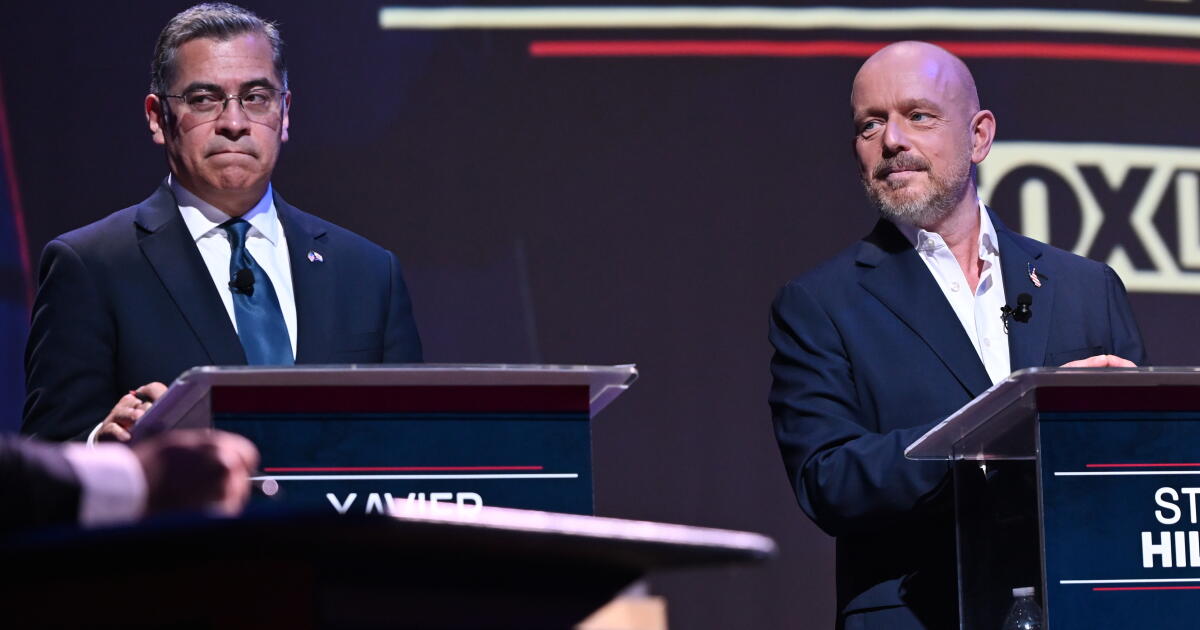
Republican Steve Hilton and Democrat Xavier Becerra speak during a break in the April 28 gubernatorial debate.

Republican Steve Hilton and Democrat Xavier Becerra speak during a break in the April 28 gubernatorial debate.

(Eric Thayer / Los Angeles Times)

Former Fox News commentator Steve Hilton has hammered that message in ads and on the debate stage, lambasting the Democratic establishment for pushing so much unnecessary regulation that it has chased out business and investment and made everything from gas to housing to groceries more expensive for average residents.

He has blamed Democrats for California’s high rates of poverty and unemployment, its high cost of living and high taxes, its record homelessness and its poor public school results.

In an interview, Hilton said he understands that California voters may not like Trump — who endorsed him — and may have conflicting beliefs about federal and international policy, but that California’s biggest problems have “nothing to do with President Trump.”

“Voters need to decide on what direction they want to take in terms of the policies that affect their daily lives in California,” he said, and those are “devised and enacted within California by our politicians here in Sacramento.”

He also said it’s no surprise that some of his Democratic rivals have also acknowledged that the Democratic establishment has been a failure, because “if you pretend otherwise, you show that you’re just completely out of touch with public opinion.”

Rusty Hicks, chair of the California Democratic Party, said “every campaign is entitled to run the race that they believe matches their story,” even if that means questioning the party’s past performance. But he also said polling hasn’t shown that message to be an effective one, and he’s confident that voters will show their ongoing trust in the party at the polls.

Redistricting, sniping and name-calling

The decision by California voters last November to pass Proposition 50 and allow the state’s Democratic leaders to redraw the state’s congressional maps to favor Democratic candidates in a handful of additional districts — part of a wider redistricting war sparked by Trump — has intensified the primary races in those areas.

As an example, longtime incumbent Reps. Ken Calvert (R-Corona) and Young Kim (R-Anaheim Hills) are now competing to represent the same redrawn swath of Orange, Riverside and San Bernardino counties, and have bitterly attacked one another. Kim has called Calvert a “swampy,” “sleazy” and “corrupt” politician guilty of “sabotaging President Trump’s agenda.” Calvert has called Kim a “RINO,” or Republican In Name Only, and a “Trump-hating liberal.”

Democrats have also sniped at each other, including in the race to replace retiring Rep. Darrell Issa (R-Bonsall) in his redrawn district in San Diego and Riverside counties — where Trump also holds an outsize presence.

Rep. Young Kim and Rep. Ken Calvert are opponents in a heated race in a newly redrawn congressional district.

Rep. Young Kim and Rep. Ken Calvert are opponents in a heated race in a newly redrawn congressional district.

(Associated Press)

Stutzman said it will be interesting to see how those primaries play out, but also how Democrats there and in other races perform in November — when Democrats are expected to perform well nationally given Trump’s lousy ratings, but Democrats in California could underperform thanks to statewide frustration with affordability, housing and homelessness here.

“People are like, ‘Eh, you know, yeah, Trump — but there’s some problems here,’” Stutzman said.

Hicks said he expects California voters to not only elect another Democratic governor, but to “push back on a Trump administration and congressional Republicans and Republicans around the country that have sought to rig the game in their favor,” including by “ensuring that we fulfill the promise of Proposition 50 by winning congressional seats and retaking the House of Representatives.”

He said the current political moment “can feel like a pressure cooker,” but Californians will “continue to adapt and overcome and be resilient, just as they always have been.”

Source link

As influencers rise in politics, some call for tighter regulations on payments

In the 2024 election, hundreds of social media influencers were credentialed for the first time to attend the Democratic and Republican conventions. They have been invited to holiday parties in the Pennsylvania governor’s mansion, to political rallies in Texas and to events at the White House by both the Biden and Trump administrations.

The role of influencers is surging as candidates and groups across the political spectrum see their social media feeds and personas as a pathway to younger audiences and harder-to-reach groups of voters.

“You have that sense of authenticity, like a friend is talking to you,” said Emma Briant, a professor at Notre Dame University’s Lucy Family Institute for Data & Society who studies propaganda.

That’s exactly what campaigns are hoping to harness when they partner with influencers, she said.

But the nature of that partnership has come into question in California’s hotly contested gubernatorial race after it emerged that a number of content creators — some with millions of followers, others with only a handful — had taken payments from the campaign of Democratic candidate Tom Steyer and not disclosed that they were paid to create those posts.

Some popular content creators have felt the need to explain themselves to their audience. Others have questioned how common such under-the-table payments might be, since there are no disclosure requirements for paid content at the federal level and few jurisdictions have any rules mandating it.

Some campaign finance advocates are concerned that voters could increasingly be influenced by social media posts that they don’t know are sponsored.

“The problem is that it doesn’t look like an ad,” said Saurav Ghosh, a former enforcement attorney at the Federal Election Commission. “It ends up really getting people at a place where they’re not skeptical and not able to tell the difference between what’s voluntary and where the influencer is acting as a paid spokesperson.”

Ghosh is now the director of campaign finance reform at the nonprofit Campaign Legal Center, which has filed a petition asking the FEC to require disclaimers on paid content created by influencers.

Roughly 1 in 5 Americans said they regularly got news from social media influencers in 2024, according to the Pew Research Center, and that number was nearly double for younger adults between the ages of 18 and 29.

Working with social media creators can be an easy way for candidates to try to boost their image, particularly with a younger audience.

“If they don’t have big personalities, maybe partnering with some influencers who seem cool and fun can make you seem cool and fun also through association,” said Link Lauren, a political influencer and podcaster who served as a communications advisor for Robert F. Kennedy Jr.’s presidential campaign in 2024.

California is one of the few places that requires disclosure of sponsored social media posts, but the 2023 law that created those rules hadn’t gotten much of a workout before the issue was raised in this contest through a series of dueling complaints with California’s Fair Political Practices Commission. The commission has yet to weigh in on the various accusations.

Under the law, influencers are required to provide disclosure that a post was sponsored and say who paid for it. Political groups are required to notify paid creators of the requirement.

Even if the commission finds that violations have occurred, the penalties are not especially harsh.

Violation of the law carries no civil, criminal or administrative penalties. The FPPC can take alleged violators to court and ask a judge to force compliance. And violations can be penalized with a fine of up to $5,000 per instance.

Influencers reporting influencers

In the gubernatorial race, the issue of compliance was raised, naturally, by a pair of influencers.

Beatrice Gomberg has built up a following of more than 180,000 followers on TikTok, where she posts under the handle antiplasticlady. Her side gig of creating nonplastic children’s cups and lunch boxes became her main gig after she lost her human resources job at Macy’s during the COVID-19 pandemic.

“I started doing social media because I didn’t want to hire a marketing company,” Gomberg said.

Gomberg’s posts were initially largely focused on research related to plastic, but have become increasingly political over time. When campaigns put out the call for influencers to meet with candidates, Gomberg answered.

She interviewed Katie Porter, she met with Xavier Becerra. And it was at a Becerra event in April when she met Kaitlyn Hennessy, another influencer focused on politics.

They found that the world of online influencers can be isolating. “We stare in front of our phones,” Hennessy said. “You don’t want to see our screen time.”

As they scrolled through social media posts about the governor’s race, they found a cause to unite them.

They kept seeing videos posted by social media accounts espousing similar messages in support of Tom Steyer. Hennessy wondered at first if they were actually created by artificial intelligence.

They found that the posts seemed to be created by a network of women who, in some cases, had created several different profiles to promote a variety of products.

They pored over Steyer’s campaign disclosures and saw that the campaign listed payments to several prominent influencers — including one with the handle Zay Dante, with 1.8 million followers on TikTok — who had not disclosed creating paid content for the campaign.

The pair filed a complaint laying out their allegations, which the Steyer campaign has called “baseless.”

In the wake of their complaint, Steyer defended his campaign’s use of paid influencers, writing on Substack that his campaign believed content creators should be paid for their work and that the campaign had been transparent about disclosing those payments.

In a separate post, influencer Carlos Eduardo Espina said he had been paid $400,000 for work he has done for the Steyer campaign. Espina, who has more than 14 million followers on TikTok, is an advisor to the campaign, which was publicly announced.

“You will never see anything on my channels that I don’t believe in, or that I think goes against the best interest of my community. No one buys my opinion. But I also think it’s fair to be compensated for my work,” he wrote on Substack.

Not everyone is ready to accept payment for posts.

Lauren, the influencer who advised Kennedy’s campaign, said that while he doesn’t begrudge other influencers accepting sponsorship, he chooses not to.

“A passive viewer might think you really believe this,” he said. “I have a strong connection with my audience. I really consider them my family.”

Lauren said he favors disclosure requirements.

Briant, the propaganda researcher, said she is concerned about the possibility of foreign actors trying to influence Americans through paid posts.

In 2024, for example, federal prosecutors filed an indictment alleging that Russian state media employees had paid nearly $10 million to a Tennessee company that paid popular right-wing social media influencers to unwittingly produce pro-Russia content.

Briant said she believes that the only way to counteract increased manipulation through social media influencers is to impose harsh penalties when paid content is not disclosed.

“Ultimately, it’s a wild west at the moment if there are no repercussions for not doing it,” she said.

Source link

Poll of judges, lawyers sees grave Trump threat to rule of law

Sometimes it seems as though the only thing that stands between a functioning democracy and a full-on Trump autocracy is a thin, black-robed line.

Although the Supreme Court, in general, and conservative appellate courts, in particular, have bowed and granted President Trump permission to do pretty much anything he wants, they haven’t thoroughly capitulated to his endless grasping for ever more power. (The way invertebrate congressional Republicans have.)

At the lower-court level, judges have repeatedly ruled in ways intended to check Trump, most notably when it comes to violating civil and constitutional rights in pursuit of his indiscriminate immigration dragnet.

The tendency to slow-walk his administration’s response to those rulings — and ignore others that Trump thinks he can safely snub — only contribute to the perception of presidential lawlessness and a sense that our judicial system is being strained to something approaching a breaking point.

Go ahead, if you’d like, and dismiss those concerns as just so much overwrought hand-wringing, or the mindless anti-Trump blathering of your friendly political columnist. A new survey of legal experts — including federal judges, top-tier lawyers and scores of professors from some of the country’s leading law schools — finds widespread concern about the brittle state of our legal system.

And it’s not just the fears of a lot of shaggy-thinking liberals.

“The nation is strong as is its commitment to the rule of law,” said one appellate judge, a Republican appointee. “The current president presents the greatest threat in decades.”

The survey was conducted by Bright Line Watch, a nonpartisan academic group that monitors the health and resilience of American democracy, in conjunction with the Safeguarding Democracy Project at UCLA’s School of Law.

Conducted between mid-February and early March, the poll anonymously surveyed 21 federal judges, 113 lawyers, 193 law professors, 652 political scientists and a nationally representative sample of 2,750 Americans.

What leapt out to UCLA’s Rick Hasen, director of the Safeguarding Democracy Project, was that “across the ideological spectrum and across judges, lawyers and law professors, there was considerable agreement that the rule of law in the U.S. is under tremendous stress.” That consensus, he said, suggests “a real risk to democracy.”

Most legal experts agreed that Trump is using executive power excessively, with a majority doubting the conservative-leaning Supreme Court would handle cases involving the Trump administration impartially. The experts also expressed concern about politicized law enforcement — Trump seeking to persecute his perceived enemies — executive branch overreach, and the failure of Congress or the Supreme Court to do more to rein in the rogue president.

Eight in 10 of those surveyed said federal officials fail to comply with court orders somewhat or very often, and nearly 9 in 10 said political appointees in Trump’s Justice Department mislead federal judges somewhat or very often.

Talk about contempt of court — not to mention our vital system of checks and balances.

There was, unsurprisingly, a split among conservatives and liberals who took part in the survey. (The study defined legal conservatives as those saying the Supreme Court should base rulings on its understanding of what the Constitution meant as originally written. Liberals, who made up most of the respondents, were defined as those saying the court should base its rulings on what the Constitution means in current times.)

Conservatives, for instance, were more likely than liberals to see former President Biden as a greater threat to the rule of law than Trump. Liberals were more likely than conservatives to see evidence of Trump politicizing the Justice Department.

There were also differences between legal experts — those most intimately involved in the judicial system — and the public at large. The experts were more concerned about Trump’s excesses and threats to the rule of law, which, Hasen said, stands to reason.

The legal system is not something most people encounter daily in the same way they do, say, gasoline prices or the cost of groceries. “Yet,” Hasen said, “it’s one of these background things that really matters.”

Why?

Hasen put it this way: “Imagine that a person had a dispute with their neighbor and it ended up in small claims court before a judge and the judge made the decision not based on the merits of the case but based on whether he was friends with one of the parties, or didn’t like people who were similar to one of the parties.”

Now imagine that kind of corrupted, perverted system of justice writ large.

If, for instance, “people know that the government can successfully seek retribution from people who criticize it, people will be less likely to criticize the government,” Hasen said, leaving the country worse off by muzzling those who would hold their elected leaders to account.

Or if, say, rioters overran the U.S. Capitol and tried to steal an election and, instead of being punished, received cash payouts from the federal government, what incentive would there be to follow the law?

Happily — and who couldn’t use a bit of good cheer right about now — all is not lost.

People “can demand that their elected representatives take steps to assure that the rule of law will be followed,” Hasen said, and can insist “that the government [not] play favorites or seek retribution against perceived enemies.”

That’s the power people have, come election time. That’s why voting matters.

There are lots of things riding on the outcome in November, not least the sanctity and integrity of our legal system.

Bear that in mind when you cast your ballot.

Source link

Clashes in Belgrade as student-led protests demand elections | Police News

Clashes have broken out between protesters and riot police after an antigovernment rally in the Serbian capital, Belgrade.

Large crowds of demonstrators poured into central Belgrade on Saturday, many carrying banners and wearing T-shirts emblazoned with the “Students win” motto of the youth movement that organised the gathering.

Serbian President Aleksandar Vucic has sought to rein in mass demonstrations that have challenged his hardline rule in the Balkan country. The size of Saturday’s turnout suggested that dissent remains strong more than a year after protests first began with demonstrators demanding accountability for a train station tragedy in northern Serbia in November 2024 that killed 16 people.

Anticorruption protests forced then-Prime Minister Milos Vucevic to resign in January 2025 before the authorities moved to clamp down on the movement. Many in Serbia blamed the concrete canopy collapse at the station on alleged corruption-fuelled negligence during renovation work carried out with Chinese companies.

On Saturday, Serbia’s state railway company cancelled all trains to and from Belgrade in what appeared to be an effort to prevent at least some people from travelling to the capital from other parts of the country.

In a video posted on Instagram on Saturday, the president said protesters “have shown their violent nature and that they cannot stand political opponents”. Vucic, who was en route to China for a state visit, added: “The state is functioning and will continue to work in line with the law.”

Students on Saturday demanded early elections and the rule of law, accusing the government of crime and corruption. They said they now plan to challenge Vucic in this year’s elections, which they hope will unseat his right-wing populist government. Vucic said on Thursday that the parliamentary elections could be held between September and November.

Clashes were first reported near a park camp of Vucic loyalists outside the Serbian presidency building. The camp was set up before another large antigovernment rally last March as a human shield against protesters. Folk music blared from a fenced-off area surrounded by rows of riot police in full gear.

The Serbian president has come under international scrutiny for his hardline tactics against demonstrators over the past year, including arbitrary arrests and the use of excessive force. The Council of Europe’s commissioner for human rights, Michael O’Flaherty, criticised Serbia’s government in a report after he visited the country last week and said he “will monitor the situation closely”.

O’Flaherty also cited “reports of police protecting unidentified and often masked attackers of journalists and protesters”. He said the overall human rights situation has deteriorated since his previous visit in April 2025.

Serbia is seeking to join the European Union while cultivating close ties with Russia and China. Democratic backsliding under Vucic could cost the country about 1.5 billion euros ($1.8bn) in EU funding, the bloc’s top enlargement official warned last month.

Source link

L.A. crime has plummeted — but it’s still a hot mayor’s race topic

Homicides in Los Angeles are down to levels not seen since the 1960s. Neighborhoods once awash in gang violence now sometimes go weeks, even months, without a shooting. And the follow-home robberies and street takeovers that captured the public’s attention in recent years have largely subsided.

By many measures, the city is safer than it has been in generations — and yet voters following L.A.’s hotly contested mayoral race might think the opposite.

The challengers to Mayor Karen Bass have zeroed in on homelessness and public drug use to argue she hasn’t delivered on public safety, while also criticizing how the Police Department has operated and been funded during her tenure.

Mike Bonin, a former L.A. City Council member, said the fact that Spencer Pratt — the former reality TV star who has been attacking Bass from the right — has gained so much traction in the race is proof of how Bass and other candidates to the left have failed to change “prevailing narratives that the city is unsafe.”

A man in a suit speaking to another man

Mayoral candidate Spencer Pratt hosts a campaign block party on 10th Avenue in Los Angeles on May 20, 2026.

(Robert Gauthier / Los Angeles Times)

Pratt has been particularly active on social media, where he has shared artificial-intelligence videos created by fans depicting him as various superheroes coming to the rescue of a city that, under Democratic rule, has turned into a dystopian hellscape.

In a March 26 post on Substack, Pratt railed against the thousands of drug-related calls that emergency officials respond to every month. He has said that if elected mayor, he would order the police and fire chiefs and the county health director to “treat every encampment as a grave-disability zone.”

“No new laws needed,” he wrote. “No endless task forces.”

Flanking Bass on the left is Nithya Raman, a progressive City Council member who was once the mayor’s political ally.

Raman has argued that Bass has thrown too much money at the LAPD, with raises for police officers coming at the expense of other basic services such as park maintenance and street paving. Raman said the LAPD pay increases have “bankrupted” the city, depriving other services of much-needed funding. In campaign ads, Raman has cast herself as a more sensible alternative to Bass. Raman has said she would work to reduce traffic deaths and prioritize safety on the city’s buses and trains.

When she first ran for office in 2020, Raman called for defunding the police, saying the Los Angeles Police Department should be a “much smaller, specialized armed force.” Since then, however, she has voted for some budgets that increased spending on law enforcement.

In response to questions from The Times, Raman said she would work to find ways to overhaul public safety.

“I’ll propose budgets that expand unarmed response, work with LAPD to improve 911 response to more quickly answer calls for help that don’t require armed officers, and will appoint leadership at the Police Commission who will actively partner with the City Council to work on reform,” she said.

Representatives for Pratt and Bass didn’t respond to requests for interviews with the candidates.

Bonin said Bass — who supported various police reform measures while Congress — has shocked some of her supporters with how “aggressively pro-police she has been.”

When she ran for mayor in 2022, Bass vowed to retool the recruitment and hiring process in order to restore LAPD staffing to 9,500 officers. That hasn’t happened. The number of sworn officers recently fell below 8,600, despite Bass striking a deal with the police union to offer higher starting salaries and new retention bonuses.

A woman with curly, short brown hair, wearing glasses and a mustard yellow jacket, speaks while holding a microphone

Mayor Karen Bass takes part in a candidate forum on May 5, 2026, in Sherman Oaks.

(Eric Thayer / Los Angeles Times)

On Thursday, the City Council approved a $15-billion budget for the upcoming fiscal year, which included funds to hire 510 new officers — just enough to offset turnover and maintain current staffing levels.

Raman has said the LAPD should not shrink any further because there aren’t enough officers to respond to 911 calls “in a timely fashion.”

Samantha Stevens, a Los Angeles political consultant and former legislative staffer, said people seem willing to back Pratt because he acknowledges that their sense of safety has been shaken — even if he has offered few concrete details about how to tackle crime beyond cracking down on homelessness.

Pratt’s critics say that his plan relies on funneling homeless people into a shelter system that doesn’t have the capacity to handle them all. Others have noted that the aggressive tactics he has proposed would probably face legal challenges.

A woman speaks at a lectern with a sign that says 'Nithya for Mayor' in a dirt lot

L.A. City Councilmember Nithya Raman, who is running for mayor, makes a campaign stop at the site of a home burned in the Palisades fire.

(Eric Thayer / Los Angeles Times)

“He’s kind of a case study in somebody who has a lot of opinions but has no idea of how the city is run,” Stevens said.

Fernando Guerra, a political science professor at Loyola Marymount University, said Pratt seems to have tapped into a deep well of discontent among Angelenos who believe that crime and homeless have spiraled out of control. The challenge for Bass, he added, is that although the numbers suggest that crime has decreased, many people associate the sight of encampments spilling onto public sidewalks as “a breakdown” that indicates the city is becoming less safe.

“You want to go back to the days of Daryl Gates, you’ve got Pratt,” he said, referencing the former LAPD chief whose controversial police sweeps in the late 1980s yielded thousands of arrests while alienating large segments of South L.A.

“If you want more of the same from the past 20 years, you’ve got Bass,” Guerra added. “And if you want something new, then you’ve got Raman, but she has to explain what exactly she wants to do.”

Although Pratt and Raman appear to be the strongest challengers to Bass, several long-shot candidates have also made public safety a key issue in their campaigns. Some have gone after Bass for her support of LAPD Chief Jim McDonnell. Hired by Bass in 2024, McDonnell has touted the impressive drop in crime under his leadership, but also faced criticism over an uptick in shootings by police and aggressive crowd control tactics during protests against the Trump administration’s immigration policies.

A man in dark police uniform holds his fingers together as he stands in front of another man

Police Chief Jim McDonnell attends a news conference at LAPD headquarters on May 21, 2026.

(Genaro Molina / Los Angeles Times)

Rae Huang, a minister and housing rights advocate, said if elected mayor she would immediately replace McDonnell with someone who has the “ability to really reimagine what public safety really looks like.”

“I’m the only one with the guts to say that out loud,” Huang told The Times during a recent campaign stop at a bookstore in the West Adams neighborhood.

In social media posts and interviews, Huang has frequently referred to the LAPD as “one of the biggest legal gangs in the world,” and said she would work on diverting money from the police budget to scale up programs that have shown promise in sending unarmed specialists to deal with emergencies that involve people experiencing mental health crises.

The city is already running two such pilot programs, but under Bass they have remained underfunded, Huang said. Last week, the City Council signed off on expanding one of the programs.

Huang said she would also invest more heavily in addressing the city’s lack of affordable housing, which she said is an underlying cause of crime and homelessness.

The Los Angeles Police Protective League has poured hundreds of thousands of dollars into attack ads against Huang and Raman.

Adam Miller, a tech entrepreneur, has tried to strike a balance in his mayoral campaign, advocating for changes while acknowledging that many people still feel unsafe despite the historic drop in violent crime.

He criticized a recent vote by the L.A. City Council to limit so-called pretextual stops, in which officers pull people over for minor traffic infractions in order to investigate more serious offenses. The stops have been blamed for enabling racial discrimination.

Miller said that “constraining the Police Department is the opposite of what we should be doing.” He called for “leveraging” AI and modernizing the department’s archaic computer systems, which he said could allow the LAPD to catch up to other agencies that have embraced new technology.

Miller told The Times that he recently went on a ride-along with officers from the Rampart Division, which he said was eye-opening.

“At the highest level I think Angelenos don’t feel safe anymore,” he said. “They don’t feel safe in their neighborhoods, but more recently they don’t feel safe even in their own homes.”

Statistically speaking, the city might be safer than it’s been in decades, he said — but that doesn’t necessarily matter to voters.

“I don’t think it’s just perception,” he said. “I think it’s reality that crime has spread.”

Source link

L.A. voters will cast ballots in eight City Council districts, two with open seats

Los Angeles voters will cast ballots in eight City Council district elections next week, including for two open seats where incumbents are leaving because of term limits.

The contests for the seats being vacated by Councilmembers Bob Blumenfield and Curren Price have drawn large fields of candidates, but the biggest spending has been in the Westside’s District 11, where incumbent Traci Park is facing challenger Faizah Malik, a public interest attorney and one of four council candidates backed by the local chapter of Democratic Socialists of America.

Park has raised $1.3 million, according to the latest campaign finance reports filed Friday, while challenger Faizah Malik reported about $520,000 in contributions. In addition, more than $3 million has been spent in the race by so-called independent expenditure committees that spend money to elect or defeat candidates but which are barred from coordinating their activities with the campaigns.

The district includes Venice, Mar Vista, Brentwood and Pacific Palisades, which was devastated by wildfire in January 2025.

Malik said Friday she is confident heading into the primary election, saying most of her donations are under $100 each, and that she hasn’t taken money from corporations.

Los Angeles City Council candidate for CD11 Faizah Malik attends a canvassing event.

Los Angeles City Council candidate Faizah Malik attends a canvassing event March 15 in Westchester.

(Eric Thayer / Los Angeles Times)

“This is what it means to be a grassroots candidate, and it is just more evidence that the people of CD11 believe in our vision for a Westside that is affordable for everyday people,” Malik said.

A Park campaign aide said Park’s haul is indicative of the councilmember’s record of getting results.

“But no one is taking anything for granted,” the aide said in a statement. “We’re working until the final vote is cast because this election will determine whether the Westside keeps moving forward or gets pulled backward into the same failed ideological politics Angelenos are exhausted by.”

Los Angeles City Councilmember Traci Park gives a pep talk to members of United Firefighters of Los Angeles City.

Los Angeles City Councilmember Traci Park, center, with members of United Firefighters of Los Angeles City on May 12.

(Genaro Molina / Los Angeles Times)

Park has emphasized her advocacy for fire recovery efforts, including pushing for permit fee waivers for residents wanting to rebuild. Malik has said Park has been too focused on single-family homeowners and said she would focus more energy on renters.

They have contrasting views on policing: Malik said she opposes expanding the size of the Los Angeles Police Department and instead supports shifting more resources to the city’s unarmed crisis response program. Park said the Police Department should have about 10,000 sworn officers, up from about 8,700 currently. She voted in favor of a 2023 LAPD contract that gave raises to officers and increased salaries to new hires.

They stand in contrast of each other on the Venice Dell housing development project, which would turn a city lot into 120 housing units for low-income and homeless people. Park opposed the completion and instead wants to turn it into a “mobility hub” and move the housing project to an adjacent lot. Malik, who represented the developer that filed a suit against the city claiming Park and others sought to kill the project, said the project was a motivating factor for her campaign.

District 9

Six candidates are vying to replace Councilman Curren Price, who hit the 12-year limit, in District 9. The district includes the Convention Center, USC and communities along the Harbor Freeway.

The candidates vary on key issues, including policing and housing. Estuardo Mazariegos, co-director of the Alliance of Californians for Community Empowerment Los Angeles, is backed by the Democratic Socialists of America. He has called for reducing the LAPD budget and redirecting funds to other city departments.

Two other candidates — Jorge Hernandez Rosas, an educator, and Jose Ugarte, who previously worked for Price — said they support hiring more police officers. Another hopeful, Elmer Roldan, executive director of Communities in Schools of Los Angeles, said he believes in keeping the LAPD at its current size.

Ugarte, Roldan, Rosas and Martha Sánchez, a therapist, all support enforcing Municipal Code 41.18, which bars homeless encampments near schools and daycare centers. Mazariegos and Jorge Nuño, an entrepreneur, say the code doesn’t solve homelessness and instead just moves people around.

Ugarte has raised the most in contributions of any candidate and has been endorsed by the Los Angeles County Democratic Party in the nonpartisan race.

District 3

Three candidates are competing for an open seat in District 3, where Councilmember Bob Blumenfield has termed out of office. The district encompasses Woodland Hills, Canoga Park, Reseda, Winnetka and Tarzana.

The candidates are Tim Gaspar, who founded an insurance company, Barri Worth Girvan, district director for Los Angeles County Supervisor Lindsey Horvath, and Christopher Robert “C.R.” Celona, a tech entrepreneur.

The three candidates are similarly positioned on public safety, backing Mayor Karen Bass’ long-term goal to increase the LAPD ranks to at least 9,500 officers. All three also support enforcing Municipal Code section 41.18.

Gaspar and Worth Girvan have both scored key endorsements. Gaspar is backed by Blumenfield, billionaire developer Rick Caruso and Councilmembers Monica Rodriguez, Tim McOsker and John Lee and billionaire developer Rick Caruso. Worth Girvan has endorsements from a long list of state Democratic lawmakers, the county Democratic Party, the Sierra Club and labor unions.

Gaspar leads in campaign contributions, followed by Worth Girvan. Celona, who has promised to resuscitate the city’s entertainment industry by fast-tracking film permits and cutting red tape, trails far behind.

District 1

Councilmember Eunisses Hernandez faces four challengers in District 1, which stretches from Highland Park on the northeast to University Park on the southwest. She is backed by the local Democratic Socialists of America, and her challengers claim the district has suffered under under her leadership, pointing to MacArthur Park as emblematic of the homelessness and drug addiction crisis plaguing the city.

Hernandez counters with a list of accomplishments, including helping secure a $6.3-million state grant to house homeless individuals near the Arroyo Seco riverbed and advocating for a citywide network of unarmed crisis response teams.

She faces challenges from Maria Lou Calanche, a former Los Angeles police commissioner and founder of the nonprofit Legacy LA; Nelson Grande, an executive consultant and former president of Avenida Entertainment Group; Raul Claros, founder of California Rising; and Sylvia Robledo, a small-business owner and former council aide.

Hernandez’s campaign has also faced an onslaught of accusations of “dark money” spending. A group called Neighbors First has sent mail pieces critical of Hernandez and other leftist City Council candidates.

District 5

Incumbent Katy Yaroslavsky faces two challengers for her District 5 seat, both of whom oppose her stance on housing and public safety spending. The district includes some of the city’s wealthiest neighborhoods, including Bel-Air, Westwood, Cheviot Hills and Hancock Park.

Challengers Henry Mantel, a tenants’ rights lawyer, and Morgan Oyler, an accountant, say Yaroslavsky hasn’t done enough to increase the district’s housing supply. Yaroslavsky, who holds a wide lead in fundraising, has said she supports increasing housing density near transit centers but cautioned against building more than the city can sustain.

District 13

Councilmember Hugo Soto-Martínez, who is also backed by the Democratic Socialists of America’s L.A. chapter, faces three challengers in District 13, which includes Atwater Village, Glassell Park, Elysian Valley, Echo Park, Silver Lake and East Hollywood.

The list of challengers includes Colter Carlisle, vice president of the East Hollywood Neighborhood Council, Dylan Kendall, who runs Grow Hollywood, and Rich Sarian, vice president of strategic initiatives for downtown’s South Park Social District.

While Soto-Martínez supports expanding the city’s unarmed personnel program, Carlisle and Kendall would like to expand the police force. Sarian has said he supports the unarmed personnel program and wants to examine the LAPD’s current size and resources.

District 15

Incumbent Tim McOsker is facing off against community organizer Jordan River in District 15, which covers Harbor City, Harbor Gateway, San Pedro, Watts and Wilmington. McOsker has decades of experience in the political world, having worked in the mayor’s office, and the city attorney’s office before joining the City Council in 2022. Rivers, who is unemployed, is a member of the Green Party.

District 7

Monica Rodriguez is running unopposed for the District 7 seat in the northeast San Fernando Valley.

Times staff writers David Zahniser, Noah Goldberg and Sandra McDonald contributed to this report.


Source link

South Lebanon’s agriculture falls victim to Israeli attacks

A United Nations Interim Force in Lebanon soldier stands guard as farmers harvest olives in the village of Odaisseh, located close to the Blue Line border with Israel, in southern Lebanon, in October. File Photo by Wael Hamzeh/EPA

BEIRUT, Lebanon, May 22 (UPI) — Lebanon’s agriculture sector emerged as another victim of Israel’s widespread attacks across southern Lebanon, damaging vast areas of farmland, displacing the majority of the region’s farmers and threatening the country’s food security, economic resilience and cultural identity.

The sector, which is key to Lebanon’s economy and plays a vital role in sustaining rural communities and preserving cultural traditions, had not yet recovered from the impacts of the 2023-2024 war between Hezbollah and Israel when it was again hit by resumed hostilities in March.

The fresh escalation severely disrupted farming activities, with an estimated 22.5% of agricultural areas (56,264 hectares) damaged, including farms and greenhouses, and nearly 80% of farmers (more than 6,593) displaced and unable to access their land due to Israeli military activities, according to an updated report released by the Lebanese Ministry of Agriculture on May 5.

The report indicated that the most affected crops in the south are bananas (95%), citrus trees (97%), olives (91%) and small-scale farming, which accounts for 80% of Lebanon’s total agricultural area.

Moreover, more than 1.8 million heads of livestock (cows, goats, sheep and poultry), 29,121 beehives, and 2,030 tons of fish have been lost.

Nizar Hani, the minister of agriculture, said the sector suffered its biggest losses compared with previous wars, adding that agricultural losses have doubled since the March 2 escalation to about $1.5 billion, out of an estimated total war damage that exceeds $20 billion.

Hani said Israel is establishing a buffer zone in southern Lebanon “empty of any life, where no one can pass through, hide or live,” through destruction of entire villages, properties, orchards and olive trees.

He said southern Lebanon produces 70% of the country’s citrus fruits and 90% of its bananas, supplying the local market and exporting to neighboring countries such as Syria, Jordan and Iraq.

And he told UPI that the heavy agricultural losses, inflation, and resulting job losses had a direct impact on food security, with 24% of people living in Lebanon — including Syrian displaced persons, Palestinian refugees and others — requiring immediate assistance.

According to an analysis by the Agriculture Ministry, in collaboration with the U.N.’s Food and Agriculture Organization and the World Food Programme, 1.24 million people were expected to face food insecurity between April and August 2026, marking a significant increase from the November 2025-March 2026 period, when an estimated 874,000 people experienced acute food insecurity.

Nora Ourabah Haddad, the Food and Agriculture Organization representative in Lebanon, warned that damage to irrigation systems, productive infrastructure, livestock systems and agricultural supply chains is further weakening local production capacity.

Haddad referred to substantial declines in the production of milk, meat, eggs and honey after 1,600 farms were affected and more than 1.8 million animals killed during the war.

She said the scale of the damage is “extremely serious” and extends far beyond the affected agricultural land that included some of the country’s most productive farming areas.

“What is at stake today is Lebanon’s capacity to sustain local food production, protect rural livelihoods and preserve the resilience of its agrifood systems at a time when the country is already heavily dependent on food imports and facing severe economic pressures,” she told UPI in an interview.

Haddad said food prices rose by 8.4% in the first quarter of 2026, while transport costs increased by 21%, adding that higher fuel and logistics costs expected to continue to drive up prices.

This time, farmers fear prolonged displacement after being forced to leave their land and homes under Israeli evacuation orders in early March — as many were preparing for the planting season.

Hussein Salameh, head of an agriculture cooperative in the Bint Jbeil-Marjeyoun area, recalled how they fled without having time to take any belongings, move their cows away or release them.

Salameh, an inhabitant of the village of Aitaroun, said the displaced farmers mostly feel “frustrated and abandoned” after exhausting their savings on working their land and repairing their damaged homes when they first returned after the Nov. 27, 2024, cease-fire.

He noted that Hezbollah did not provide them then with any financial assistance, saying it no longer had the funds to do so.

Unlike other displaced employees or skilled workers who could still find work in their areas of refuge, they have lost their only source of livelihood away from their land, he said.

“This is a big tragedy. … Farmers have only their land to live on and survive,” he told UPI.

The fear is that when farmers remain separated from their land, livestock and livelihoods for extended periods, many gradually lose the ability to sustain themselves and may eventually abandon agriculture altogether, Haddad warned.

Helping farmers protect what remains of their livelihoods by providing emergency agricultural support and restoring the country’s agricultural capacity before losses become “irreversible” were emerging priorities for the Food and Agriculture Organization, she said.

However, soil contamination presents another major concern after Lebanon and international rights groups accused Israel of unlawfully using white phosphorus and the herbicide glyphosate during its attacks on southern Lebanon, destroying crops and damaging beehives and livestock.

“This is an international environmental crime,” Hani said, adding that Israel “sprayed everything with glyphosate.”

The destruction and uprooting of old olive trees — some of which have been cultivated and preserved across generations, and in some cases for centuries — was equally painful.

“It is the loss of a living heritage … olive trees are deeply connected to family history, local traditions, food culture and rural economies,” Haddad said, adding that their destruction carries not only economic consequences, but also profound social and cultural impacts on farming communities.

Restoration is possible, but it requires time as newly planted trees require many years before becoming fully productive.

“Some of these ancient olive trees may also contain unique genetic heritage that has adapted to local environmental conditions over centuries, making parts of this loss potentially irreversible from a biodiversity perspective,” Haddad said.

Even if hostilities were to stop today, recovery in southern Lebanon’s agriculture sector would not be immediate and would require extensive international funding and support.

Farmers would also need time to recover from the “deep psychological impact” of being uprooted from their land, after their “cultural and environmental values” were destroyed, according to Hani.

To Salameh, Israel was not just targeting Hezbollah but carrying out what he described as “collective punishment” against everyone living in the south, including those opposed to the Iran-backed group.

“Would such collective punishment ensure security for Israel? Would that bring peace?” he asked.

Source link

California’s population growth to slow in coming decades

California’s population will grow more slowly in the next few decades than it has in the past — and that is good for the state’s still-struggling economy, according to a new USC report.

The study projects that the state’s population, now 37.3 million, will continue to increase at a healthy clip — about 1% annually — for years to come. But at least through 2050, we are unlikely to see the boom rates of recent decades, especially the 1980s.

“This is more manageable growth and that’s good news for California,” said Dowell Myers, a USC demography and urban planning professor who co-wrote the report with colleague John Pitkin. “We’re returning to a more normal rate of growth.”

The cooling pace means the state, city and county governments and other entities will have more time to prepare for a bigger population than they did in years past, allowing for more effective planning, Myers and other experts said. That could ensure that new roads and parks, for example, are put in areas where they are most needed and where growth is likely to be sustained, they said.

The researchers said the slowdown will mainly stem from a sharp drop in immigration to California, part of a nationwide trend detailed in other recent studies.

Although the slower pace of growth may be a net positive for California, it will require revisions to an array of public and private plans, including for schools, water projects, transportation, hospitals, highways and other infrastructure.

“Those of us who’ve been here for a while think of California as a place that’s grow, grow, grow — and go, go, go — but this shows that we’re not that anymore,” Hans Johnson, a demographer with the Public Policy Institute of California, said of the USC study released Tuesday. “We’re now more typical of the rest of the nation.”

Johnson noted that the brakes on California’s growth were evident in the 2010 census, after which, for the first time, the state failed to gain a new seat in Congress.

The report, the third in a series of projections by USC’s Population Dynamics Research Group, predicts that California’s population will grow at less than 10% per decade for the next several decades.

In the 1980s, the state’s population surged nearly 26%, adding about 6 million residents. The increases were fueled primarily by the booming aerospace industry and economic problems elsewhere in the country, which made the Golden State a powerful magnet for job seekers.

In the 1990s, the state’s growth rate fell to 14% but remained strong. It slowed further, to 10%, in the decade just ended, the USC report shows. Myers said the continuing falloff from 2000 to 2010 may have been partly due to the recession that began in 2008. Growth was slow even in 2005, when the economy was still strong.

The new predictions differ significantly from California’s official population projections. Those show that the state’s population by 2020 would reach 44 million, a level USC’s researchers now say will not be attained until 2028.

Bill Schooling, chief of demographics research for the state department of finance, praised the USC report and said his staff, too, is working on a new set of population figures, which he says will be lower than its previous estimates. Schooling’s office is racing to produce the new estimates ahead of its regularly scheduled report because demographic changes are so profound that state agencies urgently need fresh data to update their planning.

The USC analysis also predicts that as California’s growth slows, its population will change in various ways. The state in coming decades is expected to have more senior citizens, fewer children and more young adults. The state’s immigrant population will be more settled, with a larger share that has lived in the U.S. at least 20 years.

Each change has implications, the experts said.

The average age of the state’s population, as in the nation, is rising, partly driven by the aging of the huge baby boom generation, whose oldest members were born in 1946 and are of retirement age. The USC researchers say the number of Californians of retirement age compared with people of prime working age (25- to 64-year-olds) will rise to 36 seniors per 100 working-age adults in 2030. It stood at 22 to 100 in 2010.

As the boomers age, they will require more state services and that will create budget challenges, Johnson noted. Also significant is the loss of their workforce skills to the state, he said. Baby boomers are California’s most highly educated generation, he said, with a greater share having graduated from college than younger or older age groups.

A smaller population of children in years to come means savings for the state, mainly in education costs. It could lead to higher per capita spending for the education of those who remain, Johnson said.

The rising share of young adults age 25 to 34 in the next 20 years is good news for the state, which experienced negative growth for that age group from 1990 to 2010, Myers said. Young adults are crucial for the state’s economic growth. They are most likely to become new workers, rent their first apartment, buy a home, have children and be first-time voters, he said.

California’s increasingly settled immigrant population means that its members are more likely than before to have learned English, have children born in the U.S. and remain in the state, Johnson said.

“It’s important for us as a state to make sure immigrants and their families are integrated into our society and are successful, so it’s really important to look to their education,” he said. “The biggest challenge California faces long term is to ensure that enough of our residents go to college, and to make sure they graduate.”

rebecca.trounson@latimes.com

Source link

Army of Young Leftist Activists, Loyal Elderly Tenants Make Up W. Hollywood’s Coalition for Economic Survival : Fringe Group Takes Over Center Stage

In the trunk of his battered 10-year-old Ford sedan, Larry Gross stores half a dozen scarred yellow folding chairs. The chairs, strewn among volleyballs, softball equipment and long-discarded papers, are essential equipment for a man who spends much of his life arranging and attending meetings.

Gross is a professional organizer, a man whose career is measured in meetings. He sets up his chairs everywhere in the tiny city of West Hollywood, in the dingy church office where he works, in the clean, well-lighted offices of City Hall, in cramped apartment common rooms and in sparsely furnished election headquarters.

What he accomplishes at those meetings often has immediate impact on the fortunes of the 16-month-old city. With the aid of a small band of young leftist activists and a loyal army of elderly Jewish tenants, Gross has built a potent grass-roots version of a political machine and become the city’s most commanding power broker.

Formidable Power Bloc

In the process, his Coalition for Economic Survival has transformed itself from a Los Angeles-based fringe pressure group with limited successes in rent control and street demonstrations into West Hollywood’s most formidable power bloc. No other organized group in the city wields as much influence or inflames as much controversy.

The coalition and its supporters have elected two of the city’s five council members–both of whom face reelection on April 8–and are priming for a third. Some of its volunteer members have wangled key appointments to the city’s commissions. Others have been hired in policy-making posts in the city’s fledgling bureaucracy.

“West Hollywood is (the coalition’s) oil gusher,” said Ron Stone, who led the city’s incorporation movement. “They’ve dug holes all over Los Angeles, but they never struck deep until they came to West Hollywood. They worked hard here and they deserve the rewards.”

The coalition’s primacy has alienated many of those who are accustomed to holding power. Landlords are roused to fury by the mere mention of Larry Gross’ name. Businessmen worry that the coalition’s continuing dominance will cost them profits. Rival politicians are jealous of the group’s clout. Even some council members seethe privately at the coalition’s refusal to compromise on minor political issues.

“CES is run by a very small group of people,” said Tony Melia, an insurance man who chairs a faction of moderate businessmen challenging the coalition for political supremacy in the April election. “They are a mystery to us all.”

Grist for Criticism

Nearly every move that the 34-year-old Gross makes as director of his coalition becomes instant grist for criticism: Passing folded notes to Mayor John Heilman and Councilwoman Helen Albert (both coalition members), Gross is accused of controlling their votes. Taping a flag over his office desk, he is branded a Communist (Gross described the flag, which has been taken down, as a United Farm Workers banner; his enemies say it was a hammer and sickle). Shaving his wispy beard and wearing suits instead of flannel shirts, he is said to be cleaning up his act for public consumption.

“People set me up as the enemy all the time,” Gross said. “They do it out of fear and envy. They really don’t have the foggiest notion of what CES is all about.”

Gross’ Hold on Coalition

Their obsession with Gross is hardly unwarranted. About 13 years after he founded the coalition with a group of peace activists and leftist leaders, Gross is the only original member left. Organizers and volunteers have come and gone, leaving because of “activist burnout,” because they needed a better-paying job or because of personal or philosophical conflicts. But Gross remains.

Although ostensibly a democratic organization, the coalition has remained securely in Gross’ control. His partisans say he is central to CES because of his natural leadership abilities; former members and enemies attribute his endurance to Machiavellian political cunning. But in the end, many who have watched Gross say he remains in control of the coalition because he simply is the coalition.

“Our success all trickles down from Larry,” said Jacqueline Balogh, the coalition’s membership director. “Without him, CES wouldn’t exist.”

Gross is a lean, fox-faced man who has a closet athlete’s fascination with competitive sports and a weakness for interrupting his organizing activities to attend Dodger and Laker home games.

He tries to keep his private life shielded from public scrutiny. “I don’t like the focus on me,” he said in a recent interview. “It’s the organization and what it has accomplished that’s important.”

Friends and former acquaintances say Gross lives in a sparsely furnished rented duplex in Echo Park. Five years ago, he made barely $500 a month at his job. These days, he makes more, but declines to reveal a figure. He still drives his decade-old Ford despite its growing list of automotive maladies.

His voice bears traces of a Queens accent that becomes thicker when he excitedly addresses crowds. “The landlords are trying to say rent control is not an issue in dis campaign!” he roared to an enthusiastic hall filled with senior citizens early this month. “The reason is dey don’t stand for strong rent control!”

Odd Man Out

The accent is one of the few facets of Gross’ activist life style that he has not polished. His is a career that began at Forest Hills High School in New York, where Gross found himself odd man out among fellow students in the late 1960s. “I was the only radical on campus,” he said.

He is the son of divorced parents. His father, a trade school teacher, lives in Miami; his mother, a volunteer with the Simon Wiesenthal Center, lives in Los Angeles, not far from West Hollywood. Both were influences on his burgeoning activism, his father as an active union member, his mother as a Holocaust survivor.

“What she went through outraged me whenever I thought about it,” Gross said.

Often joining older college students in peace marches at Central Park and other anti-Vietnam War activities, Gross graduated from high school with few prospects. He took a job as a clothing store salesman, but in 1972, came to Los Angeles to visit his mother, who had moved here.

Extending his stay by taking political science classes at Los Angeles City College, he became active in local efforts to drum up support for the impeachment of President Richard Nixon. Drifting between activist groups, Gross in 1973 became involved in new union of peace and civil rights organizations which was protesting Nixon’s cuts in social service budgets.

The umbrella group became the Coalition for Economic Survival. “They had a little flat on Vermont Avenue with a small file cabinet in the back,” said Rosa Factor, an early coalition volunteer. “It was real small-scale. Larry was a lot different in those days. His hair was long and frizzy, hippie-style.”

Strong Points

The group’s forte was picket line protest and street theater. Demonstrating against high milk prices in 1974, coalition organizers toured inner-city shopping centers, urging a boycott. Gross and his fellow activists spoke from the back of a pickup truck, where they mounted a purple papier-mache cow named “C. Brunel Cow” after then-state Agriculture Secretary C. Brunel Christensen. At a later demonstration, protesting a Pico-Union expansion of a Pep Boys warehouse complex, Gross and his followers marched to the chant: “Manny, Moe and Jack! We want our buildings back!”

At first preoccupied with consumer issues such as rising bus fares and utility costs, the coalition managed to win favorable coverage in newspaper and television reports. They had little influence, however, on the commissions which made the decisions.

Skyrocketing rents that accompanied Los Angeles’ real estate speculation fever in the late 1970s gave the coalition a ready-made issue. “We cut our teeth on rent control,” said Norman Chramoff, a former coalition member who now works in West Hollywood’s rent control administration. “That’s when CES membership grew and grew.”

The new members were senior citizens, outraged that their rents were doubling and tripling, often in the span of a year. After learning to live on fixed incomes, many elderly tenants became afraid that they would be evicted from apartments where they had lived for years.

Remembering the horrors of the Depression, many seniors feared a return to poverty. “Anybody who lived through the Depression can’t imagine how scared we were,” said Martha Newman, a woman in her 60s who is an ardent coalition supporter. “CES saved us from that.”

Limited Victories

The coalition promised relief from the surging apartment rental rates. In a series of political confrontations with landlords, the coalition won limited victories. Although it did not get the strong rent protections it wanted, the coalition did help push a moderate rent control law (4% annual rent increase) through the Los Angeles City Council. In Los Angeles County, the coalition pressured supervisors, but was only able to help pass an even weaker rent law in 1979 (7% annual increase).

In November, 1983, a coalition-sponsored referendum failed to persuade county voters to adopt a tougher rent control law. Because of overwhelming support among senior renters, the referendum did well in West Hollywood–passing there by a 5-1 ratio–but it was not enough to keep rent control alive. That vote, which led to the expiration of county rent control in 1985, set the stage for West Hollywood’s incorporation battle.

By that time, the coalition had made deep inroads into the city’s elderly community (estimated at 40% of the area’s population). Those inroads proved crucial in the 1984 incorporation election.

Gross estimates that 2,000 of the coalition’s 5,000 members are in West Hollywood. Political observers of all stripes in West Hollywood agree that in an election year campaign, the coalition can command upwards of 2,000 votes–a significant block among West Hollywood’s 19,000 registered voters.

“West Hollywood is sort of our flagship,” Gross said. “We have a tremendous opportunity here.”

The city’s elderly tenants also provide the coalition with much of its financial support. At coalition meetings, organizers pass around empty fried chicken buckets, which are often returned brimming with cash and checks.

Several allegations of discrepancies in the coalition’s finances were reported to county officials last year. But Candace Beason, a prosecutor in the county district attorney’s investigative division, said her department has declined to investigate them. “They were relatively minor complaints,” she said last week. “The case is closed.”

Since its incorporation victory in November, 1984–in which two coalition members, Heilman and Albert, were elected to the council and the coalition aided the election victories of council members Alan Viterbi and Valerie Terrigno–the coalition has worked to consolidate its power.

New Headquarters

Late last year, the group moved its headquarters from a cluttered office on Pico Boulevard in Los Angeles to a cluttered office in the Crescent Heights Methodist Church in West Hollywood. Working at night, amid old metal desks and boxes sagging with files, coalition organizers quickly felt at home in the new city.

But, as with nearly everything they do, coalition organizers found themselves under attack, this time just for moving into West Hollywood. Landlords, Republicans and businessmen tried to pressure church leaders and city officials to evict them but the CES has stayed put.

The coalition–and Gross, in particular–are under constant fire. During the 1984 incorporation election, he was branded a Communist by Jewish Defense League activist Irv Rubin. Rubin claimed then–and maintains today–that he has “inside information” proving that Gross visited Cuba as a guest of Fidel Castro.

Gross labels the charges “the ravings of the far right.” Despite continued whisperings about “hidden agendas,” landlords and other political enemies of the coalition have never proved their claims.

But at least half a dozen former coalition members say they were invited by some coalition organizers to attend Marxist study meetings and similar functions. One former member, Mark Siegel, who is now chief deputy to Los Angeles Councilman Joel Wachs, said that he was asked several times to join a Marxist study group. He declined.

“The thing is, (CES) was such a loose group,” Siegel said. “There were all kinds of philosophies floating around there. We certainly weren’t being directed from Moscow.”

Both Gross and Heilman also admit that some members have been philosophical Marxists. “But we have Republicans among our steering committee people, too,” Gross said. “We even have one person who sells Amway products. Should we throw them out for that? I don’t think it really matters.”

‘I’m Scared’

“Of course it matters,” argues Tony Melia, who heads West Hollywood for Good Government, the group opposing the coalition in the April elections. “We want officials who choose for us, without any hidden agendas. If the rumors I hear are true, then I’m scared.”

Gross and his followers have also been portrayed as dogmatic and unwilling to take part in the compromises that are the basic components of small-town politics. “That is my one real gripe with them,” said Councilman Stephen Schulte. “There’s no middle ground to them.”

To that criticism, Heilman responds: “I don’t call that being dogmatic,” he said. “We stand for certain principles. Why should we deviate from them?”

Arguments over covert Marxism and political rigidity, however, mask the nature of the real power struggle in West Hollywood. Perceived as the most influential organization in the city, the coalition’s apparent clout is envied by groups that have had less sway with the City Council.

“At least until this election is over, they (the coalition) have the appearance of the most-organized political entity in town,” Schulte said. “One doesn’t confront them lightly.”

Those who do can expect to become enemies. When Melia unveiled his Good Government group earlier this year, he portrayed it as a rival of the coalition for political clout in West Hollywood. Gross immediately branded the group as a “front for the landlords.”

While it is indeed probable that the landlords would prefer victories by Good Government candidates in the April election, Gross immediately set into motion “an us-versus-them situation,” according to community activist Bob Conrich.

Black and White

“They have no gray areas,” Conrich said. “Larry’s convincing his elderly constituency that the landlords are waiting behind every corner to gouge them. It’s an effective political tactic, but it’s dishonest and it sets this city up for the same situation in every election. Larry will set someone up as a tool of the landlords and then try to knock them down.”

Such was the case earlier this month, when coalition organizers filled a hall at Plummer Park with senior citizens and raised the threat that the city’s rent control ordinance was in danger. “This election is going to be a big battle,” Gross said. “They have the money. They had it last time. But we have the people.”

It has been harder for the coalition to bring out their people when the heat of an election has cooled. During last year’s rent control battle, landlords far outnumbered tenants at public hearings on the proposed law.

Still, in rent control votes and in pressing for an affordable housing policy with the city’s interim growth ordinance, the coalition lived up to its reputation. On other votes, though, without obvious backing of its elderly constituents, the coalition has found itself sometimes limited in its influence over council decisions.

That became embarrassingly obvious to coalition organizers when the council refused to exact concessions from the Pacific Design Center in return for a planned major expansion. Heilman and Albert, backed by coalition lobbyists, pushed for fees that would have paid for a day-care center and provided seed money for a community development corporation. But in the end, the two council members gave up their fight.

Close Votes

The coalition has even had trouble getting some of its members appointed to city commissions. In close votes in recent months, the coalition’s candidates for posts on the city’s Transportation and Human Services commissions were defeated and the coalition even was unable to prevent landlord leader Grafton Tanquary from winning a spot on the Affordable Housing Task Force.

Schulte, Melia and a number of other political observers say such defeats indicate a lessening of the coalition’s clout. “I don’t think they loom as high on the horizon as they did six months ago,” Schulte said. “They haven’t kept up the pressure.”

But Gross and other coalition members say those defeats were minor ones, offset by gains achieved in a less obvious area–political organizing among the city’s 89% tenant population. The coalition is trying to win more allies among the apartment dwellers for future elections.

In recent months, Gross and his fellow organizers have shown up weekly at apartment buildings scattered throughout West Hollywood for “house meetings,” small receptions where they explain the new rent control law to tenants and answer questions about other concerns.

Last month, Gross showed up at one building to explain the details of the city’s new rent law to six tenants. As a radio faintly played “The Poet and Peasant Overture,” Gross set up his folding chairs and waited for his small audience to arrive.

The meeting lasted just over an hour. The conversation did not get beyond the level of after-dinner chat. But in the eyes of many West Hollywood political observers, the coalition’s dependence on such seemingly insignificant meetings may provide the key to its future influence.

“They do the groundwork that no one else in West Hollywood is willing to do,” said Councilman Viterbi. “They’re out there all the time, making new contacts, renewing old ones. No one else in this city has the patience or the manpower to do that. As long as they keep it up, they’ll be a force to reckon with.”

Comments on the Coalition

Incorporation leader Ron Stone: “West Hollywood is (CES’) oil gusher.”

Rival coalition leader Tony Melia: “CES is run by a very small group of people. They are a mystery to us all.”

Councilman Stephen Schulte: “At least until this election is over, they (CES) have the appearance of the most-organized political entity in town. One doesn’t confront them lightly.”

Councilman Alan Viterbi: “They do the groundwork that no one else in West Hollywood is willing to do.”

Source link

Nader Names Running Mate – Los Angeles Times

Green Party presidential hopeful Ralph Nader said that Native American activist Winona LaDuke will again be his vice presidential running mate.

LaDuke, 40, is a Harvard graduate from the White Earth Indian Reservation in Minnesota. A farmer and author, she started the White Earth Land Recovery Project 10 years ago and is known for her work recovering lands taken from Minnesota’s Objibway tribe.

Source link

Pete Hegseth delivers West Point grad speech, says cadets are ‘ready’ for war

May 23 (UPI) — Secretary of Defense Pete Hegseth delivered a graduation speech to graduating West Point cadets Saturday, and told them they are “ready” for war.

“West Point is set apart. It’s special. It’s above politics,” Hegseth said at the U.S. Military Academy in West Point, N.Y., Saturday. “Success here is based on merit. It’s how you perform that matters.”

He accused former “foolish and feckless leaders” of pushing identity politics on the academy.

“The battlefield does not grade on a curve, and you can’t throw your pronouns at the enemy,” The Hill reported Hegseth said. “Combat is the ultimate test, and our best Americans must ace it.”

He said previous “woke and weak leaders” tried to transform the school into “woke Princeton.” Hegseth got a bachelor’s degree from Princeton.

“They embraced the [diversity, equity and inclusion] craze and tried to introduce diversity and inclusion studies,” Hegseth said. “They hired professors who advocated for anti-American ideologies right here in these halls, but no more.

“You are fit, not fat. You are disciplined, not distracted,” Hegseth told the cadets.

While he didn’t mention the war in Iran, he told the graduates that they “are stepping into the arena at a time when the stakes could not be higher.”

“We’re sending you to lead, we’re sending you to forge warriors, and we are sending you, perhaps, to war, and you are ready,” he said.

On stage were also Rep. Steve Womack, R-Ark., Rep. Pat Ryan, D-N.Y., Army Secretary Dan Driscoll and other military officials.

Last year, President Donald Trump delivered the graduation speech.

The Blue Angels perform a flyover during graduation and a commissioning ceremony at the U.S. Naval Academy in Annapolis, Md., on May 22, 2026. Photo by Bonnie Cash/UPI | License Photo

Source link

Travel industry worries after Trump administration reiterates threat to ‘sanctuary city’ airports

The travel industry is on edge after Homeland Security Secretary Markwayne Mullin reiterated his threat to withdraw U.S. Customs and Border Protection officers from airports in so-called sanctuary cities in a move that could jeopardize international flights.

The U.S. Travel Assn. said that Mullin confirmed he is considering withdrawing the officers in a meeting where the trade group was pressing its concerns about other proposals the Trump administration is considering that could hamper travel. The travel association and major airlines quickly condemned the idea, and even Transportation Secretary Sean Duffy said it doesn’t make sense to him.

“U.S. Travel believes such a move would have devastating consequences for the travel industry and communities that depend on international visitation,” the industry group said Friday in a statement.

Details of the meeting were first reported by the Atlantic.

Duffy said at a congressional hearing this week that he wasn’t familiar with Mullin’s remarks, and he’d like to learn more about the context and maybe ask Mullin a question about what he meant. But Duffy said it would be a bad idea to start restricting travel based on political views. After all, he acknowledged, at some point Democrats will be in charge and “you will all switch spots at one point — hopefully not too soon, Mr. Chairman.”

“We have people from around the world and around the country that need to be able to fly into all different kinds of places. We shouldn’t shut down air travel in a state that doesn’t agree with our politics,” Duffy said.

So it’s not clear how much support this idea has within the administration, though President Trump has previously threatened to withhold funding from sanctuary cities.

There is no strict definition for sanctuary policies or sanctuary cities, but the terms generally refer to jurisdictions that limit cooperation with U.S. Immigration and Customs Enforcement. And courts have rejected the idea of pulling funding from them in the past.

In Trump’s first term in office, in 2017, courts struck down his effort to cut funding to the cities.

It’s not clear exactly which cities and airports Mullin might target, but the Justice Department last year published a list of three dozen states, cities and counties that it considers to be sanctuary jurisdictions. They include California, Los Angeles, San Francisco and San Diego County.

The Airlines for America trade group was quick to say the idea would hurt the economy and disrupt travel.

“Reducing CBP staffing at major airports would have a devastating effect on the airline and tourism industries, causing a significant operational disruption to carriers, travelers and the flow of international cargo.”

Funk and Yamat write for the Associated Press.

Source link

Secret Service shoots person near White House, bystander also shot

The U.S. Secret Service shot a person near the White House on Saturday, and a bystander also was shot, a law enforcement official said.

Both individuals were said to be in critical condition, according to the official, who spoke on condition of anonymity because they were not authorized to discuss the investigation.

Journalists working at the White House on Saturday reported hearing a series of gunshots and were told to seek shelter inside the press briefing room.

On X, the Secret Service said it was “aware of reports of shots fired near 17th Street and Pennsylvania Avenue NW” — one block from the White House — and was “working to corroborate the information with personnel on the ground.”

In a social media post, FBI Director Kash Patel said officers were responding to shots fired and said he would “update the public as we’re able.”

President Trump was inside the White House at the time.

Evidence of the shooting was visible on a sidewalk just outside the White House complex, where yellow crime scene tape snaked across the pavement and Secret Service officers placed dozens of orange evidence markers on the ground. Medical material, including what appeared to be purple surgical gloves and kits typically used by emergency medical personnel, were also seen.

In a post shared on X, Selina Wang, the senior White House correspondent for ABC News, shared video of the moment she said she heard what “sounded like dozens of gunshots” and ducked for cover. Writing that she had been performing an ordinary task that reporters at the White House do every day — filming themselves on a cellphone, for a social media post — Wang’s video shows her speaking for a few seconds about Trump’s statements earlier Saturday about a potential Iran deal.

As the sounds of gunfire are heard in the background, Wang’s eyes grow wider, and she ducks down in the media tent, which is among those situated in a line along the White House driveway where broadcasters film their reports. On X, Wang’s video had been shared thousands of times as of Saturday evening, and viewed at least 3 million times.

The Metropolitan Police Department said on its X account that the Secret Service was working the scene and cautioned people to avoid the area. The scene is near where a gunman ambushed two members of the West Virginia National Guard in November.

U.S. Army Spc. Sarah Beckstrom, 20, died from her wounds. Andrew Wolfe, then 24, was critically wounded. Rahmanullah Lakanwal has been charged in that incident.

The gunfire Saturday comes nearly a month after what law enforcement authorities said was an attempted assassination of the president on April 25 as he attended the annual White House Correspondents’ Assn. dinner at a Washington hotel. Cole Tomas Allen of Torrance recently pleaded not guilty to charges that he attempted to kill Trump and remains in federal custody.

Following that scare, Secret Service officers shot a suspect they said had fired at officers near the Washington Monument, also near the White House. Michael Marx, 45, of Midland, Texas, was charged in a complaint filed in U.S. District Court in connection with the May 4 shooting. A teenage bystander was wounded in that incident.

Superville and Durkin Richer write for the Associated Press. AP photojournalists Jose Luis Magana and Alex Brandon and writers Gary Fields, Meg Kinnard and Matthew Daly contributed to this report.

Source link