politics

One year on from Nepal protests, have Gen Z demands been met? | Protests News

One year ago, thousands of young people took to the streets in multiple Nepali cities to protest against corruption. Following the resulting curfews, arrests and the killing of protesters in a crackdown on the demonstrations, the Gen Z‑led movement forced the government from power, ushering in an interim administration and opening the way for new elections.

Now, as Nepal grapples with the aftermath of devastating floods along its border with Tibet, we examine what has changed over the past year – and whether the demands of the Gen Z protesters have been met.

What happened in Nepal last year?

On September 8, 2025, youth-led “Gen Z” protests began in Kathmandu and other cities of Nepal.

Demonstrators who took to the streets were protesting a series of corruption scandals in the country and were also angered by the rising trend of the children of Nepali government officials – dubbed “Nepo kids” – documenting their lavish lifestyles online.

The protests broke out just days after the country blocked 26 social media sites including Facebook, Instagram, X (formerly Twitter), and TikTok for not complying with government rules about “harmful” content. This ban was lifted when the protests began.

Some young demonstrators defied curfews imposed by the authorities after demonstrations began, leading to arrests and the police firing live rounds at protesters, killing about 76 people. Hundreds of protesters were injured and hundreds more arrested. Protesters also set fire to several government buildings, including parliament, and the army was deployed.

Then, on September 9, Prime Minister KP Oli, 74, resigned from his position. Within a week, Nepal’s former Chief Justice Sushila Karki had been appointed as the country’s new interim prime minister.

Ultimately, the protests culminated in the current government being formed in March this year when 35-year-old rapper-turned-politician Balendra Shah was sworn in as the country’s youngest-ever prime minister.

Shah leads the Rastriya Swatantra Party (RSP), also known as the National Independent Party, a new anti‑establishment party which emerged after the youth-led protests and won more than two‑thirds of the 165 directly elected seats in parliament in March. Traditional parties such as the Nepali Congress and the CPN‑UML have a much smaller representation than ever before.

Although he was not a street organiser of the protests, Shah became one of the most prominent political figures, channelling Gen Z’s anger into his electoral campaign.

What were the key demands of the Gen Z protesters?

They included:

  • An end to corruption: Protesters demanded greater transparency and accountability from political elites they view as corrupt, as well as an end to nepotism, whereby the children of those elites live in luxury while many young Nepalis struggle financially.
  • Mass resignations and suspensions: Protesters called for the resignation of Prime Minister KP Sharma Oli and the mass resignation of parliamentarians. They also called for an immediate suspension of officials who issued the order to fire on protesters.
  • Political overhaul: The protesters called for the dissolution of parliament, establishment of an interim government and holding new general elections.

Have these demands been met?

The demands have been met to some extent.

For instance, Oli resigned in the wake of the Gen Z‑led protests, and several senior members of his government also stepped down. Parliament was dissolved, an interim government was established, and new general elections were held in March this year.

“Despite the loss of life and property during the movement, the interim government successfully conducted peaceful elections, leading to the emergence of a new political force in government,” Yog Raj Lamichhane, an assistant professor at Nepal’s Pokhara University, told Al Jazeera.

“The result reflected public disenchantment with the old political establishment.”

In March this year, Nepal police arrested Oli and former Home Affairs Minister Ramesh Lekhak for their alleged involvement in the deadly crackdown on the protesters last year.

However, both men were released in April after a Supreme Court order asked the police not to indefinitely extend the detention. They remain under investigation in connection with last year’s deadly Gen Z protests, but have not been formally charged.

Furthermore, the issue of corruption among political elites has barely been addressed, observers say.

Dinesh Paudel, professor at the Appalachain State University in the US, told Al Jazeera: “The fundamental concerns and issues raised by the young protestor last year are still the same, and there are no governance style changes even after the new elected government, other than some populist rhetorics on small and cosmetic topics.”

Has the leadership change made any difference?

Some of the young leaders have entered parliament and government, while others remain in activist groups. The divisions between these two groups of people are becoming more apparent as they often clash over how much to compromise with the old political establishment.

Those who were elected to parliament in March mostly belong to the Rastriya Swatantra Party (RSP), or National Independent Party.

“One of the most exciting and progressive parts is the emergence of youth in politics as most of the parliamentarians are young, educated and have much aspiration to change,” Bishnu Raj Upreti, a public policy analyst and research director at Nepal Centre for Contemporary Research (NCCR), told Al Jazeera.

“The leadership change appears to have brought some positive differences, particularly in the working style of the current prime minister,” Lamichhane said.

However, experts say the younger generation of MPs – those elected under the NIP/RSP banner as well as those in older parties – remains constrained by party hierarchies and Nepal’s entrenched political system.

“They are inexperienced and are still heavily controlled by party structures,” Upreti said. He added that wider generational distrust between young politicians and the older establishment also complicated reform efforts.

“Leadership change has started. It is good, but not enough.”

This has resulted in an apparent divide between those in government positions and those in activist groups.

In May this year, the new government invited Gen Z activists – mostly civil society leaders and youth activists – to give their input for constitutional amendments. However, 25 of the 29 invited boycotted the meeting, saying deeper systemic problems and earlier agreements with the previous administration were being ignored, according to Gen Z activist Aayush Basyal.

Basyal, who was present at the protests last year, said it was “really tricky” for young activists to adjust to working inside the system alongside the new Gen‑Z politicians now in office. “They are trying to cooperate with the authorities they previously challenged, while still pushing for the radical changes they demanded on the streets,” she explained.

“Now the Gen Z protesters of that time are divided into different factions, and some of the factions are vehemently opposing some work of government,” Upreti explained.

“So those who oppose the government are not in positive booking of the government,” Upreti added.

Where are the protesters now?

On Tuesday, families of protesters who were killed in last year’s crackdown organised a formal commemoration at what used to be Nepal’s parliament building.

After functioning as the parliament building for almost two decades, it shut down last year when Gen Z protesters trespassed and set fire to it.

Basyal said the authorities provided tight security amid rumours that some groups might try to incite violence, noting that Nepal’s “media economy” often amplifies sensational incidents even when only a few people are involved.

In the meantime, however, the divide within the Gen Z movement is becoming more stark, particularly what some see as a failure by the new leaders to advocate for protesters.

“The injured protesters have generally received medical treatment and certain monetary compensation,” Lamicchane said.

“However, the concept of compensation remains broader than financial support alone. In my view, the true compensation would be the fulfilment of the promises and objectives that inspired the Gen Z movement and the subsequent formation of a new government.”

Basyal said that while some of the people involved in the movement are now MPs or cabinet ministers, others, from poor, minority backgrounds, who lack money and influence, are still in jail and cannot speak up for themselves.

“There are people still in jail, officially more than 900 and unofficially, maybe like 1,600 plus, who are in jail for arson,” Basyal said.

He said it was troubling that these protesters remain in jail, suggesting this risks becoming “institutionalised” and raising questions over whether the government is effectively celebrating impunity.

Activists, he added, hope the new administration will treat these detainees better, but “that is yet to be seen.”

What still needs to change?

Analysts say structural changes are necessary.

“Although the government has promised reforms, particularly through changes in laws and policies, these commitments have not yet been substantially realised,” Lamichhane said.

Upreti noted that the new government has not begun any structural changes at all.

“Structural changes have to start with changing existing laws and bringing in new laws and policies,” he said.

“From what we’ve seen so far, the new leaders don’t appear to be prioritising that. Massive reform of the bureaucracy is a precondition to achieving the aims of the Gen Z movement, but the government has not yet done meaningful work in this line.”

He added that another important element is to develop better relations and deeper trust with Nepal’s two giant neighbours, India and China, since Nepal’s economic progress and geopolitical balance depend on them.

Experts also say Nepal’s highly centralised system of government is a major obstacle to deeper structural reform.

“Strong collaboration of the federal movement with provincial and local government is the necessary condition for advancing economic progress, but they ignore provincial and local government as they have no provincial and local government. It is not a good approach,” Upreti said.

“Structural changes are necessary and they come from internal power dynamics such as urban-rural divide, inherent conflict between educated elites and peasant farmers and economic and bureaucratically institutionalised corruption,” Patel said. “It is hard to imagine that there will be any structural changes, aiming to making people’s lives better, at this stage and under current circumstances.

“In short, Nepal has missed yet another opportunity from a popular uprising that would fundamentally address Nepali peoples desire for change.”

What’s next?

“This new government seems to be deeply under its own weight of expectation,” Basyal said.

He explained that historically in Nepal, there’s been an “expectation gap”: people expect a lot, governments deliver little, and that gap fuels frustration.

He said that this government has “not been transparent”.

“The prime minister, he doesn’t speak a lot in the parliament. And when he did address the parliament a few times, that was pretty chaotic, as well,” Basyal added.

“If this issue remains unaddressed, it may lead to a second wave of public disenchantment.”

Lamichhane said, however, it will take time to see if the government can address the challenges it faces.

“Let’s hope and wait for changes. Now, it’s not the appropriate time to criticise the government, as Nepal has faced an apocalypse in the form of a massive flood.”

Meanwhile, flags in Nepal flew at half-mast on Monday as the country mourned the more-than-1,300 people who are known to have died in catastrophic floods which ravaged the border region with Tibet late last month. Thousands more people are still missing.

Basyal noted that Nepal’s current constitution was finalised and promulgated in September 2015, only after the devastating April and May earthquakes created urgent political pressure to end nearly a decade of deadlock.

“It feels like the nation comes together only during national disasters. So we’re really hopeful that this sense of unity that is right now will help.”
Source link

Candidates for governor Becerra, Hilton to debate after all

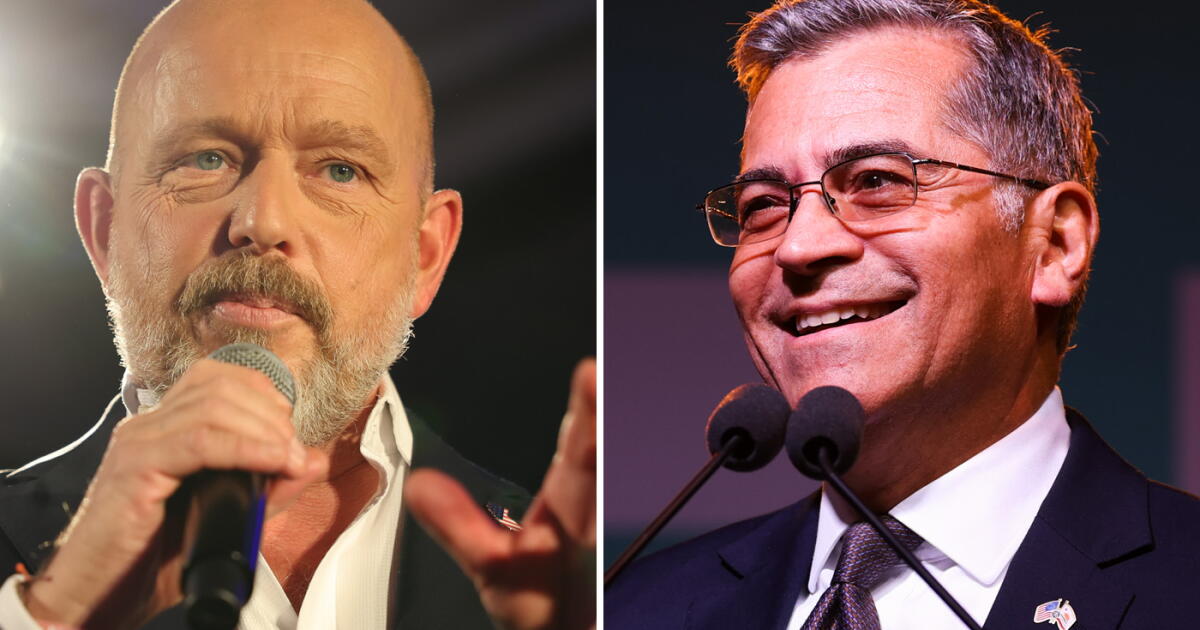
Days before California voters receive their mail-in ballots, gubernatorial candidates Xavier Becerra, a Democrat, and Steve Hilton, a Republican, will debate in a nationally televised face-off.

On Sept. 30 at CNN’s Burbank studio, the two candidates hoping to succeed termed-out Gov. Gavin Newson are expected to spar over sharply divergent visions for the future of the state. California’s next leader is expected to face pressing fiscal issues, as well as continued battle with the Trump administration.

Given California’s deep Democratic tilt, there was a question whether the two men would debate.

On Aug. 19, Becerra promised multiple debates with Hilton ahead of the general election.

“We will have debates, and between now and Nov. 3, we will continue to go out there and meet with folks to make sure they have an opportunity to see the candidates,” Becerra told reporters after greeting business owners, community leaders and voters in a walking tour of Little Tokyo in downtown Los Angeles. “Voters need to have good information. We’ll make sure they have it, and there will be debates.”

The following day, Hilton said he was skeptical of Becerra’s promise.

“I don’t believe him unless he commits to an actual debate. Invitations are on the table for dates and places,” Hilton said. “Why can’t he just accept them? I think he’s lying. I don’t think he wants to do debates because he doesn’t want to debate his record.”

September’s hour-long debate, taking place shortly before county elections officials begin mailing ballots to all the state’s registered voters, will be moderated by the cable network’s anchors Dana Bash and Jake Tapper.

It is the most attention a California gubernatorial contest has drawn since 2010, when “Today” show host Matt Lauer and NBC News Political Director Chuck Todd moderated nationally televised clashes.

That is perhaps unsurprising given how sharply the California electorate has swung left, with no Republican winning a statewide contest since 2006. Two did that year.

While there will not be a studio audience, the debate will air on CNN, CNN International, CNN en Español, CNN.com and related TV and mobile apps for subscribers.

Times staff writer Nicole Nixon contributed to this report.

Source link

Becerra would extend moratorium on death penalty if elected governor

Democrat Xavier Becerra defended the death penalty while serving as California’s attorney general, a punishment his office actively sought in the case of a gunman convicted of an Orange County mass shooting, but as the front-running candidate for governor he has vowed to block executions if elected in November.

Becerra said he will extend the blanket reprieve for all death row inmates that Gov. Gavin Newsom enacted by executive order in 2019, saying he supported “moving our state away from a costly, flawed system that disproportionately impacts Black and brown communities and too often gets it wrong.”

Those comments have reassured anti-death penalty advocates wary of Becerra, who has stated throughout his career that capital punishment should be an option for victims seeking justice. He reiterated that stance just a decade ago during his confirmation hearing for attorney general, though he also expressed concerns about the unjust application of the punishment.

“I support the death penalty, but I hate the way it’s being executed,” Becerra told state lawmakers in 2017.

“If you commit some heinous crime where you have taken the life of someone else, and you knew that there was a death penalty in place in that place where you committed that crime, then you should face the punishment for what you’ve done,” he explained. “It doesn’t give me pleasure to say that, but I simply do believe there’s a simple justice in that.”

Becerra’s challenger in the Nov. 3 election, former Fox News commentator Steve Hilton, opposes the death penalty but said he would rescind Newsom’s moratorium because it defies the will of voters.

Becerra has said he is concerned by how death sentences historically have been applied, including a highly disproportionate number of condemned inmates who are Black or Latino men and cases in which they later have been exonerated of crimes.

He repeated similar positions last year during a gubernatorial forum in Los Angeles.

“I do not believe every Californian has gotten a fair verdict in these fights,” he said in response to a question about extending Newsom’s moratorium. “But here is what I will tell you: We have to be aggressive in going after crime, especially the most heinous crime. … I will make sure that we have a judiciary system and a prosecution system that takes into account that we must show fairness.”

Though California has not performed an execution since 2006, prosecutors in some areas of the state continue to seek and win death sentences. As of early August, there were 565 condemned inmates in California prisons, according to the state Department of Corrections and Rehabilitation.

Newsom’s moratorium stops the state from carrying out those sentences.

In California, county district attorneys are responsible for prosecuting the vast majority of accused murderers when they go to trial and also deciding whether to seek the death penalty. The office of the state attorney general is responsible for defending death penalty convictions on appeal.

Becerra sought the death penalty in a murder case his office prosecuted early in his tenure, though unsuccessfully. Scott Dekraai, who was convicted of killing his ex-wife and seven others in a shooting at a Seal Beach beauty salon, was sentenced to life in prison without the possibility of parole after a prosecution scandal involving his case.

Some death penalty opponents criticized Becerra for fighting to uphold the death sentence of Robert Lewis Jr., who was deemed by the California Supreme Court in 2018 to have an intellectual disability that made him ineligible for execution.

“I find that reprehensible,” said Mike Farrell, president of Death Penalty Focus, an advocacy group. A longtime anti-death penalty activist, Farrell is better-known for starring as B.J. Hunnicutt in the TV show “M*A*S*H.”

“It may not have been his idea, but he was part of that process,” he said of Becerra.

Others said Becerra cannot be blamed for doing his job. Former Vice President Kamala Harris faced the same dilemma when she served as state attorney general, as does Rob Bonta, who currently holds the office.

“The AG is in a different position because it’s just inherent in their role to defend convictions and sentences,” said Natasha Minsker of the California Anti-Death Penalty Coalition. “For example, Kamala Harris is very strongly personally opposed to the death penalty and still, while she was AG, the office defended hundreds of death sentences. Same with Rob Bonta. He’s very clearly personally against the death penalty, and his office continues to defend death sentences.”

Becerra’s campaign declined an interview on the subject and referred to his statement in support of extending Newsom’s freeze on executions.

Hilton, his Republican opponent in the race, holds starkly different views.

“If you’re arguing that taking a life is such a serious crime, then I don’t think responding by taking a life actually makes that argument,” he said in an interview last month.

But he said California voters spoke clearly by voting twice — in 2012 and 2016 — against ballot measures that would have repealed the death penalty. “I don’t think it’s OK for a governor to just substitute their personal opinion on an issue where the voters had an explicit and direct say,” he said.

“I strongly believe in holding people accountable for what they do,” Hilton said. “But my sort of fundamental belief is that if we’re saying it’s wrong to kill someone, then the state shouldn’t be doing it, either.”

Hilton also would roll back Democratic-led reforms that have shortened many inmates’ prison sentences by allowing them to seek parole sooner.

End or extend? It’s not that simple

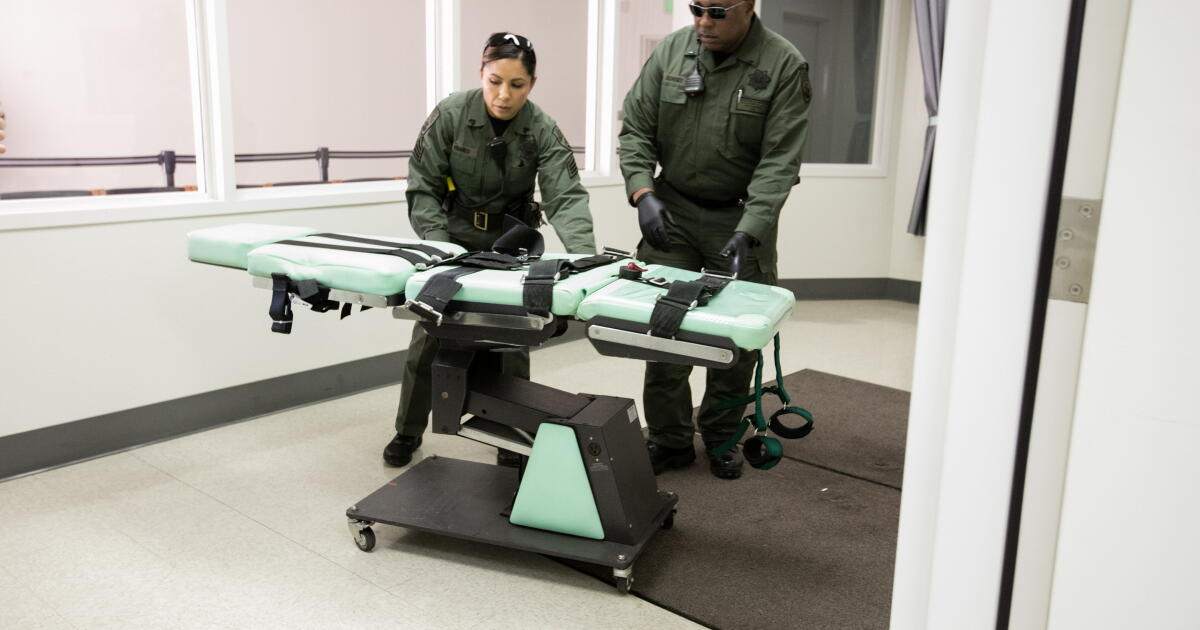
Even if a governor rescinds the moratorium, resuming executions would be a long and complicated process because the state has no approved protocol or facilities to carry out death sentences.

Newsom ordered the dismantling of San Quentin’s death row and execution chamber. Even before he took office, the state’s use of lethal injection drugs was part of a long-running and now-dormant legal battle. And a dwindling number of attorneys who specialize in death penalty cases meant 70% of condemned inmates did not have a lawyer at the end of last year, according to a state report.

California’s death penalty also faces a new legal challenge from groups arguing that capital punishment cases have been administered in a way that is racially discriminatory. In May, the California Supreme Court ordered the attorney general’s office to respond to the arguments and assigned the case to a superior court.

The shifts in California’s criminal justice system are reflected in legal battles waged by the pro-death penalty Criminal Justice Legal Foundation, a nonprofit that supports victims of crime and their families in court.

“We used to do a lot of work in the capital punishment area because that was the area where justice and the sentences were under the greatest attack,” said Kent Scheidegger, the group’s legal director.

But as California’s Democratic-controlled Legislature, governor and, at times, voters adopted measures aimed at reducing the prison population, Scheidegger said the foundation’s efforts increasingly are focused on preserving “the finality of sentences.”

Many capital cases were negotiated as “plea bargains to life without parole on the express promise that this will provide the finality that the victims need most,” he said. “Life without possibility of parole, until recently, meant life without possibility of parole. And now we’ve got one action after another coming out of the government to break down that finality and give people sentenced to life without parole opportunities to get out.”

The group has challenged attempts to expand early release for violent offenders under 2016’s Proposition 57 and new regulations that would allow people sentenced to life without the possibility of parole to seek release.

Twenty-seven states allow the death penalty, but governors in four of them — California, Ohio, Oregon and Pennsylvania — have paused executions.

Slow shifts in public opinion

Attitudes about capital punishment have shifted over time. A 2025 Gallup poll showed 52% of Americans favor the death penalty for people convicted of murder, down from its peak of 80% in 1994.

In a 2023 survey by the Public Policy Institute of California, 62% of adults in the state said they “strongly favor” or “somewhat favor” the death penalty in murder cases. When asked which punishment they prefer for a first-degree murder case, 55% said life without parole and 43% chose the death penalty. More than three-quarters believe there “is some risk that an innocent person will be put to death.”

Despite the changing opinions, Minsker, of the California Anti-Death Penalty Coalition, said there’s little appetite for another repeal attempt because of how expensive ballot measure campaigns have become.

“I am personally one of the strongest proponents of ending the death penalty, and I am not sure I would spend $30 million on that right now, given all the other needs that California has,” said Minsker, a former attorney for the American Civil Liberties Union who ran the unsuccessful 2012 death penalty repeal measure.

Putting an anti-death penalty measure on the statewide ballot also could have put Newsom in an precarious political position. If it failed, Californians would be sending a stinging rebuke to the Democratic governor’s executive decision to grant a blanket reprieve to all condemned inmates.

Minsker is leading a group of criminal justice advocates, faith organizations, prosecutors, murder victim family members and others urging Newsom to commute every death sentence in California before he leaves office.

But advocates are unsure whether Newsom, who is considering a run for president in 2028, would risk the backlash a mass commutation would probably bring. The California Supreme Court also must review executive clemency actions for inmates with more than one felony charge.

Commuting all death sentences to life in prison “would be the coup de grâce,” Farrell said. “However, politically, I’m sure those who are advising him are urging him to have caution in that regard.”

Source link

How South Korea finds itself trapped in the US-Iran war | US-Israel war on Iran News

Tehran has threatened “serious consequences” for South Korea if it interferes in the US-Israel war on Iran.

The warning comes amid reports that Seoul is mulling contributing to the US naval blockade of the Strait of Hormuz passage, which has hampered Iran’s oil exports.

Recommended Stories

list of 4 itemsend of list

In a statement posted on X on Monday, Ministry of Foreign Affairs spokesman Esmaeil Baghaei said Iran and South Korea had more than 64 years of diplomatic relations based on mutual respect and that Tehran values that friendship.

However, if South Korea joins the United States in its military actions against Iran at a time when the country is defending itself from what he called US aggression and “war crimes against women and children”, then there will be consequences, he warned.

Baghaei threatened that Iran would regard any military presence or participation in operations by another country in the Gulf and the Strait of Hormuz “would inevitably be regarded as direct support for the aggressor and would have serious consequences”.

“No sovereign and responsible country should succumb to US pressure and intimidation and become complicit in acts of aggression and horrific crimes against the great Iranian nation,” he added.

Seoul did not respond directly, but a Ministry of Foreign Affairs statement on Monday said it is communicating with the international community over the situation in the passageway.

Here’s what we know about how South Korea is getting roped in:

AH-64 Apache attack helicopters at Camp Humphreys on the final day of the annual US-South Korea UFS joint military exercise, which was shortened by six days after President Donald Trump ordered a substantial reduction in US participation, in Pyeongtaek, South Korea, August 21, 2026 [Yonhap via Reuters]

Why is South Korea involved?

Seoul, a close ally of Washington, has been under pressure from US President Donald Trump.

The issues began in mid-August, when Trump revealed in an interview, and later online, that he had spoken to South Korean President Lee Jae Myung and asked that Seoul give “a little hand” in the war on Iran.

According to media reports, the two leaders had spoken over the phone on May 17.

Seoul said, “No, thanks!”, according to Trump’s message on social media.

However, as South Korea now knows, saying no to Trump has repercussions.

On August 16, Trump announced that the US would significantly scale back joint military drills it holds annually with South Korea – the evening before they were scheduled to begin.

The Ulchi Freedom Shield (UFS) exercises are meant to sharpen Seoul’s readiness in case of a North Korean attack. They usually last for more than 11 days but were reduced to five.

In a post on his Truth Social site, Trump claimed the drills were “costly” and that they send a “hostile” signal to North Korean leader Kim Jong Un, with whom he is trying to build a relationship. South Korean Foreign Minister Cho Hyun said in parliament there was no warning from the US.

Trump also questioned why South Korea would refuse his request when thousands of US soldiers are stationed on the Korean Peninsula.

The US also cancelled another military exercise scheduled for September, although South Korea’s military revealed it received a notification much earlier in June, with Washington citing constraints due to the war on Iran.

How has South Korea responded?

President Lee, a liberal who pushes for a dialled-down defence posture, has opted to negotiate. His office earlier released statements saying it hopes for “meaningful dialogue” with Trump.

South Korea’s Yonhap news agency reported on Monday that Washington has, however, “ratcheted up pressure” on Seoul.

On Friday, a South Korean presidential official told Yonhap that Seoul could consider a military contribution to international measures seeking to free up navigation in the passageway as long as it does not affect the country’s defence readiness.

South Korea is looking at various options, the official said, including possible cooperation with France, the United Kingdom and other allies on sending noncombat and search-and-rescue forces.

The South Korean military has also started reviewing assets and troops that could be deployed, including maritime patrol aircraft, explosive ordnance disposal teams and unmanned mine detection and clearing systems, he added.

Such a move would be unpopular. The opposition has spoken out against a possible deployment, as have some within Lee’s ruling Democratic Party. Many South Koreans have also protested against the US-Israel war on Iran.

An activist wearing a cutout mask of Trump attends a rally to condemn the US-Israel war on Iran, with others in front of the US embassy in Seoul, South Korea, March 1, 2026
An activist wearing a cutout mask of Trump attends a rally to condemn the US-Israel war on Iran, with others in front of the US embassy in Seoul, South Korea, March 1, 2026 [Kim Hong-Ji/Reuters]

What is the history of US-South Korea relations?

South Korea became one of the US’s closest allies after Washington backed Seoul against Pyongyang in the Korean War of 1950.

The US supported Seoul’s economic and military growth in the years after. Under a treaty, some 29,000 US soldiers have been stationed permanently on the Korean Peninsula since the end of the war. Seoul has also relied on US defence might to deter nuclear-armed North Korea.

In return, South Korea supported several US wars, including the Iraq War, and is designated an important non-NATO ally.

In 2025, however, Washington imposed a 25 percent tariff on the country, testing relations. Seoul opted to negotiate rather than retaliate, leading the US to lower tariffs to 15 percent.

Many South Koreans were also alarmed after hundreds of South Koreans were arrested in Immigration and Customs Enforcement (ICE) raids on a Hyundai plant in Georgia in September 2025.

Last October, Trump travelled to Seoul in a historic state visit, and earlier this year, President Lee visited the US. Lee is also trying to resume dialogue between Washington and Pyongyang.

How is South Korea being affected by the US-Israel war on Iran?

South Korea is facing an economic crisis. The country relies on the Gulf supplies via the Strait of Hormuz for 60 to 70 percent of crude imports, meaning supply is being severely hit. The war has led to soaring inflation, causing the Korean won to fall to a 17-year low.

Seoul therefore has an interest in freeing up the strait. However, under Korean law, the government will require parliament’s approval before a military deployment, although some governing party members could oppose it.

Source link

L.A. fast-food workers could get greater protections

Retail employees in Los Angeles working irregular schedules, called in for shifts with just a few hours’ notice, got some relief years ago in the form of a city law requiring large retailers to give them notice of their schedules at least two weeks in advance.

Now, that 2024 law could be expanded to encompass the city’s fast-food industry, whose precarious workforce — largely women from immigrant communities — has long raised concerns over unstable schedules that they say make it difficult to plan their finances, child care, medical appointments and other obligations.

The L.A. City Council’s economic development and jobs committee late last month approved the ordinance, which also would establish a mandatory six-hour paid training to educate workers on minimum wage laws and other labor protections. It goes to the full council for a vote on Tuesday.

The proposal is backed by a statewide union of fast-food workers — established in 2024 — that is affiliated with the Service Employees International Union, which for years has helped organize fast-food employee walkouts over wage theft, safety and pay.

The California Fast Food Workers Union‘s organizing director, Maria Maldonado, said workers often are unaware of their rights regarding heat exposure and other risky conditions common in kitchens. The training, she said, would show them they have recourse and city support for reporting employers when conditions are unsafe.

“If you know there is support to enforce the law, we are going to see a difference in the industry,” Maldonado said.

City Councilmember Hugo Soto-Martinez first introduced the ordinance in 2024.

Although worker-friendly proposals usually are ultimately backed by the L.A. City Council, the process often is lengthy, with business interests lobbying against such measures.

The California Restaurant Assn. wrote in a letter to the council that the ordinance would greatly increase costs in a state that already is expensive to operate in and that it unfairly singles out an industry that has long served as a successful pathway to business ownership for minority entrepreneurs.

In the letter, business groups took issue with third parties administering worker training, arguing that labor groups could use them to prime the workforce for union campaigns.

The ordinance would “not only duplicate existing law but also force neighborhood restaurants to pay thousands of dollars so groups with ulterior motives can hold team members as a captive audience,” the letter said.

The group also argued that training would create third-party access to workers’ data even as many immigrant workers are fearful of heightened immigration enforcement, noting that the training might “require employers to disclose sensitive information to outside entities, creating serious privacy risks.”

A report commissioned by McDonald’s, compiled by the firm Beacon Economics and Pepperdine University, surveyed some 1,200 workers in L.A. County and found that a majority, about 70.6%, opposed the proposed paid training, while 29.4% said they would want such training, the survey said.

California’s fast-food industry employs more than 750,000 people and is a growing sector, according to state data. The state fast-food union has argued that local and state protections are crucial.

Source link

Polls suggest tight presidential race as Brazil marks Independence Day | Elections

Brazil has marked Independence Day with the two main candidates for October’s presidential election holding events. The latest poll shows current President Luiz Inacio Lula da Silva’s lead narrowing against his main rival Flavio Bolsonaro.

Source link

Russia strikes Kyiv as three-day pause during US envoy visits ends | Russia-Ukraine war News

Strikes resume in Russia and Ukraine after a three-day pause during US envoys’ visits to the countries’ capitals.

Russia has struck Kyiv after a three-day pause in attacks on the Ukrainian and Russian capitals expired, following a visit by two US envoys that yielded no tangible progress towards peace.

Two residential buildings were damaged by Russian air raids early on Tuesday, city officials in Kyiv said. Drones hit buildings in the capital city as well as in the Boryspil and Fastiv districts on the outskirts of Kyiv, according to the State Emergency Service of Ukraine.

An air raid alert, published by the Kyiv city military administration, urged residents to take shelter due to the threat of an “enemy” drone attack.

Following the reported attacks in Ukraine, Russian regional Governor Roman Busargin said a Ukrainian drone attack injured several people after hitting civilian infrastructure in Saratov, nearly 1000km from Moscow. The number of casualties from both incidents remains unconfirmed (621 miles).

Russia and Ukraine pledged to halt strikes on each other’s capitals for three days as Washington dispatched envoys to Moscow and Kyiv. However, fighting continued elsewhere.

Attacks paused after leaders Vladimir Putin of Russia and Volodymyr Zelenskyy of Ukraine announced the ceasefire during the visits by US President Donald Trump’s envoys, Steve Witkoff and Jared Kushner, to Moscow and Kyiv over the weekend.

Russia’s state news agency TASS confirmed that the three-day suspension Putin had ordered for his forces expired on Monday evening local time.

Witkoff and Kushner held talks with officials in Moscow and Kyiv regarding ending the conflict. Kremlin aide Yury Ushakov called the more than three-hour meeting in Moscow on Saturday “highly useful”.

Russian President Vladimir Putin (R) welcomes Trump's son-in-law Jared Kushner (L) and US Presidential Envoy Steve Witkoff (2-L) during their meeting at the Kremlin in Moscow, Russia, 05 September 2026. [Gavriil Grigorov Sputnik/Kremlin/EPA]
Russian President Vladimir Putin welcomes Trump’s son-in-law Jared Kushner (left) and special envoy Steve Witkoff (second left) during their meeting at the Kremlin in Moscow, Russia, on September 5, 2026 [Gavriil Grigorov Sputnik/Kremlin/EPA]

After talks with Ukraine’s Zelenskyy, Witkoff said: “We’ve had a very meaningful discussion, substantive, important, and we are very encouraged, and we look forward to continuing this as long as it takes.”

Witkoff also raised the prospects of reviving three-way negotiations to end the war.

A White House official told the Reuters news agency that the next steps regarding the war, which Russia began with a full-scale invasion of its neighbour in February 2022, would be announced in the coming weeks.

Source link

Rubio heads to Ecuador, Colombia, Peru after right-wing victories in region | Donald Trump News

Rightward shift in Latin America comes as Washington pledges to grow influence, take militaristic approach to cartels.

United States Secretary of State Marco Rubio is travelling to three South American countries whose recently elected leaders have closely aligned with President Donald Trump’s administration.

Rubio will travel to Colombia on Tuesday to meet with newly elected President Abelardo de la Espriella. He will then visit Ecuador to meet with President Daniel Noboa before going to Peru, where he will meet with another newly elected leader, Keiko Fujimori.

Recommended Stories

list of 3 itemsend of list

The State Department has not yet released a more in-depth agenda for the trip, saying only that Rubio will discuss “US support for Colombia’s earthquake response; enhanced cooperation in the shared fight against narcoterrorism, which threatens our hemisphere; and the benefits of deeper commercial relationships between our countries”.

The trip comes amid a rightward shift in Latin America that has seen several Trump-aligned leaders take office. Beyond the three countries, Trump also backed Honduran President Nasry Asfura, who won the presidency in November, and Bolivia’s Rodrigo Paz, who won in October.

Beyond the new leaders, Trump has also closely aligned with Argentina’s Javier Milei, who took office in 2023, and El Salvador’s Nayib Bukele, who became the leader in 2019.

US influence over Western Hemisphere

Rubio’s visit comes as the Trump administration has pledged to assert more influence over the Western Hemisphere in what Trump has referred to as the “Donroe Doctrine”, a reference to the 19th-century Monroe Doctrine that opposed European interference in the Americas.

It has shifted to a militaristic approach to security in Latin American countries, while broadly reframing efforts to combat drug trafficking as a war against “narco-terrorists”.

In August, Colombia’s de la Espriella upped cooperation with the US by joining the Trump administration’s so-called “Shield of the Americas”.

The 19 members of the group have jointly pledged a “commitment to using lethal military force to destroy the sinister cartels and terrorist networks”.

Unlike his predecessor, leftist Gustavo Petro, de la Espriella has also praised US military strikes on alleged drug smugglers in the Caribbean and eastern Pacific. At least 227 people have been killed in those strikes, in what rights groups have condemned as extrajudicial killings.

Family members of those killed have charged that the targets were fishermen, not drug smugglers.

The US has proven a major supporter for de la Espriella in the wake of a devastating earthquake in Colombia last month in which at least 330 people were killed and thousands left homeless.

In March, the US military announced it was collaborating with Ecuador, under Noboa’s leadership, to target drug trafficking groups in the country.

Ecuador’s Interior Minister John Reimberg defended the US strikes on vessels allegedly carrying drugs in an interview with broadcaster Teleamazonas last week.

Peru’s Fujimori, the daughter of former leader Alberto Fujimori, who notoriously dissolved the country’s Congress and Supreme Court to consolidate power during his government from 1990 to 2000, has also pledged closer ties with the US and a military crackdown on criminal groups.

Conservative shift

Rubio’s visit comes after the US announced a controversial agreement with Venezuela’s interim leader, Delcy Rodriguez. The deal, struck in the wake of the January 3 US abduction of Venezuela’s ex-President Nicolas Maduro, grants US companies access to 65 billion barrels of crude oil reserves over the next 100 years.

It also comes as Washington has continued to up its pressure campaign against Cuba, with Foreign Minister Bruno Rodriguez on Monday rejecting any talks with the US despite its ongoing fuel blockade of the island.

Brazil and Mexico remain the only regional powers with leftist leaders. Rubio has called the region’s conservative lurch an “extraordinary achievement”.

The shift has accompanied the strengthening of ties between Israel and several Latin American countries since Trump took office.

Brazilians will go to the polls in October, when Flavio Bolsonaro, a son of former right-wing leader Jair Bolsonaro, seeks to unseat Luiz Inacio Lula da Silva.

Trump has remained a staunch ally of the elder Bolsonaro, who has been sentenced to 27 years in prison for leading a conspiracy to hold onto power.

The US president has also shown strong support for the younger Bolsonaro, including inviting him to the White House in May.

Source link

L.A. Labor Day rally: Union workers warn of automation, job losses

Thousands of union workers, their family members and supporters marched through the streets of industrial Wilmington on Monday, taking part in a Labor Day parade whose festive mood overshadowed their serious concerns about the future.

Jesse Munoz, a 63-year-old longshoreman, who belongs to International Longshore and Warehouse Union Local 13, talked of how automation has eliminated more than 2,000 jobs over the last 15 years or so and worries that foreign-owned companies will do more to shrink the workforce and worsen working conditions.

“The concern is the future,” Munoz said. “I have a son that’s on a list to become a casual worker, which is a worker that will accumulate his hours, and then hopefully within time become a regular member of the union. But the future is not as promising as we would like it to be.”

“If you eliminate the workforce, you eliminate taxes. You eliminate pensions,” he said.

International Longshore and Warehouse Union members throw candy to onlookers at Monday's Labor Day parade.

International Longshore and Warehouse Union members throw candy to onlookers at Monday’s Labor Day parade.

(Kayla Bartkowski / Los Angeles Times)

The Wilmington rally joined Labor Day events throughout the nation Monday, a holiday that also marks a prime campaign opportunity for candidates in midterm elections and other political races.

The first U.S. Labor Day celebration took place in New York City on Sept. 5, 1882, with 10,000 marchers. In 1894, President Cleveland signed a congressional act establishing the first Monday of September as a legal holiday, which has become known for promotional sales as well as a day off for many.

The holiday has particular resonance in Southern California, where the labor movement remains large in numbers and powerful in political influence. Across the nation, that’s far from a given.

The number of workers represented by unions rose by 463,000 in 2025, according to data collected by the pro-labor American Prospect, and national density — meaning the number of U.S. workers who are unionized — edged from 9.9% to 10.0%. However, private-sector union density stayed at 5.9%, meaning the numerical gain came chiefly from government employment.

Munoz said he has a message for President Trump, who has used steep tariffs on foreign-made goods in an attempt to return more manufacturing to the United States, leading to price increases domestically.

“Stop those tariffs and stop this automation,” Munoz said. “Just get the people back to work. Help the economy build itself up again with the workers, not with politicians.”

Giovanna Mendez, right, hugs a teacher during a Labor Day parade

Giovanna Mendez, right, hugs her sibling’s elementary school teacher during the Labor Day parade in Wilmington.

(Kayla Bartkowski / Los Angeles Times)

While the Wilmington crowd was heavily Democratic, one longshoreman in his early 60s showed it was possible to be pro-labor and pro-Trump.

“We’re a lot better than when [President] Biden was in, way better,” said the worker, who also spoke of his union as “wonderful.”

Jordan Gonzales, a 20-year longshoreman, expressed worries about the future of trade work.

“A lot of people would rather be in the office and in the AC,” said Gonzales. “We’ve lost our workers that are outside of an office.”

He was enjoying a hearty free breakfast at a union hall and looking forward to his 12-year-old’s marching band performance in the parade, where she played a glockenspiel.

Participating school bands included San Pedro High, Banning High, Harry Bridges Middle, Port of Los Angeles High and Garfield High.

Delegations from many unions marched with their local chapters and a procession of restored and souped-up cars completed the picture. L.A. Mayor Bass was front and center behind the banner of the shore workers.

Politicians at work on Labor Day

In the pre-parade free breakfast inside the Longshoremen’s & Warehousemen’s Memorial Assn. cavernous meeting hall, a parade of elected and aspiring politicians introduced themselves, straining to be heard and noticed in brief remarks over a sometimes inattentive din.

Xavier Becerra, the Democratic candidate for California governor spoke briefly, thanking union members for their daily labors and campaign support.

“None of us should forget where we came from,” Becerra said. “Let us work hard,” he said, referring to election day. “November 3rd belongs to us just the way Labor Day belongs to us.”

Also on hand were both Los Angeles mayoral candidates: incumbent Bass and challenger Nithya Raman.

1

L.A. Mayor Karen Bass speaking to security

2

L.A. mayoral candidate Nithya Raman greeting parade watchers

1. L.A. Mayor Karen Bass speaks to security during the Labor Day parade in Wilmington. 2. L.A. mayoral candidate Nithya Raman greets parade watchers. (Photographs by Kayla Bartkowski / Los Angeles Times)

Bass praised the city and union movement for positive strides “even in the midst of Donald Trump, who has done everything he can do against working people, including invading our city, but we are back, and we stay united, and we’re going to continue to do that,” she said. “L.A. is a labor city, and I am there with you 100%.”

Labor leaders also are almost 100% behind her in terms of endorsements. One exception is the Western States Regional Council of Carpenters, which endorsed Raman. The union represents about 65,000 members across 10 states.

“We need more housing in L.A.,” said Doug Hicks, the union’s vice president and director of organizing. “How many cranes are there in downtown Los Angeles today?”

In her brief breakfast remarks, Raman, an L.A. City councilmember, said that “automation, AI, are taking away jobs all over this country, and it is up to us to step up and fight back, and that is why I’m here to stand alongside the workers of this country.”

Master carpenter Joseph W., who did not want to give his last name, declined to speak about endorsements, focusing instead on the challenges of workers.

“We build the houses, but we can’t buy them,” he said. In 1977, his dad bought a house in Norwalk in 1977 for less than $50,000. Now that property is worth close to a million dollars.

“That’s 20 times what my dad paid for it,” said Joseph, who is 55 and rents his own home. “I don’t make 20 times what my dad got paid.”

The younger workers included members of ILWU Local 56, the “ship scalers” union, which cleans up hazardous materials and provides environmental remediation both in the ports and beyond. Its members were involved in wildfire cleanups and removing waste from the hazardous Lineage warehouse fire in Boyle Heights in June.

Two members of the Western States Regional Council of Carpenters fist bump.

Two members of the Western States Regional Council of Carpenters bump fists after Monday’s Labor Day parade.

(Kayla Bartkowski / Los Angeles Times)

Evan Briseno, 18, would like to move on to safer work before his health is potentially affected. But fellow union member Francisco, 21 — who declined to give his last name, wants to move up in the trade, while noting that some areas are so dangerous that every patch of skin needs to be covered.

Neither follows politics, but they’re both concerned with workplace safety issues.

Other unions included Teamsters, Service Employees International, SAG-AFTRA (for performers) and teachers — along with their students.

Mark Ramos wore multiple hats as chair of the Los Angeles County Democratic Party and president of the United Food and Commercial Workers International Union Western States Council and UFCW Local 1428.

Ramos said one current union battle is to make self-serve checkout lines manageable for the workers who must supervise them.

Source link

Germany’s AfD wins in key state: Is far-right on cusp of national rule? | Elections News

For the first time since World War II, a far-right party is within reach of power at state level in Germany, after coming first in Saxony-Anhalt on Sunday.

The Alternative for Germany (AfD) won 44 percent of the vote, stopping short of an overall majority but making clear its wide political significance.

Recommended Stories

list of 3 itemsend of list

On election night, AfD’s leader in the state called on other political groups to cooperate. “As a democrat, I will reach out to all those who wish to work with us to bring about a fundamental political turnaround,” Ulrich Siegmund said.

Yet, forming a government will prove difficult. The AfD has been classified as “far-right extremist” by the domestic intelligence agency and other political groups remain wary of striking an alliance.

The AfD has dismissed accusations of extremism and mainstream parties have been unable to halt its surge in the polls over recent months. Latest polling indicates the party, which stands for strong restrictions on immigration, restoring ties with Russia, cutting support to Ukraine and quitting the euro, is Germany’s most popular at national level.

The Saxony-Anhalt election could be a harbinger of a historic return of the far-right in the 2029 national election, when forecasts say the AfD stands a realistic chance of finishing first.

What happened in Saxony-Anhalt?

Siegmund, the charismatic 35-year-old who attracted thousands to his campaign rallies, said AfD “made history”.

“The people have made it absolutely clear that they finally want political change and, above all, they have shown that they want it with ⁠us,” he told supporters.

The AfD achieved its best-ever election result in Saxony-Anhalt with 44 percent of the vote, leaving all other parties far behind. The incumbent centre-right Christian Democrats (CDU), led by Chancellor Friedrich Merz, scored less than half of that share with 17 percent.

The AfD is projected to gain 39 of the 83 seats in the state parliament in Magdeburg, leaving it three short of the 42 needed for an absolute majority.

That means the party must find allies, but all other mainstream parties refuse to work with the far-right, a strategy of non-cooperation known as the “firewall”. The AfD has so far never participated in a governing coalition in Germany’s 16 states nor in its federal government.

While he now appears willing to strike deals with other parties to come to power, previously Siegmund signalled unwillingness to find middle ground with other political groups. Leading up to the vote, he stated that he was only interested in governing alone to bring about fundamental political change in Germany.

How did AfD fare in recent elections?

The election takes the AfD one step closer to advancing its agenda, while also reflecting the growing unpopularity of Germany’s ruling coalition.

In Saxony-Anhalt, the party more than doubled its vote share — from 21 percent in the last election. By contrast, the CDU’s vote halved from 37 percent to 17 percent, its worst result ever in the east-central German state.

Federal elections last year similarly resulted in a landmark performance by the AfD, which emerged as the largest opposition faction in the Bundestag, the German federal parliament in Berlin. The party came second with 21 percent of the vote, securing its highest-ever showing.

In state elections in Baden-Wurttemberg and Rhineland-Palatinate earlier this year too, the AfD more than doubled its seats — though it still finished third. In 2024, the AfD emerged victorious in the Thuringia state election and second in the Brandenburg state election — both were firsts for the party.

The AfD’s electoral gains in Saxony-Anhalt mirror growing dissatisfaction among voters — especially in the former East Germany — about the stagnant economy, high unemployment and domestic security, which the party largely pins on immigration.

What challenges lie ahead for AfD?

Since its formation in 2013, the AfD has been embroiled in various scandals and has faced major controversies, including alleged foreign espionage links, secret deportation plans and internal nepotism.

The party went from a fringe Eurosceptic group to the country’s most powerful opposition force in little more than a decade, becoming too extreme even for the European Parliament’s far-right Identity & Democracy group. It kicked the party out in May 2024 after lead AfD candidate Maximilian Krah stated that not everyone in the SS – Adolf Hitler’s infamous Nazi paramilitary organisation – was a criminal.

Krah has also been under investigation by German prosecutors for alleged illegal payments, bribery and money laundering linked to China and Russia. The German parliament last year decided to lift the far-right legislator’s immunity to help investigators.

AfD politicians have also come under fire for employing family members, including in Saxony-Anhalt, where several parliamentarians are reported to have employed relatives.

Bundestag President, Julia Klockner, banned seven AfD employees from entering the German parliament over security concerns, after they failed internal background reliability checks due to their ties to right-wing extremist networks and past criminal convictions.

Senior AfD figures also faced a backlash for attending a secretive meeting to discuss mass deportation plans for people with a migration background.

What are the AfD’s prospects for the national election in 2029?

Pollsters are unanimous in forecasting the AfD as the largest party in Germany in the next national election in 2029, with around 28 percent of the vote.

That would mark a major transformation in the German political landscape from 2025, when the CDU and its ally the Christian Social Union together won 28.5 percent of the vote.

Yet even that outcome would not necessarily give AfD the ability to govern. If other parties maintain a “firewall” policy, that could prevent the far-right party from forming a coalition government.

Still, the Saxony-Anhalt election has been received by some politicians as a call for change. “Politics begins with considering reality,” Cem Ozdemir, head of government in the southwestern state of Baden-Wurttemberg and a member of the Green Party, wrote on X.

“That means the AfD is the election winner in Saxony-Anhalt. And that must mean for all democratic forces that nothing can remain as it is, and we must fundamentally reconsider our politics and our political style.”

Source link

Trump’s economic record is working against him in the midterms

A sporadic global trade war led by President Trump is fueling inflation across the U.S. economy, elevating prices on everyday goods, as the war with Iran sends the price of gas on a roller coaster.

Aggressive tax cuts have pushed the national debt past $40 trillion, driving a growing crisis in the bond market. And an unprecedented immigration crackdown is disrupting the labor supply in agriculture, construction, hospitality and food processing, raising prices even further.

Approaching the halfway point of Trump’s second term, a president who won reelection based on a promise to turn the economy around now faces a reckoning in the midterm elections centered largely on his economic record.

Trump’s economic agenda has emerged as an increasingly awkward liability for Republicans heading into the November elections, leaving lawmakers to defend policies that have delivered political pain at home, even as the White House argues they will pay off in the long run.

Polling on Trump’s handling of the economy has remained in precariously low territory throughout the summer, entering Labor Day weekend with less than a third of Americans supporting his job performance on their most pressing concerns. One recent poll, from the University of Massachusetts Amherst, found that only 22% perceive the economy in a good or fair state.

Shoppers at Lincoln Heights Certified Farmers Market in Los Angeles on Wednesday.

Shoppers at Lincoln Heights Certified Farmers Market in Los Angeles on Wednesday.

(Jason Armond / Los Angeles Times)

And Americans’ confidence in the economy is unlikely to improve much ahead of election day, Nov. 3, in part because bad economic news has shown to sink confidence fast. Good news takes much longer to win people back, experts said.

“Voters’ opinion of the economy has mostly hardened,” said Aaron Klein, chair of economic studies at the Brookings Institution. “People vote the economy of the spring and summer, not November.”

Good news has been harder to come by.

Heading into the holiday weekend, Trump dismissed communities opposed to data-center construction as “backwards and poor.” A rapidly escalating trade dispute with Canada threatens Republican gains in battlegrounds along the northern border that could determine control of the Senate.

Sean Zabriskie, center, helps his son Connor, 7, try on hockey pants

Sean Zabriskie, center, helps his son Connor, 7, try on hockey pants at The Ice Box Hockey shop in Harbor City. The trade war between the U.S. and Canada is affecting products like hockey gear, most of which is made in Canada and imported to the U.S.

(Genaro Molina / Los Angeles Times)

And fresh polling found that more than 90% of Americans believe corruption is rampant in Trump’s government, even as the president spends hundreds of millions of dollars on vanity projects across the capital.

Susan Collins, the incumbent Republican senator from Maine seeking another term in a strategically critical race, chastised the Trump administration for its latest trade spat with Ottawa as “making the job harder” of securing reelection.

“There’s just nothing good you can say about them,” Collins said of the tariffs.

Trump has pushed back on criticisms of his record, declaring the country has “the greatest economy we’ve ever had” and touting what he calls a manufacturing boom, all while distancing himself from potential midterm losses.

“I’m not affected by the election,” Trump told reporters last week. “I’m not running. But my party’s running, and I’m going to help my party.”

But Rep. Mike Johnson, a Louisiana Republican and speaker of the House, said last week that the midterms would serve as a referendum on Trump’s presidency.

Rep. Aisha Wahab (D-CA) and Speaker of the House Mike Johnson (R-LA) arrive for a a ceremonial swearing-in

Rep. Aisha Wahab (D-Hayward) and Speaker of the House Mike Johnson (R-La. ) arrive for a ceremonial swearing-in at the Capitol in Washington, D.C., on Sept. 2.

(Andrew Harnik / Getty Images)

“Even though his name isn’t in the midterm, his legacy is,” Johnson said. “The America First priorities and principles are. His administration is.”

Several embattled incumbents fear that’s the case and are distancing themselves from the president. Several Republican lawmakers — including Reps. Tom Barrett of Michigan and Zach Nunn of Iowa — plan on skipping a midterm GOP convention called by Trump for this week in Texas.

Joanne Hsu, director of the University of Michigan’s Survey of Consumers, said that gas prices were a chief frustration among Americans, and found that consumer sentiment soured rapidly once it became clear the conflict in Iran would not be short-lived.

“Consumers are absolutely not feeling great about the economy right now, and the factors that are underpinning their frustrations with the economy at this time are factors that are pretty tough to turn around on short notice,” Hsu said.

Even if the Iran conflict reached a resolution, confidence in the economy is likely to change only when the prices are reflected at the gas station, she said.

“When it comes to the views of the economy, it’s really about what’s happening to my wallet,” Hsu said.

During a White House press media briefing on Thursday,Vice President JD Vance acknowledged the Iran war has led gas prices to rise and that he does not know when Americans can expect those prices to go down.

Vice President JD Vance talks to reporters during a news briefing

Vice President JD Vance talks to reporters during a news briefing at the White House on Sept. 3.

(Chip Somodevilla / Getty Images)

“The reason gas prices are so high now is because the Iranians are shooting at commercial shipping,” Vance said. “Gas, frankly, could have been much, much higher were it not for our efforts. But I am not going to make a promise about when it is going to return to $3.”

The day after Vance spoke, diesel hit a record all-time high of $5.85 a gallon. In California, it sold for as much as $7.71.

Yet Trump has tried to downplay the economic pressure the war in Iran is placing on Americans, in particular as the Strait of Hormuz — a vital shipping corridor for oil and gas — remains under threat by Iranian troops.

Diesel prices over $7 a gallon are displayed on a pump at a gas station

Diesel prices over $7 a gallon are displayed at a gas station in Los Angeles on Aug. 21.

(Justin Sullivan / Getty Images)

“We have the Strait of Hormuz in extremely good shape,” Trump said, adding that the U.S. Navy has escorted ships through the channel. “A lot of oil is coming out. That’s why you haven’t seen the price of oil going the way they thought it might have to go.”

Trump on Monday also touted an agreement with the Venezuelan government to develop a vast amount of the South American country’s oil reserves. Asked how he sees the deal affecting American consumers, Trump said: “Ultimately prices are going to come down.”

One of the Arts of War statues, newly covered in gold leaf

One of the Arts of War statues, newly covered in gold leaf, is visible at Arlington Memorial Bridge near the Lincoln Memorial in Washington, D.C.

(Andrew Harnik / Getty Images)

“Now, will it happen before the election? I can’t tell you that. But I think people are very smart,” he said.

For some Americans, the economic pressures are a key driver ahead of the midterm elections.

Monica Escalante, a home care provider who is a member of the United Domestic Workers union, said she started feeling the pinch on her wallet after Trump imposed sweeping tariffs on a number of products she buys at the grocery store. Gas, she noticed, became harder to cover after the Iran war started.

Escalante, who lives in Bakersfield, said she also has to drive her client to the grocery store, and that mileage reimbursements are not enough to cover her costs.

“It’s really hard when I don’t have the money for gas, and she doesn’t have the money for gas. Then it is like: What do we do?” she said. “It is either she’s borrowing or I’m trying to figure out how I can get gas in my tank.”

Source link

As Trump locks in oil deal, Venezuelans ask: What happened to elections?

President Trump has locked in a deal to develop Venezuela’s vast oil resources, an arrangement the White House says will bring a country battered by years of economic collapse to a “place where elections are possible.”

But the agreement — backed by acting President Delcy Rodríguez, a holdover from the Nicolás Maduro government that Washington deems “illegitimate” — is raising new uncertainty about how entrenched the unelected government may become.

In January, when the U.S. military captured Maduro, Trump did not say how long a democratic transition would take but said Rodríguez was “gracious” and “essentially willing to do what we think is necessary.”

Asked by The Times on Wednesday what was stopping him from demanding Venezuela set a firm election date, Trump was blunt: “I just don’t think they are ready yet.”

“It’s very new. We took them out of a dictatorship and we’re getting along great with the government,” Trump said. But he said an election would happen “soon.”

U.S. Secretary of Energy Chris Wright walks alongside Venezuela's interim president Delcy Rodríguez

U.S. Secretary of Energy Chris Wright walks alongside Venezuela’s interim president, Delcy Rodríguez, after a news conference on the deal to develop 17 oil fields in the country.

(Jesus Vargas / Getty Images)

Under the deal, the U.S. government is partnering with an oil producer to create a new company, North American Blue Energy Partners, to develop 17 fields with a proven potential of 65 billion barrels. NABEP will have rights to the fields for 100 years.

For many Venezuelans, the lack of urgency around elections — set against a deal that gives the United States majority control over roughly a third of the country’s oil reserves — is starting to feel like a broken promise.

“They tell us we have to wait two years, maybe more, while in the meantime they do business with a government that wasn’t elected, that was imposed on us, and that we don’t want,” Carlos Pérez, a 23-year-old automotive mechanics student, told The Times.

Antonio Marchetti, a 45-year-old plumber and electrician, said that while he sees the removal of Maduro as a “good thing,” the oil deal makes it seem as though Trump’s plans were those of a “cowboy, the invader John Wayne,” all along.

“We were expecting elections,” Marchetti said. “This pact with Trump entrenched the dictatorship that he himself declared war on. But to get rid of Maduro, he left the rest and did business with them. It disgusts me.”

A man holds a sign with a message that reads in Spanish; "Yankee out, murderers" during a protest

A man holds a sign that reads in Spanish, “Yankee out, murderers” during a protest in Caracas on Aug. 29 against President Trump’s deal giving the United States a stake in Venezuela’s oil reserves.

(Pedro Mattey / Associated Press)

The frustrations go beyond Venezuela. In Washington, Republican lawmakers have praised the oil deal, while calling Rodríguez an “interim dictator” who cannot be trusted.

María Corina Machado, the exiled leader of the Venezuelan opposition and a recipient of the Nobel Peace Prize, on Thursday raised her own worries about what the oil deal means for the future of Venezuela.

In a video message, Machado stopped short of criticizing Trump’s oil deal, but acknowledged concerns about a pact negotiated with an “illegitimate” government.

“Venezuelans know that there can be no development without strong institutions and a government elected by popular vote,” she said. “That is the only real guarantee of success and stability for any large-scale investment.”

A plan in the works

Trump administration officials have characterized the deal as an economic lifeline that will eventually stabilize a country and prepare it for free and fair elections.

Secretary of State Marco Rubio said last week that the United States is facilitating talks between Venezuela’s interim government and Dinorah Figuera, an opposition figure leading Venezuela’s 2015 National Assembly, the last democratically elected legislature recognized by the United States.

Machado has been left out of those talks. They are expected to resume in mid-September.

Rubio says that for any election to be “credible,” the voting system will require an overhaul and political parties will need time to organize. Steps also must be taken to ensure the country has a free press.

Echoing Rubio’s comments, the White House said Friday that Trump wants elections held at the “right time,” but that his top priority is to bring Venezuela “back from the dead and rebuild the country after it was incompetently ruled by a nasty dictatorship.”

Energy Secretary Chris Wright and with Venezuelan acting President Delcy Rodríguez

U.S. Energy Secretary Chris Wright meets with Venezuelan acting President Delcy Rodríguez at Miraflores presidential palace in Caracas on Sept. 2.

(Pedro Mattey / Ap Photo/pedro Mattey)

On Wednesday, while Energy Secretary Chris Wright visited Caracas, Rodríguez declined to set a firm date for an election, but added, “I have worked tirelessly to ensure that Venezuela is ready and prepared when the time comes for its electoral process, which will take place — have no doubt about that: There will be an electoral process.”

The open-ended approach to holding an election, however, has drawn criticism from former Trump administration officials, who argue the lack of a timeline essentially lets Rodríguez govern indefinitely.

“Here’s my fear: It makes us Delcy’s partner, and gives the president a reason to want her to remain in power,” Elliott Abrams, who served as U.S. special envoy to Venezuela during Trump’s first term, told The Times.

He contended that the White House so far appears to prefer a pliant interlocutor, and Rodríguez, he says, will do “whatever Trump tells her to do.”

If an election is to take place in Venezuela, a nine-month runway for preparation is likely to be expected, Abrams said.

People shop for produce at a market in Maracaibo, the heart of Venezuela's oil industry. .

People shop for produce at a market in Maracaibo, the heart of Venezuela’s oil industry. .

(Ariana Cubillos / Associated Press)

In Washington, some Republican lawmakers have continued to call for elections in Venezuela, arguing that Rodríguez cannot be trusted.

“The only way we will have a prosperous Venezuela is with the end of the murderous regime and the return of democracy,” Rep. Carlos A. Gimenez (R-Fla.) wrote on social media. He also called Rodríguez an “interim dictator.”

In an interview with NBC News’ “Meet the Press,” Sen. Ted Cruz (R-Texas) said he does not necessarily think elections should happen before the oil agreement is finalized, but he said they “need to proceed rapidly.”

“I believe they should proceed no later than midway through next year,” he said.

Sen. Rick Scott (R-Fla.) said he is working with Trump and Rubio to ensure “free, fair and transparent elections as soon as possible.” He did not, however, say what would constitute “soon.”

Mixed views on economic hope

In the Lake Maracaibo region, an area that would see renewed investments under the oil agreement, Junior Araujo — a 47-year-old oil worker — sees a “wonderful opportunity to be reborn.”

Araujo, the father of three, is in desperate need of a better economic outlook. He works 120 hours a week and earns only $20. For his family, food alone usually costs about $150 a week.

“We have to get creative and find new ways to make ends meet through side jobs like selling clothes and making yogurt,” he said. “That’s our real financial situation.”

Venezuelans watch oil tankers anchored in Lake Maracaibo

Venezuelans watch oil tankers anchored in Lake Maracaibo on Sept. 4. Much of the country’s oil industry is centered in the Maracaibo region.

(Humberto Matheus/Sipa USA via Associated Press)

For Araujo, the hope for a better economy does not take away his frustrations with the government.

“We’re neither happy nor dancing here, all our benefits have been taken away from us,” he said. “Our main problem is the current government; we need to restore our institutions.”

Nazareth Lezama, a 35-year-old teacher, also sees the oil deal as an economic opportunity but remains concerned that the current government may not have negotiated the best price or conditions for Venezuela. She added this has happened in the past.

“We must be clear that this regime destroyed the oil industry,” she said, adding that Venezuelans “need elections to choose leaders based on merit.”

Marchetti, the plumber from Caracas, says the oil deal is a “100-year chain” on Venezuelans imposed by Trump. He said it has become the “last straw” for him, and he has decided to leave Venezuela and emigrate to Europe.

“With all the pain in my heart, I will leave everything behind. I have a European passport; it won’t be easy to start a life from scratch, but there is no hope left here,” he said.

He does not know where he will land yet. But he knows he needs to leave Venezuela.

“This ship is sinking,” he said.

Times staff writer Ceballos reported from Washington. Special correspondent Mogollón reported from Caracas.

Source link

Column: Wildfire bill flameout sad for California

It was unprecedented and stunning: California’s governor and top two legislative leaders negotiated a compromise on a big bill — and one house rebelled, refusing to bring it to a vote.

Not just any bill, but this year’s biggest in the state Legislature, dealing with catastrophic wildfires, arguably the state’s most perilous problem.

The issue: who gets hit the hardest financially when a for-profit utility’s electrical equipment ignites a blaze. The utility’s investors? Its ratepayers? The insurers? Their premium payers?

At stake, depending on who you talk to, is whether the electricity providers can afford to stay in business and keep our lights on. Will some utility — Southern California Edison, Pacific Gas & Electric or San Diego Gas & Election — be forced into bankruptcy when the next powerline-caused wildfire explodes?

Alternatively, there’s another unacceptable potential outcome: Property insurance companies completely stop issuing policies — not just in obvious fire-prone areas, but in tree-lined urban neighborhoods — and basically pull out of California. Or their premiums become flat-out unaffordable.

You’re reading the L.A. Times Politics newsletter

George Skelton and other analysts cover the insights, legislation, players and politics you need to know. In your inbox Monday and Thursday mornings.

Politically, the wildfire legislation’s flameout called into question Gov. Gavin Newsom’s seeming weakness as a lame duck chief executive who will be termed-out of office in January.

Newsom stuck out his neck and took it on the chin from fellow Democrats — showing that even with lopsided one-party rule, unity and success aren’t always guaranteed.

But the episode also raised doubts about Assembly Speaker Robert Rivas’ leadership capability. The Hollister Democrat signed off on the deal with Newsom and Senate President Pro Tem Monique Limon (D-Santa Barbara), but reneged at the last minute under pressure from the Assembly Democratic Caucus. They killed the bill without a floor vote.

I’m in my seventh decade of covering California governors and legislatures and never have seen — or heard of — anything like this: a legislative leader backing out of a deal agreed to with the governor and the other house’s leader.

But in truth, Newsom didn’t really like the agreement much anyway. He was on the utilities’ side, and they were out-lobbied by the insurers and ratepayers.

“I know we all hate utilities, so no one wants to defend a utility. But you’ve got to deal with reality. This thing’s not going to get better on its own,” Newsom told reporters at the Capitol on the night before the deal collapsed, referring to the utilities’ worsening financial liability.

Personally, I think it’s an overreach to conclude that Newsom’s power has been severely weakened — or that Rivas necessarily showed lack of leadership. One can question their reasons for doing what they did, but that doesn’t mean it was because of political debility.

“Newsom’s still a powerful lame duck because he could be a presidential nominee,” Republican consultant Rob Stutzman says.

“One of the better things he has done all year is taking on this issue. It would have been very easy for him to just pass it on to the next governor.”

Leaving aside whether this governor could become a president, there are hundreds of bills piling up on his desk that he must sign or veto by Sept. 30. That gives him tremendous clout. It’s good politics — and human nature — for a governor to lean more favorably toward a measure if it’s authored by a legislator who has voted with him.

Plus, one of the Legislature’s last acts last week was to send Newsom a bloated supplemental budget bill containing more than $3 billion in spending, including countless stacks of pork sought by lawmakers for their districts. Newsom easily and gleefully could discard any or all of it.

So Newsom has awesome power, lame duck or not.

But he’s vulnerable to criticism for his style. He has had an annoying habit of waiting until the very end of a legislative session to spring a hefty proposal on the lawmakers. It’s called “jamming.”

In the past, this pressure tactic mostly worked, although it ticked off lawmakers. This time Assembly members rebelled.

It’s not clear whether his jamming is mainly strategy, or just lack of focus and a tendency to push too many projects at once. Or is he preoccupied with positioning himself to run for president in 2028? Probably all of the above.

“If we had more time, we could have had a different outcome,” Rivas told me.

With only a few days remaining in the legislative session, Newsom initially proposed an ambitious plan that would have shifted more cost for utility-sparked wildfires to property insurers, sharply raising premiums across California. Utilities would have gotten some relief.

It became a titanic fight between two powerful special interests. And insurers — teamed with consumer advocates — triumphed, forcing Newsom to back down.

After hard bargaining, the governor and legislative leaders finally agreed on a post-midnight deal to help wildfire victims receive compensation more quickly — a so-called fast-pay program — and to step up fire preventative efforts.

But utilities’ financial risks weren’t significantly reduced, and they quickly mounted an opposition campaign. That resulted in Assembly Democrats scuttling all of it on the session’s last day.

“It’s unfortunate that [bill] was not given a vote,” Limon said, adding that the Senate was prepared to pass it.

“I don’t want us to do the easy stuff and call it a day,” Rivas told me. “I wanted to see real utility accountability. This bill did not go nearly far enough.”

It went a fair distance, however, in helping future fire victims get their insurance payouts faster. And it probably should have been passed.

Half a loaf. Bird in hand. Incremental change. Next year more incrementalism. Ultimately it can add to massive reform.

Some problems are just too tough to resolve in one sitting.

What else you should be reading

The must-read: Reining in Big Tech: How California lawmakers plan to regulate AI and social media
California vs. Trump: Judge dismisses Justice Department lawsuit challenging California transgender sports policies
The L.A. Times Special: Texas is red, California blue — but for how much longer? A Lone Star toss-up will tell

Until next week,
George Skelton

—
Was this newsletter forwarded to you? Sign up here to get it in your inbox.

Source link

Philippines warns China may reassert itself amid US-South Korea drill cuts | Donald Trump News

Manila defence chief says Washington gave ‘definite assurances’ that its commitments to the Philippines remain.

Philippine Defence Secretary Gilberto Teodoro has warned that Beijing could view recent cuts to the joint US-South Korea military drills as an opportunity to reassert itself in the Asia Pacific.

Speaking on the sidelines of the Seoul Defense Dialogue, an annual multilateral security forum, Teodoro said that “China is very quick to exploit gaps”, when asked on Monday whether Beijing could seize on the move.

Recommended Stories

list of 3 itemsend of list

He added that Washington had given Manila “definite assurances” that the US commitments to the Philippines remained unchanged.

He also accused China of exploiting democratic systems to spread “distortive narratives”.

US General Xavier T. Brunson, commander of the ROK/US Combined Forces Command (CFC), the United States Forces Korea (USFK) and the United Nations Command (UNC), shakes hands with a US Army soldier during a US-South Korea joint river-crossing exercise, which is a part of the annual Freedom Shield joint military training, near the demilitarised zone separating South and North Korea, in Yeoncheon, South Korea [Kim Soo-hyeon/Reuters]
US General Xavier T Brunson, commander of the ROK/US Combined Forces Command (CFC), the United States Forces Korea (USFK) and the United Nations Command (UNC), shakes hands with a US Army soldier during a US-South Korea joint river-crossing exercise near the Demilitarized Zone separating South and North Korea, in Yeoncheon, South Korea [Kim Soo-hyeon/Reuters]

South Korea and the US shortened the duration of their annual joint military drills and scaled back field training exercises last month after US President Donald Trump ordered a “substantial reduction” in the annual war games.

The US-led Ulchi Freedom Shield war games ended six days earlier than originally planned.

Trump cited his “very good relationship” with North Korean leader Kim Jong Un and linked the decision to Seoul’s refusal to join the US and Israel’s war on Iran at the time.

Last week, South Korea’s presidential office said it was mulling “contributions” to the US’s freedom of navigation ⁠in the Strait of Hormuz. The presidential office later clarified that nothing has been decided, as any military deployment by South Korea requires a decision by the country’s National Security Council, a resolution at a cabinet meeting, and consent from the National Assembly.

Trump said he planned to meet with Kim later this year. Kim’s sister, Kim Yo Jong, later released a statement denying any ongoing communication between the US president and her brother and maintained that Washington continues to engage in a “hostile” policy towards her country, despite the warm relationship between the two leaders.

US, South Korea and Japan hold trilateral military drills

The US, South Korea and Japan are due to hold five days of military drills in waters east and south of South Korea’s Jeju Island starting on Monday.

South Korea’s military said in a statement that the Freedom Edge exercise is defensive in nature and meant to respond to North Korean nuclear and missile threats as well as promote regional peace and stability.

North Korea has previously slammed the trilateral drill as a “reckless show of strength” that proved its adversaries’ confrontational stance. Pyongyang has also said the drill contained a US intention to lay siege to China and exert pressure on Russia.

Source link

Armed man charges toward Democratic candidate for Ohio governor

An armed assailant charged toward the Democratic candidate for Ohio governor, Amy Acton, on Sunday during a campaign stop at the Canfield Fair, injuring several people before he was stopped by troopers, the Ohio State Highway Patrol said.

The Highway Patrol said in a statement that a man it identified as Patrick Havas, 38, forced his way through a crowd, knocking over members of the audience as he moved toward Acton, the state’s former public health director. He had a taser and two pistols, the statement said.

The Mahoning County Sheriff’s Office said two handguns and a set of brass knuckles were recovered after his arrest, and “no weapons were ever brandished or even removed from their holsters.”

Havas was taken to the county jail and booked on charges of disorderly conduct and two counts of assault, the Highway Patrol statement said, adding that no other details were available pending an investigation. Online court records didn’t yet list the case, and it wasn’t clear as of Sunday night whether Havas has an attorney.

Republican Gov. Mike DeWine said in a statement that the man “tried to forcefully push himself” toward Acton as she was speaking at the fair in Canfield, in northeastern Ohio.

“Violence or the threat of violence at political or public events is always unacceptable,” DeWine added.

The attack is the latest act of political violence to roil the United States. The Ohio gubernatorial contest is one of the most high-profile races this year as the campaigns enter the final six weeks of campaigning before the election in November.

Acton is facing Republican Vivek Ramaswamy, who has parlayed his national name recognition from his 2024 presidential run, tech industry connections and alliance with President Trump into a record fundraising haul that he is tapping for advertising spots. He is using campaign rallies and advertising to criticize Acton.

Ramaswamy’s campaign called Sunday’s attack unacceptable.

“Candidates should be able to meet with voters without having to worry about threats or violence. What happened today is completely unacceptable and has no place in politics, and we hope that no one was hurt,” Ramaswamy’s communications director, Connie Luck, said in a statement Sunday.

Addie Bullock, communications director for Acton’s campaign, said in a statement that the assailant lunged at Acton. She said the candidate “will always stand up to the chaos, hate and vitriol that pits us against one another.”

The incident brought condemnation from Ohio Republican Sen. Jon Husted, who said on X that he and his wife were “disturbed by the attempted attack on Amy Acton today at the Canfield Fair. We are grateful for law enforcement’s quick response. There is no place for this kind of behavior, and it must never be tolerated.”

The country has seen a rise in political violence over the last decade, including assassination attempts against Donald Trump at a rally in 2024 and at the White House Correspondents Assn. dinner in April, and the Jan. 6, 2021, riot by a pro-Trump mob at the U.S. Capitol.

Other examples include a 2017 shooting at a Republican congressional baseball team practice in Alexandria, Va., a 2022 hammer assault on then-Speaker Nancy Pelosi’s husband at the couple’s San Francisco home, and the fatal shootings last year of a Democratic Minnesota state lawmaker and her husband and of conservative commentator Charlie Kirk in Utah.

Federal political committees spent more than $40 million on expenses labeled as security during the 2023-24 campaign cycle, the most recent one for which data are publicly available, according to a report released in April from the Public Service Alliance, a nonpartisan group that focuses on security for public officials.

Before running for governor, Acton had been recruited by DeWine in 2019 to lead the Ohio Department of Health while serving as an associate professor of public health at Ohio State University. As the COVID-19 pandemic ramped up in early 2020, she was thrown into the state and national spotlight — becoming a source of comfort to many viewers of the governor’s daily news conferences.

For her service as health director, Acton earned the John F. Kennedy Library Foundation’s Profile in COVID Courage Award, the Columbus Foundation’s Spirit of Columbus Award and Ohio State’s highest alumni honor, the Alumni Medalist Award.

Her position as the face of the DeWine administration’s aggressive stance against the coronavirus also earned Acton many enemies, among them statehouse Republicans and conservative Ohioans who opposed pandemic public health restrictions.

Fields writes for the Associated Press. AP writer Ryan J. Foley in Iowa City, Iowa, contributed to this report.

Source link

Jamaica to file slavery reparations petition during UK visit | Slavery News

Petition to King Charles questions the legality of slavery under English law and UK’s responsibility for reparations.

A Jamaican delegation to the United Kingdom has said it will file a petition addressed to King Charles III to seek legal guidance on the question of slavery reparations.

This is the first time a British Commonwealth state will use this legal route “for the cause of reparatory justice”, the Jamaican delegation said, as the visit to London kicks off Monday.

Jamaica’s Ministry of Culture, Gender, Entertainment and Sport said its minister, Olivia Grange, will lead the delegation “to advance Jamaica’s push for reparations for the African ancestors who suffered under hundreds of years of enslavement”.

The ministry added that it will meet with the British Museum to discuss “the repatriation of cultural artefacts taken from Jamaica”.

The petition will ask the king, Jamaica’s head of state, to answer three questions on the transatlantic slave trade to the Judicial Committee of the Privy Council, the Caribbean island’s highest court of appeal based in London.

Under the Judicial Committee Act of 1833, the UK monarch has the authority to refer legal matters to the court for an advisory opinion.

The questions include: whether the enslavement of Africans in Jamaica was legal under English common law, whether it violated international law, and whether the UK has a legal obligation to provide a remedy for the harm caused by slavery.

Jamaica's Minister of Youth, Sports and Culture, Olivia Grange attends the AIPS and Laureus Press Celebration 'Champions in Sport for Good' during day six of the 12th IAAF World Athletics Championships at Casa Italia, Hotel Ellington on August 20, 2009 in Berlin, Germany. [Mark Dadswell/Getty Images]
Jamaica’s Minister of Youth, Sports and Culture Olivia Grange attends the AIPS and Laureus Press Celebration ‘Champions in Sport for Good’ during the 12th IAAF World Athletics Championships at Casa Italia, Hotel Ellington, on August 20, 2009, in Berlin, Germany [Mark Dadswell/Getty Images]

Grange said she would not speculate on whether Jamaica was asking the UK to pay reparations for the slave trade.

“We want the answers. Once we get the answers, or once we get a response to those questions, then the next steps will be determined,” she said.

“We understand the Jamaican government is seeking a petition to be heard before the Judicial Committee of the Privy Council,” a Buckingham Palace spokesperson said in response to Jamaica’s inquiry.

The palace acknowledged the king’s constitutional role in the petition as Jamaica’s head of state but said he had no role in deciding the substance of the claim.

British merchants enslaved and forcibly transported 600,000 to 1 million Africans to Jamaica between the 17th century and the early 19th century.

Shortly after abolishing slavery in 1833, the UK paid slave owners $27m in compensation, amounting to 40 percent of the Treasury’s annual income. To raise the cash, the government took out considerable loans, finally paying off its debts in 2015.

The Jamaican government estimates that the country is owed about $10bn, but the UK has repeatedly refused to pay for historical slavery.

Source link

Trump administration makes another appeal to the Supreme Court to allow mail ballot restrictions

Lindsay Whitehurst and Gary Fields

The Trump administration on Sunday renewed its appeal to the Supreme Court after a federal judge blocked new restrictions on mail ballots ahead of the midterms.

The filing came after U.S. District Court Judge Indira Talwani extended an order against the U.S. Postal Service enforcing President Trump’s executive order for the November elections.

The legal wrangling comes even as states start sending out mail ballots, leaving the administration little time to make big changes in mail ballot rules.

“Ballots have already begun to be mailed in North Carolina, and more States will begin the mailing process as the injunction remains in place — including Alabama on September 9 and at least five States the week of September 13,” Solicitor Gen. John Sauer said in the filing.

“Once those ballot envelopes enter the mailstream, there is no retrieving them. And while the injunction allows the Postal Service and the States to continue taking steps to ensure that their envelopes satisfy the Rule’s requirements … each day the injunction is in place risks sowing confusion and chaos because the injunction makes those preparatory steps voluntary, rather than mandatory.”

The appeal marks the third time the administration has asked the high court to intervene. The high court has allowed the plan to move forward but not ruled on whether it is legal.

The battle could have major ramifications for this year’s elections, when control of Congress is at stake. Nearly one-third of voters in the U.S. cast mail ballots. Mail ballots are sent to every California voter.

Democratic states and voting rights groups say the changes are unconstitutional and amount to voter suppression. Election officials contend that there isn’t enough time to revise their systems to comply with the new Postal Service directives.

The Trump administration has framed the restrictions as commonsense changes that are within its power to regulate the mail.

“Simply put, the best way to address respondents’ fears about inability to comply with the Rule is to grant an immediate administrative stay of the order, followed by a full stay pending further review,” Sauer said. “That will remove the improper cloud of uncertainty that the district court has cast over the Rule, making clear to all involved that compliance with the Rule is not optional and must start without further delay.”

Trump has long sought to limit mail voting, even though he himself often uses that method to cast his own ballot. He has falsely blamed mail balloting for his 2020 election loss to Democrat Joe Biden, spreading baseless claims of fraud. But so far, he has been unable to change the long-standing voting procedure.

Whitehurst and Fields write for the Associated Press.

Source link

Turning Point lays groundwork to shape GOP presidential race in 2028

Alongside the familiar sounds of roosters crowing and thrill seekers screaming on rides at the recent Iowa State Fair, there was a chorus of boos from Turning Point Action activists who were heckling Democratic politicians making their way through the crowds.

Videos of the confrontations got hundreds of thousands of views on social media, a burst of attention for a conservative youth organization that is charting its next chapter after last year’s fatal shooting of its leader Charlie Kirk. But the true test of Turning Point Action’s clout was unfolding inside the exhibition center, where staff members were registering voters, handing out buttons and signing people up for social events.

“Building the foundation for 2028,” said one of the fliers.

While Democrats have punted Iowa from the top of its presidential primary calendar, the state’s caucuses will still kick off Republicans’ next nominating process. Turning Point Action is positioning itself to shape that contest, a reminder that preparations for the next White House campaign are already in motion even though no candidates have announced and the midterm elections are still two months away.

Turning Point Action wants at least one staffer in each of Iowa’s 99 counties to mobilize the conservative grassroots.

“It is important to us to see high voter participation in the caucuses,” said Tyler Bowyer, the organization’s chief operating officer. “That’s your measuring stick.”

In addition to Iowa, Turning Point Action grew its footprint in New Hampshire and Nevada for this year’s midterms, which could also help in 2028.

The likely beneficiary of this initiative would be Vice President JD Vance, who is widely expected to launch a presidential campaign. Turning Point leaders including Erika Kirk, Charlie’s widow, have been clear they’re ready to throw their support behind Vance if he jumps in.

More than a dozen Republican officials, activists, lawmakers and strategists in Iowa said Turning Point’s imprint in the state was visible but still something of a mystery, and some privately question whether the organization’s impact will match the buzz it generates online.

But others have eagerly welcomed the organization to the state.

“A year ago, Iowa was virgin — no Turning Point. And many of us complained,” said Kelley Koch, a former Dallas County Republican chair, to a gathering of MAGA Nation Iowa, the grassroots organization she founded. “Finally, Turning Point Action listened to us.”

Early state investments could benefit Vance

When asked about his 2028 ambitions, Vance demurs and says he’s focused on his current job, but he’s expected to be an immediate Republican front-runner if he decides to seek the presidency. Bowyer said Turning Point Action wants to be supportive without “being pushy.”

“We haven’t officially endorsed as an organization yet because no one’s announced, right? But, you know, depending on who announces and when we endorse — yeah, of course we’ll be out campaigning on behalf of who we endorse,” he said.

Bowyer said Vance can bridge the gap between the Make America Great Again movement, which President Trump launched more than a decade ago, and younger voters who were attracted to Charlie Kirk’s brand of conservatism.

“It’s a natural fit,” he said.

Bowyer acknowledged that Turning Point Action’s growing infrastructure in early primary states could cause some agitation on the right if it is seen as throwing its weight behind one candidate. But, he said, “that’s not why we do it,” describing the goal as boosting turnout in the Iowa caucuses to send a strong signal heading into the general election.

Other potential candidates include Marco Rubio, Trump’s secretary of State. Rubio, however, has said he wouldn’t run against Vance.

Sen. Ted Cruz of Texas has not announced a campaign, but he has already made several visits to Iowa this year and said in a recent podcast hosted by Texas Lt. Gov. Dan Patrick that “it’s no secret that I want to be president.”

Looking to grow the grassroots

Although Iowa has shifted rightward over the last decade, it’s considered a political battleground in this year’s midterm elections because of Trump’s sagging approval ratings, declining access to healthcare and tariff-driven turmoil in the agricultural industry.

Sen. Joni Ernst and Gov. Kim Reynolds, both Republicans, are retiring, and there are fiercely contested races to replace them. Democrat Josh Turek and Republican Ashley Hinson are seeking the Senate seat, while Democrat Rob Sand and Republican Zach Lahn want to be governor. Two battleground congressional districts will help determine control of the House as well.

The spotlight on Iowa this year is an opportunity for Turning Point Action to demonstrate its clout.

The organization said it hired four staffers on the ground last year. After Lahn’s surprise win over Trump-endorsed Rep. Randy Feenstra, Turning Point Action said it would double its staffing in the state before the midterms.

Young activists regularly post on social media from county fairs and Republican committee meetings. They upload selfies on sidewalks or stoops to show days spent knocking on doors.

“We’re newer in Iowa,” a Des Moines-based senior field staffer, Kylie Kloewer, told a visitor who stopped by Turning Point Action’s booth at the state fair.

The booth featured signs declaring that there are only two genders and one that said “men can’t get pregnant,” the kind of confrontational culture war messaging that Charlie Kirk practiced on college campuses. Some people nodded and chuckled, while others raised their eyebrows as they wandered by.

Those who walked up to the table could sign up for social clubs that host events, including barbecues and volleyball games.

“Any involvement is success,” said Kelsey Newberry, who is based in the organization’s Phoenix headquarters and was helping at the Iowa State Fair. “You’re bringing people together as a community. The more you talk to your neighbors, the better.

“And even if they’re not ready to get activated now,” Newberry added, “being around like-minded people might encourage them in the future.”

Fingerhut and Price write for the Associated Press. Price reported from Washington.

Source link

Backlash over data centers hits California, and the midterms

Darian Orduno bounced her baby boy on her chest, looking down at his thick black hair and bright eyes. What might pollution from a data center do, she wondered, to his growing lungs?

That question had brought Orduno, 25, to a community meeting opposing a possible data center here, and her fears, she said, likely would influence her vote in the midterm election too.

“I just had him, and now it’s concerning if he’s going to be able to grow up here,” Orduno said, or “if I’m going to have to relocate.”

As about 100 residents filed into a church for the meeting in late August, under a Central Valley sky hazy with air pollution, many shared the same worries — that a facility pitched for the local fairgrounds could further worsen the area’s air quality and strain its water supply.

Barbara Castle listens to speakers during a town hall meeting on a possible small-scale data center in Hanford.

Barbara Castle listens to speakers during a town hall meeting on a possible small-scale data center in Hanford.

Nationwide, such concerns are fueling a backlash to data centers from both the left and the right as tech companies flood the country with thousands of proposals for the facilities in nearly every state from California to Maine.

Data centers have become an unusually bipartisan flash point in the midterm elections, as candidates race to delineate policy platforms and respond to public opinion. The issue stands to influence swing voters and motivate turnout at the polls.

Here in the 22nd District, home to the state’s most competitive congressional race, how significantly the issue will affect voters’ decisions remains to be seen. But one thing is clear: Anxiety about data centers is mounting.

“It’s a national concern, it’s now a state concern, and now it’s bled into the local concern,” Hanford Mayor Mark Kairis said. “It’s a very emotionally charged issue right now.”

The Art Center building in Hanford.

Residents in Hanford who oppose data centers say they are worried about the region’s air and water quality, concerns echoed by rural communities across the country.

Demand for data centers, which house the computer systems powering artificial intelligence and the internet, has surged as AI use has ballooned. As of April, more than 1,500 new data centers were in development across the United States, according to a Pew Research Center analysis, largely in rural areas.

The centers require intense cooling, which often demands high water and power use and creates the potential to affect the environment and to pass on utility costs to consumers. But they power technology that is becoming increasingly integrated into American business. They also create jobs, though with limitations.

Democrats see the data center uproar as fitting into their affordability messaging, and candidates generally agree data centers should be regulated, though their positions vary on how aggressively. For Republicans, whose party has backed AI innovation, responding to worsening public opinion has been trickier — particularly given President Trump’s championing of AI and data centers.

Vice President JD Vance on Thursday acknowledged negative polling on data centers but framed the issue as a question of American industrial dominance, saying the country can’t shy away from development. Earlier in the week, Trump asserted that the only reason communities should reject data centers is if they want to be “backwards and poor.”

The public may see data centers as a physical manifestation of AI advancement in general, said Camille Crittenden, executive director of the Center for Information Technology Research in the Interest of Society, a University of California research center. Opposing data centers offers people a way to vent their broader concerns about the technology’s increasing dominance.

Priest Luke Martinez expresses concerns during the community meeting .

Priest Luke Martinez expresses concerns during the community meeting .

“This is a very specific focal point for a general anxiety about AI,” she said. “People see these data centers, and they’re thinking, ‘AI’s going to take my job.’”

The backlash from residents in the Central Valley to the possibility of even a small-scale data center demonstrates how acutely the issue has put many Americans on edge.

“It really is terrifying,” said Lucy Gomez, 57, of Hanford, a retired teacher. “I feel like we’re being guinea pigs when we don’t want to be.”

Increasing influence

Community anger about the facilities has prompted close attention from California lawmakers, who passed legislation in Sacramento on Monday to regulate energy use by the data center industry and impose other requirements.

California is home to the third-most data centers of any state, though it has experienced a relatively smaller new boom because of its high electrical prices and other factors. Still, 54 new facilities were in the works for the state as of April, according to Pew.

Hanford Mayor Mark Kairis speaks with coulcilwoman Kimber Regan during a town hall meeting in Hanford.

Hanford Councilwoman Kimber Regan speaks with Mayor Mark Kairis during the meeting. Hanford’s zoning ordinances do not allow data centers, but the city does not have jurisdiction over the county fairgrounds site where Global Stack is evaluating its proposal.

In Georgia and Pennsylvania, New York and Texas, Nevada and Virginia, the issue has become hot-button in elections at all levels. Ads about data centers run on the airwaves in states with key congressional races. Gubernatorial candidates jockey over it; both New York Gov. Kathy Hochul, a Democrat, and Texas Gov. Greg Abbott, a Republican, put temporary moratoriums on new data centers.

A memo from the Republican senatorial campaign arm underscored how critical the question was becoming last month, when it warned AI companies that data centers could be the deciding issue in the close race between Ohio GOP Sen. Jon Husted and former Sen. Sherrod Brown, his Democratic challenger.

Data centers “are the anchor hanging around Husted’s neck,” said the memo, which was first obtained by Axios. “If he loses and data centers get the blame, politicians across the country will take notice — and they will not go near the next one.”

Sixty-one percent of Americans would oppose a data center being built where they live, a late August poll by the Economist and YouGov found.

Though Democrats and independents were more likely to oppose the centers, 47% of Republicans also said they would oppose it, and 52% of people who voted for Trump in 2024 said they believed construction of a new data center would increase their electrical bills.

Data centers encapsulate existing concerns among red and blue voters across the nation and in California about their quality of life and the influence of major tech companies, said Sonoma State University political science professor David McCuan.

“California has a lot of communities that have been struggling and trying to find a way forward, and the data center debate captures those voters’ frustrations,” McCuan said.

Political winds

The historic Bastille and courthouse in Hanford's Civic Center Park.

The historic Bastille, which served as Kings County’s jail and sheriff’s office from 1897 until 1964, stands tall next to the courthouse in Hanford’s Civic Center Park.

The idea for a center on the Kings County fairgrounds is part of a broader pitch by developer Global Stack USA to boost the state’s emergency infrastructure by installing small-scale data centers, helipads and parking garages at fairgrounds around the state.

Global Stack Chief Executive Dan Kang said the goal was strengthening the state’s emergency response capabilities while helping fairgrounds financially. The company’s early materials envisioned operating 70 sites by 2030.

The company has not made any formal proposals, but in Kings and Tulare counties, the issue caught attention after fair officials agreed to allow Global Stack to evaluate their sites. The idea also prompted some residents to voice opposition in Ventura County last month.

The facilities would include what’s known as an edge computing data center, which typically is much smaller than traditional data centers and which Global Stack says would require lower utility use and no municipal water connection.

Concerns about water and energy use by data centers are legitimate, said Shaolei Ren, a UC Riverside engineering professor who studies AI. Centers like the one proposed by Global Stack do not guzzle water the way larger ones do, but they still can use extra power or generate air and noise pollution, Ren said.

In Kings County, the project potentially could benefit the fairgrounds as a long-term revenue source, said Dena Rizzardo, chief executive of the fair board, a state entity that would have final say over any proposal. Because fairgrounds are state property, local and county officials don’t have jurisdiction.

Kang said he is committed to working with local communities to ensure “any path forward reflects local needs and California’s broader resilience priorities.”

In the district’s congressional race, which could help decide control of the House in November, Democratic nominee Randy Villegas said he has been getting questions about data centers from voters. Last month, he released a set of policy points and called for a data center moratorium of at least a year to give Congress time to pass regulations.

Anti-data center crowd during a town hall meeting at the Episcopal Church of the Savior in Hanford.

Democratic congressional candidate Randy Villegas urged meeting attendees to lobby federal lawmakers to pass legislation regulating data centers.

“The advancement of technology … should not be an excuse to throw our communities under the bus,” Villegas said at the Hanford meeting, where he addressed the friendly crowd without identifying himself as a congressional candidate. A College of the Sequoias professor, he is attempting to unseat Republican Rep. David Valadao.

Valadao, in a statement to The Times, said data center construction requires a “responsible approach” that includes local input and ratepayer protections.

“Data centers play an important role in our economy and national security, but Central Valley families are already facing high electric bills and concerns about our water supply,” Valadao said. He did not answer questions about the proposal in Hanford.

Several attendees at the Hanford meeting, who ranged from Gen Z to elderly, said the issue would affect their midterm votes, though most said they already were leaning to the left.

Gomez, the retired teacher, was not happy with either party but planned to vote for Democrats because she viewed them as taking more action to protect public health than Republicans.

a girl stands next to her father sitting in a church pew with others

Ember Gomez listens to speakers while her father, Filiberto, looks on during the meeting. Filiberto Gomez said he was concerned a data center would affect children’s health.

Courtney Hawkins, 40, said the data center issue “absolutely” would carry weight in his votes.

“I believe that AI is good for propelling technology in general,” Hawkins said, “but I don’t believe we should be pursuing it without regulations and at the cost of the environment.”

Source link

U.S. running low on advanced defensive missiles and could be for years

The statistics are sobering — so sobering that Defense Department officials refuse to confirm, deny or discuss them.

From Feb. 28 through July, the first five months of the war with Iraq, U.S. forces burned through almost 60% of the nation’s advanced defensive missiles — the Patriot and THAAD interceptors that protect American troops.

When the war began, the Pentagon had almost 2,800 Patriot and THAAD missiles in its worldwide inventory, according to a study by the Center for Strategic and International Studies, an independent think tank. By the end of July, that number had dropped to about 1,100, CSIS reported. Almost two-thirds of the Patriots and almost 40% of the longer-range THAAD were gone.

“This is a generational annihilation of our theater missile defense capability,” said Tom Karako, director of CSIS’s Missile Defense Project. “There’s no way you can look at this and not see it’s a setback.”

The White House and the Pentagon have not challenged the CSIS figures, although they have issued sweeping denials that any shortage exists.

“We have far more munitions than anyone in the world, and far more than we need,” President Trump said in July.

That’s true, but misleading. The U.S. military still holds vast inventories of short-range offensive missiles. But the sophisticated defensive missiles that protect U.S. troops no longer are abundant — as even Trump has acknowledged.

“We have certain types of munitions [of which] we have unlimited, virtual unlimited supply,” he said last month. “We have others where it’s a little bit tighter.”

The result is a squeeze that has prompted U.S. commanders to husband Patriot and THAAD interceptors as scarce assets.

For much of August, when a frayed de facto ceasefire was in effect, U.S. forces did not respond with high-end missiles when Iran attacked oil tankers in the Strait of Hormuz.

But when Iran launched rockets against U.S. bases in Jordan last week, Patriots reportedly were used to knock the incoming missiles down. (The Pentagon has declined to confirm or deny those reports.)

The U.S. weapons arsenal “no longer has the capacity to deter a Chinese attack against Taiwan,” the Council on Foreign Relations warned in a report last month. Defense planners share the same concern over a potential Russian assault on the Baltic states.

The conservative Heritage Foundation has forecast that the Pentagon’s inventory of missiles would run out “within the first week of a Taiwan conflict.”

In Europe, a U.S. defense official told the Associated Press last month that the shortfall was “beyond critical.” If Russia attacked a NATO country, the official said, U.S. forces in the area would “take punch after punch in the mouth.”

The core question is whether the United States has so few missiles that it cannot credibly deter China or Russia from attacking their neighbors.

“You’ve got to be strong enough to send a clear message that our enemies should not try anything because we’re a credible force,” said Leon Panetta, President Obama’s former defense secretary. “Now we’re losing a lot of that credibility — and that’s dangerous.”

Knowing that U.S. forces have been left without thousands of weapons needed to deter conflict, Karako said, could in itself be provocative. “It could tempt an aggressor to do something, knowing that we have fewer [missiles] to thwart them.”

The obvious remedy is to build more interceptors — a process Trump and Defense Secretary Pete Hegseth ordered even before the war began. But ramping up missile production won’t immediately replenish the stockpile.

Before the Iran war, defense contractors were producing only about 620 Patriots and 96 THAAD each year — fewer than half the number expended during a few weeks this spring.

At current production rates, it will take at least three years to return the Patriot inventory to its prewar level, and at least four years for THAAD, CSIS reported.

Defense experts warn that the stocks need to be even larger than they were before the war to credibly deter China or Russia.

Mark Cancian, a retired Marine colonel and principal author of the CSIS estimates, says most analysts believe it will take years after replenishing the stocks expended in the Persian Gulf to build a credible deterrent against China.

The Pentagon has enough munitions, both offensive and defensive, to continue fighting the campaign against Iran, he added — but some of those less-sophisticated weapons can be used only at shorter ranges, which means placing more troops in harm’s way.

Cancian said the CSIS figures were based on publicly available Pentagon budget and acquisition documents, updated in some cases from recent press reports — but not from leaks of classified information.

The roots of the missile shortage began long before the war with Iran. Trump and Hegseth are not the only ones to blame, although their belief that Iran would quickly capitulate appears to have been a major factor.

Nor did former President Biden cause the shortage, as Trump has claimed Biden gave several hundred Patriots to Ukraine, but the shortfall is far larger than that.

The underlying problem, defense experts say, is that the United States designed its missile defense programs for a world in which only a few major powers like China and Russia posed serious threats.

But the landscape of military technology has changed. Missiles and drones have become cheaper and easier to acquire, and countries like Iran can strike targets at great distances without making a huge investment in weaponry.

That’s a transformational change — and the Pentagon has been behind the curve, argues Michael C. Horowitz, a senior fellow at the Council on Foreign Relations. “This is the kind of situation in which great-power militaries like the United States struggle,” he said.

So the Trump administration faces several challenges. It needs to replenish its depleted stores of advanced defensive missiles — a process that has only just begun, and which Congress has not yet funded. Meanwhile, Horowitz and others argue, it also needs to build less expensive missile and drone systems to fill the multiyear gap before Patriot and THAAD inventories can be restored.

The Pentagon has begun that process, deploying several relatively inexpensive anti-drone missile systems.

Trump’s One Big Beautiful Bill Act last year included $7.7 billion for low-cost missile and drone programs, but 13 months later, more than 90% of the money remains unspent, Horowitz said.

Source link

California wants to list Jewish as an ethnicity. Jews are divided over the idea

California is poised to be the first state in the nation to allow people to identify their Jewish heritage on state forms, sparking debate within the community about identity and the merits of being singled out.

Some Jews believe the move would help people understand the community better, particularly on issues such as health and hate crimes. But some are wary about providing too much information given the history of government-sanctioned persecutions against Jewish people.

The state recognizes nearly 50 racial and ethnic identities for data collection, but it considers Jewish identity only as a religion, not an ethnicity.

Senate Bill 1387, which lawmakers passed Aug. 31, seeks to require state agencies to include a box for Jewish ethnicity on all demographic data forms, ranging from public assistance programs to college applications.

The goal is to improve the accuracy of state data to better understand the needs of Jewish communities, according to the bill’s author, state Sen. Henry Stern (D-Los Angeles). The bill, which received broad support in the Assembly and Senate, will head to Gov. Gavin Newsom’s desk in the coming weeks for a signature or veto.

The proposed law has gone beyond data collection within the Jewish community, prompting discussions and disagreements over whether being Jewish is religious, cultural or a blend of many things. For some, it’s evoked anxiety about the historical dangers of tracking Jews.

Stern doesn’t mind the debate. In fact, he says, it speaks to a core part of Jewish identity.

“I love that the Jewish tradition is us arguing with each other,” he said. “It is such a beautiful part of our heritage to debate these kinds of things and what it means to be Jewish, and I love making space for that.”

California has broadened the list of racial and ethnic categories people can select in recent years. Newsom last year signed a similar bill that created a category for Middle East and North African individuals separate from the “white” designation that had previously encompassed those ethnicities.

California is home to an estimated 1.2 million Jewish people, representing the second-largest Jewish population in the United States after New York. And for most American Jews, Jewish identity is not one size fits all.

“The difficulty here, I think, is that Jewishness doesn’t fit neatly into the categories Americans normally use,” said Jeffrey Kopstein, the chancellor’s professor of political science at UC Irvine. “So, of course, to non-Jews, Jews are often thought of as a religion, but Jewish identity also has historically involved ancestry, culture and peoplehood.

“Many people who are entirely secular nevertheless understand themselves and are understood by others as Jews,” he added.

A Pew Research study published in 2021 found that about 1 in 5 Jews in the United States — roughly 19% of respondents — said that being Jewish is about a combination of religion, ancestry and culture. About 22% said being Jewish is a matter of culture, while 21% said it was a matter of ancestry. About half as many — roughly 11% — said being Jewish is mainly about religion.

The study found that religion is not central to the lives of most Jews living in the United States. Still, identifying as Jewish matters greatly to them, with three-quarters of Jewish Americans saying that “being Jewish” is very important or somewhat important to them, according to Pew.

Jewish California, a Jewish advocacy group that sponsored the bill, wrote in a statement that when Jewish ethnicity is absent from data, disparities in healthcare, education and discrimination are less likely to be identified or addressed. Data collection, it says, “signals to the public how communities are understood.”

“When California recognizes Jews only as a religion, it reinforces a narrow and incomplete understanding of Jewish identity, encouraging the misconception that Jews are defined solely by belief or worship rather than by a rich and distinct culture, history, peoplehood, and shared experience. That misunderstanding leads to generalizations, creating fertile ground for bias and discrimination,” the group wrote in a statement.

But opponents argue that the bill oversimplifies Jewish identity and could potentially make people more of a target for antisemitism, which saw a nationwide surge after the start of the Israel-Hamas war on Oct. 7, 2023.

In 2025, the Anti-Defamation League tallied 6,274 incidents of antisemitism in the United States, down from 9,354 incidents the year prior. Last year’s numbers were still about five times higher than a decade ago, according to the ADL.

Cat Zavis, a rabbi at Beyt Tikkun, told the California Assembly’s Judiciary Committee in June that the bill erases the diversity of Jewish people whose families come from a variety of places including the Middle East, North Africa, South Asia and Europe.

“Jews are not a single ethnicity. Judaism is a religion,” she said. “Many Middle Eastern and North African Jews have spent years working to have their distinct histories recognized. Their stories are not the same as those of Ashkenazi Jews. They have different experiences of displacement, discrimination, privilege and identity. By collapsing all Jews into a single ethnic category, this bill makes those communities invisible.”

Stern says people will still be able to check multiple racial and ethnic identification boxes on forms to encompass all the ways they identify.

Groups have also raised concerns about the government maintaining records on Jews, which is reminiscent for some of the trauma of the Holocaust. In the 1930s, the Nazi government used a variety of forms of public data including tax returns and census records to help identify Jews who would be rounded up and sent to concentration camps where millions were killed.

“History offers a clear warning: when Jewish identity is officially distinguished from that of all other ethnic groups, the results have too often been catastrophic,” the Bay Area chapter of Jewish Voice for Peace, an advocacy organization that bills itself as the largest Jewish group supporting Palestine, wrote in a statement.

Supporters of the bill say identifying as Jewish under the law is strictly voluntary. For Stern, the root of the bill is empowerment.

As a kid growing up in Los Angeles, Stern wasn’t as religious as he is now, but he was still singled out for being Jewish. Other students drew swastikas on his backpack. Antisemitic cartoons appeared in his school newspaper.

“Some stuff happened where I went from being a normal kid blending in to suddenly realizing I had an identity and it was one that was sort of defined by being called out for it,” he said. “Back then, there were no forms on campus, or applying for college, that had an opportunity for me to identify as Jewish, even though I was being identified by other people that way.”

He hopes the proposed law will give people the chance to own their Jewish identity on their terms.

“Maybe this is one place where people who are excellent at disagreeing with each other can all kind of agree that there ought to be a space for us,” he said.

Source link

Election integrity is on the November ballot in key states

Free and fair elections are foundational to our representative democracy. A government intended to reflect and honor the will of the people works only if the people can express their will. That’s why we have elections.

But don’t take the word of your friendly political columnist.

John Lewis, the late Georgia congressman and hero of the civil rights movement, said voting is precious and “the most powerful non-violent tool we have in a democratic society.” Former President Reagan called the right to vote “the crown jewel of American liberties.”

Alas, we have a president who believes his most precious right, apart from lining his silken pockets, is nursing his over-ripened ego. Donald Trump can’t stand the fact he lost the 2020 election — which he most emphatically did — and so he’s built a carapace of lies: about illegal ballots, rigged election machinery, rampant voting by noncitizens, and so on.

Worse than his deceit — which has deeply undermined faith in our elections and the dedicated people who run them — is Trump’s brazen efforts to rig the system by disenfranchising millions of voters, all so he can keep Democrats from winning office.

Reagan, no less than Lewis, probably is turning cartwheels in his grave.

But there’s a chance to push back. In November, voters in 26 states will elect a secretary of state, choosing the officials who will oversee the 2028 presidential race throughout most of the country. What could possibly go wrong?

Let’s hope we don’t find out.

The secretary of state used to be one of those ministerial posts that few outside government knew or much cared about; from a political standpoint, the office and its occupant seemed dull and dry as Melba toast. That changed after 2000, when Republican Katherine Harris placed her weighty thumb on the scale and helped deliver Florida’s 25 electoral votes, and the White House, to George W. Bush.

What really politicized the office of secretary of state, though, was Trump’s obsessive compulsion with his 2020 defeat.

Spurred by his incessant lies about supposed fraud, allies and opportunists set out to hijack the country’s election machinery and do Trump’s dirty work from the inside. In 2022, a group calling itself the America First SOS Coalition endorsed a slate of cranks and quacks who ran for secretary of state in 14 states, including the presidential battlegrounds of Arizona, Georgia, Michigan, Nevada and Wisconsin.

FILE - Tina Peters, former Mesa County, Colo.

FILE – Tina Peters, former Mesa County, Colo., clerk, listens during her trial, March 3, 2023, in Grand Junction, Colo. (Scott Crabtree/The Grand Junction Daily Sentinel via AP, Pool, File)

(Scott Crabtree / Associated Press)

Thankfully, all of them lost, save for one candidate in Indiana. Among those defeated was Tina Peters, the former county elections chief in Mesa County, Colo., who went on to infamy, and prison, for orchestrating a security breach aimed at “proving” 2020 votes were stolen from Trump. (Never mind that he won the county by nearly 30 percentage points.)

The SOS Coalition apparently is defunct; its website address now leads to an online gambling portal.

But more than two dozen election deniers ran for secretary of state this year, according to States United Democracy Center, a nonpartisan group that works to promote fair and secure elections nationwide. Six of those candidates won their primaries and made it to November’s ballot, including in three states — Arizona, Nevada and Wisconsin — that promise to be key once more to picking the next president.

The stakes in those races are considerable, said Peverill Squire, a University of Missouri expert on state elections. “Who’s going to be administering [election] rules? How they’re going to interpret those rules?” he said, offering examples of the office’s import. “Whether they’re going to try to make it more difficult to vote, or easier to vote. Whether they’re going to try to engage in activities that will further raise doubts in some people’s minds about how fairly the election has been conducted.”

Former Nevada Assemblyman Jim Marchant

Nevada Republican Jim Marchant is among the election deniers running for secretary of state in November. He lost four years ago after promoting Donald Trump’s false claims he beat Joe Biden.

(Ricardo Torres-Cortez / Associated Press)

The contest in Nevada is a rerun of 2022, when Democrat Cisco Aguilar narrowly defeated Republican Jim Marchant. Undeterred, Marchant continues to spout gibberish about sabotaged voting machines and other far-fetched claims of election chicanery. Among the remedies he’s floated, according to the Nevada Independent, is using technology to measure voters’ heartbeat as a way to verify their identity.

Um…

Meanwhile, in Arizona, incumbent Democrat Adrian Fontes faces Republican state Rep. Alexander Kolodin, an attorney who was sanctioned by the State Bar for pursuing baseless claims of 2020 election fraud. One of his Trump-inspired lawsuits was swiftly rejected by a federal judge who noted its conspicuous lack of “relevant or reliable evidence” — thus raising doubts not just about Kolodin’s discernment but also his capacity to cover even the basics.

In Wisconsin, where elections are overseen by a six-member, bipartisan commission, Republican Jay Schroeder is running on a pledge to dismantle that fair-minded system, calling it a “failed experiment.” Had he been secretary of state in 2020, Schroeder told NBC News, he would not have certified Joe Biden’s victory in the state.

That’s all you need to know, Wisconsin.

Great amounts of time, energy and resources are being devoted this election to races for Congress and for statehouses across the country, which makes sense.

Control of both the House and Senate are in play on Nov. 3. There are more than a dozen gubernatorial contests with at least some degree of competition, including close races in Ohio, Georgia and Wisconsin.

But with so much riding on the outcome, it’s also worth paying heed to those down-ballot races for secretary of state.

You can’t keep elections on the straight and narrow if the people running them are crooked.

Source link