politics

Poll shows Bass, Raman and Pratt in tight race for mayor

Karen Bass, Nithya Raman and Spencer Pratt are locked in a tight battle for Los Angeles mayor, according to a poll released Thursday, with incumbent Bass holding what pollsters called a statistically insignificant lead ahead of Tuesday’s primary.

Bass had 26% support from likely voters, followed by City Councilmember Raman with 25% support, according to the poll by the UC Berkeley Institute of Governmental Studies, which was co-sponsored by The Times.

Pratt, the former reality TV personality making his first bid for elected office, had support from 22% of the likely voters surveyed.

Up until this latest poll, Bass had enjoyed a substantial lead over her challengers, with analysts predicting she would garner enough votes to make a Nov. 3 runoff with either Raman or Pratt. The latest survey suggests any of the three could advance.

“You’ve got three very different candidates, each with very different constituencies, all within the margin of error. It’s going to boil down to turnout,” said Mark DiCamillo, the director of Berkeley IGS polls.

The poll also showed that in a head-to-head runoff between Bass and Raman, the councilmember would lead, 32% to 28%, among the city’s registered voters, but in this scenario, a quarter of likely voters say they would choose neither or would not vote, and 15% were undecided.

The survey of 1,913 registered voters — 1,351 of whom are considered likely voters — is the largest sample of any public poll released in advance of the election. It was conducted between May 19 and 24. The poll has a margin of error of around 3% in either direction.

Just 10% of voters were still undecided, the poll found, down from 26% when the last survey by Berkeley IGS was conducted March 9-15.

Mayoral candidate Spencer Pratt at a campaign block party in South Los Angeles last week.

Mayoral candidate Spencer Pratt at a campaign block party in South Los Angeles last week.

(Robert Gauthier / Los Angeles Times)

Since then, Pratt and Raman have made steady gains while support for Bass has nearly flatlined.

The March poll had Bass with support from 25% of likely voters, followed by Raman with 17% and Pratt with 14%. Since then, Bass has gained just 1 percentage point, while support for Raman and Pratt jumped by 8 percentage points each.

There are 14 candidates running for mayor in Tuesday’s primary and all were listed in the Berkeley IGS poll, but Bass, Raman and Pratt have consistently led in polling. They’ve also raised the most money in campaign contributions. The latest campaign finance reports, filed last week, showed Pratt with $3.26 million in contributions through May 16, followed by Bass with $3.13 million.

Raman reported a total of more than $931,000 through the May 16 filing period, of which $60,000 came in the form of a loan from Raman to her own campaign. She also received the maximum amount of matching funds available in the race, $1.25 million.

Leftist candidate Rae Huang was favored by 9% of the likely voters surveyed, up 1 percentage point from March, while tech entrepreneur Adam Miller dropped from 6% to 5%, despite infusing his campaign with $4 million of his own money after the first poll.

The major issues in the race have included the city’s approach to homelessness, housing affordability and public safety.

Pratt, whose home burned in the Palisades fire, has blamed Bass for failing to prepare for the conflagration and for her postfire response. Raman has criticized Bass’ Inside Safe program for the unhoused, saying its high cost isn’t sustainable.

Bass has deemed Raman an ineffective City Council member who struggles to build alliances on the legislative body, and has said Pratt does not have a clue about how to run a city like Los Angeles.

Although Pratt now appears to have a chance at making the runoff, the poll showed he would face a steeper climb in potential November runoff scenarios with Bass or Raman. Pratt, a Republican who has been labeled “Trumpian” by Raman, is competing in a city where GOP registration is less than 15%.

“Pratt is an unusual candidate and is generating a lot of enthusiasm in the primary, but he trails by double digits to Raman and Bass in a runoff,” DiCamillo said.

In a showdown between Bass and Pratt, the incumbent mayor was ahead, 47% to 29%, among the city’s registered voters, with 12% undecided and 12% choosing neither or saying they would not vote.

Raman also led Pratt in a potential runoff, 45% to 28%, with 16% undecided and 11% choosing neither or saying they would not vote.

Pratt has repeatedly pointed out that the mayor’s race is nonpartisan. Even so, President Trump said last week that he hopes Pratt does well and that he heard Pratt was “a big MAGA person.”

Trump’s unpopularity in Los Angeles could lessen Pratt’s appeal to Democrats, according to a poll by Cygnal, a national polling group that has worked for Republican candidates.

Los Angeles mayoral candidate Nithya Raman walks down Olvera Street

Los Angeles mayoral candidate Nithya Raman walks down Olvera Street alongside Olvera Street business owners on May 19 in Los Angeles.

(Ronaldo Bolaños / Los Angeles Times)

There’s been just one debate featuring all three of the leading candidates, during which Raman asserted that Bass and Pratt were working to ensure that she would be knocked out in the primary, which Bass and Pratt disputed.

The debate was followed by a huge influx of campaign contributions to Pratt, who also was polling in second in an Emerson College poll earlier this month.

Raman’s strong showing in Thursday’s poll shows she is very much in the race despite assertions by Bass’ campaign and Pratt’s campaign that she is faltering after a lackluster debate performance.

The poll shows Bass and Pratt with high unfavorability ratings. Bass was considered unfavorably by 57% of likely voters, up 1 percentage point from the March survey. Pratt’s unfavorable rating in the current poll was also 57% — up dramatically from the 28% unfavorable rating in the previous poll, although in that poll, 55% of likely voters had no opinion of him.

In the May poll, Pratt was rated favorably by 25% of likely voters, and Bass by 35%.

The poll found that 40% of likely voters rated Raman favorably, with 35% viewing her unfavorably.

Source link

Bari Weiss shakes up ’60 Minutes’ with a new executive producer

The venerable news magazine “60 Minutes” is undergoing a major overhaul under CBS News Editor-in-Chief Bari Weiss.

Weiss announced Thursday the appointment of new executive producer to replace Tanya Simon, a 26-year veteran of the program who took over the top job last July. She will be replaced by Nick Bilton, a former New York Times technology columnist and documentary filmmaker.

Bilton will be the first executive producer in the 58-year history of “60 Minutes” to come from outside of the tightly knit organization. The program has only had four leaders in its history — Don Hewitt, Jeff Fager, Bill Owens and Simon — all of whom came up through the ranks of CBS News.

Weiss is said to have developed a solid relationship with Simon, whose late father Bob Simon was a highly respected correspondent for the program. But the connection apparently deteriorated after Weiss did not receive an advance notice on Anderson Cooper’s sign off from the program ending his nearly 20-year run as a correspondent.

Cooper, who is also a full-time anchor at CNN, turned down a new “60 Minutes” deal from Weiss. During his final appearance, he expressed fears about the editorial independence of the program.

Tanya Simon is the new executive producer of "60 Minutes."

Tanya Simon is the new executive producer of “60 Minutes.”

(Michele Crowe CBS News)

“Things can always evolve and change, and I think that’s awesome, and things should evolve and change, but I hope the core of what ’60 Minutes’ is always remains,” Anderson told viewers. “I think the independence of ’60 Minutes’ has been critical.”

Speculation over changes at “60 Minutes,” the most-watched news program on television for 52 consecutive years, have been swirling for months since Paramount Chief Executive David Ellison installed Weiss to oversee editorial content at CBS News.

The program has been in turmoil since Oct. 2024 when President Trump filed a $20 billion lawsuit against CBS over an interview conducted with then Vice President Kamala Harris that was settled to clear the regulatory path for Skydance Media’s acquisition of Paramount.

From a business standpoint, “60 Minutes” is a curious target. The program is one of the most profitable hours on the CBS prime time schedule while retaining its status as television’s most prestigious journalism operation. While the ratings for “60 Minutes” get a boost from a lead-in from high-rated NFL late afternoon games, it remains one of the few network shows that viewers make an appointment to watch.

Source link

US Treasury threatens Oman with sanctions over Hormuz Strait | Donald Trump News

A top US official says Oman should know that Washington ‘will aggressively target’ actors that facilitate tolls in waterway.

The United States has warned that it would “aggressively” impose sanctions on Oman if it helps Iran establish a tolling system in the Strait of Hormuz, intensifying President Donald Trump’s threats against the Gulf ally.

US Treasury Secretary Scott Bessent said on Thursday that Washington will “not tolerate” either country imposing fees on commercial ships in the strategic waterway.

Recommended Stories

list of 3 itemsend of list

“Oman, in particular, should know that the US Treasury will aggressively target any actors involved — directly or indirectly — in facilitating tolls for the Strait and any willing partners will be penalized,” Bessent said in a social media post.

“All nations should reject outright any efforts by Iran to disrupt the free flow of commerce. Tehran’s days of terrorizing the region and the world are over.”

The statement comes less than 24 hours after President Trump threatened to bomb Oman, a key US ally known for its neutrality and mediation efforts in regional crises, including the war between the US and Iran.

While Iran has suggested that the governments in Tehran and Muscat could jointly manage the Hormuz Strait, Oman has not said that it is seeking control over the waterway, parts of which flow through its territory.

It is not clear what is driving Washington’s recent posture toward Oman. It is highly unusual for the US to threaten sanctions and military action against a close security and economic partner.

Since the US and Israel started bombing Iran without direct provocation on February 28, Iran has closed the strait and claimed sovereignty over it.

Around 20 percent of the world’s oil flowed through Hormuz before the conflict, so the Iranian blockade has put a major strain on energy supplies, sending prices soaring.

The US and Iran have been indirectly negotiating to reach an agreement for a comprehensive end to the war, and control over the Hormuz Strait has emerged as a major point of disagreement.

Trump has stressed that the strait must be a free passageway.

When asked whether he would accept joint Iranian-Omani control over the strait in the short term, the US president told reporters on Wednesday: “Nobody is going to control it. It’s international waters, and Oman will behave just like everybody else, or we will have to blow them up.”

Ali Bagheri, deputy secretary of Iran’s Supreme National Security Council, said on Thursday that Tehran will not allow Hormuz to be a source of insecurity for the country.

“The powers that have used this passage against Iran’s security must be held accountable,” he was quoted as saying by Iran’s public television.

Bagheri added that Iran seeks to “establish a just order that negates hegemony and domination and strengthens trust and cooperation” in the region.

Source link

Judge refuses to block Trump order to limit mail voting

A federal judge has declined to halt President Trump’s executive order creating a federal voter list and limiting mail voting, clearing the way for potential sweeping changes in how American elections are run shortly before this year’s midterm elections.

U.S. District Judge Carl Nichols, a Trump appointee in Washington, late Wednesday rejected the request by Democrats and civil rights groups that had argued Trump’s order would likely be found unconstitutional because the states and Congress, not the president, have the power to set election rules. Nichols agreed with the Republican Trump administration’s contention that it was too early to block the order because it has yet to be implemented.

Nichols’ ruling leaves the door open for further challenges when the Trump administration moves to implement the president’s directive. A separate lawsuit seeking to block the executive order is underway in Boston. No matter how rapidly the administration acts, no voting changes are expected during primary elections, which continue into next month.

“The Court recognizes that the Postal Service may ultimately issue a final rule that directly affects Plaintiffs or their members, or that the Government may develop State Citizenship Lists that omit specific individuals due to particularized flaws,” Nichols wrote. “Plaintiffs may, of course, renew their motions if and when those future actions occur. Until then, however, Plaintiffs cannot show that preliminary injunctive relief is warranted.”

The Trump administration has yet to formally issue lists of eligible voters, and those who filed the initial request for a temporary halt said they’d be back if the administration moves in that direction.

“We are ready to resume the fight if and when the administration takes those next steps,” said Juan Proaño, chief executive officer of the League of United Latin American Citizens, one of the organizations that sought the stay from Nichols.

Trump issued the order in March after a bill he supported to overhaul voting stalled in Congress. The order would have had the federal government create a list of eligible voters and then directed the U.S. Postal Service to deliver mail ballots only to those on the list. Election officials argued it was ripe for abuse and could cause chaos, and the postal union has objected to the idea of mail carriers policing ballots.

Since his 2020 presidential election loss to Democrat Joe Biden, Trump has groundlessly claimed mail voting is rife with fraud and has launched a federal investigation into that year’s vote, even though repeated audits and investigations, including ones run by Republicans, found it was free of widespread fraud. Trump also has said he wants to “take over” election administration in Democratic areas.

Democrats and civil rights groups argued it was urgent that Nichols issue a restraining order in the midst of primary season and with states already gearing up for the fall midterm elections.

This was Trump’s second executive order seeking to overhaul elections and voting. His initial election executive order, issued just months after he took office in his second term, has been blocked by multiplefederal judges. That order sought to require documentary proof of citizenship to register to vote, among other changes.

Riccardi writes for the Associated Press.

Source link

Justice Department opens investigation into E. Jean Carroll, who accused Trump of assault: AP source

The Justice Department has opened an investigation into whether E. Jean Carroll, the longtime advice columnist who has said Donald Trump sexually assaulted her in a New York department store 30 years ago, lied during the course of civil litigation against the Republican president, according to a person familiar with the matter.

The person who confirmed the existence of the investigation was not authorized to publicly discuss an ongoing inquiry and spoke on the condition of anonymity. The perjury investigation is being led by the federal prosecutors’ office in Chicago, and acting Atty. Gen. Todd Blanche has had no involvement because of his prior work as Trump’s personal attorney, the person said.

Lawyers for Carroll did not immediately respond to requests for comment from the Associated Press on Thursday.

It’s the latest in a series of investigations the Trump administration Justice Department has opened into perceived adversaries of the president. The actions, including securing an indictment last month against former FBI Director James Comey, have raised alarm from Democrats and former officials that an institution meant to make prosecutorial decisions independent of the White House is being weaponized.

Carroll has said a flirtatious, chance encounter with Trump in 1996 at Bergdorf Goodman’s Fifth Avenue store in Manhattan ended violently. She said Trump slammed her against a dressing room wall, pulled down her tights and forced himself on her. Trump has called the allegations a “made-up scam,” and he has attacked her motivations, saying they were politically driven or arose from a desire to promote her memoir.

A jury in 2023 found Trump liable for sexually abusing Carroll, awarding her $5 million. The following year, another jury awarded Carroll $83.3 million in a defamation case related to Trump’s social media attacks on her.

The Justice Department is scrutinizing a statement Carroll made in the course of the civil litigation that no one else was paying her legal fees. It later became public that a Chicago-based organization backed by Reid Hoffman, the co-founder of LinkedIn, had helped fund Carroll’s case. Trump’s lawyers in the civil case accused Carroll of concealing that information, which they said called into question whether the case was politically motivated.

A court entry earlier this month said Trump won’t have to pay the award until the U.S. Supreme Court gets a chance to review the case or reject an appeal. The 2nd U.S. Circuit Court of Appeals agreed to a request by one of Trump’s lawyers that it let the president delay the payment to Carroll, though it required that he post a $7.4 million bond to cover any additional interest costs, a request Carroll’s attorney had made.

The Carroll investigation was first reported by CNN.

Richer and Tucker write for the Associated Press.

Source link

2026 California voter guide: vote-by-mail, registration, track my ballot

With just days left to cast your vote in California’s primary election on June 2, The Times has answers to your last-minute questions about the voting process.

Here’s what you need to know:

What are the key races to watch?

  1. The California governor’s race is a tight battle between Democrats and Republicans who are vying to replace Democratic Gov. Gavin Newsom, who is serving his second term and cannot run again. Top candidates include a Riverside County Sheriff, a former senior advisor to British Prime Minister David Cameron, a former Los Angeles mayor, a billionaire hedge fund founder and a member of the U.S. House of Representatives. Your guide to the race for California governor can be found here.
  2. In the Los Angeles city mayoral race, incumbent Karen Bass faces a reelection challenge from a field of candidates that include a reality TV personality, a tech entrepreneur, a City Council member and a progressive community leader. Your guide to the L.A. mayor’s race can be found here.

What is on the ballot?

There are several races, ballot measures, local district seats and statewide races that Southern Californians must decide on.

Most of the attention will be on the races for California governor and the mayor of Los Angeles.

City of Los Angeles residents have several other items to consider, including:

County of Los Angeles residents will be asked to vote on:

Voters will decide on six local congressional district seats and other statewide races including the:

A comprehensive breakdown of each race or proposed tax measure can be found here.

What is an open primary?

An open primary allows the top two candidates who garner the most votes to move on to the general election in November, no matter what party they belong to.

This system could allow two candidates from the same party to advance to the general election.

Is it too late to vote by mail?

No. You can return your vote-by-mail ballot by:

  1. Dropping it off in the return envelope at a secure official drop box now through the close of polls on June 2.
  2. Dropping it off in person at a polling place, vote center or county elections office by 8 p.m. on June 2.
  3. Dropping it off at the post office. Mailed ballots must be postmarked on or before election day and received no later than 7 days after election day. To ensure your ballot is postmarked by election day, mail it at least five days before June 2. If mailing on election day, get a hand-stamped postmark from a postal employee at a United States Post Office.

What is the deadline to return a vote-by-mail ballot?

In order to be counted, vote-by-mail ballots must be postmarked on or before election day, June 2, and received by your county elections office by June 9.

How do I check if I’m registered to vote?

To find out if you’re registered to vote, visit the secretary of state’s website. You’ll need to enter a California driver’s license or identification number or the last four digits of your Social Security number.

You also can call the state’s voter hotline (available in 10 languages) at (800) 345-8683 to get a paper application mailed to you, or you can pick up one at a county election office, most California libraries and United States Post Office locations, as well as many federal, state and local government offices — including the Department of Motor Vehicles.

If you opted to register online, officials say you should wait at least 24 hours before checking your voter status.

How do I register to vote? Can I register on election day?

The deadline to register to vote was May 18.

If you’ve failed to meet the deadline, you can register as a conditional voter through the same-day voter registration process.

Eligible citizens who need to register or reregister to vote within 14 days of an election can complete this process to register and vote at county elections offices, polling places or vote centers.

To find an early voting location, use the secretary of state search tool here. You can find your local polling places here.

Your submitted ballot will be processed and counted once the county elections office has completed the voter registration verification process.

How do I check my voter status?

You can check your voter status from the California secretary of state website here. To find your record, you’ll need to provide your full name, date of birth, state driver’s license or identification card number and the last four digits of your Social Security number.

Where is my closest drop box?

Secure ballot drop-off locations opened May 5. You can visit the Los Angeles County Office of the Registrar-Recorder/County Clerk’s website here to find a ballot box near you.

How do I track my ballot?

Once cast your ballot, you can track it here.

Staff writers Seema Mehta, Phil Willon and David Zahnister contributed to this report.

Source link

Bondi will be asked about the Epstein files at committee hearing

Former Atty. Gen. Pam Bondi is scheduled to meet with the House Oversight Committee on Friday to discuss the Justice Department’s investigations into deceased sex trafficker Jeffrey Epstein and its release of files related to that investigation.

But the circumstances surrounding her meeting with the committee raise questions about how much the committee will actually learn about either.

For one, the former attorney general will not be under oath in a sworn deposition but will provide a transcribed interview, which is voluntary. Bondi’s interview with the committee will happen behind closed doors with members of the committee and staff and will not be filmed. The committee says it plans to release a transcript soon after the hearing.

And Bondi will be represented at her interview by Assistant Atty. Gen. Harmeet Dhillon, which legal experts say raises the prospects that the Department of Justice could direct Bondi to not answer some questions posed by the committee.

Former Atty. Gen. William Barr, former President Clinton and former Secretary of State Hillary Clinton all gave sworn depositions.

Rep. James Comer (R-Ky.), the chair of the committee, rejected the Clintons’ offer to provide a transcribed interview, rather than sit for a deposition, out of concern that someone giving a transcribed interview could “refuse to answer whatever questions he wanted for whatever reasons he wanted.”

Comer’s spokesperson said Bondi was allowed to sit for a transcribed interview, rather than a deposition, because the former attorney general was “cooperative.”

“Unlike the Clintons who defied subpoenas for seven months, former Attorney General Pam Bondi voluntarily and quickly cooperated with the Committee to identify a mutually agreeable date,” spokesperson Austin Hacker said in a statement.

Bondi had, in fact, refused to comply with the committee’s subpoena while she was still in office, and the ranking Democrat on the committee, Rep. Robert Garcia (D-Long Beach), filed a resolution on April 29 to hold Bondi in contempt for not complying with the committee’s subpoena a month earlier. Bondi’s agreement to provide a transcribed interview was announced the same day.

The committee subpoenaed Bondi in March to learn more about the department’s long-running investigations into Epstein — the financier accused of abusing more than 1,000 women and girls and directing some of them to have sex with his high-powered friends — and the department’s release of files in response to the 2025 Epstein Files Transparency Act, which mandated disclosure of the investigative records.

Asked whether Dhillon’s participation indicated that the department planned to invoke privilege and bar Bondi from sharing some information, the department said in a statement that Dhillon and other agency officials would attend Bondi’s interview “solely to ensure accurate representation of Department processes, facilitate any necessary clarifications, and support a complete factual record for the Committee.”

The department added that it “routinely provides staff” to assist with “congressional engagement involving past Department staff actions.”

But a former DOJ ethics official, speaking on the condition of anonymity for fear of retribution, said that Dhillon’s participation in the proceedings was anything but routine.

Typically, this type of work would be handled by a less senior attorney at the department who had more direct involvement with the subject matter at hand, the former official said. Dhillon oversees the department’s civil rights division, while the investigations into Epstein were criminal matters.

“I don’t see where Harmeet Dhillon has the experience or the normal level of authority that this would be delegated to,” the official said. “Everything about this seems unusual.”

Bondi would also need to have submitted a formal request for representation from the department.

“It doesn’t just happen willy-nilly,” the former ethics official said.

The department didn’t say how Bondi came to be represented by the agency’s attorneys. Bondi, who said this week she is being treated for thyroid cancer, didn’t respond to a request for comment.

The presence of Dhillon — a San Francisco attorney and Republican party insider who has been talked about as a potential pick for attorney general — could also present a conflict of interest, experts said.

“It’s unclear if she is representing the interests of Bondi, the department, or herself,” said Dave Rapallo, a former staff director of the House Oversight Committee.

He said that Dhillon would not have been able to represent Bondi if her testimony was provided in a deposition because the committee’s rules prevent agency lawyers from attending depositions.

Bondi was fired by President Trump on April 2. She was dogged by questions about her handling of the Epstein investigation throughout her time in office.

Trump campaigned on the promise of releasing information about the government’s investigation into Epstein in 2024 and in February 2025, Bondi told Fox News that she had on her desk a list of clients of Epstein — who died in federal custody in 2019.

But months later, as questions swirled about Trump’s relationship with Epstein, the Justice Department announced that it was closing its investigation into Epstein and said that, in fact, no such client list existed.

Soon after, Rep. Ro Khanna (D-Fremont) and Rep. Thomas Massie (R-Ky.) introduced the bipartisan Epstein Files Transparency Act, requiring the Justice Department to release all of the records from its investigation into Epstein. Trump initially opposed the legislation but ultimately signed it into law.

The department has released millions of pages of records in response to the law. While Acting Atty. Gen. Todd Blanche said in January that there are millions of additional pages of records that are not yet public, the department has indicated that it doesn’t plan to release these additional files.

Source link

A bitter slugfest in Central Valley exposes divisions in the Democratic Party

The southern Central Valley is home to one of California’s few remaining congressional battlegrounds, where Democrats are itching to oust longtime Republican incumbent Rep. David Valadao.

Last year’s voter-approved Proposition 50 redrew the lines of this Latino-majority district slightly in Democrats’ favor. Two top Democratic candidates are battling over who is the best choice to face Valadao (R-Hanford) in November.

Valadao is particularly vulnerable after he voted last year to cut Medicaid spending, a critical resource for many in this poor, rural area. Two-thirds of residents in the district are enrolled in the federally funded low-income health insurance program, and more than 60,000 are expected to lose coverage when work requirements and other federal rules take effect next year.

Rep. David Valadao (R-Hanford) leaves a meeting of the House Republican Conference at the Capitol Hill Club on March 17.

Rep. David Valadao (R-Hanford) leaves a meeting of the House Republican Conference at the Capitol Hill Club on March 17.

(Tom Williams/Getty Images)

National Democratic infighting has overshadowed a classic moderate vs. progressive primary race since House Democrats’ campaign arm threw its support behind one candidate, Assemblymember Jasmeet Bains (D-Delano), over Randy Villegas, a school board trustee backed by progressives including Sen. Bernie Sanders (I-Vt.).

The race was already tense when the Democratic Congressional Campaign Committee added Bains, a family doctor and two-term assemblywoman, to its “Red to Blue” program, which provides staff and fundraising support to Democrats running against vulnerable Republican incumbents. Local party leaders said they had received assurances from national Democrats that they would stay out of the race, which further angered Villegas and his supporters.

“This is another example as to why people’s faith in the Democratic Party and party leadership is at an all-time low,” Villegas said in an interview with The Times. “In many ways, it’s a badge of honor to not be the insider candidate and to say that I’m actually going to fight for community members here and not D.C. elites.”

DCCC chair, Rep. Suzan DelBene of Washington, cited Bains’ background as a family doctor and her track record in the Legislature fighting to expand access to healthcare.

Randy Villegas takes frequent selfies for their social media while walking neighborhoods in Bakersfield.

Randy Villegas, running for California’s 22nd Congressional District, said his campaign manager wants him to take frequent selfies for their social media while walking neighborhoods in Bakersfield.

(Myung J. Chun/Los Angeles Times)

“We only weigh in on primaries when we feel that one candidate stands out as the strongest possible nominee to ensure that we win in the general election,” DelBene said in a recent interview on CBS’ “Face the Nation.” “This is a district that has been devastated by cuts to healthcare, a large Medicaid population, so she’s an incredible candidate and definitely can speak to the issues needed on health care.”

For Democrats, the outcome of the primary could have national significance. With President Trump’s popularity at a low point nationwide — and especially in California — the party hopes to win enough seats in the 2026 election to oust the Republicans from power in the U.S. House of Representatives.

Valadao, who was first elected to Congress in 2012, has been a perpetual target for Democrats, who have held a sizable registration advantage in his district. A moderate Republican, Valadao had emphasized his support for immigration reform, a departure from his party. Still, Democrats ousted Valadao in the blue wave of 2018, only for him to win back the seat in 2020 and remain in office ever since.

Both Villegas and Bains promote themselves as the Democrats’ best option to topple Valadao once again.

Villegas, the son of Mexican immigrants, is endorsed by the House Hispanic and progressive caucuses and has painted Bains as a corporate-backed candidate who would bend to special interests.

Jasmeet Bains speaks with Mary Jimenez during a campaign canvassing walk in Bakersfield.

Jasmeet Bains, running for California’s 22nd Congressional District, speaks with Mary Jimenez during a campaign canvassing walk in Bakersfield.

(Myung J. Chun/Los Angeles Times)

“We can’t just offer that we’re not Trump. The Democratic Party actually needs to stand for something,” he said. “To me that means fighting for universal healthcare, universal childhood education, banning members of Congress from trading stocks, getting rid of corporate PAC money. Those things may make Democratic leadership uncomfortable, and I’m OK with that.”

Bains is campaigning on her experience as a physician in a region known for its poor environmental and health outcomes. After medical school, she returned to Kern County, where she completed her residency and continued working at clinics that primarily serve low-income patients in the region.

She decided to run for the seat after Valadao voted in favor of H.R. 1, the Republican spending bill Trump signed into law last year that cut nearly $1 trillion in Medicaid funding to pay for tax cuts, which Bains described as a “betrayal.”

“In the Valley, your word is your bond,” she said in a phone interview as she drove the 250-mile journey from her district to the state Capitol in Sacramento. “In the beginning he kept telling everyone that he wasn’t going to vote for it, and I took him for his word.”

Jasmeet Bains brings 8-month-old, Chiquita, as she campaign walks a neighborhood in Bakersfield.

Jasmeet Bains brings 8-month-old, Chiquita, as she campaign walks a neighborhood in Bakersfield.

(Myung J. Chun/Los Angeles Times)

Bains is the daughter of Indian immigrants and was the first South Asian woman elected to the California Legislature. She continues to work weekend shifts at a clinic in Delano.

“I thought the healthcare disparities of people losing their private insurance and having to transfer to Medicaid” was bad, Bains said. “With the trillion dollars cut from Medicaid federally, I’m now in a position where I’m transferring my patients from Medicaid to nothing. The problem in the Valley for healthcare has gotten worse and worse and worse.”

It’s the reason labor unions including SEIU Local 521, which represents workers in public, nonprofit and healthcare sectors in Kern and other counties around the state, are backing Bains.

“Within my own union, the members that I represent in Kern County, in certain ZIP Codes they have a 15-year less life expectancy than my union members living in Monterey County, which is a very similar community” with rural agricultural interests, said Riko Mendez, the union’s chief elected officer.

He said Bains understands the region’s unique health challenges and has used her perch in the Legislature to address them, including pushing for funding to research and treat valley fever, an infection caused by fungal spores in the region’s soils.

“We think her experience, her profile, her message is one that we agree with, and that has the best chance of winning in the runoff against Valadao,” he said.

Bains’ time commitments in Sacramento and working at the clinic leave her little time for a traditional campaign knocking doors and showing up to community events. Some voters backing Villegas have noticed.

Randy Villegas takes a phone call in the shade while walking neighborhoods in Bakersfield.

Randy Villegas takes a phone call in the shade while walking neighborhoods in Bakersfield.

(Myung J. Chun/Los Angeles Times)

“For us, showing up is one of the most important things, and he’s the only candidate who has been doing that consistently,” 18-year-old Vanessa Orozco Romero said after a recent candidate forum in Bakersfield. Though nearly a dozen candidates for various offices were invited, Villegas and two other Democrats running for legislative seats were the only ones to attend.

Orozco Romero called the DCCC’s decision to back Bains “stupid and morally not OK,” especially since neither of the candidates earned enough delegate support to win the state party endorsement earlier this year.

Bains and Villegas have similar backgrounds as children of immigrants who grew up in the southern Central Valley. Though they both went on to earn high-level degrees, each is adamant about staying in Kern County to improve life for its residents.

The district is anchored in the eastern side of Bakersfield, home to California’s once-thriving oil fields, and stretches northward toward Fresno to include swaths of agricultural lands and small farming towns.

While there are more than twice as many registered Democrats in the district as Republicans, Democratic candidates often underperform in the Central Valley and independent voters play a crucial role picking winning candidates. Even under the new Proposition 50 lines that favor Democrats, President Trump would have beat former Vice President Kamala Harris by nearly 2 points.

Though nearly two-thirds of voters in the district are Latino, turnout is usually low among Spanish-speaking voters who are often discouraged by negative attack ads, Democratic activists said.

Save for the 2018 midterms during Trump’s first term, Valadao, a dairy farmer, has frustrated Democrats by continually winning over enough independents to hold onto the seat. Though the three candidates are competing in an open primary, Valadao is expected to advance to the general election as a longtime incumbent and the only Republican on the ballot.

“As he does in every primary election, Congressman Valadao is working hard to earn the vote of all Democrats, Independents, and Republicans,” Robert Jones, a consultant for Valadao’s campaign, wrote in an email. “We trust that the voters of the Central Valley will send the two best candidates to the general election in November.”

Source link

California teeters on healthcare cliff, but no one is paying attention

When Congress passed the big, ugly bill known as HR 1 last year, most Americans understood it meant cuts to Medicaid, the safety net program millions rely on for medical insurance.

But few Californians realized just how much it will affect the Golden State when its provisions really kick in, starting after the midterms (the Republicans aren’t that dumb) and continuing on in cascading cuts for the next few years.

Millions of Californians — not just low-income folks — are going to feel the effects, whether through a loss of insurance, fewer providers able to keep their doors open, or rising premiums and costs.

“This problem trickles up,” state Senate leader Monique Limón (D-Goleta) told me. “This is not just going to impact the people that have a public healthcare plan. When you see a hospital close, when you see medical providers no longer being able to practice, it is absolutely going to impact everybody, the middle class included.”

Added to the loss of federal funds, Gov. Gavin Newsom’s most recent budget plan (which the Legislature has to debate in coming weeks) includes cuts at the state level. This is in part to contend with the loss of federal money, but also because healthcare costs keep rising and even in this wealthy state, we can’t afford the bills — at least not without some changes.

What those changes are — and who should bear the brunt of them — is a complicated and largely ignored debate happening right now. While our candidates for governor have been grilled on whether they support single-payer healthcare or not, (Becerra is a sort-of, Steyer is a yes) the real question isn’t how is the next governor going to expand access to care — but how are we going to keep the whole system from collapsing right now.

“This is not hypothetical, this is what’s coming down the line,” Limón said.

The problem

About 15 million adults and children, or about 1 in 3 of our state’s residents, rely on Medi-Cal, which is what California calls its Medicaid program.

Through a creative bit of state financing called the Managed Care Organization, or MCO, tax, the federal government has been paying for a big chunk of the costs of that insurance, about $7 billion a year. President Trump’s HR 1 makes that money go bye-bye by greatly reducing the MCO, leaving the state to figure out how to backfill that cash. And that’s just one of the ways the big, ugly bill hurts California. Yes, it’s complicated.

A patient lying on his back in a silver-colored chamber resembling a rocket

The number of Californians losing health insurance coverage could roughly double in the next four years. Above, a patient undergoes treatment for tongue cancer at Ronald Reagan UCLA Medical Center on March 6, 2026.

(David McNew / Getty Images)

Newsom’s budget plan relies in a not-small way on restructuring the MCO tax to fit HR 1’s new rules. But here’s the problem with that — any fix will require approval from the Trump administration, which has repeatedly shown the welfare of Californians is not a high priority. In fact, the Trump administration in March rejected California’s request to update another fee related to hospitals that also generates billions for Medi-Cal.

So maybe Newsom will be able to negotiate a plan that saves the MCO and California healthcare. But wouldn’t it be much better for the GOP, with a presidential election looming, to watch California (and her presidential-contender governor) tumble off a healthcare cliff? Few states rely on an MCO tax the way ours does, which means our pain is going to be far more visible and profound if we lose this funding.

That means if Newsom’s budget is approved by the state Legislature with the MCO fix, the state is taking a gamble. If the feds don’t approve some new version of the MCO tax, “it would have major implications,” Adriana Ramos-Yamamoto told me. She’s a senior policy fellow with the nonpartisan California Budget and Policy Center.

Sort-of solutions

What’s the fourth-largest economy in the world to do? Limón would like to see the state stop subsidizing corporations who pay so meagerly that their employees qualify for Medi-Cal.

“We don’t have the luxury of being able to provide these tax subsidies,” Limón said.

Turns out, 42% of Medi-Cal enrollees are full-time workers, according to a new report by the UC Berkeley Labor Center. Although most big corporations offer some sort of health insurance, it’s often tied to working a certain number of hours (which they then make sure not to schedule) or it has prohibitive costs or other barriers.

In 2022, the Labor Center found, 34% of low-wage workers received their health insurance through employers, compared with 69% of higher wage workers — meaning California is picking up insurance costs because low-wage employers are finding ways out of them.

“Over the decades, Medi-Cal has really undergone a significant transformation. It’s shifted from a program that primarily served the disabled and indigent and elderly folks to one that largely supports folks that work in low-wage industries,” Tia Orr, the executive director of SEIU California, told me. “Medi-Cal has now become a program where folks that work every single day have to rely on it. The idea that someone can work every day and qualify for food stamps and Medi-Cal, it should be eye-opening to folks.”

Right now, she points out, California taxpayers are paying about $7,800 a year for each person on Medi-Cal.

“The corporations that they work for don’t have to pay one dollar of that, right?”

Limón and her Senate colleagues would like to change that. They have proposed the “Fair Share” plan that would impose a tax on the state’s largest and wealthiest corporations whose employees rely on public assistance. It’s more of an idea than a fleshed-out policy at this point, but as ideas go, it ain’t a bad one. It’s been done in Massachusetts, and New Jersey’s governor has suggested it.

In California, it deserves more attention than it’s currently being given.

To be fair, Newsom’s plan also would also limit state corporate tax credits to $5 million, as my colleague Taryn Luna points out, or 50% of a firm’s tax liability, whichever is greater. That change could bring in $850 million next year to state coffers and grow to $1.8 billion by the end of the decade. That’s still not nearly enough to cover healthcare costs.

To add to the drama, the California Legislative Analyst’s Office predicts all this will get worse — that the number of Californians losing health insurance coverage could roughly double in the next four years. The Newsom administration projects federal Medi-Cal changes could push off 44,000 people in 2026-27, growing to 1.3 million people by 2029-30.

That means more people getting sick and dying because they can’t afford a doctor. It means more doctors, clinics and hospitals losing income vital to keeping their doors open, and more emergency rooms being overloaded because it’s the only option.

“The worst is yet to come,” Rachel Linn Gish, interim deputy director at Health Access California, a consumer healthcare advocacy coalition, told me. “If you wait to take action until it gets bad, it’s already going to be way too late.”

She’s right, and however you look at it, a fix should include corporations paying their fair share.

What else you should be reading

The must-read: Justice Department sues UCLA for the third time, alleges antisemitism against students
The deep dive: The $400 Million Showdown Between a Billionaire and a California Mayor
The L.A. Times Special: Garden Grove crisis exposes Southern California’s hidden industrial risks

Stay Golden,
Anita Chabria

Was this newsletter forwarded to you? Sign up here to get it in your inbox.

Source link

Congress takes aim at the Clean Air Act, putting the limits of California’s power to the test

California is confronting the limits of its power to save federal environmental protections as Congress and the Trump administration take aim at a landmark law the state has relied on for decades to clean the air of noxious smog.

A push by Republicans to roll back parts of the Clean Air Act would affect California more than any other state, rattling its lawmakers and regulators. And their legal authority to pick up the fight against California’s smog on their own is constrained.

The House last month passed a bill fiercely opposed by doctors and public health groups, including the American Lung Assn. and the American Academy of Pediatrics, that would delay for years new anti-pollution standards aimed at ultimately preventing 160,000 childhood asthma attacks and as many as 220 premature deaths in California each year.

The Trump administration had already tried using regulatory authority to put the standards on hold for a year, but walked back that action Wednesday after California and 14 other states filed suit against the delay.

The bill advancing in Congress would go much further, permanently upending the way restrictions are imposed on the ozone and small particulate matter that make up smog. No longer would regulators base decisions solely on scientific findings about what level of smog is safe to breathe. The potential cost to business would for the first time loom large in setting limits, and ultimately guide such things as when people with breathing problems are warned to stay indoors.

“It would be disastrous to do this,” said Jared Blumenfeld, former regional director of the federal Environmental Protection Agency for California and other Western states.

“The Clean Air Act has been one of the most successful and revered public health measures taken anywhere on the planet. Everyone from China to India to European nations came to my office and said, ‘How do we achieve these kinds of gains?’ This all originated in Los Angeles at a time the air was so bad it led to the creation of the EPA.”

Many state lawmakers agree, and they are vowing to keep California in compliance with the Clean Air Act as it exists now — regardless of what happens in Washington. But that turns out to be a promise not easily kept.

“This is not an easy switch whereby Congress gets rid of the standard, and California just puts it back in place,” Blumenfeld said.

Some of the most damaging pollution released inside California’s borders can only be controlled by federal regulators. Among California’s biggest concerns is what is spewed from the exhaust pipes of trucks traveling through the state that are not subject to its strict emissions rules. Such fumes account for 60% of such heavy truck pollution.

The EPA has been under pressure to toughen federal rules for trucks to enable California to meet its obligations under the act. The state and EPA have also been working on research into new technologies to clean truck emissions.

Even if the industry-friendly Trump administration slows down those efforts, the act empowers states and activists to impose pressure on the EPA in court.

But that would change under the measure passed by the House, HR 806, which would weaken the air quality standards now motivating federal action.

“We need EPA to continue to move ahead aggressively,” said Kurt Karperos, deputy executive officer at the California Air Resources Board. “It has a responsibility under the Clean Air Act to take action.… We are concerned this would be used as a justification to slow down.”

The pushback against the Clean Air Act in Congress is rooted in complaints, often driven by industry, that the EPA under the Obama administration set standards for air quality that are impossible to reach without harming economies in places that are already struggling, like California’s Central Valley, home to some of the worst air in the nation.

Among the most effective allies for Republicans pushing to weaken standards is the head of the San Joaquin Valley Air Pollution Control District, which regulates 25,000 square miles. It is home to 4 million Californians, who struggle with smoggy air and soaring asthma rates.

Seyed Sadredin, the district’s executive director, said there is only so much his agency is empowered to do, and now it faces severe federal sanctions for emissions from cars and trucks it has no authority to regulate.

Sadredin recently told Congress that local businesses will soon be prevented from expanding and big highway projects forfeited under Clean Air Act sanctions the valley faces — even after the region has done everything in its power to control pollution with some of the toughest restrictions in the nation.

“It all sounds nice and noble when you look down to the valley from the outside,” he said of the tough federal standards. “If you are with the elite crowd, you might say, ‘Let’s punish the valley for something they have no control over.’ We are talking real-life impact in a place suffering from double-digit unemployment, poverty, malnutrition. This has a real impact on our people. It is not just an academic argument.”

The San Joaquin board limited its support of the House measure to the part that would exempt air districts from sanctions in certain circumstances. A public outcry moved it to back away from its push to force the EPA to consider economic impacts in determining what air is safe to breathe.

But the economic impact language is still part of the House bill that the San Joaquin board helped get passed, creating no small measure of tension between Sadredin and other air quality experts who say his dire warnings served to benefit agriculture and drilling interests averse to stricter rules.

The valley is not going to lose big highway projects and businesses if it can’t control truck and car pollution it has no authority to regulate, according to state air regulators. But it will be pushed in the areas where it does have control, they say, including cutting pollution from oil and gas wells, and residential and agricultural burning.

“It is absolutely not in the cards,” Karperos said of the punishment Sadredin warns will befall the valley in coming years under current clean air rules. A good faith plan by the valley to further reduce emissions in the places it can would protect it from such sanctions, he said. But that plan will require more action by a region resistant to it.

“There are feasible strategies,” Karperos said. “The threat of sanctions is a red herring.”

Times staff writer Tony Barboza contributed to this report.
evan.halper@latimes.com

Follow me: @evanhalper

ALSO

High-speed rail backers lose another round in court

Oil companies outspent environmentalists during California’s climate change negotiations

Trump’s Cabinet seeks spiritual guidance from minister with a dim view of female politicians


Source link

Voting: Beating up Smarty Pants

Ross G. Brown is a television and screenwriter who lives in Westlake Village

Everything I need to know about the current presidential election, I learned in fourth grade. Back then, I was the smartest kid in my class. I knew it, and I wanted everyone else to know it too. Math, science, history–I had all the answers. The minute the teacher asked a question, my hand flew up and I panted, “Oooh, oooh, I know, I know.”

I was not very popular with my classmates. In fact, I got beat up a lot after school. I suspect Al Gore did too.

As I watched Gore during the debates, I saw a bright, hard-working, dedicated guy with an impressive command of the pertinent information and an astounding ability to synthesize this knowledge into concrete proposals on domestic and foreign affairs. Unfortunately, I also saw myself in grade school–too smart for my own good.

Gore studied hard and was thoroughly prepared for the televised civics and government quizzes each debate provided. A teacher might have given him an A. But much of the rest of the class just wanted to punch Mr. Smarty Pants in the nose.

The rap on George W. Bush is that he doesn’t know what he’s talking about, that he offers only vague generalities and sound-bite platitudes. This may be so, but I learned an important life lesson at the hands of several of my beefier, if intellectually less gifted, fourth-grade classmates: People may poke fun at a Know-Nothing, but they can’t stand a Know-It-All.

I’m a liberal Democrat and I’m voting for Gore. I thought Gore “won” the debates, meaning I found his arguments far more detailed and persuasive.

But the vast majority of people who vote based on issues, such as taxes, education and abortion, chose sides long ago. The election is now in the hands of others, those who put off doing their homework until the last minute. These folks don’t evaluate candidates in a purely analytical fashion. They don’t grade on a point system. It’s strictly pass/fail, based on gut reaction, and the plain truth is Gore fails with too many of these voters. For them, his superior intellect isn’t an asset, it’s an irritant. He just rubs them the wrong way. They may not beat him up, but they surely won’t vote for him, and that means trouble for Gore when the final exam comes on Nov. 7.

The intellectual part of me cries out, “This isn’t fair.” I want the principal to step in and acknowledge that Al Gore is far more qualified than George W. Bush. But this is a democracy, not a meritocracy. The best and brightest student doesn’t always get to be class president. The most popular one does.

Source link

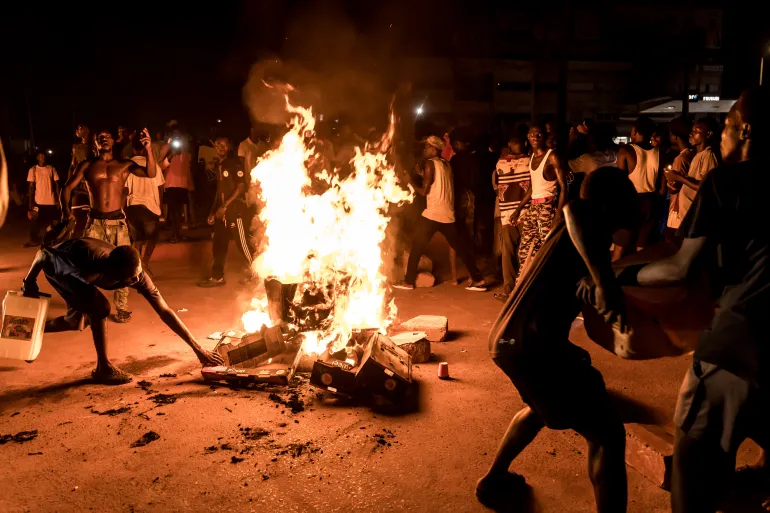
Bolivia’s president warns ‘time is running out’ amid protest crisis | Protests

NewsFeed

Bolivia’s president has warned protesters “time is running out” amid a weeks-long standoff over the country’s economic and political crisis. President Rodrigo Paz has secured powers to declare a State of Emergency, but protesters remain unmoved.

Source link

Obama asks for end to anti-Muslim sentiment

As a candidate, Barack Obama passionately defended the importance of religion in his life and in the nation’s politics. As president, Obama on Friday called for a renewal of religious tolerance and a cooling of tempers against Muslims as he tried to defuse the furor over plans to build an Islamic prayer center and mosque in New York and threats to burn copies of the Koran in Florida.

Obama, a Christian whose Muslim name inflames some of his fringe opponents, didn’t have to get involved in either dispute. But because of his responsibilities as president and commander-in-chief, Obama said he did.

“This country stands for the proposition that all men and women are created equal; that they have certain inalienable rights — one of those inalienable rights is to practice their religion freely,” Obama said.

“And what that means is that if you could build a church on a site, you could build a synagogue on a site, if you could build a Hindu temple on a site, then you should be able to build a mosque on the site.

Obama said he was aware that some of the 9/11 families were still in pain over the attacks, making a mosque nearby so sensitive.

“Tomorrow we as Americans are going to be joining them in prayer and remembrance,” the president said. “But I go back to what I said earlier: We are not at war against Islam. We are at war against terrorist organizations that have distorted Islam or falsely used the banner of Islam to engage in their destructive acts.

The Islamic prayer center and mosque would be built blocks from the World Trade Center, which was brought down two jetliners seized by Islamist terrorists. A third plane was intentionally crashed into the Pentagon, and another plane crashed in a field in Pennsylvania.

Obama began the news conference by saying that the ninth anniversary of the Sept. 11, 2001, terrorist attacks should be a day of remembrance and service. The mosque controversy has become linked to the furor over a Florida pastor’s decision to burn copies of the Koran to protest the 9/11 attacks.

“The idea that we would burn the sacred text of somebody else’s religion is contrary” to American principles, said Obama, who earlier this week called it a “stunt.” “My hope is that this individual prays on it and refrains from doing it,” he said.

Obama spoke of his duty as commander-in-chief to protect troops and U.S. interests around the world from Muslim anger over the planned Koran burning. Demonstrations have increased in Muslim countries, especially Afghanistan, where thousands have taken to the streets.

“This is a way of endangering our troops, our sons and daughters,” Obama said. “You don’t play games with that.”

How the threatened book burning by Pastor Terry Jones of the Dove World Outreach Center in Gainesville, Fla., took on world-class dimensions is subject to debate. Many, including some in the Obama administration, have blamed the media’s coverage for helping to elevate what is a small church with perhaps 50 members, into a global player.

“It is in the age of the Internet that something can cause us profound damage around the world, so we have to take it seriously,” Obama said.

In televised interviews, Jones has gone back and forth, saying he would suspend the burning so he can meet on Saturday in New York with Muslim leaders seeking to build the controversial mosque.

Imam Feisal Abdul Rauf, in charge of the New York effort, said he has no plans for any such meeting.

michael.muskal@latimes.com
Twitter.com/LATimesmuskal


Source link

Two Forms of Justice – Los Angeles Times

Isabelle R. Gunning is a professor of law at Southwestern University of Law

One year and four months ago, Jeremy Strohmeyer followed little 7-year-old Sherrice Iverson into a casino ladies’ room. His friend, David Cash, followed after them. There, Strohmeyer kidnapped, sexually assaulted and strangled Sherrice to death while Cash, according to his own testimony, watched the assault begin and then left without notifying authorities. Strohmeyer pleaded guilty to all the crimes, facing a lifetime in prison, and Cash remains at UC Berkeley. The disparate legal treatment of two young men who both appear so morally culpable has raised a lot passions, causing even a noted criminal defense attorney, Strohmeyer’s own Leslie Abramson, to call angrily for some retribution against Cash.

So why hasn’t Cash been charged? Many in the African American community believe that the whole case is about race. South-Central activists were highly critical of the Nevada district attorney’s willingness to accept a plea offer from Strohmeyer, wondering if the prosecution wouldn’t have been more eager to seek the death penalty through a trial if the victim were white and wealthy. Maybe. As a former public defender, it seems to me that the deal was typical when a defendant faces a real possibility of the death penalty. Moreover, as an opponent of the death penalty, I agree with Sherrice’s father when he said, “Killing that boy won’t bring my baby back.”

But when it comes to Cash, I wonder. This is not Mississippi in 1963. There is no great racist plot. Indeed, the public unease and outrage against Cash is a multiracial affair with blacks and browns, whites and reds, yellows and “mixeds” all horrified by his actions and indifference. But is there a subtle, perhaps unconscious combination of racial and class privilege causing the authorities to balk at charging a young middle-class white man with a bright future at an elite public university? Would they be so hesitant if he were darker hued, had no high school degree and had the uncertain economic future that too many young, poor black and brown men face?

It is said that neither Nevada nor California can charge Cash because neither state has a “good Samaritan” law–and they should.

I disagree with the pundits who oppose such laws with concerns that range from the infrequency with which Vermont uses its law to the suggestion that these laws turn “us into informants on each other.” It doesn’t matter if the new law is rarely used. Ideally, we hope that all criminal laws will rarely need to be used. What matters is that we believe that the moral obligation to help under certain circumstances is important. If so, then we should have a law for whenever it is needed. And these laws have less to do with us becoming informants on each other and everything to do with what we should already be doing for each other: helping each other out in times of need, regardless of our differences, because we are all part of a community.

But what about the laws we already have? Both states have laws that make accessories to a crime guilty of a crime. An accessory is the crime of knowing a felony offense has been committed and helping the perpetrator avoid arrest or trial. Several Nevada attorneys have suggested that Cash could be charged as an accessory for two reasons: If Cash saw the sexual assault and lied about it, that would be interference with the state’s ability to prosecute, or if Cash told friends, as he did, to keep quiet when they recognized Strohmeyer and Cash in the televised casino surveillance tape that, too, would hinder Strohmeyer’s arrest and prosecution. These attorneys are right. And their examples are bolstered by the fact that when Cash’s father told Cash that the two of them would have to go to the police, Cash’s first move was to call Strohmeyer and tell him, “Do whatever you’re going to do, but do it now.” It was a warning designed to help Strohmeyer avoid arrest or trial.

Frankly, as new information is revealed, the case against Cash grows stronger. While Cash swore under oath that he only witnessed the young girl struggling with Strohmeyer, Cash consistently told friends that he watched Strohmeyer molest the half-naked, terrified Sherrice. It was then, according to Cash’s former roommate, that Cash asked Strohmeyer that stomach-turning question “Was she aroused?” not after Strohmeyer left the bathroom and said that he’d killed Sherrice as Cash claims now.

If instead of ineffectually trying to stop his friend and leaving while “fear[ing] the worst,” Cash, in fact, encouraged his friend’s sick, deadly assault, Cash sounds more like an aider and abettor–beyond an accessory and as guilty as the principal. Surely, Sherrice’s hopes must have died when, in the last moments of her life, she saw her sole avenue of escape blocked by the head of the man in the next stall chatting with her assailant while she was tortured. One wonders whether Cash didn’t wait outside the bathroom door to act as a lookout for Strohmeyer. Moreover, this uglier version of Cash’s acts is evidence that he may have lied. The fact that he lied is more than perjury or inhibiting a police investigation or even protecting Strohmeyer. The lies are also about the specifics of what Cash himself saw and did and reflect his own consciousness of guilt.

If the Nevada authorities can look at all this and find no crime, it’s important to note that the California authorities could also charge Cash. Although the main crime, Sherrice’s murder, occurred in Nevada, many of the accessory acts–intimidating witnesses, lying to authorities, warning Strohmeyer–occurred in California. So the Nevada and the California authorities can do what justice demands.

Many of Cash’s fellow students are morally outraged and have taken action accordingly; the student council wanted to throw him out of school. Both the Nevada and California authorities ought to reexamine Cash’s immoral and illegal behavior and also act accordingly.

Source link

Kosovo Conflict Creates Schism Within the GOP

Ethnic war in Kosovo is provoking a kind of civil war inside the Republican Party.

In rapid fashion, the conflict in the Balkans is widening a fissure in the GOP over America’s role in the world. While Democrats mostly have supported President Clinton’s course, Republicans are being torn in diametrical directions as Yugoslav President Slobodan Milosevic’s forces systematically expel hundreds of thousands of ethnic Albanians from Kosovo.

On one side, a band of traditional GOP internationalists–led by Sen. John McCain of Arizona–is urging Clinton to escalate the campaign against Milosevic, even to the point of sending ground troops to drive the Serbian forces from Kosovo.

On the other side, an assertive group of conservative nationalists–led by presidential hopeful Patrick J. Buchanan, but extending into Congress–is arguing that the United States should bring its forces home now and leave the problem to the Europeans. “I think . . . we should tell our partners, ‘Look, we’ve expended, almost exhausted our resources. . . . Now on May 1st, we’re going to be out of there and then you take over from there,”’ Sen. James M. Inhofe (R-Okla.) argued Sunday.

This dispute marks the first real division in the Republican presidential campaign and, more importantly, a continued shift in the GOP’s center of gravity away from the internationalism that defined it through the Cold War.

Many in the GOP now appear increasingly drawn to an updated version of the old “fortress America” doctrine in which the United States increases its spending on defense but reduces its commitments abroad. Supporters describe this impulse as hard-headed nationalism. Critics, in both parties, deride it as isolationism.

“Republican foreign policy is now mired in pathetic incoherence,” the conservative Weekly Standard magazine said in an editorial last week.

In the first half of the century, the GOP was closely divided between internationalists and isolationists. When the Cold War dawned after World War II, that balance of power tilted toward the internationalists–whose victory was sealed by Dwight D. Eisenhower’s triumph over isolationist Sen. Robert A. Taft of Ohio for the GOP presidential nomination in 1952.

For nearly the next four decades, internationalists dedicated to containment of the Soviet Union held the upper hand in the GOP–even while isolationist sentiment in the Democratic Party grew after the Vietnam War.

A Role Reversal for Democrats, GOP

But the collapse of the Soviet Union eliminated the central rationale for engagement abroad among conservatives and has precipitated something of a role reversal between the parties during Clinton’s presidency. That process has reached a peak in the last few weeks with Republicans leading the opposition to U.S. involvement in Kosovo and Democrats (including many who opposed Vietnam) insisting on America’s obligation to ensure stability abroad.

When the Senate voted last month to authorize airstrikes in Kosovo, 70% of Senate Republicans voted no. Earlier, three-quarters of House Republicans voted against the use of American troops as part of an eventual North Atlantic Treaty Organization peace-keeping force in Kosovo. Virtually all Democrats in both chambers backed Clinton.

Those figures partly reflect Republican skepticism about Clinton’s ability to manage a military conflict and their sheer distrust of the president. But most analysts also see larger forces at work.

“It’s a complex fabric that’s giving us this situation here, from congressional feelings toward this president to the post Cold War fault lines,” said Marshall Wittmann, director of congressional relations at the conservative Heritage Foundation.

It is possible that tensions could sharpen among Democrats, too, if Clinton eventually asks for ground troops. But so far Democrats have offered little dissent from the president’s course.

On the other hand, the outbreak of fighting has widened the disagreement among Republicans. Overshadowed during congressional debates on Kosovo last month, internationalist Republicans have raised their voices since the bombings began.

Most ubiquitous has been McCain. Last week, McCain put off the formal announcement of his bid for the GOP presidential nomination in 2000, saying that it was inappropriate while NATO was at war in Kosovo. But he has been inescapable on television arguing for an escalation against Milosevic, including the use of ground troops if necessary.

“For us to rule out any capability we have to bring this war to a successful conclusion is a mistake,” McCain said.

Others in this camp include Republican Sens. Richard G. Lugar of Indiana and Charles Hagel of Nebraska, 1996 GOP presidential nominee Bob Dole and–more gingerly–Elizabeth Hanford Dole, who has not explicitly backed ground troops but said last week that “no options should be taken off the table.”

In a slightly different place are Republicans–led by former Secretary of State Henry A. Kissinger–who opposed the original decision to intervene in Kosovo but now say that NATO must do whatever it takes to defeat Milosevic to maintain its credibility.

Yet it remains unclear how much support these internationalists still command in the GOP.

Apart from McCain and Elizabeth Dole, the only other Republican contender who has accepted the possible use of ground troops is Texas Gov. George W. Bush–though his comments have been so tangled and conditional that the conservative Wall Street Journal editorial page labeled them “Clintonian.”

Half of the GOP contenders–including former Vice President Dan Quayle and Ohio Rep. John R. Kasich–have opposed the bombing mission from the outset.

On Sunday, Inhofe and Buchanan raised the ante by calling for Clinton to cut off the military action already underway. Jack Kemp, the GOP’s 1996 vice presidential nominee, last week also urged Clinton to call off the attack and reopen negotiations. Rep. Tom Campbell (R-San Jose), who has criticized the mission, plans to introduce a resolution shortly that would require an up or down vote in Congress on whether to end American involvement.

Republicans opposed to the Kosovo mission extend beyond isolationist figures like Buchanan toward leaders with previously unquestioned credentials as internationalists–like Kemp and Quayle. But the GOP case against involvement is resurfacing arguments that echo earlier generations of isolationist thinking on the right.

One line of thought revives pre-Cold War conservative skepticism about excessive U.S. involvement in Europe. Quayle and Sen. Kay Bailey Hutchison (R-Texas) have argued over the last week that, if troops are required in Kosovo, European nations alone should provide them.

Most foreign policy analysts consider that an impractical prescription since the European governments have made clear that they will not commit troops unless the United States does.

Concerns About U.S. Military Deployments

A related line of Republican thinking on Kosovo echoes earlier “fortress America” thinking. This argument holds that Clinton has invested U.S. forces in too many conflicts–from Bosnia to Haiti to Kosovo–that do not truly threaten America’s vital interests.

By making so many deployments, these conservatives insist, Clinton is depleting the U.S. ability to respond to a true crisis–especially because they believe he has not provided enough funds for defense. As Kasich put it recently: “The United States has to maintain its strength and power so it can preserve stability in the world.”

Much like Clinton, the GOP internationalists think that argument is almost exactly backward. They argue that the United States cannot hold its position of world leadership if it walks away from a crisis of this magnitude.

The test of strength for these competing arguments could come in the weeks ahead if Clinton decides to seek congressional support for ground troops.

Source link

Biden sues Justice Department to stop release of audio and transcripts tied to special counsel probe

Joe Biden sued the Justice Department on Tuesday in an effort to block the release of audio recordings and transcripts of the former president’s interview with a ghostwriter that were obtained by the special counsel who investigated his handling of classified documents.

Biden’s lawyers said in a lawsuit filed in Washington’s federal court that the Justice Department plans to release the files to Congress and a conservative group, the Heritage Foundation, after the department had previously argued that they were exempt from disclosure under the public records law.

Biden’s lawyers argued that the disclosure would “constitute an unwarranted invasion of President Biden’s privacy.”

“Every American, including a sitting or former Vice President, has a right to privacy in the personal conversations he has within his own home,” his attorneys wrote. “And when the U.S. Department of Justice obtains that private information through a criminal investigation, the Department bears a particular responsibility to protect it from disclosure.”

At issue in the case are audio recordings and transcripts of Biden’s interviews at his home in 2016 and 2017 with Mark Zwonitzer, who worked with Biden on his two memoirs. The files were scrutinized by special counsel Robert Hur as part of his investigation into the president’s improper retention of classified documents, from his time as a senator and as vice president.

Hur’s yearlong investigation led to a 345-page report that questioned Biden’s age and mental competence but recommended no criminal charges against the then-81-year-old. Hur said he found insufficient evidence to successfully prosecute a case in court.

Biden has separately fought the release of the audio of his interview with Hur. The House in 2024 voted to hold Biden Atty. Gen. Merrick Garland in contempt of Congress for refusing to turn over that audio after the White House exerted executive privilege, shielding it from Congress.

The transcripts of five hours of Biden interviews with federal prosecutors was released that same year. While Biden was adamant that he treated classified information seriously, the transcript shows that he was at times fuzzy about dates and details and he said he was unfamiliar with the paper trail for some of the sensitive documents he handled.

Republicans have argued Biden was being given a pass by his own Justice Department and that Trump had been unfairly victimized by prosecutors. Democrats, for their part, stressed Biden’s cooperation in the investigation and strongly contrasted that with the separate criminal case against Trump, who was accused of refusing to return classified documents requested by the National Archives that he had at his Florida estate.

Richer writes for the Associated Press.

Source link

Newsom vows to levy 100% tax on California recipients of Trump’s $1.8-billion ‘slush fund’

Gov. Gavin Newsom has threatened to tax 100% of the money Californians receive from President Trump’s “anti-weaponization” fund for his political allies.

Trump’s Justice Department had announced last week that it would establish a $1.776-billion fund to compensate allies of the president who claim they have “suffered weaponization and lawfare” under the Biden administration’s Justice Department.

“Anyone from California that receives any of those funds, we want to tax 100% of those proceeds,” the governor told reporters Thursday.

“That’s an action the state of California can take …[and] it’s an action we look forward to taking.”

Just how Newsom would do so remains unclear. He indicated that he would need action from the Democratic-led California Legislature to impose the new tax. If adopted, the measure would likely face legal challenge.

The fund has prompted outrage from Democrats and some Republicans — including Sen. Mitch McConnell (R-Ky.), who said in a statement that the “slush fund,” which would “pay people who assault cops,” was “utterly stupid.”

Newsom’s remarks about Trump’s settlement fund came on Thursday as he signed a bill designed to prevent election interference ahead of Tuesday’s primary.

The bill, Senate Bill 73, restricts law enforcement agencies and officers — including those from federal agencies — from interfering with state and local election officials, such as confiscating ballots, voter rolls or voting machines without a warrant.

The governor said the bill is meant to address “legitimate anxiety” over threats to election integrity after Riverside County Sheriff Chad Bianco’s decision to seize ballots from the county’s voter registrar as part of a fraud probe. Bianco, a long-time Trump supporter, is one of the top Republicans running to succeed Newsom after the end of his second and final term as governor.

Newsom also pointed to ICE and Border Patrol’s decision last November to stage an event near Dodger Stadium, calling it a “show of force designed to intimidate free expression and free speech.”

“That’s why we have to step up and we have to draw the line,” Newsom said. “We have to clarify the rules of engagement… there are fines associated with this, criminal fines and jail time of three years, so that’s a warning [to] the folks out there that think they can do the bidding of the Trump administration.”

Newsom said he expects Trump to interfere with the upcoming election — noting that the president has falsely claimed that he “won” California in the last election.

“Every single thing that Donald Trump is saying only suggests that he will do more, not less, to intimidate and to impact the outcome of this election,” Newsom said. “I absolutely expect the worst again, because we’ve been on the receiving end of it.”

Source link

The Rodríguez Siblings Are Losing a Major Asset: Zapatero

It’s always spectacular to see a big shot getting caught. Especially when he’s made a long career at the top of an European democracy under a mask of respectability. And, oh so suddenly, it turns out he’s made a fortune dealing with a Latin American dictatorship.

The sequence was— as people love to say today—worth of a Netflix series. 

Hours before getting on another flight to Caracas, José Luis Rodríguez Zapatero decided to stay in Madrid once he knew he had just become the first former prime minister in the history of Spain’s 50-year-old democracy to be indicted for a crime. For those who turn on the phone in the morning across the Atlantic, when it is noon in Spain, the news of the indictment came as one bundle with the footage of Zapatero’s office being raided by an anti-corruption investigative unit of Spain’s National Police Corps, known as UDEF.

Zapatero was indicted by Audiencia National (an equivalent of the Supreme Court) for selling his influence to get a financial relief kit for an airline, Plus Ultra, the smallest of four Spanish carriers that received assistance from Madrid as a result of the demand-side shock during the pandemic. This company, with a fleet of seven aircrafts, was also the youngest of the lot, and had the particular feature of having inaugurated routes to Caracas in the annus horribilis of 2017, a time when international operators were withdrawing from the country en masse. As Armando.Info investigative reporter Roberto Deniz would reveal in December 2018, Plus Ultra’s majority stakeholders were from Venezuela.

Eight years later, Zapatero is being prosecuted over allegations of political influence peddling related to the €53 million bailout of Plus Ultra. He also faces charges of criminal conspiracy, document forgery and money laundering. The judge handling the case describes Zapatero as the head of “a stable and hierarchical influence‑peddling structure” meant to “obtain financial benefits as an intermediary, exerting influence over public bodies on behalf of third parties, mainly Plus Ultra.” At least six other individuals are under investigation, including Plus Ultra’s chairman, its CEO, and Alicante-based businessman Julio Martínez Martínez.

The UDEF report says Zapatero and Martínez were at the center of a structure of businesses and consulting firms meant to syphon money coming from China, Venezuela and Spain into his personal accounts.

This latter will be a key character in this story: Martínez Martínez is not only being accused of acting as Zapatero’s frontman in a number of entities that received payments linked to the Plus Ultra (et al) scheme. His own personal records, such as notebook annotations UDEF just made public, suggest he was fully aware of Zapatero’s business and political dealings with the Maduro regime. That evidence seems to point at both opaque trade deals (over Venezuelan light crude, gold, fuel, asphalt, which were the subject of US sanctions until recently) Martínez and Zapatero may have promoted, and knowledge about a number of high-profile political prisoners released this year. The son-in-law of Edmundo González, security expert Rocío San Miguel and opposition moderate Enrique Márquez (who has publicly praised Zapatero) appear mentioned. Martínez´s notes also provide previously undisclosed details about the contents of a constitutional reform Maduro toyed with, but never brought about after stealing the presidential vote in 2024.

All of this adds to the investigations about shady business in the pandemic that involved Spanish businessman Víctor de Aldama, former Transport Minister and PSOE Organization Secretary José Luis Ábalos, and his close advisor Koldo García. The trio famously met Delcy Rodríguez in the tarmac of the Madrid international airport, for a purported conversation over the sale of Venezuelan gold lingots, despite her being the subject of EU sanctions and therefore unable to step on European soil. These three Spaniards (with Ábalos and Koldo being amongst the closest collaborators of Pedro Sánchez in his primary campaign and early government) are the main actors in a series of corruption scandals that have been getting closer to the Spanish head of government, a darling of the International Left whose reputation has been boosted by a knack for antagonizing Donald Trump. But the former aides of Perro Sanxe have been arrested without bail and indicted (and will soon face a sentencing hearing). His brother is facing trial. His wife has also been indicted and is on the verge of facing trial. And now it looks like his political mentor will also face a lengthy process before Spanish justice.

Just after the Zapatero news broke in Spain, predictable reactions began to come across the political spectrum: bloodthirst at the Right, accusations of conspiracy at the Left. Then, the judge made public the 88-page file, fed with a probe that began in 2024, and the ambiance turned in a second. Many allies of the graft-plagued socialist government admitted that the accusations are solid, the evidence overwhelming, and the outlook quite bleak for Zapatero. The conspiracy theory that this was lawfare against the Sánchez government faded away. Spain’s paper of record, El País, traditionally aligned with Zapatero’s party PSOE, wrote a stern op-ed saying that the Sánchez government was forced to investigate this properly to prevent the “enemies of democracy” in the Far Right from charging against the democratic system. “Full cooperation with the judiciary, full respect for the presumption of innocence, and all my support for President Zapatero,” Sánchez said today. 

As you may have noticed, authorities have released more evidence this week. Spanish media ranging from the State-owned, left-leaning broadcaster RTVE to the investigative El Confidencial are carving out a map of the Zapatero network of sociedades mercantiles. While not all of these companies are under investigation, together they received an estimated €2.6 million between 2020 and 2025 from Chinese capital and entities under investigation.

The investigation will likely reveal more details about the dealings between the chavista regime, Zapatero and other politicians and businesspeople close to the Sanchista government.

The UDEF report says Zapatero and Martínez were at the center of a structure of businesses and consulting firms (under not-at-all pretentious names like Inteligencia Prospectiva and Análisis Relevante) meant to syphon money coming from China, Venezuela and Spain into his personal accounts. Money that looks, in many cases, like kickbacks. For instance, Whathefav, a social media agency owned by his two daughters, got a payment of half a million euros for creating a website and a promotional video for Inteligencia Prospectiva SL, which is owned by Guillemo and Domingo Amaro Chacón. These two are Spanish-Venezuelan citizens who happen to be the sons of a businessman involved in a case of insurance fraud with PDVSA. Inteligencia Prospectiva reported losses, but was paying juicy bills to other businesses of the same network, like Whathefav.

UDEF  also cites evidence of conversations between Domingo Amaro Chacón and Julio Martínez Martínez, from 2021 to 2024, discussing a deal with Minerven (coded as “comercialización de amarillo”), nickel reserves in Venezuela, a major tourism development project on La Tortuga Island, and what seems like efforts to promote the opening of the UAE embassy in Caracas (coded as “the desert guys”). All of this may have something to do with UDEF’s suggestion (reviewed here by The Objective) alleging that the Plus Ultra case might be linked to a money-laundering operation involving proceeds from the Venezuelan CLAP food-box scheme, as well as the shipment of 5-8 tons of gold from Caracas to Dubai.

Yes, it’s a lot. And we’re not even getting into other grim details, like reports that Whathefav received a €100,000 payment from the company behind VenApp, which you’ll remember as the mobile app Maduro promoted in the past two years to encourage chavistas to snitch on dissidents.

“I told you so…”

Until that day, Zapatero was able to sell to the Spanish people that he had been in Venezuela not just as a negotiator helping take people out of jail, but as a peacemaker trying to prevent the country from falling into a civil war. Apparently through his good heart and blue eyes.

Suddenly, Spain has discovered that a former president, adored among socialists for his term’s achievements like the disbandment of terrorist group ETA, who left Moncloa Palace with no scandals on his shoulders, and who kept enough prestige to back the rise of Sánchez, is an international operator that used his connections and knowledge to make at least 2.6 million euros in ways that spill way beyond the disputable boundaries of legal lobbying.

Once again, Venezuelans raised their eyes to the sky and whispered with resignation. That “yes, moron, we have known this for years” feeling we are so familiar with. 

This case should remind the EU that post-Maduro Venezuela still harbors kleptocratic networks embedded well within European jurisdictions.

For Venezuelan media, and we dare to say a great deal of the public, Zapatero has been known for years as a loyal operator of the chavista regime who works at the expense of the people to help Maduro, and now the Rodríguez siblings, to preserve power. In doing so, he has kept the boardgame tilted against the opposition. The statesmanship that many Spaniards attribute to Zapatero has served only to defend Maduro’s interests during several negotiation rounds with international presence, and to corner the opposition into disadvantageous arrangements by presenting himself as an arbiter when, in fact, he’s no more than an able messenger of Miraflores. Former political prisoners like Lorent Saleh have recalled how Zapatero pressured their families to keep quiet about torture and abuse endured in prison. All that work, of course, has been handsomely rewarded.

We saw his shadow in the humiliation of president-elect Edmundo González Urrutia, in the Spanish ambassador’s house in Caracas, during his last hours in Venezuela in August 2024. Edmundo was pressured by Delcy and Jorge Rodríguez to sign a self-incriminating letter as a condition for being allowed to leave for Spain. After that, the Rodríguez siblings and Zapatero have actively endorsed each other: one of the Spaniard’s last visits to Caracas saw him declaring next to Jorge and other National Assembly lawmakers as a key international sponsor of the 2026 amnesty law, which Delcy recently discontinued. One of those lawmakers, fake opposition politician Timoteo Zambrano, is another close friend and ally of Zapatero. The latter’s influence looks so significant that Delcy just appointed Zambrano as the Venezuelan ambassador in Madrid.

Bad for Delcy, good for María Corina

The investigation will likely reveal more details about the dealings between the chavista regime, Zapatero and other politicians and businesspeople close to the Sanchista government. It will all depend on what prosecutors can find and prove, but it’s fair to say that a wave of scandals and a thickening of corruption dossiers of this kind could make any democratic government in the world collapse (though with Sánchez, in the end, we’re talking about a man Spanish voters know for surviving all kinds of reputational crises). 

The Spanish government was among the first to recognize Delcy Rodríguez as head of state. As early as January, its top diplomat said he would request that the EU lifts sanctions on Delcy. Just a few weeks ago, the same official confirmed that Caracas would resume talks with the IMF. The Spanish Foreign Ministry used to be run by Josep Borrell, a socialist from the non-Zapaterista faction (the more moderate, Felipista wing) of the ruling PSOE, who has become a vocal critic of both the Maduro dictatorship and Zapatero. But Madrid’s latest efforts to normalize relations with Delcy haven’t gone unnoticed, perhaps encouraged by the Trump administration, and also by Maria Corina Machado’s close ties with the Spanish Right.

With such accusations against a key enabler of this bilateral relationship, the image of normalcy (and common sense) both Sánchez and Delcy are trying to project should take a hit. This case should remind the EU that post-Maduro Venezuela still harbors kleptocratic networks embedded well within European jurisdictions.

We should note this is not a problem where Delcy can turn to the Trump administration for help. Not only because Trump despises Sánchez, but because Homeland Security reportedly gave leads to Spain’s National Police in the Plus Ultra case, in cooperation through the American embassy in Madrid.

A big winner in this case is María Corina Machado, who recently held a massive rally in Madrid’s main square that few Spanish politicians could have matched. Machado was lambasted by Foreign Minister José Luis Albares for refusing to meet Sánchez or other leftwing leaders during her Madrid visit. Throughout her trip, when asked by journalists about this decision, Machado did not name Sánchez but thanked the Spanish government for receiving Venezuelan migrants over the years, while also stressing her utmost respect for Spanish institutions. It is false that Machado only met with the right-wing opposition: she appeared publicly with former PM Felipe González, a historic figure of Spanish social democracy and a key leader of the country’s famous Transition.

Machado may now be feeling some relief about how the whole Spanish saga is unfolding (both Zapatero and Machado have acknowledged they have never spoken to each other).

In another era, she might have summed it up with one of her classic phrases: se los dije.

Source link

Canada chooses Swedish early warning planes rather than US model | Business and Economy News

Canada has announced plans to buy a fleet of early warning planes from Sweden’s Saab rather than a competing option from Boeing as it seeks to reduce its reliance on the United States.

Prime Minister Mark Carney said on Wednesday that Canada would opt for Saab’s GlobalEye, which is based on Bombardier’s Global 6500 jet. Boeing’s E-7 Wedgetail plane – which has suffered from delays and cost overruns – had also been in contention.

Recommended Stories

list of 4 itemsend of list

“With a suite of advanced sensors and mission systems, Saab’s GlobalEye will be a key resource for the Canadian Armed Forces to detect and deter threats across the Arctic,” Carney told a defence conference in Ottawa.

The Prime Minister pledged in March that Canada would take full responsibility for protecting its vast Arctic territory, after relying for decades on a partnership with the US to monitor its more than 4.4 million square km (1.7 million square miles) of land and sea, a territory larger than India.

Carney’s Liberal government last year announced plans to ramp up defence spending. The US and other allies had complained for years that Canada was not meeting longstanding NATO targets on military expenditure; Carney announced in March that Canada hit that target of spending 2 percent of its GDP on defence last year.

In a statement, Saab said it planned to invest in research and development work in Canada as part of any deal.

Although Carney did not give details of the fleet size or the cost of a potential contract, military officials had earlier said they were looking to buy six early warning aircraft.

Philippe Lagasse, associate director of international affairs at Ottawa’s Carleton University, said Canada’s decision to buy the GlobalEye planes was “an important test case for the Carney government’s policy of pivoting away from American military capability”.

He said in a statement that the decision confirms Canada’s relationship with Sweden, a new NATO ally that has also been eager to strengthen its ties to the Canadian military.

Canada has previously said it wants to work more closely with the Nordic countries in the Arctic on defence and other issues, in a global environment in which the US has become a less reliable partner.

“GlobalEye is already creating jobs in Canada, and working with the Canadian supply chain. This decision ties our two nations even closer together,” Swedish Prime Minister Ulf Kristersson said in a social media post.

Saab is also in the running to sell Canada some of its Gripen fighters.

Canada has a deal to buy 88 F-35 jets from Lockheed-Martin, but last year, after the US slapped tariffs on key Canadian imports, Carney asked the military to probe whether it could cut back the order and buy some planes from another manufacturer.

Carney later told reporters Ottawa would make a decision on the fighter fleet in due course and declined to comment when asked whether the military would be operating two jets.

Last week, a Pentagon official, speaking after Washington suspended planned biannual defence talks with Canada, said the delay in making a decision on the F-35s showed how Ottawa was prioritising politics over defence issues.

Still, Lagasse of Carleton University said he expected Canada would ultimately decide to stick with a fleet of F-35 jets rather than splitting the fleet by buying some Saab Gripens.

“If the government was determined to buy Gripens, I would have expected them to make the announcement alongside this [GlobalEye] decision,” he said.

Trade tensions

The announcement came amid ongoing trade tensions between US and Canada after US President Donald Trump slapped tariffs on Canada after taking office last year, alongside multiple comments threatening to annex the country and make it the 51st state of the US.

Historically, nearly 80 percent of Canada’s exports have been to the US. While the vast majority of those were protected under the USMCA, the trade agreement between the two countries that also includes Mexico, that is now due for a review, which starts on July 1, and Trump has said the US does not really need that deal.

While the US has announced bilateral talks with Mexico, there has been no mention of Canada.

Deputy US Trade Representative Jeffrey Goettman will lead bilateral talks in Mexico City on Thursday and Friday focused on “economic security and rules of origin for key industrial goods,” the department said in a statement on Wednesday.

USTR said the US and Mexico will hold a second round of negotiations in Washington on June 16-17, focused on agriculture and “a level playing field,” with a third set of talks in Mexico City scheduled for the week of July 20.

The first Trump administration held trilateral negotiating rounds with both Mexico and Canada to create the existing USMCA, which replaced the 1994 North American Free Trade Agreement in 2020.

But so far, there have been few discussions between US Trade Representative Jamieson Greer and his Canadian counterpart, Canada-US Trade Minister Dominic LeBlanc, since early March, and no formal launch of a US-Canada negotiating process.

Source link

Longtime correspondent Sharyn Alfonsi expects to depart ’60 Minutes’ as big changes loom

Sharyn Alfonsi, the longtime “60 Minutes” correspondent who clashed with CBS News Editor-in-Chief Bari Weiss over a story on Trump White House immigration policies, said Wednesday her contract is not being renewed.

“Over the weekend, my contract with CBS News expired, drawing to a close nearly twenty years with the network, including more than a decade at ’60 Minutes,’” Alfonsi, 54, said in a statement to The Times.

“Following an intense editorial dispute over our CECOT story, repeated attempts by my representation to establish a path forward were met with absolute silence from network executives,” she added. “The message could not be clearer: my time at 60 Minutes is apparently over.”

CBS News declined to comment on Alfonsi’s remarks. Her contract expired this past weekend but she remains employed at the division on an “at will” basis, which means she can be terminated at any time, according to people familiar with the discussions. Producers who worked with Alfonsi have been assigned to other correspondents.

Alfonsi made her comments as the “60 Minutes” staff anticipates significant changes in the coming days, which could include shifting the lineup of correspondents. Anderson Cooper has already announced his departure from the program after 20 seasons.

A scene from the "60 Minutes" report "Inside CECOT."

A scene from the “60 Minutes” report “Inside CECOT.”

(CBS News)

The segment at the center of Alfonsi’s likely exit, “Inside CECOT,” detailed the Trump administration’s treatment of hundreds of Venezuelan migrants who were deported to an El Salvador prison known for its harsh conditions.

“Inside CECOT” was scheduled to run Dec. 22 but was pulled the day before air by Weiss, who believed it needed more reporting, including a direct on-camera response from the administration, which did not participate.

Alfonsi protested the decision to hold the story, calling it politically motivated in an email she sent to colleagues that was shared publicly.

Alfonsi said at the time the story was ready for air after being vetted by the network’s attorneys and the standards and practices department.

“It is factually correct,” Alfonsi wrote. “In my view, pulling it now — after every rigorous internal check has been met is not an editorial decision, it is a political one.”

“Inside CECOT” eventually ran on Jan. 18 without any substantial changes to its tone or reporting. Weiss acknowledged internally that pulling the segment after it had already been promoted was a mistake.

The move created the first public relations fiasco under Weiss’ watch and tarnished the strong journalistic reputation of “60 Minutes.” The matter also added to the narrative that Weiss was installed at CBS News to placate the Trump administration as parent company Skydance Media sought government regulatory approval to buy Paramount and its current deal to merge with Warner Bros. Discovery.

The program has been in turmoil since October 2024 when President Trump filed a $20-billion lawsuit against CBS over an interview conducted with then-Vice President Kamala Harris that was settled to help clear the regulatory path for Skydance Media’s acquisition of Paramount last year.

Weiss joined CBS News in October with a mandate from Paramount Chief Executive David Ellison to pull the division to the political center. The founder of the conservative-friendly digital news site the Free Press, Weiss has wanted to make changes to “60 Minutes” but put them off until after the 2025-26 TV season ended this past weekend.

In her statement, Alfonsi predicted CBS News would try to make her exit an administrative decision not related to her work.

“In the coming days, network leadership may attempt to hide behind corporate euphemisms like ‘modernization’ and ‘restructuring’ to explain away my departure,” Alfonsi said. “Don’t be misled. This was not a routine corporate transition; it was a deliberate choice to penalize a journalist for refusing to sanitize factually accurate reporting, and it sends a chilling message to the entire newsroom.”

Insiders at CBS News are uncertain about the extent of the planned overhaul. Weiss has been advised to limit any disruption to “60 Minutes,” which is coming off a strong season of ratings performance.

Nielsen data showed the program averaged 9.1 million viewers in its Sunday time period, up 9% from the previous year. The program’s views across digital and social media platforms were also up substantially.

Source link

Alabama asks Supreme Court to allow use of congressional map helping GOP, despite racial bias ruling

Alabama on Wednesday asked the Supreme Court to allow it to use a congressional map favoring Republicans in this year’s elections, despite a lower court’s ruling that the redistricting plan intentionally discriminates against Black people.

The state’s Republican leadership filed an emergency appeal with the justices a day after a three-judge court refused to let the state use a map it adopted three years ago that has a majority Black population in just one of its seven congressional districts.

The judges instead required Alabama to continue using a court-ordered map that was put in place for the 2024 elections that includes two districts where Black residents comprise a majority or close to it.

Atty. Gen. Steve Marshall told the court that the state did not intentionally discriminate against Black residents and should be allowed to hold elections this year under a map chosen by lawmakers, not judges.

The appeal is the latest development in the fallout from last month’s Supreme Court ruling that struck down a Black-majority district in Louisiana and weakened the federal Voting Rights Act. That ruling has led Republicans in several Southern states, including Alabama, to take steps to reshape voting districts with large minority populations that have elected Democrats.

The redistricting frenzy is part of a broader push by President Trump to try to hold on to Republicans’ slim House majority in the November elections.

The Alabama cases stretches back several years. The three-judge panel in 2023 ruled that a map drawn by Republican state lawmakers intentionally diluted the voting power of Black citizens. The court said the state, which is about 27% Black, should have two districts where Black voters are the majority or close to it. The court-selected map was used in 2024.

After the Supreme Court’s recent ruling in the Louisiana case, Alabama officials moved to implement the 2023 state-drawn map. The Supreme Court’s conservative majority agreed to lift the injunction that had blocked the map’s use and sent the case back to the three-judge panel for reconsideration in light of the Louisiana ruling.

In the meantime, voters cast ballots in Alabama’s May 19 primaries, and Republican Gov. Kay Ivey set new special primaries for Aug. 11 in four congressional districts affected by the map switch.

Upon further review, the judicial panel said it was standing behind its initial finding that there was “undisputed evidence” of intentional racial discrimination, a holding that was independent of and unaffected by the Supreme Court ruling on the Voting Rights Act.

It said the special congressional primaries should instead proceed under the previous court-approved districts.

The use of the court-ordered map led to the 2024 election of U.S. Rep. Shomari Figures, a Black Democrat. State Republicans are seeking to use a map that would give the GOP an opportunity to reclaim the south Alabama seat.

The state is asking for Supreme Court action by Monday as it makes preparations for the special vote in August.

Sherman writes for the Associated Press.

Source link

Biden sues to prevent release of conversations with ghostwriter

May 27 (UPI) — Former President Joe Biden filed suit against the Department of Justice Tuesday to block the release of unredacted audio recordings and transcripts of his private conversations with the ghostwriter of his 2017 memoir.

In 2024, the Heritage Foundation filed a Freedom of Information Act to get Biden’s comments to Mark Zwonitzer while writing, Promise Me, Dad: A Year of Hope, Hardship, and Purpose.

Under the Biden administration, the Justice Department had withheld the materials. But when Trump took over the presidency, “the Department has reversed that position,” the suit said.

In February, Biden’s attorney Amy Jeffress wrote, “without any formal explanation for its about-face, the Department notified President Biden of its intention to release the audio recordings and transcripts to the plaintiffs in the FOIA Action.”

On May 5, “the Office of the Deputy Attorney General informed President Biden, through counsel, that the Department had made a final decision to release the materials, with limited redactions, to the Heritage Plaintiffs and to Congress on June 15,” the lawsuit says.

“Every American, including a sitting or former vice president, has a right to privacy in the personal conversations he has within his own home,” Jeffress wrote in the lawsuit. “And when the U.S. Department of Justice obtains that private information through a criminal investigation, the Department bears a particular responsibility to protect it from disclosure.”

The documents were from records that then-special counsel Robert Hur used to write some parts of a 2023 report on Biden’s handling of classified documents that described him as “painfully slow, with Mr. Biden struggling to remember events and straining at times to read and relay his own notebook entries.” Hur didn’t bring charges against Biden.

Redacted transcripts of those conversations have already been released to the public.

Rep. Jim Jordan, D-Ohio, chair of the House Judiciary Committee, said he wanted the tapes released.

“I think it’s just important for the American people to know exactly where the President of the United States was… . (W)e’d like to see all that information, I think, to underscore what the Democrats were trying to hide just a few years ago,” CNN reported Jordan said.

Vice President JD Vance speaks during a roundtable on anti-fraud initiatives in the Indian Treaty Room in the Eisenhower Executive Building near the White House on Tuesday. Photo by Bonnie Cash/UPI | License Photo

Source link