WASHINGTON — The Trump administration is promising $500 rebate checks to an estimated 1 million Affordable Care Act enrollees across 30 states, who the White House alleged were overcharged by the Biden administration for exchange fees.
The promise comes after Trump pledged Wednesday to send every American adult $5,000 if Republicans retain control of the House and Senate in the midterm elections and as affordability has become a central issue for voters heading into November.
“The relief begins with refunding everyone who was overcharged and the rebates are going out in just a few weeks,” President Trump said in a recorded address released on the White House X account Thursday. Enrollees who can expect refunds are those who do not receive premium assistance.
Critics called the move a “gimmick” that doesn’t represent a plan for addressing soaring healthcare costs.
Trump in his address accused former President Biden’s administration of “gross mismanagement” of ACA funds, without providing evidence, and said that the Biden administration collected user fees from insurance companies that consumers paid through higher premiums.
In a fact sheet, the White House claimed that Biden’s administration “accumulated a significant surplus of funds that were not used to benefit the Americans who paid these higher premiums.” It said the rebates would be sent out beginning next month.
It is unclear whether the $500 rebate represents what each enrollee may have overpaid, where the money for the rebates would come from and whether it requires congressional approval for disbursement.
Trump’s announcement comes as the price of ACA insurance has skyrocketed for many Americans during his own second term. The Trump administration opposed extending COVID-era subsidies that had helped offset the costs of health insurance for most enrollees during Biden’s term.
After the Republican-led Congress allowed the subsidies to expire this year, premiums doubled or tripled for many enrollees, prompting millions to downgrade their plans or exit the program entirely.
Brad Woodhouse, a Democratic strategist and executive director of advocacy group Protect Our Care, called the rebate plan “an absolute joke” in a statement.
“Since Republicans took away tax credits from working families, millions of people have seen their monthly premiums rise by hundreds, if not thousands, of dollars,” Woodhouse said. “At a time when people are scraping by to keep up with the high cost of groceries, rent, and healthcare, this $500 gimmick won’t even begin to dig them out of the hole that Trump and Republicans created.”
Officials at the Centers for Medicare and Medicaid Services did not respond to Associated Press requests for comment, and a White House official referred back to the fact sheet.
Roughly 19 million people receive insurance through the Affordable Care Act exchange.
Hussein and Swenson write for the Associated Press.
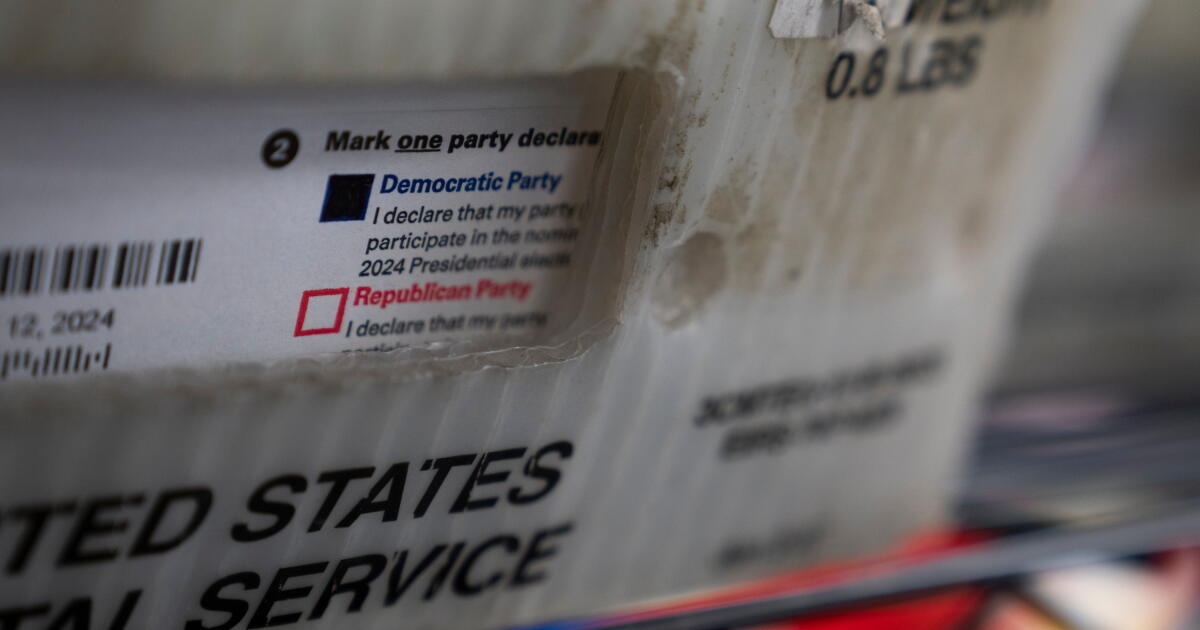
WASHINGTON — An appeals court on Thursday upheld a block on President Trump’s executive order limiting mail voting, a decision that comes as the Supreme Court considers the same case and states have already started sending out ballots for the high-stakes midterm elections.
The three-judge panel refused to lift a preliminary injunction against the order issued last week by U.S. District Judge Indira Talwani. It prohibits the U.S. Postal Service from implementing Trump’s directive. The Postal Service has said it would not deliver ballots from states that did not pre-clear their envelope design with the federal government and submit a list of voters to an online portal, which has yet to be activated.
Election officials warn that it’s impossible to comply with those terms, especially with the first mail ballots already being sent out in Alabama, North Carolina and Wisconsin.
The panel of three judges nominated by former President Biden agreed with the plaintiffs that the president does not have the power to regulate states’ election policy.
“Appellants have not made a strong showing that the district court erred in determining that the Final Rule is likely unlawful,” they wrote, a reference to a rule published by the Postal Service to implement Trump’s order.
The panel wrote that the Trump administration had done little to dispel arguments by many election officials that the changes would bring “chaos and widespread disenfranchisement.”
“Indeed, appellants have not even seriously challenged this aspect of the district court’s ruling, much less demonstrated why it is clearly erroneous,” the order states.
The government also hasn’t shown evidence of past fraud to justify the restrictions, the judges said.
A request for comment from the White House was not immediately returned.
The panel’s decision comes even as the Supreme Court is already considering the same case, which is part of a frenzied legal rush as states are beginning to send out mail ballots for this fall’s midterm elections. Democrats and civil rights groups in a separate lawsuit in Washington, D.C., also are trying to halt the executive order.
The 1st Circuit also had upheld a previous hold Talwani placed on the executive order. But that ruling was lifted by the Supreme Court in a procedural decision that did not determine whether the plan was constitutional.
The plaintiffs swiftly filed new lawsuits after the Postal Service finalized its rule governing mail ballots.
Riccardi and Whitehurst write for the Associated Press.
California, home to the world’s largest tech companies, is placing more guardrails around social media and artificial intelligence as child safety concerns escalate.
On Thursday, California Gov. Gavin Newsom signed more than 10 bills aimed at keeping young people safe online.
From suicides to sextortion, parents and their children are wrestling with how social media and AI chatbots could be harming people’s mental and physical health. The anxiety comes as technology becomes more powerful, playing a bigger role in classrooms, offices and homes.
California lawmakers have tried to tackle online safety concerns for years and they’ve faced intense lobbying from tech companies with deep pockets. The state’s laws have a disproportionate impact on the global tech industry because so many of the field’s titans are based here.
“We cannot hand children technology engineered by some of the most sophisticated companies in the world, and then place the burden on kids to defend themselves against it,” said California First Partner Jennifer Siebel Newsom in a news conference Thursday in the San Francisco Bay Area.
The California governor, who has tried to strike a balance between safety concerns and supporting innovation, has rejected online safety bills in the past that he thought were too restrictive or premature.
The batch of new legislation includes Senate Bill 1119, which would require companion chatbot operators to assess risks, notify parents in certain cases if their child threatened to harm themselves, and take other safety steps.
Lawmakers named the bill Adam’s Law, after Adam Raine, a California teen who died by suicide in 2025 after conversing with OpenAI’s ChatGPT. The teen’s parents sued OpenAI, alleging in the lawsuit that ChatGPT provided information about suicide methods that the teen used. OpenAI and Pinterest publicly expressed support for the bill on Thursday.
Adam Raine’s mom, Maria, said in the news conference that the new law will help save lives and hopes that other states will enact similar legislation.
“Powerful AI companionship chatbots were unleashed on our kids with vastly inadequate protections. Adam was an early adopter of AI, and so many of us parents did not understand the dangers back then,” said Maria Raine, who came to the event with a photo of her son.
Suicide prevention and crisis counseling resources
If you or someone you know is struggling with suicidal thoughts, seek help from a professional or call 988. The nationwide three-digit mental health crisis hotline will connect callers with trained mental health counselors. Or text “HOME” to 741741 in the U.S. and Canada to reach the Crisis Text Line.
At the event, Democratic and Republican politicians shared their experiences as parents who have seen firsthand how technology affects children.
Assemblyman Josh Lowenthal (D-Long Beach) said parents are seeing anxiety and depression among children who grew up in front of screens.
“That anxiety is because the pace of technology is moving faster than government can put guardrails in, and that’s left families across the state struggling to figure out how to keep their kids safe,” Lowenthal said.
Lowenthal introduced Assembly Bill 1709, which Newsom also signed. It would bar certain online platforms from providing an “addictive feature” such as autoplay and feeds that display recommended content to users under 16 years old.
Tech industry groups opposed the bill, raising concerns that it could cut off access to social media’s benefits, such as people’s ability to connect with family and friends. Tech industry groups such as TechNet say that lawmakers should enforce current laws to strengthen parental controls rather than pass new ones.
NetChoice, which has sued California and other states to block the enforcement of new online safety laws, said in a statement that the group has First Amendment concerns about the new bills Newsom signed.
“The state cannot simply describe speech as addictive and then claim a right to regulate access to it,” said Zach Lilly, Director of Government Affairs at NetChoice. “Whether the governor and legislature choose to respect it, Californians have a right to express themselves, and NetChoice will continue to fight for that right.”
The new safety restrictions come as tech companies, including Meta, Google and others, face more scrutiny over how they design products. The companies have suffered several legal blows in courtrooms in California this year.
Meta, which owns Facebook and Instagram, agreed in August to pay up to $17 billion and make child-safety changes to resolve a multistate lawsuit. The lawsuit accused the tech company of designing and deploying harmful features while misleading the public about them.
As part of the settlement, Meta said it would impose time limits and mute notifications during certain hours for teens. Young people would also have the option to choose to view a non-algorithmic social media feed that isn’t personalized and disable autoplay.
Earlier this year, Meta and YouTube also lost a social media addiction lawsuit in Los Angeles.
While new legislation goes further than the settlements, some countries have passed stricter restrictions on social media. Last year, Australia started banning social media for children under 16, though enforcement has posed a challenge because teens are finding ways to get around the restriction.
Newsom, who pushed for federal regulation, said that he thinks California’s approach to social media is “better” than Australia’s because children are “all figuring out a way to game that system.”
“This is about the features themselves. This is about actually addressing the problem, the scrolling, the algorithms,” he said.
Safety concerns around technology have also heightened as companies double down on advancing artificial intelligence.
This week, a researcher for AI company Anthropic said he left the company over concerns that AI companies, including OpenAI, are “gambling with our lives” as they race ahead to improve AI that could surpass human intelligence.
The researcher, Jacob Coxon, shared a viral social media post that said: “People building AI earnestly believe that it could kill us all by the end of the decade.”
Newsom signaled the work to protect children isn’t over.
“We need to move, but one thing we’re not doing is we’re not sitting back and we’re not letting it rip,” he said.
Thousands of Salvadoran immigrants nationwide faced uncertainty after the federal government failed to decide by a Wednesday deadline whether to extend or terminate their longtime temporary protections against deportation.
Those protections, known as Temporary Protected Status or TPS, allow immigrants to obtain work permits and by Thursday some Salvadorans had already been fired from their jobs. Others who had been let go were reinstated after the Trump administration clarified that an announcement on TPS for Salvadorans would come “at the appropriate time” and that they would retain work authorization in the meantime.
Employers also expressed uncertainty about whether the statement was enough to legally keep Salvadoran employees on their payroll. Those who lost their jobs worked across the U.S. in construction, at hotels and as janitors.
Some took the announcement that work authorizations remained in place — made late Wednesday by U.S. Citizenship and Immigration Services — as a cause for hope, while others saw it as prolonged mental torture. There are 170,000 Salvadoran TPS holders, including 36,000 living in California.
Asked for further guidance on Thursday, Homeland Security sent a link to the USCIS website.
Advocates with the National TPS Alliance distributed a letter including the administration’s announcement for TPS holders to share with their employers and stating that “any decision to terminate could not take effect for a minimum of 60 days.” The letter seemed to help, as advocates reported that some fired employees had been able to return to work.
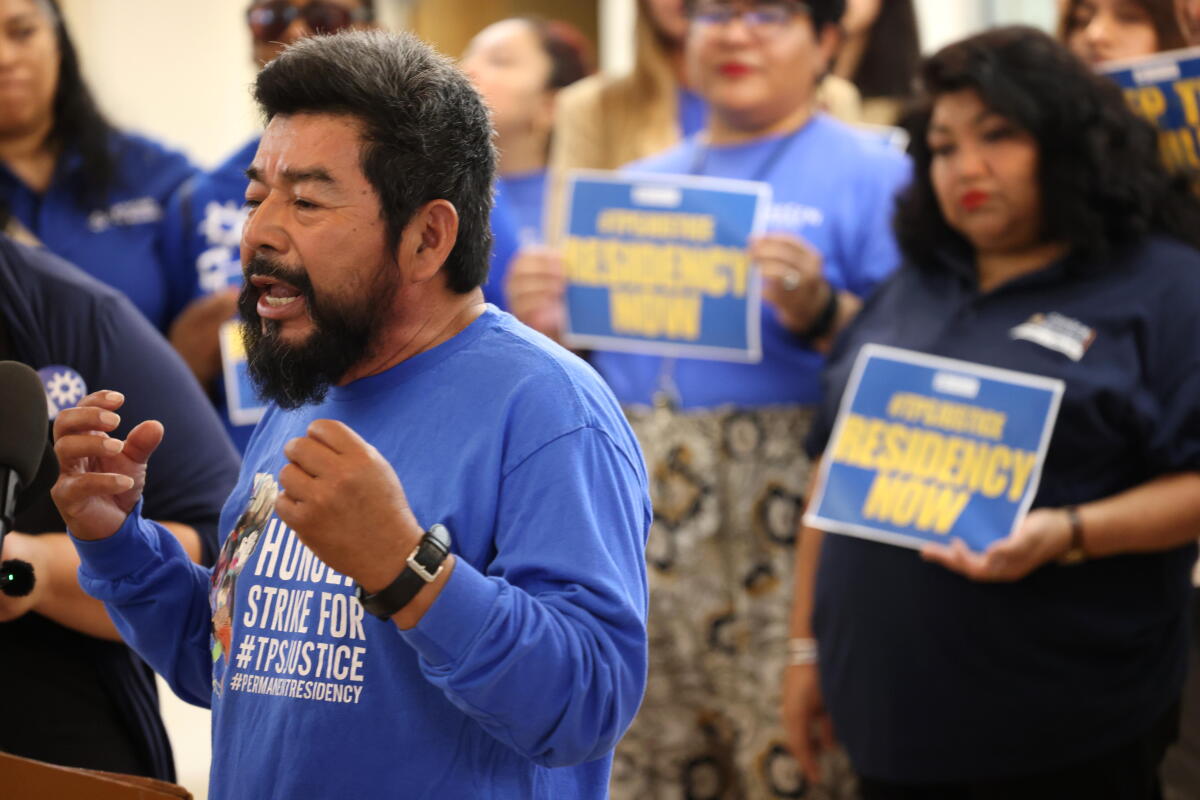
Not everyone was reinstated. Jose Ramirez reported to his construction job in Santa Monica for the last time on Wednesday.
The 63-year-old had been legally working in the U.S. since 2001, when TPS was first extended to Salvadoran immigrants.
Jose Ramirez, a TPS holder from El Salvador, speaks during a news conference in Los Angeles on Thursday.
(Genaro Molina/Los Angeles Times)
He had been in the country for six years before that, and constantly struggled to find stable work. The work permit was a lifeline. He’d dedicated the last 25 years to construction, during which he fathered three daughters and set roots in Compton.
Still, his boss said Ramirez could no longer present for work Thursday.
“I’ve worked on buildings that reach the skies of Los Angeles,” Ramirez said. “I’ve contributed economically and lent my labor to this great country.”
Ramirez’s boss said his job would be available to him, but he’d need to show proof of an active work permit. A notice or a letter is not enough, Ramirez said.
The USCIS announcement was “a ray of hope that they will give us an extension,” Ramirez said. “But, it’s just not certain. Anything can happen. We’re just praying to God that the government will make it official.”
Signs at a news conference to provide an update on the status of TPS designation for Salvadoran immigrants.
(Genaro Molina/Los Angeles Times)
Ending TPS would be a shock to El Salvador’s economy, where remittances from Salvadorans in the U.S. make up nearly a quarter of the nation’s GDP — nearly $10 billion last year. In 2019, President Nayib Bukele, an ally of President Trump, publicly called on the U.S. to extend TPS for Salvadoran immigrants.
More recently, Bukele has embraced Trump’s deportation agenda, including by accepting controversial deals to house foreign detainees in the country’s mega-prison. The number of people deported to El Salvador nearly doubled in the first three months of 2026.
The decision by the Department of Homeland Security to extend or terminate TPS typically has been made at least 60 days before the designation was set to expire. DHS can extend the program for a six, 12 or 18-month period or decide to cancel the designation.
But the Trump administration has delayed announcements, including some made days after the designation expired. A Supreme Court ruling in June determined that the Homeland Security secretary has final authority over the program and cut down the ability for advocates to sue.
Lauren Truslow, CEO of 3D Enviro, a Virginia company that does identification and abatement of hazardous materials, said the lack of a decision on TPS has been stressful and costly. Three of her 30 employees are TPS holders from El Salvador. Another, who is married to a Salvadoran TPS holder, told her his family plans to leave the country if the program is canceled.
3D Enviro is a federal contractor, and Truslow said that her employees’ driver’s licenses and federal badges expired on Wednesday.
“How do they continue to work for me?” she said. “No one seems to know the answer to that. They can’t get into federal facilities without valid ID. Them showing a memo from USCIS is not going to cut it.”
During a news conference organized on Thursday by the Central American Resource Center of Los Angeles, other immigrant rights groups and local elected officials, speakers urged TPS holders to form a plan for their families and schedule a legal consultation with a trusted lawyer. They also called on the administration to issue a decision on TPS for El Salvador and a pathway to permanent legal status.
“Salvadoran families deserve clear, timely and trustworthy information from the government,” said Martha Arévalo, CARECEN’s executive director. “As we gather this morning, we don’t have an extension for TPS. … What we have is another waiting game and a renewed limbo for families.”
“We are going to fight this,” vowed Los Angeles Mayor Karen Bass.
In a statement, Sen. Alex Padilla (D-Calif.) called the USCIS announcement “clear as mud.”
“Once again, the Trump Administration is punishing immigrants who have followed the rules with chaos, uncertainty, and cruelty,” he wrote.
Also in attendance at the news conference was Carmen Sanchez, 49, who works the night janitorial shift cleaning offices in Los Angeles. She said many of her co-workers who were also protected under TPS were told not to return to work after Wednesday.
Sanchez planned to report to work Thursday evening, but was sure she’d suffer the same fate. She said she has three adult children in El Salvador and is helping two of them pay for college.
“If we lose our work permit, we lose our job. We lose our stability. We lose everything,” Sanchez said. “We’re being kept on this thread of extensions, and we don’t know when that thread is going to break.”
After lower house approval, the bill to grant tens of thousands of Sahrawis citizenship now goes to the Spanish Senate.
Published On 10 Sep 202610 Sep 2026
Spanish lawmakers have backed legislation that would grant citizenship to tens of thousands of Western Saharans who were born when Spain ran the disputed territory now largely controlled by Morocco.
Spain’s lower house of Parliament on Thursday approved the legislation 168-31, with 145 abstentions.
Recommended Stories
list of 3 itemsend of list
The bill still requires Senate approval before becoming law.
The text grants Spanish nationality to Sahrawis born before September 29, 1977 and to their children through naturalisation, even if they never resided in Spain.
Although the exact number of beneficiaries is unknown, Sahrawi groups estimate that between 70,000 and 120,000 people could benefit from the legislation, which supporters described as addressing a “historical injustice” by colonial Spain in the Western Sahara.
Tensions with Morocco
The vote comes at a particularly sensitive time for Madrid’s historically delicate relations with Rabat due to the migration crisis in Spain’s north African territory of Ceuta, and the mass arrival of at least 70,000 migrants from Morocco in July.
Spain’s leftist government has avoided blaming Morocco – which does not recognise Spanish sovereignty over Ceuta and Spain’s other North African territory of Melilla – but the right accuses Rabat of orchestrating the surge for political motives.
Morocco claims sovereignty over Western Sahara and began asserting control over the territory after Spanish rule ended.
The Algerian-backed Polisario Front independence movement seeks recognition of an independent state called the Sahrawi Arab Democratic Republic.
Many Sahrawis live in refugee camps in Tindouf in western Algeria, or elsewhere abroad, while others remain in Western Sahara.
Against this backdrop, the initiative to grant Spanish nationality to Sahrawis has divided opinion in Morocco but not prompted condemnation from the government.
Moroccan media quoted Ramadan Messaoud, a member of the Royal Advisory Council for Saharan Affairs, as saying in July that Rabat had “no problem” with Sahrawis obtaining Spanish citizenship. Others had done so “over the past few years”, noted Messaoud, who is also president of the Sahrawi Association for Human Rights.
‘Restoring’ identity
Western Sahara was a Spanish colony until 1975, when Spain relinquished its administration under agreements with Morocco and Mauritania.
Spain’s ruling Socialist Party and its junior left-wing partner Sumar, which filed the initiative, were among those who supported the bill, while the opposition conservative People’s Party abstained and far-right Vox voted against it.
“With the adoption of this legislation, we are restoring – and I emphasise, restoring – the Spanish national identity card to those Sahrawis who once held it and from whom this state took it away,” said Tesh Sidi of the leftist Sumar coalition, the first woman of Sahrawi origin to serve in Spain’s Parliament.
The bill will now go to the Senate, where amendments are expected, before returning to the lower house for final approval.
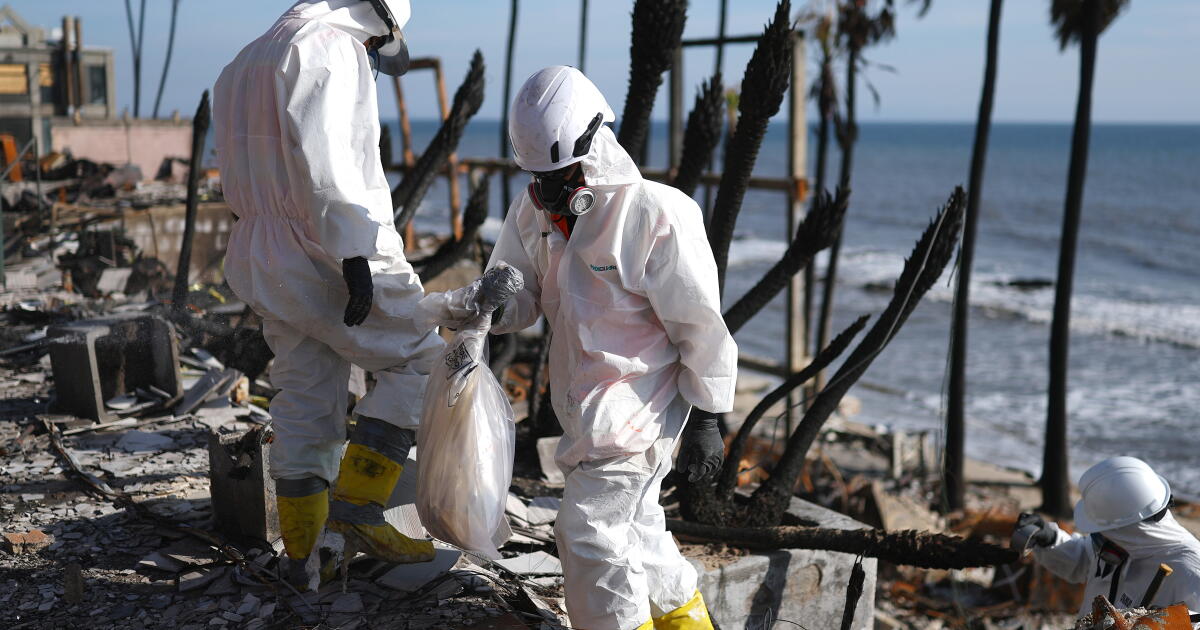
Los Angeles County launched a probe into Farmers Insurance Company’s handling of claims by policyholders impacted by last year’s devastating Eaton and Palisades wildfires, after a growing number of residents complained of delays, denials and underpayments.
In a letter sent to Farmers on Wednesday, the county’s lawyers said if the company is engaging in any unlawful or unfair business practices, it must immediately stop.
“Eaton Fire survivors did everything right—responsibly paying their premiums year after year—but when disaster hit, Farmers left them with a contaminated home and refused to pay for testing and cleanup,” said Los Angeles County Supervisor Kathryn Barger, who represents Altadena, in a statement.
“My constituents shouldn’t have to walk back into homes with lead and asbestos because an insurance company won’t pay for the test that would prove it’s there,” she added.
Farmers disputed the county’s claims.
“As always, we operate in accordance with applicable laws and regulations,” the insurer said in a Thursday statement. “We do not believe the inquiry accurately characterizes our actions or practices and will cooperate through the appropriate process.”
“Serving our customers during difficult times is at the heart of what we do, which is why each claim is reviewed individually, taking into account the specific circumstances of the loss and the coverage provided under the policy,” the company said. “We remain focused on handling claims with care, consistency and attention to each customer’s unique situation.”
County officials said that at a recent meeting with Eaton fire survivors, those with Farmers policies said the insurer had been slow or resistant to pay for toxin testing by qualified industrial hygienists, forcing residents to pay for it themselves.
The testing revealed that many homes were contaminated with unsafe levels of lead, asbestos, chromium, and other toxic substances, the county said.
The residents also told the county that Farmers has refused to pay for adequate remediation of the contaminants and declined to cover ongoing living expenses.
“After paying millions of dollars in premiums, policyholders deserve the benefits and support they paid for,” said Supervisor Lindsey Horvath, whose district includes Pacific Palisades. “Families whose homes survived the Palisades and Eaton Fires but remain damaged or contaminated should not be forced to choose between returning to an unsafe home and financial devastation.”
The new investigation comes after the county filed a lawsuit against State Farm on Aug. 31 for its handling of Eaton and Palisades fire claims. The county claims State Farm engaged in illegal and deceptive business practices that kept victims from receiving what they were entitled to under their policies. State Farm denied the county’s claims.
Venezuelan political junkies witnessed an amusing phenomenon in the past few weeks: former presidential hopeful Henrique Capriles embraced a derisive meme about himself that suddenly became popular. Or more precisely, he, too, started joking about his own memefied persona, el manguanguas, the weirdly energetic, repetitive and even creepy politician that appears at your doorstep and, if you let him inside, sits down for hours to hablar de la situación while emptying your family’s coffee reserves.
Capriles is one of the most memeable characters in our universe and the manguanguas moniker is not a rarity. It comes from a 2019, early Juan Guaidó era livestream where he praises Guaidó and rants at Maduro for virtually terminating political competition a year before: “¡Coño, qué manguangua! ¿Ah?” (an indignant “hell, that’s convenient, huh?”).
The whole thing does say a couple of things about our (still overwhelmingly digital) public sphere and the memefication of Venezuelan politics. First, it seems many people were more eager to have a laugh and scroll down the manguanguas rabbit hole than to learn, say, about the US-Nabep deal and the involvement of bolichico king Alejandro Betancourt, a material architect of the crisis that remains the biggest handicap to the quality of life of Venezuelans. To put it another way, el manguanguas was getting an insane amount of attention while the US overlords faced their biggest reputational crisis in Venezuela since January 3.
The meme emerged because Capriles has been touring Miranda while Venezuelan politics become increasingly defined by what a group of gringos in navy blue suits decide to tweet on a Friday evening.
We’re not making a great discovery here—most people know memes can have spectacular traction when it comes to political messaging and campaigning. The Venezuelan jodita, the national propensity to make jokes about everyone and everything even in the midst of tragedy, can make memes an even stronger weapon in our digital sphere. It seems someone made Capriles aware of that: he first reacted by complaining on X, accusing “those who are paying a millionaire campaign in production and publicity” of attacking him on social media. Then he acknowledged it in a friendlier fashion: “They say I visit your homes to steal your coffee,” he said in a September 1 video in Barlovento. “They mock me because they don’t want to see me coming here.” In a later post, he made a toast with other townspeople raising tiny coffee cups: “Por la manguangua!”
Capriles decided to tag his recent posts with #OperaciónManguangua and the whole thing has been helping him—engagement around his account grew and became more positive as a result, though he still doesn’t dare to open the comments section in his X handle. It’s good news for him after a few years of unpopularity, when he formally joined the faux opposition camp. If not for the events of January 3 and a still dim opening of the political arena, Capriles would be flirting with irrelevance, just a washed-up face in the parliamentary seat Jorge Rodríguez gifted him in 2025, begging Iris Varela or Jorge Arreaza for a chance at the chamber’s microphone. We wrote about his acts and decisions extensively—or his lack of courage and effectiveness—in the late Maduro era. But Capriles is not yet irrelevant, at least in my opinion.
The meme emerged in the first place because Capriles has been touring the state of Miranda this summer—a post-Maduro redemption tour, if you will—while Venezuelan political events again become increasingly defined by what a group of gringos in navy blue suits decide to tweet on a Friday evening. A few years ago, Capriles campaigned strongly about “bringing politics back to the country” in a not-so-slight dig at Guaidó, Leopoldo López, and the Trump-backed interim government they led. He now recognizes María Corina Machado as the rightful opposition leader and criticizes her exclusion from the so-called negotiations, so this is not about a plot against her.
Venezuelan politics started to see some interesting movements a few months ago, but these have become less and less intense as the rest of the opposition waits for Machado’s return or the green flag of an election date.
As weak and isolated as he may look, Capriles is one of the few opposition people with actual freedom to call things what they are when it comes to the United States and Venezuela. That is not the case for Machado, Juan Pablo Guanipa, or other figures who might be playing a role behind the scenes. Capriles didn’t have to wait for Marco Rubio’s explanations five days later to make his case about the US-Nabep deal. He was quick to assert that the oil belonged to the people on the day of Trump’s bombastic announcement, and made some sensible questions: What’s the deal’s scope? What’s its legal basis? What do Venezuelans receive, and under which conditions? Elliott Abrams, the GOP hawk and special envoy in Trump’s first term, noted Capriles’ almost lonely stance as a sign of the country’s worrying lack of politicians who are truly independent from Washington (to make his point, the former operative of Ronald Reagan also quoted the Venezuelan Communist Party in his Washington Post op-ed).
Will the manguanguas joke give him an enhanced platform? Maybe for a bit, though Capriles has a habit of messing things up and making people grow tired of him rather quickly. Right now, he is being noisier than at that time he was supposed to run for the 2023 primaries, only to chicken out in the final stretch, knowing he stood no chance against Machado. However, the videos he has been posting of rural communities in the state he once governed do carve out an accurate picture of how the country looks outside a few big cities. In the Barlovento area, Capriles is seen visiting a ramshackle school where the roof looks about to fall down, with a disgusting pile of books and furniture eaten by heat and dust as a library, its walls and windows looking flimsy when not broken. Another post shows a nearby ghost town, Tacarigua de la Laguna, where Capriles records an empty beach in front of him and an abandoned building behind—the only living thing nearby being a baby cat. Mire, aquí lo único que quedó es el gatico, he says.
In March, we wrote that the political heat map of Venezuela was starting to see some interesting movements, but these have also become less and less intense while the rest of the opposition waits for María Corina’s return or the green flag of an electoral calendar to light up the party. Maybe, if the people are kept waiting, angry or disappointed with the Americans as the opposition watches from the dugout, Capriles will remain the only cat making noise. Mire, pues vamos a ver.
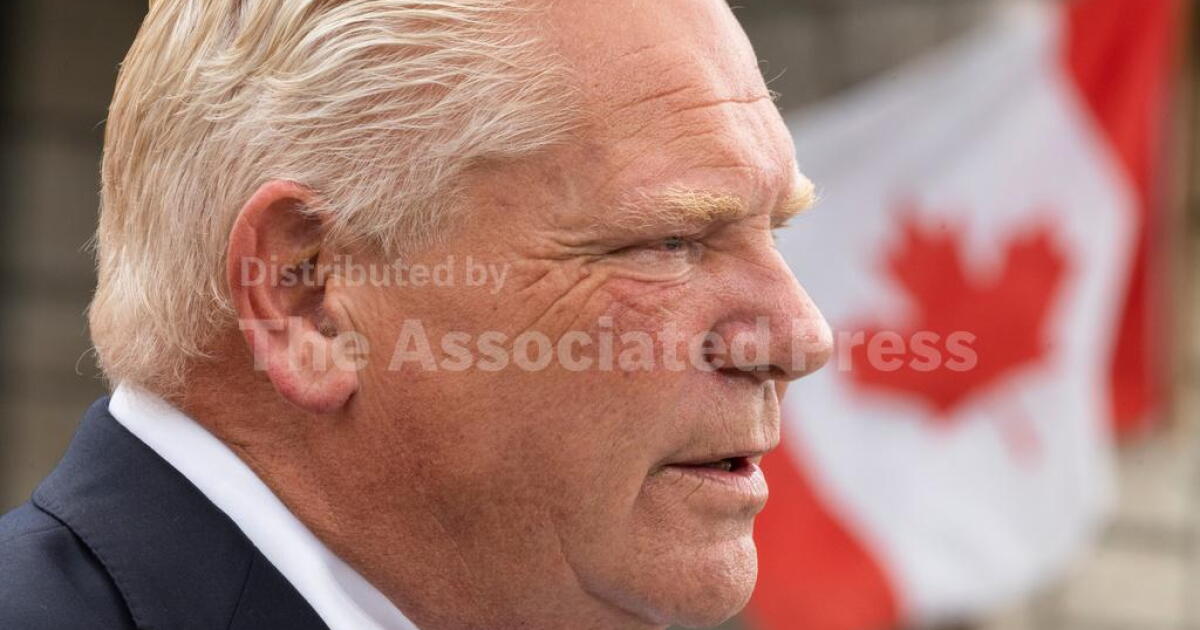
TORONTO — Ontario Premier Doug Ford said Thursday he hopes President Trump’s Republicans lose both the House and Senate in the midterm elections, saying voters should punish Trump politically for his escalating trade war with Canada.
“Hopefully he’s going to lose the Senate. He’s going to lose Congress. I hope so, and hold him accountable,” Ford said. “But we’ll see how that goes. We aren’t going to interfere in the U.S. election.”
Ford has emerged as one of Trump’s most outspoken Canadian critics, accusing him of trying to strip industry out of Ontario and move it south of the border as the two trade personal insults and threats.
Ford’s comments came two days after Washington escalated the dispute by banning some Canadian dairy products and motorcycles and most alcoholic beverages after Canadian retaliatory tariffs took effect on about $20 billion in U.S. goods. Trump also moved to shut Canadian products out of large, long-term U.S. government contracts.
“He’s not reliable at all,” Ford said. “He could make a deal today and then change his mind. And we’ve seen that over and over again.”
Still, Ford said he believes Trump wants an agreement before the midterms and that Canada should return to negotiations as soon as possible.
“I truly believe President Trump wants a deal before the midterms,” Ford said. “I could be wrong, but I think it’s best that we sit down and get a deal.”
Last year, Trump abruptly ended trade talks with Canada after Ford’s Ontario government aired an anti-tariff television ad in the United States using former President Ronald Reagan’s criticism of tariffs.
The feud repeatedly has turned personal. In an interview with the Associated Press last month, Ford mocked Trump for keeping a portrait of Reagan near his desk while pursuing tariffs the former president had criticized, saying Reagan would be “throwing up on him from the picture if he knew what was going on.”
Trump described him as “the less charismatic, intelligent, and overall unimpressive brother of the late, great, Rob Ford.”
Trump also signed an executive order directing the U.S. government to refer to Lake Ontario as “Lake America,” a name Canada does not recognize.
Ford said Thursday that Trump unintentionally strengthened Canada by forcing it to reduce its dependence on the United States.
“The only two good things Donald Trump has ever done for Canada,” Ford said, were that “he woke us up” and “he united the country like I’ve never seen before.”
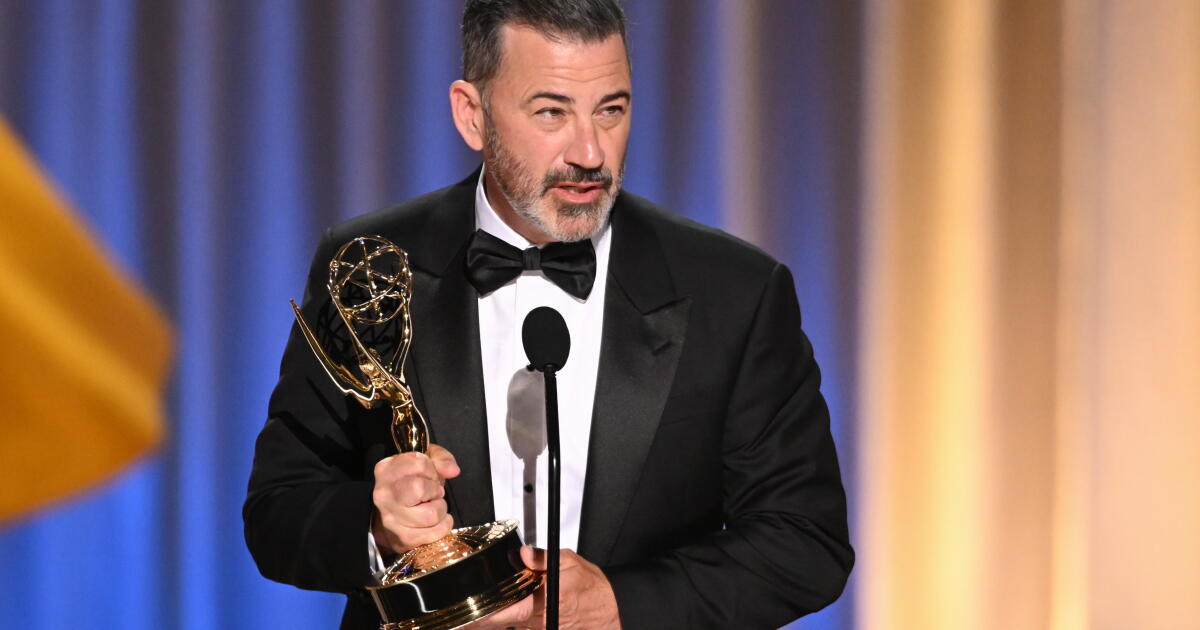
ABC comedian Jimmy Kimmel’s interview with Texas Senate candidate James Talarico won’t air on broadcast television amid the network’s high-stakes skirmish with the Federal Communications Commission.
Kimmel, during his Wednesday night monologue, said his talk with the 37-year-old Texas Democrat would instead stream on his show’s YouTube channel — depriving ABC viewers and TV stations of a potentially newsworthy interview with Talarico, who has been surging in the polls.
The Texas race is shaping up as a key contest in what could help decide control of the U.S. Senate in the mid-term elections.
Kimmel alluded to the Walt Disney Co. network’s ongoing dispute with FCC Chairman Brendan Carr as the reason for the switch. This spring, Carr’s Media Bureau ordered ABC to submit to an early review of its TV station licenses for Disney’s eight owned stations. The FCC launched the review a day after President Trump demanded Kimmel be fired after First Lady Melania Trump became upset over a joke the comedian told on his program, “Jimmy Kimmel Live!”
ABC has since sued the FCC, alleging Trump’s disdain for Kimmel and other ABC programs has fueled the FCC’s heavy-handed approach to the network, in violation of its 1st Amendment rights.
Kimmel pointed to the “unusual circumstances” in his monologue.
“For the whole 20-plus years of our show, in fact, I’ve been interviewing Americans who are running for office with no problem at all, just like [David] Letterman did, [Jay] Leno did, Arsenio [Hall], etc. etc.,” Kimmel said. “I’ve interviewed a lot of political candidates — from Hilary Clinton to Ted Cruz to Donald Trump.”
But, Kimmel said that in the current climate, airing the Talarico interview on the public airwaves carried too much risk.
“Out of consideration for our local stations, especially our ABC affiliates in Texas who would have to deal with this nonsense,” the ABC interview, which was scheduled for Thursday, would instead play on YouTube, he said.
ABC declined to comment. An FCC spokesperson did not immediately respond to a request for comment.
The issue surfaced nearly one year after a major dust-up when ABC temporarily benched Kimmel after comments he made on his show over the shooting of conservative activist Charlie Kirk. During that episode, Carr seemed to threaten Disney by saying that Kimmel should be punished.
“We can do this the easy way or the hard way,” Carr said. “These companies can find ways … to take action … on Kimmel or there is going to be additional work for the FCC.”
Two station groups removed Kimmel’s show, but ABC eventually stood by the comedian returning him to his perch the following week.
The Disney-owned station licenses were not set to expire for several years when the FCC demanded that Disney defend its stewardship of the outlets. The license for Disney’s KABC-TV Channel 7 in Los Angeles extends to 2030 but it is now being challenged.
The Burbank giant has asked a federal judge to issue a temporary restraining order and injunction to halt the FCC’s early station review.
ABC also is defending against an FCC probe into whether its daytime talk show, “The View,” should be entitled to an exemption from the so-called equal-time rule for political candidates who appear as guests.
Carr has challenged the status of “The View,” arguing that the topical chat show is not a bona fide news program and, thus, should not be entitled to the exemption.
The same issue tripped up former CBS late night comedian Stephen Colbert who interviewed Talarico in February — before his program, “The Late Show with Stephen Colbert, was canceled.
At the time, Colbert told viewers CBS lawyers forbid him from airing a Talarico interview on his program due to the FCC’s increased scrutiny of exemptions to the equal-time rule, an allegation that CBS disputed.
But Colbert’s interview played on the program’s YouTube channel — not the CBS network.
The FCC has said it was investigating ABC stations over whether the company’s diversity and inclusion policies are in violation of the Communications Act of 1934 and the agency’s rules, including its “prohibition on unlawful discrimination.”
Last week, the FCC asked a federal judge in Washington to dismiss ABC’s 1st Amendment lawsuit, calling Disney’s challenge to the early review “meritless” because the commission hasn’t made a decision on whether to escalate the matter or rescind Disney’s station licenses.
Kimmel ended his monologue, saying he was grateful for the YouTube channel “because in the America we live in right now, that is the best that we can do until November.”
On Sept. 11, 2001, there were no smartphones and no social media. What the country watched that morning — a jet airliner colliding with the south tower of the World Trade Center, the ash rolling through the streets, the paper still falling in the afternoon — was through a television set and the journalists who had to deliver the unfathomable details.
The jarring images shattered the peacefulness of a sunshine-filled late summer morning in New York.
“Everything seemed so perfect,” said MS NOW’s Chris Jansing, reflecting on the moments before anchoring her network’s continuous coverage. “It was another day of doing a job I loved, living in a city I loved.”
By nightfall, nearly 3,000 people were dead in lower Manhattan, at the Pentagon and in a field outside Shanksville, Pa. The experience of covering the terrorist attacks and their grim aftermath transformed Jansing and other journalists who were there. Twenty-five years later, it’s never far from their minds.
“It’s with me in ways large and small,” said NJ Burkett, a correspondent who covered the tragedy for New York station WABC. “When I look at my phone and it says 9:11, it takes me back.”
The Times asked five of the on-air personalities who are still working today to look back on the day they were called to cover the tragedy and its lasting impact.
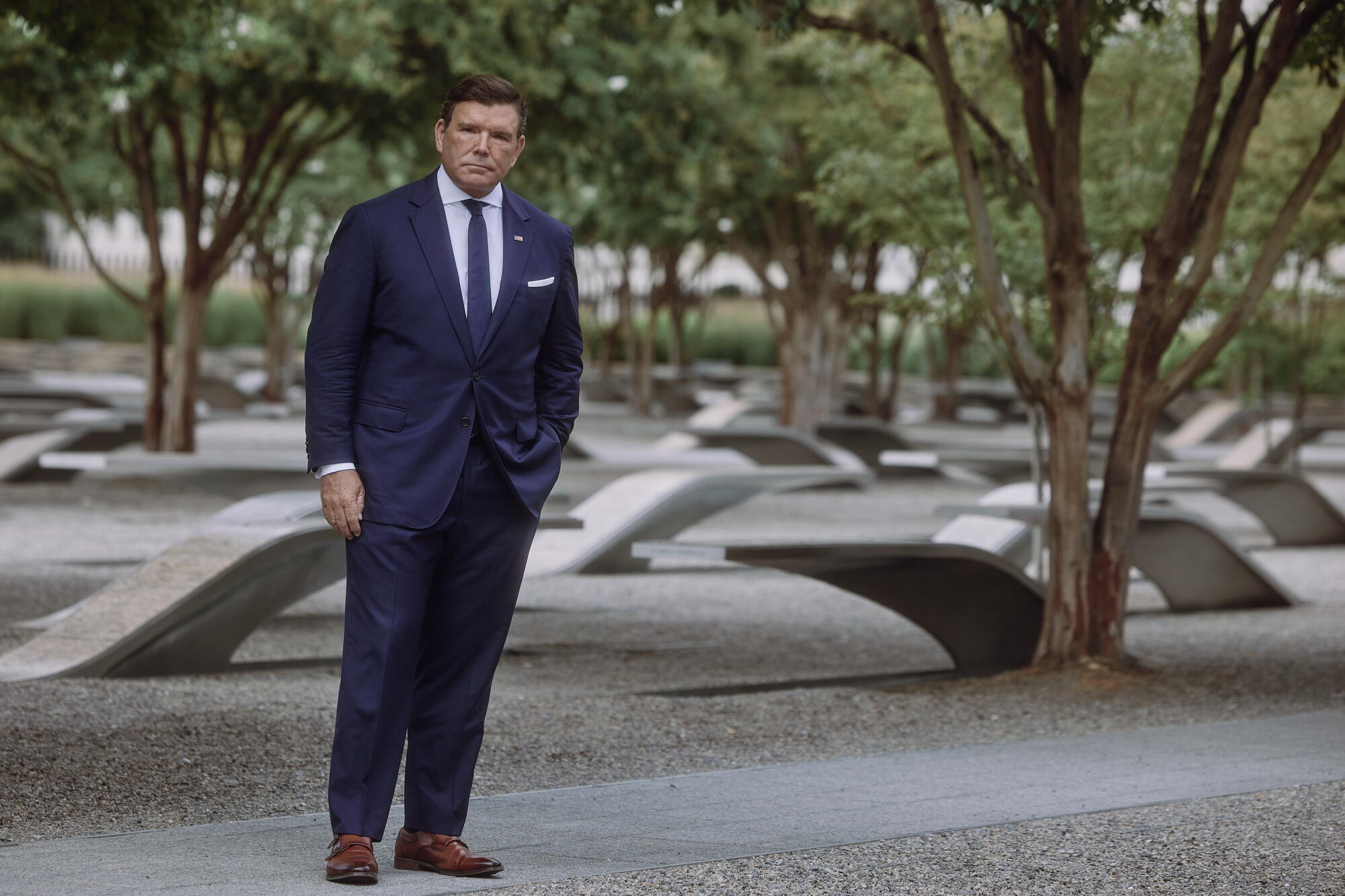
Bret Baier: “I just said yes to everything.”
Fox News anchor Bret Baier at the National 9/11 Pentagon Memorial in Arlington, Va., on Aug. 25, 2026.
(Jared Soares/For The Times)
On every anniversary of Sept. 11, Fox News anchor Bret Baier uses the hashtag #NeverForget. He can recall every moment of that day.
Baier, 56, was driving to the Fox News bureau in Atlanta when he first heard on his car radio that a plane had hit the World Trade Center. He was a 31-year-old correspondent for the network, covering stories throughout the southeast U.S. and Latin America. When he arrived at the office, a call came from New York headquarters telling him to book a flight to the city so he could file reports from the World Trade Center site for Fox TV affiliates around the United States.
After a second plane hit the south tower of the World Trade Center 17 minutes later, all flights in the U.S. were halted. Baier and his producer were told to get a car and start driving.
“I just remember going really fast when I was driving,” Baier said. “I remember thinking what is happening with the world, and how big this story is. How big this moment is.”
By the time the duo reached northern Georgia, their plans changed again. A jetliner struck the Pentagon while a San Francisco-bound United Airlines flight crashed in Shanksville, Pa. Fox News executives told Baier and his producer to reroute to Arlington, Va.
After the 10-hour drive, Baier started the first of 10 straight days of reporting on the recovery efforts at the site. While the World Trade Center provided the most dramatic and enduring pictures of the stunning attack, the loss of life at the Pentagon was staggering as well, as 125 people died along with the 64 passengers and crew members on American Airlines Flight 77.
Baier was eventually pulled into the larger military story that followed 9/11. Fox News, just 5 years old, did not have a full-time Pentagon correspondent. Baier was offered the job while traveling overseas with Defense Secretary Donald Rumsfeld, who was making the case for war against Afghanistan.
“I called a buddy on a satellite phone to get me an apartment in Washington,” he said. “Fox packed up my stuff in Atlanta.”
But the unplanned move changed Baier’s life. In six years on the Pentagon beat, he traveled to 74 countries. He was embedded with the military in war zones. “I just said yes to everything,” said Baier, who has anchored Fox News’ Washington newscast “Special Report” since 2009.
Baier recalled it was in the weeks after Sept. 11 that he first wore an American flag pin on his lapel. He never felt conflicted about it, even though such displays were prohibited at other network news divisions. “I thought I could report on America, ask tough questions and still be an American, pulling for us to win,” he said. “I wanted to be tough but fair, but also show that as a country we were standing together against this horrible attack.”
Byron Pitts covering the terrorist attacks in lower Manhattan for CBS News on Sept. 11, 2001.
(CBS)
Byron Pitts: “It’s the only story I think about every day.”
A newcomer to New York 25 years ago, Byron Pitts, then a CBS News correspondent, admitted it took him a few moments to understand the massive scope of what happened the morning of Sept. 11, 2001. He arrived early at the network’s headquarters on the West Side of Manhattan to screen an interview he did with entertainer and civil rights icon Harry Belafonte. Shortly after he started, a producer knocked on his door and told him there was a plane crash at the World Trade Center.
Pitts, 65, acknowledged the producer but kept working. “I thought it was a novice pilot bumping into a building,” he recalled. “I thought it would be three hours out of my day and it won’t make television.”
The producer came back shortly and said, “You need to go down there.”
An irritated Pitts hailed a cab and headed down the West Side Highway. While in the car, he learned a second plane had hit the south tower. Traffic was stopped and he had to head downtown by foot.
As Pitts got closer to the site, he tried to use his past experiences covering fires and other disasters during his career to judge the severity of the situation.
But the horrible scenes that unfolded before him were incomparable. One was a lifeless body near the lobby of the north tower. He thought it was a homeless man until he saw a uniform. He later learned it was Father Mychal Judge, the chaplain of the New York Fire Department killed by fallen debris. Judge’s body was later carried away by a group of first responders. Pitts saw a woman and a man standing at a window of one of the towers holding hands, and then jumping.
“Gravity takes over and their hands split, and he moves a little faster than she does,” Pitts said. “And we see them on the ground. That was the moment I realized something significant was going on.”
Pitts crossed paths with Mika Brzezinski, then a CBS News correspondent, now the cohost of MS NOW’s “Morning Joe.” As debris came down and smoke filled the air, they headed into an elementary school that Pitts believes was a command post for the fire and police departments. They took turns calling into CBS News on a hard-line phone, one delivering accounts of the unfolding catastrophe while the other looked outside to gather details amid the blinding smoke and dust.
Pitts said from that day forward, he never went to a story assignment without a handkerchief.
Pitts was awed not just by the enormity of the event, but also by how despite the rigid hierarchy of CBS News, he was “the new kid on the block” who had to present the story on Dan Rather’s evening newscast that night.
“My approach became almost childlike, so I would not become overwhelmed,” he said. “I tried to make it as simple as possible. I said, ‘Dan, I’ve never heard New York City this quiet.’ I was thinking — what simple thing can I say that you would understand if you’ve never been in New York.”
A few weeks later, Pitts headed off to Afghanistan to cover the U.S. military action. His evening news report on Sept. 11 won an Emmy Award and his star rose at CBS News, leading to “60 Minutes” and then ABC News in 2014, where he is currently a co-anchor of “Nightline.”
Pitts knows the good fortune he’s had in TV journalism is linked to the tragedy that started with a producer’s knock on his door 25 years ago. “I feel some measure of guilt but mostly gratitude,” he said. “It’s the only story I think about every day.”
Pitts said he uses his 9/11 experience to provide perspective. “When we’re discussing politics, a mass shooting, or the latest awful day in Iran, I know for a fact there is one guy in the room who has seen worse and who can say, ‘we’ll be OK,’ ” he said.
Chris Jansing: “You had to balance the news response with the human response.”
Chris Jansing paid her dues as a local reporter in upstate New York before she joined MSNBC (now called MS NOW) as a daytime anchor in 1998. She loved living in Manhattan, and took friends from out of town to the World Trade Center observation decks and Windows on the World, the restaurant on the 106th floor of the north tower.
“It was so iconically New York,” she said. “And I was proud to live in the city.”
Jansing, 69, had little time to process her emotions when she was told to “get in the chair” before 9 a.m. that morning at MSNBC’s Secaucus, N.J., studios after the first plane hit.
“You had to balance the news response with the human response,” she recalled.
For several hours, Jansing co-anchored the network’s coverage alongside Gregg Jarrett. The look of 24-hour cable news evolved that day, as the tsunami of information led to Fox News, MSNBC and CNN all adding running tickers at the bottom of the screen.
Jansing went to the roof of the network’s building after Brian Williams took over the anchor chair. Trauma centers in the area had been alerted, and she was told to watch for ambulances. “There was still a hope and a prayer that there would be injured folks who would overwhelm the hospitals in New York and would need to be brought to New Jersey,” Jansing recalled. She saw none.
Jansing has never watched the coverage of that day, which is now on YouTube. She had real-life reminders every day in her Manhattan neighborhood when she walked by the Rescue Company 1 firehouse that lost half its battalion at the crash site. She adopted a dog left behind by a 9/11 victim, a Dachshund named Baron. She remains friends with every producer she worked with on the story. The experience also reinforced her purpose in a career approaching its 50th year.
“I will always think that those moments are what keep you going,” said Jansing, currently chief political reporter for MS NOW. “They were an affirmation that’s kept me in the job,”
NJ Burkett, a correspondent for WABC, on the 13th floor of the Walt Disney Co. offices in Manhattan on Aug. 31, 2026.
(Roshni Khatri/For The Times)
NJ Burkett: “I put myself in increasingly dangerous situations.”
Burkett, 64, recalls how pedestrians were gathered around WABC’s windowed street level studio on the Upper West Side of Manhattan when he arrived for work on 9/11. He presumed the crowd was there for a big name guest on “Live with Regis and Kelly.” They were actually watching monitors showing news reports of the first plane that hit the north tower.
As Burkett and his cameraman Marty Glembotzky headed downtown in a truck, he already knew it was a terror attack. He recalled covering the 1993 terrorist bombing of the World Trade Center and regretted not getting footage of the firefighters’ rescue efforts. This time around he wanted to go inside the buildings and document their heroism.
A police officer stopped Burkett and Glembotzky before they could get in, likely saving their lives. A short time later, they would escape death again.
Burkett was doing a second take for a taped report that would set the scene for viewers when he heard the rumbling that “sounded like Niagara Falls.” It was the south tower of the World Trade Center coming down behind him. “A huge explosion now raining debris on us — we better get out of the way,” he said in what may be the most terrifying video clip from that morning.
Burkett and Glembotzky took cover in an adjacent building. “We open up the door and in a weird way it’s sort of providential, right?” he said. “The door is a metaphor. It’s like the door into the rest of your life. If we had to run for half a block, we’d be dead.”
Glembotzky was so shaken by the experience, he stepped away from his career as a cameraman and became a wine seller before eventually returning. But Burkett took on more dangerous assignments in the Middle East, heading to Israel to cover the Palestinian uprising known as the Second Intifada. He later headed to Iraq to cover the run-up to the U.S. invasion in 2003.
Burkett won a George Foster Peabody Award for his work on 9/11. In retrospect, he believes he took on assignments in war zones to avoid dealing with the trauma of the day.
“I would put myself into increasingly dangerous situations,” he said. “Looking back, I was running from 9/11. That was my way of coping. Sometimes I wonder did I allow myself feel it enough. Or did I just run too far and too hard and it will all come down and crash on me one day?”
Occasionally he worries about 9/11-related illnesses. “If I start to cough — the slightest little cough — I’ll think ‘is this it?’” he said.
But as a New York TV fixture since 1989, Burkett still feels the appreciation from viewers for his efforts. “To this day, almost 25 years later, people will come up to me on the street and ask to hug me and say ‘NJ Burkett I’m glad you’re alive,’ ” he said.
Carson Daly at NBC’s “Today” show studio at Rockefeller Plaza in Manhattan on Sept. 3, 2026.
(Roshni Khatri/For The Times)
Carson Daly: “I remember how motionless the room was.”
As continuous news coverage of the Sept. 11 attacks saturated television for days, the makers of entertainment shows had to decide when it would be appropriate to go back to work. Carson Daly and the MTV executives mulled over the situation as their wildly popular program “Total Request Live” remained off the air for three days since the attacks.
“We had such a massive audience that the question was raised, ‘do we have a responsibility to simply show up?’ ” Daly, 53, recalled in a recent interview.
Daly, now a feature anchor on NBC’s “Today,” was not a journalist by trade. But he understood the trust that young viewers had in him and “TRL,” a live show that counted down the most popular music videos of the moment. The show had dealt with tragedy a few years before after the high school shooting in Columbine, Colo.
But 9/11 happened on the home turf of “TRL,” which aired from New York City’s Times Square. With the bridges and tunnels closed, getting a crew to the studio was a challenge.
“Everybody wore multiple hats,” said Daly, who also served as an executive producer.
By Sept. 14 of that week, the MTV studio on Broadway was filled with young “TRL” fans, but lacked the energy viewers were used to seeing on the screen. “They were frozen,” Daly recalled. “That was in such stark contrast to what the show was every day. I remember how motionless the room was and feeling like, ‘What am I doing on television?’ ”
Carson Daly shows a tattoo he got after the 9/11 attacks in New York.
(Roshni Khatri/For The Times)
Daly leaned on the MTV News team to update the audience on the 9/11 story developments. Music stars including Jay-Z, Justin Timberlake and Kid Rock called into the program to share their thoughts with Daly. Instead of music videos, the screen showed email messages from viewers expressing their feelings about the tragedy.
MTV News personality Sway delivered a music news report that noted how two new CD releases — “Party Music” by the American hip-hop group The Coup and Dream Theater’s “Live Scenes from New York” — were delayed because both used cover artwork that depicted the destruction of the World Trade Center.
Daly has a permanent remembrance of the week. When he arrived at the MTV offices the day before “TRL” returned, the building was evacuated after it received a bomb threat.
“I remember walking around Hell’s Kitchen,” he said. “I ended up getting a tattoo. A red, white and blue NYC on my right wrist.”
JEFFERSON CITY, Mo. — The U.S. Supreme Court again rejected a push to use Missouri congressional maps backed by President Donald Trump on Thursday, a loss for Republicans trying to maintain control of the House in the fast-approaching midterm elections.
The decision appears to clear the way for use of the old maps.
It comes after a pitched court battle shortly before ballots begin going out for the pivotal November elections. The maps were drawn to help Republicans gain an additional U.S. House seat.
It’s the second time the high court has refused to intervene to keep the Trump-backed maps in place.
*Some interviewees asked that their surnames be withheld because of the political nature of the interviews.
Malmo, Sweden – A very Swedish political tradition is playing out in Malmo, the country’s third-largest city. Rows of twee campaign booths, known as “election cottages”, are packed into a corner of the central square.
Recommended Stories
list of 3 itemsend of list
National polls have Sunday’s election on a knife-edge, with the centre-left opposition bloc led by the Social Democrats just a few percentage points ahead of the right-wing group – a gap that has tightened over the past month.
In the middle of the row, representatives of the Left Party and the far-rightSweden Democrats (SD), bitter rivals from opposite ends of the political spectrum, campaign a metre apart.
Migration is a key election issue. Multicultural Malmo, with more than a third of the city’s 368,000 residents born outside Sweden, has become the centre of the debate.
For the right, the city represents failures of integration, a cautionary tale it says of what happens when immigration goes unchecked. Beyond Sweden, Malmo draws disproportionate interest.
In 2017, the populist English politician Nigel Farage branded it the “rape capital of Europe”, a claim a leading Swedish criminologist dismissed as nonsense, while Germany’s far-right AfD has used it in its narratives about the dangers of immigration.
Strength in diversity
In the city’s town hall, a grand building with a Dutch Renaissance-style facade, Anfal Mahdi, an opposition councillor in Malmo for the Left Party, sits amid the splendour of green velvet chairs, historical oil paintings and royal portraits.
Right-wing politicians ignore the socioeconomic challenges of living in the areas built under Sweden’s “Million Programme”, she said, referring to an ambitious scheme to build one million new homes between 1965 and 1974.
It began as a social housing initiative for working-class Swedish families. In later decades, as many of those families moved out, the apartments were allocated to migrant and refugee newcomers.
Observers say what began as a utopian welfare project gradually became the physical framework of today’s segregated suburbs.
Mahdi, whose family fled Iraq after the Gulf War, grew up in one of these areas during cuts to the welfare state that had defined modern Sweden, as public spending tightened after its early-1990s economic crisis.
But what they lacked in welfare, they made up for in diversity, she said.
“I had friends from Bosnia, Palestine, Somalia and when we grew up we did not have much, but we leant on each other,” she said.
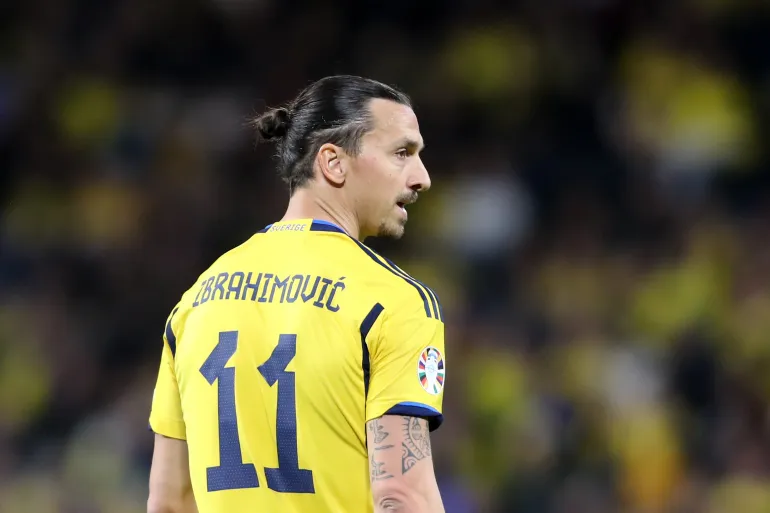
The city’s most famous son, Zlatan Ibrahimovic, grew up in Rosengard, a Million Programme estate on Malmo’s eastern side that police still classify as a “particularly vulnerable area”. The famous footballer regularly credits the area for shaping the skill and confidence that defined his career.
Zlatan Ibrahimovic grew up in Rosengard and went on to become Sweden’s all-time top goalscorer [File:Linnea Rheborg/Getty]
“It’s often in these neighbourhoods that people can shine; there is a sense of community that doesn’t exist elsewhere,” said Adam*, a 20-year-old florist who also grew up in one of the areas Sweden officially labels “vulnerable”.
He rejects the stereotypes associated with Malmo, saying young people here are far more concerned with the cost of living, finding work and the everyday pressures of getting by.
Mahdi shared this sentiment, saying “wallet politics”, relating to healthcare and unemployment, are central issues for all sections of society.
Healthcare tops voters’ concerns nationally, while unemployment in Malmo, at around 11 percent, is among the highest of any Swedish municipality.
A Green Party campaigner in Malmo, behind are stands belonging to the Moderate Party and Communist Party of Sweden, September 9, 2026 [Nils Adler/Al Jazeera]
But not everyone sees it that way.
Lena, a 78-year-old campaigner for the Moderate Party, which leads the right-wing bloc, believes integration along with schooling are taking centre stage. At the last election cycle, it was care for the elderly, she said.
Jacob, a 19-year-old resident who was speaking to representatives of various parties, said a taboo has been broken with more young people turning right, including towards the SD, now polling as Sweden’s second-largest party.
The far-right party with neo-Nazi roots could enter government for the first time if the right-wing bloc wins: Prime Minister Ulf Kristersson has promised cabinet posts, including the migration portfolio.
Anfal Mahdi in Malmo town hall, January 9, 2026 [Nils Adler/Al Jazeera]
‘Divisive politics’
Sara, a woman in her twenties of Palestinian heritage, said “divisive politics” are normal now. The rhetoric around immigration and Islam in particular has left her feeling some “don’t want integration or even assimilation, they just want you to leave”.
Under the current right-wing government, many teenagers who grew up in Sweden with their families were ordered to leave on turning 18 while their parents were allowed to stay. The government paused the separation in March after a public outcry and moved to reform in June.
In February, the Swedish Migration Agency ordered an eight-month-old boy born in the country, Emanuel, to be deported alone to Iran while the rest of his family kept their permits.
Thousands of pro-Palestine protesters march through the streets of Malmo, May 11, 2024 [Nils Adler/Al Jazeera]
The system concerns Binto Drammeh, whose father is of Gambian heritage.
“Our uncle was made to leave as he didn’t meet the income threshold,” she told Al Jazeera.
The government has repeatedly raised the salary threshold for work permits, most recently in June, when it increased from 80 to 90 percent of the Swedish median wage.
Failing to meet it could ultimately lead to a deportation order.
Criminal networks
Crime is another main election issue.
With a population of 10.6 million, Sweden has one of Europe’s highest rates of deadly gun violence, even though lethal violence fell last year to its lowest level since 2012.
Among the challenges, criminal networks are recruiting children as young as 12 to transport weapons, sell drugs and carry out contract killings. In 2024, Danish gangs were found to be hiring Swedish teenagers to carry out shootings and bombings.
How to tackle the problem divides the parties.
The right prioritises punishment and deterrence, while the left and centre-left emphasise tackling root socioeconomic causes, rehabilitation and preventive social work. The lines are not always clean, however: the Social Democrats backed lowering the age of criminal responsibility, while the Left, Green and Centre parties voted against it.
TikTok politics
Young voters appear more engaged than at the last election.
Lena of the Moderate Party said: “I haven’t met one person who said they won’t vote,” while Mahdi said the Palestine issue has had a galvanising effect.
“Right now, all the posts on my TikTok page are from party accounts; they got a lot of likes and views and many videos are trending,” said Jacob, the 19-year-old resident.
Yet some are undecided about whom to vote for, partly because of Sweden’s unusual bloc system. Built on the idea of consensus, it means a vote for one party’s policies may be diluted in coalition, or are hard to push through.
“I will be honest, I have not voted yet,” Adam said, as he looked out at the array of campaign booths next to his flower stand. “Young people are interested in politics, but many of us think that no matter who comes, nothing will really change.”
A Social Democrat Party poster (left) reads ‘Now it is the ordinary folks’ turn’ and Left Party posters read ‘Yalla, Yalla housing for all’ and ‘Good schools for every young person’.
A sweeping bipartisan bill that seeks to prevent catastrophic wildfires and restore fire-ravaged forests has revealed a schism in the nation’s environmental movement as some conservation advocates find themselves allied with a longtime foe: loggers.
The Fix Our Forests Act, which Congress is close to passing, aims to speed up forest management projects on public and tribal lands by reducing regulatory and legal hurdles.
The proposed legislation comes at a time of increasingly devastating wildfires and has garnered wide support among Republicans and the timber industry.
However, the traditional Democratic coalition of environmental groups is split over the role humanity has to play in forest management. Some argue ecosystems are best protected when humans leave them alone — a view that dominated during the timber wars of the ’80s and ’90s. Others argue that humans have a responsibility to intervene — an increasingly popular idea as climate change threatens ecosystems around the world.
Among the major environmental groups that oppose the legislation are the Sierra Club and Center for Biological Diversity. They worry that limiting environmental review and litigation will allow timber companies to heavily log these areas instead of gently thinning them. Meanwhile, some Southern California groups worry the bill would allow well-meaning land managers to approve misguided projects that ultimately harm local shrublands, which have a very different relationship with fire than the bill’s namesake, forests.
“It’s really handing the keys to the Trump administration to be able to push forward a lot of their timber agenda,” said Anna Medema, deputy legislative director for forests and public lands at the Sierra Club.
But the Nature Conservancy and other groups have voiced support for the bill, citing the constant and imminent threat that increasingly severe wildfires pose to communities and ecosystems.
“We do advocacy at a twofold level. We are doing defensive work to fight back against bad things, and we’re also trying to promote the good things that are happening on the ground,” said Morgan Cashwell, North America director of legislative affairs for the Nature Conservancy. Right now, that good work needs to “meet the moment in the current wildfire crisis.”
That sentiment appears to have motivated Western lawmakers in particular.
In the House of Representatives, roughly half of the Democrats from Western states voted for the bill, compared to about a quarter of Democrats from elsewhere in the country. Republicans voted overwhelmingly in favor. The legislation is now awaiting a final vote in the Senate. Congress has until Jan. 3, 2027, to pass it.
“Wildfires today are very different than wildfires from a generation ago,” said Sen. Alex Padilla (D-Calif.), who co-introduced the Senate version of the bill. “Oftentimes, they’re irreversibly devastating ecosystems and watersheds.”
“So,” he said, “ the status quo is clearly not working.”
Rep. Bruce Westerman (R-Ark.), center, chairman of the House Committee on Natural Resources, delivers remarks at the Capitol in March 2023.
(J. Scott Applewhite / Associated Press)
The act was born when Rep. Bruce Westerman (R-Ark.), a former forester, stole a seat on a plane next to Rep. Scott Peters (D-San Diego). He used the opportunity to talk Peters’ ear off about a beloved species of tree that is under threat from worsening wildfires: the giant sequoia.
The two introduced a bill to protect them, called the Save Our Sequoias Act, and quickly saw an opportunity for something bigger.
“I knew right away that this could be a gateway to talking about permit reform,” Peters said. So, “we started working on a bigger, nationwide reform of forestry practices which have been really, really clogged up.”
While California grasslands, shrublands and woodlands are adapted to different frequencies and intensities of wildfire, research has found that high-severity fires — which kill the vast majority of trees in their path — are scorching 30 times more land area than in the 1980s.
The result: California is losing, on average, more than 200,000 acres of forest every year — or roughly 2.5% of all woodlands in the state every decade. U.S. Forest Service efforts to resuscitate these ecosystems have failed to keep pace. In recent years, the agency has reforested only about 1% of woodlands that are unlikely to recover on their own.
Californian supporters of the Fix Our Forests Act argue the problem has more to do with permitting delays than finances.
Marin County firefighters train during a prescribed burn in June in San Rafael.
(Heather Diehl / Getty Images)
Rep. George Whitesides (D-Santa Clarita), who co-sponsored the Fix Our Forests Act, pointed to nonpartisan research that found it takes the Forest Service more than five years on average to complete a full environmental review and begin work on forest thinning projects that use mechanical equipment like bulldozers and wood chippers. For prescribed burns, it takes more than seven years on average.
“That’s insane,” he said, that it “takes as long as a kid growing up to be a first grader to be able to move on this.”
The Fix Our Forests Act would exempt projects from the full permitting process if they were in areas with the most extreme fire risk and would expand existing exemptions for projects under 3,000 acres to cover projects up to 10,000 acres. It also would limit the window during which environmental groups can sue over project approvals.
These projects tend to employ a combination of harvesting timber and thinning smaller trees and plants with heavy machinery (often the favored tools of Republicans and the timber industry) and using prescribed fire to clear out the forest floor (often favored by environmental groups).
The “environmental left” has “made it endlessly time-consuming and ultimately cost prohibitive to maintain our forests, all with the promise that this would improve the forest environment,” said Rep. Tom McClintock (R-Elk Grove), a co-sponsor who authored some of the permitting exclusions. “Well, after 50 years, I think we’re entitled to ask, how’s the forest environment doing?”
In March 2025, President Trump issued an executive order that blamed “our inability to fully exploit our domestic timber supply” as a contributor to disastrous wildfires. In response, the U.S. Forest Service set a goal to increase the amount of timber open to logging by 25% nationwide over five years.
Scott Dane, executive director of the American Loggers Council, argued the nightmare scenarios of expansive clear-cutting from the timber wars are not on the table for America’s public lands.
“It’s a boogeyman position that they love to take from 100 years ago,” he said. “It’s not, in reality, in modern forest management at all.”
Watchdogs in Southern California have a different concern: While research shows forest thinning is an effective tool in overgrown Sierra Nevada woodlands, the state’s coastal shrublands are not denser than they historically have been. Consequently, the type of projects the Fix Our Forests Act would expedite are far more controversial and contested in shrublands. Local advocates fear the act would undermine their ability to push back on proposals with questionable scientific backing.
Goats and sheep graze on top of Kite Hill in May 2025 in Los Angeles for wildfire prevention.
(Juliana Yamada / Los Angeles Times)
In contrast to projects in conifer forests that aim to decrease the density of trees and vegetation across the landscape, shrubland projects are typically centered on creating a network of corridors hundreds of feet wide with no vegetation throughout the wildlands and clearing plants away from existing buildings.
While firefighters rely on these networks of fuel breaks to access the wildlands during fires and build containment lines, research has found that when firefighters cannot reach the fuel breaks — which is often the case during extreme winds — the lines only stop fires about 13% of the time. If they are not routinely maintained, they also risk supporting the growth of flammable invasive grasses.
In Los Padres National Forest, near Santa Barbara, officials proposed in 2022 creating roughly 187,000 acres of fuel breaks and structure defense zones. After organizations like Los Padres ForestWatch pushed back on the plan through the environmental review process, the national forest ultimately scaled the proposal down to about 22,000 acres this July.
“You had community input, and you had the federal government incorporating that input into a plan that is grossly improved,” said Benjamin Pitterle, director of advocacy and field operations at Los Padres ForestWatch. “It’s arguably a perfect example of how the process should work.”
Companies and special interest groups with some of the diciest issues expected to land on California’s next governor’s desk are among the top financial backers of Democrat Xavier Becerra, the gubernatorial front runner.
Money from Big Tech, the healthcare industry, labor unions and tribes helped propel Becerra’s bid for governor, which languished at the outset then took off just months before the June primary. All are major players in national and state politics and have a major financial stake on the policies of California’s next governor.
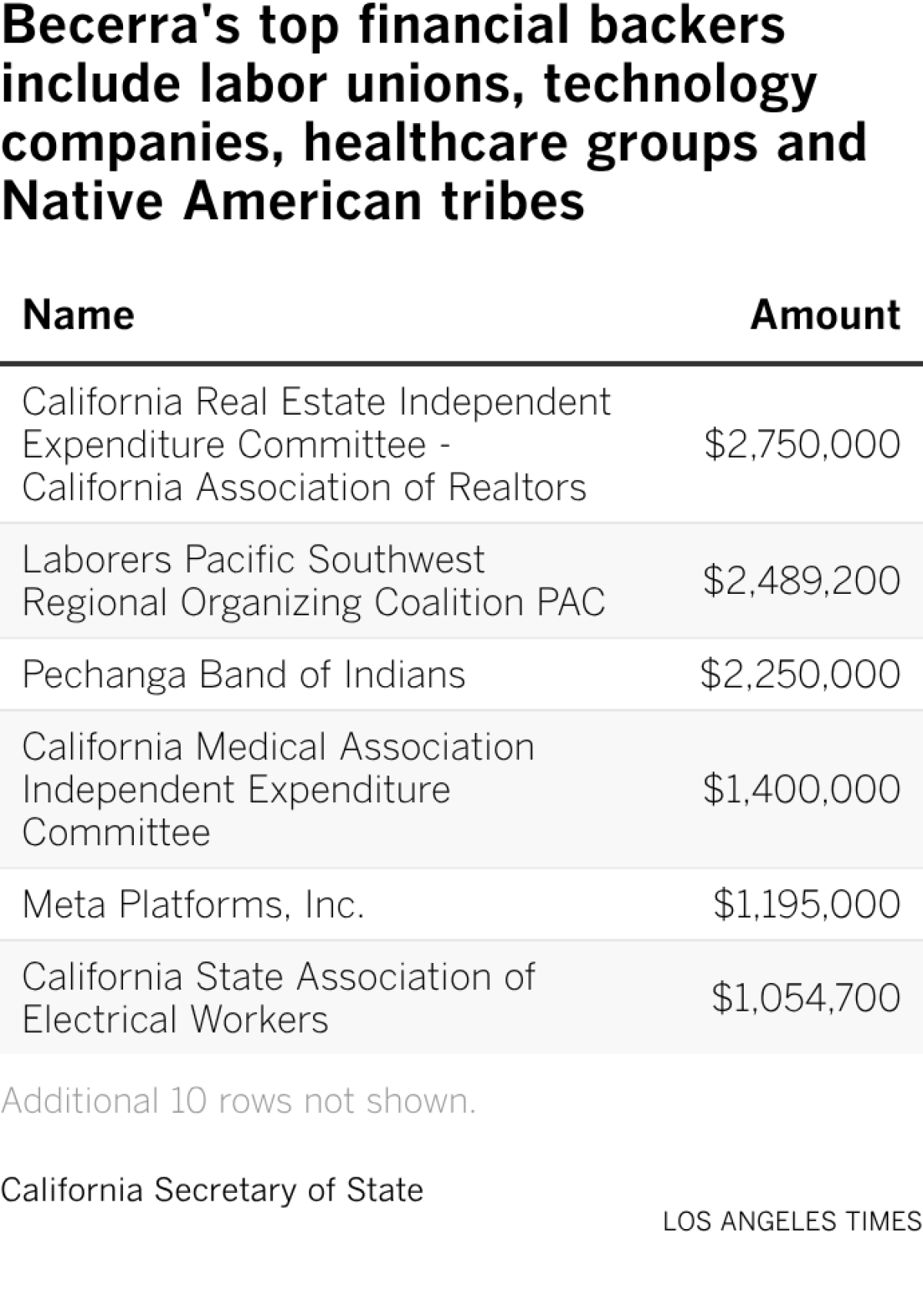
Meta, which has contributed nearly $1.2 million to groups backing Becerra’s campagin, has faced mounting scrutiny by lawmakers and the courts. The Menlo Park-based company, which operates social media and communication platforms such as Facebook, Instagram and WhatsApp, just agreed to a landmark $17.1 billion settlement to resolve multi-state claims that its apps endanger children.
The state Legislature in August also passed a measure to bar social media platforms from providing an “addictive feature” to lure children, as well as bills to shield Californians from threats posed by the boom in artificial intelligence and data centers. The fate of these measures is now in the hands of Gov. Gavin Newsom, and the next governor likely will have to decide whether approve even stricter controls on Big Tech.
Meta is among eight donors that wrote seven-figure checks supporting Becerra’s gubernatrial campaign, with most of he money funneled to independent committees backing the Democrat that are not allowed to legally coordinate with the candidate. Campaigns often find back doors to do so.
Former state Sen. Steve Glazer, a Democrat who ran Jerry Brown’s successful 2010 gubernatorial campaign, said such spending is not surprising.
“Look, millions and billions of dollars are at stake, and the governor is the central point for all of that in California,” Glazer said. “It’s not a gamble anymore. You’re not picking a winner or a loser, right? So the floodgates open up for a runaway winner like Xavier Becerra.”
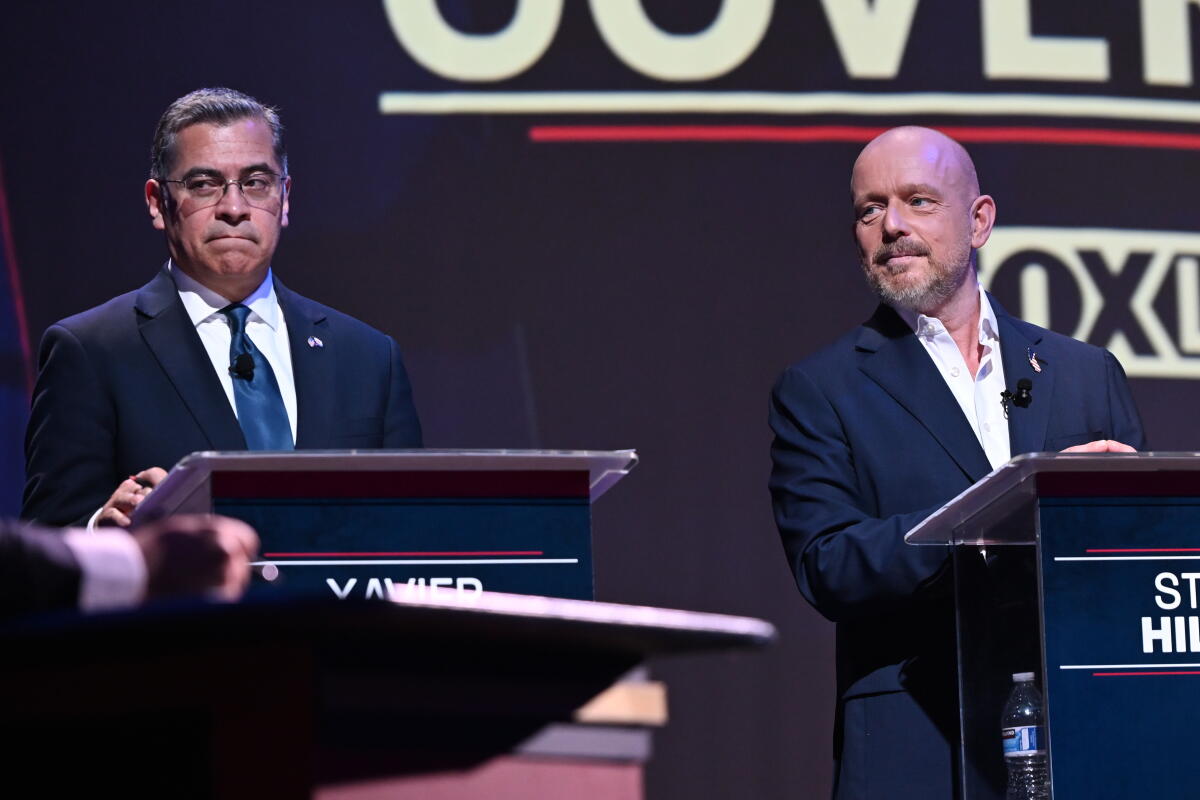
Becerra, the former secretary of the U.S. Department of Health and Human Services and a longtime congressman, won one of the top two spots in the chaotic June primary. Republican Steve Hilton, a conservative media commentator and strategist who was endorsed by President Trump, won the other slot to advance to the Nov. 3 election. Becerra is considered a heavy favorite to win, given that Democratic voters in California outnumber Republicans nearly 2 to 1.
Becerra has the financial edge in the race, raising at least $30 million while also receiving significant support from the independent committees. Donors have contributed $48.8 million to Becerra’s campaign committee as well as outside efforts supporting his bid, according to a Times analysis of contributions through Sept. 3.
A Becerra spokesman said that although the campaign welcomed support from any donor, he would not weigh their contributions as he makes policy decisions if elected
“Xavier Becerra is laser-focused on making California work for working people — lowering costs, building housing, and making this state affordable again,” said Jonathan Underland, a spokesman for the Democrat. “Anyone willing to stand with us in that fight is welcome to join it, and we won’t hesitate to challenge anyone who gets in the way of that goal.”
His GOP rival raked in $18.8 million, including a $90,100 contribution from the candidate himself. Hilton’s top donors are billionaires and business executives including manufacturer Donald Friese and his wife Andrea, Silicon Valley billionaire Tim Draper, former Fox Corp. Chairman Rupert Murdoch, Google co-founder Sergey Brin, Los Angeles real estate magnate Geoffrey Palmer and the founder of defense contractor Anduril Industries, Palmer Luckey.
Executives and employees at Lighthouse Worldwide Solutions Inc., a company that makes contamination monitoring systems, contributed more than $474,000 to Hilton’s campaign.
A small handful of donors gave to both candidates. Uber and its employees gave nearly $42,000 to Hilton, while the company and an affiliated political action committee spent $1,039,200 supporting Becerra. Vlad Tenev, founder of the financial trading platform Robinhood, gave $289,000 to Becerra and $15,000 to Hilton.
A committee ostensibly established to oppose Hilton, an effort that effectively propped him up among Republican voters before the June primary, raised $2.5 million through large donations from the California Nurses Assn., the Service Employees International Union, the Democratic Governors Assn. and wealthy businessman Bill Bloomfield, an unsuccessful congressional candidate and Republican-turned-Democrat.
Hilton said Becerra’s financial backers are unsurprising and illustrate the “corruption” created by one-party rule in Sacramento.
“All these businesses and organizations assume he’s going to be the next governor, so they’re trying to bribe him,” Hilton said in an interview. “You can call it donations if you want, but it’s actually legalized bribery. … Big business and special interests are shoveling cash into his mouth in the hope that they can bribe him to do their bidding.”
Becerra, who served in public office for nearly 35 years, has a long history of support from powerful industries, labor unions and others with business before the government. During his 24 years in Congress, donors spent roughly $11 million supporting Becerra, according to the Times analysis and Open Secrets, a nonprofit, nonpartisan tracker of campaign fundraising. While he served as California attorney general for four years, contributors spent nearly $9.4 million backing him.
Among the former Biden Cabinet secretary’s top financial backers in the governor’s race are labor unions, healthcare groups, tech companies and Native American tribes that own some of the state’s splashiest casinos. All will probably be affected by decisions made by the next governor.
The Laborers’ International Union of North America and local affiliates and political arms, focused on infrastructure projects and the creation of union jobs, has contributed nearly $3.2 million. A committee associated with the California Assn. of Realtors that is focused on housing, real estate policy and property rights has spent nearly $2.8 million backing Becerra.
The Pechanga Band of Indians chipped in more than $2.3 million to efforts supporting Becerra at a time that gaming issues continue to be scrutinized.
A Pechanga representative said the tribe’s leader was unavailable due to travel but pointed to a statement he made before the primary.
“Secretary Becerra has stood with Indian Country for decades and understands Tribal sovereignty. When tribal healthcare was on the line, he was there,” said Tribal Chairman Mark Macarro. “This experience comes from a lifetime of public service, not a checkbook.”
The California Medical Assn. has spent nearly $1.5 million backing Becerra at a time of deep impending federal healthcare funding cuts and efforts by the state to backfill that lost financial support.
Dr. René Bravo, president of the California Medical Assn., which represents more than 50,000 physicians, said their spending was spurred by the their belief that Becerra is the best candidate to take on impending federal healthcare funding cuts that will harm millions of Californians access to care.
“Xavier Becerra understands healthcare and the challenges facing patients and physicians. The next governor will make critical decisions on MediCal, the physician workforce, affordability and access to care,” Bravo said. “We’re investing in this race because those decisions will directly affect California patients and physicians.”
Meta declined to comment on its contributions, and the Realtors and the Laborers did not respond to requests for comment.
Becerra, asked about the Realtors’ large donations supporting his campaign, noted that most of the money was contributed to committees outside his control. But he argued that his policy priorities have long been clear, including when he was an afterthought in the gubernatorial race.
“I was pretty clear in the primary, where I wasn’t getting as much support from a lot of different folks,” Becerra said Fridayat a news conference in north Long Beach supporting Proposition 1, a proposed $11.25-billion bond measure on the November ballot to boost affordable housing construction around the state.
“What I will tell you is this: Take a look at my record. Take a look at what I’ve said, and rather than look to inflated promises, look at what I’ve done in my record,” Becerra said, standing in front of Laborers’ International Union of North America members clad in orange safety vests. “And I will tell you, I have built, not just as a public servant, but when I was wearing myself that orange vest as a construction worker, as a laborer for Local 185, in my younger years, I was out there helping build. And so what we’re going to do is we’re going to do what we need to do, regardless what the voices say. We’re doing it because the people demand it.”
Fossil fuel and renewable energy firms have also supported Becerra, notably Chevron and affiliated groups and employees, spent more than $1.1 million boosting his bid — money that his Democratic rivals in the governor’s race and other critics, including climate activist Jane Fonda, pounced upon before the primary.
Billionaire hedge fund founder Tom Steyer deployed mobile billboards touting Becerra saying “You need Chevron, I need Chevron,” a clip from a longer comment about how every Californian doesn’t drive an electric car.
Chevron did not respond to a request for comment.
Earlier this year, Becerra was a single-digit polling afterthought in the crowded race to replace Newsom, who is termed-out. But after a dizzying primary that included a potential front-runner, then-Rep. Eric Swalwell (D-Dublin), dropping out amid allegations of rape and sexual assault, Becerra took the lead in the Democratic field and placed first in the June election.
Becerra, 68, has a long career in elected office, serving two years in the state Assembly, 24 years in Congress, four years as California’s attorney general, and four years in the Biden administration.
While he was in Congress, donations to his federal campaign committee grew dramatically, according to an analysis of Federal Election Commission documents provided by Open Secrets.
In the early 1990s, Becerra was receiving donations in the low six figures, but by the end of his time in Congress, he was receiving well over $1 million during each two-year electoral cycle.
Finance, insurance and real estate firms and trade groups, such as Charles Schwab, the National Assn. of Insurance and Financial Advisors, the New York Life Insurance Co., Merrill Lynch and Pacific Life Insurance, were major supporters of Becerra, who served on the powerful House Ways and Means Committee, which regulates taxation. Such donors contributed more than $2.6 million to his congressional bids, according to Open Secrets.
Healthcare interests came in a close second, contributing more than $2.4 million to his congressional campaigns in the years before he was nominated and confirmed as Biden’s secretary of Health and Human Services, according to Open Secrets. Among the groups that supported Becerra’s federal campaigns included organizations representing physical therapists, anesthesiologists, podiatrists, assisted living and long term care facilities, and dietitians. While in Congress, Becerra was a strong advocate and supporter of the Affordable Care Act, a landmark healthcare overhaul championed by former President Obama.
Labor donated more than $1.7 million to Becerra’s congressional bids, a trend that continued when he ran for attorney general. Unions representing laborers, electrical workers, pipe fitters and firefighters donated $1 million, according to the Times analysis. The number has spiked to $6.3 million for Becerra’s gubernatorial bid.
Lorena Gonzalez Fletcher, president of the powerful California Labor Federation, said Becerra’s personal and political resume are significant at a time when the next governor will need to tackle artificial intelligence and the potential resulting job losses, the state’s volatile budget and federal funding cuts to MediCal and Medicare.
“He comes from a union family,” she said. “He has a long history of being on the right side of working people in a lot of different roles — in Congress, as attorney general and as secretary of Health and Human Services.”
President Donald Trump pledged Wednesday to send every American adult $5,000 if Republicans retain control of the House and Senate in the midterm elections, an extraordinary gambit to reverse his party’s sagging fortunes in November.
The dubious promise would likely cost more than $1 trillion and require congressional approval, and would further exacerbate the country’s nearly $1.8 trillion annual budget deficit and concerns about inflation.
“If the Republicans win, you win with us and you get $5,000,” Trump said during the GOP’s midterm convention in Dallas. “It will be called the Trump Dividend.”
He likened the payments to a corporation’s distributions to shareholders, citing “our tremendous strength and success economically.”
Within an hour, Vice President JD Vance appeared to try to walk back Trump’s proposal — at least in part — by suggesting the dividend payments would not go to the wealthy. Vance suggested it could be paid for by U.S. tariff revenues, though the suggested payment dwarfs what the U.S. has taken in through the protectionist measures.
The White House did not respond to a message seeking details.
Congress would need to approve or otherwise acquiesce to the payment. The sum would far exceed U.S. tariff revenues even before the Supreme Court tossed much of the president’s tariff program last year.
The national debt last month topped $40 trillion for the first time.
Trump has frequently lamented that, during the modern era, the president’s party almost always loses seats in Congress during the midterms, and he has looked for unorthodox ways to defy the trend, including this week’s convention.
“We’re going to change that,” Trump said. “There’s no reason for it.”
Marc Goldwein, the senior policy director at the Committee for a Responsible Federal Budget, a think tank in Washington, said Trump has no authority send money to Americans without approval from Congress.
Goldwein added that dividends are something that companies pay when there’s a surplus, but the U.S. is running $2 trillion annual deficits and has $40 trillion in debt.
“The idea that we’ve had fiscal success is backwards and bordering on laughable,” he said. “We don’t have surpluses to give away.”
The move was reminiscent of billionaire Elon Musk’s efforts to buy votes in last year’s Wisconsin state Supreme Court race, where he handed out million-dollar checks to voters to try to boost a candidate who ultimately lost.
Trump has discussed the possibility before but has never tied it to his party’s electoral fortunes. Earlier this year, he proposed a $2,000 dividend and said he didn’t think he needed approval from Congress.
Get our L.A. Times Politics newsletter
The latest news, analysis and insights from our politics team.
By continuing, you agree to our Terms of Service, which include arbitration and a class action waiver. You agree that we and our third-party vendors may collect and use your information, including through cookies, pixels and similar technologies, for the purposes set forth in our Privacy Policy such as personalizing your experience and ads.
Last year, Trump gave members of the military a $1,776 check that he called a “warrior dividend.”
“I will get a bill ready so that we can get the Trump Dividend passed immediately after the November 3rd election,” Republican Sen. Bernie Moreno of Ohio wrote on X late Wednesday. “Because Republicans (and America) will win!”
A $5,000 check would give each American more money than they received in direct government payments from COVID-19 relief measures during Trump’s first term.
Trump’s proposal would be legal because the payment would go to everyone regardless of how they voted, or whether they voted at all, said New Mexico-based attorney John Day.
“This is a campaign promise,” Day said. “It’s not a payment to individuals to try to get them to vote in a particular way.”
Republicans are on defense as they look to defend their narrow House majority against strong headwinds. Trump is unpopular, and Americans overwhelmingly oppose the war in Iran. Even the Senate, which Republicans once were well-positioned to keep, is up for grabs.
Cooper writes for the Associated Press. Associated Press writers Lisa Mascaro and River Zhang contributed.
War in the Middle East. The hottest summer on record in the U.S. AI getting as scary as “Terminator 2: Judgment Day.” An eroding coastline. A president who spends more time posting pathetic memes than improving the lives of everyday Americans.
It sure seems like we’re living in the End Times, right?
Why, we haven’t even reached the most frightening part of 2026: Election Day, when false prophets will besmirch ballots as the Great Deceiver, also known as Donald J. Trump, does everything possible to maintain his reign.
While people should research candidates and ballot initiatives before deciding how to vote, I also suggest that they read up on some of the thousands of saints recognized by the Catholic Church. You don’t have to belong to the faith to find wisdom in the lives of people who dealt with trials and tribulations far harder than ours and are now considered worthy of emulation.
This campaign season contains all sorts of scenarios screaming for holy intervention. We should pray extra hard to these saints for the next two months:
St. Homobonus: The Catholic Church recognizes no patron saint for the wealthy, since Jesus preached that it was easier for a camel to go through the eye of a needle than for a rich man to enter heaven. Captains of industry instead venerate this 12th century Italian nepo baby, who ran a successful clothing business yet gave most of his earnings to the poor. If tech bros followed St. Homobonus’ example, that would be a far more convincing argument against Prop. 40, the California ballot initiative that would impose a (supposed) onetime tax on billionaires, than what they’re doing: whining about socialism, threatening to leave California and spending tens of millions of dollars on ads that voters are already tuning out or tossing in the trash.
Archangel Gabriel: His role in telling the Virgin Mary she would become the mother of Jesus makes my brother’s namesake the patron saint of mail carriers. With Trump doing everything possible to ban mail-in voting — and a compliant Postal Service leadership eager to do his bidding — here’s to hoping Archangel Gabriel calls up his winged homeboys Michael and Raphael, fights off all electoral Satans and ensures a fair election.
St. Benedict: Patron saint of exorcisms. Someone place his prayer card at all the city halls in southeast L.A. County to rid the area of civic corruption once and for all!
St. Peter Claver: Chapters of the Knights of Peter Claver — the oldest Black Catholic fraternal organization in the U.S. — exist in parishes across South L.A. Some in the area are fretting because, for the first time in 63 years, not all of its three City Council seats will be held by Black representatives. With Curren Price terming out, a Latino immigrant — either Jose Ugarte or Estuardo Mazariegos — will capture the District 9 seat. May the winner follow the example of Claver, who spent his life advocating for Black people in Colombia despite the fact he was a white Spaniard, and ensure that Black Angelenos — now only 8% of the city’s population — continue to have strong representation at City Hall.
St. Augustine: The founder of the Augustinian order to which Pope Leo belongs, he’s the patron saint of converts and preached against the haughty. “They uplift themselves,” Augustine wrote, “as though they were righteous or important but, as Paul writes, ‘Like smoke they will not last because their insanity will soon become obvious to everyone.’” Are your ears burning yet, JD Vance? Do you feel a tingle on your neck, Gavin Newsom?
Xavier Becerra, left, and Steve Hilton during a California gubernatorial candidate debate Feb. 3 in San Francisco.
(Laure Andrillon / Associated Press)
St. Stephen and St. Francis Xavier: They share names and attributes with Steve Hilton and Xavier Becerra, who are running against each other to become California’s next governor. Becerra has spent his decades-long political career serving as missionary for California liberalism, just like Francis Xavier helped make the Jesuits a worldwide institution. Of the two St. Stephens, one was a former king who’s the patron saint of Hungary, birthplace of Hilton’s parents. Far more relevant is the St. Stephen who was the first Christian martyr. The way Hilton is sacrificing his political life in the name of Trump, he’d better ask that Stephen to tell God not to make his likely electoral demise too painful.
Our Lady of Refuge: Although St. Junípero Serra was the Apostle of California, this Marian apparition has been the patroness of the Golden State since the days when we were part of Mexico. Sinners ask her to beg God for forgiveness on their behalf — and isn’t that what we all will do when our chosen candidate inevitably messes up?
St. Thomas: He’s the patron saint of India, where Los Angeles city councilmember and mayoral candidate Nithya Raman was born. He’s also the patron saint of architects, too many of whom have sat around with their hands tied up in red tape while waiting to rebuild Pacific Palisades after last year’s inferno, a stasis that many residents will forever blame on Mayor Karen Bass. But history better remember the Apostle as Doubting Thomas, who refused to believe that Jesus had risen from the dead until feeling the holes in His crucified hands. Let’s hope Angelenos are as skeptical about the claims of both Bass and Raman that they, and only they, can revive L.A.
St. Clare of Assisi: She died in the 13th century, but the Italian nun was named the patron saint of television in 1958 because she could see a Mass held far away, despite being bedridden. May St. Clare convince God to short-circuit networks and streaming services every time another annoying political ad interrupts me while I’m watching the latest episode of “Project Runway.”
St. Thomas More: The patron saint of politicians famously stood up to England’s King Henry VIII and his philandering, unethical ways. May St. Thomas More’s witness inspire someone in Trump’s cabinet to do the same.
Eh, who am I kidding? Some things are beyond even God.
Pennsylvania senator who has clashed with party over Israel support says he will reject ‘the extremes and socialism’.
Pennsylvania Senator John Fetterman, a Democrat who has distanced himself from his party, has appeared in a video recording on the first day of the Republican Party’s two-day midterm convention in the United States.
The video on Wednesday was a surprise for those who attended the conservative gathering in Dallas, Texas, where President Donald Trump is seeking to galvanise support ahead of the November elections.
Recommended Stories
list of 3 itemsend of list
“Yes, I’m Senator John Fetterman, Pennsylvania. Yes, I’m a Democrat. Why am I here talking to you today? Because, well, I’m a common-sense Democrat,” Fetterman said as he introduced his Republican colleague, Senator Dave McCormick of Pennsylvania.
Fetterman, a 57-year-old first-term senator, has cast himself as an outsider within the Democratic Party.
He has offered outspoken support for Israel and the war on Iran, even as voters and progressive voices in his party criticise those elements of US foreign policy.
“I’m always going to stand with America. I’m always going to reject the extremes and socialism and that anti-American way of life,” Fetterman said in the video clip.
But his appearance at the Republican Party’s first-ever midterm convention is likely to exacerbate criticism from his Democratic colleagues.
US Representative Brendan Boyle, another Pennsylvania Democrat, has repeatedly questioned Fetterman’s party allegiance, as well as his commitment to public service. He renewed that sentiment after Wednesday’s video aired.
“A year ago I labeled John Fetterman ‘Trump’s favorite Democrat.’ Tonight, he yet again proves why,” Boyle wrote on social media.
Fetterman has also faced questions about his fitness for office following a series of reports that detail his apparent lack of enthusiasm for his Senate responsibilities.
A recent Wall Street Journal article found that the senator had cancelled meetings with constituents.
In one case, The Wall Street Journal said he skipped a June meeting with injured military veterans, citing illness, only to show up later for a Fox News interview about Israel and its joint war with the US on Iran.
His approval rating is now higher among Republicans in Pennsylvania than among members of his own party.
Last month, a poll from The New York Times, Siena College and The Philadelphia Inquirer suggested that 73 percent of Pennsylvania Republicans approved of Fetterman’s performance, up from 25 percent in 2024.
Meanwhile, Democratic support in the state had slid dramatically over the last two years, slipping from 74 percent to 22 percent. Some 63 percent of Democratic respondents held an unfavourable view of him.
While Fetterman has depicted himself as a maverick within the Democratic Party, he has denied that he would switch parties to become a Republican.
“I’m not going to be a Republican, but I’m going to be a Democrat that’s going to have a conversation with whoever is playing it straight,” he said in a recent interview with Fox News.
Still, speculation about Fetterman’s party credentials has continued as the midterms near.
The election on November 3 will decide which party controls Congress for the final two years of Trump’s term.
Republicans currently hold a small majority in the House of Representatives and Senate, but they could face a setback at the polls as voters express frustration over cost of living issues and Trump’s deepening unpopularity.
Still, reclaiming the Senate especially could be an uphill climb for Democrats. Only a third of Senate seats are up for re-election this year, compared with all 435 House seats.
WASHINGTON — President Trump gave sizable holiday gifts to four White House aides, according to new financial disclosures released by the administration.
The gifts of $45,000 each to executive assistant Natalie Harp, communications advisor Margo Martin, and deputy director of Oval Office operations Chamberlain Harris as well as a $20,000 gift for director of Oval Office operations Walt Nauta were noted in the staffers’ annual financial disclosure forms that were published by the administration last week. Harp, Martin and Harris make $150,000 annually and Nauta is paid $175,000 a year, according to the White House’s salary disclosure report to Congress.
A White House official, who was not authorized to comment publicly and spoke on the condition of anonymity, said Trump “has a long-standing practice of giving Christmas gifts to people in his orbit, including at times employees and aides, both in government and in his time in the private sector.”
The official did not say if any other staffers were given similar gifts from the president but added that the cash gifts were not related to the “individuals’ official government duties, and therefore are entirely permissible under relevant legal and ethical standards.”
The disclosures of the gifts were first reported earlier on Tuesday by the Washington Post.
Harp is a constant presence by Trump’s side and is known for carrying a portable printer with her so she can print out favorable media coverage and social media posts for the president, who prefers reading important information on paper rather than on a screen.
Martin has been working for Trump since his first go-around in the White House. She started in the first term as a White House press assistant and followed the president to Palm Beach, Fla., to help run his media operations after he lost the 2020 election to Democrat Joe Biden. She returned to the White House with Trump after his 2024 victory.
Earlier this year, Trump appointed Harris to serve on the U.S. Commission of Fine Arts, which has oversight over the president’s White House ballroom project.
Nauta, who previously served as a valet to Trump, and Mar-a-Lago property manager Carlos De Oliveira were charged in 2023 with conspiring with Trump to obstruct an FBI investigation into classified documents that the Republican took with him when he left the White House after his first term.
JOINT BASE ANDREWS, Md. — President Trump had been eagerly awaiting his trip to Texas for Republicans’ unusual midterm convention. But his new Air Force One had other ideas, at least for a short time.
The president arrived at Joint Base Andrews via Marine One on Wednesday afternoon for his scheduled departure to Dallas. But he was held on the helicopter for about 15 minutes as U.S. Air Force personnel were seen attending to Air Force One and an inflatable emergency slide that was seen deployed from the front right exit, across the plane from the door that Trump typically uses.
As Trump arrived at the base, the old blue and white presidential aircraft was seen moving from its hangar onto the tarmac a few hundred yards behind the new plane that Trump accepted as a gift from the Qatari government and had refurbished and painted red, white, blue and gold. The older plane’s front and rear steps were put in place, signaling the possibility that it would have to be used for Trump’s Texas trip.
Eventually, Trump emerged from Marine One and said the slide on the new plane was being tested.
“They want to make sure everything works perfectly,” the president said of the jetliner that Trump accepted as a gift from the Qatari government and had refurbished.
It was not immediately clear whether the slide was intentionally inflated for testing or whether it was an error that had to be assessed and corrected. But Trump said he was not worried. Asked whether he was satisfied that the plane was safe, he said, “Yeah, I am — or I wouldn’t be on it.”
Trump boarded shortly after as the crew continued to work. They appeared eventually to deflate, detach and cart away the deployed slide.
Air Force One, the designation for whatever aircraft carries a sitting president, took off for Dallas shortly after.
Barrow and Martin write for the Associated Press. Barrow reported from Atlanta. AP reporter Collin Binkley contributed to this report from Washington.
Dallas, Texas – The Republican midterm convention has represented a gambit for the party: centring US President Donald Trump in the final stretch of the midterm elections, even as the first two years of his second term have cast a polarising political shadow.
That has been particularly true when it comes to the war on Iran, which Trump launched alongside Israel on February 28, and the knock-on effects on affordability in the United States, a key issue for many voters.
Recommended Stories
list of 3 itemsend of list
As Trump prepared to deliver a keynote address on Wednesday in Dallas, prices for Brent Crude, the global benchmark, rose above $100 a barrel for the first time since July, a reminder of the conflict’s continued fallout for global markets.
Nevertheless, supporters who spoke to Al Jazeera still saw the president as the man to rally Americans to vote Republican in November, as the party fights to hold onto control of the House of Representatives and Senate.
But some voiced concern – or confusion – over the impact of the war.
“This really is a Trump-a-palooza, as people have been saying,” said Carter Eisinger, a 27-year-old electrician who travelled from Fargo, North Dakota.
“I think some people say that in a derogatory way, but I think it’s very much a complimentary phrase,” he added. “The reality of it is we are in a Trump Republican Party.”
Convention attendee Carter Eisinger has mixed opinions about the US-Israel war on Iran [Joseph Stepansky/Al Jazeera]
Still, Eisinger struggled to see how the war fit into Trump’s “America First” vision.
“In my opinion, I don’t really see the connection of how a war in Iran helps us here in the country,” he said. “If the Iran war is justified, I’m willing to pay the gas prices, but I haven’t seen that justification.”
He felt a similar confusion about the close relationship between the US and Israel.
“At the end of the day, I’m going to come right back to whatever is best for families, young people, anyone in America,” he said. “If it’s helping Israel in a way that helps us, then great… but it needs to help us first.”
Others were more charitable towards Trump’s approach to the Middle East, even if they saw the war on Iran as a misstep.
Bijay Dixit, a 59-year-old photographer from Houston, Texas, gave Trump high marks on his approach to immigration. He also believed Republicans were the party to steward the economy in the years ahead.
But on Iran, he said there had been a “miscalculation”, even if he agreed with the Trump administration’s position that the war was ultimately a necessary response to the totality of Iran’s actions in the 47 years since the Islamic revolution in 1979.
“Iran needed to be stopped at some point,” he said. “When I say miscalculation, what I mean is underestimation of the capacity of the IRGC [Islamic Revolutionary Guard Corps].”
Helen Vennett, a 65-year-old small business owner from Maryland and the chairman of her county’s Republican Party, likened the convention to a high-school pep rally.
“All of us need to have cheerleaders in our life… It just gets you fired up again. You kind of need to know that you’re not alone, that there are believers,” she added.
But while she said she broadly supported the Trump administration’s justification for the war, she acknowledged the potential political fallout.
“It’s a tough one,” she said.
Vijay Dixit, a Texas photographer, believes the war against Iran was a ‘miscalculation’ [Joseph Stepansky/Al Jazeera]
Polls have regularly suggested widespread disapproval among US citizens of the war on Iran, with independents in particular expressing disapproval. Many, in turn, rank affordability as their top issue heading into the midterm vote.
A recent Reuters/Ipsos poll suggested that only a quarter of Americans think the war is worthwhile.
For its part, the Trump administration has downplayed the prospect of ending the war, focusing instead on efforts to open shipping routes in the Strait of Hormuz, over which Iran continues to assert its influence.
Speaking to reporters on Wednesday as he departed for the convention, Trump sought to temper expectations that the war would end before November’s pivotal vote.
“I think it’s going to take a little bit longer than the midterm,” he said, accusing Iran of intentionally holding out until November.
“They’re desperate to try and affect the election so that we can get a nice weak group of people in there and leave them alone and let them have their nuclear weapons,” he said.
He predicted the war would end swiftly after the final votes have been cast.
“They can’t hold out any longer,” he said.
John Russell, 55, from Rockford, Illinois, who regularly travels to Trump rallies as part of the “Front Row Joe’s” group, said he believed voters would still view the first two years of Trump’s second term as a net positive.
“It’s been a small bump with the gas going up,” he told Al Jazeera from the convention.
“But it had to be done. We can’t allow [Iran] to have a nuclear bomb,” he said, referring to one of the administration’s main justifications for the war.
John Russell is optimistic about the Republican Party’s prospects ahead of the midterm elections [Joseph Stepansky/Al Jazeera]
Tehran has long denied seeking a nuclear weapon, with military analysts generally agreeing that destroying its nuclear programme would require a major military escalation, involving boots on the ground.
Russell predicted that the Republican Party’s bet would pay off at the polls.
“It’s going to fire up the base,” he said of the convention. “It’s going to switch some independents to vote for the Trump-backed candidates, and they will win.”
SACRAMENTO — Fighting for reelection, Orange County Rep. Young Kim has removed several references to President Trump from her campaign website as she tries to broaden her appeal to voters in a race against fellow Republican Rep. Ken Calvert.
The two are locked in a brutal intra-party fight over one of the only safe districts left for Republicans in Southern California after voters approved a new congressional district boundaries last year.
Throughout the primary, both Republicans used campaign ads and mailers to play up their support for Trump and court GOP voters. But as the general election approaches, both candidates are diminishing the president’s presence in their messaging by varying degrees.
Until recently, a banner on the homepage of Kim’s website described her as a “Proven Fighter” who would “Stand with President Trump to deliver a bold America First Agenda,” according to archived versions of the site.
As of this week, the banner said the Congresswoman is “taking on Career Politicians to Restore the American Dream.” Previous references to Trump and “America First” have been removed from the website’s homepage and Kim’s biography. The changes were first reported by Politico.
An “Issues” page that highlighted her positions on red meat topics such as “Standing with President Trump to Save America,” “Protecting Election Integrity” and “Fixing Bidenflation” has been taken down.
Kim’s campaign pushed back on the notion that she is distancing herself from Trump, calling it “completely absurd.”
“Our campaign has consistently framed this race as a choice between an effective leader like Young Kim, who has delivered results in less than three terms in Congress, and Ken Calvert, whose career has been plagued by corruption controversies and FBI investigations,” said Kim campaign spokesman Chris Pack. “Calvert incessantly complains about Washington getting nothing done, seemingly oblivious to the fact that after nearly 40 years, he has become Washington.”
The new 40th congressional district, reconfigured under Proposition 50 approved by California voters in 2025, packs many of the region’s Republican voters into a district which includes inland Orange County and portions of San Bernardino and Riverside counties.
The new map carved the district held by Calvert, a Corona Republican and 33-year fixture in Congress, into three different pieces. Democrats redrew the map in an attempt to oust up to five Republicans and cancel out GOP-led gerrymandering in Texas. Kim, who is from Anaheim Hills, and Calvert advanced from the primary election over several Democrats and an independent candidate and will face off in the Nov. 3 general election.
Calvert continues to emphasize his close ties to Trump. His campaign homepage features a video with shots of him shaking Trump’s hand and interacting with him in the Oval Office.
Calvert’s campaign criticized Kim for scrubbing Trump from her website and at other times keeping the president at arm’s length.
“Young Kim can delete Trump from her website, but she’ll never be able to erase the fact that she is a complete and total fraud who will say anything if she thinks it will help her keep her job,” said Calvert campaign spokesman Calvin Moore.
“Young Kim has had every opinion on Trump imaginable from trying to censure him to claiming she’s 100% with him, to promising to kick his butt, then trying to lick his boots in the primary. It’s insulting to voters’ intelligence that she thinks voters won’t see right through it,” he said.
Calvert’s PAC, Americans 4 Security, has also changed messaging on its mailers. Before the primary, it sent over a dozen mailers attacking Kim for “blocking the Trump agenda” and “running from her anti-Trump record.”
Two recent mailers sent by the PAC contrast Calvert’s record with Kim’s and make no mention of Trump.
The post-primary messaging shifts weren’t a surprise to Matt Klink, a Republican political strategist.
“Through targeting, you look at Democrats and decline to state voters, and you soften your message to focus on things that they care about. That’s not changing their position, it’s just effective campaigning,” he said.
But personally, Calvert has continued to embrace the president. His campaign confirmed Calvert is attending an unconventional midterm Republican convention in Dallas, Texas. Trump is scheduled to give keynote speeches both nights.
Kim skipped the GOP convention in favor of meetings with constituents and a human trafficking task force, and to attend 9/11 events, according to her campaign.
“Calvert being with Trump, he’s helping to create that enthusiasm around his campaign,” Klink said. By skipping the convention, “Young Kim is signaling, ‘I may be a Republican, but I care about the district, too.’ It’s a good contrast.”
California and nearly two dozen other states warned the U.S. Supreme Court Wednesday that allowing the U.S. Postal Service to move forward with President Trump’s new rules for mail ballots in the November election would cause “chaos” and could disenfranchise millions of eligible voters.
“In some States … compliance with USPS’ rule would be impossible ahead of the midterms, meaning that millions of voters would be unable to vote by mail and some would not be able to vote at all,” the states argued. “In the remaining States, there would be chaos — and a significant risk that millions more voters would be denied the ability to vote.”
The Democrat-led coalition — which includes California, 23 other states and the District of Columbia — also cited objections from lower-ranking state and elections officials in conservative states that have not objected to the Postal Service’s position, including the lieutenant governor and other officials in Utah saying implementation of the new rules would “be an unmitigated disaster.”
Similar warnings have emanated from Florida, Ohio, Texas and Wisconsin.
“Whatever else may be said of USPS’ new rule, it would wreak havoc on States and their voters if it takes effect at this late point,” the Democrat-led states wrote, pointing out that some States, including North Carolina and Wisconsin, have already begun to mail out ballots.
The states’ arguments were in response to the Trump administration over the weekend filing an emergency appeal to the high court, asking it to overturn a lower-court ruling halting the plan from being implemented for the Nov. 3 election.
The new rules — developed in response to a March executive order from Trump — require states to submit their complete voter lists to the Postal Service, and to adopt new ballot envelopes with individualized voter bar codes designed by the Postal Service. They require the Postal Service to then reject any mail ballots that don’t match those lists.
Trump’s order also directed the Department of Homeland Security to develop its own list of eligible citizen voters, ostensibly to be compared against the state lists.
Trump and other supporters of the changes — including top officials from a dozen Republican-led states — argue they are necessary to prevent widespread voter fraud, including by non-citizens. Elections experts say there is no evidence of such widespread fraud, despite robust audits and other searches for it.
The Democrat-led states sued to block the changes on multiple grounds, including that neither Trump nor the Postal Service have any authority to regulate state-run elections, that the changes would illegally prevent eligible voters from casting ballots, and that the timeline imposed by the new rule — formally issued by the Postal Service on Aug. 21 — made compliance by November impossible.
Independent voting rights groups also sued, alleging the new rules threatened to disenfranchise voters and make their work educating voters on their options for casting a ballot impossible to carry out.
A Postal Service whistleblower recently added skepticism to the agency’s ability to implement the new rules on its end, alleging in a statement published by congressional Democrats that the agency’s online portal for verifying ballots was built in a “slapdash” manner, is “fundamentally flawed” and threatens as built to reject thousands of ballots if just a single one cannot be properly read.
Last week, U.S. District Judge Indira Talwani granted requests from the states and the independent groups to halt the plans from being implemented nationwide, issuing a preliminary injunction requiring the Postal Service to cease all work on them.
The Trump administration then bypassed the U.S. 1st Circuit Court of Appeals to ask the Supreme Court for relief from Talwani’s order.
Solicitor Gen. D. John Sauer, the administration’s top litigator, argued that the warnings from states that the changes are unworkable, represent an overreach of federal authority or would cause chaos in November are all baseless.
“The Rule ensures that States remain responsible for determining voter eligibility and eligibility to vote by mail, and it does not dictate ballot content, mailing or receipt deadlines, or ballot-counting procedures,” Sauer wrote. “The Rule thus plainly does not seize control of States’ administration of elections — it simply imposes reasonable preparation requirements for certain election-related mail.”
Sauer argued that if the court does not allow the changes to proceed, it would cause “serious irreparable harm on the federal government, the States themselves, and the voting public” by “nullifying the Postal Service’s efforts to address the risk that the federal mails will be used to perpetrate voter fraud.”
Experts have consistently rejected those claims — including in their own filings before the high court.
Rick Hasen, director of the Safeguarding Democracy Project at UCLA Law, joined three other election experts to argue to the lower court that the Trump administration’s claims of injury were “speculative and weak.” They noted that the administration had “offered no evidence” in court that the new rules would “stop any appreciable amount of voter fraud or even that voter fraud through the mails is a widespread problem that USPS should address.”
Meanwhile, they wrote, there was “undisputed evidence” presented to the lower court that the Postal Service is “still not prepared to implement its new rule or do so accurately and efficiently, even as states have begun mailing out their ballots,” and that the “harm to the states and to voters is enormous, as the rule threatens to disenfranchise millions of elderly voters, disabled voters, military voters and all others including the most vulnerable who depend on mail voting, in both red and blue states.”
The Democrat-led states also noted that the Trump administration hadn’t proven that widespread voter fraud is a legitimate threat, but had shown it is ill prepared itself to implement the changes without causing widespread disruption — as evidenced in part by the whistleblower’s claims.
It’s unclear when the Supreme Court will rule, though a relatively quick decision is expected given the emergency nature of the appeal.