politics

To combat copper thefts, L.A. city agency seeks its own armed police

For thieves looking to strip Los Angeles for parts, copper has become a fast-moving currency.

The problem has become so persistent that the Los Angeles Department of Water and Power is now asking for its own armed police force to protect vulnerable utility equipment, street lighting and critical infrastructure, insisting that the department’s contracted and unarmed security guards aren’t cutting it.

“They lack the authority to detain or arrest suspects, intervene in crimes in progress, conduct searches, or carry firearms for enforcement purposes,” according to a May 21 report from the city agency. “Delays hinder timely intervention, reduce investigative effectiveness, and contribute to repeat victimization of LADWP facilities.”

Under DWP’s current “observe and report” security model, an officer who sees someone cutting a fence or stripping copper from a transformer has little authority apart from yelling a warning or making a 911 call, according to the department report.

The proposal asks for 20 to 50 sworn officers to start, hired over a five-year period, along with support staff. If approved, the force would give the agency’s officers the authority to carry a firearm, make arrests and investigate thefts. The plan was scheduled to be discussed Thursday by the City Council.

The push comes as citywide service requests for streetlight repairs have surged over the last several years.

Dark streetlights.

L.A.’s historic streetlights outside the Bureau of Street Lighting near Virgil Avenue and Santa Monica Boulevard.

(Jason Armond/Los Angeles Times)

The city logged 14,328 electronic streetlight service requests in 2018, according to data from the Bureau of Street Lighting. Requests have tripled since then, reaching an all-time high of 46,079 in 2024, the last full year of available data.

Mayor Karen Bass’ office said in March that copper thefts are a leading cause of streetlight outages. Repairs have been backlogged for months.

Prices for the metal are at an all-time high, driven by major supply disruptions in Indonesia and Chile, and soaring demand from artificial intelligence data centers and electric grid infrastructure. Thieves typically exchange the metal for cash at recycling centers, where it can fetch up to $5.30 per pound. The City Council last year approved a program offering up to $5,000 for information in metal and wire theft cases.

Theft losses alone exceed $1 million annually, according to DWP.

Establishing a new police force would require changing the city charter, meaning voters will have a say come the November midterm elections. Authorities will also need to obtain state legislative approval for the plan.

Officials said rolling out the police department would cost $9.7 million over three years, plus up to $6 million annually to pay for staffing. They maintain those costs are less than the $46 million combined DWP spends each year on private security contractors and unarmed staff security.

A metal pole and base, with an opening in the base.

On Hill Street in downtown L.A., streetlights have been targeted by thieves and vandals.

(Jason Armond/Los Angeles Times)

Any cost overflows would be paid for by DWP customers.

Timothy O’Connor, executive director for the Los Angeles Office of Public Accountability, a spending watchdog, said his office is not convinced that the agency could minimize long-term cost creep, or that the new force would offset enough costs to justify the program. The proposed force of a few dozen officers, he said, would be too small to get the job done.

“Theft losses at DWP are real and are increasing. However, eliminating these losses is not enough to offset the proposed costs,” he said. “Furthermore, DWP will be unable to fully eliminate theft given the diffuse nature of the DWP system.”

But O’Connor also said the department is faced with real security risks like those posed by drone attacks or terrorism threats, which he said “appear to justify the proposal at some level.”

In February, a man shot himself after he drove his car through the perimeter fence of a power substation while carrying explosives and several firearms. Dubbing the incident an attempted terrorist attack, officials said the episode could have caused catastrophic infrastructure damage.

David Levitus, executive director of the advocacy group LA Forward, said he was surprised to learn of the proposal so late in Los Angeles’ ongoing charter reform process, which his organization has monitored closely.

“The fact that this is being dumped in late May — what’s the rush?” Levitus said. “I think we really need to be wary of creating new police departments in general, but especially without a clear case and clear constraints and accountability mechanisms.”

Source link

Contributor: In politics after Trump, nothing is disqualifying

After a decade of Trumpism, it should come as no surprise that President Trump’s ethos (presenting scandal as strength, outrage as authenticity and public disgrace as evidence you’re a “fighter”) has trickled down into congressional campaigns of both parties.

In Maine, for example, controversial oysterman and veteran Graham Platner, a Democrat, appears poised to face Republican Sen. Susan Collins, after incumbent Gov. Janet Mills’ failure to launch led her to drop out of the Senate primary.

Under old “pre-Trump” rules, Platner’s campaign would have withered instantly after revelations that he once had a Totenkopf SS tattoo, previously identified himself as a communist, said Black people were poor tippers, and wrote that white people “actually are” as racist and stupid as Trump thinks they are.

Instead, after all this surfaced, Platner actually rose in the polls. Considering the circumstances, there are several reasonable explanations for this.

Maybe Maine Dems have concluded that moral purity tests are politically suicidal after years of watching heterodox figures like Joe Rogan and Elon Musk drift away from the party.

Maybe Platner’s rough-edged outsider persona simply feels more authentic than another interchangeable politician in a pantsuit droning on about “working families.”

Perhaps the difference is that, unlike Trump or Texas’ scandal-plagued Republican Atty. Gen. Ken Paxton, Platner has at least attempted contrition.

Or maybe Maine Democrats have absorbed the same lesson Republicans adopted in 2016: Once voters stop treating scandal as disqualifying, policing your own side for off-the-field behavior starts to look like unilateral disarmament.

I mean, who could blame them for thinking you’ve got to fight fire with fire? America, after all, reelected Trump after 34 felony convictions.

At a certain point, continuing to insist that “character matters” starts sounding like advice Ward Cleaver might have offered Wally on “Leave It to Beaver.”

But Maine isn’t the only example of voters viewing scandalous behavior as a “keeping it real” feature, not a bug.

Another just took place in Texas, when the aforementioned Paxton crushed normie incumbent Sen. John Cornyn in a Republican primary runoff, garnering nearly 64% of the vote.

Paxton, it’s worth noting, was previously indicted on felony securities fraud charges, impeached by the Texas House on allegations including bribery, accused by senior aides of abusing his office to help a donor and real-estate developer and accused by his wife (a Texas Republican politician) of infidelity, just to name a few of his greatest hits.

Yet, not only did the scandals not doom Paxton, they probably helped him. They signaled a willingness to fight, casting him as both a victim and an outsider. There may be no purer expression of trickle-down Trumpism than Paxton, which probably explains why Trump endorsed him.

At this point, you might be thinking that all is lost. But there are counterexamples that lend to optimism.

Paxton’s Democratic opponent in Texas, for example, offers a stark contrast, as well as an opportunity to test the level of our societal decline in November.

Texas Democrats could easily have nominated their own chaos agent in Rep. Jasmine Crockett, a progressive firebrand whose flair for viral combat suggests she understands the incentives of modern politics perfectly well.

Instead, they chose James Talarico — a young state legislator, former middle-school teacher and Presbyterian seminarian — who projects the kind of earnest optimism that lands somewhere between Barack Obama and Pete Buttigieg.

If a Democrat like Talarico can win in deep-red Texas — against a scandal-plagued candidate who shouldn’t get within 10 miles of the U.S. Capitol — it will perhaps provide a modicum of hope that red lines still exist, and that some voters still believe character is destiny.

But regardless of who wins that matchup, the fact that both Paxton in Texas and Platner in Maine emerged as their party’s respective Senate candidates (Platner won’t technically be the Democratic nominee until after the Maine primary in June) still suggests something profound has shifted in American politics.

Not long ago, the scandals attached to either man would have ended a campaign overnight.

Today, they function more like résumé enhancements. Because the defining lesson of the Trump era may be this: Nothing is disqualifying anymore.

If a failed nepo baby and middling reality-TV star can become president, survive endless scandals (think “Access Hollywood”), rack up felony convictions, be found liable for sexual abuse, sit by and watch a Capitol riot, and then return to power anyway, traditional ideas about character and electability are simply no longer relevant.

The question now is whether Trumpism has become America’s permanent political operating system — or whether the new rules apply only to Trump himself.

November will offer some hints.

Matt K. Lewis is the author of “Filthy Rich Politicians” and “Too Dumb to Fail.”

Source link

Becerra leads governor’s race; Hilton, Steyer in tight contest for second spot

On the cusp of California’s gubernatorial June 2 primary, voters are closely divided among three candidates vying to succeed Gov. Gavin Newsom at a perilous moment in the state and nation’s history, according to a poll released Thursday.

Among likely California voters, 25% support Xavier Becerra, a Democrat and former Biden Cabinet secretary, according to the survey by UC Berkeley’s Institute of Governmental Studies that was co-sponsored by the Los Angeles Times. Republican Steve Hilton, a former Fox News commentator and British political strategist, has the backing of 21%, while 19% backed billionaire hedge fund founder turned environmental activist Tom Steyer, a Democrat.

California gubernatorial candidate Xavier Becerra takes a selfie at an event while campaigning

California gubernatorial candidate Xavier Becerra takes a selfie at an event while campaigning on May 26, 2026 in San Francisco, California. Becerra is the former United States Secretary of Health and Human Services and is running as a democratic candidate for governor. California’s statewide election is on June 2.

(Benjamin Fanjoy / Getty Images)

The survey provided the clearest indication yet that the three have separated themselves from the rest of the field. Support increased for Becerra, Hilton and Steyer since the last Berkeley IGS poll in March. Becerra leapfrogged everyone. In early March he wallowed near the bottom of the pack at just 5% support among likely voters, and now is the front-runner.

The other candidates floundered. Support for Riverside County Sheriff Chad Bianco, a Republican, dropped 5% and he now finds himself in a distant fourth place. Former Democratic Rep. Katie Porter of Irvine dropped by almost half to 7%. San Jose Mayor Matt Mahan, former Los Angeles Mayor Antonio Villaraigosa and state Supt. of Public Instruction Tony Thurmond — all Democrats — remained mired in the single digits.

Poll director Mark DiCamillo cautioned that it remains unclear which candidates will finish in first and second place in the June 2 primary, a pivotal question since only the top two finishers will advance to the November general election regardless of party affiliation. The low voter turnout thus far makes predicting the outcome especially difficult.

Although every registered voter in California was sent a mail-in ballot, many have not returned them or dropped them off at voting locations — a telltale sign of the uncertain nature of this year’s governor’s race. The survey, which included all 61 of the gubernatorial candidates on the ballot, found that Democratic turnout thus far is noticeably lower compared with past primary elections, DiCamillo said.

Steve Hilton, Republican gubernatorial candidate for California, arrives for a news conference

Steve Hilton, Republican gubernatorial candidate for California, arrives for a news conference at the San Jose Diridon Station in San Jose, California, US, on Tuesday, May 26, 2026. Republican gubernatorial candidate Steve Hilton is announcing his intention to halt future taxpayer-funded payments for California’s High-Speed Rail project, if elected in November.

(Jason Henry/Bloomberg via Getty Images)

“We’re assuming that … the Democrats will in fact turn out in the final week after we had concluded our poll and begin to make up ground on what looks like an early lead for Hilton, and those voters favor Becerra,” DiCamillo said.

The survey, conducted between May 19 and 24, found that likely Democratic voters favored Becerra over Steyer by 11 percentage points. Voters registered as “no party preference” were evenly divided between Becerra, Steyer and Hilton. Among likely Republican voters, Hilton led Bianco by almost 2 to 1.

Becerra also had a notable edge over Steyer among women and Latino voters, while Steyer had an advantage among Black voters. Hilton was favored over the two Democrats among self-identified libertarians and among voters in Orange County, the Central Valley and northern coast and Sierra region.

The poll found that 7% of voters remained undecided.

For the first time in more than a quarter of a century, the contest to lead the nation’s most populous state and the world’s fourth-largest economy has consistently lacked a front-runner despite a plethora of candidates.

Two of California’s best-known Democrats, former Vice President Kamala Harris and U.S. Sen. Alex Padilla, both toyed with a run for governor before deciding not to run, which contributed to the sluggishness of the race. The 2026 campaign for governor also languished in the shadow of the mayhem stirred up by President Trump, including his immigration raids throughout Southern California, and the devastation wrought by the 2025 Pacific Palisades and Altadena wildfires.

But a whirlwind of recent developments has drawn attention to the race.

Former Rep. Eric Swalwell (D-Dublin), once a front-runner in the contest, withdrew from the race and resigned from Congress in the aftermath of multiple allegations of sexual misconduct and assault that he denies.

Tom Steyer, Democratic gubernatorial candidate for California, during a campaign event

Tom Steyer, Democratic gubernatorial candidate for California, during a campaign event in Santa Rosa, California, US, on Wednesday, May 27, 2026. California is holding its primary election on June 2. Photographer: David Paul Morris/Bloomberg via Getty Images

(Bloomberg/Bloomberg via Getty Images)

Additionally, record-breaking amounts of money have flowed into the race. Steyer has smashed state self-funding records by contributing $212 million to his campaign as of Tuesday, according to the California secretary of state’s office. Nearly $85 million has been donated to independent expenditure committees by corporations, labor unions, tech titans, Native American tribes and other special interests, most of which will have policy interests that will be in front of the next governor.

Although the 2026 California governor’s race lacks the allure of recent contests that featured candidates such as global movie star Arnold Schwarzenegger, political scion Jerry Brown and former San Francisco mayor and likely 2028 presidential candidate Gavin Newsom, it is unfolding at a crucial time for Californians.

The state’s most vulnerable residents are facing severe reductions to medical care because of looming federal healthcare funding cuts, and California’s budget, already volatile because of its reliance on the state’s wealthiest residents, may grow more unpredictable. California’s highest-in-the-nation gas prices increased even more because of the U.S.-Iran war, adding to the state’s entrenched affordability crisis, which has driven many residents out of the state.

The cost of living, homelessness and public safety were among the top concerns expressed by voters, according to the poll. Protecting voting rights was also supported by most voters, though their underlying concerns could be starkly different based on their political views.

Democrats have been focused on the disenfranchisement of voters, a fear that has heightened in the aftermath of a recent Supreme Court decision that gutted a section of the Voting Rights Act that forced states to draw voting districts to help elect Black or Latino representatives to Congress. Republicans echo President Trump’s claims of elections being rigged.

Chad Bianco is interviewed after the California Gubernatorial debate

Los Angeles, CA – MAY 06, 2026: Chad Bianco is interviewed after the California Gubernatorial debate at Skirball Cultural Center on Wednesday, May 6, 2026 in Los Angeles, CA.

(Jason Armond/Los Angeles Times)

Voters split largely along party lines about issues such as Trump’s policies about climate change, immigration and taxes.

Voters’ uncertainty in the governor’s race is partly driven by California’s unique, voter-approved “jungle” primary system, in which the two candidates who win the most votes in the June 2 primary advance to the November general election, regardless of party affiliation.

Although the state’s voters are largely registered Democrats, the party’s leaders feared earlier this year that they would splinter among the multiple Democrats on the ballot, leading to Hilton and Bianco advancing to the November general election and ensuring that a Republican would be elected governor. Bianco had the backing of 11% in the new Berkeley survey.

The Republicans were once roughly tied in polls, until Trump endorsed Hilton in April. More than one-third of likely Republican voters said Trump’s endorsement of Hilton made them more likely to support him. Among voters who identified with the “Make America Great Again” movement, nearly two-thirds supported Hilton while less than 3 in 10 backed Bianco.

Though Bianco’s followers seem to be more passionate, “Hilton has got the much broader base of support, and then he got Trump’s endorsement,” DiCamillo said.

He added that Hilton’s rise is unusual in California, where statewide candidates typically spend enormous sums of money to raise their visibility among the state’s 23.1 million registered voters.

“What’s interesting about Hilton is that he hasn’t really done much of his campaigning in the traditional way. He hasn’t run huge amounts of television advertising, you don’t see his name out there in the traditional media, other than in free media,” DiCamillo said. “You can see that in the data, because almost a third of voters still have no opinion of Hilton … about what it was back in March, which is startling for a candidate who is among the leaders.”

Democrats’ fear of being locked out of the November general election led party leaders and allies to effectively urge low-polling candidates to drop out of the race in remarkable public statements in March.

The tables have since turned — the prospect of two Republicans winning the top spots in the June primary appear nonexistent, while polling shows a small possibility of two Democrats advancing to the general election.

“I’m not saying it’s likely, but it’s possible that two Democrats could emerge, and that would have huge implications on turnout in the [November] election,” DiCamillo said, pointing to California congressional races that could shape control of the U.S. House of Representatives. “If you don’t have a Republican at the top of the ticket, it would be dismal for the Republicans’ chances.”

The poll of 8,578 registered California voters was conducted online in English and Spanish and has a margin of error of about 2 percentage points in either direction.

Source link

US Treasury secretary confirms plans for banknote featuring Trump’s face | Donald Trump News

Proposed $250 bill would mark the first time a living person has appeared on US currency in more than a century.

US Secretary of the Treasury Scott Bessent says preparations are under way to print a new $250 banknote featuring President Donald Trump’s face, with lawmakers to decide whether the bills will be put into circulation.

US law bars any living person from appearing on US currency, but legislation was introduced last year to create an exception to allow current and former presidents to be featured.

Recommended Stories

list of 3 itemsend of list

Speaking at the White House on Thursday, Bessent said a design had been prepared in anticipation of a change in the law.

“Right now, there is proposed legislation – front of the House, in front of the Senate – to change the first requirement so that a living person, Donald J Trump, could be on a $250 bill,” Bessent said.

Bessent made his comments after The Washington Post reported that Treasurer Brandon Beach, a Trump appointee, has been pushing the Bureau of Engraving and Printing to expedite the process for a new currency note to mark the 250th anniversary of the Declaration of Independence.

“I don’t think that there’s anything untoward about having the president of the United States, the person who’s president of the United States, on the 250th anniversary bill,” Bessent told reporters.

A design mock-up obtained by The Washington Post showed the words “America 250 anniversary”, a nod to the US declaring its independence on July 4, 1776.

The Treasury Department did not immediately respond to Al Jazeera’s request for comment.

Behaviour of dictators, monarchs

A banknote featuring Trump’s face would be the latest example of the US president expanding his personal brand in his official capacity since returning to the White House in 2025.

Banners featuring Trump’s portrait have been hung on the Department of Justice and other federal buildings.

And his slate of appointees to the Kennedy Center governing board added his name to the national performing arts facility, which Congress originally designated as a memorial to assassinated President John F Kennedy.

Trump’s signature is also set to appear on US currency as part of plans to mark the 250th anniversary, a first for a sitting president.

US banknotes have until now featured the signatures of the Treasury secretary and the treasurer.

In March, the US Commission of Fine Arts, led by Trump appointee Rodney Mims Cook Jr, approved the minting of a commemorative gold coin bearing the Republican president’s image.

The announcement, which relied on a legal loophole for commemorative coins, prompted a backlash from critics, who likened the move to the behaviour of dictators and monarchs.

Source link

Trump administration tells prosecutors to stand down on Venezuela leader, sources say

The Trump administration has quietly instructed federal prosecutors in Miami to avoid pursuing criminal investigations into Venezuela’s acting President Delcy Rodríguez, a longtime target of the U.S. Drug Enforcement Administration, according to current and former U.S. law enforcement officials, in the latest sign of warming relations between the White House and the oil-rich nation.

It’s unclear whether prosecutors had implicated Rodríguez in any crimes or whether investigators were moving toward an indictment. A Justice Department spokesperson said in an email “there was never an investigation into her to shut down.”

But DEA records obtained by the Associated Press earlier this year show she consistently surfaced on the radar of federal law enforcement dating to at least 2018, though she has never been criminally charged in the U.S. like several other senior Venezuelan officials.

The directive to pause scrutiny into Rodríguez was meant to avoid upsetting the administration’s efforts to stabilize Venezuela after the capture of her predecessor, Nicolás Maduro, among other reasons, a current official said. It was not clear whether the White House, which deferred comment to the Justice Department, was involved in the decision.

“Everybody has been told to stand down,” one of the former officials said.

The former officials, who had been briefed on the development, as well as the current official all spoke to the Associated Press on condition of anonymity because they were not authorized to publicly discuss internal deliberations.

Rodríguez, a U.S. attorney representing her and the Venezuelan Communications Ministry didn’t respond to requests for comment.

The move eases pressure on Rodriguez

Removing the threat of potential indictment, even temporarily, eases pressure on Rodríguez as the Trump administration seeks to work with the acting leader to stabilize Venezuela after Maduro’s ouster and open the country to U.S. investment.

President Trump praised Rodríguez as a “terrific person” shortly after the U.S. military took Maduro and his wife to New York to face federal narcotics charges. Both have pleaded not guilty.

In recent months, the U.S. has lifted sanctions against Rodríguez and recognized her as Venezuela’s sole head of state, allowing her to re-establish ties with western banks and more freely work with U.S. investors seeking to tap into the world’s largest petroleum reserves. As ties between the two governments have deepened, some have held out the Venezuelan playbook — characterized by oil blockades, indictments of top leaders and threats of military intervention — as a model to drive regime change from within as the U.S. pressures other longtime adversaries in Iran and Cuba.

Rodríguez and her brother, Jorge Rodríguez, the head of the National Assembly, were hit with U.S. sanctions during Trump’s first term for their role in undermining Venezuelan democracy and cementing Maduro’s authoritarian rule.

Rodríguez “is doing a great job,” Trump wrote on social media in early March. “The Oil is beginning to flow, and the professionalism and dedication between both Countries is a very nice thing to see!”

In recent months, Rodríguez has hosted ceremonies with a steady stream of American oilmen, some of them partaking in high-profile delegations led by U.S. Energy Secretary Chris Wright and Secretary of the Interior Doug Burgum.

Election talk deferred amid Trump’s praise

Missing in all the mutual backslapping is any talk of elections, even as Rodríguez last month blew through a 90-day limit set by Venezuela’s high court to fill Maduro’s position on a temporary basis.

“I don’t know,” she responded in English when a visiting U.S. journalist earlier this month shouted out a question about her time frame for holding elections. “Some time.”

Sen. Jeanne Shaheen of New Hampshire, the top Democrat on the Senate Foreign Relations Committee, has demanded the administration explain its favorable treatment of Rodríguez, calling her a “central figure in Nicolás Maduro’s repressive regime.”

“Sanctions have been lifted on Ms. Rodríguez without any indication that she has taken concrete and meaningful actions to restore democratic order,” Sheehan, joined by Sen. Elizabeth Warren of Massachusetts, wrote in a letter to Secretary of State Marco Rubio and Secretary of Treasury Scott Bessent last week.

Rick de la Torre, a former CIA chief of station in Caracas, said that the decision to shield Rodríguez fits well with the Trump administration’s foreign policy goals in Venezuela.

“She’s a lifelong Marxist and was a senior leader of one of the world’s most corrupt regimes but the U.S. is providing her with breathing space and carrots to lay the foundation for democracy and U.S. investment,” said de la Torre, the CEO of Tower Strategy, which advises companies on Venezuela.

“There’s a shelf life to her utility, however. At some point she will face justice,” he added.

Rodríguez has been on DEA’s radar since 2018

The DEA had amassed a detailed intelligence file on Rodríguez dating to at least 2018, and has received allegations about her ranging from drug trafficking to gold smuggling, the AP reported earlier this year. One confidential informant told the DEA in early 2021 that Rodríguez was using hotels in the Caribbean resort of Isla Margarita “as a front to launder money,” the records show.

Her name has surfaced in nearly a dozen DEA investigations — several of which remained ongoing as recently as this year — involving field offices from Paraguay and Ecuador to Phoenix and New York. She had even been linked to Maduro’s alleged bag man, Alex Saab, whom U.S. authorities first arrested in 2020 on money-laundering charges, the records show.

Rodríguez deported Saab this month as part of a purge of insider businessmen who are accused of having enriched themselves through corrupt dealings with Maduro.

It’s unclear in which Miami investigations Rodríguez’s name surfaced. Two of the former officials said Rodríguez has also come up in meetings with investigators in Tampa, Fla., tasked last year by former Atty. Gen. Pam Bondi with looking into financial crimes in Venezuela.

At the time, Rodríguez was serving as Maduro’s vice president. Justice Department policy requires the attorney general to personally approve the charging of any foreign head of state, who are normally immune from prosecution under international and U.S. law.

Halting high-profile criminal probes of foreign leaders

The pausing of the investigations into Rodríguez comes as the Trump administration has similarly tapped the brakes on ongoing federal investigations into another prominent Latin American leftist, Colombian President Gustavo Petro.

The DEA had also designated Petro a “priority target” over alleged ties to drug traffickers that had been probed for months by federal prosecutors. The New York Times reported in March that U.S. officials recently assured the Colombian government Petro does not face charges in those cases.

Duncan Levin, a former prosecutor who worked for the U.S. attorney’s office in Brooklyn, said it would be “deeply troubling” for law enforcement to be “told to stand down from a legitimate investigation for political or transactional reasons.”

“The White House cannot use criminal enforcement as a diplomatic light switch,” Levin told AP. “DOJ decisions are supposed to be based on law, evidence, policy and public safety — not on whether a foreign official is useful to the administration at a given moment.”

Goodman, Richer and Mustian write for the Associated Press. Richer reported from Washington and Mustian from New York. AP Writer Regina Garcia Cano in Mexico City contributed to this report.

Source link

6 protesters arrested after clash with ICE officers outside a New Jersey detention center

Protesters clashed with armed federal immigration officers in front of a New Jersey detention center where advocates have demonstrated for days while asserting that people detained there are staging a hunger strike over poor living conditions.

Groups of demonstrators, many wearing gas masks and other face coverings, linked arms in a human chain in front of Delaney Hall in Newark on Wednesday night, videos and photos posted on social media show.

Some used trash cans, old mattresses, umbrellas and other materials as makeshift shields and barricades as they confronted U.S. Immigration and Customs Enforcement officers. Others attempted to block people and vehicles from entering and exiting the building or threw orange traffic cones and other objects in the direction of the ICE officers lined at the entry gate.

The group chanted, “You will hang!” and, “Every cop, every fed, shoot yourself in the head,” and other taunts at the officers, many of whom wore helmets and tactical vests.

The ICE officers used pepper spray to try to disperse the protesters, according to videos posted to social media. Some used their batons to beat and push back protesters as the officers attempted to clear the roadway for vehicles.

At least one truck driver got out of his vehicle to vent his frustration when some protesters tried to block vehicles driving on the road in front of the detention center. People detained inside could at times be seen waving to protesters from Delaney Hall’s windows.

The U.S. Department of Homeland Security, which oversees ICE, said about six demonstrators were arrested for assaulting law enforcement officers.

“Assaulting and obstructing ICE law enforcement is a crime and felony,” the agency said in a statement. “Anyone who assaults law enforcement will be prosecuted to the fullest extent of the law.”

On Thursday, demonstrators again returned to Delaney Hall.

New Jersey Gov. Mikie Sherrill also said state health department officials were “denied full access” to the facility for a health inspection. The Democrat said the officials were only allowed to inspect a limited part of the facility as she called on ICE to “de-escalate” the situation.

“As I’ve said repeatedly, refusing to provide full access raises serious questions about what ICE is trying to hide from public view,” Sherrill said in a statement that also repeated her calls to shut down the facility outright.

Earlier Wednesday, Democratic members of Congress from New York City toured the facility as part of an oversight visit. A private prison company runs the detention center, which sits along an industrial stretch of Newark Bay.

Reps. Jerry Nadler, Daniel Goldman and Adriano Espaillat, who all represent Manhattan, described dire conditions where people held in the facility are fed small portions of often spoiled food and their varied medical needs are ignored.

Homeland Security spokespersons have denied any hunger strike, abuse or poor conditions inside the center and dismissed criticism from opponents as political posturing.

Source link

Democratic Convention – Los Angeles Times

* Re “Play Fair With the Protesters,” editorial, July 25: Once again, The Times has positioned itself so that no matter what happens during protests at the Democratic National Convention it can place the blame on the LAPD. First, you want the protesters to be allowed in areas which invite security problems. Then you issue the caveat that “the city should of course be prepared to act decisively and appropriately if things get out of hand.”

No doubt there are people planning to protest on behalf of positions in which they strongly believe. However, many of those who will take to the streets are simply professional “activists” who caused the chaos during the WTO meeting in Seattle. If the police, with due reason, rough up a few of these types, The Times stands ready to shout “brutality.”

ROSS BARRETT

Los Angeles

*

Re “Public Won’t Get Convention Party,” July 24: Ben Austin, LA Convention 2000’s communications director, says that he can’t find a site in Los Angeles ready, willing or able to host a celebration open to the public (read voters!). I can appreciate his problem, what with a budget of only $150,000, compared to the $1.5 million budgeted for a press party.

Still, I should think that several publicly owned venues would suffice. The first that comes to mind is Griffith Park. There are several locations just within the park, including Greek Theater. There is also the Los Angeles Memorial Coliseum. I know it’s not big enough for Al Davis or anyone else in the NFL, but Al Gore could use an extra 60,000 happy campers. But maybe the Democrats aren’t so much the party of the people anymore. Maybe it’s time to look more carefully at the Greens.

ANDREW CARRILLO

Venice

*

Mayor Richard Riordan and the LAPD are making false charges of violence against those of us who want to protest outside the Democratic National Convention next month. Why? Because they don’t want you to hear about the important issues that have compelled people to protest. Riordan doesn’t want me to march peacefully with thousands of my fellow teachers and ask, “Why does this city have $4 million to give to the bloated DNC budget when they haven’t built a new high school in the last 30 years?”

Riordan reported “sadly” that Al Gore will not have access to his choice of ritzy downtown hotels during the convention because people want to organize protests downtown. But millions of working Angelenos have no access to health care. When was the last time Riordan felt sad about that? He’s afraid of thousands of people marching peacefully and asking these questions, because neither he, nor the Democrats, nor the Republicans have any answers. But we will be there. We will ask those questions. And we will come up with our own answers.

RANDALL CHILDS

Inglewood

Source link

Treasury Secretary Bessent confirms steps for a Donald Trump $250 bill

Treasury Secretary Scott Bessent said Thursday that his department has prepared the design for a $250 bill featuring President Trump, anticipating the passage of stalled legislation in Congress to put the president on a new denomination of legal tender.

Bessent said at the White House that authorizing the currency will be up to lawmakers on Capitol Hill, but that “we’ve created the bill” because “we have to be prepared.”

The secretary downplayed the idea that the administration is pushing the matter, despite Trump’s penchant for infusing his name and likeness across the nation’s capital and into the observances of the 250th anniversary of the Declaration of Independence. Bessent also insisted there is nothing inappropriate about Trump’s visage being part of the seminal national celebration.

“The president doesn’t do it; the House and the Senate have to do it,” Bessent said at the White House, referring to legislation, introduced by Rep. Joe Wilson (R-S.C.), that would direct the Treasury Department’s Bureau of Engraving and Printing to put Trump’s face on the new bill to mark the 250th anniversary of the nation’s founding.

A Treasury Department spokeswoman said the agency carried out “appropriate planning and due diligence” to implement a potential congressional mandate “to produce a $250 commemorative note which will appropriately recognize the 250th Anniversary of our great nation.” The spokeswoman did not mention Trump.

If passed and signed into law by Trump, Wilson’s bill would mark an extraordinary recognition for a sitting U.S. leader and comes as Trump has sought to place himself at the center of Independence Day commemorations. The Department’s preparation for the languishing legislation suggests some enthusiasm for the idea on the part of the Trump administration.

Report: Trump ally has pushed to expedite new currency

The agency’s explanation follows a Washington Post report stating that U.S. Treasurer Brandon Beach, a Trump appointee, has been pushing the Bureau of Engraving and Printing to expedite the process for a new currency note. The paper also reported that the former BEP chief, Patricia Solimene, was reassigned after pushing back.

The Treasury spokesperson declined to comment on Solimene’s status but confirmed that Michael Brown, a top Beach aide, became acting director of engraving and printing May 18.

Beach did not respond to an Associated Press request for comment.

Wilson’s legislation, which so far has languished in Congress, is intended to create an exception to existing law that bars any living person from appearing on U.S. currency; the bill would allow current and former presidents to be featured.

Bessent confirmed the measure is designed for one person.

“Donald J. Trump,” he said emphatically, repeating the full name that the president himself often uses in the third person.

According to the Post report, Beach last fall provided the Bureau of Engraving and Printing with the design for the new bill. It featured Trump’s portrait — the same one that adorns banners hanging on some federal buildings in Washington — and a 250th anniversary logo. Trump’s signature also was included, a design element that would differ from other paper money.

British artist Iain Alexander told the Post he designed the bill and said he’d discussed it with the president. Alexander did not respond to an AP request for comment.

The newspaper also reported that Solimene resisted pressure from Beach and Brown and stressed to them the lengthy legal and procedural process required to issue new currency. Solimene was reassigned against her will, the Post reported, paving the way for Brown to oversee the bureau.

Trump has aggressively spread his name and likeness

A new currency note would be the latest example of Trump expanding his personal brand in his official capacity since returning to the White House last year.

Beach and Bessent already streamlined approval of a commemorative 250th anniversary coin featuring Trump. The Treasury Department has asserted that those special coins fall outside the prohibition on living presidents appearing on money. In 1926, the nation’s 150th anniversary, then-President Calvin Coolidge appeared on a commemorative half-dollar coin that was official legal tender.

The Trump administration has had banners featuring his portrait hung on the Department of Justice and other federal buildings. And his slate of appointees to the Kennedy Center governing board added his name to the national performing arts facility that Congress originally designated as a memorial to assassinated President John F. Kennedy. That renaming is being challenged in court because of the federal law establishing the center as the official memorial to the 35th president.

Bessent noted that unless Wilson’s exception passes, current law sets just two conditions for him to consider on currency: that “In God We Trust” is printed somewhere on it, and that only deceased individuals be depicted, with their names described below their portraits.

“It’s all up to Capitol Hill,” Bessent said. “We will stick to the law.”

Barrow writes for the Associated Press.

Source link

Michigan Gov. Gretchen Whitmer decides not to run for president in 2028

May 28 (UPI) — Michigan Gov. Gretchen Whitmer will not run for president in 2028, planning instead to take a break from politics rather than jumping straight into another campaign when her term ends.

Whitmer, who is in her second and final term as Michigan governor, was widely expected to join the field as her profile nationally has grown since President Donald Trump‘s first term in office.

“There will be a robust group of people running for president,” Whitmer told WJBK-TV.

“I will not be one of them in 2028. I can tell you that,” the Democratic governor said.

Whitmer’s term ends at the end of this year, and she told the Detroit television station that there is time between now and the next presidential election to change her mind, but does not expect to do so.

“I want to have an impact,” Whitmer said in the WJBK interview, which was conducted at the Mackinac Policy Conference.

“I want to do good work, but I’m also looking forward to taking a little bit of a break and thinking about it, not jumping right into something,” she said.

Whitmer said she spoke with former Transportation Secretary Pete Buttigieg, former House Speaker Paul Ryan and former Commerce Secretary Gina Raimondo before making the decision.

A poll on Democrats who may run for president in 2028 published Thursday found Buttigieg leading a possible primary race, followed by California Gov. Gavin Newsom and U.S. Rep. Alexandria Ocasio-Cortez (D-N.Y.).

Source link

U.S. review of Mexican consulates stokes worries vital services may be lost

Mexico’s consulate in Los Angeles helps thousands of citizens each week, assisting them with registering births, obtaining passports and, increasingly since President Trump’s second term began, accessing legal help for loved ones who have fallen afoul of his administration’s immigration policies.

Although it serves the country’s biggest Mexican community, all 53 Mexican consulates in the U.S. provide services that make Mexican people’s lives easier — just like the nine U.S. consulates in Mexico improve the lives of Americans south of the border.

The U.S. State Department has launched a review that might lead to the closure of an unknown number of Mexican consulates. Although it hasn’t said why, the review is happening against the backdrop of the immigration crackdown, some thorny bilateral issues and far-right theories that the consulates have been interfering in U.S. politics and encouraging Mexicans to migrate northward.

Azucena Aviles, a 33-year-old mother who drove more than an hour to the L.A. consulate this month to renew her Mexican passport and get one for her daughter, said consular services are invaluable — especially in California, which is home to nearly 13 million people of Mexican descent, including an estimated 1.7 million who are in the U.S. illegally.

“It wouldn’t be fair if they messed with the Mexican people, especially with our support systems, which come from the Mexican consulate and which, in some way, help or protect our fellow Mexicans,” she said.

Trump has been exerting growing pressure on Mexico, with questions looming over issues including human rights, national sovereignty and regional diplomacy.

His administration has given only the broadest of explanations for launching its review.

“Department of State is constantly reviewing all aspects of American foreign relations to ensure they are in line with the President’s America First foreign policy agenda and advance American interests,” Dylan Johnson, assistant secretary of State for global public affairs, wrote in an email.

Among the possible reasons for the review is that it could somehow fit into the Trump administration’s immigration efforts to deport people in the U.S. illegally. The largest contingent of such people — an estimated 4.3 million, according to the Pew Research Center — are Mexican.

Relations between the two countries could also play a role, with Trump increasing pressure on Mexico in the run-up to free trade negotiations important to both nations’ economies, taking a more aggressive approach toward the U.S.’ southern neighbor and even threatening to take military action against Mexican cartels.

Mexican President Claudia Sheinbaum has avoided head-on conflicts with Trump and instead relied on diplomacy, including sending top officials to Washington and seeking to maintain a strong relationship with the Trump administration by cracking down on Mexican cartels. Sheinbaum and her predecessor have also been key allies in slowing migration to the U.S. and speeding up the deportation of other Latin American migrants.

But Sheinbaum has taken a firmer stance in regards to the deaths of Mexicans in U.S. immigration detention centers, calling them unacceptable and saying the conditions in such lockups were “incompatible with human rights standards and the protection of life.” She instructed Mexican consulates to visit detention centers daily to help ensure detained citizens are being held in safe conditions.

Relations rapidly deteriorated in recent weeks after the U.S. indicted several Mexican officials on drug trafficking charges, and two CIA officers died following an anti-narcotics operation in northern Mexico — American involvement that Sheinbaum said her government had not authorized. That drug raid raised uncomfortable questions in Mexico about the extent of U.S. involvement in domestic security operations.

Years of tit-for-tat tariffs between the two countries have also added strain.

A review of foreign consulates is “usually a sign that a bilateral relationship is in a very, very rocky moment,” said Arturo Sarukhan, a former Mexican ambassador to the U.S. In Mexico’s case, it comes at “the worst moment of the U.S.-Mexico relations” in decades, given all the current points of contention, he said.

Further straining relations is a theory being amplified by Peter Schweizer, a writer with a following among Trump loyalist who has claimed that Mexican consulates interfere in U.S. politics and encourage migration to the U.S. Experts say that although a few Mexican consulate officials may have sought to influence politics back home, there is no evidence of them interfering in U.S. elections.

In response to the State Department review, Sheinbaum said the idea that Mexican consulates are “playing politics in the United States is completely false.” She said the job of consulates anywhere is to “always protect” citizens.

Sarukhan too said that although consulates defend the rights of Mexican citizens, there is no evidence that they are interfering in U.S. elections.

Whatever the reasons for the consulate review, it has stoked worries.

During a weekly public forum at the L.A. consulate, a woman who didn’t give her name and whose husband had been in U.S. immigration detention asked for help finding him a lawyer, highlighting one crucial service consulates provide for their citizens.

An older man said he had heard about the review and asked about possible closures.

Carlos González Gutiérrez, Mexico’s top diplomat in Los Angeles, responded that, as Sheinbaum said, there would be “no reason whatsoever” for the U.S. to close a Mexican consulate.

Indeed, consulates would have significant, devastating effects for Mexican immigrants,” especially in isolated areas, said Ariel Ruiz Soto, a senior policy analyst for the Migration Policy Institute.

Every day, consular officials go to the Immigration and Customs Enforcement holding center in downtown Los Angeles to identify and interview as many detained Mexican nationals as they can.

González Gutiérrez, 62, begins every weekly public forum by noting how many detained Mexicans consular officials have interviewed since the immigration crackdown began in Los Angeles last June.

At that May 11 meeting, the figure stood at 1,940. Nearly half had deep roots in the U.S., he said. About 46% have been deported, 35% have children born in the U.S., 69% entered the country through a port of entry, 6% overstayed a visa and 2.5% requested asylum. Most were men, and many worked in construction, agriculture, gardening and the service industry.

He also disputed the claim that Mexican consulates are interfering in U.S. politics.

“We are guests of this country’s government, just as U.S. consuls are guests of the Mexican government. In that sense, we are neither activists nor spies,” said González Gutiérrez. “We carry out our work openly, within a pluralistic and democratic society.”

Pineda and Janetsky write for the Associated Press. Janetsky reported from Mexico City.

Source link

Trump’s DOJ sues 4 Democratic-run states over denying undercover license plates for federal agents

President Trump’s administration is suing four states over their refusal to issue undercover license plates to federal agents, the latest front in the wider struggle between the White House and Democratic-led states over the Republican president’s immigration crackdown.

The Department of Justice alleges in separate lawsuits announced Thursday that Maine, Massachusetts, Oregon, and Washington state are imposing unconstitutional restrictions that it says impede law enforcement and threaten agents’ safety.

“By denying undercover license plates to DHS components, including ICE, while issuing them to their own state agencies, these governors are pursuing discriminatory and obstructionist policies against federal law enforcement,” said acting Atty. Gen. Todd Blanche in a statement.

“These actions undermine federal immigration enforcement, allow dangerous criminals to escape justice, and terrorize American communities,” Blanche added.

The Justice Department filed the suits on Wednesday in U.S. district courts in the respective states. The four state governments are accused of trying “to obstruct the Federal Government’s immigration enforcement efforts, even though control over immigration and the nation’s borders is an exclusive federal power.”

Additionally, the Justice Department argues in the suits that the U.S. Constitution’s Supremacy Clause bars state governments from regulating federal law enforcement.

Maine Secretary of State Shenna Bellows, who oversees her state’s plate program and is also a Democratic candidate for governor, said she’s confident her decisions will hold up in court.

“What ICE did in Maine and continues to do was terrorize our friends and neighbors,” Bellows said in an interview Thursday. “There are no secret police in a democracy and we will always stand up for our Mainers safety and freedom.”

A spokesperson for Massachusetts Atty. Gen. Joy Campbell said the state’s lawyers are “reviewing the complaint and will defend the RMV policy to the greatest extent possible.”

Officials in Washington and Oregon did not respond to a request for comment on the federal action.

Feds say agents are endangered when easily identified

The administration asserts that federal agents “frequently investigate and apprehend violent criminals, including cartel members, gang members, sex offenders, human traffickers, and other violent offenders” and says making those authorities easily identifiable subjects them to increased harassment and potential physical harm.

The lawsuit comes after a back-and-forth between the DOJ and some state officials. The administration previously sent state officials letters demanding they justify their policies.

Maine Atty. Gen. Aaron Frey answered the Justice Department last week, defending his state’s policy and disputing the DOJ’s contention that it has hampered federal enforcement actions.

“Rather, the program reflects a legitimate and constitutional policy choice by the SOS not to allow its resources to be commandeered by the federal government for use in civil immigration enforcement activities that have, in Maine and elsewhere, resulted in multiple incidents of abusive and unconstitutional conduct by DHS officials,” Frey wrote.

Bellows, in her role as secretary of state, announced a pause on confidential license plates in January, after federal authorities ramped up their immigration enforcement activities in the state. Bellows said at the time that the state wanted to be “assured that Maine plates will not be used for lawless purposes.”

The federal suit against Maine argues that the state “has issued confidential license plates to law enforcement agencies for many years” and that “such plates are explicitly authorized under Maine law.” The state’s review this year, the suit argues, resulted in unlawful state regulation of the federal government by requiring federal applicants for state license plates to attest that federal vehicles that obtained confidential plates would not be used for civil immigration enforcement. The suit also states that Maine did not impose commensurate requirements on state or local agencies applying for the plates, making the program discriminatory against the federal government.

Bellows has previously defended her decision.

“When ICE asked for confidential license plates, I said no” because “covert civil immigration enforcement is not something Maine will facilitate,” she said last week.

Arguments are similar to debate over agents’ masks

The Trump administration’s arguments on the license plates are similar to its defense of federal agents wearing masks on their deployments to American cities. That became a flashpoint in an extended government shutdown over Department of Homeland Security funding, as Democrats on Capitol Hill demanded key changes to how Trump’s mass deportation plans were carried out after masked federal agents killed two U.S. citizen protesters in Minnesota.

The White House and DHS have maintained the agency’s mask policy, and the administration already has won a federal court order blocking a California law that barred law enforcement officials from covering their faces in the state.

Additionally, the administration has been at odds with so-called sanctuary cities where local law enforcement does not assist federal authorities with immigration enforcement. And Blanche has instructed the Justice Department’s Civil Division to identify all state and local laws, policies, and practices that could impede what the administration describes as “lawful federal operations.”

Barrow and Whittle write for the Associated Press. Barrow reported from Atlanta. Whittle reported from Scarborough, Maine.

Source link

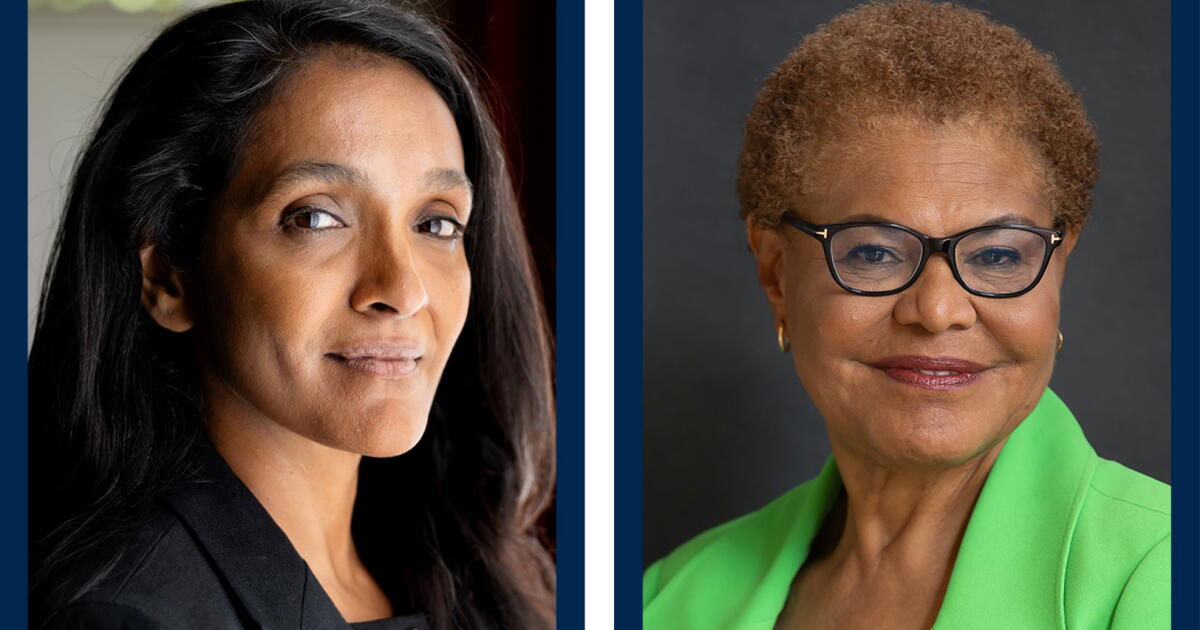
Poll shows Bass, Raman and Pratt in tight race for mayor

Karen Bass, Nithya Raman and Spencer Pratt are locked in a tight battle for Los Angeles mayor, according to a poll released Thursday, with incumbent Bass holding what pollsters called a statistically insignificant lead ahead of Tuesday’s primary.

Bass had 26% support from likely voters, followed by City Councilmember Raman with 25% support, according to the poll by the UC Berkeley Institute of Governmental Studies, which was co-sponsored by The Times.

Pratt, the former reality TV personality making his first bid for elected office, had support from 22% of the likely voters surveyed.

Up until this latest poll, Bass had enjoyed a substantial lead over her challengers, with analysts predicting she would garner enough votes to make a Nov. 3 runoff with either Raman or Pratt. The latest survey suggests any of the three could advance.

“You’ve got three very different candidates, each with very different constituencies, all within the margin of error. It’s going to boil down to turnout,” said Mark DiCamillo, the director of Berkeley IGS polls.

The poll also showed that in a head-to-head runoff between Bass and Raman, the councilmember would lead, 32% to 28%, among the city’s registered voters, but in this scenario, a quarter of likely voters say they would choose neither or would not vote, and 15% were undecided.

The survey of 1,913 registered voters — 1,351 of whom are considered likely voters — is the largest sample of any public poll released in advance of the election. It was conducted between May 19 and 24. The poll has a margin of error of around 3% in either direction.

Just 10% of voters were still undecided, the poll found, down from 26% when the last survey by Berkeley IGS was conducted March 9-15.

Mayoral candidate Spencer Pratt at a campaign block party in South Los Angeles last week.

Mayoral candidate Spencer Pratt at a campaign block party in South Los Angeles last week.

(Robert Gauthier / Los Angeles Times)

Since then, Pratt and Raman have made steady gains while support for Bass has nearly flatlined.

The March poll had Bass with support from 25% of likely voters, followed by Raman with 17% and Pratt with 14%. Since then, Bass has gained just 1 percentage point, while support for Raman and Pratt jumped by 8 percentage points each.

There are 14 candidates running for mayor in Tuesday’s primary and all were listed in the Berkeley IGS poll, but Bass, Raman and Pratt have consistently led in polling. They’ve also raised the most money in campaign contributions. The latest campaign finance reports, filed last week, showed Pratt with $3.26 million in contributions through May 16, followed by Bass with $3.13 million.

Raman reported a total of more than $931,000 through the May 16 filing period, of which $60,000 came in the form of a loan from Raman to her own campaign. She also received the maximum amount of matching funds available in the race, $1.25 million.

Leftist candidate Rae Huang was favored by 9% of the likely voters surveyed, up 1 percentage point from March, while tech entrepreneur Adam Miller dropped from 6% to 5%, despite infusing his campaign with $4 million of his own money after the first poll.

The major issues in the race have included the city’s approach to homelessness, housing affordability and public safety.

Pratt, whose home burned in the Palisades fire, has blamed Bass for failing to prepare for the conflagration and for her postfire response. Raman has criticized Bass’ Inside Safe program for the unhoused, saying its high cost isn’t sustainable.

Bass has deemed Raman an ineffective City Council member who struggles to build alliances on the legislative body, and has said Pratt does not have a clue about how to run a city like Los Angeles.

Although Pratt now appears to have a chance at making the runoff, the poll showed he would face a steeper climb in potential November runoff scenarios with Bass or Raman. Pratt, a Republican who has been labeled “Trumpian” by Raman, is competing in a city where GOP registration is less than 15%.

“Pratt is an unusual candidate and is generating a lot of enthusiasm in the primary, but he trails by double digits to Raman and Bass in a runoff,” DiCamillo said.

In a showdown between Bass and Pratt, the incumbent mayor was ahead, 47% to 29%, among the city’s registered voters, with 12% undecided and 12% choosing neither or saying they would not vote.

Raman also led Pratt in a potential runoff, 45% to 28%, with 16% undecided and 11% choosing neither or saying they would not vote.

Pratt has repeatedly pointed out that the mayor’s race is nonpartisan. Even so, President Trump said last week that he hopes Pratt does well and that he heard Pratt was “a big MAGA person.”

Trump’s unpopularity in Los Angeles could lessen Pratt’s appeal to Democrats, according to a poll by Cygnal, a national polling group that has worked for Republican candidates.

Los Angeles mayoral candidate Nithya Raman walks down Olvera Street

Los Angeles mayoral candidate Nithya Raman walks down Olvera Street alongside Olvera Street business owners on May 19 in Los Angeles.

(Ronaldo Bolaños / Los Angeles Times)

There’s been just one debate featuring all three of the leading candidates, during which Raman asserted that Bass and Pratt were working to ensure that she would be knocked out in the primary, which Bass and Pratt disputed.

The debate was followed by a huge influx of campaign contributions to Pratt, who also was polling in second in an Emerson College poll earlier this month.

Raman’s strong showing in Thursday’s poll shows she is very much in the race despite assertions by Bass’ campaign and Pratt’s campaign that she is faltering after a lackluster debate performance.

The poll shows Bass and Pratt with high unfavorability ratings. Bass was considered unfavorably by 57% of likely voters, up 1 percentage point from the March survey. Pratt’s unfavorable rating in the current poll was also 57% — up dramatically from the 28% unfavorable rating in the previous poll, although in that poll, 55% of likely voters had no opinion of him.

In the May poll, Pratt was rated favorably by 25% of likely voters, and Bass by 35%.

The poll found that 40% of likely voters rated Raman favorably, with 35% viewing her unfavorably.

Source link

Bari Weiss shakes up ’60 Minutes’ with a new executive producer

The venerable news magazine “60 Minutes” is undergoing a major overhaul under CBS News Editor-in-Chief Bari Weiss.

Weiss announced Thursday the appointment of new executive producer to replace Tanya Simon, a 26-year veteran of the program who took over the top job last July. She will be replaced by Nick Bilton, a former New York Times technology columnist and documentary filmmaker.

Bilton will be the first executive producer in the 58-year history of “60 Minutes” to come from outside of the tightly knit organization. The program has only had four leaders in its history — Don Hewitt, Jeff Fager, Bill Owens and Simon — all of whom came up through the ranks of CBS News.

Weiss is said to have developed a solid relationship with Simon, whose late father Bob Simon was a highly respected correspondent for the program. But the connection apparently deteriorated after Weiss did not receive an advance notice on Anderson Cooper’s sign off from the program ending his nearly 20-year run as a correspondent.

Cooper, who is also a full-time anchor at CNN, turned down a new “60 Minutes” deal from Weiss. During his final appearance, he expressed fears about the editorial independence of the program.

Tanya Simon is the new executive producer of "60 Minutes."

Tanya Simon is the new executive producer of “60 Minutes.”

(Michele Crowe CBS News)

“Things can always evolve and change, and I think that’s awesome, and things should evolve and change, but I hope the core of what ’60 Minutes’ is always remains,” Anderson told viewers. “I think the independence of ’60 Minutes’ has been critical.”

Speculation over changes at “60 Minutes,” the most-watched news program on television for 52 consecutive years, have been swirling for months since Paramount Chief Executive David Ellison installed Weiss to oversee editorial content at CBS News.

The program has been in turmoil since Oct. 2024 when President Trump filed a $20 billion lawsuit against CBS over an interview conducted with then Vice President Kamala Harris that was settled to clear the regulatory path for Skydance Media’s acquisition of Paramount.

From a business standpoint, “60 Minutes” is a curious target. The program is one of the most profitable hours on the CBS prime time schedule while retaining its status as television’s most prestigious journalism operation. While the ratings for “60 Minutes” get a boost from a lead-in from high-rated NFL late afternoon games, it remains one of the few network shows that viewers make an appointment to watch.

Source link

US Treasury threatens Oman with sanctions over Hormuz Strait | Donald Trump News

A top US official says Oman should know that Washington ‘will aggressively target’ actors that facilitate tolls in waterway.

The United States has warned that it would “aggressively” impose sanctions on Oman if it helps Iran establish a tolling system in the Strait of Hormuz, intensifying President Donald Trump’s threats against the Gulf ally.

US Treasury Secretary Scott Bessent said on Thursday that Washington will “not tolerate” either country imposing fees on commercial ships in the strategic waterway.

Recommended Stories

list of 3 itemsend of list

“Oman, in particular, should know that the US Treasury will aggressively target any actors involved — directly or indirectly — in facilitating tolls for the Strait and any willing partners will be penalized,” Bessent said in a social media post.

“All nations should reject outright any efforts by Iran to disrupt the free flow of commerce. Tehran’s days of terrorizing the region and the world are over.”

The statement comes less than 24 hours after President Trump threatened to bomb Oman, a key US ally known for its neutrality and mediation efforts in regional crises, including the war between the US and Iran.

While Iran has suggested that the governments in Tehran and Muscat could jointly manage the Hormuz Strait, Oman has not said that it is seeking control over the waterway, parts of which flow through its territory.

It is not clear what is driving Washington’s recent posture toward Oman. It is highly unusual for the US to threaten sanctions and military action against a close security and economic partner.

Since the US and Israel started bombing Iran without direct provocation on February 28, Iran has closed the strait and claimed sovereignty over it.

Around 20 percent of the world’s oil flowed through Hormuz before the conflict, so the Iranian blockade has put a major strain on energy supplies, sending prices soaring.

The US and Iran have been indirectly negotiating to reach an agreement for a comprehensive end to the war, and control over the Hormuz Strait has emerged as a major point of disagreement.

Trump has stressed that the strait must be a free passageway.

When asked whether he would accept joint Iranian-Omani control over the strait in the short term, the US president told reporters on Wednesday: “Nobody is going to control it. It’s international waters, and Oman will behave just like everybody else, or we will have to blow them up.”

Ali Bagheri, deputy secretary of Iran’s Supreme National Security Council, said on Thursday that Tehran will not allow Hormuz to be a source of insecurity for the country.

“The powers that have used this passage against Iran’s security must be held accountable,” he was quoted as saying by Iran’s public television.

Bagheri added that Iran seeks to “establish a just order that negates hegemony and domination and strengthens trust and cooperation” in the region.

Source link

Judge refuses to block Trump order to limit mail voting

A federal judge has declined to halt President Trump’s executive order creating a federal voter list and limiting mail voting, clearing the way for potential sweeping changes in how American elections are run shortly before this year’s midterm elections.

U.S. District Judge Carl Nichols, a Trump appointee in Washington, late Wednesday rejected the request by Democrats and civil rights groups that had argued Trump’s order would likely be found unconstitutional because the states and Congress, not the president, have the power to set election rules. Nichols agreed with the Republican Trump administration’s contention that it was too early to block the order because it has yet to be implemented.

Nichols’ ruling leaves the door open for further challenges when the Trump administration moves to implement the president’s directive. A separate lawsuit seeking to block the executive order is underway in Boston. No matter how rapidly the administration acts, no voting changes are expected during primary elections, which continue into next month.

“The Court recognizes that the Postal Service may ultimately issue a final rule that directly affects Plaintiffs or their members, or that the Government may develop State Citizenship Lists that omit specific individuals due to particularized flaws,” Nichols wrote. “Plaintiffs may, of course, renew their motions if and when those future actions occur. Until then, however, Plaintiffs cannot show that preliminary injunctive relief is warranted.”

The Trump administration has yet to formally issue lists of eligible voters, and those who filed the initial request for a temporary halt said they’d be back if the administration moves in that direction.

“We are ready to resume the fight if and when the administration takes those next steps,” said Juan Proaño, chief executive officer of the League of United Latin American Citizens, one of the organizations that sought the stay from Nichols.

Trump issued the order in March after a bill he supported to overhaul voting stalled in Congress. The order would have had the federal government create a list of eligible voters and then directed the U.S. Postal Service to deliver mail ballots only to those on the list. Election officials argued it was ripe for abuse and could cause chaos, and the postal union has objected to the idea of mail carriers policing ballots.

Since his 2020 presidential election loss to Democrat Joe Biden, Trump has groundlessly claimed mail voting is rife with fraud and has launched a federal investigation into that year’s vote, even though repeated audits and investigations, including ones run by Republicans, found it was free of widespread fraud. Trump also has said he wants to “take over” election administration in Democratic areas.

Democrats and civil rights groups argued it was urgent that Nichols issue a restraining order in the midst of primary season and with states already gearing up for the fall midterm elections.

This was Trump’s second executive order seeking to overhaul elections and voting. His initial election executive order, issued just months after he took office in his second term, has been blocked by multiplefederal judges. That order sought to require documentary proof of citizenship to register to vote, among other changes.

Riccardi writes for the Associated Press.

Source link

Justice Department opens investigation into E. Jean Carroll, who accused Trump of assault: AP source

The Justice Department has opened an investigation into whether E. Jean Carroll, the longtime advice columnist who has said Donald Trump sexually assaulted her in a New York department store 30 years ago, lied during the course of civil litigation against the Republican president, according to a person familiar with the matter.

The person who confirmed the existence of the investigation was not authorized to publicly discuss an ongoing inquiry and spoke on the condition of anonymity. The perjury investigation is being led by the federal prosecutors’ office in Chicago, and acting Atty. Gen. Todd Blanche has had no involvement because of his prior work as Trump’s personal attorney, the person said.

Lawyers for Carroll did not immediately respond to requests for comment from the Associated Press on Thursday.

It’s the latest in a series of investigations the Trump administration Justice Department has opened into perceived adversaries of the president. The actions, including securing an indictment last month against former FBI Director James Comey, have raised alarm from Democrats and former officials that an institution meant to make prosecutorial decisions independent of the White House is being weaponized.

Carroll has said a flirtatious, chance encounter with Trump in 1996 at Bergdorf Goodman’s Fifth Avenue store in Manhattan ended violently. She said Trump slammed her against a dressing room wall, pulled down her tights and forced himself on her. Trump has called the allegations a “made-up scam,” and he has attacked her motivations, saying they were politically driven or arose from a desire to promote her memoir.

A jury in 2023 found Trump liable for sexually abusing Carroll, awarding her $5 million. The following year, another jury awarded Carroll $83.3 million in a defamation case related to Trump’s social media attacks on her.

The Justice Department is scrutinizing a statement Carroll made in the course of the civil litigation that no one else was paying her legal fees. It later became public that a Chicago-based organization backed by Reid Hoffman, the co-founder of LinkedIn, had helped fund Carroll’s case. Trump’s lawyers in the civil case accused Carroll of concealing that information, which they said called into question whether the case was politically motivated.

A court entry earlier this month said Trump won’t have to pay the award until the U.S. Supreme Court gets a chance to review the case or reject an appeal. The 2nd U.S. Circuit Court of Appeals agreed to a request by one of Trump’s lawyers that it let the president delay the payment to Carroll, though it required that he post a $7.4 million bond to cover any additional interest costs, a request Carroll’s attorney had made.

The Carroll investigation was first reported by CNN.

Richer and Tucker write for the Associated Press.

Source link

2026 California voter guide: vote-by-mail, registration, track my ballot

With just days left to cast your vote in California’s primary election on June 2, The Times has answers to your last-minute questions about the voting process.

Here’s what you need to know:

What are the key races to watch?

  1. The California governor’s race is a tight battle between Democrats and Republicans who are vying to replace Democratic Gov. Gavin Newsom, who is serving his second term and cannot run again. Top candidates include a Riverside County Sheriff, a former senior advisor to British Prime Minister David Cameron, a former Los Angeles mayor, a billionaire hedge fund founder and a member of the U.S. House of Representatives. Your guide to the race for California governor can be found here.
  2. In the Los Angeles city mayoral race, incumbent Karen Bass faces a reelection challenge from a field of candidates that include a reality TV personality, a tech entrepreneur, a City Council member and a progressive community leader. Your guide to the L.A. mayor’s race can be found here.

What is on the ballot?

There are several races, ballot measures, local district seats and statewide races that Southern Californians must decide on.

Most of the attention will be on the races for California governor and the mayor of Los Angeles.

City of Los Angeles residents have several other items to consider, including:

County of Los Angeles residents will be asked to vote on:

Voters will decide on six local congressional district seats and other statewide races including the:

A comprehensive breakdown of each race or proposed tax measure can be found here.

What is an open primary?

An open primary allows the top two candidates who garner the most votes to move on to the general election in November, no matter what party they belong to.

This system could allow two candidates from the same party to advance to the general election.

Is it too late to vote by mail?

No. You can return your vote-by-mail ballot by:

  1. Dropping it off in the return envelope at a secure official drop box now through the close of polls on June 2.
  2. Dropping it off in person at a polling place, vote center or county elections office by 8 p.m. on June 2.
  3. Dropping it off at the post office. Mailed ballots must be postmarked on or before election day and received no later than 7 days after election day. To ensure your ballot is postmarked by election day, mail it at least five days before June 2. If mailing on election day, get a hand-stamped postmark from a postal employee at a United States Post Office.

What is the deadline to return a vote-by-mail ballot?

In order to be counted, vote-by-mail ballots must be postmarked on or before election day, June 2, and received by your county elections office by June 9.

How do I check if I’m registered to vote?

To find out if you’re registered to vote, visit the secretary of state’s website. You’ll need to enter a California driver’s license or identification number or the last four digits of your Social Security number.

You also can call the state’s voter hotline (available in 10 languages) at (800) 345-8683 to get a paper application mailed to you, or you can pick up one at a county election office, most California libraries and United States Post Office locations, as well as many federal, state and local government offices — including the Department of Motor Vehicles.

If you opted to register online, officials say you should wait at least 24 hours before checking your voter status.

How do I register to vote? Can I register on election day?

The deadline to register to vote was May 18.

If you’ve failed to meet the deadline, you can register as a conditional voter through the same-day voter registration process.

Eligible citizens who need to register or reregister to vote within 14 days of an election can complete this process to register and vote at county elections offices, polling places or vote centers.

To find an early voting location, use the secretary of state search tool here. You can find your local polling places here.

Your submitted ballot will be processed and counted once the county elections office has completed the voter registration verification process.

How do I check my voter status?

You can check your voter status from the California secretary of state website here. To find your record, you’ll need to provide your full name, date of birth, state driver’s license or identification card number and the last four digits of your Social Security number.

Where is my closest drop box?

Secure ballot drop-off locations opened May 5. You can visit the Los Angeles County Office of the Registrar-Recorder/County Clerk’s website here to find a ballot box near you.

How do I track my ballot?

Once cast your ballot, you can track it here.

Staff writers Seema Mehta, Phil Willon and David Zahnister contributed to this report.

Source link

Bondi will be asked about the Epstein files at committee hearing

Former Atty. Gen. Pam Bondi is scheduled to meet with the House Oversight Committee on Friday to discuss the Justice Department’s investigations into deceased sex trafficker Jeffrey Epstein and its release of files related to that investigation.

But the circumstances surrounding her meeting with the committee raise questions about how much the committee will actually learn about either.

For one, the former attorney general will not be under oath in a sworn deposition but will provide a transcribed interview, which is voluntary. Bondi’s interview with the committee will happen behind closed doors with members of the committee and staff and will not be filmed. The committee says it plans to release a transcript soon after the hearing.

And Bondi will be represented at her interview by Assistant Atty. Gen. Harmeet Dhillon, which legal experts say raises the prospects that the Department of Justice could direct Bondi to not answer some questions posed by the committee.

Former Atty. Gen. William Barr, former President Clinton and former Secretary of State Hillary Clinton all gave sworn depositions.

Rep. James Comer (R-Ky.), the chair of the committee, rejected the Clintons’ offer to provide a transcribed interview, rather than sit for a deposition, out of concern that someone giving a transcribed interview could “refuse to answer whatever questions he wanted for whatever reasons he wanted.”

Comer’s spokesperson said Bondi was allowed to sit for a transcribed interview, rather than a deposition, because the former attorney general was “cooperative.”

“Unlike the Clintons who defied subpoenas for seven months, former Attorney General Pam Bondi voluntarily and quickly cooperated with the Committee to identify a mutually agreeable date,” spokesperson Austin Hacker said in a statement.

Bondi had, in fact, refused to comply with the committee’s subpoena while she was still in office, and the ranking Democrat on the committee, Rep. Robert Garcia (D-Long Beach), filed a resolution on April 29 to hold Bondi in contempt for not complying with the committee’s subpoena a month earlier. Bondi’s agreement to provide a transcribed interview was announced the same day.

The committee subpoenaed Bondi in March to learn more about the department’s long-running investigations into Epstein — the financier accused of abusing more than 1,000 women and girls and directing some of them to have sex with his high-powered friends — and the department’s release of files in response to the 2025 Epstein Files Transparency Act, which mandated disclosure of the investigative records.

Asked whether Dhillon’s participation indicated that the department planned to invoke privilege and bar Bondi from sharing some information, the department said in a statement that Dhillon and other agency officials would attend Bondi’s interview “solely to ensure accurate representation of Department processes, facilitate any necessary clarifications, and support a complete factual record for the Committee.”

The department added that it “routinely provides staff” to assist with “congressional engagement involving past Department staff actions.”

But a former DOJ ethics official, speaking on the condition of anonymity for fear of retribution, said that Dhillon’s participation in the proceedings was anything but routine.

Typically, this type of work would be handled by a less senior attorney at the department who had more direct involvement with the subject matter at hand, the former official said. Dhillon oversees the department’s civil rights division, while the investigations into Epstein were criminal matters.

“I don’t see where Harmeet Dhillon has the experience or the normal level of authority that this would be delegated to,” the official said. “Everything about this seems unusual.”

Bondi would also need to have submitted a formal request for representation from the department.

“It doesn’t just happen willy-nilly,” the former ethics official said.

The department didn’t say how Bondi came to be represented by the agency’s attorneys. Bondi, who said this week she is being treated for thyroid cancer, didn’t respond to a request for comment.

The presence of Dhillon — a San Francisco attorney and Republican party insider who has been talked about as a potential pick for attorney general — could also present a conflict of interest, experts said.

“It’s unclear if she is representing the interests of Bondi, the department, or herself,” said Dave Rapallo, a former staff director of the House Oversight Committee.

He said that Dhillon would not have been able to represent Bondi if her testimony was provided in a deposition because the committee’s rules prevent agency lawyers from attending depositions.

Bondi was fired by President Trump on April 2. She was dogged by questions about her handling of the Epstein investigation throughout her time in office.

Trump campaigned on the promise of releasing information about the government’s investigation into Epstein in 2024 and in February 2025, Bondi told Fox News that she had on her desk a list of clients of Epstein — who died in federal custody in 2019.

But months later, as questions swirled about Trump’s relationship with Epstein, the Justice Department announced that it was closing its investigation into Epstein and said that, in fact, no such client list existed.

Soon after, Rep. Ro Khanna (D-Fremont) and Rep. Thomas Massie (R-Ky.) introduced the bipartisan Epstein Files Transparency Act, requiring the Justice Department to release all of the records from its investigation into Epstein. Trump initially opposed the legislation but ultimately signed it into law.

The department has released millions of pages of records in response to the law. While Acting Atty. Gen. Todd Blanche said in January that there are millions of additional pages of records that are not yet public, the department has indicated that it doesn’t plan to release these additional files.

Source link

A bitter slugfest in Central Valley exposes divisions in the Democratic Party

The southern Central Valley is home to one of California’s few remaining congressional battlegrounds, where Democrats are itching to oust longtime Republican incumbent Rep. David Valadao.

Last year’s voter-approved Proposition 50 redrew the lines of this Latino-majority district slightly in Democrats’ favor. Two top Democratic candidates are battling over who is the best choice to face Valadao (R-Hanford) in November.

Valadao is particularly vulnerable after he voted last year to cut Medicaid spending, a critical resource for many in this poor, rural area. Two-thirds of residents in the district are enrolled in the federally funded low-income health insurance program, and more than 60,000 are expected to lose coverage when work requirements and other federal rules take effect next year.

Rep. David Valadao (R-Hanford) leaves a meeting of the House Republican Conference at the Capitol Hill Club on March 17.

Rep. David Valadao (R-Hanford) leaves a meeting of the House Republican Conference at the Capitol Hill Club on March 17.

(Tom Williams/Getty Images)

National Democratic infighting has overshadowed a classic moderate vs. progressive primary race since House Democrats’ campaign arm threw its support behind one candidate, Assemblymember Jasmeet Bains (D-Delano), over Randy Villegas, a school board trustee backed by progressives including Sen. Bernie Sanders (I-Vt.).

The race was already tense when the Democratic Congressional Campaign Committee added Bains, a family doctor and two-term assemblywoman, to its “Red to Blue” program, which provides staff and fundraising support to Democrats running against vulnerable Republican incumbents. Local party leaders said they had received assurances from national Democrats that they would stay out of the race, which further angered Villegas and his supporters.

“This is another example as to why people’s faith in the Democratic Party and party leadership is at an all-time low,” Villegas said in an interview with The Times. “In many ways, it’s a badge of honor to not be the insider candidate and to say that I’m actually going to fight for community members here and not D.C. elites.”

DCCC chair, Rep. Suzan DelBene of Washington, cited Bains’ background as a family doctor and her track record in the Legislature fighting to expand access to healthcare.

Randy Villegas takes frequent selfies for their social media while walking neighborhoods in Bakersfield.

Randy Villegas, running for California’s 22nd Congressional District, said his campaign manager wants him to take frequent selfies for their social media while walking neighborhoods in Bakersfield.

(Myung J. Chun/Los Angeles Times)

“We only weigh in on primaries when we feel that one candidate stands out as the strongest possible nominee to ensure that we win in the general election,” DelBene said in a recent interview on CBS’ “Face the Nation.” “This is a district that has been devastated by cuts to healthcare, a large Medicaid population, so she’s an incredible candidate and definitely can speak to the issues needed on health care.”

For Democrats, the outcome of the primary could have national significance. With President Trump’s popularity at a low point nationwide — and especially in California — the party hopes to win enough seats in the 2026 election to oust the Republicans from power in the U.S. House of Representatives.

Valadao, who was first elected to Congress in 2012, has been a perpetual target for Democrats, who have held a sizable registration advantage in his district. A moderate Republican, Valadao had emphasized his support for immigration reform, a departure from his party. Still, Democrats ousted Valadao in the blue wave of 2018, only for him to win back the seat in 2020 and remain in office ever since.

Both Villegas and Bains promote themselves as the Democrats’ best option to topple Valadao once again.

Villegas, the son of Mexican immigrants, is endorsed by the House Hispanic and progressive caucuses and has painted Bains as a corporate-backed candidate who would bend to special interests.

Jasmeet Bains speaks with Mary Jimenez during a campaign canvassing walk in Bakersfield.

Jasmeet Bains, running for California’s 22nd Congressional District, speaks with Mary Jimenez during a campaign canvassing walk in Bakersfield.

(Myung J. Chun/Los Angeles Times)

“We can’t just offer that we’re not Trump. The Democratic Party actually needs to stand for something,” he said. “To me that means fighting for universal healthcare, universal childhood education, banning members of Congress from trading stocks, getting rid of corporate PAC money. Those things may make Democratic leadership uncomfortable, and I’m OK with that.”

Bains is campaigning on her experience as a physician in a region known for its poor environmental and health outcomes. After medical school, she returned to Kern County, where she completed her residency and continued working at clinics that primarily serve low-income patients in the region.

She decided to run for the seat after Valadao voted in favor of H.R. 1, the Republican spending bill Trump signed into law last year that cut nearly $1 trillion in Medicaid funding to pay for tax cuts, which Bains described as a “betrayal.”

“In the Valley, your word is your bond,” she said in a phone interview as she drove the 250-mile journey from her district to the state Capitol in Sacramento. “In the beginning he kept telling everyone that he wasn’t going to vote for it, and I took him for his word.”

Jasmeet Bains brings 8-month-old, Chiquita, as she campaign walks a neighborhood in Bakersfield.

Jasmeet Bains brings 8-month-old, Chiquita, as she campaign walks a neighborhood in Bakersfield.

(Myung J. Chun/Los Angeles Times)

Bains is the daughter of Indian immigrants and was the first South Asian woman elected to the California Legislature. She continues to work weekend shifts at a clinic in Delano.

“I thought the healthcare disparities of people losing their private insurance and having to transfer to Medicaid” was bad, Bains said. “With the trillion dollars cut from Medicaid federally, I’m now in a position where I’m transferring my patients from Medicaid to nothing. The problem in the Valley for healthcare has gotten worse and worse and worse.”

It’s the reason labor unions including SEIU Local 521, which represents workers in public, nonprofit and healthcare sectors in Kern and other counties around the state, are backing Bains.

“Within my own union, the members that I represent in Kern County, in certain ZIP Codes they have a 15-year less life expectancy than my union members living in Monterey County, which is a very similar community” with rural agricultural interests, said Riko Mendez, the union’s chief elected officer.

He said Bains understands the region’s unique health challenges and has used her perch in the Legislature to address them, including pushing for funding to research and treat valley fever, an infection caused by fungal spores in the region’s soils.

“We think her experience, her profile, her message is one that we agree with, and that has the best chance of winning in the runoff against Valadao,” he said.

Bains’ time commitments in Sacramento and working at the clinic leave her little time for a traditional campaign knocking doors and showing up to community events. Some voters backing Villegas have noticed.

Randy Villegas takes a phone call in the shade while walking neighborhoods in Bakersfield.

Randy Villegas takes a phone call in the shade while walking neighborhoods in Bakersfield.

(Myung J. Chun/Los Angeles Times)

“For us, showing up is one of the most important things, and he’s the only candidate who has been doing that consistently,” 18-year-old Vanessa Orozco Romero said after a recent candidate forum in Bakersfield. Though nearly a dozen candidates for various offices were invited, Villegas and two other Democrats running for legislative seats were the only ones to attend.

Orozco Romero called the DCCC’s decision to back Bains “stupid and morally not OK,” especially since neither of the candidates earned enough delegate support to win the state party endorsement earlier this year.

Bains and Villegas have similar backgrounds as children of immigrants who grew up in the southern Central Valley. Though they both went on to earn high-level degrees, each is adamant about staying in Kern County to improve life for its residents.

The district is anchored in the eastern side of Bakersfield, home to California’s once-thriving oil fields, and stretches northward toward Fresno to include swaths of agricultural lands and small farming towns.

While there are more than twice as many registered Democrats in the district as Republicans, Democratic candidates often underperform in the Central Valley and independent voters play a crucial role picking winning candidates. Even under the new Proposition 50 lines that favor Democrats, President Trump would have beat former Vice President Kamala Harris by nearly 2 points.

Though nearly two-thirds of voters in the district are Latino, turnout is usually low among Spanish-speaking voters who are often discouraged by negative attack ads, Democratic activists said.

Save for the 2018 midterms during Trump’s first term, Valadao, a dairy farmer, has frustrated Democrats by continually winning over enough independents to hold onto the seat. Though the three candidates are competing in an open primary, Valadao is expected to advance to the general election as a longtime incumbent and the only Republican on the ballot.

“As he does in every primary election, Congressman Valadao is working hard to earn the vote of all Democrats, Independents, and Republicans,” Robert Jones, a consultant for Valadao’s campaign, wrote in an email. “We trust that the voters of the Central Valley will send the two best candidates to the general election in November.”

Source link

California teeters on healthcare cliff, but no one is paying attention

When Congress passed the big, ugly bill known as HR 1 last year, most Americans understood it meant cuts to Medicaid, the safety net program millions rely on for medical insurance.

But few Californians realized just how much it will affect the Golden State when its provisions really kick in, starting after the midterms (the Republicans aren’t that dumb) and continuing on in cascading cuts for the next few years.

Millions of Californians — not just low-income folks — are going to feel the effects, whether through a loss of insurance, fewer providers able to keep their doors open, or rising premiums and costs.

“This problem trickles up,” state Senate leader Monique Limón (D-Goleta) told me. “This is not just going to impact the people that have a public healthcare plan. When you see a hospital close, when you see medical providers no longer being able to practice, it is absolutely going to impact everybody, the middle class included.”

Added to the loss of federal funds, Gov. Gavin Newsom’s most recent budget plan (which the Legislature has to debate in coming weeks) includes cuts at the state level. This is in part to contend with the loss of federal money, but also because healthcare costs keep rising and even in this wealthy state, we can’t afford the bills — at least not without some changes.

What those changes are — and who should bear the brunt of them — is a complicated and largely ignored debate happening right now. While our candidates for governor have been grilled on whether they support single-payer healthcare or not, (Becerra is a sort-of, Steyer is a yes) the real question isn’t how is the next governor going to expand access to care — but how are we going to keep the whole system from collapsing right now.

“This is not hypothetical, this is what’s coming down the line,” Limón said.

The problem

About 15 million adults and children, or about 1 in 3 of our state’s residents, rely on Medi-Cal, which is what California calls its Medicaid program.

Through a creative bit of state financing called the Managed Care Organization, or MCO, tax, the federal government has been paying for a big chunk of the costs of that insurance, about $7 billion a year. President Trump’s HR 1 makes that money go bye-bye by greatly reducing the MCO, leaving the state to figure out how to backfill that cash. And that’s just one of the ways the big, ugly bill hurts California. Yes, it’s complicated.

A patient lying on his back in a silver-colored chamber resembling a rocket

The number of Californians losing health insurance coverage could roughly double in the next four years. Above, a patient undergoes treatment for tongue cancer at Ronald Reagan UCLA Medical Center on March 6, 2026.

(David McNew / Getty Images)

Newsom’s budget plan relies in a not-small way on restructuring the MCO tax to fit HR 1’s new rules. But here’s the problem with that — any fix will require approval from the Trump administration, which has repeatedly shown the welfare of Californians is not a high priority. In fact, the Trump administration in March rejected California’s request to update another fee related to hospitals that also generates billions for Medi-Cal.

So maybe Newsom will be able to negotiate a plan that saves the MCO and California healthcare. But wouldn’t it be much better for the GOP, with a presidential election looming, to watch California (and her presidential-contender governor) tumble off a healthcare cliff? Few states rely on an MCO tax the way ours does, which means our pain is going to be far more visible and profound if we lose this funding.

That means if Newsom’s budget is approved by the state Legislature with the MCO fix, the state is taking a gamble. If the feds don’t approve some new version of the MCO tax, “it would have major implications,” Adriana Ramos-Yamamoto told me. She’s a senior policy fellow with the nonpartisan California Budget and Policy Center.

Sort-of solutions

What’s the fourth-largest economy in the world to do? Limón would like to see the state stop subsidizing corporations who pay so meagerly that their employees qualify for Medi-Cal.

“We don’t have the luxury of being able to provide these tax subsidies,” Limón said.

Turns out, 42% of Medi-Cal enrollees are full-time workers, according to a new report by the UC Berkeley Labor Center. Although most big corporations offer some sort of health insurance, it’s often tied to working a certain number of hours (which they then make sure not to schedule) or it has prohibitive costs or other barriers.

In 2022, the Labor Center found, 34% of low-wage workers received their health insurance through employers, compared with 69% of higher wage workers — meaning California is picking up insurance costs because low-wage employers are finding ways out of them.

“Over the decades, Medi-Cal has really undergone a significant transformation. It’s shifted from a program that primarily served the disabled and indigent and elderly folks to one that largely supports folks that work in low-wage industries,” Tia Orr, the executive director of SEIU California, told me. “Medi-Cal has now become a program where folks that work every single day have to rely on it. The idea that someone can work every day and qualify for food stamps and Medi-Cal, it should be eye-opening to folks.”

Right now, she points out, California taxpayers are paying about $7,800 a year for each person on Medi-Cal.

“The corporations that they work for don’t have to pay one dollar of that, right?”

Limón and her Senate colleagues would like to change that. They have proposed the “Fair Share” plan that would impose a tax on the state’s largest and wealthiest corporations whose employees rely on public assistance. It’s more of an idea than a fleshed-out policy at this point, but as ideas go, it ain’t a bad one. It’s been done in Massachusetts, and New Jersey’s governor has suggested it.

In California, it deserves more attention than it’s currently being given.

To be fair, Newsom’s plan also would also limit state corporate tax credits to $5 million, as my colleague Taryn Luna points out, or 50% of a firm’s tax liability, whichever is greater. That change could bring in $850 million next year to state coffers and grow to $1.8 billion by the end of the decade. That’s still not nearly enough to cover healthcare costs.

To add to the drama, the California Legislative Analyst’s Office predicts all this will get worse — that the number of Californians losing health insurance coverage could roughly double in the next four years. The Newsom administration projects federal Medi-Cal changes could push off 44,000 people in 2026-27, growing to 1.3 million people by 2029-30.

That means more people getting sick and dying because they can’t afford a doctor. It means more doctors, clinics and hospitals losing income vital to keeping their doors open, and more emergency rooms being overloaded because it’s the only option.

“The worst is yet to come,” Rachel Linn Gish, interim deputy director at Health Access California, a consumer healthcare advocacy coalition, told me. “If you wait to take action until it gets bad, it’s already going to be way too late.”

She’s right, and however you look at it, a fix should include corporations paying their fair share.

What else you should be reading

The must-read: Justice Department sues UCLA for the third time, alleges antisemitism against students
The deep dive: The $400 Million Showdown Between a Billionaire and a California Mayor
The L.A. Times Special: Garden Grove crisis exposes Southern California’s hidden industrial risks

Stay Golden,
Anita Chabria

Was this newsletter forwarded to you? Sign up here to get it in your inbox.

Source link