politics

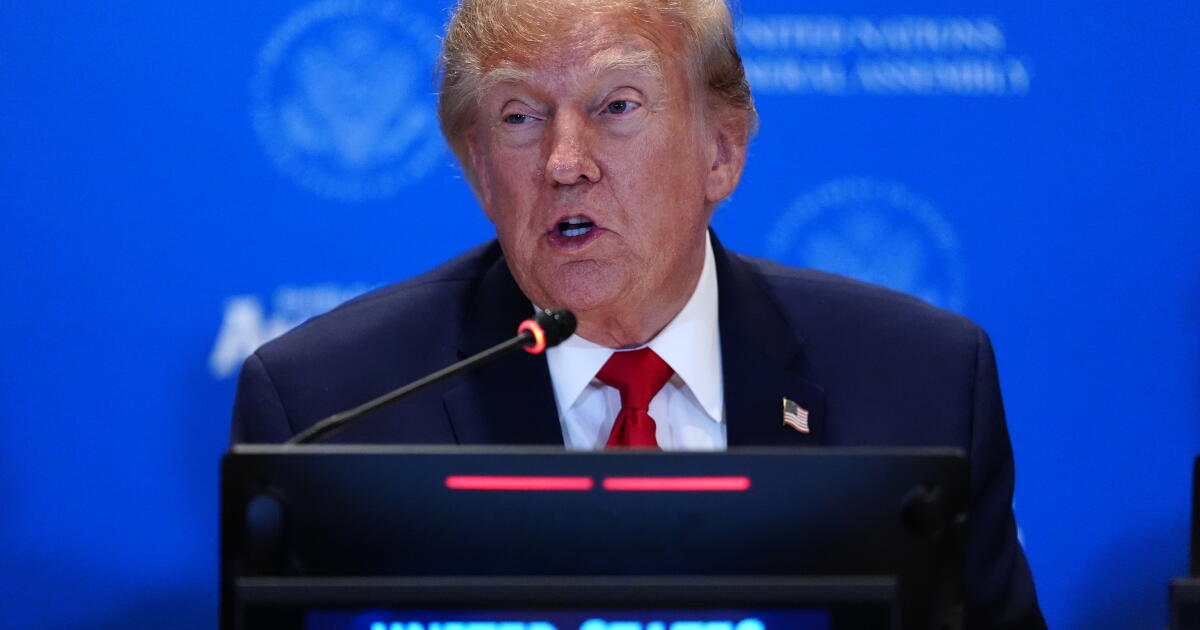
Canadian FM: Is the US still a reliable ally? | Politics

Anita Anand discusses Donald Trump, NATO, Israel, China and Canada’s international role.

Canadian Foreign Minister Anita Anand discusses whether Canada can still depend on the United States – as well as defence spending, Arctic security, Gaza, Iran, China, India, and Canada’s push to diversify trade beyond the US.

Source link

Sen. Cassidy loses in Louisiana primary, takes aim at Trump

Sen. Bill Cassidy, R-La., speaks during a hearing with NIH Director Jay Bhattacharya at the Dirksen Senate Office Building near the U.S. Capitol in Washington, D.C., on February 3. He lost the Republican primary on Saturday. File Photo by Bonnie Cash/UPI | License Photo

May 17 (UPI) — Sen. Bill Cassidy, a 15-year veteran of the U.S. Congress, lost Louisiana’s Republican primary this weekend and appeared to take aim at President Donald Trump in his concession speech.

Cassidy, who has represented Louisiana in the U.S. Senate since 2015, said that though the election didn’t turn out the way he wanted, “you don’t pout, you don’t whine, you don’t claim the election was stolen.”

“Let me just set the record straight: Our country is not about one individual,” he said, NBC reported. “It is about the welfare of all Americans, and it is about our Constitution. And it is the welfare of my people and my state and my country and our Constitution, to which I am loyal.

“And if someone doesn’t understand that, and attempts to control others through using the levers of power, they are about serving themselves. They’re not about serving us. And that person is not qualified to be a leader.”

Saturday’s election results showed that U.S. Rep. Julia Letlow received the most votes in the Republican primary for the U.S. Senate seat, with 44.84% of the vote. Louisiana State Treasurer John Fleming narrowly took second place with 28.28% of the vote and Cassidy came in third with 24.8%. The results mean Letlow, who has Trump’s backing, will face Fleming in a runoff on June 27, NOLA.com reported.

Trump was less veiled in his attacks on Cassidy in a post on Truth Social on Saturday night. He described the senator’s loss as “unprecedented.”

“That’s what you get by voting to Impeach an innocent man, especially one who made it possible for Cassidy’s Senate win,” Trump wrote.

Cassidy was one of six Republicans in the Senate to vote in favor of proceeding with an impeachment trial for Trump. He ultimately voted to acquit Trump in the president’s second impeachment trial in 2021.

Cassidy represented Louisiana’s 6th Congressional District from 2009 to 2015, when he was first elected to the U.S. Senate.

Source link

Alex Saab and the Mutating Realities of Chavismo

Alex Saab was once presented by the Venezuelan state as a symbol of national sovereignty. Today, the same state refers to him simply as “the Colombian citizen Alex Naim Saab Morán.”

That contradiction is not a side detail in the Saab saga. It is the story.

For years, chavismo invested extraordinary political and symbolic capital into transforming Saab from a relatively obscure businessman into something much larger: diplomat, political prisoner, sanctions-era patriot, and eventually minister of commerce. When he was detained in Cape Verde in 2020 on U.S. money laundering charges, the Maduro government reacted as though a senior state official had been kidnapped by a hostile empire. State media launched nonstop campaigns demanding his release. Venezuelan diplomats lobbied internationally on his behalf. Officials presented copies of his Venezuelan passport in foreign courts. Delcy Rodríguez herself described him as an innocent Venezuelan diplomat persecuted by Washington.

The regime did not merely defend Saab. It fused his fate with the idea of Venezuelan sovereignty itself.

And yet today, after reports that Saab was quietly detained inside Venezuela for months before being surrendered to the United States, the same state apparatus appears eager to emphasize something entirely different: his Colombian nationality.

The legal logic is obvious enough. Venezuelan law generally prohibits the extradition of Venezuelan nationals. Saab’s status as a naturalized citizen may have provided the government with the legal flexibility needed to facilitate his transfer while preserving a veneer of constitutional procedure.

But politically, the reversal is extraordinary.

Until recently, Saab was not treated as a foreign intermediary operating on behalf of Venezuela. He was treated as Venezuela. Attacks on Saab were framed as attacks on the republic itself. His return from Cape Verde during the Biden-era prisoner exchange was celebrated as a geopolitical victory. In January, Delcy Rodríguez publicly thanked him for his “dedication and commitment to the homeland” while announcing he would assume “new responsibilities.”

Only months later, he became deportable.

The Saab affair exposes how late chavismo governed through mutable political realities rather than stable institutional principles.

What changed was not merely the regime’s opinion of Saab. The operative meaning of Saab himself changed according to political necessity. He was successively businessman, envoy, diplomat, patriot, minister, revolutionary symbol, and now effectively a legally manageable Colombian citizen. The categories surrounding him  (citizenship, sovereignty, legality, loyalty) were treated less as fixed institutional realities than as flexible political instruments.

This is what gives the entire saga its distinctly Orwellian quality.

The issue is not simply propaganda. All political systems engage in propaganda. The issue is the degree to which political reality itself became fluid. Yesterday’s indispensable patriot becomes today’s silent liability. Yesterday’s sovereign diplomat becomes today’s extraditable foreign national. The contradiction is not resolved so much as administratively absorbed.

For Venezuelans, this dynamic has become painfully familiar. Years of institutional improvisation, overlapping authorities, constitutional contortions, and contradictory official narratives have gradually normalized incoherence as a governing method. People learn not to ask whether political narratives are internally consistent, but whether they remain operationally useful.

The Saab saga condenses that evolution into a single character arc.

And yet this is not merely a story about narrative manipulation. It is also a story about how chavismo itself changed under the pressure of sanctions, isolation, and survival.

During the years of maximum international pressure, Saab’s networks reportedly became central to the regime’s economic adaptation. Food imports, opaque oil transactions, offshore procurement systems, sanctions workarounds, and parallel financial structures increasingly blurred the distinction between state policy and survival improvisation. Saab occupied a hybrid role inside that world: part businessman, part diplomat, part financial operator, part sovereign representative.

That ambiguity was not accidental. It reflected the logic of a state learning to survive siege conditions.

But survival systems often produce figures who become simultaneously indispensable and dangerous. The very people who help preserve a regime during periods of extreme pressure can later become liabilities once strategic priorities shift. As Venezuela moved from total isolation toward tentative normalization, figures associated with the sanctions-era architecture increasingly carried diplomatic, financial, and political costs.

The fall of Tareck El Aissami and the PDVSA crypto scandal had already hinted at this transition. Entire internal networks once tied to the regime’s survival mechanisms suddenly became objects of public investigation and selective purge. Saab’s extradition pushes that logic much further. Unlike the internal anti-corruption campaigns of previous years, this was not simply the revolution disciplining itself. It was the state externally relinquishing one of its own.

And perhaps that is why the Saab affair feels so psychologically significant inside chavismo itself.

For years, the movement functioned through implicit assumptions about loyalty and protection. Certain figures appeared untouchable because they embodied too much of the system’s operational history and symbolic legitimacy. Saab seemed to belong to that category. His sudden transformation from protected patriot to expendable liability suggests that the category itself may be disappearing.

That does not necessarily mean the regime is collapsing. Authoritarian systems can survive long after ideological coherence erodes. But it does suggest a deeper transformation underway: the gradual evolution of chavismo from revolutionary movement into survival-oriented governing apparatus.

Revolutionary systems rely on myths that are supposed to remain stable over time. Survival systems prioritize flexibility instead.

The Saab affair reveals what happens when that flexibility extends not only to policy, but to reality itself.

Source link

News Analysis: Trump spent two days with Xi in Beijing. Was he outplayed?

As President Trump left Beijing on Friday, Chinese social media resurfaced a familiar nickname for the president — flattering at first glance — declaring that Chuan Jianguo, the “Nation Builder,” had returned.

It was not meant as a compliment. The nation he is building, according to the Chinese, is not the United States but their own, through a series of inadvertent yet costly mistakes inflicted by Trump at home and abroad.

  • Share via

If the Chinese government was self-assured entering Trump’s summit with Xi Jinping, then the results of the state visit, in which Beijing refused to offer Trump any meaningful deals or concessions, signal their unmistakable confidence in American decline.

Chinese government statements in local media stating as much made their way back to Trump as he was departing, aggravating the president, a U.S. official said. But the White House secured a clarification from the Chinese that seemed to placate Trump. America was only declining under President Biden, they said — not anymore.

President Trump and President Xi Jinping tour Zhongnanhai Garden in Beijing

President Trump and President Xi Jinping tour Zhongnanhai Garden on Friday in Beijing.

(Evan Vucci / Pool via Getty Images)

The Trump administration argues the trip was a success, having secured the display of conciliation and partnership the president had sought after years of increasingly dangerous acrimony.

Foreign policy hawks on China will be displeased with his new direction of friendship and cooperation with a government they view as openly hostile to the United States. But Trump seems to have reached a similar conclusion as past administrations, that China might require a relationship in pursuit of, as Xi put it, “constructive strategic stability.”

Trump was notably out of character throughout his stay here, deferential to his host, marveling at displays of Chinese power and reticent to speak with the press.

Five times over two days, Trump referred to Xi as his friend, taking every public opportunity to offer his compliments and pats on the back. None of it was reciprocated. The Chinese leader, Trump told Fox News in an interview, was “all business” in private, as well, apparently uninterested in his overtures of personal goodwill.

Presidents Xi and Trump tour Zhongnanhai Garden.

Presidents Xi and Trump tour Zhongnanhai Garden on Friday.

(Evan Vucci—Pool/Getty Images)

The summit may ultimately be remembered as the moment when Trump recognized a shifting power dynamic, where an American president had the rare and uncomfortable experience of entering a meeting clearly overmatched.

“I think the most important thing is relationship,” Trump said in the interview, describing the summit as “historic.”

“It’s all about relationship,” he added. “I have a very good relationship with President Xi.”

Taiwan was discussed ‘the whole night’

Little of substance was accomplished over two days of talks. But Chinese officials expected no less after warning Trump’s team before the summit that its minimal preparation had failed to lay the groundwork for diplomatic agreements.

Still, the lack of breakthroughs may come as a relief to some in Washington. Trump appears to have held to a long-standing U.S. line on Taiwan, for now, refusing to provide Xi with clarity on whether the United States would defend the self-ruled island if China tries to reclaim it by force.

The two men discussed the matter “the whole night,” Trump told Fox.

If China attacked, “they would be met harshly, and bad things will happen,” Trump said. Yet within the same answer, he questioned Taiwan’s “odds” against China if war were to break out, even with U.S. help, noting its proximity to the Chinese mainland and its vast distance away from the United States.

Whether Trump will proceed with arms sales to Taiwan — passed by Congress and obligated by law under the Taiwan Relations Act — is still an open question.

“If you kept it the way it is, I think China is going to be OK with that,” Trump said, referencing an ambiguous status quo around Taiwan’s status, “but we’re not looking to have somebody say, ‘Let’s go independent because the United States is backing us.’ ”

“Taiwan would be very smart to cool it a little bit,” he added. “China would be smart to cool it a little bit. They ought to both cool it.”

President Trump departs as President Xi looks on after a visit to Zhongnanhai Garden on Friday.

President Trump departs as President Xi looks on after a visit to Zhongnanhai Garden on Friday.

(Evan Vucci/ Pool via Getty Images)

Curious company

Trump’s choice of company in the U.S. delegation left the Chinese with questions over the purpose of the trip.

Lara Trump, a Fox News host and the president’s daughter-in-law, attended alongside her husband, Eric Trump, whose presence as a private citizen running the Trump Organization was a direct appeal to Beijing to treat the administration like a family business. Brett Ratner, director of the “Rush Hour” series and a documentary on the first lady that bombed at the box office, was given prime placement along with America’s top business leaders.

The last time a secretary of Defense attended a presidential state visit to China was on Richard Nixon’s famous trip in 1972. Chinese officials were unsure what to make of Pete Hegseth’s presence — whether it was meant to convey a softer stance, a hardening one, or simply an ignorance of basic diplomatic protocol.

Trump said he felt personally honored by the lavish welcome he received on the edge of Tiananmen Square, outside the Great Hall of the People, where China hosts all visiting dignitaries.

Before a lunch at Zhongnanhai, the secretive headquarters of the Chinese Communist Party, Trump asked Xi if he was special for getting to visit the compound. He was the fourth U.S. president to do so.

While the Trump administration offered itself glowing reviews of the outcome of the summit, the Chinese government offered little to say as he departed. And Chinese media highlighted Beijing’s resolute stance on American priorities — from trade to the Iran war — as evidence of Chinese confidence and American decline.

But all that business wasn’t the point of the trip, Trump told Fox’s Bret Baier. For the president, it was all personal.

“I want to thank President Xi, my friend, for this magnificent welcome,” Trump said in his toast at the state banquet, repeating the personal overture. “The American and Chinese people share much in common. We value hard work. We value courage and achievement. We love our families and we love our countries.

“Together, we have the chance to draw on these values to create a future of greater prosperity, cooperation and happiness and peace for our children,” Trump added. “We love our children. This region and the world — it’s a special world, with the two of us united and together.”

Source link

Republican Senator Cassidy loses Louisiana primary after opposing Trump | Politics News

Bill Cassidy is among seven Republican senators who voted to convict Trump after the January 6, 2021, Capitol attack.

US Senator Bill Cassidy has lost his Louisiana Republican primary after years of criticism from supporters of Donald Trump over his vote to convict the United States president during his 2021 impeachment trial linked to the January 6 Capitol attack that year.

Cassidy failed to secure enough support in the southern state on Saturday to advance to a run-off, finishing behind Representative Julia Letlow and State Treasurer John Fleming. The two will face each other in a second round of voting on June 27.

Recommended Stories

list of 4 itemsend of list

The result underlines Trump’s continued influence over the Republican Party as he targets politicians seen as disloyal, even as he faces growing political pressure over inflation, falling approval ratings and criticism of the US-Israeli war on Iran.

Cassidy was one of seven Republican senators who voted to convict Trump after the attack on the US Capitol by Trump supporters who sought to overturn Trump’s 2020 election loss. While several Republicans who broke with Trump chose not to seek re-election, Cassidy campaigned aggressively for a third six-year term and heavily outspent his rivals.

On the morning of the vote, Trump attacked Cassidy on social media, calling him “a disloyal disaster” and “a terrible guy”. Speaking after his defeat, Cassidy appeared to respond indirectly to Trump’s remarks. “Insults only bother me if they come from somebody of character and integrity,” he told supporters.

He added: “Our country is not about one individual. It is about the welfare of all Americans, and it is about the constitution.”

Letlow, meanwhile, embraced Trump’s backing during her victory speech. “I want to say thank you to a very special man, … the best president this country has ever had, President Donald Trump,” she said.

She later described Cassidy’s impeachment vote as evidence that he had “turned his back on Louisiana voters”. Trump celebrated Cassidy’s loss online, writing: “That’s what you get by voting to impeach an innocent man.”

The Louisiana race is the latest in a series of contests in which Trump has backed efforts to remove Republicans who opposed him. Earlier this month, several Indiana state senators were also defeated after they had rejected Trump’s redistricting plan aimed at winning more seats in the US Congress for Republicans.

Saturday’s elections also took place amid confusion after a recent US Supreme Court ruling weakening part of the Voting Rights Act related to electoral district maps.

While the Senate primary went ahead as planned, Louisiana officials postponed primary elections for the US House of Representatives to redraw district boundaries. Civil rights groups challenged the delay, arguing it violates both the US Constitution and the Louisiana Constitution.

Source link

Voter voices from the San Gabriel Valley on California governor’s race

Eddie Martinez can’t stand Donald Trump. So when Eric Swalwell entered the race for California governor, Martinez had his candidate.

“I liked the way he took Trump on, the impeachment thing in Congress,” Martinez said of the former Bay Area congressman, a Trump nemesis who served as one of the House prosecutors in 2021 when Democrats held the wayward president to account for the second time.

Then, suddenly, Swalwell’s campaign collapsed under the weight of allegations of abuse, including charges he sexually assaulted a former aide. With Martinez’s choice out of the running, the Democrat turned to the candidate who’d been his second pick all along, Xavier Becerra.

Martinez has been familiar with Becerra for decades, going back to when the former congressman, state attorney general and Biden Cabinet member was in the state Assembly. To his credit, said the 65-year-old retired public relations strategist, Becerra has largely kept clear of controversy and there’s never been a whiff of personal scandal — an important consideration after Swalwell’s spectacular self-destruction.

On top of all that, Martinez said as he prepared to drop his mail ballot at a post office in Alhambra, it would be nice for California to elect its first Latino governor in modern times. It’s been, Martinez observed, more than 150 years.

With the gubernatorial primary entering its final two weeks, a contest that had been stubbornly formless has finally gained coherence. Becerra, who’d been widely given up for dead as he foundered near the bottom of polls, has unexpectedly emerged as the Democrat to beat.

“He has the most experience,” said Ruben Avita, a 57-year-old actor who leans Democratic and is tilting toward Becerra over hedge-fund billionaire Tom Steyer. “At this point,” Avita said as he waited to catch a double feature at a cineplex in Monterey Park, “I want someone with a proven track record.”

Among the Republicans running, Trump’s pick — conservative commentator Steve Hilton — seems firmly ensconced atop the GOP field.

“He’s got a lot more common-sense approach than any of these other idiots,” said Wayne The Flame — yes, he explained, that’s his legal name —which, while not exactly a ringing endorsement, still counts as a vote.

The Claremont independent, retired at 73 after a career selling motorcycles and hot rods, described Riverside County Sheriff Chad Bianco, the other major GOP contestant, as a racist and dismissed the entire Democratic field with a string of epithets. “Dumb—,” he said of the voters who keep putting the likes of them in power.

A dog standing alongside the legs of her heavily tattooed owner

Peaches, a chihuahua/boxer rescue, stands alongside her owner, Wayne The Flame

If not terribly enthused, at least The Flame has made up his mind. Many voters remain undecided — or, at least, not entirely wed to a candidate.

Some are holding on to their ballots longer than usual, awaiting any last-minute developments and weighing the election odds as though wagering in a high-stakes game of poker.

Like many Democrats, Bryce Dwyer’s concern is that Hilton and Bianco will seize both spots in June’s top-two primary, advancing to a November runoff and giving California its first Republican governor in 16 years.

A 40-year-old project manager at the Getty Research Institute, Dwyer held his 2-year-old daughter as his son, 6, romped on a pleasant afternoon in Sierra Madre’s Memorial Park. Across the street, the bells of Christ Church chimed the hour.

“None of the Democrats are putting forth anything that is making me excited,” said Dwyer, who’s ruled out Becerra (he doesn’t see much there) and is deciding between Steyer and former Orange County Rep. Katie Porter. He’s trying to cast his ballot strategically, the East Pasadena resident said, and “it’s the first time in a while I haven’t really had a clue who I’m going to vote for so close to election day.”

A woman in a red dress in profile with her hands held in front of her

Democrat Priscilla Vega of Monrovia has yet to settle on her candidate for governor

This is a deeply unsettled season in California, with precious little hope the next governor — whoever he or she turns out to be — will make things better anytime soon. That mix of discouragement and discontent surfaced repeatedly, like a dull ache, in conversations with dozens of voters across the San Gabriel Valley.

The region’s ethnic and economic diversity — from the working-class neighborhoods of Pomona through the Asian-majority suburbs to the mountainside mansions of San Dimas and Pasadena — make the valley a prime battleground in the race for governor.

Alana H., who asked not to use her last name, said she wasn’t even bothering to vote.

She ticked off some reasons: The soaring price of gas and rising cost of, essentially, everything else. The fear her college-age daughter will never be able to buy a home in California. Worse, is her loss of faith. She no longer believes in the promise, once taken for granted, that each generation will improve its lot over the last. And, Alana said, she’s not alone: “Anyone who’s an average person is in the same boat, we’re all just trying to stay afloat.” Standing in front of the post office in Alhambra, the 52-year-old paddled her arms as though to keep from sinking.

A man stands in front of a wall full of framed pictures

Jaunenito Pavon, in his Glendora wine and chocolate bar, would like California to elect a governor who could unify the state. He’s still deciding on a candidate

The politicians in both parties are “so out of touch,” she said, “all they’re doing is fighting over this and that, when everyone I know doesn’t care what party you’re in. They just want to put food on their table. They want their kids to have a better life.”

Shelby Moore has some of the same concerns. Forget about ever buying a home, said the 30-year-old California native, a Democratic-leaning independent. It’s no small feat scraping up money for rent. “I’ve lost almost every single friend that I went to high school or college with,” Moore said between waiting tables at a Mediterranean restaurant in Glendora. “They’ve all moved out of state.”

A waitress places food on the table at a Glendora restaurant

Shelby Moore, 30, a waitress in Glendora, said all her friends from high school and college have left California because it’s so expensive.

She’ll definitely vote, Moore said, though she doesn’t know for whom. One of the Democrats. Someone who’ll work to make California more affordable and keep people like her friends from being priced out.

In Claremont, Eric Hurley was another undecided Democrat. He attended last month’s gubernatorial debate at Pomona College, where the 56-year-old professor teaches psychological science and Africana studies. Otherwise, he’s been too busy to pay much attention to the race.

But it’s important, Hurley said, that whoever wins “keep fighting the good fight and standing by our liberal principles. I would hate to see someone in the governor’s office start capitulating to what the current administration is asking.”

A man sitting outside a coffee shop with his image reflected in the window

Democrat Eric Hurley is undecided in the governor’s race. But he wants someone who’ll stand up to the Trump administration.

Others seconded that notion, that California needs to stand as a bulwark against Trump and his excesses, such as the draconian crackdown that has terrorized the state’s large immigrant population.

But there’s not a great appetite for the sort of performative pushback that’s won the current governor a wide audience on social media and boosted Gavin Newsom’s political stock as he positions himself ahead of the 2028 presidential campaign.

Jennifer Harris, 56, is a single mom in Monrovia who oversees payroll at a food manufacturing company. She has to stretch each of her dollars to make ends meet; soon she’ll be shelling out $30,000 a year for her daughter to go to college. Buying a home, Harris said, is out of the question.

She confessed to chuckling at the governor’s memes — an over-the-top oeuvre that includes Newsom as super hero, Newsom as religious beacon, Newsom as romance-novel hunk — and his other cheeky jabs at the president. “But that’s not an adult way to handle it,” Harris said between errands in Monrovia’s quaint shopping district. “It’s not solving any problems.”

Better, she said, for the next governor — she hasn’t decided whom she’ll support — to focus on practicalities: improving the economy, making housing and healthcare more affordable, dealing with homelessness and the underlying mental health issues.

A woman seen in profile

Jennifer Harris said Gov. Newsom’s over-the-top social media presence is amusing. But she wants the next governor to focus on more practical things.

Britnee Foreman echoed that sentiment.

The 41-year-old, who lives in Azusa and works in the music business, was meeting a friend, Priscilla Vega, 43, for lunch in Monrovia. Along with a meal, the two Democrats shared their concerns about inflation and income inequality.

“Memes are great for publicity,” said Foreman, who’s deciding between Becerra and Porter, based on their policy experience. (Vega, a lifestyle marketer, has yet to narrow down her choice.)

A woman gestures while discussing the California governors race

Britnee Foreman says the next governor needs policies “with teeth,” not an active social media presence.

“But I prefer policy,” Foreman went on. “I don’t want them just to be the popular person out there on social media. It’s great if they’re tweeting and have a cute little Insta-story. But I need their policies to have teeth and actively move us forward. And not just look like it’s moving forward.”

After nearly eight years, amid widespread unease, California seems ready to put the Newsom era in the past. It’s just not clear what path voters will choose, or which candidate they’ll prefer to steer the state toward, hopefully, a better place.

Source link

Keiko Fujimori, Roberto Sánchez advance to Peru presidential runoff

Right-wing candidate Keiko Fujimori gained the largest percentage of votes in the first round of the presidential election in Peru. Photo by Paolo Aguilar/EPA

May 15 (UPI) — Peru’s National Office of Electoral Processes finalized the official vote count Friday after 33 days of scrutiny and legal challenges, confirming that right-wing candidate Keiko Fujimori and leftist candidate Roberto Sánchez will compete in a presidential runoff June 7.

The final tally of the mid-April voting placed Fujimori first with 17.18% of valid votes.

The main battle centered on second place, where Sánchez secured 12.03% and narrowly overtook conservative candidate Rafael López Aliaga, who finished third with 11.90%, trailing by just 21,210 votes.

“The race for the runoff produced a scenario similar to 2021, with a contest between the left and the right,” electoral law expert José Tello told RPP Noticias.

The dispute over second place shifted dramatically as vote counting progressed in Peru’s remote regions. Early results favored López Aliaga, whose strongest support came from Lima, the capital and largest urban voting bloc.

However, after more than 90% of ballots had been processed, returns from rural and highland regions in southern Peru boosted Sánchez’s candidacy, repeating voting patterns seen in the 2021 election, when then-little-known rural teacher Pedro Castillo advanced to the runoff and later won the presidency.

The final outcome depended on Peru’s Special Electoral Juries, which reviewed 653 disputed and challenged voting records before electoral authorities could release the definitive results.

After the official figures were announced, López Aliaga led a protest outside the headquarters of Peru’s National Jury of Elections, rejecting the outcome, alleging fraud and demanding an international audit, according to Diario Gestión.

With the official count completed, Peru’s National Jury of Elections is expected to formally certify the runoff candidates Sunday ahead of the second-round vote that will determine who governs the country for the 2026-2031 constitutional term.

Source link

Some in GOP want ballots to be counted by hand, not machines

A growing effort to raise suspicion about the security of voting systems has kindled a back-to-the-future moment among conservatives in some parts of the U.S.

Republican lawmakers in at least six states have introduced legislation that would require all election ballots to be counted by hand instead of electronic tabulators. Similar proposals have been floated within some local governments, including about a dozen New Hampshire towns and Washoe County in the presidential battleground state of Nevada.

The push for hand-counting ballots comes amid mistrust of elections stoked by many Republicans who advance the false narrative that widespread fraud cost former President Trump reelection in the 2020 contest.

Despite no evidence of widespread fraud or major irregularities, conspiracy theories have proliferated among his allies that voting systems were somehow manipulated to favor Democrat Joe Biden. That has prompted calls to ban electronic tabulators used to scan ballots, record votes and compile race tallies.

“It’s our responsibility, and it should be our desire, to count every vote and to imbue confidence in our citizenry that our elections are fair and free, and that their vote is being counted,” said New Hampshire state Rep. Mark Alliegro, sponsor of a hand-counting bill that is similar to ones proposed in Arizona, Colorado, Missouri, Washington and West Virginia.

Alliegro said he was motivated by his analysis of recounts in nearly 50 New Hampshire state legislative races, not by the 2020 presidential election.

But some of the bill’s supporters reference the 2020 election to explain why they argue his hand-count legislation is needed. They cite a belief — despite evidence disproving it — that Trump actually won a landslide victory and that cheating is the only way to explain how New Hampshire voters elected a Republican governor and GOP majorities in the Legislature, but then backed Democrats for federal office.

Critics of the proposals to ditch electronic ballot tabulators and return to hand-counting are blunt about what they see as the motivation.

“It’s coming from conspiracy theories and lies,” said Sylvia Albert, director of voting and elections for Common Cause, a nonpartisan group that advocates for expanded voter access. “It’s attempting to lower people’s confidence in elections.”

Albert and others said it’s unrealistic to think election officials can count millions of ballots by hand and report results quickly, given that ballots often include dozens of races. The partisan review last summer of the 2 million ballots cast in Maricopa County, Ariz., which included a hand count, took several months and hundreds of people to complete.

“If you have a jurisdiction with 500 voters, you might be OK. But if you have a jurisdiction with thousands of voters, tens of thousands of voters, hundreds of thousands of voters, it’s just not going to work,” said Jennifer Morrell, a former elections clerk in Colorado and Utah who now advises state and local election officials.

Even in New Hampshire’s small towns, hand-counting is a complicated, lengthy process when a typical ballot might include 50 questions, said Milford Town Clerk Joan Dargie, who spoke against the proposed legislation on behalf of the New Hampshire City and Town Clerks Assn. She estimates her town would have to boost election workers from 200 to 350, and said many of her fellow clerks have said they will quit if they have to tabulate every ballot by hand. “People who are asking to get rid of machines obviously haven’t worked in an election,” she said.

As one example, Cobb County, Ga., performed a hand tally ordered by the state after the 2020 election. It took hundreds of people five days to count just the votes for president on roughly 397,000 ballots, said Janine Eveler, elections director for the county in metro Atlanta. She estimates it would have taken 100 days to count every race on each ballot using the same procedures.

Counting by machine isn’t just faster. Multiple studies have shown it’s also more accurate, said Charles Stewart, professor of political science at the Massachusetts Institute of Technology.

The first research on the topic was done almost two decades ago, comparing recounts of New Hampshire races that were originally tabulated by hand with those tabulated by machines. In that study and subsequent research, the machines won, he said.

“Counting votes is very tedious. Human beings are bad doing tedious things, and computers are very good at doing tedious things,” Stewart said.

Most states also conduct postelection audits that are designed to identify any irregularities with ballot scanning and counting. But with many Republicans believing Biden was not legitimately elected, election machines have become a popular target.

In Nevada, a Republican county commissioner is pushing a proposal that would require hand-counting of all ballots, along with a return to primarily in-person voting and beefing up uniformed security at polling places.

“I’m 82 years old, and I’ve been through a lot of elections,” said Washoe County Commissioner Jeanne Herman. “I know that something is not right.”

The proposal has drawn opposition from other commissioners, the biggest labor union in the state and a rare front-page editorial in the largest newspaper in northern Nevada, which said the measure could cost taxpayers “millions of dollars to chase down Facebook rumors of illusory election fraud.”

In West Virginia, a bill to repeal the state law governing tabulation machines died in committee earlier this month. In Missouri, lawmakers have not yet acted on a proposal that would ban electronic voting machines and tabulation equipment and require hand-counting to be livestreamed and recorded.

The bill’s sponsor, Republican state Rep. Mitch Boggs Jr., said he has no proof elections have been manipulated but is responding to constituent concerns.

“You file what the constituents are asking for,” Boggs said. “But at the end of the day, what they’re really wanting is just the transparency. They want to know that our elections are secure.”

Republican state Rep. Petty McGaugh said the legislation would delay election results and likely undermine their accuracy. When she became clerk of rural Carroll County in 1995, election staff were still hand-counting ballots by marking tallies in blocks of five on paper. She noticed multiple errors and eventually switched the county to an electronic tabulation system.

“I don’t really think that in this day and age we need to go back to hand-counting where it’s so susceptible to human error,” she said. “We’ve got to start trusting electronics and computers.”

In New Hampshire, that message seems to have gotten through. Last week, a state House committee unanimously recommended killing the hand-counting legislation and voters in nine towns where the question was on the ballot in local elections rejected it.

Source link

Sen. Cassidy ousted in Louisiana GOP primary, as two rivals advance to runoff

Sen. Bill Cassidy, a Republican who has occasionally asserted his independence from President Trump, failed to advance in Saturday’s GOP primary runoff in Louisiana, as a Trump-backed foe and another candidate finished in the top two spots.

U.S. Rep. Julia Letlow won the most votes, capitalizing on the power of Trump’s endorsement in his latest attempt to purge his party of people he views as disloyal. State Treasurer John Fleming came in second to join her in the next round of voting.

Trump supported Letlow over Cassidy, one of seven Republican senators who voted to convict him during his second impeachment trial over the attack on the U.S. Capitol on Jan. 6, 2021. Cassidy, a doctor, has also clashed with Health Secretary Robert F. Kennedy Jr. over vaccine policy, even though he provided crucial support to help Kennedy get confirmed.

By receiving less than 50% of the vote, Letlow and Fleming, a former U.S. House member and Trump administration official, were unable to avoid the runoff, which will take place June 27. The winner will almost certainly take the November general election because of the state’s Republican leanings.

The Louisiana primary comes in the middle of a month of campaigns by Trump to exact retribution on politicians he views as having crossed him. On May 5 he helped dislodge five of seven Indiana state senators who rejected his partisan gerrymander plan.

Next Tuesday, U.S. Rep. Thomas Massie of Kentucky will face a Trump-backed challenger, Ed Gallrein, in another Republican primary. Massie angered Trump by opposing his signature tax legislation over concerns about the national debt, pushing for the release of the Jeffrey Epstein files and opposing his decision to go to war with Iran.

The president leveled insults at Cassidy on Saturday morning, calling him “a disloyal disaster” and “a terrible guy” on social media. In the evening he followed up with: “Congratulations to Congresswoman Julia Letlow on a fantastic race, beating an Incumbent Senator by Record Setting Numbers.”

Jeanelle Chachere, a 66-year-old nurse, said she considers Cassidy “a phony” and voted for Letlow solely because Trump endorsed her.

“I’m going by what he says, because I like what he does,” she said.

Election changes stir concern

The election was scrambled by a recent U.S. Supreme Court decision focused on Louisiana gutting a part of the Voting Rights Act that affects how congressional maps are drawn. Although the Senate primary is moving forward, Louisiana leaders decided to delay House primaries until a future date to allow them to redo district lines ahead of time, a shift that threatened to cause confusion for voters Saturday.

Mary-Patricia Wray, who has consulted for Republican and Democratic candidates in Louisiana, said before the vote that the change could weigh against Cassidy by dampening turnout among voters who are less fervently pro-Trump.

“Suspending the congressional primaries hurts Cassidy,” she said. “Some people believe the Senate primary is canceled.”

Cassidy also complained that a new primary system enacted last year confused voters by requiring them to ask for a partisan ballot instead of the all-party primary previously in place. He said some called his office to say they had been unable to vote for him.

“The process that was set up was destined to be confusing,” Cassidy told reporters Friday.

Dadrius Lanus, executive director of the state Democratic Party, said his team fielded hundreds of calls from voters statewide who said the changes undermined their ability vote as they planned.

“A lot of the information should have gotten to voters well in advance,” Lanus said. “It’s literally been a whirlwind of confusion.”

A costly primary

Cassidy waged an aggressive campaign to convince voters he should not be counted out. Wray was among the political consultants who, as election day neared, gave the senator a chance of pulling off an upset.

The senator’s campaign was expected to have spent roughly $9.6 million on advertising through May 16, according to the ad-tracking firm AdImpact. And Louisiana Freedom Fund, a super PAC supporting him, was on track to spend $12.3 million.

By comparison, Letlow’s campaign, which launched Jan. 20, spent roughly $3.9 million, while a super PAC backing her, the Accountability Project, spent about $6 million.

Fleming’s campaign spent about $1.5 million.

Cassidy and Louisiana Freedom Fund ran ads attacking Letlow within days of her entering the race for supporting diversity, equity and inclusion initiatives, which Trump has tried to root out of the federal government.

Letlow, a college administrator before her election to the House, said she supported DEI while interviewing for the position of president of University of Louisiana-Monroe in 2020.

The ads, an attempt to characterize Letlow as a progressive trying to pass as a conservative, were one way Cassidy tried to flip the script in a race where he was on the outs with Trump.

Trump’s campaign

The senator’s vote in favor of convicting Trump after his 2021 impeachment has shadowed Cassidy throughout his second Senate term.

John Martin, a 68-year-old retired engineer in south Louisiana, said he would vote for Letlow because he was still upset by Cassidy’s decision. He waved a flier from Letlow’s campaign showing her standing alongside the president.

“I know a lot more about Cassidy than I do about her,” Martin said. “But if she’s endorsed by Trump, I’m going to believe that.”

Cassidy steered clear of Trump’s ire last year, supporting Kennedy to lead the Department of Health and Human Services despite his public reservations about the nominee’s anti-vaccine views.

Mark Workman, a 75-year-old retired infectious disease physician in the New Orleans suburbs, said he backs Fleming. Had Cassidy “stood up and blocked RFK,” Workman said, he would have supported the senator for taking a strong and courageous stance.

“He had the ability to stop him,” Workman said, “and he was too weak to do that.”

As chair of the Senate Health Committee, Cassidy has been more publicly critical of Kennedy, including over funding cuts for vaccine development.

Trump blamed Cassidy for the failed nomination of his second choice for surgeon general, Casey Means, who raised doubts about vaccinating newborns for hepatitis B, a practice Cassidy supports. Trump withdrew the Means nomination and decried Cassidy.

Challenger waited for Trump’s backing

Letlow considered running last year but only entered the race after Trump announced his endorsement in January.

By that time Fleming, who was elected state treasurer in 2023, was already in the race as a Trump devotee. But Landry was looking for a better-known challenger, and he suggested Letlow to the president.

Letlow had an unconventional and tragic entry into politics.

In 2020, while she was a college administrator, her husband, Luke, was elected to the U.S. House but died of COVID-19 before he could be sworn in. Letlow ran for and won the seat in a March 2021 special election and was reelected in 2022 and 2024.

Beaumont and Brook write for the Associated Press and reported from Des Moines and Baton Rouge, respectively

Source link

Congressman Tests His Winning Streak

Rep. Xavier Becerra isn’t worried that he has less money and fewer endorsements than other candidates running for mayor of Los Angeles. He isn’t worried because the lessons he has gleaned from his 11 years in public office are that Things Work Out. Opportunities Arise. The Underdog Surprises People.

If you lived a life shaped by luck and discipline and powerful patrons, a life that propelled you, after one term as a state assemblyman, to become a respected member of Congress, you might feel the same way.

At age 43, driven less by a determined vision than by a strict work ethic and influential allies, Becerra has accumulated a fair share of political success, particularly considering he had no ambition for public office until about a decade ago.

As chairman of the Congressional Hispanic Caucus, he forged strong relationships with Capitol Hill leaders and President Clinton. He won a plum assignment on the powerful House Ways and Means Committee, the first Latino so named. Colleagues from both parties regard him as sharp and fair-minded.

This time around, however, happenstance and hard work may not be enough. The mayor’s race is testing Becerra’s political acumen and his sunny string of luck. The candidate once perceived as the “favorite son” among up-and-coming Latino leaders is jousting for recognition in a crowded field. Even former allies such as County Supervisor Gloria Molina say they are puzzled that he is running.

Becerra has been slow to develop a compelling message for his candidacy. He has infuriated some Latino leaders who fear that he will split community support with fellow candidate and former Assembly Speaker Antonio Villaraigosa, preventing either one from winning. He has come under fire for his role in President Clinton’s controversial commutation of a drug trafficker’s sentence.

Becerra’s involvement in the commutation flap was a jarring contrast to the most persistent image of the congressman–that of a clean-cut, above-the-board legislator, a man some colleagues admire as the “Boy Scout” of politics.

Becerra’s mother, Maria Teresa, has a favorite story about her son. One Sunday morning when he was about 8 years old, he tired of waiting as she readied his three sisters for Mass at their south Sacramento church.

“Vamos, Mama,” he said. “Mass starts in 10 minutes.”

“Si, hijo,” she responded. “Paciencia.”

But Becerra couldn’t wait. Not willing to risk being late, he walked out the door and down the seven blocks to church by himself.

The entire truth about that Sunday may be a little less saccharine.

“I probably didn’t want to go to a later Mass and miss football,” Becerra said recently, laughing.

Hard Work and Good Grades

The only son among four children, Becerra always got good grades. He broke up fights in high school. He helped his father do construction work as a teenager, quick to handle the heavy labor.

Even then, he succeeded with a combination of chance and by-the-books meticulousness.

Take golf.

It was not the obvious sport for the son of a construction worker growing up in a one-bedroom house. But an elementary school friend’s father was an avid player, and gave his son a set of golf clubs. The two boys putted around in the friend’s backyard after class. When they grew older, they played at a small public course nearby, sharing a single set of clubs.

Finally, Becerra’s father scraped together enough money to buy him a cheap set of Kmart clubs. But he didn’t have enough to pay for lessons. So Becerra mastered golf much as he would tackle politics: by cramming.

He went to the library and checked out golf books. He cut the weekly golf tips column out of the Sacramento Bee. Finally, by his senior year at C.K. McClatchy High School, he made the varsity golf team.

During high school, Becerra also mastered a very different hobby: poker. He became so good that years later, during a trip to Las Vegas with his parents, a casino offered him a job as a dealer.

While he gained command of some subjects with focus and diligence, chance also set him on his course to college.

One day in high school chemistry class, a friend who had botched an exam tossed aside his application to Stanford University. Becerra picked it up and, on a whim, filled it out. He didn’t know where the campus was until he and his mother drove there to enroll him in the fall of 1976.

The son of Mexican immigrants–his mother grew up in Guadalajara and his father, Manuel, was born in Sacramento but raised in Tijuana–Becerra would become the first in his family to graduate from college.

Close friend Arturo Vargas, who met Becerra at Stanford, said he “always had a clean-boy image, almost to a fault.”

“On campus, people tended to drink beer and be rowdy,” said Vargas, now the executive director of the National Assn. of Latino Elected and Appointed Officials, based in Los Angeles. “The time I knew him, he was more likely to drink milk.”

Another college acquaintance said he was “the straightest Chicano I knew. It looked like his short-sleeved shirts were ironed.” (They were.)

When his girlfriend–now wife–Carolina Reyes was downstairs in the lounge of the Casa Zapata dorm leading meetings of the Chicano activist organization MEChA, Becerra was more likely to be upstairs studying. Friends encouraged him to take a greater leadership role on campus, but Becerra was intent on getting into law school. (He did, graduating from Stanford Law in 1984.)

“I was the grandiose one who wanted to conquer the world, and he did too, but he wanted to do it step by step,” said Reyes, now an obstetrician.

After working for Legal Aid in Massachusetts while his wife attended Harvard Medical School, Becerra came back to Sacramento to work for state Sen. Art Torres, who had been his boss during a post-college fellowship. He moved to Los Angeles in 1986 to run Torres’ district office.

Soon, he met Eastside political operative Henry Lozano, chief of staff for the venerable Rep. Edward Roybal, the dean of local Latino politics. One day on the golf course, Lozano asked Becerra, so when are you going to run?

He wasn’t.

“I’m a policy guy,” Becerra told Lozano.

A few years later, Lozano and other Eastside community leaders invited Becerra–by then a deputy attorney general–to meet. They posed the question again, more specifically: Will you run for the open state Assembly seat in the San Gabriel Valley?

“I guess we were considered kingmakers,” said Frank Villalobos, a longtime Eastside activist who was at the meeting. “When we asked someone, it was pretty much considered giving them el dedazo.”

El dedazo, literally the fingering from a powerful person: It’s your turn.

New Generation of Latino Leaders

Becerra looked stunned. He thought they were kidding, until he realized no one was laughing. He’d have to talk to his wife, he said.

“My vision was I was going to be the right-hand person that an elected official counts on to do the memos, to advise,” he said. “You know, the one you always see in the movies whispering in the ear of the official, and then all of a sudden the eloquent question comes out.”

But once planted, the idea took root.

A group known as the “macho dogs”–Lozano, Villalobos, future city Councilman Mike Hernandez, future Assembly Speaker Bob Hertzberg and Molina’s husband, Ron Martinez–put together his campaign.

Torres, Becerra’s old boss, loaned staff and helped Becerra raise money. They challenged the candidates being backed by two other powerful Latinos. (Later, Molina, then an assemblywoman, endorsed Becerra and brought on her political team.)

The fresh-faced, Stanford-educated Becerra fit the image voters were seeking, weary as they were of scandal in the wake of state Sen. Joseph Montoya’s political corruption conviction.

Becerra’s victory kicked off a new era in Latino politics, a rise in young, polished college graduates who offered a different mold of leadership than many of their roughhewn elders.

Two years later, Roybal decided to retire from Congress after 16 terms.

The power brokers, including Molina, approached Becerra again. This time, he had the support of both the powerful county supervisor and Roybal.

Becerra moved into the district, sleeping on his friend Villaraigosa’s couch for a few nights before he found an apartment. Fending off criticism that he was a carpetbagger, he won a tough primary against school board member Leticia Quezada and handily beat his Republican opponent that November.

Last fall, he won reelection with 83% of the vote.

Becerra’s relationship with Villaraigosa–and their competition on the ballot–has served as a tense undercurrent to the mayor’s race. Becerra resisted efforts last year by Molina and Henry Cisneros, the former Secretary of Housing and Urban Development, to broker a compromise so that only one Latino would be in the race.

Becerra has repeatedly told supporters that he refused to cut a deal with Villaraigosa because he doesn’t believe in el dedazo.

But isn’t that exactly how he got into office?

He laughed at the question.

“Those were tiny dedos,” he said. “What they offered wasn’t enough to push me over the finish line.”

Others disagreed.

“He’d be nowhere if Gloria Molina hadn’t put him in office,” said one Latino leader and longtime associate who did not want to be identified.

When pressed, Becerra acknowledged he got help.

“I am where I am because of others,” he said. “What I’m saying is I’ve never been part of the establishment.”

‘Not the Best at Playing the Game’

Whatever the origins of his success, Becerra thrived in Congress. His diligent attention to detail earned praise from members of both parties. A fluent Spanish speaker, he has spent much of his time pressing issues affecting his Latino constituency, such as restoring benefits to legal immigrants and defending bilingual education.

“He’s sort of one of the few young dynamic Latino leaders in the House,” said Amy Walter, a congressional analyst for the Cook Political Report. “He’s very intelligent and well-respected, even by Republicans I talk to.”

Although he has succeeded in climbing the Washington ladder, Becerra has also, on occasion, dramatically demonstrated his political naivete.

“I understand the politics,” Becerra said. “I’m not the best at playing the game.”

In 1993, the freshman legislator took on Dan Rostenkowski, then the powerful chairman of the Ways and Means Committee–which Becerra was trying to join.

Rostenkowski wanted to cut welfare benefits to legal immigrants, to fund an extension of unemployment benefits. Becerra and other Hispanic Caucus members objected. They negotiated with House leaders to preserve the payments to blind, elderly and disabled legal immigrants.

An amended bill was drafted with Rostenkowski’s reluctant approval. But before it went to the floor for a vote, Becerra made a fatal mistake. During a weekly Democratic whip meeting, he rose to thank the leadership for supporting the bill. Rostenkowski, still frustrated at the change, growled at him.

Becerra could have stopped talking at that point. But he didn’t.

Breaching House protocol, the young congressman took on the veteran chairman, arguing that legal immigrants had every right to be in the country.

What ensued was an almost unheard of shouting match, as Becerra continued to raise his voice over the chairman’s bellows. Later, on the floor, Rostenkowski lambasted the amended bill as damaging to jobless Americans. The compromise failed. The next day, the original plan passed and was signed into law.

“I learned a lot from that,” an unrepentant Becerra said recently. “There were people who said to me afterward, ‘Xavier, if you just kept your mouth shut, you had it. You had won.’ I said, ‘Why do we have to win that way?’ ”

Becerra’s actions also backfired in late 1996, when he took a four-day educational trip to Cuba just as he was bidding to become chairman of the Hispanic Caucus.

Predictably, his trip set off a firestorm of criticism in the Cuban exile community. The three Cuban American legislators were furious he had visited the island and not denounced Fidel Castro’s regime.

Becerra was eventually elected chairman of the caucus, but its two Cuban American Republicans resigned from the group, ending its bipartisan clout.

Over time, Becerra did develop some political prowess: Under his guidance, the caucus successfully lobbied to win back some of the benefits for legal immigrants cut in 1994, and pushed Clinton to include more Latinos in his administration.

But questions about his political judgment persist, most recently centering on the case of convicted drug dealer Carlos Vignali. Becerra, who has received nearly $14,000 in political donations from Vignali’s father, Horacio, wrote a letter to Clinton in November asking for a review of Vignali’s conviction. He also called a White House counsel–on Clinton’s last night in office–to inquire about the status of the case. Vignali’s sentence was commuted the next day.

His involvement, along with that of other Los Angeles leaders, contributed to the firestorm of controversy that flared over the pardons and commutations granted by Clinton.

Surprised by the criticism, Becerra said that it did not occur to him that he might be seen as using his political leverage on behalf of a donor. He was merely trying to get information, he said. He insists that he never asked Clinton outright to give Vignali clemency–merely to see if his 15-year sentence was too harsh.

Becerra entered the Los Angeles mayor’s race with a few advantages, some shrewdly obtained. He has won convincingly in a district that ranges from Boyle Heights west to Hollywood. Facing minimal competition in his last reelection campaign, he spent almost $860,000–including almost $400,000 on television ads–to boost his name recognition citywide just as the mayoral election approached. It may have paid off: A recent Los Angeles Times poll put Becerra in the thick of a many-candidate tussle for second place behind the front-runner, City Atty. James K. Hahn.

But Becerra’s campaign has suffered from a central disadvantage. Having been fingered by fate for so long, Becerra has found it difficult to answer the most basic of questions: Why is he running?

As recently as December, almost a year after he entered the race, he told Times reporters that he had not yet come up with a message for his candidacy. “I have to figure that out,” he said.

More recently, he said his interest in becoming mayor grew after he battled with the Metropolitan Transportation Authority and Los Angeles Unified School District over their federal funding.

“It was real frustrating and I thought, we have to do better than this,” he said. “The more it became clear that no one was stepping forward who I felt inspired by, the more I started thinking about it. It’s worth a shot.”

(Friends also confirm that his wife, an obstetrician at Cedars-Sinai Medical Center, wanted him to return to Los Angeles so he could spend more time with their three young daughters.)

Not the Only Golden Boy

After casting about for a campaign theme, Becerra eventually sought to tie his disparate proposals together under the rubric of “neighborhoods first.” But his specific ideas tend to resemble mom-and-apple-pie bromides.

He talks about getting every child a library card, about making the Los Angeles Zoo the best in the nation, about making sure everyone has a good school, grocery store, fire station and place to worship near home.

During mayoral forums, while the other candidates draw specific rationales for their candidacies, Becerra repeats his neighborhoods theme religiously, often redundantly.

“We have to do the little things right,” he tells audiences. “Some people say, that’s small thinking. But there’s no way I can think about these big things until we start to get the little things right.”

Some wonder aloud why Becerra is running. He has raised the least money of the top six candidates in the April 10 primary election, and had only about $600,000 on hand at the end of February, compared to Hahn’s $2.2 million. Villaraigosa’s presence on the ballot further complicates Becerra’s chances.

“At one time, he was the golden boy of Hispanic politics in Los Angeles, and now he’s finding out there’s others who have a claim to that title,” said Sergio Bendixen, a Miami-based political analyst and pollster who has experience in California campaigns.

While some say his political path has been made easier by influential champions, Becerra insists that his lack of sheer ambition means he is not overly enticed by the power that accompanies elected office.

“I don’t covet it,” he said. “I fear people who must have it, whatever it takes.”

He brushes aside criticism that he is ill-positioned for victory. People had the same doubts about his prospects when he first ran for office, he said.

His sunny analysis of the toughest race of his career: “We have nowhere to go but up.”

(BEGIN TEXT OF INFOBOX / INFOGRAPHIC)

Xavier Becerra

* Born: Jan. 26, 1958, in Sacramento.

* Education: Stanford University, bachelor’s degree in economics (1980); Stanford University Law School (1984).

* Personal: Married to Carolina Reyes, obstetrician at Cedars-Sinai Medical Center. Three daughters: Clarisa, 7, Olivia, 5, and Natalia, 3.

* Party: Democrat

* Career: Member of the U.S. House of Representatives, 1993-present; state assemblyman, 1990-1992; deputy attorney general, 1987-1990.

* Strategy: Becerra is counting on the support of nearly 78,000 people who voted for him in his congressional bid in November. His campaign hopes to win more votes by pushing his “Neighborhoods First” theme in small community meetings. He is also working to shore up Latino support with frequent appearances in Spanish-language media.

*

Times researcher Maloy Moore contributed to this story.

About This Series

The Times today presents the first of six profiles of the major candidates for mayor of Los Angeles. The articles will appear in the order in which the candidates will appear on the ballot.

Source link

Texas high court rules against Gov. Greg Abbott on removal of Rep. Gene Wu

May 15 (UPI) — The Texas Supreme Court refused to remove state Rep. Gene Wu, D-Houston, from office, despite the efforts of Gov. Greg Abbott after the 2025 redistricting showdown.

Chief Justice Jimmy Blacklock, who once worked as an Abbott aide, wrote that the courts “have uniformly recognized that it is not their role to resolve disputes between the other two branches that those branches can resolve for themselves.”

“The courts’ institutional ‘reluctance … to involve themselves in contests of factional political power,’ a reluctance we reiterate and reinforce today, is a check on the judicial power ‘of ancient standing,’ not an optional preference we are at liberty to discard,” Blacklock wrote.

The fight stems from August 2025 when Texas began an effort to redistrict the state’s congressional seats to create more Republican-leaning districts. Democrats in the state’s legislature fled Texas to prevent a quorum in the House. They eventually returned, and the measure passed.

Texas House Democratic Caucus Chairman Gene Wu led the charge during the exodus of his party members, drawing the ire of Abbott. The governor had threatened to expel any Texas House members who fled the state, of whom there were more than 50.

Wu posted on X Friday: “Texas House Democrats refused to be complicit as Texas Republicans delivered Donald Trump the extra congressional seats he begged for, and now, Gov. Abbott’s final attempt at revenge has been put to rest.”

Texas House Democrats posted: “Today, we won. We’re not going anywhere.”

Republicans hold 24 of Texas’ 38 seats in the U.S. House, with one vacancy. The new map is expected to add five Republican representatives from the state.

Blacklock indicated the matter could be considered in the future.

“Whatever wrong may have been committed by the absent House members, the Texas Constitution’s internal political remedies, none of which involve the judicial branch, were sufficient to the task of restoring the House’s ability to do business,” Blacklock wrote. “Should those remedies unexpectedly prove inadequate in a future case, we might have occasion to consider whether any judicial remedy could ever be available in circumstances such as these.”

Source link

Mayoral hopeful Spencer Pratt woos Valley voters in a rival’s district

Lake Balboa resident Jose Meraz is looking for a mayor who will turn L.A. around, cleaning up streets that he says are “filled with garbage.”

Schoolteacher Tracey Schroeder, a Republican candidate for state Assembly, is unhappy about crime, open-air drug use and the slow rebuilding effort in the wake of the Palisades fire, which destroyed thousands of homes.

Greg Whitley, a resident of Reseda, said he’s frustrated with homelessness and the influx of what he called “criminal illegal aliens.”

“I live with the Spanish community. Great people,” he said. “But these illegals that come here for criminal reasons, they’re making them look bad, and they don’t like it.”

All three showed up outside a five-bedroom home in Sherman Oaks on Saturday, looking to speak with reality TV personality Spencer Pratt, now waging an insurgent campaign for Los Angeles mayor in the June 2 election.

Mayoral candidate Spencer Pratt, left, poses with a supporter

Mayoral candidate Spencer Pratt, left, poses with a supporter during a community meet-and-greet event Saturday at a home on Longridge Avenue in a residential neighborhood of Sherman Oaks.

(Etienne Laurent/For The Times)

Standing in the entry to the home’s two-car garage, the onetime star of “The Hills” spent more than two hours shaking hands, giving hugs and posing for photos with his admirers, who waited in line under punishing San Fernando Valley sunshine.

Pratt used social media to invite the public to the campaign event, which took place in the district represented by one of his mayoral opponents, City Councilmember Nithya Raman.

He did not deliver any speeches outside the property, which is listed for rent on Zillow for $15,950 per month. He and a member of his security personnel said he was not taking interviews.

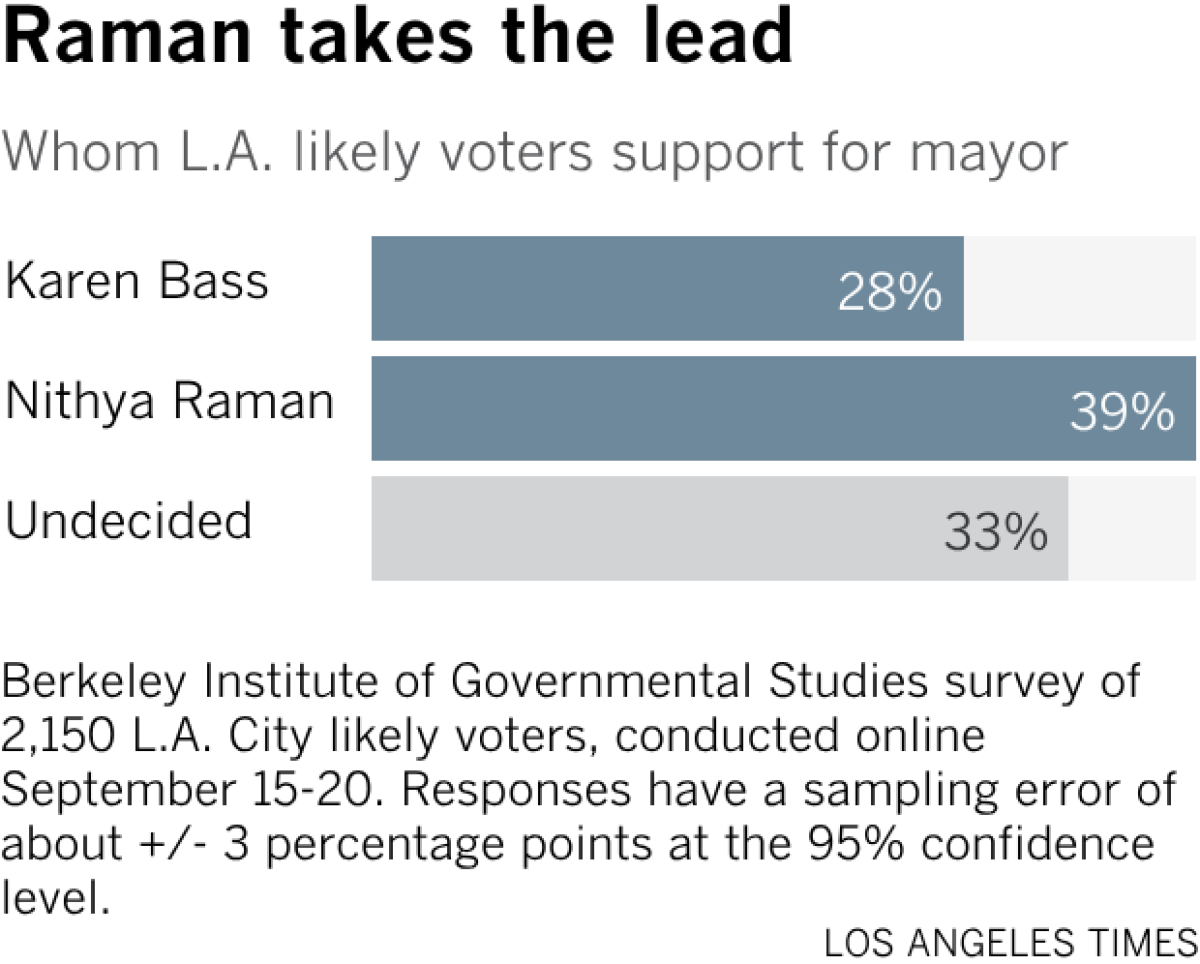
Pratt has been running in voter surveys behind Mayor Karen Bass, who is running for reelection, sometimes swapping places with Raman for second and third. He turned in a strong debate performance this month and has been outpacing his rivals in fundraising, according to the most recent disclosure reports.

While running for office, Pratt has blamed Bass for the 2025 wildfire that destroyed much of Pacific Palisades, including his home. He has railed against the city’s handling of homelessness, saying he would pursue a “treatment first” approach toward people with drug addiction who are living on the street.

Mayoral candidate Spencer Pratt, back to the camera, speaks with supporters

Mayoral candidate Spencer Pratt, back to the camera, speaks with supporters Saturday during a community meet-and-greet event.

(Etienne Laurent/For The Times)

Pratt said recently that he wants to increase Los Angeles Police Department staffing to 12,500 officers over the next decade, up from about 8,600. Speaking with one supporter on Saturday, he said the city needs to “make sure all the laws are being enforced.”

“Plenty of functioning cities enforce their laws,” he said.

That message resonated with many of the people in line.

“He is advocating for the safety and security of our families — specifically, for mothers to be able to walk their kids to school,” said Saba Lahar, a resident of Sherman Oaks, moments after talking to the candidate.

Pratt fans dropped off ballots, picked up lawn signs and stopped to pick up coffee drinks from the Hustle N Dough doughnut truck parked out front.

Some showed up even though they cannot cast ballots in L.A.

A man photographs his father holding a "Pratt for L.A. Mayor" sign in the street

Ruben Jr., no last name given takes a picture of his father during mayoral candidate Spencer Pratt’s community meet-and-greet Saturday in Sherman Oaks.

(Etienne Laurent/For The Times)

Brian Rodda, who runs a walking food tour company, described himself as “an unsatisfied Angeleno” even though he lives in West Hollywood, which is not part of the city of L.A.

“Sadly, because I do live in West Hollywood, I cannot vote for him,” he said. “But I certainly think we need a change.”

Source link

Colorado governor commutes election denier Tina Peters’ sentence after Trump pressure

Colorado Gov. Jared Polis on Friday commuted the sentence of election conspiracy theorist Tina Peters following pressure from President Trump, the latest instance of the president using his influence to reward those who echoed his baseless claims of mass fraud as the cause of his 2020 election loss.

Trump has championed the case of Peters, a 70-year-old former county clerk who was sentenced to nine years behind bars after being convicted in a scheme to make a copy of her county’s election computer system. She will be released June 1.

In April, a Colorado appeals court upheld her conviction but ordered Peters to be resentenced because it said the judge who sent her to prison wrongly punished her for speaking out about election fraud, a decision that Polis praised.

In a letter to Peters, Polis wrote that she was convicted of serious crimes and deserved to spend time in prison. “However, this is an extremely unusual and lengthy sentence for a first time offender who committed nonviolent crimes,” the governor wrote.

He added that Peters’ application “demonstrates taking responsibility for your crimes, and a commitment to follow the law going forward.”

Trump posted around the time of the announcement on his social media platform: “FREE TINA!”

A woman wears a We the People pin along with numerous Free Tina Peters stickers

Jeany Rush, 76, wears a We the People pin along with numerous Free Tina Peters stickers during the Colorado Republican State Assembly on April 11 at Massari Arena on the Colorado State University Pueblo campus in Pueblo, Colo.

(Timothy Hurst/MediaNews Group/The Denver Post via Getty Images)

‘Affront to the rule of law’

Colorado Secretary of State Jena Griswold criticized the decision by the governor — a fellow Democrat — saying that “it was a dark day for democracy” and that ”selling out our state’s justice system for Trump is an affront to the rule of law.”

“A clear message is being sent to those willing to break the law and attack democracy for the president — they will likely not face consequences for their actions,” Griswold said at a news conference.

Peters has been serving her sentence at a prison in Pueblo after being convicted in 2024 by jurors in Mesa County, a Republican stronghold that supported Trump.

Peters sneaked in an outside computer expert, an associate of MyPillow Chief Executive Mike Lindell — a fellow election denier — to make a copy of her county’s Dominion Voting Systems election computer server as state officials updated it in 2021. Peters joined Lindell onstage at a “cybersymposium” that promised to reveal proof of election rigging, after which video and photos of the update, including passwords, were posted online.

After the commutation announcement, Peters issued a statement through her attorney thanking Polis and apologizing.

“Five years ago I misled the Secretary of State when allowing a person to gain access to county voting equipment. That was wrong,” Peters said. “I have learned and grown during my time in prison and going forward I will make sure that my actions always follow the law, and I will avoid the mistakes of the past.”

She also condemned threats and violence against voters, county clerks and election workers.

Gubernatorial candidates weigh in

Polis is ineligible to seek reelection due to term limits, and the candidates running to succeed him weighed in on his decision.

Sen. Michael Bennet, a Democrat in the race, said that he vehemently disagreed with the commutation and that Peters knowingly broke the law, undermined elections and was convicted by a jury.

“Lawlessness only breeds more lawlessness,” Bennet said. “With President Trump continuing to attack Colorado, we must do everything we can to stand strong for our institutions and the rule of law.”

A Republican candidate, state Sen. Barbara Kirkmeyer, said she would have preferred that the trial judge revisit Peters’ sentence as ordered by the appeals court before the governor considered any commutation.

“A commutation or pardon by a governor should be reserved for truly extraordinary circumstances,” Kirkmeyer wrote in a statement. “The governor has a responsibility to apply justice fairly, consistently, and without bias.”

Trump’s influence

Peters was convicted of state, not federal, crimes, which put her beyond the reach of Trump’s pardon power, which he used to free those convicted of crimes for the Jan. 6, 2021, attack on the U.S. Capitol. So the president championed her cause through the media.

Trump has lambasted both Polis, calling him a “Scumbag Governor,” and the Republican district attorney who prosecuted her, Daniel Rubinstein, for keeping Peters in prison. He has referred to Peters as “elderly” and “sick.” Earlier this year, Trump uninvited Polis from a White House meeting with governors over the case.

The president had said Colorado was “suffering a big price” for refusing to release her. His administration has been choking off funds, ending federal programs and denying disaster aid. It also announced the dismantling of the National Center for Atmospheric Research in Colorado and relocated the U.S. Space Command from the state to Alabama.

Matt Crane, executive director of the Colorado County Clerks Assn., said the commutation “signals that it is open season on our election and election officials.”

“Gov. Polis is bending the knee to the same political voices and conspiracy theories that are undermining belief in our democratic institutions,” Crane said. “This is now Gov. Polis’ legacy. He will not be able to run from it.”

Peters’ health

Peters’ lawyers have said her health has declined in prison. Peters, who had part of her right lung removed in 2017, started coughing frequently after the prison’s heating system was turned on for the winter and has had trouble sleeping due to chronic pain from fibromyalgia, her lawyers said.

In January, Peters was involved in a scuffle with another inmate but was found not guilty of assault following a prison disciplinary hearing, Colorado Department of Corrections spokesperson Alondra Gonzalez-Garcia said. Peters was found guilty of being in a location without authorization.

The federal Bureau of Prisons tried but failed to get Peters moved to a federal prison. In January, Polis said he was considering granting clemency for Peters, calling her sentence “unusual and harsh“ for a first-time, nonviolent offender. In March he repeated those arguments in a lengthy post on the social media platform X.

Polis defended his decision Friday in a social media post.

“I’ll always stand for free speech and to make sure that we live in a country that no matter what your viewpoints are, you are not incarcerated longer because of them,” Polis said.

In contrast to some other Democratic governors, Polis, who portrays himself as a political iconoclast, has at times taken an accommodating stance toward Trump. Though he criticized the president’s tariff and immigration policies, the governor praised earlier moves by Trump such as creating the Department of Government Efficiency, which was run by billionaire Elon Musk, and the choice of vaccine critic Robert F. Kennedy Jr. to run the Department of Health and Human Services.

Slevin and Riccardi write for the Associated Press. AP writers Ali Swenson in New York, Jacques Billeaud in Phoenix and Audrey McAvoy in Honolulu contributed to this report.

Source link

Bolivia launches early-morning crackdown on roadblocks outside La Paz | Protests News

Military and law enforcement clashed with demonstrators outside La Paz, Bolivia, in an attempt to clear roadways that had been blocked as part of nationwide antigovernment protests.

As many as 3,500 soldiers and police were deployed as part of the operation that began in the early hours of Saturday. Around 57 people were arrested, according to the citizens’ rights ombudsman’s office.

Miners, schoolteachers, Indigenous groups and unions have helped to organise the protests, which aimed to convey outrage against the government of centre-right President Rodrigo Paz.

Bolivia is in the grips of an historic economic crisis, considered the worst the country has seen in decades.

The government’s foreign currency reserves have cratered, as exports from Bolivia have slowed down.

Key among those was natural gas. Vast reserves of the fuel were discovered in the late 20th century, and for nearly three decades, those natural gas deposits powered Bolivia’s economy, transforming the South American country into a major energy exporter.

But in 2022, the dynamic switched, amid mismanagement and dwindling supplies. Since then, Bolivia has had to import fuel from abroad, exacerbating its economic crisis.

Currently, many parts of the country have experienced long lines for fuel and shortages of basic supplies like food.

Paz, who was elected in October, had campaigned on alleviating the economic stress. But since taking office, he has spurred outrage by ending a two-decade-old fuel subsidy and pushing to privatise state-owned companies.

Earlier this month, the protests forced the repeal of a land reform measure, Law 1720, that critics claimed could be used to dispossess small, rural landowners, in favour of bigger holdings.

The Bolivian government has estimated that 22 roadblocks have been erected across the country in recent weeks.

Some of the protesters have demanded Paz’s resignation: His election in October marked the end of nearly two decades of rule by the Movement for Socialism (MAS).

But Paz’s office has blamed the demonstrations for cutting off key supplies to cities like La Paz, which holds the seat of government.

Food prices have increased since the blockades began, and the government claims three people have died after being unable to reach hospitals.

According to presidential spokesperson Jose Luis Galvez, Saturday’s crackdown on the protesters was designed to create a “humanitarian corridor” to ensure the free flow of supplies to hospitals in La Paz.

Earlier this week, Paz also thanked his Argentinian counterpart, Javier Milei, for delivering humanitarian assistance to Bolivia.

“This gesture of solidarity not only strengthens the historic bonds of brotherhood between our nations, but also represents vital relief for our communities in times of great need,” Paz wrote on social media on Friday.

Milei responded by denouncing the protesters as anti-democratic.

“Argentina stands with the Bolivian people and supports their democratically elected authorities against those who seek to destabilise the country and obstruct the path toward freedom and progress,” the Argentinian president said.

Source link

In Montgomery, thousands rally to defend voting rights

Thousands of people rallied Saturday in the cradle of the modern civil rights movement to mobilize a new voting rights era as conservative states dismantle congressional districts that helped secure Black political representation.

U.S. Sen. Cory Booker of New Jersey called Montgomery “sacred soil” in the fight for civil rights.

“If we in our generation do not now do our duty, we will lose the gains and the rights and the liberties that our ancestors afforded us,” Booker said in the Alabama capital.

The crowd was led in chants of “we won’t go back” and “we fight.”

“We are not going down without a fight. We are not going down to Jim Crow maps,” Shalela Dowdy, a plaintiff in the Alabama redistricting case said, alluding to racial gerrymandering in several states that has followed the recent Supreme Court decision to roll back the Voting Rights Act.

A crowd of thousands gathered in front of the city’s historic Alabama Capitol, where the Confederacy was formed in 1861 and where the Rev. Martin Luther King Jr. spoke in 1965 at the end of the Selma-to-Montgomery voting rights march. The stage, set in front of the Capitol, was flanked from behind by statues of Confederate President Jefferson Davis and civil rights icon Rosa Parks — dueling tributes erected nearly 90 years apart.

Speakers said the spot was once the temple of the Confederacy and transformed into holy ground of the civil rights movement.

Some in the crowd said the effort to redraw lines has echoes of the past.

“We lived through the ’60s. It takes you back. When you think that Alabama’s moving forward, it takes two steps back,” said Camellia A. Hooks, a 70-year-old Montgomery resident.

The rally began in Selma, where a violent clash between law enforcement and voting rights activists in 1965 galvanized support for passage of the Voting Rights Act. It then moved to the state Capitol, where King gave his “How Long, Not Long” speech the same year.

The Supreme Court ruling involving Louisiana hollowed out a tenet of the Voting Rights Act that was already weakened by a separate high court decision in 2013 and then narrowed further over the years. That helped clear the way for stricter voter ID laws, registration restrictions and limits on early voting and polling place changes, including in states that once needed federal pre-clearance before they could change voting laws because of their historical discrimination against Black voters.

Veterans of the civil rights movement are alarmed by the speed of the rollbacks, noting that protections won through generations of sacrifice have been weakened in little more than a decade.

Kirk Carrington, 75, was a teen in 1965 when law enforcement officers attacked marchers in Selma on what became known as Bloody Sunday. A white man on a horse wielding a stick chased Carrington through the streets on that day, he said.

“It’s really just appalling to me and all the young people that marched during the ’60s, fought hard to get voting rights, equal rights and civil rights,” Carrington said. “It’s sad that it’s continuing after 60-plus-odd years that we are still fighting for the same thing we fought for back then.”

The effect in Montgomery

Montgomery is home to one of the congressional districts that is being altered in the wake of the Supreme Court ruling.

A federal court in 2023 redrew Alabama’s 2nd Congressional District after ruling that the state intentionally diluted the voting power of Black residents, who make up about 27% of its population. The court said there should be a district where Black people are a majority or near-majority and have an opportunity to elect their candidate of choice.

But the Supreme Court cleared the way for a different map that could let the GOP reclaim the seat. While the matter remains under litigation, the state plans special primaries Aug. 11 under the new map.

Democratic Rep. Shomari Figures, who won election in the district in 2024, said the dispute is not about him but rather people’s opportunity to have representation.

“When Republicans are literally turning back the clock on what representation, what the faces of representation look like, what the opportunities, legitimate opportunities for representation look like across this country, then I think it starts to resonate with people in a little bit of a different way,” Figures said.

Alabama House Speaker Nathaniel Ledbetter, a Republican, said the Louisiana ruling provided an opportunity to revisit a map that was forced on the state by the federal court.

“People tend to forget what happened. When this thing went to court, the Republican Party had that seat, congressional seat 2,” Ledbetter said last week. “There’s been a push through the courts to try to overtake some of these red state seats, and that’s certainly what happened in that one.”

Evan Milligan, the lead plaintiff in the Alabama redistricting case, said there is grief over the dismantling of the Voting Rights Act, but it is crucial that people recommit to the fight.

“We have to accept that this is the new reality, whether we like it or not,” Milligan said. “We don’t have to accept that this will be the reality for the next 10 years or two years or forever.”

Chandler writes for the Associated Press.

Source link

Poll shows Lula and Bolsonaro tied before Brazil’s presidential election | Elections News

Right-wing challenger Flavio Bolsonaro faces new scrutiny over a film funding scandal, which could affect his race against incumbent Lula.

A new poll has reaffirmed the tight race for Brazil’s presidency this year, with both the left-wing incumbent Luiz Inacio Lula da Silva and his right-wing challenger, Flavio Bolsonaro, tied in a head-to-head contest.

On Saturday, Datafolha, the polling firm for the Grupo Folha media conglomerate, released its latest numbers, tracking the candidates’ progress in the run-up to October’s generation election.

Recommended Stories

list of 3 itemsend of list

Nearly 2,004 responded to the latest survey, which asked them to identify whom they would vote for if Lula and Bolsonaro progressed to a run-off.

Lula, now 80 years old, is angling for a fourth nonconsecutive term.

Brazil’s presidents are limited to two four-year terms at a time, and Lula first served as president from 2003 to 2011, championing social programmes to reduce hunger and increase federal assistance to the poor.

Bolsonaro, on the other hand, is hoping to continue his father’s far-right political legacy. The eldest son of imprisoned former President Jair Bolsonaro, Flavio — a senator representing Rio de Janeiro — has pledged to seek his father’s release should he be elected.

Jair Bolsonaro is currently serving a 27-year prison sentence for attempting to plot a coup and subvert the election results in 2022, which saw an end to his term and the beginning to Lula’s latest.

Saturday’s poll results put Lula and the younger Bolsonaro in a dead heat.

Both candidates received 45 percent of the polled voter support, with an additional 9 percent indicating they would cast “null” ballots. The remaining 1 percent was undecided.

But the poll, conducted on May 12 and 13, was conducted before the latest scandal involving the younger Bolsonaro’s campaign gained public traction.

Controversy over film deal

On May 13, The Intercept Brasil, a news publication, printed a report containing leaked WhatsApp messages between Bolsonaro and a banker arrested for an alleged fraud scheme, Daniel Vorcaro.

Bolsonaro had reportedly approached Vorcaro to finance a film about his father’s life, called Dark Horse.

The Bolsonaro family has long maintained that Jair Bolsonaro is a victim of political persecution, and it had tapped US actor Jim Caviezel to play the ex-president.

According to The Intercept’s reporting, Flavio Bolsonaro and his brother Eduardo Bolsonaro had soliciting funding from Vorcaro, who ultimately pledged $24m, or 134 million Brazilian reals, to the film project.

In a statement, Flavio Bolsonaro acknowledged that he had reached out for financing, but he denied the exchange had anything to do with Vorcaro’s alleged fraud scheme.

“It is necessary to separate the innocent from the criminals,” the statement said. “In our case, what happened was a son seeking PRIVATE sponsorship for a PRIVATE film about his own father’s life.”

Left-wing lawmakers, however, have called for an investigation into the incident.

The controversy over the Dark Horse film is not the only scandal to have rocked Flavio Bolsonaro’s presidential campaign in recent months.

In December, the senator entered the presidential race with his imprisoned father’s blessing.

But shortly afterwards, he faced criticism for statements appearing to suggest he might withdraw from the race in exchange for his father’s freedom. He later clarified that his candidacy was “irreversible”.

In April, Brazil’s Supreme Court also gave the go-ahead for federal police to investigate whether Flavio Bolsonaro had made defamatory statements about Lula.

While Lula was the frontrunner by a wide margin in late 2025, Bolsonaro has since narrowed the gap, leading to the two candidates racing neck and neck before October’s election.

Source link

Francesca Albanese on Israeli sexual violence suffered by Palestinians | Politics

Francesca Albanese speaks to Redi Tlhabi on sexual violence against Palestinians by Israeli forces and its coverage.

A recent New York Times article highlighted the sexual violence suffered by Palestinians at the hands of Israeli forces. But the allegations have been documented for years by human rights groups and Palestinian organisations. So why does the world only seem to pay attention when a Western news organisation does?

This week on UpFront, Redi Tlhabi speaks with UN Special Rapporteur Francesca Albanese about sexual violence, Israeli impunity – and the double standards of Western attention.

Source link

State Begins Accepting Gays’ Domestic Partner Sign-Ups

Citing reasons financial, emotional and political, hundreds of gays and lesbians around California took advantage of a new law Monday and began the process of registering with the state as domestic partners.

To some it seemed a giant step, to others a baby step, toward full recognition of their relationships.

“We are involved in a commitment with caring and loving and all the things I hear people say about their husbands and wives,” said Sam Catalano, a state employee who hummed the wedding march as he and his partner paid $10 to become registered couple No. 66 at the secretary of state’s office in Sacramento.

“But today I have gained one benefit, and those married couples have 1,400,” he said, citing federal studies that estimate more than 1,000 legal benefits of marriage.

Actually, the legislation signed into law last year by Gov. Gray Davis–AB 26 by Assemblywoman Carole Migden (D-San Francisco)–affords some same-sex couples two benefits: hospital visitation rights (which could otherwise be restricted to family members) and health insurance coverage for the dependents of government employees covered by CalPERS, the state retirement system.

With the new law, California became one of the nation’s pioneers in domestic partner policies. Twelve California cities and four counties, including Los Angeles, have their own policies giving health benefits to domestic partners, as do many corporations.

In Vermont last month, the state Supreme Court ruled that homosexual couples are entitled to all benefits and protections related to marriage. And in October, France became the first European nation to legalize civil solidarity pacts.

Across the country, 30 states have enacted laws to prevent same-sex marriages from being recognized, a Californians will decide on such a proposal in the March 7 primary election.

Tens of thousands of couples are expected to register under the domestic partners law. Same-sex couples are eligible, along with heterosexual couples over age 62, who sometimes hesitate to marry because of potential cuts in their Social Security income.

State analysts have no estimate of how much the registrations will cost the state and local governments.

State construction supervisor Billie Norman has been with her partner, Beverly Thames, for 14 years. Every year she has applied to add Thames to her health plan. Every year her application has been rejected.

“I could marry a man tomorrow and they’d give me insurance for him,” Norman said, flashing one of the matching diamond engagement rings the two wear. “We’re stable, we’re homeowners, we’re civil servants. There ought to be recognition of that.”

The state registration program signals a social shift, Norman said, that inches her and Thames closer to the Elvis-themed wedding they hope to have someday. Similar domestic partner bills passed the Legislature in 1994 and 1998 only to be vetoed by former Gov. Pete Wilson.

In March, California voters will vote on Proposition 22, the Limit on Marriages Act spearheaded by state Sen. Pete Knight (R-Lancaster), which would bar California from recognizing same-sex marriages. No state currently permits same-sex marriage, but some have court cases or legislation pending that could change the situation.

Proposition 22 spokesman Robert Glazier said the campaign has taken no position on domestic partnership registration, but “if someone wants to change marriage in California, they should do it in a very upfront way, not through a back door.”

Members of the “No on Knight” camp that opposes the measure predicted that publicity about partnership registration will work in their favor, highlighting the discrimination they believe gays and lesbians face in California and “how the Knight initiative will further discriminate against them,” said campaign manager Mike Marshall.

A small line of applicants greeted secretary of state employees when they arrived at 8 a.m. Monday to open the special filings desk, which falls under the ironically named “Limited Partnerships” division. All through the day couples wandered in, many having just learned of the opportunity in news accounts over the weekend.

By day’s end, spokesman Shad Balch said 71 couples had registered in Sacramento and at four branch offices around the state and hundreds more had taken out applications.

Among them were retirees and young people, middle class and poor, outspoken and shy. One couple has lived together for 29 years, another for three. For some it was the first official documentation of their relationship, for others one of a series of acknowledgments: city registrations, commitment ceremonies and corporate benefit extensions.

Ken Day, Catalano’s partner, said many gay couples they know are reluctant to even bother with the paperwork, a simple one-page form that can be mailed to the secretary of state but must be notarized.

Some think “it’s unnecessary and derivative,” he said. Others, he said, rolling his eyes, think the very idea is “too heterosexual.” A few were not ready for the commitment, which hinges on a pledge of joint responsibility for living expenses.

Among the many rights the state accords to married people but the new law does not extend to same-sex couples are Social Security benefits, inheritance provisions and health coverage after the death of the state employee. It does not give them any of the tax benefits of marriage, and they will not have the right to make medical decisions for each other.

Nor does the law untangle the complicated and expensive arrangements that gay and lesbian couples with children make to share health benefits with, and legal responsibility for, their children.

California Youth Authority counselor Cathyann Intemann spent $4,700 to adopt her partner’s daughter so she could count her as a dependent for her state health benefits. The couple rejoiced on learning Sunday that the new law would take effect in time to cover their second child, due this spring.

Intemann’s partner is a stay-at-home mother who estimated that she pays at least $3,000 a year for her own health insurance. “The bottom line is this saves us money in our household,” Intemann said.

(BEGIN TEXT OF INFOBOX / INFOGRAPHIC)

How to Register

The secretary of state’s office recommends that domestic partners mail registration forms to the Sacramento office, P.O. Box 944225, Sacramento, CA 94244-2250. Both partners’ signatures must be notarized and a fee of $10 enclosed. Forms are available at county clerks’ offices and online at https://www.ss.ca.gov, and can be filed in person at the secretary of state’s offices in these cities:

* Fresno: 2497 West Shaw Ave., Suite 101

* Los Angeles: 300 South Spring St., Room 12513

* San Diego: 1350 Front St., Suite 2060

* San Francisco: 455 Golden Gate, Suite 7300

Source link

L.A. police union targets leftist mayoral candidate Rae Huang, who’s running in fifth

Good morning, and welcome to L.A. on the Record — our City Hall newsletter. It’s David Zahniser, with an assist from Connor Sheets and Sandra McDonald, giving you the latest on city and county government.

We’ve reached the point in L.A.’s city election season where a juicy piece of news is popping off every day.

With a little over two weeks until the June 2 election, the campaigns’ remarks are getting more scathing, the spending more expensive and the scramble by supporters to get their chosen candidates into the top two more intense.

Like everyone else, we’re struggling to keep track of it all. In the meantime, here are a few of the more unusual moments from the past week:

The police union targets fifth-place candidate Rae Huang

You’ve probably heard about the digital attack ads put out by the Los Angeles County Federation of Labor warning voters that reality TV personality Spencer Pratt is “the LAST thing Los Angeles needs.”

Savvy political players said it wasn’t an attack ad at all, but rather a thinly veiled bid by the County Fed, a group that supports Mayor Karen Bass, to boost Pratt’s chances of making the Nov. 3 runoff election. Those observers say the mayor and her allies would rather run against Pratt, a Republican in a heavily Democratic city, than Raman during the campaign’s second round.

Now, another ad is up. But this time it’s from the Los Angeles Police Protective League, another union that is backing Bass’ reelection.

The league reported Wednesday that it’s spending about $100,000 on digital ads against mayoral candiate Rae Huang, who has been polling in the single digits.

Like the County Fed ad focused on Pratt, it’s not so much a lacerating attack as it is a list of the candidate’s beliefs.

“She supports the anti-business Green New Deal to increase taxes on corporations to provide free public transportation,” the digital ad says.

Once again, political sophisticates see a ruse, saying the police union is trying to lift Huang’s profile among voters, helping her pull support away from one of Bass’ top rivals, Councilmember Nithya Raman. Such a scheme, if successful, would ensure that Pratt ends up in the top two.

Asked about its new ad, league spokesperson Tom Saggau said the union is alerting voters that Huang “hates cops, corporations and real estate developers and voters should be aware.”

“It’s extremely important for voters to know about Rae Huang’s reckless plans to dismantle the police department and blow the city budget with free public transportation and other giveaways,” he said.

Huang said on social media that the police union is going after her because “they know change is possible.” At the same time, she acknowledged the ads were somewhat flattering.

“I think LAPD’s a little scared of me because they just spent over $100,000 in attack ads against me,” she said in a campaign video. “But they’re making me look good, so … thank you!”

Rob Quan, who is part of the advocacy group Unrig LA, replied to Huang at one point on X.

“They aren’t trying to stop you they are trying to boost you,” he wrote.

Raman backers really want Huang to drop out

With the primary campaign nearly over, impatient Raman supporters have been taking matters into their own hands, calling on Huang to drop out and ensure that Bass faces an opponent to her left.

Evan Goodrich, a Raman voter who lives in Echo Park, said he wants Raman in the top two. Voters shouldn’t squander their chance at getting a progressive mayor and creating change at City Hall, he told The Times.

Goodrich, 31, was more blunt on social media.

“Your campaign is broke, you have a snowball’s chance in hell of winning, and you’re costing us the most progressive viable candidate we have. It’s time to drop out!!!” he wrote, in a response to a Huang post.

Huang, a member of the Democratic Socialists of America, said she’s not going anywhere.

During a Q-and-A posted on Reddit, she pushed back at the idea that her campaign is splintering the progressive vote, arguing that she views Raman as “neoliberal,” not progressive.

Raman has shifted her positions on police hiring, anti-encampment laws and Measure ULA, the tax on high-end real estate sales, Huang’s campaign said.

“I would not consider Nithya to be a progressive candidate, full stop. I do see her as being continuing to be a part of the establishment,” Huang said.

Huang did acknowledge that she sees Raman as being to the left of Bass.

Raman accuses Bass of ‘pay-to-play’ politics

As she battles to get into the top two, Raman launched a broadside against Bass this week, accusing her of engaging in multiple “pay-to-play” deals.

In a burst of social media posts, she accused Bass of negotiating “a sweetheart LAPD Union contract that bankrupted the city and a convention center expansion that will cost us over $4 billion after debt payments.” Special interests that supported those deals are now reciprocating, Raman said, by campaigning for the mayor.

Raman offered what she said is a fresh example of pay-to-play politics: the mayor’s push to allow owners of second homes to rent those places out on Airbnb or other short-term platforms, a practice currently prohibited by city law.

The Central City Assn., which supports the move, announced plans this week to spend $1 million on a campaign supporting Bass. A large part of its funding is coming from Airbnb, which also favors the idea. The downtown-based business group also supported Bass on the Convention Center.

“This is what pay-to-play politics looks like,” Raman said.

Bass has been defending her policy moves, saying the police raises were needed to keep officers from taking more lucrative jobs in other cities. The Convention Center expansion will boost tourism and a struggling downtown, Bass said.

The mayor also reiterated her support for the vacation rental policy, saying it would only be temporary, generating additional taxes for the city while ensuring more beds are available for the 2028 Olympic Games.

You’re reading the L.A. on the Record newsletter

Sign up to make sense of the often unexplained world of L.A. politics.

Bass campaign spokesperson Alex Stack called the allegations “another conspiracy theory from a failing candidate who is grasping at straws after her debate disasters and polling showing she won’t make the runoff.”

“The City should absolutely be exploring every way to maximize the economic benefit from the Olympics and to generate revenues paid by visitors, not Angelenos,” he said in a statement.

Nella McOsker, who heads the CCA, struck a similar note, praising Bass for supporting pro-business policies and calling Raman’s assertions “ridiculous.”

Wait, there’s a sheriff’s race?

If the mayor’s race has been blowing up, the contest for Los Angeles County Sheriff has been downright sleepy.

Sheriff Robert Luna, now seeking a second 4-year term, holds a substantial financial edge over the rest of the field, according to the most recent batch of fundraising reports.

In mid-April, Luna had more than $738,000 cash on hand, compared to about $114,000 for former Sheriff Alex Villanueva, who is attempting a comeback. Each of the other challengers had less than $50,000, spending reports show.

Sheriff’s Capt. Mike Bornman, one of the eight candidates running to unseat Luna, said the campaign had a single candidate forum in Compton, and that neither Luna nor Villanueva took part.

State of play

— BERN NOTICE: U.S. Sen. Bernie Sanders announced Friday he is endorsing a handful of council candidates: Eunisses Hernandez on the Eastside, Hugo SotoMartínez in Hollywood, Faizah Malik on the Westside and Estuardo Mazariegos in South L.A. Sanders is also backing Deputy Atty. Gen. Marissa Roy in her bid for city attorney.

— HITTING THE MOTHERLODE: You can’t put a price on a mother’s love. Or can you? The independent expenditure committee working to elect city controller candidate Zach Sokoloff, bankrolled by his mother Sheryl Sokoloff, continued its campaign spending spree this week, reporting it had paid out nearly $4.8 million by Thursday. The latest tranche of money went toward attack ads against City Controller Kenneth Mejia.

— WAGE WARS: The City Council took the first step Wednesday toward scaling back a planned $30 hourly minimum wage for hotel and airport workers, in the hope of persuading business leaders to drop a planned ballot measure to repeal the city’s business tax. Under the plan, the hourly wage would reach $30 in 2030, instead of summer 2028. The move is not final and more deliberations are planned next week.

— OLYMPIC ANGST: State lawmakers pressed organizers of the 2028 Olympic Games about the effort to secure federal funding, pointing to Trump’s animosity toward California. Joey Freeman, vice president of state affairs for the LA28 Organizing Committee, assured legislators that his committee has a “wonderful working relationship” with the Trump administration. L.A. is on the hook for hundreds of millions of dollars if the games lose serious money.

— POLL POSITION: A new voter survey showed Bass continuing to lead the pack of candidates in the mayor’s race, with Pratt in second and Raman third. Paul Mitchell, vice president of voter data firm Political Data Inc., questioned the poll’s accuracy, saying it oversampled Latinos and undersampled people over 50.

— DUMPING THE DEBATE: The FOX11 mayoral debate that had been planned for this week was canceled after Bass and Raman pulled out. Pratt had already declined to attend the event.

— TARGETING TAXES: L.A. County voters historically have been generous about sales tax hikes, signing off on increases to pay for public transit and homeless servcies. But with the public reeling from soaring gas prices and other rising costs, some are wondering if they will get behind Measure ER, a half-cent sales tax hike to pay for healthcare programs.

— DIGITAL FIRST: TV ads used to dominate in L.A. mayoral campaigns. But this year, candidates have been relying heavily on social media, posting snappy, off-the-cuff videos in the hope of going viral.

— REALITY, STARS: Songwriter/producer David Foster and his wife Katharine McPhee held a star-studded fundraiser for Pratt at their home, one that featured McPhee singing a parodied version of Tina Turner’s “The Best,” according to a video posted on X. Pratt has been scooping up donations from a number of Hollywood players, including Universal Music Group chief executive Lucian Grainge and Sandra Rebish, also known as TLC’s Dr. Pimple Popper.

QUICK HITS

  • Where is Inside Safe? The mayor’s signature program to combat homelessness went to Boyle Heights this week, tackling encampments at Hollenbeck Park and at the entry to the Sixth Street Bridge. The area is represented by Councilmember Ysabel Jurado.
  • On the docket next week: The council meets Tuesday to take another stab at renegotiating the terms of the $30-per-hour wage hike for airport and hotel workers.

Stay in touch

That’s it for this week! Send your questions, comments and gossip to LAontheRecord@latimes.com. Did a friend forward you this email? Sign up here to get it in your inbox every Saturday morning.

Source link

Tens of thousands march in London in far-right and pro-Palestine protests | Protests News

British capital sees heightened security as right wing rally takes place at the same time as Nakba Day march.

Tens of thousands of people are marching through central London in two separate protests – one pro-Palestine demonstration a day after Nakba Day, and the other, a far-right rally staged by Tommy Robinson.

Police in the British capital deployed 4,000 officers, including reinforcements from ⁠outside the city, on Saturday and pledged “the most assertive possible use of our powers” in what they called their biggest public order operation in years.

Recommended Stories

list of 3 itemsend of list

Armoured vehicles, horses, dogs, drones and helicopters were also deployed to manage the separate protest marches, the UK Metropolitan Police said.

By 1200 GMT, shortly after both marches started, police said they had made 11 arrests for a range of offences. They had earlier forecast ⁠turnout of at least 80,000 – about 50,000 at Robinson’s “Unite the Kingdom” march, and 30,000 more expected to go to the Nakba Day rally.

Authorities had imposed various conditions on the two rallies over their routes and timings, in a bid to keep rival attendees apart.

Prosecutors were told to consider whether certain protest placards or chants may amount to offences and stir up aggression during the rallies.

“This is not about restricting free speech,” said the Crown Prosecution Service’s director, Stephen Parkinson. “It is about preventing hate crime and protecting the public, particularly at a time of heightened tensions.”

The police force, which estimates its operation will cost 4.5 million pounds ($6m), warned in a statement that it would adopt “a zero-tolerance approach”. That includes, for the first time, making organisers legally responsible for ensuring invited speakers do not break hate speech laws.

The British government earlier blocked 11 foreign nationals from entering the country for the “Unite the Kingdom” rally. Right-wing figures claiming to have been barred include Polish politician Dominik Tarczynski, Belgian politician Filip Dewinter, Colombian-American anti-Islam commentator Valentina Gomez and Dutch activist Eva Vlaardingerbroek.

On the eve of demonstrations, Prime Minister Keir Starmer warned: “Anyone who sets out to wreak havoc on our streets, to intimidate or threaten anyone … can expect to face the full force of the law.”

Starmer – facing intense pressure within his ruling Labour party to quit after far-right Reform UK scored huge wins in local elections last week – accused the organisers of Saturday’s far-right rally of “peddling hatred and division”.

Last September, far-right activist Robinson – whose real name is Stephen Yaxley-Lennon – drew about 110,000 people into central London for a similar rally proclaiming “national unity, free speech and Christian values”.

X owner Elon Musk addressed that event, which shocked many in the UK for its scale, directness, and clashes between participants and police, which injured dozens of officers.

Meanwhile, the Stand Up to Racism group has combined its antifascism march with the pro-Palestine event to mark Nakba Day, held annually on March 15 to commemorate the 1948 mass expulsion of Palestinians from their land during the establishment of the state of Israel.

The Met said live facial recognition would be used for the first time to police the protests.

Source link

Cracked L.A. sidewalks are a symptom of a bigger breakdown

When I wrote last week about one of my favorite mountain ranges — L.A.‘s sidewalks — I immediately began fielding questions.

People wanted to know about the scoring system that awarded just 15 points, out of 45, to John Coanda and his wife, Barbara, who uses a wheelchair because of ALS. The Mar Vista couple had applied to the city’s Safe Sidewalks program to have some busted-up sidewalk in front of their home repaired.

With several sidewalk hazards on both sides of their block, Barbara can’t safely make it down her street. So how is it possible that under L.A.’s “Sidewalk Repair Program Prioritization and Scoring System,” their meager 15 points means they could be waiting “in excess of 10 years” for help?

I have the answers.

The Coandas got 15 points for being in a residential zone. But they didn’t meet the requirements for getting two additional awards of 15 points. They do not live within 500 feet of a bus or transit stop. And they had not been in the sidewalk repair backlog queue for more than 120 days.

It is not clear, however, that moving up to a score of 30 will bring out city work crews in less than 10 years. Knowing what I know, I wouldn’t bet on it.

The scoring system exists because in a lawsuit settlement 10 years ago, the city agreed to spend $1.4 billion over 30 years to repair damaged sidewalks and other infrastructure failures that impede the mobility of people with disabilities.

But there’s a backlog. A huge backlog, in the thousands. At my request, the city disclosed on Friday that it’s receiving about twice as many new disability-access repair requests each year as it’s addressing. In addition, the backlog for disability access requests and from residents applying for a sidewalk repair rebate program stands at roughly 30,000, with about 600 repairs being made each year.

As I said in a previous column, L.A. might indeed be all buttoned up by the ‘28 Olympics, but that would be 3028, not 2028.

Cracked sidewalks, to be clear, are but a symptom of a deeper, decades-long breakdown at City Hall. Basic services have been sacrificed to pay for employee compensation and pension costs the city can’t afford, with homeless services adding to the budget crisis.

By the way, I heard from one reader in response to my suggestion last week that if you can’t wait 10 years or more for the city to fix a broken sidewalk, you can apply to the rebate program, which will cover a portion of repairs. Don’t bother, said Lori Lerner Gray, who owns a house in Silver Lake and applied two years ago, but finally gave up.

“There is a massive waiting list and it’s a very complicated procedure just to try to get on it, let alone speak with anyone to help,” Gray said. “Once you finally get into the program, it’s impossible to proceed because of permits, engineering reports and finally you are required to bring the entire area to ADA compliance on your own dime.”

She said she was told she’d have to pay to relocate a utility pole.

And sidewalks aren’t the only infrastructure problem, as other readers noted. The city is way behind on filling potholes, repaving streets, installing curb ramps, making park improvements and replacing broken lights. I recently wrote about all the blight around City Hall, including the graffiti-tagged monument and fountain that has been inoperable for most of the last 60 years.

Oren Hadar, a Mid-City resident who writes about housing and transportation on his The Future Is L.A. website, reported last year in a Times op-ed that city streets were falling apart because the city had switched from repaving entire roads to doing what it called “large asphalt repair.”

With the switch, the city avoided federal requirements to upgrade curb ramps on repaved streets, Hadar said. He told me that when he travels to other cities near or far, “I’m always jealous of everything. Sidewalks are in better shape or there are better bike lanes. … You could go to even Santa Monica or Culver City. You don’t have to go far to see infrastructure that’s better.”

Other major cities have had formal infrastructure plans for years, while L.A. has ducked and dithered. Finally, earlier this month, Mayor Karen Bass introduced the city’s long-awaited CIP (capital infrastructure program), and offered a brutal assessment of what went wrong.

“For too long,” she said in the executive summary, “information has been scattered across departments, buried in lengthy reports and budgets, and difficult to fully understand. These challenges have had real consequences, contributing to decades of underinvestment in our built environment.”

The summary reads like an indictment of City Hall leadership and the manner in which public spaces have deteriorated. With Bass running for reelection, voters have to decide whether her role in those failures is grounds for dismissal, or her campaign-season pitch for a new day should help earn her a second term.

The report, with backing by members of the City Council, cited “fragmented systems and data silos,” “no shared vision across city departments,” “growing maintenance deferrals,” “slow, inefficient capital planning,” no “project intake standards,” “highly decentralized and uncoordinated grants,” “resource planning and staffing misalignment,” and “opaque capital planning process.”

Way to go, team.

You could take many of those same critiques and apply them to the haphazard way in which city and county leaders have addressed homelessness.

However, the city’s infrastructure plan does offer a framework for assessing the damage and prioritizing projects, and using charter reform to create a public works director position with greater authority. None of this will happen quickly, and given the budget crunch, you might be wondering how any of this would be paid for.

The suggestions in the report include bonds, a parcel tax, grants, fees on tickets to concerts and sporting events, fees on taxi and rideshare trips, and much, much more. None of this will be popular, especially if the public is unconvinced that city leaders can be trusted with more money.

Urban planner Deborah Murphy, chair of the city’s pedestrian advisory committee, noted that L.A. has gotten grants or state funding in the past for specific projects and then, because of staffing shortages or other stumbles, failed to hold up its end of the deal.

“It kind of ruins our reputation for getting future money,” Murphy said.

Jessica Meaney, executive director of Investing in Place and a longtime advocate for the infrastructure plan, is thrilled that the city has finally taken this step.

“But the key question is: who is actually in charge of making it happen?” she asked.

It’s critical, Meaney suggested, for city leaders to push for charter reform that puts infrastructure authority under a newly empowered public works director. If the city gets this right, she said, implementation of the infrastructure plan “could finally show Angelenos the true scale of deferred maintenance, make trade-offs visible, and create a road map for better sidewalks, streets, parks, and accessibility.”

If the current fragmented authority remains in place, Meaney said, the headline would be:

“No one is in charge of your sidewalk and City Hall is determined to keep it that way.”

steve.lopez@latimes.com

Source link

CIA director’s visit to Havana fuels questions over Cuba’s future

May 15 (UPI) — CIA Director John Ratcliffe’s visit to Havana this week opened a new political chapter inside and outside Cuba, with analysts and opposition figures interpreting the meeting as a sign of direct pressure from Washington on a regime battered by massive blackouts, fuel shortages and an increasingly deep economic crisis.

The trip marked an unusual development in bilateral relations. The Cuban government confirmed that a U.S. delegation led by Ratcliffe met with his counterpart Thursday at Cuba’s Interior Ministry.

Washington had requested the meeting, which was approved by “the leadership of the Revolution,” according to the state-run newspaper Granma.

The CIA released photos of the meeting — “the most significant milestone so far in the two months of opaque negotiations taking place between Washington and Havana,” Spanish newspaper El País reported.

In another twist, according to reports by CBS News, USA Today and NBC News, a U.S. Justice Department official said the United States is considering formally charging former Cuban President Raul Castro over a 30-year-old incident in which the Cuban government shot down two aircraft operated by Cuban exile group Brothers to the Rescue.

The Ratcliffe visit, which lasted a brief time, was not announced in advance. He him Air Force plane flew from Joint Base Andrews in Maryland and returned hours later.

For decades, the Cuban government systematically accused opposition figures, independent journalists and dissidents of acting as agents or collaborators of the CIA. However, it was the regime itself that officially announced the meeting with agency director.

“The Cuban government announced the CIA visit first. For Cubans, that means important things are happening or about to happen,” Sebastián Arcos, acting director of the Institute for Cuban Studies, told UPI.

“This increases expectations and anxiety inside and outside the island.”

Energy has become the central focus of Cuba’s crisis. Ratcliffe arrived on the island precisely as Cuba declared a total energy collapse, formally running out of diesel fuel because of the U.S. naval blockade, while multiple technical failures at thermoelectric plants have left millions of people without electricity for up to 22 hours a day.

According to posts shared by activists and users on Facebook, protests have spread across the Cuban capital for four consecutive nights, while reports of internet outages in areas where gatherings have taken place have increased, Diario de Cuba reported.

Professor Jorge Piñón, director of the Latin America and Caribbean Energy Program at the University of Texas’ Energy Institute, said the visit by the CIA chief to Cuban territory “puts on the table what the rules of the game are from the point of view of the United States,” amid a crisis he described as “hour zero” for Cuba’s energy system.

Piñón told UPI that Cuba has practically exhausted its fuel reserves at storage facilities, ports and refineries, while thermoelectric plants operate on the verge of technical collapse.

The consequences extend far beyond the lack of electricity.

Piñón warned that the crisis affects ground transportation, water and food distribution, agriculture and even humanitarian operations by religious organizations that lack diesel to transport aid.

The deterioration of the electrical system also stems from structural problems accumulated over decades. Cuba depends on thermoelectric plants more than 40 years old, many adapted to burn extra-heavy domestically produced oil with high levels of sulfur and contaminating metals.

According to Piñón, that fuel accelerates the deterioration of already obsolete equipment, generating a “vicious cycle” of temporary repairs and new breakdowns.

He said the island produces about 40,000 barrels a day of heavy crude, but needs about 100,000 barrels a day to cover its energy demand, leaving a critical deficit of refined fuels mainly intended for transportation.

At the same time, Professor Raúl Rodríguez, director of the Center for Hemispheric and United States Studies at the University of Havana, described a society marked by daily exhaustion, uncertainty and the progressive deterioration of living conditions.

He told UPI that prolonged blackouts affect food preservation, access to drinking water and hospital operations.

The crisis also has deep economic consequences. Tourism, one of Cuba’s main sources of foreign currency, operates at less than 50% of capacity, affecting employment and the flow of resources into the country.

Rodríguez estimated that about 300,000 workers linked to the tourism sector face direct impacts from the economic slowdown.

Additional problems include health and environmental issues stemming from the lack of fuel for fumigation, garbage collection and basic urban services. The academic warned of growing risks of mosquito-borne diseases such as dengue and chikungunya.

Despite intensifying social unrest, the experts agreed that the crisis will not necessarily lead to an immediate political change.

Rodríguez argued that protests over blackouts and shortages “do not constitute, by themselves, a trigger capable of provoking regime change,” due to the absence of an organized political alternative with social legitimacy.

Piñón, meanwhile, said that although signs of social exhaustion exist, the country currently lacks leadership capable of channeling a political transition or with enough authority to organize a possible post-crisis scenario.

According to press reports, the U.S. demands delivered directly by the CIA director focus on an ultimatum conditioned on deep and immediate structural changes.

Washington is demanding that the Cuban government carry out political reforms toward democratization, release all political prisoners and fully open the economy to the private sector.

“From the information that has emerged, the CIA director traveled to Cuba to deliver an ultimatum: either you move, or the United States will,” the Institute for Cuban Studies’ Arcos said.

The reaction of Miguel Díaz-Canel’s government has reflected pragmatism forced by extreme economic suffocation and the collapse of basic services on the island.

Although Havana agreed to receive the CIA delegation to avoid a violent social outcome, it formally maintains its rhetoric defending national sovereignty, rejecting political conditions that threaten the socialist system.

Cuban officials used the meeting to present evidence that the island does not represent a threat to U.S. security, demanding in return its removal from the list of state sponsors of terrorism and an end to the naval blockade preventing fuel shipments from reaching the island.

Describing the country’s daily deterioration, Cuban writer Leonardo Padura recently portrayed Cuba as a nation where old social protections have collapsed, while the political structure remains intact.

In an essay published on the website La Carta de las Ideas, Padura recalled that July 2021 protests represented an unprecedented social explosion on an island historically marked by strong surveillance and state control mechanisms.

The government response, he wrote, was a severe “order to fight” accompanied by exemplary judicial proceedings aimed not only at punishing, but also at discouraging future public expressions of dissent.

Padura said that precedent helps explain why, despite economic and social conditions now being even worse than in 2021, street demonstrations have been more limited than many outside Cuba expected.

Another expert thinks the United States will dominate as Cuba sinks into crisis.

“The CIA currently has the upper hand. Without the CIA, [President Donald] Trump can do nothing, and [Secretary of State Marco] Rubio knows nothing because he has never even been to Cuba,” Lillian Guerra, professor of Cuban and Caribbean history and director of the Cuba Program at the University of Florida, told UPI.

Guerra argued that the agency holds a dominant position over the Cuban state because of its understanding of the regime’s “theater and discourse of lies and subterfuge” amid the crisis.

Guerra said “nobody is buying” the government’s official explanations anymore and warned that Cuban authorities “are running out of time” as public frustration grows across the island.

She added that the meeting shows Washington is negotiating with Cuba’s “real leaders” linked to the Ministry of the Interior, a structure she described as more powerful than the Revolutionary Armed Forces and primarily focused on preserving political control.

Source link